Disclaimer

rbc_tl_disclaimer

The Strait of Hormuz has now been effectively closed for 69 days, and with global jet fuel prices now over US$180 per barrel—roughly double a year ago—the costs are showing up on earnings calls. Delta Air Line’s fuel bill is expected to rise by US$2.5 billion this quarter alone and the company has signalled higher fares and fees to help offset the costs. The disruption has already driven Spirit Airlines into bankruptcy, with the potential for more as prices remain elevated.

By the numbers: more than half of globally traded jet fuel is impacted

  • 23% of seaborne jet fuel flows directly through Hormuz, primarily to European markets.

  • 40-50% of global jet fuel exports originate from Asia, and those exports are down two-thirds from pre-crisis levels—starved of Middle Eastern feedstock.

  • China, a major Asian fuel exporter, reduced exports of jet fuel, diesel, and gasoline exports by as much as 33% in March to safeguard domestic market from disruptions.

  • With Europe getting 75% of its jet fuel net imports from the Middle East, the IEA warned in mid-April that parts of the region could run out by the end of May if countries don’t find alternatives

The bigger picture: energy security runs through the refinery as well

As Hormuz illustrates, energy security is not just about who controls the crude and (as is the case with critical minerals) final products matter. Along with China, South Korea and Thailand, which are also major fuel exporters, also capped shipments on most refined fuel exports as countries struggle with Middle East supplies or protect their domestic aviation sectors.

India’s response is instructive. Rather than scrambling for alternative imports, it moved to reduce structural exposure—amending its aviation fuel regulations to allow blending with domestic agricultural feedstock. Energy security and clean fuels became the same policy.

In Canada, an often-cited vulnerability has come to the fore

Canada’s physical exposure to Hormuz is limited, but Ontario and Quebec remain structurally reliant on imported refined petroleum products, of which jet fuel is the largest. That import dependency sits with the U.S., which is more than willing to use energy trade as leverage. The Hormuz crisis revisits a harder question for Canada: what is the right shape of tomorrow’s energy integration with the U.S.?

Sustainable Aviation Fuel (SAF): Where clean and secure meet?

Canada is different from Asia in one important respect: we sit on a lot of feedstock. Oil, of course, but also canola, tallow, and municipal waste, which flow into operating renewable diesel infrastructure, most notably in Strathcona, Alta., through Imperial Oil and Come by Chance refinery in Newfoundland and Labrador, Nfld., (Braya). Yet, Canada produces zero SAF.

SAF accounted for less than 1% of jet fuel consumed globally in 2025. That number is expected to climb to 4% by the end of the decade, according to BloombergNEF. And while energy security has not been part of that growth story, it could be the catalyst, as India proved, that brings new participants to the table. For Canada, that would not just be a domestic resilience argument—but a growing export opportunity for the energy and agricultural sector.​​​​​​​​​​​​​​​​

–Shaz Merwat, Energy Policy Lead

The surge in oil prices and another spike in gold exports pushed Canada’s trade balance back into surplus in March.

According to Assistant Chief Economist Nathan Janzen: “Significant trade uncertainty remains with negotiations on CUSMA renewal likely to intensify in coming months, but we continue to expect, as a base-case, that a more stable U.S. tariff backdrop in 2026 (albeit still at significantly higher tariff rates for some products) will leave trade as less of a headwind to growth than it was in 2025.”

Read more in ‘Canadian trade balance back in surplus as energy prices surge’ here.

U.S. trade court rejects Trump’s latest global tariff push

  • The U.S. Court of International Trade ruled against President Trump’s latest 10% global tariffs, finding the administration improperly used Section 122 of the Trade Act of 1974 to justify broad-based duties tied to trade deficits.

  • The decision is another legal setback for the administration’s tariff strategy following earlier rulings against the use of the International Emergency Economic Powers Act (IEEPA). The White House is expected to appeal and find other ways to implement tariffs.

Trump extends EU deadline while new regulatory disputes emerge

  • President Trump extended the deadline for the EU to implement elements of last summer’s trade arrangement until July 4, while warning tariffs could further increase if Brussels does not follow through on commitments.

  • Separately, major U.S. business groups are pushing Washington to intervene against the EU’s updated Product Liability Directive, arguing new rules around digital products and consumer claims could expose firms to significant litigation risk.

Chinese outbound M&A accelerates

  • Chinese overseas mergers and acquisitions reached a five-year high in Q1, totaling US$9.6 billion and marking the fifth consecutive quarter of growth, according to Rhodium Group data.

  • The increase comes as Beijing simultaneously tightens controls over inbound foreign acquisitions in strategic sectors, including retroactively blocking Meta’s acquisition of Chinese AI app Manus.

Auto sector pushes for continuity under CUSMA

  • Major North American auto industry associations urged the Trump administration to extend CUSMA, warning against splitting the pact into separate bilateral arrangements.

  • Industry groups representing GM, Toyota, Tesla, Volkswagen, Hyundai and others argued that separate agreements would increase regulatory complexity and disrupt integrated North American supply chains during a period of rapid technological transition.

Mexico ramps up commercial engagement with Canada ahead of USMCA review

  • This week, Mexico launched one of its largest trade missions to Canada in recent memory, bringing more than 240 companies to Toronto and Montreal for over 1,800 business meetings.

  • The outreach comes as Ottawa and Mexico City position themselves ahead of the upcoming CUSMA review, though both countries continue to take visibly different approaches to engagement with the Trump administration.

–Thomas Ashcroft, Global Issues Policy Lead

Disclaimer

rbc_tl_disclaimer

➔ Renewable projects can serve as a playbook for Indigenous participation in future developments

➔ How methane abatement could replace lost Middle East gas supplies

➔ Your backyard can help save the environment

Top 10 Indigenous-owned projects by count

Power and utilities dominate Indigenous participation. That’s both its strength and its constraint, says Energy Policy Lead Shaz Merwat. Loan guarantee programs have been most active in western Canada, while northern communities, closest to the mineral deposits the energy transition requires, lack transaction readiness. Yet, the electrification trend offers substantial Indigenous investment opportunities nationwide. Read our Nations Building report that examines ways to boost First Nations participation as Canada embarks on a new project wave.

Methane mitigation could replace gas supplies stranded due to the Strait of Hormuz closure. That’s the stunning assessment from the International Energy Agency (IEA), which estimates that available methane abatement measures could free up to 200 billion cubic metres of natural gas—or double the supply volumes cut off due to the virtual closure of the Strait. Large quantities of produced gas are not being put to productive use, owing to methane leaks, and flaring and venting from oil and gas operations. The cost-effective, proven technologies could abate three-quarters of emissions from oil and gas and about half of coal emissions, according to the IEA. (Also read: What the Canada-Alberta methane deal means for businesses).

Nature conservation icon Sir David Attenborough is now eyeing his backyard for sustainability. After traversing the world’s wildest places, Attenborough’s new BBC series focuses on the often overlooked garden. It may have several low-hanging fruits, literally: home gardens can reduce carbon emissions, sequester carbon, and produce fresh food (pro tip: use rainwater to go truly green). Canadians already have a head start: About three in five Canadian households (59%) grew fruit, herbs, vegetables or flowers for personal use in a survey a few years ago.

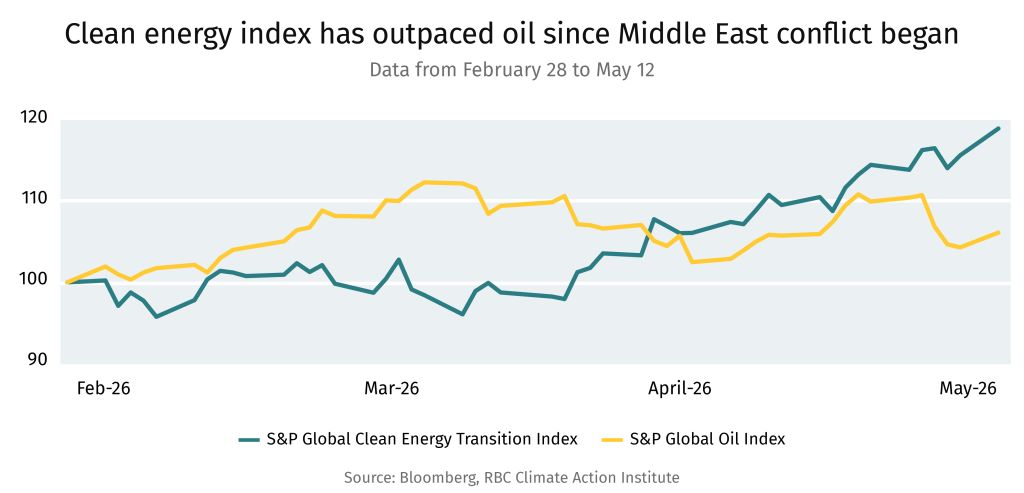
It’s early days, but the stalemate playing out over the Strait of Hormuz is forcing countries to renew their focus on electrifying their way out of fossil fuels. We have been here before as recently as 2022 when Russia launched a full-scale invasion of Ukraine, upending European energy ties to Russian oil and gas. Yet coal, oil and gas rebounded to near all-time highs.

Will it be different this time? Here are five ways the crisis has rekindled momentum for energy transition.

1. Global consensus is hardening. Santa Marta, Colombia, was the site last week of the First Conference on Transitioning away from Fossil Fuels, where 57 nations—including Canada—sought ways to move towards cleaner energy.While several lofty goals were expounded, a key takeaway was to launch a panel of experts who would provide scientific input on reducing fossil fuel dependence, high energy prices and extreme weather damage. It could be a breeding ground for new ideas.

2. AccelerateEU aims to shield Europe from energy price shocks. One idea is to accelerate the shift to “home green clean energy,” including an Electrification Action Plan to be released by the European Commission by the summer.

3. Knee-jerk consumer behaviour could alter long-term demand. Global EV sales jumped 66% in March compared to February, as some consumers baulked at the prices at the pump and switched to EVs. Several countries in Europe and Asia had record-breaking months. That could have long lasting consequences for fuel demand and what’s called” demand destruction.” In Canada, more than 12,600 zero-emission vehicles were sold in February, compared with nearly 8,700 the month before, recent Statistics Canada data shows. An AutoTrader survey of 17,000 Canadians found half of respondents would now consider buying an EV.

local bureaucrats

4. Chinese bureaucrats are now on the clean-energy case. The country is launching a campaign aimed at accelerating climate action by local authorities, in an effort to plateau CO2 emissions before 2030. At stake: rewards and career progress for local bureaucrats. Never underestimate the resourcefulness of a middle manager keen to get their performance bonus.

5. Most renewables are now competitive with fossil fuels. Even before the Iran war, the price competitiveness of solar and wind energy was the primary driver of power sector decarbonization, according to Ember Energy. In 2025, the average Levelized Cost of Energy (LCOE) for solar ($39/MWh) and onshore wind ($40/MWh) was 60% lower than that of combined cycle gas turbines (CCGT), which stood at $102/MWh. Offshore wind ($100/MWh) has also reached price parity CCGT. US$100+ oil prices only make the case for renewables more compelling. China’s export of photovoltaic solar panels, lithium-ion batteries and new-energy vehicles rose 70% in March year-on-year, Carbon Brief’s analysis of Chinese customs data shows.

Here’s what Lisa Ashton, Head of Research, gleaned from Ottawa’s latest Spring Economic Update:

Clean investment push continues. Expanded tax credits and incentives for carbon capture, clean electricity, and clean technologies aim to attract private capital and scale domestic innovation.

Proposed $5 billion in international climate investment. Flowing through Environment and Climate Change Canada, FinDev and Global Affairs Canada, the update proposes spending on climate initiatives and technology development in emerging economies around the world to advance global decarbonization. Carbon pricing framework is reinforced. Working to strengthen industrial carbon pricing benchmarks and ensuring consistent national standards remain central to competitiveness. Yet, key decisions are pending, namely performance standards. Another obstacle: the oil industry is pushing back on the carbon tax.

Funding of $3.5 billion towards scaling nature positive outcomes. Announced in the government’s Force of Nature strategy, the federal government will stimulate investments in nature, tying climate competitiveness to conservation goals (e.g., protecting 30% of lands and waters by 2030).

Integration with broader economic strategy. The proposed Sustainable Finance Conference and the development of the made-in Canada sustainable investment guidelines aim to connect public and private dollars in key economic sectors, linking sustainable investments to jobs, affordability, and global competitiveness.

The takeaway. Canada is doubling down on a market-driven, investment-led approach to climate policy. The country will need to advance key strategies and agreements including the energy MoU with Alberta to drive real outcomes through its renewed approach.

First Nations Major Project Coalition’s 9th annual conference
  • Atthe First Nations Major Project Coalition’s 9th annual conference, John Stackhouse discussed how economic reconciliation and Indigenous equity are vital to ensure Canada’s big ambitions are fully realized.

  • Gregory Brew, a historian of international energy and U.S.-Iranian relations and a senior analyst at the Eurasia Group, on how America would pay dearly for its energy arrogance.

  • Subsidies and price floors are temporary tools, demand is what would sustain prices and investor confidence in critical minerals, writes Gracelin Baskaran, director, critical minerals security, at the Center for Strategic and International Studies.

Curated by Yadullah Hussain, Managing Editor, RBC Climate Action Institute.

Climate Crunch would not be possible without John Stackhouse, Jordan Brennan, John Intini, Farhad PanahovLisa AshtonShaz MerwatVivan SorabCaprice Biasoni, Lavanya Kaleeswaran and Joelle Schonberg .

Have a comment, commendation, or umm, criticism? Write to me here (yadullahhussain@rbc.com)

Climate Crunch Newsletter

Disclaimer

rbc_tl_disclaimer

  • Modern Methods of Construction (MMC) refers to innovative homebuilding approaches to improve the efficiency, sustainability and quality of construction. It includes of off-site construction, including 3D volumetric modules, 2D panels and pre-fabricated components, as well as innovative on-site approaches, such as robotics and digital tools.

  • It can help build homes up to 50% faster and 40% cheaper than traditional methods. Yet current conditions actively prevent adoption at scale—leaving Canada’s housing crisis unresolved.

  • MMC currently makes up 7.5% of the Canadian construction market. Forecasts show it’s set to grow at a compounded annual growth rate of 5% by 2029.1

  • Deploying these new methods could meaningfully contribute towards Canada’s housing needs. Raising MMC ‘s contribution to 15% of annual supply needs (about 72,000 units a year), would require developing dozens of new factories at current production capacities.2

  • Canadian policy, market, and financing conditions are hindering wider MMC adoption. Reshaping policy and regulatory frameworks and financing mechanisms to support off-site construction can unlock the market commitment needed for MMC to scale

  • Proven methods exist globally. Several international examples—Sweden’s industrialized housing sector, Japan’s engineered modular homes and the U.K.’s MMC agenda—provide valuable lessons for Canada.

Home prices in virtually every major Canadian city, and many smaller communities, have soared out of reach for many people. While the causes of Canada’s housing crisis are varied, all point back to a foundational issue: Canada is not building enough affordable homes fast enough.

To restore affordability and meet projected demand, Canada needs upwards of 480,000 new units a year between now and 2035.3 Over the past quarter century, the country hasn’t come close to that number of housing starts in a single year, let alone at the sustained pace required. A fragmented regulatory environment, stagnant productivity growth, and labour challenges in the construction sector compound the problem. What’s needed, and fast, are new approaches to increase supply, reduce costs, improve delivery times and decrease emissions.

Canada is falling short of CMHC's projected annual 48,000-new-units target

Source: CMHC, Housing starts, under construction and completions, all areas, annual.

Against this backdrop, Modern Methods of Construction (MMC) has emerged. MMC, proponents claim, offer several advantages over traditional “stick-frame,” on-site building methods. Factory production can compress overall project timelines by 20-50%4, which not only accelerates housing delivery but lowers financing costs. Controlled conditions allow home builders to deliver a higher quality product with better thermal efficiency and airtightness, which is increasingly valuable as energy prices rise and climate competitiveness intensifies. Off-site work also requires fewer workers and eliminates the scheduling complexity of coordinating skilled trades on-site.

While a growing ecosystem of manufacturers and developers are experimenting with various prefabrication techniques, MMC accounts for as little as 2% of housing starts in Canada.5 That’s largely because factory efficiencies are often offset by transportation costs, overheads, and premiums from lower production volumes. At Canada’s current scale, MMC is not always cheaper than conventional construction on a straightforward unit-cost comparison basis.6 Savings of 20- 40% are possible7 but only with volume and standardization, which is precisely why scale is
so central to MMC’s value proposition.

So, what’s holding MMC back from becoming a cornerstone in Canada’s housing strategy?

Developed by the University of New Brunswick’s Off-site Construction Research Centre, MMC revolves around seven distinct categories spanning off-site construction, on-site innovation and emerging technologies.

Category 1: Volumetric (3D) modular construction involves fully enclosed units fabricated in controlled factory environments and assembled on-site.

Category 2: Panelized (2D) structural systems utilize flat structural elements like walls, floors and roofs that are prefabricated and then delivered for assembly.

Category 3: Prefabricated components support portions of the primary structure without constituting a complete system, such as foundation elements and staircases.

Category 4: Non-structural assemblies and sub-assemblies, including prefabricated building service components like bathroom pods, façade assemblies and mechanical and electrical systems that simplify on-site installation.

Category 5: Additive manufacturing represents the emerging field of 3D printing for construction to enable layer-by-layer fabrication either on-site or remotely.

Category 6: Building product-led site productivity improvements, including developing materials in larger formats or with simplified connections to accelerate installation.

Category 7: Building process-led site productivity improvements, leveraging digital tools, automation, robotics and lean management practices to optimize on-site efficiency and workflow.

Costs, timelines, regulatory treatment, financing and workforce requirements vary considerably across these different categories. Volumetric modular construction, for example, offers the most dramatic time savings (units can be stacked in days once the factory work is complete), but requires the largest upfront capital investment and faces the most financing and regulatory hurdles. Panelized systems are more familiar to regulators and financiers, but offer more modest efficiency gains. This framework is valuable as it allows regulators, financiers, and developers to navigate these trade-offs—moving beyond treating modular construction as an outlier to managing it as a coherent set of delivery methods.

Canada’s construction sector faces a fundamental productivity problem that predates today’s affordability crisis. Between 2001-2023, labour productivity in the construction sector declined 37.3%.8 The sector is highly fragmented, with many small firms lacking the scale to invest in technology or training. Work is seasonal and project-based, making it difficult to develop durable workforce pipelines. And the traditional model of site-based, trade-coordinated construction is inherently resistant to the standardization and optimization that drives productivity.

Canada’s skilled trades shortage compounds these problems. This drives up labour costs and, in some markets, prevents projects from moving ahead. The business model is also materially different. Unlike conventional builders who typically operate on a project basis with variable costs, MMC manufacturers require substantial upfront capital investment in factory facilities and equipment. Factories then need consistent, high-volume orders to achieve economies of scale. Furthermore, traditional construction financing is not well-suited to the MMC model, as lenders typically release funds based on on-site construction milestones rather than factory production phases.

Regulations present another obstacle. Canada’s building codes, while harmonized at a base level through the National Building Code, are administered provincially and adopted municipally. A manufacturer, specializing in MMC, that wants to sell into multiple provinces faces a patchwork of code requirements, inspection regimes and approval processes, which can increase delivery complexity and costs. This fragmentation and regulatory friction are among the most frequently cited barriers by MMC practitioners in Canada.9

The country’s vast geography means that the economics of factory-to-site transportation are more demanding than in markets like Japan or the Netherlands. A local factory can serve the Greater Toronto Area or metropolitan Vancouver area well, but the costs of delivering housing more than a few hours away can erode the economic case for off-site production. Strategic factory placement represents a critical lever for unlocking MMC’s potential. This is particularly critical in remote and underserved regions, including northern Canada and Indigenous communities, where persistent supply chain gaps constrain development.

Canada’s climate adds an additional complication. Extreme cold affects the performance of certain building materials and systems, as well as the logistics of construction. While prefabricated and modular approaches are a great opportunity to build housing more quickly in harsh climates and remote regions, designing for standardization requires manufacturers to develop multiple climate-specific standards (reducing economies of scale) or focus on regional markets (limiting national scalability).

All the factors above continue to slow broader uptake. Many builders already incorporate forms of prefabrication, such as manufactured wall panels or trusses, but full modular construction is a relatively small share of overall housing built. Today, modular construction accounts for an estimated 7.5% of the overall Canadian construction market, representing $5.1 billion in annual value.10 If MMC were to capture even 10-15% of Canada’s annual housing need (about 43,000 to 72,000 units per year), it would need dozens of new factories at current production capacities.11 Simply put, large investments and coordinated action is required for MMC to materially change housing delivery output.

Caivan

Ottawa-based Caivan, one of Canada’s largest developers, uses off-site manufacturing facilities to build four to seven houses daily, with plans to increase production to up to 5,000 a year. It’s also working in partnership with federal and territorial governments, and Inuit organizations, to build 750 modular homes in Nunavut, modified to accommodate specific needs in the north.

Habitat for Humanity Greater Toronto Area

Habitat for Humanity GTA is using modular technology in the construction of its new building in the east end of Toronto. Emerging from the $1.2 billion New Deal partnership between Ontario and the City of Toronto to increase the supply of below market, attainable modular homes, 33 affordable units will be available when the project completes in 2027, with most units large enough to accommodate families.

Bonville Industries

A fourth-generation family business, Bonville has been manufacturing prefabricated housing components for decades, mostly for the Québec and Ontario markets. It has developed over 45,000 homes to date, producing everything from large custom homes to multi-unit affordable housing projects, including the ‘missing middle’ buildings between 4-12 units.

1. Recalibrate policy and regulatory frameworks to capture substantial opportunities

All levels of government in Canada are responsible for getting housing built, making policy central to wider MMC adoption.

Building code harmonization is perhaps the most important policy lever and one that MMC manufacturers, industry associations and sector researchers have cited as a significant barrier.12 13 A manufacturer today must navigate different code interpretations, inspection requirements and warranty regimes across jurisdictions, creating real costs that are potentially prohibitive for smaller firms. In the U.S., a uniform national building code for manufactured homes (the “HUD” Code) is in place, and Australia is planning to implement a National Voluntary Certification Scheme for MMC manufacturers that will make meeting code requirements more straightforward. In the 2026 Spring Economic Update, the federal government committed to updating the National Model Codes to better support factory-built housing, including by accelerating the review and approval processes of innovative and prefabricated construction products and expanding the codes to

support more flexible building options (such as engineered wood).14 But this requires coordination and consensus across levels of government and industry stakeholders, alongside rigorous technical reviews.

Municipal permitting and approvals processes can present another critical bottleneck for MMC adoption, reflecting a tension between legitimate regulatory oversight and the need for systems that can accommodate industrialized construction timelines. Current frameworks were designed around traditional stick-built construction and require manual review of projects as a unique design, even when modular units are repetitive and factory-certified. For MMC to achieve its potential, municipal processes need to be fundamentally expedited to reduce approval times, including through mechanisms like pre-approved typologies, use of digital platforms and streamlined review tracks for certified manufacturers. The federal government has indicated that it intends to work with provinces and territories to reduce regulatory friction and provide clearer and more predictable pathways for factory-built housing, but this will take time to materialize. Without such modernization—supported by both regulatory reform and capacity-building for planning departments—the apparatus designed to protect public interests paradoxically undermines Canada’s ability to create housing supply at the speed and scale needed.

Public procurement is a powerful and under-utilized tool. Governments at all levels support the development of both market and non-market housing. When procurement requires or incentivizes MMC techniques, it creates the demand that manufacturers need to justify factory investments.

Build Canada Homes, the federal housing agency launched in September 2025, is mandated to galvanize the implementation of MMC and accelerate the delivery of affordable housing. Canada Mortgage and Housing Corporation (CMHC) is also starting to promote greater use of MMC by incorporating provisions for MMC into their programming. Other government homebuilding initiatives offer noteworthy opportunities, including increasing the supply of housing in the north and on military bases.

The variation in provincial and municipal building codes matters. Federal collaboration across levels of government to align policy and regulatory levers—not just in building codes, but with procurement, planning rules, and approval processes—can meaningfully reduce the fragmentation that limits developers’ and manufacturers’ ability to successfully deploy MMC.

2. Solve scale, standardization and skills challenges

Policy sets the framework, but market conditions determine whether private actors have the ability and motivation to operate within it.

Typically, MMC manufacturers work with developers to bring these technologies into the homebuilding process. Appetite for using MMC in projects is growing and those most likely to embrace off-site construction—large market housing developers, non-profit housing providers with extensive pipelines and institutional landlords creating purpose-built rentals—are building in volume. Other players remain less convinced due to the higher upfront costs, uncertainty about demand and delivery, and the complexity of managing an unfamiliar supply chain. Consumer interest, on the other hand, may be less of a barrier than is sometimes assumed, though there is little data on Canadian preferences and perceptions. Survey data from other jurisdictions suggests that consumers (especially renters) have few objections to factory-built homes when they are well-designed.15 16

Supply faces more structural constraints. Factory capacity is currently limited and geographically uneven. Small-scale developers can face higher barriers to adopting MMC, such as absorbing up-front costs and managing complex procurement. The economics of factory operation are also challenging; a modular facility needs to produce between 500 and 1,000 units a year to make modular construction cost competitive.17

Standardization is the key to unlocking efficiencies. When building types, dimensional systems and connection details are standardized, manufacturers can invest in tooling and processes that dramatically reduce unit costs. But it requires coordination across developers, manufacturers, designers and regulators that is difficult to find in a fragmented industry. Countries that have adopted MMC have done so either with strong public developer mandates (Sweden) or through large vertically integrated manufacturers that have sufficient market power to drive standardization (Japan). Canada has neither. Creating anchor demand through public procurement, and facilitating industry integration across the value chain, are the two most direct ways to create market conditions that could generate a tipping point.

Workforce development also tends to be overlooked, though the tide may be about to turn with the federal government’s recent $6 billion investment in skilled trades. The shift to factory-based production requires a different labour profile, with more emphasis on manufacturing process skills, digital design literacy, and quality systems management. Canada’s existing apprenticeship and trades training is not well-aligned to these requirements, but construction workers typically have many of the core skills needed for modular factory work, making re-skilling possible. A workforce strategy for industrialized building—incorporating provincial colleges, sector councils and manufacturers—will be central in building human capital.

3. Adapt financing mechanisms to boost investing environment

Even with supportive policy and favourable market conditions, financing remains a decisive barrier. The financing of off-site construction does not fit traditional financing frameworks developed over decades, as financing needs to be provided for materials and work outside of standard security frameworks.

Conventional construction financing is built around the draw structure, where lenders advance funds progressively as on-site milestones are achieved and the partially completed building acts as security, via land title. For volumetric modular construction, the largest costs are incurred in the factory, often before a single module arrives on site. At the point of maximum factory expenditure, there is little on the ground to serve as security, leaving developers to typically finance the production phase from equity or working capital. This front-loading of equity requirements increases the effective cost of capital for MMC projects, partially or fully offsetting efficiency gains. Particularly for smaller developers or non-profit providers, it can be a difficult barrier to overcome.

Financing Comparison: Traditional Construction and MMC

Financing Comparison: Traditional Construction and MMC
Traditional ConstructionMMC (Modular/Prefab)
Risk assessmentEstablished risk modelsUnclear/less established risk
Valuation approachComparable sales and valuation data readily available

Appraisers understand consistent methods
Few comparable sales

Inconsistent appraisal methodology
Draw scheduleStage-based inspections

Foundation -> Framing -> Finish
Upfront factory payments

Not aligned with traditional stages or lender security
Insurance and warrantiesStandard insurance and warranty products with risks well-understoodCoverage gaps during transport

Limited warranty options

Lack of data regarding claims

CMHC has begun to adapt programs for modular construction, and, as federal policies and frameworks evolve, there is opportunity to go further. Build Canada Homes could also play a complementary catalytic role by effectively de-risking the model. Both agencies could also address the capital gap that prevents manufacturers from expanding at scale, potentially working with other public or private partners.


For MMC to reach scale, Canada’s banks and private lenders need to be active participants. At present, a lack of familiarity with large-scale MMC projects can make them difficult to assess from a risk perspective. A recent U.K. government inquiry on MMC reported that real barriers exist in the form of risk aversion on the part of warranty providers, insurance companies and banks,18 which speaks to lenders, even experienced ones, being constrained in their ability to assess and approve each building system, material type, component and construction method.19

The most immediate impactful change would be a re-thinking of the construction draw schedule. Banks could adapt protocols that allow advances against verified factory production milestones, which is how MMC loans are secured in Australia and the UK.

Security valuation could be considered along with lending schedule changes. Modules in a factory are considered personal property, not yet attached to real estate, and their value in a default scenario is uncertain. Lenders could overcome this by creating security frameworks tied to factory-built components; industries like shipping and aircraft manufacturing involve lending against high-value assets in production and similar approaches could translate to modular construction.

Beyond loan mechanics, banks can invest in improving institutional knowledge. Effective lenders elsewhere have created specialist teams with expertise in MMC, relationships with manufacturers and insurers, and tailored risk frameworks. Lenders with specialist capacity have an edge in a market that could grow substantially—some estimates indicate that modular construction in Canada is expected to reach $6.4 billion by 2029 (compared to $5.1 billion in 2024).20

Banks can also play a constructive role in shaping the standards infrastructure. In markets where MMC has achieved greater scale, third-party certification and inspection frameworks have been critical in giving lenders the assurance needed to advance funds against factory production. The U.K.’s Buildoffsite Property Assurance Scheme (BOPAS), developed jointly by industry participants and the Royal Institution of Chartered Surveyors, offers an interesting model that has been broadly adopted by U.K. mortgage lenders. Canadian banks could work with industry bodies to help define these standards.

Finally, financial institutions could make financing for MMC-based homes more accessible for buyers, ideally treating factory-built homes that meet all standards like site-built homes for mortgage qualification and insurance purposes. This is not currently the case among most lenders in Canada. Uncertainty in the end-buyer mortgage market suppresses developer appetite for MMC, even when construction financing is available.

MMC is not a suite of products that can be dropped into the existing homebuilding system. It represents a fundamentally different approach to production, one that requires a correspondingly different system of policy, market and financing support. The existing system has been shaped by decades of site-based construction norms and transforming it requires simultaneous and coordinated action across multiple fronts.

The preceding sections are not an exhaustive checklist—first streamline regulations, then grow the market and fix the financing. Progress on one dimension, without simultaneous progress on others, is likely to produce limited results or stall altogether.

Consider the financing gap. Even if financial institutions and governments fully reformed their draw-schedule frameworks tomorrow, developers would still face a thin and immature supply chain, manufacturers would still be operating below efficient scale and regulatory environments would continue to vary significantly across jurisdictions. Financing reform, in isolation, would help at the margins but would not produce a step change in MMC adoption.

Or consider a scenario in which procurement policy is transformed, with federal and provincial housing programs committing to MMC for a large share of their social housing pipelines. This could create greater demand volume, but if building codes remain inconsistent across provinces, if financing products are not widely available and if the skilled workforce for factory production does not exist, the procurement commitment will not translate into the affordable housing units that are needed.

MMC has failed to achieve scale in countries that opted for incremental adoption. While individual projects can succeed, and manufacturers can grow to a point, this approach does not create the system shift necessary for MMC to go beyond a niche offering. Achieving systemic change requires a different kind of ambition, with policymakers willing to coordinate the suite of available levers—building code harmonization, accelerating approvals, procurement mandates, public financing support, industrial policy for factory investment—over a sustained period. It calls for private sector actors making long-term commitments to business models organized around MMC, which requires the policy and financing stability that gives those commitments a reasonable chance of success. And it requires institutions to work together to manage a complex transition.

High-priority actions should come first. National Building Code harmonization—specifically the provisions governing off-site construction—is a foundational step for unlocking action. Encouraging CMHC and Build Canada Homes frameworks to fully accommodate MMC is similarly important, given their central role in housing finance and insurance. Creating anchor demand commitments through government housing initiatives could provide the market signal that manufacturers need to invest seriously in Canadian factory capacity. This could incentivize more direct capital investment and involvement from developers and financial institutions. All the while, municipalities can seek to expedite approval and permit processes to better align with factory production timelines.

These actions would not, by themselves, produce the desired scale of MMC adoption, but they would create a solid foundation on which to build with expanded government support, market capacity, and maturing financing tools specifically geared towards the unique nature of off-site housing development.

Canada’s housing crisis is severe and MMC is an important component of a broader housing strategy. It has international precedents, demonstrated performance and clear potential to address the speed, cost, quality and labour challenges that are holding back housing delivery. The path and the technologies exist. The economic case, when properly structured, is sound. What’s missing is the coordinated, sustained commitment across government, industry and the financial sector to create the environment for MMC to flourish.

These examples show that MMC can scale when the policy, market and financing conditions are aligned. No country has achieved this purely through the intrinsic merits of the technology alone.

Sweden offers perhaps the most instructive international example for Canadians. Swedish homebuilders produce about 45% of new housing using some form of off-site manufacturing, achieved after decades of market evolution, consistent and supportive building codes, and a cultural acceptance of standardized design.

Japan’s industrialized housing sector, led by major manufacturers like Sekisui House and Daiwa House, demonstrates how vertically integrated companies can use
MMC to quickly build high-quality, disaster-resilient housing.

The United Kingdom—through its Homes England agency, MMC definition framework and a series of policy initiatives—has made serious efforts to catalyze MMC adoption, with mixed results, but valuable lessons. The 2019 Farmer Review, for example, concluded that the U.K. construction sector must “modernize or die”.

Australia, which faces many similar housing challenges to Canada, has seen a cluster of MMC manufacturers emerge, supported by proactive state-level procurement policies. The current administration has led a targeted investment of $54 million in advanced manufacturing of prefabricated and modular home construction.

Download the report

Disclaimer

rbc_tl_disclaimer

Canada and Alberta’s recent agreement-in-principle on methane equivalency sets a 75% reduction target in oil and gas methane emissions by 2035, relative to 2014 levels.1 It could prove to be consequential for the country’s climate ambitions: methane has roughly 80 times the warming impact of CO₂ over a 20-year period and accounts for nearly a quarter of the sector’s total greenhouse gas emissions, making it one of the lowest-cost, highest-impact levers for near-term climate progress.

For oil and gas producers, methane emissions measurement and performance now has greater flexibility on implementation but brings verification to the forefront.

In many instances, things are already up and running among oil and gas operators as several key methane emissions abatement technologies are well established, including:

  • Vapour recovery units that capture gas from storage tanks that would otherwise be vented;

  • Low-bleed pneumatic devices that eliminate routine methane releases from instruments controlling valves and pumps;

  • Compressor seal replacements that prevent leaks from pressurized equipment;

  • Leak detection and repair programs that use optical gas imaging and continuous monitors to find and tackle fugitive emissions.

Collectively, these technologies could reduce emissions by more than three million tonnes per year, representing roughly 1% of Alberta’s annual emissions.2

The province has deployed them at scale. Alberta has invested $172 million in methane reduction technology since 2019, including the installation of more than 58,000 low- or no-bleed devices. The outcomes are tangible: government-funded programs have prevented an estimated 17 million tonnes of emissions from being released, according to the Alberta government. A $25-million implementation program helped 49 operators deploy equipment across more than 650 sites at abatement costs below $50 per tonne.3

Canada’s broader methane mitigation sector has grown to more than 130 firms, with compliance actions under the enhanced regulations projected to generate 34,000 jobs from 2027 to 2040.

However, the progress is not without its headwinds. Alberta had frozen the TIER Fund credit price at $95 per tonne in May 2025, well below the federal trajectory to $170, citing U.S. tariff pressures.4 The MoU commits both governments to a minimum effective price of $130 per tonne, but days after signing, Alberta introduced amendments that flooded the credit market.

While the agreement is promising, success depends on transparent verification, particularly given that a multi-year aerial campaign found Western Canadian oil and gas methane emissions were nearly twice official inventories.5 Canada acknowledged this when it updated its methodology, resulting in a more than 35% increase in reported fugitive emissions.6 The agreement’s commitment to independent third-party assessment may prove its most consequential element.

Norway has the world’s lowest methane intensity thanks to a flaring ban dating back to 1971, but its oil and gas sector is a fraction of Canada’s scale.7 The IEA’s Global Methane Tracker 2025 places Canada’s upstream intensity at approximately 0.40 kg methane/GJ, below the global average of 0.55 kg methane/GJ and well ahead of Russia, Iran, and Turkmenistan, but higher than Norway and Saudi Arabia.8

The EU’s Methane Regulation, the world’s first legally binding standard, will require importers to report methane intensity from 2028 and meet maximum intensity thresholds by 2030, connecting low-methane performance with market access, potentially creating an advantage for producers that can compete on methane intensity.9

Private capital is tracking the signal. One recent example is Montreal-based GHGSat, which raised $47 million in September 2025, bringing total financing to $173 million, backed by Canadian entities Yaletown Partners, BDC Capital, and National Bank.10 The company now operates 16 methane-detecting satellites and has partnered with ExxonMobil and Aramco.

A draft equivalency agreement is expected for 60-day public consultation later this year. The signals point toward a tightening global methane regime: EU import standards by 2030; Japan and South Korea seeking lower-carbon gas supply; and the Global Methane Pledge, endorsed by 159 countries.

Disclaimer

rbc_tl_disclaimer

Food prices were expected to stabilize globally in 2026, but disruptions have materially changed that outlook. Instead of easing, risks are now skewed toward renewed food inflation.

The biggest geopolitical driver right now is the Middle East conflict, specifically disruptions to a critical artery—the Strait of Hormuz—for global energy and fertilizer trade. The World Bank now expects energy prices to jump roughly 24% in 2026. This rise in energy prices matters for food prices as energy feeds directly into transportation, processing, and refrigeration. This is a classic second-round inflation effect: food inflation lagging energy inflation by several months.

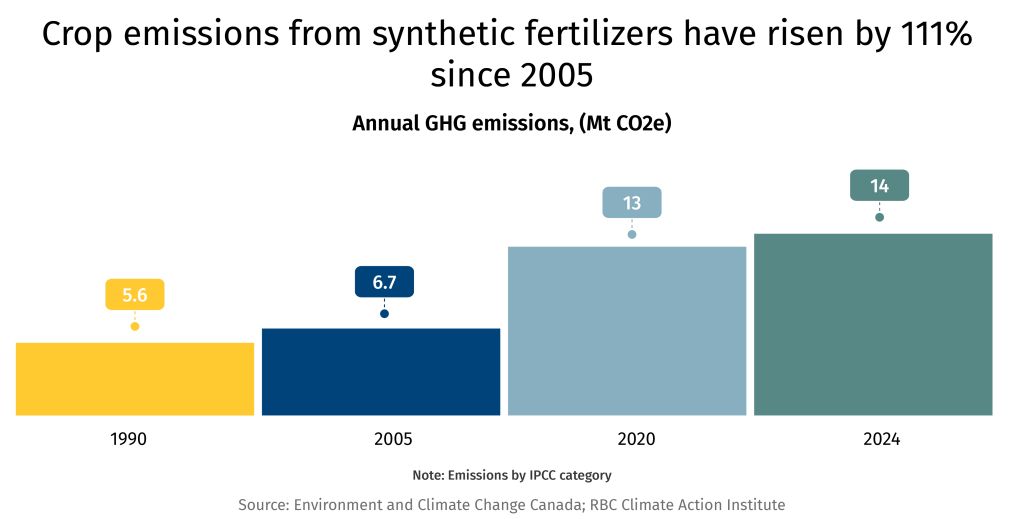
Disruptions to fertilizer supply chains is the hidden risk to food prices from conflict (and the most underpriced one). Fertilizer prices are projected to rise 31% as roughly a third of global fertilizer trade flows through Hormuz, according to the World Bank. Urea, a key fertilizer vital for boosting crop yields, is up 86% in March 2026, compared to the same time last year, with a 53% jump since February alone on Middle East troubles.

Generally, the fertilizer price shock creates a delayed but powerful effect: Farmers reduce fertilizer usage, leading to crop yields decline, a surge in food prices rise is triggered—with a lag (2026–2027).

We’re already seeing early signals of this effect with farmers expected to plant fewer acres of crops and tightening grain balances into the 2026-2027 season, according to the International Grains Council.

Layering in climate risk, this year’s food production outlook has flipped from benign to another accelerant to rising global hunger. This growing season, farmers are expected to face what projections are calling a “super” El Niño-related disruption, causing droughts across Asia and Australia, while potentially dumping the excess moisture in North and South America. These hard-to-predict weather dynamics could hinder production across the world’s biggest breadbaskets growing rice, wheat, and soybeans.

Globally, an estimated 363 million people are at risk of acute hunger in 2026—a rising number with growing conflicts and climate change effects, especially heat waves and droughts, that challenge food production and access in developing and unstable countries.

In Canada, a nation of abundance, people experiencing food insecurity are most impacted by food affordability. And global disruptions are expected to rise prices even further in 2026. The most recent estimates from Canada’s Food Price report project a 4% to 6% jump in food prices for Canadians between 2025 and 2026-that’s nearly an extra $1,000 dollars on groceries per year for an average family of four.

What to watch for: Reactive policy from food inflation could further disrupt global trade flows. Geopolitics can reset trade flows when global risks intensify through export restrictions to protect domestic food stocks and monetary tightening by central banks can suppress demand but raise global volatility in supply chains.

Bottomline: Food access and price risks have moved from moderate to accelerated. Food inflation expectations are being revised, higher, and quicker: The United Nation’s Food and Agriculture Organization’s Food Price Index is up 2.4% between February and March 2026, with notable pressures in oils, sugar, and grain prices.

—Lisa Ashton

Ottawa is preparing a summit later this year to attract $1 trillion in new investments over five years. The February securities data offers an early read on the foreign investors’ Canadian playbook.

Global investors are staying in Canada, but repositioning around the trade war. In February, foreign investors put $6.2 billion into Canadian securities, adding to the $106 billion accumulated over the past four months. At the same time, Canadian investors deployed $25.4 billion into foreign securities—the largest outflow since March 2024. While monthly securities data is volatile by nature, the net result was a $19.2 billion outflow from the Canadian economy. The headline, however, understates what is happening. The February data is less a single story than three simultaneous ones—foreign investors distinguishing between Canadian credit and growth, domestic capital chasing U.S. returns, and a market navigating the trade tumult.

Within equities, the rotation is structural, not random. Foreign capital is rotating hard within Canadian equities—out of energy and manufacturing, into banks. Foreign investors sold $9.2 billion of Canadian equity securities in February, even as the benchmark TSX rose 7.6%. At the sector level, credit intermediation and related services absorbed $12.1 billion in February alone, the largest single-sector inflow in the dataset. Energy and mining shed $9.4 billion  the same month, its weakest reading in the past five months. Manufacturing has posted outflows in four of the past five months. This pattern isn’t random: foreign allocators are concentrating in assets insulated from trade disruption (e.g. banks) while cutting the ones that aren’t (energy and manufacturing).

The bond market offers some comfort. Foreign investors added $22.6 billion in Canadian bonds in February, including $11.1 billion in corporate bonds, mostly foreign currency bonds issued by Canadian financial corporations—and $8.4 billion in federal government bonds. At the same time, they sold $9.2 billion in Canadian equities. It demonstrates foreign investor’s confidence in Canada’s credit, and more caution towards equities.

Sydney Wisener

USTR provided more CUSMA comments

  • U.S. Trade Representative Jamieson Greer told an audience in Washington that “America First” will continue to guide policy, and that the Canada-U.S.-Mexcio trade deal put its two partners in the most enviable trading position with the U.S.

  • Greer did signal a willingness to work with Canada on energy and critical minerals development but warned against using those as leverage in trade negotiations. Almost on cue, U.S. President Donald Trump signed an order authorizing a proposed Canada-Wyoming oil pipeline.

Top EU trade official leaving position over disagreements on U.S.-EU deal

  • Sabine Weyand will step down as Director-General for Trade after raising concerns that the agreement the EU struck with President Donald Trump does not meet global trade rules.

  • The President of the European Commission Ursula Von Der Leyen has repeatedly defended the deal—where the EU agreed to pay 15% tariffs on most products while reducing tariffs on most American goods to zero—as the first step towards a broader free trade agreement.

OECD reports sustained increase in critical mineral export restrictions

  • Analysis shows export restrictions on critical minerals have increased fivefold since 2009, with more countries applying controls across defence, technology, and energy inputs.

  • China continues to dominate supply, producing roughly 70% of rare earths and over 90% of some key materials, with recent export disruptions highlighting ongoing supply chain vulnerabilities.

China warns of retaliation over EU “Made in Europe” proposal

  • China’s commerce ministry warned the EU it may take countermeasures if the bloc’s proposed Industrial Accelerator Act restricts access for Chinese firms to subsidies and procurement.

  • The EU initiative is squarely aimed at reducing dependencies on China, and seeks to raise manufacturing’s share of GDP to 20% (from 14.3%) by 2035.

—Thomas Ashcroft

Disclaimer

rbc_tl_disclaimer

From a crippled spacecraft to city streets, the technology that mirrors the physical world is remaking how we build, move, and plan.

In April 1970, an oxygen tank ruptured aboard Apollo 13, roughly 330,000 kilometres from Earth. NASA engineers on the ground had no way to physically reach the spacecraft. What they could do was feed real-time telemetry from the vessel into a bank of simulators in Houston, reconfigure those models to mirror the damage, and test survival strategies before relaying instructions to the crew. It worked, and the astronauts came home. Nobody called it this at the time, but mission control had just demonstrated the core logic of what would later be known as a digital twin.

Dr. Michael Grieves formalized the concept at the University of Michigan in 2002, and NASA’s John Vickers coined the phrase in 2010.1 But the underlying principle was already clear: build a virtual replica of a physical thing, keep it synchronized with real-world data, and use it to ask questions you cannot safely or cheaply ask of the original.

A digital twin differs from an ordinary simulation in one decisive respect: it is continuously updated. A simulation models what was designed, a twin mirrors what exists right now. Feed it sensor data from a jet engine, a wind turbine, or a hospital ventilation system, and it becomes a living model, one that can flag an impending bearing failure, test a configuration change, or forecast demand three hours ahead. The distinction shifts decision-making from retrospective analysis to real-time anticipation.

McKinsey estimates that 70% of C-suite technology executives at large enterprises are exploring or investing in digital twins, and that the technology can improve public-sector infrastructure efficiency by up to 30%.2 The global market, valued at roughly US$36 billion in 2025, is projected to exceed US$329 billion by 2033, growing at a CAGR of 31%.3

NASA could twin one spacecraft because it had a dedicated mission control. Scaling the same idea to a factory, a power grid, or a city required something that did not exist in 1970: cheap, networked sensors everywhere. That infrastructure arrived with the Internet of Things (IoT). There are now more than 21 billion connected IoT devices worldwide, a figure growing at roughly 14% a year and expected to reach 39 billion by 2030.4 Each device: a pressure gauge on a pipeline, a magnetometer in a road surface, a camera at an intersection, generates the continuous telemetry that keeps a digital twin alive.

The range of applications is vast. In energy, Siemens Energy has built digital twins of gas turbine components using neural networks on NVIDIA’s Omniverse platform, accelerating power-grid assert simulation by 10,000x5, and enabling predictive maintenance that could save utility providers US$1.7 billion per year.6 Singapore’s national grid operator SP group is piloting a Grid Digital Twin that models real-time conditions of the entire electricity network, a necessity as the country targets a tenfold increase in its renewable energy share by 2035.7

In manufacturing, BMW’s plant in Regensburg exists as a complete digital replica in NVIDIA Omniverse, where engineers optimize robot placement and test new car models on a virtual assembly line without halting production. Helsinki uses a city-scale twin to model how replacing heating systems in specific districts would affect CO₂ emissions against its 2030 carbon-neutrality target. Rotterdam’s twin simulates storm surges to make proactive decisions about sluice and dam operations. In healthcare, 66% of executives expect increasing investment in digital twins over the next three years, with applications ranging from hospital operations modelling to virtual drug testing and surgical planning.8

The pattern across these cases is consistent: an asset or system too complex, too expensive, or too dangerous to experiment on directly gets a virtual counterpart fed by live data. The twin absorbs the risk of trial and error.

Urban traffic offers a particularly clear illustration. In Ontario, the economic and social cost of congestion was estimated at C$56.4 billion in 2024, projected to approach C$108 billion by 2044.9 Digital-twin logic—sense, model, anticipate, act—applied at the intersection level lets traffic engineers see how signals, vehicles, cyclists, and pedestrians behave, rather than how a timing plan assumed they would.

For a Canadian-born example of this approach at global scale, listen to the RBC Disruptors episode featuring Miovision, the Kitchener-based company whose sensor and analytics platform now operates at more than 170,000 traffic intersections across 68 countries. Their work is a case study in how digital-twin principles migrate from aerospace and heavy industry into everyday civic road systems. It also demonstrates how a Canadian startup can build a category-defining business by instrumenting something as mundane as a traffic light.

  • The convergence of digital twins with generative AI. McKinsey’s operations practice describes a shift from twins that monitor and predict to twins that recommend and, increasingly, act autonomously.

  • The emergence of twin ecosystems. A factory’s digital twin exchanging data with the twins of its supplied components and the twin of the power grid that feeds it. Interoperability, common data models, shared interfaces, certified audit trails, will determine which platforms capture long-term value.

The broader trajectory is one NASA’s engineers would recognize. When you cannot reach the physical thing, or when acting on it without rehearsal is too costly, you build a model, keep it honest with live data, and let it think ahead of you. The technology has outgrown the spacecraft, but the principle has not changed.

Download the Report

Disclaimer

rbc_tl_disclaimer

Canada’s Indigenous loan guarantee programs have totalled $1.8 billion across 26 deals1. While utilization remains low at 11%2, it is a meaningful start, reflecting deal complexity and a challenging macro environment.

A core gap exists as a first-mile problem, not a last-mile one. Guarantee programs activate at financial close. Many projects now central to Canada’s economic agenda require Indigenous participation well before that point— before commercial viability is established and long before a community could table a term sheet.

Current programs work best for contracted, rate-of-return assets. Over 80% of prior Indigenous equity transactions are in the power and utilities sector3, often smaller deals supported by dedicated procurement at the provincial level (e.g., power projects in Ontario).

Canada’s next project wave presents a risk profile these programs were never designed to manage on their own. This includes capital-intensive liquefied natural gas (LNG), higher-risk mining, and first-of-its-kind projects like carbon capture and small modular reactors.

Only experienced communities are realistically able to tap the programs. Middle-tier communities that are less transaction-ready remain structurally underrepresented; the programs’ current design risks only reinforces that gap.

Equity is not inherently equivalent to consent. Free, Prior and Informed Consent (FPIC) is a process of informed, voluntary decision-making; equity is a financial structure. Conflating the two creates pressure on communities that is counterproductive—and the regulatory environment reflects that distinction.

Canada is in the middle of a significant economic reorientation. A trade war with the United States, the emergence of new strategic partners, the demands of energy transition, and a renewed focus on sovereignty and security have produced a political consensus that the country needs to build, and build quickly. The federal government has set a target of $300 billion in additional non-U.S. trade over the next decade4. The Major Projects Office has referred 17 projects worth $126 billion for accelerated approval5. Loan guarantee programs at the federal and provincial level now represent more than $17 billion in combined authority to support Indigenous equity participation6. And the capital markets have broadly accepted that meaningful Indigenous partnership is not a regulatory checkbox—it is a condition of project viability.

These are genuine advances. But they share a common assumption worth examining: the tools, timelines, and structures being assembled around Canada’s major project agenda are built for the communities being asked to participate in them. That assumption is not wrong, but it is not always right either.

Indigenous communities are not passive participants waiting to be mobilized into Canada’s economic agenda. They are sovereign entities with their own economic priorities, their own definitions of what is an attractive investment, and their own timelines for building the institutional capacity complex transactions require. Communities generally want an equity interest in projects that serve them directly—assets that provide tangible, direct benefits to their members, that they feel genuine ownership over.

There is appetite among communities to own a share of a pipeline or an LNG terminal. But the nature of that ownership matters—a financial stake in a large (and perhaps distant) infrastructure project is not necessarily the same as owning assets proximate and community-relevant. The fit between the asset, the community, and the nature of participation matters—and it is not a fit Canada’s national project list was necessarily designed around.

This is the tension at the centre of Indigenous economic participation. A tension between two legitimate forms of nation building—Canada’s imperative to diversify its economy and build at scale, and Indigenous communities’ imperative to participate in ways that best serve their people—that overlap but do not always coincide. Given the majority of identified projects exist on or adjacent to Indigenous lands7, getting that overlap right is a key determinant in whether Canada is able to build over the next decade.

When Canada’s loan guarantee programs were announced, they generated genuine excitement—and genuine ambition. The federal program alone carries a $10 billion mandate8. Provincial programs in Alberta, Ontario, Saskatchewan, Manitoba and B.C. add another $7 billion9. Together they represent something Canada had not previously offered at scale: a systematic mechanism for Indigenous communities to access capital for equity participation in major resource and energy projects.

Number of Indigenous Loan Guarantees provided to date

The utilization numbers, viewed in isolation, look modest. To date, 26 deals have been completed across four guarantee programs totalling approximately $1.8 billion deployed, or roughly 11% of combined program authority. Ontario leads by deal count: 13 deals valued at $563 million, running since 200910. Alberta leads by dollar value: 9 deals totaling $749 million since 201911. The federal program, the largest by mandate at $10 billion, has completed two transactions: a $400 million guarantee on a $740 million pipeline deal covering 12.5% of the Enbridge Westcoast system across 38 First Nations in B.C., and a second transaction involving a 20% interest in the Hydro One Chatham-Lakeshore line (dollar terms undisclosed)12. Saskatchewan has completed two deals worth $107 million13. Manitoba has also launched a program.

Indigenous loan guarantees provided to date in dollar value

But the utilization rate deserves context before it invites criticism. These are still young programs. Deals within the resources sector are complex, involving large consortia of communities, evolving project economics, leadership transitions, and trust-building that cannot be compressed by any government instrument. The current macro environment has added further drag: a trade war with the United States, tariff uncertainty, elevated interest rates, and commodity price volatility.

This context matters because it points to something important about what loan guarantees are, and what they are not. A guarantee is not a grant, not direct funding, and not free money. The guarantee is a mechanism that often makes loans possible in the first place, while also reducing the cost of capital by an estimated 50 to 150 basis points (anecdotal evidence suggests)—meaningful when Indigenous communities typically borrow 100% of the acquisition price to take an equity stake.

As such, projects are often rate-of-return assets such as power and utilities projects, transmission lines, and pipelines. Projects with contracted cash flows, predictable debt service, and limited commodity exposure are such that the risk of default is more manageable and protects taxpayer dollars. These assets also suit communities well; levelized, stable payments that can service 100% debt financing without exposing communities to unmanageable volatility.

But what happens when the risk profiles of projects change? LNG is vastly more capital-intensive. Critical minerals have greater commodity exposure and often no contracted offtake. Carbon capture, hydrogen and small modular reactors are still technologically emerging or first-of-its-kind. This risk profile is in stark contrast to the historical transactions seen to date.

According to data from the Indigenous Energy Monitor (IEM), the median Indigenous-owned project is valued at approximately $175 million, and only 15% of projects cross the $1 billion threshold. The Major Projects Office (MPO) portfolio sits in an entirely different weight class, and very likely moves the risk profile well beyond what a loan guarantee was designed to absorb.

Loan guarantees are, by design, a last-mile instrument—they activate when a transaction is commercially viable and a community is ready to close. However, many of Canada’s future resource projects could require Indigenous communities to participate much earlier in the development cycle, before commercial viability is established and long before a community could table a term sheet.

This can create a timing gap: programs activate too late when communities may need support upfront. This first-mile problem is arguably the most important gap in the current architecture.

Across the ecosystem—programs, financial institutions, proponents, and communities—five structural challenges persist that no single instrument, loan guarantee or otherwise, has resolved and yet is likely required for the next generation of Canadian projects.

1. The banking gap

According to the Bank of Canada’s Survey of Indigenous Firms, only 8% of Indigenous businesses use institutional loans as their primary financing source, compared to 31% of non-Indigenous small businesses. Similarly, loan approval rates run at 58% versus 90%, respectively. This remains a structural impediment.

Financial institutions are still learning how to operate in this space. Deals are still processed individually rather than through standardized templates. Syndication norms are still being established. Banks are not yet fully recognizing the strength of federal and provincial guarantees in the rates they offer Indigenous borrowers—in some transactions, spreads of up to 50 basis points (anecdotal evidence suggests) persists even under loan guarantees.

The friction is most acute in the $5 to $100 million range, where deals tend to be non-recourse, whereas mid-market commercial banking operates on a recourse basis. The rate structure often compounds this–prescribed fixed rate term loans could carry significant interest costs for communities that are 100% leveraged. More flexible structures including floating rates or shorter reset periods could meaningfully improve affordability.

2. The reach problem

The communities most actively using the guarantee programs tend to be those with prior deal experience—established investment arms, legal capacity, and existing lender relationships. These communities return to the programs repeatedly. The less experienced communities with limited institutional capacity are often left behind. Even when capital does flow, many communities lack the internal governance structures needed to manage it effectively. As such, program operators have made meaningful efforts to bring less experienced communities along through consortia structures, in an attempt to offset these structural challenges. Even here, proximity to attractive assets/opportunities remains a key factor.

Many Indigenous communities depend on federal and provincial transfers to fund basic services—housing, education, and healthcare. A persistent concern is that generating own-source revenue through an equity stake can, over time, trigger reductions in those transfers. This is most tangible during pre-revenue when distributions from an equity investment may not arrive for years (construction-stage). That gap is a real deterrent to participation.

Most importantly, Section 89(1) of the Indian Act shields the real and personal property of a First Nation or band situated on reserve from seizure or other enforcement by non-Indigenous creditors, making these assets largely unavailable as conventional collateral. No loan guarantee program, in its inherent design, can alter this core constraint; rather guarantees exist precisely because of it and shape every dimension of how communities engage with capital markets.

3. The scale mismatch

The programs face a structural problem at both ends of the size spectrum. At the small end, sub-$25 million deals are effectively uneconomic. Legal and structuring costs consume a disproportionate share of the benefit at smaller ticket sizes. Yet a meaningful share of Indigenous-owned projects sit in this range. The programs, as currently structured, cannot serve them ‘efficiently’.

With larger deals, capital commitments and risk tolerances are categorically beyond what current guarantee structures were designed to support. Coastal GasLink is a case in point: a 10% equity interest was offered to 16 Indigenous communities in March of 2022, the pipeline entered commercial in-service in November 2024, but the transaction has still not closed. It reflects the complexity involved in managing large consortia of communities across years of changing project economics, leadership transitions, and evolving deal terms.

4. The geographic and sector mismatch

Recently, guarantee programs have been most active in Western Canada, where established infrastructure, mature frameworks, and communities with prior transaction experience have created ideal deal conditions. In northern and northeastern Canada, however, where many critical minerals projects, such as lithium, nickel and graphite are situated, communities are often new to major project participation, are further from existing program infrastructure, and operate without the commercial relationships that western communities have had for decades.

Of 546 Indigenous-owned projects tracked by IEM, only 13 are in mining and minerals despite critical minerals being a stated national priority14. The historically preferred form of Indigenous participation in the mining sector has been royalties and revenue-sharing arrangements—structures that communities have negotiated effectively but are not captured in equity ownership data and are not supported by guarantee programs.

Top 10 Indigenous-owned power projects that dominate, followed by energy midstream

Renewables (wind and solar) show well, given the de-risked nature of investment (lower capital intensities and mature tech). 60% of hydro projects are 20MW or less (B.C. run of river)

Within energy, most investment is at the midstream level

Upstream investments largely missing across the project types, especially within minerals

The provincial map is also incomplete. Alberta, Ontario, Saskatchewan, Manitoba and British Columbia have large programs, but meaningful participation is lacking across other provinces. This compounds the geographic and sectoral gap. Generally, provincial support often moves quicker, better reflects regional resource priorities and can carry greater alignment between governments, proponents and local communities on the “acceptability” of desired projects—key benefits that are much harder for Ottawa to replicate.

Mainstream capital markets may have increasingly settled on Indigenous equity participation as a default measure of meaningful reconciliation and a proxy for project consent. Yet, Free, Prior, and Informed Consent (FPIC) is a process of informed, voluntary decision-making and equity is a financial structure. Conflating the two can create pressure on communities that is counterproductive: the sense that accepting equity means consenting to the project, or that declining equity means forfeiting a seat at the table.

Some communities genuinely prefer royalties, revenue sharing, or contracting as forms of economic participation without requiring communities to absorb project risk or service debt. These are legitimate structures that have worked effectively in the Canadian context and deserve to be treated as such. For higher-risk projects such as upstream mining or first-of-its-kind projects, equity is likely not the most appropriate form of project participation (excluding the possibility of investing in enabling infrastructure surrounding a project). Equity partnerships are better understood as a symptom of trust than a condition precedent to it—communities with trusted relationships with proponents move quickly.

No peer country has built a systematic framework for Indigenous equity participation in major resource and energy projects comparable to Canada.

The United States operates the Department of Energy’s Tribal Energy Financing Program with US$20 billion in authority for either direct loans or partial loan guarantees15. Only one transaction has closed to date16. Subsequent legislation rescinded most of the unobligated Inflation Reduction Act (IRA) funding, severely limiting available fiscal capacity.

Australia operates a statutory royalty-sharing system through the Aboriginals Benefit Account and Aboriginal Investment NT, which received a $680 million endowment at inception17. There is no government-backed loan guarantee for Indigenous equity participation in individual projects. Notably, over 57% of operating critical minerals mines sit on land where Indigenous Australians hold native title rights, but equity ownership in those projects remains limited18.

New Zealand’s Māori and Iwi have built diversified investment portfolios through Treaty of Waitangi settlements, with some Iwi now participating in large-scale infrastructure joint ventures with institutional partners. That institutional capacity has been built over thirty years of compounding settlement capital and governance development.

Canada’s combination of federal and provincial guarantee programs, complemented by targeted fiscal support from Canada Infrastructure Bank, Canada Growth Fund and First Nations Finance Authority, represents a more systematic approach than any of these jurisdictions have deployed.

The programs that exist are not necessarily failing–they are working within the parameters of what they were designed to do. The question is whether those parameters are sufficient to manage the scale, pace, and risk profile of development aligned with the federal government’s $300 billion aspirations—a next wave of projects representing a category of capital intensity and risk the current architecture was never designed to address alone.

A streamlined template for smaller transactions (sub $25 million) would bring the middle tier of communities into the system without requiring bespoke structuring processes that consume most of the economic benefit (a cited example is how agricultural loan programs operate with standardized terms, allowing banks to more easily process small ticket sizes). Smaller deals done at volume also build institutional knowledge on both the community and lender side that larger transactions can build upon.

Federal and provincial guarantees are not being fully recognized in the rates offered to Indigenous borrowers—at 100% leverage, that gap meaningfully reduces the distributions a community receives. Banks offering improved loan terms would reduce interest costs and improve cash flows.

The most successful multi-community transactions demonstrate that experienced Nations can carry less experienced ones through a process, absorbing negotiation overheads smaller communities cannot manage. Formalizing and resourcing that role would extend the programs’ reach without requiring every participating community to independently develop full transaction capacity.

Capacity investment ahead of the deal cycle is underutilized. Financial literacy training, governance preparation, and pre-transaction advisory support delivered as standing preparation (rather than triggered by a live deal) would move more communities to the threshold where program access becomes realistic.

Budget 2025 allows the Canadian Indigenous Loan Guarantee Program to use convertible debt (e.g. committed at construction, converted to equity once cash flows begin), and it could become the standard approach for greenfield participation. In other instances, creative structuring solutions where proponents can carry communities’ equity during construction (community investments are often 100% leveraged positions) are being explored.

On the incentive side, an Indigenous investment tax credit could directly improve the economics of Indigenous equity participation for proponents. Greater flexibility around stranded tax pools could similarly improve deal economics; Indigenous communities do not pay corporate tax and therefore do not benefit from traditional tax shields, but those benefits could be structured to flow to the corporate partner.

The most significant gap is at first-mile risk. Loan guarantees activate when a transaction is commercially viable but many of the projects needing Indigenous communities’ participation will require capital commitment well before that point. Difficulty in approving and permitting greenfield projects at times is partly a function of Indigenous participation arriving too late in the development cycle.

The use of convertible debt and conditional guarantees (guaranteed financing once key project milestones are reached) are meaningful progress on the timing problem. Still, closing that gap may require a dedicated instrument or facility willing to be first dollar in, absorbing early-stage risk that neither banks nor guarantee programs are designed to take on.

The Canada Growth Fund’s (CGF) role in critical minerals—providing patient sovereign capital to projects that markets alone would not finance—offers a potential model. A comparable mechanism oriented specifically around Indigenous participation in major projects does not yet exist. This would further complement the already existing layered capital stack from CIB financing, First Nations Finance Authority (FNFA) bonds and CGF equity.

Stonlasec8 and the Westcoast Pipeline | Federal | 2025

In July of 2025, Stonlasec8 Indigenous Alliance Limited Partnership—representing 38 First Nations in British Columbia—acquired a 12.5% ownership interest in Enbridge’s Westcoast natural gas pipeline system for approximately $736 million. The transaction marked the first loan guarantee issued by the federal Canada Indigenous Loan Guarantee Corporation. CILGC provided a $400 million federal guarantee, enabling the partnership to borrow at significantly reduced cost. The financing was structured in two tranches: the guaranteed senior secured bonds issued for $400 million notional, 30-year term, 4.517% coupon and a separate non-guaranteed senior unsecured bond issuance for $335 million notional, 30-year term, 5.168% coupon, demonstrating how the two instruments can sit alongside each other in the same capital stack. A fixed rate instrument protected communities from interest rate fluctuations over the life of the investment—a meaningful feature for communities that are 100% leveraged and depend on stable distributions.

Clearwater Infrastructure Partnership | Alberta | 2023

In December 2023, Wapiscanis Waseskwan Nipiy Limited Partnership—representing 12 First Nation and Métis communities in northern Alberta—acquired an 85% non-operating interest in Clearwater Infrastructure Limited Partnership for approximately $172 million, backed by a $150 million loan guarantee of the same size. Tamarack Valley Energy retained a 15% operated interest and committed to long-term take-or-pay volume agreements, providing the stable contracted cash flows that made financing viable. CEO-level commitment from Tamarack was central to the transaction. The deal performed well enough that a follow-on expansion closed in September 2024, adding approximately $51 million in additional midstream assets and bringing Bigstone Cree Nation into the partnership.

Wataynikaneyap Power | Ontario | 2024

In December 2024, Wataynikaneyap Power (51% owned by a partnership of 24 First Nations, 49% by Fortis Inc.) completed construction and successfully energized approximately 1,800 kilometres of transmission lines connecting 17 remote northwestern Ontario communities to the provincial grid. Total project cost was $1.9 billion, financed through $1.6 billion in federal support and $680 million in loans from a syndicate of five Canadian banks. Communities that had relied on diesel generation for decades gained access to reliable, lower-cost power. The project won multiple awards and is widely cited as having shifted industry norms, with Hydro One subsequently adopting a policy to offer First Nations up to 50% equity in new transmission projects over $100 million.

Cedar LNG | British Columbia | Under Construction

Cedar LNG is a floating liquefied natural gas facility under construction near Kitimat, British Columbia, within the traditional territory of the Haisla Nation. The Haisla Nation holds a 50.1% majority equity stake with Pembina Pipeline Corporation holding the residual 49.9% — making it the world’s first Indigenous majority-owned LNG export facility. Total project cost is approximately C$6 billion, financed through 60% asset-level debt and 40% equity, with the Haisla Nation funding its 20% equity contribution through the First Nations Finance Authority (FNFA) Agency in 2026—including the issuance of a sustainable bond ($350 million notional, 30-year term, 4.7% coupon) that won Environmental Finance’s Sustainability Bond of the Year. The facility will be powered entirely by renewable electricity from BC Hydro. Operations are expected in late 2028. Cedar LNG does not use a loan guarantee.

Nations Building: Assessing Indigenous loan guarantee programs in Canada’s new project wave - download the report

Download the report

Disclaimer

rbc_tl_disclaimer

Congestion isn’t just annoying it’s an economic drag. In this episode of Disruptors, John Stackhouse speaks with Kurtis McBride, co-founder of Miovision, about how a Waterloo-built company turned intersection data into a real-time operating layer for cities and how that platform is scaling globally.

McBride explains how Miovision began with a simple insight from manual traffic counts, then evolved into a digital twin approach that helps cities reduce congestion, improve safety, support transit performance, and shorten emergency response times. He also shares how Miovision is applying AI including a conversational interface that lets traffic teams ask plain-English questions about their network and get actionable recommendations.

The conversation expands into a founder playbook for selling into cities, navigating cross-border requirements like Build America, Buy America, and building the connected intersection infrastructure that can make vehicle-to-everything (V2X) services and eventually autonomous mobility smarter and more affordable.

Also read: How Digital Twins are Solving Real World Problems

Listen on Apple Podcasts, Spotify or Simplecast

Street Smarts: The Waterloo company tackling global gridlock

SPEAKERS

Kurtis McBride, John Stackhouse

John Stackhouse 00:00:06

Hi, it’s John here. If there’s one thing I bet we can all agree on, it’s this. Being stuck in traffic is a waste of time, and we Canadians seem to waste a lot of time in traffic.

Depending on your measurement, Toronto is either the worst or second-worst city in North America. Vancouver is really bad as well, and we could add to the list pretty quickly. In those big cities, the average person is wasting or spending at least a hundred hours a year sitting in traffic. That’s an extraordinary drain on our patients, but also on our economy and doing all sorts of things for the environment that we may not want either. Well, technology can help us, maybe not eliminate traffic, but certainly alleviate it at a much greater clip than we’re seeing today.

And today on Disruptors, we’re going to meet a really impressive Canadian entrepreneur, Kurtis McBride, who is doing just that, not only here in Canada, but around the world for the last 20 years. He and his team at the Waterloo company, Miovision, are tackling the problem head on, not just by installing traffic management devices at intersections, but now building a real-time operating layer for cities, intersection by intersection, right around the world. And as you’ll hear from Kurtis, they’re also using AI to help us all navigate our urban lives a lot more efficiently. You’re about to hear about a real Canadian growth story from an entrepreneur who is tackling head-on trade challenges with the United States and trade opportunities around the world. Kurtis, welcome to Disruptors.

Kurtis McBride 00:01:51

Thank you. Happy to be here.

John Stackhouse 00:01:53

I suspect there’s not a listener who won’t have an opinion, probably strong opinions about traffic. So I’m really excited to hear about the future of traffic and how technology and AI may ease some of our pain. But before we get into the future, maybe we can go into the origin story of Miovision.

Kurtis McBride 00:02:10

Yeah. So I went to the University of Waterloo and I was a co-op student, feels like yesterday, but one of my last co-op jobs was working at a transportation engineering firm in Toronto. And occasionally I would be asked along with the other students to go out and do manual traffic counts. So we’d sit at the side of the road, baking hot July summer, downtown Toronto with a clipboard and count how many cars turned left and turned right and all that kind of good stuff. And then you’d go back to the office on Monday and get involved in the projects, how the data was being used to make very expensive, important decisions about how to improve traffic flow through a city. And then you drive home and you’d experience bad traffic and you could kind of put this all together that this is why traffic is so bad.

So that was really the need. And then did my master’s in computer vision, trying to work on a better way to count cars, and that ultimately turned into the company.

John Stackhouse 00:03:03

What a great case study of why co-op placements and broader work integrated learning is so valuable for the economy.

Kurtis McBride 00:03:12

We’re a big supporter of the co-op program. We have lots of co-op students here and in some way, I guess, paying it forward.

John Stackhouse 00:03:17

That’s great. So tell us about the Better Mouse Trap that you initially developed at Miovision. How did it work? And then we’ll get into how it’s advancing, especially with AI.

Kurtis McBride 00:03:27

Yeah, that Better Mouse Trap was basically an eye in the sky. So a video sensor that goes up, call it 30 feet in the air, looking down at the intersection, single camera view, can kind of see the whole intersection. And then we build effectively a digital twin, for lack of a better term, with that information. And then we provide a whole range of software services to cities to help them better understand what’s happening in the intersection network and then help them to improve it, reducing congestion, improving safety, improving transit performance, reducing response times from emergency responders, all different kinds of things that we do once we have that base level of data.

John Stackhouse 00:04:04

How is technology, and we’re seeing technology accelerate in every sector, changing approaches to traffic management and congestion.

Kurtis McBride 00:04;13

Yeah. I’ve been through lots of hype cycles, whether it was blockchain or IoT or Smart City and all of these sort of cycles that have come and gone. But I think with AI, maybe when it first came along, specifically generative models first came along, felt like another hype cycle, but it is far from it, as you say, transformational in terms of its implications. We’ve been applying it in two different ways. One way is software development, writing code used to be the rate limiter to growth in a business like Miovision. That’s not true anymore. We’re seeing improvements in productivity and software development using generative AI. The other place where we’ve applied it is we launched a product called Mateo last year, and Mateo is a conversational interface to the traffic data that you have in your network. We take a city and we go from a largely citizen complaint-based source of information to now we’re giving you 10 times a second a full digital twin of everything happening in your city.

What Mateo allows you to do is to have a plain English conversation with your traffic network. So everything from, “Where are my most unsafe intersections,” to “Where are the dirty camera lenses in my city that I have to go run a maintenance truck out to clean them,” and everything in the middle. And it’s been the most exciting product we’ve ever launched. A citizen emails in and says, “The left turn on this intersection on Tuesday afternoon is always a gong show,” essentially the city can now copy that email, paste it into Mateo and say, “Hey, Mateo, can you figure out what’s going on here and make some recommendations?”

John Stackhouse 00:05:42

And Mateo is getting to the decision making.

Kurtis McBride 00:05:45

Yeah, all the way through diagnosis and essentially recommending decisions. In theory, Mateo can deploy a change. We have so far made sure that the human is in the loop. We haven’t given Mateo the ability to just start making its own decisions, but in theory, as the technology matures and as the market gets more comfortable with what it’s capable of, in theory, it could find the problem, diagnose the problem, and fix the problem all without human intervention.

John Stackhouse 00:06:11

Yeah. I can’t imagine that’s far off. In some ways, I’ve always thought of traffic as kind of analogous to the internet. It’s just a lot of data flowing in different directions and machines generally are good at finding efficiencies for that data flow.

Kurtis McBride 00:06:25

I mean, in some ways it is. However, the complexity is if you ask a city manager, “Do you want to improve traffic?” They’re always going to say yes. But when you get into the nuances of that, what does it mean to improve traffic? Do you mean improve safety? Maybe you have an entertainment district in downtown Toronto and your focus there is on safety, like pedestrian and cyclist safety, or is it a commuter route? Is it Avenue Road or Eglinton Avenue where people are trying to get home from work? Is it transit performance? Is it making sure that the new LRT can get through the network efficiently? Improving traffic can mean lots of different things. So the nuance is really in setting the public policy, being really explicit about what is it you’re trying to solve for in this part of the city and how you measure, quote unquote, “Improvement.”

But then once you have that layer defined, then that’s where AI, both from a sensors and data collection perspective, ultimately at the generative layer, being able to turn that into an actionable response to an input signal, that’s where AI can really come to shine.

John Stackhouse 00:07:29

One of the challenges of traffic is it’s not just about signals, it’s about human behavior. How is technology evolving to accommodate and even help manage the human behavior of drivers?

Kurtis McBride 00:07:43

Today, Miovision is deployed into an intersection. We generate real-time data from the intersection. One of the things that we have data on is the signal state, red, yellow, and green. And this allows us to essentially make a prediction five, 10, 15 seconds into the future about when the light’s going to change from, let’s say from red to green or green to red. And today we stream that data into about two million passenger vehicles. So any of the Volkswagen group vehicles, so if you drive an Audi, for example, right in the dash of your Audi, it’ll show you if you drive this speed, so let’s say if you drive half the speed limit, by the time you get to the intersection, the light will turn green. So it allows the driver to be a much more active participant in the network progression, which is powerful.

So we’re two million vehicles today, plans to expand that considerably. There’s, call it 200 million vehicles in North America, for a passenger vehicle, that’s a great consumer experience. For a fully loaded transport truck, if they can better time their stopping and acceleration, it saves them significant money. It burns less fuel, there’s less emissions that result from that. So yeah, just one example, but maybe another longer range way to think about this is in order to power these AI workflows or agentic workflows, what’s important is that you have a digital truth about the context. So the way we might think about this in another market would be if you think about a stock market, the stock market is like a digital Oracle for the price of stocks.

And so agentic workflows need these digital Oracles. So those digital Oracles in some markets already exist like a stock market, but in other markets like traffic, those digital Oracles are highly fragmented and they don’t really exist. Miovision’s extremely well positioned. We take the region of Waterloo. We have a digital Oracle for the traffic network. I can tell you what the state of the traffic network was two years ago, what it is now, and I can predict what it’s going to be in the future. And I think that these agentic workflows are going to transform so many different parts of the economy. The traffic network, the digital Oracle of the traffic network is a critical part of that. It’s a critical context.

John Stackhouse 00:09:52

Yeah, that’s really interesting. I wanted to go deeper on your business model. So you initially were B2B selling to cities largely, and now you seem to be developing a platform approach. I wonder if you can take us deeper into your strategic thinking on how your technology enables or supports a platform and then how you monetize that.

Kurtis McBride 00:10:15

Yeah. So true that we sell to governments, but if you click into that, even today, we already have, I would say, somewhere on the order of eight or 10 buying segments that are buying capabilities, data, insights, outcomes from our platform, and we think that will only grow over time. So if you get to the place where Miovision’s platform is the trusted source of truth about what’s going on in the traffic network, now a whole bunch of different actors, as an example, let’s say I’m an insurance company and I want to price risk. Well, if I knew that City A has a higher frequency of conflicts, which is like basically the statistical indicator there will be a crash, there’s lots of almost crashes happening, so eventually there’s going to be a crash.

So if I had a knowledge that this city had a statistically higher probability of crashes than this city had, I could get a lot smarter about how I priced my risk, how I priced my insurance product. With this platform, this digital Oracle layer that provides essentially a digital representation of all things going on in the traffic network, the BlueJays, when they get to the World Series again this year, fan experience departments and professional sports teams want to understand how do I get people in and out of my major sporting event safely, efficiently in a way that they’re going to want to come back to the game.

So in that moment, being able to access traffic data about how people and vehicles are moving around inside of a network becomes extremely important to them. They’re never going to buy my sensor, but if they could buy access to my Oracle for seven games in the World Series, then that helps them do their job better. So we think there’s literally hundreds, maybe thousands of other adjacent markets that have a long tail need for the information we provide, and we’re starting to find ways to monetize that true layer.

John Stackhouse 00:12:06

Does this eventually become a consumer product or do you see it largely going to businesses?

Kurtis McBride 00:12:12

Yeah, I mean, I think all of the above. Now, whether or not Miovision provides just the data layer and other people provide the consumer interface. For example, we all use Google Maps. It might be Google Maps that’s delivering you the consumer experience, whether it’s Uber or your Nav system in your car. It might not be Miovision that provides the consumer experience, but we might be an enabling layer in the experience that it’s being provided to the consumer. I suspect that’s probably more likely where we’re going to land. It’ll be sort of B2B2C as opposed to directly B2C, but never say never.

John Stackhouse 00:12:45

And how do you think about the potential disruption from those platforms? I mean, what’s to stop Google Maps from eventually doing what you do or maybe an active user like an Uber doing something similar?

Kurtis McBride 00:12:58

It’s a great question. I think Google Maps like Android and Uber and things like that, they have one form of data, which is called probe data. So they basically know that there’s something moving. There’s a GPS signal moving around inside the network. My phone is moving around inside the network. They don’t necessarily know if that’s a car, a truck, a bus, a person. With that probe data, they don’t have signal state, so they’re not directly connected to the intersection like Miovision is. So they can’t give you real-time indications of red, yellow, green at the intersection. Because they don’t have ground truth on the camera, while they can give you the probe data, gives them all of the signals they’re getting, they don’t know whether that’s 90% of the traffic or 10% of the traffic. Whereas with our eye in the sky, we see 100% of the vehicle volumes.

So we just have a much better data source. We have a much higher fidelity layer of information, and it just enables us to do more. And then the other thing is we can close the loop. So even if you could get to the point with your probe data to know you had a problem, you already knew you had a problem. Citizens are calling and yelling at you. With us, you can actually come up with a mitigation, deploy the mitigation, and actually fix the problem, which you can’t do with a bunch of cell phones driving around the city.

John Stackhouse 00:14:09

I’m curious how you’re thinking about privacy. You accumulate a lot of data, you’ve mentioned the eyes in the sky, as that is increasingly processed by language models or other generative AI tools. How are you thinking through the privacy challenge or maybe it’s an opportunity for what you’re building as well?

Kurtis McBride 00:14:28

So we treat PII specifically, personally identifiable information. We treat it like plutonium. We do not want it, so we don’t generate it in the first place. We don’t store video images. We store metadata. So for example, car, truck and bus, cyclist, pedestrian. We’re not saying it was a pedestrian of this age, of this gender, of this hair color. We don’t need personally identifiable information to do the things we do for the cities that we serve, so we don’t capture it. In engineering, we talk about something called DFX, design for, and the X is insert anything. It could be quality, could be cost, could be manufacturability, could be privacy. So as part of our DFX, we always include a design for privacy, and we just make sure that we don’t capture any of it in the first place. And then downstream, that makes everything else we do easier.

John Stackhouse 00:15:19

What a turn to your global ambitions, Kurtis. You started in KW, Kitchener-Waterloo, but you’re now active in a really impressive range of countries. What have you learned from taking your technology global and what’s ahead for you?

Kurtis McBride 00:15:34

Everywhere I go, people would agree that traffic is not fun and that they want it to be better. So there’s a truly global market for what we do. As the world is continuing to urbanize and more and more people are moving into cities, that market’s only getting bigger. We have folks in the Middle East, we have folks in Singapore, we have folks in obviously in the US and Mexico, Europe, and expanding all the time. So I would say anywhere humans, our traffic is a problem and that’s our market.

John Stackhouse 00:16:01

But you’re also a B2B or B2B2C possibly company, and that requires teams on the ground, usually sales teams, relationship management, leads. How does that affect your business model, having to hire or acquire teams to do that sales work, but also the implementation and value add that you offer, especially to cities?

Kurtis McBride 00:16:21

What we typically do is we start small. The Middle East was one person, just recently added a second. Singapore is still one person. So we start small, build relationships, turn those relationships into pilot deployments. As those pilots start to scale up, we’ll grow the team in that area. Germany probably has, I don’t know, 20 people now. We do most of our R&D in Canada, although through acquisition, we do some of that in the US and even actually a little bit in Europe as well. But yeah, to your point, like the go to-market teams, like the sales teams, the support teams, sales engineering, all that kind of stuff, they have to be localized, but we try to invest on a success basis. The more interest we have in that market, the more skill we find in that market, the more we can invest.

John Stackhouse 00:17:01

You mentioned the United States. As we all know, it’s in some ways a more challenging market. How are you navigating the trade frictions with the US or do you encounter them at all?

Kurtis McBride 00:17:38

I mean, we do. I would say on the one hand, the US is a great market for us. They’re very technology forward when it comes to infrastructure, probably the most technology forward country in the world. We’re grateful for the opportunity to operate out of there. But the flip side is we have Build America by America, the Buy American provisions, and specifically BABA says that by October of this year, 55% of all of the input costs of any manufactured goods sold to the United States DOT, the Department of Transportation has to be manufactured in the United States. We do all of our manufacturing in Kitchener today, and so this is a big shift operationally for us. So we’re having to move production to the US to comply with BABA. So that’s a challenge. It’s a big change operationally, big change to our supply chains. There’s lots of talk about making sure that we’re leaning in to domestic manufacturers and domestic innovators to create opportunities at home.

And in the meantime, we’re trying to grow internationally. We tripled our international business outside of Canada, the US last year, and we’re hoping to triple it again this year. So really want to make sure that whatever demand we’re having to shift the US as we comply with BABA, that we’re growing our domestic demand and we’re growing our international demand so that we can maintain what has always been a very proudly Canadian manufacturing facility here.

John Stackhouse 00:18:32

What exactly would you be making that has to be made in the US and is there the capacity in the US to actually make it?

Kurtis McBride 00:18:39

I mean, it’s all of our devices that go into the intersection. So it’s sort of a smart camera. There’s a device that goes into the traffic cabinet that connects it to the internet and all that kind of stuff. And yeah, I mean, there’s capacity in the US. Inevitably, everyone’s going through this. Everyone’s trying to move manufacturing to the US. And so the cost of manufacturing in the US is certainly higher than Canada. So there’s some pricing questions that we’re having to consider. If we’re kind of being forced to move manufacturing to a higher cost market, then who’s going to bear the cost of that? Is it me or is the customer? But I would love to continue to export globally out of Kitchener. My number one goal for this year is to make sure that we’ve repopulate the demand that we’re having to ship the US so we can continue to not just serve Canada, but serve the whole global market minus the US out of Kitchener.

John Stackhouse 00:19:30

This has been a fascinating conversation and it’s so impressive what you’re building. Before we close, I want to spend a bit of time on autonomous vehicles and what AVs will do to, in your view, the future of traffic. How far off do you think we are from seeing AVs at scale on our streets?

Kurtis McBride 00:19:49

If you drive a Tesla, you’re already experiencing something that gets pretty darn close to autonomous. So the challenge I believe with the architecture today is that Tesla is a very expensive vehicle because you have to bring all of the sensors, all the computers and all the batteries with you to run the sensors and compute. Those things cost a lot. Now, over time, Moore’s Law will drive the cost of that down. Maybe in 10 or 15 years, the price performance will be such that you can buy a $ 25,000 vehicle and have it be fully like level five, fully autonomous. But the other way to think about this would be the hardest part of level five is what happens at an intersection. If the infrastructure, which it can’t today, but if the infrastructure could provide highly reliable, functionally safe data sets to the vehicles, then you wouldn’t need to bring all the sensors and compute and batteries with you to power the sensors and compute. You could cost share it.

So over the long term, my view is that, and we’re talking over a 10-year period, but if the infrastructure got smarter, got more instrumented and could communicate in a highly reliable way to the vehicles, that’s one of the areas where I think level five autonomy gets closer and easier to do. Without giving away all my secrets, we are doing some thinking on, call it a 21st century generation of an intersection. Most of the intersections today are electrical cabinets. So even though we add a lot of intelligence to it, we’re adding intelligence to an electrical cabinet. And so the question is, if you were designing an intersection today, would you start with a electrical cabinet or would you start with a digital system? And if the answer is you would start with a digital system, then at some point, a hundred years from now, intersections are probably not going to be electrical cabinets.

John Stackhouse 00:21:33

How does that transformation play for the driver or the passenger? How do intersections look differently five or 50 years from now?

Kurtis McBride 00:21:43

The key difference will be that the intersections will be able to provide much richer data. So for example, as I approach an intersection at 11 o’clock at night and there’s a cyclist in the intersection and the intersection’s not well lit, the intersection will tell my car, “Be alert. There’s a cyclist present.” That’s not true today. The intersection has no idea. It can’t communicate. The other one I’ll give you sort of a metaphor. We used to buy our Sony Walkman and we used to buy cassettes and this market functioned because there was an agreed hardware interoperability standard. So you could buy your cassette, you could buy your Sony Walkman and you knew that those things would work together when you plugged them in and therefore people who’d made music were happy to spend lots of money making cassettes because they knew you could buy them and listen.

The thing that underpins markets that are based on interoperable hardware standards is supply chains, logistics, distribution, huge working capital outlays, but it works. And the intersection is very much like this today. It’s built on interoperable hardware standards. If you fast-forward to today in the music industry, we don’t buy cassettes anymore. We use Spotify and Spotify is built around interoperable software standards. And the thing that underpins markets based on interoperable software standards is you get rid of all of the manufacturing, logistics, distribution, working capital. If you want to produce and distribute a hundred million songs, you click a button and everyone has it.

Getting the intersection from an analog electrical world built on this interoperable hardware standard where if you want to upgrade 400,000 intersections in North America, that’s 400,000 truck rolls, 400, 000 manufacturing processes. In a world where you get the intersection to be fully digital and software based, if you want to upgrade 400,000 intersections, you click a button and 400, 000 intersections get upgraded.

We’re a long way from that, but once we get through this sort of one-time switching costs, get to a software enabled intersection network, the speed at which we can improve traffic flow, improve safety, reduce response times, it goes up by orders of magnitude.

John Stackhouse 00:23:47

What would you like to see the country do in quick order to seize this new moment?

Kurtis McBride 00:23:52

We still are having a tendency to try to operate within the world as it is. And as an entrepreneur, I’ve made a career out of refusing to accept the world for how it is and changing it into the thing that it needs to be in order to be successful. And I think we need more of that thinking in the public sector. And I am heartened to see that more and more those voices inside the public sector are being elevated, given more responsibility. And I’m cautiously optimistic that in the next six to 12 months, we’re going to see some real change starting to come out of the government.

John Stackhouse 00:24:22

Kurtis, you’re a real builder. That’s so well said. We need to change what is in the way rather than accept it. Thank you for being on Disruptors.

Kurtis McBride 00:24:31

Thank you for the opportunity.

John Stackhouse 00:24:35

What Kurtis and his team at Miovision have done is really a case study for our dreamers and builders. And it takes me back to his days as a co-op student when he was able to see what more experienced and maybe more sophisticated people were missing right before our eyes. So as we all look at a world that is increasingly disrupted and in some ways increasingly scary, how do we see those opportunities and how do we seize on them? That’s what this Canadian moment is really about, finding our disruptors and helping them take on the world.

If you’re looking for more ideas and insights, visit rbc.com/thoughtleadership. Our team delivers critical insights to help businesses, policymakers, and communities make informed decisions about this rapidly changing and yes, disrupted world.

You’ve been listening to Disruptors, an RBC podcast. If you like what you’ve heard, please rate, review, and follow us on Apple or Spotify. That helps others find these conversations and continue to share them.

I’m John Stackhouse. Thanks for listening.

Disclaimer

rbc_tl_disclaimer

Also in this edition: CUSMA’s non-negotiables and a back-and-forth on provincial booze bans

The future of Canada-EU economic ties lies in industrial policy

  • As Canada diversifies its trading relationships beyond the U.S., the European Union has emerged as a priority partner.

  • Increased diplomatic engagement has some even floating the idea of Canada joining the bloc.

  • While that’s unlikely for several reasons, what is relevant and actionable is the growing alignment between Canada and Europe on industrial policy, particularly in sectors where governments are directing capital, shaping supply chains, and setting the terms of competition.

From market access to industrial access

For the past decade, the Canada-EU relationship has been defined by the Comprehensive Economic and Trade Agreement (CETA) signed in 2016. Trade has grown materially in that time, but the agreement has not been frictionless in practice:

  • Ratification remains incomplete and the agreement is yet to come into full effect, with several EU member states still yet to approve its investment chapter.

  • Regulatory barriers persist, particularly in agriculture, where Canadian exporters face constraints tied to EU sanitary rules, pesticide thresholds, and product standards.

  • However, its provisional application has seen bilateral merchandise trade increase by over 77% from 2016 to $134 billion in 2025.

  • Now, across clean energy, advanced manufacturing, and defence, both Canada and the EU are directing public financing and procurement towards building domestic capacity and securing supply chains. That shift is changing how bilateral market access will be determined.

How access is being redefined

  • The European Green Deal is directing capital into batteries, hydrogen, and industrial decarbonization, to concentrate production within the EU.

  • The proposed “Made in Europe” Industrial Accelerator Act would tie access to subsidies and public procurement in strategic sectors to EU-based production or partner-country based reciprocity.

  • This week, Industry Minister Mélanie Joly said Canada will pursue negotiations with Brussels to gain access to the “Made in Europe” program with a reciprocal approach that aligned on industrial policy.

Defence is leading Canada-EU industrial collaboration

  • Canada’s participation in the EU’s Security Action for Europe (SAFE) program provides the clearest example yet of how this shift is taking shape.

  • SAFE will provide up to $244 billion in loans to EU member states to support defence projects and in December, Canada became the only non-member state to gain preferential access to the program.

In practice, that means:

  • Canadian firms can bid into EU-funded defence contracts on the same footing as European suppliers, competing directly for contracts rather than relying on subcontracting or local intermediaries.

  • Up to 80% of Canadian content is permitted in contracts, versus the 35% for other third countries, materially increasing the ability for Canadian manufacturing, engineering, and supply chains to anchor work domestically while still qualifying for EU procurement contracts.

  • Canada will provide an upfront €10 million contribution, and a 15% participation fee will apply to the value of Canadian content in contracts where European content makes up less than 65% of the value.

What to watch

  • Whether Canada secures entry into “Made in Europe”: the government has opened the door, but EU openness to participation will require significant negotiation. The key question is whether Canada can convert political alignment into formal access across multiple sectors, not just defence, to participate in subsidy-backed projects.

  • How SAFE translates from access to contracts: preferential terms are in place, but the signal to watch will be contract awards. Whether Canadian firms can secure meaningful roles in SAFE-funded projects and scale their exports across the continent, will define the scale and longevity of this partnership.

  • The evolution of CETA: key sticking points remain for exporters, the agreement is only provisionally applied, regulatory alignment will be difficult to achieve, and negotiations are underway to reach an agreement on digital trade.

Taken together, these will determine whether Canada moves from being a preferred partner to a structural participant in Europe’s buildout and capitalize in trade on the hundreds of billions the EU is deploying through its industrial policies.

–Thomas Ashcroft, Global Policy Issues Lead

Canada's beer, wine and spirits imports from the U.S. are down 70%
  • Provincial bans on U.S. liquor could be resolved “quickly” said Mark Carney. That is, the Prime Minister said, if the U.S. takes steps on the tariffs imposed on Canadian steel, aluminum and autos—as well as Canadian forest products: “Those are more than irritants,” said Carney. “Those are violations of our trade deal.” The comments came a day after U.S. Trade Representative Jamieson Greer threatened “enforcement action” in response to Canadian provinces, including Ontario, B.C. and Quebec, keeping U.S liquor off store shelves.

  • Ottawa said it won’t back down on dairy supply management in trade talks. Dominic LeBlanc,the Minister responsible for Canada-U.S. Trade, also said Canada won’t give in to U.S. demands on French-language labelling rules when CUSMA negotiations begin later this year. Both of those issues, as well as Canada’s Online Streaming Act and its Buy Canadian policies, have been criticized by the Trump Administration. On whether tariffs of some kind will remain in place even if a deal is struck, LeBlanc said “we should be realistic–they have not taken anybody to zero.”

  • Trump administration to begin refunding US$166 billion of tariffs—plus interest. Two months after the Supreme Court struck down the “Liberation Day” tariffs, the U.S. government began accepting requests for refunds this week. The government had to build a new processing system for the 330,000 importers who paid International Emergency Economic Powers Act (IEEPA) duties.

Disclaimer

rbc_tl_disclaimer

Industrial carbon pricing is seen as one of the most effective policy levers in reducing GHG emissions. Canada is reassessing its approach to scale investment in domestic climate action and put the country back on track for GHG emissions reductions. But all abatement options need to be on the table. Agriculture’s role as a vehicle to reduce GHG emissions and sequester carbon could prove to be a valuable tool in a nationally harmonized carbon market.

Climate-smart agriculture remains an unleveraged resource for Canada to attract investments and GHG emissions reduction. Agriculture could abate more than 37 megatonnes per year in GHG emissions by 2030—that’s about 6% of Canada’s projected GHG emissions in 2030.

Ten carbon pricing systems make up Canada’s fragmented market. This approach is characterized by poor conditions like supply and demand discrepancies, price inconsistency, and a lack of transparency. Solving these macro issues is essential to making Canadian agriculture and other sectors competitive in climate action.

Agriculture is often sidelined in climate policy, with five major barriers holding back its development. In addition to fragmented, shallow markets, a lack of applicable protocols for climate-smart agricultural practices, high MMRV costs spread across small projects, limited risk mitigation for farmers and investors, and a small pool of carbon market expertise have stunted the growth of Canadian agriculture in the marketplace.

A transfer portal for agriculture projects from offset to inset markets is among five ideas to unlock agriculture’s potential in carbon pricing. Removing federal and inter-provincial regulatory barriersto develop and trade carbon creditsandaccelerating the approval of applicable agriculture protocols through a hierarchy system could also foster a marketplace that benefits from robust agriculture presence.

Agriculture has long been on the sidelines of Canada’s industrial carbon pricing system. But momentum may be shifting. The climate competitiveness strategy, industrial carbon pricing benchmark review, Canada-Alberta energy MoU, and a new nature strategy (A Force of Nature), are all potential launchpads to more deeply engage agriculture in climate innovation and nature-based investment opportunities like carbon markets.

Farmers have advocated for improved access to carbon markets as a source of offsets for some time.1 While climate-smart agriculture can create win-wins in profit margins and greenhouse gas (GHG) mitigation, innovation can be expensive at first—making incentives essential to scaling impact. On the surface, the financial opportunity of carbon markets for farmers innovating in climate-smart practices and technology is immense. Market participation can also help chip away at the sector’s GHG emissions and boost its carbon sinks. Canada’s agriculture sector produces 10% of Canada’s emissions and could abate more than 37 megatonnes of GHG emissions per year by 2030 by adopting climate-smart practices—that’s about 6% of Canada’s projected GHG emissions in 2030.2 With the right carbon market in place, that GHG abatement potential could be turned into assets for investors and companies looking to reduce their carbon footprint.

But for all its promise, Canada’s current carbon pricing regime is fragmented, characterized by underperforming markets, and unleveraged investment opportunities.Limited progress in building a fungible marketplace and utilizing agricultural landscapes and technologies as offsets in Canada has diverted climate-smart investments and projects to other countries. That said, scaling agriculture’s presence in carbon markets is still early days and remains a complex policy endeavor in most advanced economies. There’s still time for Canada to ramp up. And while structural, capital and talent barriers weaken the agriculture sector’s ability to issue offset credits at scale, addressing these issues is an opportunity to durably position agriculture GHG mitigation as a cost-effective path for Canada to meet its net-zero goals. Doing so, as is outlined below, requires targeted policy reform, accelerated action on protocols, and precise investment in capacity and resourcing.

That said, scaling agriculture’s presence in carbon markets is still in its early days and remains a complex policy endeavor in most advanced economies. And while structural, capital and talent barriers weaken the Canadian agriculture sector’s ability to issue offset credits at scale, addressing these issues is an opportunity to durably position agriculture GHG mitigation as a cost-effective path for Canada to meet its net-zero goals. Doing so, as is outlined below, requires targeted policy reform, accelerated action on protocols, and precise investment in capacity and resourcing.

How Canada’s carbon pricing system works

Every province and territory has an industrial carbon pricing system for large industrial emitters that meet the minimum national stringency standard.

A look at some of the systems’ design—and bugs:

  • A patchwork of systems: Under the Greenhouse Gas Pollution Pricing Act (GGPPA) a federal backstop output-based pricing system (OBPS) is applied in jurisdictions without equivalent systems, which covers Yukon, Nunavut, Manitoba, and Prince Edward Island.

  • Self-managed provinces: For the other provinces and territory, Canada’s carbon pricing architecture allows for the administration of a localized carbon pricing system so long as it meets the federal minimum stringency standard.

  • Polluter pays: Large industrial facilities, including oilsands and steel factories, are regulated under their jurisdiction’s carbon pricing system. Facilities that emit above their sectoral benchmark must either pay the carbon price on excess emissions, purchase eligible surplus credits from other regulated facilities that have cut their emissions below the benchmark, or purchase credits from non-regulated industries (e.g., agriculture and forestry) that can generate offsets under an approved protocol.

  • Agriculture has limited options to participate. In Canada, the active compliance offset market pathways, where approved agriculture or agriculture-adjacent protocols exist, include the Federal GHG Offset System, Alberta’s TIER system, B.C.’s OBPS, and Quebec’s cap-and-trade system. The Federal GHG Offset System is eligible to farmers across the country, unless a protocol in their jurisdiction already exists for the offset agriculture practice, they are considering (e.g., reducing methane emissions from beef cattle).

    • Federal GHG Offset System:

      Reducing Enteric Methane Emissions from Beef Cattle

    • Alberta’s OBPS (TIER Registry):

      – Agriculture Nitrous Oxide Emissions Reductions

      – Biofuel production and usage

      – Biogas production and combustion

      – Energy efficiency

      – Reducing Greenhouse Gas Emissions from Fed Cattle              

      – Selection for Low Residual Feed Intake Markers in Beef Cattle

    • BC’s OBPS:

      – Methane from Organic Waste

      – Fuel switching

    • Quebec’s cap-and-trade system:

      – Methane destruction by covering manure storage facilities

      – Manure anaerobic digestion

1. Fragmented federation: Shallow markets prevent scale

Fragmentation discourages investors from looking at Canada as a united market. Canada’s decentralized carbon pricing system poses several challenges with respect to scaling agriculture offsets for investment, including:

  • Policy complexity and ambiguity for farmers seeking market access points

  • High administrative burdens for regulated businesses, aggregators and investors that operate or need scale across jurisdictions to prove return on investment

  • Small markets that lack investor participation and liquidity

  • Ineffective use of Canada’s resources and expertise in market design and development

Further complicating matters, Canada’s system sits within an international voluntary and compliance market landscape that is disjointed. This landscape is difficult to navigate because of the varying offset registries, standards and protocols that are not equal, creating market and credit quality ambiguity.

Snapshot of Canada's compliance market activity for agriculture.

Status of agricultural projects under the carbon pricing systems

Fragmentation within Canada leads to several inefficiencies in the marketplace. In particular, the limitations in cross jurisdiction protocol use and project development restrain the effective use of domestic resources and expertise. Developing agricultural protocols and offset projects requires significant technical expertise and time to build measuring, monitoring, reporting, and verification (MMRV) standards and systems. When protocols are not transferable, and projects are not scaled across jurisdictions, it can lead to duplication of resource use and impede economies of scale in project development. For example, Environment and Climate Change (ECCC) recently developed a protocol in the federal offset system for emissions reductions in beef feedlots. Federal system protocols are not transferable to provincial systems when an equivalent protocol already exists. Alberta beef producers, who account for more than 70% of Canada’s feedlot cattle, cannot tap the federal protocol despite their suitability and must use the protocol on the Alberta TIER system–resulting in a new protocol that is not accessible by the majority of beef feedlots.

2. Impractical protocols: Agriculture’s role in GHG reductions is limited

One of the biggest obstacles in strengthening agriculture’s presence on compliance markets is the lack of approved and applicable protocols for climate-smart practices. Developers cannot issue credits without protocols that track and verify emission reductions. Without protocols, there are no offsets.

Developing protocols is a highly technical process and building consensus on MMRV approaches is a global challenge. However, agriculture protocols in Canada have proven to be especially challenging—recent protocols are the product of a slow, risk-averse approach. For instance, the Enrichment Soil Organic Carbon Protocol has been under development on the federal system for more than three years as the technical team works to devise a protocol that adheres to the offset system’s standards and is useable in practice.

Canada-wide offset coverage: Canada's greenhouse gas coverage in agriculture by compliance offset protocols

In Canada, there is a focus on project-specific direct measurements to prove impacts. This often entails greater accuracy but can result in high costs and resourcing for MMRV, especially if projects are not scaled. Balancing rigor with MMRV feasibility is the key challenge in protocol design moving forward. Project developers that have piloted different versions of the Nitrous Oxide Emissions Protocol (NERP) on Alberta’s TIER system have brought this challenge into focus. NERP projects have demonstrated the mismatch that can occur between MMRV requirements, quality in farm-level data, and the realities of working farms in natural ecosystems.

3. Stuck in pilot phase: Small projects, small ROI, slow growth

Building an engaged network of farmers, project developers and policy makers requires piloting programs to build expertise and hubs of innovation. The problem is that many agricultural offset projects in Canada have struggled to get past the pilot phase. As a result, Canada has a small presence in the marketplace–accounting for 0.2% of agriculture projects on established global voluntary registries. These projects have not issued credits yet.3

Several other factors are to blame for the lack of scaled agriculture offset projects on voluntary and compliance markets, including protocol design, limited awareness in Canada on reputable carbon market options for agriculture, small pools of upfront capital for scaling projects, geographical dispersion, and few agri-tech and agri-food companies headquartered in Canada, which can influence where companies plan their first pilot projects and initial growth. The trialing of the Canadian Grasslands Protocol on the voluntary registry, Carbon Action Reserve, also demonstrates the challenges to scaling projects when the value of credits is not in step with the size of commitment asked of farmers and ranchers like signing conservation agreements or easements and 100-year permanence guarantees.

Experience in the voluntary market can be a test bed for farmers, aggregators and regulators that need case studies like the pilot of the Canadian Grasslands Protocol to work out technical kinks and inform future market participation and protocol development. But it requires regulators to action the lessons learned. Proving out the scalability of agriculture offsets and exploring market design components before introducing them into compliance systems is an approach that is being led by the European Union (EU), where the largest Emissions Trading Scheme (ETS) by value is operated. The European Commission has been pressed to include carbon removals, including agriculture offsets, into the EU ETS. The commission is responding to the demand by first exploring impacts in voluntary marketplaces. The EU adopted the Carbon Removals and Carbon Farming Regulation in 2024, which establishes the market scaffolding for the first EU-wide voluntary certification framework for carbon removal projects that are recognized by the European Commission. Approaches like this can help scale projects past the pilot phase by promoting investor confidence via regulatory recognition, while also providing a stepwise approach to stringency and compliance by starting in the voluntary space.

4. Lack of risk sharing: Market conditions silo farmers, regulators, and investors to manage their own risks

Introducing new practices can pose financial and operational risks for farmers–a global challenge farmers face in scaling climate-smart practices. Carbon credit payments are typically issued after GHG emissions are verified and credits are sold on the marketplace. This can create a lengthy period between farmers’ investment into practice and technology adoption and carbon credit payments. Depending on the project design and upfront capital availability from credit buyers (e.g., off-take agreements), project aggregators can provide intermediary payments to farmers that cover part of the credit value while the project goes through the MMRV process. This option, however, can create risks for investors–what if the project does not meet the MMRV standards and cannot generate credits? This dynamic of investor and farmer risks being at odds is critical to solve for in scaling agriculture offset projects. Carbon markets, especially compliance markets, impose strict guardrails around additionality, which requires proving the practice change was incentivized by the carbon market, often limiting use of funds from other incentives to supplement crediting gaps.

Climate-smart practices can contribute to improving profit margins, but it can take time. There are not only upfront costs such as purchasing cover crop seed, but risks to yields and margins if the new practice does not perform well. Bain and Company estimate that Canadian farmers who adopt climate-smart practices risk, on average, three to five years of potentially lower yields and higher costs per acre before they start to see profits.4 Farmers, are therefore, taking on risks that relate to market participation costs, especially for MMRV, and farm productivity losses if the practices do not deliver on robust GHG abatement.

5. Talent and innovation wanted: Canada is a laggard in carbon market expertise

The market design limitations, from fragmentation to unpractical protocols, has led to Canada falling behind in developing the right talent and tools needed to design protocols, scale projects and issue agriculture credits on the marketplace. In the meantime, our global peers are pulling ahead. The U.S., EU, and Australia, along with emerging economies like Brazil, are establishing large networks of relevant expertise, including project developers, agri-tech companies specializing in MMRV, and institutions and consultants that have deep knowledge and experience in defining market pathways for agriculture within environmental governance frameworks.

Government policy and programming that stimulates market development can play an important role in boosting carbon market know-how and expertise. The United States Department of Agriculture (USDA) launched Partnerships for Climate Smart Commodities in 2022–a US$3.1 billion investment in more than 140 projects that has provided technical and financial assistance to help producers implement climate-smart practices, pilot innovative and cost-effective methods for MMRV, and develop markets for climate-smart agriculture. According to the USDA, this investment has led to hundreds of expanded market opportunities and the reduction of 60MT GHG emissions over the projects’ lifespan.5 Investments like this also stimulate the need for support services, like agronomists and financial advisors in agriculture, to boost their expertise in positioning farmers to be successful in market-based mechanisms that incentivize GHG mitigation.

How other jurisdictions are approaching agriculture’s integration into industrial carbon pricing

Context:

The bloc traditionally supports climate-smart practices via subsidy programs, but as of 2024, the EU has been developing the market architecture for farmers to have more options for hybrid funding.

Approach:

The cornerstone of building the market architecture for agriculture to engage in carbon markets recognized by the European Commission is the Carbon Removals and Carbon Farming Regulation.

The CRFC establishes an EU-wide certification system for carbon removals for farmers to generate offsets that will first be available on voluntary markets. The EU is considering a step-wise approach that could lead to agriculture being integrated into the EU ETS.

Ambition:

Build market-based pathways for agriculture to engage in carbon markets that contribute to decarbonizing the EU food system with a strong focus on credit integrity and quality.

Context:

A market-driven approach since 2011 that is focused on agriculture integration into compliance markets as a core supply of credits.

Approach:

Australia’s compliance framework positions farmers to voluntarily generate Australian Carbon Credit Units that are bought by regulated, large industrial emitters and by the government via auction to guarentee long-term demand.

Focus on carbon removal credit creation from agriculture has led to credit integrity and quality debates.

Ambition:

Fully integrate agriculture into compliance markets as a source of offsets to contribute to national decarbonization targets.

Context:

California has aligned its cap-and-trade system with funds to invest in decarbonization, providing pathways for farmers to earn carbon credits and receive support for climate-smart projects.

Approach:

California’s cap-and-trade system covers regulated, large industrial emitters and allows companies to use a limited number of offset credits when they do not meet the compliance benchmark.

Agriculture can be a source of these credits via approved protocols including anerobic digestion and reducing methane from rice cultivation. To support carbon removals in agriculture, Californa uses funding programs like the Healthy Soils Program.

Ambition:

Provide multiple pathways for agriculture to be supported for climate-smart practice adoption via credits and funding programs, while reducing risks associated with removal credits in the compliance market.

Context:

Policy frameworks on compliance markets and agriculture’s participation are in transition and being consolidated. Currently there is a mix of voluntary markets, compliance pilots and funding programs with plans to develop a compliance market for large, industrial emitters and potentially include agriculture as a source for offsets.

Approach:

The Brazilian Greenhouse Gas Emissions Trading System (SBCE), established in 2024, is currently in its initial setup phase. The system is aiming for full operation by 2030. Policy experts are anticipating that agriculture will be positioned to produce credits under the trading system. The amount of offsets used by regulated emitters is expected to have a quantitative limit.

Ambition:

Position agriculture to be a voluntary participant in the compliance marketplace to help incentivize emissions reductions alongside other active mechanisms in the country like insetting programs and voluntary markets.

Context:

Agriculture, particularly methane emissions from livestock, is the largest source of emissions in the country, which has led to a heated debate on how to approach emissions reductions in the sector.

A carbon price for on-farm emissions was planned, but New Zealand’s updated 2026 Emissions Reduction Plan revised its approach to focus on investing in on-farm innovation and technology to help drive down GHG emissions.

Approach:

Currently agricultural practices are not regulated under the country’s ETS and farmers are generating credits via forestry projects.

To address its livestock emissions, the country has developed a public-private investment fund, AgriZero, for scaling innovations that are proven to reduce GHG emissions from livestock. This fund operates seperately from the ETS.

Ambition:

Balance the economic ambitions and GHG mitigation objectives of the livestock sector, recognizing it uniquely as a central driver for growth and the national GHG inventory.

1. Develop a federal, provincial, and territory offset harmonization framework for agriculture

Harmonize agriculture offset registries, projects and protocols across provincial, territorial, and federal systems. It’s like lifting inter-provincial trade barriers. The federal government and provinces could negotiate formal harmonization revisions under the GGPPA covering:

  • Protocol equivalency recognition: Positions each jurisdiction to accept the other’s standards, reducing redundancies and red tape.

  • Credit fungibility: Stimulates market activity and diversified demand across jurisdictions.

  • Shared MMRV standards and safeguards: Avoids inconsistency in MMRV approaches and double accounting, while injecting clarity and certainty for investors on credit quality.

  • Registry interoperability: Allows for project developers and investors to scale projects across jurisdictions and seamlessly access, exchange and interpret data on projects across Canada.

  • Buffer pool coordination: Centralizes credit reserves that are used to act as an insurance policy across projects under equivalent protocols in the case of reversals or overstatements.

Under this framework, agricultural projects that meet federal environmental integrity standards could be developed across compliance markets. This approach could scale projects across more than one province with similar production systems. Examples include the Aspen Parkland, extending from Manitoba into Alberta, the Peace River Region, split between British Columbia and Alberta, and the Great Clay Belt, which crosses the northern border of Ontario into western Quebec. Such interoperability could increase market liquidity, minimize project cost for farmers and project developers, reduce administrative duplication, and create clearer incentives for farmers and investors.

Integrated carbon markets such as the Western Carbon Initiative that caps market activity at 352 megatonnes of GHG emissions across the participating jurisdictions, prove that harmonized systems are possible and produce deeper markets that can significantly increase trading volumes and price stability.6

To ensure agriculture offset harmonization does not invoke volatility and protects benchmark integrity, additional measures within a harmonized system could include:

  • Introducing a floor price for agricultural offsets tied to the federal carbon price

  • Allowing multi-year forward contracting between farms and industrial emitters

  • Setting annual issuance ceilings

  • Reviewing market impacts every three years

2. A transfer portal for agriculture projects from offset to inset markets

The lack of market integration for GHG mitigation projects across compliance and voluntary marketplaces is often pointed to as a barrier in growing investor activity and reducing market access challenges for farmers. The portal would allow projects to be transferred to voluntary carbon insetting registries—where companies are investing in GHG reductions in their supply chain. The transfer portal would therefore act as a mechanism to increase access to robust agriculture projects that are GHG mitigating and prevent oversupply in compliance markets.

Complementary to compliance with market demand, GHG mitigating agricultural projects are sought after from agri-food companies that have made commitments to reduce their supply-chain’s GHG emissions (i.e., Scope 3), which primarily come from agriculture production. Creating a national transfer portal for agricultural projects would allow projects to be redirected to corporate agri-food buyers seeking to reduce their supply-chain emissions. Transferring offset projects to an inset project can require some changes to the MMRV approach, such as changing the baseline measurement from an intervention to an inventory methodology. But making such changes when projects are transferred is necessary to do before issuing credits because international guidance for agri-food companies with scope 3 targets prohibits the use of offset credits in accounting scope 3 emissions reductions. Enabling such transfers is being led by groups like VERRA, who will soon publish guidance on how to transfer projects from their voluntary offset registry, Verified Carbon Standard (VCS) to their inset program, Scope 3 Standard (S3S). Allowing this type of market integration could create the market conditions necessary to boost agri-food companies confidence and investment in Canada-based inset projects because they would be following government approved protocols.

3. Create a dedicated “agriculture offset stream” within OBPS

An agriculture offset stream defined within regulated emitters’ allotted use of offset credits could be an approach to balancing the risk of flooding the market with credits, while also stimulating targeted agriculture offset credit creation. Within the existing caps and limitations for offset use across the provincial and federal system, this agriculture offset stream could be carved out of the existing requirements for regulated emitters purchasing offsets, where they must dedicate a share of their purchases to agriculture projects when projects are available on the marketplace.

Agricultural offsets should be integrated into the industrial carbon market in a way that supports cost containment without weakening incentives for industrial decarbonization. As industrial benchmarks tighten toward Canada’s 2035 and 2050 climate targets, the required use of agricultural offsets could gradually decline.

This structure would allow agricultural credits to play three complementary roles, while ensuring that industrial decarbonization remains the primary driver of emissions reductions:

  • Provide cost containment for industry

  • Generate new income streams for farmers and support rural economies

  • Deliver incremental mitigation outside heavy industry.

4. Accelerate approval of applicable agriculture protocols

Not all agricultural offsets projects are equal in their strategic value. Recognizing that some agriculture offsets have more co-benefits than others and some carry more risk, Canada could adopt a public hierarchy for agriculture protocol development that tiers climate-smart practices by their MMRV cost and risks, GHG mitigation impact and co-benefits to prioritize protocol development and reform.

  • High-priority protocols could focus on offsets that have strong MMRV frameworks and deliver tangible long-term economic value beyond credits, including:

    • Manure digesters linked to renewable natural gas

    • Livestock methane-reducing feed additives

    • Precision nitrogen management

  • Medium-priority protocols could focus on those that have broader ecosystem service values and are identified as critical to building resilience, but have less certainty in MMRV, including:

    • Cover cropping

    • Reduced/no-till systems

    • Improved crop rotations

    • Grassland restoration

    • Edge of field rehabilitation (e.g., restoring wetlands)

  • Low priority protocols could focus on emerging practices that have potential but require scaling in processing or advancements in technologies to be applicable in Canada, including:

    • Biochar

    • Microbial inoculants

The science behind MMRV of agriculture protocols is not perfect—our understanding of natural ecosystems is inherently limited–and there are material risks in miscalculating the correlation between farmers’ practice adoption and GHG mitigation outcome. Yet, there are ways to responsibly manage these risks, while accelerating the approval process of protocols.

For example, agriculture protocols can adopt:

  • Conservative baselines

  • Additionality tests against counterfactual baselines

  • Reversal risk buffers

  • 20+ year monitoring frameworks for soil carbon

5. Aggregate agriculture offset projects and invest in regional MMRV to achieve critical mass

Most Canadian farms can influence relatively small volumes of GHG emissions reductions, often making the cost of registering and verifying individual farm offset projects cost prohibitive. But many Canadian farmers are also unclear on the pathways to participate in aggregated projects.

To overcome these barriers, the federal government could establish a national aggregation framework that licenses third-party project aggregators via the existing Credit and Tracking System (CATS), and publicly lists them when they are developing projects for farmers to enroll, which would be in addition to the list of active projects listed on the registry. This list of third-party aggregators then becomes the trusted gateway for farmers seeking opportunities to participate in projects.

Complementary to improving the transparency in market access, federal and provincial governments could also consider structuring funding streams under programs like the Agricultural Clean Technology Program that are dedicated to improving regional approaches to MMRV frameworks. The funding stream could be accessible by agriculture organizations in partnership with project aggregators to develop on-the-ground resources and technical expertise that help facilitate farmer participation in projects and adoption of technology required to collect data for MMRV systems and drive down GHG emissions. Advanced targeted investments in MMRV technology and resources that are required to issue robust agriculture offset credits include:

  • Remote sensing and satellite-based soil monitoring

  • Streamlined and consistent soil sampling processes

  • Integration of digital farm data platforms and farmer awareness on data requirements

  • Standardized emission factors for climate smart-practices that are regionally adapted.

By adopting a more inclusive model of project development and opportunities for engagement, Canada could expand agriculture’s participation in the marketplace while maintaining rigorous environmental oversight.

Giving Farmers Credit: Integrating agriculture in Canada’s industrial carbon pricing system - download the report

Download the report