• Modern Methods of Construction (MMC) refers to innovative homebuilding approaches to improve the efficiency, sustainability and quality of construction. It includes of off-site construction, including 3D volumetric modules, 2D panels and pre-fabricated components, as well as innovative on-site approaches, such as robotics and digital tools.

  • It can help build homes up to 50% faster and 40% cheaper than traditional methods. Yet current conditions actively prevent adoption at scale—leaving Canada’s housing crisis unresolved.

  • MMC currently makes up 7.5% of the Canadian construction market. Forecasts show it’s set to grow at a compounded annual growth rate of 5% by 2029.1

  • Deploying these new methods could meaningfully contribute towards Canada’s housing needs. Raising MMC ‘s contribution to 15% of annual supply needs (about 72,000 units a year), would require developing dozens of new factories at current production capacities.2

  • Canadian policy, market, and financing conditions are hindering wider MMC adoption. Reshaping policy and regulatory frameworks and financing mechanisms to support off-site construction can unlock the market commitment needed for MMC to scale

  • Proven methods exist globally. Several international examples—Sweden’s industrialized housing sector, Japan’s engineered modular homes and the U.K.’s MMC agenda—provide valuable lessons for Canada.

Home prices in virtually every major Canadian city, and many smaller communities, have soared out of reach for many people. While the causes of Canada’s housing crisis are varied, all point back to a foundational issue: Canada is not building enough affordable homes fast enough.

To restore affordability and meet projected demand, Canada needs upwards of 480,000 new units a year between now and 2035.3 Over the past quarter century, the country hasn’t come close to that number of housing starts in a single year, let alone at the sustained pace required. A fragmented regulatory environment, stagnant productivity growth, and labour challenges in the construction sector compound the problem. What’s needed, and fast, are new approaches to increase supply, reduce costs, improve delivery times and decrease emissions.
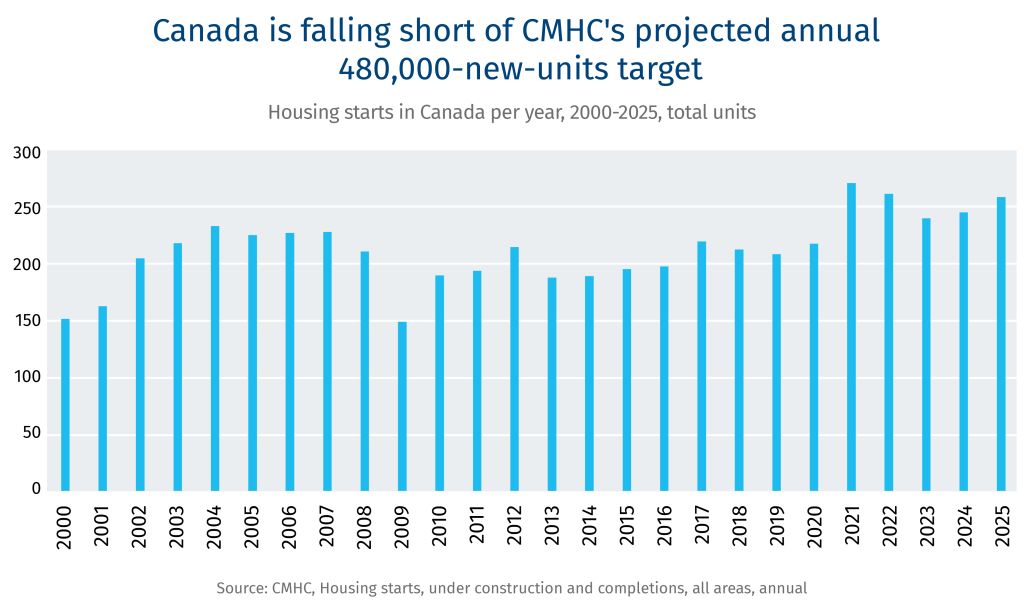
Canada is falling short of CMHC's projected annual 48,000-new-units target

Source: CMHC, Housing starts, under construction and completions, all areas, annual.

Against this backdrop, Modern Methods of Construction (MMC) has emerged. MMC, proponents claim, offer several advantages over traditional “stick-frame,” on-site building methods. Factory production can compress overall project timelines by 20-50%4, which not only accelerates housing delivery but lowers financing costs. Controlled conditions allow home builders to deliver a higher quality product with better thermal efficiency and airtightness, which is increasingly valuable as energy prices rise and climate competitiveness intensifies. Off-site work also requires fewer workers and eliminates the scheduling complexity of coordinating skilled trades on-site.

While a growing ecosystem of manufacturers and developers are experimenting with various prefabrication techniques, MMC accounts for as little as 2% of housing starts in Canada.5 That’s largely because factory efficiencies are often offset by transportation costs, overheads, and premiums from lower production volumes. At Canada’s current scale, MMC is not always cheaper than conventional construction on a straightforward unit-cost comparison basis.6 Savings of 20- 40% are possible7 but only with volume and standardization, which is precisely why scale is
so central to MMC’s value proposition.

So, what’s holding MMC back from becoming a cornerstone in Canada’s housing strategy?

Developed by the University of New Brunswick’s Off-site Construction Research Centre, MMC revolves around seven distinct categories spanning off-site construction, on-site innovation and emerging technologies.

Category 1: Volumetric (3D) modular construction involves fully enclosed units fabricated in controlled factory environments and assembled on-site.

Category 2: Panelized (2D) structural systems utilize flat structural elements like walls, floors and roofs that are prefabricated and then delivered for assembly.

Category 3: Prefabricated components support portions of the primary structure without constituting a complete system, such as foundation elements and staircases.

Category 4: Non-structural assemblies and sub-assemblies, including prefabricated building service components like bathroom pods, façade assemblies and mechanical and electrical systems that simplify on-site installation.

Category 5: Additive manufacturing represents the emerging field of 3D printing for construction to enable layer-by-layer fabrication either on-site or remotely.

Category 6: Building product-led site productivity improvements, including developing materials in larger formats or with simplified connections to accelerate installation.

Category 7: Building process-led site productivity improvements, leveraging digital tools, automation, robotics and lean management practices to optimize on-site efficiency and workflow.

Costs, timelines, regulatory treatment, financing and workforce requirements vary considerably across these different categories. Volumetric modular construction, for example, offers the most dramatic time savings (units can be stacked in days once the factory work is complete), but requires the largest upfront capital investment and faces the most financing and regulatory hurdles. Panelized systems are more familiar to regulators and financiers, but offer more modest efficiency gains. This framework is valuable as it allows regulators, financiers, and developers to navigate these trade-offs—moving beyond treating modular construction as an outlier to managing it as a coherent set of delivery methods.

Canada’s construction sector faces a fundamental productivity problem that predates today’s affordability crisis. Between 2001-2023, labour productivity in the construction sector declined 37.3%.8 The sector is highly fragmented, with many small firms lacking the scale to invest in technology or training. Work is seasonal and project-based, making it difficult to develop durable workforce pipelines. And the traditional model of site-based, trade-coordinated construction is inherently resistant to the standardization and optimization that drives productivity.

Canada’s skilled trades shortage compounds these problems. This drives up labour costs and, in some markets, prevents projects from moving ahead. The business model is also materially different. Unlike conventional builders who typically operate on a project basis with variable costs, MMC manufacturers require substantial upfront capital investment in factory facilities and equipment. Factories then need consistent, high-volume orders to achieve economies of scale. Furthermore, traditional construction financing is not well-suited to the MMC model, as lenders typically release funds based on on-site construction milestones rather than factory production phases.

Regulations present another obstacle. Canada’s building codes, while harmonized at a base level through the National Building Code, are administered provincially and adopted municipally. A manufacturer, specializing in MMC, that wants to sell into multiple provinces faces a patchwork of code requirements, inspection regimes and approval processes, which can increase delivery complexity and costs. This fragmentation and regulatory friction are among the most frequently cited barriers by MMC practitioners in Canada.9

The country’s vast geography means that the economics of factory-to-site transportation are more demanding than in markets like Japan or the Netherlands. A local factory can serve the Greater Toronto Area or metropolitan Vancouver area well, but the costs of delivering housing more than a few hours away can erode the economic case for off-site production. Strategic factory placement represents a critical lever for unlocking MMC’s potential. This is particularly critical in remote and underserved regions, including northern Canada and Indigenous communities, where persistent supply chain gaps constrain development.

Canada’s climate adds an additional complication. Extreme cold affects the performance of certain building materials and systems, as well as the logistics of construction. While prefabricated and modular approaches are a great opportunity to build housing more quickly in harsh climates and remote regions, designing for standardization requires manufacturers to develop multiple climate-specific standards (reducing economies of scale) or focus on regional markets (limiting national scalability).

All the factors above continue to slow broader uptake. Many builders already incorporate forms of prefabrication, such as manufactured wall panels or trusses, but full modular construction is a relatively small share of overall housing built. Today, modular construction accounts for an estimated 7.5% of the overall Canadian construction market, representing $5.1 billion in annual value.10 If MMC were to capture even 10-15% of Canada’s annual housing need (about 43,000 to 72,000 units per year), it would need dozens of new factories at current production capacities.11 Simply put, large investments and coordinated action is required for MMC to materially change housing delivery output.

Caivan

Ottawa-based Caivan, one of Canada’s largest developers, uses off-site manufacturing facilities to build four to seven houses daily, with plans to increase production to up to 5,000 a year. It’s also working in partnership with federal and territorial governments, and Inuit organizations, to build 750 modular homes in Nunavut, modified to accommodate specific needs in the north.

Habitat for Humanity Greater Toronto Area

Habitat for Humanity GTA is using modular technology in the construction of its new building in the east end of Toronto. Emerging from the $1.2 billion New Deal partnership between Ontario and the City of Toronto to increase the supply of below market, attainable modular homes, 33 affordable units will be available when the project completes in 2027, with most units large enough to accommodate families.

Bonville Industries

A fourth-generation family business, Bonville has been manufacturing prefabricated housing components for decades, mostly for the Québec and Ontario markets. It has developed over 45,000 homes to date, producing everything from large custom homes to multi-unit affordable housing projects, including the ‘missing middle’ buildings between 4-12 units.

1. Recalibrate policy and regulatory frameworks to capture substantial opportunities

All levels of government in Canada are responsible for getting housing built, making policy central to wider MMC adoption.

Building code harmonization is perhaps the most important policy lever and one that MMC manufacturers, industry associations and sector researchers have cited as a significant barrier.12 13 A manufacturer today must navigate different code interpretations, inspection requirements and warranty regimes across jurisdictions, creating real costs that are potentially prohibitive for smaller firms. In the U.S., a uniform national building code for manufactured homes (the “HUD” Code) is in place, and Australia is planning to implement a National Voluntary Certification Scheme for MMC manufacturers that will make meeting code requirements more straightforward. In the 2026 Spring Economic Update, the federal government committed to updating the National Model Codes to better support factory-built housing, including by accelerating the review and approval processes of innovative and prefabricated construction products and expanding the codes to

support more flexible building options (such as engineered wood).14 But this requires coordination and consensus across levels of government and industry stakeholders, alongside rigorous technical reviews.

Municipal permitting and approvals processes can present another critical bottleneck for MMC adoption, reflecting a tension between legitimate regulatory oversight and the need for systems that can accommodate industrialized construction timelines. Current frameworks were designed around traditional stick-built construction and require manual review of projects as a unique design, even when modular units are repetitive and factory-certified. For MMC to achieve its potential, municipal processes need to be fundamentally expedited to reduce approval times, including through mechanisms like pre-approved typologies, use of digital platforms and streamlined review tracks for certified manufacturers. The federal government has indicated that it intends to work with provinces and territories to reduce regulatory friction and provide clearer and more predictable pathways for factory-built housing, but this will take time to materialize. Without such modernization—supported by both regulatory reform and capacity-building for planning departments—the apparatus designed to protect public interests paradoxically undermines Canada’s ability to create housing supply at the speed and scale needed.

Public procurement is a powerful and under-utilized tool. Governments at all levels support the development of both market and non-market housing. When procurement requires or incentivizes MMC techniques, it creates the demand that manufacturers need to justify factory investments.

Build Canada Homes, the federal housing agency launched in September 2025, is mandated to galvanize the implementation of MMC and accelerate the delivery of affordable housing. Canada Mortgage and Housing Corporation (CMHC) is also starting to promote greater use of MMC by incorporating provisions for MMC into their programming. Other government homebuilding initiatives offer noteworthy opportunities, including increasing the supply of housing in the north and on military bases.

The variation in provincial and municipal building codes matters. Federal collaboration across levels of government to align policy and regulatory levers—not just in building codes, but with procurement, planning rules, and approval processes—can meaningfully reduce the fragmentation that limits developers’ and manufacturers’ ability to successfully deploy MMC.

2. Solve scale, standardization and skills challenges

Policy sets the framework, but market conditions determine whether private actors have the ability and motivation to operate within it.

Typically, MMC manufacturers work with developers to bring these technologies into the homebuilding process. Appetite for using MMC in projects is growing and those most likely to embrace off-site construction—large market housing developers, non-profit housing providers with extensive pipelines and institutional landlords creating purpose-built rentals—are building in volume. Other players remain less convinced due to the higher upfront costs, uncertainty about demand and delivery, and the complexity of managing an unfamiliar supply chain. Consumer interest, on the other hand, may be less of a barrier than is sometimes assumed, though there is little data on Canadian preferences and perceptions. Survey data from other jurisdictions suggests that consumers (especially renters) have few objections to factory-built homes when they are well-designed.15 16

Supply faces more structural constraints. Factory capacity is currently limited and geographically uneven. Small-scale developers can face higher barriers to adopting MMC, such as absorbing up-front costs and managing complex procurement. The economics of factory operation are also challenging; a modular facility needs to produce between 500 and 1,000 units a year to make modular construction cost competitive.17

Standardization is the key to unlocking efficiencies. When building types, dimensional systems and connection details are standardized, manufacturers can invest in tooling and processes that dramatically reduce unit costs. But it requires coordination across developers, manufacturers, designers and regulators that is difficult to find in a fragmented industry. Countries that have adopted MMC have done so either with strong public developer mandates (Sweden) or through large vertically integrated manufacturers that have sufficient market power to drive standardization (Japan). Canada has neither. Creating anchor demand through public procurement, and facilitating industry integration across the value chain, are the two most direct ways to create market conditions that could generate a tipping point.

Workforce development also tends to be overlooked, though the tide may be about to turn with the federal government’s recent $6 billion investment in skilled trades. The shift to factory-based production requires a different labour profile, with more emphasis on manufacturing process skills, digital design literacy, and quality systems management. Canada’s existing apprenticeship and trades training is not well-aligned to these requirements, but construction workers typically have many of the core skills needed for modular factory work, making re-skilling possible. A workforce strategy for industrialized building—incorporating provincial colleges, sector councils and manufacturers—will be central in building human capital.

3. Adapt financing mechanisms to boost investing environment

Even with supportive policy and favourable market conditions, financing remains a decisive barrier. The financing of off-site construction does not fit traditional financing frameworks developed over decades, as financing needs to be provided for materials and work outside of standard security frameworks.

Conventional construction financing is built around the draw structure, where lenders advance funds progressively as on-site milestones are achieved and the partially completed building acts as security, via land title. For volumetric modular construction, the largest costs are incurred in the factory, often before a single module arrives on site. At the point of maximum factory expenditure, there is little on the ground to serve as security, leaving developers to typically finance the production phase from equity or working capital. This front-loading of equity requirements increases the effective cost of capital for MMC projects, partially or fully offsetting efficiency gains. Particularly for smaller developers or non-profit providers, it can be a difficult barrier to overcome.

Financing Comparison: Traditional Construction and MMC

Financing Comparison: Traditional Construction and MMC
Traditional ConstructionMMC (Modular/Prefab)
Risk assessmentEstablished risk modelsUnclear/less established risk
Valuation approachComparable sales and valuation data readily available

Appraisers understand consistent methods
Few comparable sales

Inconsistent appraisal methodology
Draw scheduleStage-based inspections

Foundation -> Framing -> Finish
Upfront factory payments

Not aligned with traditional stages or lender security
Insurance and warrantiesStandard insurance and warranty products with risks well-understoodCoverage gaps during transport

Limited warranty options

Lack of data regarding claims

CMHC has begun to adapt programs for modular construction, and, as federal policies and frameworks evolve, there is opportunity to go further. Build Canada Homes could also play a complementary catalytic role by effectively de-risking the model. Both agencies could also address the capital gap that prevents manufacturers from expanding at scale, potentially working with other public or private partners.


For MMC to reach scale, Canada’s banks and private lenders need to be active participants. At present, a lack of familiarity with large-scale MMC projects can make them difficult to assess from a risk perspective. A recent U.K. government inquiry on MMC reported that real barriers exist in the form of risk aversion on the part of warranty providers, insurance companies and banks,18 which speaks to lenders, even experienced ones, being constrained in their ability to assess and approve each building system, material type, component and construction method.19

The most immediate impactful change would be a re-thinking of the construction draw schedule. Banks could adapt protocols that allow advances against verified factory production milestones, which is how MMC loans are secured in Australia and the UK.

Security valuation could be considered along with lending schedule changes. Modules in a factory are considered personal property, not yet attached to real estate, and their value in a default scenario is uncertain. Lenders could overcome this by creating security frameworks tied to factory-built components; industries like shipping and aircraft manufacturing involve lending against high-value assets in production and similar approaches could translate to modular construction.

Beyond loan mechanics, banks can invest in improving institutional knowledge. Effective lenders elsewhere have created specialist teams with expertise in MMC, relationships with manufacturers and insurers, and tailored risk frameworks. Lenders with specialist capacity have an edge in a market that could grow substantially—some estimates indicate that modular construction in Canada is expected to reach $6.4 billion by 2029 (compared to $5.1 billion in 2024).20

Banks can also play a constructive role in shaping the standards infrastructure. In markets where MMC has achieved greater scale, third-party certification and inspection frameworks have been critical in giving lenders the assurance needed to advance funds against factory production. The U.K.’s Buildoffsite Property Assurance Scheme (BOPAS), developed jointly by industry participants and the Royal Institution of Chartered Surveyors, offers an interesting model that has been broadly adopted by U.K. mortgage lenders. Canadian banks could work with industry bodies to help define these standards.

Finally, financial institutions could make financing for MMC-based homes more accessible for buyers, ideally treating factory-built homes that meet all standards like site-built homes for mortgage qualification and insurance purposes. This is not currently the case among most lenders in Canada. Uncertainty in the end-buyer mortgage market suppresses developer appetite for MMC, even when construction financing is available.

MMC is not a suite of products that can be dropped into the existing homebuilding system. It represents a fundamentally different approach to production, one that requires a correspondingly different system of policy, market and financing support. The existing system has been shaped by decades of site-based construction norms and transforming it requires simultaneous and coordinated action across multiple fronts.

The preceding sections are not an exhaustive checklist—first streamline regulations, then grow the market and fix the financing. Progress on one dimension, without simultaneous progress on others, is likely to produce limited results or stall altogether.

Consider the financing gap. Even if financial institutions and governments fully reformed their draw-schedule frameworks tomorrow, developers would still face a thin and immature supply chain, manufacturers would still be operating below efficient scale and regulatory environments would continue to vary significantly across jurisdictions. Financing reform, in isolation, would help at the margins but would not produce a step change in MMC adoption.

Or consider a scenario in which procurement policy is transformed, with federal and provincial housing programs committing to MMC for a large share of their social housing pipelines. This could create greater demand volume, but if building codes remain inconsistent across provinces, if financing products are not widely available and if the skilled workforce for factory production does not exist, the procurement commitment will not translate into the affordable housing units that are needed.

MMC has failed to achieve scale in countries that opted for incremental adoption. While individual projects can succeed, and manufacturers can grow to a point, this approach does not create the system shift necessary for MMC to go beyond a niche offering. Achieving systemic change requires a different kind of ambition, with policymakers willing to coordinate the suite of available levers—building code harmonization, accelerating approvals, procurement mandates, public financing support, industrial policy for factory investment—over a sustained period. It calls for private sector actors making long-term commitments to business models organized around MMC, which requires the policy and financing stability that gives those commitments a reasonable chance of success. And it requires institutions to work together to manage a complex transition.

High-priority actions should come first. National Building Code harmonization—specifically the provisions governing off-site construction—is a foundational step for unlocking action. Encouraging CMHC and Build Canada Homes frameworks to fully accommodate MMC is similarly important, given their central role in housing finance and insurance. Creating anchor demand commitments through government housing initiatives could provide the market signal that manufacturers need to invest seriously in Canadian factory capacity. This could incentivize more direct capital investment and involvement from developers and financial institutions. All the while, municipalities can seek to expedite approval and permit processes to better align with factory production timelines.

These actions would not, by themselves, produce the desired scale of MMC adoption, but they would create a solid foundation on which to build with expanded government support, market capacity, and maturing financing tools specifically geared towards the unique nature of off-site housing development.

Canada’s housing crisis is severe and MMC is an important component of a broader housing strategy. It has international precedents, demonstrated performance and clear potential to address the speed, cost, quality and labour challenges that are holding back housing delivery. The path and the technologies exist. The economic case, when properly structured, is sound. What’s missing is the coordinated, sustained commitment across government, industry and the financial sector to create the environment for MMC to flourish.

These examples show that MMC can scale when the policy, market and financing conditions are aligned. No country has achieved this purely through the intrinsic merits of the technology alone.

Sweden offers perhaps the most instructive international example for Canadians. Swedish homebuilders produce about 45% of new housing using some form of off-site manufacturing, achieved after decades of market evolution, consistent and supportive building codes, and a cultural acceptance of standardized design.

Japan’s industrialized housing sector, led by major manufacturers like Sekisui House and Daiwa House, demonstrates how vertically integrated companies can use
MMC to quickly build high-quality, disaster-resilient housing.

The United Kingdom—through its Homes England agency, MMC definition framework and a series of policy initiatives—has made serious efforts to catalyze MMC adoption, with mixed results, but valuable lessons. The 2019 Farmer Review, for example, concluded that the U.K. construction sector must “modernize or die”.

Australia, which faces many similar housing challenges to Canada, has seen a cluster of MMC manufacturers emerge, supported by proactive state-level procurement policies. The current administration has led a targeted investment of $54 million in advanced manufacturing of prefabricated and modular home construction.

Download the report

The federal government is launching Build Canada Homes (BCH) this fall with an ambitious goal: to double the current pace of construction in Canada to almost 500,000 new homes per year.

Here are six things that will be key to BCH’s success as it aims to tackle the country’s housing crisis:

The extent to which quick progress can be made by BCH will depend on two critical ingredients: agreement on the problem and precision on what “affordability” means.

In August, Housing, Infrastructure and Communities Canada (HICC) released a ‘Market Sounding guide’ to engage sector stakeholders. And while it offers some identifiable signals, it stops short of defining the specific housing problem that BCH aims to solve. This ambiguity leaves things open to interpretation and may result in misaligned expectations from the different audiences being asked to provide feedback.

Furthermore, housing affordability is based on various factors including income and location. It remains to be seen if BCH will prioritize building and financing non-market “affordable” housing or if its remit will be much broader. Honing in on precise intended outcomes will be critically important–focusing on addressing affordability for those whose needs are not met by the market requires a different set of approaches than aiming to address affordability for Canadians overall.

BCH’s impact will rely on convening housing stakeholders to work together in genuine partnership. All levels of government—federal, provincial and municipal—must row together to ensure funding and regulatory levers align. This will require a clear articulation of BCH’s contribution to getting more housing built in relation to other efforts across government, including within a wider housing plan at the federal level.

Partnership must also extend beyond government. Bringing together core players across the private, public and non-for-profit sectors to create a clear roadmap, and in short order, is no small endeavour. Equally important is meaningful collaboration with Indigenous partners, as rights-holders, to address the unique and considerable housing challenges faced by Indigenous people both on- and off-reserve. In theory, BCH could be a solid platform for joint action, but outcomes will ultimately be determined by the effectiveness of partnerships in practice. 

Canada’s housing policy framework is already complex, with multiple agencies, ministries and levels of government playing important roles. As it stands at the federal level, a department (HICC) and two Crown Corporations (Canada Mortgage and Housing Corporation (CMHC) and Canada Lands Company) are deeply embedded in the design and delivery of housing policy and programs. To be effective, the federal government must be clear on how BCH will complement, not compete with, established organizations with deep institutional expertise, in addition to effectively coordinating housing policy across other jurisdictions and relevant policy areas, including immigration, infrastructure and the environment.

Creating a federal body requires new legislation, governance structures, staff, and systems for accountability and oversight, before the first BCH-supported units will even begin to be developed. Moving too quickly risks creating a structure that is duplicative, under-resourced and poorly integrated within the current context. At the same time, costs associated with establishing a new institution will be significant, raising the question of whether those resources would be better channelled through existing mechanisms. While pressing action on housing affordability is needed, government will engender greater trust by being transparent about what can feasibly be accomplished and by when.

At the core of BCH’s objectives lies a fundamental tension: how to build quickly and at scale while also advancing innovative techniques and improving productivity. Delivering large volumes of new housing quickly will mean understanding which levers to pull and prioritize with existing, more traditional approaches for more units to get built. It will also be essential to indicate what progress should look like with proven, but less utilized technologies, such as modular and prefabricated construction, while layering in experimentation with other less-established methods, materials or financial tools.

Capacity, capability and demand will also factor in as key considerations across regions. What will improvements on the innovation front look like in Whitehorse in relation to Winnipeg? Overall, the test for BCH will be whether it can scale what already works while experimenting in parallel, ensuring that progress is both rapid and attuned to regional differences.

Tariff-related increases in the cost of imported materials pressure budgets and risk delaying projects, while unpredictable supply chains make it difficult for industry to commit to new builds. Prioritizing domestic materials and regional production hubs, as the Market Sounding guide emphasizes, is noteworthy but could impact costs and timelines. Government and industry will need to navigate these pressures strategically to deliver affordable and high-quality housing without interruption.

BCH poses opportunities for stronger coordination, increased innovation and, ultimately, improved affordability for Canadians. Success, however, hinges on its ability to bring partners together to rapidly execute and deliver on its ambitious objectives, against the backdrop of an uncertain economic environment. Lack of agreement or clarity on the ways to collaboratively move forward will reduce trust and hamper results, potentially creating even greater challenges.

Key Takeaways

Tackling Canada’s housing shortage will require $2 trillion in capital deployment over the next 5 years—that’s a 5X increase from current levels 

Two taxation tools—tax-free municipal bonds for housing and infrastructure, and tax credits for affordable housing—have spurred housing supply in the U.S., attracting $5 in private capital for every $1 of foregone taxation revenue

Municipalities could cut housing costs by 20% by financing infrastructure with municipal bonds.

The housing shortage in Canada has reached a crisis point.1 An estimated 3.5 million new homes are needed to keep up with demand.2 A staggering number, especially compared to the U.S., where the shortage is 12 times smaller, on a per capita basis, despite having eight times the population.3 Canada’s growing housing shortage has contributed directly to affordability challenges. Average home prices have sky-rocketed in recent years—particularly in Ontario and British Columbia, which accounts for two-thirds of the country’s shortage—such that prices are now nine times household income.4

The federal government proposed a National Housing Strategy in 2017. But the program has only delivered 10% of its commitment to build 131,000 affordable rental homes.5 Mark Carney’s government has now pledged to spend the bulk of its $36-billion housing commitment on prefabricated homes. Tax cuts and concessionary financing for developers round out the government’s policy package.

It’s a start, but more can be done. The U.S. approach to housing can be instructive in how to attract continuous private capital into homebuilding. Canada and the U.S. both provide government subsidies to encourage developers to build more affordable rental and ownership housing. Canada’s preference is grants or concessionary financing, for rental housing, and waiving of government fees, and downpayment support for first-time homebuyers.6 This policy playbook requires the federal government, and provincial governments to a more limited extent, to fund these programs through direct capital outlay.

The U.S. relies more on federal tax incentives to draw in money from corporate, institutional, and mom-and-pop investors to finance housing and housing related infrastructure, including roads and stormwater sewers. At the heart of the U.S. taxation playbook are two tax tools: tax-free municipal bonds and a low-income housing tax credit for affordable housing.7 In 2024, these tools cost the U.S. Department of the Treasury a combined US$59.1 billion—1.2% of all federal revenue—but crowded in nearly US$500 billion in direct-equity investments.8

The introduction of similar federal income tax changes in Canada could achieve a housing trifecta: increased supply, improved affordability, and more sustainable homes. By our estimates, housing costs could decrease by 20%. These savings would allow developers to free up more capital, enabling them to build twice the number of projects with the same amount of equity financing. An acceleration of building activity that could help the Carney government fulfill a key priority: making housing in Canada more affordable.9

Tax-free Municipal Bonds

U.S. local governments have the power to raise debt in public markets, through bond issuances, to finance operating and capital needs, including housing. Local governments have US$4 trillion in outstanding municipal debt, and the U.S. municipal bond market is the largest, globally.10 

The demand for local government debt can largely be attributed to the tax shield it provides investors. Holders of municipal debt, mainly institutional and retail investors, do not have to pay income tax on interest earned on these bonds.11 Since investors are willing to accept a lower rate of return in exchange for lowering their tax obligations, local governments can borrow from the public debt markets at lower costs, typically 100 to 160 basis points lower than taxable bonds with similar risk characteristics.12

To prevent the misuse of proceeds, the federal government places restrictions on what can be financed. Proceeds are principally used to finance projects where the benefits flow to public rather than private interests. To be considered for public purposes, bonds must meet one of the following criteria: more than 90% of the proceeds are used by a government entity, or less than 10% of the proceeds are secured for a property that is used in a trade or business. Municipal bonds that satisfy either of these conditions are classified as government bonds and the federal government does not impose a cap on the amount of debt that can be issued.

Activities that fail to satisfy either of these tests but provide both public and private benefits, such as multi-family residential housing projects, green buildings, and sustainable design projects,13 are eligible for financing with a type of municipal bond classified as a private activity bond (PAB). Unlike government bonds, PABs are subject to capital raising limits, which is US$48 billion in 2025.14 While PABs are used to fund a variety of initiatives, they are critical for developers building affordable housing projects. About 44% (or US$18 billion) of PABs are used to finance affordable rental housing projects, in 2022.15

Low-Income Housing Tax Credit for Affordable Rental Housing

A second tool in the U.S. tax code playbook are low-income housing tax credits (LIHTC). Since its inception in 1987, the LIHTC has been responsible for the development of 7.8% of new U.S. housing stock, or 3.65 million units of affordable housing.16

Two types of credit exist, a 4% and a 9% tax credit.17 The 9% tax credits are allocated to states annually by the Internal Revenue Service (IRS). In 2025, credits are capped at $49.6 billion. States distribute these credits to eligible projects, and eligibility criteria is refreshed annually, to remain aligned with each state’s affordable housing priorities, including the construction of greener or more energy efficient homes. The 4% tax credits are awarded automatically to projects that receive 50% of funding through tax-exempt municipal bond financing. There’s no ceiling on the amount of 4% tax credits available each year, since developers apply for the credit directly with the IRS.

While there are several approaches to accessing the 9% tax credit, the most common is for a syndicator, typically a bank, to play match maker between developers and investors. A limited liability corporation (LLC) is formed in which investors are the limited partners owning 99.99% of a housing project, and the developer as the general partner owns 0.01%. The developer flows to investors the tax credits they receive from their state housing finance authority once a project is occupied. Investors in return provide equity financing to developers, that’s generally $0.90 on the dollar for a credit. These investment partnerships are structured to last 15 years, which is the mandated affordability period in the tax code. At the end of the 15-year holding period, the investors, who are mainly corporations, have the option to sell the housing project back to the developer or enter a new deal for the same property.18

Investors in LIHTC are mainly motivated by the after-tax returns on their equity investments. As a result, they are comfortable with providing 80% equity financing for a project where they will receive lower returns because their contributions will be used to lower rents. Investors internal rate of return (IRR) of after-tax savings range from 350 to 800 basis points which on the upper end of the IRR range is almost twice the yield of a 12-month U.S. treasury bond.19 Two forms of tax savings exist—general tax savings and income tax savings. The former is realized through asset depreciation and operating losses. Income tax savings are realized by using the tax credits to offset federal income tax liability for 10 years, although the credits can be recaptured if the housing project fails to comply with rent and income requirements.20

Tax credits, while benefiting investors and businesses, come with a downside cost: foregone taxation revenue, which, as noted above, cost the government US$59.1 billion in 2024. On the positive side, the LIHTC is estimated to crowd in US$2 of investment spending for every dollar in foregone revenue. The multiplier effect is even more staggering for municipal bonds, crowding in US$10 of private investor capital for each dollar in foregone tax revenue.21

What’s required to adopt the U.S. tax playbook in Canada

Investment tax credits and tax-free capital gains are not novel taxation concepts in Canada. The federal government’s Multiple Unit Rental Building (MURB) program, which ran from 1974 to 1981, permitted retail investors in rental apartments to lower their income tax obligations by claiming capital depreciation and other costs against their income. The program, which cost the federal government between $1.3 and $2.1 billion in foregone taxation revenue in today’s dollars, was eventually discontinued due to its ineffectiveness in creating below market rental housing and lowering rental construction costs.22

The U.S.’s LIHTC program is like Canada’s MURB program in providing tax incentives to attract private capital to finance affordable housing projects. But it differs in its prescriptiveness, governance, and tax-incentive design, which draws in more corporate and institutional rather than retail investor capital. By imposing thresholds for income and rent levels, along with a 15-year compliance period, the program has been successful in ensuring a steady supply of affordable rental housing that’s privately owned. The effectiveness of the program is further enhanced because states are given the flexibility to tailor the program to meet regional priorities, such as Washington state’s preference for projects that are located near mass transit.

Adopting the U.S. affordable housing taxation playbook in Canada will require all orders of government to tweak or introduce new legislative or governance changes in how they deliver and fund housing, and housing-related infrastructure. The greatest shift will be required at the local government level. There, long-standing capital budgeting practices will need to modernize to leverage debt financing that’s available from institutional investors.[1] The crowding in of private capital, however, hinges on the federal government making the necessary changes to its tax code, as the quantum of benefits of similar tax code changes at the provincial level are insufficient for investors.

Federal Government

The federal government would need to enact tax code and governance changes to implement a low-income housing tax credit and a tax-free municipal bond regime in Canada. 

For tax-free municipal bonds, changes are required to the Income Tax Act to exempt interest earned on municipal bonds. Guardrails would be needed to ensure bond proceeds are earmarked for housing related infrastructure projects, such as watermains and sewers. To encourage green infrastructure, the government could also impose a requirement that proceeds be used to build low-carbon infrastructure, such as district energy systems using waste heat. Both guardrails could be achieved by defining the circumstances when interest earned on municipal bonds is not income. For these changes to work, municipalities would need to develop borrowing frameworks, such as a social debenture framework or a green debenture framework, which specifies how bond proceeds will be used.

Changes to the Income Tax Act would also be required to create an investment tax credit for the financing of affordable housing, along with corresponding eligibility criteria of what constitutes affordable housing. To encourage the construction of greener homes, the Department of Finance could replicate the IRS’s approach of defining a range and type of eligible projects. 

The final broad change that may be required at the federal level is the expansion of the Canadian Mortgage and Housing Corporation’s (CMHC) mandate to administer the income and rent limit elements of a LIHTC program, if its current remit related to core housing need does not include these activities.   

Provincial Governments

Canadian provinces do not have housing financing agencies but could leverage housing ministries or departments to administer the provincial components of an LIHTC program. The mandate of these ministries and departments may need to change to encompass all provincial-level elements of a program, such as setting housing priorities, scoring applications, allocating tax credits, and monitoring compliance.

Municipal Governments

For decades, municipalities have been permitted to raise capital through bond issuances and loans to fund capital projects, but rarely for affordable housing.24 This is partly because the federal government along with the provinces are the key funders of market and non-market housing programs, aimed at housing affordability and more recently at climate change. Ontario is the only province where municipalities are actively engaged in funding affordable rental housing, mainly government-owned community housing.25 Funding for these initiatives is primarily paid for by revenue generated from municipal property taxes and user fees, and, in rare cases, municipal bonds, with the latter confined to the largest cities with a growing population and stable economic base, such as Toronto.

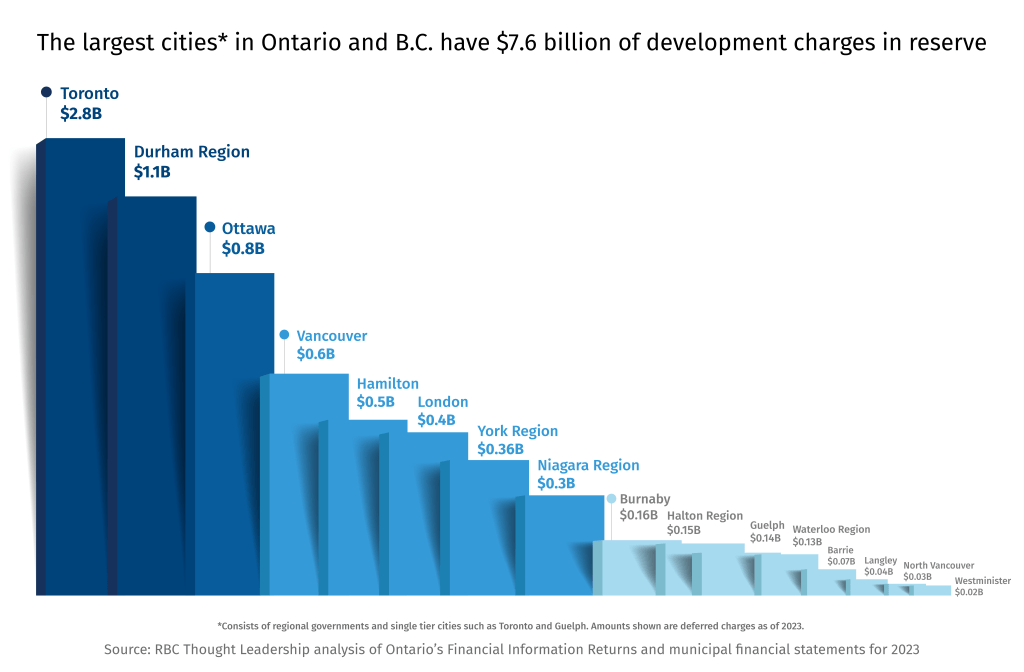
We are not proposing municipalities adopt the U.S. municipal bond playbook wholesale, whereby municipalities directly fund affordable housing with bond proceeds.26 Such a proposal may be unworkable in provinces that require public money to finance only public assets. Instead, we encourage municipalities, especially those in Ontario and B.C., to study the costs and benefits of paying for infrastructure with long-term public debt financing instead of development charges.27 Our analysis of proposed and under construction housing projects found that removing the cost of infrastructure from the price tag of homes can potentially reduce the per-unit construction costs of new homes in the Greater Toronto Area and Metro Vancouver by an average of 20%.28

 Moving to a debt-financing model does not change who pays for housing related municipal infrastructure–renters, homeowners and ratepayers. The conduit for this cost pass-through however changes from developers to municipalities. Because municipalities can borrow at a cheaper rate than developers or homeowners, the interest costs that are passed through are lower.29 Fundamentally, the proposed change addresses a structural housing affordability problem that’s rooted in having renters and homeowners of new construction pay for infrastructure costs upfront, rather than spreading the cost over many decades, through monthly utility fees.

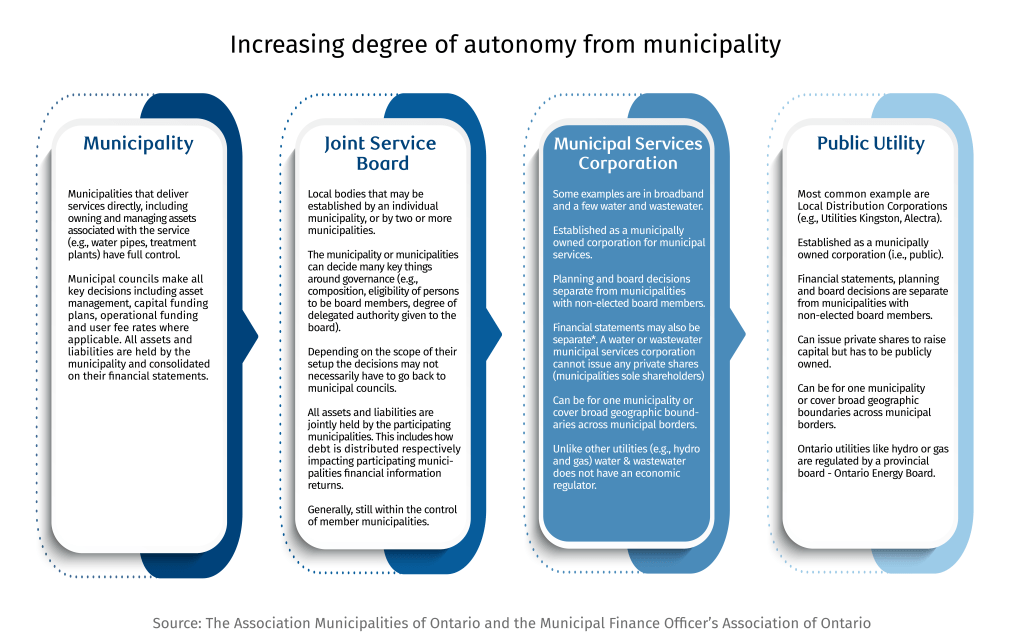
Public-debt financing can occur either as on-book or off-book financing. On-book financing requires municipalities to stay within their annual debt repayment limit, which is generally 25% of own revenue sources.30 Off-book financing provides municipalities greater borrowing flexibility, as annual debt repayment limits are not applicable.31 This form of financing, however, is more administratively complex, as municipalities would need to establish a municipal services corporation (MSC) or a public utility, and scope out the services they want to provide. The most common uses of MSC, or public utilities, are for water/wastewater and local electricity distribution. Both types of corporations operate arms-length from municipalities and take on the public debt used to finance an infrastructure project, in addition to owning and operating the asset.

The strong fiscal position of Canada’s largest municipalities indicates that shifting to a public debt model to finance housing related infrastructure is achievable. Based on regulatory filings32, the 13 largest single-tier and regional governments in Ontario that are also active in the municipal bond market have the fiscal room to take on at least $4 billion in debt, either as loans or bonds, without breaching their annual debt repayment limit. That’s two times greater than the $2 billion they collected in development charges in 2023.33

About 20 Canadian municipalities actively borrow from the public debt market to finance their hard infrastructure projects.34 Municipal bond issuances totaled $5.4 billion, in 2024, with $53 billion in outstanding debt.35

Given the mostly AA to AAA credit ratings of Canadian municipalities, the low risk of default, and the attractive risk-return profile, it’s likely that based on the U.S. experience,changes to the federal tax code to exempt the interest earned on municipal bonds will result in greater investor demand.36

While Canada’s municipal bond market is unlikely to grow 75 times, to $4 trillion dollars, which is the size of the U.S. municipal bond market, the $4 trillion figure is proof that tax incentives can be an effective tool in drawing in private capital into desired forms of infrastructure.37

Municipalities have a range of governance options in how to deliver their services, and ownership and management of these services. The most common model that exists in Canada are for municipalities to have full ownership of service delivery. Within the past 30 years, as more responsibilities are shifted onto municipalities from provincial governments, there’s been a slow evolution to explore different and more cost-effective forms of service delivery.   

Municipal services corporations (MSC) and public utilities are the two most common alternative forms of service delivery.38 The creation of these arms-length municipally owned corporations provide greater flexibility to plan for and finance the full lifecycle of assets.   

In a MSC or public utilities service delivery model, these corporations take on debt to pay for the upfront capital expenditure costs of an infrastructure project. Debts are paid off over several decades through monthly user fees derived from homeowners and businesses using the infrastructure. The continued economic viability of these systems is ensured through mandatory utility connections, typically required by provincial or municipal planning regulations.

Turning ideas into action

We encourage all levels of governments to study and consider the taxation and financing ideas proposed in this policy brief, as they refresh their housing strategies.

Our policy brief does not model the utility rates impacts were municipal governments to adopt a debt financing model for infrastructure. These economic and taxation studies are complex, requiring a deep understanding of capital budget and service delivery models, which is not uniform across Canada. Given the domain expertise required to execute these studies there’s an opportunity for provincial and municipal governments to jointly co-fund these studies to understand the costs and benefits of our proposed ideas.

At the federal level, policy and program design work is likely underway for the government’s affordable housing tax credit proposal, and its commitment to reduce municipal development charges by 50%.39 We encourage the Department of Housing, Infrastructure and Community to consider the ideas put forth, as they move deeper into the policy analysis, program design and consultation stage of their work. Since changes to the Income Tax Act are at the crux of our two ideas, we encourage the Department of Finance to evaluate the cost and benefits of our two tax proposals on the government’s balance sheet.

Conclusion

An estimated $2 trillion will be required over the next five years to build the additional 3.5 million homes required to alleviate the country’s housing affordability crisis.40 A crisis that in the past few years have led to several studies by the federal and provincial governments analyzing the root causes of the country’s housing supply and affordability problem, and recommendations for action.

The taxation ideas proposed above advance some of these recommendations. The Ontario Housing Affordability Task Force recommended the creation of an arms-length municipal services corporations that would build, own and operate housing related infrastructure.41 As well as finance the infrastructure using debt rather than development charges. And the Canada-British Columbia Expert Panel on the Future of Housing Supply and Affordability recommended increasing the supply of below-market rental housing through a long-term funding commitment.42

The urgency to leverage and enlarge the pool of capital available for new housing construction—five times the current level of deployment—is becoming greater, as provinces and the federal government take on unplanned new spending to support businesses and communities impacted by U.S. tariffs. The net effect on both levels of government is less fiscal room to support other priorities, including housing. Restoring housing affordability needs to be a short and long-term strategic priority for all levels of government. Doing so will free up household disposable income that can be re-invested to grow other sectors of the economy. It will be a sustainable outcome that can help safeguard today’s standard of living and economic prosperity for current and future generations of Canadian renters and homeowners.

For more, go to rbc.com/thoughtleadership

Download the Report

Policymakers in Canada’s fastest growing cities face a triple challenge over the next decade: how to build their infrastructure for a rapidly growing population, continue lowering greenhouse gas emissions, and ensure that neither strain municipal finances.

Against this backdrop, low to zero-carbon district heating systems, and in general district energy systems, are emerging as a fiscal and climate tool that municipalities are deploying to tackle their growth, climate and fiscal trilemma. The low-carbon neighbourhood systems have the potential to lower building emissions by just over a third in Canada’s biggest cities, according to our research.

District Heating Systems – A Solution for Multiple Challenges

District heating is a large-scale approach to heating a cluster of buildings with energy produced by a central heating plant. It’s not new to Canada, though. The first central steam heating plant was established in 1878 in London, a mid-sized city in southwestern Ontario. The plant provided downtown businesses with heat, distributed through an underground network of pipes to individual buildings. The network-based neighbourhood approach to heating fell out of favour in the country around the late 1950s, as natural gas became widely available for space heating.

Canada’s ratification of the Paris Agreement in 2016—a legally binding international treaty on climate change—has compelled municipalities to explore ways to transition away from natural gas for space heating while also scaling their greenhouse gas reduction efforts. And district heating systems are increasingly emerging as their solution of choice. These new systems are designed to be low to zero carbon and take advantage of the most cost-effective and low carbon feedstock in close proximity to a system’s central heating plant. Common feedstocks include recovered heated sewer water, such as those from showers and dishwashers, heat stored up to 350-metre deep below the ground, or biomass, such as wood chips and plant waste. Heat pumps or heat exchangers, powered by electricity, are used to move heat generated at a central plant to buildings in the heating network.

The Climate Imperative

Buildings is the third largest source of emissions in the country and the single largest source of municipal emissions, accounting for an estimated 50-60% of all its emissions1.

The challenge of building physical infrastructure is that it’s locked in for up to 60 years in some cases. The strategic and political choices made today will dictate the long-term fiscal and climate health of these cities for more than half a century.

Embodied emissions, which is the carbon in building materials, is more challenging to decarbonize than operating emissions, due to the “green premium” and limited availability of low-carbon building materials.

Given this constraint, municipalities are focusing their policy efforts on reducing emissions from space heating, which account for 65% of operating emissions. A common policy lever is to mandate construction of more energy efficient buildings. A shortcoming of such policies is their failure to address a key change crucial to reaching Net Zero—to switch away from natural gas to carbon free energy sources, especially for space heating. Energy efficiency policies’ intent to lower the amount of energy consumed, and decarbonization policies’ focus on reducing emissions, has led to the emergence of another policy lever that can achieve both policy outcomes: the deployment of low or zero-carbon district heating systems.

Scaling district heating systems could lower building sector emissions in Canada’s largest cities by 36%

Building upon analysis that engineering consultants RWDI undertook for the Climate Smart Building Alliance, the Climate Action Institute estimates that building sector emissions in Canada’s largest cities could conservatively be reduced by 36% annually, were 27% of all new building floor space connected to a district heating system powered by low or zero-carbon energy sources2. That’s four and a half times greater than the current rate of decarbonization for the electricity sector, which has already experienced the fastest decline in emissions in Canada over the past several years3.

The Fiscal Imperative

Municipal infrastructure is costly to repair and maintain. The Federation of Canadian Municipalities’ latest report estimates that local governments across Canada have a $170 billion infrastructure repair backlog, an amount that is 217 times greater than Vancouver’s 2024 capital budget4.

Property taxes, originally conceived to fund community-wide infrastructure and services, such as fire protection, roads and parks, have evolved since the 1990s to fund infrastructure that only benefits a subset of the community’s households and businesses. The trend towards socializing the costs of private benefits, combined with limited revenue raising tools, legislative requirements for balanced budgets and limits on public debt issuances have all contributed to the massive infrastructure repair backlog.

The on-going structural challenges of municipal finance, and the high capital and operating costs of greening infrastructure has municipalities on the hunt for innovative fiscal tools that can shift costs from taxpayers to ratepayers. Privatization of utility costs is emerging as a potential solution. To date, the greatest adoption of this practice is the provision of low or zero-carbon thermal energy through the creation of a district energy system.

District thermal systems, a subset of DES, provide a hat-trick of benefits for municipalities. They facilitate the creation of low to zero-carbon thermal grids, they are crucial to increasing the pace of building decarbonization, and they don’t impose a burden on municipal finances. For municipally owned systems, district thermal systems serve as a new and significant revenue stream, which can be tapped into without new legislative authority5. Revenues are generated, at the building level, from a variable charge for thermal energy consumption and a fixed charge for the amount of system capacity required to provide heat to a building.

The enabling factors for the triple benefit are a business model predicated on full cost recovery, spread over a 30-year time horizon, and aided by regulatory requirements that all buildings must have a utility connection for thermal heating6. System owners take on the initial capital risk of designing and building a system. These capital costs, in addition to operating costs, are directly passed onto ratepayers once a system enters operations. System owners are compensated for the asymmetric risks at project onset, through 30 years of steady, predictable and recession-proof streams of revenue.

The Path To Greater and Faster Adoption

Market forces have primarily driven the deployment of district heating systems to date. Five supply and demand policies, if enacted through Official and Secondary Plans, by-laws and climate strategic plans can speed up their scale and adoption.

  • Policy Support 1: Introduce Mandatory Connection By-laws

    The current crop of new low carbon district heating systems is driven by real estate developers looking to decarbonize their master planned greenfield projects. Devoid of infrastructure connections and utility connections, such developments are fertile ground for the deployment of district heating systems. The blank canvas gives real estate developers complete freedom to choose and build the most cost effective and climate friendly energy sources for their development, unlike other types of developments.

    District heating systems have also been deployed for brownfield developments, such as the redevelopment of the False Creek Neighbourhood in Vancouver. On brownfield sites, however, district heating systems often must compete with natural gas or other pre-existing thermal energy infrastructure. By-laws requiring real estate developers to connect their buildings to existing district heating systems can help in scaling demand, by removing developer discretion of the type of thermal energy connection to provide for their developments. Mandatory connection by-laws are common in Vancouver and the lower mainland of British Columbia.

  • Policy Support 2: Promote Integration of District Heating in New Projects

    District heating systems are most cost effective when deployed in high density, mixed-use developments where infrastructure costs can be spread across a greater number of buildings. The mixed-use characteristic of a development is important as it contributes to variable heating demand throughout the day, given the different demand patterns between residential and commercial buildings. This variability in peak demand is important for minimizing system build and operating costs. A smaller system can be built to handle total and peak demand, and peak operating costs are lowered as consumption is spread out.

    Introducing policies in Official and Secondary Plans that lay out the circumstances of when district energy systems should be considered will aid in their adoption and economic viability. The City of Toronto’s Official Plan has several policies requiring developers to consider the incorporation of district energy systems when planning new neighbourhoods or when developing in areas zoned for mixed-use projects.

  • Policy Support 3: Recognize and Reward Adoption

    An increasing number of municipalities have adopted Net Zero strategies and emissions reduction goals as part of their target-setting framework or building design and performance requirements, such as the City of Toronto’s Green Standard. These frameworks recognize the environmental benefits of low carbon district energy systems, including district heating systems. Municipalities can reward developers for their pursuit of low-carbon systems by refunding a portion of development charges and/or fast-tracking review of their applications.

  • Policy Support 4: Create a Strategic Energy Plan

    Municipal-wide energy plans, such as those adopted by the cities of Guelph and Edmonton, are another emission-reduction tools municipalities have adopted. Identifying where district energy systems will be built in an energy plan can aid in their adoption. They can be used to attract developers interested in incorporating ready-made, turnkey district energy systems in their projects. That’s the strategy the City of Guelph employed when it developed its district energy strategic plan in 2014. The plan identified 10 nodes in Guelph where district energy systems would be built by the city and the types of development targeted for each node.

  • Policy Support 5: Encourage Development of District Energy-Ready Buildings

    Requiring real estate developers to construct “district energy-ready” buildings to spur future demand has emerged as another proactive policy lever. Under these policies, developers construct their buildings with the equipment necessary for future connection to a planned district energy system.

Related Reading

High Rise, Low Carbon:

Canada’s $40 billion Net Zero building challenge

Timber Rising:

How Wood Can Spur Canada’s Green Building Drive

Power Shift:

How Ontario Can Cut Its $450-Billion Electricity Bill

For more, go to rbc.com/climate.

Download the Report

Download

Contributors:

Lead author: Myha Truong-Regan, Head of Climate Research, RBC Climate Action Institute

Yadullah Hussain, Managing Editor, RBC Climate Action Institute

Shiplu Talukder, Digital Publishing Specialist

Caprice Biasoni, Graphic Design Specialist

  1. Buildings generated 89MT of emission in 2022.
  2. Estimate based on the following DES connectivity ratios by building typology and floor space, for new construction occupied between 2024 to 2030: 50% commercial and institutional; 25% multi-residential; 10% single detached and attached homes. Annual savings starting in 2030.
  3. The average annual rate of emissions reduction for the electricity sector between 2020 to 2022 was 8%.
  4. Making Canada’s Growth a Success: The Case for a Municipal Growth Framework.
  5. Depending on system size and heating demand, a district heating system can generate profits equivalent to 15% of a municipality’s property tax revenue.
  6. All builders are required to provide utilities to their buildings. In the absence of regulation and ESG related emission reduction targets, builders have discretion over whether heating will be powered by electricity or natural gas. District energy systems, given their scale, can enable the use of wasted forms of heat, which is not economically viable at a building level.

Key Takeaways

On February 16th, RBC, the Task Force on Housing and Climate, and BC Housing joined forces to host a roundtable discussion in Vancouver to address Canada’s housing crisis by enabling and scaling prefabricated or manufactured construction. We assembled a cross-section of attendees in the buildings space, including executives from commercial builders, real estate investment firms, pre-fabricated manufacturers, construction services, Metro Vancouver, BC Housing, Infrastructure Canada, industry associations, and others, plus RBC’s real estate and sustainable finance lending teams. The conversation highlighted the fundamental and structural challenges that need resolution before prefabricated construction can emerge as a viable solution. While some challenges have been captured below, this note focuses on some of the enablers and ideas tabled in the discussion that could help solve Canada’s housing challenge. Here’s what we took away from the discussion:
  1. Executive champions can pave the way.
  2. Manufactured housing has succeeded in jurisdictions that have shown urgency in resolving the housing crisis and have executive champions that facilitate approvals through the system. St. Catharines, Ontario, and Charlottetown, Prince Edward Island, were cited as municipalities where builders delivered housing projects within months, thanks to various city departments’ willingness to negotiate existing guidelines and expedite approvals.
  3. Deploy different financing and equity models.
  4. This includes properties owned by municipalities that offer shared equity with developers and financiers. Patient capital for affordable housing projects should also be explored. Importantly, lenders are being asked to rethink their financing terms and risk and valuation models to enable more manufactured construction, which differs significantly from traditional construction finance. In manufactured construction, heavy capital outlay is required prior to tooling starting at factories, compared to traditional construction financing that anticipates a steady pace of outlay as the site progresses.
  5. Capital is needed for an industry in pain.
  6. Private sector players provide the vast majority of housing in Canada and will play a pivotal role to meet CMHC’s projection of 3.5 million additional housing units (for a total of 5.8 million) by 2030. But current macro conditions are hampering their ability not just to build, but survive. In the past 18 months, interest rates on loans and land debts have ballooned exponentially, affecting project economics. And while public advocacy for prefab and mass timber construction has been ramping up, several manufacturers such as Nexii and Structurlam, have gone under. Industry, including developers, contractors, manufacturers, and others, needs proper incentives, including subsidies and tax credits, to invest more in housing, especially affordable stock that often yields thinner margins.
  7. Lean on public sector procurement.
  8. Given the high capital costs required to invest in manufacturing plants and facilities, an extended period without housing projects could render companies insolvent. That’s where public entities can play a foundational role. Ensuring that there’s not only a fast approval process but one that guarantees projects allows companies to grow and scale.
  9. Seek international expertise.
  10. Ultimately, we may need to also look outside of Canada to get the scale needed to build nearly six million in cumulative housing units by the end of the decade. Many manufacturers in Canada have already folded, and the remaining may not have the capacity and/or scale to meet the projected housing target. China’s manufacturing capacity–at millions of square feet of factory space–should be explored.
  11. A catalogue of pre-approved home designs is a step in the right direction.
  12. But it needs to be reconciled against the complex policy landscape across various levels of government, including national codes, provincial policies, and municipal codes. Builders are struggling to keep up with constant changes to building codes. Significant effort is also required to adapt existing knowledge for each amendment, which prevents their ability to scale using manufacturing.
  13. Governments are alert to the housing challenge.
  14. Federal Minister Sean Fraser has signalled the department’s increased focus on manufactured housing as a solution to the crisis in recent forums and discussions. The CMHC’s Housing Accelerator Fund is another laudable effort to tie federal funding to municipals to removing local barriers to building homes fast. The Task Force on Housing and Climate’s report on March 5 will likely have recommendations that end up in this year’s federal budget. B.C.’s Ministry of Housing is also expected to push through a swath of legislative changes this spring, on the heels of the province’s new BC Builds program. However, governments can do more to facilitate development, including harmonizing codes across jurisdictions, speeding approval processes, and educating permitting departments on the benefits of innovative construction methods and materials.
  15. British Columbia could be a manufactured housing leader.
  16. The province is managing its forests in more sustainable ways and focusing on high value rather than high volume. WoodWorks BC and other organizations are also working to build up supply of wood and mass timber product. As builders increase the use of the low-carbon materials, the sector could see a jobs boost.

Why we wrote this

Last fall RBC partnered with BCG’s Centre for Canada’s Future and Arrell Food Institute at the University of Guelph. We set out to explore what we believe is Canada’s moonshot: to produce 26% more food by 2050 (enough to maintain our contribution to the global population as it grows) with fewer emissions. The result was The Next Green Revolution: How Canada can produce more food and fewer emissions.

Throughout the past year, here’s what we learned:
  1. Canada is uniquely placed to lead: Our assets are unparalleled, but we need to do more to maximize them. Other nations are allocating substantial funding to promote climate-smart agriculture. Canada can proportionally match those investments while establishing new market mechanisms to help finance agriculture’s sustainable transition.
  2. Nothing will happen without accurate measurement technology: Tools to monitor emissions accurately (especially carbon sequestration in soil) are essential to building markets and helping producers take advantage of them.
  3. Cross-sector collaboration is key: A successful transition to Net Zero demands a new approach. It requires public-private actors across the fragmented agriculture supply chain to work together, as one sector, toward a single vision.
  4. Private sector R&D is insufficient: Canada has invented some of the most important agricultural technologies globally. But private sector funding for innovation is at an all-time low. To remain leaders in this space, we’ll need private actors to invest.
  5. Skills gaps are limiting growth: The sector requires more workers to drive the Net Zero transition. From on-farm managers to data analysts, qualified workers and advisors are desperately needed on Canadian farms, but post-secondary funding is insufficient.
  6. Early adopters should be rewarded: A significant number of producers across Canada have engaged in climate-smart agricultural practices for years—if not decades. These pioneers could be left out as programs develop to financially incentivize farm operators making their first transitions to better soil health methods. To continue growing current carbon stock levels, early adopters must receive a financial benefit for their continued contributions.
  7. The world needs Canada more than ever: With global supply chains under stress from the Ukraine-Russia War and extreme climate events, many countries are facing food shortages or unstable supply lines. As a politically stable country, and a reliable supplier of safe, high-quality food, Canada has an opportunity to become the world’s sustainable breadbasket.

Key takeaways

  • The building sector is the 3rd most carbon intensive industry in Canada, accounting for 13% of all emissions in 2022, or 92 million tonnes (MT) of CO2e. Canada aims to cut that amount to 53MT by 2030.
  • Widespread adoption of wood, specifically mass timber, as a substitute or complement to concrete and steel could cut embodied emissions in buildings by as much as 25%.
  • Mass timber deployment in new apartments, condos, and office towers could cut emissions by at least 9MT, or nearly 10% of the sector’s emissions, by 2030.
  • Aside from emissions savings, greater use of mass timber in building construction could conservatively grow the mass timber market by $1 billion by 2030. A share of this growth is anticipated to flow to Indigenous communities as they are in the employment catchment areas for logging sites, sawmills and mass timber manufacturing facilities.
  • Addressing the cost of construction and occupancy insurance, and mismatch between supply and demand is essential before Canada can achieve emissions savings, economic, and job growth opportunities.
  • Canada has all the puzzle pieces required to become a global leader in mass timber. The country’s climate commitments are an opportune time for all players in the building sector to come together to act on this collective ambition.

British Columbia And Quebec Spearheading Canada’s Timber Drive

Completed mass timber projects, 2022

Source: Natural Resources Canada’s Mass Timber database, RBC Climate Action Institute

661

The number of completed mass timber projects in Canada

87%

B.C., Ontario & Quebec’s share of Canada’s mass timber projects

12

The number of storeys permitted for mass timber projects in Canada

A 10-storey building rising near Toronto’s Harbourfront may not stand out among the crush of the city’s skyscrapers, but as an environmental statement it stands tall. George Brown College’s Limberlost Place is a mass-timber-and-glass structure with ambitions of being a net-zero carbon emissions building. It’s an idea whose time has come. While towering steel-and-concrete structures once symbolized economic growth, they are now emblematic of the climate challenge that needs to be scaled. The extensive use of carbon-intensive cement, steel and aluminum in buildings has made it the third most emissions generating sector in Canada, accounting for 92 MT of CO2e1, or 13% of all emissions in 2022. Rising populations, continued urbanization and a rush to develop multi-storey concrete buildings to address a housing supply crisis could make it harder to rein in emissions. Canada can tap into its rich forestry resources to create a global market for large beams, panels and posts made of treated wood, that can potentially replace concrete and steel or dramatically cut their use—and their associated emissions. The rise of Limberlost Place, and the smattering of similar structures dotting Canada, suggests we may be on the cusp of the next wave of sustainable buildings: made with low-carbon mass timber and assembled like an Ikea wardrobe to help bring down emissions.

Rise of mass timber

The emergence of mass timber in Canada as a complement and alternative to concrete and steel first emerged in 2007, with the completion of several commercial and institutional buildings in British Columbia, Ontario and Quebec2. These include the College of the Rockies Kootenay Centre South in Cranbrook, B.C., the Winnipeg Humane Society in Manitoba, and the OslerBrook Golf Clubhouse in Collingwood, Ontario. Prior to this point in time, national and provincial building codes did not permit the use of mass timber. Canada now boasts 661 completed mass timber projects. The United States, in comparison, has about 356 completed projects. Governments or colleges/universities commissioned most of the early commercial and institutional buildings. And while they still dominate the building type mix, there’s a notable shift to multi-storey residential buildings, driven by private developers and builders. Today, a third of all planned and under construction mass timber projects are residential multi-storey projects.
Insight

Wood first: B.C.’s Mass Timber Playbook

Several enabling policies has made British Columbia a leader in the use and production of mass timber within Canada and internationally.

The long-time champion of its forestry sector and its products, B.C. introduced The Wood First Act in 2009, with the mandate to use wood in provincially funded buildings. The “wood first” procurement approach for public projects continued with successive governments and culminated with the establishment of the Office of Mass Timber Implementation in 2020. A Mass Timber Demonstration Program was announced in 2020 to support early adopters of mass timber, such as Adera Development, to accelerate wider adoption of this low-carbon building material. The province remains quick footed in addressing regulatory barriers, specifically building code requirements. British Columbia was the first province to permit six-storey wood frame residential buildings. When the National Building Code of Canada (NBC) was revised, in 2020, to permit 12-storey mass timber buildings, the province followed suit, even though the NBC was not finalized.

The province leveraged its abundant forestry resources to mirror the playbook used by many European countries to promote mass timber. Countries with sizeable forestry sectors, such as Austria, Germany, Sweden and Finland were some of the first European countries to remove building code restrictions on wood—the most significant obstacle to mass timber use and adoption. Recognizing that government support is often needed to commercialize and scale widespread adoption of new products, these governments also provided project development, and research and development grants for builders and developers to build with mass timber.

The 9 MT emissions imperative

12-25%

Drop in buildings emissions if developers swap concrete & steel with mass timber

6%

Concrete, steel and aluminum’s contribution to Canada’s emissions

9%

Decline in building sector emissions due to widespread use of mass timber

Concrete and steel’s emissions profile is 6 and 5 times greater than wood, respectively3. Within the context of buildings and embodied emissions, concrete, steel, and aluminum account for 6% of Canada’s total emissions or 41 MT of greenhouse gas emissions, in 20224. In multi-storey buildings, the floor system is the largest total surface area within a building and accounts for 50% of a building’s embodied emissions,5 which reside in the materials that are considered especially challenging to decarbonize. Given the emissions profile of a building’s floor system, much of current decarbonization efforts have focused on this structural building element. Multi-storey buildings constructed with a mass timber floor system can reduce their average emissions by 27% for the floor system and 12% to 25% for the entire building structure6, according to builders with extensive experience working with mass timber.

Embodied emissions profile of a mid-rise tower

The sector could cut 5.5 MT in emissions by 20307 if one-third of all new apartments and condos and all new office towers, in major urban centres, were constructed using mass timber. Emissions could decline by another 3 MT if all future apartments and condos were constructed using a mass timber floor system and domestic manufacturing capacity was not a constraining factor8. These emission savings demonstrate that small efforts, such as changing one element of a building’s structure, can lead to significant emissions savings, even though the size of the gains may pale in comparison to other purely technology-based solutions, such as heat pumps or electric vehicles. Construction with mass timber could also lower on-site vehicular traffic and reduce the use of fossil-fuel powered heavy equipment. Unlike concrete, mass timber is a prefabricated wood product that can be delivered in a few shipments and then stored on a construction site. Mass timber practitioners, Veronica Madonna of Athabasca University and founder of architect firm Studio VMA, and Lee Scott of Element5, a mass timber manufacturer with plants in Quebec and Ontario, have found that this storage benefit can reduce on-site vehicular delivery traffic by 80 to 90%, compared to the construction site for a traditional concrete and steel building.
Insight

The story of embodied emissions in steel and concrete

Mass timber, steel, and concrete all have their origins as natural materials extracted from or below the earth’s surface.

The energy and industrial processes required to transform iron ore into steel and limestone and clay into cement, and eventually concrete, are the reasons for their high embodied emissions profile, compared to mass timber. The industrial processes for steel and concrete require using extraordinarily high heat, between 1,400 to 1,600 degrees Celsius, to transform raw materials in blast furnaces or kilns. Energy required to power blast furnaces for steel-making accounts for 87% of emissions generated in the steel making process, according to the International Energy Agency. For cement production, the reverse is true, with 65% of emissions attributable to industrial processes, specifically, the release of greenhouse gases from the heating of limestone and clay in kiln ovens. Mass timber’s significantly lower emissions profile can be attributed to a manufacturing process that largely leaves the original raw materials intact.

Another advantage is that mass timber weighs about 30% less than concrete. The downstream benefit of lower on-site delivery traffic and higher weight differential is lower transportation related emissions. The prefabricated nature of mass timber combined with its relative lightness compared to steel and concrete, means that less heavy machinery such as cranes are needed on a construction site. And when they are used, they have a shorter running time. Both practices reduce the fossil fuel used to operate construction machinery, lowering emission levels.

Canada’s opportunity to capture a slice of the global mass timber market

3x

Growth in Canadian jobs associated with mass timber by 2030

3x

Growth in Canadian GDP from mass timber by 2030

$4.9B

Global mass timber market by 2030

Mass timber accounted for 1% of all building construction materials in North America last year. The global mass timber market reached $1.6 billion in 2022 and is forecast to rise to $1.9 billion this year10. Analysts estimate the market could reach $4.9 billion by 2030 if global demand continues to grow at an annual rate of 14.5%. Canada’s share of the global mass timber market is $379 million in 2023. And it’s growing, with an additional $649 million expected to be added to the country’s economic output from the production of mass timber, under a scenario where there’s no new manufacturing capacity by 2030. Increased production capacity and efforts by Canada to capture 25% of the global mass timber market could see economic output surpass $1.2 billion by 2030. If the construction material mix moves away from carbon-intensive concrete and steel and mass timber industry takes off, it could account for a larger share of the estimated $2.6 trillion global building materials market by 2030. While there are no official employment data for the mass timber sector, we estimate that the sector employs, directly and indirectly, about 4,000 Canadians in 202311. The sector’s job growth is anticipated to triple by 2030, to a high of 12,150 jobs across manufacturing, technology, forestry, design and engineering, if future demand materializes. Some of these jobs are anticipated to flow to Indigenous peoples as the employment catchment areas of logging sites, sawmills and mass timber manufacturing facilities often encompass their communities.

Canada’s Forestry Resources Could Boost Its Low-Carbon Economy

Two scenarios for Canada’s promising mass timber economy

RBC Climate Action Institute derived analysis using data in Polaris Market Research’s Cross Laminated Timber Market report, Natural Resources Canada Mass Timber data base, and Statistics Canada sectoral GDP data.

Barriers to Canada’s mass timber and climate ambitions

The steady increase in the number of mass timber projects underway in Canada is a testament to the building sector’s green ambitions. Industry interviews suggest a strong desire to increase the use of mass timber, but fundamental challenges are preventing market participants from raising their ambitions at a pace necessary to reach Canada’s climate goals.

Mass Timber’s Big Opportunity To Grab Greater Market Share

Breakdown of building construction materials use in North America

Source: RBC Climate Action Institute, Mantle Developments, 2022

Insurance underwriting has emerged as the most difficult challenge for both building construction and occupancy insurance. Presently, each building requires a bespoke policy, which significantly adds to a project’s final cost,12 and is ultimately passed down to the end buyer. Construction insurance premiums for a mass timber building can be up to 10 times the costs of a similar building constructed with steel and concrete. This layer of cost erodes the competitiveness of buildings featuring mass timber and hampers its widespread use in residential, commercial, and institutional buildings13. A second structural issue is a mismatch between the location of mass timber production and demand for the material. Patrick Chouinard, the founder of Element5, noted that B.C.’s early mover status resulted in a manufacturing base that is concentrated in western Canada, but current and emerging demand largely coming from eastern Canada and central and northeastern United States. Patrick Crabbe, Director of Mass Timber at Bird Construction, an early adopter and proponent of mass timber, estimates that 62% of capacity and 22% of demand is concentrated in western Canada, but 78% of demand and 38% of capacity is concentrated in eastern Canada14.
Insight

Sky-high premiums for mass timber buildings

Lack of data to assess the fire risk of mass timber buildings is primarily why building construction and occupancy insurances for mass timber buildings is 6 to 10 times higher than conventional steel and concrete buildings.

Exacerbating this situation is the small and niche market for mass timber. The lack of actuarial data has meant that insurance companies typically insure mass timber buildings to the closest approximate building structure archetype—a wooden frame house constructed with 2×4 lumber. Recognizing that wider adoption of mass timber is necessary to decarbonize the sector, construction services firm Ellis Don has made attempts to bridge the knowledge and information gap that exists in the insurance industry, by bringing industry players together to discuss the insurance challenge and explore potential solutions. These actions have yet to yield the desired outcome, either in Canada or internationally, and continue to present a significant obstacle to scaling the use of mass timber.

For manufacturers, one of the biggest impediments to scaling their operations is the cost of acquiring specialized mass timber machinery and technology, which is produced by only a handful of European based manufacturers. High cost of manufacturing equipment is also preventing new players from entering the mass timber business. The capital required to set up a manufacturing facility, with 50,000 m2 capacity, is estimated to cost $200 million, with the bulk of the costs attributable to machinery. Canada’s sawmills are dominated by players who produce “dimension lumber”, which are the 2×4/6/8 lumber found at big box home improvement stores and used to build the structural frame of single detached homes. Mass timber products are manufactured using dimension lumber but the moisture content and milling requirements of the lumber are materially different. These differences have created a shortage of appropriate mass timber “feedstock”, leading to a mass timber supply storage. Craig Applegath, a partner and architect at DIALOG, and early adopter of mass timber, estimates that there’s a two-year waitlist for mass timber in Canada15. Some mass timber manufacturers have addressed this third structural issue through backwards integration, by purchasing sawmills to control the type of wood that is sourced and how it is processed into feedstock. Bird Construction’s Crabbe applauds the leadership role that various governments have taken to spur interest in and use of mass timber. He notes that the success of their efforts has unintentionally led to the supply and demand imbalance. If not resolved, this market imbalance could slow the pace of mass timber adoption and the building sector’s decarbonization goals.

Recommendations

Canada may be late to the mass timber market, but it has caught up with its European competitors in less than a decade, both in the use and manufacturing of mass timber. It didn’t happen by chance either. Tailored federal and provincial policies and programs that were attuned to evolving market and regulatory forces, combined with visionary entrepreneurs along the building value chain drove Canada’s early successes. But we are just getting started. Canada has an opportunity to play a leading role in the global mass timber movement if it adopts the following recommendations: Standardize insurance underwriting to lower costs. Standardizing insurance fire risks for mass timber buildings, during building construction and occupancy, will lower insurance premiums and overall costs for builders and building owners. Continue funding capital expenditure grants. Federal and provincial grants have played a pivotal role in lowering machinery costs and enabling additional manufacturing capacity, either from existing manufacturers or new entrants. Continuing these programs would ensure supply can keep pace with double digit growth in domestic and international demand.

Conclusion

In the course of conducting research for this report we repeatedly heard from builders, architects, engineers, and manufacturers that Canada can and should be a global leader in mass timber research, manufacturing, and use, while spearheading efforts to decarbonize the building sector. While there are fundamental challenges that must be addressed before these ambitions can be realized, there’s industry consensus that these challenges are not insurmountable. Now is the time for all players in the building sector to work together to act on these challenges and solutions. And for Canada to showcase to the world that we are a nation of innovators in building construction and climate action.

Related Reading

The $2 Trillion Transition:

Canada’s Road to Net Zero

High Rise, Low Carbon:

Canada’s $40 billion Net Zero building challenge

The Next Green Revolution Project:

Food is again at the forefront

For more, go to www.rbc.com/climate-action-institute.

Download the Report

Download

Contributors:

Lead author: Myha Truong-Regan, Head of Climate Research, RBC Climate Action Institute

Farhad Panahov, Economist Yadullah Hussain, Managing Editor, RBC Climate Action Institute Darren Chow, Director, Content Strategy & Creative Production Shiplu Talukder, Digital Publishing Specialist Caprice Biasoni, Graphic Design Specialist

Patrick Chouinard
    • , Founder, Element5
Patrick Crabbe
    • , Director of Mass Timber, Bird Construction
Mark Gaglione
    • , Co-lead, EllisDon Building and Material Sciences Department
Vince Davenport
    , Co-lead, EllisDon Building and Material Sciences Department

  1. Estimates from the Canadian Climate Institute Early Emissions Estimates, 2023.
  2. Some architecture historians would argue that mass timber is not a new building material to Canada.  Mass (or heavy) timber had been used in Canada since the late 1800s.  The oldest surviving heavy timber building in Canada, which was built in 1895 and is still in use today, is located at 312 Adelaide Street West in Toronto.
  3. Hsu, S.L. (2010, June). Life cycle assessment of materials and construction in commercial structures: variability and limitations. Massachusetts Institute of Technology.
  4. RBC Climate Action Institute estimate based on analysis of data from the United Nations Environment Programme: 2022 Global Status Report for Buildings and Construction (section 3.3 Emissions in the Buildings Sector) and the Canadian Climate Institute’s Early Emissions Estimates for 2022.
  5. Interview with Mark Gaglione and Vince Davenport, co-leaders of Ellis Don’s Building and Material Sciences Department.  Craig Applegath of Dialog estimates that for some building forms, a building’s floor system can account for 70% of total building materials used.
  6. The floor system emissions reduction savings is based on the assumption that the mass timber building is constructed with a concrete and steel foundation.  The 12% and 25% total savings is for a mass timber structure versus an equivalent structure constructed using a composite steel and beam method.
  7. Residential units constructed between 2025 and 2030.
  8. The current mass timber manufacturing capacity in Canada is estimated at 1.1 million cubic meters, based on data from Natural Resources Canada.  In comparison, Architectural Record reports that European capacity is 1.6 million cubic meters.
  9. The emissions from using a mass timber floor system would be negative, were biogenic carbon taken into consideration. Ellis Don’s Building Materials and Science Department has estimated biogenic carbon savings of negative 170Kg/CO2e/m2.
  10. RBC Climate Action Institute derived analysis using data in Polaris Market Research’s Cross Laminated Timber Market report, Natural Resources Canada Mass Timber data base, and Statistics Canada sectoral GDP data.
  11. RBC Climate Action Institute derived analysis using data in B.C’s Mass Timber Action Plan, Polaris Market Research’s Cross Laminated Timber Market report, Natural Resources Canada Mass Timber data base, and Statistics Canada sectoral GDP data.
  12. Builders of projects that cost more than $50 million to construct typically need to bring in several insurance carriers to provide coverage for their projects.  This practice cannot be avoided because insurance carriers have a lower maximum insurable limit for mass timber than other conventional building materials such concrete, steel, and traditional wood.
  13. Builders with extensive experience in building with mass timber have been able to achieve cost parity with conventional steel and concrete buildings by optimizing design, construction, and scheduling practices.
  14. Data presented by Patrick Crabbe at the Brookfield Sustainability Institute’s Toronto Mass Timber Conference, September 2023.  Data obtained from Forest Economic Advisor Mass Timber North America report, July 2022.
  15. Estimate made in October 2022 in a Medium article titled: 10 Reasons to Build with Mass Timber.

Why we wrote this

Canada is on the edge of a building boom. With our housing stock already severely strained, we’ll soon need to find a way to accommodate a record surge in new Canadians. That’ll mean building nearly six million new homes.

Constructing these homes sustainably—as we must if we are to hit our climate targets—brings with it economic opportunity. Canada can lead North America’s construction sector into a new greener era, one defined by novel building materials, smart building systems and the rapid deployment of low-carbon heating and cooling. In addition to the buildings themselves, we’ll need to construct new supply chains, skilled workforces and critically a retrofit economy to support the transition.

This challenge compelled the RBC Climate Action Institute and George Brown College’s Brookfield Sustainability Institute to launch a collaboration that begins with this paper. High Rise, Low Carbon: Canada’s $40 billion Net Zero Building Challenge aims to help inform and inspire Canadians to see both the urgent need and growing opportunity that will come with more sustainable buildings.

John Stackhouse, Senior Vice President, Office of the CEO, RBC

Luigi Ferrara, Chair and CEO, Brookfield Sustainability Institute

Key points

  • By 2030, Canada will need 5.8 million new houses—a 40% increase—as the current housing affordability crisis and immigration boom accelerate demand.
  • If built with current practices and prevailing codes, these structures will add up to 18 MT (million tonnes) of greenhouse gas emissions to our carbon footprint annually.
  • Emissions from production of the cement and steel used to build them will add even more.
  • Canada’s existing buildings are already among our biggest emitters, releasing some 90 MT of greenhouse gases annually.
  • To meet our Net Zero targets, we’ll need to change how and what we build. We’ll also need to re-visit our current buildings—retrofitting some 16 million homes and 750 million m2 of commercial space.
  • This will require more than $40 billion a year in capital investment, with 60% going to retrofits and the rest to new builds.1
  • New technologies will be essential. Heat pumps—already gaining traction in Atlantic Canada and B.C.—must become mainstream, augmenting and eventually replacing gas furnaces that are the largest source of building emissions.

Key Charts


Seven Ideas

Provinces should set progressively tighter emissions standards for new and existing buildings.

Codes for new construction must tighten quickly, and emissions permitted in existing structures should decline gradually according to a transparent but ambitious schedule. Sales of emissions-heavy technology and materials should be phased down according to that schedule.

Building owners must collect and share emissions and retrofit data.

A national open-access database showing the impact of various retrofits across all building types can help owners make capital plans to meet the aforementioned standards. Governments at all levels should help share the cost of the database.

Utility commissions must send the right price signals.

Provinces can use electricity rates to encourage the installation of heat pumps in large buildings and conservation and demand shifting in small ones.

Target affordability with mortgage insurance, lending, and land-use regulations.

Ottawa should allow longer maximum amortization for insured green mortgages and fund larger direct subsidies for low-income heat pump buyers. Municipal governments should lower development charges and increase allowed density for green buildings. Banks should study how lending criteria can evolve to help homeowners afford more expensive green homes.

Municipalities should create low-carbon design districts.

Designate areas, rather than specific sites, for low-carbon building types (e.g., mass timber, innovative concrete, prefabricated homes) to rapidly scale pilots.

Upskill workers, boost labour supply, and adopt innovative new designs.

Unions and employers can collaborate to train workers in labour-saving building methods. The federal government can better target immigration policy to attract newcomers with the right building skills.

Industry can partner to secure heat pump innovation and supply.

Industry groups can target other cold countries to improve and lower the costs of cold-climate heat pumps. Governments can support trade missions and encourage domestic production of pumps and components, in part through synergies with other existing Canadian manufacturers and innovators (e.g., auto parts makers).

The case for greening Canada’s built environment

Buildings have long been at the heart of Canada’s emissions problem.

Heated by gas furnaces, powered by coal-fired electricity, and supported by emissions-heavy concrete foundations, our buildings are the third largest source of greenhouse gases after the energy and transportation sectors. In all, they generate an eighth of our emissions, or some 90 million tonnes (MT) of carbon dioxide each year. And those emissions are rising, as more houses and commercial spaces heated with natural gas are built.

To reach our climate targets, we must build in a new way. Through design and retrofits, we can do more than cut emissions. We can turn our buildings into powerful drivers of the green transition, acting as charging stations for electric vehicles, generators of solar power, and carbon sinks that protect emissions stored in raw materials.

Canada’s “built environment”—the shopping malls, homes and office towers central to our lives—is critical to the economy. Construction and real estate services directly account for a fifth of GDP, with commercial buildings supporting broader economic activities ranging from retail stores to assembly lines. But nearly half of our housing stock was built prior to 1980, when energy efficiency wasn’t a top priority. What’s more, Canada’s frigid climate and abundance of natural gas has long led us to heat our homes generously, with little need to focus on emissions.

Until now. Our existing housing stock is already well short of what Canadians need and soaring prices are placing home ownership increasingly out of reach. With record immigration targets set to bring 5.5 million newcomers to Canada by 2035, we’ll need to expand our housing supply by 40% in the next 10 years—without raising emissions.

The scale of this task may be daunting, but it also gives us a chance for a fresh start. And some Canadian companies are seizing it, taking a lead in the development of climate-smart building technologies. Element5, in St. Thomas, Ont., produces mass timber technology that glues wood together in layers strong enough to replace traditional steel and concrete in buildings. B.C.’s QuadReal is turning a Toronto warehouse into a solar farm, fitting the roof with reams of panels that will ultimately power electric delivery trucks. And Toronto’s Morgan Solar is designing window blinds that double as solar panels. Canada can lead North America by exporting these smart building solutions, growing the economy, and cutting our own emissions along the way.

The challenge for our builders will be to make such low-carbon innovations part of business as usual. They’ll also have to work with living spaces that are larger compared to most developed countries.


Labour shortages, strained electricity systems and stressed supply chains for new technologies will present significant barriers. So too, will the added consumer cost of building green. As living costs rise, every added dollar will weigh on Canadian households.

But building the way we always have will bring its own financial burdens, in the form of future retrofits and heftier carbon prices. We can’t afford to wait any longer.

Case study

Creating climate-positive communities

New communities are a chance for designers to develop neighbourhood-scale solutions that move us more rapidly toward Net Zero.

A “climate-positive community” adopts nature-based solutions, circular economy practices, and renewable energy. It designs for durable, flexible buildings, and the conservation of ecosystems. And it supports residents in adopting simple living philosophies, sharing economies and communal smart systems.

These communities typically favour public transport, smaller homes, and higher-density neighbourhoods that allow residents to live, work and play within a walkable radius. They usually integrate a variety of uses and tenancies, develop a network of natural and human-scaled paved spaces, adopt community-run co-housing features, and incorporate renewable energy systems and smart solutions to cut energy use.

London’s Bedzed, among the world’s first climate-positive communities, features 100 homes, a college, offices, and various community facilities. Local and recycled materials were used in its construction and its district heat system and passive house design have helped cut emissions by half for transportation and a third for heating. Water use was reduced by two thirds. That’s led to significant savings for the residents, whose annual bills are £1400 lower than that of the average Londoner.

Source: The Bedzed Story

New builds vs. retrofits:
A new pathway and a long grind

New buildings offer a unique chance to reimagine our built environment.

From the outset, communities and structures can be designed to be more energy-efficient and resilient to the physical threats and costs of climate change—like heat, floods, and wildfires. Starting from scratch, developers can more affordably create tighter “envelopes” or structures that allow less air and heat to escape. They can also design around more energy-efficient technologies like heat pumps, which move heat from the outside air, water or ground and transfer it for use inside. This allows savings to materialize faster. And since heat pumps can both heat and cool spaces, this technology can also eliminate the need for both a furnace and an air conditioner in many parts of the country, cutting costs even further.

These operating savings can do much to offset the added 5-10% upfront cost of constructing sustainable buildings. Mortgage policy changes (think longer amortization for insured mortgages on zero emission homes) can do even more. Meantime, a level regulatory playing field across municipalities, where building codes are equally supportive of Net Zero buildings, can ensure all builders face the same costs and meet the same standards.

A bigger challenge rests in what’s known as “embodied carbon”. These are the emissions produced in the manufacture of building materials (such as cement for new foundations and glass for new windows). By some measures, these account for 11% of global emissions,2 and can add up to nearly two decades of emissions from operating the building.


Fortunately, some of the most exciting innovation is happening in this arena. Using wood in tall buildings allows the carbon stored in trees to effectively be locked up for 100+ years, and studies suggest it also reduces heat loss, making it easier to cut operating emissions, too. Innovations in concrete can increase the carbon it stores and 3D-printed or prefabricated buildings can dramatically reduce the amount of materials wasted. More materials are currently in development: researchers in the UK, for instance, are growing structures out of mycelium, sawdust, and wool. Not all of these innovations will be scalable, but we need to invest heavily in the most promising ones.

Current regulations are a significant barrier. To build a ten-story mass timber building, architects at George Brown College in Toronto needed special exemptions from building codes. That took four years, much longer than the expected total construction time of the building itself. We’ll need to accelerate timelines and learn from global peers. The Europeans, for example, have three times as many tall mass timber buildings under construction.


Building from the ground up is one thing. Refurbishing spaces we already have—many of which were built decades ago—will be harder. To meet our 2050 targets, we’ll need to convert 57 million m2 of residential space (400,000 units) and more than 25 million m2 of commercial space to low-carbon heating each year. For housing alone that would mean nearly tripling our current pace of conversion.

But simply replacing aging buildings is costly and could create further upfront emissions. And there are ways to work with the structures we’ve got. Retrofits that improve air tightness and insulation can make heat pumps more cost efficient, though landlords may need to vacate tenants, losing rent, and homeowners may have to sacrifice space to add insulation. For owners, the savings from retrofits may not make up for the cost, except when replacements were due anyway. And embodied carbon means early retrofits can even be bad for emissions in some cases.

Still, every time our aging buildings need an upgrade, we must seize the opportunity. And there are enough commercial buildings nearing the end of life to keep us busy until the 2030s. We need to scale up a retrofit economy quickly, lest we miss the chance to ease the stress on our already overburdened electricity system.

Enablers

1. Finance

Cleantech may be the best available solution for cutting emissions. But for homeowners and commercial landlords, the numbers make it a hard sell. Modern buildings are as much complex mechanical systems as they are spaces in which we live and work. Large commercial buildings have complicated capital budget plans. And homeowners’ budgets have many competing priorities. Some retrofits can make good financial sense, with reasonable returns (though they’re still less exciting than a shiny new kitchen renovation). But in many cases, and especially for important changes like replacing a gas furnace with a heat pump, the numbers don’t add up. Indeed, though heat pumps do slash utility bills over time, the cost of warming a home with one remains higher than with a gas furnace.

Homeowners in Toronto will pay roughly $2700 per year to heat their homes with a new, high-efficiency gas furnace and to cool it with air conditioning.3 To do the same with a cold climate heat pump,4 accounting for its higher sticker price, would cost $3,300 to $3,800. A carbon tax over $200 would be needed to make heat pumps the clear financial winner.

The highest costs are attached to the most desirable heat pumps which, like existing furnaces, are largely invisible, and push air through ducts. By comparison, the most affordable versions heat homes less evenly. As global adoption accelerates, the cost of making heat pumps (and the consumer price) should fall. But how much, and how quickly, are critical uncertainties.

Another problem: heat pumps use less energy, but they rely on electricity, which costs four times more than natural gas.5 Retrofits that tighten a building’s envelope can allow for smaller, cheaper pumps. But the cost of those retrofits may exceed the lower pump price. If smaller heat pumps gain traction, we could avoid the cost of building a much larger electricity system—but this may not be enough to convince consumers.


To overcome this, governments have turned to household subsidies like the Canada Greener Homes program, which includes grants and interest free loans that can close cost gaps. But households have been reticent to join. In almost 18 months, just 19,000 homes (of a total 16 million) have taken advantage of the Greener Homes program of 196,000 applications (less than half as many retrofits than we need to do annually). Just $69 million has been distributed of a potential $2.6 billion.6 City-level programs like Toronto’s Home Energy Loan Program are even less successful (245 homes since 2014).7

Atlantic Canada offers some hope. Between a fifth and a third of households in the three maritime provinces use heat pumps as their primary source of heat (though often with wood or electric backup). That’s risen from less than 10% in the last decade, a strong growth rate compared to the rest of Canada. The driving force is provincial funding for energy-efficient homes, especially via grants and rebates for heat pumps.8 A well-developed provincial system for delivering retrofits and educating homeowners has also helped.

Case study

Haíłzaqv First Nation

The Haíłzaqv First Nation in Bella Bella, B.C. has undertaken major retrofits, with an eye to reducing its reliance on diesel, cutting emissions, and creating equitable access to clean energy.

The program has already retrofit 154 homes with heat pumps powered by clean hydroelectricity, reducing the high cost of heating oil for residents. What sets the Haíłzaqv project apart is its approach. Community leaders have bolstered engagement, both virtually and in person, for example by helping residents fill in energy surveys. The program distributes “eco kits” so residents can install LED lightbulbs and undertake air-sealing in their homes and offers training for associated work (like energy audits). Local residents were also trained by Coastal Heat Pumps to install new heating systems, enabling them to develop skills for the long term.

This bottom-up approach, with assistance from B.C. Hydro energy efficiency subsidies, has drawn nearly $20 million in investment from the community.

Programs that offer a path to commercial building retrofits are even more scarce. These tend to lean on low-cost finance from government entities like the Canada Infrastructure Bank. And even then, the lack of commercialized large-scale heat pumps makes the economics unattractive. To make the numbers more appealing, landlords will often reduce the scale of their decarbonization strategy. Simplified, standardized retrofit services that guide owners through an efficient process will be critical.

In their absence, we’ll either need larger subsidies or more stringent regulations. This is already happening. New York will ban fossil fuels in new buildings by 2029. In the UK, existing buildings with poor emissions performance can’t be rented with standards tightening over time.

2. Electricity infrastructure

Even after we retrofit buildings, electrifying them could quadruple peak demand in the system—meaning higher electricity rates for everyone.

To decarbonize the economy by 2050, we’ll need to invest $350 billion in electricity distribution networks (the wires that bring power directly to buildings), according to BNEF. About 40% of this spending will be on upgrades to existing infrastructure.9 Some of that is needed to ensure our grids can withstand the physical effects of climate change (heat waves can damage electrical transformers and lines), but most will be needed for electrifying buildings and EV charging.

Drawing the power stored in EV batteries (and compensating the vehicle’s owner) could meet at least 8% of expected new peak demand.10 Ontario’s new ultra-low overnight rate design—which encourages EV drivers to plug in when demand is lower overnight—can create savings for EV owners and relieve burdens on the grid. But to make a bigger dent, we need to do this across many other electricity-dependent devices. Supporting building owners who conserve power is critical too.


We can electrify many more buildings before we run into these problems. But without change, we run the risk of electrifying them in the wrong ways. If forced to decarbonize, big buildings may opt to avoid expensive heat pumps in favour of cheaper electric boilers. Those systems will add stress to grids.

In the interim, there’s a good case for using hybrid gas and electric systems to stem costs. Gas is already available and heating systems replaced today will need to be replaced again by 2050—giving us another chance to fully decarbonize. A heat pump with renewable natural gas backup, a route being explored by Hydro Quebec and Energir, cuts costs by two thirds even with the added cost of renewable natural gas.

Hybrid systems also address another issue. Buildings often can’t get all the electricity they need to fully decarbonize. Two recently built Toronto residential towers with 700 parking spaces could only secure power to support ten EV charging stations.

By around 2030, we’ll need to determine if hybrid systems will get us to Net Zero, or if we need to push harder to electrify buildings. If it’s the latter, we’ll need to rethink electricity pricing structures—which don’t currently cover peak charges or time of use evenly or transparently across the country.

3. Labour force

The new builds and retrofits we need could add significant demand to already tight labour markets. Our estimates indicate heating, cooling, ventilation and electrical tradespeople will be in highest demand. We’ll need 45% more HVAC tradespeople and 55% more electricians.

Some provinces will be more challenged than others. Inefficient electric baseboard heating can be replaced with heat pumps. But most of the emissions savings will be from replacing gas furnaces with heat pumps. Quebec and B.C., with larger existing trades workforces and less dependence on gas, will be best positioned for this transition. Ontario and Alberta, with a greater reliance on gas, the fastest growing populations, and largest skilled trades shortages, will struggle more.

As a quarter of Canada’s tradespeople approach retirement this decade, we’ll need new strategies to attract young workers. And we’ll need to upskill existing workers. Among trades, awareness about heat pumps and the retrofits needed to support them remains a barrier.

Innovation can also help. Mass timber buildings, for example, require 25% less time and use 40% less site labour than current building styles.11 But they also require workers experienced in 3D modelling and CNC machining to make wood panels. Wages for these workers are 30% higher than for construction labourers.12 Still unlocking the benefits of higher wages for workers, lower emissions, and sustainable design will depend on supporting education in the trades.

Case study

Building a retrofit workforce

Different skills are required to construct green buildings. Projects may require specialized expertise in areas such as solar panel installation, geothermal energy systems, rainwater harvesting, and green roofs. Building managers will need to collect and analyze data on energy use and greenhouse gas emissions and acquire new skills to manage retrofits. They’ll also need to operate smarter, more complex building systems. Architects will need to develop expertise in retrofits as well as sustainable design. And much greater focus must be paid to upskilling HVAC trades to deploy heat pumps and complex new systems to support them.

In Canada, Workforce 2030 is leveraging a network of community organizations, educators and industry experts to transition pandemic-impacted workers into green building work like energy retrofits and new low-carbon construction. More practical training will also be needed. Singapore’s “Green Skills at Work” program provides classroom-based and hands-on practical training for workers to gain skills and knowledge in low-carbon construction practices.

4. Supply chains

Canada isn’t the only country trying to decarbonize buildings. European heat pump sales have increased rapidly, with some 16% of buildings heated by this technology.13 Sky-high gas prices due to Russia’s invasion of Ukraine and major efforts by EU governments to drive gas conservation have helped this along.

The International Energy Agency warns sales might outpace supply.14 Companies in Asia and Europe have announced plans for new manufacturing plants, but these fall short of what’s needed. With just two years required to build these facilities, that could be quickly resolved. But robust demand will be important to spur investment.

Our cold climate and large living spaces make Canada’s needs unique—but also give us the incentive to innovate. Natural Resources Canada’s joint program with the U.S. Environmental Protection Agency and Department of Energy to develop cold climate heat pumps, is a good first step.

But with limited Canadian manufacturing, we’ll still need to compete for these critical goods. The Biden administration, for example, recently added heat pumps to the list of goods identified in the Defense Production Act identified as critical U.S. climate goals. Though Canada may benefit from more a robust U.S. supply, relying on foreign suppliers adds unnecessary risk to our transition. Canada’s collaboration with the U.S. should be paired with efforts to diversify our supply chains for this critical technology—and establish production at home.

For more, go to rbc.com/the-next-green-revolution-project.

Download the Report

Download

Contributors:

Principal author: Colin Guldimann, Senior Economist, RBC Climate Action Institute

RBC
Naomi Powell, Managing Editor, Economics and Thought Leadership
Farhad Panahov, Economist, RBC Climate Action Institute
Ben Richardson, Research Associate
Trinh Theresa Do, Senior Manager, Thought Leadership Strategy
Darren Chow, Senior Manager, Digital Media
Shiplu Talukder, Digital Publishing Specialist

Brookfield Sustainability Institute
Luigi Ferrara, Dean, Centre for Arts, Design & Information Technology
Jacob Kessler, Director Account Management & Business Development
Matt Hexemer, Director, Global Design Studio
Joseph Enaje, Lead Designer
Chiara Alberti, Writer/Designer
Lucrezia Marsili, Writer/Designer
Finn Crockatt, Writer/Designer

Acknowledgements
We thank the following people for insightful conversations and support with technical analysis:
Julia McNally, Sheena Sharpe, & Cara Sloat, Toronto 2030 District
Jon Douglas, Director, Global Sustainability, Corporate Real Estate, RBC
Denise Gray, Director, Enterprise ESG Strategy, RBC
Brendan Haley, Executive Director, Efficiency Canada
Isabelle Smith, Director, Engineering Net Zero, SNC Lavalin
Stuart Galloway, EVP, SOFIAC
Aaron Berg, Director, Energy Efficiency Investments. Canada Infrastructure Bank
Julia Langer, CEO, TAF
Carl Pawlowski, Senior Manager, Sustainability, Minto Group
Joanna Jackson, Director, Sustainability & Innovation, Minto Group
Jeff Ranson, VP Sustainability & Stakeholder Relations, BOMA
Mark Hutchinson, VP, Green Building Programs and Innovation, Canada Green Building Council
Andrew Guido, VP, Sustainability and Innovation, Empire Communities
Luke Gilgan, Board Member, Mattamy Asset Management
Roya Khaleeli, Director, ESG, Mattamy Asset Management
Kevin Kruk, VP, Project Finance, Tridel
Graeme Armster, Director, Innovation & Sustainability, Tridel
Malini Giridhar, VP, Business Development & Regulatory, Enbridge
Participants at the RBC x BSI Net Zero Buildings research forum on March 15, 2023

Net Zero Buildings Forum:
Sandhya Casson
Kevin Santus
Graeme Kondruss
Jasraj Singh Narula
Wing Yan Chan
Tyana Van-Tang
Thanusha Kanagendran
Isabel Mactal
Carmen Skoretz
Wing Yan Chan
Monika Patel
Lakshya Verma
Yasaman Musician
Haylie Wong
Dhruv Sheliya
Samyuktha Vasudevan
Livy Morden
Ka Man Carmen Lau
Berk Ercan
Angelo Barletta
Mansi Bhojani
Shree Shivrajnagesh

  1. These estimates incorporate the incremental capital cost of new net zero buildings vs. current codes as well as the upfront capital costs of retrofits (insulation, heat pumps, etc). They do not present the overall cost increases or added annual spending on buildings over the life of these assets, which would be offset by savings from lower energy bills.
  2. https://www.rbc.com/en/wp-content/uploads/sites/4/2025/03/WorldGBC_Bringing_Embodied_Carbon_Upfront.pdf
  3. Based on natural gas at $10/GJ. In parts of the country where gas costs more, heat pumps can make more financial sense, but break-evens still require significantly higher gas prices.
  4. Cold climate heat pumps are much more efficient at cold temperatures, and unlike lower-cost heat pumps, convert to electric resistance heat only on the very coldest days, meaning they cost less to run and are friendlier to the grid than traditional heat pumps.
  5. Assuming gas costs of approximately 30 cents per m3 and electricity costs at about 14 cents per kWh
  6. https://natural-resources.canada.ca/energy-efficiency/homes/canada-greener-homes-initiative/canada-greener-homes-grant/canada-greener-homes-grant/canada-greener-homes-initiative-2022-quarterly-update/24712
  7. https://www.toronto.ca/news/city-of-toronto-offers-zero-interest-loans-incentives-to-accelerate-home-retrofits-and-emissions-reductions/
  8. https://climateinstitute.ca/publications/heat-pumps-are-hot-in-the-maritimes/#:~:text=As%20the%20Canadian%20Climate%20Institute,big%20switch%20to%20clean%20electricity.
  9. The balance is split evenly between replacement of end-of-life infrastructure and investment to facilitate new generation assets
  10. https://www.google.com/url?client=internal-element-cse&cx=002629981176120676867:kta9nqaj3vo&q=https://www.ieso.ca/-/media/Files/IESO/Document-Library/engage/derps/derps-20220930-final-report-volume-1.ashx&sa=U&ved=2ahUKEwikidLY3pL-AhUEk4kEHcHIAPUQFnoECAUQAg&usg=AOvVaw1rkiAVix-4islQ2Ehk9cs7
  11. Wood Products Council, “Mass Timber: Shifting Labor from Jobsite to Shop”
  12. Median wage for CNC machinists in Canada is $27.35/hr, versus $21/hr for construction labourers.
  13. https://www.ehpa.org/press_releases/heat-pump-record-3-million-units-sold-in-2022-contributing-to-repowereu-targets/
  14. https://www.iea.org/reports/heat-pumps
The seemingly simple science of finding things indoors doesn’t have a digital solution. Yet Liu’s efforts to solve that problem, and the emerging field of so-called smart building technology, are now pushing towards a bigger goal: saving the planet, one building at a time. Liu, a former University of Waterloo student and the founder of indoor mapping startup MappedIn, joined fellow entrepreneur Ritesh Patel, a University of Waterloo grad and founder of BuildScience, at the #RBCDisruptors event on Jan. 24 to talk about how a new generation of connected buildings are improving the shopping experience, cutting carbon emissions and increasing productivity for Canadians. Both Liu and Patel cite efficiency as a core purpose for their product—whether that’s the use of space or the use of resources. MappedIn uses data from property managers to build interior maps of shopping malls, airports, hospitals and more. Using the company’s data, mall owners can direct customers to the right store, airlines can get you to your flight on time, and hospitals can direct you to the right room to get the care you need. In the corporate world, MappedIn helps employees find one another, locate new desks in co-working spaces and spend less time searching for open meeting rooms. BuildScience offers a software platform that allows property owners to control all of their systems and sensors, like thermostats, security cameras and overhead lighting, through a single interface. The platform breaks down the data by floor and even by room, allowing managers to identify problem areas and inefficiencies as well as customize the environment for different uses.

Thinking through design

For years, Liu said, building management and indoor design was considered unimportant, and managers and architects didn’t think too deeply about how humans use the space around them. “In the past, space management was always done intuitively,” he said. “Now the digital visitor experience of a physical building, the digital assets of physical assets are suddenly very important to this large industry.” What changed, he said, is the rise of a different kind of consumer culture and a new knowledge of how buildings affect the environment. For years, the shared wisdom of supermarket designers everywhere was to put the most frequently purchased items—milk and eggs—as far from the entrance as possible, to entice customers along the way with impulse buys and irresistible deals. The same logic applied to department stores, where labyrinthine layouts encouraged browsing at a leisurely pace. “Every single bricks-and-mortar business has a user experience problem,” Liu said. “Consumers had all this choice and not much time. Now, the opposite is true.” With the rise of online shopping and other alternatives, he said, retailers want to make their spaces more efficient—and that’s where MappedIn comes in. The company can detail interior maps down to the products on the shelves, and stores can use that data to monitor how shoppers actually move through the space. The key for redesigning interiors, Liu said, is turning that data about customer behaviour and interior layouts into actionable insights. It’s about challenging conventional wisdom by crunching the numbers, like the Oakland Athletics did for baseball, and following where those insights lead. “We want to ask: how can you make this into Moneyball?” he said.

Building green

As consumer appetites have changed, so too has our knowledge of the impact of climate change. The Canada Green Building Council says buildings generate more than a third of Canada’s greenhouse gases, more than a third of our landfill waste comes from construction, and nearly three quarters of municipal water usage is in and around buildings. Patel said the BuildScience platform, because it ties together a building’s sensors and monitoring tools, helps clarify the importance, not to mention the business sense, of cutting energy use. “The best way to leverage our software is to measure what was previously unmeasured,” he said. “You can’t fix what you can’t measure.” By networking things like AI-controlled thermostats and lighting systems, he said, building managers can optimize their usage and cut costs and emissions for everyone. “There’s a lot of waste that occurs because somebody leaves a valve open,” Patel said. “It goes undetected until the utility bill comes in. It’s better if you can find out the day of.”

Smart prductivity

The benefits of smart buildings aren’t simply shorter shopping trips and lower emissions. With rich data, customizable spaces, and 24/7 monitoring, smart buildings can actually improve the work of those who use them. The latest LEED-certified green buildings already provide a boost to productivity. A UCLA study found a 16 per cent boost for green companies, and the World Green Building Council says its data shows a productivity boost of 18 per cent. Patients in green hospitals built with smart design have 8.5 per cent shorter stays. And a report from Dodge Data & Analytics says green buildings, whether new or renovated, command a 7 per cent increase in asset value over traditional buildings. Liu said every building manager’s challenge is boosting the productivity of their spaces, whether that’s measured in retail sales, sick days taken, or manufacturing output. Big companies have amalgamated offices and moved to initiatives such as flexible desk spaces and remote work, he said, but then need services such as MappedIn to help employees find each other. “They’ve gone from extreme asset inefficiency in terms of space allocation to human inefficiency in terms of collaboration,” he said. “There’s a middle ground, and we’re helping them figure it out.” Patel said helping to save the planet isn’t the most powerful message for selling his BuildScience platform. It’s that that the efficiency and productivity gains make business sense. He pointed to Calgary, where the oil bust has left a buyer’s market in terms of commercial space. “When it comes to marketing your space, making it green, making it customizable, making it more efficient and more productive for your employees is a selling feature,” he said. While flexible workspaces are the new norm, he said, humans are still most productive when they’re working together—and smart buildings are the best places to do so. “How we’ve prospered on this planet is collaboration and increased productivity just by being together,” he said. “Office spaces are still the best places to get work done together. And that’s why big companies like RBC will spend lots of money to rent property, because they believe it will help their employees be the most productive they can be and achieve the goals of the company.”
John Stackhouse and Peter Henderson contributed to this piece.