

 EN
EN 


From a crippled spacecraft to city streets, the technology that mirrors the physical world is remaking how we build, move, and plan.
In April 1970, an oxygen tank ruptured aboard Apollo 13, roughly 330,000 kilometres from Earth. NASA engineers on the ground had no way to physically reach the spacecraft. What they could do was feed real-time telemetry from the vessel into a bank of simulators in Houston, reconfigure those models to mirror the damage, and test survival strategies before relaying instructions to the crew. It worked, and the astronauts came home. Nobody called it this at the time, but mission control had just demonstrated the core logic of what would later be known as a digital twin.
Dr. Michael Grieves formalized the concept at the University of Michigan in 2002, and NASA’s John Vickers coined the phrase in 2010.1 But the underlying principle was already clear: build a virtual replica of a physical thing, keep it synchronized with real-world data, and use it to ask questions you cannot safely or cheaply ask of the original.
From Replica to Oracle (What is a digital twin)
A digital twin differs from an ordinary simulation in one decisive respect: it is continuously updated. A simulation models what was designed, a twin mirrors what exists right now. Feed it sensor data from a jet engine, a wind turbine, or a hospital ventilation system, and it becomes a living model, one that can flag an impending bearing failure, test a configuration change, or forecast demand three hours ahead. The distinction shifts decision-making from retrospective analysis to real-time anticipation.
McKinsey estimates that 70% of C-suite technology executives at large enterprises are exploring or investing in digital twins, and that the technology can improve public-sector infrastructure efficiency by up to 30%.2 The global market, valued at roughly US$36 billion in 2025, is projected to exceed US$329 billion by 2033, growing at a CAGR of 31%.3
The sensor revolution that made it possible
NASA could twin one spacecraft because it had a dedicated mission control. Scaling the same idea to a factory, a power grid, or a city required something that did not exist in 1970: cheap, networked sensors everywhere. That infrastructure arrived with the Internet of Things (IoT). There are now more than 21 billion connected IoT devices worldwide, a figure growing at roughly 14% a year and expected to reach 39 billion by 2030.4 Each device: a pressure gauge on a pipeline, a magnetometer in a road surface, a camera at an intersection, generates the continuous telemetry that keeps a digital twin alive.
Where twins are working now
The range of applications is vast. In energy, Siemens Energy has built digital twins of gas turbine components using neural networks on NVIDIA’s Omniverse platform, accelerating power-grid assert simulation by 10,000x5, and enabling predictive maintenance that could save utility providers US$1.7 billion per year.6 Singapore’s national grid operator SP group is piloting a Grid Digital Twin that models real-time conditions of the entire electricity network, a necessity as the country targets a tenfold increase in its renewable energy share by 2035.7
In manufacturing, BMW’s plant in Regensburg exists as a complete digital replica in NVIDIA Omniverse, where engineers optimize robot placement and test new car models on a virtual assembly line without halting production. Helsinki uses a city-scale twin to model how replacing heating systems in specific districts would affect CO₂ emissions against its 2030 carbon-neutrality target. Rotterdam’s twin simulates storm surges to make proactive decisions about sluice and dam operations. In healthcare, 66% of executives expect increasing investment in digital twins over the next three years, with applications ranging from hospital operations modelling to virtual drug testing and surgical planning.8
The pattern across these cases is consistent: an asset or system too complex, too expensive, or too dangerous to experiment on directly gets a virtual counterpart fed by live data. The twin absorbs the risk of trial and error.
Miovision and the instrumented intersection
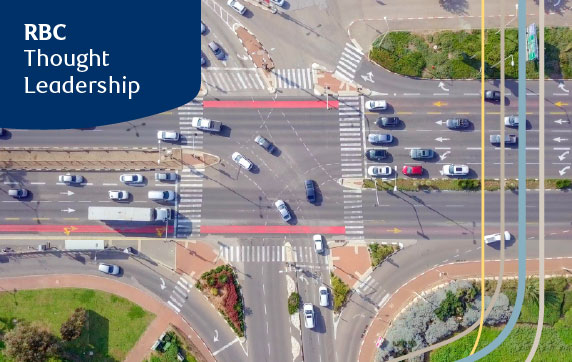
Urban traffic offers a particularly clear illustration. In Ontario, the economic and social cost of congestion was estimated at C$56.4 billion in 2024, projected to approach C$108 billion by 2044.9 Digital-twin logic—sense, model, anticipate, act—applied at the intersection level lets traffic engineers see how signals, vehicles, cyclists, and pedestrians behave, rather than how a timing plan assumed they would.
For a Canadian-born example of this approach at global scale, listen to the RBC Disruptors episode featuring Miovision, the Kitchener-based company whose sensor and analytics platform now operates at more than 170,000 traffic intersections across 68 countries. Their work is a case study in how digital-twin principles migrate from aerospace and heavy industry into everyday civic road systems. It also demonstrates how a Canadian startup can build a category-defining business by instrumenting something as mundane as a traffic light.
What to watch for as the technology evolves
-
The convergence of digital twins with generative AI. McKinsey’s operations practice describes a shift from twins that monitor and predict to twins that recommend and, increasingly, act autonomously.
-
The emergence of twin ecosystems. A factory’s digital twin exchanging data with the twins of its supplied components and the twin of the power grid that feeds it. Interoperability, common data models, shared interfaces, certified audit trails, will determine which platforms capture long-term value.
The broader trajectory is one NASA’s engineers would recognize. When you cannot reach the physical thing, or when acting on it without rehearsal is too costly, you build a model, keep it honest with live data, and let it think ahead of you. The technology has outgrown the spacecraft, but the principle has not changed.
Download the Report
Sabreena Shukul is a research assistant at RBC Thought Leadership
NASA Technical Reports Server, “Digital Twins and Living Models at NASA,” 2021; Wikipedia, “Digital twin.”
McKinsey & Company, “What is digital-twin technology?” August 2024; McKinsey, “Digital twins: Boosting ROI of government infrastructure investments,” July 2025.
MarketsandMarkets, “Digital Twin Market Size, Share & Growth,” 2025
IoT Analytics, “Number of connected IoT devices growing 14% to 21.1 billion globally in 2025,” October 2025.
GovInsider, “Digital twins and virtual power plants paving the way for global energy transition,” January 2026.
AIMultiple, “20 Digital Twin Applications/Use Cases by Industry,” January 2026.
CANCEA, “Impact of Congestion in the GTHA and Ontario,” December 2024.
This article is intended as general information only and is not to be relied upon as constituting legal, financial or other professional advice. The reader is solely liable for any use of the information contained in this document and Royal Bank of Canada (“RBC”) nor any of its affiliates nor any of their respective directors, officers, employees or agents shall be held responsible for any direct or indirect damages arising from the use of this document by the reader. A professional advisor should be consulted regarding your specific situation. Information presented is believed to be factual and up-to-date but we do not guarantee its accuracy and it should not be regarded as a complete analysis of the subjects discussed. All expressions of opinion reflect the judgment of the authors as of the date of publication and are subject to change. No endorsement of any third parties or their advice, opinions, information, products or services is expressly given or implied by Royal Bank of Canada or any of its affiliates. This document may contain forward-looking statements within the meaning of certain securities laws, which are subject to RBC’s caution regarding forward-looking statements. ESG (including climate) metrics, data and other information contained on this website are or may be based on assumptions, estimates and judgements. For cautionary statements relating to the information on this website, refer to the “Caution regarding forward-looking statements” and the “Important notice regarding this document” sections in our latest climate report or sustainability report, available at: https://www.rbc.com/our-impact/sustainability-reporting/index.html. Except as required by law, none of RBC nor any of its affiliates undertake to update any information in this document.