RBC Thought Leadership AI, Technology and Innovation

View By Topics Or Author Page Link

view_by_topics_or_author_page_link

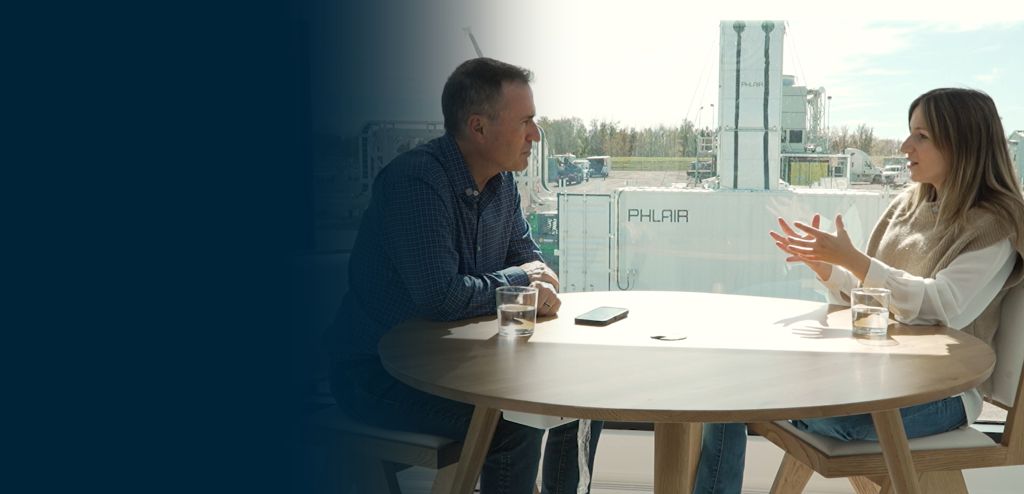
In the latest episode of Disruptors, host John Stackhouse travels to Innisfail, Alta., a little more than an hour north of Calgary. There, he joins Alex Petre, the CEO of Deep Sky, a direct air capture company that finds itself in the middle of a geo-tech race.

The two discuss whether direct air capture tech can scale, how to test competing systems side by side, and how Canada’s geology, labour force, fiscal regime and reputation as a trusted partner can turn carbon removal into a competitive advantage.

Listen on Apple Podcasts, Spotify or Simplecast

Alex Petre is the CEO of Deep Sky, a Montreal-based carbon removal company. She became CEO in 2025 after serving as the company’s chief operating officer, and she previously served as chief operating officer of Bird Canada. On Disruptors she explains how Deep Sky runs direct air capture at Deep Sky Alpha in Innisfail, Alberta.

Deep Sky is a Montreal-based carbon removal project developer. It operates Deep Sky Alpha in Innisfail, Alberta, a site that hosts several direct air capture technologies at once, with the capacity to capture 3,000 tonnes of carbon dioxide a year. In June 2026 Deep Sky delivered what it described as North America’s first certified direct air capture credits.

The episode asks whether direct air capture can scale from a demonstration site to commercial facilities. Alex Petre argues it is the one carbon removal pathway that is truly an engineering problem. John Stackhouse tests that against questions of economics, speed and whether carbon removal gives emitters an excuse to keep emitting.

Petre points to Canada’s geology for storing carbon dioxide, a workforce trained in gas processing, and tax policy that supports building. She and Stackhouse discuss whether countries with large decarbonization targets but little storage of their own could buy carbon removal from Canada, which could make it an export industry.

Direct air capture is moving from technology developers testing single systems to project developers running several technologies side by side and selling credits. Petre says that until a few years ago the field was mostly technology developers. Deep Sky says it delivered North America’s first certified direct air capture credits in June 2026.

Petre argues that carbon removal needs commercial discipline and speed, and that emissions cuts and removal both matter. Stackhouse raises Article 6.2 of the Paris Agreement, which would let countries recognize trades of carbon credits, and notes that such trades depend on trust and on avoiding double counting between countries.

Clear skies: Direct air capture and Canada’s advantage

00:00:00:00 – 00:00:24:01

John Stackhouse

Hi, it’s John here. Today I’m in Innisfail, Alberta, about an hour’s north of Calgary, just south of Red Deer, where the world is turning its attention to something called direct air capture. And behind me are half a dozen science experiments from around the world that are trying to show just how much carbon can be captured from the atmosphere by giant fans.

00:00:24:03 – 00:00:45:18

John Stackhouse

And at the center of this race is a Canadian company called Deep Sky. It’s built this site and is selling credits to finance this frontier technology, and the race for those credits is suddenly heating up. Today we’ll hear a lot more about direct air capture and Deep Sky, as well as the Canadian advantage from deep Sky CEO Alex Petre.

00:00:46:00 – 00:00:47:15

John Stackhouse

Alex, welcome to Disruptors.

00:00:47:16 – 00:00:48:22

Alex Petre

Thank you so much for having me John.

00:00:48:23 – 00:01:00:08

John Stackhouse

I want to start Alex with a bit of insight on you and your journey. You’re now CEO of Deep Sky. I don’t think you exactly trained for that going back through your resume. How did you end up here?

00:01:00:10 – 00:01:26:22

Alex Petre

I think if you look through a lot of my career, you’ll see that I like hard problems. I like a fair bit of risk, and I really like to throw myself into things. So I started my career actually in energy, then really pushed through for banking and the financial sector. And in my last adventure, I was actually the micromobility queen of North America while deploying scooters and e-bikes all over North America.

00:01:27:04 – 00:01:48:21

Alex Petre

But fundamentally, for me, I think it’s about working on the thing that depresses you the most when you open the newspaper. And so, on a personal level, the fact that we have so much impact from climate change these days, we have beautiful Canadian summers that we can’t enjoy as much because the wildfire smoke is getting to us, or winters that are full of avalanches.

00:01:48:21 – 00:02:03:01

Alex Petre

So skiing is not as safe anymore, actually, really, really upsets me. So I wanted to get to the root cause of the problem, and that is that we have too much CO2 in the atmosphere right now. So we really need to figure out a way to get it down and at scale and quickly.

00:02:03:02 – 00:02:15:10

John Stackhouse

So let’s get into direct air capture, which is what you’re pursuing. I’ve often thought of it as a giant vacuum cleaner, sucking carbon out of the atmosphere and then getting it into the ground. Is it that simple?

00:02:15:12 – 00:02:42:02

Alex Petre

And the easiest way to understand the process is you actually have really, really big fans that put a large quantity of air in contact with a sorbent. The best way to think about that sorbent is a sponge. The sponge then becomes absolutely saturated with CO2, so it can’t actually take any more in. And at that point in time you apply a process to it which actually separates the CO2 gas from the sponge.

00:02:42:06 – 00:03:02:17

Alex Petre

The sponge can keep going, which is the beauty of director capture. It is a cyclical process and you can keep at it. And what you get as an output is actually CO2 gas. Now, the great thing about doing this in Canada is that we have a workforce which is extremely specialized and very well trained in gas processing, because guess what?

00:03:02:18 – 00:03:25:13

Alex Petre

Our oil and gas industry has been doing this for dozens of years. And so we were really, really excited to actually build here because once you actually get that CO2 gas, there’s no better workforce that is trained to take that and then put it under ground for permanent storage. And, you know, as Canadians, we never really brag, but this is one of the things that we actually should brag about.

00:03:25:14 – 00:03:32:11

Alex Petre

We figure out how to safely monitor and store CO2 underground to permanently put it away.

00:03:32:12 – 00:03:50:18

John Stackhouse

That’s a great description of direct air capture. A lot of people may, though, still be thinking of CCUS. carbon capture, utilization, and storage. They’ve heard about Pathways as a big as a big opportunity also here in Alberta. How is direct air capture different from CCUS?

00:03:50:20 – 00:04:18:00

Alex Petre

So projects like Pathways and the traditional term of CCUS, a lot of the times will actually refer to what is point source capture. So point source capture is basically a technology that is fundamentally a filter you actually apply at the smokestack or the haystack of any industrial facility. So what that does is it captures the CO2 before it mixes into ambient air.

00:04:18:01 – 00:04:32:17

Alex Petre

Even if tomorrow we apply point source solutions on every single smokestack that it can be applicable to, we still need director capture to clean up the residual emissions.

00:04:32:19 – 00:04:50:07

John Stackhouse

And something I didn’t appreciate Alex, until I came here to Innisfail, is that there are multiple technologies here in your yard from around the world. Why are organizations from Airbus to a British firm coming here to do that instead of doing it in their own backyard?

00:04:50:09 – 00:05:10:15

Alex Petre

If you take a look at any other new technology and how it actually scaled over time. What you’re going to see is there’s always a duality. You have a technology developer and then you have a project developer. And if you look at the director capture space, what we kind of had until a few years ago is only technology developers.

00:05:10:16 – 00:05:37:05

Alex Petre

And so Deep Sky was really able to look across the entire supply chain and say, what is missing is a project developer. So we are in a very unique category of one where we are a carbon removal project developer, and what we focus on is actually creating the infrastructure that allows these technologies to actually scale, which is really, really important because now hardware is very much in focus again.

00:05:37:08 – 00:05:56:10

John Stackhouse

So you’ve hit the the nail on the head with that word scale. Because even these facilities, which are impressive, are capturing drops in the ocean when it comes to carbon. None of us are going to scale without better economics, but it’s still only in the thousands. And you need to get to the millions. How are you going to do it?

00:05:56:13 – 00:06:18:01

Alex Petre

Well, it’s not going to be easy, so I can tell you that, John. But what we have here is actually an incredible learning opportunity. When you’re learning from one deployment of one technology. You’re learning rate is limited by the fact that you’re just learning from one data set, from operating one technology. We’re actually learning from multiple at the exact same time.

00:06:18:05 – 00:06:38:11

Alex Petre

So the way I like to think about it is this facility we are at here today is really about compressing the time that it would normally take for the natural market forces to actually get to the standard design of what director capture should be, because this needs to be commercial for it to actually reach the scale we need.

00:06:38:12 – 00:06:59:07

John Stackhouse

So one of the things I find interesting here, Alex, is this is not a science park. This is a commercial park. You’re being paid to deliver exactly an output. Whichever of these technologies can deliver the best product for you is going to win. And you’ll use more of that. So there’s some internal competition here, which is what markets do.

00:06:59:09 – 00:07:26:07

Alex Petre

What markets do. Exactly. And I think what’s what’s been really interesting is unless we actually bring that execution muscle and that commercial focus to this industry, we might we might not necessarily see the best result. You know, I’m not here to make friends. I’m here to figure out a way to remove CO2 from the air at scale. And I think it’s that kind of attitude that’s really important if we actually want to get it done.

00:07:26:09 – 00:07:40:21

John Stackhouse

There’s been debate about direct air capture for for some years, but people like Bill Gates and Breakthrough Energy have long believed there is something here. What are you seeing that maybe even they didn’t see five years ago?

00:07:40:22 – 00:08:13:14

Alex Petre

I think there’s two things. This is one of the very few facilities that is actually operational and has produced credits, which is really important. As of June, we produced the first credits for director capture anywhere in North America. So I think that’s number one. Number two, I think relates to the fact that the size of the problem, which means the amount of CO2 we actually have to extract from the atmosphere, is so large that we need to be able to have an extremely scalable solution.

00:08:13:15 – 00:08:33:08

Alex Petre

And if you look across the entire pathway of possible ways to remove CO2 from the atmosphere, direct air capture is the only one that is truly just an engineering problem. And guess what? Humanity, despite all of our bad traits, sometimes, is actually really good at pulling together whenever we have an engineering problem.

00:08:33:10 – 00:08:44:15

John Stackhouse

What do you say to people who raise an eyebrow and say, this is just giving people an excuse to keep emitting because they’re going to pay someone to take their carbon out of the atmosphere?

00:08:44:17 – 00:09:13:12

Alex Petre

I think it’s really important to be pragmatic. I think that it’s absolutely fair to challenge those who continue emissions, and those who maybe have plans to increase their emissions. I 100% support that. But at the same time, we also have to be aware of the fact that we’re not all going to stop flying tomorrow, driving cars, buying groceries, and doing a lot of things that fundamentally are driven by fossil fuels.

00:09:13:13 – 00:09:22:20

Alex Petre

But unless we focus on both reducing emissions and decarbonizing one way or another, we’re going to run out of time.

00:09:22:22 – 00:09:40:04

John Stackhouse

I think I’m getting the picture that you’re aiming to build the first commercial scale operation, the first commercial scale carbon farm or whatever you want to call it. But we’ll need hundreds, maybe thousands, thousands of those. How soon can you do that?

00:09:40:06 – 00:10:07:13

Alex Petre

We we have actually developed three different sites throughout Canada. And this is what’s really exciting about deep Sky. We can actually work across Canada. And our first site is here, but we also are working on developing sites across Manitoba and Quebec, which is really exciting. From our perspective, we are very close. So we actually hope to FID. So that’s actually make a decision on the beginning of construction for the project late 2027.

00:10:07:16 – 00:10:14:08

John Stackhouse

What is going through your mind in terms of the hurdles or challenges to get from here to to there?

00:10:14:11 – 00:10:38:14

Alex Petre

I would love to move much faster because I think the world really needs this, and I think we for a long time have stopped doing good in the name of doing perfect. And I think that has been an enemy to progress. And so I think what scares me is that I’m not doing it quickly enough, and that we as deep sky, are not scaling up as quickly as we should.

00:10:38:15 – 00:10:48:09

John Stackhouse

But from a capital perspective, what’s the pitch to investors for something that’s probably not going to deliver a return in the in the near term?

00:10:48:11 – 00:11:15:17

Alex Petre

The pitch for investors is actually pretty simple. Canada is the very best jurisdiction to build right now. There is a direct air capture CCUS, so carbon capture utilization storage ITC investment tax credit. What that means is if you deploy director capture facilities in Canada, there is a tried and tested program. And so lots of people that we talk to, for example, I’ll just pick Japan.

00:11:15:18 – 00:11:38:08

Alex Petre

We do a lot of business with Japanese partners, but let’s be honest, they have very little land available to do this themselves. And they also lack storage capability. However, what they do have is really good engineering, really good well casing providers, really good supply chain. And so it’s a really symbiotic relationship when we actually work on carbon removal.

00:11:38:10 – 00:11:49:13

Alex Petre

Because as an investor I can actually have synergies between what I produce at home, but also investing in a jurisdiction that takes this really, really seriously.

00:11:49:15 – 00:12:01:02

John Stackhouse

Direct air capture is one of the technologies that’s being caught up in the geotech race. Give us a sense of what’s happening on the global chessboard of of DAC technology.

00:12:01:07 – 00:12:25:13

Alex Petre

There is a lot happening in China. I think where Canada can fundamentally lead is actually in carbon capture and permanent storage. And I’ll tell you why. The product that gets created through that process, which is a carbon credit, is in very hot demand by countries that have really big decarbonization targets, but no ability to store themselves. So Switzerland is one of these countries.

00:12:25:13 – 00:12:46:09

John Stackhouse

So countries like Switzerland, Japan would pay Canada effectively to capture the carbon from the atmosphere because it doesn’t matter what. There’s no geography in the atmosphere. It’s one atmosphere for the planet, no borders up there. And then store it in the in the Earth here. Clearly, the federal government supports what you’re doing, but may need to do more, especially on.

00:12:46:10 – 00:13:16:13

John Stackhouse

And here we’ll get very arcane on what’s called article 6.2 of the the Paris Accords on climate, which effectively allows nations to recognize the trade of credits. But nation states Canada and Japan, Canada and Switzerland need to have that mechanism. That’s right. How far off are we from that so that other countries around the world can call you up and say, hey, Alex, I want to actually buy a million credits from you when you have that commercial scale to to execute on it.

00:13:16:15 – 00:13:43:04

Alex Petre

It’s been a really interesting engagement with the federal government and several ministries throughout, notably environment and climate change, but natural resources as well, and finance. And I think what’s really exciting is that Canada sees the opportunity at hand. So I think it’s really about keeping that momentum and showing that ambition of Canada to actually export something that is a) very valuable, but b) digital.

00:13:43:06 – 00:13:54:02

Alex Petre

So we don’t actually need to build additional infrastructure to export it, which in today’s day and age is actually a really meaningful way to diversify our exports.

00:13:54:04 – 00:14:15:16

John Stackhouse

This is actually a really good example of the value of trust. And the world has fragmented too much. So we’re going to see more bilateral engagements around the world. And it will be countries that trust each other on, on something like a carbon credit, because you need to trust the other country to prove it and to prove that they’re not going to double count it or do something sneaky with you.

00:14:15:17 – 00:14:41:15

John Stackhouse

So Canada’s value in the world as a trusted partner actually plays a critical role, not just in trade and other engagements, but in our climate relationship with an economic value, as you’re showing here. But something important for Canadians to understand, and this is around double counting, is that if you’re capturing carbon here and putting it in the ground and Japan is paying you for that, Canada doesn’t get it, doesn’t get to count it as well.

00:14:41:20 – 00:14:48:11

John Stackhouse

But we’ll have to find other ways to reduce our emissions, both physically and also the accounting of those emissions.

00:14:48:12 – 00:15:01:08

Alex Petre

We need to make sure that anything that is produced in Canada for Canada’s goals is very well accounted for. But we also have the ability to produce for export in this particular industry.

00:15:01:09 – 00:15:26:06

John Stackhouse

And this is an export industry that you’re almost creating. I don’t want to say from scratch because others have have been here before, but it’s very, very nascent. As you help us think about what’s possible over the next few years, what should Canadians come to grips with in terms of what we need to do collectively to become that direct air capture leader in the in the world?

00:15:26:08 – 00:15:45:10

Alex Petre

I first want to acknowledge the fact that Canada has already done a lot, because I think that’s really, really important. We talked a lot about our natural advantages and we really want the geological lottery, but we also actually match that with the fiscal regime that supports it. And now with real political momentum to actually make this into an industry.

00:15:45:12 – 00:16:19:21

Alex Petre

So I personally think from now on. It’s a little bit up to us. And when I say us, I mean the private sector. I think we need to work really hard. I think we need to be really, really ambitious and also really, really focused. And so I think for once, there is no whining and just rolling up sleeves and getting to work. As a citizen, as anyone kind of focused on this, I would say learn about director capture, come work with us, come work in the supply chain that we’re building here for direct air capture, because guess what?

00:16:19:22 – 00:16:34:17

Alex Petre

It can actually create lots of jobs for us. And if you’ve drilled wells all your life. Guess what? You can also drill wells for CO2 storage, not just for resource extraction. I think we have the perfect conditions for it, and it would be a shame not to use the opportunity.

00:16:34:18 – 00:16:43:22

John Stackhouse

Perfect conditions. Love that set up. Five years from now, we won’t be sitting next to a five acre site. Presumably we’ll be sitting next to something much bigger. What’s your vision?

00:16:43:23 – 00:17:05:03

Alex Petre

Yeah, I want to ensure that in the next five years we have at least three large scale commercial facilities operational throughout Canada. I think this is a pan-Canadian story. I think it’s really exciting that Alberta created the opportunities early for us to start here. And so I think this can be something really, really big for Canada ultimately.

00:17:05:06 – 00:17:08:02

John Stackhouse

What a great message. Alex, thank you for being on Disruptors.

00:17:08:03 – 00:17:09:14

Alex Petre

Thank you so much for having me.

00:17:09:16 – 00:17:31:02

John Stackhouse

Direct air capture is no longer a science project. It is now part of that geo tech race that we’re talking about this season on disruptors. And the countries that get there first are also going to have a geopolitical advantage, not just in the challenge of climate change, but in the race to develop new technologies that will help shape the economy of the 2030s.

00:17:31:04 – 00:17:38:23

John Stackhouse

I’m John Stackhouse and this is Disruptors, an RBC production. Thanks for watching.

00:17:39:01 – 00:18:09:10

Alanna Whitten

Disruptors. An RBC podcast is created by the Thought Leadership Group and does not constitute a recommendation for any organization, product or service. Information presented is believed to be factual and up to date, but we do not guarantee its accuracy and it should not be regarded as a complete analysis of the subjects discussed. All expressions of opinion reflect the judgment of the authors as of the date of publication, and are subject to change.

00:18:09:12 – 00:18:27:00

Alanna Whitten

Precautionary statements relating to the information in this podcast refer to the legal disclaimers on RBC dot com slash disruptors. For more Disruptors content like or subscribe wherever you get your podcasts and visit our web page at RBC Thought Leadership.

View By Topics Or Author Page Link

view_by_topics_or_author_page_link

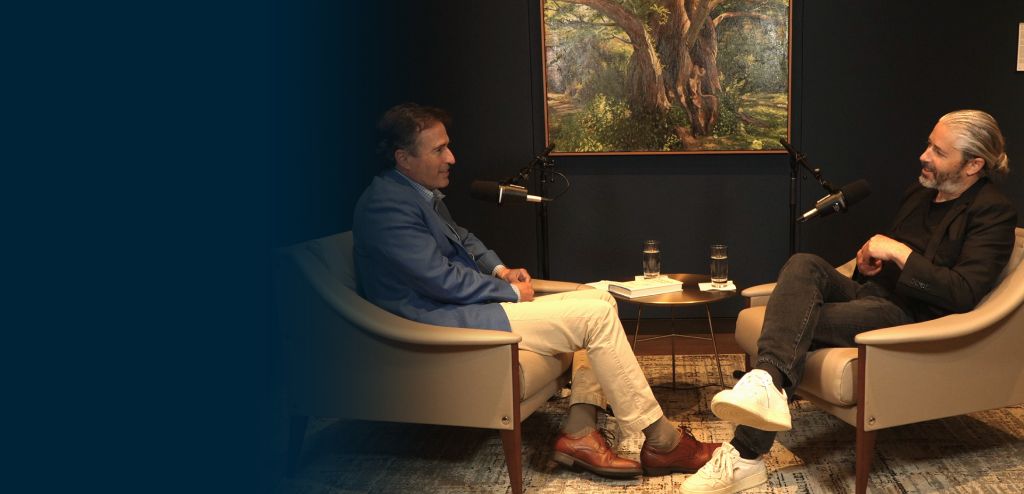
Ronnen Harary co-founded Spin Master when he was just 23 years old, armed with $10,000, a learning disability that pushed him toward entrepreneurship, and an instinct to bet on himself. What started as Earth Buddies—nylon sacks filled with sawdust and grass seed—led to Air Hogs flying toys, then Hatchimals, and eventually Paw Patrol, one of the most successful preschool entertainment franchises in the world. Today, Spin Master is a publicly traded global company headquartered in Toronto.

In conversation with Disruptors host John Stackhouse, Harary shares his journey while making a broader argument: your 20s are the optimal decade to start a business. You’re close to the zeitgeist, full of energy, unburdened by the over-intellectualization that can paralyze mature companies, and gifted with society’s permission to take risks and fail. He introduces the concept of “inverse risk”—the often-overlooked danger of not pursuing your entrepreneurial vision, of giving up on what he calls “the screenplay of your life.”

Harary also explores why Canada, despite its resources and talent, underproduces entrepreneurs compared to other developed economies. He points to culture, risk aversion, and a lack of institutional support—though he credits organizations like Futurpreneur for offering collateral-free loans that help young founders get started.

Despite economic uncertainty, Harary believes this is the most exciting time ever to be a young entrepreneur. AI is disrupting established industries, creating white space for agile founders who can move faster than legacy companies. For anyone considering starting a business, his advice is simple: movement creates luck. Don’t wait. Start now.

Listen on Apple Podcasts, Spotify or Simplecast

Ronnen Harary is the co-founder of Spin Master, a Toronto-based global toy and entertainment company. He started the business at age 23 with partners Anton Rabie and Ben Varadi, initially selling Earth Buddies—novelty toys that grew grass hair. The company expanded into flying toys with Air Hogs, then into entertainment properties including Paw Patrol, one of the most successful preschool franchises globally. Harary is also the author of No Experience Necessary, a book encouraging young people to pursue entrepreneurship in their 20s. He grew up in Toronto as the son of immigrants, and his learning disability (dysgraphia) helped shape his entrepreneurial drive. 

Spin Master is a Canadian toy and entertainment company founded in 1994 by Ronnen Harary, Anton Rabie, and Ben Varadi. The company is known for creating and marketing popular toys and brands including Air Hogs, Hatchimals, and Paw Patrol. Starting with just $10,000, Spin Master has grown into a publicly traded global company headquartered in Toronto, with products sold worldwide. The company has successfully expanded from physical toys into television production and digital entertainment, making it one of Canada’s entrepreneurial success stories in the consumer products and media space.

The episode addresses Canada’s entrepreneurship gap—specifically, why the country isn’t producing enough young entrepreneurs despite having excellent educational institutions, talent, and resources. Ronnen Harary argues that cultural factors, including risk aversion and lack of permission to fail, hold back potential founders. He makes the case that entrepreneurship in your 20s offers unique advantages: proximity to emerging trends, high energy levels, the “power of not knowing,” and societal permission to take risks and recover from failure. The conversation explores how to encourage more young Canadians to start businesses and why current economic disruption, particularly from AI, creates opportunity rather than obstacles.

Canada’s productivity and competitiveness depend on entrepreneurship and innovation. Young entrepreneurs drive economic dynamism, create jobs, and build the companies that can compete globally. Without a robust pipeline of new businesses, Canada risks falling behind peer economies. Harary points out that despite Canada’s advantages—top universities, diverse talent, stable institutions—the country culturally discourages risk-taking and doesn’t celebrate failure as a learning experience the way other entrepreneurial ecosystems do. Addressing this gap could unlock significant economic growth and help Canada build more globally competitive companies across sectors, from technology to consumer products.

According to Harary, AI disruption is fundamentally reshaping the entrepreneurial landscape. Established companies are slow to adapt, creating white space for agile young founders who understand emerging technologies and can move quickly. The barriers to starting a business have also lowered—digital tools, AI-powered automation, and access to global markets through e-commerce make it easier than ever to launch and scale. However, economic uncertainty, post-pandemic challenges, and geopolitical instability create psychological barriers that may discourage young people from taking entrepreneurial risks. Harary argues the opportunities outweigh the obstacles for those willing to move.

Business leaders can learn that agility and willingness to fail fast often matter more than experience or resources. Harary’s concept of “inverse risk” suggests that playing it safe—avoiding bold moves—can be riskier than trying and failing. For policymakers, the episode highlights the need for cultural change around entrepreneurship, better access to early-stage capital (particularly collateral-free loans), and celebrating entrepreneurial attempts even when they don’t succeed. Organizations like Futurpreneur demonstrate one model for supporting young founders. Canada’s economic future may depend on creating an environment where more young people feel empowered to start businesses in their 20s, when they have the energy, perspective, and runway to build something transformative.

Permission to Fail: A case for youth entrepreneurship

[0:00] Ronnen Harary

I think it’s the most exciting time to be an entrepreneur ever, The fact that AI is in the marketplace is disrupting everything and in disruption creates opportunities. And if you’re younger and you have the energy level and you’re closer to the tech, you are going to run circles around the bigger companies.

[0:20] John Stackhouse

Today we’re talking about a really positive disruption. It’s called entrepreneurship. But unfortunately Canada does not have enough entrepreneurs. Not nearly enough.

And there’s a whole new post-pandemic generation emerging that is not gravitating towards starting their own businesses.

Which is why it’s so important to hear from Ronnen, because he’s just written a book called No Experience Necessary And why being in your 20s is the best time ever to start a business.

Ronan is the kind of new entrepreneur that we need a lot more of.

A few decades ago, when he was just 23 coming out of university, he and some friends launched a company that became Spin Master.

Now, you may not have heard of Spin Master, but I’m pretty sure you’re familiar with its products and brands, things like Hatchimals and Air Hogs, or that global TV sensation Paw Patrol and all the toys that go with it.

That all started with just $10,000 and a lot of youthful ambition.

Today, Ronnen is still helping to drive and relentlessly grow a global champion right here in Toronto.

Ronnen tells his story in no experience necessary, but he really uses the book to to push a generation of 20 somethings to embrace entrepreneurship the way he did when he was 23.

It’s the biggest, most positive disruption anyone can take in their lives.

Ronnen, welcome to Disruptors.

[1:43] Ronnen Harary

John. Great to see you again.

[1:45] John Stackhouse

Great to see you again and to be talking about your book No Experience Necessary. That’s so liberating for those of us of any age. We can do things without experience.

[1:57] Ronnen Harary

You can bet on yourself at any age.

[1:59] John Stackhouse

What inspired you?

[2:01] Ronnen Harary

You know, I when I hit middle age, I was thinking back to my 20s and all the amazing things that accrued to me and my business partners and everybody that joined us on the journey in that decade and how magical that decade was. And I didn’t realize at the time, like, everybody’s rooting for you and the power of not knowing.

And like, there’s so many things and your energy level that that you’re gifted in your 20s that recedes in your 30s, 40s and 50s. You have other things that accrue to you in your 30s, 40s and 50s.

[2:30] John Stackhouse

Tell us a bit more about what what’s the magic elixir and combination that comes together in one’s 20s?

Yeah.

[2:37] Ronnen Harary

I think that if you’re inclined to start a business, one of the things you have going for you is that you’re very close to the zeitgeist, and you’ve been in your parents’ home for the last 20 years. You’ve been in university. You’ve been observing, observing, observing. And once you graduate from school or graduated from high school, or once you hit your 20s, you have the you finally have agency to take your thoughts and bring them out into the world.

Right. And I think that the key thing about business is always identifying the white space opportunities, like what’s different and being part of the zeitgeist. You are practically the zeitgeist when you’re in your 20s and suddenly you’re like, I see the way I want to serve food differently, or have a restaurant be differently, or a food cart, or the way I want to open up the service.

Or it could be anything. And that’s what I’m trying to encourage people to do, is that if you see the world differently and you see an opportunity, you should go for it, especially if you have like this, this desire. And but what happens is that we always conventional wisdom is you need more experience to actually go into it.

So that’s what you have in your 20s. Seeing the world differently, you have other things like the power of not knowing. Sometimes when you know too much, it holds you back.

And so for us, you know, our big power of not knowing moment was when we brought out Air Hogs into the marketplace?

I don’t know if your kids play with the Air Hogs. You know, the airplane you pumped up and it flew for 45 seconds. When the inventors pitched it to us. We went to this park, we flew it, and me and Ben, we were like 25 year old kids. We felt like we were ten and we were like, we need to make this product.

This is so magical. We knew there were safety issues. We knew that it was a plane and it was going to fall out of the sky and it may break. So there’s going to be some returns and we’re like, we’ll figure it out. So we took all our money for our first two products. We plowed it into the Air Hogs spent a year and a half engineering developing it, and just about when we were about to bring it to market, we found out that Hasbro Matel had passed on it.

We thought we were the first to see it, and I think that if we would have been a bit more of a mature company, we would have. We would have intellectualize the returns and the safety issues too much and would have said, you know, it’s it’s too much of risk. But we didn’t know as much. And we went with our gut and it turned out to be great.

And it launched as we were producing flying toys for the next 15 years, doing hundreds of millions of dollars in flying toys.

But when you’re in your 20s. You have so much energy, right? And so I write about the book I write, passion delevers risk. If you’re super passionate about something, it becomes less risky at the end of the day because you will feel you will figure out so many different ways to make it a reality, right?

So it’s a, it’s a combination of, of those sorts of things.

[5:31] John Stackhouse

Let’s get into the Spin Master story. But Ronnen first start When did you first see that entrepreneur in yourself?

[5:39] Ronnen Harary

You know, I probably say probably around 15, 16, you know, in and around there. You know, I grew up with classic immigrant, middle class family, right? And so I was an immigrant, middle class kid in an upper middle class neighborhood so that, you know, highlights a lot of things. And it drives you to actually, you know, when you’re a kid, you want to fit in.

So my allowance was always like less than everybody else’s. So I always had to like, work and I always had jobs and stuff like that. So that was a combination. And then also growing up with a learning disability called dysgraphia.

[6:21] John Stackhouse

Explain that.

[6:22] Ronnen Harary

It’s basically it’s the inability for your hands to keep up with your thoughts. So as I start writing my handwriting, my hands start to cramp up and then my handwriting becomes illegible and even illegible for me. So I got to go back and rewrite the words so the teacher can read it, and I can read it, and then you lose your train of thought and you kind of have to reboot.

So an exam that.

[6:43] John Stackhouse

But your thoughts are already down the road.

[6:46] Ronnen Harary

There, down the road. But you’re having but you have to go back and then you have to think about what you’re thinking, what you were just thinking about. So an exam that would take person an hour would take me two hours. And so I was very lucky to get it identified as a kid. And I got a lot of accommodations as a result of it in school.

And I’m so fortunate to the public school system for identifying me, because a lot of kids actually don’t get identified. And if you don’t get identified it’s very hard to actually graduate school. So I was lucky, but my learning disability forced me to because I knew academics was not going to be my career path and I probably would not be a doctor.

It forced me to be entrepreneurial in nature. So it was the immigrant and the learning disability mixed together and also my curiosity. Right? I was just curious about a lot of things. And I actually it’s funny, we’re in the Royal Bank building, and when I was a kid, like I always used to look at this building, I looked at this specific building and I was like, what’s going on in there?

Like, I was a kid, I would always read the business section and I was always looking up. I wouldn’t read sports or anything like that. It wouldn’t read entertainment. I was reading business, I was reading those magazines, and I was always aspiring to like the people that were working in buildings like this. So it’s actually cool that I’m actually here doing this with you.

So I, I don’t know, just innately. I love business, I love the I love the art of business.

[8:05] John Stackhouse

The art of business. Yeah. And at university, you may make made friends, deepen friendships, but decided out of the gates that entrepreneurship running your own business is going to be your path.

[8:19] Ronnen Harary

For sure. I knew it since I was ten years old and then we go to university. It was a bit of a necessity because I had to pay for school and, you know, and I were selling fertilizer door to door for our first two weeks after first year. And we were like, this is a tough gig, so we better figure something else out.

And then we started Campus Faces, which was like this poster, marketing poster with advertising and pictures of students. And so that’s that was our first real entrepreneurial journey.

[8:45] John Stackhouse

And then talk a bit about the birth of spin Master and how you got into the toy business instead of the fertilizer business.

[8:53] Ronnen Harary

Well, it was funny because we actually started with plants – Earth Buddies.

You know, when we graduated from university, I was waiting for Anton to graduate, and we said we were going to continue this business. And Anton’s my business partner. I met him when I was 12, and we have another partner, Ben Varadi, that went to business school with Anton and Ivy. And literally we found out about this product called Earth Buddies, which is a little potato head.

You put them in water, gross grass for hair after seven days. And it was doing really well in Israel. And I went to Anton, drove up to Western. I said to him, no one was doing this in Canada. What do you think about doing them? And he said, I think you’re crazy. Like this is never going to sell.

It took me two weeks to convince him. He finally said yes. We said, we’re going to make 5000 pieces for Mother’s Day. I got my brother in law to help us with the machinery, gave him 5% profit sharing. My sister made the packaging, she got 5% profit sharing and we started selling those 5000 pieces on the streets of Toronto.

Came into the office on Monday. We still had like 4000 in the warehouse. Found a distributor that we went to. He called us up three weeks later. He’s like, when can you order? When can you deliver us 26,000 pieces? And then we move factories and then, you know, the most amazing thing happened. A couple months later, we got this big order from Kmart Corporation for half a million pieces.

And the craziest thing is, you know, I was actually talking about it today is like, for us as Canadians, we never we never thought about Canada as like the single market. We were always thinking global. And we got our first big order from an American retailer within three months of being in business.

[10:32] John Stackhouse

You tell the story in your book how the buyer from Kmart, and it took chutzpah on your part, going to Kmart headquarters and tracking her down in her office. But she took a chance on you because you were in your 20s, correct?

[10:48] Ronnen Harary

What happened was Anton was backpacking with a guy a year before in Europe, and his family was well connected in Michigan. So Anton called me and said, do you know, can you get us an appointment at Kmart? And he said, sure, no problem. And for some reason I took the appointment. Okay. I woke up at 3:00 in the morning.

I drove down to Kmart, 9:00 meeting. I do a presentation and after 30 minutes the buyer looks at me and says to me, I’m not the buyer for this product.

[11:17] John Stackhouse

You got the wrong guy.

[11:18] Ronnen Harary

You got the wrong guy. And I didn’t believe him. So I re-pitched him again. And after 15 minutes he says, I’m not the buyer. To which I said to him, you know what, we’ll give you the product on consigned sales. And if it sells, just pay us. And he said, I’m not the buyer. So I said to him, well, who is the buyer?

I just drove from Toronto. He went back and he gave me this, and he came back in the room and he gave me the piece of paper and written on it was Adrienne Zacks. And I took my box of Earth Buddies, and I walked around Kmart Corporation looking for this lady. And I got so lucky that she was sitting at her desk.

And I pitched her and she said, okay, I’m going to give you a meeting at 3:30. I go downstairs, Aaron Hermelin, Anton’s buddy, was there and the rep, and they were like, what happened? I say, got the meeting at 3:30. They’re like, great, let’s go for lunch. I’m like, I’m not leaving. I’m not going anywhere. I didn’t leave the office.

I go up at 3:30 and as I walk in the door, she’s got seven competing products sitting on the side. So I’m like, great. I found the right buyer and b, I was like, oh no, I better reduce my price. And before I sat in the seat, I reduced my price. I was going to go in with the price of 265, and as I sat down, I changed the price to 165.

I did a 20 minute pitch. I told her everything about Campus Faces our poster business at university. I told her everything we’ve done for the last three months, and then she did the most magical thing, and she turned around and she grabbed this book and she gave it to me and she said, this is the vendor agreement. Read the book.

I’m giving you an order of 48,000 pieces. And if it goes well, we’re ordering half a million pieces from you. And I share the story in detail because she gave the order to 23 year old guys over the seven other people that had that shipped in product to her, a because we got in the room. So it’s like, I’m a big believer.

It’s like you don’t go, you don’t get, you got to get in there.

[13:15] John Stackhouse

You don’t go, you don’t get.

[13:16] Ronnen Harary

And I was earning and genuine about what we were doing. And she felt the passion. And then on top of that, she was like, this is a young guy. They’re young but they’re passionate and I think they’re going to be able to deliver. And I think that’s what gave us the edge at the end of the day.

[13:38] John Stackhouse

So you start with the Earth Buddy, but it explodes from there to Spin Master, today is one of Canada’s great global companies. Even though Canadians may not be familiar with the corporation, we’re sure familiar with its products.

[13:56] Ronnen Harary

Yeah. I mean, it’s it’s I write about in the book about the inverse risk. You can’t I would never be able to write the story from selling nylons filled with sawdust and grass seeds to, you know, all the products that we’ve brought out into the world.

[14:17] John Stackhouse

You know more about what you mean by inverse risk?

[14:20] Ronnen Harary

Well, the inverse risk is like whenever you’re evaluating an opportunity, right? Two things happen. One is usually we get a lot of resistance. Right. And so it’s the ability to break through the resistance. Usually when we evaluate the opportunity we look at we can game out the downside. We know what’s going to happen right. Negatively go out of business, we lose money.

You know we lose the time. We lose our opportunity cost. But when you look on the other side of the ledger, of all the things that potentially could happen, it’s hard for you to write that story because you just don’t know. Right? It’s so unknown. Right. So it’s like once you start. So in our case, you know, like when we started with the Earth Buddy, we never knew a year later we’d be selling Devil Stick, right?

And we never knew that Devil Sticks would lead us into the toy business. And we never lose the. Once we were in the toy business, ten years later, we’d be making TV shows. And then we never realized. Like we’d produce, you know, one of the greatest preschool shows ever.

This is Paw Patrol. So you the journey, right? You you can’t write it all out. And so because you can’t write it out, you lean more to the conservative side of things, but you miss out on your ability to see what potentially could happen. And it’s actually even deeper because you almost give up, right? You give up on the upside of, of the of what’s possible.

And you give up on potentially the screenplay of your life and living out the screenplay of your life. And so it’s that it’s that balance between uncertainty and certainty. And I call it the inverse risk because it’s riskier to not know, to try and live it out.

even the failures I firmly believe are going to lead to your successes, It’s actually not so risky because you’re inclined to go in that direction. Right. And sometimes I would say is like resistance. Resistance is actually good a good thing. It tells you that you want to do something.

[16:43] John Stackhouse

One of the reasons I wanted to have this conversation Ronnen is that entrepreneurship is a big need in Canada.

Why don’t we have more of that.

[16:56] Ronnen Harary

It’s a great question. And I was talking to someone about this earlier today.

And I think it’s I think it’s a cultural thing. It’s a deep cultural thing because it actually doesn’t square because we have all these amazing resources. We have the best schools, right? We have such smart people. We have the most supportive society. Right?

We have we have everything best country in the world. So I think at the end of the it’s a cultural thing, going back to giving people permission to do things differently, giving people permission to fail. It’s okay to fail, right? It’s okay to try multiple times because it will lead to your success. And maybe it’s entrepreneurialism.

And starting your own businesses is a is not such a risky path at the end of the day, right?

[17:52] John Stackhouse

One of the many strengths we have in this country is a range of groups that do lean into entrepreneurship. One of them is Futurpreneur, ad organization that RBC has gotten behind, and we’re making even greater commitments. You’ve been a big supporter of Futurpreneur over many years. What is it in Futurpreneur that you see and how does it help young entrepreneurs?

[18:18] Ronnen Harary

We I think the amazing thing about Futurpreneurs is that they give out loans without collateral, right to people to start their business.

And that’s the biggest thing. It’s like, you know, it’s really hard. I will tell you, in the early days when we start our business, I’m not going to mention which banks, but we did not get loans from the Canadian banks.

[18:47] John Stackhouse

Is it harder to be an entrepreneur today or easier?

[18:50] Ronnen Harary

I think.

[18:50] John Stackhouse

It’s a young entrepreneur.

[18:51] Ronnen Harary

I think it’s I think it’s the most exciting time to be an entrepreneur ever, ever, ever, ever. Okay. It’s like the tools you have with AI are incredible. The fact that AI is in the marketplace is disrupting everything and in disruption creates opportunities. And if you’re younger and you have the energy level and you’re closer to the tech, you are going to run circles around the bigger companies.

The bigger companies are slow. They are lumbering. I know, okay, because we’re in middle age, you know, and we’re trying to keep up and we’re having to buy other people’s companies and pay a lot for them because we didn’t create what they just created. And we have a bigger machine to put it in. But you know what? I’d prefer if we would have created it, not have to buy it.

Right? We just had to do an we just did an acquisition right now. Case in point okay. The most beautiful, incredible product. It’s called Sticker Box okay. It’s basically it’s a beautiful red box. You press the button on the top, you speak into it and you say, make me a sticker of John riding a horse on a surfboard.

It’s the first ever amazing physical AI product that’s invented and brought commercialized, and we didn’t create it. I was with the guys today and I said to them, you guys will go down in history for actually creating the first ever amazing physical AI product in the world Sticker Box.

Congratulations. You guys will go down in history and we had to buy it from them.

[20:34] John Stackhouse

How old are they?

[20:35] Ronnen Harary

They are not in their 20s, but they’re in their 30s. Yeah. The one guy he actually has, he built the prototype, built it for his three year old kid.

There are so many amazing things happening out in the marketplace.

So I know the markets like it’s it’s dire out there because of Covid and the political situation and the uncertainty in the world. Like it’s an uncertain time for young people and I feel for them. But at the same time, there is some other stuff over here that’s going in your favour and you got to lean in where you lean.

[21:11] John Stackhouse

Does not just seize the day, seize the decade and.

[21:14] Ronnen Harary

Seize the deck. Seize the moment, seize the moment, and don’t let the moment define you. Don’t let the other stuff over here define you. Let the stuff over here, okay? And whatever’s and whatever’s. And I think whatever’s whatever is your definition of success. And I think that’s really the decade that we’re moving into. Right. Is that people it’s like you don’t have to follow conventional paths.

And I think the fact that there’s so much disruption is giving people the permission to follow other paths that are that are the past, that they want to take at the time, that they want to take them.

[21:50] John Stackhouse

What a great message to wrap up on. There’s never been a better time to be an entrepreneur. Ronnen f I can ask the last question, it’s, what would you tell your 23 year old self?

[22:01] Ronnen Harary

Life is long, right? And you don’t have to rush and enjoy the journey, But but at the same time, you know, like make sure you make sure you’re moving right. Because movement creates luck.

[22:15] John Stackhouse

Movement creates luck.

Thanks for being on Disrupters. Thanks for the book.

[22:18] Ronnen Harary

Thanks, John. Pleasure. Thanks for reading it.

[22:22] John Stackhouse

Permission to fail. Those may be the three most important words, Ronnen said. And it’s really a code for disruption.

You can’t disrupt in business, and you can’t disrupt yourself if you’re not willing to take a chance. And there’s no such thing as taking a chance if you’re not willing to fail In your 20s, you have more permission to fail.

You have more runway to recover as well.

It’s why it really is the greatest time in life to become an entrepreneur. This is Disruptors, an RBC podcast. I’m John Stackhouse. Thanks for listening.

View By Topics Or Author Page Link

view_by_topics_or_author_page_link

When some of the world’s biggest investors came to Toronto in September, AI, quantum and defence frequently emerged as discussion topics, along with, of course, resources and infrastructure. Biotech, a field where Canada has a century-long record of world-changing science, was stuck on the sidelines. It fits a pattern. For decades, biotech in Canada is admired in the lab but largely overlooked in capital markets. But as medicine becomes a matter of economic security, that gap is getting harder to ignore.

Over the past decade, the life sciences sector generated the highest 10-year gross returns among all sectors. Notably, it produced 44% of the value of Canada’s 50 largest venture exits, from just 22% of the deals (and 80% of the five top venture capital-backed exits). Yet only about 7% of the capital allocated to Canadian venture funds went to life sciences funds.

Canadian life sciences companies raised $258 million in venture capital in the first half of 2026, a decline of 39% year over year and the lowest first-half total in the series. The $4 billion AI fund that Radical Ventures announced at the summit is nearly 15 times that amount.

We have a strong foundation to build on. Canada has a 4% share of the global clinical trials market representing $3 billion in direct expenditures annually, of which industry-sponsored trials account for $2.1 billion. Moreover, Canada has the highest number of ongoing clinical trials per capita in the G7 with more than 3,000, and Canadian researchers are among the most cited in the world. 

Part of the challenge is the product. Only about 8% of drugs that enter human trials are ever approved globally , and the path from the initial trial stage to approval averages more than 10 years. Count the failures, and a single approved medicine can cost more than US$1 billion.

That profile doesn’t fit a generalist venture portfolio or a pension fund’s risk model. It needs specialists who can price scientific risk, a bench strength Canada is only now building.

The sector also has a visibility problem. As Clarissa Desjardins, CEO of Montreal’s Congruence Therapeutics, recently noted on Disruptors: “What biotech does, what we’re great at (is) taking those early-stage academic ideas and turning them into drugs—that’s kind of invisible.”

The missing middle

Canada is good at starting biotech companies, but struggles to scale them:

  • Canadian healthcare VC funds are relatively small with an average fund size of $150-300 million, with a focus on earlier company development stages with average investments of $10-20 million. There is a chronic shortage of later-stage scale-up capital from domestic sources.

  • In Canadian therapeutics, domestic investors’ participation falls from 42% in early-stage rounds to just 24% in later-stage growth deals (2024).

  • In therapeutics rounds over $50 million, international investors make up 76% of the investors and 67% of deal volume.

Biotech investors usually cash out in one of two ways: a sale or an initial public offering (IPO). An IPO lets backers exit gradually while the company stays independent and keeps raising money. Canada hasn’t recorded a venture-backed IPO since 2021, while 13 biotechs went public in the U.S. in the first half of this year alone. That leaves a sale as the default exit.

When regulators signalled that Clementia, Desjardins’ previous company, had the data to seek approval, buyers were ready to pay for certainty. She pressed her board to keep building. “It’ll cost another $500 million of fundraising and it’ll take five years with zero certainty,” they told her. Ipsen of France would later buy Clementia for up to US$1.3 billion.

Such exits create wealth and recycle talent into new start-ups. But the long-term rewards (headquarters, jobs, royalties) accrue elsewhere. In sharp contrast, the U.S. has built anchor companies such as Boston-based Vertex Pharmaceuticals, now worth about US$130 billion, by funding them through years of risk. Canada doesn’t have a single homegrown drug developer of that scale. The top 10 publicly traded Canadian biotech companies have an aggregate market capitalization of $13 billion and employ over 1,500 people. Combined they wouldn’t crack the top 100 of listed American biotech firms in terms of market cap.

Health is security

During the pandemic, Ottawa acknowledged that “a decades-long decline” in Canada’s domestic biopharmaceutical industry had left the country unable to quickly produce its own COVID-19 vaccine. The federal government now funds parts of the sector as “dual-use,” alongside defence. At the same time, China has redrawn the global competitive map. Chinese drug candidates accounted for about a third of Big Pharma’s licensing spending in 2025. Many have already been tested in early human trials and are licensed for a fraction of what they would cost to develop in North America. “They’ve changed the economics of drug discovery,” Desjardins says. In her view, the race for follow-on drugs against well-known targets is largely lost, but Canada can still lead where the science is nascent, including AI-driven discovery for hard-to-treat diseases. But that window won’t stay open indefinitely.

Three shifts could help change the trajectory:

  • Mobilize domestic capital at scale. Attract institutional money for the $50-million-plus rounds, managed by specialists who understand scientific risk.

  • Sharpen the incentives. Build on recent R&D tax changes to make Canada a more competitive place to develop, and own, intellectual property.

  • Set an anchor ambition. Nurture atleast one Canadian life sciences company worth more than $10 billion, employing thousands, within a decade.

Listen to John Stackhouse’s full conversation with Clarissa Desjardins on Disruptors.

View By Topics Or Author Page Link

view_by_topics_or_author_page_link

Listen on Apple Podcasts, Spotify or Simplecast

Nate Glubish is Alberta’s Minister of Technology and Innovation and the MLA for Strathcona-Sherwood Park. He leads the province’s push to attract $100 billion of AI data centre investment within five years, a target set in its AI Data Centres Strategy in December 2024. Speaking with John Stackhouse on stage at Energy Disruptors: UNITE in Calgary, he explains why Alberta treats data centres as “digital refineries”: natural gas becomes electricity, electricity becomes computing power, and the output can be sold anywhere in the world. 

The conversation covers the rules behind the pitch. Alberta offers no subsidies or tax credits, and data centre builders pay the full cost of the power infrastructure they need. Projects must also be in the right place. Glubish contrasts Meta’s campus in Sturgeon County’s heavy-industrial zone, which is moving forward, with a proposal near Olds that the Alberta Utilities Commission denied in August 2026. He describes how the first 1,200 megawatts of grid power for data centres was set and why the next allocation, still being designed, would be interruptible and temporary. 

For Canada, the stakes are about more than investment: where AI computing is built, who owns it, and whether Canadians rent critical infrastructure or own it. 

Nate Glubish is Alberta’s Minister of Technology and Innovation, a role he has held since 2022, and the MLA for Strathcona-Sherwood Park. He was first elected in 2019 and previously served as Minister of Service Alberta, where he developed the Alberta Broadband Strategy. Before politics he spent most of a 15-year career as a venture capital investor in Alberta technology companies. 

It is the Government of Alberta ministry created in October 2022 to lead the modernization of government services and to attract investment in the province’s technology sector. Under Minister Nate Glubish, it leads Alberta’s AI Data Centres Strategy, launched in December 2024, which aims to attract $100 billion of data centre investment. 

How Alberta plans to attract large-scale AI data centre investment while avoiding the problems other jurisdictions have faced. These include subsidies, strain on the power grid, rising electricity prices, and projects built too close to homes. Glubish describes the province’s approach: no subsidies, builders pay for their own power infrastructure, and strict rules on location and grid access.

AI computing is becoming critical infrastructure. Glubish argues that if Canada does not build its own capacity, it risks becoming a permanent renter of that infrastructure from other countries. Alberta’s natural gas and grid could position the country to host computing for domestic use and for allies, such as European governments facing energy shortages.

Demand for power is the constraint. Alberta’s first allocation of 1,200 megawatts of grid power for data centres is fully allocated, while requests from proposed projects far exceed what the grid can supply. Glubish says a second round would be interruptible and temporary, giving projects a start while they build their own generation.

Clear, predictable rules can attract investment without subsidies. Alberta’s approach makes data centre builders carry the costs and risks of their power needs, protecting ratepayers, and uses location and zoning to separate projects that should proceed from those that should not, as the contrast between Meta’s Sturgeon County campus and the Olds proposal shows.

Digital Refineries: Data centres as Alberta’s new resource

Introduction

[0:00] John Stackhouse 

I’m John Stackhouse, and you are listening to a live recording of RBC Disruptors with Nate Glubish, Alberta’s Minister of Technology and Innovation. We’re on the main stage at Energy Disruptors UNITE conference in Calgary on Tuesday, September 29th. And I mark that because the topic we’re going to engage in today, data centers, seems to move by the day, certainly by the week. Minister Glubish has been in this important role since 2022, is really at the forefront of data center policy on behalf of Alberta, which has seen quite widely as a leader in policy. So we’ll hear a lot more about that. Minister, welcome to Disruptors. 

[0:40] Nate Glubish 

Thanks for having me. John. Happy to be here. 

The Mood Shift  (0:42)

[0:42] John Stackhouse 

It feels like there’s been a bit of a mood shift out there on data centers. We’re in Calgary, so I’m tempted to call it a bit of a political Chinook over the  summer. You’ve been out over the summer in communities across Alberta listening to concerns, hearing from people. What should we all understand from the voices that you’ve been able to listen to over the summer, when it comes to data centers? 

[1:07] Nate Glubish 

One of the things that doesn’t surprise me is that folks have questions and they have some concerns. And these concerns are rooted in very real world examples where projects were done irresponsibly. And so what I take away from that is that folks want to make sure that if this infrastructure is going to be built in Alberta, it has to be done the right way. And the Alberta government completely agrees. You know, we spent the last three years studying this industry. We knew a wave of infrastructure investment was coming. We knew that this was going to be the critical infrastructure of the economy, of the future. And we knew that Alberta had a lot of the building blocks that the industry was going to be looking for and would rely upon for a lot of their investment plans for the future. But we also knew that there was some cautionary tales of other places in the United States and abroad where some suboptimal decisions were made, and they didn’t stand up for what was best for their citizens. 

[2:03] Nate Glubish 

They just rushed to attract the investment. We’ve taken a different approach. We didn’t want to be first. We wanted to be the smartest.  

[2:10] John Stackhouse 

So we’ll get into what responsible development does look like. But you’re very clear that you would take time, three years, as you said, to understand that, and you would study the mistakes or missteps of others. Can you give us a sense of some of the missteps that you were able to see with the power of hindsight? 

[2:28] Nate Glubish 

Yeah, sure. Well, I mean, one I think is just that there were a lot of jurisdictions that did subsidize this infrastructure. And I can tell you you don’t need to. The fact is, that’s not what these companies need. If you’re going to offer them millions of dollars, they’ll take it. I mean, who wouldn’t? But they don’t need it. And Alberta’s proven that because Alberta has made it very clear we will not subsidize. We will not give tax credits. We will not give government incentives. What we will instead do is give policy environment that is clear. It’s fair, it’s competitive. And you can it’s predictable. So you know what the rules are. And you know that if you follow the rules, you know what to expect as an outcome. I mean, we all know data centers require a lot of electrical power generation, and some jurisdictions didn’t do the engineering ahead of time to say, how big is that demand? 

[3:15] Nate Glubish 

How are they going to access this power? And they just let them plug into the grid. And all of a sudden now you had this massive load without any corresponding power generation capacity coming online to support it. And that caused reliability and resiliency issues in their grids and in some cases also caused power prices to spike. Those are all objectively bad things. And we have taken the time in Alberta to carefully craft our rules around more of a bring your own power approach and a cost causation approach, which essentially we’ve enshrined it in legislation to say, if you’re going to build data center infrastructure in Alberta, you pay 100% of the costs of anything to do with the power generation. So many, many folks in the audience might be familiar with the largest data center project that’s moving forward in Alberta, and that’s the Meta site up in Sturgeon County in the Alberta industrial heartland. 

[4:06] Nate Glubish 

They’re paying 100% of the cost for their grid connection. It’s over $100 million. For any other industry oil and gas, petrochemical, agricultural, forestry, whatever it is, they would not pay that $100 million they would get. They would go through the process to get approved by the grid operator, and they would connect. And all grid participants, Albertans and Alberta businesses alike, would share in the cost of that incremental infrastructure. We’ve made it clear for data centers and only for data centers, they’re the only ones being treated 

Value-Added Economics  (4:41) 

[4:41] Nate Glubish 

this way. But 

[4:41] John Stackhouse 

The companies that are promoting data centers are worth hundreds of billions, even trillions of of dollars. And a big part of that valuation is what they’re able to do with data centers. So I think the public has seen this and said, okay, the yardstick, the economic yardstick has shifted. You’ve articulated that they need to be not subsidized. But I’m curious how your own thinking is evolving in terms of the economics of data centers. And will they continue to carry the economic value? And as you look to attract more of them to Alberta, kind of economic value do you foresee them generating for Alberta? 

[5:22] Nate Glubish 

I think how I’d like to work my way to answering that is to talk about this concept of value-added economics. Folks have been asking me and my colleagues for years, why doesn’t Alberta build more refineries, for example, why are we so focused only on shipping our oil and gas to global markets? What excites me about data centers is they are essentially digital refineries, because we’re taking the gas that we have in abundance, we’re converting it and adding value to it by creating electricity. We’re converting that electricity and adding value to it and creating intelligence. And we can export that anywhere in the world at the speed of light through fiber. And so why this is so meaningful is I was looking at some of the research done by Peter Tertzakian from Arc Energy. He did some study to look at. 

[6:09] Nate Glubish 

If you look at all of the traditional value-added infrastructure for traditional energy. So refineries, petrochemical, textiles, etc., the value-add multiplier was anywhere from like five x to on the highest end, about 20 x. So the most valuable addition of traditional infrastructure is you could take the gas molecules hydrocarbon molecule and add 20 times the value to it. That’s a great value proposition. With data centers the value multiplier is over 1000 x. So you can take $2 a gas and turn it into $2,000 of tokens. Now that’s an exciting value proposition. I want to make sure that Albertans can see as much benefit from that as possible. But the only way we can do that is if the physical infrastructure that is doing that digital refining is here. 

[6:57] John Stackhouse 

Walk us through where the value is for local as well as the province. I get it for the owners of the data. If I’m shipping data into a data center, say in this jurisdiction, and crunching it, I’m going to derive the economic value from that. Maybe here, maybe somewhere else. How does Alberta actually capture that value from the knowledge creation that you’re describing? 

[7:21] Nate Glubish 

The home run is making sure we have domestic companies also building this capacity so that it’s not just American hyperscalers. I mean, we welcome that infrastructure investment. Albertans will still benefit from that. But the home run is if we have Alberta and Canadian based companies who are building this infrastructure too, to to serve domestic and global demand. And that’s how we can make sure that we’re capturing that full uplift. But even for those projects like the Meta site, the value economics are still extraordinary. I mean, when you look at just the revenue from taxes, fees, levies, natural gas, resource royalties, etc., that will come from that single project alone to the benefit of Albertans is about $250 million a year forever. 

[8:10] Nate Glubish 

We didn’t have to spend a dollar to attract that investment. So this is this is this is enormous. If you can imagine, if you start to get 2 or 3 of these, all of a sudden you’re getting into the billion dollar range. Where else can you go and find and unlock $1 billion of new revenues to help fund health care, education, roads, public safety services, the things that Albertans rely upon. 

The Alberta Model  (8:32) 

[8:32] John Stackhouse 

Let’s talk a bit about what some people call the Alberta model. I was in conversation with the head of policy for one of the hyperscalers, and asked him what jurisdiction in the world had it right when it came to policy, and he said, Alberta without without question. Curious how you would describe the Alberta model from a policy point of view. 

[8:55] Nate Glubish 

Well, I think first and foremost, we’ve been very clear. You pay your own way if you come to Alberta. Make no mistake, there’s there’s no better place than Alberta. We have the energy, we have the talent. We have the ability to execute. We have the ability. We have a long track record of building big industrial things. We’re really good at that. But we have high expectations. If you’re going to be someone who’s going to build this infrastructure in Alberta, you have to do it Alberta’s way. When it comes to water, you need to use the best available technology, like Meta is, using closed loop liquid cooling systems that you fill at once, and they operate for 100 plus years. They don’t actually consume water. 

[9:36] John Stackhouse 

So that’s a condition of building a data center in Alberta. You’ve got to fill the tank once and. 

[9:43] Nate Glubish 

Today it’s not a legislated statutory requirement. Today, what we’re finding is that nobody is building modern data center infrastructure without that, because their facilities can’t survive without that technology. But we are giving serious thought to making that a legislated requirement. And I wouldn’t be surprised if you see something later this fall in our legislative session on that fact. 

[10:07] John Stackhouse 

Can you share a bit more of your thinking and the government’s thinking on setbacks? A lot of the data centers in Alberta are and will be powered presumably by gas turbines. Those are tend to be loud, especially for major operations. So understandably, communities want a bit of distance to the to the generator. Sometimes that’s a little more complex calculation in rural areas where there may be a homestead that’s closer, but it’s one homestead and there’s no equal distance between homesteads and, say, the data center. So complex, fair concerns but complex calculations. How are you thinking through that? 

[10:47] Nate Glubish 

These are the right questions to be asking. And I hear a lot about this from folks that I’ve talked to at the town halls and from folks across the province. And really what it comes down to is just like anything in business location, location, location. We have two case studies right now that demonstrate that the rules we already have are leading to responsible development. Meta I keep coming back to because it’s the largest project that’s moving forward today. It’s in the Alberta industrial heartland. This is thousands of acres of heavy industrial zone land. It’s been zoned for this. It’s a designated industrial zone, and it’s been designated this way for decades. That land that they’re on was originally going to be multiple traditional refineries. 

[11:34] Nate Glubish 

Those never moved forward because the private sector investment never materialized. Now you have a digital refinery instead. So that was an example of a company that came in and said, we’re going to pay our own way. We’re going to follow all of Alberta’s rules. We will do it to Alberta’s standard, and we’ll do it in the right location. On the flip side, we had a proposal near Olds that was in some light industrial zoning, literally right across the street from a residential subdivision with hundreds of homes, like we’re talking a few hundred meters away. And they wanted to build 1000 megawatt facility with a gigawatt scale power generation site right next to it. Well, logically, that raises some concerns. Do I want to be living right next door to a power plant like that? 

[12:22] Nate Glubish 

I think most of us would probably say no. The good news is the Alberta Utilities Commission looked at the project and they concluded it was not in the public interest. It didn’t make sense. And so the application was denied. That project is dead. It’s not going to happen. Meta – right project, right location, done the right way. Olds – wrong project, wrong location, down the wrong way. The rules that we have are working now. That said, is there room for some refinement of our policies to include some more clarity around what setbacks might make the most sense so that both residential residences residents in Alberta could say, I can have confidence knowing that something like this will never happen within this buffer zone. 

[13:08] Nate Glubish 

It’s too early to say exactly what that’s going to look like, but I would say stay tuned. We’ll have more to say on that. I think that there is a place for something along those lines that will make it clear to residents that we are looking out for their interest first, but also demonstrate that Alberta is still open for business. Just let’s do it the right way and the right spots, and if we can provide more clarity and certainty right at the start for our industrial friends to say, if you want to build here, here’s the best places and here are some places that are off limits. Don’t waste your time spinning your wheels on something that doesn’t make sense. I think that could be a win for everybody. 

[13:46] John Stackhouse 

Clarity and certainty are  words you keep turning back to and I think it’s worth stressing. This is hardly confined to data centers. I had the opportunity to visit a direct air capture facility the other day here in southern Alberta. These are large, giant fans, and when they’re all going, wow, it it’s a it’s a force. The requirement for them, as was described to me, is this sound from the machines cannot be louder than 60dB, which is the loudness of a highway at the closest front door to the site. So it’s kind of like a. 

[14:26] Nate Glubish 

It’s a little better than that. So the noise regulations that apply to power plants today are 50dB during the day, which if we all just stop talking, this is at least 50 to 55dB in this room right now. And then at night it’s 40dB is the rule. So that’s I mean, that’s really quiet. And what what we’re looking at is saying, like we need to have similar noise rules for data centers, not just for the power generation that’s co-located with them. And I know it’s possible, like I’ve toured enough of these data centers and yeah, when you go inside there, noisy, but you go in the parking lot, it’s quieter than this room is right now with the fans for this smoke, and that makes the lights look cool. 

[15:12] Nate Glubish 

And that’s because they’ve engineered it with the best available technology to attenuate the noise and contain the noise on the inside. So I think our message to industry is we want you to use best available technology. We want you to do things the best way. Albertans demand the best. If not out here to just go and defend big Tech. We’re out here to do what’s best for you, for Albertans. But responsible development of this infrastructure will set up Albertans for success in the economy of the future. If we don’t do this now, we will become permanent renters of the critical infrastructure of the next 20 or 30 years, and we will be paying a premium rate to the Americans and to other jurisdictions. And make no mistake, they’ve proven to us that they can turn that technology off in a heartbeat if there’s something they’re not happy 

Export the Intelligence  (16:04) 

[16:04] Nate Glubish 

with. 

[16:04] John Stackhouse 

And this is not just a value to Albertans and Canadians. A lot of countries around the world are looking for places to store and compute data in jurisdictions they can trust that have a stable, transparent rule of law. And Canada and Alberta certainly compete well on that score. 

[16:23] Nate Glubish 

Yeah, I think this is an opportunity for Alberta and for Canada is that many jurisdictions like Europe, the UK, for example, they have the same needs that we have of needing compute for their government workloads, for their private sector workloads, for their academic research workloads. But they don’t have access to scalable energy. They’re in an energy crisis. They simply can’t get the energy. And so I’ve been pitching this to some of my counterparts in European countries. I just met with a couple of the German ministers, both at the Viva Tech conference in France, as well as at the All In conference in Montreal recently here just a couple of weeks ago, and I was pitching them. I said, you said you want to increase your compute capacity by three gigawatts, show me where the energy is going to come from and they don’t have an answer. 

[17:14] Nate Glubish 

I said, you know what, you could build that infrastructure in Alberta and we could work with you to scale the power generation here. And then you could have sovereign compute workloads to serve your citizens and to serve your businesses, and make sure that German law applies to those workloads. We can be partners. We want the same thing. We want the EU to be strong and secure and to meet the challenges of the modern global economy. We want Canada to be strong and energy is at the root of all of it. Alberta has that energy. We are a friendly trading partner. Let’s export the compute, the intelligence, instead of the hydrocarbon itself. 

The Power Queue  (17:54) 

[17:55] John Stackhouse 

Energy allocation is a little more challenging as you think about sort of the next gigawatt or more of allocations in the province. How are you thinking about approaching the allocations? 

[18:09] Nate Glubish 

Yeah. Well, first I want to talk about how we dealt with the first allocation, because some folks have this misconception that any data center can come here and plug into our grid. That’s not true. We have very strict rules. And so what we did, the first thing we did is we said if, okay, we understand what large load data center power load requirements look like and they’re a challenge to navigate from an engineering perspective, given what we know about that first question, how much spare excess power generation capacity do we have in Alberta’s grid today? And at that time, we had thousands of megawatts of spare capacity that was not being used. And we all pay for that infrastructure through our rates and through our transmission and distribution charges. 

[18:55] Nate Glubish 

So then we asked, okay, well, we don’t want to give all of that to data centers because then we have no buffer. How much of that could we safely commit to large load demand from data centers. And so the great operator did all the engineering and all the analysis, and they concluded we could do 1200MW. So that that was the first batch. There’s no there’s no more grid power being offered to data centers today. But while we are working on is to say when that next allocation does occur, what does that have to look like? Anybody that will qualify under a phase two allocation, it will be intermittent, which means if there ever becomes a grid event where there’s scarcity, let’s say a power plant in the grid comes offline. Let’s say the wind stops blowing, the sun stop shining, and we -40, right? If we have a catastrophic event, who gets turned off first? 

[19:42] Nate Glubish 

The people who got that allocation, the data centers. Second, it will be temporary. You don’t get to have this forever. You get to have it for a prescribed period of time. Because again, our bring your own generation policy is is the goal here. So if someone says, I want to build 1000 megawatt facility, can I get 100MW to start? The answer is maybe if you accept intermittency, which means you take all the risk if the grid if the grid needs to scale back for a minute or an hour or a day, you’re the one being curtailed. 

[20:15] John Stackhouse 

I thought data centers couldn’t deal with that. How are they? What’s the feedback you’re getting? 

[20:20] Nate Glubish 

The feedback is, okay, look, if that’s what it takes to get 100MW of grid power so that then I have the time to build the next 900 or 1000MW of my own power generation. I’ll do it, and I will ensure that I have enough backup generation on site in order to handle that minute or hour or day. It will cost me more money, but I’ll do it because what they’re finding is there’s no jurisdiction in North America that can offer them a path to 1000MW, even if they build their own generation, because the problem is it’ll take them 2 or 3 years to build their own generation, but they need at least 100MW to get started today. So imagine if we had, for argument’s sake, 500MW or 1000MW that we could offer that way. And that was the catalyst that led to 5000MW, or 10,000MW of private sector investment for new generation. 

[21:13] Nate Glubish 

That cost us nothing. And we had all the risk protection because all the risk of the grid was on the proponents, not on Albertans, not on ratepayers. That’s a good thing.

The Trillion-Dollar Bet  (21:26)

[21:26] John Stackhouse 

How big is the data center opportunity for Alberta? When you look out five, ten years. 

[21:31] Nate Glubish 

I said, the ambition when we really start data center strategy three years ago of $100 billion in five years. 

[21:38] John Stackhouse 

100. 

[21:39] Nate Glubish 

Billion, 100 billion, I think I would be shocked if we don’t pass that within the next 12 months. I think the opportunities in the hundreds of billions within the next decade, easily $1 trillion of investment in Alberta. And that’s just in the data centers, initially. The spin off benefits of the supply chain that will continue to expand across Alberta, and then the benefits of the new technology companies that will choose to be located in Alberta and will build the next generation of AI powered technologies that will want to be located where they can access reliable compute that is domestic, that is sovereign, that is digitally sovereign, so that it’s subject to Alberta and Canadian laws and nobody else’s laws. 

[22:27] Nate Glubish 

So that protects their intellectual property. That’s in the orders of magnitude of hundreds of billions as well. 

[22:32] John Stackhouse 

$1 trillion opportunity and ambition for Alberta. lot of noise out there globally and across North America on data centers. You live in the public square. Do you sense that it is shifting more positively, or is it still hostile or somewhere in between? And what will shift it? 

[22:51] Nate Glubish 

I think there’s a portion of folks who will never be persuaded, and that’s okay. But the majority of folks are open-minded. They might have some reservations, but they just want to learn the facts. The fact is that Alberta’s standards are the highest in North America, and my goal is just to get out there and demonstrate that and prove that with the facts. And I’m confident that if we show what responsible development looks like, and we didn’t even have time to get into what responsible use of AI looks like. I think we also need to demonstrate that too. That’s a conversation for another day. But once we can show folks what responsibly used, responsible use of AI can do to make their lives better, to strengthen our health care system, to help deliver better, faster, smarter services through the government, to help private sector companies reach their fullest potential. Once they see that and once they see that, yes, we are doing development in a responsible way and they see the economic benefits that comes from that development. 

[23:45] Nate Glubish 

I’m confident that Albertans will get on board. And so my goal is to get out there, hear the concerns, provide them with the facts, and demonstrate to them through our leadership that we are intent on having the highest standards in North America. 

[23:57] John Stackhouse 

So AI for all, but also AI for good. Thank you. Minister, for being on stage at Energy Disruptors and for being on our podcast at RBC Disruptors. Thank you all for listening. I’m John Stackhouse. 

[24:11] Nate Glubish 

Thanks again for having me. 

View By Topics Or Author Page Link

view_by_topics_or_author_page_link

Listen on Apple Podcasts, Spotify or Simplecast

Canadian medical research has produced breakthrough after breakthrough. But too often, the companies behind the science scale elsewhere, and the talent, revenue and ownership goes, too.

On the latest episode of Disruptors, Clarissa Desjardins, co-founder and CEO of Montreal’s Congruence Therapeutics, talks with host John Stackhouse about what it will take to change that, all while AI and China reshape drug discovery.

Clarissa Desjardins is a Montreal-based scientist and serial biotech entrepreneur, and co-founder and CEO of Congruence Therapeutics. Congruence is her fourth company. She previously founded Clementia Pharmaceuticals, co-founded Caprion Pharmaceuticals, and started her first company while completing a Ph.D. at the Montreal Neurological Institute. 

Congruence Therapeutics is a clinical-stage biotechnology company that uses computational tools, including machine learning and protein-structure simulation, to discover small-molecule drugs. Its approach aims to reduce the trial and error of early drug discovery. Its first drug candidate is in clinical trials, with further programs expected to follow.

The episode examines the state of the global biotech industry—which has seen China rapidly industrialize drug discovery and AI transform how drugs are found—and Canada’s place in it. Clarissa Desjardins and John Stackhouse discuss why Canada’s strong scientific expertise has not translated into a burgeoning domestic industry, and what the country should do now.

The biotech industry provides economic growth and national resilience. As China becomes a major source of new drugs, Canada’s ability to discover, develop and produce its own medicines is increasingly a question of sovereignty.

There are two shifts dominating: AI and computational tools are shortening early drug discovery, while China has built state-backed, round-the-clock drug discovery operations producing clinic-ready candidates efficiently. That changes the economics for North American biotech firms, and is pushing them toward novel technologies and harder-to-treat diseases.

Desjardins argues Canada should mobilize more domestic capital, take more “shots on goal” with new companies, and improve R&D tax credits and talent attraction. She wants Canadian investors to back companies through to global scale. John Stackhouse adds that biotech belongs in Canada’s sovereignty agenda, supported by policy, capital and education.

Canada’s Biotech Challenge

[0:00] Clarissa Desjardins

We need to get our acts together or else in the future you can see the majority of our drugs coming from a place like China.

[0:06] John Stackhouse

How much time do we have?

[0:09] Clarissa Desjardins

We may have lost the race already on the so-called “Me Too” small molecule drugs or the “Me Too” antibodies. But there are so many other diseases to be addressed, right? We can still compete by using unique technologies and being more innovative and creative, which the Chinese have not yet become, but they certainly will.

[0:28] John Stackhouse

Hi, it’s John here. You may have noticed that Canada is in the global spotlight, certainly when it comes to capital and investment.

A couple of weeks ago, the world’s biggest investors came to Toronto, and hundreds of billions of dollars were committed to major projects, but also some really interesting tech opportunities in Canada. AI, quantum, space, technology were all center stage, which was really exciting. But one thing was missing, and that was biotech.

I don’t think that was by design, but it’s really important that we take that challenge on. How do we make biotech and life sciences more broadly a national priority for our economic growth, for our investment agenda, and for our sovereignty? There are few people in the country who are better versed in this than our guest today, Clarissa Desjardins. She is a serial entrepreneur, a scientist, and a real champion of biotech and life sciences.

Clarissa, welcome to Disruptors.

[1:30] Clarissa Desjardins

Thank you. Happy to be here.

[1:32] John Stackhouse

It’s great to talk to you and I want to dive right into it, but first give us a sense of your own background. You’re a serial entrepreneur. You’ve had a number of successful exits. How did you go from science into entrepreneurship?

[1:46] Clarissa Desjardins

Sure, happy to tell you about my journey as an entrepreneur. So when I was doing my PhD at the Montreal Neurological Institute, I loved research. I had no inklings that I would become an entrepreneur. So it was an accidental discovery where I was working in the lab with a lot of radioactive peptides. So these are I 121 labeled peptides, and nobody enjoys that. Very naively, a colleague of mine and I decided that well wouldn’t a fluorescent label be better than a radioactive one? It was a very naive idea because fluorescent labels are huge and they usually destroy the activity. So anyhow it worked and we thought this is a great tool, but then the idea slowly sunk in that well if this is a great tool for us that replaces radioactivity, that is stable, that isn’t bad for the environment, you could do many more different types of experiments.

Wouldn’t it be useful to other people? I felt so lucky to have the privilege to do basic research. You know, I loved it, and I thought, you know, only wealthy countries can afford to pay scientists to investigate these basic questions, whatever interests them. So if you discover something practical that could lead to economic activity, you should really try to make sure that it’s available and that someone develops it. I didn’t think that someone would be me. I thought, well, they’ll hire some qualified business people who know what they’re doing, but it ended up being me. So I patented the tool and I started a business. And I learned as I went along how to patent, you know, how to do payroll, etc. And those learnings are quite easy compared to, you know, the technical learning that that we all do in our PhDs. But long story short, this company was successful in the sense that we were selling across the world. It was incredibly rewarding. And that was the entrepreneurship bug that I then never lost.

[3:47] John Stackhouse

It’s really interesting that you wanted to get your science to application to make it useful to a wide range of people. I’m sure most scientists want that. But you saw the private sector and entrepreneurship as the route for that. Canada’s changed a fair bit over the decades since your first company. But people may not appreciate how significant we were globally. Going back to the 80s and 70s, we were the country that invented insulin, but with Connaught Labs took it to a global level, and then Connaught was sold to a European country. We were the country that developed the science behind GLP, what people now know as the Ozempic, created in Canada, scale globally somewhere else.

We’ll get into what we need to do as a country, but just curious, Clarissa, what you’ve seen in terms of those significant changes from the nineties to today.

[4:40] Clarissa Desjardins

Yes, so what you’re pointing out, John, is just the wealth of knowledge creation that we’ve always had in Canada because of the high quality of our universities. So we, you know, publish more papers per capita than the US. We are, you know, the quality again of our universities and of the output is tremendous. So we can go back in history and point to all of these incredible breakthroughs that unfortunately we did not translate into commercial benefit for our society. So that that’s an issue. What has improved since the 90s a lot is first of all the culture and the attitude. When I started my business, it was frowned upon. My supervisor at the time and others were saying, you’re selling out, okay, you’re going to the dark side, you want to make money. And it really was not that. I really want felt that it was important for discoveries to generate economic activity because I thought we needed to give back for everything that we had as researchers. But people understand that now and scientists want to develop their ideas and their devices and drugs into commercializable products for that for that good reason. So there’s better culture of entrepreneurship, there’s a lot more money than there used to be.

The knowledge of how to develop drugs, etcetera, how to commercialize them is there.

[6:03] John Stackhouse

Tell us a bit about Congruence.

[6:05] Clarissa Desjardins

So Congruence is the fourth company that I’ve started here in Montreal. And what I wanted to do was to use the latest computational tools, both structure-based tools, but also machine learning and artificial intelligence tools, to accelerate the discovery of small molecules. This process of discovering a small molecule, which is a once-a-day pill, you know, the most convenient form of drugs, is a very arduous process. It’s shrinking now because we’re all using these tools, but it used to be, you know, minimum four to six years to go from an idea, a target that you want to develop the small molecule pill for, to four years to the development candidate. That means you’re just starting to prepare to go into the clinic, you’re two years away from the clinic. All in all, we’re talking 10 to 12 years. So this is part of the reason why I think our industry is so misunderstood.

It’s complex, it’s long and it’s high risk and you really have to have expertise in all those fields. So I’m very proud to say at Congruence we have shrunk that time and that risk down, largely due to our platform to machine learning and AI tools that we’ve applied. We’ve shrunk that initial stage, that stage of going from target to the clinic. So that would be about six to seven years. So we’ve reduced it down to three to four because we have our first product going into the clinic. It’s in the clinic, excuse me. The second one will be in the clinic next year and so will the third. So we did it with three products as we normally do for risk mitigation and we shrunk the time by about 50%.

[7:35] John Stackhouse

And it’s no coincidence that Congruence is based out of the Mila building. Mila is one of Canada’s great AI innovation but application centers, if I can call it that, to get AI out of the lab and into the real world. Give us a bit of a sense of how AI and biotech are dancing together to move things move things faster. And we’ll talk about the Canadian opportunity because we have strength not just in life sciences, as you said, global leading researchers. We’re a global leader in AI as well. So if we’re gonna win in one area, surely this is it.

[8:18] Clarissa Desjardins

Yeah, so I mean AI is being used across the entire drug discovery spectrum where we use it at Congruence is in the early stages, as I mentioned, to generate the molecules in silico, test them in silico, such that instead of generating typically two to five thousand molecules to find the right one in a trial and error type fashion, we’re now synthesizing two to five hundred molecules before we find the right one. So it’s a lot of simulation of protein motion, a lot of simulation of the pockets where the small molecule binds. This is atomic level, you know, physics and chemistry. But AI is being used to identify patients, to discover novel targets. So a lot of the big companies that came out over the last 10 years were actually looking to kind of digitize nature, right? So those are very exciting but very expensive enterprises. A lot of them were started by the AI experts. And I have to say the jury’s still out on whether they’ve been successful or not, because when I say it’s expensive, I’m talking hundreds of millions of dollars to try to capture this digital biological information and you know, sometimes they miss the mark.

So yeah, we’ve been very practical about how we use it. We use it to reduce trial and error in a drug discovery paradigm. We’re not trying to digitize biology yet.

[9:54] John Stackhouse

Yet. Tell us a bit about the Canadian challenge. As I said in the intro, tech was certainly at the forefront of the Canada Investment Summit, except for biotech. And I don’t think that was deliberate, but it’s also a recurring challenge for life sciences. What what are you and others up against?

[10:13] Clarissa Desjardins

I think we’re up against the complexity of our industry and just lack of public awareness. So I think people are aware of big pharma where they get their drugs, and you know, the reputation of big pharma has not been great. And people are aware of researchers that are contributing new knowledge and discovering new targets and sometimes very early stage molecules. But what biotech does, what we’re great at, taking those early stage academic ideas and turning them into drugs, that’s kind of invisible.

[10:46] John Stackhouse

One of the challenges is also venture funding. As you said, it’s really expensive. Go to the US and there’s lots of capital. Our calculations shows that there was just $273 million of venture funding in the first half of this year. That’s a pittance compared to the amount of capital in the country. What are investors missing?

[11:08] Clarissa Desjardins

So I think investors are really missing first of all, the returns, the historical returns that biotech has delivered, and those are only increasing now with the increased M&A activity that we’ve seen. So they’re they’re missing great returns. And it’s not on purpose, it’s because you need that expertise to understand at each stage of bringing the molecule forward, what is that worth and kind of being able to weigh the risk and the investments. As I was saying, luckily there’s a lot more Canadian VCs now. I think I might be the first biotech at Congruence to have a cap table that is dominated by Canadian venture capital. So we’re talking Lumira, Amplitude, Fonds des Travailleurs du Québec, BDC.

So if and when Congruence succeeds, either by selling our drug to the market or potential acquisition, all of these Canadian investors will benefit. So we’re looking forward to that day because what’s happened historically is that the US VC’s have benefited.

[12:09] John Stackhouse

And they have a lot of subject matter expertise, especially the funds in Boston, but also on the West Coast. It’s as we’ve been discussing, this is science and you want scientists in the VC pool.

What can we do differently, given the pressures on the country to move at a much faster pace and greater scale.

[12:30] Clarissa Desjardins

I see more and more young people wanting to become entrepreneurs in medical device and services in drug discovery. And you know, drug discoveries is takes hundreds of millions of dollars. So it’s it’s normal that you don’t have hundreds and hundreds of these types of companies, right? So that pipeline is getting richer.

We need more venture capital, more shots on goal, such that 10 years from now we could have an anchor company.

By an anchor company, I mean a company that’s worth more than $10 billion, that employs thousands of people, that is selling, you know, hundreds of millions of dollars, making hundreds of millions in revenue that is kind of stable and there for decades. I think that that’s more than possible in the next 10 years.

[13:15] John Stackhouse

So we’ve got plenty of seed capital, really good science. We’re getting better at the growth stage, although a lot more to do there. There’s still that big jump to global scale. As you said, we don’t have an anchor company. I’ve heard that we are the only G7 country, is that correct, that doesn’t have a billion dollar life sciences company.

It should have been a wake-up call in the pandemic, when we were not able to produce our own vaccines, even though we were one of the creator of vaccines. We had to go cap in hand to other countries, including big pharma to work that out. So there’s a sovereignty issue here as well. This isn’t just about economic development. When we talk about sovereignty, health sovereignty, protecting ourselves against diseases and even pandemics is a growing part of national security. You’re in the thick of it as you look ahead, developing what you’re doing at Congruence, huge applications in areas like obesity. But you are also up against pharma giants, the Lillys of the world that can do this, but may just want to buy what you’re developing. And for many entrepreneurs, that’s a good exit quite literally and then they can invest in their next venture as as you’ve done. How do we as a country think through that challenge of helping science entrepreneurs like you grow, scale, reach that global market, and not end up as part of an international company based somewhere else.

[14:48] Clarissa Desjardins

So before I comment on the build versus buy dilemma of biotech companies once they reach a certain scale, I just want to mention that we do in Canada have several companies that could become these anchor companies, right? So we have Xenon, we have AbCellera, right? They’re they’re traded on the they’re worth $4 billion in market cap. We have Zymeworks, over a billion dollars. So we have those, and they could evolve in into that stage. I hope they do. And we’ve also had all of the multi-billion dollar exits, you know. We’ve had Chinook for over five billion with GSK, and that’s what you’re talking about. My prior company, Clementia, for 1.3 billion, Inversago, Bellus, each for 2 billion. So that just demonstrates the amount of value that can be created within these companies in a relatively short period of time, within five to six years. But it’s a shame, as you’re pointing out. Why do we get acquired? Well, it’s very hard, and I was sitting in the situation with Clementia, wanting to deliver the drug myself. So what happened is we developed a drug for a rare pediatric bone condition, and the FDA stated that the data that we had was sufficient to now go seek approval.

So you’re sitting around the board with venture capitalists that have taken the risk for the last five to seven years and they’re paying you for certainty. They’re paying you for everything going right over the next five years. And we know that in our field things don’t always go right. Sometimes a new, you know, adverse event materializes, maybe the market wasn’t what you thought. So it’s very difficult for the board to make that decision. And I did plead with my board to say, please let us market it ourselves, right? We’re gonna build an anchor company. And they said, Clarissa, we understand and we believe you could probably do it, but it’ll cost another five hundred million dollars of fundraising and it’ll take five years with zero certainty as compared to the price that they’re paying us today. That’s why it’s so difficult to say no to an acquisition that is paying you for certainty.

[17:02] John Stackhouse

I suspect those market dynamics haven’t changed. How do we navigate against that? Or do we accept that as a positive part of capital and life sciences?

[17:14] Clarissa Desjardins

It is a positive. One of the things that I love about biotech is that employees own 15% of the stock options. This is everybody’s an owner. And so that money is recycled in Canada. So that wealth creation is fantastic. We all own 15% of the company. It’s the other owners, the venture capital owners. Unfortunately, it’s the majority in the US. But it is normal and healthy that this occur. What has to happen at one point is that our own capital providers are in a situation where they want to take the risk and they say, no, you know what? We don’t this price is a good price today, but we would like to continue to build. We have confidence in this team, we want the benefits of the anchor company for the ecosystem, and we were willing to take the chance. So I think that’s a numbers game. I think that once enough of our capital providers have been successful, once the conditions are right, those bets will be made.

[18:33] John Stackhouse

We’re focusing this season of Disruptors on what’s called geotech, so the intersection of geopolitics and technology and disruption. That’s happening in biotech. I’ve seen numbers that suggest like two-thirds now of discoveries is coming out of China. Which means the world is, whether we know it or not, increasingly dependent on China for drugs including many that are life-saving, but certainly life-improving. There’s all sorts of efficiencies that go with that and benefits to the consumer, but pretty clearly creates a key vulnerability that comes with dependency. How do you think through that challenge of going up against those so-called hegemons? We’ve talked about the US, but China is becoming the hegemon in in biotech.

[19:29] Clarissa Desjardins

Yeah, so what’s happened in China is really outstanding. It’s hard to believe how far they’ve come in the last six to seven years. And so it’s obviously a result of industrial policy investing hundreds of millions of dollars such that now their Western North American trained scientists are going back into fully funded labs, operating 24-7, I understand, industrializing this drug discovery process.

And they’ve changed the economics for our industry. So, for example, VCs are gonna fund our company Congruence, and they’re gonna wait five to seven years to see if we get a signal in the clinic, whereas they could buy this clinic-ready proven compound for a fraction of what they would have to invest in Congruence.

Now, where there’s hope is that I don’t see them really on the bleeding edge of technology. I don’t see the application of machine learning AI to difficult to drug targets, to novel modalities. But I do believe it’s a matter of time, and we need to get our acts together or else in the future you can see the majority of our drugs coming from a place like China. That’s scary.

[20:47] John Stackhouse

How much time do we have?

[20:49] Clarissa Desjardins

We may have lost the race already on the so-called “Me Too” small molecule drugs or the “Me Too” antibodies. We’re we’re losing it. They’re so efficient, so they’re able to to sell their clinically proven early stage drugs to pharma for a fraction of what it would cost to develop them in in North America, unfortunately. That race has been lost. But there are so many other diseases to be addressed, right? So the CNS diseases, the psychiatric diseases, etc. There’s there’s a lot more to do there and we can still compete by using unique technologies and being more innovative and creative, which which the Chinese have not yet become, but they certainly will.

[21:31] John Stackhouse

So we do have a window and it’s remarkable to see how Canada has changed even in the last twelve months in areas like energy and space and defense. In some ways it’s a completely different country than certainly twenty four, thirty-six months ago. What would you suggest, Clarissa, we need to do to have the same sort of shift and focus for biotech over the next year or two?

[21:54] Clarissa Desjardins

So there’s certainly some policy changes that would again cause, you know, more funds to be attracted, foreign and domestic. So the R&D tax credit system can be improved, so that just like for every dollar you have two dollars worth to work with. There are other policy changes in terms of attracting foreign talent that we could do, tax holidays, etc., that we used to have. But fundamentally we just need to mobilize more more capital. And so I don’t know if that’s a policy change with the pension funds. I understand they’re doing very well, right? But we need more economic growth and we need more capital within our industry to ultimately lead to these anchor companies and to just generate the revenues that our country deserves by virtue of having invested in this great education and this great society where we can be creative and we can innovate, we need those returns from biotech in Canada.

[22:56] John Stackhouse

Maybe you can leave us with a future state, Clarissa, something to shoot for. Ten years from now, if we get this right, what’s your vision of what Canada can be?

[23:07] Clarissa Desjardins

It’s possible, if we get this right, that ten years from now we could triple the number of startup companies in medical devices, drug discovery services, and that would lead then to more, you know, billion-sized companies, and that would lead to anchor companies being developed, because they wouldn’t all be acquired, and that would change the whole ecosystem where all of the brilliant scientists that we have now studying in universities would find a place to work in Canada. They wouldn’t have to go to San Francisco and Boston where we have the brain drain and where the revenues from these great drugs that are solving serious societal problems are coming back to us in Canada. So that would move the needle on our GDP and just make this great industry benefit us.

[23:56] John Stackhouse

What a great ambition to shoot for and one that is within reach, as you’ve shown over and over and over again, with your companies and also with your leadership on the national stage. Clarissa, thank you for being on Disruptors.

[24:10] Clarissa Desjardins

Thank you, John. My pleasure.

[24:17] John Stackhouse

Like so much of the world, Canada is having a moment, and it’s a moment, even a reckoning, on that word sovereignty. We’re trying to figure out how we can produce more of what we rely on and also what our allies depend on. Yet in all those sovereignty conversations, biotech tends to be left out or comes at the end of the sentence. We all know the pandemic was a wake up call that we need to find better ways to produce vaccines, yes, but a whole range of medical and health technologies that literally save our lives, but also build our sovereignty. Clarissa Desjardins has been a voice in a bit of the wilderness for decades on this, and yet she’s stuck at it, building company after company and quietly helping to build a Canadian ecosystem that is ready to take on the world. But as she made clear, we all have a role to play in that through public policy, through capital mobilization, through the education of future generations to ensure that we have the scientists and entrepreneurs who can build biotech, but also biotech sovereignty for Canada.

That will be critical to keeping Canada healthy and secure for generations to come.

I’m John Stackhouse, and this is Disruptors, an RBC podcast. Thanks for listening.

View By Topics Or Author Page Link

view_by_topics_or_author_page_link

Data centres are at the core of the AI boom. Tech companies are committing trillions of dollars, much of it to the data centres that power their AI applications and services. And Canada is a natural destination for data centre buildouts, given its clean energy, cooler climate, and abundant land.

The scale of the opportunity is immense. In Canada’s New Capital Playbook, co-written with McKinsey & Company, we found that global data centre demand—as measured by energy requirements—is expected to roughly triple by 2030, with AI accounting for about 70% of that growth. Cumulative investment in data centre facilities alone could exceed US$2 trillion to US$2.5 trillion through 2030.

As the report outlines, pairing investment in data centres with commercialization steps can allow Canada to be a participant in shaping the global AI economy. Data centres could potentially provide significant economic benefit, generating revenue and improving productivity through AI-enabled solutions. Domestic data centres could also strengthen Canada’s AI and data sovereignty.

However, public sentiment has soured on data centres amid environmental and noise concerns, as well as growing anxiety about AI. Data centre construction has become deeply politicized, particularly in the U.S., where it has emerged as a key mid-term election issue.

Closer to home, a framework to guide data centre development in Canada has started to take shape, with the federal government and six provinces each releasing principles, frameworks or rules aimed at setting clear expectations for data centre projects. As Canada pursues a build out of the infrastructure powering AI, the frameworks that have been unveiled so far boil down to three key requirements:

  • Power: bring your own generation or win an allocation, without loading the grid or offloading costs on Canadians.

  • Price: pay the full cost without relying on public money and leave lasting benefits.

  • Permission: earn the approval of the local community, Indigenous rights holders, and relevant regulators.

Power is often the most significant challenge with data centre development and has the longest lead time. Addressing power requires grid studies and connection agreements, or self-supplied generation with the utility regulator’s approval, plus the transmission, substation, and transformer work that must start early. In some cases, large substation transformers can take more than three years to arrive.

Power and Permission set the pace of a large data centre build
Figure 1. Five overlapping workstreams for a hypothetical large Canadian data centre project, with illustrative timing. Timelines draw on information from Hydro One, Wood Mackenzie, GE Vernova, Fasken, BLG, Alberta Environment and Protected Areas, Avisen Legal, Broadstaff and Skadden. Every project differs.

Power often determines where projects land. Alberta holds roughly 3% of Canada’s active data centre capacity but about 90% of proposed capacity, in part because it is where a developer can often most easily build its own power generation, rather than wait for the grid. The provincial government has also actively sought to be a major hub for data centres. Meta broke ground in the summer on a $13 billion, 1 GW facility, its largest outside the United States, to be fed in 2030 by a $4.6 billion, 932 MW natural gas plant being built beside it in Sturgeon County near Edmonton.

Even so, Alberta’s interim grid allocation of 1,200 MW is fully subscribed against a queue near 19,565 MW. Ontario estimates proposals there could exceed 10,000 MW. Even those that want to supply power themselves face obstacles, as demand has stretched delivery times for gas turbines and other equipment. For a fraction of the proposed projects to proceed, Canada needs new supply: the Alberta and Ontario queues alone are roughly 18 times the 1.6 GW of data centre capacity operating in the country today.

Prime Minister Mark Carney has put forward a plan to double the capacity of the electricity grid by 2050, “supplying clean, reliable and affordable power over the next coming decades.” As part of the forthcoming national electricity strategy, there could be an opportunity for clean energy to play a bigger role in powering data centre demand. Currently, natural gas is often filling the energy gap. But low emission nuclear energy may also be an opportunity, particularly in Ontario, where more reactors are being built. Nuclear-powered data centre development is already happening in the U.S. For example, Microsoft struck a 20-year agreement with Constellation to restart the Three Mile Island Unit 1 reactor. Now renamed as the Crane Clean Energy Center, it is expected to go back online in 2027.

Who pays and who benefits is the second test. Alberta won’t offer subsidies or discounted electricity. Ontario, Saskatchewan, and New Brunswick have each moved to make new data centres pay their own way, rather than rely on public money, and Hydro-Québec has proposed a data centre rate that’s about double its large industrial rate. The federal principles also state that data centres must create lasting local benefits and not shift electricity costs to Canadians.

Data centres can bring construction spending, property tax and utility revenue, and compute that local firms can use. For Canada, longer-term benefits could include building the grid connection, power generation, and local economic benefits.

In some cases, revenue from AI data centres can potentially lower costs for residents. In the U.S., utility provider Indiana Michigan Power proposed cutting about US$59 million from 2027 bills, roughly US$100 a year for a typical household, and freezing Indiana residential rates for three years, citing revenue from data centres and other large power loads.

Permission remains a key challenge, even when power is available and economic benefits are clear. Getting data centres built requires environmental approvals, Indigenous consultations, municipal, provincial or territorial permits, as well as regulatory decisions.

Addressing water usage is also key, something that is reiterated in the federal government’s framework. For example, interim by-laws in Mississauga and Oakville, Ont., pausing data centre development were passed to study local impacts including water, and the Sturgeon Lake Cree Nation is in court challenging the water permit for the Wonder Valley development on its Treaty 8 territory. Water is usually a local approval question in Canada and can sometimes be where permission is granted or rejected.

Indigenous partnership is critical. Many potential data centre sites sit on or near traditional territories, so consultation is a legal requirement.  Indigenous equity stakes have also become an important component of advancing Canadian infrastructure projects. For example:

Bell’s Regina-area campus sits on land owned by George Gordon First Nation, under a partnership focused on Indigenous procurement and workforce development, with waste heat under discussion for a George Gordon Developments project next door and nearby university campuses.

JurisdictionApproachWhat it means for Canada
United StatesSpeed over process. Interconnection queues hold about 1,300 GW of generation and 750 GW of storage, and a new plant waits a median of more than five years (LBNL); the EPA has proposed letting states drop federal public-notice requirements for “minor source” air permits, a class that covers many data centre backup generators; more than 30 candidates for Congress, governor and state legislatures have signed a pledge that backs a ban on data centre tax breaks; and Pennsylvania’s governor has, by executive order, made state permits contingent on local approvals, barred NDAs, and directed the state to press regulators to make developers pay full grid costs.Volatile rules and long waits for data centres in America are Canada’s opening, and the trap to avoid.
ChinaState-directed scale. About 32 GW installed at the end of 2025, heading for 60 GW by 2030, with eight national computing hubs under “East Data West Computing,” an 80% renewable requirement for new hub projects, and PUE caps of 1.25 (1.2 in the hubs).Canada may not be able to match the scale. However, we may be able to match some of the conditions. No Canadian province sets a renewable-share rule for data centres, though the hydro grids in Quebec and B.C. already exceed China’s 80% in practice.
European Union, France, GermanySovereignty through subsidy. The EU is aiming to invest €10B and unlock €20 billion more from the private sector for up to seven “AI gigafactories” of more than 100,000 processors each, with 76 expressions of interest from 16 EU Member States.  France has identified at least 35 sites suitable for data centres, 16 available immediately, cut its authorization time from nine months to six, and attracted a UAE-backed 1 GW campus.Europe is competing on pre-cleared sites and public money. Canada similarly has many sites and likely higher potential for clean power generation.
NordicsConditions tightening. Finland moved data centres to the higher electricity tax class on July 1, 2026, and is debating a proposal that large facilities bring matching new generation before connecting; Sweden is expected to attach heat-recovery conditions to new permits; Norway’s January 2026 strategy requires renewable-powered, energy-efficient facilities.Like Canadian provinces, Nordic governments are tightening terms as demand grows, with higher electricity taxes, requiring new generation, and heat-recovery and renewable conditions.
IrelandThe cautionary case. A de facto moratorium on new grid connections around Dublin from 2022, with data centres using nearly a quarter of national electricity, was lifted by the regulator in December 2025 but only on strict conditions: on-site or nearby generation or storage must cover maximum demand and at least 80% of annual electricity must be from new renewables.Unmanaged growth resulted in a moratorium, so it’s critical to plan growth with better management of power demands.
Gulf statesState capital and speed, with sovereign AI partnerships recruited aggressively. Stargate UAE is aiming for a 5GW campus and Saudi Arabia is aiming for 1.5GW investment.It’s unlikely that Canada will be able to match or outspend them. Canada’s counter is what money cannot buy quickly: a clean grid, political stability, rule of law, and proximity to U.S. customers and networks
Southeast AsiaSingapore has provisionally allocated 200 MW under its call for applications with colocation occupancy above 95%; Johor, Malaysia has 1,110 MW operating, 602 MW under construction and 2,486 MW planned, with vacancy at 0.7% and Malaysian authorities tightening power, water, and renewable requirements.Even the fastest-growing market in Asia is adding conditions as it grows

Power

  • Provinces could publish and hold energy operators accountable to a grid connection timeline. The American interconnection wait is a competitive opening for Canada.

  • Canada’s forthcoming national electricity strategy could include data centres as anchor demand to get major energy projects built, including nuclear, hydro and gas.

Price

  • Governments should carry some of the public education burden regarding electricity costs and require transparency in return. That could include a plain explainer of what a data centre draws, pays and returns (which the federal transparency principle already calls for).

Permission

  • Provinces could offer data centre-ready sites with pre-cleared permits and clear bring-your-own power rules.

  • Turn the emerging consensus into a common floor: include a shared definition of Canadian ownership and control, and shared expectations so that different frameworks can read as one to a developer.

View By Topics Or Author Page Link

view_by_topics_or_author_page_link

Listen on Apple Podcasts, Spotify or Simplecast

Germany arrived at ALL IN 2026 in Montreal as the conference’s Country of Honour, sending its largest-ever delegation of business leaders to Canada’s biggest AI gathering. The visit came in the same week Canada and Germany’s governments backed LawZero, the Montreal AI safety lab founded by Yoshua Bengio — one of several concrete deals now anchoring a fast-growing Canada-Germany tech relationship, alongside the Cohere-Aleph Alpha merger and last year’s Canada-Germany Digital Alliance.

On this episode of Disruptors, hosts John Stackhouse and Nora Bieberstein — recording live from the show floor — sit down with three people at the center of that relationship. Yvonne Denz, President & CEO of the Canadian German Chamber of Industry and Commerce, explains what’s changed in the decade she’s spent encouraging German companies to do business in Canada, and what a looming manufacturing workforce gap means for both countries. Robert Jozic of Schwarz Digits — the digital arm of the group behind Lidl and Kaufland — talks about why his company backed the Cohere-Aleph Alpha merger and how “middle powers” can compete against American hyperscalers. Dr. Ralf Wintergerst of Giesecke+Devrient and Bitkom connects Germany’s industrial base with Canada’s AI research strength, and explains G+D’s role building the offline component of the digital euro.

The throughline: two innovation-rich, scale-constrained countries betting that partnership — not self-sufficiency — is the faster path to technological sovereignty.

Yvonne Denz is President & CEO of the Canadian German Chamber of Industry and Commerce (AHK Kanada), a role she’s held since 2020 after joining as Vice President in 2014. The Chamber represents roughly 300 German member companies doing business in Canada.

Robert Jozic is EVP of Digital Strategy & Ecosystems at Schwarz Digits and Managing Director of Schwarz Media, part of the Schwarz Group — the parent company of Lidl and Kaufland, and one of Europe’s largest retailers.

Dr. Ralf Wintergerst is Group CEO of Giesecke+Devrient, a Munich-based security technology company, and President of Bitkom, Germany’s digital industry association.

There are three deals including Cohere’s merger with Germany’s Aleph Alpha, backed with a Schwarz Group investment; Canada and Germany’s joint government commitment to LawZero, Yoshua Bengio’s AI safety lab, announced at ALL IN 2026; and the Canada-Germany Digital Alliance and Sovereign Technology Alliance signed by both governments over the past year.

Germany sent its largest-ever trade delegation to ALL IN 2026, and the two governments backed that visit with real commitments — including the LawZero funding — signalling growing interest in Canadian AI research, sovereign compute and critical minerals as Germany looks to diversify away from U.S. technology dependence

That mid-sized economies may gain more from combining complementary strengths — Canada’s AI research and resources, Germany’s industrial base and capital — than from trying to replicate the full American or Chinese technology stack alone.

Two Middle Powers, One AI Bet: Canada and Germany’s Tech Alliance

[0:00] John Stackhouse

AI stands for Artificial Intelligence. It also stands for All In and we are at the All In conference in Montreal. This is the biggest AI gathering in Canada. 10,000 people, hundreds of companies and dozens of countries represented here. And as a sign of just how much change is underway in the world, the country of honor this year at All In is Germany.

And there’s a lot of talk about how Canada and Germany can become even greater AI partners, which is why I’m excited to have my RBC colleague Nora Bieberstein join me here. Nora knows a lot about AI, and she’s also from Germany. Nora, welcome to Disruptors. Or should I say Willkommen?

[0:41] Nora Bieberstein

Thank you John. Or should I say Danke schön! It’s very exciting for me to be here as a German living in Canada. It’s great energy. Some really big announcements made in the last 24 hours on stage, and we have some excellent German tech leaders lined up for today’s episode.

[0:58] John Stackhouse

And here we have another special guest on Disruptors, a robot. Don’t know if it speaks German, English or something else, but welcome Willkommen to Disruptors. So a lot to discover. Let’s get going. We’re joined by Yvonne Denz, the head of the Canada German Chamber of Commerce. Yvonne, welcome to Disruptors.

[1:20] Yvonne Denz

Thank you. Thanks for having me.

[1:22] Nora Bieberstein

So tell us a bit about what you’re hearing from the delegation that is here at All In over the last 24 hours. What are the key themes and experiences?

[1:31] Yvonne Denz

They’re all very, very excited. So for most of them, or for some of them, it’s their first time in Canada and they’re very, very impressed with the trade show. They’re impressed by the talent in the AI space, by the research in the AI space, but also the openness to collaborate. The sense of we are going to work together to build something bigger.

The spirit of, as I said, cooperation and the trust, and as we usually say, like the shared values between the two, the two countries.

[2:02] Nora Bieberstein

You moderated a very insightful panel with industrial AI leaders. BASF was on the panel, a really interesting robotics company. Tell us some of the takeaways from the panel conversation.

[2:18] Yvonne Denz

So I think one very interesting aspect was the idea that was raised by a Irene Yang from BASF about having maybe some template IP agreements that companies, especially startups, could easily access, maybe 2 or 3 just templates that of course they would still have to adapt to their own case, but something very concrete they could just pick up on a website to make that step easier for the collaboration.

That was one. The other one was the was the idea to really work on concrete problems. And we had NEURA Robotics on the stage. We had someone from Linamar on the stage who really said, well, we have an aging workforce that’s going to retire, and we have a gap in people that are coming into the workforce. There’s numbers out there that 25% of the workforce in the manufacturing field is going to retire within the next years, but we only have 8% that’s coming.

So how do we bridge this gap? And to bridge that gap we need autonomization. That’s the only way we can go. And so that is something where they now start talking. Well what can automate.

[3:29] John Stackhouse

You’ve spent the past decade, probably more trying to convince Canadian companies to do more business with Germany. What have been some of the ahas for you in making the case to Canadians to get on the airplane and start selling?

[3:47] Yvonne Denz

I think it always comes down to the business case, and we are all business people. We all know that the moment you can show them a real business case, they will get into the plane and they will make the trip. It’s also making sure that they, sometimes if they look at Europe, they can see it as a very complex market.

And it is a complex market. But if you start somewhere and of course, I always say start in Germany. It is an amazing, and it’s a big market where you can have very successful business.

[4:18] John Stackhouse

Yvonne if we’re fortunate enough to be here a year from now, what do you hope will have changed?

[4:23] Yvonne Denz

I hope to see there’s more Canadian German cooperation. And I actually don’t necessarily think that’s a hope. I believe this is going to happen because there is no way around it. I think we will see some concrete outcomes. And of course, hope we will have a good German contingency at next year’s All In, because I think Canada and Germany are all in.

[4:47] John Stackhouse

What a great way to end, Canada and Germany are all in. Yvonne, thank you for being on Disruptors. Thank you.

[4:53] Nora Bieberstein

Great insights from Yvonne Denz.

[4:55] John Stackhouse

Nora, I find it fascinating how Canada and Germany are trying to find more things to trade and invest in. We’ve got a submarine deal, more to come in space. And all this in AI. Who will we hear from next?

[5:08] Nora Bieberstein

Talking about AI, we will hear from Robert Jozic from Schwarz Group.

[5:13] John Stackhouse

And Schwarz Group. Who are they?

[5:15] Nora Bieberstein

They might not be a household name here in Canada, but in Germany and beyond in Europe they are a big deal. We’re talking Lidl. If people have heard of that or Kaufland. Big, big brand names over in Europe.

[5:27] John Stackhouse

We’re joined now by Robert Jozic from the Schwarz Group. He runs pretty much all things digital there. Robert, welcome to Disruptors.

[5:36] Robert Jozic

Yeah. Thank you for having me here in the lovely Montreal area. So looking forward to our exchange.

[5:41] John Stackhouse

Building scale in a fragmented world is not easy. You mentioned those two countries. Our Prime Minister Carney refers to them as the hegemons, the United States and China. They certainly are the tech hegemons. So you’re up against an American firm, Amazon. You’re trying to develop AI capabilities. While the hyperscalers, largely Americans, are rapidly moving things forward. How do you see the world evolving when middle powers like Germany and Canada are trying to develop, and even formalize tech alliances in a free market environment?

Where will each have sovereignty over our own countries? I think that’s probably what most Germans and most Canadians want, but there needs to be some sort of allied effort.

[6:30] Robert Jozic

For me, the first step is, and please don’t get me wrong on this one, but take out emotions. Don’t get me wrong on this, because of course we are all proud of our nations and of what we have to achieve. We also feel being responsible for moving forward. But this actually matters. For any kind of geography and nation.

If we come back to the essence of your question, see, we are right now in the middle of the biggest technological change ever. We are right now the heartbeat right now, if you just take the chip sector is on a cadence of every 12 months right now. So literally every year there is a new chip generation, which is on average two and a half times more efficient, more powerful, you name it, than the previous one.

And that’s the heartbeat. So at the same point in time, if you want to differentiate yourself, you need to find ways on how either to address a specific new market which the case in the sovereign game. Why? Because there is a strong demand on sovereign setups. Everybody would like to have their LLM being hosted at a data center of a partner in your jurisdiction because then actually you have the guarantee, or at least a higher level of guarantee, and trust into the setup being available on the next day.

Literally. The second aspect is that by looking into the technology field, the race is not at all. So there is a high potential for a lot of technologies, especially when it’s about the convergence of software and hardware for moving forward. The only issue is you have to come up with a ten-fold, 15-fold or 20-fold improvement in order to be relevant in this market at all.

But these opportunities are there, and we are looking forward to leverage them jointly with partners. So and coming back, the market is huge, the opportunities are huge, and all it actually needs is determination because the understanding of the dependencies are there. The conviction that we need to move forward for technology and sovereignty is there. And let’s just execute.

So determination. And I have to emphasize this because while talking a lot with the politicians and so on, and not the ones here during this event, but generally. Right. Talk is cheap. You have to act.

[8:54] Nora Bieberstein

Yeah. You mentioned LLMs and you mentioned partnerships. So there was a big announcement on stage yesterday, Cohere and Aleph Alpha, you decided to back that deal. Could you tell us a bit about that and why you decided to be involved there?

[9:09] Robert Jozic

See, for Cohere and Aleph Alpha, I think this was one of the most important moves, for a number of reasons. First of all, scale is important in that whole game. And I think we see that even the leading players are having a severe issues right now in order to stay successful, or just to go for their IPO.

Secondly, there is a decent market for closed models, for sovereign closed models, as there is also a market potential for open weight and open source models. But both kind of solutions are addressing a complete different need and requirement. So you don’t have a problem with running a request for on linear algebra when Chinese model is answering you. So you can be pretty sure that there is hardly any kind of political bias in the results.

But this might look completely different if you serve an agent for healthcare, public or defense requirements for environments in the corresponding industries.

[10:12] John Stackhouse

Maybe. The last quick question for you. Germany is here pitching AI to Canadians. A lot of Canadians are in Germany pitching AI as well. What does Germany have to offer Canada that we should be paying attention to?

[10:25] Robert Jozic

I think we’re on both sides opening up the market potentials, because the European market is, I think, quite attractive for Canadian players as it is relevant for European players. Also to have an additional market and extend their, addressable market for sovereign solutions. So from a market perspective, it’s a match and it’s an extension.

From the talent pool it’s it’s exactly the same. Most people do not know that the leading researchers in Canada are very close friends, personal friends of the corresponding peers in Germany and vice versa. So we are emphasizing bridges, which were there already since a couple of decades. Now it’s just about to use them more frequently.

[11:08] John Stackhouse

Emphasizing bridges, using those bridges. Robert, thank you for being on Disruptors. Danke schön.

[11:13] Robert Jozic

Thank you very much.

[11:14] Nora Bieberstein

Fascinating to hear from Robert Jozic. And watch what Schwarz Group is doing in Germany and beyond.

[11:19] John Stackhouse

Who will we hear from now?

[11:21] Nora Bieberstein

Next up we have Dr. Ralf Wintergerst who is the CEO of Giesecke & Devrient, G&D for short, a big security company, Munich based. They started out printing banknotes and are now evolving into digital currencies, payments and can’t wait to dig in. Herr Wintergerst, welcome!

[11:45] Ralf Wintergerst

Well, thank you for having me here.

[11:46] Nora Bieberstein

Yes, tell us a bit more about you, what you do and what brings you to Canada.

[11:51] Ralf Wintergerst

Well, I’m actually running a German security technology company. We are based in Munich and we have long standing operations here in Canada. So it’s like coming a little bit home because I have been here many times because of business.

[12:04] Nora Bieberstein

And tell us a little bit about All In. Germany is the country of honor. There’s a big delegation. What’s been your experience so far and what can you tell our listeners?

[12:13] Ralf Wintergerst

Well, I have a second role in my life, right? I’m the head of the president of Germany’s digital association, and there is 2300 firms members. So I also represent Germany’s kind of digital business, so to say. Right. And seeing the All In here with all centered around AI of course. Right. I’m very thrilled. It’s a very good vibe and a very good atmosphere.

And what I personally recognized is that there’s a lot of business opportunities for us. In my other role as a CEO of a security tech company as well. Right. Because, we do a lot of things in mission critical security solutions, mostly on the digital side in the meantime. And so I’m really very happy about all the connections I’ve made here.

[12:54] John Stackhouse

We’re living in a world of incredible change, and many of us are trying to better understand other parts of the world and what they have to offer. Tell us a bit about what we may be missing in terms of Germany’s tech capabilities. We all know the engineering prowess of the country, but in newer and frontier technologies, AI particularly, what does Germany have that Canadian should be paying more attention to?

[13:19] Ralf Wintergerst

Yeah, I think the connection between Germany and Canada can pay off when we combine the know-how and the foundations you have in AI with the Mila Institute, for example, or what you have done in the AI space with Germany’s found, let’s say, very strong industrial base we have and all the data we have, because if we can leverage that, then the next frontier in AI, which will be physical AI, can be mastered and scaled through the combination of the assets of both countries, because no country like China or U.S., I think there’s no comparability.

But, Canada with 41.5 million inhabitants, Germany is 84. I think if you combine two markets, we have a better possibility to scale. Right. And the industrial foundation and physical AI and the AI foundations can be a very strong combination. And the combination of Aleph Alpha and Cohere here, that we at least have a third moment in global AI as a separate model.

Combining that, again, provides the ample opportunity for me.

[14:27] John Stackhouse

Just for clarity, the third moment, what were the first two moments?

[14:30] Ralf Wintergerst

Well, I think the first, I was surprised when ChatGPT came out. Right. Then the second really moment was the Mythos moment, right when it actually turned out that the software all of a sudden can be shut down. And we really, at least in Germany, I think I have the same notion from Canada we felt dependent. And when you feel the dependency and when you get a notion that technology is weaponized against you, then of course you must act right.

And the action, of course, is we cannot switch off the American models because they’re simply too dominant at the moment. Right. But if we are good in creating choice, then we reduce dependency and we increase the offerings not just for our own countries, but for the world. And this is what we should aim for.

[15:18] John Stackhouse

It’s important for us in Canada to understand what Germany is doing in AI. But I also wonder what Canada has to offer Germany, because you could do probably a lot of this on your on your own. Why does why does Germany need Canada? Yeah.

[15:32] Ralf Wintergerst

Well I think the deep tech and the high tech technological advancements require so much funding and so much infrastructure that we have to think differently in combining businesses, right? Because Germany has a lot of funds, some are used well, some maybe not, right, as in every country, but doing it all alone against these two big gorillas in the world, the United States and China.

I think it’s impossible. So we have to find coalitions in the Western world not just to be good to our own economy, but to have something which is equally scalable. And a third point for me personally, is we have to make an offer to those countries who eventually not cooperate with the United States and China, which is the global South, because if the global South always makes the choice for China and the United States, we are pretty much left alone.

And this is not good. Right. And your Prime Minister, Mr. Carney, said that we don’t want to be on the menu. Right, because we want to play our own game. And I think the own game has a different formula.

[16:36] Nora Bieberstein

Yeah. Yeah. I would love to switch to the digital euro project. Oh, yeah. Yeah. Your company Giesecke & Devrient or G&D as we say here, it’s a bit easier. Is building the offline component for that. Can you tell us a bit about that project?

[16:52] Ralf Wintergerst

Yeah. Well the European Central Bank is very sensitive when we talk about this project. Right. Because but generally I think we, we come from a legacy. Right. Because we turn next year 175 years old and once upon a time we have even printed Canadian currency here locally in the country. Right. And so now we have a lot of interface to all the Canadian banks and to the Bank of Canada.

But we do the same in Europe. And when in Europe, the big project came up for central bank digital currency. We were already three years developing along the lines for other countries in Africa and in Asia. So we have the entire set of minting digital currency to circulating it. So the entire algorithm suite, and we have tested and tried it.

So of course, then we got a major part of the digital euro, which is a very important project, because I think from a European perspective, there’s a lot of players who dominate the digital space in payment. Right. And there’s that notion of how can we protect in a, in a certain way, digital sovereignty, how can we be independent?

What happens if somebody switches us off? What can we offer against that? Because you must have an offer countering it on the digital side. Yeah, right. And that was probably the prime purpose of running the project. And we are in the middle of actually making the specifications for the digital euro. Right. Which of course for details you must ask the central bank.

They are always very sensitive on that. Yes, but but I think overall it has a place in the world for protecting own interests.

[18:29] John Stackhouse

Ralf, it’s been a pleasure. Thank you for being on Disruptors.

[18:32] Ralf Wintergerst

Great pleasure. Thank you.

[18:34] John Stackhouse

We’ve had a couple of intense, fascinating days here in Montreal at the All In Conference. Nora, what’s most impressed you?

[18:42] Nora Bieberstein

John. What an action packed 48 hours. As a German, I must say, the German delegation and talking to tech leaders from Germany was very special to me. And I learned a lot, as we saw from the conversations earlier, but also just the energy. AI is here to stay and all the ecosystem getting together around artificial intelligence, innovation and the newest developments.

It’s energizing to be in the room with with everyone.

[19:11] John Stackhouse

It’s got me thinking more about the globalization of AI. The science has been dominated by the United States and China, but we’re seeing so many other countries all around us here at All In and beyond, who are growing their foothold in AI. Canada is one of them. And Canada will be partnering with more and more countries on this in the years ahead.

That’s why we’re focusing this season of Disruptors on geotech and this brave new world of technology. I’m John Stackhouse.

[19:40] Nora Bieberstein

I’m Nora Bieberstein.

[19:41] John Stackhouse

Thanks for being with us.

View By Topics Or Author Page Link

view_by_topics_or_author_page_link

Listen on Apple Podcasts, Spotify or Simplecast

With questions swirling around AI sovereignty, safety and regulation, we bring you an important conversation this week.

Recorded at the Milken Institute Global Dialogues in Toronto, Cohere co-founder Aidan Gomez, RBC President and CEO Dave McKay, and Evan Solomon, Canada’s Minister of Artificial Intelligence and Digital Innovation, discuss who should write the rules for frontier AI, why access to the most advanced tools is uneven, and whether Canada can support a global champion.

Aidan Gomez is co-founder and CEO of Cohere, a Toronto-headquartered enterprise AI company founded in 2019 with Nick Frosst and Ivan Zhang. He was one of eight authors of the 2017 paper “Attention Is All You Need,” which introduced the transformer architecture used in modern large language models. He holds a degree from the University of Toronto and a PhD from Oxford.

Cohere is a Canadian AI company building large language models and AI products for regulated industries including finance, healthcare, energy and the public sector, along with government. It is headquartered in Toronto with offices internationally.

Whether Canada can convert its role in inventing modern AI into lasting economic and strategic advantage, and who should be setting the rules for frontier AI systems.

The panel argues Canada has the research base, the talent and a frontier-model company, but has been slower to capitalize on deployment. The question raised is whether capital, access to advanced tooling and policy can align before the window closes.

McKay describes product development cycles compressing sharply, with work that previously took years now measured in months. He argues the effect on work is reallocation and retraining rather than straightforward elimination.

View By Topics Or Author Page Link

view_by_topics_or_author_page_link

Listen on Apple Podcasts, Spotify or Simplecast

For years, the mandate of Disruptors was simple: explore how technology is changing everything. But in 2026, a deeper dynamic is taking center stage—how geo-technology (the merger of scale, power, and innovation) is redrawing the global economic map.

In this episode, host John Stackhouse is joined by economist, writer, and Noahpinion creator Noah Smith for a candid look at global competition. Smith breaks down why modern power is no longer defined strictly by large military platforms, but by control over the physical supply chains that fuel modern technology—specifically the “Electric Tech Stack” of lithium-ion batteries, rare earth permanent magnets, and power electronics.

The conversation explores why Western industrial policy must shift from traditional growth toward strategic preservation, how AI is complementing human labor rather than eliminating it, and why middle powers like Canada, Europe, Japan, South Korea, and India must collaborate to achieve “allied scale.”

For Canadian business leaders and policymakers, this episode offers a clear diagnostic on how external pressures can serve as a catalyst for national cohesion, industrial capacity, and global trade partnerships.

Noah Smith is an economist, former Bloomberg Opinion columnist, finance professor, and the creator of Noahpinion, one of the world’s most widely read economics and technology newsletters.

As defined by host John Stackhouse, geo-technology is the merger of scale, power, and technological innovation with the strategic intent to create dominance, shaping a new global race among nation-states and tech giants.

Coined by Noah Smith, the Electric Tech Stack refers to three foundational hardware components underlying modern physical technologies: lithium-ion batteries, rare earth permanent magnet motors, and power electronics. These inputs power everything from commercial smartphones and electric vehicles to military drones and robotics.

Allied scale refers to strategic cooperation among non-hegemonic middle powers—including Canada, European nations, Japan, South Korea, and India. By coordinating trade, defense procurement, and regulations, these nations can aggregate enough industrial and supply chain scale to maintain technological independence.

You can stream all episodes on Apple Podcasts, Spotify or read transcripts and research reports directly on rbc.com/thoughtleadership

View By Topics Or Author Page Link

view_by_topics_or_author_page_link

Listen on Apple Podcasts, Spotify or Simplecast

Season 10 of Disruptors leaned into urgency. Episode after episode, the question behind each conversation was the same: does Canada have what it takes to compete—in AI, in data, in energy, in the industries and economy being built right now?

For the season finale, John Stackhouse took that question to the RBC and Eurasia Group US-Canada Summit, where 500 leaders from two nations convened for one day to confront the most consequential economic relationship in the world. Nearly $2.5 billion dollars in goods and services crosses the Canada-U.S. border every single day. The relationship runs deeper than any trade agreement through shared defence, infrastructure, and decades of integration that have made the two economies less like partners and more like a single system.

Two conversations. Two answers to the season’s central question.

The first is with Colonel Jeremy Hansen, the Canadian Space Agency astronaut who became the first Canadian and first non-American to travel into deep space, as mission specialist on the Artemis II lunar mission in April 2026. Hansen flew around the Moon and came back with something harder to measure than data: a conviction that collaboration is an operational requirement. Canada earned its seat on Artemis through decades of commitment to space robotics. That’s the model, he argues, for how two countries build something that neither could build alone.

The second conversation is with Michael Sabia, Canada’s 26th Clerk of the Privy Council—the country’s top public servant— and one of its most experienced voices on economic policy. Sabia has a clear-eyed case for ambition. Canada holds low-carbon energy, critical minerals, food security, world-leading AI research, and the trust of the world. It will soon be the only country with free trade access to three billion consumers. The question, Sabia argues, is not whether Canada has a hand to play. It’s whether Canada plays it with the confidence and ambition the moment demands.

This is the Season 10 finale of Disruptors, recorded live at the RBC and Eurasia Group US-Canada Summit. The season explored whether Canada has the tools and the will to compete in AI, data sovereignty, clean energy, healthcare, and tech growth. This episode brings two conversations that answer that question directly: one with Colonel Jeremy Hansen, the first Canadian to travel into deep space, and one with Michael Sabia, Clerk of the Privy Council. Together they make the case for collaboration and ambition as the defining requirements of this moment in Canada’s history.

Colonel Jeremy Hansen is a Canadian Space Agency astronaut who flew as mission specialist on the Artemis II lunar mission in April 2026, becoming the first Canadian and first non-American to travel into deep space. Michael Sabia has served as Canada’s 26th Clerk of the Privy Council since July 2025, the country’s top public servant, with previous senior roles as CEO of Hydro-Québec, Deputy Minister of Finance, and CEO of the Caisse de dépôt et placement du Québec. Both were speaking live at the RBC and Eurasia Group US-Canada Summit.

Hansen drew directly on the Artemis II mission and argued that collaboration is an operational discipline, not a soft aspiration. Canada earned its seat on the mission through decades of sustained commitment to space robotics—thousands of people, millions of decisions, all pointing at a shared objective. He described how the Artemis II crew built trust by surfacing friction early and refusing to let problems fester. His message for the Canada-U.S. relationship: make collaboration the stated intent, keep it simple, and demand that everyone in the room bring solutions, not just problems.

Sabia made the case that ambition is exactly what this moment requires and that Canada should have it. Canada holds low-carbon gas, food and fertilizers, critical minerals, world-leading AI research, and the trust of the world. It will soon be the only country with free trade access to three billion consumers. He argued that strengthening Canada domestically and deepening the U.S. relationship are mutually reinforcing, not competing priorities. His conclusion: this is not a time for national anxiety. Confidence and ambition are the characteristics that will define Canada’s next chapter.

From Ottawa to Orbit: Two Views on Canada’s Big Day

SPEAKERS

Colonel Jeremy Hansen, Michael Sabia, John Stackhouse

John Stackhouse 00:00:09

Hi, it’s John here. As we wrap up this season, I want to share a couple of conversations with you that I thought captured a couple of the big ideas we heard over and over again this season. One is on moonshots, the other is on big ambitions.

The first is with Jeremy Hansen, who is now the Canadian authority on moonshots because he’s been to the moon and back. He’ll share insights from the journey, the voyage, and what it taught him about leadership and about humanity. We’ll also hear from someone who may be a little less celebrated than Colonel Hansen, but is hugely important to all the moonshots that Canada is trying to undertake this decade.

Michael Sabia runs the Canadian public service and is Prime Minister Carney’s right hand for pretty much everything major that is going on in the country. He’s also one of Canada’s most respected business thinkers and business leaders. Having run Hydro-Quebec, the Quebec Pension Fund and Bell Canada, he knows a thing or two about disruption and is on the front lines of all the disruptions that Canada is up against.

Both conversations were recorded live at the recent RBC Eurasia Group Canada US Summit held here in Toronto. One of my takeaways from that summit is that we’re going to face a long, hot summer when it comes to trade negotiations and everything else that’s on the table between Canada and the US. But there’s also a huge amount of opportunity, especially if we stay grounded but reach towards the stars. That’s the formula of every great moonshot.

Here he is, fresh from Halifax, Colonel Jeremy Hansen. So he literally flew from Halifax to get here this morning, but of course has also returned from another trip. He’s been to the moon and back. For those of you who don’t know Jeremy’s story, born in London, Ontario, educated at the Royal Military College and spent 17 years in Houston living, working, training with the American astronauts, but always wearing that Canadian flag on your shoulder there. So we’re going to talk about space, but we’re also going to talk about Canada and what lies ahead. But thank you. A lot of people are wanting to spend time with you right now and it’s wonderful for you to be part of this conversation.

Colonel Jeremy Hansen 00:02:35

Yeah, I appreciate that. And I actually appreciate the opportunity just to be with you, thought leaders. These types of conversations and leaders like you that put Canada in the position to collaborate with the United States, that Canada became the second country to send a human in a deep space because of that collaboration. So I’m excited to be here with you. It was worth the flight.

John Stackhouse 00:02:53

Well, we’re going to talk about– it was worth the flight–we’re going to talk about all that’s going on down here, but let’s start up there because the summit has been very much about the ground level, but you’re, I think, the only one in this room who has seen our beautiful continent from afar, very, very far away. What went through your mind as you were whipping around the moon there and got to look down on our little rock here and our little piece of that rock?

Colonel Jeremy Hansen 00:03:19

Pretty extraordinary journey. I would highlight, I flew with Reid, Victor and Christina and they had all spent at least six months, Christina closer to a year, aboard the International Space Station. And in the beginning, when you ride the rocket to space and you get out to, we went out to about 2,000 kilometers on our first orbit. I did get to see the continent, all of Canada, all of the United States all at once, but it wasn’t very long until all of that started to disappear and you couldn’t make out continents anymore. You saw a lot of blue, you saw a lot of white clouds. You’d see strange shapes of the terrain, but it was hard with the cloud cover to really make out what you’re looking at. And very soon you just started to connect with what we termed “tiny earth.”

And you couldn’t always see earth out the window, it depended on the orientation of the spacecraft. And so whenever the spacecraft would turn for thermal reasons and we would catch earth out the window, someone would just say, “Oh, there’s tiny earth.” And we would all float over and admire tiny earth. But I think it was interesting that I stopped connecting with a country, I started connecting with a planet. And I didn’t really think about that until I had some time off last week and I was like, “Gosh, yeah, it’s really true.” I just naturally stopped connecting with a country. But I will say, when I do think about our collaboration, something that really jumps out at me and when I looked at it from space is, for a thriving North America, you have to have a thriving Canada and you have to have a thriving United States. There’s just no other way to see it from space.

And that does mean two things. In the Astronaut Corps, we have these expeditionary skills, we call them, but two of the five are self-care and team care. And in order to be a good team player in a crew, you have to have good self-care. And so understanding how each of us take care of ourselves and our thriving as individuals is what allows the conversation to figure out how do we collaborate while still accomplishing that.

John Stackhouse 00:05:13

It’s a bit of a message for Canada and the US that we have to take care of ourselves but also be part of the team.

Colonel Jeremy Hansen 00:05:19

When you decide to go on a trip, try and send yourself around the moon, you do need a team. You need mission control, you need the engineering teams and of course you need the team that’s in the capsule and you don’t pick that team lightly. And so our currency is competency and collaboration. Those are the two things we have to have, otherwise, it falls apart. And we demand that. There’s no free rides in space exploration. Everybody has to be in it fully, has to be digging in and bringing real meaningful contribution. And that’s what I see here when I look at this room. You guys are all spending time here because you see that it’s valuable to lean into how can we get our two countries working together and firing in all cylinders to bring that collaboration.

John Stackhouse 00:06:09

Give us a sense of the collaboration up there because there’s no more challenging or risky environment.

Colonel Jeremy Hansen 00:06:15

Yeah. So Reid was our commander and the commander is always the commander, but a good commander will lift up their crew and utilize them to their full capability. And so Reid was very intentional about finding meaningful roles for all of us in the capsule and dividing the tasks through the mission. And so for launch and entry, Reid and Victor were in the seats with the controls and those were their primary areas. For all of the other trajectory burns that we did to navigate around the moon and back and get up to 39 times the speed of sound, that was Christina and I who were responsible for those. We’d built a lot of trust and we had worked through a lot of tensions.

In the beginning, we committed time in saying we want to get to be the highest functioning team that we can be. And then eventually when we came to understand that we would need to understand each other better. And so with that time we started to dig deeper and then we started to build a muscle that we would communicate when things, anytime there was a small friction, we would start to communicate about it. And that is the muscle we built so that we would eventually become this team that just wouldn’t let something fester.

John Stackhouse 00:07:23

So a team, but you’re also an individual. What did you learn about yourself on the mission?

Colonel Jeremy Hansen 00:07:29

I really found myself moved in gratitude for the opportunity and for what we have. There is an innate human joy in accomplishing tough things, taking on big challenges, leaning into help, helping others. What it reinforced for me coming back here is that it is very much worth continuing to dig into the challenging and hard things that we have in front of us. This Canada-US relationship for one, how we leverage space. There’s a list as long as my arm of things that we could do that are the right things to do for our country and the right things to do for our international collaboration on space. I guess I know with concrete certainty that there’s value in pursuing that.

John Stackhouse 00:08:22

So let’s get into some of those challenges and opportunities. We’re all more excited about space today, I’d suggest. How do we seize on that excitement and what should we as a country, as Canada, but also as neighbors, Canadians and Americans be doing?

Colonel Jeremy Hansen 00:08:37

Something that I’ve said often that I think is worth highlighting here is, why was there a Canadian on Artemis II? And it’s because Canada partnered with the United States decades ago. Canadians held a vision over decades, thousands of people participated in this, but also because the United States carved out space for a country to bring their gifts and actually bring real value to the collaboration. And so when we committed to developing a third generation of space robotics, Canada earned its way onto the Artemis II flight and that’s a really incredible example. And so what I would suggest out of that is as we look at our relationship, we really need to ensure that we are guiding the masses, that collaboration is our stated objective.

Actually getting stuff done and working together in a way that is mutually beneficial has to be our stated objective. And so if you’re going to lead thousands of people who are going to make millions of decisions in order to make this the thriving collaboration it could be, then you need that stated commander’s intent, that overriding commander’s intent. And it does not need to be complicated, but it has to be simple in that collaboration is the desired outcome and that at the end of the day, it should be mutually beneficial for both parties.

John Stackhouse 00:10:01

I wonder, Jeremy, if you can leave us with some of the insights you’ve brought back from space on what we can all take away in terms of how to go about our own days, but also how our two countries can work together in the years ahead.

Colonel Jeremy Hansen 00:10:14

Well, pretty much every night that we’re sleeping on board the spacecraft, the caution and warning system went off and woke us up. And every time the caution warning system goes off, it might be a false alarm, but you don’t treat it like that. You float out of your sleeping bag and you float the displays and you start trying to figure out what is going on and why that happened. And then you talk to mission control and you work through it. And I think what is maybe useful for us as humans is, especially with our cancel culture and our culture that just is constantly pointing out what’s wrong, we as leaders can’t accept that. That’s not good enough. People who can point out what’s broken and stop there is not acceptable in our space culture. We do not allow a flight control or a mission control to pass or to participate in our program if that’s all they can do is point out the problems.

We have an expectation that they will, yes, identify the problem, but then they will identify a workaround or a solution, or at the very least, a path forward to find a solution and who they need help with. And we as leaders right now need to demand of the people in this conversation that they either get the depth of understanding to understand all sides of the problem and an actual solution, or we just don’t need to hear from them yet.

John Stackhouse 00:11:43

I can’t think of a better message to end on Colonel Hansen, Jeremy. Thank you, thank you. On behalf of the audience, on behalf of the US-Canada Summit, thank you for this conversation, but also all that you’re doing for Canada and the world.

Colonel Jeremy Hansen 00:11:56

Thanks everyone. Have a great day.

John Stackhouse 00:12:03

Jeremy Hansen went to the moon and came back with something more than data. It was a new way of seeing. From that distance, borders disappear. What’s left is the relationship.

Canada’s top public servant has kind of been doing the same but from a very different vantage point. Here’s Michael Sabia. What a great way to end the day. Michael is one of the most thoughtful people I’ve known. You are.

Michael Sabia 00:12:32

You’re jumping to conclusions.

John Stackhouse 00:12:34

See what I say at the end of the conversation. No, let’s get right into the relationship because you’ve been clerk for close to a year, probably feels a lot longer.

Michael Sabia 00:12:44

It does.

John Stackhouse 00:12:44

But you’re not quite at the one year mark. And you’ve in various jobs dealt with Americans, worked with Americans. Curious what, in this position, what you’ve seen that maybe the rest of us don’t see or understand about the relationship?

Michael Sabia 00:13:00

I don’t think that I see anything in particular that others don’t see. I mean, at the end of the day, this relationship between Canada and the United States, this is not ultimately about a relationship between two governments. Obviously, governments matter. I mean, that’s the statement of the obvious, but the relationship is so much deeper and so much more highly distributed. Here I’m thinking about governors, chambers of commerce, CEOs, investors, firms, families. I mean, that’s the bedrock of this relationship between Canada and the United States. And I think those people on both sides of the border understand that by working together, we are collectively stronger and it creates strength on both sides. That’s the essence of it. And as Canadians, I think we have to be and we are trying now to invest a lot more in the strengthening of those relationships and taking our case to a broad spectrum of Americans beyond just the administration in Washington.

So if you asked me kind of what did I learn in this period, I guess it’s a bit paradoxical and I think I’d say, on the one hand, this is a relationship of great strength because of its depth, because of how highly distributed it is, but at the same time, paradoxically, it’s also fragile. Fragile because at this time in such a contested world, the strength doesn’t necessarily manifest itself in resilience on either side of the border. So for us, I mean, the lesson I draw from that is we have to continue and really redouble our efforts at working with that broad spectrum of opinion in the United States.

John Stackhouse 00:14:47

The Carney government is clearly focused on diversification but not decoupling. Help us understand how you walk that fine line between trying to diversify Canada’s relationships, not just through trade, without alienating our principle partner or antagonizing.

Michael Sabia 00:15:03

I actually don’t think there’s a tension here because you’re absolutely right. We are not decoupling. Yes, we are diversifying, but look at Canada’s economic policy and split it geographically. I mean, two basic pieces, there’s the United States piece and there’s the rest of the world piece. I don’t think there’s a strategic conflict between those two things. I think actually those two things are mutually reinforcing. That’s the essence of it. So take the US side, clearly proximity brings with it some economic gravity. I mean, that’s an inevitability. And therefore, does Canada need a well-functioning economic relationship with the United States? Absolutely we do. And that’s why the Prime Minister a couple of weeks ago in New York called for a new economic partnership between Canada and the United States. Now that starts with the work we’re doing on the CUSMA negotiations. It starts in addition to CUSMA with working to get to a trade arrangement for some of the heavily impacted sectors, whether it’s aluminum, steel, autos, et cetera.

But what’s really important to understand here is all of that rests on, in our view, a foundation of a stronger Canada. And that stronger Canada is the result of the work that we’re doing to invest in the country, to yes, diversify our economy, to use our natural resources as the coin that will allow us to diversify more broadly. It’s about doubling the electricity production of our country, which we are going to do. It’s about AI and the things that Canada is an intellectual leader in AI, we need to start using that for commercial purposes. It’s about all these other things that we’re going to do to make Canada a stronger economic presence and a stronger economic partner to the United States, which is why not decoupling, yes, we’re going to strengthen Canada, but by strengthening Canada, we think we can strengthen the relationship with the United States and that’s the frame of mind that we have.

John Stackhouse 00:17:09

Let’s shift to defense strategy. It’s been a focus of this summit. The government is clearly increasing, quite significantly, defense spending, but defense spending has become key to economic and trade policy as well, which is a big shift. How are you thinking through balancing the efficiencies as well as the requirements of defense spending, ultimately protecting the country while also stimulating economic growth, adding to the Canada Strong agenda and being used, if I can put it this way, as a trade lever.

Michael Sabia 00:17:39

Yeah. So national security and economic security, though those two things are mutually reinforcing and that’s pretty fundamental to how we think about defense. I think the issue’s a lot broader than procurement though. I mean, this is ultimately, on the defense side, this is ultimately about a few things. One, it’s Canada stepping up to take care of ourselves, which we need to do. It’s Canada stepping up to be a good ally in a context of NATO or whatever. And it’s Canada thinking creatively about how we can use defense dollars to accomplish two objectives at the same time, to strengthen national security on the one hand, but at the same time to promote economic development. In other words, by creating more defense industries, by creating a more dynamic environment in the Arctic with the investments that we will make there. So it’s a really good example of how the kind of policies that we’re pursuing and the diversification that we’re pursuing is not at odds with America’s interests.

Why do I say that? Look at the Arctic. There, we are working in a diversified environment. We are working with the Nordic Five. We are asserting our presence in the North, both for economic reasons and for military reasons. And I think actually that’s exactly consistent with what the Americans would like to see. They would like to see Canada stepping up, doing what we need to do a little bit more, well, more aggressively, not a little bit more, more aggressively from a defense spending and a defense presence point of view. But that diversity that we’re pursuing, that diversification we’re pursuing with the Nordic five is a great example of how our cooperation with other countries can frankly take some of the pressure off the United States. And when I stand back, John, and I think about, I just look at the hand we have to play and I compare that to other hands of other countries in the world.

We have huge reserves of low carbon, low cost gas, and the world’s going to need gas. We have foods and fertilizers for a hungry world. We have natural resources and especially critical minerals and in the fall, you’re going to see a package of regulatory reforms that are going to allow us to speed up and to speed up in a dramatic way. We now have a plan to move forward on using AI and adopting AI. As I said, we’ve been an intellectual leader, but now we need to integrate it into our economy and deal with some of our productivity issues. By the end of the year, we’ll be the only country in the world that has access to three billion consumers through free trade agreements, the only country in the world that can say that. We’re changing the way the country operates so that it’s not just a Montreal to Toronto corridor that dictates what happens in Canada, but that all of the regions of the country, because of their importance from an economic development point of view, that they’re part of the game as well.

One other thing, we also have one other asset that sadly is pretty rare in the world today and that’s a sad thing and that is a simple word, the word is trust. People trust us. They trust us because of our values. They trust us because of our history. So when I look at all of that, the conclusion I draw from that is, this is not a time for national anxiety about a relationship between two governments. This is a time for confidence because we have a hand that, played properly, played in a skillful way, can lead to really a new chapter in Canada’s history and a new chapter in the relationship between Canada and the United States, which we acknowledge is very important and an important foundation for the future prosperity of the country.

John Stackhouse 00:21:27

What a great note to end on. In fact, that’s the note we began on this morning. Dave mentioned its risk in Canada. We’re hearing that from around the world. Lots of smart people are seeing that hand. We are playing it, but we’ve got to play it even more ambitiously in the US.

Michael Sabia 00:21:41

Ambition. Now there’s an important word. That’s exactly what we need. Confidence, ambition. Those are the characteristics that are going to build the future of the country and build an enduring and good relationship with the United States.

John Stackhouse 00:21:53

Let’s do it.

Michael Sabia 00:21:54

Let’s do it.

John Stackhouse 00:21:55

All right. Great note to end on. Michael, thank you.

Michael Sabia 00:21:57

Thank you.

John Stackhouse 00:21:57

Thank you. Thank you.

Michael Sabia 00:21:58

Thank you.

John Stackhouse 00:22:04

Two conversations, one from orbit, one from the room where policy gets made, but both pointing in the same direction, which can be incredibly positive for Canada. From all of us at Disruptors, that’s season 10 and what a season it’s been. This season Disruptors won a Webby Award and that genuinely would not have happened without you. To everyone who listened, who shared the show and who voted, thank you. It means a lot to our whole team here at RBC. We’ll be back in the fall with more conversations at the edge of what’s changing Canada and the world. Until then, have a safe and happy summer. And if you’re listening along the way, be sure to check out some of the episodes from years past that we will re-release through July and August.

Be sure to like, follow, and subscribe to Disruptors wherever you get your podcasts. And if you want to explore more of RBC’s thinking on all the issues that we cover, head to rbc. com/thoughtleadership or follow us on social media. And if you can, be sure to like, follow, and subscribe to Disruptors wherever you get your podcasts. I’m John Stackhouse and this is Disruptors, an RBC podcast. Thanks for listening and we’ll see you in September.