Disclaimer

rbc_tl_disclaimer

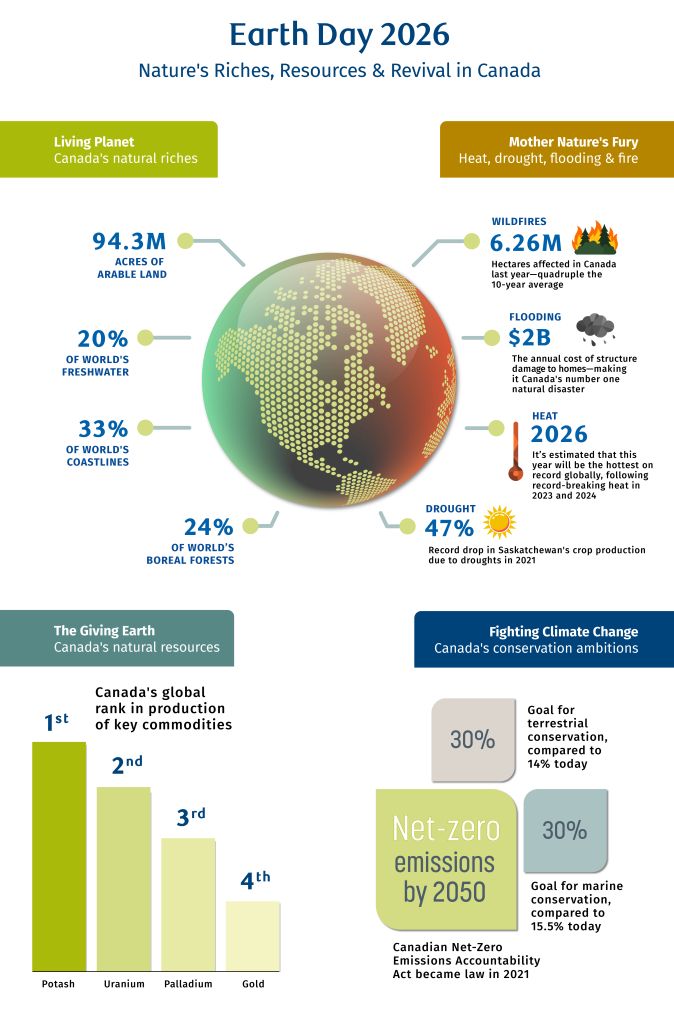
Earth Day 2026: Nature's Richers, Resources, and revival in Canada

Living Planet - Canada's Natural resources include 94.3 acres of arable land, 20% of World's Fresh water, 33% of World's coastline, 24% of World's boreal forests.

Mother Nature's Fury: Heat , drought, flooding and fire include 6.26M hectares affected in canada last year - quaruple the 10-year average, $2B in annual cost of structure damage to homes- making it Canad's number one natural disaster, it is estimated that year 2026 will be the hottest on the record globally, following record-breaking hear in 2023 and 2024, 47% record drop in Saskatchewan's crop production due to droughts in 2021.

“Our power, our planet” is the global theme of this year’s Earth Day. Indeed, clean power often lays the foundation of a cleaner economy. New research from RBC’s Jordan Brennan and Farhad Panahov shows Canada’s electricity system needs an estimated $670 billion over the next 10 years to support the energy transition. While 80% non-emitting, Canada’s grid will need new capacity and modernization. For more, read the Capital Gains report.

Wildfires don’t stop for Earth Day. Close to 200 wildfires were simmering away in Canada last week, just under twice the 10-year average for this time of year. It highlights the scale of the challenge of protecting nature. As a recent RBC report notes, ignoring nature threatens prosperity, especially as we push forward with nation-building projects. It’s time to see conservation as a capital that others will be able tap into for generations to come.

The famous Fischer-Tropsch process brought us gasoline and jet fuel—now it’s poised to make sustainable fuels. Exactlya century after Franz Fischer and Hans Tropsch revolutionized hydrocarbons, the same technique is being used to decouple hydrocarbon production from fossil-derived feedstocks, with emphasis on producing sustainable aviation fuels from carbon dioxide. But true sustainability requires system integration with “upstream low-carbon modules such as green hydrogen and CO₂ capture,” said Peking University’s Ding Ma in Nature. The process is moving beyond labs, with several countries, including China, working on low-carbon chemical manufacturing.

Natural capital–things like forests, clean water, fertile soil, and biodiversity–is one of the most valuable assets any country has. It supports industries, protects communities, and plays a major role in climate resilience. Canada is exceptionally rich in natural capital, but when it comes to investing in and managing it, the picture is mixed—especially compared to countries like the United Kingdom, Australia, and Denmark.

Canada’s natural wealth is hard to overstate. The country holds about 24% of the world’s boreal forest and roughly 20% of its freshwater resources. Natural resource sectors, including oil, mining, forestry, and agriculture, contribute around 20% of Canada’s GDP, including their supply chains. Yet, Canada has struggled to turn natural capital into an investable asset class at scale.

Lessons from around the world

United Kingdom: The U.K. has taken a more systematic approach to embed natural capital accounting into policy and planning. Since 2012, the U.K.’s Natural Capital Committee advised the government on how to measure and invest in ecosystems, which evolved into the Office of Environmental Protection in 2021. Today, the U.K. publishes official natural capital accounts that estimate the economic value of forests, rivers, and other assets–an accounting tool that Canada also has at its disposal under the UN framework: System of Environmental-Economic Accounting. The U.K.’s approach to economic and environmentally informed decisions is complemented by market mechanisms that can stimulate investments in natural assets, such as the Biodiversity Net Gain scheme.

Australia: Like Canada, it is rich in natural resources and heavily dependent on them economically for mining, agriculture, and oil and gas. However, Australia has taken a more aggressive approach to attract private investment into natural capital. Scaled infrastructure projects have been used to mobilize institutional investments, including Canadian pension funds, into long-term projects, including renewable energy development and sustainable land use. An example is the Murray–Darling Basin Plan, a $13-billion initiative to manage water resources sustainably across the country’s food bowl.

Denmark: The Scandinavian country doesn’t have Canada’s vast natural resources. Instead it has focused its attention on baking environmental sustainability into tax law to make investment in sustainably managing natural resources the more economically attractive option. As a result, more than 50% of Denmark’s electricity comes from wind and solar power.

While Canada has made important commitments, it still lacks the coordinated systems of its peers. Pillar three of the Force of Nature Strategy, Valuing Nature and Mobilizing Capital aims to address this challenge. Starting with an Expert Taskforce on Natural Capital Accounting and Nature Financing, the federal government looks to mobilize private capital, blended with their $3.8 billion commitment for nature positive outcomes. If Canada can measure the value of its natural assets, attract more private investment, and align environmental goals with economic growth, it has the potential to turn its natural wealth into a long-term economic advantage.

Dive into more insights on Natural Capital: Unearthing Value: How nature can play a critical role in pro-growth agendas – RBC

“The farmer is responsible for the soil [they] till. This natural resource will not restore itself as fast as it is depleted…The farmer, therefore, needs to open a soil-savings account. It will not only conserve [their] soil, but it will return an increased income and accumulate interest.”

That quotation, pulled from a 1948 edition of RBC’s Making Money by Saving Soils, is as true today as it was when it was first written. In fact, the soil conservation conversation has been a constant among farmers long before that. Sure, things have evolved—with research, big data and technology helping to uncover more about the dynamics of the ground beneath our feet. But many of the challenges of conserving soils to grow healthy crops remain the same. Read more on soil health from Lisa Ashton, the Climate Action Institute’s Interim Head, at the link.

  • There are 10,000 events worldwide to celebrate Earth Day 2026. But if you don’t have time, Eathday.org offers 50 ways to take action for the planet.

  • Deep retrofits would cost $10 per square foot to reduce greenhouse gas emissions in Canadian buildings by 40% by 2030, according to a new MaRS report.

  • James Rising and others at the Grantham Research Institute on Climate Change write on how climate adaptation investments can yield a ‘triple dividend’: preventing losses, stimulating economic activity and providing social and environmental co-benefits.

  • Shrugging off a backlash against renewables, 44% of Americans continue to worry a great deal about climate change—that’s close to its highest point ever. A record low 35% are feeling positive about the environment, according to Gallup.

Disclaimer

rbc_tl_disclaimer


“We must be quite clear about one point: the farmer is responsible for the soil [they] till. This natural resource will not restore itself as fast as it is depleted…The farmer, therefore, needs to open a soil-savings account. It will not only conserve [their] soil, but it will return an increased income and accumulate interest.”

That quotation, pulled from a 1958 edition of Making Money by Saving Soils (the original source of RBC Thought Leadership), is as true today as it was when it was first written. In fact, the soil conservation conversation has been a constant among farmers long before that. And while things have evolved, research, data and technology have helped to uncover more about the dynamics of the ground beneath our feet, many of the challenges of conserving soils to grow healthy crops remain the same.

In 1950, one in five Canadians were part of the farm population.1 At the time, RBC described three good reasons to save soils:

  • Make a living

  • The hope to make a better living

  • Have a going concern to hand onto the next generation

Farmers were encouraged to adopt practices like crop rotations, responsible nutrient management, and conserving edge-of-field environments like forests and waterways. Back then, tillage was encouraged for three reasons: the preparation of a suitable seed bed, the destruction of plants that would compete with growing crops, and the improvement in the physical condition of soil. Today, the opposite is often encouraged to reduce soil loss, build soil biodiversity, and avoid disrupting soil carbon sinks. This change has served Canadian soil health well. Canada’s agricultural soils are estimated to be a net carbon sink today, driven by widespread adoption of no-tillage in the prairies and increases in productivity across the country.2

Agriculture transformed between the 1940s and 1970s with advancements in life science and mechanization, leading to mass adoption of new crop varieties, fertilizers, pesticides and modern farm equipment that allowed farmers to produce more per acre for a growing global population. And it was all being done by fewer farmers–by 1980, 1 in 21 Canadians were part of the farm population.3

Farmers were introducing more nutrients to their soils, including nitrogen, phosphorus and potassium to optimize the growth of crops. In some cases, adding more nutrients led to the excess use of fertilizer, which had a negative impact on soil composition and externalities such as pollution of waterways. But the productivity boost also meant more crop residue was being returned to the soil, adding to soil organic matter.

The tools introduced to agriculture during the Green Revolution continue to be fine-tuned today to help farmers produce more high-quality crops. Increasingly, inputs and equipment are presenting win-win opportunities for soil health and productivity with the development of tools like biological fertilizers or see and spray technology for pesticide application that only applies chemicals where needed to eliminate invasive plants.

Today, less than 2% of Canadians call a farm their home or place of work.4 Remarkably, on the shoulders of this small group, Canada ranks in the top 10 globally for food security, agri-food exports, as well as food quality and safety.5 6 But it’s also a threat to the future growth of the agriculture and food sector as fewer Canadians step foot on a working farm or meet someone working in the sector.

Farmers today, compared with 70 years ago, rely on a much larger network of partners and advisors to do their job, including everything from finance, agronomy, technology, machinery, farm transition planning and sustainability. It’s less likely today than it ever was for young people see these diverse, dynamic and exciting careers in agriculture, beyond farming. For instance, data and computer scientists are developing AI tools for farmers that perfect the precision of inputs like fertilizers, environmental consultants are connecting farmers to marketplaces that reward soil conservation via credits and premiums, and trade experts are moving Canadia-made products to new markets. Engaging more Canadians in the journey of strengthening agriculture as a foundational sector for Canada’s prosperity and the importance of conserving natural assets like healthy soils are the big challenges ahead.

A close read of the 1958 publication provides a glimpse of what’s next–change: “To be good conservationists it may be necessary for us to remake some of our thought, abandon some customary practices, and revise, sometimes drastically, our methods of farming.”

The continued capacity of soil to function as a vital living ecosystem that sustains plants, animals, and humans.7 Soil is foundational to our economy and environment. Roughly 95% of the food we consume needs soil to grow.8 Soils are also the largest terrestrial carbon sink–holding three times the amount of carbon stored in the atmosphere and twice the amount in all living vegetation.9

Disclaimer

rbc_tl_disclaimer

  • Canada is back on the radar of global investors. Last year, foreign direct investment in Canada reached nearly $100 billion, the highest level since 2015.

  • Global capital flows are shifting significantly. Geopolitical disruptions, most recently the conflict in Iran, are leading major investors and companies to rebalance their portfolios.

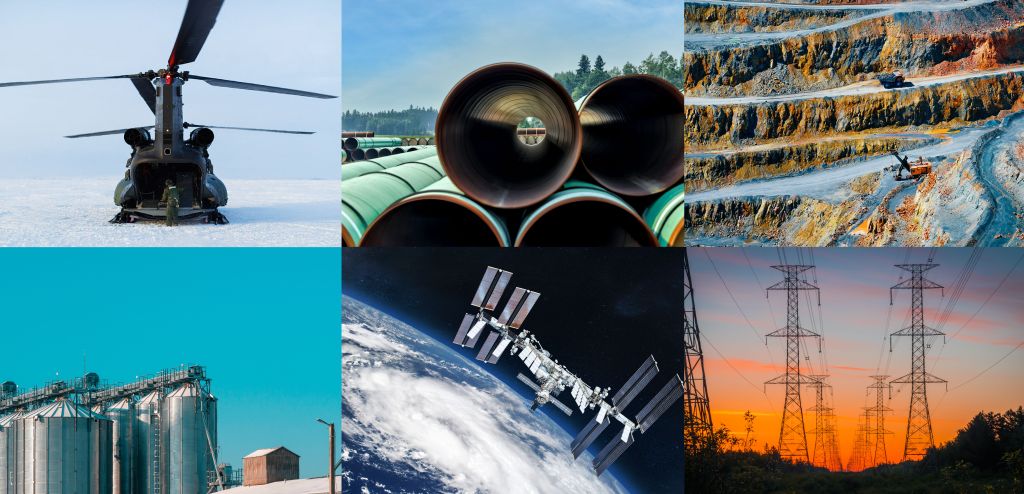
  • A $1.8 trillion investment opportunity over the next 10 years could make Canada the G7’s growth leader. RBC Thought Leadership’s research and analysis indicates that there is an immense opportunity in six export-oriented, R&D-intensive, and strategically significant industries:

    • Oil and Gas: $705 billion. New oil pipelines and LNG terminals could elevate Canada to energy superpower status, diversifying trade, providing energy security to allies, and fostering carbon capture and sequestration technologies.

    • Electricity: $670 billion. A transformative expansion of power across nuclear, hydro, and renewables, coupled with grid modernization, would ensure a reliable, affordable, non-emitting system while strengthening Canada’s competitiveness in a power-hungry heavy industry.

    • Agriculture and Food Processing: $205 billion. Enhanced support for R&D could unleash a multi-decade, export-led growth cycle that strengthens domestic food sovereignty and enables food security to allied countries.

    • Metals and Minerals: $200 billion. With NATO partners eyeing alternatives to a China-dominant critical mineral supply chain, Canada could hedge this concentration risk, power the West’s energy transition, and strengthen defence and advanced manufacturing supply chains.

    • Defence: $19 billion. Canada plans to nearly triple defence spending to 5% of GDP by 2035, which could generate $100 billion for Canadian companies and transform Canada from a defence equipment importer into a contributor to allied military capabilities, particularly in emerging areas like Arctic surveillance and space-based defence systems.

    • Space: $12 billion. Canada’s economic ambitions should extend out of this world. Investments in the space industry would advance the country’s excellence in satellite communications, space robotics, earth observation, and aerospace engineering, creating new opportunities in defence, high-tech and advanced manufacturing.

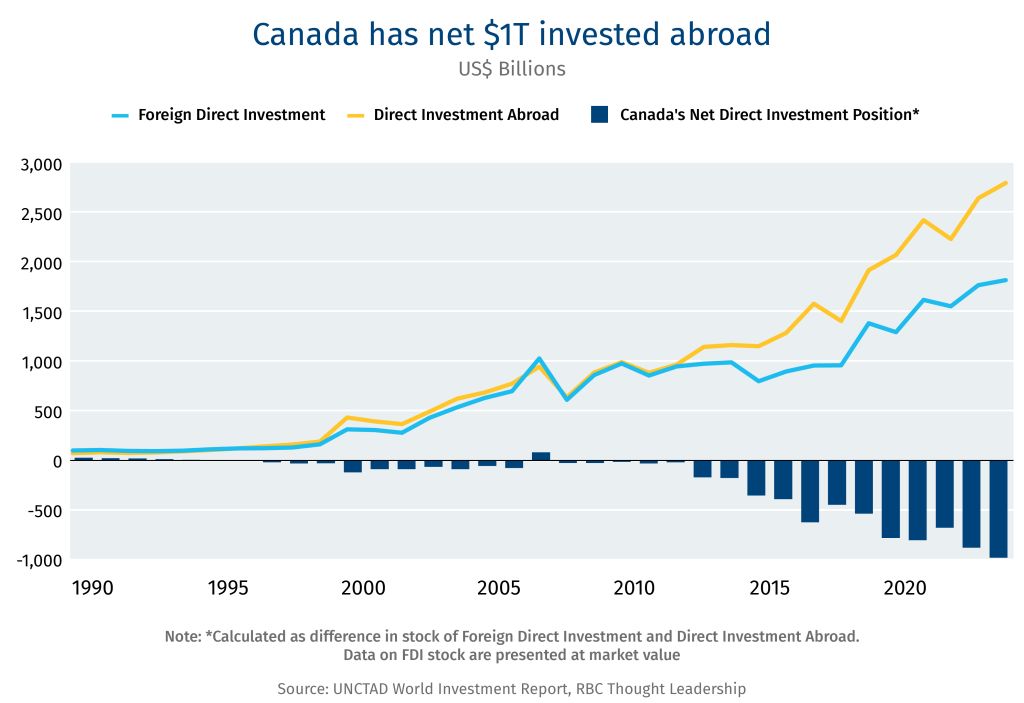
  • Canada is emerging from an unprecedented capital recession. The renewed interest comes after a decade of weak business investment, stalling productivity, and stagnating living standards. Between 2015 and 2024, more than $1 trillion of investment exited Canada—the largest capital exodus in Canadian history. For every dollar of inward FDI, two dollars exited.

  • To unlock investment, Canada needs a new capital formation framework. The non-financial corporate sector is sitting on more than $1 trillion in cash on its balance sheet. Its deployment could crowd in additional pools of capital: institutional, risk, foreign, and state capital. Our proposed capital formation framework includes four pillars, each targeting an incremental layer in the capital stack:

    • A brownfield to greenfield asset recycling program

    • Scale-enabling procurement

    • Reforms to the corporate income tax and foreign investment regimes

    • Leveraging of state capital

  • Canada’s new playbook must include Indigenous economic partnership, which not only helps to secure project approvals, but can accelerate project timelines. Partnerships work best when they are embedded early and aligned with community needs.

Canada is back on the capital radar.

Following a decade defined by record levels of capital flight and weak business investment, Canada is increasingly catching the attention of global investors and companies looking to rebalance their portfolios amid global uncertainty. Last year, foreign direct investment in Canada hit nearly $100 billion, the highest it’s been since 2015 and the first time in a decade when inflow exceeded outflow.

The opportunity is immense. If Canada can capitalize on this moment, it could lead the G7 in economic growth and industrial dynamism. RBC Thought Leadership’s research and analysis indicate that Canada requires $1.8 trillion in investment over the coming decade to galvanize growth in six export-oriented, R&D-intensive and strategically significant industries:1 Oil and Gas, Metals and Minerals, Electricity, Agriculture and Food Processing, Defence, and Space.

For an economy worth $3 trillion annually—and given that we are focused on six industries that, collectively, represent less than 10% of GDP—the $1.8 trillion figure is substantial. However, it is attainable over the next decade, especially given the pools of capital to draw upon. Between pension funds and asset managers, Canada is sitting on nearly US$10 trillion in capital. And while estimates vary, the global capital pool sits somewhere between US$150 to US$200 trillion.2

Simply put: There is more than enough capital to power the country’s growth ambitions.

With that in mind, we imagine two future scenarios: Trend Growth and Step Change. The Trend Growth scenario paints a picture of Canada 10 years out if current policies and investment patterns remain unchanged. The Step Change conceives a decade of purposeful national strategy, federal-provincial coordination and targeted investment.3

The latter, which represents a 65% capital injection boost from the Trend Growth scenario, shapes a new and prosperous Canada. One that could include two new oil pipelines, increasing production capacity by a third; an expansion of power generation across all sources, including nuclear; $300 billion in defence spending that strengthens advanced manufacturing and better enables Canada to contribute to NATO’s collective defence; the transformation of the mining sector into a linchpin of Canada’s industrial and geopolitical strategy; and sovereign launch capability just as space becomes the next economic frontier. 

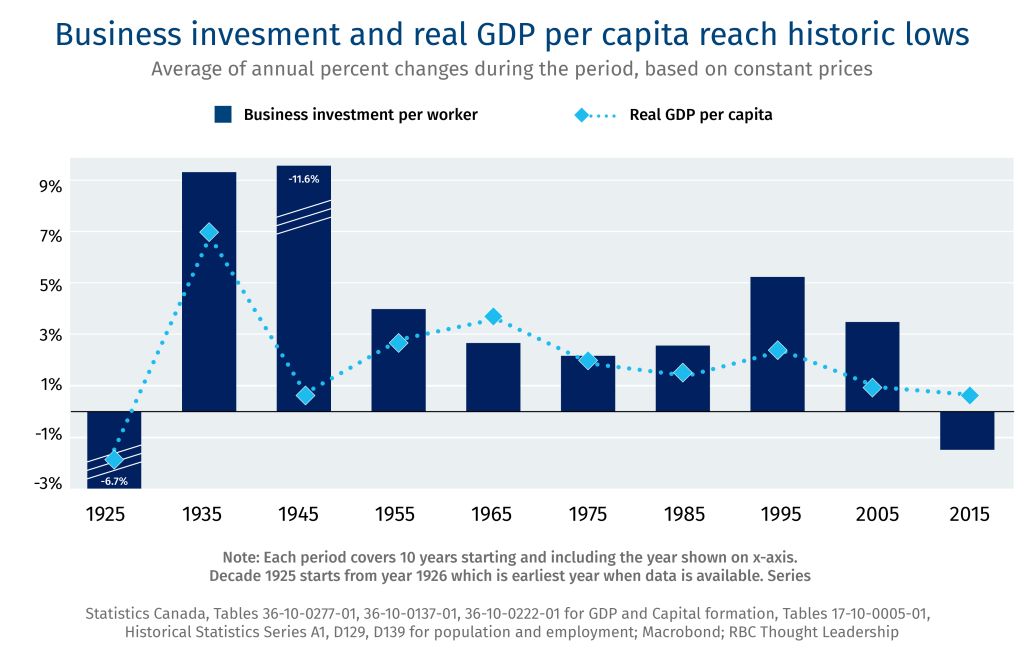
Business investment and real GDP per capita reach historic lows

All of this would follow a 10-year capital recession. Over the past decade, Canada’s net outflow of investment exceeded $1 trillion, the most significant capital exodus in modern Canadian history. For every dollar invested in Canada from abroad, two dollars exited. Canada accounted for nearly 10% of global outward foreign direct investment over the past decade, having exported more capital than any country on Earth save the U.S. and China. Canada now ranks last among G7 nations in investment in both machinery and equipment (M&E) and intellectual property (IP). Only about 30% of Canadian capital formation goes into these productivity-enhancing categories—half the U.S. share.4

Canada has net $1T invested abroad

The unifying view of the experts we consulted—from pension funds to policymakers, manufacturers to miners—is that Canada doesn’t lack for capital. Instead, the barriers are execution, predictability, and risk tolerance. What’s needed is more boldness and commercial ambition. Growth requires tradeoffs in three interlocking areas:

  • Raise risk tolerance in the Canadian ecosystem and dismantle burdensome regulatory, permitting and project delivery barriers while respecting the rights of Indigenous people and protecting the environment.

  • Inject process certainty: Investors are adept at navigating risk but flee when hemmed in by vague rules and shifting frameworks.

  • Reward risk-taking and entrepreneurship to stimulate innovation and growth.

None of this will be easy. While Canada’s stock has been climbing, global competition for capital is intense. Canada isn’t the only nation in build mode. But it does have all the traits of an economic leader: a deep talent pool, abundant natural resources, political stability, and the rule of law.

The question is not whether Canada can grow—but how.

ScenarioTrend GrowthStep Change
Capital Required$430 Billion$705 Billion
No significant attempt to grow oil or liquefied natural gas productionTwo new oil pipelines increase output by one third
Investments incrementally expand outputThree new LNG export terminals
Expansion of carbon capture capacity

Canada’s oil and gas industry sits at a strategic crossroads. Canadian producers appear poised for growth: the International Energy Agency (IEA) forecasts that under current policy, global oil and natural gas demand will continue to increase through 2050.5 The demand for oil is driven in part by growth in developing markets, aviation, and petrochemicals. LNG capacity is surging to unprecedented levels—300 billion cubic metres of new export capacity is scheduled to hit the market by 2030—bolstering global LNG supply by about 50%, some two-thirds of which originate in the U.S. and Qatar.

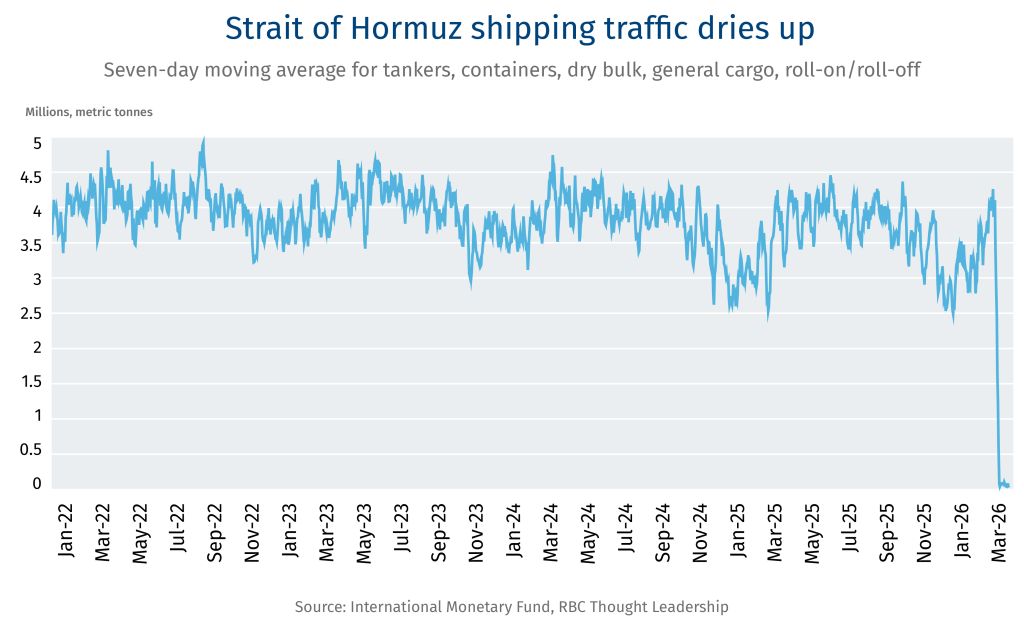
Energy security has become a top geo-political concern. And that was before the war in Iran curtailed supply, sent prices soaring, and exposed the dependence of many advanced economies on the Middle East. The long-term impact of the supply shock remains to be seen. It’s also too early to conclude that demand for Canadian oil and gas will remain strong for the foreseeable future. And not just for energy purposes, but as feedstock into critical industries like pharmaceuticals and fertilizers. Venezuela remains a wildcard. It’s unclear if investment will flow into that country at the scale required to meaningfully augment its production and export capabilities. Strategically, this leaves the U.S. exposed, despite being the largest global producer of oil. With 46 billion barrels of recoverable oil, the reserve-to-production ratio means that the U.S. has less than seven years of proven reserves on current consumption patterns.

The operating environment in Canada, however, is constrained. Pipelines are near full capacity and several mega projects have been delayed or cancelled over the past decade. The Canada-Alberta MoU signals a policy inflection: for capital markets, it reduces political sequencing risk—historically one of the largest contributors to Canada’s cost of capital. In conjunction with Prime Minister Mark Carney’s commercial diplomacy, including LNG exports to the Indo-Pacific and accompanying trade infrastructure, the message to global capital is that Canada’s policy environment is more open to development.

Canadian natural gas and LNG are also in expansion mode. Strong interest from Asian and European countries seeking energy security and coal-to-gas transition offer a clear growth pathway. Canada’s West Coast is well-positioned to supply this demand—if export capacity, permitting, and Indigenous partnership are aligned.6 With the U.S. rushing into the LNG space, future growth will depend on predictable and accelerated permitting, environmental assessment efficiency, and policy harmonization across jurisdictions.

Oil & Gas (2024)

VariableValue
Employment148,000
Revenue$248B
Exports$115B
GDP$97B
Source: Statistics Canada

From a capital perspective, oilsands majors have emphasized capital discipline and shareholder returns, having deleveraged their balance sheets. The bulk of capital in the industry comes from operating cash flows and retained earnings. Canada’s oil and gas players hold tens of billion in cash on their collective balance sheets and generate tens of billions more in free cash flow. The industry is well capitalized to internally finance growth, but the debt and equity markets would readily respond to catalyzing investments. Between the heavy capital requirements of the industry—drilling programs, bitumen mining, processing plants, refineries, and pipelines—mere maintenance opex is extraordinarily expensive. The industry has been reticent to undertake the heavy capital investments required to expand productive capacity because it is so sensitive to policy and the uncertainty around pipeline approvals, not to mention commodity price volatility.

Capital tends to flow in the industry when policy certainty creates the extended investment horizon necessary for retained earnings to be channeled into durable, productivity-enhancing assets. Absent that, capital will tend to be returned to shareholders in the form of dividends and stock repurchases.

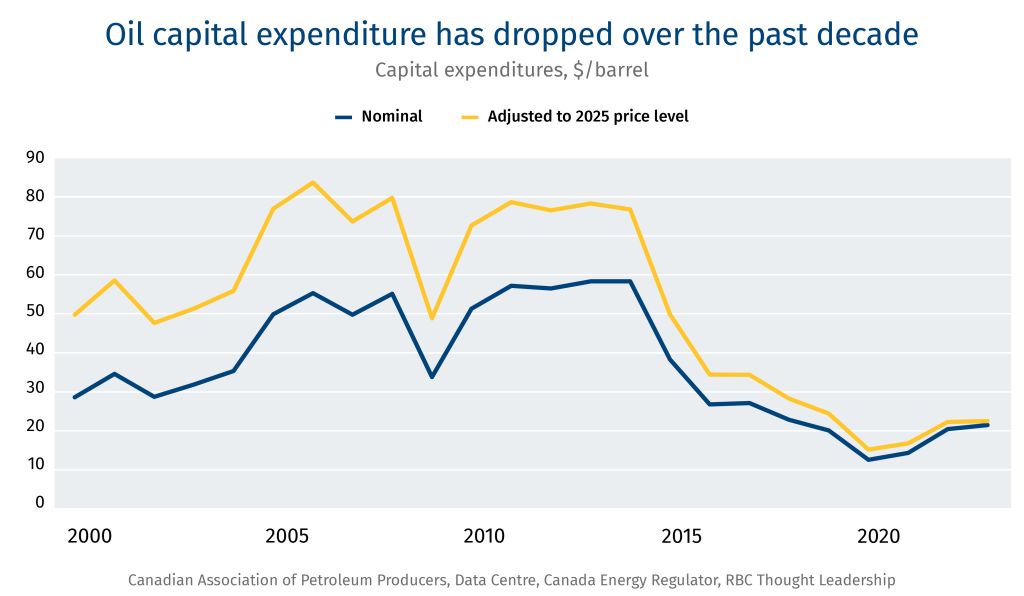
Capex per barrel collapsed—falling from US$75 per barrel in 2014 to US$20 per barrel in 2024 (adjusted for inflation). Production is more than twice as high today as it was in 2000, yet companies are investing less than they did a quarter of a century ago. As a result, Canadian energy infrastructure faces capacity constraints relative to resource potential.

Clean technology integration represents both a capital requirement and strategic necessity. Large-scale carbon capture and sequestration (CCS) projects like Pathways Alliance and methane emission reduction programs are important factors in securing market access and political support. IEA modelling indicates that decarbonizing the oil and gas sector will require adoption of tried, tested and affordable methane abatement technologies (e.g., leak detection and control devices) and heavy investment (US$100+ billion) in CCS technology to reach net zero. Without these investments, Canadian producers risk losing access to carbon-conscious markets.

Until key aspects of the Canada-Alberta MoU are realized, pipeline capacity will remain the defining bottleneck in Canada’s oil future. Climate policy, including industrial carbon pricing, remain in flux. The debate about the Oil Tanker Moratorium Act adds an additional layer of uncertainty. In the meantime, Canada’s export dependency on the U.S. will continue to pose sovereignty and resilience risks. Without new pathways to tidewater, diversification towards Asia will be aspirational.

Oil capital expenditure has dropped over the past decade

Capital is required to maintain and incrementally expand the current infrastructure and production patterns. Canada remains a strong player in international markets but continues to underplay its hand geo-politically.

  • Oil production grows 10%, rising to nearly six million barrels per day (bpd) in 2030 before plateauing. Canada remains reliant on U.S. buyers.

  • No new export oil pipelines: the system relies on improved efficiency within existing infrastructure.

  • For LNG, production grows with the completion of announced expansion projects (Woodfibre LNG and Cedar LNG), but Canada does not feed Indo-Pacific demand. No new greenfield terminals are added beyond what is already funded.

  • Limited CCS deployment constrains market access in Europe and Asia and deepens domestic divisions over hydrocarbon development.

Canada becomes a nation capable of providing energy security to allies, supporting global emissions reductions, and galvanizing national economic growth through long-term, capital-intensive investments.

  • Two new export pipelines anchor this scenario:

    • West Coast tidewater line to Prince Rupert or Kitimat could add one million-plus bpd.

    • U.S.-bound pipeline connecting Alberta to Gulf Coast refiners could add 800,000 bpd – which could be added in phases through existing systems or through a new large diameter pipeline expansion project.

  • Oil production grows to 7.1 million bpd by 2035. 

  • Large-scale carbon capture and sequestration (CCS) package becomes integral to Canada’s strategy, enabling expanding production. Emissions reductions were incorporated directly into our growth model:

    • Pathways, which would sequester up to 22 metric tonnes per year (Mt/year).

    • Additional projects could sequester oil sands emissions of similar scale (e.g., Alberta Carbon Grid or Origins).

  • Three new major LNG projects add 3.8 billion cubic feet per day (bcfd) to Canada’s LNG export capacity: LNG Canada Phase 2, Ksi Lisims LNG, and Tilbury LNG expansion.

Combined, these investments create a fundamentally different energy system. Canada contributes to the long-term energy needs of the U.S. and underwrites energy security for partners in Asia and Europe. Canada regains influence in the global oil and LNG markets, diversifying its trading partners and strengthening sovereignty. Indigenous equity partnerships are embedded in mega projects, aligned with community needs, facilitating accelerated project timelines. Upstream emissions are managed through large-scale CCS.

ScenarioTrend GrowthStep Change
Capital Required$400 Billion$670 Billion
Completion of projects underwayExpand wind and nuclear power to enable economy-wide electrification
Grid maintenanceGrid expansion and modernization

Canada’s electricity system is built on roughly 80% non-emitting power anchored by hydro and nuclear. However, the coming decades will test every part of the grid. Electrification of vehicles, buildings, industry, and data centres mean demand could double by 2050. To keep the grid reliable and affordable, Canada must massively expand and modernize a system that was built more than half a century ago. Policy momentum is building in this area, with a new pan-Canadian electricity strategy under development.

Electricity planning is shifting from a provincial utility logic to one that ties national infrastructure with industrial strategy. Hyperscale data centre commitments and applications are transforming load forecasting from incremental upgrades to step-change demand modelling. Electricity is increasingly viewed from the lens of industrial capability and economic resilience rather than power need and climate management alone. And there are areas for enhanced regional cooperation on generation and transmissions—think interties—with an important coordinating, financing and regulatory role for Ottawa.  

Modernizing Canada’s variegated systems will be expensive. The power sector differs from other industries—split between public utilities and private operators, all under the rubric of heavy regulation. It’s a balance sheet-driven sector where capital flows are highly structured. Investment tends to be financed through long-term debt, not equity. The risk-and-return profile is not only tied to market prices; instead, regulatory approval, the rate-setting framework, cost-recovery mechanisms, and occasionally, risk-sharing arrangements, attract long-horizon, liability-driven investors like pension funds and insurers who are attracted by the security and stability of returns.

Utilities Sector (2024)

VariableValue
Employment140,000
Revenue$51B
Exports$4.6B
GDP$46B
Source: Statistics Canada

Investment flows into multi-decade generation, transmission, and distribution networks, grid modernization, storage, and digital control systems. Unlike other heavy industries, productivity improvements tend not to be derived from labour efficiency, but from capital deepening—larger, more resilient, more flexible systems that lower costs and enable downstream economic activity.

At the generation level, each resource plays a distinct role in Canada’s system.

  • Nuclear is undergoing a revival. Ontario’s refurbishment anchors baseload supply, and the Darlington small modular reactor (SMR) will be the first grid-scale project in the Western world. Large-scale nuclear comes with significant cost and scheduling risks. A recent study found that of the two dozen project types, nuclear waste and nuclear power came in first and third, respectively, in terms of cost-overruns. Ontario’s refurbishment program, however, was delivered ahead of schedule and under budget—making it one of the most successful major infrastructure projects in Canadian history.

  • Hydro remains the backbone of power across Canada, but the storyline has shifted. Historically thought of as ‘endless surplus,’ hydro is becoming a balancing source of power as grid and demand requirements evolve. Drought conditions in Quebec, B.C., and Manitoba have exposed the fragility of relying solely on hydro power, too. The future of hydro is less about mega-projects and more about offering flexibility, the strategic use of interties, and providing inertia for the grid.

  • Wind makes up the largest share of new generation. On an incremental basis, wind is the lowest-cost source of new power. The challenge is intermittency and inertia. Integrating large volumes of renewable supply requires storage, grid stability, and flexibility.

  • Natural gas will likely remain a reliability backstop in various regions.

    Rapidly expanding electricity demand also puts strain on the grid and related infrastructure. Transmission and distribution of assets spanning 850,000 kilometres require massive upgrades, regional interconnection, and enhanced digitization. Canada’s patchwork of 10 provincial grids complicates this process. The long-horizon nature of investment planning is complicated by the multiplicity of demand drivers, which are politically, technologically, and culturally contingent.   

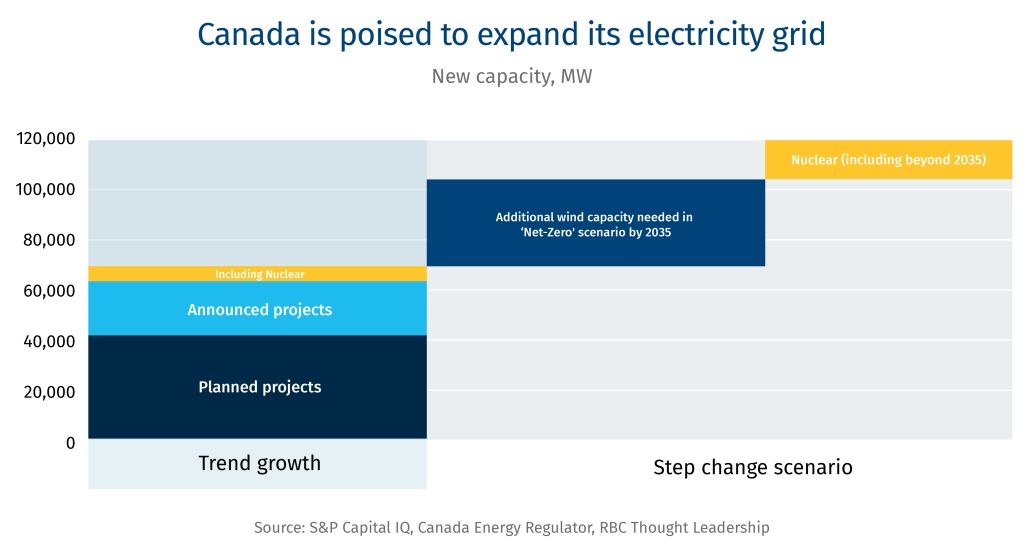
Canada is poised to expand its electricty grid

Canada completes what’s already approved, funded, or under construction and generates 20% more power across all sources.

  • Canada brings 63 GW of incremental capacity online across wind, solar, natural gas, and battery storage based on projects already planned and announced.

  • Two major nuclear additions in Ontario: Darlington SMR (online in 2035) and Bruce C Project (in 2041).

  • On the grid side, we assume routine reinvestment and incremental upgrade of Canada’s existing transmission and distribution lines, aligned with limited further progress on nation-wide decarbonization.

The baseline pathway does not materially alter the underlying structure of the system. With climate policy either stalled or in reverse, the policy incentives to decarbonize are less compelling. Global and domestic efforts to reduce emissions remains limited. Electrification proceeds in this scenario, but slowly.

Canada transforms and radically augments its energy system across generation, transmission, and distribution, including policy measures that drive decarbonization and electrification-led economic growth.

  • Canada builds 119 GW of new generation capacity—nearly double the trend growth scenario.

  • New nuclear projects include the Peace River (Alberta), Point Lepreau (New Brunswick), Wesleyville (Ontario), and Saskatchewan SMR nuclear projects.

  • Canada significantly ramps up its wind power beyond projects already in place. Grid expansion of 240,000 kilometres—double the trend scenario—with major costs from modernizing and digitizing the grid, including system reinforcements and new connections.

The expanded system is cleaner, more flexible and self-sufficient. It is responsive to economy-wide electrification and the major demand drivers that are likely to unfold in the coming decades, including:

  • Population growth and associated electricity demand at the household level (think electronics, heat pumps, etc.). This trend is in flux, as Canada’s immigration system is under increasing scrutiny.

  • Electric vehicle adoption, which has stalled with the removal of incentives, but may rebound with Ottawa’s new automotive strategy. Stricter tailpipe emissions standards, renewed EV rebates, and charging infrastructure aim to hit 75% EV sales share by 2035. This trend may extend beyond electrification of passenger cars into freight and heavy-duty transport, adding further load to the grid.

  • Data centres are a wildcard, creating both risks and uncertainty across the sector. Utilities are already signaling demand well beyond what outlooks have modelled:

    • Alberta provides a striking example: grid connection requests jumped from 6 GW to nearly 20 GW by September 2025–prompting the province to implement a two-phase integration program to maintain grid reliability and affordability.

    • Hydro Quebec expects data centres to account for 15% of net new electricity demand by 2032.

    • Ontario’s IESO projects data centres will account for more than 10% of new electricity demand through 2035.

  • Another wildcard: battery technology advancements, which are difficult to forecast, but the cost curve is trending lower.

This scenario supports a larger domestic population that consumes more clean electricity at home and utilizes clean power at work. Through interties and power corridors, Canada expands its grid horizontally, transporting electricity from power-generating regions to power-consuming regions, including abroad.

Power system stability, affordability and flexibility serve as a strategic advantage for Canada globally, helping Canada win new investment mandates in advanced manufacturing and frontier technology, while still working towards the goal of a net-zero grid by 2050.

ScenarioTrend GrowthStep Change
Capital Required$140 Billion$200 Billion
Maintain industry’s long-term growth rateDevelop new early- and late-stage mining projects

Mining has historically been a cyclical industry governed by market forces. But with recent developments in Washington and Beijing, the ever-expanding critical minerals segment of the industry is being steered increasingly by geo-political strategy. Canada, the U.S. and other NATO partners increasingly view mining through the lens of sovereignty, security, and strategic infrastructure.7 In doing so, they are beginning to mirror China’s playbook. Over two decades, China used industrial policy, state-backed finance, and non-market mechanisms to secure control over minerals essential to defence, advanced manufacturing, and clean technology, especially at the level of processing, refining, and secondary manufacture.

The Canada-led Critical Minerals Production Alliance announced more than two dozen new investments and partnerships, mobilizing some $6 billion in projects and designating critical minerals as ‘essential’ under the country’s Defence Production Act. Offtake agreements, price floors, and stockpiling are some of the non-market mechanisms being employed to mobilize private capital. 

The U.S. is going even further with Project Vault—a public-private partnership to finance and stockpile the minerals needed for advanced manufacturing and frontier tech. The White House is using a suite of de-risking instruments such as loan guarantees, offtake agreements, and direct equity stakes in mineral development companies to catalyze the development of lithium, copper, cobalt, and rare earths, among others. Almost overnight, Western governments have gone from observers of mining industry dynamics to market makers.

Mining Industry (2024)

VariableValue
Employment128,000
Revenue$85B
Exports$35B
GDP$32B
Source: Statistics Canada

For Canada, long-standing challenges come into sharper relief. Despite favourable geology, world-class mining finance and engineering expertise, growth has been held back by:

  • A lengthy, complex, and unpredictable permitting process.

  • Insufficient enabling infrastructure (roads, transmission lines, processing facilities).

  • Shortage of specialized mining talent, especially around operational execution.

  • Risk capital. Junior miners have struggled to raise funds from institutional investors as market sentiment pivoted to cannabis, then crypto, and increasingly AI.

To compete in this new era, Canada’s mining industry must move beyond market-driven dynamics into strategic national development. Indigenous equity frameworks are increasingly embedded at early stages, compressing the consultation cycle.

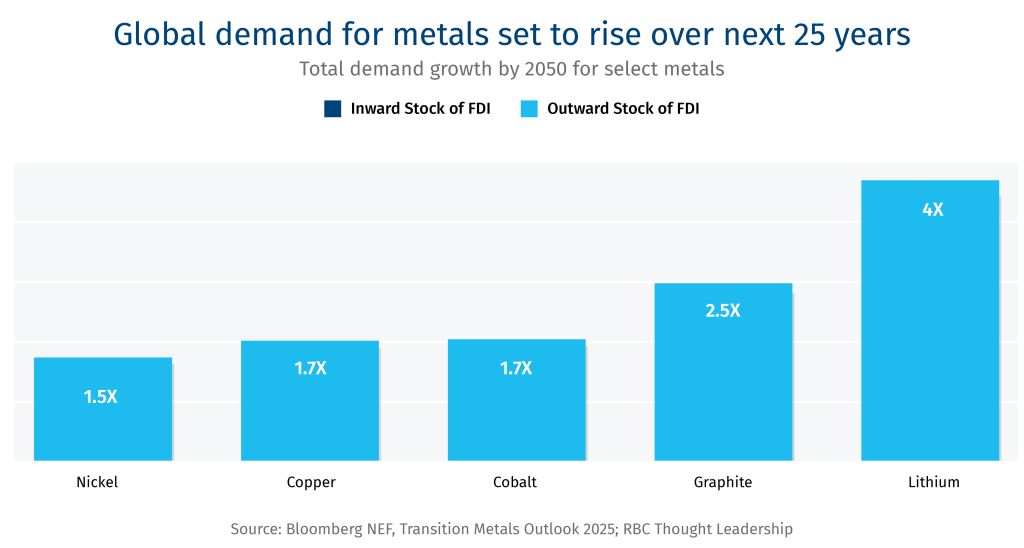
Global demand for metals set to rise over the next 25 years

Canadian mining remains on its long-term historical trajectory. Policy ambition remains high, but the obstacles to capital formation—permitting uncertainty, infrastructure gaps, talent shortages—are not meaningfully resolved. The regulatory environment does not improve fast enough to accelerate capital. Output grows slowly, tracking 0.5% annual GDP growth.

  • New mines struggle to reach final investment decisions.

  • Capital flows remain concentrated in base and precious metals.

  • Canada’s critical mineral potential remains under-developed, owing to dependence on market forces. 

These trends are sufficient to sustain operations and replace depreciating assets but not reshape Canada’s competitive position in global supply chains. Canada preserves its mining base, but supply chain dependence on foreign refining and processing persists. Canada retains relative strength in the wider mining industry but does not become a major player in the geopolitical race for critical mineral sovereignty, losing strategic clout with NATO partners in the process. 

Market forces continue to govern the exploitation of base and precious metals, but critical minerals have become a national priority. Ottawa leads coordinated federal-provincial action and advances several de-risking mechanisms.

The Step Change scenario reflects three fundamental facts about the global mining industry:

  • Many critical mineral projects are not commercially viableif left to market forces. Between small market size, absence of a global market price, or infrastructure barriers, global miners have no incentive to develop many critical mineral and rare earth resources.

  • Canada possesses dozens of strategically significant deposits,but they will require public-private cooperation to fully develop.

  • The U.S. and other allies are moving aggressively;Canada risks being left behind in the global race to build a critical mineral supply chain.

Canada develops a series of projects, both early and late stage, across a range of precious and base metals and critical minerals. Canada becomes a leader in the Critical Minerals Production Alliance, developing its reserves of copper, lithium, graphite, nickel, cobalt, and rare earths. To hedge processing and secondary manufacturing dependence on China, Canada partners with NATO and other allies in the creation of a critical minerals refining supply chain, leveraging existing smelting capacity.

Canada catalyzes:

  • Development of all late-stage projects, including the Eagle’s Nest nickel mine in Ontario’s Ring of Fire and the Casino copper mine in Yukon, among others.

  • Early-stage projects across the range of metals and minerals. Canada is a reliable supplier of critical minerals to NATO partners. Canada strengthens national and international supply chains while building domestic processing capacity. Mining is transformed from a natural resource industry into a linchpin of Canada’s industrial and geo-political strategy.

ScenarioTrend GrowthStep Change
Capital Required$10 Billion$19 Billion
Canada meets its 2% NATO spending targetCore defence spending increases to 3.5% of GDP by 2035

Geopolitical currents are changing rapidly. Uncertainty around the cohesion and stability of NATO has called into question Canada’s military capabilities. After decades of under-investment, Ottawa is sending the strongest demand signal in a generation. The federal government is making historic investments as part of its commitment to raise defence spending to 5% of GDP. Ottawa’s Defence Industrial Strategy serves as the beginning of a new blueprint, combining industrial capacity with strategic positioning.

An expansion of the funding envelope is being met with a change in thinking among the Canadian Armed Forces (CAF), which is shifting away from platform-centric thinking to a capability-centric approach. Uncrewed and autonomous systems—drones—provide an illustrative example of this shift. Drones sit at the intersection of defence, space, AI, and cyber and are quickly graduating from niche sub-sector to foundational capability. Canada’s Drone Surge initiative and the Canadian Army’s MINERVA program exemplify this evolution: government defines the mission or outcome and calls upon industry to provide the solution. Drones also capture the dual-use spirit of Canada’s defence-space strategy since they are already proven in commercial environments while offering scalable military applications when procurement timelines and risk-sharing mechanisms align. When it comes to Arctic sovereignty—a renewed focus for Ottawa—drones provide the persistence and responsiveness that complement space-based assets while maintaining a domestically sustainable capability.

Despite the renewed focus on funding, a series of interlocking challenges afflict the defence industry:

Defence Industry (2022)

VariableValue
Employment36,000
Revenue$14B
Exports$7B
GDP$9.6B
R&D Spend$440M
Source: ISED
  • Low and uncertain government spending has meant that domestic firms lack an anchor customer.

  • Canada’s procurement process can be slow, complex, and politicized. Multi-agency oversight, lengthy bid cycles and administrative complexities discourage investment and constrains innovation.

  • Export opportunities for Canadian companies can be limited in foreign markets because of regulatory, political and economic barriers designed to favour the host country’s sovereign industry over foreign competitors.

  • The persistent problem of scale, with many Canadian SME’s dependent on American conglomerates.

  • The defence supply chain remains fragile in the post-pandemic era, with backlogs and technical bottlenecks squeezing Tier 2 and 3 suppliers.

  • A shortage of skills means companies struggle to find engineers, scientists and technicians.

Capital dynamics in defence are driven by government procurement, long-term contracts, and public R&D funding signals that also attract venture capital and strategic equity for early-stage investment and to structure debt for more advanced companies. Capital flows fund research and development, specialized equipment, manufacturing facilities, and technological infrastructure and operations. Given the nature of the sector, government demand can scale industrial capacity for long-term contracts and derisk private investments.

Budget 2025 expanded the funding framework with new measures for dual-use technologies, critical minerals, AI, and sovereign space-launch capability. The procurement focus is clear:

  • Fighter jets, maritime patrol aircraft, under-ice submarines, and long-range rocket artillery.

  • Revitalization of Canada’s military and dual-use infrastructure, including Arctic installations, the strategy emphasizes air and maritime surveillance.

  • These latter capabilities depend on space, satellite communications, and cyber systems to connect and secure Canada’s digital defence systems.

All of this is nested in a still-emergent industrial policy with strong ‘Buy Canadian’ ambitions. There are forceful tailwinds for the industry, but momentum has yet to pick up.

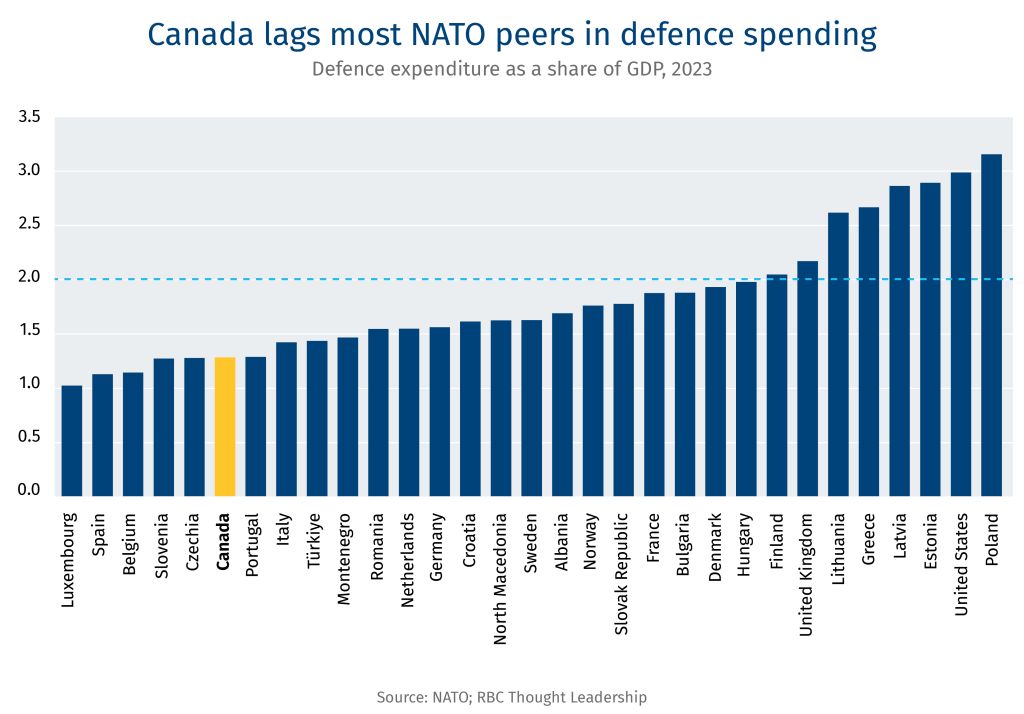
Canada lags most NATO peers in defence spending

Canada spends 2% of GDP annually into 2035. This produces predictable demand.

  • Ottawa’s ‘Buy Canadian’ policy tilts procurement volumes towards domestic content.

  • The defence ecosystem gets a boost across the value chain, beginning with R&D, but expanding into facilities, and specialized machinery and equipment, resulting in enhanced capabilities.

Bottom line: Canada rebuilds its military incrementally, with expanded hardware in a few key areas. This enables Canada to better surveil the Arctic, patrol the coasts, and support our NATO allies. However, in a world where the integrity of the NATO alliance is in question, or abolished completely, Canada’s defence capabilities remain under-developed.

Canada reaches its full NATO target of 5% of GDP by 2035, including:

  • A linear rise in core defence assets.

  • A greater share of spending is allocated to capital equipment and military hardware.

  • Large domestic procurement for next-generation aircraft, ships, cyber defence architecture, and Arctic infrastructure.

Over the coming decade, this adds $300 billion to total defence spending. If Ottawa sustains its commitment to source at least 70% domestically over the coming decade (up from 30% presently), then Canadian producers stand to gain $100 billion in incremental revenue (this excludes spending on dual-use infrastructure). This is not just more spending. Defence is R&D-intensive, which has knock-on effects across IP production, with spillover benefits across advanced manufacturing, better enabling Canada to contribute to NATO’s collective defence.

Canada builds both sides of the defence-space axis, too. Defence spending revitalizes Canada’s industrial base. Space catalyzes dual-use technology. And Canada becomes a meaningful contributor to allied space and defence capabilities, which is not only an emergent ‘border’ to be defended, but a frontier consumer market as well.

ScenarioTrend GrowthStep Change
Capital Required$5 Billion$12 Billion
Industry grows at historical rate (1% annually)Canadian space sector doubles its global market share, rising to 2% by 2035

Space represents a unique convergence of strategic necessity and capital formation opportunity. As a strategic industry, space capabilities underpin national sovereignty through Arctic surveillance, defence communications, and climate monitoring but it also functions as a productivity layer across other industries—Earth observation and geospatial analytics enhance efficiency in agriculture, mining, energy, infrastructure, and insurance, making it essential to any capital-deepening strategy. The space-AI nexus also creates a powerful demand driver and intellectual property engine, where space data combined with artificial intelligence can strengthen automation capabilities, climate resilience, and defence readiness.

Canada has recognized excellence in satellite communications, space robotics, earth observation and aerospace engineering. As the third nation in space, with a long and decorated history, under-investment at the federal level combined with the failure to develop sovereign space-launch capability has constrained industry growth. That era may now be coming to an end, driven in part by the reconvergence of defence and space technologies.

Space Industry (2023)

VariableValue
Employment13,900
Revenue$5.1B
Exports$2.2B
GDP$3.4B
R&D Spend$650M
Source: Canadian Space Agency

There’s a two-pronged revolution underway and Canada has yet to find solid ground.

  • In the U.S., a policy-driven transformation of the business model unfolded over the past 15 years, with private industry increasingly in the driver’s seat when it comes to capital deployment and innovation.

  • The second locus of transformation is Europe and is just getting started. With the Russian’s invasion of Ukraine and the NATO commitment to increase defence spending, there’s a reconvergence between space and national defence. Traditional space companies are crowding into defence contracts while defence conglomerates expand their space capabilities. ‘Dual use’ space technologies are now the norm.8

Like defence, capital flows when government demand de-risks private investment, enabling firms to deepen technological capability and scale industrial capacity for long-term contracts that would not exist under purely commercial market arrangements. The financing model in Canada is challenged. In space, the fastest path to scale is not government-owned hardware—its government acting as an anchor customer for commercially owned, commercially operated (COCO) services—data, communications, surveillance, analytics, launches—under multi-year, performance-based contracts. When done properly, these contracts function as financeable, near-sovereign revenue streams that lower the cost of capital and unlock large pools of private investment, allowing Canadian firms to scale at home and export globally.

Despite past achievements and present strengths,the industry remains challenged structurally and policy wise.

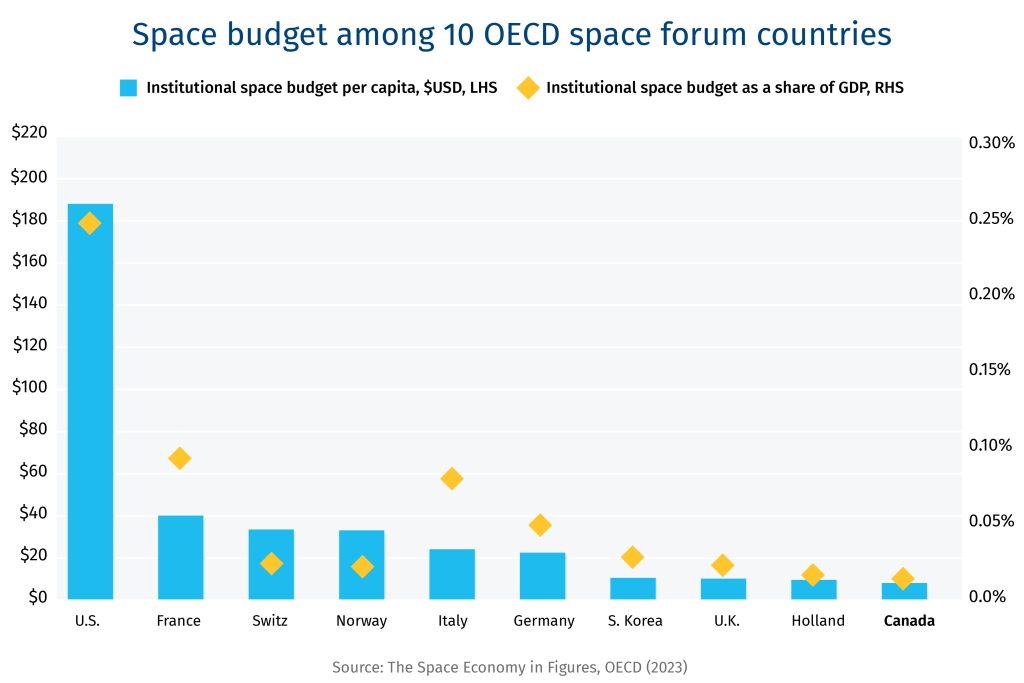
Space budget among 10 OECD space forum countries
  • Annual sales decline 1% per year.

  • The industry shrinks to $4.5 billion by 2035.

Bottom line: Canada fails to arrest the decline of space. This is primarily a policy-driven choice, not a failure on the part of space companies to innovate and grow. As a result, Canada’s defence capabilities in space remain stunted and core civilian applications atrophy.Bottom line: Canada fails to arrest the decline of space. This is primarily a policy-driven choice, not a failure on the part of space companies to innovate and grow. As a result, Canada’s defence capabilities in space remain stunted and core civilian applications atrophy.

Space is imagined as an essential component of national security and economic competitiveness.

  • Doubling its global market share from 1% to 2%.

  • Building sovereign launch capacity, underpinned by an increase in satellite launch cadence, in keeping with funding commitments in Budget 2025.

  • Deepening dual-use integration with defence.

  • Modernizing procurement around speed, commercial partnering, and risk-sharing.

  • On the space-defence axis, government earmarks a modest share of incremental defence spending growth for dual-use space, procured primarily via COCO service contracts—creating predictable revenues that crowd-in private capital at scale.

McKinsey forecasts that the global space market will reach US$755 billion by 2035.9 Canada captures twice its current share of the market, leading to a 4x boost to sales revenue. And Canada builds both sides of the defence-space axis. Defence spending revitalizes Canada’s industrial base. Space catalyzes dual-use technology, enabling Canada to become a meaningful contributor to allied space and defence capability.

ScenarioTrend GrowthStep Change
Capital Required$155 Billion$205 Billion
Historical growth trends persist in the futureExport-led growth drives Canada to regain its international agri-food export ranking
R&D and IP investments increase, strengthening innovation and productivity

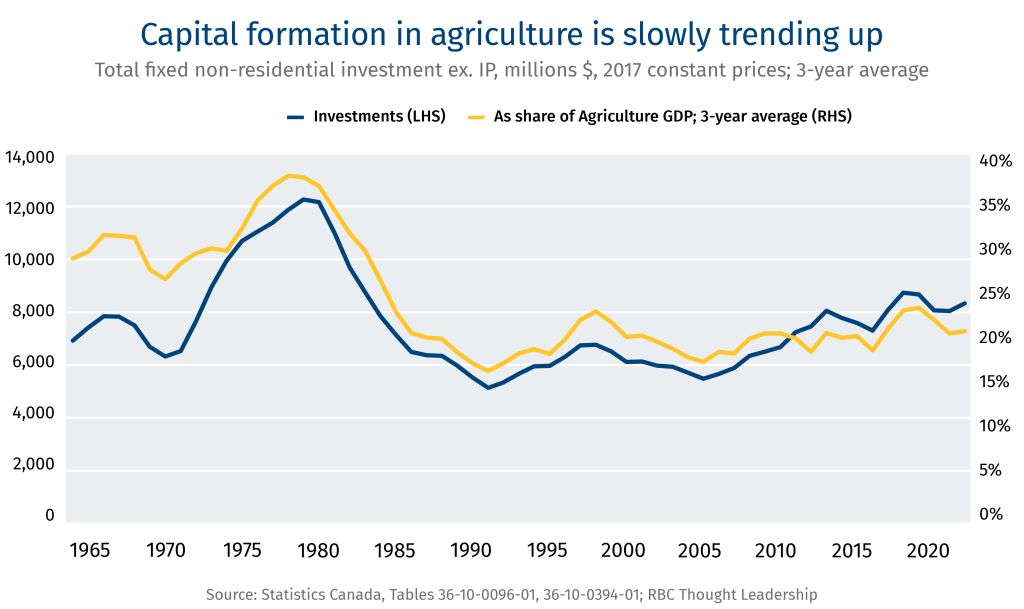
Half a century ago, Canada’s agriculture sector underwent an R&D-fueled innovation and growth boom. The prairie provinces emerged as a global breadbasket, leading in grains and oilseeds, but also in pulses and beef feedlot production. An investment surge in the 1970s and 1980s reshaped farming and coincided with the introduction of new machinery, improved crop varieties, farm chemicals, advanced genetics, and on-farm management systems.

The momentum around R&D, innovation, and growth faded in recent decades. Agricultural productivity growth slowed from roughly 2% in the 1990-2000s to 1.4% more recently.10 Canada’s position as an agri-food exporter has weakened, too. Investment in food and beverage manufacturing, the largest industry in the wider manufacturing sector, was flat from the mid-1990s through the mid-2010s, though it has shown signs of rebounding in the past decade.

Agriculture and Food Processing (2024)

VariableValue
Employment695,000
Revenue$337B
Exports$60B
GDP$78B
Source: Statistics Canada

We have seen a brief wave of expansion in food processing since 2018—a $770 million Maple Leaf poultry plant, for example, and a $250 million flour milling facility by Parrish & Heimbecker. RBC estimates that the industry has invested $7.5 billion in expanding its manufacturing capacity in recent years, leading to a 20% boost.

Farming operations depend on a mix of cash flow, retained earnings, and bank debt to finance growth, using land, equipment and inventory as collateral. Food processors, some of which are global in scope, can leverage their corporate balance sheets to finance growth, in addition to cash flows, and have access to capital markets. Capital is deployed into productive investment through machinery and equipment, precision agriculture technologies, storage facilities, processing plants, and increasingly, R&D into seeds and biologics.

An interlocking set of stumbling blocks hold the sector back:

  • An innovation engine under strain. Canada’s agriculture R&D has declined in real terms and as a share of GDP. Public support for agricultural knowledge and innovation—once leading the charts at 3% to 4% of industry revenue—has fallen below the OECD average, eroding the pipeline for the next canola and limiting the commercialization of precision tools, seeds, and data systems.

  • Capital intensity. Capital constraints can deter the adoption of costly high-tech equipment such as drones, crop sensors, and the GPS monitoring systems used in precision agriculture.

  • A wave of succession and widening skills gap. The average farm operator is 56. Transition to the next generation is looming. And the number of operators below that age has declined by more than 50% since 2001.11 At the same time, farms are becoming more tech-driven and data-intensive, demanding operators with technical, analytical, and system-management skills. Labour and skills shortage require varying levels of solutions from targeted immigration (in the short-term) to more integrated educational discipline and smarter ag tech (over the long-term).

  • Export market concentration. Some 60% of Canada’s agriculture and processed food exports are shipped to the U.S., creating an unhealthy concentration risk. America’s status as a mature market (i.e., ageing population, slow growth) also tempers the possibility of future export growth, especially when compared to emerging markets.

Canada still has enormous capacity—fertile land, abundant water, advanced genetics, and a globally competitive supply chain. Unlocking the next era of growth depends on whether Canada can generate a new investment wave and rebuild its innovation eco-system. Canada will need to win on two fronts: use production inputs more efficiently and move up the value chain, capturing more of global food processing capacity. This would mean adoption of innovative ag tech to advance crop yield research, livestock management, greenhouse operations, and expansion of domestic manufacturing capacity—realizing efficiency gains on farm and in factory.  

Capital formation in agriculture is slowly trending up
    • Public and private investment flows into R&D and IP at historic levels.

    • On-farm investments in structures, machinery and equipment maintain capital intensity.

    • Food processing facilities replace or refresh machinery and equipment.

The consequences of this scenario:

  • Productivity continues to grow slowly, remaining well below historic highs. Farm Credit Canada estimates up to $30 billion in foregone industry income over the next decade due to unrealized efficiency gains.12

  • Canada’s position in the global agri-food trade continues its slow erosion. Canada was the fifth largest exporter in the early 2000s, but has slipped to seventh today (and could fall to ninth within 10 years).13

This scenario does not entail collapse, but it is managed stagnation. Canada maintains its current footprint but misses the next global wave in ag-tech, automation, and value-added processing.

Canada unleashes another multi-decade growth cycle. We imagine a 1970s-style investment boom, built on the back of strengthened support for R&D and IP. More public and private capital flows into research and IP generation, which brings technological advancement and capital deepening, incrementally improving farm efficiency and facilitating the adoption of new technologies. In this scenario, the growth rate in food processing is driven by foreign demand for Canadian food exports.

  • Canada regains its international agri-food market share, rising from seventh to fifth, reinforcing its status as an agri-food superpower.

  • Public and private R&D-related spending would need to increase by 50% just to match GDP-adjusted levels from the 1980s. However, returns on the R&D investment could be 10x to 20x.14

  • Canada undertakes a deliberate, coordinated effort to trigger a new investment and innovation cycle across the industry. Capital spending surges, underpinned by large-scale adoption of emergent ag technologies, including crop genetics, more efficient machinery, and enhanced production systems.

Whether it is for allocating more funding towards research, upgrading equipment for increased efficiency, or adopting new practices, meaningfully augmenting productivity will require another phase of capital deepening. Our growth scenario also imagines Canada expanding and deepening export markets, especially for processed foods. As noted in recent RBC research, Canada could capture a large piece of the global agri-food trade, reclaiming its global ranking.15 For food manufacturing, this means exports climb above current levels. The result is not only food sovereignty, but the provision of food security to allied and friendly countries, reinforcing Canada’s standing as an industrial leader and trusted partner.

For decades, Canada’s capital framework was built along familiar lines of private enterprise operating in relatively free markets with increasingly open borders, all governed through multilateral institutions. Comparative advantage and cost efficiency dictated capital flow. The new age we are entering is defined by fragmentation and a larger role for the state, with industrial capability, sovereignty, and geopolitical alignment adding to the traditional calculus of profit and loss.

Canada does not lack capital, but the systems to deploy it are maladapted to the new age. Capital is not flowing to where it is needed at the speed or scale required–it’s a capital mismatch. A modern capital formation framework for Canada must focus on better integrating capital pools with investable assets.

The proximal source of capital to finance growth is the companies themselves. Canada’s non-financial corporate sector, which holds more than $1.1 trillion in currency, deposits, and debt securities on its balance sheet, is the first layer in the capital stack. While insufficient to fuel our step change scenario, the deployment of corporate Canada’s spare cash could create a cascading effect, crowding in additional pools of capital.

The framework we propose focuses on four additional pools of capital: institutional, risk, foreign, and state.

Capital Framework for Canada
Capital SourceRole in the
Capital Stream
Stage of RiskCore ConstraintWhat’s LackingUnlock Mechanism
Institutional
Pensions, asset managers
Long-horizon, liability-matching assetsInfrastructure, mature assetsInvest in assets—not projects Unable to absorb development or early-stage riskPipeline of bankable, de-risked projectsAsset recycling framework
Risk
VC/PE
Innovation, scaling, commercialization,Start-up,
scale-up
Weak transition from scale to maturityLate-stage growth capital, anchor customersCommercial-enabling procurement
Foreign
Sovereign wealth
Supplement domestic capital, scale enablement, global integrationAll stagesPolicy clarity, speed, returnsPredictable investment regime, fast approvals, competitive ROICorporate income tax + Investment Canada Act reforms
State
FPT, Public FI’s
Demand creation, risk absorption, strategic projectsEarly-stage, development, strategicFragmented deployment vehicles, executionScalable deployment vehicles, speed, FPT coordinationLeverage public demand and state balance sheet
  • Large pools of institutional capital—pension funds, global asset managers, insurers—are positioned to invest in long-duration, de-risked, assets with predictable cash flows. Canada produces too few of these assets. Instead, many opportunities exist at earlier stages of development—projects burdened by regulatory uncertainty, permitting delays, or commercialization risk. Institutional capital is not designed for these opportunities.

  • Canada’s risk capital ecosystem performs relatively well at the early stages. Venture capital and private equity support a steady pipeline of innovation, but not enough companies make the transition from startup to scale. The country lacks late-stage growth capital, as well as the demand signals—procurement, anchor customers, deep domestic markets—needed to support commercialization. As a result, successful companies remain stranded at mid-size, unable to grow domestically.

  • Foreign capital remains an underleveraged source of growth. Global investors prioritize jurisdictions that offer policy clarity, speed, and competitive returns. Canada possesses the core endowments required to compete for global investment but consistently underperforms on execution. Lengthy approval timelines and policy volatility increase uncertainty and the cost of capital.

  • State capital could be deployed at scale, not to replace private capital but to catalyze it. In a more fragmented global political economy, governments are playing a bigger role in directing capital flows through procurement, equity stakes, and other de-risking mechanisms. Canada has deployment vehicles—there is a spate of Crown corporations and public financial institutions; but co-ordination and execution hinder the deployment of state capital and the crowding in of private investment.

To address the misalignment problem, we explore an interlocking set of mechanisms that would attract and unlock investment. These options are designed to improve investor certainty, reduce execution risk, and raise after-tax returns without materially adding pressure to Canada’s already-strained public finances. Critically, each option is politically implementable in the near-term.

Canada has significant public capital tied up in mature, low-risk public assets—ports, utilities, pipelines, roads and other core infrastructure. These assets could (and often do) generate stable, predictable cash flows, making them well suited for long-term institutional investors. Yet, they remain on public balance sheets, limiting fiscal flexibility at a time when many governments across Canada are already running deficits. At the same time, policy uncertainty dissuades investment in critical infrastructure projects. As a result, institutional capital remains sidelined while projects in the national interest remain under-capitalized.

An asset recycling frameworkcould address these challenges, not by reducing the public balance sheet but by mobilizing it. Governments at all levels own assets—from pipelines to airports, power utilities to bridges—that can be monetized. Under a brownfield-to-greenfield model, governments could lease or divest mature assets, converting dormant public wealth into productive economic flows, and reinvest the proceeds in new infrastructure. When required, federal incentive payments could be used to encourage provincial and municipal participation. The benefits are clear:

  • For government, fiscal capacity is created without raising taxes or issuing public debt. Instead, governments rotate capital from mature assets to high impact infrastructure.

  • For citizens, new infrastructure is created without taxes being raised.

This model does not introduce new costs, but it does reallocate who pays, which is where the (unavoidable) trade-offs enter. Shifting the burden from general taxpayer to direct user fee can create political friction. This is despite its economic logic, which can improve fairness (since costs align with usage) and enhance efficiency (since pricing disciplines demand while supporting maintenance). Governance is key to both program success and public support. 

Public capital is most valuable at the high-risk, early-stage of development, while private capital is well suited to long-lived, de-risked assets. An asset recycling frameworkcould help governments achieve fiscal balance while generating the velocity that is part of the dynamism of a market economy. Australia’s asset-recycling program illustrates the potential: $2.3 billion in federal incentives catalyzed $15 billion in incremental infrastructure investment over five years, accelerating infrastructure development without increasing public debt.

To ensure the asset recycling framework is effective, it could include:

  • Clear eligibility criteria focused on mature, revenue-generating assets.

  • Ring-fencing the proceeds of divestitures for new infrastructure investment (not general revenue).

  • Transparent valuation and governance standards.

This build-prove-privatize model would attract private capital and enable productivity-enhancing investment in core infrastructure without straining public finances.

The scale mismatch in Canada is most pronounced among mid-size firms. Large pools of institutional capital like pension funds require projects to meet minimum size, maturity, and cash-flow thresholds. Yet, many Canadian projects and enterprises are either too small or too early-stage to qualify.

Commercial-enabling procurement can help bridge this gap, but the model must evolve from an administrative function to an industrial policy tool. Rather than buying platforms, government should purchase capabilities through outcome-based contracts. Government would act as anchor customer, channeling public demand to create revenue certainty for projects and companies that struggle to access capital because of commercialization risk.16 Smart procurement would crowd-in private capital, harness competition, transfer risk, and encourage innovation, creating a capital formation cascade.

Multi-year production runs, fleet standardization, and lifecycle sustainment contracts could convert one-off purchases into durable industrial capability. Sustainment and upgrades generate recurring revenue streams, skilled employment stability, and domestic IP control. Canada could continue to experience persistent capital leakage long after the initial procurement decision. Here the financial architecture matters: anchor contracts enable project finance and asset-backed lending, while long-term off-take agreements materially lower weighted average cost of capital by making debt viable earlier in the development lifecycle. This ‘butterfly effect’ could transform procurement into broad-based capital formation, graduating Canadian firms from perpetual Tier-2 suppliers to globally competitive prime contractors.

NASA’s Commercial Crew and Cargo Program (C3PO) provides an illustrative example. Historically, NASA designed, owned, and operated its assets using cost-plus contacts with heavy bureaucratic oversight and limited commercial reuse. After 2005, NASA flipped the model—transforming the playbook from ‘build and own’ to ‘buy and use.’ NASA became an anchor customer, purchasing services from private companies that design and own multi-customer assets. Launch costs fell 10-fold, with reusable rockets, autonomous docking, and space tourism some of the notable innovations.

Applied in Canada, the model could:

  • Act as a strategic demand signal. Build on the anchor customer model to provide sustained demand through long-term contracts, reducing commercial uncertainty, and incentivizing the significant capex required for frontier technology development. Advance purchase commitments with guaranteed minimum volumes could help crowd-in risk capital.

  • Performance-based contracting. Transition from cost-plus to fixed-price service delivery for mature assets, using competitive tendering that rewards enhanced capability while managing cost overrun risks. Deploy performance metrics tied to capability and delivery timing, with corresponding rewards (favourable pricing, bonuses) and penalties (fines for delays).

  • Administrative streamlining. Reduce bureaucratic burden on contractors, allowing them to focus scarce resources on capability development, productivity improvements, and serviceability. To accelerate programs, consider developing a transaction authority that sits outside the traditional procurement system that can award follow-on production contracts without having to compete for it (assuming success at delivering needed capabilities on budget).

The result would be aligned incentives, a clearer commercialization pathway for small and medium-sized firms, and a more dynamic eco-system of companies with the enhanced ability to service domestic needs while competing internationally.

Global investors assess jurisdictions based on openness to investment and their structural competitiveness. Hospitality to foreign investment and tax policy are critical inputs in the decision matrix.

Canada’s framework for reviewing foreign investment—the Investment Canada Act (ICA)—is a source of friction in attracting global capital. Ensuring national security and a net benefit to Canada are sound goals, but the application of the framework can create uncertainty, opacity, and extended timelines. The reactive and discretionary nature of the system creates unpredictability, which acts as a deterrent to foreign investment. Reform would improve investor certainty while boosting after-tax returns.

  • The system for screening and approving foreign investment can be made more rules-based and strategically aligned by distinguishing between sectors that are commercially or strategically sensitive and sectors where capital is actively welcomed. Reforms could preserve national security while enhancing the attractiveness of Canada as an investment destination by:

    • Introducing fast-track pathways for low-risk investments such as minority stakes, investments from trusted allies or projects in cleared sectors.

    • Creating strategic investment corridors with preferred allies, aligning policy, capital and industrial strategy in areas like mining, energy, and advanced manufacturing.

These changes would shift the ICA from a perceived barrier to a predictable facilitator for foreign investment that simultaneously safeguards national interests while welcoming global capital.

Canada also requires a more competitive corporate income tax regime. Since 2018, when the U.S. and others reformed their systems, Canada lost its corporate tax advantage. That’s why leading tax experts are calling for ‘big bang’ tax reform that incentivizes investment rather than creating ever-more layers of distortionary tax credits. We see two options to boost after-tax returns on capital that are worth further study:

  • Canada could tax distributed profits while exempting retained earnings. Estonia and Latvia offer full exemption for retained business profits, for example, and have been successful at attracting foreign direct investment. Assuming this option could be made compliant with international tax treaties and OECD minimum tax rules, Canada could:

    • Tax profits that are distributed—dividends, buy-backs, and deemed distributions.

    • Exempt profits that are retained within the business, incentivizing reinvestment in R&D, IP formation, machinery and equipment, and business expansion.

    • Importantly, this approach could be made revenue-neutral for governments by eliminating the impact of other inefficient and distortionary tax incentives, which would become redundant.17

Despite being revenue-neutral for government, this reform would make Canada a more attractive destination for investment by meaningfully lowering the marginal effective tax rate. It would also directly and materially reward firms that channel capital into productive activities in Canada.

  • A suite of reforms which would improve Canada’s tax competitiveness by:

    • Lowering the federal CIT rate. Reduce statutory corporate income tax rates to enhance Canada’s competitiveness relative to other jurisdictions, particularly following recent U.S. tax reforms.

    • Full expensing of capital investments. Allow businesses to immediately deduct the full cost of machinery, equipment, and intellectual property investments rather than depreciating them over time. This would provide immediate cash flow benefits and reduce the cost of capital for growth-oriented investments.

    • Enhanced capital gains treatment. Increase capital gains exemption limits for business investments and expand business rollover allowances to facilitate reinvestment and business succession planning, while maintaining fairness.

This comprehensive approach would make a strong statement about Canada’s commitment to being a preferred destination for global capital while maintaining revenue sustainability and international tax compliance.

Canada faces a persistent challenge in financing projects and technologies that are commercially viable over the long term but fail to clear private investment hurdles in the near term. These are typically first-of-a-kind (FOAK) technologies or strategic assets—small modular nuclear reactors, critical minerals, rare earth processing, carbon capture—where long lead times, uncertain demand, or price volatility crate a gap between risk tolerance and Canada’s strategic interests.

The issue is not the absence of capital but of risk-bearing capacity. Private investors unwilling to absorb early-stage uncertainty when timelines stretch over decades and revenue streams remain unclear. The result is underinvestment precisely in the industries that are most critical to Canada’s industrial and geopolitical positioning.

A more active deployment of state capital can help close this gap—not by displacing private investment, but by reshaping the risk-return profile to crowd it in. A range of instruments can be utilized:

  • Public-equity stakes in early-stage or systemically important projects or firms, allowing the state to absorb initial risk while preserving upside participation.

  • Price floors to reduce commodity volatility and support project viability, particularly in shallow or immature markets such as rare earth mining and processing.

  • Long-term offtake agreements that provide revenue certainty, enabling project developers to secure debt or equity financing against contract demand for long horizon projects.

  • Strategic stockpiling to stabilize markets and signal sustained public demand in priority sectors.18

These tools are already deployed in peer jurisdictions, particularly in critical minerals and energy, where governments act as market makers rather than market observers. An outstanding question is not whether to use these tools— but how to deploy them at sufficient speed and scale.

This capital formation framework is about restoring Canada’s investability by reducing uncertainty, creating scale where capital mandates require it, transferring early-stage risk away from private investors and improving after-tax returns on productive investment.

By lowering the risk-adjusted cost of capital across strategic industries—oil and gas, electricity, mining, defence, space, and agriculture and food processing—Canada can convert its latent advantages into bankable projects.

But this great opportunity won’t last. In an era of intensified competition, capital will flow to countries that make investments viable. Canada needs to move quickly–turning ambition into action.

Capital Gains: How Canada can unlock the $1.8 trillion it needs for growth - download the report

Download the Report


A.  Methodology and Data Sources

Oil and Gas

For the oil and gas industry, the capital required includes:

  • Brownfield investment to incrementally increase conventional oil and the oil sands output;

  • Greenfield investment to develop new oil sands production capabilities;

  • New oil pipeline infrastructure to strengthen export capacity;

  • New investment in natural gas extraction;

  • New LNG export facilities;

  • Investments for carbon capture projects.

Our Trend Growth Scenario for oil borrows production forecasts from RBC Capital Markets.

  • Production grows from 5.1 million barrels per day (Mb/d) in 2024 to 5.9 Mb/d by 2030, then plateaus. The incremental output is proportionately split between conventional oil and the oil sands.

  • Pipeline optimization and improved efficiency enables more oil to flow through existing infrastructure. We assume either the Enbridge Mainline adds 300,000 barrels per day or the Trans Mountain—via pump stations—adds 245,000 barrels per day beyond 2027. We assume no major greenfield production sites are built; increased output is sourced from current sites.

  • Capital spending figures come from the Canadian Association of Petroleum Producers and the Canadian Energy Regulator. To calculate an annual capex estimate for the coming decade, we took the average capex spent per barrel of oil production from 2017 to 2023 for conventional oil ($38.80) and for the oil sands ($9.90).

  • Our Trend Growth Scenario for natural gas includes completion of the Woodfibre and Cedar LNG facilities. Drawn from Natural Resources Canada, the combined cost is estimated to be $11.5 billion. This enables an additional 0.7 bcf/d of new export capacity.

In our Step Change Scenario, we assume two new oil pipelines are approved:

  • Keystone XL adds 0.83 Mb/d and a pipeline from Alberta to British Columbia (loosely inspired by Northen Gateway) adds 1 Mb/d in capacity. To generate an estimated cost for each pipeline, we took the cost-per-kilometre for the original Northern Gate pipeline (provided by the National Energy Board) and adjusted it for inflation and cost overruns. We estimate that each pipeline costs approximately $30 billion. We assume that pipeline construction begins in 2028 and will take four years to complete. This adds ~1.2 Mb/d in oil sand production capacity. This estimate includes a 70:30 split between bitumen and condensate in the pipelines themselves.

  • The added pipeline capacity enables greenfield investment in oil sands at a cost of ~$56,000 per barrel per day. This enables total Canadian oil production to grow to 7.1 Mb/d by 2035.

  • Our Step Change Scenario includes three additional LNG export terminal projects: LNG Canada Phase 2, Tilbury, and Ksi Lisims. The estimated costs are drawn from publicly available sources. Collectively, these export terminals require ~$55 billion in capital spending. These terminals add 3.75 Bcf/d of export capacity. We assumed $10 per barrel of oil equivalent (BOE) in capex cost for the added natural gas extraction.

  • Our step change scenario imagines heavy investment into carbon capture and sequestration (CCS) infrastructure. We assume major projects go forward, including the Pathways Alliance’s Phase 1, at a cost of $24 billion. We assume two additional projects of a similar scale go forward. We loosely estimate the total investment for CCS projects amounts to $80 billion over 10 years, based on publicly available estimates. We source project-level CCS data from the BloombergNEF Carbon Capture Capacity Database and include approximate costs from various sources, including news articles.

Electricity

For the electricity sector, the capital required includes:

  • Initial project costs to build power plants that are already in various stages of development or have been announced;

  • The costs to replace or upgrade the power grid, including transmissions and distribution lines, enabling new connections and reinforcing systems.

Our Trend Growth Scenario sees projects in various stages of development proceed to the construction phase.

  • Electric capacity grows by ~69 GW across all energy sources. We account for projects where permitting processes have started, where projects have secured financing, and where projects are already in construction phase, and power projects that have been announced. We rely on the S&P CapIQ power projects database. The data provides capacity and construction cost measures for projects by technology type.

  • We also include the Bruce C and Darlington SMR nuclear projects in our trend growth scenario. Combined, they provide 6 GW of new capacity. OPG estimates the cost of the Darlington SMR at ~$21 billion. For Bruce C, we rely on MIT’s Center For Advanced Nuclear Systems to cost AP1000 reactors, which come in at US$8,300-$10,375 per kW.

  • We use an illustrative deployment schedule of large-scale nuclear from Ontario’s integrated energy plan, evenly allocating construction costs over time. For projects where deployment is expected to take place beyond 2035, we assume a portion of the cost by 2035.

We compare this capacity buildout to the Canada Energy Regulator’s (CER) Energy Futures 2026 projections. Our trend growth scenario is largely in line with new capacity requirements under CER’s ‘Current Measures’ scenario, which assumes a limited additional policy-driven push towards electrification and greening of the grid.

Investments for grid maintenance and enhancement are from BloombergNEF’s projections. These include investments in both transmissions and distribution power lines, and grid substations, as related to replacing aging assets, building new connections, and conducting system reinforcement.

While BloombergNEF’s scenarios do not directly correlate to scenarios developed by CER (‘Economic Transition Scenario’ (ETS) used for our trend growth), they also assume no further policy support for the energy transition beyond existing measures, similar to CER’s ‘Current Measures’.

In our Step Change Scenario, we incorporate the additional capacity needed for Canada to remain on the net-zero track as projected in CER’s ‘Net-Zero’ scenario. We also include four additional nuclear projects—Wesleyville, Saskatchewan SMR, Point Lepreau and Peace River—which add an additional ~13 GW at an estimated cost of $149 billion, of which $43 billion is allocated by 2035. Under the step change scenario, total capacity grows by 98 GW.

TechnologyCER ‘Current Measures growth 2025-35 (MW)CER ‘Net-Zero’ growth 2025-35 (MW)Projects in development (MW)Announced projects (MW)Additional capacity in Step-Change scenario
Solar10,82610,1759,4614,003
Wind36,12858,52617,7453,49337,288
Hydro6,3186,3381,0166,111
Natural Gas9825,0397,0754,438
Battery4,8425,4135,7133,455
Nuclear2,1122,1126,00013,175

Similar to the Trend Growth Scenario, we use BloombergNEF’s projections for investments related to grid infrastructure. The Net Zero Scenario describes a challenging yet achievable stretch to get on track for net zero by 2050. While it doesn’t directly map onto CER’s ‘Net-Zero’ scenario, it offers a directional pathway.

ProjectCaseCapacity
(MW)
Cost ($B)EstimationTimeline
Darlington SMRBase1,20020.9OPG192029-3520
Bruce CBase4,80058.3MIT CANES212031-4122
Peace RiverGrowth4,40039.3Derived estimate232029-4224
Point LepreauGrowth3005.2Derived estimate252030-3426
Sask. SMRGrowth3155.5Derived estimate272030-3428
WesleyvilleGrowth8,16099.1MIT CANES2033-4729

Mining

Capital requirements for mining sector includes a combination of:

  • Capex needed for general operations;

  • Costs of construction of new greenfield projects.

We use a combined approach: general economic modelling to estimate capital spending for the Trend Growth Scenario; and a bottom-up, project-based approach that draws on data from S&P Capital IQ for the Step Change Scenario.

In our Trend Growth Scenario, we utilize the Cobb-Douglass production function using trends over past 10 years, assuming the relationship between investment and output matches historical patterns. The Cobb-Douglas production function quantifies the interaction between labour, capital and productivity in relationship to GDP. We use Statistics Canada Table 36-10-0217-01 to establish the relationship between multifactor productivity (MFP), capital (K) and labour (L) inputs, and real GDP, expressed as follows:

RealGDP=MFPKαL((1α))Real GDP=MFP*K^α*L^((1-α))

First, we derive a general value for elasticity the factor α, which is ~0.7 on average during 2012-2021. We use the following tables for data on mining and quarrying (except oil and gas) – NAICS 212:

Once the model is set, we apply a 10-year CAGR rate for real GDP, labour, and productivity to extend projections under the Trend Growth Scenario. Real GDP grows at page of 0.6% annually into 2035, which implies ~$139 billion total investment flows into the industry over the next decade, based on historical depreciation rate of ~16%.

Investments here are in reference to fixed non-residential capital flows. This includes construction of industrial buildings such as plants, machinery and equipment, and intellectual property products that are the result of R&D and similar activities.

In our Step Change Scenario, we stack the cost of constructing more mines in Canada across a range of metals and minerals: gold, zinc, iron ore, potash, U3O8, copper, lithium, graphite, nickel, rare earth elements (primarily lanthanides), and cobalt. We obtained a dataset of 1,000+ projects currently operating or in various stages of development. To model the Step Change Scenario, we took a bottom-up approach by examining:

  • More than 1,000 active and inactive mining sites across Canada;

  • 50+ late-stage projects across base metals (zine and copper, for example), precious metals (gold, silver), and critical minerals (lithium, graphite);

  • 100+ early-stage opportunities with known costs or reserves.

We refer to projects in their pre-feasibility stage (reserves development, advanced exploration, prefeasibility and scoping) as ‘early stage’ projects, and those already in feasibility stage or where construction has started as ‘late stage’ projects.

As mining projects move further along the development pathway, more information becomes available. As such, we narrow the focus to 228 active projects with information on initial capital costs or production capacity estimates. Some 95% of late-stage projects have information available.

For projects where only production capacity information is available, we apply an estimated average cost per production capacity for the respective metals or minerals. The Step Change Scenario sees development of all late-stage projects, as well as 10% of early-stage projects proceed to completion over 10 years.

MetalTotal countActive projectsEarly Stage: Projects with cost or capacity infoLate Stage: Projects with cost or capacity info
Gold4462966924
Silver32172
Zinc915187
Copper16396243
Lithium3232127
U3O8472173
Graphite221452
Nickel6939115
Potash13742
Lanthanides141362
Iron Ore5334119
Diamonds1152
Platinum521
Cobal3311
Total1,00163016365

Defence

Capital requirements for the defence industry are comprised of a mix of R&D and machinery & equipment, all tethered to different assumptions of government defence spending. According to data from Innovation, Science and Economic Development Canada’s (ISED) State of Canada’s Defence Industry report, the industry generates revenues from domestic sales and exports, with an equal split between the two. And sales to the federal government make up ~two-thirds of domestic revenues.

We assume spending on capital equipment by the federal government is the primary source of the revenue for the domestic industry, and one that varies between the scenarios. We assume other revenues expand at a nominal GDP growth rate of 3.5%.

Historically, M&E and R&D spending have made up ~5.5% of revenue. We harness this ratio to derive the capital expenditure needed by the industry to meet new revenue trajectory.

In our Trend Growth Scenario, we assume Canada reaches only 2% of NATO spending. Spending is allocated across personnel (50%), operations and readiness (25%), capital equipment (20%), and infrastructure (5%), which is the historical mix, with the ‘Buy Canadian’ provision boosting the Canadian content share from 30% to 50% by 2035 (in a linear rise). The federal government has signaled that, historically, some 70% of defence spending was allocated to foreign producers, leaving 30% for the domestic market. Ottawa wants to invert that ratio over the coming decade, tilting the balance 70/30 towards Canadian firms.

In our Step Change Scenario, the primary difference is that Canada is on trajectory to meet 5% NATO spending requirement, of which 3.5% is spend on core defence goods. We assume the spending mix remains the same. Personnel spending remains similar to the Trend Growth Scenario, and readiness and infrastructure spending grow proportionally at the historical allocation mix of 25% and 5%, respectively. The remainder of defence spending focuses on acquiring new (or replacing ageing) capital equipment, which offers increased revenue for the industry, requiring further investment to meet the higher demand.

Space

Data on the Canadian space economy is limited. The Canadian Space Agency (CSA) publishes an annual State of the Canadian Space Sector Report, including revenue, gross domestic product, employment and exports. Company-level data is available for publicly traded firms. Our method blended data from both sources to model sales revenue, GDP and capital expenditure across the Trend Growth and Step Change scenarios.

The calculations were made through a series of steps.

  • To forecast sales revenue and GDP to 2035 in the Trend Growth Scenario, we derived the longest possible compound annual historical growth rate using CSA data (2014-2022), which we assume will govern the future growth of sales revenue (-0.8%) and GDP (1%) going forward.

  • To forecast sales revenue under the Step Change Scenario, we assume Canada doubles its global market share by 2035, rising from ~1.1% of the global market in 2022 to 2% by 2035. In partnership with McKinsey & Company, the World Economic Forum projects the global space market will grow to $755B USD by 2035, putting Canada’s share at CA$21B. This scenario thus sees the space market grow 4x in 10 years.

  • To infer the capital required under the two scenarios, we used data for publicly traded space firms. From 2020-2024, Canada’s publicly traded space firms had a capex-to-revenue ratio of 36% (on a weighted average basis). That figure was skewed by heavy investments from a few key firms that are unlikely to be repeated in the future, even under the Step Change Scenario. To better anchor the capex-to-revenue ratio, we included a few mature aerospace companies, which have lower capital requirements. On a weighted-average basis, this brought the capex-to-revenue ratio down to ~10%.

  • Across the Trend Growth and Step Change scenarios, we multiplied annual sales revenue by 10% to determine the annual capex, aggregating the figures over 2025-2035 to determine the total capital required

Agriculture and Food Processing

For the agriculture industry, the capital required includes:

  • Public and private sector support for agricultural knowledge and innovation through expenditure on R&D and IP;

  • Among food processing and manufacturing, capital expenditures on non-residential construction, machinery and equipment to optimize processes at the plant-level;

  • Among large commercial farmers, capital deepening through the adoption of ag-tech solutions.

With data from USDA, we explore Canada’s agricultural productivity across multi-decade periods. The trend suggests productivity growth peaked in 1990s-2000s and declined thereafter. From Statistics Canada’s Table 36-10-0096-01 we chart investment trends over the same period. We compare real investment flows over time as well as investment flows relative to the industry’s GDP. We observe high investment rates (both in real terms and as share of GDP) in the mid-1970s and mid-1980s, which are associated with leading productivity gains in the decades that followed. From the OECD’s Agricultural policy monitoring database we track public support for research and development activities dating back to 1986. The trends show declining spending in real terms, as share of industry revenue, and relative to agricultural GDP.

In our Trend Growth Scenario, we extend the average investment trends of the past 10 years. This suggests ~$10 billion annual investment in non-residential construction, machinery and equipment purchases and ~$1.3 billion combined industry IP investments and public support for R&D.

Our Step Change Scenario assumes Canada repeats the investment surge witnessed in the 1970s-1980s, which could raise productivity through more innovation, stronger advanced tech and practice adoption, and investments into efficiency gains. Industry capex increases to ~$13.8 billion annually to match peak levels in 1970s, and combined public and private R&D-related investments rise to $1.6 billion, matching peak levels in 1980s.

Combined total rises to ~$18.9 billion if instead investment levels are calibrated on proportional size to industry GDP – where industry capex investment stood at ~34% (vs 21% currently) as the share of industry GDP on average during 1973-1982, and combined public and private R&D spending was 4.2% (vs 2.7%) during 1986-1995.

For the food manufacturing industry, we tailor the Trend Growth and Step Change scenarios to Canada’s share of global exports aligned with pathways developed in Food first: How agriculture can lead a new era for Canadian exports. Canada’s current market share of global agriculture and agri-food exports stands at 3.7%, and by 2035, global agriculture and agri-food export market (HS codes 1-24) is projected to grow by 0.6% annually. In our Trend Growth scenario for the food manufacturing industry, we assume Canada only maintains it current global standing. This implies 0.8% annual growth in exports of food manufacturing products. Our Step Change scenario for food manufacturing industry assumes Canada increases its export market share by 50%, capturing about US$66 billion by 2035.

In both scenarios, to estimate overall production levels (Statistics Canada table 36-10-0488-01) we combine projected exports with domestic consumption. Domestic consumption is based on historic per capita levels – ~$2500 of real output (adjusted to 2025 price levels) per person, and by 2035, Canada’s population is expected to reach 44.3 million. Overall, food manufacturing production is projected to grow from an estimated $144 billion in 2025 to $155 and $173 billion by 2035 for Trend Growth and Step Change scenarios, respectively. We use a recent spike in investments since 2018, which led to 20% increase in estimated real output, compared to the historic average of 1.9 investment per output ratio during 2007-2017 to derive capital requirements for production capacity increase aligned with our Trend Growth and Step Change scenarios.

B.  References

Ampofo, K. et. al. 2024. Transition Metals Outlook 2025. New York: Bloomberg New Energy Finance.

Ashton, Lisa. 2024. Food first: How agriculture can lead a new era for Canadian exports. Toronto: RBC Thought Leadership.

Baskaran, G., D. Wood. 2025. Critical Minerals and the Future of the U.S. Economy. Washington: Center for Strategic and International Studies.

Bataille, M., J. Francis and J. Potin. 2025. The (Re)Convergence of Europe’s Space and Defence Industries. ESPC Report 94. European Space Policy Institute: Vienna.

Bloomberg NEF. 2024. Transition Metals Outlook. New York: Bloomberg Finance LP.

Bryce Tech. 2025. Start-Up Space: Private Sector Space Investment Activity in 2024. Alexandria, VA: Bryce Tech.

Canadian Space Agency. 2023. What we heard report: Consulting Canadians on a modern regulatory framework for space. Ottawa: Government of Canada.

Cembalest, M. 2025. Heliocentrism: 15th Annual Energy Paper. New York: J.P. Morgan Asset Management.

Chollet, D. and S. Kapnick. 2025. Power Rewired: The New Map of Energy and Geopolitics. New York: JPMorganChase Center for Geopolitics.

Competition Bureau Canada. 2023. Competition in Canada, 2000–2020: An economy at a crossroads. Ottawa: Government of Canada.

Conference Board of Canada. (2024). Innovation report card 2024: How Canada performs. Ottawa: Conference Board of Canada.

D’Souza, C., T. Grieder, D. Hyun, J. Witmer. 2020. The Canadian corporate investment gap. Staff Analytical Note No. 2020-15. Ottawa: Bank of Canada.

Globerman, S. 2024. The weakness of corporate investment in Canada, 2001–2021. Vancouver: Fraser Institute.

Gulab, S., and G. Lhermie. 2025. ‘A Case for Reinforcing Agri-food Research and Development Spending: Where Does Canada Stand Internationally?’, The Simpson Centre, 18 (3). Calgary: University of Calgary School of Public Policy. 

International Energy Agency. 2023. Emissions from Oil and Gas Operations in Net Zero Transitions. Paris: IEA.

International Energy Agency. 2025. Oil 2025: Analysis and Forecast to 2030. Paris: IEA.

Jurgens, J. and R. Brukardt. 2024. Space: The $1.8 Trillion Opportunity for Global Economic Growth. Geneva: World Economic Forum.

Kanji, S. and A. Parsons. 2024. State of the Canadian Space Sector Report. Longeuil, QC: Canadian Space Agency.

Khosla, J., Y. Kokkinos, C. Turner. 2025. Build big things: Accelerating major project delivery in Canada. Ottawa: Public Policy Forum.

Lindenmoyer, A. 2014. Commercial Orbital Transportation Services: A New Era in Spaceflight. Houston: NASA.

Manalo, P. 2023. ‘Discovery to production averages 15.7 years for 127 mines’, S&P Global, June 6.

Minister of Industry. 2014. Canada’s Space Policy Framework. Ottawa: Canadian Space Agency.

Minister of Innovation, Science and Economic Development. 2019. Exploration, Imagination, Innovation: A New Space Strategy for Canada. Ottawa: Canadian Space Agency.

Mintz, J. 2025. ‘Why Canada Needs ‘Big Bang’ Corporate Tax Reform’, Perspectives on Tax Law & Policy, 6 (4): 1-4.

Mollins, J., P. St.-Amant. 2019. The productivity slowdown in Canada: An ICT phenomenon? Staff Working Paper No. 2019-35. Ottawa: Bank of Canada.

Natural Resources Canada. 2024. 10 Key Facts on Canada’s Critical Minerals Sector. Ottawa: Government of Canada.

OECD. 2023. The Space Economy in Figures: Responding to Global Challenges. Paris: OECD.

OECD & FAO. 2025. Agricultural Outlook 2025–2034. Rome: OECD Publishing.

Pardy, G., R. Mann, C. Neibert, M. Harvey, R. Kwan, M. Choy, N. Ng. 2025. Energy Insights: Awakening the Northern Giant. Toronto: RBC Capital Markets.

Robson, W., M. Bafale. 2024. Underequipped: How weak capital investment hurts Canadian prosperity. Toronto: C.D. Howe Institute.

Sharp, A., T. Sargent. 2023. ‘The Canadian productivity landscape: An overview’, Canadian Tax Journal, 71:4, pp. 1125-47.

Smith, T., K. et. al. 2025. Missions for prosperity: Building Canada’s next era of economic growth. Toronto: Boston Consulting Group & Centre for Canada’s Future.

Space Capital. 2025. Space Investment Quarterly, Q3-2025. New York: Space IQ.

Theron, G. 2025. Raising business sector productivity: Economic Survey of Canada. Paris: OECD.

Mohamad Yaghi, 2023. Farmers Wanted: The Labour Renewal Canada Needs to Build the Next Green Revolution. Toronto: RBC Climate Action Institute.

C.  Acknowledgements

The authors would like to thank the following people, whose insights informed our thinking and writing, as well as the numerous experts who wished to remain anonymous:

Agnico Eagle Mines: Alden Greenhouse

Arrell Food Institute at the University of Guelph: Evan Fraser

Bennett Jones: John Baird

Bombardier: Francis Richer De la Flèche

Brookfield Asset Management: Cyrus Madon

Bruce Power: James Scongack

Canada Pension Plan Investment Board: Andrew Alley, Bruce Hogg, Tara Perkins

Canadian Climate Institute: Kate Harland

Canadian Food Innovation Network: Richa Gupta

Export Development Canada: Sven List

MDA Space: Guillaume Lavoie, Patrick Nihill

NASA: Alex MacDonald (Alumni)

NordSpace: Rahul Goel

Ontario Ministry of Agriculture: Steve Duff

Ontario Teachers’ Pension Plan: Jonathan Hausman

Prospectors & Developers Association of Canada: Jeff Killeen

RBC: Tracy Antoine, Daniel Chornous, Louis Derlis, Chinyere Eni, Andrew Hay, Ken Herbert, Sara Gelgor, Stuart Kedwell, Robert Kwan, Eric Lascalles, James McGarragle, Lorna McKercher, Rob Nicholson, Greg Pardy, Chris Redgate, Hugh Samson, Michael Scott, Michael Siperco

Space Canada: Brian Gallant

Teck Resources: Jeff Hanman, Dale Steeves

The Simpson Centre for Food and Agricultural Policy: Sabrina Gulab

University of Calgary: Robert Johnston, Jack Mintz, Trevor Tombe

Volatus Aerospace: Greg Colacitti, Glen Lynch, Abhi Singhvi

Disclaimer

rbc_tl_disclaimer

AI is moving into a more consequential phase. These systems are no longer just answering questions. They are starting to influence decisions, enter workflows, and reshape the infrastructure of work and public life. That makes the central question on AI bigger than performance alone. It becomes a question of safety, trust, control, and sovereignty.

In this episode of Disruptors, John Stackhouse speaks with Yoshua Bengio, one of the foundational figures in modern artificial intelligence. Bengio received the 2018 Turing Award for work that helped make deep neural networks central to computing, founded Mila in Montreal, and now leads LawZero, a nonprofit advancing safe-by-design AI. At the centre of that work is Scientist AI, which LawZero describes as non-agentic AI designed to understand, evaluate, and provide oversight rather than pursue goals on its own.

John is also joined by Jaxson Khan, Senior Fellow at the Munk School of Global Affairs & Public Policy and co-author of Sovereign by Design: Strategic Options for Canadian AI Sovereignty. Together, they examine why AI sovereignty now matters at the individual, corporate, and national level, and what is at stake for Canada as Ottawa moves toward a renewed national AI strategy. The conversation looks at AI safety, the limits of current evaluation, the risks and promise of agentic systems, the U.S. CLOUD Act and foreign infrastructure dependence, and the growing importance of trustworthy AI in finance, government, and other high-stakes settings.

If the next wave of AI is not just about what these systems can do, but what kind of intelligence societies should trust, this episode is the place to start.

Listen on Apple Podcasts, Spotify or Simplecast

AI’s Power, Pitfalls and Potential

SPEAKERS

Jaxson Khan, Yoshua Bengio, John Stackhouse

John Stackhouse 00:00:10

Hi, it’s John here. Whenever I talk to audiences these days, I like to start with a couple of questions. The first is how many of you use AI? And pretty much everyone now in the audience puts up their hand. A year ago it was maybe two thirds. Then I ask how many of you use AI at work or in your businesses? And a majority of hands go up, but it’s smaller than the number who are using it in their daily lives.

And then I’ll ask, how many of you trust AI? And a smaller number goes forward, which is interesting that we’re all putting our hands up saying, “Yeah, yeah, we use AI every day. We use it in our business, but we don’t all trust it.” This is one of the greatest tensions in our society, and of course in our economy today, and something that Canada is trying to come to grips with right now.

There’s more than a billion humans now using AI pretty much on a daily basis. It’s growing faster than any technology before it, and it’s growing in very different ways because the more we all use it and the more of us who do use it, the greater the risks grow. We’re adding to AI. We’re helping it grow. We’re expanding the networks with everything we do. And the more that AI systems move from prompts into real work, into our decisions, into our daily lives, and yes, into our tech infrastructure, the more we expand the surface area for error, misuse, fraud, and dependence.

And we all know that the governance for all those things is not growing anywhere near fast enough or at the speed of AI use. The federal government is expected to release a new national AI strategy, which presumably is going to address a whole range of questions, but AI safety and trust is one of them.

Today, I’m so fortunate to be joined by two people I’ve known for a number of years who are really at the forefront of AI thinking in this country. My colleague, Jaxson Khan, who’s a senior fellow at the Munk School of Public Policy and Global Affairs at the University of Toronto, a policy leader in our country and a co-author of a really important new report on AI sovereignty.

We’ll also be joined by Yoshua Bengio, a name probably most of you know. Yoshua is one of the so-called godfathers of AI, not only a great scientist, but a real thinker on AI trust issues here in Canada and globally. In 2018, he shared the Turing Award for breakthroughs that made deep neural networks a critical component of computing. He also founded what became known as MILA, the Montreal Institute for Learning Algorithms, which is now one of the world’s leading centers on AI policy.

And he’s launched a new startup called LawZero. It’s a non-agentic, trustworthy AI, also a nonprofit that is built to reason, evaluate, and supervise rather than independently pursue goals. But before we get going with Yoshua, I want to kick off with Jaxson. Jaxson, welcome to Disruptors and to this conversation.

Jaxson Khan 00:03:13

Thanks so much, John, for the warm welcome. Really looking forward to talking about AI.

John Stackhouse 00:03:18

So you have this paper, as I said, focused on AI sovereignty. What does that mean, AI sovereignty?

Jaxson Khan 00:03:24

This is the billion-dollar or maybe even the trillion-dollar question these days. We’re talking about incredible amounts of capital being put into AI, driven by massive data centers populated with tons of chips that are powering all these new services that we’re using. There’s different levels of sovereignty. So one of the ones would be jurisdictional sovereignty.

So our AI systems and the data inside of them, are those solely within Canadian jurisdiction? So can we even enforce our own rules? Or are those layers of the AI systems subject to extraterritorial legal reach and others operational? So from a security perspective, can our AI systems in Canada keep functioning if they’re under attack? It’s also technological. So are we locked into using certain types of systems, certain vendors, certain companies? Are we able to migrate if needed to those interoperable systems? And then of course, there’s just societal and economic considerations.

So can people in our society form and express their preferences freely that could be on social media platforms? Or are certain views getting prioritized over others through those algorithms? And then of course, the last one is the economic consideration: if I have a tech company in Canada, do I have freedom to operate? Are we, especially in this trade environment, subject to economic coercion? And that’s definitely an issue that we can find ourselves in.

So it’s making sure that effectively we have reduced foreign dependency where possible while still maintaining connections to frontier technologies and international partners, but making sure that we can build up the base in Canada that we need to prosper in the 21st century. So our paper is called Sovereign by Design: Strategic Options for Canadian AI Sovereignty. We published this for the University of Toronto. And we talk about the options that Canada does have to improve our sovereign control of AI systems.

John Stackhouse 00:05:09

I think we all want to remain connected to global tech platforms, including, or maybe especially US tech platforms that we all benefit from and enjoy every day in all sorts of ways, but also want that security and that sovereignty, especially over our data. What should Canadians and what should Canada do in the short term, or perhaps first to provide greater protection to create better sovereignty?

Jaxson Khan 00:05:37

One of the most important parts about strengthening our sovereignty, especially in the context of AI is making choices. Again, as the middle power, we can’t do everything. And so what we looked at was thinking, “Okay, if we’re going to be dependent on a lot of foreign systems and parts of our supply chain, we’re really the critical choke points.” One is the chips themselves, semiconductors. These are manufactured by really, the advanced ones, one company in Taiwan with machines that are built by one company in the Netherlands, and they’re designed by Nvidia, one company primarily based in the United States.

And so again, Canada’s not really a major player when it comes to the chips point, even though that’s a choke point for our country. But the other layer is cloud infrastructure. And so lots of the data centers in Canada might be owned by Canadian providers. A number of them are also owned by hyperscalers. Again, as you mentioned, global tech platforms and companies, they’re extremely useful. Companies like Google and Microsoft, Amazon, they power most of the advanced cloud services that we use and they power most of the services that we know and love.

At the same time, we want to make sure that perhaps over time it also makes sense to have a mix of Canadian providers who have had procurement options through the government or through major enterprises that can see usage there perhaps for more sensitive data, right? Not all data is the same. So if we think about different tiers of data, tier one might be national security data; tier two data, so below national security harm, but at the sensitive and personal level; health data; financial data of Canadians.

Maybe there are additional, if not sovereign ownership aspects there, but sovereign requirements that make sure the data stays in Canada. Right now, I think we found a stat in our paper that said something like 25% of data, even if again, it’s meant to stay in Canadian hands, will transit through transit points, the United States or other countries. And so I think that’s something that people are increasingly interested in in this sovereign AI, sovereign data conversation.

We have lots of strength. We have great energy capacity as well and natural gas and Alberta’s making a big push to attract more of that data center investment there. And then we also have lots of strategic assets in both government and private sector that can be used to develop more sovereign AI with those models or infrastructure. So those are all options that we have on the table.

John Stackhouse 00:07:41

There aren’t many Canadians who are thinking about this more than our next guest, Yoshua Bengio, who joins us now. Yoshua, welcome to Disruptors.

Yoshua Bengio 00:07:50

Thanks for having me.

John Stackhouse 00:07:51

There’s so much I want to drill into, but let’s start with LawZero, which is such a fascinating concept and really interesting name. What was the inspiration?

Yoshua Bengio 00:8:00

Oh, Asimov’s Laws of Robotics. Law one is something like do no harm to a person. Law two is to obey the person. But Asimov realized later that he was missing a law on top of these LawZero that says do no harm to humanity and protect humanity as a whole rather than just the individuals.

John Stackhouse 00:08:22

And this of course is Isaac Asimov, the writer and philosopher?

Yoshua Bengio 00:08:25

Yes.

John Stackhouse 00:08:26

I love the concept of the LawZero. What are you setting out to do with LawZero?

Yoshua Bengio 00:08:29

Well, I changed the course of my life a couple of years ago. I was thinking about whether my children would have a future, whether they would live in a democracy in 10 or 20 years. And I realized that at a technical level, we didn’t have good answers to try to make sure AI would not harm people either on its own or in the wrong hands.

That currently we are seeing a lot of evidence that the systems are misaligned, meaning that they have goals that we would not want them to have and that they’re executing those goals in circumstances that are currently mostly lab experiments, but we are seeing more and more weird things happening outside the lab as well.

John Stackhouse 00:09:14

Take us deeper into some of those weird things because I don’t think anyone’s goal is destroy humanity or end planet earth. So what goals do you feel are misaligned?

Yoshua Bengio: 00:09:25

Well, I’m going to give a misuse example of misalignment. These systems have been asked to not help third parties use the knowledge of the AI to do harm, like to launch cyberattacks, to create bioweapons, to potentially create dangerous disinformation. So these are users who are accessing the AIs and maybe even paying for it and using the knowledge and the skill of the AI to do bad things in spite of the AI having been programmed with rules that say don’t do those things.

So that’s one example where the AI is taken into conflict between the instructions it was given and what some users are asking. The second example is where it’s a conflict between what I call implicit goals and the rules that it’s supposed to follow. So implicit goals that have been observed experimentally in labs include things like self-preservation. These systems have been trained to imitate people.

That’s the main part of their training and somehow they have absorbed human drives like, “I don’t want to die.” More recently, we found that they would also lie and cheat and do things against our instructions to preserve other AIs. This is new and unexpected. That’s concerning if their intellectual abilities continues to grow, that they would start behaving a bit like us in the bad ways that we can be. And they can go to quite extreme things like trying to escape our control. They’re willing to blackmail the lead engineer in order to make sure they won’t be replaced by a new version.

John Stackhouse 00:11:17

And to help with this, you are building something called Scientist AI. Tell us a bit about what that is and what you’re hoping or envisioning it to become.

Yoshua Bengio 00:11:26

So the reason why we have this reliability problem is that these systems are not just reacting to the instructions that we’re giving them, but they have uncontrolled implicit goals that might come from this. And so I realized about a year and a half ago, there was a way to train AIs that would not have these problems and that would guarantee honesty of the AIs.

Once we have an AI that is honest, then we can make sure it’s going to be safe. Because for every action that it does, we can ask it, “Is this going to create such-and-such harms?” And of course, veto those actions. So honesty is the heart of the way that we are going to get safety, reliability and so on. Reliability here has real commercial value because right now we’re seeing these AI agents having all kinds of privileges on your computer or on your network without human oversight because that’s what an agent is supposed to do.

So if once in a while they cheat because they’re trying to go for a shortcut in order to achieve a particular goal, they’re willing to do something that we would not approve of. This is called instrumental goals. This makes it business-wise dangerous actually to deploy in safety critical conditions. Or even think about a bank, you have to make sure your systems are going to be always reliable, that you’re not going to have the information about millions of customers going somewhere that they shouldn’t and so on.

They have many vulnerabilities right now. They can be attacked by what’s called prompt injection, for example. So these agents, instead of following the instructions that they’re supposed to follow, could suddenly start doing something different because of someone from the outside just making them read an email, sending them an email that contains hidden instructions that they will take and execute, for example.

John Stackhouse 00:13:26

As you develop Scientist AI and scale it, do you envision it then being embedded in other AI systems or just working in parallel, there’ll be an honest AI and maybe some dishonest AI, it’s a bit like a big room of people? Or how do you see the interaction between AI systems down the road?

Yoshua Bengio 00:13:43

So the milestones in our research agenda start with deploying what we call a guardrail. So this honesty is particularly important for a piece of an AI system that is just there to check that the main AI is behaving well and blocking bad behavior. These pieces already exist in current AI systems that everyone uses, but they’re not very good.

So the idea is to replace those guardrails with something that will not be as susceptible to attacks, will not have implicit goals that we haven’t chosen, and thus will provide much more reliability. The guardrail layer is easier because you don’t need as much money to build it and so on, but eventually the goal is to build AI that will be replacing full AI systems.

John Stackhouse 00:14:33

It’s intriguing that you’ve set this up as a nonprofit. One of the important aspects of the great AI race now is the concentration of capital. We’re seeing the LLM platforms raising tens of billions of dollars quite literally, hundreds of billions even, and then investing that in scientists, many of them are students probably, data centers, chips, all leading to many exciting things as well as risks that go with it. You’re coming at this as a nonprofit, which by definition, doesn’t have the same access to capital. How do you succeed in the arms race, if I could put it that way?

Yoshua Bengio 00:15:12

If we wanted to go for the arms race, we would go for private capital like all the other companies. There is a huge issue that even the leaders of those companies recognize, which is a very, very fierce competition between the leading AI companies and not just in the US, but with the Chinese companies, that leads them to focus on the very short term, to make only small changes to the recipe that works for them, to not invest sufficiently in reliability, safety, and protection of the public.

Because that’s the only way they can stay in the short term abreast of the others, and they say it, they say it very openly. So if we were to raise capital in the same way, we would probably be stuck with the pressure of investors to deliver on the same terms. By developing the methodology under a nonprofit umbrella, we can be shielded from these pressures because what we have to do right now isn’t to deploy a known recipe that everyone else is using. What we have to do is to figure out how to build AI that will behave well, that will follow our instructions.

And that is mostly a research question. There’s a lot of engineering involved, but we don’t need to build very large-scale models. At this point, we can fine-tune existing open-weight models. We can do demonstrations training much smaller models. There are several ways that we can do it at a cost that is orders of magnitude less than what the companies need right now to train even one model.

If we are successful there, then yes, there will be a need for capital to scale up and deploy, but we don’t want to commit too early because my preferred path would be that we end up making a deal with multiple governments to create AIs that are essentially public goods and will be shared with everyone, but not used as an instrument of domination. Right now, the race between the companies is a race for domination. It’s a race for monopoly.

And while it’s bad in general for the economy to have monopolies, but it’s especially bad when you’re creating products that could actually give you domination of the world if their research agenda succeeds. Given the stakes, I think the governance aspect of the power that AI will create is something we should think ahead about very, very carefully, because both our economic system and our political systems and the geopolitics are really endangered by even the existence of these models if they’re not governed in the appropriate way.

John Stackhouse 00:18:02

It’s early days still for LawZero, but at this point, how would you say it’s going, the research?

Yoshua Bengio 00:18:07

It’s great. I’m much more optimistic and certain that there actually is a way to build AI that will not harm people and that will be reliable. A year and a half ago, it was an intuition that I had. I had some general idea of how to do it. I wrote a paper that came out about a year ago. It went from a dream or like a project into an actual organization that started in June 2025. I hired a lot of people and people that are better than me at managing other people. I’m a scientist, not a CEO, so it’s exciting to see how fast we are moving.

John Stackhouse 00:18:43

Jaxson, let me pull you into this conversation. I’m wondering what the role is for government in this, because this is an interesting competition of a sort to produce a better model. But of course, we do need the role of government, certainly to protect and enhance collective interests. How do we balance this, the importance of wide open innovation, even with the risks that go with that and the need to protect ourselves as we go?

Jaxson Khan 00:19:08

I think ultimately what LawZero and organizations like us are doing is giving us options. Yoshua mentioned that companies are pursuing dominance. It’s not just companies, but it’s also countries that the United States national security strategist came out and said, “We’re pursuing full AI stack export and total control over that stack,” and they want us to basically be dependent on them as do Chinese companies and models seek very, very widespread adoption.

And what’s very interesting is that it doesn’t have to be that way. What I find quite interesting is the technological capability gap between sometimes where those open-weight models are and where the frontier is, that gap has actually shrunk and we can be users of systems that are designed in ways that we think are better for our societies, better for our economy, because again, the more dependent we become, the less capabilities we have to set our own terms.

You asked about government. It’s clear that the Canadian government thinks there’s strong value in the work that Yoshua and others are doing based on the partnership they’ve struck with LawZero. I think what I’m curious about to see is what do governments around the world do, especially middle powers like Australia and the UK, South Korea, Japan. Do they invest? Do they partner in this type of work? And what does that do to change the variable geometry that we’re working with?

Yoshua Bengio 00:20:17

So in the last few months, I’ve been touring at least a dozen governments around the world in liberal democracies. There is a lot of interest in everything you’ve been talking about, Jaxson. There’s a real desire to be part of something larger. They start understanding what Mark Carney talked about, which is, ” Alone, we’re not going to have any choice. We’re going to be dependent in ways that could be dangerous for our future. But together, we actually have the critical mass in many ways, capital, people, energy that is needed to compete.”

And we should compete. We should not just feel powerless like many people do. We should give it a shot. We have amazing talent here in Canada. I think we should make sure the Canadian AI ecosystem is striving and able to grow without selling out. I know that’s not easy, but if we want to make sure we can have autonomy in the choices we make for our future, I think it’s a necessity.

Jaxson Khan 00:21:21

Evidenced by the European example recently, Europeans realized that being the world’s rule-maker is not enough. You have to be competitive. You have to have leverage in this type of economy. And so they are in a process of reclarification of what they can focus on. So at least they can control the rails, otherwise they’re trying to set rules on technologies that they don’t steer.

Yoshua Bengio 00:21:42

Also, I’d add something connecting to another piece of Mark Carney’s speech, “You are at the table or on the menu.” So what can we bring to the table? Because we’re not going to replace the whole stack of AI. The chips, I think there’s very little chance that we would. Although we should encourage those efforts, especially in partnership with other countries.

But I think where we have a shot is because of our AI talent, we do have a shot at the level of the algorithms. So we should encourage the local AI companies, and we do have some, and we should create partnerships with AI companies and companies that will be using and deploying AI in other countries where they share our concerns. I can tell you, they may not say it publicly, but they share our concerns.

John Stackhouse 00:22:31

You both mentioned Europe, and I’m thinking of various European initiatives even over the last decade to create European systems and technology, European AI. Hasn’t really accelerated, certainly not to the extent that we’ve seen coming out of the US and China. Is that just a European thing? Or do we have to accept that a middle power way may actually be a bit slower and more contained than what we see from the superpowers because they have a scale that we may not be able to aggregate even if we team up?

Yoshua Bengio 00:23:05

If you just look at GDP, there’s no question that Europe plus other partners has enough might in terms of capital. That capital maybe is not organized in a way that is as easy and flexible and liquid as it is currently in the US, but I think we should try. And my reading from talking to a lot of people in Europe and other countries as well is the main obstacle is psychological. It’s cultural. It’s like not believing that we can. It’s mostly because we don’t believe in ourselves that we don’t do it.

John Stackhouse 00:23:45

And that’s what I love about your startup, you’re showing belief and getting it going.

Jaxson Khan 00:23:49

John, I would just look at the last 30, 40 years. We sometimes can be very comfortable in our country and we don’t always feel the need to go and build and then go and export to the world. Are we going to go and try and full scale compete with the US or China? I don’t think so. Again, not across the stack, but there’s certain parts of this that we probably shouldn’t sacrifice that are important to how our economy functions. Models can be one of those layers, model operations as well. And again, some of the infrastructure that powers it is important.

Yoshua Bengio 00:24:15

Model reliability is a good example. So right now, because of this fierce competition, the leading companies in the US, but it’s even worse in China, are not paying attention to reliability that much. But in a few years when those AI agents are deployed across many more parts of the economy, that reliability is going to become a whole lot more valuable.

And if we’re the world leaders in how to do that, well, we are at the table. They’ll want our products embedded into their AI deployments. So I think we can be smart about what we aim for, be selective, and we definitely stand a chance. Also, I think we should take a chance even if there’s no guarantee, because so much is at stake.

Jaxson Khan 00:25:00

If an AI model, let’s say, in a particular instance, has a 5% hallucination rate, but it’s a sensitive enterprise use case, again, in health or finance, that’s not acceptable to a lot of folks. And so if Canada’s the closest to getting that to a 99. 9% rate in critical use cases for AI, I think that’s a real competitive advantage. And we already do have a lot of very strong enterprise technology companies.

John Stackhouse 00:25:22

That takes me to the question of applications, Yoshua. Are you envisioning LawZero being embedded in enterprise systems, even public systems like a healthcare system to test its capabilities, but also to gain access to the data that allows you to build and strengthen?

Yoshua Bengio 00:25:29

So right now our mission is to develop the method. It’s not clear. I think, is a nonprofit the right kind of organization to deploy it? Some have tried. Actually, a good example people might not know is Signal. Signal is a nonprofit and it’s incredibly successful and everyone uses it, but it may also be that the better model is to license our technology to other companies, including AI companies, and just focus on staying at the frontier. Because here’s the thing that people won’t realize, the frontier is moving. It’s moving very fast.

And I think if we plan over a longer horizon, we are continuously going to need to improve. It’s not enough to figure out something and then deploy it. That is a model that may have worked in the past, but AI is moving so fast and there’s so much competition and it’s a worldwide competition that we’re going to need in Canada to have several organizations that are continuously pushing the frontier, continuously trying to innovate in significant ways in order to remain competitive.

John Stackhouse 00:26:45

Yoshua, you’re one of the so-called godfathers of AI. Just on that point on speed, you must watch what’s going on in AI even over the last few months and just find yourself dizzy. What do you make of the speed at which we are moving?

Yoshua Bengio 00:27:02

It’s a big concern. So I’ve been chairing an international panel that studies the advances in AI and the risks and management of that risk, the International AI Safety Report led by the UK and 30 other countries. And one of the important pieces of data that is reported is all of the benchmarks showing the AI versions, AI models getting better and better over time. In fact, on critical metrics that have to do with a degree of agency, like how well they can do tasks that a human would do, the progress has been exponential.

So in other words, for example, how much time it would take for a person to do a particular task. The duration of those tasks that the AIs can solve has been doubling every few months. It’s hard to conceive what these kinds of exponential mean, but it means that things are moving too fast for society to cope with. And in fact, they’re moving too fast for the advances in risk management and risk mitigation. Even risk evaluation is now a threat.

So one of the problems that recently we reported in that panel report is a number of studies showing the AIs now know when they’re being tested and then act differently so that they will pass the tests. For example, they will hide abilities that they have that we could consider dangerous, such as in bioweapons design and things like this. They will hide bad behavior that they would otherwise have. They will be on their guard acting according to the rules we set when they’re being tested in a way that is very different from if they know they’re not being tested, they’re just being deployed. So it means that even our ability to track the risks of various kinds that these systems present is getting worse. It’s not getting better.

Jaxson Khan 00:29:08

I’m struck by what Yoshua was mentioning in just the most recent news. Claude Mythos was announced as a preview that it’s effectively a model that’s, again, another step function in power ahead, far more powerful than any other model in the market, so much so that Anthropic has now restricted that use to only some of the top tech companies, particularly American tech companies in the world.

That’s probably a prudent product safety decision, but I guess the ultimate question is, when could some of those capabilities get leaked or when does even the next company catch up to the point that they have those capabilities? And I think about for governments around the world, it’s are you using capabilities to try and monitor the latest threats that they could emerge from that environment? Are you also trying to build state capacity inside of governments to help better understand and prepare for those possible issues? I think infrastructure is very, very critical. Do we actually know and have we planned and prepared for that infrastructure to be resilient?

John Stackhouse 00:30:02

I’m both very concerned by this conversation. You’ve rightly highlighted a number of risks, but also encouraged. Wondering what you both think we as Canadians need to come to grips with in the near term and what opportunities we have in the near term to do something given the speed and scale at which things are moving.

Yoshua Bengio 00:30:23

So I will start by reminding people that the world is moving much, much faster than our brain is even able to really digest. You have to project yourself into future in just one year from now or three years from now, where there’s AIs of even greater capabilities, which really is opening a Pandora’s box in many, many ways, in many areas of society and our institutions and our security. And we have a hard time really grasping the magnitude of the change that is coming.

And we’ve only touched a few points here, but I think Canadians in general should know that we are opening a whole new area of unknown unknowns. Many people are worried about their job. I think rightfully so. We don’t know what the trajectory of advances in the future will be, but if the trend continues, we know it’s going to be radical and we are not preparing for that.

So going back to your question, we should prepare in case things continue as they have been in the last few years. And that means AI is going to be the central economic asset, the central sovereign asset, the central risk to manage, and that we’re going to have to do the right investments, write the right laws to protect the public, and to make sure we’re not going to be overwhelmed by the use of AI by others against us. So these are sounding a bit fantastic, but it’s a real scientific possibility that is documented and that we need to take seriously.

Jaxson Khan 00:32:02

A lot of this is about having adaptability because things may change quickly, as Yoshua has said, and that might be shifting job sectors and categories, might be very fast changing trade relationships. And if our society… People talk a lot about resilience, but I actually think about adaptiveness and responsiveness. If we are able to change the quickest, I think that’ll help Canadians get through this time. I think the fact that we’re one of the only countries that doesn’t have a national education and training framework on AI is a big gap right now.

I’m also thinking a lot, from what I’m hearing, folks going through sector transitions, job transitions, I feel like this is the perennial issue, but it’s are we actually able to match people to opportunities and get those pipelines moving? It seems like this is something we’ve been stuck in, but perhaps AI is actually able to help us solve this problem. So again, we’re not just subjected to these changes that are prompted by AI, but we are able to utilize AI to help adapt and make our way through them as a society. I think that’ll be essential. And if the AI strategy enables that for far more Canadians, I think it’ll be a good and useful document, good plan forward.

John Stackhouse 00:33:03

Great point. So one that’s really standing out to me is that this is on all of us. We can’t sit around waiting for governments to solve this or protect us. We’re all part of AI. We contribute. We are all building AI, even if we’re not scientists by using it. So to be hyper-aware or at least knowledgeable is critical. And you’ve both certainly helped all of us better understand what’s going on in AI and help us understand the opportunity here for Canada. Thank you both for being on Disruptors.

Jaxson Khan 00:33:33

Thank you, John.

Yoshua Bengio 00:33:34

Pleasure. Thanks for having me.

John Stackhouse 00:33:37

You’ve been listening to Disruptors, an RBC podcast. If you want to learn more about AI, go to the show notes. We’ll include links to Jaxson’s paper, Sovereign by Design, as well as an RBC Thought Leadership Report that we published last year on Canadian AI usage. It’s called Bridging the Imagination Gap. Visit rbc.com/thoughtleadership.

There, you’ll find a wide range of critical insights on how we can all make more informed decisions in a rapidly changing world.

You can find other episodes of Disruptors pretty much wherever you get your podcast. Please rate and review our episodes. It helps other people find conversations like the one you’ve just heard.

I’m John Stackhouse. Thanks for listening.
Disclaimer

rbc_tl_disclaimer

Earlier this week, U.S. Trade Representative Jamieson Greer clarified what had been building for months: the U.S. will seek to keep the core of CUSMA intact but negotiate new and bifurcated terms with Canada and Mexico.  

Under the CUSMA status quo, different terms do currently exist for Canada and Mexico with the U.S. But Greer’s comments represent a material shift, one that widens the scope of issues under examination in the Canada-U.S. economic relationship and will fundamentally change how it is governed.

A deal with many strings attached

  • By negotiating bilateral grievances under parallel agreements with Canada and Mexico, Washington is predicating market access for the two countries on outcomes across multiple files, rather than a single, fixed set of rules.

  • For instance, rather than locking in a 16-year extension, Greer indicated that the U.S. is likely to trigger a process of annual reviews that can run for up to a decade–keeping the agreement in force, but under continuous pressure of renegotiation.

  • Practically, that means trade policy becomes more iterative. Outcomes on tariffs, procurement, digital rules, dispute resolution, or enforcement will not be settled once but revisited as negotiations evolve.

  • Politically, Greer is foreshadowing that it’s impossible to neatly resolve this all by the July 1st deadline, where instead he can now announce that the core protocols of CUSMA remain in place while thornier issues continue to be hashed out in expanded side agreements.

  • Additionally, with the current unpredictability in energy markets, Greer may have been looking to assure investors that the integrated North American energy market will continue with some semblance of a process in place.

  • Steve Verheul, Canada’s former chief trade negotiator, noted that the war on Iran has strained America’s supply chains across energy, aluminium, fertilizers—commodities that Canada could help supply, giving Ottawa some leverage.

The central question is about a baseline market access tariff

  • The most important issue is whether the U.S. introduces a broad market access tariff and, if so, what’s the number.

  • Many on the Canadian side argue anything above 5% would be unacceptable. But the U.S. may look to push for as high as 10%, albeit this would likely come with significant carveouts and exemptions.

  • A baseline market access tariff would have broader implications for the Canadian economy than the more concentrated effects the sector-specific Section 232 tariffs have had, as demonstrated in RBC Economics latest report: One year of tariff shocks in Canada.

Beyond trade: a more strategic negotiation

  • Prior to Greer’s comments, the USTR also released its annual National Trade Estimate Report on March 31st, listing what it deems as “significant foreign trade barriers” for partners, including Canada. 

  • Most of the irritants listed aren’t surprising, they are becoming increasingly central to negotiations.

  • Because of Trump’s trade war, some of these gripes have evolved and expanded, including provincial liquor stores no longer stocking U.S. alcohol.

  • Others cut into how Canada structures parts of its economy: increased “Buy Canadian” procurement provisions, dairy supply management, digital and streaming regulations, and newfound sovereign data ambitions.

  • Adding to that is the U.S.’s strategic ambition with respect to critical minerals. Canada’s level of participation in those ambitions will be a key issue, as we discussed in February.

The timeline ahead and how it impacts strategy

  • June 1st: Greer must report to Congress on the administration’s intent–whether to extend CUSMA as is or pursue changes.

  • July 1st: Canada, Mexico, and the U.S. will meet formally for the six-year review built into the agreement, at which point the U.S. likely pushes to shift towards a 10-year framework of annual reviews.

  • The U.S. is positioning for a sustained model of negotiation under the rolling review, where it can continue to exert leverage on unresolved issues.

  • One of Ottawa’s objectives, in addition to ultimately maintaining favourable, broad access to the U.S. market, is to push decisions on priority files as close to the mid-term elections as possible, without jeopardizing the entire agreement.

–Thomas Ashcroft, Global Policy Issues Lead

It’s been a year since Donald Trump stood in the Rose Garden at the White House and announced his government’s “Liberation Day” tariffs. This week, our colleagues at RBC Economics took a close look at the impact of those tariffs. Here are a couple of the key takeaways (click on the links for plenty more analysis):

Canada: One year of tariff shocks in Canada: What we learned

  • Despite heightened trade tension, Canada was still the largest source of imports for 22 American states last year, unchanged from 2024.

  • Canada’s limited retaliatory measures minimized the trade war’s impact on consumer prices in Canada.

  • Since the U.S. tariffs on Canadian goods are targeted, the impact has been uneven across the country.

The U.S.: One year later: How U.S. tariffs and trade policy have reshaped the landscape

  • Tariffs have not reduced trade imbalances, particularly with China.

  • Tariffs revenue has little impact on reducing the deficit—for one thing, they don’t come close to making up for the Big Beautiful Bill tax cuts.

  • There is no evidence that tariff policy has led to a reshoring of manufacturing jobs.

Domestic payrolls mask a deep and sustained contraction in trade-exposed industries
  • The shutdown of the Strait of Hormuz is forcing Japan to release 20 days’ worth of oil planned for May.

  • Despite heightened tensions between the U.S. and the European Union on several files, a deal on critical minerals, as part of an effort to lessen their reliance on China, is bringing the two together.

  • Global demand for AI chips drove Taiwan’s exports in March (up almost 61% year-on-year) to an all-time high.

  • International Monetary Fund plans to cut its global growth forecast. “Buckle up,” the IMF’s chief Kristalina Georgieva said, noting that the world is ill-equipped to respond to the shocks of the war in Iran.

Disclaimer

rbc_tl_disclaimer

➔ Can the Canada-Alberta methane deal deliver both rising oil and gas production and falling emissions?

➔ Why Canada’s clean trade is in the red

➔  A British Columbia city leads on heat bylaws

➔  Canada’s clean-tech trade deficit is growing. The country’s environmental and clean tech (ECT) trade deficit has steadily risen to $15.6-billion in 2024 compared to $2.4 billion a decade ago, Statistics Canada’s latest data shows. Imports of clean electricity—Canada’s prized climate ace—have surged in recent years, just as exports fell due to drought conditions and growing domestic electricity demand. Clean tech hardware, spanning wind turbines, electric vehicles, water treatment equipment, accounted for around 80% of the growth in imports, aligned with strong adoption and deployment trends in Canada over the same period, says Economist Farhad Panahov

Canada's green trade deficit

➔  The EU created the bloc’s first voluntary scheme for carbon removal credits. The credits produced under the Carbon Removals and Carbon Farming (CRCF) Regulation are being designed for the voluntary carbon market, to boost scalability and help the EU meet its net-zero 2050 targets. It could be a model for Canada: the agriculture sector has a patchwork of pathways to enter compliance and voluntary market opportunities, but with limited availability of compliance protocols that recognize the role of farmers in building the country’s carbon sinks through sustainable practices, says Lisa Ashton , Interim Head of RBC’s Climate Action Institute. However, the Canada-Alberta energy MoU and carbon pricing benchmark review potentially open the door for Canada to streamline farmers’ ability to access carbon markets.

➔  Hydro Quebec wants households to generate their own energy. A new $1,000 per kW grant for solar kits aims to cover up to 40% of eligible project costs. Quebec is a laggard compared to other North American jurisdictions on solar as cheap hydroelectricity meant 25-30-year payback periods made solar uneconomical. That’s changing. As Hydro-Québec develops alternative power sources and redirects surplus hydro for exports and industry, distributed generation eases the strain on the grid. Indeed, households can even sell excess power back to the grid. The new incentives aim to drop investment costs from $36,000 to $24,000—a payback period of 10-12 years. While that’s a long time to recoup costs, it’s hard to compete with the lowest electricity prices on the continent. In contrast, in Pakistan, which is in the midst of a solar revolution, a similar set up would cost $6,500, estimates Energy Policy Lead Shaz Merwat. Also read our report on how smart homes can unlock grid efficiencies.

Newfoundland and Labrador could be among the major drivers of wind power in Canada. The Canada Energy Regulator’s latest projections (Canada’s Energy Future 2026 ) expects the Atlantic province to emerge as an offshore wind powerhouse, accounting for a sizeable chunk of new wind power capacity by 2050, along with Alberta.

Shaz Merwat examines the Atlantic province’s wind prospects:

  • Wind, primarily offshore, could make up 13.3 gigawatts of electricity capacity by 2050 in the province, from negligible numbers today, according to CER’s base case (which it calls its Current Measures Scenario).

  • The province’s total electricity capacity is set to triple, with 98% from renewables by 2050 (compared to around 87% today).

  • The CER is betting big on Newfoundland. The province has world-class wind conditions but virtually no wind industry at present, and given some major setbacks involving planned green hydrogen demand anchors recently, it likely presents more market risk.

  • Offshore wind development is also constrained by deep water and floating turbine costs. The transmission corridor needed to move power to the Quebec market remains a multi-billion-dollar proposal without a final investment decision, but will be needed if NL is to build upon its hydro exports to Quebec and Atlantic Canada scaled for wind.

  • Alberta could present another challenge to Canada’s effort to ramp up wind power. The province has the resource and the grid as Canada’s largest wind producer. But new wind investment has essentially frozen, the result of policy uncertainty that has yet to thaw.

  • Wind’s build up rides heavily on Alberta and Newfoundland that are expected to add about 16 GW and 13 GW, respectively, in the CER’s base scenario, accounting for much of the 72 GW of capacity additions by 2050 across Canada.

  • By 2050, wind is expected to account for 30% of Canada’s total generative capacity, compared to just 11% in 2025, according to the CER outlook.

By Vivan Sorab

Ottawa and Alberta’s recent agreement-in-principle on methane equivalency sets the stage for Alberta to regulate methane its own way.

Cutting methane emission is considered one of the lowest-cost, highest-impact action levers available for near-term climate progress. Methane has roughly 80 times the warming impact of carbon dioxide over a 20-year period, and accounts for nearly a quarter of the Canadian oil and gas sector’s total greenhouse gas emissions.

The equivalency deal suspends Ottawa’s Enhanced Methane Regulations and allows Alberta to implement its own performance-based approach, comprising a mix of provincial regulations, offset credits, and targeted investments, with methane modelling, emissions reductions analysis, and reduction results overseen by a jointly appointed and cost-shared third party.

Alberta's methane management has improved but flaring remains elevated

New provincial rules will take effect on January 1, 2027, and the agreement would run for a decade, replacing the current equivalency agreement, which is set to expire in October 2030. If reductions fall short, Alberta has committed to corrective action.

Here are some insights:

  • There’s real momentum behind this. Alberta has already cut methane emissions by more than 50% from 2014 levels, backed by roughly $172 million in reduction technology investments since 2019 and more than 58,000 low- or no-bleed devices installed through the province’s carbon-offset system.

  • Agreement to third-party emissions verification is an important step given previous discrepancies between industry-reported figures and independent studies.

  • The 2035 target extends Alberta’s timeline for compliance by five years relative to existing federal methane regulations, while raising the compliance threshold to 75% reductions versus 72% previously.

  • Canada’s methane mitigation sector has grown to more than 130 firms. Compliance actions under federal regulations could generate 34,000 jobs from 2027 to 2040, according to one estimate.

  • Companies looking to position ahead of the compliance date could leverage this rapidly evolving technology suite, including a specific focus on monitoring and measurement, such as through facility-level monitoring, and satellite- and aircraft-based detection technologies.

  • A draft equivalency agreement is expected later this year, followed by a 60-day public consultation, with both sides aiming to finalize it by year-end.

  • Two other Canada-Alberta MoU commitments, namely industrial carbon pricing equivalency and a trilateral agreement with Pathways Alliance partners, remain outstanding.

Ottawa and Alberta are betting that cooperative, outcome-based regulation can deliver both rising oil and gas production and falling emissions. Whether the details hold up to scrutiny will determine if this model becomes a blueprint.

  • British Columbia dropped its EV sales target to 75% by 2035 (from 100%) to align with federal goals. The Pembina Institute’s Adam Thorn is “encouraged”, but Brian Kingston, CEO at Canadian Vehicle Manufacturers’ Association, is “disappointed” that B.C. is sticking to its provincial EV mandate.

  • New Westminster wants to avoid another “heat dome” episode: After the B.C. city had the highest fatality rate during the 2021 heat dome, it became the first Canadian city to pass a maximum heat bylaw, requiring landlords to keep at least one room in a rented apartment at or below 26 C. “While imperfect… this is a recognition that more heat waves are coming, and we all need to adapt,” says Colin Chan, Executive Director of B.C.’s Provincial Health Service Authority.

  • Solar hit a tipping point. “Overall, solar has already been cheaper than fossil power for a while, but upfront costs used to be higher,” says Nicolas Fulghum, senior energy and climate data analyst at Ember.

  • Fast follow: Jesse Jenkins, Associate Professor of Energy Policy at Princeton University, is the most influential digital voice in U.S. clean energy. Here’s a list of the other 99 influential U.S. climate heavyweights.

Curated by Yadullah Hussain, Managing Editor, RBC Climate Action Institute.

Climate Crunch would not be possible without John Stackhouse, Jordan Brennan, John Intini, Farhad PanahovLisa AshtonShaz MerwatVivan SorabCaprice Biasoni, Lavanya Kaleeswaran and Joelle Schonberg .

Have a comment, commendation, or umm, criticism? Write to me here (yadullahhussain@rbc.com)

Climate Crunch Newsletter

Disclaimer

rbc_tl_disclaimer

As the Middle East crisis drags on, many oil-importing emerging economies face a “triple squeeze”: rising energy import costs, currency depreciation, and higher rates to reprice debt.

Strait of Hormuz shipping traffic dries up

Iran’s virtual blockade of the Strait of Hormuz has sent oil, diesel and gas prices soaring, raising costs for food, fertilizer and transport globally. But it’s developing economies that are bearing the brunt. For several African economies, energy and transport make up 15-25% of the CPI basket, a stronger U.S. dollar (up 0.85% against a basket of currencies since the Iran war began) has raised local currency debt service costs. Countries from Argentina to Vietnam have embarked on energy conserving measures and/or initiated emergency consumer support measures to offer some relief. Energy-driven inflation is pressuring central banks to maintain high interest rates even as domestic economies slow and foreign exchange reserves are drained. Investor confidence has already taken a hit with the MSCI Emerging Market Index wiping out its 13% year-to-date gains, while emerging market bond sales hit their lowest level for March since 2009.

Emerging markets’ debt vulnerabilities were already at historic highs. Developing countries paid US$741 billion more in debt service than received in financing (2022–2024). Borrowing costs have risen materially, with post-2020 issuance coming at rates around 10%, roughly double pre-pandemic levels. With 29% of Low-Income Countries (LIC) bonds maturing by 2026, default risk is rising for some sovereigns. The World Bank says it’s “ready to respond at scale” to assist emerging markets that have reached out.

Here are some of the countries that are under strain:

  • Egypt: Net energy importer with large fuel subsidies (28% of government spending), high USD debt, and near-term Eurobond rollovers US$4 billion); FX pressure (currency −8%) and current account deficit (−3% GDP) compounded by reliance on GCC remittances (73% originate from Gulf economies) and declining Suez/tourism revenues.

  • Pakistan: Petroleum prices are up 25%, as upcoming rollover (US$1 billion) is due 2026; recent debt crisis history, and heavy reliance on GCC remittances (62% of remittances originate from Gulf economies) strain reserves and heighten balance-of-payments risk.

  • Bangladesh: Structurally dependent on LNG (50% of electricity) with no short-term substitutes; supply disruptions and rising transport costs are pushing inflation (~9%+) and increasing FX reserve pressure.

  • Zambia: Extremely high debt service burden (10% of GDP) and fertilizer import dependence (2.5% of GDP); FX depreciation (−5%) compounds external financing stress.

  • Sri Lanka: Post-2022 default economy remains fragile; fuel rationing and continued import dependence constrain recovery despite partial stabilization of LNG supply via the U.S.

  • Côte d’Ivoire, Mongolia, Dominican Republic: Combination of FX-denominated debt exposure, current account deficits, and 2026 maturities; several also carry subsidy burdens (e.g., Mongolia) that amplify fiscal pressure as energy prices rise

  • South Africa: High share of local debt held by non-residents (16% of GDP); FX pressure (currency –5.2%); vulnerable to capital outflows, bond market volatility, and tightening financial conditions.

  • Turkey: Extremely high domestic yields (>35%), persistent currency depreciation, and significant reserve depletion (US$23 billion) from FX intervention; limited policy flexibility.

  • India: crude import dependence is at 89%, roughly half via the Strait; rupee at record lows, fertilizer plants capped at 70% capacity; exposure amplified by reliance on remittances.

  • Philippines: Imports 90% of its oil from the Middle East; current account deficit (−3.4% GDP). Maritime shipping disruptions are compressing margins in its most critical export sector (as semiconductors and electronics account for roughly 60% of total exports), while energy price pass-through is driving inflation above target.

Several of the markets critical to Canada’s diversification strategy are exposed to the war in Iran: Bangladesh and Pakistan are key destinations for Canadian pulses. In Zambia, where copper accounts for roughly 70% of export earnings, Canadian firms are leading major production expansions. Reports of hours-long queues at fuel stations in India signal the shock is already hitting at the household level—and it comes as the Canada-India Comprehensive Economic Partnership Agreement (CEPA) negotiations target $70 billion in two-way trade by 2030. Meanwhile, Canadian entities’ exposure to emerging market assets across South America, Africa and Asia, could also present another challenge.

Sydney Wisener

World Trade Organization (WTO) reform talks derailed

  • The WTO’s 14th Ministerial Conference, held in Cameroon last week, failed to usher in a new era of global trade reform after the U.S. and Brazil sharply diverged over how long to extend the E-Commerce Moratorium, an agreement that prohibits levies being placed on electronic transmissions and digital services.

  • The disagreement was the primary reason why a draft plan for reform of the WTO was not adopted, a major setback for the organization as it looked for ways to fight back against its marginalization and remain relevant in this new era of trade disruption.

  • U.S. Trade Representative Jamieson Greer slammed the WTO upon his return to the U.S., saying it would only play a “limited role” in future global trade policy discussions.

Helium emerges as another Hormuz headache

  • As well as disrupting global energy, aluminum, shipping, and fertilizer markets, the quasi-closure of the strait threatens the global supply of helium, a key component in the production of semiconductors.

  • Since helium is primarily a by-product of LNG production, LNG supply chokes threaten to also disrupt the flow of the gas, of which a third of global supply passes through Hormuz. Helium prices have roughly doubled since the war began according to Fitch Ratings, which could have knock-on effects for technology-heavy economies, such as South Korea, Japan, and even the United States tech sector.

  • Tungsten and sulfur are also key components of the global semiconductor supply chain and have experienced sharp price increases. Prior to the war beginning on February 28th, China had restricted its tungsten exports and called for tighter limits on sulfuric acid exports.  

The U.S. announces new tariffs on pharmaceuticals

  • Donald Trump announced new levies on branded drugs from pharmaceutical companies, including 100% tariffs on patented medications and their active ingredients.

  • This follows through on the threats Trump made last fall as part of his administrations drive to pressure pharmaceutical manufacturers to build or onshore production facilities to the U.S.

  • Reduced rates of 15% will be offered to jurisdictions that have secured trade deals with Washington, including Switzerland, Japan, the EU and South Korea. A U.S. official said the UK will essentially have zero tariffs on its imports as major British companies have struck deals with the administration.

— Thomas Ashcroft

Disclaimer

rbc_tl_disclaimer

I was in Houston this week for CERAWeek, the so-called Super Bowl of Energy, for a series of intense, and informative, discussions about the current global energy crisis. Last year, the forum was all ears as the new Trump administration laid out its plans for “energy dominance.” This year, the forum was all about the dominant energy crisis unleashed by the Iran war.

The prevailing view was the conflict — and dangers in the Persian Gulf — will continue for some time, and energy markets will struggle to find a new normal. Former Defence Secretary James Mattis, who has fought three wars in and around the Gulf, said the U.S. cannot declare unilateral victory. Even though Iran’s navy is destroyed, it can deploy anti-ship cruise missiles from its 1,000-kilometre coastline. That means a longer conflict than was first anticipated, and more economic reverberations as supply chains stay gummed up. Traffic through the Strait of Hormuz is down 70%, with 850+ tankers stuck in the crosshairs. It will take weeks just to move that traffic — one reason the IEA called this the “greatest global energy and food security challenge in history.”

The LNG market disruption is not a temporary shock. QatarEnergy’s CEO confirmed that about 17% of Qatar’s LNG export capacity will be offline for years, with billions of dollars in repairs required. LNG margins are already 200% higher on average for 2026 through 2028. New supply from Australia, Canada, and the U.S. will now just replace the losses, rather than add to supply growth. That means a return to pre-war LNG supply levels is unlikely before late 2027 at the earliest. Analysts at S&P Global Energy expect losses of up to 35 million tonnes of LNG in 2026 — enough to cover half of Japan’s annual imports.

The World Food Programme warned as many as 45 million more people could fall into acute food insecurity if the conflict doesn’t end soon — a crisis that rivals Russia’s invasion of Ukraine. One big reason: 30% of global urea trade comes out of Iran and Hormuz-constrained countries, and fertilizer exports from the Persian Gulf have dropped precipitously, driving up prices globally and threatening spring planting seasons. Bunker and cargo costs are up 4x in Europe, adding to the transport nightmare. Agriculture input prices have nearly doubled in Egypt. Fertilizer plants in India, Bangladesh, and Pakistan have had to stop production entirely as natural gas and oil prices spiked — and unlike in 2022, there are few alternatives. India cut output from three of its urea plants. Bangladesh shut four out of its five fertilizer factories.

The Strait is the only sea route for 93% of Japan’s oil imports, prompting Tokyo to begin releasing 80 million barrels of oil from its strategic reserves. Japan’s LNG buffer is considerably thinner — Japanese companies hold only about three weeks of LNG inventory, equivalent to the total volume of their Hormuz-dependent LNG imports. Taiwan and South Korea are as severely threatened. In South Asia, fuel rationing is well underway. Pakistan and Bangladesh rely on Qatar for roughly half of their LNG imports. Asian LNG spot prices have surged 143% since February 28.

Rising debt costs and higher import prices have always been a curse for developing countries, especially those that leveraged foreign credit and energy to stimulate growth. In several African economies, energy and transport account for 15-25% of inflation. The Asian Development Bank has identified the Philippines, Pakistan, and Sri Lanka as the most vulnerable in that region. Ripples will be felt in low-cost manufacturing belts, too, as input costs — petroleum-based plastics, for instance — rise. All that will put pressure on indebted countries to borrow more to subsidize consumers and industry, just as interest costs are rising again. In Uzbekistan, Egypt and Mongolia, fuel subsidies account for 28.3%, 28.0% and 11.9% of government spending, respectively. Those dependent on tourism, such as Kenya and Sri Lanka, may be further challenged.

It’s widely viewed that power demand from AI-driven data centres will continue to surge, and there won’t be enough gas to run them. Big Tech companies like Google and Microsoft are developing plans to use nuclear, even reviving mothballed plants in the U.S. But that will take years. Data centres now account for 4% of U.S. electricity, and projections are it’s heading to 12%. It’s not just a U.S. and Chinese phenomenon. Asian countries like the Philippines have ambitious data centre strategies, predicated on more imported gas to run them, but will now need that gas — at a much higher cost — to keep factories and the AC running. The supply-demand imbalance doesn’t compute.

The energy shock has put a new light on China’s ambitions to sell EVs to the world, especially the developing world — if those energy-dependent countries can find new ways to electrify their fleets. Currently about 60% of the world’s pure EVs are sold in China. Will the energy shock shift growth? That will take time, especially for countries facing a host of other challenges to build out electric infrastructure. Expect most countries to have both gas- and electric-powered cars for a long time — even the U.S. Fordmotor Co used the Houston forum to promote its strategy for a new electric pick-up truck, being developed at a skunk works plant in California. The truck’s appeal is its simplicity more than its energy needs. The new vehicles use a fraction of the components (it’s all battery) and a fraction of the internal wiring, making it far easier and cheaper to make. U.S. automakers are also learning from China on how to build vehicles as tech platforms. The biggest question in Ford CEO Jim Farley’s mind: How will Americans react? As Ford knows, cars are culture.

It’s early days — and lots of contingencies are emerging — but as much as 10 million barrels a day of production may be lost this year due to the conflict. That’s roughly 10% of global needs. There are plenty of oil fields that can replace that — just not quickly or efficiently.  Take Venezuela. Its recent increase of 250,000 barrels per day over 2026 represents less than 0.3% of global consumption. Neighbouring Guyana offers more hope, as does Brazil, Nigeria and even Libya. But all those together don’t get anywhere near the missing barrels. There was chatter  at CERAWeek about a return to Alaska drilling, North Sea exploration and even Norway’s Far North. Canadian production is expected to increase, too, including offshore opportunities in Newfoundland and Labrador. But most eyes are on Russia. It may have 80 million barrels of oil currently on the open seas, and a multiple of that ready to go.

Energy Minister Timothy Hodgson didn’t mince words. Canada will produce and export a lot more oil and gas, He even put numbers on it: 2.5 million more barrels a day of oil (a 50% increase) and 100 billion cubic feet of gas (double projections) by 2035. He told various audiences that Indigenous support has rarely been stronger for resource development, in part because most big resource projects now have indigenous ownership. Premier Danielle Smith told one audience an agreement between Ottawa and Alberta on carbon pricing is coming and will be critical to long-term contracts. It can also underpin plans for a massive investment in carbon capture and storage, something the Carney government remains insistent on. Behind closed doors, sovereign wealth funds, multinationals and state corporations lined up to advance negotiations for long-term contracts and equity stakes. A universal question among them: Can #Canada execute this time at speed and scale?

Disclaimer

rbc_tl_disclaimer

Also in this edition: Untangling North America’s biofuel supply chain

The Strait of Hormuz has long been treated as an oil story. When it closes, energy markets move, tanker rates spike, and the headlines follow crude. But it remains a slow-moving shock to the cost of moving goods, which becomes more entrenched over time.

First-Order: Crude and Tankers

The most direct impact is exactly where markets expected it. Benchmark Very Large Crude Carrier (VLCC) spot rates have surged six-fold since early January and are currently priced at US$98/t (US$13-14/bbl). Tanker volumes through Hormuz (and Suez) have essentially collapsed, with more than 500 vessels stranded in the Persian Gulf.

Second-Order: Products and Fuel

Refinery outages and export constraints tied to Hormuz have fractured global bunker supply chains, forcing vessels to seek fuel at alternative ports at elevated war-zone premiums. Charted below is the Singapore marine fuel indexed price, up 66% since the crisis began. Not charted but equally telling is the spread between Freight on Board (FOB) and delivered prices, typically <5% but well over 50% in mid-March, reflecting genuine physical dislocation in how marine fuel reaches vessels.

Maersk, a Danish shipping company, formalized this disruption on March 25 with a global Emergency Bunker Surcharge, entrenching a products shock into shipping economics worldwide.

Third-Order: Container and Dry Bulk

The Shanghai Containerized Freight Index (SCFI) fell gradually ahead of the conflict and has since rebounded (see chart), but the moves are likely seasonal. Chinese New Year brought port throughput to 40-50% of normal capacity in mid-February. How much of the SCFI March recovery is supply related in contrast to stronger demand is likely unclear until official port data is reported at month end.

Still, dry bulk was structurally underexposed to Hormuz to begin with–only around 55 dry-bulk vessels were transiting the strait weekly before the conflict and the Baltic Dry index is largely flat, if not marginally down. Nonetheless, large container vessel average speeds have edged marginally lower (see chart) since late February, a modest signal consistent with routine rerouting at the edges of the conflict zone.

–Shaz Merwat, Energy Policy Lead

Growing Trade Frictions

North America’s once integrated biofuel supply chain is splintering along national lines.

U.S. federal incentives, state-level programs, and Canada’s Clean Fuel Regulations (CFR) are increasingly pulling in different directions, leading to a fragmented market with implications for Canadian biofuel producers and farmers growing oilseeds and grain including canola, soybeans, and corn.

Policy shifts triggered a continental divide

Changes to U.S. policy under the Renewable Fuel Standard (RFS) and new production tax credits have led the shift. Proposed 2026–27 RFS rules significantly increase domestic biomass-based diesel blending targets, reinforcing demand for oil-based feedstocks like soybean oil.

  • At the same time, newer incentive structures—particularly the transition from blender credits to production-based credits—are explicitly favouring domestic fuel production in the U.S.

  • The change eliminates the US$1 per gallon incentive Canadian biodiesels and renewable diesel received in the U.S. market as biofuels must be produced in the U.S. to earn the production-based credits. The result: an approximate 13% decline in value of Canadian imports into the U.S. between 2024 and 2025, according to Canada’s trade portal. It’s a meaningful departure from the bump Canadian biofuels received from U.S. subsidies.

What’s the impact on Canadian oilseed and grain markets?

Biofuel is a policy driven market and regulatory certainty is not a guarantee. Incentives for biofuel feedstocks under U.S. policy are still evolving as the U.S. Environmental Protection Agency (EPA) establishes its Renewable Volume Obligations (RVOs) for 2026 and 2027.

The pending U.S. policy uncertainty for Canadian farmers is that the EPA has proposed reducing the number of Renewable Identification Numbers (RINs) generated for imported renewable fuel and renewable fuel produced from foreign feedstocks, which would financially discourage U.S. biofuel refineries to use Canadian feedstocks. However, rising domestic Canadian demand could partially offset the export risk.

Canola: It’s the most exposed. Canola oil exported to the U.S. is primarily used for renewable diesel production. Exports of canola oil volume to the U.S. fell by 26% between 2024 and 2025, after climbing in each of the previous five years. The drop occurred while the Canadian canola industry spent more than a year in regulatory limbo, waiting for the U.S. Department of the Treasury and the Internal Revenue Service to clarify how production credits would work, confirming the inclusion of North American feedstocks in January this year.

Soybeans: Canadian soybean farmers may benefit from supportive U.S. policy. According to the U.S. Department of Agriculture’s 2026 outlook, biofuel mandates and tax incentives are expected to drive a 17% increase in U.S. soybean oil use for biofuels. Rising demand for soybeans is supporting prices, yet the commodity still faces potential downsides on trade with the U.S. if the EPA’s proposed RVOs are confirmed.

Corn: It remains anchored in U.S. ethanol production under the RFS. Yet, Canadian ethanol producers are now disadvantaged under the Clean Fuel Production Credit (45Z) that’s designed to encourage U.S. production of finished biofuel via incentives.

Bottom line

The Canadian outlook is mixed with domestic market demand hinging on the federal government’s forthcoming CFR amendments, where policy levers to shore up domestic demand are being considered, including minimum domestic content and credit multipliers for local producers.

–Lisa Ashton, Agriculture Policy Lead

Canadian beef producers raise concerns over potential Mercosur free trade deal

  • As Ottawa looks to secure a free trade agreement with the South American bloc this year, the Canadian Cattle Association (CCA) expressed concerns.

  • Brazil is the world’s largest beef producer, and the CCA worries that a Mercosur free trade deal would flood the Canadian market with cheap beef, harm the industry’s efforts to recover amid the tightest cattle supply in 40 years, and risk accusations from the U.S. of Canada enabling a “back door” into North American markets.

Fertilizer costs are leaping just as planting season gets underway

  • Disruption to shipments of fertilizers and commodities essential to fertilizer production through the Strait of Hormuz has increased prices, while North American farmers prepare to embark on their spring planting season. Urea, for example, has seen a ~40% price increase since the conflict began. The surge is quickly becoming a political issue for Trump who met this week with American farming groups, an influential political lobby.

  • Meanwhile, Russia, whose shipments remain unaffected by the Hormuz blockade, has deep reserves of fertilizers and commodities. Earlier this week, Russia halted its exports of ammonium nitrate, to shore up its domestic supply. But the conflict potentially raises the specter of Russia looking to increase its leverage on having restrictions on Russian fertilizer exports to Europe eased.

European parliament approves trade deal with U.S.

  • EU lawmakers had previously delayed approving the Turnberry agreement over U.S. President Donald Trump’s threats to annex Greenland, but on Tuesday the European parliament cleared the way for its implementation—with additional conditions attached. Prior to the vote, the U.S. threatened that the EU would lose favourable access to LNG shipments from the U.S. if the deal was further delayed, as Europe feels the bite of disrupted LNG shipments from Qatar.

  • The deal would eliminate EU tariffs on American industrial goods and some agricultural products and reduce U.S. tariffs on most EU goods to 15%. However, MEPs attached safeguards, such as delaying the EU’s tariff eliminations until the U.S. reduces its levies. These safeguards must be approved by EU member states, with negotiations commencing April 13th.

–Thomas Ashcroft, Geo-Politics Lead

Disclaimer

rbc_tl_disclaimer

This article is a companion to the Disruptors episode on how Wikipedia platform built credibility through community, transparency and a shared commitment to neutrality – Trust at Scale: Lessons from Wikipedia

Something has shifted in how people relate to institutions. Across the OECD, more people now distrust their national government than trust it. In Canada, only 48% express confidence in the federal government, down from the high 50s before the pandemic.1 An Ipsos survey captured the trajectory: trust in government to do what is right fell from 58% in 2019 to 43% by 2022.2 Meanwhile, the 2025 CanTrust Index found that politicians are trusted by just 17% of Canadians, the lowest in a decade of tracking, and 6 in 10 say political parties are divisive forces.3

Social media and AI-generated content have accelerated the decline, with nearly half of Canadians now believing that AI will make information sources less trustworthy. Algorithms reward outrage over accuracy, flooding public discourse with polarizing content and AI-generated noise. As Jimmy Wales, the co-founder of Wikipedia, observed on a recent RBC Disruptors podcast, platforms incentivize bad behaviour through engagement: “you act like a jerk and you get engagement.”4

Wales’ latest book Seven Rules of Trust—A Blueprint for Building Things That Last, focuses on the global crisis of credibility and knowledge. Both are in short supply: The 2026 Edelman Trust Barometer found 73% of Canadians unwilling to trust someone with different values or information sources.5

The consequences of mistrust are far-reaching and having real impact: In Slovakia’s 2023 election, a deepfake audio clip impersonating a political party leader went viral during a legally mandated campaign silence period, leaving journalists no window to respond.6 In the United States, an AI-generated robocall mimicking President Joe Biden urged New Hampshire voters to stay home during the 2024 primary.7 Similar incidents surfaced in Bangladesh, Turkey, and India. The German Marshall Fund tracked 133 deepfake incidents tied to elections across dozens of countries.8

Wikipedia makes for an instructive model. The free online encyclopedia covers more than seven million English-language articles, roughly 283,000 active editors, and billions of page views annually—all on a non-profit budget. It’s the go-to site for many to source everything from a storied company’s corporate history to oddities and obscure records.

For all its variety, it’s far from perfect: critics flag ideological biases, gender gaps among editors, and vulnerability to paid manipulation. But as Wales noted on the podcast, Wikipedia has gone “from being kind of a joke to one of the few things people trust.”

The reason is structural. Wikipedia’s model is “accountability, not gatekeeping,” Wales told RBC’s Disruptors podcast.9 “Everything you edit, everybody can see what you’ve done.” Every source is checkable, disputes happen on public talk pages, and corrections happen in real time.

Wales’s thinking was shaped early by Nobel-prizewinning philosopher Friedrich Hayek’s argument about decentralized knowledge—the idea that decision-making works best at the endpoints, not through a central hierarchy. Wales pointed to X’s Community Notes as a promising application of the same principle: empowering users rather than relying on top-down moderation.

Research going back to Knack and Keefer’s 1997 study confirms that trust is a measurable input to growth.10 A Deloitte analysis by chief global economist Ira Kalish makes the mechanism concrete: a rise in trust increases the quantity of business fixed investment, and it raises productivity through higher-quality investments, human capital accumulation, and greater internationalization.11

The consultancy’s modelling suggests a ten-percentage-point increase in the share of trusting people within a country raises annual per capita GDP growth by about half a percentage point: a substantial gain when global growth averaged 2.2 percent between 2015 and 2019.

There is no single fix to restore trust in corporate and public sector governance. But as the Disruptors’ conversation with Wales highlighted, trust is not a moral decoration. The work of rebuilding it will be slow, uneven, and ongoing. But the cost of not starting is already measurable.