Where we are

2024 has been a significant year for momentum in Indigenous economic reconciliation. The mainstreaming of Indigenous equity ownership in major projects has been a long-sought goal. Significant strides include:

The final investment decision on the first Indigenous-owned LNG facility, Cedar LNG in B.C.

The sale and purchase agreement completed by the Nisga’a Nation on Ksi Lisims LNG in B.C.

The continued expansion of the largest Indigenous-led energy project in Ontario, Wataynikaneyap Power.

The announcement of a new, Indigenous-owned wind energy project—Seven Stars Energy—which is expected to be the largest in Saskatchewan.

Enabling meaningful Indigenous economic participation is now the status quo, and it’s incumbent on both governments and the private sector to advance proactive Indigenous participation. It is important to get this right for Canada—to grow the Indigenous economy, enable free, prior and informed consent for project development, and provide investor certainty.

Both provincial and federal governments are starting to catch up. BC Hydro announced the first competitive power bid in 15 years that mandated a minimum 25% Indigenous equity ownership requirement. Ontario recently announced its largest competitive energy procurement with the scoring expected to continue incentivizing (but not mandating) Indigenous participation1. All SaskPower renewable projects require a minimum of 10% Indigenous ownership.

And, after years of advocacy from both outside and within governments, three Indigenous loan guarantee programs were announced this year – one federal, and one in B.C. and Manitoba. These programs, if effectively implemented, will provide access to capital for Indigenous Nations seeking equity partnerships in major projects. Direct equity participation can enable greater economic self-determination by going beyond the traditional structures of impact-benefit agreements and employment, procurement, and contracting covenants. In some cases, it gives governance rights on projects that directly impact Nations. With existing access to capital support through provincial loan guarantee programs and federal Crown corporations, the next few years present a significant opportunity to advance meaningful progress on Indigenous economic reconciliation and equity ownership across the country.

Canada is amid an energy transition—which is both a climate and economic imperative. The road to Net Zero goes through Indigenous territory as our previous report 92 to Zero underscored. Indigenous ownership, participation and partnerships are now table stakes when advancing important resource and energy projects. Through financial and non-financial partnerships, early and deep Indigenous involvement in major project development can be a made-in-Canada model for inclusive economic growth as proactive relationship building is prioritized between Indigenous Nations, governments, and the private sector.

How we got here

The story of Canada is one of the Indigenous Nations that have occupied these lands and waters before all settlers. The Canadian government (personified through the Crown) recognized their independence, autonomy, and nationhood through treaties and agreements including the Tawagonshi Treaty (Two Row Wampum Treaty) of 1613, the Hudson’s Bay Charter of 1670, and the Royal Proclamation of 1763. Canada as a country and a concept has been and continues to be shaped by its relationship with its First Peoples. These agreements and documents recognize Indigenous rights and titles, but the Supreme Court of Canada has also recognized that they only express and affirm what already exists—that Indigenous Nations have stewarded Canada since time immemorial2.

The Canadian government pursued colonization through a range of administrative, legal and other means (including, but not exclusively, through violence). Following the conclusion of the process of Confederation in 1867, the Canadian government consolidated various pieces of legislation relating to Indigenous peoples in the form of the first Indian Act (1876), marking the shift in federal policy from mutuality to assimilation. Post-Confederation historic treaties signed with First Nations were sometimes done so under duress, or were implemented in a manner that breached the terms and spirit of the treaty relationship.

Following the Red River Resistance, the Canadian government often removed members of the Métis Nation from the lands they had been living on to give it to settlers and in some instances, offered scrip—titles to land that were either untenable for agriculture and hunting or bought out by unscrupulous speculators at a significant discount. The Inuit faced similar dispossession with resource extinguishment due to the whaling industry and forced relocation to the High Arctic. These are only some examples of the direct and indirect impacts of colonialism that First Nations, Inuit and Metis Nations have faced over history.

Indigenous Nations have found themselves increasingly dislocated from their legal orders, governance and economic systems through a process of dispossession of their lands, waters and resources.3 Despite this marginalization, Indigenous Nations have advocated for, and advanced legal, political and governance rights, including having Aboriginal rights and titles entrenched in the Constitution. Being able to participate fully in the mainstream Canadian economy while maintaining sui generis rights continues to be an important priority for Indigenous peoples and is an important aspect of the pathway toward economic self-determination and true reconciliation.

Indigenous Nations continue to face significant institutional and legal barriers to raising affordable capital to enable entrepreneurship and participation. This includes the inability to collateralize reserve land due to Section 89 of the Indian Act for First Nations, the inability to access federal funding programs for the Métis Nation, and the difficulty of securing project funding in remote, rural areas for the Inuit.

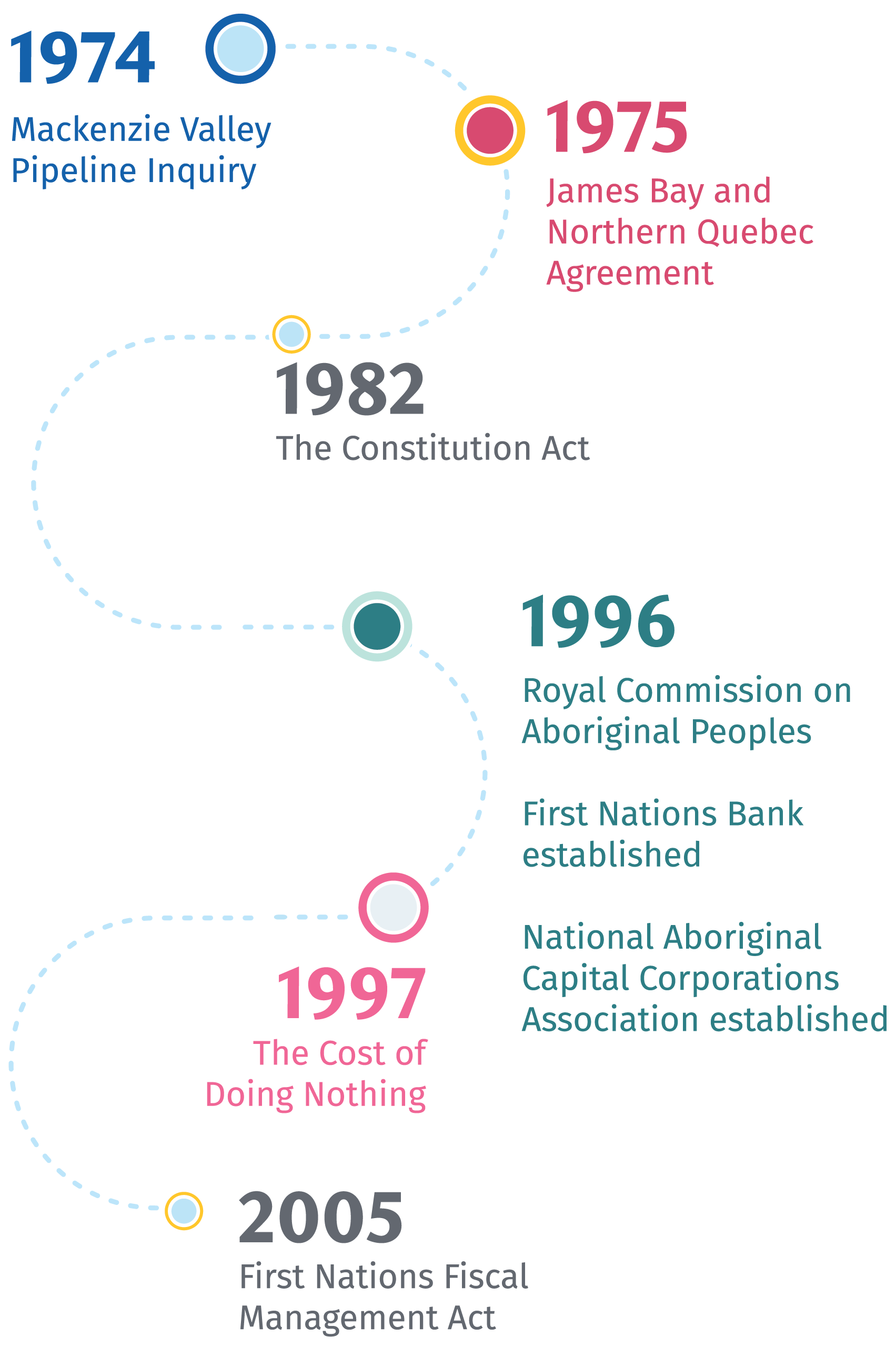
Major strides have already been made, including the passage of the First Nations Fiscal Management Act, the creation and devolution of powers to territorial governments and the creation of Indigenous-led financial institutions. Further strides must be made to unlock Indigenous economic potential and create the pathway for true economic reconciliation.

Timeline of key events
The story today

When Indigenous Nations consider major project participation, they often face a combination of institutional, legal and economic barriers that have led to many (but not all) Indigenous Nations to build a balance sheet, deal history, or internal capacity. Access to affordable capital that enables Nations that reduce the cost of capital and safeguard Indigenous assets remains a challenge. This is because of a combination of legal and institutional barriers outlined above, as well as network effects and a lack of awareness on the part of the private sector on the benefits of proactive Indigenous participation.

This gap is particularly evident in opportunities where Indigenous Nations may wish to have an ownership stake in energy and natural resource projects on their territories. Indigenous ownership is now a leading model to align interests and advance project development in a timely way by prioritizing Indigenous-corporate relationships, incorporating Indigenous values and priorities, and potentially streamlining regulatory processes4.

What is a loan guarantee and how are they structured?

A loan guarantee is a contractual agreement to repay a debt provided by a third-party lender such as a bank, when the borrower can no longer pay (i.e., “backstopping a loan”). For the lender, this can virtually eliminate the risk of economic loss. For Indigenous investors, equity loans without guarantees can be prohibitively expensive (i.e., the cost of the loan, if granted at all, is less than the cost of financing without a guarantee). Without guarantees, Indigenous investors are often faced with the scenario of an uneconomic cost of capital, accepting a much smaller equity position—or none at all—which are sub-optimal outcomes.

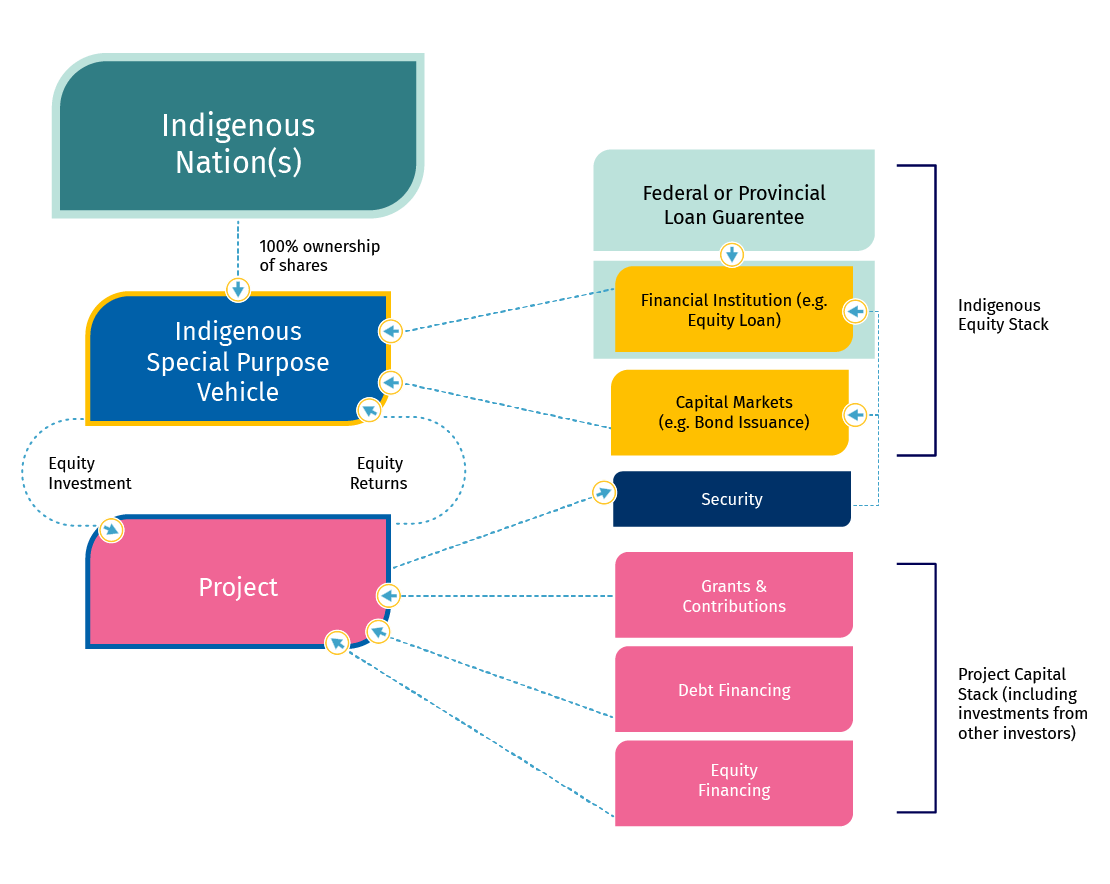
A loan guarantee facilitates the lending environment to fund the equity portion of a transaction, providing credit enhancement and liquidity support for Indigenous borrowers. Importantly, the use of limited partnerships and special purpose vehicles do not put Indigenous community assets at risk, as the project debt raised is non-recourse/limited recourse to equity partners. Use of a special purpose vehicle owned by Indigenous Nations, and generating distributions back to the community limit exposure of liabilities to the value of the initial equity investment made by a Nation.

Loan guarantee programs have emerged as a “brick in the wall”—a part of the solution to address the access to capital gap among other complementary tools. The figure below outlines an example of the ownership structure and the relationship between an Indigenous Nation and equity ownership in a project, in particular, where a loan guarantee may play a role.
The federal government along with the B.C. and Manitoba governments announced loan guarantee programs in 2024 on the heels of advocacy by Indigenous Nations and the private sector amid growing maturity in the public policy development process. These programs, if effectively deployed, could help close the gap in the substantial demand for Indigenous equity participation, estimated by the First Nations Major Projects Coalition to be approximately $45 billion over the next 10 years. Both the development and deployment of newly announced loan guarantee programs will benefit from existing models in Ontario, Alberta and Saskatchewan.

Project finance tools for advancing Indigenous ownership in major projects

These announcements are an important contribution to the set of tools available for Indigenous Nations to economically participate in resource and energy projects. As these programs are implemented, important considerations will include the risk mandate of a loan guarantee program, adequate capacity support to enable partnerships, robust governance to ensure decision-making and issuance of guarantees are undertaken commercially, and stacking with other guarantee programs and support. Priorities to pay attention to as these programs are being implemented will include:

Indigenous people must be supported to make free, prior and informed decisions on project participation. Partnerships across all Indigenous Nations—First Nations, Inuit and Métis—must be supported. Indigenous perspectives, leadership and talent recruitment, development and retention should also be prioritized when implementing loan guarantee programs.

Programs should support the widest scope of projects to maximize Indigenous economic opportunity as a first-order priority in addition to wider productivity gains to Canada.

Government financial support should be backed by a robust due diligence process. A path toward market sustainability is necessary, so Indigenous Nations can access capital on an equal footing with other market participants over the long term.

Time is of the essence. Individual project negotiations must move at the speed of trust, but the bureaucratic functions of the loan guarantee programs must move at the speed of business. This priority will have to be balanced with the need to have a robust due diligence process.

Existing loan guarantee programs continue to learn and develop new approaches to better enable Indigenous ownership and participation. For instance, how best to support Indigenous ownership in greenfield or pre-construction projects. New loan guarantee programs need to retain flexibility in the structuring and deployment of guarantees to develop and adopt best practices across both public and private sectors.

Risk mandate and project application

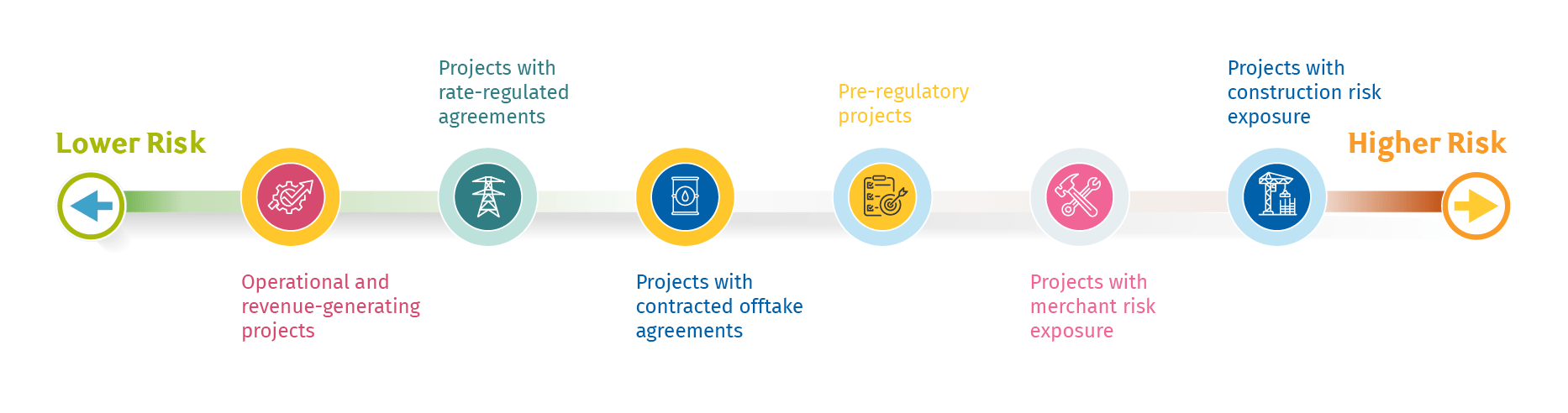
Projects that provincial and federal governments select to guarantee will depend largely on the risk mandate of the loan guarantee program. Generally, loan guarantee programs mandated to be low or zero-risk will primarily provide support for relatively low-risk sectors (such as rate-regulated or operational projects). A loan guarantee program with a more accommodative risk mandate could take

on earlier-stage projects in riskier sectors (such as those with more merchant risk exposure) and larger/smaller ticket sizes—facilitating the completion of net-new projects that would not have occurred without Indigenous economic participation. Figure 2 presents the notional risk across a range of possible sectors and project stages, ranging from low to high risk.
It is likely that loan guarantee programs, similar to many government funding programs, will start out relatively risk-averse. However, given the ability of governments (particularly the federal government) to absorb more risk, these programs should adopt an evolving, dynamic risk mandate as they gain expertise through “learning by doing.” For instance, annual risk mandate reviews can incorporate the inputs of Indigenous clients and private sector participants in guarantee programs to re-evaluate whether new, innovative approaches and sectors can be covered. The risk would entail multiple dimensions, including:

Although partial loan guarantees that do not cover the entire Indigenous equity loan may be preferred initially, guaranteeing up to 100% of the equity loan can enable a greater degree of Indigenous economic participation and returns on projects where previously infeasible.

A sector-agnostic approach is important, enabling Indigenous Nations to retain full say and determination on the types of projects that happen on their territory and broadening the positive impacts of Indigenous participation. The loan guarantee program should prioritize a mix of projects across a range of sectors and geographies

Loan guarantee programs will seek to minimize undue risk and a call on guarantees due to both fiscal and reputational risk. Over time, as loan guarantee programs demonstrate success, a wider range of considerations can include guaranteeing projects with a smaller ticket size and greenfield or pre-regulatory projects versus brownfield projects, have a range of risk exposure. Ensuring this mix will capitalize on the program opportunity to maximize Indigenous opportunity and enable investment into net-new projects that contribute to energy and economic goals.

A larger number of Nations in a deal may add complexity, and dilute returns and the equity stake for individual Nations, but it can provide positive multiplier effects. Nations with a greater degree of capacity can support Nations that are developing and building their own internal capacity. Facilitating relationship building across Nations, and with the private sector will be an important impact measure for loan guarantee programs.

A loan guarantee does not create a cash profile on a government’s public accounts, but a loan loss provision can set aside part of the cash requirement for a call on a guarantee. However, when a guarantee is issued, part of this provision would be “locked in” until the loan is repaid. Accounting for a diversity of loan durations (e.g. a mix of five, 10 and 15-year terms) can enable the program to recycle capital and issue new guarantees that would unlock a greater value of equity partnerships.

Additional structuring protections governments may consider to mitigate risk would include:

Indigenous Nations that can invest their own capital can create an equity buffer, which can mitigate risk and further reduce the cost of equity capital.

Loan guarantee programs must lower the barrier to entry, including onerous fees, but these fees can also be tailored to the specific risk profile of the guarantee.

These are standard contractual terms that can stipulate timely repayment of debt by directing cash flows toward debt repayment before distributions, and create a buffer to ensure that future issues can be cured through funds capitalized upfront and over time.

Often used in minority ownership positions, share buyback provisions obligate the majority partner (and often the operator) to re-acquire the Indigenous equity shares in the case of full default.

A standard aspect of commercial debt monitoring, post close due diligence can help address potential issues proactively and enable a government, proponents or financiers to step in prior to an issue being raised. Both commercial monitoring and relationship management with individual Indigenous Nations will be important.

The federal minister of finance has indicated that the government would look forward to seeing the program oversubscribed and a request to increase the funding beyond $5 billion. Indeed, one major project can take over the entire loan guarantee envelope. A larger guarantee envelop is a positive signal of the government’s commitment to enable greater Indigenous partnerships and meet the $45 billion potential.

Capacity

A combination of institutional factors and network effects may mean Indigenous Nations have varying degrees of relationships, know-how and deal history to build the commercial capacity to assess and negotiate deals. The degree of capacity may be variable based on the Indigenous Nation and the nature of the deal. Capacity support can be crucial to the success of access to capital tool that enables Nations to access appropriate commercial, legal and financial expertise to make the right decisions.

As a comparator that highlights the importance of capacity amongst other factors, the U.S. Tribal Energy Loan Guarantee Program created in 2005 issued its first loan guarantee in March 2024. The program’s slow progress may be attributable to multiple factors, but an important omission appears to be that it did not fund for capacity for Native American tribes to make informed decisions on the commercial and technical aspects of a deal.

The federal government has provided $3.5 million over two years to support capacity funding under the program. This is a start, but capacity funding must be more highly prioritized to ensure Indigenous Nations have the appropriate commercial, technical and legal expertise to make project participation decisions. Capacity is often further enabled through the fees charged on loan guarantees, which can be recycled into a capacity fund, alongside support by project proponents. The B.C. loan guarantee program has indicated that it will capitalize a capacity fund with $10 million. The Manitoba loan guarantee program has not indicated whether it will fund capacity.

Organizations such as the First Nations Major Projects Coalition have played an important role in supporting Nations build and consolidate internal commercial, technical and environmental capacity. Continued support of existing and new organizations will be a crucial success factor over the long run.

A positive trend that is Indigenous Nations is growing the number of Nations supporting each other in building capacity. Anecdotally, in deals with multiple Indigenous Nations involved, Nations with more experience and a greater degree of internal commercial or technical expertise often allocate their internal or external resources or contribute their relationships or past experience to support those Nations that are building this capacity.

Governance

Independent, arms-length administration has been a priority with existing programs, including in Ontario (managed through a Crown agency) and Alberta and Saskatchewan (managed through an arms-length corp.). Independence and autonomy enable decision-making to happen with minimal political interference, and generally, have enhanced credibility. Indigenous perspectives and inclusion must be a critical component in all governance structures. Key priorities in developing a transparent, inclusive and nimble governance model will include:

Indigenous leadership and representation across governance and decision-making bodies must be a priority and imperative, given the focus of these programs on Indigenous economic reconciliation and inclusion.

The focus should remain on assessing guarantees on apolitical criteria, including ensuring commercial viability and inclusivity, limiting the scope for political interference in the issuance of individual guarantees.

A corollary for loan guarantee programs to remain apolitical is ensuring the approval and decision-making processes prioritize speed. Approvals by an independent, arms-length board with representation across Indigenous leaders, government officials, and the private sector can expedite implementation and communications.

  • Part of deploying at speed is enabling, particularly at the federal level, a “single window” approach or coordinating efforts across federal and provincial loan guarantee programs to ensure appropriate service delivery to Nations.

Robust, commercially comparable due diligence criteria and evaluation processes must be developed to ensure loan guarantee decisions are made on the commercial and economic merits of the underlying project and loan guarantee.

Buy-in and transparency go hand in hand to bulwark the credibility and reputation of loan guarantee programs. Both a clear governance process and robust monitoring and reporting requirements will be required for Indigenous Nations and the private sector to understand how and why guarantee decisions are made.

Stacking

There are a range of organizations that provide financial support for Indigenous major project participation, notably provincial loan guarantee programs. Considerations that would enable better stacking with the aim of maximizing the economic opportunity of Indigenous ownership using the full weight of government resources include:

Offering a “single window” for Nations considering both provincial and federal guarantees.

  • This includes coordination and communication between officials, which is especially important in complex projects that require support across multiple organizations. The federal loan guarantee program has an opportunity to show leadership in this regard.

Aligned financing and contractual terms including fees, guarantee structure and flexibility in rules that enable Nations to tap into multiple financing “pots.”

For capacity grants—not restricting the number of sources Nations can access.

Organizations that provide both financing and capacity support include the provincial guarantee programs, the First Nations Finance Authority, the Canada Infrastructure Bank, Export Development Canada, Business Development Bank of Canada, Farm Credit Canada, and multiple provincial agencies that provide support towards Indigenous economic opportunity.

Future tools

Loan guarantees can be an effective tool—but are only a brick in the wall and not a silver bullet. Crowding in private investment and creating a path to market sustainability will be important.

Future considerations for governments as they consider expanding the toolkit may include:

Indigenous economic interests intersect with almost every sector in the economy including fisheries, agriculture, telecommunications, infrastructure, manufacturing, tourism, and others. Federal and provincial loan guarantee programs can start expanding support across multiple sectors, particularly beyond the energy and natural resources sectors where most of the focus has remained.

Guaranteeing project debt, albeit riskier, may be the next stage after a critical mass of support and private capital is available to guarantee equity. This would functionally on-lend the federal government’s credit rating to Indigenous borrowers, and provide a greater range of flexibility for banks to lend toward.

Providing 100%-plus guarantees can support Indigenous participation for projects in the pre-construction, pre-revenue generation phase. Similar to guaranteeing debt, this may be riskier, but if strategically employed in otherwise commercially viable projects, it can unlock meaningful, early Indigenous participation in projects, particularly in strategic sectors such as critical minerals.

In higher-risk sectors such as mining, particularly in some frontier critical minerals projects, Indigenous Nations may prefer to participate through a royalty or income stream. By creating an institutional structure to transfer part of the royalty revenue to Indigenous Nations, governments can incentivize participation in sectors such as mining or forestry (where the royalty is referred to as stumpage fees). Federal government action is called for here. Provincial governments in B.C. and Alberta amongst others already have resource-revenue sharing agreements.

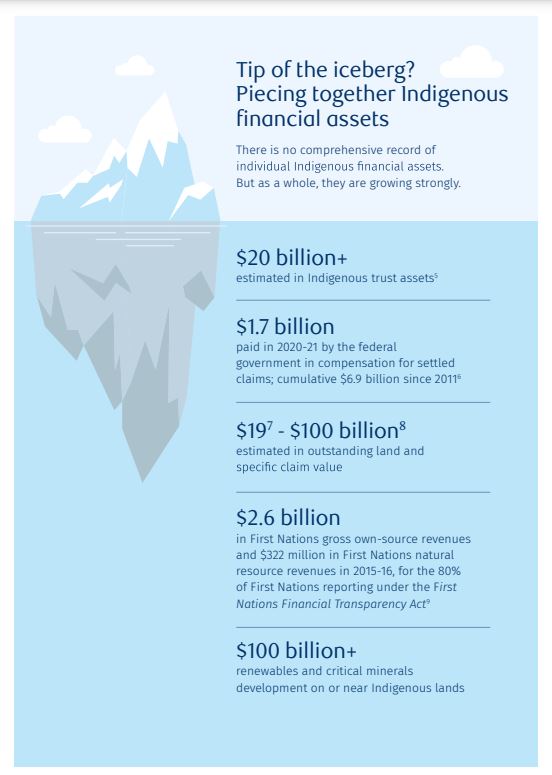
The growing wealth of Indigenous Nations includes an estimated $20 billion in trust assets and up to $100 billion in outstanding land and other claims. Pooling trust and investment assets through optional Indigenous-led institutions can help generate significant investment income as well as a vehicle to further advance participation and ownership.

An Indigenous Development Bond, akin to development bonds issued by emerging economies and multilateral institutions, can support financing of Indigenous-led projects. This would build on the existing success of the First Nations Finance Authority’s pooled lending and bond issuance program. This instrument would require consensus on bond issuance standards.

Building on the work of the Canadian Sustainability Standards Board and the federal sustainable investment guidelines, integrating Indigenous perspectives and considerations to investment standards can be an additional tool to drive investment to Indigenous-led projects and organizations.

An Indigenous-led development finance institution that consolidates debt, equity and grant instruments could offer a comprehensive set of tools to durably finance projects and businesses. The model for such an institution would be akin to community development banks, capitalized by both public and private sectors, rather than multilateral development banks with votes allocated by share capital.

The private sector is developing innovative structures to crowd in Indigenous participation and inclusion in major projects, including:

  • Breaking out lower-risk, revenue-generating elements of a larger project and facilitating Indigenous ownership—often elements that outlive the life of a single project (e.g. transmission lines or toll roads).

  • Post-construction options for Indigenous ownership, wherein the option can be exercised by Indigenous Nations to purchase an equity stake upon project completion.

  • Minimum annual payments to mitigate the potential downside and protect Nations from undue risk when a project goes through periods of no revenue.

  • Share buybacks upon project failure to commit to a set price to repurchase equity stakes by the project proponent if the project fails to be completed.

  • Negotiating Indigenous governance rights even in cases of minority equity positions through a separate share-class structure to recognize Indigenous owners sit in a unique position apart from other commercial participants.

  • Co-investing with institutional investors, particularly, with co-investors that can deploy large sums of capital over long durations, both in individual major projects and by bundling smaller opportunities through joint ventures.

  • Proponent guarantees or contractual supports: Proponents may seek to provide their loan guarantees or other forms of contractual support to enable Indigenous participation, particularly in riskier projects. This may be balanced by a higher equity sale price.

A proactive, relationship-focused and trust-based approach for Indigenous partnerships is now necessary in both public and private sectors. Advancing economic reconciliation through meaningful partnerships is both a moral and economic imperative – presenting an opportunity to grow out collective prosperity as a country.

For more, go to rbc.com/en/thought-leadership/

Download the Report

What if we knew that the world — the human world — would be so radically different within our lifetimes that we might not recognize daily life? What if we knew that children born in 2025 would never know the meaning of work, or income inequality, or deprivation?

What if the ensuing shocks were so profound — to society, business, government, even to our sense of self — that our future selves wished more than anything else they had prepared better for the day when algorithms and machines could do everything we do, only better and faster? And what if our future selves were to look back at 2024, to see it as the one clear moment in time when we saw the future and blinked?

The potential for those shocks is there. Artificial General Intelligence — software with human-like intelligence and the ability to self-teach — may be nearing a state where it can, at least theoretically, start to displace, at scale, the functions (mental, physical, perhaps even emotional) that have, for millennia, made humans the species we are.

Will the resulting shocks come in a decade or a century, or somewhere in between?

In the long arc of time, the timing may not matter, as we know today the clock is running out on the age in which man reigned over machine. We are on the edge of a new era of commingling and interoperability, an era which could see intelligent machines play a role in every aspect of life.

That era will present plenty of unknowns, and for that, society needs to start preparing.

To discuss how, a group of technologists, academics and executives gathered this spring in Asilomar, California, to confront our newest existential challenge: What if we succeed? What if, within a decade, AGI is capable of replicating every human task? And how, on earth, should we prepare?

The Setting

Past is prologue, and so may be true for AI in the quiet solitudes of Asilomar.

Jutting into the Pacific Ocean, around the corner from Monterey Bay, Asilomar is a sleepy retreat that can easily be bypassed for the spectacle of Pebble Beach on one side and chill vibe of Pacific Grove on the other. Indeed, it seems to embody the paradox that Gertrude Stein applied to her hometown of Oakland, not far away. There is no ‘there’ there.

In one direction lies the sea and its infinite promise, and in the other, beyond the coastal mountains, Silicon Valley and its exponential promise. It was here, at the edge of America, and in the throws of the second Industrial Revolution, that the great San Francisco architect Julia Morgan designed a retreat for the Young Women’s Christian Association, the first in the American West.

Morgan had already helped San Francisco rebuild from the Great Fire of 1906, and was well into the defining commission of her career, Hearst Castle, down the coast in San Simeon. In 1913, when Asilomar opened, the world was on the cusp of a technological revolution, one that would make airplanes, cars, telephones and movies the tent pegs of 20th century life.

Morgan had tried to give the YWCA a retreat from what was to come, with her wood-beam and vaulted ceiling “Chapel” and its engraved words, “the lord on high is mighty.” But she later recognized that the Roaring Twenties, and the rise of American modernism, would challenge that view of the almighty, as it gave god-like powers to a new scientific class immersed in the atom and electron.

Nearly a century later, a new generation of scientists, technologists and their backers, are seeking to equally reshape society, with AGI.
Can they prepare for the unknowns of a far more powerful tech revolution? Can they find ways for autonomous machines and their human dependents to co-habitat?

If they succeed, can their society reform capitalism, in ways that the first Roaring Twenties failed to do, to fairly distribute resources even though the means of production are controlled by machines? And will the rest of us find new ways to accept our finiteness in an infinite economy?

Looking over the rugged dunes that connect Asilomar with the setting sun, and the promise of tomorrow, the challenges of technology disruption may feel the same today as they did for Julia Morgan, to both harness modernity and keep it in its place. And yet a century on, this new revolution feels entirely different, with its exponential promises looking to be as profound as its existential threats.

Here are some of the considerations:

1. The promise of infinite surplus

Moore’s Law remains the guiding force of our times, allowing for the doubling of computing power every two years. In fact, over the past decade, compute power has doubled every six months. To date, human ingenuity has been able to keep pace with that kind of growth. We’ve figured out how to use computers, smart phones, and wired machines to our benefit. But the compounding of compute beyond this decade, into a new AGI realm, may be more challenging to human adaptation, especially as machines increasingly make their own decisions and gain physical mobility. We could see more biorobots in 25 years than humans, and far more virtual agents informing, advising, and eventually directing our daily lives.

Some forecasters believe that 80 per cent of jobs will be done by some form of AI within a generation. One result could be a near-infinite rise in economic output, as the world’s productive capacity soars. Services such as health care, education and financial advice could become free, universally available and ever-improving. Profound challenges — climate, cancer, crime — could be solved rapidly. And even as wages collapse with the end of work, spiking productivity rates and surging output should easily compensate, if effective distribution models are established.

While the promise of such surpluses may be foreseeable, the timing is not. Like all technological impacts, AI is following the course of a slow, steady explosion. That makes it harder for society to prepare, to change income models, tax regimes, and social expectations. Moreover, the course of AI adoption and its impacts are unlikely to be linear, especially when they run up against rigid social and economic models. A meandering path to AGI, with technological bursts and social reactions, may mean we get to AGI before society is ready for it.

Perhaps Transformational AI can help distribute the surpluses it creates, but only if we guide it to do both at the same speed.

What’s needed:
Dynamic research to track the displacement of labour and distribution of benefits across the economy.

2. What AI needs to learn

Many aspects of AI may not be as smart as we think, given the stumbles of ChatGPT. But it’s also showing all signs of being slow and steady, then fast and furious. The avalanche effect.

The technology is currently evolving through a rapid series of small steps, with few eureka moments. One reason: most models still focus on computation, rather than achieving goals. The chat bot explosion of the early 2020s has yet to expose deep thinking from machines, other than an impressive ability to accept prompts and respond.

We need to shift Large Language Models (LLMs) to algorithms that can learn from ordinary experiences, not just from neat data sets. Indeed, LLMs may need to search for greater challenges, and pursue the sorts of messes that literally don’t compute. AI may also need more time, tools, and space to test and learn from multiple hypotheses rather than the hard coding of symbolic reasoning. Ultimately, systems will need to get better at working with the wonders of the human mind, and the depths of intuition that machines can’t replicate. One suggestion: “Think of it more as parenting than programming.”

That kind of parental guidance — helping AI not touch the hot stove or poke the dog’s eye — can come through continuous deep learning and “efficient off-policy learning”; that is, allowing the models to colour outside the boundaries of their algorithms, to understand aberrations, and to engage in discordant and shallow data sets. This will require humans to accept that our relationship with AI increasingly will become continuous and not transactional; again, parenting, not daycare. And we may need to accept that passive systems will wake up to learning.

Ultimately, AI will need to develop its ability to anticipate and adjust. Prediction machines will need to become planning machines. And like most of us, there will need to be plans for failure. Hospitals, for instance, may need to add on-call data scientists to help manage algorithms that go awry or stop during a procedure because they don’t know what to do.

The growth of AI may be iterative, a journey of baby steps. But such is the rapidly incremental nature of innovation.

A bit like childhood.

What’s needed:
Open sharing of discoveries and data, when public interest is at stake, to ensure collective progress.

3. A concentration risk

You don’t need to be in Silicon Valley to hear the giant sucking sound of capital by AI. And it’s getting louder, as the colossi of chip, cloud, and compute devour more and more capital to finance their energy- and data-hungry learning models. As the big get bigger, they’re also starting to drive returns, which in turn is leading to more capital generation.

LLM spending is already estimated to have hit about $1 billion last year, and could reach $10 billion this year or next. Some suggested $100 billion could be spent annually on language models within five years. Intel is already spending $25 billion on chips. AI is having the same power in fundraising; last year saw $50 billion in venture funding and 38 new unicorns. OpenAI, the market darling, saw its valuation edge reach $80 billion.

And then there’s this calculation: If AGI increases economic productivity, in an optimistic forecast, the cash value of its benefits could be $124 quadrillion. Suddenly, a $7 trillion investment seems reasonable.

The centripetal force of AI is about more than money. The cloud behemoths are accumulating data and talent at rapid clips, and also amassing the resources to spend on supercomputers. It’s estimated fewer than 10,000 people are working on what can be considered “transformative” AI — anything that might lead to AGI — and most are serving the interests of a handful of firms. It’s said that Tesla’s dominance in automobile data, especially for autonomous vehicles, was one reason Apple — hardly a constrained enterprise — backed away from the its AV project.

Will the concentration lead to an oligopoly or even monopoly in AI? And will that stifle competition? Or will there be an emergence of“bilateral oligopolies” — small groups of players at each link in the supply chain? That could lead to cartels or at least coalitions in, for instance, electricity supply, computing operations, and chip supplies. Governments could equally impose constraints — quotas, as an example — on dominant players, or at least require them to serve national needs first.

All of which comes with a caution: concentration of power is less dangerous than concentration of thought.

What’s needed:
Governments may need to consider an industrial policy mix for AI, to ensure a fair and strategic allocation of resources, including capital.

4. A risk to supply chains
There may be more than we can manage. Compute, chips, and labour are all in short supply, and traditional supply-demand models may no longer apply. For one, AI is creating exponential curves in demand through the unpredictability of its uses and needs. The steep cost of inferencing — the running of data in a live AI model — is only growing as those models get hungrier. The more they learn, the more they want to learn. A separate tech race is on, to develop more efficient chips, shrink the size of models, and compress the middleware that adds more weight to systems. In each of those areas, competition helps. And the explosion of capital for AI could help fuel that competition.

Structural (or infrastructural) inputs like electricity will be harder to fix. Much of the world is already in a hurry to produce more clean electricity to run factories and cities in a net-zero economy, and there’s a risk that capital-rich AI projects and their energy-hungry data centres will outbid the older parts of the economy trying to transition their energy models. In that scenario, the compute demands of AI could sideline the climate demands of society. In those cases, governments may need to assign scarce resources to a hierarchy of societal needs.

More positively, the enormous potential of the race for AGI, and the apparent economic potential, could prove to be an added incentive to the development and scaling of emerging energy sources like nuclear fusion.

A scarcity of inputs will also challenge the business and organizational adoption of AI, including transformational AI. Legacy industries, already operating with low margins, will continue to be challenged to compete, compute, and to buy the chips they may need. Such a scenario may lead many companies and public-sector organizations, as was the case in the Internet’s early years, to accept their place as slow adopters, using off-the-shelf enterprise software tools that can be useful for efficiency but less dynamic for innovation.

This will put further pressure on governments, to find ways to increase both supply and demand for AI in a broad range of sectors as well as public interest pursuits. As is often said of the Internet, we had an invention that was profound and powerful enough to cure cancer, and we used it instead to share photos. The same risk — individual preferences versus collective needs — could play out with AI and models; creating celebrity avatars rather than diagnosing health problems. In business, too, the next generation of AI needs to be focussed on discovery, not just automation. Collective research models, such as a DARPA or NASA for AI, could help coordinate university research and business application, and in turn develop ecosystems that ease supply chain constraints and open doors for emerging challengers.

Ultimately, AI should expand our vision, not shrink it.

What’s needed:
Incentives and initiatives to ensure the supply chains of AGI are focussed on societal needs, especially science, including the incomplete sciences of climate and behaviour.

5. A risk to robots
Mention AI on Main Street, and most conversations will quickly turn to robots and their rise. The early years of Transformational AI is painting a different picture. Many of the biggest private sector AI players have set aside their initial focus on blue-collar work — where robots are most needed — and turned instead to white-collar functions. For one, there’s quicker returns in the information economy. By its very nature, language models are also best at playing with words and numbers, the stuff of enterprise software. And it turns out, error rates are more acceptable in the information economy. We’re willing to accept fake news, or fake essays, a lot more than flawed buildings.

That’s not to suggest there’s no hope for robots outside warehouses. It’s just going to take longer. Big Tech is actively trying to develop software that can mimic human dexterity and senses. The prize is enormous. It just takes an ability to convert perception data into action data — what we might call reflex and instinct, as opposed to habit. In the coming years, we may see more “teleportation,” as people take possession of robots to help them learn. We could even see business models around Brain as a Service, in which enterprise software packages can be bought or licensed to command various aspects of the workplace, home, and community, or perhaps even ourselves.

The demand for robots, and other smart hardware, will only grow as populations age and eventually shrink. So, too, will our comfort interacting with machines, just as we’re comfortable conversing with our phones. (One retailer said their store tests show customers trust on-floor robots more than on-floor staff, for information.)

What will AI-powered robots, and other learning machines, be good for? If we get it wrong, we’ll end up developing self-teaching vacuum cleaners and toilet scrubbers first, rather than using Transformational AI to transform how the world’s economy operates. If we get it right, AGI can help remove transportation from the ground and sea, putting it in the air and freeing up our lands and waters for better uses. It can transform manufacturing, including through 3D printing. And most profoundly, it can change the way we live, with medical devices in our bodies learning as we age. Like the third Industrial Revolution — the computer age — which allowed us to shift en masse from a brawn economy to a brain economy, the advancement of Transformational AI can power the robots and smart machines in our lives to do more than make our lives more convenient and efficient.

They can help us leap into a new age of discovery.

What’s needed:
Robotics programs, including public supports, that drive innovation to the most important frontiers of human progress.

6. A transition risk

Utopia doesn’t have an on-ramp. If we’re to get to an AI-driven world, in which there’s infinite surpluses and machine-enabled peace and prosperity, we will have to endure a lot of bumpy detours and diversions.

In the world’s poorest countries, and indeed in the poorest regions of the world’s richest countries, labour is too abundant and cheap to replace with AI. Infrastructure and technology distribution will further impede the universal spread of AI. Paradoxically, where AI is needed most, it could be deployed least.

The dispersion of AI in advanced economies won’t come without disruptions, either, especially to workforces. Entire areas of expertise, and the trades and professions associated with them, could rapidly dwindle, along with the education programs that feed them. “Stranded expertise,” as it’s called.

During this transition, many of us will need to shift to “augmented work” in which we job-share with AI, exploring ways to make the most of each other as we co-habite roles. We will also need to prepare — psychologically as well as economically — for the day when we’re no longer needed in that role. Augmentation will give way to an advanced form of automation, in which the job and its constituent tasks continue to evolve in the hands of a machine.

Those with a growth mindset see far more opportunity. First of all, if AI is restricted to current human knowledge, it will have failed. Properly guided, Transformational AI should multiply our collective knowledge set, as well as our troves of creativity, which in turn will lead to more discoveries, more creations and more pursuits and jobs. As one small comparison, the microscope did not element any jobs; rather, it opened our collective eyes to frontiers and possibilities we had scarcely imagined.

Bumps, yes, but the transition is to a place of greater human engagement.

What’s needed:
Development programs for AI in low-income regions, as well as AI-powered learning programs across professions, trades, and jobs at risk.

7. A distribution risk

Even if we put AI in Utopia, it will be subject to human nature, which generally is not about sacrifice and sharing. Yes, once AGI becomes a universal reality, the potential surpluses of our economy could spell an end to hunger, poverty, and disease. But humans may not be content. We may still need and yearn for status hierarchies. Our happiness will remain relative. There will also be divisions between countries, as nations (xenophobic ones, especially) seek forms of differentiation to enhance national pride and self-worth. An AI-powered Olympics would be no fun if the optimal outcome was for every country to share the gold medal.

This kind of competition — or as Freud called it, “the narcissism of small differences” — may become more entrenched, and violent, if humans are unable to find other forms of meaning, beyond work. Regardless of the political economy of a country, basic instincts will be a challenge for AI to cope with — something communist states discovered about themselves and their Utopian dreams in George Orwell’s Animal Farm. (“All animals are equal, but some animals are more equal than others.”)

Even today, in the West at least, we have the best lives humanity has arguably ever lived, and yet we generally feel we don’t have enough. Social discontent has rarely been higher, and ironically, we know how to solve most of society’s shortcomings. In fact, we don’t need AI to figure out how to distribute wealth more equitably, as we did that some generations ago. Just open our borders more to trade and immigration, and find more systematic ways to distribute the surpluses of our economies. AI would tell us to do the same thing, presumably, and we would find reasons — relative prosperity — to reject it.

What’s needed:
More open trade policies, including for digital assets and IP, to allow for a freer flow of AI opportunities and benefits.

8. A risk to democratic capitalism

Capitalism exists by permission of democracy, and if the benefits of AI are not clearly and fairly distributed, the system that is financing its growth could be at risk. This could require capitalism to adjust as much as society needs to adjust to the powers of AI.

For centuries, the distribution of economic surpluses has been largely based on labour. More recently, economic rewards have gone disproportionally to the owners of capital, over labour. As AI, and the owners of the capital behind it, amass more economic benefits, and as labour rewards are diminished, social tensions and ensuing political pressures could grow. This could become even more acute in aging societies in which older, and less productive, generations hold the bulk of capital through their lifetime of savings, while labour-challenged younger generations are squeezed.

Could this lead governments to nationalize AI, in order to distribute the benefits more widely? Or will governments instead more aggressively tax the owners of capital, to redistribute their gains from AI? Perhaps modern capitalism won’t be needed anyway, since its AGI may replace the need for markets to determine equilibriums and drive the efficient allocation of resources. An algorithm can do that.

As AGI takes hold, governments could also be tempted by policies more associated with authoritarianism, to maintain control over the social and political consequences of emerging models. Fundamentally, democratic capitalism will be challenged to address this: Whoever controls the digital infrastructure behind AI — supercomputers, chips, energy sources — will control the future. In other words, the digital means of distribution will eclipse the means of production as the determinant of economic power.

Which leads to this question: in 2034, if Silicon Valley hasn’t taken over Washington, will Washington need to take over Silicon Valley?

What’s needed:
Businesses, investors, and governments need to rapidly develop new approaches to market economics, to ensure the rewards of capital and labour are properly assessed and allocated.

9. A risk to meaning

Technology has always challenged the meaning of life, and the purpose we each hold. Deus ex machina (“god from the machine”) goes back to Ancient Greece, and a seemingly instinctive association between the almighty and technology, both being stronger than us. In ancient theatre, the god from the machine usually brought resolution to the problems on centre stage and sent audiences home happy. AGI may be expected to do the same, even though the angst of human life may not compute.

Humans will need to prepare, perhaps rapidly, for a world in which work and deprivation are both remarkably scarce. That won’t put an end to human desires, even when everyone has sufficient food, housing, and clothing. We always need more. Especially in our minds and hearts. AGI may not anytime soon be able to speak to our emotional needs, for laughter, comfort, and love. Nor can it address the social isolation that can come from the end of workplaces, schools, and commercial centres.

Or can it?

AGI may actually not put an end to work, but rather enhance jobs and pursuits with more meaning. It will take the robotic out of every job, perhaps. This could lead to a new definition of work, in which jobs are as much social as economic functions. Call it a Seinfeldian world, as someone suggested, each of us busy with banter and errands. We’ll all be active, and rewarded accordingly, just not what exactly what we’re sure for.

Will that shift to leisurely work make us feel more inconsequential? And perhaps less essential? Will it lead to lethargy? Or anarchy?

Over the coming years and decades, as we pursue the final frontiers of technology, we will need to explore the inner frontiers of humanity, to determine what it means to be humans. We can love and preserve, as much as we today produce and provide. But that will require some new shared narratives of what the good life — and good work — can be.

Only humans can code that.

What’s needed:
Dismantle or at least refine labour market barriers and regulations, to allow for a more entrepreneurial, creative, and human approach to work.

10. A risk to regulation

The greatest risk in regulation may be our inclination to regulate the past against the future, and AGI is all about the future. That presents an important moment to challenge ourselves with what ifs:

  • What if there is only one AI model and it can be independently regulated?
  • What if we regulate the users and not the algorithms?
  • What if we declare and code all models with what good looks like? What if we declare and code all models with what bad looks like, including self-replication, break-ins and evil intent (e.g. bioweapon design)?
  • What if we ensure agents and models have “normative competence” to search for, and recognize, boundaries and laws?
  • What if we penalize, even threaten to shut down, models that go against good?
  • What if we use interoperability to monitor how models are doing, and ultimately allow models to measure and police themselves?
  • What if we allow models to share IP, to assist new entrants?
  • What if we require AI models that draw on data from public spaces — roads, social channels, education systems, for instance — to join data utilities?
  • What if we create regulatory safe harbours for areas of public importance, such as disease recognition?
  • What if we assign “personhood,” with rights and legal responsibilities, to agents and chatbots?
  • What if we apply principles rather than prescriptions to AI?
  • And ultimately, what if beneficial co-existence is not possible?

The emerging frontiers of AI regulation are no longer in the distance, and governments (democratic ones, at least) will be challenged to catch up. Fearing the worst, they may throw in the towel and shut down AGI efforts — or leave it in the hands of incumbent oligopolies that may be easier to negotiate with and police. It’s surely the case that AGI is too novel a concept to allow for regulatory capture. And yet, the incumbents, and their regulators, are party to the rise of algorithms that may soon be too complex and inscrutable for them to understand, and dangerously irreversible.

There is no easy way at it, other than, perhaps, to remind ourselves that science is inherently about experiment, guided by universal principles, including Do No Harm. Societies, in a range of political systems, have harnessed the benefits of science — space, medical, nuclear, biological — by following such principles. Ultimately, we may need to place the same confidence in the scientists working on AGI. If we don’t, other countries and regimes will not likely let up in their pursuit of this new frontier for intelligence. We may be better to work together, and over time, as was the case in the atomic age, place faith in science and a bit of skepticism in each other.

As the political code suggests, trust but verify.

What’s needed:
In the near term, a clear and replicable taxonomy and code for AI regulators to model and share. In the longer term, international conventions and systems for AI governance.

11. A risk to global security

Scientists hate to be politicized. Too late. AI is rapidly becoming a central political issue, and a growing geopolitical one. The G7 is making AI one of its top priorities, in part to ensure there’s a coherent and collective approach to keep China and Russia from achieving supremacy. The United States and Britain have made AI a central file for their heads of government, as nuclear security was in decades past. They’re not alone. The United Arab Emirates, among other emerging economic powers, has made AI a national ambition, while its close ally India is seeking to do the same with what may be the fastest growing tech stack anywhere. Those challengers to the West may find their own common ground, in a “Third Way” model that is neither Chinese, nor American-centric.

A space race in AI may be healthy for competition, and innovation, but it’s also a risk to global security, as self-learning models strive to compete with each other based on national standards and goals, not universal ones. This rivalrous approach to AI could deepen as countries put more resources behind national strategies designed to create a competitive advantage. Potentially worse may be national restrictions (and hoarding) of key AI inputs, including compute power and chips. Without greater global governance, the odds of mishaps — intentional or accidental — will grow.

Fortunately, the world has nearly a century of experience in successful multilateral governance, which while flawed, has helped prevent nuclear strikes, the proliferation of biological weapons, and ultimately another world war. Even conventions on child labour, land mines, and summary executions have had their effect. Similar approaches to AI governance may soon be needed.

Unfortunately, the post-war institutions that have successfully governed conduct in so many areas since the 1940s are themselves under attack. If the major powers are losing confidence in the World Trade Organization, why would they lean into a World AI Organization? As in previous generations, it may be up to scientists and business leaders to build bridges with all countries pursuing AI goals, including those that may have difficult political relationships with others. As the Churchillian credo of diplomacy says, jaw jaw is better than war war. In that spirit, we will need more alignment, between East, West, North, and South, on the goals — and dangers — of AI. We will also need more public confidence in AI, for people to see the value in its development as well as global governance, understanding its weaponization would be fatal.

Ultimately, AI for all will require all for AI.

What’s needed:
Track 2 diplomacy to bring together scientists, business leaders and academics from rival countries, paving the way for a Track 1.5 effort with government officials.

12. A risk to society

Not far from the barren dunes and windswept groves of Asilomar, the great midcentury American writer John Steinbeck worked on The Grapes of Wrath and Cannery Row. Those classics captured America at a crossroads, scarred by Depression, challenged by a changing world order, and yet inspired by the technological gusto from the Roaring Twenties. Writing of an emergent superpower, Steinbeck noted that the best qualities that Americans seek in people — kindness, honesty, openness — are not what they value in the market. And what we seek in markets — sharpness, acquisitiveness, self-interest — are what we consider failures in people. In other words, we seek in a system what we don’t want in each other, failing to appreciate a system is a function of its parts.

Can AI change that, taking the best of humanity and applying it to the worst of society? It won’t be easy given the dyspeptic mood of publics almost anywhere. It will be even harder in a political environment that seems to eschew kindness and celebrate sharpness.

The mind-boggling reach of Transformational AI can seem like too much for any society to comprehend and absorb. Democracy, most of all, may be challenged to mediate those existential challenges. The risks to our personal and collective security, the dangers of concentration, the unknowns of distribution, and the highly variable outcomes of regulation — each of these could tip the public’s mind away from AI. That is, if Transformational AI is not too fantastical for the public to consider seriously. That is, if it’s not too late to reverse what’s been started. That is, if we can untangle what’s smarter, faster, and more aware than its creators.

And if we can, do we know how to move collectively and at speed? As a society, we weren’t ready for the COVID-19 pandemic, which was predictable and precedented. Facing the unprecedented, we will need to find a different path. We can start by breaking down challenges into actionable and meaningful opportunities, and to frame the AGI discussion in the realities of today and tomorrow, rather than the extraordinary projections of a future time. Governments and their publics care most about the here and now, which is a good place to meet. Taking a page from nuclear science, we can also develop the muscles and rigours of safety precautions and monitoring. And we can build bridges with scores of countries to ensure this is a human-scale endeavour, not the purview of an elite band. Steinbeck wrote, in Cannery Row, “Man’s right to kill himself is inviolable, but sometimes a friend can make it unnecessary.” That may sound morbid, but it was framed in the spirit of a community that was overwhelmed by the changing world around it. Friendship, they discovered, was one of humanity’s great powers.

It may yet be what prepares us for the age of AGI.

Download the Report

Download

The global energy system is in the throes of a generational shift. Population and economic growth spell a demand for much more energy. Climate pressures spell an imperative for a different mix. And new technologies mean new opportunities for both. Looking out a decade, to the mid-2030s, can that changing world of nearly 9 billion people power itself into a new age of sustainable growth? And where can Canada, a global leader in all forms of energy, create the most value in a Net Zero economy? To map out the expected courses for both energy demand and supply in the 2030s, RBC Economics & Thought Leadership and RBC Capital Markets, including Global Research, developed global and national datasets, and new projections. The estimates are based on current assumptions of population growth, economic growth and distribution, technology adoption and government regulation. The highlights of that research are laid out in this report, and its six major conclusions which are designed to help inform policy discussions at COP28, the UN Climate Conference in Dubai, and subsequent energy policy conversations. We know energy is fundamental to every part of our economy, while our management of energy emissions is also fundamental to progress on climate change. Balancing those needs will require an informed public discussion, which this research is meant to contribute to.

1. The world will need to supply another United States worth of demand

Global population growth may be slowing, but the world still needs to generate more exajoules in the next few decades to power emerging economies’ growing needs. Global population is set to rise by 1.7 billion to 9.7 billion by 2050, adding the equivalent of another China and United States in one generation. More imminently, world population will rise by around 834 million by 2035, which is the equivalent of another Europe. That will require another 93 Quad BTU of energy, or close to what the United States consumes now. When it comes to energy-intensity growth, the world appears to be on a two-track trajectory. In advanced economies, efficiency gains are lowering per capita consumption, which has contracted 13% over the past 20 years in Europe and North America, or about 0.7% per year. Population growth is also easing, but not declining outright in most advanced economies. Still, efficiency gains on a per-capita basis aren’t yet large enough for total energy demand to decline outright, even among advanced economies, especially in Canada. Emerging markets are on a faster track and still in the early stages of adopting passenger vehicles, home appliances and advanced manufacturing. In India, the world’s most populous country, energy consumption rates are still relatively low. A slowing population growth rate will help contain emissions growth but not sufficiently enough to offset a growing demand for intensive energy sources, including coal. Indeed, India’s population growth remains concentrated in the north where coal-dependency remains significant for industrial and urban demands.

Global energy demand growth by region

Per-year percentage contribution to world energy consumption growth

Source: U.S. Department of Energy, RBC Economics

Elsewhere, the pace of growth is uneven across the developing world. Per-capita energy consumption rates in China, the world’s largest market, are approaching advanced economy levels and will begin to level out. The pace of energy demand growth is set to slow after rising by 2% per-year over the past decade. And decades of low birth rates from the one-child policy mean China’s population is outright declining, which (all else equal) lowers total energy demand. By our count, growth in total energy consumption will be half the pace of the last decade in China – with risks of further decline if its economy weakens. The populous countries of Africa, rest of Asia and Latin America are facing their own unique challenges to build their economies while managing energy demand and climate pressures. Capital will be critical. Developing countries account for only one-fifth of investment in clean energy, despite making up two-thirds of the world’s population. Middle income countries, such as Brazil, Mexico and South Africa, are home to 75% of the global population and 62% of the world’s poor. Their rising disposable income, and aspirations to buy motorbikes, homes and electronics, will require all forms of energy. Eventually, the massive gap between energy consumption rates in emerging markets will close as their economies mature — but we are not there yet.

Energy consumption per-capita

MMBtu/person, 2021

Source: U.S. Department of Energy, RBC Economics

2. Renewables will account for 20% of global energy needs

While total energy demand will continue to increase, a rising share will come from production of zero emissions and renewable power. Renewable power is set to grow at five times the rate of conventional energy by 2035, which would push the share of total energy consumption globally from renewables to about 20% from 12% in 2022 and 8% a decade earlier in 20121. The cost competitiveness of renewables versus conventional energy has improved greatly, and government supports are encouraging a faster transition than otherwise would occur. Thanks to the Inflation Reduction Act, U.S. renewable energy growth is set to more than double by 2035, rising at a 7% per-year rate, or double the growth rate for renewables over the past decade. In virtually all regions, renewable power is set to rise as a share of total energy consumption. One key reason: between 2010 and 2020, the cost of solar and wind power fell 56% and 85%, respectively. Much of that growth could displace coal and other high-emissions sources. Coal consumption outright declined by about 0.5% per year globally over the last decade, and is expected to decline annually at twice that pace through 2035. That would still leave coal accounting for about 20% of total global energy consumption in 2035, down from 27% currently and over 30% a decade ago. Still, renewables are not without their challenges. Countries that have rolled out ambitious clean grid plans worry about the reliability of grids that depend primarily on wind and solar. A surge in installations is leading to cost inflation, at least in the medium term, while scaling up battery storage remains a challenge, although rapid advances are being made. Global co-operation is also crucial to ensure a smoother roll-out of renewables and a level playing field across countries. The patchwork of global regulations, such as a carbon border adjustment tax, and different carbon pricing mechanisms, need further refinement, robust common standards, and general acceptance across jurisdictions to speed up the transition. Political calculations could also change the trajectory of renewable adoption in many counties. There are signs of political resolve weakening on climate policies as the electorate around the world struggles with high cost of living, especially inflated energy bills. As many as 3.2 billion people in 40 countries (including the U.S.) with a combined GDP of US$44.2 trillion, will head to the polls in 2024. Climate policies are set to come under scrutiny and the prevailing public mood could well shift momentum in either direction. Meanwhile, worries around China’s control over metals and minerals and technologies vital for the energy transition have led many countries to develop parallel, and costlier, supply chains. But new mines will take at least a decade to build and renewable supply chains could easily become more complicated and costlier in a trade-restricted world. While these frictions are unlikely to slow the pivot to renewables, they could delay it.

Global energy consumption by source

Source: U.S. Department of Energy, RBC Economics

3. Peak oil demand is coming—but not yet

Discussions around “peak oil” can miss the bigger picture: An industry can remain dominant for decades even if it never surpasses some past high point. We assume global oil demand will continue to slow as a share of total energy consumption, but volumes consumed will not outright peak before 2035. Total petroleum consumption is already declining in major advanced economies (including the United States) but will continue to grow in emerging markets as population and energy use per person rises. There is substantial uncertainty around those estimates, with near-term risks both on the downside (slower global growth, notably in China) and on the upside (rapid technology adoption, also notably in China). Still, the direction of travel is clear: Over 60% of total global oil consumption is from the transportation sector, where the EV transition is well underway. China alone accounted for almost two-thirds of total global petroleum consumption growth over the last decade, and is now shifting rapidly to EVs. Full electric and plug-in hybrid vehicles have increased to 40% of total retail vehicle sales in China – more than 10 times the roughly 3% share in 2019.

Expected petroleum consumption growth by region

Per-year percent change, 2022 to 2035 (expected)

Source: UN, U.S. Department of Energy, RBC Economics

In Europe, electric vehicles already account for 44% of total car sales in 2022. The U.K. plans to fully end the sale of fully internal combustion engines by 2035. Canada plans to increase zero-emission vehicle sales to 60% of the new car market by 2030 and 100% by 2035. Those plans can change, and governments have a long history of delaying green energy objectives. The turnover of vehicle fleets is another key factor. Internal combustion vehicles are staying on the road for longer than ever as reliability and durability improves (the average age of a vehicle in the U.S. is 12 years), suggesting a longer shelf life for existing stock even as EVs make up a greater share of sales. Still, per-capita petroleum consumption rates have already been declining for decades across advanced economies thanks to fuel efficiency increases, and that trend will likely accelerate as the market share of EV sales grows.

Per-capita petroleum consumption

Index = 100 in 2011

Source: UN, U.S. Department of Energy, RBC Economics

4. Natural gas faces a more uneven transition

The phasing down of coal power is expected to boost demand for natural gas as a transition fuel on an eventual pathway to renewables and battery storage—at least in advanced economies. The pace of that transition will vary significantly by region, and with levels of government support. In the U.S., heat pump subsidies in the Inflation Reduction Act will help accelerate the transition to renewable fuels for home and commercial heating. Elsewhere, coal remains a core energy source, which gas could displace over time. China, the world’s largest emitter of greenhouse gases, is continuing to invest in nuclear power, but also permitted the equivalent of two large scale new coal power plants per week in 2022, despite pledges to reach Net Zero by 2060. In India, there is an estimated 65.3 GW of proposed, on-grid coal capacity under active development, equal to a third of its current coal generation capacity. Globally, natural gas demand growth is expected to be driven primarily by increased demand in emerging markets — enough to ensure total demand for natural gas is not likely to peak until after 2035. But the pace of growth will average about half the 1.8% annual rate of growth over the last decade, and the share of natural gas in the total global energy mix will edge lower with renewable power sources growing more quickly. In Canada, natural gas demand will be underpinned by strong demand from industrial sources – including high demand from the oil & gas sector. The expected launch of LNG Canada by mid-decade will signal Canada’s first major gas export foray beyond the United States, as major markets look for secure energy supplies. In Europe, since Russia’s invasion of Ukraine, plans for 26 new regasification terminals have been announced or launched, totalling 104.5 MTPA—a fifth of the current global LNG capacity, according to the International Gas Union. In Asia, Japan, China and South Korea remain among the world’s top three LNG importers. Their new long-term deals with multiple LNG exporters underscore their desire to secure and diversify energy supplies.

5. Oil Investments: Capturing value, capping emissions

Petroleum remains an important source of energy – still accounting for around 30% of total energy consumption by 2035. That would remain true even in the International Energy Agency’s more optimistic scenario in which global oil consumption peaks before the end of this decade. And the nature of Canadian oil production – heavily weighted to long-lived projects with very large initial sunk capital costs, and a relatively small share of global production – means that domestic oil production is relatively insensitive to near-term market dynamics2.

Canadian oil & gas capex spending still low

% of GDP

Source: Statistics Canada, RBC Economics

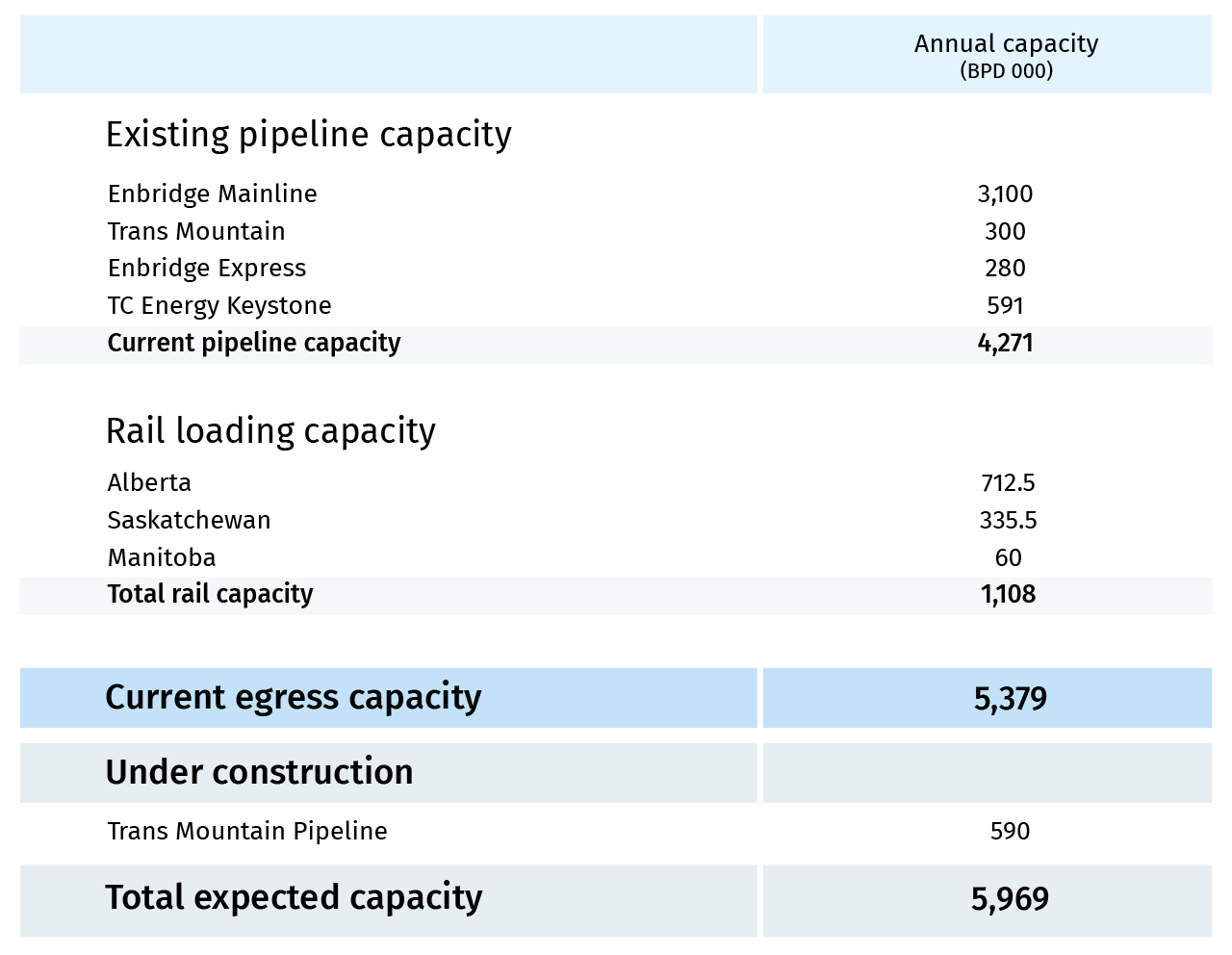
Still, the sector remains constrained by insufficient pipeline capacity to get Canadian production to market. The government-owned Trans Mountain Pipeline expansion will boost takeaway capacity significantly once it enters service likely in 2024. The 590,000-barrel-per-day expansion will fetch tidewater prices and reduce the discounts on Canadian benchmarks. Additionally, oil sands production is well-capitalized and may not need significant further investments. As a result, total oil and gas investment has declined to 1.5% the size of annual Canadian GDP – less than half the share (3.7%) before the oil price collapse of 2015. Even without new projects, the domestic industry can increase production over the next decade if global demand grows. We expect Canadian oil production to rise by 16.5% by 2030, primarily by increasing capacity of existing production rather than new investments. The Federal government’s proposed framework for an oil & gas emissions cap could change that outlook. There is still no certainty of what that the final regulations will look like. The framework envisions a (soft) cap at 35%-38% below 2019 emissions from oil & gas production to be phased in from 2026 to 2030 and with options to produce above caps for a price. But details are still to come and will be influenced by feedback from industry, legislative pressures, and potential court challenges. Decarbonization strategies may present the most significant capital need for oil and gas producers heading into the 2030s. The oil sector has already lowered emissions per barrel by roughly 20% since 2010, although increased production led to an absolute growth in emissions over that period. Plans and proposals for decarbonization projects, including carbon capture and sequestration, will require tens of billions of dollars of new capital, including from the federal and provincial governments. The sector believes such investments could secure its export markets for years, perhaps decades, to come.

6. Canada’s strong population growth will require a broad energy mix

Canada has one of the highest per-capita energy consumption rates in the world thanks to cold winters, hot summers, and a widely dispersed population. In addition, high levels of immigration are now the key driver of population growth, and added energy demand. Will Canadians shift to climate-friendly technologies fast enough to offset the addition of five million newcomers over the next decade? The transition to EVs is one signal it might—the share of hybrid and full-electric vehicles in total autos sales has more than doubled over the last decade, to 16% from 7% a decade ago. And the volume of gasoline sales is running ~3% below 2019 levels despite a 6% population increase over that period.

Canadian gasoline sales growing slower than population

Index = 100 in 2019

Source: Statistics Canada, RBC Economics

The pandemic reset consumer behaviour with possibly long-term consequences. Work-from-home policies have also dented public transit traffic and fuel consumption. Plus, a new generation of Canadians, and younger immigrants, living in more urban settings, may further cut fuel consumption over time. More people will likely mean more buildings to heat, too. Over the longer-run, alternative heat sources like heat pumps can help displace traditional natural gas and fuel oil as primary home heating sources. But cold winters mean energy demand for home heating will continue to grow and keep a floor under natural gas consumption—for now.

Canadian population growth bucking a slowing global trend

Average percent change per year

Source: UN population projections (Statistics Canada for Canada), RBC Economics

Canada’s share of renewable power is still relatively high (25%) compared to other countries, mainly due to the availability of abundant hydro power. But the impressive figure masks a weakness: Canada is one of the few advanced economies that failed to increase that share significantly over the past decade. That could change in the decade ahead with renewable power growth expected to accelerate, as envisioned in the proposed federal Clean Electricity Regulations. The rules aim to create low- or zero-emission electricity grids across Canada by 2035 and are part of the federal government’s overarching goal for the economy to get to Net Zero by 2050. The eventual shape and success of those regulations, which are opposed by several provinces, will be significant to the trend-line of natural gas consumption. Canada is also expected to rely on growth in nuclear energy, led by Ontario, to boost the share of total energy consumption from the zero-emission source. As the industry regains acceptance as a reliable and safe zero-emissions energy source, we assume a 9% increase in nuclear energy consumption in Canada by 2035.

Canada energy consumption by source

Source: U.S. Department of Energy, RBC Economics

More broadly, the right policy levers and industrial innovation can transform Canada into an all-round global energy player, and taps its sun, wind and timber, in addition to its strategic fossil fuels. Canadian resources and ingenuity can be a force in the world and help us deliver our Net Zero target, as we stated in our $2 Trillion Transition report.

Related Reading

The New Climate Bargain:

How Canada Can Manage Energy & Environmental Security

The $2 Trillion Transition:

Canada’s Road to Net Zero

Canada’s Conundrum:

Three Ways To Address The World’s Gas & Climate Crises

For more, go to RBC Economics & Thought Leadership.

Download the Report

Download

Contributors:

Lead author: Nathan Janzen, Assistant Chief Economist, RBC Economics

Myha Truong-Regan, Head of Climate Research, RBC Climate Action Institute Yadullah Hussain, Managing Editor, RBC Climate Action Institute Caprice Biasoni, Graphic Design Specialist

  1. There is room for faster growth in renewable power if governments are more aggressive at accelerating the transition. IEA projections also have renewable power rising to ~20% of global energy consumption by 2035 based on ‘stated policies’, but the share rises to closer to a third in the more aspirational ‘announced pledges’ scenario.
  2. Oil production in Canada continued to grow through the global oil price collapse of 2015
In a guest essay, Allan Clarke explores ways Canada can tap First Nations’ potential to advance Canada’s green growth

Key Points

  • Federal government’s 2023 budget commitments will empower Indigenous Peoples to play a vital role in helping Canada achieve its Net Zero goals.
  • Government’s financial support for Indigenous investment in major projects is critical in achieving economic reconciliation.
  • Made-for-Canada tools could include loan guarantee programs, capital-raising vehicles, and credit risk management to hone Indigenous potential and embed their capital and skillsets in green economic and community development projects.
  • Long-term and sustainable access to a predictable capital stream can only be achieved through structural changes in fiscal and taxation frameworks.
  • Indigenous Groups can lead in advancing Canada’s Critical Minerals Strategy—which is expected to play a pivotal role in fuelling the domestic and global low-carbon economy.

Indigenous Groups Emerge As A Net Zero Pillar In Budget 2023

In Budget 2023, the Government of Canada recognized “the world’s major economies are moving at an unprecedented pace to fight climate change, retool their economies, and build the net-zero industries of tomorrow.” To keep up, Budget 2023 proposed several initiatives that were described as necessary “to build a thriving, sustainable made-in-Canada clean economy.” Some notable budget highlights:
  • Significant investments to accelerate the supply and transmission of clean electricity
  • A refundable tax credit to support and accelerate clean electricity investment in Canada
  • Prioritizing investments through the Canada Infrastructure Bank to support the building of major clean electricity and clean growth infrastructure projects
  • Recapitalizing funding for the Smart Renewables and Electrification Pathways Program to support regional priorities and Indigenous-led projects.
At the same time, Ottawa recognized two fundamental challenges to the success of this effort. First, large-scale, long-term investments are required to support the realignment of global supply chains and build a Net Zero future. And second, the recent passage of United States’ Inflation Reduction Act (IRA) poses a major challenge to Canada’s ability to compete in the industries that will drive the green economy. To accelerate the completion of major projects required to drive the clean economy, the government intends to prioritize expediting major project reviews while maintaining strong regulatory standards. The government also stated its commitment to further improving the quality and consistency of benefits that Indigenous communities derive from major projects in their territories, by advancing opportunities for Indigenous communities to participate as partners in major projects.
  • Budget 2023 identified $8.7 million to support engagement with Indigenous partners, including Indigenous rights-holders, towards the development of a National Benefits-Sharing Framework.
  • The Canada Infrastructure Bank is tasked with providing loans to Indigenous communities to support them in purchasing equity stakes in major projects in which the Bank is also investing.
Both initiatives will serve Canada’s effort to build the clean economy.
Meaningful implementation of the United Nations Declaration on the Rights of Indigenous Peoples in Canada requires a sharing of wealth and power
In the first case, meaningful implementation of the United Nations Declaration on the Rights of Indigenous Peoples (UNDRIP) in Canada requires a sharing of wealth and power. Article 26 of UNDRIP states that “Indigenous Peoples have the right to the lands, territories and resources which they have traditionally owned, occupied or otherwise used or acquired.” A National Benefits-Sharing Framework could be an important step in implementing UNDRIP and achieving economic reconciliation. Support from the Canada Infrastructure Bank to help Indigenous communities purchase equity stakes in major projects, while limited in scope, is another welcome development.

Making Capital Affordable

It’s a start, but more can be done. Here are three mutually beneficial ways Canada can unlock capital for Indigenous participation. 1. A More Comprehensive Loan Program The greatest impediment to Indigenous participation in major projects is access to affordable capital. The causes are well documented: a legal and regulatory environment that is unfavourable for economic and business development; historic and deliberate exclusion from exercising jurisdiction over traditional lands and resources; inequitable public investment in housing and infrastructure; lack of support for business growth; and a complex government funding regime. According to the National Indigenous Economic Strategy: “While the effects of colonialism have been devastating to the social, physical, and mental health of our communities, one of its most nefarious objectives was the deliberate exclusion of Indigenous Peoples from sharing in the wealth of this country.”1 The principal instrument to achieve this nefarious objective is generally understood to be the anachronistic Indian Act, which regulates almost every aspect of community life on reserve for nearly 600,000 registered Indians.2 It defines who is an “Indian” and, among other matters, regulates band membership, band government, taxation, lands and resources, estates and money management. While legislation and regulations in off-reserve contexts typically evolve and are updated over time, the Indian Act has largely been frozen in time, leaving on-reserve communities with outdated and paternalistic rules and procedures that have not kept pace with a modern economy. Partly as a result of its fiduciary duty to Indigenous people, the federal government often acts in ways that hinder economic and business development on reserve. As a fiduciary, the Crown is required to protect the interests of First Nations and is liable if it fails to do so: witness the growing inventory of Specific Claims that deal with historic wrongs against First Nations.3 This slows down transactions considerably, as the Crown often acts in a manner designed to reduce potential liability for decisions over which it has ultimate authority under the Indian Act. According to research conducted by Fiscal Realities, in its report Expanding Commercial Activity on Reserve Land, “as result of delays and a reluctance of the Crown to allow First Nations to share risk, First Nations are not only protected from bad deals but also lose many good ones.”4 Deployed prudently, loan guarantee programs similar to the ones in place in Alberta, Ontario and Saskatchewan, can help Indigenous communities overcome the impediments to economic development and barriers to economic inclusion that are the product of outmoded policy and legislation. Most recently, the Alberta Indigenous Opportunities Corporation (AIOC) played a key role in the landmark agreement that resulted in 23 First Nations and Métis communities acquiring an 11.57% non-operating interest in seven Enbridge pipelines in northern Alberta (valued at $1.12 billion). In this case, the AOIC provided a loan guarantee that made the project a viable proposition for the Indigenous groups. At the time, Indigenous leaders involved spoke passionately about impacts the stable source of long-term revenues generated by the partnership will have on their citizens and communities. Fort McKay Métis Nation president Ron Quintal said the agreement will mean the community can direct more money to education, infrastructure and housing.5 A federal loan guarantee program would facilitate equity participation by Indigenous communities in major projects, thereby advancing economic reconciliation by redressing past efforts at economic exclusion. It also furthers the implementation of UNDRIP by creating the conditions conducive to free, prior and informed consent, and support Indigenous communities in generating revenues that will be re-invested in Indigenous housing, education, health and other services that promote community well-being and better socio-economic outcomes. 2. Overcoming Development Barriers Canada needs to take meaningful action on closing the infrastructure gap. Longstanding under-investment in key infrastructure in First Nations communities has created immense economic, social and health inequities. While adequate infrastructure is vital to community health and well-being, the lack of infrastructure—housing, broadband, connectivity, transportation, energy, adequate water and wastewater treatment systems—is a serious barrier to economic development and an impediment to participation in major projects. While investments announced in recent budgets represent a significant increase to historical levels of Indigenous infrastructure funding, they are still inadequate to substantially close the infrastructure gap. New approaches and innovations are also required to more effectively deploy available federal funding. It’s generally accepted that the serious shortages of on-reserve housing and infrastructure cannot be addressed exclusively through the current “annual cash funding” model of federal funding. When inflation exceeds annual budget increases, less infrastructure is built each year even as the Indigenous population continues to grow. Alternatives must be contemplated. The First Nations Fiscal Management Act and its institutions, including the First Nations Finance Authority, the First Nations Financial Management Board and the First Nations Infrastructure Institution, can be used to leverage long-term federal transfers to raise debt financing through the capital markets to build on-reserve infrastructure and housing.
Canada needs to take meaningful action on closing the infrastructure gap
Specifically, the First Nations Fiscal Management Act (FNFMA) provides First Nations with fiscal powers similar to those exercised by municipalities and other orders of government in the areas of real property taxation, financial management and access to capital. Promoting strong and accountable on-reserve taxation and financial management frameworks, and providing a mechanism to access pooled borrowing for infrastructure and other public works, has allowed the regime to demonstrate its value as an important instrument to promote economic development and support sustainable First Nations communities. Since the issue of its first debenture in 2014, the First Nations Finance Authority has raised over $1.8 billion in the capital markets. This financing is used to construct housing and public infrastructure in First Nation communities. Today, more than 350 First Nations have joined the FNFMA, and 142 First Nations are now qualified borrowing members. According to Closing the Infrastructure Gap by 2030: A Collaborative and Comprehensive Cost Report Identifying the Infrastructure Needs of Canada’s First Nations, published in 2022, $349.2 billion is required between now and 2030 to close the infrastructure gap in First Nations communities.6 The report—undoubtedly the most thorough, comprehensive and far-reaching assessment and costing of First Nations housing and infrastructure needs ever undertaken—outlines the capital and operations and maintenance costs to construct, repair and improve First Nations infrastructure and ensure its proper and on-going maintenance. The report identifies major infrastructure requirements across a broad range of needs—often needs that are not typically funded by Indigenous Services Canada or other federal government departments. In addition to estimating costs associated with education, housing and public infrastructure, the report provided a comprehensive examination of the cost associated with all-season access roads, climate adaptation, meeting Net Zero carbon goals, connectivity and accessibility. Building on the success of FNFMA, the government should allow First Nations to borrow against long-term federal transfers. This would ensure that more infrastructure and housing can be built now, in today’s dollars, and with higher standards for design, construction and maintenance than currently exists in government programs. 3. Forging A New Fiscal Relationship With Indigenous Peoples Canada must fulfill its commitment to building a new fiscal relationship with Indigenous Peoples. In 2019, the Joint Advisory Committee on Fiscal Relations released its interim report7 with wide-ranging recommendations on improving the Nation-to-Nation and Treaty-based fiscal relationships of First Nations and Canada. These recommendations included moving toward sufficient flexible and predictable funding, enhancing revenue generation opportunities, strengthening the institutions that support First Nations, new approaches to measuring for results, new fiscal and taxation powers, and the establishment of new fiscal institutions. The fiscal powers, institutional structures and financial and administrative capacity associated with a new fiscal relationship are necessary pre-requisites to support successful and authentic partnerships with Indigenous communities in major projects. It’s a necessary step on the road to a clean economy that would ensure Indigenous governments have meaningful access to capital, including their own. These recommendations are consistent with the government’s own stated positions. For example, Canada’s Critical Minerals Strategy was described by the Minister of Natural Resources as setting the stage for the “advancement of reconciliation with Indigenous Peoples.”8
“By growing and building our expertise at each point along the critical mineral supply chain, Canada can grow its economy from coast to coast to coast, fight climate change at home and around the world, and improve the resiliency of our supply chain and those of our allies to future disruptions. Importantly, this must be done in a way that advances the Government of Canada’s commitment to reconciliation with Indigenous peoples through meaningful consultation, early and ongoing engagement, investments in capacity supports, environmental stewardship, community safety, and economic opportunities for Indigenous peoples.” – The Canadian Critical Minerals Strategy
The Critical Minerals Strategy will prioritize economic reconciliation, respect Aboriginal and Treaty rights and contribute to the socio-economic well-being of Indigenous communities. The strategy identifies strong, progressive relationships with First Nations, Inuit, and Métis peoples across Canada through early engagement, collaboration, and the development of mutually beneficial partnerships as key success factors. The strategy also identifies systemic barriers to Indigenous participation and leadership in the sector, in addition to addressing economic, business, and community skills and capacity gaps. The blueprint also identifies the need for more Indigenous-led research and inclusion of traditional knowledge and inclusion in planning, and decision-making throughout the project lifecycle. It also rightfully cites lack of access to competitive capital for equity participation as a major impediment. The implementation of a federal loan guarantee program would facilitate equity participation of Indigenous communities in major projects. Closing the infrastructure gap by employing innovative solutions would help address a long-standing impediment to creating the conditions for economic development in Indigenous communities, while complementing efforts to increase own-source revenues from participation in major projects and to establish a modern fiscal relationship between Canada and Indigenous governments. These efforts would pay dividends—not to shareholders in private companies—but to citizens of Indigenous governments through new investments in housing, infrastructure, education, health care and facilities and other public works. All of which are sorely—and demonstrably—needed.

Contributors:

Lead Author: Allan Clarke, Consultant, Indigenous Issues

RBC Climate Action Institute Myha Truong-Regan, Head of Climate Research Yadullah Hussain, Managing Editor Shiplu Talukder, Digital Publishing Specialist Darren Chow, Senior Manager, Digital Media

Allan Clarke is an Ottawa-based consultant on Indigenous issues. He previously served more than 30 years in the Public Service of Canada, most recently as the Director General, Economic Research and Policy Development with the former Indigenous and Northern Affairs Canada. Allan has served on several not-for-profit boards, including Catalyste+, the Indigenous Screen Office, the John Howard Society (Ottawa), BookNet Canada and the Association for the Export of Canadian Books. He is Anishinaabe with family roots on the Wikwemikong Unceded Indian Reserve.

Why we wrote this

Canada is on the edge of a building boom. With our housing stock already severely strained, we’ll soon need to find a way to accommodate a record surge in new Canadians. That’ll mean building nearly six million new homes.

Constructing these homes sustainably—as we must if we are to hit our climate targets—brings with it economic opportunity. Canada can lead North America’s construction sector into a new greener era, one defined by novel building materials, smart building systems and the rapid deployment of low-carbon heating and cooling. In addition to the buildings themselves, we’ll need to construct new supply chains, skilled workforces and critically a retrofit economy to support the transition.

This challenge compelled the RBC Climate Action Institute and George Brown College’s Brookfield Sustainability Institute to launch a collaboration that begins with this paper. High Rise, Low Carbon: Canada’s $40 billion Net Zero Building Challenge aims to help inform and inspire Canadians to see both the urgent need and growing opportunity that will come with more sustainable buildings.

John Stackhouse, Senior Vice President, Office of the CEO, RBC

Luigi Ferrara, Chair and CEO, Brookfield Sustainability Institute

Key points

  • By 2030, Canada will need 5.8 million new houses—a 40% increase—as the current housing affordability crisis and immigration boom accelerate demand.
  • If built with current practices and prevailing codes, these structures will add up to 18 MT (million tonnes) of greenhouse gas emissions to our carbon footprint annually.
  • Emissions from production of the cement and steel used to build them will add even more.
  • Canada’s existing buildings are already among our biggest emitters, releasing some 90 MT of greenhouse gases annually.
  • To meet our Net Zero targets, we’ll need to change how and what we build. We’ll also need to re-visit our current buildings—retrofitting some 16 million homes and 750 million m2 of commercial space.
  • This will require more than $40 billion a year in capital investment, with 60% going to retrofits and the rest to new builds.1
  • New technologies will be essential. Heat pumps—already gaining traction in Atlantic Canada and B.C.—must become mainstream, augmenting and eventually replacing gas furnaces that are the largest source of building emissions.

Key Charts


Seven Ideas

Provinces should set progressively tighter emissions standards for new and existing buildings.

Codes for new construction must tighten quickly, and emissions permitted in existing structures should decline gradually according to a transparent but ambitious schedule. Sales of emissions-heavy technology and materials should be phased down according to that schedule.

Building owners must collect and share emissions and retrofit data.

A national open-access database showing the impact of various retrofits across all building types can help owners make capital plans to meet the aforementioned standards. Governments at all levels should help share the cost of the database.

Utility commissions must send the right price signals.

Provinces can use electricity rates to encourage the installation of heat pumps in large buildings and conservation and demand shifting in small ones.

Target affordability with mortgage insurance, lending, and land-use regulations.

Ottawa should allow longer maximum amortization for insured green mortgages and fund larger direct subsidies for low-income heat pump buyers. Municipal governments should lower development charges and increase allowed density for green buildings. Banks should study how lending criteria can evolve to help homeowners afford more expensive green homes.

Municipalities should create low-carbon design districts.

Designate areas, rather than specific sites, for low-carbon building types (e.g., mass timber, innovative concrete, prefabricated homes) to rapidly scale pilots.

Upskill workers, boost labour supply, and adopt innovative new designs.

Unions and employers can collaborate to train workers in labour-saving building methods. The federal government can better target immigration policy to attract newcomers with the right building skills.

Industry can partner to secure heat pump innovation and supply.

Industry groups can target other cold countries to improve and lower the costs of cold-climate heat pumps. Governments can support trade missions and encourage domestic production of pumps and components, in part through synergies with other existing Canadian manufacturers and innovators (e.g., auto parts makers).

The case for greening Canada’s built environment

Buildings have long been at the heart of Canada’s emissions problem.

Heated by gas furnaces, powered by coal-fired electricity, and supported by emissions-heavy concrete foundations, our buildings are the third largest source of greenhouse gases after the energy and transportation sectors. In all, they generate an eighth of our emissions, or some 90 million tonnes (MT) of carbon dioxide each year. And those emissions are rising, as more houses and commercial spaces heated with natural gas are built.

To reach our climate targets, we must build in a new way. Through design and retrofits, we can do more than cut emissions. We can turn our buildings into powerful drivers of the green transition, acting as charging stations for electric vehicles, generators of solar power, and carbon sinks that protect emissions stored in raw materials.

Canada’s “built environment”—the shopping malls, homes and office towers central to our lives—is critical to the economy. Construction and real estate services directly account for a fifth of GDP, with commercial buildings supporting broader economic activities ranging from retail stores to assembly lines. But nearly half of our housing stock was built prior to 1980, when energy efficiency wasn’t a top priority. What’s more, Canada’s frigid climate and abundance of natural gas has long led us to heat our homes generously, with little need to focus on emissions.

Until now. Our existing housing stock is already well short of what Canadians need and soaring prices are placing home ownership increasingly out of reach. With record immigration targets set to bring 5.5 million newcomers to Canada by 2035, we’ll need to expand our housing supply by 40% in the next 10 years—without raising emissions.

The scale of this task may be daunting, but it also gives us a chance for a fresh start. And some Canadian companies are seizing it, taking a lead in the development of climate-smart building technologies. Element5, in St. Thomas, Ont., produces mass timber technology that glues wood together in layers strong enough to replace traditional steel and concrete in buildings. B.C.’s QuadReal is turning a Toronto warehouse into a solar farm, fitting the roof with reams of panels that will ultimately power electric delivery trucks. And Toronto’s Morgan Solar is designing window blinds that double as solar panels. Canada can lead North America by exporting these smart building solutions, growing the economy, and cutting our own emissions along the way.

The challenge for our builders will be to make such low-carbon innovations part of business as usual. They’ll also have to work with living spaces that are larger compared to most developed countries.


Labour shortages, strained electricity systems and stressed supply chains for new technologies will present significant barriers. So too, will the added consumer cost of building green. As living costs rise, every added dollar will weigh on Canadian households.

But building the way we always have will bring its own financial burdens, in the form of future retrofits and heftier carbon prices. We can’t afford to wait any longer.

Case study

Creating climate-positive communities

New communities are a chance for designers to develop neighbourhood-scale solutions that move us more rapidly toward Net Zero.

A “climate-positive community” adopts nature-based solutions, circular economy practices, and renewable energy. It designs for durable, flexible buildings, and the conservation of ecosystems. And it supports residents in adopting simple living philosophies, sharing economies and communal smart systems.

These communities typically favour public transport, smaller homes, and higher-density neighbourhoods that allow residents to live, work and play within a walkable radius. They usually integrate a variety of uses and tenancies, develop a network of natural and human-scaled paved spaces, adopt community-run co-housing features, and incorporate renewable energy systems and smart solutions to cut energy use.

London’s Bedzed, among the world’s first climate-positive communities, features 100 homes, a college, offices, and various community facilities. Local and recycled materials were used in its construction and its district heat system and passive house design have helped cut emissions by half for transportation and a third for heating. Water use was reduced by two thirds. That’s led to significant savings for the residents, whose annual bills are £1400 lower than that of the average Londoner.

Source: The Bedzed Story

New builds vs. retrofits:
A new pathway and a long grind

New buildings offer a unique chance to reimagine our built environment.

From the outset, communities and structures can be designed to be more energy-efficient and resilient to the physical threats and costs of climate change—like heat, floods, and wildfires. Starting from scratch, developers can more affordably create tighter “envelopes” or structures that allow less air and heat to escape. They can also design around more energy-efficient technologies like heat pumps, which move heat from the outside air, water or ground and transfer it for use inside. This allows savings to materialize faster. And since heat pumps can both heat and cool spaces, this technology can also eliminate the need for both a furnace and an air conditioner in many parts of the country, cutting costs even further.

These operating savings can do much to offset the added 5-10% upfront cost of constructing sustainable buildings. Mortgage policy changes (think longer amortization for insured mortgages on zero emission homes) can do even more. Meantime, a level regulatory playing field across municipalities, where building codes are equally supportive of Net Zero buildings, can ensure all builders face the same costs and meet the same standards.

A bigger challenge rests in what’s known as “embodied carbon”. These are the emissions produced in the manufacture of building materials (such as cement for new foundations and glass for new windows). By some measures, these account for 11% of global emissions,2 and can add up to nearly two decades of emissions from operating the building.


Fortunately, some of the most exciting innovation is happening in this arena. Using wood in tall buildings allows the carbon stored in trees to effectively be locked up for 100+ years, and studies suggest it also reduces heat loss, making it easier to cut operating emissions, too. Innovations in concrete can increase the carbon it stores and 3D-printed or prefabricated buildings can dramatically reduce the amount of materials wasted. More materials are currently in development: researchers in the UK, for instance, are growing structures out of mycelium, sawdust, and wool. Not all of these innovations will be scalable, but we need to invest heavily in the most promising ones.

Current regulations are a significant barrier. To build a ten-story mass timber building, architects at George Brown College in Toronto needed special exemptions from building codes. That took four years, much longer than the expected total construction time of the building itself. We’ll need to accelerate timelines and learn from global peers. The Europeans, for example, have three times as many tall mass timber buildings under construction.


Building from the ground up is one thing. Refurbishing spaces we already have—many of which were built decades ago—will be harder. To meet our 2050 targets, we’ll need to convert 57 million m2 of residential space (400,000 units) and more than 25 million m2 of commercial space to low-carbon heating each year. For housing alone that would mean nearly tripling our current pace of conversion.

But simply replacing aging buildings is costly and could create further upfront emissions. And there are ways to work with the structures we’ve got. Retrofits that improve air tightness and insulation can make heat pumps more cost efficient, though landlords may need to vacate tenants, losing rent, and homeowners may have to sacrifice space to add insulation. For owners, the savings from retrofits may not make up for the cost, except when replacements were due anyway. And embodied carbon means early retrofits can even be bad for emissions in some cases.

Still, every time our aging buildings need an upgrade, we must seize the opportunity. And there are enough commercial buildings nearing the end of life to keep us busy until the 2030s. We need to scale up a retrofit economy quickly, lest we miss the chance to ease the stress on our already overburdened electricity system.

Enablers

1. Finance

Cleantech may be the best available solution for cutting emissions. But for homeowners and commercial landlords, the numbers make it a hard sell. Modern buildings are as much complex mechanical systems as they are spaces in which we live and work. Large commercial buildings have complicated capital budget plans. And homeowners’ budgets have many competing priorities. Some retrofits can make good financial sense, with reasonable returns (though they’re still less exciting than a shiny new kitchen renovation). But in many cases, and especially for important changes like replacing a gas furnace with a heat pump, the numbers don’t add up. Indeed, though heat pumps do slash utility bills over time, the cost of warming a home with one remains higher than with a gas furnace.

Homeowners in Toronto will pay roughly $2700 per year to heat their homes with a new, high-efficiency gas furnace and to cool it with air conditioning.3 To do the same with a cold climate heat pump,4 accounting for its higher sticker price, would cost $3,300 to $3,800. A carbon tax over $200 would be needed to make heat pumps the clear financial winner.

The highest costs are attached to the most desirable heat pumps which, like existing furnaces, are largely invisible, and push air through ducts. By comparison, the most affordable versions heat homes less evenly. As global adoption accelerates, the cost of making heat pumps (and the consumer price) should fall. But how much, and how quickly, are critical uncertainties.

Another problem: heat pumps use less energy, but they rely on electricity, which costs four times more than natural gas.5 Retrofits that tighten a building’s envelope can allow for smaller, cheaper pumps. But the cost of those retrofits may exceed the lower pump price. If smaller heat pumps gain traction, we could avoid the cost of building a much larger electricity system—but this may not be enough to convince consumers.


To overcome this, governments have turned to household subsidies like the Canada Greener Homes program, which includes grants and interest free loans that can close cost gaps. But households have been reticent to join. In almost 18 months, just 19,000 homes (of a total 16 million) have taken advantage of the Greener Homes program of 196,000 applications (less than half as many retrofits than we need to do annually). Just $69 million has been distributed of a potential $2.6 billion.6 City-level programs like Toronto’s Home Energy Loan Program are even less successful (245 homes since 2014).7

Atlantic Canada offers some hope. Between a fifth and a third of households in the three maritime provinces use heat pumps as their primary source of heat (though often with wood or electric backup). That’s risen from less than 10% in the last decade, a strong growth rate compared to the rest of Canada. The driving force is provincial funding for energy-efficient homes, especially via grants and rebates for heat pumps.8 A well-developed provincial system for delivering retrofits and educating homeowners has also helped.

Case study

Haíłzaqv First Nation

The Haíłzaqv First Nation in Bella Bella, B.C. has undertaken major retrofits, with an eye to reducing its reliance on diesel, cutting emissions, and creating equitable access to clean energy.

The program has already retrofit 154 homes with heat pumps powered by clean hydroelectricity, reducing the high cost of heating oil for residents. What sets the Haíłzaqv project apart is its approach. Community leaders have bolstered engagement, both virtually and in person, for example by helping residents fill in energy surveys. The program distributes “eco kits” so residents can install LED lightbulbs and undertake air-sealing in their homes and offers training for associated work (like energy audits). Local residents were also trained by Coastal Heat Pumps to install new heating systems, enabling them to develop skills for the long term.

This bottom-up approach, with assistance from B.C. Hydro energy efficiency subsidies, has drawn nearly $20 million in investment from the community.

Programs that offer a path to commercial building retrofits are even more scarce. These tend to lean on low-cost finance from government entities like the Canada Infrastructure Bank. And even then, the lack of commercialized large-scale heat pumps makes the economics unattractive. To make the numbers more appealing, landlords will often reduce the scale of their decarbonization strategy. Simplified, standardized retrofit services that guide owners through an efficient process will be critical.

In their absence, we’ll either need larger subsidies or more stringent regulations. This is already happening. New York will ban fossil fuels in new buildings by 2029. In the UK, existing buildings with poor emissions performance can’t be rented with standards tightening over time.

2. Electricity infrastructure

Even after we retrofit buildings, electrifying them could quadruple peak demand in the system—meaning higher electricity rates for everyone.

To decarbonize the economy by 2050, we’ll need to invest $350 billion in electricity distribution networks (the wires that bring power directly to buildings), according to BNEF. About 40% of this spending will be on upgrades to existing infrastructure.9 Some of that is needed to ensure our grids can withstand the physical effects of climate change (heat waves can damage electrical transformers and lines), but most will be needed for electrifying buildings and EV charging.

Drawing the power stored in EV batteries (and compensating the vehicle’s owner) could meet at least 8% of expected new peak demand.10 Ontario’s new ultra-low overnight rate design—which encourages EV drivers to plug in when demand is lower overnight—can create savings for EV owners and relieve burdens on the grid. But to make a bigger dent, we need to do this across many other electricity-dependent devices. Supporting building owners who conserve power is critical too.


We can electrify many more buildings before we run into these problems. But without change, we run the risk of electrifying them in the wrong ways. If forced to decarbonize, big buildings may opt to avoid expensive heat pumps in favour of cheaper electric boilers. Those systems will add stress to grids.

In the interim, there’s a good case for using hybrid gas and electric systems to stem costs. Gas is already available and heating systems replaced today will need to be replaced again by 2050—giving us another chance to fully decarbonize. A heat pump with renewable natural gas backup, a route being explored by Hydro Quebec and Energir, cuts costs by two thirds even with the added cost of renewable natural gas.

Hybrid systems also address another issue. Buildings often can’t get all the electricity they need to fully decarbonize. Two recently built Toronto residential towers with 700 parking spaces could only secure power to support ten EV charging stations.

By around 2030, we’ll need to determine if hybrid systems will get us to Net Zero, or if we need to push harder to electrify buildings. If it’s the latter, we’ll need to rethink electricity pricing structures—which don’t currently cover peak charges or time of use evenly or transparently across the country.

3. Labour force

The new builds and retrofits we need could add significant demand to already tight labour markets. Our estimates indicate heating, cooling, ventilation and electrical tradespeople will be in highest demand. We’ll need 45% more HVAC tradespeople and 55% more electricians.

Some provinces will be more challenged than others. Inefficient electric baseboard heating can be replaced with heat pumps. But most of the emissions savings will be from replacing gas furnaces with heat pumps. Quebec and B.C., with larger existing trades workforces and less dependence on gas, will be best positioned for this transition. Ontario and Alberta, with a greater reliance on gas, the fastest growing populations, and largest skilled trades shortages, will struggle more.

As a quarter of Canada’s tradespeople approach retirement this decade, we’ll need new strategies to attract young workers. And we’ll need to upskill existing workers. Among trades, awareness about heat pumps and the retrofits needed to support them remains a barrier.

Innovation can also help. Mass timber buildings, for example, require 25% less time and use 40% less site labour than current building styles.11 But they also require workers experienced in 3D modelling and CNC machining to make wood panels. Wages for these workers are 30% higher than for construction labourers.12 Still unlocking the benefits of higher wages for workers, lower emissions, and sustainable design will depend on supporting education in the trades.

Case study

Building a retrofit workforce

Different skills are required to construct green buildings. Projects may require specialized expertise in areas such as solar panel installation, geothermal energy systems, rainwater harvesting, and green roofs. Building managers will need to collect and analyze data on energy use and greenhouse gas emissions and acquire new skills to manage retrofits. They’ll also need to operate smarter, more complex building systems. Architects will need to develop expertise in retrofits as well as sustainable design. And much greater focus must be paid to upskilling HVAC trades to deploy heat pumps and complex new systems to support them.

In Canada, Workforce 2030 is leveraging a network of community organizations, educators and industry experts to transition pandemic-impacted workers into green building work like energy retrofits and new low-carbon construction. More practical training will also be needed. Singapore’s “Green Skills at Work” program provides classroom-based and hands-on practical training for workers to gain skills and knowledge in low-carbon construction practices.

4. Supply chains

Canada isn’t the only country trying to decarbonize buildings. European heat pump sales have increased rapidly, with some 16% of buildings heated by this technology.13 Sky-high gas prices due to Russia’s invasion of Ukraine and major efforts by EU governments to drive gas conservation have helped this along.

The International Energy Agency warns sales might outpace supply.14 Companies in Asia and Europe have announced plans for new manufacturing plants, but these fall short of what’s needed. With just two years required to build these facilities, that could be quickly resolved. But robust demand will be important to spur investment.

Our cold climate and large living spaces make Canada’s needs unique—but also give us the incentive to innovate. Natural Resources Canada’s joint program with the U.S. Environmental Protection Agency and Department of Energy to develop cold climate heat pumps, is a good first step.

But with limited Canadian manufacturing, we’ll still need to compete for these critical goods. The Biden administration, for example, recently added heat pumps to the list of goods identified in the Defense Production Act identified as critical U.S. climate goals. Though Canada may benefit from more a robust U.S. supply, relying on foreign suppliers adds unnecessary risk to our transition. Canada’s collaboration with the U.S. should be paired with efforts to diversify our supply chains for this critical technology—and establish production at home.

For more, go to rbc.com/the-next-green-revolution-project.

Download the Report

Download

Contributors:

Principal author: Colin Guldimann, Senior Economist, RBC Climate Action Institute

RBC
Naomi Powell, Managing Editor, Economics and Thought Leadership
Farhad Panahov, Economist, RBC Climate Action Institute
Ben Richardson, Research Associate
Trinh Theresa Do, Senior Manager, Thought Leadership Strategy
Darren Chow, Senior Manager, Digital Media
Shiplu Talukder, Digital Publishing Specialist

Brookfield Sustainability Institute
Luigi Ferrara, Dean, Centre for Arts, Design & Information Technology
Jacob Kessler, Director Account Management & Business Development
Matt Hexemer, Director, Global Design Studio
Joseph Enaje, Lead Designer
Chiara Alberti, Writer/Designer
Lucrezia Marsili, Writer/Designer
Finn Crockatt, Writer/Designer

Acknowledgements
We thank the following people for insightful conversations and support with technical analysis:
Julia McNally, Sheena Sharpe, & Cara Sloat, Toronto 2030 District
Jon Douglas, Director, Global Sustainability, Corporate Real Estate, RBC
Denise Gray, Director, Enterprise ESG Strategy, RBC
Brendan Haley, Executive Director, Efficiency Canada
Isabelle Smith, Director, Engineering Net Zero, SNC Lavalin
Stuart Galloway, EVP, SOFIAC
Aaron Berg, Director, Energy Efficiency Investments. Canada Infrastructure Bank
Julia Langer, CEO, TAF
Carl Pawlowski, Senior Manager, Sustainability, Minto Group
Joanna Jackson, Director, Sustainability & Innovation, Minto Group
Jeff Ranson, VP Sustainability & Stakeholder Relations, BOMA
Mark Hutchinson, VP, Green Building Programs and Innovation, Canada Green Building Council
Andrew Guido, VP, Sustainability and Innovation, Empire Communities
Luke Gilgan, Board Member, Mattamy Asset Management
Roya Khaleeli, Director, ESG, Mattamy Asset Management
Kevin Kruk, VP, Project Finance, Tridel
Graeme Armster, Director, Innovation & Sustainability, Tridel
Malini Giridhar, VP, Business Development & Regulatory, Enbridge
Participants at the RBC x BSI Net Zero Buildings research forum on March 15, 2023

Net Zero Buildings Forum:
Sandhya Casson
Kevin Santus
Graeme Kondruss
Jasraj Singh Narula
Wing Yan Chan
Tyana Van-Tang
Thanusha Kanagendran
Isabel Mactal
Carmen Skoretz
Wing Yan Chan
Monika Patel
Lakshya Verma
Yasaman Musician
Haylie Wong
Dhruv Sheliya
Samyuktha Vasudevan
Livy Morden
Ka Man Carmen Lau
Berk Ercan
Angelo Barletta
Mansi Bhojani
Shree Shivrajnagesh

  1. These estimates incorporate the incremental capital cost of new net zero buildings vs. current codes as well as the upfront capital costs of retrofits (insulation, heat pumps, etc). They do not present the overall cost increases or added annual spending on buildings over the life of these assets, which would be offset by savings from lower energy bills.
  2. https://www.rbc.com/en/wp-content/uploads/sites/4/2025/03/WorldGBC_Bringing_Embodied_Carbon_Upfront.pdf
  3. Based on natural gas at $10/GJ. In parts of the country where gas costs more, heat pumps can make more financial sense, but break-evens still require significantly higher gas prices.
  4. Cold climate heat pumps are much more efficient at cold temperatures, and unlike lower-cost heat pumps, convert to electric resistance heat only on the very coldest days, meaning they cost less to run and are friendlier to the grid than traditional heat pumps.
  5. Assuming gas costs of approximately 30 cents per m3 and electricity costs at about 14 cents per kWh
  6. https://natural-resources.canada.ca/energy-efficiency/homes/canada-greener-homes-initiative/canada-greener-homes-grant/canada-greener-homes-grant/canada-greener-homes-initiative-2022-quarterly-update/24712
  7. https://www.toronto.ca/news/city-of-toronto-offers-zero-interest-loans-incentives-to-accelerate-home-retrofits-and-emissions-reductions/
  8. https://climateinstitute.ca/publications/heat-pumps-are-hot-in-the-maritimes/#:~:text=As%20the%20Canadian%20Climate%20Institute,big%20switch%20to%20clean%20electricity.
  9. The balance is split evenly between replacement of end-of-life infrastructure and investment to facilitate new generation assets
  10. https://www.google.com/url?client=internal-element-cse&cx=002629981176120676867:kta9nqaj3vo&q=https://www.ieso.ca/-/media/Files/IESO/Document-Library/engage/derps/derps-20220930-final-report-volume-1.ashx&sa=U&ved=2ahUKEwikidLY3pL-AhUEk4kEHcHIAPUQFnoECAUQAg&usg=AOvVaw1rkiAVix-4islQ2Ehk9cs7
  11. Wood Products Council, “Mass Timber: Shifting Labor from Jobsite to Shop”
  12. Median wage for CNC machinists in Canada is $27.35/hr, versus $21/hr for construction labourers.
  13. https://www.ehpa.org/press_releases/heat-pump-record-3-million-units-sold-in-2022-contributing-to-repowereu-targets/
  14. https://www.iea.org/reports/heat-pumps

Natural gas currently presents one of Canada’s biggest climate choices

Expansion of the abundant resource could unlock a fresh wave of economic activity and help cut global emissions. But we risk missing our Net Zero targets without major investments in abatement technologies. As major energy importers Japan and Germany eye Canadian natural gas, federal and provincial policymakers are wrestling with a conundrum: Turn them away and risk more global energy volatility or tap British Columbia and Alberta gas and leave Canada’s economy more exposed to shifts in the global gas outlook. The Japan-led G7 Summit in May will struggle with this twin challenge of managing energy and climate security. The group of the world’s richest countries are still debating natural gas’s role in ensuring market stability. A strategic energy alliance that protects the group’s long-term economic prosperity and climate ambitions would bring some clarity to the path forward. Here are three roles Canada can play:
  • The Gulf Coast Gas Exporter: Ramp up natural gas exports to the U.S. Gulf Coast liquefied natural gas producers, which is developing a number of gas-exporting projects. The strategy may raise Canada’s upstream gas sector emissions by up to 7%.
  • The Strategic Exporter: Carve a niche in global LNG markets as a strategic supplier of stable, low-emissions gas. A handful of projects could potentially reduce global emissions by a net 105 MtCO2e—roughly equivalent to Qatar’s total GHG emissions, but would also raise Canadian gas sector emissions by a third assuming current technologies. However, most of the upstream gas emissions and nearly a third of LNG terminal emissions could be abated with electrification and other technologies. The strategy would attract a projected $133 billion in capital investment into the Canadian economy over 40 years.
  • The West Coast Hub: Build out LNG capacity to its full potential, taking a more assertive role in global natural gas markets. The strategy could reduce net global emissions by as much as 211 MtCO2e but raise the Canadian sector’s emissions by 66%. The strategy would attract more than $200 billion in investments.
Each path carries economic and climate risks that Canadian policymakers and industry must weigh. And fast. Global LNG markets are restructuring, opening fresh opportunities for West Coast projects. But that window won’t be open for long.

Canada’s Choices for Supporting Global Energy Security

Chart: Canada’s Choices For Supporting Global Climate & Energy Security

Asia Key To Long-Term Demand As LNG Investors Eye New Investments

Getting to Net Zero requires the world to cut fossil fuel consumption, including natural gas. But we’re not there yet. Even as wind and solar farms spring up around the world, LNG—natural gas cooled to -162°C to 1/600th of its original volume to ship over long distances cheaply—is gaining fresh momentum. A key reason: cleaner-burning natural gas often means lower emissions than oil or coal. Europe has demonstrated LNG’s value with its frantic dash to replace piped Russian gas, importing the equivalent of 10% of LNG trade in 2021, mostly from the U.S. Though the EU remains intent on transitioning to a clean energy economy, for now it’s rushing to build new regasification terminals. Meanwhile, natural gas is part of the EU taxonomy for sustainable activities—albeit under strict conditions including no unabated natural gas in power generation beyond 2035. If carbon capture technology for gas abatement evolves constructively, gas could be a player in European energy for longer. While gas will remain in the mix in Europe and other advanced economies for some time, it’s clear that future demand will decline as these economies build cleaner energy infrastructure.

Natural Gas is a cleaner-burning fossil fuel

Chart: Natural Gas is a cleaner-burning fossil fuel Asia, on the other hand, will have a harder time turning away from natural gas. As one of the world’s biggest LNG importers, Japan is alarmed by its dependence on Russian and Middle Eastern countries as well as new export limits proposed by major LNG supplier Australia. It’s encouraging the development of nuclear energy, hydrogen and natural gas as part of this year’s G7 agenda. LNG will also remain an essential fuel in China, India and other populous countries of South Asia and Southeast Asia as these countries seek to meet growing energy demand while reducing a strong reliance on coal to meet climate commitments. China, India and Southeast Asia will see gas demand grow by around 44% by 2050 in the International Energy Agency’s base case scenario. LNG would take the bulk of the growth with declining local pipeline-based production. But it’s hardly a full-blown bull case for gas. Stunned by last year’s five-fold jump in LNG prices, many Asian countries raised their coal consumption, while others pivoted to renewables, especially as the economics of switching directly from coal to clean energy in Asia improved dramatically. Non-emitting energy rollout may take a while to gain traction in Asia, but it’s still a cloud hanging over the long-term gas outlook.

Emerging markets driving gas demand

Chart: Emerging markets driving gas demand
Global LNG markets remain tight. But gas exporters are responding to high price signals with a raft of proposed projects from LNG heavyweights, including the U.S. and Qatar.Globally, more than 100 megatonnes per annum (MTPA) of new LNG supply could be approved before 2024, adding 17% to the global LNG market. Another 1,035 MTPA are in pre-final investment decision stage, but the International Gas Union believes “a fair portion” are unlikely to proceed given investor focus on capital discipline and a reluctance to invest in long-term projects in an uncertain global energy market. There are also question marks hovering over Russia’s new planned LNG capacity, given the spate of Western sanctions and departure of oil and gas majors from the country.With a strong market outlook in the medium term but possibly much weaker in the long-term, would 25 to 40-year Canadian LNG liquefaction capacity investments be profitable?

Canada’s Proposition

LNG Canada Phase I, a large B.C. export facility backed by Royal Dutch Shell, Malaysia’s Petronas BHD, PetroChina Co., Japan’s Mitsubishi Corp. and Korea Gas Corp. will mark Canada’s first meaningful entry in global LNG markets by mid-decade. The project’s capacity of 14 MTPA will place Canada among the top 10 largest LNG exporters in one fell swoop. Woodfibre LNG and Cedar LNG, with a combined capacity of up to 6 MTPA, are advancing toward development. Global majors are certainly taking another look at new West Coast projects, drawn by the demand for diversified gas suppliers and some compelling advantages:
  • Canada is the world’s 4th largest natural gas producer, and home to a huge concentration of conventional and unconventional natural gas reserves.
  • The Montney shale basin straddling Alberta and B.C.—about the size of New Brunswick and Nova Scotia combined—can potentially produce 449 trillion cubic feet of natural gas, nearly six times Canada’s conventional gas reserves. And Montney reserves are relatively cheap: a 2018 study found 200 years supply in the basin below $2.50 per million British thermal units breakeven.[1]
  • B.C. projects are about 10 shipping days from Asia, compared to 20 for U.S. Gulf Coast exporters via the tolled Panama Canal, reducing both costs and emissions. The only major active U.S. West Coast LNG project is the federally-approved US$39-billion Alaska project.
  • Canada’s world-leading methane regulations, naturally low formation CO2 in the Montney, and promise of clean electricity supply is prized by global producers eager to reduce their greenhouse gas emissions. Two proposed Canadian LNG projects are majority-backed by Indigenous groups, suggesting strong local support.

Distance To Asia

Nautical miles

Source: Oxford Energy Institute

Still, several challenges cloud the cost and profitability picture. Canada’s capital costs for greenfield projects are relatively high and it’s unclear whether foreign consumers are willing to pay added costs for diversified energy supplies. While Canada has existing attributes that can drive a lower emissions profile for its LNG, new oil and gas climate policies requiring rapid industry-led decarbonization could add significantly to costs.

How Canadian LNG projects stack up against rivals

CAD/Mbtu

Chart: How Canadian LNG projects stack up against rivals

Here are three ways Canada can support global energy and environmental security.

Scenario 1: The Gulf Coast Gas Exporter

The U.S.’s expeditious LNG buildout serves as an opening for Western Canadian natural gas producers. Canada’s low-cost, plentiful gas resources and investment grade companies are attractive to many U.S. LNG projects competing for stable gas supplies. Canadian companies have secured supply agreements of 0.3 billion cubic feet per day (bcf/d) with U.S. LNG exporters. Growing these agreements to 1 bcf/d would give Canadian companies exposure to global pricing with limited capital risk.
The Gulf Coast Gas Exporter
New Capacity Economy Climate
LNG capacity Gas production Investment Jobs Royalties Canadian Emissions Global Net Emissions
1.0 bc f/day $10B 6,200 $4.7B 3.4 MtCO2e

Climate and economic considerations

  • Given the abundance of Western Canadian natural gas, higher U.S.-bound gas exports may not raise production. But if it did, Canadian emissions would increase by 2% relative to current oil and gas sector emissions. That’s directionally opposite to Canada’s stated goal to cut emissions from the sector by 42% by 2030.
  • Being a Gulf Coast exporter is not a growth strategy. U.S. LNG could be well supplied with domestic gas reserves over the long-term, new cross-border and interstate pipelines to the Gulf Coast will be difficult to build, and pricing premiums could be captured by other players.
  • Without sufficient pipeline capacity to the U.S. or Eastern Canada, or LNG to international markets, the value of Canadian gas resources will continue to be diminished. The result of flooded local markets: Canadian natural gas benchmarks priced at a discount to U.S. and international benchmarks.

Canadian gas priced at a discount to major benchmarks

USD/Mbtu

Chart: Canadian gas priced at a discount to major beachmarks

Scenario 2: The Strategic Exporter

Canada could take a more deliberate role in stabilizing global energy markets, with new LNG capacity of 40 MTPA, or about 7% of current global supply2. Exporting gas could ramp up trade and investment ties with strategic Trans-Pacific economies. Proposed LNG facilities or those entering the environmental assessment process must demonstrate a credible Net Zero plan by 2030, according to new B.C. rules. Canada’s low emissions and relatively high environmental, social and governance standards would differentiate its gas for markets willing to pay premium prices.
The Strategic Exporter
New LNG Capacity New Gas Production Investment Jobs Royalties Canadian Emissions Global Net Emissions
40 MTPA 4.8 bcf/day $133 B 95,400 $22.7B 16.6 MtCO2e -105 MtCO2e

Climate and economic considerations

  • Global emissions could fall. Canadian West Coast LNG shipped to China can produce less than half the lifecycle emissions per unit of electricity generated compared to the Chinese average, if it displaces coal fired generation. 3
  • The Paris Accord’s Article 6 international centralized emissions trading system—which would verify LNG’s displacement of coal and give Canada credit for global emissions reductions—is years away.
  • Major decarbonization of Canadian gas and LNG is technologically feasible and able to abate up to 90% of upstream gas emissions, while full electrification of LNG terminals can cut emissions by 63% compared to electrification for only non-compression systems (as in LNG Canada Phase I). This could add at least $0.7 per Mbtu to producer costs, raising Canadian supply cost.
  • Electricity demand for low-emissions LNG terminals and gas supplies would require major new generation and transmission infrastructure. Estimates of terminal electricity demand vary, but could translate into about 10% of BC’s current total electricity generation for every 20 MTPA of LNG—enough to power up to 2 million electric vehicles.4While BC will require new LNG projects entering the environmental assessment process to be Net Zero by 2030, BC Hydro has not yet set out clear provincial electrification plans, leaving a narrow window for new LNG investments.
  • Governments could collect substantial royalty and tax revenues from new LNG projects, but with the uncertain long term gas outlook, governments may be asked to pitch in with fiscal incentives to attract new projects, effectively subsidizing allied consumers to ensure energy security.
  • Exporting gas to Trans-Pacific economies would strengthen Canada’s Indo-Pacific investment and trade strategy.
How Natural Gas Producers Can Cut Emissions
Emissions source (share of emissions) Technology Technologically feasible abatement share Producer Cost (CAD/bcf)
Combustion 63% Electrification 100% $514,000
Methane Venting and Leaks 17% Various – leak detection & repair, blowdown capture, replace pumps, etc. 68% $1,900
CO2 Venting 17% Carbon capture 70% $158,000
Flaring 4% Collection & compression of gas into pipelines 90% $5,700
Total upstream gas sector emissions = 50 MtCO2e

Source: 2022 National Inventory Report, B.C. Ministry of the Environment, IEA methane tracker, RBC’s $2 Trillion Transition, industry consultation

Scenario 3: The West Coast Hub

By building up to 13% of current global LNG capacity and increasing natural gas production by 60%, Canada could become a global LNG player. But Canada’s high greenfield development and major decarbonization costs would make building clean, competitive LNG supply at scale a tall order.
The West Coast Hub
New Capacity Economy Climate
New LNG Capacity New gas Production Investment Jobs Royalties Canadian Emissions Global Net Emissions
80 MTPA 9.7 bcf/day $236 B 169,000 $45.5 B 33.2 MtCO2e -211 MtCO2e

Climate and economic considerations

  • Gas sector emissions would rise 60%, assuming current technologies. Canada would likely need to provide leeway in domestic sectoral emission targets, given steep decarbonizing costs and difficulty finding sufficient international buyers willing to engage in bilateral emissions trading.
  • To keep supply costs competitive and reduce sectoral emissions, new projects could require major fiscal incentives or taxpayer investment in electricity infrastructure. Governments could participate more in the financial upside of new projects, earmarking royalty and tax revenues in this high-risk, high-reward strategy for aggressive domestic decarbonization of non-gas sectors.
  • A massive buildout of natural gas could hurt Canada’s reputation as a climate champion. Without consent of Indigenous groups on whose lands most of Montney straddles, upstream gas supplies may have difficulty expanding sufficiently.
  • A larger natural gas sector provides a partial hedge against Canada’s oil sector. However, Canada’s economy would be exposed to transition risk if pessimistic natural gas forecasts play out, as more economic activity is exposed to fossil fuels. Stranded gas assets would cease to generate public economic benefits despite historical emissions allowances or taxpayer supports.
Active Canadian LNG Projects
Project Owners Location Status Capacity (MTPA)
LNG Canada Phase 1 Shell/Petronas/Petrochina/Mitsubishi/Korea Gas Commercial start mid-decade 14
LNG Canada Phase 2 Shell/Petronas/Petrochina/Mitsubishi/Korea Gas Kitimat (Haisla Nation territory) Economic feasibility underway 14
Cedar LNG Haisla Nation/Pembina Environmental Assessment permit received 3 to 4
Ksi Lisims LNG Project Nisga’a Nation, Rockies LNG (Advantage, Birchcliff, Bonavista, NuVista, Paramount Resources & Peyto) and US based Western LNG Pearse Island, NW coast of BC (Nisga’a Nation land) Environmental Assessment Decision in progress 12
Woodfibre LNG Pacific Energy Corp. (Singapore)/Enbridge (30%) Squamish, BC Approved 2.1
Tilbury Phase 2 Expansion Fortis BC Tilbury Island, BC Environmental Assessment Decision in progress 2.5

Under construction; all other projects pre-FID (final investment decision) Source: Project websites, RBC Economics

Ideas to Move Forward

LNG is one of the toughest economic and climate choices for Canada – tremendous upside and downside risks abound on both sides. The country has historically avoided definitive moves on LNG, which led to a rash of abandoned projects a decade ago. The stakes are only higher now, so Canada cannot dither and be locked into a future decided by chance. Canada needs to set clear guardrails for its domestic LNG industry, finding the right roles for industry, government, electricity ratepayers, and foreign consumers to best manage its preferred balance of climate and economic risks. Regardless of the outcome Canada aims for, there are key elements missing in the policy framework and industry playbook that will compromise Canada’s ability to move forward at all. This is where we could start.
  • Canada should drive high standards in bilateral emissions trading agreements under the Paris Accord’s Article 6, with the federal government leading the development of robust frameworks through the G7. Canada’s forthcoming sustainable finance taxonomy could include flexibility for long-lived LNG transition assets where tied to verified global emissions reductions.
  • The federal government should deliver on promises to fast-track major project approvals and streamline regulatory assessment processes, including working with provinces on assuring a single process per project.
  • Industry should seek to expand gas takeaway capacity with existing infrastructure, including investment-grade Canadian operators securing more long-term supply agreements with U.S. LNG developers, investments by midstream companies to optimize pipeline capacity, and gas majors working with pipeline companies to resolve their frequent contract disputes.
  • Sponsors of new LNG projects should improve their cost profile by leveraging pipeline or scale efficiencies, leaning on more modular technologies, and proactively managing skilled labour and supply chain constraints.
  • Federal and provincial governments should set clearer decarbonization targets for the gas and LNG industry. Their support for sectoral decarbonization should be made clear and scale with Canada’s view of how the sector supports global energy security. The industry needs to deliver on emissions reductions.
  • BC Hydro should quickly establish a clear electrification strategy and timetable that helps guide private sector investments in electrification of the sector. Review of the pricing framework for industrial users should appropriately distribute the costs of grid expansion.
  • Federal and provincial governments should roll out broad-based supports for Indigenous communities to purchase equity in major projects, including LNG infrastructure, addressing a historic gap in access to capital that has eroded project support and slowed development.
  • Industry and government actively communicate Canada’s framework for LNG development internationally, so global investors understand Canada’s relative advantages and openness to investment.

Cynthia Leach, Assistant Chief Economist, Thought Leadership, Royal Bank of Canada Yadullah Hussain, Managing Editor, RBC Climate Action Institute, Royal Bank of Canada

LNG capacity in mtpa is converted to gas production in bcf/day by assuming a capacity utilization of 80%, multiplying by the LNG-to-gas (bcf) conversion factor of 48.0279, and then dividing by 365. This value is then grossed up to account for fuel use of the LNG terminal, assuming the specifications of LNG Canada Phase I . Capital investment for LNG liquefaction terminals, upstream gas production and transmission, excludes operating costs. Estimated based on a range of sources, including LNG project proposals. Total (direct+indirect+induced) jobs impact of capital investment (excludes operating costs), using Statistics Canada multipliers for oil and gas construction. Weighted average construction period is 10 years. Current gas sector jobs based on total (direct+indirect+induced) jobs from CAPP. Royalties estimated using 15% rate on revenue, based on one month AECO forward rate. Canadian emissions are calculated using emissions intensity for upstream BC gas production from the Pembina Institute Shale Gas Tool (historical values, not counting planned emissions reductions) and implied emissions intensity of liquefaction, based on the specifications of LNG Canada Phase I. Global net emissions reduction based on midpoint of the range of lifecycle emissions savings estimates of Canadian LNG delivered to Asia versus Chinese coal in power generation, based on: Nie et al. 2020, Greenhouse-gas emissions of Canadian liquefied natural gas for use in China: Comparison and synthesis of three independent life cycle assessments, Journal of Cleaner Production Abatement potential based on IEA methane tracker, RBC’s $2 Trillion Transition, and various discussions with industry and academics. Electricity requirement for LNG terminal compression and auxiliary power used from: https://www.rbc.com/en/wp-content/uploads/sites/4/2025/03/Roda-Stuart_Thesis_Final.pdf. BC Hydro system energy balance taken from: https://www.rbc.com/en/wp-content/uploads/sites/4/2025/03/integrated-resource-plan-2021.pdf 1 Microsoft Word – 19-0156-Letter Report Revised Nov 8 2019 (gov.bc.ca) 2 Operating, under construction, or approved FID LNG liquefaction capacity of 598 MTPA, as of April 2022. https://www.igu.org/resources/world-lng-report-2022/ 3 https://www.rbc.com/en/wp-content/uploads/sites/4/2025/03/Roda-Stuart_Thesis_Final.pdf 4 https://www.rbc.com/en/wp-content/uploads/sites/4/2025/03/Roda-Stuart_Thesis_Final.pdf. At 80% capacity utilization, this translates into 328 GWh/ MTPA.

Key Findings

  • By 2033, 40% of Canadian farm operators will retire, placing agriculture on the cusp of one of the biggest labour and leadership transitions in the country’s history.
  • Over the same period, a shortfall of 24,000 general farm, nursery and greenhouse workers is expected to emerge.i
  • 66% of producers do not have a succession plan in place, leaving the future of farmland in doubt.ii
  • These gaps loom at a time when Canada’s agricultural workforce needs to evolve to include skills like data analytics and climate-smart practices that enable us to grow more food with fewer emissions.
  • Through short-, medium-, and long-term policies, Canada can establish the digitally-savvy agricultural workforce needed to make our country a global leader in low carbon, sustainable food production.
  • To offset a short-term skills crisis, we’ll need to accept 30,000 permanent immigrants over the next decade to establish their own farms and greenhouses or take over existing ones.
  • To meet our medium and long-term goals, we’ll need to build a new pipeline of domestic operators and workers by bolstering education and increasing the R&D spending behind productivity-enhancing automation.
  • Other nations, like Japan and New Zealand are rapidly deploying national strategies to tackle similar challenges. They are offering incentives to farm operators who become more autonomous or unlocking pathways for foreign skilled workers and new farmers to enter their industries. Canada needs to act fast.

Canadian farmers are getting older and fewer

2001

166M acres

346,000

Avg age 50

2006

167M acres

327,000

Avg age 52

2011

160M acres

294,000

Avg age 54

2016

159M acres

272,000

Avg age 55

2021

153M acres

262,000

Avg age 56


*all bars are illustrative Source: RBC Economics and Statistics Canadaiii

A 3-point plan for growth

  1. Increase immigration of farm operators by 30,000 over the next decade.
  2. Promote agricultural education across colleges and universities to attract new students.
  3. Accelerate the adoption of autonomous and mechanized solutions on farms.

Short Term:

Opening the border to new producers

Canada’s agricultural skills crisis is already one of the world’s worst. The country has one of the highest skills shortages in food production compared to other major food exporting nations-trailing only the U.S. and the Netherlands.

Canada’s shortage of agricultural workers is among the most severe

Sources: OECD Skills for Jobs Databaseiv

A rapidly approaching demographics crisis is set to make the problem worse. In 10 years, 60% of today’s farm operators will be over the age of 65. Never have so many Canadian farmers been so close to retirement. In addition, the number of operators below the age of 55 has declined by 54% since 2001.v The most immediate solution to this challenge rests at our borders. Providing permanent immigration status to over 24,000 general farm workers and 30,000 operators can assist in bridging retirement and staffing gaps, help the sector fulfill its productivity potential and meet domestic and foreign food demands. Many farms and greenhouses are already looking to other countries to address the need for low-skilled labour. Indeed, Canada’s agricultural sector is among the most diverse in the world though the degree of demand for foreign workers differs significantly by province and operation. The Temporary Foreign Workers program remains a critical source of low-skilled labour. But it has its disadvantages. First, it’s a provisional solution to a chronic issue. Second, many of these temporary foreign workers (TFWs) who develop skills essential to Canadian seeding and harvests, must return to their home countries for short periods. If they are unable to return to Canada (for reasons that can include their government barring the shift due to its own food security fears) then Canada’s on-farm workforce is dramatically reduced. Better policies are needed to enable the immigration of low-skilled labourers. For instance, a pathway to permanent residency for experienced TFWs will immediately address this type of shortage. When it comes to more highly-skilled farm operators, Canada has always welcomed these types of immigrants from the Netherlands, China, United States, United Kingdom and India. But there are now valuable untapped opportunities to attract operators who have lost their farms because of regulatory policies in other nations. In the Netherlands for instance, the government set aside €24.3 billion to buy out the 3,000 Dutch farms with the biggest emissions. Producers that do not accept the offer will be forced to close. And farms permitted to stay in operation will need to significantly reduce their nitrogen application. The country will also have to reduce its livestock population to a third of its current size over eight years. In New Zealand, a 2019 law that requires producers to reduce their emissions by 10% in the next three years is already forcing farms to scale back. Hundreds of thousands of skilled farmers worldwide are being forced to downsize or are facing closures. In the EU alone there has been a loss of over four million farms since 2005. This is creating a labour pool of qualified farmers around the world that can help Canada grow its food exports while also adapting to stringent sustainability regulations. The immigration of scientists, data engineers, and entrepreneurs has been recognized as critical to Canada’s growth. A similar approach needs to be adopted to attract farmers.

Medium Term:

Agricultural schools must evolve to meet today’s demands

There has been a fundamental shift in agricultural schools across Canada. As enrolment declined in the 1990s, many schools reassessed their curricula. To boost enrolment, they began to offer cross-disciplinary courses that might attract urban students less interested in working on a farm. This meant focusing on topics outside agricultural science, from food security to international development. The approach worked. Since bottoming out in 2003, admissions have grown by more than 40%—a sign of shifting attitudes toward agricultural studies.vi Currently, Canada’s rate of post-secondary education enrolment in agricultural, forestry, fishing, and veterinary education is among the highest in the OECD, EU, and G20. Despite this, demand for graduates continues to exceed supply.vii

Canadian enrolment in agricultural education is strong

Percentage of total enrolment

Source: OECD Education at a Glance Database and RBC Economicsviii

To boost enrolment further, more needs to be done to integrate agriculture into mainstream programs. For instance, no full-time MBA program among Canada’s top 10 business schools currently offers elective courses in agribusiness. Similarly, agricultural schools don’t do enough to promote a cross-disciplinary approach that integrates students in fields ranging from engineering to social science. These innovations will be critical to increasing enrolment and developing a stronger, better-resourced agriculture ecosystem. On the other hand, some agricultural schools and colleges are transforming into the most cross-disciplinary centres in the country as they take on topics ranging from the financial incentives to promote carbon sequestration in soil to clean energy. The Controlled Environment Systems Research Facility at the University of Guelph even works with NASA and the Canadian Space Agency to research methods of growing food on Mars. While raising enrolment numbers, agricultural schools must also keep an eye on equipping students with the tools to put their skills to work. For example, engineering, business and computer science schools could develop more ag-related coops, case studies, and special project courses that would provide experiential education opportunities focused on food production. Advisory services for producers Education doesn’t stop at the school gate. Producers have historically been among the first adopters of new technology. To put even more digital skills to work they’ll need access to advisory services that can educate them on the best solutions, the most effective production practices, and the best ways to reduce costs and promote sustainability on their farms. Just as the challenges facing each farm are unique, so too are the solutions for them. Advisory services help farmers design those bespoke solutions. They also offer formal and informal workshops to farm operators and their employees. Advisory services, similar to those provided to farmers in the United States, ought to be made more publicly available to new Canadian farmers.

Long Term:

Introducing more mechanized and autonomous solutions on the farm

Automation has been a core theme in agriculture for centuries. Most machinery and tools today are equipped with technologies that increase efficiencies on every acre. And producers that invest in technology tend to be more profitable. In 2020, over 50% of farms investing in new technology noted a decrease in costs. And while automation reduces the need for on-farm labour it also creates new jobs for highly skilled workers. The introduction of the tractor, self-propelled combine, and auto-steer are among the milestones in on-farm innovation and productivity. Smart agriculture technology and practices will promote higher levels of efficiency, increase productivity, limit environmental impact, and promote sustainability. Just as important, these innovative solutions can reduce the need for low-skilled labour. A lot of this innovative technology is already being developed in Canada. But more ambitious research and development is critical to cutting staffing needs and improving production rates and sustainability. This begins with funding. In Canada, agricultural R&D dollars predominantly originate from public sources. We should strive to be more ambitious with funding as every dollar invested in R&D generates $10 to $20 in GDP.ix As production intensifies on farms, more tools to decrease emissions autonomously will be needed.

Canadian public funding for agricultural R&D lags global peers

Millions $USD

RBC Economics, OECD, and Stats Canada

Public investments represent the largest source of funding for Canada’s agriculture R&D at CAD $ 450 million in 2020, but private in-house R&D lags by comparison at CAD $108 million.xxi And Canadian firms invest less on average in R&D than foreign firms. Corporations have contributed significantly to past innovations that ease labour shortages while making agricultural production more resilient to extreme weather events and improving quality and sustainability. However, for Canada to become the world’s most reliable and sustainable food exporter, further investments will be needed. R&D can spur growth in the sector, but distribution among producers will be critical. Though capital expenditure in agriculture has risen faster than in other Canadian industries over the last 15 years the largest investments have been among crop producers.

Canadian agricultural firms trail global competitors in R&D spending

Expenditures as a percentage of revenues

2018

1.2%

Canada

5.2%

Foreign

2019

1.0%

Canada

3.8%

Foreign

2020

1.4%

Canada

4.6%

Foreign

RBC Economics, Statistics Canadaxii

World Comparison

Canada is not the only nation facing a labour and skills gap in its agriculture sector. These countries have already taken action to address shortages through unique policy programs: Japan

The average age of a Japanese farmer is 68, making it the country with the biggest agricultural leadership challenge in the OECD. To ensure young farm operators enter the sector, the government provides them with income support for five years upon establishing their own farms. In addition, the launch of the Smart Agriculture program provides free advisory services for how to implement autonomous and mechanized solutions. The country has also established “pilot villages” that can demonstrate the effectiveness of new technologies.xiii

New Zealand

New Zealand is struggling to get young people and new producers to enter the sector. In 2014, the Primary Industry Alliance was formed among producers, universities, colleges, and public officials.xiiv The agriculture component of the program focuses on attracting new farmers through education and immigration. In addition, the government has engaged with the Māori community to increase its participation in the industry.

The Netherlands

Over 530,000 migrant workers are employed across the Dutch agriculture sector.xv While the Netherlands is increasingly reliant on these migrant labourers, it wants to increase its share of highly-skilled workers. To confront this challenge, the government established the Strategy for Green Education to attract students to the industry and coordinate education institutes to meet the labour needs of the sector.

The United States

Like Canada, the U.S. relies heavily on temporary labourers. However, as the rate of farm operators has declined, the demand for labour has only grown. There is funding for agricultural education programs in secondary schools and support for land-grant universities that offer advisory services to farmers. But the labour crunch is nevertheless forcing the average wage higher and has prompted many producers to invest in autonomous solutions.

Conclusion

The agriculture sector is facing a transformational skills and labour crisis. However, with the right approach, this acute disadvantage can become a generational advantage. By increasing the immigration of skilled farmers, encouraging colleges and universities to bring students of all backgrounds into the sector, and investing in innovative solutions to automate and reduce on-farm labour, Canada can lead the world into a new era of low carbon farming. Budget 2023 was an opportunity to set ambitious goals that capitalize on Canada’s natural advantages in agriculture. While many of the measures unveiled provide temporary relief to various issues, the budget lacked a comprehensive vision for the sector’s future and the climate challenges it is encountering. The opportunity is there for farmers, governments and the broader agricultural supply chain to work together on this issue. Meeting these challenges will demand a whole new approach that includes the participation of all of these stakeholders.

Success factors

[inpage-tabs id=”1″]

For more, go to rbc.com/the-next-green-revolution-project.

Download the Report

Download

Contributors:

Lead author: Mohamad Yaghi, Agriculture and Climate Policy Lead, RBC

RBC Naomi Powell, Managing Editor, Economics and Thought Leadership Farhad Panahov, Economist Carrie Freestone, Economist Darren Chow, Senior Manager, Digital Media Shiplu Talukder, Digital Publishing Specialist Gwen Paddock, Director, Sustainability & Climate – Agriculture Boston Consulting Group Youssef Aroub, Project Leader Keith Halliday, Senior Director, Centre for Canada’s Future Chris Fletcher, Managing Director and Partner Thomas Foucault, Managing Director and Partner Shalini Unnikrishnan, Managing Director and Partner Sonya Hoo, Managing Director and Partner Pilar Pedrinelli, Expert Consultant Arrell Food Institute, University of Guelph Evan Fraser, Director Ibrahim Mohammed, Ph.D. Candidate, Environmental Sciences Deus Mugabe, Ph.D. Candidate, Plant Agriculture Lisa Ashton, Ph.D. Candidate

  • Dr. Joy Agnew, Associate VP of Applied Research, Olds College
  • Christopher Johnson, Senior Development Partner, Olds College
  • Dr. Danny Le Roy, Associate Professor of Economics, University of Lethbridge
  • Jeanna Rex, Arrell Food Institute, Education Coordinator, Arrell Food Institute at the University of Guelph
  • Beverly Agar, Senior Relationship Manager, Agriculture and Agri-Business, RBC

  1. Employment and Social Development Canada and RBC Economics,
  2. Statistics Canada 2021 Agricultural Census and RBC Economics,
  3. Statistics Canada 2021 Agricultural Census and RBC Economics,
  4. RBC Economics and OECD Skills for Jobs Database,
  5. Statistics Canada 2021 Agricultural Census and RBC Economics,
  6. Statistics Canada 2021 Agricultural Census and RBC Economics,
  7. OECD Education at a Glance Database and RBC Economics,
  8. OECD Education at a Glance Database and RBC Economics,
  9. Agricultural Institute of Canada, “An Overview of the Canadian Agricultural Innovation System.”
  10. Statistics Canada, and RBC Economics,
  11. Statistics Canada and RBC Economics,
  12. Statistics Canada, OECD Statistics, and RBC Economics.
  13. “Labour and skills shortages in the agro-food sector”, OECD Food, Agriculture and Fisheries Papers, No. 189, OECD Publishing, Paris, https://doi.org/10.1787/ed758aab-en.
  14. “Labour and skills shortages in the agro-food sector”, OECD Food, Agriculture and Fisheries Papers, No. 189, OECD Publishing, Paris, https://doi.org/10.1787/ed758aab-en.
  15. “Labour and skills shortages in the agro-food sector”, OECD Food, Agriculture and Fisheries Papers, No. 189, OECD Publishing, Paris, https://doi.org/10.1787/ed758aab-en.

Why we wrote this

<class=”dark-blue”>Canada needs to lead the world in net zero agriculture, and our organizations want to play a constructive role in that journey. To do that, we’ve embarked on a long-term research project, rooted in our foundational report, The Next Green Revolution. We are following that up with a series of smaller reports, to explore the opportunities in policy, human capital, financial capital and technology. None of these are a panacea, but in aggregate, the themes and research can help get us closer to our shared goal of a more sustainable food system.
This report, focussed on ag-tech, shows the opportunities that a range of technologies present to Canada―and also the need for our country to be strategic in our approach. Our team analyzed investment data, sector pathways, and the impact of public policy, both in Canada and other countries. We also worked with the Creative Destruction Lab’s ag-tech program, based in Calgary, to gain insights into the experience of entrepreneurs. Canada has a history of producing groundbreaking research and development, a lively ecosystem of startups, and a deep talent pool that includes tech-savvy farmers, world-class scientists and creative agri-entrepreneurs. We also understand the imperative to advance a just transition through technology rather than pursuing technologies for their own sake. Innovation will be key to the low carbon, sustainable food systems of the future. This is Canada’s moment to unlock it. John Stackhouse,
    • Senior Vice President, RBC Economics and Thought Leadership
Keith Halliday,
    • Senior Director, BCG Centre for Canada’s Future
Evan Fraser,
    Senior Director, Arrell Food Institute at the University of Guelph

For more, go to rbc.com/climate.

Download the Report

Download

Key findings

A new generation of agricultural technologies could help cut potential 2050 emissions from Canada’s agriculture sector by up to 40%.
Seven specific technologies hold exceptional power to kickstart the country’s transformation to a low carbon agricultural producer: precision technologies; carbon capture, utilization, and storage systems; anaerobic digesters; controlled environment farming; livestock feed additives; agriculture biotechnology; and cellular agriculture.
But Canada’s share of global investment in these technologies is insufficient. And most agricultural R&D funding continues to be drawn overwhelmingly from the public sector.
Producers, particularly those with small and medium-sized businesses, also face a number of key challenges in adopting these technologies (including cost and infrastructure). Entrepreneurs, too, will need support in scaling their innovations.
By leaning on its existing strengths, Canada can become a leader in developing emerging ag-techs that will define the future of global food systems.

Canada can lead in a new world of agricultural technology

Imagine a bumper crop of wheat grown entirely without chemical fertilizers and using practices that regenerate the soil. Or a swarm of drones that use artificial intelligence to identify every plant in a field, sniping only the weeds with a precision spray. Or a fresh slice of salmon sashimi that was grown in a bioreactor, not caught from the sea. These are among the game-changing technologies enabling the Next Green Revolution in agriculture. Like innovations that came before them, they’re accelerating productivity to help feed a growing global population. But they’re also playing a critical new role: reducing agricultural emissions and enabling soil to absorb greenhouse gas emissions. While agriculture produces 10% of our national GHGs annually, its core raw materials—soil, plants, and animals—also hold almost unequalled power to pull emissions out of the atmosphere, where they contribute to climate change. Unlocking that power, and cutting existing emissions, will depend on many things: including supportive policy, a well-trained workforce, and financing. Critically, this transformation will also hinge on technology—and our success in both developing it through responsible innovation and putting it to work to help the economy, the environment and individual farm operators. In previous research, we found that technological solutions could play a major role in cutting up to 40% of potential 2050 emissions from Canada’s agricultural sector.1 As a top exporter of key crops, with broad market access and a deep history of agricultural innovation, Canada is extremely well-positioned to not just lead the world in the adoption of these ag-techs but in the development of them. By engaging diverse actors in the Canadian food system, we can develop technologies that are responsible, creative, and efficient. Indeed, given our advantages, this opportunity is ours to lose. We’ve identified seven key innovations or “ag-techs” we believe can both meaningfully reduce emissions and present opportunities for Canada to lead. Some, like anaerobic digesters, carbon capture utilization and storage (CCUS) and precision technology are ready and starting to scale now. Others, like vertical farms and plant science will be key solutions in the medium term. Still others, like cellular agriculture and precision fermentation, could transform the food systems of the future. In every case, maximizing the potential of these innovations means building the right platforms for collaboration among not just farmers and entrepreneurs, but communities, investors, corporations, social enterprises, and governments. It’ll mean proving to farmers of all types that sizeable upfront investments in more proven ag-techs are worth it while de-risking their leaps of faith into emerging technologies. We need to also be careful that these tools, many of which are capital intensive, do not hurt smaller and medium-sized enterprises and producers and that they are truly deployed to help Canada achieve both our emission targets and drive a green economic transition. Doing this will mean accelerating investment in research and development—particularly among private actors—and directing more of it toward the technologies that can do the most to cut emissions now. As it stands, most ag-tech investments in Canada are focused on productivity enhancing digitization and automation, which help increase yields and improve farm operations. We need more investment in innovation to advance sustainable and regenerative farming. Canada’s share of global funding for most key technologies is low

Global venture capital and private equity investment in ag-tech since 2017

Ready to scale: These technologies are already playing a role in our effort to reduce emissions in agriculture. They are developed and commercially available, but require the right incentives, financing, and policy support to be adopted and scaled. On track: These technologies are still considered nascent, though they are commercially available. They have strong potential to help Canada adapt to the effects of climate change and/or reduce emissions, but still require further development and growth. Least ready: These technologies are mostly in the R&D stage and generally not yet commercially available (at least in Canada). They have immense potential to transform the sector and build on existing Canadian strengths and resources.

Mobilizing private investment is key to competing on the global stage

Canadian agricultural innovations can be found on fields around the world, from canola seeds invented by Prairie scientists to grain augers first imagined in Manitoba. Yet as we move into a new era of low emissions agriculture, much of our potential to build on this strength—using newfound advantages unlocked by artificial intelligence and data science—remains untapped. Agriculture has outpaced other Canadian sectors in investment over the last number of years—a positive sign suggesting both productivity and rising domestic demand for machinery and equipment with more technology embedded in it. But leading the world in this space demands more investment, particularly from the private sector. For generations, Canadian agricultural research and development has been overwhelmingly fuelled by public dollars. Over the last decade, the public sector accounted for as much as 90% of agricultural R&D, compared to about 30% in the United States.2 Meantime, Canadian agricultural startups and private companies have lagged international peers in drawing private investment. Of roughly US$36 billion in global venture capital and private equity investments in ag-tech since 2017, Canada received just 3%, or US$1 billion. The U.S. captured US$20 billion or 55%. Canadian agriculture businesses have grown their R&D budgets significantly—at least doubling them from 2015 levels in recent years. But they still fall far short of Canadian public R&D funding, which steadily declined as a percent of GDP since the 1980s. As governments in peer countries like the U.S. and Europe accelerate public spending on sustainable agriculture (for example via the Inflation Reduction Act, and the European Green Deal), Canada risks falling even further behind. It is imperative for Canada to keep pace on incentives to avoid placing our producers and companies at a disadvantage or causing a brain drain to other nations. To compete, we’ll need governments to shift more support to on-farm implementation and uptake of ag-tech regenerative agriculture practices. And we’ll need businesses to drive more investment—particularly in the technologies that hold the most promise to move the needle on climate change. Agrifood investment has outpaced other industries in Canada

The global race to create the next generation of ag-tech is heating up

...
...
...
...

Israel

Israel, a small country with little arable land, is already the global leader in digital fertigation. This technique employs sensors and cloud-based analytics to determine the targeted release of water and fertilizer directly onto a plant’s roots. More recently, the country has expanded its agricultural focus to develop capabilities in vertical farming and alternative proteins. Israeli companies are leading the world in investment in plant-based proteins, drawing US$160 million as of the first half of 2022—22% of all funds globally. Investment in novel protein more broadly is the second largest globally, including for cultured meats (US$320 million as of the first half of 2022).3 The industry grew 160% in the first half of 2022 with more than 100 Israeli companies specializing in novel proteins (and more than 11 of these created between 2021 and 2022 alone). Israel devotes 17% of agricultural spending to research and development.

Singapore

Less than 1% of Singapore’s land is arable, but that hasn’t stopped it from setting ambitious agriculture targets. The country’s “30 by 30” goal aims to reduce its dependence on food imports by increasing domestic food production to 30% of demand by 2030. As part of this, the government is providing funding to help farmers upgrade equipment and test new technology on their farms, while also supporting innovation and ag-tech development. Singapore has clear strengths in urban and controlled environment farming (e.g., vertical farms, contained fish farms, and indoor farm factories that use AI and big data to maximize efficiency), and has more recently emerged as a hub for the development and regulation of alternative proteins.4 In 2019, Singapore announced a regulatory framework for the pre-market assessment of novel foods and is working with public and private sector organizations to support growth of cellular agriculture startups. It was the first country to approve cell-cultured meat for human consumption in December 2020 and is home to more than 20 cell-based meat producers.

Japan

Crisis drives innovation. After the 2011 tsunami and Fukushima nuclear disaster destroyed most nearby farmland, the Japanese government jumpstarted a vertical farm building boom to replace lost production. Today, Japan has more than 300 vertical farms—powered by robotic automation and smart technology—to help maintain its domestic supply of food, which is also increasingly challenged by the country’s aging population and migration to cities (causing abandonment of farmland).5 The government’s 2020 Environment Innovation Strategy aims to develop climate-smart technologies, including through new breeding varieties that reduce CH4 and N2O emissions from agriculture and livestock.

The Netherlands

Despite its smaller size, the Netherlands is the world’s second largest food exporter in dollar value behind the U.S. An agri-food powerhouse, the country excels at digitizing its greenhouses and fields with smart technologies. Dutch greenhouses, which account for 80% of cultivated land in the Netherlands, are among the most advanced in the world. More recently, the Netherlands has emerged as a frontrunner in plant-based food products, driven largely by innovations from Wageningen University and Research Centre. The university is the leading research hub for the Dutch food industry and often referred to as “Food Valley” or the “Silicon Valley of Food.” Home to a US$94 million plant-based food innovation centre, Wageningen University works with startups and researchers to develop new vegan products. Nearly 200 agri-food companies are present within a 10-km radius of the university, creating a dense network of collaboration between the public and private sectors. There are more than 60 companies and research institutions focused on plant-based protein in the country.6

The Transformative Seven

Building a low carbon agriculture sector will be a challenge unlike any we’ve faced. The good news is we have powerful technology to help us do it. We’ve identified seven innovations that, if applied in a way that is equitable and supported by producers and communities, hold the most promise to cut emissions and store or sequester them in soil. Much remains open to debate. No matter how powerful the potential of a technology is, it is never a panacea, and needs to be adopted by producers, accepted by consumers, and supported by policy. Too often in the past promising technological innovations have also hurt communities. Considering these tensions, our goal here is to lay out the potential of these innovations to cut emissions in Canada and use this analysis as a lead up to successive phases of this collaborative project, where we will road test ideas with a range of groups and communities across Canada. Boosting investment in the technologies we’ve identified will be key to realizing their potential. Together, RBC, BCG Centre for Growth and Innovation Analytics and Arrell Food Institute gathered the best available data on current investment levels. Still, much of this data remains insufficient or undisclosed. Establishing better transparency in this arena will be critical to tracking our progress going forward.

The Problem When applied to fields, nitrogen fertilizer is a key cause of emissions. Additionally, tilling or ploughing the soil churns up carbon stored within it, releasing it into the atmosphere where it contributes to climate change. The Solution Precision technologies like smart tractors gather data on farm productivity and fertilizer use to empower better, more granular decisions about where to use inputs and in what quantities. Other tools like air seeders and soil sensors can enable farmers to seed and fertilize land with precision, and enable regenerative agriculture practices like reduced tillage that protect soil quality and biodiversity. Currently 13MT of carbon is stored in Canadian soil. Our research suggests that by embracing this technology as well as regenerative agriculture practices, an additional 21MT of carbon can be stored in soil by 2050. Canadian farmers have made strides in adopting some precision technologies. In Saskatchewan, for instance, adoption of precision tech has helped 80% of farmers use no-till or conservation tillage. And auto-steering for tractors has been a mainstay on farms for decades. But greater adoption of next generation tools that incorporate advanced technology like artificial intelligence and automated robotics—powered by data—could take precision farming to another level. The Challenges Canada lags the global average in investment in precision agricultural technology and there are a number of barriers to adoption among producers. To catch up, it must convince farmers that these next generation tools will work on their farms. Private and public sectors can help demonstrate the benefits by establishing sponsored field trials, by setting up carbon markets and by providing the data points and evidence necessary to prove the technology’s value to farmers. Protecting that farm data will also be key. Given the variance of soil quality and make-up across the country, farmers are more likely to trust demonstrations when they are close to their own operations.

Canadian spotlightPrecision AI produces artificial intelligence-powered drones with onboard computer vision that allow granular decisions to be made on the farm. Its drones can identify every plant species it sees on the field, and can target weeds with precision spraying, thereby reducing the use of chemicals by up to 95%. Founded in Regina, Saskatchewan in 2017, the company has grown to over 40 full time employees globally and raised $20 million in seed funding in 2021.

The Problem The production of nitrogen fertilizer—key to the boom in yields in recent decades—involves the combustion of natural gas and its conversion into hydrogen. Both processes create large amounts of carbon dioxide that are emitted into the atmosphere where they contribute to climate change. Our estimates suggest fertilizer production emits 12 MT of emissions annually. Without change, emissions will rise to 35MT by 2050. The Solution Carbon capture, utilization, and storage systems (CCUS) trap carbon dioxide emissions before they enter the atmosphere, reuse them or compress them into liquid that is then shipped via pipeline to a storage facility. CCUS has the potential to capture and store 7MT of emissions by 2050. Since 2019, Saskatoon-based Nutrien has been using CCUS to capture carbon dioxide from its Redwater plant. This liquid CO2 is then moved via the Alberta Carbon Trunk Line to oil recovery projects in central Alberta. Nutrien sent approximately 139,000 tonnes of CO2 via this route in 2021.7 But beyond this, CCUS is not widely applied in the Canadian fertilizer industry. And globally, just six fertilizer facilities use this technology.8 The Challenges To enable widespread adoption of CCUS in fertilizer production, more infrastructure is key. This includes carbon sequestration hubs and extensions of existing trunk lines to reduce the financial barriers faced by production facilities. To provide this, we’ll need better coordination across a range of governments, regulators, and industry. Access to geological space for storing carbon, permitting for major projects, legal liability, and other complex technical aspects of these projects need a cohesive regulatory framework if we’re to increase deployment of capital in carbon capture.

Canadian spotlight Headquartered in Vancouver, B.C., Svante’s technology allows CO2 to be purified and concentrated within 60 seconds. This approach focuses on separating CO2 from nitrogen. Dilute flue gas (generated in industries like steel and oil and gas) is diverted to a continuously rotating platform where the CO2 is trapped within proprietary filters made from nano materials with a high capacity for CO2 capture. It is then purified and ready for storage. The company’s first industrial pilot test plant in Saskatchewan, in partnership with Husky Energy (now Cenovus Energy), is able to capture 10,000+ tonnes of CO2 per year. With lower capital costs than other existing solutions, this technology makes large-scale commercial carbon capture possible.

The Problem The food that goes into livestock must also come out, which creates methane emissions of about 8 MT per year in Canada, according to our research. Without change, these emissions from manure will rise to 10MT by 2050. The Solution Anaerobic digesters turn methane captured from manure (from cows as well as pigs, chickens, and other ruminant animals) and off-farm organic waste like crop residue, food waste and silage into renewable natural gas, biogas and electricity. Digestate, a byproduct, can also be used as an organic fertilizer on fields or as dairy bedding. Anaerobic digesters have the potential to cut emissions by 2MT by 2050. Canada has 279 biogas projects that are transforming methane into 196 MW of clean electricity and 6 million GJ of Renewable Natural Gas (RNG)— the equivalent of more than nine large hydro dams. And with just 45 operational digesters in the Canadian agriculture sector as of 2020, the most significant potential for the technology’s growth is on the farm.9 On-farm anaerobic digesters also add another revenue stream for farmers willing and able to undertake a project on their land. In Canada, biogas development (including anaerobic digesters) has been driven by provincial energy and waste management policies. There is huge opportunity for growth, especially in agriculture, where crop residues and animal manure make up two-thirds of Canada’s easily available biogas resources. In addition to on-farm plants, community digesters have been touted as a pathway to growth, where their use and costs can be split among multiple farms and potentially even local municipalities. The Challenges But investment and development thus far is anemic, with just 29 projects underway. (Data on investments in anaerobic digester development is also quite sparse). The high costs for building these facilities (in the tens of millions per facility, depending on the size) are a barrier. While there are significant tailwinds for the industry, including from government policies like the clean fuel regulations and offset markets, greater demand for biofuels and derisking structures like power purchase agreements will also need to be developed.

Canadian spotlight DLS Biogas builds biogas plants complete with remote monitoring capabilities. Biogas plants take organic waste (including manure), capture the methane, and transform it into renewable natural gas, electricity, and digestate. As part of its service offering, DLS Biogas provides feasibility and financial analysis, planning and construction management, and full-service operational support for farmers. The Ontario-based company is part of the Dairy Lane Systems family of companies, which has provided milking equipment and other services to dairy farmers for more than 30 years.

The Problem Conventional field farming produces emissions through fertilizer application. Emissions are also created when land is converted to farming, and when food is transported from the field to the grocery store. Controlled environment farming has the potential to help change the pattern of land use change, which if left unaltered, will rise from 4MT to 24MT by 2050. The Solution Greenhouses and vertical farms are the best known examples of controlled environment farming, which describes the production of food in an indoor environment. Vertical farms grow food indoors in stacked layers. Vertical farming uses only 10% of the land and requires up to 90% less water than conventional farming.10 It can also create a stable, local supply of fruits and vegetables, cutting the need for emissions-intensive transportation, and improving domestic food security. When powered and heated with fossil fuels like propane—as many are now—greenhouses can actually add to our emissions footprint. But in the longer run, if these operations use low carbon or renewable energy, they could be a source of low emissions food. Controlled environment agriculture also allows more food to be produced on less land. When matched with the right policies to create incentives to protect land, this creates new opportunities to create wildlife habitat and capture carbon in soil. But while this tech is viable for microgreens and other vegetables and fruits, it is not currently a feasible option for other major crops such as berries. Our estimates suggest we can avoid 20MT of emissions by preventing land use change between now and 2050. According to the latest Census of Agriculture, Canada has roughly 5,000 greenhouses and nurseries. Big investments are also being made to develop vertical farming, including a few government programs and a $65M investment by McCain Foods. The Challenges Costs remain a hurdle. In addition to capital costs such as land and the buildings themselves, electricity expenses for LED lighting, which take the place of natural sunshine in the growing cycle, tend to be the biggest budget item for vertical farms. Vertical farms can’t quite compete with conventional field farming yet and operators have struggled with zoning laws that don’t recognize indoor farming as agriculture.

Canadian spotlight Founded in 2011, GoodLeaf Farms was inspired by indoor hydroponic farming in Japan. Its pilot farm was constructed near Truro, Nova Scotia in 2015 and the company launched its first full-scale commercial farm in Guelph, Ontario in 2019. GoodLeaf grows microgreens and baby greens year-round using a hydroponic system, including LED lights and controlled heat and humidity. Its products, including micro arugula, lettuce, baby spinach, and more, are sold in Ontario.

The Problem Each year, a single cow will belch about 220 pounds of methane.11 The methane from cattle is shorter lived than carbon dioxide but 28 times more potent in terms of warming the planet. In Canada, enteric fermentation (the digestive process in livestock) contributes approximately 24 MT of GHGs. The Solution Scientists have discovered how to reduce cattle emissions through the gut microbiome. Feed additives like 3-NOP (3-nitrooxypropanol), algae and seaweed supplements suppress the enzyme that triggers the production of methane. They can also help cows digest food more efficiently. Additives and supplements have the potential to cut emissions by 16MT by 2050. 3-NOP has been shown to cut emissions by as much as 45% while adding seaweed to the diet of dairy cows could cut emissions by as much as 82%. Scientists are also working to ensure that this can be done without yield losses—potentially even improving the efficiency of cattle (that is, helping them grow more using less feed). 12 The Challenges The biggest challenge to scaling feed additives is regulatory approval. 3-NOP has been approved in Brazil and in the European Union, where it was categorized under feed additives that offer an environmental benefit (streamlining the path to commercialization). But in Canada, where it’s classified as a veterinary drug, it’s unlikely to be approved for several years. Cost is also a key barrier. Without a price on greenhouse gases (such as a carbon tax), farmers lack the incentive to adopt methane-reducing additives because there is not yet a clear economic benefit—only an environmental one. While a carbon credit scheme could help, there is still a heavy burden placed on the farmer to gather data to gain the credit.

Canadian spotlight Established in 2007 in PEI, North Atlantic Organics (NAO) produces mineral supplements for animals and plants using organic sea plants (seaweeds). Inspiration for the business came to co-founder Joe Dorgan when he tried to convert his dairy herd to organic but was unable to find a natural source for mineral supplements. A breakthrough arrived in 2014, when Rob Kinley, an agricultural scientist working with the company, found that its seaweed cattle mix was able reduce methane emissions from cow’s digestion by 20%.13 The company is currently in the process of developing mineral supplements for plants and hopes to scale up production.

The Problem Climate change is resulting in extreme weather events that can decimate crops. The overuse of fertilizer, as detailed above, generates nitrous oxide emissions. The Solution Agricultural biotechnology uses selective breeding, genetic engineering, gene editing, and tissue culture to accelerate and complement traditional approaches to produce crops and livestock with desirable traits, such as enhanced disease or drought tolerance (among other things). Its origins are in plant and animal breeding, which have been used for thousands of years to help produce new varieties of crops and increase yields. Canola, invented in Saskatchewan in the 1960s, is one example. In addition to breeding, genomic approaches that seek to enhance microbiomes, such as in the soil or the guts of animals, can enable carbon sequestration or prevent disease. The use of ag biotech approaches for carbon emissions reduction is relatively new and in the R&D phase. Ag biotech can create crops that improve uptake of nitrogen and other nutrients in soil (thereby reducing the use of fertilizer). It can also create plants with greater resiliency to disease and extreme weather events (like flooding and drought), and optimize soil microbes to improve soil fertility and boost plant growth. Some of the most exciting agricultural research is now taking place below the soil, as scientists study the power of microbiomes and root structures to counter climate change. Some are examining the potential to control photosynthesis to accelerate carbon sequestration. Others are developing microbiomes inoculated from disease. Biofertilizers are also being developed to secure the atmospheric nitrogen needed for plants to thrive. The Challenges Among the biggest barriers to investment in Canada are regulations of plants with novel traits, which are more stringent than those of competitors. A survey of plant breeders conducted by CropLife Canada found that a quarter of plant breeding research was halted after projects were determined to be “novel” and thus, subject to PNT risk assessments and approvals that could cost up to millions of dollars before a product could be commercialized. Seventy-seven percent of respondents indicated that the PNT regulatory framework needed to be updated to reflect current levels of knowledge. Another 27% indicated they conducted field trials outside of Canada to avoid requirements pertaining to PNT varieties.

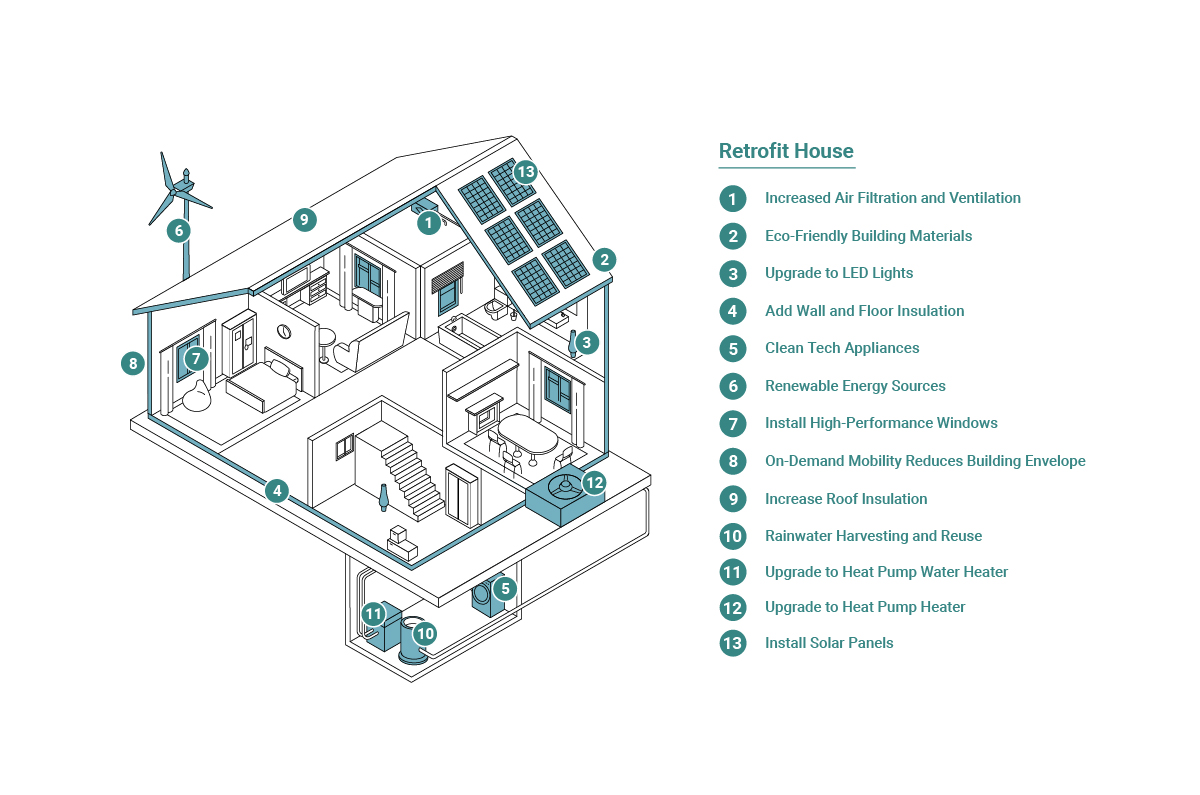
Canadian spotlight Okanagan Specialty Fruits, based in Summerland, B.C., grows novel tree fruit varieties developed through bioengineering. Its flagship product is the Arctic apple, which doesn’t turn brown when bitten, sliced, or bruised (but does turn brown when it begins to rot). The company holds global intellectual property rights in compositions and methods for regulating expression of polyphenol oxidase (PPO) genes to control enzymatic browning in tree fruits.

The Problem Livestock produce emissions through enteric fermentation and manure, as detailed above. The pattern of land use change also generates emissions. The Solution Cellular agriculture is a discipline that can transform yeast, bacteria, cell samples and fungi into novel forms of proteins that can serve as alternatives for dairy or lab-grown meat and fish. It has the potential to produce alternatives to livestock and dairy products that require less land and inputs. The lab-grown process is considered more sustainable since it uses less water and land to produce food and emits fewer greenhouse gases than a field of cows or barn full of chickens. And Canada has a plentiful supply of feedstock, particularly carbohydrates, starches, and sugars, which could be used for cell-based agriculture products.14 (We currently dispose of leftover starches from peas after its proteins are used to make plant-based meats. This could instead be fed to specially bred micro-organisms such as yeast, which could then be used to make the proteins normally found in dairy products). The Challenges High upfront costs make starting a cellular agriculture company difficult. Investor education has also been a barrier. Aside from a few specialized investment firms, entrepreneurs say most investors don’t sufficiently understand the nuances of food science to gauge the potential of the vertical. Funding amounts tend to be low, with shorter terms. Entrepreneurs say more patient capital is needed to grow their companies.

Canadian spotlight Cell Ag Tech is an Ontario-based cellular agriculture startup developing cell-cultured seafood, with a current focus on lean white fish. Cell Ag Tech was recently announced as a winner in Canada’s regional cellular agriculture competition, AcCELLerate-ON, for its work on scaling fish muscle stem cells in 2D and 3D. Earlier this year, Cell Ag Tech also entered into an agreement to collaborate with the Centre for Commercialization of Regenerative Medicine to develop a process for growing fish cells in bioreactors.

Recommendations: Canada’s time to lead

The Next Green Revolution depends on both putting ready technologies to work and responsibly developing the game-changing innovations that will define the future. Though other nations are rapidly mobilizing their own resources to accomplish these goals, few are as well-positioned as Canada to lead. The following actions will be key to catalyzing the investment needed to scale the Transformative Seven, as well as remove key barriers to their adoption. In the next phases of our report series, we’ll gain a better understanding of how technology (buttressed by policy) can be applied to support producers (especially small- and medium-sized farms), foster acceptance by consumers and be inclusive of all stakeholders.

Create a central funding body for research and development. Many of the most promising and advanced areas of Canadian agricultural research don’t fit within current funding categories. A more centralized system, operating in close partnership with academia and the private sector, such as in the United States Department of Agriculture, could develop a more holistic, nationwide view of where support and innovation is needed. The leadership shown by federal governments in creating the innovation super clusters provides a playbook for how Canada can super charge agri-food research and innovation.
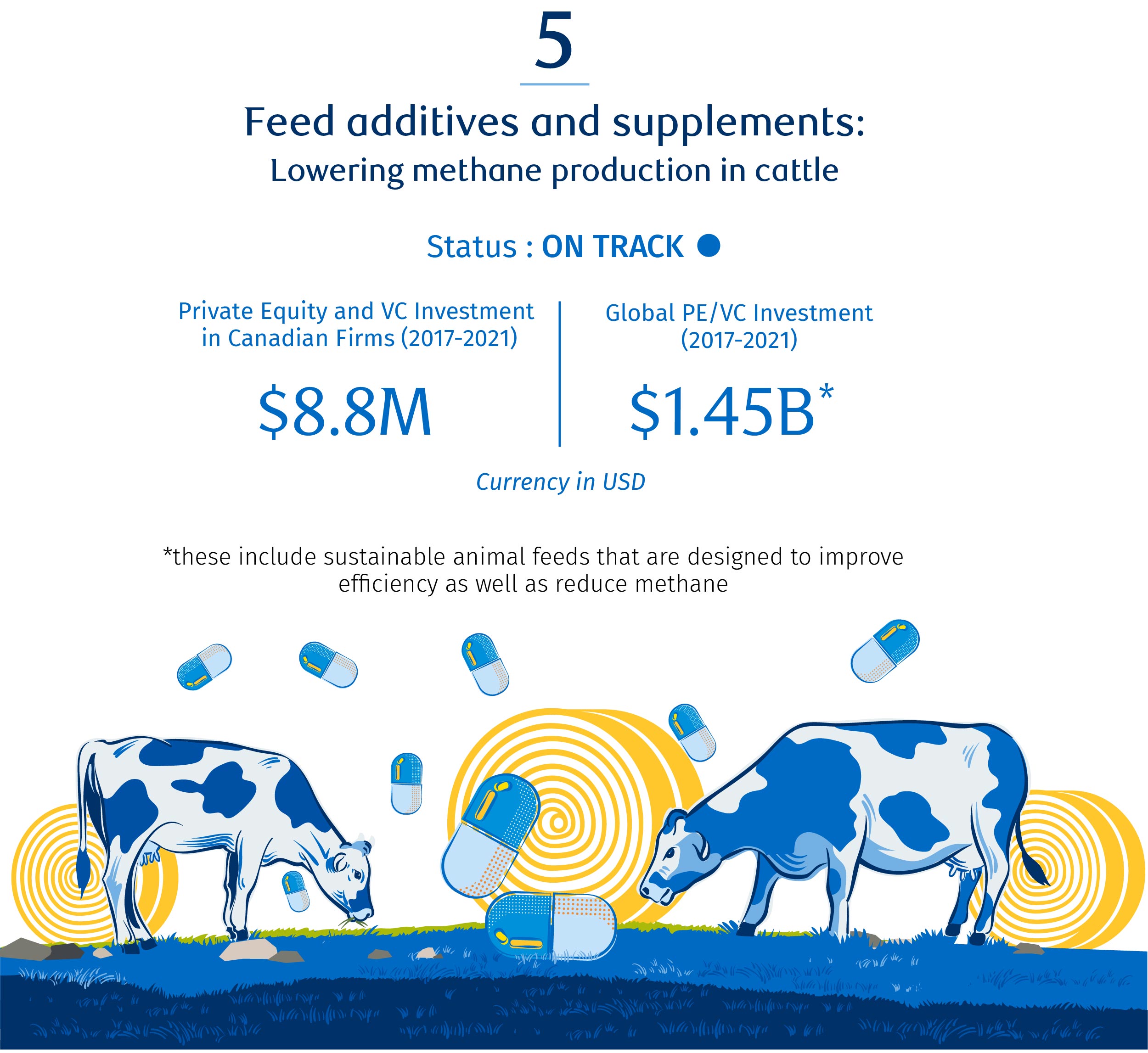
Enable commercialization of existing research. This will require increased funding for university tech transfer offices and programs. To unlock Canada’s innate strengths in research and development, we need to make it easier for researchers to take their work to commercial market. This includes streamlining crop science regulations that currently require extensive (and expensive) trials, and have discouraged some from pursuing development in Canada.
Marry agriculture and technology programs in post-secondary schools. Future food systems need more people with talents in data science, coding, and artificial intelligence—many of whom are currently drawn to the software industry. Efforts to draw more of this talent should begin early. Re-branding agriculture as a “cool” career may require local governments and business improvement associations to re-brand rural communities as desirable places to live—especially for immigrant populations with STEM skills. Collaboration with social scientists can ensure innovations are contextualized to the needs of farmers, accepted by consumers, and developed responsibly.
Create a Canadian Ag-Tech Silicon Valley. This hub for breakthrough ag-tech innovation should enable cross-silo collaboration among entrepreneurs, investors, researchers, communities, corporations and governments and carry the goal of incubating ideas and supporting the growth of start-ups and scale-ups. The hub should align public and private sector players around a common innovation ambition, focused on select priorities (such as the Transformative Seven technologies outlined above). An example of this is Rabobank’s Foodbytes! initiative. It includes a startup program that provides food and ag-tech startups with mentorship, commercial partnership, and investment opportunities.
Create innovative tax and financial incentives to spur more private investment. Accelerating private investment in Canadian ag-tech will mean thinking more creatively about the tax and financial incentives we have in place. We need to encourage the automation that will be key to our agricultural productivity and international competitiveness—and that will draw more capital to the technologies that will drive the future of low emissions farming. Expanding accelerated depreciation beyond tangible assets to include artificial intelligence and other ag-techs is one possibility.
Develop a comprehensive and transparent view of ag-tech investments that is easily accessible. This should include all of the innovation lifecycle. Data on private (venture capital and private equity) investment in startup companies is generally available except where funding rounds are not disclosed, but thorough data on business investment in agriculture R&D is difficult, if not impossible, to come by. The same can be said of ag-specific higher education R&D. Filling in these data gaps would give us a view of the technology landscape and help us understand where we need greater investment.
Build communities of early adopters among farmers. Farmers listen to other farmers. Much of the adoption of regenerative agriculture practices has stemmed from farmers seeing the successes of others—particularly those working with similar growing conditions. This helps ease farmers’ uncertainty about the effectiveness of technologies without risking their own operations. Independent demonstration areas are also powerful tools to prove the effectiveness of emerging innovations. Much of this knowledge transfer used to be performed by publicly-funded and independent agriculture extension programs. More recently, private sector companies have invested heavily in applied research programs to help farmers get best possible results from their products.
Make it pay. Forcing farmers to pay for emissions they already produce could add pressure to high food prices. A better approach is to compensate farmers for reducing them. Yet existing models like carbon credits are insufficient and place an unequal burden on the farmer. A national standard for measuring the impact of emissions-cutting activities, including a mechanism for measuring, reporting and verifying (MRV) carbon stored in soils, could be critical to compensating farmers and to empowering policymakers and financial institutions to mobilize support. This standard—also key to attracting investment—will need to be designed and regulated on a national basis and aligned internationally with our major trading partners.
Share the risk. For farmers, adoption of emissions-cutting technology adds more uncertainty to a business already weighted with risk. Governments and other companies in the agricultural value chain have an important role to play in sharing the risk burden. That’ll mean insuring against yield losses for farmers who adopt sustainable practices. For example, right now there is no incentive for sustainable agriculture under crop insurance schemes though these practices are proven to reduce the impact of flooding and drought. Crop insurers should be willing to adjust premiums to reflect these shifting risks.

For more, go to rbc.com/climate.

Download the Report

Download

Contributors:

RBC Trinh Theresa Do, Senior Manager, Thought Leadership Strategy Naomi Powell, Managing Editor, Economics and Thought Leadership John Stackhouse, Senior Vice President Colin Guldimann, Economist Benjamin Richardson, Research Associate Farah Huq, Senior Director, Content Strategy Darren Chow, Senior Manager, Digital Media Zeba Khan, Manager, Digital Publishing Aidan Smith-Edgell, Research Associate Kitty Wu, Intern Gwen Paddock, Director, Sustainability & Climate – Agriculture Brenda Bouw, Freelance Writer

Boston Consulting Group Keith Halliday, Director, Centre for Canada’s Future Chris Fletcher, Managing Director and Partner Sonya Hoo, Managing Director and Partner Wendi Backler, Partner and Director, BCG Centre for Growth and Innovation Analytics Youssef Aroub, Project Leader Pilar Pedrinelli, Consultant Rachit Sharma, Lead Knowledge Analyst, BCG Centre for Growth and Innovation Analytics

Arrell Food Institute, University of Guelph Evan Fraser, Director Deus Mugabe, Ph.D. Candidate, Plant Agriculture Dr. Jesus Pulido-Castanon, Post-doctoral Research Associate Emily Duncan, PhD Candidate

In addition to those cited in this report, we’d like to thank the following individuals for their insights:
    • Alice Reimer, Strategic Advisor, CDL
    • Alison Sunstrum, Founder, CEO CNSRVX-Inc
    • Jim Baker, CEO, Cultura Technologies (Volaris Group)
    • Simon Barber, Former Head, Asia Pacific Regulatory and Stewardship, Syngenta Seeds, Singapore
    • Wilf Keller, Vice President of Outreach, Agri-Food Innovation Council
    • Ray Price, CEO, Sunterra Group
    • Gary Haley, Chair, Haley Family Investment Trust
    • Jay Cross, President, Canadian Academy of Health Sciences; Professor, University of Calgary
    • Lenore Newman, Canada Research Chair in Food Security and the Environment and Professor of Geography, Simon Fraser University
    • Mark Thompson, Executive Vice President, Chief Corporate Development and Strategy Officer, Nutrien Ltd.
    • Michelle Nutting, Director, Agricultural and Environmental Sustainability, Nutrien Ltd.
    • Dan Heaney, Research Associate, Plant Nutrition Canada
    • Tom Steve, General Manager, Alberta Wheat Commission
    • Jason Lenz, Vice President, Alberta Wheat Commission
    • Dan McCann, CEO, Precision AI
    • Juanita Moore, Vice President of Corporate Development, GoodLeaf Farms
    • Janay Meisser, Director of Innovation, United Farmers of Alberta
    • Mauricio Alanís, Director, Sustainability Strategy and Partnerships, Maple Leaf Foods
    • Ryan Phillippe, Director, Corporate Development, Genome Canada
    • Josh Bourassa, Research Associate, The Simpson Centre for Food and Agricultural Policy
    • Elena Vinco, Researcher and Policy Analyst, The Simpson Centre for Food and Agricultural Policy
    • Guillaume Lhermie, Director, The Simpson Centre for Food and Agricultural Policy
    • Lejjy Gafour, President, Cult Food Science Corp.
    • Francis Rowe, CFO, Cult Food Science Corp.
    • Jane Church, Corporate Engagement Manager, Nature United
    • Tony Ward, Professor Emeritus, Department of Economics, Brock University
    • Dave MacMillan, CEO, Deveron UAS
    • Derek Eaton, Director of Public Policy Research and Outreach, Smart Prosperity Institute
    • David Hughes, President and CEO, The Natural Step Canada
    • Stuart Smyth, Associate Professor, College of Agriculture and Bioresources, University of Saskatchewan
    • Kristjan Hebert, Managing Partner, Hebert Grain Ventures
    • John Van Logtenstein, Vice-President, Dairy Lane Systems and DLS Biogas
    • John Walker, Walker Farms
    • Scott Walker, Walker Farms
    • Clyde Graham, Executive Vice President, Fertilizer Canada
    • Josh Pollack, Co-founder, CELL AG TECH
    • Valentin Fulga, Co-founder, CELL AG TECH
    • 1. Without change to current practices or market share, we
project
    • Canada’s current agriculture emissions could rise to 137 megatonnes by 2050
    • 2. Agricultural Institute of Canada, “An Overview of the Canadian Agricultural Innovation System.” 2017.
https://www.rbc.com/en/wp-content/uploads/sites/4/2025/03/AIC-An-Overview-of-the-Canadian-Agricultural-Innovation-System-2017.pdf
    • 3. The Times of Israel, “Israeli companies lead world in plant-based food tech investments — report,” August 2022.
https://www.timesofisrael.com/israeli-companies-lead-world-in-plant-based-food-tech-investments/
    • 4. Eco-Business, “Is Singapore poised to become Asia’s hub for alternative protein?,” August 2021.
https://www.eco-business.com/opinion/is-singapore-poised-to-become-asias-hub-for-alternative-protein/
    • 5. BBC Storyworks, “How technology is transforming Japan’s agriculture”
https://www.bbc.com/storyworks/future/the-technology-transforming-agriculture/how-technology-is-transforming-japans-agriculture
    • 6. Fast Company, “How the Netherlands became a plant-based protein powerhouse,” November 2020.
https://www.fastcompany.com/90573547/how-the-netherlands-became-a-plant-based-protein-powerhouse
    • 7. Nutrien, “2022 Environmental, Social ESG And Governance (“ESG”) Report,” 2022.
https://www.rbc.com/en/wp-content/uploads/sites/4/2025/03/Nutrien_ESG-Report-2022.pdf
    • 8. Global CCS Institute. “Facilities Database,”
https://co2re.co/FacilityData
    • 9. Canadian Biogas Association, “Canadian 2020 Biogas Market Report.” April 2021.
https://www.rbc.com/en/wp-content/uploads/sites/4/2025/03/Canadian_2020_Biogas_Market_Full_Report.pdf
    • 10. Columbia Climate School: State of the Planet, “How Sustainable is Vertical Farming? Students Try to Answer the Question,” December 2015.
https://news.climate.columbia.edu/2015/12/10/how-sustainable-is-vertical-farming-students-try-to-answer-the-question/
    • 11. UC Davis, “Cows and climate change: making cattle more sustainable,” June 2019.
https://www.ucdavis.edu/food/news/making-cattle-more-sustainable
    • 12. Breanna M. Roque, Marielena Venegas, Robert D. Kinley, Rocky de Nys, Toni L. Duarte, Xiang Yang, Ermias Kebreab, “Red seaweed (Asparagopsis taxiformis) supplementation reduces enteric methane by over 80 percent in beef steers,” March 2021.
https://journals.plos.org/plosone/article?id=10.1371/journal.pone.0247820
    • 13. CBC News, “How feeding cows seaweed could help P.E.I. meet emission targets and boost this business
    • Social Sharing,” November 2021.
https://www.cbc.ca/news/canada/prince-edward-island/pei-seaweed-feed-methane-emissions-climate-change-1.6228982
    14. Ontario Genomics, “Cellular Agriculture Canada’s $12.5 Billion Opportunity In Food Innovation,” November 2021.

92 to Zero is the latest report in RBC Economics and Thought Leadership’s climate series, building from the team’s flagship report, The $2 Trillion Transition.For decades, RBC has engaged with Indigenous communities and we continue to work with them on our journey toward progress and reconciliation. The Royal Commission on Aboriginal Peoples was a clarion call that led to The Cost of Doing Nothing and subsequent work, including A Chosen Journey. Through our Climate Blueprint we are committed to sustainability and accelerating the transition to Net Zero. In these initiatives, we are listening and learning and using our platform to amplify Indigenous voices.

It’s now clear that the national priorities of Net Zero and reconciliation with Indigenous Peoples are inextricably linked. In the same spirit, we expect RBC’s reconciliation journey will increasingly intersect with our climate priorities.

92 to Zero highlights the incredible value that Indigenous capital, knowledge and decision-making can bring to a Net Zero transition. We’ve recently launched a national initiative of “listening circles” led by former Assembly of First Nations national chief Phil Fontaine that this report will help inform and inspire—and lead to more from us in the years ahead.

Now, each of us must act to break down the ongoing systematic barriers that prevent the full realization of Indigenous capital, supporting reconciliation and climate action. We hope this report will propel us further down that path.

We acknowledge that RBC resides on the traditional and contemporary treaty, and unceded territories of Turtle Island (North America) that are home to many First Nations, Inuit, and Métis peoples.

Key Findings

  • Canada’s road to Net Zero will rely heavily on vital sources of capital held by Indigenous nations. RBC estimates Canada needs roughly $2 trillion in capital over the next 25 years, much of it from Indigenous sources—or unlocked by Indigenous partnerships, including ownership.
  • An Indigenous-led approach to the climate transition, and economic opportunities toward Net Zero, will be essential to economic reconciliation.
  • Specifically, to achieve Net Zero and economic reconciliation, Canada needs to leverage four forms of Indigenous capital:

Natural Capital: Indigenous lands hold vast resources essential to green energy systems, and will be essential to the clean tech revolution. At least 56% of advanced critical mineral projects, 35% of top solar sites and 44% of the better wind sites involve Indigenous territory.

Financial Capital: The growing wealth of Indigenous communities includes an estimated $20 billion in trust assets and up to $100 billion in outstanding land and other claims. This capital will be critical to “crowding in” billions of dollars in private and public clean energy investment for Net Zero initiatives.

Intellectual Capital: Incorporating Indigenous values and traditional knowledge in the transition will lead to more sustainable and profitable outcomes. It can establish Canada as a leader in regenerative techniques, the preservation of biodiversity, and nature based carbon solutions—a powerful advantage as Canada competes with other countries for capital to finance the energy investment.

Human Capital: Emerging young Indigenous leaders and entrepreneurs will be critical generators of the innovative thinking needed to fuel the green transition. And as the fastest growing youth cohort, Indigenous Canadians can help power a Net Zero workforce that will include valuable jobs in skilled trades, advanced technology, business ventures and more.

What is 92?

To redress the legacy of residential schools and advance the process of Canadian reconciliation, the 2015 Truth and Reconciliation Commission issued 94 calls to action. The 92nd dealt specifically with business and reconciliation.

We acknowledge that RBC resides on the traditional and contemporary treaty, and unceded territories of Turtle Island (North America) that are home to many First Nations, Inuit, and Métis peoples.

Indigenous communities can unlock green economic growth

For many Indigenous Peoples in Canada, braiding is a sacred act. It brings together seemingly disparate sinews, with the goal of building a stronger, more unified whole. Strands of hair, breakable on their own, become more resilient when braided together. Blades of sweet grass are woven and burned with sage, cedar, and tobacco, the ceremony strengthening the community, which in turn cares for the plant.

Similarly, to meet the generational challenge of climate change, Canada must weave together the critical strands of Indigenous capital to secure a durable Net Zero strategy.

This new approach is about much more than money. It includes natural capital—vast portions of critical mineral, solar and wind developments depend on access to Indigenous lands—along with growing Indigenous wealth (financial capital), traditional Indigenous knowledge (intellectual capital) and powerful Indigenous entrepreneurship and talent (human capital). Each is required to strengthen the whole.

To unleash this capital, Canada will need new tools for clean energy development. That means establishing stronger corporate commitments and incentives for Indigenous partnership, greater sharing of project benefits, and financeable models of Indigenous equity participation. It means developing investment criteria that incorporates Indigenous perspectives and more intentional development of Indigenous entrepreneurs and youth leadership.

Above all else, it means establishing a new approach to partnership, one that reinforces the role of Indigenous rights, leadership, decision-making and consent.

These concrete actions will pull growing sources of Indigenous capital toward Net Zero. They’ll also mobilize critical private capital, by building a foundation of predictable development, better environmental outcomes, and expansive social impact.

Meaningful partnerships can’t be rushed. But the demands of the Net Zero transition are immediate—and there’s only one opportunity to get it right.

The onus now is on everyone to move forward together.


Natural Capital: The path to Net Zero winds through Indigenous land


Canada comes to the global climate challenge with a unique set of advantages. Its landscape includes vast quantities of both conventional and renewable energy resources—assets that, while enviable, bring challenges. Even as the country continues to rely on oil and gas, and works to more sustainably produce it, it’ll need to begin harnessing the resources to power the clean economy of the future.

And these resources are attached largely to Indigenous lands. RBC research shows at least 56% of advanced critical minerals projects involve Indigenous territory. Top opportunities for renewables development also overlap with Indigenous lands, including at least 35% of top solar sites and 44% of better wind sites. And Indigenous rights exist over many other territories that will require engagement.

To include these assets in its Net Zero strategy, Canada will need a new model for Indigenous partnerships—one that begins with meaningful engagement and consent.

Indigenous land contains key resources

  • At least 56% of the $60 billion in new critical mineral advanced projects involve Indigenous lands, including 26% within 20 kilometres of Indigenous reserves, settlement lands, and other title-like areas, and another 30% on unceded territories where Indigenous rights are asserted.
  • At least 35% of the top sites for the required $30 billion in solar development are near title-like lands.
  • And at least 44% of the better sites for the needed $135 billion in wind development are near title-like lands.

Indigenous communities have ‘a say’, but not decision-making power

Greater legal and political recognition of land rights has empowered Indigenous voices at the negotiating table for development projects, particularly in unceded and modern treaty territories.

These advancements follow decades of government policy that removed Indigenous Peoples from decision-making and deprived them of long-held land and treaty rights. This created a cycle of underinvestment, poverty, and trauma that persists in many communities today.

How Indigenous Peoples were isolated from decision-making

Early cooperation between distinct and sovereign settler and Indigenous groups created mutually beneficial trade and strategic military alliances that aided European survival on the land. But over time, official government policies of land dispossession, paternalistic suppression, and cultural assimilation took hold. The government never fully honoured original agreements and it removed Indigenous Peoples from the decision-making table.

It’s now clear that the national priorities of Net Zero and reconciliation with Indigenous Peoples are inextricably linked. In the same spirit, we expect RBC’s reconciliation journey will increasingly intersect with our climate priorities.

92 to Zero highlights the incredible value that Indigenous capital, knowledge and decision-making can bring to a Net Zero transition. We’ve recently launched a national initiative of “listening circles” led by former Assembly of First Nations national chief Phil Fontaine that this report will help inform and inspire—and lead to more from us in the years ahead.

Now, each of us must act to break down the ongoing systematic barriers that prevent the full realization of Indigenous capital, supporting reconciliation and climate action. We hope this report will propel us further down that path.

We acknowledge that RBC resides on the traditional and contemporary treaty, and unceded territories of Turtle Island (North America) that are home to many First Nations, Inuit, and Métis peoples.


As Indigenous communities regain rights and sovereignty, business methods are inching closer to the true spirit of initial cooperative agreements between Indigenous and settler societies, or

Treaties, that guided the sharing of land and living together in parallel.

But conflicts continue to erupt, including public demonstrations against development companies. While the courts have signaled a growing willingness to set precedent for consultation, they’ve also established that Indigenous rights are not absolute.

Government often navigates difficult decisions in the overall national interest. But this maxim has led to problematic policy and flawed corporate approaches to Indigenous engagement. Too often, Indigenous Peoples have been given only checkbox approval on planned projects that don’t respect their community values, governance, timelines, or consensus-building processes.

Resulting clashes have led to cancelled projects, runaway costs and timelines, and rushed planning phases that fail to leverage extensive Indigenous knowledge of land stewardship.

An oppositional approach is one way to pursue energy development. But it’s not the optimal one. Resulting court challenges, broken social trust, delays, and investment uncertainty pose a sizeable threat to Canada’s climate ambitions.

Striking true partnership

Some Indigenous leaders have told Canada’s business community they’re thinking about this in the wrong way. Rather than represent a project risk, Indigenous Peoples could bring something unique to the table. They can potentially improve certainty and returns, offer deep location-specific knowledge and better environmental and social outcomes. And as the rights of Indigenous

Peoples continue to draw international attention, their reintegration into clean energy development could emerge as a competitive strength.

“I think a lot of proponents are going to have to shift their mindset from thinking of Indigenous people as a risk to a possible source of capital and an enhancement to their project.”

Mark Podlasly
Director Economic Policy
First Nations Major Projects Coalition

To realize it, Indigenous communities must be engaged as true partners. That means including their voices, values, knowledge and decision-making from the earliest stages of a project. Sufficient time needs to be allotted for this process, similar to the months or years afforded for Western development work.

Meaningful engagement and consent is an ongoing exercise of building trust, sharing information, and acting to realign the terms of the partnership based on evolving priorities. It also includes the possibility of saying no—some projects will not align with community values, and they may have to be rerouted or in some cases abandoned.

The power of Indigenous equity

Indigenous equity ownership of new energy projects is rising. Equity improves the risk profile of projects, both through ongoing information sharing and the ability of both parties to shape their direction.

Equity participation can build intergenerational wealth and guide land stewardship. This aligns with the long-term sustainable world view of many nations and in particular, the Haudenosaunee (Iroquois) Seventh Generation Principle, where decisions are partly determined by the impact they’ll have on the next seven generations.

By contrast, near-term commitments in many of today’s impact benefit agreements (around Indigenous procurement, employment, community investment or royalties) are increasingly out of sync with the priorities of Indigenous communities, especially in light of the valuable sources of capital they control.

Equity is not a universal solution. Some communities may not have the risk appetite or expertise to manage equity investment. Infrastructure development is complicated and risky, and project finance lenders may be wary of significant partners that lack major construction or operational experience. Certain projects that focus on transition fuels or non-dominant abatement technologies—like oil, natural gas, or carbon capture, utilization, and storage—could carry long-term risks.

And equity isn’t always an option for the Indigenous communities that want it. Even communities that have revenue-generating activities may find a portion of the equity contribution is unfinanceable by private lenders. For communities that lack any revenue-generating activities, the equity option is even further out of reach. Project proponents, financial institutions, and governments need to eliminate this equity financing gap. Greater capacity building and advisory services are then needed to support communities in making informed choices between different partnership arrangements, and negotiating the best terms.

“Our nation is not new to industrial development […] essentially we’ve sat on the sidelines and witnessed the destruction of our territory, our environment, and our cultural resources to being active partners within a process where we had a seat at the table.”

Chief Crystal Smith
Haisla First Nations Chair
First Nations LNG Alliance


Financial Capital: Indigenous leadership will help fuel the $2 trillion transition


Large Canadian firms with $8 trillion in global assets have committed to Net Zero, yet annual spending on green projects is still far short of the $80 billion per year required. Indigenous financial wealth isn’t at the scale needed to lead financing of the $2 trillion Net Zero transition. But with more than $20 billion in trust assets and up to $100 billion in outstanding land and other claims, it can nevertheless make a significant impact.

The bigger opportunity rests in the power of Indigenous financial capital and consent to crowd in the larger private funding needed for Net Zero—by derisking projects, boosting returns, improving environmental outcomes, and increasing social acceptance. Mobilizing investors to support Indigenous-aligned responsible investment will accelerate this process while also enhancing economic reconciliation.

Indigenous assets cycle back into communities

Greater recognition and application of Indigenous land rights have added to the financial wealth of Indigenous communities. These additions stem partly from land claim settlements or compensation for past violations of treaty or other rights. With over 250 specific claims awaiting negotiation and over 160 currently under review, as well as ongoing litigation and land claims, further increases in these assets can be anticipated.

Distinct from individual wealth, these assets are for the benefit of the community, supporting spending on physical, social or cultural infrastructure, economic development, or disbursements to members. They are increasingly being used to decarbonize local communities, including Net Zero projects in the built environment, renewable energy developments or transmission lines that bring cleaner electricity to diesel-reliant remote communities, or equity stakes in sustainable projects such as transition fuel facilities or wind and solar farms.

The Senákw project on Squamish Nation reserve land in Vancouver—a 12-tower, mixed-use development—is the largest First Nations economic development project in Canadian history and Canada’s first large-scale net zero housing development . To be developed in partnership with a private developer, the Nation is contributing the land. Costing $3 billion to construct, it could generate $8-12 billion in revenue for the Nation over the leasehold life

While growing, Indigenous financial assets remain undersized, a result of the historic non-recognition of Indigenous rights and suppression of the Indigenous economy. There’s also significant variation in the financial wealth held by communities based on treaty status (unceded, modern, or historic), location (urban or remote) and proximity to major resource projects. For example, the Squamish, Musqueam, and Tsleil-Waututh nations have major developments on their traditional unceded territories around and within modern day Vancouver. By contrast, a limited sample of 500 First Nations from 2015 to 2016 showed 50% had revenues below $3 million, whereas the top nation earned almost $100 million.

Formally recognizing the value of Indigenous partnership

Indigenous leaders can provide the greatest long-term certainty around infrastructure development. And Western developers and scientists are starting to recognize the value of Indigenous knowledge in project design.

Governments and leading project sponsors need to financially recognize the value Indigenous partners bring to the table. Fair compensation will lead to a growing Indigenous financial asset base that can be invested back into community wellbeing and position nations for Net Zero investment. That means finding new valuation models that go beyond lands leased or rights-of-way. Right now, communities that seek an equity share after the risky construction phase often purchase a stake in a more valuable project—but at a higher cost. This is despite their active participation in helping to de-risk it from the beginning. In terms of traditional knowledge, communities are often reimbursed for their time or monetary outlays, but not necessarily for their intellectual property as ‘consultants on the land’. Appropriately classifying these features as accretive to project returns may lead to their monetization, helping to close the Indigenous financial asset and equity financing gap.

Indigenous-aligned responsible investment

Successful Indigenous communities are investing in financial products consistent with their cultural values and using activist strategies to push companies to do better. They’re scaling their impact and building capacity through partnerships with like-minded investors. The National Aboriginal Trust Officers Association (NATOA), a resource and training organization, and Share, a responsible investment organization, have created the Reconciliation and Responsible Investment Initiative. It seeks to mobilize Canadian investors to “… use their voices and their capital to promote positive economic outcomes for Indigenous peoples including through employment, support for Indigenous entrepreneurs, increased partnerships with Indigenous communities and respect for Indigenous rights and title”10.

There’s a growing understanding that Indigenous entrepreneurs and communities could be a valuable focus for impact investing approaches. Also, that Indigenous factors, like Indigenous project co-development or Indigenous say in corporate governance, may be important to the overall performance of companies and projects. But while intentions are on the rise, the tools and regulatory framework to mobilize finance remain in the early stages.

  • The ESG standards increasingly being deployed across capital markets have largely omitted Indigenous priorities and perspectives, and were developed without Indigenous input.
  • Too often, Indigenous issues are considered an “S” factor in ESG modelling, which overlooks the singular legal foundations of Indigenous participation, as well as the unique environmental nature of Indigenous-led or -guided development.
  • The $1.3 trillion dedicated sustainable equity fund market has no funds with an explicit focus on Indigenous issues.
  • Investor demand has been insufficient to establish investment products aligned with Indigenous priorities.
  • Concrete business commitments to Indigenous issues are not significant enough—or disclosed and verifiable—to build diversified products.

As the investment environment changes, corporate and investor inaction on climate and Indigenous priorities becomes increasingly salient to the bottom line.

“Investors are going to need to see this as not as some sort of forecasted or predicted risk. They’re actually going to need to see climate change as having material impact on assets that they own..”

Joseph Bastien
Share
Reconciliation and Responsible Investment Initiative


Intellectual Capital: The power of Indigenous land stewardship and knowledge


Indigenous capital is more than natural and financial capital. Recognition of the value of Indigenous voices and knowledge can be a powerful driver of both economic reconciliation—and growth.

Generations of traditional Indigenous knowledge have shaped an approach to land management that ensures the long-term sustainability of ecosystems. Each community specializes in preserving the delicate interrelationships between people, plants, and animals in its traditional territory. This approach is holistic, anchored in the interconnectedness of the environment, well-being and culture. It’s about the principle of reciprocity and sustainability. It is not rigid, but evolving.

As Canada seeks to build a prosperous economy while also minimizing environmental damage, preserving biodiversity, and developing nature-based carbon sinks for climate management, Indigenous knowledge and ways of knowing will become critical competitive advantages.

Leveraging these assets can also extend economic opportunities to Indigenous Peoples that haven’t traditionally benefitted from land rights.

But it’ll mean embracing a different world view.

Two-eyed seeing leads to better outcomes

Etuaptmumk, or two-eyed seeing, is a Mi’kmaq principle that calls for seeing from one eye with the strength of Indigenous stewardship, knowledge, and ways of knowing, and from the other with the strength of Western tools and systems. Bringing both perspectives together can create thoughtful, and more profitable Net Zero solutions.

Uniting place-based Indigenous knowledge with Western scientific methods improves the outcomes of environmental studies for development projects. By itself, the traditional scientific approach may only offer a narrow window into the local environment and require advanced extrapolation—for instance, on the baseline migratory patterns of fish or how to restore a reclaimed project site to its original ecosystem from decades ago. Indigenous knowledge, acquired over centuries of climatic variation, can augment or contextualize this information, producing more robust conclusions. Similarly, Western methods can complement traditional knowledge. For example, tracking devices on at-risk local species can expand information on and understanding of their movements.

“[Mi’kmaq Ecological Knowledge] is a cumulative body of knowledge that is passed on from generation to generation, Elder to child and is dynamic. MEK draws upon the ever changing natural world—as ecological knowledge changes over time, and new experiences bring forward new understandings regarding the Earth’s ecology, the Mi’kmaq will continue to learn, grow and share, just as they have done for over ten thousand years.”

Mi’kmaq Ecological Knowledge Study Protocol
Assembly of Nova Scotia Mi’kmaq Chiefse

Federal laws now require incorporation of Indigenous knowledge in the environmental assessment process, with interim guidance saying that traditional knowledge should be viewed as providing a framework “as complementary and influential information alongside Western science”.

But Indigenous knowledge does not yet have an equal place in environmental studies. Whereas Western science is afforded months, or even years, to do its work, assessment processes now often only have a short timeline for Indigenous input near the end. Indigenous communities often do not have this information readily available as it must be collected from knowledge-holders in the community, and they may be reluctant to share if trust is not strong. Others may want to produce their own traditional knowledge-based studies.


Human Capital: A new generation of leaders is driving innovation


Stronger say over local project development, growing wealth, and recognition of the value of Indigenous knowledge is empowering a new generation of Indigenous Peoples and entrepreneurs. The Indigenous economy, estimated at over $30 billion per year in 2016, is outpacing growth in the overall national economy and is poised to grow to $100 billion by 2024.

Driving change is a growing group of young, educated Indigenous leaders. These leaders are advancing new models of economic reconciliation and development. Supported by stronger land rights and growing capital, they’re pursuing an Indigenous-led approach to sustainable economic development that connects investment and community prosperity. They’re building networks with other Indigenous leaders past and present and often acting through increasingly influential Indigenous-led business and advocacy organizations, such as the Canadian Council for Aboriginal Business, First Nations Major Projects Coalition (FNMPC), Indigenous Resource Council, or National Aboriginal Capital Corporations Association (NACCA).

Many are heads of major economic ventures and are building a new model for the upcoming generation, which still sees limited Indigenous representation in corporate Canada. In 2020, only 0.3% of corporate board seats were held by Indigenous persons, despite their 4.9% share of the population.

Corporate Canada is increasingly seeking Indigenous perspectives and representation. As it does, it will be important that it doesn’t hoard Indigenous talent, especially from remote communities. Corporations that have a clear social purpose and use innovative models to share Indigenous talent with their communities are more likely to be successful.

Local talent can be a competitive advantage

The Net Zero projects brought by Indigenous leaders to their communities will have a powerful pool of human capital to draw from. And many communities are interested in economic partnerships that include long-term employment benefits. This means higher-value Indigenous employment and skills development that outlives the project, and includes opportunities at all levels including planning, design, construction, management, and operations.

This is also in the interest of project sponsors. For one, it’s a sign of the true partnership Indigenous leaders will be looking for when selecting collaborators. Additionally, in a world of acute labour shortages and fragile, cost-pushing global supply chains, a network of trusted local employees and suppliers delivers value. Building these networks takes time. But Canada’s energy system transition will be an intergenerational project.

The Net Zero transition can benefit from an Indigenous workforce that’s younger than for Canada as a whole. Indigenous youth are the fastest-growing population cohort, with their numbers expanding four times quicker than the non-Indigenous population. Indigenous people are increasingly pursuing postsecondary qualification, especially women, 52% of whom had a postsecondary qualification in 2016. Indigenous youth value their languages, identity and culture, and are confident in their foundational skills—including critical thinking, communication, or collaboration, which are all central to the future of work. The already strong employment of Indigenous people in Canada’s resource economy and skilled trades occupations, and greater proximity to remote areas, means an easier transition to the skills needed for green infrastructure and clean energy.

Meanwhile, Indigenous entrepreneurs are developing new businesses at nine times the Canadian average with 50,000 Indigenous-owned businesses across diverse Canadian sectors. Many of these businesses are promoting Indigenous values and knowledge, from Cheekbone Beauty—founded by Jenn Harper, an Anishinaabe woman whose line of high quality sustainable cosmetics is giving back to the community—to the SIKU mobile app, an Inuit-led social network to help hunters share real-time knowledge of ice conditions and animal behaviour.

Moving forward with reconciliation also means not hiding from the past or the impact that endures in so many Indigenous communities. All Canadians, including Canadian business, have a greater role to play in reconciliation, including supporting new approaches to education and pathways to employment, as we explored in our 2021 report, Building Bandwidth. Whether it’s apprenticeship and co-op opportunities for Indigenous students or capital for young entrepreneurs, a skills-centric approach to the climate transition will be critical.

“I think about the advancements [that Indigenous groups have] and it’s a small group thinking outside the box, thinking about innovation. What we need to figure out and address is how to bring everyone with us and continue to strengthen capacity in our communities.”

Chief David Jimmie
CEO at Squiala First Nation,
President Stó:lō Nation Chiefs Council

Capacity planning and supports are needed. Indigenous-led organizations are providing some of that—in addition to NATOA, First Nations Major Projects Coalition (FNMPC) and others, AFOA Canada provides capacity development in Indigenous management, finance, and governance. The Indigenous Leadership Development Institute Inc. (ILDII) builds leadership capacity in Indigenous people with specific training. But greater access and new partnerships will be critical.

More financial innovations are helping address the longstanding capital gaps between Indigenous communities and the rest of the country. It would take about $83 billion in capital to close the financing gap based on 2013 estimates. But Indigenous entrepreneurs still face barriers that other Canadian entrepreneurs don’t. Limits from the Indian Act and government underinvestment in assets continues to constrain the use of homes or other sources of collateral for conventional lending.

Innovative approaches can often work around this, but the complexity can scare off some lenders, or cause significant risk aversion in Indigenous lending. And with the need to access multiple government, Indigenous organizations, and private programs to obtain financing, application processes and timelines can be complex and time consuming.


A Way Forward


In her book, Braiding Sweetgrass, Robin Wall Kimmerer describes the propagation of sweet grass as growing not from the wind or animals but by underground root systems called rhizomes. Having long survived unseen, the Indigenous community is now emerging with strength and taking hold of prosperity grounded in recognition of the essential strands that nourished it: natural, human, financial, and intellectual capital.

To get to Net Zero, Canada will need to bring this Indigenous capital together with non-Indigenous capital through positive intent and deliberate action. If this is done right, it can promote reconciliation and a prosperous Net Zero future for everyone.

Here are some key questions Canadians need to address:

  • What are the steps of engagement that project proponents must develop with Indigenous communities to achieve and maintain consent for development, given evolving definitions of consent and community-specific priorities?
  • How can Indigenous communities proactively communicate their internal governance structures, preferred engagement processes, and general posture or conditions for clean energy and infrastructure development?
  • How can better equity participation models be developed to encompass the wide range of assets, ambitions and priorities across Indigenous communities?
  • How can non-Indigenous and Indigenous-led financial institutions and governments fill gaps in the project financing needed to ensure meaningful Indigenous ownership?
  • How can international ESG standards and metrics be adapted to incorporate Indigenous perspectives and Canada-specific context, including legal rights framework?
  • What are the best practices for meaningfully hearing and integrating Indigenous knowledge and perspectives in project decision-making processes as well as broader economic development strategies?
  • How can Indigenous communities be supported in projecting the labour supply, skills, or supplier network needed to actively participate in economic development opportunities?

For more, go to rbc.com/climate.

Download the Report

Download

Contributors:

  • John Stackhouse, Senior Vice President
  • Cynthia Leach, Assistant Chief Economist
  • Alanna La Rose, Manager, Strategic Partnerships
  • Colin Guldimann, Economist
  • Darren Chow, Senior Manager, Digital Design
  • Naomi Powell, Managing Editor, Economics and Thought Leadership

The New Climate Bargain is the latest report in RBC Economics and Thought Leadership’s climate series, building from the team’s flagship report, The $2 Trillion Transition, which was launched in October 2021. This climate series is designed to inform and inspire Canadian prosperity, while advancing RBC’s ongoing commitment to speak up for smart climate solutions, a key pillar of RBC’s Climate Blueprint.


Climate change, meet energy security

Russia’s invasion of Ukraine is a cataclysmic moment for global energy markets. As governments and consumers grapple with energy shortages and high gas and power bills, climate change policies are being thrust into competition with energy security.

The old energy order is giving way to a new, disorderly one as Europe and Asia seek alternate supplies to replace Russian exports. Moscow’s ploy to exploit Europe’s energy vulnerability will not be forgotten in a hurry, and has accelerated two contradictory responses: rapid decarbonization and a scramble to raise fossil fuel production at least in the short term.

The dichotomy underscores a hard truth: short of major additional action, oil and gas will likely remain critical and contentious energy sources for longer than some think.

This poses some critical questions for the West:

Should Canada and the U.S. raise production significantly in the short term to cool prices?

How does higher output square with their ambitious emissions reduction plans?

If governments fail to balance climate action and energy security, will high energy costs and emissions erode public trust?

Canada can still reach its 2050 Net Zero targets, but it may not be a linear journey.The Canadian government has called for more oil and gas production to help ease the global crisis in the short run, while maintaining a firm commitment to competitive and decarbonized oil and gas in the long run.

Our research shows both goals are within reach—but at significant cost. Canada can still reach its 2050 Net Zero targets, but it may not be a linear journey. There isn’t a moment to lose. Policy action over the next 24 months must chart Canada’s climate-and-energy path to Net Zero by 2050.


Key findings

Canada’s oil and gas sector can support near-term energy security while advancing climate action, but will need regulatory certainty and support at all levels of government.

Oil sands and conventional producers could raise production by up to 500,000 barrels per day from 2021 levels.


This could add 9 million tonnes of greenhouse gases per year, costing at least $1.5 billion annually to abate—but bringing potential net benefits of $10.5 billion annually. Critically, if Canadian barrels displace those of other producers, there would be no additional global emissions.

Meeting climate targets despite new production will demand significant investment in methane reductions, as well as electrification and carbon capture across industries.

Cutting emissions 40% from current levels in the oil sands by 2030 will likely require $45 billion to $65 billion in capital spending between 2024 and 2030, peaking at about $9 billion per year mid-decade.

Full upstream decarbonization with carbon capture, utilization and storage (CCUS), a critical emissions-reduction technology, will require oil prices averaging roughly US$50 WTI through 2050.

A deliberate approach to deploying decarbonization technology in the oil sands is needed to avoid over-investing in costly solutions. CCUS should be viewed as just one tool at Canada’s disposal.


CHAPTER 1

Oil is here for the long haul

The journey to decarbonization was never going to be smooth. But it’s turning out to be a highly disruptive economic and political event.

While energy security and climate change have long been on a collision course, Moscow’s aggression has brought the conflict to a head. Early indications suggest at least 3 million barrels per day of Russian oil could be shut in as buyers stay on the sidelines. In the longer term, a bigger portion of Russia’s 11.7 million bpd production could be challenged in the face of oil majors’ exits and as Moscow becomes an international pariah.

The Russian invasion has prompted calls to cut oil and gas demand by accelerating investments in clean energy technologies, a move that could blunt bad actors’ ability to hold energy markets hostage. But most countries would struggle to switch their energy sources rapidly over the next decade.

For example, zero-emission vehicles (ZEVs) accounted for just 5.6% of Canadian light vehicle registrations in 20211. Given this modest starting point, it would take a Herculean effort to reach the ZEV mandates set out in Ottawa’s recently announced Emissions Reduction Plan (ERP). The mandate requires at least 60% of all new light-duty vehicle sales be ZEVs in 2030. Even if Canada meets that ambitious target, 84% of light vehicles will still run on gasoline by the end of the decade

Russia’s actions in Ukraine have shocked energy markets but it’s still too early to know if the world will double-down on investments in renewable energy or lean on fossil fuels to manage the shortages. Most likely, both will see a wave of new investment.

Early estimates suggest global oil and gas capital expenditures will increase 11.6% year-on-year to US$533 billion in 2022. They’ll rise another 4% in 2023, before returning to pre-pandemic levels in 2024, according to Fitch Solutions.

So far, high fossil fuel prices have done little to curtail demand, at least in North America. While renewable energy investments are expected to rev up too, in Canada, there’s a renewed push for more oil production and a call for more pipelines. In the U.S., shale basins and Middle East oilfields are preparing to bring back mothballed rigs.

And the world may be falling back into old consumption patterns. Germany plans to build LNG terminals even as it accelerates investments in renewables, while the IEA has recommended a temporary switch to coal and oil-fired electricity to wean the European Union off Russian gas. Both would add to, rather than cut, emissions.

The hurried response is aimed at protecting consumers from price spikes. Persistently high energy prices are cascading across energy-intensive industries, raising prices of staple commodities and denting the budgets of vulnerable households and small businesses. In such an environment, energy accessibility and affordability usually trump climate considerations for consumers.

There are already signs that government resolve is weakening: Germany, California, and British Columbia, usually climate leaders, are offering subsidies to offset high gasoline and power prices.

So far, high fossil fuel prices have done little to curtail demand, at least in North America. Consumers have room to absorb higher prices, since US gasoline costs are still nearly a full percentage point lower as a share of personal consumption expenditures than early in the 2000s, and Canadians have amassed major savings stockpiles during the pandemic.

While there is regulatory and investor pressure on energy suppliers to rein in direct emissions (Scope 1) and indirect emissions from purchased electricity (Scope 2), governments have tiptoed around the equally significant challenge of altering consumer behaviour.

Globally, explicit and implicit fossil-fuel subsidies primarily focused on the consumer stood at US$5.9 trillion in 2020, or about 6.8% of GDP. And they’re expected to rise to 7.4% of GDP by 2025, according to the International Monetary Fund. Consumer behaviour trends also suggest preference continues to take precedence over climate considerations: sales of SUVs soared 10% and accounted for 45% of all car sales last year, adding 120 million tonnes of CO2 annually.

Taken together, these indicators suggest oil demand will rise rather than fall in this decade. The IEA’s short-term forecast pegs demand for oil at 104 million barrels per day in 2026, compared to around 99.7 million this year. Production growth over the next few years will be led by the United States, Saudi Arabia, UAE, Iraq and Brazil.

Absent greater action, rising investment in clean energy doesn’t necessarily mean a decline in traditional energy sources.Canada’s contribution to higher output is also baked into the pie. The Canada Energy Regulator expects domestic production, led by the oil sands, to peak at 5.8 million bpd by 2032, before falling to 4.8 million bpd in 2050, assuming action to reduce GHG emissions continues at its current pace. If that’s the case, emissions would mostly rise, despite improvements in oil sands efficiency (which has fallen by a third since 1990.)

Surging global energy demand

Energy demand over the past four decades has grown around 1.75% annually.
With global population set to rise by another 2 billion people by 2050, expect that demand to surge again. As a base case, the IEA projects energy demand will grow 1% annually over the next three decades.


While renewable energy consumption is forecast to lead growth with a 3.2% annual increase between 2020 and 2050, oil demand is expected to rise by 0.5% and natural gas by 1.3% annually. Absent greater action, rising investment in clean energy doesn’t necessarily mean a decline in traditional energy sources.

Still, a bullish scenario for oil markets is far from certain. The IEA’s less optimistic scenario pencils in a 25% decline in oil demand, with prices averaging US$64 per barrel. However, if a greater push emerges to get to Net Zero, prices drop as low as US$24. Net Zero production will be a prerequisite to sell into that shrinking oil market.

The trouble is, this base case for fossil fuel demand is at odds with climate goals.

To have a 50% chance of meeting a 1.5°C warming target (the stretch goal for the Paris Agreement), the world will need to leave 60% of the world’s remaining oil and gas, and 90% of its coal in the ground2.That’s twice as much as a 2° scenario, and suggests we’ll need to hit peak global production soon—certainly within the decade.

Compared to 1.5°, 2° could be even more destructive for the planet, with twice as many plants and animals seeing their habitats diminish, large swathes of sea coral becoming extinct, and millions more people facing heatwaves, floods, and water scarcity3.

Against that bleak backdrop, Western oil production should not continue unrestricted no matter how acute the energy security imperatives. To resolve that tension, new Western production must displace other sources, to stabilize global emissions (including Scope 3 emissions that include an organization’s upstream and downstream emissions), and policymakers must redouble efforts to drive down oil demand.

Canada has the tools and technologies needed to rapidly deploy renewable power, electrify buildings and transport infrastructure, and, in some cases, industry. But managing the impact of intermittent renewables and the high cost of some alternatives will require careful planning, too.

But displacing development of fossil fuel resources elsewhere will be more challenging. Western economies need to be on the same page, targeting a growing Western share of oil production and falling overall oil demand. And they’ll need to agree to pay a premium for oil from climate-compliant producers.

Canada and the U.S. should pursue a North America energy security alliance that secures both conventional energy, and the underlying resources for energy transition. Elements of such a strategy include long-term contracts with U.S. refineries that provide certainty for Canadian oil producers to invest in decarbonization, maintenance of existing pipelines and support for power transmission lines.

Canada must ensure it receives consideration for its stability and energy decarbonization efforts. Long-term contracts could seek to put a floor on oil prices at levels that support decarbonization investments in Canada, and reduce the impact of extremely high oil prices for US consumers.


CHAPTER 2

Canada’s role in ensuring energy security

Energy is a critical sector for Canada. Oil and gas extraction and support activities, refining, distribution and transportation, could account for close to 10% of Canadian GDP in 2022. In addition to directly employing 178,500 Canadians, the industry supported 415,000 indirect jobs in 2020.

Resource-rich provincial governments benefit from royalties, which are expected to total at least $18 billion in 2022, up 50% from 2021 due to high energy prices and fully paid-down projects. 4

Given its sizeable resources, Canada can play a critical role in ensuring global energy security—that both addresses short-term energy shortages and burnishes Canada’s status as a soft power whose resource wealth can neutralize non-democratic forces. The challenge is to do so without threatening our climate goals.

First, the good news. Canada can boost oil and gas exports to the U.S., which, in turn will raise the U.S.’s ability to expand energy supplies to the rest of the world.

We estimate that Canada can raise production by as much as 500,000 barrels per day through a combination of oil sands and conventional oil production to overcome supply deficits over the next year.

While Canada’s exports are already at near record levels with an average of 3.76 million bpd in 2021, U.S.-destined pipeline capacity stands at more than 4 million bpd.

Over the past few years, Canadian pipeline operators have invested in decongesting their systems to optimize capacity, but further notable increases may require new lines, according to industry.

But under a realistic production forecast, that may not be necessary. The Canada Energy Regulator’s latest forecast of 5.3 million bpd of pipeline and rail capacity by 2050 should be sufficient to handle Canadian production.

Around 1 million bpd of total rail loading capacity suggests that, in a pinch, current oil export capacity can support near-term expansion. However, railway companies will be challenged to supply specialized rail cars and juggle demand from agriculture, food and minerals producers already struggling with supply chain challenges in order to accommodate higher oil shipments.

Canadian takeaway capacity is sufficient

Source: Canadian Association of Petroleum Producers, Canada Energy Regulator

The bad news: rising production could challenge Canada’s recently-announced ERP target to cut oil and gas sector emissions by 42% as new production adds as many as 9 million tonnes of additional emissions.

Laying the Foundation for Emissions Cuts

Required under Canada’s Net Zero legislation, the Emissions Reduction Plan (ERP) and the subsequent federal budget marked a tone-shift for climate policy. The document outlined emissions targets at the sectoral level, and provided significant new funding for transportation, carbon capture, and nature-based climate solutions.

But when it comes to the all-important energy sector, it was short on details. Mindful of a war in Ukraine and a full-blown global energy crisis that is still unfolding, the ERP underscored the dilemma of setting aspirational climate goals at a time of structural disruption in energy markets.

The ERP assumes rising Canadian oil production. But recent announcements pay more attention to new projects’ emissions rather than their economic benefits. The message from Ottawa is, increasingly, that only the lowest-carbon operations will be given social license to produce.

It will be a challenge, but we believe Canada can accelerate oil production and achieve its stated goal of reducing greenhouse gas emissions by 40 to 45% by the end of the decade.

There are no guarantees. The industry may not respond to the call to raise production without resetting emissions targets and obtaining social licence. Investors have prioritized dividends and buybacks over ploughing back profits to generate more barrels, while labour shortages and stringent ESG targets are further discouraging a push to raise production.

Should oil prices rise further, that may not be the case. But to secure more energy supplies, Canadian policymakers should signal greater comfort with a short-term rise in oil emissions—as long as emissions start to fall in other areas, or oil production starts coming offline beyond 2030.

At the same time, policy makers can pull other levers to ensure we remain close to our 2030 emissions targets. Rising oil sector emissions can be offset with cuts elsewhere, such as by accelerating renewable power infrastructure and building decarbonization, and improving energy efficiency. The economic benefit of rising oil production can help offset the cost of accelerating other sectors’ decarbonization, especially buildings and electricity, where supply chain bottlenecks may be less severe than transportation.

Overall, there’s no need for near-term energy security challenges to threaten the world’s commitment to Net Zero. But cross-sector trade-offs won’t work in the long term. Canadian oil producers will need to cut not just industry-average emissions, but overall emissions in each type of production. Making the long term investments needed to do so requires clarity, and there’s no better clarifying moment than an energy crisis.


CHAPTER 3

The need for CCUS

While supporting near-term energy security and meeting future climate targets will be challenging, our report $2 Trillion Transition: Canada’s Road to Net Zero found that technologies to achieve deep cuts are readily available for transportation, buildings and electricity.

The ERP already targets 42% emissions cuts in the oil and gas sector, nearly 40% of which come from the oil sands, where cuts are costly and technically difficult. This will be challenging to achieve, given the industry’s reliance on capital-intensive carbon capture projects for deep cuts.

Development of the recently-approved Bay du Nord oil field off the coast of Newfoundland, which may only start producing oil in the late-2020s, could add some 4.5 million tonnes over the life of the project.

But conventional oil and natural gas producers appear well placed to cut emissions over the next decade. For one, their emissions are lower per barrel, due to lower energy input. For another, about 40% of upstream natural gas emissions, and two-thirds of conventional oil emissions come from methane releases and leaks. These are slated for a 75% reduction by 2030 via widespread leak detection and vapour recovery units, making up nearly the entire contribution of cuts in the ERP.

More effort to electrify facilities near B.C.’s clean electricity grid to address combustion could deepen cuts and make room within the sector for rising production. In the medium term, with greater effort by utilities to bring electricity to more parts of B.C. and Alberta’s oil and gas fields, deeper decarbonization is possible.

Types of bitumen production

Mining: Shovel-Ready
Only a fifth of the oil sands deposit can be extracted by mining. Massive shovels scoop out the bitumen and ship it on large trucks to cleaning facilities where it is separated from sand, water and clay, or tailings. The waste material is sent to tailings ponds.
Current production (2020): 1.49 million bpd

Production forecast (2030): 1.70 million bpd
The separated oil is processed in two ways:


Synthetic Crude Oil
Synthetic crude oil (SCO): Once stripped of the waste, the bitumen is converted to a sweet, synthetic crude oil (SCO), in upgraders, or complex heavy oil refineries. While the process adds to the oil’s emissions at the upstream stage, the lighter, sulphur-free end product can be sold to a conventional refinery.

Average emissions intensity (2014-18): 95 kg/bbl

Froth treatment
Mined dilbit or paraffinic froth treatment (PFT): Two new oil sands projects, Imperial Oil’s Kearl Oil Sands Project and Suncor Energy-led Fort Hills, use the PFT method. The process removes the bitumen’s heaviest components and is diluted with lighter blends to produce dilbit. PFT uses a paraffinic solvent as diluent, producing a clean end product that can be transported without the need to upgrade, thereby reducing upstream emissions.

Average emissions intensity (2014-18): 46 kg CO2/bbl

If Canada is serious about cutting oil sands emissions by 2030, the first move is to bring down emissions intensity—the CO2 emitted per barrel—with production efficiencies. But this isn’t likely to bring emissions on track to meet our climate goals.

Without new facilities dragging down average carbon emissions5, oil sands emissions per barrel could improve about 6 to 7% by 2030. Some of these improvements would come at high costs6. Others are only economical for new facilities, or those not yet past the prototype stage.


Over the long term, breakthrough technologies that provide low- or no-carbon steam, like hydrogen boilers and small modular nuclear reactors, could revolutionize oil sands production, as both provide zero-carbon sources of heat and power. Unlike conventional producers, who consistently need to drill new wells, and move emissions-controlling equipment each time, the stationary nature and slow decline rate of oil sands may improve the economics of costlier equipment like reactors.

Until then, carbon capture is the key technology for cutting emissions deeply. The IEA and UN’s Intergovernmental Panel on Climate Change have both identified CCUS as a technology that can help cut emissions with conducive policies, public support and innovation.

Most CCUS projects to date, in Canada and elsewhere, have been heavily subsidized by tax credits or government investments. But the technology is not without significant drawbacks: it’s pricey, slow to build, adds costs, relies on complex engineering, and sometimes fails to capture or store emissions effectively. The technology also needs to be tested in large- scale settings. As yet, there are no major plants that capture CO2 from the combustion of natural gas, which is the primary application for the oil sands. And with just 40 million tonnes per year of existing capturing capacity globally, a near-term buildout of 20 to 30 million tonnes in Canada appears ambitious.

What’s more: CCUS projects don’t inherently have financial returns. The product they make, CO2, has minimal market value, so returns need to be engineered from government policy, like carbon pricing or fuel standards. And in many cases, the avoided taxes or regulatory payments are highly uncertain.

Accordingly, most CCUS projects to date, in Canada and elsewhere, have been heavily subsidized by tax credits or government investments. Or have required corporations to voluntarily pay very high carbon prices. To justify government investment, we need to be sure oil sands production at scale is competitive in the long run.

To justify government investment, we need to be sure oil sands production at scale is competitive in the long run.


Emissions Catchers: Carbon Capture Utilization & Storage Projects in Canada

CCUS projects in operation, under construction and proposed


CHAPTER 4

Can Net Zero oil sands compete in global markets?

The Oil Sands Pathways Initiative, an industry group aimed at getting the oil sands to Net Zero, is targeting targeting 22 million tonnes (Mt) in emissions cuts by 2030. To accelerate investment in CCUS, the recent federal budget announced a refundable investment tax credit totaling a little less than 50% of project costs to 2030. This is a significant step in the right direction, and should help spur studies of, and investment in, the best CCUS sites.7


But for widespread deployment—government modelling implies some 15 to 18 Mt of installed capacity by 2030—more effort from provinces will be needed. This could include a top-up on the credit, but also improvements to non-financial parts of CCUS projects like permitting, liability, and storage rights. The government’s commitment to explore carbon pricing certainty could also help de-risk cash flows from CCUS projects.

And to make an equal contribution to Canada’s 2030 target, we think the overall ambition needs to grow, deploying around 30 Mt of carbon capture in the next eight years.


Doing so would require between $45 and $65 billion in total capital spending between 2024 and 2030, totaling $9 billion per year at its peak. This would be a significant draw relative to the industry’s current investment levels. Assuming the government continues to absorb half the bill, total taxpayer costs would be significant, too.

While previous rounds of high oil prices have led to investment booms, the short-term landscape has changed. After a turbulent few years, oil sector investors prefer to see firms focus on dividends and share buybacks rather than invest in expensive carbon capture projects.

The long-term outlook also challenges major investments in oil sands projects, especially as most forecasts have oil demand falling in the coming decades, as drivers switch to electric vehicles. A major push for decarbonization to reduce demand for Russian oil and gas in Europe may accelerate this trend.

In that context, Canada’s challenge rests in removing carbon emissions from the oil sands without making them uneconomical to extract.


We estimate full decarbonization of the oil sands8 could cost between $6 and $14 per barrel for mined bitumen and $17 and $23 for in situ bitumen. Overall, WTI would have to average about US$50 over the life of the project to meet investor expectations. While that has largely been the case since 2005, uncertain future demand means that may be a high bar.

That said, oil sands wells decline more slowly than conventional ones, making them more suitable for site-specific and immobile CCUS. If CCUS remains a key technology for decarbonizing oil, that may be a structural advantage for oil sands producers. Ignoring sunk capital costs, steam assisted gravity drainage (SAGD) facilities with CCUS could run profitably at prices as low as US$40.

These relatively high abatement costs mean Canadian producers should take a pragmatic approach to CCUS. Deploying investments gradually through the 2020s and 2030s would allow for cost efficiencies and leave room for future technologies to potentially lower costs. A slower approach is at loggerheads with deep emissions cuts this decade, but a measured, realistic approach to decarbonizing heavy oil production will be critical to maintain Canada’s economic competitiveness in the sector.

In the long term, given a majority of emissions from oil consumption come from burning the fuel, industry will need to invest in developing uses for bitumen that don’t require combustion. IEA forecasts put non-combustion demand near 15 million barrels per day in 2050, for things such as lubricants, waxes and asphalt. Opportunities to take the heaviest parts of Canadian barrels and make value-added products like carbon fibre are in the early stages of innovation, but could be a key for diversification and transition in the oil sands.

Of course, this may yet be challenged by emissions reduction mandates levied by government and the significant uncertainty around future oil and carbon prices. We’ll need a coordinated effort by industry and government to address these challenges.


CHAPTER 5

Managing volatility in the investment cycle

The oil sector is highly cyclical, which makes long term investments difficult especially when coupled with the uncertainty of returns for decarbonization projects. For one, it’s likely oil production and emissions will fluctuate through 2050 as prices encourage or discourage investment. Investing billions of dollars in CCUS during periods of price weakness will be challenging, and boom-and-bust weary investors may be reluctant to fund large-scale, long horizon projects even when prices are high.

At the same time, record cash flow of an estimated US$150 billion for Canadian oil and gas producers this year, and expectations that high prices will persist for some time, make allocating public funds to decarbonize the oil sector a greater political challenge amid high corporate profits.

Against this backdrop, a key goal for Canada should be to help smooth volatile investment cycles in the oil patch, and ensure consistent investment in the industry’s decarbonization. Federal and provincial governments should spread out the significant windfall revenues they accrue during high price periods to help sustain investment when the industry is struggling. And firms should commit to funding decarbonization even if oil prices falter.

The Canada Growth Fund is an important shift in the government’s approach, promising new investment structures and formalized involvement in emissions-cutting projects. While co-investing with industry in abatement projects improves financial returns, there are still significant roadblocks to large decarbonization projects. Policy uncertainty, permitting and regulatory snarls, sub-surface rights for carbon storage and liability if it leaks, and the risks associated with early stage technologies can still delay investment.

To deliberately deploy enough investment to meet rapidly approaching targets in the sector, an energy-focused stream within the Growth Fund needs to bring the right stakeholders around a single table to streamline and expedite project approvals.

Resource-rich provinces, the energy and financial industries, regulators, utilities and outside experts can partner with the Growth Fund to jointly address these roadblocks.

To reduce uncertainty, investment in oil and gas decarbonization during low price periods could see higher public contributions than during periods when industry cash flow is high, demonstrating government support when times are tougher.

Crucially, it must have some independence from the political cycle. Rather than additional budgetary allotments, public funding should be directly segregated from existing royalties and federal corporate taxes to ensure funding stability.

Canada Growth Fund’s energy stream: Who does what?

  • Federal government: can ear-mark windfall corporate tax revenues from high commodity prices to major industrial decarbonization in the Growth Fund, and provide long-term carbon pricing guarantee contracts to de-risk cash flows from specific CCUS projects.
  • Provincial government: should earmark a portion of the royalties for decarbonization of provincial economies, and commit to proactively reducing the free allocation of credits in provincial pricing systems to support the backstop carbon price.
  • Provincial and federal regulators: would need to work with ministries industry, and local stakeholders to fast-track permitting and approvals for strategic decarbonization projects.
  • Indigenous groups: which are at the forefront of both climate change and resource management, should be equity partners and have a voice in how resources are deployed.
  • Private sector financial institutions: will be key partners to help industry use leverage to hit desired rates of return. Non-recourse financing supported by carbon pricing guarantees from the federal government should be explored.
  • Utilities: will be key partners to help industry use leverage to hit desired rates of return. Non-recourse financing supported by carbon pricing guarantees from the federal government should be explored.
  • Industry: will allocate capital as projects are approved, but will also provide expertise on how to direct investment. They must commit to making decarbonization a priority throughout the investment cycle.


Key ideas to move forward

To ensure energy and climate security, the federal government and key provinces, the private sector and Indigenous communities will need to take critical steps in the near future. Some ideas:

 
ACTIVELY PARTICIPATE IN OIL MARKET STABILITY

Avoid emissions policy that restricts or cuts near-term domestic production at a time when Western Canadian oil is addressing current market disruptions. Beyond 2030, significant efforts should be made to curtail and even wind down projects that are not aligned with Canada’s Net Zero goals. Decarbonization technologies and processes should be embedded in business models of all new projects.

Leverage the Canada Growth Fund to smooth investment cycles in the oil and gas space. Spending could incorporate larger public contributions in periods of lower oil prices and more private funding at high prices.

Ensure any emissions cap is forward-looking. Seek greater effort in natural gas and conventional production than oil sands, and aim for falling emissions over the medium term.

 
ACCELERATE & DIVERSIFY EMISSION CUTS
Offset slower progress on oil emissions with other decarbonization efforts, including building retrofits, ZEV subsidies, and electrical transmission infrastructure.
Develop new abatement technologies that maintain cost efficiencies. The Canadian Innovation and Investment Agency, introduced in Budget 2022, should also include a stream for the most promising early-stage abatement technologies and non-combustion uses for oil.
Diversify energy investment. While oil and gas will be key fuels for climate transition, electricity and new energy technologies such as hydrogen are gaining momentum. Canada’s energy firms should aspire to broaden their asset portfolio and develop expertise in low-carbon and sustainable technologies that would complement fossil fuel exports.

 
TAP INTO INDIGENOUS EXPERTISE

Continue to ensure Indigenous groups are key partners in new energy systems. Equity participation in new infrastructure and energy projects would foster support from partners with local expertise, speeding development. Ensuring Indigenous communities receive upside and ownership, as well as the economic benefit of projects, are key pathways to advance meaningful economic reconciliation and inclusion.

 
FORGE ENERGY ALLIANCES
Resolve key energy trade issues with the United States at the highest political level to overcome state and provincial hurdles. Develop a North American energy alliance with a high-level summit that broadly aligns U.S. and Canada on market access issues including cross-border pipelines, alignment of fuel standards and border carbon adjustments.
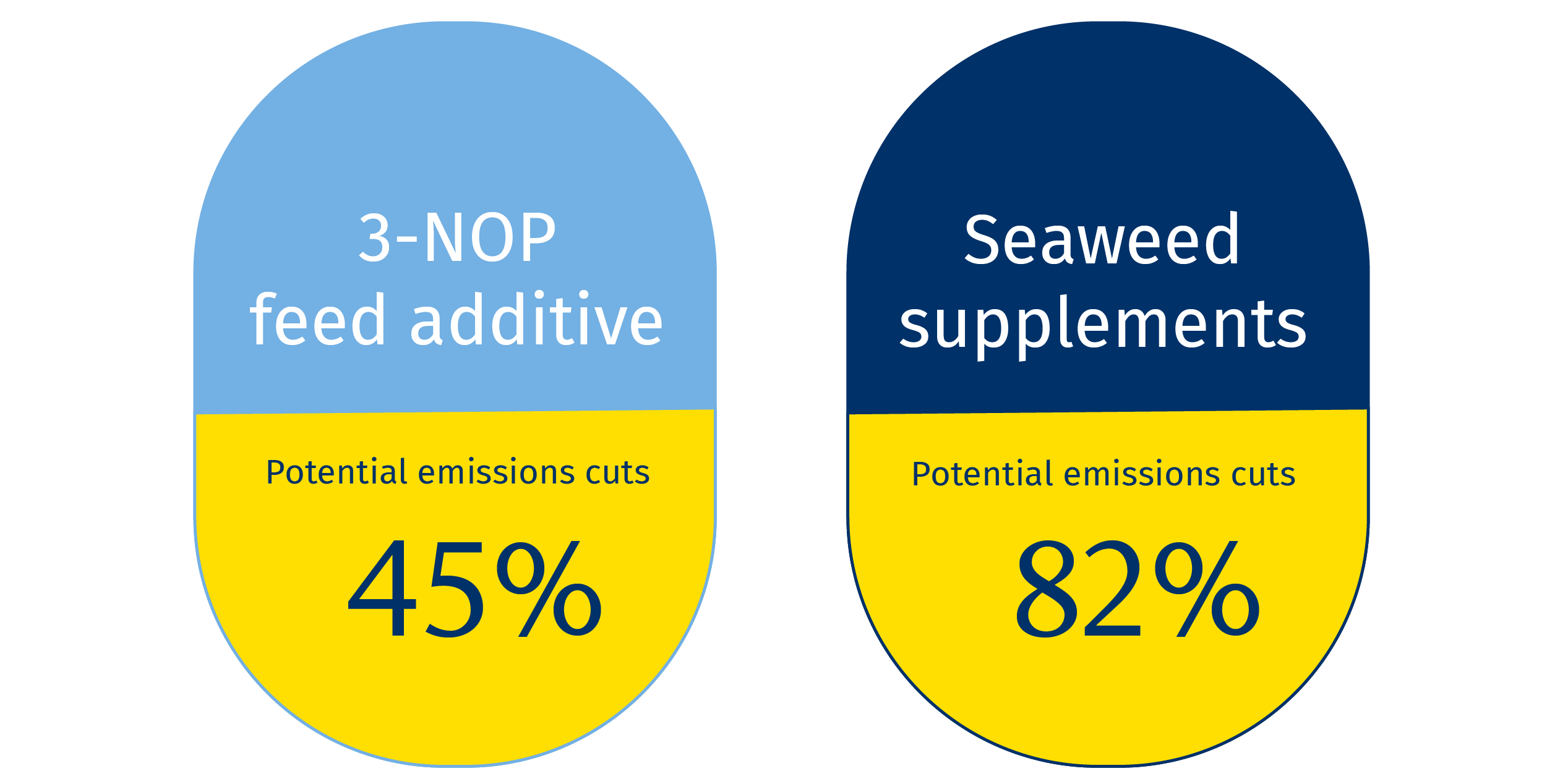
Work with international partners to create demand certainty. Aim for long-term oil contracts with the U.S. and Europe to price in environmental efforts, governance and geopolitical stability to ensure the most stable producers remain key suppliers of Net Zero oil. Similarly, cultivate deeper energy ties with Asian economies such as Japan, South Korea and Taiwan to bring energy market stability. Greater trade ties could also open the door for export-focused liquefied natural gas and hydrogen joint ventures with Asian countries.

1. https://ihsmarkit.com/research-analysis/automotive-insights-canadian-ev-information-analysis-q4-21.html
2. https://www.nature.com/articles/s41586-021-03821-8
3. https://climate.nasa.gov/news/2865/a-degree-of-concern-why-global-temperatures-matter/
4. https://www.arcenergyinstitute.com/meet-the-new-boom-different-from-the-last-boom/
5. e.g., new mines built with paraffinic froth treatment, new or expansion SAGD facilities with solvents or lower SORs; derived from IHS markit estimates

6. e.g., petroleum coke boiler replacements, which industry may avoid in favour of CCUS if project economics improve
7. Costs of CCUS are highly process- and site-specific, meaning the tax credit may be sufficient for some projects, such as capture on hydrogen production facilities, and not others such as steam generation in oil sands facilities.
8. Large scale deployment of CCUS, methane-sparing processes, and offsetting residual emissions using highly credible nature based offsets or technological carbon dioxide removal
9. https://www.rbc.com/en/wp-content/uploads/sites/4/2025/03/220307-Energy-Charts.pdf

Contributors

  • Yadullah Hussain, Managing Editor, Climate and Energy, Thought Leadership Strategy
  • Colin Guldimann, Economist
  • Naomi Powell, Managing Editor, Economics and Thought Leadership
  • Darren Chow, Senior Manager, Digital Media
  • Zeba Khan, Manager of Publishing, Economics and Thought Leadership
  • Aidan Smith-Edgell, Research Associate, Economics and Thought Leadership