Disclaimer

rbc_tl_disclaimer

Also in this edition: A Q&A with the former Chief Agriculture Negotiator for the Office of the United States Trade Representation

This week, RBC and Eurasia Group convened a roundtable in Washington, D.C., bringing together policymakers, business leaders, and trade experts as part of the lead-up to the Canada–U.S. Summit that we’ll co-host in Toronto in June.

The tone was cautiously optimistic, which is markedly different from the doomsday headlines and political noise that has become commonplace. Key players on both sides of the border remain focused on preserving and strengthening one of the most deeply integrated economic relationships in the world.

The discussion coalesced around several critical themes:

  • The upcoming CUSMA review, built into the agreement six years ago, was designed as a forum to air grievances, not dismantle the framework. That process alone won’t upend a trade relationship that sees Canada as the top trading partner for more than 30 U.S. states—a fact the Office of the United States Trade Representative is acutely aware.

  • Section 232 tariffs on aluminum, lumber, steel, and autos—imposed on national security grounds—lie outside the formal review process, and there will inevitably be high-stakes negotiations around changing the status quo.

  • Trump is also less likely, and less able, to unilaterally reimpose sweeping tariffs in 2026. Yet initiatives like Project Vault signal his intent to align allies with U.S. interests on critical minerals and advanced technologies. Trump will want to ensure Canada doesn’t stray too far from the U.S. orbit on those, particularly as the EU advances its own agenda on tech sovereignty and regulation.

  • For its part, Canada has distinct advantages to draw on: its supply of heavy rare-earth elements with irreplaceable magnetic and high-temperature properties, as well as its leading capabilities in quantum computing.

  • Meanwhile, China’s role in both markets remains a concern and will feature prominently in negotiations. For Washington, the priorities are to reduce the ability for Canada to serve as a backdoor for Chinese goods into the U.S. market and to decouple its critical minerals supply chain. Ottawa needs to manage that shift while maintaining a measure of economic flexibility.

  • Energy interdependence is key. The integrated Canada–U.S. energy system, bolted together by pipelines and grids, powers a landmass larger than Russia. Canada supplies more than 60% of U.S. crude oil imports, and industry leaders cautioned against viewing that relationship merely as leverage. With both countries ranking among the world’s top energy producers, the logic is compelling to expand joint infrastructure and strengthen North America’s competitive position globally.

Political leaders may argue and tinker with the details, but the machinery of integration continues, driven by habit, necessity, and sheer economic gravity.

-Thomas Ashcroft

RBC’s John Stackhouse on how trade tensions may strengthen Canada’s position in an integrated market:

Trump’s extraordinary use of tariffs has braced Canadians for a more fundamental remaking of continental free trade, on less favourable terms for Canada and Mexico.

This has put Canada on a more ambivalent, but strategic and resolute course. It is not unusual for Canadian governments of both major political parties over the decades to oscillate between closer alignment with Washington and periodic assertions of autonomy. But this time, it is different in at least one big way: Canada is now investing heavily in industrial strategy and other sovereign economic policies.

As a result, there are at least three major restructurings underway:

  • Expanding ports and export infrastructure to reach markets beyond the United States.

  • Building domestic defence, digital, and data capacity with a “Buy Canadian” approach to procurement and a willingness to increase collaboration with other European and Asian partners.

  • Rebuilding domestic industrial capacity while reorienting manufacturing toward higher-value, globally competitive activity.

Taken together, and if executed, this strategy would not imply a retreat from the U.S. market so much as a change in how Canada relates to it. Trade with the United States would remain large and central, but less one-sided: Canada would export more from a broader base of domestic capacity, rely less on U.S. inputs, and approach the relationship from a position of greater bargaining strength. The result would likely be steadier, more diversified cross-border trade.

Read the full commentary here.

Our Agriculture Lead Lisa Ashton sat down with Ambassador Darci Vetter, Former Chief Agriculture Negotiator for the Office of the United States Trade Representation, to unpack recent changes in the U.S. tariff approach and what the agriculture sector should be thinking of ahead of the CUSMA review. (This interview has been edited and condensed for brevity.)

Q: How might the Trump administration’s current focus on reciprocity and trade deficits impact agriculture and food trade, where supply chains are often multi-country and complex?
A: Farmers and food processors now have to factor multiple and changing tariff rates into their sourcing decisions. These calculations are further complicated by tariffs on steel, aluminum, auto parts, lumber and other products that are critical inputs. 

It’s also not clear to me that the U.S. agricultural trade deficit is a good indicator of the health of the U.S. agricultural sector. If you look at the products that the U.S. exports versus those it imports, you are quite literally comparing apples and oranges. While there is merit in examining how U.S. farmers can better serve local and national markets—and no country wants to be overly dependent on food imports—imported agricultural and food products ensure consumers have access to a varied, affordable and healthy diet.

The USDA’s latest agricultural trade forecast is predicting a US$20 billion decrease in the agricultural trade deficit.1 While the forecast predicts a small increase in exports, a closer examination shows the majority of the changes are due to a decrease in prices for high-value imports like coffee, cocoa and spirits, rather than changes in policy.

Q: What should agriculture and food sectors be watching for in the CUSMA review? 
A: The trilateral food and agricultural trade relationship among Canada, the U.S. and Mexico is one of the world’s most integrated agricultural trading relationships. In 2024, U.S. agricultural and seafood exports to Mexico and Canada totalled more than US$60 billion2. In the U.S., a broad group of agricultural associations have formed the Agricultural Coalition for USMCA to advocate for continuation of the agreement, recognizing its critical value for the sector.

Longstanding relationships are bound to have a few irritants. In his December testimony to Congress, U.S. Trade Representative Jamieson Greer listed a few issues in agriculture— including market access for U.S. dairy products that Canada committed to provide under CUSMA; addressing Canada’s exports of certain dairy products; and the impact of importing Mexican seasonal produce on U.S. growers. 

Q: What other elements of the CUSMA review could impact the sector?
A: The U.S. is likely to prioritize tighter rules of origin and/or North American content requirements for autos, auto parts, steel and aluminum—affecting supply chains for these important inputs for agricultural production and food processing.

One of the most important elements of CUSMA was the Sanitary and Phytosanitary Measures Chapter. CUSMA added important obligations to help ensure food safety and animal and plant health. The SPS Chapter calls for coordination to ensure regulations are transparent, based on sound science and risk, and allow for key agricultural technologies. The USMCA SPS Committee provides a venue to coordinate positions and inform international standards. While unlikely to be changed in the review, they provide a clear example of the benefits of long-term regional approach to trade relationships.

Disclaimer

rbc_tl_disclaimer

➔ Inside Canada’s strategy for the “Davos of Energy”

➔ What Canadian leaders told us about their views on climate action

➔ Canadian oil can deploy industrial carbon pricing at the cost of a Timbit per barrel, according to a study

Energy transition—not defence—will drive demand for critical minerals. Focus on electric vehicles and other energy transition technologies will be vital to underpin investments in Canada’s critical minerals sector, , according to Energy Lead Shaz Merwat. The good news is that emerging processing technologies—such as flash joule heating and direct lithium extraction—could alter the cost curve for new Canadian refining projects. Canada’s clean electricity advantage could also prove to be a differentiator as processing technology reduce energy intensity sufficiently to compete with China.​​​​​​​​​​​​​​​​ Read Shaz’s Mine & Refine report and Seven Takeaways from PDAC.

How are Canadian business executives addressing climate policies? The Climate Action team was on a listening tour over the past few weeks to check the pulse on climate action among Canadian leaders. Here’s what we heard: Canadian businesses are focusing on the doable. The result is not retreat, but a sharper focus on what can be built, financed, and scaled this decade. There’s plenty of climate capital to scale ambitions. The challenge is deploying it. Read our full briefing here.

Creating demand is the impetus for the new Advanced Carbon Removal (ARC) Coalition in Canada. The coalition launched this month and is made up of RBC, Shopify, the Government of Canada and other investors to mobilize $100 million in new support for Canadian carbon dioxide removal projects by 2030. These projects cross several sectors including energy, heavy industry and agriculture, and focus on scaling durable carbon removal technologies, including direct air capture, biochar, bioenergy with carbon capture and storage, enhanced weathering, and marine carbon dioxide removal. Canada has a competitive advantage in these carbon removal pathways given its vast resources in minerals and biomass, and access to clean electricity sources for processing.

The hope is that the Middle East conflict is short-lived. But it’s already casting a long shadow on global economic growth and energy flows—and climate goals.

With much of the oil-and-gas rich region engulfed in the crisis, major European and Asian importers are scrambling to secure alternative fossil fuel supplies. Solar and wind may be “intermittent” power sources, but oil and gas are now facing challenges of their own. The question for both energy-rich and option-poor policymakers is how to make urgent short-term decisions—without undermining long-term climate implications.

Here is what’s at stake…

For Canada: Big decisions, high stakes

Safe-harbour Superpower. Nervous nations have come calling, says Tim Hodgson, Minister of Energy and Natural Resources, looking for politically neutral Canadian oil and gas. Bonus: Canadian hydrocarbons don’t pass through global flashpoints—but do face domestic logistical hurdles. Can Canada ramp up as a reliable supplier without compromising its climate goals?

Investors are already testing the waters. The temptation is to build new West Coast LNG terminals and oil pipelines, and even East Coast projects to power Europe. Newfoundland Labrador recently reached a deal with Equinor and BP p.l.c. to lay the ground for construction and production at the offshore $14-billion Bay du Nord project. The oil pipeline route formerly known as Keystone XL—and now called the Prairie Connector—is all being revived. These projects could trigger an economic growth spurt—most certainly they would raise emissions.

Provincial considerations. British Columbia and Quebec must now navigate the tension between their strict environmental mandates and the pressure of allowing new energy infrastructure through their territories. Alberta, on the other hand, would need to ensure it does not over-index on oil and gas investments amid uncertain global energy demand.

For Europe: A power reset?

Continental drift. The 40% surge inEuropeanLNG prices following the strike on Iran highlighted the economic bloc’s limited options. With the continent still scarred by the loss of Russian pipeline gas, the current Middle Eastern shock has fractured the EU’s green consensus. Italy’s recent move to suspend carbon pricing—and Germany’s quiet recalibration of the 20-year-old Emissions Trading System (ETS)—signals a pivot toward security first over climate first.

Power with strings attached. As Qatari LNG through the Strait of Hormuz dries up, Europe is facing a short-term gas crisis, with Italy, Belgium and Poland more exposed than others. While U.S. LNG is bridging the gap, this reliance is increasingly transactional, coming with “political strings” that complicate the transatlantic alliance. Faced with a complete Russian gas embargo and a supply chain for renewables that remains dangerously concentrated in China, Europe finds itself in a strategic deadlock: return to legacy coal, pay the American premium, or accelerate a transition fuelled by China.

For Asia: Wake-up call

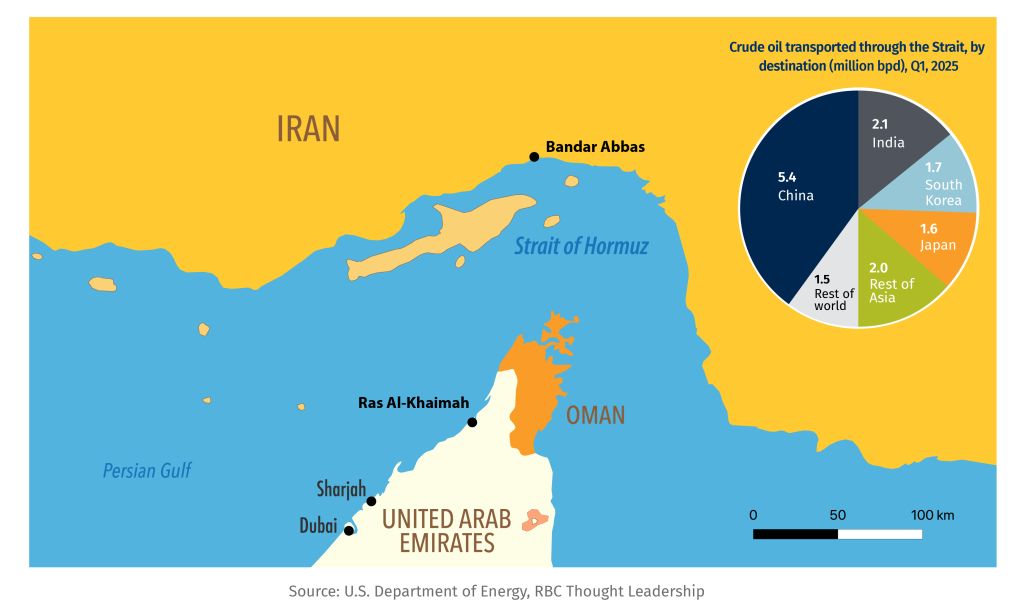
The Electrostate Paradox: China’s energy security is currently defined by a stark contradiction. As the destination for 38% of all oil transiting the Strait of Hormuz, Beijing has much lose from Middle Eastern volatility—a vulnerability compounded by the loss of Venezuelan crude following the ouster of the Maduro regime earlier this year. While Beijing recently issued a cautious 15th Five-Year Plan—lowering its carbon intensity target to 17% to prioritize industrial stability—this retreat masks a deeper shift. As Jason Bordoff, director of the Centre on Global Energy Policy at Columbia University, argues, by absorbing the short-term costs of fossil fuel disruptions today, China is effectively clearing the path to consolidate its dominance as the world’s first true “Electrostate.”

India’s dilemma. Even before the recent destabilization in the Middle East, New Delhi signalled a significant appetite for Canadian energy, with High Commissioner Dinesh Patnaik affirming India’s readiness to absorb “whatever Canada is offering.” While India maintains deep-rooted ties with Middle East nations, the vulnerability of the Strait of Hormuz—which handles nearly 15% of India’s crude imports—has accelerated a long-standing diversification mandate. For India, the crisis could simultaneously trigger higher coal consumption, more Western LNG exports, but also focus on powering up sola, and other renewable energies.

The Asian pivot. Roughly 37% of the oil transiting the Strait is destined for South Korea, Japan, and other regional hubs—a dependency that is forcing a radical strategic recalibration. Rather than waiting for Middle Eastern tensions to stabilize, South Korea is leveraging the volatility as a catalyst. The country’s president framed the crisis as “a good opportunity to swiftly and extensively transition to renewable energy.”

It’s unclear whether fossil fuels or renewables will emerge as winners from the latest cataclysmic conflict. What’s certain, however, is that the global race to secure energy supplies has intensified.

Canada is all set for the “Davos of energy.” The IHS CERA conference in Houston, starting March 23, will have a much larger Canadian presence than in recent years, with the Canada House pavilion and participation of Tim Hodgson, the Minister of Energy and Natural Resources, with officials from Invest in Canada (IIC), Innovation, Science, and Economic Development Canada (ISED), and Global Affairs Canada (GAC), among others.

Canada’s balancing act would be to attract American dollars but also diversify away from U.S. capital and attract a wider investor base to safeguard its sovereignty and reduce dependence on the American market.

—Canada’s four strategic themes at the event:

  • Standing on guard: Position Canada as a secure and stable clean and conventional energy superpower;

  • Being resourceful: Showcase Canada’s leadership in innovation, research and development, and emissions reduction in energy;

  • Championing Team Canada: Support energy companies by showcasing Canada’s benefits as a destination for energy investment capital; and,

  • Leveraging the sovereignty angle: Highlight Canada’s energy sovereignty and ability to meet growing global energy demand through market diversification.

—Several Canadian provinces, energy companies, and thought leaders will be amplifying the message, with Alberta Premier Danielle Smith slated for one of the panels.

—With construction on the roads in minerals-rich Ring of Fire set to commence this year and a new Critical Minerals Strategy, Ontario Minister of Energy and Mines Stephen Lecce will join a panel on the New Geopolitics of Critical Minerals.

—Canada House will feature dedicated programming focused on oil, nuclear energy, LNG, AI and energy, investment in Canada and methane abatement technologies. Some of the planned sessions, include Capital in Motion: Funding an Infrastructure Supercycle, featuring Minister Hodgson. Another with Chief Sharleen Gale, Chair of the First Nations Major Projects Coalition, will be on delivering Canadian energy to global markets.

—Other sessions focus on Canada’s low-carbon LNG, next-generation nuclear reactors, Canada’s methane innovation leadership, AI-enabled clean technology, and breakthroughs and bottlenecks in getting Canadian oil to global markets.

—The world’s facing a copper shortage. John Stackhouse and Shaz Merwat discuss how Canada can help.

—The agriculture sector is asking, “why Canadian farmers are not participating in compliance carbon markets at scale as a source of offsets?” Interim Head Lisa Ashton presented our Climate Action 2026 findings at the Annual Sustainability of Canadian Agriculture Conference and carbon pricing dominated the Q&A period.

—Canadian Climate Institute’s Dale Beugin and Ross Linden-Fraser explains why the industrial carbon pricing will cost just a Timbit per barrel for Canada’s oil sands sector.

—ESG now means energy, security and geopolitics, writes Liam Denning, Bloomberg opinion columnist.

—Canadian provinces and territories signed a deal to build transmission infrastructure needed to power the country’s next generation of growth. Pembina’s Tim Weis explains its significance.

—It’s not just the latest U.S. tariffs that have gutted Canada’s softwood lumber sector. RBC Economics Salim Zanana explains the thousands cuts.

Curated by Yadullah Hussain, Managing Editor, RBC Climate Action Institute.

Climate Crunch would not be possible without John Stackhouse, Jordan Brennan, John Intini, Farhad PanahovLisa AshtonShaz MerwatVivan SorabCaprice Biasoni, Lavanya Kaleeswaran and Joelle Schonberg .

Have a comment, commendation, or umm, criticism? Write to me here (yadullahhussain@rbc.com)

Climate Crunch Newsletter

Disclaimer

rbc_tl_disclaimer


Canada’s Milano Cortina 2026 Winter Olympics delivered unforgettable moments and also a warning sign: podium success is increasingly built upstream, through systems, sport science, and technology.

This Disruptors episode looks at what it takes to rebuild Canada’s pipeline in a world where competitors invest heavily in data infrastructure, coaching capacity, and AI-enabled training feedback loops. When funding is stagnant and costs shift onto athletes, the next generation gets smaller and competitive advantage slips away.

The conversation also highlights what “building the pipeline” can look like, from talent identification to scalable access to sport science and why those tools matter as much as traditional training resources.

Also read: Home-field advantage: How to scale Canadian sport tech

Listen on Apple Podcasts, Spotify or Simplecast

Tech Wins Gold: How Canada Can Rebuild Its Olympic Pipeline

SPEAKERS

Jennifer Heil, David Shoemaker, John Stackhouse

John Stackhouse 00:00:05

Hi, it’s John here.

When I say Milano Cortina, what jumps to mind? The Olympics, of course, but what are the images? Is it Courtney Sarault on the short track ice winning four medals or is it Mikael Kingsbury winning a silver in traditional moguls and then that unbelievable gold run in the brand new dual moguls event? The perfect ending to the greatest freestyle skiing career ever. Or is it those two amazing hockey gold medal games and unfortunately those two overtime losses to the USA? Or is it something else?

Whatever stays with you and still inspires you from the Olympics, it probably revolves around an athlete and those unforgettable Olympic moments of human achievement. Our athletes did incredibly well, even though the medal count was not what they wanted it to be. But what we probably all overlooked in this Olympic experience is the role of technology and the financial support that is essential to Olympic achievement at the level that we all know Canada is capable of. High performance technology is accelerating as fast in Olympic sports as it is anywhere else. It’s through the skis and skates that propel our athletes and yes, those remarkable BMW made bobsleds that help the Germans win gold, silver, and bronze.

Whatever the sport, technology is playing an increasingly valuable role. And as Canada thinks about the Olympics of the future, we need to think more ambitiously about the investments we can make in technology and in supporting our athletes.

This episode of Disruptors is so timely, not only because the Milano Cortina games are just a couple of weeks behind us, but because the always awesome Paralympics are well underway now and technology is just as important there as anywhere else.

Today we have two very special guests, Jennifer Heil, the Olympic champion and moguls and one of Canada’s most decorated freestyle skiers with gold in Turin and silver in Vancouver. She’s also Team Canada’s Chef de Mission for Milano Cortina 2026, and also the founder and CEO of her own tech company, Revvel Health, which we’ll hear a lot more about in this episode. And we’re joined by David Shoemaker, the CEO and Secretary General of the Canadian Olympic Committee. Before coming home to lead Canada’s Olympic movement, David spent seven years as CEO of NBA China and previously served as President of the WTA Tennis Tour. So he’s seen how the world’s biggest sports organizations build performance systems and scale them.

The world’s top Olympic programs are now running on tools that track every training rep, every night’s sleep, every hour of recovery, and feed that data into a unified athlete platform so coaches can intervene before an injury happens, but also use that data to help their athletes perform at their very best. And here’s what’s key to this conversation and frankly key to Canada for the years ahead. Other countries are funding this as infrastructure. Canada is treating it as a cost and we’re not treating it very seriously. That’s the context for today’s conversation. If we want to own the podium, we need to invest a lot more in our athletes, their support teams, and the technologies that other countries are racing ahead with. This is a moment of nation building. And as we’re seeing in Milano Cortina, there are a few better nation builders than our Olympians.

So let’s hear from a couple of our champions on what we can all do to continue to build Canada as an Olympic power. David and Jen, welcome to Disruptors.

Jennifer Heil 00:03:59

Thanks for having us.

David Shoemaker 00:04:00

Thank you for having us.

John Stackhouse 00:04:02

I’m so excited for this conversation, as I’m sure our listeners are too. And I want to start by taking us back to Milano. David, I’ll start with you, what was the standout moment for you?

David Shoemaker 00:04:13

Wow, that is definitely asking me to pick my favorite child. The saying in the Olympic sport is, “The only thing tougher than winning a gold medal is defending one.” And our women’s speed skaters in the team pursuit defended a gold medal from Beijing. So this is Isabelle Weidemann, Valerie Maltais and Ivanie Blondin. And they defended that gold medal and then they got up on the podium, and when “O Canada” was played, Isabelle embraced her teammates. And I usually try to belt down “O Canada” and I choked up after the first couple of lines. It was a really special moment for me and for everyone watching, and I’ll remember that one forever.

John Stackhouse 00:04:56

Love it. Jen?

Jennifer Heil 00:04:58

Yeah, I have two big takeaways. One is personal in that I left there inspired like the nine-year-old kid who first picked up a magazine seeing Olympic athletes. And I’ve been involved in the Olympic movement for so long. I didn’t expect it. I came back to my everyday life and I was like, “I want to be better.” And then in terms of a specific moment, I would have to say it was Megan Oldham. And that comes back to being a female athlete myself in an action sport. And these women at this Olympics across skiing, snowboard, they literally took it to new heights. And the level at which they’re competing now blew me away, left me so excited. And Megan is so tough. So she crashed really badly in her second run in slopestyle. She had so much bruising she could hardly stand on her leg. She went back up and won a bronze medal and then followed it up two days later with a gold. So for me, that’s the standout moment.

John Stackhouse 00:05:59

What wonderful Olympic memories, and that says so much about the Olympics. It is just humanity at its best. What we’re talking about today is how all of us as Canadians can do better in terms of supporting and investing in our athletes. And one of the great needs, as I said in the introduction, is technology. You’ve both been to lots of Olympics, seen lots of sports. Anything jump out at you at these games in terms of how fast technology is advancing?

David Shoemaker 00:06:29

From a viewing standpoint, the use of drones, and I guess I should be careful because it feels like two years ago when I used the word drone in public, we were talking about it in a very different context. But what it’s done if you watch some of the downhill ski racing or watched Megan Oldham in slopestyle or Kingsbury go down a mogul course and give you that bird’s eye view of what it’s like, how steep it is, how big those moguls are, how high they fly in the air and do their flips and their spins. It is really an awesome way of bringing the winter games into 30 million Canadian homes that watch these Olympic Games more than Paris.

Jennifer Heil 00:07:11

Yeah, I was totally blown away. I felt like I was on the Alpine course with the athletes, and it made me excited in the sense of really bringing people into the performance and the intensity of it. I would say what’s really interesting is ML and AI as a whole, it’s actually very good on the technical side. So it can do a very good job obviously of pattern recognition and identifying biomechanics and movements in sport. The opportunity there is immense on the judging side as someone that comes from a judged sport. I think that at a minimum, it should be incorporated into the next Winter Olympics where it’s making sure that there’s no anomalies within the judging score. I think that’s a great way to standardize what we’re seeing more and remove some of the error that just is always going to happen. So I think there’s a huge opportunity. We’re still very early in adopting that from the technical side of sport, but we know nations are working on it.

John Stackhouse 00:08:10

One of my eye-popping moments was with the bobsled and the Germans who, of course, dominate that have a program with BMW. Of course they do. They’re German making BMW quality bobsleds, and that’s not the only reason they won gold, silver, and bronze, but I suspect that’s one of the key differentiators. So just an indication of what other nations are doing.

David Shoemaker 00:08:33

Yeah. The Olympic movement will have to come to grips with whether technological advancement and innovation is something to embrace and let nations that can afford that gain from that, or by contrast, in Monobob where there are all the bobsleighs are made by one company, and while you can paint them up with your nation’s colors, it’s basically an equalizer. What do we want to see be the baseline of competition, technological advantage, or trying to have everybody start from the same starting point? And I don’t think we’ve quite figured that out as an Olympic movement yet.

John Stackhouse 00:09:11

What’s your view? It’s hard to imagine hockey players being required to wear the same skates or use the same sticks or Alpine racers using the same skis, but maybe I’m not thinking widely enough.

David Shoemaker 00:09:21

No, but maybe at least put some limits to it the way, let’s say the sport of golf has said, we need to say that the coefficient of rebound on a driver needs to be limited to a certain amount or a ball has to conform to certain specifications and then have at it.

Jennifer Heil 00:09:37

I’d like to see it broken into two things. I think it’s going to be very hard to stop AI and the use of technology to optimize performance, but from an equipment place, I think we should absolutely standardize it more and it shouldn’t be the differentiator between nations at the degree it is in some sports.

John Stackhouse 00:09:57

So if standardized or not, we’re going to need to invest. And I say want to invest a lot more in a whole range of things, but those technologies as well, they also have wonderful spinoff benefits. David, I wonder if I can ask you to speak to the request that you and the COC have made for $ 144 million coming out of the games. It seems like such a small number when we’re talking about billions and tens of billions for so many other things in society. And every dollar has a value. I’m not trying to make false comparisons, but as you said, this was Games that Canadians, regardless of the results, embraced and loved. And in this moment of national pride, it really is something I imagine most Canadians do want to lean into more, whether they’re athletes or not. What do we need to understand about where this money should go and would go?

David Shoemaker 00:10:47

Yeah, this matters so much to me. I’ve been in this role since January of 2019, and I can think of no issue that I’ve prioritized more than advocating to the federal government on behalf of our national sports organizations and in turn, on behalf of this nation’s great athletes. For clarity, and I feel compelled to mention this every time this comes up, we’re not asking for a penny for the Canadian Olympic Committee. We are almost entirely privately funded. We have 39 marketing partners who support us generously. We’ve been able to increase our investment in Canadian sport and Canadian athletes by 300% in the last 20 years, and we’re going to continue to do more. We announced a 10-year strategy where we’re going to put $500 million into Canadian sport and to Canadian athletes over the next 10 years. But what has trailed us is the federal government’s investment in the 62 national sports organizations. They have not had an increase in their core funding since 2005. These are the organizations that the federal government has entrusted with, and you can imagine what things cost back in 2005 and what they now cost in 2025.

What we’ve seen happen over the course of the last five, 10 years is as they’ve been experiencing this financial distress, the burden of these financial problems has been shifting increasingly to athletes. And so athletes are increasingly being asked to pay what are called team fees, 10, 20, $30,000. So I’ve equated it to, “Congratulations, you’ve made the national team in your sport. Here’s the invoice to be a representative of Team Canada, and that doesn’t fit my vision for the sport.” So we are trailing our competitive nations. Germany’s putting about a billion dollars a year into sport, and we need to do better. Where will it go? It’ll go into high performance sport because these athletes are a great source of pride for us, and we need to continue to support them to do what they do to unite communities around the country, but we also have to invest in linking the impact of that triumph to what happens in the communities, to getting more young people broadly across the country, lowering the barriers to access to sport and to organized sport. And that’s where the money would go.

John Stackhouse 00:13:06

Jen, tell us a bit about what this means to athletes and maybe share a bit of your own experience as an outstanding athlete, but what you had to go through from a financial perspective.

Jennifer Heil 00:13:36

So I lived through a pretty big inflection point in the sport system. So that was where Canada was hosting the 2010 Olympics and we created Own the Podium. And so everything shifted in that moment, including the culture of sport. So what did we do? We got a strategy on how we were going to build a strong system. We had the resources to support that, including innovation. We brought a lot of innovation, a lot of top minds in staff and sport into Canada at that time. And then we had this culture of winning and there was this pride and this excitement. I mean, how many books have been written on culture building and company culture? All of that came together in a way where we had our best success winning the most gold medals of anyone that year. And we’ve seen the continued effects of that. And we’re at the tail end of this now, and we are at the moment of total brain drain in our system of the best minds in sport.

When I was asked about this issue at the Olympics, I had a top sports scientist in the world who’s been to nine Olympic Games, works for Canada, be like, “Jen, I want to work in Canada. This is where my family is. This is where I want to be.” He’s like, “I don’t know if I’m going to have a job after March.” I spoke to one of the best sports nutritionists globally who lives and works in Western Canada, and he’s already had to move 80% of his time out of the country and into the US because there isn’t the funding and support. I heard from a bunch of athletes on the ground and support staff, and they said, “Other countries want to come to Canada. It is a source of pride to be able to coach and be a sports scientist in Canada.” And so it’s not that people don’t want to be here and we don’t have a lot to offer, it’s just quite frankly, we can’t afford them right now.

John Stackhouse 00:15:02

What a great point. We talk a lot about talent attraction at this point in history and how many super talented people could and should be moving to Canada. And that includes not only athletes, but all the professionals who support them. Hearing you both speak so passionately and eloquently, I think, boy, we got to move on from elbows up to pony up.

David Shoemaker 00:15:23

We have the absolute best athletes in the world who continue to do more with less. And when we see what they do and the pride they instill in us, this is a very, very modest investment when you compare it to the other nation building activities we are so committed to.

John Stackhouse 00:15:41

David, can you give us a sense of what other countries are doing? And I’m not thinking of the United States because it’s kind of in a category of one in how it approaches these things, but smaller European nations, as an example, who certainly win more medals than us. I think in Norway, obviously, but other countries that we like to compare ourselves with.

David Shoemaker 00:16:01

Our Chief of Sport, Eric Miles, often talks about the fact that in Norway or in the Netherlands, if they call a team meeting among all their national athletes, they can all get there in an hour and a half. We don’t have that advantage. But whether you measure it in absolute dollars or whether you measure it on a per capita basis, we are being out invested at the federal level five, six, 10 times more by our peers. And that makes it awfully difficult for our sport organizations and for our athletes to compete at the level that they do. Our athletes did incredibly well. But when we look at the medal table, it’s not where we aspire to be at the winter games. And we know we can do better. We know we have a thinning talent pool. We know 75% of our medalists were over the age of 30, and that’s something that we’ve really got to address.

John Stackhouse 00:16:55

Can I stop you there? I don’t think most of us appreciate this point about a thinning talent pool. And when we think, or you think certainly about 2035 and beyond, what kind of situation are we looking at?

David Shoemaker 00:17:09

Well, we can illustrate it. Maybe the best one would be our long track speed skating team who actually did marvelously in Milano Cortina, but it was basically the very same medal hopefuls that we put on the track in Beijing. I don’t want to speak for any of them in terms of what their longer term plans are for 2030 and the games of the French Alps, but that puts a lot of pressure on them to then come back four years later and continue to perform. What has happened in order for Canadian sports to continue to perform at the highest level is that they’ve been mortgaging the future for the sake of the present. And that means that when they’ve been able to put less money into the development of the next generation of athletes, athletes who are likely five to eight years out, giving them international experience, giving them World Cup experience, giving them Olympic experience where other nations are able to bring them along. And that’s where we’ll see our lack of investment in the next generation catch up with us when we’d sort of say, “Okay, who’s up next? Who’s on deck?” And we look and the bleachers are empty.

Jennifer Heil 00:18:15

We’re creating a pay-to-play system, and I think that goes counter to Canadian values and what we aspire sport to do in this country. And what the other countries who are succeeding are doing well is that they’re investing deeper into the system where that has virtually disappeared in Canada. So for example, Norway isn’t funding every sport. They don’t have 62 NSOs that they’re funding. They’re choosing sports that align to their culture and their values, and they’re going deep into that system. Canada has to make some decisions and look at that on how we can be more efficient in the way we fund our operations. That for sure has to be part of the conversation. But what I was hearing on the ground in terms of this pay-to-play system and the younger athletes is that families are saying, “We’re here for one Olympic cycle, but we can’t afford to be here for two and three.” Which is where those conversions into medals start to happen. We’re saying, “How do we create the system that works in Canada?” And our athletes will always punch above their weight. And so to your question around technology, there’s so many opportunities that are opening up there. Yes, it’s expensive to invest in it, and yes, we need to have a strategy to make sure it’s part of how we move forward, but AI offers some incredible cost savings. And the company I’m building is a performance tech company where we take the knowledge base and we work with the experts, the very best in class to basically democratize access to that knowledge. So there’s ways that if we plan for this and we look strategically into the future, we can actually reduce costs over time and get more of these expertise to more athletes as an example of how we can be efficient and save costs if we embrace this and have a plan.

John Stackhouse 00:20:00

Jen, tell us a bit more about the company and what your vision is.

Jennifer Heil 00:20:04

So the company is called Revvel, and it’s really based off of my experiences in the sports system where under the conditions that we talked about around 2010, I had the best sports science and medical team around me that anyone in the world would have. So physio, sports psychologists, nutritionists, the best of the best. And it was extraordinary and it allowed me to go on and achieve my goals, but I started to think that was normal. And so when I retired from sport, I was like, “Wait a minute, this is weird. Where is everybody?” And so my goal has always been, how can we create these structures and get this knowledge that’s in the sports system that’s best in class on the human body, human performance? How do we get that into the general population? And so I went down to Stanford with this thesis where I did a one-year MBA and was able to go and explore the technology to do this because it’s never been scalable before. And so we’re building the platform where with the experts, we create their AI knowledge base, which is like a living, breathing thing that they have to upkeep. And then through an app, you’re able to access that knowledge and personalize it to your own life context.

John Stackhouse 00:21:13

You also co-founded something called B2ten, which is designed to fill the gap between the national system and what athletes actually need. Tell us a bit more about B2ten and where it might take us.

Jennifer Heil 00:21:25

Yeah. So I mean, when we look at the sport system holistically, we need a lot of different players at the table. David has talked about the COC and the private investment. That’s a critical piece to our sports system. B2ten was really about bringing private dollars, philanthropic dollars into the system. And our donors have been with us for 20 years, have raised tens of millions of dollars, and it all comes down to nation building for them. They understand the importance of sport. They understand how sport brings us together as a country. And so we’ve been able to bring these top resources and really create these athlete-centric training programs, which is so key in terms of the culture, but also getting these expertise into the country and keeping them here. So that’s been a huge focus of it. We also have an arm of getting physical literacy into daycares and making sure that that connection from elite sport down to grassroots is happening. 2ten continues and needs to do its part in the system and making sure that the best in class are accessible to our athletes is a key part of the focus.

John Stackhouse 00:22:30

How do we get future generations more engaged? How do we support them and how do we use technology to re- up the pipeline?

David Shoemaker 00:22:39

You may have heard of RBC Training Ground, which is basically a talent identification program that has worked marvelously in its 10th year. RBC has been able to go around the country and find athletes and help them determine what sport they’re most likely to have success in. And we have some really amazing stories that have come out of that. For example, Kelsey Mitchell, who won a track cycling gold medal at the Tokyo Olympics was only five years prior to that a soccer player and had power in her legs that was off the charts. And Avalon Wasteneys, who was a rower and was identified by RBC Training Ground and was part of that Women’s Eight team that’s been so successful. I think also with AI, we can, and I’ll use Jen’s turn of phrase, democratize talent identification in the country. Imagine being able to go to youth all around and say, “Okay, here’s the new app on the phone, show us how you jump, how you run, how you throw, et cetera, et cetera and we’ll come back to you and tell you what sport you should go and sign up for at your local club.” We know that there’s efforts to do this in part of the African continent to try to get a little bit more Olympic activity out of some of those countries and Senegal in particular in the lead up to the Youth Olympic Games that’ll be happening later this year there. I’m excited about how sort of technology could help us in a country as large as Canada, tap into the talent that’s surely out there.

John Stackhouse 00:24:12

As we move towards close, I wonder if I can get both of your thoughts on what we need to strive for. I’m fascinated what other countries have done, we all know about Britain’s success with cycling, investing heavily in that. Australia’s invested more in sports science. Ireland funds a national athlete data platform for a country that’s pretty much the size of Greater Toronto. So other countries are making really interesting strategic bets. So as we think about that big vision, also what are some of the big bets we should be thinking about?

David Shoemaker 00:24:45

Well, we’ve announced a Team Canada 2035 10-year strategy that has three core pillars: podium, play, planet. And in terms of podium, we aspire to be top five in the world on a combined basis when we aggregate our summer and winter Olympic performance. In terms of play, we aspire to get a million more young people into organized sport. And that’s about linking the incredible performances on the world stage and the inspiration that creates in young people. So when Summer McIntosh ignites a world of young people to want to get into swimming, they’re not just left to wonder, how do I contact my local swim club? The local swim club is there for them and offering access at levels that are much lower than they are today.

And then planet is about our belief that we cannot achieve either of those first two pillars if our sporting environments aren’t preserved. And this is a winter problem, but it’s also a summer problem with incredible heat and air quality issues, but we do have to preserve our sporting environments with melting polar ice caps and snow issues. And technology plays a really important role there. We see more and more countries tenting snow over the summer months so that it exists for a reliable snow season going forward. And I think we’re just beginning to scratch the surface of what leadership could be in that space so that the winter games are here with us in the way we see them for many, many years to come.

Jennifer Heil 00:26:13

I want to just say the athletes don’t lack ambition. And that was very clear to me in Milano Cortina, being on the ground with some of the lesser funded sports, the heartbreak there was so real of the athletes. One of the athletes in a sliding sport spoke to her coach and she was like, “I want to be better. I’ve been here for eight years. What do I have to do?” And the coach who was a former athlete said, “Well, when I was that far into my career, I had more time on the track. I had that extra training camp or two training camps every year.” And the response was, “Okay, well, how much do I have to pay?” So this isn’t the system we want to build. It’s not sustainable. I want to see that same ambition matched from the leadership of the government. I think it’s important that as Canadians, we don’t mix up humility with ambition. Our athletes are hugely ambitious. We know that Canadians like waving the flag. We saw it in 2010 when there was just this incredible wave of pride in our country and pride to stand on top of the podium. We know that to be true, but the point is is that we do need a strong functioning system to inspire the youth to get Canadians active. All of this matters and all of this can be connected, but we have a lot of work to do.

John Stackhouse 00:27:36

Well, I think it’s on all of us. We all embrace the Team Canada spirit. What do we all need to do in the next, let’s say, two years to pick up the pace towards those longer term goals?

David Shoemaker 00:27:49

I believe the linchpin here is federal funding. I believe we have a Prime Minister in Mark Carney who believes mightily in the power of sport. We’ve seen him in hockey jerseys on the campaign trail. We have confidence that he hears our athletes, but we need action in that space. We have a Minister of Sport in Adam van Koeverden, an Olympic champion, an icon who also understands the power of sport. And so we just need to get this one over the line and then deploy it in a way that makes sense, consistent with the vision in the way that Jen’s spoken so well about.

John Stackhouse 00:28:28

Maybe one last question to all the young Jennifer Heils out there today, what’s your message to them?

Jennifer Heil 00:28:34

To me, sport equals joy. And I can tell you that being an Olympian, standing on top of the Olympic podium, some of my best moments in sport were school sport, where being a part of the school volleyball team was going to the Canada winter games and meeting incredible people from Newfoundland who sent me letters in the mail for an extra decade. To me, it’s about going out and striving to be your best in a positive environment. And I think that’s what we should aspire to build, whether that’s community, provincial, national team level. That’s what we should aspire to offer our youth. But for me, it was always about challenging myself to be my best, and that kept the fire alive. Of course, I wanted to win medals, that those were the outcomes, but that wasn’t where the joy was.

John Stackhouse 00:29:25

Being our best in a positive environment, what wonderful words. That really, really is joy. Thank you both for your leadership, for your inspiration. Let’s keep at it. It’s “Go Canada” time. Thank you for being on Disruptors.

David Shoemaker 00:29:37

It sure is. Thanks so much, John.

Jennifer Heil 00:29:39

Go Canada.

John Stackhouse 00:29:43

When you think of the payoff of 30 million Canadians cheering their athletes from a distance of future generations, investing themselves in sport and all that comes with that, or the technologies that have so many benefits and applications well beyond the playing field, we need to stop putting so much burden on our athletes and start thinking more strategically on how we as a country can invest in the sports infrastructure.

And a special note for budding athletes, you heard David reference RBC Training Ground. It’s a remarkable program and is resuming its search for the next generation of Canadian Olympians. In just a couple of weeks, anyone aged 14 to 25 is invited to register at rbctrainingground.ca and come out to any of the free local qualifying events that are happening right across the country to test your speed, power, strength, and endurance. If you’re looking for more ideas and insights, visit rbc. com/ thoughtleadership. There you’ll find a whole range of critical insights on how we could all make more informed decisions in a rapidly changing world.

You’ve been listening to Disruptors, an RBC podcast. If you like what you’ve heard, please rate, review, and follow us on Apple or Spotify. That helps more people find conversations like this one.

I’m John Stackhouse. Thanks for listening.

Disclaimer

rbc_tl_disclaimer

Also in this edition: A conversation with Canada’s Foreign Affairs Minister Anita Anand, key takeaways from PDAC, and the Iran conflict’s impact on global oil supply and prices

If trade and investment are two sides of the same coin, Canada for a good while has been calling on trade when the coin was flipped. The Carney Doctrine—whenever it’s written—shows a new preference for investment. No capital, no bananas.

The prime minister signalled a capital-first inclination in his lightning tour of Asia this week, as he covered 30,000 kilometres, three countries and $5.5 billion in deals faster than the Toronto Maple Leafs can win a game. The messages in Mumbai, Sydney and Tokyo—three of the world’s key capital markets centres—is that Canada needs and wants capital. Not a lot of symbolic trade MOUs on this junket.

Carney’s Indo-Pacific initiatives focussed on capital flows, industrial partnerships, and supply chain integration across sectors such as critical minerals, semiconductors, AI, defence manufacturing, and energy security. From a distance, it looked more like a PE road show than a trade mission. Example: IFM, an infrastructure investment behemoth owned by Australian pension funds, declared its intention to invest up to $10 billion in Canada. That matters because more infrastructure in the two countries will enable more trade.

Back home, some subtler changes added to the trend toward global capital as the precursor to trade. A shakeup at Global Affairs was the latest sign that foreign policy is now rooted in the PMO. The Prime Minister and his top bureaucrat, Michael Sabia, also hired Glenn Purves as deputy minister of international trade. Purves is a long-time bureaucrat who had worked under Sabia before heading to the private sector early last year as head of macro research at BlackRock’s Investment Institute. 

Putting a capital markets guy atop the trade service is a signal: capital first. Purves now has his own global infrastructure, too, through trade commissions, to ensure Carney’s capital calls are met. Somewhere on that PMO in the Sky, the Prime Minister keeps a tally of commitments made, and commitments delivered. Call it the new balance of trade. 

John Stackhouse

The Strait of Hormuz, through which 20% of the world’s oil passes, is a key transit point for many energy-import dependent Asian countries. China, by a wide margin, tops that list.

Since the Iran conflict started, commercial shipments of crude and natural gas have slowed to a “near-total” pause. And the price is climbing—fast. Brent Crude futures crossed US$90 a barrel, the highest in almost two years, leading to fears of higher prices at the pumps and spiking inflation. 

–Farhad Panahov

This year’s Prospectors & Developers Association of Canada (PDAC) event in Toronto was abuzz with talk of Canda’s critical mineral riches and the speed at which they can be brought to global markets—at commercial scale. The industry is enthusiastic, the government supportive, but there is a long way to go to realize Canada’s mining potential.

Here are seven themes that we observed at the event:

  • Diverging views of supply chains exposures

  • Resolving refining bottlenecks will be key

  • Project Vault is not a partnership of equals

  • Copper is the clearest demand signal

  • Don’t ignore civilian demand

  • Prioritize across the minerals list

  • Regulatory coordination as competitive advantage

Read more on these key takeaways from Shaz Merwat, RBC Thought Leadership’s Energy Lead, here.

Hours after returning home from India, where Prime Minister Mark Carney kicked off talks of a Comprehensive Economic Partnership Agreement aimed at doubling two-way trade to $70 billion by 2030, Foreign Affairs Minister Anita Anand joined RBC’s John Stackhouse on stage at the Toronto Region Board of Trade.

Some key takeaways from the conversation (edited for brevity):

JS: What signals are you bringing home, especially to business decision makers?
AA: We are the only G7 country that has a free trade agreement with every other G7 country. We had the infrastructure in place from a trade perspective. We need it to be operationalized and utilized. Such is the case with India. We need all of us to be utilizing the agreements that we are executing, or we will keep having to rely on one trading partner and all the difficulty that has caused.

JS: I’ve heard this for decades. We need to diversify. We’re making progress but it’s slow progress. What are we, in business, missing?
AA: It’s really important to unpack what we are doing internationally. That’s what I’m trying to do, make foreign policy and these types of agreements accessible and understandable for businesses to utilize—that will yield actual trade diversification over and above the agreements that we’re signing.

JS: I wonder if you could wrap up with a positive reflection from your trip and if there was any one point that really gave you confidence, especially for businesses?
AA: There is a positive story here despite the very difficult economic environment we find ourselves in, despite a global conflict that is extremely disconcerting and stressful. Canada is on a positive path to growth. Canada has everything the world wants. There is not a room that I go into where people are uninterested in Canada.

Watch the entire conversation here.

States challenge Trump’s latest trade measures

  • As many as 24 U.S. states have sued the Trump administration over its new 10% tariffs imposed under Section 122 of the 1974 Trade Act, arguing the president again exceeded his authority after the Supreme Court struck down the earlier emergency-powers tariffs.

  • The case reopens yet another legal front in Washington’s tariff strategy and prolongs uncertainty for businesses, as courts weigh the limits of executive trade authority.

AI chip exports potentially being tied to U.S. investment

  • The U.S. Commerce Department is proposing new export rules that would require countries buying large volumes of Nvidia and AMD AI chips to commit investment into U.S. data-centre infrastructure.

  • The move signals a shift toward “investment-for-access” technology policy, as the U.S. tries to leverage its semiconductor advantage to support the huge buildout of data centres.

–Thomas Ashcroft

Disclaimer

rbc_tl_disclaimer

This year’s Prospectors & Developers Association of Canada (PDAC) event in Toronto was abuzz with talk of Canda’s critical mineral riches and the speed at which they can be brought to global markets—at commercial scale. The industry is enthusiastic, the government supportive, but there is a long way to go to realize Canada’s mining potential. Here are seven themes that we observed at the event.

The U.S. and Canada approach critical minerals from materially different strategic frameworks, and that divergence has consequences for bilateral cooperation.

The U.S. framing is one of industrial decay and national security emergencymanufacturing surge capacity, weapons systems dependency, and concerns of China outpacing American armament production capacity by a factor of five to six. Within that frame, critical minerals are not a supply chain optimization problem but rather a symptom of a broader hollowing out of American industrial capability that extends to smelters, chemical processing, and advanced manufacturing.

Canada’s framing has been more “narrowly” commercial—a supply chain opportunity, a geological advantage to be monetized, and a seat among allies to be secured.

That gap in threat perception creates friction with an expectation the U.S. is (or at least will be, over time) operating on a more binary logic—alignment or non-alignment—while Canada has positioned itself as a middle power seeking rules-based multilateral cooperation.

Whether Canada narrows that perception gap—or develops an independent strategic rationale grounded in its own economic security interests—will likely impact how “seriously” it is taken at the bilateral table as the Canada-United States-Mexico trade deal review evolves.

Canada’s geological endowment is enviable, but extraction without downstream processing is increasingly seen as less than ideal. Yet, the economics of building processing capacity in Canada are deeply unfavourable.

Anecdotally, conversion costs for lithium spodumene to cathode-grade material run roughly twice what they are in China and at times in Latin America. Global copper smelter margins are often 2–5%, if not simply breakeven. Canada has closed multiple smelters over the past fifteen years. Even in China, the rare earth refining industry has not earned its cost of capital in three decades—arguably the watermark against which any new entrant must be measured.

These margins do not support private sector investment at scale without intervention. We heard overwhelming agreement that state capital needs to function as first dollar in, last dollar out on processing infrastructure. The buyers’ club concept—pooling G7 demand and stabilizing prices when they are depressed—addresses part of this problem, but the governance and trust architecture to deploy that capital at scale remains unresolved.

The bilateral/plurilateral distinction that emerged from the sessions as it relates to the U.S. view of a buyers’ club—supply sourced bilaterally, but demand aggregated multilaterally—sounds like burden-sharing but warrants scrutiny. This architecture is in essence the U.S. acquiring mineral supply on its own terms, stored on U.S. soil and then asking allies to aggregate demand around what is effectively American strategic inventory. Put plainly: Buy American.

Nations’ tendencies to operate in self-interest in a scarcity scenario is precisely the reason for Project Vault’s domestic storage requirement. Still, for other nations like Canada, the risk is being a favoured supplier with no guarantee of preferred access when it matters most. Such asymmetry, hopefully, can be negotiated.

If there is one commodity where the investment thesis is most favourable, it is copper. The convergence of AI infrastructure buildouts, electrification, defence procurement, and grid expansion has created a demand profile that generalist investors can underwrite without relying on policy-dependent assumptions.

Yet even with this enviable demand profile, there is strong consensus of a growing shortage of copper supply, still. As it relates to Canada, copper may be the most realistic near-term entry point through which broader mining investment, including in associated polymetallic deposits, gets unlocked, solving many of the “more traditional” less niche, mining development challenges.

At its simplest, sustainable long-term demand secures supply chains. China built its critical minerals dominance through civilian demand—electric vehicles, wind turbines, batteries—at a scale that justified refining investment and created learning curve advantages that now make its processing margins tough to compete against.

The strategic paradox facing North America is attempting to construct supply chains for critical minerals while simultaneously pulling back on the civilian demand drivers to justify that investment. Without a credible domestic demand signal, processing facilities face uncertain offtake, and without offtake, project finance is unavailable. At present, alternative anchors such as defence and AI/data centres is expected to be the near-term catalyst, but the sheer size of the total addressable clean energy demand is one that better captures the attention of longer-term, more generalist investors.

Treating 30-plus minerals as a single policy strategy ignores the complexities of each metal’s supply chain. The genuine policy problem is in niche commodities where Canada punches above its weight—rare earths, scandium, tungsten, graphite, nickel and possibly lithium—where markets are either small, opaque, and/or structurally dominated by a single producer (often China).

A strategy focused on five to eight minerals with a clear demand anchor is viewed as more executable and more credible from an effective strategy than a broad-based approach. If oriented successfully, this will have positive spillover effects on the procurement of the types of skills and human capital associated with the greater strategy, such as rare earth separation, hydrometallurgy, and advanced processing requiring specialization unreplicated through equipment procurement alone. The expertise that exists across the G7 countries is an untapped potential.

The Major Projects Office represents a meaningful shift toward facilitation of these projects. Brownfield expansion is the near-term opportunity while Indigenous partnerships, structured early with genuine economic participation, is consistently the most effective accelerant to mitigate permitting and financing risks.​​​​​​​​​​​​​​​

Disclaimer

rbc_tl_disclaimer

A smarter way for adult learners to hone new skills

Competency-based education (CBE) is a personalized style of post-secondary learning that allows participants to earn credentials by mastering skills and knowledge at their own pace.

There are more than 1,000 CBE programs offered at U.S. institutions, many at the degree or associate degree level.

In Canada, while several postsecondary institutions are experimenting with CBE at micro-credential and certificate levels, no public Canadian institution offers the chance to earn competency-based degrees or diplomas (Bow Valley College in Calgary plans to offer hybrid diplomas in information technology and cybersecurity beginning in September).

In 2013, the Obama administration called for individually paced programs that “award credits based on learning, not seat time” as a way of promoting innovation, and creating affordable, accelerated degree pathways for adults. Within a decade, the number of providers grew from about a dozen to more than 600.

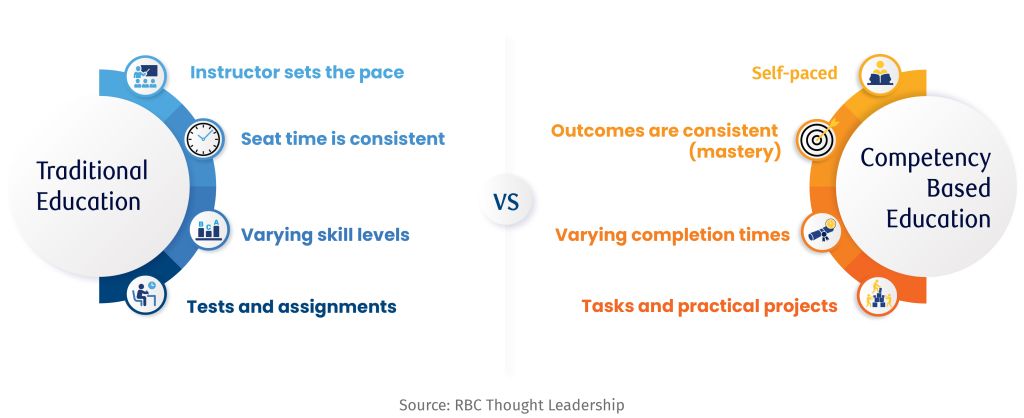
Traditional education vs Competency based education

Traditional degree and diploma programs are generally designed to serve students studying full-time and moving directly from high school to college or university. These students often seek and benefit from a cohort experience—students start and progress together, with a pace set by an instructor. Their final grades vary.

CBE degree and diploma programs are designed for adults who already have a level of skill and experience. Programs tend to start monthly or even weekly. Learners move at their own pace with individualized support from coaches or advisors. CBE assessments are usually performance-based tasks or projects that reflect real-life scenarios—a business student might analyze a company’s financial statements and identify inefficiencies, for example, while a nursing student might conduct a thorough patient assessment.

Everyone is required to meet the same high bar. Students pass by demonstrating mastery and are supported to address learning gaps until they do (e.g., they may get rounds of feedback from a faculty coach, persisting until they can perfect a specific task before moving on to the next). This approach allows participants to progress more quickly through content they’re familiar with and devote the necessary time to new skills and concepts.

In today’s rapidly changing economy, CBE can help adults whose jobs are disrupted, providing them an opportunity to upskill in evolving sectors or reskill to shift into an entirely new area of work. CBE programs could also provide foreign-trained workers the opportunity to earn Canadian credentials aligned with their skills and expertise.

Employers benefit, too. CBE programs can help match skills with jobs quickly. And the focus on mastery ensures that graduates achieve a high level of skill. 

Western Governors University–The pioneer of CBE
Salt Lake City, Utah + regional hubs in nine states

On offer: Online undergraduate and graduate degrees in business, education, information technology, health & nursing.

How it works: Most program intakes are monthly. Leaners pay US$4,000 in tuition per six-month term, working at their own pace to earn competency units by demonstrating skills on various tests or projects. On average, a bachelor’s degree takes 2.5 years to complete.

University of Maine at Presque Isle–Nearly doubled CBE enrolment last year
Presque Isle, Maine

On offer: Online undergraduate and graduate degrees in areas such as accounting, education, public policy and management.

How it works: Learners progress through courses in eight-week sessions– US$1,800 per session for undergraduates, US$2,450 for graduate students. An advisor helps ensure students maximize their time each session; programs can be completed in a year.

Capella University –A founding member of the Competency-Based Education Network
Minneapolis, Minnesota

On offer: Undergraduate and graduate degrees in business, education, health care administration, information technology, nursing and psychology.

How it works: Programs operate on an ‘all-you-can-learn’ 12-week subscription basis. Students can start any month. An evaluation of the first five years of program delivery found the median completion time was 60% faster in CBE bachelor’s degrees compared to credit-hour versions Capella offered; and median tuition costs were 60% lower.

Download the report

Disclaimer

rbc_tl_disclaimer

Climate Action 2026: Reset, Retreat, or Renew highlighted the drop in climate action in 2025 for the first time since the report’s 2019 baseline. It wasn’t a total shock that climate wasn’t a major priority considering the challenges Canadians are facing on trade, affordability, national unity and security. Still, we wanted to delve deeper—is this drop going to persist in 2026? What can Canada do to push through the headwinds and drive climate action back up in 2026?

The Climate Action Institute set out on an engagement tour with industry leaders and climate policy experts over the past few weeks to understand what’s next for climate action in Canada and what path governments, businesses, and consumers will take in the year ahead—reset, retreat or renew?

1. Climate ambitions are being reset with a focus on what’s doable

Many of the climate targets set in the early 2020s for 2030 and beyond are becoming harder to achieve – not because ambition has faded, but because short term pressures are colliding with long-term decarbonization plans. Across advanced economies, governments and businesses are recalibrating, prioritizing delivery and near-term feasibility over headline ambition. The result is not retreat, but a reset: a sharper focus on what can realistically be built, financed, and scaled this decade.

While climate change is still on the mind of Canadians, concern truly intensifies when climate impacts intersect with immediate issues of health and safety—in particular, when it comes to wildfires. The intersection of climate risk and daily life is reshaping policy debates and what climate actions need to be prioritizing in the short-term. Governments are increasingly exploring how to align climate policy with how Canadians are experiencing environmental effects, as well as macro issues including affordability, energy security, and industrial competitiveness, rather than treating climate action as a separate agenda.

2. There’s plenty of climate capital. The challenge is deploying it.

There are $100 billion of government incentives budgeted between now and 2035 for clean-tech and climate programs, according to our estimates.1

The problem is that industry leaders find many Canadian climate funds “untouchable” or with transaction costs that are too high. For example, stakeholders in the mining and clean technology sectors struggle to access programs like the Low Carbon Economy Fund, citing bureaucratic hurdles such as complex granting processes. Stakeholders said this challenge is systemic across climate programs and incentives. Notably, the Auditor General found that the federal government’s recently retired Net Zero Accelerator, an $8-billion fund, attracted only 15 out of the 55 largest-emitting companies in Canada and resulted in just two signed agreements by late 2024. The biggest barrier cited was the lengthy and complex application process, averaging 407 hours.2

Leveraging AI applications was suggested by industry as one option to help streamline project review processes and synthesize project data, reducing the administration burden for governments and applicants. AI powered government administration is a trend that has a growing list of working examples, like DAISY, the Development Application Information System, in New South Wales in Australia that helps local councils and project developers accelerate approval processes.

3. Policy friction and geo-political uncertainty threatens Canadian climate competitiveness

In an era marked by protectionism, shifting alliances, and supply-chain risk, the idea that Canada can compete globally on climate ambition alone can feel aspirational. Yet, for emissions-intensive, trade-exposed sectors, climate competitiveness is less about idealism and more about whether decarbonization can tangibly support growth, resilience, and market access.

Canada’s steel sector illustrates that tension. Over the past year, steel sector exports fell 24%, as the industry saw reduced revenues and demand, and more than 1,000 direct jobs lost, moving long-term 2050 net-zero targets lower on the priority list for companies.3 Yet, decarbonization opportunities that are clearly aligned with growth and market prospects help make the case for climate competitiveness. The U.S.’s 50% tariffs on Canadian steel accelerated plans for Algoma Steel to transition production from traditional blast furnaces to electric arc furnaces, which use electric power instead of coal, allowing for a more flexible, lower-cost operation that is more competitive under trade pressure. Yet, this switch did not come without tradeoffs, including large upfront investments and scaling down employment.

British Columbia’s timber industry exemplifies a sector hit hard by tariffs, but with the potential to bolster Canada’s climate competitiveness ambitions. After a long downturn fuelled by mill closures, pest outbreaks and wildfires, the timber industry is seeking bounce back opportunities through new markets that can boost demand. Mass timber could be an option.

As a low-carbon material, mass timber can reignite domestic production, feed the modular housing boom, and decarbonize the building sector. To succeed, federal, provincial, and municipal governments must prioritize low-carbon procurement, adopt “tall wood” building codes, and streamline project permitting.

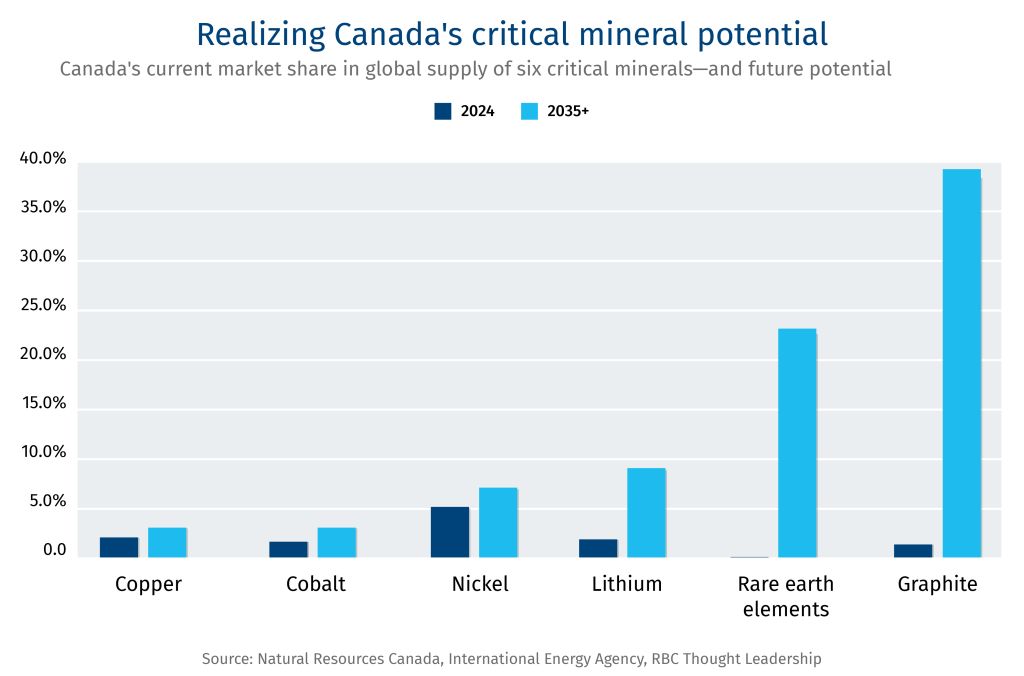
Canada climate competitiveness in other sectors hinges on getting major projects off the ground. Despite holding the world’s sixth-largest lithium reserves, and substantial deposits of nickel, cobalt, and rare earth elements, Canada is not a major player in producing the materials that are essential to batteries, wind turbines, and electric vehicles.4 While Natural Resources Canada has identified critical minerals as central to economic growth and climate strategy, mining projects remain hindered by capital gaps and long permitting timelines. Geopolitical fragmentation complicates market access and financing for Canadian projects. For investors, climate alignment alone is insufficient. They require regulatory clarity, infrastructure readiness, Indigenous partnership certainty, and long-term offtake agreements. Without streamlined approvals and coordinated federal–provincial policy, Canada risks failing to leverage its mineral wealth for the global energy and industrial transformation.

Climate competitiveness could be a fantasy if Canada can’t pass the test of reducing policy friction and mitigating geopolitical uncertainty fast enough to make climate alignment the simplest path to growth in resource-based sectors.

4. A national electricity strategy requires a major shift in priorities

An imminent pan-Canadian electricity strategy is set to map a plan for expanded power generation and remove barriers between provincial markets.

According to our estimates, expanding electricity generation by 2050 by low-emission sources including nuclear, hydroelectric and abated natural gas in addition to solar and wind, would cost over $1 trillion.5 Canada’s surging electricity demand is a hot topic as industry leaders and consumers grapple with the current bill to meet demands, like Toronto Hydro’s $5.9 billion investment plan for 2025-2029. The pressing upgrade highlights the strain on existing infrastructure to support electrification (e.g., heat pump adoption).

The availability of reliable renewable power to meet rising demand is a central concern, particularly as the economics of developing low-carbon generation are not consistently viable across Canadian jurisdictions, challenging the national goal of fully decarbonizing electricity systems by 2050. Existing infrastructure and cost barriers mean natural gas continues to play a significant role and is expected to remain the dominant heating source in many provinces including Alberta, Saskatchewan and some Atlantic provinces. On the demand side, affordability is often the primary driver for households considering a switch to low-emitting technologies such as heat pumps. However, in provinces like Saskatchewan, where subsidies for fuel switching are limited or unavailable, homeowners often cannot justify the upfront investment required to adopt low-emission solutions. Without supportive policy measures or improved economic incentives, the financial case for transitioning to cleaner technologies remains challenging for many households.

Scaling energy supply to meet demand and deliver on a pan-Canadian vision requires a shift in priorities to “build big things,” focusing on infrastructure like the East-West energy grid and major climate projects. However, projects have yet to get off the ground raising questions if big and bold is possible, or if the small and fragmented tradition of Canada’s federation will persist.

Other countries are finding ways to meet their economies’ rising power needs. In 2024, China added approximately 543 gigawatts of new electricity capacity, according to their National Energy Administration. The power generation added since the end of 2021 in China now exceeds the size of the entire U.S. power system. While Canada’s needs are proportionally smaller, the comparison highlights the speed required to compete in clean energy manufacturing, supply chains, and technology deployment.

5. Too many shovel-ready carbon removal solutions are waiting to scale

Canada’s forests, wetlands, and agricultural lands can reduce Canada’s emissions by up to 78 megatonnes of CO2e in 2030 if sustainable management and conservation are enabled.6 Unlocking these nature-based solutions requires scale. Projects must achieve economies of scale to go through the costly process of being verified on functioning markets to deliver real value to land stewards, such as farmers. Projects must also provide the value of scale to investors looking for large single purchases of credits or claimed impacts. It’s ironic that despite Canada’s vast natural landscape, a lack of operational scale remains the primary barrier to delivering market-based incentives.

Aside from the Conservation Cropping Protocol in Alberta that has since been retired and the Great Bear Rain Forest, there are few Canadian examples of scaled market-based approaches to incentivize nature-based solutions. Fragmented carbon pricing systems and rigid protocol design are key hinderances that have slowed progress in Canada. However, the current review of Canada’s industrial carbon pricing benchmarks, and bilateral agreements such as Alberta’s memorandum of understanding with the federal government, present an opportunity to test policy designs that can unleash investment for nature-based solutions.

6. Capitalizing on climate-conscious consumers critical to decarbonization

Despite rising national security threats, affordability concerns, and an economic downtown, roughly 33% of Canadians still list climate change as one of their top three concerns, according to our consumer survey.

Consumer demand represents a critical lever. Adoption of technologies, such as heat pumps and electric vehicles, would accelerates once the economics make sense, in the form of rebates, clear price signals, and stable policy frameworks. Businesses and policymakers can harness this demand by aligning climate policy with affordability and competitiveness for consumers.

Major infrastructure projects—such as new transmission corridors, clean-tech manufacturing hubs, or carbon management systems—require public trust to move from proposal to implementation. Without social licence, even technically sound projects stall. Building that trust means demonstrating tangible benefits: job creation, lower long-term energy costs, improved reliability, and enhanced resilience to climate impacts.

Canada’s climate challenge is increasingly a question of scale and delivery. Ambition remains important—but execution, coordination, and trust will determine whether the country can translate targets into tangible outcomes.

Download the report

Disclaimer

rbc_tl_disclaimer

Prime Minister Mark Carney arrived in India with clear ambitions to move quickly toward a Canada–India trade agreement. The geopolitical logic is sound, rooted in diversification, Indo-Pacific cooperation, and increasingly aligned strategic interests.

But successive Canadian governments have tried—and largely failed—to unlock India’s massive market at scale. India liberalizes selectively, opening sectors where imports support domestic growth while maintaining tight protection where political sensitivity is highest. Early gains are therefore most likely where India requires external supply or technology—energy security, industrial inputs, and advanced technologies—meaning Canada’s strategy must prioritize sequenced commercial outcomes rather than broad economy-wide concessions.

Luckily, there’s already a blueprint: Canadian pension funds have laid incredible groundwork, having invested over $70 billion in India, which can open up commercial entry points.

We identify some sectors where Canada can make inroads in the Indian market.

Agriculture: Domestic sensitivities, big trade

  • Agriculture remains Canada’s largest export sector to India, yet also one of its most politically constrained. Current measures—a 30% duty on Canadian yellow peas and 10% tariffs on lentils—are designed to protect Indian farmers and manage food-price stability.

  • India frequently adjusts tariffs, licencing rules, and procurement conditions in ways that effectively cap import volumes, particularly for pulses where Canada is a leading supplier.

  • These policies function as domestic economic management tools and can shift quickly with harvest outcomes or inflation pressures, creating persistent uncertainty for Canadian exporters. Clearer import frameworks would help.

Energy: Displacing Russian oil and gas

  • India’s energy demand is expanding across oil, gas, and electricity generation faster than any advanced economy, creating structural alignment with Canada’s resource base.

  • Yet current trade highlights the gap between potential and reality: Canada’s largest energy export to India today is coal, not oil or natural gas—demonstrating that infrastructure and commercial pathways are limiting the relationship.

  • India’s effort to diversify suppliers, notably Russia, under pressure from the U.S., creates an opening for Canada to reposition itself as a longer-term supplier of crude, LNG, and nuclear fuel.

  • Long-term oil and LNG purchase orders—not diplomatic announcements—will determine whether alignment translates into sustained export growth.

Nuclear: Powered by cooperation

  • India’s planned reactor expansion, targetting roughly 100 GW of capacity by 2047, requires secure fuel supply, while Canada remains one of a limited number of politically reliable uranium exporters.

  • Uranium trade operates on long planning horizons and structured supply arrangements, making it less exposed to short-term commodity volatility than most resource trade.

  • Cooperation typically extends beyond fuel into engineering services, safety systems, workforce training, and regulatory collaboration that deepen industrial ties over time.

  • A uranium agreement would signal that the bilateral reset has moved beyond diplomacy into sustained economic cooperation.

Talent and culture: Soft people power

  • Talent mobility and diaspora ties remain foundational infrastructure for the commercial relationship, underpinning investment and business linkages across sectors.

  • Pressures surrounding international students and domestic post-secondary capacity mean mobility policies must balance economic opportunity with political sustainability at home.

  • Film and media collaboration represents a practical early opportunity, as Bollywood production increasingly seeks global filming locations that “Hollywood North” can provide.

Industries: Beyond commodities

  • India’s growth constraints increasingly lie in systems—grids, logistics, emissions management, and industrial efficiency—not simply access to raw materials.

  • Canadian firms are competitive in these enabling technologies, allowing Canada to participate as a solutions partner alongside a resource exporter.

  • Pairing energy exports with clean technology and digital optimization broadens the relationship beyond commodity cycles and supports incremental, repeatable commercial integration.

Trade with India will advance not through political momentum alone, but by aligning commercial incentives with India’s domestic priorities. Canada’s success will ultimately be measured not by what paper is signed but what follows: goods shipped, projects financed, and supply relationships durable enough to expand over time.

–Thomas Ashcroft, Global Issues Policy Lead

Back to the Future: Lessons from a Post-WWII Tin Agreement

This week, the Office of the U.S. Trade Representative issued a request for comments on how a plurilateral critical minerals agreement should be designed. Buried within the submission is a reference to the 1956 International Tin Agreement. That reference is worth a short history lesson.

Why It Matters

The International Tin Agreement was one of the most ambitious experiments in commodity market governance ever attempted—a producer-consumer framework designed to bring price stability to a material the Western world depended on but couldn’t control. It lasted nearly 30 years but ultimately failed. The reasons it failed are precisely the questions the USTR notice is now asking allied governments to answer for critical minerals.

Lessons learned

  • The buyers’ club needs to be big enough to matter. The tin deal failed partly because non-members were significant suppliers. Plurilateral clubs need critical mass—hard to do given China dominates both refined supply and end-use demand.

  • Speed matters. Tin took six revisions over decades to lay the ground, and still collapsed. The window for today’s Western critical mineral supply chain realignment is shorter with China likely even more incentivized to further disrupt markets.

  • Rules of origin is the real enforcement mechanism. Price floors mean little without teeth, and the buyers’ club needs compliance. Given U.S. desires to reshore production, this reads as a competitive advantage for Canada relative to other U.S. trade partners.

Bigger picture

The critical minerals file is unusual as it’s the only area where Washington is leveraging partnerships rather than tariffs. Convening allies, building frameworks, and even asking trade partners to help design the rules is helping Washington foster greater confidence and investment certainty for industry and financiers.

The architecture is emerging, and if successful, a guaranteed price for metals tied to rules of origin that extend through to refined input should be enough to make Western refining economies work. At present, the capital to build that infrastructure is not. This is where more work needs to be done.


Landing on the eve of the annual Prospectors & Developers Association of Canada conference in Toronto, which attracts more than 27,000 attendees, is RBC Thought Leadership’s newest report,  Mine & Refine, which examines that capital gap—the structures, financing mechanisms, and sovereign investment needed to make Canada a credible supplier of refined critical minerals into the new supply chain order.

–Shaz Merwat, Energy Policy Lead

China’s finance ministry confirmed that tariffs on some Canadian agricultural goods will be suspended.

  • The announcement follows the deal Carney cut in Beijing earlier this month. 

  • While the 100% tariffs on canola meal and peas, and the 25% levy on lobsters and crabs will not be imposed, the announcement made no mention of canola seed tariffs, which were supposed to come down to 15% as of March 1.

Over 900 companies have sued the U.S. government after Supreme Court tariff ruling

  • FedEx was the first major American company to come asking for refunds after last Friday’s ruling putting ~$170bn of tariff revenue in play.

  • The onslaught of lawsuits that have been filed with the U.S. Court of International Trade will keep lawyers busy for some time and introduce another major layer of uncertainty and difficulty for U.S. President Donald Trump’s tariff regime.

Germany pushes China for a trade reset

  • Chancellor Friedrich Merz urged Beijing to curb subsidies, address industrial overcapacity, and ease restrictions on European firms as EU concerns over unfair competition and widening trade imbalances grow.

  • Xi Jinping positioned China as a defender of multilateral trade and encouraged closer EU alignment, even as Europe seeks to reduce strategic dependencies in critical supply chains.

–Thomas Ashcroft, Global Issues Policy Lead

Disclaimer

rbc_tl_disclaimer

Roughly $1 in $10 in Canada’s mining sector has been directed towards pure-play critical mineral development over the past 25 years. The majority of the $700+ billion raised in Canadian mining equity and M&A has poured into other metals, with gold and precious metals accounting for 70% alone. In contrast, Australia directed twice that amount over the same period.

Critical minerals are finally attracting a bigger share of mining investment. Around 67 critical minerals projects—representing about half of all active mining proposals—are currently planned, proposed, or under construction, with a potential investment of $72.4 billion by 2034, according to the Major Projects Inventory.

Canada could account for 14% of the global supply across the six key critical minerals by 2040. Current Canadian production of six core critical minerals, cobalt, nickel, lithium, copper, graphite and rare earth, is on average 2% of global supply. It could rise to 14%, on average, at full capacity if identified projects come on stream, the Canadian government estimates.

However, Canada lacks a strong base of well-capitalized domestic players. Only 19% of Canada’s publicly listed S&P/TSX Composite mining firms are diversified miners, compared to two-thirds of Australia’s S&P/ASX 300 mining index. To reach its goals, Canada will likely need to continue relying on international mining companies and foreign investors.

Two decades of capital allocation decisions have stunted critical minerals’ growth. Canada remains largely a “mine-and-ship” jurisdiction when it comes to critical minerals—with much of the value add and refining picked up by China and other players who have captured the refining segment, and further developed ancillary supply chains, such as electric vehicle, electronics and defence industries.

Despite trade tensions, there are still signs of U.S.-Canada capital alignment. Under President Donald Trump, the U.S. has invested an estimated US$135 million in direct equity stakes in Vancouver-based companies Trilogy Metals and Lithium Americas Corp., in addition to a US$2.3 billion bridge loan for Lithium Americas. It will be unlikely the U.S. can (or wishes to) completely phase out Canada from North America’s critical mineral ecosystem.

Canada faces a critical minerals capital crunch. The absence of patient, risk capital severely impedes the country’s ability to support both Canada and other Western nations in their efforts to move their critical mineral supply chains away from China.

Realizing Canada's critical minerals potential

That capital is needed for Canada to take advantage of the critical minerals industry that’s projected to grow between two to three times globally with a capital requirement of US$500-600 billion by 2040, according to an International Energy Agency forecast. Global demand for six core commodities—cobalt, copper, graphite, lithium, nickel and rare earth elements—will be driven by several growth sectors, including electric vehicles, clean energy infrastructure and space. As well as strategic sectors such as defence, manufacturing and electronics.

Canada holds world-class geology across all six metals but remains a relatively marginal player, accounting for roughly 2% of the global supply of the six metals. If identified projects proceed at full capacity, it could climb to 14% of total supply over the next 15 years, on average, according to Canadian government estimates. The development of vertical supply chains such as an expanded advanced manufacturing base, could have an exponential impact on Canadian supply to meet domestic and international demand.

Yet, Canada remains largely a “mine-and-ship” jurisdiction. Raw metals are shipped mostly to China where they are refined and transformed into high-value components. It’s the result of two decades of capital allocation decisions and the lack of a robust national strategy, but also China’s ability to depress metal prices to crush competitors.

There’s considerable global momentum to propel the Canadian critical minerals industry forward. The U.S. is leveraging its funding, market mechanisms and guarantees to build out a critical minerals market that excludes China. Meanwhile, Europe and several G20 allies are eager to diversify their critical minerals supply chain as they fear the Chinese industrial machine will crush their domestic economies and leave them ever more beholden to Beijing.

China’s recent export controls on key minerals—including rare earths, graphite, gallium, germanium—over the past year are a clarion call for Western countries to act.

Among its G7 allies, Canada is best equipped to take advantage: it’s home to high-grade lithium belts and graphite deposits in Quebec and Ontario, globally significant nickel resources in Manitoba, formidable copper reserves in British Columbia, and rare earth elements in pockets across Canada, including Newfoundland and Labrador. Few countries can claim this breadth across all six critical minerals at scale.

We have identified five structural pressure points that explain why Canada’s critical minerals sector remains undercapitalized, and why market forces alone will not correct the imbalance. Closing the gap requires a coordinated public-private agenda anchored in sovereign co-investment, infrastructure financing, miner-driven shared processing corridors and integration into Western supply chains.

1. The loss of national champions

Between 2005 and 2012, more than $119 billion in Canadian base metals and steel assets transferred to foreign ownership.

The surge in Canadian mining globalization

The transactions were part of a wider globalization trend: foreign capital was expected to unlock value faster than our limited domestic capital markets, and nationality of ownership mattered less than the resulting economic uplift from mineral production and job creation. What that consensus underestimated was the long-term cost of losing domestic companies capable of anchoring new project developments—for a future era.

As Canada’s domestic giants were subsumed into global majors, the domestic capital-raising ecosystem was also disrupted. Boutique mining dealers shrank from around 60% of deal flow in 2010 to effectively 20% today, according to S&P Capital IQ. A similar trend is seen across capital holders as well, with resource-specialist funds now making up only 1-2% of domestic equity mutual fund assets under management today, compared to 6-8% in the early years following the global financial crisis, according to ISS MI MarketSage.

Many of the national champions that could have spearheaded Canada’s lithium, graphite and rare-earth projects largely no longer exist. Meanwhile, global majors allocate capital across their global portfolios that may not align with Canada’s strategic, sovereign objectives. This dynamic stands in marked contrast to the oilsands, which is the predominant operating asset controlled by large domestic players with large domestic ownership.

2. Capital consolidation around gold took the shine off other metals

Of the $700 billion raised in Canada in mining equity and mergers and acquisitions over the past 25 years, only 11% of capital was channelled to pure-play critical minerals development, according to S&P Capital IQ and LSEG. In contrast, Australia directed over twice as much capital to critical minerals during the same period. This was partly due to geology (Australia’s copper deposits are larger and less associated with gold), and partly to a closer proximity to Chinese and East Asian smelters.

The higher gold concentration in Canada reflects a historical M&A wave, with the S&P/TSX Composite mining complex becoming increasingly dominated by a smaller pool of large gold producers. In essence, Canada’s public mining equities evolved into a precious metals financing platform—a result of structural choices made over two decades across Canada’s critical minerals companies.

It doesn’t have to be a zero-sum game between gold and critical minerals—there is room to grow both mining sectors and even create ecosystems that feed off each other.

However, in Canada excellence in gold did not necessarily extend to critical minerals for two reasons:

  • The composition of Canada’s gold endowment made it efficient at producing the yellow metal, but relatively less so for other associated minerals like copper, nickel, cobalt as by-products. Australia’s mix of iron oxide-copper-gold deposits provide a more diverse commodity portfolio.

  • Gold mining skills and infrastructure do not inherently transfer to critical minerals. Gold smelting and refining are mature and standardized, whereas critical minerals processing, which is oriented towards specific end-uses (especially on battery metals) that require complex hydrometallurgy and chemical conversion..

3. Junior miners continue to face a financing cliff

Canada’s flow-through share financings—a tax incentive that allows investors to deduct 100% of their investment against their taxable income—works exceptionally well for early-stage exploration. It aggregates retail capital, reduces the effective cost of capital, and has successfully supported mineral exploration.

However, once a company completes the first assessment hurdle, these tax incentives expire (until construction begins). What follows is a $20-30 million financing gap: feasibility studies, engineering, permitting, and technical validation are required for ultimate final investment decision. These costs are often too large for high net-worth investors and too risky for institutional investors and lenders. Delays in permitting compound this challenge, as the companies remain pre-revenue with a stretched balance sheet.

For niche commodities such as graphite, rare earths and lithium, the problem is worsened by lack of market diversity. China often remains the sole buyer of mineral concentrates. Chinese lithium converters buy spodumene ore and process it into battery-grade lithium, while rare earth concentrates must be converted into a Mixed Rate Earth Carbonate—a processing step Canada largely lacks.

Few institutional investors have historically backed a Canadian junior whose only offtake market is a Chinese refiner, leading to a structural financing gap that has stalled viable projects for years.

4. Refining and processing face a structural deficit

Over the past three decades, Western countries effectively outsourced lower-margin, energy-intensive refining to China. Backed by state-backed capital, lax environmental regulations and lower labor costs, China now controls 70% of global refining market share for 19 of the world’s 20 most critical minerals.

China also builds overcapacity to squeeze competitors. Global copper smelting utilization was only 70% last year, and has played a role in Canada closing the Flin Flon, Gaspe and Kidd Creek copper smelters over the years. Today, only one Canadian copper smelter/refinery remains active: Glencore’s Horne smelter in in Rouyn-Noranda, Que., and its associated Canadian Copper Refinery.

Competing head-to-head in pure-play downstream processing against subsidized overcapacity is economically difficult. However, Canada’s advantage lies in pairing upstream mineral exposure—where margins are structurally higher—with selective downstream integration in “mineral corridors” that offer durable cost advantages, such as low-cost, zero-emitting hydro power in Quebec.

5. Limited domestic demand has constrained value chain growth

Refining investment follows demand—a capital-intensive smelter is hard to build in Canada where local demand is limited. Battery cell manufacturing is nascent and defence procurement operates at a fraction of U.S. scale. Magnet manufacturing, rare earth processing, and cathode precursor production are largely absent. The result is that shipping concentrates are shipped to where the customers are: primarily China.

The paradox is that Canada committed up to $55 billion to attract electric vehicle and battery manufacturers over the next 15 years without attaching domestic sourcing conditions that peer jurisdictions demanded. Germany and France implemented strict, minimum E.U. content and local supply-chain requirements into their electric vehicle subsidy schemes. South Korea similarly tied support to the use of Korean-source battery materials and components. The absence of such commitments in Canada, means the subsidies have not yet catalyzed ancillary industries.

1. Scale sovereign capital across the full value chain

Ottawa’s $2-billion Critical Minerals Sovereign Wealth Fund requires more heft to match the significant capital requirements. The Korea Zinc joint venture, for example, is developing a refinery in Tennessee for US$7.4 billion alone, demonstrating the substantial capital-intensity of downstream investments. A full build-out of mining, refining and processing critical minerals require an order of magnitude of patient capital that’s willing to persevere over years of construction and commercial validation.

The Canada Growth Fund (CGF) has made three mineral investments to address the gap. Its recent co-investment in Thompson Nickel Mines in Manitoba alongside U.S.-based Orion Resource Partners LP and Brazil’s Vale SA anchored the project, attracting credible corporate capital, and signalling strong sovereign commitment. This follows investments by the CGF in Quebec’s Nouveau Monde Graphite facility and the Foran Mining Corp. copper-zinc project in Saskatchewan.

Internationally, the Brazilian Development Bank also offers a template: a US$1-billion blended fund structured with government and private capital (including national mining champion Vale), managed at arm’s length and deployed across extraction, refining and processing. The structure, backed by government funding, instills commercial discipline, and makes strategic projects financeable.

2. Deploy infrastructure capital to unlock regions

Co-investing in enabling infrastructure—such as roads, transmission, grid connections to remote mining regions—reduces a project’s required break-even price by around 22-24%, the single largest lever of any individual policy measure, according to a recent Canada Infrastructure Bank (CIB) analysis.

The build-out of accompanying infrastructure is ideal for pension funds and long-duration institutional investors who are best suited to participate: lower risk than equity in a junior miner, contractual cash flows, and infrastructure-style returns. Ontario’s metal-rich Ring of Fire region alone requires as much as $2.4 billion in road and transmission investment before a single mine becomes commercially viable. For pension funds, it’s an opportunity to finance infrastructure, provided there’s surety of the facility being built, and the new infrastructure can be put to multiple uses and even serve as a springboard for new developments.

Investment in remote communities, many of which are on First Nations territories, presents another opportunity. However, unlike Alberta and British Columbia where oil and gas commercial precedents are well-established between First Nations communities and corporations, these mining jurisdictions require nurturing local governance and technical readiness to ensure long-term commercial success.

3. Build mineral corridors around Canada’s best clusters

Shared processing infrastructure solves multiple problems simultaneously. For instance, Quebec’s six high-grade, high-tonnage lithium projects can complement a regional refining hub. A similar logic applies to the lithium belt running from Thunder Bay to Winnipeg, and to the Sudbury nickel cluster, which already boasts world-class refining infrastructure that could expand to serve new critical minerals projects across Northern Ontario.

Such centralized refiners would give junior and mid-sized miners credible non-Chinese buyers, reinforcing their business and investment case. Corridor economics could also have a cascading economic effect, extending to logistic, transport, commercial and residential housing, and other amenities.

A shared Central Lithium Refinery—potentially structured with government loan guarantees and anchor offtake agreements with battery producers in Europe, Korea, Japan, and emerging Canadian manufacturers.

This offtake, in turn, makes projects financeable on Canadian equity markets and eventually eligible for project financing. The infrastructure economics improve further if the Plan Nord railway extension in Quebec proceeds—an initiative championed by the Cree Development Corporation that would materially reduce both the environmental footprint and capital costs of the Quebec lithium cluster.

4. Draw in global majors to improve project economics

The Canada Growth Fund is well-positioned to co-invest alongside global majors, provide offtake agreements that de-risk revenues, and leverage investment tax credits (ITC) to improve project economics. CGF’s partnership with Strathcona Resources Ltd., to build a $2-billion carbon capture and sequestration facility is a case in point: the government underwrote half the capital and allowed full ITC value to flow to private investors. Revenue de-risking tools, such as offtake agreements and contracts for difference, could reduce a project’s required break-even by approximately 18-19%, CIB analysis shows. The combination of infrastructure investment, revenue de-risking, and co-equity could move Canadian projects to the top of a global major’s priority list.

5. Forge closer ties with U.S. supply chains—but diversify

Few governments are doing more to reshape the global minerals order than the United States. The U.S. Office of Strategic Capital is authorized to deploy US$100-200 billion to bolster defence and industrial supply chains—roughly 15-20 times Canada’s federal funding. Washington’s Project Vault, a US$12-billion critical minerals stockpile, is already operational and striking deals with other countries.

Developing closer ties with U.S. supply chains is Canada’s greatest structural advantage other jurisdictions would struggle to replicate. Strategic deals under the Project Vault umbrella, would ensure Canadian minerals flow into U.S. rules of origin for batteries and EVs. Guaranteed offtake commitments would also give Canada both the demand signal and the financing certainty that mine-refine-process economics require.

The strategy is not without risk as deeper supply-chain alignment with Washington could mean Canadian minerals face U.S. export licencing and defence procurement priorities that serve American industrial policy first.

To avoid diminishing its resource sovereignty, Canada should pursue a strong diversification strategy targeting European and Asian allies, building on its 26 new investments and partnerships with G7 allies that unlocked $6.4 billion of critical minerals projects.

Australia and Canada share comparable geological endowments and mining traditions, but the similarities end there. Australia has consistently outpaced Canada in diversifying its resource wealth, employing a robust strategy focused on mobilizing capital, project permitting, and underwriting infrastructure—ultimately shaping investor behaviour.

Here’s how the Australian and Canadian playbooks have deviated:

1. Anchor investors lead the way

Australia’s pension funds maintain a standing allocation to resources, supported by specialist mining investors who understand the risk profile at every stage of development. Canadian pension funds don’t have the same obligation, while its overall investor base has rotated away from resources over the past 15 years towards tech, healthcare, and global equities. This has left mining capital in Canada episodic, cycle-dependent, and increasingly risk-averse at critical stages of development. The result is a more fragile domestic funding environment for Canadian miners, a trend partly driven by the historically lower total return performance of Canadian miners relative to their Australian peers.

2. Mechanisms to manage financing troughs

While both countries successfully fund early-stage exploration, Canada’s path diverges sharply after that. Flow-through financing—which provides tax incentives at the earliest stages—is effective but limited to exploration. This leaves feasibility, construction, and first production with few funding and incentive levers. This creates a structural incentive to sell assets early rather than build and operate them. Australia’s deeper capital pool through pension funds and specialist resource investors has fostered mid-tier producers that Canada largely lacks.

3. Permitting certainty as a capital advantage

Australia’s approval frameworks include statutory timelines to prevent processes from stalling indefinitely. Canada’s multi-layered federal and provincial reviews, combined with open-ended consultation processes, can stretch five years or more with no defined endpoint. Because permitting risks directly impact project economics, these delays serve as a significant deterrent to capital.

4. The virtuous cycle of base metal wealth—and expertise

Australia’s commodity diversity is anchored in bulk and base metals—iron ore, metallurgical coal, copper, bauxite and alumina—in greater propensity than Canada and its precious metals. That mix supported the growth of BHP Group, Rio Tinto Ltd and Fortescue Ltd., which are now backing other critical minerals including the energy-transition metals like lithium and rare earths. While Canada’s geology is diverse, public markets, historical mergers and acquisitions (M&A) and resulting producer base tilted towards gold companies.

5. Market access and Asian ties facilitated demand

The rise of Asian steel manufacturing, especially China but also Japan and Korea, drove long-term contracts for Australian iron ore and metallurgical coal and anchored the rise of the Australian mining majors. These deep commercial ties now extend to copper, alumina and other emerging battery materials. Canada, by contrast, built commercial ties with North America and Europe, and became cost uncompetitive from a supply standpoint given the lower operating costs of Asian refiners but also missed out on the nexus of demand from Asian battery value chains.

Download the report

Disclaimer

rbc_tl_disclaimer

➔ Stick to net zero by 2050 or abandon it?

➔ Some land sectors have a new emissions standard

➔ Canada makes a big nuclear push in Europe

Could April 1 reset Canada’s off-course climate trajectory? The Canadian Climate Institute’s latest report (which notes that Canada’s climate targets are “off course”), suggests that strengthening measures such as industrial carbon pricing and oil and gas methane rules is critical to coming close to the targets. Both measures are part of the MoU that Ottawa and Alberta agreed to hammer out by April 1. Together, these two policies could deliver an emissions-busting punch (see chart).

Canada's climate tarets depend on a few high-impact policies

Should the world give up on net zero by 2050? U.S. Energy Secretary Chris Wright thinks so. He recently chastised the International Energy Agency (IEA) for its “destructive illusion” of the 2050 goal. Amid this friction, energy ministers at an IEA summit in Paris last week failed to agree on climate objectives. It’s true that the world’s struggling to hit its net-zero targets, the UN projects, as nations from Canada to Germany retreat from some of their more ambitious climate policies. But few are looking to cast aside net zero just yet. France and other European nations pushed back during the summit, noting that electrification remains a cornerstone of the bloc’s economic policy. Meanwhile, Canada is expected to unveil its Climate Competitiveness Strategy, and China has already emerged as the world’s first “electro-state.”

China has galloped ahead of competitors with a new electric work horse of the ocean. Fittingly, in the new Year of the Horse, China debuted ocean-going Ning Yuan Dian Kun, featuring a battery capacity equivalent to 380 Tesla Model 3s. The test launch comes as the international Maritime Organization dithers on solving ocean pollution—technology, as it so often does, is leading policy here. Crucially, the batteriescan be shore-charged and swapped like cargo container to ensure its 740 twenty-foot equivalent (TEU) load can sail further. It’s a critical breakthrough: half the world’s container fleet is under 3,000 TEUs (twenty-foot equivalents) and these vessels are considered the ocean’s true work horses. An emissions dent in that space could make a real splash.

– By Lisa Ashton, Interim Head, Climate Action Action Institute

The first international standard for accounting for land-based sectors’ greenhouse gas (GHG) emissions is a true test of taking science from the lab to the field—and of patience.Land-based sectors, including agriculture and forestry, finally have an international standard for accounting, reporting and tracking GHG emissions.

The GHG Protocol’s Land Sector and Removals Guidance (LSRG) is intended to standardize GHG inventory accounting across companies with land-based GHG emissions allowing for consistent disclosures, which is necessary to boost their credibility with investors and regulators around claims like farmers increasing soil carbon sequestration and tree planting that are at risk of miscalculating their real impacts given the complexity of tracking GHG sources and sinks in natural systems.

It was a long time coming, taking more than five years of debates, revisions—and even a period of derailment—to land the GHG Protocol.

Why did it take so long? Simply put, it was due to tensions between climate accounting purists and industry trying to agree on a practical standard.

The sticking points:

  • Not knowing who your farmer is: Agri-food supply chains are geographically dispersed and cover large swaths of land to feed a growing population, challenging companies pursuing perfection in tracking changes in GHG emissions and soil carbon removals happening on the farms from which the companies are sourcing from.

  • Counting GHG emissions when land use changed: Repurposing land from, say grassland to cropland, has GHG emissions and soil carbon change implications that could alter a company’s GHG emissions inventory. Determining which measurement technologies, like remote sensing, are acceptable for tracking these changes and how to report net impacts has been a source of confusion.

  • Accounting, measuring and tracking soil carbon: GHG changes in natural ecosystems like agricultural soils is deeply complex and datasets take years to establish. The right approach that allows companies to track soil carbon changes without becoming an exhaustive, expensive academic exercise is still up for debate as measurement approaches are still being refined and many factors influence soil carbon changes.

Should Canadian businesses align with the GHG Protocol’s Land Sector and Removals Guidance?

Companies that source agriculture and forestry products are now faced with this challenging question as the decision influences their business far beyond their climate goals–from supply chain logistics and relationships to their sourcing regions and ingredient choices. The decision is even more complicated because the standard took longer than expected to be developed and missed a window when influential companies were creating their GHG accounting frameworks and developing incentive programs for farmers and foresters to deliver on-the-ground climate action in the early 2020s.

By Stephanie Shewchuk, Housing Policy Lead

Canada’s stumbling forestry sector could hurt the country’s ability to develop homegrown sustainable solutions for packaging, building and retail sectors. The Forest Products Association of Canada called 2025 “one of the most challenging years in recent memory.” In addition, wildfires—paradoxically exacerbated by climate change—laid to waste 886,300 hectares in 2025 alone, which is well above the province’s 10-year average.

Ottawa and the B.C. governments have both acknowledged the depth of the province’s forestry crisis through targeted budget measures, but there may be room for more: new investment tax credits to encourage biomass use, improved procurement guidelines to support greater uptake of Canadian wood in government projects, and for the newly launched Build Canada Homes agency to prioritize Canadian lumber in federal construction products. It could prove to be a significant climate move as buildings currently make up 18% of Canada’s greenhouse gas emissions.

These approaches will support an industry in crisis today but its future will hinge on three key factors: market recovery, positioning sustainable wood products as a strategic asset in the transition to a low-carbon economy, and how effectively it can adapt to climate-driven wildfire risk.

  • Canada’s Energy Minister Tim Hodgson was in Warsaw recently pushing the CANDU nuclear technology for Poland’s next suite of nuclear reactors. “We have what Poland wants,” Hodgson said as he drums up more interest for the baseload power source. Canada is also reportedly eyeing a uranium deal with India during Prime Minister Mark Carney’s visit to New Delhi this week.

  • Canada’s new auto strategy promises a new path for the sector, but Climate Action Institute Economist Farhad Panahov says the road ahead will be driven by three key themes.

  • Geothermal—the heat beneath our feet—could be a transformative baseload power source. CAI’s Clean Energy Lead Vivan Sorab digs into the opportunity.

  • Who came up with the 1.5 Celsius global target anyway? Climate scientist Katharine Hayhoe explains how science and politics converged on a number that defines global ambition.

  • Any credible scenario for Canada’s electricity future must consider wind and solar supplying majority of new demand growth. “The question is not whether these sources will expand, but whether Canada will begin to treat solar power as a core strategic asset or continue to regard it as marginal,” writes Peter Nicholson, Chair, Canadian Climate Institute, in an essay.

  • “Energy is not an end in itself; what people want is hot showers and cold beers.” Micheal Liebreich and others believe policymakers will have better success if they count energy from the consumer’s perspective.

  • Pollution poses a bigger threat to India’s economy than trade tariffs, IMF chief economist Gita Gopinath warned recently. Here’s why one of the world’s largest economies is being choked.

Curated by Yadullah Hussain, Managing Editor, RBC Climate Action Institute.

Climate Crunch would not be possible without John Stackhouse, Jordan Brennan, John Intini, Farhad PanahovLisa AshtonShaz MerwatVivan SorabCaprice Biasoni, Lavanya Kaleeswaran and Joelle Schonberg .

Have a comment, commendation, or umm, criticism? Write to me here (yadullahhussain@rbc.com)

Climate Crunch Newsletter