

 EN
EN 

Also in this edition: A conversation with Canada’s Foreign Affairs Minister Anita Anand, key takeaways from PDAC, and the Iran conflict’s impact on global oil supply and prices
Canada’s new capital-first strategy
If trade and investment are two sides of the same coin, Canada for a good while has been calling on trade when the coin was flipped. The Carney Doctrine—whenever it’s written—shows a new preference for investment. No capital, no bananas.
The prime minister signalled a capital-first inclination in his lightning tour of Asia this week, as he covered 30,000 kilometres, three countries and $5.5 billion in deals faster than the Toronto Maple Leafs can win a game. The messages in Mumbai, Sydney and Tokyo—three of the world’s key capital markets centres—is that Canada needs and wants capital. Not a lot of symbolic trade MOUs on this junket.
Carney’s Indo-Pacific initiatives focussed on capital flows, industrial partnerships, and supply chain integration across sectors such as critical minerals, semiconductors, AI, defence manufacturing, and energy security. From a distance, it looked more like a PE road show than a trade mission. Example: IFM, an infrastructure investment behemoth owned by Australian pension funds, declared its intention to invest up to $10 billion in Canada. That matters because more infrastructure in the two countries will enable more trade.
Back home, some subtler changes added to the trend toward global capital as the precursor to trade. A shakeup at Global Affairs was the latest sign that foreign policy is now rooted in the PMO. The Prime Minister and his top bureaucrat, Michael Sabia, also hired Glenn Purves as deputy minister of international trade. Purves is a long-time bureaucrat who had worked under Sabia before heading to the private sector early last year as head of macro research at BlackRock’s Investment Institute.
Putting a capital markets guy atop the trade service is a signal: capital first. Purves now has his own global infrastructure, too, through trade commissions, to ensure Carney’s capital calls are met. Somewhere on that PMO in the Sky, the Prime Minister keeps a tally of commitments made, and commitments delivered. Call it the new balance of trade.
– John Stackhouse
Turning off the tap
The Strait of Hormuz, through which 20% of the world’s oil passes, is a key transit point for many energy-import dependent Asian countries. China, by a wide margin, tops that list.
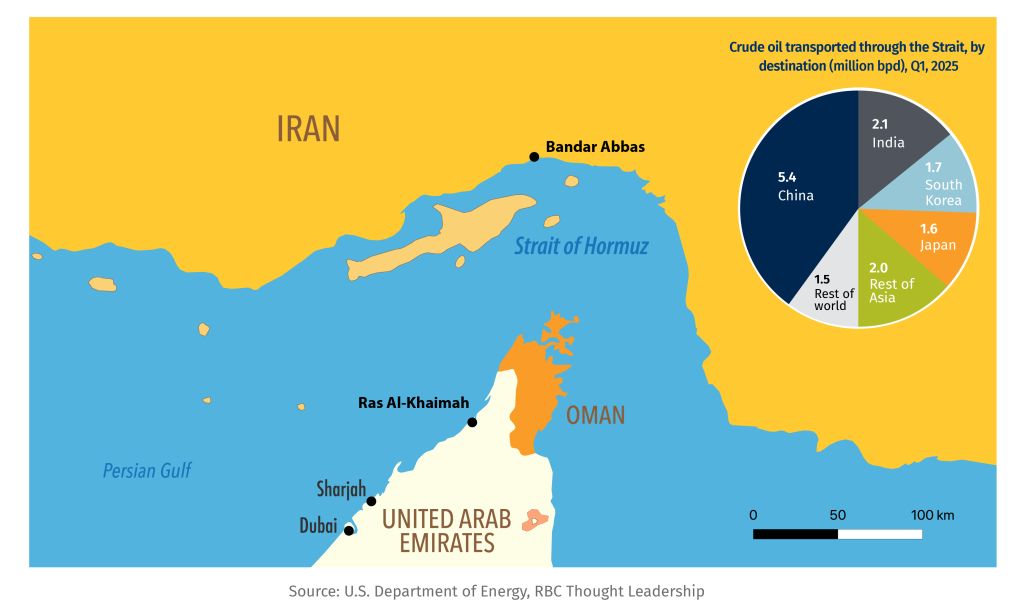
Since the Iran conflict started, commercial shipments of crude and natural gas have slowed to a “near-total” pause. And the price is climbing—fast. Brent Crude futures crossed US$90 a barrel, the highest in almost two years, leading to fears of higher prices at the pumps and spiking inflation.
–Farhad Panahov
Critical conversations: 7 takeaways from PDAC
This year’s Prospectors & Developers Association of Canada (PDAC) event in Toronto was abuzz with talk of Canda’s critical mineral riches and the speed at which they can be brought to global markets—at commercial scale. The industry is enthusiastic, the government supportive, but there is a long way to go to realize Canada’s mining potential.
Here are seven themes that we observed at the event:
-
Diverging views of supply chains exposures
-
Resolving refining bottlenecks will be key
-
Project Vault is not a partnership of equals
-
Copper is the clearest demand signal
-
Don’t ignore civilian demand
-
Prioritize across the minerals list
-
Regulatory coordination as competitive advantage
Read more on these key takeaways from Shaz Merwat, RBC Thought Leadership’s Energy Lead, here.
Three Questions with…Foreign Affairs Minister Anita Anand
Hours after returning home from India, where Prime Minister Mark Carney kicked off talks of a Comprehensive Economic Partnership Agreement aimed at doubling two-way trade to $70 billion by 2030, Foreign Affairs Minister Anita Anand joined RBC’s John Stackhouse on stage at the Toronto Region Board of Trade.
Some key takeaways from the conversation (edited for brevity):
JS: What signals are you bringing home, especially to business decision makers?
AA: We are the only G7 country that has a free trade agreement with every other G7 country. We had the infrastructure in place from a trade perspective. We need it to be operationalized and utilized. Such is the case with India. We need all of us to be utilizing the agreements that we are executing, or we will keep having to rely on one trading partner and all the difficulty that has caused.
JS: I’ve heard this for decades. We need to diversify. We’re making progress but it’s slow progress. What are we, in business, missing?
AA: It’s really important to unpack what we are doing internationally. That’s what I’m trying to do, make foreign policy and these types of agreements accessible and understandable for businesses to utilize—that will yield actual trade diversification over and above the agreements that we’re signing.
JS: I wonder if you could wrap up with a positive reflection from your trip and if there was any one point that really gave you confidence, especially for businesses?
AA: There is a positive story here despite the very difficult economic environment we find ourselves in, despite a global conflict that is extremely disconcerting and stressful. Canada is on a positive path to growth. Canada has everything the world wants. There is not a room that I go into where people are uninterested in Canada.
Watch the entire conversation here.
Trade Posts
States challenge Trump’s latest trade measures
-
As many as 24 U.S. states have sued the Trump administration over its new 10% tariffs imposed under Section 122 of the 1974 Trade Act, arguing the president again exceeded his authority after the Supreme Court struck down the earlier emergency-powers tariffs.
-
The case reopens yet another legal front in Washington’s tariff strategy and prolongs uncertainty for businesses, as courts weigh the limits of executive trade authority.
AI chip exports potentially being tied to U.S. investment
-
The U.S. Commerce Department is proposing new export rules that would require countries buying large volumes of Nvidia and AMD AI chips to commit investment into U.S. data-centre infrastructure.
-
The move signals a shift toward “investment-for-access” technology policy, as the U.S. tries to leverage its semiconductor advantage to support the huge buildout of data centres.
–Thomas Ashcroft
This article is intended as general information only and is not to be relied upon as constituting legal, financial or other professional advice. The reader is solely liable for any use of the information contained in this document and Royal Bank of Canada (“RBC”) nor any of its affiliates nor any of their respective directors, officers, employees or agents shall be held responsible for any direct or indirect damages arising from the use of this document by the reader. A professional advisor should be consulted regarding your specific situation. Information presented is believed to be factual and up-to-date but we do not guarantee its accuracy and it should not be regarded as a complete analysis of the subjects discussed. All expressions of opinion reflect the judgment of the authors as of the date of publication and are subject to change. No endorsement of any third parties or their advice, opinions, information, products or services is expressly given or implied by Royal Bank of Canada or any of its affiliates. This document may contain forward-looking statements within the meaning of certain securities laws, which are subject to RBC’s caution regarding forward-looking statements. ESG (including climate) metrics, data and other information contained on this website are or may be based on assumptions, estimates and judgements. For cautionary statements relating to the information on this website, refer to the “Caution regarding forward-looking statements” and the “Important notice regarding this document” sections in our latest climate report or sustainability report, available at: https://www.rbc.com/our-impact/sustainability-reporting/index.html. Except as required by law, none of RBC nor any of its affiliates undertake to update any information in this document.