Disclaimer

rbc_tl_disclaimer

What you need to know about the rapidly emerging field of quantum computing, which can solve problems faster than a supercomputer

Quantum computing is quietly moving from an interesting physics challenge to potentially a strategic solution in boardrooms worldwide. The global market for quantum technology is expected to reach up to US$97 billion by 2035. Canada sits close to that shift, with a deep research base and a small set of firms trying to translate scientific advantage into industrial capability.

Quantum computers aren’t replacing classical machines. They’re a specialist tool for problems that even today’s best supercomputers can’t handle. In 2024, Google’s Willow chip completed a benchmark calculation in under five minutes that would take a leading supercomputer an estimated 10 septillion years, vastly exceeding the age of the universe.

A classical computer tries possibilities one by one, through binary bits (0 or 1). Whereas a quantum computer uses qubits, which keep many possibilities alive at once (superposition), links parts of the problem so they move together (entanglement) and uses cancellation/reinforcement to make wrong answers fade and right answers stand out (interference).

It can solve problems classical computers can’t handle. Bain estimates quantum computing could unlock up to $250 billion in value across pharmaceuticals, finance, logistics, and materials science. Consider drug discovery: bringing a drug to market could cost up to $4 billion and can take more than a decade. Add to that, the fact that about 90% of drug trials fail. Quantum computers can simulate molecular interactions at the atomic level: something classical machines can only approximate, heavily compressing timelines.

The security clock is already ticking. The most immediate business risk is “harvest now, decrypt later”: adversaries collect encrypted data today and wait for quantum capability to crack it retroactively. The National Institute of Standards and Technology (NIST), the National Security Agency (NSA), and the Canadian Cyber Centre all treat this as a live threat requiring action. If your organization holds data with a long shelf-life: health records, proprietary research, industrial IP, the breach window is already open.

Canada’s quantum prowess is decades in the making. Waterloo’s ‘Quantum Valley’, anchored by the Perimeter Institute and the Institute for Quantum Computing, has attracted over $1.5 billion in investment over 25 years and trained more than 3,500 quantum specialists.

The challenge is keeping that advantage at home. In December 2025, Ottawa launched the Canadian Quantum Champions Program, investing $92 million across four companies: Xanadu (Toronto), Nord Quantique (Sherbrooke), Photonic (Vancouver), and Anyon Systems (Montréal). This is part of the government’s five-year quantum commitment of $334.3 million.

The projected payoff: by one estimate, quantum could contribute more than 3% to Canada’s GDP by 2045, rivalling the aerospace sector, and support more than 200,000 jobs.

There are technical challenges that need to be addressed. A qubit holds its quantum state for a tiny window, often tens to hundreds of microseconds, so you can only run a limited number of steps before errors drown out the signal. It’s like solving a complex equation on a whiteboard that starts erasing itself every fraction of a second.

To compensate, engineers use error correction: redundant qubits that check and protect the computation. But creating a single stable “logical qubit” can require hundreds to thousands of physical qubits, far more than current machines offer. This is where the race is being run – Google, Microsoft, and Canada’s Xanadu are all competing to crack error correction at scale and unlock breakthroughs in molecular simulation, cryptography, and optimization that classical computers can’t reach.  

  • Post-quantum cryptography deadlines: Canada’s roadmap for the public service requires migration plans by April 2026, high-priority systems quantum-safe by 2031, and full migration by 2035. Those dates will ripple into vendor contracts and supply chains.

  • Early commercial traction: Drug discovery, materials science, and financial optimization are where pilots are emerging. Consistent advantages over classical methods will signal the technology is turning a corner.

Download the report

Disclaimer

rbc_tl_disclaimer


Quantum computing is moving from research into real infrastructure — and that shift brings two truths at once: a major leap in what’s possible for discovery, and a cybersecurity deadline for the systems we rely on for trust.

In this episode of DisruptorsJohn Stackhouse visits Xanadu’s Toronto headquarters to meet Aurora, a networked quantum computer built to push scale in the right direction and to see what “quantum in the real world” looks like as photonic systems move toward practical deployment.

John is also joined by Dr. Stephanie Simmons, Founder and Chief Quantum Officer at Photonic, who lays out both the upside and the urgency: the opportunities quantum could unlock in areas like materials and chemistry, and the security reality behind “harvest now, decrypt later,” where adversaries can collect encrypted data today with the intent to decrypt it later once fault-tolerant quantum arrives.

The takeaway is practical: post-quantum cryptography (PQC) migration is a multi-year transition, and leaders should start now — by mapping cryptography dependencies, prioritizing high-risk systems, and pushing vendors to deliver PQC-ready roadmaps before the storm hits.

Also read: Quantum Computing. Explained.

Listen on Apple Podcasts, Spotify or Simplecast

Harvest Now, Decrypt Later: The Quantum Era’s Encryption Challenge

SPEAKERS

Christian Weedbrook, Dr. Stephanie Simmons, John Stackhouse

John Stackhouse 00:00:09

Hi, it’s John here. I don’t want to be a scaremonger, but right now as you’re listening to this, are pretty good that adversaries somewhere maybe trying to collect your data, even your encrypted data. If you’re running a company, a hospital, a public institution, or just sharing data. Basically if you rely on encryption to create digital trust or rely on digital trust for anything, this episode is for you.

Now, these sorts of challenges have been with us for decades, but there’s one word that is really sharpening the challenge in the 2020s and that word is quantum. Today we’re going to talk to two of Canada’s leading quantum pioneers to not only understand what’s at stake in this new global battle that’s taking place in machines all around us, but to get a true sense of how Canada has become a true global leader in both the science of quantum and the art of trust.

We’ll be joined by Dr. Stephanie Simmons. She’s the founder and Chief Quantum Officer at Photonic. It’s a remarkable company that I’ve had the chance to visit in Burnaby B.C. And we’ll also be joined by Christian Weedbrook, the founder and CEO of Xanadu and we’ll visit his quantum lab in downtown Toronto.

You may know both of their names from previous episodes of Disruptors. They joined us in 2023 when most of us probably still filed quantum under the label “someday.” Now, these systems are moving from research labs into production infrastructure and will be critical to Canada’s competitiveness and sovereignty in a high stakes global digital economy.

Here’s a bit of background for those of you who may not have your high school physics textbook quite at hand. Quantum computers use qubits. Those are units that can exist in multiple states simultaneously. And when qubits become entangled, they behave as one coordinated system, solving certain problems exponentially faster than any classical computer could. But as powerful as quantum states can be, they are also incredibly fragile.

The real engineering challenge is correcting errors in real time before all those calculations collapse. Once a system reaches so- called fault tolerance, where they can fix errors faster than they can occur, today’s encryption becomes obsolete. Imagine the threats that can go with that, and guess what?

They’re already active. “Harvest now, decrypt later” means actors, usually bad ones, are collecting encrypted data today to decrypt tomorrow. And if that protection breaks, we just don’t lose privacy, we may lose trust in every institution that holds our information. So today’s episode is about protecting that trust layer of the economy before it’s too late and the breakthroughs that come with it. Let’s get into it. I’m here at the Toronto headquarters of Xanadu, which is really in some ways ground zero of quantum technology, certainly here in Canada. I’m with Christian Weedbrook, the founder and CEO of Xanadu, and behind me is Aurora, a creation of Xanadu and the world’s first networked quantum computer. Tell us what we’re looking at.

Christian Weedbrook 00:03:30

So the first thing to notice is this is a quantum computer. It’s the most advanced quantum computer anywhere in the world in terms of its networking capability. So what we see here is four server racks. They’re roughly about seven feet tall. They wouldn’t look out of place in a normal data center. And this is setting the vision for what quantum computing will become, but the challenge here is how to connect them together. Quantum mechanics makes it typically very difficult to connect server racks together unless you’re using photons or light, which is our approach.

John Stackhouse 00:004:01

Okay, take us deeper into that because certainly to the lay eye, it looks like server racks as you say. So what’s going on here that makes this quantum?

Christian Weedbrook 00:04:11

For any quantum computer, you need to be able to access things like the superposition principle entanglement and interference. So all those properties are occurring here. So we’re using photons or light. Qubits are creating up here. And as they propagate downwards, gates are acting on them. And so it’s very much typical of a normal computer. You have inputs, the bits normally, you have gates and then you have the readout. We have a quantum mechanical version of this where you actually have qubits, gates and then measurements at the bottom.

The key point here is that you actually have light starting at the top, getting created qubits and going all the way down. And that’s happening individually and all these server racks. But the really cool thing is they’re actually talking to each other. You can see down here the yellow cables of fiber optics being connected to their nearest neighbor. And that’s really the revolutionary aspect of this Aurora computer when it relates to scalability.

John Stackhouse 00:005:04

And speaking of scale, how much bigger does this get or is this the size and it’s just the intensity that needs to be focused on?

Christian Weedbrook 00:05:13

This can scale up to arbitrary number of server racks now, so that’s being solved.

John Stackhouse 00:05:17

So how do you improve the performance?

Christian Weedbrook 00:05:19

Essentially, let’s take a laser pointer. Whenever you shine a laser pointer at a wall, you can see the laser on the wall. But if you imagine the wall getting taken kilometers away, the imprinted laser starts diluting. It becomes faint. And that means photons have been lost.

Loss here actually causes the errors in our computation. And as mentioned before, that’s why we use error correction codes, so that will protect us against the loss of information. But the other one is working more and more with foundries. So we actually have photonic integrated chips. And we design them here in Toronto and send them off to different foundries around the world. They made or fabricated these chips and send them back to us. What we need to do is improve the performance of those chips, and that’s how we reduce loss from a physical point of view.

John Stackhouse 00:06:07

Christian isn’t giving us a scoreboard today. He’s actually showing us a path to scale. And here’s the uncomfortable part. Once systems like this truly scale, and they will, the encryption that protects identity and transactions today becomes obsolete. “Harvest now, decrypt later” is the storm on the horizon. Encrypted data is being collected and stored now to be open later, but if that promise of protection breaks, we just don’t lose privacy, we may lose trust in those who hold our information.

Implementing post- quantum cryptography is like replacing your roof before the storm hits. If you wait until water is coming through the ceiling, well, it’s already too late. So what does that actually mean for the trust layer of our economy? Stephanie’s going to break down the risk and what leaders need to do next. Stephanie, welcome back to Disruptors.

Dr. Stephanie Simmons 00:07:00

Thank you so much for having me. I’m excited to be here.

John Stackhouse 00:07:03

John Stackhouse: It’s great to have you as a repeat guest. What do you think about most when you think about this idea of “harvest now, decrypt later,” and what’s at stake?

Dr. Stephanie Simmons 00:07:12

Yeah. What I like about quantum is that we know it’s coming and we have the opportunity to prepare. When ChatGPT happened, it took everybody by surprise. But we know this is coming, so we have the opportunity to just take a deep breath and move. “Harvest now, decrypt later.” Data is a lot cheaper to hold onto today. We know that there’s quite a bit of tracking being done and holding onto communications today so that one could decrypt it in the future.

Now, what’s needed for the cryptographically relevant quantum computer has come down considerably. So just for reference, I’m a founder of a company called Photonic. And one of the things that we brought into the market about a year ago now was efficient QLDPC codes, much more efficient codes. What it does is it’s meant that the requirements to build these big quantum systems that can break into all these codes came in by an order of magnitude or more.

So a lot of these things are moving really quickly. And we know that what it can do is it asks us to think about coming up with a new cryptographic solution for the way that we communicate. Now, that’s just the cryptography side.

John Stackhouse 00:08:15

Well, let’s talk about some of the challenges in commerce and what could break down. Is it going to be identity, authentication, signing? Where do you think the vulnerabilities are?

Dr. Stephanie Simmons 00:08:26

It can do the math that we rely upon for what we’ll call the asymmetric layer of our cryptographic systems. And that’s kind of every exchange. So it’s not just authentication, although for sure it is every step along the way where you could take a look. What we use today is we use a, for the asymmetric part of the encryption, we have this handshake. So two different teams over the internet or whatever network, they have this agreement. We’re like, ” Okay, hey, you are who you say you are. And I’m going to rely that this math problem is really hard to solve, but if you have the solution, it’s really easy to check.” So that’s why it’s called asymmetric.

And what you have is that math is kind of what we’re trusting is unbreakable for all the comms. And so when you’re logging into your account, when you’re logging into anything, when you’re forming any communication, that math is what you’re trusting. And so I think that in the early instances, if an adversarial organization were to use that, it would get access to basically any communication we use online.

Now, okay, what I want to say is that there are new cryptographic standards that people are really excited about and they hope they will withstand all future quantum algorithms. We don’t know all the future quantum algorithms, but there is reason to hope that these ones will be resilient. And so we have the opportunity now to change our software and hope that those new cryptographic standards hold.

So there are solutions here, and people have been working on this, as you can imagine, quite a bit. What I’m glad to hear in this conversation here is the interest in actually taking that step and shift. And it’s not easy. It’s not easy because a lot of teams use third party suppliers that themselves are using vulnerable cryptography. So I think we have that awareness moment. The community knows that this is in five years plus or minus. And we can take the time to go in and just put that additional layer of security to know that we’re going to be quantum safe through the coming years.

John Stackhouse 00:10:38

So that’s the threat. “Harvest now, decrypt later” isn’t science fiction, it’s a trust crisis on a timer. We’ve seen the threat, we’ve seen the defense architecture, but there’s another side to this story. Back to Christian Weedbrook. What can quantum computing actually do for us today and what will enterprises use first?

You’re doing a lot around drug discovery, which is one of the big opportunities with quantum. Tell us more about what you’ve done and where you’re hoping that will go.

Christian Weedbrook 00:11:08

Once you have a large enough quantum computer, as mentioned, once you have hundreds of these server racks performance, our world will look very different. So if you look at pharmaceuticals, it starts off with classical simulation of quantum systems. You go through then synthesizing candidates for drug discovery, same with materials. And then you do clinical trials. So meaning you go from simulations all the way through.

And then ultimately what happens is 90% of the candidates after all these trials fail and you’ve wasted 10 years, one to two billions of dollars, and you only have a 10% success rate. So quantum computing will flip that. So whether it’s drug discovery materials, the simulation of complex systems as the starting point, which traditional computers are doing, quantum computing will do significantly better. And the hope is instead of taking 10 years, you can actually do it in significantly less time, say a year or even a few months. And so that’s why our world will look very different.

John Stackhouse 00:12:08

Stephanie, walk us through some of the opportunities that you’re most excited about.

Dr. Stephanie Simmons 00:12:14

Quantum mechanics is hard to simulate classically. By classically, I mean using light switch, zeros and ones. And because of that, we are okay at simulating small chemicals like some of the small elements that we use for drug design and the rest. But once we get to heavy atoms or complicated molecules, even as complicated as caffeine, we can’t simulate it fully.

So having a tool fit for purpose for the material world opens up with the opportunity to produce not just a large language model, but a large chemistry model or a large physical model to really understand how the physical world works, which would be a whole other layer of capability that we can then bring to whatever industry we want. That can help with corrosion, it can help with metabolism, it can help with more complicated drug design, photosynthesis or redesigning of the energy landscape with having new catalysts to help with all kinds of energy efficiencies. That’s a big one.

In the financial world there’s a lot of people that are looking at how to use these tools to better help with some of those applications, whether or not it be optimization or detection of anomalies or whatnot.

There’s a way to leverage not just AI and classical computing, high-performance computing, but then bring quantum into the mix to have all of the computational tools available to sort out our most challenging problems computationally.

John Stackhouse 00:13:39

I’ve had the privilege of getting to see your computer up close. Most people will not get to see a quantum computer, but they’ll discover quantum through the cloud and through quantum as a service. Tell us a bit more about QaaS, Quantum as a Service and how different enterprises, but also individuals should be thinking about accessing quantum through the cloud.

Dr. Stephanie Simmons 00:14:03

We should all have roadmaps internally. By we, I mean the broader community. How does it impact your business? And understanding those applications and doing the application engineering and development to know what kind of quantum resources you’re willing to pay for. If we were to put a hyper capable quantum computer into the cloud, most wouldn’t know what to do with it. So having that roadmap for like, ” Hey, what would you pay for?” I think that’s really important because if you don’t do it, your competitors will, and then they’ll be able to use it to their advantage in a first mover sense.

Quantum as a Service is the way to get quantum capabilities into the hands of everybody who needs them, but can’t afford a single system. But this is similar to how we’re using cloud compute today. Most teams don’t want to build their own data centers, but they do want to have access to that capability. And I think what’s going to happen over time is the field will progress and the quantum part of it will be under the hood, and you’ll only see the application layer.

And that is again, how people are using a lot of the tools today, right? AI or high performance computing, the really, really high performance teams will go all the way in and understand how to do it themselves, but there will still be a lot of appetite for the high level access that only is providing solutions to problems, not compute cycles themselves.

John Stackhouse 00:15:29

As that evolves, again, help but think about sovereignty and security, the more that quantum is distributed. If you have your own computer as you do, I imagine that is more secure, but as quantum gets distributed through the cloud, there’s more vulnerabilities. How should we be thinking about both sovereignty as a country, but also security for organizations and individuals as that distribution starts to accelerate?

Dr. Stephanie Simmons 00:15:56

That’s a wonderful question because the last thing you want to do is have a quantum computer that could hack anything just be freely available online. That one might be a bit messy.

John Stackhouse 00:16:06

That’s a scary thought.

Dr. Stephanie Simmons 00:16:07

Well, I mean, okay, let’s just be clear. If we get through the cybersecurity transition, which will be a transition, there’ll be some number of years and then we’re done with it, then we should have those tools available for everybody to use for whatever they need. So there will be a place where we think about yes, sovereignty and security through this transition, and that’s where, again, especially because Canada invested in quantum so early, we have a little bit more cultural awareness here than most other countries. We should take that step and be in front of it because then we could be one of the first to actually, from a security perspective, leverage the full benefits.

Now, this comes back to the value side. Perhaps all you’re asking for is an optimization to a problem. And you could submit that job rather than have access to the computer. Then you could make sure that the actual requests are secure, right? Because asking for an optimization is different than asking to hack a communication. Right? And so that could be managed from a security perspective by the providers and done so in a way where it’s not limiting the providers to actually provide value to the world.

Now, I would share that Canada’s way ahead of many, many nations on quantum. And there’s maybe a top 10 list of teams around the world that are on this race to deliver these big commercial scale systems with all these applications. And so from a sovereignty perspective, we have the opportunity to not make the mistakes that we did before and actually double click on a commercialization frontier for this technology, not just invention.

I think it’s our time to learn lessons of commercialization from a sovereignty perspective, because if you take a look at how a lot of new technologies have been developed, you take a look at the iPhone for example. Most of the components for the iPhone were developed through DARPA contracts, a US government agency that fueled defense aspects, but also then were used in the commercial market. And I think that we can learn lessons like that because those programs, they’re absolutely part of the mix, especially if it’s important from a sovereignty perspective to be first and have an actual commercial landing.

Some of the other incentives that come along are all kinds of matching programs or incentive programs. These are really part of the game. And teams want to succeed in stable, lovely places like Canada, but the money talks too. So yeah, we do have to think about that structure and make sure that the plans and structures are in place because people want to win here, and we absolutely can.

John Stackhouse 00:18:41

Companies and universities, public sector organizations and individuals need to come to grips with this incredible opportunity. What’s the key to get going with and focus on in the year ahead?

Dr. Stephanie Simmons 00:18:53

Yeah, I would suggest get a quantum transition plan in place. There’s a lot of work that now exists that you can leverage. You don’t need to start from scratch. Part of that is going to be putting some of the suppliers on notice that you as an org need them to be quantum secure. And also think about internally how you want to benefit from the applications that are known already, and then think about developing them further. Because I would tell you that those applications are coming in thick and fast now because people are really seeing how close this is.

I think back to Avro Arrow and Bombardier and Nortel and Blackberry, I mean, we can do it and we can keep it if we learn from what structurally seems to be working elsewhere, just honestly pattern- matching and hitting that market. So one of the things that the US government is doing, for example, is putting in $ 300 million per quantum company that they think has a shot on goal. And Canada very helpfully is playing with that market force. And so that’s an awareness thing that I think is really positive progress.

From a regulation perspective, I think it’s important to not get too fearful and lock it down because that could be a market force that’s a disincentive to actually build. But let’s just be smart about it, right? Let’s get the cybersecurity in place across the country. We already have a date now. 2030 is our date with the Five Eyes. In general we are thinking about this date, plus or minus. I think we need to bring it in a little bit personally, but that’s because I know some things that maybe others don’t. And we can do it. There’s nothing wrong with it, and then we can really benefit. I think it’s going to be a wonderful wave of capability that we can use on all kinds of hard problems.

John Stackhouse 00:20:30

John Stackhouse: It’s no coincidence that in pretty much every national strategy we now see whether it’s defense and space or autos, and of course, AI, quantum is a key element. And a lot of that is due to your leadership, Stephanie. So thank you for that and thank you for being on Disruptors.

Dr. Stephanie Simmons 00:20:48

Oh, absolutely. Thanks for having me on. It’s a great conversation. Really appreciate it.

John Stackhouse 00:20:55

Here’s one thing that’s really important to remember. Quantum computing isn’t some day, it’s now. The systems are real. The threat is active, the clock is ticking, but this isn’t a story about inevitable disaster. It’s a story of choice. You can treat quantum as both a capability bet and a security retrofit. You can start now inventorying where you rely on cryptography, prioritizing what must stay secure and migrating to post- quantum strategies before today’s protected data becomes tomorrow’s breach. Or I guess you can wait for the headline moment, but by then, too late.

If you want to know more about quantum, check out rbc.com/thoughtleadership. You’ll find lots of great content there, including a new quantum primer from our research associate, Sabrina Schuchel.

You’ve been listening to Disruptors, an RBC podcast. Please rate, review and follow us on Apple or Spotify or wherever you get your podcasts. It helps more people find conversations like the one you’ve heard today. I’m John Stackhouse. Thanks for listening.

Disclaimer

rbc_tl_disclaimer

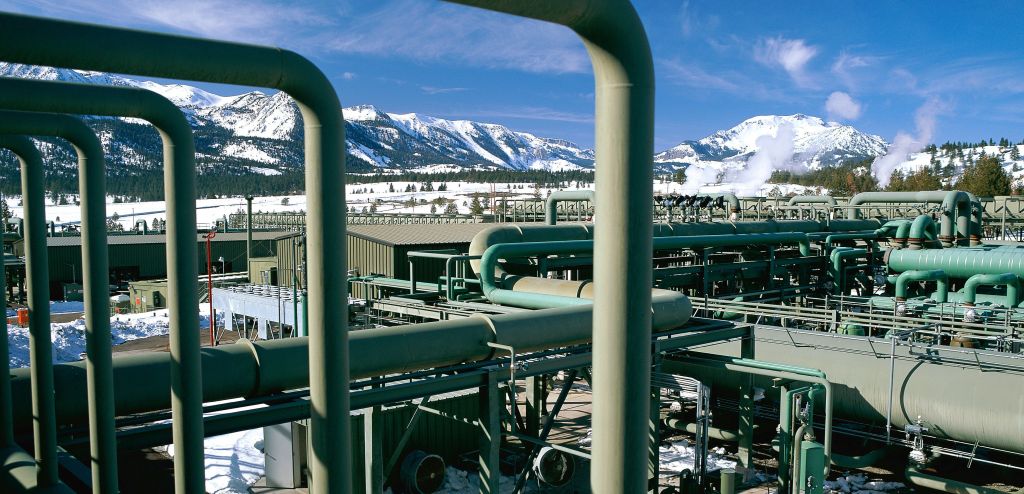
Investment in next-generation geothermal technologies is surging globally, driven by recent breakthroughs in drilling technology that are rapidly transforming the economics and viability of geothermal electricity generation. According to the International Energy Agency (IEA) and data from Underground Ventures, a geothermal-focused venture investor, financing for next-generation geothermal reached roughly CAD$3 billion in 2025.1 The U.S. and Indonesia lead the world in investment in geothermal power and heating projects.2

While Canada possesses world-class subsurface expertise, hot geothermal gradients spanning western and northwestern regions, and companies like Eavor, DEEP Earth Energy, and Tu Deh-Kah Geothermal, domestic deployment lags dramatically. Canada currently generates less than six megawatts (MW) of geothermal power, representing 0.004% of the country’s installed capacity.3

According to the IEA, global investment in geothermal energy could reach CAD$3 trillion by 20504 as nations seek reliable, zero-emission baseload power to complement intermittent renewables. Advanced technologies are key to scaling geothermal, which has traditionally been confined to specific areas with the right geology. Two technologies stand out: (1) Enhanced geothermal systems (EGS), which borrow shale drilling technology, create new fractures in hot underground rocks, inject fluids and use the steam to generate geothermal power;5 (2) Closed Loop Geothermal (CLG) systems also deploys advanced drilling and injects liquid through underground pipes to generate electricity.6 7

Recent innovations are dramatically reducing costs. Improved drilling techniques borrowed from oil and gas, including polycrystalline diamond compact drill bits and real-time fibre optic monitoring, are cutting well costs by up to 12-26% compared to earlier estimates.8 Companies like Houston-based Fervo Energy have demonstrated sustained 8-10 MW output from single production wells at their Cape Station project in Utah, validating the commercial viability of EGS.9 New techno-economic analysis shows that in high-gradient regions like British Columbia’s Mount Meager or the Northwest Territories’ Liard Basin, levelized costs of energy for EGS could fall to CAD$45-53/MWh with continued innovation, competitive with combined-cycle gas and cheaper than new nuclear.10

The opportunity could be significant.

Recent research on Baker Lake, Nunavut, reveals that previously dismissed regions of the Canadian Shield may hold viable deep geothermal resources. At a measured gradient of 28°C/km, significantly higher than earlier national estimates, modelling indicates a 90% likelihood that a four-kilometre deep system could meet the community’s heating demand, with potential for electricity generation at 7-8 kilometre depth.11

Saskatchewan is already leveraging its oil and gas expertise.

Saskatoon-based DEEP Earth Energy has partnered with oilfield services company SLB to develop Canada’s first commercial-scale geothermal power facility near Estevan, near the Saskatchewan-North-Dakota border. Phase 1 involves drilling two wells, with Phase 2 potentially scaling to 18 wells producing 30 MW.12 This project leverages the Western Canadian Sedimentary Basin’s hot sedimentary aquifers and demonstrates that Canada’s oil and gas infrastructure, rigs, drilling expertise, and supply chains, can be applied to geothermal development.

Yet regulatory fragmentation threatens to stall momentum.

Only Alberta, British Columbia, and Nova Scotia have geothermal-specific legislation. There is no national strategy, no coordinated R&D agenda, and insufficient financial de-risking tools to accelerate early-stage projects. A national regulatory template that provinces could rapidly adapt to their own specific needs alongside government-backed initiatives like the Alberta Drilling Accelerator (ADA) could help to catalyse geothermal in Canada by reducing drilling costs, developing high-temperature tools, and optimizing reservoir stimulation.

The window for Canadian leadership is closing.

The U.S. Department of Energy’s Enhanced Geothermal Shot targets electricity costs below CAD$61/MWh by 2035.13 with billions in funding. Tech giants including Google, Meta, and Microsoft are investing heavily in geothermal partnerships. China, Indonesia, and the Philippines are rapidly expanding deployment. If Canada does not act with coordinated policy, regulatory harmonization, and strategic R&D investment, it risks squandering subsurface expertise and geological endowment that offer natural advantages.


Vivan Sorab is Clean Technology Lead at RBC Thought Leadership

Disclaimer

rbc_tl_disclaimer

➔ Meet Coalie, the hard-hatted American mascot

➔ Ottawa’s auto strategy comes with a climate-action twist

➔ What should be the North Star for Canada’s proposed national electricity strategy?

Canadian companies aren’t waiting for Ottawa’s signal to advance the U.S.’s mineral ambition. While the federal government is holding off signing any formal deals with Washington on critical minerals, Toronto-based Cyclic Material is investing a strategic US$82 million in a rare-earth recycling facility in South Carolina, after securing new funding from the Canada Growth Fund, among other investors. It’s a trend: Vancouver-based Lithium Americas is building a massive project in Nevada, while Trilogy Metals is developing a copper-zinc-gold district in Alaska—with the U.S. government taking the unprecedented step of buying small stakes in both recently. North America’s market and geographical gravitational pull would hopefully overcome political posturing.

Climate Adaptation and Resilience (CA&R) could be the next frontier in climate investing. RBC Capital Markets’ report Private Markets Innovation in Climate Adaptation and Resilience highlights five areas where capital could make a difference: earth data, insurance solutions for businesses and society, wildfire and the grid, water, and the built environment. CA&R secured only US$65 billion in capital flows in 2023, compared to US$1.8 trillion in traditional mitigation investments such as renewables and energy storage. Climate Action Institute’s Clean Tech Lead Vivan Sorab believes while mitigation efforts’ address both current and long-term trends in emissions, their immediate impact tends to be muted; CA&R investment can potentially deliver more visible and quicker results in the form of less downtime and assets protected. The insurance costs are already mounting: 34 extreme-weather events triggered insured losses of US$1 billion or more in 2024—the second-highest number on record.

“Coalie,” the hard-hatted American mascot, may struggle to revive coal This carbon-intensive lump is getting a makeover for the AI meme era as the U.S. government promotes coal as vital for the economy. Despite its critics, coal saw a resurgence last year: U.S. coal-fired electricity jumped 13% year-on-year in 2025, while natural gas—which is about 50% less emission-intensive than coal—fell 3.6%, according to the International Energy Agency’s latest electricity outlook. However, coal’s dominance is slipping elsewhere in what the IEA describes as an “uncharacteristic” shift: major consumers China and India saw a drop in coal power generation in 2025 for the first time in more than five decades. While coal is projected to remain the single largest source of global electricity through 2030, the IEA predicts declining consumption in China and the European Union. Even the U.S. is expected to see a drop in coal consumption by 2030, Coalie’s charms notwithstanding.

Photo Credit: U.S. Department of the Interior

– By Farhad Panahov, Economist, RBC Climate Action Institute

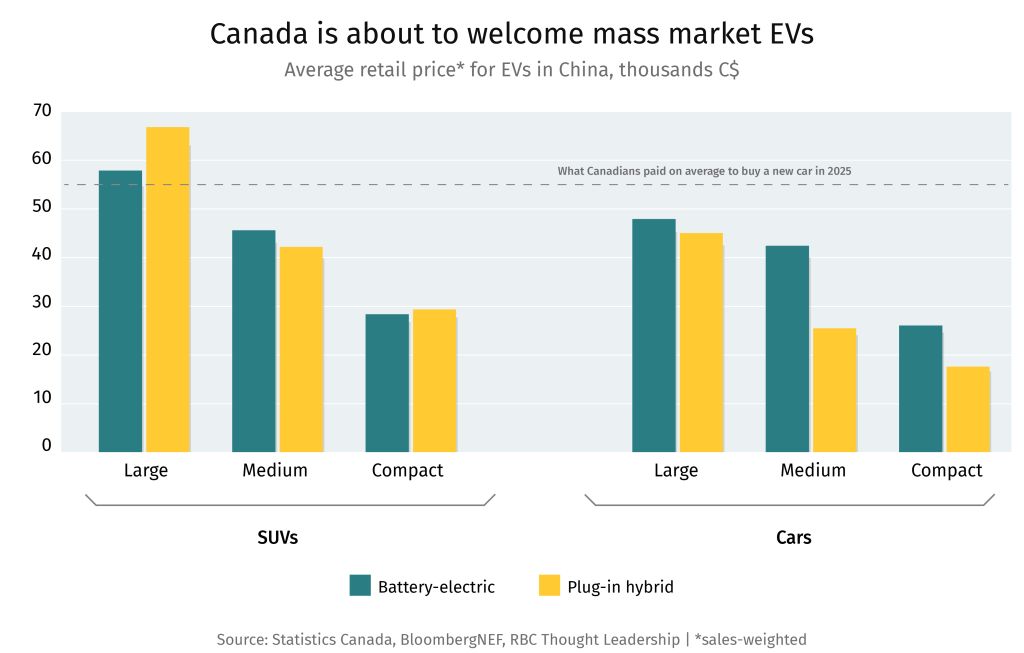
Canada’s new strategy to boost EV sales has a twist: a cap of $50,000 for the total transaction value to be eligible for a subsidy. A more stringent rule—to boost mass market models—compared to a previous program that allowed purchases of more expensive trims.

Average price Canadians paid last year for a new vehicle was $55,000, and nearly $70,000 for an EV. And while each $1,000 could add 11% to the EV demand, based on Canadian Climate Institute’s analysis, only 13 of the 163 battery-electric models available in Canada are priced below that level, according to the Canadian Automobile Association. Another 10, priced at around $55,000, are potential candidates to be marked down to claim the subsidy.

Meanwhile, the 49,000-quota for Chinese EVs, should add further impetus to vehicle transition. Crucially, while these vehicles are excluded from the incentive program, they could enter the market at the lower end of the price range, as models like BYD and Geely made up about a quarter of global EV sales last year, are sold for $35,000 in China—roughly half of what Canadians paid for EVs in 2025.

But North America is notoriously in love with large cars, such as trucks and SUVs, a segment where Chinese EVs might not have the same price leverage. And don’t forget the 6.1% Canadian tariff that still applies on Chinese cars, plus shipping costs. Chinese EVs, facing less intense competition than at home, could also seek higher markups for their models in Canada.

The success of the Canadian strategy could rest as much on consumer trust as it does on the final price tag. Nearly half of Canadians are still not in the EV camp based on recent poll from Clean Energy Canada; and only one in 10 would buy a Chinese EV with another two in the “maybe” mindset.

The previous federal program of $2.7 billion helped put about half a million EVs on Canadian roads. The fresh round of subsidies, with a lower $2.3-billion allocation, could add 840,000 new EVs, the government projects.

Canada is about to welcome mass market EVs

The new auto strategy could help transport—a stalwart sector for emission cuts over the past five years (see our Climate Action report)—deliver the following in climate action:

  • EV mandates out, standards in. Abolishing the much contested EV sales mandates in favour of emissions standards will aim to achieve 75% EV sales share by 2035.

  • Emissions standards. Emissions standard are a common practice for automakers and allows for higher compliance flexibility compared to sales mandate while still incentivizing a pivot towards emissions-free vehicles. Since 2011 alone, emissions per mile from passenger cars and light trucks have declined 50% and 30%, respectively.

  • U.S.-Canada policy is diverging. Historically, Canada aligned its emissions standards with the U.S. It’s different now as Canadian policy diverges from the U.S. Environmental Protection Agency (EPA) push to roll-back Biden-era standards (that would have halved emissions per mile by 2032).

  • …As is Detroit 3’s strategy. The auto policy supports another $3 billion investment in the EV sector “positioning Canada as a place where the vehicles of the future are built.” However, the Detroit Three—Ford Motors, General Motors and Stellantis—are scaling back EV roll-out plans that has cost them around US$50 billion, amid tepid customer demand.

  • Networks are getting a supercharge. Ottawa is committing $1.5 billion to expand the charging network, adding to the $1.1 billion in funding, which so far has helped add 7,000 installations. Canada’s public charging network is already sufficient for current levels of EV adoption, at ratio of ~21 EVs per charging port, but will need to significantly expand as adoption accelerates.

Also check out: RBC’s Electric Car Cost Calculator

A scan of notables and notable developments

  • Lisa Ashton, Interim Head of the institute, is in Ottawa for Agriculture Day festivities, a timely opportunity to share insights from Seeding Scale, our new research on the growth capital pipeline in the agri-food sector. Lisa heard that the innovation pipeline needs focused improvements as well and universities and industry are working collaboratively to devise a clear vision for the sector ahead of the agriculture ministers meeting in July. 

  • As the U.S. convened allies, including Canada, on critical minerals last week, John Stackhouse shared a few thoughts. His first point: even the U.S. knows it can’t go-it alone on mining.

  • Canadian Climate Institute’s Rick Smith finds another climate angle on a recent Canadian court ruling that reinforced Ottawa’s right to list plastics as “toxic”: “…polluting industries and some provinces have been spinning a yarn that the federal government’s Clean Electricity Regulations, also enacted under CEPA, are an illegal over-reach. As of today, those arguments look like the thinnest of gruel.” Read the ruling.

  • As Canada develops a national electricity strategy, Polaris Strategy’s Dan Woynillowicz has some thoughts on what the strategy should set as its North Star: Double energy productivity, double production, and double the share of final energy demand met by clean electricity.

  • Nugget from a House of Commons report on climate change, from Janis Sarra of the Canada Climate Law Initiative, on the importance of Canadian taxonomy: “An estimated $115 billion annually is required for Canada’s low-carbon transition, and a  science-based taxonomy will create the market integrity, clarity and interoperability, globally, necessary to accelerate global capital to come and invest in Canada’s businesses.”

Curated by Yadullah Hussain, Managing Editor, RBC Climate Action Institute.

Climate Crunch would not be possible without John Stackhouse, Jordan Brennan, John Intini, Farhad PanahovLisa AshtonShaz MerwatVivan SorabCaprice Biasoni, Lavanya Kaleeswaran and Joelle Schonberg .

Have a comment, commendation, or umm, criticism? Write to me here (yadullahhussain@rbc.com)

Climate Crunch Newsletter

Disclaimer

rbc_tl_disclaimer


Recorded in Ottawa during Feeding Innovation: Building Canada’s agriculture super power, this Disruptors special translates Lisa Ashton’s report Seeding Scale into a clear playbook for action. John Stackhouse and Lisa unpack why agri-food is “different money,” why companies hit a growth-stage financing wall, and what it takes—capital, commercialization pathways, and sector fluency—to scale agri-food innovation in Canada. Joined by Vive Crop CEO Darren Anderson and Emmertech’s Kyle Scott, the conversation connects the report’s core findings to on-the-ground reality: what breaks, what it costs, and what changes first.

Listen on Apple Podcasts, Spotify or Simplecast

The $15m Cliff:  Keeping Canadian Agri-Food Startups Scaling at Home

SPEAKERS

Lisa Ashton, Darren Anderson, Kyle Scott, John Stackhouse

John Stackhouse 00:00:10

Hi, it’s John here coming to you from Ottawa to talk about agriculture. Now, I know this isn’t exactly the place you probably think about for agriculture, or for that matter, the time of year. Ottawa is frozen, and by frozen, I mean minus many double digits, and it’s hard to see any green shoots around the place even during Winterlude. But Ottawa this week is actually the very center of an important debate about Canada’s agriculture future and particularly about the kind of capital we’re going to need to grow quite literally a lot more in the years and decades ahead.

On this episode of Disruptors, we’ll hear from leading innovators as well as capital mobilizers, but I want to kick off with my colleague, Lisa Ashton, who is RBC’s Ag Policy lead, and the author of a new report on Canada’s growing challenge of capital for agriculture and particularly ag tech. The report’s called Seeding Scale. Lisa, welcome back to Disruptors.

Lisa Ashton 00:01:13

Thank you for having me.

John Stackhouse 00:01:14

What do we need to be thinking about as a country in terms of the capital that farmers and all the techies behind them are going to require in the years ahead?

Lisa Ashton 00:01:24

So over the last few months, I’ve had the opportunity to go literally coast to coast, meeting with farmers and processors in PEI and incubators in Vancouver. There’s a deep concern that we’re exporting our startups because we’re not supporting them at the growth stage.

John Stackhouse 00:01:42

Let me pause you there, Lisa, because that’s a well-known challenge in tech land that get gobbled up by American VC firms or bigger tech companies. This is actually happening in ag too. Tell us more about the ag tech companies that are getting gobbled up, particularly by the US.

Lisa Ashton 00:02:00

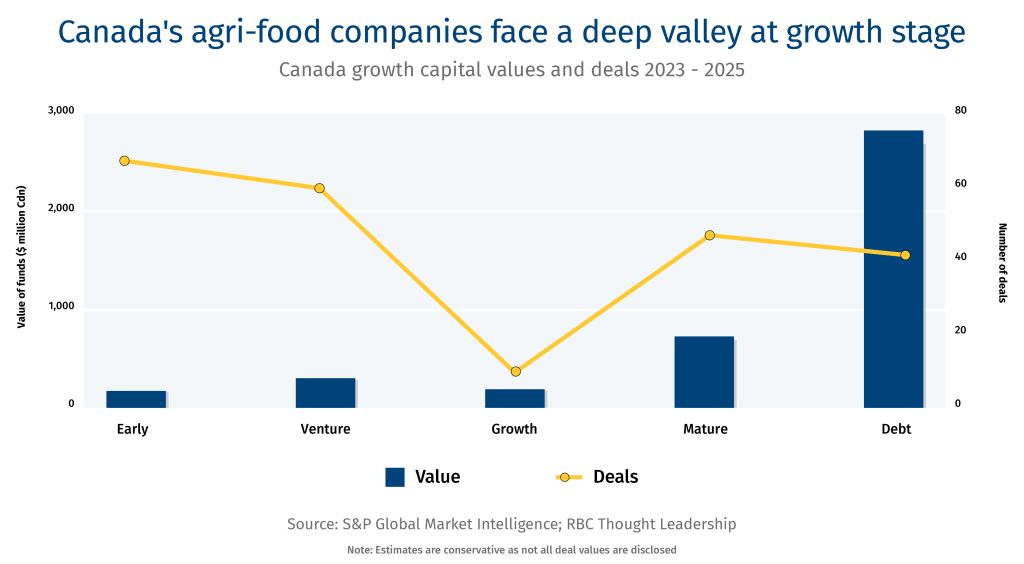
Certainly, so it’s not even just ag tech companies. What we’re hearing is this challenge about agri-food companies within the Canadian context. They have relatively strong support at the early stage. We have incubators, accelerators, venture firms that are really growing within the sector. But once they get to about the 15 million market-

John Stackhouse 00:02:20

Is that 15 million in capital size or revenue or something else?

Lisa Ashton 00:02:24

In injections in venture into a growing company. What that means is that those companies that are looking for Series B, Series C, Series D types of funding to grow their business, they have to start to seek foreign funds, which isn’t necessarily a bad thing. But when we think about the domestic regulatory frameworks in terms of bringing products to market and getting approvals in Canada, mixing that with the capital challenge drives companies to foreign markets so you can almost simply think about it as we’re investing in Canadian IP and then exporting that IP to benefit other countries’ productivity, job growth, and expansion of their agri-food sectors.

John Stackhouse 00:03:08

One of the things I found really interesting in your report, again, it’s called Seeding Scale, is that this was not always the case. In fact, just a decade ago in the 2010s, Canada was doing much better in terms of capitalizing ag-tech, and then it seemed to go off a cliff with the pandemic.

Lisa Ashton 00:03:26

Yes, there’s certainly a downturn in terms of growth capital across sectors. We see a 10-year low in terms of value in deal count for agri-food growing companies. Venture firms were really hot and heavy up to the 2021 peak, and we’re seeing the capital flow much slower. The sector attracted roughly 4% of growth capital over the last five years, and when you think about that in comparison to the sector’s contribution of GDP, around 7%, it’s certainly undercapitalized in that regard as well.

John Stackhouse 00:04:00

One of the other challenges I’ve seen is also the lack of knowledge in a lot of companies, whether it’s those federal agencies or VC shops, they have people who really understand software as a service, but have no understanding of how agriculture works. That’s not the case in the United States. When I get to visit VC shops in Silicon Valley, there will be an ag-tech expert who has deep subject matter expertise. Two things going on this week that we’re part of. One is a national round table with Canada’s agriculture minister, Heath MacDonald, as well as investors and operators and innovators from across the country talking about this very challenge. Also, Farm Credit Corp, a big federal agency, has its annual Future of Food conference where farm leaders and agriculture leaders from across the country get together. Maybe that’s one of the reasons it’s happening in February, not a lot to do back on the farm.

Follow us on our social media channels for more on those engagements. I think it’s worth stressing that for all the talk we’re hearing, and it’s good talk about the amount of capital Canada is going to need over the next decade to build more economic independence across the country and across all sectors. Yes, we’re talking about oil and gas and minerals and advanced manufacturing and auto and defense and space. Not enough talk about agriculture.

Lisa Ashton 00:05:27

I couldn’t agree more, John.

John Stackhouse 00:05:28

It’s probably maybe closer to 10% of the national economy, that and more of export potential. I like to say it is the one sector that stitches together every single community across this country. It’s also important to our national fabric, and it is all about technology. As we’re talking about attracting capital, retaining capital, growing capital, in all these other sectors, we got to think agriculture, agriculture, agriculture as a place where we can really scale fast. Lisa, before we get to our guests and expanding this conversation, what’s the one thing you would love Canadians to really come to grips with as we think about the year and the years ahead?

Lisa Ashton 00:06:13

I really hope that Canadians come to grips with the potential in agri-food. It’s a large exporter. It’s a key exporter for the Canadian economy, but within our regional hubs from Vancouver to PEI, it really is a driver of innovation across universities and businesses and governments. And so it really is a place for career development, but again, that investment in terms of the opportunity to grow and meet Canada’s ambitions that have been clearly laid out over the last few months.

John Stackhouse 00:06:47

Let’s hear now from a couple of amazing Canadian innovators who are on the front lines of all this and more. Darren Anderson is CEO of Vive Crop, a company building solutions that have to work in the real economy in real growing seasons. And Kyle Scott is the Managing Partner of Emmertech, a Canadian ag-tech investor who knows a thing or two about how to attract and grow those millions of dollars that we’re going to need in the years ahead for Canada to be a true ag superpower. Darren and Kyle, welcome to Disruptors.

Darren Anderson 00:07:19

Thank you for having us.

Kyle Scott 00:07:20

Thanks very much.

John Stackhouse 00:07:21

Darren, I’m going to start with you. Give us a snapshot of the vision you have for the company.

Darren Anderson 00:07:26

Sure. We make more sustainable and effective pesticides, and it’s all based on technology that was originally developed at the University of Toronto almost 20 years ago now, which is kind of crazy to say out loud. But we bring products to market that increase producer productivity, increase their profitability, increase their sustainability, primarily focused on North America and our products will be used in about three million acres this year.

John Stackhouse 00:07:48

And how big are you today?

Darren Anderson 00:07:50

We’re about 75 people. About 95% of our revenues in the US will be about 25 million in revenue in Canada this year.

John Stackhouse 00:07:59

Great story just getting going. We’ll come back to what you need to keep that going. But Kyle, tell us a bit about Emmertech.

Kyle Scott 00:08:06

Emmertech is a Canadian-based investment firm. We invest solely in agriculture companies, mainly domiciled in Canada. It’s mainly strategic egg companies, so some of the large corporates in the sector, and then a number of high-net worth farmers from across the Canadian prairies as well.

John Stackhouse 00:08:21

And Kyle, what have you needed to get Emmertech up and running and to succeed where maybe others have shied away in Canada?

Kyle Scott 00:08:29

I’m originally from Saskatchewan. Spent most of my time working out in Toronto in management, consulting and private equity with some of the largest players in Canada. I think that one of the things that I noticed then as well as now is there’s just not a lot of people who come from that space who are pursuing agriculture and agricultural opportunities. I view it as a pretty big part of my role to get more of those people interested and knowledgeable about the space to be able to bring more investors and more capital into agriculture.

John Stackhouse 00:08:58

And one of the big things, if I can call it that, that you’ve been instrumental to is a commitment this week among a range of financial institutions and capital mobilizers to get roughly a commitment for $ 4 billion of new capital. For ag-tech, this is being led by Farm Credit Corp. RBC is part of the pledge. Kyle, what were the biggest challenges in getting those commitments to this $ 4 billion?

Kyle Scott 00:09:25

Yeah, for sure. More champions in the sector and doing a better job of telling our story, I think are two of the big ones. We have some of the greatest founders in the world here, especially when it comes to agriculture. And when you speak with Canadian founders, it’s truly compelling how close they are to their end customer base. I think, John, you might’ve alluded to this earlier about how agriculture in Canada touches every community and touches everyone in the country.

And one of the things that’s starting to attract more and more capital into the sector is just having those founders out there, doing a better job of telling our story, and quite frankly, starting to have some pretty significant wins. When you look at a company like Vive, like Darren’s company, what they’ve been able to build and grow domestically from Canada has been truly amazing and it’s just getting started, and there are myriad other examples like Darren across the country.

Darren Anderson 00:10:18

Well, and I think there’s actually a unique opportunity in Canada specifically because, to put it bluntly, because we tend to operate in a more capital constrained environment, Canadian founders tend to build real companies earlier than maybe some of our competitors down south. And so I think one of the things that that means is when companies are now ready for that growth stage, they’ve built one heck of a foundation to grow off of that their competitor companies just don’t have.

Lisa Ashton 00:10:43

Darren, just quickly, what do you mean by real company? We heard from a lot of stakeholders that startups may be coming out with solutions that don’t actually solve a problem in the agri-food sector. Is that maybe what you’re referring to or is it something else?

Darren Anderson 00:10:58

There are a set of companies that, to put it bluntly, are better at selling to their balance sheet customer, to their investor set than they are at selling to real farmers and making a real difference on the farm. And those companies can often raise capital quite successfully and grow quite successfully, but those are also the ones that tend to get way out over their skis and potentially end up just not making it. And I think we’ve seen a number of those high profile failures recently. I think for a lot of Canadian companies, presuming the farmer need is there, the reality is because they’re capital constrained, they have to know how to make money out of the gate. They have to know how to generate a real demand, real value to the farmer. They have to know how they’re going to make money, and then that sets them up to be able to scale quite rapidly as they build that repeatable, predictable, scalable engine inside their companies.

John Stackhouse  00:11:49

Darren, one of the riddles I think a lot of us wrestle with is the opportunity and challenge of the United States. So you said, what was it? 95% of your revenue is now in the US, that’s great. I mean, every Canadian company needs to be almost out of the gates an exporter. The best market to start with an export strategy is the United States, despite all the concerns that we have right now, it is our ticket to scaling, but it can’t be our only ticket.

One of the challenges though that I hear about over and over and over again is that a company becomes largely beholden to the US market. Then it starts to raise Series C, D, E from US VC companies who offer sometimes more favorable terms, who have subject matter expertise, and then say, “Oh, by the way, now that we’re taking a material share in your company, we’d like you to move to Austin or Silicon Valley or wherever they see the opportunity to scale there because you’re in a bigger ecosystem.” Walk us through how Vive is navigating those currents.

Darren Anderson  00:12:53

Yeah, we’ve been fortunate in that our shareholder base is still very much dominated by Canadians. We haven’t had some of the pressures that you’ve been talking about.

John Stackhouse  00:13:02

95% of your revenue in the US, 80% of your capital in Canada.

Darren Anderson  00:13:06

Correct. And I mean, there are many issues with that. I’m incredibly passionate about bringing our tools to Canadian growers, and if you think about it, 80% of our capital is coming from Canadian capital pools effectively to help US growers out compete Canadian growers because the US growers have our tools and the Canadian growers do not. I don’t think that’s what any of us want to be happening, but if we look at our next stage of growth, there is no growth stage capital in Canada for companies like ours, almost nothing. What FCC is doing is incredible and has the potential to be incredibly catalytic, but before they came along, there was almost nothing as far as growth stage capital.

And so for us, the next stage of growth was going to have to be in the US or in Europe or in Brazil where you have these major funds that have the agricultural expertise that you all talked about and know what it takes to build a company. And I worry about taking capital from those types of organizations and having them say, “Yeah, I understand it’s awesome that you’re a Canadian company, but why don’t you look at moving?”

John Stackhouse  00:14:04

But we can fix that. Kyle, I’m looking at you.

Kyle Scott  00:14:08

Yeah, it’s a bit of a funny problem. Up here, we do really, really well with early stage financing. The problem is that we’re one of the larger ag tech investors in the country, and we can’t go in when Darren or some other companies that we know quite well across the country are looking to raise 30, 40, 50 million dollars. That’s an entirely new snack bracket and requires an entirely different fund structure to be able to participate in. So in Canada, it’s once you hit that growth stage that there’s really, really a significant lack of capital. This year, two of our other companies as well have gone out and successfully raised $ 30 million plus rounds, and almost all of the capital and certainly the lead investors from those have come from either Europe to US or elsewhere, not domiciled in Canada.

John Stackhouse 0 00:14:56

What on the corporate side, Lisa, do we need to ensure that the value chain, as it’s called, is investing in farmers and ag tech companies?

Lisa Ashton  00:15:04

There are a few movements that are happening currently in the agri-food ecosystem, particularly the Canadian Food Innovation Network has designed a program that is specifically for connecting corporates to early stage founders. This is mutually beneficial so that food retailers, for example, can actually see what’s coming down the pipeline, seeing what kinds of food innovations or food products are being developed, and then it provides the startups with early access to their potential buyers, their potential exit, or their potential collaborator across the supply chain.

Kyle Scott  00:15:43

Yeah, one of the things that we definitely see is more and more productive corporate engagement when they’re participating with funds. Either as an investor in a fund that then invests in companies or alongside into the company, there’s quite a few examples, fairly well known, that when a corporate gets too involved and has too much control directly of a company, it can go pretty sideways pretty quickly for the founders. There’s some different mechanisms to get more involvement, and I think what Lisa was referring to there, the corporate participation, if we could see an elevated level of that working alongside more of the investors in Canada, I think that that’d be super, super helpful.

John Stackhouse  00:16:27

Kyle, take us through the typical journey of a growth company. As you’re saying, there’s plenty of early stage capital from folks like you. Get to $ 15 million valuation, you’re fine in Canada. Now we may have public sector entities like FCC and BDC that would help bridge the valley of death as it’s known. But with all due respect to those organizations, they tend not to be cutting edge on a global platform to help companies get to that unicorn status. What should we be thinking about as a country to ensure that we do have that sophisticated, savvy, globally relevant growth capital operation that firms like Vive can work towards as they get through the valley of death?

Kyle Scott  00:17:14

Holy smokes. It’s a tough nut to crack, and one of the things I’ll say about the Crown Corporation, specifically EDC, BDC, and FCC, they’re an interesting participant in the ecosystem because I firmly believe that they want to be helpful and they will follow another investor into an investment, but they will not lead an investment. And so the challenge you run into is that those groups are there to participate. They are not there to solely carry the torch for a company going forward. So without someone to match or someone else to lead, that tool stays in the tool belt and can’t be used. So that becomes one of the challenges with those groups. The broader point about how do we create more globally relevant larger growth stage ag-tech investors. To be perfectly honest with you, it’s one that I’m trying to fix right now. It’s a gap that we’ve clearly identified as we’ve invested in early stage companies and they’ve grown up.

One of the number one places for us to be able to go is our Canadian financial institutions and our Canadian agriculture corporations who really, really care about the sector. And so for us, it becomes much like when our founders go out to raise capital, it becomes being able to tell the story, show why this sector is important, and because you are investing in financial assets, show why you’re able to make money doing it. To tell those three parts of the story to people who are unfamiliar with the sector takes time, it takes resilience, and it takes on your investor side, someone willing to take the leap with you and put money to work in the sector.

John Stackhouse  00:18:47

One of the challenges there I suspect is just exposure. It’s knowledge. If you go into any financial institution or large investment operation, likely they have experts in life sciences and health tech. Increasingly, I suspect there will be that expertise in defense tech because that’s the hot hot thing now with tens of billions of dollars of new NATO commitment coming to the fore. And then there’s poor old agriculture, our original growth sector where we just take it for granted, but don’t have that expertise in probably the large pension funds, but other large institutional investors as well.

Kyle Scott  00:19:23

Yeah. To your point about the institutional knowledge around agriculture, it’s funny. I say this pretty frequently. It’s nice for agriculture that it hasn’t been, and I say this lovingly, co-opted by the MBA mentality. I’m an MBA, so I get to say that. But the downside of it is that a lot of the folks who rise up into those roles and come from there, they just don’t know the sector. I think that one of the challenges there is more fundamental and goes back to how do we make agriculture a cool, interesting industry for more folks who are passionate about finance, passionate about investing to be able to come in and actually drive those outcomes.

John Stackhouse  00:20:00

Make agriculture cool again. I’ll let people play with that, especially in MBA schools for all the MBA deans listening.

Lisa Ashton  00:20:11

Darren, you raised a really interesting point that beyond just the growth capital challenge, there’s a number of other factors to why you’ve seen your markets grow in the US much faster than Canada. In our report, we looked at the three Cs beyond capital, and one of those is competitiveness. Would love to hear your view on that and why you’re seeing those factors lead you to a market growth in the US relative to Canada.

Darren Anderson  00:20:37

I do think for any Canadian agri-tech company, they’re going to have to be looking at the US as a market, but unlike in almost every other sector where the US is 10 times the size of the Canadian market, in most areas in agriculture, you’re looking at being something like a third. So the question is just how do you capitalize on them? So as you noted, we started selling in the US in 2016 when we received our first regulatory approval. We received our first regulatory approval in Canada in 2023. We have 11 products approved for use in the US right now. We have one product approved for use in Canada.

John Stackhouse  00:21:08

Darren, let’s pause for a second there. You’re saying that you’ve had one regulatory approval in Canada, 11 in the US. If Team Canada loses 11 to one to Team USA, it will be a national crisis. We got to come to grips with that. Give us a sense of the quick changes that you would like to see happen this year to allow us not to lose 11 to one, but actually maybe win 11 to one.

Darren Anderson  00:21:33

I’ve got one big swing, and then one small swing, if you’ll permit me. On the big swing, I think there’s an opportunity for Canada to target a culture of reciprocity, reciprocal recognition of regulatory approvals from other countries. Now that wouldn’t be in all cases, right? But default is that if something’s been approved in Australia or if it’s been approved in the US, it should be a faster path to be able to bring those products to market here in Canada. That would be one change. It’s a big one, but it is doable and it is something that I’d like to see our trade representatives focused on. The smaller ask is, if you think about, we’re spending so much time right now talking about “buy Canadian,” what about “regulate Canadian?” Canadian domestic companies, front of the line for regulatory approvals.

John Stackhouse  00:22:17

Seems easy. Kyle?

Kyle Scott  00:22:19

We often say capital’s like water, it’ll find the path of least resistance to the largest ROI. And so removing some of those regulatory burdens and regulatory pathways that allow our companies to scale and commercialize rapidly would be hugely beneficial to attracting more capital to the sector.

John Stackhouse  00:22:35

Yeah, capital is like water. There is no shortage of capital in the world, no shortage of capital in Canada actually, but a lot of it is flowing to the US because of those opportunities. Even over the last 12 months, capital has been flowing fairly assertively to the US because of the opportunities there, including in ag-tech, which we know is so critical to the country. We know what the challenges are, but let’s also think of the opportunities. We are hearing more interesting Canada from around the world, across all sectors.

I actually got to spend time with a European investor who, the firm’s been around for 400 years. They said, “We have 50 year strategic plans and we review them once every five years. And we’ve just gone through a review and we’re actually really interested in Canada and we’re really interested in Canadian agriculture because when we think about all that the world is going to need over the next 50 years, food is going to be one of the big needs. So we are looking for investible opportunities in Canada right through the value chain over the long haul.”

Darren, give us a macro view of what you’re seeing out there in the world and help us understand what we can do to bring more of those opportunities to Canada.

Darren Anderson  00:23:57

The way we view the world right now is there are a massive number of companies out there that would be really, really interesting targets for us to go acquire. We’re actually actively in market right now looking at a number of those targets where we can bring them in house, take advantage of our distribution network, our technology, and build that unicorn right here in Canada. Canadian companies, because they tend to be capital constrained, are good companies. These companies have solid foundations and those are amazing foundations to build off of whether you’re looking at organic or inorganic growth, and I think given the overall market conditions right now, it’s an amazing opportunity to be building something like this in Canada.

John Stackhouse  00:24:36

As we move towards close, I want to take that big picture idea forward. Our research at RBC shows, Lisa, I think we can grow our exports by at least 20% by the end of this decade. That’s our moonshot as a country, and it isn’t just producing more at the farm level. It’s developing lots of technologies right through the value chain of agri-food production so that we can be more competitive here at home, reduce food costs for everyone, but also make ourselves more relevant in an increasingly competitive global market that is going to need lots more food. Kyle, what’s the one thing we as a country need to come to grips with this year in 2026 to get that payoff by 2030?

Kyle Scott  00:25:22

I’m going to cheat and say that there’s two things that I’m thinking about. The first one is working with international partners, attracting more FDI into the country, investing alongside in our companies with knowledgeable investors who can help us export to other markets is critical. So whenever we hear there are other investors passionate about investing in Canada, I think it’s wonderful. The second thing I would say is there’s a lot of ag infrastructure that is due for an upgrade where we can leverage some new technologies as well to become a more reliable, not only producer, but trade partner and exporter.

John Stackhouse  00:25:56

That’s a really interesting point about export infrastructure. Darren, what are the one or two things you would suggest we come to grips with this year for that 2030 payoff?

Darren Anderson  00:26:05

I want to see the FCC capital commitment and the capital commitment by groups like RBC and Emmertech land successfully. I actually think that that is an absolutely transformative and catalytic event for the ag-tech space here in Canada. I think it has the scale that’s coming behind it and the ability for it to have an impact across the entire ecosystem is incredible, and I think making sure that we follow through on those commitments would honestly be the single most transformative thing this year. The nice thing is it’s already underway.

John Stackhouse 00:26:36

Lisa, as we wrap up, seeding scale has so many ideas in it. What are one or two that you want to leave us thinking about?

Lisa Ashton 00:26:44

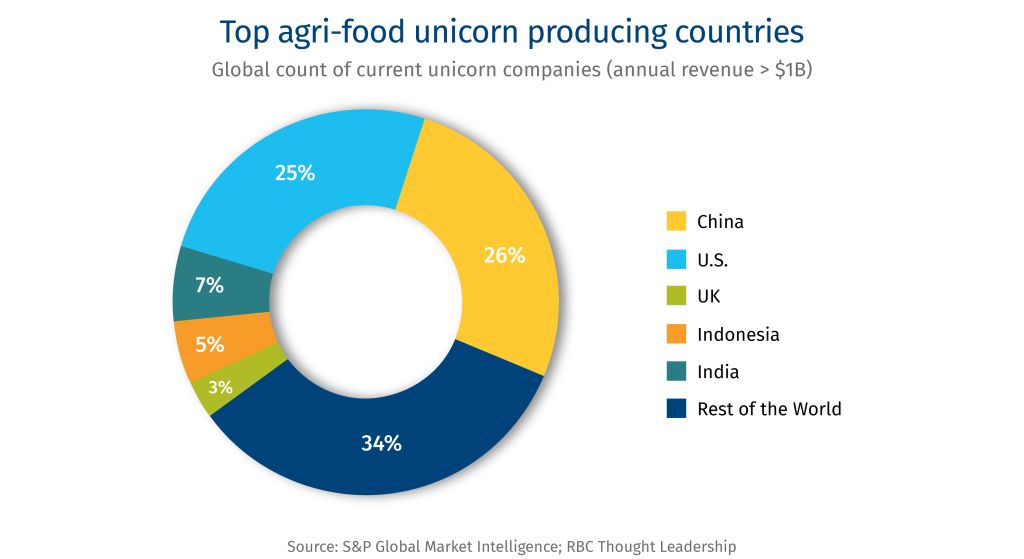
Darren, you brought up unicorns. When we looked around the world, we looked at China, the US, India, they have stables full of unicorns. The UK, Australia, even Ireland, more countries that we would consider our peers have examples of unicorns in the agri-food sector. Canada has none. So these unicorns, they’re privately held startup companies that are building revenues of over a million dollars per year. And I think building some unicorns in Canada should certainly be a moonshot for Canadians to be thinking of.

John Stackhouse  00:27:17

Yeah, we really should have the Shopify of ag-tech.

Lisa Ashton  00:27:20

Absolutely.

John Stackhouse  00:27:21

There’s no reason that Canada can’t. We just need to continue to scale what we’re doing. Thank you all for being part of that scaling story and for being on Disruptors.

Kyle Scott  00:27:31

Thanks so much for having us.

Darren Anderson 00:27:32

Thank you.

John Stackhouse 00:27:35

Before we go, if there’s a through line from today, it’s that this is a solvable design problem. Canada has the land, the operators, the science, and the entrepreneurs. The work now is alignment, capital that fits agri-food realities, pathways that prove adoption in the real world, and the confidence to build value add here at home. Lisa, your report, Seeding Scale, how can people find it?

Lisa Ashton 00:28:02

It’s live now. Please visit rbc.com/thoughtleadership. It’s part of our growth project where we’re really focusing on key levers within the Canadian economy that can help us achieve our national growth ambitions.

John Stackhouse 00:28:17

If you found this episode useful, please follow Disruptors wherever you listen. Better still leave a rating and share it with someone who’s building or funding what comes next.

I’m John Stackhouse, thanks for listening.

Disclaimer

rbc_tl_disclaimer

Canada’s agri-food startups present a $13-billion investment opportunity. Capital flows in growing agri-food companies could help Ottawa achieve its target of unlocking $1 trillion in investment by 2030 to power economic growth.

The country’s agri-food sector is currently undercapitalized by domestic growth funds. The sector accounts for only 2% of government-backed growth, venture and infrastructure funds at the federal level, and brought in an estimated 4% of total growth funds invested in Canada over the past 5 years.

It’s not that there isn’t interest. Venture and institutional funds have attempted to flow but fragmented governance across provinces and sector fit for funds have pushed agri-food to the sidelines of mainstream approaches to deploying growth capital.

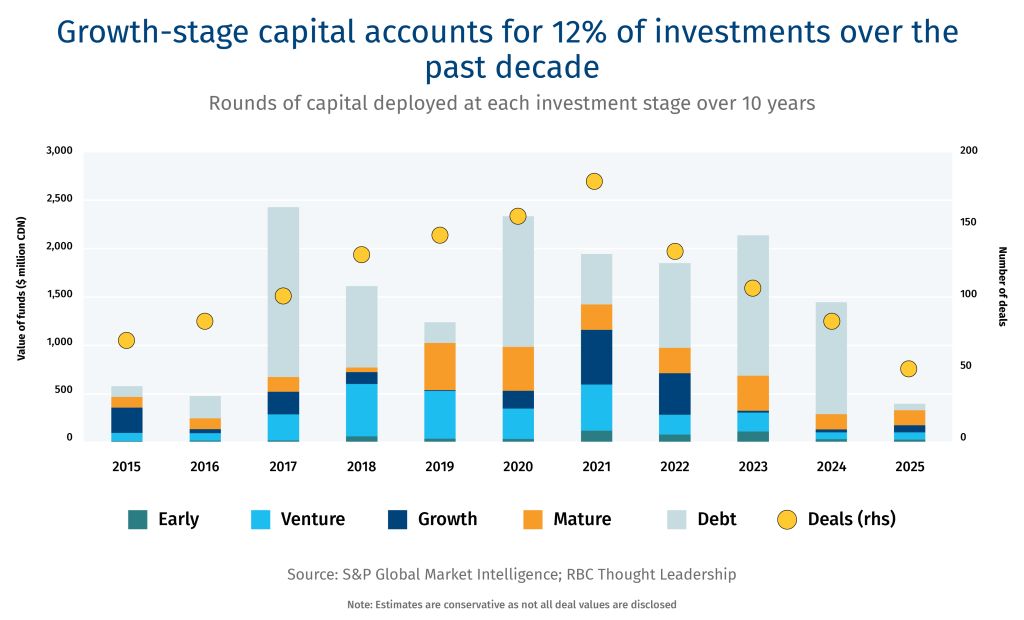
Domestic agri-food companies got a piece of the growth capital boom–$10.5 billion–between 2015 and 2021. However, investments across sectors have dwindled. Today, growth investment in Canadian agri-food is lower than it was a decade ago, with values down 32% and deals by 29%.

The basic mechanics of growth for an agri-food company can cut the sector out of fund priorities. To align investment with Canada’s growth and sovereignty ambitions, funds like the $1B Venture and Growth Capital Initiative announced in the 2025 federal budget could establish agri-food lanes with tailored tools.

Other nations–including Finland, Japan, and the United Arab Emirates–are explicitly linking food security, productivity, and industrial policy through coordinated growth capital strategies. To achieve food security goals, the UAE launched the Agri-Food Growth and Water Abundance (AGWA) cluster with the ambition to attract $48 billion by 2045 specifically for their agriculture, food and water sectors.

The opportunity for Canadian investors and innovators–public and private–is to better calibrate and scale capital and businesses to anchor economic value domestically. This starts at the idea stage, improving universities’ weakening role in innovation and reverse trends in business outsourced investments to universities for agri-food R&D, which have fallen 64% in the past five years.

Canada has one of the world’s most productive agricultural systems, globally competitive farmers, and is a net exporter of value-added agriculture and food products. Yet, the country is steadily losing its position as a preferred place to start, scale, and retain agri-fooda startups. That’s because the pipeline for investment and innovation has structural gaps and barriers, from seed to maturity.

Canada is in building mode. Its ambition to attract $1 trillionb in investment over the next five years to drive growth for the country is a signal.1 A key piece of mobilizing this investment is to put Canada’s existing infrastructure, growth, and venture funds to work for potential high-growth sectors, such as agri-food industries. Most notably, the 2025 federal budget identified agri-food as one of three sectors that Canada enjoys a strategic global advantage. But Canadian agri-food accounts for less than 2% of growth-oriented government-backed funds. And over the past five years, agri-food companies have only captured 4% of total growth capitalc investment in Canada, which agri-food investors characterize as a stark under-investment in the sector.

If Canada were to align its growth capital investment in agri-food with the industry’s contribution to GDP as a benchmark to build from, it would require an estimated $13 billion from now until 2030–a 36% boost in investment relative to the past five years. An investment ambition to focus action and position Canada as a thriving, global hub of agri-food innovation and products.

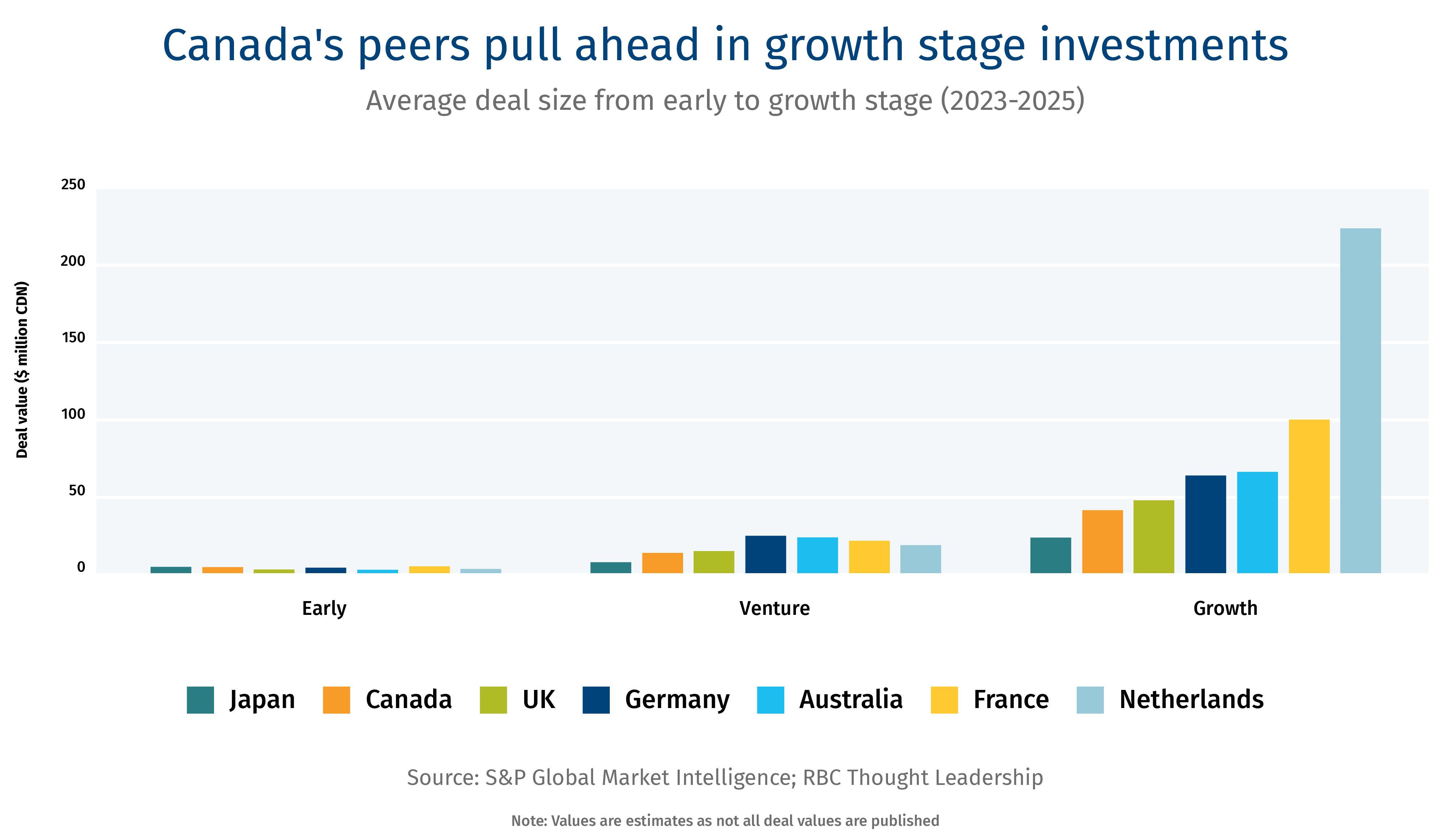
Global disruptions over the past five years highlight the need to advance Canada’s sovereign capacity in agriculture and food innovation, production and processing. And the rest of the world is not waiting for Canada to perfect its approach. Without immediate action, Canada risks capping agri-food sector’s growth potential by not hosting more value-add processing domestically. It risks hollowing out the agri-food innovation ecosystem as companies and talent look to other countries, including Australia, Japan and Germany, which are growing their investment in R&D and commercialization.2 And it risks irrelevance in the era of disruptive technologies—including AI-driven decision tools, gene editing, biological inputs, automation, robotics, and novel food processing—that will shape productivity gains in the decades ahead.

There is a mismatch between the framing of Canada’s agri-food sector as a superpower and its strategic advantages with the actual scale and focus of investments domestically. Transforming Canada into an agri-food superpower requires a targeted, nimble approach to capital and growth that navigates the sector’s restraints and fulfills its true potential.

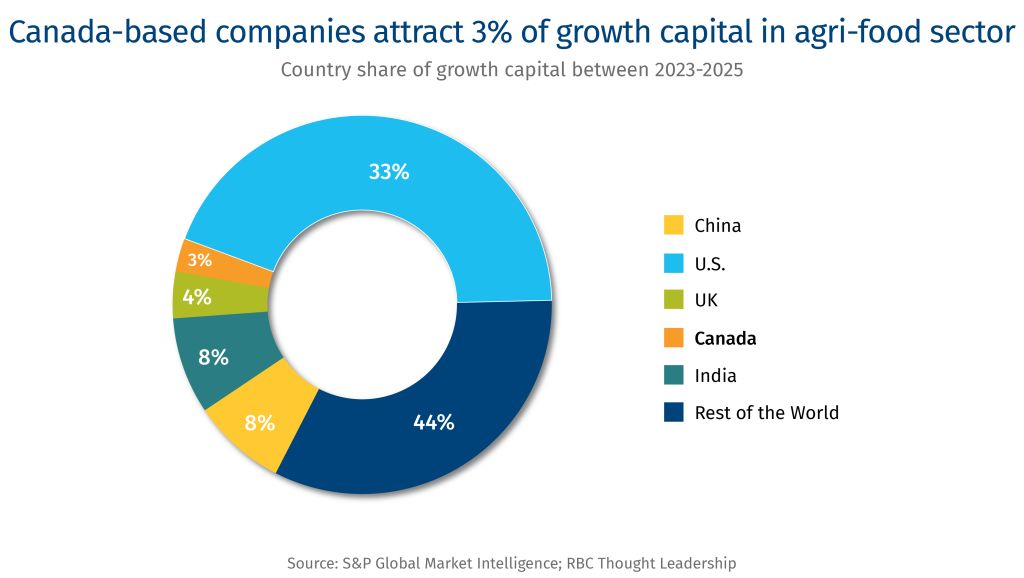
Canada-based companies attarct 3% of growth capital in agri-food sector
  • Purpose of capital: Idea development, early prototyping, market research

  • Investors: Angel investors, incubators/accelerators, university and government grants, venture seed funds, family offices

  • Strengths: Government and regionalized support via early-stage innovation programs

  • Challenge: Breakdown between public and private collaboration on commercialization of intellectual property (IP)

  • Purpose of capital: Pilots, prototyping, market testing, and small-scale production

  • Investors: Accelerators, venture firms, corporate venture, government grants, family offices, Crown corporations

  • Strengths: Growing network of venture funds

  • Challenges: Navigating investment pathways and undercapitalization risks that could force bridging rounds, slow development, and dilute equity

  • Purpose of capital: Continued innovation, market leadership emerging, scaling operations

  • Investors:  Venture firms, private equity, corporate strategic investment, Crown corporations

  • Strengths: Access to international market for capital, especially U.S. and EU

  • Challenges: Gap in follow-on fund, especially Series B to growth and fragmented domestic capital-raising options

  • Purpose of capital: Stable cash flows, slower growth, operational efficiency and expansion, exit

  • Investors: Commercial banks, private equity, merger and acquisition, trade sale, initial public offering

  • Strengths: Strong commercial bank support, however, project financing can be difficult to secure

  • Challenges: Few large domestic corporate acquirers; often requires sale to foreign buyers; Companies with infrastructure projects face structural challenges in assembling capital mixes

Not enough companies make it to growth; and not enough capital is available for the select few that do.

The scale, staging, and value of growth capital invested in growing companies are indicators of a sector’s momentum and growth prospects. In Canada, upstream and midstream marketsd  that cover agriculture inputs to food processing is generally well covered for early-stage capital by government grants, family offices, and venture firms. While end-stream markets like food brands have less access to early stage-funds, with fewer active venture firms in the market. Agri-food companies across market segments start to face Canada’s growth capital challenge of fragmented and shallow domestic funds when seeking to raise $15 million in capital or more. And across economic sectors, there is a significant gap in capital for growth, with domestic venture firms not positioned to inject more than $30 million. This constrains scaling and reduces Canada’s ability to attract and retain high-potential agri-food companies. The situation is exacerbated as agri-food in Canada is too complex for general investors to navigate without industry expertise. The capital pools, for example, engaging with an agriculture-tech company are often completely different from those engaged with a food brand company as their growth metrics, markets, and use of capital differ substantially (e.g., IP vs. a distribution warehouse).

The growth capital market has had a volatile decade. The world experienced a surge in growth capital across sectors, including agri-food, in the lead up to the peak in 2021. Between 2015 and 2021, growth capital in Canadian agri-food in the early and venture stages grew by 1,405% and 480%, respectively.3 This growth was driven by a few factors, and actors:

  • Global interest in agri-food technology and sustainable agriculture surged with the growing urgency to feed more people with fewer environmental impacts. As a result, global investment in agri-food technology rose to $71 billion in 2021.4

  • In response, Canada launched incubators (YSpace Food Incubator), accelerators (SVG Thrive) and applied food science centres (Saskatchewan Food Industry Development Centre) to enable commercialization of agri-food innovation.

  • Agriculture and food focused venture funds also grew in Canada, including District Ventures Capital, Ag Capital Canada, Emmertech, Tall Grass Ventures, and Nya Ventures.

  • And some crown corporations helped drive momentum in the sector through initiatives like Farm Credit Canada’s (FCC) $2 billion commitment by 2030 to advance innovation in the domestic agriculture and food industry.

Growth stage capital acocunts for 12% of investments over the past decade

Since 2021, most segments of growth capital availability and investments have dwindled. Investment in Canadian agri-food companies is now lower than it was a decade ago, with values down 32% and deal count by 29%.5 This contraction mirrors trends in other major agri-food economies—including the U.S., Brazil, and Australia—where funding focused on agri-food technologies dropped to a 10-year low.6

While there have been some positive signs in the past five years, such as rising private equity and a shift to focusing on impactful and mature companies, fundamental challenges in retaining and attracting capital remain. The most obvious challenge is the growth-stage. The value of available capital in Canada in growth stages falls roughly 37% compared to the venture stage where the startups are more supported by venture firms and incubators.7

Canada's agri-food companies face a deep valley at growth stage

However, focusing on fixing this problem in isolation, can result in new problems arising along the pipeline. For example, the agri-food venture funds that emerged over the past decade in Canada now seek to raise new, larger funds to address gaps at the growth capital stage, and this shift could risk creating a new gap in early venture—rounds of between $1 million and $5 million. Enabling capital availability at each stage of growth and across market segments therefore requires coordination among investors to build coverage along the pipeline.

The absence of a Canadian agri-food unicorn—defined as a privately held startup valued at more than $1 billion—is a macro signal that Canada does not have an ecosystem that can propel promising companies.8 Peers like the Netherlands, Germany, and Australia all have unicorns—and heavy hitters like the U.S., India, and China have a stable-full.

Top agri-food unicorn producing countries

Capital structures push companies down and out of Canada.

Canada’s agri-food startups often advance slower through their commercialization and market expansion stages relative to those in competing markets because capital pools are shallower. Less capital leads to incremental growth and longer time horizons to demonstrate returns. While early-stage companies can attract public and venture funding, those seeking larger rounds are often forced to seek capital abroad.

Canada's peers pull ahead in growth stage investments

Vive, a crop protection company based in Mississauga, Ontario, is looking to raise Series D capital, seeking more than $40 million, starting in Q1 of 2026. Vive expects that more than 75% of the capital raised in this round will come from outside Canada. This builds on Vive’s initial market expansion, which occurred in the U.S. because the active ingredient approval for their products took four years compared to the eight years it took in Canada.

Fueling early agri-food innovations but avoiding support for those same innovations at growth stages.

Support from government at the early stages of growth comes largely from incubators, accelerators, cost-share and R&D programs, which are important pieces of Canada’s agri-food innovation pipeline. Yet, this concentration and program delivery often results in Canada’s emerging leaders in agri-food being described as “grant-entrepreneurs” who are forced to spend excessive time on finding and writing applications and meeting reporting requirements instead of building investor-ready businesses. Of course, government checks and balances are vital in public funding, but accessing and reporting on these funds can be made more efficient.

Another challenge with government capital is that economy-wide pools of funds like the Canada Growth Fund do not intentionally restrict agri-food, but the sector often does not fit neatly within investment criteria for several reasons, including project scales, geographical dispersion of production and projects, and the definitions of innovation or clean technology. As a result:

  • Canada Growth Fund’s 17+ investments do not feature a single agri-food company.

  • Of Canada Infrastructure Bank’s 106 investments, only one is focused on agriculture production.

  • The agri-food sector makes up an estimated 3% of the 575 companies invested in through the Venture Capital Catalyst Initiative (VCCI) and Venture Capital Action Plan.

Capital from asset-tied farmers to blocked out institutional investors is an untapped resource for Canada’s agri-food sector.

Institutional investors in Canada, like pensionfunds and private equity firms, want to be engaged in Canadian agri-food but face a trifecta of investment barriers:

  • Limited number of sizeable projects

  • Co-investors, both private and public, to share risk

  • Investment-limiting regulations

Canada’s model for capital attraction in primary agriculture illustrates some of these barriers. Canada is optimized for family ownership with differing provincial regulations on ownership restrictions including foreign investment and supply management for some sub-sectors. This is in sharp contrast to Australia, for example, which treats agriculture as an investable export industry via large, aggregated farms with professional farm management companies. Investors can inject hundreds of millions into single companies, who then have more liquidity to make investments in new companies and innovations that can boost their productivity.

Institutional investors looking to make significant investments with proven returns might see Canada’s fragmented model difficult to navigate. As a result, some of Canada’s largest pension funds invest in agriculture outside of Canada. Public Service Pension Investment’s natural resource portfolio is made up of roughly 77% agri-food investments, with Canada accounting for 9.3%. The largest share, 43.3%, goes to Oceania countries, predominately Australia.

Farmers also have an important role in the agri-food innovation and capital pipeline as new products and services in the upstream market segment can directly impact their growth and productivity. But Canadian farmers are limited since capital is often tied up in operational costs and assets, like land, buildings and equipment. This reduces both demand signals for novel technologies and co-investment opportunities in impactful projects relative to countries that can attract large-scale investments at the farm-level and have available capital for expenditures beyond operations and assets.

Risk aversion dampens investor appetite, entrepreneurship, and innovation.

Unlike the U.S., where a “fail fast, iterate, scale” culture fuels deal activity and risk appetite, Canadian investors are generally more risk-averse, particularly beyond seed stage, which discourages bold bets. This shows up in the number of new Canadian companies seeking funding rounds.

Agri-food companies established in select top countries

Traditional investor preferences toward, for example, information technology over agri-food innovation —often perceived as lower-growth and lower-return—limit participation by generalist venture firms and institutional investors. This reinforces narrow capital pools for late-stage agri-food deals.

The onus to build clear and consistent approaches to access support and capital should not lie solely with investors. If startups can get customers, capital often follows. This stresses the need for improving the applicability of new innovations to real-world problems and the adoption of these innovations alongside investment, starting with Canadian farmers, corporates and retailers but also foreign customers for Canadian companies to truly scale.

Proven demand would enable startups to forge capital paths through their growth stages and work with investors to build the right capital stacks. Three Farmers, a Saskatchewan-based snack food company, scaled production in the Prairies and sells its seasoned pulses in more than 4,000 retailers across Canada and the U.S. Attracting growth capital has been a key component of the company’s success. That includes a 2022 raise of $6.2 million led by three pivotal investors: Venture capital firm District Ventures Capital who has deep consumer packaged goods expertise, Export Development Canada how helps companies effectively grow in foreign markets like the U.S., and Protein Industries Canada who can offer access to innovation and supply chain networks.9 In 2025, a new strategic partnership with Farm Credit Canada (FCC) added equity but also the smart capital that growing companies need in the form of mentorship to help navigate regulations and optimal approaches to capital mixes. Such examples offer a gameplan on engaging and connecting with the right type of investors—at the right time.

Building supply chains requires capitalemerging agri-food companies struggle to source it domestically.

Building out agri-food supply chains and commercializing products often requires infrastructure development for production and processing facilities, which demands the right capital structures across equity and debt to make the developments attractive for companies and investors. Often new facilities for production, especially for food products and processing, require off-take contracts or adoption commitments to secure investor confidence. In Canada, where there is a small pool of investors willing to engage in large capital projects, food supply chains are decentralized, and price benchmarks can be uncertain, particularly for novel food ingredients, obtaining these commitments can be difficult, raising percieved risk.

Despite the upfront cost to commercialize and expand, growth in the industry runs counter to the assumption that momentum is not building for value-add processing in Canada. Over the past decade, year-over-year revenue growth in agri-food manufacturing has averaged 5.9%, compared to the manufacturing average of 3.6%.10

Investment in agri-food manufacturing assets has grown by about 32% in constant prices over the past decade.11 This moderate growth is primarily driven by expansion of established, large scale agri-food companies building out meaningful processing capacity.

Yet, many new companies innovating in food ingredients face barriers in bringing together the right capital stacks due to supply-chain barriers–a lack of price certainty and contractual commitments from buyers before processing infrastructure is built. As a result, Canada risks losing value-add processing to other growing jurisdictions where the capital is flowing it. For example, Phytokana Ingredients Inc., an Alberta startup turning Canadian-grown fava beans into food ingredients, is working to build out Canada’s value-add processing of pulses and is in the process of securing funding to construct and commission a fully automated 30,000-metric-tonne-a-year dry fractionation processing facility near Strathmore, Alberta.12 However, building the right capital base is proving challenging with domestic investors, pushing Phytokana to explore foreign investors, which may have implications for where future value-add processing is developed.

Canada’s agri-food landscape is difficult to navigate for startups and investors not ingrained in the network of agri-food regional and national organizations. Once in these networks, startups in the early stages are often well supported, but two challenges to building consistent pathways for companies to attract staged capital remain:

  • Navigating the funding and support opportunities and application processes

  • Identifying where to go for follow-on funding

Mapping investor profiles to specific market segments and their mandates provides a structured roadmap for scaling capital from seed through to growth stages. Countries like the U.K., Israel, and Singapore offer examples of how to build such structure. The U.K., for example, is known for structured paths from seed accelerators and hubs into mid-and late-stage capital with organizations such as Founder Factory.

A key reason why agri-food deal counts in Canada over the past three years shrink by 450% between early to growth stage is the state of startup companies’ readiness. Investors consistently cite company readiness as a primary constraint. Founders of startups often excel at proof-of-concept and R&D but face challenges when transitioning to validated customer demand, repeatable revenue models, regulatory and supply-chain readiness and management and governance maturity.

Many organizations, including university research innovation offices and accelerators, are positioned to work on these issues. For example, the Canadian Food Innovation Network (CFIN) connects startups with corporate partners around defined food technology market segments such as food ingredients. These programs enable startups to build relationships with retailers and strategic buyers earlier, while giving corporates and supply-chain actors clearer visibility into emerging innovations. Making this connection is critical to improving startup success rates and building connectivity among industry leaders and startups, as only 6% of public corporate companies engage in venture investment in Canada, compared to 40% in the U.S.13

Canada is increasingly perceived as a regulatory burdensome place to scale an agri-food business and commercialize its IP in agri-food.

Canada lags key competitors like Australia, Japan, Germany, France, Italy, UK and South Korea as a priority jurisdiction for agri-food patent filing.14 An outcome of multinational companies, especially those in life sciences that reported that they have seen Canada significantly fall in their internal ranking of jurisdictions to invest in R&D over the last decade. This is in part due to approval processes for agri-inputs like active ingredients in pesticides struggling to maintain a timely and transparent process for reviewing applications.15 These trends are chipping away at Canada’s brand as a supporter of early agri-food innovation.

United States: Scale and depth

Market share: The U.S. captured 33% of global agri-food investments over the past three years.

Strength: The sheer scale and maturity of its capital markets.

Lesson: Build growth funds that can actively participate across the full company lifecycle. For example, Chicago-based S2G Investments has multiple funds, and can work with companies at different stages of growth, creating deeper capital pools, where agri-food companies have historically struggled to access capital from PE or commercial banks (e.g., pre-revenue).

India: Demand-driven growth

Market share: India now attracts 8% of global agri-food growth investment and is projected to be even more dominate over the next decade as its agriculture productivity rapidly improves.

Strength: Growth is anchored in massive domestic demand, a rapidly modernizing food system, and strong government support for agricultural innovation.

Lesson: Focus on the basics of where production and consumption is growing to steer investment. To meet consumption and production projections, India is experiencing strong growth in agri-marketplace platforms, supply-chain logistics, and precision agriculture through increased participation from domestic venture funds and strategic.

The country now captures nearly 8% of Europe’s agri-food tech investments.16 The recent surge was driven largely by a $260-million growth-stage investment in Finnforel, an aquaculture company, highlighting Finland’s strength in sustainable protein and advanced food production systems.

Despite just 2.3 million hectares of farmland—3.7% of Canada’s farmland mass—Finland is emerging as an innovation hub following a similar government-backed approach that the Netherlands and Denmark have taken to crowd-in private investment for the sector. Finland’s ecosystem is characterized by strong public-private collaboration, deep expertise in cold-climate agriculture and aquaculture, and a focus on export-oriented, high-technology solutions.

Japan is now the third largest agri-food technology investor in Asia capturing an estimated 13% of the market–behind India and China.17 Japan rose in the global rankings on the back of several large growth-stage deals, including a $89-million investment in biomaterials startup Spiber.

Japan’s competitive advantages include active participation by large corporate venture investors, including Global Brain Corporation and Beyond Next Ventures. Japan is a mature domestic market that supports commercialization of premium and functional foods and has notable advantages in key growth areas including biomaterials and fermentation technologies. The country’s domestic ecosystem also excels at scaling capital-intensive technologies that require long development timelines and strong industrial partners.

The UAE imports approximately 80% of its food. In response, food security has become a national priority. The UAE aims to produce 50% of its food domestically and rank first in the Global Food Security Index by 2051.18 To achieve this, the UAE launched the Agri-Food Growth and Water Abundance (AGWA) economic cluster, which aims to attract nearly $48 billion by 2045.

Food security as a strategic imperative has fueled rapid growth in the country’s agri-food sector, and is supported by broader benefits of the UAE’s economy, including:

  • Tax-free zones and investor-friendly regulation

  • Leading logistics infrastructure and a strategic geographic location as a connector between Europe, Africa, and Asia

  • Strong government backing aligned with long-term national goals.

Potential impact: Improve universities’ weakening role in innovation and reverse trends in business outsourced investments to universities for agri-food R&D, which have fallen 64% in the past five years.19

Incentivizing commercialization requires exploring approaches beyond rewarding researchers via grants that measure success based on peer-reviewed publications and promotions dependent on traditional academic-research-services model. Agri-food faculties across Canada could consider strengthening their promotion of academic-entrepreneur pathways for researchers—like Dalhousie University’s Agriculture Faculty offers—and create structured opportunities for universities and the private sector to negotiate IP ownership to support commercialization. This could include enabling co-design partnerships among institutions and companies, providing clearer conflict-of-interest guidance, and embedding commercialization activity into promotion and tenure criteria, particularly in applied sciences and engineering disciplines.

It is common practice for Canadian universities and colleges engaged in private-sector projects to automatically own the IP that’s developed. While this approach is often designed to protect public interest and institutional value, these conditions—combined with the lack of formal recognition, tenure credit, and financial reward structures for researchers acting as entrepreneurs—can create material barriers to commercialization. As a result, institutions like universities, which are foundational breeding grounds for experimentation and novel idea generation, risk being increasingly excluded from the agri-food commercialization pipeline, particularly in capital-intensive and applied innovation areas such as food processing, biomanufacturing, and agriculture tech. The U.S, Israel, and parts of Europe have demonstrated that flexible IP ownership models—such as creator-owned or shared-IP frameworks paired with clear revenue-sharing mechanisms—can materially increase startup formation, industry collaboration, and downstream investment without compromising academic integrity.

Potential impact: Mitigate the stark deal count shrink of 450% from early stage to growth stage; and retain entrepreneurial STEM and business talent in agriculture beyond the current 1% of postgraduates.20

To solve early-stage roadblocks, build an AI-powered concierge platform within an existing national organization with sector credibility and institutional knowledge that allows startups to navigate public and private opportunities in one place, building upon existing tools like AgPal.

There have been previous attempts at building similar services to help startups navigate this landscape, and many incubators and accelerators offer connection and navigation services. Yet, agri-food startups consistently report being lost in the early stages of company formation and experience a sharp drop-off in support once they graduate from an incubator or accelerator. This “support cliff” is particularly acute in agri-food due to long R&D cycles, regulatory complexity, and capital intensity. Such a tool could provide tailored, real-time guidance on funding eligibility, customer discovery, regulatory pathways, clearer hand-offs for each growth capital stage, and ecosystem connections.

Optimizing the platform would require investors and early-stage supporters to align on shared definitions of market segments, innovation categories, and support mandates so the tool can accurately route startups to the right opportunities.

Potential impact: Address agri-food’s underwhelming share of total domestic growth capital by engaging more generalists in the sector, while also attracting a larger share of global venture capital investment, totally more than $500 billion in 2025.21

If the sector wants outsiders to engage, existing agri-food leaders and investors in Canada need to offer more intentional platforms for non-agri-food investors to build familiarity, context, and conviction. A starting point could be targeted national roundtables for each market segment led by select agri-food investment leaders for domestic and international generalist investors to start building connections, share sector-specific investment theses, and compare notes on market segment profiles, timelines, and exit pathways.

On the other side, general investors that have intentions to materially and strategically invest in the sector also have an opportunity to pull agri-food into their coverage area. Opportunities to embed agri-food expertise directly into investment decision-making could include:

  • Investment committees and advisory panels that upgrade their agri-food expertise by including agri-food operators, processors, and sector investors.

  • Fund managers of investment firms participating in federal programs like VCCI must have a team with either:

    • Prior agri-food investing experience, or

    • A formal advisory relationship with sector experts.

Venture funds and programs allow for sector-specialist sub-allocations within broader funds such as agri-food market segment carve-outs within generalist funds.

The potential impact: Position agri-food to have investable projects and companies for government-back funds to invest in beyond the current 2% that the sector captures from these funds.

Although agri-food is cited as one of Canada’s key strategic advantages, government investment programs – at the provincial and federal level – are often not accessible to growing agri-food companies because they are not fit for purpose for the types of innovation, asset intensity, and scaling timelines typical of the sector. This misalignment leaves significant agri-food potential unleveraged.

For example, VCCI does not explicitly exclude agri-food, and some participating fund managers do operate agri-food-focused funds. But only 3% of companies invested in through VCCI-supported funds operate within the agri-food sector. While fund manager expertise and explicit mention of agri-food plays a role, so too do program criteria, technology definitions, and innovation classifications that shape investment decisions and systematically bias capital toward digital-first or asset-light sectors, resulting in agri-food being overlooked.

Rather than creating entirely new programs, existing funds could establish agri-food lanes with tailored tools. One option is to explore a growth-stage agri-food mandate within VCCI or its successor under the $1B Venture and Growth Capital Initiative that was announced in the 2025 federal budget.

There is an opportunity to adjust eligibility rules for federal and provincial government funds to reflect how agri-food companies scale as they raise growth capital, making way for high-quality agri-food companies:

  • Accepting asset-heavy business models that have robust business and risk management plans (e.g., processing facilities, fermentation tanks, cold storage, pilot plants)

  • Recognizing process innovation, novel ingredients, yield improvement, and cost reduction as legitimate innovation—not just software or IP-only advances

  • Allowing longer commercialization timelines (7–10 years vs. 3–5) consistent with regulatory, construction, and market adoption realities.

Potential impact: Canada is a net exporter of processed and value added agri-food products with immense potential to host more processing of products that are largely still exported as raw ingredients. One example is plant protein: while Canada is the number one exporter of dried peas, roughly 88% of production over the past five years has been exported as a raw commodity.22 23 This one example significant missed opportunity for domestic value creation, job growth, and export diversification to benefit from the burgeoning pea protein industry.

Expanding the Canadian agri-food value chain, requires public and private investors to be deploying blended capital structures that reflect agri-food economics. This includes considering tools to mitigate risks in capital deployment for high-impact projects that address a clear growth opportunity for Canada’s agri-food sector such as:

  • Subordinated or patient capital alongside private equity

  • Government first-loss guarantees to de-risk infrastructure projects

  • Revenue-linked instruments or convertible structures suited to variable margins

  • Support for offtake-linked financing when buyer commitments are conditional but there is clear demand

In agri-food markets, upstream buyers often hesitate to confirm long-term offtake agreements before facilities are built or scaled, while investors require revenue certainty to deploy capital—creating a structural deadlock. Targeted risk-sharing tools can bridge this gap and unlock private investment into processing, ingredients, and food manufacturing capacity. Of course, Canada will need to find buyers for processed verse raw ingredients, but not exploring the opportunities to scale processing domestically is a lost value creation opportunity for Canada.

Investing in abundance: Addressing Canada’s growth capital gap in agri-food - social

Download the Report

Alison Suntrum, Nya Ventures and CDL Agri-Food

Amy Standish, Saskatchewan Ministry of Agriculture

Andrew Heintzman, InvestEco Capital

Arlene Dickinson, District Ventures Capital

Ben Gibbons, Water Point Lane

Bianca Parsons, Alberta Food Processors Association

Blair Knippel, Inside Out LLC.

Brennan Gillis, Dalhousie University

Bruce Rathgeber, Dalhousie University

Celine Hildebrandt, Farm Credit Canada

Chris Hartt, Dalhousie University

Chris Paterson, Tall Grass Ventures

Chris Theal, Phytokana

D’Arcy Hilgartner, RDAR

Dana Gibson, Alberta Innovates

Darren Anderson, Vive Crop Protection

Dave Barrett, Dalhousie University

Dawn Trautman, SVG Ventures, THRIVE

Drew Dwernychuk, Innovation Saskatchewan

Evan Fraser, Arrell Food Institute, University of Guelph

Ghader Manafiazar, Dalhousie University

Glen Price, Venturepark

Graeme Millen, Farm Credit Canada

Graham Markham, New Protein International

Greg McElheran, Export Development Canada

Haibo Niu, Dalhousie University

Heather Bruce, Dalhousie University

Jeff Linner, PFM Capital Inc.

Jeff McKinnon, Four Mile

Jeff Zweig, Fiera Comox

Jodie Parmer, Canada Infrastructure Bank

Jolene MacEachern, Dalhousie University

Kassandra Quayle, Protein Industries Canada

Kee Jim, G.K., K Jim Farms and Feedlot Health Management Services Ltd.

Ken McDougall, McDougall Acres Grainex Inc.

Kirby Sawatzky, Parkland Potato Varieties

Krista Heidebrecht, Sofina Foods

Kristjan Hebert, Hebert Grain Ventures

Kyle Scott, Emmertech

Laurie Dmytryshyn, PIC Investment Group Inc.

Lawerence Hanson, Agriculture and Agri-Food Canada

Leah Perry, Wittington Ventures

Lenore Newman, University of Fraser Valley

Marie Barnes, Invest Alberta

Martin Vanderloo, New Protein International

Marvin Slingerland, MNP

Matt Coutts, Coutts Agro Ltd.

Matt Petrow, Rayhawk Technologies

Miranda Stahn, New Harvest Canada

Oleta LeRush, BASF Canada

Richa Gupta, Canadian Food Innovation Network

Rob Russell, Emmertech

Robert Saik, T1 Technology Corporation

Shaun Vey, Syngenta Canada

Stefanie Colombo, Dalhousie University

Steven Webb, Global Institute of Food Security

Suresh Neethirajan, Dalhousie University

Travis Esau, Dalhousie University

Tyler Groeneveld, Protein Industries Canada

Wayne Arsenault, Avena Foods

Wilson Acton, Tall Grass Ventures

Disclaimer

rbc_tl_disclaimer

Also in this edition: Canada’s trade with non-U.S. markets is hitting all-time highs and the U.S. looks to create a critical minerals trading bloc to rival China

The Liberal government’s much-anticipated auto-sector strategy reinstates electric vehicle incentives, eliminates EV sales mandates, invests in expanding the EV charging network, and offers incentives and tax breaks for global auto makers to build in the country.

It’s all in response to U.S. tariffs, and the looming threat that President Donald Trump might tear up CUSMA in the coming months.

Of course, Prime Minister Mark Carney is hoping to preserve CUSMA and build on its North American supply chain advantages to a new set of investors. But even if Canada’s access to the U.S. market is no longer unfettered, Ottawa can point to several reasons why European and Asian countries may want to set up their auto shop in Canada:

  • Canadians buy a lot of pricey cars and SUVs: Canada is the world’s 9th-largest auto market, with ~1.9 million vehicles sold annually—skewed toward higher-value SUVs and trucks, with a robust servicing and after-market (courtesy of our harsh winters). OEMs also now compete for high-margin customers, not volume. Canadians buy a lot of cars, including a lot of expensive (read: high margin) cars.

  • Asian carmakers want a North American hub: With 7.2 million global sales in 2024, the combined Korean power of Hyundai-Kia edged out GM and Stellantis for the third spot in the global rankings. However, the companies’ manufacturing footprint and market share remains Asia-heavy, creating an incentive to rebalance toward North America. Canada could become a second North American production zone, hedging geopolitical, climate, and labour risks.

  • Canada is critical to global supply chains: Our store of critical minerals (nickel, cobalt, lithium, graphite), batteries, parts ecosystem, and reliable, clean power offer supply chain integrity at low cost. Just ask Volkswagen.

  • The Ontario-Quebec corridor is an auto-tech Silicon Valley: Canada’s strengths in AI, autonomy, and software—the frontier of future value creation for the auto industry—further enhances the offering.

  • Canada is a free-trade haven: It stands to reason that Canada will secure some form of market access to the U.S. that makes an auto trade possible. We shouldn’t forget the 14 other free trade agreements we’ve signed that cover 50+ countries, 1.5 billion consumers, and 60% of global GDP.

— Jordan Brennan

According to RBC Economist Claire Fan:

“Despite the deteriorating trade balance, Canadian exporters continue to show signs of partial diversification into non-U.S. markets. Goods exports to non-U.S. destinations were 29% above year-ago levels in November, while goods imports from non-U.S. markets rose 18%—both near or at all-time highs.”

U.S. looks to create a critical minerals trading bloc rivalling China

  • At a Washington summit, attended by representatives from more than 50 nations, the U.S. outlined a vision for a rare earths trade zone, using tariffs to create a price floor for minerals and drawing on the respective strengths of partner countries across the value chain, to counter Chinese dominance.

  • Several bilateral deals were struck, including U.S. “Action Plans” with Mexico, the EU and Japan, to develop coordinated trade policies.

  • Foreign Minister Anita Anand said more details were needed before agreeing to such a framework, which would play a role and potentially give Canada some leverage in upcoming CUSMA negotiations.  

Trump and Modi broker trade truce

  • Washington committed to cutting tariffs on Indian goods from 50% to 18%, in return for New Delhi stopping its purchases of Russian oil.

  • While details on the timing of the tariff changes and other trade barrier reductions remain vague, the amelioration of some of Trump’s most punitive tariffs gave a boost to U.S.-listed shares of Indian companies.

Red Sea reopening adds to shipping overcapacity pressures

  • As Houthi attacks on the critical shipping lane subside, and Suez Canal transit rises, container companies are bracing for pressures on their bottom line if freight rates lower and oversupply worsens.

  • Danish group AP Møller-Maersk, the world’s second largest container shipping company, announced its first operating loss in years and plans to cut jobs to insulate these impacts.

  • Naval escorts have become a necessity for container ships passing through the Red Sea, and tensions between Iran, the U.S. and Israel remain a threat to the stability of the passage.

Ottawa indicates foreign aid will be increasingly tied to trade objectives

  • Randeep Sarai, Secretary of State for International Development, said Canada’s development and humanitarian spending will focus more on opportunities that create “mutual prosperity.”

  • As it reduces the foreign aid budget, the government will look to use the distribution of these dollars as a tool with countries that Canada wants to increase trade with.

— Thomas Ashcroft

Disclaimer

rbc_tl_disclaimer

Driving effective carbon pricing. That’s a core challenge for Canada in implementing a carbon competitiveness strategy and underpins the active review of the national carbon pricing benchmark by Environment and Climate Change Canada (ECCC).

Carbon markets are no longer an abstract policy debate. They’re a practical test of whether capital shows up — or goes elsewhere.

The Climate Action Institute team spent time this week with the Pembina Institute and other leaders in carbon markets and climate investment to focus on one question: what is required to drive further investment?

The answer was consistent and blunt: a well-functioning carbon market. And in Canada, we still don’t quite have one.

The clearest signals from the room:

Carbon policy is increasingly shaped by global market access and competitiveness, not domestic policy alone.

Large trading partners are embedding carbon constraints into trade architecture. The EU’s Carbon Border Adjustment Mechanism (CBAM) is the most visible example: it effectively exports EU carbon prices into global supply chains. Starting with exporters selling steel, cement, aluminum, fertilizers, or electricity into the block, carbon pricing is no longer optional – it’s a cost of doing business. However, shifting political winds in the EU could cast uncertainty onto the implementation of CBAM, creating a rocky landscape for Canada’s carbon policy makers to navigate as they consider benchmark stringency in the context of market access under unpredictable geopolitical conditions.

But emerging economies aren’t waiting.

Brazil is advancing a national carbon market framework tied to sustainable finance taxonomies. Several African jurisdictions are building carbon market infrastructure alongside trade and development partnerships–often accelerated by deeper commercial ties with Europe.

These systems may start narrower, but they are being designed with international alignment in mind from day one.

Large consumer blocs are pulling climate policy into their economies at scale.

China now operates the world’s largest Emission Trading System (ETS) by covered emissions. The EU ETS covers thousands of facilities, has a declining cap, deep liquidity, and a clear long-term trajectory. The UK ETS mirrors this logic. Systems in Japan, Korea, and India are expanding rapidly.

Canada stands out–not for ambition, but for structure. Instead of a single scaled trading system, we operate a patchwork: the federal backstop, provincial fuel charges, and multiple industrial output-based systems (OBPS, TIER, etc.), each with different rules, prices, and compliance options. Scale and harmonization have helped other countries build function carbon pricing system. Canada’s fragmented approach makes it harder for investors and trading partners to engage. The benchmark review must grapple with whether flexibility has crossed too far into fragmentation.

Financing decarbonization at scale without a carbon market will be extremely challenging. Large-scale decarbonization projects can be risky to backstop through government guarantees alone. A deeper, more liquid national market would let the market itself absorb more of that price risk, reducing reliance on public balance sheets.

Establishing fungibility of carbon credits across federal-provincial systems emerged as a critical first step to building the market depth that serious decarbonization investment requires. Investors were clear: price volatility kills capital formation.

  • They need price certainty over investment time horizons

  • They need credible incentives that reward real decarbonization

  • They need policy or fiscal backstops that hold when markets wobble

Alberta’s TIER market is a frequently cited example for price volatility. Prices swung from under $15 per tonne to over $40 in a matter of weeks in tandem with the announcement of the Alberta MOU. And this ignores the reality that too often TIER prices can become dislocated from the headline federal carbon backstop–implying future volatility as well. The result is investors are forced to price in the risk that spreads could widen further.

ECCC benchmark criteria focused only on minimum price levels may miss the point. Predictability, guardrails, and credible price corridors matter just as much as nominal stringency. By contrast, the EU ETS combines a long-term cap trajectory with market stability mechanisms that dampen extreme swings. The result isn’t cheap carbon—it’s bankable carbon.

Canada is in the middle of an infrastructure push. The first tranche of major projects under Bill C-5 was announced six months ago; the second tranche is underway. Hydrogen, LNG, pipelines, grid interconnections—there’s real momentum behind getting things built faster.

Market design choices made now will shape where capital flows next. The ECCC benchmark review is an opportunity to signal that Canada is serious about building a market that works and how complementary instruments can crowd in capital.

Carbon contracts for difference (CCfDs), for example, were discussed as a powerful complement to carbon pricing, if used in a targeted manner. They de-risk investments by guaranteeing a carbon price floor for projects that deliver deep emissions reductions.


Market design is investment policy. It determines whether Canada attracts the next generation of clean industrial projects – or watches them land elsewhere.

As ECCC reviews the national carbon pricing benchmark, the question isn’t whether carbon pricing should exist. That debate is over. The real question is whether Canada’s system is credible, scalable, and stable enough to compete in a world where carbon markets now shape trade, capital flows, and industrial strategy.

Disclaimer

rbc_tl_disclaimer

Also in this edition: Tariff lawsuits ramp up, Canada-India relations are re-energized, and two economic giants strike the “mother of all trade deals.”

On the same day the International Monetary Fund released a report showing that the removal of internal trade barriers in Canada could result in a 7% boost in real GDP, an important discussion took place at the Canadian Club of Toronto.

Two of Canada’s top CEOs—Tracy Robinson of CN Rail and Max Koeune of McCain Foods—joined Sean Strickland of Canada’s Building Trades Unions for a discussion with the Business Council of Canada’s Goldy Hyder, on the big changes that Canada needs to make to infrastructure development, business regulation and immigration.

Here are some bottlenecks we need to fix—quickly:

  • Canada is among the worst in the OECD in days lost to labour disruptions. That means our connective tissue to the world—ports, rail, sea lanes—are MIA when the rest of the world is expecting us to be on time.

  • The TMX oil pipeline expansion took longer to permit than to build. Just one of many agonizing stories about our glacial speed of permitting and other approvals.

  • Despite massive shortages in the skilled trades, our provinces are bringing in paltry numbers through immigration. Who else is going to build all those big projects?

  • It’s easier regulation-wise to export food to the U.S. than between provinces. When will we get to the one economy idea?

What needs to be done?

Robinson said we need to review our approach to labour negotiations to ensure the economy doesn’t get shut down as often as it does, especially in a world when other countries are happy to see that happen.

Strickland pushed for better labour force planning, to ensure we’re recruiting the right people and right numbers for the right needs in our economy. We’ve talked about that for years. It’s solvable.

Koeune called for immigration reforms that would give permanent residency applicants a clearer view of how long it will take, and where their application is at. He called the system a “black box,” which I’ve heard from plenty of other employers in recent months.

We can’t take on the world if we don’t take on our own challenges first.

Elbows up, fine. Heads up, better.

–John Stackhouse

Companies suing the U.S. government following Supreme Court hearing

Since the Supreme Court’s November 5th hearing on the legality of U.S. tariffs, more than 1,000 companies, including Costco, Revlon and Ray-Ban, have sued the Donald Trump administration. The reason? If the highest court in the land strikes down the tariffs (verdict date unknown), the suitors hope to recoup some of the money they allege has been lost due to tariffs.

Record Canadian oil output finds new markets

  • Despite weak global prices, Canada’s oil industry is pumping record volumes and boosting exports to Asian markets, particularly China where sales more than quadrupled last year, as well as India and South Korea.  

  • Though most Canada’s oil exports still go to the U.S., the sector’s resilience, record output driven by expanded pipeline capacity, and growth in Asian markets, is boosting oil majors’ shares and strengthening the country’s economic diversification drive. Expect more calls for additional pipeline capacity, to sustain this trend.

Canada-India pursue apolitical, reliable energy trade

  • As diplomatic relations continue to improve, officials pledged that Canada would supply more crude oil, liquefied natural gas, and liquefied petroleum gas to India, and that more refined petroleum products will be sent the other way.

  • Energy minister Tim Hodgson noted that India represents the fastest-growing source of energy demand while assuring his counterparts “we will never use our energy for coercion.” The relaunch of a “ministerial energy dialogue” between Canada and India promises to facilitate greater reciprocal investment and collaboration in other areas including hydrogen, uranium, biofuels, batter storage, critical minerals, electricity, and AI.   

  • India’s High Commissioner to Canada said Prime Minister Carney will likely visit India in March, and that under his government no longer views Canada as the “younger brother” of the U.S.

India and EU agree “mother of all trade deals”

  • As Washington targets both with steep tariffs, two of the world’s biggest markets have agreed a trade deal that,  once in effect, will eliminate tariffs on more than 90% of goods, marking a new era in economic relations.

  • The two sides made no secret of the fact this breakthrough was catalyzed by U.S. trade policy, to soften the blow of tariffs and increase their economic autonomy. This will result in boosts to India’s export of manufactured goods and give the EU preferential access to a massive, growing market.

  • The EU is already one of India’s largest trading partners, and while India is only the EU’s ninth-trading partner, the EU predicts its exports there to double by 2032. Negotiations over an Investment Protection Agreement are ongoing.

–Thomas Ashcroft

Disclaimer

rbc_tl_disclaimer

➔ Winter Olympics: running out of slope?

➔ Chinese EVs: low emissions, high drama

➔ Notes from Davos: The looming fight for grid power

Only four locations would be able to host Winter Olympics by 2050 if current climate trajectory persists. The 2026 Winter Olympicorganizers are powering venues in Milan and Cortina d’Ampezzo with certified renewable electricity and sustainable sourcing, even as the February event is expected to emit around 930,000 tons of CO2. More crucially, snow management remain an issue as the Alpine region has seen a 25% drop in snowfall since 1980. It’s a problem that’s unlikely to go away: a new University of Waterloo study shows that of the 92 potential Winter Olympic host locations, only 52 would remain-climate reliable for the winter edition and 22 for the Paralympics in the future, if current climate policies persist. Without snowmaking technology—only four will reliably be able to host the event by 2050.

China-made EVs could lower Canadian transport emissions—but at a political cost. The decision to allow Chinese EVs in return for Canadian agri-food access comes as Canadian federal and provincial governments have rolled back subsidies. EVs have done the heavy work of lowering Canda’s emissions over the past six years, with transport emissions down 6% compared to 2019, according to Climate Action 2026 report. Cheaper EVs could help maintain the momentum. But rumblings from Washington suggest the deal could complicate CUSMA negotiations.

Canada’s agri-food processors are not waiting for policy perfection. In Atlantic Canada, processors are investing to extract more output from less energy and water, while farmers see emission cuts as a way to boost productivity, observed our Interim Head Lisa Ashton, during her trip to Prince Edward Island to share Climate Action 2026 report’s findings. PEI farmers are leading the way with their 2040 Pathways plan to reduce GHG emissions, accelerate on-farm climate adaptation actions, and boost economic outputs and trade by 2040. It’s an example of how farmers can organize and design a pragmatic plan to drive environmental and economic outcomes for their businesses.

Nowhere has climate change, resources and geopolitics collided more quickly. U.S. interest in the Arctic island of Greenland and Russian ships patrolling the region should compel Canada to cover—and bolster—its northern bases.

Climate change is the trigger for interest in the Arctic: Washington’s sudden interest in the “piece of ice” is sparked by a climate-change induced thaw that’s opening up the region to activity— benign or otherwise. The Arctic has just ended a year of record heat and shrunken sea ice as northern latitudes become rainier and less ice-bound due to the climate crisis, scientists say. That’s also accelerated a race for control by the U.S., Russia and “near-Arctic state” China. Canada needs to catch up.

While the Arctic’s location is strategic—so are its resources. The northern region contains significant fossil fuel reserves—an estimated 13% (90 billion barrels) of the world’s undiscovered conventional oil resources and 30% of its undiscovered conventional natural gas resources. In addition it also contains rare earths, nickel, cobalt, graphite and other elements that are vital for energy transition. While it’s unclear whether the region can meaningfully meet rising global energy demand at cost and at scale any time soon, the faster the region warms, the more attractive and accessible its resources would become.

Sovereignty and strategic competition: Canada’s Arctic sovereignty is shaped by competing interpretations under the United Nations Convention on the Law of the Sea, with Canada ratifying the treaty and defining extended continental shelf claims, while the United States has signed but not ratified it.

The North American Aerospace Defense Command (NORAD) detected and tracked Russian military aircraft operating in international airspace near Alaska in 2025, while China and Russia launched a joint patrol in 2024.

Canada’s calculus: Canada makes up 28% of the Arctic land area, second only to Russia’s 67% Arctic landmass. However, the Canadian Arctic accounts for just under 2% of the Arctic region’s economy, and negligible population.

The Major Project Office’s focus on developing Churchill Port at the mouth of Hudson Bay, the Red Chris Mine Expansion and the North Coast Transmissions Line and Ksi Lisim LNG, along with a separate $1-billion investment to strengthen the North’s trade and transportation infrastructure, suggests Canada is joining the Arctic race. Getting these proposals to completion would be the ultimate test. The projects—and more defence spending—will be vital to allay U.S. concerns about the vulnerability of the Canadian Arctic.  But they also need to be respectful of climate and Indigenous issues.

By John Stackhouse, Senior Vice President, Office of the CEO, RBC

John was at Davos last week to make sense of the new world order and a global economy that’s resembling more a bartering and babbling souk than a tightly wired marketplace. Among his observations, two directly impact energy and climate: the competing priorities for grid power, and the continued rise of renewable energy—against all odds. Read the excerpts:

A/C or AI: It’s gridlock
The next energy crisis won’t be fuelled by oil or gas; it will be strained by the world’s faltering electricity grids. Electricity demand globally is rising three times faster than total energy demand, driven by air conditioning and electric vehicles, as well as data centres.

While 90% of Americans have access to air conditioning, the number is 20% in India, 18% in Indonesia and 5% in Nigeria—each with some of the world’s fastest-growing cities. Add to that the growing demand for EVs, which now account for a quarter of global car sales, up from 5% in just five years.

Fatih Birol, head of the International Energy Agency, said the world will need 10,000 terra-watts of new electricity in the next decade, which is the equivalent of adding another U.S., Canada, Europe and Japan. Without any innovation breakthroughs, that would require 70% more copper, and a vast expansion of steel and critical minerals processing.

A renewable lease on energy: There were two vastly telling moments in Davos’s main Congress Hall, one speaking to scarcity, the other to abundance. Donald Trump went off script to lambaste renewable energy, especially wind which he said was for “losers.”

A day later, Elon Musk used the same stage to profess a glorious future for renewables, especially solar which he said could power all of America if he had his way. Just give him a parcel of land, 160×160 kilometres, and tariff-free solar panels! Away from North America, renewables are still the driver of energy growth and have shifted from a “transition” source to a default for new supply in many markets. Europe reached roughly 50% renewable generation in 2024.

In other fast-growing markets, renewables are increasingly seen as energy additions, not just replacements for fossil fuels. Falling battery costs (solar is down roughly 80% in India) and longer lifetimes (30–35 years) have helped shift economics from a simple cost per unit to a cost per lifecycle.

Read John’s full Davos commentary here.

  • Interim Head Lisa Ashton recently hosted a roundtable in Edmonton with industry leaders and investors on growth capital in Canada’s agri-food sector to dive into the investment challenges that were highlighted in The Next Generation of Growth.

  • Energy Lead Shaz Merwat moderated a panel at the BC Natural Resources Forum at Prince George, focused on Canada’s future gas and LNG competitiveness with senior executives from industry, Indigenous organizations.

Curated by Yadullah Hussain, Managing Editor, RBC Climate Action Institute.

Climate Crunch would not be possible without John Stackhouse, Jordan Brennan, John Intini, Farhad PanahovLisa AshtonShaz MerwatVivan SorabCaprice Biasoni, Lavanya Kaleeswaran and Joelle Schonberg .

Have a comment, commendation, or umm, criticism? Write to me here (yadullahhussain@rbc.com)

Climate Crunch Newsletter