Disclaimer

rbc_tl_disclaimer

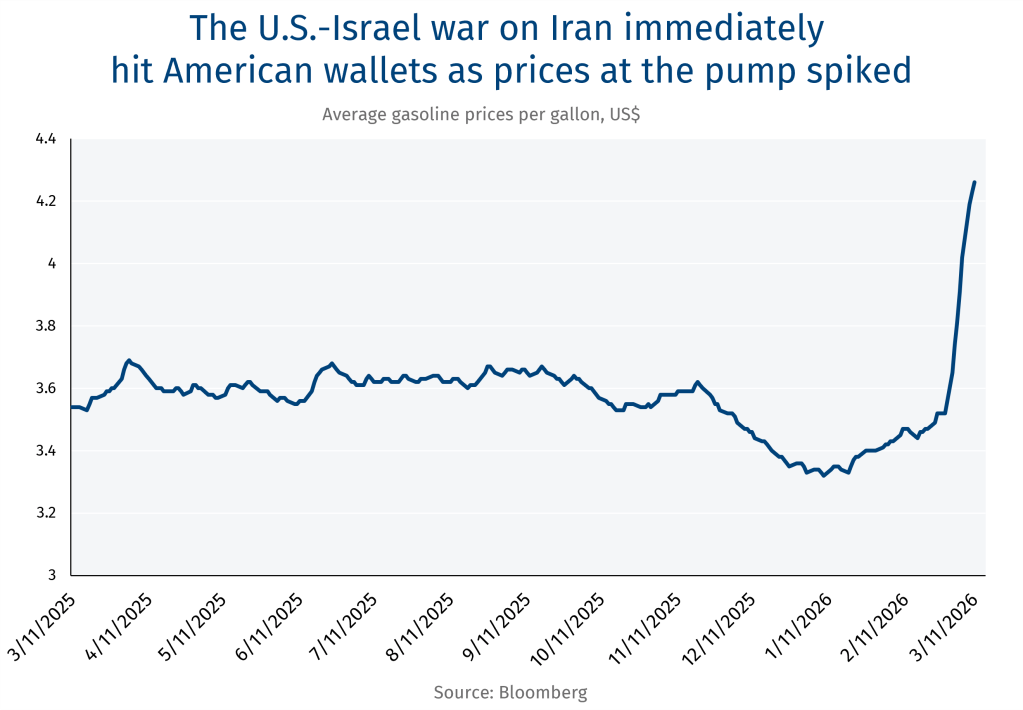
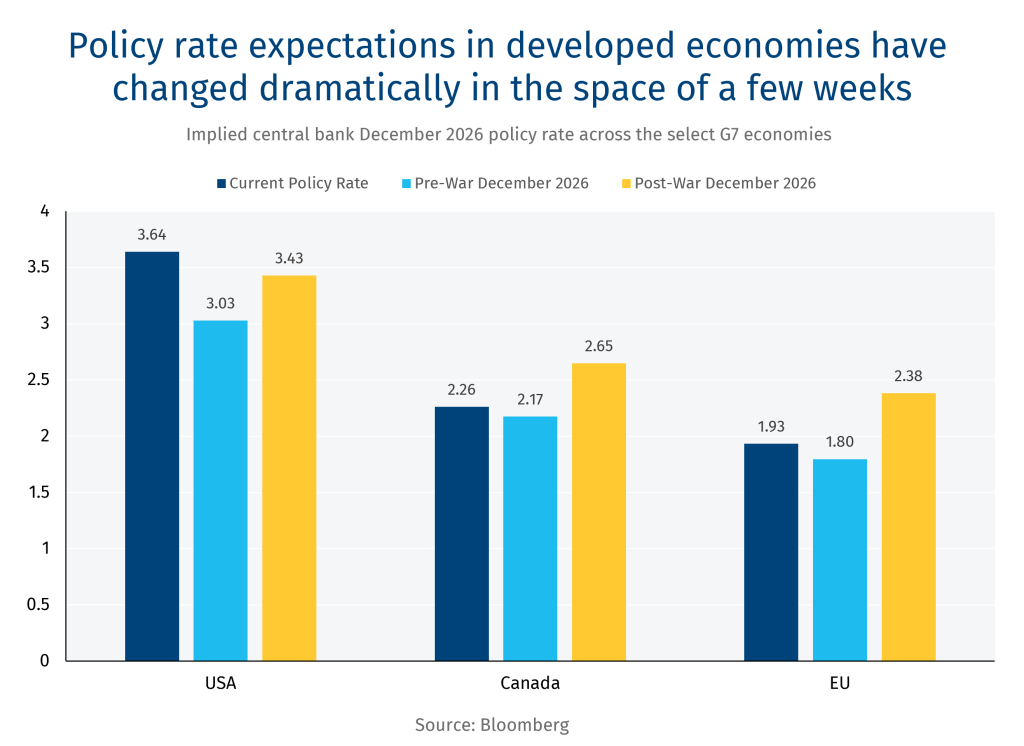
I was in Houston this week for CERAWeek, the so-called Super Bowl of Energy, for a series of intense, and informative, discussions about the current global energy crisis. Last year, the forum was all ears as the new Trump administration laid out its plans for “energy dominance.” This year, the forum was all about the dominant energy crisis unleashed by the Iran war.

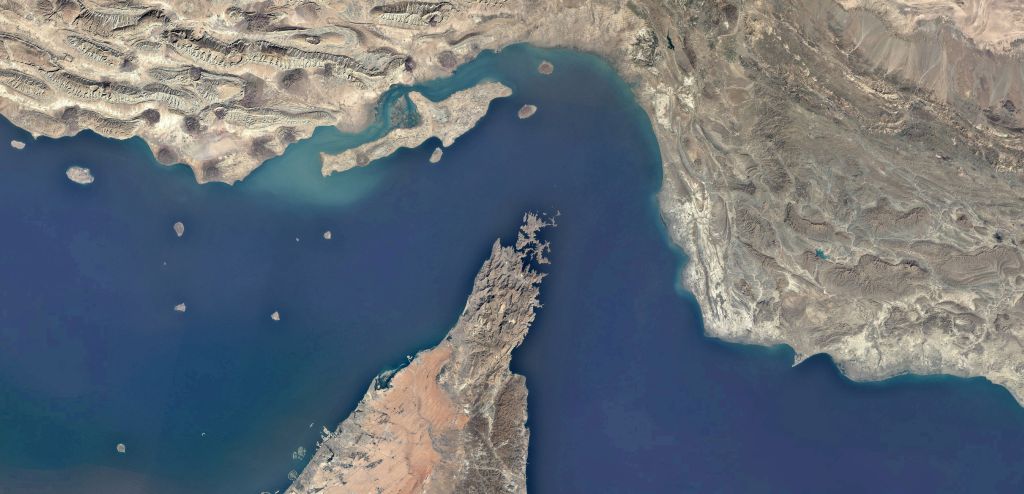
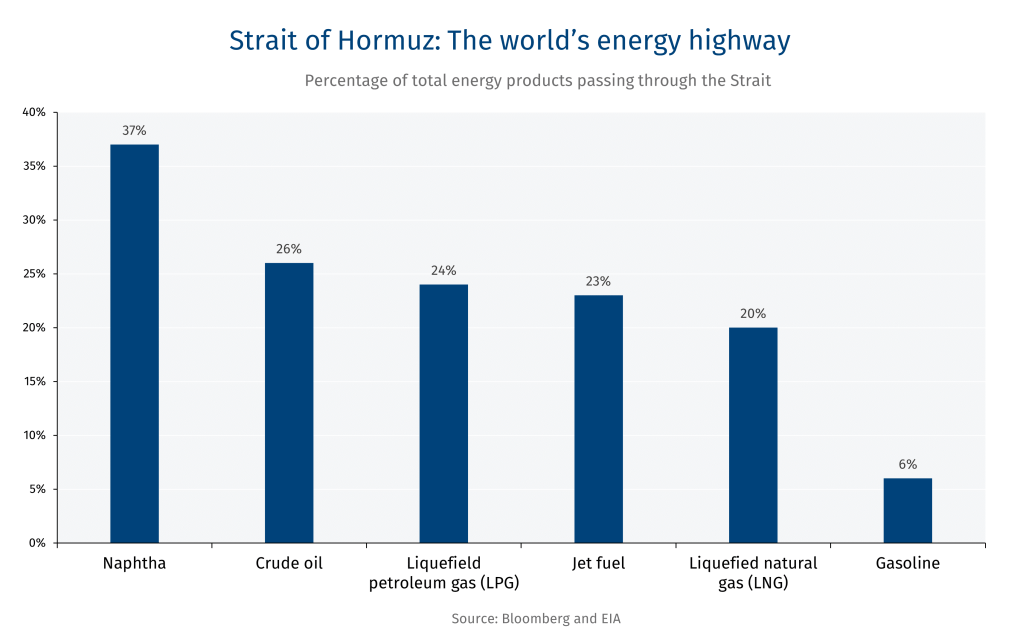
The prevailing view was the conflict — and dangers in the Persian Gulf — will continue for some time, and energy markets will struggle to find a new normal. Former Defence Secretary James Mattis, who has fought three wars in and around the Gulf, said the U.S. cannot declare unilateral victory. Even though Iran’s navy is destroyed, it can deploy anti-ship cruise missiles from its 1,000-kilometre coastline. That means a longer conflict than was first anticipated, and more economic reverberations as supply chains stay gummed up. Traffic through the Strait of Hormuz is down 70%, with 850+ tankers stuck in the crosshairs. It will take weeks just to move that traffic — one reason the IEA called this the “greatest global energy and food security challenge in history.”

The LNG market disruption is not a temporary shock. QatarEnergy’s CEO confirmed that about 17% of Qatar’s LNG export capacity will be offline for years, with billions of dollars in repairs required. LNG margins are already 200% higher on average for 2026 through 2028. New supply from Australia, Canada, and the U.S. will now just replace the losses, rather than add to supply growth. That means a return to pre-war LNG supply levels is unlikely before late 2027 at the earliest. Analysts at S&P Global Energy expect losses of up to 35 million tonnes of LNG in 2026 — enough to cover half of Japan’s annual imports.

The World Food Programme warned as many as 45 million more people could fall into acute food insecurity if the conflict doesn’t end soon — a crisis that rivals Russia’s invasion of Ukraine. One big reason: 30% of global urea trade comes out of Iran and Hormuz-constrained countries, and fertilizer exports from the Persian Gulf have dropped precipitously, driving up prices globally and threatening spring planting seasons. Bunker and cargo costs are up 4x in Europe, adding to the transport nightmare. Agriculture input prices have nearly doubled in Egypt. Fertilizer plants in India, Bangladesh, and Pakistan have had to stop production entirely as natural gas and oil prices spiked — and unlike in 2022, there are few alternatives. India cut output from three of its urea plants. Bangladesh shut four out of its five fertilizer factories.

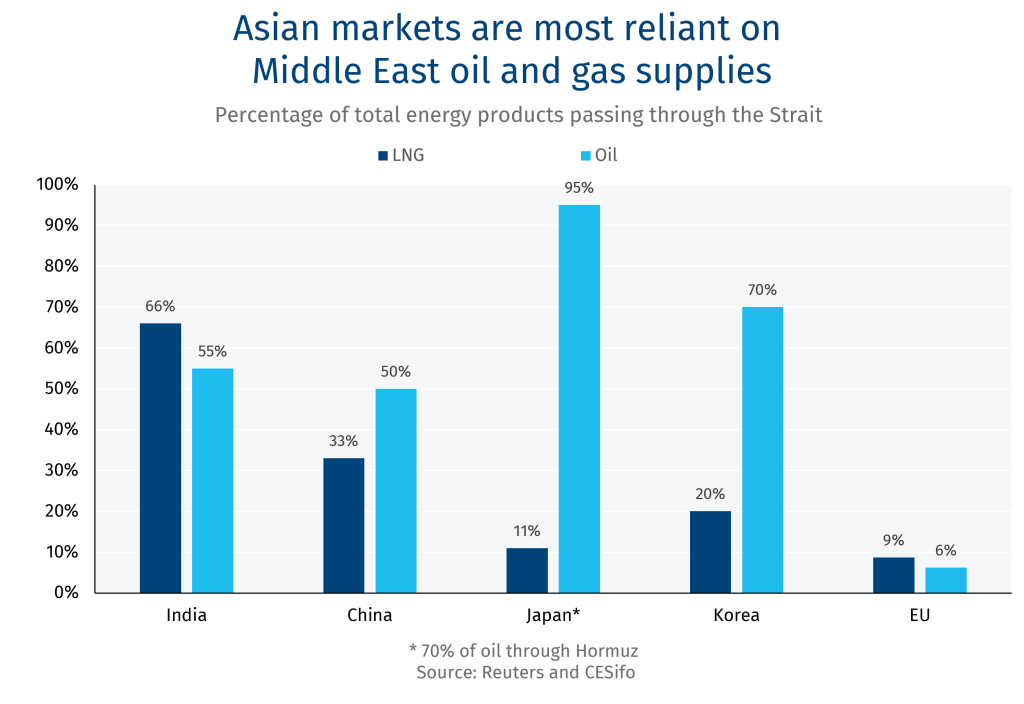
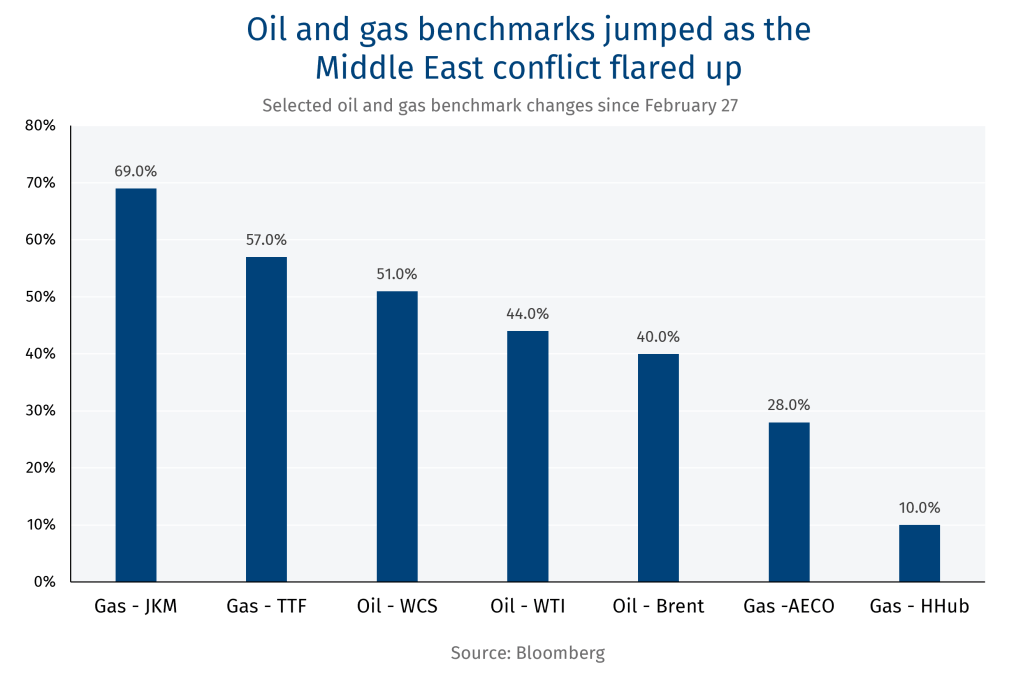
The Strait is the only sea route for 93% of Japan’s oil imports, prompting Tokyo to begin releasing 80 million barrels of oil from its strategic reserves. Japan’s LNG buffer is considerably thinner — Japanese companies hold only about three weeks of LNG inventory, equivalent to the total volume of their Hormuz-dependent LNG imports. Taiwan and South Korea are as severely threatened. In South Asia, fuel rationing is well underway. Pakistan and Bangladesh rely on Qatar for roughly half of their LNG imports. Asian LNG spot prices have surged 143% since February 28.

Rising debt costs and higher import prices have always been a curse for developing countries, especially those that leveraged foreign credit and energy to stimulate growth. In several African economies, energy and transport account for 15-25% of inflation. The Asian Development Bank has identified the Philippines, Pakistan, and Sri Lanka as the most vulnerable in that region. Ripples will be felt in low-cost manufacturing belts, too, as input costs — petroleum-based plastics, for instance — rise. All that will put pressure on indebted countries to borrow more to subsidize consumers and industry, just as interest costs are rising again. In Uzbekistan, Egypt and Mongolia, fuel subsidies account for 28.3%, 28.0% and 11.9% of government spending, respectively. Those dependent on tourism, such as Kenya and Sri Lanka, may be further challenged.

It’s widely viewed that power demand from AI-driven data centres will continue to surge, and there won’t be enough gas to run them. Big Tech companies like Google and Microsoft are developing plans to use nuclear, even reviving mothballed plants in the U.S. But that will take years. Data centres now account for 4% of U.S. electricity, and projections are it’s heading to 12%. It’s not just a U.S. and Chinese phenomenon. Asian countries like the Philippines have ambitious data centre strategies, predicated on more imported gas to run them, but will now need that gas — at a much higher cost — to keep factories and the AC running. The supply-demand imbalance doesn’t compute.

The energy shock has put a new light on China’s ambitions to sell EVs to the world, especially the developing world — if those energy-dependent countries can find new ways to electrify their fleets. Currently about 60% of the world’s pure EVs are sold in China. Will the energy shock shift growth? That will take time, especially for countries facing a host of other challenges to build out electric infrastructure. Expect most countries to have both gas- and electric-powered cars for a long time — even the U.S. Fordmotor Co used the Houston forum to promote its strategy for a new electric pick-up truck, being developed at a skunk works plant in California. The truck’s appeal is its simplicity more than its energy needs. The new vehicles use a fraction of the components (it’s all battery) and a fraction of the internal wiring, making it far easier and cheaper to make. U.S. automakers are also learning from China on how to build vehicles as tech platforms. The biggest question in Ford CEO Jim Farley’s mind: How will Americans react? As Ford knows, cars are culture.

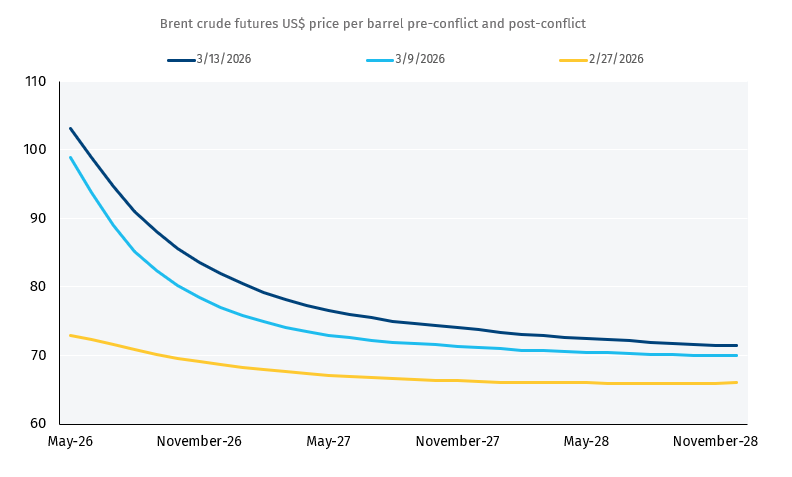
It’s early days — and lots of contingencies are emerging — but as much as 10 million barrels a day of production may be lost this year due to the conflict. That’s roughly 10% of global needs. There are plenty of oil fields that can replace that — just not quickly or efficiently.  Take Venezuela. Its recent increase of 250,000 barrels per day over 2026 represents less than 0.3% of global consumption. Neighbouring Guyana offers more hope, as does Brazil, Nigeria and even Libya. But all those together don’t get anywhere near the missing barrels. There was chatter  at CERAWeek about a return to Alaska drilling, North Sea exploration and even Norway’s Far North. Canadian production is expected to increase, too, including offshore opportunities in Newfoundland and Labrador. But most eyes are on Russia. It may have 80 million barrels of oil currently on the open seas, and a multiple of that ready to go.

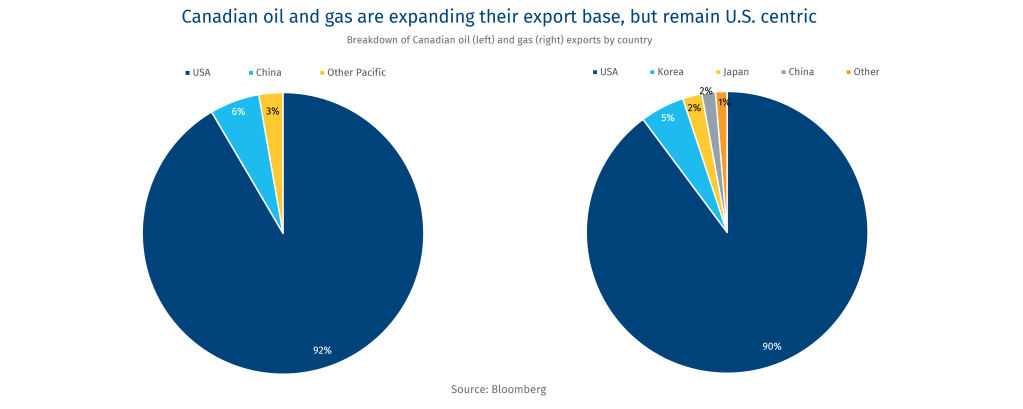
Energy Minister Timothy Hodgson didn’t mince words. Canada will produce and export a lot more oil and gas, He even put numbers on it: 2.5 million more barrels a day of oil (a 50% increase) and 100 billion cubic feet of gas (double projections) by 2035. He told various audiences that Indigenous support has rarely been stronger for resource development, in part because most big resource projects now have indigenous ownership. Premier Danielle Smith told one audience an agreement between Ottawa and Alberta on carbon pricing is coming and will be critical to long-term contracts. It can also underpin plans for a massive investment in carbon capture and storage, something the Carney government remains insistent on. Behind closed doors, sovereign wealth funds, multinationals and state corporations lined up to advance negotiations for long-term contracts and equity stakes. A universal question among them: Can #Canada execute this time at speed and scale?

Disclaimer

rbc_tl_disclaimer

Also in this edition: Untangling North America’s biofuel supply chain

The Strait of Hormuz has long been treated as an oil story. When it closes, energy markets move, tanker rates spike, and the headlines follow crude. But it remains a slow-moving shock to the cost of moving goods, which becomes more entrenched over time.

First-Order: Crude and Tankers

The most direct impact is exactly where markets expected it. Benchmark Very Large Crude Carrier (VLCC) spot rates have surged six-fold since early January and are currently priced at US$98/t (US$13-14/bbl). Tanker volumes through Hormuz (and Suez) have essentially collapsed, with more than 500 vessels stranded in the Persian Gulf.

Second-Order: Products and Fuel

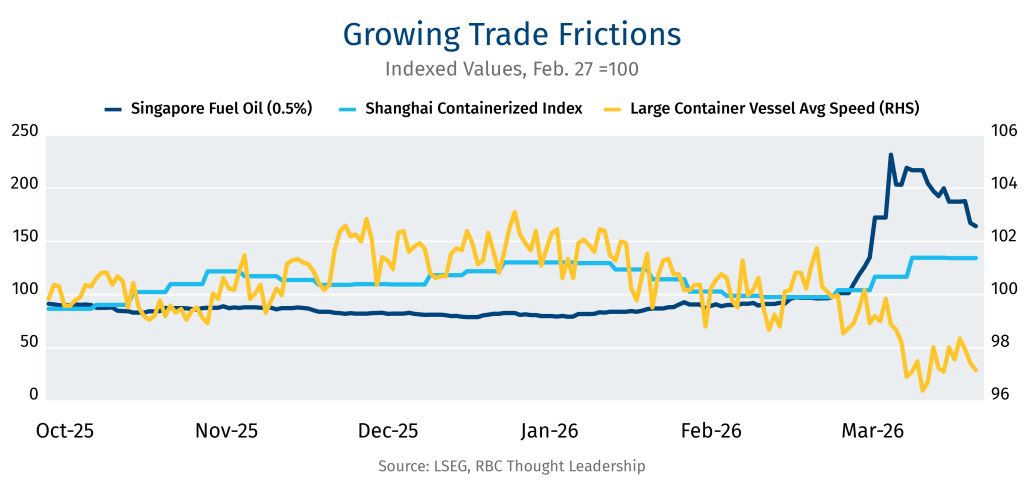
Refinery outages and export constraints tied to Hormuz have fractured global bunker supply chains, forcing vessels to seek fuel at alternative ports at elevated war-zone premiums. Charted below is the Singapore marine fuel indexed price, up 66% since the crisis began. Not charted but equally telling is the spread between Freight on Board (FOB) and delivered prices, typically <5% but well over 50% in mid-March, reflecting genuine physical dislocation in how marine fuel reaches vessels.

Maersk, a Danish shipping company, formalized this disruption on March 25 with a global Emergency Bunker Surcharge, entrenching a products shock into shipping economics worldwide.

Third-Order: Container and Dry Bulk

The Shanghai Containerized Freight Index (SCFI) fell gradually ahead of the conflict and has since rebounded (see chart), but the moves are likely seasonal. Chinese New Year brought port throughput to 40-50% of normal capacity in mid-February. How much of the SCFI March recovery is supply related in contrast to stronger demand is likely unclear until official port data is reported at month end.

Still, dry bulk was structurally underexposed to Hormuz to begin with–only around 55 dry-bulk vessels were transiting the strait weekly before the conflict and the Baltic Dry index is largely flat, if not marginally down. Nonetheless, large container vessel average speeds have edged marginally lower (see chart) since late February, a modest signal consistent with routine rerouting at the edges of the conflict zone.

–Shaz Merwat, Energy Policy Lead

Growing Trade Frictions

North America’s once integrated biofuel supply chain is splintering along national lines.

U.S. federal incentives, state-level programs, and Canada’s Clean Fuel Regulations (CFR) are increasingly pulling in different directions, leading to a fragmented market with implications for Canadian biofuel producers and farmers growing oilseeds and grain including canola, soybeans, and corn.

Policy shifts triggered a continental divide

Changes to U.S. policy under the Renewable Fuel Standard (RFS) and new production tax credits have led the shift. Proposed 2026–27 RFS rules significantly increase domestic biomass-based diesel blending targets, reinforcing demand for oil-based feedstocks like soybean oil.

  • At the same time, newer incentive structures—particularly the transition from blender credits to production-based credits—are explicitly favouring domestic fuel production in the U.S.

  • The change eliminates the US$1 per gallon incentive Canadian biodiesels and renewable diesel received in the U.S. market as biofuels must be produced in the U.S. to earn the production-based credits. The result: an approximate 13% decline in value of Canadian imports into the U.S. between 2024 and 2025, according to Canada’s trade portal. It’s a meaningful departure from the bump Canadian biofuels received from U.S. subsidies.

What’s the impact on Canadian oilseed and grain markets?

Biofuel is a policy driven market and regulatory certainty is not a guarantee. Incentives for biofuel feedstocks under U.S. policy are still evolving as the U.S. Environmental Protection Agency (EPA) establishes its Renewable Volume Obligations (RVOs) for 2026 and 2027.

The pending U.S. policy uncertainty for Canadian farmers is that the EPA has proposed reducing the number of Renewable Identification Numbers (RINs) generated for imported renewable fuel and renewable fuel produced from foreign feedstocks, which would financially discourage U.S. biofuel refineries to use Canadian feedstocks. However, rising domestic Canadian demand could partially offset the export risk.

Canola: It’s the most exposed. Canola oil exported to the U.S. is primarily used for renewable diesel production. Exports of canola oil volume to the U.S. fell by 26% between 2024 and 2025, after climbing in each of the previous five years. The drop occurred while the Canadian canola industry spent more than a year in regulatory limbo, waiting for the U.S. Department of the Treasury and the Internal Revenue Service to clarify how production credits would work, confirming the inclusion of North American feedstocks in January this year.

Soybeans: Canadian soybean farmers may benefit from supportive U.S. policy. According to the U.S. Department of Agriculture’s 2026 outlook, biofuel mandates and tax incentives are expected to drive a 17% increase in U.S. soybean oil use for biofuels. Rising demand for soybeans is supporting prices, yet the commodity still faces potential downsides on trade with the U.S. if the EPA’s proposed RVOs are confirmed.

Corn: It remains anchored in U.S. ethanol production under the RFS. Yet, Canadian ethanol producers are now disadvantaged under the Clean Fuel Production Credit (45Z) that’s designed to encourage U.S. production of finished biofuel via incentives.

Bottom line

The Canadian outlook is mixed with domestic market demand hinging on the federal government’s forthcoming CFR amendments, where policy levers to shore up domestic demand are being considered, including minimum domestic content and credit multipliers for local producers.

–Lisa Ashton, Agriculture Policy Lead

Canadian beef producers raise concerns over potential Mercosur free trade deal

  • As Ottawa looks to secure a free trade agreement with the South American bloc this year, the Canadian Cattle Association (CCA) expressed concerns.

  • Brazil is the world’s largest beef producer, and the CCA worries that a Mercosur free trade deal would flood the Canadian market with cheap beef, harm the industry’s efforts to recover amid the tightest cattle supply in 40 years, and risk accusations from the U.S. of Canada enabling a “back door” into North American markets.

Fertilizer costs are leaping just as planting season gets underway

  • Disruption to shipments of fertilizers and commodities essential to fertilizer production through the Strait of Hormuz has increased prices, while North American farmers prepare to embark on their spring planting season. Urea, for example, has seen a ~40% price increase since the conflict began. The surge is quickly becoming a political issue for Trump who met this week with American farming groups, an influential political lobby.

  • Meanwhile, Russia, whose shipments remain unaffected by the Hormuz blockade, has deep reserves of fertilizers and commodities. Earlier this week, Russia halted its exports of ammonium nitrate, to shore up its domestic supply. But the conflict potentially raises the specter of Russia looking to increase its leverage on having restrictions on Russian fertilizer exports to Europe eased.

European parliament approves trade deal with U.S.

  • EU lawmakers had previously delayed approving the Turnberry agreement over U.S. President Donald Trump’s threats to annex Greenland, but on Tuesday the European parliament cleared the way for its implementation—with additional conditions attached. Prior to the vote, the U.S. threatened that the EU would lose favourable access to LNG shipments from the U.S. if the deal was further delayed, as Europe feels the bite of disrupted LNG shipments from Qatar.

  • The deal would eliminate EU tariffs on American industrial goods and some agricultural products and reduce U.S. tariffs on most EU goods to 15%. However, MEPs attached safeguards, such as delaying the EU’s tariff eliminations until the U.S. reduces its levies. These safeguards must be approved by EU member states, with negotiations commencing April 13th.

–Thomas Ashcroft, Geo-Politics Lead

Disclaimer

rbc_tl_disclaimer

This article is a companion to the Disruptors episode on how Wikipedia platform built credibility through community, transparency and a shared commitment to neutrality – Trust at Scale: Lessons from Wikipedia

Something has shifted in how people relate to institutions. Across the OECD, more people now distrust their national government than trust it. In Canada, only 48% express confidence in the federal government, down from the high 50s before the pandemic.1 An Ipsos survey captured the trajectory: trust in government to do what is right fell from 58% in 2019 to 43% by 2022.2 Meanwhile, the 2025 CanTrust Index found that politicians are trusted by just 17% of Canadians, the lowest in a decade of tracking, and 6 in 10 say political parties are divisive forces.3

Social media and AI-generated content have accelerated the decline, with nearly half of Canadians now believing that AI will make information sources less trustworthy. Algorithms reward outrage over accuracy, flooding public discourse with polarizing content and AI-generated noise. As Jimmy Wales, the co-founder of Wikipedia, observed on a recent RBC Disruptors podcast, platforms incentivize bad behaviour through engagement: “you act like a jerk and you get engagement.”4

Wales’ latest book Seven Rules of Trust—A Blueprint for Building Things That Last, focuses on the global crisis of credibility and knowledge. Both are in short supply: The 2026 Edelman Trust Barometer found 73% of Canadians unwilling to trust someone with different values or information sources.5

The consequences of mistrust are far-reaching and having real impact: In Slovakia’s 2023 election, a deepfake audio clip impersonating a political party leader went viral during a legally mandated campaign silence period, leaving journalists no window to respond.6 In the United States, an AI-generated robocall mimicking President Joe Biden urged New Hampshire voters to stay home during the 2024 primary.7 Similar incidents surfaced in Bangladesh, Turkey, and India. The German Marshall Fund tracked 133 deepfake incidents tied to elections across dozens of countries.8

Wikipedia makes for an instructive model. The free online encyclopedia covers more than seven million English-language articles, roughly 283,000 active editors, and billions of page views annually—all on a non-profit budget. It’s the go-to site for many to source everything from a storied company’s corporate history to oddities and obscure records.

For all its variety, it’s far from perfect: critics flag ideological biases, gender gaps among editors, and vulnerability to paid manipulation. But as Wales noted on the podcast, Wikipedia has gone “from being kind of a joke to one of the few things people trust.”

The reason is structural. Wikipedia’s model is “accountability, not gatekeeping,” Wales told RBC’s Disruptors podcast.9 “Everything you edit, everybody can see what you’ve done.” Every source is checkable, disputes happen on public talk pages, and corrections happen in real time.

Wales’s thinking was shaped early by Nobel-prizewinning philosopher Friedrich Hayek’s argument about decentralized knowledge—the idea that decision-making works best at the endpoints, not through a central hierarchy. Wales pointed to X’s Community Notes as a promising application of the same principle: empowering users rather than relying on top-down moderation.

Research going back to Knack and Keefer’s 1997 study confirms that trust is a measurable input to growth.10 A Deloitte analysis by chief global economist Ira Kalish makes the mechanism concrete: a rise in trust increases the quantity of business fixed investment, and it raises productivity through higher-quality investments, human capital accumulation, and greater internationalization.11

The consultancy’s modelling suggests a ten-percentage-point increase in the share of trusting people within a country raises annual per capita GDP growth by about half a percentage point: a substantial gain when global growth averaged 2.2 percent between 2015 and 2019.

There is no single fix to restore trust in corporate and public sector governance. But as the Disruptors’ conversation with Wales highlighted, trust is not a moral decoration. The work of rebuilding it will be slow, uneven, and ongoing. But the cost of not starting is already measurable.

Disclaimer

rbc_tl_disclaimer

What you need to know about the West’s struggle to break China’s dominant role in rare-earth elements refining—and the technologies that could break Beijing’s hold

The West has ceded critical minerals processing to China–and rebuilding that capacity in a way that is environmentally permittable, economically viable, and scalable within Western regulatory frameworks is a defining industrial challenge of the decade.

China controls 70% of the global refining market share for 19 of the world’s 20 most critical minerals; across minerals such as rare-earth elements that figure is north of 90%. This dominance is the compounding effect of three structural forces, each reinforcing the other over time.

Economics. China’s historically low labour costs, energy subsidies, and state-backed industrial policy built a cost structure that undercut Western processors at prevailing commodity prices.

Environment. Conventional rare earth processing relies on sulphuric acid baking, multi-stage leaching, and solvent extraction, generating toxic waste streams and radioactive tailings. According to a Harvard analysis, for every tonne of rare earth output, conventional processing produces roughly 2,000 tonnes of toxic waste. Western jurisdictions internalize those costs through permitting, environmental liability, and community opposition.

Industrial ecosystem. As China’s processing capacity scaled, it drew in engineering talent, downstream manufacturers, and end-use demand—each reinforcing the next. As Western processing retreated over the last 40 years, financial markets stopped funding, institutions stopped training, and downstream manufacturers defaulted to Chinese supply. China accumulated the opposite—four decades of process knowledge, engineering expertise, and refining IP that enforces a barrier to Western re-entry.

Rebuilding Western processing capacity by replicating China’s model runs into the same barriers that caused offshoring. Arguably it’s now compounded by China’s October 2025 export controls on processing equipment and technology. A more tractable path confronts the environmental liabilities of conventional methods directly—and in doing so, also improves the economics.

Grant and procurement decisions offer a reasonable proxy for which processing approaches have cleared basic viability thresholds. The U.S. Department of War, Department of Energy, and the Government of Canada have directed meaningful capital toward next-generation critical minerals processing since 2022.

Waste and tailings. New processing approaches—including flash heating and modular ion-exchange systems—substantially reduce or eliminate waste streams, making projects permittable where conventional processing would not be.

Canadian firm Ucore Rare Metals is a case in point. Its RapidSX platform is a column-based solvent extraction system for rare earth separation that runs approximately three times faster than conventional mixer-settler systems, with a smaller physical footprint and no Chinese equipment or technology. The U.S. Department of Defense (DoD) awarded US$4 million for Ucore’s Kingston, Ontario, demonstration facility, followed by US$18 million toward its Louisiana Strategic Metals Complex. The Government of Canada committed $36 million at the G7 resource ministers meeting in October 2025 to support refining of samarium and gadolinium.

Emissions. Decarbonizing processing is mainly a question of energy source: replacing fossil-fuel-fired kilns and furnaces with electrically powered alternatives—particularly hydro or other clean sources—solves the emissions problem and improves economics given falling clean electricity costs. Most global critical mineral refining runs on coal-heavy Chinese grids. Processing on hydroelectric power, as Quebec offers, materially changes the emissions profile of the same output.

Australia-based Metallium Resources Inc. is working on a solution to transform metal recovery and recycling waste through flash joule heating—millisecond electrical pulses to heat material above 3,000 degrees Celsius, extracting metals selectively without acid or water. The U.S. DoW provided an initial gallium-focused grant and selected the technology as a processing step in a DoW-funded red mud recovery project in Louisiana. Metallium’s Texas demonstration plant has been commissioned, with feedstock supply secured through a binding agreement with commodity firm Glencore plc.

Recycling. The IEA finds recycled energy transition minerals such as nickel, cobalt, and lithium produce on average 80% fewer greenhouse gas emissions than primary mined material. Recycling rates for rare-earth elements and lithium remain below 5% globally, yet feedstock is accumulating fast: spent EV batteries, end-of-life wind turbine magnets, and electronic waste from AI infrastructure all carry recoverable critical metal content.

The EU has institutionalized recycling demand through binding regulation. Under EU Battery Regulation 2023/1542, manufacturers face minimum recycled content requirements. These are enforceable compliance thresholds—not targets. They create a structural demand signal for recovered materials that current processing infrastructure cannot meet.

ReElement Technologies is aiming to turn scrap into mining stock. A subsidiary of American Resources Corp, ReElement runs a modular ion-exchange and solvent-based refining platform processing rare earth magnet scrap and lithium-ion battery black mass into high-purity separated products. The platform accepts multiple feedstock types without Chinese primary concentrates. ReElement has received DoD and Department of Energy funding as part of the U.S.’s effort to establish domestic rare earth and battery metal refining capacity.

Challenging China’s rare-earth refining dominance will take time, but the funding of experimental technologies, backed by policy focus and support, suggests that the transition is finally underway.

Critical Minerals Processing: The West’s Refining Challenge and the Technologies Closing the Gap - download the report

Download the report

Disclaimer

rbc_tl_disclaimer

➔ Canada charts new scenarios for a new energy era

➔ The small switcheroo that revolutionized energy efficiency

➔ A handbook for climate hopefuls

What happens to coffee farms when pest-controlling bats disappear? The world is waking up to the fact that biodiversity impacts everything from your morning cup of Joe to corporate bottom lines. Recently, 152 member governments, including Canada, backed the IPBES Business & Biodiversity Assessment report. It’s groundbreaking research as more than half of the world’s economy, roughly US$78 trillion, depends on nature, from food to tourism to construction, according to RBC research. One of the IPBES report’s key takeaways: align fiscal policies and financial flows with biodiversity and sustainability goals. However, muted mainstream media coverage suggests the message of nature as an asset—and shield—has yet to resonate with a mass business audience. For more, read Unearthing Value: How nature can play a critical role in pro-growth agendas

It’s a light-bulb moment for energy efficiency. While the global built floor area grew 20% over the past decade, lighting electricity use remained stable—in no small part to the humble LEDs, which are nearly 12 times more efficient than halogen lamps. Without them, the world would have gobbled up 800 TWh more electricity—exceeding Africa’s annual electricity consumption, the International Energy Agency estimates. Significant potential remains: 30% of lamps in South America and parts of Asia-Pacific (excluding China and India) still need upgrades, while replacing aging first-generation LEDs would further conserve power watts.

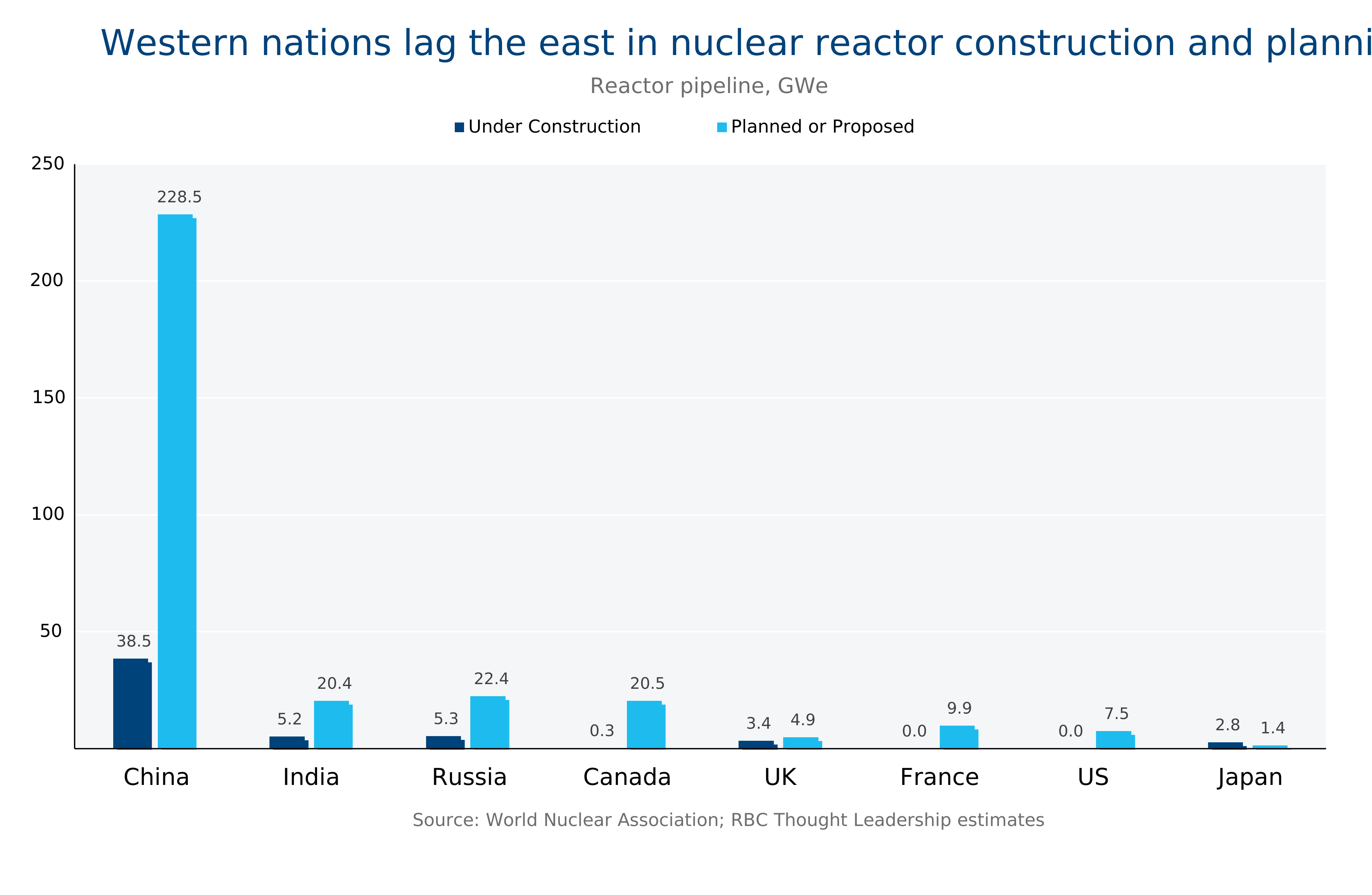
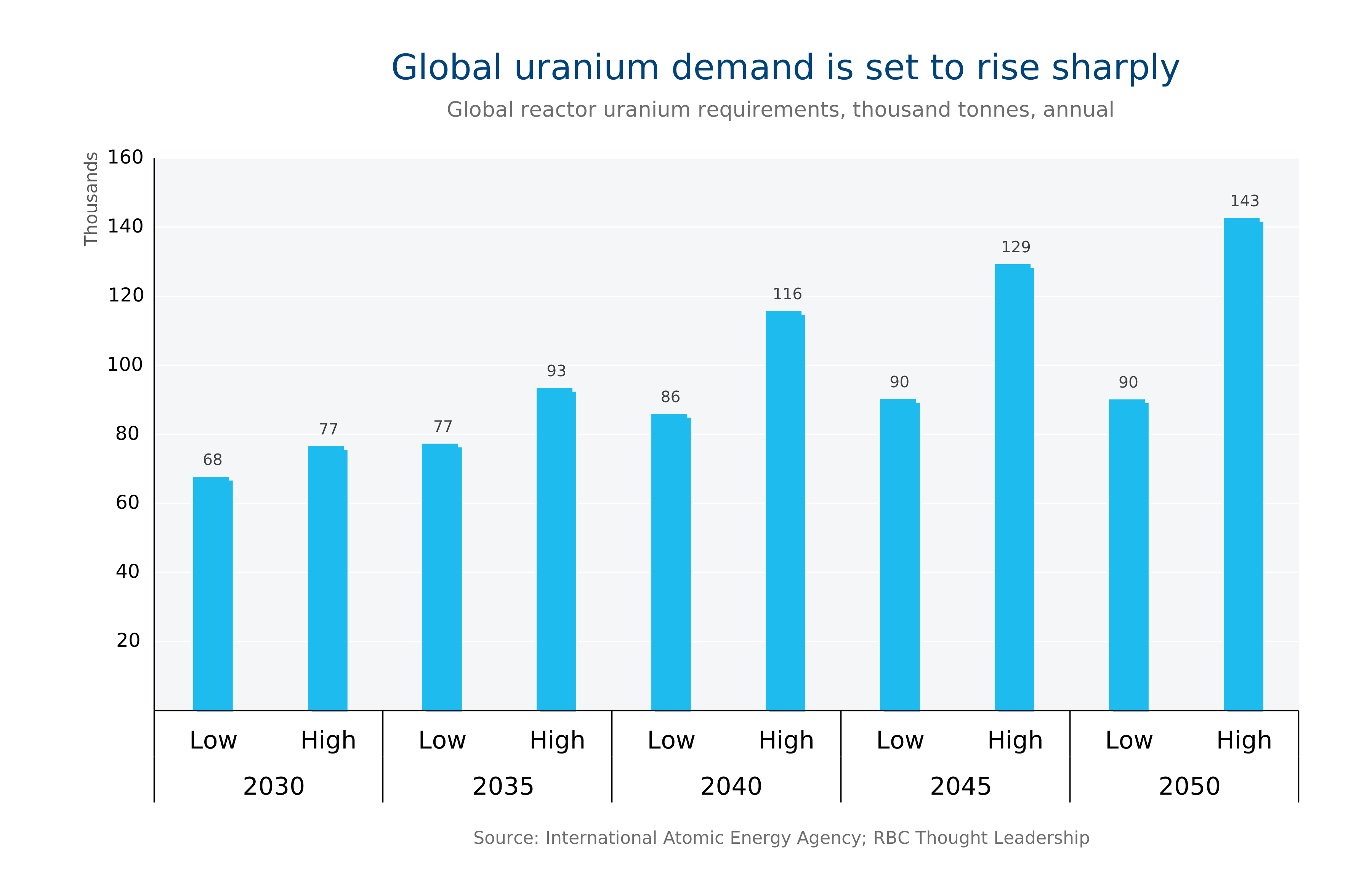
Nuclear’s making a climate comeback. The low-carbon electricity technology underlies some of the world’s cleanest grids and could help decarbonize several industries, says Vivan Sorab, our Clean Tech Policy Lead. France’s electricity grid emits just 22 gCO2/kWh, one of the lowest in the world, as nuclear supplies 65% of the country’s power. Ontario’s grid saw emissions intensity rise to 74 gCO2/kWh in 2024 over the previous year as nuclear refurbishments and demand growth necessitated more natural gas in the system. Small modular reactors (SMRs) could extend nuclear’s climate logic beyond the grid. Carbon-intensive industries like heavy oil extraction and petrochemicals require high-temperature steam that renewables are struggling to deliver on their own. SMRs could eventually provide both electricity and industrial process heat, making them one of the few technologies that can help hard-to-decarbonize sectors. For more on nuclear, read Atomic Advantage: Canada’s generational opportunity in a new Nuclear Age.

By John Stackhouse, Senior Vice-President, Office of the CEO

John Stackhouse at CERAWeek

The climate contingent at this week’s big CERAWeek energy conference in Houston could be forgiven for a bit of dizziness. It’s not just the bayou city’s humidity (early) or the marathon TSA lineups at Bush International (late); the tenor on climate action felt a bit 180. 

Two years ago, Joe Biden’s energy secretary Jennifer Granholm was here to explain the administration’s LNG pause. On Monday, Donald Trump’s energy secretary Chris Wright stood on the same stage to explain plans to double LNG production this decade.

It’s not just the White House that has changed climate colours. Delegations from dozens of countries came to Houston to plead for more of everything—especially natural gas. The Japanese—home to Kyoto and a lot of climate innovation—were at the front of the queue, explaining they can no longer rely on Qatar and a few others for the gas that powers their island economy. (Remember the nuclear shut down, post-Fukushima.)

The U.S. is now working to supply Japan and other allies with as much gas and oil as it can muster. And it looks like a lot of that will come from Canada.

When it comes to oil, Canada covers two-thirds of the gap between U.S. production (12 million barrels a day) and consumption (20 million). We supply an even bigger share of Americans’ gas in a range of states.

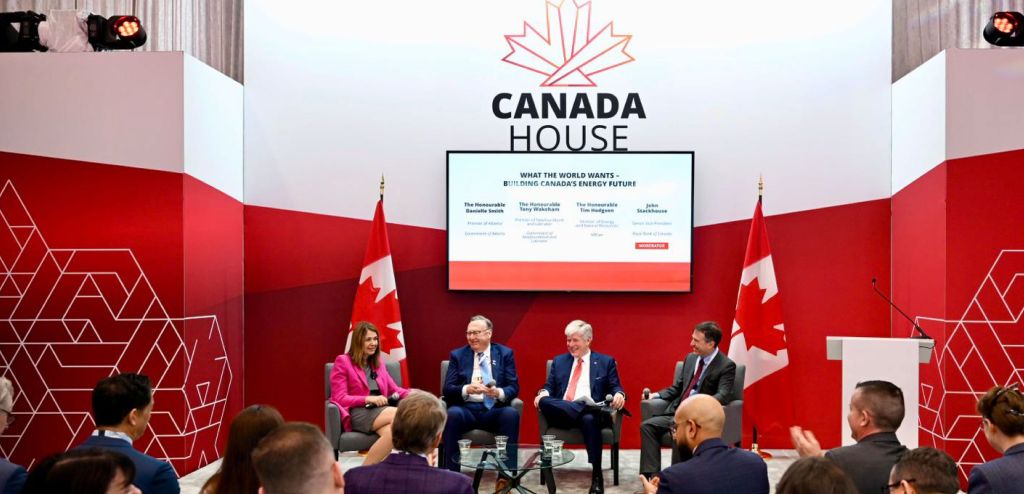
Energy Minister Tim Hodgson came to Houston to tell the world that the federal government is committed to seeing oil production increase by 2.5 million barrels a day — a 50% jump — and doubling LNG exports from what’s now planned. Can that massive increase be done in line with climate commitments?

I posed the question to Hodgson and Alberta Premier Danielle Smith in a conversation I moderated at Canada House, as part of the conference. They expressed strong alignment (so much so that Smith called herself the environmental spokesperson for Carney’s energy policy). They then honed in on three words: methane, carbon pricing and Pathways.

Their governments later that day unveiled an agreement on methane emissions that will help keep Canada, and Alberta, on a path to net zero (“carbon neutrality” is Smith’s preferred measure). Industrial carbon pricing is thornier, although it may get solved by extending some timelines.

The big nut is Pathways, which Hodgson called “the biggest carbon capture project in the world” and would make all those new barrels much more carbon efficient. Cost is another matter. Ottawa thinks Pathways could cost as little as 50 cents a barrel, which it sees as a deal for the industry if it secures a 50% increase in production. Industry people here see the cost to be higher, although there’s some hope that possible investments from Canadian pension funds would reduce long-term capital costs.

We can expect more on all this next week, when the Ottawa-Alberta MOU on energy hits its key milestone date of April 1. The global crisis may cause some delays, and lead to further adjustments. But the message in Houston from Ottawa and Alberta was clear: more production and lower emissions is the new Canadian plan.

By Shaz Merwat, Energy Policy Lead

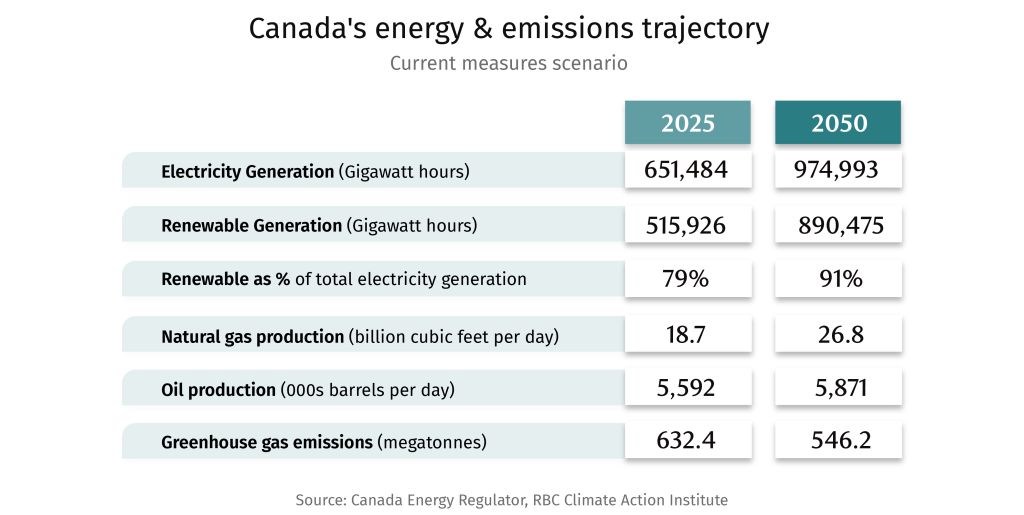
Electrification is going to be Canada’s key climate enabler. Electricity generation is expected to be up 50% by 2050, with renewables making up 91% of the grid (compared to 79% today), according to Canada Energy Regulator’s latest traditional scenario, which it labels as Current Measures.

While net-zero by 2050 remains a challenging aspiration, the economy is also forecast to advance towards lower-carbon sources. With carbon-intensive coal almost out of the equation, and crude oil production growth easing, fossil- fuel growth will be driven by the relatively lower emissions natural gas: By 2050, natural gas will account for 43% of total oil and gas production—compared to 36% today.

Canada's energy & emissions trajectory

Published two weeks into the war on Iran—what could prove to be one of the most cataclysmic energy events of this century—the report offers multiple paths for Canadian energy and electricity growth and emissions contraction.

  • Canada is moving beyond net zero: This year’s edition retains the Current Measures and Canada Net-Zero Scenarios from Canada’s Energy Future 2023 (EF2023), but adds Higher and Lower Cases that bracket the baseline by varying economic growth, liquefied natural exports, data centre demand, and global energy prices—offering a more plausible ±20% range of outcomes rather than anchoring the analysis around net zero by 2050 as the only destination.

  • Emissions will decline around 14% by 2050. GHG emissions under Current Measures are lower in EF2026 at every point—but a net-zero Canadian economy is nowhere on the horizon. By 2050, EF2026 projects 546 megatonnes (Mt) versus 566 Mt in EF2023, reflecting better near-term decarbonization from policies already in place, particularly in the electricity sector.

  • Sun and wind power will power the grid. Electricity generation under Current Measures is broadly similar across both reports. By 2050, total generation reaches approximately 975 Terawatt-hour (TWh) in the Energy Futures 2026 report compared to 972 TWh (EF2023). The more notable divergence is in the renewables share: EF2026 projects a faster ramp-up, reaching 91% non-emitting generation by 2050 versus 86% in EF2023, with stronger growth from 2035 onward.

  • Canada’s kicking the peak oil can down the road. Oil production is consistent near-term but EF2026 is notably more conservative in the medium term. By 2035, EF2026 projects ~6.0 million barrels per day (bpd) versus 6.5 million bpd in EF2023—converging closer by 2050 at 5.9 versus 6.3 million bpd by 2050. Peak oil production has been pushed out seven years, to 2042 from 2035 prior. The High Scenario projects oil production soaring to 6.4 million bpd.

  • …and firing up natural gas. EF2026 projects substantially higher output in every time horizon, reaching 26.8 billion cubic feet per day (bcfd) by 2050 versus 21.5 bcfd in EF2023—a 25% increase—driven largely by new LNG export assumptions baked into the 2026 modelling.

  • Carbon capture, utilization and storage (CCUS) volumes will likely be marginal. While not specifically broken out in the forecast, about 4% of Canada’s total power generation will be from carbon-captured natural gas in the Current Measures scenario.Total oil and gas emissions are expected to be 176 MT in 2050, down 12% vs 199 MT as modelled in 2025, on the back of a 5% increase in oil and gas production (5.9 million bpd by 2050, compared to 5.6 million bpd in 2025).

  • Canada is trailing peers: Within a global context, under Current Measures, Canada’s emissions decline from 694 Mt in 2023 (latest available data) to 562 Mt by 2035 is a 23% reduction from its 2005 baseline of approximately 730 Mt. That puts Canada marginally behind the U.S., where Rhodium Group projects a 26–35% reduction below 2005 levels by 2035. Both trail the EU considerably—the EU is on track for roughly a 45–47% reduction by 2035 under current and planned measures. All three are falling short of net-zero without additional policy action.​​​​​​​​​​​​​​​​

Fred Pearce, a UK-based science writer and public speaker, who has authored a few ominously titled books over the years: When the Rivers Run Dry, The Land Grabbers and With Speed and Violence, has a change of tone with Despite it All: A Handbook for Climate Hopefuls. In it, heaims to tell stories about “hope amid the gloom.”

Here’s an excerpt from a short email exchange:

What makes you hopeful?
We remain in deep peril. Every tonne of greenhouse gases added to the atmosphere sticks around for centuries. But my hope lies in the extraordinary progress we have made technically. China, and increasingly India and other fast-developing countries, are adopting solar power as their default source of energy, because it is so cheap. That was unimaginable even 20 years ago. The Chinese are now transforming the cost of batteries so we can store the sun’s energy, rather than just tapping it real-time. We are entering the solar age. It is economics now, not politics, that is making the difference. Whether it is happening fast enough remains as issue. But it is happening.

One of the reasons you give for your optimism are smaller families and an ageing population—but isn’t that going to impact economic growth and government’s ability to support citizens?
 
It’s a new kind of population bomb. The fear is of a growing number of aged economic “dependents”, and fewer people of working age to support them. Ageing could also slow economic activity by undermining innovation from young go-getters. We have to rethink the old: see them as a source of wisdom and knowledge, as carers as well as the cared for. I am 74 now and still working, so I would say that! But let’s also remember we have fewer children to care for, and today most women are economically active, not at home to bring up the kids.

What worries you the most?
Cliff-edges, points of no return. Melting ice sheets on Greenland and Antarctic and the resulting rising sea levels may soon be unstoppable—even if temperatures come back down. Deforestation in the Amazon may be near the point where lack of trees dries out the air so the remaining trees die off. And the ocean circulation system could be close to collapse, switching off the Gulf Stream.  Then there is melting permafrost unleashing methane, a potent greenhouse gas that would supercharge warming. Again, unstoppable. Science cannot tell us yet where or when we may trigger such tipping points. So even as we make remarkable ground in ending our addiction to carbon-based fuels, my fear is it could be too late to avoid these great regime shifts. We may be lucky; we may not.

  • Failure to value and account for natural assets are among the four barriersholding back climate adaptation initiatives in Canada,write C.D. Howe senior fellow James Stewart and Anabela Bonada, managing director at the Intact Centre on Climate Adaptation, University of Waterloo.

  • Gavin Mooney at the Energy Transition Advisor explores how rapid solar power deployment helped Pakistan cushion its crushing dependence on Middle East natural gas.

  • Canada is entering one of the largest electricity buildouts in its history. If it’s going to succeed, Indigenous Nations must be at the centre—not on the sidelines, write Kwatuuma Cole Sayers and Blake Shaffer in an op-ed.

  • As energy systems are struggling to transform in the face of climate change, Justice in Canada’s Energy Transition report asserts that justice and equity are central to making a low-carbon economy sustainable, writes Julie MacArthur, a co-editor of the report.

  • “Excessive heat warnings, red flag warnings for wildfire conditions, and monthly temperature records being shattered yet again… this is easily one of the most anomalous out-of-season heatwaves that I’ve observed,” says climate scientist Zachary Labe about the current season.

Curated by Yadullah Hussain, Managing Editor, RBC Climate Action Institute.

Climate Crunch would not be possible without John Stackhouse, Jordan Brennan, John Intini, Farhad PanahovLisa AshtonShaz MerwatVivan SorabCaprice Biasoni, Lavanya Kaleeswaran and Joelle Schonberg .

Have a comment, commendation, or umm, criticism? Write to me here (yadullahhussain@rbc.com)

Climate Crunch Newsletter

Disclaimer

rbc_tl_disclaimer

For 25 years, Wikipedia has been one of the web’s most relied-on public resources. But in an age of generative AI, misinformation and falling trust in institutions, why does it still work? Jimmy Wales, Co-Founder of Wikipedia, joins John Stackhouse to discuss how the platform built credibility through community, transparency and a shared commitment to neutrality. They explore what AI still gets wrong, why accountability matters more than algorithmic gatekeeping, how trust affects business and civic life, and what institutions can learn from one of the internet’s most enduring models.

Listen on Apple Podcasts, Spotify or Simplecast

Trust at Scale: Lessons from Wikipedia

SPEAKERS

Jimmy Wales, John Stackhouse

John Stackhouse 00:00:03

Hi, it’s John here. Today’s episode is about a single word, trust. And if you’re like me, you probably think trust is in decline pretty much everywhere. And every survey out there, every study would say trust is in secular decline.

And yet, if you took a bus this morning, you put your trust in a whole bunch of people. If you bought a sandwich at lunch, you put your trust in a whole bunch of strangers. For all of our concerns about trust, we have trust all around us and in many ways it’s also growing.

Our guest today is someone who has just written a book about the seven rules of trust, and he’s also built one of the world’s most famous enterprises, which is stitched together entirely by trust.

I’ll be joined in a moment by Jimmy Wales, Sir Jimmy when he’s in the UK, Jimbo when he’s at home in Alabama, and around the world, known as the co-founder of Wikipedia.

Whether your questions are about science, business, wars, movie stars, wherever the human imagination will take you, Wikipedia continues to grow as the world’s encyclopedia, not just because it’s full of facts, but because it’s stitched together by trust.

In his book, The Seven Rules of Trust, Jimmy Wales and his Canadian co-author, Dan Gardner, outlined not just the core principles of Wikipedia, but the broader principles of trust that can make society and communities stronger, even in this disruptive age of generative AI.

Jimmy, welcome to Disruptors.

Jimmy Wales 00:01:44

Thanks for having me on. It’s good to be here.

John Stackhouse 00:01:46

Let me start with the book and curious what inspired you to write it 25 years after launching Wikipedia.

Jimmy Wales 00:01:53

Yeah. Well, I’ve been watching the Edelman Trust Barometer Survey, and we’ve seen this really long-term slide in trust in society. So trust in politics, trust in institutions, to a lesser degree, trust in business, trust in each other.

And I realized that Wikipedia is built on a foundation of trust. So I thought, “Okay, well, look, Wikipedia’s gone from being kind of a joke to one of the few things people trust. What are some of the lessons I’ve learned and what do I have to say about that?”

John Stackhouse 00:02:25

And lots of lessons that we’ll get into, but maybe we can chat a bit about what is causing that decline. Society’s very different today than 25 years ago when you launched Wikipedia. What in your mind has really changed in our worlds?

Jimmy Wales 00:02:40

If you take a long view, then, yes, a lot is different from 25 years ago, but a lot is the same. Human beings are still the same. Our institutions are flawed, good and bad, and all of that.

What has changed, certainly the rise of social media and how people are living their lives in that sense, but also the rise in, I would say, hyperpartisanship in politics.

When we look at trust, say trust in politics, it’s very tempting for a lot of people to lay the blame at the foot of Donald Trump, for example, who’s clearly not always a trustworthy person. But the decline in trust is much older than that, and it’s a much more broad long-term trend.

And so, that’s not the only place to look. I mean, I would say in part, he’s a symptom of the decline of trust as much as a cause.

John Stackhouse 00:03:31

Many people would attribute that to the decline of institutionalism, whether it’s churches, communities, the fragmentation of society. Do you buy that general theory of society that we’ve become more atomized?

Jimmy Wales 00:03:44

To some extent, the way we live our lives in many ways is not that far different. We still have groups of friends and we still have various community things we do and so on and so forth.

 But I do think there’s a piece to that. Certainly, when we see relatively rapid changes in technology, the way we get information… I’ll just give one example.

In the last 25 years, we’ve seen a real acceleration in the decline in local journalism, local newspapers. And that makes people a little disconnected from civic participation. I wish I had a solution to the problem of local newspapers, but I don’t. But I think some of those kinds of things are a factor in all of this.

John Stackhouse 00:04:48

One of the aspects of your book that I found interesting was the notion of, I want to call it community spirit, maybe you call it civics, but doing things together. And this takes me back to the origins of Wikipedia because people may describe it as crowdsourcing, but it really is about community.

Take us back 25 years when you were building Wikipedia. What inspired you as the internet was taking off to do this crazy thing of getting humans to work together across geographies on something as age-old as editing and fact checking?

Jimmy Wales 00:05:06

Yeah. I’m glad you didn’t fully go with crowdsourcing because that’s a term I don’t particularly care for. Crowdsourcing is, “Oh, I’ve got some work to do. I’m going to try and trick the general public into doing it.” And that’s not a very respectful description. It’s not a very accurate description of what people are like and what Wikipedia is like.

And that’s really about community building, about people getting together because they enjoy doing something together. They feel productive in some way with Wikipedia, in particular. And some of the inspiration for it.

So I had a friend who was a professor at Brown University, so elite Ivy League University, philosophy professor, and we met each other online. And we had an email dialogue for several years discussing ideas and philosophy, and I was learning a lot from him. And it was fantastic that somebody was willing to share that much time with me.

And that kind of spirit to say, actually, people enjoy intellectual stuff. They enjoy working together with other people. That was part of the inspiration is to say, “I think people would enjoy doing this.”

John Stackhouse 00:06:13

One of the things about your own background that people may not appreciate is that you were, I don’t know if this is fair, but a bit of a quant.

Jimmy Wales 00:06:19

Mm. Mm-hmm.

John Stackhouse 00:06:20

You did your PhD studies in finance, you worked as an options trader, you’re a numbers guy. How did that intersect with that intellectual curiosity that was also a foundation of Wikipedia?

Jimmy Wales 00:06:35

I’m a big fan of an essay by Friedrich Hayek. It was in the American Economic Review in 1945, and it’s titled, On the Use of Knowledge in Society. And it’s about how a price system functions to communicate information.

So, at that time, there was a raging debate going on between the idea of a centrally planned economy versus a price-based market economy. And what he identified that I think is universally understood now is that the price system plays a very important role in efficiently communicating information about demand and what people want.

And his point was, “A price system’s incredibly efficient. I don’t need to know why the shelves are emptying out of this product that I make. I just need to know, “Hey, I can make more. I can sell more. And then the price system is sending me the signal.”

So, Wikipedia is not a price system, it’s not a marketplace. But that idea of decentralizing decision making was something that really impacted my thinking, which is to say in a traditional encyclopedia, all the information has to be communicated up a hierarchy and to the editor-in-chief and as sort of a central group of people decide.

Whereas at Wikipedia, the main decision making goes on at the end points, at the level of the individual article where people are discussing and debating, bringing in new sources and so on and so forth. And so that kind of decentralized approach did have a big impact on my early thinking.

John Stackhouse 00:08:02

So, a big bet in trust, I would assume by you in your community. But you didn’t seem to invest a lot in selecting that community, almost self-selected. Is that a fair reflection from what I’ve read in your book?

Jimmy Wales 00:08:16

I mean, that’s an interesting question, actually. So before Wikipedia, I had a project called Newpedia, which was a very traditional top-down, we’re going to write an encyclopedia, let’s recruit the best academics. And a lot of those people made up the backbone of the early community.

And certainly throughout the history of Wikipedia, there’s always been this idea of, we need to find people who are kind and thoughtful, who respect the idea of neutrality, who respect the need for quality sourcing and all of that.

And so, although, yes, it’s very open and anybody is welcome to come and join, we’re still, we’re looking for a certain type of person.

John Stackhouse 00:08:54

And the community helped you select that?

Jimmy Wales 00:08;56

Oh, yeah, for sure. I mean, even today, it’s all part of what we do. I mean, we do things like editathons, sort of public outreach events to get people to come and join Wikipedia and so forth. We’re always looking for people who think it would be a cool hobby.

John Stackhouse 00:09:09

So, this takes me back to those early years. At the time I was in journalism, I was Editor of The Globe and Mail during some of those years, and we experimented with lots of things, but one of them was community comments.

And in the early days, holy cow, it was almost an, I don’t want to say an unmitigated disaster, but it was pretty loud, noisy, and at times irresponsible. And it was a window on the downside of community, especially un-moderated community.

How did your thinking evolve in those early years as social media was exploding, as we were getting into those early days of the internet as something that everyone could participate in?

Jimmy Wales 00:09:54

I’m old. I’m old enough that I remember Usenet, which was before the Worldwide Web even. It was a giant un-moderated and in many ways un-moderatable because it was a very distributed design. It was full of flamers, full of spam, full of very angry people.

And so, sometimes people have this kind of rosy view,  Oh, it must have been really easy back then because everybody was sweet and nice and everybody was happy about the internet.” And I’m like, “Well, no, not really.”

Because the thing about humans is we can be mean to each other even without an algorithm. And so, the way I think about this and the way I talk about this is like, what do you need to do to foster, facilitate a good community, a quality discussion?

And so, clearly, as many, many newspapers experienced back in the early days, just opening up and let anybody comment on anything, it’s going to be dominated by the angriest people, by the trolls and by… It’s sort of a bit of a fiasco. So then you have to start thinking about, “Okay, but how do we manage this? How do we get better at this?”

At Wikipedia, what’s interesting is we don’t use algorithms, we don’t use scoring mechanisms. It’s an accountability model, not a gatekeeping model. So everything you edit, everybody can see what you’ve done. And so they can see your history.

And so, you will have a good reputation or a not a good reputation and people would be aware of that. You don’t get a reward from being from low quality behavior. As you do, by the way, in almost all social media, because the reward is you act like a jerk and you get engagement.

Wikipedia, it’s just like your comment gets erased and that’s that. One of the earliest rules of Wikipedia was no personal attacks. You and I, maybe we’re editing something together and we’ve got a real disagreement. Well, the minute one of us steps across the line and starts attacking the other person, that’s not helpful.

That doesn’t mean everybody’s perfect in Wikipedia. Obviously, people get mad and they attack each other and so on. But there’s a culture that says, “You know what? If you’ve been a jerk to someone, you should probably apologize.”

Maybe you should back away from that subject area if you’re too emotional to be able to calmly interact with people, maybe too much trying to win a battle rather than help make the project better.

And so, it’s not magic and it’s not automatic. It really does require ongoing discussion, dialogue, coaching, people to say like, “Hold on a minute, here’s what we’re trying to do.”

And one of the seven rules of trust that I think is really important is have a good purpose. And with Wikipedia, we all know what we’re here to do.

We have a goal. The goal is a high quality, neutral encyclopedia that cites quality sources and so forth, and that puts a framework around everything that we do. And so we have a way of deciding. It’s like, “Oh, is this debate constructive or is this just people sniping at each other?”

John Stackhouse 00:12:47

Let’s fast-forward into this new age of AI. Probably like a lot of people, I’ve been wondering, how does Wikipedia survive in an age of generative AI? Most models, LLMs, draw on Wikipedia, it seems a lot.

Jimmy Wales 00:13:02

Yeah, they do.

John Stackhouse 00:13:03

But, over time, does that relationship continue where Wikipedia feeds the LLMs? Or do the LLMs figure it out and start to bypass you and those moderators who are essential to all that you’ve built?

Jimmy Wales 00:13;17

Yeah, I don’t see any movement in that direction. I mean, clearly, Wikipedia is a key part of the training data and that human curation of knowledge is very, very important. I mean, I always joke you wouldn’t want to use an LLM that was trained only on Twitter. It would be very angry and stupid.

And obviously, Wikipedia is different from a lot of publishers who are quite disturbed about all this and the training that’s going on on their content. But Wikipedia is open source, freely licensed. And so, on that level, it’s fine. That’s what it’s here for is the world is better off if LLMs have read Wikipedia.

But in terms of competing with us, at least for now, and we’ll see how this goes, the hallucination problem is still severe for large language models. I mean, they literally just make stuff up. And dangerously, they make stuff up that sounds plausible, that’s the way the technology works.

And that problem is much greater the more obscure the topic that you get to. So, at least for now, large language models aren’t a direct substitute in any way for Wikipedia. They’re clearly inferior.

What they are better at, and this is having some impact on us, is that quick answer to a question, particularly if it’s of low risk, low danger. So, if you ask Google today, “How old is Tom Cruise?” We do see a decline in traffic for that type of query.

But if you have that question and that’s literally all you wanted, okay, fine, you’re done. You don’t come to Wikipedia, that’s okay. We’re not ad driven, so our revenue isn’t based on how many clicks we get.

But if you’re like, “Oh, wow, he’s younger than I thought. I thought he must have been 80 by now and he isn’t. What was he in? I thought he was in a movie. What was that?”

And then you go, you dig in, then you’re back to Wikipedia. And so that’s great.

John Stackhouse 00:15:08

Does it change the business model for you?

Jimmy Wales 00:15:11

No, no. Our business model, so to speak, we’re a charity and we’ve had very, very good donations. I mean, our donors are very loyal. And then there was sort of the amusing theme because Elon Musk has been on a campaign against us and he once tweeted, “Defund Wikipedia.” We brought in a few million that day, so bring it on, Elon.

But no, it hasn’t impacted us. And we’re very lucky. I mean, actually one of the things that I do think is quite important, and this was a decision that we made consciously. We aren’t funded by governments and we aren’t funded by a handful of billionaires, and that’s a really good thing.

Imagine if 10 years ago Elon had said, “Oh, Jimmy, stop with the banners and asking people for money. I’ll just fund it. I’ll just write a check every year for the costs.”

Well, then we’d be absolutely vulnerable to whatever whims he might have. And we’re much better off having the intellectual independence of being funded by the general public and we answer to the general public, and that’s really, really important.

John Stackhouse 00:16:15

All of this in a way speaks to neutrality. Elon has labeled you Wokepedia and says, “You’re not neutral. You’re biased.” And there’s some debate as to what neutrality means in this day and age. In some ways, none of us are neutral.

How’s your own thinking about neutrality evolving in this arguably more contentious age?

Jimmy Wales 00:16:36

I’m still very, very keen. So, certainly, the way I approach these questions is, if you say we’ve become Wokepedia, I’m like, “Well, that’s just not true. I know the Wikipedians. I know Wikipedia. It’s not true.”

If you say, “Yeah, but this particular area, you’ve got a bias.” My answer to that is always, “Okay, let’s see what we can do about that. Tell me what you think is wrong and how do we fix it?”

And there are areas where I don’t think we’ve got it right right now. I think we’ll get there, but that’s just part of the discourse.

For me, that is the heart of what Wikipedia should be about is having that thoughtful dialogue. How do we get to a place where everybody can point to it with pride and say, “Yeah, that is a good presentation of the issue.”

And so, for me, neutrality in these divisive times is the same as it ever was. It’s not that hard. It’s sometimes hard to calm people down enough to get there and things like that, of course.

But when people say,  Oh, but how can you be neutral anyway?” I’m like, “Well, okay, here’s one technique. One of the most important techniques that we have is step back from the issue and don’t take a side in the debate, just describe the debate and describe it in a way that’s fair to all the sides.”

And the reason that I prefer that is because I believe that is what an encyclopedia should give you. You shouldn’t go to an encyclopedia and get a one-sided presentation of something. You should get an understanding of what the debate is about.

When we think about the question of trust, I think people will continue to trust us and increase their trust in us as long as we’re willing to grapple with it. We’re willing to say, “Okay, hold on. You’re saying we’re super biased. Let’s go through this.”

What I find when I look into this is, that what Wikipedia tends to do is knock off some of the rough edges in the media. When the media is being biased, we kind of tone it down and stay at more neutrally.

John Stackhouse 00:18:29

One of the important aspects, even essential aspects of neutrality is skepticism, including self-skepticism. That takes me to your Seven Rules of Trust, and we don’t have time to go through each of them, but I want to talk about the social context of these pillars of trust.

I was fascinated in the book with your reflections on Quakerism. The belief in community, Quakers work and worship in circles and meet in circles.

It had me wonder about how our circles have been broken and whether we can rebuild them online or if we are becoming too self-centered, losing the circle and having things revolve around us rather than us being part of a broader group that revolves around something bigger.

Jimmy Wales 00:19:13

So, a lot of our sense that society’s breaking down in some horrific way does come from a very politicized political class and from highly toxic social media, not from our day-to-day life. It’s easy to fall into a little bit of despair if we think about broad, huge, big picture trends, because what can anybody do about that? I’m just one person.

But I think we can start where we are. And I think that’s part of the concept of the Seven Rules of Trust is to say, “In my personal life or in my family, in my company, in my organization, can I put trust at the center of what we’re thinking about?”

So if you’re a small business, you really should be thinking a lot about trust. What is the trust that your customers have in you? How do you build that trust? How do you extend that?

Because it’s very profitable to be trusted. It makes doing business of all kinds much easier and cheaper. And part of the story of the Quakers in the book is the Quakers, as a part of their ideology, they would be honest about their negotiating position to a fault.

And because of that, people were like, “Oh, well, you can do business with the Quakers. They’re not going to cheat you and great. Fantastic.” So they became very successful in business, and that’s really an amazing thing.

And I think that’s the kinds of things that we can put on the agenda in lots of places. And I think we should see more of that. As consumers, we should say, “Actually, I’m going to go with the product where I feel like the company has a reputation of standing behind it.”

John Stackhouse 00:20;45

And that’s the good side of the sharing economy that consumers, users get to share information. It’s not just about sharing a product. Uber’s a good example of this.

Great leap of faith. I’m getting into a stranger’s car, but I also trust the community that if others rate that driver 4. 9, odds are pretty good because I’m part of that community.

Jimmy Wales 00:21:07

Yeah. With Uber, the thing I find sort of amusing is, I remember there was a big kind of moral panic and scare, when? 30 years ago, I don’t remember exactly, about carjackings.

And at that time, if you pulled up at the curb somewhere and somebody opened the rear door of your car, you would be absolutely terrified that you were getting carjacked. Now, you wouldn’t do that because you would go, look, “Hey, I’m not an Uber.”

It’s sort of more trusting the idea, oh yeah, a random person tries to get in my car. I’m going to laugh about it because they’re probably not trying to kill me. They think I’m an Uber.

John Stackhouse 00:21:41

But one of the tensions, and this is perhaps a forever tension in online society and online economies is the need for regulation of having a central force that governs what we do. So when there is bad behavior, even if it’s abnormal, that it is both corrected and there’s a signal to the market, to the community of users that bad behavior is caught and addressed.

What should we learn from the Wikipedia model in terms of governance? Because there isn’t that centralizing force that you mentioned earlier in the conversation.

Is that just the special sauce of Wikipedia or can that be translated to other, especially more commercial markets?

Jimmy Wales 00:22:23

I think it can. I mean, we’ve talked about businesses that could do a better job of thinking about trust and building trust. Top down, centralized, opaque moderation mechanisms are not working very well. And so my view is, start to explore ways you can devolve a lot of that into the community.

I’ll give one example that I do think is a bright spot. I sort of knock on Twitter quite a lot, X. I can never change what it’s called in my mind, but their community knows feature I think is broadly a good thing.

It empowers people to say, “Hold on, that’s wrong. That’s misinformation.” And I think that kind of stuff is very useful because it’s not top down, it’s not from the company. It empowers the community to have a say over something.

But that idea of let’s find ways to devolve decision making to the end points, that’s probably a very helpful thing to do.

John Stackhouse 00:23:17

Jimmy, as we move towards close, one of the things I’m taking from this conversation is actually your optimism about humanity. Of course, your Seven Rules of Trust are positive. Things like make it personal. We can all do something. We don’t need to leave this up to an algorithm.

But I love the point, I think it’s rule number two, about being positive about people. Give us a sense of what gives you positivity when you wake up in 2026 about people.

Jimmy Wales 00:23:45

If you step away from the online world and spend time with families, spend time with friends, people are delightful. And in the research for the book, I found a lot of really bright spots.

Things like Braver Angels is a group that they get together people across the aisle, political spectrum to sort of have discussions and debates. But what they show is actually people have more in common than they have in difference, even if they’re very different politically. So there’s a lot to be happy about.

And even I’m going to say a lot of people are very dismissive and have a lot of concern about young people being addicted to their phones and addicted to TikTok and, “Oh, kids these days and their short form video.”

And I’m like, yeah, they do love a little short form video. That’s true. They like the YouTube shorts and they like the TikTok and all of that. But guess what? This is also the same generation, I’m talking about teenagers who will binge-watch eight straight hours of a really complicated and sophisticated TV show.

Another element that I’ve really been pleased to find out, I had no idea is like the listenership to podcasts skews heavily young. And you think, wow, podcasts, like podcasts are long form content.

This is the same generation we’re afraid all they’re doing is flicking posts on Instagram and yet they’re doing that, but you know what they’re also doing? They’re also listening to really long conversations and that’s kind of fantastic.

John Stackhouse 00:25:10

And are they going to Wikipedia?

Jimmy Wales 00:25:11

Oh yeah, yeah, yeah. Massive. Yeah. One of my favorite things to do, I love to go out and speak at schools. And I always think when I was 15, if they had said, “Yeah, okay everybody, we’re having an assembly and the Editor-in-Chief of Britannica is going to come and give a lecture today,” we would have been like, “Ugh, kill me now. Are you kidding me?”

And when I go to speak, the kids are out of their minds. They’re so excited. They love Wikipedia.

John Stackhouse 00:25:36

Why do you think kids today may be more interested in encyclopedia as the online version than your generation might have been in the physical world?

Jimmy Wales 00:25:43

Oh, I just think it’s so much a part of our lives, Wikipedia, compared to encyclopedias back then. Back then, encyclopedia was a very solemn set of books on the shelf and you would go to it from time to time.

Whereas now, imagine that you hear, as you might in the news these days, I saw that Iran fired a missile at Azerbaijan and you think, “Azerbaijan, I don’t really know about that.”

40 years ago, you might have thought, “Oh, I should go to the library and look that up.” Well, you thought that, but you never did it. You just wondered and that was the end of that. Whereas now you probably go, “Oh, hold on. Azerbaijan.” You Google it and then you’re like, “Oh, Iranian Azerbaijani relations. Okay, now I’m going to see, what are they mad about?”

And that’s the kind of casual learning that people really enjoy and I think is really powerful.

John Stackhouse 00:26:26

It comes back to maybe one of the unspoken rules of trust, which is be curious.

Jimmy Wales 00:26:35

Jimmy Wales: Yeah.

John Stackhouse 00:26:36

And humans are, we’re a curious species.

Jimmy Wales 00:26:38

They definitely are.

John Stackhouse 00:26:39

We want to learn, we want to explore. If I can ask one last question, Jimmy, this has been such a rich conversation. It’s about what some might call a trust dividend.

If we’re doing all these things, following the rules, creating more trust, and if there is a dividend from that, where would you invest it? Is it in schools like you’re doing? Is it in institutions? Is it in digital infrastructure and product design?

Jimmy Wales 00:27:04

I definitely think that investing in education is incredibly important, investing time with your children and their education, things like that. That is massively, massively important. And I think that’s something we all need to focus on.

John Stackhouse 00:27:19

Jimmy Wales, what a great conversation. Thank you. Thank you for creating Wikipedia.

Jimmy Wales 00:27:24

Very good.

John Stackhouse 00:27:24

John Stackhouse: I can’t think of a person who has not benefited from it and you can’t say many things about that in the world.

Jimmy Wales 00:27:30

Jimmy Wales: Very good.

John Stackhouse 00:27:30

Thank you for being on Disruptors.

Jimmy Wales 00:27:32

Thanks for having me.

John Stackhouse 00:27:34

There’s so much to take away from that conversation. But one of the points that stands out in my mind is how trust is not a moral decoration. Every business, every community, every circle of friends depends on trust, and that’s something we can all invest in every day.

Check out our show notes for a new briefing on trust at Internet Scale. And if you’re looking for more ideas and insights, visit rbc.com/ thoughtleadership. There, you’ll find critical insights to help us all make more informed decisions in a rapidly changing world.

You’ve been listening to Disruptors, an RBC podcast. If you like this episode, please rate, review, and follow us on Apple or Spotify. That will help others find conversations like the one you’ve heard today.

I’m John Stackhouse. Thanks for listening.

Disclaimer

rbc_tl_disclaimer

It does not take sustained disruption to ships sailing through the Strait of Hormuz for it to stop operating as a reliable artery of global trade. The costs are starting to add up: container shipping rates have risen 12% in the two weeks ended last Thursday, according to the Drewry World Container Index.

  • When maritime war risks emerge, a relatively concentrated group of insurers designate high-risk areas, standard coverage falls away and shipowners must secure additional war risk insurance on a voyage basis, priced as a percentage of the vessel’s value.

  • In recent weeks, those premiums have surged from fractions of a percentage point to now 5% of a ship’s value. For a large tanker, that translates into millions of dollars for a single passage. That could soon lead to shortages and likely higher prices for everyday items from toys to clothes to chips.

  • When Iranian drones, mines, or small-boat attacks present a persistent and credible threat to the strait, this also becomes a human judgment call for the captains and crew. Not to mention the shipowners who don’t want to see one of their expensive tankers go down or be rendered useless.

  • There are rising international efforts, including from Canada, to safely reactivate a key maritime channel in the Gulf, where an estimated 1,000 ships—largely energy tankers—are currently stalled.

  • According to Lloyd’s List Intelligence, the conflict has already seen 23 vessels targeted, with some incidents leading to crew casualties.

  • While Covid hit volumes sharply and dramatically increased freight rates, Hormuz is testing the precision of the global shipping system: flows are being rerouted, voyages are lengthening, and tonnage is being repositioned across basins. Cargo that would typically transit Hormuz is increasingly moving west via alternative corridors, with Red Sea ports emerging as key nodes in what is now a rapidly shifting map for cargo transiting through the Middle East.

What’s the impact?

  • Longer voyages absorb capacity, tighten vessel availability in some regions, and create imbalances elsewhere. For containerized trade, the impact is consequential. E-commerce delivery delays have already hit Middle East retail, as air cargo is also taking a hit.

  • Global supply chains depend on timing. Goods move in sequence and within defined windows. That predictability is now eroding. An increase in freight rates can be absorbed. A shipment that arrives weeks late, and without certainty, cannot.

–Thomas Ashcroft

Oil and gas trade has virtually halted in the countries surrounding the Strait of Hormuz in the Persian Gulf. And as Qatar’s natural export facilities suffered a hit, it has sent energy forecasters back to the drawing board.

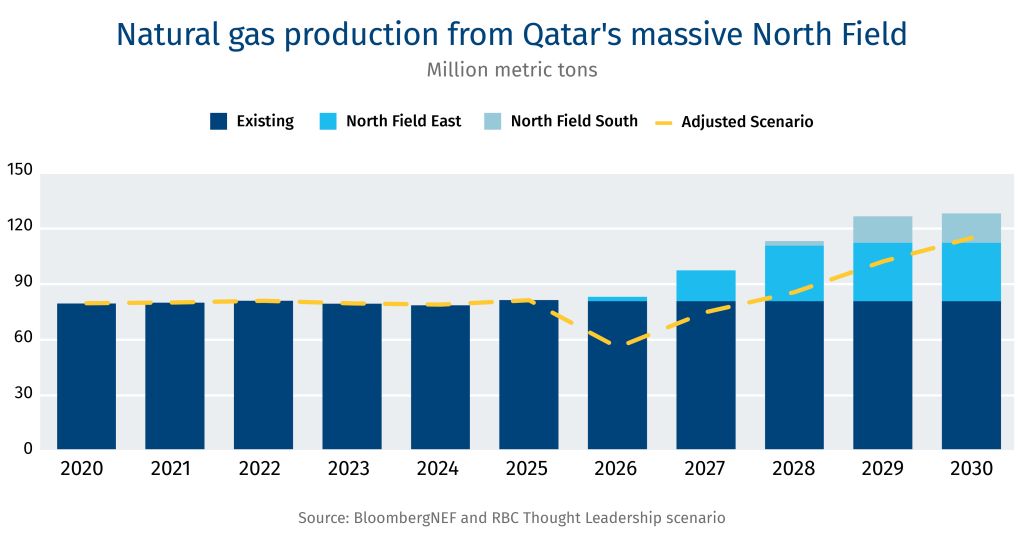
The global LNG market was on track to move into meaningful surplus in 2026, with two million tonnes on supply of 475 million tonnes (MT) in 2026 and 30 MT on supply of 585 MT in 2029.

How badly are Qatar’s LNG exports hit?

  • A disruption to Qatari supply — the world’s second largest LNG exporter — would wipe that surplus out entirely for roughly three years to a 30 MT shortage in 2026, and only 8 MT excess in 2029. Of course, this assumes no demand destruction, which remains to be seen.

  • Based on conversations, Qatar’s adjusted supply scenario of LNG this year is likely 50-55 MT, a ~30 mtpa disruption from last year’s ~83 mtpa of production. That’s not a rounding error—it is a decline just under two times greater than Canada’s current entire LNG export capacity.

  • Qatar’s North Field expansion, which underpins the global supply growth story through 2030, could get pushed back with a slower ramp. The market was pricing in those volumes but is now repricing a near to mid-term shortage.

    Natural gas production from Qatar's massive north field

This is a two-stage shock

  • The Strait of Hormuz dimensions compound the picture. With tanker traffic effectively frozen, the disruption isn’t just a production story – even unaffected volumes are shut-out of the Strait.  

  • LNG Canada is revving up. Eight vessels departing B.C. in the first 17 days of March versus four in all of December signals that Pacific Basin buyers are already rerouting toward non-Gulf supply.

  • Reports suggest U.S. LNG cargoes are also headed to Asia via the Panama Canal.

  • Bottom line: The anticipated LNG glut — widely expected to lower prices and improve affordability — is likely off the table through at least 2028.

For more, read: Energy Shock: 8 charts that explain the global oil and gas fallout – RBC

–Shaz Merwat

Negotiating trade with President Donald Trump is like playing whack-a-mole. Irritants pop up relentlessly and belligerently. Except if you swing late, the mole pops up and whacks you back harder. The U.S. Trade Representative’s launch of a Section 301 investigation into Canada is just the latest belligerent act.

The investigations, targeted a total of about 60 trading partners, fall under two probes:

  • First, to determine if countries have failed to effectively ban or enforce prohibitions on goods produced with forced labour entering America (which is the focus of the Canadian investigation).

  • Second, whether foreign government subsidies result in overcapacity that floods markets and hurts U.S. manufacturing in key sectors.

The U.S.’s motive is to force allies to share the load in hardening against forced labour goods from regions like Xinjiang region—where minorities are forced to produce goods—, apart from overcapacity, and broader Chinese supply risks. It’s not just bilateral finger-pointing but, for Canada, it does initiate a deliberately targeted process:

  • Washington charges that Ottawa’s forced-labour enforcement regime unfairly burdens U.S. commerce by letting tainted goods flow into North America.

  • That triggers mandatory consultations, public hearings, and evidence-gathering before tariffs can then be applied.

What’s the realistic threat?

If Canada falls foul of these investigations, duties could target manufacturing inputs (steel, aluminum, minerals), high-tech goods (semiconductors, solar, electric vehicles), seafood, toys, electrical equipment, and consumer essentials like textiles and leather. 

Canadian Border Services Agency (CBSA) data reveals modest gains after 2024 Forced Labour and Child Labour in Supply Chains Act took effect in Canada. Seizures of suspected forced-labour shipments—apparel, toys, and electronics often traced indirectly to the Xinjiang autonomous region in China—edged up, with around 50 detentions in 2024 versus almost none in the prior three years. However, only one shipment was confirmed as violating the prohibition in Canada, a fraction of U.S. Customs and Border Protection’s US$1 billion in seizures over suspected ties to forced labour. The Canadian government committed $25.1 million over two years starting 2025 to Global Affairs Canada and CBSA for investigations and enforcement, to accelerate this, but Washington questions the bite, arguing the enforcement lacks the teeth would help achieve its strategic goals with China.

What happens now?

  • Section 301 is a process, not a trigger. Unlike Section 232, it requires consultations, evidence-building, and public hearings before any tariffs can be imposed.

  • Canada has a narrow window to shape the record: April 15 submissions and hearings beginning April 28 will be critical to demonstrate enforcement progress and anchor arguments in CUSMA labour commitments (Chapter 23).

How it impacts CUSMA negotiations

  • The timing is deliberate. Section 301 process is running in parallel with the CUSMA review, giving the U.S. Trade Representative office USTR an early signal of whether consultations are producing results.

  • United States Trade Representative’s Jamieson Greer said this week that Canada lags Mexico in the CUSMA review process. The Canadian pacing is strategic, reflecting a conscious allocation of risk and leverage in Ottawa. Mark Carney assembled his team and split roles accordingly: Ambassador Mark Wiseman courts Congress against wild cards like CUSMA withdrawal (which can be done through executive order, although Congress does maintain ultimate control over repealing the legislation).

  • Meanwhile, chief negotiator Janice Charette coordinates the relevant government departments and red lines for the PM.

  • Pre-U.S. midterms, Canada must collaborate on forced labour without offering high-value concessions like critical minerals access. Demonstrating enforcement progress and willingness, while holding strategic cards close and letting the midterms test Trump’s leverage to preserve Ottawa’s negotiating room.

–Thomas Ashcroft

China’s recent opportunistic “offer” to Taiwan to unite with the mainland in exchange for energy security illustrates how energy security, trade, and geopolitics are converging, as the Middle East conflict violently shakes up global energy systems.

Why does Taiwan need energy security?

  • The East Asian Island is the world’s leading producer of semiconductors, with natural gas and oil—mostly imported—accounting for 61% of energy supply, according to data from the Statistical Review of World Energy. Coal (33%), nuclear (3%), and renewables (3%) make up the rest.

  • In 2016, Taiwan initiated policies to phase out nuclear power and completed the shutdown of its final reactor in May 2025, bringing nearly 5GW of power—or 42% of Canada’s nuclear capacity—offline, and growing its liquefied natural gas imports.

  • Around 42% of Taiwan’s imported LNG came from Qatar, which suffered a severe missile attack from Iran this week.

  • Taiwan is revisiting its nuclear strategy, with feasibility studies to examine restarting two nuclear power plants. State-owned utility Taipower is also expected to submit reactor restart plans this month.

Lessons in a new energy era

  • Our report Atomic Advantage: Canada’s generational opportunity in a new Nuclear Age, underscored how energy security is driving a resurgence in nuclear power worldwide.

  • Many European and Asian nations are diversifying their energy suppliers but also power sources to navigate the geopolitical instability disrupting global energy markets.

  • As nations seek to diversify both energy supplies and power sources, Canada is well positioned to help. Canada’s Candu reactor technology, which includes sub-gigawatt scale reactors suited to smaller grids, and growing SMR expertise make it a natural partner for countries looking to reduce fossil fuel dependence without relying on Chinese or Russian technology.

–Vivan Sorab

Disclaimer

rbc_tl_disclaimer

  • Canada is one of only six countries with a domestically designed and exportable nuclear technology portfolio. That strategic leverage positions Canada to shape global energy security and forge long-term alliances.

  • Canada can take advantage of rising global interest in nuclear power. The United States has ambitions to quadruple its nuclear capacity, and more than 30 other nations have pledged to triple nuclear capacity by 2050.Canada can offer proven value across the nuclear supply chain to help scale the growing global market.

  • Uranium is the U.S.’s structural vulnerability—and Canada’s advantage. U.S. nuclear reactors require 25,355 tonnes of uranium annually, but sources only 8% of that requirement domestically. Canada, which has the world’s third-largest uranium resources and is ramping up production, is establishing its anchoring role in North America’s nuclear fuel supply chains with its high-quality deposits, reliable production, and geopolitical stability.

  • Canada’s nuclear supply chain is primed for expansion but sits at a strategic inflection point. Ontario’s successful nuclear refurbishment projects have preserved high-value nuclear manufacturing and engineering capabilities and have demonstrated that large-scale nuclear projects can be delivered ahead of schedule and under budget. But future competitiveness depends on sufficient policy clarity, project pipelines, and new nuclear build success to justify sustained investment and expansion.

  • Canada faces three credible, and not mutually exclusive, nuclear futures. Canada can anchor its strategy around: (1) uranium and fuel security; (2) lead in technology through pressurized heavy water reactors (PHWRs) and light water small modular reactors (SMRs); or (3) integrate more deeply into a North American nuclear build-out.

  • Canada needs to move fast to execute its nuclear ambition. Civil nuclear competitors are pairing technology with financing, diplomacy, and long-term partnerships as global interest in nuclear power surges. The window is narrowing for Canada to translate intentions into lasting influence. It could prove to be a multi-billion-dollar exporting opportunity as nuclear investments need to nearly double to US$120 billion annually by 2030 to double nuclear capacity, according to one International Energy Agency scenario.

Following a period of stagnation in the Western world, nuclear power is making a comeback—a global resurgence driven by the rising power demand of artificial intelligence, the energy security concerns, and shifting industrial policy.

The technology sector, facing imminent increases in power demand thanks to AI data centres, is a key driver of nuclear’s resurgence, with companies like Google, Microsoft, Meta, and Amazon signing agreements with conventional nuclear power producers and advanced nuclear technology companies. Google signed a 25-year power purchase agreement with NextEra Energy to restart the Duane Arnold Energy Centre in Iowa, a 610MW plant offline since 2020,1 provided early-stage capital to Elementl Power to develop three advanced nuclear sites in the U.S.2 and partnered with Small Modular Reactor (SMR) company Kairos Power and the Tennessee Valley Authority on a reactor demonstration project.3 Amazon has invested over US$1 billion in nuclear projects and technologies,4 including a stake in the advanced SMR company X-Energy.5 And Meta, looking to secure reliable, long-term electricity supplies to power its AI ambitions, inked 20-year agreements to buy energy from three U.S. nuclear plants (Meta also committed to developing small modular reactors with two companies). These deals will provide the company with 6.6 gigawatts of power by 2035, according to Meta.6

Beyond the growing power needs of artificial intelligence, energy security concerns, particularly in Europe, are driving the reversal of nuclear phaseout plans and the development of new nuclear strategies. Italy has recently begun exploring the reintroduction of nuclear power into the country’s energy mix, almost four decades after its last plant was shut down.7 Denmark is actively considering nuclear power,8 and Norway has begun impact assessment studies for a potential SMR.9 The European Commission is also developing a strategy targeting SMR deployment by the 2030s.10

Western nations lag the east in nuclear reactor construction and planning

Yet nuclear’s resurgence in the West faces significant challenges. Most notably, reactor construction projects across several Western nations have been marked by cost and schedule overruns that have raised execution risk and hampered financing. The Vogtle 3 and 4 projects in Georgia, the first new reactor projects in the U.S. in decades, were built at an estimated cost of US$36.8 billion as of 2014, relative to an original estimated cost of US$14 billion.11 The Flamanville 3 project in France connected to the grid in December 2024, twelve years behind schedule, at a cost of €13.2 billion, quadruple the initial cost estimate.12 The U.K.’s Hinckley Point C project remains under construction, and is now projected to cost £49 billion, nearly triple the £18 billion estimate when it commenced construction in 2017, with Unit 1 not expected online before 2030.13 And in the U.S., the V.C. Summer nuclear project in South Carolina was abandoned in 2017 following project delays and cost overruns.14   

But with interest in nuclear resurgent, worldwide capacity could grow 75% to roughly 730GW by 2050 under current policies, according to the International Energy Agency.15 

For its part, the U.S. is aiming to quadruple what is already the world’s largest nuclear reactor fleet by 2050 (up from its previous goal to triple capacity), strengthen its supply chain, and modernize nuclear fuel supplies. The U.S. is advancing rapidly on next-generation nuclear technology, committing about US$5 billion in federal funding to small modular and advanced reactor research, demonstration, and early deployment through U.S. Department of Energy programs.

China, meanwhile, is building an additional 38.5GW of capacity16, while Russia is leveraging nuclear energy for its Arctic, industrial and foreign policy goals, extending its state-backed reactor export model.

With significant uranium reserves and deep nuclear technology expertise, Canada is one of only six countries with domestic and exportable nuclear technology portfolios. And it is embarking on a new nuclear construction program that could become one of the largest in the West if the full suite of projects proceeds as planned. Construction of the G7’s first Small Modular Reactor (SMR) has started at the Darlington nuclear site in Clarington, Ontario, and several of Canada’s nuclear reactors have been successfully refurbished ahead of schedule and under budget, bucking the cost overrun trend of nuclear projects in other Western countries.

Simply put, Canada has an opportunity to play a key role in nuclear’s resurgence—from anchoring global uranium and fuel supply to leading in nuclear technology and service exports to its allies, scaling North American nuclear supply chains, and enhancing global nuclear exports.

Here are some of the goals and requirements for each pathway.

The Goal

As global reactors restart, stable uranium mining and nuclear fuel services (conversion, enrichment, fabrication) become increasingly critical to energy and security. Canada’s world-class uranium deposits and uranium conversion expertise anchor allied nuclear fuel security in North America and abroad, guarding against energy insecurity and resource nationalization risks.

Global uranium demand is set to rise sharply

Leveraging Canada’s Advantage

Planned and under-construction reactors will increase global uranium requirements as they come online, necessitating new mines as existing resource quality drops and supplies of secondary uranium become more constrained.

Canada is home to the world’s third largest uranium resources after Australia and Kazakhstan,17 and already plays a key role in anchoring nuclear fuel supply chains thanks to its high-quality deposits, reliable production, geopolitical stability, and fuel manufacturing expertise.

Ongoing expansion of existing projects and new mines in Saskatchewan will enhance Canada’s position as a key energy security pillar for allies in North America and globally. By building on its strengths in uranium conversion (Canada holds 18% of global uranium conversion capacity),18 Canada can strengthen fuel services stability for an expanding nuclear fleet in North America and abroad.

Pathways to Success

The U.S.’s nuclear reactor fleet already has key energy security vulnerabilities, with 20% of its enriched uranium sourced from Russia in 2024.19 U.S. policy efforts have sought to reduce the dependence with proposed investments in spent fuel reprocessing, and the previous administration’s ban on Russian enriched uranium imports (Russia controls 40% of global enrichment capacity)20. However, even with potential expansion of enrichment infrastructure, the U.S. will remain dependent on uranium imports, with domestic production currently a fraction of annual reactor requirements. U.S. nuclear reactor operators purchased 25,355 tonnes of uranium in 2024, with only 8% sourced domestically, with Canada providing the greatest source of U.S. purchases at 36% of the total.21 Continued U.S.–Canada partnership on uranium will be critical for the security of the U.S.’s nuclear fuel supply. While Canada is currently self-sufficient in uranium and fuel manufacturing thanks to reactors that run on natural uranium, future nuclear reactors, such as SMRs and potentially large light water reactors, will necessitate enriched uranium for fuel, potentially strengthening the case for Canada to seek domestic enrichment capabilities.  

The Goal

Leveraging its existing technology expertise and expanding its domestic large-scale nuclear program alongside growing expertise in SMR deployment would strengthen Canada’s energy and economic security domestically. It would also provide a differentiated portfolio of reactor technologies, engineering and operational services, and regulatory support for new and existing nuclear jurisdictions.

Leveraging Canada’s Advantage

Canada’s experience in the Candu pressurized heavy water reactor (PHWR) design, construction, and operation, underpins a 17-reactor strong fleet across Ontario and New Brunswick and 12 units exported internationally since the 1970s.22 Fuelled by natural uranium, Canadian reactors do not rely on enriched uranium fuels, enabling independence from a concentrated set of enrichment suppliers, an increasingly valuable attribute as energy independence gains traction globally. Modern, gigawatt-scale designs and upgraded versions of existing reactors could expand Canada’s reactor portfolio if they are licensed and proven commercially at home. Simultaneously, successful construction and operation of grid-scale light water SMRs in Ontario would cement Canada’s position as a first mover and operator in this technology, allowing Canadian nuclear suppliers and operators to market their construction, operational and regulatory expertise to new markets.

Combined, these capabilities could position Canada among a handful of countries with credible expertise and export capability across a portfolio of technologies ranging from large nuclear reactors to small modular reactors.

Such a nuclear energy strategy could also provide a boost for the more than 200 domestic nuclear component manufacturers supporting Canada’s program. PHWR and SMR deployments abroad could enable value capture for Canada across the full reactor lifecycle, from uranium and fuel services supply, regulatory support, reactor construction and operation, through refurbishments, and decommissioning—even with some supply chain localization in partner countries.

Pathways to Success

Experience from early SMR projects will enable the Canadian nuclear sector, and partners across the supply chain, construction, and engineering services, to anchor global deployment.  Poland,23 Hungary,24 and Bulgaria25 alone could represent a potential pipeline of up to 40 SMRs, providing a critical early market for Canada starting in the 2030s, as domestic deployment of large reactors sets the stage for international exports later into the decade. To succeed, Canada’s local deployments will need to be delivered and operated successfully, backed by the expansion of its supply chain and nuclear manufacturing base beyond its current refurbishment-ready capabilities. Key manufacturing gaps, such as reactor vessels and heavy water production for new reactors, will need to be closed. Canada will also need to expand its nuclear talent pool to prepare for reactor construction, as well as preserve existing expertise, as global deployments create competition for talent.

The Goal

Integrating more deeply into the U.S. supply chain (including reactor component manufacturing, construction, and deployment) would give Canada access to an established export pipeline for large light water nuclear reactors. Favourable commercial negotiations and cross-border intellectual property transfer could enable Canada to partially localize supply chains for U.S.-origin large reactor components, allowing Canada to support domestic construction programs and support foreign reactor construction.

Leveraging Canada’s Advantage

U.S.–Canada civil nuclear cooperation is rooted in decades of technology collaboration and expertise exchange. Although Canada and the U.S. operate different nuclear reactor technologies today and have distinct nuclear regulatory procedures, the two nations have formally collaborated on several advanced nuclear technologies such as next-generation SMR fuels and light water SMRs through joint technical work between each nation’s regulators.26

A traditionally single-technology nuclear nation, Canada could expand its large nuclear reactor fleet to include U.S.-origin designs such as the AP-1000, which benefits from more than a decade of operating experience in the U.S. and China. This could lower construction risk for gigawatt-scale reactors in Canada by leveraging lessons learned from prior construction projects in the U.S. and China, and enable Canada’s nuclear supply chain to expand, and selectively access a global export pipeline. Currently, 20 AP-1000 reactors have been contracted in markets such as Poland, Bulgaria, Ukraine, and India,27 and Canadian manufacturers have signed memorandums of understanding for the potential supply of  components such as valves and flow control equipment,28 as well as steam generators, pressure vessels, and heat exchangers.29

 Canadian manufacturers have already provided components such as valves30 and fabrication services for reactor modules31 to U.S. nuclear projects such as Georgia’s Vogtle 3 and 4 reactors. U.S. nuclear supply chains, which lay largely dormant until the Vogtle projects lack the capacity to scale reactor construction to the levels envisaged under the U.S. government’s ambitions,32 could create opportunities for Canadian manufacturers if projects proceed to construction. The Canadian nuclear supply chain already hosts more than two dozen companies with nuclear certifications from the American Society of Mechanical Engineers, covering core nuclear components, safety systems, and relief systems,33 evidence of an established, licensable industrial base capable of supporting large-scale reactor deployment.

Pathways to Success

For deeper North American supply chain integration to succeed, Canada will need to secure and increase domestic manufacturing and export opportunities as the U.S. builds out its nuclear industrial base. Washington has increasingly framed nuclear energy as a strategic economic sector, with industrial policy playing a growing role alongside commercial considerations. Recent agreements between the U.S. federal government and nuclear sector partners reflect this orientation, positioning reactor deployment as a vehicle for U.S. industrial renewal. The trajectory of existing U.S.–Canada trade dynamics, such as tariffs on Canadian-manufactured components, alongside commercial negotiations, will determine the extent to which Canada is able to localize manufacturing and scale current exports to the U.S.

  • Eighty years ago, Canada became the second country, behind only the United States, to achieve sustained nuclear fission thanks to the work on the experimental Zero Energy Experimental Pile (ZEEP) reactor at the Chalk River Laboratories in Ontario.34

  • Canada’s domestic, pressurized heavy water nuclear reactor technology, the Candu, supplies 15% of the country’s electricity through 16 reactors in Ontario and one reactor in New Brunswick.35

  • The Canadian nuclear sector employs roughly 89,000 people,36 and is a major producer of medical isotopes, like Cobalt-60 for cancer treatment and medical sterilization, through its nuclear reactors.

  • Canada leads in next-generation nuclear technologies, having developed the world’s first SMR roadmap in 2018 and is building the G7’s first SMR near Toronto, a project that will eventually supply 300MW of capacity, enough to power 300,000 homes with reliable, zero-emission power.

  • Canada is advancing rapidly on its deep geological repository, a culmination of years of stakeholder engagement and Indigenous engagement, entering the impact assessment process, bringing the country closer to a single solution for the long-term responsible management of spent nuclear fuel.

As Canada expands its nuclear power industry, it needs to enhance and refine several areas across the supply chain.

  • Establish a comprehensive nuclear strategy. Centred on energy and economic security and a fleet-based approach for deployment, a pan-Canadian comprehensive strategy—in coordination with Ontario and other provinces, industry and universities—can improve certainty needed for supply chain investment, workforce development, inter-provincial cooperation, and international partnerships. It could integrate deployment targets, construction timelines for major projects, and technology pathway clarity with the goal of ensuring future energy and economic security.

  • Develop a competitive nuclear export financing and diplomatic infrastructure. A dedicated nuclear export financing facility, supporting a multi-technology reactor portfolio including SMRs, could improve Canada’s competitiveness as an exporter of nuclear reactors, components, and expertise. It could be paired with enhanced diplomatic infrastructure, with dedicated nuclear trade commissioners and the integration of civil nuclear cooperation into Canada’s foreign policy strategy.

  • Build and maintain a nuclear-skilled workforce. Skills development planning, including expansion of apprenticeship programs, visa fast-tracks for nuclear specialists, university partnerships, and training facilities tied to deployment timelines could smooth the way for large-scale nuclear deployment.

  • Close critical supply-chain gaps and support expansion. Canada’s nuclear supply chain will need to scale heavy water production and close gaps in calandria manufacturing and zirconium supply for fuel cladding, while supporting local suppliers to remain competitive against manufacturers in other civil nuclear jurisdictions like China. The nuclear supply chain can provide an avenue for manufacturers from other sectors (e.g., the automotive industry) to diversify into, but can benefit from targeted support for high-cost and time-intensive nuclear component manufacturing certifications from professional bodies such as the Canadian Standards Association and the American Society of Mechanical Engineers.

  • Protect uranium value chain and strengthen fuel security. Growing mining capacity, expanding conversion infrastructure to capture more value-added services along the nuclear fuel cycle, and assessing advanced fuel requirements and potential expansion of Canada’s fuel capabilities into areas such as fuel fabrication for light water nuclear reactors and enrichment will prepare Canada and its allies for an energy secure future regardless of technology.

Download the Report

RBC Thought Leadership is grateful to the following individuals and organizations for sharing their expertise.

Atkins Realis

Atomic Energy of Canada Limited

BWXT Canada

Cameco Corporation

Canadian Nuclear Safety Commission

Conexus Nuclear Inc.

David Paterson

Jacquie Hoornweg

Laurentis Energy Partners

Michelle Leslie

Milt Caplan, MZ Consulting

Norm Sawyer, ION Nuclear Consulting

Ontario Power Generation

RBC Capital Markets

SMR Forum

The Breakthrough Institute

The Canadian Association of Small Modular Reactors

The Canadian Nuclear Association

The Organization of Canadian Nuclear Industries

The World Nuclear Association

Westinghouse Canada

Disclaimer

rbc_tl_disclaimer

This article is a companion to the Disruptors episode on sports technology – Tech wins Gold: How Canada can rebuild its Olympic pipeline.

On November 1, 1959, three minutes into a game at Madison Square Garden, a shot by New York Ranger forward Andy Bathgate broke Jacques Plante’s nose. The Montreal Canadiens’ goalie left the ice, received several stitches, and returned wearing a fiberglass mask he had moulded himself. Montreal won 3–1 and went on an 18-game unbeaten streak. From then on, Plante refused to play without one. Within a decade, every goalie in the league had followed his lead. Plante was not trying to disrupt anything. He had simply decided that stopping a frozen puck with his face was a problem worth solving—and that impulse, identify a problem, build a solution, let the results speak for themselves, has been a through-line in Canadian sport ever since.

The global sport tech market was valued at roughly US$19 billion in 2024 and growing about 20% annually. Canada has a US$450-million share, a little more than 3%, and an annual growth rate of nearly 19% ranking among the fastest of any national market. Yet, on the funding side, Canada is treating sport and sport technology as a discretionary expense. As Canadian Olympic Committee CEO David Shoemaker notes in a recent episode of Disruptors, peer countries are “out‑investing [Canada] at the federal level, five, six, 10 times.” Germany alone is putting “about a billion dollars a year into sport.”

Toronto Metropolitan University’s Future of Sport Lab, launched with Maple Leaf Sports & Entertainment (MLSE) in 2015 as one of North America’s first sport tech incubators, has helped launch companies that have collectively raised more than $100 million.

That includes Montreal’s Sportlogiq, co-founded by former Olympic figure skater Craig Buntin, which has developed computer vision technology now trusted by almost every NHL team. And Rapsodo and 3Motion AI, which are putting biomechanical coaching tools into the hands of club-level athletes and local coaches. Tools that are now accessible through a portable device or a smartphone app.

The issue with Canada’s sport tech story has never been what gets built. But what happens after it does. Sportlogiq was acquired by U.S.-based Teamworks in January 2026. Halifax-founded Kinduct, whose athlete‑management platform was used by more than 550 teams and organizations worldwide, was bought by Silicon Valley’s mCube in 2020, in what its founder called the largest sport tech exit in Canadian history.

The cycle is familiar: public research dollars seed the company, which proves its technology at global scale, before getting snapped up by foreign owners that provide the commercial infrastructure that Canada lacks. The same pattern is emerging in human capital. On Disruptors, Jennifer Heil, Canada’s chef de mission for Milano Cortina 2026 Winter Olympics and founder of a performance‑tech startup, describes “a moment of total brain drain” in high‑performance sport, with top scientists and nutritionists shifting their time to the United States because “we can’t afford them right now.”

Three-quarters of Canada’s medallists at Milano Cortina were 30 or older. The bench strength is thinning, with Speed Skating Canada’s World Cup roster dropping from 24 to 16. Close to half of Canadian families report that organized sport is too expensive, and athletes at the national level pay as much as $25,000 out of pocket to represent their country.

Sport technology can address the problem directly. RBC Training Ground identified gymnast Marion Thénault at 17 with no skiing background; within five years she had won Olympic bronze. AI-assisted talent identification could replicate that kind of discovery at scale, reaching communities that traditional scouting never will.

Shoemaker imagines that scaled through AI: “Show us how you jump, how you run, how you throw—and we’ll tell you what sport you should sign up for at your local club.” Heil’s own startup, Revel, is built on the idea that AI can “democratize access” to elite coaching knowledge once reserved for Olympians.

And keeping the companies that build those tools Canadian-owned means keeping the returns: the jobs, the intellectual property, the platform revenue, stay here as well.

The sector has the companies and the research infrastructure. It lacks the domestic capital to keep them scaling at home, as well as a national strategy that pairs the products with the young athletes that need them.

That gap is visible in the public system itself: national sport organizations have not seen a core‑funding increase since 2005, and Shoemaker notes that some athletes now face team fees of as much as $30,000. A national strategy for sport tech could treat data, infrastructure and talent identification as long‑term capital investment.

Disclaimer

rbc_tl_disclaimer

Oil and gas markets are reeling as the Iran war chokes off production in the Middle East, with its impact reverberating across the world. As energy supply chains get fractured and prices become volatile, we examine the emerging trends defining this new era of global energy insecurity.

  • Alternative Middle East export routes have limited capacity of 3.5 to 5.5 million bpd.

  • The 54-kilometre waterway handles 20 million barrels per day (bpd) or 20% of global oil supply. Only the Strait of Malacca, in Southeast Asia, handles more crude oil.

  • Close to 93% of Qatar’s LNG exports transit through the Strait—19% of global LNG trade.

Strait of Hormuz: The worlds' energy highway
  • Japan was the first country to announce the release of oil from its reserves as part of the International Energy Agency-coordinated action, injecting 80 million barrels in the market.

  • The U.S. is allowing India to buy Russian oil as a stop-gap measure—as New Delhi scrambles to find alternatives for some of the 2.5-2.7 million bpd it sources from Iraq, UAE, Saudi Arabia and Kuwait.

  • The U.S. has exempted Russian oil from sanctions for at least 30 days—weakening Western efforts to support Ukraine in its war against Russia.

Asian markets are most reliant on Middle East oil and gas supplies
  • LNG Japan/Korea Marker (JKM) jumped the most, underscoring Asian dependence on the Strait.

  • The crisis has erased a looming LNG supply glut, with Europe Asia scrambling for supplies.

  • Oil prices remain volatile, vacillating between US$76-119 per barrel over the past week.

Oil and gas benchmarks jumped as the Middle East conflict flared up
  • The Korean and Japanese stock market sell-off is reflective of energy exposure but also above-average year-to-date performance pre-crisis.

  • China’s estimated 100-day oil import cover has shielded its stock market from a severe downturn.

  • U.S. and Canada markets have been structural winners in the reallocation of global equities.

Most equity markets sold off as war broke out - but some are showing signs of resilience
  • While North America’s net exporter of crude oil, the global structure of oil markets has not spared the American economy

  • A recent Washington Post/CNN poll shows about 7 in 10 American voters are “very” or “somewhat” concerned that the Iran war will send oil and gasoline prices higher

  • Higher gasoline prices would be a key datapoint for the U.S. administration as it plots it next move.

The U.S.-Israel war on Iran immediately hit American wallets as prices at the pump spiked
  • Across Canada, the U.S. and EU, the expectation was an easing of monetary policy as the year progressed—but it has reversed on fears of higher inflation.

  • A sustained US$80 oil could raise inflation from 2.2% to 2.5% in Canada, according to RBC Economics.

  • Similarly, the U.S. would see an increase from 2.7% to 3.1% at US$80 per barrel.

Policy rates expectations in developed economies have changed dramatically in the space of a few weeks
  • China has been Canada’s biggest non-U.S. oil export destination—which could grow further as relations with Beijing improve.

  • South Korea has been the primary destination for Canadian LNG to date.

  • Over the long term, Canada could likely serve a more meaningful role in de-risking Asian supply.

Canadian oil and gas are expanding their export base, but remain U.S. centric
  • Around 8 million barrels per day of crude and 10 mbd of liquids production in the Middle East is reportedly shut in with the Strait of Hormuz at a virtual standstill, according to the International Energy Agency.

  • Despite International Energy Agency members planning 400-million-barrel injection into markets, the price trajectory would likely depend on the U.S.’s ability to ensure the security of the Strait of Hormuz.

Brent Future curve suggests oil prices will remain higher for longer