

 EN
EN 

Signals
“Our power, our planet” is the global theme of this year’s Earth Day. Indeed, clean power often lays the foundation of a cleaner economy. New research from RBC’s Jordan Brennan and Farhad Panahov shows Canada’s electricity system needs an estimated $670 billion over the next 10 years to support the energy transition. While 80% non-emitting, Canada’s grid will need new capacity and modernization. For more, read the Capital Gains report.
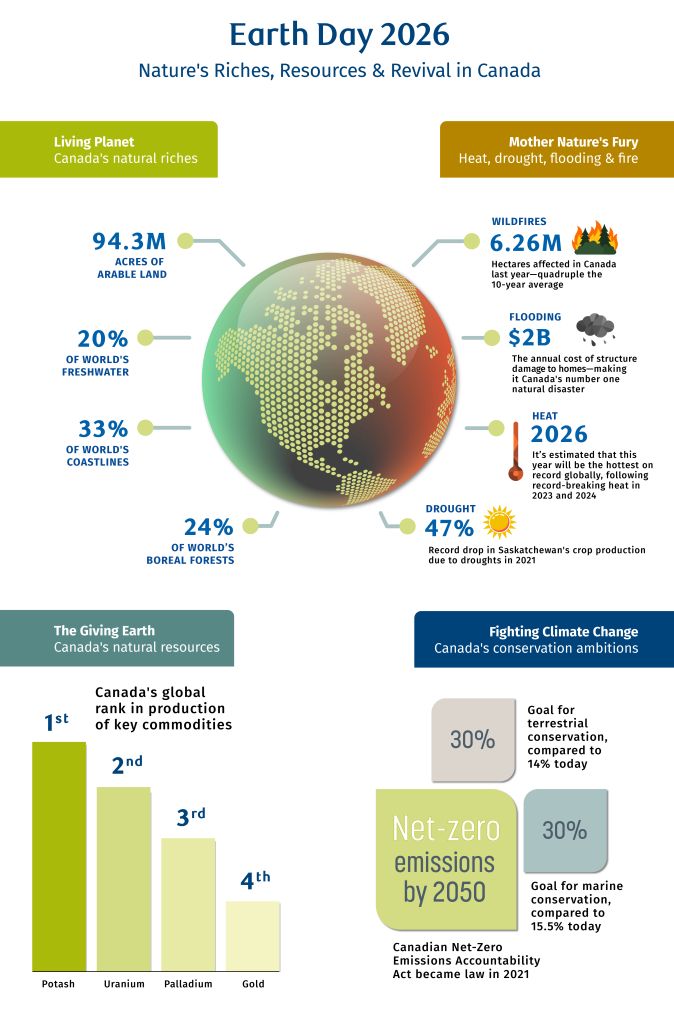
Wildfires don’t stop for Earth Day. Close to 200 wildfires were simmering away in Canada last week, just under twice the 10-year average for this time of year. It highlights the scale of the challenge of protecting nature. As a recent RBC report notes, ignoring nature threatens prosperity, especially as we push forward with nation-building projects. It’s time to see conservation as a capital that others will be able tap into for generations to come.
The famous Fischer-Tropsch process brought us gasoline and jet fuel—now it’s poised to make sustainable fuels. Exactlya century after Franz Fischer and Hans Tropsch revolutionized hydrocarbons, the same technique is being used to decouple hydrocarbon production from fossil-derived feedstocks, with emphasis on producing sustainable aviation fuels from carbon dioxide. But true sustainability requires system integration with “upstream low-carbon modules such as green hydrogen and CO₂ capture,” said Peking University’s Ding Ma in Nature. The process is moving beyond labs, with several countries, including China, working on low-carbon chemical manufacturing.
How does Canada’s portfolio management compare globally?
Natural capital–things like forests, clean water, fertile soil, and biodiversity–is one of the most valuable assets any country has. It supports industries, protects communities, and plays a major role in climate resilience. Canada is exceptionally rich in natural capital, but when it comes to investing in and managing it, the picture is mixed—especially compared to countries like the United Kingdom, Australia, and Denmark.
Canada’s natural wealth is hard to overstate. The country holds about 24% of the world’s boreal forest and roughly 20% of its freshwater resources. Natural resource sectors, including oil, mining, forestry, and agriculture, contribute around 20% of Canada’s GDP, including their supply chains. Yet, Canada has struggled to turn natural capital into an investable asset class at scale.
Lessons from around the world
United Kingdom: The U.K. has taken a more systematic approach to embed natural capital accounting into policy and planning. Since 2012, the U.K.’s Natural Capital Committee advised the government on how to measure and invest in ecosystems, which evolved into the Office of Environmental Protection in 2021. Today, the U.K. publishes official natural capital accounts that estimate the economic value of forests, rivers, and other assets–an accounting tool that Canada also has at its disposal under the UN framework: System of Environmental-Economic Accounting. The U.K.’s approach to economic and environmentally informed decisions is complemented by market mechanisms that can stimulate investments in natural assets, such as the Biodiversity Net Gain scheme.
Australia: Like Canada, it is rich in natural resources and heavily dependent on them economically for mining, agriculture, and oil and gas. However, Australia has taken a more aggressive approach to attract private investment into natural capital. Scaled infrastructure projects have been used to mobilize institutional investments, including Canadian pension funds, into long-term projects, including renewable energy development and sustainable land use. An example is the Murray–Darling Basin Plan, a $13-billion initiative to manage water resources sustainably across the country’s food bowl.
Denmark: The Scandinavian country doesn’t have Canada’s vast natural resources. Instead it has focused its attention on baking environmental sustainability into tax law to make investment in sustainably managing natural resources the more economically attractive option. As a result, more than 50% of Denmark’s electricity comes from wind and solar power.
While Canada has made important commitments, it still lacks the coordinated systems of its peers. Pillar three of the Force of Nature Strategy, Valuing Nature and Mobilizing Capital aims to address this challenge. Starting with an Expert Taskforce on Natural Capital Accounting and Nature Financing, the federal government looks to mobilize private capital, blended with their $3.8 billion commitment for nature positive outcomes. If Canada can measure the value of its natural assets, attract more private investment, and align environmental goals with economic growth, it has the potential to turn its natural wealth into a long-term economic advantage.
Dive into more insights on Natural Capital: Unearthing Value: How nature can play a critical role in pro-growth agendas – RBC
Banking on Soil
“The farmer is responsible for the soil [they] till. This natural resource will not restore itself as fast as it is depleted…The farmer, therefore, needs to open a soil-savings account. It will not only conserve [their] soil, but it will return an increased income and accumulate interest.”
That quotation, pulled from a 1948 edition of RBC’s Making Money by Saving Soils, is as true today as it was when it was first written. In fact, the soil conservation conversation has been a constant among farmers long before that. Sure, things have evolved—with research, big data and technology helping to uncover more about the dynamics of the ground beneath our feet. But many of the challenges of conserving soils to grow healthy crops remain the same. Read more on soil health from Lisa Ashton, the Climate Action Institute’s Interim Head, at the link.
Conversations
-
There are 10,000 events worldwide to celebrate Earth Day 2026. But if you don’t have time, Eathday.org offers 50 ways to take action for the planet.
-
Deep retrofits would cost $10 per square foot to reduce greenhouse gas emissions in Canadian buildings by 40% by 2030, according to a new MaRS report.
-
James Rising and others at the Grantham Research Institute on Climate Change write on how climate adaptation investments can yield a ‘triple dividend’: preventing losses, stimulating economic activity and providing social and environmental co-benefits.
-
Shrugging off a backlash against renewables, 44% of Americans continue to worry a great deal about climate change—that’s close to its highest point ever. A record low 35% are feeling positive about the environment, according to Gallup.
This article is intended as general information only and is not to be relied upon as constituting legal, financial or other professional advice. The reader is solely liable for any use of the information contained in this document and Royal Bank of Canada (“RBC”) nor any of its affiliates nor any of their respective directors, officers, employees or agents shall be held responsible for any direct or indirect damages arising from the use of this document by the reader. A professional advisor should be consulted regarding your specific situation. Information presented is believed to be factual and up-to-date but we do not guarantee its accuracy and it should not be regarded as a complete analysis of the subjects discussed. All expressions of opinion reflect the judgment of the authors as of the date of publication and are subject to change. No endorsement of any third parties or their advice, opinions, information, products or services is expressly given or implied by Royal Bank of Canada or any of its affiliates. This document may contain forward-looking statements within the meaning of certain securities laws, which are subject to RBC’s caution regarding forward-looking statements. ESG (including climate) metrics, data and other information contained on this website are or may be based on assumptions, estimates and judgements. For cautionary statements relating to the information on this website, refer to the “Caution regarding forward-looking statements” and the “Important notice regarding this document” sections in our latest climate report or sustainability report, available at: https://www.rbc.com/our-impact/sustainability-reporting/index.html. Except as required by law, none of RBC nor any of its affiliates undertake to update any information in this document.