

 EN
EN 

“We must be quite clear about one point: the farmer is responsible for the soil [they] till. This natural resource will not restore itself as fast as it is depleted…The farmer, therefore, needs to open a soil-savings account. It will not only conserve [their] soil, but it will return an increased income and accumulate interest.”
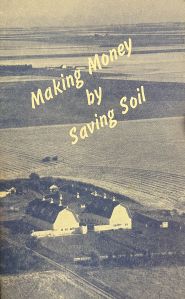
That quotation, pulled from a 1958 edition of Making Money by Saving Soils (the original source of RBC Thought Leadership), is as true today as it was when it was first written. In fact, the soil conservation conversation has been a constant among farmers long before that. And while things have evolved, research, data and technology have helped to uncover more about the dynamics of the ground beneath our feet, many of the challenges of conserving soils to grow healthy crops remain the same.
Mid-20th Century: Soil as a national responsibility
In 1950, one in five Canadians were part of the farm population.1 At the time, RBC described three good reasons to save soils:
-
Make a living
-
The hope to make a better living
-
Have a going concern to hand onto the next generation
Farmers were encouraged to adopt practices like crop rotations, responsible nutrient management, and conserving edge-of-field environments like forests and waterways. Back then, tillage was encouraged for three reasons: the preparation of a suitable seed bed, the destruction of plants that would compete with growing crops, and the improvement in the physical condition of soil. Today, the opposite is often encouraged to reduce soil loss, build soil biodiversity, and avoid disrupting soil carbon sinks. This change has served Canadian soil health well. Canada’s agricultural soils are estimated to be a net carbon sink today, driven by widespread adoption of no-tillage in the prairies and increases in productivity across the country.2
Late-20th century: Soils as foundation to the productivity boom
Agriculture transformed between the 1940s and 1970s with advancements in life science and mechanization, leading to mass adoption of new crop varieties, fertilizers, pesticides and modern farm equipment that allowed farmers to produce more per acre for a growing global population. And it was all being done by fewer farmers–by 1980, 1 in 21 Canadians were part of the farm population.3
Farmers were introducing more nutrients to their soils, including nitrogen, phosphorus and potassium to optimize the growth of crops. In some cases, adding more nutrients led to the excess use of fertilizer, which had a negative impact on soil composition and externalities such as pollution of waterways. But the productivity boost also meant more crop residue was being returned to the soil, adding to soil organic matter.
The tools introduced to agriculture during the Green Revolution continue to be fine-tuned today to help farmers produce more high-quality crops. Increasingly, inputs and equipment are presenting win-win opportunities for soil health and productivity with the development of tools like biological fertilizers or see and spray technology for pesticide application that only applies chemicals where needed to eliminate invasive plants.
21st Century: Soil as natural capital
Today, less than 2% of Canadians call a farm their home or place of work.4 Remarkably, on the shoulders of this small group, Canada ranks in the top 10 globally for food security, agri-food exports, as well as food quality and safety.5 6 But it’s also a threat to the future growth of the agriculture and food sector as fewer Canadians step foot on a working farm or meet someone working in the sector.
Farmers today, compared with 70 years ago, rely on a much larger network of partners and advisors to do their job, including everything from finance, agronomy, technology, machinery, farm transition planning and sustainability. It’s less likely today than it ever was for young people see these diverse, dynamic and exciting careers in agriculture, beyond farming. For instance, data and computer scientists are developing AI tools for farmers that perfect the precision of inputs like fertilizers, environmental consultants are connecting farmers to marketplaces that reward soil conservation via credits and premiums, and trade experts are moving Canadia-made products to new markets. Engaging more Canadians in the journey of strengthening agriculture as a foundational sector for Canada’s prosperity and the importance of conserving natural assets like healthy soils are the big challenges ahead.
A close read of the 1958 publication provides a glimpse of what’s next–change: “To be good conservationists it may be necessary for us to remake some of our thought, abandon some customary practices, and revise, sometimes drastically, our methods of farming.”
What is Soil Health?
The continued capacity of soil to function as a vital living ecosystem that sustains plants, animals, and humans.7 Soil is foundational to our economy and environment. Roughly 95% of the food we consume needs soil to grow.8 Soils are also the largest terrestrial carbon sink–holding three times the amount of carbon stored in the atmosphere and twice the amount in all living vegetation.9
Lisa Ashton is RBC Thought Leadership’s Agriculture Policy Lead
Statistics Canada. Farm and non-farm populations, 1921-2001.
Agriculture and Agri-Food Canada. Agri-environmental indicators, 2021.
Statistics Canada.
Statistics Canada. Census of Agriculture – Farm Population, 2021.
Economist. Global Food Security Index, 2025.
United Nations Comtrade. Trade Data, 2026.
Lehmann, J. The concept and future prospects of soil health. Nature Reviews Earth & Earth, 2020.
FAO. World Soil Day, 2025.
Georgiou, K. Global stocks and capacity of mineral-associated soil organic carbon. Nature Communications, 2022.
This article is intended as general information only and is not to be relied upon as constituting legal, financial or other professional advice. The reader is solely liable for any use of the information contained in this document and Royal Bank of Canada (“RBC”) nor any of its affiliates nor any of their respective directors, officers, employees or agents shall be held responsible for any direct or indirect damages arising from the use of this document by the reader. A professional advisor should be consulted regarding your specific situation. Information presented is believed to be factual and up-to-date but we do not guarantee its accuracy and it should not be regarded as a complete analysis of the subjects discussed. All expressions of opinion reflect the judgment of the authors as of the date of publication and are subject to change. No endorsement of any third parties or their advice, opinions, information, products or services is expressly given or implied by Royal Bank of Canada or any of its affiliates. This document may contain forward-looking statements within the meaning of certain securities laws, which are subject to RBC’s caution regarding forward-looking statements. ESG (including climate) metrics, data and other information contained on this website are or may be based on assumptions, estimates and judgements. For cautionary statements relating to the information on this website, refer to the “Caution regarding forward-looking statements” and the “Important notice regarding this document” sections in our latest climate report or sustainability report, available at: https://www.rbc.com/our-impact/sustainability-reporting/index.html. Except as required by law, none of RBC nor any of its affiliates undertake to update any information in this document.