RBC Thought Leadership Yadullah Hussain

➔ The big fight over methane

➔ Canada is going global with its nuclear ambitions

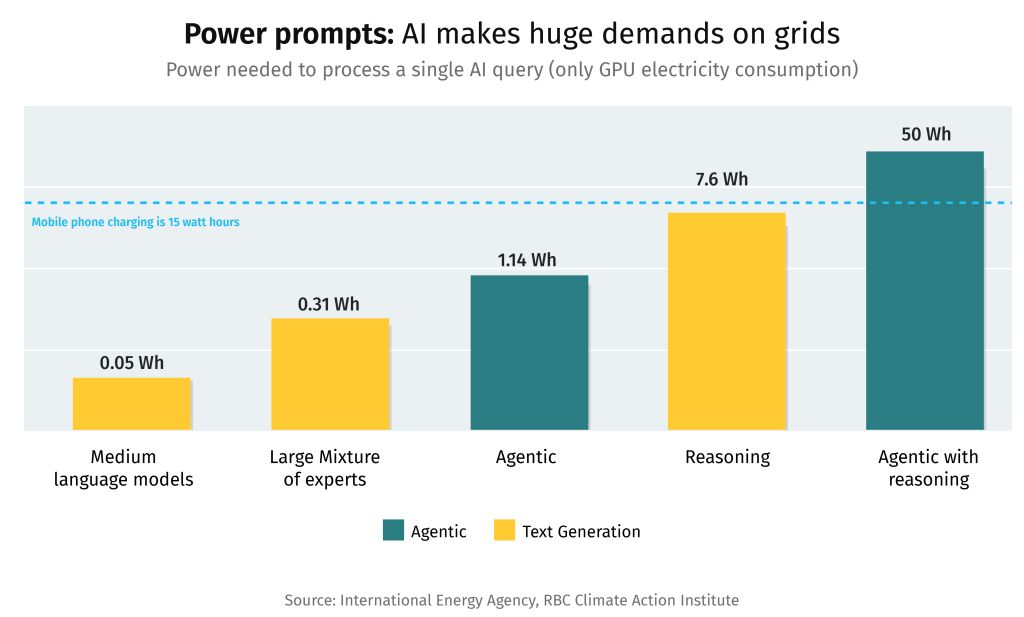
➔ Why a Canadian municipality paused a data centre project

Corporates are returning to the fore: Corporate sustainability appears to be turning a corner, with companies demonstrating renewed commitment propelled by the tailwinds described above, says Brian Hong, RBC Director, Environmental Markets Solutions Group, who attended London Climate Week. The breadth of representation across the events—spanning large corporates, financial institutions, investors, government representatives, and NGOs—was another positive indicator. Read his full impressions of #LCAW2026 here.

Canada is an Energy Transition Index laggard. The country, ranked 32nd, dropped one spot in the World Economic Forum’s 120-country index and trails most of its advanced peers (the U.S. is ranked 19th and Australia 26th).Canada’s step down was part of a more sweeping decline in advanced economies on rising energy prices and weaker climate policies.

El Niño is fuelling a cooling crisis. Space cooling is already the fastest-growing energy demand in buildings globally (4% annually), straining power grids. As temperatures remain oppressive, expect AC adoption—and demand for power—to ramp up: only 52% of Canadian renters have AC access, while only 15% of the 3.5 billion people in hot climates worldwide own air conditioners.

By Vivan Sorab, Clean Tech Lead

Canada’s electricity strategy is at a critical juncture with policymakers and industry grappling with the push and pull of managing growth and keeping it—mostly—clean.

At the electricity strategy summit in Ottawa, hosted by Natural Resources Canada and Smart Grid Innovation Network, I came away with the following insights:

The action is at the distribution end: New housing is driving a wave of transformer and metering demand, while rooftop solar, EVs, and other inverter-based resources are climbing sharply. Data centres, squeezed by caps such as Alberta’s 1.2-gigawatt limit and global chip shortages, are increasingly seeking to connect at the distribution level.

Affordability is a binding constraint: A hyper-focus on lowest cost is choking the investment the electricity system needs to grow. Yet affordability is also the single greatest threat to political continuity, and with it the durability of any national strategy.

Planning needs to extend beyond the kilowatt-hour. Integrated resource planning optimizes for capacity and energy, but distributed energy resources and demand-side management deliver more than power, boosting local economic development, customer comfort, and household savings. Today, those benefits are not priced properly, some say, and so the distributed solutions that could ease the system are systematically undervalued.

Workforce and supply chains limit what can be deployed and how fast. Deployment forecasts, such as for heat pumps, assume trajectories that available labour and supply chains cannot deliver. The achievable pace will be more modest than headline targets imply. The skills gap compounds this: every retirement removes 30–40 years of expertise, with no systematic upskilling regime to replace it.

Interties and an East-West grid are back on the table. Shifting geopolitics has revived interest in regional integration, but Canada’s grid remains dominantly north-south. Cross-time-zone interties could materially raise the value of renewables by offsetting peaks across the country, though deeper modelling and feasibility work are necessary.

The biggest export opportunity may not be physical. The export conversation fixates on hardware such as small modular reactors and large nuclear components. But Canada has an underused advantage in electrification expertise and grid software.

By Shaz Merwat, Energy Policy Lead

The U.S. and Qatar are at odds with the EU over methane import rules. Brussels is holding the line—while quietly suspending enforcement. The framing is now familiar: energy security versus climate ambition.

That could prove to be an advantage for Canada, given its high methane compliance standards. Most major global sources of gas supply anxiety right now have a Canadian answer, says Shaz Merwat, our energy policy lead.

Years of work on methane are yielding results. The Montney is among the lowest methane-intensity gas plays in the world. Enhanced federal regulations finalized in December target 72% below 2012 levels by 2030. The compliance burden the U.S. and Qatar are lobbying against is already baked into Canadian operations.

Chokepoints? Kitimat ships west. No concerns around the current conflict in the Strait of Hormuz, blocked traffic in the Suez Canal, the Panama Canal is running dry, or the future of the Taiwan Strait.

For Canadian operators, methane performance is turning out to be a quieter, cheaper way, with a growing list of buyers who are starting to make it a condition rather than a preference.

By Vivan Sorab, Clean Tech Lead

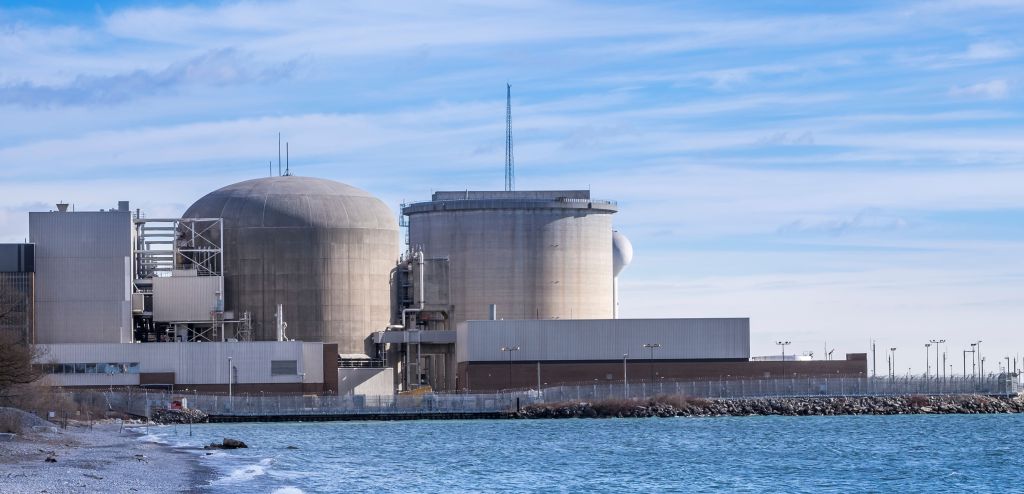
Canada’s new Nuclear Energy Strategy leverages its civil nuclear energy legacy for energy security, industrial policy, and exports.

Here are six insights into the scope and depth of Canada’s new nuclear ambitions:

  • New reactors: The strategy targets up to 10 new large reactors (two under construction by 2035, five more planned by 2040), at least one deployment outside Ontario (Canada’s current nuclear stronghold), by 2035, a modernized CANDU design by 2030, and a doubling of the nuclear workforce.

  • A fleet approach: The strategy concentrates regulatory, supply-chain, and construction effort behind specific reactor designs for every use case, helping to standardize deployments, drive down costs, and build a construction track record.

  • It’s about Team Canada: The strategy emphasizes nuclear exports and envisions a unified “Team Canada” export posture with several goals: securing CANDU in at least four new markets by 2040, engaging six to 10 new-entrant countries, and capturing supply-chain share in at least five non-CANDU projects globally. A dedicated Export Financing and Commercial Framework is meant to let Canada compete on sovereign financing, a key driver of nuclear technology exports.

  • Leveraging uranium: Canada is the world’s second-largest uranium producer, and CANDU reactors run on natural uranium, insulating it from the enrichment supply chains that are dominated by Russia. The strategy aims to double uranium exports by 2035. While Canada’s current reactors do not require enriched uranium to operate, Canada’s SMR fleet will require enriched fuel, which the strategy says remains under consideration but will be secured for reactors that require it.

  • Leading with innovation: Nuclear fusion, a defence-led advanced microreactor, and a medical isotope push are also key components of the strategy.

  • The next steps: Execution hinges on financing, supply chain, and jurisdiction. Federal financing policy that defines terms isn’t due until April 2027, and the plan aims to attract private and pension capital that has been hard to mobilize for Western nuclear projects. On the supply-chain side, heavy-water production capacity closed in the 1990s and would have to be rebuilt, alongside heavy forgings and nuclear-grade materials. And provinces, not Ottawa, choose the technology and manage downstream effects, with the federal role being one of signalling and supporting de-risking.

➔ Can Canada build more homes and build more defence infrastructure in a climate-smart way? RBC’s John Stackhouse offers some thoughts on the triple play that’s about to be tested as Canada embarks on a new housing expansion.

➔ When municipalities fight back.In a sign of municipal backlash against data centres, Hamilton, Ont., councillors unanimously paused a data centre project on the grounds that it could impact the environment, water use, and affordability. Councillor Nrindr Nann, who led the initiative, said 21 other municipal councils have requested her motion letter.

➔ It’s 25% by 2035. That’s the new proposed climate target for energy consumption intensity in the building sector under the COP31 Presidency of Türkiye. It could strike a chord—and build momentum as rising power bills has emerged as a critical challenge for businesses and consumers.

Curated by Yadullah Hussain, Managing Editor, RBC Climate Action Institute.

Climate Crunch would not be possible without John Stackhouse, Jordan Brennan, John Intini, Farhad PanahovLisa AshtonShaz MerwatVivan SorabCaprice Biasoni, Lavanya Kaleeswaran and Joelle Schonberg .

Have a comment, commendation, or umm, criticism? Write to me here (yadullahhussain@rbc.com)

Climate Crunch Newsletter

➔ The beautiful game’s rising carbon footprint

➔ How to acknowledge, encourage and scale conservation

➔ Notes from the U.S.-Canada Summit: Canada must play its critical minerals, and nuclear cards strategically

  • The Canadian Deep Geothermal Coalition will develop the country’s first national geothermal energy roadmap. Ottawa tasked the group— comprising industry and Indigenous leaders, researchers, policymakers—to tap a nascent clean industry that has caught the eye of 50 jurisdictions globally.

  • Quebec rolled back its target of 100% zero-emissions sales by 2035. It’s now 80%, a “balanced approach,” the government said, that accounts for supply chain challenges facing the global auto industry. In March, Ontario Premier Doug Ford urged Quebec and British Columbia to drop their EV sales targets to boost the country’s competitiveness.

  • It will be a sizzling summer of soccer. As 48 teams clash in the FIFA World Cup, they are also facing another formidable opponent: unusually hot weather, and El Nino, a natural warming cycle, that will “pour fuel on the fire of a warming world,” according to UN Secretary General António Guterres. The event, hosted by Canada, the U.S. and Mexico, also has a heavy carbon footprint.

    FIFA World Cups: Heated games, heavy carbon footprint

In a guest commentary, Catherine Grenier, President & CEO, Nature Conservancy of Canada, writes about assigning value to nature.

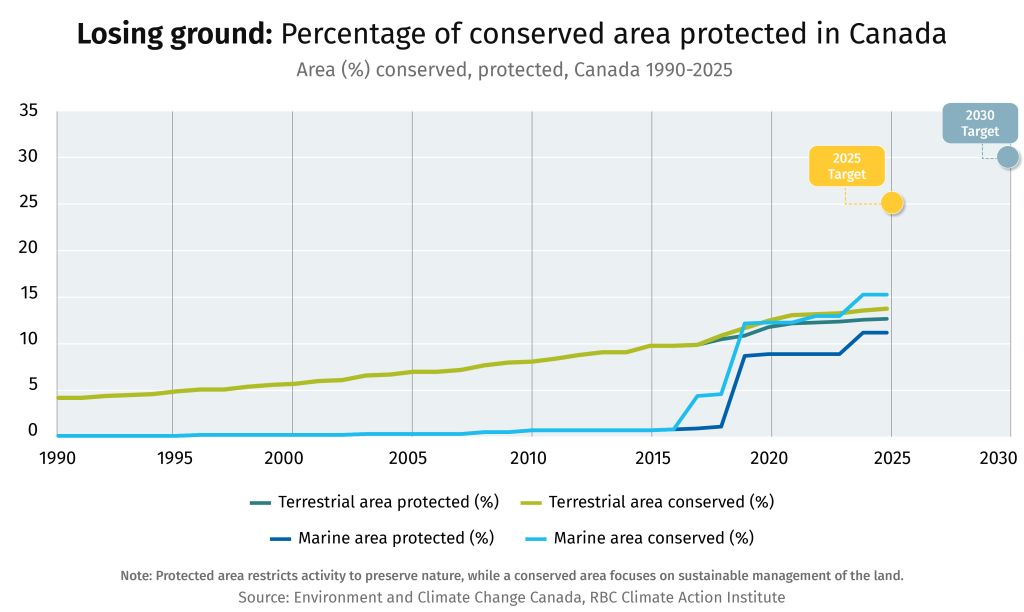
From agriculture and forestry to municipalities and mining, many sectors are actively managing their lands in ways that deliver real, measurable conservation outcomes. But these outcomes are not properly acknowledged or reflected on balance sheets. These outcomes do not formally advance conservation targets or inform conservation decision-making, and are not included in the frameworks that assign value to nature. 

It is time to acknowledge these sectors more intentionally as contributors to the conservation community and conversation. Together, we can identify and advance practical approaches to using our lands that continue to support biodiversity outcomes.

OECMs: Acknowledge, encourage, scale

The first step in deepening this collaboration is formally acknowledging the work that is already being done. One approach is through Other Effective Area-Based Conservation Measures (OECM) recognition.

OECMs are sites, other than Protected Areas, that achieve effective, long-term conservation–even though they are managed primarily for other reasons. They offer a way to value and sustain strong land management practices, which allows biodiversity to persist over the long term.

Consider, for example, the choices cities make to protect drinking water through land-use restrictions and watershed management. Or how landowners and corporations exempt portions of forestland from active logging and industrial extractive use. Ranchers support conservation-compatible activities like grazing native grasslands. Green infrastructure sustains wildlife connectivity by limiting the land fragmentation caused by human development.

OECM recognition is one way to make these long-term commitments visible and credible, offering something real to show in markets that are increasingly asking about environmental contributions. 

OECMs in action

Earlier this year, the city of Saint John, New Brunswick, formally recognized 4,800 hectares of city-owned land as having special conservation status. The land includes mature, intact forests, lake shorelines, and rich wetlands that are used to enhance and safeguard the city’s drinking water supply, with its benefits extending beyond the health and well-being of its citizens.

In 2022, J.D. Irving, Limited, became the first forestry company in Canada to have some of its land recognized as an OECM: nearly 10,000 hectares of Acadian forest and coastline. This land supports public commitments and recreational use, while also conserving some of the province’s most unique and species-rich areas.

The path forward

OECMs are not new, but the federal government’s recently released Strategy to Protect Nature has reinvigorated a policy environment that can accelerate their use. Collectively, we have an opportunity to define the path forward, embrace innovation, collaborate on new ways to engineer solutions for, and with, partners whose efforts are not currently being accounted for.

For conservation leaders, this means exploring ideas like: How and where are industry-led management decisions leading to durable conservation outcomes? How can these management practices be strengthened and supported for the long term? And where is there opportunity to develop tools that can respond to both industry and biodiversity needs?

OECM recognition has gained momentum on working ranches, within sustainably managed forests, in municipalities, and within research and recreation landscapes. The opportunity ahead lies in working alongside industry to dig deeper, get creative, and determine where else they might apply.

This approach also opens the door to greater recognition, more meaningful support, and stronger community engagement. It makes clear that when considered together, nature and economics can work harmoniously.

  • In the new world order, Canada will need to play its many cards more assertively: low-carbon natural gas, critical minerals, food and fertilizer, nuclear fuel, and a stable rule-of-law environment that capital increasingly prizes, notes John Stackhouse, Senior Vice-President, Office of the CEO, RBC, in his analysis of the recently-concluded U.S.-Canada Summit hosted by RBC and the Eurasia Group.

  • At the Climate Smart Buildings Alliance 2026 Leadership Summit industry leaders explored ways building and construction sectors can drive Canada’s economic growth while meeting our climate commitments. Stephanie Shewchuk from RBC Thought Leadership engaged with the ideas and innovators driving this conversation forward. Read some of the highlights from the event here.

  • At London Climate Action Week next week, more than 75,000 attendees will discuss the state of energy transition, supply chains, energy security, sustainable cities, and carbon removal, among others. Are you attending? Send us your thoughts. #LCAW2026

  • The rise of batteries shoots down the argument that “the wind doesn’t always blow, and the sun doesn’t always shine,” notes Alison Reeves, program director at Grattan Institute. “Who cares any more if we can store electricity at scale?”

Curated by Yadullah Hussain, Managing Editor, RBC Climate Action Institute.

Climate Crunch would not be possible without John Stackhouse, Jordan Brennan, John Intini, Farhad PanahovLisa AshtonShaz MerwatVivan SorabCaprice Biasoni, Lavanya Kaleeswaran and Joelle Schonberg .

Have a comment, commendation, or umm, criticism? Write to me here (yadullahhussain@rbc.com)

Climate Crunch Newsletter
➔ F1’s race ahead in sustainable fuel initiative

➔ Arrell Food Institute’s Evan Fraser on what keeps him up at night

➔ What’s Canada’s next big climate policy moment?

Clean energy spending is set to nearly double that of fossil fuels for the first time. For every dollar going to oil, gas, and coal (US$1.2 trillion), nearly two are expected to flow to renewables, nuclear, grids, storage, efficiency, and electrification in 2026, estimates the International Energy Agency in its World Energy Investment 2026 report. The Middle East conflict is reshaping energy investment in real time, pushing energy security to the forefront, notes Clean Tech Lead Vivan Sorab. Global energy investment is on track to hit US$3.4 trillion this year, a 5% rise from 2025, with solar investments attracting US$1 billion a day on average. Nuclear is also back, with 78 GW under construction across 15 countries and annual investment above US$80 billion. However, not all signals are positive, with coal supply investment reaching US$180 billion, the highest since 2012.

Montreal recently hosted Formula 1 with a new generation of sustainable fuels, continuing its legacy of climate leadership (Montreal Protocol, 1987; Kunming-Montreal Global Biodiversity Framework, 2022), writes Senior Vice-President, Office of the CEO, John Stackhouse, who was at the high-but-sustainable-octane event. It was part of F1’s new fuels standard this season targeting net zero by 2030. The cars ran on 100% Advanced Sustainable Fuel, with Team Mercedes winning the Canadian Grand Prix using fuel developed by partner Petronas. The sustainability initiative extends beyond fuel: support crews travelled via cargo planes using sustainable aviation fuels, and cars feature enhanced efficiency designs. Montreal also recently hosted the FIA Sustainable Innovation Series exploring how AI and technology drive efficiency gains.

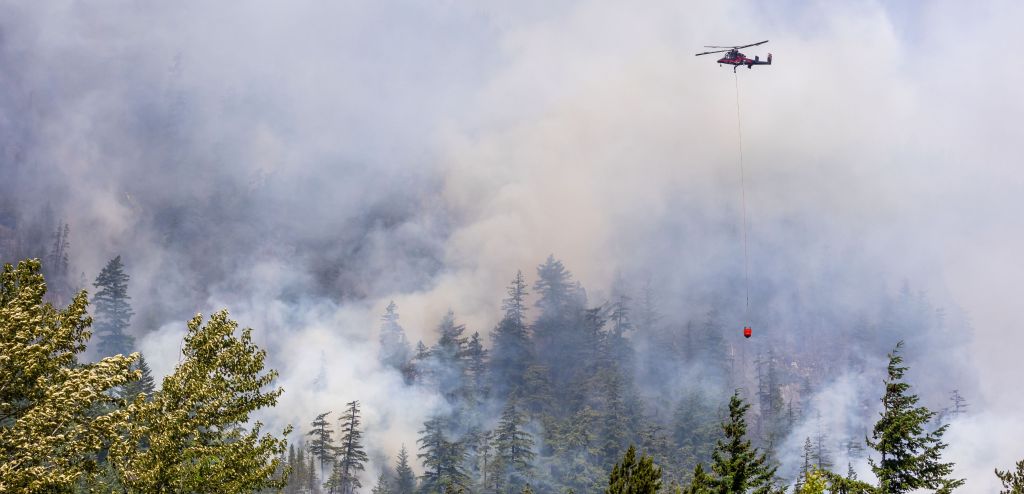
For Sarah Goodman, the wildfire crisis hits close to home. Almost everyone in British Columbia now knows someone who’s been evacuated from their home due to wildfires, said Vancouver-based Goodman, who leads NorthX, the B.C. firm that’s identified wildfire as a strategic sector to deploy “hard” climate solutions.

The firm, backed by federal and provincial governments and Shell, has invested $5.5 million in wildfire tech, including a fresh $2.2 million round in three promising startups. This year’s wildfire season is already ravaging parts of B.C. and Alberta, as temperatures recently hit 23.9 degrees in Vancouver—breaking a 128-year-old May record.

Wildfires both result from, and accelerate, climate change. Hotter weather turns forests into tinderboxes, sparking economic and environmental disasters:

  • Insured losses from wildfires in Canada soared 1,003% to reach $8.1 billion between 2016-2025, compared with $734 million the previous decade, according to CatIQ.

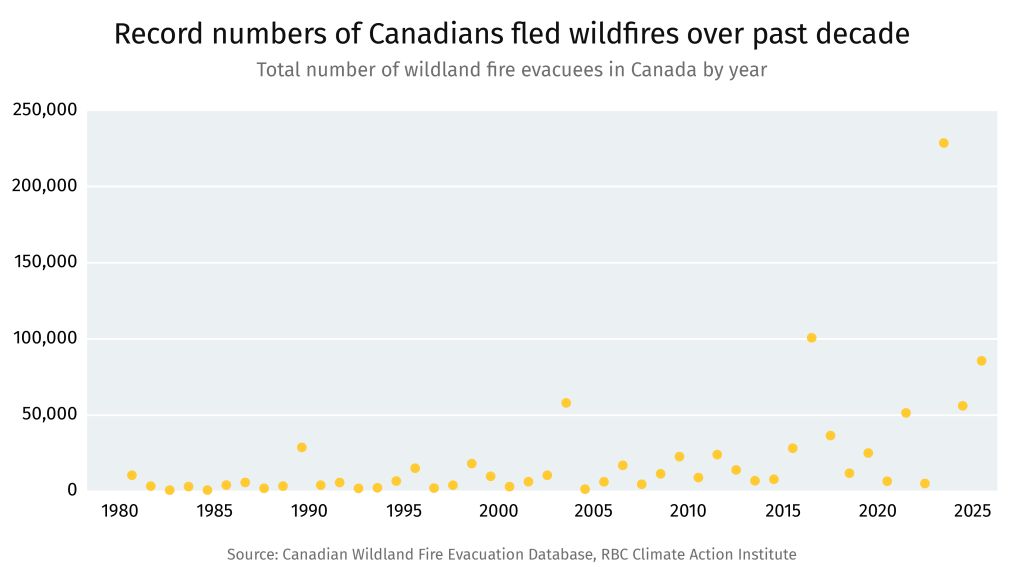
    Record numbers of Canadians fled wildfires over past decade. Total number of wildland fire evacuees in Canada by year.
  • As much as 7% of Canada’s oil production was briefly shut during an Alberta wildfire last year, with major pipeline infrastructure perilously close to the flames.

  • 2023 and 2025 were Canada’s two worst wildfire seasons ever. Wildfire carbon emissions in Canada in the first 10 months of 2025 hit 250 megatonnes (for context the nation’s GHG emissions were 661.5 MT in 2024), according to the European Commission’ Copernicus database.

  • If Canada’s forest wildfires were a country, they would have been the world’s eighth-largest emitter in 2023, according to 440megatonnes.ca. Yet wildfires from unmanaged forests are not counted in Canada’s official emissions.

  • “The rate of change in wildland fire severity and behaviour is accelerating faster than we can comfortably keep pace with,” says Stacey Sankey, Natural Resource Canada’s policy advisor and author of Blueprint for Wildland Fire Science in Canada (2019-2029).

Investment is ramping up to suppress, mitigate and manage wildfires—but as Goodman notes, “we are in the early stage of wildfire tech”:

  • In April, NorthX Climate Tech invested a combined $2.2 million in three B.C. startups in a new round: Crown.ai, Nova and Skyward Wildfire Technologies.

    • Crwn.Ai uses artificial intelligence to predict power line-caused ignitions;

    • Nova—another AI-powered tech—uses aerial data to identify potential hotpots;

    • and Skyward aims to tackle lightning—often sparking destructive fires.

  • “Wildfires behave differently in different geographies,” said Goodman, but there are opportunities to export Canadian tech. Nova, for example, operates in 200 jurisdictions globally.

  • The federal government is boosting wildfire funding by $70 million to $629.8 million through 2030. Some of the $290-billion defence budget could also serve dual purpose for aerial monitoring and wildfire suppression.

When it comes to wildfires, Stacey Sankey wrote the blueprint—literally. The Senior Policy Advisor at the Canadian Forest Service authored the Blueprint for Wildland Fire Science in Canada (2019-2029). The situation has improved significantly, but there is still meaningful work to be done, Stacey said. The interview is edited for brevity:

Q: Have the challenges you identified in the report improved or worsened since its publication?

A: Blueprint made 15 recommendations to guide science investments, attract new partnerships, and align national research efforts. Progress on the human resources gap has been real. A $5 million investment, through Natural Resources Canada (NRCan) and the National Science and Engineering Research Council (NSERC), created a Wildland Fire Research Network, anchored at the University of Alberta, developing 68 wildland fire professionals across master’s, PHD, and post-doctoral programs. As a part of this network, numerous universities have expanded their programs to include wildland fire related research and courses. The federal government has also invested heavily in training more community-based firefighters. That said, progress continues to be stretched by the scale of growth in wildland fire severity.

Q: Which of your recommendations have been implemented?

A: There has been substantial and concrete movement across the Blueprint’s core recommendations: on increasing research and innovation capacity, respecting Indigenous knowledge, expanding partnerships, and sharing governance and coordination.

NRCan has strengthened data, modelling and decision support systems, including modernization of the Canadian Wildland Fire Information System (CWFIS) and the Canadian Forest Fire Danger Rating System (CFFDRS). New target investments have advanced wildland fire risk assessment tools, while NSERC Network created a new generation of trained wildland fire expertise.

On Indigenous fire stewardship, implementation includes establishment of REDFire (Reciprocity, Ecology, and Diversity in Fire) Lab and Thunderbird Collective, which work to advance Indigenous leadership and knowledge in wildland fire management.

The federal government is supporting provinces and territories to procure specialized equipment, train firefighters, and secure aerial firefighting capacity. Canada also committed to international cooperation through the G7 Kananaskis Wildfire Charter and WildFireSat, a collaboration between NRCan, Environment and Climate Change Canada, and the Canadian Space Agency, which will be the world’s first government-owned satellite system for monitoring wildfires.

Q: What other challenges have emerged since the report was published?

A: The rate of change in wildland fire severity and behaviour is accelerating faster than we can comfortably keep pace with and firefighting resources continue to be stretched, keeping Canada reliant on international resources during extreme fire events. There also continues to be more work that can be done in advancing Indigenous wildfire stewardship.

Sitting at the intersection of food, sustainability and climate change, Evan Fraser, Executive Director at the Arrell Food Institute at the University of Guelph, is worried a changing climate could trigger a global polycrisis. Still, he believes Canada can step up to be a source of food stability for the world.

Q: What’s one thing you wish more people understood about the relationship between climate change and our food system?

A: While we often talk about energy systems (heating, lights, power, gas) as a key lever through which we can address climate change, food is also a very big lever. Food systems produce around 30% of the world’s greenhouse gas emissions. But systems can become net-zero, or even “net-negative” (i.e. absorb more greenhouse gases than they emit), with a few big changes. The secret is to reduce fossil fuel use in food production and supply chains, apply inputs like fertilizer with precision, and build up the soil’s organic matter. The latter is where the “net-negative” opportunity lies. Soil organic matter is essentially carbon dioxide turned into plant material. If farmers adopt practices such as reducing soil disturbance, it allows soil organic matter to build up, pulling carbon dioxide from the atmosphere. Soil organic matter also acts like a sponge, trapping water when it is available and holding onto it when it is needed, making soil more resilient to extreme whether events.

Q: What climate and food-related issues are keeping you up at night?

A: What’s keeping me up at night isn’t climate change on its own, but the interaction of climate, geopolitical and economic changes. I worry these stressors are building to a cascade of crises that may overwhelm countries and households. 

Since the U.S./Israel-Iran war started, and the Strait of Hormuz was blockaded, fertilizer prices have skyrocketed, forcing farmers all over the world—especially small-scale farmers in Africa and other places—to cut back. This will result in lower yields. At the same time, the U.S. Mid-West is experiencing severe drought, the Indian monsoon is set to be weak, and a major El Niño threatens the Southern Hemisphere’s next growing season.

I am worried we are facing a polycrisis. Over the next six to 12 months, several things may go wrong in the food system, triggering another rash of food inflation. One risky scenario is a repeat of widespread food riots of 2008-2011 that exploded in Haiti, Cameroon, and dozens of other countries. I am already seeing worrying signs that we could be heading back to this area in places like Kenya. A bad harvest this year due to climate change could accelerate the disturbances, leading to political volatility. 

Q: What innovations in the food system are you most optimistic about? And what do you think Canada’s role is (or should be) in advancing the innovation?

A: Canada should set itself up to become the world’s most reliable and trusted exporter of food and agri-food exports not only as an economically valuable commodity to be traded but also a strategic lever. Through food exports, we can export geopolitical stability and resilience, and that is a role that Canada should lean into, especially in this extraordinarily turbulent moment. 

To lead, we need major investment in agri-food research and training, focusing on innovations like drought and pest-tolerant seeds, AI decision-support tools for farmers, and smart tractors. These advances will help Canadian farmers navigate climate change and geopolitical disturbances. These innovations, combined with our farmers, geography and land and water resources, Canada is positioned to become one of the world’s most important breadbaskets this century. 

  • Rick Smith of the Canadian Climate Institute believe Canada’s next big climate policy moment will be the release of federal vehicle regulations to reach the equivalent of a 75% EV adoption rate by 2035.

  • Michael Liebreich on the Great Clean Energy Acceleration 2.0—a discontinuity in energy markets as profound as the oil shocks of the 1970s.

  • Jonathan Stern, Distinguished Research Fellow at the Oxford Institute for Energy Studies, asks in a report: are efforts to reduce flaring from oil and gas upstream operations a lost cause?

  • Celeste Saulo, secretary general of the World Meteorological Organization, warns why the El Niño weather phenomenon expected this summer is an “urgent climate warning.”

Curated by Yadullah Hussain, Managing Editor, RBC Climate Action Institute.

Climate Crunch would not be possible without John Stackhouse, Jordan Brennan, John Intini, Farhad PanahovLisa AshtonShaz MerwatVivan SorabCaprice Biasoni, Lavanya Kaleeswaran and Joelle Schonberg .

Have a comment, commendation, or umm, criticism? Write to me here (yadullahhussain@rbc.com)

Climate Crunch Newsletter
  • Pathways for pipeline: Breaking down the Alberta-Canada deal

  • Why Hope Bay project boosts Indigenous participation

  • Oil is spiking, but clean energy stocks are the ones getting a bump

Honda may have shelved its $15-billion EV plant in Ontario—but there’s a world where Canada’s assembly lines bustle with activity. In Steering Through Uncertainty, RBC Thought Leadership’s Managing Director Jordan Brennan outlines four possible futures for the embattled Canadian auto industry. One of the rosier forecasts sees the industry restore access to the U.S. market, unlock billions in pledged investment for EVs and conventional vehicles, and ramp up car assembly to two million by 2040 (from 1.3 million today). Leveraging critical mineral reserves bolsters the case for made-in-Canada cars. That’s the fast lane scenario. Other projections lead to diversification, deceleration, and even a dead end. Dive into all four scenarios here.

Hope Bay project promises Inuit-led development. Ottawa broke ground on the $2 billion redevelopment of the Hope Bay gold mine in Nunavut—projecting $2.6 billion in annual export growth and nearly 2,000 jobs. Ottawa also committed $25 million to the Kitikmeot Tugliq Energy Hope Bay Wind Project, an Inuit-owned wind and battery storage system that will power the mine. The project is a useful real-world test of the framework examined in Nations Building, our assessment of Indigenous loan guarantee programs in Canada’s new project wave. Hope Bay is promising on three counts:(1)The mine will be powered by wind and batteries rather than diesel. (2) Indigenous equity participation in mining remains structurally underrepresented. Hope Bay is gold, not a critical mineral, but it establishes a template for the harder projects that follow. (3) An Inuit-owned energy project powering a mine on Inuit lands offers opportunities communities in remote regions toparticipate in Canada’s new projects.

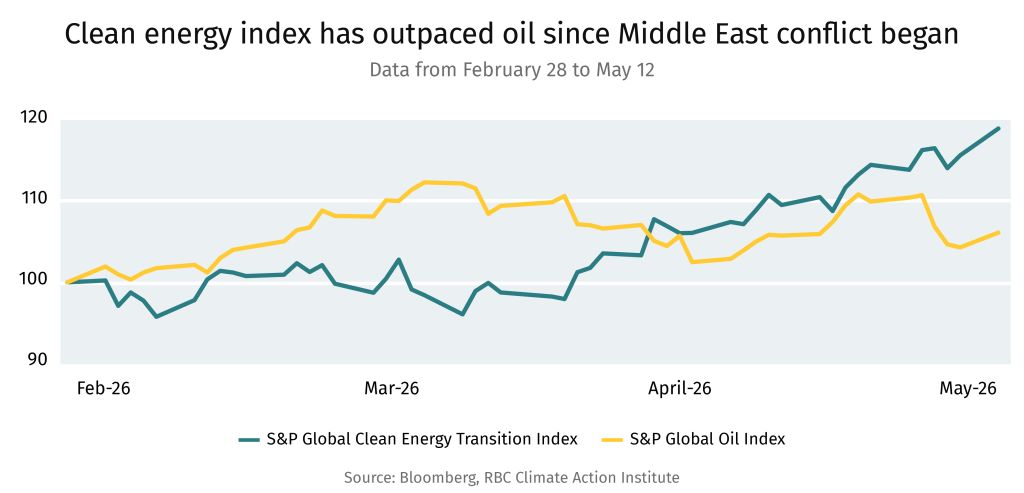
Clean energy index has outpaced oil since Middle East conflict began

Oil prices are spiking, but momentum rests with low-carbon stocks. Clean energy companies benefit from both elevated fossil fuel prices and accelerating renewable policy support on growing concerns over energy independence, Christopher Dendrinos, RBC Capital Market’s clean energy analyst, told us. This is particularly pronounced in oil-and-gas import-reliant Europe. While natural gas dominates the data centre space, renewables are also benefiting from rising demand to power AI. “The sector remains resilient going forward given the strong energy demand macro backdrop,” Dendrinos said.

Canada and Alberta’s landmark Implementation Agreement last week builds on the November 2025 Memorandum of Understanding that aimed to balance Canada’s economic and environmental goals.  However, the Implementation Agreement doesn’t stand alone. A day before, Carney had launched a National Electricity Strategy committing to double Canada’s grid capacity by 2050, with consultations now underway with provinces, territories, Indigenous Peoples, utilities, and unions. The strategy projects up to $15 billion in total energy savings and lower energy costs for 7 in 10 Canadian households. Natural gas retains a role for grid stability, nuclear and geothermal get explicit support, and the Clean Electricity Investment Tax Credit is being extended to intra-provincial transmission. A joint Alberta-Canada Electricity Working Group has been struck to advance the work.

Other stakeholders will now weigh in on the national electricity strategy, but the Alberta-MoU is much further ahead and poised for action. Energy Policy Lead Shaz Merwat breaks down its key highlights:

  • Carbon pricing in Alberta is locked in through 2040: Headline TIER (Technology Innovation and Emissions Reduction) prices: $95 today, $115 per tonne in 2030, $130 in 2035, $140 in 2040. The federal backstop will be updated to match — this is now effectively the national industrial carbon pricing framework.

  • A binding floor on TIER credits — for the first time: Starting at $60/t in 2030, rising to $110/t by 2040. Pre-MOU, TIER credits traded at roughly $20 against a $95 headline. The floor is the most consequential new mechanism in the deal.

  • 75 Mt of Carbon Contracts for Difference: Jointly issued 2030–2040, equally cost-shared, $600 million maximum liability per party ($1.2 billion aggregate). If either government walks back, that party assumes sole liability.

  • The West Coast pipeline has a defined timeline: Alberta submits to the Major Projects Office by July 1, with Ottawa designating it as a “project of national interest” under the Building Canada Act by October 1. The one million barrels per day pipeline to Asian markets could start construction by September 2027.

  • No Pathways, no pipeline. The two projects are explicitly mutually dependent. Pathways targets 16 Mtpa in total emissions reductions: 6 Mtpa by 2035, 5 Mtpa by 2040, 5 Mtpa by 2045. The trilateral MOU with the Oil Sands Alliance is still unsigned.

  • Sector-specific stringency rates. Large oil sands companies face 2% annual tightening of emissions intensity through to 2040 under revamped TIER, while Pathways operators see a tightening of just 1% from 2031 onwards.

  • Co-operation agreement on Impact Assessment. Two-year cap on impact assessments and federal deference to provincial processes where projects fall primarily within Alberta’s jurisdiction.

  • Indigenous economic participation centred across the framework. Co-ownership and equity partnership paths referenced repeatedly in today’s Implementation Agreement and the Co-operation Agreement on Impact Assessment.

  • The Co-operation agreement reflects intriguingly different working on UNDRIP. Canada maintains its commitment, while Alberta views UNDRIP as non-binding.

  • Climate targets remain intact. Both Alberta and Ottawa re-commit their target of net zero by 2050.

Taken together, the twin announcements represent a potential move towards creating the most comprehensive federal-provincial energy framework Canada has produced in a decade — covering carbon markets, carbon capture, storage and utilization, oil export infrastructure, and grid expansion simultaneously. The architecture is scoped, but execution will be key. The proxies to watch over the summer, in the lead-up to Ottawa’s Canada Investment Summit in September: a named pipeline proponent, the trilateral MOU with the Oil Sands Alliance, and the first material Indigenous consent agreement on the pipeline route.

  • Long-term uncertainty in global oil markets may ultimately accelerate the shift toward EVs as Canada strengthens domestic electricity generation, Victor Fedeli, Ontario’s Minister of Economic Development, Job Creation and Trade, told John Stackhouse at the Toronto Region Board of Trade Auto Event.

  • Agriculture Policy Lead Lisa Ashton on why Canada and other countries are embarking on a fertilizer emissions accounting overhaul. Read the brief here.

  • It’s hard to trace where critical minerals come from, weakening their environmental bona fides. Around 30-40% of the companies have a traceability system. The International Energy Agency says strengthening incentives for collecting and sharing data could be one of five ways to address the challenge.

  • Alberta’s “failure” to build new transmission could cost consumers in the province over a  quarter of a billion dollars annually through higher electricity bills, Will Noel, of the Pembina Institute, estimates.

  • Leah Stokes, a professor of environmental politics at the University of California-Santa Barbara, says the current U.S. administration’s push away from clean sources is costing each American household US$1,508 this year alone.

Curated by Yadullah Hussain, Managing Editor, RBC Climate Action Institute.

Climate Crunch would not be possible without John Stackhouse, Jordan Brennan, John Intini, Farhad PanahovLisa AshtonShaz MerwatVivan SorabCaprice Biasoni, Lavanya Kaleeswaran and Joelle Schonberg .

Have a comment, commendation, or umm, criticism? Write to me here (yadullahhussain@rbc.com)

Climate Crunch Newsletter

➔ Renewable projects can serve as a playbook for Indigenous participation in future developments

➔ How methane abatement could replace lost Middle East gas supplies

➔ Your backyard can help save the environment

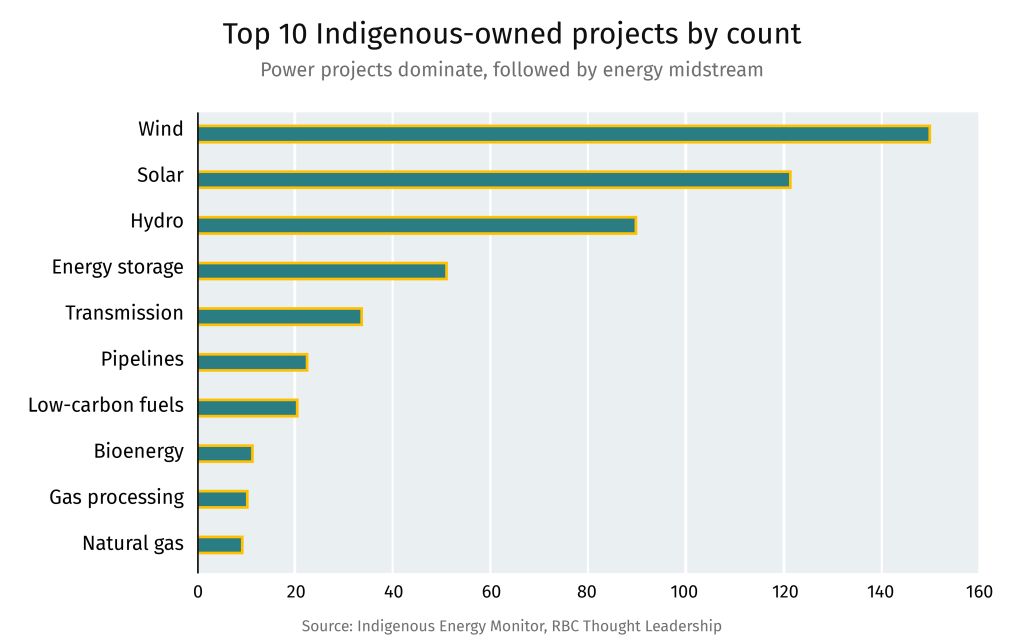
Top 10 Indigenous-owned projects by count

Power and utilities dominate Indigenous participation. That’s both its strength and its constraint, says Energy Policy Lead Shaz Merwat. Loan guarantee programs have been most active in western Canada, while northern communities, closest to the mineral deposits the energy transition requires, lack transaction readiness. Yet, the electrification trend offers substantial Indigenous investment opportunities nationwide. Read our Nations Building report that examines ways to boost First Nations participation as Canada embarks on a new project wave.

Methane mitigation could replace gas supplies stranded due to the Strait of Hormuz closure. That’s the stunning assessment from the International Energy Agency (IEA), which estimates that available methane abatement measures could free up to 200 billion cubic metres of natural gas—or double the supply volumes cut off due to the virtual closure of the Strait. Large quantities of produced gas are not being put to productive use, owing to methane leaks, and flaring and venting from oil and gas operations. The cost-effective, proven technologies could abate three-quarters of emissions from oil and gas and about half of coal emissions, according to the IEA. (Also read: What the Canada-Alberta methane deal means for businesses).

Nature conservation icon Sir David Attenborough is now eyeing his backyard for sustainability. After traversing the world’s wildest places, Attenborough’s new BBC series focuses on the often overlooked garden. It may have several low-hanging fruits, literally: home gardens can reduce carbon emissions, sequester carbon, and produce fresh food (pro tip: use rainwater to go truly green). Canadians already have a head start: About three in five Canadian households (59%) grew fruit, herbs, vegetables or flowers for personal use in a survey a few years ago.

It’s early days, but the stalemate playing out over the Strait of Hormuz is forcing countries to renew their focus on electrifying their way out of fossil fuels. We have been here before as recently as 2022 when Russia launched a full-scale invasion of Ukraine, upending European energy ties to Russian oil and gas. Yet coal, oil and gas rebounded to near all-time highs.

Will it be different this time? Here are five ways the crisis has rekindled momentum for energy transition.

1. Global consensus is hardening. Santa Marta, Colombia, was the site last week of the First Conference on Transitioning away from Fossil Fuels, where 57 nations—including Canada—sought ways to move towards cleaner energy.While several lofty goals were expounded, a key takeaway was to launch a panel of experts who would provide scientific input on reducing fossil fuel dependence, high energy prices and extreme weather damage. It could be a breeding ground for new ideas.

2. AccelerateEU aims to shield Europe from energy price shocks. One idea is to accelerate the shift to “home green clean energy,” including an Electrification Action Plan to be released by the European Commission by the summer.

3. Knee-jerk consumer behaviour could alter long-term demand. Global EV sales jumped 66% in March compared to February, as some consumers baulked at the prices at the pump and switched to EVs. Several countries in Europe and Asia had record-breaking months. That could have long lasting consequences for fuel demand and what’s called” demand destruction.” In Canada, more than 12,600 zero-emission vehicles were sold in February, compared with nearly 8,700 the month before, recent Statistics Canada data shows. An AutoTrader survey of 17,000 Canadians found half of respondents would now consider buying an EV.

local bureaucrats

4. Chinese bureaucrats are now on the clean-energy case. The country is launching a campaign aimed at accelerating climate action by local authorities, in an effort to plateau CO2 emissions before 2030. At stake: rewards and career progress for local bureaucrats. Never underestimate the resourcefulness of a middle manager keen to get their performance bonus.

5. Most renewables are now competitive with fossil fuels. Even before the Iran war, the price competitiveness of solar and wind energy was the primary driver of power sector decarbonization, according to Ember Energy. In 2025, the average Levelized Cost of Energy (LCOE) for solar ($39/MWh) and onshore wind ($40/MWh) was 60% lower than that of combined cycle gas turbines (CCGT), which stood at $102/MWh. Offshore wind ($100/MWh) has also reached price parity CCGT. US$100+ oil prices only make the case for renewables more compelling. China’s export of photovoltaic solar panels, lithium-ion batteries and new-energy vehicles rose 70% in March year-on-year, Carbon Brief’s analysis of Chinese customs data shows.

Here’s what Lisa Ashton, Head of Research, gleaned from Ottawa’s latest Spring Economic Update:

Clean investment push continues. Expanded tax credits and incentives for carbon capture, clean electricity, and clean technologies aim to attract private capital and scale domestic innovation.

Proposed $5 billion in international climate investment. Flowing through Environment and Climate Change Canada, FinDev and Global Affairs Canada, the update proposes spending on climate initiatives and technology development in emerging economies around the world to advance global decarbonization. Carbon pricing framework is reinforced. Working to strengthen industrial carbon pricing benchmarks and ensuring consistent national standards remain central to competitiveness. Yet, key decisions are pending, namely performance standards. Another obstacle: the oil industry is pushing back on the carbon tax.

Funding of $3.5 billion towards scaling nature positive outcomes. Announced in the government’s Force of Nature strategy, the federal government will stimulate investments in nature, tying climate competitiveness to conservation goals (e.g., protecting 30% of lands and waters by 2030).

Integration with broader economic strategy. The proposed Sustainable Finance Conference and the development of the made-in Canada sustainable investment guidelines aim to connect public and private dollars in key economic sectors, linking sustainable investments to jobs, affordability, and global competitiveness.

The takeaway. Canada is doubling down on a market-driven, investment-led approach to climate policy. The country will need to advance key strategies and agreements including the energy MoU with Alberta to drive real outcomes through its renewed approach.

First Nations Major Project Coalition’s 9th annual conference
  • Atthe First Nations Major Project Coalition’s 9th annual conference, John Stackhouse discussed how economic reconciliation and Indigenous equity are vital to ensure Canada’s big ambitions are fully realized.

  • Gregory Brew, a historian of international energy and U.S.-Iranian relations and a senior analyst at the Eurasia Group, on how America would pay dearly for its energy arrogance.

  • Subsidies and price floors are temporary tools, demand is what would sustain prices and investor confidence in critical minerals, writes Gracelin Baskaran, director, critical minerals security, at the Center for Strategic and International Studies.

Curated by Yadullah Hussain, Managing Editor, RBC Climate Action Institute.

Climate Crunch would not be possible without John Stackhouse, Jordan Brennan, John Intini, Farhad PanahovLisa AshtonShaz MerwatVivan SorabCaprice Biasoni, Lavanya Kaleeswaran and Joelle Schonberg .

Have a comment, commendation, or umm, criticism? Write to me here (yadullahhussain@rbc.com)

Climate Crunch Newsletter
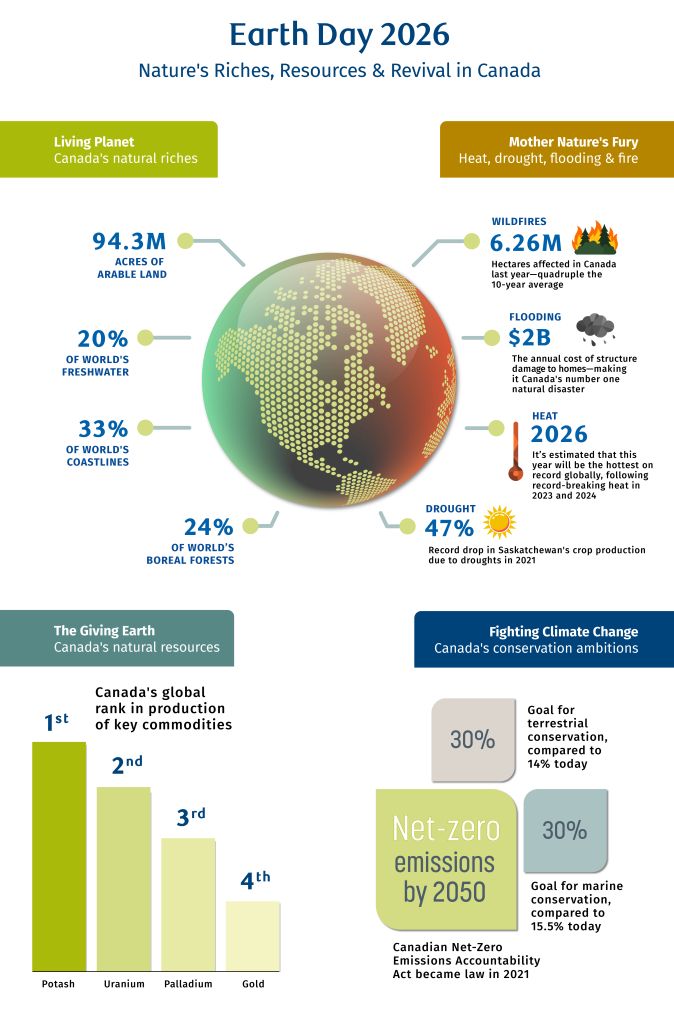
Earth Day 2026: Nature's Richers, Resources, and revival in Canada

Living Planet - Canada's Natural resources include 94.3 acres of arable land, 20% of World's Fresh water, 33% of World's coastline, 24% of World's boreal forests.

Mother Nature's Fury: Heat , drought, flooding and fire include 6.26M hectares affected in canada last year - quaruple the 10-year average, $2B in annual cost of structure damage to homes- making it Canad's number one natural disaster, it is estimated that year 2026 will be the hottest on the record globally, following record-breaking hear in 2023 and 2024, 47% record drop in Saskatchewan's crop production due to droughts in 2021.

“Our power, our planet” is the global theme of this year’s Earth Day. Indeed, clean power often lays the foundation of a cleaner economy. New research from RBC’s Jordan Brennan and Farhad Panahov shows Canada’s electricity system needs an estimated $670 billion over the next 10 years to support the energy transition. While 80% non-emitting, Canada’s grid will need new capacity and modernization. For more, read the Capital Gains report.

Wildfires don’t stop for Earth Day. Close to 200 wildfires were simmering away in Canada last week, just under twice the 10-year average for this time of year. It highlights the scale of the challenge of protecting nature. As a recent RBC report notes, ignoring nature threatens prosperity, especially as we push forward with nation-building projects. It’s time to see conservation as a capital that others will be able tap into for generations to come.

The famous Fischer-Tropsch process brought us gasoline and jet fuel—now it’s poised to make sustainable fuels. Exactlya century after Franz Fischer and Hans Tropsch revolutionized hydrocarbons, the same technique is being used to decouple hydrocarbon production from fossil-derived feedstocks, with emphasis on producing sustainable aviation fuels from carbon dioxide. But true sustainability requires system integration with “upstream low-carbon modules such as green hydrogen and CO₂ capture,” said Peking University’s Ding Ma in Nature. The process is moving beyond labs, with several countries, including China, working on low-carbon chemical manufacturing.

Natural capital–things like forests, clean water, fertile soil, and biodiversity–is one of the most valuable assets any country has. It supports industries, protects communities, and plays a major role in climate resilience. Canada is exceptionally rich in natural capital, but when it comes to investing in and managing it, the picture is mixed—especially compared to countries like the United Kingdom, Australia, and Denmark.

Canada’s natural wealth is hard to overstate. The country holds about 24% of the world’s boreal forest and roughly 20% of its freshwater resources. Natural resource sectors, including oil, mining, forestry, and agriculture, contribute around 20% of Canada’s GDP, including their supply chains. Yet, Canada has struggled to turn natural capital into an investable asset class at scale.

Lessons from around the world

United Kingdom: The U.K. has taken a more systematic approach to embed natural capital accounting into policy and planning. Since 2012, the U.K.’s Natural Capital Committee advised the government on how to measure and invest in ecosystems, which evolved into the Office of Environmental Protection in 2021. Today, the U.K. publishes official natural capital accounts that estimate the economic value of forests, rivers, and other assets–an accounting tool that Canada also has at its disposal under the UN framework: System of Environmental-Economic Accounting. The U.K.’s approach to economic and environmentally informed decisions is complemented by market mechanisms that can stimulate investments in natural assets, such as the Biodiversity Net Gain scheme.

Australia: Like Canada, it is rich in natural resources and heavily dependent on them economically for mining, agriculture, and oil and gas. However, Australia has taken a more aggressive approach to attract private investment into natural capital. Scaled infrastructure projects have been used to mobilize institutional investments, including Canadian pension funds, into long-term projects, including renewable energy development and sustainable land use. An example is the Murray–Darling Basin Plan, a $13-billion initiative to manage water resources sustainably across the country’s food bowl.

Denmark: The Scandinavian country doesn’t have Canada’s vast natural resources. Instead it has focused its attention on baking environmental sustainability into tax law to make investment in sustainably managing natural resources the more economically attractive option. As a result, more than 50% of Denmark’s electricity comes from wind and solar power.

While Canada has made important commitments, it still lacks the coordinated systems of its peers. Pillar three of the Force of Nature Strategy, Valuing Nature and Mobilizing Capital aims to address this challenge. Starting with an Expert Taskforce on Natural Capital Accounting and Nature Financing, the federal government looks to mobilize private capital, blended with their $3.8 billion commitment for nature positive outcomes. If Canada can measure the value of its natural assets, attract more private investment, and align environmental goals with economic growth, it has the potential to turn its natural wealth into a long-term economic advantage.

Dive into more insights on Natural Capital: Unearthing Value: How nature can play a critical role in pro-growth agendas – RBC

“The farmer is responsible for the soil [they] till. This natural resource will not restore itself as fast as it is depleted…The farmer, therefore, needs to open a soil-savings account. It will not only conserve [their] soil, but it will return an increased income and accumulate interest.”

That quotation, pulled from a 1948 edition of RBC’s Making Money by Saving Soils, is as true today as it was when it was first written. In fact, the soil conservation conversation has been a constant among farmers long before that. Sure, things have evolved—with research, big data and technology helping to uncover more about the dynamics of the ground beneath our feet. But many of the challenges of conserving soils to grow healthy crops remain the same. Read more on soil health from Lisa Ashton, the Climate Action Institute’s Interim Head, at the link.

  • There are 10,000 events worldwide to celebrate Earth Day 2026. But if you don’t have time, Eathday.org offers 50 ways to take action for the planet.

  • Deep retrofits would cost $10 per square foot to reduce greenhouse gas emissions in Canadian buildings by 40% by 2030, according to a new MaRS report.

  • James Rising and others at the Grantham Research Institute on Climate Change write on how climate adaptation investments can yield a ‘triple dividend’: preventing losses, stimulating economic activity and providing social and environmental co-benefits.

  • Shrugging off a backlash against renewables, 44% of Americans continue to worry a great deal about climate change—that’s close to its highest point ever. A record low 35% are feeling positive about the environment, according to Gallup.

➔ Can the Canada-Alberta methane deal deliver both rising oil and gas production and falling emissions?

➔ Why Canada’s clean trade is in the red

➔  A British Columbia city leads on heat bylaws

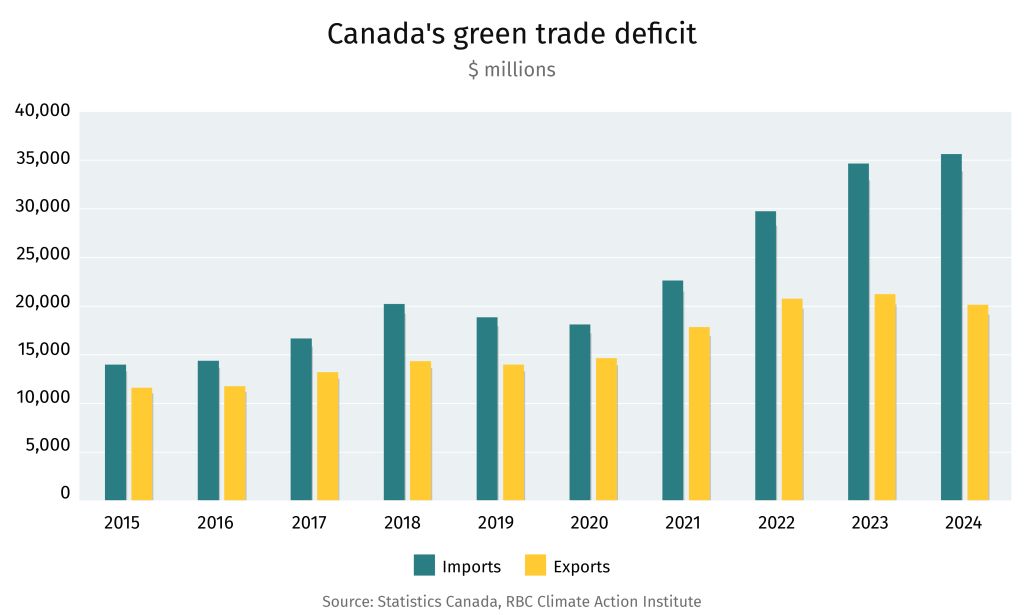
➔  Canada’s clean-tech trade deficit is growing. The country’s environmental and clean tech (ECT) trade deficit has steadily risen to $15.6-billion in 2024 compared to $2.4 billion a decade ago, Statistics Canada’s latest data shows. Imports of clean electricity—Canada’s prized climate ace—have surged in recent years, just as exports fell due to drought conditions and growing domestic electricity demand. Clean tech hardware, spanning wind turbines, electric vehicles, water treatment equipment, accounted for around 80% of the growth in imports, aligned with strong adoption and deployment trends in Canada over the same period, says Economist Farhad Panahov

Canada's green trade deficit

➔  The EU created the bloc’s first voluntary scheme for carbon removal credits. The credits produced under the Carbon Removals and Carbon Farming (CRCF) Regulation are being designed for the voluntary carbon market, to boost scalability and help the EU meet its net-zero 2050 targets. It could be a model for Canada: the agriculture sector has a patchwork of pathways to enter compliance and voluntary market opportunities, but with limited availability of compliance protocols that recognize the role of farmers in building the country’s carbon sinks through sustainable practices, says Lisa Ashton , Interim Head of RBC’s Climate Action Institute. However, the Canada-Alberta energy MoU and carbon pricing benchmark review potentially open the door for Canada to streamline farmers’ ability to access carbon markets.

➔  Hydro Quebec wants households to generate their own energy. A new $1,000 per kW grant for solar kits aims to cover up to 40% of eligible project costs. Quebec is a laggard compared to other North American jurisdictions on solar as cheap hydroelectricity meant 25-30-year payback periods made solar uneconomical. That’s changing. As Hydro-Québec develops alternative power sources and redirects surplus hydro for exports and industry, distributed generation eases the strain on the grid. Indeed, households can even sell excess power back to the grid. The new incentives aim to drop investment costs from $36,000 to $24,000—a payback period of 10-12 years. While that’s a long time to recoup costs, it’s hard to compete with the lowest electricity prices on the continent. In contrast, in Pakistan, which is in the midst of a solar revolution, a similar set up would cost $6,500, estimates Energy Policy Lead Shaz Merwat. Also read our report on how smart homes can unlock grid efficiencies.

Newfoundland and Labrador could be among the major drivers of wind power in Canada. The Canada Energy Regulator’s latest projections (Canada’s Energy Future 2026 ) expects the Atlantic province to emerge as an offshore wind powerhouse, accounting for a sizeable chunk of new wind power capacity by 2050, along with Alberta.

Shaz Merwat examines the Atlantic province’s wind prospects:

  • Wind, primarily offshore, could make up 13.3 gigawatts of electricity capacity by 2050 in the province, from negligible numbers today, according to CER’s base case (which it calls its Current Measures Scenario).

  • The province’s total electricity capacity is set to triple, with 98% from renewables by 2050 (compared to around 87% today).

  • The CER is betting big on Newfoundland. The province has world-class wind conditions but virtually no wind industry at present, and given some major setbacks involving planned green hydrogen demand anchors recently, it likely presents more market risk.

  • Offshore wind development is also constrained by deep water and floating turbine costs. The transmission corridor needed to move power to the Quebec market remains a multi-billion-dollar proposal without a final investment decision, but will be needed if NL is to build upon its hydro exports to Quebec and Atlantic Canada scaled for wind.

  • Alberta could present another challenge to Canada’s effort to ramp up wind power. The province has the resource and the grid as Canada’s largest wind producer. But new wind investment has essentially frozen, the result of policy uncertainty that has yet to thaw.

  • Wind’s build up rides heavily on Alberta and Newfoundland that are expected to add about 16 GW and 13 GW, respectively, in the CER’s base scenario, accounting for much of the 72 GW of capacity additions by 2050 across Canada.

  • By 2050, wind is expected to account for 30% of Canada’s total generative capacity, compared to just 11% in 2025, according to the CER outlook.

By Vivan Sorab

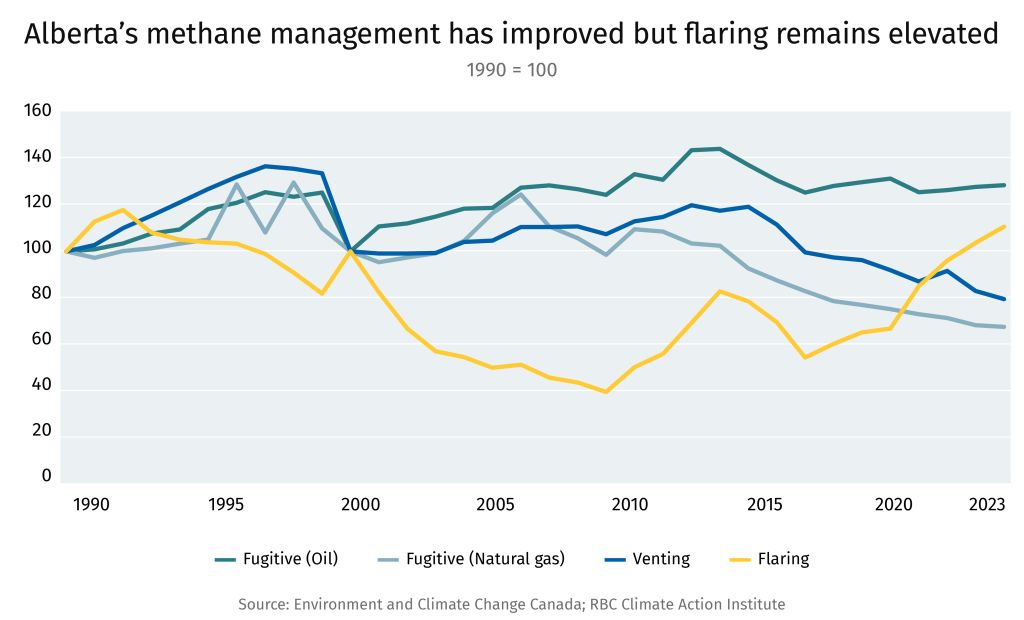
Ottawa and Alberta’s recent agreement-in-principle on methane equivalency sets the stage for Alberta to regulate methane its own way.

Cutting methane emission is considered one of the lowest-cost, highest-impact action levers available for near-term climate progress. Methane has roughly 80 times the warming impact of carbon dioxide over a 20-year period, and accounts for nearly a quarter of the Canadian oil and gas sector’s total greenhouse gas emissions.

The equivalency deal suspends Ottawa’s Enhanced Methane Regulations and allows Alberta to implement its own performance-based approach, comprising a mix of provincial regulations, offset credits, and targeted investments, with methane modelling, emissions reductions analysis, and reduction results overseen by a jointly appointed and cost-shared third party.

Alberta's methane management has improved but flaring remains elevated

New provincial rules will take effect on January 1, 2027, and the agreement would run for a decade, replacing the current equivalency agreement, which is set to expire in October 2030. If reductions fall short, Alberta has committed to corrective action.

Here are some insights:

  • There’s real momentum behind this. Alberta has already cut methane emissions by more than 50% from 2014 levels, backed by roughly $172 million in reduction technology investments since 2019 and more than 58,000 low- or no-bleed devices installed through the province’s carbon-offset system.

  • Agreement to third-party emissions verification is an important step given previous discrepancies between industry-reported figures and independent studies.

  • The 2035 target extends Alberta’s timeline for compliance by five years relative to existing federal methane regulations, while raising the compliance threshold to 75% reductions versus 72% previously.

  • Canada’s methane mitigation sector has grown to more than 130 firms. Compliance actions under federal regulations could generate 34,000 jobs from 2027 to 2040, according to one estimate.

  • Companies looking to position ahead of the compliance date could leverage this rapidly evolving technology suite, including a specific focus on monitoring and measurement, such as through facility-level monitoring, and satellite- and aircraft-based detection technologies.

  • A draft equivalency agreement is expected later this year, followed by a 60-day public consultation, with both sides aiming to finalize it by year-end.

  • Two other Canada-Alberta MoU commitments, namely industrial carbon pricing equivalency and a trilateral agreement with Pathways Alliance partners, remain outstanding.

Ottawa and Alberta are betting that cooperative, outcome-based regulation can deliver both rising oil and gas production and falling emissions. Whether the details hold up to scrutiny will determine if this model becomes a blueprint.

  • British Columbia dropped its EV sales target to 75% by 2035 (from 100%) to align with federal goals. The Pembina Institute’s Adam Thorn is “encouraged”, but Brian Kingston, CEO at Canadian Vehicle Manufacturers’ Association, is “disappointed” that B.C. is sticking to its provincial EV mandate.

  • New Westminster wants to avoid another “heat dome” episode: After the B.C. city had the highest fatality rate during the 2021 heat dome, it became the first Canadian city to pass a maximum heat bylaw, requiring landlords to keep at least one room in a rented apartment at or below 26 C. “While imperfect… this is a recognition that more heat waves are coming, and we all need to adapt,” says Colin Chan, Executive Director of B.C.’s Provincial Health Service Authority.

  • Solar hit a tipping point. “Overall, solar has already been cheaper than fossil power for a while, but upfront costs used to be higher,” says Nicolas Fulghum, senior energy and climate data analyst at Ember.

  • Fast follow: Jesse Jenkins, Associate Professor of Energy Policy at Princeton University, is the most influential digital voice in U.S. clean energy. Here’s a list of the other 99 influential U.S. climate heavyweights.

Curated by Yadullah Hussain, Managing Editor, RBC Climate Action Institute.

Climate Crunch would not be possible without John Stackhouse, Jordan Brennan, John Intini, Farhad PanahovLisa AshtonShaz MerwatVivan SorabCaprice Biasoni, Lavanya Kaleeswaran and Joelle Schonberg .

Have a comment, commendation, or umm, criticism? Write to me here (yadullahhussain@rbc.com)

Climate Crunch Newsletter
➔ Inside Canada’s strategy for the “Davos of Energy”

➔ What Canadian leaders told us about their views on climate action

➔ Canadian oil can deploy industrial carbon pricing at the cost of a Timbit per barrel, according to a study

Energy transition—not defence—will drive demand for critical minerals. Focus on electric vehicles and other energy transition technologies will be vital to underpin investments in Canada’s critical minerals sector, , according to Energy Lead Shaz Merwat. The good news is that emerging processing technologies—such as flash joule heating and direct lithium extraction—could alter the cost curve for new Canadian refining projects. Canada’s clean electricity advantage could also prove to be a differentiator as processing technology reduce energy intensity sufficiently to compete with China.​​​​​​​​​​​​​​​​ Read Shaz’s Mine & Refine report and Seven Takeaways from PDAC.

How are Canadian business executives addressing climate policies? The Climate Action team was on a listening tour over the past few weeks to check the pulse on climate action among Canadian leaders. Here’s what we heard: Canadian businesses are focusing on the doable. The result is not retreat, but a sharper focus on what can be built, financed, and scaled this decade. There’s plenty of climate capital to scale ambitions. The challenge is deploying it. Read our full briefing here.

Creating demand is the impetus for the new Advanced Carbon Removal (ARC) Coalition in Canada. The coalition launched this month and is made up of RBC, Shopify, the Government of Canada and other investors to mobilize $100 million in new support for Canadian carbon dioxide removal projects by 2030. These projects cross several sectors including energy, heavy industry and agriculture, and focus on scaling durable carbon removal technologies, including direct air capture, biochar, bioenergy with carbon capture and storage, enhanced weathering, and marine carbon dioxide removal. Canada has a competitive advantage in these carbon removal pathways given its vast resources in minerals and biomass, and access to clean electricity sources for processing.

The hope is that the Middle East conflict is short-lived. But it’s already casting a long shadow on global economic growth and energy flows—and climate goals.

With much of the oil-and-gas rich region engulfed in the crisis, major European and Asian importers are scrambling to secure alternative fossil fuel supplies. Solar and wind may be “intermittent” power sources, but oil and gas are now facing challenges of their own. The question for both energy-rich and option-poor policymakers is how to make urgent short-term decisions—without undermining long-term climate implications.

Here is what’s at stake…

For Canada: Big decisions, high stakes

Safe-harbour Superpower. Nervous nations have come calling, says Tim Hodgson, Minister of Energy and Natural Resources, looking for politically neutral Canadian oil and gas. Bonus: Canadian hydrocarbons don’t pass through global flashpoints—but do face domestic logistical hurdles. Can Canada ramp up as a reliable supplier without compromising its climate goals?

Investors are already testing the waters. The temptation is to build new West Coast LNG terminals and oil pipelines, and even East Coast projects to power Europe. Newfoundland Labrador recently reached a deal with Equinor and BP p.l.c. to lay the ground for construction and production at the offshore $14-billion Bay du Nord project. The oil pipeline route formerly known as Keystone XL—and now called the Prairie Connector—is all being revived. These projects could trigger an economic growth spurt—most certainly they would raise emissions.

Provincial considerations. British Columbia and Quebec must now navigate the tension between their strict environmental mandates and the pressure of allowing new energy infrastructure through their territories. Alberta, on the other hand, would need to ensure it does not over-index on oil and gas investments amid uncertain global energy demand.

For Europe: A power reset?

Continental drift. The 40% surge inEuropeanLNG prices following the strike on Iran highlighted the economic bloc’s limited options. With the continent still scarred by the loss of Russian pipeline gas, the current Middle Eastern shock has fractured the EU’s green consensus. Italy’s recent move to suspend carbon pricing—and Germany’s quiet recalibration of the 20-year-old Emissions Trading System (ETS)—signals a pivot toward security first over climate first.

Power with strings attached. As Qatari LNG through the Strait of Hormuz dries up, Europe is facing a short-term gas crisis, with Italy, Belgium and Poland more exposed than others. While U.S. LNG is bridging the gap, this reliance is increasingly transactional, coming with “political strings” that complicate the transatlantic alliance. Faced with a complete Russian gas embargo and a supply chain for renewables that remains dangerously concentrated in China, Europe finds itself in a strategic deadlock: return to legacy coal, pay the American premium, or accelerate a transition fuelled by China.

For Asia: Wake-up call

The Electrostate Paradox: China’s energy security is currently defined by a stark contradiction. As the destination for 38% of all oil transiting the Strait of Hormuz, Beijing has much lose from Middle Eastern volatility—a vulnerability compounded by the loss of Venezuelan crude following the ouster of the Maduro regime earlier this year. While Beijing recently issued a cautious 15th Five-Year Plan—lowering its carbon intensity target to 17% to prioritize industrial stability—this retreat masks a deeper shift. As Jason Bordoff, director of the Centre on Global Energy Policy at Columbia University, argues, by absorbing the short-term costs of fossil fuel disruptions today, China is effectively clearing the path to consolidate its dominance as the world’s first true “Electrostate.”

India’s dilemma. Even before the recent destabilization in the Middle East, New Delhi signalled a significant appetite for Canadian energy, with High Commissioner Dinesh Patnaik affirming India’s readiness to absorb “whatever Canada is offering.” While India maintains deep-rooted ties with Middle East nations, the vulnerability of the Strait of Hormuz—which handles nearly 15% of India’s crude imports—has accelerated a long-standing diversification mandate. For India, the crisis could simultaneously trigger higher coal consumption, more Western LNG exports, but also focus on powering up sola, and other renewable energies.

The Asian pivot. Roughly 37% of the oil transiting the Strait is destined for South Korea, Japan, and other regional hubs—a dependency that is forcing a radical strategic recalibration. Rather than waiting for Middle Eastern tensions to stabilize, South Korea is leveraging the volatility as a catalyst. The country’s president framed the crisis as “a good opportunity to swiftly and extensively transition to renewable energy.”

It’s unclear whether fossil fuels or renewables will emerge as winners from the latest cataclysmic conflict. What’s certain, however, is that the global race to secure energy supplies has intensified.

Canada is all set for the “Davos of energy.” The IHS CERA conference in Houston, starting March 23, will have a much larger Canadian presence than in recent years, with the Canada House pavilion and participation of Tim Hodgson, the Minister of Energy and Natural Resources, with officials from Invest in Canada (IIC), Innovation, Science, and Economic Development Canada (ISED), and Global Affairs Canada (GAC), among others.

Canada’s balancing act would be to attract American dollars but also diversify away from U.S. capital and attract a wider investor base to safeguard its sovereignty and reduce dependence on the American market.

—Canada’s four strategic themes at the event:

  • Standing on guard: Position Canada as a secure and stable clean and conventional energy superpower;

  • Being resourceful: Showcase Canada’s leadership in innovation, research and development, and emissions reduction in energy;

  • Championing Team Canada: Support energy companies by showcasing Canada’s benefits as a destination for energy investment capital; and,

  • Leveraging the sovereignty angle: Highlight Canada’s energy sovereignty and ability to meet growing global energy demand through market diversification.

—Several Canadian provinces, energy companies, and thought leaders will be amplifying the message, with Alberta Premier Danielle Smith slated for one of the panels.

—With construction on the roads in minerals-rich Ring of Fire set to commence this year and a new Critical Minerals Strategy, Ontario Minister of Energy and Mines Stephen Lecce will join a panel on the New Geopolitics of Critical Minerals.

—Canada House will feature dedicated programming focused on oil, nuclear energy, LNG, AI and energy, investment in Canada and methane abatement technologies. Some of the planned sessions, include Capital in Motion: Funding an Infrastructure Supercycle, featuring Minister Hodgson. Another with Chief Sharleen Gale, Chair of the First Nations Major Projects Coalition, will be on delivering Canadian energy to global markets.

—Other sessions focus on Canada’s low-carbon LNG, next-generation nuclear reactors, Canada’s methane innovation leadership, AI-enabled clean technology, and breakthroughs and bottlenecks in getting Canadian oil to global markets.

—The world’s facing a copper shortage. John Stackhouse and Shaz Merwat discuss how Canada can help.

—The agriculture sector is asking, “why Canadian farmers are not participating in compliance carbon markets at scale as a source of offsets?” Interim Head Lisa Ashton presented our Climate Action 2026 findings at the Annual Sustainability of Canadian Agriculture Conference and carbon pricing dominated the Q&A period.

—Canadian Climate Institute’s Dale Beugin and Ross Linden-Fraser explains why the industrial carbon pricing will cost just a Timbit per barrel for Canada’s oil sands sector.

—ESG now means energy, security and geopolitics, writes Liam Denning, Bloomberg opinion columnist.

—Canadian provinces and territories signed a deal to build transmission infrastructure needed to power the country’s next generation of growth. Pembina’s Tim Weis explains its significance.

—It’s not just the latest U.S. tariffs that have gutted Canada’s softwood lumber sector. RBC Economics Salim Zanana explains the thousands cuts.

Curated by Yadullah Hussain, Managing Editor, RBC Climate Action Institute.

Climate Crunch would not be possible without John Stackhouse, Jordan Brennan, John Intini, Farhad PanahovLisa AshtonShaz MerwatVivan SorabCaprice Biasoni, Lavanya Kaleeswaran and Joelle Schonberg .

Have a comment, commendation, or umm, criticism? Write to me here (yadullahhussain@rbc.com)

Climate Crunch Newsletter

➔ Stick to net zero by 2050 or abandon it?

➔ Some land sectors have a new emissions standard

➔ Canada makes a big nuclear push in Europe

Could April 1 reset Canada’s off-course climate trajectory? The Canadian Climate Institute’s latest report (which notes that Canada’s climate targets are “off course”), suggests that strengthening measures such as industrial carbon pricing and oil and gas methane rules is critical to coming close to the targets. Both measures are part of the MoU that Ottawa and Alberta agreed to hammer out by April 1. Together, these two policies could deliver an emissions-busting punch (see chart).

Canada's climate tarets depend on a few high-impact policies

Should the world give up on net zero by 2050? U.S. Energy Secretary Chris Wright thinks so. He recently chastised the International Energy Agency (IEA) for its “destructive illusion” of the 2050 goal. Amid this friction, energy ministers at an IEA summit in Paris last week failed to agree on climate objectives. It’s true that the world’s struggling to hit its net-zero targets, the UN projects, as nations from Canada to Germany retreat from some of their more ambitious climate policies. But few are looking to cast aside net zero just yet. France and other European nations pushed back during the summit, noting that electrification remains a cornerstone of the bloc’s economic policy. Meanwhile, Canada is expected to unveil its Climate Competitiveness Strategy, and China has already emerged as the world’s first “electro-state.”

China has galloped ahead of competitors with a new electric work horse of the ocean. Fittingly, in the new Year of the Horse, China debuted ocean-going Ning Yuan Dian Kun, featuring a battery capacity equivalent to 380 Tesla Model 3s. The test launch comes as the international Maritime Organization dithers on solving ocean pollution—technology, as it so often does, is leading policy here. Crucially, the batteriescan be shore-charged and swapped like cargo container to ensure its 740 twenty-foot equivalent (TEU) load can sail further. It’s a critical breakthrough: half the world’s container fleet is under 3,000 TEUs (twenty-foot equivalents) and these vessels are considered the ocean’s true work horses. An emissions dent in that space could make a real splash.

– By Lisa Ashton, Interim Head, Climate Action Action Institute

The first international standard for accounting for land-based sectors’ greenhouse gas (GHG) emissions is a true test of taking science from the lab to the field—and of patience.Land-based sectors, including agriculture and forestry, finally have an international standard for accounting, reporting and tracking GHG emissions.

The GHG Protocol’s Land Sector and Removals Guidance (LSRG) is intended to standardize GHG inventory accounting across companies with land-based GHG emissions allowing for consistent disclosures, which is necessary to boost their credibility with investors and regulators around claims like farmers increasing soil carbon sequestration and tree planting that are at risk of miscalculating their real impacts given the complexity of tracking GHG sources and sinks in natural systems.

It was a long time coming, taking more than five years of debates, revisions—and even a period of derailment—to land the GHG Protocol.

Why did it take so long? Simply put, it was due to tensions between climate accounting purists and industry trying to agree on a practical standard.

The sticking points:

  • Not knowing who your farmer is: Agri-food supply chains are geographically dispersed and cover large swaths of land to feed a growing population, challenging companies pursuing perfection in tracking changes in GHG emissions and soil carbon removals happening on the farms from which the companies are sourcing from.

  • Counting GHG emissions when land use changed: Repurposing land from, say grassland to cropland, has GHG emissions and soil carbon change implications that could alter a company’s GHG emissions inventory. Determining which measurement technologies, like remote sensing, are acceptable for tracking these changes and how to report net impacts has been a source of confusion.

  • Accounting, measuring and tracking soil carbon: GHG changes in natural ecosystems like agricultural soils is deeply complex and datasets take years to establish. The right approach that allows companies to track soil carbon changes without becoming an exhaustive, expensive academic exercise is still up for debate as measurement approaches are still being refined and many factors influence soil carbon changes.

Should Canadian businesses align with the GHG Protocol’s Land Sector and Removals Guidance?

Companies that source agriculture and forestry products are now faced with this challenging question as the decision influences their business far beyond their climate goals–from supply chain logistics and relationships to their sourcing regions and ingredient choices. The decision is even more complicated because the standard took longer than expected to be developed and missed a window when influential companies were creating their GHG accounting frameworks and developing incentive programs for farmers and foresters to deliver on-the-ground climate action in the early 2020s.

By Stephanie Shewchuk, Housing Policy Lead

Canada’s stumbling forestry sector could hurt the country’s ability to develop homegrown sustainable solutions for packaging, building and retail sectors. The Forest Products Association of Canada called 2025 “one of the most challenging years in recent memory.” In addition, wildfires—paradoxically exacerbated by climate change—laid to waste 886,300 hectares in 2025 alone, which is well above the province’s 10-year average.

Ottawa and the B.C. governments have both acknowledged the depth of the province’s forestry crisis through targeted budget measures, but there may be room for more: new investment tax credits to encourage biomass use, improved procurement guidelines to support greater uptake of Canadian wood in government projects, and for the newly launched Build Canada Homes agency to prioritize Canadian lumber in federal construction products. It could prove to be a significant climate move as buildings currently make up 18% of Canada’s greenhouse gas emissions.

These approaches will support an industry in crisis today but its future will hinge on three key factors: market recovery, positioning sustainable wood products as a strategic asset in the transition to a low-carbon economy, and how effectively it can adapt to climate-driven wildfire risk.

  • Canada’s Energy Minister Tim Hodgson was in Warsaw recently pushing the CANDU nuclear technology for Poland’s next suite of nuclear reactors. “We have what Poland wants,” Hodgson said as he drums up more interest for the baseload power source. Canada is also reportedly eyeing a uranium deal with India during Prime Minister Mark Carney’s visit to New Delhi this week.

  • Canada’s new auto strategy promises a new path for the sector, but Climate Action Institute Economist Farhad Panahov says the road ahead will be driven by three key themes.

  • Geothermal—the heat beneath our feet—could be a transformative baseload power source. CAI’s Clean Energy Lead Vivan Sorab digs into the opportunity.

  • Who came up with the 1.5 Celsius global target anyway? Climate scientist Katharine Hayhoe explains how science and politics converged on a number that defines global ambition.

  • Any credible scenario for Canada’s electricity future must consider wind and solar supplying majority of new demand growth. “The question is not whether these sources will expand, but whether Canada will begin to treat solar power as a core strategic asset or continue to regard it as marginal,” writes Peter Nicholson, Chair, Canadian Climate Institute, in an essay.

  • “Energy is not an end in itself; what people want is hot showers and cold beers.” Micheal Liebreich and others believe policymakers will have better success if they count energy from the consumer’s perspective.

  • Pollution poses a bigger threat to India’s economy than trade tariffs, IMF chief economist Gita Gopinath warned recently. Here’s why one of the world’s largest economies is being choked.

Curated by Yadullah Hussain, Managing Editor, RBC Climate Action Institute.

Climate Crunch would not be possible without John Stackhouse, Jordan Brennan, John Intini, Farhad PanahovLisa AshtonShaz MerwatVivan SorabCaprice Biasoni, Lavanya Kaleeswaran and Joelle Schonberg .

Have a comment, commendation, or umm, criticism? Write to me here (yadullahhussain@rbc.com)

Climate Crunch Newsletter
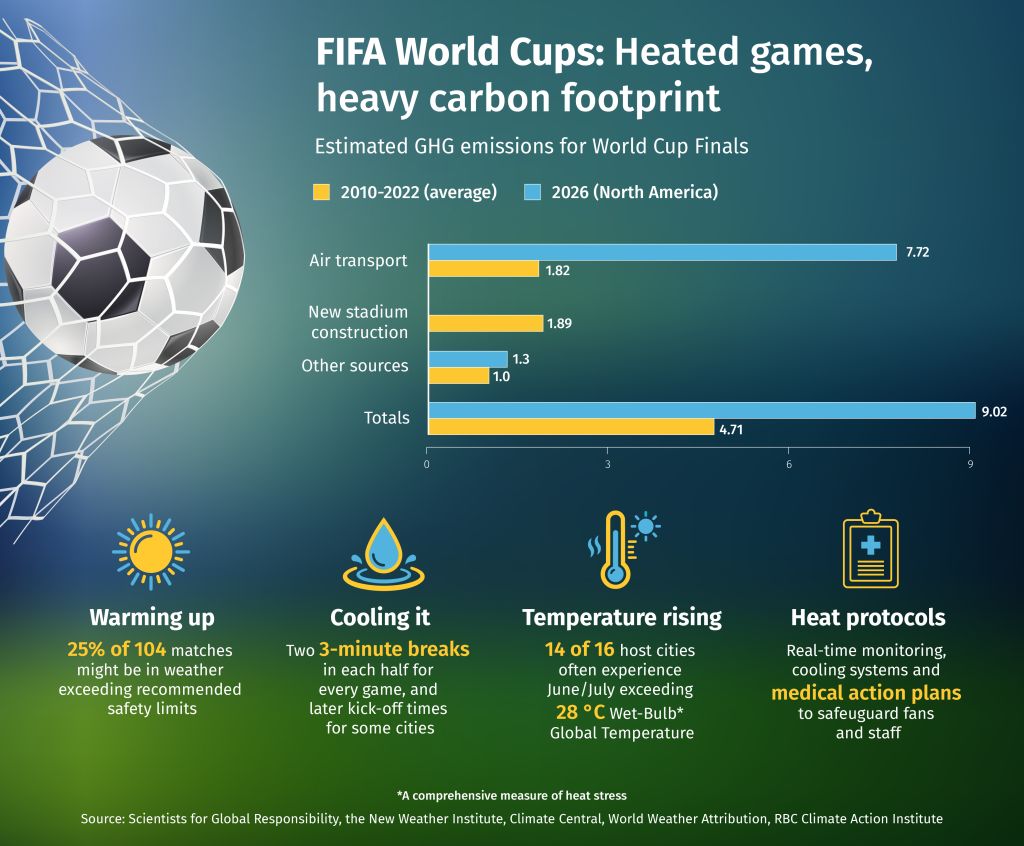
➔ Meet Coalie, the hard-hatted American mascot

➔ Ottawa’s auto strategy comes with a climate-action twist

➔ What should be the North Star for Canada’s proposed national electricity strategy?

Canadian companies aren’t waiting for Ottawa’s signal to advance the U.S.’s mineral ambition. While the federal government is holding off signing any formal deals with Washington on critical minerals, Toronto-based Cyclic Material is investing a strategic US$82 million in a rare-earth recycling facility in South Carolina, after securing new funding from the Canada Growth Fund, among other investors. It’s a trend: Vancouver-based Lithium Americas is building a massive project in Nevada, while Trilogy Metals is developing a copper-zinc-gold district in Alaska—with the U.S. government taking the unprecedented step of buying small stakes in both recently. North America’s market and geographical gravitational pull would hopefully overcome political posturing.

Climate Adaptation and Resilience (CA&R) could be the next frontier in climate investing. RBC Capital Markets’ report Private Markets Innovation in Climate Adaptation and Resilience highlights five areas where capital could make a difference: earth data, insurance solutions for businesses and society, wildfire and the grid, water, and the built environment. CA&R secured only US$65 billion in capital flows in 2023, compared to US$1.8 trillion in traditional mitigation investments such as renewables and energy storage. Climate Action Institute’s Clean Tech Lead Vivan Sorab believes while mitigation efforts’ address both current and long-term trends in emissions, their immediate impact tends to be muted; CA&R investment can potentially deliver more visible and quicker results in the form of less downtime and assets protected. The insurance costs are already mounting: 34 extreme-weather events triggered insured losses of US$1 billion or more in 2024—the second-highest number on record.

“Coalie,” the hard-hatted American mascot, may struggle to revive coal This carbon-intensive lump is getting a makeover for the AI meme era as the U.S. government promotes coal as vital for the economy. Despite its critics, coal saw a resurgence last year: U.S. coal-fired electricity jumped 13% year-on-year in 2025, while natural gas—which is about 50% less emission-intensive than coal—fell 3.6%, according to the International Energy Agency’s latest electricity outlook. However, coal’s dominance is slipping elsewhere in what the IEA describes as an “uncharacteristic” shift: major consumers China and India saw a drop in coal power generation in 2025 for the first time in more than five decades. While coal is projected to remain the single largest source of global electricity through 2030, the IEA predicts declining consumption in China and the European Union. Even the U.S. is expected to see a drop in coal consumption by 2030, Coalie’s charms notwithstanding.

Photo Credit: U.S. Department of the Interior

– By Farhad Panahov, Economist, RBC Climate Action Institute

Canada’s new strategy to boost EV sales has a twist: a cap of $50,000 for the total transaction value to be eligible for a subsidy. A more stringent rule—to boost mass market models—compared to a previous program that allowed purchases of more expensive trims.

Average price Canadians paid last year for a new vehicle was $55,000, and nearly $70,000 for an EV. And while each $1,000 could add 11% to the EV demand, based on Canadian Climate Institute’s analysis, only 13 of the 163 battery-electric models available in Canada are priced below that level, according to the Canadian Automobile Association. Another 10, priced at around $55,000, are potential candidates to be marked down to claim the subsidy.

Meanwhile, the 49,000-quota for Chinese EVs, should add further impetus to vehicle transition. Crucially, while these vehicles are excluded from the incentive program, they could enter the market at the lower end of the price range, as models like BYD and Geely made up about a quarter of global EV sales last year, are sold for $35,000 in China—roughly half of what Canadians paid for EVs in 2025.

But North America is notoriously in love with large cars, such as trucks and SUVs, a segment where Chinese EVs might not have the same price leverage. And don’t forget the 6.1% Canadian tariff that still applies on Chinese cars, plus shipping costs. Chinese EVs, facing less intense competition than at home, could also seek higher markups for their models in Canada.

The success of the Canadian strategy could rest as much on consumer trust as it does on the final price tag. Nearly half of Canadians are still not in the EV camp based on recent poll from Clean Energy Canada; and only one in 10 would buy a Chinese EV with another two in the “maybe” mindset.

The previous federal program of $2.7 billion helped put about half a million EVs on Canadian roads. The fresh round of subsidies, with a lower $2.3-billion allocation, could add 840,000 new EVs, the government projects.

Canada is about to welcome mass market EVs

The new auto strategy could help transport—a stalwart sector for emission cuts over the past five years (see our Climate Action report)—deliver the following in climate action:

  • EV mandates out, standards in. Abolishing the much contested EV sales mandates in favour of emissions standards will aim to achieve 75% EV sales share by 2035.

  • Emissions standards. Emissions standard are a common practice for automakers and allows for higher compliance flexibility compared to sales mandate while still incentivizing a pivot towards emissions-free vehicles. Since 2011 alone, emissions per mile from passenger cars and light trucks have declined 50% and 30%, respectively.

  • U.S.-Canada policy is diverging. Historically, Canada aligned its emissions standards with the U.S. It’s different now as Canadian policy diverges from the U.S. Environmental Protection Agency (EPA) push to roll-back Biden-era standards (that would have halved emissions per mile by 2032).

  • …As is Detroit 3’s strategy. The auto policy supports another $3 billion investment in the EV sector “positioning Canada as a place where the vehicles of the future are built.” However, the Detroit Three—Ford Motors, General Motors and Stellantis—are scaling back EV roll-out plans that has cost them around US$50 billion, amid tepid customer demand.

  • Networks are getting a supercharge. Ottawa is committing $1.5 billion to expand the charging network, adding to the $1.1 billion in funding, which so far has helped add 7,000 installations. Canada’s public charging network is already sufficient for current levels of EV adoption, at ratio of ~21 EVs per charging port, but will need to significantly expand as adoption accelerates.

Also check out: RBC’s Electric Car Cost Calculator

A scan of notables and notable developments

  • Lisa Ashton, Interim Head of the institute, is in Ottawa for Agriculture Day festivities, a timely opportunity to share insights from Seeding Scale, our new research on the growth capital pipeline in the agri-food sector. Lisa heard that the innovation pipeline needs focused improvements as well and universities and industry are working collaboratively to devise a clear vision for the sector ahead of the agriculture ministers meeting in July. 

  • As the U.S. convened allies, including Canada, on critical minerals last week, John Stackhouse shared a few thoughts. His first point: even the U.S. knows it can’t go-it alone on mining.

  • Canadian Climate Institute’s Rick Smith finds another climate angle on a recent Canadian court ruling that reinforced Ottawa’s right to list plastics as “toxic”: “…polluting industries and some provinces have been spinning a yarn that the federal government’s Clean Electricity Regulations, also enacted under CEPA, are an illegal over-reach. As of today, those arguments look like the thinnest of gruel.” Read the ruling.

  • As Canada develops a national electricity strategy, Polaris Strategy’s Dan Woynillowicz has some thoughts on what the strategy should set as its North Star: Double energy productivity, double production, and double the share of final energy demand met by clean electricity.

  • Nugget from a House of Commons report on climate change, from Janis Sarra of the Canada Climate Law Initiative, on the importance of Canadian taxonomy: “An estimated $115 billion annually is required for Canada’s low-carbon transition, and a  science-based taxonomy will create the market integrity, clarity and interoperability, globally, necessary to accelerate global capital to come and invest in Canada’s businesses.”

Curated by Yadullah Hussain, Managing Editor, RBC Climate Action Institute.

Climate Crunch would not be possible without John Stackhouse, Jordan Brennan, John Intini, Farhad PanahovLisa AshtonShaz MerwatVivan SorabCaprice Biasoni, Lavanya Kaleeswaran and Joelle Schonberg .

Have a comment, commendation, or umm, criticism? Write to me here (yadullahhussain@rbc.com)

Climate Crunch Newsletter