

 EN
EN 

As Canadian farmers produce more per acre to feed a growing global population, fertilizer use has jumped 108% over the past two decades. That has come with an environmental impact: synthetic fertilizers now account for a quarter of the agriculture sector’s emissions in Canada.1 But the current emissions accounting system is flawed as it primarily focuses on the quantity used. What’s missing in the equation is farmer stewardship of fertilizer use to optimize placement, source and timing that help lower emissions.
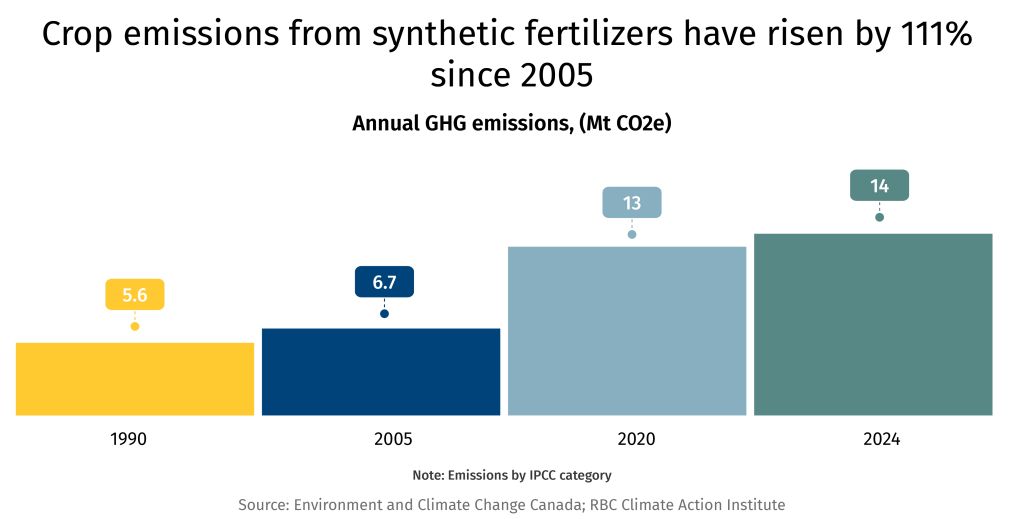
In an effort to optimize fertilizer use, the number of Canadian farmers with a nutrient stewardship plan has more than tripled over the past five years.2
Rising adoption rates are a sign of climate action. But it’s also an economic decision, especially as geopolitics continue to disrupt fertilizer supplies and raise prices. Nitrogen fertilizers have faced the brunt of supply chain shocks from geopolitical conflicts over the past five years as key producers include the Middle East and Russia. Nitrogen is also the primary driver of GHG emissions from fertilizer use. When nitrogen is not fully consumed by crops to grow, nitrogen can be emitted into the atmosphere as nitrous oxide (N2O) emissions, a GHG that is 273 times more potent than carbon dioxide over a 100-year time scale. When farmers adopt nutrient stewardship practices, GHG reductions can be substantial. An Ontario study, for example, found that when nitrogen fertilizer rates are optimized, and technology and practices that improve the source, timing and placement of fertilizer are adopted, N2O emissions can fall by up to 57%.
To capture in the accounting the full suite of practices, Canada, and other agriculture producing countries, including Australia, Denmark, New Zealand, Brazil and the U.S., are developing research and industry networks to collaboratively advance N2O measurement and monitoring systems.
These research-driven networks have multiple lab-to-market applications, including those focused on:
-
Improving the understanding of how farmers’ practices impact N2O emissions, supporting investment decisions by farmers, industry and governments in nutrient stewardship
-
Building a suite of indicators that allow for more accurate tracking against GHG emission targets at the farm, regional and national scale
-
Refining the measuring, monitoring, reporting and verification (MMRV) protocols for carbon offsets and sustainability programs, improving the accounting of farmers’ climate actions to better connect them to market-based incentives and provide greater assurance to carbon credit buyers
Canada: A driving force in innovation of measurement and monitoring practices
Canada’s response to fertilizer-related N2O emissions has increasingly focused on improving measurement, coordination, and on-farm nitrogen management. A central initiative is the Canadian Nitrous Oxide Network (CanN2ONet), a collaborative research network involving universities, government agencies, farmer groups, and industry partners. The network was established shortly after Canada’s national target for reducing fertilizer-related N2O emissions by 30% by 2030 was announced in 2020—a policy with notable industry push back that has since faded in sector discourse.
CanN2ONet operates a series of long-term monitoring sites across Alberta, Saskatchewan, Manitoba, and Ontario. These sites use micrometeorological techniques to continuously measure N₂O emissions from agricultural fields under different climates, soil conditions, and management systems. The network also addresses a long-standing challenge in agricultural climate policy: accurately measuring emissions at field scale. Traditional national GHG inventories often rely on generalized assumptions that do not fully capture local soil and weather conditions.
Denmark: An ambitious vision for meeting GHG targets
Denmark’s SmartField initiative represents one of Europe’s most advanced efforts to reduce agricultural N2O through data-driven and field-scale innovation. Led by the Danish Technological Institute and funded by the Novo Nordisk Foundation, SmartField aims to cut N2O emissions from Danish agriculture by as much as 30% by 2030 without reducing yields or increasing other forms of nitrogen pollution.
Canada and Denmark-based researchers are advising one another as both CanN2ONet and SmartField focus on building a national testing and validation platform for emission-reduction technologies and farming practices. The SmartField project combines stationary “supersites,” mobile measurement systems, advanced sensors, and modelling tools to monitor how fertilizers behave in real farming conditions. These facilities generate detailed datasets on nitrogen cycling, soil biology, crop performance, and greenhouse gas emissions.
One of the initiative’s features is the integration of science, policy, and implementation. SmartField brings together universities, government agencies, agricultural organizations, and private-sector stakeholders to accelerate the adoption of low-emission farming practices.
New Zealand: Balancing rural economic growth and GHG trajectories
Agriculture accounts for roughly half of the country’s GHG emissions. Cattle manure from livestock and fertilization of grasslands for animal feed are the main culprits of N2O emissions. The agricultural sector is also the largest contributor to export revenue, accounting for 70% of merchandise exports, with agricultural production alone contributing 5% to the country’s GDP.
New Zealand’s approach to managing its large agriculture environmental and economic footprint has evolved over the past five years with an initially strong prioritization on GHG reductions aligned with legislated net-zero targets. Through industry engagement, the focus has shifted towards innovation and scaling practices and technologies that present win-wins in productivity and emissions reduction. A government-led, centralized approach to advancing N2O emissions accounting has been driven by the country’s Ag Emissions Centre and rolls into New Zealand’s broader ambitions to mitigate GHG emissions from agriculture.
Lisa Ashton is RBC Thought Leadership’s Agriculture Policy Lead
Environment and Climate Change Canada. National Inventory Report 1990 –2024: Greenhouse Gas Sources And Sinks In Canada, 2026.
Fertilizer Canada. Fertilizer Use Survey, 2024.
This article is intended as general information only and is not to be relied upon as constituting legal, financial or other professional advice. The reader is solely liable for any use of the information contained in this document and Royal Bank of Canada (“RBC”) nor any of its affiliates nor any of their respective directors, officers, employees or agents shall be held responsible for any direct or indirect damages arising from the use of this document by the reader. A professional advisor should be consulted regarding your specific situation. Information presented is believed to be factual and up-to-date but we do not guarantee its accuracy and it should not be regarded as a complete analysis of the subjects discussed. All expressions of opinion reflect the judgment of the authors as of the date of publication and are subject to change. No endorsement of any third parties or their advice, opinions, information, products or services is expressly given or implied by Royal Bank of Canada or any of its affiliates. This document may contain forward-looking statements within the meaning of certain securities laws, which are subject to RBC’s caution regarding forward-looking statements. ESG (including climate) metrics, data and other information contained on this website are or may be based on assumptions, estimates and judgements. For cautionary statements relating to the information on this website, refer to the “Caution regarding forward-looking statements” and the “Important notice regarding this document” sections in our latest climate report or sustainability report, available at: https://www.rbc.com/our-impact/sustainability-reporting/index.html. Except as required by law, none of RBC nor any of its affiliates undertake to update any information in this document.