

 EN
EN 

-
Pathways for pipeline: Breaking down the Alberta-Canada deal
-
Why Hope Bay project boosts Indigenous participation
-
Oil is spiking, but clean energy stocks are the ones getting a bump
Signals
Honda may have shelved its $15-billion EV plant in Ontario—but there’s a world where Canada’s assembly lines bustle with activity. In Steering Through Uncertainty, RBC Thought Leadership’s Managing Director Jordan Brennan outlines four possible futures for the embattled Canadian auto industry. One of the rosier forecasts sees the industry restore access to the U.S. market, unlock billions in pledged investment for EVs and conventional vehicles, and ramp up car assembly to two million by 2040 (from 1.3 million today). Leveraging critical mineral reserves bolsters the case for made-in-Canada cars. That’s the fast lane scenario. Other projections lead to diversification, deceleration, and even a dead end. Dive into all four scenarios here.
Hope Bay project promises Inuit-led development. Ottawa broke ground on the $2 billion redevelopment of the Hope Bay gold mine in Nunavut—projecting $2.6 billion in annual export growth and nearly 2,000 jobs. Ottawa also committed $25 million to the Kitikmeot Tugliq Energy Hope Bay Wind Project, an Inuit-owned wind and battery storage system that will power the mine. The project is a useful real-world test of the framework examined in Nations Building, our assessment of Indigenous loan guarantee programs in Canada’s new project wave. Hope Bay is promising on three counts:(1)The mine will be powered by wind and batteries rather than diesel. (2) Indigenous equity participation in mining remains structurally underrepresented. Hope Bay is gold, not a critical mineral, but it establishes a template for the harder projects that follow. (3) An Inuit-owned energy project powering a mine on Inuit lands offers opportunities communities in remote regions toparticipate in Canada’s new projects.
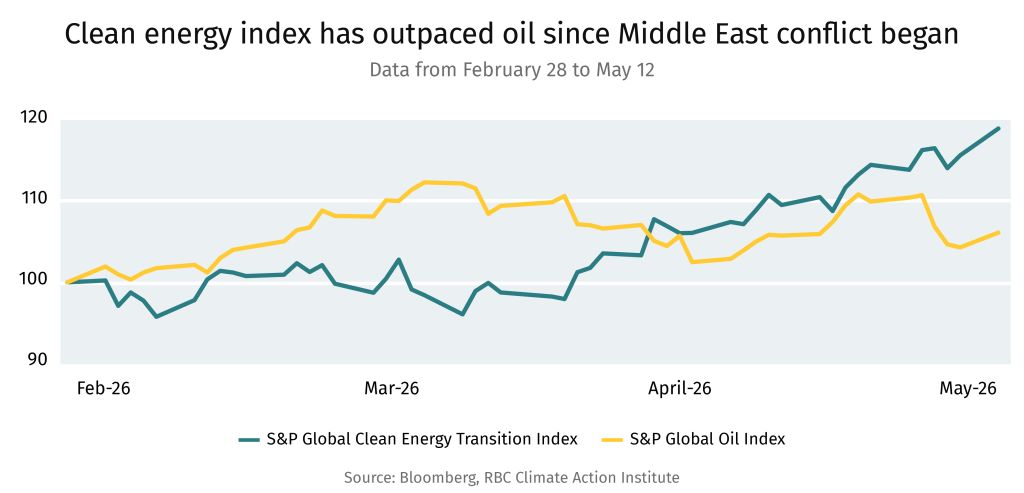
Oil prices are spiking, but momentum rests with low-carbon stocks. Clean energy companies benefit from both elevated fossil fuel prices and accelerating renewable policy support on growing concerns over energy independence, Christopher Dendrinos, RBC Capital Market’s clean energy analyst, told us. This is particularly pronounced in oil-and-gas import-reliant Europe. While natural gas dominates the data centre space, renewables are also benefiting from rising demand to power AI. “The sector remains resilient going forward given the strong energy demand macro backdrop,” Dendrinos said.
Pipeline for Pathways, and a climate reset for Canada
Canada and Alberta’s landmark Implementation Agreement last week builds on the November 2025 Memorandum of Understanding that aimed to balance Canada’s economic and environmental goals. However, the Implementation Agreement doesn’t stand alone. A day before, Carney had launched a National Electricity Strategy committing to double Canada’s grid capacity by 2050, with consultations now underway with provinces, territories, Indigenous Peoples, utilities, and unions. The strategy projects up to $15 billion in total energy savings and lower energy costs for 7 in 10 Canadian households. Natural gas retains a role for grid stability, nuclear and geothermal get explicit support, and the Clean Electricity Investment Tax Credit is being extended to intra-provincial transmission. A joint Alberta-Canada Electricity Working Group has been struck to advance the work.
Other stakeholders will now weigh in on the national electricity strategy, but the Alberta-MoU is much further ahead and poised for action. Energy Policy Lead Shaz Merwat breaks down its key highlights:
-
Carbon pricing in Alberta is locked in through 2040: Headline TIER (Technology Innovation and Emissions Reduction) prices: $95 today, $115 per tonne in 2030, $130 in 2035, $140 in 2040. The federal backstop will be updated to match — this is now effectively the national industrial carbon pricing framework.
-
A binding floor on TIER credits — for the first time: Starting at $60/t in 2030, rising to $110/t by 2040. Pre-MOU, TIER credits traded at roughly $20 against a $95 headline. The floor is the most consequential new mechanism in the deal.
-
75 Mt of Carbon Contracts for Difference: Jointly issued 2030–2040, equally cost-shared, $600 million maximum liability per party ($1.2 billion aggregate). If either government walks back, that party assumes sole liability.
-
The West Coast pipeline has a defined timeline: Alberta submits to the Major Projects Office by July 1, with Ottawa designating it as a “project of national interest” under the Building Canada Act by October 1. The one million barrels per day pipeline to Asian markets could start construction by September 2027.
-
No Pathways, no pipeline. The two projects are explicitly mutually dependent. Pathways targets 16 Mtpa in total emissions reductions: 6 Mtpa by 2035, 5 Mtpa by 2040, 5 Mtpa by 2045. The trilateral MOU with the Oil Sands Alliance is still unsigned.
-
Sector-specific stringency rates. Large oil sands companies face 2% annual tightening of emissions intensity through to 2040 under revamped TIER, while Pathways operators see a tightening of just 1% from 2031 onwards.
-
Co-operation agreement on Impact Assessment. Two-year cap on impact assessments and federal deference to provincial processes where projects fall primarily within Alberta’s jurisdiction.
-
Indigenous economic participation centred across the framework. Co-ownership and equity partnership paths referenced repeatedly in today’s Implementation Agreement and the Co-operation Agreement on Impact Assessment.
-
The Co-operation agreement reflects intriguingly different working on UNDRIP. Canada maintains its commitment, while Alberta views UNDRIP as non-binding.
-
Climate targets remain intact. Both Alberta and Ottawa re-commit their target of net zero by 2050.
Taken together, the twin announcements represent a potential move towards creating the most comprehensive federal-provincial energy framework Canada has produced in a decade — covering carbon markets, carbon capture, storage and utilization, oil export infrastructure, and grid expansion simultaneously. The architecture is scoped, but execution will be key. The proxies to watch over the summer, in the lead-up to Ottawa’s Canada Investment Summit in September: a named pipeline proponent, the trilateral MOU with the Oil Sands Alliance, and the first material Indigenous consent agreement on the pipeline route.
Conversations
-
Long-term uncertainty in global oil markets may ultimately accelerate the shift toward EVs as Canada strengthens domestic electricity generation, Victor Fedeli, Ontario’s Minister of Economic Development, Job Creation and Trade, told John Stackhouse at the Toronto Region Board of Trade Auto Event.
-
Agriculture Policy Lead Lisa Ashton on why Canada and other countries are embarking on a fertilizer emissions accounting overhaul. Read the brief here.
-
It’s hard to trace where critical minerals come from, weakening their environmental bona fides. Around 30-40% of the companies have a traceability system. The International Energy Agency says strengthening incentives for collecting and sharing data could be one of five ways to address the challenge.
-
Alberta’s “failure” to build new transmission could cost consumers in the province over a quarter of a billion dollars annually through higher electricity bills, Will Noel, of the Pembina Institute, estimates.
-
Leah Stokes, a professor of environmental politics at the University of California-Santa Barbara, says the current U.S. administration’s push away from clean sources is costing each American household US$1,508 this year alone.
Curated by Yadullah Hussain, Managing Editor, RBC Climate Action Institute.
Climate Crunch would not be possible without John Stackhouse, Jordan Brennan, John Intini, Farhad Panahov, Lisa Ashton, Shaz Merwat, Vivan Sorab, Caprice Biasoni, Lavanya Kaleeswaran, Joelle Schonberg and Alicja Siekierska.
Have a comment, commendation, or umm, criticism? Write to me here (yadullahhussain@rbc.com)
Climate Crunch Newsletter
This article is intended as general information only and is not to be relied upon as constituting legal, financial or other professional advice. The reader is solely liable for any use of the information contained in this document and Royal Bank of Canada (“RBC”) nor any of its affiliates nor any of their respective directors, officers, employees or agents shall be held responsible for any direct or indirect damages arising from the use of this document by the reader. A professional advisor should be consulted regarding your specific situation. Information presented is believed to be factual and up-to-date but we do not guarantee its accuracy and it should not be regarded as a complete analysis of the subjects discussed. All expressions of opinion reflect the judgment of the authors as of the date of publication and are subject to change. No endorsement of any third parties or their advice, opinions, information, products or services is expressly given or implied by Royal Bank of Canada or any of its affiliates. This document may contain forward-looking statements within the meaning of certain securities laws, which are subject to RBC’s caution regarding forward-looking statements. ESG (including climate) metrics, data and other information contained on this website are or may be based on assumptions, estimates and judgements. For cautionary statements relating to the information on this website, refer to the “Caution regarding forward-looking statements” and the “Important notice regarding this document” sections in our latest climate report or sustainability report, available at: https://www.rbc.com/our-impact/sustainability-reporting/index.html. Except as required by law, none of RBC nor any of its affiliates undertake to update any information in this document.