WP Menu

wp-menu

By Lisa Ashton, Director of Agriculture Policy, RBC Thought Leadership

U.S. President Donald Trump’s US$12 billion aid package for American farmers struggling with rising input costs like fertilizer and seeds comes with a sting for Canada. Trump is considering “very severe” tariffs on Canadian fertilizer to “bolster” U.S. domestic fertilizer production. 

This could prove to be an own goal for Washington. More tariffs on Canadian fertilizers are likely to raise prices for U.S. farmers in the short-term and could create volatility in securing long-term supply. The proposed move comes as the U.S. has few alternatives to Canadian fertilizer, while American farmers have limited leverage in the market and are price receivers. Here’s what is at stake for both the Canadian and U.S. agriculture sectors:

  • Canada accounts for 81% of U.S. potassium-based chemical fertilizer imports and tariffs would further raise costs along North America’s interconnected agri-food supply chain.1

  • The U.S. tried a version of this before: It imposed broad tariffs (25%) earlier this year on many Canadian imports, including potash and other fertilizers. After pushback from American farmers and industry groups, fertilizer tariffs were reduced to 10%.

  • Those moves proved to be a body blow as U.S. Import Price Index for chemical fertilizers rose from 164.5 in December 2024 to 186.5 in September 2025.2

    • The U.S. Prices Paid Index tracking costs paid by U.S. farmers rose to 149.9 in June 2025, up from 139.9 the year before. Over the same period, fertilizer costs were the primary driver for rising costs for U.S. crop farmers, up 11% in the index.3

  • Canada has the world’s largest potash reserves, with 1.1 billion tonnes of potash, which is 5x larger than U.S. reserves.4 Canada’s scale of potash mining by production volumes was 36x larger than the U.S. in 2024.5

  • Fertilizers account for roughly 30% to 45% of a U.S. farmer’s annual operating cost, depending on the crop.6 As farmers are vulnerable to volatility in input prices, they often can’t pass rising input costs onto consumers since many sell into commodity markets (i.e. corn, wheat, soybeans). That could challenge the U.S. administration’s efforts to reduce costs for farmers ahead of 2026 mid-terms with active tariffs on their inputs and threats of more.

  • The U.S. could carve out separate deals with Canada and Mexico says U.S. Trade Representative Jamieson Greer. He said the Trump administration is leaving all options on the table when it comes to the Canada-U.S.-Mexico Agreement (CUSMA). Mark Carney was quick to dismiss the possibility of separate deals: “That’s not what they’re saying.”

  • Kirsten Hillman, Canada’s ambassador to the U.S. who played a key role in the CUSMA negotiations, announced that she will step down in the New Year. Hillman’s replacement has yet to be announced but reports surfaced that Mark Wiseman, former chief executive of the Canada Pension Plan Investment Board, is the front-runner.

  • Canada’s $153-million trade surplus in September blew past analysts’ expectations of a $4.5-billion deficit. Exports to the U.S. rose 4.6% (imports fell 1.7%). And exports to other parts of the world shot up 18.6%.

  • In the U.S. exports surged in September, resulting in the smallest trade deficit in 5 years.

  • And China’s trade surplus tops US$1 trillion for the first time. Despite trade tensions with the U.S., Beijing exported US$3.4 trillion worth of goods in the first 11 months of the year by finding, in part, new markets for its outbound shipments, including Africa (+26%), Southeast Asia (+14%) and Latin America (+7.1%).

By Jordan Brennan, Managing Director, RBC Thought Leadership

President Trump has been making the point that tariffs carry with it short-term pain for long-term gain. The data confirms that he’s got the pain part right.

Inflation: Since Trump’s so-called ‘Liberation Day’ in April, producer prices in the U.S. have moved meaningfully higher. The knock-on-effect: consumer inflation has grown for five consecutive months and now stands at 3%—a level not seen since early 2024.

Producer and Consumer prices march higher since liberation day

Consumer sentiment: According to the University of Michigan’s long-running survey of consumers, confidence is sitting at half-century lows. Four of the 10 worst monthly readings have come since Liberation Day.

Manufacturing: Far from rebounding, manufacturing employment—including politically-sensitive auto jobs—has worsened since January. The U.S. has shed nearly 50,000 manufacturing jobs this year.
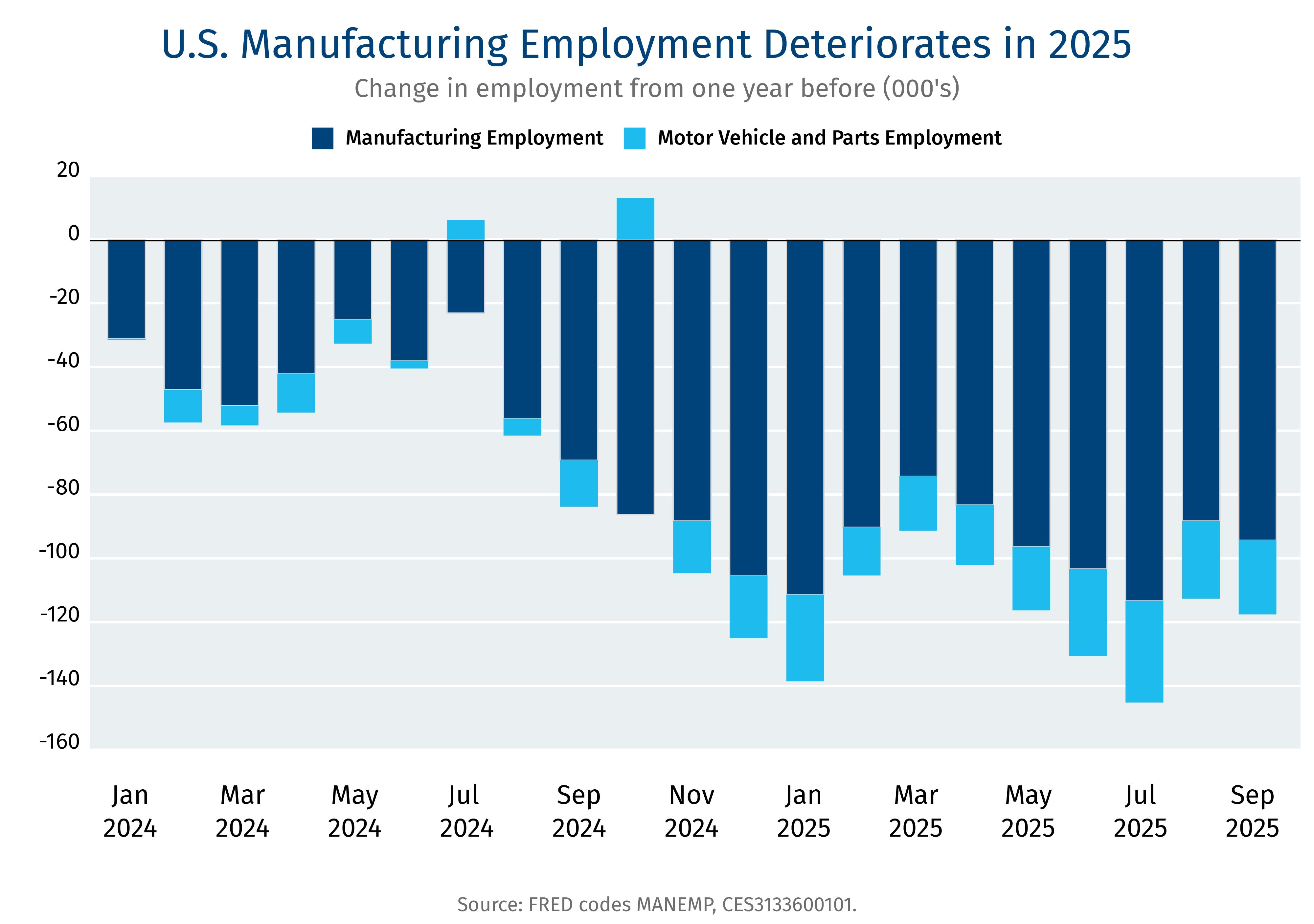
U.S. Manufacturing Employment Deteriorates in 2025

The rejoinder from the White House is inevitably that the tariff policy takes time and discomfort is transitional. But voters rarely reward distant promises over immediate pain. And Trump has already started to ease off, recently slashing tariffs on beef, coffee and assortment of other grocery-store items. Expect more selective tariff relief—targeted by region and by product—as the midterms draw closer.

WP Menu

wp-menu

I sat down with former Australian prime minister Scott Morrison while he was in Toronto this week, to talk about that country’s bold bets on the space sector and what Canada can learn.

Morrison helped launch Australia’s space sector into a higher orbit, and is now active in the global sector, especially in the U.S. Here’s some of what he shared with me, as well as a group of Canadian space leaders and investors:

  • Space is “once again becoming a geopolitical contest,” echoing the 1950s–70s space race. Pretty much every aspect of intelligence and national security now has a space connection. 

  • Canada should see space as a way into the world’s most important military and security alliances. AUKUS (Australia-UK-US) is one of those groups, as is the Quad (US, Australia, India and Japan) and the Five Eyes intelligence network of the US, Britain, Australia, New Zealand and Canada. 

  • AUKUS is worth watching as it shifts attention from submarines and undersea dominance to orbital dominance. Space may be Canada’s opportunity to join an AUKUS2.

  • While NATO has been slow on space, that will shift. The Ukraine war — and the role of satellites and drones — shows where future battlefields lie.

  • The sector is projected to grow ~9% annually, heavily driven by semiconductors, satellites and global AI demand.

  • Combined, AI and space will be the defining mega-trends of the next 50 year, shaping global security, economics, and national capabilities.

  • A dedicated national space agency, with senior oversight from government, is essential for the sector’s growth, providing critical mass, coordination, and legitimacy.

  • Large private-sector players are essential, too, but public capital and international partnerships are required.

  • Launch leads to legitimacy. If a country can’t launch its own assets into orbit — right now, Canada can’t — it won’t be a leader. Australia is aiming to build the only near-equatorial launch site among the Five Eyes, making it more indispensable to intelligence partners. 

  • Don’t stop at launch. “The sexy stuff is rockets,” but real industry growth depends on infrastructure, logistics, testing, science support and service capacity.

  • Others are on the move. Japan is aggressively scaling its space ambitions, targeting 30 launches per year and leveraging tight state–industry coordination. New Zealand has Rocket Lab and a politically energized space agenda.

Here’s what Morrison says Canada needs:

  • A credible national space strategy with funding behind it.

  • A capability others need.

  • A willingness to invest politically and financially at the scale the US and Australia are committing.

  • A concrete capability that strengthens our alliances, including  space domain awareness, Arctic surveillance, satellite manufacturing, launch capacity, AI-enabled sensing and cyber integration.

  • A security-focused rationale, aligned with allied threat assessments — particularly those related to China.

“At the end of the day, this is a security initiative, not an industry development initiative. At home, governments will speak about employment and economic benefits. But in Washington, Canberra, London, Tokyo, or Wellington, the argument must be strictly: Here is the capability Canada brings to collective security.’”

WP Menu

wp-menu

Artificial Intelligence is poised to reshape how value is created across Canada’s economy. To understand that shift, RBC Thought Leadership interviewed more than two dozen firms that are on the frontlines of building or deploying AI for Bridging the Imagination Gap: How Canadian Companies Can Become Global Leaders in AI Adoption. The report distilled the patterns that emerged from those conversations.

Building on that report, our series of case studies goes a level deeper. Here we follow how Manulife, a global insurer and asset manager, used generative AI as a catalyst to rethink how the organization learns, shares, and scales new ideas. The company’s experience shows that successful AI adoption is not a technology challenge alone—it’s a challenge of capability-building, governance, and empowering people to work differently.

Manulife, a global asset manager headquartered in Canada, saw AI as a chance to move beyond incremental efficiency gains and reimagine products and operations. Leadership judged the sector “too comfortable,” set a clear ambition to become a digital-customer leader, and treated OpenAI’s Large Language Model in 2022 as a tipping point. A hands-on executive session turned AI from a niche experiment into a CEO-level agenda item, signalling that real impact would require structure, governance, and integration—not one-off pilots.

Build absorptive capacity (infrastructure). Manulife created a multi-tier learning stack and embedded ~200 data science and machine learning experts, and used leadership rituals to grow the “stock of prior knowledge,” so new AI advances could be absorbed and embedded faster.

Institutionalize adaptive capacity (the engine). Leaders normalized copying—if one team built something useful, others reused it. This turned isolated wins into shared playbooks and spread improvements quickly. By embedding that habit, Manulife accelerated the cycle of adopt, invent, select, scale, building adaptive and innovative capacity together.

Balance speed and safety (governance by outcomes). Responsible AI principles, expanded model-risk frameworks, cross-functional review, and real-time telemetry treated fast iteration and strong oversight as complements, not one-off pilots

It was mid 2020. Jodie Wallis, then Manulife’s Global Chief Analytics Officer, had summoned the company’s top executives into a Toronto boardroom. She knew the meeting would mark a turning point: OpenAI’s breakthrough latest large language model (LLM), GPT1– 2 had just been released, and, at nearly 100 times stronger than its previous models, GPT-2’s implications stretched far beyond the technology itself. For Manulife, a 137-year-old insurer built on actuarial precision and risk discipline, the question was whether this new capability would be treated as a passing novelty, or as the spark for deeper change.

For years, AI at Manulife meant prediction and automation—underwriting models, fraud detection, lead scoring. Even as the frontier advanced with machine-learning models that could conjure hyper-realistic images, these applications still felt contained within the realm of “computer things.” They were useful and very impressive but safely bounded by expectation.

To Wallis, large language models like GPT shattered those boundaries. Designed for an iterative exchange, they created value not through a single output but through an unfolding dialogue—shifting the dynamic from command-and-response to something closer to collaboration. LLMs could now reason with a human-like cadence, inviting conversation rather than instruction. The breakthrough was not a more polished “answer,” but the model’s ability to so fluidly augment inquiry itself—generating new directions of thought and discovery.

That shift—from bounded tasks to open-ended discovery—was as unsettling as it was exhilarating. Wallis framed the moment with unusual candor: “Our industry has been too comfortable. This technology isn’t just another tool—it’s a fork in the road. We either harness it, or risk being reshaped by it.”

Around the table, reactions varied: curiosity, excitement, apprehension. The challenge was immediate. Should Manulife treat generative AI as an experiment at the margins, or as the new trajectory of the business itself? Wallis herself was convinced of the answer, but she also knew the technology was still raw—too raw, perhaps, for the boardroom to fully accept. The choice would force hard calls about strategy, governance, culture, and investment, all at the breakneck pace at which the frontier was advancing.

In such moments of technological upheaval, corporate boards look to figures like Wallis to distinguish passing trends from transformative forces. Unlike the technologist-soothsayers popular at the time, her task was consequential: to foresee how generative AI might reshape an institution built on actuarial discipline, and to ensure Manulife seized the opportunity rather than being undone by it. Frame the moment correctly, and new value could be unlocked; misjudge it, and the consequences could be existential.

But foresight alone would not suffice. Wallis knew no memo or slide deck could capture the implications of generative AI; words on a page risked being dismissed as abstractions. The only way forward was direct confrontation. To overcome that gap, one had to experience it themselves. Fortunately, the technology itself offered an answer—the opportunity to turn the crystal ball around and let skeptical peers glimpse inside for themselves.

So, she placed a tablet in front of each leader, preloaded with the latest OpenAI model, and invited them to test it—to ask it the questions they might otherwise have asked her. The room fell silent as screens lit up with blinking prompts. One by one, Manulife’s senior leaders began conversing with GPT-2, watching as it generated fluent answers in real time. The exercise was disarmingly simple, yet it shifted the atmosphere. Within minutes, the conversation had moved from “is this real?” to “what does this mean for us?”—the kind of pivot that months of memos and meetings could never have achieved.

It was Wallis’s decision—to make her colleagues experience the frontier for themselves—that created conviction at the top. But she knew conviction alone would not be enough. To matter, it had to be built into infrastructure, and then into the agility to adapt. With that boardroom experiment, Wallis set the flywheel in motion—conviction, infrastructure, adaptation—that would carry Manulife through one of the most profound technological shifts in its history. In doing so, Manulife joined a small group of financial giants positioning Canada at the forefront of AI transformation.

To understand how this journey unfolded, RBC Thought Leadership sat down with Jason MacDonald, Chief of Staff in the Office of the CEO, and Jodie Wallis—now the company’s Global Chief AI Officer—to explore how they and their colleagues steered a $72-billion insurer through one of the most profound technological shifts in its history.

Strong buy-in from senior executives is critical at the beginning of any transformative initiative. Wallis understood that leaders had to experience AI directly for themselves. In doing so, she was putting into practice what Everett Rogers’ diffusion theory had long shown: new ideas spread faster when they are trialable—safe to experiment with in low-risk conditions—and observable—when peers can see results firsthand. Together, these conditions turn abstract technology into something tangible enough to believe in.

That is exactly what unfolded in the boardroom. Once a few respected voices found the tool useful—asking follow-ups, reading fluent outputs aloud—trialability was satisfied: executives could experiment in a low-stakes, hands-on way. And because these experiments happened in public, observability took hold: colleagues could watch, compare reactions, and see the system working in real time. What could have been a solitary experiment quickly became a shared moment of discovery. Peer-to-peer reinforcement allowed skepticism to fall away and curiosity to spread, because the technology no longer seemed risky or abstract.

But conviction alone is not enough. To matter, it had to be translated into infrastructure that would let Manulife absorb and scale what leaders had seen. That is where absorptive capacity comes in.

A single demo, however persuasive at the individual level, fades unless an organization as a whole can metabolize what it saw into repeatable capability. That is the job of absorptive capacity—a firm’s ability to recognize the value of new information, assimilate it, and apply it to commercial ends—the infrastructure that makes later adaptation possible. Research on absorptive capacity, first developed by professors Wesley Cohen and Daniel Levinthal in the 1990s, highlights two foundations of that infrastructure:

Knowledge is cumulative and path-dependent—it builds fastest on what people already know, meaning prior knowledge is like scaffolding for future learning.

Breadth of knowledge expands absorptive reach—organizations with a wide base of prior knowledge can take in and apply new external ideas more effectively.

Absorptive capacity is about learning—building the knowledge base and routines to embed new tools. Adaptive capacity (discussed in Insight Three) is about changing—reconfiguring those routines when the frontier shifts and old paths no longer fit. Manulife needed both, but it started by deliberately building the absorptive infrastructure needed to allow the organization to learn. In doing so, Wallis’s team treated culture and skills as equal pillars to technology and designed a multi-tier learning stack:

AI 101 for anyone with an interest

advanced prompt-engineering and data-science for power users, and

tailored executive modules delivered with university partners.

They then wove AI into leadership rituals. At Manulife’s Global Leadership Conference, for example, executives showcased employee-built solutions to their peers, creating a common language of use cases and governance. The goal wasn’t just awareness; it was to give every layer of the company—front line to boardroom—enough context to recognize where AI was relevant and embed it in daily work.

In Cohen and Levinthal’s terms, Manulife was steadily increasing its stock of prior knowledge, so each new wave of technology could be absorbed and recombined faster. Wallis’s actions directly aligned with the two conditions they described: training and rituals made learning cumulative by building on what employees already knew, and broad participation across the workforce expanded the base of knowledge available to draw on. In an industry often criticized as “too comfortable,” this gave Manulife a distinctive edge: the ability to build on new tools and embed them into its routines in ways that accumulated advantage over time.

But infrastructure alone is not enough. Once that foundation was in place, the challenge became keeping momentum when the frontier shifted and old paths no longer fit. That required a different capability: adaptive capacity—the engine that keeps the flywheel turning.

When then-CEO Roy Gori warned that the industry had grown “too comfortable,” Wallis knew this complacency was dangerous in a domain where new AI models and applications were appearing at a breakneck pace, driven by massive new capital flows. Absorptive capacity had already given Manulife the infrastructure to learn and embed AI tools across the enterprise. The next challenge was agility: ensuring the company’s response to advancing technology was equally swift and dynamic. Adoption couldn’t be a one-off event; it had to become iterative. That insight set the stage for adaptive capacity—the engine that converts adoption into continuous reinvention.

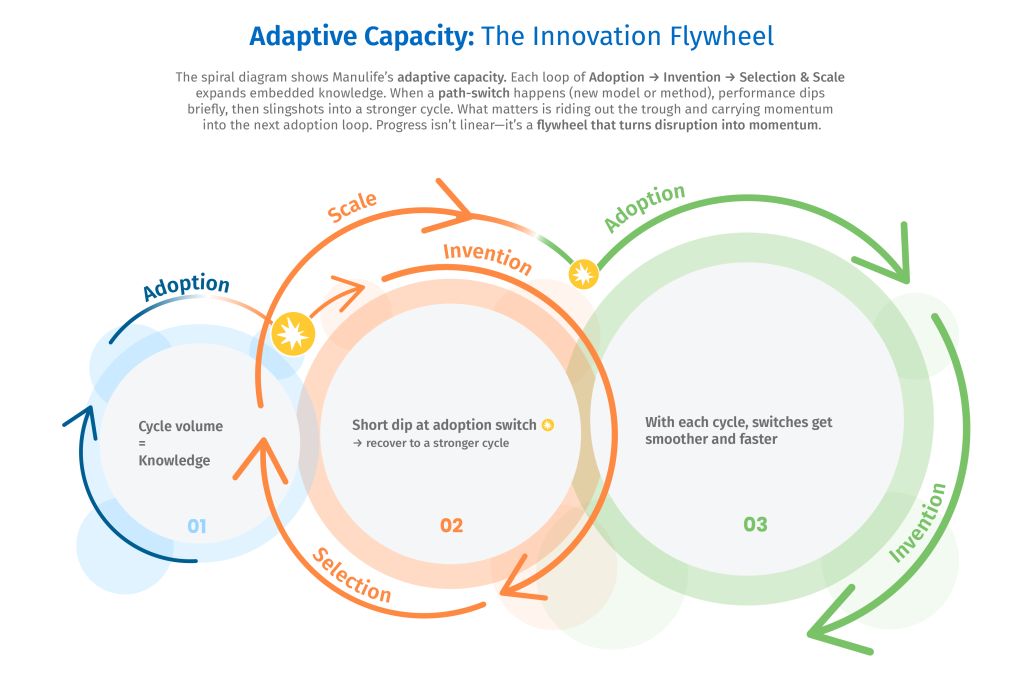
Research underscores why this engine is critical. Prior adoption experience is the single strongest predictor of inventive capacity: organizations learn to invent by first copying. Yet when firms switch paths—moving to new models or methods —performance often dips before it recovers, as old mental models stop fitting the new approach. Adaptive capacity is therefore the discipline of riding out that trough and recovering faster, turning temporary disruption into cumulative learning. Manulife operationalized this discipline through a set of deliberate routines.

Adoption→ taking in new tools, practices, or patterns developed elsewhere, and embedding them into the organization’s routines.

Selection and Scale → filtering what works, embedding it into routines, and scaling proven solutions across the enterprise.

Invention→ creating original solutions internally, without relying on external patterns.

Manulife built this discipline deliberately. With a strong foundation of AI literacy embedded across the company, leadership worked to smooth adoption pathways by normalizing copying as a precursor to invention. Wallis instituted prompt-a-thons and leadership conferences where employee-built tools were showcased, creating a common language of value and risk. These rituals made it legitimate to borrow, refine, and scale what worked—ensuring adoption wasn’t confined to early enthusiasts but cascaded across the enterprise. In Cohen and Levinthal’s terms, this was about continuously increasing the firm’s stock of prior knowledge so that when a path switch came—whether a new model, platform, or application—the organization could absorb and apply it faster.

Secondly, Wallis deliberately designed for safe path-switching. A vendor-agnostic, cloud-ready stack allowed models to be swapped ‘even daily,’ making technology change a managed routine rather than a disruptive reset. Scaling decisions were tied to clear business outcomes—revenue lift, cost savings, risk reduction, or productivity—so that pivots created value rather than noise.

Finally, it embedded selection capacity—the discipline to prune weak ideas quickly and scale winners. Cross-functional forums and outcome-based funding kept the portfolio focused, so absorptive capacity compounded rather than leaked.

Together, these routines formed Manulife’s innovation flywheel: adoption experience generated invention; selection routines filtered the noise; flexible architecture enabled safe path-switching; and the loop restarted with each cycle stronger than the last.

From the outset, the company made responsible AI governance a design choice. In the absence of clear national rules, it created its own responsible AI principles and operating rules to ensure experimentation and deployment stayed aligned with ethical, privacy, and compliance obligations.

Manulife expanded its existing model risk frameworks to address GenAI’s unique challenges—vetting third-party vendors, monitoring outputs for bias or hallucinations, and requiring ongoing performance assessments for every model in production. A cross-functional governance committee reviewed use cases for ethical and privacy risks, aligning policies with evolving global guidelines. Governance was embedded as a living process, not a static policy.

Critically, Manulife treated fast iteration and strong oversight as complements, not trade-offs. Continuous model monitoring—tracking accuracy, drift, and usage—was used to tighten controls in real time. This outcome-based approach allowed models to stay in production as long as they met error and bias thresholds, and to be adjusted or pulled the moment they didn’t. Iteration was welcome, but never at the expense of trust.

This proactive stance enabled Manulife to scale GenAI quickly and responsibly, building confidence with compliance teams, customers, and policymakers, even in the absence of clear regulation. The broader lesson is that firms in sensitive sectors should not treat regulation as a brake. By self-imposing principles, operationalizing oversight, and demonstrating to regulators that innovation can be pursued responsibly, companies can get ahead of uncertainty. For policymakers, the takeaway is equally important: enabling real-time oversight and outcome-based guardrails may achieve safety faster than prescriptive, one-off compliance checks.

Within just a year of embracing generative AI, Manulife achieved broad-based adoption at a speed few incumbents match. Its proprietary assistant, ChatMFC, went from pilot to near ubiquity: within months, 40% of employees were using it monthly, and by early 2025, more than 75% of the global workforce was actively engaged with GenAI tools, training, or use cases. Adoption was not siloed to tech teams; it touched nearly every function, from sales and service to back-office operations.

The impact on productivity was equally striking. In call centers, AI tools shaved 30 – 40 seconds off average call times without lowering customer satisfaction. Across the enterprise, generative AI was no longer a side project—it had become embedded in the daily flow of work.

Customer-facing gains were even more visible. Newer advisors ramped up faster, using AI coaching to practice and refine interactions. Meanwhile, advisors reported that AI freed them to focus on client relationships, creating the unusual outcome of a technology initiative that delivered both efficiency and deeper human engagement.

At the strategic level, the flywheel was spinning. By mid-2025, Manulife had 35+ GenAI use cases in production and 70 more in queue. Early deployments alone contributed an estimated $4.7 million in benefits, while the broader digital transformation program (with AI at its core) yielded over $600 million in 2024 benefits—savings, new sales, and better risk outcomes. Looking ahead, the company projects a threefold return on AI investments over five years. These results affirm that Manulife’s design choices — hands-on executive engagement, outcome-gated scaling, perpetual-beta governance—transformed AI from novelty to institutional capability.

Numbers

$1.6T Assets under management
35MCustomers worldwide
$53BMarket Capitalization
$5.1BNet Income
38kNumber of employees
200Data scientists and engineers embedded across teams
$600mBenefits attributed to digital transformation (with AI as a core part) in 2024.
75+AI use cases deployed by the end of 2025
75%Share of Manulife’s global workforce engaged with GenAI

Download the Report

WP Menu

wp-menu

Momentum is building across Canada for Indigenous-led agriculture production and food processing. This was on full display in Regina at the recently-concluded Canadian Western Agribition, Canada’s largest livestock show, where the National Circle for Indigenous Agriculture and Food (NCIAF) hosted the Indigenous Agriculture Summit, attracting more than 400 attendees.

1. Shifting demographics sparks skills development

Canada’s total farm population decreased by 3.5% between 2016 and 2021.1 Its workforce is also getting older, with the average farm operator now 56 years old. In contrast, the Indigenous farm population is growing (+6%), with average Indigenous male farm operator aged 34 and 39 for female operators.2

Agriculture’s relatively young and growing Indigenous population can potentially help the sector meet its rising demand for highly skilled talent. It could also support services gaps, including business and finance advisory, agronomic and technology support, and environmental and management planning services.

Indigenous training programs are growing at college and university campuses across the country. In some cases, the offerings are highly specific. For instance, Suncrest College, which operates nine locations across Saskatchewan, launched an Indigenous-led canola crushing program earlier this year. The 12-week program prepares students for careers in the oilseed crushing industry.3 Assinobione Community College in Manitoba is also strengthening Indigenous students’ access to agri-food training and skills by providing tuition-free programs like horticultural production for off-reserve learners, funded by partners like the Congress of Aboriginal Peoples.4

2. Expanding Indigenous engagement in production and land management

First Nation reserves across the prairies are home to 1.5 million acres of cropland—and growing. In Saskatchewan, Indigenous reserve land has nearly doubled since 1992—currently 8,234 square kilometres—due in part to the Treaty Land Entitlement (TLE) and Specific Claims process. The TLE and Specific Claims are Canada’s avenues for fulfilling promises to First Nations, addressing land owed from historical treaties or breaches of obligations of assets (Specific Claims). Cropland on reserves in Saskatchewan increased by roughly 10% over the same period and now covers roughly 43% of reserve land in the Prairie provinces– below the provincial average of cropland accounting for 63% of Saskatchewan.5

With expanded reserve lands and a growing movement to build food sovereignty, Indigenous communities are reintroducing or advancing their community food production systems, focusing primarily on gardens and raising animals on a small scale for local consumption. Fox Lake Cree Nation, for example, reintroduced fruit, vegetable and poultry production for the community, situated 750 kilometres northeast of Winnipeg. On a larger scale, 4C Farms Ltd., on Cowessess First Nation, is an example of an Indigenous owned commercial agricultural production operation, growing grains and oilseeds, and managing a herd of 125 Angus cattle. The farm includes more than 2,500 acres of pasture and hay land, and 2,000 acres of croplands in Saskatchewan.6

Access to processing infrastructure and navigating supply chain logistics and food standards can be barriers to bringing food products grown on reserve to market. To address these barriers, Indigenous communities are working to shorten their supply chains so that they can sell more directly to retailers or customers. Mistickokat Nehiyawak, located about 120 kilometres north of Saskatoon, is a community leading wild rice production and processing initiatives to expand market access for wild rice.

3. Regenerating bison populations

Across North America, roughly 30 to 60 million bison roamed before European colonization led to the expansion of settler communities and agriculture production.7 At the summit, Dr. Leroy Little Bear, elder of the Kainai First Nation and professor emeritus at the University of Lethbridge, shared how restoring bison populations can be a path to Indigenous reconciliation and regeneration.

Indigenous communities are developing approaches to reintroduce bison on reserve land. And it’s paying dividends. The Blood Tribe (Treaty 7) is leading a project to reintroduce plains bison through enhanced land management that includes restoring native grasslands and revitalizing cultural approaches to building a healthy ecosystem, including prescribed burning of grasslands for regrowth. The Blood Tribe now has a 96-animal herd, providing cultural and environmental benefits, and employment opportunities for the band. Overall, the bison population in Canada, primarily concentrated in Alberta and Saskatchewan, has grown by 25% to 150,000 head over the past five years.8 And Agriculture and Agri-Food Canada’s recent three-year, $5-million investment further supports the restoration of bison in collaboration with Indigenous communities across the region.9 This funding was announced at the summit, and will support capacity building in the bison sector, regional learning herd networks to share knowledge and skills, and foster collaboration among communities.

WP Menu

wp-menu

The Canada-Alberta Memorandum of Understanding (MOU) sets the stage for the province to become a continental energy superpower across both traditional and non-traditional energy forms. A key piece of the MoU centres around a bitumen pipeline project provided Alberta proceeds with several low-carbon projects and programs in parallel.

As it stands, the province’s major projects inventory consists of almost 1,000 projects valued at $167 billion. Incorporating a new major bitumen pipeline, plus meaningful growth in data centres and accompanying power generation and distribution, could raise that figure to more than $400 billion.

Here are five themes that stood out to us from the MoU:

1. A clear roadmap: The level of specificity within the document gives the MoU teeth. Unlike most MoUs that usually focus on outlining broad contours of areas of co-operation, this MoU sets out clear guidelines and targets.

2. Tight deadlines: The accelerated timelines suggest an urgency that puts the onus on Alberta to deliver, quickly, on several climate policies in order to secure expansion of its fossil fuel sector. Most of the key action items required on the Alberta side (carbon pricing equivalency, methane equivalency, tri-lateral Pathways MoU) have an April 1, 2026, deadline. It also brings an urgency in British Columbia where Premier David Eby would have to make some quick decisions on a new pipeline (and the proposed expansion of Trans Mountain pipeline) across his province.

3. A new bitumen pipeline: The success of the MoU, especially in the context of a new, large bitumen pipeline, revolves around the historically challenged duty to consult and the Build Canada Act to bypass future legal challenges, which at this point appear almost certain.

4. A 700,000-bpd proposition:
The Alberta government is expected to remain the central pipeline proponent until all parties—including Indigenous groups— are on board to reduce the possibility of delays and cost overruns that has plagued past pipeline expansions. In the nearer to mid-term (next five years), pipeline expansions across Enbridge’s Mainline and the federal government-owned Trans Mountain will add up to 600,000 to 700,000 barrels per day in added capacity, which should be enough to support growth for the remainder of this decade.

5. Low-carbon boost: The space given to non-oil and gas commentary such as a substantial expansion of power generation for traditional heavy industry, but also around data centres, interties, and domestic supply chain capture (e.g., Canadian steel and pipeline), suggests that the federal government is creating linkages to ensure a potential Alberta boom cascades across industries and provinces.

What’s being overlooked:

  • The increase in Alberta’s TIER price to $130 per tonne does not specify a date. The Canadian federal benchmark was set to cross that threshold in 2027/2028. Current Alberta TIER prices have since risen to $25-27/tonne (from $17-18/tonne just a couple weeks ago) according to RBC’s Environmental Markets trading desk, implying a 5x return if prices reach the threshold level;

  • The MoU makes specific reference to include enhanced oil recovery (EOR) as part of an extension of existing federal investment tax credits for carbon sequestration, utilization and storage (CCUS). The economic uplift from the ability to monetize the additional oil stream can be meaningful. According to a University of Calgary study, certain Alberta EOR-CCUS reservoirs are economically viable at a carbon price of $60/tonne. In comparison, a Colorado School of Mines study suggests that in the U.S. allowing EOR within the 45Q tax credit— designed to accelerate carbon capture, utilization and storage—could provide an additional economic benefit of between US$95-$120 per tonne of CO2e.

  • Both the construction of a bitumen pipeline and construction of the oilsands-led Pathways carbon capture, utilization and storage (CCUS) project are preconditions of one another. Yet, that precondition is dependent upon the commencement of ”Pathways Phase 1 Projects” (22-million tonnes out of Pathways’ total 50-million tonne capacity). It’s unclear if that references the sequestering (12 million tonnes) or emissions reductions (10 million tonnes) initiatives.


    Shaz Merwat is Energy Policy Lead at RBC Thought Leadership

WP Menu

wp-menu

This op-ed originally appeared in the Toronto Star


Canada has entered a new space age.

The Carney government announced a historic commitment of $528.5 million to European Space Agency (ESA) programs, all of which will return to Canadian companies, enabling them to build deeper partnerships with European space and defence projects and companies.

It also says to the world that Canada wants to be a serious space player again, and to partner with plenty of allies beyond the United States.

One big step for Canada, yes, but compared to the even larger new space investments that other countries are making, it is still only one small step for humankind. To be a major global space player again, Canada needs to do much more, and do it quickly. To thrive in this new space age, we will need far more private capital and entrepreneurs than we’ve ever seen in our country. We need to attract and keep space investors (and there’s far more than Elon Musk out there), and ensure they’re generating capital, ideas, technology and high-value jobs in Canada — something other emerging space powers, from India to Japan to Germany, are already doing.

Our new report, A Higher Orbit: How Canada can build and finance a bolder space strategy, recently published by RBC Thought Leadership, lays out this new space imperative for Canada. It can’t be overstated: our sovereignty, Arctic defence, tech capabilities and economic prospects are all at various degrees of risk. Indeed, at a time when Canada is looking north, west and east, we need to look up, too — with much more ambition.

Let’s start by reconciling with the ground we’ve ceded. Canada was the third nation to go to space, in the 1960s, and for decades a pioneer and partner for our allies. Then we lost our way. Over the past decade, our space spending flatlined and were surpassed by numerous other countries.  Today, even the Netherlands spends a greater percentage of GDP on spacethan Canada.

Budget 2025 aimed to relaunch Canada’s space ambitions, quite literally. In addition to the ESA announcement, the budget allocated $182.6 million for domestic orbital launch capabilities, most likely to build two Atlantic Canada spaceports. Little else matters if we can’t launch our own rockets and vehicles into space, which is the case today. Until we do, we will be a passenger on SpaceX and other countries’ rockets — and beholden to their laws, timelines, and priorities.

Once we have Canadian controlled launch, we see a bold decade ahead in which Canadian satellites can join the front of the pack in earth observation and communications. Those will be our eyes and ears on the Arctic, and for Canadian interests everywhere. They also will be critical to our evolving security alliances and protecting our sovereignty. This is where elbows up needs to become heads up.

Beyond national defence, our research shows significant economic potential, touching pretty much every sector. The global space economy, led by the U.S. and China, is on course to triple in value to $1.8 trillion (US) over the next decade. Japan, Germany, India, South Korea and the United Arab Emirates are all gearing up national space programs to capture their share of that prize.

Corporate Canada needs to look up, too. As the saying goes, every company is now a space company. So, too, is every digital citizen. Whether you know it or not, your data travels, on average, 40 times a day through low orbit — and right now, that’s not secure as recent research indicates that satellites may be broadcasting up to half of their traffic through unencrypted channels.

Modelling from RBC Thought Leadership shows the need for roughly $12 billion in new capital for Canadian space ventures over the next decade, which in turn can generate more than $20 billion in annual industry revenue.

To get there, we will need a bolder strategy. That starts with a procurement pathway that says to the world what we’re willing to spend over the next five-10 years. If Canada commits 5 per cent of our enhanced 5 per cent NATO commitment to space, the government will be able to map out $7.5 billion a year in space spending — that’s enough to catapult Canada back into the peloton of advanced nations, less reliant on the U.S. and China. Without long-term commitment, global investors — the ones who can multiply that public investment — will not see Canada as a serious player.

Next, the upcoming Defence Industrial Strategy needs to lay out which sectors within space are top priotities. Much of this can be technologies that we are already excellent at – such as synthetic aperture radar and space robotics – but it will need to include new areas, such as counter-space systems, as well.

In addition to security and economic benefits, space monitoring technologies are critical to mitigating climate change, from melting ice conditions to changing water systems and shorelines. Quite urgently, space tech needs to play a leading role in our ability to predict, prevent and fight wildfires — a capability we can export to our allies, too.

Then there’s the Buy Canadian mandate. We can actually do more, and faster, in space than on Earth. We have globally respected companies, from big players like Brampton’s  MDA Space and Telesat in Ottawa to fast-growing innovators like Toronto’s Kepler and Montreal’s GHGSat, which can all scale more rapidly for global markets.

Recently, at SpaceBound, the annual forum organized by Space Canada, we were encouraged to hear Defence Minister David McGuinty and Industry Minister Melanie Joly share more of the government’s ambitions for space. Both ministers along with senior military officials carried that message to the Halifax Security Forum.

In Ottawa, we also convened a private roundtable with companies and investors who said much more needs to be done. Canadian investors — from private equity to pension funds — need to sharpen their space skills, as we’re seeing instutional investors do in the U.S. and Europe. Federal financial institutions like Export Development Canada and Business Development Bank of Canada need to make space a greater priority within their new strategies for defence finance. And our colleges and universities — long champions of space innovation — need to up their games in both the commercialization of research and training of a new generation of space pioneers.

The moment for that is now. When Jeremy Hansen joins the Artemis II mission to the moon this winter, he will be the first non-American to ever leave Earth’s orbit. It can be a defining moment, to all Canadians, to say to outselves and to the world: we’re going to make a lot more space for Canada. Just look up.


WP Menu

wp-menu

Artificial Intelligence is poised to reshape how value is created across Canada’s economy. To understand that shift, RBC Thought Leadership interviewed more than two dozen firms that are on the frontlines of building or deploying AI for Bridging the Imagination Gap: How Canadian Companies Can Become Global Leaders in AI Adoption. The report distilled the patterns that emerged from those conversations.

Building on that report, the series of case studies go a level deeper: following one company’s journey through specific problems, pivots and opportunities, helps illustrates the strategic choices and policy conditions that turn technical promise into economic and societal value.

Internal validation matters. Schneider Electric proved AI’s value both internally and in customer offers. Starting with supply chain projects that freed up millions to invest in predictive tools that reduced downtime. This internal credibility gave the company the confidence to embed AI directly into products and services.

Governance can be an advantage. By treating the EU AI Act as a design specification rather than red tape, Schneider built compliance into its MLOps machine-learning pipeline. This not only eased adoption internally but also created a “trust premium” with customers.

Centralization drives scale. A 350-person AI Hub concentrated scarce expertise, standardized tools, and linked directly to executive decision-making, turning AI into a repeatable capability rather than scattered experiments.

Future readiness requires sovereignty and edge leadership. Focusing on trust and compliance, Schneider is positioning itself to thrive in a world where data localization and sovereignty increasingly shape industrial competition.

When most people picture electronics manufacturing, they think of smart chips, GPUs, CPUs and capacitors. But it’s the hidden circuitry under the hoods that makes our world hum efficiently : a lattice of switches, sensors, drives, control panels, and interconnected IoT systems that silently, safely and reliably switch on lights, move elevators and keep servers cool.

Schneider Electric, the 189‑year‑old French manufacturing group, is the giant behind that invisible architecture. With €38.2 billion in annual revenue,1 177,000 employees, and operations in more than 100 countries, it manufactures the circuitry and control systems that power buildings, factories, grids and data‑centres.

2Schneider has maintained operations in Canada3for more than 100 years, with roughly 3,000 individuals across 10 provinces. Its products are featured in 40% of residences and 50% of commercial buildings in Canada.4

Schneider’s value to the global economy is twofold: it supplies5 the hardware and software that makes modern life possible and shepherds one of the world’s most distributed industrial supply chains6.

Yet even Schneider was not immune to the pandemic’s shock waves. By late 2020, COVID-19’s stop-start demand swings left warehouses bulging with unsold stock while plants struggled for parts. Across a network of 162 factories7, roughly 300,000 stock-keeping units (SKUs)8 and around revenues fell 6.4% organically9 in the first quarter of 2020, year-on-year, putting billions at risk.

Faced with this disruption, Schneider had to decide whether to keep tweaking legacy systems or take a chance on machine learning. They chose the latter.  Starting small, at one its North‑American switch‑gear plants, Scheider’s AI team trained a gradient‑boost model on three years of order history, macro indicators and pandemic mobility data. Six weeks later, there were double‑digit gains in forecast accuracy, safety‑stock days fell by a third, and the pilot resulted in considerable savings. The result became the catalyst for further exploring AI capabilities, that delivered great results in the energy management space. The strategic move to scaling AI initiatives globally resulted in creating Schneider’s centralized AI Hub.  

How did Schneider Electric transform multiple AI pilots into a global capability, and lead in enterprise AI deployment? To find out, RBC Thought Leadership sat down with Cédric Bureau, Senior Principal Product Manager for Artificial Intelligence at Schneider Electric, to unpack four key strategies the company implemented while scaling its AI capabilities, and the insights they offer today.

It clicked when we saw an internal AI pilot’s results. We weren’t just solving problems—we were building something that offered new opportunities for us and our customers — Cédric Bureau

Internally, under Schneider’s AI-at-scale program, the company rolled out machine-learning models across supply-chain planning and the factory floor; computer-vision and vibration analytics began feeding AI information and predicting failures, lifting throughput and uptime, and enhancing energy efficiency. In parallel, Schneider put AI into everyday enterprise support tools—HR and engineering chatbots and copilots, and enhanced energy-efficiency software—so teams had working tools, not just pilots.

The step-change came when those capabilities moved into customer offers. An anomaly-detection model first used to monitor building thermal performance and detect abnormal energy use now powers Schneider’s bespoke EcoStruxure Building Advisor10, which flags abnormal consumption and tunes HVAC automatically. By shifting from manual, Excel-based reporting to AI-powered building energy modelling, customers have achieved measurable benefits—including considerable operating cost savings across 50 sites and 2–5% reductions in energy consumption.

The two tracks now reinforce each other. Schneider’s AI-at-scale strategy sets the playbook—how pilots move to shop floor, enterprise tools and into products—and a centralized AI Hub runs it, rotating experts across projects, standardizing tooling and governance, and building enterprise-wide AI know-how. That pairing makes the hand-off between AI development and the factory floor routine: models that prove themselves are industrialized, documented and shipped into offers, while product telemetry feeds fresh data back for the next round. Internal efficiencies realized fuel further R&D, with every factory win becoming a candidate feature in a future product.

Takeaway: Use the enterprise as a live test bed and consistently build both technology and human capabilities to innovate with AI. When an AI solution delivers value inside the business, it provides credibility and de-risks similar use cases. Being able to claim “we run this at scale ourselves”improves sales prospects with cautious customers.


“AI is now past the hype cycle inside the company—it’s part of daily work habits”—Cédric Bureau

Scattered pilots could never keep pace with a network of 162 factories across five continents. So, in late 2021, Schneider launched a global AI Hub11—across three locations: Boston, Paris and Bangalore. Within 12 months the hub grew to around 350 data scientists, machine learning operations (ML Ops) engineers, product managers and an in‑house compliance squad. To ensure the hub can move at pace with technology development trends, it’s headed by a Chief AI Officer who reports to the executive committee, ensuring strategic bets on AI are scrutinized at the C‑suite level.

By elevating AI initiatives into a standalone enterprise function, Schneider pulled them out of isolated IT corners and gave them the strategic visibility needed to reach production. This centralized, AI-first organizational design enabled four key advantages:

1. Hub-and-spoke coordination: The centralized AI Hub supplies the technical backbone—algorithms, data infrastructure, compliance tools and features a team of AI product managers, each dedicated to a set of business units to work with marketing managers with clear understanding of local and/or industry specific challenges. This split of roles prevents duplication, ensures solutions are tailored to operational needs, and speeds up the rollout of AI projects across the enterprise.

2. Paved-road development: All AI projects share the same basic set of tools and processes—like standard methods to gather data, store and organize models, and perform quality checks. Think of it like using a standard recipe: following it takes some extra work at the start, but once you’ve done that, making adjustments or improvements becomes simpler and faster. Because as these processes are consistent across Schneider, teams don’t have to constantly reinvent the wheel. Netflix and Spotify use a similar concept, calling it a ‘paved road’, meaning a clear, straightforward path that makes developing technology quicker, safer, and easier.

3. Talent attraction and retention: The AI Hub offers a compelling career path and collaborative environment. Schneider can recruit top AI talent from Big Tech companies and retain skilled experts significantly longer than comparable industrial organizations.

4. Built-in compliance capability: Schneider’s compliance experts are integrated within the AI Hub. Every AI project undergoes a standardized risk assessment and bias testing before deployment, ensuring adherence to regulations such as the EU AI Act and laying the groundwork for the ‘compliance-by-design’ approach detailed further in the case.

Schneider is not alone in this architecture. Bosch’s Center for AI and the Siemens AI Lab follow a similar hub‑and‑platform pattern

Takeaway: Success comes from treating AI as a core enterprise function—appointing clear leadership, concentrating expertise, and serving business units as internal clients.


While talent solved capacity; trust solved adoption. When Brussels drafted the world’s first horizontal AI law, Schneider decided regulation would be a design spec, not a hand‑brake.” —Cédric Bureau

When the draft EU AI Act first circulated, many industrial peers froze projects, waiting to see how onerous the rules would become. In contrast, Schneider’s AI Hub embedded a ‘compliance squad’—lawyers, data‑privacy officers, risk engineers—directly into ideation and sprint teams. Every new use‑case begins with a 10‑question risk‑rating questionnaire that maps potential AI applications to the Act’s taxonomy (minimal, limited or high‑risk). Proposals assessed as high risk trigger up‑front data‑anonymization, mandatory human‑oversight12 plans and bias‑test requirements before development begins.

Schneider’s AI deployment pipeline itself enforces the law. Schneider’s AI policy requires that all use cases undergo a two-stage compliance review. First, use cases are scanned for risks across ethics, design, IP, data security, and governance. Then, those risks are mapped into a treatment plan—identifying owners, setting mitigation actions, and tracking accountability—so that compliance is not just a checklist but a living process. This AI Policy ensures alignment with EU AI Act Articles 1013 (data & bias), 11 (technical documentation) and 14 (human oversight). Once a model is live, the platform’s monitoring dashboard logs performance drift and automatically opens an incident ticket if thresholds are breached, satisfying Articles 72‑73 of the act on post‑market surveillance.

By having compliance experts on the team, Schneider’s engineers treat concerns like bias mitigation, data anonymization, and cybersecurity—as design inputs, not obstacles. This is an organizational cultural shift—developers are guided to think about ethical/legal constraints from the start rather than scramble to retrofit fixes later.

These extra steps yielded  three commercial dividends:

1. Faster sales cycles :Clients in heavily regulated industries often demand proof of AI governance; handing them an ‘AI‑Act‑ready’ dossier trims procurement reviews.

2. Trust premium: Positioning Schneider’s solutions as ‘regulation‑ready’ differentiates them against rivals who still treat compliance as paperwork to be done later. 

3. Build once, comply everywhere: Treating EU standards as the floor cuts duplication across markets and future‑proofs the portfolio against new laws—Canada’s Bill C‑27 included. As it stands, Schneider maintains compliance with standards across the world, including the Institute of Electrical and Electronics Engineers (IEEE14), International Electrotechnical Commission (IEC15) and the Organisation for Economic Co-operation and Development (OECD16).

Take‑away: By baking the rulebook into the codebase and deployment processes, Schneider converts the cost of compliance into a strategic advantage.


“We knew we’d succeeded when operators started asking us for AI models, not because management pushed them, but because workers saw firsthand how they improved their jobs.” — Cédric Bureau

With Schneider’s talent (AI Hub) and compliance guardrails (compliance by design) in place, it established the four-gate funnel to manage ideas. Every AI use case, from factory forecasting to customer-facing microgrid control, flows through the same four stages. At each gate, a go/no-go decision is made based on business case and feasibility. Pet projects without ROI, or projects deemed too high-risk are stopped early. Winners move quickly, because approval chains, tooling, and documentation are built in from the start.

Gate 1: Data owners co-develop a one-page problem brief with the AI Hub—qualifying return on investment (ROI), carbon impact, and passing a 10-question risk scan. Key technical challenges are identified, and sandbox phase on masked data with built-in bias and robustness testing is done to evaluate feasibility and to assess the best technology to overcome such challenges.

Gate 2: A Minimum Viable Product development and real-life deployment. Plant operators co-design dashboards and evaluate the solution in as-close to real-life-conditions as possible. Critically, the funnel separates trying from scaling—preventing the common trap of endless proof-of-concepts.

Gate 3: Solutions are hardened for production: user interfaces, documentation, and business integration. Models are migrated onto the Hub’s MLOps platform, and the compliance team completes the EU AI Act technical dossier.

Gate 4: Live dashboards track ROI, drift, and incident logs. Red flags auto-escalate to both the site lead and AI product team. Some models retrain automatically based on performance thresholds.

Takeaway: Human-centric design extends through the development, implementation, and operational phases of AI applications—Schneider doesn’t treat business stakeholders as merely AI end-users. They’re co-owners of AI solutions.

This cultural strategy scales, too. As small tools proved helpful, trust grew. Engineers adopted AI as naturally as any other tool. Plant managers began expecting data-driven insights in meetings. Executives used AI dashboards to spot margin opportunities. The result wasn’t just tech fluency—it wasa mindset shift. People no longer see AI as opaque or threatening—they understood where it fits, and how it can help them do better work.

Internally, Schneider backed this shift with a firm-wide initiative to elevate the AI knowledge of all employees through awareness/training programs, regular data & AI webinars, and the publicly available AI at Scale podcast.

Schneider Electric has thrived under Europe’s regulation-first approach, aligning early with the EU AI Act and embedding compliance into its operating model. This strategy has given it a competitive edge: customers see its solutions as “regulation-ready,” and regulators view the company as a trusted partner.

But the future of regulation may expose the company to competing paradigms, in which the EU resides in the middle. In the United States, a market-led approach prioritizes rapid innovation, with looser rules and fewer documentation burdens. China, meanwhile, pursues a state-steered model, demanding tight government oversight and strict localization of data. Each system pulls global players in different directions, and supply chains are increasingly split along regulatory lines.

Numbers

€38.2 b 2024 revenue
€4.3 bNet 2024 income
177 000 Number of employees
162Number of manufacturing sites, globally
1836Year of founding, in Le Creusot, France
100+Number of countries Schneider Electric maintains operations in     
5%Portion of revenue invested in R&D
20,000Number of active, global patents
1stRanking in Corporate Knights Global 100 most sustainable corporations

Download the Report

WP Menu

wp-menu

Compromise.

That’s how the world’s leading news organizations summed up COP 30, the United Nations climate conference that just ended in Belém, Brazil. A sampling;

“A climate compromise” — Le Monde (France)
“Mixed verdict” — The Times Of India (New Delhi)
“Fragile deal” — The New York Times
“Historic finance boost” — O Globo (Brazil)
“Progress on money, standstill on oil, gas, coal” — DER SPIEGEL (Germany)
“Vulnerable nations decry lack of fossil-fuel phaseout” — Al Jazeera Media Network (Qatar)
“Multitrao consensus, showcasing unity” — China Daily (Beijing)

The mutirão spirit, or working together, was as good as the conference could get, given it had compromise at every turn. Here’s what mattered most in the end:

  • Commitment to a Just Transition facility, aimed at supporting groups and communities most impacted by climate action

  • Commitment to triple adaptation finance, although no clear path to do so

  • 80 counties called for a roadmap to phase out fossil fuels, fewer than expected

  • New push for oceans-based solutions

  • New emphasis on “information integrity” to combat disinformation on climate

  • No significant agreements on deforestation, a setback for many given the summit’s location in the Amazon basin.

COPs (or Conference of the Parties who signed the UN climate framework) tend to end in a mix of commitment and disappointment. This one was no different — although given its milestone status and location in Brazil, home to the first Earth Summit in 1992, it fell short of most expectations. Perhaps that’s not surprising, given the state of geopolitics and the global economy.

Turkiye will host COP31 next year, while Australia will lead the negotiations. Both countries were vying for the lead role, and agreed to share the spotlight.

Another compromise!


John Stackhouse, Senior Vice-President, Office of the CEO, RBC

WP Menu

wp-menu

➔ Mark Carney’s Climate Competitiveness Strategy spotlights critical minerals and tax credits

➔ What to expect at COP30

➔  Gates’ reboots his climate view

Further reading: Unearthing Value: How nature can play a critical role in pro-growth agendas – RBC

The fight for critical minerals is only heating up. Beijing and Washington may be on talking terms these days (unlike Ottawa and Washington), but the fight for rare earth supremacy will be this decade’s big battle. Canada has entered the fray with 26 new partnerships with 9 allied countries and has earmarked capital in the new budget (see below). Vivan Sorab, Senior Manager of Clean Tech, says Canada has the resources, the capital, and the intellectual property to start building a supply chain, but needs to mobilize at speed. That will involve (a) fast-tracking funding for rare earths, (b) guaranteeing demand for the minerals, and (c) building domestic processing capability. Read Vivan’s full briefing here.

Across the pond, several EU members refused to agree to legally binding 2040 goals. Member states agreed to cut emissions by between 66.3%-72.5% by 2035 as part of a submission to the UN ahead of the COP30 Summit in Brazil. But several member states refused to agree to the legally binding 2040 goal unless significant concessions were made that would allow countries to claim 5% of their emissions reductions by selling international carbon credits. The EU also agreed to weaken other politically sensitive climate policies, including delaying the launch of an upcoming EU carbon market by one year, to 2028.

The federal budget promised to show how the Mark Carney government intertwines climate policy with its growth agenda. It’s early days, but as the federal climate policy takes shape it presents a fascinating trade—stronger industrial carbon pricing and clean electricity regulations for a likely end to the emissions cap and an extension of tax incentives for carbon capture. Let’s see what Alberta and Saskatchewan have to say. (read John Stackhouse’s view on the federal budget here.)

Here’s what caught our eye:

Industrial Carbon pricing: Canada needs robust carbon markets to support clean growth investments. The government plans to work with provinces to set a multi-decade industrial carbon price trajectory that targets net-zero by 2050. It will give businesses confidence. The plan is to fix the benchmark and harmonize across the country in providing a common, strong price signal. We wrote about the importance of harmonizing industrial carbon pricing last year. Expect Canada Growth Fund to continue to issue carbon contract for differences (CCfD) for projects.

Methane: The government aims to finalize enhanced methane regulations for the oil and gas sector and landfills, and work with provinces to negotiate equivalency agreements.

Oil and Gas Emissions Cap: The government plans to leverage technologies such as carbon capture and storage to lower oil and gas sector emissions, which means the Oil and Gas Emissions Cap “will no longer be required.”

Clean Fuels: The government plans to maintain the clean fuel regulations meant to help transition Canada toward less carbon-intensive gasoline and diesel, a rule that the Conservatives have criticized.

Tax credits: The government expanded pre-investment tax credits for green manufacturing, as well as carbon capture and storage (CCUS). Under the budget, the CCUS tax credit, which covers up to 60% of relevant investments, would extend the current rate until 2035.

Critical minerals: A $2-billion Critical Minerals Sovereign Fund will include equity investment, loan guarantees and offtake agreements. The $371.8 million First and Last Mile Fund aims to bring late-stage projects to production stage. Additional critical minerals, like antimony, indium and gallium, are now eligible under the clean tech manufacturing tax credit.

It may be more low-key than previous years, but COP events always serve as a pulse check on the state of global climate action—or inaction.

Here’s what to expect from the event:

Belém, the host with the most (to lose): The north Brazilian city is the gateway to the Amazon region—known as the “lungs of the world” – as it produces 20% of the world’s oxygen. But the region is facing disturbances through land use, wildfires and climate-change fuelled extreme weather, plus the relentless march of industrial and commercial expansion. So Belém seems like a fitting, if far-off, location showcasing the ground realities of climate change, unlike the more convenient and glitzy financial hubs of New York and Dubai.

A decade after Paris. The world’s changed since 2015 – when virtually the entire world was united in its pledge to lower emissions. Now, not so much. Current mood: uncompromising. Commodity exporters are feeling emboldened, while climate litigation is at an all-time high.

A logistical challenge for a region with 18,000 rooms. Host Brazil expects 50,000 policy types to attend the negotiations, and has even suggested some delegates share rooms. Organizers are also arranging cruise ships, private properties and converting schools into hostels to accommodate climate-biz tourists. Last month, 81 countries were in negotiations with organizers over hotel rooms while 87 countries had already reserved accommodation, according to Brazil’s COP30 Presidency.

There may be a U.S.-sized hole at COP. The U.S., which is in the process of pulling out of the Paris accord, does not plan to send high level representatives to Belém. Still, Washington’s shadow is expected to loom large over negotiations.Organizers have high hopes. COP30 delegates are pushing forward five key agenda items: (1) stronger national climate plans with clearer investment pathways, (2) mobilizing US$1.3 trillion for climate action, including US$300 billion for developing countries, (3) incentivizing sustainable and climate-aligned investment, (4) finalizing rules for an UN-backed global carbon market, and (5) a “fair and inclusive transition” away from fossil fuels, ensuring support for workers and vulnerable communities impacted by climate change. Let the negotiations begin.

Bill Gates, the Microsoft co-founder who launched a successful second career as a climate tech financier, recently shared “some tough truths” about climate. His latest note has upset some but have been welcomed by others, including the U.S. President.

Beyond the headlines, his comments may be more nuanced.

Reframe the risk: Gates argues that while climate change will profoundly reshape global systems, it is unlikely to render the planet uninhabitable. His emphasis is on proportionality—recognizing climate change as a chronic, worsening challenge rather than an existential endgame. A new UN report on climate action now expects temperatures to rise 2.3-2.5°C, compared to 2.6-2.8°C in last year’s report, leaving the “world heading for a serious escalation of climate risks and damages.”

From temperature to welfare: Gates has urged that climate action should be evaluated not only by emissions avoided or degrees of warming averted, but also by how effectively it improves human welfare, particularly in vulnerable regions. It aligns with a growing call in development circles to integrate adaptation and poverty reduction within the climate agenda.

Innovate, innovate, innovate: Gates continues to position technological innovation—in clean power, industrial processes, and agriculture—as the decisive tool for decarbonization, suggesting that will drive lasting emissions reductions.

Avoid doomsday narratives: Alarmism may erode public trust and misallocate resources, Gates notes. Some might argue though that the continued focus on climate issues drove action and channelled trillions of dollars into energy transition.

➔ John Stackhouse , Senior Vice-President, Office of the CEO, spoke to a G7 delegation, and advisers, ahead of a G7 Energy and Environment Minister meeting in Toronto last week, sharing insights on how RBC sees the world evolving. Read his keynote here.

➔ At the Toronto Global Forum on Oct 17, John held a main-stage conversation with Heather Chalmers, President and CEO of GE Vernova Canada, and was also part of a working session on skills and supply chain issues with Ontario’s energy minister Stephen Lecce.

➔ At the GLOBE Food Leadership Summit in Calgary the Canadian Alliance for Net Zero Agri-Food (CANZA) unveiled the Million Acre Challenge, a new initiative to scale climate- smart farming practices across Canada.

➔ At the Arrell Food Summit on Oct 21, Lisa Ashton, Director of Agriculture Policy, sat down with Rene Van Acker, President and Vice-Chancellor of the University of Guelph, to discuss Canadian agriculture’s sustainable growth while addressing one of its most pressing challenges—the country’s growing innovation gaps in agri-food.

➔ Lisa also took part in a panel on climate-smart agriculture food systems at Simon Fraser University, Vancouver.

Curated by Yadullah Hussain, Managing Editor, RBC Climate Action Institute.

Climate Crunch would not be possible without John Stackhouse, Jordan Brennan, John Intini, Farhad PanahovLisa AshtonShaz MerwatVivan SorabCaprice Biasoni, Lavanya Kaleeswaran and Joelle Schonberg .

Have a comment, commendation, or umm, criticism? Write to me here (yadullahhussain@rbc.com)

Climate Crunch Newsletter

WP Menu

wp-menu

On the eve of Canada hosting the G7 Energy and Environment Ministers’ meeting in Toronto, John Stackhouse, Senior Vice President, Office of the CEO, RBC, delivered a keynote at the IEA Energy Innovation Forum 2025. He focused on three forces redefining how the world operates.  


As you all know, we live in a new era of urgency, in which ambitions are growing and horizons shrinking.

  • It took 15 years for the semiconductor to change the world

  • It took 5 years for the Internet to change the world

  • And it’s taken barely 15 months for Generative AI to change entire landscapes

I was reminded of these new forces of compression during a visit to Silicon Valley last week where a few major tech CEOs said the same thing: “Long term is now six months.”

Yes, we live in a time of unprecedented change and unprecedented compression. And we live in a world that’s being restructured, in our view, by three defining forces. These forces are converging to redefine how nations, markets and societies operate—and they are all connected by energy security.

The first mega force of the 2020s will not surprise any of you. It’s frontier technology

Roughly 45% of the S&P 500 today is comprised of AI Hyperscaler stocks. These hyperscalers are spending more than half a trillion dollars a year, collectively, and that’s rising. For 2025-2027, that could mean $1.5 trillion.

It’s a huge concentration of capital that towers over what now seems like a distant memory: the big capital swings that the U.S. Inflation Reduction Act unleashed just five years ago.

Energy is essential to that growth, as you don’t scale—let alone hyperscale—without a new quantum of energy. And it needs to be secure energy.

The second mega force are the growing geopolitical divisions over trade.

Global trade as a percentage of GDP grew steadily following the Second World War from 10% to reach roughly 60% at the onset of the Great Financial Crisis. It has since plateaued in the mid-50s. This likely falls further next year, with trade volumes expected to increase a meager 0.5% in 2026, much slower than global GDP growth of 2.6%.

We don’t see an end to globalization, but this new age of re-globalization will lead to further capital shifts and energy innovation, just as we saw a quarter century ago when China joined the WTO.

Why? Countries trading less will inherently need more of their own energy, or at least energy from a smaller range of suppliers. Bring on the innovation.

Third, we’ve entered a new security paradigm in which defence—including space—will make major claims on both public and private capital in this more fractured, uncertain and conflictual world. Increased defence and security needs are top of mind for most of our governments. And, as you all know, defence supremacy requires energy.

NATO countries are targeting spending on defence and security to be 5% of GDP by 2035. That’s an annual spend of $2 trillion–and this in rapidly aging societies that may have less productive capacity and greater social need.

This trio of global shifts—in technology, trade and security—will require capital and demand innovation. Critically, these forces point to a clear global need: low-cost, accessible, reliable energy.

You don’t have security in the 2020s without data, critical minerals and energy. Every major advancement in AI will rely on enormous computing power. By 2035, global data center power demand is expected to reach 1,600 TWh, that equals the current power needs of Germany, the UK and France.

Just this week, the U.S. government announced a massive partnership with Brookfield Asset Management, Cameco and Westinghouse Electric, to accelerate the deployment of nuclear power—in part because of America’s ambition of AI supremacy.

Nations and companies that secure abundant and ideally low-carbon power will own the digital future. I stress low-carbon power because renewables are still the cheapest form of electricity generation. Low-carbon power because nuclear is the most energy dense, and increasingly adaptable with the advent of SMRs. Low-carbon power because Big Tech remains committed to procuring affordable, reliable and clean over the medium to longer term. For the G7, low-carbon power can be a competitive advantage and key to a security agenda.

Nations that master the ability to generate, store and distribute these diverse power sources, locally, will also reduce security vulnerability. From drones, sensors and cyber defence–modern militaries are increasingly electrified and digitized. And in an economic environment that can feel more like a battlefield than a marketplace, energy self-sufficiency will reduce exposure to price shocks and geopolitical pressure. Nations that master next generation energy technologies—think large-scale battery storage, or carbon removal and storage—will govern the industries of the future.

This competition for those industries may be won by those that have secure, affordable access to data, energy, and critical minerals. And that competition will be shaped by the two great techno-powers, the U.S. and China. As I mentioned earlier, the new security imperative depends on three inputs—AI, energy and critical minerals. The U.S. has two of these three. China is well on its way to having three out of three. Through collaboration, the G7+ can have an overwhelming security of all three. But we need to be faster, faster and faster. Back to that Silicon Valley ethos of time.

For energy, faster means removing frictions in key inputs traded across our nations. And faster means removing our own internal frictions. Across the developed world, it simply takes too long to build major projects. We have not found a way to disrupt NIMBYISM.

If we do, removing these frictions can quicken development, reduce uncertainty, improve economics and unlock capital to move in both speed and scale. Faster, faster and faster.

This is what is needed to keep pace with the speed in which our energy systems are transforming. Systems that used to evolve over decades now need to reinvent themselves in just a few years.

Energy efficiency–the “first fuel”—has slowed in the past decade. Grid modernization, renewable integration and EV infrastructure must scale faster than any energy transformation in history. Supply chains for lithium, nickel and rare earths are being rebuilt in real time to reduce our dependence on China.

A collaborative approach to responsible resource development across the G7 could be streamlined, with common regulations, standards and financing to mobilize cross-border flows. But let’s not fool ourselves, retooling energy systems at breakneck speed is not cheap. Ten years ago, the economic conditions were, frankly, more accommodating.

  • Low-cost capital

  • More fiscal capacity for subsidies

  • More aligned policy support and favourable market conditions

All those made clean energy projects financially attractive and relatively low risk. Today, higher long-term interest rates, trade frictions, and inflationary supply chain pressures have made the same investment environment more challenging.

And that presents a dilemma. Sustainable energy investments for all of the above could require $2 trillion per year—globally. And that is at the heart of our collective energy innovation challenge. Venture Capital and Private Equity are needed to drive innovation and new technologies to proof of concept. But we’ve reached a point where demonstration projects are too expensive for traditional venture capital and too risky for mainstream capital. This is challenge known as the ‘missing middle’ of capital.

Yet this challenge, is an opportunity. While China has become a global trading nation and clean tech leader, the G7 still dominates capital flows. G7 currencies account for 85% of global foreign exchange volume and dominate the $12.3 trillion in global currency reserves. And a lot of that capital—public and private—is flowing toward these opportunities around security.

Just think of how much has changed in the past six months—a.k.a. the new long term.

First, governments are now investors. We’ve seen the Pentagon create what’s essentially a private equity arm–a firm signal that governments will take more active roles as procurers, capital allocators and resource captors to ensure their economic prosperity and energy and resource security.  The Canadian government is standing up a new Defence Investment Agency with similar ambitions and will likely be using key financing arms to direct more venture capital to defence, space and other strategic security needs.

Secondly, we’re seeing much more assertive and strategic approaches to procurement, including indications from some key allies to create strategic reserves of critical minerals, secure supply chains for energy infrastructure and strategic offtake agreements.

Thirdly, we have seen nations explore new ways to use their collective balance sheets. Here’s one example: RBC is one of 10 global banks that is helping to stand up a new entity called the Defense, Security and Resilience Bank, to facilitate capital expenditures across the defense industry–some of which could conceivably be earmarked for energy and mineral development.

This is all part of a new chapter of what some might call state capitalism—or at least the economically activist state. This will be important for the G7+ and others to, at least, monitor, if not coordinate. Especially in terms of how markets across our countries can align and connect to facilitate new capital flows to these growing strategic imperatives.

Governments can also bridge market failures specific to regulatory uncertainties, demand and financing of first-of-a-kind projects. They can procure, finance and invest.

For example, U.S. Defense Procurement Act Title 3 allows for funding of critical minerals. Here in Canada, public entities like the Canada Infrastructure Bank and Canada Growth Fund can be used to help build out the dual use infrastructure of energy, minerals and defence.

The same opportunity exists for business development banks and export finance agencies across the G7+, to help underwrite the risks of new energy ventures as part of a bigger security strategy. It’s these new approaches to finance—ideally through public and private sector cooperation—that can unleash new waves of capital for this new imperative of energy security.

And do it with Silicon Valley speed.

Consider this: In 2022, climate tech private equity and venture capital outraised defense tech at a scale of 7:1. In 2025, the two are essentially even. I think we can all guess how 2026 is shaping up.

For emerging climate tech ventures, tapping into this new paradigm of defence and security capital may be key to the next few years of global innovation. There isn’t time to wait to see how it plays out. Technology is moving fast. Geopolitics are shifting. And a new map of global security is taking shape. Energy and critical minerals will be the ink on that map, and the G7—and the innovators in this room—have the chance to help draw it.