Disclaimer

rbc_tl_disclaimer

I sat down with former Australian prime minister Scott Morrison while he was in Toronto this week, to talk about that country’s bold bets on the space sector and what Canada can learn.

Morrison helped launch Australia’s space sector into a higher orbit, and is now active in the global sector, especially in the U.S. Here’s some of what he shared with me, as well as a group of Canadian space leaders and investors:

  • Space is “once again becoming a geopolitical contest,” echoing the 1950s–70s space race. Pretty much every aspect of intelligence and national security now has a space connection. 

  • Canada should see space as a way into the world’s most important military and security alliances. AUKUS (Australia-UK-US) is one of those groups, as is the Quad (US, Australia, India and Japan) and the Five Eyes intelligence network of the US, Britain, Australia, New Zealand and Canada. 

  • AUKUS is worth watching as it shifts attention from submarines and undersea dominance to orbital dominance. Space may be Canada’s opportunity to join an AUKUS2.

  • While NATO has been slow on space, that will shift. The Ukraine war — and the role of satellites and drones — shows where future battlefields lie.

  • The sector is projected to grow ~9% annually, heavily driven by semiconductors, satellites and global AI demand.

  • Combined, AI and space will be the defining mega-trends of the next 50 year, shaping global security, economics, and national capabilities.

  • A dedicated national space agency, with senior oversight from government, is essential for the sector’s growth, providing critical mass, coordination, and legitimacy.

  • Large private-sector players are essential, too, but public capital and international partnerships are required.

  • Launch leads to legitimacy. If a country can’t launch its own assets into orbit — right now, Canada can’t — it won’t be a leader. Australia is aiming to build the only near-equatorial launch site among the Five Eyes, making it more indispensable to intelligence partners. 

  • Don’t stop at launch. “The sexy stuff is rockets,” but real industry growth depends on infrastructure, logistics, testing, science support and service capacity.

  • Others are on the move. Japan is aggressively scaling its space ambitions, targeting 30 launches per year and leveraging tight state–industry coordination. New Zealand has Rocket Lab and a politically energized space agenda.

Here’s what Morrison says Canada needs:

  • A credible national space strategy with funding behind it.

  • A capability others need.

  • A willingness to invest politically and financially at the scale the US and Australia are committing.

  • A concrete capability that strengthens our alliances, including  space domain awareness, Arctic surveillance, satellite manufacturing, launch capacity, AI-enabled sensing and cyber integration.

  • A security-focused rationale, aligned with allied threat assessments — particularly those related to China.

“At the end of the day, this is a security initiative, not an industry development initiative. At home, governments will speak about employment and economic benefits. But in Washington, Canberra, London, Tokyo, or Wellington, the argument must be strictly: Here is the capability Canada brings to collective security.’”

Disclaimer

rbc_tl_disclaimer

Momentum is building across Canada for Indigenous-led agriculture production and food processing. This was on full display in Regina at the recently-concluded Canadian Western Agribition, Canada’s largest livestock show, where the National Circle for Indigenous Agriculture and Food (NCIAF) hosted the Indigenous Agriculture Summit, attracting more than 400 attendees.

1. Shifting demographics sparks skills development

Canada’s total farm population decreased by 3.5% between 2016 and 2021.1 Its workforce is also getting older, with the average farm operator now 56 years old. In contrast, the Indigenous farm population is growing (+6%), with average Indigenous male farm operator aged 34 and 39 for female operators.2

Agriculture’s relatively young and growing Indigenous population can potentially help the sector meet its rising demand for highly skilled talent. It could also support services gaps, including business and finance advisory, agronomic and technology support, and environmental and management planning services.

Indigenous training programs are growing at college and university campuses across the country. In some cases, the offerings are highly specific. For instance, Suncrest College, which operates nine locations across Saskatchewan, launched an Indigenous-led canola crushing program earlier this year. The 12-week program prepares students for careers in the oilseed crushing industry.3 Assinobione Community College in Manitoba is also strengthening Indigenous students’ access to agri-food training and skills by providing tuition-free programs like horticultural production for off-reserve learners, funded by partners like the Congress of Aboriginal Peoples.4

2. Expanding Indigenous engagement in production and land management

First Nation reserves across the prairies are home to 1.5 million acres of cropland—and growing. In Saskatchewan, Indigenous reserve land has nearly doubled since 1992—currently 8,234 square kilometres—due in part to the Treaty Land Entitlement (TLE) and Specific Claims process. The TLE and Specific Claims are Canada’s avenues for fulfilling promises to First Nations, addressing land owed from historical treaties or breaches of obligations of assets (Specific Claims). Cropland on reserves in Saskatchewan increased by roughly 10% over the same period and now covers roughly 43% of reserve land in the Prairie provinces– below the provincial average of cropland accounting for 63% of Saskatchewan.5

With expanded reserve lands and a growing movement to build food sovereignty, Indigenous communities are reintroducing or advancing their community food production systems, focusing primarily on gardens and raising animals on a small scale for local consumption. Fox Lake Cree Nation, for example, reintroduced fruit, vegetable and poultry production for the community, situated 750 kilometres northeast of Winnipeg. On a larger scale, 4C Farms Ltd., on Cowessess First Nation, is an example of an Indigenous owned commercial agricultural production operation, growing grains and oilseeds, and managing a herd of 125 Angus cattle. The farm includes more than 2,500 acres of pasture and hay land, and 2,000 acres of croplands in Saskatchewan.6

Access to processing infrastructure and navigating supply chain logistics and food standards can be barriers to bringing food products grown on reserve to market. To address these barriers, Indigenous communities are working to shorten their supply chains so that they can sell more directly to retailers or customers. Mistickokat Nehiyawak, located about 120 kilometres north of Saskatoon, is a community leading wild rice production and processing initiatives to expand market access for wild rice.

3. Regenerating bison populations

Across North America, roughly 30 to 60 million bison roamed before European colonization led to the expansion of settler communities and agriculture production.7 At the summit, Dr. Leroy Little Bear, elder of the Kainai First Nation and professor emeritus at the University of Lethbridge, shared how restoring bison populations can be a path to Indigenous reconciliation and regeneration.

Indigenous communities are developing approaches to reintroduce bison on reserve land. And it’s paying dividends. The Blood Tribe (Treaty 7) is leading a project to reintroduce plains bison through enhanced land management that includes restoring native grasslands and revitalizing cultural approaches to building a healthy ecosystem, including prescribed burning of grasslands for regrowth. The Blood Tribe now has a 96-animal herd, providing cultural and environmental benefits, and employment opportunities for the band. Overall, the bison population in Canada, primarily concentrated in Alberta and Saskatchewan, has grown by 25% to 150,000 head over the past five years.8 And Agriculture and Agri-Food Canada’s recent three-year, $5-million investment further supports the restoration of bison in collaboration with Indigenous communities across the region.9 This funding was announced at the summit, and will support capacity building in the bison sector, regional learning herd networks to share knowledge and skills, and foster collaboration among communities.

Disclaimer

rbc_tl_disclaimer

The global space economy is poised to nearly triple to US$1.8 trillion by 2035, making the value derived from orbital assets equivalent to that of some G20 economies.

Canada has an opportunity to grow its space economy to $21 billion by 2035 — a four-fold increase.

An estimated $12 billion in public and private capital is needed to spur this growth. Much of that can be leveraged through new procurement strategies.

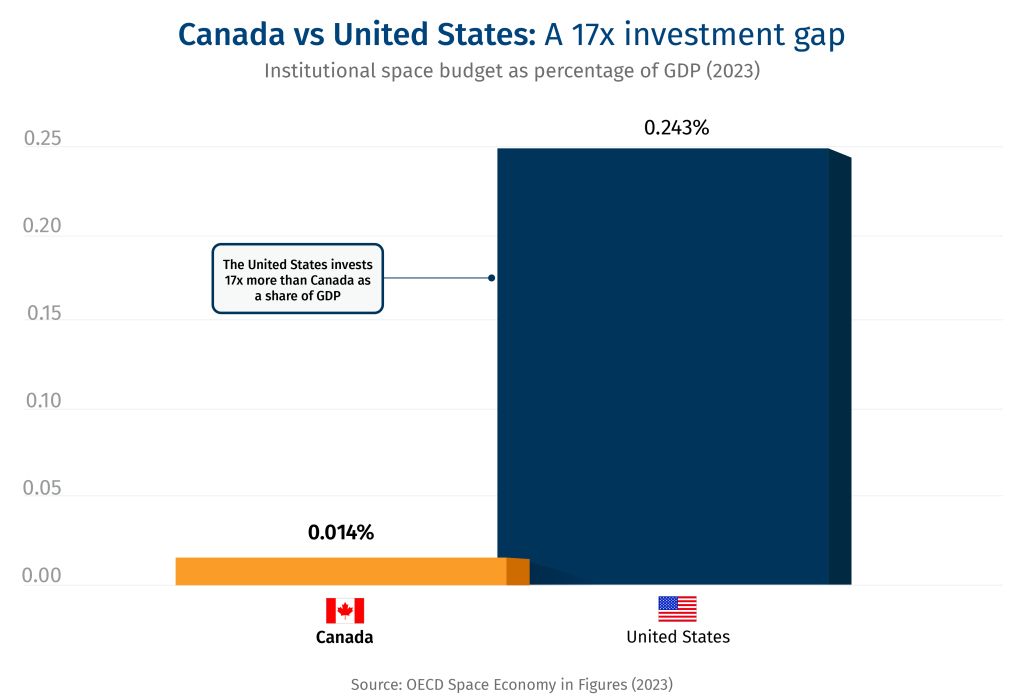
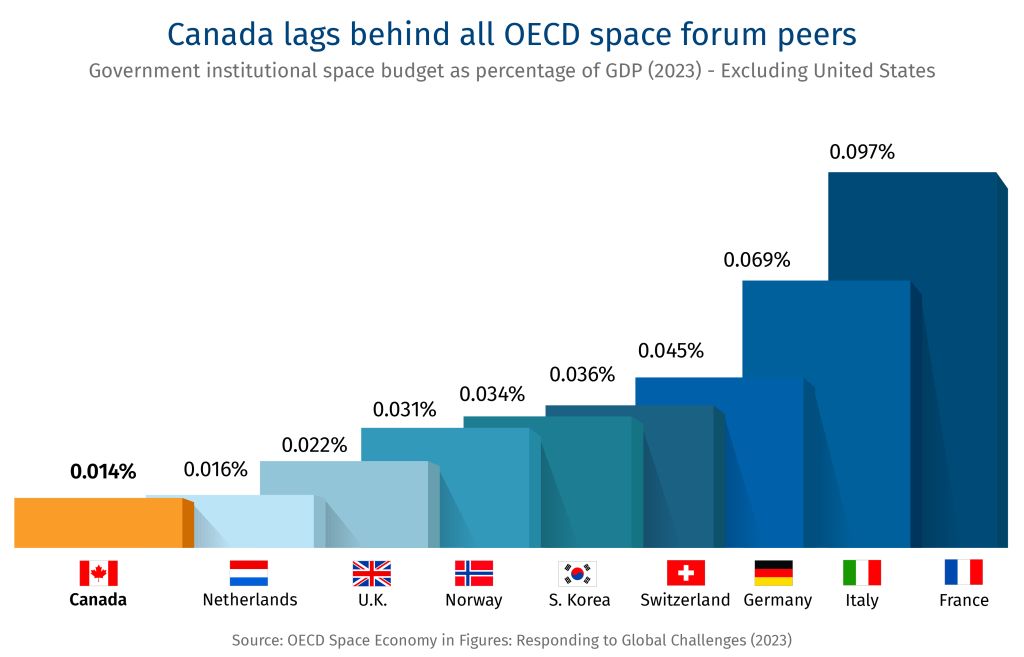
Canada currently ranks last in public spending among 10 OECD Space Forum members as a percentage of GDP.  At the same time, the Canadian space industry generates $5 billion in sales revenue, which is 25% less than it did in 2014.

Canada’s total space budget is projected to increase 56% over the next decade. That includes a federal budget commitment of $180 million for launch capabilities, with two sites already under development in Atlantic Canada.

Canada can seize this moment by building a new space strategy around five key pillars: sovereignty, defence, technology, commercialization and climate.

The U.S., China, Japan, and Germany provide critical lessons for Canada — especially through strategic procurement, state scale and finance, as well as technical excellence.

Success depends on a more unified approach within government, procurement modernization, capital market activation, export market development and talent mobilization. These are interdependent levers but success requires simultaneous progress across all of them.

We’ve entered an ambitious new space age—and Canada needs an ambitious new space strategy. 

What’s at stake? Our sovereignty in a more divided world. Our prosperity in a new tech universe. And our relevance to allies when the “final frontier” is suddenly the next economic and strategic frontier.  

The global space economy is poised to nearly triple from US$630 billion in 2023 to US$1.8 trillion by 20351, making the value derived from orbital assets equivalent to that of some G20 economies. This transformation is not merely an economic opportunity. There’s a fundamental shift underway in how nations are mapping out their sovereignty and competitiveness, and it’s increasingly through space.

Canada has much of what’s needed to be a leader in this new age. When Jeremy Hansen heads to the moon next year, he’ll be the first non-American to leave Earth’s orbit. Our space researchers are widely seen as among the world’s best (and for a lot more than the Canadarm). And our strong capabilities in the AI economy, and perhaps soon the quantum economy, puts us where the planetary puck is going. 

Unfortunately, too much of Canada’s space ambition rests on past achievements and not enough on future commitments. And we’re at risk of losing altitude just as the global space industry is taking off. As of 2025, Canada is one of the only space-faring nations that can’t launch itself from its own soil even to low orbit. meanwhile, our digital lives increasingly flow through tiny satellites sent from Earth on American and European rockets.

Our private space sector is also nowhere near what Canada could support. The Canadian space industry generates $5 billion in sales revenue2–25% lower than 2014.3 And our space GDP is down 13%, with productivity running about one-third lower than the U.S. space sector. If trends continue, we project negative annual sales growth of just 1% a year over the coming decade, with industry revenue falling to $4.5 billon by 2035. 

Then there’s the challenge of government spending. Canada currently ranks last in public spending among 10 OECD Space Forum members as a percentage of GDP4.  In a decade that saw SpaceX transform the space economy, and the U.S., China, India and Japan all land crafts on the moon, the Canadian Space Agency’s budget fell 18% from 20155—and at $414 million6 is a fraction of the OECD average.

Government institutional space budget as a percentage of GDP 2023 - Canada vs United States: A 17x investment gap

Canada lags behind all OECD space forum peers including Netherlands, U.K., Norway, South Korea, Switzerland, Germany, Italy, France

That’s starting to change, as Canada’s public space investments are again increasing. The total spending for Canada in space reached $549 million in 20247. The federal budget includes a commitment of roughly $180 million8 for launch capabilities, with two spaceports under development (Atlantic Spaceport Complex and Maritime Launch) and several ambitious rocket projects (Canada Rocket Company, NordSpace, Reaction Dynamics). It was also announced that Canada will ramp up its investment in European Space Agency programs by $528.5 million, which will boost R&D for Canadian-made technology, and Canada is the only non-European country partnered with the European Space Agency. 

Canada, the third nation in space after the Soviet Union and the U.S., also has some of the world’s leading satellite and robotics firms, led by Telesat Lightspeed (with nearly 200 satellites planned for orbit over the next two years), Kepler Communications (the first in the world to use lasers to connect Earth and space) and MDA Space (ranked the fifth most innovative globally by Fast Company). Plus, a new generation of innovators, including Mission Control and Canadensys. Our new NATO commitment of dramatically increased spending could spark a generational opportunity to invest in those companies, and many more, including through dual-use space capabilities.

Canada can seize this moment by building a space strategy around five essential pillars:

  • Sovereignty: Building a space industrial base

    An elevated sector requires much bigger Canadian companies, as well as a domestic infrastructure that starts with sovereign launch capabilities. It’s as fundamental as building and operating our own shipping ports.

  • Defence: Becoming an essential ally in the Arctic

    As NATO allies look to Canada for Arctic defence capabilities, we can be the most trusted non-American ally in space, while also being an integral U.S. partner in the defence of North America through our participation in initiatives like the Golden Dome.

  • Technology: Using satellites to secure a digital leap

    The race for AI and quantum will run through new constellations of satellites that Canada can continue to help build and operate. This will be critical to any sovereign tech stack, as is the ability to not only control and secure our data but to leverage it for our own objectives.

  • Commercialization: Breakthrough research and development

    Every company, whether they know it or not, is a space company. Space is embedded in our daily lives and fundamental to our economy, particularly in geolocation services and the transmission and storage of data. Canada should continue to be at the forefront of researching, developing and commercializing these essential technologies.

  • Climate: Protecting Earth from the sky

    Our ability to manage a changing climate, and reduce the impact of extreme weather, runs through space. That will be especially critical as we look to better manage wildfires and develop new ways to protect our changing coastlines and thawing tundra.

To advance this strategy, Canada can draw on plenty of lessons from recent transformations in the space sector, particularly models that embrace defence-oriented priorities while enabling private-sector leadership. The U.S. is the exemplar of recent space innovation and leadership. Following the 2003 Columbia disaster, in which all seven American astronauts onboard the space shuttle were killed, the U.S. pivoted its space strategy from “build and own” to “buy and use.”

Washington became an anchor customer, purchasing services from private companies. Launch costs have fallen 10-fold in some cases, while innovations like reusable rockets, satellite internet like Starlink, and low-cost in-space mobility have emerged. The results speak for themselves: SpaceX’s valuation reached US$350 billion in 20249, while defence-tech companies like Palantir and Anduril command valuations of US$330 billion10 and US$30.5 billion11, respectively.

Canada could use that public-private dynamic to reach similar heights. The current space sector contributes $3.2 billion to GDP12. Using McKinsey’s forecast of a US$755 billion global market by 2035 for ‘backbone’ applications,13 we forecast that, if it receives major investment. Canadian space industry revenue could grow to $21 billion annually by 2035—a four-fold increase.

A key engine propelling this sector growth needs to be Ottawa’s new commitment to dedicating 5% of our GDP to NATO defence spending and dual-use systems.14 Dedicating 5% (of the 5%) to space defence and dual-use systems could inject up to $7.5 billion annually into the Canadian space sector by 2035.15 But Canada also needs to generate more private capital, which will require strategic government spending coupled with a more market-oriented approach. By our estimates, the Canadian space industry will require nearly $5 billion in capital in the coming decade to maintain existing capital stock. In a more ambitious scenario, where Canada doubles its share in the global space market, the country would need $12 billion in space capital.

That strategy needs to recognize a rapidly changing strategic stratosphere, in which two techno-powers—the U.S. and China—are competing for supremacy. We can further use space as a low-orbit lab in which leading science and technology efforts, from computing to life sciences, are accelerating. And as an outer boundary and one of the first points of potential conflict, space will only become more important to national defence.

In this new sphere of influence, Canada can leverage our unique position as both the strongest American ally in space and the leading non-American space player. The choice before us seems clear: embrace ambitious space leadership or accept managed decline in a domain that will define economic and security outcomes for decades to come.

The strategic approaches adopted by the four leading space players—the U.S., China, Japan, and Germany with the context of the European Union—provide critical lessons as Canada looks to accelerate its space sector development.

The U.S. has fundamentally restructured its space industrial base through a major shift from traditional cost-plus contracting to commercial services procurement. NASA and the Department of Defense function as anchor customers, offering multi-year, fixed-price contracts that de-risk private investment. This model has enabled SpaceX to capture 52% of global launch market share16 —accomplished through a combination of purchase commitments and direct government funding.

The commercial crew and commercial cargo programs exemplify this approach: they procure services at multi-billion-dollar scales, creating predictable demand that attracts private capital.17 The success of these programs, as well as the ancillary result of Starlink’s billions in revenue, validates the commercial viability of this model, while the Starshield program demonstrates how these capabilities can also be adapted for defence applications.18 With around US$7 billion in annual venture funding19 flowing into the sector and International Traffic in Arms Regulations (ITAR) creating protected market conditions, American companies benefit from rapid iteration cycles and risk tolerance.

Without comparable governmental anchor contracts of between $500 million and $1 billion, Canadian firms remain constrained to tier-two supplier roles within American prime contractor networks—manufacturing components rather than integrated systems.20

China has pursued a contrasting model characterized by centralized planning and state capital deployment, though it has also begun to fund its own commercial players after seeing the success of the U.S. strategy. Between the Guowang and Qiafan constellations, China is planning to launch more than 25,000 satellites.21 These represent more than technical achievements; they constitute sovereign infrastructure investments. Through civil-military fusion doctrine, every capability serves dual-use purposes, while Belt and Road Initiative ground stations from Pakistan to Kenya to Argentina extend China’s space influence globally.22

This approach succeeds through cabinet-level coordination that aligns space development with foreign policy and industrial strategy. Provincial governments compete for space industry clusters, creating internal competition within a unified national framework.

By contrast, Canada’s space activities remain fragmented across the Canadian Space Agency, Innovation, Science and Economic Development Canada, the Department of National Defence, and Global Affairs Canada—each operating with distinct priorities and lacking ways to bundle demand into single orders for demand aggregation. This institutional fragmentation prevents the coordination necessary to focus on strategic priorities and national champions.

Japan, which has increased space funding 10-fold in three years, has evolved from a predominantly civil and science-focused space program to a comprehensive national defence-and-markets focused initiative. This transformation materialized through the expansion of defence space spending for the Space Strategy Fund, from its initial ¥300 billion (US$1.93 billion), to ¥1 trillion (US$6.5 billion) over ten years.23

This transformation resulted from reconceptualizing space as essential to national security. Japan’s keiretsu corporate structures facilitate this approach through crossholdings that provide patient capital insulated from short-term market pressures. Government-backed institutions including the Innovation Network Corporation of Japan (INCJ) and the Development Bank of Japan (DBJ) provide strategic financing where private markets fall short.

Germany has been undergoing a major shift through defence prioritization, adding a historic US$40 billion in military space capabilities by 2030—including unprecedented consideration of offensive counter-space systems.24 Germany already had a strong platform, being among the European Space Agency’s largest contributors, at €3.5 billion (US$4 billion) over three years.25 It also ranks third globally in space patents26 and hosts over 120 space start-ups.27 In 2022, German SpaceTech startups generated over €120 million in revenue across 16 deals.28

Germany’s regulatory evolution on space, while delayed, also shows pragmatic progress. As an example, in September 2024 Germany published key points for a future German Space Act. One part is a proposed €50 million liability cap with 10% revenue-based recourse limitations29 that could potentially provide more favorable terms for investment. This measured approach—balancing commercial enablement with public protection—offered a template for nations seeking to stimulate private investment without assuming unlimited liability. Note, it is possible that the EU draft Space Regulation (2025)30 will take priority and does not include a specific liability cap. In either case, Germany’s ability to maintain world-leading capabilities in synthetic aperture radar, optical systems, and small satellite technology, while working through regulatory complexity both internally and in the EU, proves that perfect institutional conditions need not be prerequisites for technical leadership.

For Canada, Germany offers one of the most relevant models: a G7 nation with federal complexity, strong technical capabilities, and allied commitments that must balance sovereignty with collaboration.

How others are picking up the pace in space

These brief profiles capture the high-level aspects of the space strategies of the UK, South Korea, New Zealand, Norway, UAE, and Australia.

Goal: Brexit-driven strategic autonomy in critical technologies

Strengths: Public capital unlocks private markets. Defence Space Strategy provides framework. UKSA-DSIT integration recognizes space-digital convergence

Assets: OneWeb stake (now Eutelsat). Harwell Space Cluster. Strong satellite manufacturing base

Budget: US$765M public investment catalyzed a US$2.89B space economy boost (3.8x multiplier)31

Key method: Strategic public investments and long-term strategy unlock private capital. Banking conservatism and ESG requirements can create constraints but this significant multiplier demonstrates good success

Lesson for Canada: Comparable Commonwealth economy demonstrates public investment can achieve significant leverage when tied to strategic imperatives like Arctic sovereignty.

Goal: Achieve launch independence through sustained development.

Strengths: Chaebol structure absorbs early losses. Political commitment survives failures. Methodical capability building over two decades.

Assets: KSLV-II (Nuri) operational launcher.32 Naro Space Center. 425 Project.33 Samsung and Hanwha industrial integration. Korea Aerospace Research Institute (KARI).

Budget: US$670M, with US$560M directed at R&D projects.34 Sustained funding through multiple administrations despite technical setbacks.

Key method: 20-year progression: sounding rockets → military35 and commercial36 satellites → launch vehicle. Each failure treated as learning investment not political liability.

Lesson for Canada: We possess everything South Korea spent 20 years building. Difference lies in sustained commitment and commitment to sovereign launch, now recently rectified.

Goal: Dominate responsive small satellite launch market.

Strengths: Regulatory innovation enables rapid iteration. Geographic isolation becomes launch advantage. Private sector leadership with government support.

Assets: Rocket Lab: 70+ launches, 2nd most frequent U.S. launcher. Mahia Peninsula private range. 120 launch opportunities/year. U.S. corporate structure.

Budget: US$59M in public spending, US$1.52B space sector revenue (2024).37 Minimal government investment, high private return

Key method: Special use airspace, streamlined licensing. <2-month contract-to-launch capability.38 First to use 3D printing and electric turbopumps to reduce costs.39

Lesson for Canada: Small nation can dominate global niche through regulatory agility and geographic advantage, and most importantly backing and building off the success of a single, world-leading space entrepreneur. Focus beats breadth.

Goal: Become Europe’s gateway to polar and SSO orbits.

Strengths: Arctic location optimal for high-value orbits. First operational continental European spaceport. Strong allied integration.

Assets: Andøya Spaceport operational. Isar Aerospace 20-year anchor tenant. U.S. Technology Safeguards Agreement. Arctic Satellite Broadband Mission with U.S. payloads.

Budget: US$208M40. US$36K spaceport investment.41 Additional US$20K for defence allocation.42

Key method: 18-month construction for the spaceport.43 German commercial anchor + U.S. military integration.44 30 launches/year capacity at full operation.45

Lesson for Canada: Arctic geography becomes strategic asset through infrastructure investment and allied partnerships. Execution beats deliberation.

Goal: High-value tech transfer and inspiration through prestige projects.

Strengths: Significant capital compresses development timelines. Every tech transfer includes mandatory training. Global talent acquisition at premium rates.

Assets: Hope Mars probe (2020). Mohammed bin Rashid Space Centre. KhalifaSat Earth observation. Partnerships with NASA, JAXA, Roscosmos.

Budget: US$443M in civil space investment. Silicon Valley salaries for global talent. Backing from the US$820M sovereign wealth fund.46

Key method:  Buy proven technology, build local capability. Prestige generates foreign investment and regional leadership.47 Now leveraged into domestic start-ups and space investment holdings.

Lesson for Canada: Rapid influxes of targeted capital on major, visible projects can result in meaningful tech transfer and national inspiration.

Goal: Leverage Southern Hemisphere position for Indo-Pacific leadership.

Strengths: Late entry avoids legacy constraints. AUKUS provides technology access. Geographic advantage for polar orbits and regional coverage.

Assets: Australian Space Agency (2018). Multiple launch site developments. Deep Space Communication Complex. SmartSat CRC.

Budget: US$25M (2024), with US$135M over 5 years (2023-2028).48 US$840M Modern Manufacturing Initiative includes a US$101M Australian Space Manufacturing Network.50 Additional defence space investments.

Key method: Focus on mining, agriculture, maritime applications. Allied integration through AUKUS.

Lesson for Canada: Partnerships with the U.S. and integration into strategic domains provides technology transfer and co-investment opportunities. As in the Indo-Pacific, so it can be in the Arctic.

We’re the country that sent a skylark to sing in space, built the arm that assembled humanity’s orbital outpost, and created the radar that sees through Arctic darkness.

1962
The skylark takes flight
1981
The arm that built the future
1995
The all-seeing eye
2025
The inheritance test
September 29, Vandenberg Air Force Base: Thor-Agena rocket carries 145kg of Canadian built satellite into orbitNovember 13, Space Shuttle Columbia: Canadarm unfurls above Earth, Canada wordmark blazingRADARSAT-1 launches: Canada’s synthetic aperture radar pierces clouds, darkness, Arctic storms60 years of excellence meets venture capital reality
Alouette 1 makes Canada the third nation in spaceThe impossible made routine: Many doubted a 6-degree freedom robotic arm couldn’t work in spaceGeography as destiny: Built for a country that’s half winter, all vast, mostly invisible from spaceBrain drain accelerates: Our roboticists design for Silicon Valley, our radar experts optimize for Arlington
Named for a French-Canadian folk song about a skylark, because even our satellites have culture410kg on Earth, but in orbit it juggled 100-tonne payloads with centimeter precision72-hour promise: Any corner of Canada mapped within three days, Arctic covered dailyCapital gap becomes critical: Technical excellence without financial fuel
The miracle: Built by a DND team when transistors were “just in their infancy” with “no textbooks and virtually nothing” to guide themThe nuclear connection: Born from CANDU reactor robots—Canadian ingenuity repurposed for the cosmos17-year marathon: Planned for 5 years, operated for 17. Another Canadian overachieverBudget commitment to domestic launch – need to rise to meet the moment
Designed for 1 year. Sang for 10. The little satellite that could—and didPerfect record: 90 missions, 5 shuttles, built the ISS, fixed Hubble. Zero failures.The crossroads question: Sovereign space power or sophisticated supplier
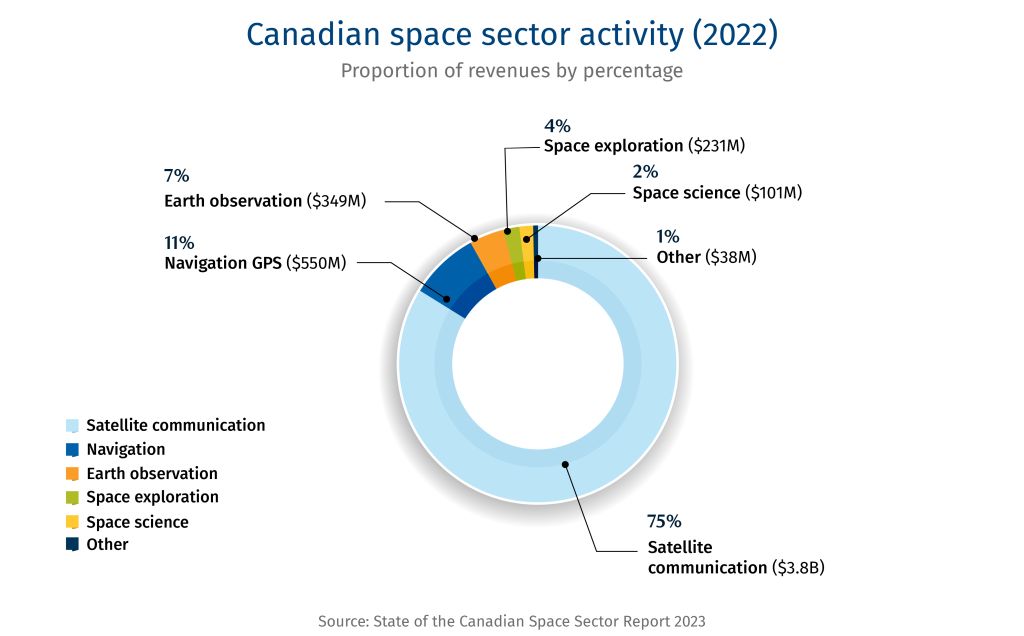
Canadian space sector activity - proportion of revenues by percentage

The following companies collectively employ more than 10,000 Canadians and generate more than $5 billion in annual revenue, with export rates exceeding 80%. They also demonstrate that Canada possesses the technical capability, manufacturing excellence, and commercial acumen to compete globally. What they lack is the scale of capitalization and anchor contracts their international competitors enjoy. With the proposed $12 billion capital injection by 2025 and defense spending increases tied to Canada’s new NATO commitment, these space firms could grow from successful niche players to global champions—creating the ecosystem that attracts and retains the next generation of space companies.51

  • Member of Canada’s fastest growing companies list, three years running

  • Built Canadarm, Canadarm2, and Dextre and now Canadarm3—establishing Canada’s robotics legacy

  • RADARSAT prime contractor, leading synthetic aperture radar technology

  • Developer of MDA Aurora, the world’s leading commercial Low Earth Orbit (LEO) digital communications satellite

  • Over 3,800 employees

  • Strategic relevance: Largest space company in Canada with a proven ability to execute complex programs and compete globally

  • Founded 2015, raised more than US$300 million in venture funding

  • Launching 10 optical data relay satellites in January 2026, building on the flight heritage of 23 previously deployed satellites, designed for compatibility with the U.S. Space Development Agency’s optical communications standards

  • First commercial company to demonstrate inter-satellite links in LEO

  • More than 175 employees

  • Strategic relevance: Kepler leads optical data relay technology globally and provides real-time connectivity, advanced on-orbit compute, and hosted payload services for mission-critical data

  • Developed Spacefarer™ platform used by NASA, and commercial operators

  • Delivered mission critical hardware and software for lunar rovers to customers on three continents

  • Launched Mission Persistence with SpaceX in June, Canada’s Giant Leap for AI in Space

  • Leaders in deploying AI at the edge, on the spacecraft itself, including for wildfire detection

  • Raised over $22 million in equity and non-dilutive funding

  • 35+ employees with deep space operations expertise

  • Strategic relevance: Software and operations expertise critical for managing complex constellation and lunar missions

  • Developing Spaceport Nova Scotia, located near Canso, which is designed as a multi-user, multi-mission launch complex

  • Active partnerships with small- and medium-lift launch providers for suborbital missions and ongoing discussions with Canadian and international orbital launch companies

  • Signed a U.S. Technology Safeguards Agreement, enabling U.S. launch providers and spacecraft partners to operate at the site using controlled American technologies

  • MDA Space made a $10 million strategic investment becoming an operational partner

  • The Company received a $10 million loan from Export Development Canada tosupport site development, launch pad completion, and operational readiness

  • Competitive access to polar and sun-synchronous orbits, offering inclinations from 45.1 to 90 degrees and safe downrange corridors over the Atlantic

  • Strategic relevance: Positions Canada to become a launch-enabled nation, capable of deploying and replenishing satellites from its own soil

  • Third-largest landing gear company globally; $800 million in revenue

  • 2,000 employees across Canada, U.S., UK, and Spain

  • Supplies Boeing, Lockheed Martin, Airbus, and many more OEMs

  • Export sales represent 90% of revenue

  • Strategic relevance: Precision manufacturing and systems integration capabilities directly applicable to spacecraft programs

  • Specializes in planetary exploration missions and systems, lunar rovers, science instruments, cameras, and lunar greenhouses

  • Developing LRM lunar rover for CSA and multiple lunar utility vehicles for NASA Artemis program and commercial customers

  • Leading the development of lunar greenhouses to produce food for astronauts on the Moon. Working with CSA, DLR, and NASA

  • Produce and sell computers, power systems, and cameras for lunar missions. Over 20 cameras now on lunar surface and another 200 currently in production, 100 of which are already ordered for various international lunar missions

  • Strategic relevance: Next-generation space robotics extending Canada’s legacy into lunar economy

  • Developing Canada’s first end-to-end responsive space launch system with vertically integrated capabilities

  • Tundra rocket (500 kg to LEO by 2028) and scales to Titan rocket (5,000 kg to LEO by 2032), designed as Canada’s first sovereign orbital launch vehicles

  • Building Atlantic Spaceport Complex (ASX) in Newfoundland & Labrador with operations starting in 2025

  • Manufacturing 3D-printed Hadfield & Garneau liquid rocket engines using Jet-A/SAF and LOx propellants

  • Terra-Nova satellite launching 2026 featuring NVIDIA GPU powered edge-AI for wildfire detection and wild field of view (WFOV) space domain awareness (SDA)

  • Strategic relevance: Dual-use SHARP defence program developing hypersonic capabilities and high-altitude missions for Arctic sovereignty using same hardware from Tundra rocket and engines

  • Leader in dedicated orbital launch services, rapid replenishment, and reconstitution of satellite constellations, with patented propulsion technology that simplifies propulsion architecture to ~12 parts compared to ~15K

  • $38M+ in total funding, including a $14M Series A (June 2025) and $10M grant from the Government of Quebec (June 2025)

  • Aiming for maiden suborbital launch in winter 2026; Aurora-8 launch vehicle targets the growing market of small satellites

  • Targeting first orbital launch attempt via pathfinder launch agreement with Maritime Launch Services to launch from Spaceport Nova Scotia in Q3 2028

  • Awarded €300K ($482K CAD) in NATO DIANA Phase II and awarded $776K from CSA SDTP for microthruster demonstration

  • Strategic relevance: Advances Canada’s sovereign launch capability and positions the country in the emerging suborbital and small-satellite launch markets

  • Founded in 1969, now one of the world’s largest satellite operators

  • Telesat Lightspeed LEO constellation: $6.5B investment for 198 satellites

  • Global broadband coverage with focus on enterprise, government, and mobility markets

  • Competing directly with SpaceX Starlink and Amazon Kuiper

  • ~750 employees

  • Strategic relevance: Demonstrates Canada’s ability to deploy capital for mega-constellations, critical for digital sovereignt

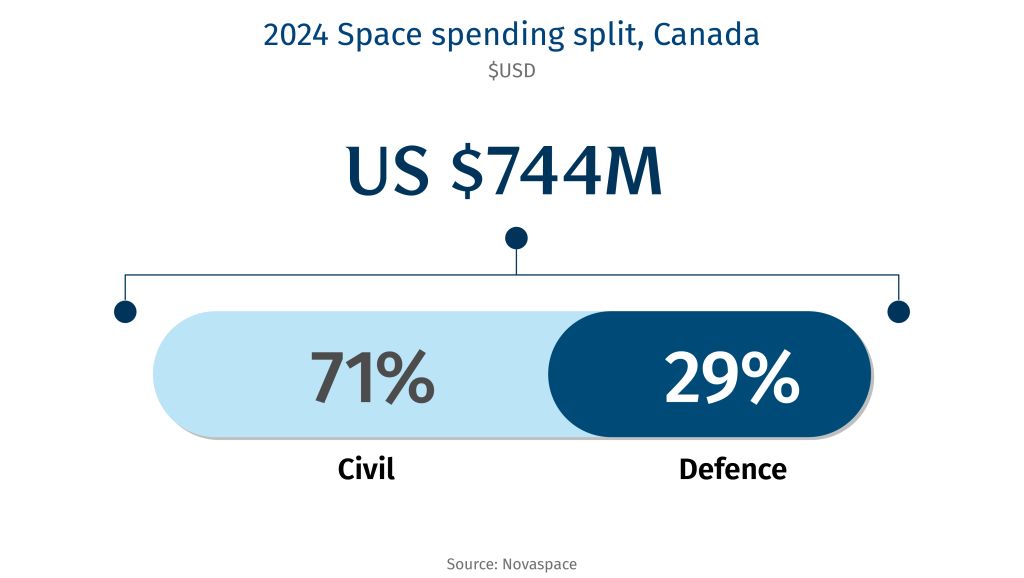
Canada needs to turn its pockets of space excellence into key pillars of a new global strategy. And the renewed focus on defence spending can be the launch pad. Defence spending currently represents 29% of Canada’s space spending and is poised to grow significantly as NATO commitments scale.52 This isn’t just budget reallocation; it’s a fundamental market transformation. Defence-driven procurement can facilitate anchor contracts and multi-year revenue certainty, which can help unlock private capital and enable Canadian space companies to achieve commercial scale.

Target capability by 2035: Strengthen our domestic space industrial base with a focus on sovereign launch capabilities and critical components where Canada has existing strengths.

Private capital, especially in the U.S. and Europe, has created a new generation of space companies. For example, deal flow in the U.S. space industry has more than doubled over the past decade and the value of those deals rose nearly four-fold.53 In the wider space industry, nearly US$50 billion flowed into space companies since 2015,54 growing on average 21% per year,55 with venture capital driving much of the action. The UK has become the second most attractive destination for space capital, as it has received 17% of this inflow.56 The industry is experiencing growth not seen since the Cold War space race, and dual-use and commercial capabilities are driving it.

In this global space race, Canada has many strengths but also some critical gaps. We have strong satellite manufacturing capacity, solid component production, but also fragmented supply chains and no domestic ability to get our own satellites to orbit. Canada is also under-equipped when it comes to testing facilities and national research centres. Decades of underinvestment in national space capabilities relative to our peers is starting to show. This industrial gap fundamentally limits our strategic autonomy and economic potential in a sector growing at 9% annually.57

New federal budget commitments will help, especially with the allocation of $182.6 million over three years for sovereign space launch capability.58 That’s a good start. But industrial competitiveness requires more to build a value chain: new ambitious missions and capabilities, advanced satellite and component manufacturing facilities, testing and validation centres, ground systems infrastructure, and perhaps two operational spaceports in the years ahead—NordSpace’s Atlantic Spaceport Complex and Maritime Launch’s Spaceport Nova Scotia.

The potential for economic transformation is proven. NASA’s shift from “build and own” to “buy and use” didn’t just reduce launch costs; it catalyzed an entire commercial space industry. The U.S. increased objects launched into outer space from 29 in 2011 to more than 2,200 in 202459 by empowering and buying national services from space entrepreneurs, and nurturing domestic manufacturing, supply chains, and service providers.

Modern space economics favour this comprehensive approach. The evolution of satellite technology shows dramatic cost changes. Commercial communications satellites in the 1990s cost $350-950 million (in today’s dollars), and can now be deployed for $150-500 million,60 with new small GEO satellites available for as low as $15 million.61 The transformation in small satellites has been even more remarkable: universities and emerging nations can now build and launch CubeSats as low as $150,000 total, compared to traditional satellites costing hundreds of times more.62 63

A robust industrial base that is increasingly funded through defence space spending could deliver defensive outcomes comparable to more naval destroyers or F-35s—but with far greater domestic economic multipliers through dual-use applications in communications, Earth observation, and climate monitoring.

2024 Space spending spilt for Canada between Civil and Defence

Annual capability by 2035: NATO-leading Arctic communications, positioning, surveillance systems; counter-space capabilities for deterrence

Space has fundamentally changed how nations project economic and military power. Advanced militaries now depend on satellites for communications, reconnaissance satellites gather intelligence and identify targets, and PNT constellations (including GPS) guide everything from precision munitions to drones.

Beyond these tactical capabilities, space remains central to strategic security. Early-warning systems that detect nuclear missile launches rely heavily on space-based assets. Starlink’s role in Ukraine grabbed headlines, but that’s just the beginning of how space systems are reshaping national defence.

At the same time, counter-space capabilities are proliferating rapidly. The U.S., Russia, China, and India have all destroyed their own satellites to demonstrate anti-satellite missiles.64 China and the U.S. are building extensive counter-space arsenals, including satellite proximity operations and refueling infrastructure. Russia has shown it can launch nuclear weapons into orbit that could wipe out most low-Earth orbit satellites with an electromagnetic pulse.65 The consensus is clear: any conflict between major powers will likely start with moves in space.

Canada needs advanced space capabilities for battlefield communications, intelligence gathering, target detection, and space control—including counter-space systems—if it wants to maintain sovereignty and deter adversaries. Our NATO and Five Eyes partners naturally expect us to take the lead on Arctic defence, where space systems are particularly critical given the massive territory and sparse population. Emerging Canadian firms like Dominion Dynamics are beginning to develop these critical capabilities domestically for Arctic sensing. Geography gives Canada a unique advantage: positioned far from potential conflict zones in Europe and the Indo-Pacific, we can contribute space assets to allied operations more effectively than ground, naval, or air forces.

With our small population and vast territory, staying tight with our “Five Eyes” – an alliance between Australia, Canada, New Zealand, the United Kingdom and U.S. – to share intelligence remains our best security strategy. Joining initiatives like the Golden Dome proposed by the US could strengthen these ties. The U.S.-led space-based missile defence architecture would integrate allied capabilities into a unified shield against hypersonic and ballistic threats. For Canada, participation could mean more than simply enhanced protection—it positions us as an essential partner in continental defence, potentially securing industrial participation and technology transfer for Canadian firms and ensuring our voice shapes the future of North American security architecture and supports broader Five Eyes capabilities.

Defence investments that fund new technology development consistently boost R&D spending and drive economic growth, as defence innovations built can often find commercial applications. But this economic spillover only works when we develop capabilities domestically rather than buying foreign systems. Canada needs to source from and co-develop with Canadian companies, structuring deals so these firms can scale domestically then globally. The U.S. has built massive companies this way—SpaceX ($350B+), Palantir ($330B), and Anduril ($30B)—through strategic national security contracts.

Annual capability by 2035: Quantum-secured satellite communications networks; sovereign positioning, navigation, and timing systems

Over the next decade, nations will secure economic and strategic advantage through technology. And three converging megatrends will reshape global power dynamics: the exponential growth of data as a strategic asset, the vulnerability of current encryption to quantum computing, and the critical dependence of commerce on satellite infrastructure. Nations that control secure satellite communications will hold the keys to digital sovereignty—those without independent capabilities will face strategic constraints.

Consider the scale of satellite dependence today. Maritime shipping, which moves more than $14 trillion in goods annually,66 depends entirely on satellite positioning and timing.67 Financial markets rely on GPS timing for transaction synchronization—an outage costs approximately $1 billion per day to the U.S. economy.68 The positioning, navigation, and timing services sector generated around US$280 billion in downstream revenues globally in 2023 from devices and services.69

The technological landscape of 2030 will be unrecognizable from 2020. As AI models become commoditized and universally available, competitive advantage will shift from algorithms to proprietary datasets. The companies and nations that can securely collect, transmit, and process unique data streams will dominate. Satellite constellations provide these unique vantage points—monitoring global supply chains, tracking economic activity, enabling autonomous systems—but only if that data can be secured.

Quantum computing presents both an existential threat and transformative opportunity. Current encryption methods protecting satellite communications, financial transactions, and military data will be vulnerable to quantum decryption within this decade. China has already demonstrated quantum satellite communications with their Micius satellite.70 The nation that deploys quantum-secured satellite networks first won’t just protect their own communications—they’ll become the trusted provider for allies seeking protection.

Meanwhile, the AI revolution demands unprecedented data transmission capacity and security. Training next-generation AI models requires massive datasets often collected from satellite imagery, IoT networks, and global sensors. The Smart Cities market encompassing these technologies is projected to reach US$1.4 to US$4 trillion by 2030,71 72 much of it dependent on secure satellite connectivity for IoT infrastructure. Control of secure satellite infrastructure is also likely essential for what many are calling sovereign AI.

Every Canadian AI company training models on proprietary data faces choices about data routing and storage. Our innovation ecosystem’s competitiveness depends partly on secure infrastructure that enables protection of intellectual property while maintaining global connectivity.

Canada’s position presents both opportunities and vulnerabilities. Our reliance on allied satellite infrastructure—while beneficial for interoperability and cost-sharing—creates potential single points of failure. It is wise to ensure resilience through diversification.

In scenarios of system degradation—whether from solar events, cyber attacks, or infrastructure failures—Canada needs assured access to positioning, navigation, and timing services. Our banks, power grids, and transportation networks all depend on precise timing signals. The economic risk compounds as Canadian companies in resource extraction, financial services, and advanced manufacturing transmit sensitive data through satellite infrastructure without sovereign alternatives. Additionally, a three-year study conducted by researchers at UC San Diego and the University of Maryland found that roughly half of geostationary satellite signals are transmitting sensitive data completely unencrypted, making them vulnerable to interception with basic equipment.73

Canada possesses unique advantages to become a global leader in secure satellite communications. Our quantum research leadership—through institutions like the Quantum Valley ecosystem in Waterloo, the $360 million National Quantum Strategy, and the additional $334.3 million announced in Budget 202574 75 combined with leading quantum companies like Xanadu, Photonic, and NordQuantique, position us to develop quantum-secured satellite networks ahead of most nations. Combined with our intentions on Arctic sovereignty, NATO obligations, and trusted middle power status, Canada has both capability and market opportunity.

The economic case is compelling. Telesat’s $6 billion Lightspeed constellation76 demonstrates private sector confidence in Canada’s ability to compete globally in satellite communications. Adding quantum security creates differentiation for nations seeking trusted alternatives—not to replace existing partnerships but to ensure resilience through diversity. With focused investment, Canada could build quantum-secured satellite infrastructure serving both domestic needs and allied nations seeking additional secure communications options.

Annual capability by 2035: World-leading research programs in strategic domains; 100+ annual student projects; 2-3 breakthrough technology demonstrations annually

When it comes to space research, nations are no longer competing for scientific prestige but for control of technologies that will define economic and strategic power. China is targeting a space-based solar power demonstration by 2035.77 The U.S. is pursuing nuclear propulsion for Mars missions.78 Japan is developing a lunar RV while offering quarterly ISS deployment opportunities that have enabled over 200 satellite deployments since 2012.79 These aren’t science projects—they’re strategic investments in future market dominance.

Canada’s research strengths uniquely position us for space technology leadership, but only if deployed strategically. Three Canadian quantum companies—Nord Quantique, Xanadu, and Photonic—advanced to DARPA’s Quantum Benchmarking Initiative finals, competing for US$316 million.80 The federal budget’s $334 million quantum investment provides capital to secure these headquarters in Canada.81 Our materials science and robotics expertise, hardened through Arctic operations, directly translates to lunar environments. Our mining sector is well-poised to extract critical minerals, and it is one of the strongest in the world. Our nuclear industry has CANDU reactor experience that could be applicable to space power systems.

Success requires fundamental shifts in how Canada approaches space R&D. Japan’s model of regular deployment opportunities reduces the gap between prototype and product. When investors know technologies can be validated within months rather than years, capital flows to innovative companies. Canada could establish similar quarterly launch opportunities, transforming research projects from academic exercises into commercial pipelines.

The implementation pathway is clear: commercial partnerships from day one, with industry co-investment in research programs. Mechanisms ensuring breakthrough IP remains in Canada. Structured programs that connect student projects to space missions could be a great start. Most critically, acceptance that moonshots require multiple attempts and a commitment to preparing both the public and politicians to accept some failures as part of the process of innovation and growth.

The economic case is compelling. When NASA commits to purchasing orbital and lunar delivery services, companies raise billions in private capital. When DoD funds quantum communications, startups achieve unicorn valuations. Canada can replicate this model with government as first customer, not final customer, creating markets that attract private investment.

The opportunity window may be narrowing. As space commercialization accelerates and the owners of platform technologies emerge, first movers will establish dominant positions. Canada has proven it can produce world-leading research. The next decade will determine whether we capture the value of our innovations or continue subsidizing competitors’ success.

Annual capability by 2035: AI-integrated Earth observation systems; operational climate monitoring for Canadian territory

Canada’s unprecedented 2023 wildfire season—burning 16.5 million hectares, seven times the historical average—demonstrates why climate monitoring has become economic infrastructure. The fires cost over $1 billion in suppression efforts across four provinces, contributing to $945 million in total insured weather losses.83 This crisis creates market opportunity: the global Earth observation sector will grow from $5 billion today to $8 billion by 2033,84 driven by nations requiring the same wildfire prediction, flood monitoring, and agricultural intelligence that Canada must develop for survival.

Space-based monitoring is an operational necessity. Twenty-six of 54 essential climate variables can only be measured from space.85 86 Canada’s unique geography—vast boreal forests, Arctic territories, prairie agricultural systems—creates monitoring challenges that, once solved, become exportable products for nations facing similar environmental pressures.

Canada’s Earth observation heritage provides a strong foundation. Earth observation represents 20-per-cent of Canada’s space expenditures (the second largest driver after satellite communications). RADARSAT’s synthetic aperture radar heritage made Canada a world leader in Earth observation—an advantage that evolved from defence requirements but found commercial markets in resource management, disaster response, and environmental monitoring. Start-ups like SkyWatch and GHGSat are also finding ways to derive and create value from earth observation products, as well as international customers.

Canada’s current Earth observation strategy explicitly recommends developing a dedicated program to “source commercial and international data”87 to complement sovereign capabilities. However, this recommendation was notably absent from the RADARSAT+ funding package announced in 2023.88 Canada could develop and fund a new initiative, analogous to NASA’s Commercial SmallSat Data Acquisition program, that focuses specifically on acquiring, evaluating, and integrating commercial and international Earth Observation data. Canada could also build off of NASA’s Earth Information Center initiative and work towards a national Climate Resilience Design Centre, enabled by space-data and AI.

AI could transform Earth observation from static imagery to predictive intelligence. Canada could build a world-leading Earth digital twin. It could enable algorithms to identify patterns that are harder for human analysts to discern. That could include early indicators of crop failure, illegal resource extraction, maritime trafficking, or military movements. This AI-driven Earth observation creates commercial export opportunities—data products and analytics services that allied governments, resource companies, and agricultural operations will pay for. Dual-use optimization is powerful. The same satellites that monitor wildfires and agricultural conditions can also provide military intelligence, border surveillance, and maritime domain awareness.

Canada could capture an estimated $21 billion of the global space market annually by 2035, creating new jobs and transforming our economy. Or we could watch from the ground as others claim the high frontier. The difference comes down to approximately $12 billion in capital investment and the political will to deploy it–and soon.

The are several strategic unlocks that Canada’s leaders could consider:

  • Canada’s space governance remains fragmented across multiple departments with no single point of accountability, deterring the private investment needed to scale the sector. One option is to have the National Space Council report directly to a senior minister or Clerk of the Privy Council, granting them authority to coordinate all federal space spending. This creates the focused leadership that capital markets require—mirroring how Japan’s Prime Minister provides oversight over the country’s national space agency.

  • NovaSpace, a global consultancy firm, diagnosed our core failure: we create “technology orphans”—innovations that win small government grants, then die without major customers.89 The Department of National Defence could break this cycle by committing to become a significant customer of Canadian space innovations and services and providing world-leading space defence capabilities for ourselves and for our allies in the process.

  • It is hard for companies to raise capital against one-time contracts, which is what Canada often offers. The Canadian Space Agency could address this by shifting from buying hardware to purchasing services, replicating NASA’s success, as outlined above. At the early stages, this could be similar to the US SBIR program (which Budget 2025 may create a version of, through ISED).90 Phased contracts would take companies from $200,000 feasibility studies through $1.5-million development contracts, on a pathway to commercialization towards $50-million deals, creating a proven pathway from innovation to market.

  • Canadian space companies also face challenges in “de-banking” for defence-related work and the country has venture funds that are often too small to scale champions. To navigate this, Export Development Canada (EDC) could consider establishing a dedicated Space Finance Division with expanded lending capacity, while Finance Canada could classify space as “strategic infrastructure” to unlock pension fund investment. EDC could also consider guaranteeing 80% of commercial loans, like how it did through BCAP during the pandemic. This could mobilize the billions needed to build Canadian champions.

  • Canada’s space exports grew 13% from 2020 to 2023, proving international appetite exists. Fast-tracking agreements with Five Eyes and NATO partners, combined with a dedicated Space Export Division within Global Affairs, could help position Canada as a trusted non-American option for nations seeking alternatives to U.S.-China dependency. An “Allied Space Preferred Partner” designation could also expedite approvals.

  • More than 40 universities and research centres participate in the Canadian space sector, and this is a strength that can be built on.91 At the same time, in the context of talent, Canada is facing significant challenges. The major reduction of international students may reduce our talent pipeline, and many of our traditional sectors including automotive are struggling amidst the trade war. Opportunities to unlock talent could include industrial retraining programs into the space and defence sectors, especially from hard hit areas of our economy. One opportunity is a U15-led, business-academia approach to space-driven technologies for earth science and climate resilience, including wildfire detection and management—something that can exported to NATO allies for dual use purposes. Further, national regulatory sandboxes and multi-year federally funded university space research institutes partnered with the CSA and DND that link space and defence procurement with post-secondary institutions and industry partners could create pre-qualified talent pipelines and accelerate security clearances.  

These unlocks—unified leadership, procurement modernization, capital market activation, export market development, and talent mobilization—are interdependent. Success requires simultaneous progress across all dimensions. International precedents, particularly NASA’s commercial programs and the UK’s space investment strategy, demonstrate that government market-making can catalyze private sector growth.

But the window is narrowing. First-mover advantages in quantum communications, Arctic surveillance, and other emerging space technologies have expiration dates measured in months and years, not decades. Furthur delay risks permanent relegation to consumer and tier-two status rather than being a producer and leader in the global space economy.

The path forward requires coordinated action across government, industry, and capital markets. Without executive-level leadership and the structural reforms outlined, Canada risks missing a generational opportunity.

At a time when we’re aiming east, west and north, instead of south, Canada also needs to look up—and aim higher, quite literally, with an ambitious space strategy.

Download the Report

Methodology

Data on the Canadian space economy is limited. The Canadian Space Agency (CSA) publishes an annual State of the Canadian Space Sector Report, including revenue, gross domestic product, employment and exports. Company-level data is available for publicly traded firms. Our method blended data from both sources to model sales revenue, GDP and capital expenditure across ‘baseline’ and ‘ambition’ growth scenarios. The calculations were made through a series of steps.

  • To forecast sales revenue and GDP to 2035 in the ‘baseline’ scenario, we derived the longest possible compound annual historical growth rate using CSA data (2014-2022), which we assume will govern the future growth of sales revenue (-0.8%) and GDP (1%) going forward.

  • To forecast sales revenue under the ‘ambition’ scenario, we assume Canada doubles its global market share by 2035, rising from ~1.1% of the global market in 2022 to 2% by 2035. In partnership with McKinsey & Company, the World Economic Forum projects the global space market ‘backbone’ applications (such as satellite, launchers, broadcast television, and GPS) will grow to US$755 billion by 2035,92 putting Canada’s share at $21 billion. This ambition scenario thus sees the space market grow 4x in 10 years.

  • To infer the capital required under a baseline and an ambitious scenario, we used data for publicly traded space firms. From 2020-2024, Canada’s publicly traded space firms had a capex-to-revenue ratio of 36% (on a weighted average basis). That figure was skewed by heavy investments from a few key firms that are unlikely to be repeated in the future, even under the ambition growth scenario. To better anchor the capex-to-revenue ratio, we included a few mature aerospace companies, which have much lower capital requirements. On a weighted-average basis, this brought the capex-to-revenue ratio down to ~10%.

  • Across the baseline and ambition scenarios, we multiplied annual sales revenue by 10% to determine the annual capex, aggregating the figures over 2025-2035 to determine the total capital required.

Disclaimer

rbc_tl_disclaimer

Across Nunavut’s Kivalliq region, communities and mine sites still rely on imported diesel for electricity and satellite links for basic connectivity. It’s expensive, carbon-intensive, and leaves a strategically vital part of Canada dependent on infrastructure we don’t fully control.

In this episode of Disruptors: The Canada Project with John Stackhouse, we travel to Nunavut to explore the Kivalliq Hydro-Fibre Link (KHFL) — a 1,200-kilometre, Inuit-led project that would connect Manitoba’s renewable grid and Canada-based broadband backbone to five Kivalliq communities and future mining projects. Led by Nukik Corporation under 100% Inuit ownership, KHFL is designed to deliver clean power, high-speed terrestrial connectivity, and Nunavut’s first physical infrastructure link to southern Canada.

Joining us are former premier P.J. Akeeagok and Anne-Raphaëlle Audouin, who unpack how this corridor could cut diesel use, reduce dependence on satellite networks, strengthen Arctic sovereignty, and create a new model for community-driven infrastructure in the North.

Listen on Apple Podcasts, Spotify or Simplecast

P.J. Akeeagok: When Canadians think about growth, we don’t always think about the Arctic, but we should. Nunavut has a place in this world and certainty is right here. Opportunity is right here. Nation building in Canada has never been completed. We built highways from the east coast all the way to the west coast, but now is our time to do the same in the Arctic.

P.J. Akeeagok: The Arctic is where sovereignty is tested and where the next gains in critical minerals could be unlocked. Nunavut is ready and Nunavut is ripe. A productive, a resilient Arctic is a national project. It means dependable energy, connectivity, and transportation delivered in ways that truly reflect Inuit rights, knowledges, as well as priorities.

John Stackhouse: That’s P.J. Akeeagok, the sixth premier of Nunavut, or as he’s known to pretty much everyone in the north PJ.

P.J. Akeeagok: With the announcement of the Iqaluit Hydro Project, we see the first of four nation-building pillars, taking shape: clean, reliable energy for our capital, anchoring sovereignty, resilience, and opportunity.

P.J. Akeeagok: Canada is starting to recognize the Arctic is essential to sovereignty and to our prosperity. Alongside the Kivalliq Hydro Fibre Link, Northern Transportation Corridors and Arctic Digital Backbone. These projects complete Canada’s unfinished work of nation-building. Our peers across the Arctic have invested steadily and acted with clear timelines.

P.J. Akeeagok: Canada could do the same. We need Canada to join us to treat the Arctic, not as a pilot, but truly as a pillar. Plan with indigenous leadership, financed with certainty and built to last. This is our moment to complete nation-building together. I’m John Stackhouse. Welcome to

John Stackhouse: Disruptors the Canada Project. This season we’re crisscrossing the country to meet the builders who are using technology to tackle our toughest problems. Along the way, sketch a blueprint for a stronger, more competitive nation. Today’s destination, Nunavut’s Kivalliq region.

John Stackhouse: The Arctic isn’t a postcard, it’s a pillar of Canada. For generations, our sovereignty has rested on a real presence in the north.

People living there, working there, raising families there. And beneath that land lies some of the world’s most important reserves of critical minerals, the inputs for batteries, grids, and the cleaner economy we keep talking about. Here’s something you might not know. Canada’s Arctic still runs on imported diesel and connects to the world through satellite networks that we don’t control.

John Stackhouse: That means high volatile power costs for families and businesses, and an internet that freezes when the bandwidth does. Meanwhile, across the Nordic Arctic in Norway, Sweden, Finland, Iceland, and Denmark, remote communities are tied into national grids and fiber backbones. In other words, they’ve wired their north and we haven’t, at least not yet and that matters.

John Stackhouse: When we don’t control the energy and connectivity that keep communities running, we create national vulnerabilities, economic, social, and strategic. That is no longer acceptable for a G7 country. An Inuit owned project aims to change that equation. The Kivalliq Hydro-Fiber Link, a 1200 kilometer corridor delivering clean electricity and true high-speed internet from Manitoba to none of it.

John Stackhouse: It can cut diesel, use and emissions and give families, schools, and businesses a line they can trust no matter the weather. And it does something bigger. It powers Canada’s next economy in the north critical minerals projects that need steady low carbon energy and real connectivity to hire locally, automate and compete globally.

John Stackhouse: Built for permafrost and 40 below. A nation building test we can actually pass. Our guest today is Anne-Raphaëlle Audouin CEO of the Nukik Corporation, the Inuit owned developer leading the Kivalliq energy and fiber build. With more than 15 years in major projects and indigenous partnerships, Anne Raphael focused on a simple goal, reliable power, and real connectivity that work in 40 below and that work for people who live there.

John Stackhouse: We started by asking Anne-Raphaëlle, what’s the pitch for this project?

Anne Raphaele: The project is called the Kivalliq Hydro-Fibre Link. It’s an ambitious Arctic project that intends to connect the Canadian Arctic to Southern electrical grid and fiber-optic network by connecting around the Churchill area, crossing the border into Nunavut, taking five communities off of diesel, plus active operating mines, and bringing full broadband connectivity into the territory.

Anne Raphaele: It’s important to know that Nunavut is very much relying on antiquated systems because a hundred percent of all the energy needs in the territory have to be met by burning diesel. So everyday life, everyday business, everyday government operations, everything functions by burning diesel. And most of the diesel we burn in the Arctic comes from foreign countries most years.

Anne Raphaele: It’s actually a hundred percent that all the diesel that is imported into the territory that comes from foreign countries, mostly the United States. And then on the connectivity piece, to give you the full picture. We rely mostly now on Starlink, which is amazing technology, but it’s not domestic technology..

Anne Raphaele: It’s number one driven by the people who have to really live under third world conditions in the north, which is unacceptable. And B, it’s really about national security because the Canadian Arctic in Nunavut is a real Achilles heel at this time. We’re heading into a wall with no energy or connectivity optionality whatsoever.

Anne Raphaele: When you look at the map of Sweden, Finland, Russia, Norway, they’ve built roads, they’ve built networks, they’ve built high voltage transmission lines, and they did that decades ago. Name me, one nation around the world that is powering a modern society solely on diesel. It just doesn’t exist.

John Stackhouse: Before we dive into the engineering behind this new project, let’s get our bearings. The Fibre-Link Corridor runs up the west coast of Hudson Bay from northern Manitoba. Near Churchill then follows the Kivalliq communities north before turning inland to Baker Lake or Qamani’tuaq, as it’s known in Inuktitut. The goal is simple. Connect household schools and clinics first, while giving local employers the reliability they need to plan and grow.

John Stackhouse: We asked Anne-Raphaëlle to walk us along the path from Churchill through places like Arviat, Whale Cove, Rankin Inlet, Chesterfield Inlet, and on to Baker Lake, and explain who gets connected first.

Anne Raphaele: The line would connect around Churchill, and so we would take that line, take it 1000 kilometers north, and address all the different hamlets along the way, which are five of them.

Anne Raphaele: Then take it inland West towards Baker Lake, which is the only inland community in the Kivalliq region and power existing mining operations, mostly Agnico Eagle mines mining operation, which is 20 kilometers off of Rankin Inlet.

John Stackhouse: Let’s ground this in everyday life so it’s easier to picture. Imagine the changes for a family, a school, and a clinic. Once the community can count on steady power and real broadband, rather than diesel and a satellite link.

Anne Raphaele: Day in and day out, you’re burning a diesel that is damaging your health. Those diesel plants weren’t built 50 kilometers out of the hamlets, they are right downtown, near schools, near hospitals, near homes. The diesel you burn in the Arctic is called Arctic grade diesel, and it is much more polluting, much more health affecting than regular diesel that you put in your car in maybe Toronto or Ottawa. Just because it has to resist some pretty harsh climatic conditions in terms of everyday life.

Anne Raphaele: It’s transformative. That’s the beauty of being connected to the grid as well, is now you’re not only connected to the next city, but you’re connected to the North American grid. The real benefit of North America is really a connected web, and the grid unfortunately is more connected north south, as in Canada US than it is north, south, as in, you know, Canadian to Canadian provinces and territories.

Anne Raphaele: We’ve been better neighbors to the US than we have to our own fellow Canadians. When I started working for Nukik Corporation four years ago, I could have never had even just a teams call without the camera on because the connectivity was so spotty. It has gotten much better with Starlink, but again, how resilient are we and how much can we say that we have a sovereign arctic if we rely on non-domestic assets and foreign owned technologies?  It’s just a slogan at that point to talk about arctic sovereignty in Canada.

John Stackhouse: Once Nunavut gets connected to the grid, a number of overdue systemic improvements suddenly become possible.

Anne Raphaele: The fibre it’s gonna power and allow telehealth to happen. Reduce medical evacuation. Now you have the ability to have a doctor online powered and supported by terrestrial fibre, as reliable as we experience anywhere else in the country, and then it’s transformational for education. People won’t have to leave the territory to have access to long-term education.

John Stackhouse: One corridor doing two jobs is part of the efficiency here. The same right of way that carries electricity, can carry the fibre that keeps clinics, classrooms, and local businesses online, while also supporting industrial operations.

Anne Raphaele: You have to run fibre optic anyways in a transmission line of this length. And in modern assets, high voltage, you typically nowadays run fiber optic for the maintenance and operation of your line. We are just going to bring more so that we can serve the communities, serve the businesses, serve the mines, and different, you know, broadband off-takers that, uh, maybe interested in, in the fibre optic.

John Stackhouse: It’s an ambitious and necessary idea, but the challenge lies in how you build efficiently across permafrost and 40 below.

Anne Raphaele: The project will be a technical feat, just, uh, just by its sheer realization because we’re talking of hundreds and hundreds of towers built into the tundra, into Nunavut, and into sections of it, into permafrost.

Anne Raphaele: The way to do it is to anchor it as much as possible and as deep as possible to use a certain type of transmission tower that resists to high winds, and that is designed to withstand those climatic conditions that tend to be quite extreme in the Arctic. It’s really gonna be groundbreaking, and we’ve never done it here in Canada.

Anne Raphaele: Other nations have done it in the seventies, in the eighties, they’ve made it happen. They were innovators of their days. But also it’s a technology that has so much proof of concept, right? The first transmission line commission in North America was commissioned, I think in 1889. There’s an ability to be innovators and to build the next chapter of your country with vision by leveraging the known expertise that is in your country.

Anne Raphaele: And we are builders in Canada. In the 1800’s, we built the Canadian railway, and at the time there were maybe 3 million people in Canada. We didn’t build it for 40 million Canadians, but the founders of Canada knew that the country was gonna grow, knew that this was the vision. And so, the innovation sometimes is not necessarily in the technology itself.

Anne Raphaele: I would say it’s in the leadership, in the vision, in believing in its people and saying, okay, we’re gonna embrace technology that is available now, purpose it to the needs of the terrain of the people, of the purpose, and make it happen over maybe sometimes very ambitious targets and distances. And just go for it.

John Stackhouse: Just go for it, it’s a clear imperative if ever there was one. Ultimately, this is a corridor story. Northern Manitoba and the Port of Churchill are part of the same ecosystem as the Kivalliq. If we do this right, we’ll have people, goods, data, and opportunity moving more reliably in both directions. So the big question then becomes how do Churchill and the Kivalliq rise together, and what does that pairing unlock for the region?

Anne Raphaele: You won’t see a port of Churchill that thrives without a Kivalliq region that thrives. You won’t see a port of Churchill that really taps into the full breadth of the value proposition of new inflow and outflow from the port without a Kivalliq region that becomes developed with, you know, new mines. There’s a modular home factory in Arviat.

Anne Raphaele: Those materials are gonna be barged in from Churchill. You cannot have and realize the full potential of the region without interlocking the two priorities in April of 2025. I was lucky enough to, I think, witness history in the making when Premier Kinew and Premier Akeeagok, together to sign a joint announcement on the creation of a strategic energy and economic corridor between their two jurisdiction.

John Stackhouse: We managed to dig out the CPAC recording of that historic signing. If you’re curious,

P.J. Akeeagok: uh, first off, it’s, uh, an honor to be here. Uh, always, uh, great to, to be able to work with you, uh, really as, as Canadians. Uh, it is. What a historic moment that we’re in. Uh, I just really wanna recognize the incredible leadership. Uh, that has brought us here. Uh, this has been the vision of many Inuit leaders that wanted to connect, uh, Southern Canada to the north and this is nation building, and so we’re very excited to be able to work with such a incredible partner. We already share many of our, uh, common interest from healthcare to education among others, but now to be able to look at what we could do together, uh, really excites me. So I’m very honored to be here and to be welcomed to your beautiful province.

Wab Kinew:
So welcome to Manitoba and lets put pen to paper.

Anne Raphaele: And that was done in the context of Premier Kinew repatriating, 500 megawatts of expiring hydro exports to the US and saying we’re gonna do a carve out and we are gonna do that, carve out for the Kivalliq Hydro-Fibre link and we’re gonna allocate 50 megawatt of that 500 to Nunavut.

Anne Raphaele: Nothing had ever been done like this before. We have some expiring contracts. We’d rather be good neighbors to our Inuit brothers and sisters rather than, you know, selling it to the US who are turning their back on us at this time during the trade dispute. So there were a lot of things happening, but I think it was really moving to be in that room when the two premiers signed the announcement and took the lead on saying, we are Indigenous leaders and we are gonna stand hand in hand and make history here.

John Stackhouse: I love this idea of close collaboration and sharing of priorities, and for a big infrastructure project like this, when it comes to cost versus value, what should Canadians know about jobs GDP and payback?

Anne Raphaele: Yes, the project capital cost is high, $3 billion, but you know, the benefits are proportionally as high $3.2 billion GDP contribution during construction alone, more than 15,000 person years of employment. Millions and millions of revenues in terms of taxes, payrolls, royalties.

The one thing to understand, at the end of the day, this is not a diesel displacement project. It’s not even a fiber project. It’s a critical and strategic infrastructure project, and it’s, it’s a critical differentiation because it transforms how you’re gonna approach the investment.

Anne Raphaele: It’s not that insurmountable to build infrastructure in the Arctic, and it is important to understand the mining potential, specifically in the Kivalliq region of Nunavut is world class. In that area, we’re sitting on all sorts of critical mineral in one of the largest greenstone belts that exists in North America that is still completely untapped.

Anne Raphaele: The uranium deposit is akin to what we’re seeing in the Athabasca deposits in Saskatchewan and potentially what could redefine what could be the economic engine of Canada.

John Stackhouse: So we need to call it what it is, strategic infrastructure that powers a new economic engine. Our Arctic peers in other northern countries made these bets decades ago. We can still catch up and on our terms. Inuit owned, cleaner, smarter commissioning is targeted for 2032. So we asked Ann Raphael to paint us the 10 year picture.

Anne Raphaele: 2032, we are planning on energizing the line, so a 10 year outlook. After commissioning, you’ll see more connected people bring more connected mindsets, more connected businesses. Businesses that start and stay and remain in the Arctic because now they’re connected to the fabric. They have a place to reliably power their operations. Not just mining. I think this will be a critical enabler of a lot of things, and that again, is the defining value of the project is that by investing in a project like the Kivalliq Hydro Fibre-Link, you send a clear message to the people who live there, that it’s not just about planting a Canadian flag and then claiming that we are Arctic sovereign, but it’s about telling those people that they matter.

Anne Raphaele: That they deeply matter, that their future matters. That yes, there are Canadians. They’re not just Canadians when we wanna assert our sovereignty, but that we believe in their future. We believe in their contribution, workwise and in other ways, and that we’re gonna give a future to their children.

John Stackhouse: We’ll give P.J. the last word.

P.J. Akeeagok: You know, it’s incredible to see the unity from coast to coast to coast in terms of our opportunity that we see as a country. The Arctic truly has what the world needs. We’ve made in true partnership with, in identifying four projects that really mean the criteria of what we could do to build a strong, resilient country.

P.J. Akeeagok: It means training and jobs that stay in the north and public service that works 40 below that open up markets, whether it’s the deep sea port in that can unlock incredible fisheries where we could supply the world. With our resources, whether it’s the Arctic security corridor or the Grays Bay Rode and Port Project that can allow us to become a super power in terms of supplying the world of critical minerals among many, or whether it’s the Kivalliq Hydro-Fibre Link that would connect Southern Canada to the Arctic for the first time and complete true nation building as we move forward.

John Stackhouse: For generations, the North has tested Canada’s resolve and defined our sovereignty. Families from Arviat to Baker Lake have built communities in 40 below, relying on foreign diesel and bandwidth we don’t control. The Kivalliq Hydro-Fibre Link corridor isn’t just about cleaner power and faster internet. It’s about ending that dependency so schools don’t suffer, clinics don’t close, and local businesses can plan for growth. This is strategic infrastructure. It unlocks world-class critical minerals under the Kivalliq.  Metals for batteries, grids, and industry on terms that keep more value in Canada and in the north. It strengthens a northern corridor anchored by Churchill, tying people goods and data to a future we build, not one we rent, and it moves us towards parity with other Arctic nations that wired their North years ago. The question isn’t whether Canada needs Arctic capability. It’s whether we’ll choose to build it at home with Inuit leadership and the certainty that turns plans into projects from the west shore of Hudson Bay to the rest of the country.

John Stackhouse: You can see how much opportunity there is for Canada if we wire it. You’ve been listening to Disruptors: The Canada Project. Thanks for joining us on this incredible journey across Canada. There’s much more ahead. If you’ve enjoyed this episode, please subscribe and leave us a review and five star rating.

John Stackhouse: It helps others discover the show and you can learn much more about this project and other RBC thought leadership initiatives at rbc.com/thought leadership. Join us next time. As we continue our journey across the country, in search of the innovators and leaders who are helping Canada meet this moment boldly with their eyes on the future.

John Stackhouse: I’m John Stackhouse, thanks for listening.

Disclaimer

rbc_tl_disclaimer

In this week’s edition: North America’s Critical Minerals Moment — and Canada’s Strategic Role

By John Stackhouse

A few years ago, Saudi Arabia and Canada were barely on speaking terms. Now they’re exploring trade deals, investment opportunities and, if plans come together, a visit to the Kingdom next year by Mark Carney.

In the Age of Trump, they’re among a host of mid-sized powers that are looking to carve out a new economic and geopolitical path.

Here’s what could redefine the Saudi-Canadian relationship: energy, including renewables, nuclear and EVs; advanced manufacturing, including drones and satellites; AI and quantum; mining and critical minerals; and advanced education and health care. The two countries also have a lot of capital to deploy, and a lot of capital that they need.

The rapidly evolving relationship was on display earlier this month when Saudi Investment Minister Khalid Al-Falih spent a day in Ottawa, with Carney and a range of senior ministers, and then a day on Bay Street. Less noticed but also important was Alberta Premier. Danielle Smith’s visit to the region, including Saudi Arabia, to promote energy technology and investment.

Here’s some of what may be worth watching in the coming months:

  • Carney’s pitch for $1 trillion+ in new investment (most of it private capital) will need to include sources like Saudi investment funds and corporates;

  • Saudi’s ambitions to diversify its energy sector—Al-Falih mentioned green and blue hydrogen, green ammonia and EVs—could use a lot more Canadian technology, talent and investment. The visiting Saudis met with Ontario autoparts makers, hoping they might want to be part of the Saudi ambition to make 600,000 EVs a year;

  • Canadian manufacturers and producers, especially in agri-food, can be leading players in Saudi’s ambition to be a food hub for the Middle East and North Africa.

  • Ottawa is hoping to restart trade talks with India under a “new process,” said Canadian Trade Minister Maninder Sidhu. On a three-day visit to India, the Minister discussed critical minerals, clean energy, agriculture and artificial intelligence.

  • In an effort to lower grocery bills, U.S. President Donald Trump is working lower tariffs on items like coffee and bananas into deals with a handful of Latin American countries. 

  • The price of pasta from Italy, however, could skyrocket for Americans come January when the proposed 107% tariff on goods from 13 Italian companies is scheduled to begin.

  • Canada’s forestry industry is planning to re-route about 10% of wood (enough to build 75,000 homes) that would normally go to the U.S. to the UK and Europe.

  • Amazon and Microsoft threw their support behind the Gain AI Act, legislation that would require chip makers to satisfy U.S. demand before exporting to other countries, including China. Nvidia, which has been seeking access to the world’s second largest economy, view the act as an unnecessary intervention.

By Shaz Merwat, Director of Energy Policy

A recent submission to U.S. Trade Representative Jamieson Greer from the Coalition for North American Trade (CNAT)—co-chaired by former U.S. House Ways and Means Chairman Kevin Brady, Canada’s former NAFTA lead negotiator Steve Verheul, and Mexico’s Ken Ramos—positions CUSMA as one of the continent’s most powerful tools for rebuilding critical-minerals security.

Key details from the filing:

  • The U.S. remains 100 percent import-reliant for 16 critical minerals (including graphite) and over 50 percent reliant for another 29 such as rare earths, zinc, cobalt, and nickel.

  • Canada is the U.S.’s primary import source for indium, nickel, potash, tellurium, uranium, vanadium, and zinc—and the second largest for copper, graphite, niobium, and tungsten.

The CNAT submission argues the CUSMA’s tariff-free architecture and co-production model are the ideal platform to accelerate re- and near-shoring of critical-minerals supply chains—from exploration and permitting to processing, refining, and battery-grade materials. Integrating Canada’s resource base with U.S. manufacturing strength and Mexico’s processing capacity fills a gap in critical-minerals collaboration to date, with most of the focus on G7+ allies.

For Canada, the strategic opening lies in deepening trilateral integration—leveraging CUSMA to attract investment, expand value-added processing, and align upstream resources with the broader North American production system to build a fully regional critical-minerals platform.

Disclaimer

rbc_tl_disclaimer

Saskatchewan, long known for feeding the world, is now leading a revolution in ag-tech. With automation, machine learning, and AI-powered quality control, the province is redefining how food moves from field to port.  Agriculture is more than Canada’s heritage – it’s our future advantage. 

In this episode of Disruptors: The Canada ProjectJohn Stackhouse speaks with Kyle Folk, founder and CEO of Ground Truth Ag, whose technology automates grain grading — a process that once took hours, now done in minutes. He’s joined by Murad Al-Katib, CEO of AGT Food and Ingredients.  

It’s a story about turning information into prosperity, and about how Saskatchewan’s innovators are helping Canada feed a growing world while building a more resilient, sovereign economy. 

Listen on Apple Podcasts, Spotify or Simplecast

Feeding the Future: How Saskatchewan is Seeding Canada’s Ag-Tech Revolution 

John Stackhouse: Hi, it’s John here. If you’ve ever stood on the prairies, you know there’s a quiet ambition on those endless horizons. Generations of farmers and land keepers have looked at these horizons and also seen endless possibilities. They’ve learned to read the soil and spot opportunity in the earth itself. Now in the data flowing from it.

Murad Al-Katib: The future of agriculture will be those sensors and that data collection put to use to generate billions of dollars of economic output. And you know, there’s a ready market for our product, the emerging markets of the world. Population growth to 10 billion by 2050, and middle incomes rising in Asia to $33 trillion by 2030. Those are the drivers of the Canadian agricultural commercialization opportunity, and I believe it’s a generational opportunity, one that we must seize for the benefit of all Canadians.  So, we’ll feed food security of the world, and we’ll create economic wealth and benefits.

John Stackhouse: That’s Murad Al-Katib President and CEO of a AGT Food and Ingredients. It’s a homegrown Canadian success story and one of the world’s largest suppliers of pulses. If you’ve ever made lentil stew or split pea soup, you’ve probably tasted his work.

John Stackhouse: Murad keeps close tabs on the overall health of Canada’s agribusiness. Today we’re going to show you why we all should do.

Murad Al-Katib: I want Canadians to recognize that food systems are not something to take for granted, and that we have a responsibility to the world to provide quality food. So, we can alleviate 735 million people who are undernourished every day, and at the same time, we create wealth in our communities.

John Stackhouse: The opportunity here is enormous. As global agriculture shifts and new markets open, Canada is competing alongside major players like Brazil, Argentina, and Kazakhstan. The danger isn’t that we can’t meet this moment, it’s that we won’t, if we stop innovating, we’re not just falling behind on feeding the world, we’re leaving money on the table.

John Stackhouse: I’m John Stackhouse. Welcome to Disruptors the Canada Project. This season we’re taking you on a journey across the country to meet some of the visionaries who are using technology to tackle our most urgent challenges, and in the process, create a blueprint for a stronger, more competitive Canada.

John Stackhouse: Today’s destination, Saskatchewan. Whether it’s automated elevators or GPS guided tractors or climate-controlled storage facilities, or those incredible three kilometer long trains that you see on the Saskatchewan landscape, this sort of ag tech is what we’re going to need a lot more of in the years ahead. If Canada is going to produce more food for a growing and increasingly divided world. For all the technology that is helping farmers and AgriFood companies do so much more in this age. Here’s something that might shock you. We’re still grading grain the way our great-grandfathers did by hand, sample by sample.

John Stackhouse: As every Saskatchewan farmer knows, the global marketplace for their crops is getting well more rough and tumble. Whether it’s the United States or China or India, our trading partners are becoming more demanding and in some ways less reliable, which means we’re going to have to be more sophisticated and competitive than ever, like in so many other sectors.

John Stackhouse: Canada’s competitive edge in agriculture is going to require even more automation. In this episode, we meet Kyle Folk. He’s the CEO of ground truth Ag. To discover how our province that has helped feed the world for a century or more is building AI powered computer vision that can grade grain in minutes instead of hours.

John Stackhouse: Giving Canada the automated edge, we need to stay competitive in global food markets. I can’t think of anyone better to kick off this conversation than Murad. He’s based in Regina, where over the past two decades, he’s built a AGT from a startup to a global exporter to more than 120 countries. He served on multiple boards as well as the UN World Food Program’s Innovation Advisory Council.

John Stackhouse: Morad is a passionate advocate for AgriFood innovation, value added processing, and sustainability. He grew up in Saskatchewan, so I started by asking him what it’s been like to watch the Saskatchewan farmers of his youth change and innovate.

Murad Al-Katib: The transition and the transformation of agriculture. It’s been a, a very fascinating thing to watch over a lifetime.  Growing up in Davidson, Saskatchewan, a small, uh, rural community of 1200 people, every farmer would grow wheat. If I go back to my childhood in the late seventies and eighties, you know, we were predominantly known as the breadbasket of the world.

John Stackhouse: Of course, that breadbasket looks very different today, more diversity of crops for starters. Also, a lot more automation and technologies, helping farmers maximize yield and get their cross to market more efficiently. I asked Marad if there was a turning point, a moment when farmers began to think about data technology as central to how they work.

Murad Al-Katib: Farmers have been early adopters of technology. You know, I look at the stacking of technologies and that’s where we get to the kind of the precision farming innovation that we’re now implementing. It started with technologies on soil conservation, moisture conservation that really date back 40 and 50 years. I mean, remember, we’re growing these crops in soil conditions that are receiving less than 400 millimeters of annual rainfall and precipitation.

Murad Al-Katib: This is what in the world they would call desert agriculture. The technologies that have been developed over the last 20 and 30 years, leading up to things like precision farming, the use of sensors, data collection, decision support systems, all of that led to a dramatic improvement of the cropping systems and the yield while providing a carbon footprint that’s lower than any broad acre cropping system in the world.

John Stackhouse: Murad is talking about decades of evolution, but the next generation of farmers are taking that data-driven approach even further. I want you to meet Kyle Folk. He’s the CEO of Ground Truth Ag, and he’s here to talk about how Saskatchewan is transforming brain handling, giving Canada the automated edge. We need to stay competitive in global food markets.

John Stackhouse: Kyle, you and I were together a number of years ago, uh, I think before the pandemic in Regina, and I was always fascinated at your transition from, uh, farm kid to Ag Tech. Tell us what got you first interested in digital technology.

Kyle Folk: I left the farm after high school, became an electrician, and then in about 2009 or 10, John, I was back at the farm one weekend visiting and dad needed a hand, he wanted to get help setting up for a truck that was coming to haul, some canola way.  So we went to throw the auger in the bin and this wasn’t, uh, hopper bottom, it was the old flat bottom type and went to slide the auger in and it wouldn’t go in ’cause the grain had spoiled. And so that. Got me down this path of my first venture into Ag Tech and it was, uh, building a system that would be able to show farmers what their temperature moisture was in their bins so they could detect grain spoilage ahead of time.

Kyle Folk: And so that was pre-ground truth days, but that was my first foray into, into Ag Tech.

John Stackhouse: Tell us a bit about ground truth and what the ambition is.

Kyle Folk: Ground truth is really focused on automating the grain grading process. Growing up around the farm, the way that we were sampling grain and having it sent away to be graded was the same way that it is today and the same way it was 115 years ago. It’s a manual process. Grain graders take up to eight years to be fully trained, John. That’s because weather patterns or weather cycles just don’t even show up for up to eight years.

John Stackhouse: Grain grading is something that’s done, uh, around the world. What’s the advantage that you’re developing in Saskatchewan?

Kyle Folk: Grain grading. Yes, you’re right. It is done around the world since the early ninteen hundreds. The only thing that’s really changed when it comes to grain grading is the ability to do some non-visual assessments like protein, moisture, test weight, those kinds of things. There’s machines that can do that, but the large part of grain grading is visual.

Kyle Folk: And so it’s a human that has to make a judgment call on subjective elements. And so, you know, hard Red Spring wheat is one of the hardest, if not the hardest grains to grade in the world. Humans are expected to be able to determine that in a very short time period because as you know, the scale of farming is changing drastically, and the window for being able to make these assessments keeps closing, getting shorter and shorter.

John Stackhouse: Kyle’s story captures what’s happening across the prairies, a quiet revolution where people who grew up on farms are now using sophisticated data systems to solve problems, they’ve seen firsthand. They’re taking gaps in the system like spoiled grain or inconsistent grading and fusing them with capabilities like AI and computer vision. The result, agricultural tradition meets digital precision, and the opportunity isn’t just local, it’s national, and Saskatchewan innovators are already proving they’re up to the challenge.

Murad Al-Katib: When I chaired the national strategy table for agriculture and food for the government of Canada in 2019, we filed our recommendation saying that we believe that the ag sector in Canada can go from 45 billions of exports to 85 billion in exports.

Murad Al-Katib: We met that in the third year of the target. How many sectors of our economy can deliver $65 billion of tangible economic growth in a three year period while agriculture did that?

John Stackhouse: When you look at how quickly those targets were reached, you gotta wonder what’s changed. Was it innovation on the farm, new global demand, or something cultural in how we think about AgriFood as a high tech sector.

Murad Al-Katib: We’re doing more with less, which is ultimately the aim of technology and innovation commercialization. We, you know, are taking the same land base, the same seeded acres, and we’re dramatically increasing the production efficiency of that land. Your increasing competitiveness and productivity. We’ve been always viewed as a sleepy sector, one that is more traditional. Yet when I look at it, it’s leading in tech innovation. Agriculture is no longer the family farm. It is a technology innovation centric industry that is not only steady and reliable, but it’s growing and dynamic. Data and analytics will make us able to make better decisions. What we need to do is ensure that technology and innovation and the applications of those are gonna allow us to meet that consumer demand for clean, safe, reliable, trustworthy food.  So it’s an opportunity for a career. It’s an opportunity that is very, very exciting. And could it be more bullish on the agriculture sector in this country? It’s gonna be exciting over the next couple of decades.

John Stackhouse: Murad is talking about transformation at a national scale. Billions in growth as technology reshapes the entire sector. But that transformation starts with innovations like Kyle’s. Let’s see how ground truth works. Kyle, maybe paint a picture for us of what your technology looks like and how it operates.

Kyle Folk: Yeah, so grain samples we’ve talked about, you can pour ’em into Our bench top unit runs through, we utilize machine vision, so computer vision, and we utilize near infrared spectroscopy.  Combined with machine learning models, deep learning models, to be able to then assess that sample visually and non-visually, to be able to identify 50 plus visual characteristics in a matter of like sub five minutes for a human trained, just to identify what is the worst characteristic in that sample.

Kyle Folk: It takes about eight minutes on average. If you’re going to assess a sample for all the characteristics, it’s going to take you days, if not a week, to do that.

John Stackhouse: You’ve been at this for a while now. What have been the biggest breakthroughs and also what are you most up against right now?

Kyle Folk: Coming from the farm aspect, we always felt that we were subjected to all the risk and nobody else took on any risk in the process.

Kyle Folk: And you know, our grain buyers, although we had good relationships with them, they were doing what was best for them. And really, we’d wear all that risk. The biggest shocker for me was understanding and realization that the grain buyers are just doing the best that they can with all of the shortcomings that are in place.

Kyle Folk: As soon as I started talking to them and exploring this idea of ground truth and automating the grain grading process, it was very exciting to me and how interested they were in having something like this for themselves. Once we started building these models to grade the grain in a comprehensive way, John, not just a handful of characteristics, but all of them, it was a big, exciting milestone for us to hit to see this starting to work.

John Stackhouse: Kyle, maybe we can step back and better understand what this can mean for Canada.

Kyle Folk: The reason we can grow more today, John, is because we understand it. You can’t manage what you can’t measure. So with quality aspects, this has been relatively unmeasurable, inconsistent, at the field level, but once this technology becomes mainstream, John and farmers are able to understand in great detail what their quality is.

Kyle Folk: Then they can start to manage it better. The quality of grain that’s going to come out of Canada. Is only going to increase and be better. And so that will only position us better on a world stage. And to be honest, yes, I would say our supply chain is a little fragile from this perspective right now, but we still are one of the best in the world, if not the best.

John Stackhouse: How does that change the economics for, for the farmer?

Kyle Folk: When you harvest, you send one kg samples to two kg samples to your prospective buyers and they grade it. And this is a human making a judgment call. You send three samples to three different prospective buyers and you get three different results.

Kyle Folk: So what do you do with that as a farmer, if you had our unit at your yard and you could grade it immediately, you’d know what you could sell that for. You’d know what contract you could pick up. You’d know what premiums would be available to you. That’s a different mindset.

John Stackhouse: You’ve developed all of this in Saskatchewan, which is frankly one of the world’s leaders in so many aspects of ag tech, but you’re also up against a world that is getting better and better at this. What does Saskatchewan have as an ag tech leader, and what does it need to maintain or improve that position going into the 2030s?

Kyle Folk: You go to Silicon Valley, you go out for a coffee or a tea at a local coffee shop, you’ll see or hear people having conversations about tech startups. That same thing applies to Saskatchewan.

Kyle Folk: I can’t go to a rink without overhearing two farmers talking about the weather or talking about how their crop looks, or talking about pricing, talking about a contract. You are immersed when you’re in Saskatchewan. You’re completely exposed to agriculture, whether you like it or not. We definitely have an advantage when it comes to Ag Tech.

Kyle Folk: You know, five to 10 years down the line that we will be the powerhouse in technology for agriculture as much as we are just for agriculture as a whole. Because there’s no question I could see us being at the top.

John Stackhouse: What a great ambition, Kyle, thanks for being on disruptors.

Kyle Folk: Thanks for having me, John.

John Stackhouse: For these innovations to truly scale, they need to be part of something bigger. A resilient food system that feeds both ourselves and the world. I asked Murad what it’s going to take to keep Canadian Ag Tech at the front of the pack.

Murad Al-Katib: We still have hangovers from what I would call the old Canadian Wheat Board bulk grain handling economy that we had for so many years. We have to be planning for what the trade infrastructure looks like in 2050 and 2060, not in 2026.

Murad Al-Katib: If I was Prime Minister for a day, I would spend a hundred billion on trade infrastructure. It will pay for generations to come. Supply chains are all about connectivity. Each link must be efficient. Data and technology will also make that more efficient. So let’s seize that opportunity.

John Stackhouse: That’s the long game infrastructure that lasts half a century, not half a season. But Murad also sees shifts in global demand that are forcing us to think differently about what we produce. How we add value to it.

Murad Al-Katib: We have an opportunity to have a consumer base that’s completely different than the consumer base we have today. We continue to ship commodities around the world.

Murad Al-Katib: We’re not doing as good of a job on value added. We need to ensure the regulatory system allows, allows and encourages the development of food and food products. We have to remind people you don’t get more prosperity from redistributing the current wealth that you have. You get more prosperity in a nation by creating new wealth.

Murad Al-Katib: And new wealth is largely created by a customer abroad who is willing to purchase our product for a price and economics that make us able to not only compete, but to make a profit.

John Stackhouse: To meet the demands of global markets and complete agriculture’s transformation, we’re going to need more people like Kyle, who are looking at our systems with a critical eye and finding ways to make them more competitive. But as Murad Al-Katib reminds us, this isn’t just about gadgets and growth. It’s about building the infrastructure and intelligence that will feed the world and fuel Canada’s prosperity. We simply can’t keep planning our trade strategy one crop year at a time. We need to think like builders, not just producers, because the next frontier of agriculture isn’t just in the soil, it’s in the systems that connect us with a fast changing and increasingly fragmented world. The question now isn’t whether the technology works. The question is whether we can scale up fast enough to stay ahead. Canada has a unique advantage. A prairie culture that fuses innovation with practical farming experience. That’s what helps global ambition grow straight outta the soil. I’m John Stackhouse and you’ve been listening to Disruptors, the Canada Project, an RBC podcast. If you wanna hear the whole series, please subscribe wherever you get your podcasts, and better yet, give us a five star rating that will help others hear these stories and share them. And if you wanna learn more about The Canada Project. Go to rbc.com/thoughtleadership. Join us next time as we continue our journey across the country in search of the innovators and leaders who are helping Canada meet this moment boldly with their eyes fixed on the future.

Disclaimer

rbc_tl_disclaimer

By Shaz Merwat, Director, Energy Policy

Ottawa’s trade diversification push, laid out in part in the Federal Budget this week, could redraw North America’s energy map—and test its most important economic relationship.

Why it matters

  • The 2025 federal budget sets an explicit goal: double Canada’s non-U.S. goods exports to about $600 billion by 2035.

  • Mark Carney’s ASEAN tour last week reinforced that ambition, courting Asian partners and positioning Canada’s growth story squarely in the East.

  • Together, these moves turn oil and growing LNG exports into instruments of economic diversification and strengthening multilateralism within trade.

  • A removal of the oil and gas emissions cap opens the door to greater oil exports to Asia.

By the numbers

  • Roughly 75% of Canada’s exports flow to the United States.

  • In 2024, Canadian energy exports totaled $197 billion, with crude oil alone accounting for $147 billion.

  • About 91% of Canada’s crude exports remained U.S.-bound through the first seven months of 2025. Canada’s remaining crude exports–about 450,000 barrels a day, about 1% of Asian demand–ends up in Asia.

  • Asia’s oil-import demand i.e., India, China, Japan, and South Korea has climbed by more than 25% since 2015 to about 22 mb/d, driven primarily by China and India’s rapid industrial growth.

The bigger picture

  • Heavy crude’s staying power: Electrification is largely displacing gasoline – a light barrel – but not diesel, jet fuel or petrochemical feedstocks. That longevity gives heavy barrels strategic value.

  • Asia’s heavy-oil hub: China is sharply pivoting into petrochemicals, aiming to take Japanese and Korean market share. India, too, is expected to see oil imports grow 1.5 million bpd by 2035 as both countries seek steady supplies of heavy and sour crude. Today, that supply originates from the Middle East, Russia and Venezuela, creating an opening for a stable, Western entrant.

  • Investment and offtake matter: Canada’s oil expansion will come from oil sands growth. Long-term commitments–both investment and offtake – will be essential to anchor any future West Coast capacity. With CNOOC, Sinopec and PetroChina already in Canada, and better ties with India envisioned, how would renewed Asian capital be welcomed in Ottawa…and Washington?

  • Carbon and shipping constraints: Industrial carbon pricing, expectations for progress on progression on the Pathways carbon capture and storage project, a federal Tanker Ban and tighter International Maritime Organization (IMO) shipping regulations all hang in the balance, unanswered.

Bottom line

Canada’s bid to expand exports through a multilateral trade system could sit awkwardly beside Washington’s more bilateral instincts. For decades, U.S. policy has treated Canadian energy as a secure extension of its own supply chain. As Ottawa builds eastward links and asserts greater agency in global oil markets, it’s not only testing the flexibility of the North American partnership—it’s testing whether America will allow that independence to take shape.

  • The Liberal government’s federal budget earmarked billions of dollars in funding in response to the Trump Administration’s tariffs.

    • As part of the shift from “reliance to resilience,” the budget pledged $5 billion over seven years to create the Trade Diversification Corridors Fund.

    • And an additional billion dollars for an Arctic Infrastructure Fund with a stated goal, in part, of linking the Canada’s North to global markets.

    • The introduction of a $2 billion critical minerals sovereign fund, that would make equity investments, loan guarantees and offtake agreements with mining companies.

  • The Supreme Court case pertaining to President Trump’s use of the International Emergency Economic Powers Act to impose tariffs, including the fentanyl tariffs on Canada, kicked off. Even members on the bench from the conservative majority questioned the U.S. President unilaterally setting tariffs on imports. A decision is likely months away.

  • By approving measures to protect farmers, the European Union moved a step closer to the Mercosur trade deal, a massive agreement with South American nations that’s been a quarter century in the making.

  • Despite pressure from U.S. tariffs, Ontario projected a smaller deficit than expected in its fiscal update. The economic statement also promised a balancing of the books in 2027-28.

  • The U.S. Department of the Interior added silver and copper to its list of critical minerals paving the way for both to be included in future tariff policies.

“The U.S. footprint in global trade will be smaller. The world needs to adjust to that. It will be a bigger adjustment for us.”
Bank of Canada Governor Tiff Macklem, speaking at The Logic’s Summit this week.

Disclaimer

rbc_tl_disclaimer

➔ Mark Carney’s Climate Competitiveness Strategy spotlights critical minerals and tax credits

➔ What to expect at COP30

➔  Gates’ reboots his climate view

Further reading: Unearthing Value: How nature can play a critical role in pro-growth agendas – RBC

The fight for critical minerals is only heating up. Beijing and Washington may be on talking terms these days (unlike Ottawa and Washington), but the fight for rare earth supremacy will be this decade’s big battle. Canada has entered the fray with 26 new partnerships with 9 allied countries and has earmarked capital in the new budget (see below). Vivan Sorab, Senior Manager of Clean Tech, says Canada has the resources, the capital, and the intellectual property to start building a supply chain, but needs to mobilize at speed. That will involve (a) fast-tracking funding for rare earths, (b) guaranteeing demand for the minerals, and (c) building domestic processing capability. Read Vivan’s full briefing here.

Across the pond, several EU members refused to agree to legally binding 2040 goals. Member states agreed to cut emissions by between 66.3%-72.5% by 2035 as part of a submission to the UN ahead of the COP30 Summit in Brazil. But several member states refused to agree to the legally binding 2040 goal unless significant concessions were made that would allow countries to claim 5% of their emissions reductions by selling international carbon credits. The EU also agreed to weaken other politically sensitive climate policies, including delaying the launch of an upcoming EU carbon market by one year, to 2028.

The federal budget promised to show how the Mark Carney government intertwines climate policy with its growth agenda. It’s early days, but as the federal climate policy takes shape it presents a fascinating trade—stronger industrial carbon pricing and clean electricity regulations for a likely end to the emissions cap and an extension of tax incentives for carbon capture. Let’s see what Alberta and Saskatchewan have to say. (read John Stackhouse’s view on the federal budget here.)

Here’s what caught our eye:

Industrial Carbon pricing: Canada needs robust carbon markets to support clean growth investments. The government plans to work with provinces to set a multi-decade industrial carbon price trajectory that targets net-zero by 2050. It will give businesses confidence. The plan is to fix the benchmark and harmonize across the country in providing a common, strong price signal. We wrote about the importance of harmonizing industrial carbon pricing last year. Expect Canada Growth Fund to continue to issue carbon contract for differences (CCfD) for projects.

Methane: The government aims to finalize enhanced methane regulations for the oil and gas sector and landfills, and work with provinces to negotiate equivalency agreements.

Oil and Gas Emissions Cap: The government plans to leverage technologies such as carbon capture and storage to lower oil and gas sector emissions, which means the Oil and Gas Emissions Cap “will no longer be required.”

Clean Fuels: The government plans to maintain the clean fuel regulations meant to help transition Canada toward less carbon-intensive gasoline and diesel, a rule that the Conservatives have criticized.

Tax credits: The government expanded pre-investment tax credits for green manufacturing, as well as carbon capture and storage (CCUS). Under the budget, the CCUS tax credit, which covers up to 60% of relevant investments, would extend the current rate until 2035.

Critical minerals: A $2-billion Critical Minerals Sovereign Fund will include equity investment, loan guarantees and offtake agreements. The $371.8 million First and Last Mile Fund aims to bring late-stage projects to production stage. Additional critical minerals, like antimony, indium and gallium, are now eligible under the clean tech manufacturing tax credit.

It may be more low-key than previous years, but COP events always serve as a pulse check on the state of global climate action—or inaction.

Here’s what to expect from the event:

Belém, the host with the most (to lose): The north Brazilian city is the gateway to the Amazon region—known as the “lungs of the world” – as it produces 20% of the world’s oxygen. But the region is facing disturbances through land use, wildfires and climate-change fuelled extreme weather, plus the relentless march of industrial and commercial expansion. So Belém seems like a fitting, if far-off, location showcasing the ground realities of climate change, unlike the more convenient and glitzy financial hubs of New York and Dubai.

A decade after Paris. The world’s changed since 2015 – when virtually the entire world was united in its pledge to lower emissions. Now, not so much. Current mood: uncompromising. Commodity exporters are feeling emboldened, while climate litigation is at an all-time high.

A logistical challenge for a region with 18,000 rooms. Host Brazil expects 50,000 policy types to attend the negotiations, and has even suggested some delegates share rooms. Organizers are also arranging cruise ships, private properties and converting schools into hostels to accommodate climate-biz tourists. Last month, 81 countries were in negotiations with organizers over hotel rooms while 87 countries had already reserved accommodation, according to Brazil’s COP30 Presidency.

There may be a U.S.-sized hole at COP. The U.S., which is in the process of pulling out of the Paris accord, does not plan to send high level representatives to Belém. Still, Washington’s shadow is expected to loom large over negotiations.Organizers have high hopes. COP30 delegates are pushing forward five key agenda items: (1) stronger national climate plans with clearer investment pathways, (2) mobilizing US$1.3 trillion for climate action, including US$300 billion for developing countries, (3) incentivizing sustainable and climate-aligned investment, (4) finalizing rules for an UN-backed global carbon market, and (5) a “fair and inclusive transition” away from fossil fuels, ensuring support for workers and vulnerable communities impacted by climate change. Let the negotiations begin.

Bill Gates, the Microsoft co-founder who launched a successful second career as a climate tech financier, recently shared “some tough truths” about climate. His latest note has upset some but have been welcomed by others, including the U.S. President.

Beyond the headlines, his comments may be more nuanced.

Reframe the risk: Gates argues that while climate change will profoundly reshape global systems, it is unlikely to render the planet uninhabitable. His emphasis is on proportionality—recognizing climate change as a chronic, worsening challenge rather than an existential endgame. A new UN report on climate action now expects temperatures to rise 2.3-2.5°C, compared to 2.6-2.8°C in last year’s report, leaving the “world heading for a serious escalation of climate risks and damages.”

From temperature to welfare: Gates has urged that climate action should be evaluated not only by emissions avoided or degrees of warming averted, but also by how effectively it improves human welfare, particularly in vulnerable regions. It aligns with a growing call in development circles to integrate adaptation and poverty reduction within the climate agenda.

Innovate, innovate, innovate: Gates continues to position technological innovation—in clean power, industrial processes, and agriculture—as the decisive tool for decarbonization, suggesting that will drive lasting emissions reductions.

Avoid doomsday narratives: Alarmism may erode public trust and misallocate resources, Gates notes. Some might argue though that the continued focus on climate issues drove action and channelled trillions of dollars into energy transition.

➔ John Stackhouse , Senior Vice-President, Office of the CEO, spoke to a G7 delegation, and advisers, ahead of a G7 Energy and Environment Minister meeting in Toronto last week, sharing insights on how RBC sees the world evolving. Read his keynote here.

➔ At the Toronto Global Forum on Oct 17, John held a main-stage conversation with Heather Chalmers, President and CEO of GE Vernova Canada, and was also part of a working session on skills and supply chain issues with Ontario’s energy minister Stephen Lecce.

➔ At the GLOBE Food Leadership Summit in Calgary the Canadian Alliance for Net Zero Agri-Food (CANZA) unveiled the Million Acre Challenge, a new initiative to scale climate- smart farming practices across Canada.

➔ At the Arrell Food Summit on Oct 21, Lisa Ashton, Director of Agriculture Policy, sat down with Rene Van Acker, President and Vice-Chancellor of the University of Guelph, to discuss Canadian agriculture’s sustainable growth while addressing one of its most pressing challenges—the country’s growing innovation gaps in agri-food.

➔ Lisa also took part in a panel on climate-smart agriculture food systems at Simon Fraser University, Vancouver.

Curated by Yadullah Hussain, Managing Editor, RBC Climate Action Institute.

Climate Crunch would not be possible without John Stackhouse, Jordan Brennan, John Intini, Farhad PanahovLisa AshtonShaz MerwatVivan SorabCaprice Biasoni, Lavanya Kaleeswaran and Joelle Schonberg .

Have a comment, commendation, or umm, criticism? Write to me here (yadullahhussain@rbc.com)

Climate Crunch Newsletter

Disclaimer

rbc_tl_disclaimer

At the edge of Hudson Bay, the Port of Churchill is being revitalized — reconnecting the Prairies to global markets and strengthening Canada’s northern gateway to the world.

In this episode of Disruptors: The Canada Project, John Stackhouse speaks with Premier Wab Kinew, Chris Avery of Arctic Gateway Group, and Grant Barkman of Decision Works about how Indigenous ownership, modern rail infrastructure, and drone-powered innovation are reconnecting the Prairies to global markets.

As global trade routes shift and Arctic access expands, Manitoba is positioning itself as a northern link between the Prairies and the world — redefining how Canada moves goods, builds partnerships, and prepares for the future.

Listen on Apple Podcasts, Spotify or Simplecast

Premier Wab Kinew: Little old Manitoba is having a big moment, a wealth of critical minerals, a clean energy grid, access to tide water, a direct trade road to Europe, and hardworking people. I think we’re about to surprise a lot of people across Canada.

John Stackhouse: That’s Premier Wab Kinew, and he’s right. Manitoba is having a moment.

John Stackhouse: The world is changing. Supply chains are shifting, and Canada is realizing that sovereignty isn’t just about borders. It’s how we get what we produce to the rest of the world.

Premier Wab Kinew: Canada’s at a critical moment for our economy and for our shared future. In a time of tariffs and nation building projects, Manitoba is leading the way. We might just have a national unity project as well. In this moment, we’re going to be a game changer. When we build Manitoba, we not only make our province stronger, but we also make all of Canada stronger

John Stackhouse: As the world redraws its trade maps. Manitoba is positioning itself as Canada’s third coast connecting the prairies to global markets through the north. It’s a story of resilience, reconciliation, and reorientation for the country’s economy.

Premier Wab Kinew: Here at the heart of the continent. We’re building the critical infrastructure that connects our country and brings our goods to the world, but we can’t do it alone. Together with indigenous nations, with businesses, and with all levels of government, we can deliver more good jobs and a stronger economy for all of us.  Little old Manitoba making big things happen.

John Stackhouse: I’m John Stackhouse. Welcome to Disruptors the Canada Project. This season we’re crisscrossing the country to meet the leaders and innovators, making bold moves at a pivotal moment for all of Canada. In the process, creating a blueprint for a stronger, more competitive nation.

Today’s destination is Manitoba, the heart of the continent, where a new trade corridor is taking shape on the edge of the Arctic. The Port of Churchill has long been imagined as Canada’s northern gateway. Now it’s being rebuilt by indigenous and northern communities to give our exporters something they’ve never had before, A third coast to serve as a gateway to the world.

We’ll meet Chris Avery of the Arctic Gateway Group and Grant Barkman of Decision works to explore how in drone powered innovation have restored a critical Northern Rail link unlocking the Port of Churchill and giving Canada flexibility, independence, and a northern trade route to the world. This northern route depends on the Arctic Gateway Group, led by Chris Avery, who’s working with indigenous and northern communities to reconnect Canada to the world through the north.

John Stackhouse: Let me start with the Arctic Gateway Group. Tell us a bit about it and the ambition.

Chris Avery: Arctic Gateway Group owns and operates the Hudson Bay Railway, the Port of Churchill, and the Churchill Marine Tank Farm. We in turn are, um, owned by One North, which is a consortium of 29 First Nations and 12 Northern Manitoba communities. So largely indigenous owned. The Port of Churchill is the gateway for the vast resources of Western Canada to global markets in Europe, middle East, Africa, south America, even Latin America.

John Stackhouse: Churchill has been a dream of many visionaries for generations as a gateway. What’s different now that will allow you to do what others before you have not been able to achieve

Chris Avery: In an era where President Trump is applying tariffs to Canadian goods and talking about Canada as a 51st state, and Canada needing to look to diversify its trade, become a global energy superpower, and really assert our sovereignty in the North. Churchill now, once again, has become a strategic asset for Canada.

John Stackhouse: Take us deeper, Chris, into the tech transformation in infrastructure. You’ve got three legs of the challenge here, the rail across some pretty rugged terrain to get all the goods to the coast and the port itself. And then of course, the water between Churchill and those markets you referenced go, pretty far north. So multiple challenges on each of those fronts. How is technology helping you?

Chris Avery: About 50% of Canada’s geography has permafrost present, and as a result, much of our linear infrastructure, whether it’s roads or railways or pipelines, go through permafrost, and we are very adept at dealing with this.

Chris Avery: So more specifically for the Hudson Bay Railway, we utilize great technology to help us understand what’s happening in the ground. So for example. We have, uh, ground penetrating radars that are mounted onto our locomotives. And as the locomotives are traveling over our tracks, it’s gathering data on what’s happening in the ground underneath the tracks. You know, how frozen is it? How stable is the ground underneath. We also use drone technology that wasn’t available before to us. To fly over the tracks and really measure the geometries of the track and look at how level the track is and look and identify where there may be problems. So, whether you have overflowing rivers or ponds or beaver dams that are causing, uh, trouble away from the railway tracks, the drones are able to fly over and identify where there might be issues as well.

John Stackhouse: Keeping that railway open through permafrost and floods isn’t easy, but it’s vital. And now technology is giving Northern operators the tools to predict and prevent problems before they happen. One of the innovators helping Arctic Gateway do just that, is a Manitoba based company that’s taken drone inspection to a whole new level.  Meet Grant Barkman. He’s the president and director of flight operations for decision works.

Grant Barkman: We started decision works almost 20 years ago with the primary idea in mind that if people spend too much time making decisions, it slows the process of innovation down. It slows the process of project completion down. Effective decision making, meaning having all the right information at hand drives positive change faster, and ultimately leads to greater efficiency in the work processes that decisions are driving.

John Stackhouse: To reach Churchill, there’s really only one way in by rail. The Hudson Bay railway runs almost a thousand kilometers north from the Pas Transporting goods by rail in the north isn’t easy. Muskeg and permafrost mean that the ground under the rail line is literally shifting. Grant and his team at Decision Works were brought in to help the railway tackle a challenge unique to this remote line grant. And the team came up with a solution called Track Sense. It’s a unique rail infrastructure monitoring platform.

Grant Barkman: They’ve built a rail line essentially on top of a shifting foundation. It’s a constantly shifting foundation. So, the rail line itself does need to move. It needs to move laterally. It needs to move vertically.  They came to us and said, our biggest issue is that we work in the remotest environments in Northern Manitoba, and we must continually monitor our rail from a safety perspective, is there anything you can do to address that issue? Track sense provides them with a toolkit that allows ’em to do the same level of inspections, in some cases, even better quality inspections than they do today.  And do it very, very efficiently without disrupting any of the rail traffic that’s generating revenue. When a railway operator, like Hudson Bay Railway puts their crews out on the track to do manual inspection, they can’t be running revenue, earning stock at the same time. So capturing that same inspection data with a drone flying over the track, it provides them with not only the quality of inspections, but it also facilitates them earning revenue at the same time by running stock underneath us.

John Stackhouse: Monitoring the line in such a remote location is challenging. Grant says Track Sense uses the drones and predictive analytics to interpret images and complex data spotting problems before they become disasters.

Grant Barkman: Early indications, for example, of overland flooding, understanding water flow patterns and water basin data and so on, were able to predict well ahead of impacts affecting the railway infrastructure.  We’re able to predict the likelihood of a flooding event that could cause a major disruption to the infrastructure and therefore derailments are worse. So that’s an area that we are very dedicated to working on predictive capabilities wherever possible water, overland flooding is probably the most significant predictive issue that we are looking to resolve and looking to solve for all infrastructure owners, whether it be railways, highways, or whatever.  The other area is forest fire risk. So we can identify the relative risk of forest fire based on the forest fire fuel conditions that exist within any particular area. This is also a very significant predictor of future events. So, if we can see a high-risk area of forest fuel. We can also monitor that area more continuously identifying early identification of fires that can be responded quickly before they become out of control.

Grant Barkman: So that’s another very significant area. So hydrology and forest fire are the two biggest areas. The other one is just around trending and trend analysis on track itself. There are what we call areas of interest that are perennial problem spots that move regularly based on seasonality, based on temperature, based on water flow patterns, et cetera. So being able to more continuously monitor those areas, seeing trends developing and then responding. To those trends before they become significant issues, before they cause actual events like derailments and so on. Predictively and proactively, and these are some of our ongoing goals at Track Sense and working with partners to go even beyond that to say at a more macro level, let’s look at the combination of all these events and drive out a risk model, if you will.  For the entire network and say, where’s our highest risk of potential issue? Let’s proactively direct our limited crew resource, our limited human resource to those highest risk areas. I think looking at it holistically is probably the next major step that we’re going to take as we start to pull all these different incidents into track sense. Analyze them for relative risk and start presenting those back to the railway owners to say, here’s how you can proactively invest your maintenance budget, your maintenance dollars, your maintenance resources to drive the highest value in reducing risk within your railway network. In general, I think that’s where we’re going, and ai, generative ai and predictive AI is a very significant part of that.

John Stackhouse: As you heard, these high-tech drones are now mapping, measuring and predicting risks, turning large amounts of raw data into real-time decisions in the most remote areas, more data, more analysis, faster turnaround time, and that shift just isn’t about safety, it’s about keeping Canada’s Northern lifelines open year round, and the array of high-tech drones, grant and his team use are pretty impressive.

Grant Barkman: Vertical takeoff and landing fixed wing drones, which is a specialized area of drone tech. Wingra is the orange drone that you see. It’s what they call a tail sitter drone. It takes off and lands vertically, but transitions to horizontal flight. Very much like SpaceX. The SpaceX maneuvers, it’s a very cool drone to fly and it’s, uh, orange because orange is the color we can see the furthest as humans. It’s a very advanced survey and mapping drone. We also fly drones from a company called Quantum. Quantum has vertical takeoff and landing drones, but they take off and land in a horizontal orientation with tilt rotors or tilt propellers, so they take off vertically and then tilt the rotors forward to transition to horizontal flight

John Stackhouse: Five to 10 years out you have to wonder what will have in how we operate Northern Rail from a control room. Here’s grant’s prediction

Grant Barkman: Long range. Beyond visual line of sight operations and you know, we’ve been actively involved in that for a few years now. The regulation has changed or is just about to change such so that we can fly much longer-range flights from a central point. We don’t necessarily have to even have pilots on the ground in all these locations where drones are being utilized. We can fly them from a central point anywhere that we’re network connected effectively, we can operate drones remotely. So that’s a very significant change. Now, you combine that with some of the other technologies coming along, like Drone in a Box Solutions where you can put a drone in a location that itself recharges itself. It downloads its data or uploads its data, depending on what you’re doing, whether your flight planning or collecting the data from a flight. So, it has an independence, and you can launch that drone again remotely. So, we’re gonna see drone swarming becoming much more part of the strategy here. Drone swarming, meaning multiple drones, doing multiple jobs at the same time, but control from a single point.

Grant Barkman: So, it’s gonna become a much more efficient technology over the next five years. And then coupled a course with the advancements in ai, the advancements in real time object detection and ai. Along with onboard compute capability on the drone itself.

John Stackhouse: Visionaries like Grant and his team at Decision Works have taken a legacy piece of infrastructure and reinvigorated it through a combination of predictive analytics and drone technology. It’s a novel combination, but is Canada ready to scale this up?

Grant Barkman: Canada is leading in so many areas within the drone industry globally. We have some innovation in this country that is way beyond what people are seeing today, and a lot of that, again, is back to regulations, holding them back. Canada is already leading in several very key areas and can maintain that leadership position through smart investments, through leveraged investments, through collaboration and government, and regulators can play a very significant role in, uh, facilitating those kinds of collaborations. The wheels of government just move so slowly when it comes to approving new technology and innovation.

John Stackhouse: Manitoba is proving how technology can make some of the toughest infrastructure in the world smarter, safer, and more connected. If Canada can learn from this, if we can embrace new technologies with open arms and apply them across the north in a way that works closely with indigenous communities, imagine what that could unlock for Canada’s economy idea of the North 3.0. Here’s Chris Avery again from Arctic Gateway Group.

Chris Avery: What Churchill allows us to do is to diversify our trade beyond any one partner. So certainly, when President Trump came into power and tariffs were levied against Canadian goods and there were talks of 51st State, you know, it really amplified the need for us as a nation to diversify our trade and give ourselves optionality’s, another port option, aside from the ports and the borders that we have today. So, I think that’s a really important thing is the Port of Churchill and the Hudson Bay railway allows us to diversify our trade. Right now, it’s a us but if it’s not the US today, it could be something in Asia tomorrow or in another part of the world another time. So having that diversity of options for Canadian trade just makes a ton of sense.

Chris Avery: Credit to Premier Canoe in Manitoba and Prime Minister Carney for having visions of Manitoba truly being a maritime province. And I think if you look ahead 10 years from now. You’ll see the growth of Churchill and Northern Manitoba, truly as a gateway to other markets, including Europe, middle East, Africa, south America, and a gateway for the vast resources we have in Western Canada and Alberta and Saskatchewan and in Manitoba, and really leverage those resources for the good of the country

John Stackhouse: With better data and stronger rail Churchill isn’t just a port, it’s a proving ground for a new kind of Canadian infrastructure. And of course, none of it would be happening without participation and ownership by Northern First Nations. You mentioned the role of government and also there’s a foundational role for First Nations and indigenous communities.Walk us through the capital structure and the ownership model that you’ve been developing and what that may signal for other communities and provinces across the country that are looking to bring in all sorts of new capital to finance these sorts of projects.

Chris Avery: Maybe to answer that question, I might take a step back. This set of infrastructure with the port, the railway, the airport, you know, it’s a great set of infrastructure to facilitate our trade and also help us assert our sovereignty in the north. And more recently, given the geopolitical situation with the US, it has become even more important. And this set of assets was, you know, back in 96, was sold to American interests and the American interest owned the asset, but really didn’t invest properly into the asset, and it was neglected for decades. And that accumulated into the railway washing out in 2017 and it was washed out for 18 months, essentially cutting off the northern communities in Northern Manitoba, in central Nono it, which depended on Churchill for a lot of its supplies. So it was at that time that Canada bought the infrastructure in partnership with the Arctic Gateway Group, which is the indigenous owned organization, to take the ownership back from the Americans. So right now, Arctic Gateway Group, as I said, is owned by One North, which is a consortium of 29 First Nations and 12 Northern Manitoba communities, and it’s a unique form of indigenous economic reconciliation. Now you really don’t see anywhere else in Canada. In fact, we were, uh, recently at the First Nations Major Project Coalition in Toronto. Large organizations were talking about how they were looking for indigenous participation in their projects. And you know, when we got up, we sort of talked about how we’re already indigenous owned. We’re not a joint venture. We’re not partly or percentage owned by First Nations. We’re largely indigenous owned.

John Stackhouse: Churchill’s revival is about more than infrastructure. It’s economic reconciliation in action led by indigenous communities, unlocking new opportunities for all of Canada. What lets you move quickly now?

Chris Avery: We’re an operating port and operating railway in a set of infrastructure that already exists, whether you’re talking about the town site that can handle a large population to an airport, to the port and the railway itself. We’ve shipped 10,000 tons of critical minerals recently. We have a number of vessels coming in to supply the Nunavut region and the central, uh, Keal region in Nunavut. And we expect to have agricultural products moving through the port this year. So, this is very much a set of assets that already exist today, and now we can move at speed to really, fully leverage it for the benefits of today and to address the issues of our times today.

John Stackhouse: As the ship’s return to Hudson Bay, Churchill is once again showing how northern infrastructure can move at the speed of opportunity. When you think about the year or years ahead, what will be the biggest challenges?

Chris Avery: Some conversations that people have that says in three and a half more years, when President Trump is no longer in office, we don’t have to worry about this. So. Maybe some of the fears that I have is not seizing the moment and making sure that we’re prepared for the future and believing that things will come back to the way they were after three and a half years and so on.

Chris Avery: We will always be very strong trading partners with the us, but fundamentally, as the Prime Minister has said, and the Premier has said, the relationship has changed. And then as I said, you know, we have a trade deal with the US that may last or that may not last. We don’t know. And then if it’s not the US it could be something in Asia or other parts of the world. So having this optionality and having diversity of trade is really important for Canada.

John Stackhouse: Chris, you’ve just nailed the very purpose of our podcast series that’s looking at this phenomenal moment of economic transition and the whole excitement around Build, baby Build, which really should be labeled Innovate Baby Innovate, because that’s exactly what we must do. Nowhere more than in the north and the far north, as you’ve just explained we can do that with Rail. How is technology then transforming the port side of the operations and what you’ll be developing in Churchill?

Chris Avery: The port itself is almost over 80 years old, and it was a port of strategic importance for Canada back in the day when agriculture products were our primary exports. And of course that’s changed. Agricultural products is still a big part of our export. Other things have overtaken it, and maybe in the meantime, the port has been underutilized. The set of infrastructure that we have in Canada, the port, the railway that connects to the port to the rest of North America, an airport with a 9,200 foot runway in a town infrastructure that’s capable of supporting a lot more than its supports today. This whole set of infrastructure is now underutilized, but it’s now a strategic asset for our day and time today.

John Stackhouse: The Port of Churchill and the Hudson Bay Railway isn’t just about reopening a port; it’s about reopening possibilities from drones to data to indigenous partnerships. The Port of Churchill is redefining what it means to build a resilient nation, one that trades on its own terms and connects every coast. Churchill isn’t just Manitoba’s story, it’s part of Canada’s next chapter in sovereignty and trade. The rail line to Hudson Bay has weathered, floods, frost foreign ownership, and decades of neglect. But today, it stands as a reminder of what we can achieve when we bet on ourselves and each other as the world rethinks trade energy and sovereignty.  Canada’s third coast. Right here in Manitoba signals how Canada can adapt by thinking bigger, reaching farther, and looking north. This has been another episode of Disruptors: The Canada Project, an RBC podcast. If you want to hear our complete series on Canadian innovators who are helping Canada chart a new course, subscribe to Disruptors wherever you get your podcasts, and better yet, give us a five star rating. Visit rbc.com/thoughtleadership I’m John Stackhouse.  Thanks for listening.

Disclaimer

rbc_tl_disclaimer

In this week’s edition: Lots of trade talk on the sidelines of the Asia Pacific Economic Cooperation summit and a generational investment in Canada’s competitiveness

By John Stackhouse

This week’s federal budget will aim to reorient Canada’s economy for a new global economic order, and that goes well beyond Donald Trump. 

The Canadian economy has been out of step with global trading and investment patterns for some time. Trump just shone a light on it. 

Consider trade itself. Global trade as a percentage of GDP reached a post-war peak of about 60%, coinciding with the Global Financial Crisis (itself an outcome of trade and investment imbalances). It’s since dropped to the mid-50s, and will likely come down a touch this year and next as the global economy slows. 

This doesn’t mean an end to globalization. It does indicate a re-globalization that—cue the budget signals—will lead to significant capital shifts. And they will be perhaps more significant than anything we’ve seen in 25 years, since China entered the WTO and became the new magnetic pole for global capital. 

This time, capital won’t flow to the lowest cost, mass producer. It will find the sources of strategic goods and resources, which would play well to the new Canadian pitch. Especially for energy, minerals, defence, space and food. 

Those strategic exports will be especially valuable to some of Canada’s key trading partners like South Korea and Germany, as they seek to reduce reliance on the U.S. and China. Moreover, big exporters like the Koreans and Germans will need more secure energy supplies if they’re going to be ready for a world of more modest trade in manufactured goods. 

I spoke about this new energy security paradigm last week at an IEA energy innovation forum, on the sidelines of the G7 energy ministers meeting in Toronto. You can read the full text here.

  • Prime Minister Mark Carney’s meeting with China’s President Xi Jinping this past Friday didn’t yield any major results but it was the first formal meeting between a Canadian Prime Minister and the Chinese President since 2017. Carney, who described it as a “turning point” for the two countries, also accepted XI’s invitation to visit China.   

  • Wanting more info on the state of Canada-U.S. relations, several Canadian Premiers are calling on Carney to host a First Ministers’ meeting. The last time the PM met with the premiers was August 6. 

  • A couple of days after U.S. President Donald Trump vowed he wouldn’t talk with Carney for some time, the two were placed directly across from one another during an eight-person dinner hosted by South Korea’s President. The PMO wouldn’t confirm if trade talk was on the menu but did say the World Series was a topic of conversation.

  • On Friday, Trump doubled down on his promise to not engage Canada in trade talks; which differed from the message sent from his Energy Secretary Chris Wright, who, while at the G7 Energy and Environment Ministers’ meeting, said the goal is for the two countries to get back to the table and cooperate more closely on oil, gas and critical minerals.

  • While it didn’t lead to a finalized trade deal, the meeting between Donald Trump and China’s Xi Jinping resulted in agreements on a few key items–including export controls on rare earths and chips.

  • The truce came on same day China’s factory activity numbers revealed its longest decline in nine years.

Canada’s prosperity depends heavily on how efficiently it can move goods to market—yet its largest ports have fallen behind the world’s best.

In the latest episode of Disruptors: The Canada Project, John Stackhouse spoke with Devan Fitch, Program Manager of the Roberts Bank Terminal 2. The long-planned project, at the mouth of Fraser River Delta, represents a generational investment in Canada’s competitiveness.

Here’s an excerpt from this week’s episode:

JS: Most Canadians probably take the Port of Vancouver for granted, even though if you look around, at least some of the stuff in your life passed through this port. Give us a sense, Devin, of the magnitude of the Port of Vancouver and what it means to the Canadian economy.

DF: If you take out of the equation all of the trade that we do with the U.S. and you think about the trade that we do with the rest of the world, $1 in every $3 of trade passes through the Port of Vancouver. That’s supporting businesses right across Canada. Consumers right across Canada. We happen to be located in Vancouver, but we are very much Canada’s port.

JS: As I understand it, the Port of Vancouver is the size, nearly, of the next five biggest ports in the country.

DF: That’s correct.

JS: And Roberts Bank will enable it to grow by another 30%. Is that correct?

DF: Yeah, somewhere between 20 and 30%.

JS: What does 30% bigger actually mean?

DF: In one fell swoop, it will increase capacity on the west coast of Canada by approximately one third. It will add 135 hectares of new waterfront trade enabling industrial land in one of the most industrial land constrained regions of North America. To give you a sense of scale of T2 – 12-million cubic metres of sand and 4-million cubic meters of manufactured rock. On the sand side, that’s about 2,500 Olympic sized swimming pools.

JS: Sounds enormous, but how does it compare to the world’s mega ports?

DF: It’s big for Canada. It is modest in size and scale compared to some of the largest ports around the world in Asia and Europe. But certainly a step function increase for Canada. It will provide capacity to move a $100 billion worth of trade goods every single year and support over 17,000 supply chain jobs across the nation.

JS: Give us a sense of how the port business is transforming and what opportunities there may be for Canada to move up in the competition leagues.

DF: Right now the world’s biggest container ships are about 24,000 twenty-foot equivalent units (TEUs). They’re applying their trade from Asia to Europe, and we see shipping lines cascading those large ships onto the North American routes as they age. We’re expecting as we move forward to see a significant increase in the size of ships, calling at the Port of Vancouver. Right now the average size is around 10,000 TEUs and we’re building Roberts Bank Terminal 2 to futureproof it to be able to accommodate ships as large as 24,000 TEUs.

Listen to the full episode here.


In this special season of Disruptors: The Canada Project, we’re crisscrossing the country and speaking to visionary leaders who are harnessing technology to take on Canada’s most-urgent challenges. Listen and subscribe wherever you get your podcasts.