

 EN
EN 


For the week of August 3rd
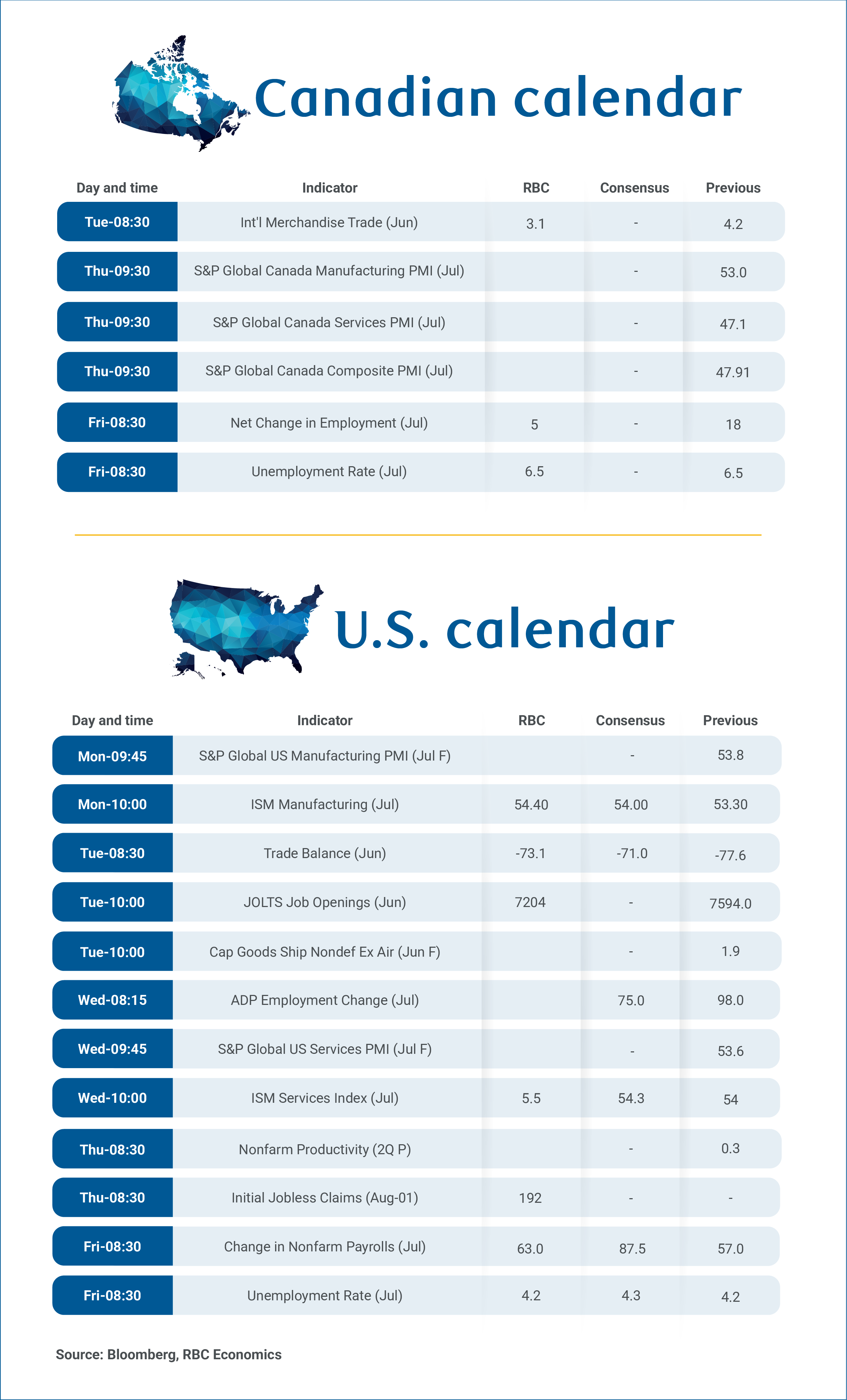
Next Friday’s labour market report for July in Canada is the first for Q3, and an important update on whether the gradual improvement seen in recent months is continuing.
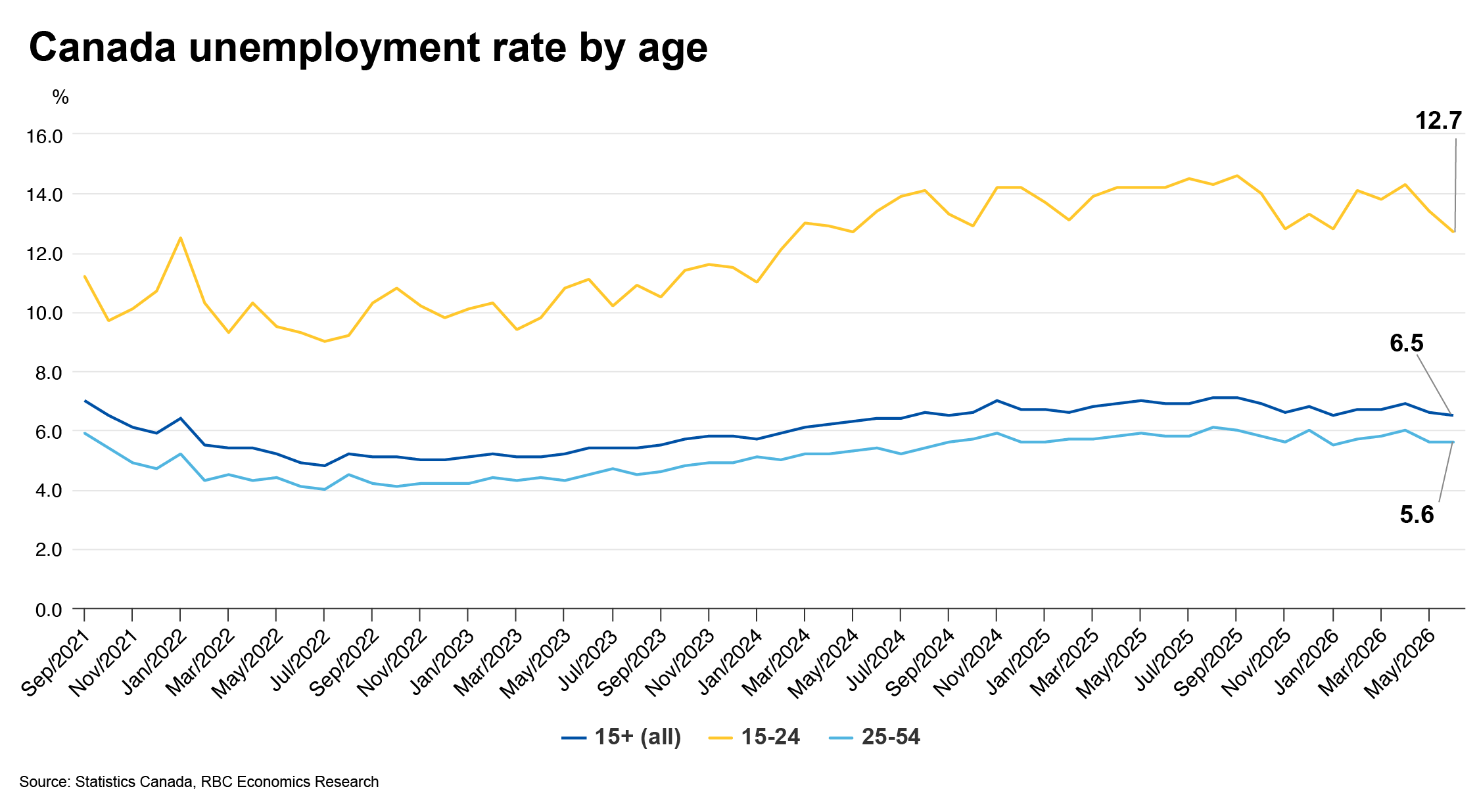
We expect jobs to increase by 5,000 with the unemployment rate holding steady at 6.5%. That would still leave the employment count down slightly in 2026, but would add to increases over May and June. And, with population (and labour force growth) slowing, the unemployment rate holding at 6.5% (down from 6.9% in April, and lower 0.4% from a year ago) remains consistent with per-worker market conditions broadly improving.
Recent labour market indicators, including job postings, have changed little heading into July, suggesting hiring demand has continued to stabilize despite ongoing trade uncertainty.
The composition of employment gains and wage growth will also remain important. June’s increase was driven primarily by part-time jobs, while full-time positions saw a more modest gain. Average hourly wage growth also picked up slightly in June after slowing sharply in May, but that’s likely to continue to drift lower with slack in the market still high by historical standards.
More broadly, recent jobs reports have been consistent with an economy that continues to recover at a modest pace. Employment has continued to increase, the unemployment rate has edged lower from its April peak, and other indicators point to rebounding growth in Q2. The separately released Survey of Employment, Payrolls and Hours data showed employment up 95,000 this year to May—stronger than the more timely Labour Force Survey—with hours worked tracking firm.
A July report broadly in line with our expectations would reinforce our base case forecast that Canada’s labour market is continuing to stabilize, supporting the view that the economy remains on a path of modest, but steady expansion.
-
We expect Canadian exports to decrease by 1.2% in June, while imports increase by 0.3%. The decline in exports is likely due mostly to lower oil prices during the month, while imports are expected to reflect moderate growth in motor vehicle shipments. On balance, we expect the merchandise trade balance to narrow to a $3.1 billion surplus, down from $4.2 billion in May.
About the authors:
Nathan Janzen is an Assistant Chief Economist, leading the macroeconomic analysis group. His focus is on analysis and forecasting macroeconomic developments in Canada and the United States.
Abbey Xu is an economist at RBC. She is a member of the macroeconomic analysis group, focusing on macroeconomic forecasting models and providing timely analysis and updates on economic trends.
Explore the latest from RBC Economics:
-
Public sector key to Canada’s investment boom: Inside provincial capital plans
-
September jobs report: Softer headlines, sturdy foundations
-
Canada’s GDP growth paused in July but still on track for Q3 gain
-
Housing affordability relief is tapering off across Canada
-
PCE deflator update: A retroactive revision, not a disinflationary signal
-
Understanding PCE deflators: The Fed’s preferred measure of inflation
-
Podcast: The 10-Minute Take
-
September Executive Briefing: What to watch in the final quarter of 2026
-
Revised numbers point to positive population growth in Canada
-
How much housing demand in the US still lives at home?
Share these insights with your network:
This article is intended as general information only and is not to be relied upon as constituting legal, financial or other professional advice. The reader is solely liable for any use of the information contained in this document and Royal Bank of Canada (“RBC”) nor any of its affiliates nor any of their respective directors, officers, employees or agents shall be held responsible for any direct or indirect damages arising from the use of this document by the reader. A professional advisor should be consulted regarding your specific situation. Information presented is believed to be factual and up-to-date but we do not guarantee its accuracy and it should not be regarded as a complete analysis of the subjects discussed. All expressions of opinion reflect the judgment of the authors as of the date of publication and are subject to change. No endorsement of any third parties or their advice, opinions, information, products or services is expressly given or implied by Royal Bank of Canada or any of its affiliates.
This document may contain forward-looking statements within the meaning of certain securities laws, which are subject to RBC’s caution regarding forward-looking statements. ESG (including climate) metrics, data and other information contained on this website are or may be based on assumptions, estimates and judgements. For cautionary statements relating to the information on this website, refer to the “Caution regarding forward-looking statements” and the “Important notice regarding this document” sections in our latest climate report or sustainability report, available at: https://www.rbc.com/community-social-impact/reporting-performance/index.html. Except as required by law, none of RBC nor any of its affiliates undertake to update any information in this document.

