

 EN
EN 


“Don’t bet against the US economy” has been our core narrative this year: A resilient high-income consumer, solid labor market, generous fiscal spending, and an AI-powered investment boom boosting the world’s largest economy. But, sustained strength can also exact a price, and the end of summer came with three developments that showed how hard it is to stay in equilibrium.
-
It’s still true: America needs workers, not jobs. The unemployment rate started the summer at 4.3% and has fallen to 4.1% as job growth exceeded expectations. The US is now averaging about 80,000 per month after adding only 10,000 jobs a month in 2025. That’s particularly strong given that our estimate of the break-even pace of employment has fallen to about 20,000 per month as a record number of retirements and slowdown in immigration mean the economy doesn’t need to create the same number of jobs as before.
Meanwhile, layoffs are near all-time lows, job openings continue to grow faster than the civilian labor force, and workers recently laid off have a nearly 40% likelihood of re-employment within five weeks. This is generally good news for the consumer, but tight labor markets of this degree can also mean labor availability becomes more challenged—something to watch for.
-
Inflation is moving in the wrong direction, and it’s not just an energy story. More than half of the components of the Consumer Price Index are running above 3%. There is indeed breadth of inflation within indicators, but also across indicators: ISM and Producer Price Index data confirm the inflation pipeline is heating up, not cooling down. Goods prices are still at risk with tariffs very much still in play, and there’s evidence of high energy prices spilling into airline fares and other sectors. Freight costs, in particular, have spiked, adding more risk that goods prices will be pushed higher.
-
The Federal Reserve raised rates for the first time in three years, clearly not in an attempt to open the Strait of Hormuz and bring down energy prices, but to attempt to:
-
Stem any potential bleeding from high energy prices into broader prices.
-
Tamp down lightly on demand-driven inflation, some of which is still in play.
We expect another two hikes from the Fed this year, which won’t be enough to shift our outlook for the US economy, but warrants some monitoring of lower-income consumers and interest-rate sensitive inflation. See our list of what to watch as the Fed tightens.
-
What’s on the radar heading into 2027
A tight labor market, hot inflation, and a hiking Fed might lend itself to the idea that the US is “overheating.” But that’s not quite how we see it, at least not yet. Inflation is strong, but largely supply driven. Growth has been strong, but reliant on non-residential capital expenditure (i.e. AI investment). Meanwhile, there have been some early indications of minor stress in the consumer credit space. Indeed, what we see now is more consistent with a “warm” economy. However, whether the US tips into overheating or cools from current levels may come down to three themes ahead.
-
The AI spending bet. There’s no doubt the bullish US economic view is firmly relying on AI investment and has for a while. Nonresidential investment has consistently added to GDP growth since 2021, driven largely by structures (i.e., data center construction), and equipment spending tied to the data center buildout (i.e., IT and electrical equipment). We calculate that without the AI investment boost, US GDP growth would have run about half as fast in 2026 – under 1.0% in the first half. But, public opposition and government restrictions are growing, which begs the question: Can AI spending maintain momentum? It’s a risk that weighs more heavily on our minds than a few more rate hikes.
-
The consumer credit crack. Put bluntly, US households are saving less and borrowing more to sustain spending. Real wages have been trending negative for consumers since April (particularly low and middle-income households). Revolving and non-revolving loans are rising. Non-mortgage personal interest payments now consume 2.5% of disposable income—alarmingly close to the 2.8% threshold that preceded the three pre-COVID recessions. Commercial bank loan delinquencies sit at 2.6% with credit cards at 2.9%, and there’s been a recent spike in 120-plus days late delinquencies. It’s still our take that the K-shaped economy is in effect: High income consumers are driving US consumption, are less impacted by inflation, and continue to see strong growth in non-labor income. But, there’s enough building strain for lower-income buckets that’s worth monitoring for a trigger to a broader slowdown in consumer spending.
-
The retiree wildcard. Social Security benefits now support over 57 million beneficiaries, and unlike wage growth, Social Security benefits are inflation adjusted (using Q3 2026 CPI-W data). Here lies a deep divide in America: Retirees will see a segment of their income boosted by an expected 2027 COLA of 3.5%, while workers aren’t likely to see wage growth at that level. If inflation cools in 2027 while elevated transfer payments persist, COLAs could become a source of demand-driven inflation pressure, creating an unusual dynamic where benefits meant to support retirees fuel broader price increases. Don’t forget, the labor force is shrinking. Nearly 20% of US income comes from government transfers, and 22% of spending is on healthcare.
Growth outlook
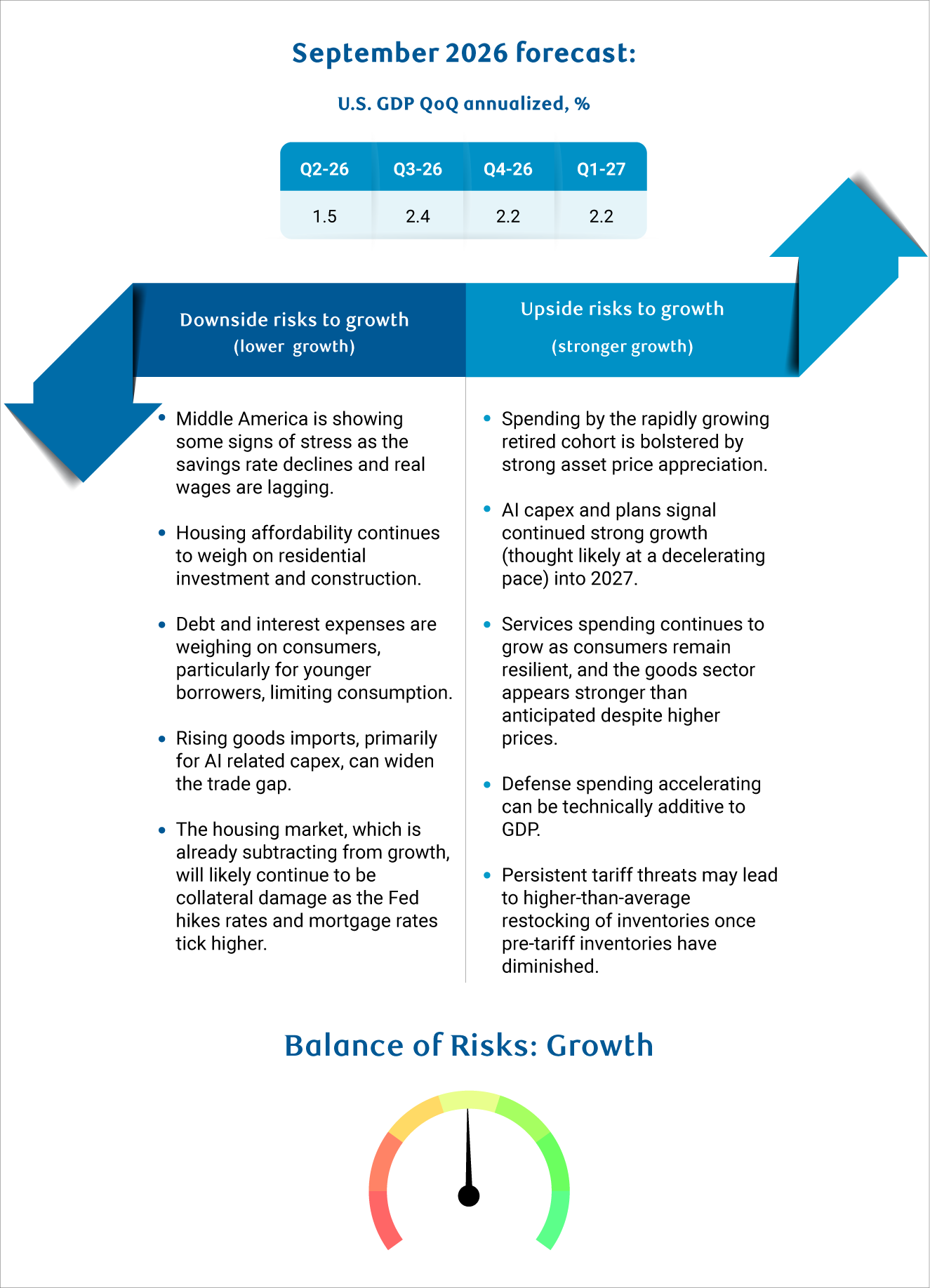
House view: TheUS economy’s resilience continues with underlying growth slightly above the 2% trend, though diverging trends persist underneath. AI continues to drive the entirety of the business investment story: Spending on information processing equipment and data center infrastructure has surged, while capex outside of the AI remains exceptionally weak. For consumers, there are signs that buffers in Middle America are developing cracks worth monitoring. With energy prices surging once again, we view risks to the economy as roughly balanced with downside surprises still possible should energy inflation bleed through beyond headline price growth, while upside surprises are still possible from productivity and the AI investment boom.
Inflation outlook
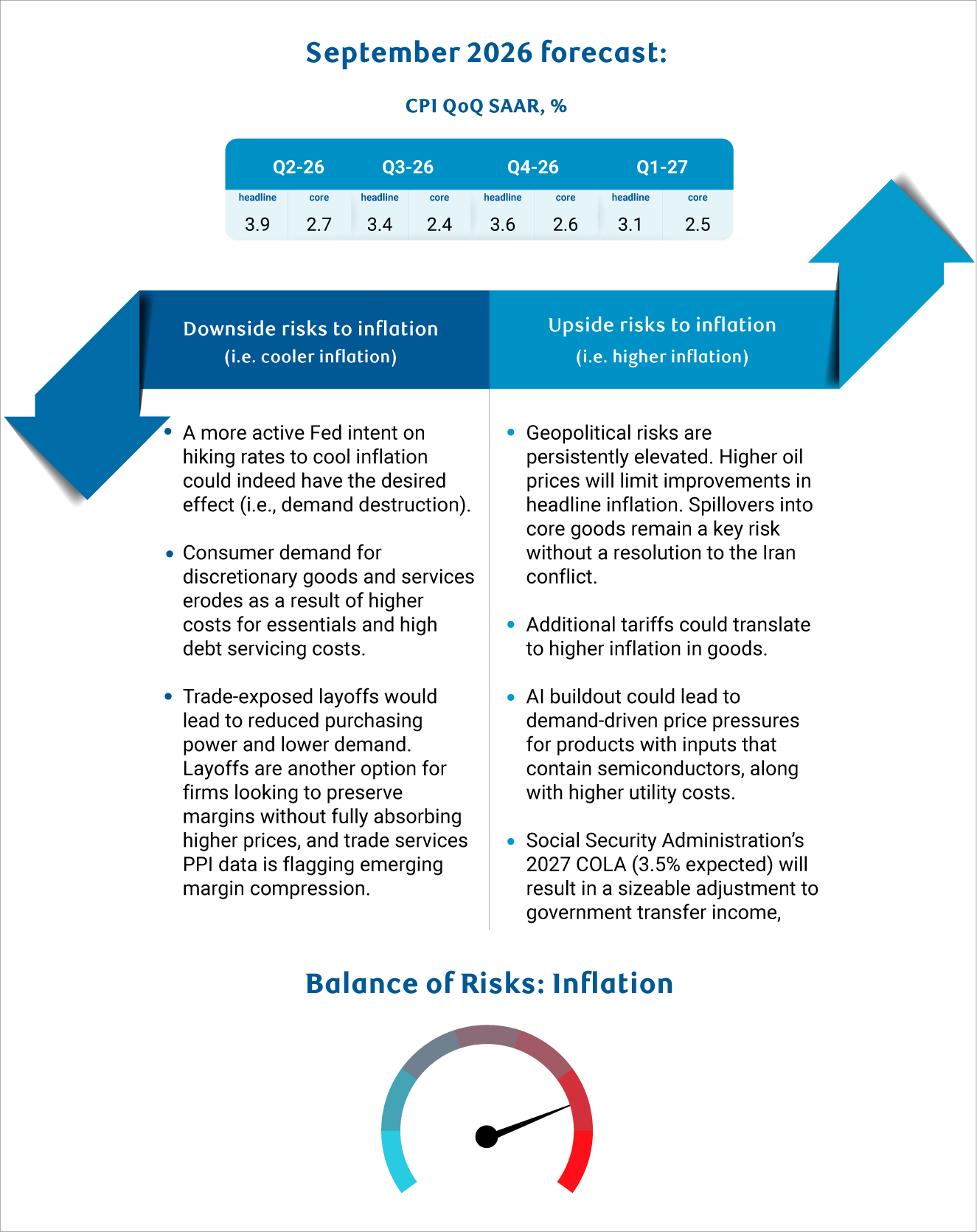
House view: Inflationary pressures remain broad and persistent with energy prices reaccelerating and tariff pressure still in play. Importantly, the Fed returning from the sidelines doesn’t guarantee supply-driven inflation will be tamed. We also acknowledge that any additional hikes may produce undesirable side effects for lower and middle-income consumers. Traditionally, hikes would work to protect against a demand-driven inflation spike. If inflation cools while we get inflation-adjusted 2027 Cost of Living Adjustments (COLA) for Social Security income, the benefits meant to support retirees could fuel broader price increases. The same can be said for soaring equity valuations that continue to support the wealthiest households—who account for the bulk of consumer demand.
Labor market outlook
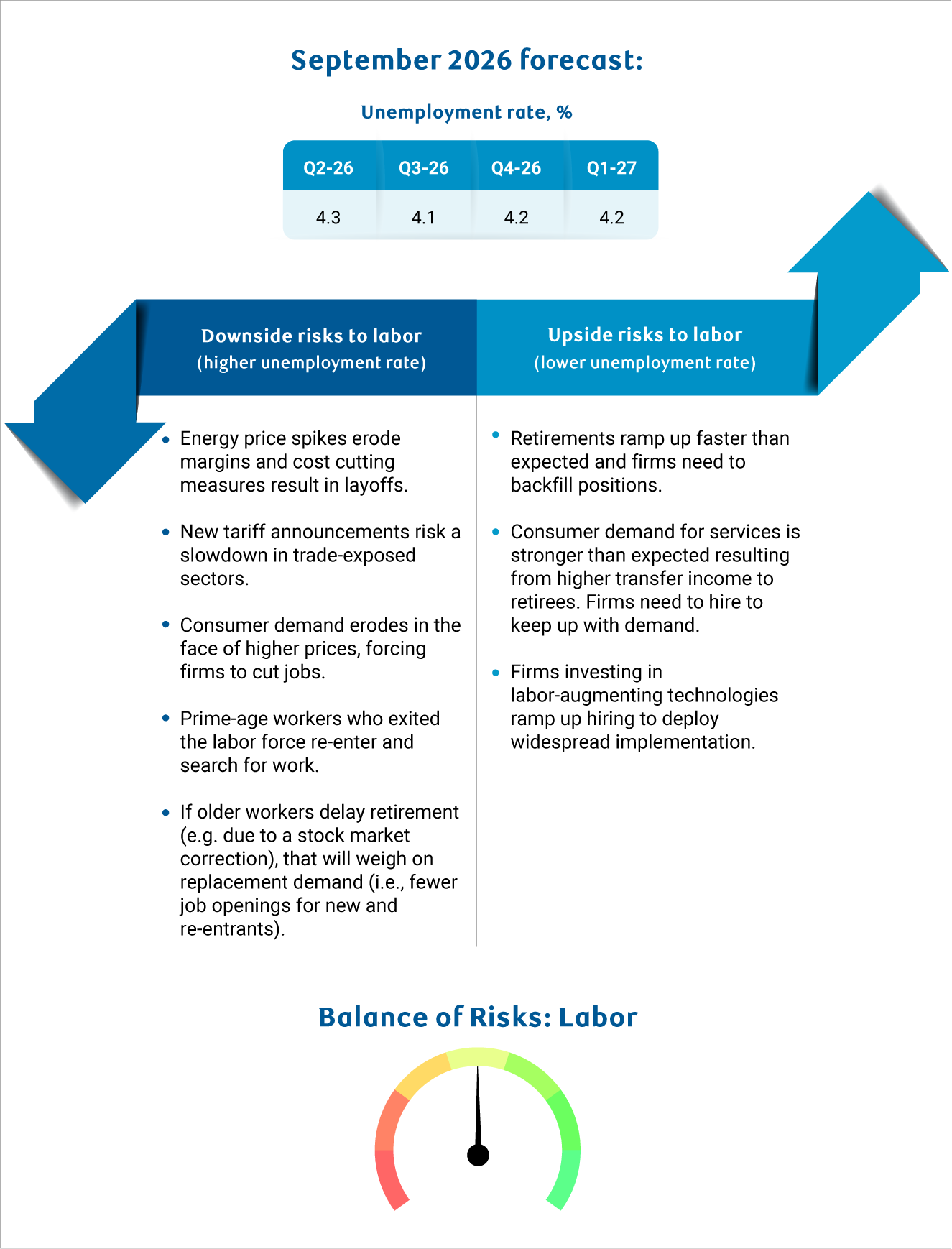
House view: We continue to expect structural factors will keep the US labor market very tight. Monthly job creation has significantly outpaced expectations in recent months—especially with an exceptionally low breakeven employment number. But, the backdrop remains mixed. Employment in some white-collar sectors continues to decline, contributing to a skill-matching problem facing recent graduates. The unemployment rate gives us a better gauge of labor market tightness over payroll growth, and it remains exceptionally low at 4.1%. Record retirements have helped keep a lid on the unemployment rate, but if we see a reversal of this trend, re-entrants could drive a slight uptick in the unemployment rate. For now, the low level of WARN notices and historically low jobless claims suggest currently there isn’t a significant risk of an increase in layoffs.
About the authors:
Frances Donald is the Chief Economist at RBC and oversees a team of leading professionals, who deliver economic analyses and insights to inform RBC clients around the globe. Frances is a key expert on economic issues and is highly sought after by clients, government leaders, policy makers, and media in the US and Canada.
Mike Reid is Head of US Economics at RBC. He is responsible for generating RBC’s US economic outlook, providing commentary on macro indicators, and producing written analysis around the economic backdrop.
This article is intended as general information only and is not to be relied upon as constituting legal, financial or other professional advice. The reader is solely liable for any use of the information contained in this document and Royal Bank of Canada (“RBC”) nor any of its affiliates nor any of their respective directors, officers, employees or agents shall be held responsible for any direct or indirect damages arising from the use of this document by the reader. A professional advisor should be consulted regarding your specific situation. Information presented is believed to be factual and up-to-date but we do not guarantee its accuracy and it should not be regarded as a complete analysis of the subjects discussed. All expressions of opinion reflect the judgment of the authors as of the date of publication and are subject to change. No endorsement of any third parties or their advice, opinions, information, products or services is expressly given or implied by Royal Bank of Canada or any of its affiliates.
This document may contain forward-looking statements within the meaning of certain securities laws, which are subject to RBC’s caution regarding forward-looking statements. ESG (including climate) metrics, data and other information contained on this website are or may be based on assumptions, estimates and judgements. For cautionary statements relating to the information on this website, refer to the “Caution regarding forward-looking statements” and the “Important notice regarding this document” sections in our latest climate report or sustainability report, available at: https://www.rbc.com/community-social-impact/reporting-performance/index.html. Except as required by law, none of RBC nor any of its affiliates undertake to update any information in this document.

