

 EN
EN 


The Bottom Line:
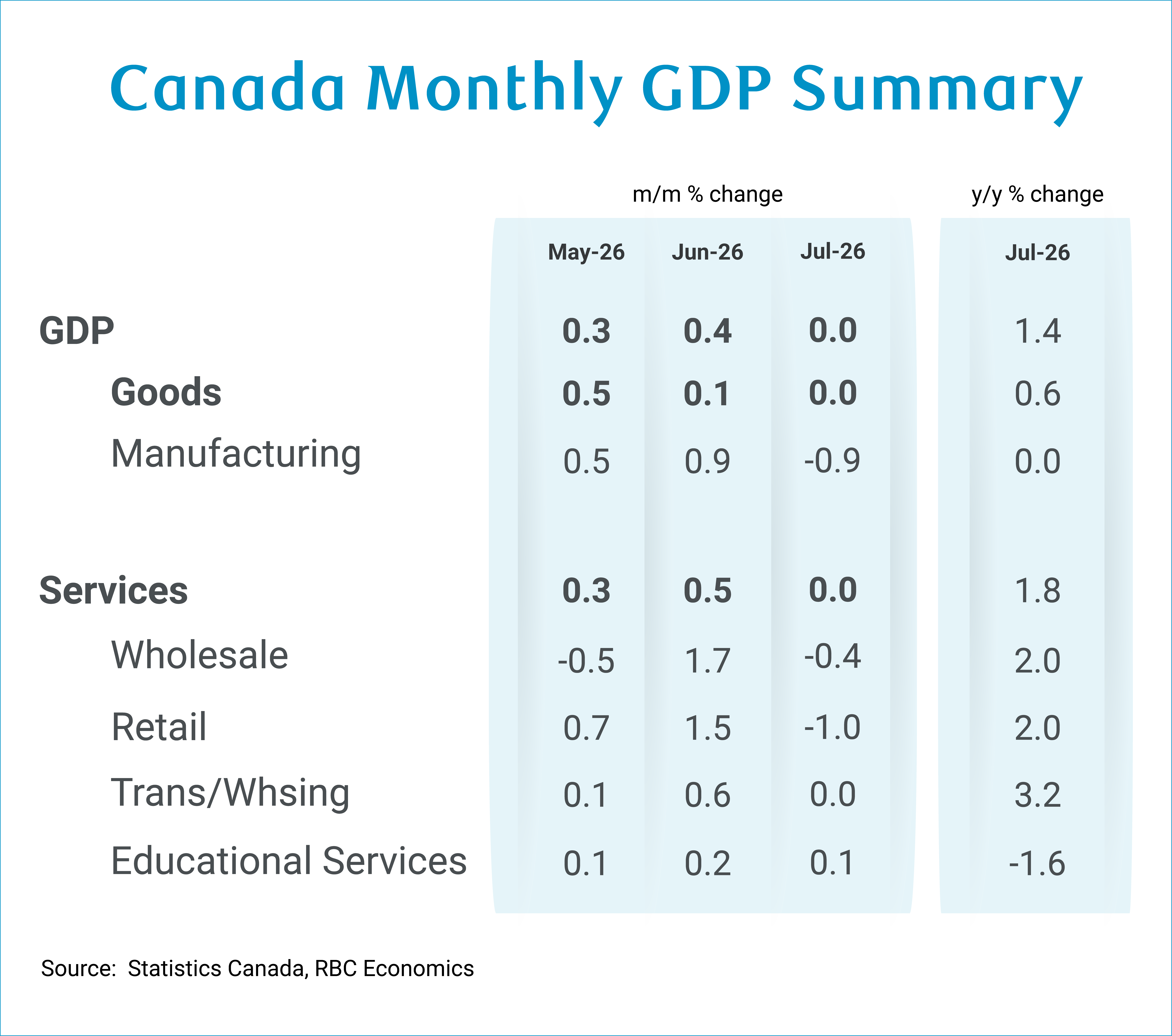
Canadian economic activity was unchanged in July, pausing after averaging 0.5% monthly gains between April and June. Weaknesses in manufacturing, wholesale, and retail trade offset continued growth in accommodation and food services and professional, scientific, and technical services sectors, and a jump in construction activity.
Still, Statistics Canada’s advance estimate (highly revision-prone) indicated GDP rose by 0.2% in August. That is consistent with further growth in the third quarter, at a slower rate than the 3.3% (annualized) jump in Q2 but broadly in line with our own 1.8% forecast and our view that the economy remains in a gradual recovery phase.
There was little indication of a significant broader negative economic impact in August after the United States imposed 50% tariffs on a subset of Canadian exports on August 22. Upcoming data reports will be watched closely — the new tariffs are expected to cause significant disruption for directly affected industries and regions, although rising hours worked and resilient consumer spending suggest activity elsewhere in the economy continued to expand.
Growth is expected to be substantially slower than in Q2 as earlier support from recovering auto production and net trade fades. New tariffs and tighter financial conditions remain important downside risks, while targeted government support should help cushion the impact on affected businesses and workers.
Overall, the July report leaves the Bank of Canada still balancing potential downside economic growth risks, and tightening in financial conditions from higher bond yields, against resilient backward looking economic data and risks that elevated energy costs spread into broader inflation. Our base case remains for the Bank to hold interest rates through the end of 2026 before gradually raising them in 2027, but recent BoC communications have signaled risks around that base-case are tilted to earlier rather than later hikes.
The details:
-
Real GDP was unchanged in July, following a 0.4% increase in June. Output was 1.4% above its year-ago level. Both goods-producing and services-producing industries were flat on the month.
-
Manufacturing output fell 0.9% after three consecutive monthly gains. The largest drag came from petroleum and coal products, which declined 5.7% after unplanned downtime at a southwestern Ontario refinery curtailed production of motor gasoline, diesel, and aviation fuel.
-
Mining, quarrying, and oil and gas extraction edged down 0.5%, as weakness in conventional oil extraction and mining excluding oil and gas more than offset a 0.2% rise in non-conventional extraction.
-
Wholesale trade slipped 0.4%, with softness concentrated in machinery and equipment, partially offset by gains in building materials and supplies. Retail trade dropped 1.0%, led by lower activity at gasoline stations and general merchandise retailers.
-
Offsetting those declines, construction output rose 1.3%, marking the fourth consecutive monthly increase and one of the largest contributors to headline growth. Utilities advanced 1.7%, reversing the prior month’s decline. Real estate and rental and leasing activity continued to edge higher (+0.1%), supported by a rebound in home resale activity. Professional, scientific, and technical services grew 0.3%, while accommodation and food services expanded 0.8%.
-
Statistics Canada’s advance estimate pointed to a 0.2% GDP increase in August. Other preliminary indicators for the month suggest manufacturing sales rose 1.1% (though mostly price-driven), and retail sales climbed 1.3%, consistent with our internal cardholder data showing resilient consumer spending. Core wholesale sales, however, posted a 1.5% decline.
About the author:
Abbey Xu is an economist at RBC. She is a member of the macroeconomic analysis group, focusing on macroeconomic forecasting models and providing timely analysis and updates on economic trends.
This article is intended as general information only and is not to be relied upon as constituting legal, financial or other professional advice. The reader is solely liable for any use of the information contained in this document and Royal Bank of Canada (“RBC”) nor any of its affiliates nor any of their respective directors, officers, employees or agents shall be held responsible for any direct or indirect damages arising from the use of this document by the reader. A professional advisor should be consulted regarding your specific situation. Information presented is believed to be factual and up-to-date but we do not guarantee its accuracy and it should not be regarded as a complete analysis of the subjects discussed. All expressions of opinion reflect the judgment of the authors as of the date of publication and are subject to change. No endorsement of any third parties or their advice, opinions, information, products or services is expressly given or implied by Royal Bank of Canada or any of its affiliates.
This document may contain forward-looking statements within the meaning of certain securities laws, which are subject to RBC’s caution regarding forward-looking statements. ESG (including climate) metrics, data and other information contained on this website are or may be based on assumptions, estimates and judgements. For cautionary statements relating to the information on this website, refer to the “Caution regarding forward-looking statements” and the “Important notice regarding this document” sections in our latest climate report or sustainability report, available at: https://www.rbc.com/community-social-impact/reporting-performance/index.html. Except as required by law, none of RBC nor any of its affiliates undertake to update any information in this document.

