

 EN
EN 


Public investment accounts for a larger share of Canada’s capital spending (‘capex’) than commonly understood, and provinces are the heavy hitters.
But, now that the era of steadily rising provincial government capex is reaching fiscal limits, the burden is increasingly shifting to Ottawa.
Here are four things to know about the importance of public investment, the debt consequences of provinces’ post-pandemic capital surge, emerging constraints on further increases, and a growing federal role in public capex funding.
1. Governments are big capital spenders with provinces in the lead
Governments’ role in Canada’s investment spending is bigger than what standard metrics imply.
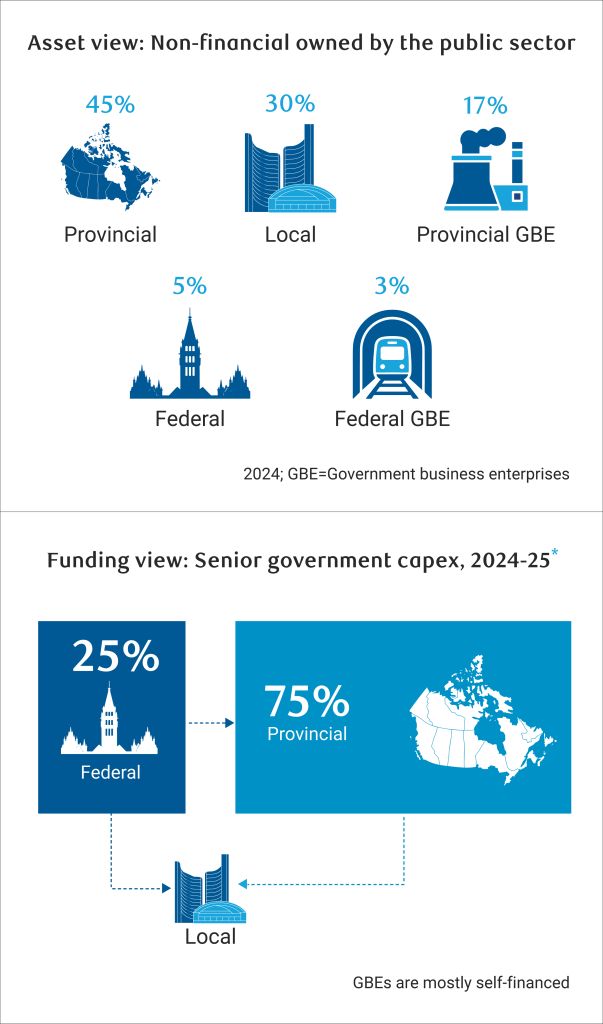
Macroeconomic accounts put the government share of capex at 18% in 2025, yet this excludes government business enterprises (GBEs)—many of which are capex-heavy such as BC Hydro or Ontario’s Metrolinx.
When you include GBEs, the public share of capex jumps to 26%, while reaching 40% for non-residential tangible assets (i.e., non-housing, non-intellectual property), which are at the heart of the federal government’s planned investment boom.
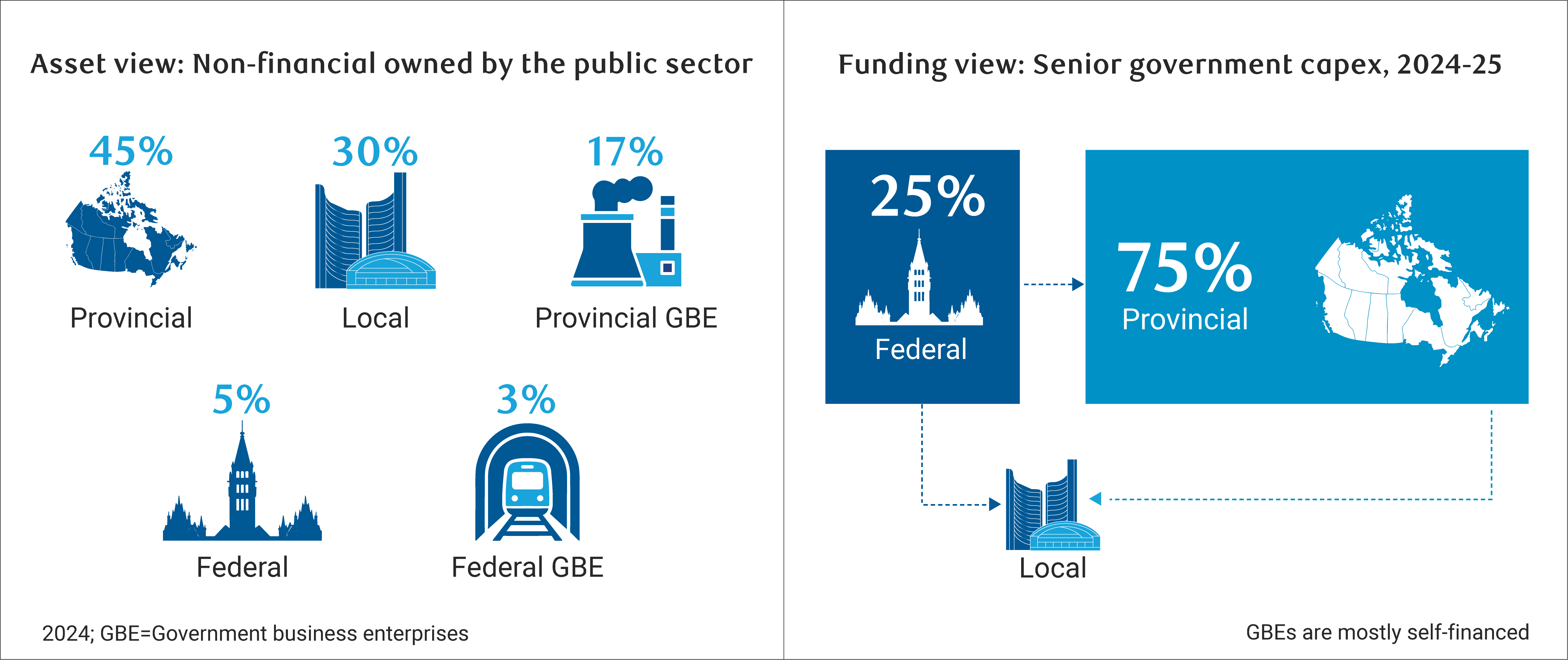
Provincial governments own 45% of public capital assets, followed by local governments and then provincial GBEs. Funding for public capex has also been predominantly provincial, although comprehensive official data is scant.
Using public accounts data for Ottawa and the big four provinces1, we estimate the provincial funding share was at least 75% in 2024–25 among senior governments (federal plus provincial, excluding GBEs and municipalities).
2. Post-pandemic capex surge pushed provincial government debt higher
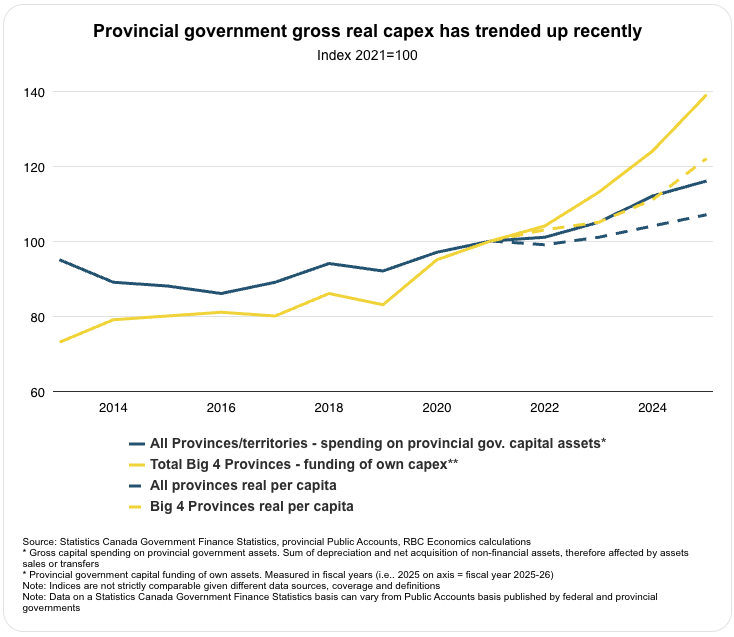
Gross real investment in provincial government capital assets has risen in recent years, while outpacing depreciation to also yield net asset additions. Much of this was self-funded. Capital spending by at least the big four provinces has also been on an uptrend.
The post-pandemic economy was conducive to rising provincial investment.
Provinces emerged from COVID-19 with debt-to-GDP ratios largely unscathed—Ottawa absorbed most pandemic support—while the nominal growth boom initially improved deficits and debt ratios. Infrastructure deficits and rapid in-migration then drove capex higher, still growing on a real per capita basis. Low interest rates (at the start) would keep the added debt serviceable.
While capex does not affect government deficit and some debt metrics the same as other spending, it does raise net debt, a measure important for investors (see below).
Combined with large operating deficits, strong capex has seen provinces collectively use material fiscal space. The acquisition of non-financial assets accounted for 26% of provincial net borrowing between 2021 and 20252.
Yet this story varies across provinces. Some have seen big capital plans contributing to rapidly increasing net debt burdens (British Columbia and Maritime provinces), while others have had more success containing recent debt burden increases (Ontario and Quebec) or benefit from stronger starting points (Alberta and Saskatchewan).
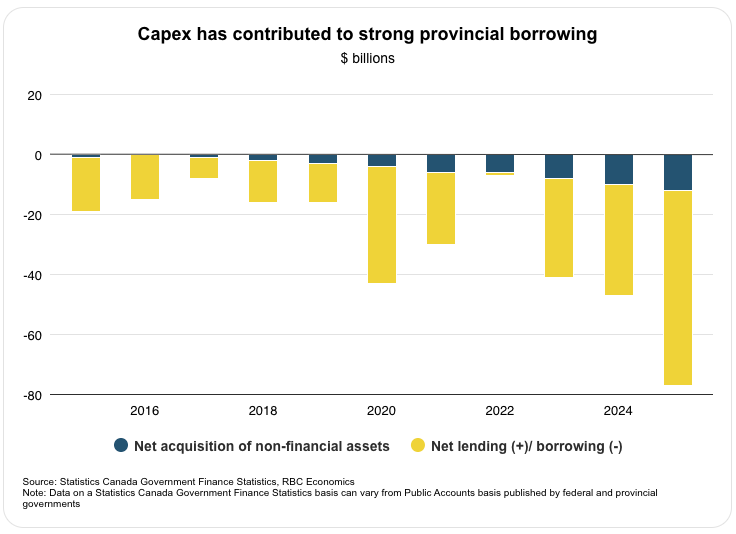
Capital spending does not directly translate into higher deficits or lower surpluses. Generally, only amortization expense, capital transfers to third parties, and interest on associated debt are part of current spending. But, a rising capital stock means rising expenses over time.
In a deficit situation, higher capex translates into higher gross debt and net debt (= gross debt – financial assets). It does not affect the “accumulated deficit” debt measure often highlighted by governments (= net debt – nonfinancial assets). However, net debt is the primary burden measure important for investors and credit rating agencies.
3. Fiscal pressures cap the provincial government capex outlook
Based on current capital plans, the big four provinces’ gross real self-funded capex is expected to peak in 2026-27 before falling by 1% in 2027-28 and 15% the year after3. If materialized, it would return collective real per capita capex for the big four provinces close to its 2021-22 level.
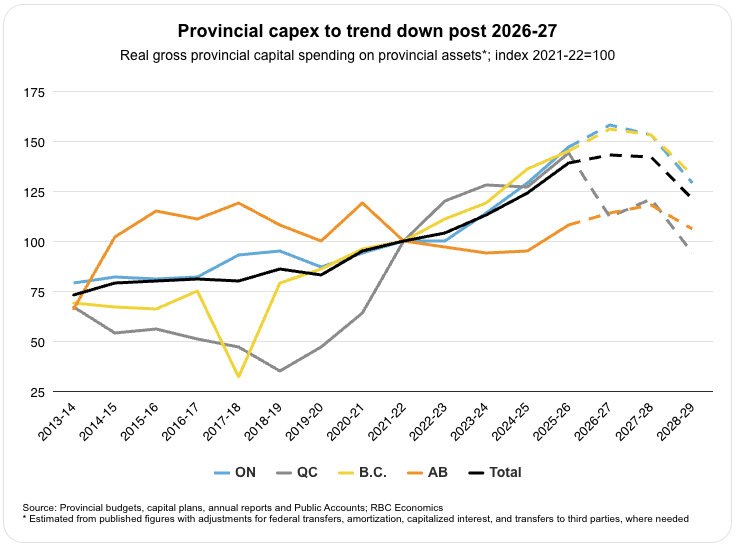
Capex is lumpy and spending timelines shift, but slower population growth and budgetary pressures suggest the recent era of routine upward revisions to provincial capital plans may be over.
Economic risks, commitments or obligations to reduce deficits, spending demands from health care, rising interest rates, and other pressures should keep budgets tight.
While the fiscal calculus is not quite the same for capex—public infrastructure can often pay for itself over time through higher economic activity—the unknown or extended timelines for these returns mean provinces with weaker fiscal capacity could be constrained now. Delaying non-critical capex is also often a preferred approach to fiscal restraint, even if it deepens infrastructure deficits.
These dynamics are already bearing on the trajectory of capex programs: B.C.’s 2026 budget delayed some capex, while Quebec’s commented that plan would respect “taxpayer capacity to pay.”
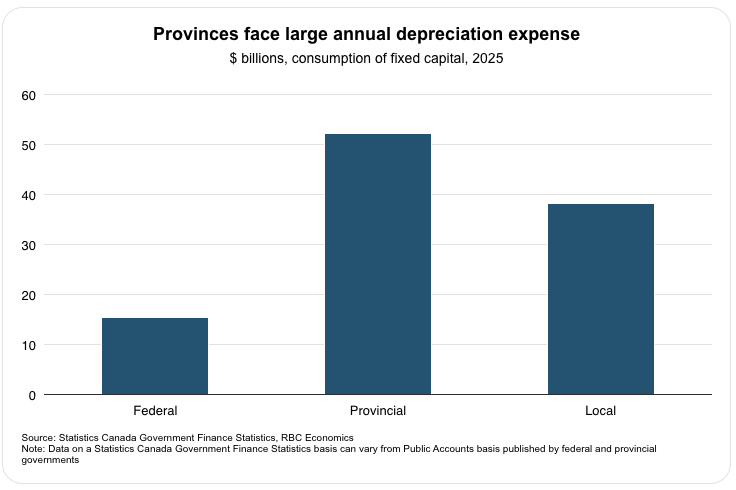
While new government capex could slow, provinces will remain primary capex funders—their very large capital stock requires huge annual investment just to keep up with depreciation.
4. Federal government funding share to grow, but on Ottawa’s terms
Ottawa may pitch in as provinces face limited capacity to take on larger capital plans, but it will probably do so selectively.
The federal share of senior government (federal plus provincial) capital funding is currently planned to increase with higher defence spending, and capital transfers to provinces and municipalities like through Budget 2025’s Building Canada Fund.
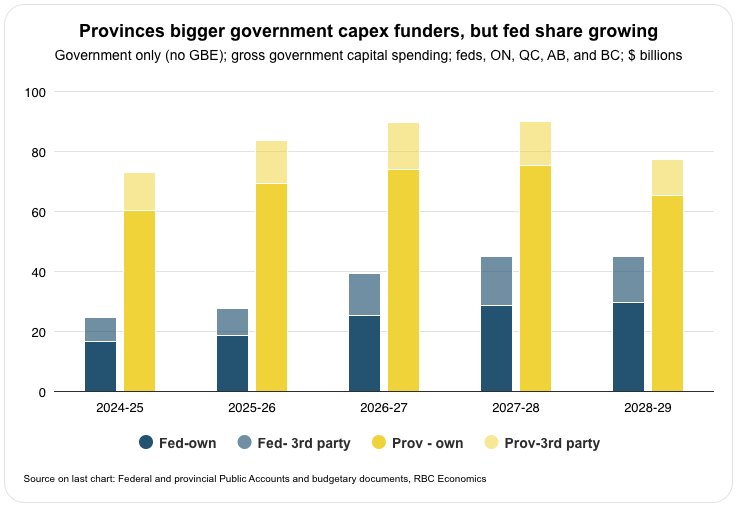
But, Ottawa has also been expanding into provincial GBE funding, and its economic strategy suggests this may increasingly be the focus ahead.
GBE capital programs are typically designed to be self-funding with expenditures recovered through energy bills, rider fares or other user fees. But, rising affordability concerns have seen federal and provincial governments intervene.
Recent federal support include the Clean Electricity Investment Tax Credit, for which public utilities are eligible, and concessionary financing from the Canada Infrastructure Bank – where provinces have been its largest co-investor to date4.
Now Ottawa is positioning public infrastructure as long-term scaffolding for private investment amid sustained business uncertainty. Expanded grids or remote roads, for example, could draw in greener resource development, critical minerals mining, advanced manufacturing or AI data centres. Much of this infrastructure is delivered by provincial GBEs. Half of the 20 projects currently referred to the Major Projects Office have public sponsors.
But, a larger federal role must avoid crowding out provincial capex or undermining sustainable infrastructure funding models – not least because Ottawa must preserve its own fiscal capacity. The Parliamentary Budget Officer found that 2016’s federal Investing in Canada Plan appears to have displaced provincial capex, essentially facilitating a deferral of tough, but necessary fiscal choices.
Getting the federal–provincial balance right will be critical. Canada’s planned investment boom hinges not just on how much Ottawa spends, but on whether that spending genuinely adds to the national capital stock.
About the author:
Cynthia Leach is the Assistant Chief Economist at RBC with a focus on federal and provincial fiscal analysis, government policy, demographics, and other thematic research.
- Estimated using public accounts data for the federal government and big four provinces – Ontario, Quebec, Alberta, and British Columbia (where over 85% of annual capital spending takes place) – with some comparability adjustments. Data limitations and definitional differences in provincial capital plans mean imperfect alignment. ↩︎
- This metric does not account for the true burden of provincially funded capex on provincial debt since it accounts for neither federal capital funding to provinces nor provincial capital funding to third parties. However, it is a reasonable approximation given provincial government investment is mostly self-funded. ↩︎
- Health and transportation were the largest beneficiaries of the 2026-27 annual increase, while the subsequent drops were broadly based (although health care was less affected). ↩︎
- Update on the Spending Outlook of the Canada Infrastructure Bank ↩︎
This article is intended as general information only and is not to be relied upon as constituting legal, financial or other professional advice. The reader is solely liable for any use of the information contained in this document and Royal Bank of Canada (“RBC”) nor any of its affiliates nor any of their respective directors, officers, employees or agents shall be held responsible for any direct or indirect damages arising from the use of this document by the reader. A professional advisor should be consulted regarding your specific situation. Information presented is believed to be factual and up-to-date but we do not guarantee its accuracy and it should not be regarded as a complete analysis of the subjects discussed. All expressions of opinion reflect the judgment of the authors as of the date of publication and are subject to change. No endorsement of any third parties or their advice, opinions, information, products or services is expressly given or implied by Royal Bank of Canada or any of its affiliates.
This document may contain forward-looking statements within the meaning of certain securities laws, which are subject to RBC’s caution regarding forward-looking statements. ESG (including climate) metrics, data and other information contained on this website are or may be based on assumptions, estimates and judgements. For cautionary statements relating to the information on this website, refer to the “Caution regarding forward-looking statements” and the “Important notice regarding this document” sections in our latest climate report or sustainability report, available at: https://www.rbc.com/community-social-impact/reporting-performance/index.html. Except as required by law, none of RBC nor any of its affiliates undertake to update any information in this document.

