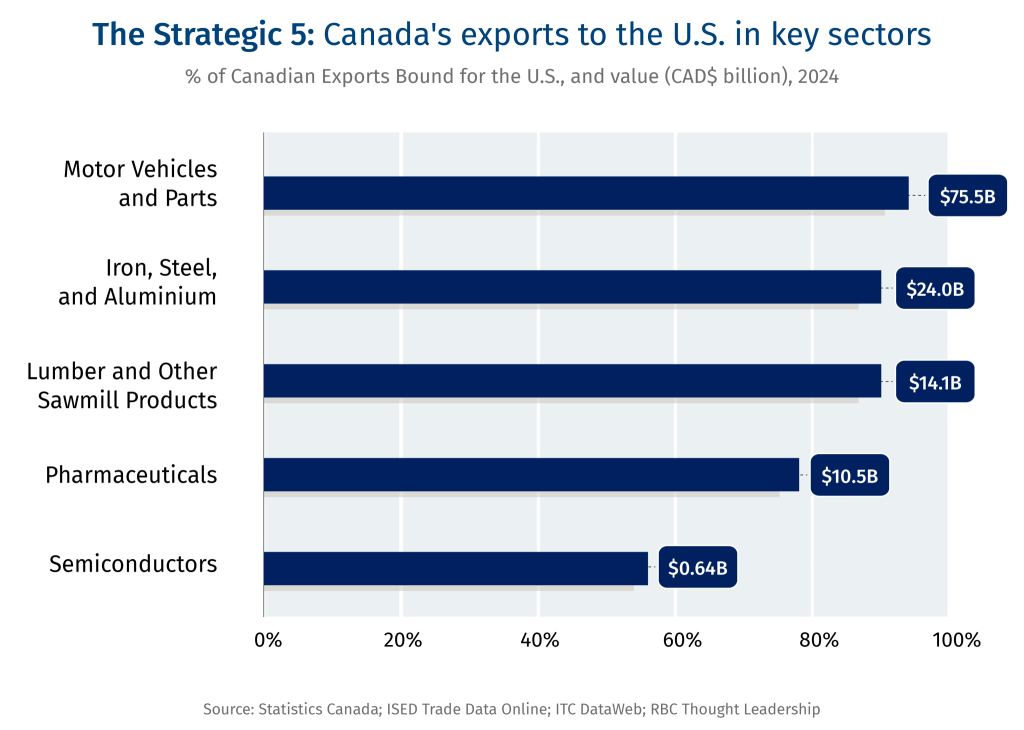
U.S. President Donald Trump believes autos, steel and aluminum, lumber, pharmaceuticals and semiconductors are the five strategic sectors that will drive American industrial revival. His overarching plans involves cutting imports (and trade deficits) and onshoring domestic production in each of the sectors and related industries. That’s emerging as a challenge for some of the U.S.’s top sector suppliers, including Canada.
These five domestic sectors rely heavily on shipments south of the border and are of strategic importance to Canada.

U.S. tariffs on the Strategic 5 will likely hurt Canada’s economic prospects and could trigger layoffs and flight of capital in sectors that are vital for our energy and national security.

Here’s a look at the importance of each of these sectors to the Canadian economy:
Automotive

  • Exposure to the U.S. market: $75.6 billion in exports (2024)

  • Total U.S. market: Sales of new vehicles in the U.S. reached 15.8 million units in 2024—second only to China’s 31.3 million.1

  • Global market: Just over 88.2 million vehicles2 are estimated to have rolled off assembly lines worldwide last year.

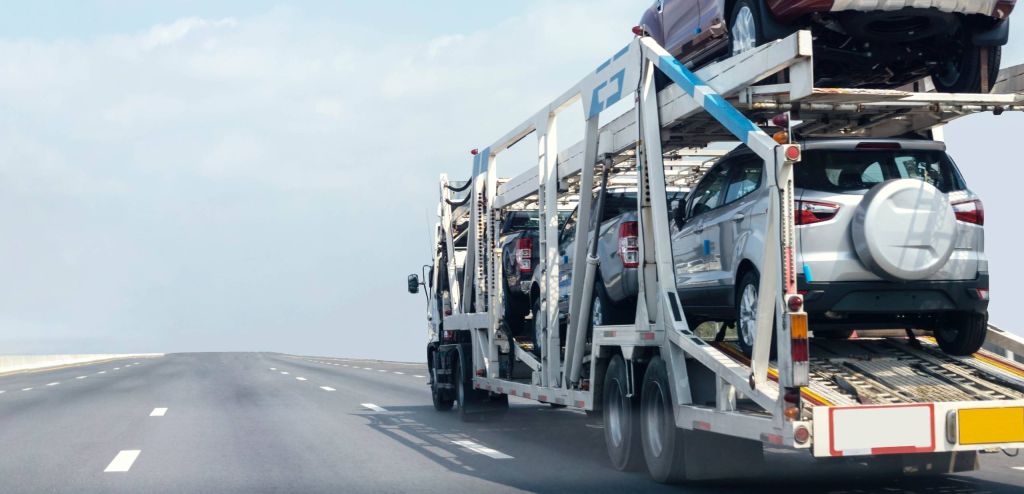
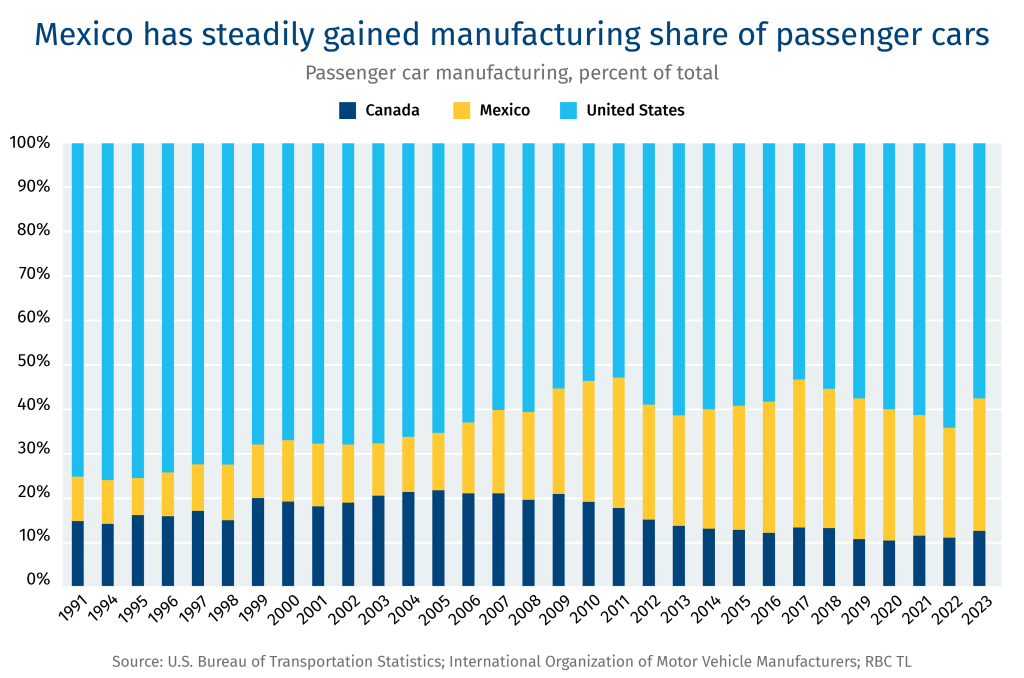
  • Canada’s role: Domestic auto- and part- makers’ market share in North American auto manufacturing has fallen over time, with Mexico gaining ground. However, 92% of Canadian auto exports are still shipped south of the border.

  • Tariff status: For CUSMA-compliant vehicles, the 25% tariffs are currently in force and apply to the value of non-US content.

  • Canada’s response: Ottawa’s countermeasures focus on 25% tariffs on all U.S. auto parts not compliant with CUSMA. The federal government and Ontario are also easing tariffs for U.S. auto parts for companies that remain committed to the Canadian auto supply chain.

  • The fallout: Stellantis and General Motors temporarily laid off staff in Ontario assembly plants.

  • What’s next: The Trump administration is mulling a potential pause on auto tariffs—primarily to give carmakers more time to onshore supply chains.

Aluminum, steel and iron

  • Exposure to the U.S. market: 91% of Canada’s aluminum and 89% of its steel exports were shipped to the U.S.

  • Total U.S. market: The U.S. consumed 93 million tonnes of steel in 2024—with Canada supplying 6.4 million metric tonnes of the total.3

  • Global market: Global aluminum demand has steadily increased over the past decade, driven mostly by growth in Chinese demand and from sectors like construction and transport.

  • The U.S. has had an average trade deficit in aluminum with Canada of about US$7 billion annually over the past five years.4

  • Canada’s role: We are a top foreign supplier of aluminum and steel to the U.S., ahead of China and Mexico.

  • Tariff status: The 25% U.S. tariffs on aluminum and steel imports from Canada are triggered by American efforts to bolster its domestic industry. The first Trump administration had also imposed tariffs on Canadian aluminum for 14 months, lifting them after USMCA was ratified in 2019.

  • The fallout: Hundreds of workers in the aluminum and steel industry have already been laid off since the latest tariffs came into effect.6 Ottawa is taking several measures to support Canadian workers and businesses.

  • What’s next: Commerce Secretary Howard Lutnick says reprieves on steel and aluminum tariffs are unlikely. With aluminum featuring on the USGS Critical Minerals list and a new probe on U.S. critical mineral imports underway, Canada’s aluminum industry may need to gear up for further uncertainty.

Lumber and other sawmill products

  • Exposure to the U.S. market: $14.1 billion in exports—90% of Canada’s total lumber exports.

  • Total U.S. market: The U.S.’s trade deficit against Canada in softwood lumber averaged US$5.8 billion annually over the past decade, according to the U.S. International Trade Commission.

  • Global market: The US$788 billion global wood products market is expected to nearly double in value by 2033. We wrote recently on how Canada can capture a greater share of the global opportunity.

  • Canada’s role: Canada’s domestic consumption of softwood lumber has fallen 11% from a decade ago. Domestic demand, which has generally followed housing starts, reached a 23-year low in 2023.

  • Tariff status: Under the Biden Administration, the U.S. raised duties charged on Canadian softwood lumber imports to 14.5% in August 2024. These tariff rates remain in place with additional hikes on the horizon.

  • The fallout: The lumber industry is already facing regulatory headwinds that have forced closures of sawmills in B.C.

  • What’s next: U.S. tariffs on softwood lumber imports are set to increase to 34.5% and could come into effect in the fall.

Pharmaceuticals

  • Exposure to the U.S. market: $10.6 billion in exports.7

  • Total U.S. market: Prescription drug sales in the U.S. were $716 billion in 20228 , or about 2.8% of U.S. GDP.

  • Between 2019 and 2024, the U.S. has run an annual $1.2 billion trade deficit in pharmaceuticals with Canada, according to U.S. International Trade Commission data.

  • Global market: Pharma R&D spending is expected to top US$200 billion9 this year.

  • Canada’s role: The U.S. is Canada’s primary pharmaceutical export market, accounting for 78% of its pharma exports in 2024. Japan, the next largest export market, received 5% ($720 million) of exports, followed by China, at 2% of exports, or $276 million. The Canadian pharma industry employed 35,367 workers in 2024.

  • Tariff status: Originally exempt from the April 2 reciprocal tariffs, the White House has now officially launched an investigation into the national security impacts of pharmaceutical imports.

  • The fallout: Industry is warning of a spike in costs of drugs and even shortages of key medicines.10

  • What’s next: Major tariffs on pharma could be on the horizon.

Semiconductors

  • Exposure to the U.S. market: $637 million, or 56% of Canadian semiconductor exports, in 2024.11

  • The U.S. runs a trade surplus in semiconductors with Canada, reporting a surplus of $764 million in 2024.

  • Global market: Global semiconductor sales were estimated at $627 billion in 2024.12

  • Total U.S. market: Companies involved in the semiconductor ecosystem plan to invest nearly US$450-billion in more than 90 new manufacturing projects in the U.S. across 28 states, according to an industry association.13

  • Canada’s role: Canada is emerging as AI hub with its clean and cheap electricity seen as a competitive edge. A recent RBC Thought Leadership report, published before the trade turmoil, estimated Canada could attract nearly $100 billion across 20-30 data centres. Disruptions to the nascent chip supply chain could disrupt that potential capital flow.

  • Tariff status: The U.S. announced probe into chip and electronics imports in early April, paving the way for new tariffs.

  • The fallout: Several tech companies have seen their stocks drop.

  • What’s next: Some reports suggest Trump will announce new tariff rates on imported semiconductors next week, with flexibility for certain companies. Secretary Lutnick said it would likely come in “a month or two.”15

Vivan Sorab is Senior Manager, Clean Technology.


To check the pulse on the agri-food industry, RBC’s Thought Leadership team met with farmers from across Canada last week—from pork producers in Manitoba to members of the fruit and vegetable industry gathered in Montreal for their annual tradeshow.

What’s clear is that the industry is highly motivated to keep up the momentum; last year, Canadian agri-food export value was a record $106 billion. And all eyes are on commodity prices, U.S. farm policy and, of course, the impact of U.S. President Donald Trump’s tariffs.

What we heard:

  • Many farmers are adopting a keep calm, carry-on approach. Farmers are accustomed to volatility, the result of managing through unexpected weather conditions, shifting commodity prices and equipment breakdowns. Trump’s tariffs are seen by many as just another disruption. That’s led some to ride out the resulting pricing swings (i.e. canola). Others, including grain and oilseed producers, are considering shifting the crops in rotation for the 2025 planting season, a direct result of China responding to Canada’s EV tariffs with their own on peas and canola products.

  • Meeting the moment for Canadian-made items. The increased demand for made-in-Canada products is leading to American-made spoilage at grocery stores. The movement adds to the push for expanding Canada’s greenhouse sector acreage and diversity of products to close our production-consumption gap for fruits and vegetables.

  • Canadian food producers and processors are working to bulletproof their USMCA-compliancy. Companies are preparing for scrutiny at the border to prove they are USMCA compliant and adhering to the rules within, such as country-of-origin. Just 0.1% of all agri-food products traded in 2024 were likely not USMCA-compliant but more than a third of Canada’s agri-food exports, albeit compliant, did not trade under the agreement.

  • Trade diversification is underway. It is, however, yet to be seen if Canadian retailors and traders are going to be able to get like-for-like on quality and price for food products. Exporters and retailors are exploring where else they can source the products they need for their customers. But will Canadians want to buy a Moroccan orange over one from Florida?

  • Can our ports handle our growth and diversification ambitions? Canada’s turn-around times are slower than key agri-food competitors, including the U.S., Australia and Brazil. The potential influx of product flow at Canada’s ports due to rising costs of moving goods through the U.S. may cause greater congestion and bottlenecks if Canada is not preparing for growth.

3 things to watch:

  • Emergency U.S. farm support and its impact on Canadian farmers’ competitiveness. The USDA’s Emergency Commodity Assistance Program (ECAP) is a $10 billion one-time economic assistance payment program to help farmers mitigate the impacts of increased input costs and falling commodity prices. For example, U.S. farmers can receive upwards of $77.66 per acre of oats and roughly $30 per acre for soybeans and wheat.

  • Cuts to U.S. agriculture research programs and services. The dismantling of USAID and cuts to its funding to 19 land-grant university-based innovation labs across 17 states, as well as proposed cuts to NOAA’s climate research can undermine agriculture innovation and risk halting essential services such as weather monitoring.

  • Risk of rising costs and disruptions for supply chains running through U.S. ports from New Orleans to Philadelphia. Trump’s April 9th executive order, Restoring America’s Maritime Dominance, instructs U.S. Trade Representatives to proceed with a proposal that includes a $1M docking fee at US ports for any ship that is part of a fleet that includes Chinese-built or Chinese-flagged vessels. On top of cost risk, U.S. custom services could slow down these just-in-time supply chains needed to bring Peruvian blueberries to Canada.

Lisa Ashton is Agricultural Policy Lead

This month marks the 100th anniversary of the publication of The Great Gatsby, the F. Scott Fitzgerald novel set in the Jazz Age when American wealth and power soared, and yet the characters clung to the vestiges of an earlier golden age.

Sound familiar?

A couple of weekends ago, I spent some time not far from the mythical Gatsby home, at another estate left by the Whitney dynasty to a foundation that the family created to support peace and sustainability. About three dozen policy leaders from the U.S., Europe and Canada gathered at Greentree, on Long Island, to discuss how business can adapt to Donald Trump’s world—and his promise of a new golden age—and also shape it.

Some of my takeaways from our discussions, which began as global markets began a sharp decline:

1. China will become the defining force of this Administration, which may need to consider “managed interdependence.”

2. The U.S. dollar remains an enormous challenge to America’s trade competitiveness and will continue to be overpriced as long as Washington runs enormous deficits.

3. Trump Republicans hold a special dislike and distrust of Europe that will be hard to resolve, and a peculiar like for Britain.

4. Tariffs won’t fix underlying U.S. frustrations, which are rooted in long-term labour productivity and real wage stagnation.

5. While trade is being blamed for middle America’s economic malaise, technology has caused more job displacement over the last 25 years.

6. America, and others, need to focus on training and reskilling to improve wages and incomes in the coming age of AI.

7. Tariff execution will be a challenge if Trump reaches (or has reached) a political high-water mark, as he will have to spend more energy on opposition forces, including more than 100 lawsuits.

8. Major businesses in Europe and North America need to come together in a more united way to project the case for more economically rational policies.

Read the speech John delivered at the conference here:

Download the Report


Energy. Geopolitics. Trade.

All three topics were on full display at Columbia’s Global Energy Summit 2025. Tariffs and trade policy dominated the Summit, with significant implications to both the supply and demand of North American energy. Shaz Merwat, Energy Policy Lead of RBC’s Climate Action Institute, was in attendance and shares the five most pressing themes at this year’s event.

1. Energy risks becoming more complex

The push to re-orient trade flows to manifest specific economic outcomes (reduce a trade deficit, reshore production) likely increases price risk through a bifurcation of supply and demand in key commodities. At the most obvious, tariffs levied on steel, aluminum and possibly copper–all key inputs to energy infrastructure–result in regional pricing. As seen in the chart below, U.S. aluminum prices have largely decoupled from European pricing as a result of Trump’s tariffs. Similarly, price differences between U.S. Midwest hot rolled coil steel prices (US$1,075/tonne) and Northern Europe hot rolled coil steel (US$715) has increased to about $360/tonne, compared to $150/tonne at the start of the year.

Geopolitically, risks are also expanding beyond the simple ‘Middle East’ supply risk that we have known for the last half century. Spheres of influence can re-orient supply and demand relationships, especially in the case of LNG and critical minerals. These emerging geopolitical trade barriers ultimately weaken an otherwise more ‘global’ market to absorb supply and demand shocks–which likely are more deliberate at a time when weaponized trade is becoming increasingly more common (Russian gas, Chinese supply chains, the American market).

2. What is this energy dominance you speak of?

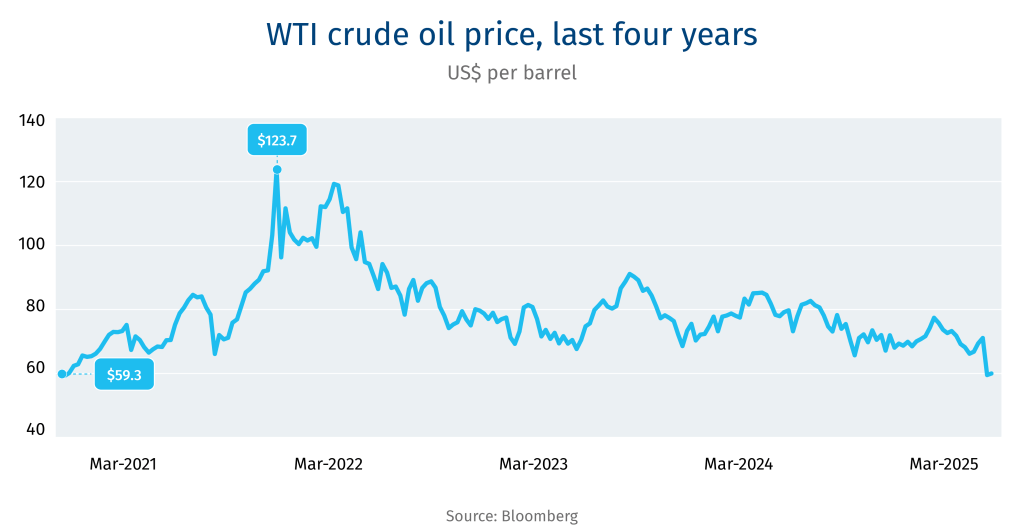
While the Administration has vowed to unleash U.S. energy dominance, to date, it appears to have done the exact opposite. On oil, Trump’s trade/tariff agenda has driven oil prices lower than those witnessed for most almost all of Biden’s presidency. WTI has twice dipped below US$60 per barrel in the past week–a level widely seen as U.S. shale’s breakeven–leading to increasing concerns of idled rigs and declining production; S&P Global estimates US$50/bbl oil could cause a U.S. production decline of 1 million bbl/d. All the while, OPEC is boosting production.

The continued desire to gut funding for the Inflation Reduction Act also stymies U.S. renewable energy, even for tax credits deemed friendly to the oil industry (such as the 45Q carbon capture tax credits). Lastly, concerns around supply inflation (steel/aluminum tariffs) and general market/economic uncertainly has created a very challenging environment to deploy capital.

3. Climate trade frictions remain alive and well

With the gutting of the WTO and Trump’s reciprocal tariffs, developing nations are increasingly seeing their preferential trade terms (higher ‘allowable’ tariff rates) erode. You can add climate to that list, as nations impose climate-related trade measures to enhance economic competitiveness.

In Europe, carbon border adjustments protect domestic carbon policy. In the U.S., a border pollution fee leverages America’s carbon advantage–especially in relation to China. The U.K. and Australia are also exploring carbon border adjustments of their own.

Domestic carbon policies without a climate trade measure (such as a CBAM), politically, is almost certainly bound to fail. Yet, expectations for developing nations to enact similar carbon prices as the E.U.’s emissions trading scheme–a system that has seen carbon pricing increase/expand over the last two decades–in a mere few years, seems unjust. This likely only accentuates climate trade tensions between North and South.

4. Reducing the trade deficit

In the eyes of U.S. President Donald Trump, reciprocal tariff rates yield a balanced trade relationship. For trade partners, a balanced trade relationship is as good as a ‘due north’ one can expect under Trump’s vision of America First. Trade partners will be served well if they can better house American (merchandise) exports.

In this world, U.S. LNG likely shines bright. The country is expected to surpass Qatar as the largest provider of U.S. LNG, globally, by 2030 according to RBC Capital Markets forecasts as seen below. For major LNG buyers that run large trade surpluses with the U.S. (the E.U., Japan, Korea, India), greater purchases of LNG supply can be the ‘easy’ win.

5. AI clusters and cross-border data flows

Nations with abundant, cheap electricity are best positioned in the race to build data centers. This likely results in supply ‘clusters’, especially torqued to renewable generation given the climate commitments of tech firms. Consensus is increasingly pointing to Canada, the U.S. and the Middle East as becoming cluster of American artificial intelligence deployment.

But what does that mean for data flows? Data protectionism towards data hosting (colocation) likely remains, but more alignment is needed on cross-border data transfers resulting from compute capacity (hyperscale). We expect more on this in the renegotiation of USMCA in 2026.

Shaz Merwat is the Energy Policy Lead of RBC’s Climate Action Institute

Starting April 5th, the U.S. is imposing 10% baseline tariffs, with most countries facing a tariff rate that appears to be based on a calculation of trade deficits as a share of exports from that country. Crucially, it exempts Canada and Mexico as it’s not applied to USMCA-compliant products.

Here are six impacts we’re watching out for:

1. Canada lives to fight another day, but not without some pain.

Existing tariffs remain, including those based on IEEPA/fentanyl , steel and aluminum and auto and auto-parts that went into effect just past midnight today. Duty-free trade still applies to products that are USMCA compliant—perhaps a signal that the President still takes the agreement he signed seriously.

  • Most, if not all, Canadian auto manufacturers have 50% S. content, which means an effective tariff rate of 12.5%. Combined with a 70-cent Canadian dollar, it puts Canadian auto and parts makers in relatively good stead, especially in comparison to Asian and European automakers facing up to 25% in tariffs.

  • The story on energy is similarly that of relief—RBC Capital Markets highlighted how most, if not all, oilsands producers are USMCA compliant, and not be subject to the 10% tariff on energy. A 10% tariff on other resource products and potash, although significant, is not enough to affect producers’ bottom lines.

  • While we may see specific provinces and sectors negotiating for exemptions, most will likely not want to rock the boat until the federal election is over on April 28, and an economic and security partnership can be negotiated. But Canada isn’t out of the woods yet—lumber is still in the U.S. administration’s crosshairs, and President Donald Trump alluded to a longstanding irritant of his in Canadian dairy.

2. It’ll be hard to raise revenues (only) from tariffs.

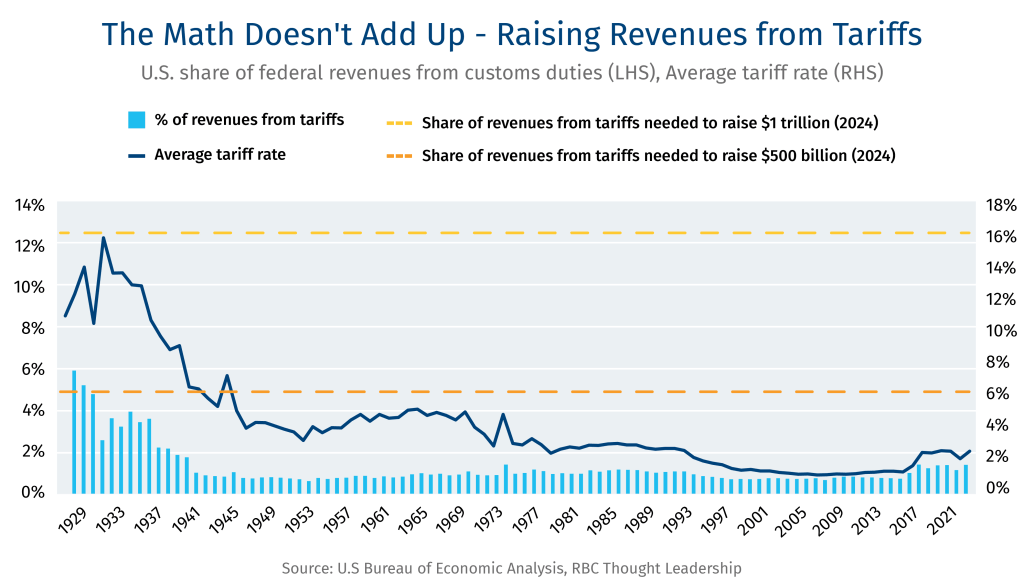
To fund tax cuts, President Trump and Secretary Howard Lutnick’s stated goals are to raise US$1 trillion in revenues from tariffs and achieve another US$1 trillion with an aggressive program of cost-cutting through the Department of Government Efficiency. But the math doesn’t add up.

The government would have to generate 12.4% of total revenues from tariffs to raise US$1 trillion—something the U.S. government has not achieved in the past century, even during the height of the Smoot-Hawley tariffs in the 1930s. Even the more modest goal of US$500 billion seems hard to achieve given the U.S. federal government hasn’t raised 6.2% of its revenues from tariffs since 1929—when the Great Depression started.

3. Will China deviate from its targeted retaliatory approach?

China now faces an effective tariff rate of 54%, on top of tariffs on steel and aluminum and those levied under the IEEPA. The Chinese government has historically responded with targeted retaliatory tariffs, particularly on agriculture and geared toward swing states or those voting Republican. However, these are the highest effective tariff rates ever levied on China. It will be interesting to see if Beijing sticks to a strategy of targeted action, or one that will be more sweeping. Regardless, a trade war between the world’s two biggest economies will cause significant economic ripples and rejig supply chains.

  • Of note, China recently entered exploratory talks on a regional free trade and investment agreement with Japan and South Korea, two countries that are not traditional Chinese allies. This is an important signal that countries in Asia and beyond are creating bulwarks and buffers against a United States that they increasingly see as threatening and unpredictable. These developments may isolate Canada even further.

4. The price of the climb down may be steep.

Trump explicitly signaled to countries that he was willing to negotiate concessions in exchange for reduced trade actions. The cost of these concessions will be worth watching, with the countries first in line to negotiate exemptions (especially the ones most exposed to U.S. trade actions) likely getting a raw deal. Expect the coming few days, before the tariffs officially come into force, to be a lobbying frenzy in D.C. as countries most exposed to U.S. trade action try and negotiate lower rates.

  • Allied Retaliation: Trump explicitly warned countries that teaming up against the United States to retaliate would yield higher tariffs. Canada may not wish to gang up against the United States as the degree of integration between our economies does not favour Canada. But expect the Canadian government to partner with allies on strategic sectors, such as critical minerals or semiconductors, to press against U.S. trade action and to share a more unified message on the costs of a full-blown tariff war on sectors with strategic or national security importance.

5. Congressional rancor over the trade deficit emergency.

On the other side of Pennsylvania Ave., the Senate voted to pass a joint resolution to strike down the emergency Trump used to levy tariffs on Canada, with four Republicans joining the Democrats. The joint resolution is unlikely to pass the House, where caucus discipline is more strongly enforced, but it is still a repudiation of Trump’s trade policies against the country’s closest ally. The President used the same authorities, stemming from the International Economic Emergency Powers Act, deeming trade deficits as a national emergency. Expect to see another fight in Congress as the legislature seeks to regain control over trade and tariff policy, and as Democrats use the joint resolution as a cudgel to split the Republicans and a referendum on Trump.

6. Global macroeconomic and supply chain shocks.

The bigger channel of impact of these tariffs—and the biggest unknown—will come from governments and businesses completely reshaping the trading links that have been built over the past century. Some companies may choose to reshore production to the United States, while many others may avoid the U.S. completely. Regardless of how the tariffs are implemented, the macroeconomic effects of uncertainty are significant and dire, as our Economics team has noted, pushing up the U.S. effective tariff rate over 20%.

Trump appears to want to achieve multiple goals through his policy instrument of choice, including reshoring investment and trade flows, strengthening the greenback, raising revenues and using tariffs as economic leverage to achieve other policy outcomes. It is unclear whether he will be able to achieve all these goals. What is clear is that this is only the beginning of a rocky ride for the global economy, and for Canada.

Varun Srivatsan is Director, Policy and Strategic Engagement, RBC Thought Leadership

Field Notes: How Canadian businesses are navigating trade tensions

China’s 100% tariff on canola oil and meal has Canadian farmers concerned. That stress level could climb, as China also has its eye on Canadian canola seeds—the largest segment of our canola exports to China—, which have been spared for now. “That would be the other big shoe to drop,” said Rick White, CEO of the Canadian Canola Growers Association (CCGA), which represents approximately 40,000 farmers across Canada.

Canola was developed by Canadian scientists in the 1960s—hence the name. It’s considered healthy oil as it’s low in saturates (an unhealthy fat) and high in monounsaturates (considered good). Canada is the world’s largest canola producer and counts, with 40,000 farmers generating $43.7 billion, with the U.S., China and Japan—in that order, its three biggest export markets. Australia is among Canada’s biggest canola rivals.

As the Chinese tariffs hit Canadian canola farmers, they are freezing investments and need support. White shared some ideas on ways to soften the blow:

  • White says the tariffs were not a surprise, as past disputes with China (2019-2020) had targeted canola.

  • China has once again targeted the agriculture sector in direct response to Ottawa implementing tariffs on Chinese EVs, aluminum and steel.

  • The industry feels the Canadian government “absolutely bears the responsibility” of that action and should compensate farmers for the financial losses that they will incur.

  • Other major canola seed exporting countries include Australia, Ukraine, Russia. Canada specifically grows canola, which is defined as having low erucid acid and low glucosinolates. Australia and the EU are also significant growers of canola or double low rapeseed, which is of comparable quality.

Canola seeds in the crosshairs

  • A looming Chinese anti-dumping investigation on Canadian canola seed could trigger more tariffs. That’s “the big shoe to drop.”

  • Canola seed is Canada’s primary canola export to China, with canola oil and meal accounting for a smaller portion. In 2024, China imported six million metric tonnes of Canadian canola seed, worth $4 billion.

  • The Chinese are following World Trade Organization (WTO) rules around anti-dumping. WTO challenges take time but provide legal recourse. The CCGA has registered as a party to China’s investigation.

Farmers are looking to freeze investments

  • Farmers rotate crops for agronomic reasons, but canola is a Canadian staple crop, which limits alternatives. Agronomics involves soil and crop management and helps optimize distribution, management and productivity of land.

  • Farmers are already expressing concerns about market risks from China and the U.S. with some suggesting delays in capital investments and equipment purchases due to uncertainty.

  • Plus, purchase of new equipment could possibly come from the U.S. that could be subject to countervailing duty by Canada.

  • “Farmers are not going to take that risk of investing big pieces of capital into renewing infrastructure … there’s going to be a big chill on investment, at least this year.”

Across the border, more trouble is brewing

  • The U.S. is Canada’s largest canola export destination, valued at $7.7 billion in 2023. The U.S. has not yet imposed a 25% tariff on canola, as CUSMA (the Canada-U.S.-Mexico Agreement) remains in effect. But once exemptions expire, new U.S. tariffs could further harm Canadian canola exports.

There are ways to build a tariff-less ecosystem

  • Last December, the CCGA sent a letter to the federal government, forecasting farm gate losses of between $1.76 billion to $4.33 billion for 2025-26 due to the Chinese tariffs.

  • Ottawa has announced new loan products to sustain the industry, but farmers argue they cannot borrow their way through this crisis and need cash compensation.

  • “The federal government needs to compensate farmers commensurate with the losses that they will incur because of China… farmers can’t, nor should they, be expected to borrow their way—they need to be compensated.”

  • The CCGA is advocating for the development of a domestic biofuels and sustainable aviation market.

  • It could be a new domestic market for at least 2-3 million tonnes of canola seed. It would help soften the blow for canola farmers, as the risk and uncertainty around U.S. and Chinese markets is going to remain for a long time. It is an opportunity to help diversify and reduce Canada’s heavy dependence on China and the U.S. markets.


Dig deeper:

RBC Chief Economist Frances Donald answers three questions on Trump’s tariffs and its impact on the global economy.

Q: What do the U.S. tariff exemptions mean for Canada’s economic growth outlook? U.S. still has tariffs on Canadian autos, steel and aluminum.
FD:
 How quickly the Canadian economic narrative has shifted. Prior to “Liberation Day,” our biggest concern was the implications of broad based tariffs on Canadian growth and particularly, that Canada appeared to be the biggest relative loser of American trade policy. Now, while various sector specific tariffs will weigh on Canada in 2025, our concerns are shifting to more “traditional” risks to Canada’s economy—the rising risk of a U.S. recession and a drop in oil prices. The latter may be more “indirect” in some capacity, but they are also more of a function of global developments that have far less to do with Canadian-U.S. political relations.

Q: Do you expect the Bank of Canada and the U.S. Federal Reserve to reassess as U.S. tariffs are rolled out?
FD: The Bank of Canada and the Federal Reserve are facing different challenges, just like their economies are struggling with different risks. In Canada, inflation is around 2% with some mild upside created by global supply chain disruptions ahead. And yet, Canadian growth is still tepid and supportive of a few more rate cuts. As of now, we continue to expect another 50bps of rate cuts.

The Federal Reserve is in a much greater bind. The size and scope of tariffs announced are consistent with higher inflation and a much lower growth profile. That “stagflationary” mix pulls at both sides of the Fed’s dual-mandate in opposite directions (price stability and full employment). At this point, our expectation is that concerns about inflation spiralling higher will keep the Federal Reserve on the sidelines, but markets have been increasing their probabilities of rate cuts to support what is likely to be a much weaker economy.

Q: A bigger tariff war looms, with the U.S.-China and U.S.-EU imposing tariffs and retaliatory tariffs. Will that be inflationary and damaging for the Canadian and global economy?
FD: Just how damaging U.S. tariffs turn out to be will largely be a function of how long they stay in place for, and economists are poorly credentialled on making that call. But the largest concern at this juncture is that we witness a global uptick in prices as supply chains become entangled and the interconnected nature of our global economy makes it difficult for any economy to escape rising costs. There are certainly similarities to the COVID era that can be drawn, except for one major one: we didn’t head into pandemic-era inflation having just gone through pandemic-era inflation. That is, Canadians and Americans have already experienced an over 20% increase in prices since 2020, and the ability of households and businesses to absorb a second wave of inflation so soon after is likely very limited. Last month, it seemed the trade war was North American centric. Now, it is global and without borders.

Further reading:

Yadullah Hussain is Managing Editor, RBC Thought Leadership

Field Notes: How Canadian businesses are navigating trade tensions

Canada’s agriculture sector is among the first casualties of the trade wars with China and the United States. Monty Reich, CEO of SWT Ltd, a farmer-owned, independent grain and crop input company in Saskatchewan, discusses how farmers are navigating the trade tensions.

Uncertainty and volatility a near-daily irritant

  • The current environment is challenging, uncertain—and confusing. “Each day is a different journey,” Reich said.

  • Even before the 100% Chinese tariffs on canola oil and meal and yellow peas were imposed, the U.S. had started talking tariffs in December, with durum wheat on the list to be hit.

  • SWT had to absorb the financial blow of U.S. tariffs on durum wheat, choosing not to pass those costs onto its farmer-shareholders. “We sold product into future spring positions and took that hit on our own bottom line,” Reich noted.

  • U.S. tariffs have made durum wheat exports more costly. “We are the importer of record,” Reich noted, meaning SWT itself is directly responsible for paying the 25% tariff—a cost that prohibits any future sales.

Canola prices are plunging

  • For canola farmers, the impact has been brutal. Prices have plunged by 25-30% since the Chinese tariffs were imposed, dropping from around $16 per bushel to $12.

  • “Margins on the farm are pretty narrow as it is,” Reich said. Even small price shifts can turn a profitable season into a financial disaster. With this level of decline, farmers are watching their incomes evaporate.

Tariffs are hitting from all quarters

  • China’s restrictions on canola and yellow peas have cut off a crucial market, leaving farmers with few places to turn to. “China accounts for about 87% of the yellow pea market along with the U.S. and India,” meaning farmers now face a near-total lockout.

  • India’s on-again, off-again tariffs on pulses add another layer of uncertainty, leaving Canadian farmers with few viable alternatives.

Farmers are scrambling for alternatives

  • “Growers are penciling in right now, trying to figure out what’s going to provide them the best return,” Reich said.

  • Farmers could pivot to other crops, but in practice, it’s not that simple. “It’s not easy to just flip commodities,” he explained.

  • Farmers are “scrambling” to adjust before the next planting season.

Deferred investments, shrinking profitability

  • Some canola crush plant investments were already deferred a couple of years ago due to ongoing challenges with the Chinese marketplace and the cost of construction.

  • Production facilities being built today are going to continue, and existing facilities will continue operating, but margins are getting tighter.

  • Farmers are weighing whether to cut back production, reduce costs, or even scale down their operations altogether.

Fear of stranded shipments

  • China’s anti-dumping tariffs on canola seeds can come soon, adding to the threat.

  • That risk makes exporting to China a high risk. If canola seed shipments hit the waters, the Chinese “can slap on a tariff tomorrow.” That uncertainty alone is enough to spook exporters and depress prices.

  • This feels different from the dispute with China in 2019 that was more restricted to a few companies over “dockage concerns,” and quality issues.

Backdoor trade routes

  • In the past, when China restricted direct imports, Canadian canola still made its way there—through other markets.

  • “There will be other South Pacific Asian countries that’ll take the product and flip it over to China.” But those countries will try to secure the goods at a discount.

  • In addition, building trade relationships with new markets takes time. It’s not simply about switching markets from one to another (e.g., from China to the Philippines).

Other crops are also facing challenges

  • Pulse crop (e.g., lentils) are also facing challenges, particularly due to tariffs from India. This adds pressure to the profitability of these crops, with farmers having to navigate changing trade policies, especially when tariffs are applied or removed unpredictably.

Who will replace Canadian canola?

  • In the short term, other countries such as Australia can substitute Canadian canola, but Canada’s product is generally seen as highly reliable and high-quality.

  • As supply and demand dynamics shift, other countries may adjust their crop rotations to meet market needs.

  • Billions of dollars have been invested in Western Canada in canola capacity and crush capacity. There’s a lot of investment at stake in canola to “just let it go away,” Reich said.

The need for stronger government engagement

  • While farmers often prefer minimal government intervention, strong trade agreements are essential in resolving issues like tariffs or trade restrictions.

  • Canada’s government should ensure robust trade relations with key partners (China, the U.S., India) to reduce barriers, Reich recommended.

  • Saskatchewan, for instance, has set up nine offices abroad to facilitate smoother trade relations and reduce friction.

  • Canadian agriculture needs to have strong representation globally, not just through trade agreements, but through actual presence and ongoing diplomatic engagement.

  • Government investments are needed to improve infrastructure to boost interprovincial markets and move products west-to-east.

U.S. President Donald Trump finally dropped the hammer on the auto sector with tariffs on automobile and parts imports, upending the global auto industry and threatening economic damage on major suppliers to the U.S. market. The headline 25% U.S. levy has dominated the news but, as we discuss, the true cost of tariffs will be in the details. With countries from Canada to Germany to Japan roiled by the announcements, the industry is grappling with the following questions:

1. How will the tariffs be applied?

  • The proclamation is light on detail on targeted automobiles and automobile parts. Engines and engine parts, transmission and powertrain parts, and electronic components were singled out in a 2019 investigation into the impacts of automotive imports on U.S. national security.

  • But industry remains uncertain about the extent of tariff applicability this time around. The proclamation also allows the U.S. Secretary of Commerce and domestic producers of automobiles or auto parts to request parts not already included to be tariffed in the future.

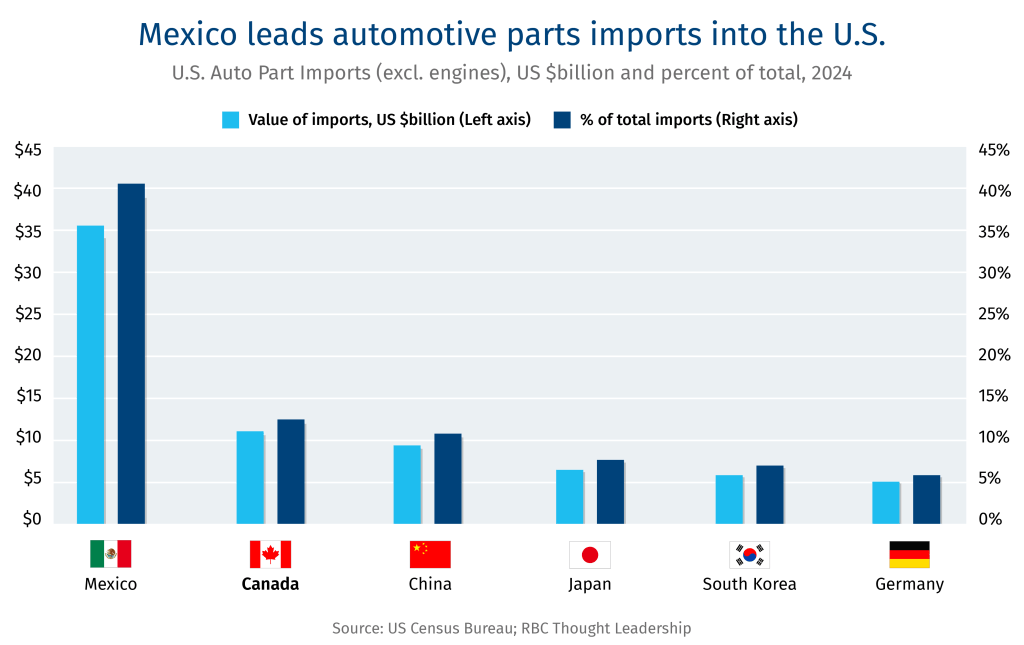
  • The U.S. imported US$83 billion in auto parts and accessories (not including engines) in 2024, with Mexico and Canada supplying 41% ($35 billion) and 13% (US$11 billion), respectively.

2. How will tariffs be implemented and compliance determined?

  • The true cost of tariffs will depend on the amount of U.S.-origin content in imported vehicles, but specifics remains unclear.

  • According to the president’s order, the 25% tariff will apply to the value of non-U.S. content in imported vehicles. However, discussions between the U.S. and Canada suggest CUSMA-compliant automobile imports with at least 50% U.S. content may be exempt. Those with less than 50% U.S. content may receive 12.5% tariffs.

  • Automotive parts will see tariffs of 25% applied to the value of non-U.S. content, according to a process being determined by U.S. Customs and Border Protection and the U.S. Secretary of Commerce. They are expected to come into force by May 3.

3. How will supply chains be affected?

  • The co-development of U.S., Canadian, and Mexican automotive industries have enabled efficiencies of production and market growth across the continent, from the Automotive Products Trade Agreement in 1965 (also known as the Canada-U.S. Auto Pact) through the integration of Mexico via NAFTA in 1994, and more recent renegotiations of Regional Content Values (RCV) under CUSMA.

  • Over the past three decades, Mexico has steadily gained on the U.S. in production share of passenger vehicles in North America, rising from 10% pre-NAFTA in 1991, to 30% of passenger car manufacturing within the continent by 2023. Over the same period, the U.S.’s share of passenger car manufacturing dropped from 75% to 58%. Mexico surpassed Canada’s production share within the continent in 2008.

  • Though Canada’s share of passenger vehicle manufacturing grew from 15% in 1991 to peak at about 22% by 2005, it had dropped to 12% by 2023.

  • A similar trend has emerged in motor vehicle parts. From supplying 9% of U.S. imports in 1990, Mexico has grown to 41% of automotive parts imports in 2024, while Canada’s contribution has reduced to 13% in 2024 from a 1990 peak of 36%.

  • Data on the geographic origins of components across 315 car models available to the U.S. public between 2021-2025, show that, combined, U.S. and Canadian auto parts make up as much as 77% of the total value of certain models, with Mexican origin parts reaching as much as 80% in others.

  • Such high levels of integration means tariff-driven disruptions to automotive supply chains have a high likelihood of rippling through the industry, raising costs and putting pressure on manufacturers, distributors, and consumers across all geographies.

4. What’s the way forward?

  • The precise nature of tariff applicability, compliance, and enforcement remains largely uncertain, leaving manufacturers with few clear options on the way forward.

  • What’s certain is that impacts will be felt on both sides of the border, with 35 U.S. districts across 26 states importing auto parts from Canada in 2024, and southern Ontario’s automotive sector among the hardest hit.

  • The severity of reciprocal tariffs would dictate the added burdens on auto and parts manufacturers. Canada’s response to the U.S. auto tariffs would also determine the future of RCV-based tariff exemption thresholds.

Vivan Sorab is Senior Manager, Clean Technology, RBC Climate Action Institute

This article is intended as general information only and is not to be relied upon as constituting legal, financial or other professional advice. A professional advisor should be consulted regarding your specific situation. Information presented is believed to be factual and up-to-date but we do not guarantee its accuracy and it should not be regarded as a complete analysis of the subjects discussed. All expressions of opinion reflect the judgment of the authors as of the date of publication and are subject to change. No endorsement of any third parties or their advice, opinions, information, products or services is expressly given or implied by Royal Bank of Canada or any of its affiliates.

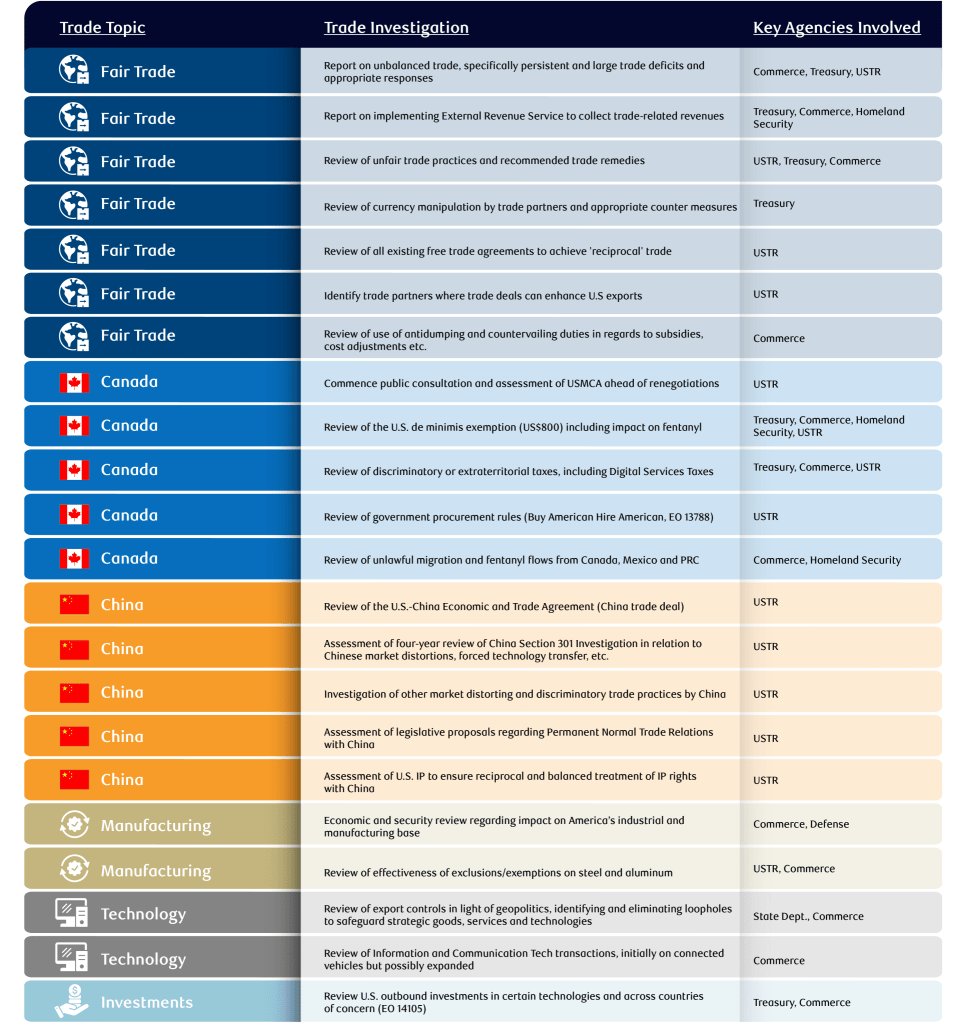
It has been 70 days since U.S. President Donald Trump directed eight federal agencies to commence the review, design and implementation of his America First Trade Policy (link). In total, over 20 investigations have progressed concurrently, to be delivered to the President on April 1.

While the final “reciprocal” tariffs are most likely a catch-all trade response to these investigations, their recommendations will shape the course of the Administration’s trade path over the next four years. In essence, we are entering a new phase – one (hopefully) out of a sprint and into a more measured pace, across six key trade themes that extend beyond the use simple tariffs as identified in the graphic below.

To get a sense of what to expect over the next few months from a hawkish Washington, read John Stackhouse’s interview with Steve Verheul, Canada’s Chief Trade Negotiator in the renegotiation of NAFTA (now CUSMA), on how he sees the trade war playing out. For more, see here.

Trump’s America First Trade Policy

Trade Investigations Due April 1

Source: whitehouse.gov

This article is intended as general information only and is not to be relied upon as constituting legal, financial or other professional advice. A professional advisor should be consulted regarding your specific situation. Information presented is believed to be factual and up-to-date but we do not guarantee its accuracy and it should not be regarded as a complete analysis of the subjects discussed. All expressions of opinion reflect the judgment of the authors as of the date of publication and are subject to change. No endorsement of any third parties or their advice, opinions, information, products or services is expressly given or implied by Royal Bank of Canada or any of its affiliates.