Artificial intelligence (AI) is rapidly reshaping the global economy, driven by Big Tech’s breakthrough apps such as OpenAI’s ChatGPT. Businesses are eyeing ways to transform their operations through AI, which has serious implications—transformative and disruptive—for the wider economy. At the heart of this AI-driven transformation are data centres, the crucial infrastructure powering applications, from simple queries to complex generative tasks.

Every AI prompt requires significant computing power. A single ChatGPT query consumes 10 times more energy than a standard Google search. More advanced AI operations such as generating text or images, exponentially spike power consumption. Canadian data centres’ rising energy demands make them a major driver of electricity demand growth. If all the data centre projects currently being reviewed by regulators proceed, they would account for 14% of Canada’s total power needs by 20301, similar to 12-15% by 2030 in the U.S.2

The development of these data centres, likely between 20 to 30, would result in $100 billion in capital expenditures related to the construction and build of accompanying IT infrastructure3. However, AI’s energy-intensive nature raises concerns about power availability, grid reliability and its implication on emissions.

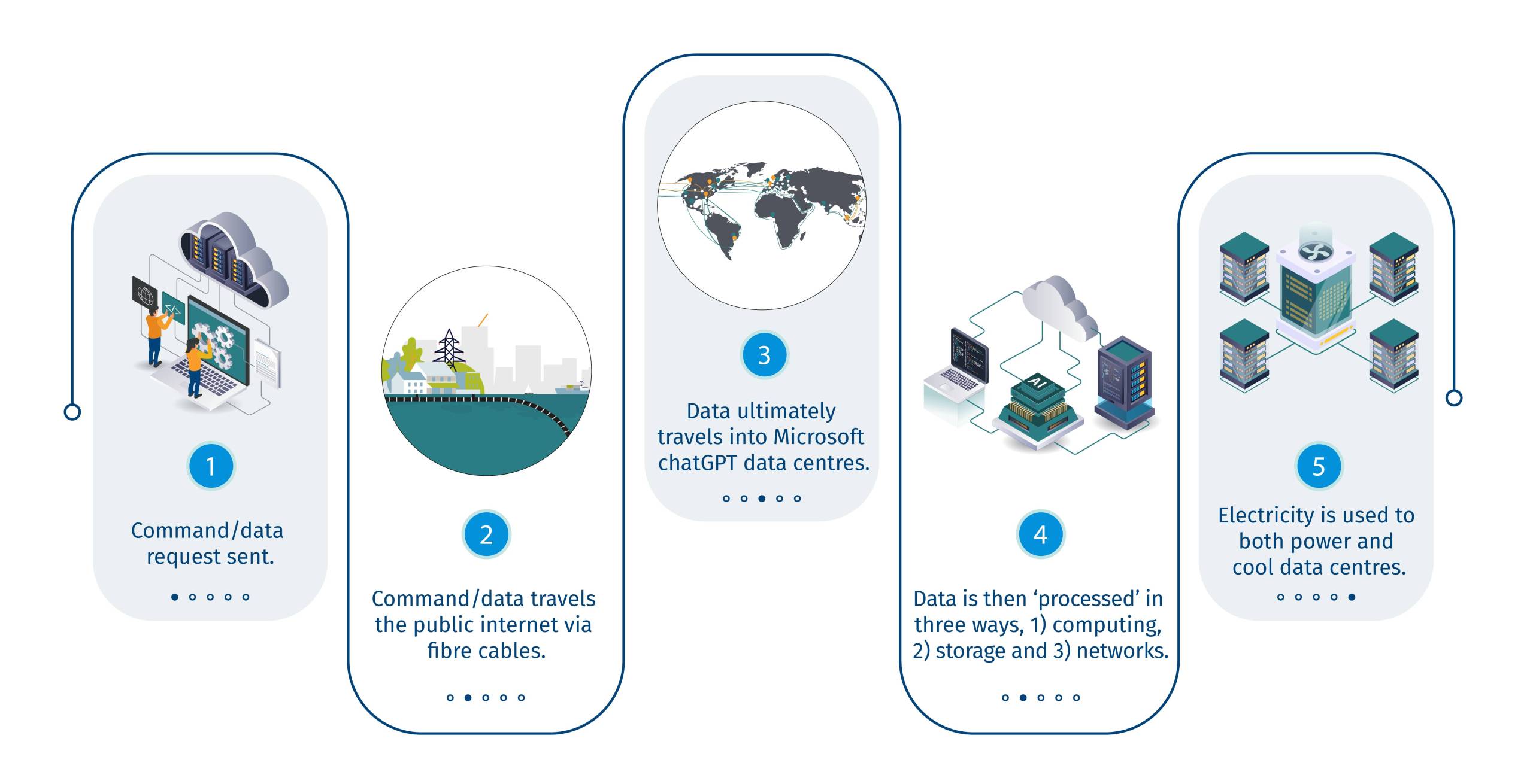
The power behind ChatGPT: How data centres process search queries


Key Findings

  • Canadian regulators are reviewing data centre applications with an estimated combined capacity of 15 gigawatts—enough to power seven out of 10 homes nationwide.
  • AI is the primary driver of this surge, with data centres offering a $100 billion economic opportunity for the construction and build out of data centres and accompanying data infrastructure.
  • Canada’s clean energy resources offer a strategic advantage for AI-driven growth. However, natural gas remains a critical part of the mix due to its reliability. Nuclear power is also an option but with a considerably longer lead time.
  • Canada’s annual emissions could rise 3%, if natural gas powers six additional gigawatts of data centres. However, carbon capture and storage (CCS) could throttle the rise of emissions.
  • Local data centres strengthen Canada’s position in AI by securing data sovereignty and enhancing cybersecurity.
  • Streamlining AI governance across Canada and the U.S. is a key next step in securing North American leadership. A review of CUSMA in 2026 would likely see refinements to the digital trade chapter.
  • Targeted efforts to increase AI adoption among Canadian SMEs—which account for half of Canadian GDP—could help reverse Canada’s lagging productivity.

A new trading chip

Canada faces a strategic moment as it captures the AI opportunity. Beyond the economic incentives, local data centres are essential for ensuring data privacy, national security, and resilience against cyber threats.

We can leverage our prodigious hydro, natural gas and nuclear power to emerge as a low-cost data centre hub. We can also build on this advantage further by harnessing AI’s power to boost Canadian productivity, enhance our competitiveness, and deepen our digital talent pool.

The AI opportunity also has trade and geopolitical implications, especially as Canada needs ever more chips to bargain with a transactional U.S. administration-in-waiting. With Washington increasingly focused on China, data sovereignty could become a key focus over the next few years. This provides Canada plenty of opportunities—but also some risks.

We could be a valuable partner for the U.S. and create a digital North American fortress, securely warehousing critical data at low cost. But that would require a realignment on data sovereignty between the two countries, which would most likely occur at the next round of Canada-United States-Mexico Agreement (CUSMA) in 2026.

A modernized digital trade chapter—Chapter 19—was a factor that drove Washington to seek a revised trade agreement during U.S. President Donald Trump’s first term. The next iteration of Chapter 19 could increase the focus on compatibility of North American data, both in terms of cross-border transfers and AI governance.


Powering up data centres

Substantial demand from “hyperscalers”—data centres with large compute capabilities—could strain Canada’s grid and drive up power bills, putting governments and regulators in a bind, as recently evidenced with the U.S. federal energy regulator’s refusal to allow Amazon Inc. to purchase more power from a Pennsylvania nuclear facility on the grounds it would raise customer rates and threaten grid reliability.

It also comes at a time many Canadian provinces are already facing sizeable power demands from population growth and electrified transport, as well as ambitions to decarbonize heavy industries. All told, Canada’s power demand was already set to double by 2050, potentially even triple4. And that was before AI became a compelling need for the global economy.

Canada has several energy sources it can draw on to power data centres, but each comes with its own challenges and considerations:

  • Wind and solar: growing sources of power but in the absence of storage, their intermittency makes them unsuitable for data centres that demand consistent baseload power.
  • Nuclear: The emerging energy of choice for Big Tech in the U.S. It’s an option in Ontario, too, but would require long lead times stretching out to a decade, if not more. Nuclear remains a viable long-term solution.
  • Hydro: Several provinces such as Quebec and British Columbia already rely heavily on the power source, and, like nuclear, would require a long time to boost capacity.
  • Natural gas: Alberta’s preferred option, and a key part of Ontario’s transition until 2040. But powering AI through natural gas comes with an emissions cost that provinces will need to weigh.

Provincial Imperatives: Honing regional approaches to AI

Provinces will ultimately drive Canada’s AI ambition.

Alberta, with ample natural gas and lower grid pressures, prefers data centres operate off-grid, minimizing the strain on public grids. The “bring your own power” (BYOP) model allows for faster deployment and supports local natural gas prices, driving economic benefits for the province. It is also aligned with the proposed Canadian Electricity Regulations, given the facilities would not be net exporters to the grid. However, BYOP is not necessarily a viable model for all Canadian jurisdictions.

Quebec, with its rigorous environmental standards and cap-and-trade system, prioritizes low-emission solutions. The province’s hydro power provides clean energy but its capacity to meaningfully expand hydro in the short term is limited. British Columbia faces similar constraints, with a preference for hydroelectric power and tight regulations on carbon-intensive energy sources.

Ontario’s more flexible energy policy allows for a mix of solutions. Its population density and industrial base create competing demands for grid capacity—from electric vehicle and battery supply chain to greenhouses. The province’s primary challenge will be to strike a balance between these competing needs.


Decisions about where and how to build data centres will involve a complex matrix of economic, environmental, and social factors. Our research shows that data centres rank higher in GDP impact compared to, say, manufacturing and transport, but contribute fewer jobs compared to those industries.

That’s where federal and provincial alignment will be critical to Canada’s AI strategy. Policymakers will need to create frameworks that allow provinces to develop bespoke policies that balance growth, sustainability and the demands of the new economy. This includes targeted support for AI adoption among SMEs and ensuring that data centres contribute to productivity gains across sectors. For example, as part of a greater commitment to invest $25 billion in Canadian data centres, Amazon Web Services (AWS) apportioned dedicated compute capacity to the University of Alberta in 2023, sourced from a recently completed $4-billion cloud computing data centre in Calgary.

Power Supply: Capturing the ‘hyperscaler’ opportunity

Data centres require vast amounts of electricity, ranging from 200 megawatts to 500 megawatts. Canada’s low-cost, clean energy gives it a significant advantage. Hydroelectric and nuclear power in cities like Montreal, Vancouver, and Toronto offers some of the cheapest and cleanest electricity in North America. Comparatively, U.S. industrial power prices in key data centre states such as Arizona, Illinois, and Texas are on average 30-40% more expensive, and that excludes their warm climates adding an extra 20-40% power for cooling purposes.

Global hyperscalers are seizing on the Canadian opportunity. We estimate various provinces are reviewing applications for 15 GW of new data centre capacity—a 20-fold increase from current levels5 and enough to power 70% of Canadian households today. In addition, the “expressed interest” in data centres is likely far greater. Alberta alone is being pitched proposals for 50 projects with a combined capacity of 20 GW6.

The mass electrification of the economy is already expected to place unprecedented demand on Canada’s grids. Canada’s power generation is expected to reach 750 GWh7 over the next ten years, compared to an estimated demand of 875 GWh8, implying a shortfall of about 15%. It underscores the need for careful resource management.


Emissions: Leveraging carbon capture

AI’s energy footprint raises concerns about Canada’s climate goals. With provinces being asked to provide power for important industries such as heavy industry, liquefied natural gas electrification and greenhouses, most provinces will have to determine where data centres fit with their economic priority and emissions-cutting ambitions.

Data centres depend on consistent baseload power, which wind and solar cannot reliably provide due to their intermittent nature. New renewable projects are also facing opposition in certain jurisdictions. Natural gas, with its reliability as baseload power and quick scalability, can fill the gap.

However, using gas for data centres raises emissions concerns. If natural gas powers six additional gigawatts of data centres, annual emissions could rise by 16 million tonnes of CO2e—a 3% increase9 in Canada’s total emissions.

Carbon capture and storage (CCS) could throttle the rise of emissions. In Alberta, companies are already in discussions to incorporate carbon capture into gas-fired power plants for data centres. That would alleviate environmental concerns, leverage existing energy infrastructure and drive further investments in natural gas production and the development of CCS.

Big Tech companies, that are investing heavily in nuclear power in the U.S. to feed their AI operations, could replicate that playbook with abated natural gas in Canada.

However, the high costs and technical complexities of CCS mean it’s not an all-of-Canada solution. While the CCS technology is readily transferable, only Alberta and Saskatchewan have the required geology and infrastructure in Canada to store carbon.


Economy: Unlocking a $100-billion opportunity

The digital economy is expanding rapidly, from cloud computing to AI applications, and transforming every aspect of the economy.

Current estimates suggest the digital economy accounts for 6.3% of Canada’s GDP, but broader estimates place it at 15%—and it’s growing 2.5 times faster than conventional economic sectors10. Data centres are critical to this digital ecosystem, hosting and processing the vast volumes of data generated by AI and other advanced technologies. Development of the proposed data centres alone could spark a $100-billion construction and IT infrastructure boom, in addition to its positive impact on the wider economy.

But there’s an even greater prize for Canadian businesses: an AI ecosystem that helps them gain a competitive edge in areas as diverse as healthcare, autos, manufacturing and clean-tech. That could be in the form of AI revolutionizing biotech research, accurately detecting weather patterns, or improving navigation in autonomous vehicles.

Canada’s AI adoption, however, lags its peers. Only 35% of Canadian firms use AI, compared to 72% in the U.S.11 The discrepancy is partially due to the high percentage of small and medium-sized enterprises (SMEs) in Canada, which employ 65% of the private workforce12. SMEs often lack the capital and talent to invest in cutting-edge technology. Addressing this gap is essential to boosting Canadian productivity, which has been in decline for more than 30 years13. With its R&D spending at 1.7% of GDP14—less than half of U.S. levels—Canada faces an urgent need to increase investment in AI and technological innovation.

The federal government has taken steps to close the productivity gap, launching initiatives such as the $2-billion AI Compute Access Fund to boost Canadian businesses’ technological capabilities. The fund aims to deliver computational power needed to drive innovation in both large companies and SMEs.

Bridging the AI adoption gap is critical not only for immediate economic gains, but also for positioning Canada as a global leader in the technology. This includes deepening the country’s AI-ready workforce, with training programs and partnerships with academic institutions key to fostering a new generation of AI professionals.

Data Security: Safeguarding sovereignty and privacy

Data sovereignty is also crucial. Canada’s strict data privacy laws mandate that sensitive information remains within its borders, ensuring compliance and protecting citizens’ privacy. As digital data grows, so do cyber risks. IBM reports 27,000 data breaches in Canada annually, with potential economic losses in the billions.

But keeping data within borders has two inherent tradeoffs: on power and trade. Data centres’ impact on the grid, to date, has been marginal given that in Canada they are used largely for hosting purposes. The proliferation of AI and resulting power draw from hyperscalers, however, accentuates this tradeoff. Most likely, segments of demand will still likely require to be hosted locally, i.e., for economically sensitive areas such as government, healthcare, banking and insurance, and research and development where latency can impact effectiveness.
For other pockets of demand, such as e-commerce, an integrated North American data corridor, as envisioned by OpenAI CEO Sam Altman, could result in comparative advantages for less constrained jurisdictions to power North America’s AI economy. But that would require greater collaboration between Canada and the United States.

Data centres can also help Canada build on its AI expertise. The country has been a leader in AI research since the 1980s, thanks to renowned academics including Geoffrey Hinton and Yoshua Bengio. Yet, the country’s lack of domestic AI infrastructure threatens its leadership. To remain competitive, Canada must likely prioritize dedicated data resources for public sectors such as healthcare, education, and defence. These resources are essential for fostering innovation and maintaining Canada’s technological edge.

Conclusion

There’s an opportunity for Canada to build on its AI leadership beyond economic considerations and productivity. An AI ecosystem can infuse the wider economy with tools that crunch big data and algorithms to boost domestic companies’ competitiveness in areas as diverse as healthcare, clean-tech, manufacturing and services and transportation and logistics.

A flexible approach, combined with federal collaboration, would ensure Canada’s AI infrastructure powers the digital economy in a way that aligns with the country’s broader sustainability, security, and economic goals.

Contributors:

Shaz Merwat, Energy Policy Lead, RBC Climate Action Institute

Yadullah Hussain, Managing Editor, RBC Climate Action Institute

Caprice Biasoni, Graphic Design Specialist

Shiplu Talukder, Digital Publishing Specialist

  1. The data centre power estimate is based on the current set of data centre projects believed to be in application with provincial electricity regulators. Total estimated power consumption for Canada by 2030 is taken from the Canada Electricity Advisory Council.
  2. As estimated by S&P Global, BCG and McKinsey.
  3. Estimate is based on total data centre build costs, including land costs, construction costs, and accompanying data processing and networking, and power and cooling expenses.
  4. Electricity Advisory Council of Canada
  5. S&P Global Market Intelligence
  6. Calgary Herald
  7. S&P Global
  8. Electricity Advisory Council of Canada
  9. Carbon emission estimate of 16 million tonnes of CO2e is based on an assumption of 360 kg/MWh at 6 GW of capacity
  10. Statistics Canada
  11. KPMG
  12. Innovation, Science and Economic Development Canada
  13. Statistics Canada
  14. Statistics Canada

Related Reading

For more, go to rbc.com/climate.

Download the Report

Download

The RBC Climate Action Institute co-hosted a special session today in Ottawa with the British High Commission, to share views with the diplomatic corps on where we see global climate policy heading and how Canada is positioned for the rest of the 2020s. Here’s some of what I discussed in a conversation moderated by Deputy High Commissioner David Prodger:

  1. Climate policy needs to be reframed (and maybe reshaped) to deliver direct cost-of-living benefits. Think energy efficiency.
  2. “Security” may be Word of the Year in 2025. Can climate policy add to our need for security of exports? We may be able to better deploy our industrial carbon pricing systems, run by the provinces, to position Canadian products as cleaner than others, especially in the U.S. and European markers.
  3. Expect more dual-purpose alliances for energy security and climate action. A G7 approach to nuclear energy cooperation, for instance, could add to Canada’s role as host in 2025.
  4. Private capital will continue to move ahead of public policy. As we will show in our upcoming Climate Action 2025 report, climate capital is still growing — not as much as it needs to, but the trajectory is up.
  5.  Innovation and technology will be key. Even in tight budget times, we’ll need to invest ambitiously in research and development.
  6. International financial institutes like the World Bank will need to take on more of the climate finance load for developing countries. Will China step up to help? And how will the U.S. react?
  7.  Developing nations will continue to raise pressure around resilience and adaptation. More money for disaster-proofing may be a good thing, unless it comes at the cost of prevention.
  8. As the world’s biggest emitters — the U.S. and China — go their own ways, other countries will need to build bridges between North and South, East and West, rich and poor, big and small. Is that still a role for Canada?

Great comments from a range of countries, with a general concern that the headwinds for climate action are growing, and more international cooperation will be needed, even in a more divided world.

Issue #05

Team Trump’s pet climate peeves and preferences
Meet the most critical metal of them all
COP29: Baku into a corner

Which is the most critical mineral of all for decarbonization? Lithium, it turns out. The International Renewable Energy Agency and the Norwegian Institute of International Affairs came to that conclusion after crunching data to account for future demand, resource availability, recycling and substitute potential. Cobalt is the second most critical. The good news for Canada: both are found in copious amounts with new mines proposed.

How can Indigenous Nations tap a $45-billion equity gap? A new CAI report recommends pathways to help build Indigenous capital muscle. Financial and non-financial partnerships in major project developments can emerge as made-in-Canada model for inclusive economic growth, writes Varun Srivatsan, director of policy and strategic engagement, in the report. It’s starting to happen: the Federal government, along with the B.C. and Manitoba governments, announced loan guarantee programs in 2024, to spur Indigenous participation in several energy projects. Read our report here.

Cooking oil may be powering your next Air Canada flight. The airline has sourced 78 million litres of sustainable aviation fuel (SAF), made of waste oil grease from cooking oil tallow and other feedstocks. Provider Neste calls the Singapore-produced vintage “unblended neat.” Combined with conventional jet fuel, the concoction can reduce GHG emissions by up to 80% over the fuel’s lifecycle. Still, SAF accounts for a mere 0.54% of the jet fuel market—although global production has tripled in a year.

Canada needs to install a 100 EV charges…a day. Currently, there is “no obvious pathway” to a Canadian charging infrastructure that can help hit the federal goal of 100% zero-emission vehicle sales goal by 2035, according to The Canadian Vehicle Manufacturers’ Association. Canada needs 446,800 public charging ports by 2035 to support the ZEV sales mandate—we are currently at 30,000. CVMA’s concerns carry tremendous weight as the association represents Ford, General Motors and Stellantis—companies that are betting their future on EVs dominating North American roads in the not-so distant future.

Climate Action Award: To Trottier Family Foundation, Peter Gilgan Foundation, Ronald S. Roadburg Foundation, Chisholm Thomson Family Foundation, David Keith and Kirsten Anderson, Sitka Foundation, Vohra Miller Foundation and Allan Shiff for donating $405 million to climate-related initiatives.

Climate Fail Award: To the Valencia regional government, which failed to send an emergency alert to mobile phones until after 8pm on the first day of catastrophic floods in Spain— nearly 13 hours after the state weather agency warned of “very intense” rain.


Trump’s energy czars, nominees and hopefuls

Energy markets are on edge as U.S. president-elect Donald Trump rolls out his choices for key posts that energy markets will either love or hate. Many of these nominees are subject to confirmation, but they offer early signals on the president’s intentions.

One early insight: many of these candidates’ constituencies and home states have benefitted immensely from the Inflation Reduction Act, which Trump has labelled the “green new scam.” Also, the U.S. oil and gas production has grown uninterrupted regardless of who’s been in the White House (see chart). For Canada, the Trump energy squad’s focus on critical minerals, oil and gas and nuclear is good news, although there seems less clarity on EV policies.

Doug Burgum, interior secretary and energy czar
Loves: “Data-driven” approach to managing. The former CEO of a software company is governor of oil and agro state North Dakota. Pushed for Net Zero emission goals for his state by 2030 primarily through carbon capture technology.

Hates: Not much. Neutral on renewables and eager to extract critical minerals.

Burgum would lead a new National Energy Council encompassing agencies and departments involved in “ALL forms of American Energy,” and scrap “totally unnecessary” regulations. Two big tasks: channeling IRA incentives and rebates, and delivering Trump’s US$2 per gallon pledge.

The interior secretary requires Senate confirmation, but not the czar role.

Chris Wright, energy secretary (nominee)
Loves: Fracking. The MIT graduate helped advance the U.S. shale gas revolution by developing a new fracking method. Once drank frack fluid on camera.
Hates: The phrase “climate crisis;” also thinks Net Zero emission pledges are “silly.”

Wright is also part of the Burgum-led National Energy Council.

John Thune, Senate majority leader (elected)
Loves: Wind power and biofuels. Wind energy powers 55% of electricity of his home state of South Dakota. He is also bullish on nuclear.
Hates: Joe Biden’s pause on liquefied natural gas approval, calling it a move to “satisfy climate activists on TikTok.”

Thune’s support for wind power potentially has him at odds with Trump who has promised to end offshore wind projects on Day 1.

Kristi Noem, U.S. Department of Homeland Security

Loves: Wind and hydropower. The South Dakota governor believes her state is the ideal place to develop next-gen nuclear technologies.
Hates:
Her pet dog. Noem was also one of five governors who declined to accept the Environmental Protection Agency’s (EPA) planning grants that Washington offered every state to address climate pollution. Also refused to distribute rebates on energy-efficient home appliances.

Neom is a nominee for an entity that oversees the Federal Emergency Management Agency at a time of frequent weather disruptions. FEMA is the country’s biggest flood insurer.

Mike Waltz, National Security Advisor
Loves: American energy dominance. Hawkish on Iran and Russia that could likely lead to more stringent energy sanctions on both countries. He helped craft the Stop Harboring Iranian Petroleum (SHIP) Act legislation, which may be revived in the new administration.
Hates: Pause in LNG approvals by the Biden administration.

The national security adviser does not require Senate confirmation.

Marco Rubio, Secretary of State
Loves:
Critical minerals supply chains. Introduced a bipartisan bill in June to “develop a strategy…to ensure that the U.S., its allies and global partners can count on a diverse and secure end-to-end supply of critical minerals.”

Hates: China, Iran and Russia—which could have implications for both renewable and oil markets.

Elon Musk, co-lead, Department of Government Efficiency (DOGE)
Loves: Tesla EVs. And U.S. federal government loans, tax breaks and other EV policies that have spurred Tesla’s rise.

Hates: Big governments and regulators that have regularly tangled with Musk over Tesla’s safety issues. Now he could gut those agencies.

Vivek Ramaswamy, co-lead, Department of Energy Efficiency

Loves:
Fossil fuels. Has financial interest in an asset management fund that manages an energy ETF—DRL—that tracks major oil and gas companies.

Hates: President Biden’s EV subsidies, which he says, makes America more dependent on China. Possible sticking point with co-DOGE lead?


Beyond The Cop29 Doom Loop

COP29 has not exactly been climate diplomats’ shining moment. But it wasn’t all doomscrolling. Here are some of CAI head John Stackhouse and the team’s top takeaways from the Baku event so far.

#1 Rejoice Article 6.4
In a landmark decision on the first day of the global climate talks, COP29 officially adopted the new operational standards for a mechanism of the Paris Agreement under Article 6, setting the stage for a global carbon market.

The adoption of article 6.4 sets the stage for operationalizing Article 6, which has faced years of deadlock. It establishes a centralized carbon market that allows countries to trade emission credits, or A6.4ERs, to meet their Paris Agreement commitments.

#2 Show me the money
To many UN skeptics, COP29 might as well be on Mars, because the agenda seems otherworldly. While establishing rules for a global carbon market is a start, most of the oxygen is going to the Big Ask, which in UN-speak is called — brace for it — the New Collective Quantified Goal, or NCQG. The goal: $1 trillion a year. We may see Elon on Mars first. A more likely commitment will be $300 billion.

Remember, the same process committed to $100 billion a year more than a decade ago, and didn’t get to that 2020 goal until 2022. We’ll see if NCQG is different.

#3 Deal or no deal
One of the biggest changes in climate action over the past decade has been a surge of charitable funds looking to invest in sustainable projects. The poster child may be Jeff Bezos’s $10-billion Earth Fund, whose CEO, Andrew Steer, is in Baku to remind the climate crowd that traditional financial players aren’t leveraging philanthropic money nearly enough. He’s been pushing the idea of “a deal team for the planet” — some kind of version of the World Bank that could pull together government-backed funding, private sector capital and philanthropic funds for the big, non-market projects to cut emissions.

#4 Upside down world
The U.S. president-elect Donald Trump is contemplating an exit from the climate talks, and France—the architect of the Paris Agreement—withdrew its top negotiator at Cop 29. But Russia, the world’s fourth-biggest emitter, thinks climate talks should not be “interrupted despite political differences,” its top diplomat said. China also wants constructive dialogue on climate change with the U.S. under the Trump administration. An upside down world, indeed.

Curated by Yadullah Hussain, Managing Editor, RBC Climate Action Institute.

Climate Crunch would not be possible without John Stackhouse, Myha Truong-Regan, Sarah Pendrith, Farhad Panahov, Lisa Ashton, Shaz Merwat, Vivan Sorab, Caprice Biasoni and Frances Dawson.

Have a comment, commendation, or umm, criticism? Write to me here (yadullahhussain@rbc.com)

Issue #04

The scrap over the cap
What the Trump climate show means for Canada
Pathways charts a CCS path
COP 29’s calendar conflict


Hot takes

Alberta’s major carbon capture project revs up. Pathways Alliance’s request for proposals from pipe manufacturers and talks with Ottawa on funding, signal progress on the long-awaited project. Proposed by six major oilsands companies, the $16.5 billion CCS project involves transporting carbon from 20 oilsands facilities by pipeline to a storage terminal in Alberta’s Cold Lake area, reducing emissions by 22 megatonnes a year, or around 10% of sector emissions. It could be a game-changer—a tired cliché, we admit—but a deserving label given the considerable scale of collaboration and ambition.

There’s a gaggle of climate reports out there—it must be COP season. The world needs to cough up around US$9 trillion more annually on climate financing to meet its Paris Agreement targets, notes a 100-page UN Emission Gap Report 2024, in what seems to be an avalanche of analysis pre-COP in Baku, Azerbaijan. The IEA also recently dropped Tome No. 1 (the 398-page World Energy Outlook) and Tome No. 2 (the 573-page Energy Technology Perspectives 2024)—with an Energy Efficiency 2024 report planned for today—IEA reports are considered benchmarks and widely referenced. A separate UN report on national climate plans and a Greenhouse Bulletin is also prime reading material for delegates on their long Toronto/Calgary flights to Baku.

COP16 ended in disarray. Delegates at the global event on bio-diversity in Cali, Colombia, dithered over nature funding and targets for this decade. Many developing nations’ delegates didn’t have the funds—symptomatic of the problem—to change flights and left the summit without a deal. There were some breakthroughs though, including a global levy on products using genetic data from nature, and a “watershed” decision to include Indigenous communities’ voice in future decisions on nature conservation.

The Simpsons—as it often does—predicted it. Billionaires are eyeing ways to block the sun with Bill Gates and OpenAI CEO Sam Altman among major backers. Mr Burns’ tried something similar in the famously prescient animated series. Solar radiation management aims to cool the planet by intentionally reflecting increasing amounts of incoming sunlight back to space. Insurers have warned of unintended climate changes that could trigger international conflicts. It also does little to reduce greenhouse emissions. Last year, the UN said deploying the technology was “unwise.” Would it stop the billionaires?

Bi-Weekly Climate Action Award: To researchers at Zhengzhou University in China and the University of South Australia for developing  a fabric that counters heatwaves. Unlike conventional fabrics that retain heat, the textiles comprise three layers engineered to optimize cooling.

Bi-Weekly Climate Fail Ward: To the Kremlin for withholding vital Arctic climate change data from NATO. Russia is also pursuing a widescale disinformation campaign against decarbonization, the Western military alliance has warned.

Unpacking Trump 2.0’s Climate Playbook

Donald Trump has stormed back into the White House, raising critical questions around U.S. climate policy especially the Inflation Reduction Act, President Joe Biden’s signature climate law, and the Paris deal. While a second Trump innings may not necessarily wreck global climate policy—it could certainly look different in a few years’ time.

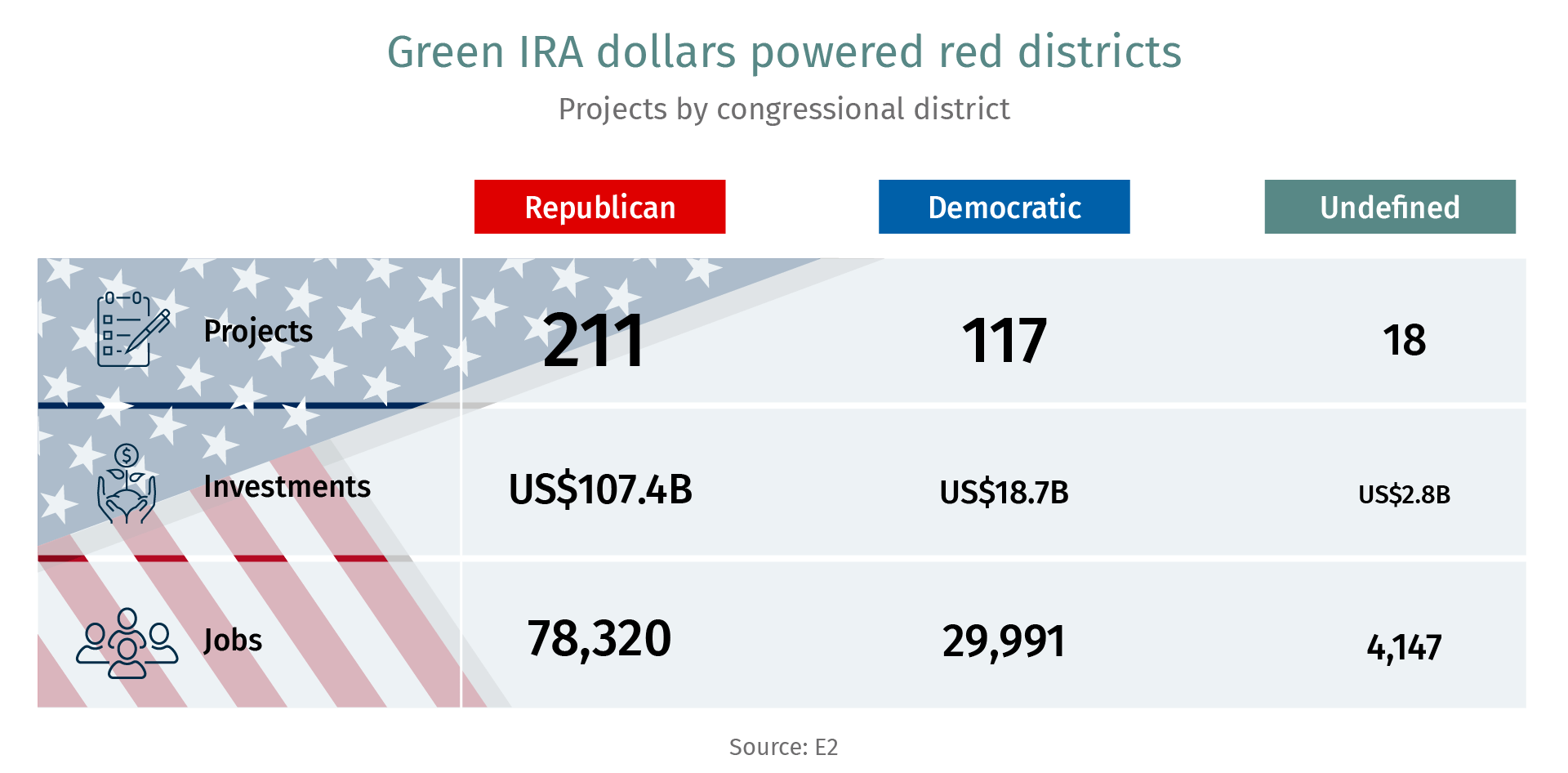
What happens to IRA now?: Trump has threatened to rescind all unspent funds from the Inflation Reduction Act, but it may be tricky as many Republican states and districts benefit bigly from the law (see table). Some analysts argue the rollout is too advanced to be axed, but Trump can certainly insist on a reset: a repackaged and rebranded policy, with some technologies getting more love than others. (For example, Trump considers wind energy “disgusting,” which could knock the wind out of that sector). Renewable stocks’ swoon after Trump’s win suggests low-carbon energy investors are anxious.

Life after Paris: Trump pulled the U.S. out of the global climate deal in his first term—he could do so again. UN chief Antonio Guterres thinks a second U.S. exit could “cripple” the Paris climate agreement. But there may be life beyond Paris. In Trump’s universe, allies will have to learn to jump headlong into new policy wormholes. Perhaps it could mean an America-led energy and climate club of allies that excludes China. It could also lead to a reset on many fronts in the form of new climate targets for 2030 and 2050 and policies that weigh energy security and affordability as equally as emissions—policies that are more palatable to businesses and consumers. Bespoke climate solutions rather than the grand one-size-fits-all policies that many countries are reluctant to pursue.

“Fun” with CUSMA: The next renegotiation phase with Canada’s CUSMA (ex-NAFTA) members U.S. and Mexico in 2026 might be more intense under a Trump administration, which is seeking more protections for the American auto industry. “Oh, I’m going to have a lot of fun,” Trump noted, ominously. But it may not be a bad omen for Canada, especially with an ace up its sleeve: critical minerals. Metals were not a major issue in the last CUSMA negotiations, but Canada could leverage them now. Trump’s focus on dissociating from China’s energy supply chain helps Ottawa make the case for a strong Canadian auto supply-chain (from nickel to cobalt, batteries and car assembly) across the 401 belt all the way to Michigan. That would ring-fence us from Trump’s plans to put tariffs on any product imported to the U.S.

What would Elon Musk do?: The billionaire Trump backer (and possibly his future government efficiency czar), is deeply invested in the North American auto market as the head of Tesla. While the president-elect rails against China’s manufacturing sector, Musk relies heavily on the country’s production base. It could lead to interesting conflicts and crosswinds, and perhaps opportunities for the Canadian auto supply chain to become a viable alternative. Ambitious, yes, but it’s no time to be a wilting violet.

Fuelling emissions: Trump’s call on U.S. oil and gas producers to “drill, baby, drill,” would send U.S. emissions higher, especially in an era of rapid deregulation. He would also likely insist that Canada, America’s largest source for imported oil, keep its oil spigots open to ensure affordability. That could complicate Ottawa’s recently proposed oil and gas emissions cap draft (see next item below). Whoever gets to negotiates trade, climate and energy policies with the new Trump administration will need to find a new balance between Canada’s ambitions and needs and a new American reality.

The scrap over the cap

The federal government’s draft regulations for the oil and gas greenhouse gas pollution cap was met with predictable bemusement by Alberta. The draft rules, possibly the most contentious Liberal climate policy, resembles its proposed framework in December 2023 of a cap and trade system.

  • Reining in emissions. The emission cap will be set in 2029, for compliance beginning in 2030, with allowances provided freely and set at 27% below reported 2026 emissions. Allowances (i.e. physical emissions) must represent a minimum of 80% of total emissions, with emissions credits and payments into a decarbonization fund providing the remaining flexibility.
  • Here’s how the math works. Starting in 2030, emissions will need to be 27% lower than 2026 level. Here’s the rub: where will emissions be in 2026? Based on energy policy lead Shaz Merwat’s math, Ottawa is modelling a 22% decline in emissions over the next two years—that seems (a little) ambitious. If one assumes oil and gas upstream emissions remain flat over the next two years, the 2030 cap equates to emissions being down 15% relative to the Paris baseline (2005), or conceivably up 7% after incorporating compliance flexibility. Cue the outrage from environmentalists.
  • Don’t forget methane. It’s expected to represent at least half of the emissions decline. Canadian historical oil and gas emissions were revised upwards by 12% this year, partly due to underestimating the greenhouse gas warming potential of methane. Canada has already planned methane regulations to reduce methane emissions 75% from 2012 levels by 2030. For a hard-to-abate sector, methane is not the hardest problem to overcome.Time to reset carbon markets? The move adds another layer of complexity to Canada’s patchwork of carbon markets. As we highlighted in a recent report, provincial fragmentation undermines carbon market’s potential. Businesses repeatedly cite regulatory uncertainty and lack of harmonization as impediments to moving forward with investment decisions.
  • Where do we go from here? Formal consultations start now, with a final proposal expected in spring. Alberta Premier Danielle Smith says she is considering “every legal option” to fight the cap. It’s also worth asking whether the Liberals will be in power till October 2025 to push through these policies, especially as a Conservative party rising in the polls is pledging to “scrap the cap.”

COP29: CALENDAR CONFLICTS

Quite a few executives have struck Baku, Azerbiajan—host of the UN climate-change conference No. 29—off their calendar, partly due to U.S. elections. It didn’t help that New York Climate Week dazzled this year, negating the need for many to travel 9,000 kilometres to bump into the same folks a month later. Inexplicably, COP also partly coincides with the G20 leaders’ summit taking place Nov. 18 and 19 at the other end of the globe: Rio de Janeiro. Talk about a climate calendar conflict.

Still, for those lucky enough to attend Azerbaijan and sample local delicacies such as kabab, plov and dolma (hat-tip: Baku-born Farhad Panahov), or steal a few hours to visit the Old City, here’s what else is on the table:

COP Lite. Joe Biden and other heavyweights are expected to skip the event. But that means more room for NGOs and delegates from developing countries.

Baku is Part II of a troika of summits: COP28 host UAE teamed up with Azerbaijan and COP30 host Brazil—the COP Presidencies Troika—to hammer out a “Roadmap to Mission 1.5°C.” COP28 was about Global Stocktaking (i.e. what’s needed), COP29 is about financing, and Brazil will oversee a new round of nationally determined contributions (NDCs), or each country’s climate plans.

Waiting for NDCs: That’s another reason Baku might be a subdued affair as most countries only reveal their updated NDC by next February. UN wants nations to be ambitious, but since the last NDCs were rolled out in 2020/21 there has been a change of personnel at the top in several countries, and decidedly less consumer and business appetite for ambitious climate policies.

Baku’s big moment: Consensus on financing alone could be Baku’s big win. Cash-strapped EU wants China to foot some of the world’s climate bill, which could come to $1 trillion a year. Expanding the donor base of countries is a “prerequisite” for an ambitious new post-2025 New Collective Quantified Goal (NCQG), to replace the US$100-billion annual climate commitment. Expect many fights on who foots the bill.

Gas-lighting: COP28 famously signed-off by noting it was the “beginning of the end” of fossil fuels. Gas powerhouse Azerbaijan seems less ambitious on that front. Expect Europe to square off against oil producing countries—again.

Racking up green storage:  COP28 was methane and nuclear’s moment. Azerbaijan is proposing countries commit to a new pledge for 1,500 gigawatt of energy storage capacity by 2030. Other proposals include reducing tourism sector emissions, and creating a global market for clean hydrogen.

The Institute In Action

Ag policy lead Lisa Ashton hosted a panel on Nature Based Solution in Agricultural Landscapes at the Royal Agricultural Winter Fair on Nov 1. Read the three key takeaways from the discussion here.

On Nov. 4, we made our second stop on our Food for Thought tour in Montreal, where Institute head John Stackhouse heard from innovators on their playbook to cut costs and reduce emissions.

What’s on the team’s reading wish list: Revenge of the Tipping Point (Malcolm Gladwell), Climate Capitalism (Akshat Rathi), Not The End of the World (Hannah Ritchie), Fire Weather (John Vaillant), Vampire State: The Rise and Fall of the Chinese Economy (Ian Williams). Read John’s book blog here.

ICYMI

Planet-heating pollutants in atmosphere hit record levels in 2023

Move over millennials, climate activism is no longer a young person’s game

Podcast: Meet the First Nation building an LNG project in B.C.

How vintage Nike Airs exposed a flaw in a US$700-million carbon market

Rebuild or retreat? Homeowners face tough decisions after repeat flooding 

Catch up on our latest work:

Biotech boom: Canada’s life sciences revolution (podcast)

AIOC: A bridge builder helping unlock Indigenous potential

Immigration changes cloud Ontario’s economic outlook

Issue #03

Lessons for Canada in the nuclear restart
A Trump victory could shake up energy markets
Climate change hits Halloween symbol
Our newsletter sender handle will change to Climate Crunch from Nov.7 edition. Save our address to your contacts to avoid spam filters


Hot takes

What’s new in the IEA’s latest annual report? A dedicated chapter on “Security, affordability and sustainability.” That wasn’t the case in the 2023 World Energy Outlook, and it’s about time. We maybe on the cusp of the “Age of Electricity,” the IEA suggests, but maintaining global temperature’s rise to 1.5C degrees–as set out in the Paris agreement–could easily swerve wildly to a 2.4C world if we can’t secure clean energy critical minerals and make it affordable for consumers. The good news: the surplus of energy—from LNG to solar photovoltaic—, means we could soon be in an energy buyer’s market, the IEA projects. The rise of renewables also means global carbon dioxide emissions are “set to peak soon,” the agency forecasts.

Canadians can save money and enjoy a low-carbon lifestyle. That’s according to a new Clean Energy Canada report that suggests installing heat pumps and buying electric vehicles can do both (as much as $777 in monthly savings for a detached house in B.C.). But that saving hack faces a grim outlook: the end of the federal Greener Home Grants and lack of affordable EVs could make it costlier to go green very soon.

A Trump victory could upend energy markets. Polls suggest the 45th U.S. president has an even chance to win the White House on Nov. 5. That would shake up geopolitics, with Iran potentially emerging as a principal target of U.S. sanctions, says RBC Capital Markets’ Helima Croft . Curbing Iran’s oil production would shore up global oil prices and invoke animal spirits among North American producers, but with consequences for Canada and the U.S.’s modest efforts to curb emissions

Canada’s crumbling road and water systems face a $350B bill. Governments installed drinking, wastewater and stormwater pipes at the fastest rate on record from 2020-2022, but the bill to replace “poor” or “very poor infrastructure” has risen to $357-billion—$100-billion more than previous estimates. It’s an urgent problem with recent episodes in Vancouver, Montreal and Toronto highlighting its frequency and scale—with huge economic impacts. The insurance industry says property claims, driven by floods, now account for 36.8% of all claims.

Before COP29, there’s COP16. In Cali, Columbia. It’s the first biennial UN summit on diversity since the landmark Global Diversity Framework in Montreal in 2022. Key agenda item includes a framework to address “biopiracy,” that would ensure countries are paid for, say, digital fingerprints of rare plant species that biotech companies would use to make drugs. Are you attending COP16? Send us your post-event hot take here.

A series of unfortunate events hit pumpkin production. Tam Andersen—who runs Prairie Gardens in Alberta—says she lost crop early this season to unusually cold weather in June, following on from a drought that hit output last year. “It’s a response to climate change—yet again. We are calling this season the Lemony Snicket season,” she said in a phone call from her 35-acre farm in Sturgeon County. Like other farmers, she is adapting to the changing weather: next season she will plant pumpkins on higher ground to protect them from an avalanche of melting frost.

Bi-Weekly Climate Action Award: To Lennard de Kler who researches wartime greenhouse gas emissions, and will lead a panel discussion at the COP29 summit in Baku, Azerbaijan, in November.

Bi-Weekly Climate Fail Award: A “bonkers” British government proposal to burn imported wood, potentially from countries including North Korea and Afghanistan, to meet Net Zero goals.

The nuclear race is on

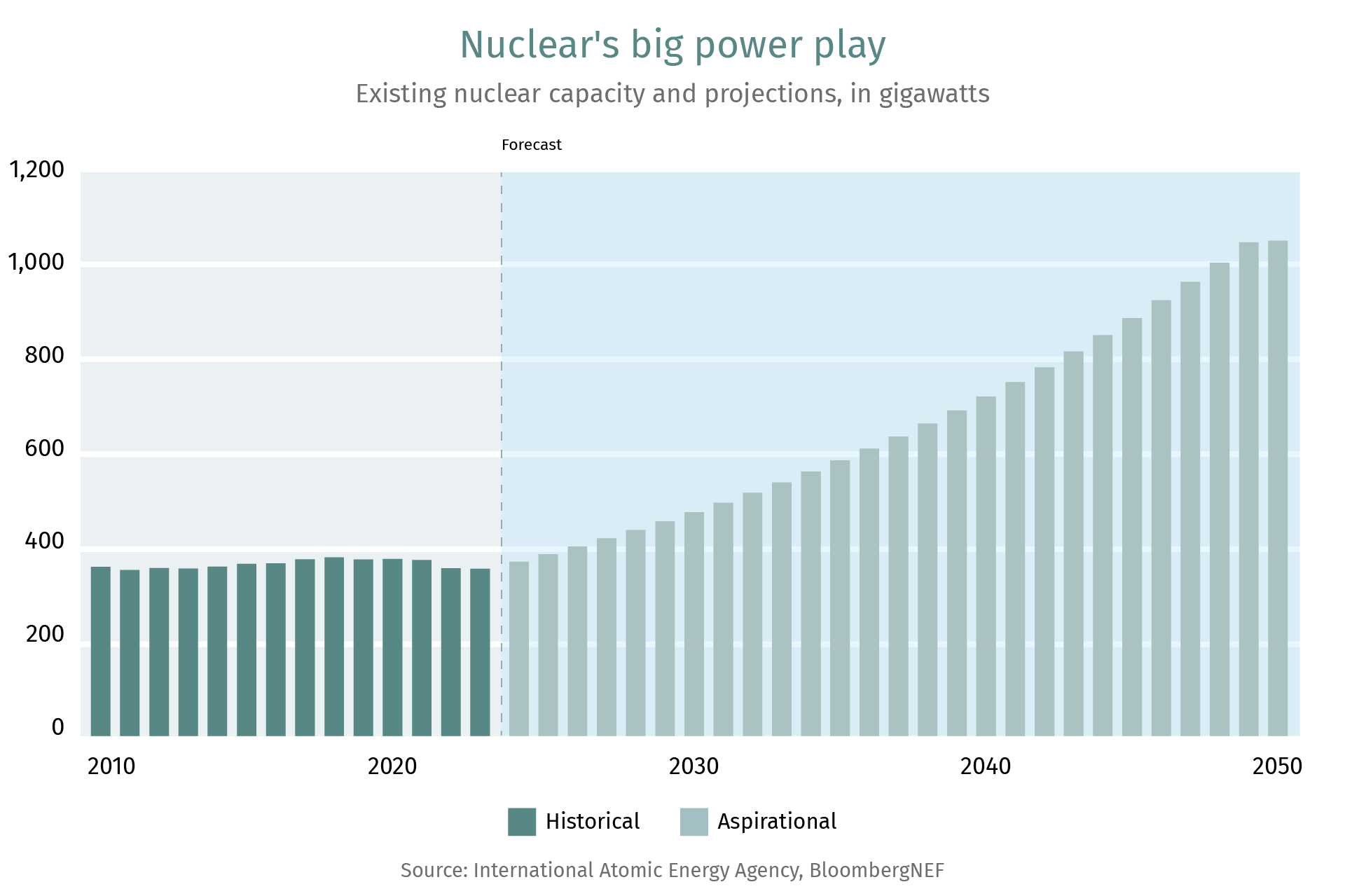
If we are nearing the Age of Electricity, as the IEA says, perhaps nuclear is already basking in its Renaissance period, driven by Big Tech. Amazon followed up its 960-megawatt contract with Talen Energy in March, with a US$500-million, 5,000MW deal with X-energy to bankroll a new generation of SMRs. Google has unveiled similar plans, while a Microsoft deal is dusting off the mothballed Three Mile Island nuclear plant, and Nvidia is eyeing Japan’s nuclear power—all to meet their insatiable artificial intelligence and datacentre demand.

While nuclear was given the green light from policymakers at COP28 in Dubai, admittedly the sector had still been waiting to “take off” – until now. The string of recent announcements has nuclear stocks flying, and meaningfully outperforming the S&P 500 on the year.

Shaz Merwat, energy policy lead, points to two key implications for Canada:

Nuclear is in Canada’s wheelhouse , as we know a thing or two—or ten—about the tech. Nuclear is becoming a key provincial plank, most notably within Ontario’s plan to meet a 75% surge in demand by 2050 (to support AI demand and others). There is also room to export our expertise to those warming up to nuclear – Ontario Power Generation’s SMRs are a case in point. The U.S. is already moving swiftly in hawking its SMR tech to Asian countries.

Second, it showcases the need for offtake agreements to drive deployment of new decarbonization technologies. Can Canada replicate this on the carbon capture front? The U.S. IRA provided a robust offtake mechanism with a guaranteed US$85/ton tax credit. Canada’s approach to derisk capital expenditures (investment tax credits) is economically sound, but has struggled to provide carbon price (revenue) certainty to date.

Carbon Markets For The Climate Era

Nine Canadian industries, including oil and gas, petroleum refineries, iron and steel, cement and aluminum, are vulnerable to carbon competitiveness and leakage risks, according to a new report by the newly-launched Commission on Carbon Competitiveness.

Aaron Cosbey, Chair of the Commission and one of the authors, says industrial carbon pricing (also known as large emitter trading systems, or LETS) remains the best option in the medium term.

“But we found some sectors at much higher risk than others (iron & steel, basic chemicals, nitrogenous fertilizers, pulp & paper, with honorable mention to cement),” Cosbey said in an email. “In those sectors there should be more generous use of performance benchmark standards within LETS, keeping the average cost of carbon very low.”

Keeping credit markets in balance will be hard as firms decarbonize, so Canada needs to start exploring options for further protection for the long term.

One option? A comprehensive border carbon adjustment. But it’s potentially trade-illegal, messes with incentives in the domestic carbon market, and would kick a hornet’s nest south of the border.

Another option is product-level GHG intensity standard—as a condition of sale on the domestic market (also applicable to imports).

Both options need U.S. co-operation and complex instrument design. Canada needs to start working on them now, the Commission recommends. Read the full report here.

Canada needs to support both legacy industries and new high-growth potential sectors to ensure long-term competitiveness, the report recommends. “Demand-vulnerable sectors may need capital for decarbonization and/or to invest in new opportunities. And high-growth sectors will have a critical need for funds to establish and grow their operations to reach commercial scale.” It must all happen in concert—and fast.

The Institute in action

At Energy Disruptors on Oct. 2, John Stackhouse and Chana Martineau, AIOC CEO, discussed economic reconciliation. Read the highlights of their conversation here.

On Oct. 16, Myha Truong-Regan was at Canada’s Productivity Summit in Calgary, discussing how energy transition can boost Canada’s economic growth and productivity.

On World Food Day, Oct. 16, Lisa Ashton attended the Arrell Food Summit to hear stories and insights on food innovation.

Lisa will also be hosting a panel on Nature Based Solution in Agricultural Landscapes at the Royal Agricultural Winter Fair on Nov. 1.

What’s on the team’s reading and listening wish list: World Without End (by Jean-Marc Jancovici and Christophe Blain), The Burning Earth (by Sunil Amrith), Gambling Man—Mayoshi Son (by Lionel Barber).

At Energy Disruptors United in Calgary, I sat down with Chana Martineau, CEO of Alberta Indigenous Opportunities Corporation (AIOC), to discuss economic reconciliation. Chana is uniquely qualified to help unlock economic opportunity for Indigenous communities and her background as a woman of First Nations heritage with 30 years of experience in banking and consulting has made her a bridge builder between private enterprise and Indigenous communities. Her cross-functional team of capital markets professionals, Indigenous relations specialists, and engagement professionals enables the AIOC to be a role model for strong governance and professional management. Chana has some advice for companies that want to build ties with Indigenous communities:

  1. Alberta Indigenous Opportunities Corporation is a breakthrough organization that’s a model for the rest of the country, demonstrating the power of mobilizing capital through Indigenous communities for opportunities. Can you tell us the story of AIOC?
  2. In 2019, the Alberta government fulfilled a campaign promise to bring to life an organization that would facilitate investment and participation by Indigenous groups in commercially viable projects – groups who had previously been held back from participating in the economy due to restrictions in the Indian Act. AIOC was set up to remove the barriers – to provide that capital that would allow full participation in the economy, while creating a replicable model that could be accessed for future projects to come. We’re coming up on 5 years next month and are seeing so much come through the pipeline we can’t keep up sometimes. It’s an exciting time for us and demonstrates the critical need for this program.

  3. It’s amazing to think that you’re just coming up to your fifth anniversary because you’ve got such an impressive track record already. And several other provinces are modelling what you’ve built. What advice do you have for them?
  4. I am impressed with the Alberta Government’s entrepreneurial spirit and their passion. They came to us and said, “What do you need to make this happen?” Our governance model is incredibly important. Our board consists of five First Nations members, two Metis members and two allies. It’ a mix of people that really understand Indigenous business and capital markets. You need the right skills at the table to protect the provincial loan guarantee and to understand the intersection of the Indigenous Nations and groups’ interests. We talk a lot about Canada’s productivity crisis. Well, it doesn’t make any sense for each jurisdiction to have a different program that doesn’t work together. When we look at big infrastructure projects that are multi-jurisdictional, we want to make sure the different programs can work together. We have been an open book in terms of helping the new programs learn from our journey. We’re here to help Indigenous peoples and Canadians understand and unlock the benefits from these partnerships.

  5. So, governance is critical. And then entrepreneurial spirit and support from your “shareholders”. It seems like a lot can be solved with these partnerships. Why hasn’t the market solved it then?
  6. Corporations want to bring in Indigenous partnerships, but those relationships have been contentious for hundreds of years. Some corporations don’t want to make a mistake. And some recognize we’ve all made mistakes and that’s what the journey toward reconciliation is about. Now they want to help. Our team straddles both worlds. We understand capital markets, publicly traded companies, and pressures of shareholders. We also understand Indigenous ways and its history, so we can help bring that together in a way that the values are shared and guide both sides. It’s about learning how to speak with each other, helping people connect and giving them a safe place to have those conversations – that’s when the magic can happen.

  7. So being a bridge builder is very powerful. What else is critical for these corporations to understand?
  8. I believe you need to be firmly rooted in your values. Thinking about our corporate partners who have executed successful transactions, they have a leadership commitment to making it happen. Their corporate development teams and legal teams are used to doing things a certain way, where time is money. It doesn’t start from a “seek-to-understand” point of view. Indigenous communities are different. The conversation is different. What I really encourage those organizations to do, and the successful ones really understand this, is to take that “seek-to-understand” approach. It’s going to look different than any transaction you’ve done before, and that’s a good, healthy thing. It takes real leadership from the very top, and commitment to following it through, because it’s a new way of doing business.

  9. The seek-to-understand approach takes time, and that often doesn’t compute with a corporate mindset. How have the successful companies adjusted their notions and approach to time?
  10. Patience, perseverance, and creativity. Those are three key elements to these kinds of transactions. Creativity is a big one. It’s not just to engage with First Nations partners – there are certain parameters of a loan guarantee that make it challenging. At AIOC, we are responsible for $3 billion of the Alberta government’s balance sheet. That’s a big responsibility. If you’re a taxpayer in this province, you don’t want me to tell you we’ve made a bad call. These deals are not easy to do. The bar is high. We have some creative credit structuring to protect the loan guarantee because if the province has a $150 million loan guarantee called, we’ve got less money for roads, schools, housing and health care. We all know the challenges there. Our credit underwriting needs to be prudent, and we need all three parties to collaborate around what works for the communities, the corporate partners, and the loan guarantee.

  11. Let’s look at the Indigenous community’s viewpoint. What are some of the signs of success in communities. How do they view these corporate partners and the structures that you’re helping to create?
  12. I think we’re on a journey and some have already seen the benefits. We’re seeing corporate and Indigenous partnerships changing contentious relationships into ones of mutual respect, understanding and collaboration. And we’re also seeing a massive unlocking of economic activity within these communities. They’re able to rebuild gathering places and all the things that go along with that – the contracting, the construction. It’s jobs, it’s income. All that drives economic activity and builds a healthy heart and connections to the community. Multiply that over 43 Nations and Settlements that have participated in our transactions. These are invaluable to the fabric of the lives in those communities. We’re just starting to see the positive economic impacts grow.

  13. How are you helping communities that don’t have capital markets or financial expertise to move at pace with some of these opportunities?
  14. There’s a lot to learn in a short period of time. We do that through our capacity grant funding, which provides advisors and/or funding for advisors. Our corporate partners also help fund that stream. Members of Indigenous communities can see the full lifecycle of the transaction – be at every single meeting, witness all the due diligence and take the site tours. Understand the journey start to finish, equipping them with the tools to engage with industry. Empowering them to say “Why are you here to talk about consultation? Why are you not here offering us equity share partnership?” The entire conversation has changed. They are not subservient to industry anymore, and I am so proud of that.

  15. Success for both corporates and communities in these deals must equate to more than just the money, doesn’t it? You’ve got human and cultural capital also on the table.
  16. You need to understand what these transactions bring to you. When it’s all about money, I don’t care who it is sitting on the other side of the table. And if it’s all about money, you’ll see what you get. When you’re in the trenches of those negotiations, if you haven’t spent the time to “seek-to-understand” and build trust upfront, Indigenous partner or not, that’s when you’re really going to feel it.

  17. What do all of us, but especially those involved with businesses and governments, need to consider to augment what you are doing?
  18. AIOC is one part of the equation, and we’re not all things to all people. We have the loan guarantees delivered, but that does not replace procurement, contracting, relationships and hiring. We need organizations and governments to start thinking differently about how these relationships are formed. If you’re trying to increase Indigenous participation in your workforce but can’t get anyone out to your job fairs – change the narrative. What if you started with an economic partnership? What does the recruiting funnel look like now? It’s a different way of approaching the issue. I think a lot of people are thinking, “How can we do this?” “How can I bring this to life for my company?” Talk to your Indigenous neighbours. Start the conversation and you will move along with that journey.

  19. Thinking about the AIOC journey – If we’re back here in a year, what’s one or two things you hope will have advanced or changed?
  20. I hope we’ve supported more partnerships. I hope we’ve broadened our scope of deals. I hope we’ve done one or two big game-changing deals across jurisdictions. And I hope the other programs are up and running.


John Stackhouse is Senior Vice President, Office of the CEO, RBC.


Issue #02 Quebec’s Northvolt-sized problem A made-in-Canada climate taxonomy to attract green capital Reimagining Canada’s industrial carbon pricing system

Hot takes

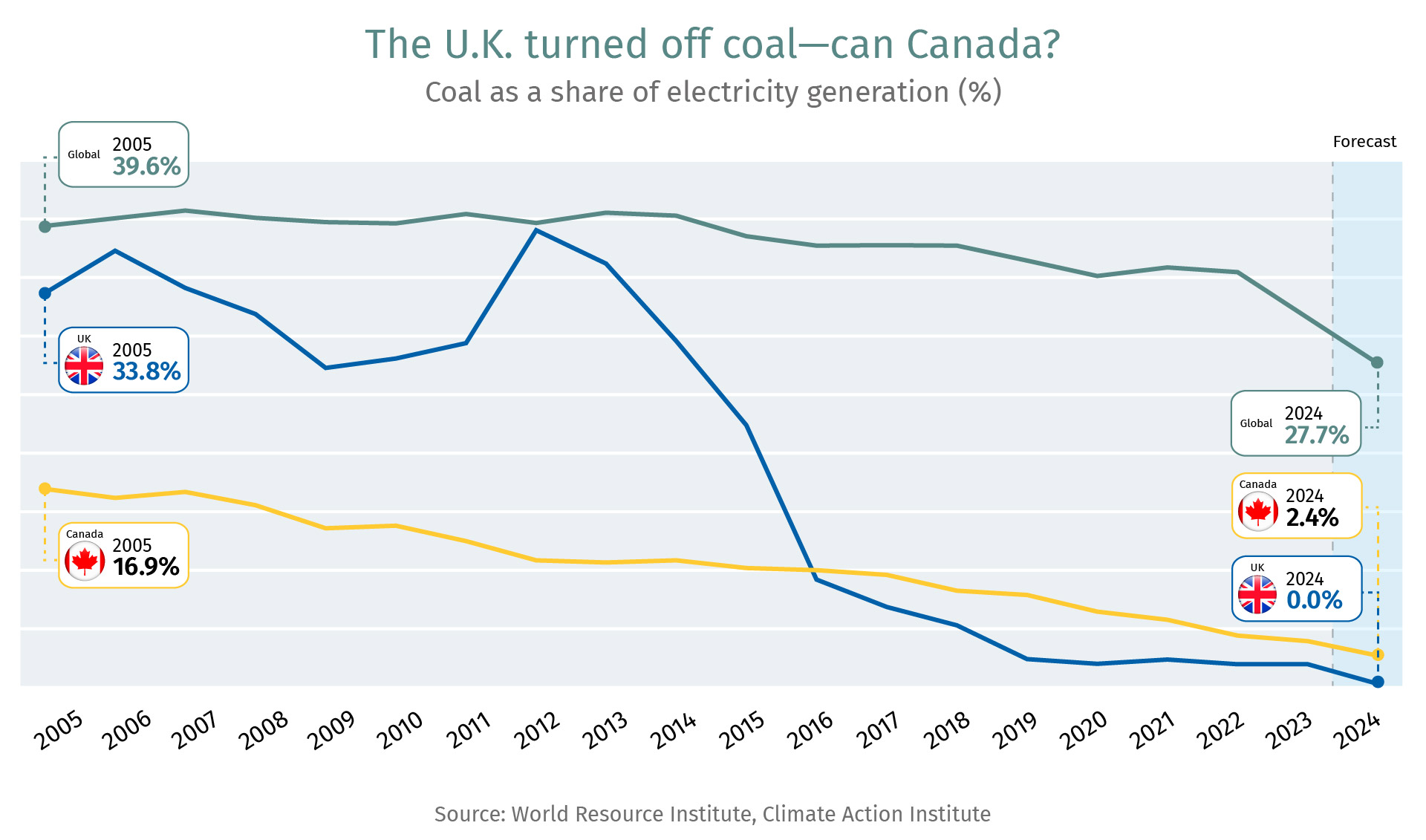
King Coal’s rein ended in the U.K—the first G7 country to do. Here in Canada, Alberta banished coal-generated power this year, but Saskatchewan, Nova Scotia and New Brunswick are still figuring out ways to rid coal off their grids. Shaz Merwat, our energy policy lead, suggests the switch to renewables, coupled with battery storage and natural gas are preferred coal-switching solutions for the rest of the decade. The pursuit of Net Zero, however, will involve carbon capture adoption and the often thorny issue of greater inter-provincial connectivity. Canada advanced its guidelines for sustainable investments. The new climate taxonomy aims to guide investors, banks, and other stakeholders seeking clearly-marked “green” and “transition” economic activities. It’s an important step in Canada’s sustainable finance journey, especially as trillions of dollars of capital eyes verifiable green and transition investment opportunities. The Canadian taxonomy can help attract private capital, which is vital for economic growth and emissions cuts. While there’s much work to be done—including some important definitions of end-use for natural gas if it’s to be sold as a transition fuel—it’s a milestone in Canada’s Net Zero journey. There’s a new energy in Calgary. Institute head John Stackhouse found the city fired up as he attended the Energy Disruptors Unite conference recently. Some of his top observations: Nuclear is back, ESG isn’t dead, and Indigenous equity is the new gold standard of engagement. Read John’s 10 takeaways here. … Speaking of new energy…: TC Energy’s spin-off of its oil pipeline business to pivot to lower-energy carbon sources is a new iteration for the 70-year-old Calgary firm. Natural gas and power and energy solutions , “driven by nuclear, pumped hydro storage and new energy opportunities,” gives the firm exposure to utility-like assets. Another energy-transition plus: the potential expansion of the 4,800-megawatt nuclear capacity at the Bruce C project at its existing Bruce Power site in Ontario.
  • Express your climate change frustration with an emoji. Dead tree emojis are coming to smartphones soon as regular folks channel their climate angst. Hurricane Helene and now Milton are just the latest weather events supercharged by climate change. Since 2019, virtually every Canadian province and U.S. state has been slammed by a costly disaster. Yet, progressive climate change policies are fast becoming political liabilities from Ottawa to Vienna to Washington.
Bi-Weekly Climate Action Award: To Shane Gross of B.C., who won the prestigious Wildlife Photographer of Year award from the U.K.’s Natural History Museum. Check out his Swarm of Life photograph below of tadpoles in a lake near Vancouver Island that won him the prize. Copyright Shane Gross Bi-Weekly Climate Fail Award: A new University of Cambridge study that advocates reducing flight speeds by 15% to reduce emissions—raising transatlantic travel times by 50 minutes.

Canada & Quebec’s Big Charge

Ottawa and Quebec have a Northvolt-sized problem. Europe’s biggest battery maker had it all: US$15-billion in funding from auto industry, banks and European governments, and was eyeing an electric vehicle battery plant near Montreal, backed by Quebec and Ottawa. But EVing is hard. The company is struggling against cheaper and better-performing Chinese EV batteries and a slowdown in European automakers’ EV plans. That could delay its Quebec factory plans by at least 18 months. The Quebec government called the project the “greenest electric battery factory in the world,” when it was launched a year ago. Now it sees it as a “calculated risk.” That’s a lot of calculated risk-taking of public money: In addition to federal funding (see table), Northvolt received a $240-million guaranteed loan from Quebec for land near Montreal to build its plant. Quebec also plunked down another $270 million in its Swedish parent company Northvolt AB, with a further $200-million investment from Quebec’s pension fund manager. The delay to Northvolt’s plans could gum up Canada’s burgeoning EV supply chain. The Parliamentary Budget Officer estimates that of the three massive EV projects (including the Volkswagen and Stellantis-LGES plants in Ontario), Northvolt was closest to break-even, i.e. by 2037. But the company’s potential delays could mean Canada and Quebec would have few economic benefits to show for their billions in EV investments until 2040 at the earliest. The project was going to be Canada’s answer to Chinese EV battery behemoths. Now the nascent industry is just left with more questions.

Carbon Pricing In Transition

Canada’s industrial carbon markets can serve as building blocks of innovation, low-carbon economic growth and investment, according to a new joint report by Climate Action Institute, Canadian Climate Institute and Clean Prosperity. But Canada’s patchwork of nine siloed carbon pricing systems are barriers to unlocking these benefits. Harmonization of the country’s carbon markets would help ensure they play an outsized role in advancing Canada’s economic, environmental and geopolitical objectives, the report argues. As policymakers shift their attention to the back half of the 2020s, amid a more fragmented world, a fresh approach to our carbon markets could strengthen both trade and climate policies, and foster a new cycle of lower-emissions growth, the three institutes state. Read the full report here.

The Institute In Action

We’re in Ottawa on Oct 10. for Net-Zero Edge, Canada’s largest climate conference, hosted by the Canadian Climate Institute and the Net-Zero Advisory Body. John Stackhouse sat down with Sir Alok Sharma and Candace Laing from the Canadian Chamber of Commerce to discuss Canada’s carbon competitiveness. Follow that conversation on John’s LinkedIn here. Catalytic capital. That was among the topics Myha Truong-Regan, our Head of Climate Research, and Ravinder Gill, Managing Director and Head of Sustainable Finance at RBC, discussed at a Food for Thought Climate Perspectives series, starting in Toronto. Read some of their top observations here. What’s on the team’s reading/listening list: Prophet Song (by Paul Lynch), It Can’t Happen Here (by Sinclair Lewis), A World Of Three Zeros (Muhammad Yunus), What If We Get It Right? (by Ayana Elizabeth Johnson).
Curated by Yadullah Hussain, Managing Editor, RBC Climate Action Institute. Climate Crunch would not be possible without John Stackhouse, Myha Truong-Regan, Sarah Pendrith, Farhad Panahov, Lisa Ashton, Shaz Merwat, Vivan Sorab, Caprice Biasoni and Frances Dawson. Have a comment, commendation, or umm, criticism? Write to me here (yadullahhussain@rbc.com)

The energy transition presents a chance for Canada’s small, open economy to reset and recharge its global competitiveness.

The race is already on: As countries fuse their economic, environmental and geopolitical objectives, there is a growing imperative to link trade and climate policies. That pressure may grow as advanced economies turn to protectionism, including ways to reduce access for products made in countries with lower emissions standards. In the new trading paradigm, Canada has the opportunity to compete in the exports of low-carbon goods, while also navigating market disruptions caused by emerging clean tech innovations.

Luckily, Canada already has a head start in this low-carbon competition, with industrial carbon markets that can serve as building blocks of innovation, low-carbon economic growth and investment. By fine-tuning and crafting policy that delivers emissions reductions domestically without compromising our competitiveness, Canada can gain an advantage in the new low-carbon economy.

Indeed, industrial carbon markets can become central to Canada’s efforts to address new imperatives brought on by the energy transition. They can help us compete in low-carbon economies, build competitive advantages in international export markets, and decarbonize heavy industries—and get Canada closer to its Net Zero goals.

Yet Canada’s current system remains a patchwork, with nine industrial carbon markets—also known as Large-Emitter Trading Systems (LETS)—that price carbon for heavy industrial facilities. Each LETS has its own subtly different design elements and market conditions that operate within their provincial silos.

The fragmentation of these markets is undermining their potential, and hampering Canada’s ability to build low-carbon industries. Creating room for provinces to tailor their systems to regional priorities and politics makes sense—up to a point. But the current arrangement is hurting small markets with the presence of a few emitters raising transaction costs for firms operating in multiple provinces. As these companies trudge through different compliance rules, they are bogged down in an increasingly complex regulatory environment that slows investment decisions. The slowdown could lead to price volatility, limited participation, low trading volumes and a general lack of confidence in these markets.

Removing interprovincial trade barriers and integrating this patchwork of systems could offer considerable economic upside that could prove to be transformative for Canada’s energy transition.

Benefits Of Harmonization

Gaining efficiency, lowering costs
A firm producing basic chemicals with operations in Ontario and Alberta in Canada’s current system would need to employ two different approaches to calculate its emission limit, to ensure it complies with each province’s laws. That leads to duplication of systems and processes for record keeping, monitoring, reporting, and verification. It also entails greater administrative and compliance costs that will eventually be passed on to consumers. Harmonization could channel more investments in decarbonization and capital expenditures and less in the human capital required to comply with each set of regulations.

Harmonizing the governance can also make markets work better. A robust oversight regime including strong governance, disclosure, and enforcement of standards would contribute to market confidence. While studies examining the integrity and functioning of Canadian carbon credit markets is limited, studies of financial markets suggests that carbon credit markets with these characteristics would improve outcomes for market participants in the form of reduced transaction costs.

A deeper investment pool
Linking markets together is another key component of harmonization, enabling the development of larger markets with a greater number of buyers and sellers that can connect quickly, reducing transacting time and search costs. Robust linkages would also create a larger market for carbon credits that are fungible across different LETS, increasing the pool of potential buyers.

Corporate Canada’s Competitive Advantage

It’s hard to evaluate short-term, sector-level (let alone firm-level) implications of industrial carbon pricing. An industry’s competitiveness will heavily depend on its structure, including costs and profitability, long-term demand for its products, and the existence of cost competitive, low-carbon substitutes. It also depends on whether key trading partners have policies in place that give preferential tariff treatment to goods produced in jurisdictions with carbon pricing schemes. And this is without accounting for other forms of policy support.

Canada’s carbon pricing scheme covers eight key Emissions Intensive Trade Exposed (EITE) industries. The goods produced by these industries, which last year contributed $232 billion to the Canadian economy, are exported to three key trading partners–the U.S., which is Canada’s largest trade partner, the EU, and China.

Canada’s Biggest Carbon-Intensive Exports

Canada’s top export destinations for its carbon-intensive products
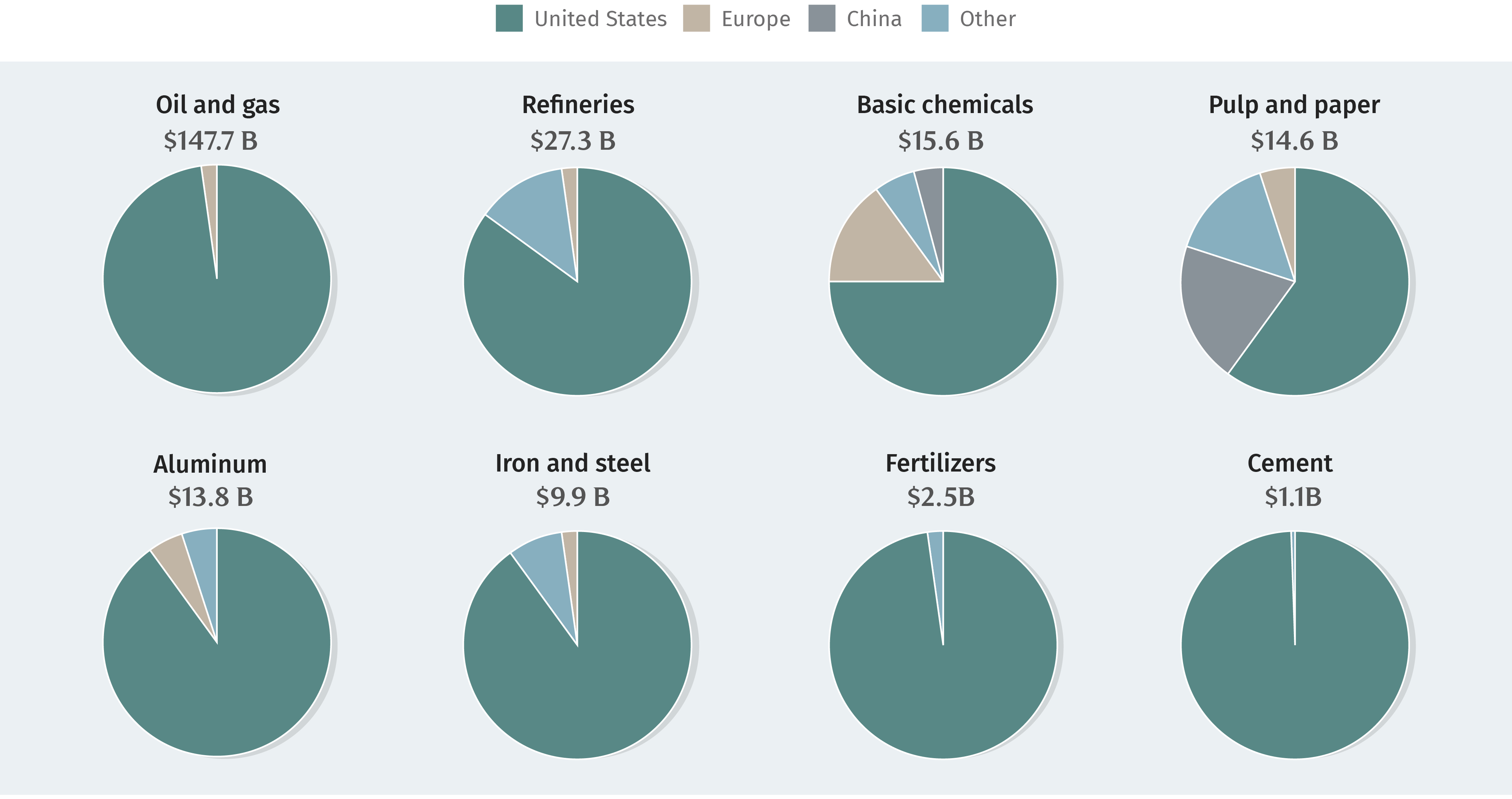
Source: RBC Climate Action Institute analysis of Statistics Canada data

Competing with Trade Partners
The EITE industries expected to benefit from carbon pricing are those with significant trading activity with the EU and China—both have LETS of their own, with vastly different dynamics.

Canadian goods are anticipated to be cost competitive with those produced in the EU, given similar industry cost structures and stringency of the EU’s carbon pricing regime. The EU’s Carbon Border Adjustment Mechanism (CBAM), set to come into effect in 2026, is a tariff scheme that gives preferential treatment to goods produced in countries with carbon pricing will have limited impact in eroding the cost competitiveness of iron, steel and aluminum produced in Canada.

Exports destined for China will have a harder time competing on price, given China’s substantially lower cost structures compared to Canada. It’s an advantage that is supported by China’s extensive use of subsidies in key industries and an abundant supply of low-cost labour. China’s relatively lower carbon price of $19 per tonne of CO2e, compared to Canada’s $80 per tonne CO2e, would have limited impact on eroding the cost competitiveness of Chinese goods compared to Canadian goods.

At face value, industries exporting to the U.S. are also at a cost disadvantage since there is no federal carbon pricing regime stateside. Canadian goods with embedded carbon costs would have to compete with U.S. goods without this cost.

Part of this cost disadvantage for key industrial sectors can be offset through system design, as well as the revenues that firms can generate from carbon credits. Recent research from Clean Prosperity and the Transition Accelerator found that revenue generated by carbon credits is the largest policy incentive available to most sectors within heavy industry. They remain Canada’s lowest-cost policy option to attract low-carbon investment into the country. In the long-run, these investment flows can position Canada to be globally competitive in new low-carbon industries.

Beyond Industry Bottom lines
Cost competitiveness, however, should not be equated with profitability and the long-term viability of an industry. Profitability ebbs and flows with economic cycles.

The viability of any industry depends on long-term demand. Canadian exports to the U.S. are concentrated in three industries, with oil, natural gas and refined petroleum products, such as gasoline, accounting for 79% of all EITE exports. Greater electrification, including the shift from gas-powered to electric-powered cars, less reliance on natural gas for space heating and electricity generation, and energy efficiency improvements is changing the U.S. energy mix, and shrinking the long-term demand for oil and natural gas.

Falling demand and market size at the industry level does not necessarily lead to broader economic stagnation. A study of B.C.’s carbon market found that, in the aggregate, carbon pricing does not have an adverse impact on its economy or employment, with employment shifting from emission intensive industries to cleaner ones. A study of the French carbon market also found similar greening of employment—evidence that carbon markets are operating as predicted by economic theory.

Similarly, Germany, the European Union’s largest economy and heaviest emitter within the EU carbon market, was able to leverage carbon pricing to cut the emissions intensity of industries, by reducing consumption of natural gas and petroleum and improving the energy efficiency of industrial processes, according to a study. This was achieved without lowering employment, GDP growth or exports.

There are limited data and studies providing insights on how Canadian provinces have adjusted their economic development strategy to safeguard their EITE industries. Some jurisdictions such as Alberta have addressed this policy challenge by building regulatory compliance flexibility into its carbon pricing regime.

Such policies also aim to ensure industries are not fiscally penalized, in the short run, as they invest in low-carbon technology, which are costly long-term investments. Under Alberta’s Technology Innovation and Emissions Reduction Regulation (TIER) system, firms can seek regulatory relief if compliance costs exceed 3% of sales or 10% of profits. In these situations, firms can use a greater number of carbon credits to reduce their compliance obligations and/or seek a greater “free” emission allowance.

Businesses repeatedly cite regulatory uncertainty as an impediment to moving forward with investment decisions. Harmonization can provide investors and markets with the certainty they need to invest in the country’s energy transition.

Navigating politics
Despite the many economic and trade benefits, and industry’s appetite for less regulatory complexity, harmonization has not been pursued for two key reasons. For some provinces, there’s a perception that harmonization could lead to an erosion of provincial autonomy to make decisions that protect their key industries. Harmonization introduces the need for greater coordination and consensus building. Processes that some provinces fear could limit their regulatory responsiveness to changing global market and regulatory conditions, and which is required to keep the industries located within their borders competitive. Many of these concerns can be addressed through governance frameworks when harmonizing the country’s LETS.

How To Harmonize LETS

LETS in Canada are already harmonized in some rudimentary ways, primarily through the headline price of carbon, which currently stands at $80 per tonne. But most of the finer details of both market design and market function vary from province to province—most notably the rules around who can hold and trade credits.

Harmonizing LETS and removing these interprovincial trade barriers will require reconciling details across systems that are at different stages in their development and maturity.

Except for Quebec, which shares a cap-and-trade system with California, all provincial and territorial use LETS known as output-based pricing systems. These systems regulate facilities based on their emissions intensity, rather than on their total emissions as with cap-and-trade. We limit this analysis to harmonizing output-based LETS across Canada. Integrating cap-and-trade and output-based markets beyond the headline price would be a far more complex, long-term challenge.

On both the substance and process of harmonizing LETS, federal and provincial governments can lean on their experiences with domestic trade deals in the pursuit of harmonization.

We outline two broad approaches.

All Parties Model
Harmonization through the All Parties Model requires strong central leadership with common standards across all provincial LETS. The Canada Free Trade Agreement (CFTA) offers a useful analogy for this more “top-down” approach to removing trade barriers. In the CFTA, the federal government and all provinces and territories have agreed to a shared set of provisions, definitions, rules, exceptions, institutional arrangements (e.g. dispute resolution), and exceptions, with a stated objective to “reduce and eliminate, to the extent possible, barriers to the free movement of persons, goods, services, and investments within Canada and to establish an open, efficient, and stable domestic market”.

Canada’s current approach to LETS, under the umbrella of the federal Greenhouse Gas Pollution Pricing Act (GGPPA), is but one possible version of the All Parties Model. Under the GGPPA, provinces are encouraged to establish and administer their own LETS.

On a rolling five-year basis, Environment and Climate Change Canada (ECCC) evaluates the performance of provincial LETS and negotiates with the provinces regarding the “equivalency” of their performance to federal standards. ECCC assesses equivalency every five years, with the next review coming in 2026. This will be the first review for some of Canada’s youngest LETS, most notably British Columbia, Saskatchewan, and Ontario.

Willing Partners Model
The Willing Partners Model offers a roadmap for any two (or more) provincial governments to harmonize their carbon markets. An analogous, “bottom-up” approach to removing trade barriers is the New West Partnership Trade Agreement (NWPTA). Through this effort, signatory provinces—British Columbia, Alberta, Saskatchewan and Manitoba—engage in a mutual effort to “liberalize trade, investment and labour mobility”. The provinces continue to amend, expand and update the agreement, most recently in 2022.

The Willing Partners Model is fundamentally an opt-in model. In the NWPTA, provinces agree to six shared criteria: definitions, obligations, rules, provisions, dispute resolution mechanisms, and exceptions to the agreement. Establishing shared criteria would be a starting point for any iteration of the Willing Partners Model for LETS. Fewer negotiating parties with a model that is voluntary can lead to an agreement with stronger shared criteria with a clearer value proposition for participating provinces.

A Willing Partners Model can also coexist alongside an All Parties Model. Just as any province can exceed the federal standards for LETS set out in the GGPPA, the NWPTA also defers to the Canada Free Trade Agreement (CFTA), where the provisions of the latter are “more conducive” to liberalization of interprovincial trade.

Degrees of harmonization
Beyond broad design details like the headline carbon price, there are many program elements of LETS that are not harmonized. Integrating these systems does not have to happen all at once. This gradual, step-by-step harmonization is also known as degrees of harmonization.

Two Components Of Harmonization

There are two core components to market harmonization. Governments can pursue each subcomponent individually or as part of a larger effort toward full harmonization.

Harmonizing market design
LETS market design involves decisions around how the carbon market will legally operate. This include what sectors will be covered by the program, the price of carbon and how exposed emitters will be to that price, who can hold carbon credits and under what conditions, and rules around monitoring, reporting and verification (MRV), including enforcement and non-compliance penalties. To take just one example, facilities that emit above a certain amount are automatically covered by LETS, but this coverage standard varies widely from province to province. Most LETS also allow smaller facilities to opt into and benefit from the program, but this standard also varies from province to province.

A Patchwork Of Carbon Coverage Standards

Canadian jurisdictions have different coverage threshold for large emitters
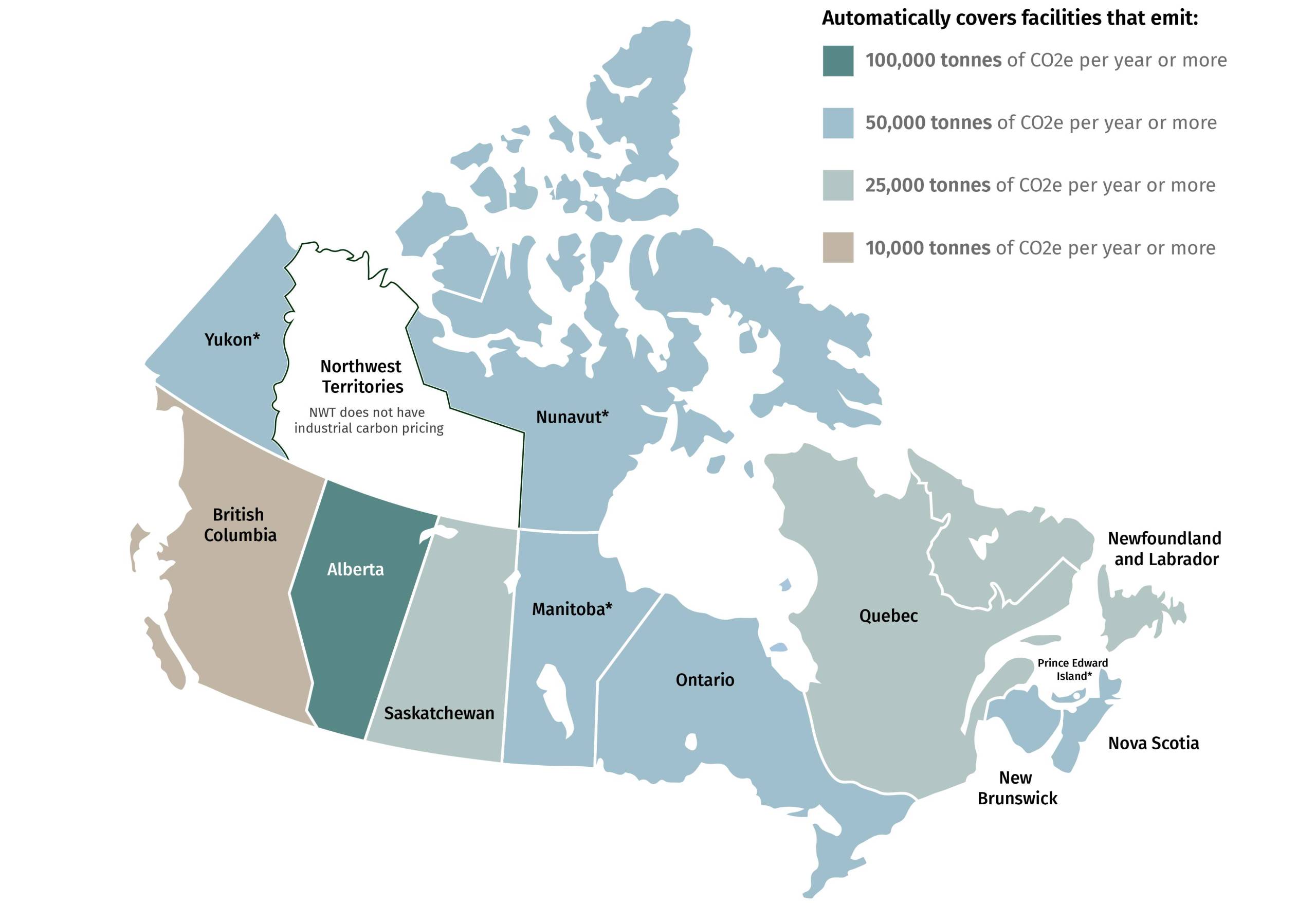
*Covered under federal framework

Source: RBC Climate Action Institute

Bringing markets in synchronicity
Full harmonization of market function includes full removal of interprovincial trade barriers, with fungible credits that are tradeable across provincial borders.

There are several elements of market design that need to be harmonized before this can occur. Some LETS have many different types of credits with unique properties. Alberta’s TIER system, by far the largest and most mature provincial carbon market, makes use of many different types of carbon credits to facilitate growth in different sectors. For instance, Alberta has two types of carbon credits with features that are specifically designed to encourage adoption of carbon capture technologies. Most other systems have a single credit type, and are more restrictive on who can hold carbon credits and participate in the market. These rules would need to be relaxed to facilitate harmonization of market function.

Beyond the mechanics of credit trading, true fungibility would also require harmonizing decisions around governance and review, including shared processes for evaluating the efficacy of different markets and the competitiveness performance of the firms participating in these markets.

Different provinces have very different industrial profiles and therefore face different competitiveness challenges. There is an urgent need for research detailing the opportunities and risks facing Canadian heavy industry as it seeks competitive advantages in a carbon-constrained world.

Canada’s current governance model for LETS—reviews in five-year increments—is sluggish. Provinces have the discretion to review and adjust benchmarks as needed, but have not done so to date even with looming risks of credit oversupply. Harmonized markets would need to make greater use of proactive strategies that can stabilize expectations around credit prices, respond to rapid or disruptive change in global markets, and reduce regulatory uncertainty for investors and operators. These strategies could include but should not be limited to policy tools such as carbon contracts and adaptive benchmark tightening.

Lastly, a shared commitment to measuring the outcomes of harmonization and the effects on provincial economies could help ensure data-driven decision-making around LETS moving forward. Provinces could also share digital infrastructure, registries, and programs that allow for credit tracking across participating provinces to maximize transparency to the broader public.

A Chance For Policy Alignment

Securing Canada’s economic future requires seizing every competitive advantage available. Many provinces have spent the better part of a decade (or more) standing up their LETS as a central plank of their decarbonization and low-carbon economic strategies. But the country’s fragmented approach to LETS presents significant opportunities for improvement. Taking stock of global market dynamics and trends towards protectionism, nearshoring and decarbonization, it may be time for a dialogue about what the next decade should look like for LETS in Canada. Harmonization, as part of a broader vision of economic competitiveness, should top the list for discussion.

Harmonization could help ensure that LETS play an outsized role in advancing Canada’s economic, environmental and geopolitical objectives. Global economic competitiveness, investments in technology and innovation, reduced regulatory red tape and costs: These and other benefits arising from harmonizing LETS are too numerous to ignore.

As policymakers shift their attention to the back half of the 2020s, and a more fragmented world, a fresh approach to our carbon markets could strengthen both trade and climate policies, and foster a new cycle of lower-emissions growth.

Contributors:

Myha Truong-Regan, Head of Climate Research, RBC Climate Action Institute

Brendan Frank, Director of Policy and Strategy, Clean Prosperity

Dale Beugin, Executive Vice-President, Canadian Climate Institute

Yadullah Hussain, Managing Editor, RBC Climate Action Institute

Caprice Biasoni, Graphic Design Specialist

Related Reading
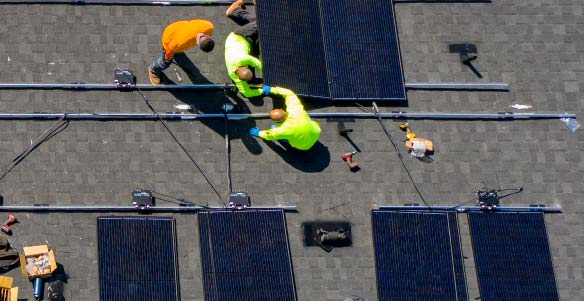
Owning the climate podium:

10 ways Canada can accelerate investment in decarbonization

High Rise, Low Carbon:

Canada’s $40 billion Net Zero building challenge

Power Shift:

How Ontario Can Cut Its $450-Billion Electricity Bill

For more, go to rbc.com/climate.

Download the PDF

Download

Issue #01

Welcome back to the newsletter formerly known as Climate Signals, offering crunchy insights and quick takes on changing climate and energy trends.
Big Apple’s Big Climate Bash
What EV Sales Downturn?


Hot takes

Carbon tax was seen as good climate policy—now it’s a victim of climate politics. NDP’s Jagmeet Singh and B.C. premier-in-campaign-mode David Eby’s about-turn on the once much-touted consumer carbon taxes reflects the electorate’s changing views on carbon tax. Never mind that the levy added a mere 0.15 percentage points to inflation—it’s radioactive. That leaves the Liberals with a bit of soul searching to do and perhaps even eye some course correction. With the government ruling out a pause, increased exemptions or higher rebates (as they did for some rural Canadians), could save the tax from being axed, says Shaz Merwat, our energy lead.

Electricity is Canada’s decarbonization workhorse. Sector emissions have plummeted 38% since 2005, and led an 0.8% drop in overall emissions last year, The Canadian Climate Institute estimates. But can clean electricity continue to dazzle, as the grid will need to possibly triple by 2050, hydro power faces droughts and new carbon capture and nuclear projects are at least a decade away? Meanwhile, demand for power-thirsty sectors such as AI and datacentres could force some to lean on gas.

Speaking of electricity, Manitoba unveiled a new plan that highlights the challenge of developing more, cleaner, power. Plan highlights include:

  • refurbishment of Manitoba Hydro’s ageing plant and equipment
  • provincial loan guarantee to help First Nations and Métis communities buy equity in wind power
  • district heating systems to help communities shift from gas
  • EV charging infrastructure
  • limits on electricity for data centres

It won’t be easy in a province that’s determined to maintain low prices and keep Manitoba Hydro in government hands (check the number of mentions). But that’s no different from most provinces, where the race is on to create more electricity without costing more to taxpayers or ratepayers. Innovation, partnership and scale will be key.

COP29 could be wild. It starts a week after the U.S. elects either IRA-fan Kamala Harris or IRA-non-fan Donald Trump (or some kind of a cliffhanger). A Trump victory could upend the summit as he famously quit the Paris Agreement in his first term and has threatened to do so again. There’s plenty of drama already after host Azerbaijan skipped over the issue of transitioning away from fossil fuels as a summit priority. Many had fought hard at COP28 in Dubai to squeeze those words in the final text. Expect more fights. And word play.

Simon Kennedy, Canada’s high-profile bureaucrat and innovation deputy minister, has retired. Instrumental in helping craft a fitting response to the U.S. Inflation Reduction Act, he positioned Canada as a tech leader in energy transition, promoted agriculture as an economic and export priority and advanced Canada’s electric vehicle, quantum computing and artificial intelligence industries. His successor will likely have to prepare for leaner fiscal times.

The ultimate insider Bill Gates has a Netflix show out called What Next? Tackling conspiracy theories with pop diva Lady Gaga, global warming with climate activists, AI with director James Cameron, and discussing with Senator Bernie Sanders whether one can be too rich (the answer is yes, Bill), the Microsoft founder leverages the famous curiosity that gave us Outlook (and Windows crashes). He sounds hopeful—as befits a billionaire—but he is right about one thing: remain engaged to find a path to progress.

Bi-Weekly Climate Action Award: The Saskatchewan Research Council for starting a commercial rare earth facility last week.

Bi-Weekly Climate Fail Award: Any effort to make book fonts thinner to cut their carbon footprint, making them probably unreadable—and inevitably extinct.


New Climate Capital

By John Stackhouse

Greetings from New York, the world’s undisputed capital of finance, fashion, media—and now climate.

Climate Week NYC, which wrapped up on the weekend, is now centre stage for climate thinkers, overshadowing the still essential but less sizzly UN climate conferences known as COPs. Sorry Baku (host of COP29 in November), but it’s hard to compete with the Big Apple when it draws:

  • 100,000 climate nerds;
  • 900 events, from Central Park to Greenwich Village;
  • the UN General Assembly and a double billing of world leaders (Joe Biden, Emmanuel Macron, Justin Trudeau and 130 others);
  • a Broadway carpet of climate celebrities, from Elon Musk to Prince Harry.

Even environmental groups seem to be warming up to Gotham glitz, hosting after-parties on Park Avenue (yes, the city where irony doesn’t sleep).

Small wonder the Wall Street Journal called NYC Climate Week “this year’s hottest climate bash.”

So what’s been achieved?

New York is about nothing if not money, and Climate Week NYC rallied a lot of it. Sovereign wealth funds, banks, private equity firms and hedge funds used the event to mobilize more of the billions needed for Net Zero.

As positive as that may be, there were plenty of concerns about the concentration of climate capital, especially in the world’s two biggest economies (which are also the two biggest emitters):

Since 2021, the U.S. has invested US$500 billion in clean energy. More than 80% of that came from the private sector, leveraging the Inflation Reduction Act;

Last year alone, the U.S. added the equivalent of 40 Hoover dams in the form of solar and wind production, helping cut coal’s share of electricity production by two thirds. Falling interest rates may encourage investors to take more risks on climate projects;

as big as America’s renewables boom may be, China accounts for 40% of the world’s new builds. The country is six years ahead of its goals, and may soon be on a clear path to Net Zero. One concern: Can China’s capital flows continue through an economic slowdown that’s worsening by the month?

Yes, money is honey for project proponents, but local is still vocal.

I joined one industry discussion about the shortage of transmission lines, which in the U.S. is holding up as much as one million megawatts of power. Seems everyone wants renewables; just not running through their backyards. Even the nuclear renaissance (see our item below about Microsoft and Three Mile Island) faces questions about the speed of permitting and regulation versus the speed of AI-infused demand.

So as powerful as New York can feel, it can’t rival public sentiment—across the U.S. or around the world. And on that count, Climate Week NYC was left with one big question that only Americans can answer, on November 5. Who the U.S. sends to Climate Week ‘25 may well determine the direction of everything else.


Still in the fast lane


Let’s back up on the Great Electric Vehicle Reversal a bit. While EV sales whimpered in several key developed markets, they held up nicely in Canada. Let’s take a look:

EVs now account for an all-time high of 12.9% of all car sales, beating Q3 2023’s record of 12.6%. That’s impressive amid an overall auto sales boom.

What plug-in hybrid, shybrid surge—battery-powered cars accounted for 74% of all EV sales—similar to previous quarters. Canadians also drove their EVs 14% more on average compared to those in regular, old gas-powered cars.

Eight out of 10 EV buyers dipped into the federal subsidies, while generous provincial incentives also helped bridge the price gap with gas-powered engines.

Should Ontario bring back EV rebates? That could be smart given the billions of dollars the province is investing in building an EV supply chain in southwestern Ontario.

Quebec now accounts for half of all EV sales, but something’s amiss in British Columbia—where EV sales have been losing steam for three straight quarters, according to Farhad Panahov, our economist and keen EV sales watcher.

Farhad believes EV sales growth could be further impeded as Canadian and American tariffs on Chinese EVs kick in late in the fall, limiting the availability of affordable options.

Also read RBC economist Salim Zanzana’s take on the impact of Canadian tariffs on Chinese EVs and metals.


ICYMI

Critical minerals are the energy transition’s under-rated bottleneck, warns McKinsey in its sprawling Global Energy Perspective 2024. Separately, 14 Western nations are speeding things up.

Gas must lean heavily on carbon capture to remain relevant, The Oxford Institute For Energy Studies warns in a report that barely touches on Canada.

How a major oil producing country is struggling to be a climate champion as forest fires ravage its ecology. (No, it’s not Canada).

If hydrogen gets your heart aflutter and you have 1.26 hours to spare, listen to Michael Liebreich’s Youtube chat with Germany’s hydrogen tsar Eva Schmid.

The global energy transition story looks even more meh if you take China out of the equation.

Three Mile Island nuclear plant, the site of the worst nuclear accident in U.S. history, is getting a Microsoft reboot.


The Institute in Action

We’ll be at Energy Disruptors: Unite 2024 on Oct 1. in Calgary to discuss the future of energy transition with stakeholders.

CAI’s also headed to the Canadian Climate Institute’s invite-only annual conference in Ottawa on Oct. 10 focused on sharpening Canadian competitiveness.

Catch up on our latest work:

What’s on the team’s reading/listening list: Elon Musk (by Walter Isaacson),  Material World (by Ed Conway), How the World Really Works (by Vaclav Smil), Fire Weather (by John Vailant), Not the End of the World (by Hannah Ritchie), and Doomberg Substack.

Curated by Yadullah Hussain, Managing Editor, RBC Climate Action Institute.

Climate Crunch would not be possible without John Stackhouse, Myha Truong-Regan, Sarah Pendrith, Farhad Panahov, Lisa Ashton, Shaz Merwat, Vivan Sorab, Caprice Biasoni and Frances Dawson.

Have a comment, commendation, or umm, criticism? Write to me here (yadullahhussain@rbc.com)

Policymakers in Canada’s fastest growing cities face a triple challenge over the next decade: how to build their infrastructure for a rapidly growing population, continue lowering greenhouse gas emissions, and ensure that neither strain municipal finances.

Against this backdrop, low to zero-carbon district heating systems, and in general district energy systems, are emerging as a fiscal and climate tool that municipalities are deploying to tackle their growth, climate and fiscal trilemma. The low-carbon neighbourhood systems have the potential to lower building emissions by just over a third in Canada’s biggest cities, according to our research.

District Heating Systems – A Solution for Multiple Challenges

District heating is a large-scale approach to heating a cluster of buildings with energy produced by a central heating plant. It’s not new to Canada, though. The first central steam heating plant was established in 1878 in London, a mid-sized city in southwestern Ontario. The plant provided downtown businesses with heat, distributed through an underground network of pipes to individual buildings. The network-based neighbourhood approach to heating fell out of favour in the country around the late 1950s, as natural gas became widely available for space heating.

Canada’s ratification of the Paris Agreement in 2016—a legally binding international treaty on climate change—has compelled municipalities to explore ways to transition away from natural gas for space heating while also scaling their greenhouse gas reduction efforts. And district heating systems are increasingly emerging as their solution of choice. These new systems are designed to be low to zero carbon and take advantage of the most cost-effective and low carbon feedstock in close proximity to a system’s central heating plant. Common feedstocks include recovered heated sewer water, such as those from showers and dishwashers, heat stored up to 350-metre deep below the ground, or biomass, such as wood chips and plant waste. Heat pumps or heat exchangers, powered by electricity, are used to move heat generated at a central plant to buildings in the heating network.

The Climate Imperative

Buildings is the third largest source of emissions in the country and the single largest source of municipal emissions, accounting for an estimated 50-60% of all its emissions1.

The challenge of building physical infrastructure is that it’s locked in for up to 60 years in some cases. The strategic and political choices made today will dictate the long-term fiscal and climate health of these cities for more than half a century.

Embodied emissions, which is the carbon in building materials, is more challenging to decarbonize than operating emissions, due to the “green premium” and limited availability of low-carbon building materials.

Given this constraint, municipalities are focusing their policy efforts on reducing emissions from space heating, which account for 65% of operating emissions. A common policy lever is to mandate construction of more energy efficient buildings. A shortcoming of such policies is their failure to address a key change crucial to reaching Net Zero—to switch away from natural gas to carbon free energy sources, especially for space heating. Energy efficiency policies’ intent to lower the amount of energy consumed, and decarbonization policies’ focus on reducing emissions, has led to the emergence of another policy lever that can achieve both policy outcomes: the deployment of low or zero-carbon district heating systems.

Scaling district heating systems could lower building sector emissions in Canada’s largest cities by 36%

Building upon analysis that engineering consultants RWDI undertook for the Climate Smart Building Alliance, the Climate Action Institute estimates that building sector emissions in Canada’s largest cities could conservatively be reduced by 36% annually, were 27% of all new building floor space connected to a district heating system powered by low or zero-carbon energy sources2. That’s four and a half times greater than the current rate of decarbonization for the electricity sector, which has already experienced the fastest decline in emissions in Canada over the past several years3.

The Fiscal Imperative

Municipal infrastructure is costly to repair and maintain. The Federation of Canadian Municipalities’ latest report estimates that local governments across Canada have a $170 billion infrastructure repair backlog, an amount that is 217 times greater than Vancouver’s 2024 capital budget4.

Property taxes, originally conceived to fund community-wide infrastructure and services, such as fire protection, roads and parks, have evolved since the 1990s to fund infrastructure that only benefits a subset of the community’s households and businesses. The trend towards socializing the costs of private benefits, combined with limited revenue raising tools, legislative requirements for balanced budgets and limits on public debt issuances have all contributed to the massive infrastructure repair backlog.

The on-going structural challenges of municipal finance, and the high capital and operating costs of greening infrastructure has municipalities on the hunt for innovative fiscal tools that can shift costs from taxpayers to ratepayers. Privatization of utility costs is emerging as a potential solution. To date, the greatest adoption of this practice is the provision of low or zero-carbon thermal energy through the creation of a district energy system.

District thermal systems, a subset of DES, provide a hat-trick of benefits for municipalities. They facilitate the creation of low to zero-carbon thermal grids, they are crucial to increasing the pace of building decarbonization, and they don’t impose a burden on municipal finances. For municipally owned systems, district thermal systems serve as a new and significant revenue stream, which can be tapped into without new legislative authority5. Revenues are generated, at the building level, from a variable charge for thermal energy consumption and a fixed charge for the amount of system capacity required to provide heat to a building.

The enabling factors for the triple benefit are a business model predicated on full cost recovery, spread over a 30-year time horizon, and aided by regulatory requirements that all buildings must have a utility connection for thermal heating6. System owners take on the initial capital risk of designing and building a system. These capital costs, in addition to operating costs, are directly passed onto ratepayers once a system enters operations. System owners are compensated for the asymmetric risks at project onset, through 30 years of steady, predictable and recession-proof streams of revenue.

The Path To Greater and Faster Adoption

Market forces have primarily driven the deployment of district heating systems to date. Five supply and demand policies, if enacted through Official and Secondary Plans, by-laws and climate strategic plans can speed up their scale and adoption.

  • Policy Support 1: Introduce Mandatory Connection By-laws

    The current crop of new low carbon district heating systems is driven by real estate developers looking to decarbonize their master planned greenfield projects. Devoid of infrastructure connections and utility connections, such developments are fertile ground for the deployment of district heating systems. The blank canvas gives real estate developers complete freedom to choose and build the most cost effective and climate friendly energy sources for their development, unlike other types of developments.

    District heating systems have also been deployed for brownfield developments, such as the redevelopment of the False Creek Neighbourhood in Vancouver. On brownfield sites, however, district heating systems often must compete with natural gas or other pre-existing thermal energy infrastructure. By-laws requiring real estate developers to connect their buildings to existing district heating systems can help in scaling demand, by removing developer discretion of the type of thermal energy connection to provide for their developments. Mandatory connection by-laws are common in Vancouver and the lower mainland of British Columbia.

  • Policy Support 2: Promote Integration of District Heating in New Projects

    District heating systems are most cost effective when deployed in high density, mixed-use developments where infrastructure costs can be spread across a greater number of buildings. The mixed-use characteristic of a development is important as it contributes to variable heating demand throughout the day, given the different demand patterns between residential and commercial buildings. This variability in peak demand is important for minimizing system build and operating costs. A smaller system can be built to handle total and peak demand, and peak operating costs are lowered as consumption is spread out.

    Introducing policies in Official and Secondary Plans that lay out the circumstances of when district energy systems should be considered will aid in their adoption and economic viability. The City of Toronto’s Official Plan has several policies requiring developers to consider the incorporation of district energy systems when planning new neighbourhoods or when developing in areas zoned for mixed-use projects.

  • Policy Support 3: Recognize and Reward Adoption

    An increasing number of municipalities have adopted Net Zero strategies and emissions reduction goals as part of their target-setting framework or building design and performance requirements, such as the City of Toronto’s Green Standard. These frameworks recognize the environmental benefits of low carbon district energy systems, including district heating systems. Municipalities can reward developers for their pursuit of low-carbon systems by refunding a portion of development charges and/or fast-tracking review of their applications.

  • Policy Support 4: Create a Strategic Energy Plan

    Municipal-wide energy plans, such as those adopted by the cities of Guelph and Edmonton, are another emission-reduction tools municipalities have adopted. Identifying where district energy systems will be built in an energy plan can aid in their adoption. They can be used to attract developers interested in incorporating ready-made, turnkey district energy systems in their projects. That’s the strategy the City of Guelph employed when it developed its district energy strategic plan in 2014. The plan identified 10 nodes in Guelph where district energy systems would be built by the city and the types of development targeted for each node.

  • Policy Support 5: Encourage Development of District Energy-Ready Buildings

    Requiring real estate developers to construct “district energy-ready” buildings to spur future demand has emerged as another proactive policy lever. Under these policies, developers construct their buildings with the equipment necessary for future connection to a planned district energy system.

Related Reading

High Rise, Low Carbon:

Canada’s $40 billion Net Zero building challenge

Timber Rising:

How Wood Can Spur Canada’s Green Building Drive

Power Shift:

How Ontario Can Cut Its $450-Billion Electricity Bill

For more, go to rbc.com/climate.

Download the Report

Download

Contributors:

Lead author: Myha Truong-Regan, Head of Climate Research, RBC Climate Action Institute

Yadullah Hussain, Managing Editor, RBC Climate Action Institute

Shiplu Talukder, Digital Publishing Specialist

Caprice Biasoni, Graphic Design Specialist

  1. Buildings generated 89MT of emission in 2022.
  2. Estimate based on the following DES connectivity ratios by building typology and floor space, for new construction occupied between 2024 to 2030: 50% commercial and institutional; 25% multi-residential; 10% single detached and attached homes. Annual savings starting in 2030.
  3. The average annual rate of emissions reduction for the electricity sector between 2020 to 2022 was 8%.
  4. Making Canada’s Growth a Success: The Case for a Municipal Growth Framework.
  5. Depending on system size and heating demand, a district heating system can generate profits equivalent to 15% of a municipality’s property tax revenue.
  6. All builders are required to provide utilities to their buildings. In the absence of regulation and ESG related emission reduction targets, builders have discretion over whether heating will be powered by electricity or natural gas. District energy systems, given their scale, can enable the use of wasted forms of heat, which is not economically viable at a building level.