

 EN
EN 


Speaker 1 [00:00:01] Hi, it’s John here.
Speaker 2 [00:00:02] And hey, it’s Theresa.
Speaker 1 [00:00:04] So, Theresa, here we are in episode four, The last of our climate conversations for this time, but I think we may keep the conversation going because there’s been so much ground that we’ve covered and yet so much we still have to cover. When we started, the Glasgow Climate Conference was just getting going. And even though that’s now in the rearview mirror, it’s important to know what’s changed. A lot of meaningful agreements were reached in Glasgow on methane, on deforestation, among other things. But now’s the time for real action, and it’s kind of over to all of us. So what do we need to be thinking about?
Speaker 2 [00:00:41] What’s really exciting coming out of this big summit is the promise of green technology, right? And the in the coordination of global countries to make it affordable and accessible to all nations. So we have things like clean electricity, electric vehicles, green steel, hydrogen, sustainable farming, all of these transformational climate solutions that are taking root and will set us on the path to net zero. And you know, when we look even in our own backyards emissions reduction, Alberta made that a big announcement for funding of these big emissions reduction projects like the Canadian Pacific Railway project to build North America’s first hydrogen powered train. How cool is that? I think we’re seeing the future John, and the future is bright.
Speaker 1 [00:01:24] I wish I had a hydrogen locomotive to play with when I had a train as a kid, but can’t wait to see it on the rail rails. I think when we look ahead, it’s important to keep that in mind, Theresa, that it’s now really up to the private sector. It’s up to entrepreneurs, investors, big companies to to take advantage of the really big shifts underway in the world, whether it’s the reimagining of the railroads, new techniques, new technologies in the oil and gas industry or changing the way that we go about agriculture, all things we’ve talked about in our climate conversations. But one of the things I thought was overshadowed in Glasgow was the role that we can all play as citizens, as consumers, as community dwellers. And increasingly, we live in urban communities. Cities, of course, are not just where we live, they’re where many, if not most, Canadians work, where businesses thrive, where people come from around the world to build new lives. Canada is a model for that. But if cities are going to continue to thrive sustainably in the decades ahead, we now have to rethink how we design them, how we build them, how we live in the great cities of this country and around the world watching the climate conference. I couldn’t help but notice the irony that it was in a very small city, Glasgow and most of the world is moving to gigantic cities, the mega cities. And that’s where we’re really going to need to focus a lot of our energy human energy in the years ahead. This is Disruptors, an RBC podcast. I’m John Stackhouse
Speaker 2 [00:03:05] and I’m Trinh Theresa Do. Welcome to the climate conversations. In this week’s final installment of the Climate Conversations, our special multi-part series on Disruptors, we look at the crucial role that Canada cities play in the push toward net zero emissions. Throughout this episode, you’ll hear from some of the innovators who are helping to make city living more sustainable. But first, John welcomes two of Canada’s leading urban thinkers for a robust conversation on what our cities, their elected officials, citizens and business leaders need to do to meet the climate moment.
Speaker 1 [00:03:46] We all know the stereotypes of Canada. You know, the vast stretches of empty space, the bucolic wonders, millions of us living in courageous isolation. Yes, the Great White North. The reality? Yeah, it’s different. We’re a nation of cities. Most of us live within 100 kilometers of the U.S. border, and most newcomers settle in a handful of cities. Today, 82 percent of Canadians live in urban areas and more than a third of us in Canada’s three biggest metropolises Toronto, Montreal and Vancouver. So why does this matter to climate? Well, cities are major contributors to climate change, according to the United Nations. Cities consume 78 percent of the world’s energy and produce more than 60 percent of greenhouse gas emissions. And yet, cities account for less than two percent of the Earth’s surface. Our last two episodes focused on the producers oil and agriculture. This episode, we’re going to look at consumers and dwellers, especially city dwellers. The way we live and how is ourselves get around and get food to our tables. They’re all critical forces in climate change, and our next two guests have spent their careers helping Canadians and many others come to grips with this reality. Jennifer Keesmaat is the former chief planner for the City of Toronto, where from 2012 to 2017, she led a team of planners overseeing unprecedented growth and urban development in Canada’s largest city. She’s currently a partner in Maki Developments, which designs, finances, builds and manages affordable rental housing in Toronto. Jennifer, welcome to disrupters.
Speaker 3 [00:05:21] It’s great to be here.
Speaker 1 [00:05:22] And also with us is Brant Toderian. Brant served as the city of Vancouver’s chief planner from 2006 to 2012. Prior to that, he was the manager of Center City Planning and Design for the City of Calgary. His consulting firm, Toderian Urban Works, works with municipalities around the world from Auckland to Rotterdam. Brant, welcome to disruptors.
Speaker 4 [00:05:43] Thank you, John. Nice to meet you.
Speaker 1 [00:05:45] Brenton, Jennifer, great to have you together, even if it’s virtual. And I wonder if we can jump on that virtual point and talk off the top about how Covid has changed us as city leaders and city thinkers. Jennifer, how has the past 18 months changed your thinking of the city?
Speaker 3 [00:06:02] Well, I think the past 18 months has changed our experience of the city really in three key ways. One is that by virtue of the fact that we haven’t been traveling internationally or even traveling often beyond our neighborhood, we’ve come to know the local much more better. There isn’t anyone I know who’s gone through Covid without having experienced a lot of walking and in some instances for the first time cycling in their local neighborhood. So we become more connected to local places just by virtue of the fact that that’s what happens in a lockdown. I think the second critical change that’s taken place has been around commuting. Many of us, many for the first time in their lives, have been freed of the long commute. You know, not having the burden of having to rush around in the morning, rush out the door, sit in traffic or, in my instance, crammed myself on to a subway car, which was a big part of my everyday life. And then the third way our lives has changed is really very much something that we are bringing into the future. And the fact that we’re doing this virtually is a reflection of that, which is we work differently. We’ve gone through an acceleration of a digital world. So the way we work has fundamentally changed, and that’s linked into the two other ideas that changes the commute and it changes how we experience that immediate environment.
Speaker 1 [00:07:31] Brant, what did we miss about cities and the resilience in in Covid that has prevented? I’d argue their death, as predicted.
Speaker 4 [00:07:39] First of all, we need to make sure cities don’t fail, period. And sure enough, there was never any chance that they were going to. But there was a chance that they could be hurt a lot, that we could lose a lot of the progress that we’ve made on things like transit ridership increases over decades that have literally taken decades to happen. There was a real chance that we could lose progress. And frankly, with the climate crisis where it is, we can’t afford to lose any progress. We need to be speeding up, not trying to make up lost ground. So when these prognostications were happening about the deaths of cities, the death of transit, the death of the commute and replaced by almost ubiquitous working from home, you know, I sort of rolled my eyes and shook my head and changed the conversation to what do we need to have happen for cities? We need cities to survive. We need public transit to survive and thrive as a critical component of successful city region. We need to have more work from home. Ironically, planners like Jan and I have been talking about increasing work from home as a way to address the complex issues of commute based transportation. For decade. AIDS and, you know, for a few decades, we said, boy, wouldn’t it be interesting if we could get from one percent to five percent working from home? Now I suddenly found myself talking about what if we have too much working from home? And what are the implications of that to the future of downtowns as not only a successful place that is the literally the taxation and economic engine of cities? What are the implications of downtown’s weakening or even failing?
Speaker 1 [00:09:10] I might argue that one of the one of the aspects of the pandemic that we can certainly learn from is resilience, and we’ve talked a lot. You’ve both talked a lot over the years about urban resilience, city resilience in design and in the functioning of cities. And we’ve seen obviously a very different resilience in a call to the fore in a pandemic. But Jennifer, I’m wondering, what have we learned from all of us as city dwellers through the pandemic that could perhaps inform the kind of resilience we may need more of climate wise in the years ahead?
Speaker 3 [00:09:39] I love that. I love that question because in some ways what we’ve learned is that we can actually live to pick up on some of the themes that Brent was introducing that we cannot we can live in a smaller footprint that we can do that and we can have a very high quality of life living in a smaller footprint. We are very early on in the pandemic, a series of US leaders from across Canada pulled together something called the 2020 Declaration for Resilience in Canadian cities. And that declaration was very much rooted in the recognition that Brent has introduced, which is that we actually make choices about the future so we can talk about what is the future going to look like? Or we can say this is the kind of future we should create. And here’s a series of things that we can do to create that future. And so that declaration has really three key themes. One is ensuring the responsible use of land, which is all about 15 minute neighborhoods and walkable, walkable places and getting our density just right. Wait a
Speaker 1 [00:10:45] second. What’s what’s a 15 minute neighborhood?
Speaker 3 [00:10:47] So a 15 minute neighborhood is really a very old idea that’s been packaged up in a very new way, which is the idea that we can design our cities, both existing places and new places such that we can undertake the majority of our activities within 15 minutes of home. And this was popularized during the pandemic through the mayor of Paris, who adopted this as city policy and introduced a whole variety of really powerful initiatives along the lines of creating urban technologies, adding community gardens into neighborhoods, adding bike lanes into neighborhoods, looking at infill and adding a diversity of housing types in the neighborhoods. And so one of the things that the pandemic really introduced was this idea that, well, hold on a minute, we can plan and design our cities and our neighborhoods in such a way that we’re using land in a more responsible way and using the land in a more responsible way means less cars, more bikes, less freeways and highways, more parks, more places for community gathering. And the 2020 declaration was a document with 20 key actions to actually deliver on that promise. Really, going back to that idea that Brant has talked about, that the city isn’t something that happens to you. In fact, the future isn’t something that happens to you. Part of the Democratic Project is actually about creating the future. We’re all creating it together. We’re making decisions and choices every day that determine what the world will be like tomorrow.
Speaker 4 [00:12:26] We tend to talk about the two most significant ways that municipal governments are essentially in control of the climate solutions or climate crisis being municipal governments control over land use and transportation. But the two are really one thing because the density of your housing is going to determine your transportation more than any other single factor. You know, I live here in downtown Vancouver, where I say, not only do I not miss owning a car, the idea of owning a car would be causes me stress. It’s like, I mean, it would be a major hassle in my highly dense, highly mixed urban condition when I can walk out of my house based on the power of nearness, the 15 minute city and get everything I need much easier than if I went down into my parking garage and pulled out a car. And in my case, it would be a car share
Speaker 2 [00:13:16] for those urban dwellers who do want to keep a car but are committed to reducing their carbon footprint. Carter Li, the CEO and co-founder of Toronto’s Switch Energy, has a solution, and we’ll let him explain.
Speaker 1 [00:13:28] Hello, my name is Carter Li.
Speaker 5 [00:13:29] I’m the CEO and co-founder of Switch Energy Inc. Switch Energy Inc is an electric vehicle charging solutions provider, and we’re addressing the challenges to widespread electric vehicle adoption by making it easier for urban dwellers who live in a. Apartments and condominiums to get convenient access to charging where they live, 80 percent of EV charging occurs at 30, so it’s very important that we address the challenges that people who live in multifamily buildings don’t have access to charging at home. Buildings designed and built 30 50 70 years ago were never designed with the context of electric vehicle charging. So there’s a lack of electrical infrastructure within buildings to provide this service to these as an amenity to residents and tenants. We optimized the electric vehicle charging infrastructure to be energy efficient, to be able to spread out across different electrical infrastructures, as well as integrate with other smart building and smart city services to provide a holistic solution to the smart charging ecosystem within buildings.
Speaker 2 [00:14:38] Now, back to more of John’s conversation with Brent Toderian and Jennifer Keesmaat.
Speaker 1 [00:14:45] So I want to extend that point and challenge you both with the choice between technology and lifestyle. The number of people listening to you or listening to urban debates will say fundamentally you’re saying I’ve got to change my lifestyle. I got a bike more. I got to have a smaller home, smaller windows on and on. And there are others who say, maybe, but the real challenge and opportunity is technology. It’s not fewer cars, it’s more electric cars. And the problem is in cities, it’s how we power our cities. Why are we focused so much on how we live rather than how we power the way that we live?
Speaker 3 [00:15:24] I actually I actually think we are focused on the way we live because the way we live consumes resources or doesn’t. And that’s why walking and cycling are such a powerful, transformative way to live because we’re not talking about moving from gas or diesel to electric. We’re talking about moving from consuming to contributing something positive. And that’s a big deal, John. That’s a really big deal. If instead of getting in my car or even getting on transit, I can walk out the door on my own two feet. And oh, by the way, I’m making a positive contribution to our overall public health care system because we know that when I walk and cycle that my health indicators go up in my demands on the health care system go down. That is a really big deal for all of society and how society is structured. Communities where people know their neighbor are better able to handle the shocks of climate change, whether that is extreme heat, extreme cold or flooding or other kinds of natural disasters which we all know we’re living in the midst of right now, our city has become very, very hot in the summer. Knowing where the elderly people live on your street and who has air conditioning, who doesn’t is a really critical part of taking care of one another, and it’s about resilience and livability in the city.
Speaker 4 [00:16:55] Our riff on what Jen’s been talking about and start with this blunt statement lifestyle will change. I’m tired of this notion that we can address climate change with no change in lifestyle, but it illustrates the fundamental problem with our whole conversation because if you go back every year over the last five years, I guarantee you lifestyle has changed every single year over the last five years. Lifestyle is constantly changing. So can you imagine telling our grandchildren that we really wanted to address climate change, but we didn’t want our lifestyle to change, even though literally your fashion is going to change two times this season? I agree with Jen about the technology. What I say is that we need to focus on getting the fundamentals right and then using technology to optimize those fundamentals. But too often technology gets put out as the alternative to getting the fundamentals right. And that has never worked.
Speaker 2 [00:17:49] One company that is all about optimization is Peak Power, a Toronto based software company that helps building owners forecast a grid needs and make energy storage more efficient. CEO Derek LeNsTR explains how his technology works.
Speaker 5 [00:18:04] Hello, I’m Derek Lim, the CEO of Peak Power. We developed a AI powered solutions to transform buildings into resources which can generate power instead of just using it by turning these assets into profitable energy resources. We encourage building owners to take action that reduce greenhouse gases, energy use and provide flexibility and reliability to the grid. Climate contributors become part of the climate solution and get paid to do so. Peak power transforms buildings into distributed energy resources in three ways, which is like batteries, on-site batteries and mobile batteries. Buildings become synthetic batteries through energy optimization or piquancy. Platform provides metrics on energy use and performance without expensive retrofits. The platform delivers actionable recommendations that save energy without sacrificing occupant comfort. A peak synergy platform connects on site batteries with the energy markets to charge discharge them at the most profitable times. Essentially, our software knows when batteries should charge from the grid at times of low demand and when to discharge its power as needed. Each solution provides value to the building owner and reduces strain on the electricity grid. They empower the building and electricity sector to make a positive environmental impact with existing infrastructure. Peak power is clean. Energy solutions help facility owners and operators prepare for a future that is environmentally and economically sustainable.
Speaker 2 [00:19:23] Now back to John in conversation with Brent Toderian and Jennifer Keesmaat.
Speaker 1 [00:19:29] You’re acutely familiar, both of you, with the governance challenge in this country when it comes to cities. How can we go about? Maybe it’s an overstatement to say reinventing our cities, but certainly rethinking them, revising them in ways that are significant contributors to our collective journey to net zero. How can we do that when cities are perennially impoverished there that are beholden to the provinces? So many of the provinces are beholden to the federal government. What’s a better approach?
Speaker 3 [00:20:01] It has become incredibly popular to say, Oh, I can’t do anything, it’s the feds, it’s the province. I can’t do anything. The issue the Brant and I have been talking about here with respect to the land use planning is 100 percent the jurisdiction of municipalities. 75 percent of all new housing in the past 10 years in Canada. Auto oriented suburban sprawl. When you 40 years ago that we should be in filling in existing areas where we have existing schools, existing roads and existing transit. But what have we done? Over the past decade, we’ve built new houses on agricultural land that cannot possibly be serviced by transit, and we built new schools well. The schools in the core of our city see their populations disappear or decline or in our older suburbs. We see this the school 36 percent utilization rates in our schools, 20 percent utilization rates in our in our schools, in our older suburbs. We can fix this. Municipalities can fix this. The governance doesn’t need to change. It’s an absence of leadership. That is the problem.
Speaker 4 [00:21:10] Well, here’s what I’ve seen. I’ve seen bad government and good government at all three levels of government, and I agree with everything you said at the municipal level and I challenge municipalities as well. When I look at the cities that I’m working with around the world are the ones that inspire me. They have all sorts of governance structures. But what they have consistently is they’ve pushed your way from this culture of excuse to a culture of energy, a culture of experimentation and strategic risk-taking. What Charles Landry calls the willingness to risk competent failure and learn. So yes, let’s by all means talk about better governance structures and some of the limitations that we built into our system. But I tend to start with culture and that and it’s really about the cities that are doing amazing things are the ones that are just finding a way to get on with it.
Speaker 1 [00:22:00] I wonder why Canadian cities and this is a gross generalization, but there’s a fair degree of truth in it. Why Canadian cities are so slow to innovate and do this sort of dynamic things that you’re talking about. What’s holding us back, especially knowing what we have to do in the next decade to address our emissions coming from our big cities?
Speaker 4 [00:22:22] I’ve heard politicians say to me many times it’s controversial out there, so we need to be patient and bring the public along instead of a leader saying it’s my job to be persuasive, to actually tell the truth about the costs and consequences, not be boring. And I think it’s actually the job of people like us to find ways to be more persuasive, break through the noise, give political leaders a chance, a better chance to do the right thing because many of them want to. But they’re often afraid of the blowback, afraid of the controversy. So it’s our job to help give them a tailwind, if you will, and position them for success.
Speaker 3 [00:23:00] I think the biggest problem with the changing the culture and enabling innovation is that because we’ve had a model of single family home ownership, there is a constituency that is vast majority in every city that has a stake in things staying the same. Unfortunately, that approach to development has been highly subsidized and so kind of truth telling about how we got that model for development, why that model for development is isn’t sustainable is really critical. But we currently have a situation where it’s very difficult to change because there’s this constituency that sees its primary interest, which is their home ownership as being protected by keeping things the same, keeping them exactly the same. So that’s another reason why it’s very difficult to implement change and build more housing the housing that we need and to create what we’re talking about here, which is more resilient and sustainable cities where you have that density, where people can walk or people can cycle and where transit is a real choice because it’s really viable. It’s really hard to do that because we can intellectualize it and identify that it is in the broader public interest. But then it actually ends up coming down to a process where when you’re implementing change, you have the vast majority of the people who are voting and who are participate. Aiding in the governance models that exist, the municipal level have a very clear vested interest in the status quo. So I think the culture we have to shake it loose by shaking loose those ideas about housing and land
Speaker 2 [00:24:44] to challenge the status quo will require a different approach to land use. But it also requires a different approach to how we build our homes and offices. Xhosa Browne, the VP of sustainability for Vancouver’s next year building solutions, explains how a lower carbon alternative to wood, concrete and steel could be a game changer for the construction industry.
Speaker 6 [00:25:06] I’m Xhosa Brown, I’m the vice president of sustainability with next. Next is a green construction technology company. We’re based in Vancouver, B.C., and we design and manufacture innovative, high performance buildings in green building products that are sustainable, cost efficient and also resilient in the face of climate change. Many people aren’t aware that buildings in the construction sector represent up to 39 percent of global energy related GHG emissions, and so we have a product that can really help reduce carbon across the value chain of buildings. We use a proprietary material called back site that has comparable properties to concrete but contains no Portland cement. And that means we’re really able to tackle carbon in the material itself, as well as build high performance, airtight, highly insulated building envelopes and then reduce carbon in the operation phase as well. We use precision offsite manufacturing and and our panels are able to be rapidly assembled on site, reducing construction waste, build times and cost.
Speaker 2 [00:26:11] And now the conclusion of John’s conversation with urban planners Brant Totten and Jennifer keesmaat.
Speaker 1 [00:26:20] Let me wrap up with a question for you both on what the city of the future and the future can be next year looks like in a country that clearly wants cities. We’ve opted for that and clearly wants more people and needs more people that there becomes a climate challenge when we’re adding every two years, roughly a million people, and we’ll go over a million people eventually just given given mass and putting most of them into, you know, half a dozen cities. How do we ensure that they don’t grow in the same way in terms of emissions, given the trajectories that they’re already on? And what would you want to do? What do we need to do today to ensure that that trajectory doesn’t take us, take us to a place we don’t want to be?
Speaker 3 [00:27:05] Well, this is a really important question because, you know, I would flip it around in some ways and say, it’s not that our cities are going to grow, but we actually need our cities to grow because our cities offer the greatest hope and possibility of us mitigating the impact of people on the planet. You know, ironically, in America, the per capita individual carbon footprint is lowest in any city in New York City. Why? Because people are most likely not to own a car in New York City, most likely to rely primarily on transit, most likely to live in a very tiny footprint where you can’t buy a lot of stuff and fill up your space with them with a lot of stuff. So the question becomes as we grow and change, how do we ensure that we can make our cities places where our quality of life is always increasing? One of the ways that we tackle this when I was chief planner, we put a planning framework in place was that we wanted to add more people, but not more cars. How do you add more people but not adding more cars? You do it through urban infill. We wanted to grow and add more people, but improve our air quality rather than decreasing our air quality. So how do we do that? We put a green roof bylaw in place and required the first city in North America to require green roofs on all new buildings so that our air quality is getting better as we’re building more buildings. We’re adding more of a natural environment, increasing access to green space and access to nature. The Ravine strategy, which is 17 percent of our land area in the city of Toronto. The ravine strategy, which is now being implemented, was not just about protecting pretty places, it was actually the counterpoint to intensification. It was precisely because we recognize there’s places that we want to grow and add density that in the city, there’s areas where we shouldn’t add density. We need cities to thrive in order to become a sustainable country and to deliver on our Paris Agreement commitments. We need our cities to work. It’s not something frivolous or secondary. It’s at the heart of being a country that can integrate new immigrants, for example, and where young people don’t leave.
Speaker 1 [00:29:20] Brant, I wonder how we can think about urban growth in the 2020s and 2030s with a climate imperative, knowing that so much of our carbon footprint as a country comes from our cities. How do we rethink those cities for the next couple of decades to make some significant changes even while we’re growing?
Speaker 4 [00:29:41] Well, you know, we tend to say that that statement that so much of our greenhouse gas emissions come from cities, they don’t come from cities, they come from people, and that cities happen to be where the people are in massive concentrations. But we know that when people are in cities, they emit less, they emit less per capita. So cities may be the location of emissions, but they are the solution to emission emissions at the same time. So how do we plan for that? Well, we tend to throw out things like, here’s our Paris climate target. We want to be carbon neutral, we want to be whatever by 2060 or 2050 or what have you. But what I haven’t seen at a city level and I and I haven’t seen at a national level is you take those outcomes you want. You take the population that were expected or intending to grow by and you actually plan it out as a massive growth management strategy for the entire country. We need to have our cities be bigger, our suburbs be smarter and a lot different and a lot more dense than they are now. And we have to have full stop on a dime stop building car oriented sprawl. And if we’re going to still build suburbs, which we probably will. They’ve got to be a fundamentally different suburb than we’ve been building up until now because if we keep going down that path, we dig our hole deeper and deeper.
Speaker 1 [00:30:58] Cities are wealth generators as they’ve always been, and we just have to think of more creative ways to ensure that wealth is being reinvested in the transition in the way we live, the way we move around, the way we use land. As Jennifer, you’ve been articulating and as you said, Brant, how we think of our space, whether it’s downtown or in the suburbs, in more dynamic ways. Thank you both for being on disrupters.
Speaker 3 [00:31:24] Very happy to be here. It was fun.
Speaker 1 [00:31:27] After the break, Theresa and I will look back at the last few episodes of the climate conversations and reflect on what we’ve learned and where we can go from here. So stay right there.
Speaker 2 [00:31:40] You’re listening to Disruptors, an RBC podcast. I’m Theresa Do. RBC Economics and Thought Leadership recently released a report called, “The Two Trillion Dollar Transition: Canada’s Road to Net Zero.” It explores the costs and benefits of Canada’s shift to a carbon neutral economy and how it can fuel a new generation of Canadian innovation, from carbon capture technology to sustainable agriculture to the full potential of supercharging electric vehicles. We look at all the ways for Canada to take a leading role in the fight for climate action and the economic opportunities they create. To learn more. Check out the link to the show notes of this episode and visit our rbc.com. slash Net zero and be sure to like and follow disruptors wherever you get your podcasts.
Speaker 1 [00:32:28] Welcome back in the final few minutes of this episode and the series, I thought would be a good idea to reflect on what we’ve heard and maybe a bit on what we’ve learned. Let’s start with that really dynamic conversation with Jennifer and Brant. Teresa, how did that reshape your thinking about cities?
Speaker 2 [00:32:44] Jennifer and Brent really pulled out a key insight that I’m also contrasting with another interview earlier on in the series. And their insight from that discussion was about how we learned through Covid that we can live with a smaller footprint and still maintain a higher quality of life than an example that they gave. As when we choose to walk or cycle instead of drive or take transit, we actually improve our health and we reduce our demands on our health care system. So there’s a less is more argument there and torn between this tension of changing how we live versus changing how we power how we live. And I think both are crucial. You know, the short term is changing how we power, how we live, changing our processes over the long term, we will have to think about fundamentally changing our lifestyle, right? Like how do we create an infrastructure where we can do more walking can do more cycling? And so when I internalized this to my own life, what are the decisions I need to make on my everyday commute or how I choose to travel? Or where do I choose to live? So I haven’t quite come out on the other side of this yet, but this is causing me a deep reflection, which I think is the point of these climate conversations.
Speaker 1 [00:33:57] Well, we all need to reflect on our roles individually and collectively, but I love where you’re going without Theresa, because so often when we look at challenges or even crises around us, we only look at the problem. And often it’s best, whether it’s in our lives are we’re looking at a business challenge to think about what’s working and build on that while addressing what isn’t working. I was reflecting on what Mark Carney said to kick off this little protective vase on how much already is out there. We often are left with thoughts of despair in climate conversations. But as Carney said, we’ve got a lot of things going right and that includes capital. There’s a lot of capital that is being mobilized to invest in these transformative technologies, and we just need to get the right incentives in place. Not necessarily easy, but also something that is within our reach and we can get going on today.
Speaker 2 [00:34:50] Yeah, I appreciated what he said about how if businesses don’t get on board, they’re going to be left behind and other challenges, how to ensure that all businesses can get on board and they have the support they need to understand. What does it take to get to net zero? You know,
Speaker 1 [00:35:05] I also keep thinking about Katharine Hayhoe, who was on that first episode as well, and what a dynamic speaker she is and so passionate about what we can all do as climate citizens. And I think that’s a really important point that I’m taking away from. This is to be a climate citizen, to talk about this and try to think about how it is relevant to different people in different ways to not think about it as judgy. She calls it or sciency because those are often the scare words or scare tones in the climate conversations. How do we talk about climate in relevant, exciting, ambitious ways that we can all connect with?
Speaker 2 [00:35:43] Hmm. I definitely would be remiss if I didn’t say that we have to be inclusive as well. And you know, part of this, we talk a lot about technology, about how exciting these innovations coming down the pipe are and they are. But also we have to acknowledge that technology is not the be all and all. You know, we think about like regenerative farming techniques that are so important to maintaining soil health and helping us to sequester carbon. But these techniques have been around since time immemorial. They have been practiced by indigenous communities while before the modern age. And, you know, listening to JP Gladu in a previous conversation. All climate action has to absolutely include partnership with indigenous communities. And so inclusion is definitely a big part of it, and that was take away from me as well.
Speaker 1 [00:36:28] What we’re going to need a different approach, a different playbook to climate, because when you look at how we’ve done over the last 30 plus years, a lot of ambitions and in so many different ways, we’ve fallen short of what we set out to to do and the clock’s running out on us, whether that’s the ten year clock or the 30 year clock, it is going to be a challenge for us to get to where I think we all need to get to. So doing the same thing over and over again, probably not the best approach. Whatever you’re doing today as an individual, what can you do in the climate conversations to get Canada moving faster and further ahead?
Speaker 2 [00:37:02] Absolutely. That is so well, said John. Well, we hope you’ve enjoyed listening to the climate conversations as much as we’ve enjoyed bringing them to you. And if you just can’t get enough, stay tuned in the weeks ahead because we’ll be offering extended cuts of some of our most popular interviews, including with Maple Leaf Foods CEO Michael McCain, former Bank of Canada Governor Mark Carney and, of course, climate scientist Katharine Hayhoe. Until then, I’m Theresa Do and
Speaker 1 [00:37:30] I’m John Stackhouse. This is Disruptors, an RBC podcast. Talk to you soon.
Speaker 6 [00:37:39] Disruptors, an RBC podcast is created by the RBC Thought Leadership Group and does not constitute a recommendation for any organization, product or service. It’s produced and recorded by JAR Audio. For more disruptors content, like or subscribe wherever you get your podcasts and visit rbc dot com slash disruptors.
Content Type: Article

Speaker 1 [00:00:02] Hi, it’s John here,
Speaker 2 [00:00:04] and it’s Theresa.
Speaker 1 [00:00:05] Theresa, how are you?
Speaker 2 [00:00:06] I’m not too bad. How are you, John?
Speaker 1 [00:00:09] That’s actually a tough question to answer these days because we’re coming out of a pandemic, so we should all feel a little better. But we’re also facing the extraordinary climate crisis, and it’s so easy to get down on it for all the high level talk about climate, and we heard a lot of it in the election. We can’t forget it comes back to us as consumers, as citizens, as neighbors. The choices we make every day add up in the conversations we have really do have an impact. And yet climate, I find, is one of the most difficult conversations. Sometimes it’s just too big to think about or too personal to talk about, but it really is about us.
Speaker 2 [00:00:49] So speaking of us, John, you’ve talked to people inside RBC and outside RBC, where one of the largest companies in Canada and the leading financial institution. What sort of role should RBC play in these big climate conversations?
Speaker 1 [00:01:04] We see climate change as one of the most significant issues in our world and in our country, and it has a meaningful impact on almost everything we do as a bank. We hear about it from our clients, whether they’re big companies or individuals. We see it impacting the direction of the economy. We see it increasingly influencing investment flows. And in a lot of ways, these are really positive changes. We’re seeing more and more dynamism in the economy among our clients. Among businesses we work with investing in new technologies, finding new processes that are making companies and entire industries more efficient, more competitive globally. We’re hearing from individuals and communities who are really hungry for change, and we want to be part of that conversation. Theresa, you’ve been involved in a research report that we’re putting out this fall looking at pathways to net zero and the two trillion dollar transition, as we call it, which is what Canada needs to think about over the next 30 years up to 2050. We need to transition the economy, and it’s not just oil and gas, it’s not just agriculture. It’s every part of the economy, it’s every region of the country. Teresa, you’ve seen a lot of the evidence from our research and the part of the conversations about what we need to do in the decades to come. Here we are in the fall of 2021. What do you think we stand?
Speaker 2 [00:02:27] I would say that if we were heading out report cards, I think our great at the moment would be needs improvement. Canada is on course to meet only two thirds of our climate commitment with existing technologies and existing know-how and for the sake of our audience net zero. It’s a it’s a complex concept, but at its most basic level, it’s about removing as much greenhouse gas from the atmosphere as we’re putting into it. Why net zero matters and why we talk about it so much is that it’s our only way to stabilize the temperature increases that our planet’s seeing. The Paris Agreement set out to limit global rises to 1.5 degrees. So if you don’t change how we’re living now, how we’re working our current approach, we’re going to be on track to see temperatures rise 3.4 3.9 Celsius this century. And the consequences are catastrophic.
Speaker 1 [00:03:17] It’s a pretty tall order. Do you think we can make it?
Speaker 2 [00:03:20] I think it will take some ingenuity, a lot of hard work, maybe a bit of luck, but I am very hopeful that we can work our way up to a passing grade.
Speaker 1 [00:03:28] Me too. Over the next several weeks, Theresa and I will be talking to some of the business innovators and market disruptors who are working to get us on that net zero path. We’ll also speak to some of the leading climate thinkers and advocates for climate action, each of whom is helping us become more knowledgeable about and more engaged in this existential fight for our planet. This is Disruptors, an RBC podcast. I’m John Stackhouse.
Speaker 2 [00:03:58] and I’m Trinh Theresa Do. Welcome to the climate conversations.
Speaker 1 [00:04:08] On today’s episode, we’re talking with two of the leading evangelists on climate action. In the second half. We’ll hear from Mark Carney, the former Bank of Canada governor who is now the U.N. special envoy on climate action and finance and also chairs the Glasgow Financial Alliance for Net Zero. But first, we’re going to speak with a woman who’s often called the most influential climate scientist on the planet. Katharine Hayhoe is the Toronto born chief scientist for the Nature Conservancy and a distinguished professor at Texas Tech University. Her work has resulted in more than 125 peer reviewed papers, and she’s contributed to multiple climate reports for the U.S. government and the United Nations. But you know what? What Hayhoe is best known for is her ability to connect with regular people and having those difficult conversations about what needs to change, even with those who don’t agree with her. In 2014, she cracked TIME magazine’s 100 Most Influential People list, and in 2018 she delivered a TED talk called The Most Important Thing You Can Do to Fight Climate Change. Talk about it. It’s been viewed almost four million times, so people do want to talk about us. Kathryn’s latest book is saving us a climate scientist case for hope and healing in a divided world. Fellow Canadian Margaret Atwood calls it a must read. If we’re serious about enacting positive change from the ground up, Katharine, welcome to disrupters.
Speaker 3 [00:05:37] Thank you so much for having me.
Speaker 1 [00:05:38] I want to start Katharine with a question about optimism because so many climate conversations are negative or pessimistic. You’re an optimist. What gives you optimism?
Speaker 3 [00:05:49] I am, and I would like to say that I’m a rational optimist because I am a scientist and as a scientist, I see all the bad news firsthand. In fact, I get it hot off the press, so to speak. I look at the data myself, and the science does not give us a lot of hope. When we look at what’s happening to our world, climate is changing faster than any time in the history of human civilization on this planet. And that’s why it matters. It’s not about saving the world. The planet will still be orbiting the sun long after we’re gone. It is literally about saving us. But what I’ve noticed wherever I go, and I literally got this question even twice yesterday, once talking to medical students and then once talking to an academic group every single day, almost I’m asked what gives you hope? And so that’s actually why I wrote the book is because I figured there’s enough doom and gloom out there. Enough of us are activated. We’re concerned about it. The majority of Canadians understand that it’s a serious issue. So what can we do about it? It turns out that hope comes from action that interesting and not recycling. And though, you know, every little bit helps. But specifically, when we get out and we use our voice to advocate for change would reengage with others when we speak within the place where we work or the neighborhood or a kid’s school or, you know, an organization where part of obviously our city and our province and at the national scale when we use our voices to talk about why this matters and what we can do to help fix it. We don’t have to be David Suzuki to do this. I’m absolutely convinced that every single Canadian can do this. And when you look to the past, when you look to massive issues like slavery and women being able to vote and civil rights in the states and apartheid in South Africa, how did the world change before? It wasn’t because the prime minister or a president or a king or a CEO or even a celebrity decided it had to. It was when ordinary people used their voices to say, You know what? The world can and must be different. That’s how change happened.
Speaker 1 [00:07:48] What can each of us be doing more of? I recycle, and as our longtime listeners know, I’m an active biker, but I don’t think I’m doing nearly enough. What can each of us be doing more of?
Speaker 3 [00:08:00] Well, it’s so interesting because when I first started to talk to people about climate change, I would get that question immediately. And, you know, I would say the traditional things that we would all say. I would say, Well, you know, have you changed your light bulbs? Have you looked at where your electricity comes from? But then I thought to myself, Is that really enough? So I stepped on the carbon scales myself. I stepped on, you know, I went to a carbon footprint calculator and I calculated my carbon footprint. And I was absolutely shocked because the number one source of my personal carbon emissions was not my light bulbs, and it was not even the car that I drove. It was not my hydro bill. It was my travel. And I’m not talking about like travel. The yoga retreats in Bali. The last time I went on an actual vacation, I can’t even remember. I mean, just to see family. It was travel to scientific conferences and to talk to people about climate change. I thought to myself, Well, this is
Speaker 1 [00:08:54] Oh the irony, the irony.
Speaker 3 [00:08:57] So, so I decided that pre-COVID I was going to transition 80 percent of the events I did to virtual events, whether people liked it or not. And if I traveled, I was only going to travel by bundling. My events together, so I would go somewhere and do like five, eight, 10. I think my record so far is 29 events in six days, which is kind of crazy, but it’s a very effective use of your time and your carbon. But then and here’s where being a scientist comes in. I started to calculate, OK. So I did this, and here’s how much I could reduce my carbon footprint. And I also got solar panels and plug-in car and address food waste and diet and stuff like that. What if everybody else who’s concerned and activated did it too? How much impact would that have on our national emissions? A fraction, a very small fraction, not even a third. And so I thought to myself, Look, this is not the answer. This is not the most effective thing that we can be doing. So that’s what I did this deep dove into. How is the world changed before? Was it because individual people took individual steps and that’s all they did? No, it’s because individual people use their voices to advocate for change in the larger sphere that they are in.
Speaker 1 [00:10:08] We’ve just come through the summer of the apocalypse. It felt like in many parts of the world. Did that dent your optimism?
Speaker 3 [00:10:16] Unfortunately, it did, because with climate change, a big part of our problem is something called psychological distance. We all agree it’s a big issue. We agree it will affect future generations and plants and animals and people living over there. But you know, we’re the north. We sort of see ourselves as invulnerable to global warming. We see it as a distant issue. And studies have shown that as we decrease our psychological distance, as we’re able to say, look, that crazy heat wave out west, it was one hundred and fifty times more likely because of climate change. The wildfire season we had back in 2017, it burned about 10 times the area because of climate change. The floods that we’re seeing, the hurricane category one passing over Newfoundland, we’re seeing climate change loading the weather dice against us. And so studies have shown that when we’re able to connect the impacts of climate change to our lives, our lived experience, our activation increases, our concern increases. But then you get Covid and I live in Texas. I live in a place where I know people who lost their lives and with their dying breath, we’re saying this isn’t coronavirus. I know people who their families then did not wear a mask or get vaccinated, and then they got Covid. And I’m thinking to myself, have I overestimated the human capability for self preservation?
Speaker 1 [00:11:36] You’ve argued as well that climate is about values, and we’re also talking to Mark Carney, who has a book called Values and I think would agree with a lot of what you’re saying. But you’re also saying it’s a rational decision. And I just wonder how we can balance in our conversations just the rational decision that saves you money or saves you time or makes your neighborhood safer versus the moral decision that this is about values and our collective being an even more existential questions.
Speaker 3 [00:12:10] In most cases, for most of us, those two are not incompatible, in fact, often they’re very compatible. I have a really funny story in my book, probably my favorite story of my colleague John. His dad lives in a rural area of Australia and his dad is a fiscal conservative, but he’s also an ideological conservative. And so in Australia, like in Canada, many conservatives reject the science of climate change because they don’t think there’s any solution other than destroying the economy. So its solution aversion masked to science sounding arguments. Because if you say it’s real, but I don’t want to fix it, that would make you a bad person. And most of us don’t want to be a bad person. So John’s dad would drag up, Oh, there’s more polar bears now than there ever were. What are you saying? The Arctic is melting dot every time John went home for dinner. And so John went back to school. He got a p, h d and cognitive psychology to understand denial. He created the world leading skeptical science website that lists 198 science sounding arguments against climate change and provides peer reviewed responses. Do you think that changed his father’s mind?
Speaker 1 [00:13:14] I suspect not
Speaker 3 [00:13:16] correct. It did not. But then there was a rebate on solar panels in his dad’s area, and so his dad got solar panels started to save a ton of money. Every month, you would send on his power bill, saying, John, look how much money I saved. It reinforced his own identity. It fit rate with one of the things at the top of his priority list. And so two years later, John was sitting with his dad and out of nowhere, his dad said, Oh, you know, global warming. I’ve always thought that was real. And John was like, what? Not only had he changed his mind, but he had forgotten that he had ever denied it because the solutions change his mind. You know what? There is nothing wrong with that.
Speaker 1 [00:13:52] I sometimes think about smoking and cigarettes, and it’s an imperfect and maybe a bad analogy, but that has been a decades long struggle with behavioral change. And when I think about some of the behavioral changes we need for true climate action, maybe there’s some lessons we can draw that out. And even though with the smoking, all the science is there and many of us smoked regardless, we knew the risks that that we were taking and we did it anyway because it was maybe enjoyable, definitely addictive. But it was also cool. And I wonder, in terms of climate and our own behaviors, what kind of norms in terms of mass media pop culture, we may need to start to challenge or think about to help change our own thinking and our own behavior.
Speaker 3 [00:14:41] I think you’re absolutely right. I mean, that’s that whole idea of social norms, the idea that we determine what’s acceptable and what’s not, because we always, as humans have these antenna, these invisible antenna up that are taking, you know, sort of taking the measure of what’s going on. So is it acceptable to have a plastic water bottle? No. Well, I better not have one. Is it acceptable to drive a giant gas guzzler? Oh, well, not really. That’s not cool anymore. What’s cool is the fast electric car better. Think about that next time. So you’re right, that has a huge impact, and that has played a big role in the changes that we’ve seen in the world. Before that I mentioned everything from, you know, women getting the right to vote to civil rights, to all kinds of changes. It’s been changes in social norms where people like that’s just not acceptable anymore. And how do we figure that out when we see other people doing it and when we hear other people talking about it? So, you know, get your solar panels or do whatever it is that you’re doing, but then talk about what you’re doing. That’s how you can change people. And in my book, even talk about how their scientific studies showing the impact of contagion, for example, with solar panels, the number one predictor of whether you’ve got solar panels is whether there’s somebody else within about a kilometer and a half of your house that has the that’s the number one predictor. It’s contagious literally in a good way, not a bad way.
Speaker 1 [00:15:52] We’ve been having a fairly optimistic conversation, which I appreciate, but there may be people listening who say, that’s not the full story. There will be people. There will be sectors. There may be regions that will be losers in this transition. How do you engage people who feel they see writing on the wall? That is not for them. Happy writing.
Speaker 3 [00:16:15] Well, first of all, I think the most important thing is to be proactive about that engagement. Acknowledge it upfront. Don’t wait for them to tell you. Think of it and look at it yourself and realize, Hey, there’s a lot of people who are just trying to feed their families. They have a well-paying job in Alberta, in the oil and gas industry, or here in West Texas, which is also the home to the oil and gas industry. And they’re not doing it. They did that job because they wanted to, you know, help destroy civilization as we know it. They picked that job because we need energy and energy is something that is inextricably linked with human well-being around the world. Access to electricity specifically is one of the major metrics that determines our level of well-being. So when I had the chance to talk to the Board of Big Oil and Gas Company here in Texas a couple of years ago, I was invited to speak and I thought to myself, Well, I can’t do it unless I figure out how we can connect over something we share first. I’m not. Go in there and start with something we disagree on, I have to start with something that we agree on, and if I can’t do that, I’m not the right person to have that conversation. Finally, I realize, you know what? I am profoundly grateful for fossil fuels. Imagine what a woman’s life was like. Imagine what anyone’s life is like 200 years ago, it was short, miserable and filled with bone breaking, repetitive tasks that left them no time for education, no time for leisure, no time for travel, no time for anything that we enjoy doing today. Energy has transformed our lives, so I actually started off by telling them how grateful I was for fossil fuels and how I realized that they were doing this because it helped people and we need energy and a solution to our future is not to just pull the plug. It’s to figure out new ways of getting energy. The same way we don’t use a Model T Ford today, the same way we don’t use a party line telephone in the same way we need energy just as much, if not more in the future than we did in the past. But in the same way, we’re transitioning to new sources of energy. So how can we work together to try to figure out how to get those new sources while still providing good paying jobs for people who have these skills who again are just trying to support their family and be part of the local economy? And I can tell you it was amazing because I went in and meeting all the arms were folded. All the pastor was leaning back. Everybody was giving side I to the one guy who invited me there, like, why did you invite her to speak to us? He sort of read the brainwaves, but when I said that? You could see like the arms were unfolding, people were leaning forward, and then one guy finally said, he’s like, You get it. We’re not the bad guys. We’re doing this because people need energy. And I was like, Yes, that’s right. And how can we keep on making sure they get energy in the future? And so that conversation was supposed to be about 40 minutes ended up going two plus hours. Everybody wanted to know what’s really happening. How is it affecting people and how can they be the good guys?
Speaker 1 [00:18:57] You mentioned the transition and this is a transition. It will take time. There are many people, thoughtful people who say, we don’t have time. There’s a lot of people, including maybe a whole generation, that is convinced that 2030 is not the end, but is, you know, a significant marker in their lives and frankly, their century. And I’m starting to wonder, well, what? What’s it going to be like if we fall short, even a little bit short, but maybe a lot short, how are we going to kind of stay together as people and keep keep at it?
Speaker 3 [00:19:35] Well, that’s part of the danger of having these hard targets, like saying, you know, 20, 30, because if we end up at, you know, one percent over by 2030, it’s not like everything’s lost. We’re a lot closer to 2030 than we would have been if we hadn’t had that goal. Every action counts, every bit of warming counts, every time counts, and we are taking a lot more action today than we were a year ago. And then next year, more, hopefully than. But you’re right. Are we going to achieve our ambitious goals? Are we going to stop smoking fast enough to avoid all of the impacts on our lands? I can tell you the answer is no, because some of the impacts already here, we’ve been essentially smoking that pack of cigarettes every day for years and even decades. And so we have some impaired breathing. We have some spots in our lungs, but we don’t have emphysema, we don’t have lung cancer and we’re not dead. So the time to act is now. And so I think when we sort of remind ourselves that what’s at stake is all of us, we’re all at stake. We all sink or swim together. We can get angry. We can get frustrated. And believe me, I do too. But ultimately, understanding that most people want to do the right thing, but they’re just scared and coming from that place of sort of understanding and forgiveness and encouragement. And in some places, you know, drawing that line and saying this is not acceptable and we cannot keep on doing this, but doing it in a way that recognizes that it’s not about us or that it’s not about allies or enemies, it’s about the fact that we’re all humans together.
Speaker 1 [00:20:55] Catherine, you are an optimist
Speaker 3 [00:20:58] in my immediate moments. I absolutely am.
Speaker 1 [00:21:01] And it’s contagious. Katharine, thank you for being on disruptors.
Speaker 3 [00:21:05] Thank you for having me.
Speaker 1 [00:21:06] Coming up after the break, we turn our attention to some of the biggest players in the global economy and speak to one of the most influential people in finance to figure out who needs to do what to get us to net zero. So stay right there.
Speaker 2 [00:21:24] You’re listening to Disruptors, an RBC podcast. I’m Theresa Do. As we mentioned off the top of this episode, RBC Economics and Thought Leadership has a new report coming out this month called the two trillion dollar transition. It explores the costs and benefits of Canada’s shift to a carbon neutral economy and how it can fuel a new generation of Canadian innovation, from carbon capture technology to sustainable agriculture to the full potential of super charging electric vehicles. If we look at all the ways for Canada to take a leading role in the fight for climate action and the economic opportunities they create. To learn more. Check out the link in the show notes of this episode and visit our rbc.com. slash Net zero. And be sure to like and follow disruptors wherever you get your podcasts.
Speaker 1 [00:22:15] Welcome back, Theresa. I don’t know about you, but listening to Katharine Hayhoe, it’s hard not to be inspired. What stood out for you?
Speaker 2 [00:22:23] She is so inspiring. I love her overall messaging on the power of the olive branch or finding a way to connect with people who may not agree with you. Being able to reach across the aisle gets to that global cooperation that you had been talking about, and it’s the only way that we’re going to able to move forward.
Speaker 1 [00:22:41] That’s so true. And, you know, maybe you have to be a climate scientist, a Canadian climate scientist living in Texas to know how to engage in those conversations because she’s done it with incredible effect. Well, our second guest is no less an advocate for individual climate action, but much of what Mark Carney focuses on these days is corralling the forces of business and the forces of finance to help get us to net zero. As the U.N. special envoy on climate action and finance, Carney is getting deep into the plumbing of the global financial system to find ways to get capital to the areas that will be critical to the transition to net zero. And as chair of the Glasgow Financial Alliance for Net Zero, Carney is working with more than 160 financial firms that control $70 billion in assets to make that a reality by 2050, if not sooner. There are many people better suited for the task. Carney is a former top banker in both Canada and England. He has deep experience in the private sector, including 13 years at Goldman Sachs and his latest book, He’s done. A lot of thinking about. This is called values building a better world for all. Mark Carney, welcome to disruptors.
Speaker 4 [00:23:54] John Stackhouse, a pleasure to be with you.
Speaker 1 [00:23:58] And I want to ask a question that came to me this morning when I woke up because this is the 20th anniversary of 911 and there’s much debate about how much it changed the world in different ways. And we’re talking about climate, and I wonder why 20 years ago, the world galvanized around a horrific event and was able to mobilize, rightly or wrongly, trillions of dollars and mobilized nations, as well as individual action to change the world. And arguably, we have not been able to mobilize the same will or resources on climate. I wonder how you think through our different collective approaches to global challenges.
Speaker 4 [00:24:42] You know, there has been a lot of progress over those 20 years, but let’s focus on what hasn’t been accomplished and how much more difficult it has become to galvanize global action, as you say. And I think there is a couple of roots of that. One was how quickly the goodwill the global goodwill of the response to 911 was dissipated within a few years. I think the second thing, though I’d underscore, is we had the financial crisis. You and I know that well, we from different vantage points lived and worked through that and the response to the financial crisis. The policy response was overwhelmingly an economic policy response in the run up to twenty seven eight. There was increasing focus on climate action at the global level. The you know, the elements of the consensus of which you just spoke were there and within the private sector an increasing focus. And I would suggest in the financial sector as well that it didn’t absolutely stop. But it was set back dramatically. As the issues in the financial sector became survival, the issues from a public policy perspective became recovering from what was then the worst economic crisis of anyone’s lifetime and had the prospect of moving into a depression if the right policy hadn’t been followed. And that set back climate efforts almost a decade when we got back to the level of public urgency, maybe arguably a greater public urgency around addressing climate in the run up to the start of 2020, government starting to come together, the financial sector starting to focus on this more. And then, of course, we had the COVID health crisis and economic crisis associated with it. And I given that history thought, Well, this is 50. You know, this could be history repeating itself and will be set back again. What’s happened and I’m sure we’ll get into this is has been the opposite that the experience of COVID and the economic circumstances and the right economic response, also a social response has galvanized climate action.
Speaker 1 [00:26:49] Why is climate not relegated by yet another global crisis?
Speaker 4 [00:26:53] Well, I think there’s several factors. One of them is I’ll start with the negative, which is that it’s 10 years later and it’s that much later. It’s that much more obvious. The climate impacts. It’s that much more urgent. That’s the first. The second is that technology has moved on quite substantially. So many more of the opportunities are economic today. It’s a question of will and getting capital to work and investment in the ground that I’m not saying that. We’ve got all of the solutions at an economic level to fully decarbonize, but there is a path for at least the next decade for substantial progress that makes a big difference. I think thirdly, a number of governments and informally I’ve been involved in these discussions with a number of governments over the last 18 months. They took a lesson from a few countries, had a climate focused response to 2008 South Korea, elements of China, elements of the German fiscal response. And lo and behold, those countries established quite competitive position, very competitive positions in key industries, solar, wind as well. So again, the economic congruence, if I can say it that way, the alignment is much better now and it’s much better understood. And I think the last thing which is a softer point, if you will, or a values point in many respects, that’s a harder point. A stronger point is what lessons do you take from the health crisis? We undervalued resilience. We didn’t prepare for something that wasn’t just a possibility, it was a certainty, and there were ample warnings. So we undervalued resilience. We didn’t listen enough to science. We didn’t think about sustainability. And by and large, and you know, there are exceptions to this. But by and large, people’s response to COVID was one of solidarity. They did what they needed to do, not just for themselves and their families, but for others.
Speaker 1 [00:28:48] Let’s talk about values. That’s of course, the title of your book, which I read with great interest. It’s an excellent book for those who haven’t read it in a very. Serious book, and I mean, not in a complimentary way. I read it concurrently with the Bill Gates book and wrestled with similarities and differences. I think you agree on many, many things, but stepping back, I found Gates. And this shouldn’t be surprising. Perhaps for a math guy like him took a very technological approach. That’s what we would expect from Bill Gates. It was almost Cartesian that this is a problem that can be solved, and you take a more bit more of a moralistic point, if I can put it that way, kind of Hobbesian. And as I compare and contrast the two works, I thought, and this is oversimplifying it, but there’s a real tension between man and machine, both in the cause of the climate crisis, but also in the solutions. But I wonder how you, you know, in the balance, are weighing technology and human behavior as we get deeper into trying to solve this crisis.
Speaker 4 [00:29:51] As you say, John, it’s both. We need the engineering technologies, and I referenced a moment ago that some of them are fully economic, profitable today when solar increasingly on the storage side, prospectively on hydrogen, they’re economic today. But we need those and I’ll use Bill Gates is termed breakthrough technologies elements of green hydrogen, sustainable aviation fuels, direct air capture and even large scale carbon capture, which is a big issue for Canada. We need those to become economic, so we need the engineers. We need the technological solutions. And what I argue in the book and what I really believe, of course I believe it. But is that when you get a consensus around something like sustainability and you move out of a trade off the planet and profit, you know, sustainability today versus tomorrow and people say, no, we want the climate crisis addressed. We expect our businesses, our governments, our financial institutions to be addressing this. This changes the value equation. It means that it is valuable to do things that reduce our carbon footprint that move us towards net zero and it becomes not just risky but actively harmful to the viability of a business. If you’re still part of the problem, if you’re not moving and that gets to the third leg of the triangle, which is financial technology, and that’s a lot of what the work I’ve been doing for the U.N. and run up to the Glasgow cop, which is and you’ve been helping with this as an institution is to put in place the plumbing of the system so that there is proper disclosure about who’s part of the solution, who’s still part of the problem. That there’s new markets that help to invest in not just the breakthrough technologies, but carbon offsets and other things that are necessary to optimize the carbon budget to have bigger capital flows into emerging economies, creating those, but also to have the commitments of the financial institutions. And with that, the transparency about what they’re doing to solve the problem.
Speaker 1 [00:31:57] I’ve been tracking summits and cops back to the to the first one in Rio. There has been a diminishment of the state in those 30 years and an expectation that the private sector, the business should do more and can do more. That was not a dominant line of thinking in Rio in 92, but it is Glasgow in in twenty one. I wonder what has shifted in those 30 years? Has the state failed in its obligations to society or is it just reached its limits? Or is there a greater robustness to private initiative, whether it’s technology or financial mobilization that we’re finally appreciating?
Speaker 4 [00:32:40] I’m not sure I would fully subscribe that the state has had the face in or has set the ground rules and been aggressive enough in the objectives and and in playing its role over the period of time. And so many in the private sector have, I mean, I’ll put it in the pejorative, but have either ignored the issue or a free road on others efforts. And so we have not been nearly aggressive enough in pricing carbon and investing in primary research. The 2008 experience. I won’t belabor it, but is an example where over 90 percent of the quote shovel ready infrastructure was carbon intensive. Effectively, it was anything but green, so it was a massive missed opportunity. What has mainstreamed over the course of the last decade and accelerated since Paris? Net zero has become an organizing principle for sustainability. It’s become much clearer to a much broader range of actors. If I can put it that way that we have a carbon budget, we are spending it rapidly, that emissions need to go down, that ultimately every country, region, sector, company, financial institutions. We’ll have to be at net zero. Candidly, that’s from my perspective, that’s one of gratitude Berg’s contributions, the sort of remorseless logic of a of a teenager, very intelligent teenager, but of a teenager, which is, well, how does this all that up? And you know, it wasn’t anywhere near shape or form and even in the financial sector or especially maybe I should say, in the financial sector 18 months ago, certainly the start of 2020, focus on climate risk management focused on disclosure. We set up pretty big objectives for the Glasgow summit, and at the heart of it was that climate was part of every major financial decision, and mapping to get there was to organize the system around net zero. And now we’re seeing that.
Speaker 1 [00:34:43] But there’s an important tension underway in the world. I would argue around timelines. When I talk to my environmentalist friends, I often divide them into two camps the 2030 camp and the 2050 camp and the 2030 camp. For people who say we can’t really think too much about net zero by 2050. The crisis has to be solved by 2030 by getting emissions down by 40 or 50 percent in that range. And then the 2050 camp for those and I’ve heard Bill Gates speak to those who say, let’s, let’s not undermine the 30 year journey by trying to do too much in the 10 year now eight year journey to 2030. So maybe we’ll fall a bit short of 2030. But the real need is to get on the right path to 2050. And hey, it’d be great to have both, but just don’t let one undermine the other. Are you a 2050 or 2030?
Speaker 4 [00:35:38] I’m more of a 20 30 year. I think that I mean, experience in managing things to extent I have and I have some is that you need objectives that are within your timeline of responsibility. Let’s put it that way that you’re going to live to live for the consequences. Now that’s the first reason. The second, just given how tight the carbon budget is, it is. It is essential. I think the third point I’ll make, which is tangential to this, but I just want to make it, which is some in the 20 30 camp, maybe not those you’ve talked to. Take the view. OK, well, we just need to radically change and shut down a variety of things. I think the lesson of the last 18 months is we’re not going to shrink our way to net zero. You know, we shut down a quarter of the global economy effectively, maybe more and only just met that seven percent annual reduction. We’re not going to shut down another quarter of our economy and then another and another. I mean, so we need to invest at scale to grow.
Speaker 1 [00:36:41] You get to see Canada both as a Canadian on Canadian soil, but also from a from a global perch. What are the two or three most important things the country can do in the next 24 months to get moving?
Speaker 4 [00:36:55] I think I’d say the following one I’d lock down those 20, 30, 20, 30, five hard commitments. So on the auto side, on the electricity side, I think that’s an imperative. I think the initiative in the net zero oil sands, the private initiative making that fully tangible, credible and moving it forward, you know, an appropriately scaled. I think having the whole of the financial sector organized for net zero and being transparent about being organized to net zero as a necessary facilitator of that, if you establish a reputation that climate policies is headed in the right direction and the market can anticipate the future entrepreneurs, innovators, investors, banks, others, they’ll put money behind the future and we’ll get there faster.
Speaker 1 [00:37:44] Well, if this were, this was outstanding. Mark, thank you.
Speaker 4 [00:37:46] Thank you. My pleasure. No, it’s great pleasure, John.
Speaker 2 [00:37:51] Well, that was a lot to chew on there, John. Are you as hopeful as Mark Carney about the ability of capital to nudge countries to try harder, in his words in Glasgow?
Speaker 1 [00:38:03] I’m hopeful that capital can play a really constructive role, but we can’t assume that others are going to take care of this, whether the others are governments or multilateral institutions like the U.N. or so-called big business. Ultimately, this all rests on all of us. We are consumers, we are citizens, we are neighbors, and the choices we make in our everyday lives may not seem consequential in their own, but together that’s what capital responds to. Let’s ensure that we’re all in this together and making informed decisions and making sure that information flows freely in open democratic systems, whether it’s in politics or in the economy or in our own communities.
Speaker 2 [00:38:47] Yeah, I love that, and I think it’s extremely important to remember the power of our own voices to make change happen. So on that note, please stay with us. In the weeks ahead, four more provocative climate conversations and cutting edge solutions, including how Canada’s farmers and food producers are responding to a rapidly warming world. Until then, I’m Theresa Do and
Speaker 1 [00:39:10] I’m John Stackhouse. This is Disruptors, an RBC podcast. Talk to you soon.
Speaker 3 [00:39:21] Disruptors, an RBC podcast is created by the RBC Thought Leadership group and does not constitute a recommendation for any organization, product or service. It’s produced and recorded by Jar Audio. For more disruptors content, like or subscribe wherever you get your podcasts or visit rbc.com slash disruptors.
 We know the consequences of climate change. We know the causes, too. We even know what can be done to address it. What we don’t know is how best to shift into gear to get there in time. It’s why RBC Economics and Thought Leadership set out on a year-long research project to map out some of the necessary pathways for Canada to get to Net Zero. That’s the state when we take as much or more carbon dioxide, methane and other greenhouse gases out of the air as we put into it. And we need to get to that state by 2050, or sooner, to avoid the irreversible consequences of climate change.
At RBC, we’re committed to Net Zero in our own operations and lending portfolios. We’re working with governments, regulators, clients, environmental groups and the global financial sector to understand what’s needed from each of us—and to share those insights as widely as we can, because we believe a shared understanding of the challenges can lead us to better solutions for all. We undertook this research to inform and inspire those conversations, and welcome you to join the conversation and learn more through our new RBC Climate Hub. The more we can listen and learn, and share the same facts, the better our chances of using Canadian resources and ingenuity to solve perhaps the greatest challenge of our time and achieve Net Zero, together.


Canada has a math challenge.
When it comes to greenhouse gas emissions, Canadians account for a relatively large share of what the world produces. Although we’ve committed over the decades to cut those emissions, we’ve fallen short. We continue to consume conventional energy to cross our vast land and heat our homes, and allow methane to seep into the atmosphere to feed ourselves and much of the planet.
All told, we’re putting as much pollution into the atmosphere as we did a generation ago. We don’t have another generation to shift gears—not if we want to avoid the worst consequences of global warming. Canada emits roughly 730 million tonnes of carbon dioxide and equivalent greenhouse gases each year, making us the world’s 10th largest emitter. That number may seem small compared to the nearly 50 billion tonnes the world produces, notably from the U.S. and China. But it’s a lot more than the 602 million tonnes we generated in 1990, just before the world’s first Earth Summit.
Despite our best intentions, emissions have grown
Greenhouse gas emissions, million tonnes of CO2, equivalent
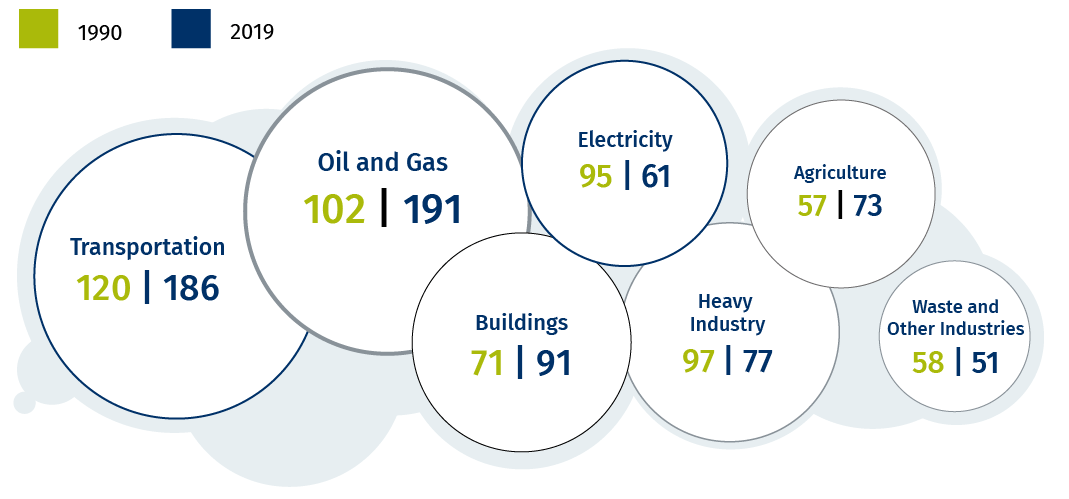
Source: Environment and Climate Change Canada, RBC Economics
To get on a more serious path to Net Zero, the federal government committed to getting Canada back to around 500 million tonnes by the end of this decade—and eliminating or offsetting the rest by 2050, using new technologies like electric vehicles, new heat sources for homes, and new processes to capture and store some of the emissions that we’ll continue to produce to power our planet.
This report aims to map out some of those pathways, as well as the investments and policies needed to achieve Net Zero. We use a range of established modelling on the emissions of major sectors, and the potential of breakthrough technologies, behavioural changes and improvements in industrial and agriculture processes. Our research aims to project out, over 30 years, what the estimated long-term costs and benefits could be, understanding that many uncertainties exist around climate, technology and behavioural trends and such forecasts will continue to evolve.
The amounts needed could be hefty: around $2 trillion in the next three decades. Based on our estimates, governments, businesses and communities would have to spend at least $60 billion a year to cut Canada’s emissions by 75% from current levels, which is about as far as we can get with current technologies. That’s a significant jump from the estimated $15 billion a year we currently spend. While those are large numbers, they’re also affordable, especially when measured against the economic returns of new technologies, products and even entire industries in which Canada can be a global leader. For context, Ontarians alone spend nearly $70 billion a year on healthcare, an essential national priority.
Nature can help, of course. Scientific forecasts for large-scale tree planting and forest management suggest such measures could sequester some 50 million tonnes annually by 20501, which covers one-tenth of what Canada will need to get to Net Zero. (Protecting Canada’s forests, wetlands and grasslands from being converted to other uses could prevent another 30 million tonnes of GHGs from being released annually.)
Then there’s technology. A nation of electric vehicles, solar-powered houses and hydrogen-fueled airplanes will help enormously, and the innovation spurred by more uptake of these technologies can cut their costs and the overall bill. But as the chart below illustrates, the best-case scenarios for these technologies might only get Canada three-quarters of the way to Net Zero. We’ll need many more inventions, and new habits, to help transform industries and lifestyles. The good news: Canadians, whether we’re developing resources, building technologies or serving a diverse world, are strong innovators, especially in the face of challenges like climate change.
One of our biggest challenges: we’ll need to roughly double our electricity supply to power a new fleet of EVs, and to heat and cool our homes, offices and schools. Canada has a head start, with a “green grid” fed by hydro, nuclear, wind and solar power. We also have plenty of lower-emissions natural gas to serve as a transition fuel, be it for heavy industry or big cities, as the economics and reliability of renewables improve. More capacity will be needed on each front, as well as historic investments in transmission lines and a new approach to how provinces manage the sector.
A national green grid can help power some of the country’s biggest emitters in cleaner, and cheaper, ways. Canada will also need to help our oil and gas producers, farmers, manufacturers and others working in carbon-heavy sectors, as they continue to develop their own pathways to Net Zero, and ensure that any transformation does not cause widespread economic hardship or social disruption. (We will have more to share on the costs of a disorderly transition in an upcoming report.)
A long-term commitment to carbon pricing, with steady and predictable increases, will help, by allowing investors, entrepreneurs and operators to allocate capital efficiently and effectively. So, too, will a regular, independent and transparent assessment of the impact of carbon pricing, and whether the 2030 target of $170 per tonne is optimal. Such an approach to pricing carbon, at significantly higher levels than today, could even shape new economic thinking for North America, if Canada and the U.S. work cooperatively on continental supply chains for green products like EVs and trade measures to better price the cost of important energy-intensive products like steel.
This journey will require new approaches to sustainable finance, if we’re to generate the $2 trillion needed to finance the transition. Overall, capital is not in short supply. Investible projects, with reasonable returns, are. What’s needed? An overhaul of industrial regulation and tax policy, and more government backstops, to offset the inherently risky frontier of clean technology, sustainable infrastructure and new consumer products. A lack of consistent and reliable policies continues to impede Canada’s ability to attract the sort of private capital needed to finance the transition.
And we’ll need people—a lot of them—to focus on the skills required to power the transition, install neighbourhood solar grids, maintain new EV fleets, and reform farming practices to ensure Canada’s ample soil is used more actively to absorb carbon from the atmosphere. Estimates suggest Canada will need to retrain 100,000 workers with new green skills, and add up to 200,000 more like them to the labour force as early as 2030.

The cost of inaction
While cutting emissions is costly, there’s a cost to doing nothing, too—one that will continue to climb the longer we postpone action.
Trend growth – or potential growth – reflects the long-run sustainable productive capacity of the economy. Actual growth fluctuates around this trend due to short run ‘cyclical’ factors. Trend growth is estimated based on trend labour supply growth and productivity.
The challenges are serious, but so are the opportunities. Canadians are proven energy innovators, including around nuclear, hydrogen-cell and oil and gas-extraction technologies. We can’t delay action as we wait for new technologies to arrive.
Policy changes will be essential. But first we’ll have to take a hard look at the areas in which Canada has the biggest emissions. In the section that follows, we explore those areas and how they can become pathways to Net Zero.

Achieving Net Zero requires us to adopt technologies that can facilitate the transition from fossil fuels to electricity, in an accelerated but orderly manner. Still, some economic activities aren’t in a position to be electrified at scale, at least in the short term: think air travel and cement making. We’ll continue to burn fossil fuels to make plastics and to generate the electricity to power all those greener technologies.
We identified six pathways to Net Zero, and while they’re not all-encompassing, they are among the most viable opportunities within reach. Four of them, explored later in this section, outline ways to cut emissions from buildings, transportation, industry, and agriculture. Even still, if we all drove electric cars and lived in solar-powered homes, rethought livestock management and captured more carbon from smokestacks, we’d still have emissions. Successfully reducing emissions from the electricity and oil and gas sectors are the two pathways most essential to fulfilling our Net Zero ambitions. We’ll start there.

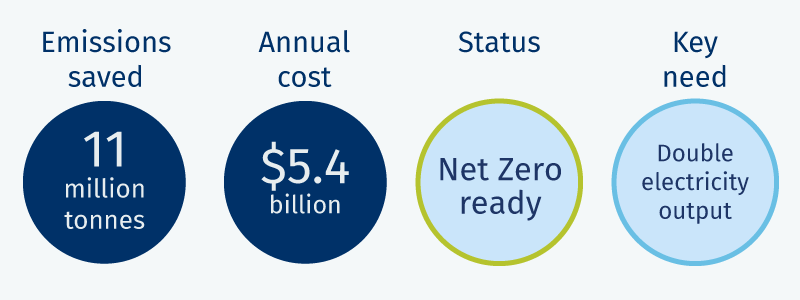
From the wind turbines on the Cape Breton coast to the dams of the James Bay Project and glittering solar panels along Vancouver’s skyline, you can see the footprints of a major electricity producer just about anywhere in Canada. We enjoy arguably the world’s best supply mix, and are fortunate to be able to take reliable electricity for granted. The companies behind those supplies have helped shape Canadian history, and will help define our future.
To power a nation of EVs and electric grills, to heat our schools when it’s -30°C and cool our offices during prolonged heat waves, we’ll need to double the supply of green electricity—essentially, power from hydro, nuclear, wind and solar. That won’t be easy in populated areas, which can still rely on relatively cheap oil and gas, especially to meet demand surges. Wind and solar are the most affordable options but often hard to get to, as large-scale renewables projects need to be built around nature’s dictates—for instance, where the wind is strongest (like in Northern Ontario, Quebec and Newfoundland)2 and where the sun shines longest (like the southern Prairies). That’s why natural gas – a Canadian strength – will be needed for the foreseeable future.
A hydrogen-powered future has long been promised. The lightest of gases, hydrogen burns hot and can be used in place of fossil fuels in trucks, trains and industrial boilers. However, the way we currently make hydrogen is an emissions challenge: using steam to break methane into hydrogen and carbon generates nine kilograms of CO2 for every kilogram of hydrogen produced. Adding carbon capture to that process yields a cleaner product called “blue” hydrogen, which relies on natural gas and could become a greater export opportunity for Canada as new regulations and process improvements take hold. The purest form, “green” hydrogen, is produced by splitting water molecules with carbon-free electricity—but it’s very expensive. Lowering its cost would be a great start, along with infrastructure to deploy green hydrogen at scale, and commercialize fuel cells for trucks and other heavy vehicles.
Canada is starting from an enviable position. As of 2019, 80% of the national grid was carbon-free. Compared with the U.K., our grid produces less than half the GHGs per unit of electricity, and a quarter compared with the U.S.
Efforts to phase out coal over the past decade, expected to be completed by 2030, have helped Canada cut carbon emissions from electricity generation. The continued use of nuclear energy helps, as have new additions of wind and solar power. Since 2010, almost all of the new capacity installed has come from renewables. That’s sped up because the cost of many zero-carbon electricity sources has declined: for new electricity plants, wind and solar generation are often 30% cheaper than natural gas. It’s a good example of something economists call “endogenous technology” – our choices today affect how technology development progresses.
In the near term, Canada’s best bet is to invest in more large-scale renewable energy. But as in every sector, any plan will involve making social and political choices. We’ll have to determine how much we’re willing to pay—collectively and individually—to accelerate the move away from fossil fuels.
Lower costs make wind and solar competitive, but not batteries
Levelized cost of electricity or storage, $US/MWh
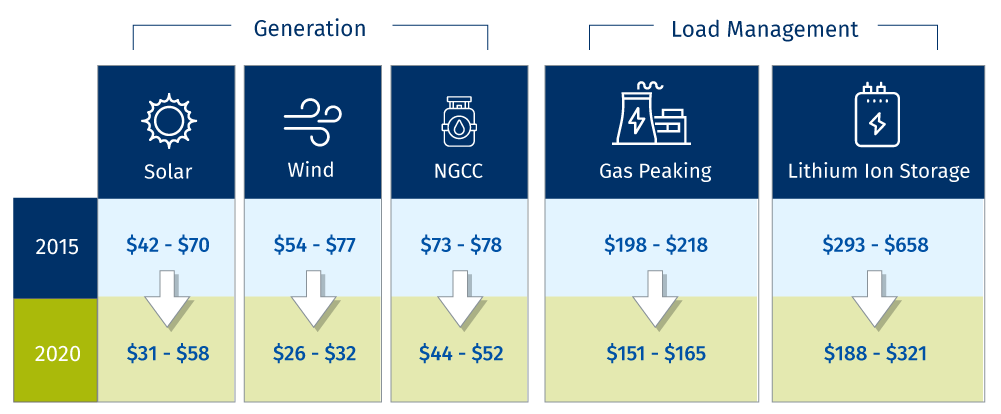
Source: Lazard, RBC Economics
Handling the peaks
Another key challenge for renewables is that, unlike gas or coal power, they can’t be fired up at any time to meet demand, and they don’t produce electricity consistently when they’re on. Studies have shown that3 solar generation can fall by as much as a third in the winter and autumn, and wind farms produce more in the spring and winter. And that’s not taking into consideration climate variances between regions.
This so-called “intermittency” leads experts to suggest we’ll likely need some gas-fired power to manage periods when electricity is in highest demand, for example at dinnertime. The key question is whether it is cheaper to store electricity from renewables, cut peak demand with energy efficiency, or build new, simpler gas plants with carbon capture technology since many existing gas plants can’t respond to demand that quickly. More national modelling is urgently needed to work through these choices and help energy producers get on with the challenge.
Another way to improve the system is to better connect provincial grids. Right now, our grid is a hodgepodge of independent systems scattered throughout the country. Smoother connections could reduce the need for expensive storage by moving power from where it’s generated to where it’s needed.
Any transition from natural gas peaking plants will involve finding better ways to store energy for those rainy days. High-capacity batteries are expensive to use, but recent analysis from Lazard suggests costs at some projects are getting closer to natural gas peaking plants as technology improves.4 Pumping some of Canada’s abundant water into a reservoir during off-peak hours could make sense, too, but it’s mostly effective in mountainous areas.5 Future energy technologies, like small nuclear reactors and green hydrogen, could provide new solutions, but they’re a ways off from being commercialized. Storing electricity for the future will be the world’s critical energy challenge.
What will it cost?
As we look to increase electricity production, the source of all this new energy will be critical. Even in the existing grid, the costs of decarbonizing could run about $5.4 billion annually. Our ability to do that would be limited initially by the cost of building and deploying enough high-capacity batteries to store all the renewable energy we’ll need, though storage prices should drop as technology improves.6
Another question: will continued population growth require an even greater amount of electricity? Canada’s population is projected to rise about 30% to 50 million people in 2050. And many of the technologies we’ll use to cut emissions will require more electricity. Most estimates point to the system’s load increasing at least 100% by 2050.

 General Fusion is developing the world’s first commercially viable fusion power plant, which will provide clean energy on demand, supplementing the intermittency of renewables. (In fusion energy, two light nuclei are combined to release large amounts of energy, producing four times more energy than nuclear fission.) The Burnaby, B.C. company’s 70%-scale demonstration plant in the U.K. will be complete in 2025. General Fusion has attracted some notable backers, including the U.K. government and Jeff Bezos. That could help the company as it competes against well-funded U.S. startups that are also racing to deploy fusion technology at scale.
Opus One Solutions’ platform allows utility companies to better manage and plan energy distribution as operating grids get more complex due to an increase in renewables. Singapore’s state-owned utility, SP Group, has contracted the Richmond Hill, Ont. firm to help optimize distribution and integrate more renewable energy into its grid. Opus One is also helping utilities in the U.K. and Australia develop more efficient and more flexible energy markets. While it offers a made-in-Canada solution, it will compete against giants like ABB, IBM, and Siemens in a competitive smart grid environment.

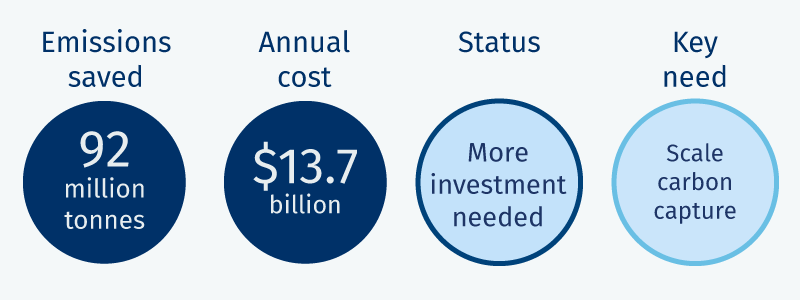
Nothing symbolizes Canada’s strengths, and challenges, as an energy power more than Alberta’s oil sands. At 165 billion barrels, Alberta’s proven reserves rank fourth in the world. The industry’s growth was made possible by homegrown innovation that allowed companies to vastly increase underground extraction of heavy crude. The province’s energy sector has been a major driver of economic growth, generating jobs, investment and almost a fifth of total exports, to the benefit of all Canadians.
Along with national pride, the oil sands continue to spark national and international debate. They’re Canada’s biggest single source of GHG emissions, at nearly 10% of the national total, and one-third of the 191 million tonnes of GHGs generated by the oil and gas sector in 2019. In 2021, to bring their net emissions to zero, the largest producers formed an alliance to invest billions in carbon-capture and sequestration, which will be critical to Canada’s overall success. But now governments need to match that commitment with additional investment and regulatory clearances to achieve Canada’s goals.
It’s the most important variable in our carbon equation, and won’t be easy to balance. Emissions from the energy sector have grown rapidly since in situ production took off in the early 2000s. About 80% of oil sands emissions now come from burning fossil fuels to make the steam used to bring bitumen to the surface and to use hydrogen to upgrade that bitumen into synthetic crude. More innovation will be needed to reduce those emissions, while also helping meet the world’s energy needs. Fortunately, the Canadian industry is a world leader in the science of heavy oil, and invested heavily in it before prices collapsed in 2015, and were hammered again in the early months of the pandemic.
The oil sands aren’t the only source of emissions in the sector, and because of Canada’s geography, a lot of energy is needed to get other forms of energy out of the ground and through pipelines to market. In conventional oil and gas production, two-thirds of emissions come from methane venting or leaks, as well as from naturally occurring CO2 in oil wells. Although methane – the main component of natural gas — causes about 80 times the warming of CO2 in the near-term, recent changes to federal and provincial regulations, along with more technology funding, have improved the outlook for Canadian gas as a global feedstock for blue hydrogen.
Such a step-by-step approach to emissions may be prudent, as we’ll need fossil fuels for years to come through the Net Zero transition. Demand for Canada’s oil, gas and plastics isn’t likely to wane significantly for a while, and could even rise for a time if U.S. demand stays strong. It will take years to phase out the internal combustion engine, transform natural gas-burning furnaces and develop alternatives for jet fuel. We also need petroleum to make petrochemicals and plastics for the foreseeable future. Curtailing oil production in Canada would put at risk our existing engineering advantages, especially if demand remains strong for some time, and could undermine our ability to study and develop other energy innovations, including green hydrogen, small nuclear reactors and electricity storage.
Another promising technology, direct air capture, envisages removing carbon straight out of ambient air. If it scales, that could also cut emissions from burning oil and gas. But for now, it’s not proven enough to rely on, and we must still move toward cleaner oil production, including capturing emissions as they’re produced.
Canada can benefit economically from maintaining production of crude and gas—but only if we act quickly to reduce the carbon intensity of Canadian production, and address carbon-intensive processes. Technological advances have already made energy production somewhat cleaner. Emissions per barrel in the oil sands have fallen 36% since 2000. Making Canada’s energy sector more efficient is critical to making our products more attractive as the rest of the world transitions.
In all parts of the energy system, reducing methane emissions should be a top priority, because the leaks cause significant warming and are among the cheapest reductions to make per tonne.
We must also ramp up use of carbon capture systems. Priority targets include stationary equipment at oil sands facilities and the methane reformers that produce hydrogen for upgrading bitumen. While carbon capture isn’t a perfect solution, it’s a known technology that can meaningfully stop GHGs from escaping into the atmosphere.
Carbon capture systems trap CO2 before it enters the atmosphere. There are various methods for doing this, but all basically end up compressing the trapped gas into a liquid and shipping it, usually by pipeline, to a storage facility. But the process has limitations. Carbon capture systems can be so costly that they make certain applications uneconomical. Another challenge is finding appropriate places to bury or trap the carbon so it doesn’t leak back into the air. A third issue is getting liquefied gases from a carbon capture facility to a place where they will be stored; that requires specialized, and sometimes very long, pipelines that further add to the cost and complexity of the whole effort.
Carbon capture can also help decrease emissions in off-grid parts of natural gas production. Where possible, we can electrify parts of the process that currently run on fossil fuels. Roughly the same goes for conventional oil production and oil refining.
A stumbling block to getting these projects off the ground is uncertainty: of the future carbon price, of regulatory approvals, and of community support. Another is finding long-term partners for projects. We’ll need to resolve these challenges to deploy CCUS at scale.
One avenue is to seek greater involvement from Indigenous communities. They have long fought for protecting the environment, a key goal of CCUS projects, and they have long-term interest in the land through which many CO2 pipelines would run, and which have the greatest capacity for CO2 storage. This makes them natural partners in these projects.
By 2030, the federal government expects oil and gas emissions to drop 53 megatonnes. The view after 2030 is far murkier because it’s difficult to predict how quickly current technologies will be adopted or new ones commercialized. Given what we know now, if $14 billion were invested by industry and government in green initiatives annually, 92 additional megatonnes could be eliminated in the oil and gas sector.
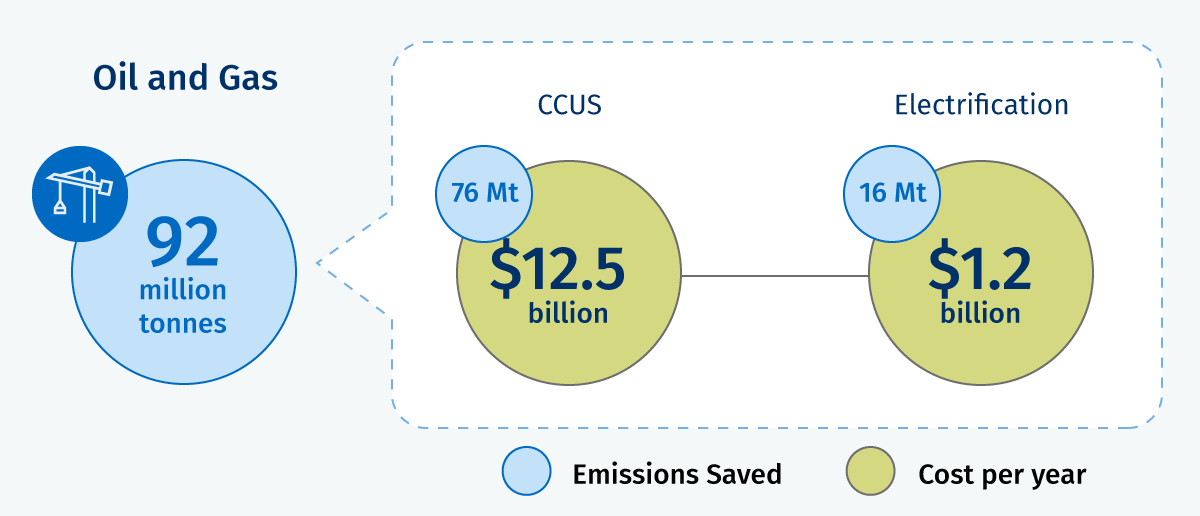
Carbon Engineering of Squamish, B.C. is a leader in direct air capture technology, which takes carbon dioxide directly from the atmosphere to then be sequestered or reused. Its facilities—one in Texas and another in Scotland—are slated to come online in 2024 and 2025, respectively. They’re each expected to remove 1 million metric tons of CO2 a year, or the equivalent of 40 million trees, all while being powered by renewable energy. (As of now, the world’s largest direct air capture facility is operated by Climeworks in Iceland and removes 4,000 metric tons of CO2 a year.) Direct air capture is a small, but important piece of the climate change equation, and it will need further development of carbon storage technologies to scale.Carbonova’s unique chemical process uses carbon dioxide and methane to make carbon nanofibre—a cutting edge material with potential in numerous applications because it’s both stronger and lighter than steel. Carbon nanofibre’s proponents say it could be used to increase the storage capacity of lithium-ion batteries, while making paints and coatings more resistant and improving vehicle tires, among other uses. The Calgary-based company has received backing from prominent investors in Alberta’s oil patch and is building a semi-commercial reactor as the first step in scaling up production.


Buildings are Canada’s third-largest source of greenhouse gases. Space heating is by far the sector’s worst carbon culprit, accounting for about 75% of emissions in residential properties and 85% in commercial. Most of the remaining emissions come from water heating. Appliances and lighting contribute only a small share. And air conditioning is a relatively small line item because most AC units and systems are run in provinces with relatively clean electrical grids.
Heating buildings is Canada’s cold climate challenge
Greenhouse gas emissions (2020), Mt of CO2e
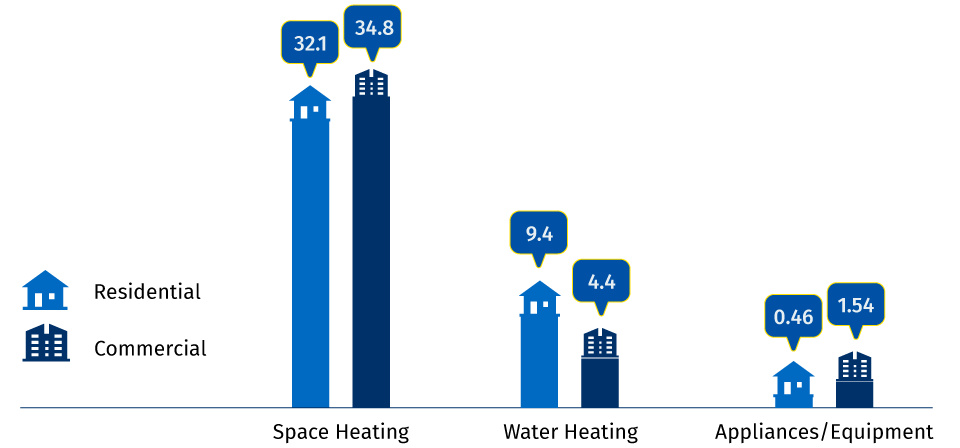
Source: National Resources Canada, Environment and Climate Change Canada, RBC Economics
An overarching problem is that much of the energy we use to regulate home and office temperatures is lost because of poor insulation, cracks and crevices in walls and out-of-date windows and doors. But voluntary programs aimed at making retrofits easier have so far failed to move the needle. For instance, a Toronto municipal program offering low-interest loans for home-energy improvements received less than 200 applications in five years.7
Efforts to encourage retrofits have fallen flat because of high upfront costs, a dearth of skilled tradespeople, and long pay-back periods for big upgrades. Even where retrofit programs make financial sense, there may be resistance because the work is disruptive and time-consuming. Landlords, too, don’t often see the energy cost savings from retrofits, which accrue to tenants.
Here’s the good news: total decarbonization is possible with current technologies. Indeed, efforts to reduce Canadian buildings’ carbon footprint are accelerating. Emissions per square metre have fallen with the introduction of more efficient appliances, retrofits and better building codes. Residential buildings have made more progress than commercial since 2000, at about 25% compared with 7%.
Phasing out fossil fuel-burning systems in favour of electric power will be key. Many parts of Canada already use electrical heat and hot water systems, but they can be expensive—especially so for building owners who switch over without first retrofitting their buildings.
One promising solution is the heat pump, a relatively new technology that moves heat from the outside air, water or ground and transfers it for use inside. It can also run in reverse. Heat pumps convert to heat much more efficiently than furnaces or boilers. As the technology behind them improves, overall utility costs should decrease in buildings with a solid retrofit plan.
Adoption of heat pumps has been slowed by high costs and also because many homeowners simply don’t know they’re an option. Another problem, at least for now, is that existing heat pumps are less efficient when temperatures dip below -15°C, so dwellings in the coldest parts of the country will need backup heat sources in the coldest periods.
Climate change has focused attention on communal alternatives to traditional on-site heating and cooling systems. Often called district energy systems, they distribute heat or cold air to multiple locations from a single source. In downtown Toronto, more than 180 buildings are connected to a shared cooling network that harnesses the cold temperatures of the water deep in Lake Ontario. District energy systems provide economies of scale, free up space in connected buildings and reduce emissions. Put another way, they spread the high cost of low-carbon systems over many users, making them feasible for more buildings. These systems are harder to incorporate into existing communities, but could suit places undergoing rapid population growth.
Costs to meet the 2050 goal
The costs of installing the most efficient insulation and electrical capacity are lower during construction than when retrofitting existing homes. For instance, the costs for heat pumps, in the absence of other retrofits, are nearly double for old houses than new builds.8
The upfront costs for a national Net Zero buildings plan would add 8% to the average construction bill, according to a joint study by the Canada Green Building Council and WSP9—but the upgrades would roughly pay for themselves in energy savings over the buildings’ lifetime. Finding ways to make the returns accrue more quickly, or spread costs over the life of the equipment (for example, with lower electricity rates for those who slash emissions) could accelerate adoption.
The added annual costs to bring both residential and commercial buildings to Net Zero could be about $5.4 billion a year.

BrainBox AI uses deep learning and algorithms to optimize HVAC systems, cutting energy waste in commercial buildings. Unlike current HVAC systems, which are reactive, its technology uses data to predict future temperature states and respond accordingly. The Montreal-based company was on Time’s list of the “Best Inventions of 2020,” and its technology—whose heart is a one-square-foot box—is already installed in more than 100 million square feet of real estate. BrainBox’s software is unique, but it does have some formidable rivals in the building sensor and automation space, including giants like Amazon and Google.Enwave’s Deep Lake Water Cooling system is the largest geothermal cooling system in the world, using the cold waters of Lake Ontario to cool offices, hospitals and other buildings in Toronto’s downtown core. It’s got winter covered too, recovering wasted heat from buildings to provide low-carbon warmth. Enwave’s system reduces electricity consumption by 90% when compared to traditional sources. After water is used for cooling it is forwarded to treatment facilities for subsequent use in taps and showers. Enwave is expected to benefit from the growing popularity of district energy systems. But they aren’t always an option: cooling systems like Enwave’s require large and deep quantities of water, and they are capital- and labour-intensive to build.


Nothing reminds Canadians of the Net Zero challenge more than the cars, trucks and planes we rely on to navigate our vast country. And our own preferences may be as powerful as any technology. Over the past 10 years, SUVs accounted for 40% of new vehicle registrations, and pickup trucks drove another 20%.
Transportation is Canada’s biggest emitter after the oil and gas sector, adding 186 million tons of GHGs to the atmosphere in 2019. Passenger transport accounts for just over half of those emissions, but we estimate the percentage from moving freight has been growing three times as quickly since 2005.
Even with Canadians driving more and buying bigger vehicles, transportation emissions have been slowly declining. That’s in part to increasing fuel-efficiency standards and the introduction of electric and hybrid vehicles. EV sales are a small but growing share of the market, spurred mostly by government subsidies and enthusiasm from early adopters.
We need to work on making passenger EVs more mainstream. Hybrids and EVs made up only 3.5% of new light vehicle registrations last year, compared with 75% of new sales in Norway, where EVs are exempt from registration fees as well as much higher value-added and import taxes. In Canada, mid-range EVs cost $8,000-10,000 more than regular cars, over the span of seven years, entirely because of higher sticker prices. Policy changes, including federal proposals to ban sales of new gas-powered passenger vehicles by 2035, will spur domestic uptake and, presumably, cut those prices. Meanwhile, Canada is also set to benefit from significant investment by automakers into more varied EVs over the next decade.
Battery technology continues to progress, and prices have fallen 80% since 201310. That’s yet more evidence that deploying technology leads to economies of scale and innovation. If we can continue this trend, EVs may only be a few years from cost parity with gas cars which would cut the added costs of transition.
Battery-powered electric motors are the most practical low-carbon alternative to internal-combustion engines, but work best in light-duty vehicles that need to move short distances without frequent recharging. They’re too heavy and inefficient for bigger vehicles, and currently out of reach for jets. As for ships, batteries are slightly more practical for smaller vessels like local ferries, but still not able to carry large loads over long distances.
Canada’s climate poses unique challenges, too. Battery performance is weaker in the cold, so during prolonged winters EVs need to charge more frequently. That’s of little concern for daily commutes, but poses a greater challenge for extended road-trips and long freight journeys. Ultimately, infrastructure and some behaviour change will be needed, along with new battery chemistry.
Alternative fuels as a stop-gap measure
For now, heavy-duty trucks, ships and planes will need to depend on biofuels to reduce emissions. These fuels, which are generally made from plant and animal materials called biomass, have an emissions profile that can be about 80% lower than traditional fossil fuels. Most biofuels can’t entirely replace fossil fuel in existing engines: they have to be blended with varying amounts of traditional fuel to avoid engine problems. One example is sustainable aviation fuel (SAF), which is generally blended 50-50 with regular jet fuel.
More advanced biofuels with the same chemical makeup as regular diesel also exist, and can be used as full replacements. The scale of use is very limited so far and production can be restricted since these fuels are sometimes made from waste-food oils and crop residues that aren’t always readily available. Growing more plants to produce biofuels also has implications: we may end up with less land to grow food. And depending where the new cultivation occurs, we might destroy stable carbon sinks like forests.
Hydrogen fuel cells, which power electric motors with the energy carried in liquid hydrogen, could be useful for heavy transport further down the road. Many are hopeful the technology could one day transform the transportation sector. For the moment, though, there’s little infrastructure to support the technology, nor are trucks being built at scale with these engines.
What are the costs?
Where electrification is viable, Canada can achieve deep emission cuts if it provides subsidies and invests in infrastructure to encourage EV use. That could be expensive. Based on current EV models and the average time Canadians own new cars, the government would conceivably have to provide EV subsidies of at least $300 for each tonne of GHGs saved to make EVs as affordable as gas-powered cars. That adds up to an annual cost of about $20 billion. Advancing battery technology—about one-third the cost of an EV—will go a long way in cutting that cost. Better infrastructure might make people more comfortable with carrying around smaller, cheaper batteries.
Where electrification of transportation is not viable right now, biofuels could fill the gap. But many applications are expensive: SAF costs about five times more than jet fuel, and could amount to $500 a tonne. Even if we could produce enough SAF to use in every flight, it could raise airline costs by as much as 50%.
The government expects current efforts to bring transportation emissions down by about 35 megatonnes. If an extra $25 billion were to be invested by Canadians on current technologies each year, a further 93 megatonnes of the projected 2030 emissions in the transportation sector could be eliminated on the path to Net Zero. But we’ll need more research and development to find better solutions for the rest of our emissions challenges.

Heavy-duty trucks rely on biofuels to reduce emissions, since batteries are too heavy. Ottawa-based GBatteries‘ ultra-fast charging technology could allow trucks to carry fewer batteries by recharging as quickly as it takes to refuel a tank of gas. What’s more, the company says its technology avoids a problem common to fast charging: battery degradation. Rival startups from Israel to Australia are looking to bring fast-charging solutions to market. While competitors are focused on new materials and construction of lithium-ion batteries, Gbatteries relies on a patented algorithm for fast charging. Listen to our conversation with GBatteries’ CEO Kostyantyn Khomutov on Disruptors.Li-Cycle of Mississauga, Ont. has grown to be the largest lithium-ion battery recycler in North America in just five years. The company says its proprietary recycling process recovers 95% of the metals critical to battery manufacturing—much more than rival technologies do—saving those metals from ending up in a landfill. The materials can then be reused in new batteries. Li-Cycle’s process also produces no wastewater and emits less carbon than traditional recycling methods. One of its biggest challenges is preparing for wider EV adoption.


Oil and gas producers are not Canada’s only heavy emitters. The workhorses of the economy (mining and cement production, to name just two) require tremendous amounts of heat and energy, and emit a lot of carbon as a result. Their production is essential to everyday life, and to Canada’s economic well-being, accounting for 16% of exports in the last five years. Some parts of this sector have made tremendous progress since the 1990s, due to cleaner manufacturing processes. But with global demand for low-carbon materials growing, getting those producers to cut emissions even more will be crucial.
In recent years, Canada’s strategy to cut the emissions of heavy industry has focused on various levies like the carbon tax, with a preference for gradual increases rather than abrupt measures.11 Progress has been slow. One reason: most companies still use relatively inexpensive fossil fuels. For instance, it takes about 900 tons of steel to make a 5 MW wind turbine,12 and producing that much steel creates about 2,400 tonnes of CO2 emissions.13 The technology to easily substitute electricity or another fuel in that process would be far more expensive or perhaps not even commercially viable.
What’s more, many industries generate emissions as an inherent part of production. Making fertilizer ammonia, for example, is energy-intensive, and further generates greenhouse gases when the constituent ingredient hydrogen is extracted from natural gas. Or in the case of cement, breaking down limestone requires a chemical reaction that emits CO2. These inherent “process” emissions are the reason why carbon capture is likely to be needed in certain circumstances.

Making steel green
Traditional steelmaking involves melting high-grade coal with iron ore at very high temperatures in furnaces fired with fossil fuels—generating a lot of emissions.
A key challenge: how to make all the new steel we need for solar panels and other green technology with as few emissions as possible. The race is on to solve that problem in places like Sweden, where the first shipment of “green” steel was received this summer. That pilot project, like others in various stages of development, uses a process that replaces the coal in the first step of steelmaking with hydrogen. The transformational power of green steelmaking will depend largely on how cost- and emissions-effective hydrogen and electricity become in the decades ahead.
The federal government expects that a slowly rising price on industrial emissions and subsidies for cleaner processes over the next decade will only coax companies to eliminate 16 of the 77 megatonnes of greenhouse gases generated in 2019. With more policy changes and more investment, faster progress may be achieved to encourage the adoption of existing technology. Industrial heat pumps, for instance, and even regular electrical heat can replace fossil fuels in some low- and medium- temperature applications, such as parts of paper production. Carbon capture works well for concentrated exhaust streams, like those from fertilizer plants and, while costly, can be applied to more expensive cases like cement plants.
If an extra $4.4 billion were invested annually by industry and government on current technologies, a further 35 megatonnes of projected 2030 emissions in heavy industry could be eliminated on the path to Net Zero.
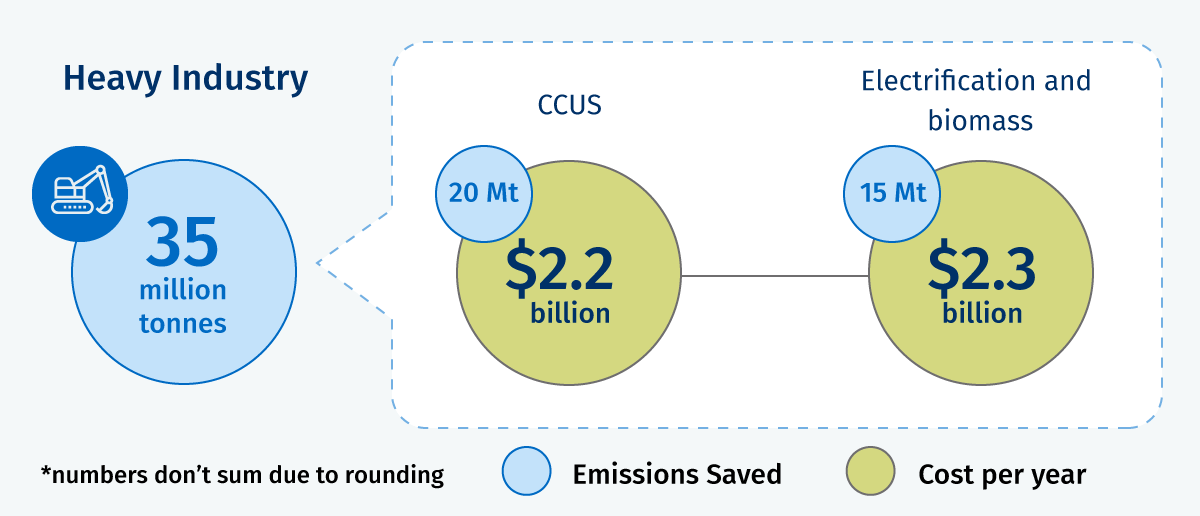
Dartmouth, N.S-based CarbonCure injects captured CO2 into concrete to make it greener. Its technology could help the heavy-emitting buildings sector get to Net Zero faster, and the amount of concrete being produced with its technology is doubling every year. That helps explain why CarbonCure attracted funding from Bill Gates’ Breakthrough Energy Ventures, Amazon and other big investors. Governments and municipalities are major buyers of concrete, so the company’s growth would benefit from procurement policies that encourage low-carbon concrete. Listen to our conversation with CarbonCure’s Rob Niven and Jennifer Wagner on Disruptors.MineSense Technologies of Vancouver helps mining companies balance the need for sustainability with finding high-grade ore. Its ShovelSense technology, which can be retrofitted onto existing mining equipment, uses sensors and a proprietary algorithm to assess ore as it’s being mined, improving ore recovery and reducing waste. MineSense’s technology is being used in mines in Canada, Chile and Peru. COVID restricted its access to the mine sites of customers, forcing it to pivot to remote technology installations.

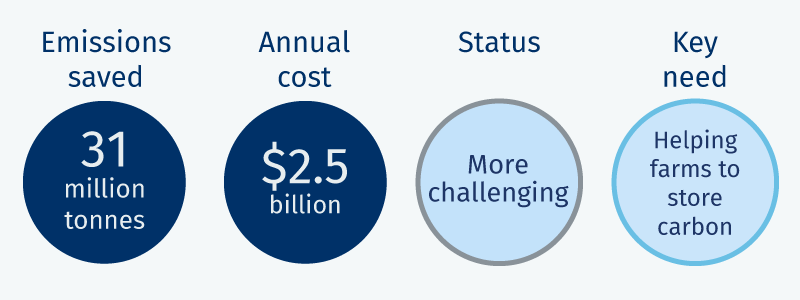
Canada is an agricultural giant, exporting wheat, barley, pulses and other food products to the world. The sector accounted for 2% of Canada’s total GDP and about 5% of its exports over the last decade and employs over 300,000 Canadians. It also generates about 10% of Canadian GHGs, or the equivalent of 73 megatonnes. Reducing them won’t be easy. Cows, pigs and other ruminant animals generate methane through their digestion, so the gases they emit are hard to trap. Widely used nitrogen fertilizers are necessary to improve yields but are a major source of nitrous oxide emissions. Like methane, nitrous oxide has a stronger warming impact than CO2.
While the amount of energy used to produce food per dollar of production has fallen, rising production has dwarfed efficiency gains. The amount of energy used in agriculture grew 30% between 2008 and 2018, largely in the form of diesel for more heavy machinery.14
The good news is that Canada compares well on agricultural emissions globally. In the livestock sector, for instance, the country ranks among the least carbon intensive, according to the Organization for Economic Co-operation and Development.
One reason for uneven progress on the farm: emissions from animals and land (including those after fertilizer application) aren’t subject to carbon pricing, and farmers are exempt from federal fuel charges on the diesel used to power equipment. The exemptions exist largely because carbon-mitigation efforts would be expected to raise food prices and put Canadian exporters at a disadvantage to global trading partners who don’t regulate farming as much.
Changing the way we grow things—such as applying less fertilizer—would help. Farmers could be encouraged to plant more cover crops, which are sown after cash crops have been harvested to help reduce soil compaction and prevent erosion. Cover crops can also sequester more carbon in the soil and prevent leftover nitrogen from wafting into the atmosphere.
Rethinking livestock production and manure management could yield the biggest reductions. Indoor facilities can be modified to capture some methane and turn it into biogas. The same could be done for manure storage, another source of methane from livestock. This is already happening, on a small scale. Also, more selective breeding and changing animals’ diets could somewhat mitigate the amount of methane ruminant animals generate in the first place.
Switching out of fossil fuels will help, too. As is the case in other buildings, fuel sources to heat or cool farm facilities can be switched over to electric heat pumps. Farm equipment, as yet, generally hasn’t been electrified, but advancements in battery technology could make that happen sooner. Electric tractors are starting to come to market, but not combines. In some cases, like grain dryers, electricity is more difficult and expensive with current technology, but still feasible.
It’s important to remember that, trees, plants and soils can store CO2. The the proliferation of food-growing in rural (or urban) settings also has the potential to sequester carbon, if managed right.
Doing a better job of managing our natural world might impact climate change just as dramatically as cleaning up heavily carbonized industries. A recent study by Nature United, funded in part by RBC Tech for Nature, found that protecting our land could prevent 30 million tonnes of GHGs from being released annually. Taking better care of Canada’s agricultural lands, forests, wetlands and grasslands could sequester 48 million tons of GHGs annually by 2030, or about 6% of current overall emissions. A large part of the approach involves changing the way we do things on the farm. Regenerative agriculture is a set of farming practices—like planting cover crops to manage soil quality—that leverage nature to address climate change. It aims to increase carbon sequestration in soils and includes benefits like making farms more drought resilient. Other practices, like planting trees between crops and on pastures, are promising too: Nature United estimates these efforts could sequester as many as 7 megatonnes by 2030, even if limited to areas where large machinery isn’t used.
While some of these GHG reductions can be achieved at relatively low costs, most will be expensive and require new processes and capital investment. Comprehensive modelling of cover crops, for example, shows that about half this abatement will cost more than $50 a tonne, exceeding the current carbon price. We estimate cutting emissions in the sector to 43 megatonnes, from 73 megatonnes in 2019, could cost as much as $2.5 billion annually.
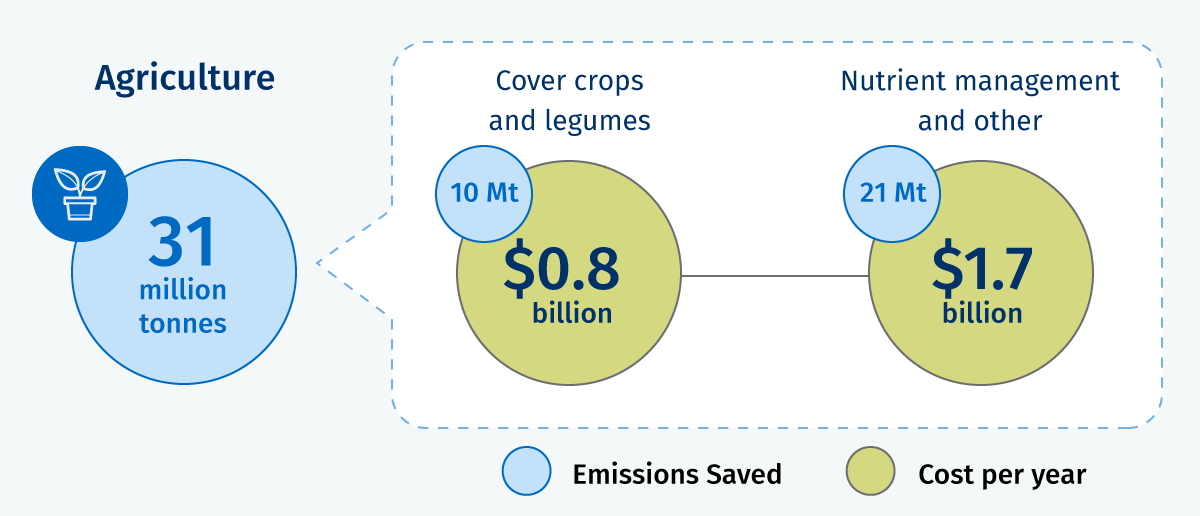
SemiosBio Technologies is a Vancouver-based precision farming platform. Its proprietary wireless network uses machine learning and artificial intelligence to provide farmers with a data-driven crop management solution. Its IoT network is the largest in agriculture, with more than 120 million acres under management and customers in countries from the U.S. and Australia to South Africa. The company has hundreds of rivals, but most are smaller and focused on one aspect of farming. Another Vancouver firm, Terramera, is developing digital agronomy tools to support and scale the transition to regenerative agriculture practices. It’s also pursuing a remote sensing technology that can measure the carbon content of soil reliably and inexpensively—a move that could help lay the foundation for an agricultural carbon credit market. The company developed a proprietary chemistry technology, Actigate, to enhance the performance of organic inputs in farming and reduce the use of synthetic chemicals.

We’ve urged households to switch from gas cars and furnaces to EVs and heat pumps. But many can’t afford to take such steps. They can take inspiration from knowing that behavioural changes can make a big impact. For example, cutting waste from fruits, vegetables, and leftovers to levels closer to that of meat and dairy could reduce Canada’s emissions by up to 4 million tonnes.15 By changing how we move, how much we heat and cool spaces, and by using cement and other carbon-intensive materials more sparingly, we could cut emissions by as much as 1.7 billion tonnes globally by 2030, according to the International Energy Agency.16 The total represents more than 10% of the cuts we’d need in that timeframe.
The challenge is getting people to change. A low-carbon lifestyle can be more expensive, harder, and less convenient than the status quo. While getting nearly 40 million Canadians to accept less convenience in their daily lives is daunting, design and innovation could make things easier. To today’s youth, getting kicked off Youtube if their parents need to make a phone call is laughable. And the thought of working from home several times a week would have seemed daunting to professionals just two years ago. In 10 years, home cooks may covet induction stoves the way they currently admire gas ranges.
Every sector has a role in helping consumers make more informed and cleaner decisions. Here’s how we think we can get started:
- Businesses should inform consumers about how their choices impact emissions. Outlining the emissions impact of different package-shipping options, or the environmental cost of packaging, could affect consumer choices.
- Mandatory labelling for emissions-intensive decisions. We could require home-sellers to disclose energy efficiency ratings and annual emissions from homes, enabling buyers to compare houses on emissions and costs.
- Cheaper funding for greener options. The financial sector has long innovated in ways that have helped drive change. Securitization of retrofit loans or mortgages for green homes and offices could tap ESG markets and bring down costs, as they once did for mortgages more broadly.
- Making greener transit more enjoyable. Dark subways, crowded trains, and unprotected bike lanes do little to encourage city-dwellers to eschew cars. Adding amenities to stations and vehicles (Wi-Fi and shopping, for instance) could boost ridership. So could building safer infrastructure: bike lanes in Toronto, especially ones that increase safe access to workplaces, have encouraged many more cyclists.17 Mandating secure bicycle parking and e-bike charging at businesses and new condos could go a long way too.
- Re-jigging electricity pricing. Nudging consumers to use less electricity when it’s most expensive to produce is the logic behind time-of-use pricing in some provinces. Expanding that nationally is a good first step. Paying industry to slash demand during peaks could be even more effective.

For decades, we took a piecemeal approach to environmental regulation and to protecting the climate. The result: emissions rose anyway. Getting to Net Zero will require a bolder plan, teeing up changes for the coming decades.
In the preceding pages, we’ve outlined the pathways that such a plan could follow. It will require everyone—homeowners, business operators, scientists, skilled tradespeople, educators, city planners—to lean in. But in conclusion, we’d like to focus on the role that policymaking can play, with eight ideas to ignite change:

A national policy on electrification
Federal incentives will be needed to develop better links between provincial grids, harmonized regulations and coherent pricing. The goal: double production over the next 30 years. Producing more power cleanly will require some tough choices, even with a rising carbon price. We may need a lot more hydro-electric power, and transmission lines to get it to major centres. Nuclear options need to stay on the table. And we’ll require carbon capture for gas-fired plants, even as renewable options and batteries build commercial scale. What will be essential: greater interprovincial cooperation.

A national strategy for green skills
Clean innovation won’t succeed if there aren’t enough engineers to deploy carbon capture systems, or contractors to install heat pumps. The goal: train up to 200,000 new workers in green skills, and reskill 100,000 existing workers, by 2030. A federal Green Skills Grant could retrain existing employees, while provincial programs could support career shifts. Teachers will need course content on climate tech, as well as the new “green” skills for tomorrow’s workforce. And farmers will need to enhance their ability to monitor how well their soils are storing carbon from the atmosphere.

Long-term commitment to carbon pricing
Canada’s plan to increase the national carbon price, through 2030, should be reaffirmed by the federal government, provinces and major business groups, to signal to the world that it is a shared priority. Ottawa should also allocate a significant (and clearly defined) portion of the revenue to technology development and adoption, and study the economic impact and sufficiency of the price as it increases to $170 per tonne. Business and environmental groups need to help governments move forward in ways that benefit every region.

Leveraging climate to enhance U.S. trade
Canada should engage the U.S. in bilateral talks around climate policy, with a focus on strategic supply chains, energy products and emissions-reduction technologies. The two governments should explore a border carbon adjustment to be applied to heavily traded goods, to ensure North American products aren’t put at a disadvantage by explicit or implicit carbon prices. Of particular importance: a secure place for Canada in the rapidly growing EV supply chain, with special focus on battery technology and critical minerals. Research collaboration with the U.S. can also help.

An industrial strategy for carbon capture, utilization and storage
The federal government and major industrial-emitting provinces should agree to a new framework for CCUS – essentially, technologies to capture and store emissions in the ground or in new products – that includes research grants, long-term tax credits for carbon stored, and new approaches to public-private investment. Critical issues: clear rights to geologic storage, permits for CO2 pipelines and flexible, time-bound regulations. Importantly, Indigenous communities must play a leading role in this next chapter of Canadian energy.

A national action plan on sustainable agriculture
Agricultural emissions are inherent to our food system, since we’ll need nitrogen fertilizer as long as we grow crops, and will produce methane as long as we raise cows and pigs. There are ways to cut emissions from current levels without lowering food production, but pricing farm emissions can lead to unacceptably high food costs. A better option: allowing nature-based sequestration on farms — from cover crops and trees, for instance — to produce tradable carbon credits. To get there, farmers need access to more soil monitoring equipment, data systems and training.

Super-charging electric vehicles
EVs will be clear winners in the transition, but unless costs fall rapidly, their adoption may not move fast enough to move the larger dial. The pluses of EV ownership are currently offset by range anxiety, a lack of charging stations, and the perils of cold weather. EV infrastructure will help, as will vehicle mandates, including Ottawa’s proposal to allow the sale of only zero-emission vehicles by 2035. On the production side, Canada can do more to support North American battery supply chains, for instance by investing in refining capacity and domestic battery manufacturing.

Rapid retrofitting
Canada’s plan to retrofit more homes must be urgently accelerated. A good start: programs to help owners manage the disruptive process of rewiring or redesigning one’s home. Net Zero building codes can remove the need to retrofit recent builds. Other policies, including financing, can help homeowners tackle large projects collectively. A national retrofit strategy could also promote group retrofitting services, and support communities that want to rethink heating altogether, with centralized geothermal models, for instance. The need: retrofit 4.5 million homes by 2030.
Conclusion
This report lays out the case for accelerated climate action, with clear goals and significant opportunities. Despite the challenges, and perhaps late start, Net Zero is within reach.
To get there we will need to stretch our approach to capital mobilization and to regulatory flexibility. We will need to imagine new ways to assess opportunities and invest in them by harnessing public and private capital, coordinating federal and provincial authorities, and ensuring Indigenous communities help to lead the way.
Canadians want a faster, and more effective, response to the climate challenge and Canadian innovators have shown they can get it done. Canadian businesses, in a range of key sectors, are driving their own transitions. The payoff – environmental, economic and social – is there if we start to move collectively.
If we get it right, we can usher in a new era of ingenuity that will protect and enhance the environment, strengthen existing industries, create new ones, and extend prosperity’s reach to millions more Canadians.
For more, go to rbc.com/climate.

Download the Report
1. https://www.rbc.com/en/wp-content/uploads/sites/4/2024/11/lazards-levelized-cost-of-storage-version-60-vf2.pdf
5. https://www.nature.com/articles/s41467-020-14555-y
6. Canada had 35.2 GW of fossil-based electrical capacity in 2018 (CER, 2020). The fastest growing battery-storage market, California, will add 1,750 MW of battery capacity in 2021. If Canada installed a similar amount of battery storage, it would take 20 years to replace fossil capacity.
7. https://www.toronto.ca/legdocs/mmis/2018/pe/bgrd/backgroundfile-114375.pdf
8. https://www.oeb.ca/sites/default/files/OEB_MACC%20Report_20170720.pdf
9. https://www.cagbc.org/CAGBC/Advocacy/making_the_case_for_building_to_zero_carbon_2019.aspx
10. https://about.bnef.com/blog/battery-pack-prices-cited-below-100-kwh-for-the-first-time-in-2020-while-market-average-sits-at-137-kwh/
11. Heavy industries are not subject to the fuel charge, but rather are covered by provincial and federal regulations that limit the level of emissions by each facility, and charge the carbon price on a subset of their emissions.
12. http://vaclavsmil.com/wp-content/uploads/15.WINDTURBINE.pdf
13. RBC calculations
14. https://oee.nrcan.gc.ca/corporate/statistics/neud/dpa/showTable.cfm?type=CP§or=agr&juris=ca&rn=1&page=3
15. National Zero Waste Council, RBC calculations (https://lovefoodhatewaste.ca/about/food-waste/)
16. https://iea.blob.core.windows.net/assets/beceb956-0dcf-4d73-89fe-1310e3046d68/NetZeroby2050-ARoadmapfortheGlobalEnergySector_CORR.pdf
17. https://www.sciencedirect.com/science/article/abs/pii/S000145751930658X; https://www.utoronto.ca/news/why-don-t-more-torontonians-bike-work-u-t-study-points-disconnected-cycling-infrastructure
Contributors:
John Stackhouse, Senior Vice President
Colin Guldimann, Economist
Ben Richardson, Research Associate
Steven Frank, Consulting Editor
Darren Chow, Senior Manager, Digital Media
Carolyn King, Senior Managing Editor
Farhad Panahov, Research Associate
Build confidence, build supports, build infrastructure.
Those are some of the calls we heard from Indigenous leaders in the tech space, when we brought a roundtable together to discuss Building Bandwidth, RBC’s recent report on preparing Indigenous youth for a digital future. The report makes the case for harnessing the power of two growing forces in Canada: the rapidly advancing economy, and the emergence of Indigenous Canadians as the fastest growing youth demographic in the country.
Building Bandwidth was always intended as a conversation starter. Here are five ideas for moving forward, based on insights from Indigenous techies across Canada.
1. “Cohort in community”
Everyone agrees: technology needs to play a bigger role in K-12 education.
But there’s an important caveat. Developing new skills should be community-driven. Parents and teachers play a critical role in nurturing young people’s budding tech skills—they’re the “influencers” long before kids discover Instagram and TikTok.
Blaire Gould, who promotes technology in schools as the executive director of Mi’kmaw Kina’matnewey in Nova Scotia, talked about the value of youth learning alongside others in their community: making friends, building connections. This practice, “cohort in community,” produces better results than pursing school and training elsewhere. Too often, Indigenous youth feel compelled to leave their communities, and find themselves missing their support net and overwhelmed by culture shock.
Similarly, an outside organization coming into the community for a one-off event or weekly workshop doesn’t cut it either, according to Jace Meyer, the executive director of the Indigenous Innovation Institute. That tends to create an “us and them” divide, leaving the impression that the skills came into the community but then left again.
2. Roll out the role models
When Indigenous students don’t see themselves reflected in the tech programs or companies that interest them, it makes them far less likely to take a chance on applying.
Tara Rush, who collaborates with Indigenous communities in her work at Google in Waterloo, talked about actively going to schools and colleges to talk to Indigenous students—particularly in the U.S., where a lot of their hiring is focused—to make it clear you can be an Indigenous face in a Google t-shirt.
The work doesn’t stop once a young Indigenous person kicks off a career in tech. The employer needs to surround them with a good support system, and help them to reach their full potential.
The shift to remote work might make this more difficult. Any employer serious about hiring and retaining Indigenous talent also needs to be serious about advocating for Internet access—the lack of connectivity is arguably the biggest barrier to success. Furthermore, in the absence of face-to-face conversations, anti-racism training will become even more important, so managers and colleagues remain aware of the danger of micro-aggressions and emotional labour on employees who are BIPOC (Black, Indigenous and People of Colour).
3. Build confidence in the future
Mitch Gegwetch, who leads NPower’s Indigenous tech workforce development from Toronto, talked about how, for many Indigenous youth, completing high school or even getting a GED doesn’t seem worth the investment.
There was widespread agreement on this critical point: they need to know where education could lead.
Dallas Flett-Wapash, who grew up on Keeseekoose First Nation in Saskatchewan, recalled how he loved watching YouTube and playing videogames—but didn’t know there was a way into the space for him. It wasn’t until grade 12, when a teacher introduced him to software like Photoshop and video editing, that he saw a possible career in technology mapped out for him. Now he’s a videogame developer, and he leads online workshops as a youth mentor.
Getting the word out early is something Jordan Baptiste takes seriously in his work developing training and education opportunities for Indigenous youth in Saskatoon. They get big smiles on their faces when they learn about careers in tech, he said. Growing up, many assume that the jobs that await them are limited to the skilled trades.
4. Promote purpose
For Nova Scotia’s Gould, the demands of directing education across the province’s Mi’kmaq communities—including long hours and travel—are balanced out by the intrinsic value of working for her community. That’s what keeps her going.
Indigenous youth need to see tech as a means to better social and cultural outcomes, not just career advancement. The tech world tends to emphasis individualism, and capitalism more generally, and that doesn’t necessarily resonate.
“We don’t thrive in white capitalism,” said Shopify’s Tracy Ridler, who works with Indigenous entrepreneurs across Canada. “We thrive in collectivism.”
5. Harness Indigenous creativity
Children are natural innovators, and technology comes naturally to many of them. Nurturing these twin skills from an early age could pay off in a big way, instilling confidence in young people to try new ways of doing things.
Flett-Wapash, the videogame developer, is passionate about his work because not much of the content he consumed growing up was created from an Indigenous perspective. Now he can imagine a world where creative learners such as himself are able to stay within their communities, and create things the community wants—from educational videos to the software to advance policy needs.
Taking this a step further, the roundtable participants talked about the value of truly taking ownership of technology—such as building platforms and infrastructure—in order to see technology as an Indigenous space, where they too belong.

Read the Report
Sonya Bell joined RBC’s Thought Leadership and Economics team as a Senior Manager, Content Delivery in 2018, coming from Queen’s Park where she was a senior writer to the former Premier of Ontario. Previously, Sonya worked in journalism as a producer at CBC and as a federal political reporter for iPolitics. Between Parliament Hill and Queen’s Park, she spent two seasons as a comedy writer on This Hour Has 22 Minutes.

As part of RBC Thought Leadership’s deep dive into the Creative economy, Disruptors podcast host Trinh Theresa Do talked to Tom Waller, Lululemon’s senior vice president for advanced innovation and chief science officer about creativity in crisis, the importance of purpose and what he’s learned as leader of Whitespace, the firm’s in-house innovation and R&D team.
How would you define creativity within the context of what you do?
I joined the company nine years ago to look at the world of Lululemon and question what we could become with the assets that we have. Creativity in that sense was about saying what if? What if we could be more of a solution to our guests’ total wellbeing than just helping them get dressed? My job was to bring some codification to our approach.
It sounds like creativity was woven into Lululemon’s DNA from the very beginning.
I was attracted to Lululemon because innovation was everywhere. It didn’t feel like it was something they needed to add. It was something they needed to amplify. And an important thing was to not get too good at being Lululemon, to not get stuck in that identity that others would start to describe. Too many companies start to wallow in success and wonder why they see a diminishing return.
What else is integral to the creative culture of Lululemon? And how did you codify that?
There’s the science of feel and human connection. On the product side, science of feel is the primary focus. As we get closer to retail, the bull’s eye shifts towards human connection. Think about when you get dressed in the morning. You did that to yourself and it created a level of confidence. Understanding how clothes and other sensory inputs can shift your state of mind and directly affect the performance of tasks…as we codify those things, we can affect not just human-centered design, but we can understand the mechanisms that affect those behaviors and create for those.
What role do you think crises play in creativity?
A lot of incredible things are forged in crisis. And those of us that create now really do have a different level of influence in the future that unfolds. The fact that it’s been a health crisis is really interesting because we’ve all had a brush with mortality. So we’re able to really scrutinize what matters. And interestingly, comfort really matters.
What role does your Vancouver location play in the success of Lululemon?
When you live in a problem, you tend to want to create a solution. So being in the great outdoors, being in a temperate rainforest, being around the Pacific Northwest, we have something like 16 or 17 different climates that we can experience throughout 12 month cycles. So surprise, clothing companies evolve. And surprise, as soon as it’s sunny, people pile outside and try and be active. Lululemon being created here was not an accident.
How would you advise other companies seeking to grow the way Lululemon did?
The most important thing is to back up from the business model and look a little harder at the purpose. The business model encourages us not to change. The purpose encourages us to change.
You sometimes see big mature companies separate their innovation teams from the rest of the corporation to protect them. How do you ensure Whitespace remains in a safe space?
I don’t know if safe is the right mindset. In fact, my team would probably say the opposite. When I first coined the term Whitespace, it was because I was hearing this terminology, ‘there are these white spaces around us. There are these opportunities that seem to be empty that maybe we should go and populate.’ I didn’t want to be called the innovation team, because two things happen. One is everyone says, ‘oh, OK, they’ll do it.’ And then you instantly shrink the innovation capability across the rest of the company. Or you have the opposite, which is ‘how come they get to do it?’ And then you create a moat between business as usual and business unusual.
My founding philosophy is that projects own people. People don’t own projects. There isn’t one team that gets to own a separate set of projects, there are clearly defined projects with a different success criteria and a different cross-functional group. That is the talent that brings that to life.
There’s clearly at some point a handoff of the development work you oversee. What are the key factors that would push an idea to execution?
It’s not a relay race. So there isn’t really a handover. We treat it like a team sport. A different person is driving the bus, but we’re still on the bus, we just we provide a different service in that in that stage. The most important thing is that the goal gets scored and we stay there until the game is over.
What is the ideal mindset for a creative team player?
Tolerance for ambiguity. I tend to come across two types of people. There’s a person that waits for structure and a person that creates structure. The latter is preferable. We very much look for people that are able to sit in ambiguity and go, ‘hmmm, I’m on a blank sheet of paper here, but I’m just going to start doodling if nothing else.’ And this doodle turned into something. Not everyone is wired to do that. Not everyone can be trained to do that. We can give people the psychological safety to fail in adding structure to ambiguity. But it’s very much a people-powered thing and a rare and valuable skill.
As a company, how do you attract the right mix of those types?
What is really important is to be attractive to all types of people. We have to be able to look at the world like it needs us to create something. On the other side of the coin, we have to be able to deliver it. To be attractive to big thinkers is just as important as to be attractive to big deliverers. The best way forward seems to be, hire both.
This interview was edited and condensed for clarity.

As part of RBC Thought Leadership’s deep dive into the Creative economy, Disruptors podcast hosts John Stackhouse and Trinh Theresa Do talked to Ajay Agrawal, the founder of the University of Toronto’s Creative Destruction Lab (CDL), about the importance of goal-setting, how to recognize success and why everyone has the potential to be part of the creative process.
Ajay, tell us about the goals you had in mind when you created CDL?
The term “creative destruction” was lifted from a book by Joseph Schumpeter. The idea was that entrepreneurs have an important role to play in reimagining how to produce the goods and services for human flourishing. Universities are magical places. People get to do research and explore how nature works in all kinds of fields. But much of the research ends up in technical peer-reviewed journals that few people read. So the idea was, “What can we do to liberate those insights in ways that can benefit humanity?”
How do you see creativity and destruction working together?
Schumpeter referred to entrepreneurs as a “perennial gale of creative destruction.” Without entrepreneurs, capitalism would lead to a small number of very large firms that would grow and grow and collapse in on themselves because they became ossified. Entrepreneurs bring creativity. They think about how to solve problems differently, more efficiently, with more ingenuity.
How do you teach creativity in a business school?
People think of creativity and innovation as a virtue. In other words, the more innovation, the better. But innovation is a cost, creativity is costly. We start with, “What’s the objective and what’s the most efficient way we can achieve that goal?” That sounds really easy, and it’s surprisingly hard. Many organizations tell me about their innovation programs and I’ll say, “What’s the goal? How do you know if you succeed?” You’d be surprised how many can’t answer the question.
Is that because creativity is difficult to measure?
Yes—if you don’t have a goal. Universities are really important institutions because they’re an environment for people to be creative and innovate with no application in mind. Curiosity-driven research is very important for an overall research ecosystem. But to bring that into a commercial setting, it’s really important to have a goal so you can give creativity some direction.
How do you define creativity?
The process of developing solutions to problems that are better than the existing solutions.
Is creativity different in tech companies than in other businesses?
The businesses that I work with are usually very small and often pre-revenue. They don’t have all the bureaucracy a larger organization has. The creativity in these small firms is in the latitude they have to explore a very wide search space, often without a lot of bureaucratic limitations.
How can a large organization embed more creativity into its culture?
There are three key things. Step one, set a really well-defined target or goal. Step two is to give people the resources they need to explore solutions to the goal. Sometimes people need some time. If they’re expected to keep doing their full-time jobs, it’s hard to have the mental space they need to explore areas outside of their initial domain of expertise. Also, some financial resources—not a lot. Being lean often creates a better environment for innovation because they have to think about how to solve the problem without buying their way to the solution.
The third thing is a way to recognize success along the way. At CDL they have check-in meetings every eight weeks. You can’t set a goal and not have lots of little intermediate milestones because people would just get lost in trying to achieve the final goal.
Is there a difference between creativity and innovation?
I think of creativity as a process and innovation as an outcome. Coming up with the clever types of solutions to build that innovation, we think of that as the creative process.
Can goals be limiting to creativity?
Goals can be a great energizer to creativity, because the minute you set constraints, the creative mind gets to work on “How do I achieve the goal, conditional on these constraints?'”
How has the crisis challenged different approaches to creativity?
The primary distinction has been not being able to work shoulder to shoulder with people, and a lot of creativity requires collaboration. We used to have a lot of great solo inventors, the Leonardo da Vincis, Renaissance people who were polymaths. But as fields have become more complex, to really understand the frontier of the field, you need to collaborate across multiple people who are experts in different areas. It’s very hard to be an expert across multiple fields now. In COVID, the biggest thing has been learning to do all this collaboration online.
What are some of the secrets to collaborating virtually?
Collaboration, particularly among really smart people, can often lead to frictions. They have a competitive spirit and they have very strong opinions because they’ve developed a lot of self-confidence in becoming experts. Online communication can be very efficient, but you can lose a lot of the camaraderie-building that happens in person.
In the before-times, you would go for lunch and have some downtime and that would create some lubrication to help you deal with the frictions when you get back to work. So we try and create times that feel a little bit more like a lunch break.
Is creativity innate in certain people, or something that can be developed by anyone?
Everybody has the potential to play a role in the creative process. That said, it’s not a free ride. Every role requires developing the muscle to play that role. So anybody can play soccer, maybe not at an elite level, but you can play. But even if you have a predisposition to be a defensive player, you still have to develop the muscle, the skill set to play that role.
This interview was edited and condensed for clarity.

As part of RBC Thought Leadership’s deep dive into the Creative economy, Disruptors podcast host Trinh Theresa Do talked to Brittany Forsyth, outgoing chief talent officer at Shopify, about maintaining a creative startup culture in the face of explosive growth.
Shopify is one of Canada’s most innovative companies. What’s the relationship between creativity and innovation?
Creativity is the space in which you play. Innovation is the outcome. It’s a measurement of how creative you’ve been and how bold you are in the execution. The creative space we’ve formed at Shopify allows for risk-taking, curiosity and resourcefulness, because generally when you’re being creative, you’re removing the constraints that sometimes have us all doing the same thing over and over again.
In that environment, what types of people tend to thrive and how do you find them?
When I made it to the exec team, on one of the off-sites, we were having this conversation around creativity and what it means. At this point, I thought it meant you get a lightbulb moment, you find the perfect solution no one else can see. Through that conversation, I had my own cheesy lightbulb moment, which was creativity doesn’t happen with the snap of a finger. It happens by connecting all the information over time and at some point all it unlocks a new thought. That was an amazing notion because it removed the constraints of someone either has it or doesn’t. We all have the ability to build it.
So when we bring people in, curiosity is foundational. We look for people that have a past track record of thinking outside the box. And a growth mindset, a constant learner.
How do you empower these people to grow and contribute to the company?
It starts with giving permission. What does it mean to fail? It’s actually OK as long as you don’t make the same mistake over and over. We do hack days. It’s three days where we stop what we’re doing and allow everyone to sign up for projects of their choice. Then we pitch them. We’ve had numerous hack day projects become critical builds of Shopify.
Most executives want new ideas, but they don’t want to change how things are done. How can companies embed creativity and new ideas into their processes?
The hardest part is when it challenges something so built into a company or that you’ve personally built. People have challenged me on something that I put my heart and soul into, and I have to listen to their feedback and ideas while also internally going through the emotional rollercoaster of, like, ‘this sucks, was I wrong?’ It takes strength. It takes maturity. It takes awareness. But if you can get there, the outcomes are just unbelievable.
You have to murder your darlings.
That’s the truth. One thing we always say is that once you create an idea, it’s no longer yours. You have to put it out there, you have to let go of it.
So how do you encourage people at Shopify to do that?
We try, even in feedback, to not ever make it personal, but about the idea itself. To be really clear on the problems rather than the person driving it. We also try and use a lot of data, whether it’s qualitative or quantitative. And we do a lot of project briefs. It’s easier to challenge ideas on that front. But I think it really comes down to walking the talk. Do you believe the best idea should prevail? If you do, you will find a way to share feedback that isn’t personal, that allows space to lick our wounds and move forward.
The notion of separating the person from the idea implies that many people can take different aspects of an idea to execution?
When building a project, we always have a champion, the most knowledge-based person on the topic. With Digital by Design, I was the champion so I have immersed myself in everything to know about digital work. However, I know that I shouldn’t, nor can I, make all the solutions on my own. So there’s a core team that’s working on it.
And just because you’re under a product team doesn’t mean you won’t be able to jump in and be a contributor to a talent project. I think it’s important to ignore the organizational structure and think of who’s going to challenge your assumptions the most.
How has the company been able to maintain its creative startup culture in the face of explosive growth?
I joined when we were about 20 employees, as the office manager. It was like, ‘you’re going to go get bananas,’ which was the snack of the office. ‘You’re going to book travel.’ I was like, ‘I just graduated H.R. so can I just dabble with a few things?’ Within a few months, we got our Series A funding and because of a few projects I had done, Tobi [Lütke] was like, ‘OK, you’re going to do more H.R. stuff.’ He saw an opportunity to grow someone. That hasn’t stopped. Every moment where we grew, I was invested in as an individual and I was the most unlikely, unorthodox person that should have been in that role.
When we went public, I was promoted about a year and a half before that to the exec team. I remember saying, are you sure you want me to do this? Every other company I knew actually brought in someone who had done it before. And one of the things that was said to me was ‘no, your lack of doing that means we’re going to solve in a new way.’ That’s a key to creativity, to challenge the status quo. I have never done H.R. in any other company. So when I get a problem, I just think about it in a very logical way. I’m still surrounding myself with people that have done it. I seek advice. But that lack of the scar tissue actually drives a new solution.
So the artistry of building Shopify, and really the team as a whole, is we hire teachers and students. Each person is a teacher and a student.
Can you describe ‘bursting’?
That’s when people come together in real life. We’re looking to solve gnarly problems, to get into a creative flow, have fun, build relationships. But it all has to be anchored in why we’re here, which is for our merchants. And so a lot of intentionality is going into it. We’re thinking about it as a hack day on steroids, meaning you come together between three to five days and you go deep with your team. We all know that moment where you’re in that creative flow, you’re all getting the right ideas out and you’re onto something amazing and it feels so good and it bonds you with these humans for lifetimes even.
You burst, you plug in, you charge up and then you go back and deplete it over time through your use. But then you go back and you plug in and charge back up again.
This interview was edited and condensed for clarity.

As part of RBC Thought Leadership’s deep dive into the Creative economy, Disruptors podcast host Trinh Theresa Do talked to Josie Fung, executive director of I-Think, a non-profit organization based at the Rotman School of Management in Toronto. I-Think partners with educators to foster creative problem-solving skills in students.
How would you define creativity?
What we’ve seen, having worked with hundreds of thousands of students, is that creativity is about having insights, seeing something that someone hasn’t seen before and doing something with it.
Does it have to be relevant to the ultimate stakeholder?
Absolutely. Creativity is often driven by a need that is unmet. For your creativity or idea to have value, you have to meet that need.Integrative thinking is a guiding methodology for I-Think. What is it?
Integrative thinking is this idea developed by [former Rotman dean] Roger Martin. When we have to make a tough decision, we’re often stuck between two ideas. A or B? Integrative thinking says instead of choosing, we’re going to create a new idea out of elements of those two ideas. On a practical level, there is no one way to do things and our job is to be constantly searching for new ways to approach problems.
How has Canada’s education system historically treated creativity?
When I was growing up, you went to art class to be creative. But now I think education is seeing that students are amazingly creative and our job isn’t to make them more creative. It’s to keep their creativity alive. About 10 years ago, Ontario came out with play-based kindergarten. That was a big signal to the system. We’re starting with kindergarten, but how do you infuse it throughout the system?
There are still people who see a divide between creative and noncreative fields. What do you think is stopping them from accepting that creativity can be useful everywhere?
Many of us went to school believing our job was to find the one right answer. And if you don’t get that right answer, you’re just wrong. Inherently, if you really want to be creative, you have to be unafraid that there are many possible answers that haven’t been discovered yet.
So as educators, what should they do to remove that fear?
One of the key ingredients for great creativity is diversity, meaning different people, different viewpoints. The second thing is how do we stop focusing on evaluation as the marker of success? What I hear from students is that by the time they get to our course, ‘I have this opportunity to see things in a totally new light. But I’ve never been asked to do that before.’ They keep asking us what the right answer should look like. But when I’m giving them a real world problem that doesn’t have an answer, there’s no right answer.How do we get their voices more involved in those discussions?
It’s about creating spaces where we’re giving those real world problems that students can solve. It turns out that students have just as good ideas as the rest of us, the rest of us being adults. Sometimes even better.How do we maintain that in these students when they enter the workforce and may be given even more constraints?
What we’ve seen is creativity actually thrives on constraints. When we started our work with I-Think we thought that if we gave students open reign on creating ideas, that would be the way forward. By giving a few more constraints, it actually helped channel their creativity.Is that is that the problem in the corporate world? The lack of constraints?
The challenge of the corporate world is that we have this unwritten social contract that the things we are, are the ways they have to be. In this pandemic, for example, we have this conversation that is on one side ‘we should never return to the way things were before.’ And on the other side, ‘we want things to be as they were before.’ Could we not ask ourselves, what have we learned in this last year?It’s been hard. It’s been tough, but what have we learned?
We have to remember in the corporate environment is that there is no creativity department. And sometimes when there’s no creativity department, it feels like that’s no one’s job, but actually it’s everybody’s job. How do we think about every single job as being a creative job?
Where do you think Canada ranks among the most creative nations?
I think Canada’s up there. But we have some choices ahead. What makes us really successful is our diversity. We have in a given classroom, sometimes as many as 21 different languages being spoken. Just imagine the number of experiences these students have, the perspectives they’ve drawn from their families. The more we can bring that around the table, the more we have the opportunity to create new and amazing ideas.
What does that future Canada look like?
Future Canada is a place where there’s a hub of innovation. And instead of thinking about tech and innovation hubs localized in one geography, it’s a nation of creativity. It’s a nation that generates all sorts of ideas, that fuels the world.
So what is needed to enable every single job to be a creative job?
It starts with our leaders asking the question of ‘am I hiring people because I want them to do a specific task?’ Are we a world of just asking people to do tasks and, check things off a list? Or are we hiring people and supporting people so they’re solving the biggest problems in the world?
What do you think is preventing some leaders today from doing that?
Quite honestly, I think sometimes our incentive programs are flawed because we’re expecting people to generate outcomes on a very short term basis, whether that’s from the expectations of the street or because of how our incentive plans are built.
And do you think classrooms have a role to play in changing those incentive structures?
I think young people do a great job of is asking those questions. And the key is how do we have people listen to them? Because there’s so much of richness and value in what students have to say.
This interview was edited and condensed for clarity.

Key findings:
-
- In the 25 years since the Royal Commission on Aboriginal Peoples called for a new partnership between Indigenous Peoples and other Canadians, the Indigenous population in Canada has grown by 750,000.
-
- Indigenous youth are the fastest-growing cohort of Canadian youth, with their numbers expanding four times quicker than the non-Indigenous population. They will represent 45% of the Indigenous population by 2030.
-
- While this cohort represents 7% of all Canadian youth, it’s approaching one-third in the Yukon, Manitoba and Saskatchewan, 60% in the Northwest Territories, and 95% in Nunavut.
-
- Indigenous high school graduation rates are improving, but only 45% of Indigenous Canadians aged 24-35 have a post-secondary education compared to 71% of non-Indigenous Canadians.
-
- Nearly two-thirds of jobs held by Indigenous workers are at risk of a skills overhaul, as data, robotics and advanced technologies drive transformational change in sectors that many Indigenous communities depend on, like the skilled trades.
-
- An RBC Future Launch survey found that even though Indigenous youth frequently use digital devices, they are less confident in their digital literacy skills than their non-Indigenous peers, with a 13-percentage-point gap emerging.
- Rapid expansion of high-speed broadband Internet and greater access to digital tools will be critical for Indigenous youth to take advantage of the decentralized post-pandemic economy and position them for new opportunities in online health and education services, e-commerce and digitally-enabled mining, forestry and agriculture.

Leaders of Tomorrow
Listen to PodcastThe High Stakes of a Faster Future
Over the next decade, 750,000 Indigenous youth will move through the education system and into early careers. What will they need to thrive in the Canadian economy of the 2020s? Advanced technologies are transforming every sector in the country. From mining and forestry to retail and entertainment, the demand for digital skills is accelerating—and disrupting old jobs and ways. Traditionally, financial capital was seen as the main driver of economic development. Now we know, there’s a need for capital, technology and skills to all work together. Drawing on our ongoing effort to understand the skills challenges facing all young Canadians, this report will focus on the human capital and skills needed for Indigenous youth to thrive in a technology-rich economy. Over the past 18 months, RBC Economics and Thought Leadership led a series of conversations with Indigenous youth, educators, employers and community leaders to assess the opportunities and challenges ahead. Will this new generation be ready to turn the Fourth Industrial Revolution to their advantage? Our conversations began in-person, but the COVID-19 pandemic shifted them online. The crisis also sharpened our focus. Indigenous youth in all parts of Canada told us about adapting to online learning, honing their technical skills, and figuring out how best to fit into the digital future that’s crystalizing all around them: a world of remote sensors, automated vehicles and artificial intelligence. They shared a vision of themselves as a bridge to bring digital skills, economic opportunity and prosperity to their families, peers and communities.“I feel like it is essential to learn more about computers, software and artificial intelligence to get a good job because everything is going to digital now.”
-Shanialyn Suggashie 23, Pikangikum First Nation, Ontario
To fully realize what the future can offer, we must be mindful of the history that brought us here. Generations of Indigenous youth have faced unique barriers to access and opportunity and have often been pushed to the periphery of economic life. In many places, pressing needs like clean water, appropriate housing and equal education continue to go unmet. RBC is committed to the reconciliation journey, and for over 25 years has been working on specific initiatives with Indigenous Peoples and communities to generate genuine and meaningful change. That work is ongoing. For this report, we focus more narrowly on where we believe the broader economy is heading and what we feel needs to happen in order for Indigenous youth to access the opportunities of the 2020s. Their success will be key to Canada’s success—and to the ongoing process of reconciliation into the 2030s.
An Ongoing National Conversation
Public calls for better access to education and training for Indigenous Peoples have been growing for more than 25 years. The Royal Commission on Aboriginal Peoples (1996) recommended better integration between study and work through programs adapted to community realities; the Kelowna Accord (2005) sought to put $1.8 billion toward raising high school graduation rates; and the Truth and Reconciliation Commission (2015) called for educational achievement gaps to be closed within one generation.
The State of Play
Advantage: youth
- Canada’s Indigenous population grew by 42.5% between 2006 and 2016.
- The median age of Indigenous Canadians is 29 versus 41 for Canadians as a whole.
- The gap in high school completion rates between Indigenous and non-Indigenous Canadians is close to 15 percentage points.
- 45% of Indigenous Peoples aged 24 to 35 have a post-secondary education versus 71% of those who are non-Indigenous.
Improving: economic participation
- There are 25 self-government agreements across Canada involving 43 Indigenous communities, with more negotiations ongoing.
- The gap between Indigenous median income and non-Indigenous median income narrowed to 25% from 33% between 2005 and 2016.
- Indigenous Peoples are creating new businesses at nine times the Canadian average.
- More than half of Indigenous Peoples in Canada lived in urban areas in 2016.
- Canada’s Indigenous GDP is $33 billion, but could rise to $100 billion if it matched Canada’s overall per capital levels.
Needed: better connectivity
- Only 24% of households in Indigenous communities have access to quality, high-speed Internet.
- Ottawa aims to connect 98% of Canadians to high-speed Internet by 2026, and all Canadians by 2030.
- Two-thirds of jobs held by Indigenous workers are expected to require a different mix of skills.
- Demand for skills in emerging technologies including machine learning, robotics, augmented and virtual reality, blockchain, and the Internet of Things rose 36% in 2019.
The Great Skills Shift
Visit Meadow Lake in Saskatchewan these days, and you will see workers preparing the ground and installing piping and wiring for an Indigenous-led bioenergy project that will eventually supply clean power to the SaskPower grid. Or head to Yellowknife, where jewelry designer Tania Larsson is creating new pieces for her 17,300 Instagram followers. Look east to Nova Scotia’s Cape Breton Island, and you’ll find the Membertou First Nation busy 24/7 operating a world-class data centre that provides data storage and recovery for clients. The Fourth Industrial Revolution was already reshaping how we work and live—pushing more of what we do online, disrupting established companies and industries, and forcing a rethink of education and training. The pandemic only accelerated that shift. This isn’t to say all Canadian youth are going to become coders or machine learning specialists. Rather, it is a signal that the base understanding of employment now includes the skills needed to work with digital and other advanced technologies like drones, robotics and the Internet of Things—and these expectations are growing. These shifts are affecting all of us. But for Indigenous Canadians, they present unique challenges that could impact socioeconomic progress, opportunities and the chance at fuller participation in the Canadian economy in the years ahead. In our 2018 report, Humans Wanted, we identified the skills that will prepare Canada’s youth to thrive in the workplaces of the future. We concluded that success will depend on two things: the skills to work with people (which we called foundational skills) and the skills to work with technology (also known as digital skills). While foundational skills like critical thinking and communication have always been important, acquiring digital skills will enable youth to work with technology as it permeates the workplace, rather than compete against it.In this latest part of our three-year Humans Wanted endeavor, we trained our skills lens on Indigenous youth. Relative to the non-Indigenous population, fewer Indigenous youth are in jobs that require future-focused skills such as critical thinking and reading comprehension. And nearly two-thirds of jobs held by Indigenous workers will need a different mix of skills in the future. Mining companies will need fewer truck drivers—and more people to remotely operate driverless trucks, as well as to program, maintain and repair them. Nurses in remote communities will have to use digital tools to communicate with and assist doctors hundreds of kilometers away. The digital shift is upending sectors where Indigenous Peoples have traditionally built careers, including the skilled trades; natural resources and agriculture; and the sales and service sector, which covers roles such as consultants and repair workers. It’s also enabling new opportunities where Indigenous employment is high, but career advancement has been slow, including health and education. In the years ahead, we expect more automation and more humanity, and a new creative age that bridges the two. Are Indigenous youth ready? First, the good news. When it comes to foundational skills, Indigenous youth are confident in their abilities, according to a survey by RBC Future Launch, which asked thousands of program participants about their skills development through online surveys between 2019 and 2021, including 2,000 Indigenous youth aged 15-29. (Respondents who rated their skills at 7 out of 10 or higher are considered “confident.”) From critical thinking to communication to collaboration, Indigenous youth rated their skillset near the same level as their non-Indigenous peers.
But the digital divide is real. The survey revealed a 13-percentage-point gulf in confidence between Indigenous and non-Indigenous youth when it comes to digital literacy. The gap was widest among those still in school and narrowed as young people gained work experience.
Confidence gap is widest on digital literacy: Indigenous youth feel less prepared across the core workplace technology skills % of respondents who rated their skills at 7+ out of 10
“I’m pretty confident in my digital skills. But I think the fact that I live in a rural-ish area may limit my career success, because people underestimate my skills.”
-Shelby Anderson, 22, Gift Lake Metis Settlement, Alberta
Addressing the gap starts with the basics. The reality is, high-speed Internet still hasn’t come to large parts of rural and northern Canada, limiting online activity for many Indigenous Peoples. In 2017, the CRTC found that about 24% of households in First Nations communities had high-speed internet, compared with 97% of urban and 37% of rural households. Among Indigenous Peoples 15 years old and up, 76.4% use the Internet daily; among all Canadians, daily usage is 91%.“The access to high-speed Internet in my community is about 2/10….Many people use their phone data to connect to the Internet. But without high-speed Internet, it is hard and takes a lot of time to access websites and Zoom calls.”
-Jaden Harper, 17, Garden Hill First Nation, Manitoba
Narrowing the gap would enable Indigenous youth to become more proficient in the use of technology and increase long-term earning potential: levelling up on digital skills has been shown to increase wages for Indigenous workers by up to 36%. Meanwhile, the cost of inaction is steep: Indigenous workers are underrepresented in high-tech sectors and only 1.2% of the high-tech workforce identifies as Indigenous. In June 2020, senior members of Canada’s tech, innovation and advanced industry sectors launched the Coalition of Innovation Leaders Against Racism (CILAR). The coalition’s mandate is to connect Black, Indigenous and People of Colour to the innovation sector by focusing on five priorities: youth skills development, job opportunities, venture and founder support, investment and funding as well as community leadership. The risk is that Indigenous youth will be underrepresented everywhere as digital permeates every sector. In our roundtable discussions and interviews, many youth were aware that a basic level of knowledge, like email and word processing, would not be enough to get a good job, and they were frustrated by the lack of learning opportunities.“I learned my digital skills by teaching myself.”
-Selynn Gibeault-Plain, 17, London, Ontario
Left to their own devices—literally—many are taking their digital training into their own hands, advancing their skillset through creative, non-traditional means. On TikTok, Inuk college student Shina Novalinga (@shinanova), shares short videos with her 2.3 million followers, showcasing her throat singing. Theland Kicknosway, an Indigenous teen advocate and hoop dancer, is harnessing his following on Instagram (@the_landk) to raise money for Missing and Murdered Indigenous Women, Girls and Two-Spirit people. This tells us Indigenous youth are going to play a key role in bridging their communities to the digital age. Imagine how much more they could do if given the right tools. In August 2020, amid the COVID-19 push toward online learning, De Beers Group donated 117 new laptops to schools in seven Indigenous communities in the Northwest Territories and 10 refurbished computers to the Yellowknife Public Library. As part of the Shaw acquisition, Rogers committed $1 billion to the Rogers Rural and Indigenous Connectivity Fund and said the company will consult with communities to create Indigenous-owned ISPs.Optimism about the future was a key characteristic in the roundtables and the survey, where nearly 40% “strongly agreed” when asked if they were optimistic about achieving their goals. Many young people were setting their sights on new cities and post-secondary institutions to build their skillsets and set themselves up for promising careers.
“One of my toughest decisions I made was coming to live in the city and continue my education.”
-Logan Mason, 18, Winnipeg, Manitoba
As young people navigate this transition, the desire for mentors is strong. This is complicated by the fact that many youth do not see Indigenous Peoples in the roles they aspire to, given the rapidly changing economy—but where they exist, they can be key to personal and spiritual development and help the next generation achieve strong outcomes.“Some supports that would best set me up for success as I complete my education and begin my career are better Internet access, a mentor or someone there for me.”
-Gwendolyn Grimoldby, 17, Ingersoll, Ontario
Early, positive career experience is emboldening young Indigenous Peoples: the Future Launch survey found that employed Indigenous youth are even more confident when it comes to communication, collaboration and critical thinking than their non-Indigenous peers. Most notably, employed Indigenous youth rate their persistence (or the ability to manage under stress) higher than non-Indigenous youth—at 76% compared to 69%.
Basic skills can’t be overlooked
Literacy and numeracy skills—the great equalizers in terms of economic incomes—are lower in Indigenous communities.
Our roundtable with Indigenous employers stressed the importance of work exposure for Indigenous youth, to build not only future skills but—perhaps more fundamentally—these basic skills. Leona Baptiste, HR Director at Osoyoos Indian Band Development Corporation, says poor reading skills are preventing many youth from getting their first jobs and moving up the skills ladder.
Employers can play a key role in supporting basic education and life skills during the transition to the workforce. They can also challenge themselves to recognize all types of learning among this incoming generation of Indigenous youth—on the job and through online certificates and land-based knowledge—in order to close the achievement gap.
Time to leverage strength in skilled trades
Trades and transport are fields in which Indigenous workers have improved their income and representation across age groups. This is influenced by a strong connection to Canada’s resource economy. Indigenous and non-Indigenous youth complete apprenticeships in the Red Seal trades at almost identical rates. However, on-reserve learners aren’t accessing apprenticeships at the same rate as off-reserve youth, and they often miss out on the in-class portions where emerging skills are introduced. The trades are increasingly influenced by digital developments, and staying on top of them is critical. Paper blueprints are out, and project schematics are mostly shared digitally on tablets. Road construction vehicles are GPS-guided. And smart glasses help train new electricians and welders with key visual prompts and instant measurements.
Indigenous technological innovation through the decades
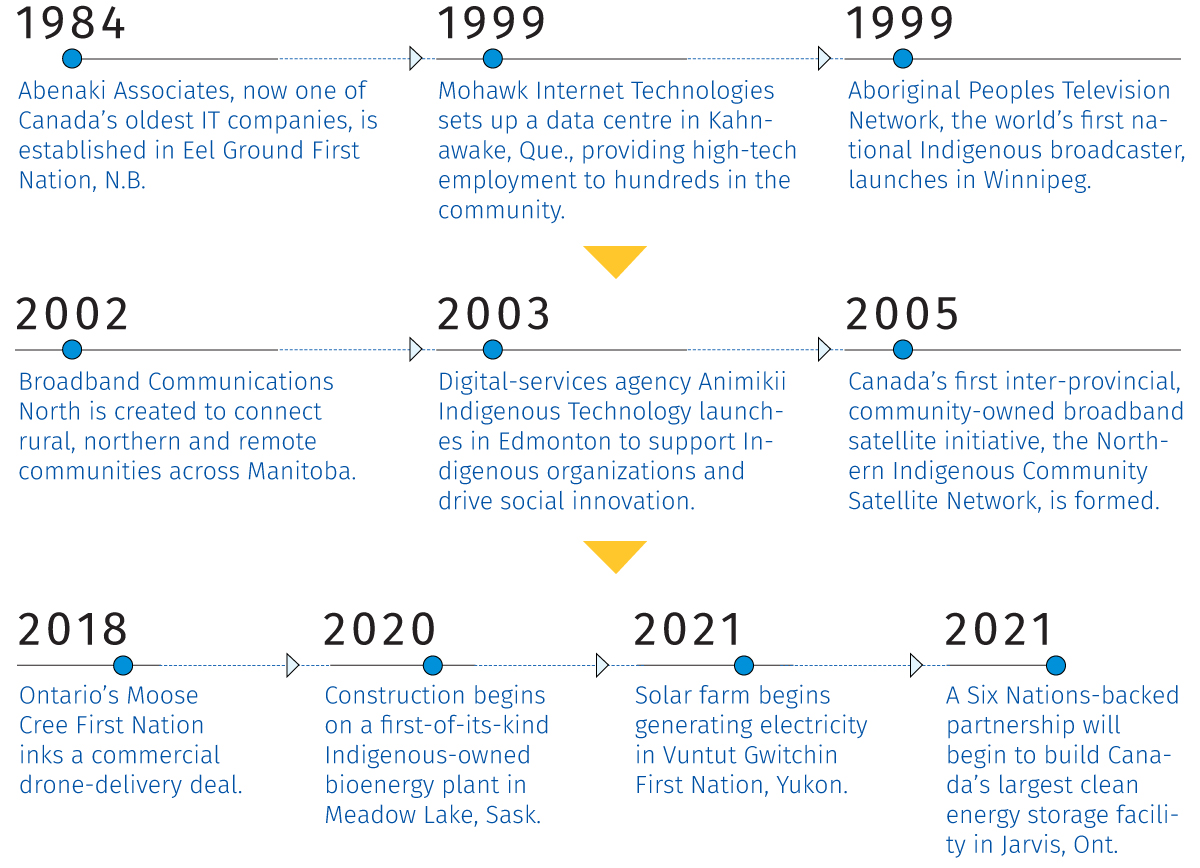
Tomorrow’s Digital Leaders
We’ve outlined the challenges and opportunities Indigenous youth face as they carve out careers in a rapidly digitizing world, and noted the need for more role models. Here are four emerging categories of digital leaders that are demonstrating the way forward.The Early Adopter
These familiar faces in the community—teachers, librarians, council members—are championing digital skills acquisition at the local level. When matched with accelerated training and resources, they become knowledge distributors within the community. They spark new forums for youth learning, like robotics teams and hackathons, and their skills will be in demand across education and local government.
Blaire Gould, 36
Eskasoni First Nation, Nova Scotia Executive Director: Mi’kmaw Kina’matnewey “I’m a tech-fanatic, really just truly interested in it. Once teachers become more comfortable with technology, it’s something that compliments or alleviates your work—and gives the best opportunity to the child.”Emerging jobs:
Education administrator Technology teacher Workplace trainer Library technicianSkills needed:
Managing resources Persuasion Problem solving Verbal communicationLeading the way:
Indigenous Teacher Education Program (BC) Prepares Indigenous students to become effective educators for public, band, and independent schools in B.C., with a focus on identity and cultural heritage. Indigenous Leadership Development Institute (MB) Builds leadership capacity in Indigenous people with specific training, including an online learning package. Centre for Indigenous Innovation and Technology (ON) Provides technology training, increases Indigenous representation in the tech industry in Canada, and promotes problem-solving using technology with an Indigenous lens.The Knowledge Translator
These are the experts and creators bringing Indigenous culture and ways of knowing into the knowledge-based economy. They are able to operate between traditional and digital spaces, elevating ideas and developing new markets. Knowledge translators are connected to land, language and their Elders and plugged into advanced technologies. They will find opportunity not only in tech through product design or animation, but also in the sciences, through applying traditional knowledge to contemporary challenges.
Mick Appaqaq, 29
Sanikiluaq, Nunavut Technician: SIKU mobile app “The future for the Arctic is uncertain, but we have all these tools now that we can utilize. You’re able to transfer knowledge from your community to neighbouring communities by posting on the app.”Emerging jobs:
Digital artist / animator Climate scientist Documentarian UX designerSkills needed:
Mathematics Research skills Land-based knowledge Indigenous languageLeading the way:
Aabijijiwan New Media Lab (MB) Provides Indigenous students with access to interactive studios with sound, projection, VR, video, animation, and more for learning, skills training, and development. First Nations University (SK) Offers an Indigenous Knowledge and Science program where science and math learning is complemented by courses in Indigenous Environmental Science. Aboriginal Territories in Cyberspace (QC) Ensures Indigenous presence in the web pages, online environments, video games, and virtual worlds that comprise cyberspace.The Digital Enabler
These are the skilled tradespersons, project managers and consultants building the physical infrastructure to support digital opportunities. Their efforts are paving the way for better connectivity, as well as developments in renewables and the green economy. With a mix of technology and trades, their skills will be valued by various employers, from telecoms to construction to energy-servicing operations.
Joe Wabegijig, 39
London, Ontario CEO: Phoenix Smart Infrastructure Inc. “My hope is to establish a stronger presence as an Indigenous business leader in this space. And see more communities adopt leading practices of smarter infrastructure to improve the well-being of communities across Canada.”Emerging jobs:
Electrician Network administrator Telecom installer IoT device specialistSkills needed:
Reading Project management Design software InstallingLeading the way:
Building Environmental Aboriginal Human Resources (AB) Offers environmental workforce training programs for Indigenous communities to develop local environmental skills and foster green career opportunities. Diggin’ Digital Professional Development (SK) Provides on- and off-reserve teachers with the resources, materials, and professional development opportunities to incorporate STEM and ICT into lesson plans for Indigenous youth in culturally relevant and appropriate ways. Trade Winds for Success (AB) Prepares Indigenous youth for careers in the trades with reading and writing supports, and preparations for apprenticeship entrance exams.The Service Connector
These are the e-commerce adopters, telehealth providers and online educators solving the twin problems of distance and integration with the broader economy. By breaking down stubborn barriers, they’re increasing access to critical services for Indigenous firms and communities, and showing both sides new opportunities in retail, education and health care. They will need steady access to the latest technology, training and resources to strengthen these new linkages within and beyond their communities.
Mallory Yawnghwe, 35
Saddle Lake Cree Nation, Alberta Founder: Indigenous Box “I would love to see my community thrive. If I can find new customers for Indigenous entrepreneurs and businesses, then I know I’ve done my job. We’re a tool to help them reach those new markets.”Emerging jobs:
Telehealth nurse Supply chain specialist E-commerce customer service provider Education navigatorSkills needed:
Collaboration Business writing Customer service Data managementLeading the way:
Shopify Indigenous(National) Offers Indigenous-led expert training on getting your business online. Keewaytinook Okimakanak (KO) eHealth Telemedicine (ON) Provides access to education sessions, training and support for health staff and community front line workers in remote communities in Northwestern Ontario. Connected North (National) Breaks down student learning barriers by connecting Indigenous partner schools across Canada with virtual field trips and remote mentorship.Pathways Forward
We’ve looked at how Indigenous youth can thrive in a more inclusive digital future; but charting the way forward will take leadership and partnership. Here, we consider the various constraints faced by educators, employers, communities and government—and how they’re finding solutions.Educators
You can’t teach digital skills if your community doesn’t have the Internet. That message was front and centre in our roundtable discussions with Indigenous educators, who face a number of challenges in preparing students for a world of advanced technologies. They liked the idea of a mandatory course in digital skills, but suggested certain foundations need to be in place first, including broadband connection, device access, and teacher training. In short, the digital literacy gap will persist as long as a funding gap does. Educators also raised concerns about how to connect students to careers in a rapidly changing economy. There is a lot of uncertainty about what skills will be in demand for tomorrow’s jobs—and educators from on- and off-reserve pointed out that the current youth employment crisis signals a disconnect between what students hear from school advisors, and the realities that await them. The first challenge for educators is trying to get kids to complete high school. The second is helping them transition to post-secondary education. Career role models, a better sense of where college could lead, and the funds to go, are all critical. At Six Nations Polytechnic STEAM Academy in Brantford, Ontario, students attend the first STEAM-focused (science, technology, engineering, arts and math) secondary school in Canada. This program wasn’t developed in isolation. With IBM as a partner, it is able to offer an Ontario Secondary School Diploma and a tuition-free two-year college diploma, with summer job opportunities along the way—plus a guaranteed job interview with IBM upon graduation. National programs can also reach students who might otherwise have limited options. Indspire helps Indigenous students across Canada complete their post-secondary education by providing bursaries and scholarships. About 90% of its Building Brighter Futures recipients graduate and find jobs—and the organization’s strong relationships with Indigenous employers mean 70% of them work in fields that support the Indigenous community.Employers
Employers value tech-savvy job candidates—but a basic skill set is of primary importance. In our roundtable discussions, we heard that too many Indigenous youth aren’t prepared for the workforce. More job placements are crucial to bridging the gap between school curriculums and working life. This will also give Indigenous youth more exposure to different types of jobs, so they can see the opportunities that exist with their own eyes. Something else they need to see with their own eyes: diversity. Indigenous youth need to see themselves broadly reflected in the workplace. For the companies that are hiring them then, the job doesn’t stop with successful recruitment: coaching, mentoring and supervising supports are also critical. Employers that provide “wrap around” or secondary supports are more successful in retaining and motivating young workers, recognizing that a new hire is a person they’re investing in. Bruno Manufacturing Ltd. in Alberta retained 90% of the staff they recruited for a two-year off-reserve construction project by providing family housing, mental health support and peer accountability. The Osoyoos Indian Band Development Corporation in B.C. has an impressive record of pursuing economic development opportunities across 13 different lines of business, including tourism, construction and wine—and equipping band members with the skills to take on new jobs. It tailors its manager training programs to each role, focusing on skill-building for a period of up to two-years. Unemployment on the reserve is less than 3% and 20% of band members are in senior positions. To widen their own impact, national companies need to replicate these ideas and develop potential from the ground up. A good start: Suncor launched an Indigenous Mentorship Program that has grown by 50% since 2018.Community
Longstanding gaps in funding and resources have left Indigenous communities and youth to count on programs and services from other actors, including not-for-profits, artists and athletes. These supplementary players provide access to skill-building and extracurricular activities that aren’t otherwise available. From dance classes to robotics clubs, youth learn valuable life skills, and build resiliency and self-confidence. What’s still missing is a way to recognize students for the skills they’ve attained through extracurricular activities, such as micro-credentials, so they can more easily demonstrate their abilities to future employers. As more community groups specialize in digital skills, we are approaching a tipping point in knowledge acquisition. In Nova Scotia, Digital Mi’kmaq focuses on introducing Indigenous students and educators to the core fundamentals of the knowledge economy, including coding, robotics, big data and web development. Its enriched educational programs, workshops and events across Atlantic Canada have reached 14,000 students and educators. Looking west, IndigeSTEAM has started a robotics club on four reserves in Alberta. In 2019, it sent an Indigenous-majority team to an international robotics competition in Dubai. The First Nations Technology Council in B.C. has partnered with more than 150 Indigenous communities across the province to provide advice, insights and technology-related training. Corporate actors are important in this space too, funding youth organizations like Actua Canada and Right to Play.Government
Power dynamics are shifting—and that’s opening up new opportunities. Indigenous self-governance gained momentum in Canada in the 1990s, and calls for meaningful consultation and sustainable economic opportunities have grown louder in the wake of the Truth and Reconciliation Commission’s 2015 report. The effects of economic distortion are still felt today, but land settlements and investment have led to the broad expansion of Indigenous ownership, and greater capacity in private partnerships. Although more private sector partnerships are being reached, some bands are still learning what they should ask for. Both sides should strive to reach deals that are mutually beneficial, and provide young people with the chance to learn and advance new skills. Leadership can make or break the push for progress and partnerships. In northern Manitoba, economic reforms under Onekanew (Chief) Christian Sinclair successfully turned the Opaskwayak Cree Nation’s business wing profitable, with investments in the cannabis sector, aerospace and infrastructure renewal. Internet access fosters this growth. Indeed, the completion of a fibre-optic network through a Bell MTS partnership was the first of its kind in Manitoba. In B.C., more than 80% of the Haisla Nation’s band revenue comes from non-government sources. A nearby liquefied natural gas project provides key economic leverage, with land and construction agreements generating long-term revenue—which is then reinvested in the next generation. The newly-built Haisla Community School has smart boards in each classroom, blending culture, science and technology. Properly directing resources is key, and the First Nations Education Council of Quebec offers a lesson in how to do so. It collaborates with 24 schools across 24 First Nations, a cooperation that culminated in the 2011 establishment of Kiuna College—the only First Nations post-secondary institution in Quebec—to produce workplace skills for local employers, within an Indigenous-focused education. On a national level, the Truth and Reconciliation Commission has challenged the federal government to provide sufficient funding to close the education gap between Indigenous and non-Indigenous students within a generation.
Access to Capital
For Indigenous youth to access the opportunities of the Fourth Industrial Revolution, new businesses, partnerships and services need to be cultivated within Indigenous communities. Significant investment will be needed to bring about these opportunities. The Indigenomics Institute points to the potential of a $100 billion Indigenous economy through strengthened economic capacity.
Yet, for many Indigenous-owned businesses and communities, access to capital remains a central obstacle to fully participating in the broader economy. In 2017, Waterstone Strategies estimated that First Nations and Inuit owned businesses used only 0.2% of total available credit in Canada, and were able to access about 9-11x less market-based capital than most Canadian firms. Indigenous Peoples continue to face structural and systemic barriers to financial security, from restrictions under the Indian Act on asset ownership to racial bias of lenders.
What’s needed now are new capital channels and business advisory services to connect entrepreneurs with capital. Organizations like the National Aboriginal Capital Corporations Association (NACCA) need to be supported in their work. It’s a network of 59 Aboriginal Financial Institutions (AFIs) stimulating economic growth by providing 50,000 loans totaling $3 billion to Indigenous-owned businesses.
Recommendations
Equipping the next generation of Indigenous Canadians with future-focused education, skills and opportunities is a shared responsibility. Governments, employers, educators and communities each play key roles. Some measures that may help:-
- Fulfill the federal commitment to provide high-speed Internet, including broadband and related infrastructure to every Canadian by 2030, prioritizing underserviced Indigenous communities.
-
- Increase access to venture capital, with special focus on the new Indigenous Growth Fund, a $150 million commitment from the Government of Canada, Business Development Bank of Canada and other government agencies, which can be a signal for future investments.
-
- Allocate additional funding for digital devices and technology courses in primary and secondary schools, both on- and off-reserve, under the transfer formulas used by Indigenous Services Canada and the provincial and territorial education ministries.
-
- Close the gaps in access to work-integrated learning for Indigenous youth, by entrenching the subsidy for Indigenous students under the federal Student Work Placement program, expanding remote WIL options and through matching tools between employers and candidates.
-
- Expand academic bridging programs at universities, colleges and apprenticeship programs that boost fundamental and digital skills for Indigenous learners and improve outcomes in higher learning.
-
- Address the significant gaps in Canada’s Indigenous labour market data by increasing funding for data collection and coordination under the federal Indigenous Skills and Development Training program.
-
- Leverage recent investments in online education by school boards and post-secondary institutions to expand STEM course offerings for Indigenous students through high-quality remote and hybrid learning in their schools.
- Expand representation of Indigenous culture, languages and content in online spaces by making digital-first approaches a priority for arts councils, and increasing the reach of Indigenous social media influencers who are promoting their culture online.
Download the Report
DownloadAbout the AuthorsAndrew Schrumm is a former lead researcher on RBC’s thought leadership team, where he examined how Canada can enter the 2020s as a diverse, innovative, and sustainable nation. He managed RBC’s future skills research project on skills-based job mobility, life-long learning, and the potential of automation in our economy. Sonya Bell joined RBC’s Thought Leadership and Economics team as a Senior Manager, Content Delivery in 2018, coming from Queen’s Park where she was a senior writer to the former Premier of Ontario. Previously, Sonya worked in journalism as a producer at CBC and as a federal political reporter for iPolitics. Between Parliament Hill and Queen’s Park, she spent two seasons as a comedy writer on This Hour Has 22 Minutes. Tracee Smith is the Founder and CEO of Outside Looking In, the largest national charitable organization empowering Indigenous youth to explore their full potential. A member of Missanabie Cree in northern Ontario, she specializes in corporate strategy, finance and Indigenous affairs and has held positions with TD Bank, TD Securities, TE Wealth and has advised clients such as Nestle Waters, Enbridge and Imperial Oil. She holds an MBA specializing in Community Economic Development and a Masters in Finance from Queens University. She also holds a BA in Dance from York University and was the first professional dancer to perform for the Governor General of Canada. She currently sits on the Board of the National Arts Centre, Smilezone Foundation and The Shoebox Project.

When Derrick Rossi co-founded biotech company Moderna Inc., a pandemic was hardly top of mind. A decade later, his work on messenger ribonucleic acid (mRNA) molecules—which carry instructions to human cells—has been recognized as critical to the development of the vaccines now fighting COVID-19. Boston-based Moderna (the name is a play on “modified” and “RNA”) is a household name. And Toronto-born Rossi, a stem-cell biologist who retired from Harvard University and Moderna in his early 50s to found a string of biotech firms, has been thrust into the spotlight.
He spoke to John Stackhouse and Naomi Powell from his cabin in Squam Lake, New Hampshire about vaccine hesitancy, entrepreneurship and how Canada can become a biotech leader.
Are you double-dosed now?
Oh, yeah. I have been since February.
Did you get the same vaccine or have you mixed?
I got Pfizer, both shots. Not Moderna, oddly. I have an affiliation with Boston Children’s Hospital. I was actually ignoring their emails for about a month and a half. Then finally—I don’t even know what inspired me to open one of these things—but it said, ‘Make your vaccination appointment.’ I said, ‘Ok I’ll do that’. And they happened to be giving out Pfizer that day.
That must surprise people.
I’m really pleased about getting Pfizer because I do a lot of advocacy for taking vaccines. I think it’s really good for me, the founder of Moderna, to say I got the one that was offered. I wasn’t vaccine shopping. All of them that are approved should be taken.
I wasn't vaccine shopping. All of them that are approved should be taken.
What can we learn from the last year about our relationship with vaccines?
We get our first vaccines when we’re infants and we’re barely sentient. And then by the time we’re adults, it’s ‘well, you know, they don’t seem to cause any harm.’ But nobody actually knows what a vaccine is. Part of vaccine hesitancy comes from this not knowing. And wherever there’s a vacuum of information, it’s filled very quickly in this day and age by misinformation.
How do you explain vaccines to people then?
Our immune systems are surveilling what comes into our body and asking: ‘Is this foreign or is this self?’ If it’s non-self, they react to it. That’s what our immune systems do. That’s the second half of vaccination and it’s always the same.
What’s the first half?
The first half of vaccination is about how you deliver that foreign thing into the body. That has many different methodologies: mRNA, protein, adenovirus, inactivated virus, attenuated virus.
Is there any age group you’d hesitate to vaccinate?
There should be no hesitation whatsoever. This is another vaccine against a really deadly disease. And this will be the most studied medical intervention in all of human history. Hundreds of millions of people have now been vaccinated. The safety study is off the charts.
Are you surprised at how quickly vaccines became available?
No. Throughout 2020, you would see pundits saying there’s not a snowball’s chance in hell we’re going to have a vaccine within two or three years. Well, that’s using old technology. Newer technologies can turn on a dime. So the whole time I was thinking, it’s going to be done because I know what this technology can do. And I know the people working on it are really seizing on this as an opportunity to advance the platform.
What role did government and Operation Warp Speed play in the vaccine development process?
It was a really smart idea, because science, like any other industry, moves at the pace with which it can access resources. Not all companies took Warp Speed money. Pfizer didn’t because it’s a giant company and didn’t want to be beholden. Moderna, on the other hand, took Warp Speed money. So now you’re not risking your own money. And in biotech you have to think about risk mitigation.
So, specifically how did that funding speed things up?
Typically when you run clinical trials, you run a phase one, then you analyze all your data before you decide what phase two is going to look like. So it’s a linear progression. This time, they did overlapping clinical trials, which is highly unusual. And basically it’s a risk because at the end of phase one, if it turns out you’ve got the wrong dose, say, you’re not going to initiate phase two because you’re dumping money away. If you’re spending the government’s money, you might feel a little bit more comfortable doing that.
Could you have done the work you did in Boston in Canada?
It certainly doesn’t hurt that I did it in Boston/Cambridge because the ecosystem was in place. It starts with top-tier academic institutions. We made our discoveries in my lab at Harvard, but University of Toronto is comparable. Then there’s venture capital, which is making a lot of money in Boston/Cambridge because a lot of biotech companies come out of Harvard and MIT. The IP experts are all there and there’s been many big successful companies created. So there’s this pool of people that have seen the movie before that you could hire in. Then Big Pharma has come in with major campuses and they’re scooping up biotech companies. All of these things were in place when I did Moderna.
And that ecosystem is foundational for a major discovery like yours?
It was a very transformational technology, no question. Things like that, they come around once every 10 years or so, where there’s something that can be applied to so many different things. Small interfering RNA (siRNA) came before it. CRISPR came after it. It’s about a 10-year interval that you get these big things. And lo and behold, so far, all three of them have happened in Boston/Cambridge.
You’re involved in a lot of discussions about creating a Canadian biotech hub. What have you advised?
Well, I’ve said you need to do it near a top-tier academic institution. I keep pushing Toronto because it’s my hometown. Then you need land—a lot of it. You need a real estate developer to build a bunch of biotech incubators. Then leave a big patch [of land]. So when Pharma wants to come, it can expand out from this hub.
This interview was edited and condensed for clarity.
For more on Canada’s burgeoning biotech industry, listen to our Disruptors podcast episode, Rethinking Biotech: How big, long-term bets are paying off.
Listen on Apple Podcasts, Google Podcasts, Spotify or Simplecast