WP Menu

wp-menu

At this month’s RBC Disruptors, we turned our minds inward. How is all that time we spend on screens changing our brains? Dr. Murali Doraiswamy, a physician and brain scientist at Duke University, says there’s cause for concern: an estimated 8%-10% of people in North America show signs of a serious addiction to the Internet and gaming. Nevertheless, he’s a techno-optimist. Thanks to its neuroplasticity, the human brain can rewire itself – it matches the tech that serves us. Going forward, we may become super good at typing, or mastering voice tech devices.

Pandemics have historically been catalysts for creativity and invention

Throughout history, pandemics have wreaked devastating consequences on societies and their populations. They’ve also inspired, in their wake, bursts of creative reinvention that made a lasting impact on the world.

In 2019, the key is to balance our screen time and our time in the real world. Dr. Doraiswamy shared five things we can do today to keep our brains in prime operating condition.

1. Get Up From Your Desk

It’s a challenge in an era when everything seems urgent – but don’t sit in front of your computer for more than an hour at a time. It’s not good for your productivity. “We are so over-scheduled, we are constantly in a task-oriented mode,” Dr. Doraiswamy said. Get up and walk somewhere, go to a coffee shop. That break from emails and meetings will help to shift your brain from a task-orientated way of doing things to a more creative and productive mode.

2. Go for a Walk in Nature

Hands down, the best place to reset your brain is in nature. When you take a walk in nature, you’re combining the trance-like state that walking puts you in, with the sense of tranquility nature provides. This contemplative time activates the brain’s default mode network. This is the part of the brain that allows you to unlock solutions to deep problems, and inspires a sense of collective well-being in people. You just need to give it free time to do its job.

3. Meditate

Everyone should be meditating for a minimum of 20 minutes a day, preferably outdoors. Start with an app, if that helps. Like walking, meditating activates the brain’s default mode network. It’s good for your brain in the long-run, too – studies show novice meditators and expert meditators have different brains. The later have less age-relate shrinkage in their brains, and the parts of the brain involved in judgement and morality are more stimulated.

4. Have a Good Conversation Every Day

The number one predictor of how long you’ll live isn’t your blood pressure; it’s your social connections. Every day, have a deep, meaningful conversation with a friend – not over Skype, but in person. These deep personal connections are vital for physical and psychological well-being. “Don’t mistake social media for what brings true meaning into your life,” Dr. Doraiswamy says.

5. Stop Checking Your Phone Before Bed

An hour before you go to bed, stop checking your phone. If you look at your phone just before going to sleep, your brain is still processing those last few emails for at least another 15-20 minutes. Early research also suggests that the blue light emitted by devices may interfere at night with our sleep cycles, meaning you’ll sleep better if those last few minutes of your day are spent with a book instead.

WP Menu

wp-menu

The pandemic has taught many of us to work in isolation. The recovery will require us to work in teams like never before.

The world is too complex, and changing too fast, for us to keep going on our own. Even the lone genius can’t solve today’s challenges.

Just ask Satya Nadella, the CEO of Microsoft and a big thinker on the future of work.

“To get anything meaningful done, you have to be able to work in teams,” Nadella told a forum of Canadian students, educators and employers.

He points to the demand for business apps that’s greater than the supply of techies to build them, and how teams of people with ”low code, no code” skills will be needed to bridge the gap. Often all that’s missing are “bridge skills” like design thinking to connect a bunch of generalists and specialists.

Design thinking is fundamentally about empathy, to listen and go beyond words, to understand context and use empathy to innovate.

Satya Nadella, Microsoft CEO

“Design thinking is fundamentally about empathy, to listen and go beyond words, to understand context and use empathy to innovate,” Nadella said.

I joined the forum to share a bit of what RBC is listening to, how we’re learning and what we’re looking for.

We know the hard skills are easy enough to identify: data analytics, cyber-security, artificial intelligence, among them. But we’re also focused on soft skills — we call them human skills — like the empathy Nadella likes. It’s one reason we’re excited about creativity as a power skill for the recovery.

We see creativity as more than an artistic pursuit. It’s the ability to combine novelty and value, to both invent (an idea, even) and find a sustainable use for it.

Then we need to code it.

Such an approach could be critical for millions who have lost jobs, especially displaced workers — bartenders, hair stylists, book merchants — with an abundance of human skills that are growing in demand.

Such a need is one reason we joined forces with Microsoft Canada and Seneca College to launch a short-order course in cloud computing, to help people from many backgrounds develop in-demand hard skills. Once on board, they’ve already got the soft skills to move from one good job to another.

Nadella told the forum this is a signal of the future of work, that we’ll all need to be continuous learners. Doesn’t matter if you’re a forester or a pharmacist, you’ll have to keep adding to your skills mix, and can do so with a foundation of human skills — call them learner skills — like critical thinking, communications and collaboration.

You might even call it a creative solution.


WP Menu

wp-menu

I interviewed Mary Robinson, the former president of Ireland and global statesperson, for RBC Capital Markets’ first annual ESG Conference. As head of the Elders, a group formed by Nelson Mandela to help resolve global conflict, Robinson is focused on the climate crisis and upcoming UN summit in Glasgow. Here’s some of what she had to say:

  • COVID has shown what’s needed to resolve crises:

  1. Collective action.
  2. Government.
  3. Science.
  4. Compassion.
  • Historically, pandemics have caused great loss and change, but also galvanized societies. COVID has made people reassess their values and the way we’ve been living, working and consuming.
  • Business innovation and private enterprise will drive the recovery. The direction of the recovery needs to be towards net-zero.
  • 127 governments have a net-zero goal, covering 63% of the global economy.
  • Pace is still not fast enough.
  1. Need to phase out coal 5x faster.
  2. Need to ramp up renewable energy 6x faster.
  3. Need to transition to EVs 22x faster.
  • Public opinion is shifting.
  1. The U.S. elected a president with the most ambitious climate policy in history.
  2. Young people have stepped up, imploring us to listen to science.
  • When it comes to ESG, the “S” (social impact) gets left out more than environment or governance.
  1. Need to see importance of a just transition, with new jobs and new training.
  2. We’ve learned to spend money to help those affected by COVID; we need to learn to spend money to help those affected by climate.
  • We have to do a lot in a very short amount of time. We need to reduce carbon emissions by 45%.
  1. often tell people that everyone can do three things:
  2. Make the climate crisis personal.
  3. Get angry with those who should be doing more.
  4. Imagine the world we need.

You can watch the full interview here.


WP Menu

wp-menu

I’ve been to Davos five times, and don’t miss the icy sidewalks and endless security lines. But when the World Economic Forum last week brought together government leaders, CEOs, community activists and scientists for a digital Davos, I did miss the informal conversations and was reminded why connectivity is so important.

Like the old movie title says, being there matters. The hallway conversations, the opportunity to read a room, the chance encounters—these are the real strengths of Davos, just as they are the real strengths of our offices, labs and schools. It’s why we’re all yearning to be back together as soon as it’s safe, even if it means having to navigate the odd icy sidewalk.

This year’s virtual Davos tried to address the challenges shaping 2021: the race to vaccinate the world, the effort to kick-start economies, the fight to flatten the climate curve, the long journey to racial justice, and the struggle to detox social media. Here’s some of what I took away:

Vaccine politics could prolong the pandemic

Vaccine nationalism may be the biggest challenge to our world right now. We will get through it, but the next few months could be politically bumpy. Germany, a leader, has vaccinated less than 5% of its population, and made clear it’s going to take care of its own population first. Other wealthy countries are struggling to get supplies, while the world’s poorest countries worry they will be shut out. And that puts everyone at some risk, as the more the virus circulates, the greater the risk of mutation. There are concerns of a “persistent pandemic,” but vaccine distribution is just one piece of the puzzle. Public health systems need to be strengthened in the poorest countries. The World Health Organization needs to be revised and reformed, too, as it’s the only body that can help us all understand the virus and how we can contain it, collectively. The politics of the pandemic are not likely to ease up.

Joe Biden can’t unite the world

China’s Xi Jinping helped kick off the week with a stern message to the new U.S. president and his allies. Any effort to insert values into trade could lead to a new Cold War. We may be headed that way anyway. As Biden pushes for an “an alliance of democracies,” Canada and the European Union will try to revive global trade in a new fashion that’s as much about values as it is about value. As German Chancellor Angela Merkel put it, multilateralism “doesn’t simply mean co-existence.” While we may see a revived World Trade Organization, it’s not likely to be an all-powerful body. Expect more regional trade blocs, and what Spain’s foreign minister called an age of “strategic autonomy.” Ironically, this effort to “re-globalize” misses the digital revolution that transcends borders. The Europeans, Australians and others may want more control over the cloud-based economy that’s thriving in the pandemic. But they’ll need to convince Biden they’re not out to stifle Silicon Valley and the platforms that Washington is happy to criticize at home, and defend abroad.

Get ready for smart supply chains

The regionalization of trade is leading to a rethinking of supply chains, and not just because of vaccine and PPE shortages. Countries are looking at strategic sectors, especially ones rooted in technology, to balance supply and demand more safely. As Canada is discovering the hard way—through vaccines—this may lead to trade-offs between efficiency and resilience. National security may come into play, too, as we witness the growing connectedness of every tool and appliance in our lives. Regions everywhere will want more control over the Internet of Things, just as they do the Internet of words, pictures and money. That means that, as we rebuild supply chains, we’ll need to put an even greater premium on R&D, to ensure manufacturing centres are integrated with innovation centres. Brawn and brain, in other words. Masayoshi Son, the Japanese investor behind SoftBank, believes this approach may fuel the next big disruption, in logistics and mobility. He thinks autonomous vehicles can be to the 2020s what smartphones were to the 2010s. We’ll see. But in the decades ahead, auto plants are likely to depend on artificial intelligence and cybersecurity as much as steel and aluminum. Based on patent data, Son is convinced only two countries—the U.S. and China—will dominate this new space race, and they’ll be central to the smart supply chains of tomorrow.

Climate change, the next catalyst of innovation

Mary Barra came to our virtual session with a plan. The General Motors CEO laid out her vision for a company focused on “Zero Crashes, Zero Emissions, Zero Congestion.” She’s trying to make GM climate-friendly, as she watches Elon Musk’s taillights on the electric highway. But the GM plan to be all-EV is as much about innovation as emissions. Entire sectors will emerge—or be remade—through the 2020s as consumers look for technology to transform their lives, and governments spend trillions to lay the groundwork of a new economy. BlackRock founder Larry Fink, a Davos regular, published his annual letter during the Forum, urging CEOs to see the climate transition as an opportunity not just for the climate. He figures the world will need $50 trillion more in new investment by 2050 to meet our sustainability goals. That’s already leading to plans for a Hydrogen Valley in Europe (to do for energy what Silicon Valley does for computing) and proposals for new power grids along the U.S. interstate network. As Bill Gates told the Forum, the biggest cuts in emissions this decade will come from technology, not changes in behaviour. His new word for climate change: “catalytic.”

Increasing trust is the challenge of post-COVID capitalism

Davos is the birthplace of “stakeholder capitalism”: the idea that, to thrive in the long term, business needs to balance returns to shareholders with returns to customers, employees and communities. This mindset led many companies in the depths of the pandemic to find ways to make and distribute emergency supplies and develop vaccines at breakneck speeds. In North America, corporations were also among the first to step up to the challenges of Black Lives Matter, changing employment and procurement practices while many governments were still talking. It’s one reason the latest Edelman Trust Barometer (a survey of 33,000 people globally) found business is now the most trusted institution—ahead of government, media and religious organizations—and the only institution seen as both ethical and competent. That’s not necessarily comforting. Trust in all institutions is important to the well-functioning of markets and an economy, as well as society. Coming out of the crisis, business will need to do more to help those institutions strengthen themselves, if a new kind of stakeholder capitalism is to endure.

Money’s cheap; judgment is not

The COVID crisis has created a new generation of fans for John Maynard Keynes, and his theories about government spending. Can it do the same for another legendary economist from the 1930s, Joseph Schumpeter, and his belief in creative destruction? Governments and business may soon need to come to grips with the lasting economic damage of the crisis and consider which sectors stand a chance of rebirth, and which don’t. The stock market rewards companies at the forefront of change. But it may be politically tougher for governments to do the same. That’s too bad, as they can reap the reward if their countries become transformation leaders. In 2020, many of those governments got by throwing money at the entire economy. In 2021, they’ll need to be more selective—and appreciate how low interest rates can be a rising tide even for leaky boats. François Villeroy de Galhau, governor of France’s central bank, expressed concern his fellow policymakers focus too much on liquidity and not enough on solvency. Kewsong Lee, the CEO of Carlyle, was less diplomatic, asking policymakers if they’re keeping “zombie companies” alive. David Solomon, the CEO of Goldman Sachs, argued markets tend to eventually separate the good from the bad and the ugly. It will take discipline from governments to know when to let the Schumpeterian forces prevail.

A new social dilemma: speech or reach?

Our virtual gathering was haunted by the January 6 attack on Capitol Hill, and what it exposed in social media and democracy. The heads of major tech companies assured us they were ahead of the mob on most counts. Susan Wojcicki, YouTube’s CEO, explained how her platform is using AI and bots to take down thousands of misleading or offensive videos every day, usually before more than a handful of people have seen them. YouTube’s owner, Google, just opened a second “safety engineering” centre, to add more human surveillance. The platforms are rightly concerned about stifling free speech, especially in a pandemic when so much needs to be expressed and shared. But as many media and advertising executives pointed out, it’s not just speech that’s the problem; it’s reach. The platforms use algorithms to amplify the reach of different types of content, and most of us don’t know how they work. Governments may need to lean in more, to examine those algorithms, regulate harmful speech, and hold tech companies to account for allowing abuses to propagate. “Responsible conduct” can be a new norm for tech, as it is for other companies that rely on the public good. More public vigilance will be needed, too. As we confront the next stage of a pandemic, and its aftermath, our collective success may just hinge on the most important word of the 2020s: trust.


WP Menu

wp-menu

This is turning into a one-issue election, in two very different parts.

Biden supporters feel COVID is the top issue, by a 42-23 margin over the economy. Trump supporters feel the economy is the top issue, by a 68-9 margin over COVID.

Which means Trump can’t afford for COVID to be the ballot question, especially since 48% of voters say they don’t trust him at all when it comes to the pandemic. In fact, the economy is the only issue in the top-10 list of voter concerns where he scores better than Biden.

These numbers are from the latest NBC-Wall Street Journal poll, conducted by Hart Research, and they show a consistent and strong lead for Biden.

But as Molly O’Rourke, a Hart Research partner, told a webinar hosted by RBC Capital Markets, there’s plenty of room for asterisks. The biggest risk is that “polling is weakest where it matters most” – among older, less educated voters in the swing states that Trump won narrowly in 2016.


On several counts, Trump faces challenges:

  • few voters (28%) feel the country is moving in the right direction, which tends to signal the mood for change;
  • interest in the election (81%) is at a new high;
  • voters are taking the election very seriously, with 83% saying the outcome matters (it’s usually about 55%);
  • his base is shifting, with his lead among white, non-college educated men falling from 38 points to 19 points in one month;
  • Biden’s lead with suburban women has grown from 9 points to 25 points in one month;
  • Biden’s lead with seniors has grown from 4 points to 27 points.

O’Rourke cautioned that polling has been disrupted by the pandemic, with serious limits on qualitative in-person interviews that give pollsters a truer sense of public sentiment.

But even in limited encounters, she’s been struck by the number of voters, including “ambivalent” Trump supporters, who use the word “exhausted” when they talk about the need for change. In a period of massive disruption, they see Trump as a source of disruption, and Biden as a source of calm.

She doesn’t see voters giving Biden a mandate to do much more than get rid of Trump and get rid of the virus. There’s much less interest in the bolder change agenda that many Democrats are hoping to implement if they secure control of both Congress and the White House.

Nearly 30 million votes have already been cast – five times as many as in 2016. And many of those ballots won’t be counted until after election day. That could be an advantage for Trump, whose supporters are more inclined to vote in person on November 3. O’Rourke suggested a “red mirage” on election night could prompt him to declare victory, even though Biden could be declared the winner days or weeks later.

The delayed results could also hang over the Senate, which is proving to be much more challenging for the Republicans. The Democrats need to flip only three of the 35 GOP seats up for grabs to secure control of the upper house, which O’Rourke said is “a very strong possibility.”

With so much up in the air, she expects the election to be “a major test of faith that people have in our institutions, and a test of our two-party system playing by the rules. I’m honestly nervous about it, and there’s plenty of opportunities to get derailed.”

O’Rourke urged one word for election night: “patience.”

For more, you can see Molly O’Rourke’s latest polling slides here.


WP Menu

wp-menu

Black Lives Matter. Greta Thunberg. The Yellow Vests Movement. Even before COVID hit, a new kind of people power – digitally-enabled, socially-driven – was disrupting the world. Global networks began to overshadow and even sideline governments and institutions. The trend has only accelerated as our lives have moved even more online, and for Canada it may present a strategic opportunity. Few countries have as diverse and influential a global network as Canada enjoys through its expats and citizens who live abroad. While there’s no census or formal survey of this growing diaspora, newly published research estimates 2-3 million Canadians live, work or study outside the country. In the 2020s, this virtual 11th province can become Canada’s super power. In a world that will be more divided and contentious – there will be yet more need for countries and networks that can bring people together and bridge differences. Canadians can already be found throughout Hollywood and Nashville, and at top of the business world in New York, London and Hong Kong. They’re at the forefront of global campaigns against war crimes and cybercrimes. They run some of the world’s top universities, including Stanford, Cambridge and Johns Hopkins. And they’re among the most recognized faces on Chinese, British and American television. Canadians are everywhere. But unlike most countries, Canada does very little to activate this global population. India has created an Overseas Indians unit, offering special visas and tax incentives to its diaspora. Italy has gone further, as one of eight countries that offers parliamentary representation to expats, while Israel and Singapore maintain active databases and outreach programs for their overseas populations. As Canada considers a post-COVID world that may be less receptive to government interventions, the opportunity to create new global networks has rarely been more important. They can be a megaphone for our small voice, a connector for our small numbers and a lever for our big ambitions. A playbook already exists, through the C100 , a non-profit association created in 2010 to bring together Canadians in Silicon Valley. The group has since brought hundreds of Canadian entrepreneurs to the Valley, and connected Valley investors to Canada. It’s also advised both the Harper and Trudeau governments on tax, innovation and immigration policies. The C100 can become the C1Million, at least in the national imagination, if we pursue a range of low-cost, high-impact policies that follow what other countries are doing:
  1. Create an expat unit at Rideau Hall, under the Governor-General, to speak up for our global population.
  2. Make a five-year budget commitment through Global Affairs Canada to co-fund expat networks.
  3. Build a digital platform, to be administered outside government, for expats to learn about and connect with each other.
  4. Create a national award and pin, in line with the Order of Canada, to be granted annually to overseas Canadians who have represented their country well.
  5. Bring together 50 of our best expats every other summer at Rideau Hall, to meet with government, business, science, media and academic leaders, and explore Canada’s place in the world.
While there are plenty of challenges, the most important may rest with all Canadians – to consider what citizenship means in a digital age. Canadians have wrestled with the rights and obligations of citizenship since the country was created, and especially since the power of citizenship was transferred from Britain’s overseas office to the government in Ottawa in 1947. A revised citizenship act in 1977 created a more multicultural approach to citizenship, including the option of dual citizenship. But another revision, in 2010, pulled back some of those rights that had been undermined in a less secure, post-9/11 world. Now, in the 2020s, new ideas of citizenship will continue to emerge as people live, work, study and communicate from anywhere to anywhere. The very notion of “Canadian” may be challenged anew. We can chart that course with the help of our 11th province, and the Canadians who are already out there, shaping the future of a planet that needs to be a bit more like Canada. John Stackhouse’s latest book, Planet Canada: How Our Expats Are Shaping the Future, was published in October, 2020 by Random House Canada.

WP Menu

wp-menu

Issue

Facial recognition technology is now a part of our daily lives, personalizing our services and making identity verification easier. Yet a lack of clear restrictions on its usage creates ambiguity for Canadian businesses that are constantly seeking data insights to drive growth and maintain relevance with consumers in a platform-based world.

POV

The pandemic has fuelled an explosion in the use of video, as we try to stay connected during the global lockdown. Workers are using Zoom and Webex daily, families are catching up over FaceTime or Skype, and we’re turning ever more frequently to social media like Instagram and TikTok for entertainment. Our faces are travelling everywhere, even when we’re not.

Our faces are travelling everywhere, even when we're not.

At the same time, Artificial Intelligence is becoming ever present in our lives as we spend more time online; sending us shopping and podcast recommendations, predicting our upcoming bills, and learning which shows we like to watch. Our faces have become a central part of this data wave, as we teach our phones to recognize us, sort our photos and even interpret our emotions. But facial recognition creates a different sort of data tool from web traffic and credit card histories – one that can assess identities, behaviours and social interactions. We’re no longer anonymous, whether sitting at our computers or taking a walk downtown.

When paired with AI, facial recognition offers incredible commercial applications that could increase the personalization of services and reduce friction in the verification of payments, health records or even voting. How will Canadian firms – big and small – choose to employ the potential of facial recognition, as we all strive to leverage technology and consumer insights? Are there clear regulations on the use of this data? On these questions, we don’t operate in a vacuum; the technology is being developed and the data put to use in various ways around the world. The drive for innovation in this space will test our resolve to ensuring AI is used for good.

To do this right, Canadian businesses should avoid working in isolation. Canada is home to the world’s leaders in developing ethical AI. It’s here that the Montreal Declaration for the Responsible Development of AI was signed, the Privacy by Design certification was developed, and CIFAR’s AI & Society program was born. In this spirit, RBC and Borealis AI have launched RESPECT AI, a hub for firms to gain practical solutions for the responsible adoption of AI.


Key Numbers


Rate of patents accelerating, with a record of 244 in 2019

The number of global patents referencing “facial recognition” stands at 1,617, with over 100 new patents so far in 2020. Tech giants Google, Samsung and IBM dominate the filings (Apple ranks 7th). Only 27 of these patents are held by Canadian applicants.

Canadian firms are divided on the use of AI and data insights

Despite the data revolution, 53% of Canadian companies aren’t using AI to inform their business decisions, and among them, 6 out of 10 have no plans to do so soon. The other half feel that AI is central to their business growth, and most plan to expand their usage over next 2 years.

Social media is generating oceans of data for facial recognition

Each day, over 100 million hours of video are streamed on Facebook, while more than 95 million uploads are made to Instagram. These images are tagged with names and locations, providing better training data for algorithms. Google is building software that can crawl all social media sites to identify a person’s face (and their associated activity) across all platforms.

Accuracy of facial recognition is near a human level

Apple FaceID claims a 1 in 1,000,000 chance someone else could unlock your device with their face. Google’s FaceNet achieved 99.63% accuracy against a benchmark image data set, surpassing Facebook’s DeepFace at 97.35%. By comparison, the human eye is accurate 97.53% of the time.

Market for this technology could double within five years

The facial recognition market had revenue of about US$3.2 billion in 2019, with some forecasts calling for it to reach US$7 billion by 2024. Key sectors of growth will continue to be government and security, with rising usage among retail and ecommerce.

Key Questions

What is facial recognition good for?

As a tool, facial recognition provides rapid identification of an individual. This can help companies provide a personalized experience to consumers, reduce friction points on verification to access secure materials, or assist law enforcement by rapidly identifying possible suspects from video.

Similar image recognition technology is already used to reduce pedestrian accidents in cities by monitoring traffic patterns. It’s also being applied in agriculture to distinguish weeds from crops for precision pesticide use. Yet, we’re likely most accustomed to using facial recognition on our phones to verify banking or email passwords, or to automatically sort our photos.

Increasing confidence in the accuracy of this technology has furthered its public uses. Between 2014 and 2018, the US agency NIST estimates a 20x improvement in accuracy, from a 4.0% failure rate to 0.2%, respectively.

We can expect the list of potential applications to grow:

  • Attendance tracking at school and work could be automated by face scans, and could provide added verification in exam halls and polling stations.
  • Loyalty members of a retailer could receive virtual coupons and recommendations by text message upon entering a store.
  • Security access to buildings or bank machines using facial recognition could reduce barriers for persons with disabilities in the workplace.

A sub-set of research is developing measures to counter the misuse of people’s images, such as deep fakes or identify fraud. And liveness detection software is aiming to identify whether an image or video is true to the subject involved; in essence, a good AI that can identify bad AI.

Does facial recognition equate to surveillance?

Many countries have no explicit legal or regulatory requirements related to facial recognition within their privacy regimes. In some places, this leaves interpretation open to discretion or abuse by government and business; as such, surveillance has become synonymous with facial recognition.

Here in Canada, we’ve seen pushback when its use has gone exceeded public comfort. When the RCMP’s association with Clearview AI – a firm with a database of 3 billion photos from Facebook and Instagram – became public, the Mounties had to set limits on its use. When Vancouver police attempted to use driver’s license photos to identify suspects in the Stanley Cup riot in 2011, the privacy commissioner required a court order on future use of such technology.

As this technology develops and pushes the limits of privacy, countries are navigating these challenges in real time. The adoption of Canada’s Digital Charter in 2019 – the federal government’s statement of intentions on digital security – suggests individuals can anticipate increased control over personal data and images under its “control and consent” principles. However, the roadmap remains unclear. In July 2020, 77 Canadian civil society groups called on the Trudeau government to; (i) ban use of the tech by federal law enforcement for surveillance and intelligence, (ii) launch public consultations on use of facial recognition, and (iii) update PIPEDA protections to specifically cover biometric data.

China, with its estimated 626 million surveillance cameras, has perhaps the strictest restrictions on private business use of biometric data. The central government, however, is exempt. Facial recognition is a key tool in its emerging national “social credit” system that scores personal public behaviour and penalizes “bad” practices (e.g. jaywalking or smoking in the wrong spot). These major investments have made China the world’s capital of facial recognition; since 2015, the majority of related patents on facial recognition and surveillance have come from Chinese applicants.

The European Union’s GDPR is the most advanced data privacy regime. It classifies the data harvested from facial recognition technology as biometric, a category that requires explicit consent from the subject prior to its collection.

In the US, four states – Washington, Illinois, Texas and California – have adopted laws on the protection of biometric data including explicit opt-in clauses, while numerous cities have banned the use of facial recognition in public services, including policing. The most recent to do so was Portland, amid civil unrest. However, the Trump administration has sought rulings in federal court to proceed with facial scans at airport entry for all passengers, including non-US citizens. Currently being piloted at Los Angeles International Airport and Dallas-Fort Worth International Airport, facial recognition is used to identify potential criminals, passport fraud and people on no-fly lists

How is this different than other personal data, like a fingerprint?

Think about it: how many times have you provided your fingerprint? Now how many images of your face are online?

Facial recognition differs from other biometrics – DNA, fingerprints – for two big reasons. First, it’s easy to collect; your image can be captured on video by anyone, anywhere. Second, it’s increasingly easy to verify against online images and with deep learning tools.

Think about it: how many times have you provided your fingerprint? Now how many images of your face are online? Governments alone have an enormous trove of reliable, labelled images, from your health card to your passport photos. Meantime, our penchant for posting images to social media – with our names, friends and locations – have created inadvertent, massive datasets for facial recognition.

A couple of years ago, Google stunned many observers by announcing development of an algorithm to track people’s social media activity across all platforms, simply by following their face. Google can do this with its propriety “reverse image search” combined with its massive scale in crawling millions of websites at once. The ease of access to people’s faces makes all of this possible.

Despite advances in the technology, facial recognition wears a mask of mistrust, particularly along racial lines. Some of the original facial recognition systems and algorithms were proven to contain ethnic bias with high levels of inaccuracy for non-white faces, due largely to the input data that skewed to white males.

Any application of this technology must appreciate the potential for bias in the underlying data — particularly given its potential to negatively impact people. Trust in these tools remain divided; when asked about personal verification methods to access health records, 58% of White respondents in the US were comfortable using facial recognition. But this figure fell to 50% and 41% among Hispanic and Black respondents, respectively.

What does this mean for Canadian businesses?

Put simply, tread lightly. Misuse of personal information can carry massive reputational and legal risks.

An RBC Borealis AI survey of Canadian businesses revealed their top motivations to invest in AI programs were (i) to reduce costs, (ii) to increase productivity and (iii) to increase sales. This is increasingly relevant amid the current economic recovery, as firms look to leverage any data advantages to create consumer relevance and new revenue.

Tech giants have inherent advantages to developing this technology, and have staked their claims in hundreds of global patents. In turn, they are seeking consumers of these data tools; for example, a retailer looking for information on shoppers who browse, but don’t buy; a restauranteur aiming to track frequency of visits to grant loyalty points; or a construction firm interested in gathering insights on worker activity on job sites.

Only 36% of US consumers trust tech companies to use facial recognition software responsibly.

Comfort with all these uses, however, is not yet widespread. A 2019 Pew research study found that only 36% of US consumers trust tech companies to use facial recognition software responsibly, and just 17% trust advertisers. When individuals are unsure of how their data is being used, firms risk running afoul of privacy and ethical practices.

Any organization or entrepreneur should consider:

  • Educating themselves and business leaders on the risks from resources like RESPECT AI.
  • Understanding and creating an awareness of the biases that may be present in their practices.
  • Conducting due diligence on vendors that supply personal data to their business.
  • Supporting business councils, and other advocacy groups, that call for clear, federal regulatory guidance on the use of data from facial recognition in business.
  • Making a public commitment to the ethical use of AI and respect for people’s autonomy, by following the principles of Privacy by Design or signing onto the Montreal Declaration.

Uncertainty about how to use AI responsibly could account for the stark divide among Canadian firms adopting it. Six in ten Canadian businesses feel that AI is mostly for larger organizations.

Key Stakes

Consumers should have the right to know why and how firms use their likeness, and governments are responsible for ensuring it is done legally. Businesses that engage in facial recognition applications without appreciating the associated ethical questions risk strong blow-back from consumers.

Canada has been a leader in supporting AI for good. How facial recognition technology is deployed will be an important test of adherence to such ideals. The pandemic has accelerated how Canada moves from conversation towards action around digital ethics.

To learn more about how we can ensure AI is working for all of us, in a responsible and ethical way, listen to our podcast episode.


WP Menu

wp-menu

The Issue

The pandemic has created a historic crisis for Canadian colleges and universities. It could present a significant opportunity, too. The widespread use of online learning platforms and tools offers educators a chance to reach a global body of students that could far exceed Canada’s current market.

It won’t be easy – other countries are eyeing the same opportunity and our schools will need to invest to grow, at a time when they’re being asked to cut. But as Canada pursues a knowledge-driven economic recovery, the digital export of post-secondary education could attract talent, create high-value jobs and help colleges and universities reimagine themselves in a pandemic-disrupted world.

POV

The global spread of COVID-19 shocked international education; and it’s not clear how quickly it will recover. So far this year, just three-quarters of the 2019 level of international students have arrived, while the number of study permit applications has plummeted, risking some of the estimated $22 billion in annual contributions these students make to our economy, and straining a sector that supports an estimated 170,000 jobs.

The fiscal impact of lost international student tuition is already hitting colleges and universities. Colleges and Institutes Canada expects only about a third of 2019’s level of new international students this fall. And rising deficits are leaving provinces with fewer resources to fight economic fires.

A concerted effort – among our schools, provinces and federal departments – is needed to resume Canada’s leadership in attracting international students, whose ranks numbered 642,000 at the beginning of 2020. Expedited visa processing, ensuring safe housing and broadening recruitment efforts will be critical.

Yet, international education is also ripe for new models. At the peak of national lockdowns, some 1.6 billion students were pushed out of school, prompting a shift in preferences toward distance and online learning. Among the nearly 300 million new degree-holders we’ll see globally by 2030 – double today’s number – many more will earn their credentials online.

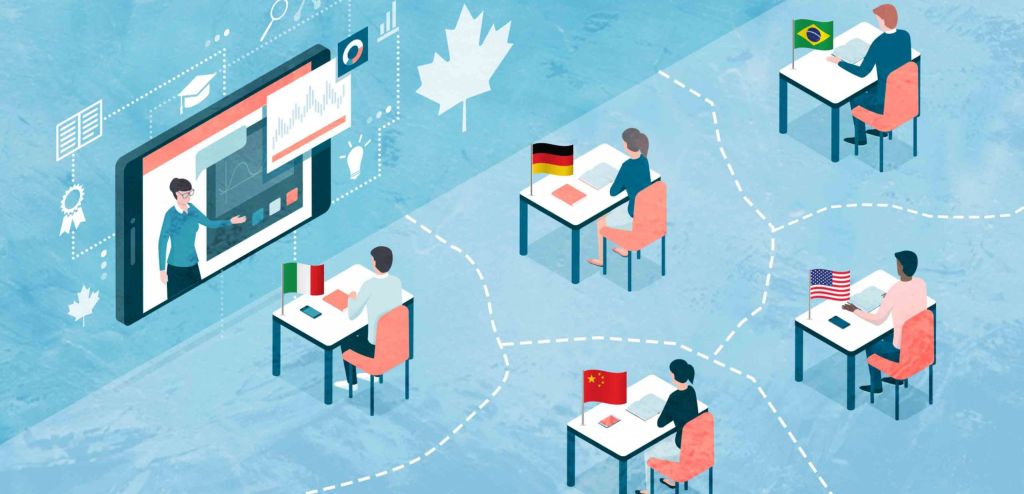
Reaching these potential international students through a hybrid post-secondary model – online at entry, and on-campus at completion – would allow Canada’s universities to be key players in this growing sector. Consider the potential of a collective push among our universities to create a global “Canada U” program. Students would earn credits remotely from their home country, gaining language skills, career guidance and virtual work-integrated learning opportunities – becoming strong candidates to secure admission to upper year studies at a university in Canada.

Key Numbers


The global pandemic slowed student arrivals

Through June 2020, student arrivals among our top-10 source countries fell 26% compared with 2019. More troublesome was the 60% drop in new study permits received by IRCC in April, May and June, and the slow rate of visas processed – only about 10% of last year’s volume was completed this spring.

Yet, internationally mobile learners are motivated to continue studying abroad

COVID lockdowns have discouraged only 5% of international students to fully abandon studies. The majority (54%) are inclined to delay their education by up to 12 months in hopes of starting studies on-campus. Only three in ten plan to begin studying online first.

Number of young graduates set to double by 2030

Asia will produce new graduates at break-neck speed, accounting for more than half of young degree holders over the next decade. The surge will be largely fuelled by China and India, where the number of graduates will grow to 81 million and 70 million respectively.

Global middle class to add 1.7 billion people by 2030

If the COVID recovery is broadly inclusive, the global middle class could swell to 5.7 billion within 10 years, leading to higher post-secondary enrolments, though faculty and funding constraints in the global south may slow institutional growth. India – Canada’s largest source of international students – could see some 600 million move to middle income levels. Meanwhile, Ethiopia, Angola and Cote D’Ivoire could together add over 20 million to the middle class.

Online cross-border education market reaches double global learners

An estimated 13 million students are earning credits online from a foreign institution. This is double the roughly 6 million on-campus international students in 2019. Canada (12%) has been the third most popular destination for on-campus international students, behind the US (21%) and Australia (13%). But it remains a minor player in cross-border online learning.

Key Questions

1. How could an online focus strengthen Canada’s international education strategy?

Online education was absent from Canada’ international education strategy, released in August 2019. Just six months later, the federal government moved quickly to allow foreign students to complete up to 50% of their program online from their home country. While this was intended to shore up existing students amid the pandemic, it opens the possibility of a new approach to our global education engagement.

Canada’s universities have already made significant investments in remote learning methods and technology, having moved 1.4 million students online this spring. Left fragmented, these resources can serve the immediate needs of schools; but combined into a unique international program, they could magnify their reach.

Canada U would engage more students in more places, combining the flexibility of a MOOC, the rigour of a Canadian credential and the appeal of experience in the Canadian workforce. Broadly, here’s what it could include:

  • Open, rolling enrolment for early-year online studies in their home country.
  • Lower per-credit tuition costs, driven by the scale of massive global enrolment.
  • Opportunity to accumulate credits towards a Canadian credential, or transfer to a domestic university.
  • Canadian based faculty, and remote counsellors for academic, career and language development.
  • Networking opportunities via Canadian trade offices in their country or satellite campuses.
  • Chance to undertake remote work-integrated learning (WIL) with a Canadian employer.
  • Opportunity for admission to on-campus learning at a Canadian school, once student has achieved equivalent credits to 50% of desired program.

Such an approach could open Canadian education to millions of young, mobile learners.

This would be no small undertaking. It would require unprecedented collaboration among our universities to provide course instruction and materials, with supports from federal and provincial governments to build digital infrastructure and global marketing, and among provincial credit transfer bodies to ensure smooth academic transitions.

2. How big is the online education market?

The OECD estimates that over 13 million students participate in cross-border online education, through both formal institutions and online platforms. The majority of these learners – while benefiting from the convenience of online studies – are not putting those credits toward a degree.

The UK has the largest number of remote international students working towards a degree – at 120,000 or about 12% of their enrolled foreign students. The culture of open distant learning (ODL) has been a key part of the UK’s strategy, cultivated across the Commonwealth – with the Open University in the UK claiming more than 2 million global graduates. By contrast, in the US, only about 5% of international students are based outside the country, and at Canada’s largest online-only school, Athabasca University, just 3% are international students.

The most significant growth over the last decade has been among MOOCs, or massive open online courses, that offer short-term courses. Though characterized by low course completions and poor student retention, their use has spiked amid the current economic uncertainty as learners seek to upgrade skills.

One of the largest platforms, EdX, claims to have had 33 million learners – nearly 70% from US and Europe. New entrant Lectera is launching a multi-lingual, fast-training program focused on workplace skills to reach global students. Google is entering this space too, providing fast-track online learning for job-focused skills to compete with traditional college diplomas.

Developed by MIT and Harvard, Edx has successfully bridged MOOC and traditional education with its MicroBachelors and MicroMasters programs, where students from anywhere can earn credits online, fast-tracking their learning when admitted on-campus. The success of these efforts demonstrates the potential for a “Canada U” program.

3. Do international students want to study online?

International students prefer– by far – to study on-campus, when possible. Surveys have repeatedly shown a strong desire among these learners to transition to the Canadian job market, with 70% intending to work here after graduation. Only the reputation of our education system (82%) and perception of a safe, tolerant society (79%) rate higher.

Yet, when we look at those who study primarily online, students in emerging countries appear to have a higher motivation to earn foreign credits online. Among MOOC students in Colombia, Philippines and South Africa, 49% completed at least one course; among those employed, it jumped to 70%, a 2016 survey found. By comparison, only 5 to 10% of MOOC students in the US and Europe will complete their online studies.

A Canada U could achieve a balanced approach of online and on-campus; offering accessible remote learning to many, with a pathway to completing studies at a Canadian school.

4. Where is the demand for greater post-secondary education?

Among Canada’s top originating countries of international students, five have seen enormous growth in high school completion that hasn’t been matched by post-secondary achievement: Vietnam, Brazil, Iran, China and India. Among them, the proportion of adults (over 25) with only a high school diploma jumped between 1990 and 2010.


Upper Secondary education completion among adults (25+) without tertiary education, select countries


This growth shows two things. First, the value of high school completion is rising in developing nations. Second, there has been a slower capacity to convert these learners to post-secondary degrees. It’s no surprise either that the top originating countries of international students are also source countries of new Canadians; last year over 11,000 new permanent residents previously studied here. For Canada, education exports have led directly to talent imports.

Online education can attract more international students than traditional on-campus education by lowering the high financial barriers of tuition, travel and housing. Cost will be a key factor for families arriving into the middle class. This year alone, currency pressures have seen the Canadian dollar appreciate greatly against the Brazilian Real, Nigerian Naira, Ethiopian Birr, Russian Ruble, and slightly against the Indian Rupee and Chinese Yuan – boosting tuition costs.


What to Watch


  • As colleges and universities reopen, and travel restrictions ease, will applications to study in Canada return to pre-COVID levels? Do we have enough capacity to promptly process applications?
  • How will universities perceive their new online education resources, as strictly emergency spending or a potential growth opportunity? Can schools collaborate towards more shared online resources?
  • To appeal to global students, will universities attempt a larger physical presence abroad, through satellite campuses or local partnerships?
  • How can the intellectual property of online education be secured when entering markets with poor censorship or legal regimes?

Key Stakes

Education is a global social good. It is also a potent global market. The two concepts should not be separated. Canada has an excellent reputation abroad for high quality education; it’s one of the things we do best, with the highest rated tertiary education among the OECD and an already impressive share of international students choosing to learn here.

In the increasingly global knowledge economy, education is one of Canada’s greatest competitive advantages. Our deep alumni network of foreign graduates helps foster business networks abroad and strengthens trading relationships. Our robust student work permits lead to strong talent acquisition as a pathway to permanent residency. As Canada looks to rebuild for the 2020s, international education must be a key plank in our national strategy.

Canada U is one idea to help us get there. Embracing this bold venture will mean breaking down the artificial barriers between our higher education institutions and provinces to promote a collaborative, platform approach to international education. It will also require new funding to assemble the necessary technology, faculty and global marketing to make it a success, without clawing back existing transfers to our universities.

There is no shortage of competition in international education – from traditional universities to tech upstarts to growing domestic higher education – but Canada is uniquely placed to lead (if it wants to).


How the COVID-19 Crisis will Transform Higher Education

Listen to Podcast


This report was authored by John Stackhouse, Senior Vice-President, and Andrew Schrumm, Senior Manager, Research, in the Office of the CEO

WP Menu

wp-menu

This new generation enjoys better access to education and technology than any before, but also faces unique economic barriers as it enters a workforce profoundly disrupted by the COVID-19 pandemic. For Canada, the potential benefits, and risks, are enormous. The Indigenous population has been growing at four times the rate of the non-Indigenous population, and today more than half of First Nations and Inuit people are under the age of 30. Even before the pandemic, though, their economic pathways were broken. The probabilities of employment for First Nations youth were only 75% (and 87% for Metis), compared to 90% for non-Indigenous people. This new generation of Indigenous youth will be critical to the economic recovery. The nature of the recovery will also be critical to their prosperity. According to a new study by the Canadian Council of Aboriginal Business and the Diversity Institute of Ryerson University, the Canadian economy stands to gain $27.7 billion through better engagement of Indigenous youth. But not if we follow business as usual. We know the past decade transformed our economy, and world, through rapid advances in mobile communications, cloud computing and artificial intelligence. We anticipate these technology platforms will become even more powerful, and essential to a post-COVID economy. And as we design and fund policies for the recovery, we need to appreciate how this accelerated change can impact Indigenous youth. To better understand and inform the choices ahead, RBC’s Thought Leadership group has held a series of roundtables through the crisis, with Indigenous youth, educators and employers, as part of a long-term research initiative. The latest roundtable, on June 23, was co-chaired by RBC CEO Dave McKay and National Chief Perry Bellegarde, to hear from First Nations chiefs and Indigenous business leaders on what their communities and youth need in order to better prepare for a digitally-enabled recovery. While the group felt self-government remains the greatest challenge — and greatest opportunity for unlocking the economic potential of Indigenous communities — we know this commitment may require years more effort to fulfil. In the meantime, there are several concrete steps Canada can take to position this new generation for success. Here are five actionable ideas that emerged:

1. Strengthen school-to-work linkages

While high school completion rates among Indigenous youth improved significantly between 2006 and 2016, university completion rates worsened compared to non-Indigenous youth. One reason: poor employment for Indigenous students, especially in the service sectors. About 20% of the Indigenous workforce is employed in trades, transportation and equipment operations, compared to about 15% for the non-Indigenous population. By contrast, only 5.5% are employed in management positions, compared to 9% for the non-Indigenous workforce, and the gap is growing. As employers begin to rebuild and rehire, and governments commit billions to economic reconstruction, creating more workforce linkages for Indigenous students will be critical. This can start with more internships, co-ops and mentorships that cultivate both workplace skills and help youth develop meaningful aspirations. These experiences also create stronger links for youth to local labour markets. This approach to human capital needs to extend further into businesses, too, to ensure better Indigenous representation on corporate boards, participation in collective bargaining and access to training funds that should be part of all development projects.

2. Build connected infrastructure

Most Canadians take connectivity for granted. For Indigenous Canadians, that’s not the case. Nearly half of the status First Nations population lives on reserves, many of which are disconnected from the digital economy. A lack of reliable access to broadband not only limits commercial activity for Indigenous businesses; it constrains access to online learning, telehealth and remote work. The digital infrastructure for remote communities needs to be completed, no later than the federal promise of 2030, and in a way that anticipates future demands on networks. Indigenous ownership over infrastructure projects — digital, transportation, healthcare or energy — can strengthen the self-sufficiency of communities by providing diversified revenue and long-term employment. Building these connections will be exponentially more important to community prosperity in the post-COVID era where e-commerce is becoming the preference for many consumers, and big employers look to more distributed workforce models.

3. Rethink supply chains through Indigenous procurement

Cross-border disruptions during the COVID lockdowns highlighted vulnerabilities within essential supply chains, particularly healthcare equipment. As public and private sectors consider on-shoring sourcing of these and other goods, there is plenty of opportunity to launch new procurement partnerships with Indigenous firms across Canada. The capacity to innovate among Indigenous-owned businesses is strong, as evident in how many mobilized to produce personal protective equipment for their communities. Greater integration into corporate procurement also would create better outlets for services-based businesses to grow and diversify, from graphics design and payroll services to engineering and management consulting.

4. Accelerate low-carbon transition

The post-COVID reset will bring sustainable development into clearer focus; considering the triple bottom line of people, planet and profit. Canadians will be looking for better ways of balancing economic development and environmental stewardship. The transition to a low-carbon economy will take a phased approach — particularly in our resource-rich country — and doing so will rely on Indigenous knowledge. By making the proper investments now in their education and technologies, Indigenous youth can play a central role in developing the green-collar jobs of the 2020s and beyond. Many of them can become the climate experts of tomorrow, if given the chance to both gain traditional land-based training and cultivate skills in advanced technologies.

5. Expand capital-raising capacity

Securing capital has long been a hurdle for Indigenous businesses. While financial institutions have significantly increased capital availability, Indigenous enterprises still do not operate on a level playing field. Increasing access to credit will remain key to financing start-ups and the small business ecosystem that drives the Canadian economy, including in Indigenous communities; doing this well through the economic recovery requires funders to become enablers by engaging within communities and forging two-way communication. Yet, securing lasting prosperity in Indigenous communities will take bigger, bolder moves. Settling land claims is one channel to do so, while creating a culture of institutional investing is another. Greater access to equity markets will help to create own-source revenue, with shared stakes in successful infrastructure, development and resources. Linking these investments to skill development and succession planning may build inter-generational wealth.

WP Menu

wp-menu

The Issue

COVID-19 triggered a mass experiment in online education that will have a lasting impact on how and where Canadians learn. The abrupt change poses a fresh challenge for a Canadian higher-education system that was already preparing for an economic future that might look very different.

POV

Over the span of a few weeks in March, Canada’s post-secondary institutions moved more than 2 million students online. The swift transition provided some early lessons: most students can learn from anywhere, and educational institutions have the ability to transform quickly.

As the urgency of managing the crisis shifts to securing Canada’s economic recovery, students looking to gain the skills to compete in the post-COVID world will demand more from digital education. Institutions should seize on this moment to give students and life-long learners greater flexibility in where, when and how they learn.

The higher-education system is about to become more competitive. Nearly every post-secondary institution on the planet has just made significant investments in online tools and methods. For Canada to remain a global education leader that continues to attract the world’s brightest, our institutions will need to differentiate themselves. This starts with cultivating the scale needed to make online leaning profitable; collaborations across the sector could give students more choices and specializations. The next step requires an inclusive approach to alternative learning – either experiential learning or micro-credentials – that gives students flexibility in how and where they obtain academic credits. At the same time, educators will need to integrate the tools of augmented reality and machine learning to personalize education.

Key Findings

Nearly 1.6 billion learners have been affected by national school closures

Amid the pandemic, 91% of the world’s students were displaced from the classroom. In Canada, more than 7 million students had to shift their learning style: 5.1 million in K-12, 1.2 million in universities, and 800,000 in colleges and polytechnics. The 540,000 students completing post-secondary education this year likely completed their programs remotely.


Canadian institutions historically lacked the resources or expertise to fully develop online learning

About 16% of university and 12% of college students learned primarily online in 2019, while more than one-third of undergraduates had at least one course with blended learning. Despite wider usage of online tools, funding and staffing issues have hampered digital education at half of universities and colleges, more so among smaller institutions.

Canada’s advantage in international student attraction is at risk

New international student permits dropped by 45% in March (year-over-year). Ongoing travel restrictions and visa-processing delays will likely stall international student arrivals in the coming months. These students pay about $6 billion in tuition alone to universities and colleges each year.

Digital spending comprised only 2.5% of global education expenditures pre-lockdown

Despite a 14x increase in EdTech venture capital since 2010, digital spending remains a small fraction of education budgets. Pre-crisis forecasts expected spending to reach 4.3% of budgets by 2025. Investment activity has been concentrated in China and the United States. Last year they attracted 52% and 33%, respectively, of digital education investments.

Key Questions

1. Will the explosion of remote-based learning lead to more options for students?

The simple answer is ‘yes.’ The longer schools remain unable to teach the way they used to, the more sticky remote-based learning will become. Students and educators will want to retain the experiences and tools they like.

Post-pandemic, institutions can expect to have a tougher time attracting students. With students realizing they can learn from anywhere, institutions will need to show why their campus experience is different.

Online education has the potential to be a great leveler among institutions. Schools of any size, location or level can provide unique offerings through online education: it is borderless, scalable and untethered to the traditional academic calendar. At the same time, students are looking for job-ready skills for a fast-changing labour market. Online non-degree granting institutions, such as edX, Coursera and Udemy, can create and scale new, skills-focused courses faster than universities. What if a student could get credit for them? Self-directed programs – where students choose from a menu of micro-credentials; online, on-campus or blended learning; and courses from a variety of institutions – may become an option in the not-too-distant future.

We’ll need to expand the traditional boundaries of higher education, with accredited institutions giving more credit for learning in all forms. While some universities are recognizing Massive Open Online Courses (or MOOCs) in their admissions practices, the real friction point will be within the credit transfer system. One example of more flexible learning is South Korea’s Academic Credit Bank (ACBS), where students can complete studies across institutions, based on their own pace and preferences; once they amass sufficient core, general and elective credits, the ACBS will certify their record and the Ministry of Education can issue a degree (without attachment to any individual institution). Such an experience would give students plenty of options in designing their own learning.

2. Which learners are most vulnerable to disruption?

As online education requires both personal digital devices and strong internet connections, students that lack access to either are most vulnerable to losing out.

About one in four Canadian households in lower-income categories use smartphones as their primary internet access. Roughly 10% of households – mostly in rural areas – lack reliable broadband internet. Indigenous students are over-represented in these categories. And for students with accessibility concerns, institutions may need to provide custom digital tools to ensure continuity in their learning.

The current ambiguity of when schools can return to normal operations will influence how some students make decisions with long-term impacts. In any other year, about 40,000 high school students will drop out of studies. This year, we are likely to see higher numbers, as nearly 300,000 are at higher risk of not completing a diploma due to economic insecurity.

For those entering university, college and trades programs this year, orientation is likely to be a remote experience too. Many schools are considering whether to change the timing of first-year courses, including front-loading online-ready courses to the fall, even those that previously had strict pre-requisites. Education consultant Alex Usher has called on Canadian universities to collaborate on a common, online first-year curriculum for 2020 entrants. Given uncertainties around the student experience in 2020/2021, one in four students is considering a gap year or leave of absence, according to recent Ivy Research Council surveys.

3. Will online learning in Canada still appeal to international students?

This remains to be seen, and is a critical question: international students are big business for our schools. If they are unable to enter Canada, we will need to find new ways of marketing a Canadian credential to non-residents.

At the start of 2020, over 640,000 foreign nationals held study permits; while at least 293,000 new permits were issued in 2019 alone, across all learning levels. In post-secondary, the international student population has doubled in the last five years to 500,000, nearly one in four students, contributing about $22 billion in GDP and about 11,000 new permanent residents annually.

Amid lockdowns, new student arrivals dropped in Q1 2020, while severe declines should be expected for the foreseeable future. To stem enrolment declines, the federal government is permitting new international students to begin their programs in their home country, complete up to 50% of their program via distance learning, and assuring access to post-graduate work permits. However, the shift to online learning greatly alters an international student’s experience if they’re unable to reside in Canada during their studies and make connections, while still paying nearly double the tuition of domestic students.

About 26% of study permit holders (or 168,000) come from countries with the most aggressive online censorship regimes. Access to Canadian education resources cannot be guaranteed for this group. Colleges and universities should prepare for a high degree of enrolment deferrals to Winter 2021 or later, and the resulting need to restructure course prerequisites and in-year bridging programs.

Colleges that offer career-transition programs for international students – which have experienced enormous growth in the previous 15 years – could be greatly impacted for two reasons. First, online learning won’t provide the hands-on, workplace-based learning that’s integral for these mostly health care workers or tradespeople. Second, uncertainty of the job market in Canada will dissuade many from taking the risk of relocating.

4. Can job-ready skills be cultivated through online learning?

Without question, learning remotely develops skills that employers demand. It requires students to manage their time effectively, strengthen their written communications and foster a digital aptitude to work alongside technology. And right now, the biggest lessons students are gaining aren’t academic; it’s about being resilient and adaptive. These will be key attributes for their future.

However, the online environment can fall short in developing socio-emotional skills like active listening, speaking and critical thinking skills. RBC’s 2018 report, Humans Wanted, concluded that these skills will be in the highest demand by Canadian employers. Online instruction requires a different pedagogy than in-person learning to achieve the same outcomes, and to develop these human skills it needs to support various forms of social interaction.

Athabasca University, Canada’s largest online-only school, doesn’t try to replicate the classroom in digital form. But it has taken a learner-centered approach to skills development, encouraging peer-to-peer interactions through team-based learning and virtual study groups. Athabasca’s April enrolment grew by 12.3% for undergraduate and 10.7% for graduate studies; an early signal of student preferences in the COVID-19 era.

Work integrated learning (or WIL) has become a part of studies for nearly 60% of post-secondary students, as it cultivates workplace skills and professional networks that can facilitate smoother transitions to employment. The lockdown has made these opportunities impossible for many employers; about one-third of students have lost or delayed their WIL placement. Virtual WIL has been an alternative for some students, and this format may stick around. Vancouver-based Riipen Networks, which creates short-term, virtual work projects for students, has now engaged with 45,000 students across 200 schools in North America. For coops, Canadian university administrators (via CEWIL) have ensured that students will receive credit for such Virtual WIL projects.

5. Can learning on a massive scale become more personalized?

If it can’t, students are more likely to disengage. While online learning requires scale to be profitable – such as classes of hundreds or thousands of students – it must offer learners personalized experiences.

The market for EdTech is as hot as it’s ever been, with VC activity reaching US$3 billion in Q1 2020, or about the entire value of deals in all of 2016. In highest demand are the tools that promise to make the digital experience unique for each learner. Augmented and virtual reality are being used to replace live subjects (e.g. nursing, dental) or to provide access to expensive test equipment (e.g. machine repair, construction). These tools allow students to practice and explore in new environments without risk of harm or error. EdTech market watcher HolonIQ is most optimistic on AR/VR, predicting a 7x increase in spending by 2025. Adapted for smartphones, these tools could usher in a new wave of remote learning including to virtual laboratories and situation-based learning that may be impossible in a physical environment.

Artificial intelligence will be a huge disruptor for education in the 2020s. While chat-bot tutors might reduce demands on faculty and real-time translators could break down language barriers, machine learning has the potential to completely alter student assessments. By understanding and documenting a student’s progress through digital-based learning, AI can develop customized learning plans. Applied broadly, these tools could eliminate aged-based grade levels in K-12 or change course pre-requisites to skill requirements for progression in post-secondary.

The infrastructure of education may be transformed too by blockchain technology, where credentials could be instantly verified. Such a system could lead to simplified credit transfers between institutions and stacking of credentials. This could open the possibility of a personal skills registry, where one’s skills, credentials and ongoing learning achievements are certified and accessible.

6. Are post-secondary institutions at an inflection point for their business model?

COVID-19 may precipitate the largest pivot in the delivery of higher education we’ve ever seen. Enrolment and revenue declines, combined with increased costs in technology, will force institutions to innovate. Those that can’t will be left behind.

First, we cannot ignore the transformation schools made to get over 2 million learners online in March. This is a major achievement, considering nearly two-thirds of Canadian post-secondary institutions cited faculty resistance as the main barrier to providing more online course options prior to COVID-19. Many educators believed online delivery limited outcomes, primarily that students were unable to self-regulate their learning. Any of these misgivings have given way – at least temporarily – to emergency measures, and institutions have been making strides on technology and course design.

Second, the institutions that had previously invested in online education are best positioned to pivot their operations. Université de Laval initiated its own learning platform in the late-2000s, through the Laval Academy of Digital Transformation; prior to COVID, 71% of its courses did not have an online component, but by end of March 95% of its courses transitioned to the online platform. At the University of Windsor, the Office of Open Learning quickly deployed resources and training for faculty to go “online in a hurry”. Bite-sized training through templates, tools, as well as blogs and podcasts, were shared across institutions. The University of Waterloo has hired over 300 summer students to work with faculty to transition courses online for fall 2020.

Finally, we will see a breakdown of the artificial barriers between Canada’s higher-education institutions. Many of which are already facing pressures to reduce costs, amid soaring public debts and expected enrolment declines. Stronger collaborations between universities and colleges will be needed to reduce duplication of and increase access to online resources. Sharing of course and learning materials is already practiced by the Maple League of schools in Atlantic Canada, the Tri-University Group in southern Ontario, and through Education City in Ottawa. Going forward, these types of partnerships will be necessary to coordinate online course offerings that maximize student options and experiences.

What we’re watching:

Canada’s higher education system has an opportunity to transform, to become a global player in online education, even in a post-pandemic world. To differentiate itself, things to consider:

  • Collaborations among universities, colleges and polytechnics on common digital learning platforms, as well as shared online curricula.
  • Proposals to modernize the credit transfer system that recognize micro-credentials and experiential learning completions towards a diploma or degree.
  • Changes to the traditional academic calendar, with higher enrolments in spring/summer terms, as well as rolling start dates for online students.
  • New forms of engagement with international students that may include more in-country presence of Canadian institutions.
  • Greater demand for course designers to develop pedagogy that adds AR/VR and machine learning to create personalized student experiences.

To learn more about how Canada can leverage its strength in education to become a global player in online learning, listen to our podcast episode.


How the COVID-19 Crisis will Transform Higher Education

Listen to Podcast