EN
EN 

Momentum is building across Canada for Indigenous-led agriculture production and food processing. This was on full display in Regina at the recently-concluded Canadian Western Agribition, Canada’s largest livestock show, where the National Circle for Indigenous Agriculture and Food (NCIAF) hosted the Indigenous Agriculture Summit, attracting more than 400 attendees.
Three takeaways from the summit:
1. Shifting demographics sparks skills development
Canada’s total farm population decreased by 3.5% between 2016 and 2021.1 Its workforce is also getting older, with the average farm operator now 56 years old. In contrast, the Indigenous farm population is growing (+6%), with average Indigenous male farm operator aged 34 and 39 for female operators.2
Agriculture’s relatively young and growing Indigenous population can potentially help the sector meet its rising demand for highly skilled talent. It could also support services gaps, including business and finance advisory, agronomic and technology support, and environmental and management planning services.
Indigenous training programs are growing at college and university campuses across the country. In some cases, the offerings are highly specific. For instance, Suncrest College, which operates nine locations across Saskatchewan, launched an Indigenous-led canola crushing program earlier this year. The 12-week program prepares students for careers in the oilseed crushing industry.3 Assinobione Community College in Manitoba is also strengthening Indigenous students’ access to agri-food training and skills by providing tuition-free programs like horticultural production for off-reserve learners, funded by partners like the Congress of Aboriginal Peoples.4
2. Expanding Indigenous engagement in production and land management
First Nation reserves across the prairies are home to 1.5 million acres of cropland—and growing. In Saskatchewan, Indigenous reserve land has nearly doubled since 1992—currently 8,234 square kilometres—due in part to the Treaty Land Entitlement (TLE) and Specific Claims process. The TLE and Specific Claims are Canada’s avenues for fulfilling promises to First Nations, addressing land owed from historical treaties or breaches of obligations of assets (Specific Claims). Cropland on reserves in Saskatchewan increased by roughly 10% over the same period and now covers roughly 43% of reserve land in the Prairie provinces– below the provincial average of cropland accounting for 63% of Saskatchewan.5
With expanded reserve lands and a growing movement to build food sovereignty, Indigenous communities are reintroducing or advancing their community food production systems, focusing primarily on gardens and raising animals on a small scale for local consumption. Fox Lake Cree Nation, for example, reintroduced fruit, vegetable and poultry production for the community, situated 750 kilometres northeast of Winnipeg. On a larger scale, 4C Farms Ltd., on Cowessess First Nation, is an example of an Indigenous owned commercial agricultural production operation, growing grains and oilseeds, and managing a herd of 125 Angus cattle. The farm includes more than 2,500 acres of pasture and hay land, and 2,000 acres of croplands in Saskatchewan.6
Access to processing infrastructure and navigating supply chain logistics and food standards can be barriers to bringing food products grown on reserve to market. To address these barriers, Indigenous communities are working to shorten their supply chains so that they can sell more directly to retailers or customers. Mistickokat Nehiyawak, located about 120 kilometres north of Saskatoon, is a community leading wild rice production and processing initiatives to expand market access for wild rice.
3. Regenerating bison populations
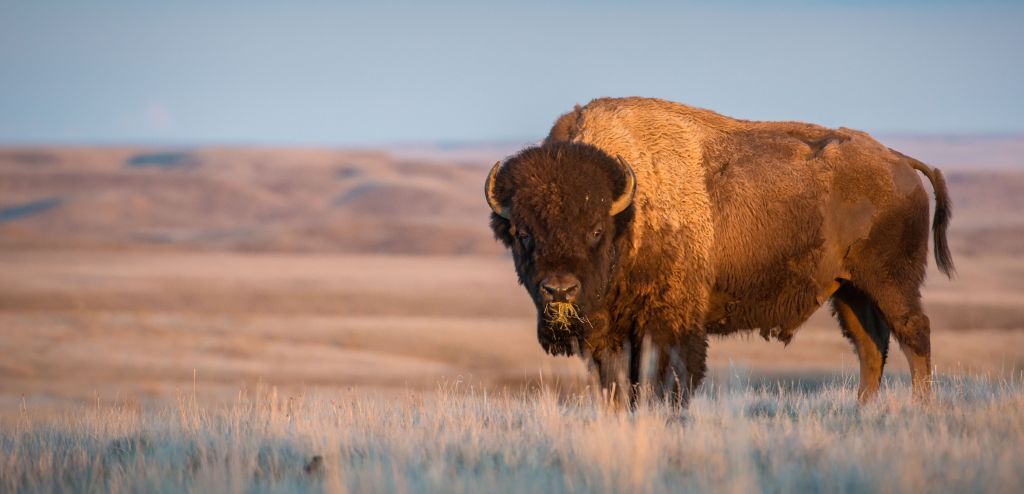
Across North America, roughly 30 to 60 million bison roamed before European colonization led to the expansion of settler communities and agriculture production.7 At the summit, Dr. Leroy Little Bear, elder of the Kainai First Nation and professor emeritus at the University of Lethbridge, shared how restoring bison populations can be a path to Indigenous reconciliation and regeneration.
Indigenous communities are developing approaches to reintroduce bison on reserve land. And it’s paying dividends. The Blood Tribe (Treaty 7) is leading a project to reintroduce plains bison through enhanced land management that includes restoring native grasslands and revitalizing cultural approaches to building a healthy ecosystem, including prescribed burning of grasslands for regrowth. The Blood Tribe now has a 96-animal herd, providing cultural and environmental benefits, and employment opportunities for the band. Overall, the bison population in Canada, primarily concentrated in Alberta and Saskatchewan, has grown by 25% to 150,000 head over the past five years.8 And Agriculture and Agri-Food Canada’s recent three-year, $5-million investment further supports the restoration of bison in collaboration with Indigenous communities across the region.9 This funding was announced at the summit, and will support capacity building in the bison sector, regional learning herd networks to share knowledge and skills, and foster collaboration among communities.
Lisa Ashton is RBC Thought Leadership’s Director of Agriculture Policy.
Statistics Canada. Farm population and total population for rural areas and population centres classified by gender and age, Agriculture–Population Linkage, 2021.
Statistics Canada. The socioeconomic portrait of the Indigenous farm population in Canada, 2021.
Suncrest College. YTC launch Indigenous-led Canola Crushing program, 2025.
Assiniboine Community College. Indigenous learners to receive horticulture training tuition free at Assiniboine, 2023.
Yu X., Natcher D.C., Morrissey, C.A., and Arcand, M.M. First Nations reserve expansion and land cover dynamics since Treaty Land Entitlement in the Prairie region of Saskatchewan, Canada. Frontiers in Environmental Science, 2025.
Saskatchewan Chamber of Commerce. Indigenous Business Directory.
National Park Services. People and Bison, 2024.
Canadian Bison Association. Present Trends.
Agriculture and Agri-Food Canada. Indigenous Prairie Bison Initiative, 2025.