WP Menu

wp-menu

It was abundantly clear at Climate Week NYC last week that momentum for regenerative agriculture is building.

Regenerative agriculture is a key pathway to build natural capital wealth for farmers as they build up assets like soil health, clean water, and biodiversity, and reduce greenhouse (GHG) emissions. Financial mechanisms that mobilize investment in farmer adoption of regenerative agriculture cover a wide range of options—carbon markets, inset schemes, and government subsidies, and more. But they are not available to every farmer, and some, like sustainable finance products, are in their infancy. The market and policy environment that enables regenerative agriculture is therefore evolving.

During Climate Week, RBC Thought Leadership, along with Nature United, presented Unearthing Value, a new report on how nature can play a critical role in pro-growth agendas. Lisa Ashton, RBC’s Director of Agriculture Policy and co-author of the report, spent a few days at the NY conference.

Here’s some of what she heard:

  • Carbon tunnel vision is not all bad. Critics say that focusing solely on the climate benefits (carbon removal, GHG mitigation) of things like cover crops, tillage reduction and improved nutrient management, ignores the many other ecosystem services that regenerative agriculture can offer, including improved productivity, water filtration, and enhanced biodiversity. But this narrow focus has delivered real breakthroughs on GHG accounting, measurement and market access, that might not have happened if there wasn’t a concerted effort from governments, agri-food supply chains and the sustainability sector on the climate action benefits of regenerative agriculture. The breakthroughs in GHG measuring, reporting and verification protocols has provided a platform from which to build other regenerative agriculture benefits. For example, GHG protocols allow for accounting of soil carbon, which is a proxy for soil biodiversity, health, and resilience. This allows for other benefits to be bolted on to climate-focused initiatives like carbon insetting programs.

  • It’s time to get more value from dollars spent on regenerative agriculture. A few landmark investments include the $704 million On-Farm Climate Action Fund in Canada, the $4.2 billion from the United States Department of Agriculture’s Partnerships for Climate-Smart Commodities in the U.S., and PepsiCo’s $300 million-plus investment in regenerative agriculture. These dollars and others have started building the groundwork of socializing the importance of environmental resilience in farming systems at scale, building frameworks for best practices for farmers and agronomists, and agri-food supply chain programs. New dollars can build upon this foundation and go further in delivering funding directly to farmers to drive impact. Partnerships can also help make dollars work harder. Companies, governments, and farmers investing in the same practices and regions can match dollars and leverage partnerships to fill gaps in their own expertise, such as food companies partnering with agribusinesses that already have agronomists on staff to work with farmers on-the-ground.

  • Developing a rigid regenerative agriculture definition may not be a good use of time. There is still a push within the agriculture and sustainability sectors to define it. But drawing a boundary around what is and is not regenerative agriculture may leave some farmers and production systems outside of scope that are indeed adopting practices that deliver on the principle of regenerative, producing positive outcomes for the environment and farmers’ bottom lines. The tone was clear among stakeholders at the conference: focus on delivering programs that work for farmers and create measurable outcomes, and stop worrying about the definition of regenerative agriculture.

1. Product Carbon Footprints. An approach for agri-food companies to track the total amount of GHG emissions associated with the products they are purchasing throughout their journey along the supply chain. This approach differs from carbon offsetting and insetting, as the carbon footprint is directly tied to the food product. Product carbon footprints also allow for companies to achieve several supply chain ambitions, including influencing climate action, building transparency and traceability, and boosting product features for sustainability-minded consumers. While it’s an approach to address the issue of “freeloading companies that haven’t invested in regenerative agriculture, it has its own issues that stem from the granularity in data and supply chain connectivity that is required.

2. Regenerative agriculture is expanding from a business-to-business model to business-to-consumer with labelling on food packaging. Investments in regenerative agriculture has largely been driven by agri-food companies and agribusiness sustainability targets and a desire to build resilience in their sourcing region. Now, consumers are increasingly being engaged on regenerative agriculture labelling. With more front-of-package labelling promoting regenerative practices, consumers can pick products based on their conservation attributes. These labels are often backed by standards like the Rainforest Alliance’s Regenerative Agriculture Certification.

3. Investments in water are growing to build climate resilience. People are experiencing climate change effects most starkly through water. Farmers are no exception. Droughts, more heavy rainfall events, and unseasonal precipitation are adding more volatility to farm management. Investments and strategies to build water resilience in agriculture are growing. Examples include the European Union’s Water Resilience Strategy released in Summer 2025, which features a water saving strategy target for 40% of agriculture land by 2030 and infrastructure investments in irrigation systems in Alberta and the Niagara region of Ontario.

WP Menu

wp-menu

An India-Canada reset is underway, and this time it will require a lot more than handshakes. 

Two years ago, Justin Trudeau sent relations between the two countries reeling. He publicly indicated the Indian government may have been involved in the murder of a Canadian Sikh activist, Hardeep Singh Nijjar, in Vancouver, creating the biggest bilateral crisis in decades. The two governments went on to expel diplomats, froze a range of visa services and suspended trade negotiations. Then came Trump, and a new age of America First that put every other foreign policy second.

This week, the Carney and Modi governments began in earnest a difficult rapprochement that will require some compromise by both. More importantly, it will require them to declare what their mutual interests (rather than shared values) are in an increasingly divided world.

Prime Minister Mark Carney himself opened the door to an interests-based policy when he invited Narendra Modi to the G7 in Alberta, in June. Modi, who was never enamoured with Trudeau, seized the olive branch.

The two governments quickly appointed new high commissioners, and re-engaged on security issues, particularly over the Nijjar case, which they both want to prevent from dominating bilateral relations. 

This week, Foreign Affairs Minister Anita Anand and her Indian counterpart S. Jaishankar met at the United Nations, ahead of a possible visit to India this fall by Anand. And Ottawa quickly moved to action, labelling India’s Bishnoi gang a “terrorist organization,” which will help both countries better police the concerning rise of Indian-based criminal activity in Canada.

All that is good news for those wanting to restore an active partnership, especially for trade and investment. But it won’t be a simple channel change back to a normalized relationship, as the two countries are on different economic, social and geopolitical wavelengths. They’ll have to find some strategic points of interest.

As Canada returns to India, it will need to navigate a more confident and independent power. Canada also needs to recognize that a decade of bilateral opportunities was either lost or fell short. And in that decade, India has changed significantly. 

It has achieved the highest nominal GDP growth among major global economies, while household incomes have nearly doubled, led by rural communities. As the world’s most populous country, India now sees itself as an economic and political power for the mid-century. It’s also quickly becoming one of the world’s most advanced digital nations, with its Aadhaar biometric ID system now covering more than 90% of the population.  

In that decade, Canada added—officially—500,000 people of Indian origin, making South Asia now the largest source of immigration. 

Those two dynamics—rising India and diverse Canada—will require a careful balance.

Carney, so far, has managed to rise above local politics to put Canadian interests at the centre of that balancing act. His government has signalled that a new chapter of India policy will focus first on economic issues, including better guardrails to ensure those interests are protected from diaspora politics.

A more interests-based policy will need to strengthen commercial ties, for both trade and investment. Over the past five years, India has become a strategic option for many Canadians (and others) shifting away from China, even as relations with India chilled and then froze, interest among major investors heated up. Between 2019-2023, Canadian pension funds directed 25% of their investment flows to India, up from 10% over the previous 15 years, as it overtook China to become the second largest destination for Canadian pension funds, behind only the U.S.

Ontario Teachers’ Pension Plan has been at the forefront, investing over the past year in the infrastructure (the National Highways Trust), vehicle finance (Kogta) and AI (Darwinbox). The Brookfield group has been equally active, buying up clean energy assets and telecom sites and, in late September, signing a $1 billion (US) partnership with GIC, a Singapore sovereign wealth fund, to manage more than five million square feet of office space in three major cities, Mumbai, Bengaluru and Hyderabad.

In trade, India has gone from Canada’s 16th largest partner in 2008 to 10th in 2015 to 7th last year.

The same can’t be said about Canada, which ranks only 30th for India. Bilateral trade reached $31 billion in 2024, including services, compared to $117 billion with China. The decline in international students—one of the largest sources of Indian revenue for Canada—will further slow that progress, as Canada’s perceived closed-door policy has tarnished our reputation across a generation of educated Indian youth.  

That’s not the only reason Canada’s quest to restart trade negotiations may require patience. An increasingly confident India—and confident Modi—will not compromise easily, especially over issues like intellectual property rights, which India has long viewed as a form of Western colonialism. 

Those differences aside, the two countries have unique and deep ties, largely through the Indo-Canadian population. Going forward, India will want a more mature relationship, based on interests, especially economic interests. Canada can pursue greater opportunities, too, from heavy oil and LNG to advanced manufacturing and space technologies. 

A renewed relationship will require both countries to recognize what they bring to each other. It can also stress what they can achieve through alliances and multilateral groups. Both Anand and Jaishankar rooted their UN addresses this week in the need for multilateralism in an America First world. India, as a rising second-tier power, and Canada, as a challenged middle power, can both find strength in collective efforts.

Fifty years ago, in 1975, India-Canada relations hit their lowest point after Indira Gandhi’s government tested a nuclear bomb the year before and then declared a State of Emergency. The relationship didn’t recover until Jean Chrétien travelled to India in 1996.

For both countries, too much is at stake for another long winter of discontent. 

WP Menu

wp-menu

➔ New York Climate Week shrugs off U.S. climate retreat

➔ Nova Scotia is going big on wind power

➔ Our Unearthing Value report explores natural capital’s role in pro-growth agendas

New York Climate Week powers on despite clouds over clean energy. The annual event, underway this week, is featuring more than 1,000 sessions across the city, from Arctic to sustainable fashion, adaptation to critical minerals. The event comes amid a major reversal by Washington on several clean energy policies. But the record number of programs and more than 100,000 attendees suggest the push for a greener and cleaner energy transition may not have waned just yet.

Nova Scotia’s Wind West proposal is gaining momentum. The province’s proposed $60-billion, 5,000-megawatt development could position Atlantic Canada as a clean energy hub. Ottawa also believes the proposal is a major projects contender, and is gauging investor interest that could spur renewable power expansion on the East Coast. But, as the strategic plan itself states, “it won’t be easy,” with regulatory challenges and cost competitiveness issues to overcome. Nova Scotia is seeking federal support through investment tax credits and low-interest loans from the Canada Infrastructure Bank and support for the Mi’kmaq Nation to purchase equity in the project. The slew of support measures could lower the project costs to $170 per megawatt hour, compared to the average energy rate of $51.86 per megawatt hour Nova Scotians paid last year.

Australia is pitching itself as a carbon storage hub. Take note, Canada. The nation Down Under is leveraging its geological advantages to become a carbon storage hub for Asia-Pacific. It’s part of Australia’s new Net Zero plan, out last week, that pledges to cut carbon emissions by at least 62% compared to 2005 levels over the next decade. The focus on carbon removal and investment in the technology aims to offset the country’s gas and mining emissions.

Mark Carney’s forthcoming “Carbon Competitiveness Strategy” is an interesting combination of words. Unlike Trudeau-era climate policy labels that centred on carbon reduction—such as “Emissions Reduction Plan” and “Oil & Gas Emissions Cap”—the current Prime Minister’s word choice signals a marked shift on how carbon (its reduction, storage and low-emissions production) can advance Canada’s economy.

As Canada recalibrates its climate policies, here are five questions we are thinking about:

  • What’s the future of the industrial carbon pricing system? Alberta’s freeze on its industrial carbon tax price for 2026 and Saskatchewan’s earlier repeal challenges federal rules. Carney will need to clarify how federal design can sustain investment on clean technologies while managing provincial divergence.

  • How should a Border Carbon Adjustment be managed? Ottawa is weighing carbon tariffs to protect domestic industry from lower-cost, high-emitting imports. But with U.S. trade tensions simmering, its implementation may rankle Washington. As our economist Farhad Panahov wrote in a recent report: “Major discrepancies in carbon pricing with its trading partners can impact Canada’s competitiveness at a time of a structural global upheaval.” Is it even feasible? Could the BCA be a carveout focused on China and other non-NATO trading partners?

  • What’s the future of the oil and gas emissions cap? Scrap, maintain or reimagine? A decision here could be critical for Canada’s energy sector.

  • What will it take to revive clean-tech funding? Several investment tax credits are already in place. What else can Ottawa do to revive flagging funding in Canadian cleantech.

  • Can we meet Paris targets? The Carney government says it remains committed to its 2030 climate goals. But the Canadian Climate Institute recently estimated that the country is off-track. What can Carney, a former UN Special Envoy on Climate Action and Finance, do to turn the trajectory around?

A new electric smart heat pump was rolled out in Canada. Vancouver-based startup Jetson’s Air can be plugged into existing ducts and operate in temperatures as low as -30C. An AI-powered energy manager analyzes weather, energy use, and indoor air quality to save energy—and money. CEO Stephen Lake, who led the smart glasses startup North that was acquired by Google in 2022, says it’s the software that will unlock efficiency gains. It could also be pivotal in making a dent in emissions: Heating emissions account for 13% of energy-related GHG emissions in Canada.

➔ A  McGill University lab spinoff secured $3.5 million from investors for a pilot project to build an iron-based energy storage. If successful, it could dramatically cut diesel and other fossil fuel consumption in heavy industry.

➔ European Union members failed to agree on a binding climate plan ahead of a UN general assembly meeting this week. They instead signed a “statement of intent” to cut emissions by as much as 72.5% by 2035.

➔ Robert Redford, who died last week, was not only a Hollywood icon, but also an activist with a knack of telling stories about a changing climate. His brainchild the Sundance Film Festival showcased several movies on the environment, while his non-profit Redford Centre backed 60 movies on climate action (or inaction), of which 11 were picked up by streaming services.

Nature

More than $78 trillion  of the global economy—roughly half of total GDP—is highly to moderately dependent on nature. Yet, national GDPs count nature only after it is extracted—fish, grain, timber–while mostly ignoring ecosystem services from nature. In our new report, Director of Agriculture Policy Lisa Ashton, writes about how leveraging natural capital can boost pro-growth strategies.

LSome key takeaways from the report:

  • Natural capital remains an underused economic engine. The GDP of Canada’s nature-based sectors, including forestry, agriculture, mining and fisheries, grew 0.3% slower, year-over-year, compared to the rest of the economy over the past quarter century. A similar trend is observed in the United States and the United Kingdom.

  • Ignoring nature threatens prosperity. More than half of the world’s economy, roughly $78 trillion, depends on nature, from food to tourism to construction. Canada, the U.S. and the U.K. are looking to build back their economies, yet their nature base in which their economies rely on for long-term growth is depleting.

  • There is a generational opportunity to leverage natural capital wealth through nation-building agendas. Countries that track and grow natural capital alongside GDP can unlock growth and attract global investors hunting for investable natural capital projects. With finance mobilizing to close the nature finance gap, demand is rising—and an estimated $580 billion is required annually by 2030 and it will be nearly $940 billion by 2050.

  • Private capital is critical to scaling. And yet, governments currently account for 82% ($222 billion) of nature finance. That’s because the private sector needs stronger policy signals and assurance that their investments will generate returns to help close the gap.

  • Nature’s place in finance and environmental markets is growing but remains underrepresented. Nature is a small segment of sustainability finance. In 2025, nature-based carbon offsets represent 13% of voluntary carbon credits to-date, but hold more than half of the annual potential of carbon credit creation.

  • Policy integration, AI, and…yes, accounting can get nature on the balance sheet and growth agenda. For Canada, a timely test for all three is the implementation of the Critical Minerals Strategy and emerging major mining projects.Starting with integrating Indigenous values and knowledge systems in natural capital accounting frameworks.

  • Today, Lisa Ashton is presenting her report  Unearthing Value on the nature economy and moderating a panel with Nature United at the New York Climate Week.

  • This week, the team hosted a delegation of U.S. congressional and embassy officials on the possibilities for enhanced cooperation between the U.S. and Canada on critical minerals.

Curated by Yadullah Hussain, Managing Editor, RBC Climate Action Institute.

Climate Crunch would not be possible without John Stackhouse, Jordan Brennan, John Intini, Farhad PanahovLisa AshtonShaz MerwatVivan SorabCaprice Biasoni, Lavanya Kaleeswaran and Joelle Schonberg .

Have a comment, commendation, or umm, criticism? Write to me here (yadullahhussain@rbc.com)

Climate Crunch Newsletter

WP Menu

wp-menu

➔ Nurturing nature at New York Climate Week

➔ The EV mandate is kicked down the road

➔ General Fusion’s new lease of life comes as global race heats up

The Canada EV mandate is on hold. Another Trudeau-era climate policy suffered a blow when the Mark Carney government paused a rule that mandated automakers to ensure EVs accounted for 20% of sales from 2026. Trade headwinds from the U.S. are partly the reason as is the end of U.S. EV tax credits later this month. Automakers are already reeling from an estimated US$12-billion in tariff costs so far. Several are caught in limbo as they have sunk billions in EV supply chains on a market that’s suddenly lost momentum. It’s a microcosm of the bigger climate-versus-economy debate that’s raging around the world.

The Business Development Bank of Canada is going big on critical minerals. The funding agency’s $200-million Industrial Innovation Venture Fund II, is supporting early-stage startups focused on several areas including key raw materials for clean-energy infrastructure and electric vehicles. Canada needs it: latest data from the Canadian Venture Capital Private Equity Association (CVCA) shows Canadian clean-tech firms raised a paltry $191 million in the first half of 2025, compared to $657 million during the same period last year.

A new global oil rush. Norway likes to imagine itself as the land of the world’s richest—and most ESG-savvy—wealth fund and electric vehicles, but it’s all driven by fossil fuels. But Sylvi Listhaug, whose Progress Party surged to second place in the recently concluded elections, wants Norway to be the “last country in the world to stop (oil) production.” It’s a recurring theme, with Canada among scores of other countries catching the new oil fever. What would it mean for global emissions? Investments in upstream oil was set to fall this year for the first time since 2020, the IEA projects. It could just be a blip.

Dawn Farrell, the first head of the brand-new Major Projects Office (MPO), is tasked with fast-tracking several projects that could raise the country’s emissions—or not, depending on how she navigates the country’s twin environmental and economic imperatives. Could Farrell accomplish Canada’s elusive trifecta of building faster, accelerating sustainable growth, and strengthening national unity?

Her nearly decade-long tenure as CEO of Calgary-based utility giant TransAlta Corp., is instructive on how the executive has operated in the past:

  • Under her watch, which ended in March 2021, the utility transitioned from coal to natural gas, as part of an industrywide transition to reduce emissions.

  • By 2021, TransAlta had completed the full conversion of Keephills Unit 2, Keephills Unit 3 and Sundance Unit 6 from thermal coal to natural gas.

  • The energy transition impacted coal workers, with several provincial communities tapping the Coal Community Transition Fund.

  • By the end of 2021, TransAlta had cut GHG emissions by 70% from 2005 levels, and exceeded the national 2030 emissions targets in Canada, the U.S. and Australia where it operates.

  • TransAlta transformed into one of the largest producers of wind power in Canada and the largest producer of hydro power in Alberta—growing renewable energy capacity from around 900 MW in 2000 to over 2,800 MW in 2021.

The TransAlta journey gives Farrell the cred to help streamline several projects, but now she must elevate it to a national level, where several competing interests—federal, provincial, First Nations and corporations—are jostling for attention.

Oil pipelines, LNG projects, and several renewable energy projects are being proposed, but here are Farrell’s overarching challenges:

  • Bringing investor confidence back: The MPO will need to prove Canada can build again—and sustainably. The office will need some early wins to see global capital dip its toes back into Canada.

  • Looking past Trump: Yes, there’s a POTUS-sized cloud hanging over Canada, but Europe (hello, Germany), Japan and emerging economies also want our resources. The next wave of projects will need to be pointing east and west, with buy-ins from consuming countries.

  • Aligning provincial priorities: Another big rock. If Farrell can get B.C., Alberta and Quebec on the same page, Canada could become a resource superpower.

  • Bringing Indigenous groups into the fold: Moving beyond lip service to actual partnerships with Indigenous communities could be the MPO’s most enduring achievements.

An ocean-based carbon removal tech is making waves. Nova Scotia-based Planetary Technologies recently struck a $43.3-million deal with Frontier Climate, which is backed by Shopify, Google, and Meta. The aim? Remove 115,211 metric tonnes of CO₂ between 2026 and 2030 by adding alkaline minerals—like calcium oxide and magnesium oxide—to coastal waters. The process accelerates natural absorption of CO2 and promises storage for over 10,000 years. Frontier believes it can bring the current price tag of roughly US$270 per tonne to US$50–$160 by leveraging existing infrastructure at coastal power plants. It will also preserve marine ecosystems and involve local communities, including the Mi’kmaq Nation.

The dream is alive at General Fusion. The Richmond, B.C.-based, nuclear fusion hopeful recently raised $30 million, after recently enduring layoffs and scaled-back operations. The funds will power its LM26 fusion demonstration program, targeting operational temperatures of 10 million degrees Celsius—an essential step on the path to commercial fusion. Shopify CEO Tobi Lütke’s Thistledown Capital and Saudi JIMCO were among investors that backed the round. The lifeline for Canada’s sole fusion company comes as investors injected US$2.6 billion over the past year across 52 other companies globally, including 29 in the U.S. alone. And the race to crack the fusion tech code is heating up: China National Nuclear Corp. set up a $2-billion China Fusion Energy Co. in July, followed soon by Massachusetts-based Commonwealth Fusion Systems, the world’s largest private fusion company, raising US$863 million in a new round.

Carbon capture is like trapping a genie in a bottle—but it could escape. A new peer-reviewed study published in Nature estimates that the world can trap a mere 1,460 gigatons of carbon dioxide-compared to previous estimates of as much as 40,000 Gt (roughly a year’s worth of CO2). Structural geological faults and poor well construction could dampen the efficacy of carbon-capture tech, the study notes. That still leaves plenty of jurisdictions with viable geology and expertise to capture carbon. Around US$4 billion has already been invested in carbon capture, utilization and storage (CCUS) facilities in 2024 with more than 50 metric tonnes of CO2 capture capacity currently operational—with few leaks reported so far. In addition, the report identifies Canada and the U.S. as “better placed” than Europe to implement geologic storage solutions.

Power On: Hard choices, real consequences. Sounds about right as the theme of this year’s New York Climate Week starting September 22. The event, which is fast rivalling the annual COP events, brings financiers, environmentalists and policy wonks together in one of the Big Apple’s worst traffic jam seasons.

Lisa Ashton, our Director of Agriculture Policy, will be in attendance. She will be speaking at the Nature Hub on September 24th at an event co-hosted by the RBC Climate Action Institute and Nature United.

Nature contributes US$33 trillion to the global economy—equivalent to the value of global trade in goods and services. Yet, nature’s role in the economy beyond its extracted resources—fish, grain, and timber—are not accounted for in national GDPs, leaving a source of economic growth and risk on the sidelines. Here’s a sneak peak of some early themes emerging in Lisa’s upcoming report on the nature economy:

  • Natural capital is underutilized as an asset in economic growth. The GDP of Canada’s nature-dependent sectors grew 0.6% slower, year-over-year, compared to the rest of the economy over the past quarter century.

  • There are real risks in overlooking nature’s role in building prosperity. Canada, the U.S., and the U.K. are looking to build back their economies. Yet, their nature base is depleting. The U.K., for example, is stressing its water assets, with the government projecting a 5- billion-litre-per-day gap in water availability by 2055.

  • Pro-growth agendas present opportunities to value and build natural capital. Nature is now a reportable risk and an investable asset class—ready to be integrated into major investment and infrastructure projects.

“In an era of reindustrialization, all opportunities for durable growth need to be on the table. A timely consideration as countries around the world are struggling to raise capital to manage, protect, and conserve their natural capital,” says Lisa.

Curated by Yadullah Hussain, Managing Editor, RBC Climate Action Institute.

Climate Crunch would not be possible without John Stackhouse, Jordan Brennan, John Intini, Farhad PanahovLisa AshtonShaz MerwatVivan SorabCaprice Biasoni, Lavanya Kaleeswaran and Joelle Schonberg .

Have a comment, commendation, or umm, criticism? Write to me here (yadullahhussain@rbc.com)

Climate Crunch Newsletter

WP Menu

wp-menu

The federal government is launching Build Canada Homes (BCH) this fall with an ambitious goal: to double the current pace of construction in Canada to almost 500,000 new homes per year.

Here are six things that will be key to BCH’s success as it aims to tackle the country’s housing crisis:

The extent to which quick progress can be made by BCH will depend on two critical ingredients: agreement on the problem and precision on what “affordability” means.

In August, Housing, Infrastructure and Communities Canada (HICC) released a ‘Market Sounding guide’ to engage sector stakeholders. And while it offers some identifiable signals, it stops short of defining the specific housing problem that BCH aims to solve. This ambiguity leaves things open to interpretation and may result in misaligned expectations from the different audiences being asked to provide feedback.

Furthermore, housing affordability is based on various factors including income and location. It remains to be seen if BCH will prioritize building and financing non-market “affordable” housing or if its remit will be much broader. Honing in on precise intended outcomes will be critically important–focusing on addressing affordability for those whose needs are not met by the market requires a different set of approaches than aiming to address affordability for Canadians overall.

BCH’s impact will rely on convening housing stakeholders to work together in genuine partnership. All levels of government—federal, provincial and municipal—must row together to ensure funding and regulatory levers align. This will require a clear articulation of BCH’s contribution to getting more housing built in relation to other efforts across government, including within a wider housing plan at the federal level.

Partnership must also extend beyond government. Bringing together core players across the private, public and non-for-profit sectors to create a clear roadmap, and in short order, is no small endeavour. Equally important is meaningful collaboration with Indigenous partners, as rights-holders, to address the unique and considerable housing challenges faced by Indigenous people both on- and off-reserve. In theory, BCH could be a solid platform for joint action, but outcomes will ultimately be determined by the effectiveness of partnerships in practice. 

Canada’s housing policy framework is already complex, with multiple agencies, ministries and levels of government playing important roles. As it stands at the federal level, a department (HICC) and two Crown Corporations (Canada Mortgage and Housing Corporation (CMHC) and Canada Lands Company) are deeply embedded in the design and delivery of housing policy and programs. To be effective, the federal government must be clear on how BCH will complement, not compete with, established organizations with deep institutional expertise, in addition to effectively coordinating housing policy across other jurisdictions and relevant policy areas, including immigration, infrastructure and the environment.

Creating a federal body requires new legislation, governance structures, staff, and systems for accountability and oversight, before the first BCH-supported units will even begin to be developed. Moving too quickly risks creating a structure that is duplicative, under-resourced and poorly integrated within the current context. At the same time, costs associated with establishing a new institution will be significant, raising the question of whether those resources would be better channelled through existing mechanisms. While pressing action on housing affordability is needed, government will engender greater trust by being transparent about what can feasibly be accomplished and by when.

At the core of BCH’s objectives lies a fundamental tension: how to build quickly and at scale while also advancing innovative techniques and improving productivity. Delivering large volumes of new housing quickly will mean understanding which levers to pull and prioritize with existing, more traditional approaches for more units to get built. It will also be essential to indicate what progress should look like with proven, but less utilized technologies, such as modular and prefabricated construction, while layering in experimentation with other less-established methods, materials or financial tools.

Capacity, capability and demand will also factor in as key considerations across regions. What will improvements on the innovation front look like in Whitehorse in relation to Winnipeg? Overall, the test for BCH will be whether it can scale what already works while experimenting in parallel, ensuring that progress is both rapid and attuned to regional differences.

Tariff-related increases in the cost of imported materials pressure budgets and risk delaying projects, while unpredictable supply chains make it difficult for industry to commit to new builds. Prioritizing domestic materials and regional production hubs, as the Market Sounding guide emphasizes, is noteworthy but could impact costs and timelines. Government and industry will need to navigate these pressures strategically to deliver affordable and high-quality housing without interruption.

BCH poses opportunities for stronger coordination, increased innovation and, ultimately, improved affordability for Canadians. Success, however, hinges on its ability to bring partners together to rapidly execute and deliver on its ambitious objectives, against the backdrop of an uncertain economic environment. Lack of agreement or clarity on the ways to collaboratively move forward will reduce trust and hamper results, potentially creating even greater challenges.

WP Menu

wp-menu

➔ Canada’s EV battery plan is supercharged

➔ The electric-jet era takes off at Billy Bishop airport

➔ How to unsettle scientists

Canada’s EV battery vision takes shape. Volkswagen’s Canadian battery arm PowerCo is pushing ahead with its St. Thomas, Ontario, gigafactory, with two construction contracts. The plant is slated to start production in 2027. But it’s more than a construction milestone, it’s a signal that Canada’s high-stakes bet on EV supply chains is materializing despite tariff skirmishes and uncertain demand. For Ottawa and Ontario, the real test will be whether it can give Canada a foothold in North America’s evolving battery supply chain. 

Energy ambitions clash with sustainability. Ontario’sproposal to connect Alberta and Saskatchewan oil and gas to refineries in Southern Ontario and tidewater ports, including a new deep-sea port on the James Bay coast, is facing Indigenous pushback. Their key concern: They feel “invisible.” The Indigenous Resource Network is also concerned they are seen as roadblocks to project development, when in fact “they are in fact part of the solution,” the IRN noted. This will be a recurring challenge as Canadian governments look to fast-track projects. Canada will need to get Indigenous groups on board to avoid project delays.

Scientists are unsettled. The U.S. Department of Energy (DoE) stunned the climate academia world with a new report that suggested “CO2-induced warming might be less damaging economically than commonly believed.” Talk about unsettling the science community. Several websites including Nature and Carbon Brief have published pointed ripostes, but the new DoE report is challenging accepted wisdom on climate. Will the UN’s Intergovernmental Panel on Climate Change (IPCC) move swiftly with a rebuttal? Its next assessment report is not due till mid-2028.

Ksi Lisims LNG project is ready for its spotlight. The Indigenous-backed project is waiting for an environmental assessment (EA) order from the B.C. government that could potentially see the natural gas export project proceed. The province’s ministers of environment and parks and energy are set to decide by September 7.

Here’s how the project could impact Canada’s economy, emissions and energy:

Who’s behind it:  The Nisga’a Nation, a self-governing First Nation on the Pacific Coast. Western LNG, backed by an affiliate of investment heavyweight Blackstone Inc., is a partner.

Location: Right next to the U.S. border on Pearse Island.

Timelines: The EA was expected by Q4 2024, so we are already playing catchup. The original application placed construction between Q2 of 2025 to Q4 of 2027, with operations beginning in 2028 (till at least 2058).

Project description: Two floating LNG facilities, each with liquefaction processing units. Once fully complete, the project will handle up to two billion cubic feet per day (bcfd) and export around 12 million tonnes per annum of LNG.

Who’s opposing it: The project faces opposition from several environmental groups and Indigenous groups, including the Gitanyow Hereditary Chiefs and Lax Kw’alaams Band.

Related infrastructure: An environmental certificate has been issued for the 780-kilometre Prince Rupert Gas Transmission (PRGT) project, which Nisga’a and Western bought from TC Energy in 2024. If PRGT rings a bell, that’s because it was the key conduit for the now-defunct Malaysian energy giant Petronas’s LNG project proposal back in 2014. It was approved even then, with amendments in July to address new environmental concerns.

What about the project’s emissions: The development expects to be net-zero ready by 2030, subject to an electricity agreement with BC Hydro. Project proponents say it would contribute 0.02% of B.C.’s emissions and 0.002% of total Canadian emissions.

Is that good?: The project claims to have a lower well-to-port emissions intensity compared to U.S. Gulf Coast projects (0.76–1.19 tonne of carbon/tonne of LNG lower). At full production, Ksi Lisims LNG would emit 9–14 million tonnes less CO2e per year than a U.S. Gulf Coast terminal project.

Is this the future of electric aviation?

RBC Thought Leadership’s Energy lead Shaz Merwat was on the Billy Bishop Toronto City Airport runway last week as Beta Technologies Alia CX300 rolled out an all-electric aircraft. The conventional takeoff/landing aircraft can be configured either as a passenger or cargo aircraft. Here are some cool specs:

  • Passenger capacity: 5 passengers

  • Cargo capacity: 1,250 lbs. of cargo

  • Maximum demonstrated range: 336 nautical miles (i.e., Toronto to Sarnia, or Calgary to Okanagan region)

  • Max speed: 280 km/hour (Cessna 172 can top 344 km/hour)

  • Charge Time: <1 hour

  • Energy cost: $18 per hour of flight time (Cessna 208: $347 per hour)

  • Emissions: At least 75% less emissions than a conventional small aircraft

  • Uses: Short-haul cargo and corporate travel

The CX300 photographed above is the cargo variant, and fourth off the production line with final delivery to Air New Zealand. The carrier will use the aircraft for regional cargo routes.

Billy Bishop is arguably already one of North America’s most sustainable airports, and is on a path to fully electrifying its vehicle fleet, including shuttle buses, ground vehicles, towing, etc.

To learn more about decarbonizing aviation, listen to the episode of RBC’s Disruptors Podcast on the topic with Angela Avery, Executive Vice President, Chief People, Corporate & Sustainability Officer at WestJet Group and Geoff Tauvette, Executive Director at the Canadian Council for Sustainable Aviation Fuels (C-SAF).

Canada’s turning its chill into an advantage. Ottawa recently injected $2.5 million in TerraFixing’s direct air capture (DAC) tech—aimed at extracting CO₂ in remote, wintry zones where low temperatures actually enhance efficiency. It’s an inventive way to turn Canadian winters into an advantage. If TerraFixing can prove cold-weather DAC works at scale, it could give Canada an edge in the global carbon-capture arms race.

A new “cli-fi” take on extreme weather. Sarah Hall’s Helm, is the latest novel in the new climate fiction genre that blends “atmospheric principles” with folktales to paint a picture of humans’ relationship with nature. Meanwhile, eco-warrior Bill McKibben, who once wrote a book with the grim The End of Nature title, returns with a surprisingly upbeat Here Comes the Sun: A Last Chance for the Climate and a Fresh Chance for Civilization.

Curated by Yadullah Hussain, Managing Editor, RBC Climate Action Institute.

Climate Crunch would not be possible without John Stackhouse, Jordan Brennan, John Intini, Farhad PanahovLisa AshtonShaz MerwatVivan SorabCaprice Biasoni, Lavanya Kaleeswaran and Joelle Schonberg .

Have a comment, commendation, or umm, criticism? Write to me here (yadullahhussain@rbc.com)

Climate Crunch Newsletter

WP Menu

wp-menu

➔ The worried, the hopeless and the climate-conscious

➔ King Coal’s long rein continues

➔ A global gridlock’s holding back renewables

Hot takes

Climate literacy for the worried and the hopeless. Ottawa plans to invest14.4 million in 17 projects to boost environmental literacy among young people. It ranges from $1.8 million for BC Parks Foundation to inform students about biodiversity loss and several programs that combine climate science with traditional Indigenous knowledge. We are going to need all of it: A recent study shows Canadian youth are wallowing in “worry and hopelessness” in response to climate change.

Carbon Upcycling is a step closer to cracking the cement emissions challenge. The Calgary-based startup recently broke ground on Canada’s first commercial-scale carbon capture and utilization facility at partner Ash Grove’s Mississauga cement plant. Opening in 2026, the $10-millionproject will capture kiln CO₂ and convert it, along with other industrial byproducts, into up to 30,000 tonnes a year of low-carbon cement materials. Funded by federal programs and venture firm CRH Ventures, the initiative aims to embed circular economy solutions into heavy industry. Also read our 2024 case study on Carbon Upcycling.

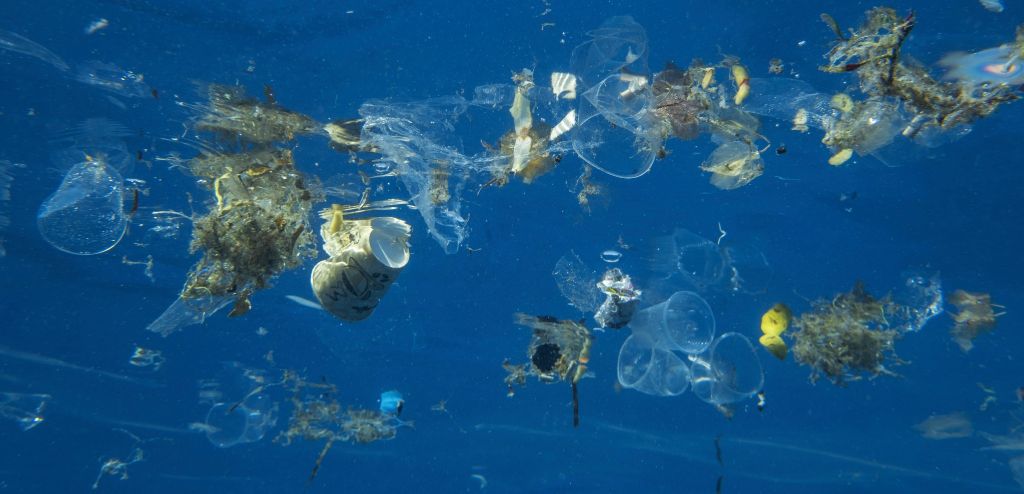
UN plastics treaty talks are on the brink. There was limited consensus among delegates of 179 nations after a 10-day marathon on global plastic pollution that ends today. The scale of the problem is massive, with straws, cups and stirrers, carrier bags and microbeads among the single-use products clogging up oceans and threatening marine life. The 2,000-plus delegates are poring over 32 clauses in a draft text, but, some say, countries can’t even agree on the definition of “plastic pollution.”

Saskatchewan Premier Scott Moe was the latest target of an AI deepfake video that falsely showed him promoting cryptocurrencies. It’s not just a public menace—it has implications for the climate.

Some AI models gobble up 20.4 million joules to generate a 30-second video, according to data extrapolated from an MIT study —that’s enough to power an electric vehicle for 18 kilometres. Eight million AI deepfakes could be shared online this year—doubling every six months, according to Open Fox, a law-enforcement consultancy. Add to it millions of meaningless, misleading and near-malicious AI-concocted videos that litter the Internet (countries as mythical monsters , anyone?). It’s not nothing: One 30-second video per day, for a month, would be the equivalent of adding 40% to a typical one-bedroom apartment’s utility bill, according to energy policy lead Shaz Merwat who wrote about AI’s power needs last year.

AI’s demand on power grids is already formidable:

➔ Datacentres will account for 20% of electricity demand growth to 2030 in advanced economies, the International Energy Agency estimates.

➔ Emissions from data centres could rise from 180 million tonnes today to 300 metric tonnes (Mt) by 2035 in IEA’s base case, with 500 Mt as a higher estimate—roughly 2.5x the emissions of Canada’s oil and gas sector.

➔ The United States now has the largest pipeline of gas-fired power plants in development globally, surpassing China—with a fifth to power data centres.

➔ Given the exponential use originating from image and video queries, most likely over time, we could see tiered pricing for heavy data users to match users’ data use for heavier AI tasks, Merwat said.

Felippa Amanta, who published a study on the AI deepfake challenge for Oxford University, goes a step further: “The deepfake’s effect on climate information and emotion will be much more significant than the direct energy to produce the deepfake.”

Spot the resilient fossil fuel in the chart below. Old King Coal set a new demand record last year, with coal-for-power generation also hitting its highest level ever. Trade in the carbon-intensive commodity also broke records in 2024. Coal is the world’s most carbon-intensive fossil fuel, with emissions on average 50% higher than natural gas.

Here are some coal trends that suggests it will endure for some time:

  • China accounts for 56% of global demand, but India and the U.S. is expected to see production rise.

  • The U.S. is considering several regulations that were poised to limit coal use in power generation. A Trump executive order also lifted “unattainable emissions controls” for coal plants to ensure energy security.

  • The IEA expects global coal consumption to plateau in 2026, but rise 5% in the fast-growing ASEAN region.

  • Despite coal’s resurgence, the IEA expects renewables-based electricity generation to overtake coal-fired generation in 2025.

Ballard is powering through a global hydrogen reckoning. The Vancouver-based company that’s been plugging away at hydrogen tech since 1979, launched its second major shake-up in less than a year. It underscores the pressure hydrogen fuel cell companies face after years of hype. Under new CEO Marty Neese, Ballard is pivoting to a narrower set of applications where its technology has proven traction, like transit buses and stationary backup power. The 30% operating cost cut target for 2026 suggests that the pace of hydrogen buildout has been slower than the market—or Ballard’s earlier strategies—anticipated.

A global gridlock is stifling renewable energy. Nearly 40% of Scotland’s wind power capacity was curtailed due to grid constraints over the past six months. That’s the latest setback in a long list of renewable and affordable power being held back by a gridlock. For every dollar invested in renewable power, just 60 cents go to grids and storage—the ratio should be one-to-one, the UN estimates, noting that there’s three times more renewable energy waiting to be plugged into grids than was added last year.

Solar and wind are getting eclipsed. The White House’s war on renewables has seen projects valued at US$22-bilion scrapped in the first six months of 2025, according to E2 data . That’s 16,500 in jobs lost during the period. On the heels of the Big Beautiful Bill that would see low-carbon energy credits phased out faster, a new federal order subjects wind and solar projects to greater scrutiny as it “denigrates the beauty of our Nation’s natural landscape.” It echoes Alberta’s no-go zone directive last year.

WP Menu

wp-menu

The Trump administration’s sweeping AI Action Plan, released last week, moves the global AI race into a new realm. It’s no longer just a race between OpenAI and Google; it’s a geopolitical contest that the world’s greatest tech power is doubling down on, as it seeks to influence (and dominate) the digital decades ahead.

Canada will need to move fast.

Here’s what stands out to me in the Trump policy:

  • Jurisdiction. Big data (and AI) is inherently global and local. And now Trump wants to unshackle Big Tech from state-level regulations on AI. Mark Carney may soon face the same challenges with the provinces, as he tries to develop a “one economy” approach to so many things. Both Carney and Trump will face push back if and when the big platforms move into health and education data—seen to be subnational jurisdictions in both countries. But in very different ways, they will need to figure out how to balance individual, local, national and global, in an AI age.

  • Ideology. Trump is aiming to “de-woke” AI models. I’m not sure how you do that, especially if you want to avoid some kind of version of thought police patrolling algorithms. I’m not suggesting AI models shouldn’t be accountable to public standards, including free speech. We just don’t know how to temper what we’ve unleashed, other than to prosecute developers under the law, just as we do with other forms of speech. Whatever your view, the Trump policy begins a new chapter in the politicization of tech.

  • Investment. A gold rush is underway for data centres and will continue to draw billions of dollars. Trump is laser-focused on keeping and building them in the U.S. Canada can continue to feed that model with our energy, financial capital and data—or build our own competitive strategy. I recently talked with a major investor who is waiting (and waiting) for approval for a mega-billion-dollar Canadian data centre, while he’s moving ahead with similar state-side projects. Data waits for no government.

  • Sovereignty. This may be the most challenging one for Canada. The U.S. and Chinese models, and clouds, have become so big and powerful it’s hard to imagine other countries creating anything to rival them. But there’s a chance for Canada. We have global tech leaders, in OpenText, Shopify and Cohere, and some competitive advantages in our own data sets, especially in health care. Is there a moonshot opportunity to build a Canadian rival? And will that require the same sort of techno-nationalist policies we’re seeing emerge in the U.S. and Europe.

As America aims to dominate AI, Canada will need our own human ingenuity to thrive in this new digital order.

WP Menu

wp-menu

➔ AI gets all the attention, but the AC is also a major power drag, too

➔ Canada’s ghost emissions

➔ David Suzuki and Chris Wright’s starkly different world views

Hot takes

Ghost emissions are climate change’s untold story. Globally, emissions from Land Use, Land-Use Change and Forestry (LULUCF) are tracked but not included in a country’s emissions inventory. While emissions from managed lands are included, emissions from unmanaged lands are excluded as they are triggered by events beyond human control-such as wildfires. But they are formidable: Wildfire on just managed lands had emissions in 2023 that surpassed Canada’s total accounted emissions-by a lot. This year’s LULUCF emissions could rack up, too. By June 2nd, total estimated wildfire emissions for Canada were second only to 2023, with approximately 56 megatonnes of carbon (or 8% of Canada’s GHG emissions in 2023), according to the EU CAMS Global Fire Assimilation System. That’s years of painstaking climate action wiped out in weeks. This highlights a fundamental tension in Canada’s climate policy: most of the attention has been on emissions mitigation; less attention has been paid to climate adaptation. And we are all paying the price.

Is it time for a $100-billion Pathway + pipeline package? Alberta and Ottawa are making progress on a big energy package that could include a West Coast oil pipeline, the long-contemplated Pathways project to capture carbon emissions, and room for expanded oil production, writes John Stackhouse from Calgary. But Mark Carney’s team may need to finesse its way out of the previous Liberal government’s oil and gas emissions cap. That could involve a new target, or delayed timeline, or a refined approach to measuring abated emissions. The package’s headline costs could also be sobering—up to $100 billion.

The Texas tragedy underscores the frequency, and intensity, of floods. More than 80% of Canadians live in urban areas, and around 8 out of 10 major Canadian cities are located in proximity to flood zones, according to the federal government. Floods are already Canada’s costliest natural hazard in terms of property damage, causing $2 billion in destruction annually, as climate change supercharges weather conditions. As part of a greater National Adaptation Strategy, Ottawa is spending  $164.2 million to update Canada’s flood mapping program by 2028. Will it be enough?

David Suzuki and Chris Wright’s recent comments highlight the tension between environmentalists and some energy proponents. Canada’s veteran environmentalist told iPolitics recently that its “too late” to reverse climate change as policymakers are focused on economic growth, not nature. Meanwhile, U.S. Energy Secretary Christ Wright sees the climate crisis as a byproduct of progress, not an existential threat. “I am willing to take the modest negative trade-off for this legacy of human advancement,” he wrote in The Economist. Policy is often driven by political cycles, with energy proponents winning this round. However, the next political cycle is around the corner.

Power-hungry data centres get all the attention, but the humble air conditioner is also a major strain on grids. As summers get more oppressive in Canada and around the world, the International Energy Agency expects air conditioners to be a top driver of global electricity demand, with air-conditioner ownership worldwide rising from 37% to 45% by 2030.

Here’s why cooling is emerging as a critical climate issue:

➔ Cooling generated just over 1 gigatonne of carbon emissions globally in 2022 (1.9% of total). Space cooling could also lead to leakage of refrigerants, which have a global warming potential of around 1,000 times higher than CO2.

➔ 2Energy demand for space cooling globally is growing at 4% annually, twice as fast as water heating. This is putting pressure on power capacity, especially as countries like Canada strain to keep their grids clean.

➔ In Canada, the percentage of households with an air conditioner hit 64% in 2021, compared to 55% in 2013. That’s even more impressive given the surge in households over the past decade.

➔ Buildings account for 18% of Canada’s total emissions. Of these, space heating and cooling represent more than 67% of building energy use.

➔ One in 10 Canadian households had a heat pump (which, of course, double up as air-conditioners) in 2021, from virtually zero a few years prior. Heat pumps are 4.5 times more efficient than conventional air conditioners, making them a key pillar of climate action.

➔ Residential heat pump imports jumped 71% in Canada in Q1, compared to the same period last year, the Heating, Refrigeration and Air Conditioning Institute of Canada (HRAI) data shows.

➔ Federal and provincial Canadian policymakers are considering building codes that would stipulate at least one room with an air conditioner in a home.

➔ Access to cooling is emerging as a human rights issues, especially after nearly 600 people died in a Vancouver heat dome event in 2021.

➔ “An important driver of activity is climate-change mitigation, driven mostly by policy, rebate programs, incentive,” says Martin Luymes, Vice President, Government & Stakeholder Relations at HRAI. For instance, federal rebates led to record heat pump sales, which then dropped off when the programs ended. Several provinces including Ontario, B.C., and Nova Scotia continue to offer rebates, helping sustain interest.

➔ The Canadian HVAC industry sees the possible termination of the Energy Star program in the U.S. as a “major mistake,” says Luymes, noting that the program, which promotes energy-efficient products including air conditioners, as valuable, low-cost consumer guidance tools. Experts say scrapping or weakening Energy Star could harm climate progress.

Sign up to receive RBC Thought Leadership’s newsletter, major reports and analysis on the biggest ideas shaping Canadian business and the economy.

Donald Trump’s signature 2025-26 budget bill is now law. The legislation changes several clean energy tax incentives that were managed under the Inflation Reduction Act (IRA), tightens domestic content requirements, imposes new qualification deadlines and sunsets other tax credits that could impact Canadian cleantech firms eyeing opportunities across the border.

Here’s the good, the bad and the ugly of the OBBBA:

Carbon capture: The bill maintains credits for carbon capture, but also provides incentives for captured CO2 for oil production, underscoring the administration’s commitment to the fossil fuels industry.

Nuclear: The bill maintains credits for both existing nuclear facilities and new advanced energy technologies. However, new foreign entity provisions could inject uncertainty in the sector’s growth. The legislation is supported by an earlier executive order that targets a quadrupling of U.S. nuclear capacity from 100GW to 400 GW by 2050.

EVs: Electric vehicle manufacturing and competitiveness will be “hard hit,” according to the Center on Global Energy Policy, noting that the law could reduce domestic demand for EVs, jeopardize battery investment and allow China and other foreign competitors to gain greater market share.

Clean grid: Solar and wind power was particularly hard hit as historic investment and production tax credits sunset earlier than before. The law would reduce the build-out of new clean power generating capacity by 53-59% through to 2035, according to the Rhodium Group. An executive order following the OBBBA directs the U.S. Treasury Secretary to eliminate subsidies for “unreliable green sources like wind and solar,” that it believes is threatening national security. A separate executive order directs the Treasury Secretary to end “market-distorting subsidies for unreliable, foreign controlled energy sources.”

Critical minerals: Metallurgical coal is nowdeemed a “critical mineral,” allowing it to qualify for a production tax credit. The law also broadly reduced 45X Production Tax Credits for critical minerals to 2033 (compared to no limits before), which would pose a challenge as most critical minerals projects require long timelines. The Center for Strategic & International says the “amended tax credit disincentivizes investment in newly discovered greenfield projects with longer timelines to production in favour of brownfield legacy mines that may be closer to production but have lower grade reserves.”

China is the world’s energy transition workhorse. Around 74%, or 1.3 terawatt, of the world’s new wind and solar capacity is being built in the country, with the U.S. a distant second with 5.9% of all new projects, and India third at 5.1%, according to Global Energy Monitor. The 590GW of new Chinese wind capacity proposed or underway could power nearly all U.S. households. China’s inevitable cleantech dominance poses a conundrum for the West, as suggested by EU President Ursula von der Leyen earlier this month: “Beijing is at once a staunch competitor in the clean tech race, and a vital partner for global decarbonization.” A fractured G7 can’t keep Chinese tech out for too long.

Straddling cleantech and AI. Founded by veteran tech investor Nicholas Parker, CleanAI recently launched a networking and financing ecosystem for entrepreneurs and businesses intersecting AI and clean-tech. CleanAI research shows that the artificial intelligence-enabled cleantech solution space would require US$138 billion over the next five years and could mitigate up to 10% of global greenhouse gas emissions.

The Institute In Action

  • Last week, John Stackhouse visited Limberlost Place, Ontario’s first mass timber, net-zero carbon emissions building, to participate in a documentary about the project. The George Brown College building is set to open this fall in Toronto.

  • On July 15th, Nathan Janzen and Lisa Ashton gave a keynote presentation at the Dairy Farmers of Canada Annual General Meeting in Toronto.

Books on the team’s reading list:

  • Genesis, Henry Kissinger, Craig Mundie and Eric Schmidt, on AI’s transformative powers, in politics, security, prosperity and science. Read John’s review here.

  • The Explorer’s Gene: Why We Seek Big Challenges, New Flavors, and the Blank Spots on the Map, by Alex Hutchinson.

Curated by Yadullah Hussain, Managing Editor, RBC Climate Action Institute.

Climate Crunch would not be possible without John Stackhouse, Jordan Brennan, John Intini, Farhad PanahovLisa AshtonShaz MerwatVivan SorabCaprice Biasoni, Lavanya Kaleeswaran and Joelle Schonberg .

Have a comment, commendation, or umm, criticism? Write to me here (yadullahhussain@rbc.com)

Climate Crunch Newsletter

WP Menu

wp-menu

➔ A Silicon Valley of direct air capture set to debut in Alberta

➔ Global abundance: Exploring the New Energy Age

➔ Brazil is cooking up sustainable soybeans for China

Hot takes

The Silicon Valley of direct air capture is taking shape in central Alberta. Quebec-based Deep Sky, backed by a US$40-million grant from Bill Gates’ Breakthrough Energy, is opening its direct air capture innovation and commercialization centre in Innisfail in central Alberta this summer. The facility—seen as a hub for direct air capture activities—will serve as a sandbox for firms to test direct-air carbon-sucking technologies before they scale their operations commercially. Eight companies—from Canada, the U.S. and Germany and others—have already signed up. In a vote of confidence, the Alberta government also recently invested $5 million in DeepSky from the province’s Technology Innovation and Emissions Reduction Regulation (TIER) fund.

Ontario is crafting a new wood construction strategy. The recently announced Advanced Wood Construction Plan aims to promote wood use in larger and taller structures to accelerate projects, lower costs by as much as 20%. Swapping cement and steel with wood would also help lower emissions in a sector that accounts for 18% of Canada’s total emissions. Widespread adoption of wood, specifically mass timber, as a substitute or complement to concrete and steel could cut embodied emissions in buildings by as much as 25%, according to our report Mass Timber. The five-year plan comes as the province’s $20-billion industry is facing punitive U.S. tariffs.

Forecasters are scrambling to assess demand from data centres in the U.S. Electricity demand is now set to grow 25% by 2030 and 78% by 2050, compared to 2023 levels, according to a new report by ICF, a consulting firm. That’s an annual growth rate of 3.2% through 2030 (1.4% previously) and 2.2% (1.1% previously) through 2050 and contrasts with the past two decades when U.S. electricity demand was essentially flat. The strain on capacity could lead to a doubling of electricity prices by 2050, ICF warns. Texas, along with California and PJM region (covering 13 mid-Atlantic and Midwest states)—markets already importing Canadian electricity—will see the highest demand growth.

Brazil is developing bespoke, sustainable soybeans for China. Inspired by its successful Boi China beef model, the Latin American country aims to develop “Soy China,” through a supply chain that aligns with China’s environmental standards and runs on renewable energy. It’s also seen as a way for China to counter the EU Deforestation Regulations (EUDR), which have much stricter rules. Many countries (inside and outside the EU) have raised concerns about the EUDR because of its stringent traceability requirements that do not align with conventional soybean supply chains. And Brazil and China’s move is alternate route for soybeans to flow. The U.S. Department of Agriculture recently warned that sustainable soybeans would directly challenge American and Canadian exporters’ market share in China.

Nature capital: Canada’s other green power

By Lisa Ashton

As climate change disrupts the U.K.’s landscapes—from the Scottish Highlands to the Somerset Wetlands—the country is facing a £97-billion ($181-billion) nature asset deficit. The Green Finance Institute (GFI) estimates that planned public spending on conservation and restoration by the government is well short of delivering on its binding commitments, including the 25-year Environment Plan and the U.K.’s 30×30 targets under the UN Biodiversity targets. It also presents real risks and losses of between £150-£300 billion of U.K.’s GDP by 2030. The U.K. government is now seeking ideas from businesses, investors, and innovators to protect the “natural foundations of its economy,” and spur growth in its “burgeoning” nature services sector.

Canada can draw lessons from the U.K. experience. It’s home to landmark investments in several initiatives including the Great Bear Sea project finance for permanence (PFP), and watershed policy commitments to protect and conserve 30% of Canada’s land and water by 2030.

Canada’s is truly a nature powerhouse with riches that are second to none:

➔ It’s one of just five countries that collectively contain more than 70% of the world’s remaining intact ecosystems;

➔ 20% of the world’s total freshwater;

➔ 25% of the world’s wetlands;

➔ 24% of the world’s boreal forests;

➔ the world’s longest coastline;

➔ the world’s longest coastline;

➔ ecosystems in Canada provide essential habitat for approximately 80,000 species.

But, Canada, like many others, has not been able to unlock nature finance at scale to address declining natural capital as a share of GDP—roughly 70% in 1995 to about 40% today—and mitigate the risks associated with a natural environment that’s experiencing more deterioration than the U.S. and the U.K. Wildfires year-to-date alone could risk 0.4% of Saskatchewan’s GDP and 0.2% for Alberta, according to Statistics Canada estimates.

Nature finance is in its infancy, but a pathway to build natural capital in Canada and investments is slowly being charted. In 2022, the Government of Canada issued its first green bond, valued at $5 billion, with a portion of funds going to nature-based projects including financing that supports the adoption of climate-smart agriculture practices.

Exploring nature finance is an opportunity to build greater resilience in Canada’s natural resource dependent economy driven by fuel, food, fertilizer and forestry production.

Sign up to receive RBC Thought Leadership’s newsletter, major reports and analysis on the biggest ideas shaping Canadian business and the economy.

Gas flaring in Alberta is raising alarms among health professionals. The Canadian Association of Physicians for the Environment (CAPE ) Alberta chapter cited research that shows a 1% increase in flaring exposure led to a 0.73% rise in respiratory-related hospital visits. The warning comes after Reuters reported that gas flaring blew past the province’s self-imposed limit on annual natural gas flaring in 2024, for a second year in a row. In June, the Alberta Energy Regulator said it was ending limits on flaring.

Overcapacity is reinforcing steel’s hard-to-abate reputation. Around 30% of steel capacity remains unused globally, an excess that’s sent prices plunging to a four-year low. With margins under pressure, steelmakers are hardly in the mood to decarbonize. The problem is set to worsen: more than 40% of new steelmaking capacity—mostly from “non-market” forces such as China—that’s set to enter the market by 2027 will be emission-intensive, according to an OECD report . Strengthening international co-operation to address excess capacity and market distortions will be vital to improve the outlook for steelmakers in market economies, the OECD recommends. That would give steelmakers the space to advance decarbonization efforts. New anti-dumping tariffs in Canada and the U.S., primarily aimed at China, is also an opportunity to establish a green steel market.

Plastic bag bans and fees are making a difference. Several U.S. jurisdictions that enforced these policies have seen a 25-47% dip in plastic bags as a share of total items collected in shoreline cleanups, according to an extensive University of Delaware and Columbia University study. The ban also reduced the number of animals entangled along the shoreline. Still, plastic pollution overall remains a growing challenge. The final round of a Global Plastics Treaty is set for August in Geneva.

The New Energy Age

By John Stackhouse

More, more, more energy.

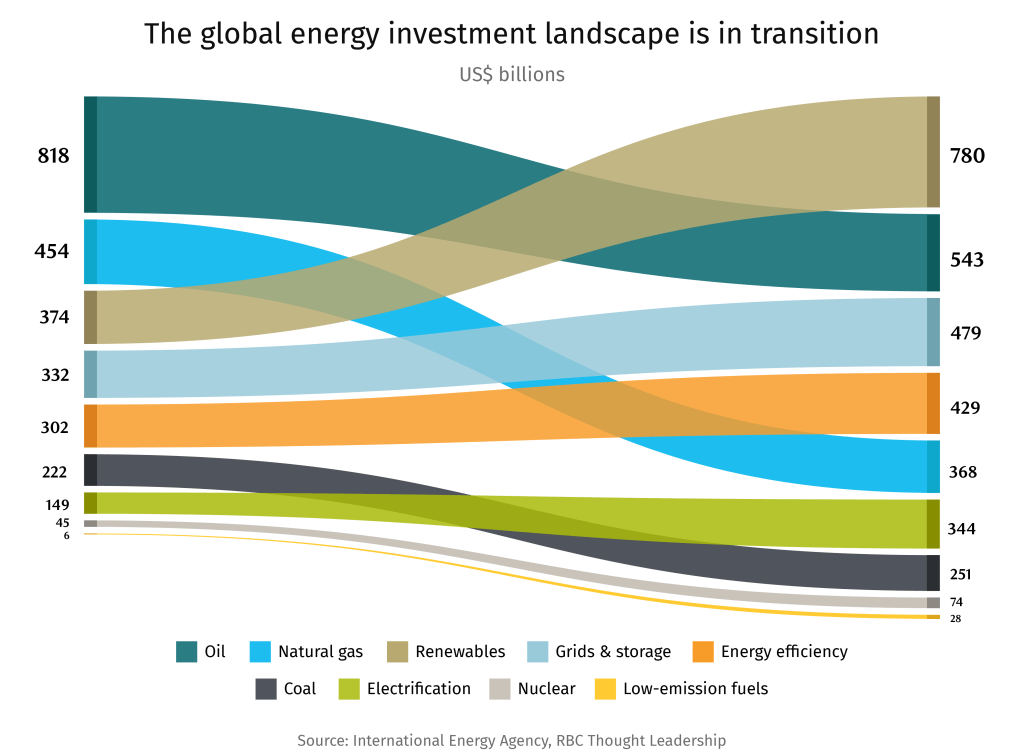
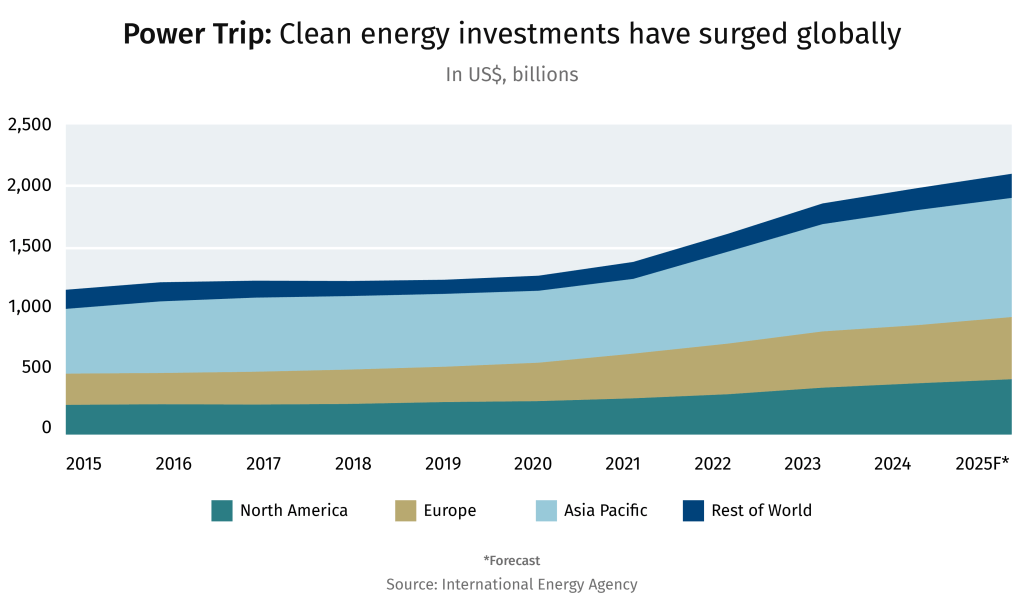
That was the big message in the IEA’s 10th annual investment report.

The International Energy Agency (IEA) tracks investment flows for all forms of energy, and this year is more relevant than ever, given the volatility we’ve seen in energy prices this decade. While a slower global economy may temper some investment patterns, what gets built today will shape energy patterns in years to come.

Some highlights:

  • Capital flows to the energy sector are on course to reach US$3.3 trillion this year.

  • China is leading the energy investment surge, accounting for nearly a third of global investment, split almost evenly between grid and storage, renewable power and fossil fuels.

  • North America saw a record US$700 billion in investments in 2024, but will see pullback to US$690 billion this year. Clean energy investment is at an all-time high.

  • Would the U.S. new “big, beautiful bill” that guts several clean energy incentives, and Canada’s Bill C-5, that promotes clean and conventional energy projects, move the needle on energy investments?

  • The biggest use of investment globally is electrification, which will consume almost half ($1.5 trillion) of all energy capital.

  • Only a third of investment will go to oil, natural gas and coal:

  • lower oil prices are likely to keep investment down;

  • LNG investment is on “a strong upward trajectory,” led by the U.S., Qatar and Canada;

  • nuclear’s renaissance continues, rising by 50% over the past five years;

  • coal-fired power in advanced economies has ground to a halt, while it’s showing a comeback in China and India.

The bottom line is the world will continue to need to invest trillions a year in energy, across a wide array of sources. As that continues, some long-term trends are clear—more energy investment will go to Asia, especially China; more will go to electrification; and as our new report, “A G7+ Strategy for Natural Gas,” lays out, more will go to gas infrastructure.

Countries that develop the right policies will generate and attract the bulk of that capital, in what’s shaping up to be a New Energy Age.

The Institute In Action

  • John Stackhouse and Lisa Ashton visited the Kelburn Farm in Manitoba in late June. The demonstration farm operates out of the Red River Valley, a growing hotspot for agri-food innovation. The Kelburn Farm is a place for farmers, students, researchers, and companies along the agri-food supply chains to test and trial new ideas that are advancing Canadian agriculture.

  • Shaz Merwat was at the RBC Energy Transition Conference in London last week. He also attended a virtual International Energy Agency Conference on certified natural gas this week.

On the team’s reading list:

  • Crisis: A Global Case Primer, by Jason Miklian and John Katsos, on leading when things are falling apart.

  • Shaz Merwat was at the RBC Energy Transition Conference in London last week. He also attended a virtual International Energy Agency Conference on certified natural gas this week.

Curated by Yadullah Hussain, Managing Editor, RBC Climate Action Institute.

Climate Crunch would not be possible without John Stackhouse, Jordan Brennan, John Intini, Farhad PanahovLisa AshtonShaz MerwatVivan SorabCaprice Biasoni, Lavanya Kaleeswaran and Joelle Schonberg .

Have a comment, commendation, or umm, criticism? Write to me here (yadullahhussain@rbc.com)

Climate Crunch Newsletter