

 EN



“It’s hard to bet against the US economy” has been our core narrative this year, and fundamental pillars remain intact, but inflation is making it harder to ignore the cost of this strength.
The inflation pipeline is heating up at every stage, the Federal Reserve has begun to tighten, cracks amid consumers are unevenly distributed, and the cost of doing business is rising.
Rate hikes will work to tamp down demand-driven price pressures, but they also warrant close monitoring of an unintended consequence: Higher interest income flowing to upper-income consumers and retirees, supporting the very cohort that is arguably the least rate-sensitive and most responsible for the spending keeping consumer inflation elevated.
We still expect a total of 75 basis points of tightening including September’s increase, but now expect the remaining to be delivered by the end of Q1 2027 rather than year-end. A slower pace buys the Fed time, particularly since a resolution of the Iran conflict—not the federal funds rate—is key to cooling supply-driven inflationary pressures dominating the current backdrop.
The US economy isn’t breaking—but the price of staying on this path is getting steeper. The unemployment rate (U3) did tick up to 4.2%, though the move was largely a rounding artifact, and every alternative measure of unemployment—U1 through U6—held steady or improved.
The real challenge is inflation. Risks are rising, and elevated bond yields pose a broader challenge beyond the household sector. Businesses and governments face higher debt-servicing costs with varying lags, and those more leveraged are particularly sensitive.
For governments, rising debt-servicing costs generally mean one of three things: Spending cuts, tax hikes, or larger deficits. Bond yields have risen significantly recently, and concerns over fiscal sustainability are mounting. Rising interest rates feed directly into the fiscal challenge, materially worsening the debt-to-GDP trajectory from an already concerning baseline.
The pain of higher rates, meanwhile, is unevenly distributed—households taking on new debt feel the impact first. As existing borrowing continues to renew and new debt is added at higher rates, effective borrowing costs across households should trend upward, pushing the debt-service ratio higher despite relatively low overall household indebtedness measured by debt-to-income.
September CPI is just the tip of the iceberg
The Consumer Price Index delivered an uncomfortable upside surprise. Core inflation rose 0.3% month-over-month, and the year-over-year pace re-accelerated to 2.6%. Core goods’ prices were particularly problematic. Categories dominated by imports recorded some of their largest monthly price gains on record.
This is a tariff and transportation cost story that is only beginning to show up in consumer prices. The pipeline looks more concerning, and the breadth is confirmed across indicators: the ISM price indices, Producer Price Index (PPI), NFIB price data, and import price index all point in the same direction.
Freight costs remain exceedingly elevated, and for most product categories, higher costs appear to be passed on to consumers—supported by positive trade services margins.
The uncomfortable reality is that the September CPI doesn’t fully capture upside risks still building from tariffs and energy prices. Our base case forecast of 2.5% core CPI in 2026 remains intact, but there are signs of more problematic energy-price spillover across a range of categories, especially as more than half the CPI basket continues to run at 3% or above.
-
Supply chain and transportation cost pass-through is the top risk to a goods’ price acceleration. PPI is reporting alarmingly high freight costs across land, air, and sea: Deep-sea freight costs surged 37% year-over-year, general freight trucking is up 17%, and air transport of freight is up 6%. In September alone, transportation and warehousing jumped 3.4% month-over-month, suggesting margin pain is acute. Import prices excluding petroleum climbed 0.8% month-over-month—a sign that inflation is spreading beyond energy.
-
Tariffs and import inflation remain a problem. Toys and recreational goods recorded their largest-ever monthly CPI increases in September, and meaningful holiday discounts look unlikely—adding to the risk of further acceleration this year. The pass-through will intensify as pre-tariff inventories wind down and IEEPA refunds conclude.
-
Core services disinflation is not a viable offset. Core services excluding housing have never run negative year-over-year, and monthly declines are exceptionally rare. That means we should not count on help from services to push inflation lower. Moreover, Social Security recipients face a 3.6% cost-of-living adjustment in January 2027, injecting spending power into a cohort driving the bulk of services demand, notably in health care. Concerningly, the housing reprieve has largely passed; further tightening risks worsening the longer-term prospect of housing inflation reaccelerating with new supply limited by high rates and input costs.
Growth outlook
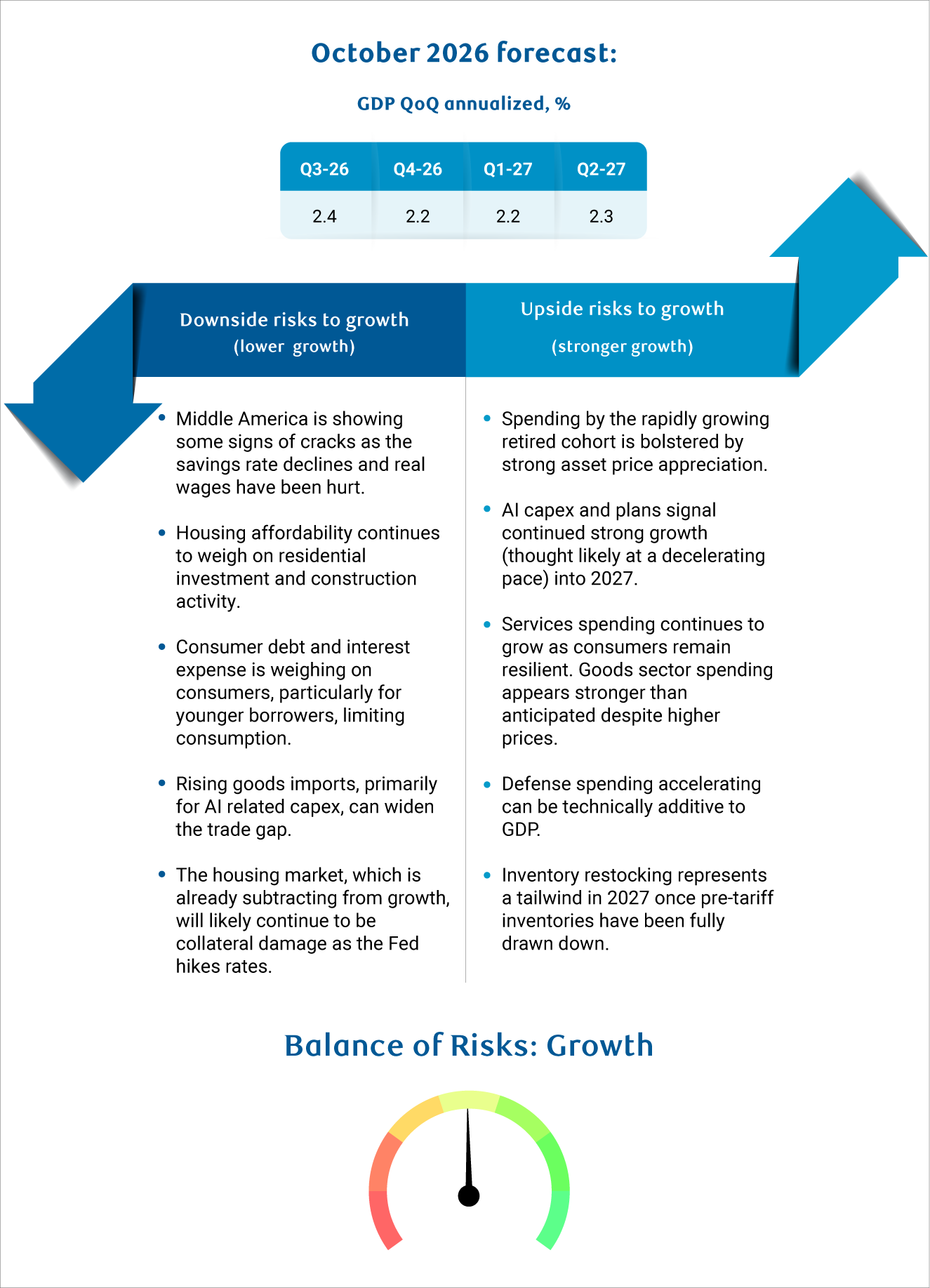
House view: US resilience continues with underlying growth slightly above the 2% trend, though diverging trends persist beneath it. AI continues to drive the entirety of the business investment story: Spending on information processing equipment and data center infrastructure has surged, while capex outside of AI remains exceptionally weak. For consumers, headline inflation is eroding purchasing power and a Fed hiking cycle will weigh on those debt exposed. With energy prices elevated, we view risks to the economy as roughly balanced with downside surprises still possible should energy inflation spill over more meaningfully to other sectors.
Inflation outlook
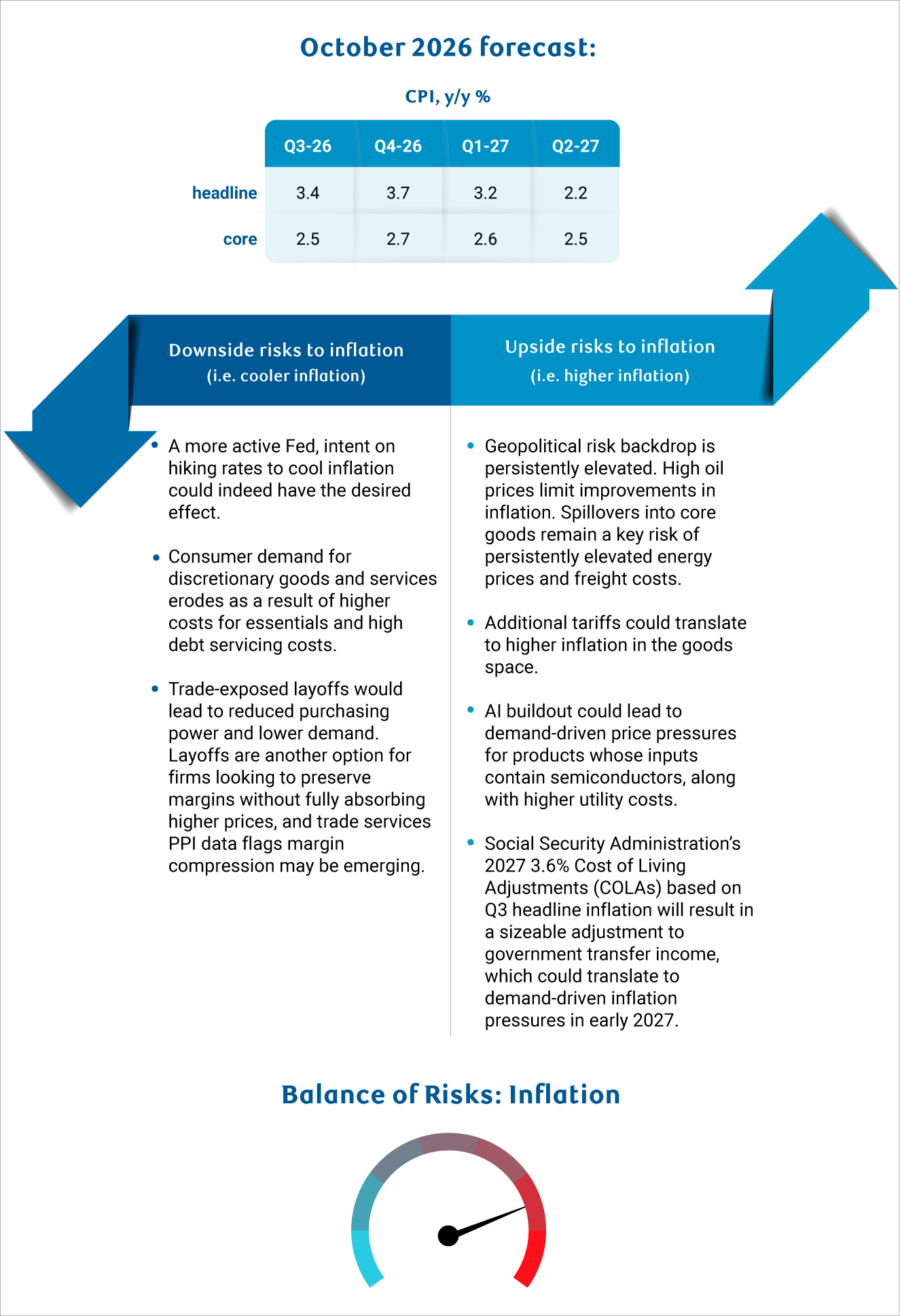
House view: Inflationary pressures remain broad and persistent with energy prices elevated and tariffs still in the picture. Freight costs look concerning and appear to be spilling over into the core goods sector, risking a re-acceleration of core inflation. Housing disinflation has run its course, and we expect housing inflation is a longer-term risk due to lack of supply. Importantly, the Fed returning from the sidelines does not guarantee that primarily supply-driven inflation will be tamed. We also acknowledge these hikes may produce undesirable side effects for lower- and middle-income consumers. Traditionally, hikes would work to protect against a demand-driven inflation spike. But with non-labor income of growing importance, new risks emerge. If inflation cools at the same time that we get the inflation-adjusted 2027 Cost of Living Adjustments (COLAs) for Social Security income, the risk remains that benefits meant to support retirees fuel broader price increases.
Labor market outlook
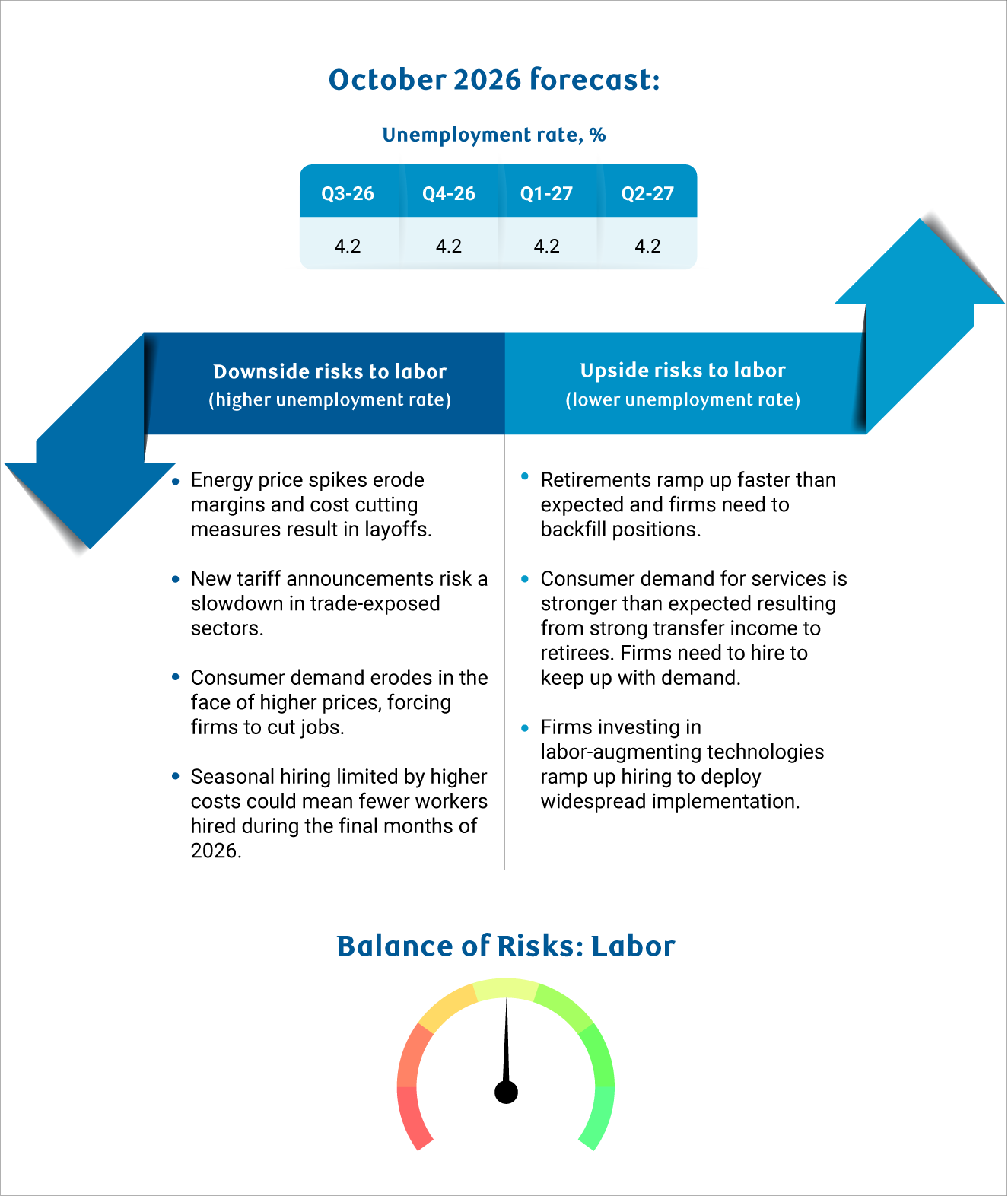
House view: We continue to expect structural factors will keep the US labor market very tight. Monthly hiring has outpaced expectations in recent months—especially in the context of exceptionally low breakeven employment. But the backdrop remains mixed. Employment in some white-collar sectors remains in decline, contributing to a significant skills-matching problem facing new graduates. The unemployment rate gives us the best gauge of labor market health and it remains exceptionally low—at 4.2%. Still, retirements have driven the unemployment rate lower recently. If we do see a reversal of this trend, re-entrants could drive a slight uptick in the unemployment rate. But extremely low jobless claims and minimal WARN notices suggest there isn’t sizeable risk currently of an uptick in layoffs.
About the authors:
Frances Donald is the Chief Economist at RBC and oversees a team of leading professionals, who deliver economic analyses and insights to inform RBC clients around the globe. Frances is a key expert on economic issues and is highly sought after by clients, government leaders, policy makers, and media in the US and Canada.
Mike Reid is Head of US Economics at RBC. He is responsible for generating RBC’s US economic outlook, providing commentary on macro indicators, and producing written analysis around the economic backdrop.
This article is intended as general information only and is not to be relied upon as constituting legal, financial or other professional advice. The reader is solely liable for any use of the information contained in this document and Royal Bank of Canada (“RBC”) nor any of its affiliates nor any of their respective directors, officers, employees or agents shall be held responsible for any direct or indirect damages arising from the use of this document by the reader. A professional advisor should be consulted regarding your specific situation. Information presented is believed to be factual and up-to-date but we do not guarantee its accuracy and it should not be regarded as a complete analysis of the subjects discussed. All expressions of opinion reflect the judgment of the authors as of the date of publication and are subject to change. No endorsement of any third parties or their advice, opinions, information, products or services is expressly given or implied by Royal Bank of Canada or any of its affiliates.
This document may contain forward-looking statements within the meaning of certain securities laws, which are subject to RBC’s caution regarding forward-looking statements. ESG (including climate) metrics, data and other information contained on this website are or may be based on assumptions, estimates and judgements. For cautionary statements relating to the information on this website, refer to the “Caution regarding forward-looking statements” and the “Important notice regarding this document” sections in our latest climate report or sustainability report, available at: https://www.rbc.com/community-social-impact/reporting-performance/index.html. Except as required by law, none of RBC nor any of its affiliates undertake to update any information in this document.

