

 EN
EN 


Bottom Line:
The September upside to core inflation (+0.3% m/m) did very little to quell fears of an increasingly problematic inflation backdrop. And the uncomfortable reality remains that the September report does not fully capture the upside risks stemming from both tariffs and geopolitical conflict translating to higher energy prices. Higher energy prices drove headline inflation +0.6% m/m, bringing year-over-year price growth to 3.7%. At 2.6% y/y, core inflation is still too high and re-accelerating. The breadth of inflationary pressures accelerated in September, and it is becoming increasingly difficult to discount the current inflation backdrop as driven by one-off idiosyncrasies.
At this juncture, we have likely already benefited from a reprieve in housing disinflation. And cost-of-living adjustments to Social Security will provide a tailwind for a group of consumers that is already driving the bulk of inflation.
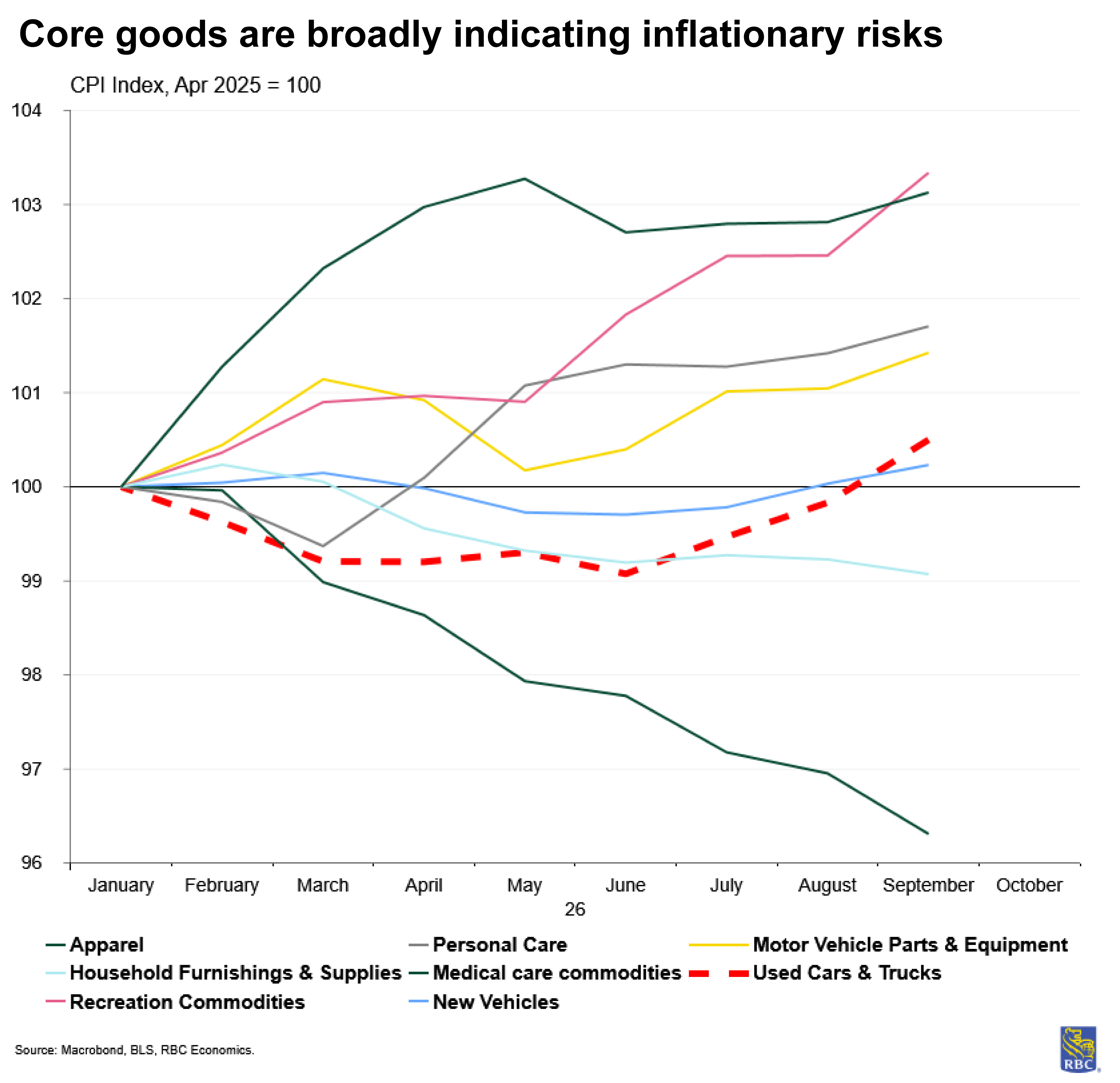
The core goods acceleration was broad. Used cars marked a third consecutive increase with clear momentum. New vehicles, a slight deceleration. And a combination of tariffs and transportation costs are now showing up in recreation commodities – though we likely have not seen the full extent of it just yet. Both toys and other recreational goods – products that are largely imported – posted their largest-ever monthly changes.
Focusing on the September CPI report, here’s what stood out:
SIGNAL (what matters most)
-
Both core goods (+0.3% m/m) and core services (+0.4% m/m) were problematic in the September report.
-
Within core goods, used cars (+0.7% m/m) have begun to accelerate (now for three consecutive months). Higher prices for motor vehicle parts and equipment (now +0.4% m/m) are also spilling over to prices for new vehicles (+0.2% m/m). And motor vehicle maintenance and repair costs are rising consistently – collateral damage of higher prices for parts and equipment. These trends will be problematic for auto insurance down the line, which will need to account for higher car prices and parts used for repairs.
-
Apparel (+0.2% m/m), recreation commodities (+0.9% m/m), and education and communication commodities (+0.9% m/m) – driven by prices for computers, peripherals, and smart home assistants – all reported outsized price growth in September as the breadth of inflation accelerated. This is an import story, since the categories of goods reporting the highest price increases, like clothing, toys, and computers, are produced abroad.
-
Supercore inflation rose +0.4% m/m in September (after a sizeable uptick in August as well) – the year-over-year pace has accelerated to 3.1%.
-
OER was up +0.3% m/m. We have consistently witnessed month-over-month growth in the 0.2-0.3% m/m range in this category, and we anticipate that the bulk of disinflation has already been felt (in the summer months) given lags between Zillow and NAR data and CPI measures of OER.
STATIC (the ongoing themes)
-
Prices for most essentials are rising above the Fed’s 2% target – which will weigh on lower-and middle-income consumers. Housing prices are up +3.3% y/y, accelerating yet again, and medical care services are still +2.5% y/y, to name a few.
-
The good news is that grocery prices are not yet problematic. But the bad news is, this is a category where we anticipate we will see spillovers from higher energy prices should they remain elevated. Freight services PPI has spiked and serves as a precursor to broader CPI spillovers.
-
At the same time, we now have Q3 CPI-W at 3.6% y/y, meaning that retirees receiving Social Security transfers will get a sizeable 3.6% cost-of-living adjustment in January 2027. This will continue to support exceptional services demand.
-
The September inflation data alone suggests upside risk to core PCE, though September PPI data (landing tomorrow), specifically for medical care services and airfares, will be critical in determining the trajectory of PCE.
NOISE (distortions and one-offs)
-
Recreation services accelerated +0.3% m/m in September. Some of this is likely a one-off. Purchase, subscription, and rental of video rose +0.6% m/m after a few major streaming providers (Disney and Hulu) raised monthly subscription prices.
About the authors:
Mike Reid is Head of US Economics at RBC. He is responsible for generating RBC’s U.S. economic outlook, providing commentary on macro indicators, and producing written analysis around the economic backdrop.
Carrie Freestone is a Senior US Economist at RBC. She is responsible for generating RBC’s US economic forecasts across GDP, employment, and inflation, and providing macro commentary through publications, presentations, and the media.
Imri Haggin is an US Economist at RBC, where he focuses on thematic research. His prior work has centered on consumer credit dynamics and treasury modeling, with an emphasis on leveraging data to understand behavior.
This article is intended as general information only and is not to be relied upon as constituting legal, financial or other professional advice. The reader is solely liable for any use of the information contained in this document and Royal Bank of Canada (“RBC”) nor any of its affiliates nor any of their respective directors, officers, employees or agents shall be held responsible for any direct or indirect damages arising from the use of this document by the reader. A professional advisor should be consulted regarding your specific situation. Information presented is believed to be factual and up-to-date but we do not guarantee its accuracy and it should not be regarded as a complete analysis of the subjects discussed. All expressions of opinion reflect the judgment of the authors as of the date of publication and are subject to change. No endorsement of any third parties or their advice, opinions, information, products or services is expressly given or implied by Royal Bank of Canada or any of its affiliates.
This document may contain forward-looking statements within the meaning of certain securities laws, which are subject to RBC’s caution regarding forward-looking statements. ESG (including climate) metrics, data and other information contained on this website are or may be based on assumptions, estimates and judgements. For cautionary statements relating to the information on this website, refer to the “Caution regarding forward-looking statements” and the “Important notice regarding this document” sections in our latest climate report or sustainability report, available at: https://www.rbc.com/community-social-impact/reporting-performance/index.html. Except as required by law, none of RBC nor any of its affiliates undertake to update any information in this document.

