

 EN



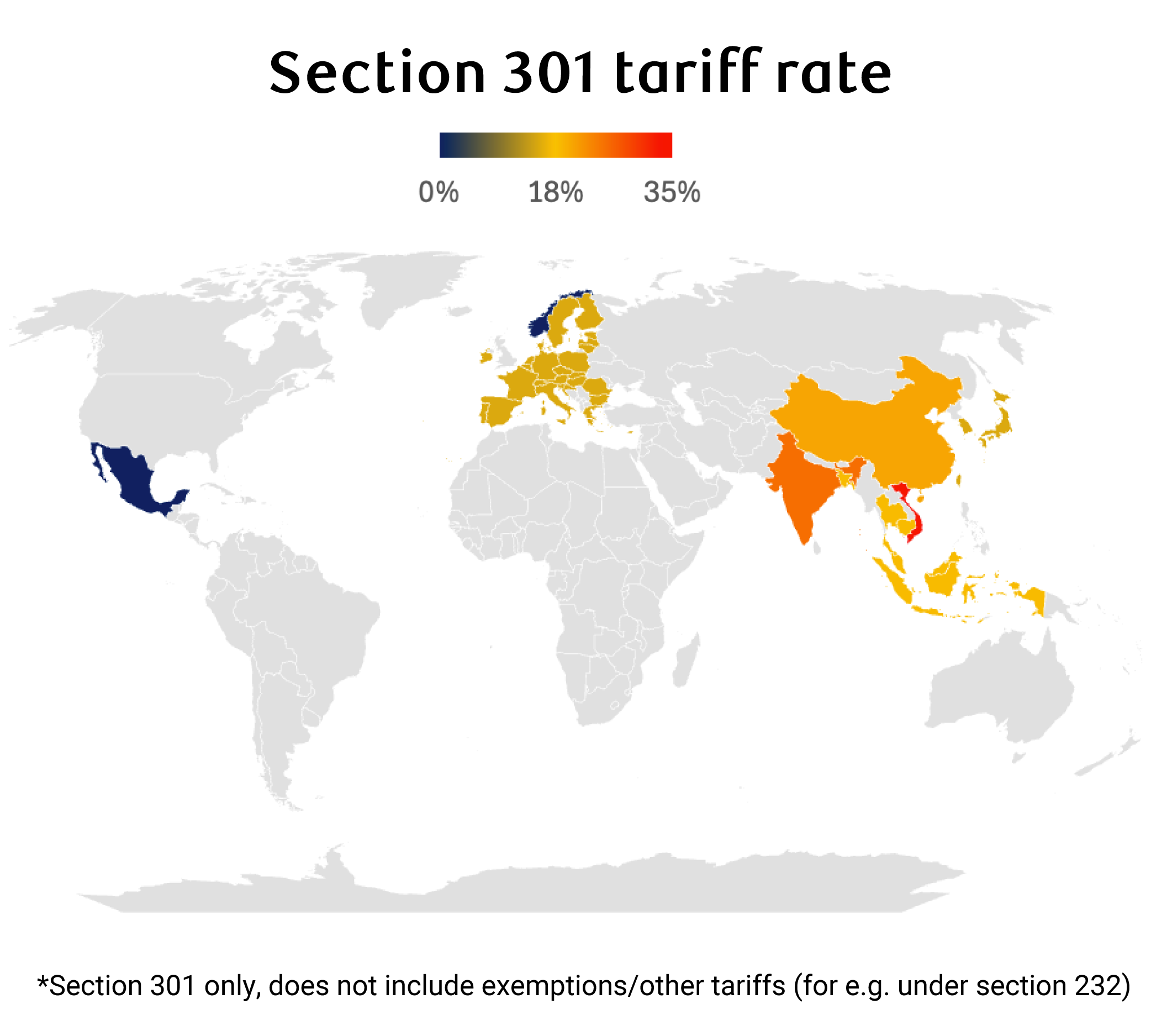
We have long said that tariffs are not going away. Following the Supreme Court decision that struck down sweeping tariffs using International Economic Emergency Powers Act (IEEPA), the administration has taken a new approach. The recent announcement by the US Trade Representative Greer highlights a fresh round of tariffs using Section 301 investigations. The targeted economies include China, the European Union, Singapore, Switzerland, Indonesia, Malaysia, Cambodia, Thailand, South Korea, Vietnam, Taiwan, Bangladesh, Japan, and India. No determination has been made for Mexico or Norway at the time of writing.
The proposed Section 301 tariffs will top up pre-existing duties, while still respecting the tariff ceilings agreed to in earlier talks. Overall tariff rates for the EU, Japan and South Korea are expected to remain at or below 15%, while China’s is expected to stay below 20%. The proposed tariffs won’t take effect immediately, but even with the delay, our base case for inflation has not changed.
The inflation impact is building in the pipeline
We continue to believe the inflationary impact from tariffs is underappreciated. How much of the tariff cost has already passed through to consumer prices is up for debate, but in our view, the full effect has yet to show up in the consumer inflation data. But the pressure in supply chains is building. PMI readings indicate an elevated price environment that require their prices to move higher. The share of small businesses planning to raise prices is growing. And the PPI data confirms this: it accelerated to 6.5% y/y in October.
With core CPI already at 2.6% y/y and core PCE running at 3.3% y/y, tariffs, if anything, add upside risk to an already challenging inflation backdrop. We maintain our view that core consumer inflation is more likely to end 2027 closer to 3% than the Fed’s 2% target.
Data distortions will continue to add to uncertainty
Part of the delayed pass through appears to be strategic. A massive inventory buildup in Q1 2025 helped many business to stock up supplies prior to tariffs going into full effect. However, that plan has run its course – following five consecutive quarters of decline (which has NEVER happened outside of a recession), inventories increased in Q3 2026, which suggests pre-tariff stockpiles have largely been drawn down. As inventories are rebuilt at post-tariff prices, business costs will continue to rise.
The trade deficit is not improving
There is little evidence to suggest tariffs have been successful in reducing the US trade deficit. In fact, US imports have increased risen since Liberation Day. The goods trade deficit was reported to be $135.9 billion in September, compared with an average of around $100 billion in 2024. Indeed, the value of imports from China have fallen, but a ramp-up in imports from other countries with relatively high tariff rates, including Taiwan, India, and Vietnam have more than made up for it.
Meanwhile, domestic output is growing slowly. US industrial production has risen modestly since 2024 apart from a few sectors associated with the AI buildout (computer and electronic products, primary metals) and aerospace, and capacity utilization has made no improvement since 2024. So far, tariffs have raised costs without rebuilding domestic capacity, and the latest proposals are unlikely to change that.
About the authors:
Mike Reid is Head of US Economics at RBC. He is responsible for generating RBC’s US economic outlook, providing commentary on macro indicators, and producing written analysis around the economic backdrop.
Carrie Freestone is a Senior US Economist at RBC Capital Markets. Carrie is responsible for projecting key US indicators including GDP, employment, consumer spending and inflation for the US. She also contributes to commentary surrounding the US economic backdrop which she delivers to clients through publications, presentations, and the media.
Imri Haggin is an Economist at RBC Capital Markets, where he focuses on thematic research. His prior work has centered on consumer credit dynamics and treasury modeling, with an emphasis on leveraging data to understand behavior.
This article is intended as general information only and is not to be relied upon as constituting legal, financial or other professional advice. The reader is solely liable for any use of the information contained in this document and Royal Bank of Canada (“RBC”) nor any of its affiliates nor any of their respective directors, officers, employees or agents shall be held responsible for any direct or indirect damages arising from the use of this document by the reader. A professional advisor should be consulted regarding your specific situation. Information presented is believed to be factual and up-to-date but we do not guarantee its accuracy and it should not be regarded as a complete analysis of the subjects discussed. All expressions of opinion reflect the judgment of the authors as of the date of publication and are subject to change. No endorsement of any third parties or their advice, opinions, information, products or services is expressly given or implied by Royal Bank of Canada or any of its affiliates.
This document may contain forward-looking statements within the meaning of certain securities laws, which are subject to RBC’s caution regarding forward-looking statements. ESG (including climate) metrics, data and other information contained on this website are or may be based on assumptions, estimates and judgements. For cautionary statements relating to the information on this website, refer to the “Caution regarding forward-looking statements” and the “Important notice regarding this document” sections in our latest climate report or sustainability report, available at: https://www.rbc.com/community-social-impact/reporting-performance/index.html. Except as required by law, none of RBC nor any of its affiliates undertake to update any information in this document.

