

 EN



All year, our view of the US economy has rested on three themes: Solid growth, a healthy labor market, and increasingly sticky inflation that isn’t likely to go away quietly.
November data reinforced all three. The economy is absorbing multiple shocks, but at the cost of higher prices and now higher interest rates. We aren’t using the word “overheating.” But it’s fair to ask whether the economy is starting to heat up, not just hold steady.
Here’s where we saw the temperature rise this month:
Growth didn’t just hold up, it sped up
The US economy has continued to handle shocks better than expected, and recent data suggests momentum may be building. Two drivers stand out.
-
AI investment has shifted from building data centers to equipping them. In total, Q3 saw the strongest quarterly growth for nonresidential equipment since 2011 (excluding the post-Covid re-opening). Information processing equipment growth accelerated to over 37% SAAR while industrial equipment advanced by nearly 25% SAAR.
-
Personal consumption accelerated in Q3, driven by higher-income consumers. Spending is firing on all cylinders with durable goods spending accelerating despite rising prices, and services spending (4.1% SAAR in Q3) advanced at the fastest pace since 2022.
Q3 GDP looked sparkling at 3.4%, but more impressive was final sales to private domestic purchasers—a cleaner read on underlying demand— which rose a whopping 4.9%. Nominal growth is running close to 6%. We’ve raised our growth forecasts to 2.4% for both 2026 and 2027, and recent data revisions suggest even further upside risk to that view.
Heat is rising in the labor market but boiling point has moved higher
We’ve long argued that America is structurally more likely to be short of workers than jobs. What may be changing is that cyclical strength is now adding to structural pressure.
An economy seeing 6% nominal growth naturally puts strain on labor supply while retirements continue to shrink the pool of workers. October payrolls came in well above expectations, and unemployment edged down to 4.1% (even as more people returned to the labor force particularly this month).
At the same time, small businesses are citing the quality of available workers as their top concern at rates well above pre-pandemic norms. Some Federal Reserve officials have noted similar concerns, and it’s a question we increasingly hear from executives: Where to find bus drivers, tradespeople, and hospitality staff?
When does a tight labor market go from being a great thing to a problem?
First, when wages start to rise more meaningfully. We’re not there yet. Wage growth seems healthy, at least, on the surface. Though, we continue to caution there are elements that might be depressing some headline metrics of wage growth including retirements of older (and above average) paid workers, and the net job creation in below-average pay sectors like healthcare and social assistance.
Second, when labor shortages limit businesses from growing. No signs there either: Capacity utilization fell this month, and some of the fastest-growing parts of manufacturing rely more on automation than headcount.
Technology is also helping sectors like transportation and warehousing do more with workers they have. In a shrinking workforce, growth that requires fewer new jobs is an advantage. It’s also likely to slow “overheating” in the traditional sense.
Inflation is broadening with more pressure still in the pipeline
While growth and jobs look solid, the US has a worsening inflation problem. The breadth is spreading with roughly half of items in the Consumer Price Index running above 3% y/y.
Higher diesel prices have filtered into freight costs, which in turn is pushing up goods from groceries to clothes and toys. Transport services have been impacted as well, reversing nearly all of the summer’s progress on inflation.
It’s also difficult to say whether pressures on consumer prices will dissipate anytime soon. Freight transport costs are up 16.5% y/y, and those costs are being passed through the supply chain. Broader producer prices are growing at 6.5% y/y, marking the widest spread between the Producer Price Index and Consumer Price Index since mid-2022.
With limited layoffs, firms appear to be choosing to pass higher costs on to consumers versus protecting margins by cutting labor costs. A key risk heading into the holiday shopping season will be whether retailers hold prices steady or limit discounts, which could mean more of that pass-through arrives early 2027.
The Fed’s Poly-K challenge
The K-shaped consumer has become a familiar idea by now, but the notion of a fractured economy needs to evolve.
There are Ks everywhere in the US economy: Retirees and workers, AI and housing investment, supply-driven and demand-driven inflation. We describe it as a “Poly-K” economy. A pattern emerges when viewed together. The forces adding to inflation are less sensitive to interest rates, and live in the upper part of the Poly-K. Meanwhile, the parts of the economy most affected by rates are contributing less to inflation, and already struggling at the bottom of the Poly-K.
This helps explain why Fed messaging can seem mixed at times. If it’s unclear how higher rates will cool inflation, there’s a reasonable case for not putting too much pressure on the most vulnerable parts of the economy, some of which are already showing signs of stress. It’s also why our forecast can show inflation above target alongside a relatively modest number of rate hikes. October’s decision to hold with two dissents in favor of a hike reflects that tension.
Still, inflation broadening combined with a strengthening labor market will make it more difficult for the Fed to make the case that only small adjustments are needed ahead. We expect hikes in December and March, but with some risk of more.
The US economy has shown it can absorb a great deal. The big question is how the costs get shared across the Poly-K?
Growth outlook
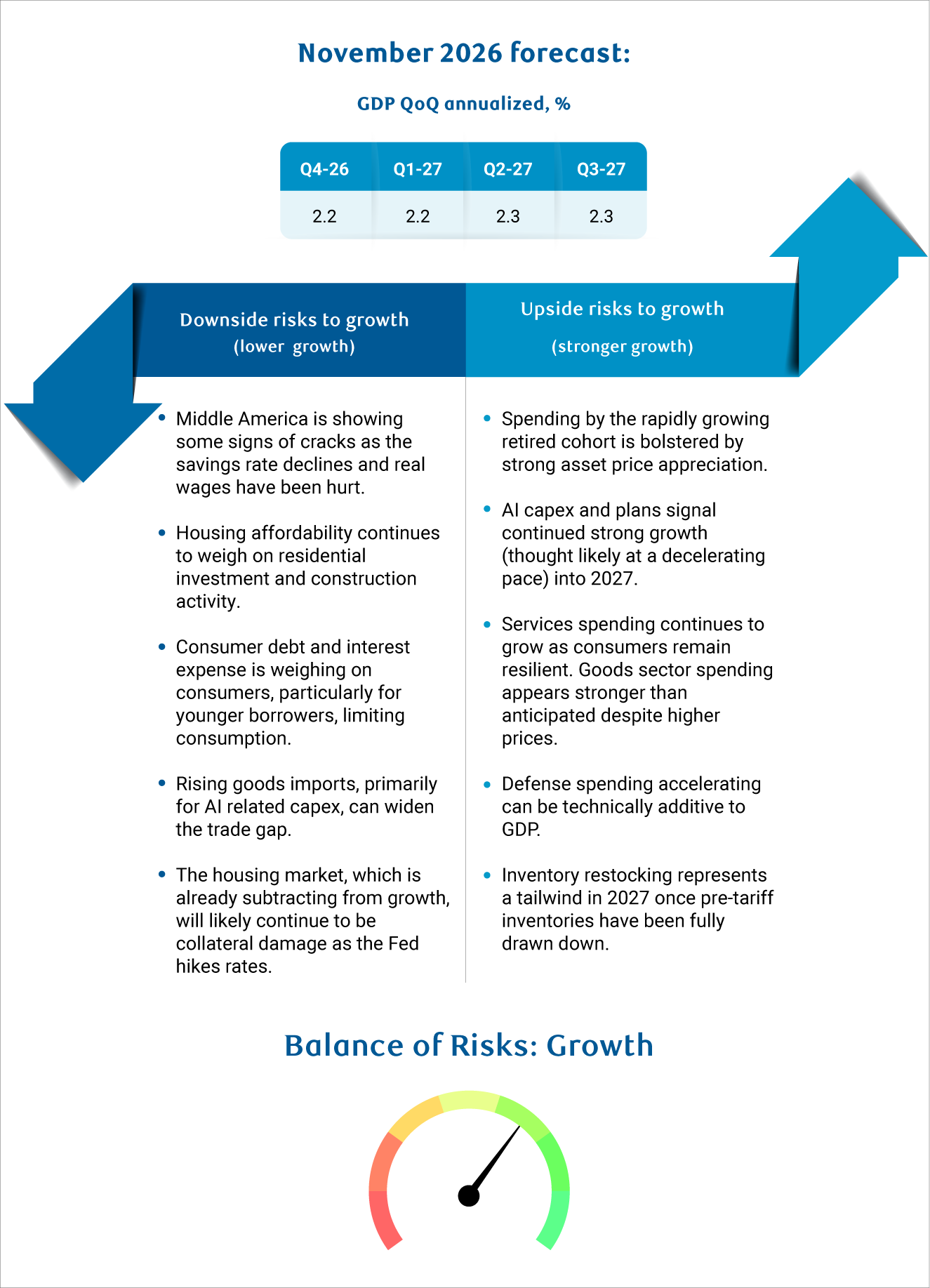
House view: US resilience continues with underlying growth above the 2% trend, and divergence beneath the surface. AI continues to drive the entirety of the business investment story: Spending on information processing equipment and data center infrastructure has surged, while capex outside of AI remains exceptionally weak. For consumers, spending accelerated despite elevated prices, but a Fed hiking cycle will weigh on those exposed to debt. With energy prices elevated, we view risks to the economy as roughly balanced with downside surprises still possible should energy inflation spill over more meaningfully to other sectors.
Inflation outlook
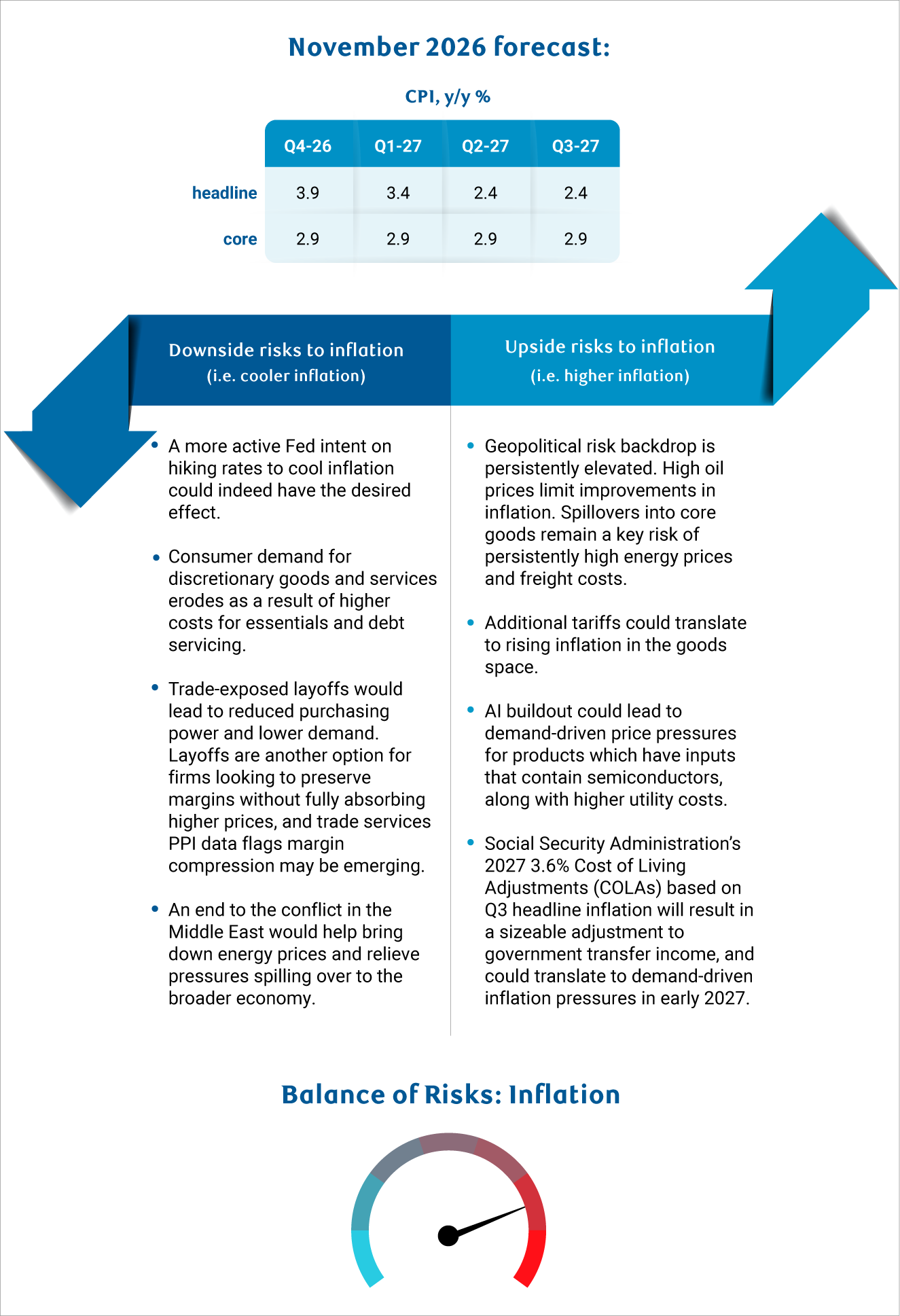
House view: Inflationary pressures remain broad and persistent with energy prices elevated and tariffs still in the picture. Freight costs look concerning and appear to be spilling over into the core goods sector with emerging signs of a re-acceleration of core inflation. Housing disinflation has run its course, and we view it as a growing longer-term risk due to lack of supply. Importantly, the Fed returning from the sidelines does not guarantee that primarily supply-driven inflation will be tamed. We also acknowledge these hikes may produce undesirable side effects for lower- and middle-income consumers. Traditionally, hikes would work to protect against a demand-driven inflation spike. But with non-labor income growing in importance, new risks emerge. If inflation cools at the same time we get the inflation-adjusted 2027 Cost of Living Adjustments (COLAs) for Social Security income, the risk remains that benefits meant to support retirees fuel broader price increases.
Labor market outlook
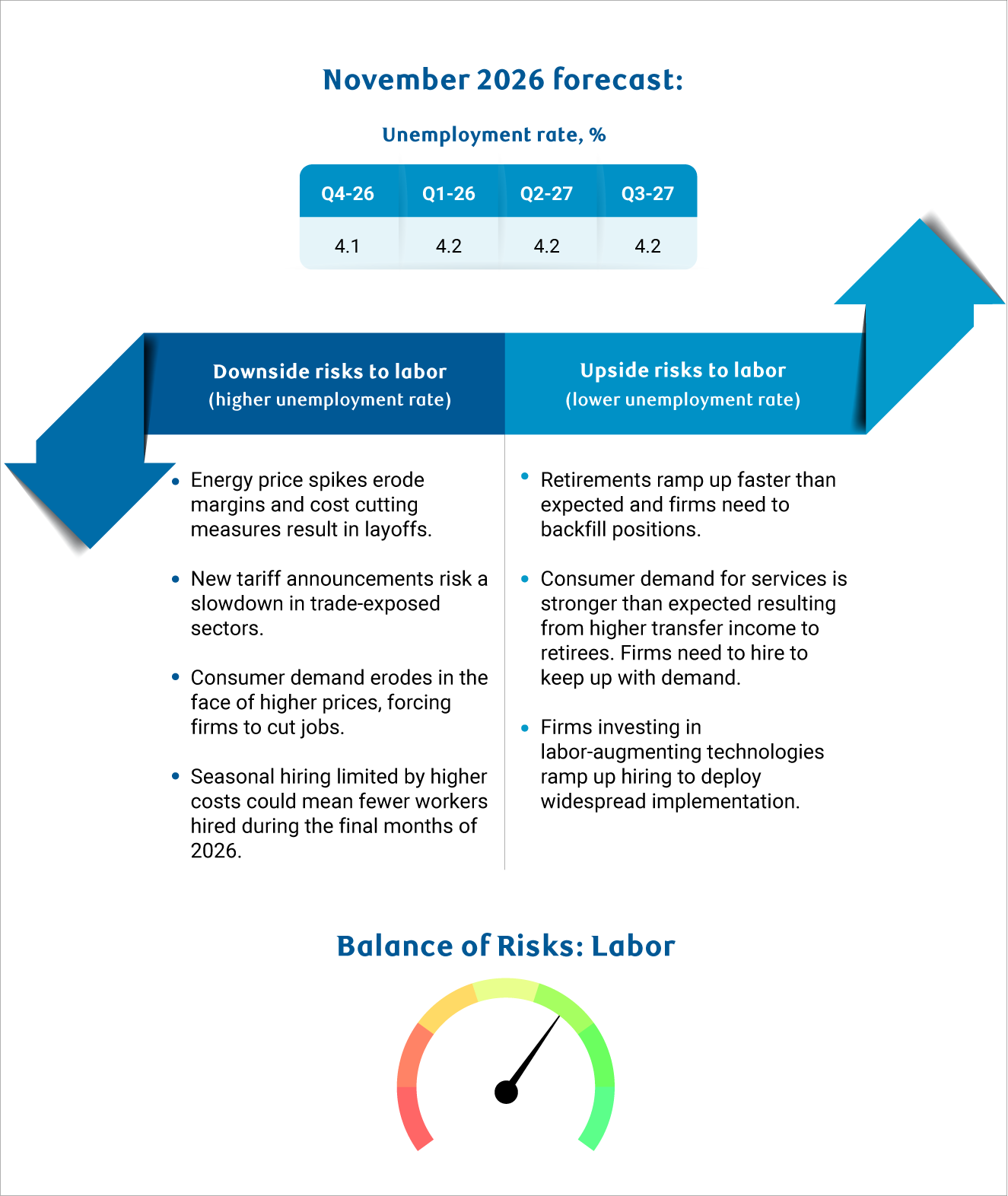
House view: We continue to expect structural factors will keep the US labor market very tight. Monthly hiring has outpaced expectations in recent months—especially in the context of exceptionally low breakeven employment. But the backdrop remains mixed. Employment in some white-collar sectors is falling, contributing to a notable skills-matching problem facing new graduates. The unemployment rate gives us the best gauge of labor market health and it remains exceptionally low—at 4.2%. Still, retirements have driven the unemployment rate lower recently. If we do see a reversal of this trend, re-entrants could drive a slight uptick in the unemployment rate. But extremely low jobless claims and minimal WARN notices suggest there isn’t currently a sizeable risk of an uptick in layoffs.
About the authors:
Frances Donald is the Chief Economist at RBC and oversees a team of leading professionals, who deliver economic analyses and insights to inform RBC clients around the globe. Frances is a key expert on economic issues and is highly sought after by clients, government leaders, policy makers, and media in the US and Canada.
Mike Reid is Head of US Economics at RBC. He is responsible for generating RBC’s US economic outlook, providing commentary on macro indicators, and producing written analysis around the economic backdrop.
This article is intended as general information only and is not to be relied upon as constituting legal, financial or other professional advice. The reader is solely liable for any use of the information contained in this document and Royal Bank of Canada (“RBC”) nor any of its affiliates nor any of their respective directors, officers, employees or agents shall be held responsible for any direct or indirect damages arising from the use of this document by the reader. A professional advisor should be consulted regarding your specific situation. Information presented is believed to be factual and up-to-date but we do not guarantee its accuracy and it should not be regarded as a complete analysis of the subjects discussed. All expressions of opinion reflect the judgment of the authors as of the date of publication and are subject to change. No endorsement of any third parties or their advice, opinions, information, products or services is expressly given or implied by Royal Bank of Canada or any of its affiliates.
This document may contain forward-looking statements within the meaning of certain securities laws, which are subject to RBC’s caution regarding forward-looking statements. ESG (including climate) metrics, data and other information contained on this website are or may be based on assumptions, estimates and judgements. For cautionary statements relating to the information on this website, refer to the “Caution regarding forward-looking statements” and the “Important notice regarding this document” sections in our latest climate report or sustainability report, available at: https://www.rbc.com/community-social-impact/reporting-performance/index.html. Except as required by law, none of RBC nor any of its affiliates undertake to update any information in this document.

