Every year, Toronto plays host to the world’s biggest mining conference, as the Prospectors and Developers Association of Canada brings together more than 27,000 global mining executives, investors and policy makers. And this year’s conference, running from March 2-5, is more critical than ever. Critical minerals will be centre stage, given their importance to the growing geopolitical race between the United States and China. They may not be the mainstay of mining but minerals like gallium and lithium are essential inputs in advanced technologies that span energy, defense, manufacturing and increasingly, artificial intelligence. Nations with secure access to these critical minerals will secure global economic competitiveness and national security. Here are three big questions we’ll be tracking at PDAC ‘25:

1. What’s with all the critical mineral hype?

From advanced semiconductors used in AI to the manufacturing of electric vehicles and batteries to technological advancements in defense and aerospace, critical minerals underlie the critical components of the Fourth Industrial Revolution – an era of disruptive technological forces driven by increased human-machine interaction. Today, China dominates the entire critical mineral value chain, from mining to refining/processing to end-use demand. The International Energy Agency has identified six core critical minerals (copper, lithium ,nickel, cobalt, graphite and rare earth elements) — and on average, China accounts for two-thirds of global refining capacity for the group. In contrast, the U.S. has limited domestic reserves of critical minerals and is entirely import-reliant on supply – often times from China itself. This battle for global tech supremacy between China and the U.S. is manifesting a critical mineral resource war, a new great game for the 21st century rivaling the geopolitical significance of oil post Second World War.

2. What role can Canada play in securing critical mineral supply chains?

Canada and the U.S. have an established minerals and metals trading relationship, as each other’s largest trading partner. In 2024, Canadian non-fuel mineral imports amounted to US$40 billion, or 24% of total U.S. imports. The country is also the largest source of U.S. critical mineral imports by dollar value, but largely skewed by ‘commercial’ critical minerals imports such as aluminum, nickel and zinc. Increasingly, there is a growing cohort of less commercial yet strategically important niche critical minerals with vital importance in defense applications, border security and advanced chip making. The supply of these minerals, such as gallium, germanium, antimony and tungsten, are dominated by China and are subject to Chinese export controls. It is across this subset of minerals particularly where we believe Canada can play a vital role in in de-risking U.S. and G7 critical mineral supply chains.

3. What can we expect to hear at the conference?

This year’s PDAC conference will have a greater-than-usual policy bent, given the increased tensions around U.S. critical mineral supply – already witnessed in Ukraine peace talks but also seen in President Trump’s commentary around Greenland and Canada. Continued rhetoric from policy makers and mining executives on Canada’s potential may expand the belief that Canada has allies and economic partners. We anticipate hearing more on how Canada can enhance its competitiveness in attracting critical mineral capital. This could include a greater role for governments in providing offtake agreements, enhanced fiscal incentives such as expanded investment tax credits, securing market access and streamlining permitting. RBC Thought Leadership will publish a more detailed report on critical minerals later this coming week, along with commentary throughout PDAC. You can follow our research and insights on RBC’s Trade Hub.

INSIGHTS AND ANALYSIS

COMMENTARY

READ THIS NEXT


BUSINESS RESOURCES

RBC Global Connect

Expanding into global markets comes with challenges, and having the right resources can make all the difference. RBC Global Connect™ is a free online platform designed to support businesses in researching, planning, and navigating international growth. Whether you’re exploring new opportunities or expanding existing operations, our goal is to provide the insights and tools you need to move forward with confidence.

The Growth Project

This project explores key drivers of economic growth including productivity, evolving technologies like AI, key sectors including agriculture and trade, and the intersection of skills and immigration. We will explore a new generation of ideas to drive prosperity: case studies and actionable steps needed to navigate the dynamic landscape of economic expansion, and uncover tools that foster growth in our community, business, and country.

Key takeaways

  • U.S. trade tensions have cast a spotlight on Canadian food trade: American tariff threats pose a special challenge to Canadian agriculture and agri-food exports, as they now account for 20% of U.S. agri-food imports.
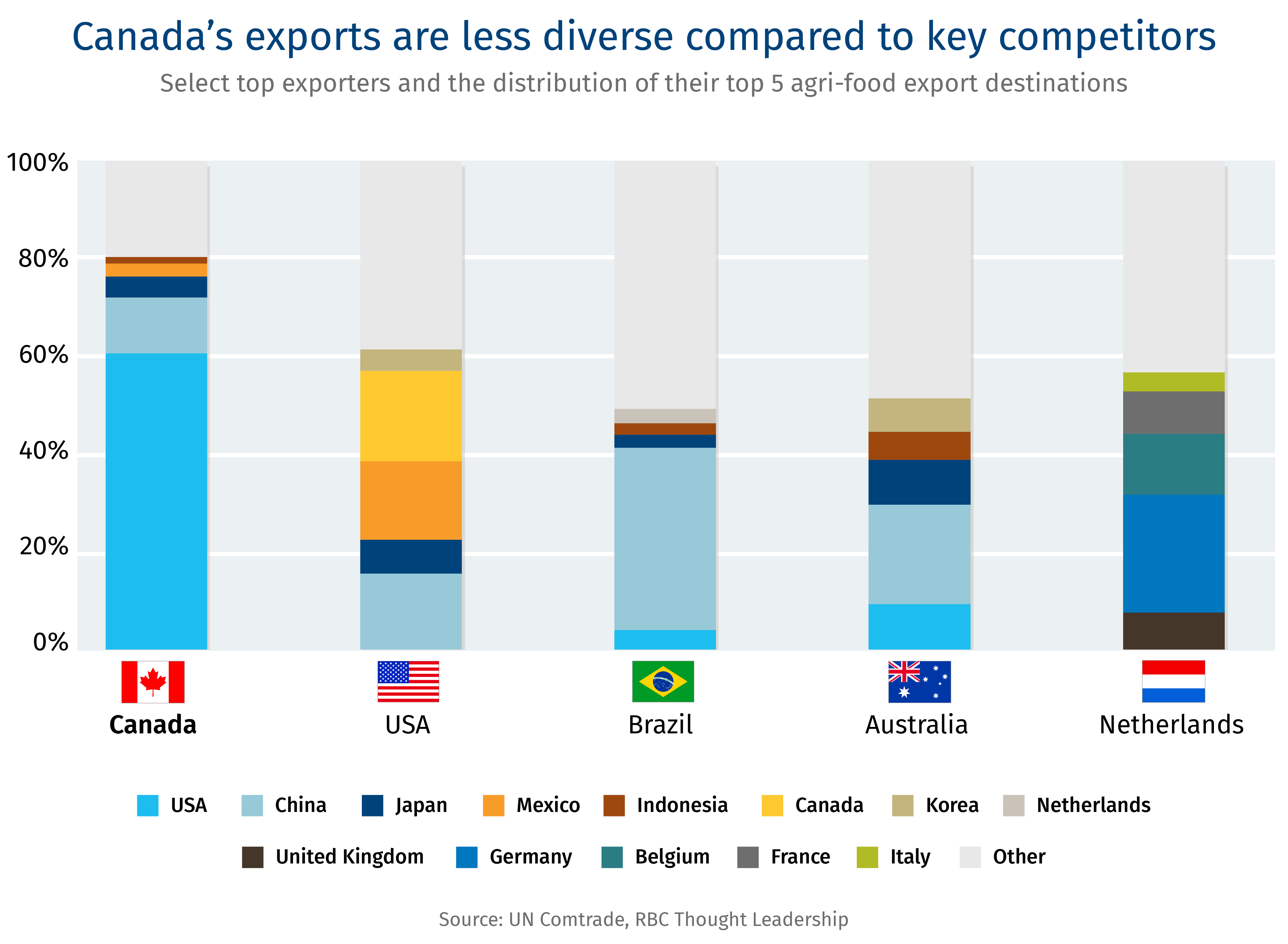
  • Exports to the U.S. are growing: Over 60% of Canada’s agriculture and agri-food exports go to the U.S.—and the value of those exports has quadrupled since 2000.
  • But Canada’s falling behind competitors globally: Canada’s position in global agriculture and agri-food trade has slipped to 7th from 5th place, and could drop to 9th by 2035 if corrective measures aren’t taken.
  • Rivals are gaining ground in the world’s top growth markets: Emerging competitors like Brazil have gained ground in Africa and the Middle-East, while traditional rivals like Australia are gaining market share in Southeast Asia.
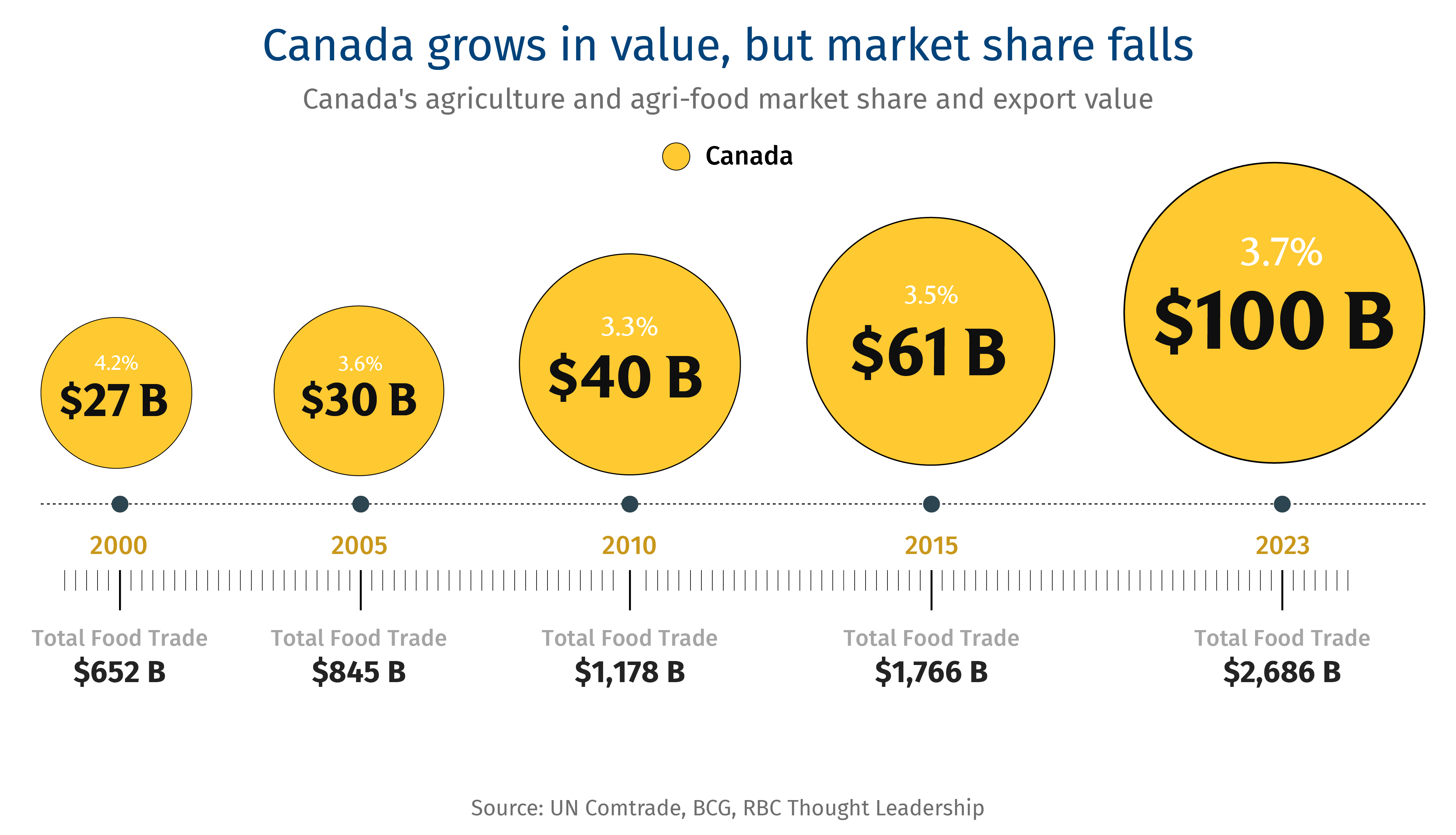
  • Canada can increase our global share by 30%: With the right investments, Canada can increase global share from 3.7% to 4.8% to regain 5th place in exports, according to new modelling by RBC and the Boston Consulting Group’s Centre for Canada’s Future. That could add $44 billiona to agriculture and agri-food’s export value by 2035.
  • A clear plan is critical: To regain market share, Canada needs to focus on innovation, investment, export-oriented infrastructure, digital infrastructure, and overseas agri-food promotion.

Canada has become overly reliant on the US for agri-food exports

Steel, autos, lumber and oil: The growing trade conflict between the United States and Canada has focused on the backbone of our blue-collar economy. But check any border crossing, and you’re just as likely to see food and agriculture products—be they lobsters trucked from Nova Scotia to Maine, or muffins from Toronto to Chicago, or cattle from Alberta to Montana.

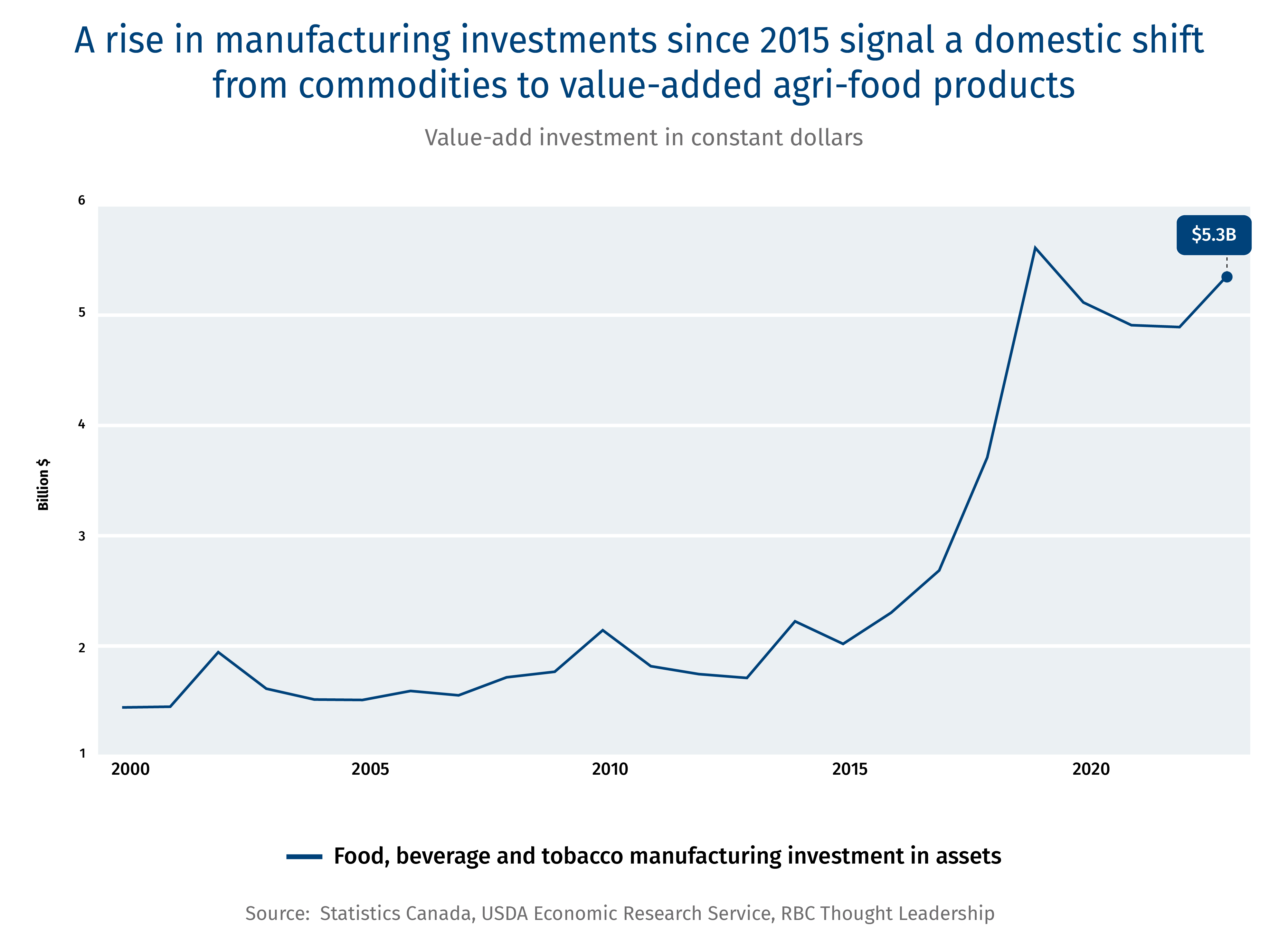
More than $100 billion worth of agriculture and agri-food products cross the border every year, with the U.S. importing nearly 60% of this trade. And thanks to a surge in agri-food processing investment over the last 20 years, that trade gap is growing. The value of Canadian exports to the U.S. has quadrupled since 2000, and Canada is now the source of 20% of U.S. agriculture and agri-food imports.2

This quiet transformation has helped the Canadian agri-food sector become the country’s largest source of manufacturing revenue. No longer just a bulk commodity producer, we are now a dominant foreign supplier to America’s grocery aisles and dining tables, as Canadian farmers and processors have become more advanced in developing new products and marketing them to Americans.

Take canola, for instance, used for cooking and biofuels and meal for animal feed. Thanks to large crushing facilities, roughly 96% of Canada’s canola oil and 65% of canola meal export volumes went to the U.S. in 2024.4 And then there’s potash, which is key to American fertilizers. Canada supplies 85% of U.S. needs, which could go higher if it pulls back from Russia and Belarus, its only other major suppliers.5

Both countries have benefitted. The U.S. has had priority access to Canada’s production and processing that has a comparative advantage for products including prepared cereals and vegetable oils. Canada’s large production base in the Prairies, as well as the scale and proximity of manufacturing and processing hubs in Ontario and Quebec, have been key to the large inflows of investment capital in recent years. In addition, consistent, high volumes and a lower dollar have propped up Canada’s ability to be a preferred importer. Historical growth in the efficiency of Canadian farms and food processors has further strengthened Canada’s position as a reliable and efficient place to source agriculture and agri-food products from. The result: Canadian food manufacturing has increased its value-add ratio—its production minus its consumption—by 71% between 2014 and 2023.7

These advantages are now in question with the threat of large-scale tariffs. If they’re applied to agriculture and agri-food products, they will make Canada a less desirable trade partner to the U.S., as our position as a low-cost exporter of agriculture and agri-food products relative to others, including China and the Netherlands, will suffer. Agri-food manufacturing may also struggle to maintain investment levels, as one of its biggest selling features has been its preferential access to the world’s largest market.

Such challenges will force Canadian producers to make a choice: accept the cost of tariffs to access the U.S. market, or search for more demand abroad.

Meanwhile, our global competitiveness has slipped

For generations, Canada has been a global leader in agriculture—wheat shipments to China during that country’s post-revolutionary struggles, pork to Japan as its economy took off, lentils to India as it looked to feed its rapidly growing cities, and maple syrup to Europe as it opened its markets. Canadian potash, fertilizer and seeds have also been critical to the ability of the world’s farmers to grow more for their own markets. Thanks to decades of export growth—ahead of most of Canada’s economic sectors—our agriculture and agri-food sector entered the 21st century as a productivity leader. But with so much focus on the U.S. market, many Canadians didn’t realize that the rest of the world was catching up, and in some categories, overtaking us.

Here’s where we stand today on the global leaderboard: over the first quarter of this century, we’ve slipped from 5th to 7th place, bumped by China and Brazil.8 And under a business-as-usual scenario, we could drop to 9th place over the next decade. A global model developed by the Boston Consulting Group’s Centre for Canada’s Future and RBC shows Canada’s market share since 2000 has declined, relatively, by 12%. Our exports are still growing—they’ve quadrupled during that time. It’s just that we’re not keeping pace with the rest of the world, which saw agriculture and agri-food exports grow five-fold over the same period.c d

This relative decline could be an early-warning signal that our agriculture and agri-food exports are not only overly dependent on the U.S., they’re likely to face even greater competition abroad in the decades ahead. Other countries such as Brazil and Chile have taken big bites of markets including meat and fish, where Canada has been competitive in the past.

Ecuador is another case worth studying. It has a highly concentrated inland aquaculture industry, outside the city of Guayaquil, where advancements in shrimp genetics have led to production volume increases of 18-fold since 2000.9 Today, shrimp accounts for roughly 24% of Ecuador’s total exports and 25% of the global crustacean export market, including shrimp and lobster.10 Similar trends can be seen in blueberries from Peru, pasta from Türkiye and soybeans from Paraguay. Such focused, aggressive growth from our competitors has contributed to Canada losing market share in two-thirds of the sectors that make up agriculture and agri-food trade—including meat (-2%), live animals (-5%) and beverages and spirits (-2%). The result for Canada, according to our model: $23 billion in forgone export value in 2023 as a result of market share loss from 2000, which is worth more than the steel and iron Canada exported to the U.S. in 2024.

An important battleground to watch is Southeast and South Asia. India and Southeast Asia‘s global agriculture and food consumption is expected to grow to over 31% of global consumption within the next decade.11 Much of the region has also been a long-time reliable market for Canadian producers, be it soybeans to Vietnam or wheat to Indonesia or peas to India. But the region is increasingly turning to other suppliers. A free trade agreement between Australia, New Zealand and the Association of Southeast Asian Nations (ASEAN) eliminated tariffs on 99% of New Zealand exports to Indonesia, Malaysia, the Philippines, and Vietnam. Through this agreement, Australia has steadily built up its exports to ASEAN, now accounting for 23% of its agriculture and agri-food export value.12 13 Brazil is another competitor to watch. Its enhanced trade promotion has not only made it a bigger supplier to ASEAN; it’s accelerating its presence in Africa and the Middle East—the world’s fastest growing regions—where its export values jumped by 24.4% and 20.4%, respectively, from 2023 to 2024.14

That re-ordering of global food trade occurred largely during a period of liberalized global trade—but that era may now be fading. If tariff and non-tariff barriers become normalized, and trade becomes more politicized, Canada’s ability to compete internationally may be challenged anew, including by growing exporters like Kazakhstan that are seeking to gain market share, especially in Asia and the Middle East.

Last year set a record US$45 trillion in global merchandise trade value, yet year-over-year growth in volumese have been on a downward trend since 2000.15 Average annual growth in trade volume was 2% between 2016 and 2025, slower than 3.45% in the previous decade.16 A key factor driving the slowdown is a deviation from a rules-based system, making way for protectionist-like policies.

For example, harmful trade interventions for cereals have increased by 2.5 times relative to liberalizing interventions since 2009, driven by financial grants, state loans, and import tariffs.17 Agriculture and agri-food often bear the brunt of such policies, given the political importance of food prices and also the political power in many countries of food producers. Average tariffs by a World Trade Organization member charged on an agriculture product is 14.8%, compared to 8% for non-agriculture products.18 A slowing appetite for trade, fewer new trade agreement opportunities, and disruptions to Canada’s North America-first export strategy are among the biggest challenges we may need to consider in the years ahead.

How to diversify: Play to our strengths, grow with new allies, invest in old markets

The opportunity is clear. Our model estimates that Canada’s share of the global export pie could grow by 30% by 2035f, adding $44 billion to total exports, if we pursue three main trade objectives: grow where Canada has market access, expand in the world’s best growth markets, and maintain existing relationships through strengthened “food diplomacy.“

The first challenge is straightforward, which is taking advantage of what we have. Canada has 15 free trade agreements providing access to over two-thirds of the global economy. Through these agreements, there is room to make better use of Canada’s market access in Europe, Asia, and Latin America. For example, the Canada-European Union Comprehensive Economic and Trade Agreement (CETA) is gradually phasing out most tariffs on seafood. Before CETA, EU tariffs for fish and seafood averaged 11%, with highs of 25%. These will be fully phased out within the next five years.19

Taking on new growth markets, with more ambition, is our next challenge. That can start in the Asian markets mentioned in the previous section. Consumers in Southeast and South Asia are expected to have more to spend on higher value products over the next decade, thanks in part to expectations for economic growth that will be among the best in the world, with GDP per capita forecast to rise 3.9%, annually, between 2024 and 2033, up from 2.6% in the previous decade.20 India is one of the clearest opportunities — a market of 1.5 billion people whose economy and standard of living are growing rapidly. This market will increasingly be an opportunity for Canada’s agri-food processing industries, especially plant-based proteins driven by Canada’s production of legumes – peas, lentils, and soybeans.

Canada’s oilseed and agriculture waste processing can also help meet expected growth in biofuel demand in Southeast Asia, where blending rates of biofuels with fossil fuels in markets such as Indonesia are expected to stay above 30%. That would raise biodiesel demand by 56% over the next decade in that country.21 Sub-Saharan Africa, the Middle East, North Africa, and Latin America are also expected to see large GDP expansions. For these regions, we can expect to see total and per capita consumption not only rise, but shift towards more nutrient-dense foods, including animal protein, vegetables, and legumes. One way to help: Canada can contribute to linking global marine transportation to local supply chains by helping to build up food corridors and port infrastructure in Türkiye, United Arab Emirates, and Saudia Arabia as key points of entry to growth markets.

Thirdly, Canada can strengthen and grow current partnerships. These markets include the U.S., Japan, China, and Mexico—the first three of which are projected to have food trade deficits over the next decade that surplus producers like Canada will compete for. Our advantage is established business networks and consumer confidence in our products. In particular, the U.S. is expected to expand its imports of fresh produce, fish, and vegetable oil over the next decade.22 Driving production and processing in these domains will help position Canada as a strategic as well as a reliable partner, if we can make some of the investments we’ll outline in the following sections.

Countries to watch

Brazil – The Investor

  • Now the second largest exporter of agriculture and agri-food products, Brazil is taking exceptionally large bites out of global oilseed and meat exports, with an approximate 20% and 11% rise in value shares, respectively.23
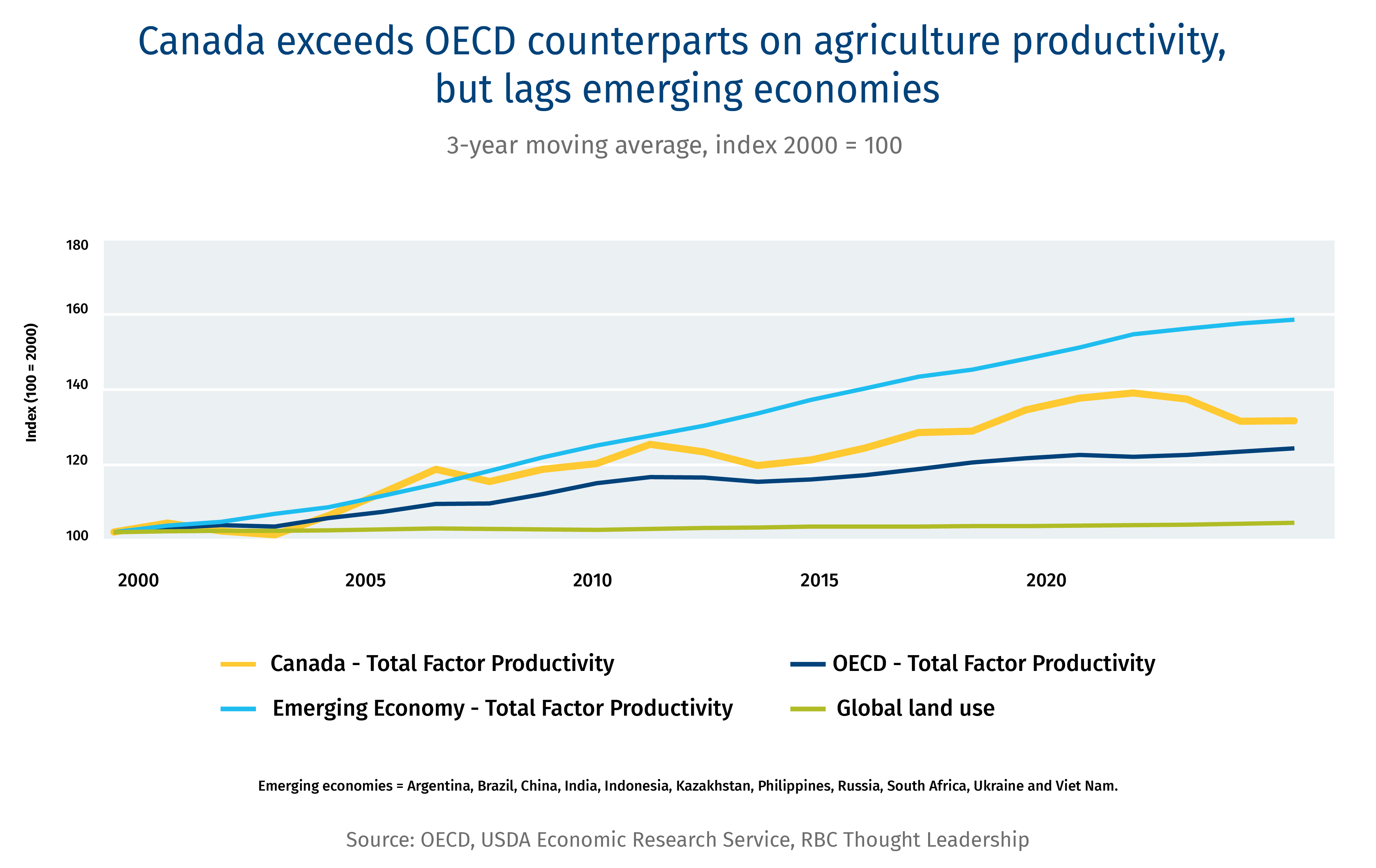
  • Row cropping in Brazil nearly doubled between 2000 and 2014, primarily from pasture conversion (80%), but forested land as well (20%).24 Brazil is also improving yields per inputs such as land, fertilizer use, and labour, with agriculture total factor productivity growing by 53% between 2000 and 2022. For comparison, Canada’s productivity grew by 27%. An industrial policy regime took a pro-business support model during the early and mid-2000s that attracted investment from multinational agri-businesses and life science companies, and helped finance growth in domestic storage, transportation infrastructure, and processing capacity.26
  • Brazil has taken an aggressive approach to marketing and promotion in growth markets and in expanding its market share in China. On the other hand, the European Union, Brazil’s second largest market, is set to enforce a zero-deforestation regulation by the end of 2025, prohibiting select imports, including soy, beef, and coffee products associated with deforestation post-2020.27 The regulation and other similar environmental policies tied to trade could present compliance challenges for Brazil even as domestic deforestation rates fall.
  • For the next decade, Brazil’s industrial policy playbook, Nova Industry Brazil, will drive innovation and sustainability with agri-food supply chains as a top priority for growth.

Australia – The Trader

  • Australia has used its 18 free-trade agreements with 30 countries to diversify, expand and adapt its agri-food export flows. The value of Australia’s agri-food exports to India increased +106% between 2022 and 2023 after the Australia-India Economic Cooperation and Trade Agreement (ECTA) entered into force in December 2022. In 2023, Australia took advantage of lower tariffs for meat in the Korea-Australia Free Trade Agreement, raising sheep and goat sales by ~50% in value relative to 2022.28
  • It’s diversifying its production to align with growth in export markets such as canola, and support that with trade promotion. Its new cross-sector agribusiness expansion initiative is a $85-million-dollar fund aimed at expanding and diversifying agri-food exports.29
  • An active participant in the Codex Alimentarius Commission, which is a collection of internationally adopted food standards. Alignment on food standards between trading partners is essential to avoid non-tariff barriers.

Spain – The Scaler

  • The country positioned itself as the go-to market for fruit, vegetables, and pork in the European Union, by focusing on production scale, quality, and regionalized production.
  • Propelled itself as a leader in agri-food reaching its EU and international customers via its 46 ports.30
  • Spain scaled production to meet export volume demands through growing productivity and a shift towards farm commercialization. This is evident through its centralized greenhouse production, optimized for regional market access and trade. However, this production cluster is primarily reliant on road transportation, creating vulnerabilities in logistics.
  • Spain will remain one of Canada’s top competitors in expanding in the European market, if it were to optimize its use of CETA.

Kazakhstan – The Grower

  • While not yet cracking the top 50 list of exporters, Kazakhstan’s agriculture and agri-food export value has grown by nine-fold since 2000.31
  • Over the next decade, if Kazakhstan’s agriculture land use trends mirror other agriculture powerhouses such as Brazil, Canada, and the U.S., we can expect to see its pastureland, which accounts for roughly three-quarters of all agricultural land to, in part, be transformed into cropland, strengthening their place in global cereal and oilseed markets.32
  • Under the Ministry of Agriculture 2021-2030 agricultural development plans, Kazakhstan plans to boost productivity in meat and dairy production, increasing carcass weights and milk outputs per animal, with sights on increasing their exports.33
  • Its agriculture sector has significant potential for growth, but is underdeveloped and underfinanced. With meaningful investments scaled through state-owned financial institutions such as KazAgroFinance, Kazakhstan will be one to watch for cereals, oilseeds, beef and sheep.34

Brésil


Brésil : l’investisseur

  • Devenu le deuxième plus grand exportateur de produits agricoles et agroalimentaires, le Brésil prend une part exceptionnellement importante dans les exportations mondiales d’oléagineux et de viande, avec des augmentations respectives d’environ 20 % et 11 % en valeur.
  • Les cultures en rangs ont presque doublé entre 2000 et 2014 au Brésil, principalement en raison de la conversion des pâturages (80 %), mais aussi des terres forestières (20 %). Le Brésil améliore également les rendements par rapport aux intrants tels que la terre, les engrais et la main-d’œuvre, et la productivité des facteurs agricoles globaux a augmenté de 53 % entre 2000 et 2022. À titre de comparaison, la productivité du Canada a augmenté de 27 %. Le régime de politique industrielle a adopté un modèle de soutien aux entreprises au début et au milieu des années 2000, ce qui a attiré les investissements des multinationales de l’agroalimentaire et des sciences de la vie et contribué à financer la croissance du stockage national, des infrastructures de transport et de la capacité de transformation.
  • Le Brésil a adopté une approche agressive en matière de marketing et de promotion sur les marchés en croissance, et il augmente progressivement sa part de marché en Chine. D’un autre côté, l’Union européenne, deuxième marché du Brésil, compte appliquer fin 2025 un règlement contre la déforestation interdisant des importations spécifiques, notamment de soja, de bœuf et de produits à base de café associés à la déforestation après 2020. Cette réglementation, conjuguée à d’autres politiques environnementales régissant le commerce international, pourrait poser des problèmes de conformité au Brésil malgré le repli des taux de déforestation dans le pays.
  • Au cours de la prochaine décennie, la politique industrielle brésilienne « Nova Industry Brazil » encouragera à l’innovation et à la durabilité, les chaînes logistiques agroalimentaires étant définies comme une priorité absolue pour la croissance.

Australie


Australie : le négociateur

  • L’Australie a mis à profit ses 18 accords de libre-échange avec 30 pays pour diversifier, développer et adapter ses flux d’exportation agroalimentaires. La valeur des exportations agroalimentaires de l’Australie vers l’Inde s’est envolée de 106 % entre 2022 et 2023 après l’entrée en vigueur de l’Accord de coopération économique et commerciale Inde-Australie (ECTA) en décembre 2022. En 2023, l’Australie a tiré parti de la baisse des tarifs douaniers sur la viande dans le cadre de l’Accord de libre-échange entre la République de Corée et l’Australie, augmentant les ventes de moutons et de chèvres d’environ 50 % en valeur par rapport à 2022.
  • L’Australie diversifie sa production afin de s’adapter à la croissance de marchés d’exportation tels que le canola, et soutient cette politique à l’aide de promotion commerciale. Sa nouvelle initiative d’expansion agroalimentaire intersectorielle est la création d’un fonds de 85 millions de dollars destiné à accroître et diversifier les exportations agroalimentaires.
  • Participant actif à la commission du Codex Alimentarius, qui est un ensemble de normes alimentaires adoptées à l’échelle internationale. L’harmonisation des normes alimentaires entre les partenaires commerciaux est essentielle pour éviter les barrières non tarifaires.

Espagne


Espagne : l’expansion

  • Le pays s’est positionné comme le marché de référence pour les fruits, les légumes et le porc dans l’Union européenne, en se concentrant sur l’échelle de production, la qualité et la production régionalisée.
  • L’Espagne s’est hissée au rang de chef de file de l’agroalimentaire en se connectant à ses clients européens et internationaux depuis 46 ports.
  • L’Espagne a augmenté sa production afin de répondre à la demande de volumes d’exportation, grâce à une amélioration de la productivité et à une transition vers la commercialisation agricole. Cela se traduit par une production sous serre centralisée, optimisée aux fins d’accès au marché régional et de commerce international. Toutefois, ce centre de production dépend principalement du transport routier, ce qui crée des vulnérabilités logistiques.
  • L’Espagne restera l’un des principaux concurrents du Canada pour ce qui est de l’expansion sur le marché européen si le pays décide d’optimiser son utilisation de l’AECG.

Kazakhstan


Kazakhstan : la croissance

  • Bien qu’il ne figure pas encore parmi les 50 premiers exportateurs, le Kazakhstan a multiplié par neuf la valeur de ses exportations agricoles et agroalimentaires depuis 2000.
  • Au cours de la prochaine décennie, si les tendances d’utilisation des terres agricoles du Kazakhstan reflètent celles d’autres puissances agricoles telles que le Brésil, le Canada et les États-Unis, on peut s’attendre à ce que ses pâturages, qui représentent environ les trois quarts de toutes les terres agricoles, soient transformés en marchés de cultures.
  • Dans le cadre des plans de développement agricole 2021-2030 du ministère de l’Agriculture, le Kazakhstan prévoit stimuler la productivité de sa production de viande et de produits laitiers en augmentant le poids des carcasses et la production de lait par animal en vue d’accroître ses exportations.
  • Le secteur agricole du Kazakhstan présente un potentiel de croissance important, mais il est sous-développé et sous-financé. À la suite des investissements significatifs réalisés par les institutions financières d’État telles que KazAgroFinance, le Kazakhstan deviendra un pays à surveiller pour les céréales, les oléagineux, le bœuf et le mouton.

Leveraging global strengths to ensure food security at home

Canada’s agriculture and agri-food sector is not just an exporter; it’s a source of high quality, affordable, and nutritious food for a growing domestic population. We produce more than we need, positioning ourselves as a net exporter of agriculture and agri-food products by $32 billion in 2023.35 However, the production mix of an export-oriented sector may not round out a healthy diet for all Canadians.36 A balanced approach is needed.

Canada has formed trade relationships with countries that specialize in producing foods such as fruit at a more competitive and productive rate. As a result, Canada runs a production deficit in fruits and vegetables, as well as sugar and confectionary products. Technology can help, in this case through the rise of modern, controlled environment agriculture. Pockets of production in Ontario, Quebec, Alberta and British Columbia have led to greenhouse fruit and vegetable production volumes increasing by roughly five times since 2000.37 This growing industry can play a critical role in closing the production gap, where vegetable production would need to double and fruit production would need to grow by five times to feed domestic demand.38

Canada will need to enable this growth through sufficient utilities, especially water, energy, and waste management. Expanding and decarbonizing Canada’s electricity grids will be essential, and could require provinces to invest nearly $160 billion to double their electricity supply with clean energy. Such investments create ripple effects in decarbonizing Canada’s food system by reducing the carbon intensity of energy used in storage, processing facilities and transportation.

Other areas for growth to meet domestic demand and regain global market share can be found in meat processing as well as fish and seafood production and processing. Meat production nearly doubles Canada’s average consumption rate, while fish and seafood production are just above consumption averages.40,41

These industries have been challenged by high operation costs, volatile commodity prices, labour shortages, and a challenging policy environment for aquaculture. Yet, there is a growing domestic and international demand for sustainable, Canadian-made proteins, which means the efficiencies created through global operations in Canada can help improve the cost and availability for domestic consumers.

Betting on Canada to feed the future may prove to be a safe environmental bet, too. While no country is immune from the negative impact of climate change on crops and animals, yield growth scenarios that account for increasing effects of climate change suggest Canada is projected to increase its role as a global breadbasket of staple crops such as wheat, soybeans, and corn.42 Canada is also well endowed with natural resources, and home to efficient production systems that responsibly use them. Canada’s agriculture water use for agriculture remains low at 11% of total freshwater withdrawal, compared to 67% in Australia and 40% in the United States. 43

Canada’s land use for agriculture also pales in comparison to the United States and Australia, which represents over half of their total land masses, while Canada’s agricultural land covers 6% of the country, underlying the limitations that other agriculture powerhouses face in meeting competing land demands for housing, energy, and food.44,45,46

Five keys to unlocking Canada’s export potential

1. Innovation


We’re a production leader and an innovation commercialization laggard. However, Canada is now also facing a productivity slowdown in agriculture production. Creating room for innovation in efficiency is the next reboot in productivity. Adoption is one area for improvement. Take automated steering for tractors and variable rate technology for fertilizers and seeds, as examples. Adoption rates for both remain low at 27% and 16%, respectively.46 We also need greater connectivity among researchers, start-ups, funders, and companies, preferably within agri-food innovation hubs like the ones grown in the U.S. Mid-West and Netherlands. That will require us to address the widening gap between private and public resourcing, which threatens Canada’s ability to develop partnerships in IP and commercialization. Government spending on agri-food research and development has declined by 9% on average, annually over the past decade. .47

2. Capital


Canada is in the top 10 countries for investments in agri-food technology and innovation.48 We could be in the top five, if annual investments in Canadian-based startups doubled. That could be tougher in a tariff world, which is inherently risky to foreign capital, but the returns on overseas exports could be enough to offset those North American challenges. Further expanding Canada’s agri-food processing sectors will also require upfront investments. Protein Industries Canada estimates we could own 10% of the global market share of plant-based foods by 2035, which would add $25 billion to annual sales. To achieve this ambition, Canada will need 10 to 15 new plant-based food processing facilities and $6 to $9 billion of capital investment for ingredient manufacturing alone.49 Scaling capital in Canada will also require us to beef up the business case, with more competitive approaches to tax and regulation. We can also do more to tell our story and reposition ourselves as a value-add producer, competing on price, quality, and volume. Developing company, region, and industry case studies (see box) that explicitly showcase what in Canada is ripe for growth, can contribute to attracting a new wave of investors.

3. Digital access


Canada needs to fix our 5G gaps. The use of precision agriculture tools highlights the importance of strong wireless connections in rural Canada. These tools rely on app or web-based platforms to improve use of feed, seed, fertilizer, and pesticide, so we can produce more with less. That requires high-speed internet and strong 5G cell reception, which rural Canada is lagging in. Deetken Insights estimates that if all Canadian farmers had access to 5G, it could add between $2.7 billion and $3.5 billion to Canada’s GDP by 2030, through input efficiencies and enhanced automation on farm.50 Canada’s Connectivity Strategy, a national vision for IT infrastructure, has propelled projects across Canada to expand access. Yet, two key agriculture producing provinces, Saskatchewan and Manitoba, have only 50% and 30% rural coverage, respectively, when it comes to 5G.51 Redeploying Canada’s rural connectivity funds to focus on rural and remote 5G access could be the initiative needed to unlock the digital economy for Canadian farmers.

4. Export infrastructure


Turnaround times at Canada’s ports are slower than many large competitors, averaging 2.7 days in 2022 while the United States, Brazil, and Australia, had average turnaround times of 2.1, 1 and 2 days, respectively.52 The Port of Vancouver, Canada’s largest port, has had longstanding infrastructure bottlenecks from the Second Narrows Bridge to the Thornton tunnel, which mechanisms such as the National Trade Corridors Fund or Canada Infrastructure Bank could help transform—if they have transformational funding. Currently, Canada’s roughly $20-billion a year investment on transportation infrastructure lags agriculture competitors such as Australia and the United Kingdom. Keeping up with these economies would require additional investments of between $13-20 billion.53 While ports are our main connection to global markets beyond the U.S., Canada’s rail system is a major domestic connector, and it is challenged with limited routes and rising labour disputes, that too require a rethink for growth. There are smaller opportunities, too, such as container logistics and inland terminals, as simple problems like container storage can clog our ports and rails.

5. Global marketing


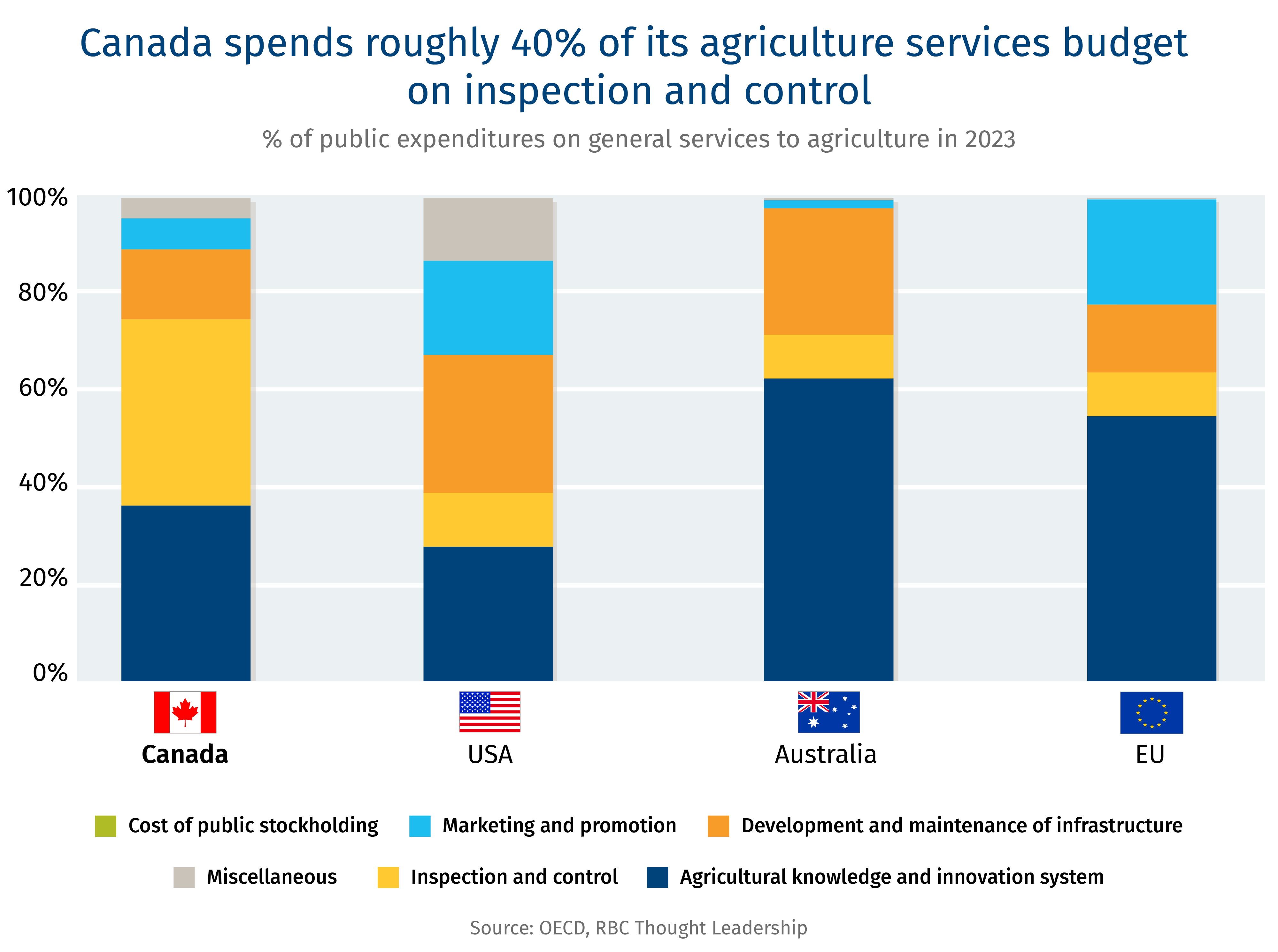
Canada is suffering from a dilution effect in its market development and access approach—with limited resources to boot. The U.S. spends close to 20% of its agriculture support services budget on marketing and promotion, or triple Canada’s share of 6%.54 In a similar vein, gaining market share requires robust inspection and control services that ensure food safety and agriculture production’s protection against new diseases and pests. Canada has a strong reputation, but also must come to grips with a dilemma: even though we allocate 40% of that agriculture support services budget to inspection and control, we still face market access issues and duplicative inspections.55 One approach would be to pick the top five products for export potential and develop priority market assessments, such as Europe for seafood. Pooling public-private resources, the federal government could work with industry associations, companies, and provinces in region-specific, agile taskforces to promote exports and inform regulatory bodies on what’s needed to support growth. A complementary option: position regulatory bodies such as the Canadian Food Inspection Agency to proactively develop standards recognition and harmonization in the identified growth markets.

Canada in 2035

In just 10 years, the world will need to feed close to nine billion people, and many of them will have more income, and appetite, for higher quality foods like the kind Canada is known for. To meet this demand, the world will need to produce 14% more food, feed, and biofuels than we’re delivering today, and do it in a more disruptive trade environment.56

To feed this future, agriculture must also compete with climate change, urban sprawl and rising land use needs from energy production. Moving from short-term reactionary tactics to strategic growth, Canada can use the U.S. tariff threats as a wake-up call to leverage agriculture and agri-food as a driving force for trade diversification while building Canadian self-sufficiency.

Under a high growth scenario, we estimate Canada could return to our position as the world’s 5th largest exporter, regaining our international clout from the early 2000s. In such a scenario, Canada in 2035 would need to expand value added agri-food exports by 50% and grow agriculture commodity exports by 10%.h

If we achieve this growth, we can imagine a Canada in which:

  • The Atlantic aquaculture industry doubles in production and processing, feeding our European neighbours and the ones just next door;
  • Alberta, home to 80% of the country’s beef output, advances the resilience of its feedlots and supply chains, contributing to Canada becoming the second largest source of meat in Japan, just behind the U.S., from fourth place today.57,58
  • Our greenhouse sector, with aspirations of doubling its acres over the next decade, moves Canadians closer to their fresh produce at an affordable price.
  • Finally, all these products are delivered to consumers via transportation systems with fewer bottlenecks from rail to port and fewer constraints, from on-farm internet to non-tariff trade barriers.

Agriculture is often left off the plate in Canada’s economic strategy discussions. This needs to change if we are to build resilience at home and regain our presence abroad. By acting on these ideas, and others, with precision and speed, the next decade can see a boom in productivity, an unprecedented scale of manufacturing, and a new path for growth through diversified markets. For every part of the country, the opportunity is ripe for growth.

How to be a global champion

AGT Food and Ingredients—The value of processing clusters


  • Pulses and plant-based product supplier exports to more than 100 countries.
  • Primary markets: Türkiye, Algeria, Iraq and the U.S.
  • Growth markets: India, South Africa, Saudi Arabia, and United Arab Emirates.
  • Export strategy:
    • Its ability to handle and process high volumes of pulses grown in close proximity to processing facilities in western Canada has boosted its export ambitions.
    • AGT has an integrated supply chain from farm gate to global distribution, and has expanded its ownership into export-oriented packaged foods and value-added processing infrastructure and bulk and containerized freight handling and transportation.
    • International business has also been driven by expanding offices and processing capacity in Türkiye, Kazakhstan, United Kingdom, Australia, Europe, U.S., South Africa, and India.
  • Growth strategy:
    • Acquisitions and new capacity to expand processing within production clusters have enabled AGT to become a global exporter of value-added pulse and durum wheat food products. It has also positioned AGT to go from a buyer and exporter of commodities to retail products with over 21 facilities across Western Canada.
    • AGT is investing and engaged in research and development to create novel products and processing systems.

Maple Leaf Food—The value of efficiency


  • Protein company with products sold in roughly 20 countries.
  • Primary markets: U.S., China, and Japan.
  • Growth markets: Philippines, Singapore, and Vietnam.
  • Export strategy:
    • Advanced market and supply chain integration with the U.S extends its geographical reach.
    • Market access and development between Canada and U.S. has also been strengthened through mutual standard recognition on animal welfare, biosecurity, and quality.
    • The quality of Canadian pork has been well established and enjoys a strong reputation in existing Asian markets.
    • Setting up offices have helped support market development in Asia. It has enabled MLF to work closely with trade commissioners in Asia for market access and development, and resolving local market issues.
  • Growth approach:
    • Recognized portfolio of brands and strong leadership, especially within North American and Asian markets.
    • Vertically integrated supply chains with a prioritization of reinvesting in the business to expand capacity and improve operational and supply chain efficiencies.
    • Over the years, MLF has used acquisitions to achieve greater scale but also to acquire major competing or complementary brands.
    • Highly focused on production efficiencies through automation and developing centres of excellence where processing plants specialize on particular product lines, taking advantage of scale.

McCain—The value of networks


  • Products are sold in over 160 countries.
  • Export strengths and approach:
    • Developed local sales offices in Tokyo and Osaka, and distribution centers throughout Japan to ensure on-time delivery
    • Close relations between international office and processing facilities to ensure reliable and consistent supply that responds to international customer needs.
    • In the event of a product shortage due to a force majeure event, such as transportation delays or crop-related issues, they are able to propose an alternative product in a timely manner, since they have production bases in various countries.
  • Growth approach:
    • Developed strong, long term relationships with farmers through direct contracts, allowing McCain to be nimble in responding to production and supply chain disruptions and build business resilience.
    • Invested in regional-specific agriculture resilience to help key supply sheds mitigate and adapt to climate change and other disruptions.
    • Expanded processing facilities and logistics to existing and emerging agriculture production hotspots. This approach is demonstrated through their recent investment in processing facilities in southern Alberta.

For more, go to rbc.com/thetradehub.

Download the Report

Download

Contributors:

RBC Thought Leadership

Lisa Ashton, Agriculture Policy Lead

John Stackhouse, Senior Vice-President, Office of the CEO, RBC

Myha Truong-Regan, Head of Research, RBC Climate Action Institute

Yadullah Hussain, Managing Editor, RBC Climate Action Institute

Farhad Panahov, Economist, RBC Climate Action Institute

Caprice Biasoni, Graphic Design Specialist

Shiplu Talukder, Digital Publishing Specialist

Boston Consulting Group

Terence Smith, BCG Centre for Canada’s Future

Keith Halliday, Partner and Associate Director, BCG Global Advantage Practice Area

Arrell Food Institute at the University of Guelph

Evan Fraser, Professor and Director

Amy Standish Assistant Deputy Minister, Policy and Programs, Government of Saskatchewan
Brian Innes, Executive Director, Soy Canada
Brodie Berrigan, Senior Director of Government Relations and Farm Policy, Canadian Federation of Agriculture
Charlie Angelakos, Vice President, Global External Affairs and Sustainability, McCain Foods Limited
Craig Klemmer, Manager of Thought Leadership, Farm Credit Canada
Cyr Couturier, Marine Biologist & Aquaculture Scientist, Marine Institute of Memorial University
Dana Dickerson, Director of Market Development and Sustainability, Grain Farmers of Ontario
Darlene McBain, Director of Industry Relations, Farm Credit Canada
Dave Carey, Vice-President, Government & Industry Relations, Canadian Canola Growers Association
David McInnes Principal, DMci Strategies
Deb Stark, Former Deputy Minister, Ontario Ministry of Agriculture, Food and Rural Affairs
Erin Gowriluk, President, Canadian Grains Council
Greg Northey, Vice President, Corporate Affairs, Pulse Canada
Guillaume Lhermie, Professor and Director, The Simpson Centre for Food and Agricultural Policy
Ian Ross, President and CEO, Grand Valley Fortifiers
Janelle Whitley, Senior Director, Market Access & Trade Policy, Pulse Canada
Janice Tranberg, President and CEO, Alberta Cattle Feeders Association
Jean-Marc Ruest, Senior Vice-President, Corporate Affairs and General Counsel, Richardson International Limited
Jeff Vassart, President, Cargill Limited Canada
John Cranfield, Dean and Professor, Ontario Agricultural College at the University of Guelph
Kendra Donnelly, Chief Financial Officer, Korova Feeders
Kim McConnell, Industry Advocate
Kristjan Hebert, President, Hebert Group
Kinga Nolan, Policy and Regulatory Affairs, Grain Growers of Canada
Kyle Jeworski, President and CEO, Viterra
Kyle Scott, Managing Partner, Emmertech
Leif Carlson, Director of Market Intelligence and Trade Policy, Cereals Canada
Lenore Newman, Professor and Director, Food and Agriculture Institute Simon Fraser University
Lorne Hepworth, Board Member, Agricultural Research and Innovation Ontario
Michael Harvey, Executive Director, Canadian Agri-Food Trade Alliance
Margaret Hudson, President and CEO, Burnbrae Farms Limited
Margaret Hughes, Vice President, Sales and Marketing, Avena Foods
Mark Walker, Vice President, Markets and Trade, Cereals Canada
Martin Scanlon, Dean and Professor, Faculty of Agricultural & Food Sciences, University of Manitoba
Matt Korpan, Executive Director of Research and Development, Center for Horticultural Innovation
Peter Dhillon, Chairman, Ocean Spray
Randall Huffman, Chief Food Safety and Sustainability Officer, Maple Leaf Foods
Ray Price, President, Sunterra
Richard Lee, Executive Director, Ontario Greenhouse Vegetable Growers
Rickey Yada, Dean and Professor, Faculty of Agricultural, Life & Environmental Sciences, University of Alberta
Ryder Lee, General Manager, Canadian Cattle Association
Sylvanus Afesorgbor, Associate professor, University of Guelph
Ted Bilyea, Distinguished Fellow, Canadian Agri-Food Policy Institute
Tim Kennedy, Executive Director, Canadian Aquaculture Industry Alliance
Tom Rosser, Assistant Deputy Minister, Agriculture and Agri-Food Canada
Trevor Tombe, Professor, University of Calgary
William Gould, Director of Business Operations, The Progressive Group of Companies
Yves Ruel, Associate Executive Director, Chicken Farmers of Canada

  1. UN Comtrade. Trade.
  2. UN Comtrade.
  3. Statistics Canada. Annual Survey of Manufacturing Industries, 2023.
  4. Statistics Canada. Canadian International Merchandise Trade Database.
  5. UN Comtrade.
  6. UN Trade and Development. Revealed Comparative Advantage.
  7. Statistics Canada. Annual Survey of Manufacturing Industries, 2023.
  8. UN Comtrade.
  9. World Bank Group. Aquaculture production (metric tons) – Ecuador.
  10. World Bank Group. Aquaculture production (metric tons) – Ecuador.
  11. OECD and FAO. OECD-FAO Agricultural Outlook 2024-2033, 2024.
  12. Australian Government. Snapshot of agricultural export diversification to ASEAN, 2024.
  13. New Zealand Foreign Affairs and Trade. The ASEAN-Australia-New Zealand Free Trade Area.
  14. Government of Brazil. Historic milestone for Brazilian agribusiness shows leadership in global food security, 2024.
  15. United Nations. Global trade to hit record $33 trillion in 2024, but uncertainties over tariffs loom, 2024.
  16. World Trade Organization Stats. Merchandise export volume change.
  17. Global Trade Alert. Cereals.
  18. Afesorgbor, SK. Trump’s Tariff Threat Could Shake Trade Relations and Upend Agri-Food Trade, 2024.
  19. Government of Canada. Opportunities and Benefits of CETA for Canada’s Fish and Seafood Exporters, 2022.
  20. OECD and FAO.
  21. OECD and FAO.
  22. USDA Economic Research Service. USDA Agricultural Projections to 2034, 2025.
  23. UN Comtrade.
  24. Zalles, V., et al. Near doubling of Brazil’s intensive row crop area since 2000, 2018.
  25. USDA Economic Research Service. International Agriculture Productivity Data.
  26. USDA Economic Research Service. Brazil’s Momentum as a Global Agricultural Supplier Faces Headwinds, 2022.
  27. UN Comtrade.
  28. Australian Government. Agriculture, fisheries, and forestry exports in 2022–23, 2024.
  29. Australian Government – ABARES. Snapshot of Australian Agriculture 2024, 2024.
  30. Invest in Spain. Spain for agri-food industry.
  31. UN Comtrade.
  32. United States International Trade Association. Kazakhstan – Country Commercial Guide, 2022.
  33. USDA Foreign Agricultural Services. Kazakhstan: Kazakhstan Finalizes 2021-2030 Agricultural Development Policy Document.
  34. United States International Trade Association.
  35. UN Comtrade.
  36. FAOSTAT. Production.
  37. Statistics Canada. Table 32-10-0456-01. Production and value of greenhouses fruits and vegetables.
  38. FAO STAT.
  39. RBC Climate Action Institute. Climate Action 2025, 2025. 40FAO STAT.
  40. OECD and FAO.
  41. FAO AQUASTATS. Agricultural water withdrawal as % of total water withdrawal.
  42. AAFC. Overview of Canada’s agriculture and agri-food sector, 2024.
  43. Australian Government – ABARES. Snapshot of Australian Agriculture 2024, 2024.
  44. USDA Economic Research Service. Land Use, Land Value & Tenure – Major Land Uses, 2025.
  45. Statistics Canada. Canada’s farms integrate renewable energy production and technologies toward a future of sustainable and efficient agriculture, 2023.
  46. OECD. Agricultural Policy Monitoring and Evaluation, 2024.
  47. AgFunder. Global AgriFoodTech Investment Report 2024, 2024.
  48. Protein Industries Canada. The Road to $25 Billion, 2022.
  49. Deetken Insights. The socio-economic impacts of 5G, 2022.
  50. Canadian Radio-television and Telecommunications Commission. Current trends – Mobile wireless.
  51. World Bank. Connecting to Compete, 2023.
  52. CANCEA. Canadian Construction Association: Transportation Infrastructure, 2022.
  53. OECD. Agricultural Policy Monitoring and Evaluation, 2024.
  54. OECD. Agricultural Policy Monitoring and Evaluation, 2024.
  55. OECD and FAO.
  56. AAFC. Distribution of slaughtering activity and number of federally inspected plants.
  57. AAFC. Sector Trend Analysis – Meat trends in Japan, 2023.

  1. Estimates are conservative and based on 2023 nominal value.
  2. Trade data is converted from USD to CAD using Bank of Canada’s average annual rates.
  3. Agriculture commodities include HS codes: 01, 03, 06, 07, 08, 10, 12, 14.
  4. Agri-food products include HS codes: 02, 04, 05, 09, 11, 13, 15, 16-24.
  5. Total trade of all goods. This category is inclusive of agriculture and agri-food.
  6. Model estimates a high growth scenario of Canada’s market share growing from 3.7% in 2023 to 4.8% in 2035.
  7. Based on a 3-year moving average.
  8. Scenarios are developed for HS codes 1-24, from 2024 to 2035. Growth in global trade is based on the latest OECD-FAO Agricultural Outlook (projected export tonnage growth at 2023 prices) individually for Cereals, Oil Seeds, Fats, Sugars, Meat and Fish. Global exports in all other categories are assumed to grow at 1% per-year based on OECD-FAO’s projected growth for agricultural commodities overall.

U.S. tariffs looming over Canada’s economy demand an urgent, forceful and strategic response. The next 30 days are critical: Canada must demonstrate to Washington that America’s path to energy and economic security depends on Canada. Especially, Canadian resources.

A focus on key commodities can underpin a broader Canadian industrial resurgence that boosts Canadian GDP, revitalizes technical innovation, attracts foreign and domestic investment in several key areas, enhances productivity and accelerate Indigenous investments in resources. That would make us indispensable to U.S. interests, and a key pillar of its economic and energy strategy.

Focusing on specific commodities can also drive a renaissance in Canada’s manufacturing and ancillary services, and can ensure robust Canadian sustainability policies, such as methane capture and conservation, advance emission reductions across the value chain. In other words, a resource-focused economic strategy need not be a strip-and-ship strategy.

There’s a broader imperative, too: geographic diversification. U.S. tariffs of 25% on all steel and aluminum imports from Canada and other countries highlight the urgency of finding new markets. Resource expansion would further derisk large-scale commodity projects and boost Canadian agriculture, materials and energy exports to Asia and Europe. Over time, this could widen the door to greater trade with many of the world’s largest and fastest-growing countries. Strategically owning parts of the value chain raises our global profile, boosts our leverage in trade negotiations with the U.S. and other partners, and makes us more resilient to shifting geopolitics.

Washington already recognizes Canada’s resource strength. The decision to impose less-punitive 10% tariffs on Canadian energy compared to 25% on other goods was a tacit U.S. acknowledgement of the strategic importance of resources to American interests. We need to seize on that geo-strategic edge and elevate commodities, and their end products, in future trade negotiations with Washington.

Here are three strategic sets of resources Canadian negotiators can focus on to deepen one of the world’s most valuable economic partnerships:

1. Abundant Canadian oil, gas and power can underpin America’s energy ambitions

Canada’s exports of oil, gas, and electricity strengthen U.S. energy reserves, reduce consumer costs, and support American objectives to expand international energy exports to global allies. Deep north-south integration of North American energy infrastructure means efforts to diversify away from Canada would be costly and time-consuming.

Although a net exporter of oil and natural gas, the U.S. is looking to help Europe and allied Asian countries reduce their reliance on less-friendly energy sources, while meeting its growing domestic demand. American reserves are plentiful but energy-intensive data centres to power artificial intelligence, and other technologies, are straining capacity. Stable Canadian energy production can add to U.S. supply through integrated pipelines and grids. That would give the U.S. a cushion to export oil and natural gas to global allies without raising prices at the pump for domestic consumers-a key Trump priority.

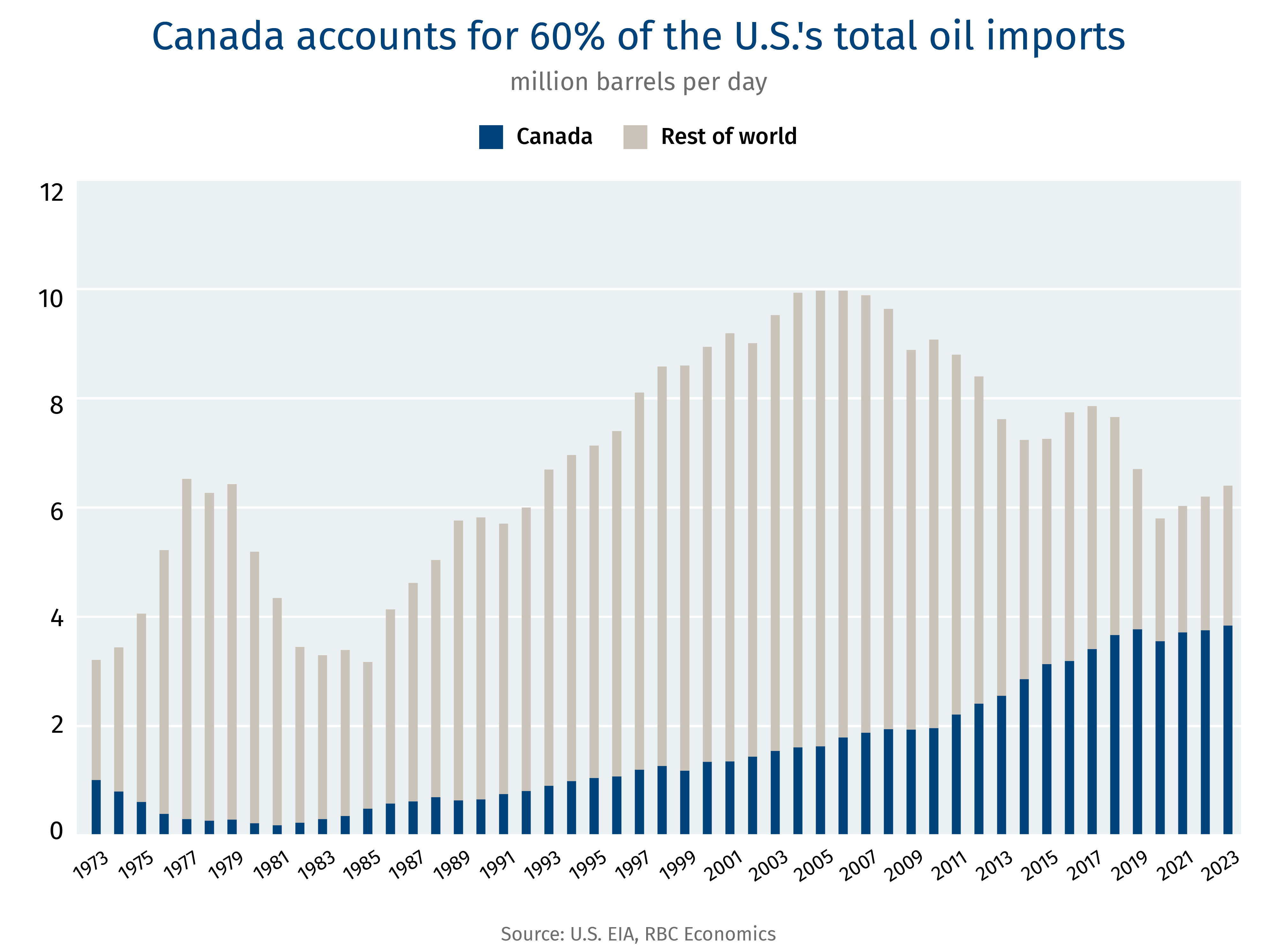
Oil: 60% of U.S. imports1

Canada’s advantage: Canadian oil can backstop U.S. efforts to become the de facto global swing oil supplier.

Canada’s share of U.S. crude oil imports has grown significantly over the past few decades, and now represent 24% of total U.S. oil consumption2. Cross-border pipelines deliver heavy crude directly to U.S. refineries that are specifically designed to process it. For these refineries, particularly those in the Midwest, moving away from Canadian heavy crude would leave them with high retooling costs or dependent on alternative sources such as Venezuela or the Middle East, exposing them to geopolitical risks. Recently, the Trans Mountain pipeline expansion has nearly tripled Canada’s oil shipping capacity to tidewater markets, carving out a role for Canada’s oil in supporting global allies, such as South Korea and Japan.

Electricity: 90% of U.S. imports3

Canada’s advantage: Low-cost and clean Canadian electricity can power several U.S. efforts including artificial intelligence, advanced manufacturing and advanced technology products.

Although the U.S. generates most of its own electricity, Canadian supplies keep the lights on and costs low across several U.S. states. New projects, such as Hydro-Quebec’s Hertel-New York powerline, aim to further increase electricity exports by providing 20% of New York City’s electricity needs, saving its residents an estimated $17 billion in electricity costs over the next three decades4.

With more than 30 cross-border transmission lines linking Canadian provinces with American states, Canada is essential for ensuring cross-border grid security and a potential source for incremental generation. For example, the rapid growth of AI technology–a U.S. strategic priority–is expected to drive a sharp increase in electricity consumption from U.S. data centres, which is estimated to account for up to 12% of U.S. total consumption by 2028, compared to 4.4% in 20235.

Natural Gas: 99% of U.S. imports

Canada’s advantage: Canadian natural gas can help America ensure ample domestic supplies and room for exports to allies in Europe and Asia.

Higher U.S. natural gas demand is expected to outpace supply growth in the next two years, according to the U.S. Energy Information Association. In addition, demand from data centres and reshoring of manufacturing could further strain natural gas power generation. Canadian natural gas is well positioned to meet supply gaps, and already accounts for 9% of total U.S. natural gas consumption with the capacity to expand further.

Canada is also poised to become a significant supplier of liquefied natural gas (LNG), and is uniquely positioned to export energy to strategic Asian allies. With six West Coast LNG projects proposed and under construction, including LNG Canada Phase I which is set to come online this year, Canada is estimated to have a total export capacity of 6.26 billion cubic feet per day (bcfd). This proposed capacity would put Canada among the top five global LNG exporters at current levels. In addition, West Coast terminals are strategically located just 10 shipping days from Asia, compared to 20 days for U.S. Gulf Coast exporters via the Panama Canal.

2. Canadian agriculture would strengthen American food security

Canada is a major part of the North American breadbasket, providing a stable and reliable supply of agricultural commodities that supplement the United States’ strengths in the sector. As a key provider of essential inputs like potash and seed oils, Canada supports U.S. food and biofuel production. With the U.S. facing potential labour shortages due to a crackdown on illegal immigration, Canada can help supplement this gap in the short term, while adding to continental food security in the long term.

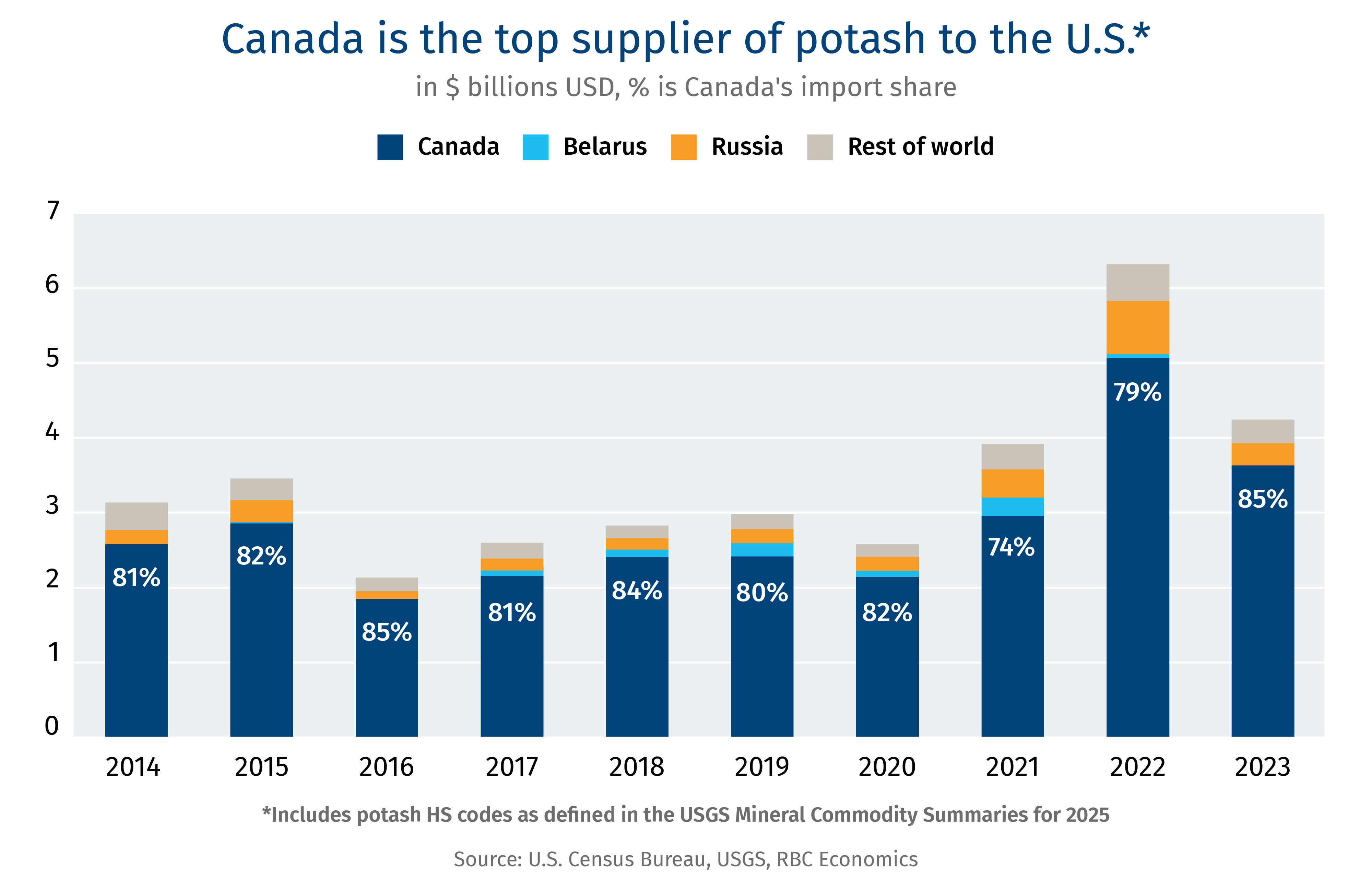
Potash: 85% of U.S. imports

Canada’s advantage: Canadian potash, a critical fertilizer component, can boost American crop yields amid extreme weather patterns, reinforcing continental food security and supply chain stability.

With growing food demand, there’s significant potential to strengthen this partnership. The Jansen potash mine, slated to begin operations in 2026, is projected to boost Canadian potash production by 4.2 million tonnes per year (mtpa), with potential expansion up to 8.5 mtpa by 2029—boosting Canadian capacity by more than a third. The new project would raise Canada’s global market share to nearly 40% by 2026. The increased production will not only bolster American food security but also help displace potash exports from non-aligned nations such as Russia and Belarus.

Canola oil: 98% of U.S. imports6

Canada’s advantage: Canola, a product developed in Canada, can play a key role in U.S. food security and meeting biofuel demand.

Canada provides a stable and diverse supply of agricultural products to the U.S., second only to Mexico. The U.S. is heavily reliant on Canadian canola oil, which account for 98% of its total imports, and is a key input in U.S. food production and renewable fuels.

Canada is also the top U.S. import source for cereal products, underpinning the deeply integrated cross-border supply chain in these sectors.

Meat: 34% of U.S. imports

Canada’s advantage: Canadian meat, including bovines and swine, are an important part of the meat feedstock into the U.S.

Animal proteins will continue to play a significant role in American diets, with per capita consumption in the U.S. projected to increase from 68.7 kilograms in 2023 to 74.6 kilograms by 20288. Canadian meat producers are essential in meeting this rising demand, as the U.S. already imports 33% of its beef and 66% of its pork from Canada7. The strong integration between Canadian and American meat markets is driven by high safety standards, a similar market structure, and alignment on product quality. As a result, Canadian meat not only supports U.S. domestic consumption but also contributes to American meat exports to global markets.

3. Canadian critical minerals and uranium can power advanced technologies in North America

The U.S. has reserves of many of the critical minerals needed in semiconductors and other sensitive technologies. Its uranium reserves are also able to help build out a new wave of nuclear power projects. It’s aiming to mine and enrich as much as possible within its borders to displace supplies from China and Russia but faces constraints, especially in adding enrichment capability. Canada has capacity in key complementary areas, like uranium conversion, that can help the U.S. build out an efficient North American value chain.

Critical minerals: 19% of U.S. imports, in total minerals and metals9

Canada’s advantage: With the right investments and innovation, Canada can advance production of several critical minerals.

The new U.S. administration is looking to accelerate several critical mineral projects and considering opportunities to advance activity within the Quadrilateral Security Dialogue, comprising the U.S., India, Japan, and Australia. Although outside this alliance, Canada is a player in the critical minerals space. It is a top 10 global producer and already a major supplier to the U.S. for aluminum, iron, steel, copper, nickel and more.

Canada has been working toward U.S. efforts to reduce reliance on China, from establishing a Canada-U.S. Joint Act Plan on Critical Minerals to $3.8 billion in public investments to ramping up exports to the U.S. of gallium and germanium, both impacted by Chinese export controls. Canada’s existing extraction and processing infrastructure could further fill U.S. gaps in key areas, such as aluminum, nickel and zinc.

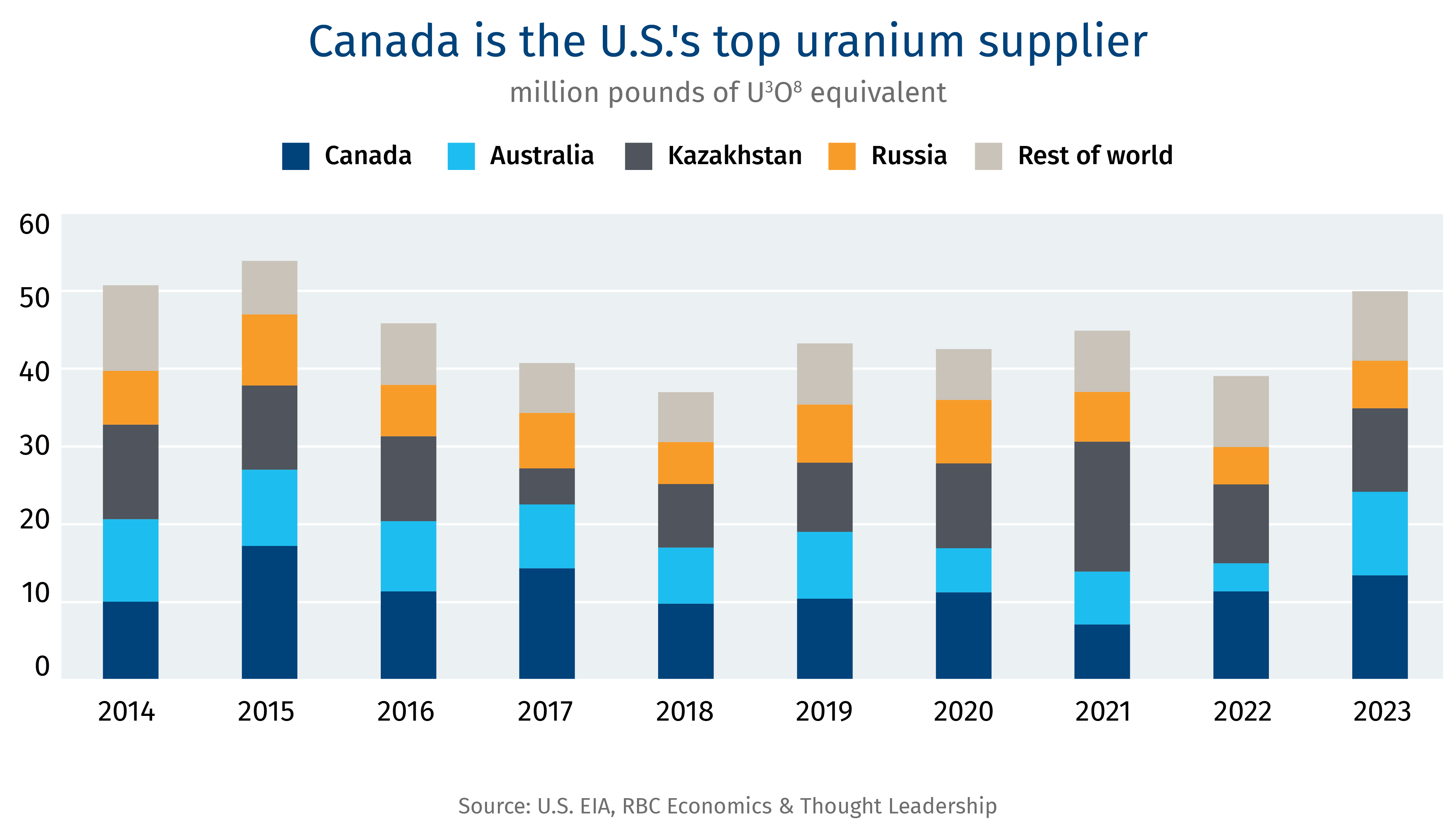
Uranium and nuclear expertise: 27% of U.S. imports, in uranium

Canada’s advantage: America’s path to nuclear renaissance goes through Canada—the world’s second largest producer of uranium after Kazakhstan.

The energy source is increasingly important to meet growing electricity demand to power AI data centres and other energy-intensive strategic advanced technologies. As the largest uranium supplier to the U.S., Canada can be an important part of the continental nuclear fuel cycle with world-leading technology and talent, small modular reactors (SMRs), and an 89,000-strong nuclear workforce honed through work on CANDU projects.

What Canada can deliver in advancing U.S. interests

In the short-term, there’s an urgent need for Canada to realign our economic interests with the U.S. For its part, the U.S. can go it alone, but it’s going to be a harder, costlier and longer route to self-sufficiency. A shifting economic and geopolitical environment behooves both to collaborate in the three core areas of mutual benefit.

This strategy heavily depends on the U.S. getting on board. We have a short window to convince Washington about the need to collaborate in the resource and energy space, which has been weaponized by several non-allied actors.

Canada also needs to get its own house in order.

A resource-focused economic and trade strategy would require billions of dollars in new infrastructure, including rail lines, seaports and processing facilities. However, domestic and foreign capital will only come to the table If there’s a stable regulatory environment and reliable pricing in what can be highly volatile markets.

These are not new challenges for Canada. Regulatory and policy uncertainty have hobbled economic development for decades. So, too, has lack of reliable demand from our major trading partners, including the U.S.

Resource production and processing calls for longer-term thinking, which will require the federal and provincial governments to work together to create entities, and strengthen existing ones, to attract and retain capital, and protect against extreme price volatility. We will also need to ensure our education systems are geared towards attracting the right talent and skills to ensure the economy is poised for long-term growth. And while positioning Canadian resources anew in the U.S. market, we will need to improve our trading relationships with many other countries and regions.

All this will require a different mindset among Canadians, to ensure our natural resources are not seen as a trading card with the U.S., but rather a strategic platform for growth, and prosperity, for decades to come.

It can be Canada’s greatest resource play.

Contributors:

Salim Zanzana, Economist, RBC Economics

Varun Srivatsan, Director of Policy, RBC Thought Leadership

Cynthia Leach, Assistant Chief Economist, RBC Economics

Yadullah Hussain, Managing Editor

Caprice Biasoni, Graphic Design Specialist

Shiplu Talukder, Digital Publishing Specialist

For more, go to rbc.com/tradehub.

Download the PDF

Download

  1. All U.S. import shares from 2023 unless otherwise indicated.
  2. Natural Resources Canada “Energy Factbook 2024-2025”
  3. Average last 5 years as 2023 figure distorted due to droughts affecting Canadian generation and export capacity.
  4. 2024 Fall Economic Statement
  5. U.S. Department of Energy “Evaluating the Increase in Electricity Demand from Data Centers”
  6. Includes imports of products under HS code 1514 in 2023
  7. Agriculture and Agri-Food Canada “Sector Trend Analysis – Meat Trends in the United States”
  8. Includes products under HS codes 0201 and 0202 for beef and 0203 for pork in 2023
  9. United States International Trade Commission

I’ve been to Davos five times, and don’t miss the icy sidewalks and endless security lines. But when the World Economic Forum last week brought together government leaders, CEOs, community activists and scientists for a digital Davos, I did miss the informal conversations and was reminded why connectivity is so important.

Like the old movie title says, being there matters. The hallway conversations, the opportunity to read a room, the chance encounters—these are the real strengths of Davos, just as they are the real strengths of our offices, labs and schools. It’s why we’re all yearning to be back together as soon as it’s safe, even if it means having to navigate the odd icy sidewalk.

This year’s virtual Davos tried to address the challenges shaping 2021: the race to vaccinate the world, the effort to kick-start economies, the fight to flatten the climate curve, the long journey to racial justice, and the struggle to detox social media. Here’s some of what I took away:

Vaccine politics could prolong the pandemic

Vaccine nationalism may be the biggest challenge to our world right now. We will get through it, but the next few months could be politically bumpy. Germany, a leader, has vaccinated less than 5% of its population, and made clear it’s going to take care of its own population first. Other wealthy countries are struggling to get supplies, while the world’s poorest countries worry they will be shut out. And that puts everyone at some risk, as the more the virus circulates, the greater the risk of mutation. There are concerns of a “persistent pandemic,” but vaccine distribution is just one piece of the puzzle. Public health systems need to be strengthened in the poorest countries. The World Health Organization needs to be revised and reformed, too, as it’s the only body that can help us all understand the virus and how we can contain it, collectively. The politics of the pandemic are not likely to ease up.

Joe Biden can’t unite the world

China’s Xi Jinping helped kick off the week with a stern message to the new U.S. president and his allies. Any effort to insert values into trade could lead to a new Cold War. We may be headed that way anyway. As Biden pushes for an “an alliance of democracies,” Canada and the European Union will try to revive global trade in a new fashion that’s as much about values as it is about value. As German Chancellor Angela Merkel put it, multilateralism “doesn’t simply mean co-existence.” While we may see a revived World Trade Organization, it’s not likely to be an all-powerful body. Expect more regional trade blocs, and what Spain’s foreign minister called an age of “strategic autonomy.” Ironically, this effort to “re-globalize” misses the digital revolution that transcends borders. The Europeans, Australians and others may want more control over the cloud-based economy that’s thriving in the pandemic. But they’ll need to convince Biden they’re not out to stifle Silicon Valley and the platforms that Washington is happy to criticize at home, and defend abroad.

Get ready for smart supply chains

The regionalization of trade is leading to a rethinking of supply chains, and not just because of vaccine and PPE shortages. Countries are looking at strategic sectors, especially ones rooted in technology, to balance supply and demand more safely. As Canada is discovering the hard way—through vaccines—this may lead to trade-offs between efficiency and resilience. National security may come into play, too, as we witness the growing connectedness of every tool and appliance in our lives. Regions everywhere will want more control over the Internet of Things, just as they do the Internet of words, pictures and money. That means that, as we rebuild supply chains, we’ll need to put an even greater premium on R&D, to ensure manufacturing centres are integrated with innovation centres. Brawn and brain, in other words. Masayoshi Son, the Japanese investor behind SoftBank, believes this approach may fuel the next big disruption, in logistics and mobility. He thinks autonomous vehicles can be to the 2020s what smartphones were to the 2010s. We’ll see. But in the decades ahead, auto plants are likely to depend on artificial intelligence and cybersecurity as much as steel and aluminum. Based on patent data, Son is convinced only two countries—the U.S. and China—will dominate this new space race, and they’ll be central to the smart supply chains of tomorrow.

Climate change, the next catalyst of innovation

Mary Barra came to our virtual session with a plan. The General Motors CEO laid out her vision for a company focused on “Zero Crashes, Zero Emissions, Zero Congestion.” She’s trying to make GM climate-friendly, as she watches Elon Musk’s taillights on the electric highway. But the GM plan to be all-EV is as much about innovation as emissions. Entire sectors will emerge—or be remade—through the 2020s as consumers look for technology to transform their lives, and governments spend trillions to lay the groundwork of a new economy. BlackRock founder Larry Fink, a Davos regular, published his annual letter during the Forum, urging CEOs to see the climate transition as an opportunity not just for the climate. He figures the world will need $50 trillion more in new investment by 2050 to meet our sustainability goals. That’s already leading to plans for a Hydrogen Valley in Europe (to do for energy what Silicon Valley does for computing) and proposals for new power grids along the U.S. interstate network. As Bill Gates told the Forum, the biggest cuts in emissions this decade will come from technology, not changes in behaviour. His new word for climate change: “catalytic.”

Increasing trust is the challenge of post-COVID capitalism

Davos is the birthplace of “stakeholder capitalism”: the idea that, to thrive in the long term, business needs to balance returns to shareholders with returns to customers, employees and communities. This mindset led many companies in the depths of the pandemic to find ways to make and distribute emergency supplies and develop vaccines at breakneck speeds. In North America, corporations were also among the first to step up to the challenges of Black Lives Matter, changing employment and procurement practices while many governments were still talking. It’s one reason the latest Edelman Trust Barometer (a survey of 33,000 people globally) found business is now the most trusted institution—ahead of government, media and religious organizations—and the only institution seen as both ethical and competent. That’s not necessarily comforting. Trust in all institutions is important to the well-functioning of markets and an economy, as well as society. Coming out of the crisis, business will need to do more to help those institutions strengthen themselves, if a new kind of stakeholder capitalism is to endure.

Money’s cheap; judgment is not

The COVID crisis has created a new generation of fans for John Maynard Keynes, and his theories about government spending. Can it do the same for another legendary economist from the 1930s, Joseph Schumpeter, and his belief in creative destruction? Governments and business may soon need to come to grips with the lasting economic damage of the crisis and consider which sectors stand a chance of rebirth, and which don’t. The stock market rewards companies at the forefront of change. But it may be politically tougher for governments to do the same. That’s too bad, as they can reap the reward if their countries become transformation leaders. In 2020, many of those governments got by throwing money at the entire economy. In 2021, they’ll need to be more selective—and appreciate how low interest rates can be a rising tide even for leaky boats. François Villeroy de Galhau, governor of France’s central bank, expressed concern his fellow policymakers focus too much on liquidity and not enough on solvency. Kewsong Lee, the CEO of Carlyle, was less diplomatic, asking policymakers if they’re keeping “zombie companies” alive. David Solomon, the CEO of Goldman Sachs, argued markets tend to eventually separate the good from the bad and the ugly. It will take discipline from governments to know when to let the Schumpeterian forces prevail.

A new social dilemma: speech or reach?

Our virtual gathering was haunted by the January 6 attack on Capitol Hill, and what it exposed in social media and democracy. The heads of major tech companies assured us they were ahead of the mob on most counts. Susan Wojcicki, YouTube’s CEO, explained how her platform is using AI and bots to take down thousands of misleading or offensive videos every day, usually before more than a handful of people have seen them. YouTube’s owner, Google, just opened a second “safety engineering” centre, to add more human surveillance. The platforms are rightly concerned about stifling free speech, especially in a pandemic when so much needs to be expressed and shared. But as many media and advertising executives pointed out, it’s not just speech that’s the problem; it’s reach. The platforms use algorithms to amplify the reach of different types of content, and most of us don’t know how they work. Governments may need to lean in more, to examine those algorithms, regulate harmful speech, and hold tech companies to account for allowing abuses to propagate. “Responsible conduct” can be a new norm for tech, as it is for other companies that rely on the public good. More public vigilance will be needed, too. As we confront the next stage of a pandemic, and its aftermath, our collective success may just hinge on the most important word of the 2020s: trust.


The U.S. was losing to communists on the battlefield, socialism was winning in the streets, monetary policy was fighting for credibility, and young people were challenging the multinationals that had come to define global commerce.

Capitalism did win out, and for the vast majority of people, the world became a better place – more open, more educated, more innovative, and by most measures more prosperous. But at the 50th World Economic Forum in Davos last week, a new global divide became apparent. After a half-century of globalization, of rules and ambitions that carried the world through the end of the Cold War, the rise of the Internet and the explosion of mobile computing, the world is facing new challenges, and new questions. And once again, a new generation is demanding action. Can capitalism again rise to the challenge?

This was my fifth trip to the Forum, and the first where I began to see the emergence of geopolitical systems and their economies as platforms competing for the transformation that lies ahead – and the deep implications that this holds. The 2020s may see a reordering of economies and industries, as societies respond to the threats of climate change and sectors tap the potential of smart technologies. But who defines that change remains to be seen. More than ever, business will have to step up.

Here’s some of what I learned at WEF 50:

1. Superpowers as the new super platforms
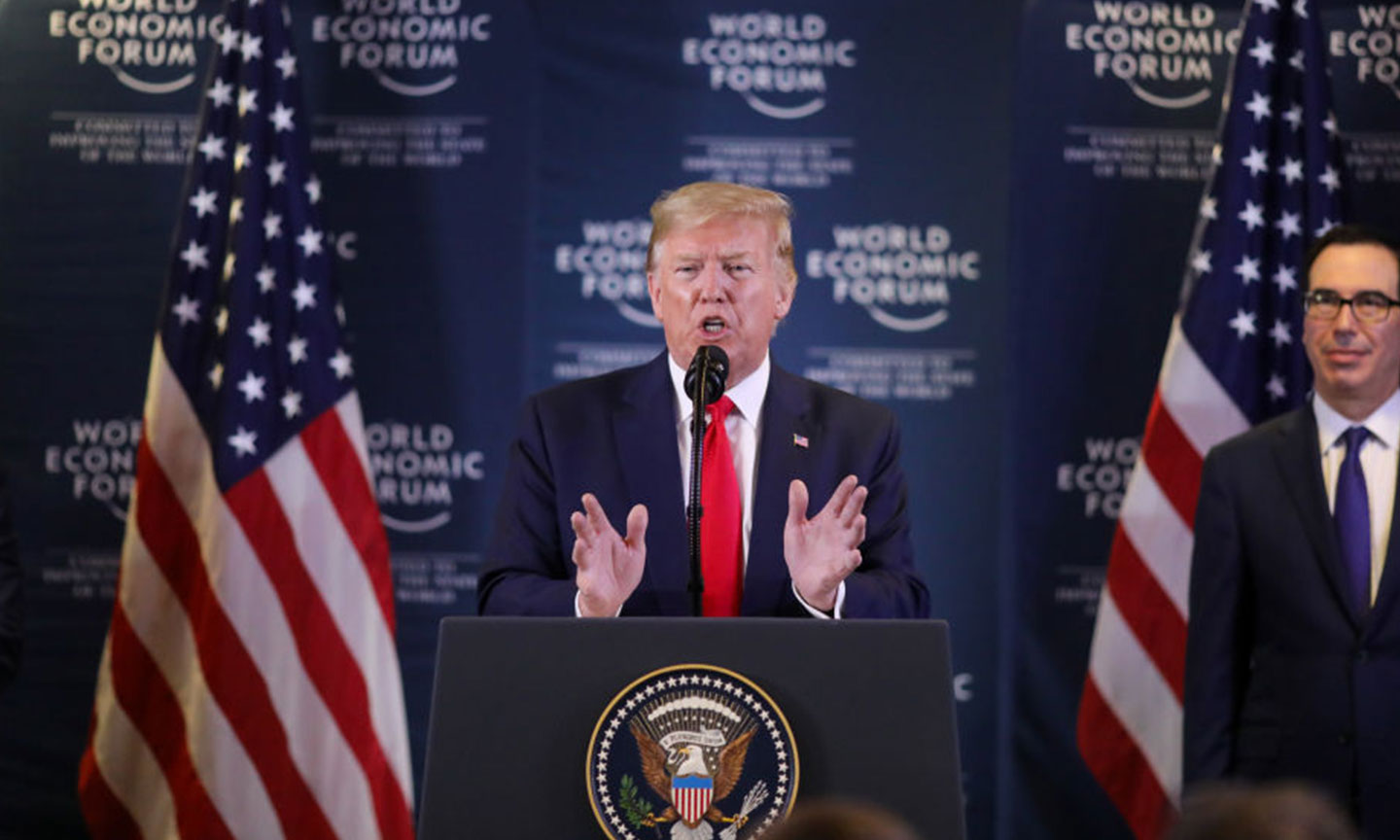
Every January, the shops along Davos’ main street are converted into showcases for far-flung markets from around the world, from Karnataka to the Caspian, with nods this year to Saudi Arabia, Ukraine and Canada’s cannabis industry. The Disneyesque displays always capture the diversity of our global economy, but the loudest messages this year came from those that didn’t have much of a visible presence: the United States and China. The two powers control 40% of global GDP, and as their trade conflict shows, they’re each trying to position themselves as a platform for global growth. That’s critical to everyone looking for global scale to solve problems, whether it’s to cure diseases, reduce carbon emissions or find new markets. It’s not just a race for scale; it’s a competition between operating systems for business, between America’s shareholder capitalism and China’s state capitalism.

I was with a group of CEOs who met with President Trump and members of his administration whose confidence was palpable. They felt their economic policies had exceeded expectations and their approach to a new trading order, based on regional and bilateral deals, would ensure the global economy continues to revolve around the American platform of capitalism, rooted in the capital markets of New York, the innovation labs of Silicon Valley and a manufacturing renaissance in between. China was less visible at this Forum, but the trade war hadn’t diminished the confidence of the Chinese leaders I met. In fact, their resolve seemed to be growing. As one regular Davos-goer noted, the absence this year of many world leaders – none of the BRIC leaders, for instance – could reflect the draw of China’s Belt and Road summit, which is held every April (Beijing last year, Dubai in 2020) and may be the new Davos. China’s rise is about more than summits and sales, however. Its approach to state capitalism is about scale, using technology and an expanding reach across Asia into Europe to create data fields that could become the OPEC of the digital age. Which platform prevails in the 2020s will be critical to every business, and country, looking for growth.

2. Government, redirected
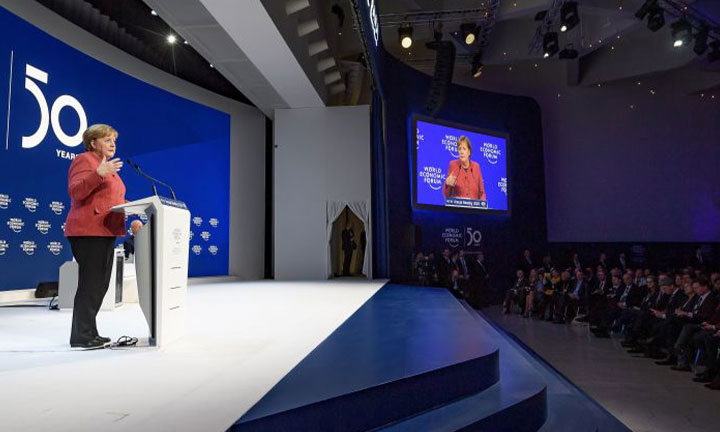
Across the aging, slow-growth West, governments are asserting themselves with a conviction not seen since the financial crisis. Nowhere is this truer than Europe, where governments are vexed by negative interest rates and the imminent departure of Britain from the European Union, a move that could further fray the world’s biggest common market. Into this valley of uncertainty, the EU leadership came in force to Davos to make the case for a more activist state. Ursula von der Leyen, the German president of the European Commission, made clear the continent isn’t going to compromise on regulations to compete with Britain. She’s ready to impose trade measures against any country that doesn’t meet environmental, social and labour standards. The Europeans are even planning to mobilize €1 trillion over the decade for a “green investment wave” that could rival the Democrats and their Green New Deal.

Even just a year ago, many Davos-goers thought rising global frustrations might spark a return to socialism. That may still happen. But at the forefront of the resurgent state are pragmatists like Germany’s Angela Merkel, who laid out an economic model that is neither left nor right: it’s a new economic model rooted in sustainability. “The whole way we do business will have to change,” the Chancellor said at her 12th Davos Forum. Europe’s more balanced approach to markets has carried into the cyber-economy, where its governments appear happy with their new, more onerous data regulations, and are determined to impose a digital tax on the Internet giants, for the sake of fairness and revenue. Global trade tensions won’t help, and indeed may worsen as Britain tries to cut deals with the U.S. and, eventually, China, in a race to bridge the two platforms.

3. Capitalism, repurposed

The Forum’s theme was “stakeholder capitalism,” an unfortunately anodyne description of a smart and sustainable approach to business that strikes a balance between communities, customers, employees and shareholders. Simply put, it puts purpose ahead of profit. Over the past 50 years, business has largely expected government to set rules and levy taxes to serve the public good. As trust in governments wanes, and the complexity of society’s problems grows, companies are charting their own course on environment, social and governance issues, to maintain public confidence in business and ensure the prosperity of communities that business serves. The challenge is serious. According to this year’s Edelman Trust Barometer, more than half of respondents worldwide feel capitalism does more harm than good – a sentiment driven largely by income stagnation. “Capitalism as we’ve known it is dead,” declared Marc Benioff, the founder and CEO of Salesforce.com.

In some ways, European and Canadian companies have already developed a purpose-driven approach to business that their American and Asian peers are only now pursuing in earnest. Microsoft CEO Satya Nadella made the case for this repurposing of capitalism, describing our economic model as the world’s most powerful economic learning system, rooted in discovery and testing. That learning system is needed more than ever to solve the world’s increasingly complex challenges, he argued. Mastercard CEO Ajay Banga suggested business can build the partnerships and networks needed to solve those problems. He came back to that word, scale, which may be the most important force of the 2020s. Business has proven to be the most effective model for scale anywhere, and is proving that again with global platforms. But this repurposed capitalism, and its complex web of relationships, will put ever-greater pressure on CEOs to reach beyond their walls and sectors, to delve into foreign subjects and work with unlikely allies, using the strength and spirit of their organizations to take solutions to a global scale. As Banga told the Forum, “there’s not enough philanthropic money or government money to solve these problems.”

4. Accountability, redefined

If business is to play a leading role in the 2020s, it will need more acceptance from society than ever, and that will require a more active role in developing national and international standards for a company’s performance on environmental, social and governance issues. We can’t wait for government. This year the Forum and 140 global companies launched an initiative to measure and show the progress of business across four pillars – principles, people, planet and prosperity – with 22 measures developed by the world’s major accounting firms. Properly adopted, the index can help communities, environmental groups, regulators, even employees, hold companies to account on their performance beyond the financial bottom line. And, in turn, this model can help business transparently measure its progress and outcomes, as we continue to strive to earn our social license to operate in society.

Such measurement tools carry risks, especially when they lose a sense of balance among their many variables. The risk was evident at this year’s Forum when environmental concerns overwhelmed the social and governance components of ESG. It’s important to remember how the failure of authorities, in business and government, to restore social inclusion after the financial crisis led to the rise of populism in the last decade. The governance failures of the Internet have been equally damaging. If the new capitalism is to find balance, it will need to ensure it continues to see the concerns of society as an integrated system rather than an itemized scorecard.

5. The new math of net zero

If two words defined this Forum, they were “net zero” – the idea that companies, even countries, can strive to reclaim more carbon from the atmosphere than they emit. The snowless pastures in the lower valleys around Davos this winter illustrated the realities of climate change and the urgency that Greta Thunberg brought to the Forum with her message that history is watching and a new generation is judging. She wasn’t alone. The world’s biggest asset manager, BlackRock, announced it would hold companies to a higher standard on all measures of sustainability, including their role in reducing global emissions. Microsoft set its own bar higher with a net-negative carbon policy that commits the software giant to offset all the carbon it has ever emitted. Few companies have done the hard math that Microsoft did, to calculate new emissions that can be attributed to its existence. If we’re serious about net-zero concepts, a lot of homework remains.

While much of the focus was on emissions reduction, more attention is going to offsets, especially nature-based ones that could allow our seas, land and forests to absorb more carbon, more quickly, as we work to transition industrial practices and consumer preferences. The Forum announced a bold commitment to help the world plant 1 trillion trees, increasing the global total by a third. That won’t be easy or cheap. The world’s leading financial institutions – banks, pension funds and asset managers – are also working to ensure more capital flows to carbon-reducing companies and technologies, and gradually away from major net emitters. In my conversations with finance officials and other global bank CEOs, it was clear governments need to do more – to set the rules of sustainable finance, and set clearer prices for risks, including carbon, so capital markets and business operators can get on with what they do best: optimizing the allocation of scarce resources, driving change and scaling innovation.

6. The messy math of energy

The most difficult conversations at Davos were also the most important. They were around how we plan for the next-quarter century of energy production and consumption, allowing investors and consumers to make economically rational choices that don’t lead to ecological catastrophe or social upheaval. To get there, we need more math and less emotion, because right now the math doesn’t add up. The Saudis, with low costs and low emissions, covered Davos with billboards and tea huts to burnish their image as they continue to export a good chunk of the world’s oil. They’re well positioned for any transition. The Americans, with a proven track record of innovation that’s made them the world’s Number One oil producer, show no signs of pulling back either. And then there’s China, whose ambitions could upend the world’s carbon math. As one China expert told us, the country is on course to open two new coal plants a month for the next 12 years.

I met with the world’s leading energy CEOs to better understand what they’re up against, and what they’re doing to reduce emissions. We need them to succeed. Our transition to a greener economy, with a more diverse energy mix, will take decades if it’s to avoid massive economic disruption. But it also needs to be more deliberate if it’s to avoid large-scale dispersion of capital away from some of our best innovators – the oil and gas companies that are using artificial intelligence, drone surveillance and advanced chemistry to reduce emissions. Some of those producers fear they’ll be cut off from investors who make unilateral decisions to adhere to the new carbon math. It may be short-sighted. Without a clearer plan to replace fossil fuels, we risk seeing producers hoard cash – or give it back to shareholders — rather than invest in new technologies. Any resulting decline in production, especially without a visible change in consumer behavior, might lead to a run-up in oil prices, something that could spark economic shocks and a political backlash.

7. The return of Malthus

When the Forum began in 1971, the world’s population was 3.8 billion, and plenty of Malthusian doomsayers warned we didn’t have enough land, water or food to cope. Instead, technology and trade triumphed, allowing roughly 7.8 billion people today to enjoy access to more food than the planet has ever produced. Can it continue as our population heads to 10 billion by 2050? With the world adding 80 million people a year, increasingly in Africa, the Middle East and other food-challenged regions, Davos renewed its focus on food security and the need to see global food production grow by 60% by the middle of the century.

The Forum brought together food innovators from around the world to showcase how technology may save us again. Cell-based meat production, pea proteins, vertical farming: there are plenty of ideas being developed. They will require new supply chains, changes to consumer behaviour and much more public and private investment. To show what individuals can do, the Forum launched a Future Food Day, serving locally sourced dishes, with smaller servings. Can such nudges make a difference? Not without large-scale investments in public research and the private scaling of innovation. Ramon Laguarta, the CEO of PepsiCo, suggested the world needs half a dozen Silicon Valleys of food innovation, in which universities, entrepreneurs and major producers can work with farmers of all sizes to transform how they produce food. The United Nations did just that in the 1960s and ‘70s, fostering a Green Revolution that helped avert a Malthusian mess. If we can make a renewed commitment to multilateralism, and allow for more business leadership, we might be able to do it again.

8. Currencies 2.0
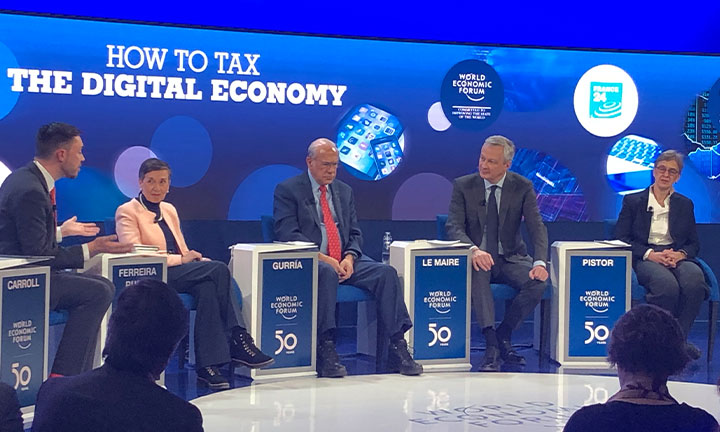
The first Davos Forum inspired conversations around the dismantling of the gold standard, and emergence of the U.S. dollar as the world’s reserve currency. Fifty years later, the Forum is working with central banks and financial institutions to talk about currencies for the digital economy. A group of financial executives met with Bank of England governor Mark Carney to discuss the next frontier in payments, knowing there is a complex problem to solve: How can we reduce the friction of digital payments without undermining the financial system that is a foundation block of our economy? We’ve weathered financial crises since the end of the gold standard because our financial system doesn’t separate the storing, lending and movement of money into isolated channels. In fact, the confluence of these channels has ensured liquidity and an efficient matching of short-term savings (deposits) with long-term investments (loans). While digital currencies could make transactions easier, they risk diverting the lifeblood of our financial system to sources outside the system, like the big tech platforms that want the economic value of payments without the regulatory costs.

The next generation of payments will present another critical question: will digital currencies ever replace King Dollar? Not any time soon. Facebook’s Libra project has struggled to gain acceptance. And China’s initiative to build a digital yuan faces some fundamental problems. Beijing hasn’t explained which currencies (if any) might backstop the concept, which would be essential if a digital yuan is to facilitate trade such as an Alibaba purchase from Europe or Russian oil sales to China. The consequences are equally unclear if such a currency were to be adopted by rogue actors seeking to evade U.S. financial sanctions. The Trump administration’s active use of sanctions has already pushed many countries, notably Russia and Iran, to pursue new financial channels with Europe, the Middle East and Asia, making the notion of a new digital currency all the more appealing to them. The biggest challenge for the next generation of currencies will be to earn the trust of consumers, producers, sellers and lenders – and scale that trust. Through financial crises, wars and recessions, the U.S. dollar has done that, which is why the world continues to flock to it. For all the frustrations they can cause, America’s legal and regulatory systems remain the gold standard of global finance. Which is why the dollar is backstopped by the most valuable currency of all: trust.

9. Organizations 3.0
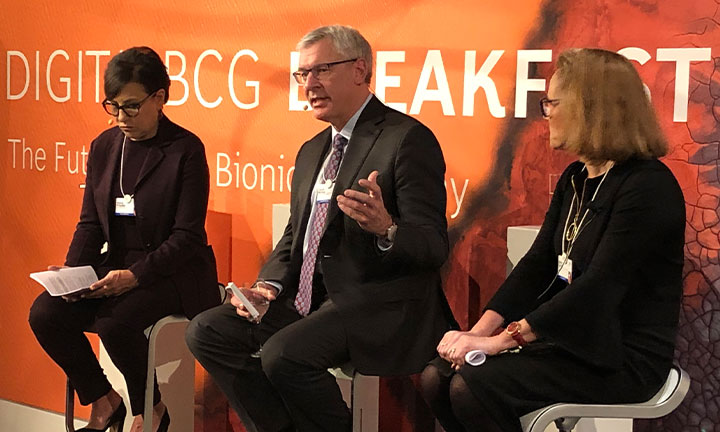
Businesses were first built around people. Over the last 50 years, they’ve been built around technology, too. We’re moving into an age when they’ll need a bionic blend, in which the interoperability of people and technology will be a critical success factor. I was part of a Davos panel on the “bionic organization,” led by the Boston Consulting Group and featuring Belén Garijo, the CEO of Merck’s Healthcare division, and Penny Pritzker, the former U.S. commerce secretary and founder of the investment company PSP Partners. We talked about how organizations can ensure their employees work effectively with smarter technologies, and how those technologies can be developed and refined to take advantage of the enormous human skills found in successful companies. Think of it as “intelligent augmentation” – the IA that can be just as powerful as AI to an organization. In the case of Merck, such an approach has increased demand for employees who can work across cultures as comfortably as they work across data platforms, blending tech and social skills. It’s one reason the company restated its purpose as “curious minds devoted to human progress.”

This blend of skills will be critical to legacy organizations trying to create 3.0 versions of themselves, using smart technologies and data pools to build their own platforms. One example: Yara International, the Norwegian fertilizer company, has built a digital platform with IBM that gives users the tools, data, networks and products they need for sustainable farming. Trouble is, such efforts rarely succeed without a diverse human mindset driving a platform. Pritzker told our session she looks for openness, authenticity and permission in companies she buys. “Innovation takes risk,” she’s found – and risk is rare if people don’t feel safe to speak their minds. She said a strong culture of diversity is critical to the bionic organization – something she didn’t appreciate until she worked in government and saw diversity as more than representation. “It’s also the difference in where you come from,” she said.

10. Education 4.0

Leave it to Yuval Noah Harari to rattle the sapiens of Davos. The Israeli author is one of my favourites, and he didn’t disappoint when he told the Forum about the disruptions coming at humanity through automation. “How do you teach a 50-year-old truck driver to be a software engineer, or teach yoga to software engineers?” he asked. Even more than job loss, the historian and author of Sapiens worries the greatest threat to progress will be the loss of our sense of relevance as machines do more of what we thought we were good at. Offering advice. Giving directions. Telling a story. “It’s much worse to be irrelevant than to be exploited,” he warned, suggesting a new “useless class” will be our great challenge in the decade ahead.

Over to you, educators, and that could soon include all of us. The Forum launched an initiative this year to provide 1 billion people with better education, skills and jobs by 2030, which will require educators, government and business to develop new learning models together. As Suzanne Fortier, the Principal of McGill University, told the Forum, we need to be ready for a revolution in lifelong learning, which will run from early childhood until we’re 100. We’ll need a lot more such innovations if the Forum is correct in its projection that technology investments will create 133 million new jobs over the next three years. Many of those jobs will require specialized tech skills. Many will demand trade skills, which the world over aren’t attracting enough young people. But everywhere, the greatest demand will be for critical thinking and communications, the power skills of the 2020s. There’s just too much information out there for humans to cope with. Indeed, over the next 50 years, our greatest challenge may be to ensure we’re always learning. As Harari knows, it’s what defines us as sapiens.


I left Davos with a sense of concern for our increasingly divided world, and a sense of hope for the human spirit at the root of progress.

The balance may rest in the concept of trust. It could, as IBM CEO Ginni Rometty told the Forum, define the decade. There’s so much change happening, so quickly, that trust is the new glue, for communities and companies. Unfortunately, as the Edelman Trust Barometer shows, our trust in governments and media is limited. Companies face a fair degree of scepticism too – but business still enjoys more trust than other institutions. We will need to honour that trust, by investing in the concerns that have divided so many, and by ensuring that the positive power of technology isn’t hampered by lack of trust. Our ability to learn, share and resolve has never been more important. As is our willingness to listen. Angela Merkel put it well when she said “the fact that people aren’t willing to talk with each other fills me with grave concern.”

It’s why forums like Davos are more critical than ever, to bring people together at a time when we’re easily pulled apart. If there was any confidence to bring home, it was in the messages from scores of youth leaders who represent a new generation – one that’s creating a more positive sense of change, and an impatience in those who can’t deliver. As Natasha Wang Mwansa, a 19-year-old girls’ rights activist from Zambia, told the Forum, “It’s not about being young or old. How will you be part of the change we need?”

Download the Report

Download

From the keynote addresses, panel discussions and hallway chatter, it’s clear that we’ve entered a new decade of divisions: a world caught between the mountains of America, China and a Britain-free Europe.

The best-selling historian, Yuval Noah Harari, took centre stage to outline the major disruptions – technology, nuclear weapons and climate – that will shape the 2020s. A lack of U.S. leadership in each space makes the world more dangerous, Harari argued, blaming a “Me First” mood in global politics. “The global order is now like a house that everyone inhabits and no one repairs.”

Harari’s talk focussed on technology – and the social and political walls it will build within countries and between them. Such barriers will be erected by an emerging plutocracy of data oligarchs and a new kind of serf he calls “the useless class.” “How does a 50-year-old truck driver train to become a software engineer or yoga instructor for software engineers? The real struggle in the 21st century will be against irrelevance. It’s much worse to be irrelevant than to be exploited. This will lead to a useless class and it will be separated by an ever-growing gap with the elite.”

Artificial intelligence will exacerbate those divisions, as the world is rebuilt around tech hubs that will hold sway over billions. “We are now hackable animals. The power to hack human beings can be used for good purposes, such as providing better health care. But if this power falls into the hands of a 21st century Stalin, it will create the worst authoritarian regime the world has seen.” Even the elites at Davos won’t be safe, he stressed. “Just ask Jeff Bezos. In surveillance regimes, the higher you rank in the hierarchy, the closer you will be watched.”

Harari warned we will lose power over all sorts of decisions – our agency – as the platforms accelerate what they’re already doing. Google will decide what we know, Netflix what we enjoy, Amazon what we own, leading us to “philosophical bankruptcy.” “If we develop an arms race in AI, it doesn’t matter who wins. The loser will be humanity.”

The trouble with Harari’s argument is it assumes global sway by these firms, and that’s less and less likely in an increasingly polarized world. Europe clearly has headed in its own direction on data regulation, and will do so with carbon regulations. In another WEF session, European political leaders stressed their intent to push ahead with a digital tax that may make life more difficult for American platforms. And America, even without Donald Trump, is likely to make it difficult for Chinese firms to thrive in North America.

With the long view of European history in her mind, the most significant speaker at WEF 2020 may be Angela Merkel, the German chancellor who came to Davos to outline the strategy for a post-Brexit Europe. The changes she described should not be underestimated in terms of their impact. Europe’s first priority, once Britain is out, will be a Green New Deal that aims to make Europe the first carbon-neutral continent. “The whole way we do business will have to change,” she told the Forum. Europe will require new supply chains, new industrial processes, new electricity grids and new power sources, including, Merkel said, a lot more hydrogen. “The way we produce steel will have to be changed completely.”

The new Europe will also try to build a special relationship with China, starting with a summit next September between EU and Chinese leaders. Next up will be a renewed focus on Africa, which will be the fastest-growing region – demographically and perhaps economically – through the 2020s. We could see a Eurafrica emerge.

Merkel conceded Europe can’t do it on its own. There are technologies – chips and semiconductors – that it will need from other markets, and it will remain ingrained in a U.S.-dominated global financial system. She added that Europe needs to regain some confidence, that it can drive innovation like it has over the centuries. And ultimately, it will need more multilateralism – a rejuvenated World Trade Organization, a reinvigorated NATO and a repurposed IMF and World Bank. That won’t be easy. “This shift of power fills people with concern and that triggers tension we need to contend with,” Merkel said. “The fact that people aren’t willing to talk with each other fills me with grave concern.”

This was her 12th Davos, and the 50th Forum since it was launched in the depths of the Cold War, when the world, and Europe, was deeply divided. Merkel left the Forum with a clear message that is as true now as it was then: “I’m convinced the price of inaction would be higher than the price of action.”


The World Economic Forum declared Wednesday “Future Food” day, when delegates were served vegetarian and locally sourced food to highlight the coming challenge of feeding a world of 10 billion people. The inconvenient message: We may need 60% more food to keep pace with demographic change, even as climate change disrupts croplands everywhere. Business as usual won’t cut it. Today, more than 10% of the world’s population remains undernourished, and the things we’re doing to feed the world may one day starve the planet. Exhibit A: Food production accounts for just over one-quarter of global emissions. Adding concern: global food loss and waste generate about 8% of annual greenhouse gas emissions, according to the FAO. It’s a troubling paradox.

Almost everywhere food is grown, there are stories of supply disruption: fields too wet to plant, weather-damaged orchards, and rain-starved vineyards. But food shortages are likely to hit poorer parts of the world much more severely than richer ones. In particular, global warming will have a badly negative impact on nutrition in Africa and Asia. It’s difficult to overstate the ripple effects of food shortages. Notably, it could lead to an increase in cross-border migration, which even at current levels is already redefining the political landscape in places like North American and Europe.

At one lunch today, a few dozen food experts ate mixed salad with seeds, mushroom risotto, and apple pie, and tried to figure out why innovation is falling short. Abi Ramanan, an AI specialist, noted: “agriculture has been mechanized but not digitalized.” She co-founded ImpactVision, a San Francisco-based company which applies hyperspectral imaging technology to improve food supply chains.

Agtech is hot in Silicon Valley, but even still agriculture isn’t attracting the scale of research funding – or venture capital – it needs for breakthroughs. There are exceptions, of course. Cellular agriculture is a fascinating next-step to plant-based alternatives. It uses cultures to build cell-based products outside of an organism that tastes like the real thing, be it meat, eggs, dairy or even byproducts like leather. While investment in agri-food innovation and more sustainable farming practices has climbed to nearly US$5 billion in the last five years, it still lags substantially behind cleantech.

Instead, governments spend $300 billion on food subsidies, with very little focused on transformation. “Farmers don’t need subsidies. They need support for investments,” said Wiebe Draijer, chair of Rabobank. But as big planning schemes for food have always shown, it can’t be centrally planned. It depends hugely on local farmers and consumers – the original and ultimate value chain

It doesn’t help that the world’s farmers can be a cautious lot, perhaps because their risk appetite is consumed by weather and climate disruptions. Then there’s price-obsessed consumers who aren’t willing to pay for innovation. Matt Barnard, the CEO of Plenty, said consumers everywhere want only “pleasure and convenience.” In some countries, insurers and banks are helping farmers transition their operations so they can invest in new technologies. But a more ambitious approach is needed. At the main forum, Ramon Laguarta, CEO of Pepsico, pushed for a bolder global approach, with five or six ag tech hubs – “connected with real farmers.” It may be the sort of scale needed to match the scale of challenge.

Until then, we may need to focus on that other thing we do with the land – forestry. At the Forum today, Klaus Schwab unveiled an initiative with the world’s leading governments and businesses to plant, grow and restore one trillion trees. Nature-based solutions that lock up carbon in forests, grasslands and wetlands can provide up to one-third of the emissions reductions required by 2030 to meet the Paris Agreement targets, according to the Forum’s calculations.

But here too, we run into a paradox where protecting the food supply and cutting greenhouse emissions collide. Planting large numbers of trees can push crops and livestock onto less productive land. That in turn could raise food prices. Regardless of the math, the economics of food will be back at Davos.

For insights into how the coming skills revolution can transform agriculture, read our recent RBC report Farmer 4.0.


In one session, Greta Thunberg called for a remaking of the global economy, through grassroots movements that rely on local ecosystems. In another, Donald Trump took credit for “the great American comeback,” describing “a blue-collar boom” of new jobs, factories and wealth that could lead to a new decade of manufacturing and global trade. Neither may indicate where leadership in the 2020s, and a decade of climate, tech and economic disruptions, is headed.

The Forum conversations about leadership suggest neither confrontation nor conflation are on the rise. Collaboration is – across offices, communities and society. It’s a new kind of “stakeholder leadership.”

An MIT Sloan Management School study, released at Davos today, found skepticism within companies about the abilities of leaders to help organizations, and communities, through disruptive change. Sloan surveyed business thinkers from more than 120 countries, and found just 12% strongly agreed their leaders have the right mindset to lead them forward. And only 40% believe their companies are building robust talent pipelines. The worst score? It was on digital skills, with fewer than 10% feeling their leaders have them. That’s worrisome because one of the messages at Davos is that new business models are emerging in which traditional companies will become their own platforms, through what IBM calls “business re-engineering on steroids.” One example: Yara International, the Norwegian fertilizer company that sees itself as an information platform for sustainable farming.

To get there, the MIT Sloan study says organizations must come to grips with “deficient skills sets and outdated mindsets.” (It profiles RBC and CEO Dave McKay for “a culture of openness, partnership-building and authenticity.”) In addition to authenticity, the authors identify an emerging type of leader who is purpose-driven and passionate, and exudes humility, inclusiveness, and empathy.

Those aren’t exactly qualities that would score well in a Davos word association game. But many of the management thinkers here are seeing it spread rapidly. In another Davos session, on the future of the corporation, Oxford economist Paul Collier made the case against “economic man” – the post-war model of corporate employees who were told what to do by their leaders and then closely monitored. “Turns out these ideas are false,” Collier said. “Those ideas are right for cats; humans are not like that. We are a uniquely pro-social species.” Which is why he sees a new generation of executives who show “leadership though respect.”

Part of Davos this year has been handed over to teenage leaders, including climate activist Greta Thunberg. She joined on stage a Zambian children rights’ campaigner, Natasha Mwansa; Salvador Gomez-Colon, a Puerto Rican advocate; and Autumn Peltier, the chief water commissioner of Anishinabek Nation in Ontario. “Our generation is standing up for the world we want to see,” Gomez-Colon told the Forum. “We’re not the future, we are the present.” The youth on stage said they see a different leadership model emerging, one that is more positive and constructive. “I don’t want your awards. If you’re going to award me, award me with helping to make change,” Peltier stressed. As for the way new media has ravaged many aspects of leadership, she added, “If you’re going to say something negative about us online, don’t. We’re trying to do something positive.”

The day ended with five of the world’s top CEOs – Brian Moynihan (Bank of America), Ginni Rometty (IBM), Feike Sybesma (Royal DSM), Jim Snabe (chair, Siemens) and Marc Benioff (Salesforce) – who discussed leadership for a new kind of economic model. “Capitalism as we have known it is dead,” Benioff told the Forum. The group agreed the CEO of the 2020s is one who can both bring together and serve so-called stakeholders, including communities. (In Salesforce’s hometown of San Francisco, “the homeless are our stakeholders,” Benioff said, referring to a campaign he led to raise taxes to reduce homelessness.) At IBM, Rometty used the example of skills training to illustrate how corporations can play a role once assumed to be solely the property of government. Knowing not every American kid can go to university, IBM has developed a tech program with high schools and community colleges to help those students prepare for the jobs of tomorrow. Rometty said that 15% of IBM’s new employees in the U.S. last year came from the new program. IBM is trying to apply the same kind of leadership thinking to its relationships with suppliers, customers, academic partners and the public.

Rometty said the imperative comes from a simple view: “This is a decade of trust.” And the trusted leader.


Beneath the Magic Mountain of Davos, the main floor of its sweeping Congress Centre features a tented sculpture made of seaweed, to showcase natural materials; a large apple tree grafted from 40 different species; and display tables of artisanal work that used to be consigned to museums by Davos-style globalization. The marquee speaking slots once reserved for Sheryl Sandberg and Eric Schmidt are now the property of Greta Thunberg and Jane Goodall. And the small backpacks given to delegates are made of recycled cloth. Even the caterers are encouraged to serve local foods and wines, and adhere to a full day of vegetarian menus this week.

Don’t worry, the WEF hasn’t gone all hippie. It’s just trying to address the biggest risks in business, which are pretty much all related to climate change and the environment. For the first time, the Forum’s Global Risks Report is dominated by them, with the top five spots of likely risks going to environmental issues (extreme weather, climate action failure, natural disaster, biodiversity loss and human-made environmental disasters) – and topping the list for impact, ahead of nuclear war.

Beyond displays of seaweed, the Forum is pushing the world’s top corporations and governments here to pursue a Net Zero strategy, meaning they’d pull as much carbon out of the atmosphere as they put into it. Its new paper, “The Net Zero Challenge: Fast Forward to Decisive Climate Action,” makes the case for unilateral action for countries and companies because the chances of a global or even multilateral solution are dimming by the year.

Some key points:

  • Few countries are on course to meet their Paris targets
  • Few countries have a credible plan to get to Net Zero emissions
  • Companies and sectors need to chart their own course to Net Zero, and should do so for self-serving reasons: to drive efficiencies, force innovation, earn the social license to operate in communities concerned about climate change, and stay ahead of the demands of regulators and investors
There are plenty of companies at Davos that argue they’re ahead of governments on climate action. Microsoft last week declared it will be carbon negative by 2030. Unilever, Levi’s and IKEA are among those with ambitious plans that aren’t relying on government action, as are major Canadian energy producers Suncor, Cenovus and Canadian Natural Resources, which have each stated a Net Zero goal or released significant emission reduction plans. “While no single actor can halt global warming alone, efforts by leading industrial nations or large corporations can have a multiplier effect,” the WEF report notes.