➔ On Carney’s to-do list: carbon capture project and transition bonds ➔ Warren Buffett’s successor built the company’s energy empire ➔ Struggling cleantech stars, and a Climate Fiction Prize
Hot takes
➔ Canada’s EV policies are hurting farmers. Ottawa’s tariffs on Chinese EVs has had the “unintended consequence” of Beijing slapping levies on Canadian canola, lobsters, and peas, etc., agriculture members of the Canadian Federation of Independent Businesses’ wrote in a letter to three federal ministers. Canada’s $62 billion in total subsidies to EV firms has also not triggered an investment boom as those firms have paused their plans in Canada, CFIB pointed out. The group wants some of those funds redirected to small businesses.
➔ Did green power trigger Iberian blackouts? Some suggest “non-controllable” resources—i.e. solar and wind that can’t be controlled or scheduled on demand—were to blame. But it’s not like fossil-fuels grids can’t break down (Italy in 2003, anyone?). But intermittent generation poses a different set of problems. While authorities remain in the dark for now, the Spanish grid operator REE had warned in February that reliance on renewables could lead to grid instability, especially if the government closes its nuclear power plants by 2027. Could the simple answer be: keep the energy mix diversified?
➔ Warren Buffett’s successor is an energy empire builder. The Oracle of Omaha handpicked Edmontonian Greg Abel to succeed him at Berkshire Hathaway. As chairman of the company’s energy and other non-insurance businesses, Abel runs a conglomerate that’s among the largest operators of wind and solar energy in the U.S., electric utilities, and natural gas pipelines. While Berkshire Hathaway runs some of the dirtiest coal plants in the U.S.—coal power now accounts for only 22% of Berkshire’s power generation, compared to 71% in 2005.
➔ Ontario is fast-tracking critical minerals development. The new proposed rules will boost investment in local supply chains and reducing reliance on foreign imports would drive job creation, stimulate economic growth, and position Ontario as a leader in the green economy. The new rules also give the province wide powers to shield its strategic assets against “hostile foreign actors and regimes.” The move comes as the U.S. is moving at a frenzied pace to lock in critical minerals, including a deal with Ukraine, fast-tracking of supply chains, and plans to accelerate deep-sea mining.
CLIMATE POLICY
Carney’s Climate Corridors
Economy and trade tops the new federal government’s priority list, but there’s room to push through climate policies—especially “energy corridors,” that are seen as the path to an investment-led growth spurt.
Here are some high-profile climate files on the new government’s to-do list:
➔ Building a major carbon capture project in Alberta. How can a CCS project backed by Pathways Alliance—a consortium of oilsands firms looking to build a carbon capture project—get off the ground? Prime Minister Mark Carney said last week in Edmonton he is keen to see it built.
➔ Strengthening industrial carbon policy. The Conservatives wanted to repeal the federal carbon pricing for industrial emissions, but it stays for now. Last year, Myha Truong-Regan, RBC Climate Action Institute’s Head of Climate Research, co-wrote on how industrial carbon markets can be central to Canada’s efforts to accelerate energy transition.
➔ A Carbon Border Adjustment Mechanism. It was in the Liberal platform and could be Canada’s version of a climate-tariff—if it proceeds—helping climate-compliant Canadian companies compete with high-emitting foreign rivals. The Europeans may nod approvingly, but a Canadian CBAM will likely face strong pushback—and retaliation—from the U.S. and other trade partners.
➔ Carbon Contracts for Difference (CCfD). Carney is supportive of expanding the initiative, but the federal government is already dealing with a laundry list of other financial priorities.
➔ Climate risk disclosure. The idea was floated on the platform just as Canada’s provincial securities commissions suspended their work on making climate-related disclosure mandatory for public companies.
➔ Transition bonds. The Liberal platform suggests financing clean industrial and agriculture projects with $10 billion in bonds issued annually.
➔ Oil and Gas Emissions Cap. There might be tweaks after Carney suggested he would work with industry and provinces “on specific ways to get those reductions, as opposed to … having preset caps or preset restrictions on preset timelines.”
➔ Li-Cycle is running out of road. The Toronto-based company’s woes persist with its CEO departing after a takeover deal with Swiss miner Glencore collapsed.
➔ Quebec won’t save Lion Electric Co. No white knight yet for the electric bus and truck maker that has struggled amid delays in subsidy and incentive programs in Canada and the U.S., and supply-chain disruptions.
➔ Nova Scotia-based Planetary Technologies won US$1 million XPrize. The ocean-based CO2 removal tech firm beat 1,300 rivals to win a slice of the US$100-million competition backed by Elon Musk. Mati Carbon, an American-Indian-African company, won the $50-million grand prize for its carbon-removal tech.
➔ Listen to Mike Kelland of Planetary Technologies, Jim Mann of UNDO who won US$5 million from XPrize, Dr. David Keith, a pioneering climate scientist and co-founder of Carbon Engineering, speak to RBC Disruptors hosts John Stackhouse and Sonia Sennik, on the innovation race to scale carbon removal technologies.
➔ Nunavut welcome solar power. A tiny community on the Arctic Circle will be able to ditch diesel generators—in the summers at least—once 2,500 solar panels are switched on soon.
➔ Climate Fiction Prize. Boy meets girl amid climate change, and love in the time of wildfires are among the themes explored in the five novels short-listed in the first-ever £10,000 Climate Fiction Prize . The winner will be picked at the Hay Festival later this month in Wales.
The Institute In Action
➔ Many of Canada’s top Indigenous leaders came together for the RBC-sponsored 8th annual First Nations Major Projects Coalition conference, to see how we can better mobilize capital for Indigenous-partnered projects. RBC also published a report, Building Together , and hosted a private roundtable with 30 Indigenous leaders and CEO’s around building Canada’s economic resilience, and the central role of Indigenous partnerships and inclusion.
➔ Grow Ontario Food Summit brought together agriculture and food leaders from across Ontario. RBC Thought Leadership’s John Stackhouse and Lisa Ashton delivered the keynote address on Canada-U.S. trade relations and its impacts on agriculture and food, and highlighted key insights from our latest research report, Food First. On the team’s reading list: Just Earth: How a Fairer World Will Save the Planet by Tony Juniper; What’s Left: Three Paths Through the Planetary Crisis, by Malcolm Harris; Values: Building a Better World for All, by Mark Carney; Abundance, by Ezra Klein and Derek Thompson.
Curated by Yadullah Hussain, Managing Editor, RBC Climate Action Institute.
All eyes were on the election this week—but something else remarkable was taking place, too. Many of the country’s top Indigenous leaders came to Toronto, and Bay Street, to see how we can better mobilize capital for Indigenous-partnered projects. These conversations are central to the questions we’re grappling with as a country–including reimagining our relationship with our closest ally and building up our economic strength.
The two outcomes—of the election and economic reconciliation—are closely related. Indeed, our economy and trade won’t grow and diversify if we don’t ensure a lot more Indigenous ownership. That was the focus of the annual First Nations Major Projects Coalition Conference, in Toronto, which drew nearly 2,000 people to explore the future of Indigenous capital—and how it is a source of strength for Canada in an increasingly competitive world.
Here’s some of what we took away, and questions we need to keep asking:
From critical minerals to hydro and natural gas, Canada’s ability to build resource projects at speed and scale will come down to 3Cs: capital, capacity and consent. Can we develop those together?
Our research shows that there is an Indigenous equity opportunity of close to $100 billion over the next decade. How can governments mobilize concessional tools to attract more private capital?
Government loan guarantees are in fashion, with the Carney government committing to double its program to $10 billion and Ontario using the conference to announce a tripling of its program to $3 billion. How can those programs be better coordinated and implemented at a faster click?
Equity may not be the most appropriate tool for some communities. Can we also promote new debt instruments, royalty models and procurement agreements for communities to invest in?
Indigenous capital is being built up quickly–from project participation to trust settlements. What structures can help us pool this capital–and reinvest returns back into Indigenous Nations?
Most communities need a lot more capacity—from finance to engineering and legal—to make these deals and projects work. In fact, our research suggests close to 85% of these projects may be unrealized without plugging the capacity gap. How can we invest more in scholarships, training, work placements and exchanges—for companies as well as communities?
Capital and capacity are useless without consent, which is more than a one-off vote, or signature. Can we develop accepted, non-binding approaches to consent that allow both parties to develop and deepen their trust and confidence?
Voice is a critical part of consent. How do we know if each partner feels they have a respected voice?
Time is of the essence. Can companies and communities create clearer approaches to timelines, and time expectations, for projects?
Uncertainty is the enemy of investment. Can co-developed models for Indigenous consent become one of Canada’s advantages with global investors?
Indigenous priorities are not diversity issues—they undergird the Constitution of our country and how our country is constituted. How can we more boldly state that Indigenous partnerships are a foundational part of operating in Canada?
Small businesses and projects tend to be excluded from these major project conversations, and yet are crucial for the success of our economy. How should we better raise capital for small business collectives and projects?
John Stackhouse, Senior Vice-President, Office of the CEO, RBC
Varun Srivatsan, Director, Policy and Strategic Engagement
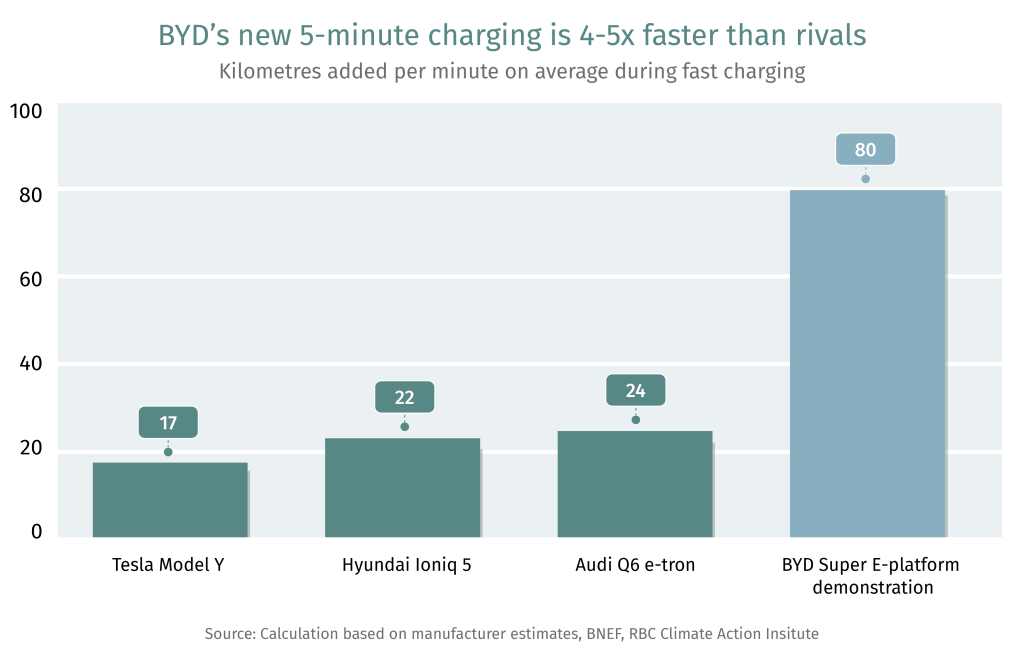
Recent demonstrations by Chinese electric vehicle (EV) giants BYD and CATL of batteries that can be charged in five minutes—up to five times faster than rivals—and with a range of 520 kilometres, has made many sit up and take notice.
Could this super-charging revolution be the game changer that will pave the way for greater EV adoption in Canada, and elsewhere? Equally crucial: can electricity grids handle the increased load demand if this technology were to reach Canadian shores in the next few years?
A game changer?
A five-minute charge has the potential to address two of the top three concerns that consumers often cite when considering EVs: range anxiety and access to public charging stations (the third being affordability). According to a JD Power survey in 2024, 68% of Canadians were anxious about running out of EV battery while on the road.The inconvenience of waiting in line at public charging stations and long charge times—on average 30 minutes—have been an issue for up to half of EV drivers, a survey shows. A five-minute charge battery with extended range tackles these issues head on and entice would-be owners to finally take the EV plunge.
The 3 big grid challenges facing 5-minute charging
Here’s how the quick-charge revolution could impact Canada’s grids:It’s a massive draw on the grid:
It’s a massive draw on the grid: Unlike traditional charging that’s spread over hours, fast charging delivers high-intensity power spike that grids might not be designed to handle. An average EV with a battery of 80 kWh would require around 1,000 kW power to fully charge in minutes. That’s enough electricity to power 800 homes for the same amount time, and adds significant load to the grid, especially if charging takes place during peak hours.
Grid expansion is already facing once-in-a-generation challenge. Expanding local distribution networks, modernizing local substations, and improving interconnections to accommodate localized demand surges are the biggest challenges posed by super-charging. Distribution lines will also need to grow by another 55,000-85,000 kilometres by 2030—requiring a build-out that’s 30%-100% faster than the current pace.
Future-proofing would require a decentralized grid: Fast, localized spikes in demand require more than just expansion of centralized grid assets. They also require the addition of decentralized distributed energy resources (DERs), such as micro-grids and residential solar, and greater grid digitization. Infrastructure modernization can also transform DERs into virtual power plants during periods of peak demand.
Farhad Panahov is an economist with the RBC Climate Action Institute.
The first 100 days for any new government are filled with a flurry of activity. For Mark Carney’s Liberal minority government that will include tabling a budget, trade talks with the Trump administration and hosting the G7 in June. Zoom out, and the key priorities come into focus. Here are five that RBC Thought Leadership has been keeping a close eye on and ones we believe will have Parliament’s full attention in the coming months—and beyond.
Securing an economic and security pact with the U.S.
During upcoming negotiations with the U.S., expect Canada to minimize concessions until duty-free trade is secured and the current trade agreement is honoured. The U.S., meanwhile, will seek to have a wide-ranging discussion that includes border and security concerns.
At a minimum, the agreement could include:
Energy and economic security: Negotiators will want to address longstanding irritants, including the digital services tax, attempting a resolution to the softwood-lumber dispute, and strengthening rules of origin. Expect movement and strategies on gas, nuclear and critical minerals, which dovetails nicely with the upcoming G7 meeting.
Defense and Arctic security: This includes everything from the plan to meet 2% defence spending targets, to NORAD modernization, dual-use accounting, social and economic infrastructure investments in the North, including an Arctic port, and expanding shipbuilding/icebreaker commitments.
Border security: Although Canada has made investments in border security, further collaboration, especially on money laundering, immigration and drug/arms trafficking, will likely come up during negotiations.
This won’t be the first attempt at a comprehensive continental economic and security agreement. In the mid-2000s, the Security and Prosperity Partnership of North America included the private sector in an effort to enhance continental competitiveness. While it didn’t come to fruition, many ideas—cooperation on infectious diseases, emergency management, and border security—have persisted. This attempt has a better chance of succeeding if it is targeted and time bound.
Address the housing affordability crisis
In The Great Rebuild, we outlined seven ways to address Canada’s housing shortage and affordability. When comparing the recommendations in our April 2024 report to the Liberal election platform, a number of key items line up:
Focus on prefab: Factory-built dwellings can be more time and cost-efficient. And the government has promised $25 billion in financing to prefab home builders—as well as a focus on sustainable building materials.
Cut red tape: Project approval timelines in Canada, as we noted, “can be among the lengthiest in the world.” Simplifying national building codes, streamlining regulations and leveraging standardized designs are all part of the Liberal platform.
Build affordable options: Government has pledged $10 billion worth of low-cost financing for lower- to middle-income Canadians.
None of this gets done, however, without shovels in the ground. We estimate that more than 500,000 additional construction workers are needed to build the homes required between now and 2030. The Liberal’s plan to incentivize companies to hire recent grads and offer apprentice programs is a start. But finding half-a-million construction workers requires more. Options include prioritizing construction skills of new immigrants, growing the enrollment of trade schools, and enticing older construction workers from retiring.
The affordability crisis has made it an imperative that Canada acts promptly and with more streamlined coordination across all levels of government.
Build Energy Corridors
Building out major energy infrastructure enhances economic resilience through the diversification of key commodity exports. In 2024, Canada’s major resource exports (minerals, metals and fuel) were among Canada’s largest, generating $175 billion in aggregate net exports–almost offsetting Canada’s global trade deficits across all other goods categories.
Success in taking projects from blueprint to buildout depends on policies directed at mobilizing private capital and reducing red tape. To date, existing key Liberal policies around Bill C-69, Bill C-48, the Oil and Gas Emissions Cap have not been conducive to large-scale investment. An ‘amended’ approach with a greater focus on pragmatism could establish a climate more conducive to attracting capital. Key focal points for Ottawa include:
Industrial carbon pricing: ‘Axe the tax’ likely shifts the burden of carbon pricing onto large industrial producers. A rising industrial carbon price likely remains, presenting competitiveness challenges relative to U.S. leadership focused on deregulation. A 50% carbon capture investment tax credit derisks capital costs, but projects need revenue certainty. To date, The Pathways Alliance, a consortium of Canada’s largest oil sands producers, has been unsuccessful in negotiating carbon credit guarantees from Ottawa. Of course, this comes at a time of competing fiscal priorities. Ottawa is already on the hook for 50% of CCUS capital costs (conservatively estimated between $60-75 billion). Contract for differences for Pathways would likely require tens of billions in additional funding (10-12 million tonnes at $125-150/t for 10 years).
Regulation/Permitting: Regulatory delays has led to drawn out timelines, leading to cost overruns and/or cancellation of key projects, as capital is ultimately redistributed to shareholders rather than towards growth-enabling infrastructure. Policies such as ‘One Project, One Review’ and declaring more energy projects as in the ‘National Interest’ are helpful. This is likely most beneficial to natural gas pipelines and LNG infrastructure, given the greater political alignment on the LNG file (B.C. and Ottawa).
Provincial trade barriers: East-west trade through greater use of interties yield a more resilient, flexible and efficient grid system—increasingly important given rising load growth over the next 25 years (up to 3x) and the need for cheap power for industry/manufacturing.
Safeguard federal finances
As RBC Economics wrote recently, a lot will be demanded of fiscal policy. A slowing economy and the risk of a greater trade-linked recession imply fiscal supports of varying degrees. And structural challenges loom–weak productivity, strained affordability, an aging population, export concentration, and shifting geopolitics could trigger more federal spending. Monetary policy has its limits—and won’t be able to address the areas of greatest need. As a result, Ottawa will need to keep the following in mind to keep the federal debt burden sustainable:
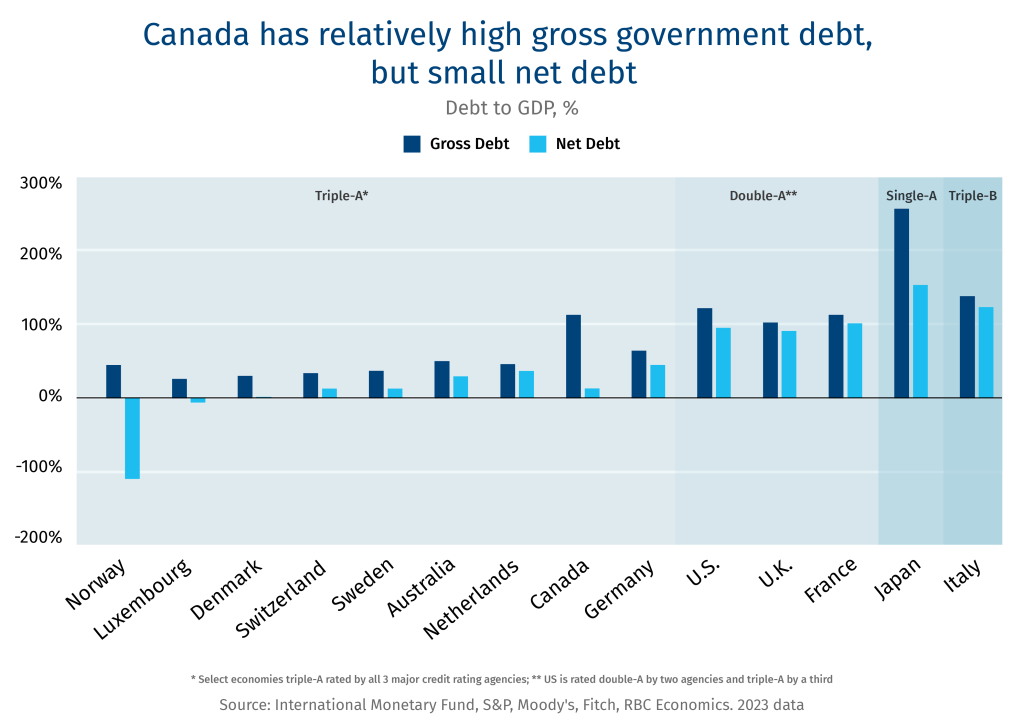
It’s not unlimited, but Canada has some fiscal space. Canada’s gross debt burden (debt-to-GDP-ratio) is high, but its net debt burden is the lowest in the G7.
Supporting the economy through a potential recession is expected by markets, and unlikely to raise red flags if sized and targeted appropriately. COVID-style supports that ‘bridge’ the economy is not the correct playbook in a trade shock where the economy, structurally, could look quite different in the aftermath.
Growth-positive investment is key to keeping federal debt levels sustainable. The more that each dollar of public spending delivers greater growth dividends, the more the federal debt burden will remain in check, even with higher spending.
Rebalance social and business investment measures. Canadians have benefited in recent years from an expansion in federal government spending on often broad-based social programs without absorbing the costs. Now, the feds have a new laundry list of to-dos, including kick-starting business investment. Non-spending measures like removing red tape help, but fiscal space will be needed for spending, as well.
Make social and other ‘must-do’ spending more growth positive. Major investment needs across the economy beg the question of sufficient capital and labour resources to achieve timely results without crowding out. Public spending in essential areas like housing, defence, and healthcare can promote efficiencies, innovation, and other growth drivers to ensure the economy can grow in multiple areas.
Transform AI into a productivity engine
Canada is rich in AI talent but short on the three things that can translate that talent into prosperity: modern computing infrastructure, large-scale deployment, and robust domestic demand. Only 26% of Canadian firms report having implemented AI—eight points below the global average—and the country continues to slip in AI-readiness indexes. With labour-force growth flattening and labour costs rising, closing the AI adoption gap is Canada’s most direct route to higher productivity, greater economic efficiency, and continued competitiveness.
Ottawa could pursue a three-pronged approach—acting simultaneously as facilitator, champion, and early adopter—to transform AI from a fragmented set of R&D bets into a nationwide productivity engine.
Facilitator: Treat compute capacity as critical infrastructure, marshalling patient capital, procurement guarantees, and partnerships with global players to facilitate access to GPU clusters. Further, government might consider targeted tax credits and grants favouring projects that embed Canadian IP and high-value jobs at home.
Champion: Ministers could become visible ambassadors for domestic AI successes, weaving them into every productivity, healthcare and defence announcement. Demand-side tools—procurement quotas that reserve, say, 25–30% of relevant contracts for qualified AI firms, first-reference-customer letters, accelerated tax refunds for AI pilots—have the potential to generate the domestic demand needed to keep promising startups from fleeing south.
Early Adopter: In the immediate term, the government could equip frontline analysts, auditors and service agents with secure co-pilots to yield productivity gains and build AI fluency. Longer term, the government could work to re-engineer programs around models that learn across departmental silos, enabled by a U.S. Department of Defense-style fast-lane tech funding agreement, a shared sovereign large language model stack, and performance incentives for senior bureaucrats who are able to effectuate AI solutions.
Contributors:
Cynthia Leach, Assistant Chief Economist, RBC
Varun Srivatsan, Director, Policy and Strategic Engagement
Shaz Merwat, Energy Policy Lead, RBC Climate Action Institute
The Public Policy Forum is one of Canada’s premier think tanks, and hosts an annual Growth Summit that tends to be at the pointy end of some pretty big issues.
This year’s summit, in Toronto, was all about what I’d call the Big Pivot — and how we can make our economy more independent and resilient. Great conversations about investment, Indigenous equity, AI-adoption and more.
Here’s a few of the questions I took away:
1. Do we need to win back investor confidence?
The answer seems to be yes. Too many of these conversations assume Canada is amazing in the world’s eyes. Rhetoric is cheap. Credit is costlier. Keep an eye on how money is priced for Canada in the coming months.
2. Can we increase competition while reducing reliance on America?
The U.S. tends to be the primary driver of competition, directly or indirectly. And there are not a lot of easy alternatives. European firms aren’t likely to add a lot of juice to Canadian markets, and Chinese entrants are probably a non-starter. Perhaps our new competition needs to come more from within.
3. Can governments play a more active economic role without wrecking the economy?
We have decades of mixed results but will likely give state corporations one more try, whether it’s to build houses or expand pipelines.
4. What the heck is “national interest”?
A lot of those government investments will be made in the name of an ill-defined national interest. We’re a nation of many regions, and one’s interests are often not another’s
5. Why do Canadians shy away from risk?
I was struck by the number of conversations that eschewed risk. No country clamours to “de-risk” like this one, as if the key role of government is to bear the risks of the private sector and of individuals.
6. How can we develop the Arctic without compromising it?
The summit included several key northern voices that stressed the need to not militarize the North the way we did in the 1950s and ‘60s. They’re eager to defend Canada, on the ground and in the sky, but not at all costs, especially to their culture.
7. How much do we want to exclude China?
Reducing our dependencies on the U.S. will require new markets and new sources of capital — and Europe won’t be the answer, not on its own. Yes, there are plenty of options. It’s a big world! But China is the biggest option, and one we need to develop a clearer relationship with.
8. How do we balance economic ambitions with climate commitments — and the world’s climate expectations?
We’ve become so consumed with All Things Trump that we seem to forgot how the rest of the world is not turning itself upside down. Indeed, climate remains a serious concern from Japan to Germany — the markets we now eagerly want to serve — and we will have to ensure we’re not misaligned.
9. How can we align our duty to consult Indigenous communities with our ambition to build more faster?
There may never be a formula for consultation and the resulting consent — but we may be able to establish norms that will be widely accepted. Watchwords: “speed and certainty.”
10. How can we pool institutional capital for major projects?
We can continue to let market forces determine what gets financed, with a range of government supports and incentives. I don’t think Canada will ever have a sovereign wealth fund. Or will we? Alternatively, can we move toward dedicated public-private investment vehicles that may draw inspiration from the Quebec model?
The next few years will be unlike any few years we’ve seen. So a lot of new thinking will be needed.
➔ Earth Day edition focuses on Canada and B.C.’s power struggles ➔ Green steel is coming ➔ EVs: Open road or roadblocks?
Hot takes
➔ Our power, our planet. That’s the theme of this year’s Earth Day, celebrated today, just as the world feels a little less empowered to take care of the planet. But this edition is striving to celebrate small victories in a (very) long journey to heal the planet. Despite policymakers axing or toning down several ambitious global climate policies, there are rays of sunshine: led by solar and wind, renewable energy capacity additions hit a new record globally in 2024, while renewables accounted for more than 92% of total power expansion last year. Still, IRENA forecasts, the world’s falling short of the collective goal set in 2023 to triple installed renewable energy capacity by 2030.
➔ Sault Ste. Marie, Ont., is the setting for a Canadian green power revolution. The northern Ontario-based Algoma Steel is gearing up to launch its electric arc furnace (EAF) this month—it would cut back on coke, or coal power, and slash the company’s annual emissions by 70%. That’s a feat for any sector, but a monumental one for an industry considered among the hardest to abate.
➔ Canada’s first SMR got the green light this month. The small modular reactor (SMR) at the Darlington Nuclear Generating Station in Ontario—the first in a G7 nation— has the all-clear from the Canadian National Safety Commission. Ontario Power Generation, the developer, is now awaiting the provincial okay. There is a trade twist, though: the BWRX-300 reactor was built by North Carolina-based GE-Hitachi Nuclear Energy—making Canada dependent on the American supply chain at a time when ties between the two countries are strained.
➔ Climate drops off the radar as an election issue. About 24% of Canadians believed climate was an important issue in the 2021 federal election cycle. Just under 4% feel the same way as they start voting in the run-up to election day on April 28. Predictably, U.S.-Canada ties topped the list in the non-partisan Vote Compass’s poll of 161,000 Canadians, followed by economy, affordability, social justice and healthcare. The environment did not crack the top 5. Climate change also barely got a mention in the leaders’ TV debates (read John Stackhouse’s LinkedIn post here).
Earth Day: A Clean Super-Power
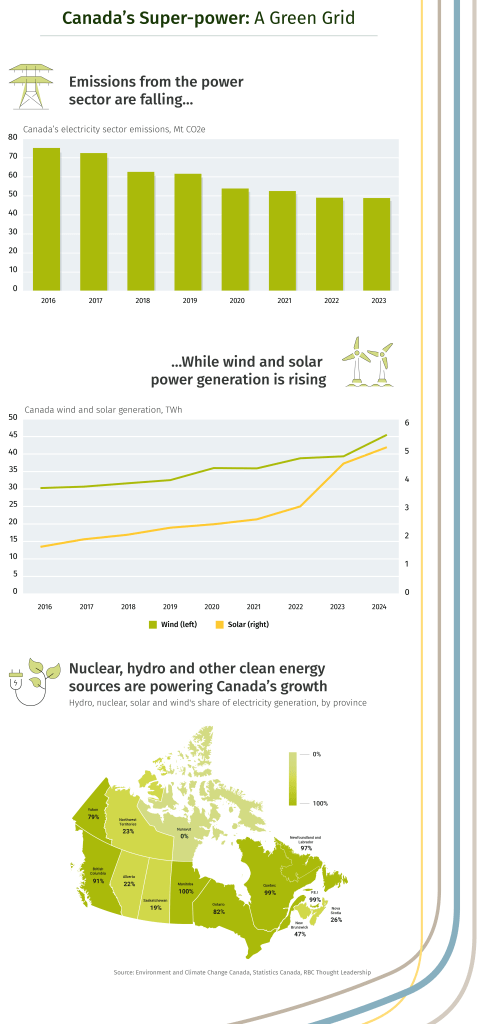
With this year’s Earth Day theme focused on tripling renewable energy by 2030, Canada can point to some victories in the electricity sector, the big one being that it’s Paris Agreement-compliant already. Alberta is coal-free, six years ahead of schedule, while Canada’s absolute electricity emissions declined by about 10% in 2024 compared to 2023.
Three charts that illustrate why electricity is Canada’s climate poster child:
There is no room for complacency, though. Here are 3 critical challenges Canadian policymakers—and a new federal government—will need to address soon.
➔ Balancing affordability with clean energy goals. New hydro dams and nuclear buildouts will be expensive, straining the ability of utilities to keep electricity bills affordable.
➔ Expanding grids cleanly. Canada needs to more than double electricity capacity by 2050—and keep it clean—, if it wants to compete for investment dollars for data centres, automotive supply chains and other heavy manufacturing.
➔ Ensuring Indigenous rights. Power and energy projects—gaining renewed urgency—require a buy-in, consent and financial involvement from First Nations. Canada has had a spotty track-record on that file, which needs to change to fast-track projects.
Ready or not
Sticking to the power theme, B.C. LNG projects now only need to be net-zero ready. That’s the distinction the B.C. government made in a new letter to the environmental regulator, widely considered a weaking of the province’s environmental rules. Or is that climate realism ? Jurisdictions are walking a fine line as they fast-tack new projects in a tariff-stricken world without abandoning their environmental commitments.
The provincial utility BC Hydro has been bulking up, but not as fast as the surge in demand, which it estimates will rise 15% by 2030. Just over 90% of B.C. grid is no-emitting, but that could drop if natural gas power.
Here’s how the province is racing to meet its economic and climate goals:
➔ BC Hydro’s updated 10-Year Capital Plan (2024/25 to 2033/34) includes almost $36 billion in community and regional infrastructure investments—a 50% increase over its previous capital plan.
➔ The Site C hydro project’s fourth unit began this month, with two more set to be switched on by the fall. Once fully operational, the project in the province’s northeast can power nearly 500,000 homes, increasing BC Hydro’s electricity supply by 8%. Given expectations for Canada’s supply needing to 2x or 3x by 2050, we need similar additions every two to three years, Energy policy lead Shaz Merwat estimates. “Policy of needing to be ‘ready’ probably adds a level of ambiguity but good to see perspectives are changing about the need to build.”
➔ In February, B.C. signed deals for 9 wind and 1 solar energy projects with a combined 4,830 gigawatt hours (GWh) projects. All projects are majority-owned by First Nations.
➔ B.C. is working to electrify Northern B.C., vital for several big-ticket energy projects including the Ksi Lsims LNG project that’s currently under regulatory review. The Indigenous-backed gas export project now faces competition for Asian markets from an Alaskan LNG development that’s gaining traction. Canada needs to move fast.
➔ The North Coast Transmission Line is a critical piece of the northern B.C. clean grid. The government is fast-tracking permits to speed up construction of the NTCL and other major high-voltage transmission lines.
➔ The B.C. government is not ruling out more hydro dams in the province.
➔ Finally, we are watching how a greenhouse gas emissions cap for natural gas utilities, as envisioned in the CleanBC Roadmap to 2030, will play out.
Four roadblocks ahead for EVs
By John Stackhouse
EVs may be one of the causalities in the trade war — or one of the winners. It’s too early to tell.
The latest quarterly assessment from BloombergNEF shows a U-turn forming in some markets, and acceleration in others, notably China. Canada is one of the markets at a turning point.
EVs, including plug-in hybrids, accounted for one in five vehicle sales last year, reaching 17.2 million new vehicles on the road, up 24% in one year. Most of that growth was in China, where close to half of new vehicle sales are EVs—a number expected to increase this year thanks to a scrappage scheme for car-owners.
Elsewhere, EVs are facing new challenges, and not just the brand war that Tesla finds itself in. European sales started to flatline in 2024, while sales growth in the U.S. tempered. And that was before Liberation Day (April 2) and Donald Trump’s decision to slap 25% tariffs on imported vehicles and parts. Higher costs are the last thing EV producers need. Other policy changes—looser fuel standards in Europe and an end to the consumer carbon tax in Canada—may further impede EV sales, as the economics of traditional car engines gain ground again on batteries.
Canadian EV sales in the past year accounted for around 15% of passenger vehicle sales. BNEF expects Canadian EV sales to rise 20% this year, amid a decline in policy supports. If EV sales stall, it will be due to four roadblocks in the months ahead:
➔ 1. Subsidies. Fiscally challenged governments will be looking to cut spending in some areas to pay for economic supports for businesses and workers hit by the trade war. The Trump administration has its eye on generous supports introduced in the Biden years. And many governments are pulling back EV mandates for their own fleets.
➔ 2. Tariffs. The U.S. is advancing a range of tariffs and trade restrictions on batteries and battery components, while China is also restricting exports of critical minerals. Battery-specific tariff rates are projected to hit 115% this year, and 132% next year. The Trump administration is also expected to continue to explore anti-dumping measures against Chinese battery components producers, even though a number of U.S. manufacturers, including Tesla, rely on them.
➔ 3. Economic growth. If the trade war continues to be a drag on economic growth, consumers will hold back on vehicle purchases of all kinds — and the more expensive range of EVs will be especially challenged.
➔ 4. Interest rates. If tariffs stoke inflation, and keep interest rates higher, car sales will be the first consumer item to take a dent, or worse. EVs may be at the front of that line, as car-owners hold on to their old vehicles for a year or two longer.
Canada could be on the verge of a historic investment boom. The trade war with the U.S., an increasingly divided global economy, concerns over Arctic security and an AI revolution that comes with enormous energy requirements—all point to the need for more economic and security infrastructure. But those diverse ambitions, from northern ports to West Coast LNG to critical mineral plants, have a common requirement: Indigenous partnerships.
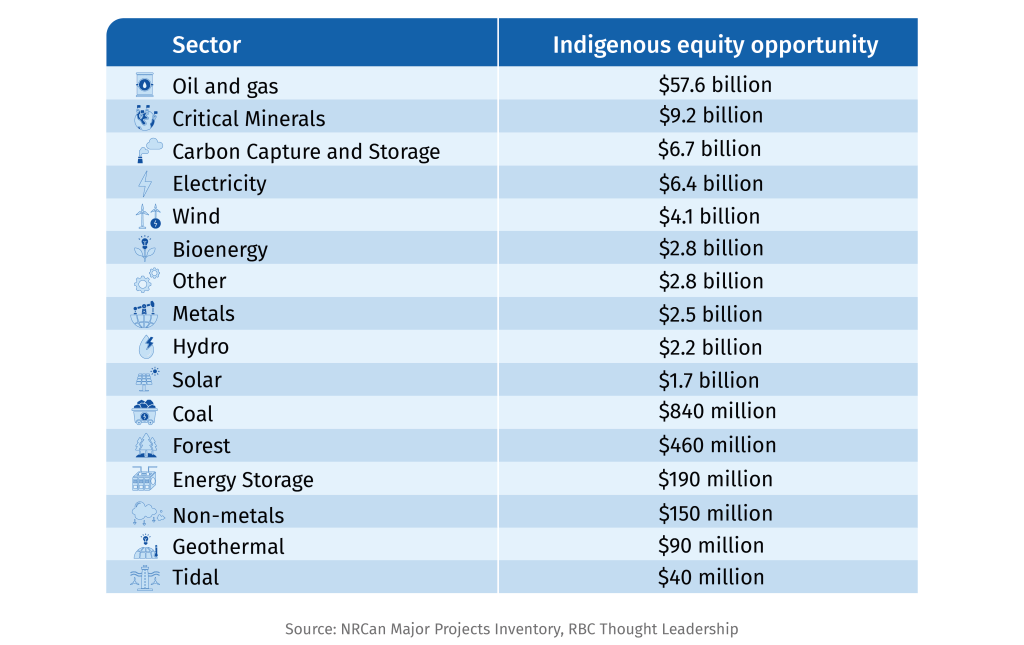
Canada’s future growth and prosperity depends heavily on getting Indigenous economic reconciliation right. If not, the country’s ability to diversify our resource exports, enjoy independence and resiliency in strategic sectors, and improve productivity, which has lagged that of other countries for years, are all at risk. And that’s not the only thing at stake. As RBC Thought Leadership’s research indicates, 73% of the 504 major resource and energy projects planned or currently underway in Canada run through, or are within a 20-kilometre radius of, Indigenous territories—namely, treaty, title unceded and consultation lands. The value of the Indigenous equity opportunity of those projects alone is $98 billion over the next 10 years.
Canada can’t afford to miss out on the opportunity. Fortunately, examples of Indigenous economic reconciliation in action span the country, including:
In Kitimat, B.C., the Haisla Nation and Pembina Pipeline are working on the Cedar LNG project, a four-year partnership that will result in a $4-billion facility. Once operational, this majority Indigenous-owned facility is expected to generate $85 million in GDP annually.
In several Manitoba and Nunavut communities, the Kivalliq Hydro-Fiber Link seeks to provide clean energy through a proposed 1,200-kilometre energy and telecommunications corridor connecting Nunavut with Manitoba’s grid.
In the small southwestern Ontario town of Jarvis, the Oneida Battery Storage Project will be one of North America’s largest battery-storage facilities when it comes online. Partly owned by Six Nations of the Grand River Development Corporation, Oneida will provide much-needed capacity to Ontario’s strained electricity grid.
While these projects illustrate progress, more can be done. Centuries of treaties, Nation-to-Nation and business agreements, and case law have underscored the centrality of Indigenous peoples in Canadian decision-making, particularly in building up infrastructure and resource projects. The Constitution Act of 1982, particularly Section 35, recognized and affirmed Aboriginal and treaty rights in the Canadian legal and political fabric. Supreme Court cases, including Calder, Delgamuukw and Tsilhqot’in, further affirmed Aboriginal rights and title—the inherent right to use and jurisdiction over an Indigenous Nation’s traditional territory.
One of the key principles enshrined through the Constitution and case law is maintaining the Honour of the Crown—a legal concept characterizing the fiduciary duty imposed on the Government of Canada toward Indigenous peoples. One of the duties that this principle imparts on the Crown is the duty to consult and accommodate. When the Crown engages in an activity that could have a negative effect on an Aboriginal right or title, it must consult with the relevant Indigenous groups and accommodate these infringements. This duty has been affirmed through case law and is characterized in the Nation-to-Nation relationship between Indigenous peoples and the Government of Canada.
The United Nations Declaration on the Rights of Indigenous Peoples (UNDRIP) advanced the concept of free, prior and informed consent (FPIC). This is a pro-active means for governments (and businesses) to seek and achieve consent on developments occurring on Indigenous territories. UNDRIP is now law federally, as well as in British Columbia and the Northwest Territories.
Together, the duty to consult and FPIC provide the framework and requirements for the way governments and businesses engage with Indigenous Nations on projects happening on their lands or implicating their interests.
What’s needed now is bold, innovative thinking. And it starts by finding ways of unlocking three critical elements:
CAPITAL: Indigenous ownership in major projects requires a mix of private and concessional financing tools, including loans, loan guarantees and grants. Without access to capital, a historic challenge for Indigenous Nations, many equity opportunities, and indeed, entire projects, may not get started.
CAPACITY: Rights-based negotiations, along with commercial and legal discussions around major project development, are complex and requires investing in capacity for everyone at the table—Indigenous Nations, governments and business—to ensure project success.
CONSENT: The constitutional duty to consult and accommodate, UNDRIP, case law, and decades of legal and political developments have cemented how important free, prior and informed consent is to project development. The downpayment needed to seek and achieve FPIC is long-term, trust-based relationships across all parties, which requires going beyond transactional project discussions.
Advancing all three elements—capital, capacity and consent—in parallel is necessary to bringing Indigenous Nations along as true partners in economic development. Through a collective call for action, led by Indigenous Nations and closely supported by businesses and governments, there is an opportunity to generate shared prosperity—and get Canada building at speed and scale.
Capital
Access to affordable capital is a persistent challenge for members of Indigenous communities, caused in part by institutional barriers set up by Canadian governments. Risk premium for Indigenous borrowers is impacted by rating agencies, and by extension, financial institutions’ risk and liability considerations. This is partly due to First Nations communities being unable to collateralize reserve land under Section 89 of the Indian Act; Metis communities being unable to leverage a land base and access federal funding; and Inuit communities finding it challenging to secure project funding in remote, rural areas. As we outlined in previous reports, loan guarantees and other financing tools can help address access to capital and risk issues.
Historically, the speed of implementation and scaling of these tools has been slow, while capital needs are only growing. This ranges from an infrastructure capital gap of up to $270 billion1, a $30-billion gap in critical minerals2, and a $60-billion gap related to climate-aligned investments in carbon capture, electricity and renewables3. The support of both private and public lenders is needed to meet demand.
The Canada Infrastructure Bank (CIB) stepped up recently, committing $1 billion to its Indigenous Equity Initiative. CIB’s equity grants, ranging from $5 million to $100 million, have a 15-year repayment target. And in early 2024, the money started to flow. That’s when CIB issued its first Indigenous equity loan, committing up to $18 million to Wskijinu’k Mtmo’taqnuow Agency Ltd. (WMA), a limited partnership owned by 13 Mi’kmaw communities. The financing allowed WMA to take an equity stake in the Nova Scotia Energy Project, Canada’s largest planned battery storage initiative.
Another important source has been the First Nations Finance Authority (FNFA), which has enabled First Nations economic development through a pooled borrowing facility. By issuing debentures on behalf of First Nations (certified by the First Nations Financial Management Board for a clean balance sheet and good financial management practices), the FNFA has borrowed $3 billion for its members toward critical, revenue-generating projects—creating an economic output of $6.3 billion.
These aren’t the only examples of progress when it comes to unlocking capital. Last year, three loan-guarantee programs were announced. One at the Federal level (recently increased from $5 to $10 billion) and two at the provincial level—B.C. ($1 billion) and Manitoba ($500 million).
The various access-to-capital tools currently available amount to about $20 billion. And based on the amount of private investment these concessional financing tools have crowded-in, there is potential to mobilize close to $48 billion in Indigenous equity investments. This leaves a concessional financing gap of $20.7 billion and a private financing gap of $28.7 billion4.
While gaps remain, there’s more capital flowing than ever. And it’s leading to action. Between 2022 and 2024, 111 Indigenous communities announced that they had acquired an equity stake in an infrastructure project, according to a report by the Toronto-based law firm Fasken Martineau DuMoulin LLP last April. More than a quarter (26%) of those were in Alberta, home to the $3-billion Alberta Indigenous Opportunities Corporation Loan Guarantee Program. Wind generation projects resulted in a spike in Nova Scotia (23%). And B.C. rounded out the top 3 with 18%. And that was before the launch of the province’s loan guarantee program noted above5.
From a private financing standpoint, approaches to risk management need to accommodate unique Indigenous concerns, with banks recognizing that if project economics are sound, Indigenous borrowers should have an opportunity to be treated on equal footing to other market borrowers.
For existing and announced access-to-capital tools, prioritize speed to implementation, a risk-accommodative approach, and broader sectoral scope, spanning not just resource and energy projects, but infrastructure, transportation, agriculture, fisheries—essentially, any sector with a nexus between Indigenous interests and a national economic imperative.
Capacity
The added complexity of major project development requires capacity building on all sides. This includes education and training required for businesses and governments to better understand Indigenous histories, economies, cultures and priorities. For Indigenous Nations, this can include everything from financial, legal and engineering capacity required for commercial negotiations, to the environmental, historical and legal support needed to participate in regulatory and rights-based discussions. It is important to recognize that Indigenous capacity has always existed, whether through trade networks, economic systems, governance models and traditional knowledge that Indigenous Nations have built up over centuries.
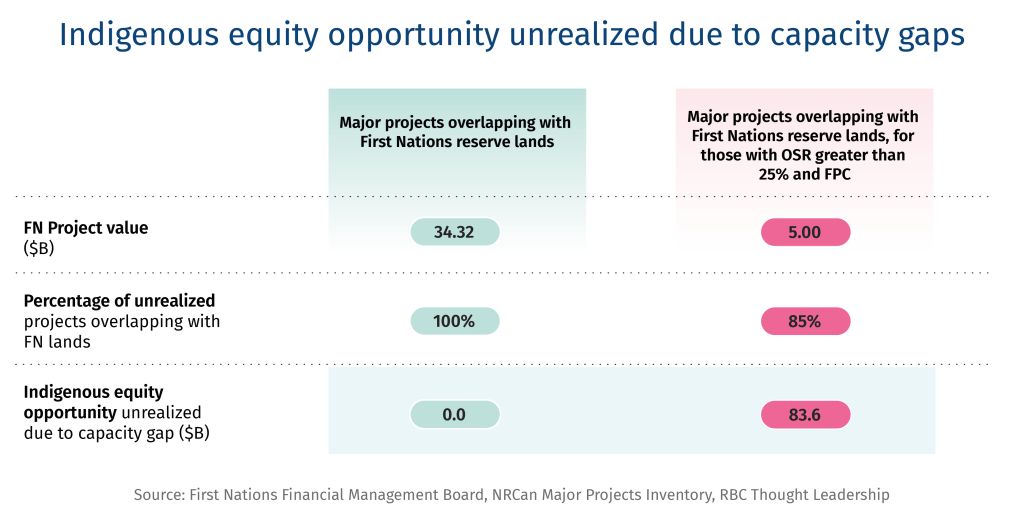
Two (imperfect) measures of fiscal and economic capacity are the ability of Nations to be able to raise own-source revenues (revenues not generated through governmental transfers) and maintain financial and governance controls. We assume two proxies for these measures—own-source revenues greater than 25% of total revenues in a First Nation, and a First Nation receiving the Financial Performance Certification. The FPC is a voluntary, independent assessment by the First Nations Financial Management Board certifying good financial health and ability to borrow from the First Nations Finance Authority.
Our research indicates that capacity gaps put 85% of projects that pass through First Nations territory at risk. That’s an estimated $83.6 billion in project value.
Project Rocket, a partnership between 23 First Nations and Metis communities and Enbridge, resulted in capacity building that benefits all parties. The partnership involved the creation of Athabasca Indigenous Investments, the special-purpose vehicle behind the Indigenous Nations taking on an 12% equity stake—valued at $1.1 billion—in seven pipelines. In addition to the potential economic benefits, the dealmaking process provided technical, legal and commercial capacity for Indigenous Nations, as well as the proponents and financial intermediaries. Agreements that include multiple Nations, like this one, allow better resourced and experienced Nations to share their expertise, ultimately making it more replicable and scalable.
Indigenous-corporate partnerships, including secondments, knowledge sharing, and leader-to-leader forums can help hone capacity.
By bridging corporate and Indigenous Canada, organizations such as the First Nations Major Projects Coalition and the Canadian Council for Indigenous Business enable relationship and capacity building, and uplift Indigenous businesses and governments. Organizations like FNMPC and CCIB are positive models to emulate and scale across the country, to provide mentorship, skills-development, environmental and economic tools, procurement strategies and project-level negotiation support for and with Indigenous Nations.
Capacity building with lending or M&A teams for proponents and financial institutions must be prioritized. This can help ensure lending team members are educated on Indigenous history, economic-development priorities, and the lens through which teams must engage with Indigenous Nations.
An important consideration for businesses is whether to build capacity internally—through targeted hiring and training—or to enhance capacity through acquiring existing organizations with the right mix of commercial knowledge and Indigenous community-level expertise.
Governments should consider dedicating 2-5% of grants, loans and guarantee funds toward capacity, to empower Indigenous Nations with the right information and ability to negotiate agreements with better-resourced private-sector counterparts. Between 2% and 5% is a guideline based on past transactions.
Consent
The nature of consent varies from community to community, and project to project. Getting to a shared understanding of consent is challenging and intersects with constitutional (Section 35 and the duty to consult) and international legal obligations (UNDRIP). However, there are some necessary, but not sufficient, conditions for achieving and maintaining consent, which include engaging early and often, economic partnerships, and inclusion of Indigenous Nations in the regulatory process.
A big part of getting projects built is the permitting and regulatory process. Part of the process is seeking informed Indigenous engagement, and, where required, consent. The Government of Canada has a duty to consult and accommodate Indigenous groups when its actions may impact potential or established Aboriginal or treaty rights—a duty that has been affirmed by the courts and the constitution. As such, expediting permitting timelines, although an important objective to speed up project development, cannot be done in a vacuum without the Crown discharging its duty to consult. Proponents have an important responsibility and role to play in building deep trust-based relationships with Indigenous Nations, and through that process, seek and achieve consent.
The Cedar LNG project illustrates how federal, provincial and Indigenous Nations can expedite the permitting process. The federal government, through a process called substitution, eliminated the duplication of two assessments for a single project. And the B.C. government worked in close partnership with the Haisla Nation to identify and mitigate environmental, social, health and economic impacts—a process that was accelerated in no small part because Haisla Nation is a co-owner in the project—resulting in a shorter and less contentious permitting process (notwithstanding ongoing concerns of the project by other Nations).
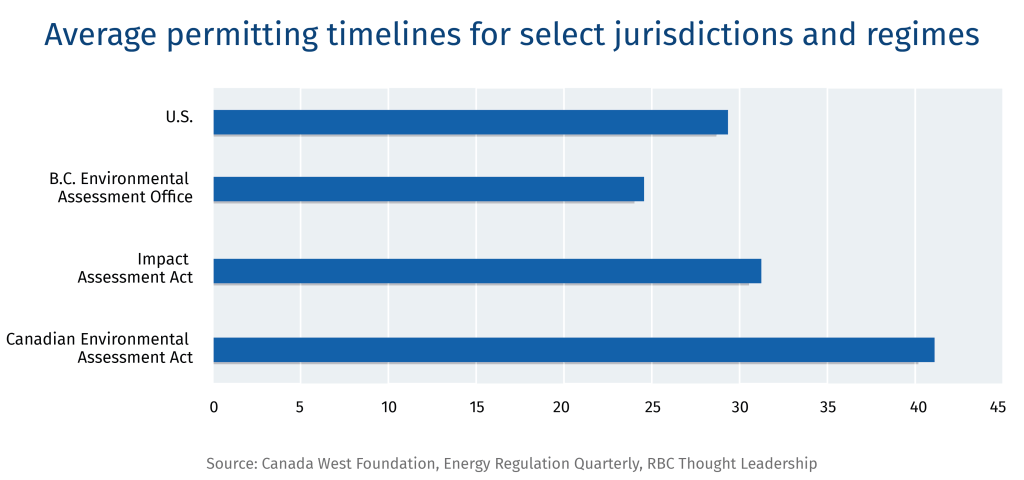
While equity ownership by the Haisla Nation on Cedar LNG likely moved things along more quickly, average assessment timelines in B.C. are, generally, some of the shortest in the country. This is partly due to proponents engaging early and often with Indigenous Nations, and provincial regulators increasingly empowering Indigenous Nations to lead assessments. The B.C. Environmental Assessment (EA) process, can integrate Indigenous-led assessments through substitution, delegation or other mechanisms. It yields a process that is 5 to 15 months shorter than the average timelines of two long-standing federal regimes and the U.S. permitting process. Federally permitted projects, particularly those that cross provincial boundaries, are complex, requiring longer permitting times. Still, the B.C. experience suggests a permitting process that incorporates Indigenous views, processes and knowledge can facilitate trust and social license.
The Eskay Creek Consent-Based Decision-Making Agreement, and the Squamish Nation Environmental Assessment Agreement both provide blueprints for how consent can be operationalized through the environmental assessment and permitting process.
The agreement, pertaining to the reopening of the Eskay Creek gold and silver mine in northern B.C., was set up under section 7 of the Declaration Act (B.C.’s legislation aligning its laws to UNDRIP). As part of the deal, the modified EA process seeks consensus through a collaboration team between the Tahltan Nation and B.C., a Tahltan risk assessment, free, prior and informed consent on the final decision, and independent dispute resolution. The agreement provides a unique model for joint decision-making, a shared environmental assessment and sustaining social license.
The Squamish Nation EA process involving the Woodfibre LNG plant and export terminal in B.C., was the first-of-its-kind legally binding, Indigenous-led EA process in Canada. A framework agreement enabled the Squamish Nation to set up a process outside the provincial and federal EA regimes. What enabled success was a parallel process of environmental and socio-economic information collection and analysis, with the final decision-making resting with the Squamish Nation Chief and Council, enabling accountability at both the technical and political levels. Buy-in for the Indigenous-led EA from federal and provincial governments, and the proponent, was crucial. And all three parties could be confident that the review addressed Squamish Nation’s concerns and interests—important for consistency of social license and support.
These approaches are not without challenges—as other Nations may seek to assert jurisdiction over those that are leading the EA process, or substantially support project development. Furthermore, this does not obviate the opposition of other interest groups, such as environmental or social groups. Nonetheless, they provide useful models of operationalizing consent through a collaborative assessment process.
Some key principles for businesses and governments when seeking and maintaining consent:
Indigenous-led assessments is one way. So is including Indigenous legal orders, traditional knowledge, values and priorities into the regulatory and assessment process through a co-assessment of projects, or the meaningful delegation of certain aspects of a project to Indigenous governments.
Relationships take investment—both time and money. Governments and businesses cannot engage on project-related issues without meaningfully building relationships to maintain consent, trust and social license for project development.
Information sharing and transparent discussions between proponents, government and Indigenous Nations is imperative.
This is challenging as it depends on both legal definitions on which First Nations the government has to discharge the duty to consult and accommodate, as well as relationship-based measures that can provide an indication of which Nations to consult. Building strong and lasting relationships with Nations, regardless of having to discharge the duty of consult, is a best practice.
Moving forward: Considerations for Canada
The geopolitical tensions with our closest ally have exposed the fault lines of Canada’s economic strategy. Trade diversification, massively building up our resource and infrastructure base, resolving internal trade once and for all, and moving up the product value chain have all become economic imperatives. Advancing Indigenous economic reconciliation is a keystone to meeting these goals. Other considerations that will drive the conversation in Canada in the months ahead will include:
What’s on the fast-track list: Both major political parties in Canada have promised to speed up development, permitting and financing of certain trade, infrastructure and resource projects in the national interest. Virtually all of the projects that will be fast-tracked will impact Indigenous interests and run through Indigenous territories. Fulsome Indigenous engagement and partnerships will determine the federal government’s ability to move at speed and scale.
The renewal of the continental security agreement: The incoming federal government will likely enter discussions with the U.S. administration on renewing the economic and security framework between the two countries. The investments needed will include surveillance, domain awareness and trade infrastructure to strengthen the North. Beyond trade and security, the social infrastructure, including housing, education and healthcare facilities, need to be built up. These discussions need to happen in close collaboration with territorial governments, Inuit birthright corporations and communities in the Inuit Nunangat.
The impact of the geopolitical contest between the United States and China: As we have explored previously, critical minerals have emerged as a key element in the new great game between the two superpowers. Canada’s ability to step in as a pinch-hitter on critical minerals mining and processing will depend on our ability to tap into mineral-rich regions such as the Ring of Fire in Ontario and the Golden Triangle in B.C. The Tahltan Nation, whose traditional territories cover 70% of the Golden Triangle, have been supportive of mineral exploration. But Indigenous claims and partnerships are yet to be resolved in the Ring of Fire—a question that will challenge other mining regions in Canada.
Generational changes in the global trading system: Changes in international trade and investment flows have countries seeking sources of economic resilience. That includes diversifying markets, but also reshoring parts of their value chain. Canada is no less immune. While these changes take effect, it is useful to remind ourselves that Indigenous Nations, as our youngest and fastest-growing population, are a source of strength and comparative advantage.
Our ability to move fast depends on our ability to move collectively. As the late Murray Sinclair, chairman of the Truth and Reconciliation Commission, said at the release of the Commission’s final report: “We have described for you a mountain, we have shown you the path to the top. We call upon you to do the climbing.”
4. Financing gap calculations are based on the capital cost of projects implicated under treaty, title and title-like, and unceded lands, multiplied by average debt-equity ratios by sector, and industry-specific assumptions on the ratio of capital that would be Indigenous-owned. The aggregate figures across sectors are multiplied by the ratio of concessional to private capital through existing loan guarantee programs, to arrive at the concessional and private capital gap. It is important to note that of the $17 billion in concessional financing tools, about $11.5 billion has not yet been implemented.
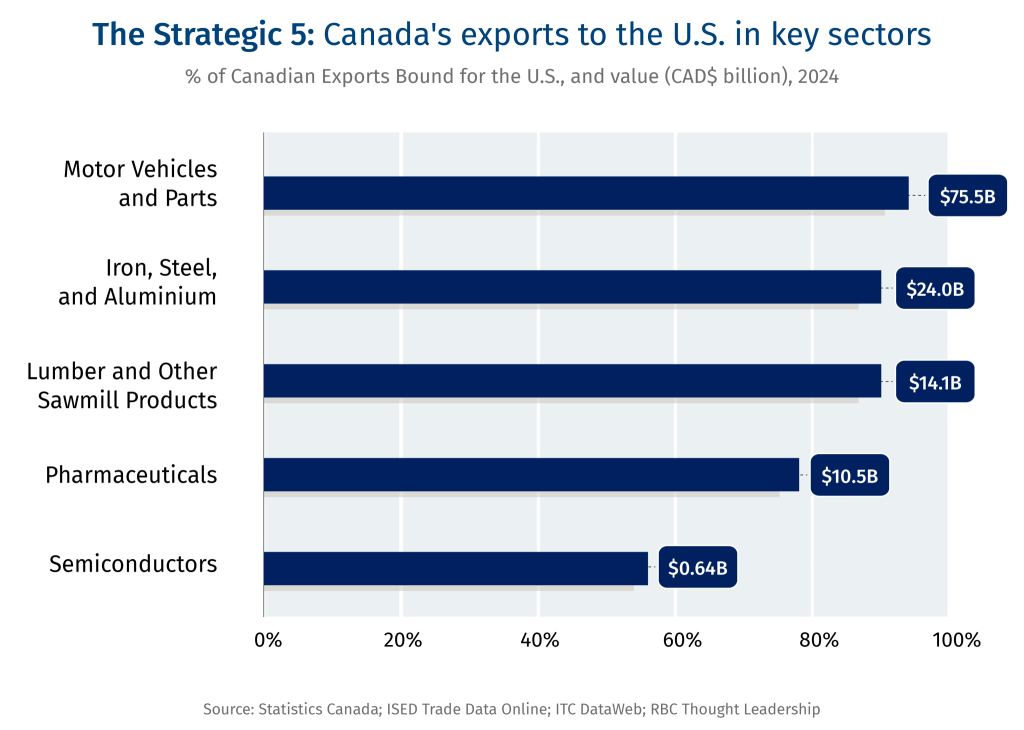
U.S. President Donald Trump believes autos, steel and aluminum, lumber, pharmaceuticals and semiconductors are the five strategic sectors that will drive American industrial revival. His overarching plans involves cutting imports (and trade deficits) and onshoring domestic production in each of the sectors and related industries. That’s emerging as a challenge for some of the U.S.’s top sector suppliers, including Canada. These five domestic sectors rely heavily on shipments south of the border and are of strategic importance to Canada.
U.S. tariffs on the Strategic 5 will likely hurt Canada’s economic prospects and could trigger layoffs and flight of capital in sectors that are vital for our energy and national security.
Here’s a look at the importance of each of these sectors to the Canadian economy:
Automotive
Exposure to the U.S. market: $75.6 billion in exports (2024)
Total U.S. market: Sales of new vehicles in the U.S. reached 15.8 million units in 2024—second only to China’s 31.3 million.1
Global market: Just over 88.2 million vehicles2 are estimated to have rolled off assembly lines worldwide last year.
Canada’s role: Domestic auto- and part- makers’ market share in North American auto manufacturing has fallen over time, with Mexico gaining ground. However, 92% of Canadian auto exports are still shipped south of the border.
Tariff status: For CUSMA-compliant vehicles, the 25% tariffs are currently in force and apply to the value of non-US content.
Canada’s response: Ottawa’s countermeasures focus on 25% tariffs on all U.S. auto parts not compliant with CUSMA. The federal government and Ontario are also easing tariffs for U.S. auto parts for companies that remain committed to the Canadian auto supply chain.
The fallout: Stellantis and General Motors temporarily laid off staff in Ontario assembly plants.
What’s next: The Trump administration is mulling a potential pause on auto tariffs—primarily to give carmakers more time to onshore supply chains.
Aluminum, steel and iron
Exposure to the U.S. market: 91% of Canada’s aluminum and 89% of its steel exports were shipped to the U.S.
Total U.S. market: The U.S. consumed 93 million tonnes of steel in 2024—with Canada supplying 6.4 million metric tonnes of the total.3
Global market: Global aluminum demand has steadily increased over the past decade, driven mostly by growth in Chinese demand and from sectors like construction and transport.
The U.S. has had an average trade deficit in aluminum with Canada of about US$7 billion annually over the past five years.4
Canada’s role: We are a top foreign supplier of aluminum and steel to the U.S., ahead of China and Mexico.
Tariff status: The 25% U.S. tariffs on aluminum and steel imports from Canada are triggered by American efforts to bolster its domestic industry. The first Trump administration had also imposed tariffs on Canadian aluminum for 14 months, lifting them after USMCA was ratified in 2019.
The fallout: Hundreds of workers in the aluminum and steel industry have already been laid off since the latest tariffs came into effect.6 Ottawa is taking several measures to support Canadian workers and businesses.
What’s next: Commerce Secretary Howard Lutnick says reprieves on steel and aluminum tariffs are unlikely. With aluminum featuring on the USGS Critical Minerals list and a new probe on U.S. critical mineral imports underway, Canada’s aluminum industry may need to gear up for further uncertainty.
Lumber and other sawmill products
Exposure to the U.S. market: $14.1 billion in exports—90% of Canada’s total lumber exports.
Total U.S. market: The U.S.’s trade deficit against Canada in softwood lumber averaged US$5.8 billion annually over the past decade, according to the U.S. International Trade Commission.
Global market: The US$788 billion global wood products market is expected to nearly double in value by 2033. We wrote recently on how Canada can capture a greater share of the global opportunity.
Canada’s role: Canada’s domestic consumption of softwood lumber has fallen 11% from a decade ago. Domestic demand, which has generally followed housing starts, reached a 23-year low in 2023.
Tariff status: Under the Biden Administration, the U.S. raised duties charged on Canadian softwood lumber imports to 14.5% in August 2024. These tariff rates remain in place with additional hikes on the horizon.
The fallout: The lumber industry is already facing regulatory headwinds that have forced closures of sawmills in B.C.
What’s next: U.S. tariffs on softwood lumber imports are set to increase to 34.5% and could come into effect in the fall.
Pharmaceuticals
Exposure to the U.S. market: $10.6 billion in exports.7
Total U.S. market: Prescription drug sales in the U.S. were $716 billion in 20228 , or about 2.8% of U.S. GDP.
Between 2019 and 2024, the U.S. has run an annual $1.2 billion trade deficit in pharmaceuticals with Canada, according to U.S. International Trade Commission data.
Global market: Pharma R&D spending is expected to top US$200 billion9 this year.
Canada’s role: The U.S. is Canada’s primary pharmaceutical export market, accounting for 78% of its pharma exports in 2024. Japan, the next largest export market, received 5% ($720 million) of exports, followed by China, at 2% of exports, or $276 million. The Canadian pharma industry employed 35,367 workers in 2024.
Tariff status: Originally exempt from the April 2 reciprocal tariffs, the White House has now officially launched an investigation into the national security impacts of pharmaceutical imports.
The fallout: Industry is warning of a spike in costs of drugs and even shortages of key medicines.10
What’s next: Major tariffs on pharma could be on the horizon.
Semiconductors
Exposure to the U.S. market: $637 million, or 56% of Canadian semiconductor exports, in 2024.11
The U.S. runs a trade surplus in semiconductors with Canada, reporting a surplus of $764 million in 2024.
Global market: Global semiconductor sales were estimated at $627 billion in 2024.12
Total U.S. market: Companies involved in the semiconductor ecosystem plan to invest nearly US$450-billion in more than 90 new manufacturing projects in the U.S. across 28 states, according to an industry association.13
Canada’s role: Canada is emerging as AI hub with its clean and cheap electricity seen as a competitive edge. A recent RBC Thought Leadership report, published before the trade turmoil, estimated Canada could attract nearly $100 billion across 20-30 data centres. Disruptions to the nascent chip supply chain could disrupt that potential capital flow.
Tariff status: The U.S. announced probe into chip and electronics imports in early April, paving the way for new tariffs.
The fallout: Several tech companies have seen their stocks drop.
What’s next: Some reports suggest Trump will announce new tariff rates on imported semiconductors next week, with flexibility for certain companies. Secretary Lutnick said it would likely come in “a month or two.”15
To check the pulse on the agri-food industry, RBC’s Thought Leadership team met with farmers from across Canada last week—from pork producers in Manitoba to members of the fruit and vegetable industry gathered in Montreal for their annual tradeshow.
What’s clear is that the industry is highly motivated to keep up the momentum; last year, Canadian agri-food export value was a record $106 billion. And all eyes are on commodity prices, U.S. farm policy and, of course, the impact of U.S. President Donald Trump’s tariffs.
What we heard:
Many farmers are adopting a keep calm, carry-on approach. Farmers are accustomed to volatility, the result of managing through unexpected weather conditions, shifting commodity prices and equipment breakdowns. Trump’s tariffs are seen by many as just another disruption. That’s led some to ride out the resulting pricing swings (i.e. canola). Others, including grain and oilseed producers, are considering shifting the crops in rotation for the 2025 planting season, a direct result of China responding to Canada’s EV tariffs with their own on peas and canola products.
Meeting the moment for Canadian-made items. The increased demand for made-in-Canada products is leading to American-made spoilage at grocery stores. The movement adds to the push for expanding Canada’s greenhouse sector acreage and diversity of products to close our production-consumption gap for fruits and vegetables.
Canadian food producers and processors are working to bulletproof their USMCA-compliancy. Companies are preparing for scrutiny at the border to prove they are USMCA compliant and adhering to the rules within, such as country-of-origin. Just 0.1% of all agri-food products traded in 2024 were likely not USMCA-compliant but more than a third of Canada’s agri-food exports, albeit compliant, did not trade under the agreement.
Trade diversification is underway. It is, however, yet to be seen if Canadian retailors and traders are going to be able to get like-for-like on quality and price for food products. Exporters and retailors are exploring where else they can source the products they need for their customers. But will Canadians want to buy a Moroccan orange over one from Florida?
Can our ports handle our growth and diversification ambitions? Canada’s turn-around times are slower than key agri-food competitors, including the U.S., Australia and Brazil. The potential influx of product flow at Canada’s ports due to rising costs of moving goods through the U.S. may cause greater congestion and bottlenecks if Canada is not preparing for growth.
3 things to watch:
Emergency U.S. farm support and its impact on Canadian farmers’ competitiveness. The USDA’s Emergency Commodity Assistance Program (ECAP) is a $10 billion one-time economic assistance payment program to help farmers mitigate the impacts of increased input costs and falling commodity prices. For example, U.S. farmers can receive upwards of $77.66 per acre of oats and roughly $30 per acre for soybeans and wheat.
Cuts to U.S. agriculture research programs and services. The dismantling of USAID and cuts to its funding to 19 land-grant university-based innovation labs across 17 states, as well as proposed cuts to NOAA’s climate research can undermine agriculture innovation and risk halting essential services such as weather monitoring.
Risk of rising costs and disruptions for supply chains running through U.S. ports from New Orleans to Philadelphia. Trump’s April 9th executive order, Restoring America’s Maritime Dominance, instructs U.S. Trade Representatives to proceed with a proposal that includes a $1M docking fee at US ports for any ship that is part of a fleet that includes Chinese-built or Chinese-flagged vessels. On top of cost risk, U.S. custom services could slow down these just-in-time supply chains needed to bring Peruvian blueberries to Canada.
This month marks the 100th anniversary of the publication of The Great Gatsby, the F. Scott Fitzgerald novel set in the Jazz Age when American wealth and power soared, and yet the characters clung to the vestiges of an earlier golden age.
Sound familiar?
A couple of weekends ago, I spent some time not far from the mythical Gatsby home, at another estate left by the Whitney dynasty to a foundation that the family created to support peace and sustainability. About three dozen policy leaders from the U.S., Europe and Canada gathered at Greentree, on Long Island, to discuss how business can adapt to Donald Trump’s world—and his promise of a new golden age—and also shape it.
Some of my takeaways from our discussions, which began as global markets began a sharp decline:
1. China will become the defining force of this Administration, which may need to consider “managed interdependence.”
2. The U.S. dollar remains an enormous challenge to America’s trade competitiveness and will continue to be overpriced as long as Washington runs enormous deficits.
3. Trump Republicans hold a special dislike and distrust of Europe that will be hard to resolve, and a peculiar like for Britain.
4. Tariffs won’t fix underlying U.S. frustrations, which are rooted in long-term labour productivity and real wage stagnation.
5. While trade is being blamed for middle America’s economic malaise, technology has caused more job displacement over the last 25 years.
6. America, and others, need to focus on training and reskilling to improve wages and incomes in the coming age of AI.
7. Tariff execution will be a challenge if Trump reaches (or has reached) a political high-water mark, as he will have to spend more energy on opposition forces, including more than 100 lawsuits.
8. Major businesses in Europe and North America need to come together in a more united way to project the case for more economically rational policies.
Read the speech John delivered at the conference here:


 EN
EN