WP Menu

wp-menu

Over the coming weeks, we will begin to see the extent of economic damage caused by the pandemic and the necessary lockdown of our society. This quarter alone will likely see the biggest economic decline any of us have witnessed, with job losses and business closings that could affect our communities and country long after the virus is contained.

In moments like these, it’s natural to think only about the immediate challenges, but we also need to think about the next stage of recovery, so we don’t lose that opportunity when it comes.

Since the onset of the COVID-19 crisis, I’ve talked with dozens of clients – from the country’s biggest companies to retail mortgage holders – and worked closely with my global peers and our governments to understand the complexity and risks we’re facing. Many of us are now recognizing we are unlikely to see a V-shaped economic recovery, as we were hoping just a few weeks ago, and will need to work hard in the coming months to bend the downward curve back to a narrow U.

It won’t be easy. Even if social restrictions are largely gone by summer, the economic scar tissue will remain and take time to heal. To its credit, the federal government has put together critical relief packages, worth more than $100-billion, and more will be needed from Ottawa and our provinces.

Now it’s time to execute, without a moment to lose. Over the coming days, we need to pull together as Team Canada to get these historic commitments to owner-operators, innovators, social entrepreneurs and families in every corner of the country and the economy. Many companies have just days left to keep their payrolls intact. Many families will struggle to make ends meet in the coming months.

The purpose of these historic investments, though, is about more than surviving today; it’s about shaping the economy of tomorrow. And that means moving from defence to offence, as the best Team Canada always does.

To make that shift, we need to think about the next normal, as there won’t be an old normal to return to. Global trade migration is not likely to go back to the old model. International movement won’t press a “resume” button any time soon. Shoppers, diners and tourists may choose to stay away from each other for a while. Even the sharing of technologies and innovations may not flow again like they did only a few months ago.

For a relatively small country such as Canada, which has benefited in so many ways from an open world, those are significant challenges. That doesn’t mean we should give up on globalization. But it does mean we need to think, for the first time in decades, about how to be more self-reliant in the areas that matter most to our competitiveness and prosperity.

Here are some of the tools we have to do that:

Capital

Canada has a strong balance sheet, one of the world’s best. The federal government is starting to leverage it more ambitiously and will need to continue to do so, which means Canadians need to be comfortable assuming more collective debt. We also have many of the world’s strongest banks, insurance companies and pension plans, each with good, well-regulated balance sheets that can be harnessed for our economic recovery. Canadians have worked hard since the global financial crisis of 2008 and 2009 to strengthen those foundations and to preserve and protect capital; now is the time to get that capital to work and invest in the entrepreneurs and innovators who can build the markets and supply chains of tomorrow.

Trade

We’ve been able to take for granted the free flow of critical supplies, from medical equipment and drugs to food and agriculture products. That may not be so true in the next normal. Our governments, leading enterprises and academic institutions need to determine how to best develop and protect more resilient Canadian supply chains. Of course, a more self-reliant Canada could become a more expensive Canada, as we don’t have a significant domestic market. We’ll need the best of our innovators to develop and apply technologies to drive the next generation of productivity gains, and with it a new Canadian competitiveness.

Technology

The crisis has given many organizations the chance to see how to work differently, and connect with customers differently. If we harness new technologies across all sectors – including government – we can accelerate our shift to a more competitive and inclusive economy. And we can ensure these technologies help us better prepare for future public-health challenges. It’s not just organizations that need to evolve, though. Using its balance sheet, Canada has the chance to invest in the next generation of infrastructure – satellite-driven rural broadband, for instance, and smart cities – that will foster more ingenuity, resilient communities and secure livelihoods. We need to see the coming recovery as a digitally driven recovery, powered by data and engineered by Canadians with skills to take on the 2020s.

Skills

To make this shift, we need to transform the way we learn and train, so our companies and communities are better equipped for a new paradigm of disruption. Through Royal Bank of Canada’s $500-million Future Launch commitment and Humans Wanted research series, we’ve spent the past few years engaging employers, educators and students to focus on the future of work. Our schools, colleges and universities have responded with important strides that make Canada’s education system among the world’s best. But if we’re teaching and learning after this crisis as we did before, we will have failed.

Youth

Unfortunately, a new generation of Canadians will be bearing the economic scars of the COVID-19 crisis here for many years. If we get behind them now, they can help lead the recovery and the rebuild. As a digitally savvy generation, they’ve been fast to adapt to this new normal. It’s why RBC has committed to keeping the close to 1,400 students we offered summer jobs to, even though some won’t have workplaces on Day 1. That’s okay. Most will be working from home and help us reimagine all we can build together. They are the future; they can help take us there.

Over these trying and tumultuous months of this crisis, I’ve been inspired by RBC’s 85,000 employees who have transitioned a global operating system with remarkably little disruption. Beyond just doing things differently, I see us doing things better, which will be critical to ensuring a successful recovery that accelerates into a vastly changed world. That’s why I’ve asked every one of our leaders to keep notes on what they’re learning and how they’re thinking about the next normal.

I’ve stressed to them two words: speed and scale. We need those twin forces to drive our business forward. We need them in public policy, too, to develop solutions at the speed of our shared problems and to ensure solutions get to a scale we’re seeing elsewhere in the world.

Over the coming weeks, we will need to move faster than we may be comfortable with and strive for a scale that’s bold and ambitious. We’ll also need to keep pace, even as we’re confronted by questions that give us pause about how we can collectively move from crisis to recovery.

We will need to lay out plans for re-engagement, to determine which parts of society can open up first and how we can approach that narrow door without sparking a social stampede.

We will need to invest aggressively in mass testing for COVID-19 and adopt new approaches to monitoring, to better understand where the virus is and how best and most humanely to contain it.

We will need to protect all Canadians as we come to grips with the prospect of co-existing with the virus, domestically and globally, before a vaccine or effective treatment is developed and produced at scale.

How we respond to those questions and work together in the weeks ahead will be remembered for years. How we rebuild from there will be remembered for generations.

We know this crisis is already different and deeper than anything we’ve seen. We should also know it can be the beginning of a new economic chapter for Canada, one that allows us to thrive and prosper in a digital age.

We’ll need to work together – something Canadians are good at, even under stress. We’ll need to think about offence as well as defence. And we’ll need to see this not only as Canada’s challenge but also Canada’s moment.

That can be our next normal.

This article originally appeared in the Globe and Mail.

WP Menu

wp-menu

The U.S. was losing to communists on the battlefield, socialism was winning in the streets, monetary policy was fighting for credibility, and young people were challenging the multinationals that had come to define global commerce.

Capitalism did win out, and for the vast majority of people, the world became a better place – more open, more educated, more innovative, and by most measures more prosperous. But at the 50th World Economic Forum in Davos last week, a new global divide became apparent. After a half-century of globalization, of rules and ambitions that carried the world through the end of the Cold War, the rise of the Internet and the explosion of mobile computing, the world is facing new challenges, and new questions. And once again, a new generation is demanding action. Can capitalism again rise to the challenge?

This was my fifth trip to the Forum, and the first where I began to see the emergence of geopolitical systems and their economies as platforms competing for the transformation that lies ahead – and the deep implications that this holds. The 2020s may see a reordering of economies and industries, as societies respond to the threats of climate change and sectors tap the potential of smart technologies. But who defines that change remains to be seen. More than ever, business will have to step up.

Here’s some of what I learned at WEF 50:

1. Superpowers as the new super platforms

Every January, the shops along Davos’ main street are converted into showcases for far-flung markets from around the world, from Karnataka to the Caspian, with nods this year to Saudi Arabia, Ukraine and Canada’s cannabis industry. The Disneyesque displays always capture the diversity of our global economy, but the loudest messages this year came from those that didn’t have much of a visible presence: the United States and China. The two powers control 40% of global GDP, and as their trade conflict shows, they’re each trying to position themselves as a platform for global growth. That’s critical to everyone looking for global scale to solve problems, whether it’s to cure diseases, reduce carbon emissions or find new markets. It’s not just a race for scale; it’s a competition between operating systems for business, between America’s shareholder capitalism and China’s state capitalism.

I was with a group of CEOs who met with President Trump and members of his administration whose confidence was palpable. They felt their economic policies had exceeded expectations and their approach to a new trading order, based on regional and bilateral deals, would ensure the global economy continues to revolve around the American platform of capitalism, rooted in the capital markets of New York, the innovation labs of Silicon Valley and a manufacturing renaissance in between. China was less visible at this Forum, but the trade war hadn’t diminished the confidence of the Chinese leaders I met. In fact, their resolve seemed to be growing. As one regular Davos-goer noted, the absence this year of many world leaders – none of the BRIC leaders, for instance – could reflect the draw of China’s Belt and Road summit, which is held every April (Beijing last year, Dubai in 2020) and may be the new Davos. China’s rise is about more than summits and sales, however. Its approach to state capitalism is about scale, using technology and an expanding reach across Asia into Europe to create data fields that could become the OPEC of the digital age. Which platform prevails in the 2020s will be critical to every business, and country, looking for growth.

2. Government, redirected
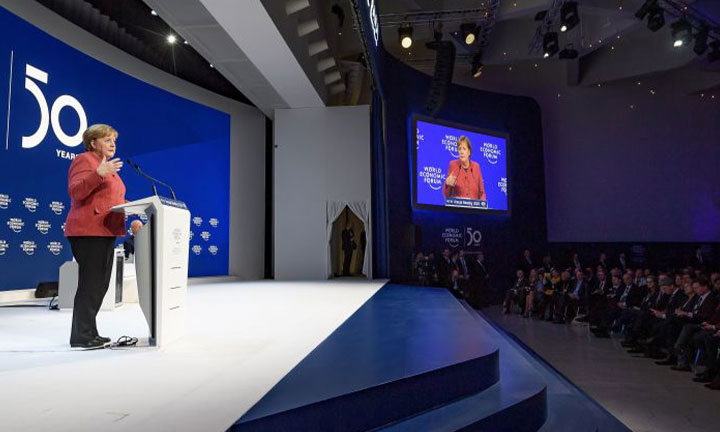
Across the aging, slow-growth West, governments are asserting themselves with a conviction not seen since the financial crisis. Nowhere is this truer than Europe, where governments are vexed by negative interest rates and the imminent departure of Britain from the European Union, a move that could further fray the world’s biggest common market. Into this valley of uncertainty, the EU leadership came in force to Davos to make the case for a more activist state. Ursula von der Leyen, the German president of the European Commission, made clear the continent isn’t going to compromise on regulations to compete with Britain. She’s ready to impose trade measures against any country that doesn’t meet environmental, social and labour standards. The Europeans are even planning to mobilize €1 trillion over the decade for a “green investment wave” that could rival the Democrats and their Green New Deal.

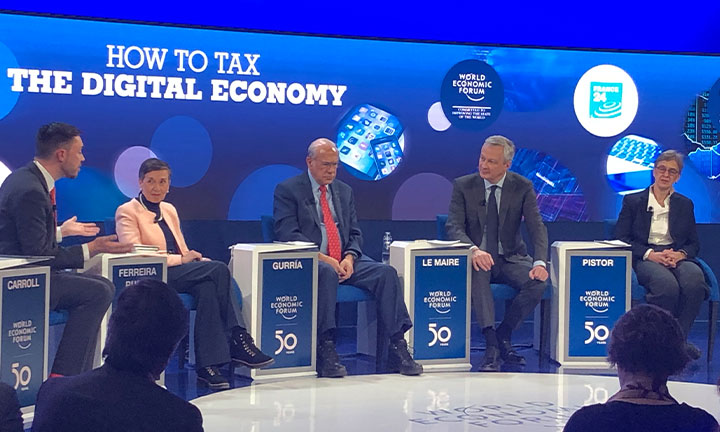
Even just a year ago, many Davos-goers thought rising global frustrations might spark a return to socialism. That may still happen. But at the forefront of the resurgent state are pragmatists like Germany’s Angela Merkel, who laid out an economic model that is neither left nor right: it’s a new economic model rooted in sustainability. “The whole way we do business will have to change,” the Chancellor said at her 12th Davos Forum. Europe’s more balanced approach to markets has carried into the cyber-economy, where its governments appear happy with their new, more onerous data regulations, and are determined to impose a digital tax on the Internet giants, for the sake of fairness and revenue. Global trade tensions won’t help, and indeed may worsen as Britain tries to cut deals with the U.S. and, eventually, China, in a race to bridge the two platforms.

3. Capitalism, repurposed

The Forum’s theme was “stakeholder capitalism,” an unfortunately anodyne description of a smart and sustainable approach to business that strikes a balance between communities, customers, employees and shareholders. Simply put, it puts purpose ahead of profit. Over the past 50 years, business has largely expected government to set rules and levy taxes to serve the public good. As trust in governments wanes, and the complexity of society’s problems grows, companies are charting their own course on environment, social and governance issues, to maintain public confidence in business and ensure the prosperity of communities that business serves. The challenge is serious. According to this year’s Edelman Trust Barometer, more than half of respondents worldwide feel capitalism does more harm than good – a sentiment driven largely by income stagnation. “Capitalism as we’ve known it is dead,” declared Marc Benioff, the founder and CEO of Salesforce.com.

In some ways, European and Canadian companies have already developed a purpose-driven approach to business that their American and Asian peers are only now pursuing in earnest. Microsoft CEO Satya Nadella made the case for this repurposing of capitalism, describing our economic model as the world’s most powerful economic learning system, rooted in discovery and testing. That learning system is needed more than ever to solve the world’s increasingly complex challenges, he argued. Mastercard CEO Ajay Banga suggested business can build the partnerships and networks needed to solve those problems. He came back to that word, scale, which may be the most important force of the 2020s. Business has proven to be the most effective model for scale anywhere, and is proving that again with global platforms. But this repurposed capitalism, and its complex web of relationships, will put ever-greater pressure on CEOs to reach beyond their walls and sectors, to delve into foreign subjects and work with unlikely allies, using the strength and spirit of their organizations to take solutions to a global scale. As Banga told the Forum, “there’s not enough philanthropic money or government money to solve these problems.”

4. Accountability, redefined

If business is to play a leading role in the 2020s, it will need more acceptance from society than ever, and that will require a more active role in developing national and international standards for a company’s performance on environmental, social and governance issues. We can’t wait for government. This year the Forum and 140 global companies launched an initiative to measure and show the progress of business across four pillars – principles, people, planet and prosperity – with 22 measures developed by the world’s major accounting firms. Properly adopted, the index can help communities, environmental groups, regulators, even employees, hold companies to account on their performance beyond the financial bottom line. And, in turn, this model can help business transparently measure its progress and outcomes, as we continue to strive to earn our social license to operate in society.

Such measurement tools carry risks, especially when they lose a sense of balance among their many variables. The risk was evident at this year’s Forum when environmental concerns overwhelmed the social and governance components of ESG. It’s important to remember how the failure of authorities, in business and government, to restore social inclusion after the financial crisis led to the rise of populism in the last decade. The governance failures of the Internet have been equally damaging. If the new capitalism is to find balance, it will need to ensure it continues to see the concerns of society as an integrated system rather than an itemized scorecard.

5. The new math of net zero

If two words defined this Forum, they were “net zero” – the idea that companies, even countries, can strive to reclaim more carbon from the atmosphere than they emit. The snowless pastures in the lower valleys around Davos this winter illustrated the realities of climate change and the urgency that Greta Thunberg brought to the Forum with her message that history is watching and a new generation is judging. She wasn’t alone. The world’s biggest asset manager, BlackRock, announced it would hold companies to a higher standard on all measures of sustainability, including their role in reducing global emissions. Microsoft set its own bar higher with a net-negative carbon policy that commits the software giant to offset all the carbon it has ever emitted. Few companies have done the hard math that Microsoft did, to calculate new emissions that can be attributed to its existence. If we’re serious about net-zero concepts, a lot of homework remains.

While much of the focus was on emissions reduction, more attention is going to offsets, especially nature-based ones that could allow our seas, land and forests to absorb more carbon, more quickly, as we work to transition industrial practices and consumer preferences. The Forum announced a bold commitment to help the world plant 1 trillion trees, increasing the global total by a third. That won’t be easy or cheap. The world’s leading financial institutions – banks, pension funds and asset managers – are also working to ensure more capital flows to carbon-reducing companies and technologies, and gradually away from major net emitters. In my conversations with finance officials and other global bank CEOs, it was clear governments need to do more – to set the rules of sustainable finance, and set clearer prices for risks, including carbon, so capital markets and business operators can get on with what they do best: optimizing the allocation of scarce resources, driving change and scaling innovation.

6. The messy math of energy

The most difficult conversations at Davos were also the most important. They were around how we plan for the next-quarter century of energy production and consumption, allowing investors and consumers to make economically rational choices that don’t lead to ecological catastrophe or social upheaval. To get there, we need more math and less emotion, because right now the math doesn’t add up. The Saudis, with low costs and low emissions, covered Davos with billboards and tea huts to burnish their image as they continue to export a good chunk of the world’s oil. They’re well positioned for any transition. The Americans, with a proven track record of innovation that’s made them the world’s Number One oil producer, show no signs of pulling back either. And then there’s China, whose ambitions could upend the world’s carbon math. As one China expert told us, the country is on course to open two new coal plants a month for the next 12 years.

I met with the world’s leading energy CEOs to better understand what they’re up against, and what they’re doing to reduce emissions. We need them to succeed. Our transition to a greener economy, with a more diverse energy mix, will take decades if it’s to avoid massive economic disruption. But it also needs to be more deliberate if it’s to avoid large-scale dispersion of capital away from some of our best innovators – the oil and gas companies that are using artificial intelligence, drone surveillance and advanced chemistry to reduce emissions. Some of those producers fear they’ll be cut off from investors who make unilateral decisions to adhere to the new carbon math. It may be short-sighted. Without a clearer plan to replace fossil fuels, we risk seeing producers hoard cash – or give it back to shareholders — rather than invest in new technologies. Any resulting decline in production, especially without a visible change in consumer behavior, might lead to a run-up in oil prices, something that could spark economic shocks and a political backlash.

7. The return of Malthus

When the Forum began in 1971, the world’s population was 3.8 billion, and plenty of Malthusian doomsayers warned we didn’t have enough land, water or food to cope. Instead, technology and trade triumphed, allowing roughly 7.8 billion people today to enjoy access to more food than the planet has ever produced. Can it continue as our population heads to 10 billion by 2050? With the world adding 80 million people a year, increasingly in Africa, the Middle East and other food-challenged regions, Davos renewed its focus on food security and the need to see global food production grow by 60% by the middle of the century.

The Forum brought together food innovators from around the world to showcase how technology may save us again. Cell-based meat production, pea proteins, vertical farming: there are plenty of ideas being developed. They will require new supply chains, changes to consumer behaviour and much more public and private investment. To show what individuals can do, the Forum launched a Future Food Day, serving locally sourced dishes, with smaller servings. Can such nudges make a difference? Not without large-scale investments in public research and the private scaling of innovation. Ramon Laguarta, the CEO of PepsiCo, suggested the world needs half a dozen Silicon Valleys of food innovation, in which universities, entrepreneurs and major producers can work with farmers of all sizes to transform how they produce food. The United Nations did just that in the 1960s and ‘70s, fostering a Green Revolution that helped avert a Malthusian mess. If we can make a renewed commitment to multilateralism, and allow for more business leadership, we might be able to do it again.

8. Currencies 2.0
The first Davos Forum inspired conversations around the dismantling of the gold standard, and emergence of the U.S. dollar as the world’s reserve currency. Fifty years later, the Forum is working with central banks and financial institutions to talk about currencies for the digital economy. A group of financial executives met with Bank of England governor Mark Carney to discuss the next frontier in payments, knowing there is a complex problem to solve: How can we reduce the friction of digital payments without undermining the financial system that is a foundation block of our economy? We’ve weathered financial crises since the end of the gold standard because our financial system doesn’t separate the storing, lending and movement of money into isolated channels. In fact, the confluence of these channels has ensured liquidity and an efficient matching of short-term savings (deposits) with long-term investments (loans). While digital currencies could make transactions easier, they risk diverting the lifeblood of our financial system to sources outside the system, like the big tech platforms that want the economic value of payments without the regulatory costs.

The next generation of payments will present another critical question: will digital currencies ever replace King Dollar? Not any time soon. Facebook’s Libra project has struggled to gain acceptance. And China’s initiative to build a digital yuan faces some fundamental problems. Beijing hasn’t explained which currencies (if any) might backstop the concept, which would be essential if a digital yuan is to facilitate trade such as an Alibaba purchase from Europe or Russian oil sales to China. The consequences are equally unclear if such a currency were to be adopted by rogue actors seeking to evade U.S. financial sanctions. The Trump administration’s active use of sanctions has already pushed many countries, notably Russia and Iran, to pursue new financial channels with Europe, the Middle East and Asia, making the notion of a new digital currency all the more appealing to them. The biggest challenge for the next generation of currencies will be to earn the trust of consumers, producers, sellers and lenders – and scale that trust. Through financial crises, wars and recessions, the U.S. dollar has done that, which is why the world continues to flock to it. For all the frustrations they can cause, America’s legal and regulatory systems remain the gold standard of global finance. Which is why the dollar is backstopped by the most valuable currency of all: trust.

9. Organizations 3.0
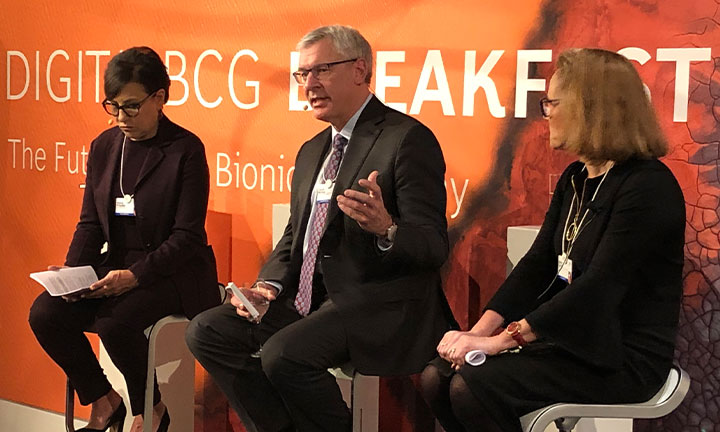
Businesses were first built around people. Over the last 50 years, they’ve been built around technology, too. We’re moving into an age when they’ll need a bionic blend, in which the interoperability of people and technology will be a critical success factor. I was part of a Davos panel on the “bionic organization,” led by the Boston Consulting Group and featuring Belén Garijo, the CEO of Merck’s Healthcare division, and Penny Pritzker, the former U.S. commerce secretary and founder of the investment company PSP Partners. We talked about how organizations can ensure their employees work effectively with smarter technologies, and how those technologies can be developed and refined to take advantage of the enormous human skills found in successful companies. Think of it as “intelligent augmentation” – the IA that can be just as powerful as AI to an organization. In the case of Merck, such an approach has increased demand for employees who can work across cultures as comfortably as they work across data platforms, blending tech and social skills. It’s one reason the company restated its purpose as “curious minds devoted to human progress.”

This blend of skills will be critical to legacy organizations trying to create 3.0 versions of themselves, using smart technologies and data pools to build their own platforms. One example: Yara International, the Norwegian fertilizer company, has built a digital platform with IBM that gives users the tools, data, networks and products they need for sustainable farming. Trouble is, such efforts rarely succeed without a diverse human mindset driving a platform. Pritzker told our session she looks for openness, authenticity and permission in companies she buys. “Innovation takes risk,” she’s found – and risk is rare if people don’t feel safe to speak their minds. She said a strong culture of diversity is critical to the bionic organization – something she didn’t appreciate until she worked in government and saw diversity as more than representation. “It’s also the difference in where you come from,” she said.

10. Education 4.0

Leave it to Yuval Noah Harari to rattle the sapiens of Davos. The Israeli author is one of my favourites, and he didn’t disappoint when he told the Forum about the disruptions coming at humanity through automation. “How do you teach a 50-year-old truck driver to be a software engineer, or teach yoga to software engineers?” he asked. Even more than job loss, the historian and author of Sapiens worries the greatest threat to progress will be the loss of our sense of relevance as machines do more of what we thought we were good at. Offering advice. Giving directions. Telling a story. “It’s much worse to be irrelevant than to be exploited,” he warned, suggesting a new “useless class” will be our great challenge in the decade ahead.

Over to you, educators, and that could soon include all of us. The Forum launched an initiative this year to provide 1 billion people with better education, skills and jobs by 2030, which will require educators, government and business to develop new learning models together. As Suzanne Fortier, the Principal of McGill University, told the Forum, we need to be ready for a revolution in lifelong learning, which will run from early childhood until we’re 100. We’ll need a lot more such innovations if the Forum is correct in its projection that technology investments will create 133 million new jobs over the next three years. Many of those jobs will require specialized tech skills. Many will demand trade skills, which the world over aren’t attracting enough young people. But everywhere, the greatest demand will be for critical thinking and communications, the power skills of the 2020s. There’s just too much information out there for humans to cope with. Indeed, over the next 50 years, our greatest challenge may be to ensure we’re always learning. As Harari knows, it’s what defines us as sapiens.


I left Davos with a sense of concern for our increasingly divided world, and a sense of hope for the human spirit at the root of progress.

The balance may rest in the concept of trust. It could, as IBM CEO Ginni Rometty told the Forum, define the decade. There’s so much change happening, so quickly, that trust is the new glue, for communities and companies. Unfortunately, as the Edelman Trust Barometer shows, our trust in governments and media is limited. Companies face a fair degree of scepticism too – but business still enjoys more trust than other institutions. We will need to honour that trust, by investing in the concerns that have divided so many, and by ensuring that the positive power of technology isn’t hampered by lack of trust. Our ability to learn, share and resolve has never been more important. As is our willingness to listen. Angela Merkel put it well when she said “the fact that people aren’t willing to talk with each other fills me with grave concern.”

It’s why forums like Davos are more critical than ever, to bring people together at a time when we’re easily pulled apart. If there was any confidence to bring home, it was in the messages from scores of youth leaders who represent a new generation – one that’s creating a more positive sense of change, and an impatience in those who can’t deliver. As Natasha Wang Mwansa, a 19-year-old girls’ rights activist from Zambia, told the Forum, “It’s not about being young or old. How will you be part of the change we need?”

Download the Report

Download

WP Menu

wp-menu

From the keynote addresses, panel discussions and hallway chatter, it’s clear that we’ve entered a new decade of divisions: a world caught between the mountains of America, China and a Britain-free Europe.

The best-selling historian, Yuval Noah Harari, took centre stage to outline the major disruptions – technology, nuclear weapons and climate – that will shape the 2020s. A lack of U.S. leadership in each space makes the world more dangerous, Harari argued, blaming a “Me First” mood in global politics. “The global order is now like a house that everyone inhabits and no one repairs.”

Harari’s talk focussed on technology – and the social and political walls it will build within countries and between them. Such barriers will be erected by an emerging plutocracy of data oligarchs and a new kind of serf he calls “the useless class.” “How does a 50-year-old truck driver train to become a software engineer or yoga instructor for software engineers? The real struggle in the 21st century will be against irrelevance. It’s much worse to be irrelevant than to be exploited. This will lead to a useless class and it will be separated by an ever-growing gap with the elite.”

Artificial intelligence will exacerbate those divisions, as the world is rebuilt around tech hubs that will hold sway over billions. “We are now hackable animals. The power to hack human beings can be used for good purposes, such as providing better health care. But if this power falls into the hands of a 21st century Stalin, it will create the worst authoritarian regime the world has seen.” Even the elites at Davos won’t be safe, he stressed. “Just ask Jeff Bezos. In surveillance regimes, the higher you rank in the hierarchy, the closer you will be watched.”

Harari warned we will lose power over all sorts of decisions – our agency – as the platforms accelerate what they’re already doing. Google will decide what we know, Netflix what we enjoy, Amazon what we own, leading us to “philosophical bankruptcy.” “If we develop an arms race in AI, it doesn’t matter who wins. The loser will be humanity.”

The trouble with Harari’s argument is it assumes global sway by these firms, and that’s less and less likely in an increasingly polarized world. Europe clearly has headed in its own direction on data regulation, and will do so with carbon regulations. In another WEF session, European political leaders stressed their intent to push ahead with a digital tax that may make life more difficult for American platforms. And America, even without Donald Trump, is likely to make it difficult for Chinese firms to thrive in North America.

With the long view of European history in her mind, the most significant speaker at WEF 2020 may be Angela Merkel, the German chancellor who came to Davos to outline the strategy for a post-Brexit Europe. The changes she described should not be underestimated in terms of their impact. Europe’s first priority, once Britain is out, will be a Green New Deal that aims to make Europe the first carbon-neutral continent. “The whole way we do business will have to change,” she told the Forum. Europe will require new supply chains, new industrial processes, new electricity grids and new power sources, including, Merkel said, a lot more hydrogen. “The way we produce steel will have to be changed completely.”

The new Europe will also try to build a special relationship with China, starting with a summit next September between EU and Chinese leaders. Next up will be a renewed focus on Africa, which will be the fastest-growing region – demographically and perhaps economically – through the 2020s. We could see a Eurafrica emerge.

Merkel conceded Europe can’t do it on its own. There are technologies – chips and semiconductors – that it will need from other markets, and it will remain ingrained in a U.S.-dominated global financial system. She added that Europe needs to regain some confidence, that it can drive innovation like it has over the centuries. And ultimately, it will need more multilateralism – a rejuvenated World Trade Organization, a reinvigorated NATO and a repurposed IMF and World Bank. That won’t be easy. “This shift of power fills people with concern and that triggers tension we need to contend with,” Merkel said. “The fact that people aren’t willing to talk with each other fills me with grave concern.”

This was her 12th Davos, and the 50th Forum since it was launched in the depths of the Cold War, when the world, and Europe, was deeply divided. Merkel left the Forum with a clear message that is as true now as it was then: “I’m convinced the price of inaction would be higher than the price of action.”


WP Menu

wp-menu

The World Economic Forum declared Wednesday “Future Food” day, when delegates were served vegetarian and locally sourced food to highlight the coming challenge of feeding a world of 10 billion people. The inconvenient message: We may need 60% more food to keep pace with demographic change, even as climate change disrupts croplands everywhere. Business as usual won’t cut it. Today, more than 10% of the world’s population remains undernourished, and the things we’re doing to feed the world may one day starve the planet. Exhibit A: Food production accounts for just over one-quarter of global emissions. Adding concern: global food loss and waste generate about 8% of annual greenhouse gas emissions, according to the FAO. It’s a troubling paradox.

Almost everywhere food is grown, there are stories of supply disruption: fields too wet to plant, weather-damaged orchards, and rain-starved vineyards. But food shortages are likely to hit poorer parts of the world much more severely than richer ones. In particular, global warming will have a badly negative impact on nutrition in Africa and Asia. It’s difficult to overstate the ripple effects of food shortages. Notably, it could lead to an increase in cross-border migration, which even at current levels is already redefining the political landscape in places like North American and Europe.

At one lunch today, a few dozen food experts ate mixed salad with seeds, mushroom risotto, and apple pie, and tried to figure out why innovation is falling short. Abi Ramanan, an AI specialist, noted: “agriculture has been mechanized but not digitalized.” She co-founded ImpactVision, a San Francisco-based company which applies hyperspectral imaging technology to improve food supply chains.

Agtech is hot in Silicon Valley, but even still agriculture isn’t attracting the scale of research funding – or venture capital – it needs for breakthroughs. There are exceptions, of course. Cellular agriculture is a fascinating next-step to plant-based alternatives. It uses cultures to build cell-based products outside of an organism that tastes like the real thing, be it meat, eggs, dairy or even byproducts like leather. While investment in agri-food innovation and more sustainable farming practices has climbed to nearly US$5 billion in the last five years, it still lags substantially behind cleantech.

Instead, governments spend $300 billion on food subsidies, with very little focused on transformation. “Farmers don’t need subsidies. They need support for investments,” said Wiebe Draijer, chair of Rabobank. But as big planning schemes for food have always shown, it can’t be centrally planned. It depends hugely on local farmers and consumers – the original and ultimate value chain

It doesn’t help that the world’s farmers can be a cautious lot, perhaps because their risk appetite is consumed by weather and climate disruptions. Then there’s price-obsessed consumers who aren’t willing to pay for innovation. Matt Barnard, the CEO of Plenty, said consumers everywhere want only “pleasure and convenience.” In some countries, insurers and banks are helping farmers transition their operations so they can invest in new technologies. But a more ambitious approach is needed. At the main forum, Ramon Laguarta, CEO of Pepsico, pushed for a bolder global approach, with five or six ag tech hubs – “connected with real farmers.” It may be the sort of scale needed to match the scale of challenge.

Until then, we may need to focus on that other thing we do with the land – forestry. At the Forum today, Klaus Schwab unveiled an initiative with the world’s leading governments and businesses to plant, grow and restore one trillion trees. Nature-based solutions that lock up carbon in forests, grasslands and wetlands can provide up to one-third of the emissions reductions required by 2030 to meet the Paris Agreement targets, according to the Forum’s calculations.

But here too, we run into a paradox where protecting the food supply and cutting greenhouse emissions collide. Planting large numbers of trees can push crops and livestock onto less productive land. That in turn could raise food prices. Regardless of the math, the economics of food will be back at Davos.

For insights into how the coming skills revolution can transform agriculture, read our recent RBC report Farmer 4.0.


WP Menu

wp-menu

In one session, Greta Thunberg called for a remaking of the global economy, through grassroots movements that rely on local ecosystems. In another, Donald Trump took credit for “the great American comeback,” describing “a blue-collar boom” of new jobs, factories and wealth that could lead to a new decade of manufacturing and global trade. Neither may indicate where leadership in the 2020s, and a decade of climate, tech and economic disruptions, is headed.

The Forum conversations about leadership suggest neither confrontation nor conflation are on the rise. Collaboration is – across offices, communities and society. It’s a new kind of “stakeholder leadership.”

An MIT Sloan Management School study, released at Davos today, found skepticism within companies about the abilities of leaders to help organizations, and communities, through disruptive change. Sloan surveyed business thinkers from more than 120 countries, and found just 12% strongly agreed their leaders have the right mindset to lead them forward. And only 40% believe their companies are building robust talent pipelines. The worst score? It was on digital skills, with fewer than 10% feeling their leaders have them. That’s worrisome because one of the messages at Davos is that new business models are emerging in which traditional companies will become their own platforms, through what IBM calls “business re-engineering on steroids.” One example: Yara International, the Norwegian fertilizer company that sees itself as an information platform for sustainable farming.

To get there, the MIT Sloan study says organizations must come to grips with “deficient skills sets and outdated mindsets.” (It profiles RBC and CEO Dave McKay for “a culture of openness, partnership-building and authenticity.”) In addition to authenticity, the authors identify an emerging type of leader who is purpose-driven and passionate, and exudes humility, inclusiveness, and empathy.

Those aren’t exactly qualities that would score well in a Davos word association game. But many of the management thinkers here are seeing it spread rapidly. In another Davos session, on the future of the corporation, Oxford economist Paul Collier made the case against “economic man” – the post-war model of corporate employees who were told what to do by their leaders and then closely monitored. “Turns out these ideas are false,” Collier said. “Those ideas are right for cats; humans are not like that. We are a uniquely pro-social species.” Which is why he sees a new generation of executives who show “leadership though respect.”

Part of Davos this year has been handed over to teenage leaders, including climate activist Greta Thunberg. She joined on stage a Zambian children rights’ campaigner, Natasha Mwansa; Salvador Gomez-Colon, a Puerto Rican advocate; and Autumn Peltier, the chief water commissioner of Anishinabek Nation in Ontario. “Our generation is standing up for the world we want to see,” Gomez-Colon told the Forum. “We’re not the future, we are the present.” The youth on stage said they see a different leadership model emerging, one that is more positive and constructive. “I don’t want your awards. If you’re going to award me, award me with helping to make change,” Peltier stressed. As for the way new media has ravaged many aspects of leadership, she added, “If you’re going to say something negative about us online, don’t. We’re trying to do something positive.”

The day ended with five of the world’s top CEOs – Brian Moynihan (Bank of America), Ginni Rometty (IBM), Feike Sybesma (Royal DSM), Jim Snabe (chair, Siemens) and Marc Benioff (Salesforce) – who discussed leadership for a new kind of economic model. “Capitalism as we have known it is dead,” Benioff told the Forum. The group agreed the CEO of the 2020s is one who can both bring together and serve so-called stakeholders, including communities. (In Salesforce’s hometown of San Francisco, “the homeless are our stakeholders,” Benioff said, referring to a campaign he led to raise taxes to reduce homelessness.) At IBM, Rometty used the example of skills training to illustrate how corporations can play a role once assumed to be solely the property of government. Knowing not every American kid can go to university, IBM has developed a tech program with high schools and community colleges to help those students prepare for the jobs of tomorrow. Rometty said that 15% of IBM’s new employees in the U.S. last year came from the new program. IBM is trying to apply the same kind of leadership thinking to its relationships with suppliers, customers, academic partners and the public.

Rometty said the imperative comes from a simple view: “This is a decade of trust.” And the trusted leader.


WP Menu

wp-menu

Beneath the Magic Mountain of Davos, the main floor of its sweeping Congress Centre features a tented sculpture made of seaweed, to showcase natural materials; a large apple tree grafted from 40 different species; and display tables of artisanal work that used to be consigned to museums by Davos-style globalization. The marquee speaking slots once reserved for Sheryl Sandberg and Eric Schmidt are now the property of Greta Thunberg and Jane Goodall. And the small backpacks given to delegates are made of recycled cloth. Even the caterers are encouraged to serve local foods and wines, and adhere to a full day of vegetarian menus this week.

Don’t worry, the WEF hasn’t gone all hippie. It’s just trying to address the biggest risks in business, which are pretty much all related to climate change and the environment. For the first time, the Forum’s Global Risks Report is dominated by them, with the top five spots of likely risks going to environmental issues (extreme weather, climate action failure, natural disaster, biodiversity loss and human-made environmental disasters) – and topping the list for impact, ahead of nuclear war.

Beyond displays of seaweed, the Forum is pushing the world’s top corporations and governments here to pursue a Net Zero strategy, meaning they’d pull as much carbon out of the atmosphere as they put into it. Its new paper, “The Net Zero Challenge: Fast Forward to Decisive Climate Action,” makes the case for unilateral action for countries and companies because the chances of a global or even multilateral solution are dimming by the year.

Some key points:

  • Few countries are on course to meet their Paris targets
  • Few countries have a credible plan to get to Net Zero emissions
  • Companies and sectors need to chart their own course to Net Zero, and should do so for self-serving reasons: to drive efficiencies, force innovation, earn the social license to operate in communities concerned about climate change, and stay ahead of the demands of regulators and investors
There are plenty of companies at Davos that argue they’re ahead of governments on climate action. Microsoft last week declared it will be carbon negative by 2030. Unilever, Levi’s and IKEA are among those with ambitious plans that aren’t relying on government action, as are major Canadian energy producers Suncor, Cenovus and Canadian Natural Resources, which have each stated a Net Zero goal or released significant emission reduction plans. “While no single actor can halt global warming alone, efforts by leading industrial nations or large corporations can have a multiplier effect,” the WEF report notes.  

WP Menu

wp-menu

In other words, no need for that AI flu vaccine.

In a new Gallup survey for Northeastern University, 61% of Canadians and 71% of Americans think artificial intelligence will eliminate more jobs than it creates. Roughly half of those respondents think AI will also decrease the number of good jobs out there.

But the vast majority also think they’re immune to automation.

Despite a general concern about the impact of AI, only 37% of Canadians and 17% of Americans think their job will be eliminated because of smart technologies.

The Gallup results were presented at a recent Future of Work discussion at Northeastern’s Toronto campus, put on by the Ontario Chamber of Commerce and RBC.

Helena Gottschling, RBC’s global head of human resources, told the forum that in financial services, automation is leading to new and different jobs – and a changing mix of skills – which means an ever-growing need for lifelong learning.

More than half of RBC’s 55,000 Canadian employees are enrolled in a digital learning program, often offered in the form of mobile and modular programs for skills ranging from digital troubleshooting to communications.

In the Gallup survey, 92% of Canadians (and 95% of Americans) said they want some form of ongoing learning through their careers – not surprising given that two thirds of them worry their skills will be outdated within a decade.

Despite those worries, few know what skills they’ll need to thrive in an AI-powered economy, but there was strong agreement across Canada, the U.S. and Britain that people will need so-called soft skills like teamwork, communication, creativity and critical thinking.

Gottschling agreed with that assessment, saying “the shelf life of tech skills will be shorter, while the shelf life of human skills will be just as long.”

A greater concern in the study was a lack of confidence in universities — for Canadians as well as American and Britons – to prepare graduates for the jobs of tomorrow. A rating of high confidence was lowest (3%) in the U.S.

A plurality of respondents viewed employers as best-equipped to provide career-long education and training.

Gottschling said most employees need solutions that are affordable, time-efficient and relevant to their ambitions. And then there’s mindset. Do people have the will and skill to learn?

WP Menu

wp-menu

The decade is wrapping up with a very different kind of championship held in the same arena. The Dota 2 tournament — the Super Bowl of electronic gaming — in Vancouver’s Rogers Arena and ensuing launch of a local pro esports team are just the latest indications of how much society, and the skills economy, can move in a decade.

From goal scorer to global gamer.

Few might have predicted such a change, or the massive surge in software jobs driven by gaming, social media and on-demand services. And yet, in the past decade, software publishing jobs have gone from 31,000 to 50,000, while jobs in computer systems design have grown from 155,000 to 258,000. The video gaming industry says it now accounts for 48,000 full-time equivalent jobs, with growth of more than 10% a year.

The skills revolution brought on by everything from gaming to the gig economy is just one reason most provinces are reviewing every level of education, as governments grapple with the ongoing challenge of people without jobs and jobs without people.

I was part of a panel discussion on the subject at the Canadian Club of Toronto, to explore how post-secondary education can better prepare students for a rapidly changing world of work.

Anne Sado, President of Toronto’s George Brown College, said we need to:

  • Make learning highly personalized, as students have very different needs.
  • Mix the classroom with digital and experiential learning.
  • Connect the curriculum with industry and community.
  • Set the stage for life-long learning.
  • Make resilience the fourth R.

Ross Romano, Ontario’s post-secondary Education Minister, stressed the need to connect research with commercial opportunities. It’s not only about driving economic value from campuses; it’s about building an innovation economy between employers, entrepreneurs and educators.

I told the audience we can expect three trends in the 2020s:

  • More educators entering the market, as demand grows for lifelong learning.
  • More individuals focused on skills training. Think of how we approach fitness.
  • More educators competing for that demand, and coming up with more creative and convenient approaches to teaching. Perhaps a Netflix for learning, with device-based, on-demand, shareable and snackable lessons.

I recently led a roundtable of employers to discuss what the elementary and secondary school systems might consider to better prepare youth for those challenges. The group included some of Canada’s biggest companies, trade unions, non-profits, small business representatives and public sector organizations.

Here’s what they said we need:

  1. More computational thinking. We don’t need a nation of coders; we do need a generation who think like coders.


  2. More digital design thinking, with students focused on problem solving, teamwork, iterative work models and data-driven solutions. “It’s a mindset,” one employer said.


  3. New ways to connect teachers to practitioners.


  4. Gen C skills: compassion, communication, collaboration, complex problem solving and critical thinking. They’re the skills most in demand, not least because of the ongoing boom in healthcare.


  5. Digital learning. It will become commonplace in organizations.


  6. Entrepreneurship. Even large organizations need more of those basic skills.


  7. Trades. Most of Canada is facing a critical shortage. Schools need to get students — and parents — thinking more seriously about it.


  8. Work-integrated learning. More co-ops, internships and apprenticeships, starting in high school. It’s not only good for the student; it injects organizations with fresh thinking and new energy.


  9. Learning to learn. Students need to be taught to become better problem solvers and approach challenges in new ways.


  10. Partnerships. No one sector or educator can address the skills shortage alone. Yet a failure to address those shortages will hurt economic productivity for all.

WP Menu

wp-menu

But in a workforce buffeted by technological change, healthcare has an advantage.

Due to the profoundly human nature of the work, advanced technologies don’t pose a significant threat to the physicians, nurses, therapists and others who provide all manner of care to Canadians. Automation will create efficiencies and replace some work, but don’t expect a robot to deliver a cancer diagnosis or replace hands-on homecare anytime soon.

That’s a welcome prognosis, but Canada’s healthcare sector is facing a critical test. The country’s aging population is poised to become a silver tsunami that will add another $120 billion in healthcare costs over the next decade. To harness the full power of technology in a country where one in four people will be seniors, the sector will need to embrace new ways of working.


Read the Full Report

Download


According to Paging Dr. Data, a new RBC report, around 17% of occupations in the healthcare sector face a risk from automation—half the level faced by the workforce as a whole.

The sector’s robust job creation is also set to continue: there will be 370,000 job openings by 2025, and the sector will be short of workers under even the most optimistic of projections. The shortfall offers a potential career path for workers displaced in other sectors, many of whom already have some of the core skills sought in healthcare.

Which brings us to the reskilling challenge. Canada’s healthcare system needs to up its skills game, and fast. Workers hoping to make the leap into healthcare will need the time, funds, and external support to prepare for a career switch. Those already in the sector will need to retrain for disruptive technologies. And the sector will be looking for entirely new skills too. Think wearable-device coding and 3D printing design.

In a sea of specialists, our research revealed some themes in terms of skills needed: digital fluency (the ability to interact with and analyze data, not just collect it), an ability to deliver virtual care (as telemedicine expands), and navigational skills (to assist patients’ journey through an increasingly complex health system). Finally, the human skills at the core of the best healthcare—empathy, active listening, critical thinking and complex problem-solving—will be more important than ever.

The skills revolution is already happening in healthcare. Educators are adapting courses from other disciplines, and training for adaptability and resiliency. Doctors are talking to AI specialists about how they can build algorithms to improve care. Hospitals are adopting some of the state-of-the-art technology, enabling them to attract new talent.

Properly designed, a mix of technology, skills and innovative management can help Canada prepare for the silver tsunami. We still have time to get it right. But there’s a particular urgency to making the skills economy work for healthcare.


To learn more about the impending silver tsunami and its implications on Canada’s healthcare sector, listen to our podcast episode, Solving for the Silver Tsunami.

WP Menu

wp-menu

Yet, vegetables are the most human-intensive food products to produce, and the sector is heading towards an enormous labour shortage in the 2020s.

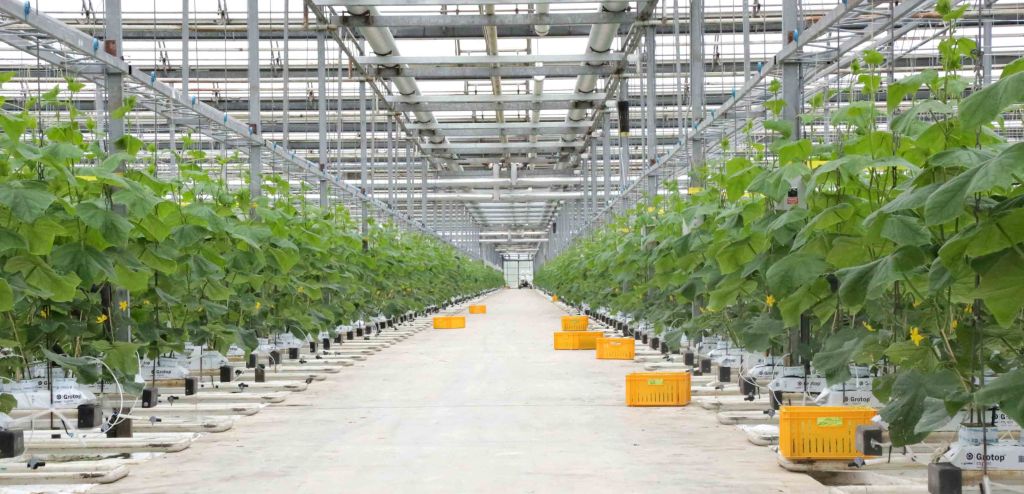
In a recent RBC report, Farmer 4.0: How the coming skills revolution can transform agriculture, our researchers identified greenhouses as a “frontier” sector for automation, with great potential to boost output and alleviate labour shortages. Today, for every $1 spent on labour, greenhouses produce $3.88 in revenue; while at the other extreme, beef operators earn $33.73 by leveraging efficiencies of machinery and scale.

Making such a transformation for indoor vegetables requires innovative, data-driven and high-skilled agricultural business owners to take risks and seize the opportunities presented by advanced technologies.

Read the Full Report

Download

The next Generation of Farmer

Hardeep and Teranjit Singh – business partners and brothers – exemplify the traits needed to succeed in the fourth agricultural revolution. As operators of Singh Greenhouses in Flamborough, Ontario, they ship 15 million English cucumbers per year across Canada and the U.S., grown over 24 acres of greenhouses. They are part of an incoming generation of young agricultural producers that bring a mix of experience, education and experimentation to a sector undergoing a high tech revolution.

“To succeed in this industry today, you have no choice but to go to school to gain the requisite knowledge,” Hardeep says. “Precision agriculture has become the standard.” An agriculture graduate of the University of Guelph, he is looking to bring a universe of digital, scientific and automation solutions into their business to reduce costs and boost output.

Data has become a fertile input for their business decisions. Last year, the Singhs instituted a new digital tracking system across their facility that allows them to monitor the health and output of their 154,000 plants in real time. The system has also given them a trove of data on their productivity, which they’re using to set targets and offer performance incentives to their 33 greenhouse staff.

For Teranjit, a graduate of Niagara College’s greenhouse technician program, improving product quality and reducing input costs through technology is a central focus. “The industry is changing so fast. We need to continuously learn about what has and hasn’t worked across the sector to make the best business decisions.” On example is a new cogeneration facility, where they produce electricity for nearly 9,000 area homes and capture the resulting CO2 to optimize greenhouse growing conditions.

Forming Human-machine Partnerships

The looming labour challenge for the greenhouse sector is severe. According to research by the Canadian Agricultural Human Resources Council (CAHRC), the sector will need to address a shortage of 29,900 domestic workers, or 55% of roles, within a decade. Already, over 40% of greenhouse and horticultural staff are temporary foreign workers, accounting for nearly two-thirds of all the foreign workers in agriculture.

A major question for researchers in the sector is, how can technology alleviate the labour gap? A leader in this effort is the Vineland Research and Innovation Centre, which is working on robotic cucumber harvesters. “The technology is still developing, where tasks that are low skill for human hands remain complex for machinery,” says Tania Humphrey, Vineland’s Chief Science Officer. “But even as machines learn best practices, complex biological systems will remain that require human intervention.”

For the Singhs, attracting and retaining staff is a perpetual challenge, in physically demanding jobs. “This line of work is a lifestyle that may require four hours one day and 14 on another, Hardeep says.” To normalize some of these pressures, they have invested in a new optical and robotic sorting, grading and packing line that can handle 14,000 cucumbers in an hour. Once in place, they will be able to divert the labour saved from the packing facility to tend and harvest more crops.

Mixing Traditional with Tomorrow’s Skills

With an increasingly digital and mechanized workplace, the skills required of greenhouse workers are changing, and educators are having to update how they train students to be job ready in the sector. At the University of the Fraser Valley, robotics and automation was added to its horticulture program in 2014. The school has been working closely with industry to identify the skills needed for the agricultural jobs of tomorrow and has shifted its greenhouse program towards more project oriented assignments. Students are challenged to draw on various data and hands-on learning to question “how do we do this better?”

Tom Baumann, an associate professor at UFV, says that agriculture educators need to “marry the old knowledge and the new technology” and encourage students to problem solve in an environment that uses both. He sees further automation of the sector as a necessity, but stresses how detrimental “losing agricultural knowledge to an algorithm” would be.

Capturing the Skills Benefit

Disruption is happening across the agri-food industry in Canada. New, high-skilled roles are emerging that promise to attract a new generation of food producer. If we are able to match people with the right skills to these jobs, our research shows that Canadian agriculture could add an additional $11 billion in output by 2030.

This growth mindset is deep-seated between Hardeep and Teranjit Singh. They’ve already broken ground on a new greenhouse, where they will expand to new crops – peppers and baby cucumbers – and leverage their experience and skills with new technology and data. This is the fourth agricultural revolution in action.