Language Flag Filename

rbc_language_toggle_menu_flag

Davos has seen a few golden ages during its time. In the 1880s, the Swiss Alps town became one of Europe’s early tourist destinations when a new class of travellers took to the “grand tour.” Davos added to its lustre in the 1920s as a spa resort for a newly confident class of Europeans. And in the 1990s, it gained a special renown as home to the World Economic Forum, which was rapidly growing in prominence at the time as the intellectual centre of globalization.

But none of those moments may have quite matched the American exuberance that took to the sleepy ski town this week. Rather than showing signs of retreat, the U.S. came in force—700 strong—including Silicon Valley titans, Wall Street billionaires, Nobel laureates, industrialists and, as if to put the gold in golden age, Olympic ski legends Lindsay Vonn and Picabo Street. To cap it off, President Donald Trump—a longtime Davos fan—video-conferenced in from Washington to both berate other government and business leaders for not pulling their weight, and to talk up American exceptionalism. Golden or not, a new age felt like it had begun—not just for the 50 heads of government and 3,000 others in attendance, but for much of the world.


Here are some of the themes that emerged at this year’s Forum:

1. America’s confidence has rarely been higher

The mood among American CEOs, and investors, was what one Davos veteran  called “giddy.” Donald Trump’s triumphal declaration of a “golden age” seems to have given businesses a shot of confidence that has changed many 2025 outlooks. The U.S economy is showing such strength that the International Monetary Fund raised its global growth forecast for 2025, from 2.2% to 2.7%, as corporations invest, especially in artificial intelligence (AI), and look to acquisitions. The U.S. is now the world’s premier destination for investment, by a long shot. In the 12 months before Trump returned to power, it attracted US$227 billion in greenfield investment projects—up by US$100 billion and more than China, India and Britain combined. Consumers are showing renewed confidence, too, while Trump’s promise to cut corporate taxes and slash regulations has quickly unleashed the animal spirits of a free market. Even the tariff threats that are rattling trade partners are seen as a win at home, pushing businesses to build inventories and domestic capacity. More than policies, Trump seems to want to restore enthusiasm in corporate America and the broader economy, and stretch the country’s ambitions. “The impossible is what we do best,” he said by video conference. While American exceptionalism may carry companies and markets for a while, risks could cloud  the sunny outlook. Joe Biden’s Inflation Reduction Act (IRA)—and its massive subsidies that are now on the chopping block—was a big reason for a lot of that investment. Inflation is another worry, as the massively indebted U.S. government continues to spend and compete with all that private investment. Immigration cuts are threatening the labour supply and could drive up wages, too. All that has put pressure on long-term interest rates, as investors wonder if inflation is truly conquered. Larry Fink, BlackRock’s CEO, said he could see a scenario in which 10-year bond yields hit 5.5%—not his forecast, he stresses, but just a distinct possibility that could dampen some of the giddiness.

Question for 2025 (Q25): Will an America First administration be able to work with other countries to keep global imbalances from tipping?

2. Europe’s confidence has seldom been lower

European leaders usually flock to Davos to tell the rest of the world about their special place in global affairs, diplomacy, business and economic policy. Not this time. European Commission president Ursula von der Leyen led a procession of voices from the continent, expressing concern about its prospects. American business and government leaders, including Trump, used the Davos stage to make it clear that Europe had become almost uninvestible because of the extraordinary layers of red tape that constrict companies and entrepreneurs. (One executive said new sustainability reporting rules required his company to answer 800 questions in its submission.) Von der Leyen acknowledged that a generation of young entrepreneurs was at risk of leaving for America and elsewhere, and conceded that Trump’s “Golden Age” messaging was a “wake-up call” for Europe. German opposition leader Friedrich Merz, who is expected to win next month’s election and become Chancellor, shared his conservative agenda of cutting taxes, slashing energy bills for manufacturers (prices have soared since Germany went off nuclear and then Russia cut gas supplies), reducing unemployment benefits and cutting family immigration levels to focus on skilled workers. He also wants to confront the Brussels bureaucracy. But it took an American, BlackRock’s Fink, to see some opportunity in the shifting winds, especially if Europe can agree to a single capital market. “There’s too much pessimism in Europe,” he told an audience on the final day. “It’s probably time to be investing back into Europe.”

Q25: Will a further expected shift to the right create momentum for deep changes to the European Union?

3. Supply shocks add to geopolitical risks

Just as the world is trying to find a new normal in the aftermath of the pandemic, the abnormal has become common. Some central bankers at Davos expressed concern about the growing threat of “supply shocks”—the disruptions in the global economy that gum up the free flow of markets. Their interest rate policies can control inflation only so much. Take the Panama Canal, for instance, one of Trump’s early targets. Any disruption to its normal operations could send inflation jumping again. Same for the Suez Canal, where Iran casts a dark shadow. The two conflicts of greatest concern to Trump—Ukraine and Gaza—could easily turn worse, and spread through their neighbourhoods at a time when many countries are pulling back from multilateral institutions like the United Nations. And then there’s perhaps the biggest risk on the supply side: climate-related disasters. Trump expressed confidence his administration can restore peace and some certainty where others had failed. He’s already opened an active channel with China’s President Xi Jinping, and suggested they work together to end the Ukraine war (Trump would handle the Ukrainians; Xi would work on Vladimir Putin). He took credit for the Israeli-Hamas ceasefire, too, and said he’d like to work on nuclear disarmament with China and Russia once Ukraine is settled. Many Davos regulars wondered if Trump, having twice won the U.S. presidency, is now angling for the Nobel Peace Prize, too.

Q25: Can shrewd negotiating skills and the strong arm of U.S. influence keep the world from greater war?

4. Energy dominance is a thing, but who will pay for it?

Say what you like about Trump, but he doesn’t mince words. And on energy, his message to the Davos crowd was clear: “Drill, baby, drill.” The Europeans seated around me in the conference hall looked shocked, until he said he would guarantee natural gas supplies for Europe. The desire for more of all kinds of energy—Trump cited oil, natural gas, nuclear, even coal—will be a relief to people in many countries struggling with high energy costs. But the political goal of “energy dominance” will have to overcome some market fundamentals. The sector has been starved of capital for much of the past decade, and may not want to invest billions of dollars on new production when prices are uncertain and perhaps falling. There’s the supply-chain challenge, too. New rigs and pipelines need a lot of heavy materials and skilled labour that are in short supply. The same goes for critical minerals which Trump wants the U.S., and allies such as Canada, to develop in order to wean themselves from Chinese supplies. Nuclear energy, which is gaining popularity, will have its own set of challenges in terms of time-frames and costs. As for the fastest-growing source of energy in the U.S., and elsewhere, the near-term fate of solar and wind is suddenly less certain. They’ve benefitted greatly from IRA, and now have to make it more on their own merits.

Q25: Will energy expansion be paid for mostly by governments, businesses or consumers?

5. The world is starting to re-arm, and re-aim

In the WEF’s annual risk survey of its members, armed conflict topped the list for the year ahead; two years ago, it didn’t even crack the Top 10. Ukraine has Europeans on edge, especially if the U.S. pulls back, while the Taiwan Strait is a worry to Asia. And the Middle East remains nervous as a weakened Iran—after losing influence in Syria, Lebanon and Gaza—considers its options. Despite Trump’s promise of peace-making, he and other leaders speaking at Davos made clear that governments in the coming years will be spending a lot more on defence. And that will mean competition for both new technologies and the old materials—steel, for instance—that every military machine is built on. The need for an advanced manufacturing sector is a key reason both Germany and the U.S. are looking to rebuild their industrial bases, to ensure they can manufacture  their own weapons. They may have a harder time building up their troops, given aging demographics across the West and young generations’ reluctance to sign up for military service. Ukrainian President Volodymyr Zelenskyy came to Davos, in military fatigues, to maintain support for his efforts—and also issue a warning to Europe and its allies. Russia has a military force of 1.4 million, including 600,000 on and around Ukrainian soil. After that, Ukraine is the largest force in Europe, with 800,000 troops. France is next at 200,000. Moreover, Ukraine relies on the U.S. for more than a third of its weapons, and continues to build arms factories to gain more independence. Mark Rutte, NATO’s new secretary-general, warned of growing “hybrid” threats through the weaponization of civilian devices like drones (and pagers). Zelenskyy suggested Europe build an “iron dome” like Israel to protect itself from Russian missiles. It may need other defensive shields, including cyber ones, as warfare rapidly evolves, leaving no nation truly safe.

Q25: As AI increasingly powers dual-use weapons, will they be more useful to democracies or dictatorships?

6. Meet Gen AI’s agents of change

AI has become as common a theme at Davos as the economic outlook, and the two are increasingly intertwined. Unlike previous years when AI was debated largely by technologist and ethicists, it’s now firmly the domain of business operators too, thanks to the explosion of AI agents  at work. Small wonder it’s called the agentic era. In the U.S. alone, more than 5,000 companies have been created in the last decade to help businesses deploy AI agents in call centres, on sales teams and in back offices. A WEF study released at Davos found companies that lead in AI adoption outperform their peers by 15% in revenue, with the biggest growth coming in financial services, telecom and media. A range of public and private enterprises shared their experience more broadly with AI, from accelerating drug discovery to providing municipal services in dozens of languages and advancing cancer detection. Copilots and agents have gained additional traction in education—in schools as well as workplaces, as AI increasingly personalizes and predicts a learning journey. Marc Benioff, CEO of Salesforce, a leader in the agent space, says the challenge now for organizations investing in AI is to develop more than tech talent. The coming preponderance of AI agents in every aspect of organizations is going to require  new approaches to corporate culture and team-building, because the teams of tomorrow will include active learning AI agents. Benioff told a roomful of business leaders: “We’re going to be the last CEOs who will be managing only humans as our workforce.“

Q25: Is society ready to work with mixed teams of people and AI agents?

7. DEI seems to be MIA. Will climate manage to stay?

Diversity, equity and inclusion used to be central themes at Davos. No more, other than as an attack line for some politicians. Trump rattled the crowd—you could see people bristle in their chairs—when he called diversity initiatives “nonsense” and stressed, a few times, America would be a “meritocracy.” His rhetoric was tame compared to a speech earlier that day from Argentina’s Javier Milei, who railed against social justice efforts, saying rights are enshrined in law and so people don’t need privileges like hiring preferences. Away from the spotlight, some wondered whether the same giant pendulum swing might happen to climate, while Europeans looked to limit the impact of decisions like the U.S. pulling out of the Paris climate accord. Many climate-focused organizations seem to be already quietly shifting their focus, including a swing back to conserving nature. Another shift  may be to move scarce dollars toward helping people and communities adapt to a world with more floods and fires. In the WEF risk report, five of the top 10 long-term risks were still climate-related. They may just need to be addressed differently. And more quietly.

Q25: How will a new class of conservative governments address the rise of climate-related disasters and damages?

8. The populists now have to deliver … to the people

Many political thinkers and historians at Davos had one eye on the new voices on the world stage, and another on the people who voted them in. Why? The populists now have to deliver, which won’t be easy in an age of tightening budgets and rising expectations. Gillian Tett, an anthropologist and journalist who is now provost of Cambridge University, cautioned the audience to be mindful of “social silence”—and the undercurrents that can pull any government under. The biggest risk, in her view, is an economic downturn, or worse a financial crisis, at a time when Trump is talking of a golden age and spending public money on things like AI and cryptocurrency that don’t mean much at the kitchen table. Despite his popularity now, Americans could grow more hostile if Trump’s wealthiest advisers were seen to profit from his policies while the general economy suffered. Such a prospect would play into a broader and growing anti-elite sentiment, which appears to be particularly strong among younger people. The annual Edelman Trust Barometer, released at Davos, showed this year an astonishing rise in the acceptance of violence among younger adults, as a means of expressing discontent. Lawrence Summers, the noted American economist, former Treasury Secretary and long-time Davos-goer, said governments would be wise to focus on service-delivery rather than grand promises and restructurings—getting roads paved, cheques delivered, and communities served in their times of need. In many ways, he noted, it’s overdue and could be good for democracy if it restores confidence in government and institutions.

Q25: Will any Western government be more popular than at the time of its last election?

9. Back to the moon, and beyond

For all the discussions at Davos about markets and policies—it’s the World Economic Forum, after all—the WEF manages to draw an eclectic mix of doers and creators. This year there was a special focus on space, and, yes, the space economy. One evening, under a bright moon, I made my way across the Davos valley, to a small dinner with the heads of several space agencies, and some of the entrepreneurs who are building entirely new sectors to get more people, and equipment, to our outer orbit—and to that shining moon. The diversity of exploration was impressive. Japan is rapidly advancing space robots and precision landing devices (they can land within 10 metres of their destination on the moon). The Japanese are also working with the Indian space agency on the next generation of moon rovers, which the Japanese think they can soon equip with pressurized cabins that will allow astronauts to drive on the surface without full personal equipment. The Saudis are focussed on launching satellites and collecting space debris. A team from the Massachusetts Institute of Technology explained a project to send a ship this month to the South Pole of the Moon, where temperatures range from +1 to -200, to study a crater that’s been visited only once. The European Space Agency has its own big project, to chase an asteroid that is hurtling towards us and will come within 38,000 kilometres of Earth (on Friday, April 13, 2029). A U.S. space investor, Kam Ghaffarian, was at our dinner to explain the hundreds of millions he’s investing in new launch systems, with a 700-person team in Los Angeles. He thinks launch technology will be one of the big growth opportunities, as the U.S. goes from a record 145 orbital launches last year (five times what it was in 2017) to sending that many every few weeks. There will be far more launches every month around the world. Entrepreneurs like Ghaffarian raised US$8.6-billion for space ventures last year—in a sector that a McKinsey & Co. study projects will be worth US$1.8 trillion in another decade. For the space-dreamers, it’s not about the money; it’s about the chance to help humanity rise above ourselves, and see our world as it is from space, with no borders and no conflict. And even among competitors, it’s about collaboration. As Mohammed Al-Tamimi, the CEO of Saudi’s space agency said, “no country will go to the moon and stay on the moon alone.”

Q25: Will the Trump administration formally launch a new Mars project?


John Stackhouse is Senior Vice-President, Office of the CEO, Royal Bank of Canada, and leads the RBC Climate Action Institute.

For more, go to RBC Thought Leadership.

Download the Report

Download

Language Flag Filename

rbc_language_toggle_menu_flag

Where we are

2024 has been a significant year for momentum in Indigenous economic reconciliation. The mainstreaming of Indigenous equity ownership in major projects has been a long-sought goal. Significant strides include:

The final investment decision on the first Indigenous-owned LNG facility, Cedar LNG in B.C.

The sale and purchase agreement completed by the Nisga’a Nation on Ksi Lisims LNG in B.C.

The continued expansion of the largest Indigenous-led energy project in Ontario, Wataynikaneyap Power.

The announcement of a new, Indigenous-owned wind energy project—Seven Stars Energy—which is expected to be the largest in Saskatchewan.

Enabling meaningful Indigenous economic participation is now the status quo, and it’s incumbent on both governments and the private sector to advance proactive Indigenous participation. It is important to get this right for Canada—to grow the Indigenous economy, enable free, prior and informed consent for project development, and provide investor certainty.

Both provincial and federal governments are starting to catch up. BC Hydro announced the first competitive power bid in 15 years that mandated a minimum 25% Indigenous equity ownership requirement. Ontario recently announced its largest competitive energy procurement with the scoring expected to continue incentivizing (but not mandating) Indigenous participation1. All SaskPower renewable projects require a minimum of 10% Indigenous ownership.

And, after years of advocacy from both outside and within governments, three Indigenous loan guarantee programs were announced this year – one federal, and one in B.C. and Manitoba. These programs, if effectively implemented, will provide access to capital for Indigenous Nations seeking equity partnerships in major projects. Direct equity participation can enable greater economic self-determination by going beyond the traditional structures of impact-benefit agreements and employment, procurement, and contracting covenants. In some cases, it gives governance rights on projects that directly impact Nations. With existing access to capital support through provincial loan guarantee programs and federal Crown corporations, the next few years present a significant opportunity to advance meaningful progress on Indigenous economic reconciliation and equity ownership across the country.

Canada is amid an energy transition—which is both a climate and economic imperative. The road to Net Zero goes through Indigenous territory as our previous report 92 to Zero underscored. Indigenous ownership, participation and partnerships are now table stakes when advancing important resource and energy projects. Through financial and non-financial partnerships, early and deep Indigenous involvement in major project development can be a made-in-Canada model for inclusive economic growth as proactive relationship building is prioritized between Indigenous Nations, governments, and the private sector.

How we got here

The story of Canada is one of the Indigenous Nations that have occupied these lands and waters before all settlers. The Canadian government (personified through the Crown) recognized their independence, autonomy, and nationhood through treaties and agreements including the Tawagonshi Treaty (Two Row Wampum Treaty) of 1613, the Hudson’s Bay Charter of 1670, and the Royal Proclamation of 1763. Canada as a country and a concept has been and continues to be shaped by its relationship with its First Peoples. These agreements and documents recognize Indigenous rights and titles, but the Supreme Court of Canada has also recognized that they only express and affirm what already exists—that Indigenous Nations have stewarded Canada since time immemorial2.

The Canadian government pursued colonization through a range of administrative, legal and other means (including, but not exclusively, through violence). Following the conclusion of the process of Confederation in 1867, the Canadian government consolidated various pieces of legislation relating to Indigenous peoples in the form of the first Indian Act (1876), marking the shift in federal policy from mutuality to assimilation. Post-Confederation historic treaties signed with First Nations were sometimes done so under duress, or were implemented in a manner that breached the terms and spirit of the treaty relationship.

Following the Red River Resistance, the Canadian government often removed members of the Métis Nation from the lands they had been living on to give it to settlers and in some instances, offered scrip—titles to land that were either untenable for agriculture and hunting or bought out by unscrupulous speculators at a significant discount. The Inuit faced similar dispossession with resource extinguishment due to the whaling industry and forced relocation to the High Arctic. These are only some examples of the direct and indirect impacts of colonialism that First Nations, Inuit and Metis Nations have faced over history.

Indigenous Nations have found themselves increasingly dislocated from their legal orders, governance and economic systems through a process of dispossession of their lands, waters and resources.3 Despite this marginalization, Indigenous Nations have advocated for, and advanced legal, political and governance rights, including having Aboriginal rights and titles entrenched in the Constitution. Being able to participate fully in the mainstream Canadian economy while maintaining sui generis rights continues to be an important priority for Indigenous peoples and is an important aspect of the pathway toward economic self-determination and true reconciliation.

Indigenous Nations continue to face significant institutional and legal barriers to raising affordable capital to enable entrepreneurship and participation. This includes the inability to collateralize reserve land due to Section 89 of the Indian Act for First Nations, the inability to access federal funding programs for the Métis Nation, and the difficulty of securing project funding in remote, rural areas for the Inuit.

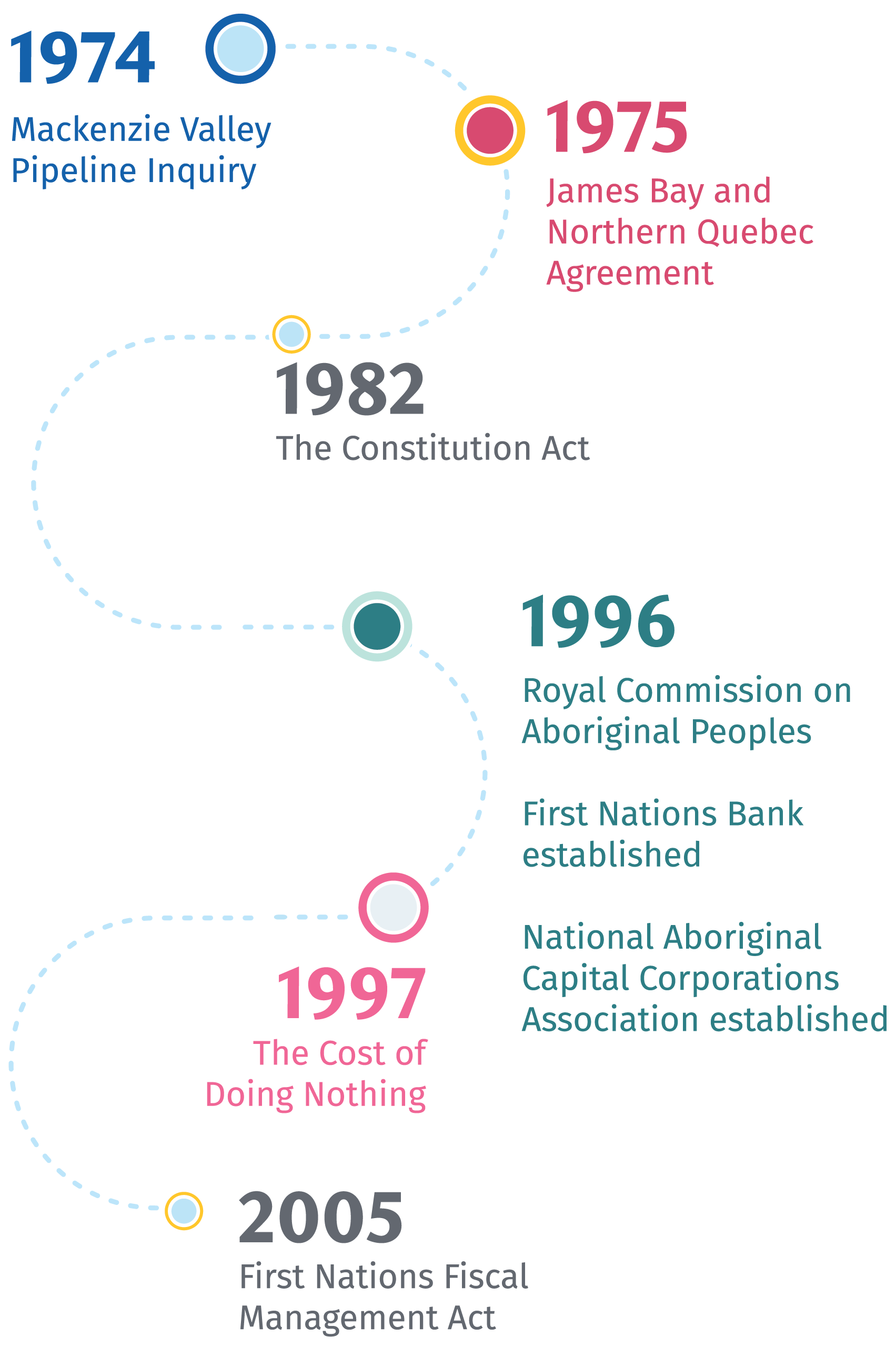
Major strides have already been made, including the passage of the First Nations Fiscal Management Act, the creation and devolution of powers to territorial governments and the creation of Indigenous-led financial institutions. Further strides must be made to unlock Indigenous economic potential and create the pathway for true economic reconciliation.

Timeline of key events

The story today

When Indigenous Nations consider major project participation, they often face a combination of institutional, legal and economic barriers that have led to many (but not all) Indigenous Nations to build a balance sheet, deal history, or internal capacity. Access to affordable capital that enables Nations that reduce the cost of capital and safeguard Indigenous assets remains a challenge. This is because of a combination of legal and institutional barriers outlined above, as well as network effects and a lack of awareness on the part of the private sector on the benefits of proactive Indigenous participation.

This gap is particularly evident in opportunities where Indigenous Nations may wish to have an ownership stake in energy and natural resource projects on their territories. Indigenous ownership is now a leading model to align interests and advance project development in a timely way by prioritizing Indigenous-corporate relationships, incorporating Indigenous values and priorities, and potentially streamlining regulatory processes4.

What is a loan guarantee and how are they structured?

A loan guarantee is a contractual agreement to repay a debt provided by a third-party lender such as a bank, when the borrower can no longer pay (i.e., “backstopping a loan”). For the lender, this can virtually eliminate the risk of economic loss. For Indigenous investors, equity loans without guarantees can be prohibitively expensive (i.e., the cost of the loan, if granted at all, is less than the cost of financing without a guarantee). Without guarantees, Indigenous investors are often faced with the scenario of an uneconomic cost of capital, accepting a much smaller equity position—or none at all—which are sub-optimal outcomes.

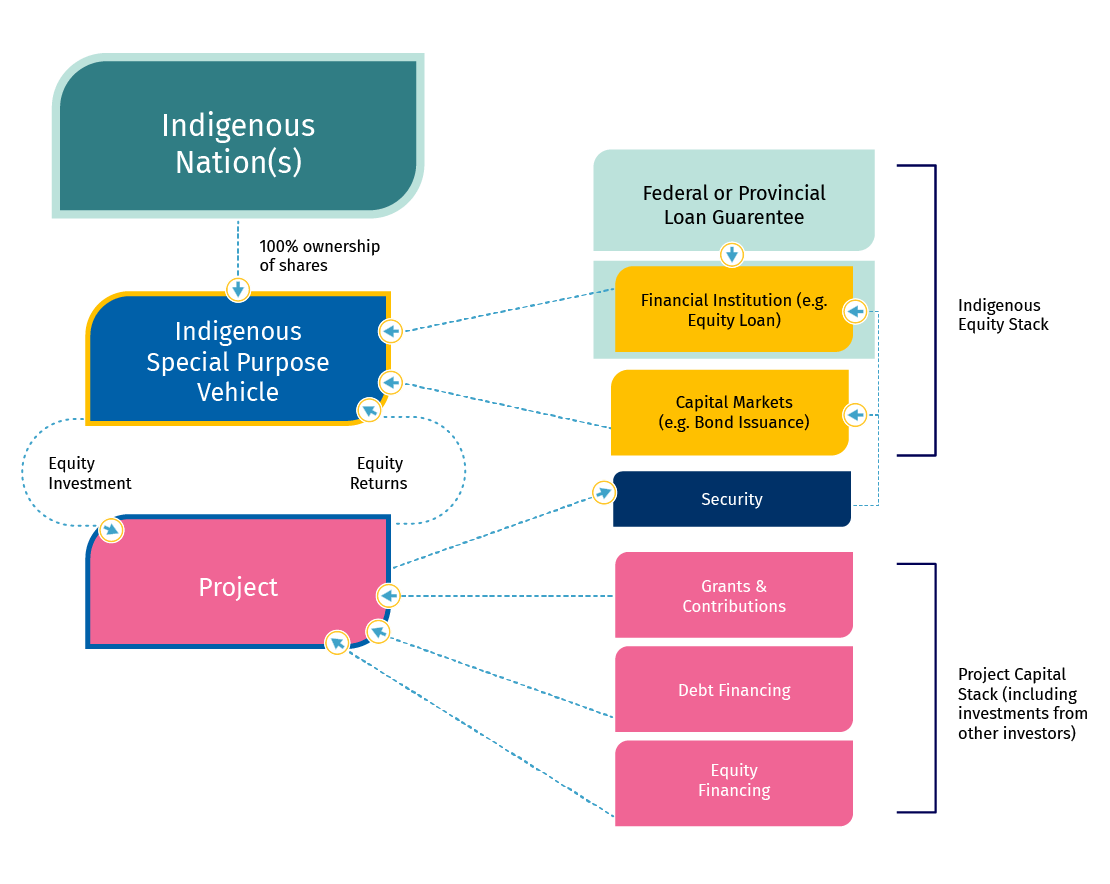
A loan guarantee facilitates the lending environment to fund the equity portion of a transaction, providing credit enhancement and liquidity support for Indigenous borrowers. Importantly, the use of limited partnerships and special purpose vehicles do not put Indigenous community assets at risk, as the project debt raised is non-recourse/limited recourse to equity partners. Use of a special purpose vehicle owned by Indigenous Nations, and generating distributions back to the community limit exposure of liabilities to the value of the initial equity investment made by a Nation.

Loan guarantee programs have emerged as a “brick in the wall”—a part of the solution to address the access to capital gap among other complementary tools. The figure below outlines an example of the ownership structure and the relationship between an Indigenous Nation and equity ownership in a project, in particular, where a loan guarantee may play a role.

The federal government along with the B.C. and Manitoba governments announced loan guarantee programs in 2024 on the heels of advocacy by Indigenous Nations and the private sector amid growing maturity in the public policy development process. These programs, if effectively deployed, could help close the gap in the substantial demand for Indigenous equity participation, estimated by the First Nations Major Projects Coalition to be approximately $45 billion over the next 10 years. Both the development and deployment of newly announced loan guarantee programs will benefit from existing models in Ontario, Alberta and Saskatchewan.

Project finance tools for advancing Indigenous ownership in major projects

These announcements are an important contribution to the set of tools available for Indigenous Nations to economically participate in resource and energy projects. As these programs are implemented, important considerations will include the risk mandate of a loan guarantee program, adequate capacity support to enable partnerships, robust governance to ensure decision-making and issuance of guarantees are undertaken commercially, and stacking with other guarantee programs and support. Priorities to pay attention to as these programs are being implemented will include:

Indigenous people must be supported to make free, prior and informed decisions on project participation. Partnerships across all Indigenous Nations—First Nations, Inuit and Métis—must be supported. Indigenous perspectives, leadership and talent recruitment, development and retention should also be prioritized when implementing loan guarantee programs.

Programs should support the widest scope of projects to maximize Indigenous economic opportunity as a first-order priority in addition to wider productivity gains to Canada.

Government financial support should be backed by a robust due diligence process. A path toward market sustainability is necessary, so Indigenous Nations can access capital on an equal footing with other market participants over the long term.

Time is of the essence. Individual project negotiations must move at the speed of trust, but the bureaucratic functions of the loan guarantee programs must move at the speed of business. This priority will have to be balanced with the need to have a robust due diligence process.

Existing loan guarantee programs continue to learn and develop new approaches to better enable Indigenous ownership and participation. For instance, how best to support Indigenous ownership in greenfield or pre-construction projects. New loan guarantee programs need to retain flexibility in the structuring and deployment of guarantees to develop and adopt best practices across both public and private sectors.

Risk mandate and project application

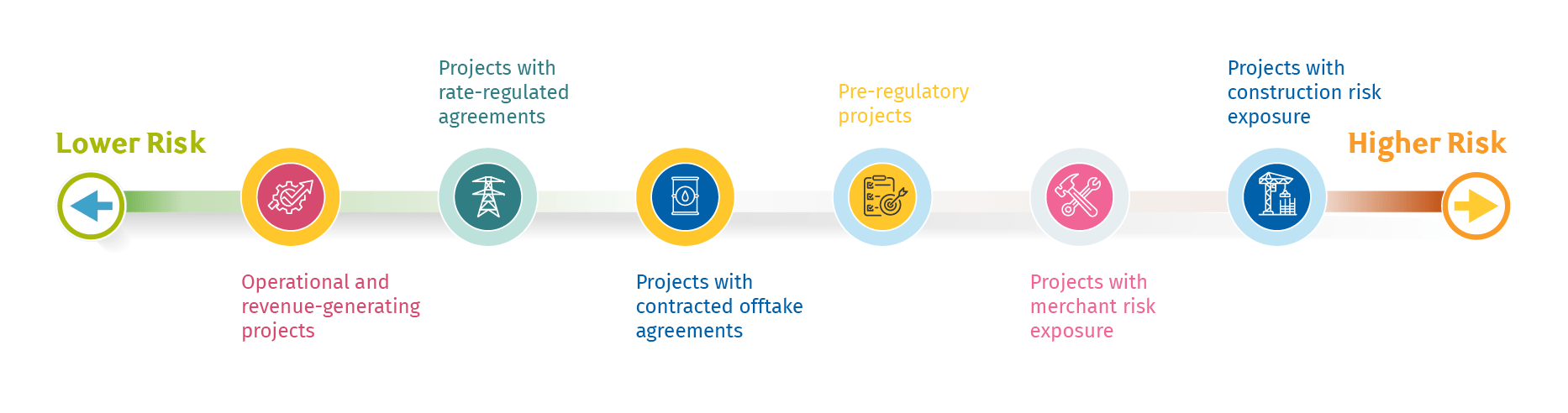
Projects that provincial and federal governments select to guarantee will depend largely on the risk mandate of the loan guarantee program. Generally, loan guarantee programs mandated to be low or zero-risk will primarily provide support for relatively low-risk sectors (such as rate-regulated or operational projects). A loan guarantee program with a more accommodative risk mandate could take

on earlier-stage projects in riskier sectors (such as those with more merchant risk exposure) and larger/smaller ticket sizes—facilitating the completion of net-new projects that would not have occurred without Indigenous economic participation. Figure 2 presents the notional risk across a range of possible sectors and project stages, ranging from low to high risk.

It is likely that loan guarantee programs, similar to many government funding programs, will start out relatively risk-averse. However, given the ability of governments (particularly the federal government) to absorb more risk, these programs should adopt an evolving, dynamic risk mandate as they gain expertise through “learning by doing.” For instance, annual risk mandate reviews can incorporate the inputs of Indigenous clients and private sector participants in guarantee programs to re-evaluate whether new, innovative approaches and sectors can be covered. The risk would entail multiple dimensions, including:

Although partial loan guarantees that do not cover the entire Indigenous equity loan may be preferred initially, guaranteeing up to 100% of the equity loan can enable a greater degree of Indigenous economic participation and returns on projects where previously infeasible.

A sector-agnostic approach is important, enabling Indigenous Nations to retain full say and determination on the types of projects that happen on their territory and broadening the positive impacts of Indigenous participation. The loan guarantee program should prioritize a mix of projects across a range of sectors and geographies

Loan guarantee programs will seek to minimize undue risk and a call on guarantees due to both fiscal and reputational risk. Over time, as loan guarantee programs demonstrate success, a wider range of considerations can include guaranteeing projects with a smaller ticket size and greenfield or pre-regulatory projects versus brownfield projects, have a range of risk exposure. Ensuring this mix will capitalize on the program opportunity to maximize Indigenous opportunity and enable investment into net-new projects that contribute to energy and economic goals.

A larger number of Nations in a deal may add complexity, and dilute returns and the equity stake for individual Nations, but it can provide positive multiplier effects. Nations with a greater degree of capacity can support Nations that are developing and building their own internal capacity. Facilitating relationship building across Nations, and with the private sector will be an important impact measure for loan guarantee programs.

A loan guarantee does not create a cash profile on a government’s public accounts, but a loan loss provision can set aside part of the cash requirement for a call on a guarantee. However, when a guarantee is issued, part of this provision would be “locked in” until the loan is repaid. Accounting for a diversity of loan durations (e.g. a mix of five, 10 and 15-year terms) can enable the program to recycle capital and issue new guarantees that would unlock a greater value of equity partnerships.

Additional structuring protections governments may consider to mitigate risk would include:

Indigenous Nations that can invest their own capital can create an equity buffer, which can mitigate risk and further reduce the cost of equity capital.

Loan guarantee programs must lower the barrier to entry, including onerous fees, but these fees can also be tailored to the specific risk profile of the guarantee.

These are standard contractual terms that can stipulate timely repayment of debt by directing cash flows toward debt repayment before distributions, and create a buffer to ensure that future issues can be cured through funds capitalized upfront and over time.

Often used in minority ownership positions, share buyback provisions obligate the majority partner (and often the operator) to re-acquire the Indigenous equity shares in the case of full default.

A standard aspect of commercial debt monitoring, post close due diligence can help address potential issues proactively and enable a government, proponents or financiers to step in prior to an issue being raised. Both commercial monitoring and relationship management with individual Indigenous Nations will be important.

The federal minister of finance has indicated that the government would look forward to seeing the program oversubscribed and a request to increase the funding beyond $5 billion. Indeed, one major project can take over the entire loan guarantee envelope. A larger guarantee envelop is a positive signal of the government’s commitment to enable greater Indigenous partnerships and meet the $45 billion potential.

Capacity

A combination of institutional factors and network effects may mean Indigenous Nations have varying degrees of relationships, know-how and deal history to build the commercial capacity to assess and negotiate deals. The degree of capacity may be variable based on the Indigenous Nation and the nature of the deal. Capacity support can be crucial to the success of access to capital tool that enables Nations to access appropriate commercial, legal and financial expertise to make the right decisions.

As a comparator that highlights the importance of capacity amongst other factors, the U.S. Tribal Energy Loan Guarantee Program created in 2005 issued its first loan guarantee in March 2024. The program’s slow progress may be attributable to multiple factors, but an important omission appears to be that it did not fund for capacity for Native American tribes to make informed decisions on the commercial and technical aspects of a deal.

The federal government has provided $3.5 million over two years to support capacity funding under the program. This is a start, but capacity funding must be more highly prioritized to ensure Indigenous Nations have the appropriate commercial, technical and legal expertise to make project participation decisions. Capacity is often further enabled through the fees charged on loan guarantees, which can be recycled into a capacity fund, alongside support by project proponents. The B.C. loan guarantee program has indicated that it will capitalize a capacity fund with $10 million. The Manitoba loan guarantee program has not indicated whether it will fund capacity.

Organizations such as the First Nations Major Projects Coalition have played an important role in supporting Nations build and consolidate internal commercial, technical and environmental capacity. Continued support of existing and new organizations will be a crucial success factor over the long run.

A positive trend that is Indigenous Nations is growing the number of Nations supporting each other in building capacity. Anecdotally, in deals with multiple Indigenous Nations involved, Nations with more experience and a greater degree of internal commercial or technical expertise often allocate their internal or external resources or contribute their relationships or past experience to support those Nations that are building this capacity.

Governance

Independent, arms-length administration has been a priority with existing programs, including in Ontario (managed through a Crown agency) and Alberta and Saskatchewan (managed through an arms-length corp.). Independence and autonomy enable decision-making to happen with minimal political interference, and generally, have enhanced credibility. Indigenous perspectives and inclusion must be a critical component in all governance structures. Key priorities in developing a transparent, inclusive and nimble governance model will include:

Indigenous leadership and representation across governance and decision-making bodies must be a priority and imperative, given the focus of these programs on Indigenous economic reconciliation and inclusion.

The focus should remain on assessing guarantees on apolitical criteria, including ensuring commercial viability and inclusivity, limiting the scope for political interference in the issuance of individual guarantees.

A corollary for loan guarantee programs to remain apolitical is ensuring the approval and decision-making processes prioritize speed. Approvals by an independent, arms-length board with representation across Indigenous leaders, government officials, and the private sector can expedite implementation and communications.

  • Part of deploying at speed is enabling, particularly at the federal level, a “single window” approach or coordinating efforts across federal and provincial loan guarantee programs to ensure appropriate service delivery to Nations.

Robust, commercially comparable due diligence criteria and evaluation processes must be developed to ensure loan guarantee decisions are made on the commercial and economic merits of the underlying project and loan guarantee.

Buy-in and transparency go hand in hand to bulwark the credibility and reputation of loan guarantee programs. Both a clear governance process and robust monitoring and reporting requirements will be required for Indigenous Nations and the private sector to understand how and why guarantee decisions are made.

Stacking

There are a range of organizations that provide financial support for Indigenous major project participation, notably provincial loan guarantee programs. Considerations that would enable better stacking with the aim of maximizing the economic opportunity of Indigenous ownership using the full weight of government resources include:

Offering a “single window” for Nations considering both provincial and federal guarantees.

  • This includes coordination and communication between officials, which is especially important in complex projects that require support across multiple organizations. The federal loan guarantee program has an opportunity to show leadership in this regard.

Aligned financing and contractual terms including fees, guarantee structure and flexibility in rules that enable Nations to tap into multiple financing “pots.”

For capacity grants—not restricting the number of sources Nations can access.

Organizations that provide both financing and capacity support include the provincial guarantee programs, the First Nations Finance Authority, the Canada Infrastructure Bank, Export Development Canada, Business Development Bank of Canada, Farm Credit Canada, and multiple provincial agencies that provide support towards Indigenous economic opportunity.

Future tools

Loan guarantees can be an effective tool—but are only a brick in the wall and not a silver bullet. Crowding in private investment and creating a path to market sustainability will be important.

Future considerations for governments as they consider expanding the toolkit may include:

Indigenous economic interests intersect with almost every sector in the economy including fisheries, agriculture, telecommunications, infrastructure, manufacturing, tourism, and others. Federal and provincial loan guarantee programs can start expanding support across multiple sectors, particularly beyond the energy and natural resources sectors where most of the focus has remained.

Guaranteeing project debt, albeit riskier, may be the next stage after a critical mass of support and private capital is available to guarantee equity. This would functionally on-lend the federal government’s credit rating to Indigenous borrowers, and provide a greater range of flexibility for banks to lend toward.

Providing 100%-plus guarantees can support Indigenous participation for projects in the pre-construction, pre-revenue generation phase. Similar to guaranteeing debt, this may be riskier, but if strategically employed in otherwise commercially viable projects, it can unlock meaningful, early Indigenous participation in projects, particularly in strategic sectors such as critical minerals.

In higher-risk sectors such as mining, particularly in some frontier critical minerals projects, Indigenous Nations may prefer to participate through a royalty or income stream. By creating an institutional structure to transfer part of the royalty revenue to Indigenous Nations, governments can incentivize participation in sectors such as mining or forestry (where the royalty is referred to as stumpage fees). Federal government action is called for here. Provincial governments in B.C. and Alberta amongst others already have resource-revenue sharing agreements.

The growing wealth of Indigenous Nations includes an estimated $20 billion in trust assets and up to $100 billion in outstanding land and other claims. Pooling trust and investment assets through optional Indigenous-led institutions can help generate significant investment income as well as a vehicle to further advance participation and ownership.

An Indigenous Development Bond, akin to development bonds issued by emerging economies and multilateral institutions, can support financing of Indigenous-led projects. This would build on the existing success of the First Nations Finance Authority’s pooled lending and bond issuance program. This instrument would require consensus on bond issuance standards.

Building on the work of the Canadian Sustainability Standards Board and the federal sustainable investment guidelines, integrating Indigenous perspectives and considerations to investment standards can be an additional tool to drive investment to Indigenous-led projects and organizations.

An Indigenous-led development finance institution that consolidates debt, equity and grant instruments could offer a comprehensive set of tools to durably finance projects and businesses. The model for such an institution would be akin to community development banks, capitalized by both public and private sectors, rather than multilateral development banks with votes allocated by share capital.

The private sector is developing innovative structures to crowd in Indigenous participation and inclusion in major projects, including:

  • Breaking out lower-risk, revenue-generating elements of a larger project and facilitating Indigenous ownership—often elements that outlive the life of a single project (e.g. transmission lines or toll roads).

  • Post-construction options for Indigenous ownership, wherein the option can be exercised by Indigenous Nations to purchase an equity stake upon project completion.

  • Minimum annual payments to mitigate the potential downside and protect Nations from undue risk when a project goes through periods of no revenue.

  • Share buybacks upon project failure to commit to a set price to repurchase equity stakes by the project proponent if the project fails to be completed.

  • Negotiating Indigenous governance rights even in cases of minority equity positions through a separate share-class structure to recognize Indigenous owners sit in a unique position apart from other commercial participants.

  • Co-investing with institutional investors, particularly, with co-investors that can deploy large sums of capital over long durations, both in individual major projects and by bundling smaller opportunities through joint ventures.

  • Proponent guarantees or contractual supports: Proponents may seek to provide their loan guarantees or other forms of contractual support to enable Indigenous participation, particularly in riskier projects. This may be balanced by a higher equity sale price.

A proactive, relationship-focused and trust-based approach for Indigenous partnerships is now necessary in both public and private sectors. Advancing economic reconciliation through meaningful partnerships is both a moral and economic imperative – presenting an opportunity to grow out collective prosperity as a country.

For more, go to rbc.com/en/thought-leadership/

Download the Report

Language Flag Filename

rbc_language_toggle_menu_flag

What if we knew that the world — the human world — would be so radically different within our lifetimes that we might not recognize daily life? What if we knew that children born in 2025 would never know the meaning of work, or income inequality, or deprivation?

What if the ensuing shocks were so profound — to society, business, government, even to our sense of self — that our future selves wished more than anything else they had prepared better for the day when algorithms and machines could do everything we do, only better and faster? And what if our future selves were to look back at 2024, to see it as the one clear moment in time when we saw the future and blinked?

The potential for those shocks is there. Artificial General Intelligence — software with human-like intelligence and the ability to self-teach — may be nearing a state where it can, at least theoretically, start to displace, at scale, the functions (mental, physical, perhaps even emotional) that have, for millennia, made humans the species we are.

Will the resulting shocks come in a decade or a century, or somewhere in between?

In the long arc of time, the timing may not matter, as we know today the clock is running out on the age in which man reigned over machine. We are on the edge of a new era of commingling and interoperability, an era which could see intelligent machines play a role in every aspect of life.

That era will present plenty of unknowns, and for that, society needs to start preparing.

To discuss how, a group of technologists, academics and executives gathered this spring in Asilomar, California, to confront our newest existential challenge: What if we succeed? What if, within a decade, AGI is capable of replicating every human task? And how, on earth, should we prepare?

The Setting

Past is prologue, and so may be true for AI in the quiet solitudes of Asilomar.

Jutting into the Pacific Ocean, around the corner from Monterey Bay, Asilomar is a sleepy retreat that can easily be bypassed for the spectacle of Pebble Beach on one side and chill vibe of Pacific Grove on the other. Indeed, it seems to embody the paradox that Gertrude Stein applied to her hometown of Oakland, not far away. There is no ‘there’ there.

In one direction lies the sea and its infinite promise, and in the other, beyond the coastal mountains, Silicon Valley and its exponential promise. It was here, at the edge of America, and in the throws of the second Industrial Revolution, that the great San Francisco architect Julia Morgan designed a retreat for the Young Women’s Christian Association, the first in the American West.

Morgan had already helped San Francisco rebuild from the Great Fire of 1906, and was well into the defining commission of her career, Hearst Castle, down the coast in San Simeon. In 1913, when Asilomar opened, the world was on the cusp of a technological revolution, one that would make airplanes, cars, telephones and movies the tent pegs of 20th century life.

Morgan had tried to give the YWCA a retreat from what was to come, with her wood-beam and vaulted ceiling “Chapel” and its engraved words, “the lord on high is mighty.” But she later recognized that the Roaring Twenties, and the rise of American modernism, would challenge that view of the almighty, as it gave god-like powers to a new scientific class immersed in the atom and electron.

Nearly a century later, a new generation of scientists, technologists and their backers, are seeking to equally reshape society, with AGI.
Can they prepare for the unknowns of a far more powerful tech revolution? Can they find ways for autonomous machines and their human dependents to co-habitat?

If they succeed, can their society reform capitalism, in ways that the first Roaring Twenties failed to do, to fairly distribute resources even though the means of production are controlled by machines? And will the rest of us find new ways to accept our finiteness in an infinite economy?

Looking over the rugged dunes that connect Asilomar with the setting sun, and the promise of tomorrow, the challenges of technology disruption may feel the same today as they did for Julia Morgan, to both harness modernity and keep it in its place. And yet a century on, this new revolution feels entirely different, with its exponential promises looking to be as profound as its existential threats.

Here are some of the considerations:

1. The promise of infinite surplus

Moore’s Law remains the guiding force of our times, allowing for the doubling of computing power every two years. In fact, over the past decade, compute power has doubled every six months. To date, human ingenuity has been able to keep pace with that kind of growth. We’ve figured out how to use computers, smart phones, and wired machines to our benefit. But the compounding of compute beyond this decade, into a new AGI realm, may be more challenging to human adaptation, especially as machines increasingly make their own decisions and gain physical mobility. We could see more biorobots in 25 years than humans, and far more virtual agents informing, advising, and eventually directing our daily lives.

Some forecasters believe that 80 per cent of jobs will be done by some form of AI within a generation. One result could be a near-infinite rise in economic output, as the world’s productive capacity soars. Services such as health care, education and financial advice could become free, universally available and ever-improving. Profound challenges — climate, cancer, crime — could be solved rapidly. And even as wages collapse with the end of work, spiking productivity rates and surging output should easily compensate, if effective distribution models are established.

While the promise of such surpluses may be foreseeable, the timing is not. Like all technological impacts, AI is following the course of a slow, steady explosion. That makes it harder for society to prepare, to change income models, tax regimes, and social expectations. Moreover, the course of AI adoption and its impacts are unlikely to be linear, especially when they run up against rigid social and economic models. A meandering path to AGI, with technological bursts and social reactions, may mean we get to AGI before society is ready for it.

Perhaps Transformational AI can help distribute the surpluses it creates, but only if we guide it to do both at the same speed.

What’s needed:
Dynamic research to track the displacement of labour and distribution of benefits across the economy.

2. What AI needs to learn

Many aspects of AI may not be as smart as we think, given the stumbles of ChatGPT. But it’s also showing all signs of being slow and steady, then fast and furious. The avalanche effect.

The technology is currently evolving through a rapid series of small steps, with few eureka moments. One reason: most models still focus on computation, rather than achieving goals. The chat bot explosion of the early 2020s has yet to expose deep thinking from machines, other than an impressive ability to accept prompts and respond.

We need to shift Large Language Models (LLMs) to algorithms that can learn from ordinary experiences, not just from neat data sets. Indeed, LLMs may need to search for greater challenges, and pursue the sorts of messes that literally don’t compute. AI may also need more time, tools, and space to test and learn from multiple hypotheses rather than the hard coding of symbolic reasoning. Ultimately, systems will need to get better at working with the wonders of the human mind, and the depths of intuition that machines can’t replicate. One suggestion: “Think of it more as parenting than programming.”

That kind of parental guidance — helping AI not touch the hot stove or poke the dog’s eye — can come through continuous deep learning and “efficient off-policy learning”; that is, allowing the models to colour outside the boundaries of their algorithms, to understand aberrations, and to engage in discordant and shallow data sets. This will require humans to accept that our relationship with AI increasingly will become continuous and not transactional; again, parenting, not daycare. And we may need to accept that passive systems will wake up to learning.

Ultimately, AI will need to develop its ability to anticipate and adjust. Prediction machines will need to become planning machines. And like most of us, there will need to be plans for failure. Hospitals, for instance, may need to add on-call data scientists to help manage algorithms that go awry or stop during a procedure because they don’t know what to do.

The growth of AI may be iterative, a journey of baby steps. But such is the rapidly incremental nature of innovation.

A bit like childhood.

What’s needed:
Open sharing of discoveries and data, when public interest is at stake, to ensure collective progress.

3. A concentration risk

You don’t need to be in Silicon Valley to hear the giant sucking sound of capital by AI. And it’s getting louder, as the colossi of chip, cloud, and compute devour more and more capital to finance their energy- and data-hungry learning models. As the big get bigger, they’re also starting to drive returns, which in turn is leading to more capital generation.

LLM spending is already estimated to have hit about $1 billion last year, and could reach $10 billion this year or next. Some suggested $100 billion could be spent annually on language models within five years. Intel is already spending $25 billion on chips. AI is having the same power in fundraising; last year saw $50 billion in venture funding and 38 new unicorns. OpenAI, the market darling, saw its valuation edge reach $80 billion.

And then there’s this calculation: If AGI increases economic productivity, in an optimistic forecast, the cash value of its benefits could be $124 quadrillion. Suddenly, a $7 trillion investment seems reasonable.

The centripetal force of AI is about more than money. The cloud behemoths are accumulating data and talent at rapid clips, and also amassing the resources to spend on supercomputers. It’s estimated fewer than 10,000 people are working on what can be considered “transformative” AI — anything that might lead to AGI — and most are serving the interests of a handful of firms. It’s said that Tesla’s dominance in automobile data, especially for autonomous vehicles, was one reason Apple — hardly a constrained enterprise — backed away from the its AV project.

Will the concentration lead to an oligopoly or even monopoly in AI? And will that stifle competition? Or will there be an emergence of“bilateral oligopolies” — small groups of players at each link in the supply chain? That could lead to cartels or at least coalitions in, for instance, electricity supply, computing operations, and chip supplies. Governments could equally impose constraints — quotas, as an example — on dominant players, or at least require them to serve national needs first.

All of which comes with a caution: concentration of power is less dangerous than concentration of thought.

What’s needed:
Governments may need to consider an industrial policy mix for AI, to ensure a fair and strategic allocation of resources, including capital.

4. A risk to supply chains
There may be more than we can manage. Compute, chips, and labour are all in short supply, and traditional supply-demand models may no longer apply. For one, AI is creating exponential curves in demand through the unpredictability of its uses and needs. The steep cost of inferencing — the running of data in a live AI model — is only growing as those models get hungrier. The more they learn, the more they want to learn. A separate tech race is on, to develop more efficient chips, shrink the size of models, and compress the middleware that adds more weight to systems. In each of those areas, competition helps. And the explosion of capital for AI could help fuel that competition.

Structural (or infrastructural) inputs like electricity will be harder to fix. Much of the world is already in a hurry to produce more clean electricity to run factories and cities in a net-zero economy, and there’s a risk that capital-rich AI projects and their energy-hungry data centres will outbid the older parts of the economy trying to transition their energy models. In that scenario, the compute demands of AI could sideline the climate demands of society. In those cases, governments may need to assign scarce resources to a hierarchy of societal needs.

More positively, the enormous potential of the race for AGI, and the apparent economic potential, could prove to be an added incentive to the development and scaling of emerging energy sources like nuclear fusion.

A scarcity of inputs will also challenge the business and organizational adoption of AI, including transformational AI. Legacy industries, already operating with low margins, will continue to be challenged to compete, compute, and to buy the chips they may need. Such a scenario may lead many companies and public-sector organizations, as was the case in the Internet’s early years, to accept their place as slow adopters, using off-the-shelf enterprise software tools that can be useful for efficiency but less dynamic for innovation.

This will put further pressure on governments, to find ways to increase both supply and demand for AI in a broad range of sectors as well as public interest pursuits. As is often said of the Internet, we had an invention that was profound and powerful enough to cure cancer, and we used it instead to share photos. The same risk — individual preferences versus collective needs — could play out with AI and models; creating celebrity avatars rather than diagnosing health problems. In business, too, the next generation of AI needs to be focussed on discovery, not just automation. Collective research models, such as a DARPA or NASA for AI, could help coordinate university research and business application, and in turn develop ecosystems that ease supply chain constraints and open doors for emerging challengers.

Ultimately, AI should expand our vision, not shrink it.

What’s needed:
Incentives and initiatives to ensure the supply chains of AGI are focussed on societal needs, especially science, including the incomplete sciences of climate and behaviour.

5. A risk to robots
Mention AI on Main Street, and most conversations will quickly turn to robots and their rise. The early years of Transformational AI is painting a different picture. Many of the biggest private sector AI players have set aside their initial focus on blue-collar work — where robots are most needed — and turned instead to white-collar functions. For one, there’s quicker returns in the information economy. By its very nature, language models are also best at playing with words and numbers, the stuff of enterprise software. And it turns out, error rates are more acceptable in the information economy. We’re willing to accept fake news, or fake essays, a lot more than flawed buildings.

That’s not to suggest there’s no hope for robots outside warehouses. It’s just going to take longer. Big Tech is actively trying to develop software that can mimic human dexterity and senses. The prize is enormous. It just takes an ability to convert perception data into action data — what we might call reflex and instinct, as opposed to habit. In the coming years, we may see more “teleportation,” as people take possession of robots to help them learn. We could even see business models around Brain as a Service, in which enterprise software packages can be bought or licensed to command various aspects of the workplace, home, and community, or perhaps even ourselves.

The demand for robots, and other smart hardware, will only grow as populations age and eventually shrink. So, too, will our comfort interacting with machines, just as we’re comfortable conversing with our phones. (One retailer said their store tests show customers trust on-floor robots more than on-floor staff, for information.)

What will AI-powered robots, and other learning machines, be good for? If we get it wrong, we’ll end up developing self-teaching vacuum cleaners and toilet scrubbers first, rather than using Transformational AI to transform how the world’s economy operates. If we get it right, AGI can help remove transportation from the ground and sea, putting it in the air and freeing up our lands and waters for better uses. It can transform manufacturing, including through 3D printing. And most profoundly, it can change the way we live, with medical devices in our bodies learning as we age. Like the third Industrial Revolution — the computer age — which allowed us to shift en masse from a brawn economy to a brain economy, the advancement of Transformational AI can power the robots and smart machines in our lives to do more than make our lives more convenient and efficient.

They can help us leap into a new age of discovery.

What’s needed:
Robotics programs, including public supports, that drive innovation to the most important frontiers of human progress.

6. A transition risk

Utopia doesn’t have an on-ramp. If we’re to get to an AI-driven world, in which there’s infinite surpluses and machine-enabled peace and prosperity, we will have to endure a lot of bumpy detours and diversions.

In the world’s poorest countries, and indeed in the poorest regions of the world’s richest countries, labour is too abundant and cheap to replace with AI. Infrastructure and technology distribution will further impede the universal spread of AI. Paradoxically, where AI is needed most, it could be deployed least.

The dispersion of AI in advanced economies won’t come without disruptions, either, especially to workforces. Entire areas of expertise, and the trades and professions associated with them, could rapidly dwindle, along with the education programs that feed them. “Stranded expertise,” as it’s called.

During this transition, many of us will need to shift to “augmented work” in which we job-share with AI, exploring ways to make the most of each other as we co-habite roles. We will also need to prepare — psychologically as well as economically — for the day when we’re no longer needed in that role. Augmentation will give way to an advanced form of automation, in which the job and its constituent tasks continue to evolve in the hands of a machine.

Those with a growth mindset see far more opportunity. First of all, if AI is restricted to current human knowledge, it will have failed. Properly guided, Transformational AI should multiply our collective knowledge set, as well as our troves of creativity, which in turn will lead to more discoveries, more creations and more pursuits and jobs. As one small comparison, the microscope did not element any jobs; rather, it opened our collective eyes to frontiers and possibilities we had scarcely imagined.

Bumps, yes, but the transition is to a place of greater human engagement.

What’s needed:
Development programs for AI in low-income regions, as well as AI-powered learning programs across professions, trades, and jobs at risk.

7. A distribution risk

Even if we put AI in Utopia, it will be subject to human nature, which generally is not about sacrifice and sharing. Yes, once AGI becomes a universal reality, the potential surpluses of our economy could spell an end to hunger, poverty, and disease. But humans may not be content. We may still need and yearn for status hierarchies. Our happiness will remain relative. There will also be divisions between countries, as nations (xenophobic ones, especially) seek forms of differentiation to enhance national pride and self-worth. An AI-powered Olympics would be no fun if the optimal outcome was for every country to share the gold medal.

This kind of competition — or as Freud called it, “the narcissism of small differences” — may become more entrenched, and violent, if humans are unable to find other forms of meaning, beyond work. Regardless of the political economy of a country, basic instincts will be a challenge for AI to cope with — something communist states discovered about themselves and their Utopian dreams in George Orwell’s Animal Farm. (“All animals are equal, but some animals are more equal than others.”)

Even today, in the West at least, we have the best lives humanity has arguably ever lived, and yet we generally feel we don’t have enough. Social discontent has rarely been higher, and ironically, we know how to solve most of society’s shortcomings. In fact, we don’t need AI to figure out how to distribute wealth more equitably, as we did that some generations ago. Just open our borders more to trade and immigration, and find more systematic ways to distribute the surpluses of our economies. AI would tell us to do the same thing, presumably, and we would find reasons — relative prosperity — to reject it.

What’s needed:
More open trade policies, including for digital assets and IP, to allow for a freer flow of AI opportunities and benefits.

8. A risk to democratic capitalism

Capitalism exists by permission of democracy, and if the benefits of AI are not clearly and fairly distributed, the system that is financing its growth could be at risk. This could require capitalism to adjust as much as society needs to adjust to the powers of AI.

For centuries, the distribution of economic surpluses has been largely based on labour. More recently, economic rewards have gone disproportionally to the owners of capital, over labour. As AI, and the owners of the capital behind it, amass more economic benefits, and as labour rewards are diminished, social tensions and ensuing political pressures could grow. This could become even more acute in aging societies in which older, and less productive, generations hold the bulk of capital through their lifetime of savings, while labour-challenged younger generations are squeezed.

Could this lead governments to nationalize AI, in order to distribute the benefits more widely? Or will governments instead more aggressively tax the owners of capital, to redistribute their gains from AI? Perhaps modern capitalism won’t be needed anyway, since its AGI may replace the need for markets to determine equilibriums and drive the efficient allocation of resources. An algorithm can do that.

As AGI takes hold, governments could also be tempted by policies more associated with authoritarianism, to maintain control over the social and political consequences of emerging models. Fundamentally, democratic capitalism will be challenged to address this: Whoever controls the digital infrastructure behind AI — supercomputers, chips, energy sources — will control the future. In other words, the digital means of distribution will eclipse the means of production as the determinant of economic power.

Which leads to this question: in 2034, if Silicon Valley hasn’t taken over Washington, will Washington need to take over Silicon Valley?

What’s needed:
Businesses, investors, and governments need to rapidly develop new approaches to market economics, to ensure the rewards of capital and labour are properly assessed and allocated.

9. A risk to meaning

Technology has always challenged the meaning of life, and the purpose we each hold. Deus ex machina (“god from the machine”) goes back to Ancient Greece, and a seemingly instinctive association between the almighty and technology, both being stronger than us. In ancient theatre, the god from the machine usually brought resolution to the problems on centre stage and sent audiences home happy. AGI may be expected to do the same, even though the angst of human life may not compute.

Humans will need to prepare, perhaps rapidly, for a world in which work and deprivation are both remarkably scarce. That won’t put an end to human desires, even when everyone has sufficient food, housing, and clothing. We always need more. Especially in our minds and hearts. AGI may not anytime soon be able to speak to our emotional needs, for laughter, comfort, and love. Nor can it address the social isolation that can come from the end of workplaces, schools, and commercial centres.

Or can it?

AGI may actually not put an end to work, but rather enhance jobs and pursuits with more meaning. It will take the robotic out of every job, perhaps. This could lead to a new definition of work, in which jobs are as much social as economic functions. Call it a Seinfeldian world, as someone suggested, each of us busy with banter and errands. We’ll all be active, and rewarded accordingly, just not what exactly what we’re sure for.

Will that shift to leisurely work make us feel more inconsequential? And perhaps less essential? Will it lead to lethargy? Or anarchy?

Over the coming years and decades, as we pursue the final frontiers of technology, we will need to explore the inner frontiers of humanity, to determine what it means to be humans. We can love and preserve, as much as we today produce and provide. But that will require some new shared narratives of what the good life — and good work — can be.

Only humans can code that.

What’s needed:
Dismantle or at least refine labour market barriers and regulations, to allow for a more entrepreneurial, creative, and human approach to work.

10. A risk to regulation

The greatest risk in regulation may be our inclination to regulate the past against the future, and AGI is all about the future. That presents an important moment to challenge ourselves with what ifs:

  • What if there is only one AI model and it can be independently regulated?
  • What if we regulate the users and not the algorithms?
  • What if we declare and code all models with what good looks like? What if we declare and code all models with what bad looks like, including self-replication, break-ins and evil intent (e.g. bioweapon design)?
  • What if we ensure agents and models have “normative competence” to search for, and recognize, boundaries and laws?
  • What if we penalize, even threaten to shut down, models that go against good?
  • What if we use interoperability to monitor how models are doing, and ultimately allow models to measure and police themselves?
  • What if we allow models to share IP, to assist new entrants?
  • What if we require AI models that draw on data from public spaces — roads, social channels, education systems, for instance — to join data utilities?
  • What if we create regulatory safe harbours for areas of public importance, such as disease recognition?
  • What if we assign “personhood,” with rights and legal responsibilities, to agents and chatbots?
  • What if we apply principles rather than prescriptions to AI?
  • And ultimately, what if beneficial co-existence is not possible?

The emerging frontiers of AI regulation are no longer in the distance, and governments (democratic ones, at least) will be challenged to catch up. Fearing the worst, they may throw in the towel and shut down AGI efforts — or leave it in the hands of incumbent oligopolies that may be easier to negotiate with and police. It’s surely the case that AGI is too novel a concept to allow for regulatory capture. And yet, the incumbents, and their regulators, are party to the rise of algorithms that may soon be too complex and inscrutable for them to understand, and dangerously irreversible.

There is no easy way at it, other than, perhaps, to remind ourselves that science is inherently about experiment, guided by universal principles, including Do No Harm. Societies, in a range of political systems, have harnessed the benefits of science — space, medical, nuclear, biological — by following such principles. Ultimately, we may need to place the same confidence in the scientists working on AGI. If we don’t, other countries and regimes will not likely let up in their pursuit of this new frontier for intelligence. We may be better to work together, and over time, as was the case in the atomic age, place faith in science and a bit of skepticism in each other.

As the political code suggests, trust but verify.

What’s needed:
In the near term, a clear and replicable taxonomy and code for AI regulators to model and share. In the longer term, international conventions and systems for AI governance.

11. A risk to global security

Scientists hate to be politicized. Too late. AI is rapidly becoming a central political issue, and a growing geopolitical one. The G7 is making AI one of its top priorities, in part to ensure there’s a coherent and collective approach to keep China and Russia from achieving supremacy. The United States and Britain have made AI a central file for their heads of government, as nuclear security was in decades past. They’re not alone. The United Arab Emirates, among other emerging economic powers, has made AI a national ambition, while its close ally India is seeking to do the same with what may be the fastest growing tech stack anywhere. Those challengers to the West may find their own common ground, in a “Third Way” model that is neither Chinese, nor American-centric.

A space race in AI may be healthy for competition, and innovation, but it’s also a risk to global security, as self-learning models strive to compete with each other based on national standards and goals, not universal ones. This rivalrous approach to AI could deepen as countries put more resources behind national strategies designed to create a competitive advantage. Potentially worse may be national restrictions (and hoarding) of key AI inputs, including compute power and chips. Without greater global governance, the odds of mishaps — intentional or accidental — will grow.

Fortunately, the world has nearly a century of experience in successful multilateral governance, which while flawed, has helped prevent nuclear strikes, the proliferation of biological weapons, and ultimately another world war. Even conventions on child labour, land mines, and summary executions have had their effect. Similar approaches to AI governance may soon be needed.

Unfortunately, the post-war institutions that have successfully governed conduct in so many areas since the 1940s are themselves under attack. If the major powers are losing confidence in the World Trade Organization, why would they lean into a World AI Organization? As in previous generations, it may be up to scientists and business leaders to build bridges with all countries pursuing AI goals, including those that may have difficult political relationships with others. As the Churchillian credo of diplomacy says, jaw jaw is better than war war. In that spirit, we will need more alignment, between East, West, North, and South, on the goals — and dangers — of AI. We will also need more public confidence in AI, for people to see the value in its development as well as global governance, understanding its weaponization would be fatal.

Ultimately, AI for all will require all for AI.

What’s needed:
Track 2 diplomacy to bring together scientists, business leaders and academics from rival countries, paving the way for a Track 1.5 effort with government officials.

12. A risk to society

Not far from the barren dunes and windswept groves of Asilomar, the great midcentury American writer John Steinbeck worked on The Grapes of Wrath and Cannery Row. Those classics captured America at a crossroads, scarred by Depression, challenged by a changing world order, and yet inspired by the technological gusto from the Roaring Twenties. Writing of an emergent superpower, Steinbeck noted that the best qualities that Americans seek in people — kindness, honesty, openness — are not what they value in the market. And what we seek in markets — sharpness, acquisitiveness, self-interest — are what we consider failures in people. In other words, we seek in a system what we don’t want in each other, failing to appreciate a system is a function of its parts.

Can AI change that, taking the best of humanity and applying it to the worst of society? It won’t be easy given the dyspeptic mood of publics almost anywhere. It will be even harder in a political environment that seems to eschew kindness and celebrate sharpness.

The mind-boggling reach of Transformational AI can seem like too much for any society to comprehend and absorb. Democracy, most of all, may be challenged to mediate those existential challenges. The risks to our personal and collective security, the dangers of concentration, the unknowns of distribution, and the highly variable outcomes of regulation — each of these could tip the public’s mind away from AI. That is, if Transformational AI is not too fantastical for the public to consider seriously. That is, if it’s not too late to reverse what’s been started. That is, if we can untangle what’s smarter, faster, and more aware than its creators.

And if we can, do we know how to move collectively and at speed? As a society, we weren’t ready for the COVID-19 pandemic, which was predictable and precedented. Facing the unprecedented, we will need to find a different path. We can start by breaking down challenges into actionable and meaningful opportunities, and to frame the AGI discussion in the realities of today and tomorrow, rather than the extraordinary projections of a future time. Governments and their publics care most about the here and now, which is a good place to meet. Taking a page from nuclear science, we can also develop the muscles and rigours of safety precautions and monitoring. And we can build bridges with scores of countries to ensure this is a human-scale endeavour, not the purview of an elite band. Steinbeck wrote, in Cannery Row, “Man’s right to kill himself is inviolable, but sometimes a friend can make it unnecessary.” That may sound morbid, but it was framed in the spirit of a community that was overwhelmed by the changing world around it. Friendship, they discovered, was one of humanity’s great powers.

It may yet be what prepares us for the age of AGI.

Download the Report

Download

Language Flag Filename

rbc_language_toggle_menu_flag

  • The federal government’s latest Clean Electricity Regulations update shows it’s softening its position on sharply cutting emissions from natural gas-fired power plants by 2035.
  • Ottawa has demonstrated that it’s receptive to the provinces’ and utilities’ concerns about their ability to meet 2035 Net Zero targets.
  • We see this as a major win for Ontario, and it also gives Alberta and Saskatchewan more leeway in how they manage their transition to cleaner sources.
  • The proposed changes are not expected to compromise the 2035 Net Zero target set for the electricity sector if the regulations for offsets are included.
  • The devil will be in the detail, as the white paper does not provide any details on what the regulations could look like when finalized.
  • In terms of next steps, comments on potential changes to CER are due to be submitted by March 15, and final regulations are set to be released by the summer.

Ottawa’s draft Clean Electricity Regulations (CER) has sparked significant debate among provinces since its release in August 2023. Various stakeholders, including provinces, industry, and utilities, have raised concerns about the draft’s strict approach to phasing out natural gas from the grid. Most provinces worry that achieving the federal target of a Net Zero electricity grid by 2035 across the country will be challenging while ensuring system reliability and affordability. There were particularly large backlashes from Alberta and Saskatchewan, which are currently phasing out coal in favour of less emitting generation like natural gas.

The federal government responded last Friday with an update on the consultations and design options that are being considered for the final regulations. It comes several months after the consultation period for the draft regulations closed.

The feedback that the federal government received from the consultation raised concerns about the effectiveness of carbon capture and storage (CCS), potential operation of inefficient units, short end-of-prescribed life, challenges for existing cogeneration facilities, provisions for greenhouse gas offsets, and post-facto emergency exemptions review. These concerns could impact units under development and how existing units are operated.

In last week’s update, the federal government proposed major changes to its draft to reduce carbon emissions from Canada’s electricity sector by 2035. The new design options show more pragmatism in the federal government’s approach, indicating that it is softening its position on sharply cutting emissions from gas-fired power plants by 2035.

What’s in the update?

The updated design options for the regulations would provide electricity system operators more flexibility to continue operating their natural gas power plants past 2035. This includes setting annual emission limits rather than performance standards, allowing plants to operate longer without constraints, and permitting the purchase of offsets when emissions from natural gas generation exceed those limits.

The improvements to the regulations currently being considered are a significant win for provinces that will still need to rely on natural gas generation past 2035. This ensures that provincial electricity system operators can continue to provide reliable and affordable electricity while maintaining Canada’s ability to achieve its emissions reduction goal.

Flexibility for provinces

The federal government is considering several options to provide more flexibility to provinces, utilities, and other electricity regulators and providers, while still ensuring significant emissions reductions. One such consideration is changing the approach from a performance standard, which is a fixed emissions intensity standard, to a possible emissions limit. This limit would be tailored to each unit’s capacity, replacing the current “performance standard approach.”

This new approach could potentially incentivize efficiency improvements and provide flexibility. However, it could also eliminate the “peaker provision approach” that was included in the draft regulations, and was an area of concern for Ontario.

We see this as a major win for Ontario, and it also gives Alberta and Saskatchewan more leeway in how they manage their transition to cleaner sources.

Additionally, the regulations could permit a unit to exceed its emissions limit by a certain amount, provided it compensates for all excess emissions with greenhouse gas (GHG) offsets. In this scenario, the federal government will be faced with the task of ensuring a reliable supply of high-quality GHG offsets. Additionally, they need to establish effective market mechanisms to manage potential increased demand for offsets within Canada.

Other considerations include extending the “End of Prescribed Life” beyond the current proposed level of 20 years and allowing responsible parties, such as utilities and crown corporations, to pool the emissions limits of their multiple existing units in the same jurisdiction.

Regulatory treatment of cogeneration is also under review, potentially shifting to an emissions limit. The approach under consideration would also differentiate between “behind the fence” electricity emissions and the emissions associated with electricity provided to the grid.

The federal government plans to continue engaging with stakeholders, including provinces and utilities, before finalizing the CER later this year. Ottawa has stated that continued collaboration will be essential to ensuring the regulations can provide significant emissions reductions while supporting electricity system reliability and affordability. Comments on potential changes to CER are due to be submitted by stakeholders by March 15.

Language Flag Filename

rbc_language_toggle_menu_flag

The global energy system is in the throes of a generational shift. Population and economic growth spell a demand for much more energy. Climate pressures spell an imperative for a different mix. And new technologies mean new opportunities for both. Looking out a decade, to the mid-2030s, can that changing world of nearly 9 billion people power itself into a new age of sustainable growth? And where can Canada, a global leader in all forms of energy, create the most value in a Net Zero economy? To map out the expected courses for both energy demand and supply in the 2030s, RBC Economics & Thought Leadership and RBC Capital Markets, including Global Research, developed global and national datasets, and new projections. The estimates are based on current assumptions of population growth, economic growth and distribution, technology adoption and government regulation. The highlights of that research are laid out in this report, and its six major conclusions which are designed to help inform policy discussions at COP28, the UN Climate Conference in Dubai, and subsequent energy policy conversations. We know energy is fundamental to every part of our economy, while our management of energy emissions is also fundamental to progress on climate change. Balancing those needs will require an informed public discussion, which this research is meant to contribute to.

1. The world will need to supply another United States worth of demand

Global population growth may be slowing, but the world still needs to generate more exajoules in the next few decades to power emerging economies’ growing needs. Global population is set to rise by 1.7 billion to 9.7 billion by 2050, adding the equivalent of another China and United States in one generation. More imminently, world population will rise by around 834 million by 2035, which is the equivalent of another Europe. That will require another 93 Quad BTU of energy, or close to what the United States consumes now. When it comes to energy-intensity growth, the world appears to be on a two-track trajectory. In advanced economies, efficiency gains are lowering per capita consumption, which has contracted 13% over the past 20 years in Europe and North America, or about 0.7% per year. Population growth is also easing, but not declining outright in most advanced economies. Still, efficiency gains on a per-capita basis aren’t yet large enough for total energy demand to decline outright, even among advanced economies, especially in Canada. Emerging markets are on a faster track and still in the early stages of adopting passenger vehicles, home appliances and advanced manufacturing. In India, the world’s most populous country, energy consumption rates are still relatively low. A slowing population growth rate will help contain emissions growth but not sufficiently enough to offset a growing demand for intensive energy sources, including coal. Indeed, India’s population growth remains concentrated in the north where coal-dependency remains significant for industrial and urban demands.

Global energy demand growth by region

Per-year percentage contribution to world energy consumption growth

Source: U.S. Department of Energy, RBC Economics

Elsewhere, the pace of growth is uneven across the developing world. Per-capita energy consumption rates in China, the world’s largest market, are approaching advanced economy levels and will begin to level out. The pace of energy demand growth is set to slow after rising by 2% per-year over the past decade. And decades of low birth rates from the one-child policy mean China’s population is outright declining, which (all else equal) lowers total energy demand. By our count, growth in total energy consumption will be half the pace of the last decade in China – with risks of further decline if its economy weakens. The populous countries of Africa, rest of Asia and Latin America are facing their own unique challenges to build their economies while managing energy demand and climate pressures. Capital will be critical. Developing countries account for only one-fifth of investment in clean energy, despite making up two-thirds of the world’s population. Middle income countries, such as Brazil, Mexico and South Africa, are home to 75% of the global population and 62% of the world’s poor. Their rising disposable income, and aspirations to buy motorbikes, homes and electronics, will require all forms of energy. Eventually, the massive gap between energy consumption rates in emerging markets will close as their economies mature — but we are not there yet.

Energy consumption per-capita

MMBtu/person, 2021

Source: U.S. Department of Energy, RBC Economics

2. Renewables will account for 20% of global energy needs

While total energy demand will continue to increase, a rising share will come from production of zero emissions and renewable power. Renewable power is set to grow at five times the rate of conventional energy by 2035, which would push the share of total energy consumption globally from renewables to about 20% from 12% in 2022 and 8% a decade earlier in 20121. The cost competitiveness of renewables versus conventional energy has improved greatly, and government supports are encouraging a faster transition than otherwise would occur. Thanks to the Inflation Reduction Act, U.S. renewable energy growth is set to more than double by 2035, rising at a 7% per-year rate, or double the growth rate for renewables over the past decade. In virtually all regions, renewable power is set to rise as a share of total energy consumption. One key reason: between 2010 and 2020, the cost of solar and wind power fell 56% and 85%, respectively. Much of that growth could displace coal and other high-emissions sources. Coal consumption outright declined by about 0.5% per year globally over the last decade, and is expected to decline annually at twice that pace through 2035. That would still leave coal accounting for about 20% of total global energy consumption in 2035, down from 27% currently and over 30% a decade ago. Still, renewables are not without their challenges. Countries that have rolled out ambitious clean grid plans worry about the reliability of grids that depend primarily on wind and solar. A surge in installations is leading to cost inflation, at least in the medium term, while scaling up battery storage remains a challenge, although rapid advances are being made. Global co-operation is also crucial to ensure a smoother roll-out of renewables and a level playing field across countries. The patchwork of global regulations, such as a carbon border adjustment tax, and different carbon pricing mechanisms, need further refinement, robust common standards, and general acceptance across jurisdictions to speed up the transition. Political calculations could also change the trajectory of renewable adoption in many counties. There are signs of political resolve weakening on climate policies as the electorate around the world struggles with high cost of living, especially inflated energy bills. As many as 3.2 billion people in 40 countries (including the U.S.) with a combined GDP of US$44.2 trillion, will head to the polls in 2024. Climate policies are set to come under scrutiny and the prevailing public mood could well shift momentum in either direction. Meanwhile, worries around China’s control over metals and minerals and technologies vital for the energy transition have led many countries to develop parallel, and costlier, supply chains. But new mines will take at least a decade to build and renewable supply chains could easily become more complicated and costlier in a trade-restricted world. While these frictions are unlikely to slow the pivot to renewables, they could delay it.

Global energy consumption by source

Source: U.S. Department of Energy, RBC Economics

3. Peak oil demand is coming—but not yet

Discussions around “peak oil” can miss the bigger picture: An industry can remain dominant for decades even if it never surpasses some past high point. We assume global oil demand will continue to slow as a share of total energy consumption, but volumes consumed will not outright peak before 2035. Total petroleum consumption is already declining in major advanced economies (including the United States) but will continue to grow in emerging markets as population and energy use per person rises. There is substantial uncertainty around those estimates, with near-term risks both on the downside (slower global growth, notably in China) and on the upside (rapid technology adoption, also notably in China). Still, the direction of travel is clear: Over 60% of total global oil consumption is from the transportation sector, where the EV transition is well underway. China alone accounted for almost two-thirds of total global petroleum consumption growth over the last decade, and is now shifting rapidly to EVs. Full electric and plug-in hybrid vehicles have increased to 40% of total retail vehicle sales in China – more than 10 times the roughly 3% share in 2019.

Expected petroleum consumption growth by region

Per-year percent change, 2022 to 2035 (expected)

Source: UN, U.S. Department of Energy, RBC Economics

In Europe, electric vehicles already account for 44% of total car sales in 2022. The U.K. plans to fully end the sale of fully internal combustion engines by 2035. Canada plans to increase zero-emission vehicle sales to 60% of the new car market by 2030 and 100% by 2035. Those plans can change, and governments have a long history of delaying green energy objectives. The turnover of vehicle fleets is another key factor. Internal combustion vehicles are staying on the road for longer than ever as reliability and durability improves (the average age of a vehicle in the U.S. is 12 years), suggesting a longer shelf life for existing stock even as EVs make up a greater share of sales. Still, per-capita petroleum consumption rates have already been declining for decades across advanced economies thanks to fuel efficiency increases, and that trend will likely accelerate as the market share of EV sales grows.

Per-capita petroleum consumption

Index = 100 in 2011

Source: UN, U.S. Department of Energy, RBC Economics

4. Natural gas faces a more uneven transition

The phasing down of coal power is expected to boost demand for natural gas as a transition fuel on an eventual pathway to renewables and battery storage—at least in advanced economies. The pace of that transition will vary significantly by region, and with levels of government support. In the U.S., heat pump subsidies in the Inflation Reduction Act will help accelerate the transition to renewable fuels for home and commercial heating. Elsewhere, coal remains a core energy source, which gas could displace over time. China, the world’s largest emitter of greenhouse gases, is continuing to invest in nuclear power, but also permitted the equivalent of two large scale new coal power plants per week in 2022, despite pledges to reach Net Zero by 2060. In India, there is an estimated 65.3 GW of proposed, on-grid coal capacity under active development, equal to a third of its current coal generation capacity. Globally, natural gas demand growth is expected to be driven primarily by increased demand in emerging markets — enough to ensure total demand for natural gas is not likely to peak until after 2035. But the pace of growth will average about half the 1.8% annual rate of growth over the last decade, and the share of natural gas in the total global energy mix will edge lower with renewable power sources growing more quickly. In Canada, natural gas demand will be underpinned by strong demand from industrial sources – including high demand from the oil & gas sector. The expected launch of LNG Canada by mid-decade will signal Canada’s first major gas export foray beyond the United States, as major markets look for secure energy supplies. In Europe, since Russia’s invasion of Ukraine, plans for 26 new regasification terminals have been announced or launched, totalling 104.5 MTPA—a fifth of the current global LNG capacity, according to the International Gas Union. In Asia, Japan, China and South Korea remain among the world’s top three LNG importers. Their new long-term deals with multiple LNG exporters underscore their desire to secure and diversify energy supplies.

5. Oil Investments: Capturing value, capping emissions

Petroleum remains an important source of energy – still accounting for around 30% of total energy consumption by 2035. That would remain true even in the International Energy Agency’s more optimistic scenario in which global oil consumption peaks before the end of this decade. And the nature of Canadian oil production – heavily weighted to long-lived projects with very large initial sunk capital costs, and a relatively small share of global production – means that domestic oil production is relatively insensitive to near-term market dynamics2.

Canadian oil & gas capex spending still low

% of GDP

Source: Statistics Canada, RBC Economics

Still, the sector remains constrained by insufficient pipeline capacity to get Canadian production to market. The government-owned Trans Mountain Pipeline expansion will boost takeaway capacity significantly once it enters service likely in 2024. The 590,000-barrel-per-day expansion will fetch tidewater prices and reduce the discounts on Canadian benchmarks. Additionally, oil sands production is well-capitalized and may not need significant further investments. As a result, total oil and gas investment has declined to 1.5% the size of annual Canadian GDP – less than half the share (3.7%) before the oil price collapse of 2015. Even without new projects, the domestic industry can increase production over the next decade if global demand grows. We expect Canadian oil production to rise by 16.5% by 2030, primarily by increasing capacity of existing production rather than new investments. The Federal government’s proposed framework for an oil & gas emissions cap could change that outlook. There is still no certainty of what that the final regulations will look like. The framework envisions a (soft) cap at 35%-38% below 2019 emissions from oil & gas production to be phased in from 2026 to 2030 and with options to produce above caps for a price. But details are still to come and will be influenced by feedback from industry, legislative pressures, and potential court challenges. Decarbonization strategies may present the most significant capital need for oil and gas producers heading into the 2030s. The oil sector has already lowered emissions per barrel by roughly 20% since 2010, although increased production led to an absolute growth in emissions over that period. Plans and proposals for decarbonization projects, including carbon capture and sequestration, will require tens of billions of dollars of new capital, including from the federal and provincial governments. The sector believes such investments could secure its export markets for years, perhaps decades, to come.

6. Canada’s strong population growth will require a broad energy mix

Canada has one of the highest per-capita energy consumption rates in the world thanks to cold winters, hot summers, and a widely dispersed population. In addition, high levels of immigration are now the key driver of population growth, and added energy demand. Will Canadians shift to climate-friendly technologies fast enough to offset the addition of five million newcomers over the next decade? The transition to EVs is one signal it might—the share of hybrid and full-electric vehicles in total autos sales has more than doubled over the last decade, to 16% from 7% a decade ago. And the volume of gasoline sales is running ~3% below 2019 levels despite a 6% population increase over that period.

Canadian gasoline sales growing slower than population

Index = 100 in 2019

Source: Statistics Canada, RBC Economics

The pandemic reset consumer behaviour with possibly long-term consequences. Work-from-home policies have also dented public transit traffic and fuel consumption. Plus, a new generation of Canadians, and younger immigrants, living in more urban settings, may further cut fuel consumption over time. More people will likely mean more buildings to heat, too. Over the longer-run, alternative heat sources like heat pumps can help displace traditional natural gas and fuel oil as primary home heating sources. But cold winters mean energy demand for home heating will continue to grow and keep a floor under natural gas consumption—for now.

Canadian population growth bucking a slowing global trend

Average percent change per year

Source: UN population projections (Statistics Canada for Canada), RBC Economics

Canada’s share of renewable power is still relatively high (25%) compared to other countries, mainly due to the availability of abundant hydro power. But the impressive figure masks a weakness: Canada is one of the few advanced economies that failed to increase that share significantly over the past decade. That could change in the decade ahead with renewable power growth expected to accelerate, as envisioned in the proposed federal Clean Electricity Regulations. The rules aim to create low- or zero-emission electricity grids across Canada by 2035 and are part of the federal government’s overarching goal for the economy to get to Net Zero by 2050. The eventual shape and success of those regulations, which are opposed by several provinces, will be significant to the trend-line of natural gas consumption. Canada is also expected to rely on growth in nuclear energy, led by Ontario, to boost the share of total energy consumption from the zero-emission source. As the industry regains acceptance as a reliable and safe zero-emissions energy source, we assume a 9% increase in nuclear energy consumption in Canada by 2035.

Canada energy consumption by source

Source: U.S. Department of Energy, RBC Economics

More broadly, the right policy levers and industrial innovation can transform Canada into an all-round global energy player, and taps its sun, wind and timber, in addition to its strategic fossil fuels. Canadian resources and ingenuity can be a force in the world and help us deliver our Net Zero target, as we stated in our $2 Trillion Transition report.

Related Reading

The New Climate Bargain:

How Canada Can Manage Energy & Environmental Security

The $2 Trillion Transition:

Canada’s Road to Net Zero

Canada’s Conundrum:

Three Ways To Address The World’s Gas & Climate Crises

For more, go to RBC Economics & Thought Leadership.

Download the Report

Download

Contributors:

Lead author: Nathan Janzen, Assistant Chief Economist, RBC Economics

Myha Truong-Regan, Head of Climate Research, RBC Climate Action Institute Yadullah Hussain, Managing Editor, RBC Climate Action Institute Caprice Biasoni, Graphic Design Specialist

  1. There is room for faster growth in renewable power if governments are more aggressive at accelerating the transition. IEA projections also have renewable power rising to ~20% of global energy consumption by 2035 based on ‘stated policies’, but the share rises to closer to a third in the more aspirational ‘announced pledges’ scenario.
  2. Oil production in Canada continued to grow through the global oil price collapse of 2015

Language Flag Filename

rbc_language_toggle_menu_flag

  • Ontario faces a $450-billion investment bill by 2050 to meet surging demand and emerge as a green-grid hub that’s attractive to industries looking to cut or eliminate their emissions.
  • Rising electricity demand could strain the province’s grid as early as 2026 and even trigger chronic shortages by 2030.To meet pressing short-term needs, Ontario is eyeing more gas-fired power generation, which, unabated, could clash with the federal government’s forthcoming Clean Electricity Regulations.
  • The province can avoid making expensive decisions on its future energy mix by pursuing robust policy measures and incentives to save power.
  • Timely action to conserve energy could save enough electricity to power 3 million homes by early 2040s—a little more than half of the province’s residential electricity demand.
  • Readily available technologies such as smart thermostats, electric panels and AI-enabled HVAC systems that can substantially improve grid efficiency and sustainability would give Ontario the room to manage demand peaks without building new gas plants.
  • The measures could save Ontario ratepayers at least $500 million annually in avoided generation costs over that time.

Smart homes can unlock grid efficiencies

Tech-savvy homes could save Ontario ratepayers $500 million annually
  • 1
    Smart thermostats
  • 2
    Solar panels
  • 3
    Smart HVAC
  • 4
    Distributed battery storage for EVs
  • 5
    LED light bulbs for conservation
  • 6
    Insulation and air sealing
  • 7
    Smart electrical panel
  • 8
    Wi-Fi enabled plugs
  • 9
    Energy-efficient appliances
  • 10
    Heat Pump Water Heater

Ontario is bracing for a wave of electricity demand

The province’s rapidly growing population, electrifying industry, and aging nuclear reactors will shift the province’s electricity grid from decades of comfortable surplus to critical shortages in just a few years. By 2026, the province’s grid could strain to meet demand during peak hours; by 2030 soaring demand could outpace generation capacity. Clearly, building more power generation is going to be unavoidable in the coming years. The Independent Electricity System Operator (IESO), which runs the province’s power market, plans to import power (primarily from Quebec), expand renewables, store power in batteries, and dabble with new nuclear reactors to meet demand. But IESO is also seeking bids for new gas-fired power plants that are vital to manage near-term capacity pressures.
The strategy could clash with Ottawa’s expected Clean Electricity Regulations (CER) that will prohibit unabated gas-fired power plants to ensure a Net Zero electricity grid by 2035. Electricity generates 7.7% of Canada’s greenhouse gas emissions—the 6th largest source of emissions in the nation. The country boasts one of the cleanest grids in the world, but that label is threatened as provinces such as Ontario, Alberta and Saskatchewan remain heavily dependent on natural gas and see it as a critical and reliable source to meet future demand. The expected CER builds on federal coal regulations that stipulate phasing out unabated coal-fired electricity units by 2030, and aims to avoid grid emissions as other sectors electrify. Rising demand for electric vehicles and heat pumps, electrified steelmaking, and battery manufacturing, among other segments, will cause the grid to expand rapidly over the next few decades. Left to their own devices, some provinces have planned to add natural gas power, partially offsetting emissions cuts from these sectors. The federal government believes recently announced electricity tax credits should offset the cost of taking gas out of the power mix or fitting it with carbon capture, but several provinces say building enough non-emitting power to meet Ottawa’s timeline is going to be difficult. Alberta and Saskatchewan who are rapidly phasing out coal as a power source, are reluctant to shut the door on natural gas without ensuring the reliability of other sources. The CER’s rollout in its current form and timeline could set up a federal-provincial fight. Ontario, the country’s largest economic engine and most populous province, faces the most immediate challenge. But investing $450 billion in generation, transmission, and distribution by 2050 without knowing the scale of demand is risky. To ensure an accelerated but orderly transition, Ontario will have to do both: boost supply, but also find other ways to manage demand in the interim. RBC’s $2-Trillion Transition report estimates annual investment of $5.4 billion in renewable and batteries are needed to save around 11 million tonnes in electricity emissions, but natural gas will have to play a stabilizing role in ensuring an orderly energy transition. As Ontario’s reliable generators such as nuclear plants get refurbished and coal power shuts down, more natural gas generation is the province’s preferred route. But that strategy is at odds with federal Net Zero targets: A recent IESO estimate foresees nearly tripling of emissions by the end of the decade, as gas plants meet increasing demand and declining nuclear production.

Stepping off the gas

What can the province do to bide its time and avoid making an early call on costly natural gas generation? One way is to use policy levers to delay demand. Energy conservation can buy the province time to build large-scale, cleaner power sources such as hydro and nuclear instead of gas, saving money long-term, as we wrote in Price of Power last year. Deferring hefty financial commitments will keep electricity affordable and gives Ontario time to redefine itself as a low-carbon manufacturing hub that attracts companies involved in electric car supply chains, green metal production, and clean-tech. The good news: technology exists that Ontario can use to navigate the looming demand rush and delay committing to natural gas-powered generation. Changing consumer attitudes and behaviours to promote flexible demand and energy efficiency will also be key to unlocking significant savings and alleviating grid pressures.
By 2040, Ontario could meet nearly 20% of its electricity demand growth via economically viable conservation
Electricity conservation is often overlooked, since it has done little to cut emissions in Ontario’s already-green grid, but it could emerge as a vital policy lever to avoid new gas plants. By 2040, Ontario could meet nearly 20% of its expected demand growth—or 28 terawatt-hour (TWh)—via economically viable conservation. Doing so could save Ontario ratepayers at least $500 million annually by 2040. It’s worked before. Over the past two decades, albeit against slowing demand growth, IESO’s conservation programs have outpaced demand. By funding retrofits and LED lighting, among other actions, electricity conservation doubled between 2014 and 2021, from 11 TWh to nearly 22 TWh. Demand grew just 7 TWh in comparison. To maximize potential, Ontario will need to leverage technology to shift peaks to avoid building more capacity now.

Smart tech to the grid’s rescue

Ontario can build on its reputation as a leader in grid innovation to support smart energy use. It’s one of the only jurisdictions globally that has a smart meter installed in nearly every home. That’s allowed the province’s widespread time-of-use pricing policy to manage peak demand. Flexible demand can also respond better to variable zero-emitting sources, like wind and solar. Given the right financial incentives that inspire attitude change, consumers may be prompted to install home solar panels, smart thermostats and smart electrical panels that can improve grid efficiency. Currently, Ontario’s centralized grid system is underutilizing these technologies. Here are a few ways the province can leverage new technologies.
  • Make it pay: EV owners save money when they charge their cars overnight. But what if they could use it themselves when they turn on their induction stove or sell the leftover power in their car back to the grid? Our research suggests EV owners could earn as much as $100 per month. Those payments could offset distribution upgrade costs for households, although infrastructure upgrades will be needed to facilitate the new vehicle-to-grid technology. Set right, they can save the province money, too, since storing power in EVs may be cheaper than single-use utility-scale batteries. Giving consumers the right price signals can facilitate more responsive demand.
  • Make it smart: Home monitoring systems attached to electrical or smart panels can combine with Wi-Fi-enabled plugs and smart thermostats to remotely control appliances, lights, heating and cooling to avoid electricity peaks. In Montreal, start-up Brainbox’s artificial intelligence software cut electricity use 10% in a major office tower by weeding out inefficiencies in the system.
  • Make it responsive: With smarter systems in place, electrical panels can alert consumers that the dryer they just turned on is more economical to run in an hour. Or when the system predicts new peaks, smart water heaters could pre-heat and store hot water for later in the day. This could be key to managing a grid that’s increasingly reliant on variable renewable power.
  • Make it accessible: Ontario’s current demand response programs focus on paying industry and large buildings to cut demand during peaks. Finding ways to encourage widespread, distributed adoption of these technologies can help consumers benefit (and get paid) for the services they can provide to the grid, easing the cost of electrification.
  • Make it cost-effective: Traditional energy efficiency can also ease the strain on Ontario’s grid. Think analog solutions like LED light bulbs, energy-efficient appliances, efficient pool pumps for homeowners. Retrofit programs will also need to be scaled up, with support from IESO.

Actions for a green & efficient grid

Ontario is in an enviable position to get electricity consumers to change behaviour. Adjustments to time-of-use pricing are already set to shift demand away from peaks. But with overnight set as the cheapest rate, consumers may not be willing to alter behaviour beyond EV charging. A well-established track record of successful efficiency programs does not mean consumers will invest in retrofits without education or financial incentives. The key will be to help consumers understand the cost of their actions and price them sufficiently to change behaviour. We’ll need to support household investments in technologies to get there faster and assist lower income households through transition. The action points below should ideally be pursued together to maximize benefits for consumers, industry and the province. Ideas to move forward
  • Ontario’s Ministry of Energy should direct IESO to ramp up and expand cost-effective energy efficiency programming.
  • Energy efficiency programs should finance low-income households’ adoption of smart technologies such as panels, thermostats, and water heaters to ensure they can benefit from new rate structure.
  • Economic incentives in existing time-of-use pricing structure are not large enough to nudge consumers to shift their energy consumption to off-peak and mid-peak hours. After supporting tech adoption and real-time pricing feedback, the Ontario Energy Board should introduce higher on-peak rates and set time-of-use pricing as a default, with financial support for low-income households.
  • Utilities should take a more consumer-minded approach to pricing that clearly communicates to ratepayers the pricing consequences of their electricity use patterns.
  • As a policy default, allow homeowners and building operators with onsite renewable power generation capacity to sell surplus power back to the electricity grid during peak demand.
  • Future electricity subsidies from all levels of government should not be focused on subsidizing more generation, regardless of cleanliness. Rather they should support adoption of new technologies to make the grid smarter and accelerate behaviour changes.

For more, go to Climate Action Institute (rbc.com).

Download the Report

Download

Contributors:

Lead author: Colin Guldimann, Senior Economist, RBC Climate Action Institute

RBC Climate Action Institute Myha Truong-Regan, Head of Climate Research Yadullah Hussain, Managing Editor Darren Chow, Senior Manager, Digital Media Shiplu Talukder, Digital Publishing Specialist

Language Flag Filename

rbc_language_toggle_menu_flag

I’ve been to Davos five times, and don’t miss the icy sidewalks and endless security lines. But when the World Economic Forum last week brought together government leaders, CEOs, community activists and scientists for a digital Davos, I did miss the informal conversations and was reminded why connectivity is so important.

Like the old movie title says, being there matters. The hallway conversations, the opportunity to read a room, the chance encounters—these are the real strengths of Davos, just as they are the real strengths of our offices, labs and schools. It’s why we’re all yearning to be back together as soon as it’s safe, even if it means having to navigate the odd icy sidewalk.

This year’s virtual Davos tried to address the challenges shaping 2021: the race to vaccinate the world, the effort to kick-start economies, the fight to flatten the climate curve, the long journey to racial justice, and the struggle to detox social media. Here’s some of what I took away:

Vaccine politics could prolong the pandemic

Vaccine nationalism may be the biggest challenge to our world right now. We will get through it, but the next few months could be politically bumpy. Germany, a leader, has vaccinated less than 5% of its population, and made clear it’s going to take care of its own population first. Other wealthy countries are struggling to get supplies, while the world’s poorest countries worry they will be shut out. And that puts everyone at some risk, as the more the virus circulates, the greater the risk of mutation. There are concerns of a “persistent pandemic,” but vaccine distribution is just one piece of the puzzle. Public health systems need to be strengthened in the poorest countries. The World Health Organization needs to be revised and reformed, too, as it’s the only body that can help us all understand the virus and how we can contain it, collectively. The politics of the pandemic are not likely to ease up.

Joe Biden can’t unite the world

China’s Xi Jinping helped kick off the week with a stern message to the new U.S. president and his allies. Any effort to insert values into trade could lead to a new Cold War. We may be headed that way anyway. As Biden pushes for an “an alliance of democracies,” Canada and the European Union will try to revive global trade in a new fashion that’s as much about values as it is about value. As German Chancellor Angela Merkel put it, multilateralism “doesn’t simply mean co-existence.” While we may see a revived World Trade Organization, it’s not likely to be an all-powerful body. Expect more regional trade blocs, and what Spain’s foreign minister called an age of “strategic autonomy.” Ironically, this effort to “re-globalize” misses the digital revolution that transcends borders. The Europeans, Australians and others may want more control over the cloud-based economy that’s thriving in the pandemic. But they’ll need to convince Biden they’re not out to stifle Silicon Valley and the platforms that Washington is happy to criticize at home, and defend abroad.

Get ready for smart supply chains

The regionalization of trade is leading to a rethinking of supply chains, and not just because of vaccine and PPE shortages. Countries are looking at strategic sectors, especially ones rooted in technology, to balance supply and demand more safely. As Canada is discovering the hard way—through vaccines—this may lead to trade-offs between efficiency and resilience. National security may come into play, too, as we witness the growing connectedness of every tool and appliance in our lives. Regions everywhere will want more control over the Internet of Things, just as they do the Internet of words, pictures and money. That means that, as we rebuild supply chains, we’ll need to put an even greater premium on R&D, to ensure manufacturing centres are integrated with innovation centres. Brawn and brain, in other words. Masayoshi Son, the Japanese investor behind SoftBank, believes this approach may fuel the next big disruption, in logistics and mobility. He thinks autonomous vehicles can be to the 2020s what smartphones were to the 2010s. We’ll see. But in the decades ahead, auto plants are likely to depend on artificial intelligence and cybersecurity as much as steel and aluminum. Based on patent data, Son is convinced only two countries—the U.S. and China—will dominate this new space race, and they’ll be central to the smart supply chains of tomorrow.

Climate change, the next catalyst of innovation

Mary Barra came to our virtual session with a plan. The General Motors CEO laid out her vision for a company focused on “Zero Crashes, Zero Emissions, Zero Congestion.” She’s trying to make GM climate-friendly, as she watches Elon Musk’s taillights on the electric highway. But the GM plan to be all-EV is as much about innovation as emissions. Entire sectors will emerge—or be remade—through the 2020s as consumers look for technology to transform their lives, and governments spend trillions to lay the groundwork of a new economy. BlackRock founder Larry Fink, a Davos regular, published his annual letter during the Forum, urging CEOs to see the climate transition as an opportunity not just for the climate. He figures the world will need $50 trillion more in new investment by 2050 to meet our sustainability goals. That’s already leading to plans for a Hydrogen Valley in Europe (to do for energy what Silicon Valley does for computing) and proposals for new power grids along the U.S. interstate network. As Bill Gates told the Forum, the biggest cuts in emissions this decade will come from technology, not changes in behaviour. His new word for climate change: “catalytic.”

Increasing trust is the challenge of post-COVID capitalism

Davos is the birthplace of “stakeholder capitalism”: the idea that, to thrive in the long term, business needs to balance returns to shareholders with returns to customers, employees and communities. This mindset led many companies in the depths of the pandemic to find ways to make and distribute emergency supplies and develop vaccines at breakneck speeds. In North America, corporations were also among the first to step up to the challenges of Black Lives Matter, changing employment and procurement practices while many governments were still talking. It’s one reason the latest Edelman Trust Barometer (a survey of 33,000 people globally) found business is now the most trusted institution—ahead of government, media and religious organizations—and the only institution seen as both ethical and competent. That’s not necessarily comforting. Trust in all institutions is important to the well-functioning of markets and an economy, as well as society. Coming out of the crisis, business will need to do more to help those institutions strengthen themselves, if a new kind of stakeholder capitalism is to endure.

Money’s cheap; judgment is not

The COVID crisis has created a new generation of fans for John Maynard Keynes, and his theories about government spending. Can it do the same for another legendary economist from the 1930s, Joseph Schumpeter, and his belief in creative destruction? Governments and business may soon need to come to grips with the lasting economic damage of the crisis and consider which sectors stand a chance of rebirth, and which don’t. The stock market rewards companies at the forefront of change. But it may be politically tougher for governments to do the same. That’s too bad, as they can reap the reward if their countries become transformation leaders. In 2020, many of those governments got by throwing money at the entire economy. In 2021, they’ll need to be more selective—and appreciate how low interest rates can be a rising tide even for leaky boats. François Villeroy de Galhau, governor of France’s central bank, expressed concern his fellow policymakers focus too much on liquidity and not enough on solvency. Kewsong Lee, the CEO of Carlyle, was less diplomatic, asking policymakers if they’re keeping “zombie companies” alive. David Solomon, the CEO of Goldman Sachs, argued markets tend to eventually separate the good from the bad and the ugly. It will take discipline from governments to know when to let the Schumpeterian forces prevail.

A new social dilemma: speech or reach?

Our virtual gathering was haunted by the January 6 attack on Capitol Hill, and what it exposed in social media and democracy. The heads of major tech companies assured us they were ahead of the mob on most counts. Susan Wojcicki, YouTube’s CEO, explained how her platform is using AI and bots to take down thousands of misleading or offensive videos every day, usually before more than a handful of people have seen them. YouTube’s owner, Google, just opened a second “safety engineering” centre, to add more human surveillance. The platforms are rightly concerned about stifling free speech, especially in a pandemic when so much needs to be expressed and shared. But as many media and advertising executives pointed out, it’s not just speech that’s the problem; it’s reach. The platforms use algorithms to amplify the reach of different types of content, and most of us don’t know how they work. Governments may need to lean in more, to examine those algorithms, regulate harmful speech, and hold tech companies to account for allowing abuses to propagate. “Responsible conduct” can be a new norm for tech, as it is for other companies that rely on the public good. More public vigilance will be needed, too. As we confront the next stage of a pandemic, and its aftermath, our collective success may just hinge on the most important word of the 2020s: trust.


Language Flag Filename

rbc_language_toggle_menu_flag

This is turning into a one-issue election, in two very different parts.

Biden supporters feel COVID is the top issue, by a 42-23 margin over the economy. Trump supporters feel the economy is the top issue, by a 68-9 margin over COVID.

Which means Trump can’t afford for COVID to be the ballot question, especially since 48% of voters say they don’t trust him at all when it comes to the pandemic. In fact, the economy is the only issue in the top-10 list of voter concerns where he scores better than Biden.

These numbers are from the latest NBC-Wall Street Journal poll, conducted by Hart Research, and they show a consistent and strong lead for Biden.

But as Molly O’Rourke, a Hart Research partner, told a webinar hosted by RBC Capital Markets, there’s plenty of room for asterisks. The biggest risk is that “polling is weakest where it matters most” – among older, less educated voters in the swing states that Trump won narrowly in 2016.


On several counts, Trump faces challenges:

  • few voters (28%) feel the country is moving in the right direction, which tends to signal the mood for change;
  • interest in the election (81%) is at a new high;
  • voters are taking the election very seriously, with 83% saying the outcome matters (it’s usually about 55%);
  • his base is shifting, with his lead among white, non-college educated men falling from 38 points to 19 points in one month;
  • Biden’s lead with suburban women has grown from 9 points to 25 points in one month;
  • Biden’s lead with seniors has grown from 4 points to 27 points.

O’Rourke cautioned that polling has been disrupted by the pandemic, with serious limits on qualitative in-person interviews that give pollsters a truer sense of public sentiment.

But even in limited encounters, she’s been struck by the number of voters, including “ambivalent” Trump supporters, who use the word “exhausted” when they talk about the need for change. In a period of massive disruption, they see Trump as a source of disruption, and Biden as a source of calm.

She doesn’t see voters giving Biden a mandate to do much more than get rid of Trump and get rid of the virus. There’s much less interest in the bolder change agenda that many Democrats are hoping to implement if they secure control of both Congress and the White House.

Nearly 30 million votes have already been cast – five times as many as in 2016. And many of those ballots won’t be counted until after election day. That could be an advantage for Trump, whose supporters are more inclined to vote in person on November 3. O’Rourke suggested a “red mirage” on election night could prompt him to declare victory, even though Biden could be declared the winner days or weeks later.

The delayed results could also hang over the Senate, which is proving to be much more challenging for the Republicans. The Democrats need to flip only three of the 35 GOP seats up for grabs to secure control of the upper house, which O’Rourke said is “a very strong possibility.”

With so much up in the air, she expects the election to be “a major test of faith that people have in our institutions, and a test of our two-party system playing by the rules. I’m honestly nervous about it, and there’s plenty of opportunities to get derailed.”

O’Rourke urged one word for election night: “patience.”

For more, you can see Molly O’Rourke’s latest polling slides here.


Language Flag Filename

rbc_language_toggle_menu_flag

Over the coming weeks, we will begin to see the extent of economic damage caused by the pandemic and the necessary lockdown of our society. This quarter alone will likely see the biggest economic decline any of us have witnessed, with job losses and business closings that could affect our communities and country long after the virus is contained.

In moments like these, it’s natural to think only about the immediate challenges, but we also need to think about the next stage of recovery, so we don’t lose that opportunity when it comes.

Since the onset of the COVID-19 crisis, I’ve talked with dozens of clients – from the country’s biggest companies to retail mortgage holders – and worked closely with my global peers and our governments to understand the complexity and risks we’re facing. Many of us are now recognizing we are unlikely to see a V-shaped economic recovery, as we were hoping just a few weeks ago, and will need to work hard in the coming months to bend the downward curve back to a narrow U.

It won’t be easy. Even if social restrictions are largely gone by summer, the economic scar tissue will remain and take time to heal. To its credit, the federal government has put together critical relief packages, worth more than $100-billion, and more will be needed from Ottawa and our provinces.

Now it’s time to execute, without a moment to lose. Over the coming days, we need to pull together as Team Canada to get these historic commitments to owner-operators, innovators, social entrepreneurs and families in every corner of the country and the economy. Many companies have just days left to keep their payrolls intact. Many families will struggle to make ends meet in the coming months.

The purpose of these historic investments, though, is about more than surviving today; it’s about shaping the economy of tomorrow. And that means moving from defence to offence, as the best Team Canada always does.

To make that shift, we need to think about the next normal, as there won’t be an old normal to return to. Global trade migration is not likely to go back to the old model. International movement won’t press a “resume” button any time soon. Shoppers, diners and tourists may choose to stay away from each other for a while. Even the sharing of technologies and innovations may not flow again like they did only a few months ago.

For a relatively small country such as Canada, which has benefited in so many ways from an open world, those are significant challenges. That doesn’t mean we should give up on globalization. But it does mean we need to think, for the first time in decades, about how to be more self-reliant in the areas that matter most to our competitiveness and prosperity.

Here are some of the tools we have to do that:

Capital

Canada has a strong balance sheet, one of the world’s best. The federal government is starting to leverage it more ambitiously and will need to continue to do so, which means Canadians need to be comfortable assuming more collective debt. We also have many of the world’s strongest banks, insurance companies and pension plans, each with good, well-regulated balance sheets that can be harnessed for our economic recovery. Canadians have worked hard since the global financial crisis of 2008 and 2009 to strengthen those foundations and to preserve and protect capital; now is the time to get that capital to work and invest in the entrepreneurs and innovators who can build the markets and supply chains of tomorrow.

Trade

We’ve been able to take for granted the free flow of critical supplies, from medical equipment and drugs to food and agriculture products. That may not be so true in the next normal. Our governments, leading enterprises and academic institutions need to determine how to best develop and protect more resilient Canadian supply chains. Of course, a more self-reliant Canada could become a more expensive Canada, as we don’t have a significant domestic market. We’ll need the best of our innovators to develop and apply technologies to drive the next generation of productivity gains, and with it a new Canadian competitiveness.

Technology

The crisis has given many organizations the chance to see how to work differently, and connect with customers differently. If we harness new technologies across all sectors – including government – we can accelerate our shift to a more competitive and inclusive economy. And we can ensure these technologies help us better prepare for future public-health challenges. It’s not just organizations that need to evolve, though. Using its balance sheet, Canada has the chance to invest in the next generation of infrastructure – satellite-driven rural broadband, for instance, and smart cities – that will foster more ingenuity, resilient communities and secure livelihoods. We need to see the coming recovery as a digitally driven recovery, powered by data and engineered by Canadians with skills to take on the 2020s.

Skills

To make this shift, we need to transform the way we learn and train, so our companies and communities are better equipped for a new paradigm of disruption. Through Royal Bank of Canada’s $500-million Future Launch commitment and Humans Wanted research series, we’ve spent the past few years engaging employers, educators and students to focus on the future of work. Our schools, colleges and universities have responded with important strides that make Canada’s education system among the world’s best. But if we’re teaching and learning after this crisis as we did before, we will have failed.

Youth

Unfortunately, a new generation of Canadians will be bearing the economic scars of the COVID-19 crisis here for many years. If we get behind them now, they can help lead the recovery and the rebuild. As a digitally savvy generation, they’ve been fast to adapt to this new normal. It’s why RBC has committed to keeping the close to 1,400 students we offered summer jobs to, even though some won’t have workplaces on Day 1. That’s okay. Most will be working from home and help us reimagine all we can build together. They are the future; they can help take us there.

Over these trying and tumultuous months of this crisis, I’ve been inspired by RBC’s 85,000 employees who have transitioned a global operating system with remarkably little disruption. Beyond just doing things differently, I see us doing things better, which will be critical to ensuring a successful recovery that accelerates into a vastly changed world. That’s why I’ve asked every one of our leaders to keep notes on what they’re learning and how they’re thinking about the next normal.

I’ve stressed to them two words: speed and scale. We need those twin forces to drive our business forward. We need them in public policy, too, to develop solutions at the speed of our shared problems and to ensure solutions get to a scale we’re seeing elsewhere in the world.

Over the coming weeks, we will need to move faster than we may be comfortable with and strive for a scale that’s bold and ambitious. We’ll also need to keep pace, even as we’re confronted by questions that give us pause about how we can collectively move from crisis to recovery.

We will need to lay out plans for re-engagement, to determine which parts of society can open up first and how we can approach that narrow door without sparking a social stampede.

We will need to invest aggressively in mass testing for COVID-19 and adopt new approaches to monitoring, to better understand where the virus is and how best and most humanely to contain it.

We will need to protect all Canadians as we come to grips with the prospect of co-existing with the virus, domestically and globally, before a vaccine or effective treatment is developed and produced at scale.

How we respond to those questions and work together in the weeks ahead will be remembered for years. How we rebuild from there will be remembered for generations.

We know this crisis is already different and deeper than anything we’ve seen. We should also know it can be the beginning of a new economic chapter for Canada, one that allows us to thrive and prosper in a digital age.

We’ll need to work together – something Canadians are good at, even under stress. We’ll need to think about offence as well as defence. And we’ll need to see this not only as Canada’s challenge but also Canada’s moment.

That can be our next normal.

This article originally appeared in the Globe and Mail.

Language Flag Filename

rbc_language_toggle_menu_flag

No matter how much technology we have, we’ve discovered we cannot escape nature’s grip. And yet, no matter how humbling this crisis has been, it should remind us that even a massive jolt to the planet cannot change the trajectory of the Fourth Industrial Revolution. If anything, we’re emerging from this crisis with an even greater desire to harness smart technologies, artificial intelligence and vast pools of data to transform pretty much everything we do. COVID did not crush the future. It merely brought it forward.

In the short term, the economic recovery won’t be as fast as the consumer and social changes that are hitting every business and community. The scar tissue will take time to heal. We estimate that even with a modest recovery, the Canadian economy will operate below pre-crisis levels until 2022, and the loss of economic output for Canada may exceed $500 billion.


The rise of tech platforms and e-commerce is helping every small business see the power of data to better serve customers.

What we’re seeing

  • Hybrid work models will be the norm
    • 90% of business leaders would allow employees to work remotely, at least part time.
    • 65% would allow flexibility on when people work.
  • Productivity tools are booming
    • 26% would make changes to productivity monitoring for remote employees.
    • Salesforce acquired Slack for $27.7 billion to enter the workplace collaboration market.
    • A study from a graduate school in Beijing found that under 10% of participants surveyed said they were more efficient working from home, while nearly 40% reported being less efficient.
  • Mental health stress numbers TK
  • Decline in innovation
    • Chicago study TK

What this means

  • Rooting technology in every talent strategy
    • Getting software and equipment to workers wherever they are
    • Investing in distributed cybersecurity
    • Advancing video and collaboration tools to enhance group work and innovation
  • Radical changing performance management
    • More focus on outputs than inputs and through-puts
    • Monitoring potential signs of distress in employees, with more access to personal days and more autonomy for time management
    • Increase recognition
  • Redesign of shared services
    • Active testing and tracing in the workplace
    • Return to corporate facilities such as staff canteens, in place of food courts
    • Concierge and delivery services to offices

What’s needed

  • Every organization will need to rethink its approach to innovation to allow for remote teamwork and distributed decision-making.
  • Physical spaces can be reimagined to allow for both physical distancing and creative brainstorming.
  • Employers who help develop the new skills needed to thrive in a disrupted and distributed work model will gain a quick competitive advantage.


The recovery could spark a return to healthy living, with more physical fitness, mental health awareness and focus on better foods.

What we’re seeing

  • Hybrid work models will be the norm
    • 90% of business leaders would allow employees to work remotely, at least part time.
    • 65% would allow flexibility on when people work.
  • Productivity tools are booming
    • 26% would make changes to productivity monitoring for remote employees.
    • Salesforce acquired Slack for $27.7 billion to enter the workplace collaboration market.
    • A study from a graduate school in Beijing found that under 10% of participants surveyed said they were more efficient working from home, while nearly 40% reported being less efficient.
  • Mental health stress numbers TK
  • Decline in innovation
    • Chicago study TK

What this means

  • Rooting technology in every talent strategy
    • Getting software and equipment to workers wherever they are
    • Investing in distributed cybersecurity
    • Advancing video and collaboration tools to enhance group work and innovation
  • Radical changing performance management
    • More focus on outputs than inputs and through-puts
    • Monitoring potential signs of distress in employees, with more access to personal days and more autonomy for time management
    • Increase recognition
  • Redesign of shared services
    • Active testing and tracing in the workplace
    • Return to corporate facilities such as staff canteens, in place of food courts
    • Concierge and delivery services to offices

What’s needed

  • Every organization will need to rethink its approach to innovation to allow for remote teamwork and distributed decision-making.
  • Physical spaces can be reimagined to allow for both physical distancing and creative brainstorming.
  • Employers who help develop the new skills needed to thrive in a disrupted and distributed work model will gain a quick competitive advantage.


The pandemic gave people more time and digital connectivity to mobilize around issues and work with fluid groups and networks to challenge government, big business and powerful interests. As the economy reopens, businesses will need to embrace the new normal of digital dissent.

What we’re seeing

  • Hybrid work models will be the norm
    • 90% of business leaders would allow employees to work remotely, at least part time.
    • 65% would allow flexibility on when people work.
  • Productivity tools are booming
    • 26% would make changes to productivity monitoring for remote employees.
    • Salesforce acquired Slack for $27.7 billion to enter the workplace collaboration market.
    • A study from a graduate school in Beijing found that under 10% of participants surveyed said they were more efficient working from home, while nearly 40% reported being less efficient.
  • Mental health stress numbers TK
  • Decline in innovation
    • Chicago study TK

What this means

  • Rooting technology in every talent strategy
    • Getting software and equipment to workers wherever they are
    • Investing in distributed cybersecurity
    • Advancing video and collaboration tools to enhance group work and innovation
  • Radical changing performance management
    • More focus on outputs than inputs and through-puts
    • Monitoring potential signs of distress in employees, with more access to personal days and more autonomy for time management
    • Increase recognition
  • Redesign of shared services
    • Active testing and tracing in the workplace
    • Return to corporate facilities such as staff canteens, in place of food courts
    • Concierge and delivery services to offices

What’s needed

  • Every organization will need to rethink its approach to innovation to allow for remote teamwork and distributed decision-making.
  • Physical spaces can be reimagined to allow for both physical distancing and creative brainstorming.
  • Employers who help develop the new skills needed to thrive in a disrupted and distributed work model will gain a quick competitive advantage.
 

Icons

...

8. Remote learning is not the same as digital learning

...

2. Self-care will be the new health care

The rise of tech platforms and e-commerce is helping every small business see the power of data to better serve customers.

What we’re seeing

  • Hybrid work models will be the norm
    • 90% of business leaders would allow employees to work remotely, at least part time.
    • 65% would allow flexibility on when people work.
  • Productivity tools are booming
    • 26% would make changes to productivity monitoring for remote employees.
    • Salesforce acquired Slack for $27.7 billion to enter the workplace collaboration market.
    • A study from a graduate school in Beijing found that under 10% of participants surveyed said they were more efficient working from home, while nearly 40% reported being less efficient.
  • Mental health stress numbers TK
  • Decline in innovation
    • Chicago study TK

What this means

  • Rooting technology in every talent strategy
    • Getting software and equipment to workers wherever they are
    • Investing in distributed cybersecurity
    • Advancing video and collaboration tools to enhance group work and innovation
  • Radical changing performance management
    • More focus on outputs than inputs and through-puts
    • Monitoring potential signs of distress in employees, with more access to personal days and more autonomy for time management
    • Increase recognition
  • Redesign of shared services
    • Active testing and tracing in the workplace
    • Return to corporate facilities such as staff canteens, in place of food courts
    • Concierge and delivery services to offices

What’s needed

  • Every organization will need to rethink its approach to innovation to allow for remote teamwork and distributed decision-making.
  • Physical spaces can be reimagined to allow for both physical distancing and creative brainstorming.
  • Employers who help develop the new skills needed to thrive in a disrupted and distributed work model will gain a quick competitive advantage.

2. Self-care will be the new health care

The recovery could spark a return to healthy living, with more physical fitness, mental health awareness and focus on better foods.

What we’re seeing

  • Hybrid work models will be the norm
    • 90% of business leaders would allow employees to work remotely, at least part time.
    • 65% would allow flexibility on when people work.
  • Productivity tools are booming
    • 26% would make changes to productivity monitoring for remote employees.
    • Salesforce acquired Slack for $27.7 billion to enter the workplace collaboration market.
    • A study from a graduate school in Beijing found that under 10% of participants surveyed said they were more efficient working from home, while nearly 40% reported being less efficient.
  • Mental health stress numbers TK
  • Decline in innovation
    • Chicago study TK

What this means

  • Rooting technology in every talent strategy
    • Getting software and equipment to workers wherever they are
    • Investing in distributed cybersecurity
    • Advancing video and collaboration tools to enhance group work and innovation
  • Radical changing performance management
    • More focus on outputs than inputs and through-puts
    • Monitoring potential signs of distress in employees, with more access to personal days and more autonomy for time management
    • Increase recognition
  • Redesign of shared services
    • Active testing and tracing in the workplace
    • Return to corporate facilities such as staff canteens, in place of food courts
    • Concierge and delivery services to offices

What’s needed

  • Every organization will need to rethink its approach to innovation to allow for remote teamwork and distributed decision-making.
  • Physical spaces can be reimagined to allow for both physical distancing and creative brainstorming.
  • Employers who help develop the new skills needed to thrive in a disrupted and distributed work model will gain a quick competitive advantage.