Language Flag Filename

rbc_language_toggle_menu_flag

The U.S. was losing to communists on the battlefield, socialism was winning in the streets, monetary policy was fighting for credibility, and young people were challenging the multinationals that had come to define global commerce.

Capitalism did win out, and for the vast majority of people, the world became a better place – more open, more educated, more innovative, and by most measures more prosperous. But at the 50th World Economic Forum in Davos last week, a new global divide became apparent. After a half-century of globalization, of rules and ambitions that carried the world through the end of the Cold War, the rise of the Internet and the explosion of mobile computing, the world is facing new challenges, and new questions. And once again, a new generation is demanding action. Can capitalism again rise to the challenge?

This was my fifth trip to the Forum, and the first where I began to see the emergence of geopolitical systems and their economies as platforms competing for the transformation that lies ahead – and the deep implications that this holds. The 2020s may see a reordering of economies and industries, as societies respond to the threats of climate change and sectors tap the potential of smart technologies. But who defines that change remains to be seen. More than ever, business will have to step up.

Here’s some of what I learned at WEF 50:

1. Superpowers as the new super platforms
Every January, the shops along Davos’ main street are converted into showcases for far-flung markets from around the world, from Karnataka to the Caspian, with nods this year to Saudi Arabia, Ukraine and Canada’s cannabis industry. The Disneyesque displays always capture the diversity of our global economy, but the loudest messages this year came from those that didn’t have much of a visible presence: the United States and China. The two powers control 40% of global GDP, and as their trade conflict shows, they’re each trying to position themselves as a platform for global growth. That’s critical to everyone looking for global scale to solve problems, whether it’s to cure diseases, reduce carbon emissions or find new markets. It’s not just a race for scale; it’s a competition between operating systems for business, between America’s shareholder capitalism and China’s state capitalism.

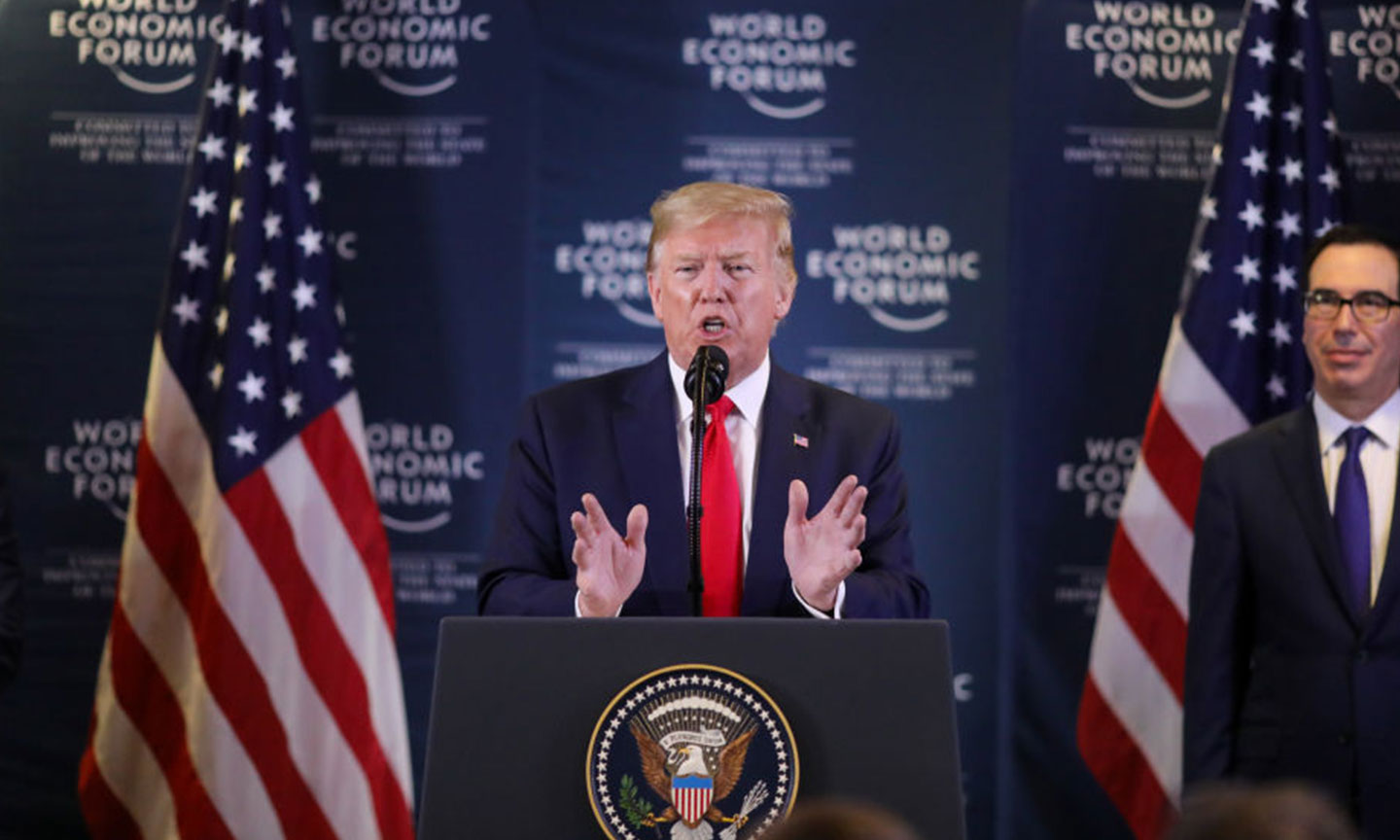
I was with a group of CEOs who met with President Trump and members of his administration whose confidence was palpable. They felt their economic policies had exceeded expectations and their approach to a new trading order, based on regional and bilateral deals, would ensure the global economy continues to revolve around the American platform of capitalism, rooted in the capital markets of New York, the innovation labs of Silicon Valley and a manufacturing renaissance in between. China was less visible at this Forum, but the trade war hadn’t diminished the confidence of the Chinese leaders I met. In fact, their resolve seemed to be growing. As one regular Davos-goer noted, the absence this year of many world leaders – none of the BRIC leaders, for instance – could reflect the draw of China’s Belt and Road summit, which is held every April (Beijing last year, Dubai in 2020) and may be the new Davos. China’s rise is about more than summits and sales, however. Its approach to state capitalism is about scale, using technology and an expanding reach across Asia into Europe to create data fields that could become the OPEC of the digital age. Which platform prevails in the 2020s will be critical to every business, and country, looking for growth.

2. Government, redirected
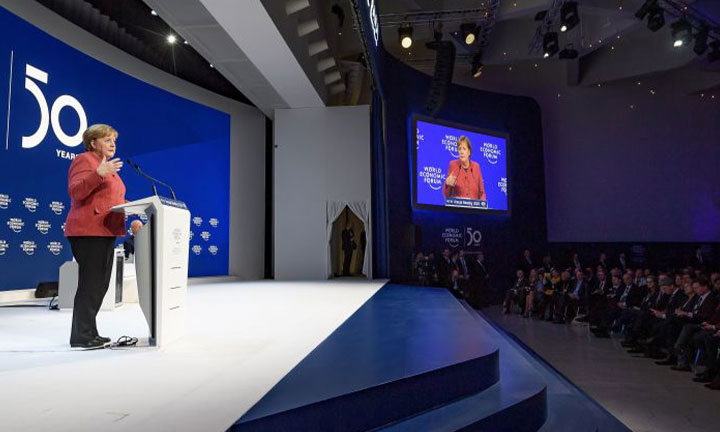
Across the aging, slow-growth West, governments are asserting themselves with a conviction not seen since the financial crisis. Nowhere is this truer than Europe, where governments are vexed by negative interest rates and the imminent departure of Britain from the European Union, a move that could further fray the world’s biggest common market. Into this valley of uncertainty, the EU leadership came in force to Davos to make the case for a more activist state. Ursula von der Leyen, the German president of the European Commission, made clear the continent isn’t going to compromise on regulations to compete with Britain. She’s ready to impose trade measures against any country that doesn’t meet environmental, social and labour standards. The Europeans are even planning to mobilize €1 trillion over the decade for a “green investment wave” that could rival the Democrats and their Green New Deal.

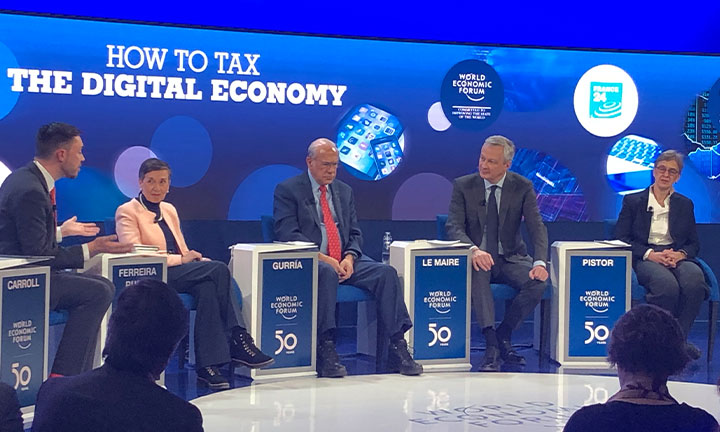
Even just a year ago, many Davos-goers thought rising global frustrations might spark a return to socialism. That may still happen. But at the forefront of the resurgent state are pragmatists like Germany’s Angela Merkel, who laid out an economic model that is neither left nor right: it’s a new economic model rooted in sustainability. “The whole way we do business will have to change,” the Chancellor said at her 12th Davos Forum. Europe’s more balanced approach to markets has carried into the cyber-economy, where its governments appear happy with their new, more onerous data regulations, and are determined to impose a digital tax on the Internet giants, for the sake of fairness and revenue. Global trade tensions won’t help, and indeed may worsen as Britain tries to cut deals with the U.S. and, eventually, China, in a race to bridge the two platforms.

3. Capitalism, repurposed

The Forum’s theme was “stakeholder capitalism,” an unfortunately anodyne description of a smart and sustainable approach to business that strikes a balance between communities, customers, employees and shareholders. Simply put, it puts purpose ahead of profit. Over the past 50 years, business has largely expected government to set rules and levy taxes to serve the public good. As trust in governments wanes, and the complexity of society’s problems grows, companies are charting their own course on environment, social and governance issues, to maintain public confidence in business and ensure the prosperity of communities that business serves. The challenge is serious. According to this year’s Edelman Trust Barometer, more than half of respondents worldwide feel capitalism does more harm than good – a sentiment driven largely by income stagnation. “Capitalism as we’ve known it is dead,” declared Marc Benioff, the founder and CEO of Salesforce.com.

In some ways, European and Canadian companies have already developed a purpose-driven approach to business that their American and Asian peers are only now pursuing in earnest. Microsoft CEO Satya Nadella made the case for this repurposing of capitalism, describing our economic model as the world’s most powerful economic learning system, rooted in discovery and testing. That learning system is needed more than ever to solve the world’s increasingly complex challenges, he argued. Mastercard CEO Ajay Banga suggested business can build the partnerships and networks needed to solve those problems. He came back to that word, scale, which may be the most important force of the 2020s. Business has proven to be the most effective model for scale anywhere, and is proving that again with global platforms. But this repurposed capitalism, and its complex web of relationships, will put ever-greater pressure on CEOs to reach beyond their walls and sectors, to delve into foreign subjects and work with unlikely allies, using the strength and spirit of their organizations to take solutions to a global scale. As Banga told the Forum, “there’s not enough philanthropic money or government money to solve these problems.”

4. Accountability, redefined

If business is to play a leading role in the 2020s, it will need more acceptance from society than ever, and that will require a more active role in developing national and international standards for a company’s performance on environmental, social and governance issues. We can’t wait for government. This year the Forum and 140 global companies launched an initiative to measure and show the progress of business across four pillars – principles, people, planet and prosperity – with 22 measures developed by the world’s major accounting firms. Properly adopted, the index can help communities, environmental groups, regulators, even employees, hold companies to account on their performance beyond the financial bottom line. And, in turn, this model can help business transparently measure its progress and outcomes, as we continue to strive to earn our social license to operate in society.

Such measurement tools carry risks, especially when they lose a sense of balance among their many variables. The risk was evident at this year’s Forum when environmental concerns overwhelmed the social and governance components of ESG. It’s important to remember how the failure of authorities, in business and government, to restore social inclusion after the financial crisis led to the rise of populism in the last decade. The governance failures of the Internet have been equally damaging. If the new capitalism is to find balance, it will need to ensure it continues to see the concerns of society as an integrated system rather than an itemized scorecard.

5. The new math of net zero

If two words defined this Forum, they were “net zero” – the idea that companies, even countries, can strive to reclaim more carbon from the atmosphere than they emit. The snowless pastures in the lower valleys around Davos this winter illustrated the realities of climate change and the urgency that Greta Thunberg brought to the Forum with her message that history is watching and a new generation is judging. She wasn’t alone. The world’s biggest asset manager, BlackRock, announced it would hold companies to a higher standard on all measures of sustainability, including their role in reducing global emissions. Microsoft set its own bar higher with a net-negative carbon policy that commits the software giant to offset all the carbon it has ever emitted. Few companies have done the hard math that Microsoft did, to calculate new emissions that can be attributed to its existence. If we’re serious about net-zero concepts, a lot of homework remains.

While much of the focus was on emissions reduction, more attention is going to offsets, especially nature-based ones that could allow our seas, land and forests to absorb more carbon, more quickly, as we work to transition industrial practices and consumer preferences. The Forum announced a bold commitment to help the world plant 1 trillion trees, increasing the global total by a third. That won’t be easy or cheap. The world’s leading financial institutions – banks, pension funds and asset managers – are also working to ensure more capital flows to carbon-reducing companies and technologies, and gradually away from major net emitters. In my conversations with finance officials and other global bank CEOs, it was clear governments need to do more – to set the rules of sustainable finance, and set clearer prices for risks, including carbon, so capital markets and business operators can get on with what they do best: optimizing the allocation of scarce resources, driving change and scaling innovation.

6. The messy math of energy

The most difficult conversations at Davos were also the most important. They were around how we plan for the next-quarter century of energy production and consumption, allowing investors and consumers to make economically rational choices that don’t lead to ecological catastrophe or social upheaval. To get there, we need more math and less emotion, because right now the math doesn’t add up. The Saudis, with low costs and low emissions, covered Davos with billboards and tea huts to burnish their image as they continue to export a good chunk of the world’s oil. They’re well positioned for any transition. The Americans, with a proven track record of innovation that’s made them the world’s Number One oil producer, show no signs of pulling back either. And then there’s China, whose ambitions could upend the world’s carbon math. As one China expert told us, the country is on course to open two new coal plants a month for the next 12 years.

I met with the world’s leading energy CEOs to better understand what they’re up against, and what they’re doing to reduce emissions. We need them to succeed. Our transition to a greener economy, with a more diverse energy mix, will take decades if it’s to avoid massive economic disruption. But it also needs to be more deliberate if it’s to avoid large-scale dispersion of capital away from some of our best innovators – the oil and gas companies that are using artificial intelligence, drone surveillance and advanced chemistry to reduce emissions. Some of those producers fear they’ll be cut off from investors who make unilateral decisions to adhere to the new carbon math. It may be short-sighted. Without a clearer plan to replace fossil fuels, we risk seeing producers hoard cash – or give it back to shareholders — rather than invest in new technologies. Any resulting decline in production, especially without a visible change in consumer behavior, might lead to a run-up in oil prices, something that could spark economic shocks and a political backlash.

7. The return of Malthus

When the Forum began in 1971, the world’s population was 3.8 billion, and plenty of Malthusian doomsayers warned we didn’t have enough land, water or food to cope. Instead, technology and trade triumphed, allowing roughly 7.8 billion people today to enjoy access to more food than the planet has ever produced. Can it continue as our population heads to 10 billion by 2050? With the world adding 80 million people a year, increasingly in Africa, the Middle East and other food-challenged regions, Davos renewed its focus on food security and the need to see global food production grow by 60% by the middle of the century.

The Forum brought together food innovators from around the world to showcase how technology may save us again. Cell-based meat production, pea proteins, vertical farming: there are plenty of ideas being developed. They will require new supply chains, changes to consumer behaviour and much more public and private investment. To show what individuals can do, the Forum launched a Future Food Day, serving locally sourced dishes, with smaller servings. Can such nudges make a difference? Not without large-scale investments in public research and the private scaling of innovation. Ramon Laguarta, the CEO of PepsiCo, suggested the world needs half a dozen Silicon Valleys of food innovation, in which universities, entrepreneurs and major producers can work with farmers of all sizes to transform how they produce food. The United Nations did just that in the 1960s and ‘70s, fostering a Green Revolution that helped avert a Malthusian mess. If we can make a renewed commitment to multilateralism, and allow for more business leadership, we might be able to do it again.

8. Currencies 2.0
The first Davos Forum inspired conversations around the dismantling of the gold standard, and emergence of the U.S. dollar as the world’s reserve currency. Fifty years later, the Forum is working with central banks and financial institutions to talk about currencies for the digital economy. A group of financial executives met with Bank of England governor Mark Carney to discuss the next frontier in payments, knowing there is a complex problem to solve: How can we reduce the friction of digital payments without undermining the financial system that is a foundation block of our economy? We’ve weathered financial crises since the end of the gold standard because our financial system doesn’t separate the storing, lending and movement of money into isolated channels. In fact, the confluence of these channels has ensured liquidity and an efficient matching of short-term savings (deposits) with long-term investments (loans). While digital currencies could make transactions easier, they risk diverting the lifeblood of our financial system to sources outside the system, like the big tech platforms that want the economic value of payments without the regulatory costs.

The next generation of payments will present another critical question: will digital currencies ever replace King Dollar? Not any time soon. Facebook’s Libra project has struggled to gain acceptance. And China’s initiative to build a digital yuan faces some fundamental problems. Beijing hasn’t explained which currencies (if any) might backstop the concept, which would be essential if a digital yuan is to facilitate trade such as an Alibaba purchase from Europe or Russian oil sales to China. The consequences are equally unclear if such a currency were to be adopted by rogue actors seeking to evade U.S. financial sanctions. The Trump administration’s active use of sanctions has already pushed many countries, notably Russia and Iran, to pursue new financial channels with Europe, the Middle East and Asia, making the notion of a new digital currency all the more appealing to them. The biggest challenge for the next generation of currencies will be to earn the trust of consumers, producers, sellers and lenders – and scale that trust. Through financial crises, wars and recessions, the U.S. dollar has done that, which is why the world continues to flock to it. For all the frustrations they can cause, America’s legal and regulatory systems remain the gold standard of global finance. Which is why the dollar is backstopped by the most valuable currency of all: trust.

9. Organizations 3.0
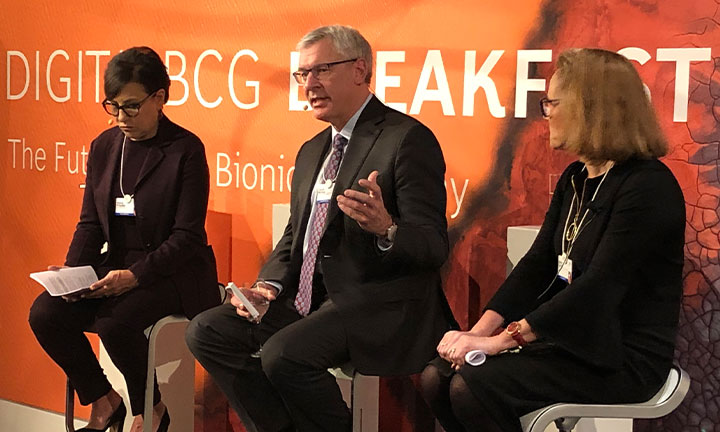
Businesses were first built around people. Over the last 50 years, they’ve been built around technology, too. We’re moving into an age when they’ll need a bionic blend, in which the interoperability of people and technology will be a critical success factor. I was part of a Davos panel on the “bionic organization,” led by the Boston Consulting Group and featuring Belén Garijo, the CEO of Merck’s Healthcare division, and Penny Pritzker, the former U.S. commerce secretary and founder of the investment company PSP Partners. We talked about how organizations can ensure their employees work effectively with smarter technologies, and how those technologies can be developed and refined to take advantage of the enormous human skills found in successful companies. Think of it as “intelligent augmentation” – the IA that can be just as powerful as AI to an organization. In the case of Merck, such an approach has increased demand for employees who can work across cultures as comfortably as they work across data platforms, blending tech and social skills. It’s one reason the company restated its purpose as “curious minds devoted to human progress.”

This blend of skills will be critical to legacy organizations trying to create 3.0 versions of themselves, using smart technologies and data pools to build their own platforms. One example: Yara International, the Norwegian fertilizer company, has built a digital platform with IBM that gives users the tools, data, networks and products they need for sustainable farming. Trouble is, such efforts rarely succeed without a diverse human mindset driving a platform. Pritzker told our session she looks for openness, authenticity and permission in companies she buys. “Innovation takes risk,” she’s found – and risk is rare if people don’t feel safe to speak their minds. She said a strong culture of diversity is critical to the bionic organization – something she didn’t appreciate until she worked in government and saw diversity as more than representation. “It’s also the difference in where you come from,” she said.

10. Education 4.0
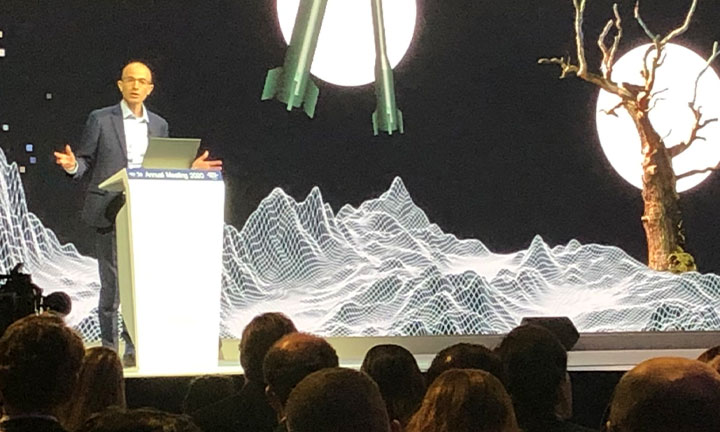
Leave it to Yuval Noah Harari to rattle the sapiens of Davos. The Israeli author is one of my favourites, and he didn’t disappoint when he told the Forum about the disruptions coming at humanity through automation. “How do you teach a 50-year-old truck driver to be a software engineer, or teach yoga to software engineers?” he asked. Even more than job loss, the historian and author of Sapiens worries the greatest threat to progress will be the loss of our sense of relevance as machines do more of what we thought we were good at. Offering advice. Giving directions. Telling a story. “It’s much worse to be irrelevant than to be exploited,” he warned, suggesting a new “useless class” will be our great challenge in the decade ahead.

Over to you, educators, and that could soon include all of us. The Forum launched an initiative this year to provide 1 billion people with better education, skills and jobs by 2030, which will require educators, government and business to develop new learning models together. As Suzanne Fortier, the Principal of McGill University, told the Forum, we need to be ready for a revolution in lifelong learning, which will run from early childhood until we’re 100. We’ll need a lot more such innovations if the Forum is correct in its projection that technology investments will create 133 million new jobs over the next three years. Many of those jobs will require specialized tech skills. Many will demand trade skills, which the world over aren’t attracting enough young people. But everywhere, the greatest demand will be for critical thinking and communications, the power skills of the 2020s. There’s just too much information out there for humans to cope with. Indeed, over the next 50 years, our greatest challenge may be to ensure we’re always learning. As Harari knows, it’s what defines us as sapiens.
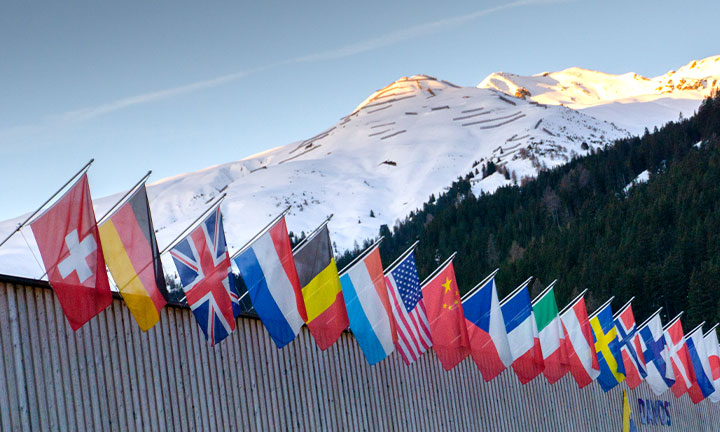

I left Davos with a sense of concern for our increasingly divided world, and a sense of hope for the human spirit at the root of progress.

The balance may rest in the concept of trust. It could, as IBM CEO Ginni Rometty told the Forum, define the decade. There’s so much change happening, so quickly, that trust is the new glue, for communities and companies. Unfortunately, as the Edelman Trust Barometer shows, our trust in governments and media is limited. Companies face a fair degree of scepticism too – but business still enjoys more trust than other institutions. We will need to honour that trust, by investing in the concerns that have divided so many, and by ensuring that the positive power of technology isn’t hampered by lack of trust. Our ability to learn, share and resolve has never been more important. As is our willingness to listen. Angela Merkel put it well when she said “the fact that people aren’t willing to talk with each other fills me with grave concern.”

It’s why forums like Davos are more critical than ever, to bring people together at a time when we’re easily pulled apart. If there was any confidence to bring home, it was in the messages from scores of youth leaders who represent a new generation – one that’s creating a more positive sense of change, and an impatience in those who can’t deliver. As Natasha Wang Mwansa, a 19-year-old girls’ rights activist from Zambia, told the Forum, “It’s not about being young or old. How will you be part of the change we need?”
Download the Report

Download

Language Flag Filename

rbc_language_toggle_menu_flag

From the keynote addresses, panel discussions and hallway chatter, it’s clear that we’ve entered a new decade of divisions: a world caught between the mountains of America, China and a Britain-free Europe.

The best-selling historian, Yuval Noah Harari, took centre stage to outline the major disruptions – technology, nuclear weapons and climate – that will shape the 2020s. A lack of U.S. leadership in each space makes the world more dangerous, Harari argued, blaming a “Me First” mood in global politics. “The global order is now like a house that everyone inhabits and no one repairs.”

Harari’s talk focussed on technology – and the social and political walls it will build within countries and between them. Such barriers will be erected by an emerging plutocracy of data oligarchs and a new kind of serf he calls “the useless class.” “How does a 50-year-old truck driver train to become a software engineer or yoga instructor for software engineers? The real struggle in the 21st century will be against irrelevance. It’s much worse to be irrelevant than to be exploited. This will lead to a useless class and it will be separated by an ever-growing gap with the elite.”

Artificial intelligence will exacerbate those divisions, as the world is rebuilt around tech hubs that will hold sway over billions. “We are now hackable animals. The power to hack human beings can be used for good purposes, such as providing better health care. But if this power falls into the hands of a 21st century Stalin, it will create the worst authoritarian regime the world has seen.” Even the elites at Davos won’t be safe, he stressed. “Just ask Jeff Bezos. In surveillance regimes, the higher you rank in the hierarchy, the closer you will be watched.”

Harari warned we will lose power over all sorts of decisions – our agency – as the platforms accelerate what they’re already doing. Google will decide what we know, Netflix what we enjoy, Amazon what we own, leading us to “philosophical bankruptcy.” “If we develop an arms race in AI, it doesn’t matter who wins. The loser will be humanity.”

The trouble with Harari’s argument is it assumes global sway by these firms, and that’s less and less likely in an increasingly polarized world. Europe clearly has headed in its own direction on data regulation, and will do so with carbon regulations. In another WEF session, European political leaders stressed their intent to push ahead with a digital tax that may make life more difficult for American platforms. And America, even without Donald Trump, is likely to make it difficult for Chinese firms to thrive in North America.

With the long view of European history in her mind, the most significant speaker at WEF 2020 may be Angela Merkel, the German chancellor who came to Davos to outline the strategy for a post-Brexit Europe. The changes she described should not be underestimated in terms of their impact. Europe’s first priority, once Britain is out, will be a Green New Deal that aims to make Europe the first carbon-neutral continent. “The whole way we do business will have to change,” she told the Forum. Europe will require new supply chains, new industrial processes, new electricity grids and new power sources, including, Merkel said, a lot more hydrogen. “The way we produce steel will have to be changed completely.”

The new Europe will also try to build a special relationship with China, starting with a summit next September between EU and Chinese leaders. Next up will be a renewed focus on Africa, which will be the fastest-growing region – demographically and perhaps economically – through the 2020s. We could see a Eurafrica emerge.

Merkel conceded Europe can’t do it on its own. There are technologies – chips and semiconductors – that it will need from other markets, and it will remain ingrained in a U.S.-dominated global financial system. She added that Europe needs to regain some confidence, that it can drive innovation like it has over the centuries. And ultimately, it will need more multilateralism – a rejuvenated World Trade Organization, a reinvigorated NATO and a repurposed IMF and World Bank. That won’t be easy. “This shift of power fills people with concern and that triggers tension we need to contend with,” Merkel said. “The fact that people aren’t willing to talk with each other fills me with grave concern.”

This was her 12th Davos, and the 50th Forum since it was launched in the depths of the Cold War, when the world, and Europe, was deeply divided. Merkel left the Forum with a clear message that is as true now as it was then: “I’m convinced the price of inaction would be higher than the price of action.”


Language Flag Filename

rbc_language_toggle_menu_flag

The World Economic Forum declared Wednesday “Future Food” day, when delegates were served vegetarian and locally sourced food to highlight the coming challenge of feeding a world of 10 billion people. The inconvenient message: We may need 60% more food to keep pace with demographic change, even as climate change disrupts croplands everywhere. Business as usual won’t cut it. Today, more than 10% of the world’s population remains undernourished, and the things we’re doing to feed the world may one day starve the planet. Exhibit A: Food production accounts for just over one-quarter of global emissions. Adding concern: global food loss and waste generate about 8% of annual greenhouse gas emissions, according to the FAO. It’s a troubling paradox.

Almost everywhere food is grown, there are stories of supply disruption: fields too wet to plant, weather-damaged orchards, and rain-starved vineyards. But food shortages are likely to hit poorer parts of the world much more severely than richer ones. In particular, global warming will have a badly negative impact on nutrition in Africa and Asia. It’s difficult to overstate the ripple effects of food shortages. Notably, it could lead to an increase in cross-border migration, which even at current levels is already redefining the political landscape in places like North American and Europe.

At one lunch today, a few dozen food experts ate mixed salad with seeds, mushroom risotto, and apple pie, and tried to figure out why innovation is falling short. Abi Ramanan, an AI specialist, noted: “agriculture has been mechanized but not digitalized.” She co-founded ImpactVision, a San Francisco-based company which applies hyperspectral imaging technology to improve food supply chains.

Agtech is hot in Silicon Valley, but even still agriculture isn’t attracting the scale of research funding – or venture capital – it needs for breakthroughs. There are exceptions, of course. Cellular agriculture is a fascinating next-step to plant-based alternatives. It uses cultures to build cell-based products outside of an organism that tastes like the real thing, be it meat, eggs, dairy or even byproducts like leather. While investment in agri-food innovation and more sustainable farming practices has climbed to nearly US$5 billion in the last five years, it still lags substantially behind cleantech.

Instead, governments spend $300 billion on food subsidies, with very little focused on transformation. “Farmers don’t need subsidies. They need support for investments,” said Wiebe Draijer, chair of Rabobank. But as big planning schemes for food have always shown, it can’t be centrally planned. It depends hugely on local farmers and consumers – the original and ultimate value chain

It doesn’t help that the world’s farmers can be a cautious lot, perhaps because their risk appetite is consumed by weather and climate disruptions. Then there’s price-obsessed consumers who aren’t willing to pay for innovation. Matt Barnard, the CEO of Plenty, said consumers everywhere want only “pleasure and convenience.” In some countries, insurers and banks are helping farmers transition their operations so they can invest in new technologies. But a more ambitious approach is needed. At the main forum, Ramon Laguarta, CEO of Pepsico, pushed for a bolder global approach, with five or six ag tech hubs – “connected with real farmers.” It may be the sort of scale needed to match the scale of challenge.

Until then, we may need to focus on that other thing we do with the land – forestry. At the Forum today, Klaus Schwab unveiled an initiative with the world’s leading governments and businesses to plant, grow and restore one trillion trees. Nature-based solutions that lock up carbon in forests, grasslands and wetlands can provide up to one-third of the emissions reductions required by 2030 to meet the Paris Agreement targets, according to the Forum’s calculations.

But here too, we run into a paradox where protecting the food supply and cutting greenhouse emissions collide. Planting large numbers of trees can push crops and livestock onto less productive land. That in turn could raise food prices. Regardless of the math, the economics of food will be back at Davos.

For insights into how the coming skills revolution can transform agriculture, read our recent RBC report Farmer 4.0.


Language Flag Filename

rbc_language_toggle_menu_flag

In one session, Greta Thunberg called for a remaking of the global economy, through grassroots movements that rely on local ecosystems. In another, Donald Trump took credit for “the great American comeback,” describing “a blue-collar boom” of new jobs, factories and wealth that could lead to a new decade of manufacturing and global trade. Neither may indicate where leadership in the 2020s, and a decade of climate, tech and economic disruptions, is headed.

The Forum conversations about leadership suggest neither confrontation nor conflation are on the rise. Collaboration is – across offices, communities and society. It’s a new kind of “stakeholder leadership.”

An MIT Sloan Management School study, released at Davos today, found skepticism within companies about the abilities of leaders to help organizations, and communities, through disruptive change. Sloan surveyed business thinkers from more than 120 countries, and found just 12% strongly agreed their leaders have the right mindset to lead them forward. And only 40% believe their companies are building robust talent pipelines. The worst score? It was on digital skills, with fewer than 10% feeling their leaders have them. That’s worrisome because one of the messages at Davos is that new business models are emerging in which traditional companies will become their own platforms, through what IBM calls “business re-engineering on steroids.” One example: Yara International, the Norwegian fertilizer company that sees itself as an information platform for sustainable farming.

To get there, the MIT Sloan study says organizations must come to grips with “deficient skills sets and outdated mindsets.” (It profiles RBC and CEO Dave McKay for “a culture of openness, partnership-building and authenticity.”) In addition to authenticity, the authors identify an emerging type of leader who is purpose-driven and passionate, and exudes humility, inclusiveness, and empathy.

Those aren’t exactly qualities that would score well in a Davos word association game. But many of the management thinkers here are seeing it spread rapidly. In another Davos session, on the future of the corporation, Oxford economist Paul Collier made the case against “economic man” – the post-war model of corporate employees who were told what to do by their leaders and then closely monitored. “Turns out these ideas are false,” Collier said. “Those ideas are right for cats; humans are not like that. We are a uniquely pro-social species.” Which is why he sees a new generation of executives who show “leadership though respect.”

Part of Davos this year has been handed over to teenage leaders, including climate activist Greta Thunberg. She joined on stage a Zambian children rights’ campaigner, Natasha Mwansa; Salvador Gomez-Colon, a Puerto Rican advocate; and Autumn Peltier, the chief water commissioner of Anishinabek Nation in Ontario. “Our generation is standing up for the world we want to see,” Gomez-Colon told the Forum. “We’re not the future, we are the present.” The youth on stage said they see a different leadership model emerging, one that is more positive and constructive. “I don’t want your awards. If you’re going to award me, award me with helping to make change,” Peltier stressed. As for the way new media has ravaged many aspects of leadership, she added, “If you’re going to say something negative about us online, don’t. We’re trying to do something positive.”

The day ended with five of the world’s top CEOs – Brian Moynihan (Bank of America), Ginni Rometty (IBM), Feike Sybesma (Royal DSM), Jim Snabe (chair, Siemens) and Marc Benioff (Salesforce) – who discussed leadership for a new kind of economic model. “Capitalism as we have known it is dead,” Benioff told the Forum. The group agreed the CEO of the 2020s is one who can both bring together and serve so-called stakeholders, including communities. (In Salesforce’s hometown of San Francisco, “the homeless are our stakeholders,” Benioff said, referring to a campaign he led to raise taxes to reduce homelessness.) At IBM, Rometty used the example of skills training to illustrate how corporations can play a role once assumed to be solely the property of government. Knowing not every American kid can go to university, IBM has developed a tech program with high schools and community colleges to help those students prepare for the jobs of tomorrow. Rometty said that 15% of IBM’s new employees in the U.S. last year came from the new program. IBM is trying to apply the same kind of leadership thinking to its relationships with suppliers, customers, academic partners and the public.

Rometty said the imperative comes from a simple view: “This is a decade of trust.” And the trusted leader.


Language Flag Filename

rbc_language_toggle_menu_flag

Beneath the Magic Mountain of Davos, the main floor of its sweeping Congress Centre features a tented sculpture made of seaweed, to showcase natural materials; a large apple tree grafted from 40 different species; and display tables of artisanal work that used to be consigned to museums by Davos-style globalization. The marquee speaking slots once reserved for Sheryl Sandberg and Eric Schmidt are now the property of Greta Thunberg and Jane Goodall. And the small backpacks given to delegates are made of recycled cloth. Even the caterers are encouraged to serve local foods and wines, and adhere to a full day of vegetarian menus this week.

Don’t worry, the WEF hasn’t gone all hippie. It’s just trying to address the biggest risks in business, which are pretty much all related to climate change and the environment. For the first time, the Forum’s Global Risks Report is dominated by them, with the top five spots of likely risks going to environmental issues (extreme weather, climate action failure, natural disaster, biodiversity loss and human-made environmental disasters) – and topping the list for impact, ahead of nuclear war.

Beyond displays of seaweed, the Forum is pushing the world’s top corporations and governments here to pursue a Net Zero strategy, meaning they’d pull as much carbon out of the atmosphere as they put into it. Its new paper, “The Net Zero Challenge: Fast Forward to Decisive Climate Action,” makes the case for unilateral action for countries and companies because the chances of a global or even multilateral solution are dimming by the year.

Some key points:

  • Few countries are on course to meet their Paris targets
  • Few countries have a credible plan to get to Net Zero emissions
  • Companies and sectors need to chart their own course to Net Zero, and should do so for self-serving reasons: to drive efficiencies, force innovation, earn the social license to operate in communities concerned about climate change, and stay ahead of the demands of regulators and investors
There are plenty of companies at Davos that argue they’re ahead of governments on climate action. Microsoft last week declared it will be carbon negative by 2030. Unilever, Levi’s and IKEA are among those with ambitious plans that aren’t relying on government action, as are major Canadian energy producers Suncor, Cenovus and Canadian Natural Resources, which have each stated a Net Zero goal or released significant emission reduction plans. “While no single actor can halt global warming alone, efforts by leading industrial nations or large corporations can have a multiplier effect,” the WEF report notes.  

Language Flag Filename

rbc_language_toggle_menu_flag

Without Donald Trump or Vladimir Putin, or Theresa May, Emmanuel Macron and Justin Trudeau, and all the media who travel with them, the tiny Alps town felt positively serene. Maybe the quieter atmosphere was needed for some reflection on where the world’s gone since the crisis, and to cast forward to where it might be headed.   This was my fourth Davos, and in many ways, the most enlivening. Clearly, the U.S.-China trade fight, and uncertain course of Brexit, had the gathering on edge. But the serious conversations focused on what lay beyond those crises. This year’s theme was Globalization 4.0, a concept hatched at Davos to explain the coming age of intelligent and ubiquitous technologies that will connect everyone and everything in ways the previous engines of globalization – steam, electricity and computing – could not. In this new era, smart machines will shape our companies and communities, and advanced technologies will be embedded in every object, and perhaps every person we encounter. It will be an age when data isn’t just the new oil; it will be the new water, the lifeblood of everything our society will want and need. The prospects can be unnerving, but I came away encouraged, with more clarity about how transformative technologies and a new generation of thinking can take our world into the next stage of globalization, and make it more decent, democratic and distributed.   Here are some of the challenges we need to consider to get there:

1. The China Challenge

Two years ago, Xi Jinping was the star of Davos, projecting a new vision for a world with China at the forefront. Last year, Donald Trump stole the show, in a very different way, projecting an America-first worldview. Their absence this year had the unexpected effect of placing their tense relationship into perspective. The business leaders at Davos expressed a quiet confidence that the U.S.-China trade dispute would be resolved in the next few months. With the Nafta negotiations largely behind them, Trump’s understaffed trade team has been able to focus on China. The Chinese also have come to understand who, and what, they’re dealing with. And both sides appear to be seeing the economic reality of trans-Pacific supply chains, which are too complex to dismantle without serious harm to both countries.

The Chinese came in force to Davos, with a clear message that they will not be subjected to Washington’s worldview.

Even if the trade dispute is resolved, it will be a beginning more than an end. In Xi, the Americans have discovered a Chinese resolve to create a new international economic order. And in Trump, the Chinese have discovered an American resolve to resist it. The Chinese came in force to Davos, with a clear message that they will not be subjected to Washington’s worldview. They see themselves indisputably as the world’s No. 2 economic power, on their way to No. 1, and believe it’s up to the West to adjust. Given China’s success over the past quarter-century, they even think their model can do the world a lot of good. No area is more contentious than technology and intellectual property rights, which the Chinese want to develop in their own manner. Wang Qishan, the powerful vice-president who led the delegation, delivered a blunt message: the world must allow China the “right to take part in the global technological governance system as equals.” That word – equals – popped up again and again.
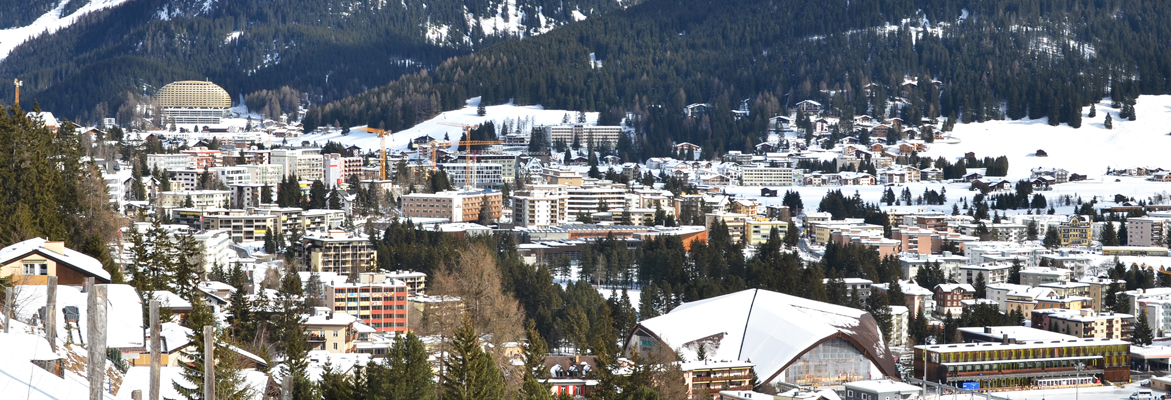
The snow-covered city of Davos at the bottom of the mountain

2. The Promise and Perils of 5G

The Huawei case seemed to be an unofficial member of the Ottawa delegation, shadowing federal cabinet ministers at every meeting as they tried to build support for the Canadian side. But interest in the company extended far beyond the extradition case of Meng Wanzhou. Huawei’s emergence as a global leader in telecommunications equipment had Davos wondering about the next generation of mobile technology, and whether the Chinese giant would lead the way. I found it intriguing that despite the buzz, many of the world’s business and government leaders seemed to know little about 5G. On the surface, the technology should help us download data and browse the Internet at up to 100 times the speed of today’s smartphones. That will make our lives more convenient, for sure. Perhaps more importantly, 5G could also become the backbone of a new economy, with the speeds and consistency needed for smart objects – self-driving cars, delivery drones, digitally-enabled appliances – to connect with each other at the speed of decision making. It’s exciting stuff, to think of how 5G might make the Internet perform like electricity – always there, always on. But as with the development of electricity – AC versus DC – there’s a fierce debate about whose technology is better. There’s little doubt Huawei is a leader, and likely to get much better as China turns its 5G focus on its bustling cities. Will we miss out on China’s advancements if we shut out Huawei? We know Beijing has sway over the company, and can compel it to hand over foreign data for national security reasons. But we also need to better understand how Huawei’s equipment would fit into the bigger technology stack that powers our mobile lives. Who can access our data will be a critical question in 2019 – not just for Huawei, but for everyone trying to wire our mobile world.

3. Slowdown or Stagnation?

I co-hosted a dinner for about 40 global CEOs on the final night of the forum, and when we turned our attention to the economy, the mood was cautiously optimistic. “Slowdown but not stagnation,” was a common refrain. McKinsey’s new global managing partner, Kevin Sneader, put it well: “When I ask CEOs at Davos about their business, they say, ‘Pretty good. I’m just worried about everyone else.’” That kind of anxiety can be positive, keeping business operators on their toes. It can also be dangerous, if they rein in investment and take fewer risks. Even though most said they expect a slowdown this year and into 2020, I got the impression other CEOs and investors still see space for expansion. The U.S. economy is running well, and China could begin to rebound once a trade deal is reached with Washington. Of course, Europe is struggling, with Italy in recession and Germany not far off. But there are plenty of other markets – India, Mexico, Brazil – that could be stronger growth engines.  
RBC CEO Dave McKay at the 2019 World Economic Forum in Davos
  The risk is we won’t be ambitious enough going into the 2020s, to seize on new technologies and those expanding parts of the world. And if we’re not ambitious, and we settle for slow growth, we may fall short of the financial returns our shareholders demand as well as the social returns – jobs, services, stability – our societies expect. To do better, governments will need to give businesses and investors the right incentives, including smarter regulations, more coherent tax policies and a predictable trading regime. As the Economist noted in its Davos issue, under its cheeky cover line, “Slowbalisation,” we need to both manage the slowdown and think more boldly about the next cycle, and how to make it commercially led, socially minded and globally ambitious.

4. Brexit’s Aftermath

Although Theresa May skipped Davos, she sent a squadron of ministers to convey her government’s confidence that it can secure a Brexit deal by spring. The Conservatives, despite their own divisions, clearly want an outcome that keeps them in power, and keeps the economy from crashing into the wall of a hard exit. We can expect some pretty tense negotiations up to the 11th hour, with an outcome perhaps not far off what May presented in December. The Brexit bullishness wasn’t exactly what the Davos crowd wanted to hear. In one session, with about 300 people in the audience, about 90% put their hands up to say they’d favour a second referendum, hoping the public this time would vote to remain in the European Union. Privately, British officials, and even British business leaders, said that’s not likely. A vote would take too long to organize, be too divisive and risk producing another contentious result. The May government instead believes it can manage a compromise over the Irish border, amongst other vexatious issues.   That may be the easy part. If May wins the support of her party and Parliament, she’ll need to quickly win back business confidence. Investment in Britain is down about 20% since the referendum, and with each passing month, manufacturers, banks and others are moving jobs to the continent, or elsewhere. Mark Carney told a Davos audience Britain’s banking system should be fine, and can withstand plenty of shocks. But he made it clear that if the U.K. can’t lay out a coherent plan for its borders and trade, there’s little business can do to prepare. Perhaps ominously, as the British ministers tried to cheer up Davos, officials back home were laying out plans for food rationing, border patrols and possible civil unrest. If nothing else, such dire prospects should focus the British mind as the 11th hour approaches.

5. A World of Walls

Chrystia Freeland at the 2019 World Economic Forum in Davos
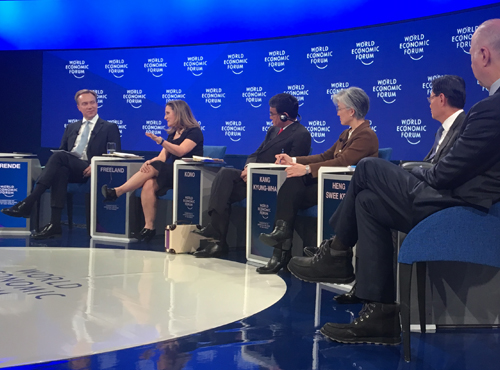
  The politicians who made it to Davos focused largely on the growing divisions over global governance, which Canada’s Chrystia Freeland summed up neatly: “The rules-based international order is facing greater challenges than at any time since it was created.” For most of the 20th century, that order was maintained by multilateral institutions to help the world concentrate more on prosperity than conflict. But public confidence in that order has eroded, helping give rise to nationalism on every continent. German Chancellor Angela Merkel, whose country knows the perils of extreme nationalism, used the Davos stage to issue a “wake-up call.”
She sees the rise of bodies like the Shanghai Pact, led by China and Russia, as an effort to build alternative systems to democracy and market capitalism. She praised the G20 as the sort of body the world needs, to keep countries and regions adhering to global principles, if not global rules and standards. It’s not impossible. Merkel pointed to the General Conference on Weights and Measures, which voted last year to change how we measure the basic kilogram, showing what global co-operation can do.   That co-operative spirit is being put to the test at the World Trade Organization, whose fate hangs in the balance of a divided world. The WTO is the central plumbing of global commerce, connecting 400 preferential trade agreements and 3,000 investment deals, and yet it’s been stripped in recent years of its ability to function normally. It’s one reason global trade has been plugged up since the financial crisis. Several sessions at Davos looked at the need for a new approach to trade that would allow countries, and trading blocs, to opt into a reformed global system. As long as global principles can be maintained, the argument goes, the spirit of global trade can live on. This idea of plurilateralism, or a club of clubs, might even be a model for the newest challenges to Globalization 4.0: bioethics, cybersecurity and data.

Several sessions at Davos looked at the need for a new approach to trade that would allow countries, and trading blocs, to opt into a reformed global system.

6. A New Data Contract

How appropriate to meet in Switzerland, a country synonymous with secrecy, to talk about 21st century privacy, as it pertains to data. While the Forum once pushed for a global approach to data, there’s a growing view that any governance system will be more balkanized. As Microsoft’s CEO Satya Nadella said, we were “naive” to think about a universal approach to the digital economy. The risk now is that each country will take its own approach to data and we’ll end up with the Internet equivalent of the 1950s airline industry. Small wonder they call it the “splinternet.” As countries like India and Thailand start to advance the use of digital identification for citizens, they’re wanting to keep their data on their soil, in a drive for “data localization” that’s likely to grow as people worry more about the use, and misuse, of their personal information.   Data localization could also become a hindrance to innovation, if it undermines cloud computing and the efficiencies that go with it. Reality is, our data cross more borders every day than many of us appreciate. It’s why Singapore, a leader on so many digital fronts, is experimenting with some ideas around cross-border processing, to allow blocks of data to flow freely, while also maintaining a secure home for them. This will become even more pressing as countries try to incorporate the data economy in trade agreements, perhaps unaware that nothing could slow down the 21st century faster than data walls. Business may need to step forward, with the spirit of the airline industry after World War 2, when it set common standards to secure public trust around the world. As the Forum was told, the public in many countries now trusts business more than government when it comes to data. Our challenge is to convert that public trust to a public good.

7. A New Social Contract

The annual Edelman Trust Barometer is released at the opening of the World Economic Forum, dropping a cold bucket of public opinion on delegates just as they’re adjusting to the crisp Alpine air. The barometer, which surveys 33,000 people in 27 markets, continues to show a clear majority distrust both government and media, while business has slowly regained most of what it lost in the financial crisis. If there’s a dominant concern, it’s the trust gap – the difference between the informed public and mass population – which is at a record high. Across the world, only one in five people think the system is working for them. That concern is especially prevalent in developed countries, where an overwhelming majority of the mass population believe they won’t be better off in five years. In Canada, only one-third of that population believes the future will be brighter.   One of the reasons appears to be a growing anxiety over job losses. It’s not that people fear automation; they just worry they’re not being given the training or skills they’ll need to hold decent jobs in the decade ahead. We know the old social contract is fraying. We used to count on good public schooling, workplace security, decent pensions, accessible healthcare and affordable housing. But in many countries, a career is now a series of gigs, the price of education is soaring, and housing is beyond the reach of many young workers. Small wonder we’re seeing so much disquiet and its political cousin, populism. In the past, the public turned to governments for answers; now they’re looking to business to speak out and invest in practical solutions like skills training. The trust barometer found 76% of people – an astonishing 11-point jump in one year – expect CEOs to take the lead on change, with workplace inclusion, fair compensation and training at the top of their list.
Davos Word Economic Forum - 2019

8. The CEO’s Dilemma

I spent the better part of an afternoon with about 50 of my peers from the United States, Europe and Asia, exploring perhaps the greatest leadership challenge in business: How to meet the demands of the world today, while positioning our companies for the complexities of tomorrow? We agreed it has to start with corporate purpose. We have a clearly articulated purpose at RBC, and it’s encouraging to see so many other global companies getting serious about it, too. Our group agreed if you don’t have the north star of purpose, you’re going to get knocked off course by the constant barrage of media and investor pressures. We agreed it’s critical for leaders to keep talking about medium-term objectives – the ones that, if they were running a sports team, would bridge the current scoreboard with the end-of-season standings. It’s also important for leaders to keep their boards and major shareholders aware of the trends they’re watching.   I outlined how RBC has tried to manage this surge of short termism in the market by articulating our medium-term financial goals, and then spending a lot of time with shareholders to help them understand our differentiated strategy, the journey that we’ve planned and the map we’re following to get there. We believe that in an age of digital disruption, we can create something powerful to help our clients thrive and our communities prosper. That’s our purpose. A Hitachi executive explained to our group why the Japanese company is developing a social innovation business, to help address global income inequality and climate change, among other long-term goals. Their executive pay is now measured against those goals. Simple reason: if the world falters, Hitachi will falter. Pepsi presented its own case study of how it’s pursuing a corporate purpose rooted in human wellness. That may sound odd for a company built on soda pop, but this clarity of purpose helped it focus on healthier products and more sustainable packaging. When Pepsi’s board last year named Ramon Laguarta to replace longtime CEO Indra Nooyi, it weighed his ability to run a sustainable enterprise and deal with inclusive societies – and to communicate those needs with passion and humanity. We’re likely to see demand for such leaders grow, as our world becomes more complex and more demanding.

9. Volatility: The New Norm?

Even though January has been a kinder month to equity investors, the December market rout was still fresh on everyone’s mind. Was the sell-off too sharp and sudden? If so, how much of that was driven by automation? I was part of a panel discussion on the growing role of machines in our markets, and what we need to consider to ensure equity while also driving efficiency. Adena Friedman, the CEO of Nasdaq, made the case that it’s never been a better time to be an investor, thanks to the efficiencies that automation has brought to markets. Costs have dropped more than 75%, she said; spreads between “bid” and “ask” prices are down as much as 90%. Of course, automation has been growing for decades at the back end of markets. But in recent years, its played a more profound role at the front end, determining what we invest in and how our investments are executed.   One example: More investors are putting their money into passive investments such as Exchange-Trade Funds, or ETFs, rather than picking stocks themselves. It’s a popular and positive trend, as it gives small investors a more level-playing field with the big ones. It also carries some long-term risks, which Bill Ford, the CEO of General Atlantic, noted. He told our panel that passive shareholders now control 44% of U.S. stocks, up from 9% a decade ago. In many cases, that means there are fewer buyers and sellers of stocks. As market automation isn’t likely to slow, financial institutions will need to continue to find ways to help clients navigate those shortfalls in liquidity and any ensuing volatility. More broadly, we’ll also need to continue to better understand the consequences of passive investing – on investors and on companies that are watching these gyrations and wondering if this really is the best way to measure the value of what they’re trying to create.

10. A New Energy Equation

A decade ago, Tony Blair came to Davos to urge the world to use the financial crisis to address the climate crisis. The billions – soon to be trillions – pouring into the balance sheets of stagnant economies, he argued, could be used to stimulate the transition to a lower carbon economy. Ten years on, the global economy is in much better shape; the environment, less so. Our collective shortfall in addressing climate change is now the No. 1 risk in the minds of the Davos community. In this year’s Global Risks Report, three of the top five risks ranked by likely outcome were environmental ones, while four of the top five ranked by impact were the same. Extreme weather was the biggest concern among the 1,000 members the World Economic Forum surveyed for the report, followed by a failure to mitigate and adapt to climate change. While there continues to be concern about the divergence in climate policy between the U.S., China and Europe, there was a lot of talk at Davos about how industries are moving ahead anyway. DHL, for instance, has designed electric vehicles to make its delivery fleet in European cities carbon neutral by 2025. Boeing has successfully tested a cargo plane using only biofuels. And two steelmakers, Mittal and Tata, are developing “green steel” using new energy sources and more recycled materials.

Regulations have to evolve as rapidly as the planet’s needs, to spur new processes and wind down old ones

Technology is only part of the play. Regulations have to evolve as rapidly as the planet’s needs, to spur new processes and wind down old ones. And much more could be done to connect energy systems. Daniel Yergin, the respected energy analyst, told the Forum he doesn’t see “peak oil” until at least 2040 – “and peak doesn’t mean plummet.” Supply chains, industrial processes and consumer choices, from home heating to commuting, are going to take time to change. And then there’s global population, projected to grow by 2 billion. Much of the discussion focused on finding ways to make our oil more carbon-efficient, to fuel that growth sustainably, and to use some of the revenue from old sources of energy to invest in the development of new ones. It’s why people call it a transition.

11. A Generational Bridge

One of the delightful surprises of this year’s Davos was the diversity of generations, from one of my heroes, Jane Goodall, to the six co-chairs of the Forum, who were all young global leaders and heroes in their own right. The interaction of the generations was inspiring, and should spur all of us to find more ways to connect young and old. At 84, Goodall is remarkable, doing more than 300 events a year, largely to promote her Roots & Shoots initiative, connecting young people with environmental efforts all over the world. “The next generation is desperate to protect nature,” she shared with us. She and rock star Bono, who’s 58, shared the spotlight at a lunch with Greta Thunberg, a 15-year-old environmental activist from Sweden, who upstaged them both with a warning from her generation: “Our house is on fire. I want you to panic.”
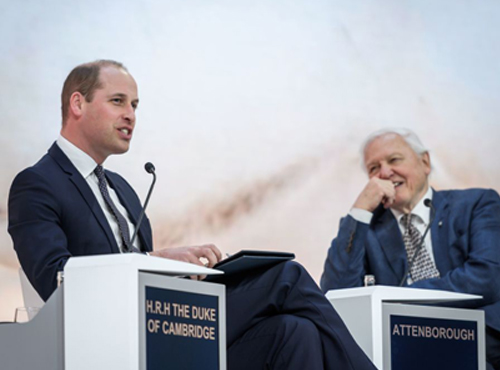
Unfortunately, the technology that consumed so much of Davos’s attention is also disconnecting Greta’s generation from the natural world around them. In another inspiring display of inter-generational conversation, Prince William (36) interviewed the legendary filmmaker David Attenborough (92) about his work in documenting the planet for more than half a century. Sir David described how in the 1950s, he could wow audiences with a simple shot of an armadillo, whereas today he has to go to the ocean floor or outer space to capture something that will grab people’s attention. He noted the irony: we’ve never been more exposed to nature and yet more disconnected from it. Sir David’s advice to the Duke of Cambridge and his generation: respect and revere the planet. And maintain “fresh eyes and wonder.” Wise words, for any age.
 
Prince William at the 2019 World Economic Forum in Davos
 

Read the Full Report

Download
 

Language Flag Filename

rbc_language_toggle_menu_flag

You wouldn’t expect to find the masses inside the Beverly Hills Hilton, which MI Global takes over every May. But their concerns were everywhere, as 4,000 executives, entrepreneurs, asset managers, policy makers and government leaders gathered this week to consider a world in flux. Here’s what I took away:
1. Why the Market Likes Mnuchin

Steve Mnuchin was a Milken regular when he lived in LA and bought distressed banks for a living. Now that he’s Treasury Secretary and working for a populist president, he’s supposed to be an outsider. It didn’t look that way. Mnuchin was received like a conquering hero at Milken, at least by the finance crowd who cheered his plan for growth. Not inclusive growth or sustainable growth, like you hear in Canada. In the U.S., it’s just growth. To get to his promise of 3% growth within two years, Mnuchin laid out a plan for tax, regulatory and trade reform. He likes to call it “a jobs plan.” On top of the corporate tax cuts already announced, Mnuchin wants to cut the top personal rate from 39% to 35%, eliminate all deductions (other than mortgage interest and charitable donations), and reduce the standard tax return to a single page. The Beverly Hills crowd liked it. And the House Republicans? “They’re 80% in agreement.” As for the elephant in the room—a border-adjustment tax to cover the cost of other cuts—Mnuchin was blunt. “We don’t think it works in its current form.” No matter. He believes the tax cuts will generate enough growth to pay for themselves.

2. Why the Economy Doesn’t (Yet)

Markets are up double-digits since Election Day, and CEO confidence is at the highest level since 2004. No surprise, then, that the crowd waxed enthusiastic about Mnuchin’s message. But it was anxious enthusiasm, in the wake of flat economic numbers. “The market has priced in a lot of announcements. We now need to see action,” said Mohamed El-Erien, the uber-investor who is chief economic adviser at Allianz. He noted that bond yields have dropped this spring, while economic prospects continue to look muted. And no one seems to be pricing in the risk of a geopolitical event—North Korea, anyone?—or a financial mishap. “Optimism is off the charts but geopolitics is a real concern,” El-Erien said. Nor is the market factoring in the slowness of Washington. Take infrastructure: it could take years, not quarters, to see a shovel hit the ground. But for now, there’s lots of liquidity and few other places to put it to work.

3. 2017: Buy American, Hire American

Trump’s “Buy American, Hire American” motto is having an effect. “Everyone now wants to build factories in America, and hire American workers,” said Ross Perot, the Texas businessman who tried to scuttle NAFTA in 1992. “Cheap money, cheap energy is good for the world, and overall the world is relatively peaceful,” he said, arguing that U.S. economic growth could hit 4% this decade. The biggest constraint? Labour. Across the U.S., there are 3 million job vacancies. In Perot’s home town of Dallas, there’s a shortage of 19,000 construction workers. The man who ran for president to fight “the giant sucking sound” of Mexico is now the voice for a more open border. Yes, it really was Ross Perot who said, “We need to get our Mexican friends back.”

4. 2018: Buy Mexican, Hire Mexican?

The Mexicans may not want to be called friends, at least for the moment. The mood toward America is so hostile that a protracted NAFTA dispute could lead to an anti-American populist winning next year’s national election. “It is not a wise decision to take an open trade negotiation into any general election,” said Kenneth Smith Ramos, Mexico’s top trade envoy in Washington. He believes an “overarching agreement” on NAFTA must be in place by year-end, and thinks it’s possible by adapting parts of the Trans-Pacific Partnership. Seeing anything meaningful pass quickly through Washington would take a healthy imagination. So the U.S. Chamber of Commerce is counselling simple advice to Trump on NAFTA: “Do no harm.” That means do no harm to the 14 million U.S. jobs that depend on North American trade—or the countless industries that will be lobbying to protect or enhance their interests. Mexico’s biggest movie-chain owner, Alejandro Ramirez Magana, gave a sense of the harm that looms, both to Mexico and the U.S.: “Our biggest movies come from California, our popcorn comes from the Midwest, the cheese on our nachos comes from Wisconsin.”

5. Trading Friends, Trump-Style

Commerce Secretary Wilbur Ross spent his time at Milken praising China and slamming Canada. China, he said, had been greatly cooperative on trade since the Mar-a-Lago summit between Trump and Xi Jinping. Canada, on the other hand, had become “nasty” in its approach to softwood lumber negotiations. Another Trump adviser cautioned that Ross was playing to the White House, trying to restore ties with Steve Bannon after the two reportedly fell apart over Trump’s attempt to kill NAFTA in late April. But there’s no doubt the White House is furious over Canada’s handling of the softwood lumber dispute, especially British Columbia’s threat of a counter-measure against U.S. coal. Ross called out B.C. as “the source of more than half the problem.”

6. Rise of the Platforms

Forget Trump and his political platform on Twitter. A more powerful force may be the other social channels and the economic platform they’re building. For now, Facebook rules. But Greg Maffei, the CEO of Liberty Media, thinks the next content battle will be between Netflix and Amazon—and the prize will be data. More Americans have Amazon Prime than go to church once a month, he said. And they’re an upscale market, willing and able to buy what Amazon recommends. He sees Alexa as “a real Trojan horse in the consumer space,” because our voices—tone plus words—”will take data to a whole new level.” Netflix could be a different platform altogether. On a typical Saturday night, a quarter of us glued to a screen are glued to Netflix. Maffei thinks the company will evolve into a platform, selling products and offering social features, because it can’t resist. It has too much data on all of us. Facebook and Google will be there, too. Facebook has close to 2 billion users. And Google’s YouTube has 1 billion people a day watching its channels. Google’s Eric Schmidt said the most important factor in a video’s success today—consumer or commercial—is the recommendation engine. Attention, brands. If you want to reach consumers, you have a new gatekeeper to please, and its name is algorithm.

7. Rise of the Cars

The car of the future is here, and further off than you think. Richard Wallace of the Centre for Automotive Research thinks we won’t see a road full of self-driving cars any time soon. The companies now testing vehicles simply don’t have enough data across different climates, geographies and population centres to make a bet. A test mile in Montana, he said, is not the same as a test mile in Miami. Regulatory changes are slower, too. And then there’s the biggest innovation hurdle of all: human acceptance. “It might be 2040 before we see truly big change,” Wallace said. Kyle Vogt, the CEO of Cruise Automation, thinks test markets will emerge over the next five years but also doesn’t expect to see self-driving cars in every city and town any time soon. “Expectations are ahead of reality. We’re seeing a lot of interesting demonstrations. What we’re not seeing is the enormous amount of work that’s still required to take a proof of concept into a commercial mode.” Whenever the future car arrives, we can expect it to have more computing power than a space station. Peggy Johnson, the head of business development at Microsoft, said the software giant sees the car the way it once saw the desktop. As carmakers reprogram every nook and cranny, they’ll need Microsoft, she hopes, to make the vehicle smarter, safer and hyper-connected. She thinks the expansion of 5G networks, around the end of the decade, will transform our vehicles into entertainment centres, supercomputers and rolling offices, all in one.

8. The New Data Economy

Schmidt believes artificial intelligence is “the most important thing to happen in computer science in 50 years.” The combination of Moore’s Law (computing power doubling every two years) and new lodes of data has afforded companies in every industry the chance to completely change their operations. He cited the case of Google data centres, which consume massive amounts of energy to stay cool. Even after some of its best engineers had tried to optimize that energy use, AI cut the data centres’ energy use by a further 50%. Pedro Domingos, the University of Washington professor who wrote The Master Algorithm, said the AI race may not be won by industry leaders. He’s finding that the most successful players in machine learning—a branch of AI—are the ones applying it to dozens of very different challenges rather than a single problem. As with humans, it seems, machines may learn best through cross-disciplinary studies.

9. The New Skills Economy

Increasingly, humans will need to be generalists, leaving it to machines to be the specialists. We’ll also need to widen our peripheral vision, rather than sharpening our focus. No matter how much machines learn, though, humans will be needed to spot the exogenous. “Our job as humans will be to be captain of the ship. We will have more ships and bigger ships,” Domingos said. We’ll also need to work with learning machines, no matter what our job. “A third of all human work will be affected by AI,” said John Chambers, the executive chairman of Cisco. Masayoshi Son, the Japanese billionaire, believes “the smart robot is going to replace many of the jobs that exist today, mostly blue collar and routine jobs of white collar.”What will happen to humans? “We will have to think, create, interact, focus on feeling.”

10. America’s Social Crisis

Mike Milken says his conference is about “building more meaningful lives” —for a reason. A sixth of middle-aged men in America have dropped out of the workforce, and half of them are dependent on opioids and prescription medicines. The decline of steady work, stable families, safe communities, even service clubs was documented in the 2000 bestseller Bowling Alone. Nearly two decades later, has the dismantling of America’s social infrastructure driven us deeper into shell? Andrew Wilson, the CEO of Electronic Arts, said there’s a reason 250 million people a day play video games, and it’s not just for fun: “We are providing self-actualization.” Pervasive social isolation is leading to at least one unexpected shift. We’re returning to sports stadiums in big numbers. The NBA just enjoyed its best year ever for attendance, with a 92% sell-out rate. Better seats, better food, better in-break entertainment and better pace of play are driving sales. NBA commissioner Adam Silver sees another curious factor: the massive improvement in home entertainment systems. Those giant flat screens that are a gamer’s best friend are also helping the arena experience. Ironically, TV may be helping convince us to spend time and money to see sports live. The new arenas are both great marketing platforms, and production centres. Silver called them “giant TV studios,” serving 90% of the population who will never attend a game – and convincing the other 10% to pay a king’s ransom for a commoner’s game.

11. Boards, Revisited

Agriculture isn’t the only area to suffer from monoculture. The boards of corporate America still look as homogenous as a cotton field in Texas. Among Fortune 500 companies, only 25% of board seats—and 5% of chairs—are held by women. “Something has to change” said Denise Morrison, CEO of Campbell Soup.“It’s too slow.” Increasingly, diversity is considered an imperative for innovation, to ensure divergent views and lateral thinking are applied to corporations as they rely increasingly on machines for linear models. How to get there? N.V. “Tiger” Tyagarajan, the CEO of Genpact, argued that CEOs need to demand diversity, and it needs to be visible through metrics and connected to the bottom line. Shareholders can help, too. The California State Teachers’ Retirement System now demands diversity plans from its major company holdings. Note: 70% of its members are women.

12. 43, Revisited

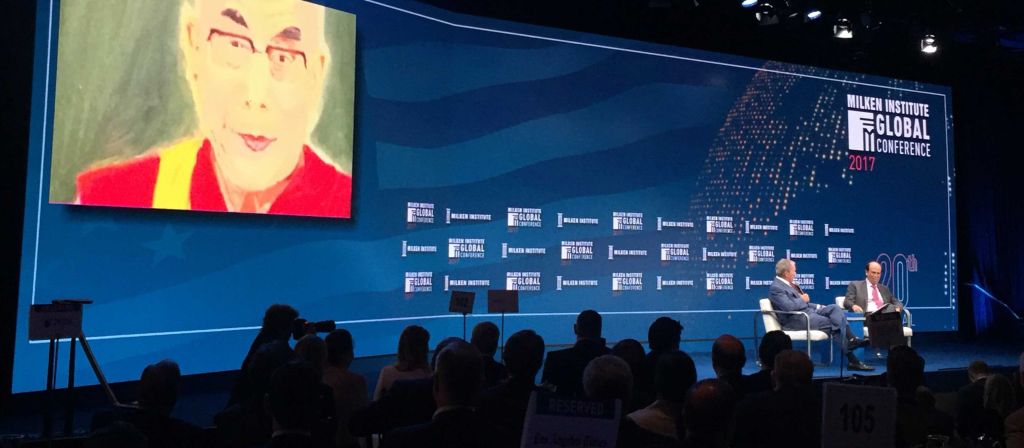
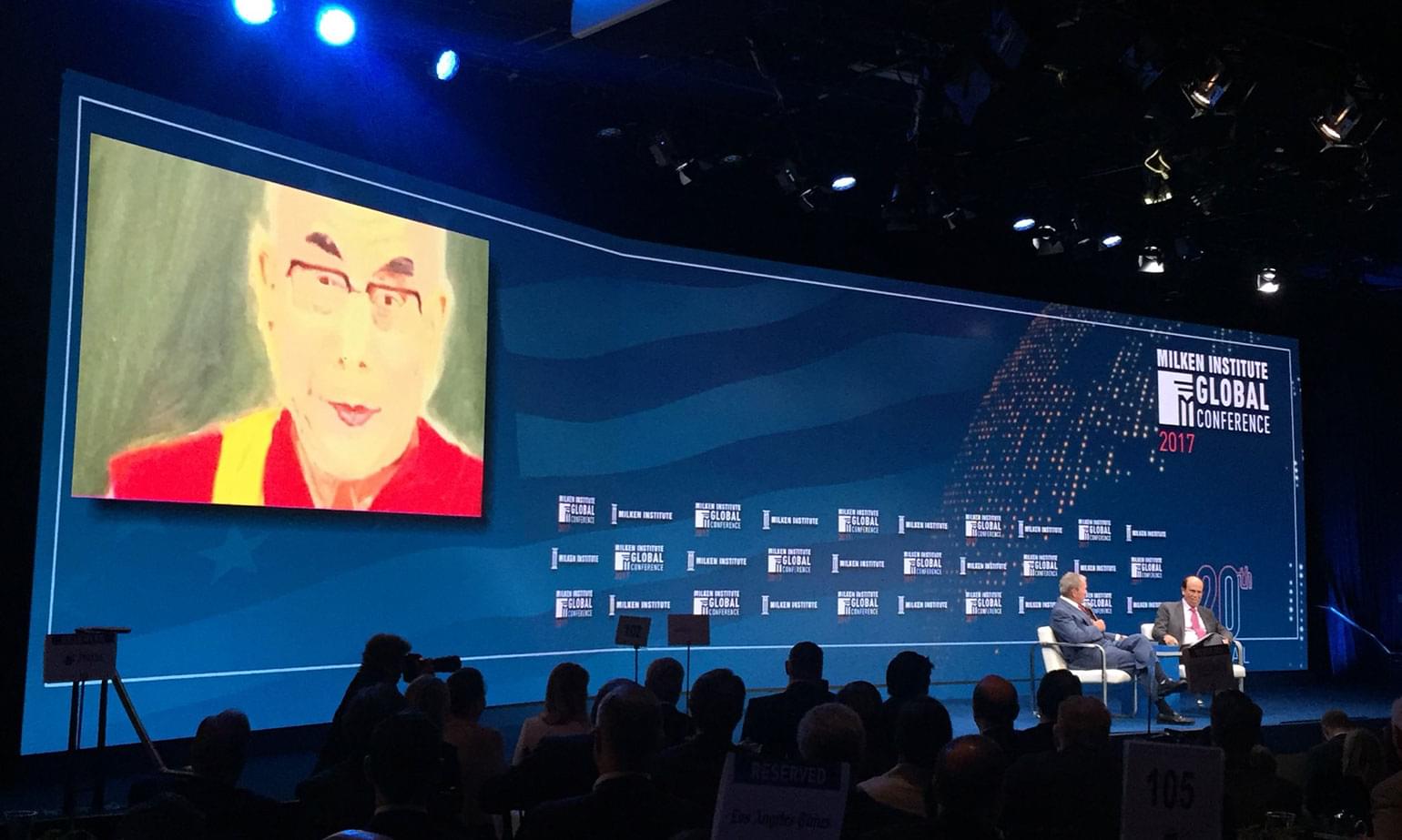
Milken opened with an anxious cheer for the Trump economic agenda. It closed with a veiled warning from a man who knows what it’s like to be a reviled Republican President and win re-election. George W. Bush, the 43rd President, earned an extended standing ovation, from a very bipartisan crowd, for his defence of a compassionate, conservative America. Just days after Trump questioned Abraham Lincoln’s prosecution of the Civil War, Bush trumpeted Lincoln’s words—“all men are created equal”—as the moral foundation of America. He believes they should be the compass of American foreign policy, immigration, education and trade. As for Trump’s suggestion that a deal with the South could have been prevented the Civil War, Bush was clear: “We’d look more like Europe than the United States.” On Mexico, he was unambiguous: “I was raised in Texas. We were Mexico. The subject didn’t make me nervous. I always felt Latinos made Texas a stronger place.” On a border fence: “It’s really hard to build fences in parts of Texas. And ranchers don’t want federal government taking their land away from them” On promoting democracy in the Middle East: “People say, ‘how dare you say Muslims can self-govern.’ I say that’s what people used to say about Condi Rice’s ancestors.” On Vladimir Putin: “He is a zero sum thinker.” And on the power of rhetoric: “When the President says something about someone, he better mean it. Especially if it’s Vladimir Putin.” As the only President ever to run a marathon, Bush left Milken with a simple message: think and plan for the long run.

Language Flag Filename

rbc_language_toggle_menu_flag

If you’ve been hearing more about angel investing lately, you’re not alone. Because of widespread digitization, the process of starting a company has changed dramatically in the past 15 years. The time and costs related to developing a tech product — even one with significant potential consumer appeal — have dropped, as has the amount of seed money needed to get a company off the ground. That’s where angel investors come in. They’re typically experienced entrepreneurs willing to provide somewhere between $10,000 and $2 million to finance an early-stage company. They’re comfortable with risk, and have plenty of advice to share. We talked to a group of angel investors, and the organization that’s helping them, about the state of angel investing in Canada, and what can be done to spur more of it. Here are some takeaways:

Angel investors fill a critical funding gap.

As many as 9 in 10 startups fail, according to some estimates. And for those that don’t, survival isn’t assured. Around half of Canadian firms with up to four employees post zero or negative growth, the Business Development Bank of Canada says. In starting a business, entrepreneurs typically use their own funds, or rely on support from family and friends. But when the demands of scaling-up mean that’s no longer enough, many find it difficult to access external financing, or are too small to catch the interest of venture-capital investors. In Canada, they’re getting more help from angels. Angel groups made investments totaling $134 million last year, up 48% from 2014, according to the National Angel Capital Organization. That’s a good sign, because venture-capital investment in the country continues to favour later-stage companies. NACO, which represents some 2,000 investors and 32 formal angel groups, is at the forefront of efforts to foster angel investing in Canada. The growth of the industry comes at a critical time for Canada: the number of people starting businesses is growing. Early-stage entrepreneurs made up some 14.7% of the population aged 18–64 last year — putting Canada ahead of the U.S. and Australia when it comes to the rate of early-stage entrepreneurship, according to the Global Entrepreneurship Monitor’s 2015 report on Canada.

Angels provide more than money.

The angels we spoke to say mentorship is a key motivation. In many cases, they created their wealth, retired and now want to give back. They’re looking for a return, sure, but are often animated by something more. As Gil Penchina, a U.S.-based angel who’s had a hand in companies ranging from eBay to Indiegogo, notes, many are enthusiasts who want to help fellow entrepreneurs. Early-stage companies can benefit from the experience, and business networks, an angel investor brings. That’s especially helpful given what many entrepreneurs say is a dearth of scale-up talent in Canada. In providing more than money, angel investors are also contributing to the development of local economies. The Northern Ontario Angels, for instance, focus on connecting angel investors and businesses with the aim of boosting growth in that region.

The time is right.

Canada has a robust early-stage ecosystem. Several Canadian universities have set up technology incubators — and they’re attracting global recognition. The country’s Industrial Research Assistance Program provides a range of services to innovative businesses — including grants to help firms commercialize technology products or build digital skills. Canada’s R&D tax incentive program is also a plus. These factors make for some pretty fertile grounds for the growing angel investor industry. In terms of headcount, Canada’s angel population is three times bigger than its venture-capital sector, and it already invests in 27 times more startups than venture capital firms do, NACO says.

Angels need support too.

NACO is trying to build up the angel community. It says more could be done to “professionalize” the group, through education and coordination. But angels say Ottawa can help, by providing more incentives to boost the pool of investment capital. NACO would also like to see a refundable federal tax credit for investments in startup ventures. British Columbia has one — and the province provided some $26 million to startups in 2014 because angels invested $86 million in eligible businesses. Another idea: Ottawa should create funds to co-invest with angels. Quebec’s government has done something like this in its support for Anges Québec, that province’s main angel group. Yet another wish: changing the tax regime to allow angels to take accelerated write-offs on their investments, instead of making them wait for years as they do now. That, angels say, would free up capital for other early-stage investments.
Sources: https://www.rbc.com/en/wp-content/uploads/sites/4/2024/11/challenges-winning-strategies.pdf http://betakit.com/report-angels-invest-133-million-in-canadian-startups-in-2015-up-48-percent-from-2014/ https://www.rbc.com/en/wp-content/uploads/sites/4/2024/11/NACO_Insights_Aug2016.pdf http://boastcapital.com/everything-you-need-to-know-about-irap-funding/ http://www.forbes.com/sites/neilpatel/2015/01/16/90-of-startups-will-fail-heres-what-you-need-to-know-about-the-10/#7ae144fe55e1 http://www.nacocanada.com/the-top-four-benefits-of-angel-investment/ https://techcrunch.com/2016/10/02/gil-penchina-on-angel-investing-market-timing-and-his-ambivalence-to-venture-capital/ https://www.rbc.com/en/wp-content/uploads/sites/4/2025/03/GEM-Canada-Report-5.2015.pdf