Disclaimer

rbc_tl_disclaimer

➔ AI gets all the attention, but the AC is also a major power drag, too

➔ Canada’s ghost emissions

➔ David Suzuki and Chris Wright’s starkly different world views

Hot takes

Ghost emissions are climate change’s untold story. Globally, emissions from Land Use, Land-Use Change and Forestry (LULUCF) are tracked but not included in a country’s emissions inventory. While emissions from managed lands are included, emissions from unmanaged lands are excluded as they are triggered by events beyond human control-such as wildfires. But they are formidable: Wildfire on just managed lands had emissions in 2023 that surpassed Canada’s total accounted emissions-by a lot. This year’s LULUCF emissions could rack up, too. By June 2nd, total estimated wildfire emissions for Canada were second only to 2023, with approximately 56 megatonnes of carbon (or 8% of Canada’s GHG emissions in 2023), according to the EU CAMS Global Fire Assimilation System. That’s years of painstaking climate action wiped out in weeks. This highlights a fundamental tension in Canada’s climate policy: most of the attention has been on emissions mitigation; less attention has been paid to climate adaptation. And we are all paying the price.

Is it time for a $100-billion Pathway + pipeline package? Alberta and Ottawa are making progress on a big energy package that could include a West Coast oil pipeline, the long-contemplated Pathways project to capture carbon emissions, and room for expanded oil production, writes John Stackhouse from Calgary. But Mark Carney’s team may need to finesse its way out of the previous Liberal government’s oil and gas emissions cap. That could involve a new target, or delayed timeline, or a refined approach to measuring abated emissions. The package’s headline costs could also be sobering—up to $100 billion.

The Texas tragedy underscores the frequency, and intensity, of floods. More than 80% of Canadians live in urban areas, and around 8 out of 10 major Canadian cities are located in proximity to flood zones, according to the federal government. Floods are already Canada’s costliest natural hazard in terms of property damage, causing $2 billion in destruction annually, as climate change supercharges weather conditions. As part of a greater National Adaptation Strategy, Ottawa is spending  $164.2 million to update Canada’s flood mapping program by 2028. Will it be enough?

David Suzuki and Chris Wright’s recent comments highlight the tension between environmentalists and some energy proponents. Canada’s veteran environmentalist told iPolitics recently that its “too late” to reverse climate change as policymakers are focused on economic growth, not nature. Meanwhile, U.S. Energy Secretary Christ Wright sees the climate crisis as a byproduct of progress, not an existential threat. “I am willing to take the modest negative trade-off for this legacy of human advancement,” he wrote in The Economist. Policy is often driven by political cycles, with energy proponents winning this round. However, the next political cycle is around the corner.

Power-hungry data centres get all the attention, but the humble air conditioner is also a major strain on grids. As summers get more oppressive in Canada and around the world, the International Energy Agency expects air conditioners to be a top driver of global electricity demand, with air-conditioner ownership worldwide rising from 37% to 45% by 2030.

Here’s why cooling is emerging as a critical climate issue:

➔ Cooling generated just over 1 gigatonne of carbon emissions globally in 2022 (1.9% of total). Space cooling could also lead to leakage of refrigerants, which have a global warming potential of around 1,000 times higher than CO2.

➔ 2Energy demand for space cooling globally is growing at 4% annually, twice as fast as water heating. This is putting pressure on power capacity, especially as countries like Canada strain to keep their grids clean.

➔ In Canada, the percentage of households with an air conditioner hit 64% in 2021, compared to 55% in 2013. That’s even more impressive given the surge in households over the past decade.

➔ Buildings account for 18% of Canada’s total emissions. Of these, space heating and cooling represent more than 67% of building energy use.

➔ One in 10 Canadian households had a heat pump (which, of course, double up as air-conditioners) in 2021, from virtually zero a few years prior. Heat pumps are 4.5 times more efficient than conventional air conditioners, making them a key pillar of climate action.

➔ Residential heat pump imports jumped 71% in Canada in Q1, compared to the same period last year, the Heating, Refrigeration and Air Conditioning Institute of Canada (HRAI) data shows.

➔ Federal and provincial Canadian policymakers are considering building codes that would stipulate at least one room with an air conditioner in a home.

➔ Access to cooling is emerging as a human rights issues, especially after nearly 600 people died in a Vancouver heat dome event in 2021.

➔ “An important driver of activity is climate-change mitigation, driven mostly by policy, rebate programs, incentive,” says Martin Luymes, Vice President, Government & Stakeholder Relations at HRAI. For instance, federal rebates led to record heat pump sales, which then dropped off when the programs ended. Several provinces including Ontario, B.C., and Nova Scotia continue to offer rebates, helping sustain interest.

➔ The Canadian HVAC industry sees the possible termination of the Energy Star program in the U.S. as a “major mistake,” says Luymes, noting that the program, which promotes energy-efficient products including air conditioners, as valuable, low-cost consumer guidance tools. Experts say scrapping or weakening Energy Star could harm climate progress.

Sign up to receive RBC Thought Leadership’s newsletter, major reports and analysis on the biggest ideas shaping Canadian business and the economy.

Donald Trump’s signature 2025-26 budget bill is now law. The legislation changes several clean energy tax incentives that were managed under the Inflation Reduction Act (IRA), tightens domestic content requirements, imposes new qualification deadlines and sunsets other tax credits that could impact Canadian cleantech firms eyeing opportunities across the border.

Here’s the good, the bad and the ugly of the OBBBA:

Carbon capture: The bill maintains credits for carbon capture, but also provides incentives for captured CO2 for oil production, underscoring the administration’s commitment to the fossil fuels industry.

Nuclear: The bill maintains credits for both existing nuclear facilities and new advanced energy technologies. However, new foreign entity provisions could inject uncertainty in the sector’s growth. The legislation is supported by an earlier executive order that targets a quadrupling of U.S. nuclear capacity from 100GW to 400 GW by 2050.

EVs: Electric vehicle manufacturing and competitiveness will be “hard hit,” according to the Center on Global Energy Policy, noting that the law could reduce domestic demand for EVs, jeopardize battery investment and allow China and other foreign competitors to gain greater market share.

Clean grid: Solar and wind power was particularly hard hit as historic investment and production tax credits sunset earlier than before. The law would reduce the build-out of new clean power generating capacity by 53-59% through to 2035, according to the Rhodium Group. An executive order following the OBBBA directs the U.S. Treasury Secretary to eliminate subsidies for “unreliable green sources like wind and solar,” that it believes is threatening national security. A separate executive order directs the Treasury Secretary to end “market-distorting subsidies for unreliable, foreign controlled energy sources.”

Critical minerals: Metallurgical coal is nowdeemed a “critical mineral,” allowing it to qualify for a production tax credit. The law also broadly reduced 45X Production Tax Credits for critical minerals to 2033 (compared to no limits before), which would pose a challenge as most critical minerals projects require long timelines. The Center for Strategic & International says the “amended tax credit disincentivizes investment in newly discovered greenfield projects with longer timelines to production in favour of brownfield legacy mines that may be closer to production but have lower grade reserves.”

China is the world’s energy transition workhorse. Around 74%, or 1.3 terawatt, of the world’s new wind and solar capacity is being built in the country, with the U.S. a distant second with 5.9% of all new projects, and India third at 5.1%, according to Global Energy Monitor. The 590GW of new Chinese wind capacity proposed or underway could power nearly all U.S. households. China’s inevitable cleantech dominance poses a conundrum for the West, as suggested by EU President Ursula von der Leyen earlier this month: “Beijing is at once a staunch competitor in the clean tech race, and a vital partner for global decarbonization.” A fractured G7 can’t keep Chinese tech out for too long.

Straddling cleantech and AI. Founded by veteran tech investor Nicholas Parker, CleanAI recently launched a networking and financing ecosystem for entrepreneurs and businesses intersecting AI and clean-tech. CleanAI research shows that the artificial intelligence-enabled cleantech solution space would require US$138 billion over the next five years and could mitigate up to 10% of global greenhouse gas emissions.

The Institute In Action

  • Last week, John Stackhouse visited Limberlost Place, Ontario’s first mass timber, net-zero carbon emissions building, to participate in a documentary about the project. The George Brown College building is set to open this fall in Toronto.

  • On July 15th, Nathan Janzen and Lisa Ashton gave a keynote presentation at the Dairy Farmers of Canada Annual General Meeting in Toronto.

Books on the team’s reading list:

  • Genesis, Henry Kissinger, Craig Mundie and Eric Schmidt, on AI’s transformative powers, in politics, security, prosperity and science. Read John’s review here.

  • The Explorer’s Gene: Why We Seek Big Challenges, New Flavors, and the Blank Spots on the Map, by Alex Hutchinson.

Curated by Yadullah Hussain, Managing Editor, RBC Climate Action Institute.

Climate Crunch would not be possible without John Stackhouse, Jordan Brennan, John Intini, Farhad PanahovLisa AshtonShaz MerwatVivan SorabCaprice Biasoni, Lavanya Kaleeswaran and Joelle Schonberg .

Have a comment, commendation, or umm, criticism? Write to me here (yadullahhussain@rbc.com)

Climate Crunch Newsletter

Disclaimer

rbc_tl_disclaimer

In this week’s edition: Trump’s 35% tariff threat, Canada seeks partners across the Pacific, and the Canadian chocolatier that’s benefitting from the U.S. boycott.

We seem to be in the Wild Wild West as Donald Trump’s latest 35% tariff threat against Canada disregards the July 21 deadline and disrupts the behind-closed-door negotiations underway.

The new deadline is August 1, by which date Canada has been asked to address several U.S. trade irritants, including supply management and the flow of fentanyl across the border. CUSMA-compliant goods crossing the border will “most likely” be exempt, said one U.S. official, in a volley of trade attacks on friends and foes alike that’s designed to confound and confuse—and lead to capitulation.

The latest threats from Washington have spurred the federal and provincial governments to look for new avenues of growth, seek new partners—east and west—, and rev up the dormant interprovincial trade engine.

Some Canadian policymakers were looking to do just that at the Calgary Stampede this week. The Greatest Outdoor Show on Earth, as it’s called, has become a blend of rodeo, carnival, and business fair, pulling in a million people a year.

Mark Carney and Pierre Poilievre were there, along with a gaggle of premiers and senior ministers. Ontario’s Doug Ford brought six cabinet members as he pushes ahead with his domestic trade agenda.

Here’s some of what’s at play as Canada looks for new trade streams:

  • A $100B energy package: Alberta and Ottawa are making progress on a big energy package that could include an oil pipeline to the West Coast, the Pathways project to capture carbon emissions, and room for expanded oil production. The Pipeline + Pathways package has a lot of political punch, but headline costs could be sobering. Add in the costs of expanding production, and the sticker could reach $100 billion. Now, that’s an investment over many years designed to deliver a multiple of that in economic growth and government revenue. But anything of that magnitude will require an explainer-in-chief.

  • New corridors: Pancake-flipping Ford and Alberta’s Danielle Smith also agreed to a feasibility study of new pipelines and rail lines between the two provinces, pledged to increase interprovincial trade of alcohol and vehicles, and push for nuclear energy development.

  • Pacific partners: International investors are very interested in Canada, as a relatively safe alternative to much of the world, including the U.S. But Japan and India wants to see action on regulatory reform, and more investment in export infrastructure. The biggest question is how quickly Canada can move on Indigenous consent for major projects.

  • Megaproject port side. ThePort of Vancouver is looking to boost its total capacity by 70% through the proposed Roberts Bank Terminal 2 Project. Canada’s main gateway has begun looking for a contractor to build the $3-billion project to boost trade with Asia.

A lot is at stake, and the country doesn’t have much time.

  • A federal red-tap review is under way to weed out rules that impede internal trade and business investments. Cabinet ministers are also being asked to find ambitious spending cuts amid Ottawa-wide belt-tightening.

  • Canadian firms, such as Purdys Chocolatiers, are reporting brisk domestic business as the U.S. brand boycott persists in the country.

  • Global trade surged in the first half of 2025, but slowing global economic growth pose risks for trade in the latter half, the UN warns.

  • President Donald Trump’s trade threats and actions now extend to copper, pharmaceuticals and Brazil. Around 14 countries also received tariff missives with the President’s classic sign-off: “Thank you for your attention to this matter!”

  • A cavalcade of small U.S. businesses and interest groups are filing cases against Trump’s litany of tariffs imposed under the International Emergency Economic Powers Act.

Multilateral cooperation is a delicate balancing act at the best of times. For half a century, the G7 skillfully juggled competing interests and represented the values of liberal openness, democratic governance, and pluralistic tolerance on the world stage. But with President Trump firing tariff missiles in all directions, including G7 partners, the BRICS+ bloc, seen as an emerging market counterweight to the G7, is quietly emerging as an attractive alternative for some nations.

The 11-nation group met in Rio de Janeiro last weekend. And while some have argued that the bloc lacks any basis for unity or cohesion apart from antipathy to the G7, the geo-economic coalition’s rising influence cannot be denied.

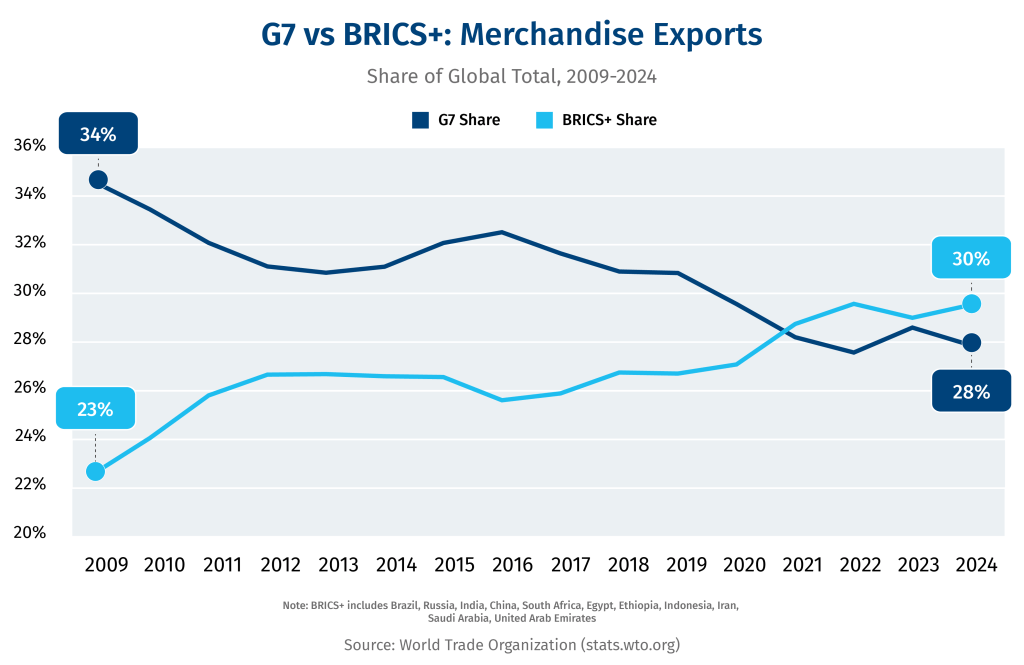
  • Formed in 2009, the bloc initially included Brazil, Russia, India and China, but now encompasses South Africa, Egypt, Ethiopia, Indonesia, Iran, and the UAE, with Saudi Arabia mulling over its membership. Together these countries account for more than a third of global GDP and nearly half of the world’s population. As a trading bloc, the BRICS+ eclipsed the G7 in merchandise exports in 2021, accounting for 30% of the global total.

  • Will Trump’s tariff war accelerate the G7’s relative decline? And will the BRICS+ be able to re-orient trade flows, proving to be a more influential voice for non-Western countries in multilateral governance? It’s too early to tell.

  • But the U.S. is already worried, with Trump threatening tariffs on countries aligning themselves with what he calls the bloc’s “Anti-American policies.”

  • Will Canada get swept up in the U.S.-BRICS cross-currents? Ottawa is already looking to reset ties with China and India—two founding members of BRICS. Foreign Affairs Minister Anita Anand, who is currently in Asia, says Canada is looking to wrap up free trade agreements with Southeast Asian nations—as soon as possible—, several of which are likely BRICS membership candidates.

  • As the Canadian government seeks relief from Trump’s tariff blitz, a longer-term trade strategy confronts the diminished status of G7 nations. How members of the BRICS+ fits into Canada’s trade future remains unknown, especially as Ottawa wants to avoid giving Washington any ammunition to blow up their fragile trade negotiations.

After decades of a unipolar world, the return of a multi-polar world is complicating Canada’s efforts to seek new trading partners.

11,000

The increase in the number of Canada’s trade-dependent manufacturing sector in June. Overall, the ecomony created 83,000 jobs, a figure that surprised analysts given the uncertainty around trade and investments.

As the North American auto industry reels under the weight of U.S. tariffs, the real story on autos may not be in Washington, but in Shenzhen, where Chinese electric vehicle (EV) behemoth BYD’s headquarters are located.

Ford CEO Jim Farley has been the most vocal about the need to “humbly accept” Chinese leadership in EV technology. The executive even imported Chinese EVs recently to test their build quality. Canada and the U.S. remain the only two major nations with no consumer access to Chinese vehicles—the U.S. imposes an almost 150% duty on new Chinese EV imports and Canada has a 100% tax—but Chinese cars are widely expected to come to North American shores at some point.

The almost-overnight success of BYD, which has ramped up production to four million units in just four years, is notable. The automaker surpassed Tesla last year as the world’s largest EV seller. BYD’s patented Blade battery is considered to be among the world’s safest and most affordable, while its autonomous driving system is deemed to be as good as, if not better than, Tesla’s. Most stunning? BYD’s EVs come at bargain prices—on average US$20,000 (C$27,400), less than half the cost of a new North American vehicle.

Whatdoes China’s enhanced automotive industrial capacity portend for Canada’s auto industry, which has been under strain for the better part of two decades? Provincial and federal governments invested heavily in the EV value chain, but with stalling EV sales (9% of total sales in Q1, 2025, compared to 18% in Q4, 2024) and paused or postponed production facilities (Honda, BASF, Northvolt to name a few), the soundness of Canada’s EV bet is being questioned. Pressure on Ottawa from some automakers to scrap the EV mandate could be another body blow to the nascent industry.

One thing seems certain: Americans, Canadians and Mexicans fighting with each other over auto production will not catalyze innovation—it would only accelerate China’s global EV lead.

Trade irritant, stable, costly, secure — these are just a few of the words currently being used to describe Canada’s supply management system, underscoring the renewed debate it’s attracting.

Supply management has faced scrutiny during nearly every major trade negotiation and economic downturn — and it’s poised to be a key discussion point in next year’s Canada-U.S.-Mexico Agreement (CUSMA) review.

The debate is no longer confined within agriculture’s siloed walls. Supply management touches many corners of Canada’s economy: from food prices and consumer choice to supply-chain jobs, trade diversification, and economic growth.

In RBC Thought Leadership’s latest report, Supply Management Explained, we take a closer look at the system’s benefits and drawbacks.

Read the full report here.

“We’ll fight against it. Period.”— Canada’s Trade Minister Melanie Joly, responding to Donald Trump’s threat to impose 50% tariffs on imported copper.

Disclaimer

rbc_tl_disclaimer

➔ A Silicon Valley of direct air capture set to debut in Alberta

➔ Global abundance: Exploring the New Energy Age

➔ Brazil is cooking up sustainable soybeans for China

Hot takes

The Silicon Valley of direct air capture is taking shape in central Alberta. Quebec-based Deep Sky, backed by a US$40-million grant from Bill Gates’ Breakthrough Energy, is opening its direct air capture innovation and commercialization centre in Innisfail in central Alberta this summer. The facility—seen as a hub for direct air capture activities—will serve as a sandbox for firms to test direct-air carbon-sucking technologies before they scale their operations commercially. Eight companies—from Canada, the U.S. and Germany and others—have already signed up. In a vote of confidence, the Alberta government also recently invested $5 million in DeepSky from the province’s Technology Innovation and Emissions Reduction Regulation (TIER) fund.

Ontario is crafting a new wood construction strategy. The recently announced Advanced Wood Construction Plan aims to promote wood use in larger and taller structures to accelerate projects, lower costs by as much as 20%. Swapping cement and steel with wood would also help lower emissions in a sector that accounts for 18% of Canada’s total emissions. Widespread adoption of wood, specifically mass timber, as a substitute or complement to concrete and steel could cut embodied emissions in buildings by as much as 25%, according to our report Mass Timber. The five-year plan comes as the province’s $20-billion industry is facing punitive U.S. tariffs.

Forecasters are scrambling to assess demand from data centres in the U.S. Electricity demand is now set to grow 25% by 2030 and 78% by 2050, compared to 2023 levels, according to a new report by ICF, a consulting firm. That’s an annual growth rate of 3.2% through 2030 (1.4% previously) and 2.2% (1.1% previously) through 2050 and contrasts with the past two decades when U.S. electricity demand was essentially flat. The strain on capacity could lead to a doubling of electricity prices by 2050, ICF warns. Texas, along with California and PJM region (covering 13 mid-Atlantic and Midwest states)—markets already importing Canadian electricity—will see the highest demand growth.

Brazil is developing bespoke, sustainable soybeans for China. Inspired by its successful Boi China beef model, the Latin American country aims to develop “Soy China,” through a supply chain that aligns with China’s environmental standards and runs on renewable energy. It’s also seen as a way for China to counter the EU Deforestation Regulations (EUDR), which have much stricter rules. Many countries (inside and outside the EU) have raised concerns about the EUDR because of its stringent traceability requirements that do not align with conventional soybean supply chains. And Brazil and China’s move is alternate route for soybeans to flow. The U.S. Department of Agriculture recently warned that sustainable soybeans would directly challenge American and Canadian exporters’ market share in China.

Nature capital: Canada’s other green power

By Lisa Ashton

As climate change disrupts the U.K.’s landscapes—from the Scottish Highlands to the Somerset Wetlands—the country is facing a £97-billion ($181-billion) nature asset deficit. The Green Finance Institute (GFI) estimates that planned public spending on conservation and restoration by the government is well short of delivering on its binding commitments, including the 25-year Environment Plan and the U.K.’s 30×30 targets under the UN Biodiversity targets. It also presents real risks and losses of between £150-£300 billion of U.K.’s GDP by 2030. The U.K. government is now seeking ideas from businesses, investors, and innovators to protect the “natural foundations of its economy,” and spur growth in its “burgeoning” nature services sector.

Canada can draw lessons from the U.K. experience. It’s home to landmark investments in several initiatives including the Great Bear Sea project finance for permanence (PFP), and watershed policy commitments to protect and conserve 30% of Canada’s land and water by 2030.

Canada’s is truly a nature powerhouse with riches that are second to none:

➔ It’s one of just five countries that collectively contain more than 70% of the world’s remaining intact ecosystems;

➔ 20% of the world’s total freshwater;

➔ 25% of the world’s wetlands;

➔ 24% of the world’s boreal forests;

➔ the world’s longest coastline;

➔ the world’s longest coastline;

➔ ecosystems in Canada provide essential habitat for approximately 80,000 species.

But, Canada, like many others, has not been able to unlock nature finance at scale to address declining natural capital as a share of GDP—roughly 70% in 1995 to about 40% today—and mitigate the risks associated with a natural environment that’s experiencing more deterioration than the U.S. and the U.K. Wildfires year-to-date alone could risk 0.4% of Saskatchewan’s GDP and 0.2% for Alberta, according to Statistics Canada estimates.

Nature finance is in its infancy, but a pathway to build natural capital in Canada and investments is slowly being charted. In 2022, the Government of Canada issued its first green bond, valued at $5 billion, with a portion of funds going to nature-based projects including financing that supports the adoption of climate-smart agriculture practices.

Exploring nature finance is an opportunity to build greater resilience in Canada’s natural resource dependent economy driven by fuel, food, fertilizer and forestry production.

Sign up to receive RBC Thought Leadership’s newsletter, major reports and analysis on the biggest ideas shaping Canadian business and the economy.

Gas flaring in Alberta is raising alarms among health professionals. The Canadian Association of Physicians for the Environment (CAPE ) Alberta chapter cited research that shows a 1% increase in flaring exposure led to a 0.73% rise in respiratory-related hospital visits. The warning comes after Reuters reported that gas flaring blew past the province’s self-imposed limit on annual natural gas flaring in 2024, for a second year in a row. In June, the Alberta Energy Regulator said it was ending limits on flaring.

Overcapacity is reinforcing steel’s hard-to-abate reputation. Around 30% of steel capacity remains unused globally, an excess that’s sent prices plunging to a four-year low. With margins under pressure, steelmakers are hardly in the mood to decarbonize. The problem is set to worsen: more than 40% of new steelmaking capacity—mostly from “non-market” forces such as China—that’s set to enter the market by 2027 will be emission-intensive, according to an OECD report . Strengthening international co-operation to address excess capacity and market distortions will be vital to improve the outlook for steelmakers in market economies, the OECD recommends. That would give steelmakers the space to advance decarbonization efforts. New anti-dumping tariffs in Canada and the U.S., primarily aimed at China, is also an opportunity to establish a green steel market.

Plastic bag bans and fees are making a difference. Several U.S. jurisdictions that enforced these policies have seen a 25-47% dip in plastic bags as a share of total items collected in shoreline cleanups, according to an extensive University of Delaware and Columbia University study. The ban also reduced the number of animals entangled along the shoreline. Still, plastic pollution overall remains a growing challenge. The final round of a Global Plastics Treaty is set for August in Geneva.

The New Energy Age

By John Stackhouse

More, more, more energy.

That was the big message in the IEA’s 10th annual investment report.

The International Energy Agency (IEA) tracks investment flows for all forms of energy, and this year is more relevant than ever, given the volatility we’ve seen in energy prices this decade. While a slower global economy may temper some investment patterns, what gets built today will shape energy patterns in years to come.

Some highlights:

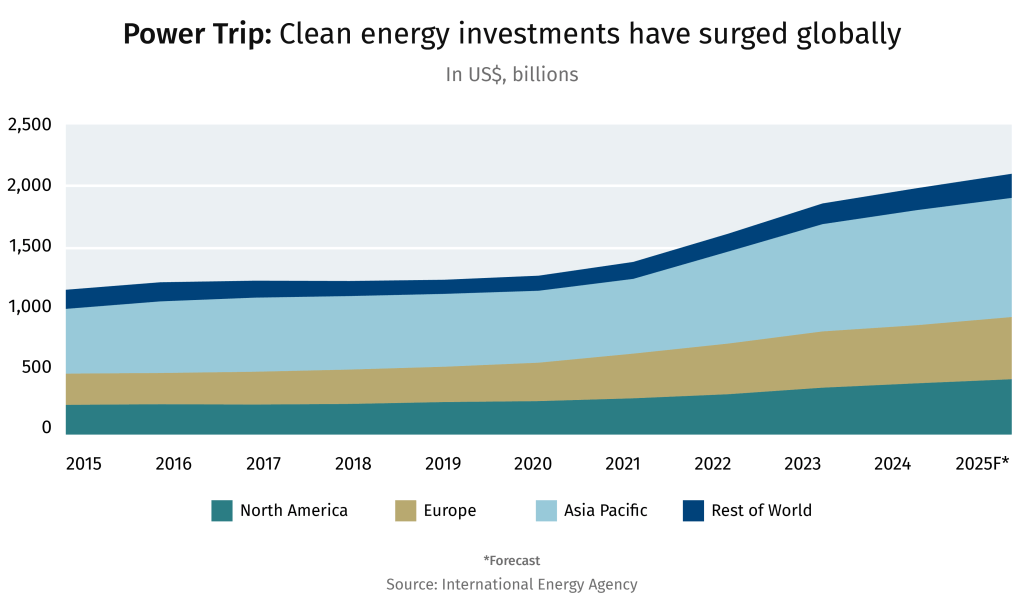
  • Capital flows to the energy sector are on course to reach US$3.3 trillion this year.

  • China is leading the energy investment surge, accounting for nearly a third of global investment, split almost evenly between grid and storage, renewable power and fossil fuels.

  • North America saw a record US$700 billion in investments in 2024, but will see pullback to US$690 billion this year. Clean energy investment is at an all-time high.

  • Would the U.S. new “big, beautiful bill” that guts several clean energy incentives, and Canada’s Bill C-5, that promotes clean and conventional energy projects, move the needle on energy investments?

  • The biggest use of investment globally is electrification, which will consume almost half ($1.5 trillion) of all energy capital.

  • Only a third of investment will go to oil, natural gas and coal:

  • lower oil prices are likely to keep investment down;

  • LNG investment is on “a strong upward trajectory,” led by the U.S., Qatar and Canada;

  • nuclear’s renaissance continues, rising by 50% over the past five years;

  • coal-fired power in advanced economies has ground to a halt, while it’s showing a comeback in China and India.

The bottom line is the world will continue to need to invest trillions a year in energy, across a wide array of sources. As that continues, some long-term trends are clear—more energy investment will go to Asia, especially China; more will go to electrification; and as our new report, “A G7+ Strategy for Natural Gas,” lays out, more will go to gas infrastructure.

Countries that develop the right policies will generate and attract the bulk of that capital, in what’s shaping up to be a New Energy Age.

The Institute In Action

  • John Stackhouse and Lisa Ashton visited the Kelburn Farm in Manitoba in late June. The demonstration farm operates out of the Red River Valley, a growing hotspot for agri-food innovation. The Kelburn Farm is a place for farmers, students, researchers, and companies along the agri-food supply chains to test and trial new ideas that are advancing Canadian agriculture.

  • Shaz Merwat was at the RBC Energy Transition Conference in London last week. He also attended a virtual International Energy Agency Conference on certified natural gas this week.

On the team’s reading list:

  • Crisis: A Global Case Primer, by Jason Miklian and John Katsos, on leading when things are falling apart.

  • Shaz Merwat was at the RBC Energy Transition Conference in London last week. He also attended a virtual International Energy Agency Conference on certified natural gas this week.

Curated by Yadullah Hussain, Managing Editor, RBC Climate Action Institute.

Climate Crunch would not be possible without John Stackhouse, Jordan Brennan, John Intini, Farhad PanahovLisa AshtonShaz MerwatVivan SorabCaprice Biasoni, Lavanya Kaleeswaran and Joelle Schonberg .

Have a comment, commendation, or umm, criticism? Write to me here (yadullahhussain@rbc.com)

Climate Crunch Newsletter

Disclaimer

rbc_tl_disclaimer

➔ Climate-tech funding perks up

➔ Nuclear ramps up

➔ Got eco-friendly milk?

Hot takes

Canadian climate technology companies raised $468 million in Q1. That’s upfrom a paltry $39 million during the same period last year. It’s a bright beginning to the year following a sluggish period of investment from Q2-Q4 2024. First quarter funding in 2025 was mostly driven by energy storage and clean power deals. While the overall rise in climate technology funding is encouraging, additional investments in industrial innovation—beyond the $36 million raised to date this year from a single deal—will be critical in decarbonizing hard-to-abate industrial sectors.

Speaking of funding, Canada will need more foreign capital to realize its commodity ambitions. More than 100 mineral projects worth $107 billion, are at various stages of development in Canada over the next ten years, according to research by RBC’s Cynthia Leach, Shaz Merwat and Vivan Sorab. With Chinese investment in minerals effectively blocked by Ottawa, Canadian miners would need to tap a variety of countries such as those in America and Europe and institutions such as Middle East sovereign wealth funds, to emerge as a commodity powerhouse. Read the full report here. Also watch RBC analysts talk minerals.

After all the talk, nuclear is finally ramping up. A new U.S. executive order aims to speed up new nuclear plant applications within 18 months—and quadruple nuclear power generation in 25 years. Belgium is scrapping its nuclear phase-out law, while EU members Germany, Denmark, and Italy are reconsidering their stances on nuclear. Ontario also kickstarted a nuclear modular reactor in May. But New Brunswick is delaying its small modular reactor (SMR) plans after its two partners failed to raise capital and hire workers. Ambition is fine, but the challenge is finding the money and the people to execute.

INFRASTRUCTURE

Build, Baby, Build—But Also Wait

Lofty ambitions, meet ground realities.Despite a reset, Canada’s plans to build new clean and conventional energy projects are running up against familiar obstacles, such as stringent environmental rules and lack of Indigenous consent. Both are critical considerations that should not supersede national interest.

Provinces that stitched together new laws in a hurry are being asked to wait:

  • Ontario’s Bill 5, which is set to become law, gives the provincial government wide powers to allocate projects to “trusted proponents” in special economic zones. The Canadian Civil Liberties Association calls it an “alarming move,” that they say gives the government the authority to unilaterally scrap legal safeguards that protect vulnerable communities and some Indigenous people.

  • Worried about the surge in mining activity, First Nations in Ontario’s Ring of Fire region are demanding the bill be struck down. Mining claims at the Ring of Fire have shot up 67% since 2022, with just under 43,000 claims covering an area 14 times the size of Toronto city, according to Wildlands League.

  • In British Columbia, which is hoping to be an LNG and commodity hub, the government narrowly passed the Infrastructure Projects Act (the Speaker had to break the tie) aimed at fast-tracking projects, amid opposition from B.C. Assembly of First Nations, municipalities and environmental organizations.

  • Anishinabek Nation Regional Chief Scott McLeod said a national plan to advance projects without input could trigger another “Idle No More” movement.

What are the chances of the federal government facing similar headwinds as it embarks on pushing through a new wave of major projects? The NDP and Bloc Quebecois are already gearing up for a fight. For now, the momentum is with the “Build” crowd.

RBC’s John Stackhouse who wasin Quebec and British Columbia recently, says attitudes towards resource development, and oil and gas exports, are shifting. (Read John’s full briefing from Quebec and B.C. here).

But as Prime Minister Mark Carney and the premiers thrash out a plan and prepare a “national interest” bill, here’s what’s on their to-do-list:

  • Indigenous consent will be needed and will take time, especially under B.C.’s commitment to the UN Declaration of the Rights of Indigenous Peoples. The First Ministers’ statement after their meeting acknowledges those challenges.

  • Premier Danielle Smith wants nine “terrible” federal policies, such as the proposed oil and gas emissions cap and tanker ban on B.C.’s northern coast, which she believes discouraged investment. How will policymakers balance their economic and environmental commitments?

  • Industrial carbon pricing remains another point of contention as it makes Canadian gas exports less competitive, but advance’s the country’s climate goals.

  • First Ministers’ focus on “decarbonized oil and gas pipelines” is another interesting proposition and would require leaning on carbon capture technology.

  • Building cleaner and more affordable electricity systems to ensure net-zero by 2050 could also spark activity in several industries such as steel, lumber and aluminum that have been deeply disrupted by U.S. tariffs.

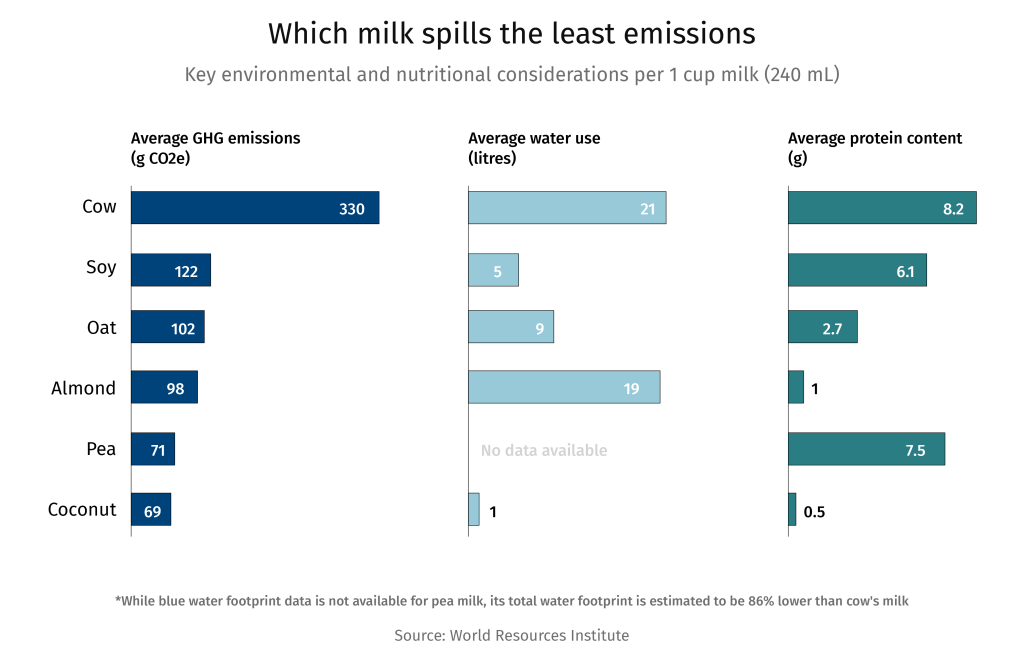
Got eco-friendly milk? It appears consumers can’t have all three—nutrition, low emissions and water conservation—when picking milk. Good old-fashioned dairy is the most emissions- and water-intensive but also the most nutritious, according to a World Resources Institute study. Almond appears to be the greatest disappointment: consuming almost as much water as dairy but is rather unwholesome. The winner appears to be the lesser-known pea milk.

Canadian cleantech remains a man’s world. Women were paid 17% less than men in 2023 in the environmental and cleantech (ECT) space—more pronounced than the 12.8% wage deficit women face in the overall Canadian economy, Statistics Canada data shows. Even though women in the industry (41.6%) were almost twice as likely as men (24.6%) to have a university diploma or degree. Overall, 7 in 10 jobs were held by men in a sector that represents 1.7% of all Canadian jobs in 2023.

A garbage truck’s worth of plastic enters the ocean every minute.That catastrophe is what makes Ocean with David Attenborough compellingviewing (now out in cinemas). “In front of us is a chance to protect our climate, our food, our home,” said Attenborough, the famed 99-year-old biologist. Oceans absorb 30% of CO2 emissions from human activities, yet only 2.4% of oceans are protected—compared to the global pledge to protect 30% of the ocean by 2030. The UN, which is hosting a conference on oceans next week in Nice, France, notes that of its 17 Sustainable Development Goals, protecting “Life Below Water,” remains the most underfunded.

The Institute In Action

  • In British Columbia, John Stackhouse joined a meeting between the Greater Vancouver Board of Trade and Calgary Chamber to discuss Canada’s role in global natural gas exports.

  • Myha Truong-Regan attended the Walrus Talks, Power Economy: Using Electricity to Change Cities, Homes, and Industry recently, to hear seven climate thought leaders and practitioners argue why the future is and must be electric.

  • Varun Srivatsan spoke to an audience at the Saskatchewan First Nations Energy Forum last week on equity financing and the importance of capacity, capital and consent to resource development.

On the team’s reading list

  • Fantasyland, a 500-year history of “How America Went Haywire” by Kurt Andersen. Read John’s review here.

  • Hotshot: A Life On Fire by River Selby, on wildfires and insights on U.S. federal fire policy, Indigenous land use and ecological history.

  • Is A River Alive? by Robert Macfarlane, tracks flowing water in Ecuador, India and Canada.

  • Who is government: The Untold Story of Public Service, by Michael Lewis, explores the vast complexity of American bureaucracy.

Curated by Yadullah Hussain, Managing Editor, RBC Climate Action Institute.

Climate Crunch would not be possible without John Stackhouse, Jordan Brennan, John Intini, Farhad PanahovLisa AshtonShaz MerwatVivan SorabCaprice Biasoni, Lavanya Kaleeswaran and Joelle Schonberg .

Have a comment, commendation, or umm, criticism? Write to me here (yadullahhussain@rbc.com)

Climate Crunch Newsletter

Disclaimer

rbc_tl_disclaimer

What does it take to transform a startup into Canada’s second-largest company in just a decade? Sonia Sennik and John Stackhouse discuss his conversation with Harley Finkelstein, President of Shopify, live from C2 Montreal.

Harley discusses how Shopify embraced anti-fragility, continually reinvented itself beyond e-commerce, and leveraged AI to reshape retail and empower creators globally. He highlights the essential entrepreneurial mindset needed to foster innovation in Canada, urging ambitious entrepreneurs to think bigger, build stronger networks, and seize the opportunities emerging at the forefront of technology and commerce. Tune in to explore how crises become catalysts, why relentless ambition matters, and how Shopify’s success story could inspire Canada’s next wave of global companies.

Listen on Apple Podcasts, Spotify or Simplecast

John Stackhouse: [00:00:00] Hi, it’s John here

Sonia Sennik: And I’m Sonia Sennik, CEO at Creative Destruction Lab.

John Stackhouse: This is Disruptors x CDL: The Innovation Era.

Sonia, it’s conference season in Tech Land. They seem to be everywhere, every day, all at once, all over North America, from the Google and Microsoft Jam Fest to the upcoming Toronto Tech Week. I just got back from one of them C2 in Montreal, which is all about the creative class meets technology, and I got to interview on stage, our old friend and one of the first disruptors guests.

Harley Finkelstein, the president of Shopify, and a force of nature in the Canadian tech conversation.

Sonia Sennik: The trajectory that Shopify has been on for the last 15 years has been tremendous. You actually interviewed Harley on the anniversary of their IPO. Can you think back 10 years ago to what Shopify was like before they [00:01:00] became the public powerhouse that they are in Canada?

John Stackhouse: $3.50 is what springs to mind. I think that was the IPO price and yeah, it’s now in the $150 range or. Maybe it’s higher today, I don’t know, but it has been one of the great Canadian rocket ships. So let’s have a listen. Here’s our conversation recorded live at C2 in Montreal. Good morning.

I’m John Stackhouse with, uh, RBC here with my good friend Harley Finkelstein from Shopify. We’re gonna have a great conversation about Shopify, a bit about Harley, but mostly about entrepreneurship. And what we need to come to grips with at this amazing moment of time. We are recording Live for Disruptors, an RBC podcast.

So hello to people far and wide who are listening to this as well. Harley is a repeat guest on Disruptors. So Great to, I was one of your first guests, I think actually. Uh, you, you were an OG. Yeah. In fact, this is an auspicious day. For a [00:02:00] few reasons. May 21st, 2015, 10 years ago, today, Shopify went public.

That’s true. So congratulations Harley, and to the team at Shopify.

Harley Finkelstein: Yeah. 10 years ago, almost to the minute we rang the bell in New York Stock Exchange. And for all of you in the crowd that are entrepreneurs, you know that there’s no feeling in the world, uh, like ringing that bell where people like Henry Ford once stood and it’s been an amazing ride.

John Stackhouse: And just to give you a sense of the ride, a billion dollar valuation, then 10 years later about $150 billion,

Harley Finkelstein: Something like that. Yeah. Give or

John Stackhouse: take. Give or take. Looking back 10 years,

Harley Finkelstein: what’s been most surprising for you? Well, I mean today the largest company in Canada is RBC. The second largest company in Canada is Shopify.

Just saying it out loud, we’re the second largest company in the country is is unbelievable. So that I think, obviously sticks with me. The other thing that sticks with me is just the impact we’ve been able to have. Shopify now powers somewhere in the neighborhood of 12% of all US e-commerce. We cross a trillion dollars in sales on the platform like trillion with a T, [00:03:00] and pretty much other than Amazon, we are the largest checkout on the internet.

So from a business perspective, obviously that’s been remarkable. But the other thing has been the amount of people at Shopify that are still around. We’re now about 8,000 or 8,500 people at the company, and there is a lot of OGs that are still doing their life’s work at Shopify 10 years later. It’s been an amazing ride.

So many critical points along the way. If you had to pick, uh, one, what would it be? I think the pandemic was one of those moments that I think in any entrepreneur’s life, similar to IPO, that you can forget overnight. This is something that most people don’t know, but I. Everyone thinks e-commerce is obviously a huge part of the economy, which it is, but e-commerce as a percentage of total retail is still in Canada, like 16%.

So part of what happened with the pandemic was overnight, the entire physical retail world shut down and all of a sudden everyone kind of woke up and realized that the future retail is not just offline, it’s, it’s online, it’s offline, it’s on social, it’s everywhere. We’re operating now is not just as an e-commerce company for small business, but rather as the [00:04:00] world’s commerce company.

If you look at the top five companies by market cap in Canada, um, RBC was created in 17, 1800, something like that. It was 1800. 1800, 1800. We’re not, we’re not that old. I know. Sorry. Excuse me. 1800, 150 years old, 150 years old. So other than. Shopify. The youngest company in the top five market cap companies in Canada was created in the fifties, which was TD Bank 1950s.

So for us at least there, there is a real sense of responsibility that not only do we want Shopify to continue to become a leader in Canada, but also how do we inspire the next vintage of incredible entrepreneurs, many of you who are in the room right now, to actually build these global dominating companies from here in Canada.

John Stackhouse: Uh, I just take, take a detour here on this point about age, because we’re only as old as, uh, we let ourselves be because our RBC is 155 years old. We consider ourselves the youngest bank in Canada, and that is very important. There’s a corporate biography. The title is Fast to the Frontier, and that is a mindset if there is a frontier.

We get there [00:05:00] before the others do. So let’s pivot to this idea of the entrepreneurial mindset, not just for individuals, for entrepreneurs, but also for a country. And how can Canada be more entrepreneurial and be more of a builder nation, which is what entrepreneurs are. So give us a glimpse of Shopify and how you maintain that builder and entrepreneurial mindset.

Harley Finkelstein: I mean, part of it is the love of ambition, but the other part is, I dunno if you folks know this book, but there’s this great book by Naim Telleb called Anti-Fragile. You and I talk about this book all the time. So this idea of anti-fragility is a fascinating model because most people assume that there’s sort of two types of systems.

There’s fragile and there’s durable. So you take a glass. You drop it and it breaks and it’s fragile. Take a glass and you drop it and it doesn’t break and it’s durable. But there’s sort of this other system called anti fragility, which is effectively you drop the glass and the glass actually reshapes stronger than it was in the first place.

We’ve taken that approach to Shopify in many ways. We’ve tried to, you know, name your podcast. We’ve tried to disrupt ourselves. So one of the things that I think historically we were [00:06:00] known for is e-commerce. We actually do not think we are an e-commerce company. We think we are a commerce company. We think the future of retail will be retail everywhere.

And the big change between retail 30 years ago in retail today is not that you have new channels, whether it’s. Social commerce, or we just announced a partnership with Roblox. So now if you’re on Shopify, you can literally sell products in Roblox, which is a big deal because there’s a hundred million people living in Roblox digitally every single day.

What we realized was that what is happening now is consumers are dictating to the retailers how they wanna buy the retailers and the brands that are gonna be most successful will sell wherever it’s most convenient for those consumers. So we started to go into things like physical retail. We started to go into things like social commerce.

We constantly thought about what is the next version of Shopify? Not like next year’s version, but in 10 years from now, what it’s gonna look like. That’s the first thing. The second thing is probably one of the best venture capital firms in the planet is Sequoia. Sequoia passed on Shopify in 2010, and when you ask Sequoia why they passed, they will say, [00:07:00] ultimately, we had an issue with your TAM, your total addressable market.

At the time, in 2010, there were about 16 million retail SMBs in the world. So they basically said, well, Shopify has 2000 of them or 5,000 of them. We think that’s, that’s good growth, but that doesn’t necessarily mean they’re ever gonna be a billion dollar company. The way we saw it though was that rather than simply just growing our slice of the pie, we were trying to grow the pie itself, and I think what would due respect to Sequoia, what they missed was that.

We were actually creating new entrepreneurs, not just taking the larger market share from the existing base of entrepreneurs. That’s kind of the way we’ve always thought about things. How do we actually disrupt ourselves? So e-commerce is cool. What’s next? Where’s retail going? And maybe the, the last one I would say is that.

We don’t lick wounds very often. We have a lot of different areas of our business. We have a payments business as a standalone company. Shopify Payments would be one of the largest companies on the planet. We have a capital business. We have a shipping label business. We had a shipping and fulfillment business for a while.

It didn’t work. We shut it down. We moved on. We [00:08:00] believe failure is the successful discovery of things that did not work. And I think when you apply that lens to decision making, you end up making much better decisions and you end up growing faster. How do you assess failure as an organization or as a team?

It’s one of two things. Either it’s product market fit or it’s simply we don’t have the right team in place. And so in the case of fulfillment, for example, if you were to pretend that Shopify was a single retailer, you aggregated all of our stores into one single large store, we would be the second largest online retailer in America.

Amazon will be the first shop, be the second. We decided, uh, years ago that what if we actually acted like that as if we were the second largest retailer and then went ahead and tried to get economies of scale across every single pain point that a retailer might have. And so fulfillment was a pain point.

We thought if we build our own warehouses and we build our own fulfillment companies, three PL capabilities, maybe we can make that easier. At some point we realized that bits and bytes and atoms are very, very different. We’re really good at building software. We are not very good at building physical infrastructure.

And so we looked around and figured out [00:09:00] is there someone out there that is doing fulfillment in a way that we would love to emulate? In the case of fulfillment, there was a company called Flexport. And so we decided to, rather than do it ourselves, sell it all to Flexport. And now the thing that was a side quest for us is a main quest for them.

That’s kind of how we look at these things that don’t necessarily always work is, is there someone out there that can do this better than us, but we can still participate in the upside.

John Stackhouse: I wanna go back to the anti fragility point and link that to recruitment, because recruitment is a huge part of Shopify. As part of your culture, how do you recruit for anti fragility?

Harley Finkelstein: We have a little bit of a hack that all of you are welcome to steal from us, which is that. Ultimately, if you look across the company, most people that work at Shopify, again, Shopify is an entrepreneurship company.

The software we build, the products we care about, it’s all about entrepreneurship. Often what we end up doing is we end up hiring entrepreneurs. We look for founders. So [00:10:00] if you’ve met people that work at Shopify, the first question you can ask them as a test is, have you built your own company? And almost everyone at Shopify would say, yeah, I have.

Sometimes they’ve been very successful and we’ve acquired them. In other cases they said, yeah, I tried. It didn’t work. Looking for people that are actually founders, we have found to be the best type of DNA for people that to come work at Shopify. They seem to have the, uh, more of an anti fragility mindset about building, but more importantly.

They have been affected by entrepreneurship to the extent that falling in love with the mission of Shopify, which is about increasing the surface air of entrepreneurship is a lot easier. And so we recruit for that. We’ve now opened up our offices on Sundays. I told you we called it Builder Sundays. So every Sunday in Montreal, here and in Toronto, the Shopify office is open.

Any entrepreneur can come hang out, and for those of you that have been you, you know that I come hang out, I spend a couple hours every Sunday there. I’ll answer emails or I’ll work on a talk or something like that. That’s the best way for us to actually find incredible people that may wanna come work at Shopify, or in the worst case scenario, people [00:11:00] that wanna build apps for Shopify or build teams for shop, or be part of our ecosystem.

That ability to actually recruit founders to build software for other founders, that’s been the best thing for us on the recruiting side.

John Stackhouse: You mentioned total addressable market, TAM and how a lot of people don’t get that. They don’t get that. In a lot of companies, a lot of entrepreneurs are not good at explaining.

Yeah. Uh, explaining their TAM. How do you see TAM today for Shopify?

Harley Finkelstein: The clever answer that I’d like to say is it should be the same TAM as Oxygen, which is anyone, but ultimately it is someone that wants to sell a product to somebody else. Historically, the stores on Shopify, the businesses that we worked with were these startups, these small companies that started at their mom’s kitchen table that grew really large.

And if you look at companies like Aloe Yoga or RI or Gym Shark, that was their story. But now we’re seeing companies like Yellow and Mattel and Birkenstocks and on running also come to Shopify as well. Ultimately. What we’re trying to do is make it so that if you have something of value that you wanna share with someone anywhere in the world, on any single surface area, and that might be e-commerce, that may be [00:12:00] ai.

I mean, I think what’s one of the things that’s gonna happen in the next couple years is you’re gonna see the shift from searches, stop starting on search engines to search starting on. Chat GBT perplexity code. And that’s a huge opportunity. And so our responsibility is if you’re on Shopify, wherever someone is looking for your products, we make sure you show up.

So our TAM is is not a particular segment or a particular type of channel. It’s anyone that wants to sell something to anybody else. And so one is to helping existing entrepreneurs, but also helping aspiring entrepreneurs convert that idea in the shower into a real business. So if you think about the history of of commerce, the history of retail, the way it always started was first you build a product and the new found audience go back 150 years.

You’re the baker, you make bread, you then do some marketing. You get people to come into your bakery, you sell the bread. That’s how it always worked for the first time in the history of the world. What’s happening now is someone like Hailey Bieber. Who has a huge audience is able to create Rhode Beauty.

R-H-O-D-E. She created a cell phone case for your [00:13:00] iPhone that allows you to put your lipstick in it. So she has an audience. She understands her audience. She decides I’m gonna create a product specifically for this audience, and she creates a hundred million dollars company in a matter of months. This idea of shifting the sequence of events from product first, audience second to being audience first, product second.

That is some of the coolest thing ever that that’s ever happened in entrepreneurship.

John Stackhouse: Take us deeper into the AI aspect of this. How is AI going to change that, or how is it already changing that dynamic of creator and market?

Harley Finkelstein: There’s some obvious ones which around leverage you. You know this, and some of you in the crowd know this, but when I’m not a leading Shopify, my Sunday project is I have this podcast called Big Shot where I’m creating an archive of the greatest Jewish entrepreneurs.

One of my last episodes was a guy named Mickey Drexler. He’s about as close to retail royalty as it comes. He created Old Navy. He basically created J Crew. He ran the Gap for 20 years. He was on the board. Steve Jobs and him were very close friends. He was on the board of Apple. Mickey Drexler talks about that.

In the heyday at the Gap, there were literally hundreds of [00:14:00] people working in the product photography Department of the Gap. I. Doing product descriptions, product photography, merchandising. Today, it’s not a pitch for Shopify. Shopify is $39 a month. You get better tooling and a better quote, unquote helper or co-founder with a free product that we give you as part of Shopify than Mickey had at the gap with 300 people.

So that’s the obvious stuff that like technology is gonna make product descriptions and product photography much easier. But the much larger picture is that right now, if you go to Google and you type in sneakers. The first search result you’re going to see is Footlocker. It’s because Footlocker pays for that.

I believe in a few years from now, when you go to chatGPT or Perplexity or any of these amazing AI tools and you type in sneakers, they’re gonna look at all of your history of every search you’ve ever done on that particular platform, and they’re gonna say, you know what? That guy really likes running or hiking.

I’m gonna show him. Adams, Allbirds. I’m gonna show him ON running. I’m [00:15:00] gonna show Birkenstocks. All of a sudden now, consumers are getting products that actually they care about based on their particular search history, not who has the most amount of money. I. And for any of you in the room right now who sell product, particularly online, that is the biggest fundamental change like paradigm shift in 20 years of e-commerce, because now it’s not who has the most amount of money, it’s actually who can get in front of the most amount of customers.

And I think that is incredibly disruptive, but also incredibly democratizing.

John Stackhouse: So let’s shift to what Canada needs to do to seize this moment. ’cause it is a moment. I’m not sure there’s ever been a better time to be a creator. Yeah. In the world. There’s all sorts of challenges, but. Classic frictions are being removed hour by hour, minute by minute, and we just talked about what AI can do to reduce friction.

Yep. Interestingly, here in Montreal, there’s one of the greatest concentrations of creators in the [00:16:00] world. I think YouTube has more creators, producers in Montreal per capita than anywhere else. More gamers and game creators here in Montreal. The same can be said across Canada, and yet clearly we’re not creating enough value from that. What are we missing?

Harley Finkelstein: Well, first let me just say this, I’ve spoken at C2, I dunno, four or five times in my life. This is actually the first time I met C2 living in Montreal. I moved to Montreal 18 months ago because I think Montreal is by far one of the most entrepreneurial cities, not in Canada, on the freaking planet.

This is a place that praise of the altars of entrepreneurship. There is no place like this city, especially as someone that is an entrepreneur. I love this place.

The Canada thing. Part of what I think is missing here, and just look at the last 48 hours, there’s been two op-eds published, one in the globe and one in the financial posts. One says, is Canada a legitimate trading partner? The other one says, is Canada a real economy? So. I [00:17:00] think generally most people in the crowd are probably tired of hearing what the problems of Canada.

We get it. There are issues with the country, we can get better. We have a new government. We have a much more ambitious leader, I think here, and I think there’s a lot of momentum right now in Canada. So I don’t wanna talk about the problems of Canada. I think we talk about the opportunity. I think the opportunity is that ultimately if you’re a creator or you’re an entrepreneur.

There’s no reason that you cannot live in any of these amazing cities in Canada. There’s no reason that your audience, that your addressable market needs to be here too. In the same way that if you are a tech entrepreneur and you have to raise venture capital, you can look at great Canadian VCs. You can also look at great American VCs or European VCs or Asian VCs or Latin American VCs.

Businesses now geographically agnostic. When you look up something on Perplexity or chat GBT, and you’re looking for a pair of shoes and the shoes that come back up, you don’t ask yourself, where is the founder based? You ask [00:18:00] yourself, is this a product I wanna purchase? Yes or no? If it’s yes, click to buy, hopefully on shop pay.

If not, you move on. So I think one of the things that we need to just remember is that. This may be a smaller market than our neighbors to the South, but Shopify, most of our merchants are in the US. Most of our partners are in the US. The original venture capitalists from Shopify were American VCs.

Canadian VCs are also involved, but ultimately we were agnostic. I was born in Canada. I grew up in the States, Tobi’s born in Germany. We never looked at Shopify as being a company that needs to be focused on Canada. We were a company based in Canada, and although those sound similar, those are very, very different things.

RBC capital markets and your investment banking arm on Wall Street. You guys don’t wanna be the best Canadian investment bank on Wall Street. You wanna be the best investment bank. Full stop. And I think the companies that are most interesting, like Fullscript in Ottawa, or plus grade here, or I think about Cohere or League, uh, or Clio in Vancouver, all these guys running those companies, [00:19:00] they are not building.

Companies focus on Canada. They just happen to be building from Canada and they wanna be the best in the world, and they’re leveraging this incredible place. I think that’s not a major aha moment, it’s just a different way to think about ambition.

John Stackhouse: I can feel the energy from you here on stage. What do we need across the country? To force multiply this.

Harley Finkelstein: I think more role models are really, really important. I mean, I mentioned that builders Sunday, as at Shopify, brings in founders to come work in our office who want to. No strings attached, but selfishly, I also wanna meet these people.

I wanna hear what they’re doing. I wanna see what they’re excited about. I feel a responsibility to show up on Sundays, just to remind them that this office, they’re in Shopify, was not built overnight, nor was it built by having small ambition. The second is, you know, you started this, our session today by talking about the 10 year anniversary of [00:20:00] Shopify.

Anyone that has messaged me to say we are close. In IPO, I’ve pretty much stopped everything that I’m doing day to day and said I’m going to like come up to Montreal or come, I’ll meet you somewhere. I will give you the exact roadmap of what you need to be IPO, ready, company, team, bankers, lawyers, governance, whatever you need, I will deliver you in a silver platter.

I will not hold back. I will tell you the cheat sheet of how to do it because I actually think. Like success gets more success. We need more op-eds about what can we do given the current situation we’re in right now. And I think talking about anti fragility, talking about admission, celebrating our successes here.

You know, on the IPO roadshow, which was a 10 years ago, we were on the IPO roadshow. We did 93 meetings, probably 40 of those 93 meetings. Someone mentioned to us, oh, you’re Canadian. We haven’t seen a company from Canada since North Teller Rim. That wasn’t a compliment. They were sort of insinuating that companies in Canada, you know, don’t last.

We’re gonna be here in another 10 years and 20 years and 30 years, Shopify’s not going [00:21:00] anywhere. So again, like change that narrative that American investors think that just think of RIM or think of Nortel instead of thinking about Shopify. I think of us thinking about RBC instead of thinking about cohere.

I think that will help a great deal too.

John Stackhouse: By the way, just an observation for the crowd and those listening. Uh, Harley and I did our first fireside a little more than 10 years ago. It was before the IPO and Shopify was known then. You were known a little bit then, but early, early days. I was impressed then and more and more impressed over the decade about how you are.

Just irrepressible number one, but you, you power your network. You will reach out to, I’m guessing almost anyone, anytime for pretty much anything legit that is helpful to you, but also has a bigger purpose. I’ve seen you do this and not enough people will pick up the phone, even metaphorically, and just reach out to someone and say, can you help me?

And. What are the odds of someone saying yes?

Harley Finkelstein: Yeah. Uh, to that they’re not zero because we don’t have the quantity of population in Canada like they do in other places, in other countries. What we [00:22:00] do have is relationship. We actually have people here. There are, I’m looking around the crowd. There are a dozen people in this crowd right now who have helped me in my career.

Mitch Joel’s in the back when I was setting up smoofer, which was store number 137 on Shopify. Before I got to Shopify, I was one of the first merchants. Mitch Joel was running twisty mod at the time, sat down with me and said, here’s everything you need to know about digital marketing. He didn’t know me, he didn’t have to help me.

He did it because he gave a shit. And if all of us give a shit and we do this at scale over and over again, we’re gonna win. It’s kinda like a total addressable

John Stackhouse: market, but it’s not the market, it’s the supporters. That’s right. Like your, your team is almost infinite if you let it, uh, if you let it be.

Harley Finkelstein: That’s right.

That ecosystem reciprocity. That’s where this stuff gets really good. I get this call. We wanna build more Shopifys. Everyone in this room could build another Shopify. Tobi and I are not smarter than anyone in this room. We work really, really hard. We are incredibly disciplined. We’re very, very ambitious.

We just really. We give a shit, we really give a shit about Shopify being an incredible business product and company. I wanna share that with everyone that needs that from me.

John Stackhouse: So we’ve got just, uh, two minutes [00:23:00] left. Uh, how do we create that flywheel in Canada? And I think an important reference point is the value that Shopify has created gone from 1 billion to $150 billion.

That’s not a gold bar sitting. In a vault somewhere that is spread across thousands of people, largely here in Canada, I’m guessing, who are reinvesting, who are building other assets with that, as well as building Shopify. So we need more of that flywheel wealth creation. It’s not a bad thing, it’s a great thing.

Harley Finkelstein: And celebrating success like that is a great thing too. What we need to, so, you know, spin the flywheel. What John’s referencing is before we came on, I showed him a slack message on my phone from someone who now lives in TMR here in Montreal. And. This woman joined Shopify 12 years ago. I posted a photo of the IPO and she wrote me a note and said, my life has forever been changed by that particular day at the IPO.

That her life, her children’s life, her family’s trajectory for the next three generations has been changed by it. If anyone knows me and my background, my [00:24:00] family’s background, our story of, of immigrating to Canada, you know, like that hits hard for me. I love that stuff, but I think that is like sharing in the upside every single person that Shopify has equity.

Everybody, not a single person design of equity. So not only helping Shopify become a bigger company, but also I think we’ve created, I don’t know, 700 800 millionaires, people at Shopify that are now millionaires because of the IPO. That means that if they stay at Shopify, great. If they don’t, they may leave and they may be angel investors.

They may start another company. That stuff really matters. And so for those of you that are sort of the early stages, considering how to think about equity and your option pool, be really generous. Help that flywheel exist because getting a note like that from someone saying their family’s trajectory has been changed because of a single pushing of a bell in New York City 10 years ago.

That is what is exothermic energy gets distributed and then they get to distribute to other people as well.

John Stackhouse: That’s the magic of human capital and financial capital totally combining, which is the Shopify story. Um, last question. If we are fortunate enough to be here in 10 years time. What do you hope to be able to [00:25:00] say?

Harley Finkelstein: Well, there’s never been a trillion dollar market cap company ever been created in Canada ever before. I think obviously RBC is the largest, uh, I’d like you to say the largest. If there, there’s a bit of a curse, as you probably know, of companies that eclipse RBC from a market cap perspective, but there’s never been a trillion dollar company created in Canada ever.

Uh, there’s eight in the US or someone like that. I think I would like in 10 years from now for there to be a trillion dollar company in Canada. I’d love it to be Shopify, but I’d also be very proud if it’s one of you in the room who ends up doing that.

John Stackhouse: Let’s do it. Yeah. Harley, thank you so much. Thank you.

That was my conversation with Harley Finkelstein at the C2 Conference in Montreal, Sonia. It’s hard to be with Harley and not feel like you just drank a case of Red Bull. The guy has more energy than almost anyone I know he likes to call himself a power extrovert, but behind that extroversion is a lot of thinking about technology, about companies, about [00:26:00] startups, and about entrepreneurship. We sure need a lot more of that in Canada.

Sonia Sennik: John, one of the things I loved that Harley said at the end was about the importance of exothermic energy and creating relationships and networks that start to build upon themselves and create that flywheel effect. You could just sense his energy and his enthusiasm for entrepreneurship spending time on Sundays just with an open door at the Shopify.

Headquarters meeting entrepreneurs. That type of excitement for entrepreneurship is something that is rare and even more rare to see it 15 years into his journey as president at Shopify.

John Stackhouse: Yeah, I love that innovation of opening your doors. I’ve often called it mingling, and many of the best leaders I’ve known through the years have been mingler.

They mingle with their clients and potential clients. I used to know A CEO who would spend an hour a week. As a customer care person just to take complaint calls from his customers because he wanted to have an honest conversation. They [00:27:00] had no idea they were talking with the CEO, but for him it was this superpower of learning and business history is full of great leaders, innovators, and builders who perfect that art of mingling.

Sonia Sennik: A quote from your conversation with Harley that really stuck with me was fast to the frontier. And how important are networks and relationships when you’re looking to be fast to the frontier in any new emerging technology?

John Stackhouse: Yeah, you’re not gonna get there on your own. So find the force multipliers in your network or add them to your network.

That was something I’ve also learned from Harley in this conversation and in knowing him over the years, is he’s a power networker and not ashamed about it. And maybe a last point to refer to is the importance of crises in building a company. We don’t wish crises on anyone, but they come. And great companies.

Shopify is one of them. The global financial [00:28:00] crisis as a catalytic moment for Shopify before it IPO’d, and then of course the pandemic, which was another inflection point for it. But it became an inflection point because they made it an inflection point to many of us run to our basements, lock the door, and wait for a friendly knock rather than see it as.

What I’ve heard described is a blue water opportunity, and that means creating more blue water between you and your competitors.

Sonia Sennik: It’s so clear in listening to Harley’s story that Tobi and Harley were so incredibly focused. He talks about their work ethic, their discipline, and very humbly says, we’re not any smarter than anyone in this room.

We just knew what we wanted to build, and we’ve been relentless about building it. Tying that back to his conversation about the importance of networking in this world of hyper productivity where all of our calendars are stacked from morning to night. In the innovators that you’ve met with the CEOs that you talked to, how best for people to carve out that time and ensure they’re investing in relationships?

What have you [00:29:00] learned in all the conversations you’ve had, John?

John Stackhouse: Well look for those gifts that knock on the proverbial door, seeing someone in a room or in a hallway, or in an airport, and taking the opportunity to introduce yourself, seize that moment, and then keep the word relentless in mind, partly shows, and Shopify as a company, shows that you need to be focused, as you say, and just relentless in your pursuit of growth.

Not for growth’s sake, but for constant improvement. I love the reference from Tobi from way back when, where I think he says if you’re not growing 40% a year in whatever it is you’re doing, you’re stagnating. Wow. That’s a, uh, that’s a high bar. But uh, these are folks who keep raising that high bar higher and manage to keep clearing it.

And that is what has made them the most successful, dare I say, technology company in Canadian history. And part of that we should stress is Harley’s point that they don’t see themselves as Canadian. They happen to come from [00:30:00] Canada, but they’re global and we all need that mindset a little bit, maybe a lot more.

Sonia Sennik: And how you talk about yourself matters. I loved when he said that before they were even considering being on the list with the likes of Amazon, they were designing their company as if they were already the second biggest marketplace in the world and started building for scale well before they were there.

And I think if we can get more of that conversation in. The ecosystem of reciprocity of that network of entrepreneurs in our country think we’ll be in really great shape.

John Stackhouse: The mic drop moment, of course, was his reference to Canada needing a trillion dollar company. And why not Shopify? What a great ambition.

We’ll see if they get there. Let’s hope they, and many others do get there, but you’re not gonna get there if you don’t have that. Ambition. So thanks again to Harley for spreading the ambition and coming back to Disruptors. This [00:31:00] is Disruptors, an RBC podcast. I’m John Stackhouse.

Sonia Sennik: And I’m Sonia Sennik.

John Stackhouse: Talk to you soon.

Disclaimer

rbc_tl_disclaimer

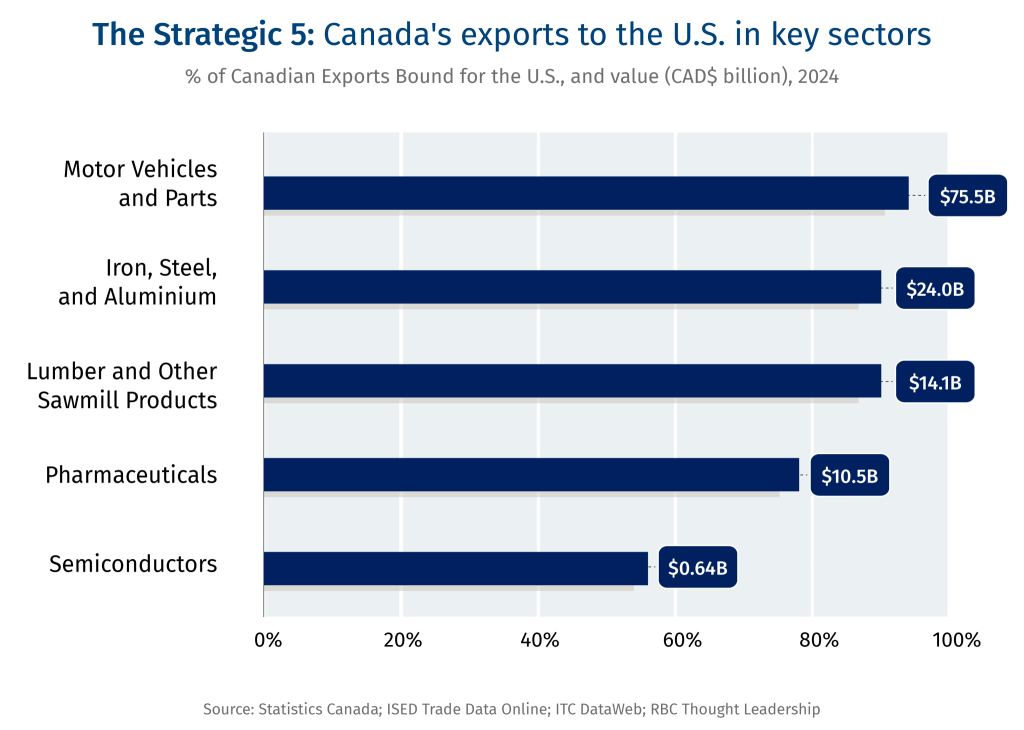
U.S. President Donald Trump believes autos, steel and aluminum, lumber, pharmaceuticals and semiconductors are the five strategic sectors that will drive American industrial revival. His overarching plans involves cutting imports (and trade deficits) and onshoring domestic production in each of the sectors and related industries. That’s emerging as a challenge for some of the U.S.’s top sector suppliers, including Canada.
These five domestic sectors rely heavily on shipments south of the border and are of strategic importance to Canada.

U.S. tariffs on the Strategic 5 will likely hurt Canada’s economic prospects and could trigger layoffs and flight of capital in sectors that are vital for our energy and national security.

Here’s a look at the importance of each of these sectors to the Canadian economy:

Automotive

  • Exposure to the U.S. market: $75.6 billion in exports (2024)

  • Total U.S. market: Sales of new vehicles in the U.S. reached 15.8 million units in 2024—second only to China’s 31.3 million.1

  • Global market: Just over 88.2 million vehicles2 are estimated to have rolled off assembly lines worldwide last year.

  • Canada’s role: Domestic auto- and part- makers’ market share in North American auto manufacturing has fallen over time, with Mexico gaining ground. However, 92% of Canadian auto exports are still shipped south of the border.

  • Tariff status: For CUSMA-compliant vehicles, the 25% tariffs are currently in force and apply to the value of non-US content.

  • Canada’s response: Ottawa’s countermeasures focus on 25% tariffs on all U.S. auto parts not compliant with CUSMA. The federal government and Ontario are also easing tariffs for U.S. auto parts for companies that remain committed to the Canadian auto supply chain.

  • The fallout: Stellantis and General Motors temporarily laid off staff in Ontario assembly plants.

  • What’s next: The Trump administration is mulling a potential pause on auto tariffs—primarily to give carmakers more time to onshore supply chains.

Aluminum, steel and iron

  • Exposure to the U.S. market: 91% of Canada’s aluminum and 89% of its steel exports were shipped to the U.S.

  • Total U.S. market: The U.S. consumed 93 million tonnes of steel in 2024—with Canada supplying 6.4 million metric tonnes of the total.3

  • Global market: Global aluminum demand has steadily increased over the past decade, driven mostly by growth in Chinese demand and from sectors like construction and transport.

  • The U.S. has had an average trade deficit in aluminum with Canada of about US$7 billion annually over the past five years.4

  • Canada’s role: We are a top foreign supplier of aluminum and steel to the U.S., ahead of China and Mexico.

  • Tariff status: The 25% U.S. tariffs on aluminum and steel imports from Canada are triggered by American efforts to bolster its domestic industry. The first Trump administration had also imposed tariffs on Canadian aluminum for 14 months, lifting them after USMCA was ratified in 2019.

  • The fallout: Hundreds of workers in the aluminum and steel industry have already been laid off since the latest tariffs came into effect.6 Ottawa is taking several measures to support Canadian workers and businesses.

  • What’s next: Commerce Secretary Howard Lutnick says reprieves on steel and aluminum tariffs are unlikely. With aluminum featuring on the USGS Critical Minerals list and a new probe on U.S. critical mineral imports underway, Canada’s aluminum industry may need to gear up for further uncertainty.

Lumber and other sawmill products

  • Exposure to the U.S. market: $14.1 billion in exports—90% of Canada’s total lumber exports.

  • Total U.S. market: The U.S.’s trade deficit against Canada in softwood lumber averaged US$5.8 billion annually over the past decade, according to the U.S. International Trade Commission.

  • Global market: The US$788 billion global wood products market is expected to nearly double in value by 2033. We wrote recently on how Canada can capture a greater share of the global opportunity.

  • Canada’s role: Canada’s domestic consumption of softwood lumber has fallen 11% from a decade ago. Domestic demand, which has generally followed housing starts, reached a 23-year low in 2023.

  • Tariff status: Under the Biden Administration, the U.S. raised duties charged on Canadian softwood lumber imports to 14.5% in August 2024. These tariff rates remain in place with additional hikes on the horizon.

  • The fallout: The lumber industry is already facing regulatory headwinds that have forced closures of sawmills in B.C.

  • What’s next: U.S. tariffs on softwood lumber imports are set to increase to 34.5% and could come into effect in the fall.

Pharmaceuticals

  • Exposure to the U.S. market: $10.6 billion in exports.7

  • Total U.S. market: Prescription drug sales in the U.S. were $716 billion in 20228 , or about 2.8% of U.S. GDP.

  • Between 2019 and 2024, the U.S. has run an annual $1.2 billion trade deficit in pharmaceuticals with Canada, according to U.S. International Trade Commission data.

  • Global market: Pharma R&D spending is expected to top US$200 billion9 this year.

  • Canada’s role: The U.S. is Canada’s primary pharmaceutical export market, accounting for 78% of its pharma exports in 2024. Japan, the next largest export market, received 5% ($720 million) of exports, followed by China, at 2% of exports, or $276 million. The Canadian pharma industry employed 35,367 workers in 2024.

  • Tariff status: Originally exempt from the April 2 reciprocal tariffs, the White House has now officially launched an investigation into the national security impacts of pharmaceutical imports.

  • The fallout: Industry is warning of a spike in costs of drugs and even shortages of key medicines.10

  • What’s next: Major tariffs on pharma could be on the horizon.

Semiconductors

  • Exposure to the U.S. market: $637 million, or 56% of Canadian semiconductor exports, in 2024.11

  • The U.S. runs a trade surplus in semiconductors with Canada, reporting a surplus of $764 million in 2024.

  • Global market: Global semiconductor sales were estimated at $627 billion in 2024.12

  • Total U.S. market: Companies involved in the semiconductor ecosystem plan to invest nearly US$450-billion in more than 90 new manufacturing projects in the U.S. across 28 states, according to an industry association.13

  • Canada’s role: Canada is emerging as AI hub with its clean and cheap electricity seen as a competitive edge. A recent RBC Thought Leadership report, published before the trade turmoil, estimated Canada could attract nearly $100 billion across 20-30 data centres. Disruptions to the nascent chip supply chain could disrupt that potential capital flow.

  • Tariff status: The U.S. announced probe into chip and electronics imports in early April, paving the way for new tariffs.

  • The fallout: Several tech companies have seen their stocks drop.

  • What’s next: Some reports suggest Trump will announce new tariff rates on imported semiconductors next week, with flexibility for certain companies. Secretary Lutnick said it would likely come in “a month or two.”15

Vivan Sorab is Senior Manager, Clean Technology.


Disclaimer

rbc_tl_disclaimer

To check the pulse on the agri-food industry, RBC’s Thought Leadership team met with farmers from across Canada last week—from pork producers in Manitoba to members of the fruit and vegetable industry gathered in Montreal for their annual tradeshow.

What’s clear is that the industry is highly motivated to keep up the momentum; last year, Canadian agri-food export value was a record $106 billion. And all eyes are on commodity prices, U.S. farm policy and, of course, the impact of U.S. President Donald Trump’s tariffs.

What we heard:

  • Many farmers are adopting a keep calm, carry-on approach. Farmers are accustomed to volatility, the result of managing through unexpected weather conditions, shifting commodity prices and equipment breakdowns. Trump’s tariffs are seen by many as just another disruption. That’s led some to ride out the resulting pricing swings (i.e. canola). Others, including grain and oilseed producers, are considering shifting the crops in rotation for the 2025 planting season, a direct result of China responding to Canada’s EV tariffs with their own on peas and canola products.

  • Meeting the moment for Canadian-made items. The increased demand for made-in-Canada products is leading to American-made spoilage at grocery stores. The movement adds to the push for expanding Canada’s greenhouse sector acreage and diversity of products to close our production-consumption gap for fruits and vegetables.

  • Canadian food producers and processors are working to bulletproof their USMCA-compliancy. Companies are preparing for scrutiny at the border to prove they are USMCA compliant and adhering to the rules within, such as country-of-origin. Just 0.1% of all agri-food products traded in 2024 were likely not USMCA-compliant but more than a third of Canada’s agri-food exports, albeit compliant, did not trade under the agreement.

  • Trade diversification is underway. It is, however, yet to be seen if Canadian retailors and traders are going to be able to get like-for-like on quality and price for food products. Exporters and retailors are exploring where else they can source the products they need for their customers. But will Canadians want to buy a Moroccan orange over one from Florida?

  • Can our ports handle our growth and diversification ambitions? Canada’s turn-around times are slower than key agri-food competitors, including the U.S., Australia and Brazil. The potential influx of product flow at Canada’s ports due to rising costs of moving goods through the U.S. may cause greater congestion and bottlenecks if Canada is not preparing for growth.

3 things to watch:

  • Emergency U.S. farm support and its impact on Canadian farmers’ competitiveness. The USDA’s Emergency Commodity Assistance Program (ECAP) is a $10 billion one-time economic assistance payment program to help farmers mitigate the impacts of increased input costs and falling commodity prices. For example, U.S. farmers can receive upwards of $77.66 per acre of oats and roughly $30 per acre for soybeans and wheat.

  • Cuts to U.S. agriculture research programs and services. The dismantling of USAID and cuts to its funding to 19 land-grant university-based innovation labs across 17 states, as well as proposed cuts to NOAA’s climate research can undermine agriculture innovation and risk halting essential services such as weather monitoring.

  • Risk of rising costs and disruptions for supply chains running through U.S. ports from New Orleans to Philadelphia. Trump’s April 9th executive order, Restoring America’s Maritime Dominance, instructs U.S. Trade Representatives to proceed with a proposal that includes a $1M docking fee at US ports for any ship that is part of a fleet that includes Chinese-built or Chinese-flagged vessels. On top of cost risk, U.S. custom services could slow down these just-in-time supply chains needed to bring Peruvian blueberries to Canada.

Lisa Ashton is Agricultural Policy Lead