RBC Thought Leadership Archives for amandeepsingh

Email Message

rbc_share_email_message

In this week’s edition: How the U.S-U.K. deal sets the stage for the rest of the world; reading the signals from Washington’s trade talks with China; what Trump is looking for when making a deal.

Noteworthy

By John Stackhouse

It was a good week for Canada—and a better one for Britain. Next week may be another story.

  • Mark Carney got some fresh daylight on trade talks and managed to reposition negotiations with Donald Trump as much more than trade. Get ready for a new North American Security Partnership.

  • Neither leader threw Mexico’s Claudia Sheinbaum under the bus, but plenty of Mexican business leaders are for her lack of progress with Trump.

  • Britain secured its own deal with Trump that was neither big nor beautiful but is suddenly the template that the U.S. will use with other countries. Not unlike pattern bargaining in the auto sector.

  • The U.K.-U.S. arrangement is essentially a sectoral handshake. More British Land Rovers for more American cheeseburgers. (Cars for cows, in other words.) The end of the beginning, as Carney might say. But for Britain, it’s a competitive advantage against the EU, especially when layered on top of its much more comprehensive agreement.

  • British PM Keir Starmer is hoping to stop in Ottawa mid-June, enroute to the G7 in Alberta, and that’s where reality may bite. Canada-U.K. trade talks have been rocky for a few years, largely because of the farm lobby in both countries. Any bets on Carney serving British cheese, or Starmer sipping Canadian milk?

  • That leaves the two allies to focus on defence procurement. Carney has been keen to buy more BAE supplies, as an example, but he also has to keep options open with Trump, who wants Canada (and Britain) to buy more American planes and weapons systems.

  • Mark June 16-17 on the calendar for a G7 that will be as epic as the mountains around Kananaskis. Expect it to be largely about security (with a NATO summit to follow in late June), and whether the post-war pillars of democracy will trade with each other as they remilitarize or cut their own deals. Whether Canada and Britain stick together, or get wedged by the U.S., will be one signal.

Need to know

18: Countries that the U.S. is reportedly prioritizing for trade talks.

79: Percentage of Americans who think the USMCA is good for the U.S. economy, according to The Chicago Council on Global Affairs latest survey. That includes 90% of Democrats and 72% of Republicans surveyed.

2,500: U.S. products, including olive oil and wine, that will have reduced tariffs under the U.S.-U.K. Economic Prosperity Deal.

100,000: British vehicles for which U.S. tariffs are lowered to 10% as part of the deal. Rolls-Royce engines will be able to enter tariff free.

The view from Washington

For a good hint as to how the U.S. is approaching its trade talks with China, consider who’s at the table this weekend in Geneva.

In: Treasury Secretary Scott Bessent and U.S. Trade Representative Jamieson Greer

Out: Commerce Secretary Howard Lutnick and White House Trade and Manufacturing Counselor Peter Navarro

Sending Bessent and Greer, perceived as more moderate, indicates that practicality and progress will take precedence over maximalist political ideology. Of note: Bessent landed the leading role after delivering the long sought-after U.S.-Ukraine natural resources deal for the White House.

A few agenda items for this weekend—and future meetings:

  • Defence: Beijing’s use of export controls on rare earth and critical minerals target vulnerabilities in U.S. supply chains for semiconductors, fighter jets, submarines, and other products vital for the US defence industrial base.

  • Advanced tech: Chinese practices and commercial policies, specifically joint-venture requirements for operating in China and disclosure requirements for attaining licenses, force foreign firms to transfer sensitive IP as a requisite for accessing the Chinese market.

  • Shipping: U.S. shipbuilders and maritime workers have complained about Chinese practices that depress shipbuilding costs, specifically low-wage or forced labour and excess supply of shipbuilding inputs spurred by government subsidies.

What does Trump really want?

There will be a few recurring themes as Trump races to close 90 deals in 90 days:

  • Reducing tariffs and non-tariff barriers: Trump views the trade posture of many countries as unfair to the U.S. and seeks to reduce tariff and non-tariff barriers wherever possible.

  • Purchase agreements: Driven by the need to reduce the trade deficit, deals will likely include purchase agreements—take, for instance, China’s purchase commitment to buy US$200 billion worth of goods (which, ultimately, China did not meet).

  • Exemptions: Trump and his team are facing significant pressure to exempt goods considered strategic, necessary, or ones where the U.S. is heavily reliant on imports—from baby powder to car seats. Expect more exemptions blunting the impact of trade actions.

  • Investment commitments: Although inward investment will reduce the U.S. net international investment position, Trump likes to see foreign countries and companies invest in the U.S., akin to Taiwan Semiconductor Manufacturing Company’s Arizona semiconductor fabrication facility.

  • Exchange-rate corrections: Market observers have been bearish about a ‘Mar-a-Lago Accord’ to correct the trade deficit through coordinated weaking of the U.S. dollar. Not only would such cross-border coordination be unlikely, the biggest target for currency manipulation, China, is highly unlikely to appreciate the renminbi.

Email Message

rbc_share_email_message

Issue #12

➔ On Carney’s to-do list: carbon capture project and transition bonds
➔ Warren Buffett’s successor built the company’s energy empire
➔ Struggling cleantech stars, and a Climate Fiction Prize

Hot takes

➔ Canada’s EV policies are hurting farmers. Ottawa’s tariffs on Chinese EVs has had the “unintended consequence” of Beijing slapping levies on Canadian canola, lobsters, and peas, etc., agriculture members of the Canadian Federation of Independent Businesses’ wrote in a letter to three federal ministers. Canada’s $62 billion in total subsidies to EV firms has also not triggered an investment boom as those firms have paused their plans in Canada, CFIB pointed out. The group wants some of those funds redirected to small businesses.

➔ Did green power trigger Iberian blackouts? Some suggest “non-controllable” resources—i.e. solar and wind that can’t be controlled or scheduled on demand—were to blame. But it’s not like fossil-fuels grids can’t break down (Italy in 2003, anyone?). But intermittent generation poses a different set of problems. While authorities remain in the dark for now, the Spanish grid operator REE had warned in February that reliance on renewables could lead to grid instability, especially if the government closes its nuclear power plants by 2027. Could the simple answer be: keep the energy mix diversified?

➔ Warren Buffett’s successor is an energy empire builder. The Oracle of Omaha handpicked Edmontonian Greg Abel to succeed him at Berkshire Hathaway. As chairman of the company’s energy and other non-insurance businesses, Abel runs a conglomerate that’s among the largest operators of wind and solar energy in the U.S., electric utilities, and natural gas pipelines. While Berkshire Hathaway runs some of the dirtiest coal plants in the U.S.—coal power now accounts for only 22% of Berkshire’s power generation, compared to 71% in 2005.

➔ Ontario is fast-tracking critical minerals development. The new proposed rules will boost investment in local supply chains and reducing reliance on foreign imports would drive job creation, stimulate economic growth, and position Ontario as a leader in the green economy. The new rules also give the province wide powers to shield its strategic assets against “hostile foreign actors and regimes.” The move comes as the U.S. is moving at a frenzied pace to lock in critical minerals, including a deal with Ukraine, fast-tracking of supply chains, and plans to accelerate deep-sea mining.

CLIMATE POLICY

Carney’s Climate Corridors

Economy and trade tops the new federal government’s priority list, but there’s room to push through climate policies—especially “energy corridors,” that are seen as the path to an investment-led growth spurt.

Here are some high-profile climate files on the new government’s to-do list:

➔ Building a major carbon capture project in Alberta. How can a CCS project backed by Pathways Alliance—a consortium of oilsands firms looking to build a carbon capture project—get off the ground? Prime Minister Mark Carney said last week in Edmonton he is keen to see it built.

➔ Strengthening industrial carbon policy. The Conservatives wanted to repeal the federal carbon pricing for industrial emissions, but it stays for now. Last year, Myha Truong-Regan, RBC Climate Action Institute’s Head of Climate Research, co-wrote on how industrial carbon markets can be central to Canada’s efforts to accelerate energy transition.

➔ A Carbon Border Adjustment Mechanism. It was in the Liberal platform and could be Canada’s version of a climate-tariff—if it proceeds—helping climate-compliant Canadian companies compete with high-emitting foreign rivals. The Europeans may nod approvingly, but a Canadian CBAM will likely face strong pushback—and retaliation—from the U.S. and other trade partners.

➔ Carbon Contracts for Difference (CCfD). Carney is supportive of expanding the initiative, but the federal government is already dealing with a laundry list of other financial priorities.

➔ Climate risk disclosure. The idea was floated on the platform just as Canada’s provincial securities commissions suspended their work on making climate-related disclosure mandatory for public companies.

➔ Transition bonds. The Liberal platform suggests financing clean industrial and agriculture projects with $10 billion in bonds issued annually.

➔ Oil and Gas Emissions Cap. There might be tweaks after Carney suggested he would work with industry and provinces “on specific ways to get those reductions, as opposed to … having preset caps or preset restrictions on preset timelines.”

➔ For more, read John Stackhouse’s blog on Carney’s energy options in the age of Trump.

Climate treads, tech & science

➔ Li-Cycle is running out of road. The Toronto-based company’s woes persist with its CEO departing after a takeover deal with Swiss miner Glencore collapsed.

➔ Quebec won’t save Lion Electric Co. No white knight yet for the electric bus and truck maker that has struggled amid delays in subsidy and incentive programs in Canada and the U.S., and supply-chain disruptions.

➔ Nova Scotia-based Planetary Technologies won US$1 million XPrize. The ocean-based CO2 removal tech firm beat 1,300 rivals to win a slice of the US$100-million competition backed by Elon Musk. Mati Carbon, an American-Indian-African company, won the $50-million grand prize for its carbon-removal tech.

➔ Listen to Mike Kelland of Planetary Technologies, Jim Mann of UNDO who won US$5 million from XPrize, Dr. David Keith, a pioneering climate scientist and co-founder of Carbon Engineering, speak to RBC Disruptors hosts John Stackhouse and Sonia Sennik, on the innovation race to scale carbon removal technologies.

➔ Nunavut welcome solar power. A tiny community on the Arctic Circle will be able to ditch diesel generators—in the summers at least—once 2,500 solar panels are switched on soon. 

➔ Climate Fiction Prize. Boy meets girl amid climate change, and love in the time of wildfires are among the themes explored in the five novels short-listed in the first-ever £10,000 Climate Fiction Prize . The winner will be picked at the Hay Festival later this month in Wales.

The Institute In Action

➔ Many of Canada’s top Indigenous leaders came together for the RBC-sponsored 8th annual First Nations Major Projects Coalition conference, to see how we can better mobilize capital for Indigenous-partnered projects. RBC also published a report, Building Together , and hosted a private roundtable with 30 Indigenous leaders and CEO’s around building Canada’s economic resilience, and the central role of Indigenous partnerships and inclusion.

➔ Grow Ontario Food Summit brought together agriculture and food leaders from across Ontario. RBC Thought Leadership’s John Stackhouse and Lisa Ashton delivered the keynote address on Canada-U.S. trade relations and its impacts on agriculture and food, and highlighted key insights from our latest research report, Food First. On the team’s reading list: Just Earth: How a Fairer World Will Save the Planet by Tony Juniper; What’s Left: Three Paths Through the Planetary Crisis, by Malcolm Harris; Values: Building a Better World for All, by Mark Carney; Abundance, by Ezra Klein and Derek Thompson.

Curated by Yadullah Hussain, Managing Editor, RBC Climate Action Institute.

Climate Crunch would not be possible without John StackhouseMyha Truong-ReganSarah PendrithFarhad PanahovLisa AshtonShaz MerwatVivan SorabCaprice Biasoni and Frances Dawson.

Have a comment, commendation, or umm, criticism? Write to me here (yadullahhussain@rbc.com)

Climate Crunch Newsletter

Email Message

rbc_share_email_message

Carbon offsets aren’t enough. To truly tackle climate change, we need a global industry dedicated to pulling carbon out of the air and at massive scale. Join hosts John and Sonia inside the innovation race to scale carbon removal technologies, featuring insights from leading voices in the field.

They speak with Dr. David Keith, a pioneering climate scientist and founder of Carbon Engineering, who unpacks the technological, policy, and economic hurdles to direct air capture and other approaches. You’ll also hear from two recent XPRIZE Carbon Removal winners, Mike Kelland of Planetary Technologies and Jim Mann of UNDO about how their startups are using ocean alkalinity and enhanced rock weathering to permanently sequester CO₂, while also delivering benefits to farmers and marine ecosystems.

Together, they explore whether the world can build a scalable, measurable, and credible carbon removal industry – one capable of drawing down billions of tons of CO₂ annually.

John Stackhouse: [00:00:00] Hi, it’s John here.

Sonia Sennik: and I’m Sonia Sennik, CEO at Creative Destruction Lab.

John Stackhouse: This is Disruptors x CDL: The Innovation Era.

Sonia, we just marked Earth Day last month, and while a lot of things happened that day, one of the coolest was some XPRIZE announcements, particularly the winners of its a hundred million dollar carbon removal competition, which included a lot of Canadians.

Sonia Sennik: Yes, John. We were at the New York Stock Exchange with the XPRIZE team to celebrate Earth Day and the top three winners, we had Mati Carbon that came through our CDL program from India that won the $50 million prize Vaulted Deep from the United States that won the $8 million prize and UNDO, that does their work between the UK and Canada who won the $5 million prize.

XPRIZE also gave out a few other prizes for most promising companies in certain areas, and the X [00:01:00] Factor Ocean Prize went to Canadian company Planetary from Nova Scotia. It was a really exciting day to see people rally around the carbon removal market, and the most interesting part about the event was listening to all the different ways that people from everywhere around the world are tackling this problem. There’s not one way to approach it, which leaves the world ripe for innovation in this space.

John Stackhouse: Well, let’s zoom in on Mati Carbon, the Indian company for a moment, the one that won $50 million for carbon removal through enhanced rock weathering.

Sonia Sennik: So an essential part of Mati Carbon strategy is working with small farmers in India.

As you know, in India, there’s a lot of farmland and mad carbon has seized the opportunity of helping farmers advance their technologies while also giving them the benefit of contributing to carbon removal. They also have best in class monitoring, reporting, and verification. You’ve heard it in any MBA class.

If you can measure it, you can manage it. Their tech stack [00:02:00] includes novel methods for soil monitoring that are coupled with sophisticated mass balance and calculations that can determine the bulk CO2 removal.

John Stackhouse: So zooming back, all of these innovators are trying to solve the same problem, and that is carbon in our atmosphere, carbon dioxide.

There’s not only the enormous amounts that we as humanity are putting into the atmosphere every year. There’s legacy carbon and that goes back centuries. That’s still sitting up there. And these combine to warm our planet. Lots of exploration going on, as we’ve discussed over many episodes about new technologies that can reduce the amount of carbon that results from all of our activities.

But there’s also some impressive innovation, which we’re going to hear about in this episode, to get that carbon outta the atmosphere and back into the earth and also back into the ocean.

Sonia Sennik: Absolutely. John, we need 10 billion tons of carbon [00:03:00] dioxide removal by 2050 to stay on track for that one and a half degree Celsius warming measurement just for reference, one mature tree absorbs 22 kilograms of carbon dioxide a year, meaning you’d need 45 mature trees to offset the average Canadian’s annual emissions. But when the problem seems as big as this is John, we can sometimes get a bit overwhelmed and think, well, how do we even approach it?

And if we haven’t figured it out by now, will we figure it out? Through our partnership at Creative Destruction Lab with XPRIZE, we’ve seen incredible advancements in these startups.

John Stackhouse: Well, let’s get at it. We’re gonna hear from a couple of really impressive innovators who have been recognized by the XPRIZE, and we’ll also hear from the world renowned scientist, David Keith, a Canadian who’s been a pioneer in carbon removal for decades.

But before we jump into those conversations, Sonia. Give our listeners a sense of the XPRIZE and why it matters to innovators.

Sonia Sennik: [00:04:00] XPRIZE is truly a one of a kind organization. Their mission is to inspire and empower humanity to achieve breakthroughs that accelerate an abundant and equitable future for all.

They do this through setting up incentive prizes. For example, the XPRIZE Carbon Removal Prize was a hundred million dollars incentive prize. The idea is that they were inspiring scientists and technologists from all around the world to start focusing their efforts. On carbon removal technologies. What that sparked was thousands of teams applying to be part of XPRIZE and a rapid increase in acceleration in the technological development of these startups.

Vaulted Deep, a Houston-based startup that was part of our XPRIZE CDL Carbon Removal stream, removed over 2000 metric tons of carbon dioxide in just four months of operations. So one can just imagine with the right level of support. Investment and their recent win from XPRIZE. A company like Vaulted Deep along with so many others can [00:05:00] scale over the next five to 10 years, removing carbon from our atmosphere at a pace we just haven’t seen before.

John Stackhouse: Our first guest is Dr. David Keith, a professor at the University of Chicago, and one of the world’s leading experts on climate science and energy technologies. Over his career, David has helped pioneer research on carbon removal and solar geoengineering. He founded Carbon Engineering, a company advancing direct air capture technology, and he brings a rare perspective that bridges science policy and entrepreneurship.

David, welcome to the podcast.

David Keith: Hi there. Pleasure to be on.

Let’s start a bit with your own background. Tell us how you got into this field and what attracted you first to CDR or carbon dioxide removal for those who are still catching up with the acronym.

David Keith: I started working on climate in the late eighties. I started working on some climate engineering technologies back then, simply because nobody else was doing it. So I’ve done a big range of things from climate modeling to observations to early work on some carbon removal [00:06:00] technologies. I wrote one of the very first papers on biomass with capture. I did work on direct air capture and then later founded a company. I’m not involved anymore. I’ve done a big range of things, but it’s only one piece of what I’ve done on climate.

John Stackhouse: We have a pretty clear idea of the climate challenge right now, particularly carbon in the atmosphere and the amount that we’re adding to the atmosphere was the problem as clear to you then, as it is now?

David Keith: Yeah, I mean, so the very first report that went to the most powerful leader in the world to President Johnson had already the data from the global carbon data that showed the increase of CO2 in the atmosphere. And they were able to do the rough balance and knew the OS ocean and doubt. So the problem has been well understood for a long time, way before I got involved.

John Stackhouse: Maybe take us into some of the technology. For those not familiar with how carbon removal works, give us a 101 if you can.

David Keith: Maybe the single most important thing to know about climate change is that the amount of warming is [00:07:00] proportional to the cumulative emissions over overall industrial time. And that means that even if we brought emissions to Zero tomorrow, that wouldn’t stop climate change.

It would just stop it getting warmer, but it would still be warm. That would still be all the climate damages would be there. And if we want to reduce the warming, if at any time people want to make the planet cooler than it is when they make that decision. You have to either pull carbon out of the atmosphere or do sunlight reflection, so engineering or a combination of them.

But cutting emissions will not make the planet cooler. It just stops making the planet warmer. I think if, if the fundamental risk is caused by moving fossil carbon from these deep geological reservoirs where the carbon’s been isolated through the atmosphere for. Billions or hundreds of millions of years.

Then the only kind of carbon removal that can really reduce the long run risk is to put it back in some kind of stable [00:08:00] reservoir. Growing trees may be great. There’s lots of places where there’s deforestation and we need trees, but trees are inherently unstable. They want to be oxidized to burn to rot, and so they don’t remove carbon in the long run.

They don’t undo the consequences of. Burning a ton of fossil fuels and putting in the atmosphere. No amount of tree planting cannot undo that. What can undo it is either capturing carbon dioxide, the gas, and shoving it deep underground and there. Different ways you could capture it or reacting carbon dioxide with base minerals.

Carbon dioxide is a weak acid and people know that acid plus bases makes salts, so that’s what naturally wants to happen anyway. If humans all went away. The carbon dioxide would eventually be removed by reacting with these basic minerals that are all over the earth’s surface. And so perhaps the most important long runways to remove carbon are to accelerate those [00:09:00] reactions with the base minerals that have a endpoint of the CO2 being in stable salts.

Sonia Sennik: How has the conversation changed over time with people’s openness to seeing carbon removal as a commercially viable approach to business and a good use of their science and technology research?

David Keith: Well, it was kind of a nothing burger forever than the Paris agreement that had this stretch goal of keeping temperatures to 1.5 came about, and then modelers who model kind of economic system and, and carbon.

These models happened to have biomass with capture and at one kind of carbon removal technology, and they suddenly found in these economic models that that was the only way to meet 1.5. To be clear, these models didn’t have sunlight reflection in them. And it’s not obvious that 1.5 is a sensible, it’s not a scientific target.

So in some ways I think that was a kind of [00:10:00] intellectual nonsense, but it meant that carbon removal suddenly became very visible. And then there were lots of people, including lots of people promoting their businesses, putting out the idea that scientists say we have to have five gigatons or something of carbon removal by 2050.

And that’s kind of ignited a whole bunch of sudden attention to carbon removal in a, in a boom. To be clear, scientists don’t say that if you are thoughtful about it. And there’s certainly been a kind of boom of hype cycle though, driven by that argument.

John Stackhouse: You refer to 1.5 as intellectual nonsense. Give us a bit more sense of where you’re coming from with that comment.

David Keith: Well, I mean, the, um, there isn’t a scientific threshold or argument that 1.5 is the right target. 1.5 was a, I think, very clever. Political choice by the environmental community to make a really near term target that was unattainable so there wouldn’t be attained so that you could build political pressure for more action, [00:11:00] which is happening.

Last year, the world spent $2 trillion, just a little under 2% of the entire world’s economy on clean energy, which is a stunning success, and we’re likely going to see emissions peak in the next couple years, which is also a stunning success. But that doesn’t mean that it was kind of intellectually or in terms of environmental policy, the right place to aim that is that 1.5 is the right place to aim.

It was a a political negotiating tool, I think a really effective one.

Sonia Sennik: And so with that type of investment, David, do you believe where you’re sitting now that we will be able to tackle the challenge ahead of us?

David Keith: I think that with current technologies, no fundamental unobtainium, no giant innovation, it’s possible to do carbon removal in a way that really does reverse a bunch of the emissions that humans made.

So I think you could say that if you started kind of mid-century. That [00:12:00] there’s strong lines of evidence that say that for something like 1% of GDP spend over a hundred years, over another century, you could remove something like a thousand gigatons of carbon, which would be, for example, that’s about just under half of cumulative emissions to date.

To be clear, I don’t think it makes sense to do large scale carbon removal until emissions have been reduced, at least down to half or or a third of their current levels.

John Stackhouse: When you think about the next few years, how do you think about the business model for these sorts of technologies? Are we on the right course that they’re going to come to fruition and scale, or do we need more significant changes to both the business model and the broader economics? Of intervention?

David Keith: Uh, no. I don’t think we’re on the right course. Most of the carbon removal efforts now are driven by voluntary [00:13:00] offset markets that I think nobody I know believes are long-term scalable things. Uh, well, there’s a lot of hype and excitement. It’s important to say how small it is. So there’s this sort of 2 trillion total and clean energy.

The total money moving in carbon removal is a few billion, so really tiny compared to that. And I think that the system’s been driven by money coming in from venture capitalists and by companies with these voluntary offsets that I think are not a scalable way to do this. And it’s resulted in a whole network of startups.

But a lot of those startups are missing some of the things that are probably most scalable and low environmental impact, like large scale open ocean Alkalinity, for example. So I think the way I view it is, at least what’s happening now is there’s. People are actually beginning to try some of these things out.

At least much more research is happening than than five years ago. I think there isn’t a clear pathway forward for how to do it in the end. You want a public good like this to get paid for. It needs to get paid for as a public good. That’s the only way that I know we’ve ever done it.

John Stackhouse: You’ve [00:14:00] mentioned Open Ocean Alkalinity.

I would just wonder if you could give a quick explanation.

David Keith: If you take a glass of pure water and put it on a counter, it will gradually become acidic. Where did the acid come from? The acid is actually from carbon dioxide in the air that makes carbon acid a weak acid in water just kind of automatically, and you would pull the CO2 outta the air.

If you put some antacid in it, which is a magnesium hydroxide, you would neutralize that acid and pull more CO2 outta the air. And then you have a little machine for capturing CO2 outta the atmosphere by adding this an acid to your little glass of water. That works stably at the global scale. Most of the carbon that in the kind of act of biosphere is locked up in the ocean as carbon.

That is in this acid-based salt balance, which is stably there basically forever. And so if we can add more of these bases to the ocean in a way that doesn’t have local environmental harm, then we would both reduce ocean acidification, which is say damaging coral reefs and also permanently remove CO2 from the atmosphere.

And the big question is. [00:15:00] How to make the bases that will dissolve at scale and how to distribute them in the ocean. And for both of those things, the idea is old. The first big paper on this topic is published in 1995, but there really hasn’t been much work. We’re now doing a bunch of work at U Chicago.

We’re working closely with Frontier, the Stripe funded big, big actor in the, in the carbon removal space. But there isn’t really a kind of coherent research effort.

John Stackhouse: Talk to us a bit about the tech challenges right now with respect to direct air capture. What are the biggest hurdles on the technology side in your mind in the coming years?

David Keith: Well, direct capture is just one of many of these technologies. It’s one I was personally involved in. I think the big question is to actually shake out these technologies and understand what they cost on the sort of plant two or three. It’s very hard to know what things cost until you actually go build them in the real world.

Sonia Sennik: You mention in that description that offset credits won’t [00:16:00] last much longer. That is probably peaking the interest of some of our listeners. Would you mind just double clicking on that?

David Keith: Well, I mean, I don’t think in the end companies do big things voluntarily. I, I don’t think they really should. It’s not the appropriate place for companies to do stuff.

I mean, if you look at the giant successes that we’ve had in environmental policy, clean air, removing lead ozone, I mean, the world has made enormous progress. Air is much cleaner around the world than it was when I was a kid. And water is too. Those are fundamentally done by government setting rules. And then companies competing under those rules.

If you think about the giant success of the sulfur cap and trade market, that helped to be the core of the US Clean Air Act that’s been copied around the world. The idea was government shouldn’t be deciding the exact technology. Government should say there’s a total amount of emissions you can have and you guys can trade inside that.

But that’s very different from a tradable offset credit, which there’s [00:17:00] no cap to, and not really a, a way to verify and, and you don’t really, there’s not a reason for companies to do it at scale. They can do a little bit for the kind of PR reason, but in the long run, you’re not gonna spend the kind of 1% of GDP for PR.

John Stackhouse: I. The broader infrastructure projects, carbon infrastructure projects, and I suppose this is what IRA in the US was, uh, starting to move towards. Are you seeing success on that level at scale

David Keith: Really too early to say. I mean, I’m totally thrilled that the plant from Carbon engineering technology that I, you know, I founded the company, is now actually just coming into operation at a half million tons a year.

Absolutely fantastic and I’m super thrilled that Oxy was involved and that IRA and these US government antennas that helped to make it happen. But that’s the first plant. It’s a half million, 10 a year plant. You don’t really find out how these things really work and begin to really understand and plant costs until you built quite a few plants, which, you know, Oxy is keen to do and I’m thrilled they are.

And [00:18:00] of course, not just one line of technology. I. Obviously was one of the innovators, so I’m excited about it. But there’s a bunch of other lines in direct air capture and then there’s all these other methods, and I don’t think right now that the kind of innovation ecosystem for carbon removal is effective and focused as I’d like to see.

John Stackhouse: And with respect to the Oxy project, this is Occidental Petroleum in Texas. For those who aren’t familiar with it, it involves enhanced oil recovery, EOR, which some people have concerns about, ultimately leading to the production, not leading to reduction of fossil fuels. How do you think through some of that complexity?

David Keith: I have no problem with EOR. Obviously it really gets under the skin of, of some of the environmental community. But if you actually have a third party regulator that ensures that the amount of carbon that went down the hole is the same amount of carbon that went up in oil, then you really have made a hydrocarbon fuel, which you can use for things that are hard to decarbonize, which has no net emissions.

And I think that’s a [00:19:00] useful thing to have.

Sonia Sennik: I’m curious to know if you could make one policy change that you think would really. Improve outcomes or set the rate incentives for advancing carbon removal, what would that be?

David Keith: So in Canada there’s a bunch of subcritical little academic research and then startups.

What there isn’t is a serious effort to build some kind of public, private entity that really has research muscle in the public interest, say for some of these emerging technologies like Enhanced Rock and Ocean Alkalinity, and then to have. Canada government actually makes some choices about where it’s gonna push.

I mean, I’m a super proud Canadian. I love it. But of course, sadly we had to sell Carbon Engineering to a US company. I think Canada is awesome, but Canada is only 40 million people. And the idea that you’re just gonna kind of let every flower bloom and have [00:20:00] all this stuff spread around the country with no center and no focus is not a recipe for winning. We need a much larger system-wide approach, is what you’re saying. Yeah. And for some of these things like. The innovation model that works so well in pharma and it where there is an underlying giant commercial market for the products. If you could make the market work is just different here.

Sonia Sennik: Yes.

David Keith: And I think a different kind of innovation answer is needed. I definitely don’t think this should all be on my academics or government labs. It, it needs private innovation. It, and I think the point is maybe there’s some ideas that come totally outta left field. But I think the big message here is that most of the carbon removal technology we’re talking about are all have been known for decades.

The issue isn’t to advance some totally new thing. The issue is to actually take some of the things we understand and march them down the playing field by. Building them at scale, doing industrial engineering, and crucially coupling that with [00:21:00] studying their environmental impacts. ’cause the issue isn’t just can we capture carbon?

It’s can we capture carbon at a low enough cost with a low enough environmental footprint? And I. Putting those together, I think requires a kind of government action and a government action is able to not pick one winner, but say We’re gonna look at this set of things, not the usual. Very sad, I love Canada, but usual way that Canada has been kind of funding research in this, which is this.

Everybody gets a little money sprinkled everywhere and sprinkled regionally, which is just not a way to win.

John Stackhouse: You are suggesting we need more state capital, but this can’t be done by government. It needs to draw in private capital at scale, not vc, but big long-term capital, and then pick some industrial projects to just build at scale.

Demonstrate with engineering, it’s not the first project, it’s the second and third to see if you can cut the cost by 50% with each iteration.

David Keith: So one thing we don’t have is applied environmental science. [00:22:00] One part, I think. Is and should be. A government function is really high quality applied environmental science that can help answer the public interest question, which is what is the environmental impact of some of these technologies?

And that doesn’t work well by just a few university grants. It requires something that looks more like a coordinated center. That focuses on this really applied work, working closely with technology developers and that that’s something it wouldn’t cost that much and that Canada could do on some of these technologies easily.

There. There’s a little bit where Canada’s kind of started a nice road on some of the ocean liny things. There’s a project on the east coast, I. Dalhousie center that has some of that, but you could do that for one or two things in a serious way. That’d be an executable thing the government could do.

Sonia Sennik: David, thank you so much. This was fantastic.

Our next guest is Mike Kelland, CEO and co-founder of Planetary Technologies, a Canadian company and CDL alumni, pioneering a unique approach to carbon removal using ocean alkalinity [00:23:00] enhancement. Planetary was recently awarded the $1 million XFactor prize from XPRIZE, carbon removal for its breakthrough work, turning the ocean into a natural carbon sink.

Mike Kelland: So the process is very simple. We actually call it seawater restoration. The easiest way to think about it is that the ocean essentially breathes and everything we put up in the air and everything that’s in the atmosphere gets breathed in by the ocean. So when we put extra CO2 up in the air. The ocean’s gonna breathe all of that.

CO2 in the CO2 concentration of the ocean builds up really quickly and CO2, when it gets into water, turns into an acid. So you can kind of think of the ocean as having like a little bit of heartburn. What we do is we work inside coastal plants to reverse some of that acidification. We source a natural mineral and we introduce that into the water that flows through power plants and wastewater plants.

And as we do that, we’re gonna reduce that acidity in the water that’s flowing through. And what that does is it allows the ocean in the local region to essentially [00:24:00] breathe again. We’ve been doing this for about five years now, and the question when we started was always, can you measure this? Are you able to really see that reduction of acidity, that reduction of CO2 in the ocean as you’re moving forward?

And over the last year, we actually showed that we were able to directly measure using some really cool sensors. We were able to show this direct measurement of the reduction of CO2 in the surface ocean as a result of our activity. It’s a really exciting space right now, and what we’re seeing more and more is these papers coming out saying, okay, we were worried about biological impacts.

Now actually we’re seeing biological benefits. So we’re seeing things like an increase in the biomass of commercially important fisheries. We’re seeing increase things like shell growth and things like that for a variety of shellfish and important commercial fisheries. So there are those co-benefits, but fundamentally what we see is that this is a very high quality, very scalable, ultimately very cheap way [00:25:00] of permanently, hundreds of thousands of years timeframe, removing carbon dioxide from the atmosphere.

And I think that that’s gonna be the funding model. The bottom line is we need. A huge amount of carbon removal. So we need enough carbon removal to get to the net in net zero, but we also need to be removing legacy emissions. None of this carbon removal stuff matters if we don’t reduce our emissions, but it’s too late to solely rely on that.

30 years ago, we had done that and really sort of bent the curve downwards on emissions. We wouldn’t need to do a lot of carbon removal, but at this point it’s too late. We’re gonna lose so much if we don’t have carbon removal. As part of the portfolio of solutions, carbon removal has to become a $1.2 trillion market by 2050 if we want to hit our climate goals.

That means that 10 years from now, we need to be scaling pretty rapidly on these technologies. There’s gonna have to be a lot of public funding that goes into this. We kind of have to think of this. I. Like waste management, how do we pick up the garbage that [00:26:00] we’ve put into the atmosphere as quickly and easily as we possibly can and as cheaply as we possibly can?

And that that really is how the market has to eventually develop in terms of our technology. In particular, study after study, after study is showing that. This form of carbon removal is the most scalable and is the cheapest. The ocean is is really a global commons, and we have to be super, super cautious with the work that we do there.

But once it starts to scale, it’s gonna go really quickly because it is such a scalable and low cost solution.

Sonia Sennik: Our next guest is Jim Mann, founder and CEO of UNDO, a carbon removal company that aims to capture huge amounts of carbon dioxide from our atmosphere. UNDO was recently awarded $5 million for its enhanced rock weathering solution via XPRIZE.

Jim Mann: So we did a lot of our early experimentation in the UK where we spread basal, which is a silicon mineral onto agricultural land.

And then as we’ve started to scale up, [00:27:00] we focused much more on Canada where we are using a manual called tonite and applying that to active football. And farmers get a benefit from the application of minerals. It has a pH stabilizing and raising effect, which is good for farmers and it also absorbs CO2 from the atmosphere.

Enhanced truck weathering is an open system, and in these complex systems it becomes very difficult to get accurate measurements. So we’ve had to develop and actually file patents on new techniques that enable us to empirically measure the removal of CO2 within that complex field environment. We give the minerals to farmers for free.

They get all the benefits on their agricultural land, and as we generate carbon credits, we sell those carbon credits at a very reasonable price, which we sell to companies, the likes of British Airways, Microsoft, McLaren Racing, Barclays Bank, big organizations that have a footprint that they can’t avoid, and so they are [00:28:00] contributing to the removal of the emissions they’ve put out there.

But the whole of that rural ecosystem is benefiting right along supply chain. In terms of the markets, I think this is very different to historic markets where we were looking more reduced emissions. Typically, this is your removal technology. We’re actually taking the CO2 back outta the atmosphere. I.

And, um, as long as you can measure that and quantify that, I think we’ll build much more robust and credible markets. We’re starting to see regulators move towards that space and we can be confident about strong market going forward. I think in terms of the agricultural community, well, that’s why we structured the business model the way we have.

They often see a benefit very, very quickly, both in terms of the pH and soil health, but also depending on what crop they’re growing, they can see a benefit in. The quality of that crop, and this is a measured quality standard that they get more money for as early as the first year of the application.

So we don’t have to persuade them that the carbon [00:29:00] markets are a good thing. So it’s a very easy conversation for us. Our vision is to build an organization that can have a real impact on the world. We want to remove a billion tons of CO2 from the atmosphere. And this accelerates our progress towards that goal.

Sonia Sennik: John, what an incredible set of conversations that showcased how many different people are taking so many different approaches to solving the problem of carbon removal.

John Stackhouse: It’s remarkable to hear the extent and depth of science that’s going on, not just here in Canada, but around the world in this.

Different kind of space race to figure out how we can capture all that carbon in the atmosphere and get it back into the ground and maybe into the ocean. It’s ambitious and we can’t assume that these technologies are gonna work or work at scale in the timeframe that we need. So we also have to focus on our own activities, whether it’s as consumers, citizens, or companies in pretty much all [00:30:00] sectors to get emissions down.

I was also intrigued by some of the comments about measurement, which remains a bit of the Achilles heel. To be frank in all of this, there’s certainly lots of MRV systems emerging, but nothing in place now that people are willing to bet billions of dollars on to accelerate and scale what we need. So it’s not just the science, it’s the business models and the measurement reporting and verification models that all have to come together and have to come together pretty soon.

Sonia Sennik: What an interesting marketplace. The carbon offset market is a multi-sided marketplace to ultimately support carbon removal, while big companies build large data centers and energy facilities to support our increasingly digital world. It’s an interesting way to take responsibility to counteract the carbon that’s being released into the atmosphere.

And companies like Shopify, Disney, Stripe have all voluntarily committed to purchase carbon offset credits to get this marketplace going. I [00:31:00] cannot wait to see where we’re at five years from now.

John Stackhouse: Five years in the span of the earth is just a blink of the eye, but it’s also a reasonable timeframe for us all to set for ourselves in terms of marking material progress in the science and technology that we’re doing, and.

Who knows. Maybe we’ll be back at that time and hear from these innovators to see what they’ve done. This has been Disruptors, an RBC podcast. I’m John Stackhouse.

Sonia Sennik: And I’m Sonia Sennik.

John Stackhouse: Talk to you soon.

Email Message

rbc_share_email_message

Welcome back to Trade Zone. Week Two. (Still in beta—so let us know what you think.)

Notebook

By John Stackhouse

It’s a big week ahead for shifts, in government and the private sector. Mark Carney is off to the White House on Tuesday, to reset relations. Expect some healthy talk about military spending, and how Canada can do more sophisticated investments for North American security. More drones. More cybersecurity. Can we make those future exports, too?

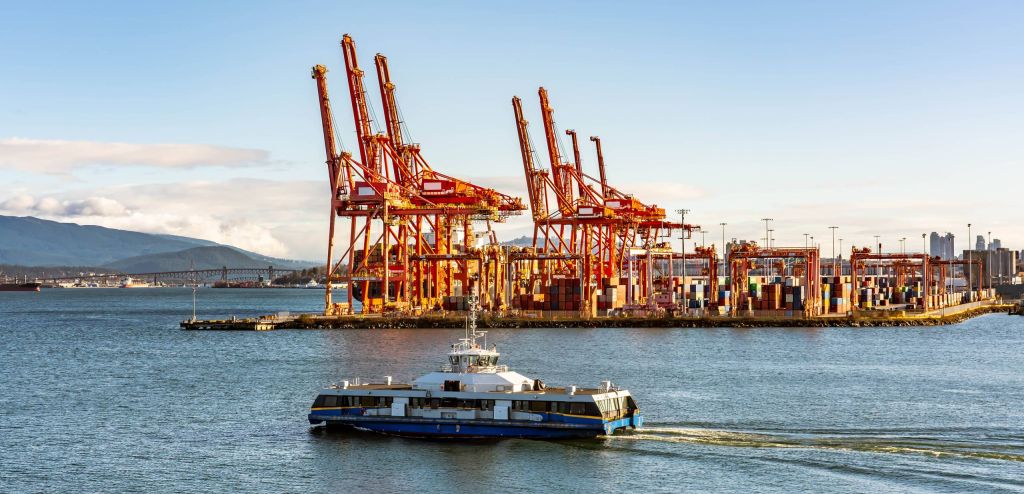
I spent part of the week in Vancouver—Canada’s gateway to the Asia-Pacific. The port looked to be thriving, thanks to massive shifts underway in supply chains:

  • Chinese and Vietnamese producers are moving goods and inputs to Canada, as they game the Trump tariffs.

  • A major B.C. agrifood producer told me his U.S. buyer has re-rerouted his company’s output to Singapore, and directed a New Zealand supplier to feed the U.S.

  • A major clothing producer explained how they’re making tariff-factored pricing decisions this week on Back-to-School products that will hit North American stores in August.

  • Another global firm told me they’ve been quietly reducing Chinese productions (now just 20%) but it’s a race to stay ahead of Trump negotiations with other markets like India.

Expect these shifts to continue.

The week in numbers

$900M is how much Apple says Trump’s tariffs could cost the tech giant this quarter. CEO Tim Cook said most iPhones for the U.S. market will now be made in India, not China.

60% fewer cargo ships travelled between China and the U.S. in April, according to one estimate. Softening demand has prompted some companies to use smaller ships.

750 jobs lost at the General Motors plant in Oshawa, Ont. The automaker has responded to tariffs by moving from three shifts to two.

Need to know

  • Before Carney goes to Washington, we have thoughts on what an economic and security deal with the U.S. could include:

    • Energy and economic security: Negotiators will want to address longstanding irritants (digital services tax, softwood-lumber dispute, strengthening rules of origin). Expect movement and strategies on gas, nuclear and critical minerals.

    • Defense and Arctic security: Everything from the plan to meet 2% defence spending targets, to NORAD modernization, dual-use accounting, social and economic infrastructure investments in the North, including an Arctic port, and expanding shipbuilding/icebreaker commitments.

    • Border security: Although Canada has made investments in border security, further collaboration, especially on money laundering, immigration and drug/arms trafficking, will likely come up during negotiations.

The big question

This week, we turned to Sue Noble, RBC’s Vice President Automotive Finance National Office, for the answer.

Q: What’s your main takeaway from Trump’s auto-tariff relief announcement this week?
SN: While the relief may be seen as a positive move, there continues to be a high degree of uncertainty that makes it challenging for manufacturers and the industry. North American production varies by manufacturer and even by brand. Without certainty on a long-term strategy for tariffs, we expect car manufacturers to take a cautious approach.

Final word

“The American people–the businesses here in America, the consumers here in America–are better off with a more stable relationship with your biggest customer. It makes sense for Americans, and it makes sense for the people who have put the President into the White House, to have affordable products to buy, to have relationships where companies invest in their communities. Companies don’t invest when there’s instability.”

Kirsten Hillman, Canadian Ambassador to the United States (The Atlantic on the Future event in Washington, April 29th)

Email Message

rbc_share_email_message

All eyes were on the election this week—but something else remarkable was taking place, too. Many of the country’s top Indigenous leaders came to Toronto, and Bay Street, to see how we can better mobilize capital for Indigenous-partnered projects. These conversations are central to the questions we’re grappling with as a country–including reimagining our relationship with our closest ally and building up our economic strength.

The two outcomes—of the election and economic reconciliation—are closely related. Indeed, our economy and trade won’t grow and diversify if we don’t ensure a lot more Indigenous ownership. That was the focus of the annual First Nations Major Projects Coalition Conference, in Toronto, which drew nearly 2,000 people to explore the future of Indigenous capital—and how it is a source of strength for Canada in an increasingly competitive world.

Here’s some of what we took away, and questions we need to keep asking:

  • From critical minerals to hydro and natural gas, Canada’s ability to build resource projects at speed and scale will come down to 3Cs: capital, capacity and consent. Can we develop those together?

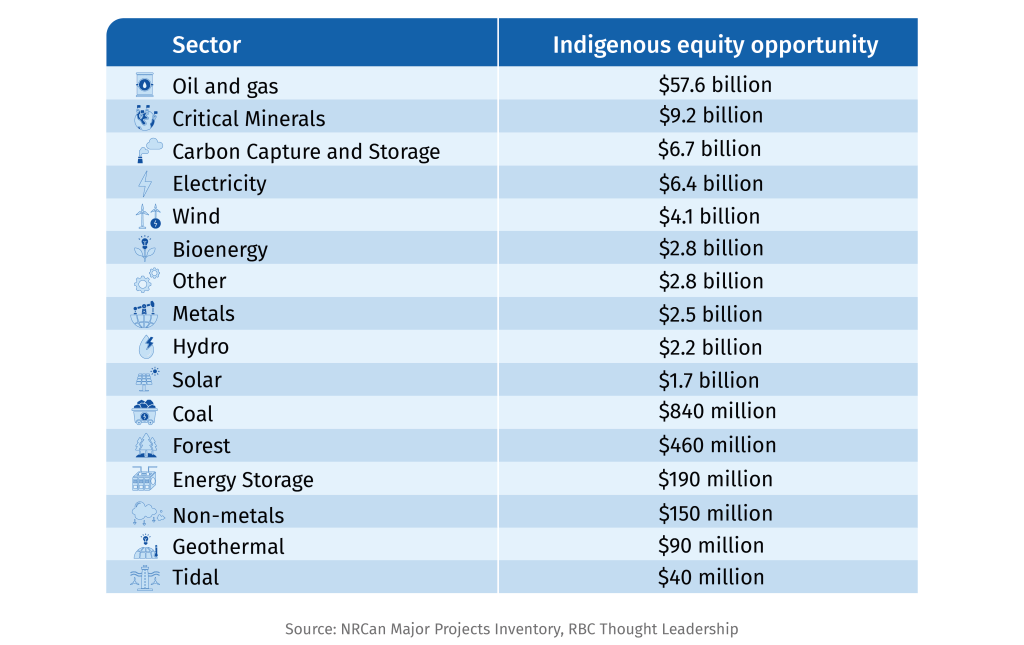
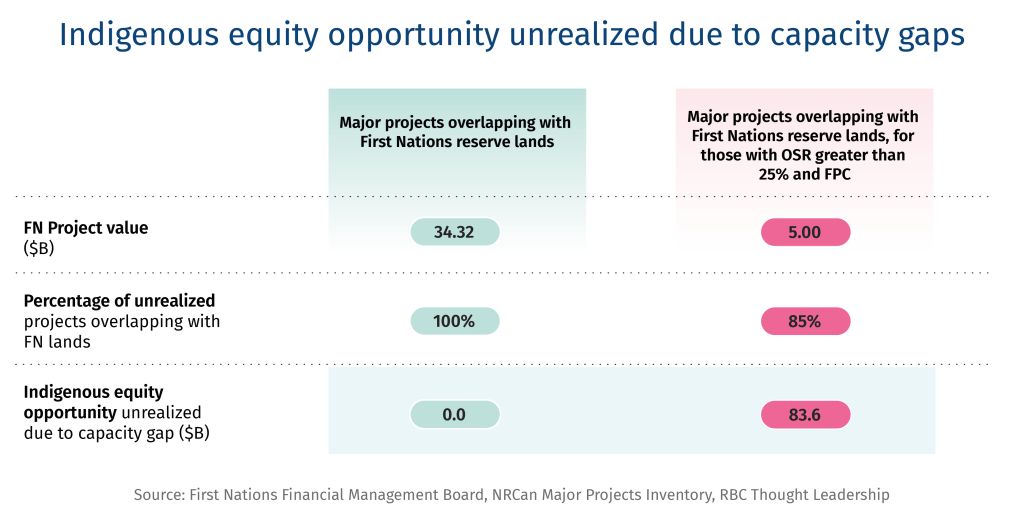
  • Our research shows that there is an Indigenous equity opportunity of close to $100 billion over the next decade. How can governments mobilize concessional tools to attract more private capital?

  • Government loan guarantees are in fashion, with the Carney government committing to double its program to $10 billion and Ontario using the conference to announce a tripling of its program to $3 billion. How can those programs be better coordinated and implemented at a faster click?

  • Equity may not be the most appropriate tool for some communities. Can we also promote new debt instruments, royalty models and procurement agreements for communities to invest in?

  • Indigenous capital is being built up quickly–from project participation to trust settlements. What structures can help us pool this capital–and reinvest returns back into Indigenous Nations?

  • Most communities need a lot more capacity—from finance to engineering and legal—to make these deals and projects work. In fact, our research suggests close to 85% of these projects may be unrealized without plugging the capacity gap. How can we invest more in scholarships, training, work placements and exchanges—for companies as well as communities?

  • Capital and capacity are useless without consent, which is more than a one-off vote, or signature. Can we develop accepted, non-binding approaches to consent that allow both parties to develop and deepen their trust and confidence?

  • Voice is a critical part of consent. How do we know if each partner feels they have a respected voice?

  • Time is of the essence. Can companies and communities create clearer approaches to timelines, and time expectations, for projects?

  • Uncertainty is the enemy of investment. Can co-developed models for Indigenous consent become one of Canada’s advantages with global investors?

  • Indigenous priorities are not diversity issues—they undergird the Constitution of our country and how our country is constituted. How can we more boldly state that Indigenous partnerships are a foundational part of operating in Canada?

  • Small businesses and projects tend to be excluded from these major project conversations, and yet are crucial for the success of our economy. How should we better raise capital for small business collectives and projects?

John Stackhouse, Senior Vice-President, Office of the CEO, RBC

Varun Srivatsan, Director, Policy and Strategic Engagement

Read More:

Building Together: How Indigenous economic reconciliation can fuel Canada’s resurgence

Email Message

rbc_share_email_message

The super-charging revolution is here.

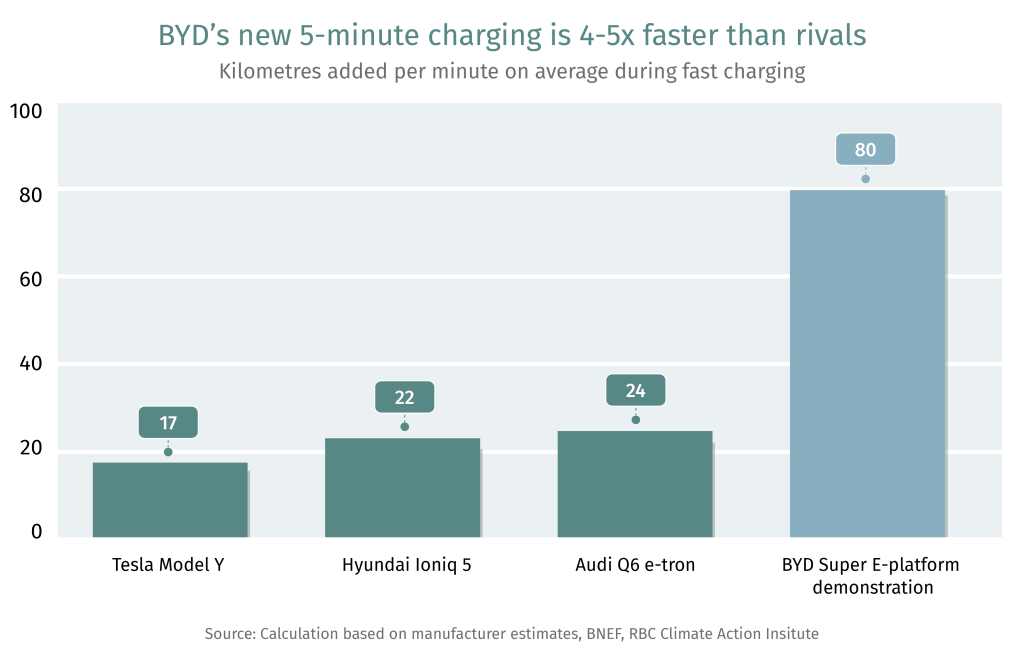
Recent demonstrations by Chinese electric vehicle (EV) giants BYD and CATL of batteries that can be charged in five minutes—up to five times faster than rivals—and with a range of 520 kilometres, has made many sit up and take notice.

Could this super-charging revolution be the game changer that will pave the way for greater EV adoption in Canada, and elsewhere? Equally crucial: can electricity grids handle the increased load demand if this technology were to reach Canadian shores in the next few years?

A game changer?

A five-minute charge has the potential to address two of the top three concerns that consumers often cite when considering EVs: range anxiety and access to public charging stations (the third being affordability). According to a JD Power survey in 2024, 68% of Canadians were anxious about running out of EV battery while on the road.The inconvenience of waiting in line at public charging stations and long charge times—on average 30 minutes—have been an issue for up to half of EV drivers, a survey shows. A five-minute charge battery with extended range tackles these issues head on and entice would-be owners to finally take the EV plunge.

BYD's new 5-minute charging is 4-5x faster than rivals

The 3 big grid challenges facing 5-minute charging

Here’s how the quick-charge revolution could impact Canada’s grids:It’s a massive draw on the grid: 

  • It’s a massive draw on the grid: Unlike traditional charging that’s spread over hours, fast charging delivers high-intensity power spike that grids might not be designed to handle. An average EV with a battery of 80 kWh would require around 1,000 kW power to fully charge in minutes. That’s enough electricity to power 800 homes for the same amount time, and adds significant load to the grid, especially if charging takes place during peak hours.

  • Grid expansion is already facing once-in-a-generation challenge. Expanding local distribution networks, modernizing local substations, and improving interconnections to accommodate localized demand surges are the biggest challenges posed by super-charging. Distribution lines will also need to grow by another 55,000-85,000 kilometres by 2030—requiring a build-out that’s 30%-100% faster than the current pace.

  • Future-proofing would require a decentralized grid: Fast, localized spikes in demand require more than just expansion of centralized grid assets. They also require the addition of decentralized distributed energy resources (DERs), such as micro-grids and residential solar, and greater grid digitization. Infrastructure modernization can also transform DERs into virtual power plants during periods of peak demand.

Farhad Panahov is an economist with the RBC Climate Action Institute.

Email Message

rbc_share_email_message

The first 100 days for any new government are filled with a flurry of activity. For Mark Carney’s Liberal minority government that will include tabling a budget, trade talks with the Trump administration and hosting the G7 in June. Zoom out, and the key priorities come into focus. Here are five that RBC Thought Leadership has been keeping a close eye on and ones we believe will have Parliament’s full attention in the coming months—and beyond.

Securing an economic and security pact with the U.S.

During upcoming negotiations with the U.S., expect Canada to minimize concessions until duty-free trade is secured and the current trade agreement is honoured. The U.S., meanwhile, will seek to have a wide-ranging discussion that includes border and security concerns.

At a minimum, the agreement could include:

  • Energy and economic security: Negotiators will want to address longstanding irritants, including the digital services tax, attempting a resolution to the softwood-lumber dispute, and strengthening rules of origin. Expect movement and strategies on gas, nuclear and critical minerals, which dovetails nicely with the upcoming G7 meeting.

  • Defense and Arctic security: This includes everything from the plan to meet 2% defence spending targets, to NORAD modernization, dual-use accounting, social and economic infrastructure investments in the North, including an Arctic port, and expanding shipbuilding/icebreaker commitments.

  • Border security: Although Canada has made investments in border security, further collaboration, especially on money laundering, immigration and drug/arms trafficking, will likely come up during negotiations.

This won’t be the first attempt at a comprehensive continental economic and security agreement. In the mid-2000s, the Security and Prosperity Partnership of North America included the private sector in an effort to enhance continental competitiveness. While it didn’t come to fruition, many ideas—cooperation on infectious diseases, emergency management, and border security—have persisted. This attempt has a better chance of succeeding if it is targeted and time bound.

Address the housing affordability crisis

In The Great Rebuild, we outlined seven ways to address Canada’s housing shortage and affordability. When comparing the recommendations in our April 2024 report to the Liberal election platform, a number of key items line up:

  • Focus on prefab: Factory-built dwellings can be more time and cost-efficient. And the government has promised $25 billion in financing to prefab home builders—as well as a focus on sustainable building materials.

  • Cut red tape: Project approval timelines in Canada, as we noted, “can be among the lengthiest in the world.” Simplifying national building codes, streamlining regulations and leveraging standardized designs are all part of the Liberal platform.

  • Build affordable options: Government has pledged $10 billion worth of low-cost financing for lower- to middle-income Canadians.

None of this gets done, however, without shovels in the ground. We estimate that more than 500,000 additional construction workers are needed to build the homes required between now and 2030. The Liberal’s plan to incentivize companies to hire recent grads and offer apprentice programs is a start. But finding half-a-million construction workers requires more. Options include prioritizing construction skills of new immigrants, growing the enrollment of trade schools, and enticing older construction workers from retiring.

The affordability crisis has made it an imperative that Canada acts promptly and with more streamlined coordination across all levels of government.

Build Energy Corridors

Building out major energy infrastructure enhances economic resilience through the diversification of key commodity exports. In 2024, Canada’s major resource exports (minerals, metals and fuel) were among Canada’s largest, generating $175 billion in aggregate net exports–almost offsetting Canada’s global trade deficits across all other goods categories.

Success in taking projects from blueprint to buildout depends on policies directed at mobilizing private capital and reducing red tape. To date, existing key Liberal policies around Bill C-69, Bill C-48, the Oil and Gas Emissions Cap have not been conducive to large-scale investment. An ‘amended’ approach with a greater focus on pragmatism could establish a climate more conducive to attracting capital. Key focal points for Ottawa include:

  • Industrial carbon pricing: ‘Axe the tax’ likely shifts the burden of carbon pricing onto large industrial producers. A rising industrial carbon price likely remains, presenting competitiveness challenges relative to U.S. leadership focused on deregulation. A 50% carbon capture investment tax credit derisks capital costs, but projects need revenue certainty. To date, The Pathways Alliance, a consortium of Canada’s largest oil sands producers, has been unsuccessful in negotiating carbon credit guarantees from Ottawa. Of course, this comes at a time of competing fiscal priorities. Ottawa is already on the hook for 50% of CCUS capital costs (conservatively estimated between $60-75 billion). Contract for differences for Pathways would likely require tens of billions in additional funding (10-12 million tonnes at $125-150/t for 10 years).

  • Regulation/Permitting: Regulatory delays has led to drawn out timelines, leading to cost overruns and/or cancellation of key projects, as capital is ultimately redistributed to shareholders rather than towards growth-enabling infrastructure. Policies such as ‘One Project, One Review’ and declaring more energy projects as in the ‘National Interest’ are helpful. This is likely most beneficial to natural gas pipelines and LNG infrastructure, given the greater political alignment on the LNG file (B.C. and Ottawa).

  • Provincial trade barriers: East-west trade through greater use of interties yield a more resilient, flexible and efficient grid system—increasingly important given rising load growth over the next 25 years (up to 3x) and the need for cheap power for industry/manufacturing.

Safeguard federal finances

As RBC Economics wrote recently, a lot will be demanded of fiscal policy. A slowing economy and the risk of a greater trade-linked recession imply fiscal supports of varying degrees. And structural challenges loom–weak productivity, strained affordability, an aging population, export concentration, and shifting geopolitics could trigger more federal spending. Monetary policy has its limits—and won’t be able to address the areas of greatest need. As a result, Ottawa will need to keep the following in mind to keep the federal debt burden sustainable:

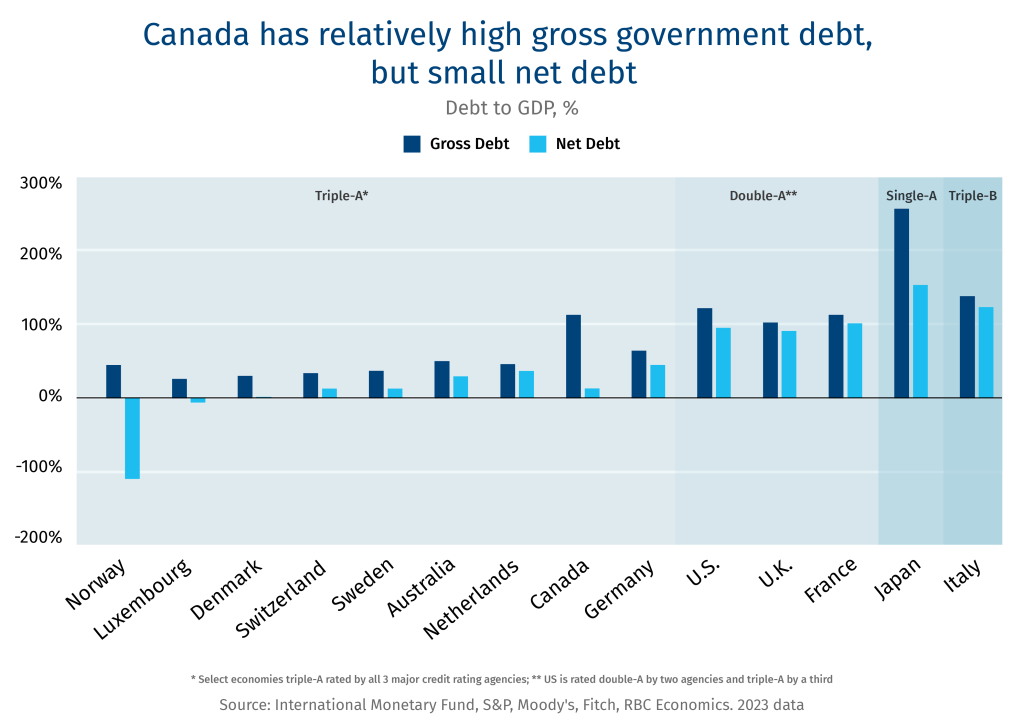
  • It’s not unlimited, but Canada has some fiscal space. Canada’s gross debt burden (debt-to-GDP-ratio) is high, but its net debt burden is the lowest in the G7.

  • Supporting the economy through a potential recession is expected by markets, and unlikely to raise red flags if sized and targeted appropriately. COVID-style supports that ‘bridge’ the economy is not the correct playbook in a trade shock where the economy, structurally, could look quite different in the aftermath.

  • Growth-positive investment is key to keeping federal debt levels sustainable. The more that each dollar of public spending delivers greater growth dividends, the more the federal debt burden will remain in check, even with higher spending.

    • Rebalance social and business investment measures. Canadians have benefited in recent years from an expansion in federal government spending on often broad-based social programs without absorbing the costs. Now, the feds have a new laundry list of to-dos, including kick-starting business investment. Non-spending measures like removing red tape help, but fiscal space will be needed for spending, as well.

    • Make social and other ‘must-do’ spending more growth positive. Major investment needs across the economy beg the question of sufficient capital and labour resources to achieve timely results without crowding out. Public spending in essential areas like housing, defence, and healthcare can promote efficiencies, innovation, and other growth drivers to ensure the economy can grow in multiple areas.

Transform AI into a productivity engine

Canada is rich in AI talent but short on the three things that can translate that talent into prosperity: modern computing infrastructure, large-scale deployment, and robust domestic demand. Only 26% of Canadian firms report having implemented AI—eight points below the global average—and the country continues to slip in AI-readiness indexes.​ With labour-force growth flattening and labour costs rising, closing the AI adoption gap is Canada’s most direct route to higher productivity, greater economic efficiency, and continued competitiveness.

Ottawa could pursue a three-pronged approach—acting simultaneously as facilitator, champion, and early adopter—to transform AI from a fragmented set of R&D bets into a nationwide productivity engine.

  • Facilitator: Treat compute capacity as critical infrastructure, marshalling patient capital, procurement guarantees, and partnerships with global players to facilitate access to GPU clusters.​​ Further, government might consider targeted tax credits and grants favouring projects that embed Canadian IP and high-value jobs at home.

  • Champion: Ministers could become visible ambassadors for domestic AI successes, weaving them into every productivity, healthcare and defence announcement.​​ Demand-side tools—procurement quotas that reserve, say, 25–30% of relevant contracts for qualified AI firms, first-reference-customer letters, accelerated tax refunds for AI pilots—have the potential to generate the domestic demand needed to keep promising startups from fleeing south.

  • Early Adopter: In the immediate term, the government could equip frontline analysts, auditors and service agents with secure co-pilots to yield productivity gains and build AI fluency. Longer term, the government could work to re-engineer programs around models that learn across departmental silos, enabled by a U.S. Department of Defense-style fast-lane tech funding agreement, a shared sovereign large language model stack, and performance incentives for senior bureaucrats who are able to effectuate AI solutions.​​

Contributors:

Cynthia Leach, Assistant Chief Economist, RBC

Varun Srivatsan, Director, Policy and Strategic Engagement

Shaz Merwat, Energy Policy Lead, RBC Climate Action Institute

Reid McKay, Director, Technology Policy Lead

Email Message

rbc_share_email_message

Welcome to the first edition of Trade Zone. It’s in beta testing, so please let us know what you think. Every week, our team at RBC Thought Leadership will share what we’re hearing from governments, learning from clients and seeing in our research. We’ll also give you a cheat sheet on the week, to help you keep pace.

Notebook

By John Stackhouse

  • If Mark Carney’s Liberals are re-elected on Monday, as polls are suggesting, expect them to shift their focus South and West by the end of the week.

  • To the South, expect a crew of newbies across the bureaucracy, as well as PMO, with experience in the U.S. A call with Donald Trump will top the To-Do list, with more than trade on their minds. “Comprehensive partnership” is one term floating about—to cover border security, immigration, Arctic and defence issues. And yes, trade, even if USMCA may not be long for this world in its current form.

  • Expect to see a highly structured and strategic Canadian approach, colliding with a highly unstructured American approach. The Trump team had been telling Canadians to avoid working groups or outside “experts.” Side note: American negotiators are driving the Mexicans batty with demands for them to control tomato shipments before any deal is reached.

  • The Trump team has been losing in the courts and in the markets. If that continues, Canada may opt for the long game, following Napoleon’s advice: “Never interrupt your enemy when he is making a mistake.”

  • To the West, watch for outreach from Ottawa to Alberta and Saskatchewan, with a focus on diversification of exports. That will take a lot more than a new pipeline (which may be on the table), as our resource-driven provinces think about new markets. Dow Chemical’s bombshell decision this week to delay its Alberta plant is just the latest trade warning. (I wrote about the Big Pivot on our Trade Hub, drawing on conversations this week at Public Policy Forum’s annual Growth Summit, which is a bit of an Olympics for policy wonks.)

  • Caught between the Potomac and the Prairies is Ontario, but not for long. Doug Ford stole the show at the PPF Summit with a feisty attack on Trump (“Sometimes the cheese seems to fall off the cracker with that guy”) and a passionate shout-out for Progressive Conservatives. Ford seems ready to play bad cop to the next PM’s good cop. He may be warming up for another role, too.

  • Get ready to hear more about Europe as a new (old) partner, for military procurement, AI standards and, yes, trade. Those conversations will grow ahead of the G7 summit in Alberta in June, when we’re expecting LNG and data centres to be front and centre. If the Trump team shows up—no bets there—they’ll want to ensure some alignment on LNG finance, especially for emerging markets, and access to gas-powered electricity for their hyperscalers (the latest euphemism for Big Tech).

  • Climate is creeping back into the trade conversation, although not in North America. Europe is marching ahead with border carbon adjustments (just don’t call them carbon tariffs). Japan is also advancing an emissions trading system, including cross-border carbon credits and a surcharge on fossil fuels (just don’t call it a carbon tax). Expect Canada’s Balkanized industrial carbon pricing system to be part of a likely discussion on the G7 sidelines. (Did we tell you that will be in Alberta?)

  • Indigenous equity will be an important aspect of any new trade relations, much more so than even five years ago. We’re part of the big First Nations Major Projects Coalition conference in Toronto next week and expecting both Ford and possibly a new PM to use the platform to advance their investment strategies. (No investment, no trade.) Other key guests will include Indigenous leaders from Alaska and Utah— hello, Republicans—who may offer a different kind of cross-border relationship.

Need to know

➔ We estimate that $125 billion is at risk for Canada as U.S President Donald Trump eyes 5 strategic sectors.

➔ In a bid to escape tariffs and wait out the trade war, third-party sellers on Amazon and Walmart are shifting stock from China to tariff-free warehouses in Canada.

➔ Not a single new IPO was completed on the TSX or Venture Exchange in Q1. Trade war is scaring companies south of the border, too.

➔ Coke vs. Pepsi: Who’s the winner of the ultimate taste, er, tariff test?

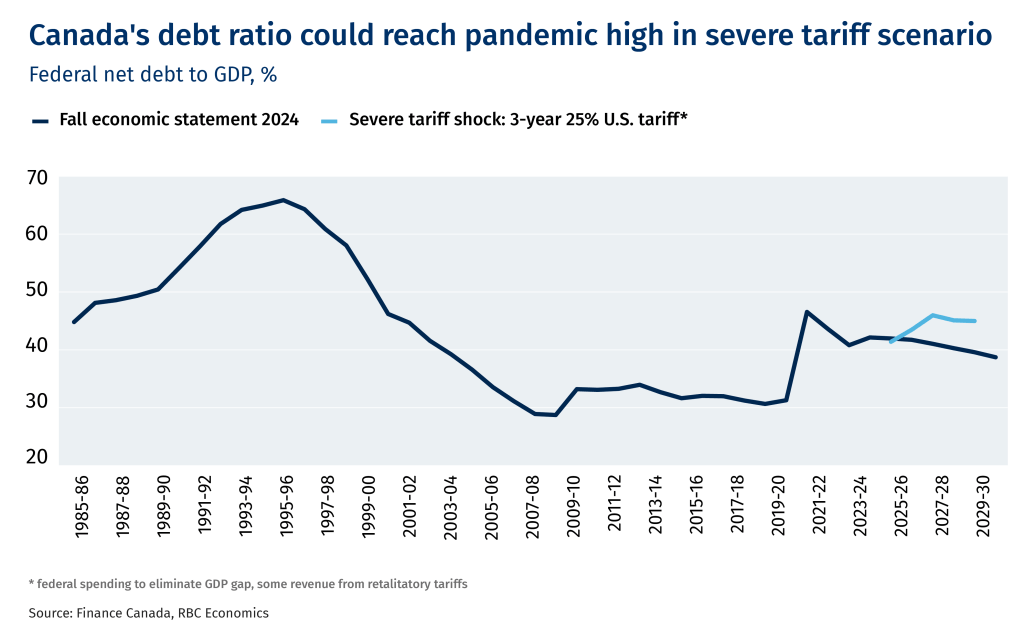
➔ Where we see Canada’s debt ratio headed over the next three years in a worst-case tariff

Final Word(s)

“All eyes right now are on the Arctic. We are the gateway to the Northwest passage and at the forefront of the conversation when we’re talking about security and sovereignty.”
—P.J. Akeeagok, Premier of Nunavut

“People are not going to race to build manufacturing in America. With the policy volatility, you actually undermine the very goal you’re trying to achieve.”
—Ken Griffin, Citadel CEO

“The renegotiation of the USMCA included a very forward-looking digital-trade agreement. I think there is meaningful opportunity there, and that’s in contrast with what you have seen in some other countries, where data sovereignty has been more restrictive.”
—David Schwimmer, CEO of the London Stock Exchange

“The EU is working on a targeted and measured response in case we cannot reach a deal [with the U.S.] rapidly.”
—Eric Lombard, France’s Minister of Economy, Finance and Industry

Email Message

rbc_share_email_message

The Public Policy Forum is one of Canada’s premier think tanks, and hosts an annual Growth Summit that tends to be at the pointy end of some pretty big issues.

This year’s summit, in Toronto, was all about what I’d call the Big Pivot — and how we can make our economy more independent and resilient. Great conversations about investment, Indigenous equity, AI-adoption and more.

Here’s a few of the questions I took away:

1. Do we need to win back investor confidence?

The answer seems to be yes. Too many of these conversations assume Canada is amazing in the world’s eyes. Rhetoric is cheap. Credit is costlier. Keep an eye on how money is priced for Canada in the coming months.

2. Can we increase competition while reducing reliance on America?

The U.S. tends to be the primary driver of competition, directly or indirectly. And there are not a lot of easy alternatives. European firms aren’t likely to add a lot of juice to Canadian markets, and Chinese entrants are probably a non-starter. Perhaps our new competition needs to come more from within.

3. Can governments play a more active economic role without wrecking the economy?

We have decades of mixed results but will likely give state corporations one more try, whether it’s to build houses or expand pipelines.

4. What the heck is “national interest”?

A lot of those government investments will be made in the name of an ill-defined national interest. We’re a nation of many regions, and one’s interests are often not another’s

5. Why do Canadians shy away from risk?

I was struck by the number of conversations that eschewed risk. No country clamours to “de-risk” like this one, as if the key role of government is to bear the risks of the private sector and of individuals.

6. How can we develop the Arctic without compromising it?

The summit included several key northern voices that stressed the need to not militarize the North the way we did in the 1950s and ‘60s. They’re eager to defend Canada, on the ground and in the sky, but not at all costs, especially to their culture.

7. How much do we want to exclude China?

Reducing our dependencies on the U.S. will require new markets and new sources of capital — and Europe won’t be the answer, not on its own. Yes, there are plenty of options. It’s a big world! But China is the biggest option, and one we need to develop a clearer relationship with.

8. How do we balance economic ambitions with climate commitments — and the world’s climate expectations?

We’ve become so consumed with All Things Trump that we seem to forgot how the rest of the world is not turning itself upside down. Indeed, climate remains a serious concern from Japan to Germany — the markets we now eagerly want to serve — and we will have to ensure we’re not misaligned.

9. How can we align our duty to consult Indigenous communities with our ambition to build more faster?

There may never be a formula for consultation and the resulting consent — but we may be able to establish norms that will be widely accepted. Watchwords: “speed and certainty.”

10. How can we pool institutional capital for major projects?

We can continue to let market forces determine what gets financed, with a range of government supports and incentives. I don’t think Canada will ever have a sovereign wealth fund. Or will we? Alternatively, can we move toward dedicated public-private investment vehicles that may draw inspiration from the Quebec model?

The next few years will be unlike any few years we’ve seen. So a lot of new thinking will be needed.

Email Message

rbc_share_email_message

Canada could be on the verge of a historic investment boom. The trade war with the U.S., an increasingly divided global economy, concerns over Arctic security and an AI revolution that comes with enormous energy requirements—all point to the need for more economic and security infrastructure. But those diverse ambitions, from northern ports to West Coast LNG to critical mineral plants, have a common requirement: Indigenous partnerships.

Canada’s future growth and prosperity depends heavily on getting Indigenous economic reconciliation right. If not, the country’s ability to diversify our resource exports, enjoy independence and resiliency in strategic sectors, and improve productivity, which has lagged that of other countries for years, are all at risk. And that’s not the only thing at stake. As RBC Thought Leadership’s research indicates, 73% of the 504 major resource and energy projects planned or currently underway in Canada run through, or are within a 20-kilometre radius of, Indigenous territories—namely, treaty, title unceded and consultation lands. The value of the Indigenous equity opportunity of those projects alone is $98 billion over the next 10 years.

Canada can’t afford to miss out on the opportunity. Fortunately, examples of Indigenous economic reconciliation in action span the country, including:

  • In Kitimat, B.C., the Haisla Nation and Pembina Pipeline are working on the Cedar LNG project, a four-year partnership that will result in a $4-billion facility. Once operational, this majority Indigenous-owned facility is expected to generate $85 million in GDP annually.

  • In several Manitoba and Nunavut communities, the Kivalliq Hydro-Fiber Link seeks to provide clean energy through a proposed 1,200-kilometre energy and telecommunications corridor connecting Nunavut with Manitoba’s grid.

  • In the small southwestern Ontario town of Jarvis, the Oneida Battery Storage Project will be one of North America’s largest battery-storage facilities when it comes online. Partly owned by Six Nations of the Grand River Development Corporation, Oneida will provide much-needed capacity to Ontario’s strained electricity grid.

While these projects illustrate progress, more can be done. Centuries of treaties, Nation-to-Nation and business agreements, and case law have underscored the centrality of Indigenous peoples in Canadian decision-making, particularly in building up infrastructure and resource projects. The Constitution Act of 1982, particularly Section 35, recognized and affirmed Aboriginal and treaty rights in the Canadian legal and political fabric. Supreme Court cases, including Calder, Delgamuukw and Tsilhqot’in, further affirmed Aboriginal rights and title—the inherent right to use and jurisdiction over an Indigenous Nation’s traditional territory.

One of the key principles enshrined through the Constitution and case law is maintaining the Honour of the Crown—a legal concept characterizing the fiduciary duty imposed on the Government of Canada toward Indigenous peoples. One of the duties that this principle imparts on the Crown is the duty to consult and accommodate. When the Crown engages in an activity that could have a negative effect on an Aboriginal right or title, it must consult with the relevant Indigenous groups and accommodate these infringements. This duty has been affirmed through case law and is characterized in the Nation-to-Nation relationship between Indigenous peoples and the Government of Canada.

The United Nations Declaration on the Rights of Indigenous Peoples (UNDRIP) advanced the concept of free, prior and informed consent (FPIC). This is a pro-active means for governments (and businesses) to seek and achieve consent on developments occurring on Indigenous territories. UNDRIP is now law federally, as well as in British Columbia and the Northwest Territories.

Together, the duty to consult and FPIC provide the framework and requirements for the way governments and businesses engage with Indigenous Nations on projects happening on their lands or implicating their interests.

What’s needed now is bold, innovative thinking. And it starts by finding ways of unlocking three critical elements:

CAPITAL: Indigenous ownership in major projects requires a mix of private and concessional financing tools, including loans, loan guarantees and grants. Without access to capital, a historic challenge for Indigenous Nations, many equity opportunities, and indeed, entire projects, may not get started.

CAPACITY: Rights-based negotiations, along with commercial and legal discussions around major project development, are complex and requires investing in capacity for everyone at the table—Indigenous Nations, governments and business—to ensure project success.

CONSENT: The constitutional duty to consult and accommodate, UNDRIP, case law, and decades of legal and political developments have cemented how important free, prior and informed consent is to project development. The downpayment needed to seek and achieve FPIC is long-term, trust-based relationships across all parties, which requires going beyond transactional project discussions.

Advancing all three elements—capital, capacity and consent—in parallel is necessary to bringing Indigenous Nations along as true partners in economic development. Through a collective call for action, led by Indigenous Nations and closely supported by businesses and governments, there is an opportunity to generate shared prosperity—and get Canada building at speed and scale.

Capital

Access to affordable capital is a persistent challenge for members of Indigenous communities, caused in part by institutional barriers set up by Canadian governments. Risk premium for Indigenous borrowers is impacted by rating agencies, and by extension, financial institutions’ risk and liability considerations. This is partly due to First Nations communities being unable to collateralize reserve land under Section 89 of the Indian Act; Metis communities being unable to leverage a land base and access federal funding; and Inuit communities finding it challenging to secure project funding in remote, rural areas. As we outlined in previous reports, loan guarantees and other financing tools can help address access to capital and risk issues.

Historically, the speed of implementation and scaling of these tools has been slow, while capital needs are only growing. This ranges from an infrastructure capital gap of up to $270 billion1, a $30-billion gap in critical minerals2, and a $60-billion gap related to climate-aligned investments in carbon capture, electricity and renewables3. The support of both private and public lenders is needed to meet demand.

The Canada Infrastructure Bank (CIB) stepped up recently, committing $1 billion to its Indigenous Equity Initiative. CIB’s equity grants, ranging from $5 million to $100 million, have a 15-year repayment target. And in early 2024, the money started to flow. That’s when CIB issued its first Indigenous equity loan, committing up to $18 million to Wskijinu’k Mtmo’taqnuow Agency Ltd. (WMA), a limited partnership owned by 13 Mi’kmaw communities. The financing allowed WMA to take an equity stake in the Nova Scotia Energy Project, Canada’s largest planned battery storage initiative.

Another important source has been the First Nations Finance Authority (FNFA), which has enabled First Nations economic development through a pooled borrowing facility. By issuing debentures on behalf of First Nations (certified by the First Nations Financial Management Board for a clean balance sheet and good financial management practices), the FNFA has borrowed $3 billion for its members toward critical, revenue-generating projects—creating an economic output of $6.3 billion.

These aren’t the only examples of progress when it comes to unlocking capital. Last year, three loan-guarantee programs were announced. One at the Federal level (recently increased from $5 to $10 billion) and two at the provincial level—B.C. ($1 billion) and Manitoba ($500 million).

The various access-to-capital tools currently available amount to about $20 billion. And based on the amount of private investment these concessional financing tools have crowded-in, there is potential to mobilize close to $48 billion in Indigenous equity investments. This leaves a concessional financing gap of $20.7 billion and a private financing gap of $28.7 billion4.

While gaps remain, there’s more capital flowing than ever. And it’s leading to action. Between 2022 and 2024, 111 Indigenous communities announced that they had acquired an equity stake in an infrastructure project, according to a report by the Toronto-based law firm Fasken Martineau DuMoulin LLP last April. More than a quarter (26%) of those were in Alberta, home to the $3-billion Alberta Indigenous Opportunities Corporation Loan Guarantee Program. Wind generation projects resulted in a spike in Nova Scotia (23%). And B.C. rounded out the top 3 with 18%. And that was before the launch of the province’s loan guarantee program noted above5.

From a private financing standpoint, approaches to risk management need to accommodate unique Indigenous concerns, with banks recognizing that if project economics are sound, Indigenous borrowers should have an opportunity to be treated on equal footing to other market borrowers.

For existing and announced access-to-capital tools, prioritize speed to implementation, a risk-accommodative approach, and broader sectoral scope, spanning not just resource and energy projects, but infrastructure, transportation, agriculture, fisheries—essentially, any sector with a nexus between Indigenous interests and a national economic imperative.

Capacity

The added complexity of major project development requires capacity building on all sides. This includes education and training required for businesses and governments to better understand Indigenous histories, economies, cultures and priorities. For Indigenous Nations, this can include everything from financial, legal and engineering capacity required for commercial negotiations, to the environmental, historical and legal support needed to participate in regulatory and rights-based discussions. It is important to recognize that Indigenous capacity has always existed, whether through trade networks, economic systems, governance models and traditional knowledge that Indigenous Nations have built up over centuries.

Two (imperfect) measures of fiscal and economic capacity are the ability of Nations to be able to raise own-source revenues (revenues not generated through governmental transfers) and maintain financial and governance controls. We assume two proxies for these measures—own-source revenues greater than 25% of total revenues in a First Nation, and a First Nation receiving the Financial Performance Certification. The FPC is a voluntary, independent assessment by the First Nations Financial Management Board certifying good financial health and ability to borrow from the First Nations Finance Authority.

Our research indicates that capacity gaps put 85% of projects that pass through First Nations territory at risk. That’s an estimated $83.6 billion in project value.

Project Rocket, a partnership between 23 First Nations and Metis communities and Enbridge, resulted in capacity building that benefits all parties. The partnership involved the creation of Athabasca Indigenous Investments, the special-purpose vehicle behind the Indigenous Nations taking on an 12% equity stake—valued at $1.1 billion—in seven pipelines. In addition to the potential economic benefits, the dealmaking process provided technical, legal and commercial capacity for Indigenous Nations, as well as the proponents and financial intermediaries. Agreements that include multiple Nations, like this one, allow better resourced and experienced Nations to share their expertise, ultimately making it more replicable and scalable.

Indigenous-corporate partnerships, including secondments, knowledge sharing, and leader-to-leader forums can help hone capacity.

  • By bridging corporate and Indigenous Canada, organizations such as the First Nations Major Projects Coalition and the Canadian Council for Indigenous Business enable relationship and capacity building, and uplift Indigenous businesses and governments. Organizations like FNMPC and CCIB are positive models to emulate and scale across the country, to provide mentorship, skills-development, environmental and economic tools, procurement strategies and project-level negotiation support for and with Indigenous Nations.

Capacity building with lending or M&A teams for proponents and financial institutions must be prioritized. This can help ensure lending team members are educated on Indigenous history, economic-development priorities, and the lens through which teams must engage with Indigenous Nations.

  • An important consideration for businesses is whether to build capacity internally—through targeted hiring and training—or to enhance capacity through acquiring existing organizations with the right mix of commercial knowledge and Indigenous community-level expertise.

Governments should consider dedicating 2-5% of grants, loans and guarantee funds toward capacity, to empower Indigenous Nations with the right information and ability to negotiate agreements with better-resourced private-sector counterparts. Between 2% and 5% is a guideline based on past transactions.

The nature of consent varies from community to community, and project to project. Getting to a shared understanding of consent is challenging and intersects with constitutional (Section 35 and the duty to consult) and international legal obligations (UNDRIP). However, there are some necessary, but not sufficient, conditions for achieving and maintaining consent, which include engaging early and often, economic partnerships, and inclusion of Indigenous Nations in the regulatory process.

A big part of getting projects built is the permitting and regulatory process. Part of the process is seeking informed Indigenous engagement, and, where required, consent. The Government of Canada has a duty to consult and accommodate Indigenous groups when its actions may impact potential or established Aboriginal or treaty rights—a duty that has been affirmed by the courts and the constitution. As such, expediting permitting timelines, although an important objective to speed up project development, cannot be done in a vacuum without the Crown discharging its duty to consult. Proponents have an important responsibility and role to play in building deep trust-based relationships with Indigenous Nations, and through that process, seek and achieve consent.

The Cedar LNG project illustrates how federal, provincial and Indigenous Nations can expedite the permitting process. The federal government, through a process called substitution, eliminated the duplication of two assessments for a single project. And the B.C. government worked in close partnership with the Haisla Nation to identify and mitigate environmental, social, health and economic impacts—a process that was accelerated in no small part because Haisla Nation is a co-owner in the project—resulting in a shorter and less contentious permitting process (notwithstanding ongoing concerns of the project by other Nations).

While equity ownership by the Haisla Nation on Cedar LNG likely moved things along more quickly, average assessment timelines in B.C. are, generally, some of the shortest in the country. This is partly due to proponents engaging early and often with Indigenous Nations, and provincial regulators increasingly empowering Indigenous Nations to lead assessments. The B.C. Environmental Assessment (EA) process, can integrate Indigenous-led assessments through substitution, delegation or other mechanisms. It yields a process that is 5 to 15 months shorter than the average timelines of two long-standing federal regimes and the U.S. permitting process. Federally permitted projects, particularly those that cross provincial boundaries, are complex, requiring longer permitting times. Still, the B.C. experience suggests a permitting process that incorporates Indigenous views, processes and knowledge can facilitate trust and social license.

The Eskay Creek Consent-Based Decision-Making Agreement, and the Squamish Nation Environmental Assessment Agreement both provide blueprints for how consent can be operationalized through the environmental assessment and permitting process.

The agreement, pertaining to the reopening of the Eskay Creek gold and silver mine in northern B.C., was set up under section 7 of the Declaration Act (B.C.’s legislation aligning its laws to UNDRIP). As part of the deal, the modified EA process seeks consensus through a collaboration team between the Tahltan Nation and B.C., a Tahltan risk assessment, free, prior and informed consent on the final decision, and independent dispute resolution. The agreement provides a unique model for joint decision-making, a shared environmental assessment and sustaining social license.

The Squamish Nation EA process involving the Woodfibre LNG plant and export terminal in B.C., was the first-of-its-kind legally binding, Indigenous-led EA process in Canada. A framework agreement enabled the Squamish Nation to set up a process outside the provincial and federal EA regimes. What enabled success was a parallel process of environmental and socio-economic information collection and analysis, with the final decision-making resting with the Squamish Nation Chief and Council, enabling accountability at both the technical and political levels. Buy-in for the Indigenous-led EA from federal and provincial governments, and the proponent, was crucial. And all three parties could be confident that the review addressed Squamish Nation’s concerns and interests—important for consistency of social license and support.

These approaches are not without challenges—as other Nations may seek to assert jurisdiction over those that are leading the EA process, or substantially support project development. Furthermore, this does not obviate the opposition of other interest groups, such as environmental or social groups. Nonetheless, they provide useful models of operationalizing consent through a collaborative assessment process.

Some key principles for businesses and governments when seeking and maintaining consent:

Indigenous-led assessments is one way. So is including Indigenous legal orders, traditional knowledge, values and priorities into the regulatory and assessment process through a co-assessment of projects, or the meaningful delegation of certain aspects of a project to Indigenous governments.

Relationships take investment—both time and money. Governments and businesses cannot engage on project-related issues without meaningfully building relationships to maintain consent, trust and social license for project development.

Information sharing and transparent discussions between proponents, government and Indigenous Nations is imperative.

This is challenging as it depends on both legal definitions on which First Nations the government has to discharge the duty to consult and accommodate, as well as relationship-based measures that can provide an indication of which Nations to consult. Building strong and lasting relationships with Nations, regardless of having to discharge the duty of consult, is a best practice.

Moving forward: Considerations for Canada

The geopolitical tensions with our closest ally have exposed the fault lines of Canada’s economic strategy. Trade diversification, massively building up our resource and infrastructure base, resolving internal trade once and for all, and moving up the product value chain have all become economic imperatives. Advancing Indigenous economic reconciliation is a keystone to meeting these goals. Other considerations that will drive the conversation in Canada in the months ahead will include:

  • What’s on the fast-track list: Both major political parties in Canada have promised to speed up development, permitting and financing of certain trade, infrastructure and resource projects in the national interest. Virtually all of the projects that will be fast-tracked will impact Indigenous interests and run through Indigenous territories. Fulsome Indigenous engagement and partnerships will determine the federal government’s ability to move at speed and scale.

  • The renewal of the continental security agreement: The incoming federal government will likely enter discussions with the U.S. administration on renewing the economic and security framework between the two countries. The investments needed will include surveillance, domain awareness and trade infrastructure to strengthen the North. Beyond trade and security, the social infrastructure, including housing, education and healthcare facilities, need to be built up. These discussions need to happen in close collaboration with territorial governments, Inuit birthright corporations and communities in the Inuit Nunangat.

  • The impact of the geopolitical contest between the United States and China: As we have explored previously, critical minerals have emerged as a key element in the new great game between the two superpowers. Canada’s ability to step in as a pinch-hitter on critical minerals mining and processing will depend on our ability to tap into mineral-rich regions such as the Ring of Fire in Ontario and the Golden Triangle in B.C. The Tahltan Nation, whose traditional territories cover 70% of the Golden Triangle, have been supportive of mineral exploration. But Indigenous claims and partnerships are yet to be resolved in the Ring of Fire—a question that will challenge other mining regions in Canada.

  • Generational changes in the global trading system: Changes in international trade and investment flows have countries seeking sources of economic resilience. That includes diversifying markets, but also reshoring parts of their value chain. Canada is no less immune. While these changes take effect, it is useful to remind ourselves that Indigenous Nations, as our youngest and fastest-growing population, are a source of strength and comparative advantage.

Our ability to move fast depends on our ability to move collectively. As the late Murray Sinclair, chairman of the Truth and Reconciliation Commission, said at the release of the Commission’s final report: “We have described for you a mountain, we have shown you the path to the top. We call upon you to do the climbing.”

Download the Report

Contributors:

RBC Thought Leadership

John Stackhouse, Senior Vice-President, Office of the CEO, RBC

Varun Srivatsan, Director, Policy and Strategic Engagement

John Intini, Senior Director, Editorial

Farhad Panahov, Economist

Caprice Biasoni, Graphic Design Specialist

Shiplu Talukder, Digital Publishing Specialist

1. https://www.caninfra.ca/insights-6

2. https://440megatonnes.ca/insight/canada-critical-minerals-clean-energy-transition/

3. https://www.rbc.com/climate-action-institute/climate-action-24/overview.html

4. Financing gap calculations are based on the capital cost of projects implicated under treaty, title and title-like, and unceded lands, multiplied by average debt-equity ratios by sector, and industry-specific assumptions on the ratio of capital that would be Indigenous-owned. The aggregate figures across sectors are multiplied by the ratio of concessional to private capital through existing loan guarantee programs, to arrive at the concessional and private capital gap. It is important to note that of the $17 billion in concessional financing tools, about $11.5 billion has not yet been implemented.

5. Update on Trends in Indigenous Equity Investments in Canada | Knowledge | Fasken