Email Message

rbc_share_email_message

Early detection remains the single most effective strategy for treating cancer, significantly enhancing survival rates and outcomes. Join hosts John Stackhouse and Sonia Sennik as they explore how groundbreaking innovation and technology are reshaping cancer detection, treatment, and prevention. Physician and entrepreneur Jesse Salk discusses his pioneering Duplex Sequencing Technology, dramatically improving diagnostic accuracy. Peter Liu, CEO of Oxford Cancer Analytics, explains how advanced machine learning and proteomics are enabling more precise and accessible cancer screening. Andrea Seale, CEO of the Canadian Cancer Society, shares exciting advances like lung cancer breathalyzers and convenient at-home blood tests. Listen in to discover how these innovations, combined with inspiring personal stories, are bringing renewed hope to one of humanity’s most pressing health challenges.

Listen on Apple Podcasts, Spotify or Simplecast


John Stackhouse: [00:00:00] Hi, it’s John here.

Sonia Sennik: and I’m Sonia Sennik, CEO at Creative Destruction Lab.

John Stackhouse: This is Disruptors x CDL: The Innovation Era.

Sonia, it’s April, and that means spring is maybe not here, but around the corner. And of course, we’re seeing daffodils both in some parks, but also on people’s lapels, which is a good reminder that April is also Cancer Awareness Month and Cancer Awareness Month. And all those daffodils, if you weren’t aware, were introduced here in Canada way back in the 1950s as a symbol of Spring of Hope, and of that great slogan that cancer can be beaten.

Sonia Sennik: John, cancer remains one of the leading causes of death worldwide with one in five people expected to develop cancer in their lifetime. But in Canada, the number is even higher.

At about two in five Canadians are projected to face a cancer diagnosis. Seeing the treatment and disease management process up close and personal, I’m [00:01:00] sure is something that many of our listeners have experienced in some way, shape, or form.

John Stackhouse: Yeah, I suspect we’ve all been through excruciating aspects of cancer, both in our own families as well as social circles, and there’s no other word.

It is excruciating on the patient, first and foremost, but also on the families and support networks of everyone who endures and suffers cancer. It’s also extraordinary and inspiring to me always to see the quality of care in this country. It is getting better just as the diagnosis of cancer is getting better, not nearly fast enough, but one of the things I love about that slogan, cancer can be beaten is its expression of hope.

The Canadian Cancer Society doesn’t say it will be beaten, but it can be beaten. If we all do something about it, and we’ll hear on this episode some of the amazing things that all of us can take advantage of with technology that don’t get us there to defeating cancer, but certainly give us all a better [00:02:00] shot.

Sonia Sennik: The Canadian Cancer Society works with us, John here at Creative Destruction Lab, with a vision of putting together an early stage program focused solely on cancer prevention treatment and survivorship technologies. Today on our podcast, we have one of our mentors, Jesse Salk, as well as one of our CDL alumni graduates.

Peter from OxCan Analytics. These folks are dedicating their lives at the forefront of innovation and technology, of improving the experience of oncology patients around the world.

John Stackhouse: And I love it that CDL has embraced cancer as a pursuit for innovation for anyone who’s listening, who is thinking about a career at innovation, and you can start that at any age.

It doesn’t need to be just about the next delivery app. Whether you’re a technologist or a marketer or a digital program manager, you too can join the battle to defeat cancer and do it through innovation.

Sonia Sennik: Absolutely, John. Coding to cure cancer. We’re gonna hear from our guests today about how artificial intelligence is playing a role in [00:03:00] transforming oncology prevention treatments and survivorship.

John Stackhouse: We’ve got a great episode, so let’s get at it.

Sonia Sennik: First, we’ll hear from Andrea Seale, the Chief Executive Officer of the Canadian Cancer Society, which is the country’s largest national charitable funder of research into over a hundred types of cancer. The Canadian Cancer Society is committed to uniting and inspiring Canadians to take control of cancer funding high performance research that improves cancer outcomes and addresses the greatest opportunities for progress.

Canadian Cancer Society is also the founding partner of our CDL Cancer program, supporting innovators at the cutting edge of science.

Andrea Seale: Progress in science and technology is helping us to improve cancer survival rates decade after decade. And when we consider emerging technologies, we could talk about genomics, ai, radio, theranostics immunotherapy, and the Canadian Cancer Society is funding really important development in all of those areas.

But some of the most exciting [00:04:00] potential I see on the horizon is about finding cancer earlier. So let’s detect it when it is stage one or even sooner. And today we do this through some of our healthcare screening programs. So mammograms, scans, fit tests, but science is allowing us. To see evidence of cancer in smaller and smaller increments of material like in the molecules in your breath or your urine, or even fragments of tumor DNA that are circulating in your bloodstream and seeing it early gives us better treatment options, and this is really what we all want.

I was in a lab that’s using breathalyzer technology to try to identify a molecular signature for lung cancer and. This is a great example of a simple, portable, inexpensive technology. If it’s like that, it could let us screen more people, screen at younger ages, screen outside our big cancer centers.

Canada’s such a big country. Imagine if eventually we could have at [00:05:00] home cancer diagnostics. Less pressure on our medical system, we could avoid more invasive time consuming surgeries for patients. It’s really promising, and it’s so important that we work together on this

Sonia Sennik: Now we welcome Dr. Jesse Salk, a pioneer in cancer innovation, whose groundbreaking work is reshaping how we detect and treat cancer. Jesse is the co-founder of Twin Strand Biosciences, a company dedicated to enhancing the accuracy of DNA sequencing through revolutionary duplex sequencing technology.

Jesse, welcome to the podcast.

Jesse Salk: Thank you very much,

John Stackhouse: Jesse. Before we get going, we should point out to our listeners that in addition to that amazing resume, you’re also the grandson of Jonah Salk, who developed one of the first successful polio vaccines. I wonder if you can give us some insight into. Your grandfather and how that inspired what you’re doing today.

Jesse Salk: Well, I knew him growing up as a child and to me he was just a grandfather like [00:06:00] any other who brought presents and played and that sort of thing. I think in sort of retrospect now being a scientist and a physician, one of the things that I say I’m most proud about being related to him is the mentality that I remember.

He tried to pass on to me that you’re only as good as your legacy, and so it’s about what one does for others and the memories you leave and the things you do. Beyond yourself that are really the most memorable and lasting.

John Stackhouse: What a beautiful legacy for him to have left to you in addition to the extraordinary legacy he left to humanity.

Tell us a bit before we get into your company and your work, the sort of legacy that you’re trying to build.

Jesse Salk: I am a physician scientist. I came out of academics and I spent many years developing basic science tools and research and publishing papers. One of the things I learned early on was that there’s a huge amount of power in academics, but there’s also a lot of limitations in terms of the scope and breadth that one can deploy these new [00:07:00] technologies.

And so I developed a technology and started a company called Twin Strand, which was really based around that intersection of tools for scientists and, uh, things that can benefit patients and customers globally.

Sonia Sennik: Jesse, for our listeners who may be unfamiliar with the term duplex sequencing, how does that differ from traditional DNA sequencing methods?

Jesse Salk: Duplex sequencing is a technique I developed with colleagues from the University of Washington more than a decade ago that uses special biochemistry and special informatics to significantly improve the accuracy of DNA sequencing. So normal DNA sequencers work pretty well and have an error rate of around 1%, and duplex sequencing drops this to below one in 10 million to allow detection of extremely rare variants for applications like detecting the presence of residual cancer after a curative intent treatment or detecting the mutagenic [00:08:00] signature of a chemical in the environment. That’s a potential carcinogen. And things along those lines, really extreme use cases.

Sonia Sennik: So the more accurate the DNA sequencing, the better the outcomes. How does your technology impact the lives of patients?

Jesse Salk: I originally developed the technique with colleagues when we were studying the formation of cancer and early cancer processes, meaning things that humans are exposed to, either related to their normal endogenous aging process, or chemicals in the environment that can mutate, DNA, can actually change it.

And although we’re familiar with being. Born with a certain set of DNA and thinking about that being immutable during life. That’s not actually quite true. Every cell in our body undergoes a very small number of genetic changes with time, and some of these are the things that ultimately lead to cancer formation.

So this technique allows better understanding of early cancer formation processes and the things that drive it, potentially allows better [00:09:00] early detection of cancer when it’s more treatable. Allows detection of relapse of cancer early when something can be done about it. Cancer’s tricky. It’s not a disease that’s from an inherited single gene or a single virus or a single bacteria that causes it.

It’s a heterogeneous disorder that’s sort of interplays and is intertwined with aging. Our bodies naturally develop mutations and we have ways of preventing those from growing, but eventually some of them can let cells grow and expand into cancers, and we. Know that we don’t go from a state of normal to a state of cancer overnight.

This is a gradual process and better ways of resolving how those mutations occur, what caused them, and what allows the cells to carry them to grow and begin that early cancer process formation will hopefully lead to better insights for better cancer prevention and early detection.

Sonia Sennik: Jesse, you spent quite a bit of time with us this year in our CDL Cancer program.

I’m [00:10:00] curious to know what innovations you’re seeing that are exciting you the most.

Jesse Salk: There’s quite a lot, uh, in the cancer stream around artificial intelligence, whether that’s interpreting pathology or radiology slides or developing new drugs. So that’s an exciting area. That’s, um, something that I’m definitely anticipating is gonna really be impacting, uh, science and medicine going forward.

There’s also a lot of focus I’m seeing on health economics and ways of taking technologies that might be cool but are also expensive, and not just throwing more expensive solutions at our problems, but taking some of the problems we have and looking at the most cost effective and, uh, realistic ways to get the most out of the tools we do have.

I think the breadth of people in the room, both companies and mentors is enormous and it’s always a pleasure to participate and see something. I learn something new each session.

Sonia Sennik: Geoffrey Hinton, years ago, I think in 2017, famously said, [00:11:00] in five years there’ll be no more radiologists. I think each of us probably know a radiologist and radiologists are very much still in business.

What does the pathway look like for AI to start making really tangible changes when it comes to cancer prevention or treatment?

Jesse Salk: I think AI is obviously a tricky term because it’s not quite the same as human intelligence. I think there are things that many of the tools we have now can do better than humans.

A lot of tasks that I tend to forget or my colleagues would rather not spend their time doing so we can spend our time thinking and focusing and more sophisticated. Management decisions and strategy. Like I said before, cancer is an incredibly complex disease and we’ve over the last decade, developed more and more new tools for increasing the depth and breadth of data streams for measuring different molecular happenings in cancer and other diseases.

I think taking very complex disparate signals and integrating together using AI to create [00:12:00] models and learning that we can use to, from that information to predict outcomes or identify specific choke points where we can therapeutically intervene is probably one of the most relevant things. So it’s using.

Pattern matching that we as humans are not necessarily good for, to get additional insights into some of the data we have from new technologies that already exist and those that are coming on down the road.

John Stackhouse: Presumably, Jesse, you could do a lot of this in your lab, and even as an academic, you’ve chosen to create your own company, Twin Strand Biosciences. Tell us a bit about the origins of the company and what, as a scientist you felt you wanted to do also as an entrepreneur.

Jesse Salk: So I spent many, many years in academics, so I really, uh, appreciate that and understand the importance of academics.

A little kid that asked me the other day, what grade I was in after he told me he was in second or third grade, and I [00:13:00] thought it was sort of funny and I thought about it and you know, I realized that I had actually graduated in the 29th grade if you had a medical school and college and residency and fellowship.

And so I’ve been at that for a really long time. So, although on one hand I really am motivated by advancing science and teaching and, and taking care of patients, I also found that there’s a lot of challenges being able to deploy new technologies at the scale and scope and to the number of people that I, you know, would, would always want to be able to do.

And so starting a company was scary but exciting opportunity and I learned a whole lot in the process. You know, I think the future of advancing science and medicine is always gonna come at the interface of academics. And commercial, whether one is fully on the academic side or one is on the commercial side, there’s always a crossover point, and that’s where that intersection of, uh, innovation comes from the most.

Sonia Sennik: And Jesse, how do you balance being an entrepreneur and a practicing oncologist, [00:14:00] and how does each role inform the other?

Jesse Salk: It’s challenging, but just like, uh, anybody does multiple things. It’s challenging. As an oncologist, I still see patients half a day a week. I take care of oncology patients over at the local VA here in Seattle, but I also teach, I supervise residents and fellows and medical students and, and teach them how to be better doctors.

And as an entrepreneur, starting a company, I teach customers. I teach scientists at the company and I teach investors about the technologies and the opportunities we have. I think there’s more overlaps than differences, but it is challenging. It is challenging context, switching from one thing to the other, but just like context switching, running a lab and being a parent, or being a doctor and taking your kids to a soccer game, these are just part of life and one has to make it work.

John Stackhouse: Jesse, switching back to cancer research, what recent developments in cancer therapies maybe excite you most and [00:15:00] where do you think that will take us?

Jesse Salk: I think one of the biggest thematic changes in cancer therapy over the last, uh, 10 years that I’ve seen is the development of many therapies focused around harnessing the immune system.

The immune system is this amazing, adaptable, evolvable system that’s, you know, taken billions of years to, to get to the state where it is, and it’s really powerful for adapting to new changes and new threats to our body. And one of the ways cancer cells avoid being cleared out by the immune system is doing certain tricky molecular changes that hide.

And so many of the new treatments that we’ve developed, uh, checkpoint inhibitors and CAR T cells and other immunomodulators have really, uh, begun. To address those vulnerabilities and weaknesses in cancer, let the aspects of the immune system work really well overcome these relatively straightforward changes.

And although we’ve [00:16:00] made major progress for coming up with treatments that can be sometimes curative in a stage four setting, which was never possible before. For many cancers or being, uh, vastly more tolerable than past chemotherapies. I think there’s an extraordinary number of opportunities ahead of us, and when we look back in 10 years, I’m sure we’re gonna say that even where we’re at right now that I just said, we should be so proud of that technology of the present is actually probably gonna be medieval compared to where we are in a decade.

So I’m really excited to be in oncology because of that.

Sonia Sennik: Jesse, for any of the entrepreneurs, scientists or epidemiologists listening, what advice would you have if they’re looking to make a difference in the field of biotechnology and healthcare?

Jesse Salk: I think the most important thing is to do what you wanna do, not what you think you should wanna do.

Take the things that you’re passionate about and find ways to use those to not just create papers or a reputation for yourself, but get them out in the [00:17:00] world. And that means working with colleagues in academia, it means starting companies or working with other companies. It means being kind and creative and generous to the broader community that we’re all part of.

As many folks have said, we all stand on the shoulders of giants and are only able to move forward because of the past work behind us. And so be sure to respect the past scientists that you’ve come from and pass it on to the next generation as you move forward and make your legacy in the world.

John Stackhouse: Jesse, that’s truly inspiring.

Thank you for being on the podcast.

Jesse Salk: Thank you for having me.

Sonia Sennik: We’re now joined by Peter Liu, co-founder and CEO at Oxford Cancer Analytics, a company at the forefront of early cancer detection using advanced machine learning and blood-based diagnostics. Peter is also a Creative Destruction Lab alumni founder, graduating from our CDL Cancer program in 2024. Peter, welcome to the podcast.

Peter Liu: Thanks very much, Sonia.

Sonia Sennik: So Peter, let’s start with your [00:18:00] founding story. What inspired you and your team of researchers to launch Oxford Cancer Analytics?

Peter Liu: So I came from a clinical medicine and cancer research background, being trained as a medical doctor in Toronto. And then, uh, having completed my PhD in Oxford, I’ve been focusing on cancer innovation for the past 13 years.

The first half of my career, I focus on novel, innovative treatments for cancers and also the mechanism to which cancers are initiated. But during my, um, clinical experiences, I started realizing actually. When detected early, a lot of cancers can be subject to, uh, treatment with curative intent. But unfortunately, if you look at a lot of the, uh, the deadliest cancers, a cancer that unfortunately kill the most normal people, those are often detected too late.

For example, lung cancer is the leading cost of cancer deaths worldwide, and over 70% of patients are often detected at the late stage when this can be a death sentence for many. Whereas you’re able to [00:19:00] detect this cancer early, there’s a significant increase in those who are able to survive beyond five to 10 years or more.

And that’s why I started shifting my focus on the, uh, early cancer detection front and the idea that a simple blood test is able to pick up materials in the blood predictive of cancer is very exciting. The fact that we’re able to detect many cancers in a minimally invasive manner using the same kind of blood tests that any of us could have done at the family doctor or GPS office for early detection.

The ability to fundamentally transform the way that we get approached cancer prevention from one that’s reactive to proactive. I think when it comes to, um, innovation nowadays, especially in the health tech space. There needs to be intersection amongst three different perspectives. One is the clinical utility.

Second is the scientific feasibility, and thirdly is a commercial impact. You need to get all three of these right, intersected at the right [00:20:00] point. Having seen at least two outta three of these, um, from the clinical medicine partner with the research part, I’ve realized that what may be clinically feasible and promising may not be scientifically feasible and vice versa. A very innovative scientific idea without being fully integrated with existing clinical pathways may often have trouble being able to reach the hands of patients. The ability to bring innovation that can benefit patients, that can benefit clinicians with a feasible scientific idea will not reach the hands of patients we need the most without that commercial support.

And that’s where we decided to take a commercial approach. So with a group of highly skilled scientists, physicians, medical researchers, regulatory experts, and commercial experts we’re able to bring these innovations to hands of patients who need it most.

Sonia Sennik: And maybe just in the simplest terms, Peter, how does OXcan’s liquid biopsy work and how is it different from other diagnostic tools?

From a patient perspective? [00:21:00]

Peter Liu: Yeah, for sure. Uh, Sonia and John, when was the last time, uh, you were at a family doctor’s office for a blood test?

Sonia Sennik: Within the last few months. I’m a great citizen. Peter. John, what about you?

John Stackhouse: It would’ve been last summer.

Peter Liu: Well, you know what? For me it was just a couple months ago.

It’s the same kind of blood test you had done there that can tell you whether you are at a higher risk of cancer and whether we would recommend you to proceed with further confirmatory testing. The reason why we have decided to go with a blood-based approach is because it can be very cost effective, is fully integrated with existing pathways.

All the infrastructures are already in place. The challenge is really knowing what to test for in the blood and whether to, um, identify whether someone is at an increased risk of having cancer. And that’s why a lot of our R & D is focused on analyzing within the blood to identify the risk of cancer.

So all in all, it sounds very simple, simple blood test that many people would’ve experience, but the science behind it, it’s a lot more complex, but requires a lot of hard [00:22:00] work.

John Stackhouse: Well, simple is good, and as a male of a certain age, I get that mailing here in Ontario from the health ministry for a prostate test, which I’m glad to do.

But point being, we should all be doing more, and the more that the system does to make it easier for us, probably the more uptake there’s gonna be.

Peter Liu: Yeah, precisely and very similar to, um, the colorectal screening guideline. There is an existing screening guideline for lung cancer, which is a leading cause of cancer that’s worldwide.

But fortunately, many countries, including the US has reached some hurdles in terms of people adopting it. There is, uh, an exposure to radiation. Plus there’s also cost and there’s only so many people you get screened through these gigantic donors. So that’s where we come in as through a simple blood test.

And that’s why actually, uh, we’ve been doing quite well in terms of working with some of the, um, the largest, uh, screening programs for lung cancer in order to better triage and to allow more patients to be screened, uh, [00:23:00] faster at a lower cost. So that, and we can detect, um, more lung cancers. Earlier.

Sonia Sennik: Peter, cancer’s such a personal and emotional disease for many. How has working so closely on this issue affected your outlook, either professionally or personally?

Peter Liu: Yeah, Sonia, I grew up in, uh, Calgary, Alberta, and I remember when I first started my undergrad, I was volunteering at the Tom Baker Cancer Center working with quite a lot of families and patients who were struggling with cancer. What I saw were each individual human being, each with their own identity, their dreams, and I saw cancer as a disease that deprived people of their fundamental identity, often altered people’s personality and to behave in a way that were not them, but also deprive them of their, of some of the most fundamental dreams and hopes.

So these encounters ground [00:24:00] the purpose of what I did, and that’s how I started Paths to Cancer Innovation. Fast forward over a decade later, I continue to be motivated by these day one stories, uh, from patients. I have also lost some very close family members, uh, of my own, uh, two cancer, including lung cancer when I was developing this company.

So not only this personal, it’s also meant for, uh, other families and people who are. Currently fighting cancer, but also people who are focused and will continue to fight cancer. In a way, it’s unfortunate that my own family member would not be able to benefit from this technology, but I hope other families and other people will be struggling with cancer will have the opportunity to benefit from this, the whole ambitions to drastically transform the way that we detect cancer and treat cancer to enable more treatment, security attempt to save lives.

John Stackhouse: Peter, as we move towards close, I wonder if you can share a bit about what’s next for OXcan and, and [00:25:00] maybe also give us a sense of where you see AI taking your company, your work, and the broader field.

Peter Liu: Yeah, so AI at its core is a tool to help us analyze data and get an output from it. So what’s important is what goes inside of it and what comes out of it.

So AI is only as good as the data you put in there. So that’s why at Oxford Cancer Analytics, we have formulated a new generation of proteomic technology so that we can unravel previously unseen data in the blood for the first time so that we can feed this data into the machine learning algorithms so that it can tell us what new biomarkers can be, uh, used for early cancer detection.

And, um, in terms of what comes out of it, uh, it’s also important because you need to control these parameters in a very careful way. I think a lot of times people may misuse machine learning, people may misinterpret the data, uh, coming out of it. And this is especially [00:26:00] important in the field of clinical medicine and also early cancer detection because it’s one of these fields where there’s an increasing need for humans to be extra prudent in terms of AI use.

When we started back in uh, 2020, people were only beginning to try to use machine learning in this area of data analytics. We realized that actually a lot of the machine learning used at the time were not necessarily tailored appropriately. For example, we used a lot of high dimensionality and low sample size data, whereas a lot of machine learning were meant to be applied to millions of people compared to the hundreds of thousands of, uh, sample size that were dealing with in clinical medicine and science.

So we actually had to directly design a lot of the machine learning models from the ground up in order to tailor them towards getting the most. Out of these data in terms of the future, we have further built in an explainability component to address a lot of the concerns that people have for AI, especially in the, um, clinical medicine and regulatory domain.

Some of the, uh, more modern but complex machine learning models [00:27:00] can be seen as a black box. What we have done is actually, we added an explainability component. So the AI actually talks back to us telling us exactly how it’s made that decision. So not only I think this patient has cancer, and I think these are the important biomarkers, it actually tells us, this is why I think this patient has cancer, and this is how I made that decision at.

And we have to pioneer a lot of new generation machine learning models, explainable AI models in order to best utilize this tool in the most responsible and suitable manner to maximize what we can get. From these innovative proteomics data for early lung cancer detection, I’m highly optimistic about AI.

I think it’s inevitable that AI will become an everyday part of our, uh, work and life, but also, especially certainly in our field, there’s an increasing need to approach it with responsibility and prudence. Uh, in terms of what’s next for Oxford Cancer Analytics. We’re excited to launch our product in the next year, starting from the US North America, UK, and EU, and hopefully being able [00:28:00] to benefit, uh, more patients globally.

Sonia Sennik: Thanks so much for joining us on the podcast.

Peter Liu: Thank you very much, Sonia and John.

Sonia Sennik: In the words of Coldplay’s, Chris Martin, it was all yellow. Daffodil month is upon us, and we’ve heard from some amazing visionaries and innovators in the cancer space.

John Stackhouse: There was so much to learn from in that episode, and sometimes cancer can seem overwhelming, but there’s a few very simple things all of us can do, not just in Cancer Awareness Month, but through the year.

Number one is to talk about it. This isn’t a secret that we should tuck away. It should be a common part of our conversation so that we’re all learning and sharing and supporting. We could also spread awareness through those daffodils and donating our time and money. And then lastly, perhaps most importantly, get tested.

No matter who you are, no matter what age or stage, there’s no real good excuse for not testing yourself and helping others get tested for cancer. That’s how collectively we can all live up to that motto of beating cancer. [00:29:00]

Sonia Sennik: John, one of my favorite parts of the CDL Cancer program is our patient contribution group.

So we’re piloting a new structure where we have patients in the room, in our CDL sessions with the innovators and our mentors and scientists. Engaging firsthand in technological development. Having the chance for the patients to share their stories and provide input to our technologists at these early stages is a really rare and special experience to observe.

And what I’ve learned is no two cancer journeys are the same. So as you mentioned, educating yourself, getting tested early and contributing to our ecosystem that has incredibly smart innovators that can tackle this problem, is an opportunity for all of us.

John Stackhouse: That’s so well said, Sonia. No two journeys are the same, so whatever yours is, don’t be afraid to share it.

This is Disruptors, an RBC podcast. I’m John Stackhouse.

Sonia Sennik: And I’m Sonia Sennik.

John Stackhouse: Talk to you [00:30:00] soon.

Email Message

rbc_share_email_message

Starting April 5th, the U.S. is imposing 10% baseline tariffs, with most countries facing a tariff rate that appears to be based on a calculation of trade deficits as a share of exports from that country. Crucially, it exempts Canada and Mexico as it’s not applied to USMCA-compliant products.

Here are six impacts we’re watching out for:

1. Canada lives to fight another day, but not without some pain.

Existing tariffs remain, including those based on IEEPA/fentanyl , steel and aluminum and auto and auto-parts that went into effect just past midnight today. Duty-free trade still applies to products that are USMCA compliant—perhaps a signal that the President still takes the agreement he signed seriously.

  • Most, if not all, Canadian auto manufacturers have 50% S. content, which means an effective tariff rate of 12.5%. Combined with a 70-cent Canadian dollar, it puts Canadian auto and parts makers in relatively good stead, especially in comparison to Asian and European automakers facing up to 25% in tariffs.

  • The story on energy is similarly that of relief—RBC Capital Markets highlighted how most, if not all, oilsands producers are USMCA compliant, and not be subject to the 10% tariff on energy. A 10% tariff on other resource products and potash, although significant, is not enough to affect producers’ bottom lines.

  • While we may see specific provinces and sectors negotiating for exemptions, most will likely not want to rock the boat until the federal election is over on April 28, and an economic and security partnership can be negotiated. But Canada isn’t out of the woods yet—lumber is still in the U.S. administration’s crosshairs, and President Donald Trump alluded to a longstanding irritant of his in Canadian dairy.

2. It’ll be hard to raise revenues (only) from tariffs.

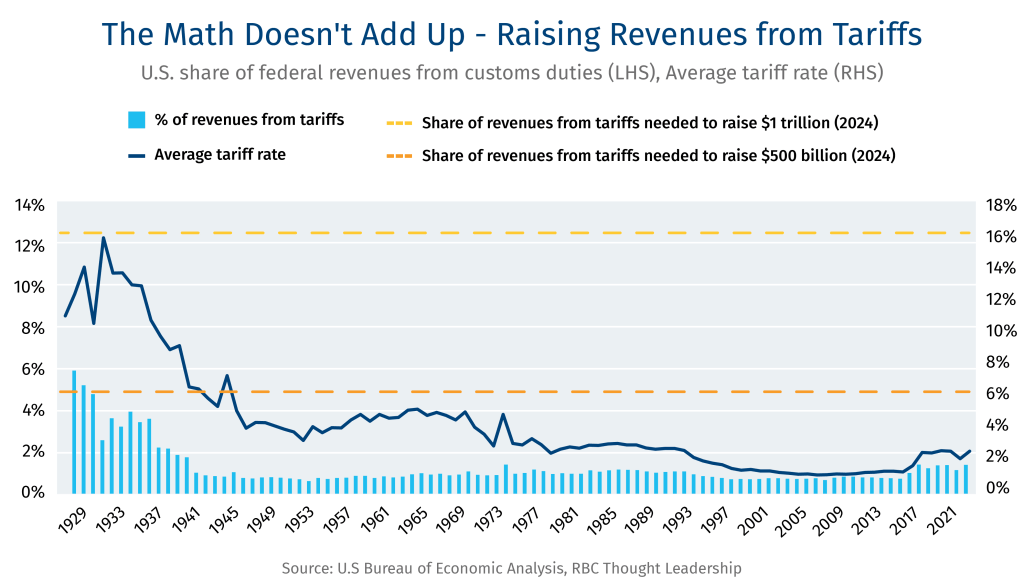
To fund tax cuts, President Trump and Secretary Howard Lutnick’s stated goals are to raise US$1 trillion in revenues from tariffs and achieve another US$1 trillion with an aggressive program of cost-cutting through the Department of Government Efficiency. But the math doesn’t add up.

The government would have to generate 12.4% of total revenues from tariffs to raise US$1 trillion—something the U.S. government has not achieved in the past century, even during the height of the Smoot-Hawley tariffs in the 1930s. Even the more modest goal of US$500 billion seems hard to achieve given the U.S. federal government hasn’t raised 6.2% of its revenues from tariffs since 1929—when the Great Depression started.

3. Will China deviate from its targeted retaliatory approach?

China now faces an effective tariff rate of 54%, on top of tariffs on steel and aluminum and those levied under the IEEPA. The Chinese government has historically responded with targeted retaliatory tariffs, particularly on agriculture and geared toward swing states or those voting Republican. However, these are the highest effective tariff rates ever levied on China. It will be interesting to see if Beijing sticks to a strategy of targeted action, or one that will be more sweeping. Regardless, a trade war between the world’s two biggest economies will cause significant economic ripples and rejig supply chains.

  • Of note, China recently entered exploratory talks on a regional free trade and investment agreement with Japan and South Korea, two countries that are not traditional Chinese allies. This is an important signal that countries in Asia and beyond are creating bulwarks and buffers against a United States that they increasingly see as threatening and unpredictable. These developments may isolate Canada even further.

4. The price of the climb down may be steep.

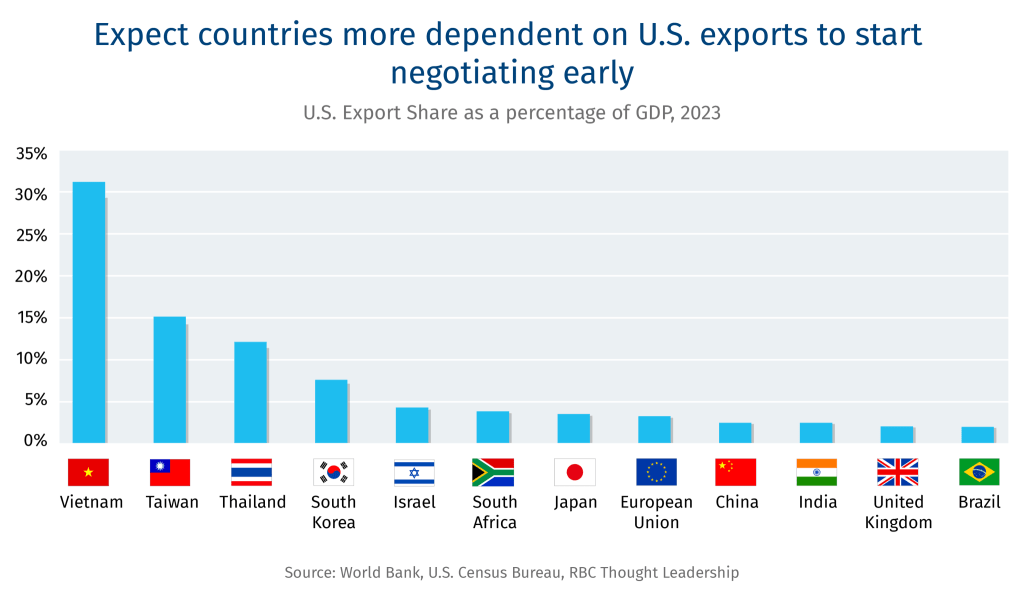
Trump explicitly signaled to countries that he was willing to negotiate concessions in exchange for reduced trade actions. The cost of these concessions will be worth watching, with the countries first in line to negotiate exemptions (especially the ones most exposed to U.S. trade actions) likely getting a raw deal. Expect the coming few days, before the tariffs officially come into force, to be a lobbying frenzy in D.C. as countries most exposed to U.S. trade action try and negotiate lower rates.

  • Allied Retaliation: Trump explicitly warned countries that teaming up against the United States to retaliate would yield higher tariffs. Canada may not wish to gang up against the United States as the degree of integration between our economies does not favour Canada. But expect the Canadian government to partner with allies on strategic sectors, such as critical minerals or semiconductors, to press against U.S. trade action and to share a more unified message on the costs of a full-blown tariff war on sectors with strategic or national security importance.

5. Congressional rancor over the trade deficit emergency.

On the other side of Pennsylvania Ave., the Senate voted to pass a joint resolution to strike down the emergency Trump used to levy tariffs on Canada, with four Republicans joining the Democrats. The joint resolution is unlikely to pass the House, where caucus discipline is more strongly enforced, but it is still a repudiation of Trump’s trade policies against the country’s closest ally. The President used the same authorities, stemming from the International Economic Emergency Powers Act, deeming trade deficits as a national emergency. Expect to see another fight in Congress as the legislature seeks to regain control over trade and tariff policy, and as Democrats use the joint resolution as a cudgel to split the Republicans and a referendum on Trump.

6. Global macroeconomic and supply chain shocks.

The bigger channel of impact of these tariffs—and the biggest unknown—will come from governments and businesses completely reshaping the trading links that have been built over the past century. Some companies may choose to reshore production to the United States, while many others may avoid the U.S. completely. Regardless of how the tariffs are implemented, the macroeconomic effects of uncertainty are significant and dire, as our Economics team has noted, pushing up the U.S. effective tariff rate over 20%.

Trump appears to want to achieve multiple goals through his policy instrument of choice, including reshoring investment and trade flows, strengthening the greenback, raising revenues and using tariffs as economic leverage to achieve other policy outcomes. It is unclear whether he will be able to achieve all these goals. What is clear is that this is only the beginning of a rocky ride for the global economy, and for Canada.

Varun Srivatsan is Director, Policy and Strategic Engagement, RBC Thought Leadership

Email Message

rbc_share_email_message

With global energy demands surging and climate concerns intensifying, Canada finds itself in a rare position: rich in natural resources, top technical talent, and the innovation needed to become a clean energy superpower. But how do we harness that potential without compromising on sustainability?

John and Sonia take listeners inside Houston’s CERAWeek energy conference to unpack the growing momentum behind methane abatement, and Canada’s opportunity to lead the charge.

The episode dives deep into methane: why it is 30x more potent than CO₂, where it leaks from — oil fields, landfills, farms etc. – and Canada’s commitment to methane capping.

Hear from four groundbreaking Canadian cleantech entrepreneurs working on space-based emissions detection, sensor-agnostic software, nitrogen-powered pneumatics, and emissions data modeling to tackle the methane challenge for the country and beyond.

Listen on Apple Podcasts, Spotify and Simplecast


ohn Stackhouse: [00:00:00] Hi, it’s John here,

Sonia Sennik: and I’m Sonia Sennik, CEO of Creative Destruction Lab.

John Stackhouse: Welcome back to Disruptors x CDL: The Innovation Era.

Sonia, like a lot of Canadians, maybe most Canadians, you’re probably fretting about the future of our nation. This is a massive moment of insecurity for us, but also an incredible moment of national pride. It’s like the country’s going through this identity crisis again, and I was struck reading an article in the Financial Times on the weekend.

About Canada’s potential to be the world’s next superpower. There’s probably something a lot of humble Canadians don’t want to thump our chests with and declare to the world, but it made a pretty compelling case that certainly with resources, we’ve got everything that the world needs from oil and gas to water and hydro to critical minerals and heavy metals.

It’s all here right now, and the world’s gonna need a lot more of it.

Sonia Sennik: [00:01:00] Absolutely John. I was driving on the weekend and saw Canadian flags on the sides of cars without a World Cup and without any hockey championship around the corner. Just Canadians celebrating being part of this country, and I think we have an amazing opportunity to start with some Greenfield projects in the country, as well as innovating on some Brownfield projects in our existing incredible refinery, smelters and oil and gas facilities around the country.

John Stackhouse: I think one of the key points that we’ll be hearing a lot about in the months ahead is that Canada can produce a lot more. We consume a lot, maybe too much, but we can also produce a lot for ourselves and for the world. Uh, and that’s a great opportunity for the country. But of course with more production comes interesting challenges around sustainability.

How do we produce more and do it more sustainably, including. Perhaps with fewer emissions.

Sonia Sennik: We have the pen in our hand, John. We have the opportunity to draw out what we want these [00:02:00] technologies to look like, how they should be implemented, and how they can sustain us long term as a country. I think we should all really see this as an incredible moment for us to rethink who we wanna be for the decades to come, and how we want to contribute to the global economy.

John Stackhouse: Interestingly, I heard a lot of Pro Canada messages at a big oil and gas conference that I attended in Houston. It’s a big energy conference and it draws 10,000 people from around the world, Saudis and Japanese Australians and Brazilians. As well as a lot of Americans, and I expected maybe a skeptical eye of Canada just given all the rhetoric we’ve been hearing.

But on the contrary, there was a lot of bullishness about what Canada can do and a lot of interest in investing in Canada, especially for the kind of Greenfield as well as Brownfield projects that you’re describing, Sonia. So the opportunity is right before us. I thought the conference, which is sometimes nicknamed the Super Bowl [00:03:00] of Energy, was going to be a drill, baby drill convention, and there was certainly a lot of enthusiasm for that, but there was a lot of deep thought about how Canada and the United States, as well as other economic partners can create energy security.

And yes, some Americans want energy dominance, but it was really about energy security in a world that is going to be probably more fractured in the years ahead.

Sonia Sennik: John the door is wide open for innovation. We have incredible talent coast to coast, but especially in Alberta where we run our CDL Rockies Energy Stream.

It’s been one of our most compelling streams to watch with the types of innovators it attracts, and the rate at which these companies are able to scale with large corporate

John Stackhouse: customers. And you know what? Speaking of Alberta, much of the conversations at CERAWeek were about the AI opportunity data centers, which Alberta, as we’ve discussed on previous podcasts, has great ambitions for the data center.

Revolution is [00:04:00] underway, and it was a dominant theme. I learned that data centers right now are consuming about as much energy as the country of Japan, and it’s going to multiply in the years ahead. So while there were a lot of energy folks at CERAWeek, there was a huge number of tech folks as well. All the hyperscalers were there in force and not as visitors or tourists.

They’re working, in fact, they’re integrating their operations increasingly with gas companies because gas is what is going to power, at least in the near term. A lot of the data centers that we’re all going to need, that we’re all using already, even though we don’t know where that data crunching goes or all the power.

That’s needed to make it happen. So get ready for more demands for gas, but also an imperative for what you said, Sonia, for innovation in the ways that we extract gas, we produce it, we ship it, and we use it at scale with technologies that make it more sustainable.

Sonia Sennik: That statistic, [00:05:00] John, you used for energy consumption comparing it to the country of Japan.

I think at a micro level, a reminder for everybody that just two chat GPT prompts consume the same amount of power to charge your entire iPhone one time, which is, I think, interesting for folks to keep in mind when we think about how much our demand is growing around the world.

John Stackhouse: So bottom line, we’re gonna need a lot, lot more energy.

In fact, I wrote a blog post about this that you can find on my LinkedIn channel or at RBC thought leadership, and the title was from MAGA to MEGA, and MEGA being Make Energy Great Again. I kid you not, that was one of the slogans of CERAWeek and one of the challenges of making energy great again, especially if it’s more gas, is coming to grips with the methane that comes with the production of gas, as well as other activities including a lot in agriculture.

Fortunately, there’s a ton of new technology and more technology on the horizon [00:06:00] that is showing how we can produce more gas with less methane emission. We’ll hear later in the podcast from four Canadian innovators who I met at CERAWeek in Houston. They’re at the forefront of the methane challenge and have some incredible ideas already in the field.

But like me, a lot of listeners probably wouldn’t want to take a spot quiz on methane. It’s complex. It’s something most of us probably haven’t studied, and to help us understand it better, we turn to my colleague Vivan Sorab, who is our Clean Tech specialist at the RBC Climate Action Institute.

Vivan Sorab: Methane, first and foremost is the main constituent of natural gas methane is a greenhouse gas like carbon dioxide. When it’s emitted into the atmosphere, it captures heat over time. That accumulation of heat causes global warming. And it’s interesting to note that methane is significantly more powerful than carbon dioxide. As a greenhouse gas methane is 27 to 30 times more potent than carbon dioxide.

Now, why is it important [00:07:00] in Cleantech? One, because natural gas is critically important to the world. We use it to power our industries. We use it to produce petrochemicals. And managing methane emissions from the production of natural gas is critical, but methane emissions also come from other areas.

Agriculture is a significant source of methane. Think emissions from ruminant animals like cows, but also from rice farming. And this is a particularly large problem in Southeast Asia. It also comes from waste, organic waste when it decomposers produces methane emissions. And finally, it’s important to note that methane emissions do.

Occur naturally as well. So swamps, speed, bugs, and similar environments also produce methane emissions. So take an oil field, you drill a well, and you produce some kind of hydrocarbon fluid from subsurface. What you get out of the subsurface can be natural gas. It could be a mixture of oil and gas, or it could be pure oil underground, but when you relieve the pressure on it.

Stuff that’s dissolved in the gas escapes, and that’s very often methane. [00:08:00] When those hydrocarbons enter the gathering infrastructure on the surface, the people who are operating the oil fields need to release some of that methane into the atmosphere and the collective term to describe the release of methane.

Whether intentional or unintentional from this infrastructure is called venting. It’s one of the main major sources of methane emissions, and there are several technologies that are available to address venting. Knowing where the emissions come from is a harder question to answer than many appreciate, and entrepreneurs have come up with a truly remarkable range of technologies to answer that question, whether it’s satellites that circle the globe and provide insights into where the emissions are coming from at various spatial and timescales.

To Airon sensors. You can have a company that mounts a sensor on an aircraft, flies over an oil field, or flies over some kind of infrastructure and tells the operator, here it is where I think you should focus your search. And then there are startups that are developing ground-based sensors, think [00:09:00] infrared cameras or certain detection systems that are kept on site to measure where the emissions are coming from and providing very high precision to operators who want to control their emissions.

So I think that those are some of the key technologies, specifically on the oil and gas side. But I should also say that there are amazing entrepreneurs doing methane abatement in various sectors, including agriculture and waste. Canada has committed to reducing methane emissions by 75% relative to 2012 levels by 2030.

That is gonna take a lot of new technology to find where the methane leaks are coming from, as we already discussed, but then also going after the last stage of methane emissions that are a little more complicated or a little more challenging to drain in the, the simple ones. There’s a lot of political uncertainty right now, so it remains to be seen how some of these commitments move forward in time.

But the US, Canada, the European Union, a lot of governments around the world are taking initiative. And it’s also industry. I’ll just give you two examples. One is the Oil and gas climate Initiative. It’s a consortium of the world’s leading, as they’re called, super majors. The [00:10:00] large private integrated oil companies that have banded together and are aiming to reduce their methane footprint as close to zero as possible by 2030.

And then there’s the oil and gas methane partnership. Another consortium between the United Nations and various private sector players that provides a framework for these industries to measure their emissions and also report them allowing for transparency into the methane emissions ecosystem.

John Stackhouse: Sonia, that was a really helpful explanation of methane. In fact, I think I might be willing to take that spot quiz. But before we go there. Let’s hear from those clean tech entrepreneurs. I got to meet in Houston. We’ll start with Stephane Germaine. He’s the president of GHGSat, a Montreal Space Tech company that’s looking literally at the bigger picture.

Stephane Germaine: Hi, my name is Stephane Germaine from GHGSat. GHGSat uses its own satellites to monitor greenhouse gas emissions from industrial facilities around the world. So satellites [00:11:00] have a unique way of being able to do that. They can cover the whole world daily and help find those big leaks fast to help operators and governments really understand that true scope of the problems so they can better control and reduce those emissions.

Our customers are becoming more and more aware of the urgency of being able to reduce their majority of their emissions at in some cases. Very little cost and, and sometimes even at a profit, that whole business case has become much more prevalent, much more present in the last five or 10 years or so.

And that’s driven our focus first on methane instead of carbon dioxide, despite the fact we do both. And that has led to a lot more mitigation, which is great. Methane captures more heat than carbon dioxide does. So they’re both greenhouse gases. They both drive global warming, but methane does it faster.

So not only does it have a bigger impact for every unit or volume you reduce, it also has a much shorter term impact. We will go look at [00:12:00] places that our customers ask us to go look at, so their own operations so that they can better understand, control and reduce their emissions. After that, we always make sure we use a full capacity of our satellites, so we’re seeing stuff all over the world that even from places that aren’t necessarily our customers.

So there we work to reach out directly to the operators of those sites. So it could be, uh, an oil and gas facility internationally, or waste management facility internationally. And when that doesn’t work, then we work with international institutions. Like we work closely with the UN Environmental Program.

We work with industry associations like the Oil and Gas Climate Initiative, and we work with them to reach out to those operators to make them aware of what’s going on and then hopefully then also arrange for transfer of best practices and information to help them understand how they can reduce their emissions.

Canada’s a great place to do R & D, right? So it’s, it took a unique set of skills and experience that we as a country are fortunate to have. In our country, so around space and environment. But in addition to that, it’s a great [00:13:00] place for funding R & D. We were able to get some really important support from the Canadian government in various forms from the Quebec government, the Alberta government, and that helped drive us to a point where the technology was mature and was ready to be commercialized.

So Canada’s a great place for that.

Sonia Sennik: Hey John, remember when I said every company is a space company? GHGSat is leveraging space technology to inform clean tech decisions on the ground here on planet Earth. So what can be done with the data they get from their satellites? Companies can look internally at their own operations, make modifications, but better yet, they can observe the impact of their decisions over time.

And as Stephane said, our world’s methane challenge is urgent, important and fixable. And technology in lower Earth orbit, like their satellite named Hugo can really help.

John Stackhouse: And here’s another interesting point that we heard from our friend Chris Hadfield on a previous episode. Looking at Earth from outer space, you actually cannot see political borders, but you can see the [00:14:00] consequences of human and perhaps political activity, including emissions.

Now, it’s one thing to see the methane as Stephane’s satellites are clearly showing it’s quite another to then do something about it. That’s where our next guest is actually bringing the challenge down to earth. I met Liz O’Connell, co-founder and CEO of Arolytics. It’s a software startup that not only helps the oil and gas sector track their emissions data, it also identifies strategies to efficiently reduce methane.

Liz O’Connell: Hi, I am Liz O’Connell. I am one of the co-founders and the CEO of a company called Arolytics. Alytic is an emissions software company, so we help the oil and gas sector track all of their emissions data, integrate it from various sensors, but also help manage and then forecast that information to identify best opportunities to abate their methane.

One thing that makes us unique is we do not have any hardware. We are sensor agnostic, and so we can really take a very consultative [00:15:00] approach when we work with the oil and gas sector, really sitting down, helping evaluate all the different sensors and technologies out there, helping them build that strategy.

And we leverage an in-house modeling tool where we can actually virtually evaluate what combination of technologies is best for their measurement strategy. And so one concrete example of that is, you know, how do we look at integrating the operational data side that you’re already collecting? And then.

Correlating that with the emissions data and helping from an operations, a field level, but also the, you know, environment teams. How can we start to marry those two teams and provide visibility in that single platform to connect workflows around that? There’s something called oil and gas methane partnership.

It’s a global initiative. I think there’s about 50% of the global oil and gas production is signed on to a voluntary commitment to start measuring and be more transparent around their methane reduction. And their measurements. And so we see a lot of traction on initiatives like that, and our platform can help collect the data to really provide support for those global initiatives like that and start to marrying that operational [00:16:00] piece to just improve operational efficiency and start to collect the data that’s already being used for operations.

Sonia Sennik: Vivan mentioned earlier that methane abatement solutions will require hardware. But in the case of Arolytics, Liz and her team reinforce that they are sensor agnostic, meaning they can seamlessly integrate into any system. So in a world where companies are under immense pressure to cut emissions, having easy access to the right data at the right time is essential to making thoughtful and efficient decisions.

This is where innovative software can play an important role as companies work towards meeting their global methane reduction targets.

John Stackhouse: Sonia. I think another point worth stressing is that Arolytics is based in Calgary, as are the next two companies that we’ll hear from, and that’s an important point, geographic location that we’ll come back to in our wrap up.

After chatting with Liz, I spoke with Jacqueline Peterson, she’s the Chief Climate Officer at Kathairos Solutions, and if you’re wondering what Kathairos means, it’s [00:17:00] Greek for clean air. Jacqueline told me how the company completely eliminates methane venting at remote oil and gas well sites by using liquid nitrogen.

Jacqueline Peterson: Hi, my name’s Jacqueline Peterson. I’m with Kathairos Solutions. So Kathairos addresses this challenge of. Pneumatic venting and pneumatic venting is responsible for about 40% of the methane emissions that come from the oil and gas sector. Pneumatics, routinely vent methane just in order to essentially operate the site to separate the liquids from the gas to move it along.

But every time these devices are actuated, they release methane into the atmosphere purposely, which is very bad. So we. End this process or eliminate it by essentially replacing the gas that’s used to drive and power and pressure these pneumatics. So we use nitrogen instead. We’ll put a specialized tank on [00:18:00] site, tie it into all the existing pneumatic control loops, and we fill these tanks with liquid nitrogen.

The liquid nitrogen is then. Released as a gas at the pressures and quantities needed to power the various pneumatic devices at the well site. But instead of venting methane, at the end of it, we vent nitrogen instead. So it’s a very simple solution that then allows us to scale quickly across hundreds of sites, thousands of sites, and hopefully tens of thousands of sites in the near future.

The biggest challenge we have right now is truthfully some political uncertainty and regulatory uncertainty, and everybody wants to address this problem, but there’s other priorities going on too, right, that they’re competing with for their dollars. And so once companies know, have that political clarity about what’s expected to them, then they just [00:19:00] address the issue head on and create a plan and execute, like the industry has always done.

We have currently close to a million well sites in North America currently venting methane. That’s very difficult to solve, but that also means that there is so much to be done and seeing all of these great technologies coming out that show us where the methane is, and then ultimately how we can eliminate that from being vented.

There’s so much that we can do from that climate perspective to drive down methane reduction. And significantly clean up oil and gas to make it a much more sustainable fuel as we move forward as an economy.

Sonia Sennik: Jacqueline gave us a clear look at how regulatory uncertainty is a major roadblock to methane reduction, and how corporate leadership can push for real change her perspective on the sheer scale of the opportunity.

With over a million sites still venting methane because of their legacy pneumatic [00:20:00] systems, it really drives home how much work there is to be done. And the scale of this opportunity and her company’s solution to replace gas and instead use nitrogen is simple and flexible to tie into any pneumatic control loop.

John Stackhouse: I think we’re starting to get the picture, Sonia, that solving the methane challenge involves multiple technologies. At multiple levels. We’ve started in space and came down to earth with some good old analytics, and we’ve just heard about some of the chemistry as well as physics that can be applied to methane.

But of course, as Jacqueline said, all of this has to be approached with a business lens. Companies are not going to take this on if it’s not part of a broader company’s strategy. And that’s where our final guest comes in, helping to piece this together for companies to think through not just the methane challenge, but the business opportunity.

I spoke with Jessica Shumlich, co-founder and CEO of Highwood Emissions Management. We’ll now hear from Jessica about her startup, which is also from Calgary, [00:21:00] leverages data analytics and sophisticated simulation tools to optimize emissions management.

Jessica Shumlich: Hello, my name is Jessica Shumlich. I’m the co-founder and CEO of High Emissions Management.

Our mission is to deliver the oil and gas’ premier solution for the development of measurement informed inventories that deliver accurate, transparent, and scalable emissions reductions. Customers are based all over, so a lot of them are based in the US but we’re increasingly seeing interest in Europe as well as the Middle East.

And so we’re looking to be the world’s go-to solution for measurement informed inventory, which means that hopefully we’ll be adopted in every single country that has oil and gas development. We’re seeing a lot of investor pressure, stakeholder pressure, and we’re seeing oil and gas companies say, Hey, I’ve made these commitments.

And actually the whiplash to go back on their commitments and then just to potentially in four years have to reinstate all of them, is gonna cause them more problems than otherwise. We fundraised on being a billion dollar company, which means about a hundred million dollars in revenue. We think [00:22:00] between methane as well as other services that are adjacent to methane, broader greenhouse gases, we can really take and transform this whole market.

So we have two customers officially in our platform, which is terribly exciting considering the fact that we’ve only launched in January of this year. We’re seeing a lot of progress, but these are enterprise sales and they take a very long time. I’m from Canada, Canada’s my home and I love it there. We have access to some of the best available talent, and so the majority of our staff, with the exception of a few business development staff, are actually based in our headquarter in Alberta.

So proud to be in Albertan, proud to be an Alberta company.

Sonia Sennik: Jessica’s insights into finding product market fit in the emissions management space were very on point. It’s one thing to have a great idea. A compelling technology, but it’s quite another to get real traction in an industry that’s still figuring out how to prioritize methane reduction.

Her perspective on companies still moving forward with emissions commitments despite the political uncertainty, was also a good reminder that [00:23:00] investors and consumers are shaping this market too, not just the regulatory environments.

John Stackhouse: Sonia, you’re an engineer. What in your mind was most interesting of all those challenges that you’d love to take on?

Sonia Sennik: I love the idea of interdisciplinary approaches. For example, this selection of four companies. Could figure out ways to collaborate to make an even stronger set of tools, measurements, and management opportunities. I think the more that we can figure out ways in which these technologies can intersect and support each other to move more quickly and make a better impact, a greater impact faster.

That’s what gets me really excited. It’s all about the system, John.

John Stackhouse: It’s all about the system and there’s some great systems in many places in Canada, but especially when it comes to clean tech in Calgary. I was really impressed by Jessica’s sign offline that she’s very proud to be Albertan, proud to be Canadian.

And one of the groups we didn’t hear from, but that was very present at CERAWeek, is the Clean Resource Innovation [00:24:00] Network. Or CRIN, it’s one of those quiet success stories of Canada that brings together entrepreneurs as well as investors and policy makers and tries to advance exactly what you pointed out, Sonia, a systems approach.

We’ve got that in ag and critical minerals. But thanks to CRIN, we also have a lot of progress underway in methane management. I was also struck in my conversations with the entrepreneurs how concerned they and their investors are about regulatory uncertainty. I thought going to Houston, there’d be almost a celebration of the end of climate action policy and quite the contrary.

Pretty much every energy company and oil and gas company I spoke to is fully committed to emissions reduction. And they’re excited about these technologies, not just because of what it does for the planet, but what it does for profitability. These technologies make companies more efficient and yes, therefore more profitable.

And when they’re more profitable, that attracts more capital and that feeds that ecosystem that you are [00:25:00] speaking of.

Sonia Sennik: So how can we meet the moment and make the most of our innovations and our resources here in Canada? We just scratched the surface today, and there’s definitely more to unpack in our upcoming episodes.

John Stackhouse: And that’s a great note to end on.

Sonia, there seems to be so much despair in the world right now, and almost a sense of helplessness and hopelessness, but listening to these entrepreneurs, it’s hard not to have hope, that innovation, that imagination, and yes, human ingenuity. He’s going to overcome all the challenges that we’re talking about. For now, I’m John Stackhouse.

Sonia Sennik: And I’m Sonia Sennik.

Thanks for listening.

This article is intended as general information only and is not to be relied upon as constituting legal, financial or other professional advice. A professional advisor should be consulted regarding your specific situation. Information presented is believed to be factual and up-to-date but we do not guarantee its accuracy and it should not be regarded as a complete analysis of the subjects discussed. All expressions of opinion reflect the judgment of the authors as of the date of publication and are subject to change. No endorsement of any third parties or their advice, opinions, information, products or services is expressly given or implied by Royal Bank of Canada or any of its affiliates.

Email Message

rbc_share_email_message

When it comes to the energy transition, we’re going to need to literally rewire our economy. On the series finale of Disruptors, an RBC Podcast, host John Stackhouse sits down with Olivier Desmarias, the CEO of Power Sustainable, one of Canada’s most significant and global enterprises. The firm is a sustainable investment manager that invests in companies and projects that contribute to decarbonization, social progress and growth. Listen as they discuss where Canada fits in the global Net Zero transition, investment strategies, and the country’s biggest opportunities to win. Links: To learn more about Power Sustainable, visit their website.
Speaker 1 [00:00:01] Hi, it’s John here. We’re coming to the end of season six of Disruptors and want to thank you, our listeners, for a remarkable journey this season and for helping make us the number one Business and Entrepreneurship podcast in Canada. We’ve got a lot more ahead, but it’s kind of exciting how far we’ve come this season. We’ve talked about some remarkable disruptions from chat to the tech rack, and we wanted to wrap up the season with a conversation about the biggest disruption out there, which is climate and how Canada can play an even greater role in the world’s progress towards net zero. It’s going to take a lot of capital, a lot of ideas and a lot of technology. And we’ll be joined today by a Canadian leader who thinks this is Canada’s opportunity to win. We’re seeing historic amounts of capital, whether it’s in the US Inflation Reduction Act or with China’s bold moves on decarbonization that are transforming every sector of the economy. And we’ve also heard through this season remarkable innovations in Canada, from construction to agriculture to energy systems. We’ve called it the $2 trillion transition. That’s the amount of capital Canada is going to need to mobilize over the next 25 years to get to net zero. And when you think about all the technology and all the people that’s going to be required to put that capital to work, it’s hard not to see the coming years and decades as a remarkable period of positive disruption. This is Disruptors, an RBC podcast. I’m John Stackhouse. When it comes to the energy transition and the enormous innovation and technologies, we’re going to need to literally rewire our economy. There are few Canadians with a better viewpoint than Olivier Desmarais. He’s the chairman and CEO of Power Sustainable, a sustainable investment manager that invests in companies and projects that contribute to decarbonization, social progress and growth while also delivering returns. And if you’re not familiar with the power group of companies, it’s one of Canada’s most significant and global enterprises. Founded by Olivier’s late grandfather, the legendary Paul Desmarais, who started with a single business, a bass company. So it’s kind of fitting that two generations later, Olivier and the team at Power are looking to new ways to pardon the expression power, our lives and economy. Olivier, welcome to Disruptors. Speaker 2 [00:02:42] Hello, John. Glad to be here. Speaker 1 [00:02:44] It’s great to have you on the podcast and I think it may be your first podcast. So all the more special. You’ve been blessed with a lot of things in life, but to remarkable grandfathers as well as remarkable grandmothers. I mentioned Paul Desmarais in the introduction and of course Jean Cretien is the other. What did they teach you about business from a young age? Speaker 2 [00:03:04] There’s actually a lot that they taught me, and a lot of it was through osmosis of just being allowed to be there while they were negotiating certain deals, just being around the dinner table during conversations when they were talking about business. Both of them imbued sort of foundational values. You know, what our principles that you just want to hold true, especially when taking over the long term. Speaker 1 [00:03:29] What a great lesson for life. Whatever you do, make sure it’s values rooted. Tell us a bit about power sustainable. What’s the origin? Speaker 2 [00:03:37] Power sustainable got created, I guess, in 2019 when I joined Power Corp. roughly nine years ago, when Power Corp. merged with Power Financial, there was a will to be much more financially focused as a firm, really get to all the correct conversations at all the correct tables so that we can be forward thinking in where we want to go. And instead of just catching up, how to try to leapfrog our competitors in order to go there. And so the angle that we took it was building a climate First alternative asset manager. And by climate, it’s really about decarbonization. That’s the one kind of KPI that cuts across all of our strategies that we bring to market. Got to be. Speaker 1 [00:04:18] A decarbonization KPI, whatever you do. Speaker 2 [00:04:21] Fully, that’s the big one. Net zero is all about decarbonization. It’s more of a broad sword tool, but it’s a great place to get all corporations focused in order to have everybody working together. If we’re going to keep ourselves below 1.5 degrees Celsius, which we’re already not going to do. Speaker 1 [00:04:38] Olivier, what were you doing before this that prepared you? Speaker 2 [00:04:43] Well, I’m a lawyer by background. You know, went to law school that studied political science and sociology because at first I wanted to go into politics. I then learned that politics is a very ugly business. And so therefore, I chose the environment as a place to where I wish to lean in and work with governments. And by that I mean all governments are trying to push their economies forward in a clean way. And so that’s where I decide to push forward. Speaker 1 [00:05:06] It’s remarkable how few politicians in Canada spend time in business. Unfortunately, it’s a bit of a gap for the country. You mentioned starting power sustainable in 2019. What gives you confidence to continue to be investing in sustainability in 2023? Speaker 2 [00:05:23] Oh my God. This is not even the beginning of where we have to go as a society. We’re going to be seeing much more, shall we call it climate impact within our own lives, which will drive the public to becoming much more serious. But more than this, I think governments are competing. You know, the United States with the IRA, China, that’s already a leader across so many sectors and sustainability. The Middle East wants to change. Europe wants their say. And the reason is it’s because it’s about the economy of the future. And will your companies be up for that challenge? And to me, just seeing the big actors on planet Earth going at it full tilt just doubles down my intuition and my theory that all Canadians should be focused much more on that. And we will need a lot more capital to help grow this sector. Speaker 1 [00:06:14] Where are the most exciting opportunities you’re seeing in the world today? You mentioned the U.S., China, Europe, the Middle East. What areas excite you most anywhere? Speaker 2 [00:06:23] Just pick where you want to play in sustainability. It’s all incredibly exciting. I mean, energy is the main focus right now. We want to electrify everything as long as we can make clean energy, which we have solar that’s continuing to improve, wind that continues to improve, and those resources are free. Batteries continue to get worked on in order to levels how the grid works. People are coming out with small modular reactions. We got hydrogen coming on board. So energy is sort of the starting point. But every single other sector will also be all about electrification. So we’re really at the beginning of this. We have a lot of the technologies today that can decarbonize us, but we’re still missing a good 20 to 30% of them. And people who do come up with those solutions will have beautiful businesses in the future. But more than that, people that also focus on how to put all the technologies together and make them even more efficient and effective will have a wonderful future in this transition that will be taking place over the next 20 to 30 years. Easy. Speaker 1 [00:07:30] I want to get deeper into some of those opportunities and where Canada sits. How are we today in 2023 in terms of the attraction to Canada for investment, for the transition versus all those other dynamic markets that you mentioned? Speaker 2 [00:07:48] Yes. Look, Canada is endowed with resources. We have huge oil reserves, natural gas reserves. We have huge hydro reserves which really help to electrify our grid in a intelligent and clean way. We have metals and mining critical minerals all over China that have yet to be extracted. But lastly, and most importantly, we have entrepreneurs and we have business leaders. There are going to be the people who really help shape the rest of Canada through the clean tech start ups that we’re creating and where Power sustainable comes in play, which is how do we think more intelligently about the energy and the resources that we have? How do we work with our First Nations to build more pipelines to the West Coast so we can sell to Asia? That’s building tons of coal fired power plants? You know how to. We help them. Do not get switching. I get that it’s not the end solution. But if considering how good we are at extraction, how clean we can be in extraction because of the quality of the labor that we have, but also the regulations that we have. We can be a real solution to help India, China and the rest of all of Asia really go off of coal and onto that gas, which is and most likely can be cleaner. Speaker 1 [00:09:04] It’s such an important point, and that’s why we call it a transition, not a switch. But it’s going to take a different kind of approach to business, I would argue more public private cooperation, a lot more collaboration with indigenous communities, as you said. And that’s one of the fundamental differences between the clean tech revolution, if I can put it that way, and the digital revolution of 20, 30 years ago, which the private sector was able to do, VC’s were able to do kind of on their own. Among the fundamental differences this time is it’s going to take a lot more public capital and a lot more public engagement because of regulations and other policies that are critical to accelerating innovation. How do you think we can go about that differently, we as Canadians? Speaker 2 [00:09:47] Well, first of all, as Canadians, we can’t be everything to everyone, right? So we have to pick where we want to win and focus in on it. There are a lot of advantages that we have in Canada or natural resources being one, and how do we add value throughout that supply chain to the world as it’s transitioning, but also leave us in a strong position after the change that we have good companies that can continue to add value. So how do we help support our clean tech entrepreneurs that are really sort of straddling this fire between private and public investments? One of the things that everybody’s investing in infrastructure, this will clearly have a private public dimension to it. I think there’s loads of opportunity for people in there, but to your point, it will require them understanding and partnering up with bigger partners that know how to work in a more public, private way. Speaker 1 [00:10:42] Olivier, tell us a bit more about power sustainable and where you see things going. You’ve launched a number of new funds in recent years and hoping we can discuss maybe a couple of them briefly. And what excites you most, beginning with the billion dollar Renewable Energy Infrastructure Fund. What’s the priority there? Speaker 2 [00:11:00] So we have four main strategies that power sustainable and a few products inside those strategies. The first one is an energy strategy, as I mentioned, electrification. This is more of a traditional product offering solar, wind, batteries. We’re looking into renewable natural gas. And so it’s really changing our grid from what it was to what we want it to be, so more sustainable, renewable focus. So right here we have about $1.6 billion of committed a um, we’ve deployed about a billion or 800 million of it as we speak right now. This will continue to be a focus because as I mentioned, the grid needs to grow rapidly and that’s how this strategy of renewables really helps power sustainable, make a difference. Speaker 1 [00:11:48] Getting projects going is not the easiest thing in this country, including in the energy sector. How can we go about that differently to meet the fairly pressing deadlines that we know are coming at us? Speaker 2 [00:12:02] Well, I think the government has taken steps already by mimicking a lot of the IRA in the U.S. That means a lot of projects that might have been put on pause will be shovel ready and moving forward. This is fantastic because we need to virtually double the size of our grid and make it clean if we really want to be competitive. And 20 to 30 years from now with our peers that are focused on doing this also, the quicker we can get there in a cost effective way, the more competitive we will be as a society and all businesses within Canada will be on a go forward basis. Speaker 1 [00:12:43] A lot of people might wonder how we’re going to pay for this. How are you thinking through the long term impact of these transitions on the economy and on individual Canadians who will have to be along for the journey? Speaker 2 [00:12:57] Yeah, well, these are infrastructure projects that have 20 to 30 year lives to them if we do them correctly, maybe even longer. So therefore, my quick one is you mortgage your country, right? You put on debt and this is to me is the correct decision. This is a part that I believe is very strategic for Canada to make sure that we win, which is being the cheapest and most effective and cleanest form of energy possible, but not over 5 to 10 years. That could lead you to doing more coal fired power plants. But over 20 to 30 years, which will lead you into taking a little bit of technology risk. But we should start thinking, well, where does. Clear fit into all of this for us as a baseload. Where can we develop even more hydro because it’s a natural born batteries set? These are the real questions that we have to ask ourselves and these are our long term focus. So as we figure out how are we going to pay for this? I think definitely some more long term capital from the government side, but also some more long term players from the private market should be building this out as much as they can in partnership with government indications of how they would like our grid to look like in the future. Speaker 1 [00:14:08] The mortgage is a great reference because none of us could afford the homes we live in if we had to pay for it all at once. So it’s a great to get a long term view. You’re right, Olivia, that governments are now taking a longer term view. You deal with a lot of private investors as well when you’re raising capital and when you’re working with partners, what do they need to have confidence to make those long term 2025 year investments, particularly in an investing world that over the last quarter century has become very short term oriented? How do you kind of compete with a mindset. Speaker 2 [00:14:43] Like the private markets are the best at really telling you where the most? Effective capital allocation is. So for us, you have the energy side, which is more infrastructure related, which I think people should be investing in that because there’s such a shortness of supply. But then you can go to agri foods where we have companies that want to shift and be more sustainable. But the impacts of how we get there are complicated. We have lots of people that would love to take a business. Risk and investing are sustainable because they see where it is in the future. But unfortunately the capital is more than they could bear and that’s where people like us come in place. We would like to partner up with mid-sized mid-cap companies that we think can be leaders in the North American market, but also the global market and sort of write significant checks that helps them achieve the goal of what they’re going for. And we will help them measure it. We will help them accomplish that transition with the managers and the private equity people that we hire, such that we can create winners in that sphere that can help to catalyze capital faster as they win. And more people want to build businesses like them. Speaker 1 [00:15:54] That’s a great description of the flywheel impact and what we can see emerging in this country in all sectors. Stay with us. In just a moment, we’ll talk more with Olivier Marais about the climate transition, about exciting technologies, and about the emerging trends in agrifood. Welcome back. I’m talking with Olivier Desmarais about the climate transition and power sustainable. In the previous segment, you were describing four strategies you’ve got for power sustainable, and we talked largely about energy, which is the dominant theme. So appropriate. Maybe you can expand on the other strategies. Speaker 2 [00:16:41] Yeah. So as I mentioned, we have four strategies. One is in energy, one is our agrifood strategy under the US name. And basically what it is is a mid-cap private equity strategy. So $200 million of revenue and less across the supply chain. And it’s how do we take hopefully the company private. But as you can imagine, some of the companies might be too big for our fund size, which is 300 million. So we would take small positions where we would really lean in and have impact from the board on helping the company really get all of its measurements up to speed, but also continue down the path of truly decarbonizing its footprint or having a good source of social impact. So, for example, the first kind of company that we bought is a company called Goodlife. And so basically Goodlife is a company that pretty much makes a salad in a vertical farming kind of way. And so it’s lots of technology, very energy intensive, which is very useful that we’re here in Canada because our energy tends to be a little bit cheaper. But not only that, our energy tends to be a lot cleaner. So therefore the carbon footprint that you can have is wonderful. Speaker 1 [00:17:56] And so glad you’re focused on agrifood. We’ve done a lot of work on that. As our listeners know, it’s such a great opportunity for candidates. 10% roughly of our emissions, maybe more, depending on how far up or down in the value chain you go. But it’s also something we can export to the world, not just the food, but all these technologies that can transform agrifood here in Canada, but ten acts the impact by being implemented elsewhere. Speaker 2 [00:18:21] Yeah, but there’s also another benefit, John, which is medicine. Some medicines are only in different places in the world here. Can we grow them at home. But when you think about sort of vertical farming and where it could go, food security across the globe could become a reality where everybody sort of is producing their own food and getting a higher quality food because of it. Speaker 1 [00:18:45] How do we do that efficiently? Because we have a food system, for better or worse, and it’s both that is incredibly efficient. So those tomatoes or strawberries that come from California. There’s a downside to that, including a climate downside. But the upside is it’s cheaper. How do we ensure that food is accessible as well as nutritious and more sustainable as we go through this transition? Speaker 2 [00:19:07] Well, I think that’s exactly what the point of the transition is and the technologies that are coming out and that will be coming out and even the vertical farming technology, you know, it’s on the cusp of becoming really economic. It’s economic in some regions, but not in all regions. And so it’s how do we get people to really hone in to that technology, but from a point of strength, from a point of profitability, and then really grow globally to allow all the markets to get more nutritious food, but hopefully also greener because of the nature of how the electric grid has been green-ified. Speaker 1 [00:19:41] It’s really interesting and often misunderstood by consumers how much energy goes into food production. It’s eye popping, how much energy. But fossil fuel energy particularly goes into the production and delivery of that tomato. So pick up a tomato and think it’s got a low carbon footprint. It actually might have a fairly significant carbon footprint. And the agtech that you’re talking about can really help transform that, while also improving food security and nutrition, other benefits. Speaker 2 [00:20:11] And it’s going to go slowly but surely. But you will reach a tipping point to where, you know, the big food companies will start to see that A, there’s more supply to be sustainable because their big problem is they’d love everything to be sustainable. It’s just hard to make that shift all at once. And where do you focus? So that’s where we can help. But with these technologies that I think will just enhance the yield and also the nutritional value for populations around the world. And this will be a phenomenal, phenomenal outcome if done correctly. And I think we have a place to where we can lead here in Canada by continue to invest inside these technologies and by being supported by government subsidies to make sure that we can be extremely competitive and at the forefront of this massive change that will be happening in our Food Network. Speaker 1 [00:21:02] Olivier, you’ve talked about energy and agrifood. What else are you looking to take on? Speaker 2 [00:21:07] Another mandate that we’re coming out with is industrial decarbonization, but also infrastructure debt investing, Because, John, one of the goals of Paris is. Attainable is to catalyze capital in this sector in order to make us go faster. Because when you think about sustainability, right, there’s two camps. You have the technologists and the put steel in the ground, the technologists. If you think about it, we don’t have the technology to get to zero. So there’s a lot of capital being put in there in order to figure it out. And then we have the other side, which is, well, we have enough of the technology to make a significant dent into the climate story and to shape the curve of how quickly we decarbonize. And within that, we need more people to start putting steel in the ground, right. Deploying the technology that we have. Messing around with how you combine the technology that we have in order to make it more effective. And the only way we’re going to do this is by showing people that not only can you be sustainable, truly sustainable, but that you can make market or market better returns. Speaker 1 [00:22:06] When you talk about putting steel in the ground, can you give us an illustration? Speaker 2 [00:22:10] Well, literally building out the energy grid of the future, right, Putting windmills all over the place, building new vertical farms, coming up with industrial companies that are making the shift to sustainability in their processes or are starting a whole new way of attacking a system like Carbon Cure, which is helping construction companies decarbonize, which helps make cement stronger and also helps suck up carbon from the atmosphere. These kinds of companies across the three pillars that we mentioned will be winners as they continue to rethink how we can decarbonize the future. Speaker 1 [00:22:45] Glad you mentioned Carbon cure. We’ve had them on the podcast and it’s a really interesting company. You also mentioned the challenge of market returns, war for infrastructure, and I’m curious about what gives you more than a hunch confidence that this space is going to outperform the market. Speaker 2 [00:23:01] So look, just to kind of macro trends, China and the U.S. are really going at it over sustainability. The Europeans want and people want this thing to happen. So a lot of money is being deployed by governments towards electrifying our grid. It’s almost reached a form of national security. And so therefore, there’s a lot of will from government actors and people see that it could be the future of businesses, period. And so therefore, that’s one is a big micro trend that even government actors are buying into now. The second one is every financial firm that I know of has signed up to U.N., PRI, which means they have to hit their net zero targets. There is a lot of balance sheet money out there, like trillions that will be chasing less amount of good products. That means yield compression in the market. This will happen over time, naturally. But I think that as 2030 comes around and we realize that we haven’t quite decarbonized 50%, which is our goal for 2030, we will start to focus in more from a government perspective, but also from a people perspective on what we can do, which will create a sort of gold rush effect towards the sector. And so I think from where governments and people want to deploy their capital is creating all the conditions to win for people that take it seriously and for people that really focus solely on this, which is what we do at power sustainable, We are solely climate focused. Climate first, right? Speaker 1 [00:24:39] Climate first. And you’ve taken us through energy agrifood infrastructure. You touched briefly on industrial decarbonization. But before we wrap up, Olivier, I wonder if you can tell us a bit more about industrial decarbonization and what catches your interest there. Speaker 2 [00:24:53] So this is a broader category, right? What really catches the interest here is the US kind of has $25 for every $1 that we put inside that growth opportunity. We Canadians know how to build interesting companies that can help decarbonize our industrial base. But what they really need, if we want to keep them in Canada and if we want them to really go bigger, is we need that kind of capital that can come in and help them grow. And so that’s really where we power sustainable, come into play. This fund that we’re going to be launching comes into play, which is how do we really target these companies that really want to win and give them that growth capital? Now, we will have a Canadian contingent inside this fund because it is North America focused, but this will help Canadian companies that I think are really good access to this kind of growth capital such that they can win and we can have real Canadian winners in our marketplace going forward. Speaker 1 [00:25:53] Olivier, you’ve laid out so many great opportunities from the energy sector to agrifood to infrastructure and to heavy industry and decarbonizing it. And it’s a global opportunity, but also a global race, as you said at the beginning. What does Canada need to come to grips with in order to be a winner in that race to net zero? Speaker 2 [00:26:12] I think we have to realize it’s a transition. Even if we produce ten carbon more in Canada, as long as we’re eliminating 100 carbon somewhere else, we’re a net contributor to -90. Let’s dare to think big. Let’s dare to take risk and not be afraid so much a failure which we are in Canada, but take risks in order to grow and to be winners in sectors. And dare I say case, we can’t get over that challenge. There are lots of sectors that will pride themselves on the Canadian sort of slow but steady and methodical way in order to win. So let’s not put all our eggs on the fact that we’re going to be super aggressive. Let’s put some of it towards the less sexy parts of the value chain, but where you can really decarbonize and really have good long term business, that creates good long term employment here in Canada. Speaker 1 [00:27:02] You mentioned an interesting point earlier about a realization that we may have in the coming years that we’re not going to hit our 2030 targets and that that could be a powerful catalyst. I suppose there’s another side of that coin where people may just shrug or give up and say, We can’t do it. As we come to that crossroads. What do we need to keep in mind? Speaker 2 [00:27:23] Look, first of all, we can’t quit. It’s really it’s not an option because of the power of compounding. So right now, by 2050, we’re trying to keep it to below 1.5 degrees. What does 1.5 degrees mean? Well, minus two degrees was the ice Age. Now, I’m not saying that two degrees will be a literal hell on Earth, but it will disrupt lots of states. People will start to emigrate all over the place in order to have a lifestyle or just a chance to live. And that will cause huge global problems. And so therefore, it’s not about can we get there? We have to get there because if we don’t, it will just get worse and worse in our own countries also. So we will get there. It’s just the speed at which we get there makes a difference. Speaker 1 [00:28:07] But it’s not just a threat. As you’ve laid out through this conversation, the power of compounding as an opportunity is extraordinary, perhaps unprecedented. Speaker 2 [00:28:16] Well, yes, we have to get there. And so therefore, we will get there. And so, therefore, it’s about more people coming to the realization that you can actually be profitable and be thoughtful and get there. And that’s one of the things that we have Paris Sustainable are trying to do, which is catalyze capital by really truly being sustainable, being forward thinking, and then teaming up with great investment teams in order to get market or market better returns. And so if you partner up with the best and you are thinking forward on sustainability, there’s no reason you’re not going to win. Period. Speaker 1 [00:28:49] What a great note to wrap up on. We have to get there, so we will get there. Olivier, thank you for being on disruptors. Speaker 2 [00:28:57] Well, thank you, John. Speaker 1 [00:29:01] That was Olivier Desmarais, chairman and CEO of Power Sustainable. There was so much that Olivier talked about, and it’s hard not to feel confident about that. QUESTION Can Canada win? When you hear him lay out the opportunities? But it’s also clear that we’re not going to win if all Canadians are engaged in this transition, whether it’s entrepreneurs or investors and certainly governments, but all of us as consumers and voters, to leaning into these enormous opportunities that are right before us. I took away from Olivier’s comments that we’ll need even more government commitment, whether it’s federal or provincial or local, to the climate transition. We’re going to need even more leadership from the private sector, from large companies and small companies laying out pathways for their own transition to net zero. And we’ll need even more commitments from investors who are going to finance this transition. At the end of the day, we can win this, but it’s on all of us to get there. That’s a wrap for season six of Disruptors. We’ll be taking a break over the summer months, but we’ll still be releasing episodes featuring our conversations from this past season. And we’ll be back with a fresh lineup for September. Have a great summer and we’ll look forward to joining you with Season seven in September. Until then, I’m John Stackhouse and this is Disruptors, an RBC podcast. Talk to you soon. Speaker 3 [00:30:26] Disruptors, an RBC Podcast is created by the RBC Thought Leadership Group and does not constitute a recommendation for any organization, product or service. For more Disruptors content, visit RBC dot com slash disruptors and leave us a five star rating if you like our show.

Email Message

rbc_share_email_message

Have you ever wondered what qualities make up a true innovator? How do they approach problems and create new solutions? Is it nature or nurture? On this episode of Disruptors, an RBC Podcast, host John Stackhouse goes inside the minds of three Canadian innovators, all recipients of this year’s Governor General Innovation Awards: Gary Agnew, Co-founder and CEO, Ideon Technologies; Paulette Senior, CEO and President, Canadian Women’s Foundation; and Dr. Mark Stradiotto, Professor of Chemistry in the Department of Chemistry at Dalhousie University. Innovation requires pushing the envelope until the end goal is reached. Our guests share how to foster an innovative culture and safe environment to achieve new ways of doing business. As we found out, innovation is within all of us, but the environment needs to be created to support it. Show notes: For more information about the Governor General Innovation awards, click here. For information on what’s happening at Canadian Innovation Week, check out their website.
Speaker 1 [00:00:01] Hi, it’s John here. It’s no secret that innovators are wired differently. I recently attended the premiere of BlackBerry, the movie. BlackBerry is, of course, one of Canada’s most beloved stories of innovation. Even though it didn’t end well and the movie does a really nice job of capturing the spirit of innovation, whether it’s the Mike Lazaridis character speaking from the heart about his desire to build the world’s best phone, That’s why you would come to work for BlackBerry or the Jim Balsillie character flying all over North America and the world to sell that phone. Innovation is about drive. It’s about passion. It’s also about corporate partners. It’s about a supply chain, and it’s really about talent constantly building and adding to that team. As BlackBerry did so well and then struggled in its final years. But my big takeaway from BlackBerry, the story, as well as the movie, is the power of assumptions and how all of us innovating in our daily lives or in our work need to check and challenge our assumptions pretty much every day. Because even though we may have invented the best phone for today, tomorrow in innovation is going to be another day. As Professor Danny President told us last year on disruptors, innovation is not just about invention. Invention is the act of coming up with new ideas. Innovation is the act of taking ideas and making them into new products and services. In other words, making things better, faster, cheaper. You know, it may be the Canadian way that we have a lot of inventions under our belt, everything from green garbage bags to the two-way radio to the pacemaker. But we have a much leaner reputation when it comes to innovation. And that’s exactly where the Governor General Innovation Awards began. It was created by former Governor General David Johnston and that great Canadian innovator, Tom Jenkins. I’ve been on the selection committee a few times now, and it’s always inspiring to see nominations from every region and every sector and to see that innovation really is a Canadian pursuit. But what makes a great innovator? What goes into forming and building great teams of innovators? And can Canada truly be that innovation nation? This is Disruptors, an RBC podcast. I’m John Stackhouse. It’s Canadian Innovation Week. And on today’s show, we’re talking about that buzzword innovation and what makes an innovator. Are you born with it? Can it be taught? Is it nature or nurture? We’ll hear from three of this year’s six Governor-General Innovation Awards winners spanning pharmaceuticals, mining, even social justice. Proving that innovation takes place everywhere. Joining me first is Garry Agnew, co-founder and CEO of Iodine Technologies, a BC based mining technology firm that provides valuable intelligence to those who explore beneath sometimes way beneath the Earth’s surface. Gary, welcome to Disruptors. Speaker 2 [00:03:11] Hi, John. Thanks very much for having me on the show. Speaker 1 [00:03:13] It’s great to have you, especially talking about innovation and what makes an innovator. And I want to start with the intersection of mining and technology, and that intersection is innovation. Mining probably doesn’t spring to the top of the mind when people hear the word innovation. Maybe give us a sense of the DNA of a miner and the DNA of a techie and how those can intersect. Speaker 2 [00:03:37] Historically, mining has been thought of as one of the late adopters of technology, and certainly there’s some good evidence as to why that’s the case. You know, I would, John, in the last five or more years, the acceleration of innovation in mining is absolutely breathtaking. And because there’s a long history, I don’t think the public truly appreciates the amount of innovation that’s happening in mining today. And just to give you an example, there’s a lot of talk about autonomous vehicles on the road. Autonomous vehicles have been running in mining probably for over a decade now. And so the mining industry is innovating and we’re excited to be part of what I see as a huge acceleration in innovation in this sector. Speaker 1 [00:04:15] Give us a quick sense of what Adyen does. Speaker 2 [00:04:17] Yeah, we use the energy from supernova explosions in space in the form of cosmic rays, and we use that energy to image down to a kilometer beneath the surface to help our clients identify areas of mineralization. Speaker 1 [00:04:31] That’s awesome. What have been the big hurdles in making that happen? Speaker 2 [00:04:36] Certainly over the last decade, we have had to repeatedly develop world firsts in order to bring the technology itself to market. But the technology and science is only one part of the equation. Partnering with the world’s largest mining companies, helping really understand their problems, and then being able to apply technology and change management with the client to be able to actually get the outcomes they’re searching for. What we don’t want to be in the business of is just delivering technology. We deliver technology to help improve and transform the customer’s business. And so that’s really a lot of the work is non technological work, if you like. Speaker 1 [00:05:14] But we’ve talked a lot over the years on this podcast about how sometimes technology is easy, people are hard. Give us a sense of that change management challenge on the people front and how you help miners who have centuries old traditions and practices that work really well in some of the world’s harshest conditions, regardless of the economic conditions? How do you help them change? Speaker 2 [00:05:37] Yeah, I remember a client for many years ago using the phrase with me that it’s very difficult to be a prophet in your own land. And what I think he meant by that is sometimes it takes an external force or body to actually help stimulate and be a catalyst for innovation with inside the company. Now, because we provide a breakthrough technology that really gives the customer a step or a change in terms their ability to understand the subsurface by delivering that technology, it opens up a whole array of possibilities for the mining company. And so, yeah, it’s what the technology makes possible is what excites us. Obviously the science is pretty cool, but the science in itself is not with the values that. Speaker 1 [00:06:21] Confidence can also be a key word in innovation, and innovators tend to be very confident because they’re taking on those great unknowns. I wonder if you can give us a sense of how you maintained confidence in what you were doing, even when it wasn’t proven? Speaker 2 [00:06:37] Yeah, I guess we’ve been told many times over the last decade that it’s impossible. You will never do it. And in actual fact, in our facility up on the wall is a Nelson Mandela quote. And that quote is it always seems impossible until it’s done. And what we try to embed in our organization, John, is this sentiment that not giving up is actually what gets you to breakthrough innovations because there’s hundreds and thousands of problems we have to solve along the way. And so the moment when you’re just about to give up, when you push and push again, suddenly there’s this amazing breakthrough on the other side that seemed impossible only a few steps before. Speaker 1 [00:07:16] I love that Nelson Mandela, quote, Innovators tend to love the word impossible. It’s the great idea. I wonder if you can give us a bit more sense of how you’ve built a culture for innovation in ideas. Speaker 2 [00:07:28] Yeah, well, it very much started with our vision, mission and values. One of our values is informed by industry, driven by science. Another one of our values is boldly ambitious, exceptionally human. And what we’re trying to characterize in that, that kind of double edged sword. And each value is creating a tension, but ensuring this science is leveraged to solve real world problems for the industry and being boldly ambitious because our customers needed us to be. But being exceptionally human in the way we show up without arrogance and a partner prepared to roll up our sleeves and really lean into solving the problem with the client. So yeah, a definition is the start of creating a great culture and that of course it’s in in every act that you do as a leader, in every communication that you have with the team engagement with customer. People pay more attention to what you do than what you say as a leader. You’re being assessed every single day in terms of the actions and the decisions you make. Speaker 1 [00:08:25] Those are really great insights, Gary. People often look to the leader as being kind of the lead dog of innovation, and yet innovation is also a team sport or a pack activity with everyone playing different roles. How do you pull out the really innovative people in a team and also pull out the innovative spirit that exists in everyone, regardless of who they are or what they do? Speaker 2 [00:08:51] Yeah, and just to clarify, I absolutely do not see myself as the chief innovator and far from it. And my role is much more about creating the environment, hiring the very best talent, creating the culture that supports innovation. And then my job is to ask the right questions and to encourage the team and challenge the team to take on difficult problems. And I CTO Doug shooting is really a remarkable innovator, a great scientist and technologist. And so Doug really takes the credit for the technological innovation that happens at IBM and of course with huge support from the cast of the Alien team. Speaker 1 [00:09:31] Gary, I feel like you’ve already given us a masterclass in both leadership and innovation. As we wrap up, I wonder if you can share with our listeners, regardless of the sector there and your best advice for being the best innovator that we can all be? Speaker 2 [00:09:47] Yeah, I would start with leadership. The words have to be aligned with the actions. If you say one thing and do something different, people see through it very, very quickly. It’s inauthentic. And so really, as a leader, be focused on being your authentic self, creating an environment where people want to come and do great work and then creating a culture that is about never giving up, a culture that relishes those problems, wants to get after those problems and get the other side of those problems. For me, that’s the crux of what innovation is about. Speaker 1 [00:10:18] Keep an open door to problems. That’s part of the recipe of any great innovator. Gary, this has been a great conversation. Thanks for being on disruptors. Speaker 2 [00:10:25] Thank you very much, John. Enjoyed the show. Speaker 1 [00:10:29] Up next, I’d like to welcome a social justice innovator helping victims of domestic abuse. In 2020, the Canadian Women’s Foundation launched the signal for help to help abuse survivors in the pandemic spike of gendered violence. The hand gesture innovation is simple Talk the sum into the palm and cover the thumb with fingers to ask for help without leaving a digital trace. It has saved lives and continues to do so every day all around the world. Joining me now is the president and CEO of the Canadian Women’s Foundation, Paulette Senior. Paulette, welcome to Disruptors. Speaker 3 [00:11:08] Thank you, John. Great to join you today. Speaker 1 [00:11:10] Before we get started, I want to extend a sincere thank you for all the incredibly important work you do to fight domestic violence and supporting women, particularly through difficult. Times in their lives. Speaker 3 [00:11:22] Thank you, John. It’s been a life long journey on this path to supporting women to live their full lives without the barrier and the devastating experience of gender based violence. Speaker 1 [00:11:36] Well, I’m looking forward to learning more from you about innovation, particularly social innovation, because too often when we hear the word innovation, our minds go to technology, but it’s also about human behavior and how do we innovate our ways to being better people, better humans. Maybe you can start by sharing a bit about the COVID 19 pandemic. There were increased levels, shocking levels of domestic violence, particularly during the lockdown. I’m curious how the idea of creating a secret hand signal came about. Speaker 3 [00:12:06] Well, as you said, when the pandemic came about, we were seeing and hearing from frontline gender based organizations, shelters, who were hearing loud and clear that they were seeing very eerie increase in numbers. And so we were really thinking, what is it that we can do to address this? And so we immediately started raising more money. And we were also approached by your PR firm who also wanted to do something based on what they were hearing in their community together. We came up with a signal for help, this hand gesture, something that seemed innocuous, something that couldn’t be traced by their partners because their partners were home with them as well. And so we needed to figure out how do we keep women safe in the circumstances we’re in, where everyone had to be paying attention and listening to the order to stay home. And so we put our heads together and came up with something that could work in this sort of new reality we’re all living in. Speaker 1 [00:13:08] And it’s clearly had a very positive, profound impact. Some people hearing this, though, may think a hand gesture. How is that innovation? Speaker 3 [00:13:18] That’s true because there are many hand gestures in the society that we live in, some that are good and some, you know, will tell you different messages. And so we had to kind of figure out something that is not currently being used. That doesn’t mean something else in another language or in another culture. So we did the research and that was an important part of it because we didn’t want to send confusing messages to society or to different cultures. And so we were able to kind of land on something that seemed innocuous but had a serious meaning behind it and was translatable across languages and cultures and societies. And also, Don, it was also the opportunity to send a message that was clear yet simple, which is I need help. It had to be that simple. It had to be that clear. Speaker 1 [00:14:07] And innovation is often most effective when it is simple. I wonder if I can focus a bit on management approaches, especially in leading a large, high performing organization and how you think about innovation as a leader, setting the aspiration and the ambition that creates the right pathways for your teams to do this kind of innovation. Speaker 3 [00:14:28] Well, I’m a strong believer in diversity. I’m a strong believer in collaborative discussions, debates, dialogs around issues, having the right people at the table, but also with a deep understanding of what it is we’re trying to address. And so we had all of that. We also had a strong desire and passion to not just make a difference, but to have an impact. We know gender-based violence steals lives in this country and around the world. So how can we develop something that’s going to have an impact that’s going to be accepted by the wider public? And so with the diversity of voices and understanding and perspectives that people brought to the table, it’s helped us to really create something that had behind it a ton of meaning and a ton of expertise upfront. It was simple and it was clear. Speaker 1 [00:15:35] As a leader, how do you take that inclusive and diverse culture and also make it one that is focused on execution? You’ve talked in very inspiring ways about how you bring people together, and that usually leads to better ideas than anyone would have, certainly on their own. Then there’s the challenge of executing, getting to market. How do you balance that? Speaker 3 [00:15:55] Well, for me, being a leader is not necessarily about having most or all or even any of the answers. I truly have a deep belief that we actually have the solutions for the problems we face because we are the ones that cause them in the first place. Right? And then the execution part to me is a bit of an insistence. You know, execution has to happen because the man that we’re charged with is about addressing something that is taking people’s lives. And so I work with some really great people who come to the table with the same passion and understanding, but also want to make a significant difference now. And I think that in itself kind of pushed us to not just create and be proud of something we’ve created, but to implement it in a way that actually was living in the world. Speaker 1 [00:16:51] We’re all looking for great people. I’m curious how you make the Canadian Women’s Foundation a destination for the great people that you want to continue to add to your team? Speaker 3 [00:17:01] I do my best to lead from a place of authenticity, from a place of unapologetic love and passion for this work, from a place of really believing that change is possible. Speaker 1 [00:17:19] Those are really inspiring words. I’m curious, Paulette, just since we moved to close for the segment, what’s next for the foundation? What’s your next great challenge? Speaker 3 [00:17:27] I love this question because I’m excited about the future. I see nothing but growth. I see nothing but the ability to speak to more people, to influence more people, to bring more people to the table, and for us to actually have the impact that we desire. And in order to do that, we have to keep innovating. We have to keep thinking about how can we reach the public in a different way than the usual. Because preaching doesn’t do it right. I’m convinced that people are essentially good and essentially want to see change and essentially want to see justice. And it’s our responsibility in terms of the work that we’re doing to support gender justice, to end gender based violence, to tap into that desire of people. Speaker 1 [00:18:20] I can’t wait to see all that. You’re going to continue to build. Pull out. Congratulations on all that you’ve done. And thank you for being on disruptors. Speaker 3 [00:18:28] Thank you so much for having me. Speaker 1 [00:18:36] Welcome back. Most of us have taken some type of prescription medication in our lives. Joining me now is a Canadian chemist responsible for inventing a key component of relevance to the pharmaceutical industry, which has been commercialized and used around the world. Dr. Marc Strada Otto is the Arthur B MacDonald research chair and the Alexander MacLeod, Professor of Chemistry in the Department of Chemistry at Dalhousie University. Mark, welcome to Disruptors. Speaker 4: Thanks for having me. Speaker 1: You and your team at Dal, created the active ingredient in medicine, and here I am, way out of my comfort zone called Delphos, which stands for Dalhousie Phosphine. I wonder if you can just explain it to all of us non-chemists listening what that is and why it’s important. Speaker 4: Sure. When you take a medicine, it has an active pharmaceutical ingredient and it has filler and binder and other things. What we’ve developed are catalysts that allow the pharmaceutical industry to assemble those active pharmaceutical ingredients. So if you like, we provide them with a tool that they use to build their drug molecules faster, cleaner, more efficiently. So where the hammer were, not the house itself. There’s no house without a hammer. Thank you for that explanation. Your work was seen, as I understand it, as a bit of an unconventional approach. We’re talking on this episode about innovation, and innovators tend to follow unconventional approaches. How did you navigate this course, which maybe some of your peers were questioning in the early days? It’s a complex interplay, to be fair of a variety of factors. We come from a different sort of branch of chemistry than is conventionally applied in this area. So we bring just a different vantage point altogether. Also, one of the big innovations that you’re referring to and thank you for your kind words, was the idea of going from palladium based catalysts to nickel based catalysts. And the assumptions that many made is that to do that you would have to sort of trick nickel into doing this work properly. And we thought, well, no, we we’re not going to take that approach. We’re going to take a different approach where we design what are called ligands that connect to the metals. I know I’m skipping over a lot of chemistry here, but having a ligand approach allowed us to approach the challenging problem in an innovative way that from our perspective looked obvious but from other perspectives looked that it wouldn’t be feasible. And I guess we’re just lucky that we stuck to our guns. Speaker 1: One of the questions I like to ask innovators is Did you see the end state? Did you have that goal in your mind’s eye and you just had to forge a path to get there? Or did you find the end state by forging a path that got you eventually into that discovery? Speaker 4: That’s a perfectly framed question, in fact, because science often is a collection of both of those things. And so we had done a lot of successful work in other areas that had sort of prepared us for what solutions were going to be needed for these other larger problems. And so you definitely need some preparation, a bit of luck, a bit of timing. But we certainly did see how our approach, if successful, would deliver on solutions to those problems. I suspect one of the critical ingredients in that, it’s nice to say preparation plus luck plus timing, but there’s also the ecosystem that you’re in and particularly a large public research university. Speaker 1: I’m wondering, Mark, what it is about the atmosphere of a university that makes it ripe for innovation? Speaker 4: You’re exactly right. This is not done in isolation. The colleagues that I have the privilege of working with, both in the university and around the world, in the pharmaceutical industry, them sharing their problems with me helps me understand how we can make impactful solutions. And then the key factor is attracting the best and the brightest people to join my team. I’m not even the quarterback. I’m the coach. So I would say the people I work with have made this entirely possible, even though I might be the one who had the big sort of top down vision of how it might work. Speaker 1: Tell us a bit about how you’ve evolved as an innovator and leader. I suspect you’re a player, coach. You’re as busy in the lab as you are sort of building the lab and building the team. Speaker 4: So I’m in my 22nd year at Dalhousie University as a professor. And when I started, you’re absolutely right, I was the player coach, I was the quarterback, I was the waterboy, I was everybody. And as you grow, it’s like a small company. You grow and then eventually you get to the size where you’re no longer benefiting the group. By being in the lab, you’re better to be working with industrial collaborators, you know, forging new areas, seeking funding, seeking investment. The truth is the people who work with me in the lab are better scientists experimentally than I am, so I’d rather leave them to do the work at the high level that they do in terms of the. Direction in the focus evolution. It was about ten or 15 years ago. We developed some catalysts for a different reaction. To make a very long story short, it resulted in some interesting academic publications and some interesting chemistry. But in the end we realized it lacked practicality to then be translated into the real world. And so that evolution might be the most important evolution that’s happened to me going from sort of academically interesting, but in practical to academically interesting. But with the requirement that we’re only going to go down roads that we know we can deliver big impact within, if that makes sense. Speaker 4: That’s such an interesting challenge that so many innovators are up against in terms of letting their team just go off on those exploratory journeys. Literally this morning I had a meeting with an industrial partner and we were trying to strike that balance because they too want the student or postdoctoral scientist to be excited and explore. But they also want them to solve the problems they’re looking for. So I proactively frame their time to protect both. That certainly is not the right set up to either have them only doing the dreamy work or having them just solve a company problem without excitement. Both end up being typically merged in the best projects. Speaker 1: Mark, you’ve got such a great story and good on Dalhousie for being part of that. I wonder as we move towards close, if you can share some insights on what Canada has and what we need to be the nation of innovators that we know we are, but that we can truly be for the world. This is Innovation Week in Canada. Part of Innovation Week is the Governor General’s Innovation Awards, and you’re being recognized for that. So congratulations to you and your team. But just as we wrap up, Mark, what should Canadians be thinking about in terms of what we have and what we need to come to grips with? Speaker 4: Well, thank you for this opportunity. I mean, the most precious resource that I think we have is the outstanding trainees that we generate in our not just university system, but in our entire sort of research ecosystem as an evolution from the university into the private sector, etc.. My personal story started in a very basic research setting, funded by basic research programing from the government. Things like the Natural Sciences and Engineering Research Council Discovery Grants. These are very, very important funding sources. That’s the money where you can just dream, create, be risky, try to come up with weird ideas. And it’s those ideas that ended up germinating into this multitude of industrially connected projects that are also funded in many cases by search through other programing. So we need fundamental science research, applied science research, and then the tools to do that work. I really couldn’t envision that the Delphi system would have evolved had I not been supported from a fundamental research point at the start of my career. Speaker 1: We need the whole country to get behind innovators like you. And that’s a great point maybe to wrap up on. Mark, this has been a great conversation. Thanks so much for your time today. Oh, thank you very much. It’s been fun. My guests today have been Garry Agnew, Paulette Senior and Dr. Mark Straley, OTO. I’d like to thank them each for spending the time with us. Those were incredible conversations I’ve learned so much. Among the points I’ve jotted down. Don’t just think of ideas as being innovation. You’ve got to test and retest, aim for impact. We all want to have impact in the work that we’re doing. That’s how you attract great people, that make great teams. But it’s also what drives innovation. And then finally, I loved what Mark had to say about being part of a bigger ecosystem. Every innovator needs to see themselves as part of something bigger, whether it’s a corporate value chain, as we heard from the mining sector or a coalition of NGOs, as we heard from Paul that we’re a university, or you’re the community that you work in, Innovation doesn’t take place in a lab. Sure, it needs labs, it needs offices, it needs garages. But all those garages and labs and offices are part of bigger communities, physical and virtual. And Canada, as we’ve heard for decades, is a community of communities. So let’s keep that going because that’s what’s going to drive innovation right through the 2020s and beyond. I’m John Stackhouse. This is Disruptors, an RBC podcast. Join us next time as we dig into another topic. How can Canada’s building sector, whether it’s homes or shopping malls, office towers or industrial buildings, forge a better path to net zero? Talk to you soon. Speaker 3 [00:28:26] Disruptors, an RBC Podcast is created by the RBC Thought Leadership Group and does not constitute a recommendation for any organization, product or service. For more Disruptors content, visit RBC dot com slash disruptors and leave us a five star rating if you like our show.

Email Message

rbc_share_email_message

The COVID-19 pandemic, extreme weather events and record e-commerce demand have shone a spotlight on the world’s supply chains. The journey of how we receive “stuff” is quite complicated—and fragile. Luckily, the power of technologies such as automation, renewable energy and data are helping to both streamline and “green” Canada’s supply chains. Goods valued at more than $275 billion pass through the Port of Vancouver every year, making it the fourth largest logistics hub in North America and a key anchor for the supply chains Canadians tend to take for granted. On this episode of Disruptors, an RBC Podcast, host John Stackhouse is joined by special guest co-host Naomi Powell, Managing Editor of Economics & Thought Leadership at RBC, to speak with Peter Xotta, Vice-President, Operations and Supply Chains at Vancouver Fraser Port Authority. Show notes: For more information about the Vancouver Fraser Port Authority, click here. To learn more about Assent, a global supply chain software solutions provider, check out their website.
Speaker 1 [00:00:00] Hi, it’s John here. Returning to the pod this week is my colleague Naomi Powell from RBC’s Economics and Thought Leadership Group. Naomi, welcome back! Speaker 2 [00:00:10] Thanks for having me back, John. It is great to be here today. We are going to be talking about supply chains and more specifically, the Port of Vancouver. And you were lucky enough to just be out there having a look at the port’s major transformation. Speaker 1 [00:00:23] Yeah, Naomi, I was lucky to be in Vancouver, one of my favorite places in Canada, if not the world. And it’s always intriguing to me to see this massive port. Of course, it’s overshadowed by those even more massive mountains, but it is the gateway of our economy to the world and has been that way for generations. It’s always striking and in some ways inspiring to see all that one would expect to see in a port. The big ships, the cranes, the rail cars that are going to go to the far ends of Canada with all sorts of stuff from around the world, as well as bringing stuff from every part of Canada to Vancouver to ship out across the Pacific to some of the world’s best markets. But the most exciting thing that’s going on right now in the Port of Vancouver is not really visible to the eye. It’s the digital transformation of ports and shipping that is going to transform supply chains and in many ways, every part of the economy. And that’s what we’re going to talk about today. Speaker 2 [00:01:22] Yeah, John. Supply chains are things we don’t think about when they’re working well, but over the last few years, we’ve had the pandemic. We’ve had that catastrophic flooding out west Ukraine more. And they’ve given us all, I think, a brutal education and just how important supply chains are and how they work. The pandemic, I think, was distinguished by how abruptly so much economic activity was shoved online overnight. We were shopping for groceries for our kids, toys for our clothes, all of it digitally. But then almost as abruptly, we became aware how much of that is actually dependent on the nuts and bolts of physical supply chains? Speaker 1 [00:02:02] That’s right. Now, I mean, we have all sorts of physical constraints on the economy, including the number of ports. There’s only a few ports that connect Canada with the world. But now we have the power of technology, whether it’s automation, renewable energy or data, lots of data that can transform the way we operate that infrastructure. And there’s no better place to see that transformation that’s underway than Vancouver. This is Disruptors. An RBC podcast. I’m John Stackhouse. Today on the show, we’re talking all things supply chains and the digital innovation, making the marine shipping industry both greener and more efficient. Joining us today is Peter Exeter, who’s vice president of operations and supply chains at Vancouver Fraser Port Authority, where he oversees land and marine operations and supply chain optimization. Peter, welcome to Disruptors. Speaker 3 [00:03:16] Thanks for having me. Speaker 1 [00:03:17] You and I actually met last year in Toronto when there was a Japanese business delegation traveling through Canada talking about their interests and concerns over the coming decades. And for me, it was a really crystallizing moment to hear these Japanese business leaders outline all the things they want from Canada, whether it was canola or natural gas. And to have that 25 year view, they could tell you largely what they might need in 2040. And they really want to get all that from Canada. We are a reliable, trusted, credible producer of many things that the Japanese and many others want, but they also have concerns about our ability to deliver, and that’s on a number of fronts. It includes our infrastructure are choked up, rail lines are overworked ports. They were wondering what’s Canada’s game plan for the next 25 years? I wonder if I can take you back to that moment, Peter, and get your thoughts on what it meant to you. Speaker 3 [00:04:17] At the time that we were having that conversation. No surprise that people were concerned about supply chains globally, including those in Canada. We had a tremendous run up of opportunity that’s led to volume growth and much of that has been centered on Western ports and in Vancouver in particular. So in a way, notwithstanding the pandemic related challenges, a good problem to have that Canada as goods and services are in demand globally. But we do need to continue to invest in capacity to serve those historical and new customers that want to trade with our country. Speaker 1 [00:04:52] What do we need most? Speaker 3 [00:04:54] It’s probably a basket of all things, but you and I chatted at that time about the priorities within the Port of Vancouver. It starts with terminal infrastructure. Increasingly, it is supportive infrastructure. It also the roads and rail leading up to the port facilities where terminals make investment and the need for us to optimize the use of the assets that we do have. Often that is through digitization effort. So those three layers of things are kind of a central theme for the port. And I would say for Canada in terms of investment in and modernization of some of the systems that we use to manage our supply chain. Speaker 2 [00:05:30] It feels like businesses are rethinking the way they’ve done things for a very long time. We’ve seen this shift from just in time supply chains to a little bit more, just in case companies keeping more components on hand, just in case there’s more disruptions. How does that change the demands on what you do at the port? Have you had to rejig your priorities to make that change. Speaker 3 [00:05:52] Dealing with much greater variability in the supply chain than we have historically has led to people trying to protect their position and metering capacity to make sure they don’t get choked up whether that’s a terminal or a railway. As we move through the pandemic and see, I would say more normal order restored, those kinds of I’ll call it buffer stocks, for example, in in major retailers I think will be drawn down as confidence is restored. Question is how do we build resilience into the supply chain so that we don’t have those kinds of challenges again? I dare say we’re not ready. If we had the kind of shock that we experienced through the pandemic. But it’s clear that these questions are top of mind for government and the private sector alike. Speaker 1 [00:06:33] Peter, I’m hoping you can give us a sense of where the world of ports is going over the next couple of decades. Then it comes back to that point about both digital capabilities and data to get a sense of where that’s going. We reached out to a supply chain software firm called Ascent, and here’s a bit of what they had to say. Speaker 4 [00:06:52] Hello, my name is Jared Connors. I’m the director of sustainability here at Assent. We recently did a study where 25% of manufacturers reported having high confidence in the capabilities of their suppliers to support their ESG and sustainability goals. Now, being the cynic that I am that showed me that 75% of companies are basically crossing their fingers when it comes to their confidence level in their supply chains, ability to support their overall mission and not engage in activities that could hit them behind the left ear or cause a regulatory infraction. When I think of supply chain disruption, I always think of operational risk issues cost quality, lead time availability. Companies can’t afford noncompliance concerns. So having the right technology to provide the data, transparency and due diligence and your supply chain is key. Speaker 1 [00:07:40] It’s really interesting how many companies now are wanting and demanding to understand where the stuff comes from that is moving through your report. Give us a sense, Peter, of where the port world is moving as we accelerate our understanding of ESG. Speaker 3 [00:07:57] Canada’s value proposition, I think historically was buy our stuff and we’ll get it to you. And that’s kind of table stakes for ports. We thrive in Canada in our supply chains by creating a framework for private investment to happen in the supply chain, whether that’s in productive capacity in the prairies and new potash mines or in rail infrastructure and services, and very much so at the ports. We want terminals to invest to continue to add capacity. And I think again, if you look at the trajectory of volume over the years, clearly that has been happening and we’re at this interesting tipping point of making sure that we continue to move that agenda forward from a demand perspective while we are fully embracing things like reconciliation, environmental issues and social issues because of the impact that goods movement have on local communities. So it’s like we’ve got this great opportunity, but the challenge associated with meeting those obligations or moving meeting those opportunities has also increased in some cases exponentially. Speaker 1 [00:08:56] I love that line by our staff. I’m sensing an ad campaign coming on. We certainly have a lot of stuff in this country that the world does need and is demanding, and that’s going to put more pressure on our ports, particularly Vancouver. It’s an exciting time for you. The federal government just approved a major expansion. With all this in mind with the Robert Bank Terminal two or ARB T2, as it’s called. I wonder if you can give us a sense of the significance of this announcement. Speaker 3 [00:09:22] We are continuing to grow at a pace that consuming available capacity and anticipated to consume the available capacity by late this decade or early into the next one. And so we’ve been working to deliver this new facility. We currently have four container terminals operated by two companies. This development would be a land reclamation project. So essentially building an island, building more Canada, as I like to say. And on top of that would be a 2.4 million TEU capacity facility, and the cost is estimated to be over $3 billion. We need to get moving on the construction of that. So it’s available in the early 2030s and this would give us a 50 or so percent increase in our container capacity. It would serve Canada’s west coast for quite a number of years. Speaker 1 [00:10:15] We’ve talked a lot on the podcast about the potential, indeed the imperative for Canada to produce more food, which our farmers are excellent at. What do we need from our ports to ensure that if we are to produce, let’s say, 25% more food, we can get it efficiently to the world? Speaker 3 [00:10:31] It’s not good enough to have terminal facilities if they can’t access the rail services that they need for that volume to be realized. Agriculture is also sensitive to loading in the rain, which we get a fair bit of in Vancouver. So improving technology to make sure that we’re not losing time to weather. And then coordination of vessel arrivals, which is also something with the growth of all volumes. But agriculture in particular has created some congestion on the vessel side of things that we need to remedy. A lot of these things are hard infrastructure at that terminals or lengthening rail lines and building overpasses. But some of it is the processes and the systems that we use to coordinate activities in the ports. And I think that’s where some of the digitization initiatives that Canada has in mind and that the port is advocating and working on will help us make sure that all of the capacity that we have, we’re using it as efficiently as possible. Speaker 2 [00:11:24] I wanted to ask you about the flooding out West, which had a huge impact on the port and had a huge impact on agricultural exporters. And I was curious to know extreme weather events are more frequent all the time. How much is that playing into your thinking as you’re planning for the next ten years? The next 20 years? Speaker 3 [00:11:41] Absolutely. It was a very significant event and taking out the supply chain, essentially severing it for several days. Clearly, we don’t want to go through those kinds of events. Again, a big part of what the port has been doing is really thinking about the other things that we need to do with sea level rise and where there are opportunities to build more resiliency into our supply chain. We’re anxious to see investment continue to occur in the core parts of the supply chain. Those roads and rail lines and overpasses are really critical. There was a recommendation for a supply chain and infrastructure strategy. I’m anxious to see or we are anxious to see what comes from that. Also, establishment of a supply chain office, I believe, will occur in in western Canada. All of these things, I think, to bring greater focus to how the supply chain is performing, do a better job of anticipating when there may be events, emergency or otherwise, that we need to. Coordinate around. And then again, I’d say senior government need to focus on where are the targeted investments that can build resiliency into the physical supply chain. Speaker 1 [00:12:49] Of course, all this can’t be done. Expansion can’t be done without considering sustainability. The global shipping industry in its current form is responsible for about 3% of global greenhouse gas emissions, and the shipping industry’s regulator, the IMO or IMO, has set a target of cutting greenhouse gas emissions in half by 2050. And Port of Vancouver has also set an ambitious goal of becoming net zero by 2050. Peter, I wonder if you can give us a sense of what your team’s top priorities are to get there. Speaker 3 [00:13:21] Certainly, as you mentioned, the IMO and rules and regulations with respect to shipping is a big step forward. We’re also partnering though, with industry and with local and provincial government on initiatives to introduce cleaner fuels to equipment that’s used more domestically, whether that’s tugs and ferries. Our own harbor patrol, for example, we’re slapping biodiesel into those pieces of infrastructure. We continue to expand. As another example, we’re just on the cusp of another cruise season shore power at our cruise facility because we’re trying to get to a place where more and more of the cruise vessels have both the capability and the opportunity to plug in to shore power. We’re probably hovering around 50% in terms of our strike rate when the ship is in the right location and has the capability, we’d like that to increase. And of course, we’re very focused on the marine ecosystem and protection of endangered species. Some of the conditions attached to that terminal to approval that we receive have specifically to do with Southern resident killer whales that are an endangered species and slowing vessels down or suspending operations when they’re in proximity to that industrial activity so that they are impacted. And then finally, I would say doing our part with respect to reporting and visibility and transparency of all of those efforts so that we are as an organization and a catalyst for trade in this region, demonstrating those communities and interest groups that are concerned about these things that we’re doing everything that is possible to protect the environment that we cherish here. Speaker 2 [00:14:52] Okay. We’re going to take a quick break. But coming up, John and I explore the various technologies and innovations at Canada’s largest ports. Welcome back. Peter, I was really interested to learn that you’re trialing the use of renewable diesel and biofuels in and around the port. What can you tell us about that? Speaker 3 [00:15:18] The transition to fuels, whether it’s in deep sea vessels or local service industries, is something that we want to find a way to move forward with. And these are trends that are happening globally at other ports. And so we’re trying to do our part to Pathfinder and lead, but also we’re happy if someone has some success to take those and implement them in our gateway as well. A big trend that is occurring is the replacement of fuels in deep sea vessels from heavy diesel or heavy marine fuels to other forms of energy. One of the ones that is, I’d say a transitional fuel is LNG. We’re seeing that as probably being a good proportion of the global fleet is adopting that as part of their kind of pathway to meeting those longer term objectives. So we expect that to that will be fairly common in the port and we’re taking steps to support those that are setting up the systems to provide that fuel within the gateway. Speaker 1 [00:16:13] That’s such an interesting example. We talk a lot about fuel substitution and fuel transitions and going from the heavy fuels that ships rely on, ironically, to get a lot of products to us. Consumers here in North America can be replaced with a cleaner fuel like LNG, and on it goes from there. But there’s all sorts of onshore technologies as well and technologies within the port that can add to sustainability. You’ve referenced a couple of them, Peter, but I wonder if you can help our listeners better understand a few of these technologies and maybe I can just throw two or three at you and get some quick explainers from you as we try to understand how the world of ports are transforming. Let’s start with semi automation. What’s that about? Speaker 3 [00:16:55] Often what you’re finding at ports, what they’re doing is they’re focused on modernization through densification. So stacking higher and doing other things to increase their throughput and reliability, looking at ways to take those jobs that are particularly challenging as maybe less safe and removing the argument from the actual mobile equipment and putting them in a control room, for example, where they actually still perform the function but in a safe, temperature controlled environment. This has created, you know, concern on the part of labor groups that, you know, where does this start and where does it end? And often I would say just my observation is it’s an economic calculus to some extent of what’s possible in the footprint that’s available. Speaker 1 [00:17:42] Maybe we can shift to shore power. BC, of course, has an abundance of hydroelectricity and you’ve got a lot of ships, as we’ve been discussing, a lot of cruise ships coming into Vancouver. How far off is it before we see the electric vehicle equivalent of cruise ships pulling into ports like Vancouver and plugging in for their charge? Speaker 3 [00:18:03] You’ll see globally the focus is often on cruise and container vessels. They have the greatest onboard electrical draw or electrical requirements. So in our case, both container and cruise terminals have a shore power capability to some extent. The idea is to try and get that more fully deployed, particularly a cruise first, where the highest draw of electricity is or highest potential transmission is. And then at each of the container terminals. And big challenge that ports have is particularly where they are upgrading facilities in legacy jurisdictions. While there might be an abundance of electrical power in the country, it may not be immediately adjacent to those facilities that are looking to transition. And, you know, normal course of things in most jurisdictions is if you’re building a new house and you want electrical power, you go to the utility and that you are doing that, you bring the power to that location. Often this is an impediment to the electrification of some of these systems, hence transitional opportunities like LNG or even leapfrogging to new technologies like hydrogen for some of the terminal equipment where if the adjacent grid doesn’t have power to immediately go to proven technologies like electrification on, those are pieces of equipment they’re testing whether they can get to those emission reductions by bypassing electricity altogether and going to two different systems. So it’s a smattering, I’d say, of things that are going on in our port. And what that does is it kind of mirrors what’s happening globally in circumstances like ours, which are unique in every port. Speaker 2 [00:19:36] So just to go back to emissions reductions, tell us about the eco action program and how you’re working with shipping companies to try and shrink their environmental footprint. Speaker 3 [00:19:46] Yeah. So the port runs a suite of environmental programs, one is called Eco Action, that really incents the use of low sulfur or low emission fuels and other technologies that reduce the impact on the environment. And increasingly the vessels coming into and out of the port will be members or participants in global organizations that give them ratings. Ratings for low noise, ratings for other technologies that they might have deployed. And we want to recognize that so that as much as possible, what we’re doing is incenting good behavior rather than trying to turn around and punish bad behavior. Speaker 1 [00:20:22] Peter, as we move to close, I wonder if you can leave us with a thought on what’s at stake if we don’t get this right and don’t do it faster. Speaker 3 [00:20:30] Sure. You’ve heard the narrative from our organization for many years, Canada, through the Port of Vancouver, trades with about 170 economies around the world, creating well over 115,000 jobs just in the transportation sector. So it’s a really big business in and of itself, but it pales in comparison to the underlying strategy of our country. And we talked about this, you know, about the agriculture, the minerals, the consumer goods that are necessary for us to maintain our standard of living really depend on having a strong core of activity in the supply chain. Because take agriculture as an example. I mean, we produce vast quantities, far in excess of what we could ever consume within this country. Why? Because we want to be a global competitor in agriculture and create those employment opportunities. What’s necessary is encouraging agriculture, companies, railways, etc., to continue to make investments, to not just sustain our capability, but to actually enhance it, to protect and enhance our competitive position as it relates to markets. Think about what’s happened geopolitically and kind of both the challenge and tragedy of some of that, but the opportunity for Canadians, if we were more nimble in terms of being able to turn these things on, which many companies and sectors are trying to do right now, thankfully those opportunities create new markets. They create sustained opportunity for further investment. And it means really having a national strategy around transportation and economy, frankly. But transportation as a component of that and really being thoughtful about how to fund the investments that are necessary to make sure that in our case, the next time a terminal investor wants to come along and plunk down $1,000,000,000, that the question about whether it can access the market, whether that’s the Marine on the Marine side or the inland side is taken off the table, which is historically where we were, there was never any question that if we did these things that I could get my stuff to and from, that’s what we need to restore. Speaker 1 [00:22:30] What a great message to wrap up on, Peter. Thanks for being on disruptors. Speaker 3 [00:22:33] Excellent. Thanks very much. Speaker 2 [00:22:37] John. That was fascinating. What were your biggest takeaways from that. Speaker 1 [00:22:41] To state the obvious? We all take sports for granted when we talk about inflation. When we talk about growth and jobs, it really does rest a lot on what’s going on or not going on at our ports. But we also take for granted the role the ports can play in both decarbonization and the digitalization of our economy. Two big forces that we talk about a lot on disruptors, and it was really interesting to hear him talk about the need to iterate, that there isn’t a simple solution that you can plug in literally or figuratively. And great to see the Port of Vancouver kind of test and learn. And then lastly, it’s interesting to hear about the power of imagination to imagine what a port can be 25 years from now and what that can mean for the Canadian economy and the global economy in a net zero world. And Port of Vancouver is going to be taking us there. Speaker 2 [00:23:32] So what I was struck by and I hadn’t thought about before when it comes to ports is the degree of collaboration that’s required. It’s like a supply chain in miniature. One hand relies on the next to take the baton, and there needs to be a degree of consensus, and there needs to be that creativity that comes with many different stakeholders working together and probably different ports. One of the things I was hoping to ask Peter was the degree to which he collaborates with other ports, right? You can create one of these incentive systems saying, here’s an award for low noise or whatever, but if Shanghai is not doing it, do they care? So I just think there’s so much potential and opportunity there, and it’ll be interesting to see how Vancouver takes advantage of it. Speaker 1 [00:24:12] I suspect we’ve got lots of questions for future episodes on ports. Naomi, it’s been great to have you on the podcast. Speaker 2 [00:24:18] Thank you so much for having me. This was really fun today. I’m Naomi Powell. Speaker 1 [00:24:21] And I’m John Stackhouse. This is Disruptors, an RBC podcast. Talk to you soon. Speaker 2 [00:24:31] Disruptors, an RBC Podcast is created by the RBC Thought Leadership Group and does not constitute a recommendation for any organization, product or service. For more Disruptors content, visit RBC dot com slash disruptors and leave us a five star rating if you like our show.

Email Message

rbc_share_email_message

On this episode of Disruptors, an RBC podcast, host John Stackhouse is joined by a special guest co-host: Lindsay Patrick, Head of Strategic Initiatives & ESG at RBC Capital Markets, where she leads the Sustainable Finance Group. As the world marks Earth Day on April 22, John and Lindsay explore various questions on climate and call on a cross-section of Canadian experts to help answer them. Listen in to find out what exactly is a nuclear Small Modular Reactor (SMR), and whether electric vehicles ramp up will “blow up the grid?” Show notes: To read RBC’s report on electricity, “The Price of Power: How to cut Canada’s Net Zero electricity bill,” click here.
Speaker 1 [00:00:00] Hi, it’s John here. And joining me in studio today is a special co-host, my colleague, Lindsay Patrick. Lindsay is the head of Strategic Initiatives and ESG at RBC Capital Markets, where she leads the Sustainable Finance Group. Lindsay, welcome to the show. Speaker 2 [00:00:16] Hi, John. Thanks for having me. Speaker 1 [00:00:18] It’s so great to have you on disruptors, Lindsay. Speaker 2 [00:00:21] So, John, Earth Day is coming up. How will you be celebrating this year? Speaker 1 [00:00:25] Well, Earth Day means a lot of things to a lot of people. And for me, it’s a chance to get my bike out of the garage if I haven’t already and get back into the ravine system of Toronto. It’s one of the things I love most about the city is it’s got, in my view, the world’s best ravine system. You can go for tens of kilometers without ever crossing a city street right through the downtown core out to the suburbs. So it’s a reminder of how even in a big metropolis like Toronto, Nature and the Earth is integral to our lives. But I also like to reflect on Earth days past and one in particular way back in 1990, when a remarkable Canadian, Matthew Coon, come the grand chief of the Grand Council of the Crees, led a group down the Hudson River to Manhattan in a large freighter canoe in protest of a big hydro dam in northern Quebec. That protest came and went. The world has moved on in many ways, but the message and that iconic image of them outside Manhattan stays with me. That Earth Day is about people and planet, and we always have to keep that balance in mind. Lindsay What does that mean to you? Speaker 2 [00:01:34] I, to John, really love the concept of Earth Day is the start of spring. And spring often means spring cleaning for many people. But we can also take that spring cleaning of cleaning up the ravines and time before the grass is grown and the leaves are out to protect the earth, to clean up some of the debris that has accumulated over the course of the winter. And that’s an annual tradition I do with my four boys in the ravines close to our house. But coming back to the events of 1990, I agree with you that that was really a powerful reminder of the importance for humans to protect nature and in a peaceful way. But they can also galvanize attention across the country, here in Canada, but around the world. And really hard to believe that that was 35 years ago. And in that spirit, with Earth Day coming up, we figure that there is no better time to tackle climate questions that you may have been too shy to ask. Speaker 1 [00:02:29] That’s right. We’re dedicating this episode of Disruptors, not just to Earth Day, but to questions that a lot of us have about climate. So we called up a bunch of experts to answer climate questions, such as Are batteries truly recyclable and what is a small modular nuclear reactor? So let’s dive in. We promise you’ll learn something new. This is Disruptors. An RBC podcast. I’m John Stackhouse. Speaker 2 [00:03:02] And I’m Lindsay Patrick. Today on the show, we tackle the top questions on climate. You’ve always wanted to know. We’ve got a lot of ground to cover, so let’s get right into it. John, going back to Earth Day, what’s the relation to technology here? Speaker 1 [00:03:23] It might seem unusual that we’re talking about technology on Earth Day, but they’re inextricably linked, as Rachel Dawn is going to point out. We called up Rachel, who is the director of policy and strategy at Clean Energy Canada, to ask what role does tech play on Earth Day? Speaker 3 [00:03:40] We live at a crucial time in human history. For the first time, the majority of the technology we need to address climate change exists, and many of it is cost competitive. So what we need is not more technology alone. We live in a rapidly closing window to secure our future, and what we need is more urgency at every level. We need governments that will act on climate change. We need citizens that will hold them accountable. We need business and capital to pivot into the energy transition. And that is how we’re going to save Earth Day. Speaker 2 [00:04:12] What an inspirational segment to kick us off. I agree with Rachel. It’s about collective action. We all have a role to play and we need to work together to achieve our common goals. Speaker 1 [00:04:24] It’s also a great reminder that most of the transformative technologies are already out there at work. This is not about the Jetsons or some crazy sci fi world of the imagination, whether it’s hydrogen or carbon capture or batteries. It’s all out there. As Rachel said, we’ve just got to figure out a way to scale it. And I might also point out we’ve got to figure out ourselves, because technology on its own is kind of useless without humans changing the way we interact with each other and with technology, which makes me think about our next question. Electric vehicles. Speaker 2 [00:04:58] Electric vehicles are something we hear so much about. A day doesn’t go by without news of electric vehicles in the press. But in Canada, RV adoption rate still lags behind our peers. It’s close to 9%, but we need to make more progress faster if we’re going to achieve our goal of EVs making up to 100% of new vehicles by 2035. Speaker 1 [00:05:21] It’s true we still have a long, long way to go, and I’ve often wondered about the physical makeup of an EV. So we called up a previous disruptors guest David Patterson, the VP of Corporate and Environmental Affairs at GM Canada, and asked him, Are EVs really carbon neutral? Speaker 4 [00:05:39] The great advantage of an EV is that it doesn’t emit carbon unlike an internal combustion engine vehicle. So you’re way ahead. The question is really, does the making of the EV itself create more carbon? The answer is it can. But if you like, General Motors are going to make the batteries from cathode active materials using zero emission electricity like we’re doing in Quebec. That’s going to make a huge difference. And then when you buy that electric vehicle, you’re quickly going to offset any additional carbon from the making of the vehicle and you’re going to be helping save the planet kilometer after kilometer. Speaker 2 [00:06:15] John I’m a proud EV owner, and I have to say it is so much not only about the makeup of the EVs and the fact that they don’t burn carbon, but it’s all about the electrical grid and the power that you use to charge your vehicle. So what about all the electrical grid capacity for these EVs that we’re planning to drive? Do we have enough power and is it enough clean power? Speaker 1 [00:06:39] I know this is one of the questions we probably all get into endless debates about how are we going to power all the EVs when the highways are full of them. So we reached out to our colleague Colin Goldman, a senior economist in our newly launched RBC Climate Action Institute. Collins done a lot of great research in this area, and here’s what he had to say when we asked him, Will all those EVs blow up the grid? Speaker 4 [00:07:03] EVs are going to be a big source of future electricity demand. In Ontario alone, they could be something like 20% of all the electricity demand in the province by 2040. That’s going to be challenging, not just in terms of how much more electricity generation we’re going to need, but also in how we get that power to houses. We’re going to need significant investments in hardening the wires that bring power to people’s homes and to businesses to charge those EVs. And the real challenge is going to be how those EVs interact with system peaks. So when there is significant demand for electricity, when everyone comes home and turns on their stoves and their air conditioners in the summer, do they also plug in their EVs? But EVs can also be something that helps improve resilience in the grid. Those batteries in those cars can act as a way to sort of help meet peak demand. Doing that, we could actually see falling cost of meeting peak demand because people are buying the batteries for their cars and then selling those services to the grid. Speaker 2 [00:07:58] I think that’s such a valid point. And from my own personal experience, I charge maybe at night while I’m asleep at off peak prices. So it’s cheaper, it’s efficient, and I’m really looking forward to at some point using that electricity that stored in my car battery to power my home on those peak periods. Speaker 1 [00:08:16] We may even get to the day where your car is a profit center, or at least for the home, because you’re going to be selling power out of the car into the grid. Speaker 2 [00:08:25] Related to this are the batteries that power the EVs themselves. Lithium ion batteries were initially developed and commercialized for use in laptops and consumer electronics. They’ve now become the leading battery type for use in EVs. But what is lithium? Tim Johnston, co-founder and executive chairman of Toronto based Battery Recycling Startup Lifecycle, explains. Speaker 5 [00:08:49] Lithium is a very light metal situated perfectly on the periodic table for use within lithium ion batteries. Lithium is produced predominantly in Australia and South America in a variety of different forms. Its production is driven today largely by lithium ion batteries, but traditionally has been used in things like ceramics and industrial greases, pharmaceutical applications and a range of specialty chemical purposes. Speaker 1 [00:09:22] Okay, that’s a great point. But aren’t all these batteries going to lead to mountains and mountains of garbage as we have to dispose of batteries the way we dispose of so many other things in society now? Well, Tim took on that question and busted the myth. Speaker 5 [00:09:38] Lithium ion batteries are inherently not wasteful. They can be reused multiple times to store energy. And that’s one of the real benefits of the lithium ion battery system. Today, with the benefits of recycling, we can now take the materials from a lithium ion battery, turn them back into. The same constituent materials that went into the battery in the first place and reuse them effectively in an infinite cycle. This is what we call closing the loop in the recycling world. Speaker 2 [00:10:11] Okay. We’re going to take a quick break. But coming up, more answers to the climate questions you’ve always wanted answers to. Stay with us. Welcome back, John. I know nuclear power has been making a comeback in the global conversation on energy. Speaker 1 [00:10:34] Yeah, there are a lot of large nuclear commitments being made right around the globe, including a lot of talk about Mars, the small modular nuclear reactors. But you know what? There’s only one functioning SMR existing out there right now, and it’s floating on a barge off the coast of Saint Petersburg, Russia. But for all the talk about Mars, many may be wondering just what isn’t. R Exactly. So we called up Robin Manley, who recently retired from his role at Ontario Power Generation, or OPG as the VP of New Nuclear Development. To break it down for us. Speaker 4 [00:11:10] A small modular nuclear reactor or SMR, is a smaller, simpler, more advanced version of nuclear power plants that we safely operate today as members do not produce greenhouse gases. They do provide non emitting electricity, energy and heat to power homes, businesses and industrial applications, which currently rely a lot on fossil fuels. The deployment of smart cars will greatly contribute to our battle against climate change. Speaker 2 [00:11:35] One thing I think is really exciting about ExoMars is their ability to provide clean energy to more remote locations that may not have access to solar or wind or a variety of other renewable energy sources. Speaker 1 [00:11:48] And when it comes to competitive advantages that Canada has, and we have a lot in the energy transition, nuclear has got to be near the top or at the top of any list. Here in Ontario, we have decades and decades of global leadership in nuclear technology and nuclear engineering. That’s now being applied to the SMR revolution. And it’s going to be really interesting to watch in the coming years as Ontario and Canada tries to take the lead in this new chapter of nuclear technology. Speaker 2 [00:12:23] Switching gears a bit to supply chains, we know the pandemic put a lot of strain on global supply chains, but e-commerce in general experienced a huge surge. Speaker 1 [00:12:33] That’s right, Lindsay. So we reached out to Mark Ang, who’s the founder and CEO of Gold Bolt, a Toronto based startup focused on electrifying and streamlining last mile delivery. Mark had this to say about the climate implications of that next day parcel delivery. Speaker 4 [00:12:49] So with all of their factors equal, simply increasing the speed of a delivery could theoretically increase carbon emissions at the same time, which will negatively impact the environment. So retailers and brands need to work with the logistics partners to mitigate the climate implications for next day delivery while still meeting their customers demands for convenience. And with the introduction of buy today, receive it on a planned date in the future. We’re seeing that convenience actually doesn’t just mean speed. Convenience could be schedule delivery. More awareness to deliver will arrive based on logistics providers routing. Other examples to do this I think are more environmentally sound will be things like forward placement where merchants can afford place the most popular SKUs so that next day deliveries or same day deliveries have shorter distances to travel. The other option is route efficiency, where logistics partners can help to sort and consolidate routes and map deliveries in a way that minimizes emissions. And then finally, at fleet electrification, where last mile delivery with EVs can just simply reduce and eliminate many of the emissions associated with maxi deliveries in totality. Speaker 2 [00:13:52] John, I think this is really exciting. When I think about my own carbon footprint, I’m a working mom with four busy kids. Perhaps I have an overreliance on e-commerce and a large part of my carbon footprint can be attributed to the distribution associated with that e-commerce activity. So terrific to see that we are coming with Climate Solutions not to address individual parts of the supply chain, but actually all the parts that will come right to my front door. Speaker 1 [00:14:23] Let’s switch Lindsay from parcel delivery to air travel. And that may be a question on a lot of people’s minds as they think I had two summer travel plans. Air travel accounts for roughly 4% of human induced global warming. And some people may say, well, the solution is to scale back or even stop flying altogether. So we thought it would be good to put that question to a Quebec based carbon credit company, Planet Air, to get their take. And here’s what CEO Mark Parker told us. Speaker 4 [00:14:52] Should you stop flying? It’s a complex question with no easy answer. But we do know that air travel is a significant contributor to carbon emissions. While stopping flying altogether may not be feasible or desirable for everyone. It makes sense to take climate change considerations into account when making travel decisions and to aim to reduce air travel whenever possible. When travel is necessary. By investing in carbon credits, you can support projects that reduce or remove carbon from the atmosphere, such as renewable energy or reforestation initiatives. This will help mitigate the impact of flights on the environment and support a more sustainable future. Speaker 2 [00:15:34] This is such an important point, John, because when I again look at the second biggest contributor to my own carbon footprint, it is probably my air travel. So, you know, really we’re calling for two key actions. One, really think about your travel footprint and minimize it. Try to do as many meetings as you can in one trip, for example. But when you need to fly, think about ways that you can invest in the ecosystem that will have environmental benefits. Speaker 1 [00:16:01] As well, said Lindsay. And I know you and I both lived and worked in different parts of the world, and we both love to travel with our families to continue to explore the world. And that’s a wonderful gift that we have the opportunity. But we need to be more mindful about the impact of our travel, not to stop it, as you say, but to be more thoughtful about the impact and how we can literally offset switching to a completely different field. Much of our recent research at RBC has been focused on the agriculture sector, and we thought it would be worth asking about cows in particular. We know cows are a significant source of GHG emissions and there’s all sorts of interesting technologies emerging that are starting to mitigate or abate those emissions. So we wanted to go back to a previous disruptors, guest John Van Logsdon Stein of Dairy Land Systems, to ask him, can machines and technology really capture those things that come out of cows? Speaker 4 [00:17:01] Indirectly, yes. Directly? No. Unless you attach a balloon to the back of a cow somehow. But I would not want that job. Indirectly. We take the manure that’s generated from the cow, run it through a biomass plant, capture that gas in a large dome, and then use it for energy production purposes. Speaker 2 [00:17:20] John, it brings us back to how we started the conversation on what is the role of technology. And never in my wildest dreams would I imagine that technology would exist to capture methane that’s released from cows that can actually then be used for energy production. Speaker 1 [00:17:35] Well, it’s an exciting technology to watch evolve and scale. Anaerobic digesters are a significant opportunity for Canada’s livestock and dairy industries. It’s really interesting to note how the US is investing a lot in digesters through the Inflation Reduction Act, and Canada needs to match that to ensure that as long as we’re producing beef and dairy products, we’re doing it in the most sustainable way possible. It can even make us a competitive exporter to the world. Speaker 2 [00:18:10] Last. John, I thought we should close on something a little bit more consumer oriented. We talked about it’s the start of spring, which is the start of barbecue season in Canada. And I’m sure many of us are wondering what is the climate footprint of all that propane we burn to power our barbecues over these spring and summer months? I’ve got four teenage boys at home who love to barbecue. What can you tell me here, John? Speaker 1 [00:18:34] Well, it’s a great Canadian question, Lindsay. So we thought we’d go back to Rachel Doran, who answered our first question. Rachel’s from Clean Energy Canada and had this answer. Speaker 3 [00:18:44] Overall, in the energy transition, we’re going to need to burn less stuff. So that means using an induction stovetop instead of your barbecue from time to time is a positive piece of the puzzle. So is switching from a gas powered car to an electric car, But how you can get at those really big and systemic changes is also thinking not just about what you drive or how you cook, but who you vote for and where you invest. This is how we get at some of the systemic changes that we need. Speaker 1 [00:19:15] Lindsay, I want to seize on that last point about investing, because I’d like to wrap up with a question for you. As I mentioned in the introduction, you lead our sustainable finance work and oversee the $500 billion that RBC has committed to sustainable finance. What are your thoughts on Canada’s net zero transition and what are you hearing from investors as well as company executives and innovators around the world in terms of how we’re going to manage this transition? Speaker 2 [00:19:44] The world of finance, John, is largely dependent on facts and figures. We love numbers, and what’s really exciting about the work that we are doing is we are integrating facts and figures, GHG emissions, our clients production plans, the capital that they need to invest in clean tech solutions and how that will generate incredible offsets that can be financed. So really what I see is that we are seeing a merging of the climate world and other social economic factors that can be quantified that do have value into the mainstream world of finance. There is a lot of capital we need to fund the transition to trillion dollars as you and your team have surmised for Canada about 50 times that for the rest of the world. But by integrating climate factors into financing decisions, we are taking a step to making these systems mainstream. And by doing that, we can accelerate capital to the areas which are part of the solution in a way that I don’t think we would have if we didn’t had the numbers associated with it. Speaker 1 [00:20:54] So Earth Day, as we’ve heard through these conversations, is about technology. It’s about people. It’s about our choices and it’s about capital. All of those coming together, not just on Earth Day, but every day. Lindsay, you’ve talked about your kids in this program. I’m wondering as we wrap up, what your message is going to be to them on Earth Day 2023. Speaker 2 [00:21:16] My message to them is, do everything you can. You have the power, have your own climate footprint. Factor into every decision you make. You have the power to make a change. Go out and do it. Speaker 1 [00:21:29] It’s been great to have you on the podcast. Speaker 2 [00:21:30] Lindsay Thanks for inviting me. I’m Lindsay Patrick. Speaker 1 [00:21:34] And I’m John Stackhouse. This is Disruptors, an RBC Podcast. Talk to you soon. Speaker 3 [00:21:43] Disruptors, an RBC Podcast is created by the RBC Thought Leadership Group and does not constitute a recommendation for any organization, product or service. For more Disruptors content, visit RBC dot com slash disruptors and leave us a five star rating. If you like our show.

Email Message

rbc_share_email_message

Soil. We have a lot of it here in Canada, with the 12th largest agricultural land holding in the world. Our vast land presents a large opportunity to help combat climate change with sequestering carbon, as well as helping farmers’ bottom lines. Traditionally, agriculture has been all about yield: the more bushels, the better. But there’s a growing push to pay farmers for what they produce and what they preserve. Canada’s soil can help grow food for an increasingly hungry world, but is also a powerful tool in the fight against climate change, because it has an incredible ability to store carbon. But it’s going to take technology and investment from Canada’s farming community to realize this full potential. On this episode of Disruptors, an RBC Podcast, host John Stackhouse explores how soil carbon can help generate The Next Green Revolution. Guests include Mohamad Yaghi, RBC’s Climate & Agriculture Policy Lead, Dr. Angela Bedard-Haughn, Dean and Professor, College of Agriculture and Bioresources at the University of Saskatchewan and Marty Seymour, CEO & COO of Regina-based CarbonRX. Show notes:
  • Check out RBC Thought Leadership’s The Next Green Revolution Project hub here.
  • For more information about the University of Saskatchewan’s College of Agriculture and Bioresources, click here.
  • Click here to learn more about CarbonRX.

Speaker 1 [00:00:01] Hi, it’s John here. Today, we’re taking on a slightly different topic for us here on disruptors. We’re talking dirt, but let’s be respectful and call it soil. We have a lot of soil here in Canada. In fact, our farmers have the 12th largest agricultural landholding on the planet. It’s a huge opportunity, both when it comes to growing food for an increasingly hungry world and also fighting against climate change because soil has an incredible ability to store carbon and it’s going to take technology and investment from a whole range of people to help generate what we’re calling the next green revolution. It starts with soil. And to help break it down for us, I’m joined by a special guest, my colleague, Mohamad Yaghi. Mohamad, welcome to Disruptors. Thanks, John. It’s great to be here with you. It’s great to have you on the team as our agriculture and climate policy lead here at RBC. I should point out, you’re also a farmer on the side, so you know a thing or two about soil. And I’m hoping you can walk us through some of the basic elements of soil and what’s called carbon sequestration in soil. When you’re looking at soil, the four most fundamental properties that you have to observe are MP K’s plus organic seed. What does that mean? And stands for nitrogen. And that’s largely responsible for the growth of the leaves on plants. Phosphorous, which is largely responsible for root growth. Potassium which is a nutrient that helps the overall functions of a plant. But then lastly, you have our organic carbon, which is fundamental to the overall growth of a plant. And you can find this organic seed everywhere around the world. One of the great opportunities in all of this for Canada is that big land mass so we can capture more greenhouse gases with the soil right across the country. If we reward farmers, particularly for protecting that land and preserving it while they also produce from it. What sort of things can farmers do to enhance the ability of their soil to capture greenhouse gases? Farmers have a wide variety of functions on what they can do on their farm to increase carbon sequestration their soil, and this carbon ultimately helps plant development. Certain practices like notes help, for instance, cover crops. The application of bio char all contributes to the increase in carbon sequestration. And this carbon sequestration not only helps to grow, but also keeps our planet cool. So all of this revolves around nature, and listeners may be wondering, what are you doing talking about nature on a technology podcast? So help connect those for us, technology and nature which do come together in this field. Absolutely. So I’m really excited about this because technology has a huge promise in helping us better understand not only our world but the dirt in it. In the past, we used to try to measure carbon in soil. Let’s say I take my farm, for instance. I would go to eight different places across the farm, collect six inches of soil, go to a laboratory, put all that soil on a tray, mix it together, and then put it in the oven to measure carbon. But what we can do today is so much more that we can start using satellite imaging data to use different light spectrums to measure carpet in soil today. So the farm of the past, they use a sensor to the lab doesn’t necessarily need to do so anymore with the promise of technologies such as satellite imaging. So on farm sensors, they can measure carbon in real time. Well, sequestering carbon in soil is a huge opportunity, both economically and environmentally. But much like farming itself, you just can’t plant the seed. The idea needs to be nurtured if it’s really going to blossom and make Canada an example that the rest of the world can look up to. This is Disruptors, an RBC podcast. I’m John Stackhouse. As I mentioned earlier, Canadian farmers manage the 12th largest agricultural land holding on the planet. It’s more than 150 million acres, and that land has the potential to sequester almost 40 metric tons of carbon every year. It’s a huge opportunity, but taking advantage will require a combination of incentives, education and technology. So to help us think through that challenge, I’m excited to speak today with two experts on the topic. In the second half, we’ll meet a Regina based carbon credit company that’s helping farmers keep their soil healthy and their farms profitable. But first, I’d like to introduce one of Canada’s leading thinkers on soil science. Dr. Angela Bedard-Haughn is a professor and dean of the College of Agriculture and Bio Resources at the University of Saskatchewan. Angela, welcome to Disruptors. Speaker 2 [00:05:06] Hi, John. Thanks for having me here today. Speaker 1 [00:05:08] Oh, it’s great to be chatting with you again. I want to start with a bit of your own background because I’ve heard you refer to yourself as a soil nerd. How did you first get interested in soil? Speaker 2 [00:05:19] Well, I grew up on a farm here in Saskatchewan, about an hour and a half northeast of Saskatoon, and it was central to our livelihood, obviously. But I must confess, I didn’t give it a whole lot of thought until I was well into my university career. Took my first soil science class. And I just I was completely smitten with the whole concept because it allowed me to bring together my scientific training in terms of geomorphology and understanding how landscapes had developed and formed and the agricultural landscapes of my youth. And so from there, full steam ahead, just really trying to understand the drivers of the variability of soils across the landscape and how they function. And that’s been the path I’ve been on for the last 25 years or so. Speaker 1 [00:06:00] A child of the soil, as they say, I don’t want to date you, but when you think back to your studies, was carbon sequestration a big part of the soil conversation? Speaker 2 [00:06:12] It wasn’t a big part of the soil conversation, certainly not the way it is now. I think, you know, there was certainly an awareness of the importance of soil organic matter. Conservation tillage was already something that was pretty widely adopted here in the prairies, and so we understood some of those benefits. But in terms of all of the additional potential as a major offset for greenhouse gas emissions, those conversations, I think, were happening, but they were much more fringe. Speaker 1 [00:06:39] Well, you mentioned conservation tillage. Some people like to refer to zero tillage, and it’s been widely heralded for many years as a victory in soil management. I’m curious how you’ve seen the evolution of attitudes towards conservation tillage or zero tillage from the seventies to where we are today. Speaker 2 [00:06:57] I think some of the big pieces with that, I mean, first of all, it came about as more of a risk management tool, right? So when we think about the timelines for adoption, it was coming out of some of the really rough years in the eighties and looking at ways to allow farmers to mitigate their risk for erosion. For example, there are photos from the eighties that you would swear were taken in the thirties in terms of the clouds of dust blowing across the prairies. And so conservation tillage was one mechanism whereby by reducing that physical disturbance of the soil, we were able to allow the soil to essentially hold together better to aggregate, better to form these more stable chunks of soil in the field. And that, combined with the residues left on the field, made it much more resistant to both wind and water erosion. But as an added bonus, it also allowed the soils to basically accumulate more organic matter, which allowed them to retain more water and retain more nutrients. And so the more we understood what those additional benefits were and farmers started to see that value proposition, it really started to pay for itself in terms of a beneficial management practice here in the more semi-arid to subhuman parts of the prairies for sure. Speaker 1 [00:08:07] One of the risks we think about a lot is the question of false precision in climate science, particularly on the mitigation and abatement side. We have a tremendous understanding of how certain technologies and processes work in terms of how they reduce emissions and capture emissions, but sometimes not as precise as all of us might like to believe. I wonder if you can give us a bit of a high level sense as a soil scientist of what we know and what we don’t know in terms of the power of soil to capture and sequester carbon. Speaker 2 [00:08:42] Well, I know we don’t have a whole day, so I’ll just try and give you those really high level points. So when we think about how soils are storing carbon, I want to just step right back and think about it. First of all, in the context of this is a fundamental part of life on earth, right? So plants are undergoing photosynthesis. They’re capturing that carbon dioxide from the atmosphere, and it’s through the return of those plant residues to the soil, the decomposition of that material that we end up with carbon in our soil. And. A form of soil organic matter. So when you think about all of the variables that would be associated with plant growth across a field, and you add to that the variables that are driving soil development and formation across a field, you very quickly start to appreciate why we have these questions about precision. So if we think about spatial variability first, so when we look at soils just taking a few steps across the field, there can be a really high degree of variability depending on whether you’re on a slightly higher or slightly lower position in the landscape, depending what the management practices. All of these things are influences in terms of the spatial variability of carbon. And then we add to that the temporal variability, because carbon is not just a one and done thing, it’s part of the global carbon cycle. What we’re seeing in the soil is a picture in time. So every time we’re measuring soil carbon, some of it is stored longer term, but a lot of that is cycling annually. So to borrow from the banking analogy, at any given point in time, what we’re seeing is the net balance. We’re not seeing the gross amount of carbon that’s gone into and out of the soil. And so if we have a number of really wet years where productivity is really high, you’re going to tend to see more carbon going into the soil. We have dry years, you might have crop failure or less vegetation growth and that in turn is going to mean there’s less gross inputs in that particular year. Speaker 1 [00:11:04] Well, I want to ask you about how we can organize ourselves better for this. But first, let me ask you about the challenge here for farmers. Are they going to have to go around their farms and Saskatchewan? Some of them run into tens of thousands of hectares, so they are massive farms scooping soil samples from each different type of field, Or are there other technologies available to make this more efficient? Speaker 2 [00:11:26] There are a lot of technologies in development right now, and so we’ll get more into that when we talk about that organized piece. But as an example, there are proximal sensors that allow us to essentially, you know, stick a probe into the soil and not have to collect quite so many samples to have an indication of how much carbon is in in a particular location at a given point in time. Speaker 1 [00:12:13] It sounds like the climate smart farmer is going to need to be as much technologist and data scientist as agronomist and farmer. Is that what you’re teaching in the school? Speaker 2 [00:12:23] We are really getting to that point now where we have to be thinking about all of those pieces. And I think we’ve gotten to the stage where, you know, not everybody can know everything, but we’re trying to build more and more of that team mentality where at least we have enough common vocabulary. So our new precision ag cert is really aimed at trying to bring together engineers and computer scientists and agronomists and soil scientists to say, okay, you know, what’s the common language that we need? And then we’ll all go and work on our components of this particular problem. But no matter what, we’ll all be able to sit down together in a room and brainstorm on collective solutions. Speaker 1 [00:12:57] Let’s turn to this question of organizing. All this sounds incredibly interesting and important at the farm level, but someone’s going to have to pull all this together in a broader market, but also ecosystem for farmers, the entire food supply chain. What do we need to better organize all the different people involved in this? Speaker 2 [00:13:18] Couple of pieces, I think that are going to be really important. One is getting a better sense of who’s collecting what information, right? So understanding what data is being stored, where is there somebody who is collecting widespread data that can be used as a broader net to bring disparate datasets together to link those pieces? I think at the core, we’re going to need somebody taking that responsibility and saying, okay, this is important. We need to find a way to synthesize these data and we need that collective social buy in where people are saying, Yeah, will, I’m willing to share my data because I understand that this is part of that enhanced precision that’s greater benefit in terms of being able to quantify what’s happening out here. Speaker 1 [00:14:36] Well, that’s one of the reasons we’ve been advocating this idea of a national soil strategy. In the research we’ve done in our Next Screen Revolution project, that collaboration with BCG and the Arrell Food Institute at the University of Guelph. We tried to explore the climate transition in agriculture and how the economy can support farmers and reward them for preserving soil, not just for what they produce. I wonder in your mind, Angela, whether it’s called a national soil strategy or something else? What it would need to include or address? Speaker 2 [00:15:07] I think the key things that it would need to include or address really is getting that that solid baseline data in place. So understanding that there’s not going to be a perfect solution. I would worry that if we said, Oh, we got to wait until we’re in just the absolute perfect space to or start from scratch with a complete new national soil sampling strategy that we might lose out on an opportunity to build that momentum. So right now there is a lot of interest. There’s an understanding of the importance of soil. It’s central city to some of the major challenges that we’re facing climate, water, food security. All of those pieces are linked so intimately with the soil. And so that national soil strategy is, I think, one of the key things is timeliness. Right. Let’s not wait. Let’s get started on it. I think that’s the key thing. Speaker 1 [00:16:01] Well, that’s a great note to wrap up this segment. Thanks so much, Andrew Luck, for being on disruptors. Speaker 2 [00:16:05] Great. Thanks a lot. Speaker 1 [00:16:07] Angela Bedard-Haughn is a dean and professor at the University of Saskatchewan. Please stay with us. We’ll be right back with the CEO of a company that’s been helping Canadian farmers manage carbon for more than 15 years. Speaker 1 [00:17:02] Welcome back. Today we’re talking about soil and how we need to dramatically change the way we manage, view and value it. Our next guest is Marty Seymour. He’s the CEO of Carbon Rocks, which is based in Regina and specializes in the origination, digitization and streaming of carbon credits. Marty, welcome to Disruptors. Yeah, it’s great to be here, John. It’s great to have you on the podcast. Thanks for being part of it. I’d love to begin by hearing about your company’s background. What’s the CarbonRX origin story? We have an interesting one in the carbon spaces. My founders were part of the first generation of carbon credits back in all five or six, and they were operating under a trade name called C Green at the time. And why I love the story is they were, I would say, the pioneers in carbon when you think of Western Canadian farmers engaging in the system. And they ran that program until the financial crisis of 2008, and all of a sudden carbon fell out of favor. And so it made founder and chairman of my board often jokes. He says, I think I was 15 years ahead of my time. And so we brought carbon our ax to life a year ago in April to really take advantage of the tailwinds around the carbon conversation that was happening. And every event I go to, every conference I go to and to the point of your podcast, it’s a conversation that everyone wants to participate in. At the same time, I find wealth farmers tend to be skeptical about pretty much everything, but they are skeptical. Whenever I raise the idea of carbon offsets and the trading market. When you think back to 2006 and the beginnings of carbon regs, how do you think farmers attitudes towards soil management and sequestration and then more broadly, carbon credits have changed? Well, I can actually speak to it firsthand because as we brought carbon credits back in 2022, I started to meet those original first generation farmers and I keep expecting to get blasted from these guys like, Oh, carbon was a rip off, didn’t work for me. I think the first users of carbon offsets and protocols at the farming level were innovators. They knew they were ahead of their time. The other I would say that the next part of the bell curve coming in to participate in carbon is what I call carbon. Curious is they actually don’t know. I’m finding as we engage in carbon credit trading is we’re building the industry in the language at the same time that we’re trying to build our companies. But most of the expertise in the space are three years old, two or three years old. You know, the epicenter of carbon was Alberta because of the oil and gas industry. But outside of that, carbon is pretty new in every remote corner of this country. There are many different kinds of credits as well and different kinds of carbon capture systems. You play in both the industrial and nature based systems. Give our listeners a sense of the difference. Yeah, I actually hold an office up the hallway from a group of engineers. They work for a company called Delta Clean Tech, and they’ve been at carbon capture for 17 years and I’ve learned a lot from them. In hydrocarbons, you can measure how much CO2 is in oil and gas before it goes through a process of refining. And you can measure how much is emitted into the atmosphere thereafter. And so that team puts meters on things to actually measure stuff. So I think the hydrocarbon industry is very sophisticated in knowing what they have at the beginning, in what they have at the end. I’m actually jealous because I spend a lot more of my time on what’s called nature based carbon, which is what our farmers do, what our force trees do. It’s nature’s way of harvesting carbon under the atmosphere. It’s a biological system, it’s highly variable, it’s highly dependent on a lot of different things. So it becomes a complicated measure, unlike my friends in oil and gas that I wouldn’t say it’s easy. It just feels easier. After you’ve been trying to chase plants around the field, trying to figure out how much carbon they’re capturing. You’re touching Marty, on one of the great challenges and opportunities in the space, which is known as MRV, the measurement, reporting and verification of what the soil is doing to capture carbon and other greenhouse gases. It’s still pretty nascent and there’s a lot of variability in measurement systems. How do you help people through that uncertainty or ambiguity, especially in markets where people like certainty? Yeah, I would say that’s the tension that exists in the carbon credit ecosystem right now is the difference between what a grower’s capable of measuring and managing to what a buyer’s expectation is. We need to move to a system where we’re using a lot more remote sensing and data as historically we drove around in trucks testing soil to measure carbon, and it was the most sophisticated, probably still defined as the most accurate. But it strikes me as ironic that we’re using carbon to drive around and measure carbon, let alone the cost implications and the lack of efficiency. And so we’re at, I’d say, ground zero on the application of remote sensing in agriculture, which I think allows us to scale. So this next generation of technology will drive the economics. And so there’s money left for the landowner, which will drive behavior changes, which will attract more money and drive more behavior changes. And like a flywheel on a car, it will gain momentum. And that’s the opportunity inside of carbon as it matures at the farm level. Walk us through, Marty, how you think this is. Going to work. When I try to simplify this in my mind, I can imagine the day where if I want to invest in a carbon credit, I go to someone like you, give you $100 and say, Marty, give me a certificate for this, and you’re going to go give that hundred dollars to a farmer, let’s say, to protect his or her land and demonstrate that they’re capturing Ph.Ds. Is it going to work that simply. No, it’s not going to work that simple, because if it would, we’d already have that in play. It’s why people are still carbon curious. There’s a whole bunch of complexities that I’m learning as I grow in this business too. But you take forestry, carbon and avoided deforestation. So not cutting down trees, there’s a value of that carbon to the buyers. Some people love that. There’s others that only want to buy carbon that comes from planting trees. In agriculture’s version, there’s zero tail farming practices, which Western Canada would be a pioneer in that. And you get into the cover crops conversation in southern Ontario and what you end up with is varying attributes of the carbon credits based on the system they come from. And there’s open carbon trading platforms because price discovery is a problem. Is a credit worth $5 or $10 each Carbon credit, based on where it comes from, has a story attached to it. My advice to growers is make sure your story is attached to your credit because it’s the best way for you to find a premium in your pricing. Tell us a bit more about what you mean by story. Is it simply the type of crop or the farming techniques that are farmers using? I think technique for me, John, allows more for a story. So regenerative agriculture is a term that that’s used widely if a practice is for generating soil carbon. That is a practice that a buyer sees value in more than reduction. Reduction is what the oil industry is doing is reducing the intensity, the carbon emissions. Farmers need to do that too, and how they operate. Removal is the Holy Grail. And so if you could actually say I’m taking CO2 out of the air and parking it in the soil for 100 years, those credits should be and will be worth more over time, because that’s what we’re really trying to do here as a carbon economy is true removal. So reduction is necessary. That’s companies reducing their footprint. But removal puts all the power in the landholder because there’s only a few places we can park carbon. The number one is in the land, in the soil. That’s where it came from. That’s where it’s going back to. I’m intrigued that you use the word story because that sort of connects with marketing and some of those is indeed about marketing. We’re all familiar with the hamburger ads that show cattle roaming open pastures, and that’s a farming technique and cattle farmers are rewarded for that. And the hamburger chain gets to maybe charge a bit more or at least market it differently, a sustainable beef. So there’s the value of storytelling through through a supply chain that’s a little different from what I might describe as an asset model where what the farmers doing becomes more of a financial asset through the soil, or they can convert the soil into a financial asset that they can then sell to anyone. How far off is it from the marketing version, supply chain version of this model to something more open ended? That would be soil as an asset. Well, in agriculture, we’re headed down that path where farmers can and should be rewarded for the good practices they do. They’re accumulating wealth in their soil as carbon. At the same time, being recognized for those contributions to the betterment of society in some sort of lending product or lending term. I think we’re in the earlier days where we’re really still marketing carbon on its attributes. So where did it come from? How much effort was put into capturing that carbon? And then and that alone appeals to buyers because it’s important differentiation that the voluntary carbon market is different than the compliance carbon market, voluntary market. Yeah, I really enjoy it because it’s really capitalism at its finest often described voluntary carbon as the kijiji of carbon. The buyer and the seller agree on the terms, and so as a result, it allows the buyer to create a story that allows the seller to create an expectation of how much rigor went into the credit. Was it derived from no till? Was it derived from the reduced emissions and build that compliment out. Over time we will get to where we start to see carbon as an asset in terms of the soil value, You know, I still self celebrate as a farm kid, John, and at its core the farmers I talk to aren’t necessarily interested in carbon as an asset. The revenue stream is really a byproduct of what they really want to do, which is improve soil health. Simply speak to a grower. When you talk carbon, they kind of glaze over because it’s new. They know they need to do something. But if you reframe it to say, do things that improve your soil health, farmers are up for that already. This is an exciting tech race and we always need to remind ourselves that it’s a global race and there’s lots of incredible things going on and high tech all over the world as we move towards close. Marty, I wonder if you can give us a sense of where Canada is positioned in the great high tech race and specifically in the technologies that are required to create these sorts of markets? Yeah, I have many thoughts on this one, John. In my past life, I used to help market beef internationally in other countries, and I learned quickly that the Canadian brand stood for something. It’s why we market our country as clean water, lots of trees, mountains and a very environmentally friendly place to live relative to others. So there’s a pent up demand to buy a Canadian based carbon credit simply because the Canadian brand stands for something. Overlay that to your question about technology and where it is Canada set. I actually think because we have such big broad acre farms in Canada, we’re the most likely place to pioneer remote sensing, our most likely place to pioneer robots where we’re trying to scale big acres, big volume, using technology to try to address labor time and certainly drive efficiency into the system. I’m in central Canada in Regina, and we’ve got a hub of ag tech going on right here where companies are innovating all the time, and it’s because they moved to Regina to scale these businesses, because our farms are 5000, 10,000, 20,000 acres big, and you can test your stuff on more acres. So can you be a front runner in this? Probably more of us is always next, bigger than us. But if you look at application of carbon technology, I’m feeling more lift in Canada. They in any other place I go Europeans they’re heavy on the regulatory the measuring side is through the validation really good at that. I think Canada is winning the race on tech. If there’s one thing we could do better to secure that race, what would it be? Well, I think we have to be prepared to experiment a little bit. John and I, I actually look to Canadian companies in this space. So the compliance market, the government, one that’s managed, is trading. It’s all based on emissions reduction and measured and supported by government. The voluntary market requires leaders is kind of a contrary opinion, John, as we often think at the grower level and getting them to use these things. I actually think big blue chip companies in Canada set the weather so companies that need to buy offsets need to look to Canadian sources first. And so to me, what Canada could do better is start by buying local because it’ll set the weather on how important carbon is and carbon management is. And more importantly, the two clients have a set of trust that allows them to build a story around the quality of credits so the both parties can feel good about the trade. Those are great messages to wrap up with Marty. Let’s set the weather and let’s experiment. Farmers experiment every season no matter what the weather is, and that’s not a bad model for all businesses across the country to think about as we get deeper into the carbon economy. Marty, thanks for being on disrupters. Thanks, John. It was my pleasure. That was Marty Seymour, the CEO and CEO of Carbon Racks. My thanks also to Mohamed Yagi from RBC and Dr. Angela Bedard Hohn from the University of Saskatchewan, who joined us earlier in the episode. It’s inspiring to hear people speak so passionately about something most of us probably take for granted. The ground under our feet. But it’s clear from these conversations today that Canada has a remarkable opportunity to lead the world in harnessing the carbon storing capabilities of soil. I was really struck by Angela’s comments about perfection being the enemy of progress. Every farmer knows this. None waits for the perfect weather or perfect precipitation to make the perfect tomato. They deal with the imperfections every day and every season. And as we develop these new models, not just of farming, but of preservation and conservation, we’ll need to be more comfortable with embracing a little bit of imperfection. And if we get the right mix of investment and technology and, yes, mindset, we’ll get to a place where every farmer can be a carbon farmer. They’ll need the right support from government, from private companies and investors to make it happen. But the opportunity is before them. And yes, underneath the fertile ground indeed. I’m John Stackhouse and this is Disruptors, an RBC podcast. Talk to you soon. Speaker 3 [00:31:21] Disruptors, an RBC podcast is created by the RBC Thought Leadership Group and does not constitute a recommendation for any organization, product or service. It’s produced and recorded by our audio for more disruptors content like or subscribe wherever you get your podcasts and visit our BBC.com disruptors.

Email Message

rbc_share_email_message

Cyber threats have been around as long as the Internet, but attacks have ramped up in the last few years, with the pandemic dramatically shifting more of our work—and our lives—online. Organizations also moved more of their operations to the cloud, creating a new potential liability. Recent high-profile security breaches have crippled some of Canada’s largest companies such as Empire Foods, Indigo, and Maple Leaf Foods, with costly impacts to the tune of tens of millions of dollars. Organized crime and some nation states are getting better and better at breaching existing security. It’s up to Canada to leverage our talent, technology, and knowledge to turn those cybersecurity challenges into opportunities. On this episode of Disruptors, an RBC Podcast, host John Stackhouse takes a deep dive into what is being done to fight cybercrime. Guests include Adam Evans, RBC’s Senior Vice-President & Chief Information Security Officer Michelle Zatlyn, founder, President, and COO of Cloudflare, and David Shipley, founder & CEO of Beauceron Security. What are the biggest risks to your data and what’s being done to keep it safe? Listen in to find out. Show notes: For more information about Cloudflare, check out their website. Click here to read about Beauceron Security. More information about RBC’s cybersecurity initiative can be found here.
John Stackhouse [00:00:01] Hi. Its John here. It’s only March and 2023 has been an incredible year for cyber attacks. In fact, the worst year on record. There are high profile security breaches that have caused serious damage to some of Canada’s largest companies, including Empire Foods, Indigo and Maple Leaf Foods, with costly impacts that are running into the millions of dollars. Cybersecurity has become an increasingly national security issue, too. And hackers are getting more and more sophisticated. We’re going to talk to some incredible leaders in the space. But before we get going, I wanted to turn to someone who knows more about cyber than almost anyone else I know. Adam Evans is RBC Senior Vice President and Chief Information Security Officer. Adam, welcome to the podcast. Thanks very much for having me, John. Adam As I noted in the intro, it’s been a year and we’re only in March. Give us a sense of the scale of what’s going on out there today. What I’ve certainly seen in the last few years, John, is what I would call the democratization or the commoditization of crime. What I mean by that is you’ve got threat actors that are operating in criminal undergrounds and they are commodities in criminal services. They’re offering up ransomware as a service breach, as a service malware, as a service, and they’re franchising out those services to other cybercriminals. So the sophistication required to execute an attack against an organization or an individual is obviously coming down. The barriers of entry into cybercrime are coming down. And at the same time, organizations like RBC or other businesses are digitizing and the bad guys are also digitizing. They’re leveraging things like machine learning and artificial intelligence and automation so they can attack organizations or individuals at scale. And to me, the last piece I should mention is that we as a society are putting more information than we ever have before online. So we’re creating this target rich environment. These guys can collect all this information at scale. They can tailor it as they set up their attacks against individuals or organizations, and that increases their success rates of successfully compromising an institution, a business, small, medium or large or an individual. So it’s sort of a perfect storm is brewing for certainly the cyber and in the underground marketplaces that they operate in. And yet, in spite of all those incredible threats, many firms are seeing security now as an asset. It’s a strength for organizations. Give us a bit of more sense of what’s going on there amongst those who are turning more to the offense, if I can put it that way. Yeah. So I think as we become more connected or interconnected and we’re doing more and more things online, we as individuals are taking an active role in our own security. How do we protect ourselves and our families? More online and organizations are going through the same thing. They’re becoming far more educated about how these threats unfold, the types of things that they are going to be managing as they operate their their businesses in this digital threat landscape. So as companies go through their digitization and we as individuals are becoming more interconnected, we need to make sure that we take an active role in how we protect ourselves. And obviously, the more knowledge we have about the cybersecurity landscape, the better off we are and the more secure we are. And that trust is now become an intrinsic part of the customer relationship with a business. Any business that you do transactions with and a bank is no different. So we are investing in educating not just our employees, but our clients and making sure that when they’re interacting with us as a bank, they’re doing it in the safest way possible. But hopefully they take those skills and that knowledge into their daily life and they’re able to protect themselves and their loved ones more effectively. I’ve heard you say, Adam, that were attacked every day, all day, which is daunting. Most organizations are going to have the resources to deal with that. What’s the future for them? So you’re starting to see more and more services that are available to businesses through, you know, the likes of the Microsofts of the world. So you can simplify some of your technology by allowing a company like the Microsoft with their cloud services to potentially give you some of that security inherently in the services that they provide to you. But I think it all comes down to risk. You have to understand the risk that you as a business own and operate. So you look at where your riskiest services or information assets are. You divert your resources to make sure that you’re protecting those resources from compromise, from inadvertent leakage. As you hire people into your organization and you educate them, they become the first line of defense. And it’s a very human centric security approach. What can we all be doing differently and doing better? Staying educated, I think is. The biggest thing is preparing for the when of it, not if it’s going to happen, it is going to happen. That’s a great point to wrap up on. Adam, thanks for being on disrupters. Thanks very much for having me. That was Adam Evans. RBC Senior Vice President and chief Information Security Officer, talking about cybersecurity during fraud prevention months. As we just heard, cybersecurity is getting closer to one’s core business, but it’s also creating a new set of challenges. It’s a risky new landscape, but with that, a large opportunity. This is Disruptors. An RBC podcast. I’m John Stackhouse. Joining us now is Michelle Zeitlin, a Saskatchewan born entrepreneur who is the CEO, co-founder and president of Cloudflare, a San Francisco based Internet infrastructure and security company. Cloudflare, among other things, blocks an average of 126 billion cyber threats every single day. Michelle, welcome to Disruptors. Michelle Zatlyn [00:06:11] Hi, John. So great to be here. Thank you for having me. John Stackhouse [00:06:14] I want to start with that number, 126 billion cyber threats every day. Give us a sense of where that’s coming from. Michelle Zatlyn [00:06:22] It’s a big number. Sometimes it’s hard to process. I think maybe stepping back, the Internet is becoming more important to everyone’s life. And you just have to think about your own life to see how that is the case, where as individuals, we’re all spending way more time on our computers or in our mobile phones and then at work, we do so much more of our work in a digital environment. And so as all of us spend more time on the Internet, cybersecurity becomes so important because it’s all in this digital space. And what’s interesting is you see in this number 126 billion cyber attacks, that’s how many attacks we stopped on behalf of our customers yesterday. And so I think it’s a real testament to Internet traffic is up, which is great, and allows all of us to do a lot of different things and in a positive way. But at the same time, there’s a whole threat landscape that businesses and people have to think about as they spend more of their time online. John Stackhouse [00:07:14] You may not have pictured that perfectly as the future when you and one of your Harvard Business classmates founded Cloudflare back in 2009. But today, I believe it’s somewhere in the range of 20% of global Web traffic runs through your servers. You have some pretty unique insights. Given this reach, can you share some of those in terms of what the biggest changes are that you’re seeing out there, both in security and resilience? Michelle Zatlyn [00:07:40] For sure. For sure. Well, the first is that because Internet traffic is up, so are just general online risks. And so if you look over the last year, cyber attacks globally increased 40% year over year in 2022. One of the other interesting insights is 90% of those attacks start with a phishing attack, which basically means 90% start with a person, an individual. We’re seeing some of the biggest attacks we’ve seen. And then a bunch of these attacks start with the individual who often are employees at a company and saying, well, there what are the implications around that? John Stackhouse [00:08:19] Where is the increase in attacks coming from? Michelle Zatlyn [00:08:21] They’re really broken down into three main areas. The first is Adidas attack and Adidas attacks. It’s called a denial of service attack. Making it hard for a business was an online service. They kind of knock it offline. A good analogy is if you’re going to the bank to try and get money out of the ATM. And there were 100 people in front of you, but they’re actually not taking money out of the ATM. 100 people in front of you actually aren’t legitimate patrons and you’re stuck 101 in line, can’t get access to the ATM. So in the digital world, that’s called the dial service attack. And that is one source of these of these increased threats where we’re just seeing a lot more DDoS attacks against businesses. And the good news is if you have the right solution, it’s very easy to deal with it. But there’s just a bunch of businesses that haven’t gotten to putting in the right solutions yet. And so they’re very prone to it and so they’re very effective. The second rise comes back to people, and as we all work from everywhere and before, you know, a few years ago, you basically went into an office building and the office building was very secure. But now there’s a lot more of a hybrid work structure where we’re doing work from our homes, from our cars, from coffee shops, as well as an office buildings. And so some of the attackers are taking advantage of that. They’re seeing it as an opportunity where all of a sudden my hybrid work setup isn’t as good as where it was when I was going to this fortress office building every day. And so there’s a big increase in targeting individuals, and it’s been a pretty effective. The third one is around ransomware. And if you are a business who receives a ransomware note, I can promise you that is not a good day. It’s very violating. It’s very stressful for your team and often you have very little time to make a decision about what you’re going to do. And if you’re not well prepared, there could be a lot of consequences to those decisions that you make. John Stackhouse [00:10:08] I would not want to wish this on anyone, but if it does happen to someone, what should people think about and do in those early moments? Michelle Zatlyn [00:10:15] So step one is you something you write about in the news to ask yourself, How would we have fared? And you will learn a lot both. You either feel better being like we would have fared really well, or actually it exposed all these gaps. And now let’s go fix it. So get ahead of it If you don’t get ahead of it and these things happen, let me tell you, those ransomware attacks, those emergency situations, John, always happen on a Friday evening or a Saturday, always, because teams are less staffed up. You can’t get the right access to the right people internally. They’re not available. They’re out enjoying their Friday night or they’re sleeping or they. Went away for the weekend. But if you do find yourself in this unfortunate situation, don’t pay the ransom. It’s really hard. You kind of want to call some experts to get some help and do some smart things to get ahead of it. There’s lots of great vendors who are out there to help advise and say, here’s what you should do, and then share the information so it doesn’t happen to others. A lot of organizations don’t call anyone for help and they try and deal with it themselves cause they’re worried about the media headlines. And I think often they end up in a really tricky situation when they follow that playbook. John Stackhouse [00:11:19] This really is war. And I got to hear your co-founder, Matthew Prince, talk a bit about this at Davos a few months ago. And he explains Cloudflare is role in the Ukraine conflict, which is a pretty incredible story, both in terms of what you’ve done to help Ukrainians up their cyber defenses, but also help Russians who want to get around Putin’s firewalls. What does Cloudflare learn from the conflict that may be relevant to cyber conflicts everywhere? Michelle Zatlyn [00:11:49] You know, it’s interesting. It’s awful. At first when the conflict happened, there was a lot of speculation that there would be massive attacks against Western businesses. And I don’t think there have been massive attacks, mostly because everyone’s been really busy with the on the ground conflicts. But we do see an increase in probing. And what’s interesting when you look at the data, John, is you would say, okay, the attacks are coming from Russia towards these Western businesses or countries. It’s not like that. The source of the attack is from many Western countries around the world, and it’s not like Singapore is doing it, but they have some devices that have been compromised that are being controlled somewhere else. And so the source of the attack actually is coming from within Germany or within Singapore looking for these vulnerabilities, but being controlled elsewhere. And that’s why sometimes trying to understand who’s behind the attack is actually a very hard question, because often the resources being used to launch it are in a physical, different location, often a physically different country than where the person who is controlling it. That’s what we’re seeing, where they’re using compromised resources around the world to look for these vulnerabilities and probes. I guess what that means we can all do or a couple of things. If you run your software updates individually, super important, like run your updates, that’s a really good security practice. And if you’re a business, there’s some messaging around it shields up making sure that you’re learning from other companies and what’s happening and using this time to do your own review of saying, okay, if this happened, how well are we prepared, Where are we strong, where we weak? What are we doing to close the gap? You’ve got to be having those conversations internally, otherwise you will be compromised and it will be a Friday night and it will then be an emergency. John Stackhouse [00:13:35] We’ve heard in a few conversations now this idea of cyber culture, and you get to see a lot of organizations. What do the ones who have a strong cyber culture do? Right? Michelle Zatlyn [00:13:46] It’s really this idea of it’s everybody at the companies job, not just my team’s job. And so whether you’re in marketing or sales or even security team, of course, the security team keeps the company secure. But they talk about it internally. They do training internally. There’s a mechanism to say, hey, this looks strange, even if it ends up being not a real security vulnerability versus not. I think that internal training is really important. And then the second aspect is really cross team collaboration. It’s often security teams partnering with the IT organization, with the engineering organizations saying, Hey, I understand we have this vulnerability, okay, what are we going to do to close it? So this internal collaboration and then the third piece, John, is really learning from other people’s mistakes. Sometimes they’re very public and that can be hard to read about and say, okay, using that situation, say, would we have been better prepared? What are we going to do about it? And then in the in the security world, there’s a lot of private conversations that take place to and being part of those conversations, but really saying how do we rise all tides? This is an evolution. You’re never done. You’re never 100% secure. It’s a never ending conversation. But having a system saying, okay, how are we doing? How we tracking? And if you just have that iteration in evolution, all of a sudden you’re in the top quartile trending really, really well and defending not only your customers and your employees from attacks, but protecting the business. That’s a really good cyber culture. John Stackhouse [00:15:09] Michelle, you shared some great insights as well as advice. I wonder if we can wrap up with some thoughts on where you see things going from here. Cloudflare has a great purview of the entire world. Where do you see things going, not only through the rest of 2023, but in the years ahead. Michelle Zatlyn [00:15:28] So right now what I see is we are going to continue to hear about breaches and cyber attacks. They’re not going away anytime soon. And we as people and businesses have to take it seriously. Now, here’s the good news. I have two pieces of good news. The first is I do believe that the solutions today are much more effective and more. More economical than they were five years ago. There’s a lot of easy to use, very effective, well priced solutions that really make it easier for businesses and people to take these things more seriously. I am hopeful as more organizations and people, as all tides rise, we learn more. We realize this is something that we just as we spend more of our time digitally, this is just part of doing business digitally and that’s okay. And our norms get more baked in. And as more organizations have layered in the security that was to be completed at a later date, like they’ve put that into their into their organizations, that five, eight, ten years from now, the whole Internet has been fortified and we are in a much better place collectively. And then there’ll be some new trend to have to deal on. But that that is kind of my prediction for the future. But right now, you got to take it seriously. And if you’re not, it’s like your organization. If you’re on a team within an organization and then you individually, we all have a role to play. John Stackhouse [00:16:44] Everyone be on high alert, but there is hope on the horizon. Michelle, thanks for being on disruptors. Michelle Zatlyn [00:16:50] Thanks for having me. John Stackhouse [00:16:52] That was Michelle Zatlyn, COO, co-founder and president of Cloudflare. Canada is home to some great companies fighting the good fight, including Fredericton, based booster on security. Joining me now is David Shipley, both Orion’s founder and CEO. David, welcome to Disruptors. David Shipley [00:17:09] Thanks for having me. John Stackhouse [00:17:11] David, let’s start with the name Beauceron. There’s got to be a story behind that. David Shipley [00:17:14] There actually is a bowser on is a sheepdog from northern France, and we named our company after this great breed. In honor of something we called the Sheepdog Effect. How do we turn people from the passive victims of cybercrime into the active defenders, from the sheep to the sheep dogs? Now, we would have picked sheepdog security, but the name was already taken. So we were down to two dog breeds. And as the boss, Ron had the right breed characteristics and a little nod to new Brunswick’s bilingual nature. We thought a French sheepdog would be great. We never anticipated that it would be pronounced hilariously around the world, and nor do we anticipate that gentleman from the coast region of Quebec are also known as both sirens, which we are glad to to also acknowledge as well. John Stackhouse [00:17:56] Well, you had me a sheep dog. That’s a great introduction to the company. And I wonder if you can tell us a bit about yourself because you’ve been referred to as the accidental cyber CEO. How did you get into the sector? David Shipley [00:18:07] So I’ve been a Canadian Forces soldier. I was an armored driver and gunner. Then I became a newspaper reporter after I graduated from university covering business, crime and politics. I left that to become the Digital Marketer website lead for the University of New Brunswick. And on Mother’s Day 2012, we got hacked by a hacktivist group called Team Digital. And on that Sunday morning, I was out walking my Greyhound and I got the nasty note from the attacker saying, We’ve posted your stuff to pastebin your IT admin suck. So I called my friends in the IT department who I worked closely with and said How can I help? And I used the skills I had from the military and from communications to help do what we would now call incident response. And from that experience I learned that cyber is more about people, process and culture than it ever is about technology. And so that’s where we went down the journey of focusing on the human side of cyber. John Stackhouse [00:18:55] As a great point. And I’m sure we’ll get more into this, that cyber is much more about people than technology. One might say the same of real military conflict which you’ve been exposed to. What are some of the similarities and differences, David, between classic military combat that you trained for and the cyber world that many of us did not prepare for? David Shipley [00:19:16] Well, in a firefight, you see the bullets coming. You know where your enemy is In the heat of all that in cyber, you don’t see the shot coming until it’s too late. It’s a lot more subtle. And what we’ve learned from the conflict in Ukraine is that cyber conflict is best in the period between peace and war. That gray zone when hostilities are escalating. And you can see that in the in the experience of Ukraine from 2014 right up to the launch of the invasion in 2022, they used it for intimidation. They used it to cause economic harm. So cyber is highly useful as a political tool, as an espionage tool, as a public influence operational tool, but as a destructive tool. It has not fulfilled that, that clear, easy to use operational purpose. John Stackhouse [00:20:04] Why is that? David Shipley [00:20:05] Well, because if you’ve got a relatively good defense behind it, it can take a long time, months or years for a team to get lucky enough to break in. Because keep in mind, most times when you break into an organization, it’s through the use of social engineering. So phishing emails, text, phone calls, etc.. But 80% of the time you’re not finding some obscure bug in a firewall. You’re getting someone to click on something in an email. And depending on how good the organization is, you may get a one in five chance where someone falls victim and then you’ve got to get by all the security tools that might catch that on the way through. So it’s tough. John Stackhouse [00:20:43] This has been an extraordinary year. Every year seems like that in cybersecurity. But this. Truly has been. What are you seeing or realizing today that you might not have appreciated a year or so ago? David Shipley [00:20:56] I think, number one, the focus that Ukraine put on basic cyber hygiene, the core fundamentals of of patching systems, educating users and multi-factor authentication. I think the other thing is it really did crystallize how long it takes offensive cyber operations to actually succeed. They don’t work at the same pace or tempo as physical conflict. The other thing that I wonder about is how cyber will be used in different ways to help Russia’s economy during this period of prolonged sanctions. And for those who aren’t familiar. Russia has very interesting relationships with a number of the large ransomware gangs, and these gangs build the criminal infrastructure, the evil cloud, as it were, of tools that are then resold to people around the world to execute extortion crimes and more. And they’re being used more and more to bring in desperately needed cash to the country. North Korea is also doing the same play. Iran is starting to in the same work where they’re not hacking to necessarily kick off a fight with the Western world, but they are hacking to get the money they need to continue their other conflicts. John Stackhouse [00:22:04] All of this can and should be seen as extremely threatening to individuals or organizations. And we all probably need to be doing a lot more to protect ourselves and those we work with. There’s also a lot of organizations out there that see this as an opportunity as well. The cybersecurity can be an asset. That’s something to invest in for growth, not just for defense. When you work with organizations in a range of sectors, what kind of growth mindset are you seeing on the cyber front? David Shipley [00:22:35] So I have the privileged position of being the co-chair for the Kenyan Chamber of Commerce Cyber right now council. And this is a group made up of all kinds of cyber businesses of different sizes, everything from giants like Microsoft and Amazon to companies like Beauceron to Phenomenal Made in Canada Cybersecurity stories like BlackBerry, which a lot of people don’t realize is a huge player now in cybersecurity. And we look at this as a massive economic opportunity. Canada has a phenomenal, trusted brand in the world, and we build amazing products. You’ve got great companies like one password, which is, you know, what we would call a unicorn. You’ve got East and Tiger out of Waterloo, Field Effect out of Ottawa, you’ve got VeriFone, which came out of Atlantic Canada, which had a massive sale to Nasdaq, which helps with online fraud and other other types of crime. So we we punch way above our weight. We’re in the top five in the world when it comes to companies making cybersecurity solutions. What’s really interesting is in it world, Canada just did a good job highlighting this is we’re abysmal at buying our own stuff. Well, the world is actually doing a lot of buying Canadian, but back here at home, particularly the federal government, it’s it’s not even remotely a priority, which is just kind of interesting and and it kind of fits a narrative. We we very rarely see how clever we are as Canadians. We often look across the border, what are they doing in Silicon Valley, etc.. But the reality is we’ve got amazing talent here. John Stackhouse [00:24:02] Give us a better sense of why Canada has that capability. How did we get into the top five? David Shipley [00:24:07] Well, interesting that there’s a there’s a bit of a tie here back to New Brunswick. So one of the first major cybersecurity exits in Canadian history was to radar, where Q One Labs, which is bought for IBM for more than $600 million and was part of a pair of exits featuring multiple founders that amounted to almost $1,000,000,000 in exits from tiny New Brunswick. And that started back where I started at the University of New Brunswick, where they were trying to keep their network running because residents kids kept crashing it and they had to figure out what was going on. And we’ve done a really good job of being on the bleeding edge of using the Internet. And and I would say we, particularly in New Brunswick, we embraced the Internet like no one else. We had the first broadband to the home in this country in the nineties. We had fiber going here and that meant we were also on the leading edge of seeing all the bad things that come with the Internet. And I think Canada’s climate plays a role. We’re online quite a bit. Why? Because the weather’s terrible a large part of the year. So, you know, we’re digital citizens and I think we’ve learned a lot of lessons from that. John Stackhouse [00:25:10] Yeah, I would talk a couple of points up to immigration as well. And there are New Brunswick has been a leader, ironically, with a lot of Ukrainians coming to New Brunswick and the UNB in particular, that the cyber cluster around UNB that helped to accelerate some of that growth well before the war. And I imagine that will continue. So being a talent magnet is critical. What more do we need to do? You mentioned government procurement as a clear step. What else can Canada do to stay in the top five or even become a more dominant player in that in that elite? David Shipley [00:25:43] Well, I think I think for me, the most important thing that Canada needs to do is put. In place. The the regulatory guardrails are going to help us be successful economically, not just in cyber, but in every other sector. Right now, Canada is lagging behind the world, and whether it’s in online privacy protection, when you look at Europe and GDPR, which hilariously is based on a principle called Privacy by Design, which was Dr. Anne CAVOUKIAN in Ontario, the former private information commissioner. So we we invented the gold standard of privacy, and we still have not implemented it here in Canada. And we’re years away from doing that. And the problem with that is if companies aren’t sent the right signal about protecting data, then all the other pressures that a business will face will override that. Now, the other part is, is unleashing more cyber talent. There’s a three and a half to 4 million worker shortage in cyber, and we have amazing programs in Canada. The leader in this is Toronto Metropolitan University’s Rogers Cybersecurity Catalyst, and it has created the gold standard. I had the privilege of being in a meeting with some of those folks and some of the folks from the White House Office of the National Cyber Director, and they were learning from some of the great things that we are doing in Toronto. John Stackhouse [00:27:00] It’s interesting, David, how you frame the opportunity as well as the challenge around privacy. I’m intrigued when organizations and I think it’s pretty much all organizations now project themselves or present themselves as being a data organization or a data company. And with that comes the imperative, but also the opportunity to see privacy and cybersecurity more broadly as an asset, as a corporate strength. It’s not a cost of doing business, of course it is. But the more you invest, the greater that asset grows. As you work with companies in all sorts of sectors. What do you find most compelling to the operators in terms of re-imagining themselves as not only a data company but a cybersecurity, large privacy minded company? David Shipley [00:27:47] I think what gives me hope and inspiration for companies is that they’re realizing that being secure can be a competitive advantage and respecting people’s privacy can help build better relationships and longer term brand loyalty, which is awesome. But there is a bit of an interesting cognitive dissonance between that thinking and the siren song of Big Data. So what we’ve heard for a decade, you know, if you if you keep it, if you hoard it, if you’ve got it, sooner or later, some magical I might unlock some hidden insights into that data. Except that ignores that there’s a portion of data that has a declining value or it actually becomes a liability and not an asset. And we we jokingly call it zombie data because it writhes in the grave in a data breach and it bites you in the backside. It’s the data that actually did not have the value that you thought it had, that if you had tighter retention policies, if you really went to minimum viable data, that in the event of a breach because you didn’t retain it anymore, you couldn’t lose it. And so there’s going to be an interesting tension between the drive to find greater businesses, efficiencies, insights and whatnot with the reality of dealing with these kinds of issues. John Stackhouse [00:29:01] We started the conversation talking about both runs origins. Tell us as we wrap up about where you see the company going in the years ahead, where do you see the greatest opportunities? David Shipley [00:29:10] It’s interesting that the human side of cyber is responsible for over 80% of all security incidents, and yet less than 1% of cybersecurity spending are the 175 to $200 billion on cyber is spent on people. And what we’ve discovered within organizations is that when you help them know more and care more about security, not just take mandatory annual compliance training or do phishing exercises, when you go further and say this is how you be successful at your job here and teach people how to use these tools, and this is why security matters to our executives, you end up with a stronger business, and that’s the mission that we’re on. When we talk about the sheepdog effect, it’s not just about reacting to in bad Guys Attack. We’ve built resilient, great businesses that people can rely on. John Stackhouse [00:29:55] What a great message to wrap up with. David, thank you for being on Disruptors. David Shipley [00:29:59] Thank you so much for the opportunity. John Stackhouse [00:30:01] That was David Shipley, founder and CEO of Beauceron Security. I’d also like to thank Adam Evans and Michelle Zatlyn, who joined us earlier in the podcast. Cyber threats have been around for as long as the Internet, but things have really changed in the last few years, both with the pandemic and the conflict in Ukraine. The rush to work from anywhere, shop from anywhere, entertained from anywhere, created all sorts of opportunities, but also put organizations and all of our data at a new threat level that we’re just coming to grips with. The economic consequences have also grown as criminal gangs and even nation states have seen all sorts of new opportunities through ransomware and other cyber threats all the while. As we heard on this episode, dark forces in the world have gotten better and better, but so too have the capabilities of all sorts of organizations that are on the front lines protecting our data, protecting our devices pretty much all day, every day to battle that, as our guest said, may never end. But it’s also a battle that Canada can play a special role in. If we leverage our talent, our tech capabilities and knowledge to turn cybersecurity challenges into opportunities that will make the Internet safer for everyone. I’m John Stackhouse and this is Disruptors, an RBC podcast. Talk to you soon. Announcer [00:31:30] Disruptors, an RBC podcast is created by the RBC Thought Leadership Group and does not constitute a recommendation for any organization, product or service. It’s produced and recorded by Jar Audio. For more disruptors, content like or subscribe wherever you get your podcasts and visit rbc dot com slash disruptors.

Email Message

rbc_share_email_message

It’s no secret that 2023 hasn’t exactly started on a high note for the tech sector. With more than 100,000 workers laid off already this year, looking in from the outside, the industry seems to have lost some of its momentum. But what are insiders saying? In the short-term, large scale layoffs may not be over, but they’re slowing. And a look back in time offers insights into the kind of mega companies that got their start during economic downturns. On this special, on-location episode of Disruptors, an RBC Podcast, host John Stackhouse speaks with tech leaders at the C100 annual summit in Silicon Valley, to get the real scoop from Canadians in the thick of it. We hear from a range of voices: Andre Charoo, managing partner at Maple VC, a venture capital firm with Canadian roots; Chris Arsenault, president and CEO of Inovia Capital; Shari Hatch Jones, founder and managing partner at Sightline Coaching, and Dominic Penaloza, founder and CEO of Peace. Is 2023 a time for the tech sector to move away from concepts and experimentation and start generating returns? Will the economic downturn slow development, or is now the time for the best ideas to rise to the top? Listen in and find out. Show notes: For more information about the annual C100 Summit click here. To read about Maple VC, visit their site. Information on Inovia Capital can be found here and Sightline Coaching here.
Speaker 1 [00:00:01] Hi, it’s John here. 2023 is shaping up to be another tough year in tech. In the U.S. alone, more than 100,000 tech workers have already been laid off this year. Google, Microsoft, Amazon are just some of the giants that you’re seeing in the headlines shedding thousands of jobs in the last few months. As an onlooker, things appear to be pretty dreary. But how does it look from the inside? I’m in California at the C 100th annual summit asking just that. Canadians those are the C in the C 100 have gathered in Silicon Valley to talk about the tech climate. How bad is it? What do entrepreneurs have to be mindful of? And are the worst of the layoffs over? Maybe a self-correction was overdue. Maybe this is time for new companies to shine. Let’s remember that General Electric, just one example, was founded during the Long Depression. Hewlett Packard was founded during the Great Depression and Microsoft was founded during a recession in the 1970s. In Canada, Hootsuite and Shopify are among the many tech companies founded during recessions. So what better time than now to create and innovate? This is Disruptors, an RBC podcast. I’m John Stackhouse. Today, I’m reporting live on location from Silicon Valley to get a snapshot of the tech sector through the eyes of Canadians. In the thick of it, I’ll be speaking with founders and venture capitalists for their thoughts and insights. But first, let’s get a sense of the landscape from Andre Sharrock. He’s a managing partner at Maple VC, a venture capital firm with Canadian roots. Andre, welcome to Disruptors. Thank you for having me here. Andre It’s been a rough start for many in the tech sector to 2023. The recent lay off announcements all carry a sort of theme of Oops, we over hired during the pandemic and now we have to scale back. People like Mark Zuckerberg are admitting it. Microsoft, too, Is the worst over? No, that is a great observation. It feels like everyone made the same mistake in a way, and they’re correcting for it and they’re all saying, Oh, it was my fault, right? They over hired. ET cetera. It’s not over for tech in any shape where form tech really propels or excels in an environment that we are entering. Right. Like if you look back in all sorts of moments of downturns over time, the best technology companies are created in these times. Why is that? Well, one is capital efficiency, profitability, things that we are hearing now that matter more than ever before that are frankly fundamental and important for building business and profitable commerce. At the end of the day, and so for sustainable businesses to matter in this world, capital efficiency is important. The other that comes to mind is focus. When you have a ton of capital at zero cost, everyone and their mother has an innovation lab and oh, there’s this department. And I was speaking to a prospective LP, they were doing a tour of one of their portfolio companies and the CEO was doing this tour of the office and they skimmed by a room and they were like, Wow, there’s a lot of people over there like, What are they doing? And the CEO could not communicate or articulate what that team was doing. And that is like that. That is an example of the times we came out of capital wasn’t properly being allocated. Yeah, many people forgot that technology is a business, right? It’s not a charity. It’s not religion, it’s a business. Right. And so business discipline is back. Yes. You’ve been through cycles before. A lot of the entrepreneurs I’ve been talking to seem to have suffered, and they now recognize they suffered from two binges in 2020 and 2021. One was the hiring binge, one was the capital binge because money was free. So it was easy to raise. And because of the pandemic and so much changing all around us, everyone went crazy with hiring. In some ways, as painful as it is, you can adjust to the hiring binge more easily than you can to the capital binge. And that may be one of the challenges I’m hearing for the year ahead. People are going to be hearing a little more stern words from their investors, saying your runway is not infinite. What do good entrepreneurs and great founders need to consider as they kind of stare at that somewhat limited runway of on the capital side? So to set that up even further. Last year, no one really went to the markets as much, at least in the earlier stages, where I play because everyone had 24 months of runway or plus. So let’s not let’s not mess with this environment right now. We’ll wait till next year. But to your point, rightly so. Well, of course, next year you’re going to this year, i.e. you’re going to have 12 months of runway. So guess what? You’re going to have to go to the market. And that valuation you got with that runway that you touted last year, well, the economy changed. So your contracts that you thought you were going to close are not closing. Now, some can get very creative. I think the best founders will find ways to make money, maybe from customers they didn’t think would be customers or didn’t put an emphasis on or a priority on or whatnot. And so I think some of the best founders will find a way to make money a B, now that they’re running out of cash, it’s okay to do A down round. You know what no one talks about matters down round in 2009. We should talk about that. I don’t know all the details because it wasn’t talked about, but some of the best companies in the planet have down roots. It’s okay. And my message to the VC is, and speaking also to myself is don’t put a bunch of structure around that. I like If you are in the world of venture, the game is about upside potential, not protecting downside risk. At the end of the day, one or two or some small relative small percentage of your portfolio will outweigh all the losses. And so while you shouldn’t reward the founder with the same valuation and that’s completely fair, I think founders should be open to down rounds and VC should be open to clean terms on those down rounds. And then we will we will grow out of it. Can you explain, Andre, to our listeners what a downright. Is and why it matters to a to a startup. Sure. And so a valuation is ultimately implied at the earliest stages, less so on the fundamentals of the business, right? These businesses are either pre-revenue or very inconsequential revenue, so you can’t really give them a revenue multiple to imply a valuation. And so the valuation is really comprised of how much someone is willing to pay on the investor side and what the founder is willing to give up on the founder side. And that math take one and divide it by the other implies the valuation. And so while that is effectively a vanity metric, founders ultimately want to see that valuation going up. It does imply what they physically kind of on paper own of this business. And so when a valuation is 100 million due to some infusion of 10 to $20 million of cash, a down round implies you’re going to do that at 80, at 70 at 50 half of your valuation, and that will signal to the market or you think it will signal to the market. You know, my company is not doing well. But again, I emphasize that that metric was a vanity metric. You could actually have revenue going up if you could talk about your revenue or talk about the amount of engaged customers or users or whatever that number actually might be going up. How about we get to a time and I think we might be entering that time where people talk about an actual business that is solving a customer’s problem and as a bunch of customers paying for that problem, does the way we solve that problem and by the way, that’s going up and right now the markets don’t see that and we understand that, but we have a long view. And so we raise that a down round, you know, 30, 20%, 60% down. But we have a long term view and we’re solving customers pain points and we will get there and eventually the valuations will catch up to underlying business performance. You’re an optimist. And one of the things that always inspires me in Silicon Valley is it is it’s a place for optimists. And even in these dark moments, people here are more optimistic than people outside the valley about the Valley’s prospects, about tech prospects. What gives you what gives you optimism? The biggest outcomes in tech happen at major shifts, And so us VCs, particularly those in Silicon Valley, have been waiting for a shift to happen for the longest time, and it was been a head fake in 2020, 2016, 2017. Well, now we have a real shift finally after 1213 years. So when there is an economic shift. Speaker 2 [00:08:56] Pair that with. Speaker 1 [00:08:57] A technological shift like the last time we had this was in 2008 was nine when there was also an economic shift combined with a mobile shift. We are seeing that with generative AI and this economic shift. And like when those two things happen, historically the best things are created. And so like we are giddy, like we are really excited that these moments have presented itself for the best values to take advantage of. So we’ve got a technological shift, an economic shift, a capital market shift, one might add to that. So the shift is on. The shift is on. Andre, thanks for being on disruptors. Pleasure to be here. Next up, I’d like to introduce Chris Arseneault. Chris has more than 25 years of experience and is the co-founder, president and CEO of Adobe Capital. Chris, welcome to Disruptors. Speaker 3 [00:09:45] Thank you very much, John. Speaker 1 [00:09:46] It’s great to be with you again. I don’t want to age you, but you have lived through a few tech market downturns and that includes the dotcom crash from way, way, way back when wondering how you’re seeing this one being any different. Speaker 3 [00:10:01] What’s interesting is that it’s totally different and it’s exactly the same. There’s a lot of elements that touches the emotional front of decision making for an entrepreneur and for an investor. That’s literally the same roller coaster that you’ll see in any events like this one. And at the same time, everything is different because all of the data is different, right? So you have to adapt. Speaker 1 [00:10:24] How would you describe most of your conversations with entrepreneurs as we look deeper into the year? Speaker 3 [00:10:29] So entrepreneurs are kind of like trying to figure out how do they stay in the driver’s seat, how and when to raise, what type of relationship do they really want to have with their cap table and their numerous investors? What has happened from our perspective over the last year is that entrepreneurs that had maybe five or seven investors on a cap table, they’re choosing one or two with who they’re really going deep, deep in decision making, deep in reviewing their strategy, reviewing their burn, considering lower growth, but with confidence, it’s hard to do reviewing their mains and how to basically build a company when everything is changing rapidly under their feet. Right. So I think it’s a unique time in the market to actually build strong relationships between investors and the entrepreneurs and between boards and the entrepreneurs, because this is a time where you have transparency like never before. You have honest. Russians. You have time to actually do due diligence. You have time to actually review what’s going on in terms of the plans of the of the business. And you have time to build trust. So this is a unique time to figure out with who you want to work with. And that’s equally for the entrepreneur as much as the investor. Speaker 1 [00:11:46] That’s a great expression. You have time to build trust. A lot of entrepreneurs may not quite see it that way as they’re scanning their cap table, thinking about which investors to spend more time with to try to deepen that trust. What sort of things should they be thinking through and looking for? Speaker 3 [00:12:04] Well, some entrepreneurs right now are still scratching their heads because their first time entrepreneur, they’ve only been in the market for the last 5 to 7 years and they’re like, hey, investors were willing to pay 30 times IRR. Why are they barely wanting to be ten times now? Like, why did that shift happen? And what does it mean for me, right? So building trust basically means understanding where the entrepreneurs are coming from, why they’re there, they’re interested in investing. We’re continuing to invest in your company, what they’re willing to do over and beyond, just putting in capital to help you become successful. Speaker 1 [00:12:39] For founders who are facing those kinds of pressures and no doubt lots more, what kind of advice do you give them just in terms of managing their own psychology, their own emotional state, but also their business brain through more challenging times than many of them have probably ever seen? Speaker 3 [00:12:54] We often talk about optionality, and optionality basically means a way for founders or the executive leadership team to stay in the driver’s seat. What does it mean? It means you have to take the hard decision in terms of your burn. And most of the company’s burn comes from compensation, right? So it’s the salaries that are the bulk of the burn of the company. So you have to take the harsh and hard decisions with regards to your own roadmap of product, of hiring, of letting go, reorganizing that helps you stay in the driver’s seat. You also have to decide what type of company are you going to be, not just now, but in the future. And sometimes in order to be able to be there and be in good shape, in order to execute on the long term vision of the company, you have to take different type of decision in the short term. And there’s no easy decision here. It’s tough. Speaker 1 [00:13:50] Yeah, nothing is easy right now, it seems. How long do you figure this will go on? Speaker 3 [00:13:55] Well, we already are starting to see a shift. I think there’s still going to be a lot of layoffs in tech this year because of companies that didn’t take the hard decisions last year. They burned through even more cash and now they’re forced to take, you know, decisions that are even more radical. So we will see more layoffs. But net net, we still came from an industry in a world that was hiring at high, high speed and at a higher pace. I just looked at the I know, a portfolio of active companies. At the end of 2021, the active portfolio had 15,000 employees. At the end of 2022, they had 16,000 employees. So even though there was over 2500 layoffs, we still net hired close to a thousand people. A lot of the roles that were let go either are finding jobs in other industries. Therefore, they’re we don’t expect that they’re going to stay on the market very long or they’re starting their own companies. So we already are starting to hear and see people that got laid off last year that are starting to own tech companies in 23. And we expect that by year end and for 2024, we most likely will see the biggest boom in startups in tech. In terms of growth numbers. Speaker 1 [00:15:13] That’s a really hopeful note to to wrap up on and incredibly sage advice from someone who’s seen these challenging times before. Chris, thanks so much for being on disruptors. Thank you. Speaker 3 [00:15:23] Very much. Speaker 1 [00:15:25] Up next, more predictions on the path forward for the tech industry direct from Silicon Valley. Stay with us. Speaker 2 [00:15:36] You’re listening to Disruptors and RBC podcast. I’m Naomi Powell. For generations, Canadian farmers have been financially rewarded for the food they produce. But what if we started also rewarding them for what they preserve? Our latest report from RBC Economics and Thought Leadership, called Fertile Ground, lays out three pathways to a more sustainable agriculture sector. Soil can be an economic asset for farmers generating more revenue by capturing greenhouse gases through sustainable practices. Farmers can unlock this potential while also protecting our land, our water and our air. But making it happen will require capital. To read the report, visit RBC dot com slash fertile ground. Speaker 1 [00:16:18] Welcome back. Today, we’re talking with Canadians who are living through the tech sector’s new reality. I’m at the C 100 Summit in Silicon Valley, surrounded by many of the industry’s top thinkers and innovators. Our next guest is Sherry Hash Jones, founder and managing partner at Sightline Coaching, an executive coaching firm based in the Bay Area. Sherry, welcome to Disruptors. Speaker 2 [00:16:40] Thanks. Good to be here. Speaker 1 [00:16:42] It’s great to have you here. And talking about talent because everyone is talking about talent in 2023. It was in many ways the most common thread through the C 100 summit. What did you take away? Speaker 2 [00:16:55] Well, I mean, it’s interesting looking at this year versus last year. And I feel like last year we were tussling with will remote continue. And I think this year it’s just really just continuing. The same story, which is remote is here to stay. The question is how do we as leaders and companies deal with this new kind of environment? And, you know, me and my work, I work with a lot of young leaders. And I think what we lose when we go entirely remote is the stuff around culture, around connection, around leadership development. Leadership is apprentice craft, right? Like we learn by watching other awesome leaders. And if you are only seeing a leader on a little square on your Zoom screen, I’m kind of concerned about how we actually help that next generation of leaders come up. Speaker 1 [00:17:43] One of my takeaways is, and I think we all see this, that hybrid, however you define that, is here to stay. And it’s really on companies and managers to optimize remote work using technologies and their rapidly growing, but also optimize in-person work. Make sure that you’re mentoring, coaching, inspiring in ways that even with the best immersive communication tools, you’re not able to be that true human perhaps. Yeah, that we are. Speaker 2 [00:18:09] It’s like in-person totally. It’s like human with a capital H and whereas that may have happened organically before because we were with our teams in person, they could watch how we work. I think now to your point, we need to be really intentional and almost create programing around it and be really intentional with our leaders that they are mentoring, coaching, making that a part of their of their bottom line in terms of how they’re working with their teams. Speaker 1 [00:18:34] Now, another factor that’s changed from last year is layoffs in the tech sector and job uncertainty. And we talked about that, how to communicate to teams who are perhaps nervous about their future, but also wondering how best to work in person or remote. What did you take away in terms of how leaders, founders, entrepreneurs can communicate with tech workers in this very different environment? Speaker 2 [00:18:57] I mean, what I heard was more communication and not less and more transparency, not less. If anything that we gained over the pandemic was, you know, showing up as human capital, age, human again. And, you know, our leaders can show up that way, too, and trust that our employees can have more of a seat at the table in terms of how things are going. I think that we really heard that from the CEOs who spoke the last couple of days, that, you know, there needs to be a level of trust there, a level of transparency that, yes, there’s going to be hard news. You can’t share everything. But the more that you share or probably that, the better the outcomes will be in terms of generating that trust in connection with your teams. Speaker 1 [00:19:39] How do you think this year is going to be different from last year or last several years from a from a talent point of view? Speaker 2 [00:19:46] I’m based here in San Francisco, so we’ve had a lot of layoffs in the tech sector. Having said that, we still have a lot of industries that are really booming. And so I think there’s a bit more pragmatism in how we hire being more selective. But, you know, if you’re top talent, there’s still going to be lots of opportunities for you to always be recruiting, right? I say this to all of my leaders. It’s definitely not something that you outsource to just your recruiting teams and be maintaining those networks. We all have eyes on top talent, right? This might be a time where folks are more open to moving and shifting. Speaker 1 [00:20:21] We also have heard about a hyper intensity of the year ahead, given economic conditions, the cost of capital, the challenges of the sector, and a lot of entrepreneurs and founders are being told you have 12 months to kind of get this this right. Hard to lead a team with that kind of pressure, but good leaders do what differentiates them. Speaker 2 [00:20:44] You know, my background was in consulting and I remember every minute counted, but the great partners were still those who could get in solve a problem. But we’re still taking time to develop along the side. So I think of it as, you know, double KPI. It’s not just, you know, what the outcome is, it’s how you’re doing it, because that’s going to retain the team longer term. And I think what we heard over the past two days is it’s not necessarily the pace of the work or the amount of the work that burns people out and gets people frustrated. It’s more about how the work gets done. And if you if you have a sense of purpose, if you’re feeling. Like you’re engaged. People are going to give their best. Speaker 1 [00:21:19] Whether in-person or remote. High fives have a value. I’m going to give you a high five sherry. Speaker 2 [00:21:24] Thank you. Speaker 1 [00:21:25] Thanks for being on disruptors. Speaker 2 [00:21:27] Good to be with you. Speaker 1 [00:21:28] Our next guest is Dominic Penaloza, founder and CEO of Peace, which offers on demand work pods in public locations. Dominic, welcome to Disruptors. Speaker 4 [00:21:38] Thank you, John. Thank you. I’m super happy to be here. Speaker 1 [00:21:41] You’ve had an incredible career journey, almost 30 years in China, and you’ve just been in lockdown in Shanghai for probably feels like 30 years and now you’re here in Silicon Valley. Give us a sense, Dom, first off the top of how different things are coming out of the pandemic in China from a tech sector point of view. Speaker 4 [00:22:04] Yes. So that part of the reason I said I am super happy to be here is because of the fact that this is my first trip in about three years. So I’m super grateful for that. I think the rate of change was so, so fast in China recently with the changes in the Zero-covid policy that things are still rapidly evolving. I think from the tech industry specifically, perhaps from the entrepreneurs perspective, there might even be more opportunity than before. This might be an interesting implication if there is a decoupling that is happening within tech. I suppose that might be bad for global efficiency, but it might be good for local opportunity because different teams have opportunities to build different products or similar products because of decoupling. Speaker 1 [00:22:53] I’m curious how you see things evolving in China, but also elsewhere because you’re innovating in the future of work spaces. Where do you think work goes as the world reopens? Speaker 4 [00:23:04] I think one of the fascinating events right now is that as I spend some time reconnecting back here in North America and I’m seeing for myself that everything I’ve been reading for the past three years about the remote work revolution, the hybrid work revolution, how approximately 30% of all American workers are now hybrid. So this is really a new normal and this is really a megatrend. And it’s quite real. It’s amazing to me because so far in China, it’s almost zero. So despite everything that we’ve gone through over there in terms of managing COVID and the great opportunity to work remotely during those periods for everyone, it’s fascinating that the reaction has been so different and basically everyone is scrambling to get back into the office. And so it’s still office five days a week as normal or as you’ve seen in the headlines from the last two years, even trying to get people to not do 996 the 9 a.m. to 9 p.m. six days a week. But everyone is still in the office and not much has changed in terms of workspace and how people work and the way that people interface within China. And so that’s fascinating to me. Speaker 1 [00:24:22] That that’s going to become a fascinating almost AB test in the world. If you have especially brain centers like Shanghai where you live that are all in-person and then other brain centers like here in Silicon Valley, where the occupancy in San Francisco is somewhere in the 20 to 40%. Do you think innovation is going to take a different course in China because of that in-person work habit that seems to be taking root again? Speaker 4 [00:24:49] I think that is a that might be $1,000,000,000,000 question, because if we’re talking about broadly innovation in general and the whole tech industry, maybe it will be better possibly, but maybe it will be worse. I think old school thinking tends to believe that we need to spend time together physically because a lot of innovation comes from those random collisions of ideas in the cafeteria, in the elevator, in the hallway, or at the watercooler. And so if that is happening, much less in the Western markets, will someone gain an advantage in terms of innovation If things are quite different in China, where everyone is still spending a lot of face to face physical time? Speaker 1 [00:25:37] I want to get your perspective as a serial entrepreneur. You’ve had a number of startups, many great successes operating in fast growth markets, particularly in Asia. As you look at the current environment, it’s really tough time for or for leaders, for founders, for entrepreneurs. What advice do you like to give people in these sorts of environments? Speaker 4 [00:25:59] The advice I’d like to give people is that if you’re a younger entrepreneur, perhaps you can take something from us more experienced entrepreneurs. I am encouraged to see that. It turns out in the latest data I saw that the age of 50 is the best time to start a company. And perhaps. The reason that is so is because by that age the person has been able to see several cycles. For myself, I was there at the beginning of the Internet and I also experienced the great dot.com crash, which gives me a certain kind of perhaps calmness or at least perspective when we talk about the current recent market shifts. And so I think having that kind of perspective will help you to be calm, to navigate your new company, or think about how to navigate your new company in these waters and knowing that these are cycles and entrepreneurs must carry on no matter what the cycle and to see the cycle as an opportunity. There are some silver linings of being in a tougher market for fundraising, for finding customers who have budgets to spend. Speaker 1 [00:27:08] These are cycles. Very wise words. Dominic, thanks for being on disruptors. Speaker 4 [00:27:13] Thank you. Thank you so much, John. Speaker 1 [00:27:15] That was Dominic Penaloza. I’d like to thank our other guest to Andre Charoo, Sherry Hatch Jones and Chris Arsenault. The tech sector is once again in a period of transition. Funding that once came easily is now scarce. The narrative has completely flipped Headlines about massive investments in tech, unicorns and IPOs have now become headlines about mass layoffs. Perhaps the only thing we can say with certainty is it’s going to be a bumpy road ahead. But, you know, those who fasten their seatbelts and keep their eyes on the destination will get there. And they may find they’ll get their way ahead of their competitors. Those are the real disruptors. I’m John Stackhouse and this is Disruptors, an RBC podcast. Talk to you soon. Speaker 2 [00:28:12] Disruptors, an RBC Podcast is created by the RBC Thought Leadership Group and does not constitute a recommendation for any organization, product or service. It’s produced and recorded by JAR Audio. For more disruptors content like or subscribe wherever you get your podcasts and visit RBC dot com, slash disruptors.