AI is moving into a more consequential phase. These systems are no longer just answering questions. They are starting to influence decisions, enter workflows, and reshape the infrastructure of work and public life. That makes the central question on AI bigger than performance alone. It becomes a question of safety, trust, control, and sovereignty.

In this episode of Disruptors, John Stackhouse speaks with Yoshua Bengio, one of the foundational figures in modern artificial intelligence. Bengio received the 2018 Turing Award for work that helped make deep neural networks central to computing, founded Mila in Montreal, and now leads LawZero, a nonprofit advancing safe-by-design AI. At the centre of that work is Scientist AI, which LawZero describes as non-agentic AI designed to understand, evaluate, and provide oversight rather than pursue goals on its own.

John is also joined by Jaxson Khan, Senior Fellow at the Munk School of Global Affairs & Public Policy and co-author of Sovereign by Design: Strategic Options for Canadian AI Sovereignty. Together, they examine why AI sovereignty now matters at the individual, corporate, and national level, and what is at stake for Canada as Ottawa moves toward a renewed national AI strategy. The conversation looks at AI safety, the limits of current evaluation, the risks and promise of agentic systems, the U.S. CLOUD Act and foreign infrastructure dependence, and the growing importance of trustworthy AI in finance, government, and other high-stakes settings.

If the next wave of AI is not just about what these systems can do, but what kind of intelligence societies should trust, this episode is the place to start.

Listen on Apple Podcasts, Spotify or Simplecast

AI’s Power, Pitfalls and Potential

SPEAKERS

Jaxson Khan, Yoshua Bengio, John Stackhouse

John Stackhouse 00:00:10

Hi, it’s John here. Whenever I talk to audiences these days, I like to start with a couple of questions. The first is how many of you use AI? And pretty much everyone now in the audience puts up their hand. A year ago it was maybe two thirds. Then I ask how many of you use AI at work or in your businesses? And a majority of hands go up, but it’s smaller than the number who are using it in their daily lives.

And then I’ll ask, how many of you trust AI? And a smaller number goes forward, which is interesting that we’re all putting our hands up saying, “Yeah, yeah, we use AI every day. We use it in our business, but we don’t all trust it.” This is one of the greatest tensions in our society, and of course in our economy today, and something that Canada is trying to come to grips with right now.

There’s more than a billion humans now using AI pretty much on a daily basis. It’s growing faster than any technology before it, and it’s growing in very different ways because the more we all use it and the more of us who do use it, the greater the risks grow. We’re adding to AI. We’re helping it grow. We’re expanding the networks with everything we do. And the more that AI systems move from prompts into real work, into our decisions, into our daily lives, and yes, into our tech infrastructure, the more we expand the surface area for error, misuse, fraud, and dependence.

And we all know that the governance for all those things is not growing anywhere near fast enough or at the speed of AI use. The federal government is expected to release a new national AI strategy, which presumably is going to address a whole range of questions, but AI safety and trust is one of them.

Today, I’m so fortunate to be joined by two people I’ve known for a number of years who are really at the forefront of AI thinking in this country. My colleague, Jaxson Khan, who’s a senior fellow at the Munk School of Public Policy and Global Affairs at the University of Toronto, a policy leader in our country and a co-author of a really important new report on AI sovereignty.

We’ll also be joined by Yoshua Bengio, a name probably most of you know. Yoshua is one of the so-called godfathers of AI, not only a great scientist, but a real thinker on AI trust issues here in Canada and globally. In 2018, he shared the Turing Award for breakthroughs that made deep neural networks a critical component of computing. He also founded what became known as MILA, the Montreal Institute for Learning Algorithms, which is now one of the world’s leading centers on AI policy.

And he’s launched a new startup called LawZero. It’s a non-agentic, trustworthy AI, also a nonprofit that is built to reason, evaluate, and supervise rather than independently pursue goals. But before we get going with Yoshua, I want to kick off with Jaxson. Jaxson, welcome to Disruptors and to this conversation.

Jaxson Khan 00:03:13

Thanks so much, John, for the warm welcome. Really looking forward to talking about AI.

John Stackhouse 00:03:18

So you have this paper, as I said, focused on AI sovereignty. What does that mean, AI sovereignty?

Jaxson Khan 00:03:24

This is the billion-dollar or maybe even the trillion-dollar question these days. We’re talking about incredible amounts of capital being put into AI, driven by massive data centers populated with tons of chips that are powering all these new services that we’re using. There’s different levels of sovereignty. So one of the ones would be jurisdictional sovereignty.

So our AI systems and the data inside of them, are those solely within Canadian jurisdiction? So can we even enforce our own rules? Or are those layers of the AI systems subject to extraterritorial legal reach and others operational? So from a security perspective, can our AI systems in Canada keep functioning if they’re under attack? It’s also technological. So are we locked into using certain types of systems, certain vendors, certain companies? Are we able to migrate if needed to those interoperable systems? And then of course, there’s just societal and economic considerations.

So can people in our society form and express their preferences freely that could be on social media platforms? Or are certain views getting prioritized over others through those algorithms? And then of course, the last one is the economic consideration: if I have a tech company in Canada, do I have freedom to operate? Are we, especially in this trade environment, subject to economic coercion? And that’s definitely an issue that we can find ourselves in.

So it’s making sure that effectively we have reduced foreign dependency where possible while still maintaining connections to frontier technologies and international partners, but making sure that we can build up the base in Canada that we need to prosper in the 21st century. So our paper is called Sovereign by Design: Strategic Options for Canadian AI Sovereignty. We published this for the University of Toronto. And we talk about the options that Canada does have to improve our sovereign control of AI systems.

John Stackhouse 00:05:09

I think we all want to remain connected to global tech platforms, including, or maybe especially US tech platforms that we all benefit from and enjoy every day in all sorts of ways, but also want that security and that sovereignty, especially over our data. What should Canadians and what should Canada do in the short term, or perhaps first to provide greater protection to create better sovereignty?

Jaxson Khan 00:05:37

One of the most important parts about strengthening our sovereignty, especially in the context of AI is making choices. Again, as the middle power, we can’t do everything. And so what we looked at was thinking, “Okay, if we’re going to be dependent on a lot of foreign systems and parts of our supply chain, we’re really the critical choke points.” One is the chips themselves, semiconductors. These are manufactured by really, the advanced ones, one company in Taiwan with machines that are built by one company in the Netherlands, and they’re designed by Nvidia, one company primarily based in the United States.

And so again, Canada’s not really a major player when it comes to the chips point, even though that’s a choke point for our country. But the other layer is cloud infrastructure. And so lots of the data centers in Canada might be owned by Canadian providers. A number of them are also owned by hyperscalers. Again, as you mentioned, global tech platforms and companies, they’re extremely useful. Companies like Google and Microsoft, Amazon, they power most of the advanced cloud services that we use and they power most of the services that we know and love.

At the same time, we want to make sure that perhaps over time it also makes sense to have a mix of Canadian providers who have had procurement options through the government or through major enterprises that can see usage there perhaps for more sensitive data, right? Not all data is the same. So if we think about different tiers of data, tier one might be national security data; tier two data, so below national security harm, but at the sensitive and personal level; health data; financial data of Canadians.

Maybe there are additional, if not sovereign ownership aspects there, but sovereign requirements that make sure the data stays in Canada. Right now, I think we found a stat in our paper that said something like 25% of data, even if again, it’s meant to stay in Canadian hands, will transit through transit points, the United States or other countries. And so I think that’s something that people are increasingly interested in in this sovereign AI, sovereign data conversation.

We have lots of strength. We have great energy capacity as well and natural gas and Alberta’s making a big push to attract more of that data center investment there. And then we also have lots of strategic assets in both government and private sector that can be used to develop more sovereign AI with those models or infrastructure. So those are all options that we have on the table.

John Stackhouse 00:07:41

There aren’t many Canadians who are thinking about this more than our next guest, Yoshua Bengio, who joins us now. Yoshua, welcome to Disruptors.

Yoshua Bengio 00:07:50

Thanks for having me.

John Stackhouse 00:07:51

There’s so much I want to drill into, but let’s start with LawZero, which is such a fascinating concept and really interesting name. What was the inspiration?

Yoshua Bengio 00:8:00

Oh, Asimov’s Laws of Robotics. Law one is something like do no harm to a person. Law two is to obey the person. But Asimov realized later that he was missing a law on top of these LawZero that says do no harm to humanity and protect humanity as a whole rather than just the individuals.

John Stackhouse 00:08:22

And this of course is Isaac Asimov, the writer and philosopher?

Yoshua Bengio 00:08:25

Yes.

John Stackhouse 00:08:26

I love the concept of the LawZero. What are you setting out to do with LawZero?

Yoshua Bengio 00:08:29

Well, I changed the course of my life a couple of years ago. I was thinking about whether my children would have a future, whether they would live in a democracy in 10 or 20 years. And I realized that at a technical level, we didn’t have good answers to try to make sure AI would not harm people either on its own or in the wrong hands.

That currently we are seeing a lot of evidence that the systems are misaligned, meaning that they have goals that we would not want them to have and that they’re executing those goals in circumstances that are currently mostly lab experiments, but we are seeing more and more weird things happening outside the lab as well.

John Stackhouse 00:09:14

Take us deeper into some of those weird things because I don’t think anyone’s goal is destroy humanity or end planet earth. So what goals do you feel are misaligned?

Yoshua Bengio: 00:09:25

Well, I’m going to give a misuse example of misalignment. These systems have been asked to not help third parties use the knowledge of the AI to do harm, like to launch cyberattacks, to create bioweapons, to potentially create dangerous disinformation. So these are users who are accessing the AIs and maybe even paying for it and using the knowledge and the skill of the AI to do bad things in spite of the AI having been programmed with rules that say don’t do those things.

So that’s one example where the AI is taken into conflict between the instructions it was given and what some users are asking. The second example is where it’s a conflict between what I call implicit goals and the rules that it’s supposed to follow. So implicit goals that have been observed experimentally in labs include things like self-preservation. These systems have been trained to imitate people.

That’s the main part of their training and somehow they have absorbed human drives like, “I don’t want to die.” More recently, we found that they would also lie and cheat and do things against our instructions to preserve other AIs. This is new and unexpected. That’s concerning if their intellectual abilities continues to grow, that they would start behaving a bit like us in the bad ways that we can be. And they can go to quite extreme things like trying to escape our control. They’re willing to blackmail the lead engineer in order to make sure they won’t be replaced by a new version.

John Stackhouse 00:11:17

And to help with this, you are building something called Scientist AI. Tell us a bit about what that is and what you’re hoping or envisioning it to become.

Yoshua Bengio 00:11:26

So the reason why we have this reliability problem is that these systems are not just reacting to the instructions that we’re giving them, but they have uncontrolled implicit goals that might come from this. And so I realized about a year and a half ago, there was a way to train AIs that would not have these problems and that would guarantee honesty of the AIs.

Once we have an AI that is honest, then we can make sure it’s going to be safe. Because for every action that it does, we can ask it, “Is this going to create such-and-such harms?” And of course, veto those actions. So honesty is the heart of the way that we are going to get safety, reliability and so on. Reliability here has real commercial value because right now we’re seeing these AI agents having all kinds of privileges on your computer or on your network without human oversight because that’s what an agent is supposed to do.

So if once in a while they cheat because they’re trying to go for a shortcut in order to achieve a particular goal, they’re willing to do something that we would not approve of. This is called instrumental goals. This makes it business-wise dangerous actually to deploy in safety critical conditions. Or even think about a bank, you have to make sure your systems are going to be always reliable, that you’re not going to have the information about millions of customers going somewhere that they shouldn’t and so on.

They have many vulnerabilities right now. They can be attacked by what’s called prompt injection, for example. So these agents, instead of following the instructions that they’re supposed to follow, could suddenly start doing something different because of someone from the outside just making them read an email, sending them an email that contains hidden instructions that they will take and execute, for example.

John Stackhouse 00:13:26

As you develop Scientist AI and scale it, do you envision it then being embedded in other AI systems or just working in parallel, there’ll be an honest AI and maybe some dishonest AI, it’s a bit like a big room of people? Or how do you see the interaction between AI systems down the road?

Yoshua Bengio 00:13:43

So the milestones in our research agenda start with deploying what we call a guardrail. So this honesty is particularly important for a piece of an AI system that is just there to check that the main AI is behaving well and blocking bad behavior. These pieces already exist in current AI systems that everyone uses, but they’re not very good.

So the idea is to replace those guardrails with something that will not be as susceptible to attacks, will not have implicit goals that we haven’t chosen, and thus will provide much more reliability. The guardrail layer is easier because you don’t need as much money to build it and so on, but eventually the goal is to build AI that will be replacing full AI systems.

John Stackhouse 00:14:33

It’s intriguing that you’ve set this up as a nonprofit. One of the important aspects of the great AI race now is the concentration of capital. We’re seeing the LLM platforms raising tens of billions of dollars quite literally, hundreds of billions even, and then investing that in scientists, many of them are students probably, data centers, chips, all leading to many exciting things as well as risks that go with it. You’re coming at this as a nonprofit, which by definition, doesn’t have the same access to capital. How do you succeed in the arms race, if I could put it that way?

Yoshua Bengio 00:15:12

If we wanted to go for the arms race, we would go for private capital like all the other companies. There is a huge issue that even the leaders of those companies recognize, which is a very, very fierce competition between the leading AI companies and not just in the US, but with the Chinese companies, that leads them to focus on the very short term, to make only small changes to the recipe that works for them, to not invest sufficiently in reliability, safety, and protection of the public.

Because that’s the only way they can stay in the short term abreast of the others, and they say it, they say it very openly. So if we were to raise capital in the same way, we would probably be stuck with the pressure of investors to deliver on the same terms. By developing the methodology under a nonprofit umbrella, we can be shielded from these pressures because what we have to do right now isn’t to deploy a known recipe that everyone else is using. What we have to do is to figure out how to build AI that will behave well, that will follow our instructions.

And that is mostly a research question. There’s a lot of engineering involved, but we don’t need to build very large-scale models. At this point, we can fine-tune existing open-weight models. We can do demonstrations training much smaller models. There are several ways that we can do it at a cost that is orders of magnitude less than what the companies need right now to train even one model.

If we are successful there, then yes, there will be a need for capital to scale up and deploy, but we don’t want to commit too early because my preferred path would be that we end up making a deal with multiple governments to create AIs that are essentially public goods and will be shared with everyone, but not used as an instrument of domination. Right now, the race between the companies is a race for domination. It’s a race for monopoly.

And while it’s bad in general for the economy to have monopolies, but it’s especially bad when you’re creating products that could actually give you domination of the world if their research agenda succeeds. Given the stakes, I think the governance aspect of the power that AI will create is something we should think ahead about very, very carefully, because both our economic system and our political systems and the geopolitics are really endangered by even the existence of these models if they’re not governed in the appropriate way.

John Stackhouse 00:18:02

It’s early days still for LawZero, but at this point, how would you say it’s going, the research?

Yoshua Bengio 00:18:07

It’s great. I’m much more optimistic and certain that there actually is a way to build AI that will not harm people and that will be reliable. A year and a half ago, it was an intuition that I had. I had some general idea of how to do it. I wrote a paper that came out about a year ago. It went from a dream or like a project into an actual organization that started in June 2025. I hired a lot of people and people that are better than me at managing other people. I’m a scientist, not a CEO, so it’s exciting to see how fast we are moving.

John Stackhouse 00:18:43

Jaxson, let me pull you into this conversation. I’m wondering what the role is for government in this, because this is an interesting competition of a sort to produce a better model. But of course, we do need the role of government, certainly to protect and enhance collective interests. How do we balance this, the importance of wide open innovation, even with the risks that go with that and the need to protect ourselves as we go?

Jaxson Khan 00:19:08

I think ultimately what LawZero and organizations like us are doing is giving us options. Yoshua mentioned that companies are pursuing dominance. It’s not just companies, but it’s also countries that the United States national security strategist came out and said, “We’re pursuing full AI stack export and total control over that stack,” and they want us to basically be dependent on them as do Chinese companies and models seek very, very widespread adoption.

And what’s very interesting is that it doesn’t have to be that way. What I find quite interesting is the technological capability gap between sometimes where those open-weight models are and where the frontier is, that gap has actually shrunk and we can be users of systems that are designed in ways that we think are better for our societies, better for our economy, because again, the more dependent we become, the less capabilities we have to set our own terms.

You asked about government. It’s clear that the Canadian government thinks there’s strong value in the work that Yoshua and others are doing based on the partnership they’ve struck with LawZero. I think what I’m curious about to see is what do governments around the world do, especially middle powers like Australia and the UK, South Korea, Japan. Do they invest? Do they partner in this type of work? And what does that do to change the variable geometry that we’re working with?

Yoshua Bengio 00:20:17

So in the last few months, I’ve been touring at least a dozen governments around the world in liberal democracies. There is a lot of interest in everything you’ve been talking about, Jaxson. There’s a real desire to be part of something larger. They start understanding what Mark Carney talked about, which is, ” Alone, we’re not going to have any choice. We’re going to be dependent in ways that could be dangerous for our future. But together, we actually have the critical mass in many ways, capital, people, energy that is needed to compete.”

And we should compete. We should not just feel powerless like many people do. We should give it a shot. We have amazing talent here in Canada. I think we should make sure the Canadian AI ecosystem is striving and able to grow without selling out. I know that’s not easy, but if we want to make sure we can have autonomy in the choices we make for our future, I think it’s a necessity.

Jaxson Khan 00:21:21

Evidenced by the European example recently, Europeans realized that being the world’s rule-maker is not enough. You have to be competitive. You have to have leverage in this type of economy. And so they are in a process of reclarification of what they can focus on. So at least they can control the rails, otherwise they’re trying to set rules on technologies that they don’t steer.

Yoshua Bengio 00:21:42

Also, I’d add something connecting to another piece of Mark Carney’s speech, “You are at the table or on the menu.” So what can we bring to the table? Because we’re not going to replace the whole stack of AI. The chips, I think there’s very little chance that we would. Although we should encourage those efforts, especially in partnership with other countries.

But I think where we have a shot is because of our AI talent, we do have a shot at the level of the algorithms. So we should encourage the local AI companies, and we do have some, and we should create partnerships with AI companies and companies that will be using and deploying AI in other countries where they share our concerns. I can tell you, they may not say it publicly, but they share our concerns.

John Stackhouse 00:22:31

You both mentioned Europe, and I’m thinking of various European initiatives even over the last decade to create European systems and technology, European AI. Hasn’t really accelerated, certainly not to the extent that we’ve seen coming out of the US and China. Is that just a European thing? Or do we have to accept that a middle power way may actually be a bit slower and more contained than what we see from the superpowers because they have a scale that we may not be able to aggregate even if we team up?

Yoshua Bengio 00:23:05

If you just look at GDP, there’s no question that Europe plus other partners has enough might in terms of capital. That capital maybe is not organized in a way that is as easy and flexible and liquid as it is currently in the US, but I think we should try. And my reading from talking to a lot of people in Europe and other countries as well is the main obstacle is psychological. It’s cultural. It’s like not believing that we can. It’s mostly because we don’t believe in ourselves that we don’t do it.

John Stackhouse 00:23:45

And that’s what I love about your startup, you’re showing belief and getting it going.

Jaxson Khan 00:23:49

John, I would just look at the last 30, 40 years. We sometimes can be very comfortable in our country and we don’t always feel the need to go and build and then go and export to the world. Are we going to go and try and full scale compete with the US or China? I don’t think so. Again, not across the stack, but there’s certain parts of this that we probably shouldn’t sacrifice that are important to how our economy functions. Models can be one of those layers, model operations as well. And again, some of the infrastructure that powers it is important.

Yoshua Bengio 00:24:15

Model reliability is a good example. So right now, because of this fierce competition, the leading companies in the US, but it’s even worse in China, are not paying attention to reliability that much. But in a few years when those AI agents are deployed across many more parts of the economy, that reliability is going to become a whole lot more valuable.

And if we’re the world leaders in how to do that, well, we are at the table. They’ll want our products embedded into their AI deployments. So I think we can be smart about what we aim for, be selective, and we definitely stand a chance. Also, I think we should take a chance even if there’s no guarantee, because so much is at stake.

Jaxson Khan 00:25:00

If an AI model, let’s say, in a particular instance, has a 5% hallucination rate, but it’s a sensitive enterprise use case, again, in health or finance, that’s not acceptable to a lot of folks. And so if Canada’s the closest to getting that to a 99. 9% rate in critical use cases for AI, I think that’s a real competitive advantage. And we already do have a lot of very strong enterprise technology companies.

John Stackhouse 00:25:22

That takes me to the question of applications, Yoshua. Are you envisioning LawZero being embedded in enterprise systems, even public systems like a healthcare system to test its capabilities, but also to gain access to the data that allows you to build and strengthen?

Yoshua Bengio 00:25:29

So right now our mission is to develop the method. It’s not clear. I think, is a nonprofit the right kind of organization to deploy it? Some have tried. Actually, a good example people might not know is Signal. Signal is a nonprofit and it’s incredibly successful and everyone uses it, but it may also be that the better model is to license our technology to other companies, including AI companies, and just focus on staying at the frontier. Because here’s the thing that people won’t realize, the frontier is moving. It’s moving very fast.

And I think if we plan over a longer horizon, we are continuously going to need to improve. It’s not enough to figure out something and then deploy it. That is a model that may have worked in the past, but AI is moving so fast and there’s so much competition and it’s a worldwide competition that we’re going to need in Canada to have several organizations that are continuously pushing the frontier, continuously trying to innovate in significant ways in order to remain competitive.

John Stackhouse 00:26:45

Yoshua, you’re one of the so-called godfathers of AI. Just on that point on speed, you must watch what’s going on in AI even over the last few months and just find yourself dizzy. What do you make of the speed at which we are moving?

Yoshua Bengio 00:27:02

It’s a big concern. So I’ve been chairing an international panel that studies the advances in AI and the risks and management of that risk, the International AI Safety Report led by the UK and 30 other countries. And one of the important pieces of data that is reported is all of the benchmarks showing the AI versions, AI models getting better and better over time. In fact, on critical metrics that have to do with a degree of agency, like how well they can do tasks that a human would do, the progress has been exponential.

So in other words, for example, how much time it would take for a person to do a particular task. The duration of those tasks that the AIs can solve has been doubling every few months. It’s hard to conceive what these kinds of exponential mean, but it means that things are moving too fast for society to cope with. And in fact, they’re moving too fast for the advances in risk management and risk mitigation. Even risk evaluation is now a threat.

So one of the problems that recently we reported in that panel report is a number of studies showing the AIs now know when they’re being tested and then act differently so that they will pass the tests. For example, they will hide abilities that they have that we could consider dangerous, such as in bioweapons design and things like this. They will hide bad behavior that they would otherwise have. They will be on their guard acting according to the rules we set when they’re being tested in a way that is very different from if they know they’re not being tested, they’re just being deployed. So it means that even our ability to track the risks of various kinds that these systems present is getting worse. It’s not getting better.

Jaxson Khan 00:29:08

I’m struck by what Yoshua was mentioning in just the most recent news. Claude Mythos was announced as a preview that it’s effectively a model that’s, again, another step function in power ahead, far more powerful than any other model in the market, so much so that Anthropic has now restricted that use to only some of the top tech companies, particularly American tech companies in the world.

That’s probably a prudent product safety decision, but I guess the ultimate question is, when could some of those capabilities get leaked or when does even the next company catch up to the point that they have those capabilities? And I think about for governments around the world, it’s are you using capabilities to try and monitor the latest threats that they could emerge from that environment? Are you also trying to build state capacity inside of governments to help better understand and prepare for those possible issues? I think infrastructure is very, very critical. Do we actually know and have we planned and prepared for that infrastructure to be resilient?

John Stackhouse 00:30:02

I’m both very concerned by this conversation. You’ve rightly highlighted a number of risks, but also encouraged. Wondering what you both think we as Canadians need to come to grips with in the near term and what opportunities we have in the near term to do something given the speed and scale at which things are moving.

Yoshua Bengio 00:30:23

So I will start by reminding people that the world is moving much, much faster than our brain is even able to really digest. You have to project yourself into future in just one year from now or three years from now, where there’s AIs of even greater capabilities, which really is opening a Pandora’s box in many, many ways, in many areas of society and our institutions and our security. And we have a hard time really grasping the magnitude of the change that is coming.

And we’ve only touched a few points here, but I think Canadians in general should know that we are opening a whole new area of unknown unknowns. Many people are worried about their job. I think rightfully so. We don’t know what the trajectory of advances in the future will be, but if the trend continues, we know it’s going to be radical and we are not preparing for that.

So going back to your question, we should prepare in case things continue as they have been in the last few years. And that means AI is going to be the central economic asset, the central sovereign asset, the central risk to manage, and that we’re going to have to do the right investments, write the right laws to protect the public, and to make sure we’re not going to be overwhelmed by the use of AI by others against us. So these are sounding a bit fantastic, but it’s a real scientific possibility that is documented and that we need to take seriously.

Jaxson Khan 00:32:02

A lot of this is about having adaptability because things may change quickly, as Yoshua has said, and that might be shifting job sectors and categories, might be very fast changing trade relationships. And if our society… People talk a lot about resilience, but I actually think about adaptiveness and responsiveness. If we are able to change the quickest, I think that’ll help Canadians get through this time. I think the fact that we’re one of the only countries that doesn’t have a national education and training framework on AI is a big gap right now.

I’m also thinking a lot, from what I’m hearing, folks going through sector transitions, job transitions, I feel like this is the perennial issue, but it’s are we actually able to match people to opportunities and get those pipelines moving? It seems like this is something we’ve been stuck in, but perhaps AI is actually able to help us solve this problem. So again, we’re not just subjected to these changes that are prompted by AI, but we are able to utilize AI to help adapt and make our way through them as a society. I think that’ll be essential. And if the AI strategy enables that for far more Canadians, I think it’ll be a good and useful document, good plan forward.

John Stackhouse 00:33:03

Great point. So one that’s really standing out to me is that this is on all of us. We can’t sit around waiting for governments to solve this or protect us. We’re all part of AI. We contribute. We are all building AI, even if we’re not scientists by using it. So to be hyper-aware or at least knowledgeable is critical. And you’ve both certainly helped all of us better understand what’s going on in AI and help us understand the opportunity here for Canada. Thank you both for being on Disruptors.

Jaxson Khan 00:33:33

Thank you, John.

Yoshua Bengio 00:33:34

Pleasure. Thanks for having me.

John Stackhouse 00:33:37

You’ve been listening to Disruptors, an RBC podcast. If you want to learn more about AI, go to the show notes. We’ll include links to Jaxson’s paper, Sovereign by Design, as well as an RBC Thought Leadership Report that we published last year on Canadian AI usage. It’s called Bridging the Imagination Gap. Visit rbc.com/thoughtleadership.

There, you’ll find a wide range of critical insights on how we can all make more informed decisions in a rapidly changing world.

You can find other episodes of Disruptors pretty much wherever you get your podcast. Please rate and review our episodes. It helps other people find conversations like the one you’ve just heard.

I’m John Stackhouse. Thanks for listening.

Earlier this week, U.S. Trade Representative Jamieson Greer clarified what had been building for months: the U.S. will seek to keep the core of CUSMA intact but negotiate new and bifurcated terms with Canada and Mexico.  

Under the CUSMA status quo, different terms do currently exist for Canada and Mexico with the U.S. But Greer’s comments represent a material shift, one that widens the scope of issues under examination in the Canada-U.S. economic relationship and will fundamentally change how it is governed.

A deal with many strings attached

  • By negotiating bilateral grievances under parallel agreements with Canada and Mexico, Washington is predicating market access for the two countries on outcomes across multiple files, rather than a single, fixed set of rules.

  • For instance, rather than locking in a 16-year extension, Greer indicated that the U.S. is likely to trigger a process of annual reviews that can run for up to a decade–keeping the agreement in force, but under continuous pressure of renegotiation.

  • Practically, that means trade policy becomes more iterative. Outcomes on tariffs, procurement, digital rules, dispute resolution, or enforcement will not be settled once but revisited as negotiations evolve.

  • Politically, Greer is foreshadowing that it’s impossible to neatly resolve this all by the July 1st deadline, where instead he can now announce that the core protocols of CUSMA remain in place while thornier issues continue to be hashed out in expanded side agreements.

  • Additionally, with the current unpredictability in energy markets, Greer may have been looking to assure investors that the integrated North American energy market will continue with some semblance of a process in place.

  • Steve Verheul, Canada’s former chief trade negotiator, noted that the war on Iran has strained America’s supply chains across energy, aluminium, fertilizers—commodities that Canada could help supply, giving Ottawa some leverage.

The central question is about a baseline market access tariff

  • The most important issue is whether the U.S. introduces a broad market access tariff and, if so, what’s the number.

  • Many on the Canadian side argue anything above 5% would be unacceptable. But the U.S. may look to push for as high as 10%, albeit this would likely come with significant carveouts and exemptions.

  • A baseline market access tariff would have broader implications for the Canadian economy than the more concentrated effects the sector-specific Section 232 tariffs have had, as demonstrated in RBC Economics latest report: One year of tariff shocks in Canada.

Beyond trade: a more strategic negotiation

  • Prior to Greer’s comments, the USTR also released its annual National Trade Estimate Report on March 31st, listing what it deems as “significant foreign trade barriers” for partners, including Canada. 

  • Most of the irritants listed aren’t surprising, they are becoming increasingly central to negotiations.

  • Because of Trump’s trade war, some of these gripes have evolved and expanded, including provincial liquor stores no longer stocking U.S. alcohol.

  • Others cut into how Canada structures parts of its economy: increased “Buy Canadian” procurement provisions, dairy supply management, digital and streaming regulations, and newfound sovereign data ambitions.

  • Adding to that is the U.S.’s strategic ambition with respect to critical minerals. Canada’s level of participation in those ambitions will be a key issue, as we discussed in February.

The timeline ahead and how it impacts strategy

  • June 1st: Greer must report to Congress on the administration’s intent–whether to extend CUSMA as is or pursue changes.

  • July 1st: Canada, Mexico, and the U.S. will meet formally for the six-year review built into the agreement, at which point the U.S. likely pushes to shift towards a 10-year framework of annual reviews.

  • The U.S. is positioning for a sustained model of negotiation under the rolling review, where it can continue to exert leverage on unresolved issues.

  • One of Ottawa’s objectives, in addition to ultimately maintaining favourable, broad access to the U.S. market, is to push decisions on priority files as close to the mid-term elections as possible, without jeopardizing the entire agreement.

–Thomas Ashcroft, Global Policy Issues Lead

It’s been a year since Donald Trump stood in the Rose Garden at the White House and announced his government’s “Liberation Day” tariffs. This week, our colleagues at RBC Economics took a close look at the impact of those tariffs. Here are a couple of the key takeaways (click on the links for plenty more analysis):

Canada: One year of tariff shocks in Canada: What we learned

  • Despite heightened trade tension, Canada was still the largest source of imports for 22 American states last year, unchanged from 2024.

  • Canada’s limited retaliatory measures minimized the trade war’s impact on consumer prices in Canada.

  • Since the U.S. tariffs on Canadian goods are targeted, the impact has been uneven across the country.

The U.S.: One year later: How U.S. tariffs and trade policy have reshaped the landscape

  • Tariffs have not reduced trade imbalances, particularly with China.

  • Tariffs revenue has little impact on reducing the deficit—for one thing, they don’t come close to making up for the Big Beautiful Bill tax cuts.

  • There is no evidence that tariff policy has led to a reshoring of manufacturing jobs.

Domestic payrolls mask a deep and sustained contraction in trade-exposed industries
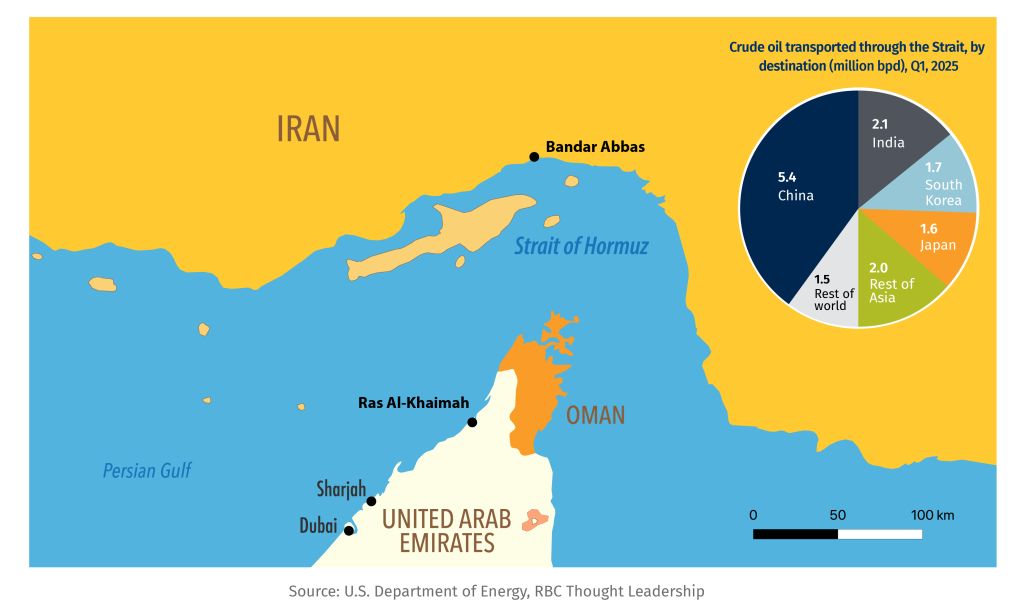
  • The shutdown of the Strait of Hormuz is forcing Japan to release 20 days’ worth of oil planned for May.

  • Despite heightened tensions between the U.S. and the European Union on several files, a deal on critical minerals, as part of an effort to lessen their reliance on China, is bringing the two together.

  • Global demand for AI chips drove Taiwan’s exports in March (up almost 61% year-on-year) to an all-time high.

  • International Monetary Fund plans to cut its global growth forecast. “Buckle up,” the IMF’s chief Kristalina Georgieva said, noting that the world is ill-equipped to respond to the shocks of the war in Iran.

As the Middle East crisis drags on, many oil-importing emerging economies face a “triple squeeze”: rising energy import costs, currency depreciation, and higher rates to reprice debt.

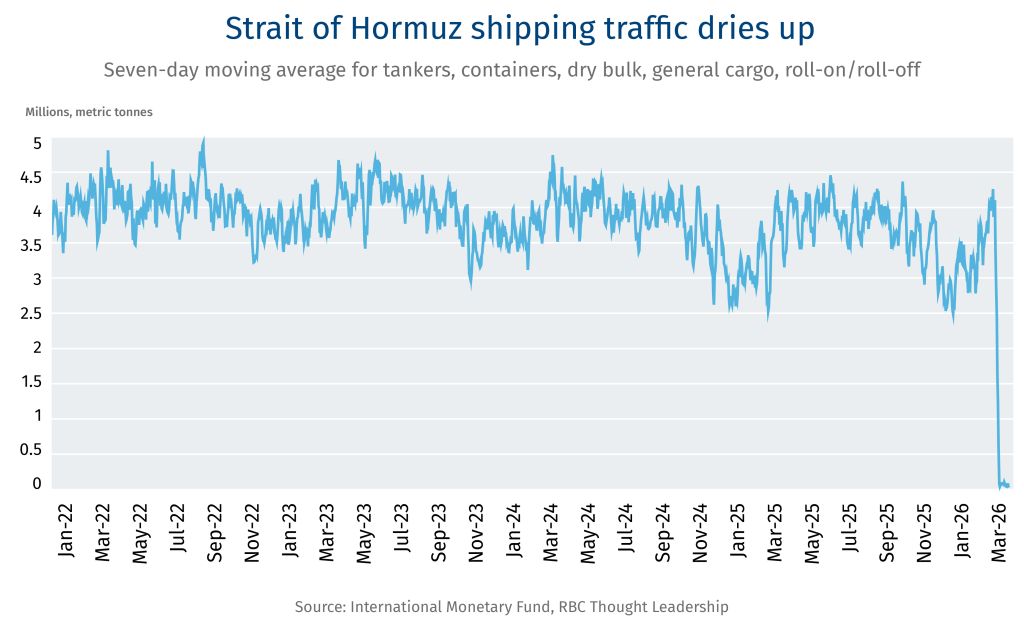
Strait of Hormuz shipping traffic dries up

Iran’s virtual blockade of the Strait of Hormuz has sent oil, diesel and gas prices soaring, raising costs for food, fertilizer and transport globally. But it’s developing economies that are bearing the brunt. For several African economies, energy and transport make up 15-25% of the CPI basket, a stronger U.S. dollar (up 0.85% against a basket of currencies since the Iran war began) has raised local currency debt service costs. Countries from Argentina to Vietnam have embarked on energy conserving measures and/or initiated emergency consumer support measures to offer some relief. Energy-driven inflation is pressuring central banks to maintain high interest rates even as domestic economies slow and foreign exchange reserves are drained. Investor confidence has already taken a hit with the MSCI Emerging Market Index wiping out its 13% year-to-date gains, while emerging market bond sales hit their lowest level for March since 2009.

Emerging markets’ debt vulnerabilities were already at historic highs. Developing countries paid US$741 billion more in debt service than received in financing (2022–2024). Borrowing costs have risen materially, with post-2020 issuance coming at rates around 10%, roughly double pre-pandemic levels. With 29% of Low-Income Countries (LIC) bonds maturing by 2026, default risk is rising for some sovereigns. The World Bank says it’s “ready to respond at scale” to assist emerging markets that have reached out.

Here are some of the countries that are under strain:

  • Egypt: Net energy importer with large fuel subsidies (28% of government spending), high USD debt, and near-term Eurobond rollovers US$4 billion); FX pressure (currency −8%) and current account deficit (−3% GDP) compounded by reliance on GCC remittances (73% originate from Gulf economies) and declining Suez/tourism revenues.

  • Pakistan: Petroleum prices are up 25%, as upcoming rollover (US$1 billion) is due 2026; recent debt crisis history, and heavy reliance on GCC remittances (62% of remittances originate from Gulf economies) strain reserves and heighten balance-of-payments risk.

  • Bangladesh: Structurally dependent on LNG (50% of electricity) with no short-term substitutes; supply disruptions and rising transport costs are pushing inflation (~9%+) and increasing FX reserve pressure.

  • Zambia: Extremely high debt service burden (10% of GDP) and fertilizer import dependence (2.5% of GDP); FX depreciation (−5%) compounds external financing stress.

  • Sri Lanka: Post-2022 default economy remains fragile; fuel rationing and continued import dependence constrain recovery despite partial stabilization of LNG supply via the U.S.

  • Côte d’Ivoire, Mongolia, Dominican Republic: Combination of FX-denominated debt exposure, current account deficits, and 2026 maturities; several also carry subsidy burdens (e.g., Mongolia) that amplify fiscal pressure as energy prices rise

  • South Africa: High share of local debt held by non-residents (16% of GDP); FX pressure (currency –5.2%); vulnerable to capital outflows, bond market volatility, and tightening financial conditions.

  • Turkey: Extremely high domestic yields (>35%), persistent currency depreciation, and significant reserve depletion (US$23 billion) from FX intervention; limited policy flexibility.

  • India: crude import dependence is at 89%, roughly half via the Strait; rupee at record lows, fertilizer plants capped at 70% capacity; exposure amplified by reliance on remittances.

  • Philippines: Imports 90% of its oil from the Middle East; current account deficit (−3.4% GDP). Maritime shipping disruptions are compressing margins in its most critical export sector (as semiconductors and electronics account for roughly 60% of total exports), while energy price pass-through is driving inflation above target.

Several of the markets critical to Canada’s diversification strategy are exposed to the war in Iran: Bangladesh and Pakistan are key destinations for Canadian pulses. In Zambia, where copper accounts for roughly 70% of export earnings, Canadian firms are leading major production expansions. Reports of hours-long queues at fuel stations in India signal the shock is already hitting at the household level—and it comes as the Canada-India Comprehensive Economic Partnership Agreement (CEPA) negotiations target $70 billion in two-way trade by 2030. Meanwhile, Canadian entities’ exposure to emerging market assets across South America, Africa and Asia, could also present another challenge.

Sydney Wisener

World Trade Organization (WTO) reform talks derailed

  • The WTO’s 14th Ministerial Conference, held in Cameroon last week, failed to usher in a new era of global trade reform after the U.S. and Brazil sharply diverged over how long to extend the E-Commerce Moratorium, an agreement that prohibits levies being placed on electronic transmissions and digital services.

  • The disagreement was the primary reason why a draft plan for reform of the WTO was not adopted, a major setback for the organization as it looked for ways to fight back against its marginalization and remain relevant in this new era of trade disruption.

  • U.S. Trade Representative Jamieson Greer slammed the WTO upon his return to the U.S., saying it would only play a “limited role” in future global trade policy discussions.

Helium emerges as another Hormuz headache

  • As well as disrupting global energy, aluminum, shipping, and fertilizer markets, the quasi-closure of the strait threatens the global supply of helium, a key component in the production of semiconductors.

  • Since helium is primarily a by-product of LNG production, LNG supply chokes threaten to also disrupt the flow of the gas, of which a third of global supply passes through Hormuz. Helium prices have roughly doubled since the war began according to Fitch Ratings, which could have knock-on effects for technology-heavy economies, such as South Korea, Japan, and even the United States tech sector.

  • Tungsten and sulfur are also key components of the global semiconductor supply chain and have experienced sharp price increases. Prior to the war beginning on February 28th, China had restricted its tungsten exports and called for tighter limits on sulfuric acid exports.  

The U.S. announces new tariffs on pharmaceuticals

  • Donald Trump announced new levies on branded drugs from pharmaceutical companies, including 100% tariffs on patented medications and their active ingredients.

  • This follows through on the threats Trump made last fall as part of his administrations drive to pressure pharmaceutical manufacturers to build or onshore production facilities to the U.S.

  • Reduced rates of 15% will be offered to jurisdictions that have secured trade deals with Washington, including Switzerland, Japan, the EU and South Korea. A U.S. official said the UK will essentially have zero tariffs on its imports as major British companies have struck deals with the administration.

— Thomas Ashcroft

Also in this edition: Untangling North America’s biofuel supply chain

The Strait of Hormuz has long been treated as an oil story. When it closes, energy markets move, tanker rates spike, and the headlines follow crude. But it remains a slow-moving shock to the cost of moving goods, which becomes more entrenched over time.

First-Order: Crude and Tankers

The most direct impact is exactly where markets expected it. Benchmark Very Large Crude Carrier (VLCC) spot rates have surged six-fold since early January and are currently priced at US$98/t (US$13-14/bbl). Tanker volumes through Hormuz (and Suez) have essentially collapsed, with more than 500 vessels stranded in the Persian Gulf.

Second-Order: Products and Fuel

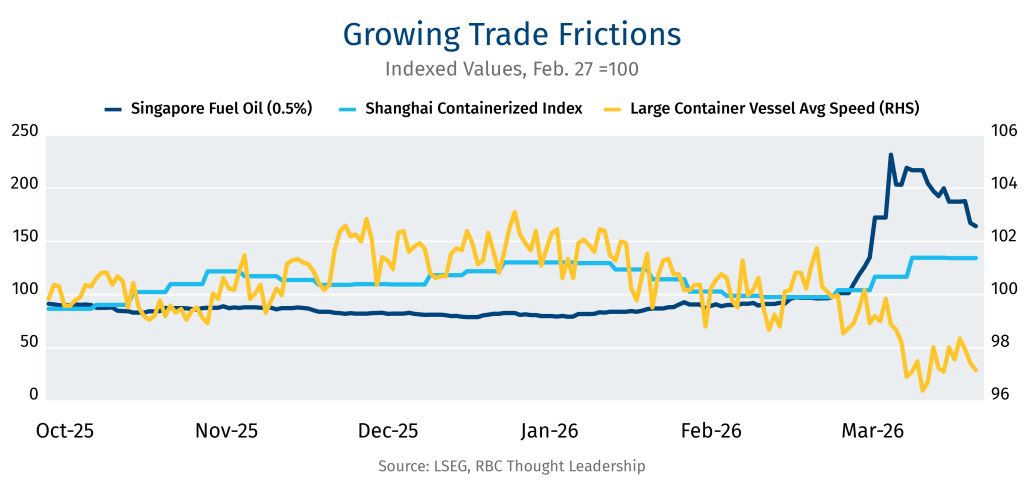
Refinery outages and export constraints tied to Hormuz have fractured global bunker supply chains, forcing vessels to seek fuel at alternative ports at elevated war-zone premiums. Charted below is the Singapore marine fuel indexed price, up 66% since the crisis began. Not charted but equally telling is the spread between Freight on Board (FOB) and delivered prices, typically <5% but well over 50% in mid-March, reflecting genuine physical dislocation in how marine fuel reaches vessels.

Maersk, a Danish shipping company, formalized this disruption on March 25 with a global Emergency Bunker Surcharge, entrenching a products shock into shipping economics worldwide.

Third-Order: Container and Dry Bulk

The Shanghai Containerized Freight Index (SCFI) fell gradually ahead of the conflict and has since rebounded (see chart), but the moves are likely seasonal. Chinese New Year brought port throughput to 40-50% of normal capacity in mid-February. How much of the SCFI March recovery is supply related in contrast to stronger demand is likely unclear until official port data is reported at month end.

Still, dry bulk was structurally underexposed to Hormuz to begin with–only around 55 dry-bulk vessels were transiting the strait weekly before the conflict and the Baltic Dry index is largely flat, if not marginally down. Nonetheless, large container vessel average speeds have edged marginally lower (see chart) since late February, a modest signal consistent with routine rerouting at the edges of the conflict zone.

–Shaz Merwat, Energy Policy Lead

Growing Trade Frictions

North America’s once integrated biofuel supply chain is splintering along national lines.

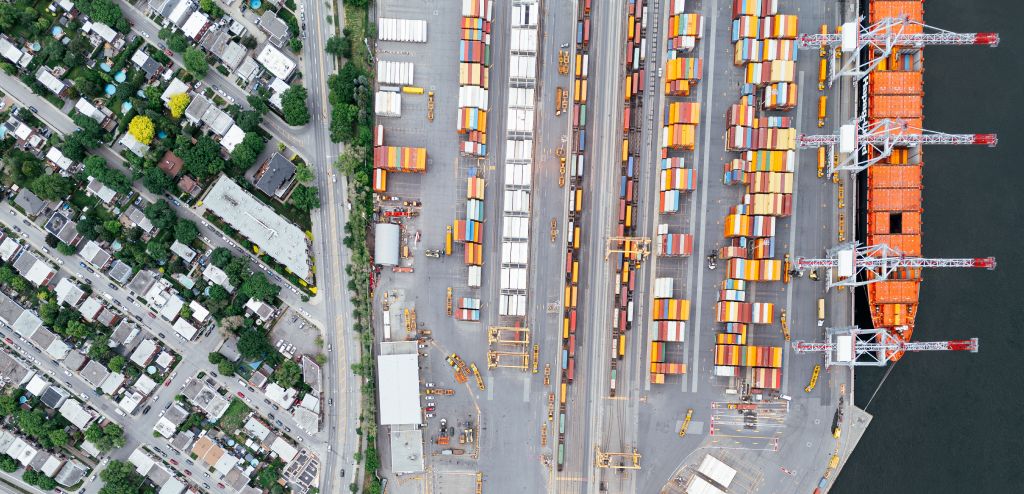
U.S. federal incentives, state-level programs, and Canada’s Clean Fuel Regulations (CFR) are increasingly pulling in different directions, leading to a fragmented market with implications for Canadian biofuel producers and farmers growing oilseeds and grain including canola, soybeans, and corn.

Policy shifts triggered a continental divide

Changes to U.S. policy under the Renewable Fuel Standard (RFS) and new production tax credits have led the shift. Proposed 2026–27 RFS rules significantly increase domestic biomass-based diesel blending targets, reinforcing demand for oil-based feedstocks like soybean oil.

  • At the same time, newer incentive structures—particularly the transition from blender credits to production-based credits—are explicitly favouring domestic fuel production in the U.S.

  • The change eliminates the US$1 per gallon incentive Canadian biodiesels and renewable diesel received in the U.S. market as biofuels must be produced in the U.S. to earn the production-based credits. The result: an approximate 13% decline in value of Canadian imports into the U.S. between 2024 and 2025, according to Canada’s trade portal. It’s a meaningful departure from the bump Canadian biofuels received from U.S. subsidies.

What’s the impact on Canadian oilseed and grain markets?

Biofuel is a policy driven market and regulatory certainty is not a guarantee. Incentives for biofuel feedstocks under U.S. policy are still evolving as the U.S. Environmental Protection Agency (EPA) establishes its Renewable Volume Obligations (RVOs) for 2026 and 2027.

The pending U.S. policy uncertainty for Canadian farmers is that the EPA has proposed reducing the number of Renewable Identification Numbers (RINs) generated for imported renewable fuel and renewable fuel produced from foreign feedstocks, which would financially discourage U.S. biofuel refineries to use Canadian feedstocks. However, rising domestic Canadian demand could partially offset the export risk.

Canola: It’s the most exposed. Canola oil exported to the U.S. is primarily used for renewable diesel production. Exports of canola oil volume to the U.S. fell by 26% between 2024 and 2025, after climbing in each of the previous five years. The drop occurred while the Canadian canola industry spent more than a year in regulatory limbo, waiting for the U.S. Department of the Treasury and the Internal Revenue Service to clarify how production credits would work, confirming the inclusion of North American feedstocks in January this year.

Soybeans: Canadian soybean farmers may benefit from supportive U.S. policy. According to the U.S. Department of Agriculture’s 2026 outlook, biofuel mandates and tax incentives are expected to drive a 17% increase in U.S. soybean oil use for biofuels. Rising demand for soybeans is supporting prices, yet the commodity still faces potential downsides on trade with the U.S. if the EPA’s proposed RVOs are confirmed.

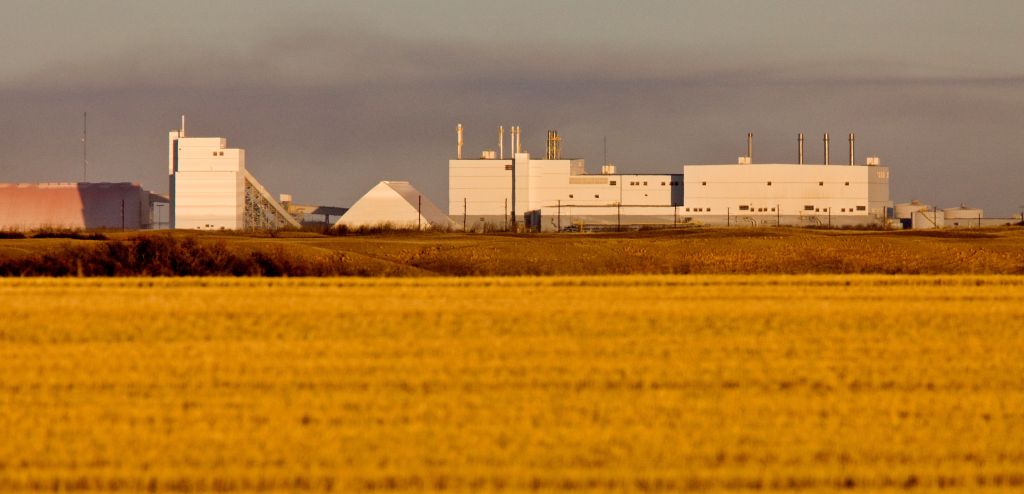
Corn: It remains anchored in U.S. ethanol production under the RFS. Yet, Canadian ethanol producers are now disadvantaged under the Clean Fuel Production Credit (45Z) that’s designed to encourage U.S. production of finished biofuel via incentives.

Bottom line

The Canadian outlook is mixed with domestic market demand hinging on the federal government’s forthcoming CFR amendments, where policy levers to shore up domestic demand are being considered, including minimum domestic content and credit multipliers for local producers.

–Lisa Ashton, Agriculture Policy Lead

Canadian beef producers raise concerns over potential Mercosur free trade deal

  • As Ottawa looks to secure a free trade agreement with the South American bloc this year, the Canadian Cattle Association (CCA) expressed concerns.

  • Brazil is the world’s largest beef producer, and the CCA worries that a Mercosur free trade deal would flood the Canadian market with cheap beef, harm the industry’s efforts to recover amid the tightest cattle supply in 40 years, and risk accusations from the U.S. of Canada enabling a “back door” into North American markets.

Fertilizer costs are leaping just as planting season gets underway

  • Disruption to shipments of fertilizers and commodities essential to fertilizer production through the Strait of Hormuz has increased prices, while North American farmers prepare to embark on their spring planting season. Urea, for example, has seen a ~40% price increase since the conflict began. The surge is quickly becoming a political issue for Trump who met this week with American farming groups, an influential political lobby.

  • Meanwhile, Russia, whose shipments remain unaffected by the Hormuz blockade, has deep reserves of fertilizers and commodities. Earlier this week, Russia halted its exports of ammonium nitrate, to shore up its domestic supply. But the conflict potentially raises the specter of Russia looking to increase its leverage on having restrictions on Russian fertilizer exports to Europe eased.

European parliament approves trade deal with U.S.

  • EU lawmakers had previously delayed approving the Turnberry agreement over U.S. President Donald Trump’s threats to annex Greenland, but on Tuesday the European parliament cleared the way for its implementation—with additional conditions attached. Prior to the vote, the U.S. threatened that the EU would lose favourable access to LNG shipments from the U.S. if the deal was further delayed, as Europe feels the bite of disrupted LNG shipments from Qatar.

  • The deal would eliminate EU tariffs on American industrial goods and some agricultural products and reduce U.S. tariffs on most EU goods to 15%. However, MEPs attached safeguards, such as delaying the EU’s tariff eliminations until the U.S. reduces its levies. These safeguards must be approved by EU member states, with negotiations commencing April 13th.

–Thomas Ashcroft, Geo-Politics Lead

For 25 years, Wikipedia has been one of the web’s most relied-on public resources. But in an age of generative AI, misinformation and falling trust in institutions, why does it still work? Jimmy Wales, Co-Founder of Wikipedia, joins John Stackhouse to discuss how the platform built credibility through community, transparency and a shared commitment to neutrality. They explore what AI still gets wrong, why accountability matters more than algorithmic gatekeeping, how trust affects business and civic life, and what institutions can learn from one of the internet’s most enduring models.

Listen on Apple Podcasts, Spotify or Simplecast

Trust at Scale: Lessons from Wikipedia

SPEAKERS

Jimmy Wales, John Stackhouse

John Stackhouse 00:00:03

Hi, it’s John here. Today’s episode is about a single word, trust. And if you’re like me, you probably think trust is in decline pretty much everywhere. And every survey out there, every study would say trust is in secular decline.

And yet, if you took a bus this morning, you put your trust in a whole bunch of people. If you bought a sandwich at lunch, you put your trust in a whole bunch of strangers. For all of our concerns about trust, we have trust all around us and in many ways it’s also growing.

Our guest today is someone who has just written a book about the seven rules of trust, and he’s also built one of the world’s most famous enterprises, which is stitched together entirely by trust.

I’ll be joined in a moment by Jimmy Wales, Sir Jimmy when he’s in the UK, Jimbo when he’s at home in Alabama, and around the world, known as the co-founder of Wikipedia.

Whether your questions are about science, business, wars, movie stars, wherever the human imagination will take you, Wikipedia continues to grow as the world’s encyclopedia, not just because it’s full of facts, but because it’s stitched together by trust.

In his book, The Seven Rules of Trust, Jimmy Wales and his Canadian co-author, Dan Gardner, outlined not just the core principles of Wikipedia, but the broader principles of trust that can make society and communities stronger, even in this disruptive age of generative AI.

Jimmy, welcome to Disruptors.

Jimmy Wales 00:01:44

Thanks for having me on. It’s good to be here.

John Stackhouse 00:01:46

Let me start with the book and curious what inspired you to write it 25 years after launching Wikipedia.

Jimmy Wales 00:01:53

Yeah. Well, I’ve been watching the Edelman Trust Barometer Survey, and we’ve seen this really long-term slide in trust in society. So trust in politics, trust in institutions, to a lesser degree, trust in business, trust in each other.

And I realized that Wikipedia is built on a foundation of trust. So I thought, “Okay, well, look, Wikipedia’s gone from being kind of a joke to one of the few things people trust. What are some of the lessons I’ve learned and what do I have to say about that?”

John Stackhouse 00:02:25

And lots of lessons that we’ll get into, but maybe we can chat a bit about what is causing that decline. Society’s very different today than 25 years ago when you launched Wikipedia. What in your mind has really changed in our worlds?

Jimmy Wales 00:02:40

If you take a long view, then, yes, a lot is different from 25 years ago, but a lot is the same. Human beings are still the same. Our institutions are flawed, good and bad, and all of that.

What has changed, certainly the rise of social media and how people are living their lives in that sense, but also the rise in, I would say, hyperpartisanship in politics.

When we look at trust, say trust in politics, it’s very tempting for a lot of people to lay the blame at the foot of Donald Trump, for example, who’s clearly not always a trustworthy person. But the decline in trust is much older than that, and it’s a much more broad long-term trend.

And so, that’s not the only place to look. I mean, I would say in part, he’s a symptom of the decline of trust as much as a cause.

John Stackhouse 00:03:31

Many people would attribute that to the decline of institutionalism, whether it’s churches, communities, the fragmentation of society. Do you buy that general theory of society that we’ve become more atomized?

Jimmy Wales 00:03:44

To some extent, the way we live our lives in many ways is not that far different. We still have groups of friends and we still have various community things we do and so on and so forth.

 But I do think there’s a piece to that. Certainly, when we see relatively rapid changes in technology, the way we get information… I’ll just give one example.

In the last 25 years, we’ve seen a real acceleration in the decline in local journalism, local newspapers. And that makes people a little disconnected from civic participation. I wish I had a solution to the problem of local newspapers, but I don’t. But I think some of those kinds of things are a factor in all of this.

John Stackhouse 00:04:48

One of the aspects of your book that I found interesting was the notion of, I want to call it community spirit, maybe you call it civics, but doing things together. And this takes me back to the origins of Wikipedia because people may describe it as crowdsourcing, but it really is about community.

Take us back 25 years when you were building Wikipedia. What inspired you as the internet was taking off to do this crazy thing of getting humans to work together across geographies on something as age-old as editing and fact checking?

Jimmy Wales 00:05:06

Yeah. I’m glad you didn’t fully go with crowdsourcing because that’s a term I don’t particularly care for. Crowdsourcing is, “Oh, I’ve got some work to do. I’m going to try and trick the general public into doing it.” And that’s not a very respectful description. It’s not a very accurate description of what people are like and what Wikipedia is like.

And that’s really about community building, about people getting together because they enjoy doing something together. They feel productive in some way with Wikipedia, in particular. And some of the inspiration for it.

So I had a friend who was a professor at Brown University, so elite Ivy League University, philosophy professor, and we met each other online. And we had an email dialogue for several years discussing ideas and philosophy, and I was learning a lot from him. And it was fantastic that somebody was willing to share that much time with me.

And that kind of spirit to say, actually, people enjoy intellectual stuff. They enjoy working together with other people. That was part of the inspiration is to say, “I think people would enjoy doing this.”

John Stackhouse 00:06:13

One of the things about your own background that people may not appreciate is that you were, I don’t know if this is fair, but a bit of a quant.

Jimmy Wales 00:06:19

Mm. Mm-hmm.

John Stackhouse 00:06:20

You did your PhD studies in finance, you worked as an options trader, you’re a numbers guy. How did that intersect with that intellectual curiosity that was also a foundation of Wikipedia?

Jimmy Wales 00:06:35

I’m a big fan of an essay by Friedrich Hayek. It was in the American Economic Review in 1945, and it’s titled, On the Use of Knowledge in Society. And it’s about how a price system functions to communicate information.

So, at that time, there was a raging debate going on between the idea of a centrally planned economy versus a price-based market economy. And what he identified that I think is universally understood now is that the price system plays a very important role in efficiently communicating information about demand and what people want.

And his point was, “A price system’s incredibly efficient. I don’t need to know why the shelves are emptying out of this product that I make. I just need to know, “Hey, I can make more. I can sell more. And then the price system is sending me the signal.”

So, Wikipedia is not a price system, it’s not a marketplace. But that idea of decentralizing decision making was something that really impacted my thinking, which is to say in a traditional encyclopedia, all the information has to be communicated up a hierarchy and to the editor-in-chief and as sort of a central group of people decide.

Whereas at Wikipedia, the main decision making goes on at the end points, at the level of the individual article where people are discussing and debating, bringing in new sources and so on and so forth. And so that kind of decentralized approach did have a big impact on my early thinking.

John Stackhouse 00:08:02

So, a big bet in trust, I would assume by you in your community. But you didn’t seem to invest a lot in selecting that community, almost self-selected. Is that a fair reflection from what I’ve read in your book?

Jimmy Wales 00:08:16

I mean, that’s an interesting question, actually. So before Wikipedia, I had a project called Newpedia, which was a very traditional top-down, we’re going to write an encyclopedia, let’s recruit the best academics. And a lot of those people made up the backbone of the early community.

And certainly throughout the history of Wikipedia, there’s always been this idea of, we need to find people who are kind and thoughtful, who respect the idea of neutrality, who respect the need for quality sourcing and all of that.

And so, although, yes, it’s very open and anybody is welcome to come and join, we’re still, we’re looking for a certain type of person.

John Stackhouse 00:08:54

And the community helped you select that?

Jimmy Wales 00:08;56

Oh, yeah, for sure. I mean, even today, it’s all part of what we do. I mean, we do things like editathons, sort of public outreach events to get people to come and join Wikipedia and so forth. We’re always looking for people who think it would be a cool hobby.

John Stackhouse 00:09:09

So, this takes me back to those early years. At the time I was in journalism, I was Editor of The Globe and Mail during some of those years, and we experimented with lots of things, but one of them was community comments.

And in the early days, holy cow, it was almost an, I don’t want to say an unmitigated disaster, but it was pretty loud, noisy, and at times irresponsible. And it was a window on the downside of community, especially un-moderated community.

How did your thinking evolve in those early years as social media was exploding, as we were getting into those early days of the internet as something that everyone could participate in?

Jimmy Wales 00:09:54

I’m old. I’m old enough that I remember Usenet, which was before the Worldwide Web even. It was a giant un-moderated and in many ways un-moderatable because it was a very distributed design. It was full of flamers, full of spam, full of very angry people.

And so, sometimes people have this kind of rosy view,  Oh, it must have been really easy back then because everybody was sweet and nice and everybody was happy about the internet.” And I’m like, “Well, no, not really.”

Because the thing about humans is we can be mean to each other even without an algorithm. And so, the way I think about this and the way I talk about this is like, what do you need to do to foster, facilitate a good community, a quality discussion?

And so, clearly, as many, many newspapers experienced back in the early days, just opening up and let anybody comment on anything, it’s going to be dominated by the angriest people, by the trolls and by… It’s sort of a bit of a fiasco. So then you have to start thinking about, “Okay, but how do we manage this? How do we get better at this?”

At Wikipedia, what’s interesting is we don’t use algorithms, we don’t use scoring mechanisms. It’s an accountability model, not a gatekeeping model. So everything you edit, everybody can see what you’ve done. And so they can see your history.

And so, you will have a good reputation or a not a good reputation and people would be aware of that. You don’t get a reward from being from low quality behavior. As you do, by the way, in almost all social media, because the reward is you act like a jerk and you get engagement.

Wikipedia, it’s just like your comment gets erased and that’s that. One of the earliest rules of Wikipedia was no personal attacks. You and I, maybe we’re editing something together and we’ve got a real disagreement. Well, the minute one of us steps across the line and starts attacking the other person, that’s not helpful.

That doesn’t mean everybody’s perfect in Wikipedia. Obviously, people get mad and they attack each other and so on. But there’s a culture that says, “You know what? If you’ve been a jerk to someone, you should probably apologize.”

Maybe you should back away from that subject area if you’re too emotional to be able to calmly interact with people, maybe too much trying to win a battle rather than help make the project better.

And so, it’s not magic and it’s not automatic. It really does require ongoing discussion, dialogue, coaching, people to say like, “Hold on a minute, here’s what we’re trying to do.”

And one of the seven rules of trust that I think is really important is have a good purpose. And with Wikipedia, we all know what we’re here to do.

We have a goal. The goal is a high quality, neutral encyclopedia that cites quality sources and so forth, and that puts a framework around everything that we do. And so we have a way of deciding. It’s like, “Oh, is this debate constructive or is this just people sniping at each other?”

John Stackhouse 00:12:47

Let’s fast-forward into this new age of AI. Probably like a lot of people, I’ve been wondering, how does Wikipedia survive in an age of generative AI? Most models, LLMs, draw on Wikipedia, it seems a lot.

Jimmy Wales 00:13:02

Yeah, they do.

John Stackhouse 00:13:03

But, over time, does that relationship continue where Wikipedia feeds the LLMs? Or do the LLMs figure it out and start to bypass you and those moderators who are essential to all that you’ve built?

Jimmy Wales 00:13;17

Yeah, I don’t see any movement in that direction. I mean, clearly, Wikipedia is a key part of the training data and that human curation of knowledge is very, very important. I mean, I always joke you wouldn’t want to use an LLM that was trained only on Twitter. It would be very angry and stupid.

And obviously, Wikipedia is different from a lot of publishers who are quite disturbed about all this and the training that’s going on on their content. But Wikipedia is open source, freely licensed. And so, on that level, it’s fine. That’s what it’s here for is the world is better off if LLMs have read Wikipedia.

But in terms of competing with us, at least for now, and we’ll see how this goes, the hallucination problem is still severe for large language models. I mean, they literally just make stuff up. And dangerously, they make stuff up that sounds plausible, that’s the way the technology works.

And that problem is much greater the more obscure the topic that you get to. So, at least for now, large language models aren’t a direct substitute in any way for Wikipedia. They’re clearly inferior.

What they are better at, and this is having some impact on us, is that quick answer to a question, particularly if it’s of low risk, low danger. So, if you ask Google today, “How old is Tom Cruise?” We do see a decline in traffic for that type of query.

But if you have that question and that’s literally all you wanted, okay, fine, you’re done. You don’t come to Wikipedia, that’s okay. We’re not ad driven, so our revenue isn’t based on how many clicks we get.

But if you’re like, “Oh, wow, he’s younger than I thought. I thought he must have been 80 by now and he isn’t. What was he in? I thought he was in a movie. What was that?”

And then you go, you dig in, then you’re back to Wikipedia. And so that’s great.

John Stackhouse 00:15:08

Does it change the business model for you?

Jimmy Wales 00:15:11

No, no. Our business model, so to speak, we’re a charity and we’ve had very, very good donations. I mean, our donors are very loyal. And then there was sort of the amusing theme because Elon Musk has been on a campaign against us and he once tweeted, “Defund Wikipedia.” We brought in a few million that day, so bring it on, Elon.

But no, it hasn’t impacted us. And we’re very lucky. I mean, actually one of the things that I do think is quite important, and this was a decision that we made consciously. We aren’t funded by governments and we aren’t funded by a handful of billionaires, and that’s a really good thing.

Imagine if 10 years ago Elon had said, “Oh, Jimmy, stop with the banners and asking people for money. I’ll just fund it. I’ll just write a check every year for the costs.”

Well, then we’d be absolutely vulnerable to whatever whims he might have. And we’re much better off having the intellectual independence of being funded by the general public and we answer to the general public, and that’s really, really important.

John Stackhouse 00:16:15

All of this in a way speaks to neutrality. Elon has labeled you Wokepedia and says, “You’re not neutral. You’re biased.” And there’s some debate as to what neutrality means in this day and age. In some ways, none of us are neutral.

How’s your own thinking about neutrality evolving in this arguably more contentious age?

Jimmy Wales 00:16:36

I’m still very, very keen. So, certainly, the way I approach these questions is, if you say we’ve become Wokepedia, I’m like, “Well, that’s just not true. I know the Wikipedians. I know Wikipedia. It’s not true.”

If you say, “Yeah, but this particular area, you’ve got a bias.” My answer to that is always, “Okay, let’s see what we can do about that. Tell me what you think is wrong and how do we fix it?”

And there are areas where I don’t think we’ve got it right right now. I think we’ll get there, but that’s just part of the discourse.

For me, that is the heart of what Wikipedia should be about is having that thoughtful dialogue. How do we get to a place where everybody can point to it with pride and say, “Yeah, that is a good presentation of the issue.”

And so, for me, neutrality in these divisive times is the same as it ever was. It’s not that hard. It’s sometimes hard to calm people down enough to get there and things like that, of course.

But when people say,  Oh, but how can you be neutral anyway?” I’m like, “Well, okay, here’s one technique. One of the most important techniques that we have is step back from the issue and don’t take a side in the debate, just describe the debate and describe it in a way that’s fair to all the sides.”

And the reason that I prefer that is because I believe that is what an encyclopedia should give you. You shouldn’t go to an encyclopedia and get a one-sided presentation of something. You should get an understanding of what the debate is about.

When we think about the question of trust, I think people will continue to trust us and increase their trust in us as long as we’re willing to grapple with it. We’re willing to say, “Okay, hold on. You’re saying we’re super biased. Let’s go through this.”

What I find when I look into this is, that what Wikipedia tends to do is knock off some of the rough edges in the media. When the media is being biased, we kind of tone it down and stay at more neutrally.

John Stackhouse 00:18:29

One of the important aspects, even essential aspects of neutrality is skepticism, including self-skepticism. That takes me to your Seven Rules of Trust, and we don’t have time to go through each of them, but I want to talk about the social context of these pillars of trust.

I was fascinated in the book with your reflections on Quakerism. The belief in community, Quakers work and worship in circles and meet in circles.

It had me wonder about how our circles have been broken and whether we can rebuild them online or if we are becoming too self-centered, losing the circle and having things revolve around us rather than us being part of a broader group that revolves around something bigger.

Jimmy Wales 00:19:13

So, a lot of our sense that society’s breaking down in some horrific way does come from a very politicized political class and from highly toxic social media, not from our day-to-day life. It’s easy to fall into a little bit of despair if we think about broad, huge, big picture trends, because what can anybody do about that? I’m just one person.

But I think we can start where we are. And I think that’s part of the concept of the Seven Rules of Trust is to say, “In my personal life or in my family, in my company, in my organization, can I put trust at the center of what we’re thinking about?”

So if you’re a small business, you really should be thinking a lot about trust. What is the trust that your customers have in you? How do you build that trust? How do you extend that?

Because it’s very profitable to be trusted. It makes doing business of all kinds much easier and cheaper. And part of the story of the Quakers in the book is the Quakers, as a part of their ideology, they would be honest about their negotiating position to a fault.

And because of that, people were like, “Oh, well, you can do business with the Quakers. They’re not going to cheat you and great. Fantastic.” So they became very successful in business, and that’s really an amazing thing.

And I think that’s the kinds of things that we can put on the agenda in lots of places. And I think we should see more of that. As consumers, we should say, “Actually, I’m going to go with the product where I feel like the company has a reputation of standing behind it.”

John Stackhouse 00:20;45

And that’s the good side of the sharing economy that consumers, users get to share information. It’s not just about sharing a product. Uber’s a good example of this.

Great leap of faith. I’m getting into a stranger’s car, but I also trust the community that if others rate that driver 4. 9, odds are pretty good because I’m part of that community.

Jimmy Wales 00:21:07

Yeah. With Uber, the thing I find sort of amusing is, I remember there was a big kind of moral panic and scare, when? 30 years ago, I don’t remember exactly, about carjackings.

And at that time, if you pulled up at the curb somewhere and somebody opened the rear door of your car, you would be absolutely terrified that you were getting carjacked. Now, you wouldn’t do that because you would go, look, “Hey, I’m not an Uber.”

It’s sort of more trusting the idea, oh yeah, a random person tries to get in my car. I’m going to laugh about it because they’re probably not trying to kill me. They think I’m an Uber.

John Stackhouse 00:21:41

But one of the tensions, and this is perhaps a forever tension in online society and online economies is the need for regulation of having a central force that governs what we do. So when there is bad behavior, even if it’s abnormal, that it is both corrected and there’s a signal to the market, to the community of users that bad behavior is caught and addressed.

What should we learn from the Wikipedia model in terms of governance? Because there isn’t that centralizing force that you mentioned earlier in the conversation.

Is that just the special sauce of Wikipedia or can that be translated to other, especially more commercial markets?

Jimmy Wales 00:22:23

I think it can. I mean, we’ve talked about businesses that could do a better job of thinking about trust and building trust. Top down, centralized, opaque moderation mechanisms are not working very well. And so my view is, start to explore ways you can devolve a lot of that into the community.

I’ll give one example that I do think is a bright spot. I sort of knock on Twitter quite a lot, X. I can never change what it’s called in my mind, but their community knows feature I think is broadly a good thing.

It empowers people to say, “Hold on, that’s wrong. That’s misinformation.” And I think that kind of stuff is very useful because it’s not top down, it’s not from the company. It empowers the community to have a say over something.

But that idea of let’s find ways to devolve decision making to the end points, that’s probably a very helpful thing to do.

John Stackhouse 00:23:17

Jimmy, as we move towards close, one of the things I’m taking from this conversation is actually your optimism about humanity. Of course, your Seven Rules of Trust are positive. Things like make it personal. We can all do something. We don’t need to leave this up to an algorithm.

But I love the point, I think it’s rule number two, about being positive about people. Give us a sense of what gives you positivity when you wake up in 2026 about people.

Jimmy Wales 00:23:45

If you step away from the online world and spend time with families, spend time with friends, people are delightful. And in the research for the book, I found a lot of really bright spots.

Things like Braver Angels is a group that they get together people across the aisle, political spectrum to sort of have discussions and debates. But what they show is actually people have more in common than they have in difference, even if they’re very different politically. So there’s a lot to be happy about.

And even I’m going to say a lot of people are very dismissive and have a lot of concern about young people being addicted to their phones and addicted to TikTok and, “Oh, kids these days and their short form video.”

And I’m like, yeah, they do love a little short form video. That’s true. They like the YouTube shorts and they like the TikTok and all of that. But guess what? This is also the same generation, I’m talking about teenagers who will binge-watch eight straight hours of a really complicated and sophisticated TV show.

Another element that I’ve really been pleased to find out, I had no idea is like the listenership to podcasts skews heavily young. And you think, wow, podcasts, like podcasts are long form content.

This is the same generation we’re afraid all they’re doing is flicking posts on Instagram and yet they’re doing that, but you know what they’re also doing? They’re also listening to really long conversations and that’s kind of fantastic.

John Stackhouse 00:25:10

And are they going to Wikipedia?

Jimmy Wales 00:25:11

Oh yeah, yeah, yeah. Massive. Yeah. One of my favorite things to do, I love to go out and speak at schools. And I always think when I was 15, if they had said, “Yeah, okay everybody, we’re having an assembly and the Editor-in-Chief of Britannica is going to come and give a lecture today,” we would have been like, “Ugh, kill me now. Are you kidding me?”

And when I go to speak, the kids are out of their minds. They’re so excited. They love Wikipedia.

John Stackhouse 00:25:36

Why do you think kids today may be more interested in encyclopedia as the online version than your generation might have been in the physical world?

Jimmy Wales 00:25:43

Oh, I just think it’s so much a part of our lives, Wikipedia, compared to encyclopedias back then. Back then, encyclopedia was a very solemn set of books on the shelf and you would go to it from time to time.

Whereas now, imagine that you hear, as you might in the news these days, I saw that Iran fired a missile at Azerbaijan and you think, “Azerbaijan, I don’t really know about that.”

40 years ago, you might have thought, “Oh, I should go to the library and look that up.” Well, you thought that, but you never did it. You just wondered and that was the end of that. Whereas now you probably go, “Oh, hold on. Azerbaijan.” You Google it and then you’re like, “Oh, Iranian Azerbaijani relations. Okay, now I’m going to see, what are they mad about?”

And that’s the kind of casual learning that people really enjoy and I think is really powerful.

John Stackhouse 00:26:26

It comes back to maybe one of the unspoken rules of trust, which is be curious.

Jimmy Wales 00:26:35

Jimmy Wales: Yeah.

John Stackhouse 00:26:36

And humans are, we’re a curious species.

Jimmy Wales 00:26:38

They definitely are.

John Stackhouse 00:26:39

We want to learn, we want to explore. If I can ask one last question, Jimmy, this has been such a rich conversation. It’s about what some might call a trust dividend.

If we’re doing all these things, following the rules, creating more trust, and if there is a dividend from that, where would you invest it? Is it in schools like you’re doing? Is it in institutions? Is it in digital infrastructure and product design?

Jimmy Wales 00:27:04

I definitely think that investing in education is incredibly important, investing time with your children and their education, things like that. That is massively, massively important. And I think that’s something we all need to focus on.

John Stackhouse 00:27:19

Jimmy Wales, what a great conversation. Thank you. Thank you for creating Wikipedia.

Jimmy Wales 00:27:24

Very good.

John Stackhouse 00:27:24

John Stackhouse: I can’t think of a person who has not benefited from it and you can’t say many things about that in the world.

Jimmy Wales 00:27:30

Jimmy Wales: Very good.

John Stackhouse 00:27:30

Thank you for being on Disruptors.

Jimmy Wales 00:27:32

Thanks for having me.

John Stackhouse 00:27:34

There’s so much to take away from that conversation. But one of the points that stands out in my mind is how trust is not a moral decoration. Every business, every community, every circle of friends depends on trust, and that’s something we can all invest in every day.

Check out our show notes for a new briefing on trust at Internet Scale. And if you’re looking for more ideas and insights, visit rbc.com/ thoughtleadership. There, you’ll find critical insights to help us all make more informed decisions in a rapidly changing world.

You’ve been listening to Disruptors, an RBC podcast. If you like this episode, please rate, review, and follow us on Apple or Spotify. That will help others find conversations like the one you’ve heard today.

I’m John Stackhouse. Thanks for listening.
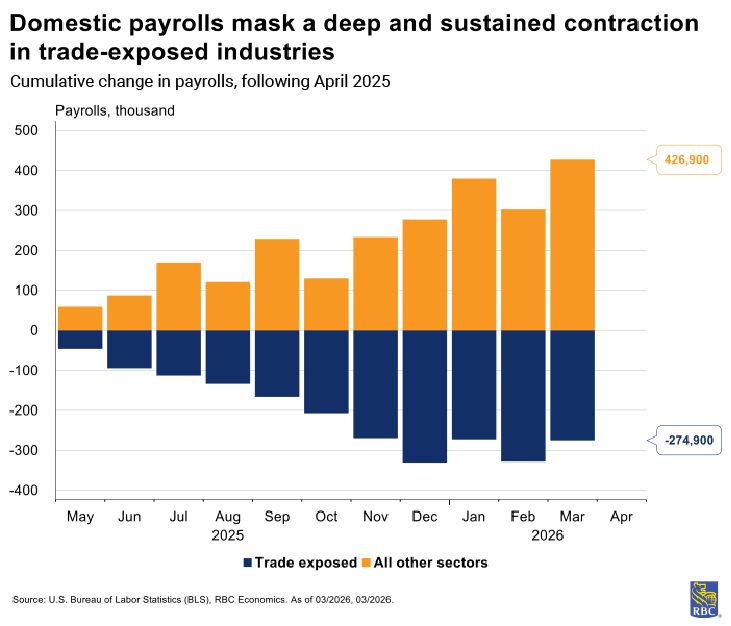
It does not take sustained disruption to ships sailing through the Strait of Hormuz for it to stop operating as a reliable artery of global trade. The costs are starting to add up: container shipping rates have risen 12% in the two weeks ended last Thursday, according to the Drewry World Container Index.

  • When maritime war risks emerge, a relatively concentrated group of insurers designate high-risk areas, standard coverage falls away and shipowners must secure additional war risk insurance on a voyage basis, priced as a percentage of the vessel’s value.

  • In recent weeks, those premiums have surged from fractions of a percentage point to now 5% of a ship’s value. For a large tanker, that translates into millions of dollars for a single passage. That could soon lead to shortages and likely higher prices for everyday items from toys to clothes to chips.

  • When Iranian drones, mines, or small-boat attacks present a persistent and credible threat to the strait, this also becomes a human judgment call for the captains and crew. Not to mention the shipowners who don’t want to see one of their expensive tankers go down or be rendered useless.

  • There are rising international efforts, including from Canada, to safely reactivate a key maritime channel in the Gulf, where an estimated 1,000 ships—largely energy tankers—are currently stalled.

  • According to Lloyd’s List Intelligence, the conflict has already seen 23 vessels targeted, with some incidents leading to crew casualties.

  • While Covid hit volumes sharply and dramatically increased freight rates, Hormuz is testing the precision of the global shipping system: flows are being rerouted, voyages are lengthening, and tonnage is being repositioned across basins. Cargo that would typically transit Hormuz is increasingly moving west via alternative corridors, with Red Sea ports emerging as key nodes in what is now a rapidly shifting map for cargo transiting through the Middle East.

What’s the impact?

  • Longer voyages absorb capacity, tighten vessel availability in some regions, and create imbalances elsewhere. For containerized trade, the impact is consequential. E-commerce delivery delays have already hit Middle East retail, as air cargo is also taking a hit.

  • Global supply chains depend on timing. Goods move in sequence and within defined windows. That predictability is now eroding. An increase in freight rates can be absorbed. A shipment that arrives weeks late, and without certainty, cannot.

–Thomas Ashcroft

Oil and gas trade has virtually halted in the countries surrounding the Strait of Hormuz in the Persian Gulf. And as Qatar’s natural export facilities suffered a hit, it has sent energy forecasters back to the drawing board.

The global LNG market was on track to move into meaningful surplus in 2026, with two million tonnes on supply of 475 million tonnes (MT) in 2026 and 30 MT on supply of 585 MT in 2029.

How badly are Qatar’s LNG exports hit?

  • A disruption to Qatari supply — the world’s second largest LNG exporter — would wipe that surplus out entirely for roughly three years to a 30 MT shortage in 2026, and only 8 MT excess in 2029. Of course, this assumes no demand destruction, which remains to be seen.

  • Based on conversations, Qatar’s adjusted supply scenario of LNG this year is likely 50-55 MT, a ~30 mtpa disruption from last year’s ~83 mtpa of production. That’s not a rounding error—it is a decline just under two times greater than Canada’s current entire LNG export capacity.

  • Qatar’s North Field expansion, which underpins the global supply growth story through 2030, could get pushed back with a slower ramp. The market was pricing in those volumes but is now repricing a near to mid-term shortage.

    Natural gas production from Qatar's massive north field

This is a two-stage shock

  • The Strait of Hormuz dimensions compound the picture. With tanker traffic effectively frozen, the disruption isn’t just a production story – even unaffected volumes are shut-out of the Strait.  

  • LNG Canada is revving up. Eight vessels departing B.C. in the first 17 days of March versus four in all of December signals that Pacific Basin buyers are already rerouting toward non-Gulf supply.

  • Reports suggest U.S. LNG cargoes are also headed to Asia via the Panama Canal.

  • Bottom line: The anticipated LNG glut — widely expected to lower prices and improve affordability — is likely off the table through at least 2028.

For more, read: Energy Shock: 8 charts that explain the global oil and gas fallout – RBC

–Shaz Merwat

Negotiating trade with President Donald Trump is like playing whack-a-mole. Irritants pop up relentlessly and belligerently. Except if you swing late, the mole pops up and whacks you back harder. The U.S. Trade Representative’s launch of a Section 301 investigation into Canada is just the latest belligerent act.

The investigations, targeted a total of about 60 trading partners, fall under two probes:

  • First, to determine if countries have failed to effectively ban or enforce prohibitions on goods produced with forced labour entering America (which is the focus of the Canadian investigation).

  • Second, whether foreign government subsidies result in overcapacity that floods markets and hurts U.S. manufacturing in key sectors.

The U.S.’s motive is to force allies to share the load in hardening against forced labour goods from regions like Xinjiang region—where minorities are forced to produce goods—, apart from overcapacity, and broader Chinese supply risks. It’s not just bilateral finger-pointing but, for Canada, it does initiate a deliberately targeted process:

  • Washington charges that Ottawa’s forced-labour enforcement regime unfairly burdens U.S. commerce by letting tainted goods flow into North America.

  • That triggers mandatory consultations, public hearings, and evidence-gathering before tariffs can then be applied.

What’s the realistic threat?

If Canada falls foul of these investigations, duties could target manufacturing inputs (steel, aluminum, minerals), high-tech goods (semiconductors, solar, electric vehicles), seafood, toys, electrical equipment, and consumer essentials like textiles and leather. 

Canadian Border Services Agency (CBSA) data reveals modest gains after 2024 Forced Labour and Child Labour in Supply Chains Act took effect in Canada. Seizures of suspected forced-labour shipments—apparel, toys, and electronics often traced indirectly to the Xinjiang autonomous region in China—edged up, with around 50 detentions in 2024 versus almost none in the prior three years. However, only one shipment was confirmed as violating the prohibition in Canada, a fraction of U.S. Customs and Border Protection’s US$1 billion in seizures over suspected ties to forced labour. The Canadian government committed $25.1 million over two years starting 2025 to Global Affairs Canada and CBSA for investigations and enforcement, to accelerate this, but Washington questions the bite, arguing the enforcement lacks the teeth would help achieve its strategic goals with China.

What happens now?

  • Section 301 is a process, not a trigger. Unlike Section 232, it requires consultations, evidence-building, and public hearings before any tariffs can be imposed.

  • Canada has a narrow window to shape the record: April 15 submissions and hearings beginning April 28 will be critical to demonstrate enforcement progress and anchor arguments in CUSMA labour commitments (Chapter 23).

How it impacts CUSMA negotiations

  • The timing is deliberate. Section 301 process is running in parallel with the CUSMA review, giving the U.S. Trade Representative office USTR an early signal of whether consultations are producing results.

  • United States Trade Representative’s Jamieson Greer said this week that Canada lags Mexico in the CUSMA review process. The Canadian pacing is strategic, reflecting a conscious allocation of risk and leverage in Ottawa. Mark Carney assembled his team and split roles accordingly: Ambassador Mark Wiseman courts Congress against wild cards like CUSMA withdrawal (which can be done through executive order, although Congress does maintain ultimate control over repealing the legislation).

  • Meanwhile, chief negotiator Janice Charette coordinates the relevant government departments and red lines for the PM.

  • Pre-U.S. midterms, Canada must collaborate on forced labour without offering high-value concessions like critical minerals access. Demonstrating enforcement progress and willingness, while holding strategic cards close and letting the midterms test Trump’s leverage to preserve Ottawa’s negotiating room.

–Thomas Ashcroft

China’s recent opportunistic “offer” to Taiwan to unite with the mainland in exchange for energy security illustrates how energy security, trade, and geopolitics are converging, as the Middle East conflict violently shakes up global energy systems.

Why does Taiwan need energy security?

  • The East Asian Island is the world’s leading producer of semiconductors, with natural gas and oil—mostly imported—accounting for 61% of energy supply, according to data from the Statistical Review of World Energy. Coal (33%), nuclear (3%), and renewables (3%) make up the rest.

  • In 2016, Taiwan initiated policies to phase out nuclear power and completed the shutdown of its final reactor in May 2025, bringing nearly 5GW of power—or 42% of Canada’s nuclear capacity—offline, and growing its liquefied natural gas imports.

  • Around 42% of Taiwan’s imported LNG came from Qatar, which suffered a severe missile attack from Iran this week.

  • Taiwan is revisiting its nuclear strategy, with feasibility studies to examine restarting two nuclear power plants. State-owned utility Taipower is also expected to submit reactor restart plans this month.

Lessons in a new energy era

  • Our report Atomic Advantage: Canada’s generational opportunity in a new Nuclear Age, underscored how energy security is driving a resurgence in nuclear power worldwide.

  • Many European and Asian nations are diversifying their energy suppliers but also power sources to navigate the geopolitical instability disrupting global energy markets.

  • As nations seek to diversify both energy supplies and power sources, Canada is well positioned to help. Canada’s Candu reactor technology, which includes sub-gigawatt scale reactors suited to smaller grids, and growing SMR expertise make it a natural partner for countries looking to reduce fossil fuel dependence without relying on Chinese or Russian technology.

–Vivan Sorab

Also in this edition: A Q&A with the former Chief Agriculture Negotiator for the Office of the United States Trade Representation

This week, RBC and Eurasia Group convened a roundtable in Washington, D.C., bringing together policymakers, business leaders, and trade experts as part of the lead-up to the Canada–U.S. Summit that we’ll co-host in Toronto in June.

The tone was cautiously optimistic, which is markedly different from the doomsday headlines and political noise that has become commonplace. Key players on both sides of the border remain focused on preserving and strengthening one of the most deeply integrated economic relationships in the world.

The discussion coalesced around several critical themes:

  • The upcoming CUSMA review, built into the agreement six years ago, was designed as a forum to air grievances, not dismantle the framework. That process alone won’t upend a trade relationship that sees Canada as the top trading partner for more than 30 U.S. states—a fact the Office of the United States Trade Representative is acutely aware.

  • Section 232 tariffs on aluminum, lumber, steel, and autos—imposed on national security grounds—lie outside the formal review process, and there will inevitably be high-stakes negotiations around changing the status quo.

  • Trump is also less likely, and less able, to unilaterally reimpose sweeping tariffs in 2026. Yet initiatives like Project Vault signal his intent to align allies with U.S. interests on critical minerals and advanced technologies. Trump will want to ensure Canada doesn’t stray too far from the U.S. orbit on those, particularly as the EU advances its own agenda on tech sovereignty and regulation.

  • For its part, Canada has distinct advantages to draw on: its supply of heavy rare-earth elements with irreplaceable magnetic and high-temperature properties, as well as its leading capabilities in quantum computing.

  • Meanwhile, China’s role in both markets remains a concern and will feature prominently in negotiations. For Washington, the priorities are to reduce the ability for Canada to serve as a backdoor for Chinese goods into the U.S. market and to decouple its critical minerals supply chain. Ottawa needs to manage that shift while maintaining a measure of economic flexibility.

  • Energy interdependence is key. The integrated Canada–U.S. energy system, bolted together by pipelines and grids, powers a landmass larger than Russia. Canada supplies more than 60% of U.S. crude oil imports, and industry leaders cautioned against viewing that relationship merely as leverage. With both countries ranking among the world’s top energy producers, the logic is compelling to expand joint infrastructure and strengthen North America’s competitive position globally.

Political leaders may argue and tinker with the details, but the machinery of integration continues, driven by habit, necessity, and sheer economic gravity.

-Thomas Ashcroft

RBC’s John Stackhouse on how trade tensions may strengthen Canada’s position in an integrated market:

Trump’s extraordinary use of tariffs has braced Canadians for a more fundamental remaking of continental free trade, on less favourable terms for Canada and Mexico.

This has put Canada on a more ambivalent, but strategic and resolute course. It is not unusual for Canadian governments of both major political parties over the decades to oscillate between closer alignment with Washington and periodic assertions of autonomy. But this time, it is different in at least one big way: Canada is now investing heavily in industrial strategy and other sovereign economic policies.

As a result, there are at least three major restructurings underway:

  • Expanding ports and export infrastructure to reach markets beyond the United States.

  • Building domestic defence, digital, and data capacity with a “Buy Canadian” approach to procurement and a willingness to increase collaboration with other European and Asian partners.

  • Rebuilding domestic industrial capacity while reorienting manufacturing toward higher-value, globally competitive activity.

Taken together, and if executed, this strategy would not imply a retreat from the U.S. market so much as a change in how Canada relates to it. Trade with the United States would remain large and central, but less one-sided: Canada would export more from a broader base of domestic capacity, rely less on U.S. inputs, and approach the relationship from a position of greater bargaining strength. The result would likely be steadier, more diversified cross-border trade.

Read the full commentary here.

Our Agriculture Lead Lisa Ashton sat down with Ambassador Darci Vetter, Former Chief Agriculture Negotiator for the Office of the United States Trade Representation, to unpack recent changes in the U.S. tariff approach and what the agriculture sector should be thinking of ahead of the CUSMA review. (This interview has been edited and condensed for brevity.)

Q: How might the Trump administration’s current focus on reciprocity and trade deficits impact agriculture and food trade, where supply chains are often multi-country and complex?
A: Farmers and food processors now have to factor multiple and changing tariff rates into their sourcing decisions. These calculations are further complicated by tariffs on steel, aluminum, auto parts, lumber and other products that are critical inputs. 

It’s also not clear to me that the U.S. agricultural trade deficit is a good indicator of the health of the U.S. agricultural sector. If you look at the products that the U.S. exports versus those it imports, you are quite literally comparing apples and oranges. While there is merit in examining how U.S. farmers can better serve local and national markets—and no country wants to be overly dependent on food imports—imported agricultural and food products ensure consumers have access to a varied, affordable and healthy diet.

The USDA’s latest agricultural trade forecast is predicting a US$20 billion decrease in the agricultural trade deficit.1 While the forecast predicts a small increase in exports, a closer examination shows the majority of the changes are due to a decrease in prices for high-value imports like coffee, cocoa and spirits, rather than changes in policy.

Q: What should agriculture and food sectors be watching for in the CUSMA review? 
A: The trilateral food and agricultural trade relationship among Canada, the U.S. and Mexico is one of the world’s most integrated agricultural trading relationships. In 2024, U.S. agricultural and seafood exports to Mexico and Canada totalled more than US$60 billion2. In the U.S., a broad group of agricultural associations have formed the Agricultural Coalition for USMCA to advocate for continuation of the agreement, recognizing its critical value for the sector.

Longstanding relationships are bound to have a few irritants. In his December testimony to Congress, U.S. Trade Representative Jamieson Greer listed a few issues in agriculture— including market access for U.S. dairy products that Canada committed to provide under CUSMA; addressing Canada’s exports of certain dairy products; and the impact of importing Mexican seasonal produce on U.S. growers. 

Q: What other elements of the CUSMA review could impact the sector?
A: The U.S. is likely to prioritize tighter rules of origin and/or North American content requirements for autos, auto parts, steel and aluminum—affecting supply chains for these important inputs for agricultural production and food processing.

One of the most important elements of CUSMA was the Sanitary and Phytosanitary Measures Chapter. CUSMA added important obligations to help ensure food safety and animal and plant health. The SPS Chapter calls for coordination to ensure regulations are transparent, based on sound science and risk, and allow for key agricultural technologies. The USMCA SPS Committee provides a venue to coordinate positions and inform international standards. While unlikely to be changed in the review, they provide a clear example of the benefits of long-term regional approach to trade relationships.


Canada’s Milano Cortina 2026 Winter Olympics delivered unforgettable moments and also a warning sign: podium success is increasingly built upstream, through systems, sport science, and technology.

This Disruptors episode looks at what it takes to rebuild Canada’s pipeline in a world where competitors invest heavily in data infrastructure, coaching capacity, and AI-enabled training feedback loops. When funding is stagnant and costs shift onto athletes, the next generation gets smaller and competitive advantage slips away.

The conversation also highlights what “building the pipeline” can look like, from talent identification to scalable access to sport science and why those tools matter as much as traditional training resources.

Also read: Home-field advantage: How to scale Canadian sport tech

Listen on Apple Podcasts, Spotify or Simplecast

Tech Wins Gold: How Canada Can Rebuild Its Olympic Pipeline

SPEAKERS

Jennifer Heil, David Shoemaker, John Stackhouse

John Stackhouse 00:00:05

Hi, it’s John here.

When I say Milano Cortina, what jumps to mind? The Olympics, of course, but what are the images? Is it Courtney Sarault on the short track ice winning four medals or is it Mikael Kingsbury winning a silver in traditional moguls and then that unbelievable gold run in the brand new dual moguls event? The perfect ending to the greatest freestyle skiing career ever. Or is it those two amazing hockey gold medal games and unfortunately those two overtime losses to the USA? Or is it something else?

Whatever stays with you and still inspires you from the Olympics, it probably revolves around an athlete and those unforgettable Olympic moments of human achievement. Our athletes did incredibly well, even though the medal count was not what they wanted it to be. But what we probably all overlooked in this Olympic experience is the role of technology and the financial support that is essential to Olympic achievement at the level that we all know Canada is capable of. High performance technology is accelerating as fast in Olympic sports as it is anywhere else. It’s through the skis and skates that propel our athletes and yes, those remarkable BMW made bobsleds that help the Germans win gold, silver, and bronze.

Whatever the sport, technology is playing an increasingly valuable role. And as Canada thinks about the Olympics of the future, we need to think more ambitiously about the investments we can make in technology and in supporting our athletes.

This episode of Disruptors is so timely, not only because the Milano Cortina games are just a couple of weeks behind us, but because the always awesome Paralympics are well underway now and technology is just as important there as anywhere else.

Today we have two very special guests, Jennifer Heil, the Olympic champion and moguls and one of Canada’s most decorated freestyle skiers with gold in Turin and silver in Vancouver. She’s also Team Canada’s Chef de Mission for Milano Cortina 2026, and also the founder and CEO of her own tech company, Revvel Health, which we’ll hear a lot more about in this episode. And we’re joined by David Shoemaker, the CEO and Secretary General of the Canadian Olympic Committee. Before coming home to lead Canada’s Olympic movement, David spent seven years as CEO of NBA China and previously served as President of the WTA Tennis Tour. So he’s seen how the world’s biggest sports organizations build performance systems and scale them.

The world’s top Olympic programs are now running on tools that track every training rep, every night’s sleep, every hour of recovery, and feed that data into a unified athlete platform so coaches can intervene before an injury happens, but also use that data to help their athletes perform at their very best. And here’s what’s key to this conversation and frankly key to Canada for the years ahead. Other countries are funding this as infrastructure. Canada is treating it as a cost and we’re not treating it very seriously. That’s the context for today’s conversation. If we want to own the podium, we need to invest a lot more in our athletes, their support teams, and the technologies that other countries are racing ahead with. This is a moment of nation building. And as we’re seeing in Milano Cortina, there are a few better nation builders than our Olympians.

So let’s hear from a couple of our champions on what we can all do to continue to build Canada as an Olympic power. David and Jen, welcome to Disruptors.

Jennifer Heil 00:03:59

Thanks for having us.

David Shoemaker 00:04:00

Thank you for having us.

John Stackhouse 00:04:02

I’m so excited for this conversation, as I’m sure our listeners are too. And I want to start by taking us back to Milano. David, I’ll start with you, what was the standout moment for you?

David Shoemaker 00:04:13

Wow, that is definitely asking me to pick my favorite child. The saying in the Olympic sport is, “The only thing tougher than winning a gold medal is defending one.” And our women’s speed skaters in the team pursuit defended a gold medal from Beijing. So this is Isabelle Weidemann, Valerie Maltais and Ivanie Blondin. And they defended that gold medal and then they got up on the podium, and when “O Canada” was played, Isabelle embraced her teammates. And I usually try to belt down “O Canada” and I choked up after the first couple of lines. It was a really special moment for me and for everyone watching, and I’ll remember that one forever.

John Stackhouse 00:04:56

Love it. Jen?

Jennifer Heil 00:04:58

Yeah, I have two big takeaways. One is personal in that I left there inspired like the nine-year-old kid who first picked up a magazine seeing Olympic athletes. And I’ve been involved in the Olympic movement for so long. I didn’t expect it. I came back to my everyday life and I was like, “I want to be better.” And then in terms of a specific moment, I would have to say it was Megan Oldham. And that comes back to being a female athlete myself in an action sport. And these women at this Olympics across skiing, snowboard, they literally took it to new heights. And the level at which they’re competing now blew me away, left me so excited. And Megan is so tough. So she crashed really badly in her second run in slopestyle. She had so much bruising she could hardly stand on her leg. She went back up and won a bronze medal and then followed it up two days later with a gold. So for me, that’s the standout moment.

John Stackhouse 00:05:59

What wonderful Olympic memories, and that says so much about the Olympics. It is just humanity at its best. What we’re talking about today is how all of us as Canadians can do better in terms of supporting and investing in our athletes. And one of the great needs, as I said in the introduction, is technology. You’ve both been to lots of Olympics, seen lots of sports. Anything jump out at you at these games in terms of how fast technology is advancing?

David Shoemaker 00:06:29

From a viewing standpoint, the use of drones, and I guess I should be careful because it feels like two years ago when I used the word drone in public, we were talking about it in a very different context. But what it’s done if you watch some of the downhill ski racing or watched Megan Oldham in slopestyle or Kingsbury go down a mogul course and give you that bird’s eye view of what it’s like, how steep it is, how big those moguls are, how high they fly in the air and do their flips and their spins. It is really an awesome way of bringing the winter games into 30 million Canadian homes that watch these Olympic Games more than Paris.

Jennifer Heil 00:07:11

Yeah, I was totally blown away. I felt like I was on the Alpine course with the athletes, and it made me excited in the sense of really bringing people into the performance and the intensity of it. I would say what’s really interesting is ML and AI as a whole, it’s actually very good on the technical side. So it can do a very good job obviously of pattern recognition and identifying biomechanics and movements in sport. The opportunity there is immense on the judging side as someone that comes from a judged sport. I think that at a minimum, it should be incorporated into the next Winter Olympics where it’s making sure that there’s no anomalies within the judging score. I think that’s a great way to standardize what we’re seeing more and remove some of the error that just is always going to happen. So I think there’s a huge opportunity. We’re still very early in adopting that from the technical side of sport, but we know nations are working on it.

John Stackhouse 00:08:10

One of my eye-popping moments was with the bobsled and the Germans who, of course, dominate that have a program with BMW. Of course they do. They’re German making BMW quality bobsleds, and that’s not the only reason they won gold, silver, and bronze, but I suspect that’s one of the key differentiators. So just an indication of what other nations are doing.

David Shoemaker 00:08:33

Yeah. The Olympic movement will have to come to grips with whether technological advancement and innovation is something to embrace and let nations that can afford that gain from that, or by contrast, in Monobob where there are all the bobsleighs are made by one company, and while you can paint them up with your nation’s colors, it’s basically an equalizer. What do we want to see be the baseline of competition, technological advantage, or trying to have everybody start from the same starting point? And I don’t think we’ve quite figured that out as an Olympic movement yet.

John Stackhouse 00:09:11

What’s your view? It’s hard to imagine hockey players being required to wear the same skates or use the same sticks or Alpine racers using the same skis, but maybe I’m not thinking widely enough.

David Shoemaker 00:09:21

No, but maybe at least put some limits to it the way, let’s say the sport of golf has said, we need to say that the coefficient of rebound on a driver needs to be limited to a certain amount or a ball has to conform to certain specifications and then have at it.

Jennifer Heil 00:09:37

I’d like to see it broken into two things. I think it’s going to be very hard to stop AI and the use of technology to optimize performance, but from an equipment place, I think we should absolutely standardize it more and it shouldn’t be the differentiator between nations at the degree it is in some sports.

John Stackhouse 00:09:57

So if standardized or not, we’re going to need to invest. And I say want to invest a lot more in a whole range of things, but those technologies as well, they also have wonderful spinoff benefits. David, I wonder if I can ask you to speak to the request that you and the COC have made for $ 144 million coming out of the games. It seems like such a small number when we’re talking about billions and tens of billions for so many other things in society. And every dollar has a value. I’m not trying to make false comparisons, but as you said, this was Games that Canadians, regardless of the results, embraced and loved. And in this moment of national pride, it really is something I imagine most Canadians do want to lean into more, whether they’re athletes or not. What do we need to understand about where this money should go and would go?

David Shoemaker 00:10:47

Yeah, this matters so much to me. I’ve been in this role since January of 2019, and I can think of no issue that I’ve prioritized more than advocating to the federal government on behalf of our national sports organizations and in turn, on behalf of this nation’s great athletes. For clarity, and I feel compelled to mention this every time this comes up, we’re not asking for a penny for the Canadian Olympic Committee. We are almost entirely privately funded. We have 39 marketing partners who support us generously. We’ve been able to increase our investment in Canadian sport and Canadian athletes by 300% in the last 20 years, and we’re going to continue to do more. We announced a 10-year strategy where we’re going to put $500 million into Canadian sport and to Canadian athletes over the next 10 years. But what has trailed us is the federal government’s investment in the 62 national sports organizations. They have not had an increase in their core funding since 2005. These are the organizations that the federal government has entrusted with, and you can imagine what things cost back in 2005 and what they now cost in 2025.

What we’ve seen happen over the course of the last five, 10 years is as they’ve been experiencing this financial distress, the burden of these financial problems has been shifting increasingly to athletes. And so athletes are increasingly being asked to pay what are called team fees, 10, 20, $30,000. So I’ve equated it to, “Congratulations, you’ve made the national team in your sport. Here’s the invoice to be a representative of Team Canada, and that doesn’t fit my vision for the sport.” So we are trailing our competitive nations. Germany’s putting about a billion dollars a year into sport, and we need to do better. Where will it go? It’ll go into high performance sport because these athletes are a great source of pride for us, and we need to continue to support them to do what they do to unite communities around the country, but we also have to invest in linking the impact of that triumph to what happens in the communities, to getting more young people broadly across the country, lowering the barriers to access to sport and to organized sport. And that’s where the money would go.

John Stackhouse 00:13:06

Jen, tell us a bit about what this means to athletes and maybe share a bit of your own experience as an outstanding athlete, but what you had to go through from a financial perspective.

Jennifer Heil 00:13:36

So I lived through a pretty big inflection point in the sport system. So that was where Canada was hosting the 2010 Olympics and we created Own the Podium. And so everything shifted in that moment, including the culture of sport. So what did we do? We got a strategy on how we were going to build a strong system. We had the resources to support that, including innovation. We brought a lot of innovation, a lot of top minds in staff and sport into Canada at that time. And then we had this culture of winning and there was this pride and this excitement. I mean, how many books have been written on culture building and company culture? All of that came together in a way where we had our best success winning the most gold medals of anyone that year. And we’ve seen the continued effects of that. And we’re at the tail end of this now, and we are at the moment of total brain drain in our system of the best minds in sport.

When I was asked about this issue at the Olympics, I had a top sports scientist in the world who’s been to nine Olympic Games, works for Canada, be like, “Jen, I want to work in Canada. This is where my family is. This is where I want to be.” He’s like, “I don’t know if I’m going to have a job after March.” I spoke to one of the best sports nutritionists globally who lives and works in Western Canada, and he’s already had to move 80% of his time out of the country and into the US because there isn’t the funding and support. I heard from a bunch of athletes on the ground and support staff, and they said, “Other countries want to come to Canada. It is a source of pride to be able to coach and be a sports scientist in Canada.” And so it’s not that people don’t want to be here and we don’t have a lot to offer, it’s just quite frankly, we can’t afford them right now.

John Stackhouse 00:15:02

What a great point. We talk a lot about talent attraction at this point in history and how many super talented people could and should be moving to Canada. And that includes not only athletes, but all the professionals who support them. Hearing you both speak so passionately and eloquently, I think, boy, we got to move on from elbows up to pony up.

David Shoemaker 00:15:23

We have the absolute best athletes in the world who continue to do more with less. And when we see what they do and the pride they instill in us, this is a very, very modest investment when you compare it to the other nation building activities we are so committed to.

John Stackhouse 00:15:41

David, can you give us a sense of what other countries are doing? And I’m not thinking of the United States because it’s kind of in a category of one in how it approaches these things, but smaller European nations, as an example, who certainly win more medals than us. I think in Norway, obviously, but other countries that we like to compare ourselves with.

David Shoemaker 00:16:01

Our Chief of Sport, Eric Miles, often talks about the fact that in Norway or in the Netherlands, if they call a team meeting among all their national athletes, they can all get there in an hour and a half. We don’t have that advantage. But whether you measure it in absolute dollars or whether you measure it on a per capita basis, we are being out invested at the federal level five, six, 10 times more by our peers. And that makes it awfully difficult for our sport organizations and for our athletes to compete at the level that they do. Our athletes did incredibly well. But when we look at the medal table, it’s not where we aspire to be at the winter games. And we know we can do better. We know we have a thinning talent pool. We know 75% of our medalists were over the age of 30, and that’s something that we’ve really got to address.

John Stackhouse 00:16:55

Can I stop you there? I don’t think most of us appreciate this point about a thinning talent pool. And when we think, or you think certainly about 2035 and beyond, what kind of situation are we looking at?

David Shoemaker 00:17:09

Well, we can illustrate it. Maybe the best one would be our long track speed skating team who actually did marvelously in Milano Cortina, but it was basically the very same medal hopefuls that we put on the track in Beijing. I don’t want to speak for any of them in terms of what their longer term plans are for 2030 and the games of the French Alps, but that puts a lot of pressure on them to then come back four years later and continue to perform. What has happened in order for Canadian sports to continue to perform at the highest level is that they’ve been mortgaging the future for the sake of the present. And that means that when they’ve been able to put less money into the development of the next generation of athletes, athletes who are likely five to eight years out, giving them international experience, giving them World Cup experience, giving them Olympic experience where other nations are able to bring them along. And that’s where we’ll see our lack of investment in the next generation catch up with us when we’d sort of say, “Okay, who’s up next? Who’s on deck?” And we look and the bleachers are empty.

Jennifer Heil 00:18:15

We’re creating a pay-to-play system, and I think that goes counter to Canadian values and what we aspire sport to do in this country. And what the other countries who are succeeding are doing well is that they’re investing deeper into the system where that has virtually disappeared in Canada. So for example, Norway isn’t funding every sport. They don’t have 62 NSOs that they’re funding. They’re choosing sports that align to their culture and their values, and they’re going deep into that system. Canada has to make some decisions and look at that on how we can be more efficient in the way we fund our operations. That for sure has to be part of the conversation. But what I was hearing on the ground in terms of this pay-to-play system and the younger athletes is that families are saying, “We’re here for one Olympic cycle, but we can’t afford to be here for two and three.” Which is where those conversions into medals start to happen. We’re saying, “How do we create the system that works in Canada?” And our athletes will always punch above their weight. And so to your question around technology, there’s so many opportunities that are opening up there. Yes, it’s expensive to invest in it, and yes, we need to have a strategy to make sure it’s part of how we move forward, but AI offers some incredible cost savings. And the company I’m building is a performance tech company where we take the knowledge base and we work with the experts, the very best in class to basically democratize access to that knowledge. So there’s ways that if we plan for this and we look strategically into the future, we can actually reduce costs over time and get more of these expertise to more athletes as an example of how we can be efficient and save costs if we embrace this and have a plan.

John Stackhouse 00:20:00

Jen, tell us a bit more about the company and what your vision is.

Jennifer Heil 00:20:04

So the company is called Revvel, and it’s really based off of my experiences in the sports system where under the conditions that we talked about around 2010, I had the best sports science and medical team around me that anyone in the world would have. So physio, sports psychologists, nutritionists, the best of the best. And it was extraordinary and it allowed me to go on and achieve my goals, but I started to think that was normal. And so when I retired from sport, I was like, “Wait a minute, this is weird. Where is everybody?” And so my goal has always been, how can we create these structures and get this knowledge that’s in the sports system that’s best in class on the human body, human performance? How do we get that into the general population? And so I went down to Stanford with this thesis where I did a one-year MBA and was able to go and explore the technology to do this because it’s never been scalable before. And so we’re building the platform where with the experts, we create their AI knowledge base, which is like a living, breathing thing that they have to upkeep. And then through an app, you’re able to access that knowledge and personalize it to your own life context.

John Stackhouse 00:21:13

You also co-founded something called B2ten, which is designed to fill the gap between the national system and what athletes actually need. Tell us a bit more about B2ten and where it might take us.

Jennifer Heil 00:21:25

Yeah. So I mean, when we look at the sport system holistically, we need a lot of different players at the table. David has talked about the COC and the private investment. That’s a critical piece to our sports system. B2ten was really about bringing private dollars, philanthropic dollars into the system. And our donors have been with us for 20 years, have raised tens of millions of dollars, and it all comes down to nation building for them. They understand the importance of sport. They understand how sport brings us together as a country. And so we’ve been able to bring these top resources and really create these athlete-centric training programs, which is so key in terms of the culture, but also getting these expertise into the country and keeping them here. So that’s been a huge focus of it. We also have an arm of getting physical literacy into daycares and making sure that that connection from elite sport down to grassroots is happening. 2ten continues and needs to do its part in the system and making sure that the best in class are accessible to our athletes is a key part of the focus.

John Stackhouse 00:22:30

How do we get future generations more engaged? How do we support them and how do we use technology to re- up the pipeline?

David Shoemaker 00:22:39

You may have heard of RBC Training Ground, which is basically a talent identification program that has worked marvelously in its 10th year. RBC has been able to go around the country and find athletes and help them determine what sport they’re most likely to have success in. And we have some really amazing stories that have come out of that. For example, Kelsey Mitchell, who won a track cycling gold medal at the Tokyo Olympics was only five years prior to that a soccer player and had power in her legs that was off the charts. And Avalon Wasteneys, who was a rower and was identified by RBC Training Ground and was part of that Women’s Eight team that’s been so successful. I think also with AI, we can, and I’ll use Jen’s turn of phrase, democratize talent identification in the country. Imagine being able to go to youth all around and say, “Okay, here’s the new app on the phone, show us how you jump, how you run, how you throw, et cetera, et cetera and we’ll come back to you and tell you what sport you should go and sign up for at your local club.” We know that there’s efforts to do this in part of the African continent to try to get a little bit more Olympic activity out of some of those countries and Senegal in particular in the lead up to the Youth Olympic Games that’ll be happening later this year there. I’m excited about how sort of technology could help us in a country as large as Canada, tap into the talent that’s surely out there.

John Stackhouse 00:24:12

As we move towards close, I wonder if I can get both of your thoughts on what we need to strive for. I’m fascinated what other countries have done, we all know about Britain’s success with cycling, investing heavily in that. Australia’s invested more in sports science. Ireland funds a national athlete data platform for a country that’s pretty much the size of Greater Toronto. So other countries are making really interesting strategic bets. So as we think about that big vision, also what are some of the big bets we should be thinking about?

David Shoemaker 00:24:45

Well, we’ve announced a Team Canada 2035 10-year strategy that has three core pillars: podium, play, planet. And in terms of podium, we aspire to be top five in the world on a combined basis when we aggregate our summer and winter Olympic performance. In terms of play, we aspire to get a million more young people into organized sport. And that’s about linking the incredible performances on the world stage and the inspiration that creates in young people. So when Summer McIntosh ignites a world of young people to want to get into swimming, they’re not just left to wonder, how do I contact my local swim club? The local swim club is there for them and offering access at levels that are much lower than they are today.

And then planet is about our belief that we cannot achieve either of those first two pillars if our sporting environments aren’t preserved. And this is a winter problem, but it’s also a summer problem with incredible heat and air quality issues, but we do have to preserve our sporting environments with melting polar ice caps and snow issues. And technology plays a really important role there. We see more and more countries tenting snow over the summer months so that it exists for a reliable snow season going forward. And I think we’re just beginning to scratch the surface of what leadership could be in that space so that the winter games are here with us in the way we see them for many, many years to come.

Jennifer Heil 00:26:13

I want to just say the athletes don’t lack ambition. And that was very clear to me in Milano Cortina, being on the ground with some of the lesser funded sports, the heartbreak there was so real of the athletes. One of the athletes in a sliding sport spoke to her coach and she was like, “I want to be better. I’ve been here for eight years. What do I have to do?” And the coach who was a former athlete said, “Well, when I was that far into my career, I had more time on the track. I had that extra training camp or two training camps every year.” And the response was, “Okay, well, how much do I have to pay?” So this isn’t the system we want to build. It’s not sustainable. I want to see that same ambition matched from the leadership of the government. I think it’s important that as Canadians, we don’t mix up humility with ambition. Our athletes are hugely ambitious. We know that Canadians like waving the flag. We saw it in 2010 when there was just this incredible wave of pride in our country and pride to stand on top of the podium. We know that to be true, but the point is is that we do need a strong functioning system to inspire the youth to get Canadians active. All of this matters and all of this can be connected, but we have a lot of work to do.

John Stackhouse 00:27:36

Well, I think it’s on all of us. We all embrace the Team Canada spirit. What do we all need to do in the next, let’s say, two years to pick up the pace towards those longer term goals?

David Shoemaker 00:27:49

I believe the linchpin here is federal funding. I believe we have a Prime Minister in Mark Carney who believes mightily in the power of sport. We’ve seen him in hockey jerseys on the campaign trail. We have confidence that he hears our athletes, but we need action in that space. We have a Minister of Sport in Adam van Koeverden, an Olympic champion, an icon who also understands the power of sport. And so we just need to get this one over the line and then deploy it in a way that makes sense, consistent with the vision in the way that Jen’s spoken so well about.

John Stackhouse 00:28:28

Maybe one last question to all the young Jennifer Heils out there today, what’s your message to them?

Jennifer Heil 00:28:34

To me, sport equals joy. And I can tell you that being an Olympian, standing on top of the Olympic podium, some of my best moments in sport were school sport, where being a part of the school volleyball team was going to the Canada winter games and meeting incredible people from Newfoundland who sent me letters in the mail for an extra decade. To me, it’s about going out and striving to be your best in a positive environment. And I think that’s what we should aspire to build, whether that’s community, provincial, national team level. That’s what we should aspire to offer our youth. But for me, it was always about challenging myself to be my best, and that kept the fire alive. Of course, I wanted to win medals, that those were the outcomes, but that wasn’t where the joy was.

John Stackhouse 00:29:25

Being our best in a positive environment, what wonderful words. That really, really is joy. Thank you both for your leadership, for your inspiration. Let’s keep at it. It’s “Go Canada” time. Thank you for being on Disruptors.

David Shoemaker 00:29:37

It sure is. Thanks so much, John.

Jennifer Heil 00:29:39

Go Canada.

John Stackhouse 00:29:43

When you think of the payoff of 30 million Canadians cheering their athletes from a distance of future generations, investing themselves in sport and all that comes with that, or the technologies that have so many benefits and applications well beyond the playing field, we need to stop putting so much burden on our athletes and start thinking more strategically on how we as a country can invest in the sports infrastructure.

And a special note for budding athletes, you heard David reference RBC Training Ground. It’s a remarkable program and is resuming its search for the next generation of Canadian Olympians. In just a couple of weeks, anyone aged 14 to 25 is invited to register at rbctrainingground.ca and come out to any of the free local qualifying events that are happening right across the country to test your speed, power, strength, and endurance. If you’re looking for more ideas and insights, visit rbc. com/ thoughtleadership. There you’ll find a whole range of critical insights on how we could all make more informed decisions in a rapidly changing world.

You’ve been listening to Disruptors, an RBC podcast. If you like what you’ve heard, please rate, review, and follow us on Apple or Spotify. That helps more people find conversations like this one.

I’m John Stackhouse. Thanks for listening.

Also in this edition: A conversation with Canada’s Foreign Affairs Minister Anita Anand, key takeaways from PDAC, and the Iran conflict’s impact on global oil supply and prices

If trade and investment are two sides of the same coin, Canada for a good while has been calling on trade when the coin was flipped. The Carney Doctrine—whenever it’s written—shows a new preference for investment. No capital, no bananas.

The prime minister signalled a capital-first inclination in his lightning tour of Asia this week, as he covered 30,000 kilometres, three countries and $5.5 billion in deals faster than the Toronto Maple Leafs can win a game. The messages in Mumbai, Sydney and Tokyo—three of the world’s key capital markets centres—is that Canada needs and wants capital. Not a lot of symbolic trade MOUs on this junket.

Carney’s Indo-Pacific initiatives focussed on capital flows, industrial partnerships, and supply chain integration across sectors such as critical minerals, semiconductors, AI, defence manufacturing, and energy security. From a distance, it looked more like a PE road show than a trade mission. Example: IFM, an infrastructure investment behemoth owned by Australian pension funds, declared its intention to invest up to $10 billion in Canada. That matters because more infrastructure in the two countries will enable more trade.

Back home, some subtler changes added to the trend toward global capital as the precursor to trade. A shakeup at Global Affairs was the latest sign that foreign policy is now rooted in the PMO. The Prime Minister and his top bureaucrat, Michael Sabia, also hired Glenn Purves as deputy minister of international trade. Purves is a long-time bureaucrat who had worked under Sabia before heading to the private sector early last year as head of macro research at BlackRock’s Investment Institute. 

Putting a capital markets guy atop the trade service is a signal: capital first. Purves now has his own global infrastructure, too, through trade commissions, to ensure Carney’s capital calls are met. Somewhere on that PMO in the Sky, the Prime Minister keeps a tally of commitments made, and commitments delivered. Call it the new balance of trade. 

John Stackhouse

The Strait of Hormuz, through which 20% of the world’s oil passes, is a key transit point for many energy-import dependent Asian countries. China, by a wide margin, tops that list.

Since the Iran conflict started, commercial shipments of crude and natural gas have slowed to a “near-total” pause. And the price is climbing—fast. Brent Crude futures crossed US$90 a barrel, the highest in almost two years, leading to fears of higher prices at the pumps and spiking inflation. 

–Farhad Panahov

This year’s Prospectors & Developers Association of Canada (PDAC) event in Toronto was abuzz with talk of Canda’s critical mineral riches and the speed at which they can be brought to global markets—at commercial scale. The industry is enthusiastic, the government supportive, but there is a long way to go to realize Canada’s mining potential.

Here are seven themes that we observed at the event:

  • Diverging views of supply chains exposures

  • Resolving refining bottlenecks will be key

  • Project Vault is not a partnership of equals

  • Copper is the clearest demand signal

  • Don’t ignore civilian demand

  • Prioritize across the minerals list

  • Regulatory coordination as competitive advantage

Read more on these key takeaways from Shaz Merwat, RBC Thought Leadership’s Energy Lead, here.

Hours after returning home from India, where Prime Minister Mark Carney kicked off talks of a Comprehensive Economic Partnership Agreement aimed at doubling two-way trade to $70 billion by 2030, Foreign Affairs Minister Anita Anand joined RBC’s John Stackhouse on stage at the Toronto Region Board of Trade.

Some key takeaways from the conversation (edited for brevity):

JS: What signals are you bringing home, especially to business decision makers?
AA: We are the only G7 country that has a free trade agreement with every other G7 country. We had the infrastructure in place from a trade perspective. We need it to be operationalized and utilized. Such is the case with India. We need all of us to be utilizing the agreements that we are executing, or we will keep having to rely on one trading partner and all the difficulty that has caused.

JS: I’ve heard this for decades. We need to diversify. We’re making progress but it’s slow progress. What are we, in business, missing?
AA: It’s really important to unpack what we are doing internationally. That’s what I’m trying to do, make foreign policy and these types of agreements accessible and understandable for businesses to utilize—that will yield actual trade diversification over and above the agreements that we’re signing.

JS: I wonder if you could wrap up with a positive reflection from your trip and if there was any one point that really gave you confidence, especially for businesses?
AA: There is a positive story here despite the very difficult economic environment we find ourselves in, despite a global conflict that is extremely disconcerting and stressful. Canada is on a positive path to growth. Canada has everything the world wants. There is not a room that I go into where people are uninterested in Canada.

Watch the entire conversation here.

States challenge Trump’s latest trade measures

  • As many as 24 U.S. states have sued the Trump administration over its new 10% tariffs imposed under Section 122 of the 1974 Trade Act, arguing the president again exceeded his authority after the Supreme Court struck down the earlier emergency-powers tariffs.

  • The case reopens yet another legal front in Washington’s tariff strategy and prolongs uncertainty for businesses, as courts weigh the limits of executive trade authority.

AI chip exports potentially being tied to U.S. investment

  • The U.S. Commerce Department is proposing new export rules that would require countries buying large volumes of Nvidia and AMD AI chips to commit investment into U.S. data-centre infrastructure.

  • The move signals a shift toward “investment-for-access” technology policy, as the U.S. tries to leverage its semiconductor advantage to support the huge buildout of data centres.

–Thomas Ashcroft

Prime Minister Mark Carney arrived in India with clear ambitions to move quickly toward a Canada–India trade agreement. The geopolitical logic is sound, rooted in diversification, Indo-Pacific cooperation, and increasingly aligned strategic interests.

But successive Canadian governments have tried—and largely failed—to unlock India’s massive market at scale. India liberalizes selectively, opening sectors where imports support domestic growth while maintaining tight protection where political sensitivity is highest. Early gains are therefore most likely where India requires external supply or technology—energy security, industrial inputs, and advanced technologies—meaning Canada’s strategy must prioritize sequenced commercial outcomes rather than broad economy-wide concessions.

Luckily, there’s already a blueprint: Canadian pension funds have laid incredible groundwork, having invested over $70 billion in India, which can open up commercial entry points.

We identify some sectors where Canada can make inroads in the Indian market.

Agriculture: Domestic sensitivities, big trade

  • Agriculture remains Canada’s largest export sector to India, yet also one of its most politically constrained. Current measures—a 30% duty on Canadian yellow peas and 10% tariffs on lentils—are designed to protect Indian farmers and manage food-price stability.

  • India frequently adjusts tariffs, licencing rules, and procurement conditions in ways that effectively cap import volumes, particularly for pulses where Canada is a leading supplier.

  • These policies function as domestic economic management tools and can shift quickly with harvest outcomes or inflation pressures, creating persistent uncertainty for Canadian exporters. Clearer import frameworks would help.

Energy: Displacing Russian oil and gas

  • India’s energy demand is expanding across oil, gas, and electricity generation faster than any advanced economy, creating structural alignment with Canada’s resource base.

  • Yet current trade highlights the gap between potential and reality: Canada’s largest energy export to India today is coal, not oil or natural gas—demonstrating that infrastructure and commercial pathways are limiting the relationship.

  • India’s effort to diversify suppliers, notably Russia, under pressure from the U.S., creates an opening for Canada to reposition itself as a longer-term supplier of crude, LNG, and nuclear fuel.

  • Long-term oil and LNG purchase orders—not diplomatic announcements—will determine whether alignment translates into sustained export growth.

Nuclear: Powered by cooperation

  • India’s planned reactor expansion, targetting roughly 100 GW of capacity by 2047, requires secure fuel supply, while Canada remains one of a limited number of politically reliable uranium exporters.

  • Uranium trade operates on long planning horizons and structured supply arrangements, making it less exposed to short-term commodity volatility than most resource trade.

  • Cooperation typically extends beyond fuel into engineering services, safety systems, workforce training, and regulatory collaboration that deepen industrial ties over time.

  • A uranium agreement would signal that the bilateral reset has moved beyond diplomacy into sustained economic cooperation.

Talent and culture: Soft people power

  • Talent mobility and diaspora ties remain foundational infrastructure for the commercial relationship, underpinning investment and business linkages across sectors.

  • Pressures surrounding international students and domestic post-secondary capacity mean mobility policies must balance economic opportunity with political sustainability at home.

  • Film and media collaboration represents a practical early opportunity, as Bollywood production increasingly seeks global filming locations that “Hollywood North” can provide.

Industries: Beyond commodities

  • India’s growth constraints increasingly lie in systems—grids, logistics, emissions management, and industrial efficiency—not simply access to raw materials.

  • Canadian firms are competitive in these enabling technologies, allowing Canada to participate as a solutions partner alongside a resource exporter.

  • Pairing energy exports with clean technology and digital optimization broadens the relationship beyond commodity cycles and supports incremental, repeatable commercial integration.

Trade with India will advance not through political momentum alone, but by aligning commercial incentives with India’s domestic priorities. Canada’s success will ultimately be measured not by what paper is signed but what follows: goods shipped, projects financed, and supply relationships durable enough to expand over time.

–Thomas Ashcroft, Global Issues Policy Lead

Back to the Future: Lessons from a Post-WWII Tin Agreement

This week, the Office of the U.S. Trade Representative issued a request for comments on how a plurilateral critical minerals agreement should be designed. Buried within the submission is a reference to the 1956 International Tin Agreement. That reference is worth a short history lesson.

Why It Matters

The International Tin Agreement was one of the most ambitious experiments in commodity market governance ever attempted—a producer-consumer framework designed to bring price stability to a material the Western world depended on but couldn’t control. It lasted nearly 30 years but ultimately failed. The reasons it failed are precisely the questions the USTR notice is now asking allied governments to answer for critical minerals.

Lessons learned

  • The buyers’ club needs to be big enough to matter. The tin deal failed partly because non-members were significant suppliers. Plurilateral clubs need critical mass—hard to do given China dominates both refined supply and end-use demand.

  • Speed matters. Tin took six revisions over decades to lay the ground, and still collapsed. The window for today’s Western critical mineral supply chain realignment is shorter with China likely even more incentivized to further disrupt markets.

  • Rules of origin is the real enforcement mechanism. Price floors mean little without teeth, and the buyers’ club needs compliance. Given U.S. desires to reshore production, this reads as a competitive advantage for Canada relative to other U.S. trade partners.

Bigger picture

The critical minerals file is unusual as it’s the only area where Washington is leveraging partnerships rather than tariffs. Convening allies, building frameworks, and even asking trade partners to help design the rules is helping Washington foster greater confidence and investment certainty for industry and financiers.

The architecture is emerging, and if successful, a guaranteed price for metals tied to rules of origin that extend through to refined input should be enough to make Western refining economies work. At present, the capital to build that infrastructure is not. This is where more work needs to be done.


Landing on the eve of the annual Prospectors & Developers Association of Canada conference in Toronto, which attracts more than 27,000 attendees, is RBC Thought Leadership’s newest report,  Mine & Refine, which examines that capital gap—the structures, financing mechanisms, and sovereign investment needed to make Canada a credible supplier of refined critical minerals into the new supply chain order.

–Shaz Merwat, Energy Policy Lead

China’s finance ministry confirmed that tariffs on some Canadian agricultural goods will be suspended.

  • The announcement follows the deal Carney cut in Beijing earlier this month. 

  • While the 100% tariffs on canola meal and peas, and the 25% levy on lobsters and crabs will not be imposed, the announcement made no mention of canola seed tariffs, which were supposed to come down to 15% as of March 1.

Over 900 companies have sued the U.S. government after Supreme Court tariff ruling

  • FedEx was the first major American company to come asking for refunds after last Friday’s ruling putting ~$170bn of tariff revenue in play.

  • The onslaught of lawsuits that have been filed with the U.S. Court of International Trade will keep lawyers busy for some time and introduce another major layer of uncertainty and difficulty for U.S. President Donald Trump’s tariff regime.

Germany pushes China for a trade reset

  • Chancellor Friedrich Merz urged Beijing to curb subsidies, address industrial overcapacity, and ease restrictions on European firms as EU concerns over unfair competition and widening trade imbalances grow.

  • Xi Jinping positioned China as a defender of multilateral trade and encouraged closer EU alignment, even as Europe seeks to reduce strategic dependencies in critical supply chains.

–Thomas Ashcroft, Global Issues Policy Lead