AI is no longer a future technology. It is already changing how work gets done, how companies make decisions and how economies compete.

This special edition of Disruptors was recorded at the Creative Destruction Lab’s Super Session during Toronto Tech Week. Host John Stackhouse is joined by Fabien Curto Millet, Chief Economist at Google and Sonia Sennik, CEO of Creative Destruction Lab, to explore AI adoption, productivity, jobs and Canada’s competitiveness.

Fabien brings a global view of AI adoption: where the data is showing productivity gains, why the jobs conversation is more nuanced than the headlines suggest, and why simple interventions like training, guidelines and encouragement can unlock experimentation. Sonia brings the founder and commercialization lens from CDL, where hundreds of science-based startups are working across AI, health, energy, agriculture, manufacturing and more.

Together, they explore why AI is moving fast but unevenly, why some sectors and workers are pulling ahead while others remain cautious, and what leaders need to do to move from pilots to scaled workflow redesign. For Canada, the test is clear: the country has deep AI talent, strong institutions, and a global reputation in modern AI. The gains will depend on adoption – especially among SMEs, public institutions and the sectors that make up the bulk of the economy.

Think of it as an AI adoption blueprint for you and your organization.

Listen on Apple Podcasts, Spotify or Simplecast

This episode examines AI adoption as Canada’s next productivity test. John Stackhouse speaks with Sonia Sennik of Creative Destruction Lab and Fabien Curto Millet, Chief Economist at Google, about jobs, productivity, business adoption and competitiveness.

The conversation was recorded at the Creative Destruction Lab Super Session on the University of Toronto campus.

Canada has deep AI talent and strong institutions, but the economic gains from AI depend on whether companies, SMEs, governments and workers can put the technology into production and redesign workflows around it.

The conversation argues for a more nuanced jobs discussion. AI will affect tasks inside jobs and change workflows, but current labour-market data does not support the simplest version of mass job-loss panic.

The leadership challenge is moving from experimentation to scale: giving workers permission and training, setting guidelines, choosing high-value workflows and redesigning operating systems rather than treating AI as a side tool.

Start with practical experimentation, train teams, create clear guidelines, identify lighthouse workflows and focus on AI to increase capacity, quality and speed – not just as a cost-cutting tool.

While the U.S. and Mexico were kicking off bilateral talks on CUSMA (and announced two more sets of meetings in June and July, without a mention of Canada), Prime Minister Mark Carney was in New York making the country’s case to a business audience.

As the U.S. pivots to bilateral talks in its effort to reshape North American trade dynamics, we examine how Canada and Mexico have fared as the U.S. squeezed both with tariffs and other economic pressures.

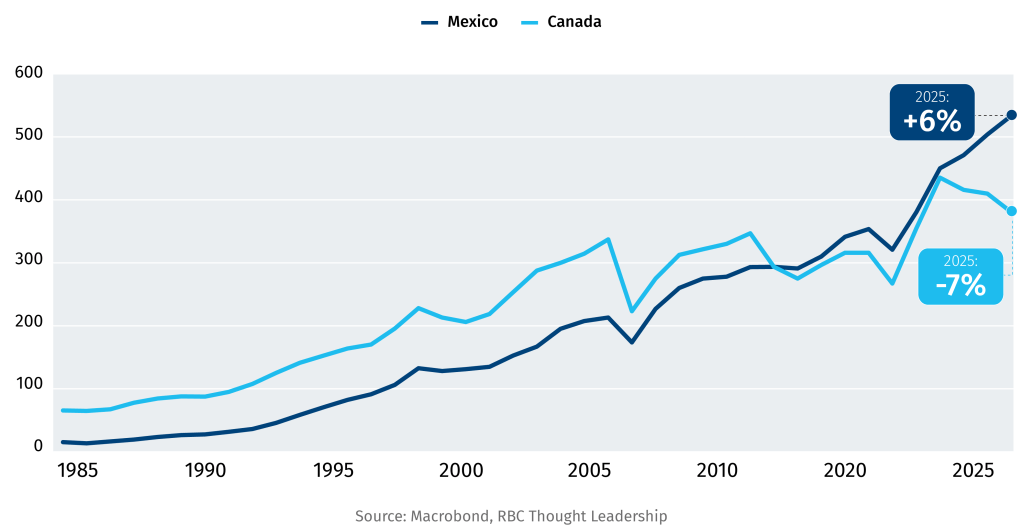
Mexico’s exports to the U.S. soared, Canada’s slipped in 2025

Annual U.S. imports from Canada and Mexico, billion US$

  • Despite one of the lowest effective tariff rates of ~3-4%, thanks to CUSMA shielding ~90% of Canadian exports, the U.S. imported nearly US$30 billion less goods from Canada—the second largest drop among U.S. trading partners behind only China.

  • Canada’s loss was almost identical to Mexico’s gain. It remains America’s largest import source and has extended its lead on the rest of the pack.

  • Both Canada and Mexico were at the epicenter of the tariff war, yet the divergence came down to the product mix, and new emerging trends, such as AI.

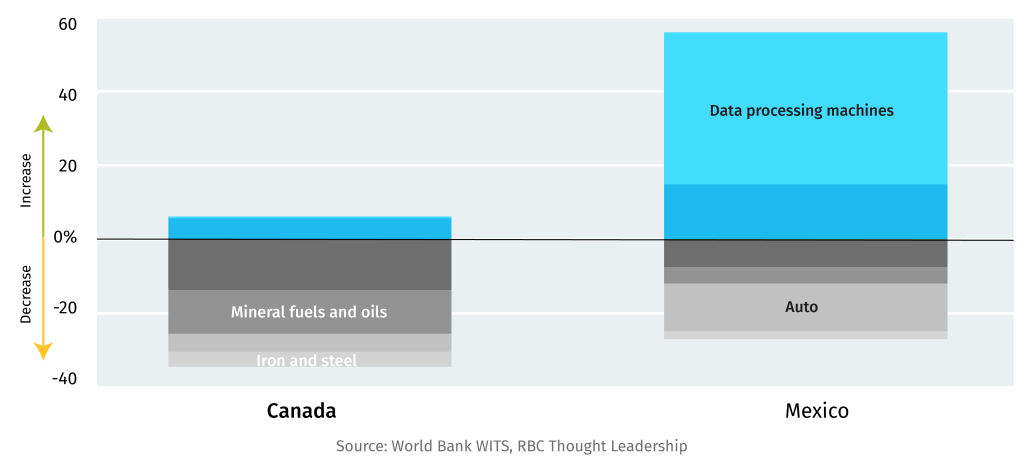
    Tariff-hit sectors squeezed both countries, but AI lifted Mexico

    Change in imports compared to 2024 by product categories, billion US$

  • Canada’s losses were broad-based. U.S. purchases from Canada fell across product categories that accounted for 84% of all imports from Canada. Lower oil volumes along with soft oil prices in 2025 accounted for a third of the drop in imports, with auto, steel and aluminum extending the decline by nearly as much.

  • Like Canada, Mexico reeled from the Section 232 tariffs. The U.S. imported US$13 billion less in auto and parts from Mexico, accounting for half of the decline.

  • The AI boom, however, lifted Mexico’s trade balance. The U.S. imported US$250 billion data processing units last year—almost double what it bought a year earlier—and Mexico was the single largest seller, supplying a third of that.

  • Data processing machines climbed to the top of the Mexico’s export ladder displacing passenger cars. Mexico’s share in global supply has doubled over the past two years, now supplying 18% of the US$550 billion global imports, and rapidly catching up to China and Taiwan.

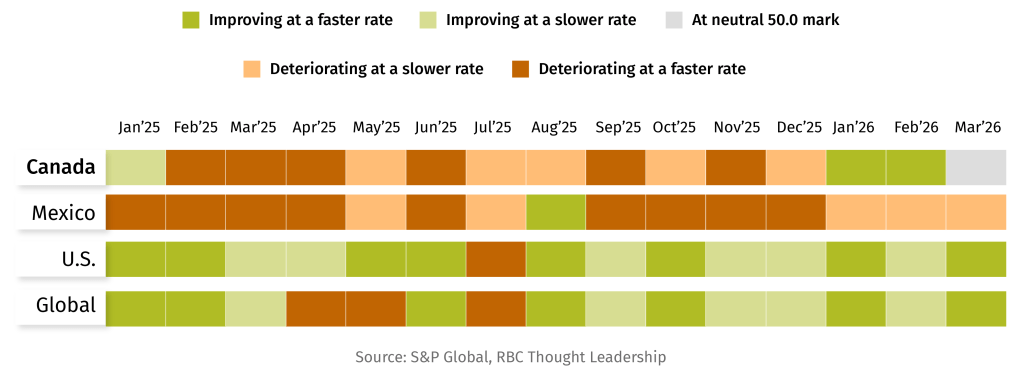
    Manufacturing sector remained soft throughout 2025

    Manufacturing Purchasing Managers’ Index (PMI)

  • Canada’s manufacturing sector, which makes up a tenth of the economy, took far more than a tenth of the pain, with GDP down 2.5% in 2025, marking a third consecutive decline. The squeeze was broad-based—14 of the 18 manufacturing subsectors contracted, from transport equipment and food & beverage to chemical and metal products.

  • Both countries shed factory jobs in 2025 but things are now diverging. Canada is regaining footing on its factory floor, with PMI climbing above 50 this year—seen as a level that signals expansion driven by new orders. Mexico’s manufacturing has been trending within the contraction zone for the past 22 months, long before tariffs were introduced, and shows no signs of immediate recovery.

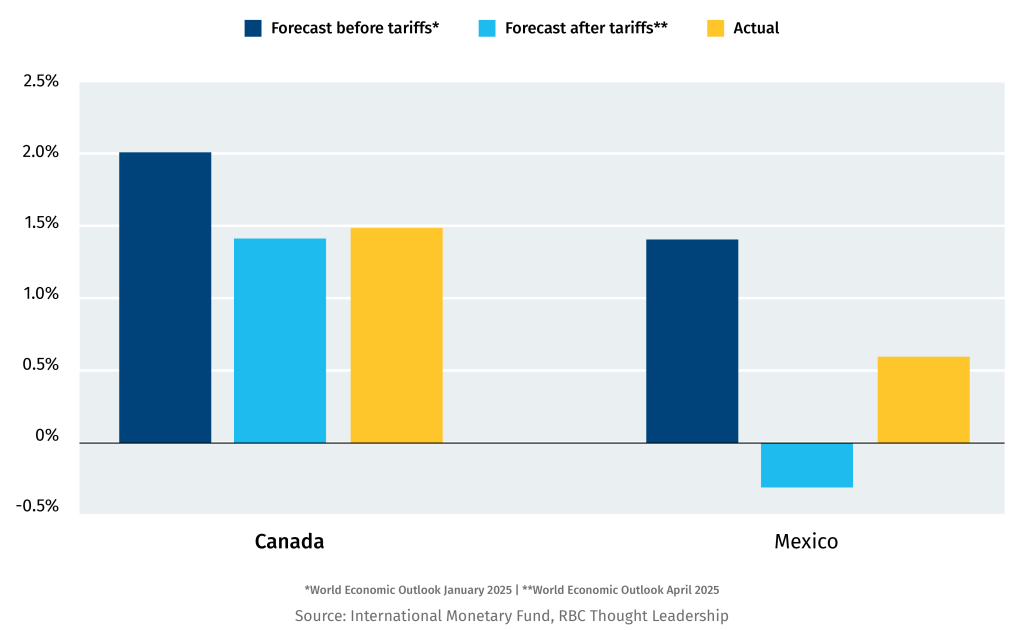
    U.S. tariff impact less damaging than feared for both Canada and Mexico

    Projection and actual real GDP growth for 2025

  • Doom and gloom scenarios did not materialize thanks largely to CUSMA, though tariffs shaved off about a fifth of Canada’s pre-trade war growth expectations, and over half for Mexico.

  • Resilient consumer demand and fiscal policy provided a cushion for the Canadian economy. Mexico saw the opposite trend as the government tightened its budget. Meanwhile, remittances from the U.S. dropped 4.6%, partially due to an immigration crackdown and softening household consumption.

 Farhad Panahov, Economist

For more:

One year later: How US tariffs and trade policy have reshaped the landscape – RBC Economics

One year of tariff shocks in Canada: What we learned

Brussels prepares broader measures against Chinese imports

  • The European Commission signalled it will expand the use of import quotas and safeguard tariffs across entire sectors as concerns grow over Chinese overcapacity in chemicals, metals, clean technology, and manufacturing. Industry Commissioner Stéphane Séjourné said the EU’s trade deficit with China has reached roughly €1 billion per day, with policymakers increasingly framing the issue as a threat to European industrial competitiveness.

India sends largest-ever trade delegation to Canada

  • Indian Commerce Minister Piyush Goyal led an Indian trade and investment delegation as Ottawa and New Delhi look to accelerate free trade negotiations and target $50 billion in bilateral trade by 2030, up from roughly $10 billion today. 

Shipping industry warns of rising costs and capacity constraints

  • Global shipping executives told the World Trade Organization that disruptions in the Gulf region and other maritime chokepoints are driving up costs across supply chains, while alternative transport corridors face growing capacity constraints. Industry leaders noted that a single container ship can carry the equivalent of roughly 70 freight trains.

ECB warns geopolitics are becoming a financial stability risk

  • The European Central Bank warned that the Iran conflict, volatile U.S. trade policy, and growing geoeconomic fragmentation are increasing risks to global financial stability. The Bank cautioned that markets may be underestimating the potential economic impact of prolonged energy disruptions, elevated sovereign debt levels, and renewed inflationary pressures stemming from geopolitical shocks.

Thomas Ashcroft, Global Issues Policy Lead

Canada has a scaleup problem. We create entrepreneurs, but too many of them feel they need to leave to build world-class companies.

Fred Lalonde is one of the exceptions. He is the founder and CEO of Hopper, the Canadian travel-tech company that uses data, prediction and fintech to help travellers book with more confidence.

Now Lalonde is bringing that same ambition to Deep Sky, a Canadian carbon removal company.

In this episode of Disruptors, recorded in front of a live audience, John Stackhouse speaks with Fred about what it takes to build and scale from Canada – and why the country needs more founders willing and able to do it here.

In this episode, you’ll learn:

  • How Hopper became one of Canada’s leading tech success stories

  • Why Fred thinks entrepreneurs better be motivated by building, not just money

  • Why AI, energy and advanced manufacturing are central to Canada’s next growth chapter

  • What it takes to build a world-class company without leaving Canada

Listen on Apple Podcasts, Spotify or Simplecast

Fred Lalonde is a Canadian entrepreneur, founder and CEO of Hopper, and co-founder of Deep Sky. In the episode, John Stackhouse frames Fred as one of Canada’s original disruptors, and Fred describes his path from teenage hacker to entrepreneur.

Hopper is a travel platform for flights, hotels, homes and car rentals. Hopper says 120 million travellers use its platform to plan trips, and the company is known for using data and prediction tools to help consumers decide when to book.

Deep Sky is a Canadian carbon removal company co-founded by Fred Lalonde. The company is building infrastructure to remove carbon dioxide from the atmosphere.

The episode is about Canada’s need to build more globally competitive companies from home. Leaders Fund and Specter found that in 2024, the U.S. produced 45x more high-potential startups than Canada, and nearly half of Canadian founders who raised more than US$1M were based in the U.S.

Fred says good entrepreneurs are motivated by building – by making something, putting it into the world and ideally changing it. He also stresses how hard the founder journey is, including the long timelines and high failure rate.

When asked about Canada’s growth challenge, Fred points to AI, climate and energy, and automated manufacturing resilience as areas where the country should focus.

RBC plans to deploy up to C$1 billion over the coming years to form a growth fund and make equity investments in support of homegrown Canadian companies. 

The Canadian Unicorn Who Stayed

SPEAKERS

Frederic Lalonde, John Stackhouse

John Stackhouse 00:00:10

Hi, it’s John here. If you’ve been listening to Disruptors over the years, you know that Canada has a problem. We are not the land of unicorns. Sure, we create a lot of companies, but as we’ve heard over and over and over again, many of our entrepreneurs, far too many, feel they have to leave Canada to create and scale a world-class business. There are, of course, exceptions and we’ve profiled a lot of them on Disruptors and one of the most impressive is our guest today, Fred Lalonde. Fred is the epitome of a Canadian unicorn. He has built a billion-dollar company here in Canada and chosen to stay in Canada, not just to continue to grow that company, but to launch more companies with even more ambition. It’s the sort of spirit many Canadians feel and we’ve got to do a lot more to help that spirit flourish right here in Canada.

If you don’t know Fred Lalonde’s story, it’s a pretty good one. He started in the digital economy as a hacker, selling pirated software on the school yard, then dropped out of school and created a solution allowing third-party hotel booking sites to integrate with hotels. He sold it to a young company called Expedia. Next, he built Hopper, another travel site that became that unicorn, and now Fred’s taking the same ambition to the fight against climate change in building a carbon removal company called Deep Sky. So when it comes to building world-class companies and scaling them here in Canada, Fred Lalonde is definitely worth listening to and that’s the conversation we want to bring to you today.

This episode was recorded in front of a live audience and it has the energy of one. Fred is funny, blunt, and occasionally dark, but underneath that is the clarity you so often find in builders who know how to create and also know how to live with failure. As Fred explains, he doesn’t manage disruption, he assumes it. We cover a lot of ground, AI, energy, manufacturing, and Canada’s stubborn reluctance to scale. That’s the challenge that we all have to take on.

Here’s my conversation with Fred Lalonde.

Fred was one of the original Disruptors. I think we’ve had you on the stage a couple of times talking over the years. It’s always great to be with you. We’re going to talk about a whole range of stuff, but Fred, let’s start with you. Amazing life history, lifelong hacker. Grew up in a household with more computers than I think you could count. I’m not going to talk about how you learned your way to hack into Bell phone systems, but that’s a whole different story. I think you once called yourself to the Global Mail no less as unemployable. So that’s a great thing to have in your Google search. Fred Lalonde, unemployable. And you’ve had a couple of near death experiences with companies and yet here you are thriving more than ever. Tell us a bit about you. What is it about you that just keeps you coming back in the face of all that has put you down, pushed you back, tried to keep you down over the years?

Fred Lalonde 00:03:22

Yeah. I mean, I ask myself that same question every day. The term is serial entrepreneur and not for nothing, it’s like you just can’t help yourself. You just keep going and going. So everything that you said is true. I dropped out of school when I was 19. I was a hacker. I’m a child of the ’80s. So I learned when I was 14 that I could copy video games. Some people are old enough to remember floppy disks. And so in high school, I made $16,000 selling these in the schoolyard. I don’t know why parents never wondered where the money came from. And of course, the next step from a hacker is being an entrepreneur. It’s the legal version of what hackers do. It is true. I’ve never had a paycheck, never had a mortgage. I’m functionally ineligible for credit cards. I learned this because you’re now my wealth manager, and they’re like, “Oh, you don’t have a credit card.”

John Stackhouse 00:04:16

Did they turn you down for a credit card?

Fred Lalonde 00:04:18

No, they just said I had no credit history, which is technically true. But the point is I like building things and it’s like a compulsion. I spend a lot of time and as I’m getting older, every year I try to do one board where I find some smart kid in Canada and I kind of help him navigate through all the crap that I wish I knew when I was 28 trying to do this. And functionally people come to me, “I want to start my company.” It’s always the same question, which is like, do you really need to do this? Is this some visceral thing that drives you? And I don’t mean making money because somebody comes to me and says, “Hey, I want to do this.” And you can kind of tell they’re motivated by money.

I’m like, “Dude, there’s a lot of ways to make money. I can give you 10 things because this is really, really hard. And actually you’re going to build for seven, eight, 10, 15 years now and you have a nine out of 10 chance of getting nothing at the end.” And people don’t understand how hard it is, how often you have to fail. So it takes a special disposition and I think good entrepreneurs are motivated by building. You don’t really care about the money or anything else. It’s just about making something, putting it into the world and ideally changing it. People don’t realize the failure ratio, like how often you’re going to be in trouble.

John Stackhouse 00:05:32

Who did you learn the most from in the early goings?

Fred Lalonde 00:05:42

So I was super lucky. When we sold to Expedia, I had no idea. The CEO of Expedia was Eric Blatchford. He grew up in Montreal and he was at some McGill football thing and he walked in, like in the movies, and then a month later he’d bought my company. I was 28. And then they brought me over to Seattle because they had integrated my company and everything. And there’s a book called Barbarians Led by Bill Gates. If you’ve ever read, it’s not very good, but it talks about the ’90s where Bill Gates had these guys that worked for him, and what they would do is pretend to go acquire a company and then they would basically steal the IP and Microsoft would replicate it. And it’d gotten so bad that venture capitalists would not back anything… They would check with Microsoft first before they invested in your company. It was crazy.

Then at some point the government talked about breaking Microsoft and they stopped. So there was 13 people that were in charge of this and the guy that was renowned for being the killer was called Lloyd Frink. He’s in the book. That was my boss at Expedia. Let’s say you were having a conversation with him and you bored him, he would leave mid-sentence. It was fascinating. And the other guy that started Expedia is Rich Barton. He’s built Zillow since. So I completely lucked out. I ended up working for those guys for four years. That’s actually the only time I didn’t sign my own paycheck. And today, if I had to give back that early money I made or the knowledge, I would give the money back tomorrow morning. That actually helped me understand what it was to build a really great company. So I would have to say it’s those guys.

John Stackhouse 00:07:17

What was the best lesson from those guys that helped you with future companies?

Fred Lalonde 00:07:21

It’s this thing that’s been misused. It’s attributed to Steve Jobs, but it’s actually not him. Then it gets attributed to Wayne Gretzky, but it’s actually not Wayne Gretzky. It’s Wayne Gretzky’s dad. Skate where the puck is going, not where it is. It’s actually really hard to do because you actually have to have a credible understanding of what the future is going to be like… And there’s this crazy thing and there’s no… Startup environments are the place where this is the most problematic, but it applies to a multi-hundred year old bank at the end of the day, especially in the era that we’re in now, which is the era of AI. But it’s like if you’re actually building something new, whether it’s small, big, something you run, something you’re a product and it makes sense in current day context, it’s probably not going to work. And so I’ll give you a few examples.

You will be standing in the rain in front of a completely licensed taxi that has been audited by the city and has paid a medallion and you’ll be waiting for a stranger to pick you up in a Toyota Corolla. Instead of checking into a hotel, you will prefer to stay in somebody’s spare bedroom. If I told you these things in 2010, you would’ve called me crazy. I just described Uber and Airbnb. The point is if your idea makes sense in present day context, it’s not going to work in the future, and that’s true in a normal 50-year span, like the one I’ve lived through now. But if you’re looking at what’s about to happen in AI, it’s an exponential problem at the end of the day that’s going to change completely. So that’s the main thing I picked up from those guys.

John Stackhouse 00:09:01

One of the great challenges in building a company of the visionary entrepreneur, usually the founder, and then especially as you scale, you need an operator. How have you found that balance because it’s not often the same person, one individual?

Fred Lalonde 00:09:15

Honestly, and I’ve thought about this a lot, I don’t actually believe in the founder/operator thing. It may have worked a few times, but even the ones that are known for being the highest visionary… So one of my good friends is Laurence Tosi, he was the CFO of Blackstone. He famously turned down Steve Jobs for CFO. So he knows Steve very well. Steve would know the operational details, the cost of the microchips. I have never seen a good CEO operator in a startup. I don’t know what it is to run a bank, and God help us, nobody will ever give me the opportunity to try that, but fundamentally, if you’re building something that has high velocity, high growth, lots of unknowns, you have to be able to get the big vision and the execution. And I’ve seen a few teams, but the really, really good ones are able to go all the way down, and I would argue your current CEO is one of the few that I’ve met that really, really qualifies and I think it shows in the culture of the bank.

So I actually think sometimes a team, but you kind of have to have that willingness to go all the way down to the nuts and bolts because when things are stable, it’s okay. I’ll give you my favorite example. If you work at a large organization like this one or Mitsubishi, what, maybe 5% of your company is new, like hiring spree, something like that. At Hopper for the first 15 years, 50% of the company was new. Think of that, right? It’s like your company’s constantly made of spare parts.

John Stackhouse 00:10:47

How do you manage that as a founder, you were there, you were the origin story and then you’ve got all these newcomers coming in and regenerating it. How do you kind of roll with that and let other people also take it in directions that you may not-

Fred Lalonde 00:10:59

The culture question. I’ve become convinced that culture is the only way to go. So for example, at Hopper and in our other companies, Deep Sky, the carbon removal company that you guys know well, we don’t have a traditional C-suite, we don’t have a CTO, we don’t have a CIO. We’ve gone to something called single-threaded ownership, which is an Amazon model. And so when we reached about a hundred people at Hopper, I started losing velocity. It gets harder to do stuff. Again, if you work in big companies, you know how hard it is to do stuff. And my problem at Hopper is I made no money doing the thing we did. We were selling flights, which is a really bad idea. And so I had to do a second thing and most companies don’t have that. They either do one thing, run out of money and die because it didn’t work, or they do a thing that works.

We had to find other things. And so what made us profitable is our financial products or fintech, blah, blah, blah. But before I could get the company to do more than one thing, it was attacking itself. So I had to design the culture. So I started reading everything I could. So Eric Schmidt wrote a book called “How Google Works.” There’s a boring long book, but there’s a children’s book. This is crazy. It’s illustrated. It’s like for five years old. I really recommend this to everybody and he explained how Google worked when he took it over from Larry and Sergey. Reed Hastings wrote a lot about this. Then I found Jeff Bezos’ shareholder letters. And if you have not done this, every year since starting Amazon, he writes. You should read this. It’s a whole insight into his mind. And I realized something fundamental.

The first thing is culture is not what you say. It’s not the poster on the wall. It’s not what your HR department does. We don’t actually have those, but if I had an HR department. It’s actually how you act and what you reward and what you punish. People will act according to what you do and what you say good or bad to somebody. And most people don’t realize how important that is. Everything’s being observed when you’re in a position of leadership. And so then I realized something really fundamental and this is actually why we’re successful. We’d be out of business if I hadn’t figured this out, I’m 100% convinced of it. Most companies get together at some point. Somebody tells them, “You need to define your culture.” Get in a room and you say, “Here are our values,” and that’s it. The really good companies, the amazing ones, they did something different. The founder at some point said, “What kind of company do we need to be for our customers?”

And so Google that was making all of its money on one algorithm, put the engineers in charge, right? Netflix, because streaming kind of didn’t work, it just wouldn’t start. If you guys are, again, old enough to remember this. So they put the product people in charge and Amazon super interestingly realized that they had no network effect where Google had the search, Facebook is a network, blah, blah, blah, all this kind of stuff. They put the category managers in charge and everything… I could go on for hours on this. So what I realized is companies have two types of cultures. The ones that kind of emerged because they got in a room and put a bunch of stuff on a sticker board and voted for it, and the cultures that are designed, that were built for a purpose and that purpose should be the business you’re in and where your customers need you to be. So we got to very, very simple things: move quickly, obsess on the customer and we put revenue as our core value, and people quit.

John Stackhouse 00:14:38

Revenue is your core value?

Fred Lalonde 00:14:39

Yeah. We have three core values, obsess on the customer, move quickly, make money. And you know what happened once we put revenue? We went from 10 million to three quarters of a billion where we are now. It’s declarative. It’s like a marriage. I pronounce revenue, and it happens. And that’s what a founder has to do. You have to manifest 90%.

John Stackhouse 00:15:00

And people not interested in revenue left.

Fred Lalonde 00:15:02

Yeah, exactly. And then it becomes a self-fulfilling prophecy. You attract people that want the thing that you’ve declared. Now, whether I believe revenue is the core thing that should drive society is irrelevant because I’m here for my customers, I’m here for my investor.

John Stackhouse 00:15:16

So we’ll switch to AI, but you mentioned in passing there, you don’t have an HR department.

Fred Lalonde 00:15:21

No.

John Stackhouse 00:15:22

How does that work?

Fred Lalonde 00:15:23

You don’t need it. Sorry. Is there anybody in HR? We realize you don’t need it. Yeah, and that’s a very long-

John Stackhouse 00:15:30

But there’s lots of HR functions that you do need.

Fred Lalonde 00:15:33

No, no.

John Stackhouse 00:15:33

How do you manage it-

Fred Lalonde 00:15:34

No, actually you don’t. Have you ever read Dilbert?

John Stackhouse 00:15:38

This could be my last conversation for RBC, but I’m genuinely curious. How does that work?

Fred Lalonde 00:15:47

We don’t have functions. So what we do is my companies all work like federations of startups. So one person’s in charge of financial products, another one’s commerce. We have somebody running banking and they have full hire and fire over their entire team. The only function that’s horizontal is finance. And so at the end of the day, the short answer is if you have a problem with your paycheck, you go to finance, but we don’t have any HR. We also don’t have offices and we never meet, which is probably another whole thing that we should talk about.

John Stackhouse 00:16:14

No HR, no offices, no meetings.

Fred Lalonde 00:16:15

It’s awesome.

John Stackhouse 00:16:16

How do you exchange ideas?

Fred Lalonde 00:16:18

You actually write them down. So we’ve actually found that… And there’s actually the founder of WordPress-

John Stackhouse 00:16:25

Bezos does this too, right?

Fred Lalonde 00:16:25

Yes. It’s a Bezosian thing. He’s not the only one. Schmidt does it a lot. So the founder of WordPress… This is a big company back in the day, still pretty meaningful. They never met anybody they hired and it was by design. And the reason is he believes to this day that if I meet you, all my cognitive bias, you’re white, we’re about the same age, I’m likely to like you, all that kind of stuff. And so they did their entire interview process in writing and they actually realized they had a very low close rate. So at the end they added one step that took up a few years. They would call you and say, “Actually, it’s a real job in case you’re wondering,” because people wouldn’t think that it was a real job. And so his point is it’s very easy for somebody to trick you verbally, especially if the person has high EQ. If you really want to know how my brain works, read me, and vice versa, I should read you. So a lot of it’s writing.

And we’re global. So we have people in every country. We serve Japanese banks and all this kind of stuff. And one of the things that it let us do because we’re a written asynchronous culture, it lets us hire the best people in the world anywhere where they are. And so when the return to office happened after the pandemic, we picked up people that were leaving Google and it’s continuing to happen now that we never would have gotten. So we’ve been punching ahead of our weight class because of talent density and that is the only metric that we have, talent density, like you would if you were building a professional football team.

John Stackhouse 00:17:55

Perfect segue into the AI part of the conversation. Is AI going to get rid of all this, this human aspect?

Fred Lalonde 00:18:03

And a lot more. Yeah. So I’m going to preface this. I have a really dark view on a lot of things. In these periods where there’s extreme disruption, there’s also extreme opportunities. So I’m going to do my best to scare the crap out of you, but for as troubling as these things are, there’s actually a lot of upside. And the reason I speak this way about climate and about AI is because I fundamentally believe in first principle thinking. You have to ask why and the why of the why. That’s how you make good decisions. If you go back to the 1900s, 1905, there were about 27 million draft animals in the United States. And so there were about 95 million people. So every three humans there was a draft animal. How do we know this so specifically? It’s because this was so important that it was part of the census.

They would count the number of horses when they did the census for the people. Why? Because all transportation but also all food was produced by draft animals. And so there were horses everywhere. The first commercial vehicle, internal combustion vehicle, was sold in the US in 1886. And so if you think of it, there’s this really bizarre period between 1890 and call it 1910, 20 years, give or take, where you had a small number of internal combustion engines and you had horses everywhere. The peak horseness was around 1915. So for 25 years we kept adding horses as part of the base of the economy, even though the internal combustion engine was there. This is Vaclav Smil, by the way, How the World Really Works. I’ve stolen all this. So the role of the internal combustion engine was to completely change transportation and food production. It replaced the horse. AI replaces thinking. So what do you think is going to happen?

Make no mistake about it. If you talk to anybody who works at an AI lab that builds AI, they are not building it to make your life easier or your people’s… They’re not building it to enable you. Every time you load Claude to make a cash flow statement for one of your customers or to goof around on something, they are training the model to do it without you. This is 100% understood. Every AI engineer understands this.

John Stackhouse 00:20:41

What would you recommend/advise people in this room to talk with their teams, with their clients, and to think about themselves, about those challenges coming at us?

Fred Lalonde 00:20:50

So I think what you have to do is break apart what your team does, what your group does, what your company does into its core components, and you need to basically do what Steve Jobs did when he did the Mac. You need to start a completely shadow organization over here and only bring… Obviously this runs entirely on AI and only bring in the parts that you need assuming that AI will do everything else. And then figure out if you can… Just remove every constraint you think you have and some like the security of the bank, you don’t have a choice, try to move it to an AI-first world. And if you get something that works, raise your hand and go, “Hey guys, look at this,” and hopefully the person next to you and the one will pick up on it and improve on it.

And the people that can do that are probably the ones that are still going to have a high-paying job because it’s that creative judgment-based act that even though the AI could probably learn, it’s probably where you want to keep the human in the loop.

John Stackhouse 00:21:53

I know we’re over time, but I want to steal another minute to just get your thoughts on this growth challenge, which we’re leaning into, we’re investing in. What do you think Canada needs to come to grips with most critically to ensure we get a better trajectory of economic growth and that we help companies and entrepreneurs like you take on the world but scale a lot faster here at home than we’ve seen?

Fred Lalonde 00:22:16

You kind of have to hunker down. So if you take Canada, we’re probably the richest country in the world, just by natural resources. We’ve talked about this actually. But we’re so comfortable we don’t realize it, right? But if I was asked to figure out what to do with the bank’s fund, which again, hopefully never happens, I think it’s very, very simple. AI for sure, climate and energy, which are the same thing, and fully automated manufacturing resilience. We need to be building our own sovereign energy. We need to be dealing with our emissions. We’re not good at wind farms. We have no tech. We’re dependent on the Chinese, the Europeans. We have nothing on solar, the Chinese… Not ideal. Our nuclear program, like every program in the world is in shambles because we gave up on it. You know what we’re really good at? Really, really good at? Drilling.

And you can either drill for dead dinosaurs at about two kilometers, but you know what happens if you keep going to five, six, seven, eight kilometers, you hit heat energy, geothermal. There’s enough energy on the ball of rock that we’re living on right now that 0. 1% of it will power our civilization for two million years. And there’s actually a company in the US that figured out how to do it cheaply two months ago. So I can tell you it’d be those themes, AI, climate, energy, and manufacturing resilience.

John Stackhouse 00:23:40

And with Canadian engineers in that US company, I mean, everything you talk about is really connected to scarcity and scarcity leads to more innovation. You’re the embodiment of that and we facilitate that. So scarcity can squeeze, it can hurt, but it leads always to some kind of innovation, usually great innovations. The other thing I love that you said, Fred, is you’ll be back next year, which tells me you have hope that we’ll all be here next year. So just in the darkness, he thinks he’ll be here next year, he thinks we’ll be here next year. I’m not that smart, but I’m connecting dots to say that we got hope here. What you’re saying, Fred, is we stand a chance to be here a year from now and doing even better things.

Fred Lalonde 00:24:32

I’m actually an optimist.

John Stackhouse 00:24:33

Okay. Fred, we’re going to close there.

Fred Lalonde 00:24:37

We’ll close on this: It’s not because something is hard and the odds are not super in our favour that we shouldn’t do it, right? That’s the whole point of everything I’ve been saying.

John Stackhouse 00:24:48

Yeah. It’s like that great line in Dumb and Dumber, “What you’re telling me is we got a chance.” Fred, thank you. Thank you. Thank you.

That was Fred Lalonde, founder and CEO of Hopper, recorded in front of a live audience. I hope you’ll agree that Fred has a way of making the future seem both more alarming and more navigable than it did before you started listening. His clarion call about scaling more here in Canada also should be a message that every Canadian can take on. At RBC, we’re trying to do more with the launch of a new billion dollar platform to invest growth capital in the companies that will help Canada grow in the years and decades ahead. And right across the country, we’re seeing big investors, private companies, and ordinary Canadians all wanting to put more capital behind this country’s amazing potential. It’s not just those big projects that we hear a lot about in the news. It’s about the big ambitions of entrepreneurs who are creating companies, whether it’s in the resource sector or the digital economy that can help Canada and Canadians sell more to the world.

For more on all this, visit rbc.com/thoughtleadership. You’ll find research, perspectives, and ideas to help you clarify what’s next.

And if you like this podcast, follow, like, and review us wherever you listen. This will help others find these conversations on the ideas, technologies, and entrepreneurs reshaping Canada’s economy.

I’m John Stackhouse and this is Disruptors, an RBC podcast. Thanks for listening.

Also in this edition: The Power of Siberia 2 and implications for Canada 

A year into Prime Minister Mark Carney’s trade diversification push, global infrastructure investors are registering the signal. The Global Infrastructure Investor Association (GIIA) Spring 2026 survey—covering leading infrastructure funds across North America and Europe—ranks Canada #1 for investment attractiveness, ahead of the U.S. and Germany. It’s the first time Canada has finished atop the annual survey. Here are the highlights: 

  • Global infrastructure fundraising hit a record US$289 billion in 2025. LP allocations are rising further in 2026—but capital is concentrating, with the top 10 managers capturing 40% of total commitments. Commitments above $2 billion are increasing most sharply. 

  • Battery storage topped North American sector rankings for the first time. Regulated gas improved materially. Geopolitical risk is now priced in individual transactions: supply chain exposure, policy durability, and counterparty strength are deal-level considerations. 

  • Canada’s pension funds—CPPIB, OMERS, Ontario Teachers’, PSP—sit at the intersection of that capital and those relationships. Their sovereign co-investment networks across Asia, the Gulf, and Europe are the intermediation layer global allocators. 

The world is noticing the shift in Canada, but it wants to see evidence of intent and action. The federal government will get a chance to bolster the case for Canada at the Canada Investment Summit in Toronto this September. 

 Shaz Merwat, Energy Policy Lead 

In ‘Surging gold prices, inroads to foreign markets cushion Canada’s exports,’ RBC Economics notes that ‘gold exports to the U.K. surged by a nominal $17 billion, or 76%, in 2025—making gold Canada’s second-largest export after crude oil—significantly cushioning declines in other goods.’ 

It wasn’t a headline agenda item of the Xi–Putin summit this week, but the Power of Siberia 2, a long-stalled pipeline that would carry Russian natural gas east to China, inched back into the spotlight as a result of the two leaders high-profile meeting. 

What is being proposed? 

A 2,600-kilometre pipeline carrying up to 50 billion cubic metre per year of gas, nearly on par with the capacity of the now idle Nord Stream 1, from Siberia’s Yamal gas fields through Mongolia to China.  

What’s the holdup? 

For one thing, price. Beijing wants roughly 12–13 cents per cubic metre, near Russia’s domestic rate; Moscow wants double. The summit ended with warm words but no price or project timeline. 

If it did come to be, how would it alter Chinese demand for non-Russian imports? 

An overland gas pipeline sidesteps maritime chokepoints China’s seaborne LNG must run through, such as the Strait of Hormuz, where tensions have left oil and gas tankers stranded for weeks (two Chinese tankers passed through Hormuz this week). A direct pipeline link to Russia would displace gas that China might otherwise pull from global LNG markets, with potential downward pressure on prices. 

Implications for Canada’s LNG ambitions? 

According to Robert Johnston at the University of Calgary, Canada’s gas story lies closer to home. More Russian gas east would push U.S. and Qatar LNG cargoes toward the same Asian buyers Canada is courting, impacting prices as LNG Canada’s second phase ramps up. But with an image of geopolitical stability and strong emissions credentials (Russian gas has an emissions intensity 50% higher than Canada’s gas) the decisive variable for Canada’s LNG ambitions–the rollout of major projects–is domestic execution rather than economics.

Additionally, energy importers are increasingly wary of relying heavily on one geography, especially after Russia weaponized natural gas exports to pressure Europe as it ramped up its war in Ukraine, and Middle East suppliers are being hemmed in by the Strait of Hormuz blockade. Canada offers largely apolitical, stable supply in a fragmented world with disrupted energy trade flows.

 Vivan Sorab, Clean Tech Lead 

IEA warns oil markets nearing “red zone” by late summer 

  • International Energy Agency Executive Director Fatih Birol warned oil markets could enter a “red zone” by July-August, with 14 million barrels per day disrupted, inventories falling, and no meaningful new Middle East supply entering the market amid the Iran crisis.  

China’s renminbi payment system sees record surge

  • China’s Cross-Border Interbank Payment System (CIPS) processed a record average daily value of RMB920.5 billion (US$135.7 billion) in March, briefly peaking at RMB1.22 trillion and nearly 42,000 transactions in a single day representing a surge in energy trade outside the U.S. dollar system.

Brussels advances implementation of U.S. trade pact 

  • EU lawmakers and member states reached a provisional agreement to implement last year’s U.S.-EU trade arrangement, including safeguards allowing Brussels to suspend tariff reductions if Washington maintains steel and aluminum duties above agreed levels beyond 2026.   

EU approves expanded foreign investment screening powers 

  • The European Parliament approved new foreign investment screening rules covering sectors including AI, semiconductors, quantum, aerospace, energy, and critical infrastructure, broadening scrutiny over third-country investment across the bloc.

Ottawa and Nunavut launch tariff-response workforce program 

  • The governments announced more than $1.5 million in funding for marine-sector training and employment supports tied to tariff-related economic disruption.  

Manitoba opens trade office in India amid diversification push 

  • Manitoba announced plans to establish a trade office in India as provinces continue pursuing direct commercial relationships abroad and reducing reliance on the U.S. market.

—Thomas Ashcroft, Global Policy Lead 

Also in this edition: Should farmland be used to produce food or fuel? And four potential routes for Canada’s embattled auto industry. 

The summit between President Donald Trump and President Xi Jinping in Beijing produced no breakthrough agreements, but that may have been beside the point. After a year in which tariffs between the two countries exceeded 100% and trade flows sharply contracted, the immediate objective on both sides appears to have been stabilization versus resolution. 

The atmospherics mattered. Trump described the talks as producing “fantastic trade deals,” while Beijing emphasized “common understandings” and continuity. But beneath the optics, the summit revealed where the real negotiations and constraints now sit.  

A few themes stood out: 

The trade relationship is structurally smaller than it was 

  • U.S. imports of Chinese goods and the bilateral trade deficit are now at roughly 20-year lows. Washington’s efforts to reduce exposure to China through tariffs, supply chain diversification, and industrial policy have had a measurable effect. The relationship is no longer defined by integration.

  • There was no material progress on tariffs or the Section 301 trade investigations targeting China over state-subsidized production overcapacity in sectors like steel, and electric vehicles.

China’s priority is predictability 

  • The Chinese spent the years between Trump’s first and second terms doing their homework, preparing counteractive policies for more U.S. trade confrontation. Export controls on rare earths and critical minerals, industrial policy tools, and tighter supply chain leverage have proven key weapons in China’s arsenal.  

  • But the summit reinforced that Beijing’s near-term priority is a more predictable operating environment with Washington—one that reduces the risk of escalation and preserves access to key export markets, technology inputs, and capital flows.  

No major progress on chips and export controls 

  • Global semiconductor stocks slid with no major chip deals announced and continued stagnation over the sale of Nvidia’s H200 chips to China.  

  • This remains the clearest dividing line in the trading relationship. Washington still sees leading-edge chips and export controls as a way to mitigate China’s access to advanced semiconductors that could be used for military applications or AI innovations. Beijing, in turn, hasn’t formally approved shipments of the chips and has looked inward, urging Chinese firms to switch to domestic hardware.

Agricultural purchases are a U.S. political priority 

  • The clearest deliverables, as is often the case in trade negotiations with China, may ultimately come in agriculture. U.S. Trade Representative Jamieson Greer said Washington expects China to commit to “double-digit billions” in annual purchases of U.S. agricultural products over the next three years, including soybeans, poultry, and pork.  

  • The White House needs to be seen as supporting U.S. farmers, especially as the impacts of the Iran war on fertilizer prices and other agricultural inputs rise ahead of the mid-terms and as planting season gets underway.

Both sides appear to want guardrails 

  • Discussions around a possible “board of trade,” investment mechanisms, and even preliminary AI guardrails show neither Washington nor Beijing currently wants uncontrolled escalation.  

  • The strategic rivalry continues, but both sides appear increasingly focused on managing it rather than intensifying it in the near term. 

Thomas Ashcroft, Global Issues Policy Lead 

Skyrocketing oil and gas prices and supply constraints are pushing countries to boost biofuel production and use. The shift aims to curtail reliance on Middle East oil and gas supplies. But the surge in policy-driven biofuel demand coincides with the rising food affordability crisis reviving a recurring debate: should farmland be used to produce food or fuel?  

The biofuel boom:

  • The U.S.’s Environmental Protection Agency set record Renewable Volume Obligations (RVOs) for 2026–2027 with notable increases for biomass-based diesel, produced primarily from soybean and canola oil in North America. In addition, the U.S. House passed legislation this week to allow nationwide year‑round sales of gasoline containing 15% ​ethanol (labelled as E15), which is largely produced from corn in the U.S. 

  • The European Commission proposed the AccelerateEU strategy in April, which includes measures to boost EU sustainable biofuel production and use. This proposal is a rapid response to the bloc spending an additional €24 billion on fossil fuel imports within the first 50 days of the Iran conflict.  

  • Indonesia revived its plans to introduce a higher biofuel blend in 2026 following rising fossil fuel import costs. The blending rate mandate ​for biodiesel made from palm oil is planned to move to 50% from 40% this year.   

  • Brazil is actively accelerating its biofuel blending mandates to enhance energy sovereignty. President Luiz Inácio Lula da Silva announced in April that the ethanol blend mandate will be raised to 32% (E32) in gasoline this spring. For biodiesel, testing is underway to understand the viability for moving the blending rate from 15% to 20%.  

  • India reached its E20 ethanol blending goal in April. Disruptions to the country’s oil and gas prices and supply are prompting discussions on ramping up to E85 or E100 as production capacity expands.    

  • Vietnam expedited its national mandate for 10% ethanol blends in gasoline to begin in April due to energy shocks in price and supply. Ethanol is produced mostly from cassava, sugarcane, and increasingly corn in the Southeast Asian nation.   

  • …and Canada? In response to the previous shock to Canada’s biofuel supply chains from U.S. trade tensions, the federal government announced a $370 million Biofuel Production Incentive and committed to amending the Clean Fuel Regulation to prioritize domestic low-carbon fuel production. These measures, while not in response to Iran war, are intended to increase the resilience of the domestic biofuel sector.  

Bottomline: The global biofuel market is poised to enter another expansion cycle as countries raise blending mandates to meet energy security and transition to lower greenhouse gas emitting energy sources. However, early signs of rising corn, sugarcane, and vegetable prices may further pressure food prices this year.  

Lisa Ashton, Agriculture Policy Lead 

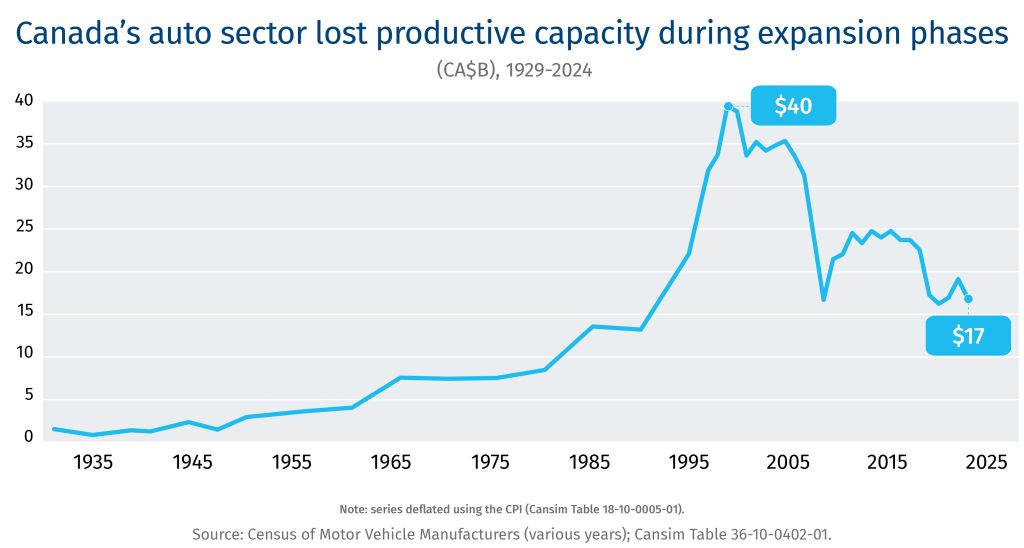
About 200 auto sector executives packed into a hotel ballroom this week for the Toronto Region Board of Trade’s Ontario Auto Forum. Magna CEO Swamy Kotagiri laid out three distinct options for dealing with the industry’s headwinds: protect jobs, chase affordability, or build resilience through anchoring the industry in capabilities that can’t easily be replicated. The latter, he said, should be the priority.  

RBC Thought Leadership’s Managing Director Jordan Brennan also took to the stage, presenting findings from his latest report Steering Through Uncertainty, which charts four distinct paths for the embattled auto industry.  

Canada's auto sector lost productive capacity during expansion phases

Read the full report, including the five strategic considerations that cut across all four scenarios, here.  

USTR pushes for “Fortress North America” steel protections under USMCA 

  • Deputy U.S. Trade Representative Jeffrey Goettman said an updated USMCA should include “unified tariff borders” for sectors like steel, aluminum, and autos to prevent products made with non-North American inputs from entering through Canada or Mexico. U.S. steel executives backed tighter “melt-and-pour” origin rules. 

EU sanctions on Chinese chip supplier raise fears of automotive disruption 

  • Industry executives warned EU sanctions of Chinese chipmaker Yangzhou Yangjie Electronic Technology, for allegedly supplying military technology to Russia, could trigger renewed chip shortages across the auto sector. Some firms are already seeking exemptions as manufacturers remain vulnerable following last year’s rare earth and semiconductor disruptions.   

EDC expands focus on diversification, defence, and strategic sectors 

  • Export Development Canada announced it facilitated $135 billion in trade-related activity in 2025, supported nearly 24,000 businesses, launched new programs, while expanding its European and Indo-Pacific presence. 

Bank of Canada research highlights declining maritime connectivity 

  • Canadian ports became less central to global shipping networks between 2016 and 2023, with declining direct connectivity and lower shipping capacity relative to major Asian hubs. The risk, writes the BoC, is “greater exposure to supply chain disruptions that could increase the cost of doing business.”  

In this episode, John Stackhouse visits Ross on the outskirts of Ottawa to talk with CEO David Ross about how the company grew from a small Canadian manufacturer into a global live-production infrastructure player. They discuss why the economics of live events changed so dramatically, how cheaper and more powerful screens transformed stadiums and concerts into multimedia platforms, and how Ross helps turn live data into visual storytelling through graphics, overlays, motion systems and production control.

Ross Video is one of Canada’s most consequential technology companies, even if most audiences have never heard of its name. They work across more than 100 countries. Their technology now sits inside countless modern live-event and broadcast experience:  On field graphics, robotic camera systems, data-rich stadium presentation, newsroom and broadcast automation and the production systems behind concerts, major sports, studios and major event coverage for clients like MLB, NFL, PGA, NHL, Premier League, Metallica, Taylor Switft, Coldplay the list goes on and on and on.

The conversation also surfaces a bigger business story. Ross describes its work as brand amplification technology, helping sports teams, venues, concerts and companies use screens, graphics, motion systems and production tools to deepen audience experience and strengthen commercial value. David lays out the company’s operating logic clearly: expand into adjacencies, acquire expertise when needed, keep founders and technical talent engaged, and never fall behind in technology. That approach shows up in Ross’s reinvestment model too: roughly one-third of the company is in R&D. This episode is about sports broadcast innovation, stadium technology, robotic cameras, concert production, real-time graphics, data storytelling, and the broader live-entertainment economy.

Ross sits inside a much larger market shift: a world where live sports, concerts, venue systems and production technology are becoming more immersive, more data-driven and more economically important.

Listen on Apple Podcasts, Spotify or Simplecast

Ross Video is a Canadian live-production technology company founded in 1974 by engineer John Ross. It grew from broadcast switchers into a broader infrastructure business spanning graphics, robotics, routing, automation, newsroom tools, replay, audio and experiential systems.

Ross helps power the production layer behind live sports, concerts, studios and major events. In the episode, David Ross describes the company as being in the business of keeping famous customers famous through high-end video.

A big part of Ross’s work is turning data into visual storytelling. David Ross explains that the company is not just about moving video. It is about presenting data in interesting and consumable ways through statistics, strike zones, heat maps, player data and other graphics that help audiences follow the event more clearly.

Ross grew by expanding into adjacent categories, building products for the same customer base, and acquiring companies with expertise it did not already have. David Ross describes the model as moving into adjacencies rather than trying to invent everything from scratch.

David Ross says he was told early in his career to never fall behind in technology, and Ross has taken that to heart by overinvesting in research and development. He says the company has about 1,500 employees, including roughly 500 in R&D.

From MLB to Metallica: The Canadian company redefining live events

SPEAKERS

David Ross, John Stackhouse

John Stackhouse 00:00:10

Hi, it’s John here. I want you to close your eyes for a moment and picture a few things.

First, let’s start with a pro football game and those seemingly magical first down lines that stretch across your screen. Or, what about those golf games where you can now hover over the green and feel a bit like a bird? And who can forget those incredible moments at the Milano Cortina games where, thanks to new camera technology, it felt like we were all part of the ski cross race. Okay, keep your eyes closed and imagine the last concert you were at. It probably didn’t feel like a concert that you might’ve gone to years or decades ago. Concerts today, especially in big stadiums, are explosive in sound, but you have 360-degree imagery all around you. The performers on stage are now, well, just part of the concert. Behind all of this is a remarkable Canadian company, and odds are you’ve never heard of it until now.

Ross Video sits on the outskirts of Ottawa in a really unassuming brown brick campus that could pass, well, for a community college. Then you walk inside and start to see some of the tells. The first is an Emmy Award on the reception desk, and then there’s a wall covered in the caps of almost every major league sports team you can name because this company has worked with them all. Open some more doors, and you come across green screen studios, robotic labs, and control systems being built for some of the biggest live productions on Earth. Ask Taylor Swift who created some of the magic of the Eras Tour, and she might say Ross Video. You’ll get the same answer from Metallica, Coldplay, and every team in Major League Baseball.

This is one of the most innovative companies I think I’ve come across anywhere. It’s also part of a much bigger economic story, one worth roughly $ 500 billion globally. That’s the live entertainment ecosystem that is reshaping how audiences and businesses experience everything from sport to politics to music. Ross Video was started by a great Canadian, John Ross, an engineer whose analog video switcher brought the 1976 Montreal Olympics to the world through the CBC. His son, David, another engineer, took that foundation and built it into a live production powerhouse that’s now operating in more than 100 countries all from this corner of Ottawa. Ross Video strikes me as the kindest story Canadians really need to hear more of these days. It’s about innovation, it’s about global ambition, and it’s about doing a lot of incredible things, including building robotic cameras right here in Canada. That’s the vision and the passion of pretty much everyone in the country, but especially of its CEO, David Ross.

David, welcome to Disruptors.

David Ross 00:03:14

Thank you.

John Stackhouse 00:03:15

I find this, as I said in the introduction, the most interesting company so many people have not heard from. I want to kick off just asking, how do you describe Ross Video to people who are not familiar with it?

David Ross 00:03:29

I thought of a billion different sort of elevator pitches, and I think one of the ones that I like is, “We’re in the business of keeping our famous customers famous through the use of high-end video.” Because if you’re using video at the level that Ross Video provides, you want to reach a lot of people. If you want to reach a lot of people, you’re either famous or you want to be famous.

John Stackhouse 00:03:49

You joined the company 30 years ago, 35 years ago?

David Ross 00:03:51

1991.

John Stackhouse 00:03:52

35 years ago.

David Ross 00:03:54

Right.

John Stackhouse 00:03:55

What did you see or feel as you were starting to take over the company that allowed you to grow it to what it is today?

David Ross 00:04:01

Fear. I came home from university, and my mom said, “You need to go upstairs and talk to your father. He’s one signature away from selling the company.” I wasn’t sure if I was going to want to start work at Ross Video. I was interested in working for maybe NASA or… I heard that Bill Gates came by the University of Waterloo, I’m an engineering student at the time, and I talked a good game about joining Microsoft. I thought I had a big career in joining Ross Video, town of 1, 200 people. Dad just laid off two thirds of the company in the recession from ’89 to ’91. Oh, boy, that’s not what I envision for the grand future of my life, I guess. I talked to dad and I said, “So what’s going on?” He says, “Well, having a challenge seeing a future with the company. I’ve got an offer,” and I said, “Well, maybe we can turn it around together.” He actually looked at me and he said, “Well, there’s a lot of satisfaction you can get from building something out of nothing.”

John Stackhouse 00:04:57

Take us back to the origin story and what your dad, John Ross, still with us, developed in the early 1970s and how that started to transform how we view and experience sport in particular.

David Ross 00:05:11

Well, back in the early 1970s, it was all about the technology. Was your product more functional, cheaper, using the latest tech? But I don’t think anybody who was really focusing on transforming the world is… You have a product, the other guy has a product, you try to make a better product.

John Stackhouse 00:05:27

Right. He developed the 16-4-

David Ross 00:05:30

Yes.

John Stackhouse 00:05:30

… switcher that, for those of us a certain age, actually made the Montreal Olympics as memorable as they are in a good way. What was it about that device that laid the foundation for what Ross is today?

David Ross 00:05:44

I think it was kind of the right product at the right time. It was exactly the right size. It was a really good price point. It was very powerful for the amount of electronics. My dad was an analog design genius, you could sort of say, where he would be able to see the circuitry in a way that was more reliable, higher quality for less parts than anybody else seemed to be able to do anywhere in the world, and so you can say that the company was founded on innovation.

John Stackhouse 00:06:14

It’s fascinating what has happened to the live event business, sport, and entertainment. They’ve become multimedia platforms, not just experiences. So much of what we all enjoy and maybe take for granted is thanks to Ross Technologies. How has the live event market evolved, and what have been those kind of signature changes over the last decade even that have allowed you to be where you are?

David Ross 00:06:40

There’s a couple of things that drove change. I think the biggest one was the fact that the screens got cheaper. It used to be LEDs or the jumbotrons. Basically, it was a television monitor for every pixel, and they took enormous amounts of power, very expensive, very low resolution. As the LED walls started to become more and more dense, cheaper, less power, then people said, “How do we drive all those pixels?” It’s not just one screen. It’s many screens of all different sizes of all different shapes throughout the venue, inside the venue, and outside the venue. And then you think about the canvas of the field as being another set of pixels that you’re drawing on in a virtual world. So it’s just this explosion of what you can see.

John Stackhouse 00:07:30

So there’s been a kind of a tech enablement. That’s also changed expectations in all of us as fans. I can’t even imagine a concert without a screen. If it was just a screen allowing me to see a closeup of the stage, I’d probably be disappointed. Same at the sporting event, hard to imagine a game, rightly or wrongly, without a screen. How have we changed as the end user in your view over the last decade or two?

David Ross 00:07:54

We’re getting much more used to a lot of data coming at us. It used to be that your high school gym that would just show the score and almost nothing else than score and the time left, and now you see what the scores are, you see the statistics, the strike zone, you may see the golf ball curve, the heat map on the floor of all the different places where they took their shots from basketball. You see all the data about all the players of everything that they’ve ever done in their lives, and it just keeps going. It’s not just about moving video, it’s about presenting that data in an interesting and consumable way. There’s lots of periods of times where the things aren’t happening, and the goal I think of some of the sports teams and the venues, as well as just broadcasters in general, is how do you keep people’s attention?

In a stadium in particular, the moment that the play stops is the moment where the stadium sort of kicks in and says, “Now, we’re going to have some fun, and we’re going to do it together, and we’re going to enjoy things.” And maybe at the same time, they’ll work in the ads that sort of pay for the whole experience at the same time, but there’s a really interesting weaving of the way that the game moves into the experience, and the advertisers move in and out, and the statistics move in and out. There’s a lot going on.

John Stackhouse 00:09:14

Talk a bit about the businesses that are between the fan and either the performer or the athlete, usually a stadium, of course, the team. I’m curious what they’re looking for, because you talk to them all the time, that’s your business. What are they looking to fulfill in building out, frankly, really expensive operations, billion-dollar stadiums and the whole district around them, as well as the cost of putting a team on the field or an artist on stage?

David Ross 00:09:42

They’ve got a lot of things that they’re juggling at once. You could sort of say at the base of it all is their brand. That sporting team, that venue, that brand has value, and so it’s all about the fact that there’s only one hockey team in Ottawa, there’s only one football team in Los Angeles as a professional level. Because there is that uniqueness and you have this fan following, how do you keep that excitement up, keep the eyeballs on that instead of some other sport, because there’s competition, or some other event, and keep it fun? It all has to hold together.

John Stackhouse 00:10:19

These stadiums have become destinations. They’re tourist destinations. I think of AT& T. There’s only one Dallas Cowboys, but there’s also only one AT& T Stadium. It’s an attraction not because of the Cowboys on their own, but because of the experience, including the screens and what you provide for that.

David Ross 00:10:37

Yeah, and that’s actually a really interesting thing about what’s going on in the business that we’re in. Because you could say a long time ago, we would be in the business of providing the technology for a television broadcaster. If you think about a sports team or a corporation now that’s using our technology, it’s a brand amplification technology. So it’s not about how much money goes into the equipment that you buy and then how much advertising do you get on the output, it’s how does that change the perception of AT& T.

John Stackhouse 00:11:08

That’s a really interesting view of the business strategy, but the brands are not just companies now. What do you figure is still growing? Because 10, 15 years ago, there were probably a lot of media analysts who said that all of this is going to be disrupted and the individual will take it over.

David Ross 00:11:25

They were wrong.

John Stackhouse 00:11:27

Why were they wrong? I was probably among those who were wrong, so tell me why I was wrong.

David Ross 00:11:32

Well, it’s both. It doesn’t have to be an either/ or. More people certainly watch YouTube than anything else in the world. Feeding into YouTube, you have everything from… I just uploaded a picture of my dog that I did myself to some very professional productions and even movies. It’s a continuum, and there’s just a certain place where Ross plays, which is in that higher-end tier.

John Stackhouse 00:11:59

Let’s talk a bit about the amazing technologies that you both built and literally acquired and then developed. I want to start with Artimo, because we just walked through your lab across the street, saw these robotic cameras zipping around. Those are developed here in an Ottawa suburb, they’re built not far away in Iroquois, Ontario, and they’re transforming so much of what we all kind of take for granted seeing on a screen. We’ll talk about some of the other innovations, but tell us why Artimo is so important in your mind.

David Ross 00:12:31

One of the things that’s interesting about Artimo, you could start from a customer point of view, it’s always good to start from customer point of view, is Artimo replaces different types of manual moves. Instead of it cruising behind a camera, there’s a limit to how much they can do with teleprompters on it and so on. Being able to have a motorized system doing repeatable moves, particularly in a newsroom or at a corporate studio, you need technology to do camera motion properly. It used to be when you’re watching television news and you even still see it in the movies, you imagine rows and rows of people yelling back and forth, “Do you have that shot? Do that shot,” and everything else. Now, at least in 700 newsrooms around the world, even at the highest level, there’s basically one guy with a mouse clicking and mumbling to himself or herself. The computer system is controlling Artimo to make sure that it’s positioned with exactly the right shot, with the right depth of field, and everything else for what is coming up next in the playlist.

John Stackhouse 00:13:34

You also have a whole range of fascinating technologies that have transformed not just what’s behind the camera but what’s on the screen, and I’m thinking of some of the layering technologies. We all kind of take for granted now those red zone markers on an NFL or CFL field, lots of other layering that has made the game experience much more dynamic and interesting. Walk us through a bit of your thinking on how that’s evolved and how that has transformed the viewing experience.

David Ross 00:14:05

Oh, wow. In football, for example, you do have the 1st and 10, the yellow lines and the blue lines and things like that. We didn’t invent that. I will say we didn’t invent it, but we certainly got into the business. One of the places that we did very well is with American college sports, American college football, because they weren’t able to afford whatever was out there at the time at the professional level, and they want to be able to get that on our in-venue as well. Because people are used to watching it on TV, “I want to see it on the big screen in the stadium as well.” We don’t want anybody to come into the stadium and feel like they’re getting a lesser experience than if they stayed at home and watched it on TV. So how do I get the same stats? How do I get the same experience and then have the in-person side of things? It’s the same thing that same technology is used for infield advertising as well, and that gives them ability to charge more for advertisements that way.

John Stackhouse 00:15:02

We’ve also seen incredible changes to the functioning of camera, and I’m thinking of the spidercam, which is another of… It was your acquisition. But wow, what you’ve done with it… Even the Milano Cortina experience, I still can visualize feeling like I was on the speed skating track. The golf experience now, I think you took it to the British Open-

David Ross 00:15:26

We did.

John Stackhouse 00:15:26

… where it now kind of goes over the green, which has just made golf so much more interesting, seeing it from the bird’s-eye view quite literally. Walk us through what you saw in spidercam when you bought the company, and what you are trying to do with it, where you see it going from here.

David Ross 00:15:45

Interesting. We started with the studio robotics, like Artimo, and things that we did before, and that was part of acquisitions. We realized that there’s a lot of value in being able to capture video with camera motion and doing a volume of space. We realized that we were doing really well with studios inside, and then we inverted them, and we could look down on the studio, and so we got that volume thing happening. What can we do outside? Of course, the natural thing is cable cameras. We had been working with spidercam in the past because they would give us telemetry information, and we’d do augmented reality with our graphics technology, and so you could sort of see stats floating in the air or something like that as they’re capturing some event. We already had experience with what we could do and saw synergy with one part of our business moving with another part of the business, just camera motion.

I did actually nudge them a few times saying, “If this is ever for sale, give me a call.” And then one day, the call came, and so we made it happen. What’s beautiful of it as well is spidercam is tier one. It’s the leader in the world. It’s the biggest brand and the biggest part of that business. So for Ross, it’s actually a brand amplification as well, because we are there at the Olympics, we are there at away games for the NFL when it’s in Europe. We’re there now for Premier League, we’re there for cricket all over the world, and we are there for the playoffs right now at the Montreal Canadiens where we put a spidercam into the arena for the first time.

John Stackhouse 00:17:23

Where do you see cameras going from here? We’re all now familiar with drone cameras, which are transforming the event experience, sport, as well as a concert. We’re getting familiar with on-body cameras, whether it’s the ref cam or the player cam. Where do you see it going over the next few years?

David Ross 00:17:41

I think it’s going to become more and more accessible. You’re going to see them more often in more fixed installations. Spidercams, not too long ago, if you wanted to buy one, if you had a million dollars, then that’s a good start. Maybe you could get something for a quarter million dollars, if you’re lucky. Basically, they were rental units, and we would fly them halfway around the world, and these things have winches the size of refrigerators and heavier than a refrigerator, and there’s four of them, and then there’s a big centerpiece in the cameras. It’s an ordeal, and you’re going up into the rafters of the stadium, and you’re putting up pulleys and worrying about safety. Every single game, you then pull it down, and you put it someplace else. We’ve just launched what we call the i-Series for the spidercam, and that means that more venues can own them and get their costs down, which means that you’ll see them in more places.

John Stackhouse 00:18:36

You do much more than just make this stuff and sell it or rent it into the market. You help build literally the infrastructure, help, whether it’s teams or concert tours, create the experience. That’s a very different business than making a robotic camera in Iroquois, Ontario and putting it on a plane somewhere. How are you thinking about the soup to nuts, if I can put it that way, aspect of this business?

David Ross 00:19:01

It’s all about adjacencies and understanding how to move into an adjacent business. When I started at Ross, all we had were analog production switchers. We had about four or five products. They’re about 10 years out of date, to be quite honest. How do you go from that to where we are today? So we started designing new products that would be sold at the same time to the same customer, made in the same factory, into the same market, with the same sales channel, and then you start moving into adjacencies. The challenge was when we started moving from traditional products to new ones. You can waste a whole lot of time and money by saying, “Let’s just invent this thing from scratch,” because you need to have the knowledge and the trust and so on. So the easiest way to do that is to acquire companies and acquire them hopefully with the founders or the genius that’s behind those companies and then don’t piss them off and keep them around.

What a lot of companies don’t do is the founders like to stay with what they know, what they know, what they can control, and so there’s a leap of faith of management where you say, “No, no, I’m going to start doing things that I’m not an expert in.” I’m a computer engineer, “Robotics? That’s madness,” or you say, “We’re a manufacturer, and we’re a supplier. We don’t get involved in our customer’s affairs.” And then we have Rocket Surgery. We buy that company, and we have great people in that company, and you build that up, and all of a sudden they’re talking about the fan experience.

John Stackhouse 00:20:31

Rocket Surgery is kind of like an agency, right?

David Ross 00:20:33

Kind of like, inside of Ross. They’re people that combine the skills of graphics and programming and organization and understanding the sport, the venue, the market, the nationality, and they come in, and they will make the stadium experience real. This vertical integration of having the design, the manufacturing, and then the creative services that are on top of that, you have to, as an owner of a company, like a tech company, be able to say, “We can get into services. We can get into art,” which is a long way from analog design or software. But when you put all these things together, it’s magic.

John Stackhouse 00:21:12

Is the business model and the approach, the knack to this, very different for live music, for concerts, than for professional sports versus outdoor events, corporate events, or general public events? Do you have to take a different approach to each, or is an event and an experience an event and an experience?

David Ross 00:21:32

There’s a common thread through them, of video and organization and so on. But yes, each one is different, and so you have to be able to know, “How do I get those relationships, and how do I understand that concerts and video for concerts is very different than video for a stadium?” For example, in the stadium, you’re talking about wow moments when the touchdown happens and the data and the advertisements and the stats and things like that. In a concert, you could argue that there’s almost not a wow moment. The whole thing is just this burn that happens the entire duration, and now you’re interested in keeping up with what the performers are doing and getting those shots, whether it’s putting video on the screens that is supposed to be synced to what the performer has rehearsed, and hopefully they’re following in live, versus having a spidercam like at a Coldplay or Metallica concert, which we also do as well, and knowing how to get those beautiful shots up on those screens.

John Stackhouse 00:22:31

And I’m guessing, especially on the creative side, on the concert side, that you have to find the right rhythms and beats quite literally. But Metallica is probably different from Taylor Swift in terms of what they’re looking for on stage, is that true or not?

David Ross 00:22:48

Actually, I have heard, I talked to some of the camera operators in a spidercam, for example, you’ve got the engineer in the background, but then you’ve got a pilot who’s flying the camera rig around, and then you’ve got the camera operator who is taking the shot from that moment and zooming in and panning around, and they work together to get the shot. From what I understand, Taylor Swift is always the same all the time, she is perfect, and Metallica is like, “Follow them,” because it could be different at any given time.

John Stackhouse 00:23:22

That’s rock and roll. Yeah.

David Ross 00:23:24

I can’t believe I’m involved in this stuff. It’s like, “I went to computer engineering in Waterloo. How did this happen?”

John Stackhouse 00:23:32

How will AI and robotics change what you’re doing now?

David Ross 00:23:36

AI is coming for software and software development and things like that.

John Stackhouse 00:23:41

Are you seeing that in your own software development?

David Ross 00:23:43

Starting to. It’s an accelerator, but it’s also an enabler. There’s a whole bunch of dimensions about how AI is going to impact our business and every business, and we’re just learning what that is on a daily basis right now. Because every time you think you know the way it stands, it changes yet again, and it can do something new. We’re just keeping up as best we can. We’re a software company and a services company and a hardware company and a robotics company, and there’s threads that tie all those things together. I like to think that those things build a competitive moat no matter what happens in the world going forward. Having a network of dissimilar things that require a broad range of expertise that can’t possibly be in one person’s head that require the organization of humans to pull it together is I think the sort of thing that makes for a strong company going forward.

John Stackhouse 00:24:34

You’ve built an incredible company here. You’ve got a really strong culture, strong values, and I’m sensing it’s very much about the team, the Ross team. Often when you do an acquisition, you’re not entirely sure of the kind of culture that you’re acquiring. You’re getting the talent and technology, but also the culture. How do you, as the CEO, preserve and grow the Ross culture?

David Ross 00:24:55

One of the things my dad said to me many years ago, he said, “A company is only people. It’s not about the products you have. That’s a moment in time. It’s not about the technology you have. That’s also just a moment in time. It’s not about the customers you have. You can lose them. It’s about the people.” And if you think about the sorts of things I was talking about, I don’t know anything about robotics. I know a bit more now, but I’m not a world expert. I don’t know everything that there is to know about creating a great stadium experience. You know what? I haven’t written code in 35 years. Everything that I have had this company create is through encouraging and enabling great people in the company. So if you take them for granted and you don’t listen to them, then you’re going to be in trouble. It turns out that if you treat people really well and you listen to them and you pay them well and you do all the right things, a culture just emerges out of all that, and it’s a pretty good one.

John Stackhouse 00:25:54

You also have a strong code of ethics, which every visitor can see as they walk through the door, and it is beautifully in plainspeak. One of the points that really jumped out at me was, “We don’t ship crap.” You also have a wonderful line about… You say that, when people aren’t sure what to do and there’s no one around to ask, “Just do what in your heart is right.” And then, in brackets, it says, “You can hire a helicopter,” which is I think a nice kind of cheeky way of saying, “Do what’s right, but don’t box yourself in.”

David Ross 00:26:23

Yeah, that’s an empowerment statement. It’s also a customer statement, and it’s also a company statement. Companies have an inherent drive towards bureaucracy and squeezing out individual actions and things like that. Often, those individual actions are the things that save the company or make the company great. When I added that to the list, I knew that the day would come when we would be a bigger company and we would be vanilla, like everyone else, and people would just punch the time clock, do their thing, say, “It’s not my job,” and go home, and leave the customer stranded or leave the company stranded. How do we put this escape hatch into the company in a way that’s memorable? When I talk about, “You may rent helicopters if necessary,” it’s like, “Well, somebody wrote that. They must mean it.”

John Stackhouse 00:27:15

A human wrote that?

David Ross 00:27:16

Yeah, a human wrote that.

John Stackhouse 00:27:22

Where does Ross go from here?

David Ross 00:27:25

In some ways, you could say it’s completely different. In other ways, it’s more of the same. The industry is going to continue to evolve. Video is going to be changing, AI is going to change things, and the world will just continue to change. As long as I continue to encourage our people to pay attention to the early warning signs, or if we’re late to react and catch up, I think we’ll be okay. What’s the same is the way we manage people. Dad was right, a company’s only people. So when the company moves forward, there’s a lot of me just… Following what other people are telling me is the exact right thing to do, and they’re the experts, and they go, “Yeah, let’s do that. Let’s go ahead.” The secret of success is hire smart people and don’t piss them off.

John Stackhouse 00:28:14

Yeah. If you’ve got a talent challenge, you probably have greater challenges, because good companies just attract good talent. I’ve read Ross has never had a down year. Is that correct?

David Ross 00:28:25

Since the day I joined, yeah, we haven’t had a down year. It’s been close sometimes, but we have not.

John Stackhouse 00:28:30

But that’s phenomenal through a few recessions, lots of disruptions. Is there something that has been consistent through that time beyond what we’ve talked about that has enabled that?

David Ross 00:28:41

I think it’s never stopped pushing. When we’re a very small company, I got a chance to have lunch with somebody who was a billionaire at the time, and I was like, “What question do I ask a billionaire over lunch?” I’m 27 years old, so I asked, I said, “Can you give me some advice?” He said, “Never fall behind in technology. You can have great people, you can have great customers, you can have a great brand, and it all seems great until you fall behind in technology. When you’re a tech company, that’s everything in the end. They’ll just feel really sorry that they can’t buy from you anymore because you don’t have the stuff that they need, but they will go someplace else.” I took that to heart, and so we overinvest, you could say, in research and development and push as hard as we possibly can afford to do every single year into R& D. We got 1, 500 people, and manufacturing is in that 1, 500 people. 500 of them are in research and development.

John Stackhouse 00:29:44

That counters so much of the Canadian narrative, that idea of having a third of your employees in R& D, “Very un-Canadian, sounds more like Germany or Japan or Korea.” What are we missing as a country so that we’re now more like Ross Video leaning into the R& D opportunity?

David Ross 00:30:02

I don’t run the other companies. I guess I don’t know exactly. I think there’s a lot of dimensions to what’s going wrong though. Historically, sometimes Canada was known as a place that had lots of R& D but not enough marketing. I took an idea of saying, “You know what? The Americans are very successful in the way that they create great technology, but then they make a lot of noise about it, and they take it to the world, and they push hard.” I remember talking to… just randomly, it was a British company I was looking to buy. I said, “Why is your product the best? Convince me,” and they went, “Well, it’s not really the best. There’s other good ones out there as well.” It’s like, “Stop being modest. You’re trying to sell me your company. This is not what I want to hear,” and we actually didn’t buy that company in the end.

But you have to be likable, hopefully, around the world, and that might be something that Canadians are good at, but at the same time, be aggressive. You realize you are in a worldwide fight to get your product out, and you’re in a worldwide fight for R& D resources that you need to make the best tech and sell it. The best investment funding that you can possibly get is from your customers. It’s called profits, and you take those profits and you reinvest. There’s so many in business school, I swear, they say, “You have a great idea, so the first thing you need is get an investor.” And then where’s that investor coming from? Probably from the United States or not from Canada. And then you have to do a second round, a third round. You’re going to do all these…

What? At what point are you going to make money? At what point do you own anything of your own company? And now you’re diluted so much, then your investors are going to sell eventually, and they’re going to sell to people they know, and it’s not going to be Canada that they’re going to sell to because they’re American or they’re European or they’re from Singapore or whatever. In those early stages, those Canadian startups have already put the landmines in, saying that they’re not going to be Canadian because that’s where they got their investment. If you could say, “I have this great idea. How do I get the first sale and maybe a bank loan and maybe some friends and family?” Start small, but build it, and have patience. 35 years, I’ve been doing this. This doesn’t happen overnight. If I wanted to do it faster, sure, I could have raised a bunch of money, but I wouldn’t be working here today. It’d be owned by someplace else and be a different name on the front of the door.

John Stackhouse 00:32:20

What a masterclass in management and innovation thinking. I’ve learned so much from this conversation, including never stop learning, but never stop pushing, never stop investing. Really great messages. As we wrap up, take us back to the stadium or to the mosh pit in your own experience, what has excited you most as a fan, as a viewer, as a spectator from what you’ve experienced and where that may be taking us as similar viewers and participants in this multimedia revolution?

David Ross 00:33:03

I think it’s just a sense of wonder that you go to these stadiums, you go to these environments, and you just sit there and go, “Wow, look at what these customers did with what we made. All the people that they’re touching and they’re impacting, it’s wonderful and it’s just fun.” I’m sorry.

John Stackhouse 00:33:20

That’s a great final management lesson. There’s no greater thrill for a business operator than seeing your customers succeed. You got them to do it with your tools, but watch their success, and the ultimate end user enjoy it.

David Ross, thank you so much for being on Disruptors.

David Ross 00:33:35

My pleasure. Thanks for inviting me.

John Stackhouse 00:33:39

There’s a version of the Ross Video story that’s kind of easy to tell, Canadian company, great products, famous clients, and good values. But I think there’s an even more interesting version. This is a company that’s been in the content production infrastructure business for more than 50 years, not chasing the spotlight, but building the systems that make the spotlight possible. It seems every time the industry shifts, Ross shows up, often making the shift possible in the first place. It’s also a story of long-term thinking. The companies that will matter in 10 years are the ones like Ross that are making the long bets right now. I think there’s something kind of Canadian about all that, creating the spotlight rather than seeking it, thinking long-term rather than chasing the short-term, and working with others while being super competitive. It’s the kind of innovation and disruption that we’re going to need more of in the years and decades ahead.

You’ve been listening to Disruptors, an RBC podcast. Please rate, review, and follow us on Apple or Spotify. That helps more people find conversations like the one you heard today. And if you want to know more about the sport and entertainment business, check out our show notes. There’s a great compendium piece there that will take you much deeper into this fascinating world. And if you’re looking for more ideas and insights, visit rbc.com/thoughtleadership.

There, you’ll find critical insights to help businesses, policymakers, and communities make more informed decisions in an ever-changing world.

I’m John Stackhouse. Thanks for listening.

The Strait of Hormuz has now been effectively closed for 69 days, and with global jet fuel prices now over US$180 per barrel—roughly double a year ago—the costs are showing up on earnings calls. Delta Air Line’s fuel bill is expected to rise by US$2.5 billion this quarter alone and the company has signalled higher fares and fees to help offset the costs. The disruption has already driven Spirit Airlines into bankruptcy, with the potential for more as prices remain elevated.

By the numbers: more than half of globally traded jet fuel is impacted

  • 23% of seaborne jet fuel flows directly through Hormuz, primarily to European markets.

  • 40-50% of global jet fuel exports originate from Asia, and those exports are down two-thirds from pre-crisis levels—starved of Middle Eastern feedstock.

  • China, a major Asian fuel exporter, reduced exports of jet fuel, diesel, and gasoline exports by as much as 33% in March to safeguard domestic market from disruptions.

  • With Europe getting 75% of its jet fuel net imports from the Middle East, the IEA warned in mid-April that parts of the region could run out by the end of May if countries don’t find alternatives

The bigger picture: energy security runs through the refinery as well

As Hormuz illustrates, energy security is not just about who controls the crude and (as is the case with critical minerals) final products matter. Along with China, South Korea and Thailand, which are also major fuel exporters, also capped shipments on most refined fuel exports as countries struggle with Middle East supplies or protect their domestic aviation sectors.

India’s response is instructive. Rather than scrambling for alternative imports, it moved to reduce structural exposure—amending its aviation fuel regulations to allow blending with domestic agricultural feedstock. Energy security and clean fuels became the same policy.

In Canada, an often-cited vulnerability has come to the fore

Canada’s physical exposure to Hormuz is limited, but Ontario and Quebec remain structurally reliant on imported refined petroleum products, of which jet fuel is the largest. That import dependency sits with the U.S., which is more than willing to use energy trade as leverage. The Hormuz crisis revisits a harder question for Canada: what is the right shape of tomorrow’s energy integration with the U.S.?

Sustainable Aviation Fuel (SAF): Where clean and secure meet?

Canada is different from Asia in one important respect: we sit on a lot of feedstock. Oil, of course, but also canola, tallow, and municipal waste, which flow into operating renewable diesel infrastructure, most notably in Strathcona, Alta., through Imperial Oil and Come by Chance refinery in Newfoundland and Labrador, Nfld., (Braya). Yet, Canada produces zero SAF.

SAF accounted for less than 1% of jet fuel consumed globally in 2025. That number is expected to climb to 4% by the end of the decade, according to BloombergNEF. And while energy security has not been part of that growth story, it could be the catalyst, as India proved, that brings new participants to the table. For Canada, that would not just be a domestic resilience argument—but a growing export opportunity for the energy and agricultural sector.​​​​​​​​​​​​​​​​

–Shaz Merwat, Energy Policy Lead

The surge in oil prices and another spike in gold exports pushed Canada’s trade balance back into surplus in March.

According to Assistant Chief Economist Nathan Janzen: “Significant trade uncertainty remains with negotiations on CUSMA renewal likely to intensify in coming months, but we continue to expect, as a base-case, that a more stable U.S. tariff backdrop in 2026 (albeit still at significantly higher tariff rates for some products) will leave trade as less of a headwind to growth than it was in 2025.”

Read more in ‘Canadian trade balance back in surplus as energy prices surge’ here.

U.S. trade court rejects Trump’s latest global tariff push

  • The U.S. Court of International Trade ruled against President Trump’s latest 10% global tariffs, finding the administration improperly used Section 122 of the Trade Act of 1974 to justify broad-based duties tied to trade deficits.

  • The decision is another legal setback for the administration’s tariff strategy following earlier rulings against the use of the International Emergency Economic Powers Act (IEEPA). The White House is expected to appeal and find other ways to implement tariffs.

Trump extends EU deadline while new regulatory disputes emerge

  • President Trump extended the deadline for the EU to implement elements of last summer’s trade arrangement until July 4, while warning tariffs could further increase if Brussels does not follow through on commitments.

  • Separately, major U.S. business groups are pushing Washington to intervene against the EU’s updated Product Liability Directive, arguing new rules around digital products and consumer claims could expose firms to significant litigation risk.

Chinese outbound M&A accelerates

  • Chinese overseas mergers and acquisitions reached a five-year high in Q1, totaling US$9.6 billion and marking the fifth consecutive quarter of growth, according to Rhodium Group data.

  • The increase comes as Beijing simultaneously tightens controls over inbound foreign acquisitions in strategic sectors, including retroactively blocking Meta’s acquisition of Chinese AI app Manus.

Auto sector pushes for continuity under CUSMA

  • Major North American auto industry associations urged the Trump administration to extend CUSMA, warning against splitting the pact into separate bilateral arrangements.

  • Industry groups representing GM, Toyota, Tesla, Volkswagen, Hyundai and others argued that separate agreements would increase regulatory complexity and disrupt integrated North American supply chains during a period of rapid technological transition.

Mexico ramps up commercial engagement with Canada ahead of USMCA review

  • This week, Mexico launched one of its largest trade missions to Canada in recent memory, bringing more than 240 companies to Toronto and Montreal for over 1,800 business meetings.

  • The outreach comes as Ottawa and Mexico City position themselves ahead of the upcoming CUSMA review, though both countries continue to take visibly different approaches to engagement with the Trump administration.

–Thomas Ashcroft, Global Issues Policy Lead

Food prices were expected to stabilize globally in 2026, but disruptions have materially changed that outlook. Instead of easing, risks are now skewed toward renewed food inflation.

The biggest geopolitical driver right now is the Middle East conflict, specifically disruptions to a critical artery—the Strait of Hormuz—for global energy and fertilizer trade. The World Bank now expects energy prices to jump roughly 24% in 2026. This rise in energy prices matters for food prices as energy feeds directly into transportation, processing, and refrigeration. This is a classic second-round inflation effect: food inflation lagging energy inflation by several months.

Disruptions to fertilizer supply chains is the hidden risk to food prices from conflict (and the most underpriced one). Fertilizer prices are projected to rise 31% as roughly a third of global fertilizer trade flows through Hormuz, according to the World Bank. Urea, a key fertilizer vital for boosting crop yields, is up 86% in March 2026, compared to the same time last year, with a 53% jump since February alone on Middle East troubles.

Generally, the fertilizer price shock creates a delayed but powerful effect: Farmers reduce fertilizer usage, leading to crop yields decline, a surge in food prices rise is triggered—with a lag (2026–2027).

We’re already seeing early signals of this effect with farmers expected to plant fewer acres of crops and tightening grain balances into the 2026-2027 season, according to the International Grains Council.

Layering in climate risk, this year’s food production outlook has flipped from benign to another accelerant to rising global hunger. This growing season, farmers are expected to face what projections are calling a “super” El Niño-related disruption, causing droughts across Asia and Australia, while potentially dumping the excess moisture in North and South America. These hard-to-predict weather dynamics could hinder production across the world’s biggest breadbaskets growing rice, wheat, and soybeans.

Globally, an estimated 363 million people are at risk of acute hunger in 2026—a rising number with growing conflicts and climate change effects, especially heat waves and droughts, that challenge food production and access in developing and unstable countries.

In Canada, a nation of abundance, people experiencing food insecurity are most impacted by food affordability. And global disruptions are expected to rise prices even further in 2026. The most recent estimates from Canada’s Food Price report project a 4% to 6% jump in food prices for Canadians between 2025 and 2026-that’s nearly an extra $1,000 dollars on groceries per year for an average family of four.

What to watch for: Reactive policy from food inflation could further disrupt global trade flows. Geopolitics can reset trade flows when global risks intensify through export restrictions to protect domestic food stocks and monetary tightening by central banks can suppress demand but raise global volatility in supply chains.

Bottomline: Food access and price risks have moved from moderate to accelerated. Food inflation expectations are being revised, higher, and quicker: The United Nation’s Food and Agriculture Organization’s Food Price Index is up 2.4% between February and March 2026, with notable pressures in oils, sugar, and grain prices.

—Lisa Ashton

Ottawa is preparing a summit later this year to attract $1 trillion in new investments over five years. The February securities data offers an early read on the foreign investors’ Canadian playbook.

Global investors are staying in Canada, but repositioning around the trade war. In February, foreign investors put $6.2 billion into Canadian securities, adding to the $106 billion accumulated over the past four months. At the same time, Canadian investors deployed $25.4 billion into foreign securities—the largest outflow since March 2024. While monthly securities data is volatile by nature, the net result was a $19.2 billion outflow from the Canadian economy. The headline, however, understates what is happening. The February data is less a single story than three simultaneous ones—foreign investors distinguishing between Canadian credit and growth, domestic capital chasing U.S. returns, and a market navigating the trade tumult.

Within equities, the rotation is structural, not random. Foreign capital is rotating hard within Canadian equities—out of energy and manufacturing, into banks. Foreign investors sold $9.2 billion of Canadian equity securities in February, even as the benchmark TSX rose 7.6%. At the sector level, credit intermediation and related services absorbed $12.1 billion in February alone, the largest single-sector inflow in the dataset. Energy and mining shed $9.4 billion  the same month, its weakest reading in the past five months. Manufacturing has posted outflows in four of the past five months. This pattern isn’t random: foreign allocators are concentrating in assets insulated from trade disruption (e.g. banks) while cutting the ones that aren’t (energy and manufacturing).

The bond market offers some comfort. Foreign investors added $22.6 billion in Canadian bonds in February, including $11.1 billion in corporate bonds, mostly foreign currency bonds issued by Canadian financial corporations—and $8.4 billion in federal government bonds. At the same time, they sold $9.2 billion in Canadian equities. It demonstrates foreign investor’s confidence in Canada’s credit, and more caution towards equities.

Sydney Wisener

USTR provided more CUSMA comments

  • U.S. Trade Representative Jamieson Greer told an audience in Washington that “America First” will continue to guide policy, and that the Canada-U.S.-Mexcio trade deal put its two partners in the most enviable trading position with the U.S.

  • Greer did signal a willingness to work with Canada on energy and critical minerals development but warned against using those as leverage in trade negotiations. Almost on cue, U.S. President Donald Trump signed an order authorizing a proposed Canada-Wyoming oil pipeline.

Top EU trade official leaving position over disagreements on U.S.-EU deal

  • Sabine Weyand will step down as Director-General for Trade after raising concerns that the agreement the EU struck with President Donald Trump does not meet global trade rules.

  • The President of the European Commission Ursula Von Der Leyen has repeatedly defended the deal—where the EU agreed to pay 15% tariffs on most products while reducing tariffs on most American goods to zero—as the first step towards a broader free trade agreement.

OECD reports sustained increase in critical mineral export restrictions

  • Analysis shows export restrictions on critical minerals have increased fivefold since 2009, with more countries applying controls across defence, technology, and energy inputs.

  • China continues to dominate supply, producing roughly 70% of rare earths and over 90% of some key materials, with recent export disruptions highlighting ongoing supply chain vulnerabilities.

China warns of retaliation over EU “Made in Europe” proposal

  • China’s commerce ministry warned the EU it may take countermeasures if the bloc’s proposed Industrial Accelerator Act restricts access for Chinese firms to subsidies and procurement.

  • The EU initiative is squarely aimed at reducing dependencies on China, and seeks to raise manufacturing’s share of GDP to 20% (from 14.3%) by 2035.

—Thomas Ashcroft

Congestion isn’t just annoying it’s an economic drag. In this episode of Disruptors, John Stackhouse speaks with Kurtis McBride, co-founder of Miovision, about how a Waterloo-built company turned intersection data into a real-time operating layer for cities and how that platform is scaling globally.

McBride explains how Miovision began with a simple insight from manual traffic counts, then evolved into a digital twin approach that helps cities reduce congestion, improve safety, support transit performance, and shorten emergency response times. He also shares how Miovision is applying AI including a conversational interface that lets traffic teams ask plain-English questions about their network and get actionable recommendations.

The conversation expands into a founder playbook for selling into cities, navigating cross-border requirements like Build America, Buy America, and building the connected intersection infrastructure that can make vehicle-to-everything (V2X) services and eventually autonomous mobility smarter and more affordable.

Also read: How Digital Twins are Solving Real World Problems

Listen on Apple Podcasts, Spotify or Simplecast

Street Smarts: The Waterloo company tackling global gridlock

SPEAKERS

Kurtis McBride, John Stackhouse

John Stackhouse 00:00:06

Hi, it’s John here. If there’s one thing I bet we can all agree on, it’s this. Being stuck in traffic is a waste of time, and we Canadians seem to waste a lot of time in traffic.

Depending on your measurement, Toronto is either the worst or second-worst city in North America. Vancouver is really bad as well, and we could add to the list pretty quickly. In those big cities, the average person is wasting or spending at least a hundred hours a year sitting in traffic. That’s an extraordinary drain on our patients, but also on our economy and doing all sorts of things for the environment that we may not want either. Well, technology can help us, maybe not eliminate traffic, but certainly alleviate it at a much greater clip than we’re seeing today.

And today on Disruptors, we’re going to meet a really impressive Canadian entrepreneur, Kurtis McBride, who is doing just that, not only here in Canada, but around the world for the last 20 years. He and his team at the Waterloo company, Miovision, are tackling the problem head on, not just by installing traffic management devices at intersections, but now building a real-time operating layer for cities, intersection by intersection, right around the world. And as you’ll hear from Kurtis, they’re also using AI to help us all navigate our urban lives a lot more efficiently. You’re about to hear about a real Canadian growth story from an entrepreneur who is tackling head-on trade challenges with the United States and trade opportunities around the world. Kurtis, welcome to Disruptors.

Kurtis McBride 00:01:51

Thank you. Happy to be here.

John Stackhouse 00:01:53

I suspect there’s not a listener who won’t have an opinion, probably strong opinions about traffic. So I’m really excited to hear about the future of traffic and how technology and AI may ease some of our pain. But before we get into the future, maybe we can go into the origin story of Miovision.

Kurtis McBride 00:02:10

Yeah. So I went to the University of Waterloo and I was a co-op student, feels like yesterday, but one of my last co-op jobs was working at a transportation engineering firm in Toronto. And occasionally I would be asked along with the other students to go out and do manual traffic counts. So we’d sit at the side of the road, baking hot July summer, downtown Toronto with a clipboard and count how many cars turned left and turned right and all that kind of good stuff. And then you’d go back to the office on Monday and get involved in the projects, how the data was being used to make very expensive, important decisions about how to improve traffic flow through a city. And then you drive home and you’d experience bad traffic and you could kind of put this all together that this is why traffic is so bad.

So that was really the need. And then did my master’s in computer vision, trying to work on a better way to count cars, and that ultimately turned into the company.

John Stackhouse 00:03:03

What a great case study of why co-op placements and broader work integrated learning is so valuable for the economy.

Kurtis McBride 00:03:12

We’re a big supporter of the co-op program. We have lots of co-op students here and in some way, I guess, paying it forward.

John Stackhouse 00:03:17

That’s great. So tell us about the Better Mouse Trap that you initially developed at Miovision. How did it work? And then we’ll get into how it’s advancing, especially with AI.

Kurtis McBride 00:03:27

Yeah, that Better Mouse Trap was basically an eye in the sky. So a video sensor that goes up, call it 30 feet in the air, looking down at the intersection, single camera view, can kind of see the whole intersection. And then we build effectively a digital twin, for lack of a better term, with that information. And then we provide a whole range of software services to cities to help them better understand what’s happening in the intersection network and then help them to improve it, reducing congestion, improving safety, improving transit performance, reducing response times from emergency responders, all different kinds of things that we do once we have that base level of data.

John Stackhouse 00:04:04

How is technology, and we’re seeing technology accelerate in every sector, changing approaches to traffic management and congestion.

Kurtis McBride 00:04;13

Yeah. I’ve been through lots of hype cycles, whether it was blockchain or IoT or Smart City and all of these sort of cycles that have come and gone. But I think with AI, maybe when it first came along, specifically generative models first came along, felt like another hype cycle, but it is far from it, as you say, transformational in terms of its implications. We’ve been applying it in two different ways. One way is software development, writing code used to be the rate limiter to growth in a business like Miovision. That’s not true anymore. We’re seeing improvements in productivity and software development using generative AI. The other place where we’ve applied it is we launched a product called Mateo last year, and Mateo is a conversational interface to the traffic data that you have in your network. We take a city and we go from a largely citizen complaint-based source of information to now we’re giving you 10 times a second a full digital twin of everything happening in your city.

What Mateo allows you to do is to have a plain English conversation with your traffic network. So everything from, “Where are my most unsafe intersections,” to “Where are the dirty camera lenses in my city that I have to go run a maintenance truck out to clean them,” and everything in the middle. And it’s been the most exciting product we’ve ever launched. A citizen emails in and says, “The left turn on this intersection on Tuesday afternoon is always a gong show,” essentially the city can now copy that email, paste it into Mateo and say, “Hey, Mateo, can you figure out what’s going on here and make some recommendations?”

John Stackhouse 00:05:42

And Mateo is getting to the decision making.

Kurtis McBride 00:05:45

Yeah, all the way through diagnosis and essentially recommending decisions. In theory, Mateo can deploy a change. We have so far made sure that the human is in the loop. We haven’t given Mateo the ability to just start making its own decisions, but in theory, as the technology matures and as the market gets more comfortable with what it’s capable of, in theory, it could find the problem, diagnose the problem, and fix the problem all without human intervention.

John Stackhouse 00:06:11

Yeah. I can’t imagine that’s far off. In some ways, I’ve always thought of traffic as kind of analogous to the internet. It’s just a lot of data flowing in different directions and machines generally are good at finding efficiencies for that data flow.

Kurtis McBride 00:06:25

I mean, in some ways it is. However, the complexity is if you ask a city manager, “Do you want to improve traffic?” They’re always going to say yes. But when you get into the nuances of that, what does it mean to improve traffic? Do you mean improve safety? Maybe you have an entertainment district in downtown Toronto and your focus there is on safety, like pedestrian and cyclist safety, or is it a commuter route? Is it Avenue Road or Eglinton Avenue where people are trying to get home from work? Is it transit performance? Is it making sure that the new LRT can get through the network efficiently? Improving traffic can mean lots of different things. So the nuance is really in setting the public policy, being really explicit about what is it you’re trying to solve for in this part of the city and how you measure, quote unquote, “Improvement.”

But then once you have that layer defined, then that’s where AI, both from a sensors and data collection perspective, ultimately at the generative layer, being able to turn that into an actionable response to an input signal, that’s where AI can really come to shine.

John Stackhouse 00:07:29

One of the challenges of traffic is it’s not just about signals, it’s about human behavior. How is technology evolving to accommodate and even help manage the human behavior of drivers?

Kurtis McBride 00:07:43

Today, Miovision is deployed into an intersection. We generate real-time data from the intersection. One of the things that we have data on is the signal state, red, yellow, and green. And this allows us to essentially make a prediction five, 10, 15 seconds into the future about when the light’s going to change from, let’s say from red to green or green to red. And today we stream that data into about two million passenger vehicles. So any of the Volkswagen group vehicles, so if you drive an Audi, for example, right in the dash of your Audi, it’ll show you if you drive this speed, so let’s say if you drive half the speed limit, by the time you get to the intersection, the light will turn green. So it allows the driver to be a much more active participant in the network progression, which is powerful.

So we’re two million vehicles today, plans to expand that considerably. There’s, call it 200 million vehicles in North America, for a passenger vehicle, that’s a great consumer experience. For a fully loaded transport truck, if they can better time their stopping and acceleration, it saves them significant money. It burns less fuel, there’s less emissions that result from that. So yeah, just one example, but maybe another longer range way to think about this is in order to power these AI workflows or agentic workflows, what’s important is that you have a digital truth about the context. So the way we might think about this in another market would be if you think about a stock market, the stock market is like a digital Oracle for the price of stocks.

And so agentic workflows need these digital Oracles. So those digital Oracles in some markets already exist like a stock market, but in other markets like traffic, those digital Oracles are highly fragmented and they don’t really exist. Miovision’s extremely well positioned. We take the region of Waterloo. We have a digital Oracle for the traffic network. I can tell you what the state of the traffic network was two years ago, what it is now, and I can predict what it’s going to be in the future. And I think that these agentic workflows are going to transform so many different parts of the economy. The traffic network, the digital Oracle of the traffic network is a critical part of that. It’s a critical context.

John Stackhouse 00:09:52

Yeah, that’s really interesting. I wanted to go deeper on your business model. So you initially were B2B selling to cities largely, and now you seem to be developing a platform approach. I wonder if you can take us deeper into your strategic thinking on how your technology enables or supports a platform and then how you monetize that.

Kurtis McBride 00:10:15

Yeah. So true that we sell to governments, but if you click into that, even today, we already have, I would say, somewhere on the order of eight or 10 buying segments that are buying capabilities, data, insights, outcomes from our platform, and we think that will only grow over time. So if you get to the place where Miovision’s platform is the trusted source of truth about what’s going on in the traffic network, now a whole bunch of different actors, as an example, let’s say I’m an insurance company and I want to price risk. Well, if I knew that City A has a higher frequency of conflicts, which is like basically the statistical indicator there will be a crash, there’s lots of almost crashes happening, so eventually there’s going to be a crash.

So if I had a knowledge that this city had a statistically higher probability of crashes than this city had, I could get a lot smarter about how I priced my risk, how I priced my insurance product. With this platform, this digital Oracle layer that provides essentially a digital representation of all things going on in the traffic network, the BlueJays, when they get to the World Series again this year, fan experience departments and professional sports teams want to understand how do I get people in and out of my major sporting event safely, efficiently in a way that they’re going to want to come back to the game.

So in that moment, being able to access traffic data about how people and vehicles are moving around inside of a network becomes extremely important to them. They’re never going to buy my sensor, but if they could buy access to my Oracle for seven games in the World Series, then that helps them do their job better. So we think there’s literally hundreds, maybe thousands of other adjacent markets that have a long tail need for the information we provide, and we’re starting to find ways to monetize that true layer.

John Stackhouse 00:12:06

Does this eventually become a consumer product or do you see it largely going to businesses?

Kurtis McBride 00:12:12

Yeah, I mean, I think all of the above. Now, whether or not Miovision provides just the data layer and other people provide the consumer interface. For example, we all use Google Maps. It might be Google Maps that’s delivering you the consumer experience, whether it’s Uber or your Nav system in your car. It might not be Miovision that provides the consumer experience, but we might be an enabling layer in the experience that it’s being provided to the consumer. I suspect that’s probably more likely where we’re going to land. It’ll be sort of B2B2C as opposed to directly B2C, but never say never.

John Stackhouse 00:12:45

And how do you think about the potential disruption from those platforms? I mean, what’s to stop Google Maps from eventually doing what you do or maybe an active user like an Uber doing something similar?

Kurtis McBride 00:12:58

It’s a great question. I think Google Maps like Android and Uber and things like that, they have one form of data, which is called probe data. So they basically know that there’s something moving. There’s a GPS signal moving around inside the network. My phone is moving around inside the network. They don’t necessarily know if that’s a car, a truck, a bus, a person. With that probe data, they don’t have signal state, so they’re not directly connected to the intersection like Miovision is. So they can’t give you real-time indications of red, yellow, green at the intersection. Because they don’t have ground truth on the camera, while they can give you the probe data, gives them all of the signals they’re getting, they don’t know whether that’s 90% of the traffic or 10% of the traffic. Whereas with our eye in the sky, we see 100% of the vehicle volumes.

So we just have a much better data source. We have a much higher fidelity layer of information, and it just enables us to do more. And then the other thing is we can close the loop. So even if you could get to the point with your probe data to know you had a problem, you already knew you had a problem. Citizens are calling and yelling at you. With us, you can actually come up with a mitigation, deploy the mitigation, and actually fix the problem, which you can’t do with a bunch of cell phones driving around the city.

John Stackhouse 00:14:09

I’m curious how you’re thinking about privacy. You accumulate a lot of data, you’ve mentioned the eyes in the sky, as that is increasingly processed by language models or other generative AI tools. How are you thinking through the privacy challenge or maybe it’s an opportunity for what you’re building as well?

Kurtis McBride 00:14:28

So we treat PII specifically, personally identifiable information. We treat it like plutonium. We do not want it, so we don’t generate it in the first place. We don’t store video images. We store metadata. So for example, car, truck and bus, cyclist, pedestrian. We’re not saying it was a pedestrian of this age, of this gender, of this hair color. We don’t need personally identifiable information to do the things we do for the cities that we serve, so we don’t capture it. In engineering, we talk about something called DFX, design for, and the X is insert anything. It could be quality, could be cost, could be manufacturability, could be privacy. So as part of our DFX, we always include a design for privacy, and we just make sure that we don’t capture any of it in the first place. And then downstream, that makes everything else we do easier.

John Stackhouse 00:15:19

What a turn to your global ambitions, Kurtis. You started in KW, Kitchener-Waterloo, but you’re now active in a really impressive range of countries. What have you learned from taking your technology global and what’s ahead for you?

Kurtis McBride 00:15:34

Everywhere I go, people would agree that traffic is not fun and that they want it to be better. So there’s a truly global market for what we do. As the world is continuing to urbanize and more and more people are moving into cities, that market’s only getting bigger. We have folks in the Middle East, we have folks in Singapore, we have folks in obviously in the US and Mexico, Europe, and expanding all the time. So I would say anywhere humans, our traffic is a problem and that’s our market.

John Stackhouse 00:16:01

But you’re also a B2B or B2B2C possibly company, and that requires teams on the ground, usually sales teams, relationship management, leads. How does that affect your business model, having to hire or acquire teams to do that sales work, but also the implementation and value add that you offer, especially to cities?

Kurtis McBride 00:16:21

What we typically do is we start small. The Middle East was one person, just recently added a second. Singapore is still one person. So we start small, build relationships, turn those relationships into pilot deployments. As those pilots start to scale up, we’ll grow the team in that area. Germany probably has, I don’t know, 20 people now. We do most of our R&D in Canada, although through acquisition, we do some of that in the US and even actually a little bit in Europe as well. But yeah, to your point, like the go to-market teams, like the sales teams, the support teams, sales engineering, all that kind of stuff, they have to be localized, but we try to invest on a success basis. The more interest we have in that market, the more skill we find in that market, the more we can invest.

John Stackhouse 00:17:01

You mentioned the United States. As we all know, it’s in some ways a more challenging market. How are you navigating the trade frictions with the US or do you encounter them at all?

Kurtis McBride 00:17:38

I mean, we do. I would say on the one hand, the US is a great market for us. They’re very technology forward when it comes to infrastructure, probably the most technology forward country in the world. We’re grateful for the opportunity to operate out of there. But the flip side is we have Build America by America, the Buy American provisions, and specifically BABA says that by October of this year, 55% of all of the input costs of any manufactured goods sold to the United States DOT, the Department of Transportation has to be manufactured in the United States. We do all of our manufacturing in Kitchener today, and so this is a big shift operationally for us. So we’re having to move production to the US to comply with BABA. So that’s a challenge. It’s a big change operationally, big change to our supply chains. There’s lots of talk about making sure that we’re leaning in to domestic manufacturers and domestic innovators to create opportunities at home.

And in the meantime, we’re trying to grow internationally. We tripled our international business outside of Canada, the US last year, and we’re hoping to triple it again this year. So really want to make sure that whatever demand we’re having to shift the US as we comply with BABA, that we’re growing our domestic demand and we’re growing our international demand so that we can maintain what has always been a very proudly Canadian manufacturing facility here.

John Stackhouse 00:18:32

What exactly would you be making that has to be made in the US and is there the capacity in the US to actually make it?

Kurtis McBride 00:18:39

I mean, it’s all of our devices that go into the intersection. So it’s sort of a smart camera. There’s a device that goes into the traffic cabinet that connects it to the internet and all that kind of stuff. And yeah, I mean, there’s capacity in the US. Inevitably, everyone’s going through this. Everyone’s trying to move manufacturing to the US. And so the cost of manufacturing in the US is certainly higher than Canada. So there’s some pricing questions that we’re having to consider. If we’re kind of being forced to move manufacturing to a higher cost market, then who’s going to bear the cost of that? Is it me or is the customer? But I would love to continue to export globally out of Kitchener. My number one goal for this year is to make sure that we’ve repopulate the demand that we’re having to ship the US so we can continue to not just serve Canada, but serve the whole global market minus the US out of Kitchener.

John Stackhouse 00:19:30

This has been a fascinating conversation and it’s so impressive what you’re building. Before we close, I want to spend a bit of time on autonomous vehicles and what AVs will do to, in your view, the future of traffic. How far off do you think we are from seeing AVs at scale on our streets?

Kurtis McBride 00:19:49

If you drive a Tesla, you’re already experiencing something that gets pretty darn close to autonomous. So the challenge I believe with the architecture today is that Tesla is a very expensive vehicle because you have to bring all of the sensors, all the computers and all the batteries with you to run the sensors and compute. Those things cost a lot. Now, over time, Moore’s Law will drive the cost of that down. Maybe in 10 or 15 years, the price performance will be such that you can buy a $ 25,000 vehicle and have it be fully like level five, fully autonomous. But the other way to think about this would be the hardest part of level five is what happens at an intersection. If the infrastructure, which it can’t today, but if the infrastructure could provide highly reliable, functionally safe data sets to the vehicles, then you wouldn’t need to bring all the sensors and compute and batteries with you to power the sensors and compute. You could cost share it.

So over the long term, my view is that, and we’re talking over a 10-year period, but if the infrastructure got smarter, got more instrumented and could communicate in a highly reliable way to the vehicles, that’s one of the areas where I think level five autonomy gets closer and easier to do. Without giving away all my secrets, we are doing some thinking on, call it a 21st century generation of an intersection. Most of the intersections today are electrical cabinets. So even though we add a lot of intelligence to it, we’re adding intelligence to an electrical cabinet. And so the question is, if you were designing an intersection today, would you start with a electrical cabinet or would you start with a digital system? And if the answer is you would start with a digital system, then at some point, a hundred years from now, intersections are probably not going to be electrical cabinets.

John Stackhouse 00:21:33

How does that transformation play for the driver or the passenger? How do intersections look differently five or 50 years from now?

Kurtis McBride 00:21:43

The key difference will be that the intersections will be able to provide much richer data. So for example, as I approach an intersection at 11 o’clock at night and there’s a cyclist in the intersection and the intersection’s not well lit, the intersection will tell my car, “Be alert. There’s a cyclist present.” That’s not true today. The intersection has no idea. It can’t communicate. The other one I’ll give you sort of a metaphor. We used to buy our Sony Walkman and we used to buy cassettes and this market functioned because there was an agreed hardware interoperability standard. So you could buy your cassette, you could buy your Sony Walkman and you knew that those things would work together when you plugged them in and therefore people who’d made music were happy to spend lots of money making cassettes because they knew you could buy them and listen.

The thing that underpins markets that are based on interoperable hardware standards is supply chains, logistics, distribution, huge working capital outlays, but it works. And the intersection is very much like this today. It’s built on interoperable hardware standards. If you fast-forward to today in the music industry, we don’t buy cassettes anymore. We use Spotify and Spotify is built around interoperable software standards. And the thing that underpins markets based on interoperable software standards is you get rid of all of the manufacturing, logistics, distribution, working capital. If you want to produce and distribute a hundred million songs, you click a button and everyone has it.

Getting the intersection from an analog electrical world built on this interoperable hardware standard where if you want to upgrade 400,000 intersections in North America, that’s 400,000 truck rolls, 400, 000 manufacturing processes. In a world where you get the intersection to be fully digital and software based, if you want to upgrade 400,000 intersections, you click a button and 400, 000 intersections get upgraded.

We’re a long way from that, but once we get through this sort of one-time switching costs, get to a software enabled intersection network, the speed at which we can improve traffic flow, improve safety, reduce response times, it goes up by orders of magnitude.

John Stackhouse 00:23:47

What would you like to see the country do in quick order to seize this new moment?

Kurtis McBride 00:23:52

We still are having a tendency to try to operate within the world as it is. And as an entrepreneur, I’ve made a career out of refusing to accept the world for how it is and changing it into the thing that it needs to be in order to be successful. And I think we need more of that thinking in the public sector. And I am heartened to see that more and more those voices inside the public sector are being elevated, given more responsibility. And I’m cautiously optimistic that in the next six to 12 months, we’re going to see some real change starting to come out of the government.

John Stackhouse 00:24:22

Kurtis, you’re a real builder. That’s so well said. We need to change what is in the way rather than accept it. Thank you for being on Disruptors.

Kurtis McBride 00:24:31

Thank you for the opportunity.

John Stackhouse 00:24:35

What Kurtis and his team at Miovision have done is really a case study for our dreamers and builders. And it takes me back to his days as a co-op student when he was able to see what more experienced and maybe more sophisticated people were missing right before our eyes. So as we all look at a world that is increasingly disrupted and in some ways increasingly scary, how do we see those opportunities and how do we seize on them? That’s what this Canadian moment is really about, finding our disruptors and helping them take on the world.

If you’re looking for more ideas and insights, visit rbc.com/thoughtleadership. Our team delivers critical insights to help businesses, policymakers, and communities make informed decisions about this rapidly changing and yes, disrupted world.

You’ve been listening to Disruptors, an RBC podcast. If you like what you’ve heard, please rate, review, and follow us on Apple or Spotify. That helps others find these conversations and continue to share them.

I’m John Stackhouse. Thanks for listening.

Also in this edition: CUSMA’s non-negotiables and a back-and-forth on provincial booze bans

The future of Canada-EU economic ties lies in industrial policy

  • As Canada diversifies its trading relationships beyond the U.S., the European Union has emerged as a priority partner.

  • Increased diplomatic engagement has some even floating the idea of Canada joining the bloc.

  • While that’s unlikely for several reasons, what is relevant and actionable is the growing alignment between Canada and Europe on industrial policy, particularly in sectors where governments are directing capital, shaping supply chains, and setting the terms of competition.

From market access to industrial access

For the past decade, the Canada-EU relationship has been defined by the Comprehensive Economic and Trade Agreement (CETA) signed in 2016. Trade has grown materially in that time, but the agreement has not been frictionless in practice:

  • Ratification remains incomplete and the agreement is yet to come into full effect, with several EU member states still yet to approve its investment chapter.

  • Regulatory barriers persist, particularly in agriculture, where Canadian exporters face constraints tied to EU sanitary rules, pesticide thresholds, and product standards.

  • However, its provisional application has seen bilateral merchandise trade increase by over 77% from 2016 to $134 billion in 2025.

  • Now, across clean energy, advanced manufacturing, and defence, both Canada and the EU are directing public financing and procurement towards building domestic capacity and securing supply chains. That shift is changing how bilateral market access will be determined.

How access is being redefined

  • The European Green Deal is directing capital into batteries, hydrogen, and industrial decarbonization, to concentrate production within the EU.

  • The proposed “Made in Europe” Industrial Accelerator Act would tie access to subsidies and public procurement in strategic sectors to EU-based production or partner-country based reciprocity.

  • This week, Industry Minister Mélanie Joly said Canada will pursue negotiations with Brussels to gain access to the “Made in Europe” program with a reciprocal approach that aligned on industrial policy.

Defence is leading Canada-EU industrial collaboration

  • Canada’s participation in the EU’s Security Action for Europe (SAFE) program provides the clearest example yet of how this shift is taking shape.

  • SAFE will provide up to $244 billion in loans to EU member states to support defence projects and in December, Canada became the only non-member state to gain preferential access to the program.

In practice, that means:

  • Canadian firms can bid into EU-funded defence contracts on the same footing as European suppliers, competing directly for contracts rather than relying on subcontracting or local intermediaries.

  • Up to 80% of Canadian content is permitted in contracts, versus the 35% for other third countries, materially increasing the ability for Canadian manufacturing, engineering, and supply chains to anchor work domestically while still qualifying for EU procurement contracts.

  • Canada will provide an upfront €10 million contribution, and a 15% participation fee will apply to the value of Canadian content in contracts where European content makes up less than 65% of the value.

What to watch

  • Whether Canada secures entry into “Made in Europe”: the government has opened the door, but EU openness to participation will require significant negotiation. The key question is whether Canada can convert political alignment into formal access across multiple sectors, not just defence, to participate in subsidy-backed projects.

  • How SAFE translates from access to contracts: preferential terms are in place, but the signal to watch will be contract awards. Whether Canadian firms can secure meaningful roles in SAFE-funded projects and scale their exports across the continent, will define the scale and longevity of this partnership.

  • The evolution of CETA: key sticking points remain for exporters, the agreement is only provisionally applied, regulatory alignment will be difficult to achieve, and negotiations are underway to reach an agreement on digital trade.

Taken together, these will determine whether Canada moves from being a preferred partner to a structural participant in Europe’s buildout and capitalize in trade on the hundreds of billions the EU is deploying through its industrial policies.

–Thomas Ashcroft, Global Policy Issues Lead

Canada's beer, wine and spirits imports from the U.S. are down 70%
  • Provincial bans on U.S. liquor could be resolved “quickly” said Mark Carney. That is, the Prime Minister said, if the U.S. takes steps on the tariffs imposed on Canadian steel, aluminum and autos—as well as Canadian forest products: “Those are more than irritants,” said Carney. “Those are violations of our trade deal.” The comments came a day after U.S. Trade Representative Jamieson Greer threatened “enforcement action” in response to Canadian provinces, including Ontario, B.C. and Quebec, keeping U.S liquor off store shelves.

  • Ottawa said it won’t back down on dairy supply management in trade talks. Dominic LeBlanc,the Minister responsible for Canada-U.S. Trade, also said Canada won’t give in to U.S. demands on French-language labelling rules when CUSMA negotiations begin later this year. Both of those issues, as well as Canada’s Online Streaming Act and its Buy Canadian policies, have been criticized by the Trump Administration. On whether tariffs of some kind will remain in place even if a deal is struck, LeBlanc said “we should be realistic–they have not taken anybody to zero.”

  • Trump administration to begin refunding US$166 billion of tariffs—plus interest. Two months after the Supreme Court struck down the “Liberation Day” tariffs, the U.S. government began accepting requests for refunds this week. The government had to build a new processing system for the 330,000 importers who paid International Emergency Economic Powers Act (IEEPA) duties.