RBC Thought Leadership RBC Thought Leadership

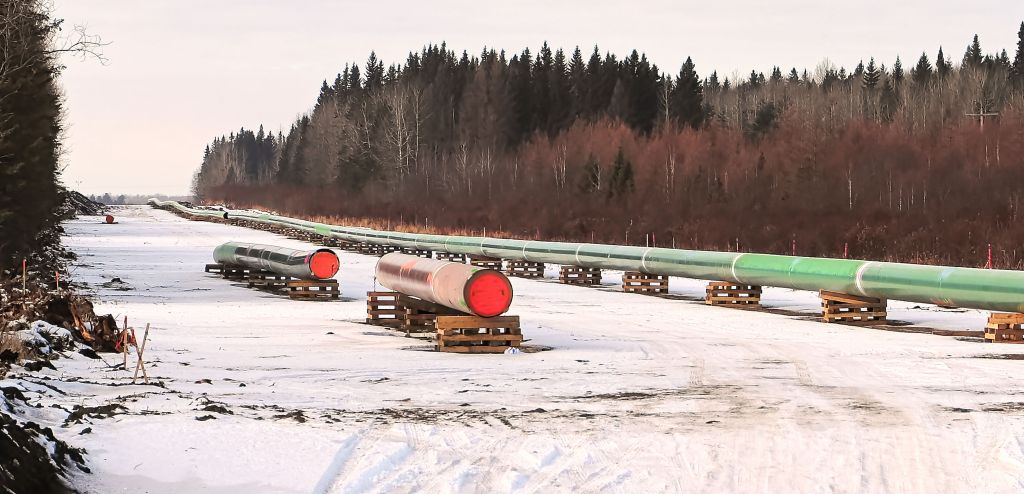
As debate continues over the costs of building Alberta’s proposed West Coast Oil Pipeline (WCOP), there is a question of how Canadian heavy crude can compete with the Persian Gulf and ever-rising Venezuelan grades that already serve the Asian market. There are several key elements that need to hold for the economics of the proposed pipeline to work—and none are guaranteed.

A Canadian barrel costs roughly twice what a Gulf barrel costs to land at the same refinery—the arithmetic of being 1,200 kilometres from tidewater. On delivered cost alone, any case for the pipeline must explain what offsets a gap that wide.

A Competitive Oil Market

Heavy sour crude delivered to Northeast Asia (C$/per barrel)

WCSArab HeavyMerey
Delivered costs (C$/b)(CA)(Gulf)(VZ)
Field to tidewater$9-$11$2-$3$4-$6
Freight to NE Asia$4-$6$3-$4$4-$5
Delivered, all-in cost$13-$17$5-$7$8-$11

Notes: Persian Gulf and Venezuelan field-to-tidewater costs are RBC Thought Leadership estimates. Western Canadian Select (WCS) costs are modelled off Trans Mountain’s shipping costs to China from its Westridge Marine Terminal.  Freight rates are mid-cycle estimates.

The new pipeline does not need to follow the same path that unfolded for the Trans Mountain Expansion Project (TMX), i.e., cost overruns that were part passed onto shippers.

Pipeline Economics

West Coast Oil Pipeline (WCOP) vs. Trans Mountain (TMX) financial metrics

WCOPWCOPTMX
Pipeline Metrics (C$)LowHighActual
Capacity, 000 bpd1,0001,000890
Capital cost, $ billion$35.2$43.7$35.3
Capital cost, $ per bpd$35,200$43,700$59,831
Pipeline toll, $/bTBDTBD$9-$11
Freight to Asia, $/b$2-$3$2-$3$4-$6

Notes: The TMX toll reflects the revised rates as disclosed in the July 7 submission to the Canada Energy Regulator ($9.20-$11.05 per barrel). The TMX capital cost per barrel is calculated based on expansion volumes only (590,000 bpd). Freight rates are mid-cycle (normalized). All dollar figures are quoted in Canadian dollars.

The West Coast Oil Pipeline’s transportation costs should hopefully be less expensive than TMX, given the use of a larger line along a ‘de-risked’ corridor, and loading supertankers (Very Large Crude Carriers) directly rather than the mid-sized Aframaxes. The challenge would be to keep the project on budget. The $35-$44 billion estimated price tag for the project excludes escalation and financing—key concerns from a competitiveness standpoint.

Western Canadian Select (WCS) trades well under global benchmarks, much of it due to captivity (as it’s one and only market is the U.S.) rather than quality. While a cheaper price improves competitiveness (buyers get a similar barrel for less cost), it is less than ideal for producers and getting oil to tidewater lets the barrel escape this structural disadvantage. The Alberta government estimates WCOP could narrow the price gap between WCS and the U.S. benchmark West Texas Intermediate by up to US$3 per barrel. For reference, WCS has historically traded at a US$10-15 discount to WTI, but has at times gone in excess of US$20 per barrel.

Buyers are hoping Canadian crude is more reliable. Cheap Persian Gulf barrels carry a Strait of Hormuz risk, while Venezuelan barrels are dependent upon an extended economic reconstruction. Canada’s oil carries neither risk, with Asian buyers willing to pay for that security.

Producer commitments are less a question of Asian demand—TMX’s fill rate suggests the demand is clearly there, but cost overrun concerns need to be alleviated to ensure the West Coast project’s competitiveness.

The trade case rests on several conditions: the project is built on time and on budget, with a discount that is more structural in nature rather than subject to periodic events, and a reliability premium outlast recent disruptions. If these conditions hold, the prize is significant: roughly $20 billion in incremental annual exports (based on 1 million barrels per day at 90% utilization, and a WCS price of $60 per barrel), along with a potential US$3-per-barrel tightening in a spread across future bitumen production of between 4.5 and 5 million barrels per day by 2035, worth about $5 billion annually. Whether Canada should make this bet with public money is a fiscal judgment, particularly given the country’s recent history with pipeline development, but one that seems increasingly likely with each passing day.

–By Shaz Merwat, Energy Policy Lead

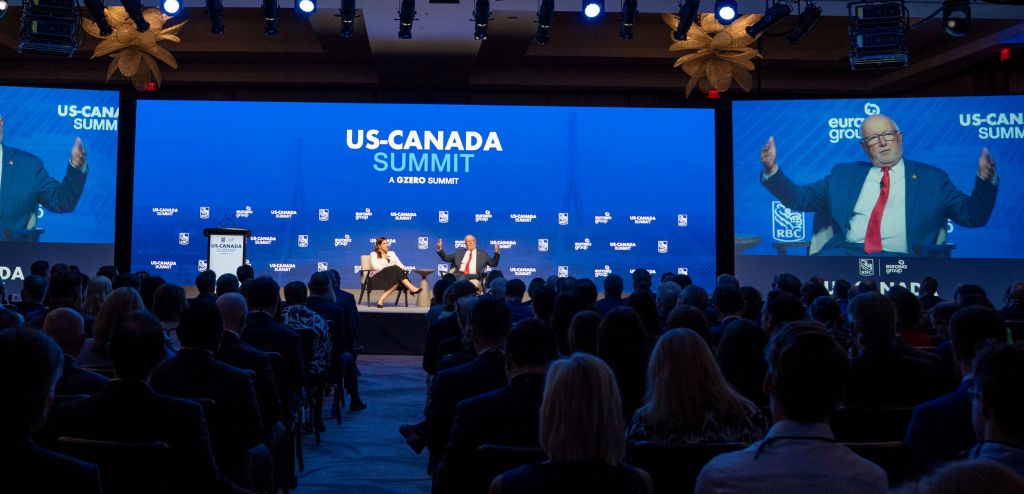
RBC brought together more than 500 business, government and policy leaders last month for the U.S.-Canada Summit, in partnership with the Eurasia Group. Ministers, governors, ambassadors, economists, investors—and an astronaut—gathered in one room to talk about the future of the world’s most prosperous relationship.

Donald Trump threatens to cut off trade to Spain

  • The U.S. President issued the threat over the European country’s refusal to increase defence spending to 5% of GDP by 2035. The U.S. administration is now preparing a list of Spanish goods to potentially embargo.

Canada tells the UAE it’s not ready for an inflow of cash

  • The federal government’s Major Projects Office told an official UAE delegation that it was too soon to inject billions of dollars into Canada, as projects are still in early stages. Prime Minister Mark Carney landed a $70 billion investment commitment from the UAE last year, but that capital has yet to be deployed.

Brussels launches probe into imports of Chinese duck

  • The European Commission has launched an anti-dumping investigation targeting Chinese Pekin duck, the breed used to make the iconic Peking duck dish. The latest dispute highlights growing trade tensions between the EU and China.

Global trade and economic groups warn of uncertainty

  • The heads of major global organizations—the International Energy Agency (IEA), International Monetary Fund (IMF), World Bank Group (WBG) and World Trade Organization (WTO)—met to discuss the impact of the war in the Middle East. While they noted that the global economy has been “broadly resilient,” they warned that uncertainty remains high and that the impacts of the war may linger.

U.S. trade deficit widens, as does Canada’s surplus

  • The U.S. trade deficit increased sharply in May, ballooning to a 14-month high despite tariffs on imports. Canada, meanwhile, saw its trade surplus widen to a four-year high in May, with exports of metals and energy increasing during the war in the Middle East.

Listen on Apple Podcasts, Spotify or Simplecast

Season 10 of Disruptors leaned into urgency. Episode after episode, the question behind each conversation was the same: does Canada have what it takes to compete—in AI, in data, in energy, in the industries and economy being built right now?

For the season finale, John Stackhouse took that question to the RBC and Eurasia Group US-Canada Summit, where 500 leaders from two nations convened for one day to confront the most consequential economic relationship in the world. Nearly $2.5 billion dollars in goods and services crosses the Canada-U.S. border every single day. The relationship runs deeper than any trade agreement through shared defence, infrastructure, and decades of integration that have made the two economies less like partners and more like a single system.

Two conversations. Two answers to the season’s central question.

The first is with Colonel Jeremy Hansen, the Canadian Space Agency astronaut who became the first Canadian and first non-American to travel into deep space, as mission specialist on the Artemis II lunar mission in April 2026. Hansen flew around the Moon and came back with something harder to measure than data: a conviction that collaboration is an operational requirement. Canada earned its seat on Artemis through decades of commitment to space robotics. That’s the model, he argues, for how two countries build something that neither could build alone.

The second conversation is with Michael Sabia, Canada’s 26th Clerk of the Privy Council—the country’s top public servant— and one of its most experienced voices on economic policy. Sabia has a clear-eyed case for ambition. Canada holds low-carbon energy, critical minerals, food security, world-leading AI research, and the trust of the world. It will soon be the only country with free trade access to three billion consumers. The question, Sabia argues, is not whether Canada has a hand to play. It’s whether Canada plays it with the confidence and ambition the moment demands.

This is the Season 10 finale of Disruptors, recorded live at the RBC and Eurasia Group US-Canada Summit. The season explored whether Canada has the tools and the will to compete in AI, data sovereignty, clean energy, healthcare, and tech growth. This episode brings two conversations that answer that question directly: one with Colonel Jeremy Hansen, the first Canadian to travel into deep space, and one with Michael Sabia, Clerk of the Privy Council. Together they make the case for collaboration and ambition as the defining requirements of this moment in Canada’s history.

Colonel Jeremy Hansen is a Canadian Space Agency astronaut who flew as mission specialist on the Artemis II lunar mission in April 2026, becoming the first Canadian and first non-American to travel into deep space. Michael Sabia has served as Canada’s 26th Clerk of the Privy Council since July 2025, the country’s top public servant, with previous senior roles as CEO of Hydro-Québec, Deputy Minister of Finance, and CEO of the Caisse de dépôt et placement du Québec. Both were speaking live at the RBC and Eurasia Group US-Canada Summit.

Hansen drew directly on the Artemis II mission and argued that collaboration is an operational discipline, not a soft aspiration. Canada earned its seat on the mission through decades of sustained commitment to space robotics—thousands of people, millions of decisions, all pointing at a shared objective. He described how the Artemis II crew built trust by surfacing friction early and refusing to let problems fester. His message for the Canada-U.S. relationship: make collaboration the stated intent, keep it simple, and demand that everyone in the room bring solutions, not just problems.

Sabia made the case that ambition is exactly what this moment requires and that Canada should have it. Canada holds low-carbon gas, food and fertilizers, critical minerals, world-leading AI research, and the trust of the world. It will soon be the only country with free trade access to three billion consumers. He argued that strengthening Canada domestically and deepening the U.S. relationship are mutually reinforcing, not competing priorities. His conclusion: this is not a time for national anxiety. Confidence and ambition are the characteristics that will define Canada’s next chapter.

From Ottawa to Orbit: Two Views on Canada’s Big Day

SPEAKERS

Colonel Jeremy Hansen, Michael Sabia, John Stackhouse

John Stackhouse 00:00:09

Hi, it’s John here. As we wrap up this season, I want to share a couple of conversations with you that I thought captured a couple of the big ideas we heard over and over again this season. One is on moonshots, the other is on big ambitions.

The first is with Jeremy Hansen, who is now the Canadian authority on moonshots because he’s been to the moon and back. He’ll share insights from the journey, the voyage, and what it taught him about leadership and about humanity. We’ll also hear from someone who may be a little less celebrated than Colonel Hansen, but is hugely important to all the moonshots that Canada is trying to undertake this decade.

Michael Sabia runs the Canadian public service and is Prime Minister Carney’s right hand for pretty much everything major that is going on in the country. He’s also one of Canada’s most respected business thinkers and business leaders. Having run Hydro-Quebec, the Quebec Pension Fund and Bell Canada, he knows a thing or two about disruption and is on the front lines of all the disruptions that Canada is up against.

Both conversations were recorded live at the recent RBC Eurasia Group Canada US Summit held here in Toronto. One of my takeaways from that summit is that we’re going to face a long, hot summer when it comes to trade negotiations and everything else that’s on the table between Canada and the US. But there’s also a huge amount of opportunity, especially if we stay grounded but reach towards the stars. That’s the formula of every great moonshot.

Here he is, fresh from Halifax, Colonel Jeremy Hansen. So he literally flew from Halifax to get here this morning, but of course has also returned from another trip. He’s been to the moon and back. For those of you who don’t know Jeremy’s story, born in London, Ontario, educated at the Royal Military College and spent 17 years in Houston living, working, training with the American astronauts, but always wearing that Canadian flag on your shoulder there. So we’re going to talk about space, but we’re also going to talk about Canada and what lies ahead. But thank you. A lot of people are wanting to spend time with you right now and it’s wonderful for you to be part of this conversation.

Colonel Jeremy Hansen 00:02:35

Yeah, I appreciate that. And I actually appreciate the opportunity just to be with you, thought leaders. These types of conversations and leaders like you that put Canada in the position to collaborate with the United States, that Canada became the second country to send a human in a deep space because of that collaboration. So I’m excited to be here with you. It was worth the flight.

John Stackhouse 00:02:53

Well, we’re going to talk about– it was worth the flight–we’re going to talk about all that’s going on down here, but let’s start up there because the summit has been very much about the ground level, but you’re, I think, the only one in this room who has seen our beautiful continent from afar, very, very far away. What went through your mind as you were whipping around the moon there and got to look down on our little rock here and our little piece of that rock?

Colonel Jeremy Hansen 00:03:19

Pretty extraordinary journey. I would highlight, I flew with Reid, Victor and Christina and they had all spent at least six months, Christina closer to a year, aboard the International Space Station. And in the beginning, when you ride the rocket to space and you get out to, we went out to about 2,000 kilometers on our first orbit. I did get to see the continent, all of Canada, all of the United States all at once, but it wasn’t very long until all of that started to disappear and you couldn’t make out continents anymore. You saw a lot of blue, you saw a lot of white clouds. You’d see strange shapes of the terrain, but it was hard with the cloud cover to really make out what you’re looking at. And very soon you just started to connect with what we termed “tiny earth.”

And you couldn’t always see earth out the window, it depended on the orientation of the spacecraft. And so whenever the spacecraft would turn for thermal reasons and we would catch earth out the window, someone would just say, “Oh, there’s tiny earth.” And we would all float over and admire tiny earth. But I think it was interesting that I stopped connecting with a country, I started connecting with a planet. And I didn’t really think about that until I had some time off last week and I was like, “Gosh, yeah, it’s really true.” I just naturally stopped connecting with a country. But I will say, when I do think about our collaboration, something that really jumps out at me and when I looked at it from space is, for a thriving North America, you have to have a thriving Canada and you have to have a thriving United States. There’s just no other way to see it from space.

And that does mean two things. In the Astronaut Corps, we have these expeditionary skills, we call them, but two of the five are self-care and team care. And in order to be a good team player in a crew, you have to have good self-care. And so understanding how each of us take care of ourselves and our thriving as individuals is what allows the conversation to figure out how do we collaborate while still accomplishing that.

John Stackhouse 00:05:13

It’s a bit of a message for Canada and the US that we have to take care of ourselves but also be part of the team.

Colonel Jeremy Hansen 00:05:19

When you decide to go on a trip, try and send yourself around the moon, you do need a team. You need mission control, you need the engineering teams and of course you need the team that’s in the capsule and you don’t pick that team lightly. And so our currency is competency and collaboration. Those are the two things we have to have, otherwise, it falls apart. And we demand that. There’s no free rides in space exploration. Everybody has to be in it fully, has to be digging in and bringing real meaningful contribution. And that’s what I see here when I look at this room. You guys are all spending time here because you see that it’s valuable to lean into how can we get our two countries working together and firing in all cylinders to bring that collaboration.

John Stackhouse 00:06:09

Give us a sense of the collaboration up there because there’s no more challenging or risky environment.

Colonel Jeremy Hansen 00:06:15

Yeah. So Reid was our commander and the commander is always the commander, but a good commander will lift up their crew and utilize them to their full capability. And so Reid was very intentional about finding meaningful roles for all of us in the capsule and dividing the tasks through the mission. And so for launch and entry, Reid and Victor were in the seats with the controls and those were their primary areas. For all of the other trajectory burns that we did to navigate around the moon and back and get up to 39 times the speed of sound, that was Christina and I who were responsible for those. We’d built a lot of trust and we had worked through a lot of tensions.

In the beginning, we committed time in saying we want to get to be the highest functioning team that we can be. And then eventually when we came to understand that we would need to understand each other better. And so with that time we started to dig deeper and then we started to build a muscle that we would communicate when things, anytime there was a small friction, we would start to communicate about it. And that is the muscle we built so that we would eventually become this team that just wouldn’t let something fester.

John Stackhouse 00:07:23

So a team, but you’re also an individual. What did you learn about yourself on the mission?

Colonel Jeremy Hansen 00:07:29

I really found myself moved in gratitude for the opportunity and for what we have. There is an innate human joy in accomplishing tough things, taking on big challenges, leaning into help, helping others. What it reinforced for me coming back here is that it is very much worth continuing to dig into the challenging and hard things that we have in front of us. This Canada-US relationship for one, how we leverage space. There’s a list as long as my arm of things that we could do that are the right things to do for our country and the right things to do for our international collaboration on space. I guess I know with concrete certainty that there’s value in pursuing that.

John Stackhouse 00:08:22

So let’s get into some of those challenges and opportunities. We’re all more excited about space today, I’d suggest. How do we seize on that excitement and what should we as a country, as Canada, but also as neighbors, Canadians and Americans be doing?

Colonel Jeremy Hansen 00:08:37

Something that I’ve said often that I think is worth highlighting here is, why was there a Canadian on Artemis II? And it’s because Canada partnered with the United States decades ago. Canadians held a vision over decades, thousands of people participated in this, but also because the United States carved out space for a country to bring their gifts and actually bring real value to the collaboration. And so when we committed to developing a third generation of space robotics, Canada earned its way onto the Artemis II flight and that’s a really incredible example. And so what I would suggest out of that is as we look at our relationship, we really need to ensure that we are guiding the masses, that collaboration is our stated objective.

Actually getting stuff done and working together in a way that is mutually beneficial has to be our stated objective. And so if you’re going to lead thousands of people who are going to make millions of decisions in order to make this the thriving collaboration it could be, then you need that stated commander’s intent, that overriding commander’s intent. And it does not need to be complicated, but it has to be simple in that collaboration is the desired outcome and that at the end of the day, it should be mutually beneficial for both parties.

John Stackhouse 00:10:01

I wonder, Jeremy, if you can leave us with some of the insights you’ve brought back from space on what we can all take away in terms of how to go about our own days, but also how our two countries can work together in the years ahead.

Colonel Jeremy Hansen 00:10:14

Well, pretty much every night that we’re sleeping on board the spacecraft, the caution and warning system went off and woke us up. And every time the caution warning system goes off, it might be a false alarm, but you don’t treat it like that. You float out of your sleeping bag and you float the displays and you start trying to figure out what is going on and why that happened. And then you talk to mission control and you work through it. And I think what is maybe useful for us as humans is, especially with our cancel culture and our culture that just is constantly pointing out what’s wrong, we as leaders can’t accept that. That’s not good enough. People who can point out what’s broken and stop there is not acceptable in our space culture. We do not allow a flight control or a mission control to pass or to participate in our program if that’s all they can do is point out the problems.

We have an expectation that they will, yes, identify the problem, but then they will identify a workaround or a solution, or at the very least, a path forward to find a solution and who they need help with. And we as leaders right now need to demand of the people in this conversation that they either get the depth of understanding to understand all sides of the problem and an actual solution, or we just don’t need to hear from them yet.

John Stackhouse 00:11:43

I can’t think of a better message to end on Colonel Hansen, Jeremy. Thank you, thank you. On behalf of the audience, on behalf of the US-Canada Summit, thank you for this conversation, but also all that you’re doing for Canada and the world.

Colonel Jeremy Hansen 00:11:56

Thanks everyone. Have a great day.

John Stackhouse 00:12:03

Jeremy Hansen went to the moon and came back with something more than data. It was a new way of seeing. From that distance, borders disappear. What’s left is the relationship.

Canada’s top public servant has kind of been doing the same but from a very different vantage point. Here’s Michael Sabia. What a great way to end the day. Michael is one of the most thoughtful people I’ve known. You are.

Michael Sabia 00:12:32

You’re jumping to conclusions.

John Stackhouse 00:12:34

See what I say at the end of the conversation. No, let’s get right into the relationship because you’ve been clerk for close to a year, probably feels a lot longer.

Michael Sabia 00:12:44

It does.

John Stackhouse 00:12:44

But you’re not quite at the one year mark. And you’ve in various jobs dealt with Americans, worked with Americans. Curious what, in this position, what you’ve seen that maybe the rest of us don’t see or understand about the relationship?

Michael Sabia 00:13:00

I don’t think that I see anything in particular that others don’t see. I mean, at the end of the day, this relationship between Canada and the United States, this is not ultimately about a relationship between two governments. Obviously, governments matter. I mean, that’s the statement of the obvious, but the relationship is so much deeper and so much more highly distributed. Here I’m thinking about governors, chambers of commerce, CEOs, investors, firms, families. I mean, that’s the bedrock of this relationship between Canada and the United States. And I think those people on both sides of the border understand that by working together, we are collectively stronger and it creates strength on both sides. That’s the essence of it. And as Canadians, I think we have to be and we are trying now to invest a lot more in the strengthening of those relationships and taking our case to a broad spectrum of Americans beyond just the administration in Washington.

So if you asked me kind of what did I learn in this period, I guess it’s a bit paradoxical and I think I’d say, on the one hand, this is a relationship of great strength because of its depth, because of how highly distributed it is, but at the same time, paradoxically, it’s also fragile. Fragile because at this time in such a contested world, the strength doesn’t necessarily manifest itself in resilience on either side of the border. So for us, I mean, the lesson I draw from that is we have to continue and really redouble our efforts at working with that broad spectrum of opinion in the United States.

John Stackhouse 00:14:47

The Carney government is clearly focused on diversification but not decoupling. Help us understand how you walk that fine line between trying to diversify Canada’s relationships, not just through trade, without alienating our principle partner or antagonizing.

Michael Sabia 00:15:03

I actually don’t think there’s a tension here because you’re absolutely right. We are not decoupling. Yes, we are diversifying, but look at Canada’s economic policy and split it geographically. I mean, two basic pieces, there’s the United States piece and there’s the rest of the world piece. I don’t think there’s a strategic conflict between those two things. I think actually those two things are mutually reinforcing. That’s the essence of it. So take the US side, clearly proximity brings with it some economic gravity. I mean, that’s an inevitability. And therefore, does Canada need a well-functioning economic relationship with the United States? Absolutely we do. And that’s why the Prime Minister a couple of weeks ago in New York called for a new economic partnership between Canada and the United States. Now that starts with the work we’re doing on the CUSMA negotiations. It starts in addition to CUSMA with working to get to a trade arrangement for some of the heavily impacted sectors, whether it’s aluminum, steel, autos, et cetera.

But what’s really important to understand here is all of that rests on, in our view, a foundation of a stronger Canada. And that stronger Canada is the result of the work that we’re doing to invest in the country, to yes, diversify our economy, to use our natural resources as the coin that will allow us to diversify more broadly. It’s about doubling the electricity production of our country, which we are going to do. It’s about AI and the things that Canada is an intellectual leader in AI, we need to start using that for commercial purposes. It’s about all these other things that we’re going to do to make Canada a stronger economic presence and a stronger economic partner to the United States, which is why not decoupling, yes, we’re going to strengthen Canada, but by strengthening Canada, we think we can strengthen the relationship with the United States and that’s the frame of mind that we have.

John Stackhouse 00:17:09

Let’s shift to defense strategy. It’s been a focus of this summit. The government is clearly increasing, quite significantly, defense spending, but defense spending has become key to economic and trade policy as well, which is a big shift. How are you thinking through balancing the efficiencies as well as the requirements of defense spending, ultimately protecting the country while also stimulating economic growth, adding to the Canada Strong agenda and being used, if I can put it this way, as a trade lever.

Michael Sabia 00:17:39

Yeah. So national security and economic security, though those two things are mutually reinforcing and that’s pretty fundamental to how we think about defense. I think the issue’s a lot broader than procurement though. I mean, this is ultimately, on the defense side, this is ultimately about a few things. One, it’s Canada stepping up to take care of ourselves, which we need to do. It’s Canada stepping up to be a good ally in a context of NATO or whatever. And it’s Canada thinking creatively about how we can use defense dollars to accomplish two objectives at the same time, to strengthen national security on the one hand, but at the same time to promote economic development. In other words, by creating more defense industries, by creating a more dynamic environment in the Arctic with the investments that we will make there. So it’s a really good example of how the kind of policies that we’re pursuing and the diversification that we’re pursuing is not at odds with America’s interests.

Why do I say that? Look at the Arctic. There, we are working in a diversified environment. We are working with the Nordic Five. We are asserting our presence in the North, both for economic reasons and for military reasons. And I think actually that’s exactly consistent with what the Americans would like to see. They would like to see Canada stepping up, doing what we need to do a little bit more, well, more aggressively, not a little bit more, more aggressively from a defense spending and a defense presence point of view. But that diversity that we’re pursuing, that diversification we’re pursuing with the Nordic five is a great example of how our cooperation with other countries can frankly take some of the pressure off the United States. And when I stand back, John, and I think about, I just look at the hand we have to play and I compare that to other hands of other countries in the world.

We have huge reserves of low carbon, low cost gas, and the world’s going to need gas. We have foods and fertilizers for a hungry world. We have natural resources and especially critical minerals and in the fall, you’re going to see a package of regulatory reforms that are going to allow us to speed up and to speed up in a dramatic way. We now have a plan to move forward on using AI and adopting AI. As I said, we’ve been an intellectual leader, but now we need to integrate it into our economy and deal with some of our productivity issues. By the end of the year, we’ll be the only country in the world that has access to three billion consumers through free trade agreements, the only country in the world that can say that. We’re changing the way the country operates so that it’s not just a Montreal to Toronto corridor that dictates what happens in Canada, but that all of the regions of the country, because of their importance from an economic development point of view, that they’re part of the game as well.

One other thing, we also have one other asset that sadly is pretty rare in the world today and that’s a sad thing and that is a simple word, the word is trust. People trust us. They trust us because of our values. They trust us because of our history. So when I look at all of that, the conclusion I draw from that is, this is not a time for national anxiety about a relationship between two governments. This is a time for confidence because we have a hand that, played properly, played in a skillful way, can lead to really a new chapter in Canada’s history and a new chapter in the relationship between Canada and the United States, which we acknowledge is very important and an important foundation for the future prosperity of the country.

John Stackhouse 00:21:27

What a great note to end on. In fact, that’s the note we began on this morning. Dave mentioned its risk in Canada. We’re hearing that from around the world. Lots of smart people are seeing that hand. We are playing it, but we’ve got to play it even more ambitiously in the US.

Michael Sabia 00:21:41

Ambition. Now there’s an important word. That’s exactly what we need. Confidence, ambition. Those are the characteristics that are going to build the future of the country and build an enduring and good relationship with the United States.

John Stackhouse 00:21:53

Let’s do it.

Michael Sabia 00:21:54

Let’s do it.

John Stackhouse 00:21:55

All right. Great note to end on. Michael, thank you.

Michael Sabia 00:21:57

Thank you.

John Stackhouse 00:21:57

Thank you. Thank you.

Michael Sabia 00:21:58

Thank you.

John Stackhouse 00:22:04

Two conversations, one from orbit, one from the room where policy gets made, but both pointing in the same direction, which can be incredibly positive for Canada. From all of us at Disruptors, that’s season 10 and what a season it’s been. This season Disruptors won a Webby Award and that genuinely would not have happened without you. To everyone who listened, who shared the show and who voted, thank you. It means a lot to our whole team here at RBC. We’ll be back in the fall with more conversations at the edge of what’s changing Canada and the world. Until then, have a safe and happy summer. And if you’re listening along the way, be sure to check out some of the episodes from years past that we will re-release through July and August.

Be sure to like, follow, and subscribe to Disruptors wherever you get your podcasts. And if you want to explore more of RBC’s thinking on all the issues that we cover, head to rbc. com/thoughtleadership or follow us on social media. And if you can, be sure to like, follow, and subscribe to Disruptors wherever you get your podcasts. I’m John Stackhouse and this is Disruptors, an RBC podcast. Thanks for listening and we’ll see you in September.

U.S. President Donald Trump’s refusal to renew the Canada-United States-Mexico (CUSMA) agreement by the July 1st deadline came as no surprise. But it did usher in a new era for the agreement, one that will include more talks—and even more uncertainty.

What does the no deal by the deadline really mean?

  • For starters, the deal is not dead: The agreement will require annual reviews for the next decade. So little changes in the near term, as tariff carve outs for Canadian and Mexican goods that comply with CUSMA remain in place. If, however, the three parties do not reach an extension agreement by 2036, the deal expires.

  • Will the U.S. withdraw before then? Trump has threatened to do so. But he would need to provide six-months written notice—and, according to the U.S. Senate’s finance committee, requires approval from Congress. As our colleagues in RBC Economics pointed out in their latest report, “We continue to view outright termination of CUSMA as unlikely if economic reasoning holds. Exporters/importers on both sides of the border have a strong incentive to maintain the deal.”

  • What about side deals? The U.S. is expected to push for separate “protocols” with Canada and Mexico. Canada-U.S. Trade Minister Dominic LeBlanc said his government is open to this path.

The roadblocks:

The U.S. has a long list of irritants, outlined in the 2026 National Trade Estimate report released by the U.S. Trade Representative (USTR) earlier this year. That includes a few often-cited issues—Canada’s supply management system; a lack of market access for American wine, beer and spirits; and the federal government’s Buy Canadian policy.

But that’s not all:

  • Improved access to Alberta’s power market: The USTR believes there’s been little progress in improving points of access to Alberta’s energy market for Montana energy producers, and that equally priced power generated in Montana is being deprioritized to benefit Alberta power producers.

  • Aircraft regulatory approvals take too long: The U.S. said stakeholders raised concerns about the regulatory process and timelines associated with aircraft validation in Canada.

  • ‘Cumbersome’ seed regulations: Canada’s system for importing of seeds, claims the USTR, is “slow and cumbersome and disadvantages U.S. seed and grain exports to Canada.”

  • A lack of IP protection: The USTR put Canada on its Watch List for intellectual property protection and enforcement. It also flagged the poor enforcement of counterfeit or pirated goods at the border and within Canada as a concern, referring specifically to the Pacific Mall in Toronto.

What’s next:

  • Negotiations will continue through the summer: The U.S. is meeting with Mexico the week of July 20 for a third round of bilateral negotiations. Mexico may be willing to make concessions, as Claudia Sheinbaum’s government has made the U.S. its top trade priority. Washington and Ottawa have yet to start negotiations.

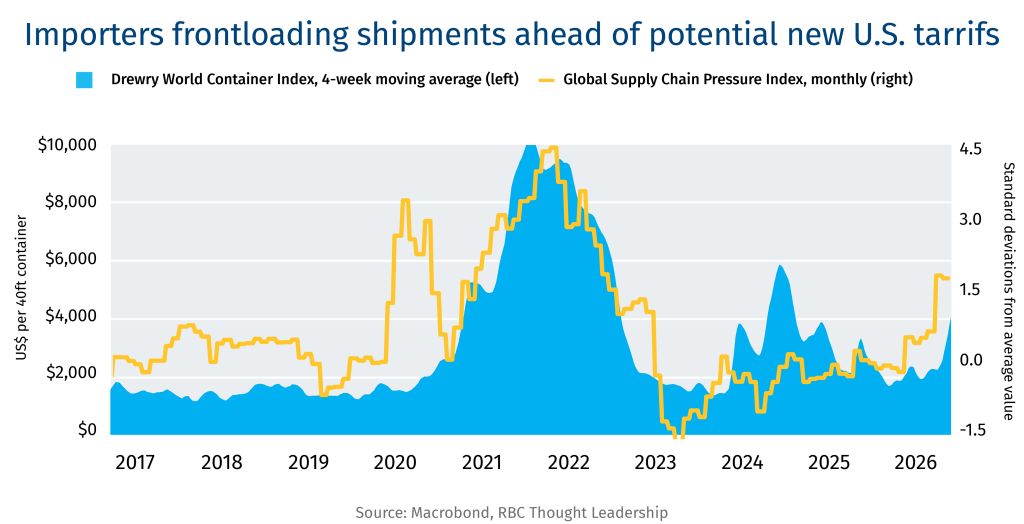
  • Another deadline looms: Section 122 tariffs will expire on July 24 unless Congress extends them, which is unlikely. It’s expected that the Trump administration will instead introduce a new set of tariffs. That’s already spurred an increase in shipping—and shipping rates—as businesses try to get ahead of a fresh batch of tariffs.

    Importers frontloaidng shipments ahead of potential new U.S. tarrifs
  • Investment uncertainty will dominate: Although the agreement is still in place, the annual reviews will prolong the business uncertainty that is already weighing on investment. Without clarity, businesses are likely to hold off on making critical long-term investment decisions. As Mexico’s economic minister Marcelo Ebrard recently said, “if you drag us into a constant review process, you’re going to choke off investment.”

The urgency to feed 10 billion people by 2050 has long been a central concern in agri-food research and policy. But with fertility rates down and global populations beginning to stabilize, a new S&P Global Energy study reframes the long-term question for the ag sector: what if supply outpaces demand?

For certain crop commodities, the rate of demand growth is predicted to slow through 2050, with feed crops especially exposed as growth in per capita meat consumption decelerates toward 0.1% annually.

Meanwhile, crop yields and food production continue to increase. That story rings true for Canada, which has boosted its yields and overall production of most crops considerably since the turn of the millennium. For instance, between 2000 and 2012 annual wheat production did not exceed 30 million tonnes, but had reached nearly 40 million in 2025.

Type of cropAverage annual yield growth (percent), 2000-2025
Canola (rapeseed)3.4
Corn for grain2.1
Wheat, all types3.0
Barley3.3

Source: Statistics Canada. Table 32-10-0359-01  Estimated areas, yield, production, average farm price and total farm value of principal field crops, in metric and imperial units

If such annual yield increases continue from 2026 to 2050 — and seeded acres remain constant —wheat and canola output would grow by tens of million tonnes.

Although an absolute reduction in food consumption is not expected, when slowing population growth contrasts with continued gains in ag outputs, a gap could pose structural challenges for the export market’s long-term health and profitability. Rising demand for biofuels and alternative markets may take some of that surplus, but Canada will need to continue enhancing its efficiency while working to differentiate itself from other major crop exporting countries. Emphasizing the quality of Canada’s exports and its dependability as a trade partner can help preserve its reputation as a preferred supplier.


Contributors: Alicja Siekierska, Farhad Panahov, Wilson Fink

There are roughly 11,000 data centres in the world. Canada has about 300. The United States has 5,000 and that number is growing fast.

Those numbers frame one of the most consequential questions in Canada’s digital economy right now: as AI transforms what data is worth and what compute power is required, who will build and control the infrastructure behind it?

In this episode of Disruptors, John Stackhouse travels to North Vancouver to go inside one of Canada’s data centres owned, operated, and built by Global Relay, a Canadian company that has spent more than 25 years managing communications data for some of the world’s most regulated organizations. It’s a conversation about AI, infrastructure, and a deceptively simple idea that is becoming more urgent every year: sovereignty is not just where data sits. It is who builds the systems, who controls the stack, and who earns the trust.

4 things you’ll learn in this episode:

  • What a data centre is and why it matters where it’s built.

  • Why data sovereignty is about more than where data lives.

  • Why AI makes your organization’s data more valuable – and more vulnerable.

  • What Ottawa needs to do differently – and what’s at stake if it doesn’t.

Listen on Apple Podcasts, Spotify or Simplecast

Data sovereignty is the idea that data should be governed by the laws, institutions, and controls of the country or organization responsible for it. In practice, it is about more than where data is stored. It also involves who controls the infrastructure, who can access the data, which legal frameworks apply, and whether the operator can protect, recover, and produce the data when needed

Data sovereignty matters because AI, cloud computing, public services, financial systems, research, and business operations all depend on sensitive data. As Canada invests in sovereign AI compute and domestic digital infrastructure, the country faces a strategic question: will Canadian data and intellectual property depend mainly on foreign-controlled systems, or can Canada build infrastructure and technology capacity at home?

Canada’s sovereign AI compute strategy is a federal effort to expand domestic AI compute capacity for researchers, businesses, and innovators. It includes public and commercial infrastructure investments designed to strengthen Canada’s AI ecosystem, and support made-in-Canada AI solutions.

Global Relay is a Canadian technology company that built and operates its own cloud and data-centre infrastructure. In the episode, Global Relay becomes a case study in what data sovereignty can look like operationally: Canadian-built technology, owned infrastructure, controlled systems, and services used by highly regulated global customers.

AI increases demand for compute, storage, power, and secure data infrastructure. It also increases the value of organizational data, because records, communications, relationships, and business activity can become inputs for AI-enabled insight and automation. That makes governance more important: organizations need to know where their data lives, who controls it, how it is protected, and how it can be used responsibly.

Own The Stack: Canada’s Data Sovereignty Test

SPEAKERS

Sahar Kayhani, Warren Roy, John Stackhouse

John Stackhouse 00:00:09

Hi, it’s John here and welcome to a special episode of Disruptors. I’m in North Vancouver standing outside the nondescript building on the North Shore of Burrard Inlet. It’s a data centre. Those are two words that you may not have used a lot a few years ago and now it’s hard to pass a day without hearing a lot and some of it controversial. Data centres are front and centre in every economic conversation and a lot of political conversations because they are so important to what’s going on in our society. The new AI strategy from the federal government speaks directly to that. Canada needs to develop more capacity and more sovereignty around all sorts of things, but data is one of them and we may need more data centres to ensure that.

Right now, there are roughly 300 data centres in Canada, including this one owned, operated and built by Global Relay, a Canadian company. 300 may seem like a lot, but that doesn’t stack up too much next to the United States where there are 5,000 data centres and that number is growing rapidly. Globally, the world has about 11,000 data centres right now and there’s a real arms race underway to build more data centres as well as the infrastructure, including energy and water required to power, cool, and operate them. This global relay centre was designed to minimize the carbon footprint, not just of the building but of the processing of all the data, which frankly is more than any of us could ever count.

I’m being greeted now by Sahar Kayhani. She’s the chief product officer at Global Relay, a facility that stores communications data for 22 of the world’s 25 largest banks. And while I’ve got a lot of questions, we’ll be sure to delve into one very big one. When it comes to digital sovereignty, what can Canada learn from a company that has spent years making it operational? Sahar, welcome to Disruptors.

Sahar Kayhani 00:02:19

Thank you, John. It’s great to be here.

John Stackhouse 00:02:21

Well, it’s especially great to be here on a gorgeous day in Vancouver. The sun is shining, the gentle wind is blowing. Before we get going Sahar, tell us a bit about your own journey and how you got to Global Relay.

Sahar Kayhani 00:02:34

I graduated in computer science a while ago. When I joined the company in 2014, I think we had about a little shy of 300 employees or around that number and since then we grew to 1,800 or a little over 1,800 now. And as a woman in technology, it was a very welcoming journey in Global Relay. We have many senior leadership of the company that are women here. So it’s been a fantastic journey so far.

John Stackhouse 00:03:06

Sahar, we’re still outside the building and it’s fascinating to see the design and the architecture, which as I understand it, is designed for security to keep the data centre from outside attacks, if I can put it that way.

Sahar Kayhani 00:03:20

Yeah, there are some elevated walls that basically are designed to make sure that the data centre is physically secure from outside the vehicles as well. We obviously, when we go inside there is various other elements of physical security that is built into this data centre.

John Stackhouse 00:03:42

So we’re inside the compound now, Sahar, and one of the aspects of your location here in Vancouver and specifically North Van that I hadn’t appreciated was the free flow of cooler marine air coming off Burrard Inlet. We’re staring now at three stories of intake devices for that air, they look kind of like louvre blinds.

Sahar Kayhani 00:04:05

Yeah. The cool air goes into the facility and makes the cooling very efficient basically from a power perspective.

John Stackhouse 00:04:13

And I guess another advantage there is it doesn’t look like you have air conditioners around here and that’s one of the functions of the bigger data centres, especially in hotter places like the Southern United States. They need massive air conditioning, which takes up space, it also takes up a lot of energy.

Sahar Kayhani 00:04:30

Yes. This allows us to not use any traditional air conditioning and just rely on the air from the marine to basically control the temperature of the facility.

John Stackhouse 00:04:41

And that’s one of the reasons you call this a green data centre.

Sahar Kayhani 00:04:44

Yep.

John Stackhouse 00:04:45

Let’s go further inside. We’re now inside the electrical room. It’s loud. Around me are six UPSs. That stands for uninterruptible power supply and that is the engine right literally of any data centre. Inside each of these six big boxes, it’s really interesting to see one opened up and underneath are these giant wheels that spin at 7,000 RPMs. So there’s a lot of power that goes into making more power for the data centre.

Sahar, we’ve moved to the second floor and are now inside a data hall. You can get in here only with biometric access and once in here it feels to me a bit like the data economy equivalent of an old bank vault. We used to store gold bars underground, now we store data in these giant racks on the second floor of a data centre.

Sahar Kayhani 00:05:48

So there is a few aspects related to storing data and the security of it. The first one is obviously redundancy does matter and the second one from various different regulatory perspective or generally data management, aspect that no one can tamper with the copy also matters. So this hall that we see here, we saw all these tapes as backups.

John Stackhouse 00:06:12

I’m holding an LTO now. This is like a big old disc that has 10 terabytes of data on it and we’re staring at racks with hundreds of these discs on and it’s all operated by robots. And the purpose of this room is essentially a backup for all the data that is out there on servers.

Sahar Kayhani 00:06:33

The robots help manage the whole system of which data is stored in which tape and moving them around for efficiency purposes. The servers that we’re going to se next are where basically the live data and the live product and application runs, but this stores the non-tamperable, non-deletable copy of the data. It’s basically the last copy of the data.

John Stackhouse 00:06:57

Let’s go. We’re now inside the main data hall. It’s frankly a little cool in here. I think it’s 13 or 14 degrees Celsius. All that cool air that we described earlier being sucked into the building is being cranked through this room by giant fans to cool the data racks and servers and we’re looking at rows and rows of them, Sahar in front of us, each is built on top of these fascinating little devices to create some resistance in case there’s an earthquake because we’re here on the West Coast and there are earthquakes and tremors. And if you’re operating a data centre, you have to be very mindful that every little shift or bend beneath the surface can affect your data. Sahar, tell us a bit about what’s going on inside these racks and servers.

Sahar Kayhani 00:07:53

We have a few of these data halls within the data centre. We manage tens of petabytes of data for our customers and financial services and other highly regulated industries. So what these server racks do, is they store all this data with the aspects of security and encryption. They also run the services on top of this data that our customers need. Basically what we do with this data or what our customers do with this data, they keep it as business records. So as you can imagine, over the last few years of social media, AI, the data is only growing and that’s why we have the efficiency in the data centre to be able to grow with the customers and their data needs.

John Stackhouse 00:08:43

I’m standing next to an incredibly loud rack that is designed entirely for AI. I’ll step into the next room to learn a bit more about why AI is so loud.

Sahar Kayhani 00:08:57

It does go back to the energy. So those GPUs consume a lot more energy than the other server room and the data hall we were at, then that’s why the noise, in addition to the air cooling noise, you hear a lot more noise from the GPUs than the other rooms.

John Stackhouse 00:09:15

So the next time I have a question for Claude, I’ll ask it to respond a little more softly.

Sahar Kayhani 00:09:21

The concept of peace and quiet doesn’t match a data centre because I think quiet translates to something that’s not peaceful at all, something going down.

John Stackhouse 00:09:34

That was a fascinating tour into the engine room quite literally of the data economy and what Global Relay is doing to make more advances. We’re now going to hear from Warren Roy. He’s the CEO and founder of Global Relay. Warren, welcome to Disruptors.

Sahar Kayhani 00:09:54

It’s a pleasure to be here, John. Thanks for making the time for me today.

John Stackhouse 00:09:58

I want to pause here and go back in time to the origins of Global Relay and then we’ll get into some of the here and now. But you founded the company way back in 1999. There was an internet back then, but it was a very different digital world. What inspired you to create Global Relay?

Warren Roy 00:10:16

Well, the inspiration came from a very simple concept, which was really founded around people and companies transitioning from paper-based communications to electronic communications being email. And the principle of the business was never lose email again. We sat down and we designed the fundamentals of the business to achieve that objective.

John Stackhouse 00:10:40

Here we are more than a quarter century later, you’re in 90 countries, I think it is. What accelerated the global relay story to get you to where you are today?

Warren Roy 00:10:49

We really strove to have a niche focus and the focus itself was record keeping, but it materialized initially after about four years in the financial sector as a result of Enron, Arthur Andersen, WorldCom all going bust and the SEC, the Securities and Exchange Commission in the United States coming down with a rule called 17A4, which was a record keeping rule. And we had developed recordkeeping technology.

So there’s an element of luck as every entrepreneur will tell you in that a market presented itself based on a technology that we had developed. And the interesting part about that is that rule from the SEC obviously spawned many other companies getting into the same business, but we had a significant headstart on them. The other aspect of the rule is that virtually every Western country adopted a derivative of it, record keeping for the financial sector. And we were able to really aggressively get after those countries by getting in planes and flying around the world over and over and over again until we built up a reasonable amount of momentum, literally knocking on doors.

John Stackhouse 00:12:06

Here we are in a very different environment. How are you seeing tech sovereignty and what do you think is really driving it as a preeminent concern right now?

Warren Roy 00:12:16

Well, tech sovereignty and the whole sovereignty eye discussion is really quite new. It started to appear about two years ago. And if you boil it down, it’s two things, it’s about control and security. Every business wants to be in control of its destiny. Every government wants to be in control of the data that it uses that’s largely private in nature to conduct its day-to-day operations. So sovereignty is incredibly important and the way the technology world is unfolded, there is an enormous amount of power in very few hands and it’s recently made a lot of countries uncomfortable and resulted in them taking a look at what levers they can pull to have better control over their data, maybe not absolute control, but better control.

John Stackhouse 00:13:05

It’s interesting that you say tech sovereignty’s been around for only a couple of years. I suspect you’re right. I certainly don’t remember people talking about tech sovereignty a decade ago, but you were onto the issue a decade or more ago in terms of building infrastructure that would allow your customers and clients to develop optionality and therefore sovereignty. What did you see back then when the world was rushing to the what are now known as hyperscalers, but the big cloud companies? What did you see back then that perhaps others missed?

Warren Roy 00:13:42

We built the company from the standpoint of having top to bottom control over all aspects of the service. And that comes from lessons learned, John. We had a data centre early on that we occupied on the West Coast that had a catastrophic failure and we lost a lot of systems. We did fully recover, but the lesson we learned from it is that we didn’t want to depend on anybody going forward and it really changed our strategy at the time. And in 2012, we went down a road of developing our entire technology stack. In other words, we have no dependency on cloud vendors.

If you think about it objectively, we are our own cloud. We have always been our own cloud and that capability that governments and large organizations are looking for today. It’s really control over your ability to resolve issues when they occur, specifically not having dependencies where you cannot resolve issues.

John Stackhouse 00:14:41

Data location is an important part of sovereignty. I wonder if you can walk us through some of the nuances there, because a lot of us might assume that, hey, if a data centre is in a jurisdiction in Canada, the data’s safe, it’s not that simple. Walk us through how we should be understanding location versus data sovereignty.

Warren Roy 00:15:01

Yeah. The three areas we speak about most commonly with global companies is privacy and privacy is really about the country that your employees reside in. And when you’re dealing with a multinational, you have to resolve the privacy issues or meet the privacy issues of every one of those countries. Underneath that layer, you have the regulatory framework that’s in place and not all industries are regulated, but all significant industries are regulated. And the regulatory framework, there’s no global standards for it. So it’s different in every country that you operate in. And then a layer underneath that is law enforcement and different countries have different level, I would just call it of aggression when it comes to their law enforcement. You need to understand privacy, regulatory environments and law enforcement to be able to put any solution in place. And historically, if you all just give you an example, the United Kingdom names Canada in their Data Protection Act and it says any business residing in the UK can hold its data in Canada. And most countries have similar laws. That’s just an example.

So you really want to understand what countries you can do business with given where the corporation resides or cloud service resides. From a Global Relay perspective, we’ve been able to achieve what we just internally call data visas so the permissions of a regulator in any given country to hold that country’s data in Canada. And we operate data centres in Canada and in the US and they’re used for different purposes by different customers. But to date, we’ve been able to achieve data visas in almost every country in the world. So there’s been, yes, a benefit to having an operation in Canada, but it’s more about setting the business up strategically to capitalize on whatever your objective is and ours was to manage data. So we became subject matter experts in privacy, regulatory laws, and obviously deal with law enforcement on a routine basis.

John Stackhouse 00:17:09

Walk us through a bit more of how AI is changing the relationship with data. I think you’ve said that data is the DNA of an organization, but that DNA is evolving with AI. How should we be thinking about that?

Warren Roy 00:17:23

In a regulated organization, your record keeping applies generally to your voice data, to your social media data, and to all your electronic communications. And when we use the phrase data as the DNA of your organization, what we’re trying to say is that everything that you are is in that data. It has your strategy, it has your customer communications, it has your contracts, it has your marketing, it has most importantly, your relationships. And the relationships in business are what drive business forward in terms of winning prospects and so forth. So organizations, they want AI to be able to capitalize on that data. A record keeping company, as we are, has very structured data and structured data equals quality, accurate, and complete data. And those three words I use commonly because they’re the three words that you see in every subpoena that gets delivered. And our whole organization has been based on preserving quality, accurate, and complete data sets.

And I don’t want to dive into the technology, John, but if you can vectorize all of that data, which is what AI reads, if you can have an LLM interpret your natural language inputs commonly called a prompt and have a feedback loop of a couple of seconds, you can get to the point where you can have a natural language conversation literally verbally with your company. “Tell me how we did today. Who are the top performers? Are there any risks that I should be concerned about?” And when you start to understand these pieces and how they go together, you can see how one, it’s a very exciting business and two, that there’s a huge upside for the companies that capitalize on AI sooner than later.

John Stackhouse 00:19:12

So we’ve got a number of forces swirling together in the world, but probably two of the most powerful are AI as you mentioned and also the longer reach of the most powerful nations in the world as we become even more borderless in digital realms accelerated by AI. How should we be thinking about borders here in Canada but elsewhere when it comes to data and digital sovereignty?

Warren Roy 00:19:40

When I look at the world, you certainly have the two major powers putting everything they have into AI. It’s still done privately through private corporations, but the investments and the efforts are super human. You can choose to compete against that. It’s very tough. But to me, when I think about what’s going on, you need to be in the AI game. You want as a country to be in control of your data and you could boil it down to one thing. One of the key things with any government is to put a framework in place to allow businesses to be successful and at the same time boost the standard of living. And those two things encompass many different controls, but that’s really how you have to think about it. I think there’s huge opportunities in Canada for AI and just generally cloud services where we can have the autonomy we want and at the same time achieve the control and privacy that we need.

John Stackhouse 00:20:37

You’ve deliberately stayed in Canada, but you’ve also said that Canada is at risk of exporting our upside. Tell us what you mean by that.

Warren Roy 00:20:47

People think far too narrowly. It seems to me that success today in business is based on selling your company and measuring your win based on the value of the sale. I think it’s unfortunate that people think that way. I really feel that, John. And for us as an organization, I’ve always been focused on just trying to build the best business I could. Our largest customers are in the UK and France. So we’re well positioned globally to serve customers. And I think it’s also important to realize what is a global company and really the definition of that is that you can serve companies well around the world, which means 24 hours a day. So you really have to think through a strategy, defining success in your own mind and taking on partners which usually come in the form of outside capital that are aligned with your long-term vision.

And one of the really tough things that I see every day in the tech sector in most countries is they’re just all sold out to the top private equity firms typically where they are then taken and capitalized on. That is not a winning formula. And whether you address that through taxes or through other mechanisms, people need to think differently. The government needs to think differently. We need to support businesses that grew up in our country. I think that spells success for a far broader group of people than you could ever define by selling a business where simply a few capitalize.

John Stackhouse 00:22:21

You’ve had more success arguably outside of Canada than within, and maybe that’s good. That’s why you’re a global company. You’ve put the global into global relay, but you said that the UK and France are your two top markets. Now they’re bigger than Canada, so there’s some simple math there at play. But why have you done better in those European markets than in Canada?

Warren Roy 00:22:43

Well, when I look back over the past 25 years, it was only after we became quite successful outside of Canada that we did any significant business inside of Canada. And I think Canadians are just gun shy. They’re very conservative. But I also think at the same time, we have had a massive wake-up call in the past 12 months where we need to start looking within and capitalizing on our capabilities because I will tell you on the world stage, Canadians are very capable in almost any area in business and running a global company has a huge benefit to the country that is its origin. And I really would like to see more Canadians going abroad to drive their revenues.

The global markets are just simply huge, but today we have had some really good support from Canadian business, especially the Canadian banks and that’s great to see. It is hard as a startup to walk into government or a major bank and say, “Hey, could you buy my product?” Because there’s a big gap between your ability and their expectations. But in reality, when companies do start to become successful, you do need to support them.

John Stackhouse 00:23:59

What does Ottawa need to really come to grips with, both as a customer, as a regulator and through industrial strategy?

Warren Roy 00:24:08

Well, they have some tough decisions to make. You have our provinces and our federal government that are hardwired into US and other foreign technologies. There are successful Canadian companies, but there’s very little implemented when you look at the percentage of expenses that is pushed out into the technology sector. The vast majority of all of it is provided by foreign nations. Tech is complicated. It’s a big bet. And from a Canadian government perspective, you need to be able to reason your way through the right bets. And that doesn’t mean betting on everybody and that doesn’t mean throwing money at everything. It means choosing smartly, reducing the risk of your mistakes and partnering with some key critical companies that can really change the game, have proven that they can change the game on the world stage.

I have spent a fair bit of time in Ottawa in the last year, we’ve really put forward our case that we can deal with the scale of the federal government because we manage the data for some of the largest organizations in the world, but I’m sure there are a hundred plus companies like Global Relay in Canada that should be considered by the federal and provincial governments that currently aren’t. And part of it is you need to find champions within the government. It is full of people that are interested in doing the right thing that have the ability to do the right thing, but the bureaucracy itself is a challenge for everybody, whether you’re working within it or you’re trying to provide a service to it.

John Stackhouse 00:25:48

If we tackle those challenges, if we get it right 10 years from now, what do you think Canada looks like in the digital world?

Warren Roy 00:25:54

It is all about automation and efficiency. Canadians want a better standard of living and you can only achieve that if you can boost productivity. So from my perspective, I think the government and corporations can do far better at providing more efficient services if they can focus on automation and automation is really driven solely by AI. And with that automation, you should be able to downsize the government itself, reduce its overall expenses, and ultimately provide a far better service to Canadians.

John Stackhouse 00:26:32

Warren, it’s so impressive what you’ve built at Global Relay. Congratulations on that and thank you for being on Disruptors.

Warren Roy 00:26:39

Oh, it’s been a pleasure, John.

John Stackhouse 00:26:43

Data is quite literally the most valuable intangible in any organization and right across the economy. But when you go through a data centre, you certainly see the tangible side of what’s at stake. It’s not only the incredible machinery and all the power generation and cooling that’s required to make it run sustainably. It’s the growing requirements for security and redundancy in an increasingly complex and volatile world.

If you want to know more about these issues or hear more of these conversations, go to rbc.com/thoughtleadership or follow us on social media. And if you like this episode of Disruptors, please be sure to subscribe wherever you get your podcasts and give us a rating or a review that will help others find this conversation and share it.

This is Disruptors, an RBC podcast. I’m John Stackhouse. Thanks for listening.

Also in this edition: 10 numbers that define Brexit’s impact on the U.K. 10 years later 

Expertise, not electrons, could be Canada’s critical energy export 

  • Ottawa’s electricity trade debate keeps circling east-west interties and cross-border electricity flows, but Canadian expertise could be an understated export asset. One such example, called out during Canada’s National Electricity Summit in Ottawa this week, was Manitoba Hydro International (revived in 2024 by the provincial utility following a three-year closure), which started selling Canadian utility expertise to more than 120 clients around the world in 1998. 

Canada needs to remove barriers to trade and to investment 

  • A big takeaway from a C.D. Howe Institute roundtable this week was that while trade diversification is important, lowering barriers to foreign investment is just as urgent. Holistically reforming the country’s corporate income tax system was one of the ideas that was floated.  

Next week, North America will cross a threshold in the Canada-U.S.-Mexico trade relationship.  

It’s not a cliff, but it will start a new chapter in what has been the world’s most successful trade pact. 

To assess what may come next, RBC’s John Stackhouse joined a Brookings Institution virtual roundtable this week, with policy thinkers from all three countries. One thing seemed certain: no matter how a revised CUSMA looks, the spirit of North American trade is likely to bring more elbows and fewer handshakes. 

Some other takeaways: 

1. There will be a deal: “Reason for optimism” was a refrain, although the costs of that deal will be felt in all three countries. So, too, is timing, especially if negotiations continue after the U.S. mid-terms and into a more fractious Washington.  

2. Get used to tariffs: Beyond the July 1 trigger for a CUSMA review, the current regime of Section 122 tariffs will expire on July 24, when we should expect the Trump administration to create another regime. Canadians need to think through a range of tariffs that could follow, from a “heavy hand” option of 15-25% tariffs (unlikely), to a variation of the status quo, which could carry greater border measures on digital trade. A safe bet is some form of “market access” price, perhaps in the 5% range, with plenty of exemptions. 

3. Side letters will be key: The general agreement may stay largely in place, with a host of side agreements that don’t require legislation. That can be good news, as such letters can be changed more easily than a full agreement. But that risk can also apply to safeguards that Canada and Mexico may seek in side deals.  

4. Mexico is willing to make concessions: Claudia Sheinbaum’s government—more overtly than Canada—has made the U.S. its top trade priority, and is adopting policies to align with Washington’s asks. That could include stricter rules of origin for the auto sector. Mexico is also interested in a broader framework, to address border, energy and food security  issues as well as trade. 

5. Canada needs to manage internal divisions: There’s no single Canadian economy when it comes to trade. The current 232 tariffs cover 36-37% of Canadian exports to the U.S.—but 58% for Ontario and 55% for Quebec. The Maritimes, Saskatchewan and Alberta face hits of less than 10%. Canadian opinion has also hardened against a deal at any cost, in part because Canadian trust in U.S. commitments has declined.  

6. Uncertainty is hurting investment and growth: In all three countries, businesses are hedging the borders, diversifying production to get ahead of new tariff and non-tariff measures. For Canada, there also may be some investments taking place to serve non-U.S. export markets, notably Europe and China.  

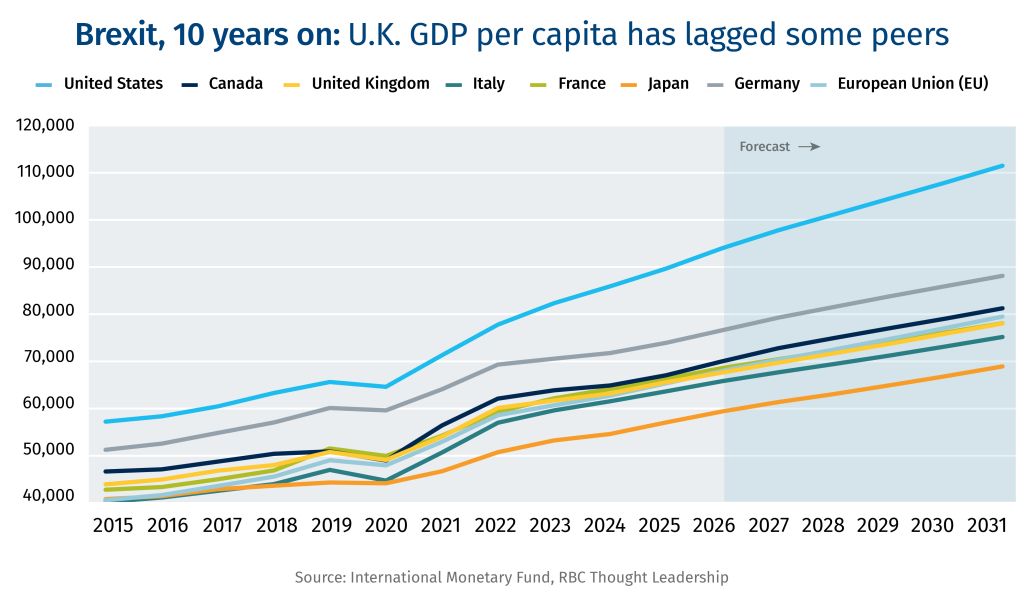
This week marked the 10-year anniversary of the referendum that resulted in the United Kingdom leaving the European Union. A decade after the seismic vote, the ramifications are still being calculated and realized. 

  •  14% – The decline in U.K.’s exports of goods to the EU in 2025 compared to 2019, before the two partners signed a new trade deal. During the same period, U.K. exports to non-EU countries were down 8%.   

  • 28% – The jump in U.K.’s services exports to the EU compared to 2019. Exports to non-EU countries were up 26% from 2019. However, the Centre for European Reform estimates that service exports are still 7% lower than they would have been if the U.K. had stayed in the EU. 

  • ↓  6-8% – The decline in the U.K.’s GDP growth by the end of 2025 due to Brexit, according to a study from the National Bureau of Economic Research.  


    Brexit, 10 years on: U.K. GDP per capita has lagged some peers

  •   5-10% – The U.K.’s GDP per capita growth was between 5% and 10% less than other similar countries between Brexit and the end of 2025, NBER also estimates.

  • ↓  13% – The decline in the U.K. business investment. Another study suggested U.K. firms invest just 11.1% cent of GDP, with only Canada lower in the G7.

  • 16% – The share of businesses reporting that Brexit was an important source of uncertainty as of Sept. 2025. It was as high as 40% shortly after the U.K. left the EU. 

  • 39 – The number of trade deals Britain has signed covering 72 countries since Brexit. Still, while the U.K.’s trading relationship with the EU fundamentally changed post-Brexit, the bloc remains the U.K’s largest trading partner.  


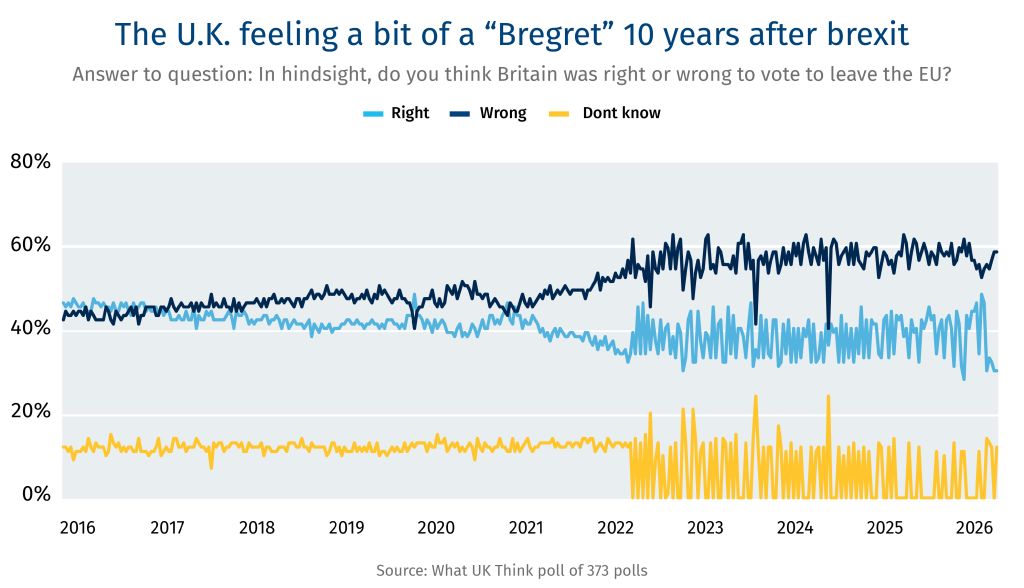
    The U.K. feeling a bit of "Bregret" 10 years after Brexit - chart

  • 57% – Of respondents said Britain was wrong to leave the EU in a recent poll.  

  • 41% – The EU accounted for 41% of the U.K.’s exports, and 50% of the U.K.’s imports.  

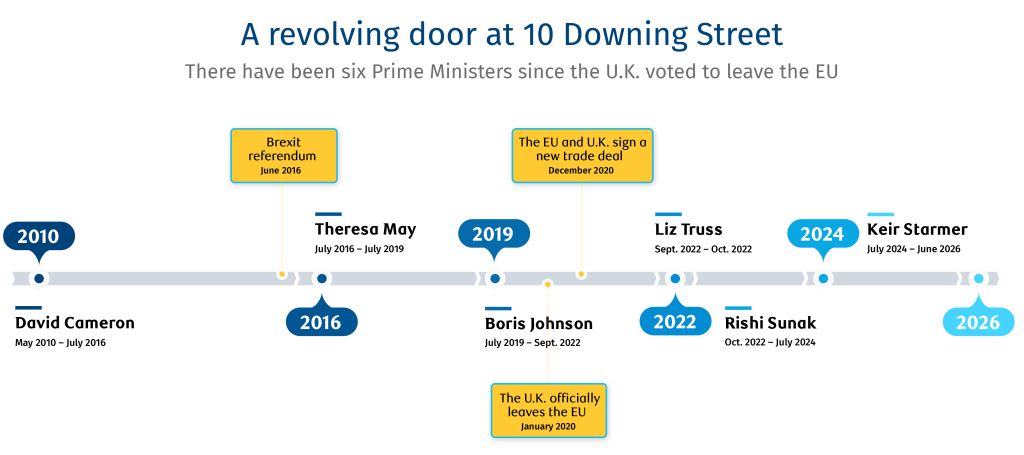
  • – The number of Prime Ministers the U.K. has had since the referendum. Former Greater Manchester major Andy Burnham is expected to become the seventh PM since Brexit. 


    A revolving door at 10 downing street

Canada’s healthcare system is one of the country’s defining public promises. It is also a system where many patients have to wait: in emergency rooms, for specialists, for procedures and for information to move from one part of the system to another.

Host John Stackhouse explores whether AI can help Canada address that issue. The conversation begins with Mara Lederman, the co-founder and COO of Signal 1, who lays out the operating reality inside hospitals: demand is rising, supply is constrained and digital technology has not yet delivered the productivity gains healthcare needs. The episode also hears from Dr. Amol Verma and Dr. Fahad Razak of Unity Health Toronto, two physician-researchers helping build VITAL, a national health-data platform growing out of predecessor GEMINI. Together, the conversations show two sides of the same challenge in our healthcare system.

Here’s some of what you’ll learn:

  • What are the practical AI use cases that can help improve our healthcare system

  • The challenges and barriers that remain in implementing AI solutions

  • How GEMINI was developed to help address data-sharing across hospitals

  • The role VITAL will play in connecting hospitals across Canada and what that could mean for not only hospitals, but for clinical trials and research

Listen on Apple Podcasts, Spotify or Simplecast

This episode of Disruptors looks at whether AI can help Canada’s healthcare system move faster, learn from its data and reduce wasted capacity. It combines the views from Signal 1 with the national health-data infrastructure story behind VITAL and GEMINI.

The episode features Mara Lederman, co-founder and COO of Signal 1; Dr. Amol Verma, physician-researcher connected to Unity Health Toronto and co-lead of GEMINI/VITAL; and Dr. Fahad Razak, physician-researcher and health-data leader connected to Unity Health Toronto and GEMINI/VITAL. The conversation is hosted by John Stackhouse.

The episode does not promise a single fix. It points to practical uses: procedure-prep calls that reduce cancelled appointments, follow-up support after discharge, better patient routing, clinical trial recruitment, operational efficiency and tools that help hospitals learn from their data.

The episode points to privacy, permissions, bias, model performance and public trust. Dr. Fahad Razak argues that the goal is not zero risk, but disciplined, transparent systems that can learn, improve and build stronger guardrails over time.

Dr. Fahad Razak says the near-term focus is testing and evaluating technologies through VITAL’s infrastructure, including examples like early heart disease detection and viral outbreak detection. He emphasizes that AI is not magic and must be evaluated like other medical interventions.

Canada is not short on health data. The challenge is building the infrastructure, trust and operating capacity to turn that data into better care, tested AI tools and a health system that learns faster.

Can AI fix ER wait times?

SPEAKERS

Mara Lederman, Amol Verma, Fahad Razak, John Stackhouse

John Stackhouse 00:00:09

Hi, it’s John here. If I ask you about Canada’s healthcare system, you probably don’t have to think too long about the answer. You might be grateful and, sure, you’re probably appreciative, but you probably also have a fair number of frustrations. This is a pretty familiar Canadian experience. We value our public healthcare system, we cherish the promise behind it, but healthcare in Canada involves a lot of waiting.

Earlier this spring, I had one of those experiences myself. A family emergency led to a long wait in a hospital emergency department. Now, everything worked out in the end, but I kept thinking about how common that experience has become. In that particular hospital, the first thing we saw when we entered the emergency department was an electronic board telling patients the expected wait time was seven hours and 32 minutes. Where else can you go where the wait time is advertised that boldly with no apologies?

Nearby, another sign asked patients to speak up if they did not want AI used during their visit. This May, the federal government released Canada’s national AI strategy and healthcare was the central priority. If you saw Prime Minister Carney roll out the policy, you’d have noticed by no coincidence he made the announcement in a hospital. And why not? Canada has a public healthcare system, world-class research talent, and hospitals generating hundreds of thousands of data points for every admitted patient. All that can help us develop better AI systems that can lead to better healthcare. But none of it, of course, is easy.

So on this episode of Disruptors, we look at the challenges from two sides. First, we’ll hear from Mara Lederman, an economist by training, and co-founder and Chief Operating Officer of Signal 1. It’s a Canadian health AI company working with hospitals in Canada and the US. Mara helps frame the pressure inside the system, rising demand, constrained supply, and the practical ways AI and technology can reduce wasted capacity.

Then we’ll hear from Dr. Amol Verma and Dr. Fahad Razak, two physician researchers connected to Unity Health Toronto. That’s the healthcare system built around St. Mike’s Hospital in downtown Toronto. They’ve built an AI infrastructure platform called GEMINI and are now helping lead VITAL, a more robust data infrastructure platform that aims to connect healthcare innovators across the country. VITAL just received a landmark federal investment of $100 million as part of a combined $200 million commitment that is the largest data innovation investment in Canadian history. Together, these platforms are aiming to reduce those horrible wait times that so many of us experience.

The opportunities here are twofold. There’s the operational challenges of wait times and then there’s the research that can lead to medical discoveries that life itself depends on. On both counts, Canadians want to be the world leader and here’s our shot to do just that. Here’s Mara Lederman. Mara, welcome to Disruptors.

Mara Lederman 00:03:19

Thanks, John. Good to be here.

John Stackhouse 00:03:21

I want to say actually, welcome back because we’ve had you on before and I want to kick off with that, Mara, because I actually can’t remember how many years it’s been, but we’re kind of talking about the same challenge. What’s going on in our hospitals that continues to lead to the levels of frustration that I think we all recognize across the country, even though we’ve all spent a lot on digital technologies over the last many years to ease those pressures?

Mara Lederman 00:03:49

I think we take a lot of pride in our healthcare system and our universal healthcare system. And then when you ask people if they feel like they’re getting good care, they’re not. And that’s not because we don’t have great research or great hospitals. I think if you ask any Canadian, they’re going to report being dissatisfied. Our ability to kind of give the average Canadian high quality care seems to be diminishing. We have a complete mismatch of supply and demand. We have incredible demand for healthcare. We have an aging population. They’re living longer with more ailments and more chronic disease. And so the need for healthcare, the demand for healthcare is growing. It’s effectively unpriced and we have a very constrained supply. And the simplest way to think about that is just sort of the number of hospital beds, the number of surgical spots, the number of procedure spots, and the number of clinical staff.

You go to an emergency department, you wait five to 10 hours. You need to see a specialist, people get booked six to nine months later. You need a quote, unquote elective, which is not really an elective procedure, but a non-emergency. You often have to wait months. And the way we’re going to do it is not just going to be by building more hospitals, staffing more beds because we simply can’t afford to do that.

John Stackhouse 00:04:54

And yet we are building more hospitals and trying to hire more doctors and nurses and there’s a logic to that. Why hasn’t digital technology particularly not made a greater difference over the last decade?

Mara Lederman 00:05:08

One of the benefits of adopting technology is it is supposed to make us more productive. What does it mean to be more productive? It means we can kind of generate more outputs with the same inputs, right? So in healthcare, you’d like to ask, how do the same sort of resources, when armed with technology, allow us to create more units of care? Probably the biggest digital technology to hit healthcare is the electronic medical record. The EMR is basically a system of record. It’s not a system of action. So there aren’t a ton of examples where you are busy clinical teams with another piece of technology often on top of the EMR and find that they can just do so much more.

John Stackhouse 00:05:48

That’s the pressure point. Demands keep rising. Supply can’t expand quickly enough and a decade of digital investment just hasn’t made the system move fast enough. At the same time, healthcare is generating more data than ever before. The problem is that too much of that data stays trapped inside hospitals, inside provinces, inside systems that were not built to learn from one another. That’s where VITAL enters the story. Amol and Fahad, welcome to Disruptors.

Amol Verma 00:06:16

Thanks for having us.

Fahad Razak 00:06:17

Great to be with you, John.

John Stackhouse 00:06:18

You’ve had an incredible busy couple of weeks now that you’re center stage in AI in the country in a very positive way. I want to start with a better understanding of VITAL. Amol, let me start with you. Take us through the VITAL story.

Amol Verma 00:06:34

The heart and the core insight and focus of our work is that healthcare does not use data very well. We don’t connect data across our healthcare organizations, and we don’t use it to inform good decisions, to develop solutions that can improve the way healthcare is delivered, and to use it to enable large-scale cutting-edge research and innovation. And so we’ve been working for about 10 years in Ontario on a hospital research network that we named GEMINI before Google showed up on the AI scene with their Gemini model and that connects hospital data now from about 45 hospitals, that’s about 60 to 70% of the patients in Ontario and makes that available for all of those different applications, quality measurement, research, innovation in healthcare. And what VITAL is doing is taking the work that we’ve built with GEMINI and really accelerating it and scaling it larger. So essentially saying we can connect hospital data at large scale across Canada and we can make it much more timely, and make that available so that we can support research and innovation to bring new solutions, new technologies, new investments into healthcare.

John Stackhouse 00:07:41

Walk us through GEMINI and how that connects with  VITAL.

Fahad Razak 00:07:44

So GEMINI was started roughly 10 years ago and the digitization of data, very different state than what it is today. So most of the chart of a patient admitted to hospital was handwritten, printed. It was in binders in the nursing station. 10 years later, almost all of information that’s relevant is now digital. So GEMINI was capturing that progressive digitization over that 10-year period. When we started to look at the world though the last couple of years, we saw that even though GEMINI was at best in Canada capacity, it really wasn’t competitive. What we were seeing in the Nordics, a place like Denmark as I think is the exemplar, the United Kingdom in terms of their ability to harness that kind of digital data at scale and use it for trials for artificial intelligence.

And just to put this in context, we’re both practicing physicians. Every patient that we admit to hospital now, we are generating hundreds of thousands if not millions of data points just to provide care. So it’s the lab tests, it’s the MRIs, it’s the digital vital signs. That data is extraordinarily important for artificial intelligence and for clinical trials and we were seeing these other countries developing population-wide capacity essentially to get that data, to use it very quickly under really good governance, legal protections for broad innovation use cases. And that was not possible with the GEMINI model. And so VITAL was a proposal to kind of leapfrog to push forward to say, “We need this at scale for the country. We need to be as competitive or better with the best-in-class we’re seeing globally.”

John Stackhouse 00:09:13

So that gives us a good sense of the infrastructure and the data. So taking us into 2026. One of the many challenges here in Canada is that healthcare is provincial. And I think you were just with deputy ministers from the provinces walking through what this new national infrastructure can do. Great in theory, but we all know the challenges of getting anything across provincial borders, including data, including doctors, including other aspects of healthcare.

Fahad Razak 00:09:42

Yeah. So I mean, let me start with your first point, John, which is the governance and political structure of Canada has made this kind of collaboration difficult. So a reasonable question is why is today any different? And I think today is different for two key reasons. The first is that we are under enormous geopolitical pressure. The use of this kind of data at scale for the country is an important value proposition where Canada can be truly competitive. We have to harness as close as possible the data of 42 million people, again, responsibly with the highest levels of privacy protection, but at that scale. If we are able to do that, there is a competitive advantage that we have at scale and that is that we are a single-payer system from coast to coast. So we don’t lose people like the United States does who don’t have insurance in their datasets.

And we are the most diverse high income society on earth. And that means that if you do your science here, if you do your AI algorithm here, your clinical trial, it’s intrinsically better than if you do it in a homogeneous population than Denmark, for example. We look more like the world than any other country. So the algorithms are just fundamentally better if done here. The second important advance is what’s been the rise of federated analytics. The data of Alberta today and five years ago, we can’t just move that data into Ontario. That’s not allowed. That had been a barrier five years ago to doing this kind of analytics, let’s say developing an AI algorithm or running a clinical trial, but we have the analytic structures that can run and develop an AI algorithm across these provinces and territories without actually moving their data. The algorithm optimizes in each jurisdiction and it keeps optimizing and rotating until it converges, as an example.

So you have a technology solution, you have the geopolitical pressures, you have the recognition that no single jurisdiction is big enough to really be competitive and that you’re seeing the offshore of the opportunity. So what is physically left Canada? An early cancer screening trial has gone to the United Kingdom. The best new vaccine trials are going to Denmark. And I think over the next three to five years, you will see some of those trials and AI developments come back into Canada because the combination of the structure that VITAL offers and the competitive advantage of our population, population dataset, size, diversity means we become a best-in-class jurisdiction to do work.

John Stackhouse 00:11:56

That’s the national infrastructure story. Connect what has been fragmented, protect the data, and turn Canada’s health system into a platform for better care, faster research, and better tested AI. But for patients who are still waiting, the question may be more immediate. What can AI actually do for me right now? Mara Lederman points to one simple example.

Mara Lederman 00:12:18

With the rise of GenAI and agentic AI, we’re seeing a whole nother set of applications, many of which aren’t yet patient facing and many of which aren’t even physician facing that are leading to efficiencies. Many of your viewers, if any of them are over 50, have had a colonoscopy, right? It’s an unpleasant experience. We all know that. And if you’ve gone through it, you know that there’s a whole round of prep you need to do in the days leading up to your procedure. You get detailed instructions about various medications and foods you need to stop eating or taking up to a week before. If someone doesn’t follow their preparation, what happens? They show up at their appointment, they get asked if they did the preparation or if they stop their iron pills, they say, “Oops, I forgot to do that.” They get canceled, no one gets a scope, you don’t get anyone off the wait list and it’s just a wasted opportunity.

So one of the health systems in the US has built an AI agent that automates these pre-procedure phone calls. And what it does is it calls everybody a week before, it goes into their medical chart, it pulls their list of medications. It says, “Here are all the medications you’re on. These are the ones you need to stop. Here’s a reminder about your prep. Here’s a reminder about when you need to come.” And it can do this for everybody. And then after these phone calls happen, a different AI reads the transcripts and flags any that feel they need to be redone by an actual nurse and the data shows more people come prepared, fewer scopes are canceled, fewer unused opportunities. So from a quality perspective, it’s better for patients, from a staff perspective, they’re not standing there with no patient and from an access, you’re not wasting opportunities to move someone off the list. So simple example, and it’s not that high risk.

John Stackhouse 00:13:57

That example shows what AI could do at the edge of care. Fewer wasted appointments, better follow up, fewer avoidable returns to the emergency department, and more support after a patient leaves hospital. But in healthcare, promising is not enough. We need to know whether these tools actually work and whether they work for Canadian patients in Canadian hospitals across Canadian communities. That brings us back to VITAL.

Amol Verma 00:14:22

AI is at an exciting point in its inflection. We need to run clinical trials on AI tools and we need a capability to do that. And the capability required to do that is an integrated digital infrastructure because unlike a medication where you work through a pharmacy, you dispense the medication, there’s a structure and infrastructure already in place for all of that. What we don’t really have the infrastructure in place for is the digital dissemination of these AI technologies. The second important application of AI in the context of clinical trials is AI can make it much more efficient to run other kinds of clinical trials. Large scale clinical trials historically have been a very expensive proposition. The average cost of a phase three clinical trial, which is what you need to get regulatory approval to bring a new drug to market is 21 million US dollars for a clinical trial.

If we can make that more efficient, we can create an extraordinary opportunity to bring new technologies faster to Canadians and make these kinds of technologies available to more people and AI can help us do that. It can help us do that by one, making it easier to collect the data you need to tell if a clinical trial was effective or not. A lot of that data is already gathered in our healthcare system. So rather than phoning up a patient and saying, “Did you end up back in the hospital?” We can just gather that information routinely to measure the outcomes you need to, to study a clinical trial.

The second piece is it can make it easier to identify which patients are eligible for clinical trials. So a big cost in clinical trials is identifying eligible participants, recruiting them into a clinical trial. AI can help us look at all of the health record data and identify which patients might be eligible and then we can work through typical processes with patients, care teams, and otherwise to try to make those trials more available to people. So lots of opportunities for AI to improve clinical trials and for clinical trials to improve AI.

John Stackhouse 00:16:12

Trust underpins all of this. And as we were discussing earlier, trust generally has declined when it comes to AI, especially here in Canada as well as the United States. How are you thinking through the trust barrier in rolling this out?

Fahad Razak 00:16:27

Yeah, I think it’s a problem that Canada is actually in quite a deep deficit around, as you said, John. So we know from surveys that in fact, the Canadian population’s trust of AI and worry about AI is actually higher than many other countries. And I would say the first point to make is that there are good reasons to be worried about AI. And so I do think that we have to be very cognizant and respectful of these worries and say, what is our solutions? What are we specifically doing? So let me talk about a couple of them. The first is whose data is being used under what permissions? We have a precedent in this country. The kind of data that we are talking about has already been used for generations really in this country in highly respectful protected ways that protect individual rights that allow opt-outs if people don’t want to be part of these innovations, that have layers of protection to anonymize around who an individual is.

We’re talking about using these aggregated parameters to develop an AI algorithm in a way that is consistent with the historical accepted pattern of the use of this kind of data in the country. However, there are some particular nuances around AI. There are ways that AI can develop an algorithm that can unmask an identifier. I think we need to be upfront about recognizing what those algorithms potentially can do, making sure that those edge use cases, not the majority of AI, but those edge use cases are ones that we are particularly careful around because I do think that we’re starting with a very understandable level of distrust and we can’t allow that deficit to worsen. So the second is that again, we are the most diverse high-income society on earth. We know from other AI deployments that these algorithms will anchor and tailor and optimize very tightly to the population they’re developed in.

So if you have an AI algorithm developed in a Nordic country, which is 95% homogeneous and you try and deploy it in Brampton, Ontario, or in Northern Ontario, or in the none of it, the chance that it’s going to work as well or even approximate as well as what they initially claimed is probably pretty low and people will pick up on that. And I think we need to be very careful to ensure that these algorithms are being deployed in our population in a way that is fair, and unbiased, and actually shows benefit.

And the third important thing is I was quite struck that the government decided to lead their AI strategy with health. Even a year ago, health may not have been one of the main pillars of an AI strategy for the country. I think it is more than just symbolism. If you speak to the Geoff Hintons and the Richard Suttons and others, they will say that of all the areas where they are worried about AI, health is probably the most important sector where they think the benefit can far exceed the risk.

The ability to detect disease early, to provide more nuanced diagnosis, that is things that people can appreciate day-to-day in their lives. I had a cancer diagnosis detected before I otherwise would’ve because of an AI algorithm that was able to pick it up in the imaging processing of my mammography. So I think as people rightfully have concerns around AI, health could be a really important sector where we can show benefit early, but we have to do it in a way that’s respectful about privacy, about bias. So I do think it’s a very important area where people actually can see real benefits in their lives.

Part of it is also a broader consideration of risk and benefit and how we think about each sector. So let me just use an analogy. I’m in downtown Toronto. I get onto the gardener in my car and you’re in a metal box with a strip of cloth over your chest driving 100 kilometers an hour at each other. We do that every day and we tolerate the risk because we have a destination and not because it’s fun to be on that road. With health data, if the entire conversation is risk containment, you are essentially boiling down your speed limit to zero kilometers an hour. So these technologies have the potential to get us to better outcomes, to better diagnosis, to more efficiency, but it’s not risk-free.

I think we need to have a conversation about tolerating some level of risk, being very disciplined and transparent where we make mistakes, and iteratively getting the safety systems better. Cars today are infinitely more safe than they were 50 years ago. That’s because we’ve iteratively made them more and more safe. There are going to be accidents, disclosures, biases that emerge. Let’s talk about it. Let’s say this was a problem. Let’s make it better. And over the years, we will see a system that is more and more safe, that has more and more guardrails, but importantly gets you where you need to go.

John Stackhouse 00:20:45

The risk conversation matters, but there’s also a risk in standing still. If Canada does not build this capacity, trials go elsewhere, AI tools get trained somewhere else, and Canadian hospitals will have to import systems designed for other populations. And in the end, patients could just end up waiting more in a system already under strain. That’s why Mara Lederman argues this should be treated as a necessity.

Mara Lederman 00:21:10

First of all, I don’t think we should call it the Canadian opportunity. I think we should call it the Canadian necessity. We started this conversation by talking about the health system being in crisis and that we aren’t going to kind of build or hire our way out of it. As long as we call it the opportunity, it feels like pet projects and innovation and we should just say there’s an absolute necessity to use technology to make healthcare sustainable. At a high level, we need to push as much care as possible into the lowest cost setting where it can be delivered. It seems like a simple thing to say, but the default is to do most stuff in hospital. Think about all the care that became virtual during COVID that nobody thought was possible before, even virtual nursing.

I was just with a company last week who’s putting sensors and cameras in patient rooms. All the data’s computed on the edge so there’s no privacy issues, nothing is stored and they are cutting down on fall risk and adverse events that happen in a hospital room that otherwise humans would’ve had to supervise. A lot of US systems have virtual emergency departments where you first even just get triaged online before you even show up in the emergency department. We’re seeing the growth in the US of what’s called ASCs, ambulatory surgical centers. So how many surgeries can be done outside of an acute care hospital as opposed to an inpatient hospital?

AI is not the only answer, but more and more I think we have fallen into the same model of thinking: that most care is delivered in a doctor’s office and if not in a hospital. And the reality is, with the technology we have now, we can do more. And so if I were to focus our country on one thing first in terms of the opportunity, it is asking how we use technology and sort of associated changes in incentives and coordination to always ask, are we delivering this care in the lowest cost setting?

John Stackhouse 00:23:01

Mara, thank you for being back on Disruptors.

Mara Lederman 00:23:04

Thank you for having me. It was fun as always.

John Stackhouse 00:23:07

Care in the lowest cost, safe setting means different things in different places. You can start to imagine AI-assisted tech being deployed and connected across our country, allowing emergency rooms to regain capacity. But also in remote communities, it may mean not needing to travel hours or fly just to get care that could be monitored, managed, and supported closer to home. Healthcare really is the critical testing ground for AI and whether it can deliver meaningful benefits for everyone. What should Canadians expect to see over the next, let’s say, year?

Fahad Razak 00:23:44

I think the one-year outcomes are going to be the introduction of technologies that we’ll be testing and evaluating using this infrastructure. So you’ll see things like, are we going to use an AI prediction algorithm to, let’s say, detect heart disease, to detect viral outbreaks as they’re occurring? These are underway and being tested by our network right now. The reality is as much as we’re optimistic around AI, it’s not magic. So it’s going to require the evaluation and testing that we historically have done for a cholesterol pill, for a cancer therapy. We have to test and evaluate. Those tests are already underway. So if you’re in communities that VITAL stretches to in Alberta, and Ontario, and Quebec, for example, you’re going to see these algorithms start to be rolled out, but it’s under evaluation phases. Again, we want to make sure that both the access to these technologies extends out to Canadians, but it’s done in a way that’s safe and under evaluation.

The announcement last week by the federal government was an additional $ 100 million investment in the VITAL network. To our knowledge, this combined $ 200 million investment is the largest in Canadian history now in this kind of data innovation. That’s about getting it out to the rest of the country. So in the next year, I think you’ll see it extending out to these three provinces, 50% of the country. In the years that follow, year two, year three, you’ll see it getting out to more and more provinces and territories. Again, we don’t want to overpromise, but the idea is we’re going to choose the best of these algorithms. Get them out there, test them, evaluate them, get them out to people, but also watch very carefully to make sure that they’re working well.

John Stackhouse 00:25:10

Fahad, Amol, thank you for being on Disruptors.

Amol Verma 00:25:13

Thanks for having us, John.

Fahad Razak 00:25:14

Such a pleasure. Thanks, John.

John Stackhouse 00:25:17

There’s a lot of government money going into AI, but that doesn’t guarantee outcomes. It does change the scale of what’s possible. Canada has enormous pools of healthcare data. The challenge now is building the infrastructure, trust, and operating capacity to turn that data into better care. VITAL now has the mandate and the resources to extend to Alberta, Ontario, and Quebec within a year and to reach more provinces and territories after that. The national AI strategy put healthcare on center stage. This investment is the follow through. AI in the ER is our new reality and we’re about to see just what kind of difference it can make.

You’ve been listening to Disruptors, an RBC podcast. Follow us wherever you get your podcasts. And be sure to share this episode with someone thinking about the future of healthcare in Canada. That will help more people discover this kind of conversation.

For more RBC thought leadership on AI, healthcare, productivity, and Canada’s innovation economy, visit rbc.com/thoughtleadership. I’m John Stackhouse. Thanks for listening.

U.S.-Mexico trade talks have worsened over security issues  

  • While talks between the U.S. and Mexico appear to be progressing, impasses have surfaced over security concerns, particularly extraterritorial U.S. operations to combat drug cartels.  

Chinese EVs remain a major irritant for the U.S. in trade talks with Canada 

  • It was no mistake that Prime Minister Mark Carney used his moment with President Donald Trump at the G7 Summit to explain the cap on the deal. Behind closed doors, a group of American policymakers remain highly concerned about the entry of China into strategic areas of the North American economy.  

Government continues to align foreign and trade policies 

  • Foreign Minister Anita Anand will take Türkiye’s foreign minister to a nuclear SMR facility in Darlington next week. Another sign that energy is increasingly a pillar of foreign policy.  

How energy markets could shape up post-Hormuz 

While hostilities between Iran and the U.S. appear to be subsiding, the re-opening of the Strait of Hormuz will continue to shape trade flows in the days, months, and years ahead. 

Why it matters—an MoU is signed, but the Strait isn’t solved 

The Washington-Tehran memorandum of understanding guarantees toll-free passage for 60 days only, followed by negotiations with Oman to define the future administration of the waterway. 

The Red Sea serves as a cautionary tale. In July 2024, a deal was struck with the Houthis, and Bab el-Mandeb Strait traffic—in the Arabian Peninsula—has not returned to early 2024 levels. Reopening of the Hormuz will be a difficult logistical process regardless of when it starts; with more than 500 vessels stranded in the Persian Gulf, mines to clear, and insurers to convince. Peak Hormuz flows may be behind us. “The vase is broken,” said IEA Executive Director Fatih Birol. “Now all actors know that the Strait of Hormuz was closed once and it can be shut down again.” 

By the numbers — resilience, and its limits 

The oil market proved more resilient than most forecasts. Brent peaked at roughly US$126 per barrel—a significant shock, but far below the US$200 worst-case scenarios circulated at the height of the crisis.  

The reason was adaptation, with a parallel logistics system emerging in real time. 

  • U.S. crude exports surged to more than 6 million barrels per day (bpd) 

  • Dark-tanker transits climbed to roughly 3 million bpd by early June, with cargoes shuttled by ship-to-ship transfer in the Gulf of Oman  

  • Alternative Saudi and UAE pipelines absorbed what they could, which was meaningful even though short of pre-crisis Hormuz volumes 

  • Kpler estimates more than 90 million barrels of non-Iranian crude and a further 70 million barrels of Iranian crude are now waiting to leave the region—a significant near-term overhang as the Strait reopens. 

But even resilience has a limit, and it is grade. Asian refiners, built for heavy sour Middle Eastern crude, spent the quarter force-feeding light sweet American barrels as a stopgap. The Hormuz gap was more around heavy oil and LNG shipments. 

The bigger picture—buyers won’t unlearn concentration risk 

Concerns are shifting to a near-term supply glut as trapped Gulf barrels flood the market. The IEA expects a significant crude overhang by 2027 if peace holds. Still, a key learning is that oil markets remain remarkably resilient. When the system was under genuine stress, it adapted through shadow infrastructure, bypass routing, and emergency substitution. Some of this was ad-hoc, but some was planned years, if not decades, ago (such as Chinese strategic reserves, and the Saudi East-West pipeline).  

These themes were discussed at RBC’s Global Energy, Power and Infrastructure Conference in New York this month, where access to global markets was the biggest topic among Canadian producers and importers—with buyers in Asia, and one in Germany cited as anchors for Canadian LNG projects in both the Atlantic and Pacific basins. Importing nations are chasing supply security and portfolio diversification, with a willingness to sew up new contracts running well ahead of the industry’s willingness to sanction new supply. 

Bottom line — a ceasefire changes the headline, not the lesson 

Canada, with one proposed cross-border crude pipeline targeting a mid-2027 final investment decision, TMX volumes already moving west, and West Coast LNG coming online, has meaningful volumes in the near to mid-term. The market will watch the Strait, but the next generation of trade will come from future agreements, which could increasingly include Canada. 

Shaz Merwat, Energy Policy Lead 

New research out of Purdue University illustrates the benefits to food prices of the trade deal now known as the United States-Canada-Mexico agreement and the costs if its dismantled. The USMCA Affordability Study: The Effect of North American Trade on U.S. Food Prices aims to quantify the effect of North American free trade agreements on U.S. food prices, and outlines a scenario where NAFTA was not implemented and historical tariff rates remained fixed. It concludes: 

  • For every percentage point in reduced tariff rates, there was a cumulative food price reduction of 2.8% over a 10-year period.  

  • Food prices were 12% lower by 2014 than they would have been in the no-NAFTA scenario, saving average households at the time approximately US$500 a year. 

  • Reversing the trade agreements would unwind those gains. And since U.S. agri-food imports from Canada and Mexico have grown significantly since the studied period, American consumers could be hit with much higher grocery bills at a time when budgets are already strained.  

Following the tariff reductions, key U.S. export commodities such as wheat, corn, and beef products did not see a rise in domestic prices that stronger export demand would normally predict. This is suggestive of how interconnected the North American food supply chains have become. 

Food affordability is already weighing heavily on household budgets in Canada and the U.S. New tariffs or trade restrictions emerging out of the upcoming negotiations could undo decades of food supply chain integrations and deepen pressure on consumers. 

Wilson Fink, Agriculture Policy Lead 

On the hunt for domestic investment, Mélanie Joly was in China this week pressing Chinese automakers to build in Canada, not just sell. Shoring up investment in Canada’s battered auto industry is necessary, but there are multiple crises on the horizon.   

Trapped between two auto giants 

Canada is in a tight squeeze in CUSMA negotiations. Section 232 tariffs aim to make Canadian assembly too expensive, threatening one of Canada’s largest export industries unless removed. Meanwhile, China eyes Canada as its North American beachhead—BYD already secured quota approval, with Chery and Geely racing for their slice of the 49,000-unit imports. 

The dynamics are stark: China wants Canadian consumers, America wants Canadian assembly jobs. Canada’s 125,000-strong auto workforce is caught in the crosshairs. 

But here’s what everyone’s missing in this tug-of-war: while Canada struggles to secure its share of North American assembly, rising vehicle prices are pushing more consumers out of the new vehicle market altogether, compressing demand while the global auto industry is facing over-capacity issues.  

The affordability trap no one’s watching

Canada's motor vehicle market: rising prices, declining demand

Vehicle prices have structural headwinds that make tariffs particularly dangerous. SUVs and pickups, which are more expensive than sedans and compact vehicles, already dominate sales. Ever-more tech features also pump up the price tag. When we layer tariffs on vehicles, steel, and aluminum, affordability doesn’t just suffer—it tanks. 

The Canadian numbers illustrate the trend: 1.92 million new vehicles sold in 2024, down 160,000 units from 2017 despite 4.3 million more driving-age residents in Canada. Population-adjusted sales have collapsed more than 20% since the 1980s while average vehicle prices have cruised 60% higher after inflation.  

The pattern repeats stateside—there are 20 million more Americans today than 10 years ago, but vehicle sales fell from 17.4 million units in 2015 to 16.4 million in 2025. As the price of vehicles rise, buyers will be pushed into the resale market.  

Bottom line 

Higher prices don’t just hurt consumers—they kill the very jobs these policies aim to protect. Fewer purchases mean reduced demand, worsening oversupply, and ultimately eliminating assembly positions across North America.  

(For more on North America’s auto industry, read our latest report: Steering Through Uncertainty

Jordan Brennan, Managing Director, RBC Thought Leadership

Canadian tech companies need global investors, global customers and global ambition. Canada needs a stronger scale-up system at home so more of the capital, customers, talent and long-term value creation stay connected to this country.

John Stackhouse sits down with Boris Wertz of Version One Ventures and Sid Paquette of RBCx to discuss Canada’s growth capital gap, the role of domestic capital, why customers and procurement matter, and where Canada can still build globally competitive technology companies.

Here’s some of what you’ll learn:

  • Where Canada’s tech capital gap shows up as companies move from startup to scale-up

  • Why global capital is necessary, but domestic capital still matters

  • Why Canadian companies need more customers and procurement pathways, not just more funding

  • Where Boris and Sid see Canada’s strengths: energy, quantum, AI, physical AI and biotechnology

Listen on Apple Podcasts, Spotify or Simplecast

This episode is about Canada’s tech growth capital gap and what Canadian companies need to compete globally from Canada. John Stackhouse speaks with Boris Wertz and Sid Paquette about domestic capital, global investors, procurement, AI, physical AI, bio and the long-term work of building more Canadian technology champions.

The guests are Boris Wertz, founder and general partner of Version One Ventures, and Sid Paquette, head of RBCx. The conversation is hosted by John Stackhouse on Disruptors.

In the episode, Sid Paquette frames the issue as less about whether strong Canadian companies can raise capital globally and more about whether enough domestic capital is present when those companies reach the growth stage. The conversation also connects capital to customers, procurement, venture networks and long-term value creation in Canada.

Boris Wertz argues that AI is creating faster cycles, more exponential outcomes and more concentration in fewer companies, founders and venture funds. That makes the scale-up question more urgent for Canada.

Boris Wertz and Sid Paquette argue that Canadian companies need more real customer opportunities, including from government and private-sector buyers. Sid notes that if no Canadian company is included in an RFP process, that should be a red flag.

Can AI fix ER wait times?

SPEAKERS

Boris Wertz, Sid Paquette, John Stackhouse

John Stackhouse 00:00:10

Hi, it’s John here. If you’re a regular listener of Disruptors, you may have heard a recent episode with Fred Lalonde, the founder of Hopper. He’s one of Canada’s most successful and interesting entrepreneurs. It’s worth a listen. Among the things Fred shared was a need for any Canadian innovator or technologist to reach global scale in a hurry. Well, to do that, you also need global capital, or at least scale that thinks like global capital.

And today, we’re going to hear from two of Canada’s most successful venture capitalists on what they see as the opportunity and the need to support and finance a whole new generation like Fred to carry Canada into the 2030s.

You’ve probably heard enough about the problem. Yes, we can produce important technology. We’ve helped shape artificial intelligence, quantum software, health technology, and emerging areas like physical AI. But when companies move from promising startup to global contender, that’s when the challenges really thicken.

That’s the tension at the center of this conversation. Canadian companies need global investors in global markets, but if the growth rounds, anchor customers, senior talent, and exit pathways all pull elsewhere, Canada risks losing too much of the long-term value from the very companies that people like Fred create here.

Today on Disruptors, I’m joined by Boris Wertz. He’s the founder and general partner of Version One Ventures, and Sid Paquette, who’s the head of RBCx, our innovation banking arm, to talk about Canada’s growth capital gap, what founders need to compete globally, and how Canada can build more technology champions for the world from Canada.

Boris, Sid, welcome to Disruptors.

Boris Wertz 00:01:55

Thanks for having us.

Sid Paquette 00:01:56

Thanks for having us.

John Stackhouse 00:01:56

Let’s start with the challenge out there. You’ve both been around the block more than a few times. You’ve seen highs and lows in venture in Canada. Boris, how would you describe the current landscape?

Boris Wertz 00:02:09

I think, in many ways, we have made a lot of progress in the innovation economy and venture capital in Canada over the last decade. Having said all that, we are also at a moment in time where, with AI, everything is shifting again. New ecosystems are emerging. New venture capital players are emerging. And this is really a moment in time where, going forward, we play a really important role in the innovation economy, and that often starts with capital.

John Stackhouse 00:02:35

Sid, on the finance side, the numbers are concerning. We are well down as a country. What’s going on out there?

Sid Paquette 00:02:43

Yeah. So there’s not one area within the ecosystem that doesn’t have problems today. Right? If you take a look at the data the last three years, emerging managers have raised 36% less than expectations. That’s really bad. You take a look at venture capital last year. The data shows that 83% of all venture capital dollars raised last year went to five managers in this country. That’s not a good situation, especially when you look at the prior year with 67%.

So we’ve got an issue across the entire finance life cycle, and there’s a bunch of things here that we need to do. We don’t have big enough growth equity players domestically to help fund these great Canadian companies. Having spoken with a lot of CEOs of these great growth-stage companies in Canada, it doesn’t feel great to a lot of them when they’ve built a company. They’ve built it here in Canada.

They’re Canadian, and they look at their cap table, and it’s a de minimis amount of Canadian investors, especially when you consider that every single taxpayer in this country has ultimately funded most of these companies through their entire life cycle through the SR& ED program, which is taxpayer dollars, which is every single company in tech largely makes use of that program.

John Stackhouse 00:04:06

This is the research and development tax credit.

Sid Paquette 00:04:07

This is the Scientific Research and Experimental Development Program. Exactly. So refundable tax credits to ultimately help these companies grow. As taxpayers, we’ve funded that. Certainly at the early stages when it’s really highly risky, these organizations have a higher rate of failure than they do success, and that’s when we all step up as taxpayers, as we should, and we help them navigate those waters.

When ultimately they get to a less risky stage, late-stage capital, that’s when then, all of a sudden, we don’t have any domestic players who can come in. So the company is at a less risky stage of their growth. There’s no domestic capital or not a lot of domestic capital to help them grow, which means then it’s far more foreign capital that comes in, which means the lion’s share of a lot of the benefit, whether it’s talent, attrition, or its capital on an exit, exits the country. Right?

And so, that’s not a great situation for us as well. And so, certainly at the late stage, it is not a lack of capital. These companies, they’re really good companies. They can get capital anywhere they want in the world, but it is a lack of domestic capital.

John Stackhouse 00:05:17

Take us deeper, Sid, and then, Boris, in terms of why there is not those stages of capital, because we did this report called Capital Gains that looks at the trillions of dollars that Canada needs, 1. 8 trillion to be specific, but that’s largely for resource development. Canada and Canadians may not appreciate this as actually one of the world’s best pools of capital.

Sid Paquette 00:05:40

We have a lot of big capital pools here in the country. Right? Our pension plans, our large corporates, et cetera. But by virtue of the size and scale of those capital pools in order to move the dial on their investment strategy, they’ve got to be able to deploy really, really big pools of capital as well, and Boris talked about it in terms of what’s happening with AI and the changes in our ecosystem.

You can build companies now far more efficiently with far less capital outlay and drive far greater amounts of revenue than ever before in history. And so, you don’t need all that much. You do need capital, but you don’t need as much historically as you used to. So then where that shifts, and this is in tech, where that shifts is, when you’ve got these large capital pools, they end up looking at more infrastructure-type investments. Right?

John Stackhouse 00:06:27

Like data centers.

Sid Paquette 00:06:28

Data centers. It could be anything to do with infrastructure. It could be building highways. It could be airports. It could be ports, whatever it is. Those are big investments that they can make. They can deploy off of a bigger balance sheet. Tech kind of falls to the wayside a little bit, but we’ve got to solve for that problem, because Canada is historically a resource economy.

We just can’t take a finite resource out of the ground, send it somewhere outside of Canada to be processed, buy it back at a premium, and then ultimately all of us consume it. That’s not a sustainable business model in any world. Right? And so, we’ve got to start solving for that. So there are infrastructure things here that we need to invest in to drive those outcomes, but then we’ve also got to go, “Hey, let’s think about what’s happening on the AI side. What is the potential that’s going to be there?”

We do not, today, have any sense really in terms of the business model changes that are coming down the pipeline, the opportunities that are coming down the pipeline, the talent requirements that are coming down the pipeline. These are things we have not seen. And so, for those of us who have been around for a bunch of these changes, whether it’s the internet or it’s the cloud or now it’s AI, there are roles that individuals…

There are opportunities that are going to be solved with software that we just don’t even have visibility to today, and this is moving so fast that it’s going to come to us really quickly. We’ve got to start thinking about the art of the possible, and we got to think about the world that we live in today is going to be very different tomorrow.

John Stackhouse 00:08:06

And I think, Boris, this is what you were getting at off the top in your reference to AI and how it is leading to a massive concentration that is obviously a big opportunity for those who have that ability to scale very quickly.

Boris Wertz 00:08:20

Yeah. I think we’re really entering a world where we’re going to see exponential growth in some of these companies, and that’s going to lead to more outlaw outcomes. Right? More value being accrued in the top 1% of all companies. So I think before, tech was always, in a certain way, nonlinear, but I think we’re now hitting a real exponential phase, and that will just create more concentration in fewer assets and fewer founders and fewer companies, and fewer VC funds.

And I think we just have to be clear that it’s a different phase of development, and we can’t really play the game that was perhaps appropriate a decade ago in a new phase that is now driven by AI and exponential outcomes.

John Stackhouse 00:09:03

How does a smaller country like Canada take on that epic challenge? It makes me think of the hegemons, as Prime Minister Carney likes to call them, but we’re seeing in AI. It is the U. S. versus China and then a whole bunch of other countries back in the peloton, and Canada is one of them. Do we just accept our place back there well behind the leaders, or is there a way to jump ahead?

Boris Wertz 00:09:27

I think Canada is starting to kind of recognize that we can’t just continue what we’ve done in the past. We need to change our playbook. We need to lean into our strengths. A country of 40 million people can’t be great in every single sector, but there’s many where I would say we have a real advantage. Energy is one of them. Mining is another one. When you think about the whole AI boom, it really comes down to ultimately energy as the input.

Sid Paquette 00:09:52

Just to jump in on that comment, I think we’ve just got to make sure that we don’t get overwhelmed by the volume of things that need to change in this country. We’re not going to solve every problem, and we can’t solve every problem given the size of our country. In some cases, it may be 10 years before we’re able to have the outcome that we would like to have had already, but if we don’t start today, every day is an extra day that we add onto a 10-year or 20-year cycle. We’ve got to lean into our natural strengths. This is looking at what we’re really good at today and where we’ve got some commonality and some natural aggregation of skills, resources, capital, and leaning into that.

John Stackhouse 00:10:36

So tell us a bit more about what our natural strengths is. If you had to bet on one thing, what would it be, and how would you execute on that bet?

Sid Paquette 00:10:44

Energy. That’s a strength of ours. Right? We’ve had that strength. We’ve had that for a long time, but there’s other strengths that are coming out of the woodwork now. If I think about a recent strength of ours globally, quantum is one of them. That was not an initiative to create a quantum center within Canada. That was just a gravitation of really smart people in this country working on a problem set, and you’ve now got this cluster that’s just naturally happening. AI obviously is another one that we’ve had in recent years as well.

John Stackhouse 00:11:14

Boris, help us understand how we fumbled.

Boris Wertz 00:11:17

AI came out of Canada, and not only one place, but literally Toronto, Montreal, Edmonton. So we had a really strong research history, but ultimately, we didn’t really have enough of an ecosystem where companies in that ecosystem took the new research, commercialized it, scaled it up. At least I would say, today, we have, with Shopify, actually one at-scale tech company that is very advanced in AI and applying it in their own business, but it’s obviously nothing compared to what you’ve seen in the Bay Area with Google and Meta and OpenAI and Anthropic and so on.

John Stackhouse 00:11:53

And I think in the case of Shopify, the main reason it’s still here is Tobi and maybe some others, but that is a leadership decision, not a natural advantage of Canada.

Boris Wertz 00:12:05

100%. 100%.

John Stackhouse 00:12:06

So thank you, Tobi.

Sid Paquette 00:12:07

I agree. You’ve got the Wessingers at PointClickCare. They’ve built a really big company here. You’ve got Jane. You’ve got Clio. You’ve got Xanadu. He’s probably the most Canadian non-Canadian I’ve ever met, wants to build a company here in Canada. And so, you do have these examples here. This is a great place to build. We’ve just got to put the right resources around these entrepreneurs to enable them to build really big companies. We can do this in Canada.

John Stackhouse 00:12:37

So let’s talk about what would help on that front, procurement. What do we learn from others on procurement that we could apply better here?

Boris Wertz 00:12:45

It’s both procurement from private companies as well as from the government. Canadian private companies haven’t really been praising new technology, being the first customer, et cetera. So I think we need to have a change in culture there, embracing technology. It has been very tough to sell to the Canadian government. We need to be just much more aggressive in leveraging procurement from the government, from private companies to get these early-stage companies and later-stage companies real revenue traction that they then can fundraise against and raise more private capital against.

Sid Paquette 00:13:16

Yeah. I agree. I think another big unlock here in Canada is on the private companies. They often don’t even consider Canadian companies in an RFP process for a particular software deployment, hardware deployment, what have you. They just go to the name that they know that they’ve done some research on that maybe Gartner or Forrester has highlighted without even looking at Canada, and I think that’s a mistake.

Canadian companies will not necessarily win out day-to-day against a U. S. competitor or a foreign competitor, but in Canada, we’ve got to give them an opportunity to at least be at the table, because most times, you are as good as the foreign competitor, and you’re based here, which means you have better connectivity with the client here.

You’ve got a team here. You’re more accessible here. There’s a lot of really good things there, and they don’t even get that access. So it is a behavior change, which is, ask the question, if there are no Canadians in an RFP process, that should be a red flag to go, ” Hey, have we really scoured the market here to see if there is a Canadian company which should be in this process? And let’s invite them in.”

John Stackhouse 00:14:25

How do you change that? Because I’ve heard this challenge for years and years.

Sid Paquette 00:14:29

This has to come from the top. This has to come from senior management teams. This has to come from boards of directors. This is not going to be a grassroots, bottom-up change. This is behavior change, which I believe behavior change, we have to reflect that at the top of the house at the executive level.

Boris Wertz 00:14:44

Yeah. You definitely see it like a change of behavior in government. I mean, it’s still early, but you feel like there’s first really important signals that government is thinking about being much more aggressive around procurement and opening up government to these opportunities.

John Stackhouse 00:15:01

One of the levers that we may be missing is sophisticated VCs, especially on the go-to-market side of it. So I hear from entrepreneurs, both of you have introduced me to many of them, who will say, sure, they’d love a Canadian as their lead investor, but if you have Andreessen Horowitz or pick your Valley investor, it’s not about the money. It’s about the talent that they have. And frankly, they’re going to ensure that you are getting in front of all the right corporates in the United States, probably beyond. How do we solve for that in Canada?

Sid Paquette 00:15:35

In the U.S., they have a process that they have been executing that playbook for a long time, and they understand when they make an investment, they’re committed to that investment, and they’re going to do everything they can to make that investment successful. They also have far more at bats than we have here in Canada.

They’ve had more successes. They’ve had more failures, which they learn a lot from as well. Let’s be frank, they’ve got a far bigger talent pool for all of the requisite talent that we need. There are really good reasons to take U. S. funding, and I am not a proponent of Canada-only funding rounds. Right? I actually think that’s a bad way to build a business.

John Stackhouse 00:16:12

Why is that a bad-

Sid Paquette 00:16:36

I just think, John, I think you lose access to networks that you’re not connected to. You lose access to talent you’re not connected to. And quite frankly, you lose access to markets that you’re not connected to. A cap table for a large, successful Canadian company shouldn’t be 5% or 10% Canadian ownership. Should it be 60%? I don’t think so, but it’s got to be somewhere in between, and it helps that company scale.

You’re going to go where you can get talent, where you can get customers, where you can get capital. There’s a lot of benefits to that domestic capital as well, but I’m a proponent of actually both. I don’t think just taking Canadian capital is a smart thing, not if you’re building a global franchise.

Boris Wertz 00:16:54

Ultimately, the Canadian VCs that want to be successful need to be globally competitive. You can’t just build your business on Canadian deals in the Canadian ecosystem, and we actually have a bunch of them here in Canada that are globally successful. We just need way more of them.

John Stackhouse 00:17:11

And you’re one of those successes, Boris. What has helped with that?

Boris Wertz 00:17:15

It’s two things. The first one is realizing that the world is much bigger than just Canada. You need to recognize what great looks like. And then secondly, it just means you have to be on the road a lot. I mean, you just can’t just run this from Vancouver or from Toronto. You need to be in the Bay Area, in New York all the time, and just need to put in that time to connect with the best in the game, meeting great founders, really understanding what needs to be done.

Sid Paquette 00:17:45

Can I comment? Because I’ve known Boris a long time. And so, maybe I’ve got an add-on I’d like to just make in terms of Boris’s success. Boris and Angela have done a phenomenal job at Version One of investing ahead of the hype cycle, coming in, identifying opportunities early, investing with conviction in those opportunities, and then those tend to be the ones over time that have the biggest return.

You’re doing it long before everybody is interested in it. You’re kind of setting the path in a lot of ways, and you’re almost acting like a queenmaker or kingmaker fund at the seed stage, because nobody else is investing in that space.

John Stackhouse 00:18:25

So, Boris, if that’s true, where is the next hype cycle?

Boris Wertz 00:18:30

Two things are always on my mind. I think the overlooked opportunities are getting rare and rare. It feels like whatever is an emerging category is perhaps there for half a year and a year and then it becomes almost mainstream. The innovation cycles are much, much faster. So you have to look harder, and you have to change your themes much, much quicker. The thing where we spend quite a bit of time on right now is physical AI and bio actually. We think at the intersection of atoms and AI, and that includes both biology as well as robotics. It’s a really interesting area.

John Stackhouse 00:19:08

Tell us a bit more about physical AI. What is it, and where are you seeing the opportunities?

Boris Wertz 00:19:14

Physical AI is very different, because the real world is messy. Right? Every manufacturing floor, every logistics center looks slightly different. Right? And so, data collection is going to be much more use case by use case, factory by factory, and making that work is much harder than scaling up a foundational model based on all the data that’s available. So we’re interested in that messy world. Biology is a similar theme. The human body is very complicated. There’s never perfect data collection. So we feel like the combination of AI and a much messier data collection, use case-specific application is super interesting.

John Stackhouse 00:19:58

I wonder in our remaining minutes if we can talk a bit about what Canada should do in the coming months and maybe years. Clearly, we’re coming to grips with our existence as a country and what we want to be. All this is going on while we have tons of billions of dollars coming into the country, staying in the country, looking for opportunities. We’ve got to also think about building the little companies that become big companies. So amazing time to be in business, to be in investing. What should we come to grips with in the near term to make all that possible, Boris?

Boris Wertz 00:20:31

I would love to see a culture shift in Canada. Canada has been known for building amazing companies, being really entrepreneurial, and we lost it a little bit in bureaucracy and regulation and just taking it for granted that our economy would work. We just have to go back and be more entrepreneurial, and that starts with obviously government embracing that, big companies embracing that, individuals embracing that. Now, we need to kind of double down and start building again, not just harvest what past generations have built, but really build for the future.

John Stackhouse 00:21:03

And how would you design venture capital, especially government interventions as well as corporate interventions, to be more effective in the decade ahead than maybe we’ve seen in the past?

Boris Wertz 00:21:14

I think we need to unlock a lot of the private capital that we have in this country, the pension funds, hundreds of billions of dollars that are there in terms of assets. We need to make sure that part of those assets are going to flow into the innovation economy. I’m not a big fan of just having government- sponsored programs, but there’s lots of private capital that is there, sitting on the sidelines, that we need to kind of activate.

John Stackhouse 00:21:39

Sid, what would you do in the next six months?

Sid Paquette 00:21:42

Wow, six months. I think we just have to start, and I say that not flippantly. There are a lot of things that we have to solve for, and we’re not going to solve for all of them, and we’re not going to get them all right, but we’ve really got to think about what do we want this country to look like in 10, 20, 30 years, and we’re going to have to make the investments today to make that happen, and we haven’t made those investments probably for the last 30 or 40 years.

We’ve got to fix the capital allocation issues that we have across the ecosystem. We’ve got to support the companies that are naturally building companies here. We’ve got to provide the fertile ground to enable others to continue to build. We’ve got some of the biggest organizations in the world in this country. How do we leverage them to help those who are building feet on the street build the next generational company?

We’ve just got to start, and we’ve got to just start chipping away at some of these problems. That’s what I would do in the next six months, and that’s what we’re going to continue to collectively do, because a number of us are working on a bunch of these things.

John Stackhouse 00:22:47

Now, maybe a final question. You’re both investors, and one of the things I love about investors is they believe in the future. That’s why you invest. What are you most excited about in the future? Sid, start with you.

Sid Paquette 00:22:58

The world that we’re in today, it is a moment, and it is a moment that we don’t fully comprehend today. I am excited for what I actually don’t know about the future, and I know that’s maybe not the answer you’re looking for, but it’s the reality. And I think anybody who thinks they know what this is going to look like five years from now, I would question that we actually do, because I don’t think we do.

There’s a lot of unknowns. This is moving faster than it’s ever moved, certainly since I’ve been alive, and I’ve been through a bunch of these technology shifts and changes over the years. This one, this is faster than anything I’ve ever seen. I think with change comes opportunity, and I’m just really excited, quite frankly, for what I don’t yet know.

John Stackhouse 00:23:40

A great answer. It makes me, Sid, think of what you and many others have done in quantum.

Sid Paquette 00:23:45

Right.

John Stackhouse 00:23:45

We don’t know what quantum is going to lead to-

Sid Paquette 00:23:46

No.

John Stackhouse 00:23:46

… but it’s leading to some pretty cool things.

Sid Paquette 00:23:48

It is.

John Stackhouse 00:23:48

And it’s getting better and better, and we, as you said earlier, have incredible strengths in Canada. So we need to continue to invest in those strengths, not really knowing where it’s going to take us. So I love that idea of being willing to bet on what you don’t know, because it excites you. Boris.

Boris Wertz 00:24:07

I’m really excited about what’s happening at the intersection of biology and AI. Everybody is obviously worried about, “Is AI replacing my job?” Let’s look at the upside, and the upside is that lots of the stuff that takes loved ones away way too early has a good chance of getting eradicated within the next decade, thanks to AI. So that’s where I’m personally super excited about, and hopefully, we’ll see some progress in the next little while there.

John Stackhouse 00:24:32

What a great note to end on. This is not the end of the world. It’s the beginning of some incredible things. We just don’t know it yet, and it’s all about discovery and investing in the people who can scale that discovery. Thank you both for doing so much of that over the years, doing that here in Canada, and thank you for being on Disruptors.

Sid Paquette 00:24:50

Yeah. Thanks for having us.

Boris Wertz 00:24:51

Thank you.

John Stackhouse 00:24:54

That was Boris Wertz of Version One Ventures and Sid Paquette of RBCx.

The takeaway is clear. Canada and our greatest companies need global investors, global customers, and global ambition. That doesn’t mean handing everything over to global players. What it does mean is that we need a stronger, globally minded scale-up system right here at home, more domestic growth capital, more sophisticated venture investors, more corporate customers willing to buy Canadian technology, and more conviction around the areas where we can truly lead.

For a broader look at the challenges and pathways forward, check out our show notes for a link to RBC’s Growth Project.

There, you’ll find a host of new ideas for the future of Canada’s economy. And if you want to hear more conversations like this, subscribe to Disruptors wherever you get your podcasts. And while you’re at it, please rate, review, and follow us on Apple or Spotify. That helps more people find conversations like the one you’ve heard today.

This is Disruptors, an RBC podcast. I’m John Stackhouse. Thanks for listening.

Also in this edition: Breaking down six under-the-radar trade themes and a deep dive on four strategically significant industries that could drive U.S.-Canada relationship going forward

With the CUSMA deadline looming and rhetoric heating up (“We don’t need anything Canada has,” President Donald Trump told reporters earlier this week) more than 300 senior business and government leaders from both sides of the border gathered in Toronto for the RBC and Eurasia Group’s US-Canada Summit.

Here are some highlights:

  • Robert Lighthizer, the 18th United States Trade Representative, argued why 50 years of trade deficits left the U.S. no choice but to impose tariffs. And why, despite not being the worst offender, Canada was a target. In a democratic political system, a government doesn’t have years to address an issue, he said. It needs to act quickly. As for where things go with tariffs from here, Lighthizer didn’t mince words: “Nobody here has a grandchild in whose lifetime America is going to be free trade.”

  • Regardless, it’s up to Canada to put on its “sales hat” said Pete Hoekstra. Though the U.S. Ambassador to Canada said potash is about the only thing the U.S. needs from Canada, the U.S. is open to offers. Hoekstra pointed to autos and oil, and even offered some points to help make Canada’s case: the countries have similar pay scales, labour standards, and a thoroughly integrated ecosystem.

  • “America First doesn’t mean America Alone,” said Mark Wiseman, Canada’s Ambassador to the U.S., who added that Canadians are not always good at reminding Americans about the importance of Canada. Remind them of what exactly? For starters: Canada is the largest buyer of U.S. cars, outside the U.S. The No. 1 export market for 30 states. And in the top 3 for almost every state. And Canadians, on per capita basis, buy 40x more American goods than the EU, China and India.

  • Dominic LeBlanc, Minister for Canada-U.S. Trade, noted that the Canadian government has put some proposals forward to the Trump administration—but is also building a Canadian economy that is strong and resilient. Canada is not an “idle spectator.”

  • Wiseman, along with Michael Sabia, the Clerk of the Privy Council and Secretary to the Cabinet, were clear that the government’s diversification efforts do not equate to decoupling from its largest trade partner. It’s ‘and’ not ‘or’. A stronger Canada, they both noted, is a stronger partner for the U.S.

  • Hoekstra didn’t disagree, noting that if Canada is a rich country, maybe a few of those dollars could flow south—maybe to Michigan (“in the summer”), Florida and Arizona. He also joked about Kentucky bourbon, which has been removed by several provinces amid the trade war: “If you need some, I’ll see that you get some.”

After decades of economic co-operation comes a trade shock from the U.S. side. In a report in the runup to the U.S.-Canada Summit, Frances Donald, Senior Vice President and Chief Economist at RBC Economics, notes that the bruised U.S.-Canada ties have uncovered several under-the-radar trade themes. Here are a few worth highlighting:

  • Global trade growth rate doubled without the U.S. Rather than break the global economy, the rest of the world is re-orienting around the U.S. market.

  • The year of Canada’s trade divergence. Higher gold prices helped Canada boost exports to other markets, even as shipments to the U.S. fell 6% in 2025.

  • Canadians have taken economic protection into their own hands. Cutting U.S. travel, boycotting American-made liquor, and seeking out domestic products showed Canadian resolve.

  • Canada added more jobs than the U.S. in 2025. While 68% of Canadian exports are headed for the U.S., only 12% of jobs are dependent on U.S. demand.

Canadian employment rose in 2025 despite trade shock. Annual percent change.

Read Frances Donald’s full briefing here.

It’s the world’s largest bilateral trade relationship—but it’s now under strain. Jordan Brennan, RBC Thought Leadership’s Managing Director, identified four strategically significant industries, which could drive U.S.-Canada relationship going forward.

Auto Manufacturing: Build on the already-integrated nature of the industry by harnessing Canadian clean power, aluminum, and critical minerals with American capital markets, OEM headquarters, and consumer demand.

Critical Minerals: Tie Canadian geology and mining with American financing and manufacturing demand, to deepen supply chain resilience and dependence on China-controlled minerals.

China has a tight grip on minerals, but Canada offers and alternative. The U.S. demand for minerals is projected to grow significantly into 2035.

Oil and Gas: Match Canada’s significant oil and gas resources, pipeline infrastructure, and tidewater access with U.S. refining capacity and capital markets to deliver affordable energy domestically—and to the world.

Defence: Combine American capital depth, technological sophistication, and R&D expenditure, with Canada’s geographic depth and world-class capabilities in sensors, avionics, satellite technology, and training and simulation to surveil and defend the continent.

Read Jordan Brennan’s full briefing here.

American excellence in artificial intelligence has had an unintended side-effect: a hyper concentration in computing software and hardware. Three U.S. tech firms account for around 85% of Canada’s cloud infrastructure spending, while another three account for roughly 88% of enterprise foundation model usage. Meanwhile, NVIDIA makes up about 80-90% of the advanced AI chip market.

Canadian firms and governments do not play a meaningful role in the global AI supply chain. But there is both a commercial and national demand to exert more control over our digital infrastructure to ensure deep AI capability as a country. The issue of “sovereign AI” has emerged as a critical issue as the world is swept up by the new technology. At the same time, choosing to build sovereign infrastructure and sovereign AI systems, or creating sovereign requirements for existing cloud infrastructure could involve a cost premium and could reduce technological competitiveness. Canadian businesses pursuing sovereign AI initiatives should consider which workloads to keep on existing cloud infrastructure, and which may require new architecture.

Canada is not alone in its pursuit of sovereign AI. More than 70% of global executives, investors and government consider sovereign AI as an “existential concern” or strategic imperative” to their goals, according to McKinsey & Co., which projects global sovereign AI to become a US$600- billion market by 2030.

For several years, the Canadian government has pursued new legislation to strengthen privacy protections and modernize its digital regulation. At the same time, a more assertive posture from Washington heading into the forthcoming Canada-U.S.-Mexico Agreement (CUSMA) review has cast some of Canada’s digital regulatory efforts as potential trade irritants. The result is a live debate—on both sides of the border—over how Canadian businesses can continue to access the latest AI innovations while maintaining robust safeguards and protections.

Canadian firms have found themselves making infrastructure, data, and vendor decisions in an environment that has materially changed in the last 18 months. The AI stack—cloud, compute, foundation models, and the data those systems run on—has simultaneously become a top subject of trade negotiations, regulatory design, procurement strategy, and operational risk management. The choices being made now at the negotiating table and in Canadian boardrooms will set the conditions for the next decade of the digital economy.

For a start, the U.S. is now more aggressively pushing for its interests and tech sector dominance, with an immediate challenge being CUSMA’s digital trade chapter, with a July 1, 2026, being the milestone for the six-year joint review.

Unlike several other trade agreements, on data localization specifically, CUSMA goes further than comparable agreements: unlike the Comprehensive and Progressive Agreement for Trans-Pacific Partnership, its rule against requiring domestic computing facilities (Article 19.12) contains no “legitimate public policy objective” exception, narrowing the space Canada would otherwise have to mandate local data storage for public services or citizen data.

Four provisions matter most for AI and data sovereignty: 1) limits on less-favourable treatment of foreign digital products, 2) restrictions on blocking cross-border data flows for business conduct, 3) prohibitions on requiring domestic computing facilities as a condition of operating, and 4) limits on source-code disclosure requirements. There is still room to move, but in narrower channels: the federal government’s national security exception, the federal procurement exclusion, and prudential carve-outs in financial services to preserve system stability. The federal government is also working on over a dozen targeted exceptions for defence.

Through a series of executive orders and policy shifts, the U.S. has hardened its position on digital trade. Washington is increasingly treating digital and AI regulation, including rules adopted outside its borders, as a trade irritant and barrier to market access. In March 2026 the United States Trade Representative (USTR) named Canada’s sovereign computing initiative, digital rules, and proposed regulations as trade barriers in its National Trade Estimate report. U.S. Trade Representative Jamieson Greer has noted that all options are on the table regarding the future of CUSMA. A U.S. executive order in 2025 creating a federal AI Litigation Task Force, while a White House recommendation calling for a “minimally burdensome national standard,” point in the same direction: AI regulation is being framed as commercial friction. In a CUSMA submission, the American industry-led Computer & Communications Industry Association (CCIA) labelled Canada’s Online News Act and Online Streaming Act as discriminatory, suggesting major headwinds ahead for the Canadian government and businesses to protect their interests.

Ottawa moved on June 4, 2026, releasing AI for All, its national AI strategy, organized around trust, opportunity, and sovereignty. Two of its six pillars target exactly these dependencies—a “sovereign AI foundation” in compute, data, and talent, and scaling Canadian champions—under a “build-partner-buy” approach. The headline commitments are concrete: infrastructure “operated under Canadian control and Canadian law,” sovereign-compute partnerships of 850 megawatts by 2030 scaling toward 2.3 gigawatts, a public supercomputer by 2031, and $700 million in affordable compute for smaller firms. Depending on execution, this may help address some of the gaps.

For Canadian leaders, sovereignty in the AI era should not mean isolation. It means freedom from coercion: the ability to choose which AI models to use, whose hardware runs AI inference, which jurisdiction governs data, and which providers can be substituted under pressure. Notably, Canada’s domestic stack for infrastructure is developing faster than the prevailing narrative suggests, including Cohere’s CoreWeave build out, Bell AI Fabric, TELUS AI data centres, the ThinkOn– Hypertec–Aptum–eStruxture consortium, and a new Canadian supercomputer are all building domestic AI and data infrastructure. Furthermore, Canada has many successful, global enterprise technology companies across AI models, financial services, healthcare technology, knowledge management and data storage, and beyond.

Canadian AI Sovereignty Risk Heat Map

In Sovereign by Design (Mullin & Khan, 2026) the above heat map rates “the severity of risk to Canadian AI sovereignty” at each layer/dimension, where sovereignty means freedom from coercion, and the ability to structure dependencies so they can’t be used as leverage. The four tiers map to how concentrated the dependency is and whether Canada has a viable substitute:

Reading the heat map. Each cell rates the severity of sovereignty risk where a layer of the AI stack (rows) meets a dimension of digital sovereignty (columns). Severity reflects the degree of foreign dependency, supplier concentration, and substitutability—and how much leverage a disruption would hand to an outside actor.

  • Low—Minimal exposure. Canada has domestic capacity, diversified supply, or ready substitutes; the dependency creates little room for foreign leverage.

  • Moderate—A real but manageable dependency. Concentration or foreign exposure exists, but allied alternatives, partial domestic capacity, or workarounds limit the leverage it confers.

  • High—A significant vulnerability. Heavy reliance on a small number of foreign providers or jurisdictions with few near-term substitutes; a disruption or coercive act would impose serious costs and be slow to route around.

  • Critical—A severe chokepoint in Canada’s supply chain. Dependence on a single (or a few) foreign-owned sources with few viable domestic or allied substitutes. Loss of access could halt or severely degrade AI capability and cascade through the stack.

Four questions sit on the table for any Canadian firm of meaningful scale considering measures to increase its AI sovereignty. The stakes vary by sector—financial services, healthcare, and defence and critical infrastructure face the sharpest versions—but the underlying architectural choices are increasingly shared.

  1. Plan for three regulatory scenarios, not one

    The CUSMA review could produce continuity on digital trade (status quo), modest tightening of restrictions, or material renegotiation on digital trade. Firms could build their AI and digital strategies with each of these futures in mind. Domestic regulatory uncertainty compounds the trade variable. Canada’s patchwork of AI and data laws could get clearer—or more tangled—as the federal government reforms the Privacy Act, PIPEDA, and other digital rules all likely at the same time. The Connected Care for Canadians Act (now Bill S-5, reintroduced in the Senate in February 2026) intersects health data interoperability with AI training in ways the legislation leaves largely undefined; and Bill C-8 is poised to extend supervisory expectations to telecommunications and adjacent critical infrastructure operators. The April 2026 Canadian Financial Sector Resiliency Group (CFRG) convening on Mythos signalled that frontier AI is now treated as a financial stability and cybersecurity concern, not simply a technology one. This is a shift that companies in energy, telecom, transportation, and water should expect on their desks next, likely ahead of a finalized supervisory framework for dealing with super powerful AI.

  2. Treat sovereign AI as an opportunity, not just compliance

    Canada’s strengths in energy, expanding data-centre capacity, and emerging AI champions could form the basis of a sovereign stack that did not exist a few years ago. Firms in adjacent sectors—such as legal, professional services, and insurance—that adopt sovereign infrastructure could build a stronger position for future Canadian regulatory shifts or trade developments. Whether that stack reaches commercial scale will depend on procurement decisions by large anchor buyers. With bank AI adoption rising from about 30% in 2019 to 50% in 2023, and projected to reach 70% by 2026, the choices the Big Six and other major financial firms in the near future could determine whether a Canadian sovereign cloud ecosystem becomes truly viable. Canada’s Defence Industrial Strategy and new NATO commitments also create a parallel growth path for dual-use firms serving Canadian, Five Eyes, and allied demand.

  3. Get the talent and IP question right

    Many technology-focused STEM graduates leave Canada, particularly top university software engineering graduates. But without people who have deep AI capability within government, Canadian companies and institutions will struggle to realize their potential. Beyond source code, the IP, model weights, fine-tuning datasets, and prompt instructions accumulated in production deployments are increasingly proprietary and valuable. Companies could also treat top AI graduates and people with significant AI skills even as strategic assets. The point lands hardest in healthcare, where procurement cycles for AI scribing, triage support, and administrative automation are top use cases.

  4. Act collectively

    No Canadian firm acting alone can move these questions. Industry associations—the Canadian Bankers Association, the Canadian Marketing Association, the Canadian Council of Innovators, and sector-specific bodies—are natural vehicles for some of the conversations now needed with government. The Business Council of Canada has made CUSMA review a central advocacy priority. Firms and industries that have not yet defined what they want from those conversations should do so now. 

Financial services, healthcare, and defence and critical infrastructure are the Canadian sectors that face the highest stakes in the convergence of AI and digital sovereignty. Executives in these sectors are likely considering some of the same architectural decisions in the coming years. What follows is a frame of some of the major policy and technology choices in front of them.

Canadian banks have moved past the question of whether to deploy AI at scale, with AI adoption moving from approximately 30% in 2019 to 50% in 2023, with 70% expected by the end of 2026, according to joint Office of the Superintendent of Financial Institutions (OSFI) and the Financial Consumer Agency of Canada (FCAC) data. In April 2026, the Canadian Financial Sector Resiliency Group (CFRG), a public-private partnership led by the Bank of Canada, convened on Mythos, signalling that frontier AI is now treated as a financial stability and cybersecurity concern, rather than simply a technology one The practical consequences are concrete. First, model risk management built for credit and market models is the floor for AI governance, not the ceiling. Second, risk frameworks need to consider the whole pathway for inference data (where and what data queries are being processed by AI models) not simply training. And third, AI-enabled cyber scenarios are among the top threats for financial stability at a systemic level.

What the Big Six and other major financial service firms procure in the next 24 months may determine whether the Canadian sovereign cloud ecosystem reaches meaningful commercial scale. Financial services are not only a subject for Canadian AI policy, but they are also among the largest forces shaping it.

The Pan-Canadian Health Data Strategy continues to advance through Health Canada and the Canadian Institute for Health Information, but the infrastructure for moving health data across provincial boundaries remains underdeveloped. Quebec constrains cross-border health data transfers as a matter of binding provincial law, while Alberta, Ontario and British Columbia have parallel systems that overlap unevenly. The Connected Care for Canadians Act (Bill S-5), advancing through Parliament in 2026, includes provisions on health data interoperability that intersect with AI training data in ways the legislation leaves largely undefined.

Canada has a patchwork of laws on AI and data, which could get clearer, or even more tangled as the federal government reforms the Privacy Act, PIPEDA, and other digital rules. Further, the current provincial patchwork of laws is unlikely to be resolved anytime soon. Meanwhile, procurement cycles for AI scribing, triage support, and administrative automation are already moving without clear sovereign requirements to procure against.

Healthcare leaders and hospital executives likely have options when it comes to digital sovereignty and protecting Canadians’ data—that might include federated learning, workload partitioning, deliberate data-flow design—but future leaders may want to invest in solutions that can ensure the data sovereignty of Canadians’ health data. Either choice is defensible. But it is crucial to determine the choices through governance and technology architecture decisions, rather than leaving them up to international vendors.

Canada’s Defence Industrial Strategy and new NATO commitments create growth opportunities for dual-use firms. Cloud infrastructure for defence presents three options: build within the U.S. ITAR compliance, build outside it for Canadian/allied demand, or build both. Canadian-classified data may require sovereign, separately operated infrastructure, while Five Eyes data likely needs more interoperable infrastructure. For critical infrastructure operators in energy, telecommunications, transportation, and water, the AI policy questions that financial services firms are working through are relevant. It will also be important to monitor the supervisory framework being considered in Bill C-8, an act respecting cyber security, amending the Telecommunications Act and making consequential amendments to other acts. The operators must decide whether to adopt AI risk management proactively or defer implementation until regulatory requirements are finalized.

The Canadian entities below are operating, contracted, or rapidly building, and are among the major domestic firms currently available for sovereign AI procurement and partnership. 

The Toronto-based company was founded in 2019. Cohere is the only Canadian-headquartered company building frontier-class language models with enterprise traction in regulated sectors, and recently reaching a combined ~US$20 billion valuation through its merger with Germany’s Aleph Alpha. A federal MoU recognizes Cohere as a strategically important Large Language Model (LLM) provider, with $240 million in committed federal funding, and it is the anchor tenant of a new Cambridge, Ontario, AI compute facility operated by U.S.-based CoreWeave under the Sovereign AI Compute Strategy. Cohere’s enterprise positioning includes sovereign deployment options for customer Virtual Private Clouds (VPC) and on-premises environments. The recent merger with Aleph Alpha extends reach into regulated European markets. The CoreWeave operating relationship has prompted reasonable questions in the ecosystem about how much Canadian ownership across the stack is required, achievable, or desirable; on balance, strengthening Cohere’s competitive position by available means likely improves Canada’s overall AI standing. RBC is a national partner and user of Cohere’s North platform.

Bell’s $2 billion+ investment in Canadian AI compute, announced in 2024 and expanded in 2025, is anchored by NVIDIA infrastructure. It’s positioned as Canadian-jurisdiction sovereign capacity for enterprise customers, with initial capacity targeted at federal, provincial, financial services, and health customers. The U.K., Germany, and France have adopted the telco-anchored sovereign cloud model, and Bell’s scale makes it the largest single domestically controlled compute investment outside the federal program.

Announced in 2024, the second major Canadian telco offering domestic AI infrastructure began operations in 2025, in Rimouski, Quebec. The facility targets customers that require Canadian-resident, Canadian-operated AI compute with carrier-grade reliability. Two telco-anchored options mean meaningful procurement competition for Canadian sovereign cloud.

It’s a coalition of mid-sized Canadian-owned data centre and cloud operators—ThinkOn, Hypertec, Aptum, eStruxture—offering sovereign cloud services for federal and regulated workloads. ThinkOn describes itself as the only Canadian-owned cloud service provider approved under the Shared Services Canada Framework Agreement for Secure Workloads at Protected B. The consortium could be an answer to the public-sector buyer’s problem of needing scale without single-vendor lock-in.

The three CIFAR-funded Pan-Canadian AI Strategy institutes—Vector (Toronto), Mila (Montreal), AMII (Edmonton)—generated much of the research base that produced Cohere, Element AI (now part of ServiceNow), and a deep bench of senior AI talent.

Other Canadian-owned providers, universities, and consortia currently operate at smaller scale, including in research compute and specialized regulated-sector hosting. Notably, Queens University and Simon Fraser University have signed a partnership on AI compute.

Download the Report

Linked sources are publicly available. Government documents, regulatory guidelines, and major reports cited in the brief are listed by topic. Disclaimer: not all sources may be precisely accurate nor are former legal opinions or forward guidance.

Trade and U.S. policy

AI sovereignty and Canadian capacity

Financial regulation and AI risk

Defence and dual use

Privacy, data governance, and provincial frameworks

  • Quebec Law 25 (Loi modernisant des dispositions législatives en matière de protection des renseignements personnels). Commission d’accès à l’information du Québec — cai.gouv.qc.ca.

  • PIPEDA Personal Information Protection and Electronic Documents Act. Office of the Privacy Commissioner of Canada

  • EU Adequacy Decision for Canada (2024 renewal) European Commission Justice and Consumers

Cyber threat and critical infrastructure