
Quantum computing is moving from research into real infrastructure — and that shift brings two truths at once: a major leap in what’s possible for discovery, and a cybersecurity deadline for the systems we rely on for trust.

In this episode of DisruptorsJohn Stackhouse visits Xanadu’s Toronto headquarters to meet Aurora, a networked quantum computer built to push scale in the right direction and to see what “quantum in the real world” looks like as photonic systems move toward practical deployment.

John is also joined by Dr. Stephanie Simmons, Founder and Chief Quantum Officer at Photonic, who lays out both the upside and the urgency: the opportunities quantum could unlock in areas like materials and chemistry, and the security reality behind “harvest now, decrypt later,” where adversaries can collect encrypted data today with the intent to decrypt it later once fault-tolerant quantum arrives.

The takeaway is practical: post-quantum cryptography (PQC) migration is a multi-year transition, and leaders should start now — by mapping cryptography dependencies, prioritizing high-risk systems, and pushing vendors to deliver PQC-ready roadmaps before the storm hits.

Also read: Quantum Computing. Explained.

Listen on Apple Podcasts, Spotify or Simplecast

Harvest Now, Decrypt Later: The Quantum Era’s Encryption Challenge

SPEAKERS

Christian Weedbrook, Dr. Stephanie Simmons, John Stackhouse

John Stackhouse 00:00:09

Hi, it’s John here. I don’t want to be a scaremonger, but right now as you’re listening to this, are pretty good that adversaries somewhere maybe trying to collect your data, even your encrypted data. If you’re running a company, a hospital, a public institution, or just sharing data. Basically if you rely on encryption to create digital trust or rely on digital trust for anything, this episode is for you.

Now, these sorts of challenges have been with us for decades, but there’s one word that is really sharpening the challenge in the 2020s and that word is quantum. Today we’re going to talk to two of Canada’s leading quantum pioneers to not only understand what’s at stake in this new global battle that’s taking place in machines all around us, but to get a true sense of how Canada has become a true global leader in both the science of quantum and the art of trust.

We’ll be joined by Dr. Stephanie Simmons. She’s the founder and Chief Quantum Officer at Photonic. It’s a remarkable company that I’ve had the chance to visit in Burnaby B.C. And we’ll also be joined by Christian Weedbrook, the founder and CEO of Xanadu and we’ll visit his quantum lab in downtown Toronto.

You may know both of their names from previous episodes of Disruptors. They joined us in 2023 when most of us probably still filed quantum under the label “someday.” Now, these systems are moving from research labs into production infrastructure and will be critical to Canada’s competitiveness and sovereignty in a high stakes global digital economy.

Here’s a bit of background for those of you who may not have your high school physics textbook quite at hand. Quantum computers use qubits. Those are units that can exist in multiple states simultaneously. And when qubits become entangled, they behave as one coordinated system, solving certain problems exponentially faster than any classical computer could. But as powerful as quantum states can be, they are also incredibly fragile.

The real engineering challenge is correcting errors in real time before all those calculations collapse. Once a system reaches so- called fault tolerance, where they can fix errors faster than they can occur, today’s encryption becomes obsolete. Imagine the threats that can go with that, and guess what?

They’re already active. “Harvest now, decrypt later” means actors, usually bad ones, are collecting encrypted data today to decrypt tomorrow. And if that protection breaks, we just don’t lose privacy, we may lose trust in every institution that holds our information. So today’s episode is about protecting that trust layer of the economy before it’s too late and the breakthroughs that come with it. Let’s get into it. I’m here at the Toronto headquarters of Xanadu, which is really in some ways ground zero of quantum technology, certainly here in Canada. I’m with Christian Weedbrook, the founder and CEO of Xanadu, and behind me is Aurora, a creation of Xanadu and the world’s first networked quantum computer. Tell us what we’re looking at.

Christian Weedbrook 00:03:30

So the first thing to notice is this is a quantum computer. It’s the most advanced quantum computer anywhere in the world in terms of its networking capability. So what we see here is four server racks. They’re roughly about seven feet tall. They wouldn’t look out of place in a normal data center. And this is setting the vision for what quantum computing will become, but the challenge here is how to connect them together. Quantum mechanics makes it typically very difficult to connect server racks together unless you’re using photons or light, which is our approach.

John Stackhouse 00:004:01

Okay, take us deeper into that because certainly to the lay eye, it looks like server racks as you say. So what’s going on here that makes this quantum?

Christian Weedbrook 00:04:11

For any quantum computer, you need to be able to access things like the superposition principle entanglement and interference. So all those properties are occurring here. So we’re using photons or light. Qubits are creating up here. And as they propagate downwards, gates are acting on them. And so it’s very much typical of a normal computer. You have inputs, the bits normally, you have gates and then you have the readout. We have a quantum mechanical version of this where you actually have qubits, gates and then measurements at the bottom.

The key point here is that you actually have light starting at the top, getting created qubits and going all the way down. And that’s happening individually and all these server racks. But the really cool thing is they’re actually talking to each other. You can see down here the yellow cables of fiber optics being connected to their nearest neighbor. And that’s really the revolutionary aspect of this Aurora computer when it relates to scalability.

John Stackhouse 00:005:04

And speaking of scale, how much bigger does this get or is this the size and it’s just the intensity that needs to be focused on?

Christian Weedbrook 00:05:13

This can scale up to arbitrary number of server racks now, so that’s being solved.

John Stackhouse 00:05:17

So how do you improve the performance?

Christian Weedbrook 00:05:19

Essentially, let’s take a laser pointer. Whenever you shine a laser pointer at a wall, you can see the laser on the wall. But if you imagine the wall getting taken kilometers away, the imprinted laser starts diluting. It becomes faint. And that means photons have been lost.

Loss here actually causes the errors in our computation. And as mentioned before, that’s why we use error correction codes, so that will protect us against the loss of information. But the other one is working more and more with foundries. So we actually have photonic integrated chips. And we design them here in Toronto and send them off to different foundries around the world. They made or fabricated these chips and send them back to us. What we need to do is improve the performance of those chips, and that’s how we reduce loss from a physical point of view.

John Stackhouse 00:06:07

Christian isn’t giving us a scoreboard today. He’s actually showing us a path to scale. And here’s the uncomfortable part. Once systems like this truly scale, and they will, the encryption that protects identity and transactions today becomes obsolete. “Harvest now, decrypt later” is the storm on the horizon. Encrypted data is being collected and stored now to be open later, but if that promise of protection breaks, we just don’t lose privacy, we may lose trust in those who hold our information.

Implementing post- quantum cryptography is like replacing your roof before the storm hits. If you wait until water is coming through the ceiling, well, it’s already too late. So what does that actually mean for the trust layer of our economy? Stephanie’s going to break down the risk and what leaders need to do next. Stephanie, welcome back to Disruptors.

Dr. Stephanie Simmons 00:07:00

Thank you so much for having me. I’m excited to be here.

John Stackhouse 00:07:03

John Stackhouse: It’s great to have you as a repeat guest. What do you think about most when you think about this idea of “harvest now, decrypt later,” and what’s at stake?

Dr. Stephanie Simmons 00:07:12

Yeah. What I like about quantum is that we know it’s coming and we have the opportunity to prepare. When ChatGPT happened, it took everybody by surprise. But we know this is coming, so we have the opportunity to just take a deep breath and move. “Harvest now, decrypt later.” Data is a lot cheaper to hold onto today. We know that there’s quite a bit of tracking being done and holding onto communications today so that one could decrypt it in the future.

Now, what’s needed for the cryptographically relevant quantum computer has come down considerably. So just for reference, I’m a founder of a company called Photonic. And one of the things that we brought into the market about a year ago now was efficient QLDPC codes, much more efficient codes. What it does is it’s meant that the requirements to build these big quantum systems that can break into all these codes came in by an order of magnitude or more.

So a lot of these things are moving really quickly. And we know that what it can do is it asks us to think about coming up with a new cryptographic solution for the way that we communicate. Now, that’s just the cryptography side.

John Stackhouse 00:08:15

Well, let’s talk about some of the challenges in commerce and what could break down. Is it going to be identity, authentication, signing? Where do you think the vulnerabilities are?

Dr. Stephanie Simmons 00:08:26

It can do the math that we rely upon for what we’ll call the asymmetric layer of our cryptographic systems. And that’s kind of every exchange. So it’s not just authentication, although for sure it is every step along the way where you could take a look. What we use today is we use a, for the asymmetric part of the encryption, we have this handshake. So two different teams over the internet or whatever network, they have this agreement. We’re like, ” Okay, hey, you are who you say you are. And I’m going to rely that this math problem is really hard to solve, but if you have the solution, it’s really easy to check.” So that’s why it’s called asymmetric.

And what you have is that math is kind of what we’re trusting is unbreakable for all the comms. And so when you’re logging into your account, when you’re logging into anything, when you’re forming any communication, that math is what you’re trusting. And so I think that in the early instances, if an adversarial organization were to use that, it would get access to basically any communication we use online.

Now, okay, what I want to say is that there are new cryptographic standards that people are really excited about and they hope they will withstand all future quantum algorithms. We don’t know all the future quantum algorithms, but there is reason to hope that these ones will be resilient. And so we have the opportunity now to change our software and hope that those new cryptographic standards hold.

So there are solutions here, and people have been working on this, as you can imagine, quite a bit. What I’m glad to hear in this conversation here is the interest in actually taking that step and shift. And it’s not easy. It’s not easy because a lot of teams use third party suppliers that themselves are using vulnerable cryptography. So I think we have that awareness moment. The community knows that this is in five years plus or minus. And we can take the time to go in and just put that additional layer of security to know that we’re going to be quantum safe through the coming years.

John Stackhouse 00:10:38

So that’s the threat. “Harvest now, decrypt later” isn’t science fiction, it’s a trust crisis on a timer. We’ve seen the threat, we’ve seen the defense architecture, but there’s another side to this story. Back to Christian Weedbrook. What can quantum computing actually do for us today and what will enterprises use first?

You’re doing a lot around drug discovery, which is one of the big opportunities with quantum. Tell us more about what you’ve done and where you’re hoping that will go.

Christian Weedbrook 00:11:08

Once you have a large enough quantum computer, as mentioned, once you have hundreds of these server racks performance, our world will look very different. So if you look at pharmaceuticals, it starts off with classical simulation of quantum systems. You go through then synthesizing candidates for drug discovery, same with materials. And then you do clinical trials. So meaning you go from simulations all the way through.

And then ultimately what happens is 90% of the candidates after all these trials fail and you’ve wasted 10 years, one to two billions of dollars, and you only have a 10% success rate. So quantum computing will flip that. So whether it’s drug discovery materials, the simulation of complex systems as the starting point, which traditional computers are doing, quantum computing will do significantly better. And the hope is instead of taking 10 years, you can actually do it in significantly less time, say a year or even a few months. And so that’s why our world will look very different.

John Stackhouse 00:12:08

Stephanie, walk us through some of the opportunities that you’re most excited about.

Dr. Stephanie Simmons 00:12:14

Quantum mechanics is hard to simulate classically. By classically, I mean using light switch, zeros and ones. And because of that, we are okay at simulating small chemicals like some of the small elements that we use for drug design and the rest. But once we get to heavy atoms or complicated molecules, even as complicated as caffeine, we can’t simulate it fully.

So having a tool fit for purpose for the material world opens up with the opportunity to produce not just a large language model, but a large chemistry model or a large physical model to really understand how the physical world works, which would be a whole other layer of capability that we can then bring to whatever industry we want. That can help with corrosion, it can help with metabolism, it can help with more complicated drug design, photosynthesis or redesigning of the energy landscape with having new catalysts to help with all kinds of energy efficiencies. That’s a big one.

In the financial world there’s a lot of people that are looking at how to use these tools to better help with some of those applications, whether or not it be optimization or detection of anomalies or whatnot.

There’s a way to leverage not just AI and classical computing, high-performance computing, but then bring quantum into the mix to have all of the computational tools available to sort out our most challenging problems computationally.

John Stackhouse 00:13:39

I’ve had the privilege of getting to see your computer up close. Most people will not get to see a quantum computer, but they’ll discover quantum through the cloud and through quantum as a service. Tell us a bit more about QaaS, Quantum as a Service and how different enterprises, but also individuals should be thinking about accessing quantum through the cloud.

Dr. Stephanie Simmons 00:14:03

We should all have roadmaps internally. By we, I mean the broader community. How does it impact your business? And understanding those applications and doing the application engineering and development to know what kind of quantum resources you’re willing to pay for. If we were to put a hyper capable quantum computer into the cloud, most wouldn’t know what to do with it. So having that roadmap for like, ” Hey, what would you pay for?” I think that’s really important because if you don’t do it, your competitors will, and then they’ll be able to use it to their advantage in a first mover sense.

Quantum as a Service is the way to get quantum capabilities into the hands of everybody who needs them, but can’t afford a single system. But this is similar to how we’re using cloud compute today. Most teams don’t want to build their own data centers, but they do want to have access to that capability. And I think what’s going to happen over time is the field will progress and the quantum part of it will be under the hood, and you’ll only see the application layer.

And that is again, how people are using a lot of the tools today, right? AI or high performance computing, the really, really high performance teams will go all the way in and understand how to do it themselves, but there will still be a lot of appetite for the high level access that only is providing solutions to problems, not compute cycles themselves.

John Stackhouse 00:15:29

As that evolves, again, help but think about sovereignty and security, the more that quantum is distributed. If you have your own computer as you do, I imagine that is more secure, but as quantum gets distributed through the cloud, there’s more vulnerabilities. How should we be thinking about both sovereignty as a country, but also security for organizations and individuals as that distribution starts to accelerate?

Dr. Stephanie Simmons 00:15:56

That’s a wonderful question because the last thing you want to do is have a quantum computer that could hack anything just be freely available online. That one might be a bit messy.

John Stackhouse 00:16:06

That’s a scary thought.

Dr. Stephanie Simmons 00:16:07

Well, I mean, okay, let’s just be clear. If we get through the cybersecurity transition, which will be a transition, there’ll be some number of years and then we’re done with it, then we should have those tools available for everybody to use for whatever they need. So there will be a place where we think about yes, sovereignty and security through this transition, and that’s where, again, especially because Canada invested in quantum so early, we have a little bit more cultural awareness here than most other countries. We should take that step and be in front of it because then we could be one of the first to actually, from a security perspective, leverage the full benefits.

Now, this comes back to the value side. Perhaps all you’re asking for is an optimization to a problem. And you could submit that job rather than have access to the computer. Then you could make sure that the actual requests are secure, right? Because asking for an optimization is different than asking to hack a communication. Right? And so that could be managed from a security perspective by the providers and done so in a way where it’s not limiting the providers to actually provide value to the world.

Now, I would share that Canada’s way ahead of many, many nations on quantum. And there’s maybe a top 10 list of teams around the world that are on this race to deliver these big commercial scale systems with all these applications. And so from a sovereignty perspective, we have the opportunity to not make the mistakes that we did before and actually double click on a commercialization frontier for this technology, not just invention.

I think it’s our time to learn lessons of commercialization from a sovereignty perspective, because if you take a look at how a lot of new technologies have been developed, you take a look at the iPhone for example. Most of the components for the iPhone were developed through DARPA contracts, a US government agency that fueled defense aspects, but also then were used in the commercial market. And I think that we can learn lessons like that because those programs, they’re absolutely part of the mix, especially if it’s important from a sovereignty perspective to be first and have an actual commercial landing.

Some of the other incentives that come along are all kinds of matching programs or incentive programs. These are really part of the game. And teams want to succeed in stable, lovely places like Canada, but the money talks too. So yeah, we do have to think about that structure and make sure that the plans and structures are in place because people want to win here, and we absolutely can.

John Stackhouse 00:18:41

Companies and universities, public sector organizations and individuals need to come to grips with this incredible opportunity. What’s the key to get going with and focus on in the year ahead?

Dr. Stephanie Simmons 00:18:53

Yeah, I would suggest get a quantum transition plan in place. There’s a lot of work that now exists that you can leverage. You don’t need to start from scratch. Part of that is going to be putting some of the suppliers on notice that you as an org need them to be quantum secure. And also think about internally how you want to benefit from the applications that are known already, and then think about developing them further. Because I would tell you that those applications are coming in thick and fast now because people are really seeing how close this is.

I think back to Avro Arrow and Bombardier and Nortel and Blackberry, I mean, we can do it and we can keep it if we learn from what structurally seems to be working elsewhere, just honestly pattern- matching and hitting that market. So one of the things that the US government is doing, for example, is putting in $ 300 million per quantum company that they think has a shot on goal. And Canada very helpfully is playing with that market force. And so that’s an awareness thing that I think is really positive progress.

From a regulation perspective, I think it’s important to not get too fearful and lock it down because that could be a market force that’s a disincentive to actually build. But let’s just be smart about it, right? Let’s get the cybersecurity in place across the country. We already have a date now. 2030 is our date with the Five Eyes. In general we are thinking about this date, plus or minus. I think we need to bring it in a little bit personally, but that’s because I know some things that maybe others don’t. And we can do it. There’s nothing wrong with it, and then we can really benefit. I think it’s going to be a wonderful wave of capability that we can use on all kinds of hard problems.

John Stackhouse 00:20:30

John Stackhouse: It’s no coincidence that in pretty much every national strategy we now see whether it’s defense and space or autos, and of course, AI, quantum is a key element. And a lot of that is due to your leadership, Stephanie. So thank you for that and thank you for being on Disruptors.

Dr. Stephanie Simmons 00:20:48

Oh, absolutely. Thanks for having me on. It’s a great conversation. Really appreciate it.

John Stackhouse 00:20:55

Here’s one thing that’s really important to remember. Quantum computing isn’t some day, it’s now. The systems are real. The threat is active, the clock is ticking, but this isn’t a story about inevitable disaster. It’s a story of choice. You can treat quantum as both a capability bet and a security retrofit. You can start now inventorying where you rely on cryptography, prioritizing what must stay secure and migrating to post- quantum strategies before today’s protected data becomes tomorrow’s breach. Or I guess you can wait for the headline moment, but by then, too late.

If you want to know more about quantum, check out rbc.com/thoughtleadership. You’ll find lots of great content there, including a new quantum primer from our research associate, Sabrina Schuchel.

You’ve been listening to Disruptors, an RBC podcast. Please rate, review and follow us on Apple or Spotify or wherever you get your podcasts. It helps more people find conversations like the one you’ve heard today. I’m John Stackhouse. Thanks for listening.

Janice Charette has at least two sets of marching orders: the one she received directly this week from Mark Carney, and the one she will receive indirectly next week from Donald Trump.

Trump’s unsurprising loss of the Supreme Court case on tariffs will only deepen the difference.

First to Carney:

  • The PM has an impressive depth of respect for his new chief trade negotiator, going back to their days in London but critically to her time last year overseeing his transition team.

  • As the country is learning, Carney works with concentric circles of trust and confidence. She’s one of a handful of people in the inner circle.

  • The PM is also known to value her deep knowledge of the Canadian government and businesses. She knows where to go for answers to the many questions and challenges the U.S. will throw at her.

  • Her first challenge will be to develop the framework for a marathon of trade talks. 

  • That includes structuring technical conversations with a counterpart that’s neither interested nor prepared right now.

  • And it means building up a team for the fight. In Trump 1, the Trudeau team set up a war room that built a network of influencers, including in industry and state governments. Something similar is needed now, but perhaps more of a data room—an operation that can gather and disseminate current information on the impact of tariffs in both countries. 

  • Her next challenge will be to align with the PM on the potential gives and red lines that any negotiator needs in their pocket.

  • One non-negotiable along the way: ensure the CUSMA exemption is maintained.

Now to Trump:

  • The President, who is also on a war footing with Iran, will spend the weekend also ramping up his next trade battle.

  • Many are expecting more Section 301 tariffs to replace the emergency powers tariffs that the Supreme Court struck down. Expect more non-tariff measures, too, and more threats

  • His key messaging may come in his State of the Union address Tuesday night, which is supposed to speak to affordability but will likely toggle between geopolitical conflicts and tariffs. 

  • The setting, on Capitol Hill, won’t be lost on a President who will cajole Congress to support him on both war fronts.

  • Trump’s lead negotiator, Jamieson Greer, has told people privately he’s preparing for negotiations with both Canada and Mexico to run beyond the November midterms. 

  • That flies in the face of many expectations for a replay of 2018, when the administration worked rapidly through the summer to complete what the President could present in the fall campaign as a BDE (best deal ever).

  • If that happens, a Democrat-led House would likely make any comprehensive deal with either country an improbability. Not only will the Dems want a different deal than Trump, Congress will be consumed—almost Watergate-like—with the Epstein files. 

Charette has faced plenty of such challenges in her career, and is widely known for grace under fire.

Press play on the next big test.

– John Stackhouse

A tariff backdoor just closed

  • The U.S. Supreme Court has effectively removed the International Emergency Economics Power Act (IEEPA) as a usable, fast-tariff instrument for any president: the ruling says IEEPA’s authority to regulate importation does not include the authority to impose tariffs absent explicit Congressional authorization.

  • That matters because IEEPA was the administration’s most flexible mechanism: it enabled broad, rapidly adjustable, country-wide duties (including “reciprocal” tariffs and fentanyl-related tariffs) that could be turned up or down quickly as negotiating pressure.

  • A large share of tariff collections tied to IEEPA is now legally exposed (and at minimum, frozen as a durable policy tool).

  • For Canada, the ruling does not touch the most biting tariffs: sectoral/national security tools (notably Section 232) remain the active battlefield for steel, aluminum, autos and other targeted categories.

  • RBC Economics hammers home that point in ‘Preserving CUSMA exemptions: Canada’s real priority amid U.S. IEEPA ruling.’“By our count, 89% of Canadian exports to the U.S. in December were not charged with tariffs because they’re compliant with rules of origin requirements in CUSMA. That leaves IEEPA measures only effective on less than 5% of exports to the U.S. In December (with the remainder accounted for by Section 232 tariffs), Canada faced an average effective U.S. tariff of 3.1%—the lowest of all major U.S. trade partners.


Canada: less blanket risk, key sectors remain exposed

  • The ruling weakens Washington’s negotiating power by removing the credibility of instantaneous escalation. Future tariffs must pass through investigations, evidentiary standards, and consultation.

  • Industries exposed to higher input costs, retailers sensitive to consumer prices, vulnerable agricultural exporters, and opposed politicians will have more opportunity to intervene before tariffs take effect.

  • The economic pain of 232 tariffs remains but the credibility of economy-wide escalation declines, improving predictability—a meaningful advantage for negotiations and investment decisions tied to North American supply chains.

  • Integration becomes a stronger argument. When tariffs require justification through formal investigations, deeply embedded cross-border supply chains become evidence against disruption.

Expect tariffs to persist, but with more politics attached

  • The administration will try to rebuild tariff leverage using other statutes, but those tools require more process, justification and time.

  • Canada can treat this as an opening to shape the record, not as an off-ramp from tariff risk. If the battlefield shifts toward investigations and consultations, Canada will need to make the case that tariffs are self-defeating for the U.S.

Coalition-building becomes more decisive

  • The most effective counterweight to new tariffs will often be U.S. stakeholders with skin in the game: downstream manufacturers, retailers, farmers, state governments, and industry associations that can credibly argue costs, shortages, and lost competitiveness.

  • Canada’s best outcomes will come from identifying where U.S. dependence is highest (inputs, components, energy-intensive processing, regional supply chains) and turning those into politically legible arguments.

What we’ll be watching closely going forward

1. Which alternative tools the Trump administration prioritizes, and whether it doubles down on using Section 232 tariffs.

2. Whether the White House seeks negotiated “wins” that substitute for tariffs: procurement commitments, investment announcements, or sectoral carve-outs.

3. How quickly and effectively U.S. industry groups and state actors coalesce around this momentum swing to further curtail White House trade power.

4. The legal and fiscal ramifications. The court did not decide whether revenues collected under IEEPA must be returned, leaving potentially US$175 billion subject to litigation. Pressure to issue large-scale repayments will be vehemently opposed but will reinforce opposition, potentially induce fiscal pressure, and complicate any attempts to rebuild a similar tariff regime.

— Thomas Ashcroft

Also in this edition: What the future could hold for Canada’s auto industry

Agreements from Washington’s inaugural Critical Minerals Ministerial are still being digested, which saw bilateral frameworks with over a dozen trade partners and the unveiling of Project Vault.

Notably, Canada wasn’t among the signatories. So as America rewires the global minerals order, does Canada stand to gain or be left behind?

Why It Matters

Project Vault is America’s attempt to build a Strategic Petroleum Reserve for critical minerals. The problem: the SPR analogy breaks down in a way that matters enormously for Canada.

The original SPR worked because the U.S. had vast domestic refining capacity—stored crude to be converted into refined fuels along the Gulf Coast. Today, North America has almost none of the processing infrastructure needed to convert raw critical minerals into the refined compounds that defense, semiconductors, and EVs ultimately require.

So Project Vault faces a fundamental paradox: stockpile raw ore with no capacity to process it; stockpile refined material almost certainly bought from China—the very dependency the U.S. is trying to hedge.

By the Numbers

  • US$15 billion—EXIM Bank financing already mobilized across allied minerals projects globally, before Project Vault

  • US$12 billion—Project Vault financing (US$10 billion from the U.S. Export-Import Bank and US$2 billion in private capital)

  • 60-day supply target buffer for strategic minerals

  • 15 bilateral frameworks signed this week alone—including the EU, Japan, UAE.

  • China’s refining grip98% gallium, 91% rare earth magnets, 96% battery-grade graphite, 79% cobalt

  • Canada’s position—71% of U.S. unwrought aluminum imports; Quebec’s Vaudreuil refinery is one of only two alumina refineries left in North America.

  • Project Vault covers all 60 critical minerals on the USGS list, many of which are core economic exports for Canada

The Bigger Picture

The U.S. isn’t building a multilateral framework—the word chosen deliberately at the ministerial was plurilateral. A smaller, aligned coalition setting its own rules, coordinating price floors, and directing investment collectively. Through EXIM and Project Vault, this architecture is being built in real-time.

Energy-intensive refining and smelting, the very processes needed to turn minerals reserve into usable industrial inputs, on paper at least, is a good set up for Canada. Our clean and cost competitive power (hydro, nuclear) complements existing mineral deposits, which, with integrated rail networks, allow for better full-cycle economics than stand-alone processing and refining operations.

Bottom Line

Canada’s critical minerals endowment is arguably its most important bilateral tool heading into the CUSMA renegotiation. Its broader integration into U.S. supply chains—across aluminum, copper, nickel, zinc and manganese— limits being phased-out to a large extent. If Canada can secure explicit recognition of Canadian content in U.S. value chains, via CUSMA assisted by Project Vault’s predictive offtake and access to U.S. capital, it is a clear win.

That said, our minerals chip depreciates with each passing day. Every bilateral framework Washington signs with another partner narrows Canada’s relative leverage, especially if CUSMA negotiations extend into 2027. And at a time when investment decisions at times are less about economics and more a price of admission to the U.S. market (read: Korea Zinc JV).

Threading that needle will be the challenge.

– Shaz Merwat

RBC economist Farhad Pananov was at The Globe and Mail’s Future of Automotive event this week. Here’s some of what he heard:

  • Strategic investments in the auto sector have fallen off compared to just to a few years ago when manufacturers were setting long-term pivots.

  • While panelists heaped plenty of praise on Canada’s highly skilled and educated labour force and diversified local economies, it was clear what the country’s greatest advantage is access to the second largest auto market in the world. For now, at least.

  • The Canada-China EV deal, which will facilitate the import of 49,000 Chinese EVs a year at low tariff rates, was met with skepticism in the room: Which brands will come to Canada? Will Canadians actually buy them?

The answer to that last question could all come down to the price…

U.S. lawmakers rebuke Trump’s Canada tariffs 

  • The U.S. House of Representatives voted to rescind tariffs on Canadian goods, the same week President Trump threatened to block the opening of the Gordie Howe International Bridge because of trade disputes. 

  • While the President will likely veto the motion, Wednesday’s vote was backed by six Republicans, indicating growing discontent with Trump’s trade policies and threats. 

U.S. agriculture industry lobbies for CUSMA continuation

  • Over 40 U.S. agricultural groups have formed a coalition to support the Canada-U.S.-Mexico trade agreement, emphasizing the economic benefits it brings to rural communities and American farmlands.

  • The advocacy campaign is targeting members of Congress, the White House, and the President, with economic analysis that shows Canada and Mexico account for approximately one-third of the value of U.S. agricultural exports. 

U.K. government signals closer alignment with Europe

  • Chancellor Rachel Reeves announced the U.K. is prepared to unilaterally align with the EU’s single market rules in sectors like financial services to reduce trade barriers, describing closer integration with the EU as the “biggest prize” for U.K. growth, pivoting away from prioritizing non-European trade deals.

  • The Labour government has been reticent to reopen Brexit as a political issue but are beginning to look more fondly at closer integration with the EU as they search for ways to boost economic growth. 

— Thomas Ashcroft


Recorded in Ottawa during Feeding Innovation: Building Canada’s agriculture super power, this Disruptors special translates Lisa Ashton’s report Seeding Scale into a clear playbook for action. John Stackhouse and Lisa unpack why agri-food is “different money,” why companies hit a growth-stage financing wall, and what it takes—capital, commercialization pathways, and sector fluency—to scale agri-food innovation in Canada. Joined by Vive Crop CEO Darren Anderson and Emmertech’s Kyle Scott, the conversation connects the report’s core findings to on-the-ground reality: what breaks, what it costs, and what changes first.

Listen on Apple Podcasts, Spotify or Simplecast

The $15m Cliff:  Keeping Canadian Agri-Food Startups Scaling at Home

SPEAKERS

Lisa Ashton, Darren Anderson, Kyle Scott, John Stackhouse

John Stackhouse 00:00:10

Hi, it’s John here coming to you from Ottawa to talk about agriculture. Now, I know this isn’t exactly the place you probably think about for agriculture, or for that matter, the time of year. Ottawa is frozen, and by frozen, I mean minus many double digits, and it’s hard to see any green shoots around the place even during Winterlude. But Ottawa this week is actually the very center of an important debate about Canada’s agriculture future and particularly about the kind of capital we’re going to need to grow quite literally a lot more in the years and decades ahead.

On this episode of Disruptors, we’ll hear from leading innovators as well as capital mobilizers, but I want to kick off with my colleague, Lisa Ashton, who is RBC’s Ag Policy lead, and the author of a new report on Canada’s growing challenge of capital for agriculture and particularly ag tech. The report’s called Seeding Scale. Lisa, welcome back to Disruptors.

Lisa Ashton 00:01:13

Thank you for having me.

John Stackhouse 00:01:14

What do we need to be thinking about as a country in terms of the capital that farmers and all the techies behind them are going to require in the years ahead?

Lisa Ashton 00:01:24

So over the last few months, I’ve had the opportunity to go literally coast to coast, meeting with farmers and processors in PEI and incubators in Vancouver. There’s a deep concern that we’re exporting our startups because we’re not supporting them at the growth stage.

John Stackhouse 00:01:42

Let me pause you there, Lisa, because that’s a well-known challenge in tech land that get gobbled up by American VC firms or bigger tech companies. This is actually happening in ag too. Tell us more about the ag tech companies that are getting gobbled up, particularly by the US.

Lisa Ashton 00:02:00

Certainly, so it’s not even just ag tech companies. What we’re hearing is this challenge about agri-food companies within the Canadian context. They have relatively strong support at the early stage. We have incubators, accelerators, venture firms that are really growing within the sector. But once they get to about the 15 million market-

John Stackhouse 00:02:20

Is that 15 million in capital size or revenue or something else?

Lisa Ashton 00:02:24

In injections in venture into a growing company. What that means is that those companies that are looking for Series B, Series C, Series D types of funding to grow their business, they have to start to seek foreign funds, which isn’t necessarily a bad thing. But when we think about the domestic regulatory frameworks in terms of bringing products to market and getting approvals in Canada, mixing that with the capital challenge drives companies to foreign markets so you can almost simply think about it as we’re investing in Canadian IP and then exporting that IP to benefit other countries’ productivity, job growth, and expansion of their agri-food sectors.

John Stackhouse 00:03:08

One of the things I found really interesting in your report, again, it’s called Seeding Scale, is that this was not always the case. In fact, just a decade ago in the 2010s, Canada was doing much better in terms of capitalizing ag-tech, and then it seemed to go off a cliff with the pandemic.

Lisa Ashton 00:03:26

Yes, there’s certainly a downturn in terms of growth capital across sectors. We see a 10-year low in terms of value in deal count for agri-food growing companies. Venture firms were really hot and heavy up to the 2021 peak, and we’re seeing the capital flow much slower. The sector attracted roughly 4% of growth capital over the last five years, and when you think about that in comparison to the sector’s contribution of GDP, around 7%, it’s certainly undercapitalized in that regard as well.

John Stackhouse 00:04:00

One of the other challenges I’ve seen is also the lack of knowledge in a lot of companies, whether it’s those federal agencies or VC shops, they have people who really understand software as a service, but have no understanding of how agriculture works. That’s not the case in the United States. When I get to visit VC shops in Silicon Valley, there will be an ag-tech expert who has deep subject matter expertise. Two things going on this week that we’re part of. One is a national round table with Canada’s agriculture minister, Heath MacDonald, as well as investors and operators and innovators from across the country talking about this very challenge. Also, Farm Credit Corp, a big federal agency, has its annual Future of Food conference where farm leaders and agriculture leaders from across the country get together. Maybe that’s one of the reasons it’s happening in February, not a lot to do back on the farm.

Follow us on our social media channels for more on those engagements. I think it’s worth stressing that for all the talk we’re hearing, and it’s good talk about the amount of capital Canada is going to need over the next decade to build more economic independence across the country and across all sectors. Yes, we’re talking about oil and gas and minerals and advanced manufacturing and auto and defense and space. Not enough talk about agriculture.

Lisa Ashton 00:05:27

I couldn’t agree more, John.

John Stackhouse 00:05:28

It’s probably maybe closer to 10% of the national economy, that and more of export potential. I like to say it is the one sector that stitches together every single community across this country. It’s also important to our national fabric, and it is all about technology. As we’re talking about attracting capital, retaining capital, growing capital, in all these other sectors, we got to think agriculture, agriculture, agriculture as a place where we can really scale fast. Lisa, before we get to our guests and expanding this conversation, what’s the one thing you would love Canadians to really come to grips with as we think about the year and the years ahead?

Lisa Ashton 00:06:13

I really hope that Canadians come to grips with the potential in agri-food. It’s a large exporter. It’s a key exporter for the Canadian economy, but within our regional hubs from Vancouver to PEI, it really is a driver of innovation across universities and businesses and governments. And so it really is a place for career development, but again, that investment in terms of the opportunity to grow and meet Canada’s ambitions that have been clearly laid out over the last few months.

John Stackhouse 00:06:47

Let’s hear now from a couple of amazing Canadian innovators who are on the front lines of all this and more. Darren Anderson is CEO of Vive Crop, a company building solutions that have to work in the real economy in real growing seasons. And Kyle Scott is the Managing Partner of Emmertech, a Canadian ag-tech investor who knows a thing or two about how to attract and grow those millions of dollars that we’re going to need in the years ahead for Canada to be a true ag superpower. Darren and Kyle, welcome to Disruptors.

Darren Anderson 00:07:19

Thank you for having us.

Kyle Scott 00:07:20

Thanks very much.

John Stackhouse 00:07:21

Darren, I’m going to start with you. Give us a snapshot of the vision you have for the company.

Darren Anderson 00:07:26

Sure. We make more sustainable and effective pesticides, and it’s all based on technology that was originally developed at the University of Toronto almost 20 years ago now, which is kind of crazy to say out loud. But we bring products to market that increase producer productivity, increase their profitability, increase their sustainability, primarily focused on North America and our products will be used in about three million acres this year.

John Stackhouse 00:07:48

And how big are you today?

Darren Anderson 00:07:50

We’re about 75 people. About 95% of our revenues in the US will be about 25 million in revenue in Canada this year.

John Stackhouse 00:07:59

Great story just getting going. We’ll come back to what you need to keep that going. But Kyle, tell us a bit about Emmertech.

Kyle Scott 00:08:06

Emmertech is a Canadian-based investment firm. We invest solely in agriculture companies, mainly domiciled in Canada. It’s mainly strategic egg companies, so some of the large corporates in the sector, and then a number of high-net worth farmers from across the Canadian prairies as well.

John Stackhouse 00:08:21

And Kyle, what have you needed to get Emmertech up and running and to succeed where maybe others have shied away in Canada?

Kyle Scott 00:08:29

I’m originally from Saskatchewan. Spent most of my time working out in Toronto in management, consulting and private equity with some of the largest players in Canada. I think that one of the things that I noticed then as well as now is there’s just not a lot of people who come from that space who are pursuing agriculture and agricultural opportunities. I view it as a pretty big part of my role to get more of those people interested and knowledgeable about the space to be able to bring more investors and more capital into agriculture.

John Stackhouse 00:08:58

And one of the big things, if I can call it that, that you’ve been instrumental to is a commitment this week among a range of financial institutions and capital mobilizers to get roughly a commitment for $ 4 billion of new capital. For ag-tech, this is being led by Farm Credit Corp. RBC is part of the pledge. Kyle, what were the biggest challenges in getting those commitments to this $ 4 billion?

Kyle Scott 00:09:25

Yeah, for sure. More champions in the sector and doing a better job of telling our story, I think are two of the big ones. We have some of the greatest founders in the world here, especially when it comes to agriculture. And when you speak with Canadian founders, it’s truly compelling how close they are to their end customer base. I think, John, you might’ve alluded to this earlier about how agriculture in Canada touches every community and touches everyone in the country.

And one of the things that’s starting to attract more and more capital into the sector is just having those founders out there, doing a better job of telling our story, and quite frankly, starting to have some pretty significant wins. When you look at a company like Vive, like Darren’s company, what they’ve been able to build and grow domestically from Canada has been truly amazing and it’s just getting started, and there are myriad other examples like Darren across the country.

Darren Anderson 00:10:18

Well, and I think there’s actually a unique opportunity in Canada specifically because, to put it bluntly, because we tend to operate in a more capital constrained environment, Canadian founders tend to build real companies earlier than maybe some of our competitors down south. And so I think one of the things that that means is when companies are now ready for that growth stage, they’ve built one heck of a foundation to grow off of that their competitor companies just don’t have.

Lisa Ashton 00:10:43

Darren, just quickly, what do you mean by real company? We heard from a lot of stakeholders that startups may be coming out with solutions that don’t actually solve a problem in the agri-food sector. Is that maybe what you’re referring to or is it something else?

Darren Anderson 00:10:58

There are a set of companies that, to put it bluntly, are better at selling to their balance sheet customer, to their investor set than they are at selling to real farmers and making a real difference on the farm. And those companies can often raise capital quite successfully and grow quite successfully, but those are also the ones that tend to get way out over their skis and potentially end up just not making it. And I think we’ve seen a number of those high profile failures recently. I think for a lot of Canadian companies, presuming the farmer need is there, the reality is because they’re capital constrained, they have to know how to make money out of the gate. They have to know how to generate a real demand, real value to the farmer. They have to know how they’re going to make money, and then that sets them up to be able to scale quite rapidly as they build that repeatable, predictable, scalable engine inside their companies.

John Stackhouse  00:11:49

Darren, one of the riddles I think a lot of us wrestle with is the opportunity and challenge of the United States. So you said, what was it? 95% of your revenue is now in the US, that’s great. I mean, every Canadian company needs to be almost out of the gates an exporter. The best market to start with an export strategy is the United States, despite all the concerns that we have right now, it is our ticket to scaling, but it can’t be our only ticket.

One of the challenges though that I hear about over and over and over again is that a company becomes largely beholden to the US market. Then it starts to raise Series C, D, E from US VC companies who offer sometimes more favorable terms, who have subject matter expertise, and then say, “Oh, by the way, now that we’re taking a material share in your company, we’d like you to move to Austin or Silicon Valley or wherever they see the opportunity to scale there because you’re in a bigger ecosystem.” Walk us through how Vive is navigating those currents.

Darren Anderson  00:12:53

Yeah, we’ve been fortunate in that our shareholder base is still very much dominated by Canadians. We haven’t had some of the pressures that you’ve been talking about.

John Stackhouse  00:13:02

95% of your revenue in the US, 80% of your capital in Canada.

Darren Anderson  00:13:06

Correct. And I mean, there are many issues with that. I’m incredibly passionate about bringing our tools to Canadian growers, and if you think about it, 80% of our capital is coming from Canadian capital pools effectively to help US growers out compete Canadian growers because the US growers have our tools and the Canadian growers do not. I don’t think that’s what any of us want to be happening, but if we look at our next stage of growth, there is no growth stage capital in Canada for companies like ours, almost nothing. What FCC is doing is incredible and has the potential to be incredibly catalytic, but before they came along, there was almost nothing as far as growth stage capital.

And so for us, the next stage of growth was going to have to be in the US or in Europe or in Brazil where you have these major funds that have the agricultural expertise that you all talked about and know what it takes to build a company. And I worry about taking capital from those types of organizations and having them say, “Yeah, I understand it’s awesome that you’re a Canadian company, but why don’t you look at moving?”

John Stackhouse  00:14:04

But we can fix that. Kyle, I’m looking at you.

Kyle Scott  00:14:08

Yeah, it’s a bit of a funny problem. Up here, we do really, really well with early stage financing. The problem is that we’re one of the larger ag tech investors in the country, and we can’t go in when Darren or some other companies that we know quite well across the country are looking to raise 30, 40, 50 million dollars. That’s an entirely new snack bracket and requires an entirely different fund structure to be able to participate in. So in Canada, it’s once you hit that growth stage that there’s really, really a significant lack of capital. This year, two of our other companies as well have gone out and successfully raised $ 30 million plus rounds, and almost all of the capital and certainly the lead investors from those have come from either Europe to US or elsewhere, not domiciled in Canada.

John Stackhouse 0 00:14:56

What on the corporate side, Lisa, do we need to ensure that the value chain, as it’s called, is investing in farmers and ag tech companies?

Lisa Ashton  00:15:04

There are a few movements that are happening currently in the agri-food ecosystem, particularly the Canadian Food Innovation Network has designed a program that is specifically for connecting corporates to early stage founders. This is mutually beneficial so that food retailers, for example, can actually see what’s coming down the pipeline, seeing what kinds of food innovations or food products are being developed, and then it provides the startups with early access to their potential buyers, their potential exit, or their potential collaborator across the supply chain.

Kyle Scott  00:15:43

Yeah, one of the things that we definitely see is more and more productive corporate engagement when they’re participating with funds. Either as an investor in a fund that then invests in companies or alongside into the company, there’s quite a few examples, fairly well known, that when a corporate gets too involved and has too much control directly of a company, it can go pretty sideways pretty quickly for the founders. There’s some different mechanisms to get more involvement, and I think what Lisa was referring to there, the corporate participation, if we could see an elevated level of that working alongside more of the investors in Canada, I think that that’d be super, super helpful.

John Stackhouse  00:16:27

Kyle, take us through the typical journey of a growth company. As you’re saying, there’s plenty of early stage capital from folks like you. Get to $ 15 million valuation, you’re fine in Canada. Now we may have public sector entities like FCC and BDC that would help bridge the valley of death as it’s known. But with all due respect to those organizations, they tend not to be cutting edge on a global platform to help companies get to that unicorn status. What should we be thinking about as a country to ensure that we do have that sophisticated, savvy, globally relevant growth capital operation that firms like Vive can work towards as they get through the valley of death?

Kyle Scott  00:17:14

Holy smokes. It’s a tough nut to crack, and one of the things I’ll say about the Crown Corporation, specifically EDC, BDC, and FCC, they’re an interesting participant in the ecosystem because I firmly believe that they want to be helpful and they will follow another investor into an investment, but they will not lead an investment. And so the challenge you run into is that those groups are there to participate. They are not there to solely carry the torch for a company going forward. So without someone to match or someone else to lead, that tool stays in the tool belt and can’t be used. So that becomes one of the challenges with those groups. The broader point about how do we create more globally relevant larger growth stage ag-tech investors. To be perfectly honest with you, it’s one that I’m trying to fix right now. It’s a gap that we’ve clearly identified as we’ve invested in early stage companies and they’ve grown up.

One of the number one places for us to be able to go is our Canadian financial institutions and our Canadian agriculture corporations who really, really care about the sector. And so for us, it becomes much like when our founders go out to raise capital, it becomes being able to tell the story, show why this sector is important, and because you are investing in financial assets, show why you’re able to make money doing it. To tell those three parts of the story to people who are unfamiliar with the sector takes time, it takes resilience, and it takes on your investor side, someone willing to take the leap with you and put money to work in the sector.

John Stackhouse  00:18:47

One of the challenges there I suspect is just exposure. It’s knowledge. If you go into any financial institution or large investment operation, likely they have experts in life sciences and health tech. Increasingly, I suspect there will be that expertise in defense tech because that’s the hot hot thing now with tens of billions of dollars of new NATO commitment coming to the fore. And then there’s poor old agriculture, our original growth sector where we just take it for granted, but don’t have that expertise in probably the large pension funds, but other large institutional investors as well.

Kyle Scott  00:19:23

Yeah. To your point about the institutional knowledge around agriculture, it’s funny. I say this pretty frequently. It’s nice for agriculture that it hasn’t been, and I say this lovingly, co-opted by the MBA mentality. I’m an MBA, so I get to say that. But the downside of it is that a lot of the folks who rise up into those roles and come from there, they just don’t know the sector. I think that one of the challenges there is more fundamental and goes back to how do we make agriculture a cool, interesting industry for more folks who are passionate about finance, passionate about investing to be able to come in and actually drive those outcomes.

John Stackhouse  00:20:00

Make agriculture cool again. I’ll let people play with that, especially in MBA schools for all the MBA deans listening.

Lisa Ashton  00:20:11

Darren, you raised a really interesting point that beyond just the growth capital challenge, there’s a number of other factors to why you’ve seen your markets grow in the US much faster than Canada. In our report, we looked at the three Cs beyond capital, and one of those is competitiveness. Would love to hear your view on that and why you’re seeing those factors lead you to a market growth in the US relative to Canada.

Darren Anderson  00:20:37

I do think for any Canadian agri-tech company, they’re going to have to be looking at the US as a market, but unlike in almost every other sector where the US is 10 times the size of the Canadian market, in most areas in agriculture, you’re looking at being something like a third. So the question is just how do you capitalize on them? So as you noted, we started selling in the US in 2016 when we received our first regulatory approval. We received our first regulatory approval in Canada in 2023. We have 11 products approved for use in the US right now. We have one product approved for use in Canada.

John Stackhouse  00:21:08

Darren, let’s pause for a second there. You’re saying that you’ve had one regulatory approval in Canada, 11 in the US. If Team Canada loses 11 to one to Team USA, it will be a national crisis. We got to come to grips with that. Give us a sense of the quick changes that you would like to see happen this year to allow us not to lose 11 to one, but actually maybe win 11 to one.

Darren Anderson  00:21:33

I’ve got one big swing, and then one small swing, if you’ll permit me. On the big swing, I think there’s an opportunity for Canada to target a culture of reciprocity, reciprocal recognition of regulatory approvals from other countries. Now that wouldn’t be in all cases, right? But default is that if something’s been approved in Australia or if it’s been approved in the US, it should be a faster path to be able to bring those products to market here in Canada. That would be one change. It’s a big one, but it is doable and it is something that I’d like to see our trade representatives focused on. The smaller ask is, if you think about, we’re spending so much time right now talking about “buy Canadian,” what about “regulate Canadian?” Canadian domestic companies, front of the line for regulatory approvals.

John Stackhouse  00:22:17

Seems easy. Kyle?

Kyle Scott  00:22:19

We often say capital’s like water, it’ll find the path of least resistance to the largest ROI. And so removing some of those regulatory burdens and regulatory pathways that allow our companies to scale and commercialize rapidly would be hugely beneficial to attracting more capital to the sector.

John Stackhouse  00:22:35

Yeah, capital is like water. There is no shortage of capital in the world, no shortage of capital in Canada actually, but a lot of it is flowing to the US because of those opportunities. Even over the last 12 months, capital has been flowing fairly assertively to the US because of the opportunities there, including in ag-tech, which we know is so critical to the country. We know what the challenges are, but let’s also think of the opportunities. We are hearing more interesting Canada from around the world, across all sectors.

I actually got to spend time with a European investor who, the firm’s been around for 400 years. They said, “We have 50 year strategic plans and we review them once every five years. And we’ve just gone through a review and we’re actually really interested in Canada and we’re really interested in Canadian agriculture because when we think about all that the world is going to need over the next 50 years, food is going to be one of the big needs. So we are looking for investible opportunities in Canada right through the value chain over the long haul.”

Darren, give us a macro view of what you’re seeing out there in the world and help us understand what we can do to bring more of those opportunities to Canada.

Darren Anderson  00:23:57

The way we view the world right now is there are a massive number of companies out there that would be really, really interesting targets for us to go acquire. We’re actually actively in market right now looking at a number of those targets where we can bring them in house, take advantage of our distribution network, our technology, and build that unicorn right here in Canada. Canadian companies, because they tend to be capital constrained, are good companies. These companies have solid foundations and those are amazing foundations to build off of whether you’re looking at organic or inorganic growth, and I think given the overall market conditions right now, it’s an amazing opportunity to be building something like this in Canada.

John Stackhouse  00:24:36

As we move towards close, I want to take that big picture idea forward. Our research at RBC shows, Lisa, I think we can grow our exports by at least 20% by the end of this decade. That’s our moonshot as a country, and it isn’t just producing more at the farm level. It’s developing lots of technologies right through the value chain of agri-food production so that we can be more competitive here at home, reduce food costs for everyone, but also make ourselves more relevant in an increasingly competitive global market that is going to need lots more food. Kyle, what’s the one thing we as a country need to come to grips with this year in 2026 to get that payoff by 2030?

Kyle Scott  00:25:22

I’m going to cheat and say that there’s two things that I’m thinking about. The first one is working with international partners, attracting more FDI into the country, investing alongside in our companies with knowledgeable investors who can help us export to other markets is critical. So whenever we hear there are other investors passionate about investing in Canada, I think it’s wonderful. The second thing I would say is there’s a lot of ag infrastructure that is due for an upgrade where we can leverage some new technologies as well to become a more reliable, not only producer, but trade partner and exporter.

John Stackhouse  00:25:56

That’s a really interesting point about export infrastructure. Darren, what are the one or two things you would suggest we come to grips with this year for that 2030 payoff?

Darren Anderson  00:26:05

I want to see the FCC capital commitment and the capital commitment by groups like RBC and Emmertech land successfully. I actually think that that is an absolutely transformative and catalytic event for the ag-tech space here in Canada. I think it has the scale that’s coming behind it and the ability for it to have an impact across the entire ecosystem is incredible, and I think making sure that we follow through on those commitments would honestly be the single most transformative thing this year. The nice thing is it’s already underway.

John Stackhouse 00:26:36

Lisa, as we wrap up, seeding scale has so many ideas in it. What are one or two that you want to leave us thinking about?

Lisa Ashton 00:26:44

Darren, you brought up unicorns. When we looked around the world, we looked at China, the US, India, they have stables full of unicorns. The UK, Australia, even Ireland, more countries that we would consider our peers have examples of unicorns in the agri-food sector. Canada has none. So these unicorns, they’re privately held startup companies that are building revenues of over a million dollars per year. And I think building some unicorns in Canada should certainly be a moonshot for Canadians to be thinking of.

John Stackhouse  00:27:17

Yeah, we really should have the Shopify of ag-tech.

Lisa Ashton  00:27:20

Absolutely.

John Stackhouse  00:27:21

There’s no reason that Canada can’t. We just need to continue to scale what we’re doing. Thank you all for being part of that scaling story and for being on Disruptors.

Kyle Scott  00:27:31

Thanks so much for having us.

Darren Anderson 00:27:32

Thank you.

John Stackhouse 00:27:35

Before we go, if there’s a through line from today, it’s that this is a solvable design problem. Canada has the land, the operators, the science, and the entrepreneurs. The work now is alignment, capital that fits agri-food realities, pathways that prove adoption in the real world, and the confidence to build value add here at home. Lisa, your report, Seeding Scale, how can people find it?

Lisa Ashton 00:28:02

It’s live now. Please visit rbc.com/thoughtleadership. It’s part of our growth project where we’re really focusing on key levers within the Canadian economy that can help us achieve our national growth ambitions.

John Stackhouse 00:28:17

If you found this episode useful, please follow Disruptors wherever you listen. Better still leave a rating and share it with someone who’s building or funding what comes next.

I’m John Stackhouse, thanks for listening.

Also in this edition: Canada’s trade with non-U.S. markets is hitting all-time highs and the U.S. looks to create a critical minerals trading bloc to rival China

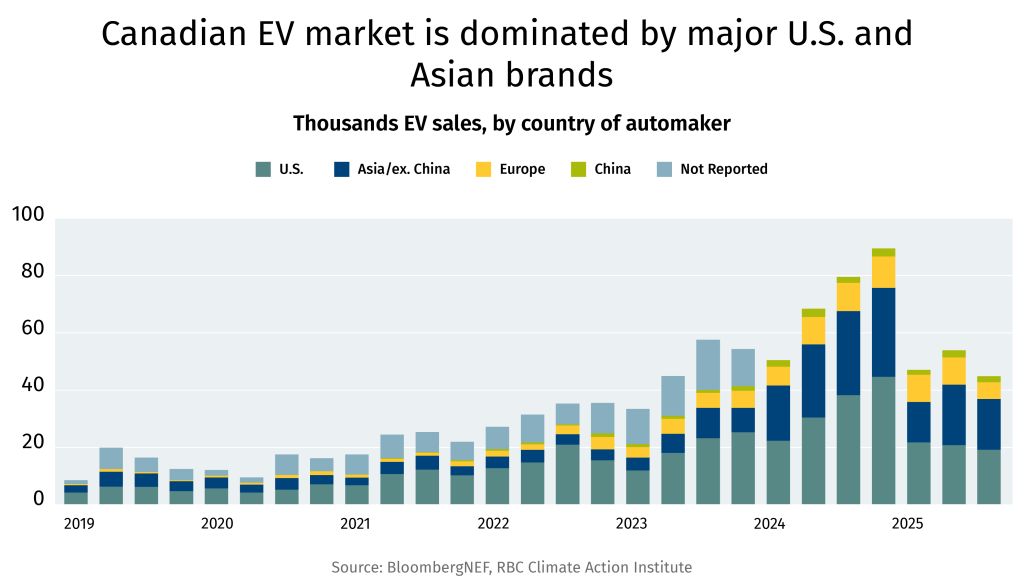
The Liberal government’s much-anticipated auto-sector strategy reinstates electric vehicle incentives, eliminates EV sales mandates, invests in expanding the EV charging network, and offers incentives and tax breaks for global auto makers to build in the country.

It’s all in response to U.S. tariffs, and the looming threat that President Donald Trump might tear up CUSMA in the coming months.

Of course, Prime Minister Mark Carney is hoping to preserve CUSMA and build on its North American supply chain advantages to a new set of investors. But even if Canada’s access to the U.S. market is no longer unfettered, Ottawa can point to several reasons why European and Asian countries may want to set up their auto shop in Canada:

  • Canadians buy a lot of pricey cars and SUVs: Canada is the world’s 9th-largest auto market, with ~1.9 million vehicles sold annually—skewed toward higher-value SUVs and trucks, with a robust servicing and after-market (courtesy of our harsh winters). OEMs also now compete for high-margin customers, not volume. Canadians buy a lot of cars, including a lot of expensive (read: high margin) cars.

  • Asian carmakers want a North American hub: With 7.2 million global sales in 2024, the combined Korean power of Hyundai-Kia edged out GM and Stellantis for the third spot in the global rankings. However, the companies’ manufacturing footprint and market share remains Asia-heavy, creating an incentive to rebalance toward North America. Canada could become a second North American production zone, hedging geopolitical, climate, and labour risks.

  • Canada is critical to global supply chains: Our store of critical minerals (nickel, cobalt, lithium, graphite), batteries, parts ecosystem, and reliable, clean power offer supply chain integrity at low cost. Just ask Volkswagen.

  • The Ontario-Quebec corridor is an auto-tech Silicon Valley: Canada’s strengths in AI, autonomy, and software—the frontier of future value creation for the auto industry—further enhances the offering.

  • Canada is a free-trade haven: It stands to reason that Canada will secure some form of market access to the U.S. that makes an auto trade possible. We shouldn’t forget the 14 other free trade agreements we’ve signed that cover 50+ countries, 1.5 billion consumers, and 60% of global GDP.

— Jordan Brennan

According to RBC Economist Claire Fan:

“Despite the deteriorating trade balance, Canadian exporters continue to show signs of partial diversification into non-U.S. markets. Goods exports to non-U.S. destinations were 29% above year-ago levels in November, while goods imports from non-U.S. markets rose 18%—both near or at all-time highs.”

U.S. looks to create a critical minerals trading bloc rivalling China

  • At a Washington summit, attended by representatives from more than 50 nations, the U.S. outlined a vision for a rare earths trade zone, using tariffs to create a price floor for minerals and drawing on the respective strengths of partner countries across the value chain, to counter Chinese dominance.

  • Several bilateral deals were struck, including U.S. “Action Plans” with Mexico, the EU and Japan, to develop coordinated trade policies.

  • Foreign Minister Anita Anand said more details were needed before agreeing to such a framework, which would play a role and potentially give Canada some leverage in upcoming CUSMA negotiations.  

Trump and Modi broker trade truce

  • Washington committed to cutting tariffs on Indian goods from 50% to 18%, in return for New Delhi stopping its purchases of Russian oil.

  • While details on the timing of the tariff changes and other trade barrier reductions remain vague, the amelioration of some of Trump’s most punitive tariffs gave a boost to U.S.-listed shares of Indian companies.

Red Sea reopening adds to shipping overcapacity pressures

  • As Houthi attacks on the critical shipping lane subside, and Suez Canal transit rises, container companies are bracing for pressures on their bottom line if freight rates lower and oversupply worsens.

  • Danish group AP Møller-Maersk, the world’s second largest container shipping company, announced its first operating loss in years and plans to cut jobs to insulate these impacts.

  • Naval escorts have become a necessity for container ships passing through the Red Sea, and tensions between Iran, the U.S. and Israel remain a threat to the stability of the passage.

Ottawa indicates foreign aid will be increasingly tied to trade objectives

  • Randeep Sarai, Secretary of State for International Development, said Canada’s development and humanitarian spending will focus more on opportunities that create “mutual prosperity.”

  • As it reduces the foreign aid budget, the government will look to use the distribution of these dollars as a tool with countries that Canada wants to increase trade with.

— Thomas Ashcroft

Also in this edition: Tariff lawsuits ramp up, Canada-India relations are re-energized, and two economic giants strike the “mother of all trade deals.”

On the same day the International Monetary Fund released a report showing that the removal of internal trade barriers in Canada could result in a 7% boost in real GDP, an important discussion took place at the Canadian Club of Toronto.

Two of Canada’s top CEOs—Tracy Robinson of CN Rail and Max Koeune of McCain Foods—joined Sean Strickland of Canada’s Building Trades Unions for a discussion with the Business Council of Canada’s Goldy Hyder, on the big changes that Canada needs to make to infrastructure development, business regulation and immigration.

Here are some bottlenecks we need to fix—quickly:

  • Canada is among the worst in the OECD in days lost to labour disruptions. That means our connective tissue to the world—ports, rail, sea lanes—are MIA when the rest of the world is expecting us to be on time.

  • The TMX oil pipeline expansion took longer to permit than to build. Just one of many agonizing stories about our glacial speed of permitting and other approvals.

  • Despite massive shortages in the skilled trades, our provinces are bringing in paltry numbers through immigration. Who else is going to build all those big projects?

  • It’s easier regulation-wise to export food to the U.S. than between provinces. When will we get to the one economy idea?

What needs to be done?

Robinson said we need to review our approach to labour negotiations to ensure the economy doesn’t get shut down as often as it does, especially in a world when other countries are happy to see that happen.

Strickland pushed for better labour force planning, to ensure we’re recruiting the right people and right numbers for the right needs in our economy. We’ve talked about that for years. It’s solvable.

Koeune called for immigration reforms that would give permanent residency applicants a clearer view of how long it will take, and where their application is at. He called the system a “black box,” which I’ve heard from plenty of other employers in recent months.

We can’t take on the world if we don’t take on our own challenges first.

Elbows up, fine. Heads up, better.

–John Stackhouse

Companies suing the U.S. government following Supreme Court hearing

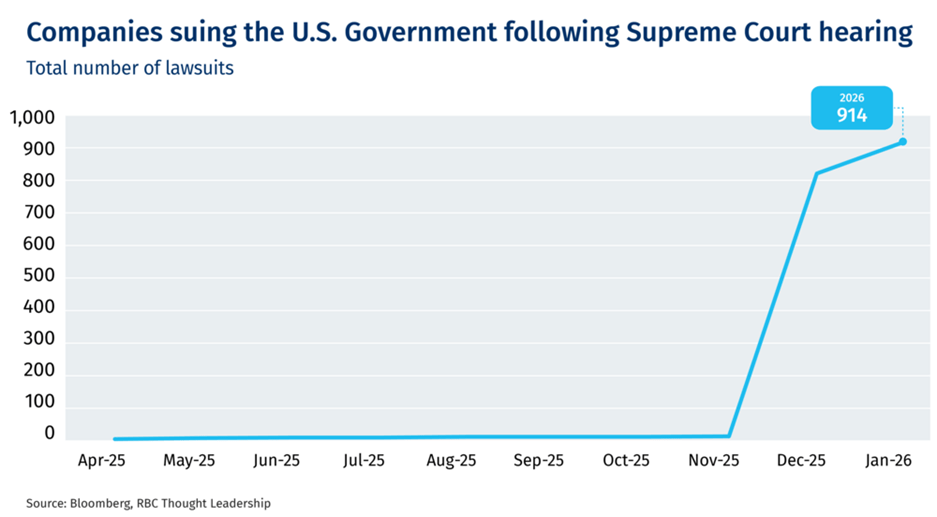
Since the Supreme Court’s November 5th hearing on the legality of U.S. tariffs, more than 1,000 companies, including Costco, Revlon and Ray-Ban, have sued the Donald Trump administration. The reason? If the highest court in the land strikes down the tariffs (verdict date unknown), the suitors hope to recoup some of the money they allege has been lost due to tariffs.

Record Canadian oil output finds new markets

  • Despite weak global prices, Canada’s oil industry is pumping record volumes and boosting exports to Asian markets, particularly China where sales more than quadrupled last year, as well as India and South Korea.  

  • Though most Canada’s oil exports still go to the U.S., the sector’s resilience, record output driven by expanded pipeline capacity, and growth in Asian markets, is boosting oil majors’ shares and strengthening the country’s economic diversification drive. Expect more calls for additional pipeline capacity, to sustain this trend.

Canada-India pursue apolitical, reliable energy trade

  • As diplomatic relations continue to improve, officials pledged that Canada would supply more crude oil, liquefied natural gas, and liquefied petroleum gas to India, and that more refined petroleum products will be sent the other way.

  • Energy minister Tim Hodgson noted that India represents the fastest-growing source of energy demand while assuring his counterparts “we will never use our energy for coercion.” The relaunch of a “ministerial energy dialogue” between Canada and India promises to facilitate greater reciprocal investment and collaboration in other areas including hydrogen, uranium, biofuels, batter storage, critical minerals, electricity, and AI.   

  • India’s High Commissioner to Canada said Prime Minister Carney will likely visit India in March, and that under his government no longer views Canada as the “younger brother” of the U.S.

India and EU agree “mother of all trade deals”

  • As Washington targets both with steep tariffs, two of the world’s biggest markets have agreed a trade deal that,  once in effect, will eliminate tariffs on more than 90% of goods, marking a new era in economic relations.

  • The two sides made no secret of the fact this breakthrough was catalyzed by U.S. trade policy, to soften the blow of tariffs and increase their economic autonomy. This will result in boosts to India’s export of manufactured goods and give the EU preferential access to a massive, growing market.

  • The EU is already one of India’s largest trading partners, and while India is only the EU’s ninth-trading partner, the EU predicts its exports there to double by 2032. Negotiations over an Investment Protection Agreement are ongoing.

–Thomas Ashcroft

Fresh from Davos, John Stackhouse shares field notes on how the world is reorganizing — and what that means for Canadians.

He is joined by Gerald Butts, Vice Chairman and Senior Advisor at Eurasia Group, to unpack the new RBC–Eurasia Canada risk report: the risks that matter most, how to separate signal from noise, and the practical playbook for where to invest, what to protect, and how to diversify.

Listen on Apple Podcasts, Spotify or Simplecast

Risk as Signal: A Canadian Playbook 

SPEAKERS

Gerald Butts, John Stackhouse

John Stackhouse 00:00:03

Hi, it’s John here. I’m just back from Davos, Switzerland and the World Economic Forum. If you’ve been tracking the WEF as it’s known for years, it often feels and seems like the status quo. Well, this year was anything but.

The World Economic Forum was all about disruption and, of course, the disruptor in chief, Donald Trump, was there along with a massive US delegation, more CEOs, more cabinet secretaries, I think, than anyone could remember. That was quite intentional. Davos 2026 was America’s turn to make a statement to the world about America First. Of course, Mark Carney was there too, making his own bold, perhaps even disruptive statements about how Canada and our allies need to pivot. If you’re a middle power anywhere, and that’s what Canada is, this new world certainly will be for the brave, and that may be just what Canada needs more of, some bravery in how we take on new technologies, new economic opportunities, and new geopolitical forces right around the world.

I came home with another signal well apart from all the noise you may have heard, and that is the world is paying more attention to Canada. Big investors from Asia, the Middle East, and certainly Europe are looking to move billions of dollars to Canada if and when they can find the economic opportunities. That will be in infrastructure, it will be in natural resource development, but it also will be in technology, particularly in AI, where Canada’s leadership is known right around the world. Here’s the other message that was certainly clear to me, we don’t have a lot of time. If there’s a window open, it’s not going to stay open much beyond this year. So whatever our ambitions are, we need to get down to execution right now. Davos was about much more than Donald Trump and Mark Carney. There were incredible conversations about renewable energy and robotics, as well as how AI is being applied in pretty much every sector across the economy.

You can find my full Davos report on our website, rbc.com/thoughtleadership. It’s called “Davos ’26: Making Sense of a New World Order.”

Now, Davos isn’t the be all and end all, and we’re probably all better for that. We actually need a year-round conversation about where our world is heading and where that will take Canada. To help with that, we’ve teamed up with the Eurasia Group to build a new platform to help Canadians understand where the world is going and where that may be taking Canada. You’ll be hearing lots more from us in the coming months about that, including a big Canada-US summit we’re putting on in June to help our two countries build what should be the most vibrant, dynamic, innovative, and prosperous economic relationship in the world. Canada needs that, but so does the US. Building or rebuilding that relationship doesn’t come without a lot of risks, and, of course, doing nothing is also a risk.

To help us understand some of the biggest risks that Canada is up against in 2026, I’m joined today by Gerald Butts. He’s the vice chair and senior advisor at Eurasia Group, and you also may recognize him from one or two Canadian conversations. Before joining Eurasia Group, Gerry was a senior advisor to Prime Minister Justin Trudeau. He’s also been a key advisor to Prime Minister Mark Carney and a host of other leaders, not just in Canada, but around the world. Regardless of your politics, there aren’t many Canadians I know who cares deeply about Canada as he does. This year, we worked together to publish a report on the 10 biggest risks that Canada faces in 2026.

Now, let’s get right at it with Gerald Butts of the Eurasia Group. Gerry, welcome to Disruptors.

Gerald Butts 00:04:02

It’s great to be here, John.

John Stackhouse 00:04:03

You’ve seen a fair bit of history, not trying to age you, but you’ve seen cycles, political cycles, economic cycles, geopolitical cycles. How are you thinking about where we’re at in January 2026?

Gerald Butts 00:04:17

It’s really important that Canadian business leaders and policymakers and regular Canadian citizens understand that we’re coming out of a long period of stable equilibrium led by the United States. The United States, for all of our lifetime, has been the world’s most important shock absorber of geopolitical risk, and now it’s become probably the world’s most significant generator of geopolitical risk. So when the United States changes its disposition toward the world, when it’s inevitably going to affect us in Canada comprehensively, we’re all being reminded every day that economic growth, prosperity, innovation, all of these things depend on geopolitical peace and stability.

John Stackhouse 00:05:03

So I think most of us are coming to grips now with the reality that our best friend, best customer, best partner on so many things is also one of our biggest challengers on so many things as well. As we look deeper into 2026, how should Canadians be thinking?

Gerald Butts 00:05:23

First of all, Canadians should recognize that we’ve been here before. We’ve had four, maybe five elections where the ballot box question has been the disposition of our relationship with the United States. We’ve been neighbors to the United States for a long time, and the United States has gone through some stuff in that period, and we have negotiated it well in the past. My favorite example that is almost eerily similar to what we’re enduring today is the US Tariff Act of 1890, which President McKinley expressly said he was designing to make Canada the 45th state. We’ve seen this movie before. It’s just been a long time, and we’re going to have to relearn all of the muscle memory that helped us negotiate it in the past.

John Stackhouse 00:06:11

John Stackhouse: That’s fascinating from a historical and a political theory point of view. I also want to think through what it means from a practical point of view. If I’m a tech company, for instance, a Canadian tech company, I’ve grown up with an assumption, and it’s been a pretty good assumption, that I’ve got the free flow of data, of people, talent, and of capital with US. That’s worked really well for tech centers from Waterloo to Burnaby in this country. If I’m a critical minerals operation or any mining operation, it’s been a pretty safe bet that I’ve got the free flow of rocks-

Gerald Butts 00:06:47

Of course.

John Stackhouse 00:06:48

… literally rocks across the border, both ways. Do we need to think about just recalibrating a little bit on the margins of that, or is it a sea change for those sectors and more?

Gerald Butts 00:07:01

It is a sea change, and it’s also a reversion to the mean that we have lived through this extraordinary period in economic history of the free flow with minimal friction of good services, people, data, capital, et cetera. We’re now firmly back in a world where there are impediments to all of those things. If you’re a firm whose business model depends on the trade in those commodities, you have to get very skilled in separating the sheep from the goats. You have to know what are real obstacles, what are being described as obstacles, but are really the political issue that will come and go with the mood of the president of the United States or the state of the point we find ourselves in the electoral cycle. Some things really matter, some things seem like they matter, and some things don’t matter at all.

John Stackhouse 00:08:00

When you think about the Canada-US relationship, what matters most of all?

Gerald Butts 00:08:04

The continuation of the Framework Agreement is what matters most. Maybe the best thing we can hope for coming out of this year is an annual continuation of the USMCA. We really don’t want to see it fall apart because it’s a trillion dollar trade, and a lot of people’s jobs depend on it on both sides of the border. So the challenge we have in the short to midterm 2026 to the end of the decade is to figure out how to walk and chew gum at the same time when it comes to economic development.

John Stackhouse 00:08:36

You at Eurasia Group have called it zombie CUSMA as the like of what we have now, but what is zombie CUSMA?

Gerald Butts 00:08:43

It’s a shorthand term for an agreement that exists on paper, but is impossible to enforce. Even if we do end up with a theoretical dispute resolution mechanism, there are all kinds of ways the Trump administration can avoid court, so to speak, but of course the agreement is there to facilitate trade. It’s not there to solve the problems that are associated with trade. The important thing is that the agreements stay in place so that there isn’t a massive disruption in trade.

John Stackhouse 00:09:15

Yeah, and Canada has an advantage there. We may not feel like one, but we still have the best arrangement compared to all of our other competitors, great access to the US, notable sectors that would not agree with that and are enduring significant economic consequences of the 232 tariffs and other measures. But how do we play this strategically knowing that we’re not the sole target of this, and others are enduring greater frictions or even barriers?

Gerald Butts 00:09:48

Even when you include the 232 tariffs, if you take an all-in comprehensive approach, we still have the lowest tariff rates of any economy to export to the United States. Part of that is due, of course, to the fact that we’re the biggest export market for the United States. This is an important fact to remind decision makers in Washington, to remind Congresspeople as they are campaigning for reelection, that, for many of them… and many of them are feeling the pain from the cratering of Canadian tourism and the decision Canadian consumers are making not to buy American alcohol. As Canadians, we have more power than we think. Obviously, the United States is a much more powerful country than we are by any objective measure, but we shouldn’t sell ourselves short either.

John Stackhouse 00:10:39

It’s also always interesting and important to follow the money. When I watch the money flows, it’s fascinating that a lot of Canadian capital is still going into the US, in fact, more.

Gerald Butts 00:10:51

Big time.

John Stackhouse 00:10:51

I haven’t seen the last quarter of evidence, but it’s significant. This is a critical strategic question for Canada. We need more capital, more growth capital for our tech companies, for our mining companies, and for all the big things we’ve talked about on this podcast, but how do we get more Canadian capital as well as global capital to work this year in our country?

Gerald Butts 00:11:15

Ultimately, it comes down to whether or not we have investible assets. Basically, our entire career, John, people like you and me, business leaders, decision makers, and government politics, we’ve all grown up with this common macro policy that deeper and broader integration with the United States economy was our ticket to prosperity, and we need to build an economic strategy that absorbs that really important change in our relationship with our most important trading partners. We have a whole generation of economic actors in the country who are not accustomed to building our own assets without the participation, if not outright control, equity control, of the United States. We’ve got a lot of work to do to figure out how to build our own investible assets and attract capital to them. I think we’ve got to be probably a lot less judgy about the sources of our capital. We’ve got to think much more clearly and probably more hardheadedly about why and why not we would allow foreign capital to invest in the country.

John Stackhouse 00:12:24

There was a great book going way back into the 1980s with the title Money Has No Country-

Gerald Butts 00:12:30

Still true.

John Stackhouse 00:12:31

… and I think we’re coming to grips with that.

Gerald Butts 00:12:34

Yeah.

John Stackhouse 00:12:34

A lot of capital sources are looking to Canada because of all the great opportunities that we have, but the world, and you hear this over and over again, also has some raised eyebrows when it comes to Canada. We don’t deliver, especially projects, certainly with the speed that much of the world is used to. In our risk report that we did together, one of the risks is cheekily titled The Charter Strikes Back, which gets into this point that Canada is here by design as a confederation, and there is power sharing between the federal government and the provinces. Many of the provinces signed on after 1867 with a full expectation and even demand that there would be this power sharing. The same sentiment is held by many, if not all, Indigenous communities that some feel they haven’t signed on yet. That’s the beauty and frustration of our family called Canada. This is a real tension for the country, and it’s going to perhaps inhibit or slow down some of the things we want to do.

Gerry, how are we going to balance this need for speed, need for delivery, need for execution with the need to respect the design of our country?

Gerald Butts 00:13:54

I think it’s the old-fashioned fine art of persuasion. We’ve got a prime minister, full disclosure, as you know, I worked hard to elect him prime minister, who is, I think without question, the finest economic mind we’ve had in that chair ever. I really hope the premiers around that table seek common cause with the prime minister, and I think the early returns are good. There is no magic bullet to solve the complexity of our constitutional issues. It’s not a question of political will. This is in our constitution. So if you want to guarantee that we get nothing done, then we would ignore the views of the constitutionally enshrined rights holders of the country, and that includes the provinces and Indigenous people.

John Stackhouse 00:14:46

What is your sense of how China right now is viewing Canada? If you could put yourself in Xi Jinping’s shoes, how is he and the power structure there viewing Canada at this moment?

Gerald Butts 00:14:59

I think from a geostrategic point of view, they would love to use the United States’ treatment of Canada as an opportunity to wedge Canada against the United States. I think that that is at the macro level unlikely to happen, but it is more likely to happen than it would otherwise be, and it will probably happen around the edges of our relationship. If I’m Xi Jinping, I’m much more confident about my ability to throw my weight around. Because if you think of geopolitics as a complex version of price discovery, what he has figured out in 2025 is that he has a card that Donald Trump can’t abide being played. So he’s happy with the way the world is developing, and he’s especially happy with the way Russia’s ill-advised invasion of Ukraine has created a resource cubby for his country. The world has unfolded pretty well if you’re Xi Jinping, and he would see Canada as a nice-to-have, but not a necessary partner.

John Stackhouse 00:16:06

A lot of thinking right now seems to be binary.

Gerald Butts 00:16:09

Yeah.

John Stackhouse 00:16:09

Do we attach ourselves more to the US or more to China? Of course, the world is much richer and more complex and diverse than that. Auto sector is a great example of it has thrived for half a century by being integrated with the United States, and maybe that continues. How do we think about these third options, not just for the auto sector, but economically when we’re literally joined at the hip by geography with the United States and have a very attractive customer with a lot of potential for growth in China?

Gerald Butts 00:16:42

It’s really important to take a step back and look at what’s happened to the global economy since the last time we, in earnest, had a discussion about developing a, quote, unquote, “Third Way.” When the Pierre Trudeau government in the 1970s was trying to develop a trade diversification strategy, the United States was just a much larger share of global GDP. The challenge that the Canadian business community has is that it’s always been easier to get on a plane and go to New York or Los Angeles or Boston than it is to hoof it to Tokyo or Singapore, and we’re going to have to learn how to do both because it is undeniably true that we have too many eggs in one basket, and we ought not to because we have so many assets in our country. It’s been a rough time in Canada for sure, but there’s still no country in the world that wouldn’t trade places with us tomorrow. We’ve got a lot going for us in Canada. We just need to figure out how to organize ourselves to deliver prosperity for our people.

John Stackhouse 00:17:47

That’s a great way to set up maybe my last question here. As you think ahead well beyond 2026… You’ve got young kids who are going into adulthood, I’m in the same situation, we have kitchen table conversations about like, “What is our country going to be like 25 years from now?” I wonder what you tell your kids in how you think about Canada in the 2040s and ’50s well beyond 2026. We’ll get through 2026, but what kind of country are we shaping up to be for the next generation?

Gerald Butts 00:18:24

I often reflect on the fact that my real source of success in life was being born in 1971 in Canada, that the dice were loaded in my favor by the circumstances of my birth, having parents who loved me and having a community where my public schools were excellent and all I had to do was study hard and do well and the world was my oyster. I understand why younger Canadians are very pessimistic about the future. I think if you put yourself in their shoes, the millennials, for instance, the first real geopolitical event they remember is 9/ 11. It was followed quickly by the ill-advised invasion of Iraq. Coming on the heels of that was the great financial crisis. Then Donald Trump got elected, and they had to endure COVID. If that’s the first 30 years of your life, that’s a much tougher start than winning the Cold War, watching the wall come down, and narrowly but successfully fighting a referendum campaign. That was kind of our version of what millennials have gone through.

What Jodi and I have tried to do with our kids is just to give them a broader sense of the spectrum of possibilities that, in the grand scheme of things, they were still extraordinarily lucky to be born in Canada in 2006 and 2007, they’re both studying at public universities that will give them excellent educations mercifully, and I consider this my greatest achievement in life along with my wife, that both my kids are studying science and not social science. The world is going to be probably a more difficult place to be in than the one we lived through in the late ’80s and ’90s, but it’s still a big, beautiful place, and they live in the best country in the world, and it’s really their responsibility to make it even better. That’s probably less true than it was when I was born, but it’s still true, and it’s precious, and it’s worth holding onto and fighting for.

John Stackhouse 00:20:43

What a great note to end on that Canada is such a great country for regular people, not only those who are born here, but those who continue to line up to come here from pretty much every-

Gerald Butts 00:20:53

Absolutely.

John Stackhouse 00:20:53

 … corner of the world. It’s also a great place to be an extraordinary person. We have to continue to make it an even better place for all people, including the builders, the innovators, the darers.

Gerald Butts 00:21:04

Those are not mutually exclusive things.

John Stackhouse 00:21:06

Absolutely, it’s not mutually exclusive. Finding that balance, that equilibrium has always been actually one of Canada’s quiet strengths. We’re just being put to a fresher and maybe harder test, but I think we both agree we’re up to it as a country.

Gerald Butts 00:21:22

Yeah.

John Stackhouse 00:21:22

Gerry, thank you so much for this conversation.

Gerald Butts 00:21:26

Real pleasure, John.

John Stackhouse 00:21:29

If you take one thing from that conversation, to me, it’s that risks aren’t new to Canada. In fact, this country was built by risk takers who dared to do things that people all over the world might’ve thought crazy or even impossible. That’s the Canadian way. We just tend to be a bit quieter about it. That’s probably part of our risk management. But we should also recognize that the risks facing the country today are as great as perhaps many of us have ever seen, but with risk comes opportunity. Canada is blessed with a better mix of geography and natural resources, as well as people and talent, and an ability to build communities that not only live together, but work together and build together.

In the year ahead, we’re going to have to figure out how to hold on to those strengths while also being bolder and more daring than perhaps we’ve ever been. I don’t know if it’s an overstatement to say that the country is at risk, but we should all get at it every day with that possible threat in mind. That doesn’t mean being defensive, quite the contrary. It means embracing a bigger, more ambitious world, and a whole new age of technologies, as well as the incredible relationship that we have with the United States to create even more opportunities for the country. That’s how disruptors succeed. When they see risk, what they really see is opportunity.

We’ve linked the full RBC Eurasia Group risk report in the show notes, along with my Davos report. If you’re looking for more ideas and insights, check out our website, rbc. com/ thoughtleadership. Our team delivers critical insights to help businesses, policymakers, and communities make informed decisions in a rapidly changing world.

You’ve been listening to Disruptors, an RBC podcast. Please rate, review, and follow us on Apple or Spotify. It helps more people find the conversations like the one you heard today.

I’m John Stackhouse. Thanks for listening. Talk to you soon.
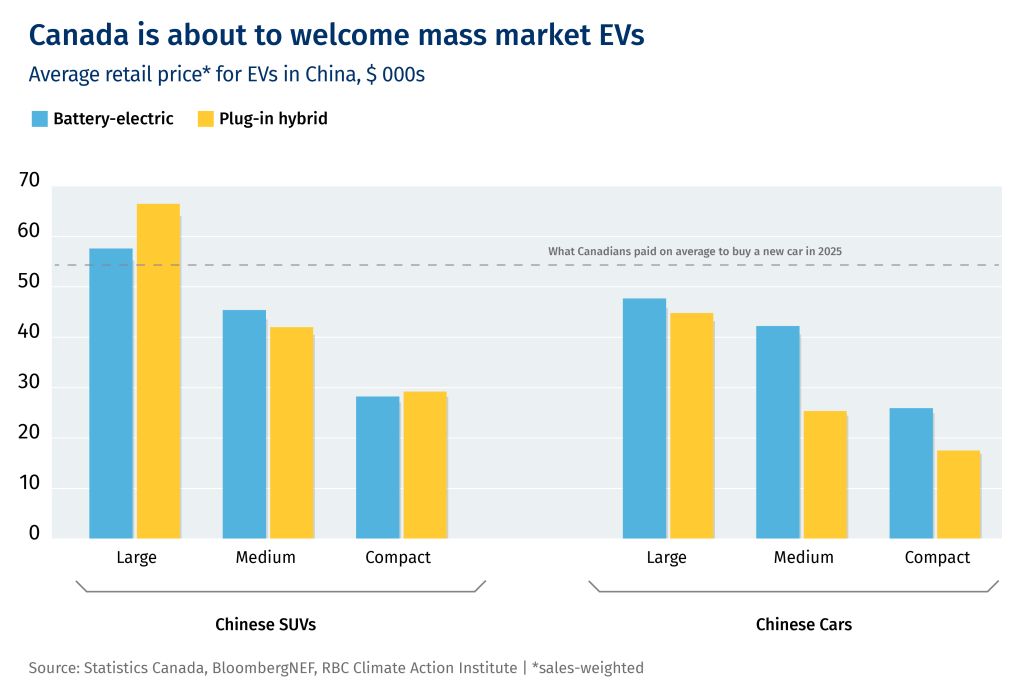
To judge by Davos’s main promenade, globalization is alive and well. Yes, the U.S. took over a church and shop to celebrate America First. But there were far more storefronts promoting Brazil, Indonesia, the Philippines and Nigeria. India wrapped an entire hotel on the promenade, where thousands schlepped every morning from their crash pads to the Congress Centre, and back at night from dinners and nightcaps.

Is this a false spring, just like the mild week in Davos? Or the beginning of what Christine Lagarde called “Plan B” and a more diversified global economy?

The European Central Bank president told the closing session of the World Economic Forum that she “is not on the same page” as Mark Carney’s view of a global rupture—but does see an important diversification of trade underway.

According to the WEF’s own research, close to half of global growth over the next five years (2025-30) will come from Asia, with China accounting for 23% and India another 15%, while the U.S. will produce 11%. Combined, the G7 will account for only 18.5% of growth. 

If it feels like a new age of diversification, one should never forget the gravitational pull of the two economic superpowers, which over the past decade (and longer) have consumed much of the world’s capital and trade. Case in point: China now accounts for about 40% of published studies on drug research, while Europe’s share has dropped from 20% to 12%. Guess where most of the world’s drugs will come from in the 2030s.

With so much in flux, who will dominate the world’s future trade zones? I came away from Davos thinking three forces will help shape the answer:

1. Balance-sheet strength. We may be on the verge of some heavy government (and perhaps private sector) borrowing to underwrite all that’s needed for diversification—from new supply chains to infrastructure. Points to the U.S. for owning the world’s reserve currency, but a range of middle powers—Germany and Canada, among them—can borrow plenty on their own.

2. Artificial Intelligence. It’s sucking up much of the world’s private capital, and will determine a lot of trade outcomes as it (along with robotics) transforms production. Yes, the U.S. and China dominate, but if AI becomes available to all, like the Internet, advantage will go to those with energy to power all those learning algorithms and the entrepreneurial brains to put the results to work. The eight biggest U.S. tech companies have $18 trillion of equity value to leverage—and a lot more domestic energy than China or Europe.

3. Demographics. It’s the sleeper trend, as the West (and Far East) tumble over demographic cliffs. Even in an age of AI, trade still relies on humans to help make and ship things and humans to buy those things. Africa’s population is on course to hit 2.5 billion by 2050, when it will be home to 25% of the world’s working age population. 

Some shrewd advice I heard was for companies to think country, supplier and currency—and have an option for each. Call it a matrix of Plan Bs. Or what Carney termed “variable geometry.” 

It’s the new math.

John Stackhouse

Bank of Canada Q4 survey shows Canadian businesses continue to be negatively impacted by trade tensions, but some are increasing non-U.S. exports

  • 33% of Canadian firms reported they are strongly impacted by U.S. trade policies. A small but increasing share of businesses reported higher sales to non-US markets. Despite weaker sales to U.S. customers, most exporters to the U.S. have not diversified into other markets citing barriers like investment in specialized equipment, compliance with regulatory requirements, and transportation costs.

  • This signals, albeit modestly, that Canadian firms are willing to expand in other markets. However, immediate economic pressures are significantly constraining hiring, investment, and diversification efforts.

Canada agrees to new partnership with Qatar to cooperate on trade, investment, and defence

  • Canada and Qatar agreed to conclude FIPA negotiations, signed an MoU to establish a Joint Economic Committee (JEC), expand air services, and increase defence collaboration (including more exports from Canada’s defence sector).

  • This is the latest in a series of wins, following last week’s agreement with China, for the Canadian government’s diversification efforts. The value of merchandise trade between Canada and Qatar in 2024 was $325 million, leaving lots of room for growth.

European lawmakers delay Mercosur trade pact over legal concerns

  • EU ratification of this agreement, decades in the making, with South American economies has been postponed by lawmakers seeking an opinion from the European Court of Justice.

  • This is the latest hurdle in a protracted process, following pressure from European farmers, which could delay the trade pact by a further two years. However, German Chancellor Friedrich Merz called on the European Commission to provisionally apply the deal, which would create one of the world’s largest free-trade zones, covering over 700 million people, and ~20% of global GDP, in recognition of the current “geopolitical situation.”

 First Chinese order of Canadian canola in months comes following trade mission

  • Prime Minister Mark Carney’s visit to Beijing has led to a Chinese importer buying 60,000 metric tons of Canadian canola, the first cargo order of its kind since China halted imports in October. This comes as China is expected to lower tariffs on Canadian canola to 15%. Canadian agriculture minister Heath MacDonald encouraged Chinese investment in Canada’s agri-food sector this week, highlighting the potential for collaboration in domestic value-added processing and research.

  • Saskatchewan, Canada’s biggest canola-producing province and the province with the highest year-over-year growth in wholesale trade, is especially well positioned to capitalize. Premier Scott Moe (who was on the trip to China) has emphasized the benefits for his province and Canada’s agricultural industry more broadly.   

Thomas Ashcroft

EV sales by country

Canada plans to allow 49,000 made-in-China EVs at much lower tariffs in return for easing levies on Canadian agricultural products. Here is what you need to know about the deal and its implications:

  • About half of the vehicles imported from China are expected to cost less than $35,000 by 2030. Average EV purchase price in Canada in 2024-25 was around $67,000.

  • Canadian EV sales were projected to remain largely flat in 2026 following a 30% decline last year. To size up Chinese imports, 49,000 would represent a quarter of Canada’s annual EV market. Ontario Premier Doug Ford is worried it could impact sales—and jobs—from existing manufacturers.

  • Europe’s strategy could serve as an alternative roadmap for Canada on autos: The continent worked with Chinese carmakers to level the playing field, and set targeted tariffs aimed at offsetting the impact of subsidies. Even with that, however, Chinese brands have captured 10-15% of the EV segment in Europe.

  • The Canada-China thaw comes ahead of critical CUSMA renegotiations that could disrupt the 80% of Canadian exports that enter the U.S. market tariff-free. Could it further complicate U.S.-Canada negotiations?

Farhad Panahov

The world is undergoing a series of once-in-a-generation shocks and adjustments. Canada needs to adjust, too. Rapidly. 

Some of the economic structures and patterns that brought Canada into this century may not live out this decade. Political and security alliances, so necessary to peace and order, are in the midst of a realignment. And advanced technologies are disrupting the very nature of work, commerce and human interaction — so much so, and so quickly, that even last year’s assessments seem distant. 

The compression of time and risks means no company or government, public enterprise or community organization, can afford to wait and watch.

Eurasia Group and RBC Thought Leadership created this report, the first of its kind, to help Canadians navigate those profound risks and sea changes in 2026. The following is a combination of five assessments from Eurasia Group’s Top Risks 2026 outlook — the global ones most likely to impact Canada — and five assessments from RBC Thought Leadership, exploring the most significant domestic forces that may shape the year ahead. These are not predictions or forecasts: rather, they are carefully considered and researched analyses of the trends, forces and interests shaping our economy and policy environment, informed by economic data, market insights and interactions with leading businesses, investors and policymakers. They’re designed as lighthouses, rather than navigation systems. 

This report is also a foundation for a new global relationship between Eurasia Group and RBC, to help firms and governments assess and manage their own risks in these unprecedented and volatile times. In the year ahead, we will publish more on these issues and convene leading thinkers in the economy and government to advance our collective understanding of the risks around us. In June, we will host the annual Canada-U.S. Eurasia Group summit in Toronto, to help shed more light on the risks, and opportunities, as these two countries and neighbours — both extraordinary in their own right — advance, and as needed redirect, their economic relationship in this rapidly changing world. 

The challenges ahead can seem daunting, even overwhelming. But as we’ve seen through history, including recent history, moments of uncertainty — that amorphous cousin of risk — are when those with clear heads and confident minds excel. 

RBC Thought Leadership

Canada is looking to build its military, develop an industrial base and forge new commercial partnerships at a wartime pace. A failure to execute could lead to others, notably the U.S., stepping in.

Canada’s enthusiasm for rapid militarization began the moment Donald Trump demanded more from America’s NATO allies and deepened as he mused about taking over parts of the Western Hemisphere, from Panama to Greenland, even putting the idea of Canada as the 51st state on the table. For Canadians, the exercise was initially a budgetary one, finding ways to allocate tens of billions to its small and often overlooked military. But when Trump sent the U.S. military into Venezuela, the warning for Canada and its armed forces took on a sharper focus. Borders are no longer gates. They’re hard lines that need to be defended.

For Canada, the task of building a big military—the biggest since the Second World War—is daunting. In war, extraordinary measures like state-run supply chains can be implemented quickly. In peacetime, each step needs more negotiation—that’s made even harder with a public that barely remembers the losses of the Afghan mission and a military bureaucracy that has struggled with much smaller magnitudes of procurement and deployment. The industrial base is a further challenge. Mention the words “military-industrial complex” and most Canadians will say “no, thanks.” Before Trump returned to power, Canada ranked 27th out of 31 NATO nations when it came to military spending as a share of GDP. In fact, defence spending had languished for the past 25 years at levels well below the late 20th century averages. Military enrolment has also been in terminal decline, with less than two service members for every 1,000 people. Even peacekeeping has declined to a few dozen blue helmets.

Read the full risk here.

Eurasia Group

U.S. Political Revolution

The United States is experiencing a political revolution: President Donald Trump’s attempt to systematically dismantle the checks on his power, capture the machinery of government, and weaponize it against his enemies. Last year, we warned about the “Rule of Don”; what began as tactical norm-breaking has become a system-level transformation beyond partisan hardball or executive overreach—qualitatively different from what even the most ambitious American presidents have attempted (please see Box 1: Trump vs. FDR). With many of the guardrails that held in Trump’s first term now buckling, we can no longer say with confidence what kind of political system the United States will be when this revolution is over.

In Trump’s view, he overcame a rigged election, two partisan impeachments, dozens of unjust felony convictions, and two assassination attempts—one a whisker’s breadth from killing him—to stage the greatest political comeback in American history. President Trump sees the principal threat to him and his allies as domestic, not external, and he believes he has a mandate for retribution. The administration views this project not as an assault on democracy but as its restoration, a necessary purge of a political system captured by a deeply corrupt establishment that had already weaponized government against them. Over 77 million Americans voted for Trump in 2024, and many of them sympathize with that diagnosis: Among 2024 voters who said democracy mattered to their decision, a majority chose Trump—not because they saw him as a champion of democratic values, but because they believed the system was already broken and wanted someone who would disrupt it. “Trumpism” is structural, and at this most fundamental level, Trump’s supporters are getting what they asked for.

To read the full risk, download the report.

RBC Thought Leadership

Canada is aiming to double non-U.S. exports through two of its biggest trade antagonists, China and India, even as Canadian investment continues to pour into the United States.

Since Mark Carney launched his “elbows up” campaign to get the country to trade more with the rest of the world, and with each other, Canadians have spent and invested more in the United States, even as Americans are doing less in Canada. The strong U.S. economy, and tax breaks under the Big Beautiful Bill, have reinforced the attractiveness of the world’s largest market for Canadian investors. From pension funds to mutual funds, more Canadian dollars than ever have headed south. Business investment has done the same. Carney may need to do even more on taxes and regulations to keep Canadian investments at home.

For all the bark, and bite, of tariffs, Canadian consumers have been slow to change habits, too. Highly visible brands like Tennessee whiskey were perhaps an easy early target. Florida and Arizona vacations have taken a hit, too. But in large measure, Canadians are still watching Netflix, buying Fords and drinking Coke at the same rate as before the trade war.

Read the full risk here.

Eurasia Group

Europe Under Siege

The hollowing out of Europe’s political center has been a decade in the making. France, Germany, and the United Kingdom each enter the year with weak, unpopular governments under siege from the populist right, the populist left, and an American administration and state-aligned social media openly rooting for their collapse. None face scheduled general elections. Yet all three risk paralysis at best and destabilization at worst—and at least one leader could fall. The consequences won’t stay contained: Europe’s ability to address its economic malaise, fill the security vacuum left by America’s retreat, and keep Ukraine in the fight will suffer.

To read the full risk, download the report.

RBC Thought Leadership

A shift in global oil and gas prospects, from Venezuela to Qatar, changes the investment outlook for Albertan exports—and the big infrastructure projects designed to get them to overseas markets.

Canada’s ambitions to be an energy superpower—including oil and gas—is being tested after the U.S. intervention in Venezuela. But the challenges lie well beyond Canada’s immediate neighbourhood. Long-term demand for oil and gas remains an open question, especially as Asia continues to turn to electrons to power growth. A global surplus of supply, including American LNG, clouds the picture further. And then there’s the question of global growth. No growth, no need for more energy, from Canada or anywhere else.

In one strategic swoop in Caracas, U.S. President Donald Trump has attempted to ringfence the Americas with Washington as its most consequential capital. In that respect, Trump may have weakened Canada’s most valuable negotiating card—energy exports. A resurgent Venezuela crude production could displace Canadian oil in the U.S. and leave it scrambling for market share with Saudis and others elsewhere. It’s a potential competitive shock. Over the past 25 years, Canada had solidified its position as the foremost supplier of oil and gas to the world’s biggest oil market, accounting for nearly three out of every five imported barrels entering the U.S. An industry built to serve America now pumps out a record five million barrels per day, compared to just over two million bpd in 2000, with more than 90% of its exports ending up in refineries in the U.S. Midwest, West Coast and the Gulf Coast.

Read the full risk here.

Eurasia Group

China’s Deflation Trap

China’s deflationary spiral will deepen in 2026, and Beijing won’t do anything to stop it. With the 21st Party Congress looming in 2027, Xi Jinping will prioritize political control and technological supremacy over the consumption stimulus and structural reforms that could break the cycle. Beijing has the means to prevent a crisis, but living standards will deteriorate, the fallout will spread abroad, and the world’s second-largest economy will remain stuck in a trap of its own making.

Home prices in China have been falling for four and a half years—a household wealth destruction on par with America’s 2008 crash, except it’s still accelerating. Consumer confidence, investment, and domestic demand have cratered with it. Beijing bet big that high-tech manufacturing would fill the gap left by property. Instead, state-driven investment has created overcapacity, and weak domestic demand means there aren’t enough buyers to absorb it.

The result is “involution”: too many Chinese firms chasing too little demand, slashing prices to survive. Margins collapse, forcing even well-run firms to cut wages and jobs to stay afloat. Workers spend less. Demand weakens further, so firms cut prices again. Meanwhile, debts grow harder to service with each turn of the cycle. Banks and local governments keep zombie firms alive—rolling over loans, protecting local champions—which keeps overcapacity entrenched. The debt-deflation spiral feeds on itself. Donald Trump’s tariffs last year made the situation worse, closing off a critical export market and confronting Chinese firms with a grim choice: slash prices to find buyers outside the United States, or transship goods through third countries to reach America anyway. Either path squeezes margins further. Over a quarter of listed Chinese companies are now unprofitable, the highest share in 25 years. 

To read the full risk, download the report.

RBC Thought Leadership

An over-correction to the recent surge in irregular immigration is squeezing employers, hammering colleges and universities, and threatening to delay a new wave of resource projects and infrastructure builds—at the same time as Canada is nearing a demographic cliff.

Canadian public and political sentiment toward immigration is increasingly negative. But the sentiment is running contrary to the country’s needs: Canada’s aging population is facing declining fertility rates, leaving immigration central to the expansion of the skilled workforce. Cutting back on immigration drastically could lead to a rapid dip in population, hurting efforts to maintain living standards, drive economic and business activity and meet near-term economic ambitions.

The Mark Carney government’s plan to clamp down on immigration comes after years of expansionary policy. Temporary residents increased beyond capacity during Justin Trudeau’s decade-long tenure that began in 2015. Housing infrastructure and community services were overloaded, and productivity declined as temporary low-wage workers removed the incentive from some businesses to invest in technology, training or equipment. Targets for new temporary residents, including students, are down by over 550,000 in 2026 compared to 2024. And permanent resident targets are down by over 100,000 from 2024 admissions. Even with these reductions, Canadians feel immigration levels are too high.   

Read the full risk here.

Eurasia Group

AI Eats Its Users

Under pressure to generate revenue and unconstrained by guardrails, a number of leading AI companies will adopt business models in 2026 that threaten social and political stability—following social media’s destructive playbook, only faster and at greater scale.

We remain bullish on AI’s revolutionary potential. Today’s frontier models reason through complex problems, show their work, and are embedded in coding, research, and knowledge workflows. The hyperscalers are offloading large chunks of software development to AI, accelerating their own R&D cycles. In biotech and materials science, AI is opening new research pathways—though commercial breakthroughs remain mostly ahead of us. Hundreds of millions of people now use chatbots daily for everything from drafting emails to debugging code and learning new skills. This is real, and it’s just the beginning.

But AI can’t live up to investors’ expectations in the short term. Even after hundreds of billions of dollars of investment, the most advanced models still hallucinate. Their capabilities are jagged: dazzling at some tasks, unreliable at others (and often unpredictably so). That inconsistency makes them hard to deploy in high-stakes applications where errors are costly. Business adoption has been uneven, with only about 10% of U.S. firms using AI to produce goods and services, according to the Census Bureau. Many companies report significant productivity gains, but surveys suggest most have yet to see meaningful bottom-line impact. Real productivity increases will arrive through wide diffusion of the technology across the economy, but that takes time. Yet markets have priced in revolution, not evolution.

To read the full risk, download the report.

RBC Thought Leadership

Canada’s economic prospects are threatened not just by external shocks and demanding neighbours; they’re up against a deepening asymmetry of federalism that makes a unified economic strategy harder to design, sell, and implement.

Different views among Ottawa, the provinces, and Indigenous governments over how to use natural resources, fund and deliver education, and stabilize a strained health-care system are pulling Canada further toward a patchwork of policy regimes just as it confronts tough trade talks with a more transactional United States and intensifying global competition. Constitutional tools that were once seen as last resorts—the notwithstanding clause, aggressive jurisdictional challenges, demands for exemptions from national regulations and standards, even provincial votes on autonomy—are becoming more commonplace, raising the odds that provinces and Indigenous groups will weaponize hard and soft vetoes on national priorities. One Canada, maybe, but many nations within.

The consequences for national unity are more serious than at any point since the 1990s because fragmentation now comes with cheerleaders and sponsors abroad. A divided global order gives foreign governments, activist networks, and corporate actors more opportunities to exploit jurisdictional tensions, whether by privileging particular provinces in supply-chain decisions, funding litigation and media campaigns around resource projects, or amplifying separatist narratives. For geopolitical rivals, anything that weakens Canada’s coherence as a U.S. ally and G7 partner could even become a feature, not a bug, as sub-national players and Indigenous rights-holders seek to express their voices more assertively over energy, climate, industrial policy, internal trade and, most critically, bilateral trade with the U.S.

Read the full risk here.

Eurasia Group

Zombie USMCA

North American trade will be stuck in limbo in 2026. The United States-Mexico-Canada Agreement (USMCA) won’t be extended, updated, or killed. It will stagger on as a zombie, keeping businesses and governments guessing while President Donald Trump continues negotiations with America’s two largest trading partners.

The agreement is up for its mandated review this year, when the parties can extend it for an additional 16 years. But Trump wants to avoid the constraints of a new trilateral deal so he can keep using bilateral leverage to squeeze economic and political concessions from both countries. Canada already scrapped its digital services tax. Mexico is imposing tariffs on China. Both are cracking down on fentanyl flows. Washington gave up nothing in return. Why lock into an agreement when the current approach keeps delivering for the U.S. president? Neither Canada nor Mexico can afford to walk away. The United States is the destination for roughly 75% of Canadian exports and 80% of Mexican exports. Trump holds most of the cards and he knows it.  

The result will be a “zombie USMCA” that is neither fully dead nor alive—and a North American trade zone buffeted by chronic uncertainty. 

To read the full risk, download the report.

Download the Report

This is a part of RBC Thought Leadership and Eurasia Group’s joint report

Canada is looking to build its military, develop an industrial base and forge new commercial partnerships at a wartime pace. A failure to execute could lead to others, notably the U.S., stepping in.

Canada’s enthusiasm for rapid militarization began the moment Donald Trump demanded more from America’s NATO allies and deepened as he mused about taking over parts of the Western Hemisphere, from Panama to Greenland, even putting the idea of Canada as the 51st state on the table. For Canadians, the exercise was initially a budgetary one, finding ways to allocate tens of billions to its small and often overlooked military. But when Trump sent the U.S. military into Venezuela, the warning for Canada and its armed forces took on a sharper focus. Borders are no longer gates. They’re hard lines that need to be defended.

For Canada, the task of building a big military—the biggest since the Second World War—is daunting. In war, extraordinary measures like state-run supply chains can be implemented quickly. In peacetime, each step needs more negotiation—that’s made even harder with a public that barely remembers the losses of the Afghan mission and a military bureaucracy that has struggled with much smaller magnitudes of procurement and deployment. The industrial base is a further challenge. Mention the words “military-industrial complex” and most Canadians will say “no, thanks.” Before Trump returned to power, Canada ranked 27th out of 31 NATO nations when it came to military spending as a share of GDP. In fact, defence spending had languished for the past 25 years at levels well below the late 20th century averages. Military enrolment has also been in terminal decline, with less than two service members for every 1,000 people. Even peacekeeping has declined to a few dozen blue helmets.

The Mark Carney government has taken the challenge head on. Its first budget injected $81.1 billion over five years. Now, Ottawa is trying to reduce the heavy concentration it spends in the United States, taking gunboat diplomacy in a very different direction: its ministers have travelled the world in search of equipment like submarines, and much more, from any ally other than the U.S. Relations with Japan and Germany have been transformed by the idea of peacetime rearmament. Same with South Korea and Sweden.

But now comes the hard part: making choices. Ottawa will inevitably irk an ally, and may very well irk its own military brass, by choosing boats, planes and weapons that aren’t as effective, on the battlefield or the balance sheet, as those American options. The challenge of “interoperability” is even greater if the Canadian military is to continue to share responsibility with the U.S. for the defence of North America. Currently, 100% of Canada’s fighter aircraft, 91% of helicopters, and more than 75% of other mission aircraft originate from the U.S. If the U.S. feels Canada’s non-American equipment isn’t up to the task of defending the Arctic or, for that matter, the North Atlantic, they may just do it themselves, even if it means torpedoing Canada’s sovereignty.

The vast web of red tape in Canada’s defence procurement system—and a bureaucracy trained to say “maybe”—has contributed to draining the private sector of much of its entrepreneurial flex. In recent budgets, fully a quarter of the Industrial and Technology Benefits Policy, or $15.3 billion, was listed as unallocated, due to deployment frictions, certification gates and poor definitions. Even the government admits it takes 15-plus years for a major fleet acquisition. And a recent study found that $18.5 billion in planned capital went unspent over a five-year period. A new ‘Buy Canadian’ military mandate may lead to, at least in the short term, more dollars chasing fewer producers. But greater cyber-security requirements—and a lot of the new spend will go to cyber defence—stands to cause further delays.

To break through that bureaucratic blockade and boost military spending at home, the Carney team opened a new Defence Investment Agency to do something soldiers are trained to do on the battlefield but is less common in government: move fast. The new money hasn’t even started to flow at speed or scale, and regions are insisting on their share, whether in the national interest or not. This will inevitably lead to lower efficiencies and higher costs, even if it does create more jobs for Canadians. It will also challenge Canada to be competitive in the growing global arms market, as it seeks to trade with allies in Europe and Asia—but will need scale and excellence to meet their standards.

Of course, missing in these equations is the sort of private capital that has helped the U.S. military-industrial complex grow. That new kind of military capitalism will be novel for many Canadian operators, and the military. Canada is seeking to play a leading role in the nascent Defence, Security and Resilience Bank—a kind of World Bank for NATO and its allies—which will draw on the strengths of members’ balance sheets to help them borrow on capital markets to finance their own budgets and supply chains. The government’s financial institutions, such as the Business Development Bank and Export Development Canada, will need to play an even greater role in helping small- and medium-sized Canadian businesses raise the capital needed to serve the so-called “primes”—or prime contractors—that sit at the top of every supply chain.

Canada’s defence industrial base includes about 600 firms—compared to 60,000 in the U.S.—and most employ fewer than 250. Those small but mighty Canadian firms have an equally small capital base. Many have been lucky to survive through the demand shocks of various governments and militaries announcing programs and then delaying them, or even shutting them down. Adding to the challenge is the fact that half of Canada’s military exports go to the U.S., which may decide to close the door if Canada snubs the big American primes. A more hidden risk for Canadian SMEs is entanglement. The IP in a complex defence product is often controlled by large operators, usually multinationals, that can shut down a small supplier.

Generals, and their political masters, love their toys, which is why so many photo ops are with big hulks of steel and not small groups of men and women doing the work behind the machines. Still, more of those people will be needed—but are harder to find. Canada’s military employs only 0.38% of the national labour force—down from 0.56% a decade ago, and well below Britain (0.58%), Australia (0.60%) and the U.S. (1.69%). The Canadian military, which has struggled to get close to 100,000 personnel, may need to double or triple in size in the next decade. And it’s not just fighter pilots and combat soldiers. It’s base operators in the Far North and cyber coders across the south. Currently, the Canadian Armed Forces (CAF) is roughly 15,000 members short of its intended size, creating persistent readiness and sustainment gaps. A lack of speed is to blame. Median recruiting timelines are upwards of 271 days, more than double the official target. The delays are sometimes greater for Canada’s large immigrant population, which needs to undergo an even longer security clearance. It’s no wonder more than half the young Canadians who apply ultimately pull out. And then there’s the hurdle of training. The CAF’s training centres are running at 80% capacity due to a shortage of instructors. That pressure may only grow as the military becomes more STEM-driven. The defence sector is 2.5 times as STEM intensive as general manufacturing.

Remilitarization is central to Canada’s effort to carve out a new relevance in the world, especially to allies, old and new. Even before Trump’s second term began, Canada was significantly growing its military participation in eastern Europe in response to the Russian invasion of Ukraine. The Canadian deployment in Latvia is one of Canada’s biggest peacetime missions anywhere and seen in Europe as a meaningful commitment to the continent’s defence. A growing Canadian military may also play a role in defending the Caribbean from drug cartels, as well as unrest in places like Haiti. And, of course, it will define itself once again in the Arctic, on land, in the air, under the ice—and overhead in low orbit, where the next battlefields may play out.

A more sophisticated and better capitalized defence industry—and a more dynamic armed forces—may even help shape the next chapter of Canada-U.S. relations. As partners, not rivals, in taking on the greater threats of China, Russia and Iran. The Great White North’s geographic sanctuary has long been a blessing. Any loss of that sanctuary will challenge the country anew. But for those Canadians who study their history, the role of conflict—present and hidden—has never been far from sight.

Download the Report