Author: RBC Thought Leadership

Why we wrote this
<class=”dark-blue”>Canada needs to lead the world in net zero agriculture, and our organizations want to play a constructive role in that journey. To do that, we’ve embarked on a long-term research project, rooted in our foundational report, The Next Green Revolution. We are following that up with a series of smaller reports, to explore the opportunities in policy, human capital, financial capital and technology. None of these are a panacea, but in aggregate, the themes and research can help get us closer to our shared goal of a more sustainable food system.-
- Senior Vice President, RBC Economics and Thought Leadership
-
- Senior Director, BCG Centre for Canada’s Future
- Senior Director, Arrell Food Institute at the University of Guelph
For more, go to rbc.com/climate.

Download the Report
DownloadKey findings


Canada can lead in a new world of agricultural technology
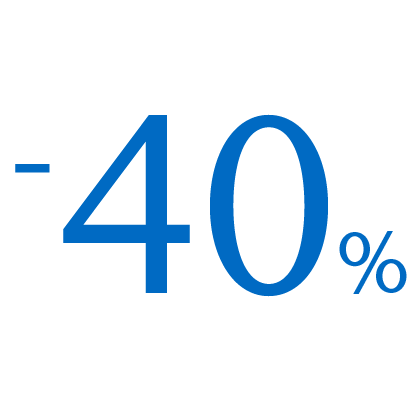
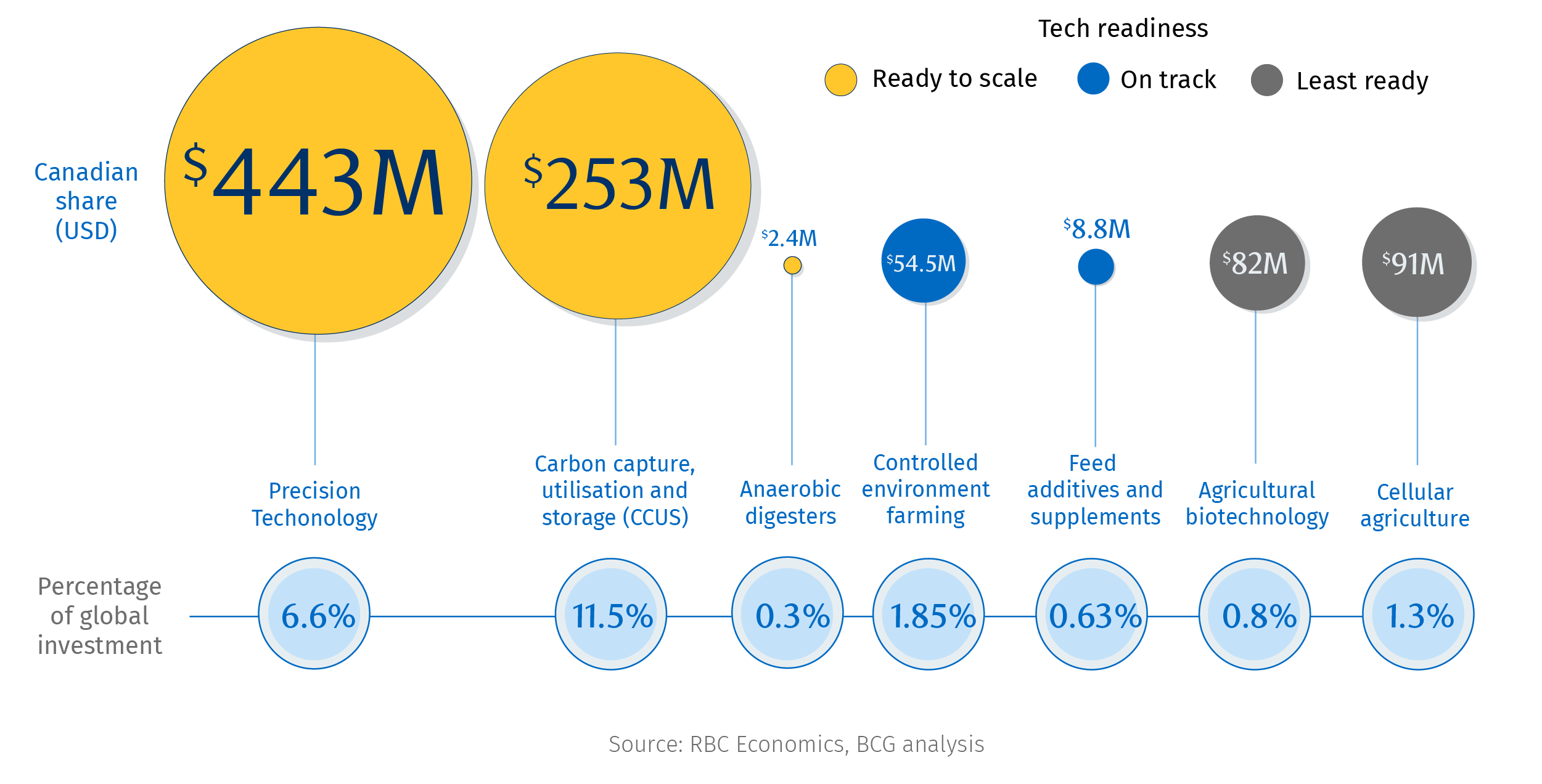
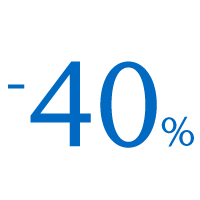
Imagine a bumper crop of wheat grown entirely without chemical fertilizers and using practices that regenerate the soil. Or a swarm of drones that use artificial intelligence to identify every plant in a field, sniping only the weeds with a precision spray. Or a fresh slice of salmon sashimi that was grown in a bioreactor, not caught from the sea. These are among the game-changing technologies enabling the Next Green Revolution in agriculture. Like innovations that came before them, they’re accelerating productivity to help feed a growing global population. But they’re also playing a critical new role: reducing agricultural emissions and enabling soil to absorb greenhouse gas emissions. While agriculture produces 10% of our national GHGs annually, its core raw materials—soil, plants, and animals—also hold almost unequalled power to pull emissions out of the atmosphere, where they contribute to climate change. Unlocking that power, and cutting existing emissions, will depend on many things: including supportive policy, a well-trained workforce, and financing. Critically, this transformation will also hinge on technology—and our success in both developing it through responsible innovation and putting it to work to help the economy, the environment and individual farm operators. In previous research, we found that technological solutions could play a major role in cutting up to 40% of potential 2050 emissions from Canada’s agricultural sector.1 As a top exporter of key crops, with broad market access and a deep history of agricultural innovation, Canada is extremely well-positioned to not just lead the world in the adoption of these ag-techs but in the development of them. By engaging diverse actors in the Canadian food system, we can develop technologies that are responsible, creative, and efficient. Indeed, given our advantages, this opportunity is ours to lose. We’ve identified seven key innovations or “ag-techs” we believe can both meaningfully reduce emissions and present opportunities for Canada to lead. Some, like anaerobic digesters, carbon capture utilization and storage (CCUS) and precision technology are ready and starting to scale now. Others, like vertical farms and plant science will be key solutions in the medium term. Still others, like cellular agriculture and precision fermentation, could transform the food systems of the future. In every case, maximizing the potential of these innovations means building the right platforms for collaboration among not just farmers and entrepreneurs, but communities, investors, corporations, social enterprises, and governments. It’ll mean proving to farmers of all types that sizeable upfront investments in more proven ag-techs are worth it while de-risking their leaps of faith into emerging technologies. We need to also be careful that these tools, many of which are capital intensive, do not hurt smaller and medium-sized enterprises and producers and that they are truly deployed to help Canada achieve both our emission targets and drive a green economic transition. Doing this will mean accelerating investment in research and development—particularly among private actors—and directing more of it toward the technologies that can do the most to cut emissions now. As it stands, most ag-tech investments in Canada are focused on productivity enhancing digitization and automation, which help increase yields and improve farm operations. We need more investment in innovation to advance sustainable and regenerative farming. Canada’s share of global funding for most key technologies is lowGlobal venture capital and private equity investment in ag-tech since 2017
Mobilizing private investment is key to competing on the global stage
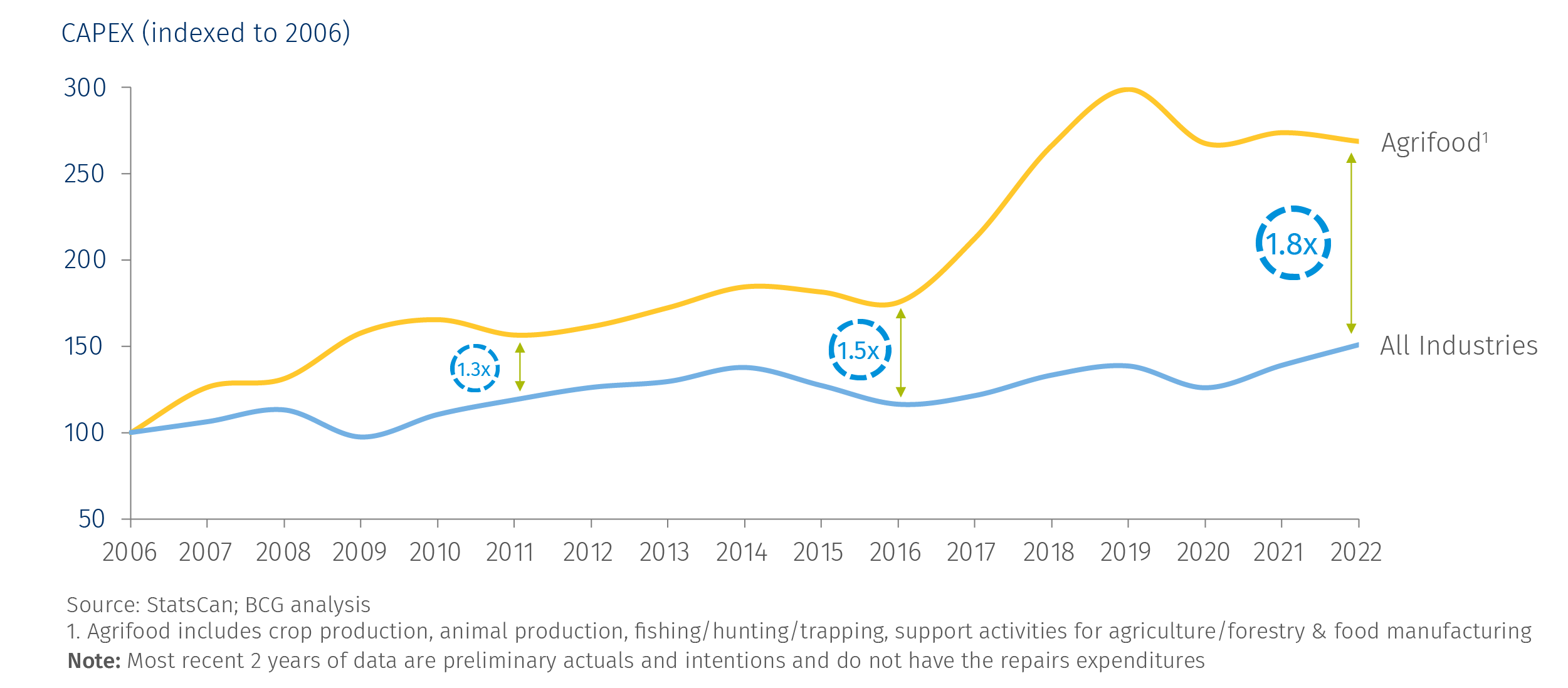
Canadian agricultural innovations can be found on fields around the world, from canola seeds invented by Prairie scientists to grain augers first imagined in Manitoba. Yet as we move into a new era of low emissions agriculture, much of our potential to build on this strength—using newfound advantages unlocked by artificial intelligence and data science—remains untapped. Agriculture has outpaced other Canadian sectors in investment over the last number of years—a positive sign suggesting both productivity and rising domestic demand for machinery and equipment with more technology embedded in it. But leading the world in this space demands more investment, particularly from the private sector. For generations, Canadian agricultural research and development has been overwhelmingly fuelled by public dollars. Over the last decade, the public sector accounted for as much as 90% of agricultural R&D, compared to about 30% in the United States.2 Meantime, Canadian agricultural startups and private companies have lagged international peers in drawing private investment. Of roughly US$36 billion in global venture capital and private equity investments in ag-tech since 2017, Canada received just 3%, or US$1 billion. The U.S. captured US$20 billion or 55%. Canadian agriculture businesses have grown their R&D budgets significantly—at least doubling them from 2015 levels in recent years. But they still fall far short of Canadian public R&D funding, which steadily declined as a percent of GDP since the 1980s. As governments in peer countries like the U.S. and Europe accelerate public spending on sustainable agriculture (for example via the Inflation Reduction Act, and the European Green Deal), Canada risks falling even further behind. It is imperative for Canada to keep pace on incentives to avoid placing our producers and companies at a disadvantage or causing a brain drain to other nations. To compete, we’ll need governments to shift more support to on-farm implementation and uptake of ag-tech regenerative agriculture practices. And we’ll need businesses to drive more investment—particularly in the technologies that hold the most promise to move the needle on climate change. Agrifood investment has outpaced other industries in Canada
The global race to create the next generation of ag-tech is heating up
Israel
Israel, a small country with little arable land, is already the global leader in digital fertigation. This technique employs sensors and cloud-based analytics to determine the targeted release of water and fertilizer directly onto a plant’s roots. More recently, the country has expanded its agricultural focus to develop capabilities in vertical farming and alternative proteins. Israeli companies are leading the world in investment in plant-based proteins, drawing US$160 million as of the first half of 2022—22% of all funds globally. Investment in novel protein more broadly is the second largest globally, including for cultured meats (US$320 million as of the first half of 2022).3 The industry grew 160% in the first half of 2022 with more than 100 Israeli companies specializing in novel proteins (and more than 11 of these created between 2021 and 2022 alone). Israel devotes 17% of agricultural spending to research and development.Singapore
Less than 1% of Singapore’s land is arable, but that hasn’t stopped it from setting ambitious agriculture targets. The country’s “30 by 30” goal aims to reduce its dependence on food imports by increasing domestic food production to 30% of demand by 2030. As part of this, the government is providing funding to help farmers upgrade equipment and test new technology on their farms, while also supporting innovation and ag-tech development. Singapore has clear strengths in urban and controlled environment farming (e.g., vertical farms, contained fish farms, and indoor farm factories that use AI and big data to maximize efficiency), and has more recently emerged as a hub for the development and regulation of alternative proteins.4 In 2019, Singapore announced a regulatory framework for the pre-market assessment of novel foods and is working with public and private sector organizations to support growth of cellular agriculture startups. It was the first country to approve cell-cultured meat for human consumption in December 2020 and is home to more than 20 cell-based meat producers.Japan
Crisis drives innovation. After the 2011 tsunami and Fukushima nuclear disaster destroyed most nearby farmland, the Japanese government jumpstarted a vertical farm building boom to replace lost production. Today, Japan has more than 300 vertical farms—powered by robotic automation and smart technology—to help maintain its domestic supply of food, which is also increasingly challenged by the country’s aging population and migration to cities (causing abandonment of farmland).5 The government’s 2020 Environment Innovation Strategy aims to develop climate-smart technologies, including through new breeding varieties that reduce CH4 and N2O emissions from agriculture and livestock.The Netherlands
Despite its smaller size, the Netherlands is the world’s second largest food exporter in dollar value behind the U.S. An agri-food powerhouse, the country excels at digitizing its greenhouses and fields with smart technologies. Dutch greenhouses, which account for 80% of cultivated land in the Netherlands, are among the most advanced in the world. More recently, the Netherlands has emerged as a frontrunner in plant-based food products, driven largely by innovations from Wageningen University and Research Centre. The university is the leading research hub for the Dutch food industry and often referred to as “Food Valley” or the “Silicon Valley of Food.” Home to a US$94 million plant-based food innovation centre, Wageningen University works with startups and researchers to develop new vegan products. Nearly 200 agri-food companies are present within a 10-km radius of the university, creating a dense network of collaboration between the public and private sectors. There are more than 60 companies and research institutions focused on plant-based protein in the country.6The Transformative Seven
Building a low carbon agriculture sector will be a challenge unlike any we’ve faced. The good news is we have powerful technology to help us do it. We’ve identified seven innovations that, if applied in a way that is equitable and supported by producers and communities, hold the most promise to cut emissions and store or sequester them in soil. Much remains open to debate. No matter how powerful the potential of a technology is, it is never a panacea, and needs to be adopted by producers, accepted by consumers, and supported by policy. Too often in the past promising technological innovations have also hurt communities. Considering these tensions, our goal here is to lay out the potential of these innovations to cut emissions in Canada and use this analysis as a lead up to successive phases of this collaborative project, where we will road test ideas with a range of groups and communities across Canada. Boosting investment in the technologies we’ve identified will be key to realizing their potential. Together, RBC, BCG Centre for Growth and Innovation Analytics and Arrell Food Institute gathered the best available data on current investment levels. Still, much of this data remains insufficient or undisclosed. Establishing better transparency in this arena will be critical to tracking our progress going forward.


In Canada, biogas development (including anaerobic digesters) has been driven by provincial energy and waste management policies. There is huge opportunity for growth, especially in agriculture, where crop residues and animal manure make up two-thirds of Canada’s easily available biogas resources. In addition to on-farm plants, community digesters have been touted as a pathway to growth, where their use and costs can be split among multiple farms and potentially even local municipalities.
The Challenges
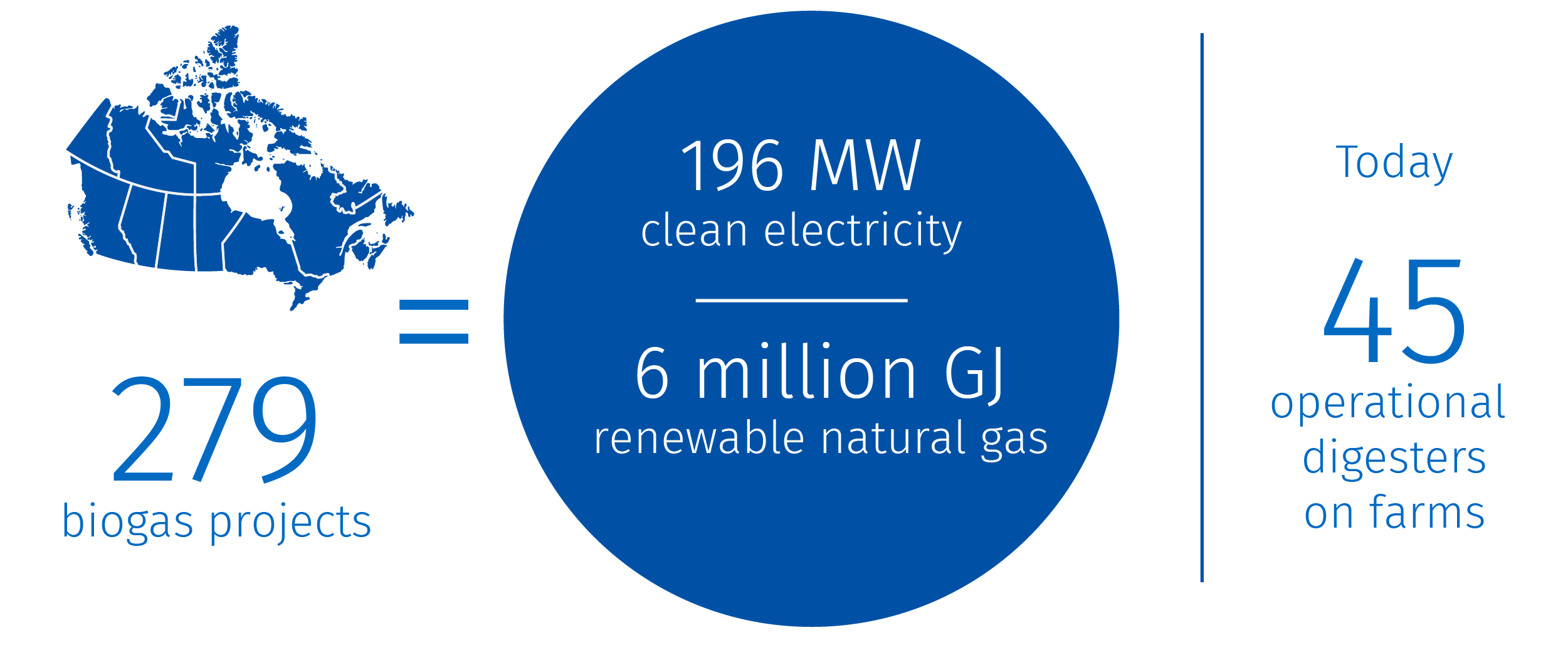
But investment and development thus far is anemic, with just 29 projects underway. (Data on investments in anaerobic digester development is also quite sparse). The high costs for building these facilities (in the tens of millions per facility, depending on the size) are a barrier. While there are significant tailwinds for the industry, including from government policies like the clean fuel regulations and offset markets, greater demand for biofuels and derisking structures like power purchase agreements will also need to be developed.


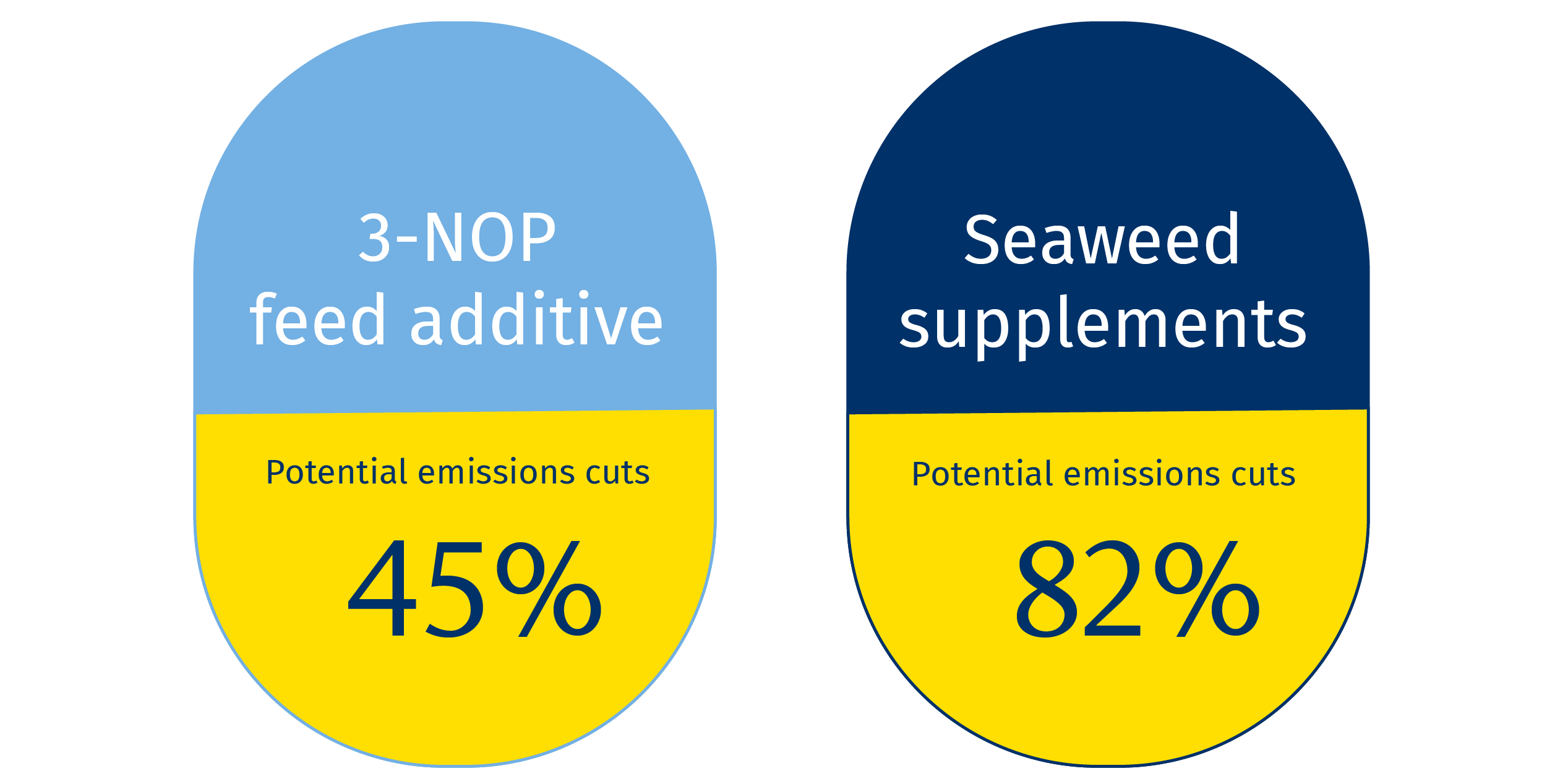
3-NOP has been shown to cut emissions by as much as 45% while adding seaweed to the diet of dairy cows could cut emissions by as much as 82%. Scientists are also working to ensure that this can be done without yield losses—potentially even improving the efficiency of cattle (that is, helping them grow more using less feed). 12
The Challenges
The biggest challenge to scaling feed additives is regulatory approval. 3-NOP has been approved in Brazil and in the European Union, where it was categorized under feed additives that offer an environmental benefit (streamlining the path to commercialization). But in Canada, where it’s classified as a veterinary drug, it’s unlikely to be approved for several years.
Cost is also a key barrier. Without a price on greenhouse gases (such as a carbon tax), farmers lack the incentive to adopt methane-reducing additives because there is not yet a clear economic benefit—only an environmental one. While a carbon credit scheme could help, there is still a heavy burden placed on the farmer to gather data to gain the credit.


Recommendations: Canada’s time to lead
The Next Green Revolution depends on both putting ready technologies to work and responsibly developing the game-changing innovations that will define the future. Though other nations are rapidly mobilizing their own resources to accomplish these goals, few are as well-positioned as Canada to lead. The following actions will be key to catalyzing the investment needed to scale the Transformative Seven, as well as remove key barriers to their adoption. In the next phases of our report series, we’ll gain a better understanding of how technology (buttressed by policy) can be applied to support producers (especially small- and medium-sized farms), foster acceptance by consumers and be inclusive of all stakeholders.For more, go to rbc.com/climate.

Download the Report
DownloadContributors:
RBC Trinh Theresa Do, Senior Manager, Thought Leadership Strategy Naomi Powell, Managing Editor, Economics and Thought Leadership John Stackhouse, Senior Vice President Colin Guldimann, Economist Benjamin Richardson, Research Associate Farah Huq, Senior Director, Content Strategy Darren Chow, Senior Manager, Digital Media Zeba Khan, Manager, Digital Publishing Aidan Smith-Edgell, Research Associate Kitty Wu, Intern Gwen Paddock, Director, Sustainability & Climate – Agriculture Brenda Bouw, Freelance Writer
Boston Consulting Group Keith Halliday, Director, Centre for Canada’s Future Chris Fletcher, Managing Director and Partner Sonya Hoo, Managing Director and Partner Wendi Backler, Partner and Director, BCG Centre for Growth and Innovation Analytics Youssef Aroub, Project Leader Pilar Pedrinelli, Consultant Rachit Sharma, Lead Knowledge Analyst, BCG Centre for Growth and Innovation Analytics
Arrell Food Institute, University of Guelph Evan Fraser, Director Deus Mugabe, Ph.D. Candidate, Plant Agriculture Dr. Jesus Pulido-Castanon, Post-doctoral Research Associate Emily Duncan, PhD Candidate
-
- Alice Reimer, Strategic Advisor, CDL
- Alison Sunstrum, Founder, CEO CNSRVX-Inc
- Jim Baker, CEO, Cultura Technologies (Volaris Group)
- Simon Barber, Former Head, Asia Pacific Regulatory and Stewardship, Syngenta Seeds, Singapore
- Wilf Keller, Vice President of Outreach, Agri-Food Innovation Council
- Ray Price, CEO, Sunterra Group
- Gary Haley, Chair, Haley Family Investment Trust
- Jay Cross, President, Canadian Academy of Health Sciences; Professor, University of Calgary
- Lenore Newman, Canada Research Chair in Food Security and the Environment and Professor of Geography, Simon Fraser University
- Mark Thompson, Executive Vice President, Chief Corporate Development and Strategy Officer, Nutrien Ltd.
- Michelle Nutting, Director, Agricultural and Environmental Sustainability, Nutrien Ltd.
- Dan Heaney, Research Associate, Plant Nutrition Canada
- Tom Steve, General Manager, Alberta Wheat Commission
- Jason Lenz, Vice President, Alberta Wheat Commission
- Dan McCann, CEO, Precision AI
- Juanita Moore, Vice President of Corporate Development, GoodLeaf Farms
- Janay Meisser, Director of Innovation, United Farmers of Alberta
- Mauricio Alanís, Director, Sustainability Strategy and Partnerships, Maple Leaf Foods
- Ryan Phillippe, Director, Corporate Development, Genome Canada
- Josh Bourassa, Research Associate, The Simpson Centre for Food and Agricultural Policy
- Elena Vinco, Researcher and Policy Analyst, The Simpson Centre for Food and Agricultural Policy
- Guillaume Lhermie, Director, The Simpson Centre for Food and Agricultural Policy
- Lejjy Gafour, President, Cult Food Science Corp.
- Francis Rowe, CFO, Cult Food Science Corp.
- Jane Church, Corporate Engagement Manager, Nature United
- Tony Ward, Professor Emeritus, Department of Economics, Brock University
- Dave MacMillan, CEO, Deveron UAS
- Derek Eaton, Director of Public Policy Research and Outreach, Smart Prosperity Institute
- David Hughes, President and CEO, The Natural Step Canada
- Stuart Smyth, Associate Professor, College of Agriculture and Bioresources, University of Saskatchewan
- Kristjan Hebert, Managing Partner, Hebert Grain Ventures
- John Van Logtenstein, Vice-President, Dairy Lane Systems and DLS Biogas
- John Walker, Walker Farms
- Scott Walker, Walker Farms
- Clyde Graham, Executive Vice President, Fertilizer Canada
- Josh Pollack, Co-founder, CELL AG TECH
- Valentin Fulga, Co-founder, CELL AG TECH
-
- 1. Without change to current practices or market share, we
-
- Canada’s current agriculture emissions could rise to 137 megatonnes by 2050
-
- 2. Agricultural Institute of Canada, “An Overview of the Canadian Agricultural Innovation System.” 2017.
-
- 3. The Times of Israel, “Israeli companies lead world in plant-based food tech investments — report,” August 2022.
-
- 4. Eco-Business, “Is Singapore poised to become Asia’s hub for alternative protein?,” August 2021.
-
- 5. BBC Storyworks, “How technology is transforming Japan’s agriculture”
-
- 6. Fast Company, “How the Netherlands became a plant-based protein powerhouse,” November 2020.
-
- 7. Nutrien, “2022 Environmental, Social ESG And Governance (“ESG”) Report,” 2022.
-
- 8. Global CCS Institute. “Facilities Database,”
-
- 9. Canadian Biogas Association, “Canadian 2020 Biogas Market Report.” April 2021.
-
- 10. Columbia Climate School: State of the Planet, “How Sustainable is Vertical Farming? Students Try to Answer the Question,” December 2015.
-
- 11. UC Davis, “Cows and climate change: making cattle more sustainable,” June 2019.
-
- 12. Breanna M. Roque, Marielena Venegas, Robert D. Kinley, Rocky de Nys, Toni L. Duarte, Xiang Yang, Ermias Kebreab, “Red seaweed (Asparagopsis taxiformis) supplementation reduces enteric methane by over 80 percent in beef steers,” March 2021.
-
- 13. CBC News, “How feeding cows seaweed could help P.E.I. meet emission targets and boost this business
-
- Social Sharing,” November 2021.
- 14. Ontario Genomics, “Cellular Agriculture Canada’s $12.5 Billion Opportunity In Food Innovation,” November 2021.
Food is again at the forefront
It’s reshaping the economy, as food prices take inflation higher. It’s redefining national security, as countries reckon with the prospect of strategic supplies. And it’s resetting the climate conversation, as producers and consumers grapple with the need for more food with fewer emissions.
The world needs a new Green Revolution, and Canada can play a leading role. Indeed, we must.
By 2050, we must increase our food production by a quarter just to maintain our contribution as the world’s population swells. We need to grow more for humanity, with less impact on the planet. This can be Canada’s moonshot for 2030 and beyond, if we can harness the imagination and enterprise of Canadians in every sector and geography.
The coming age of disruption, in agriculture and food systems, compelled RBC, BCG Centre for Canada’s Future and Arrell Food Institute at the University of Guelph to take on this project, to help inform and inspire Canadians to see both the urgent need and growing opportunity that will come with more sustainable food systems.
The following report outlines how we can build those systems by:
- Using breakthrough technologies as well as some well-established practices,
- Attracting and training a new generation of farm and food innovators,
- Investing in farmers to develop new economic incentives that reward what they produce as well as what they preserve,
- And boldly declaring to the world that Canadian agriculture can help everyone move more quickly to a world that has solved the climate crisis.
How we grow, process and consume food is not the key cause of our climate crisis. It can be a key solution. And with the right investments, it can become a made-in-Canada, farmed-in-Canada solution for the world.
John Stackhouse,
-
- Senior Vice President, RBC Economics and Thought Leadership
Keith Halliday,
-
- Director, BCG Centre for Canada’s Future
Evan Fraser,
- Director, Arrell Food Institute at the University of Guelph
Key findings
Canada’s agriculture and food systems produce 93 megatonnes or just over 10% of our national greenhouse gas emissions annually.1
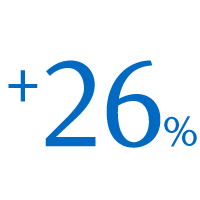
If Canadian farmers maintain current practices and market share, these emissions could rise to 137 megatonnes as the world’s population increases 26% by 2050.2
Key technologies and approaches that can cut emissions include carbon capture, utilization and storage, feed additives, anaerobic digesters, and precision technology.
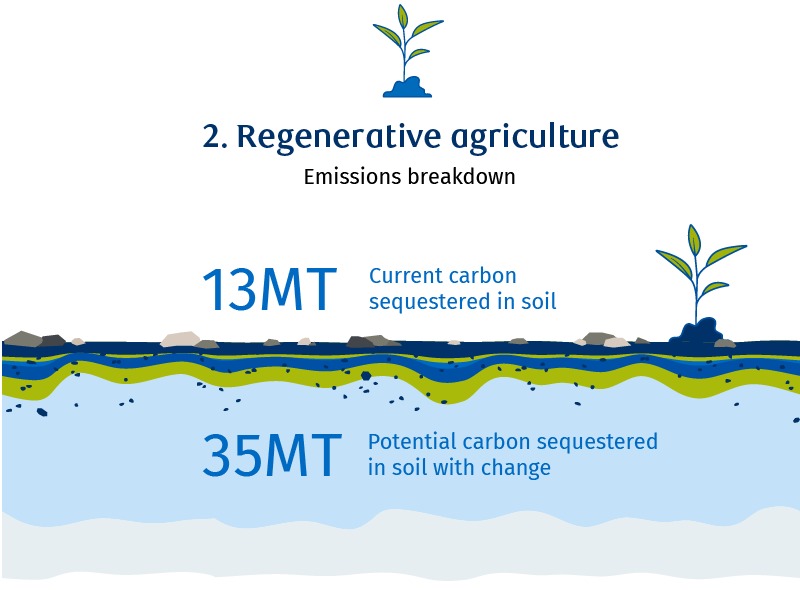
Nature-based solutions that sequester carbon will also be critical. Soil carbon has the potential to be one of our most powerful tools, raising the amount of carbon stored in soil to as much as 35MT.
By engaging these technological and management solutions, and mobilizing finance and policy to support farmers, Canada can cut up to 40% of potential 2050 emissions.
New models are needed to reward the adoption of these solutions, to execute them at scale and to reduce uncertainty and risk for farmers.
A Canadian standard for measuring the impact of emissions-cutting activities could provide a vital tool for both compensating farmers and empowering policymakers and financial institutions to support activities.
A national effort, tailored to regional contexts and focused on the key pillars of technology, finance, skills and public policy, will be essential to increasing our production while also cutting emissions.
Leading a low carbon farming revolution
Canada’s agricultural sector is at a turning point.
Global food demand is set to soar as the population rises to 9.7 billion in 2050—a 26% jump.3 At the same time, climate change is disrupting the supply chains and agricultural productivity of many major producers. And geopolitical upheaval from Russia’s invasion of Ukraine has destabilized the world’s food systems.
Rarely has feeding the world presented such a daunting challenge. Canada can lead the worldwide effort to confront it.
Our farmers are already among the most productive on the planet, supplying $75 billion worth of food to global markets each year. We’re a top supplier of key crops like wheat and canola and a global leader in the export of beef. We have a large stock of arable land and fresh water, a relatively stable regulatory environment, and international standing as a reliable supplier of safe, high-quality food.
But our successes have come at a cost. Every acre of food we grow, and every animal we raise, add to an emissions footprint that is already too big—and that we’ve committed to shrinking. Farming significantly more acres in the same way will only worsen the problem, since disturbing the soil adds more carbon to the atmosphere.
At the same time, climate change is battering production in many parts of the world, including Canada. But those forces may also, in the medium term, enable Canada to produce more food. This presents us with both a responsibility to help alleviate the global food crisis and an opportunity to expand our presence in international markets.
Realizing these aims will mean directing our strengths at a new target: producing significantly more food—while simultaneously slashing greenhouse gas emissions.
In this report, we identify four key steps that can set us on a path to accomplishing this. These include embracing technologies that cut emissions from fertilizer, livestock digestion and manure while also adopting farming techniques that help store carbon in soil. By leaning into its strengths, Canada can also become a leader in the development of the technologies and plant science that will power the next green revolution in agriculture.
Farmers will be on the frontlines of this transition. But they can’t do it alone. The vast number of activities involved in Canadian agriculture, the diversity of the regions in which they are carried out and the uneven distribution of emissions across them demand a national approach. To make it happen, we’ll need to harness cross-sectoral partnerships, research and innovation, policy development and private investment. We’ll need to expand the ports and railways that carry our goods to market. And we’ll have to think beyond our own borders, leading early efforts among trading partners to galvanize approaches to measurement, labelling and other mechanisms.
Canada has marshalled such an all-of-country approach to support our farmers in the past, mobilizing not just technological advances, but immigration, infrastructure and trade policies, with powerful effect.
By seizing the same spirit of collaboration now, Canadian agriculture can lead the world in the fight against climate change.

There are many different ways to analyze agricultural emissions, which different reports use to view the issue from different perspectives. Canada’s National Inventory Report (NIR) for 2019 identifies 73 megatonnes of emissions from agriculture. A full end-to-end view, including fertilizer, transport, processing, retailing, consumption and disposal, encompasses 136 megatonnes according to our analysis. We based this analysis on Environment Canada’s NIR IPCC reporting with scope 1-3 emissions assigned to operational steps in the value chain to avoid double-counting. Low magnitude and hard to influence scope 3 emissions, including manufacturing emissions of capital assets used in agriculture, were not included. One can also adjust this figure to account for exported and imported food. For import-related agricultural emissions, key import commodities were assigned emission factors per unit imported based on CONCITO databases and leveraged trading partners’ emission databases. For this paper, unless specifically noted in the text, we will define agricultural emissions as fertilizer production and use, enteric fermentation and manure management, on farm fuel use, crop residue, land use conversions and other emissions for a baseline of 93 megatonnes. We consider soil carbon sequestration to be negative emissions from farms. For potential emission reduction levers, estimates are based on current technology, economic, and operational readiness at current cost. These estimates were sized with input from published research, expert interviews, and pressure-tested based on expert judgement. There is significant uncertainty about the future impact of levers, due to both technological immaturity as well as unknowns around scope of implementation, so our lever analysis assumes some feasibility and implementation limits rather than the full theoretical scope of potential emissions reductions. We conducted preliminary analysis on the carbon competitiveness of key Canadian crops, synthesizing the results of multiple studies with varying methodologies. The initial findings are that Canadian agriculture is carbon competitive with our key export competitors; further research and refinement to carbon intensity reporting will be critical going forward.
The global challenge:
Climate change is transforming the way we grow food
<class=”dark-blue”>Climate change is redrawing the map of global food production. The global rise in temperatures that began towards the end of the 20th century has slowed increases in productivity driven by the widespread adoption of chemical fertilizers, more productive varieties of plants and increasingly sophisticated technology.
Since 1961, climate change resulting from human actions slowed overall growth in global agricultural productivity by 21%.4 The story is even bleaker in warmer regions like Africa, Latin America and the Caribbean, where the growth in productivity was between 26% and 34% lower than it would have been without climate change. For many countries in the tropics, farming is set to get even harder: for every degree global temperatures rise, maize yields will fall by 7.4% and rice yields by 3.2%.
Canada won’t escape the ravages of climate change—heat, drought and extreme storms battered production as recently as 2021—but the impact will be different. By 2050, yields in parts of Canada could improve by up to 50% (as warming temperatures extend growing seasons) even as they decline by 20% to 50% in areas of China, India and the U.S.5
And as the poles warm, roughly 1.85 million square kilometres of land in Canada’s north may become suitable for staple crop production by 2080.6 With Canada losing an estimated 60,000 acres of prime farmland to urban expansion each year, there may be temptation to farm or develop it.7 But the consequences of allowing agriculture to push north could be catastrophic: releasing roughly 15 gigatonnes of carbon, if forests and wetlands are cleared and ploughed.
To feed the world, Canada will need to grow more food, without adding significantly to its stock of farmland.
Cutting emissions is key to maintaining our global agricultural might
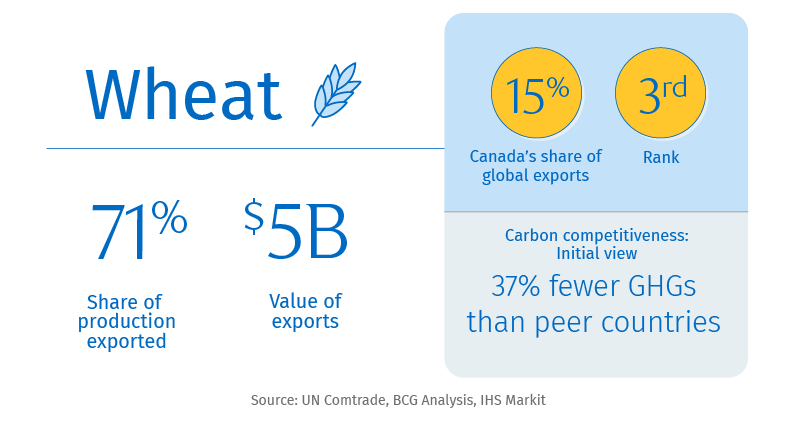
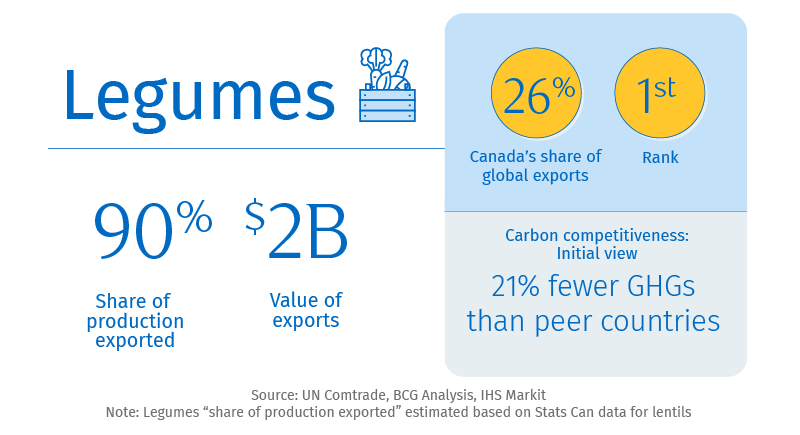
Canada is already an agricultural superpower. The Prairies grow enough wheat to rank us among the top three exporting nations. And they churn out enough canola to dominate global markets. The mines of Saskatchewan produce and ship more critical potassium fertilizer than any other country—a billion tonnes per year. We’re among the world’s largest exporters of beef and a top exporter of lentils.
As the fifth largest source of greenhouse gas emissions, Canada’s agricultural sector is also a major contributor to the country’s carbon footprint.
Canada is a major global exporter of key agricultural commodities
Emissions intensity per kg of production (Indexed to Canadian emissions intensity)


Unleashing growth requires overcoming unique challenges
As powerful as Canada’s agricultural sector is today, significant potential remains untapped. In 2017, the Advisory Council on Economic Growth projected Canada could target an 8% global market share in agricultural products by 2027 (up from 5.7% in 2015)—making us the world’s second largest exporter after the U.S.8 As one of the few countries with the capacity to increase agricultural exports (even accounting for climate disruption), that goal appears increasingly within reach. Indeed, as new markets and trading relationships develop in response to geopolitical turbulence and climate change, more opportunities will open for major producers. Spain recently lobbied the European Commission to drop import controls on animal feed from third party countries as it struggled to address gaps left by major supplier Ukraine.9 Driven by the same shortages, as well as a desire to reduce dependence on the U.S., China is looking to accelerate imports of Brazilian corn.10
“Only a small cluster of places supply grain to the world and when you have a problem in any one of them, that loss has to be soaked up. Canada is among a narrow set of countries that has material production capacity and an exportable surplus. We’ll have all kinds of opportunities.” Al Mussell, Research Director, Canada Agri-Food Policy InstituteBut if the opportunities in agriculture’s green transformation are abundant, so too are the challenges we’ll have to manage to make it happen. They begin with the unique presence of food in our daily lives. In addition to sustaining us, food plays a central role in our celebrations, our daily rituals and our communities. As a result, changes in its availability and prices are much more visible and felt more directly by consumers. This makes change politically sensitive and difficult to carry out.
And while agriculture shares many of the challenges faced by heavy emitting, trade-exposed sectors, its pathway to reduced emissions is complicated by farm economics. Input costs are unpredictable—fertilizer expenses, for instance, increased by 31.8% in 2021 while livestock feed costs rose 23%.11 Prices for agricultural commodities, which make up the bulk of farm revenues, are among the most volatile of trade-exposed industries. And the ability to absorb these fluctuations varies widely among farm types, with profit margins on the higher end for supply-managed dairy and poultry farmers and on the lower end for beef and swine farmers who are exposed to large market swings.
Now, increasingly frequent extreme weather events—to which agriculture is more exposed than any other sector—are introducing new challenges. Amid these pressures, many farmers are reluctant to adopt new practices that add more uncertainty to their operations.12
Dairy, grain, and oilseeds are most profitable sectors
Average farm net income 2009-2019, % of revenues
Beyond the farm gate, the broader supply chain introduces its own obstacles. Canada’s agricultural sector is highly fragmented, subject to both global and regional headwinds and regulated by a patchwork of provincial and national strategies. For the most part, it is also heavily dependent on a network of rail and port infrastructure that has increasingly faced pressures, including labour shortages and disruptions due to extreme weather events. “We are in the privileged position of having all this supply that the world wants and they want it now,” said Jean-Marc Ruest, Senior Vice President, Corporate Affairs and General Counsel at Richardson International, Canada’s leading grain exporter. “But we are really struggling to get the grain out of Canada. We really need to invest in our trade infrastructure.”
The National Supply Chain Task Force has recommended a nationwide effort that brings together government and industry leaders to strengthen our transportation network against changing trade patterns, climate disruption and geopolitical risk.13 A similar approach should be brought to the challenge of lowering carbon emissions in the agricultural supply chain.
We can start by addressing three key sources of greenhouse gases in the sector—fertilizer, cattle digestion and manure. In the coming section, we’ll examine the tools that can help cut those emissions—including anaerobic digesters, carbon capture, utilization and storage (CCUS), and feed additives—as well as the challenges we face in putting them to work. We’ll also look at the potential of “regenerative agriculture” to store carbon in soil. This approach includes a set of sustainable farming practices, like reduced soil tillage and cover cropping that can also make our land more resilient to the effects of climate change.
Finally we’ll examine how our existing strengths can help us lead the research and development of new technologies that could be central to the future of farming. Together, these steps can help form the foundation of Canada’s green agricultural revolution.
Four key building blocks for a low emissions agriculture and food system
Key challenge: Fertilizer production and use produces 28MT of GHGs or 30% of our total agricultural emissions (11.9MT from production; 16MT from use)

Without change: emissions will rise to 35MT by 2050
Game changers: Use: Smart fertilizers, precision technology, nutrient stewardship. Production: carbon capture, utilization and storage (CCUS), low carbon energy feedstock
The potential: To reduce emissions by 14MT by 2050
Few places demonstrate the scale and potential of Canadian agriculture like Rob Stone’s 9,000 acre farm in Davidson, Saskatchewan. In the 1960s, Stone’s land produced 20 bushels of wheat per acre. Today, it generates 50 bushels an acre, a boost Stone credits to better plant genetics, his own farming practices and nitrogenous fertilizer.
Fertilizer use represents the single biggest input cost on Canadian farms and like many, Stone has taken steps to use it sparingly. It’s also the biggest contributor to Canada’s agricultural carbon footprint and a good place to start on our journey to a green agricultural sector.
Nitrogen feeds plants, which absorb it in their roots. Some crops, like pulses, don’t need it because they draw nitrogen from the air. But for top Canadian exports like wheat and canola, nitrogen fertilizer is essential and used on just about every field that grows them. Nitrogen fertilizer releases carbon dioxide when it’s produced and can produce nitrogenous oxide (a potent greenhouse gas with a global warming potential 265 to 298 times that of carbon dioxide over a 100-year period) when applied to fields.14,15
The good news is we have tools to reduce its use. And Canada has made progress in adopting some of them. They begin with careful planning of how fertilizer is applied on the farm. Some industry-led initiatives can assist farmers in building these plans. For instance, Fertilizer Canada’s “4R Nutrient Stewardship”, emphasizes applying the right type of fertilizer, using the right rate for application, and applying it at the right time and in the right place. Scientific assessments for Agriculture and Agri-Food Canada show the widespread adoption of some 4R practices—for example, the use of enhanced efficiency fertilizers and split application of fertilizer—could lead to significant emissions reductions.
More advanced practices, aided by data and precision technology, could take us further. On his farm in Davidson, about halfway from Saskatoon to Regina, Stone tests his soil annually, monitors yields, and uses that information to build custom plans for seeding and fertilizing at variable rates. The shift has paid off: he’s using 8 to 10% less fertilizer. The technology he uses—an air drill—also made it possible for him to plant his crops without tilling the soil, a practice that improves soil quality and increases productivity by reducing the need to rest land in alternate years.
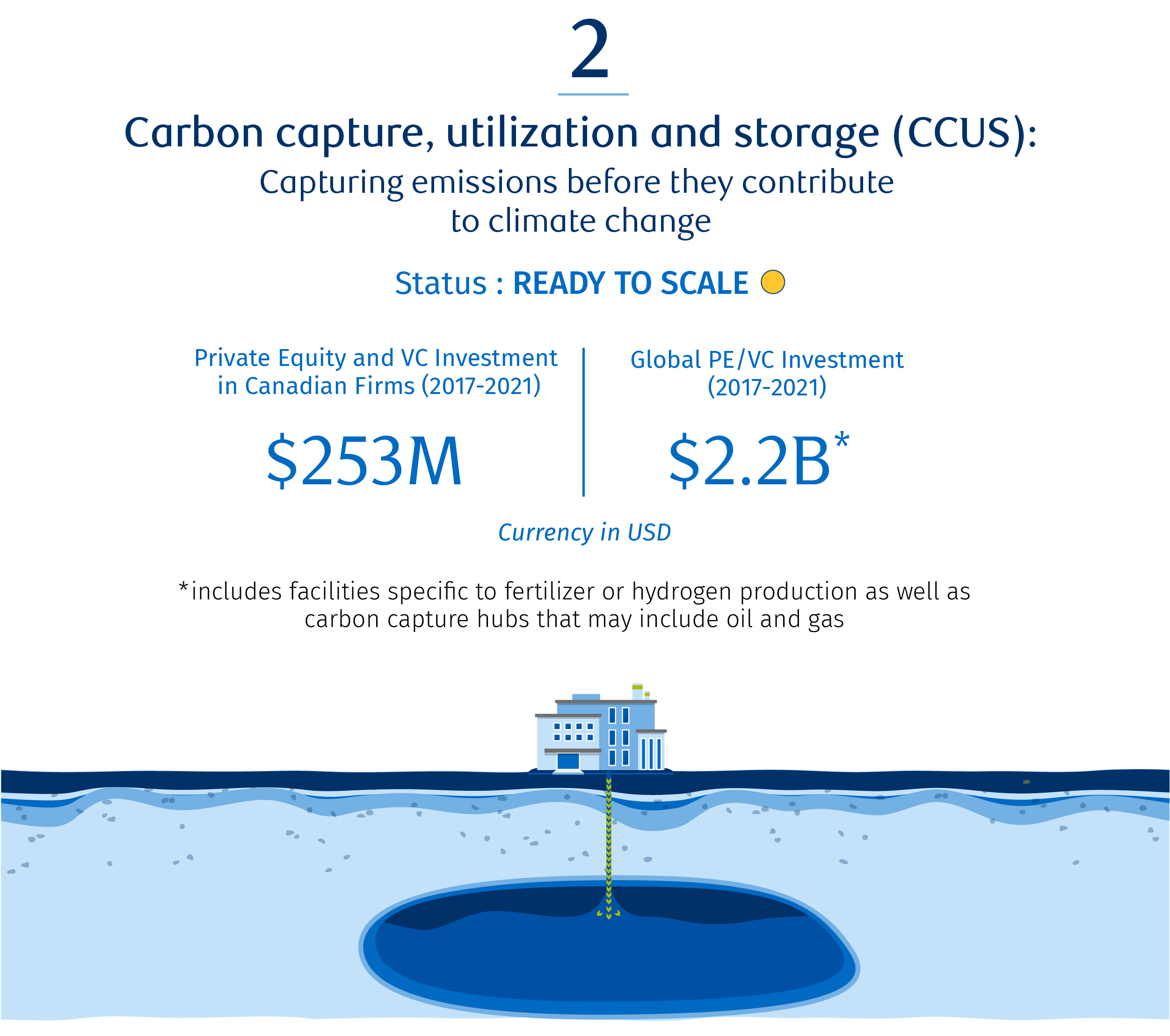
Cutting emissions from fertilizer production involves solutions at a much larger, industrial scale. Carbon capture, utilization and storage systems (CCUS), which are beginning to be used in the oil and gas sector, capture emissions before they enter the atmosphere and compress them into a liquid that’s shipped by pipeline to a storage facility. Saskatoon-based Nutrien is now using such a system to capture carbon dioxide from its Redwater plant and move it via the Alberta Carbon Trunk Line to enhanced oil recovery projects in central Alberta. Another option being explored is the process of electrolysis, which produces fertilizer by using renewable electricity to draw hydrogen from water.
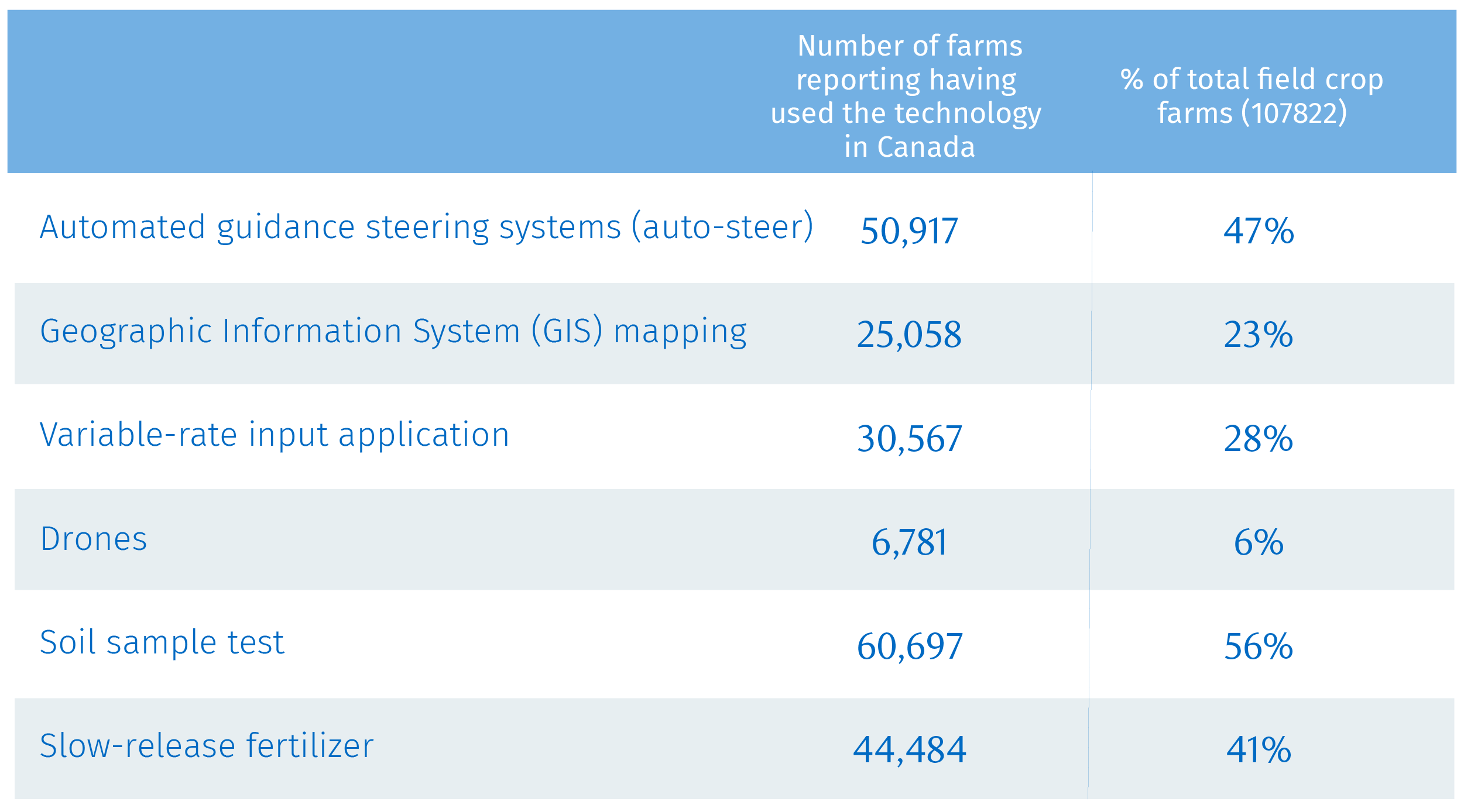
The challenges: Many Canadian farms are small and operate on thin margins that make absorbing the cost of soil testing and precision agricultural technology difficult. A recent RBC survey of 200 Canadian farmers, found that those with lower annual revenues ($250,000 to $999,000) were less likely than those with higher-revenues to be using environmentally sustainable farming practices. (However, nearly all lower revenue farms that have not yet adopted green farming practices are planning to do so in the near future). Just 13% of farmers across Canada are using variable rate techniques on their farms.16 And though the number is rising, less than a third of farmers are currently testing soil for nutrients on an annual basis—a starting point for more efficient fertilizer use.
For farmers, the risk of change is also a challenge. Research shows many producers are reluctant to adopt practices that introduce uncertainty to their operations. “These are family farms,” said Don Smith, Vice President, Petroleum and Innovation at United Farmers of Alberta. “They’re not going to experiment with new technologies if there’s a risk it could negatively impact their ability to feed their family.”
Cost and uncertainty are barriers on the production side too. Beyond Nutrien’s Redwater facility, only a minor fraction of fertilizer production employs CCUS. Though costs vary by facility, the estimated capital cost of this technology can be up to $50 million per plant depending on facility size and location, with barriers to investment including uncertainty about regulatory approvals and carbon pricing17. What’s more, CCUS is heavily dependent on infrastructure that requires further development, including carbon pipelines and storage hubs.
“The most cost effective, immediately available technology is carbon capture and storage. But it is capital intensive.” Clyde Graham, Executive Vice President, Fertilizer Canada
Current carbon sequestered in soil: 13MT
Game changers: Agroforestry, biochar, alley cropping, silvopasture, conservation and no-till practices, cover cropping, avoided land use conversion
The potential: Negative emissions rising up to 35MT
When it comes to growing food, soil is our most precious resource. About 95% of the world’s food is grown in the uppermost layer of topsoil—more than half of which has disappeared in the last 150 years due to modern, intensive farming practices. Without change, the consequences of losing even more soil will be severe. The earth’s ability to grow food and absorb water plummets without healthy topsoil, leaving us more vulnerable to both hunger and flooding.
Soil performs another vital service: it stores carbon. Indeed, while agriculture is one of the key contributors to emissions, it also holds enormous power to act as a “carbon sink,” removing carbon from the atmosphere where it contributes to climate change. Modern farming practices, like tilling, can impair this important function by disturbing the carbon in soil.
Investing in our soil then, is a critical early step in establishing a green agriculture sector. “Regenerative agriculture” aims to do this through a holistic approach to farming intended to improve soil health, protect biodiversity and draw greenhouse gases out of the atmosphere and into the ground. Though the term first appeared in the 1980s, it gained traction following a 2014 paper by the non-profit Rodale Institute, which outlined how certain soil-friendly farming techniques could sequester carbon in soil. It’s since become a top food trend in the U.S., where a growing range of products feature it as a credential and where companies like General Mills, PepsiCo and Nestle have announced commitments to advancing regenerative agriculture on millions of acres of farmland. In Canada, companies including McCain Foods, Maple Leaf Foods, Nutrien and McDonald’s Canada have launched similar initiatives.
Broadly speaking, regenerative agriculture refers to a set of practices, including reducing or eliminating soil tillage, planting cover crops (which prevent erosion and improve fertility) and furthering animal grazing techniques (which give land time to regenerate and improve the soil’s ability to store carbon).
Many Canadian farmers already use these regenerative agriculture practices. About 60% of farmers use no-till or conservation tillage practices, for example. In Saskatchewan, that figure is even higher at 80%. Adoption of other practices could take us further. Cover cropping has the potential to mitigate 9.6MT of emissions, according to the non-profit Nature United. And biochar, which turns agricultural waste into a soil enhancer that can hold carbon, could cut 6.8MT. But adopting practices that draw greenhouse gasses out of the atmosphere is only part of the equation. We also need to prevent future emissions from happening in the first place. One way to do this is by protecting grasslands, which currently trap a huge amount of carbon. Preventing grasslands from being ploughed up or paved over could mitigate 12.4MT of carbon emissions in Canada.
Many of these practices—which are now under the banner of regenerative agriculture—have long been used by Indigenous communities. And these communities have much knowledge to share as we explore the potential of these techniques.
“It’s what we’ve done all along and it’s the opposite of primitive. It’s about resilience and adaptation. You can push the land but you have to also invest, not squeeze every last drop out of it.” Jennifer Grenz, Assistant Professor, University of British ColumbiaThe challenges: Greater adoption of regenerative agriculture has been hindered by financial concerns among farmers. The cost of adopting it varies per acre across practices. And upfront investments in enabling equipment like air seeders can also be prohibitive. Producers—particularly those with slim profit margins—typically need assurances that returns will cover those costs and the risks associated with them. But according to our research, the benefits of some of these practices generally only begin to outstrip the costs four years after their adoption. And profitability appears only in year six. Meantime, markets to compensate farmers for storing carbon in soil—as well as the methods to measure it—are still in experimental stages and generally lack a sufficient payout to make up the for the upfront investment.
Uncertainty presents another, critical barrier. Regenerative agriculture lacks a single legal or regulatory definition and there is no oversight for how it’s used. This leaves it open to misuse and bold claims about its power to store carbon, when much of that is still open to scientific debate. With no single test or certification for claims, farmers (and consumers) are left to sort out credibility on their own.
Soil carbon sequestration is key to cutting emissions
Million tonnes of CO2 equivalent
Defining the term and creating a system to measure, report and verify (MRV) the carbon stored in soil due to regenerative agriculture (and the ecosystem services provided), would empower consumer choices. An MRV tool would also make it easier to attach a price to practices and lead to a market where carbon credits can be bought and sold. Some pilot projects are underway to create “carbon farms” that include attempts to build accurate MRV systems. Other projects are experimenting with advanced mathematical models that estimate how different farm management strategies may sequester carbon.
Whatever system is established will need to address myriad regional variations in soil types across the country, as well as limitations related to farming type and size. Creating a nationwide MRV accounting tool will also require a much broader system for soil testing than Canada currently has. Technology, and in particular the advancement of remote soil sensors, will be critical enablers of these systems.
Answers to these questions and others—including how to regulate future carbon markets—will take time to come together. Until then, we’ll need to find ways to incentivize farmers using the best tools we have, while consistently adopting better ones as they arise.
“We couldn’t produce without cover crops. Crazy storms used to wipe out our crops. Not anymore.”Gillian Flies, Owner, The New Farm
Key challenge: Cattle digestion produces 24MT of emissions
Without change: Emissions will rise to 30MT by 2050
Game changers: Feed additives, GHG selective breeding
The potential: To reduce emissions by 16MT by 2050
Cow burps and manure may not immediately spring to mind when we think about climate change. But Canada’s dairy and beef cattle are the biggest sources of agricultural emissions after fertilizer. Through their digestion process or “enteric fermentation”, cattle produce methane, a potent greenhouse gas with a 20 year global warming potential 85 times that of carbon dioxide.18 And in Canada, where the agricultural sector accounts for 30% of national methane emissions, 85% can be directly attributed to cattle.19
The paradox is that cattle can also act as stewards of the land. Canada has about 35 million acres of native grassland and nine million acres of seeded grasslands that act as carbon sinks. By grazing on this land, cattle stimulate grass roots to grow deeper, better enabling carbon to be stored in the soil. Using land for grazing also prevents it from being converted to other uses, which impacts biodiversity and disturbs carbon in the soil.
Adding to the complexity, Canadian beef has one of the smallest carbon footprints globally, with greenhouse gas emissions well below the global average. That makes us a critical beef supplier as the world looks to cut emissions. Our dairy cattle too, emit fewer GHGs per kilogram of final product than the global average.
Still, the outsized contribution of cattle to climate change means more must be done. Researchers are working on breeding techniques that could produce cattle that release less methane and that process feed more efficiently. Feed additives that cut the amount of methane produced during digestion could offer a more immediate breakthrough for the sector. One such additive, called 3NOP, is already in use in other countries—it has yet to be approved in Canada—and has been shown to cut emissions by as much as 45%.20 Adding seaweed to the diet of dairy cows could also cut emissions by as much as 82% while also improving the efficiency of cattle—that is, helping them grow more using less feed.21
The challenge: Feed is the most expensive and most critical input on a beef or dairy farm and questions remain about how much additives will cost amid strong international demand. A more practical concern is how to administer the additives to beef cattle that spend much of their lives grazing in open fields (where the most emissions are released).
“Feed additives are a hard sell. As we have learned working with veterinarians and feedlot operators, basically there’s no incentive…And ultimately we’re depending on the unknown: the adoption of the farmer.” Elena Vinco, Researcher and Policy Analyst, The Simpson Centre for Food and Agricultural Policy

Key challenge: Manure produces 8MT of emissions
Without change: Emissions will rise to 10MT by 2050
Game changer: Anaerobic digesters
The potential: To reduce emissions by 4MT by 2050
While less potent than cow burps, manure packs a major punch when it comes to emissions. Today, 8MT of total agricultural emissions come from manure. Of this, 55% are generated by cattle.
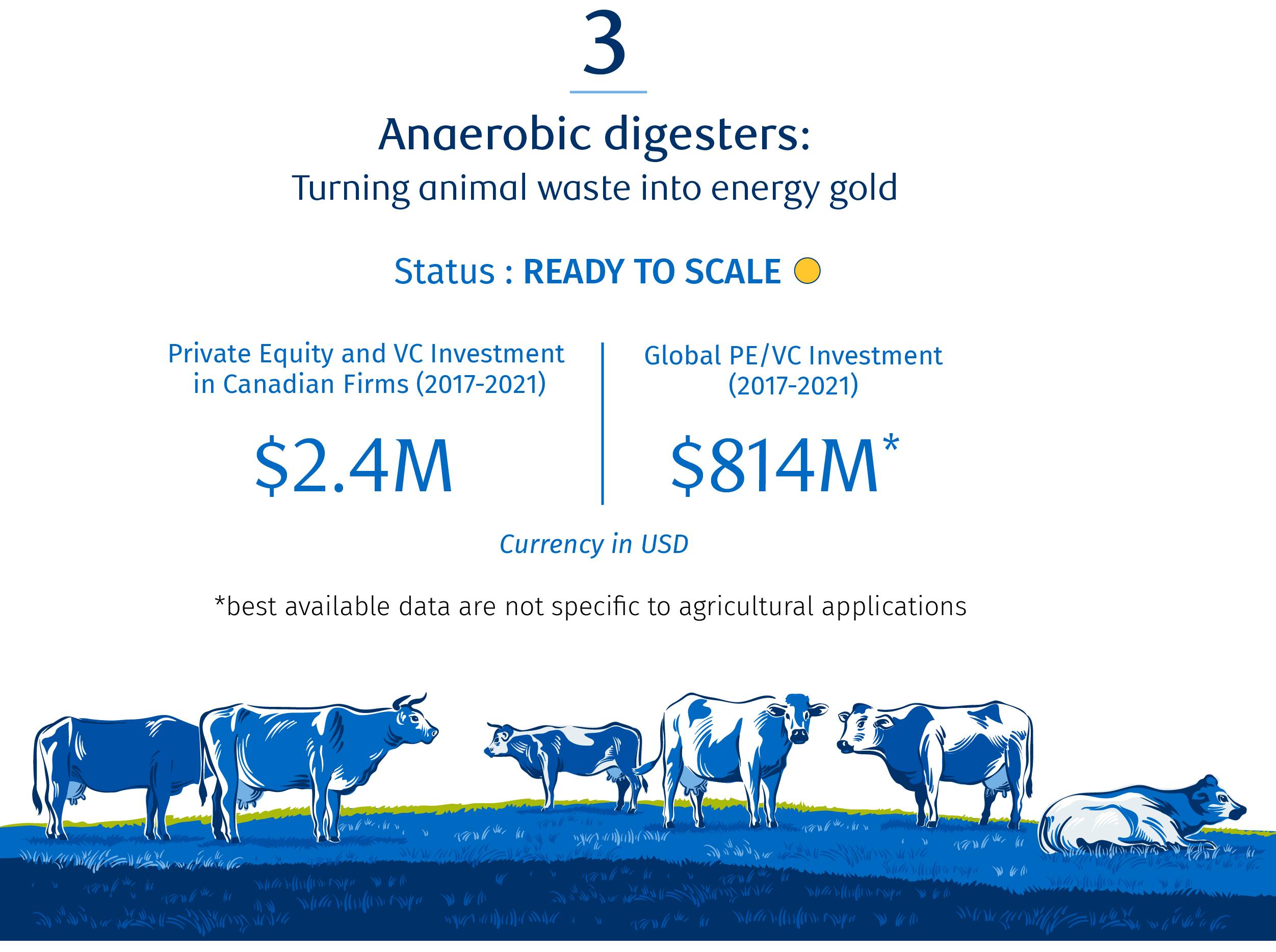
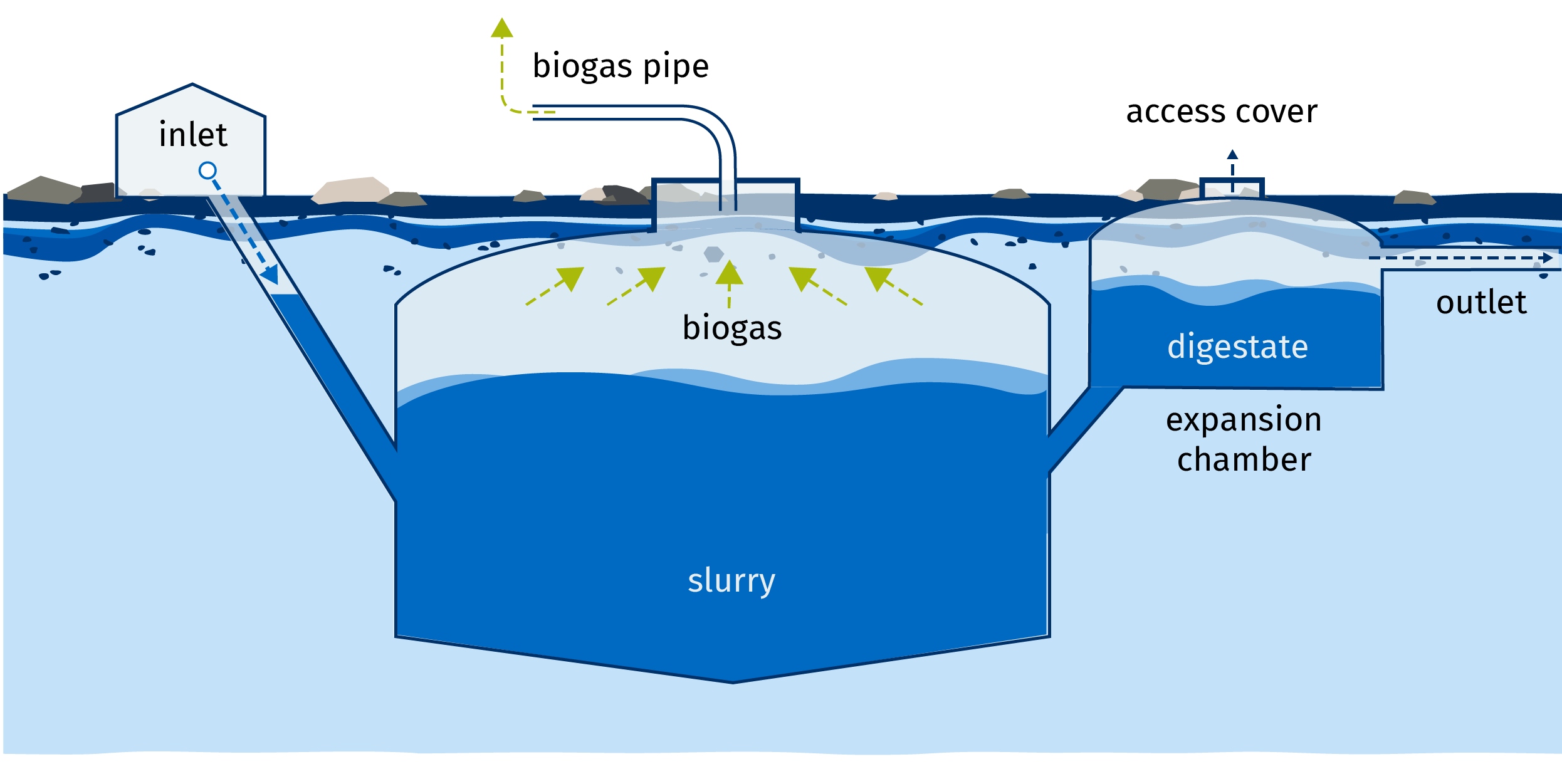
Walker Farms in Aylmer, southeast of London, Ontario, offers a glimpse at one way to bring those emissions down—while adding to the farm’s bottom line. The dairy operation partnered with Ontario-based DLS Biogas to build a $16 million anaerobic digester, technology that turns manure and organic waste into electricity or renewable natural gas (RNG). Farmers can either use that energy on the farm, cutting their own costs, or sell it to natural gas utilities like Fortis B.C. under long-term contracts. Fortis buys the gas and the carbon credits associated with it.
Digestate, an odourless byproduct, can in turn be used as fertilizer. Canada currently has 279 biogas projects in operation. And with only 13% of available biogas energy production being tapped in Canada, there’s room to grow, with the most significant potential identified in the agricultural sector.22
The challenges: Anaerobic digesters are gaining traction, largely due to the extra revenue they bring to farms. The Walkers expect to see their initial investment returned in eight years.
But the upfront cost of digesters—running anywhere from $7 million to $70 million—place them out of reach for smaller operators. The Walkers and DLS Biogas have applied for a series of grants (a process that took hundreds of hours to complete) but there are no guarantees and no programs specifically tailored to biogas.
And digesters may not make sense for every farm. With at least 150 cows needed to produce enough manure to feed a digester (Ontario averages 70 to 80 cows per farm), size matters. Access to landfilled food waste, which is also added to digesters, and pipelines to move the RNG to market are also critical. Large beef feedlots in Alberta tend to have better access to this infrastructure and enough cattle to make production economically viable. But the clay surface used in many cattle pens can end up in manure, damaging biodigester machinery. Many feedlots are converting to roller compacted concrete, which improves cattle efficiency and eliminates the problem of clay in the biogas process. This, too, is costly.
The development of communal digesters could allow smaller farms to participate in the production of biogas. But support to help cover the upfront costs—and a streamlined process to obtain it—will be critical.
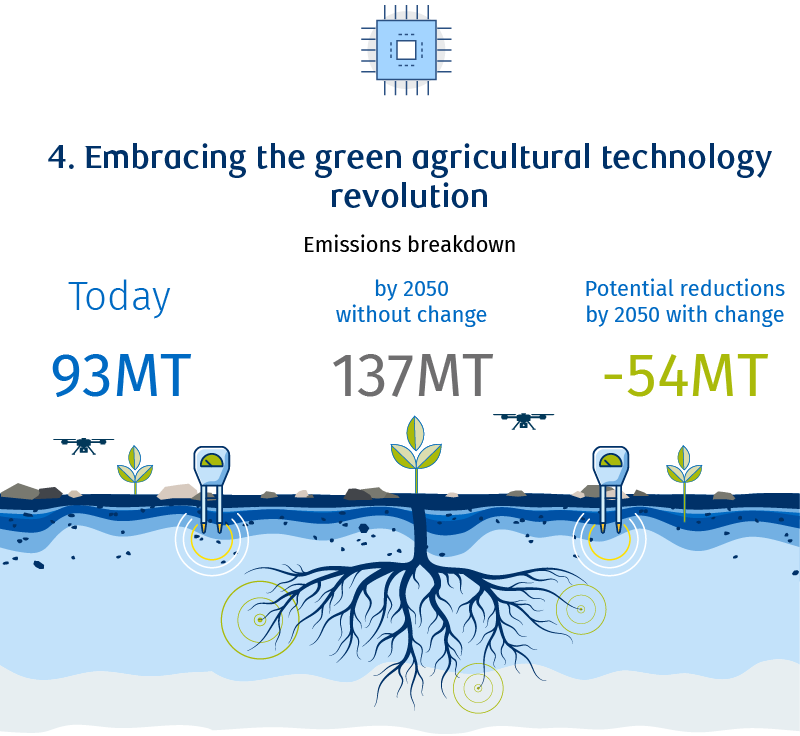
Key challenge: 93 MT overall
Without change: 137 MT
Game changers: Advanced ag-tech that cuts emissions, enables more carbon to be stored in soil and leads to more production on less land
The potential: To enable 54 MT in potential emissions reductions (or as much as 76 MT when soil sequestration is added)
Canada has a long history of agricultural innovation. The development of Marquis Wheat in 1904 was vital to the boom in Prairie crop yields that followed. Canola, created in Saskatchewan in the 1960s, is now one of the world’s most important oilseed crops. The grain auger was invented in Canada. And air seeders bearing the logo of Saskatchewan’s Seed Hawk can now be found on fields from Australia to Europe.
All of these developments fueled step changes in the productivity of Canadian agriculture. The next generation of technologies will need to do more than that. Indeed, all of the emissions reductions envisioned in this paper will in some way rely on technology—innovations like CCUS, biodigesters and precision tools. Technology will also be critical to producing more food on less land and by extension, avoiding the conversion of land into cropland. Our estimates suggest we can avoid 20MT of emissions by preventing land use change between now and 2050. Storing more carbon in soil—producing negative emissions—will also depend on increasingly sophisticated devices like soil sensors and drones that enable the market innovation necessary to accelerate new approaches like regenerative agriculture.
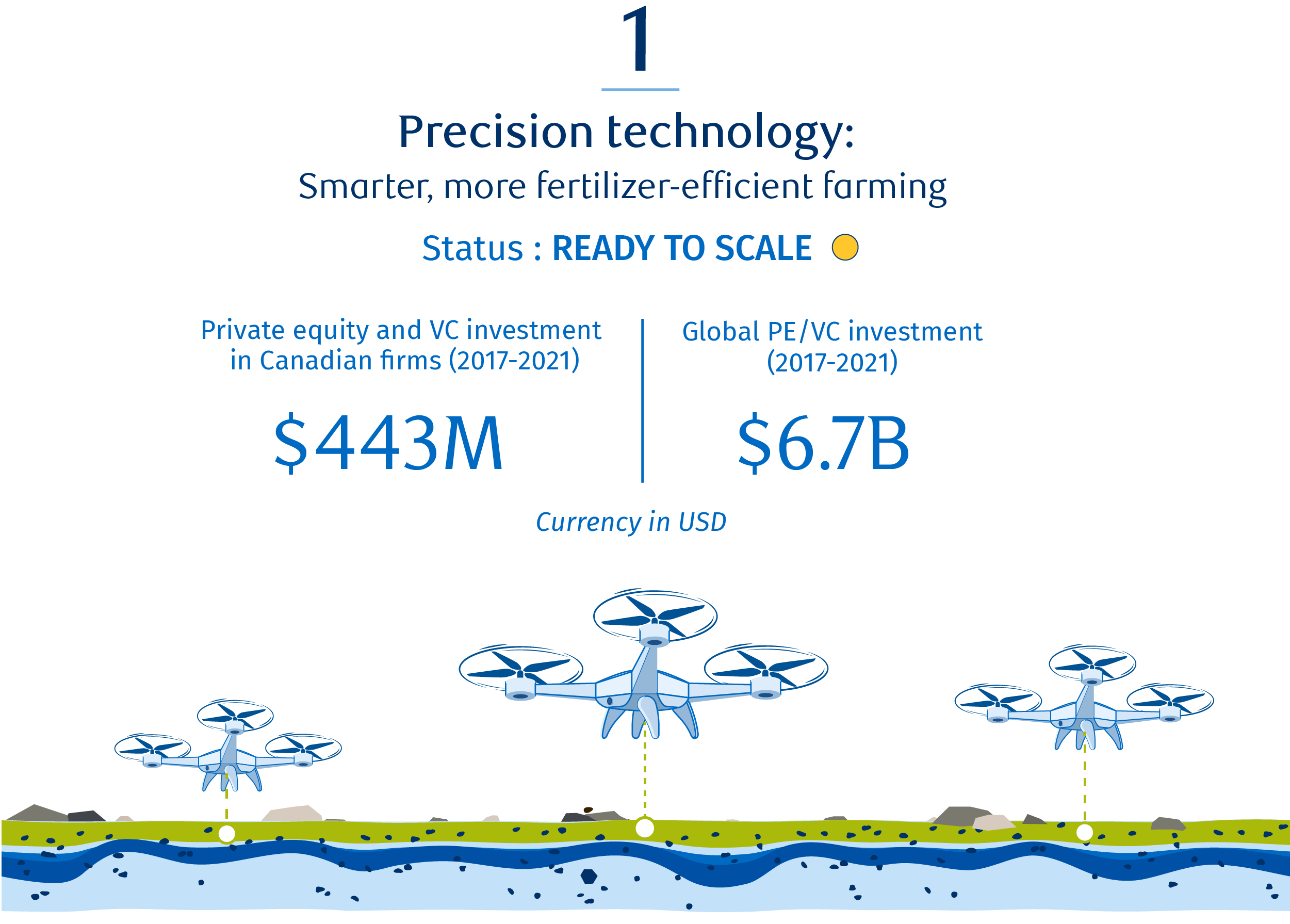
Canada’s heft in global agriculture markets, its longstanding expertise in crop science and its newfound strength in artificial intelligence and data science, position us well to lead in some areas of this race. Yet when it comes to drawing private investment to homegrown innovation, we’re falling behind. Of roughly US$36 billion in global venture capital and private equity investments in ag-tech since 2017, Canada received just 3%, or US$1 billion. The U.S. captured US$20 billion or 55% of investments.
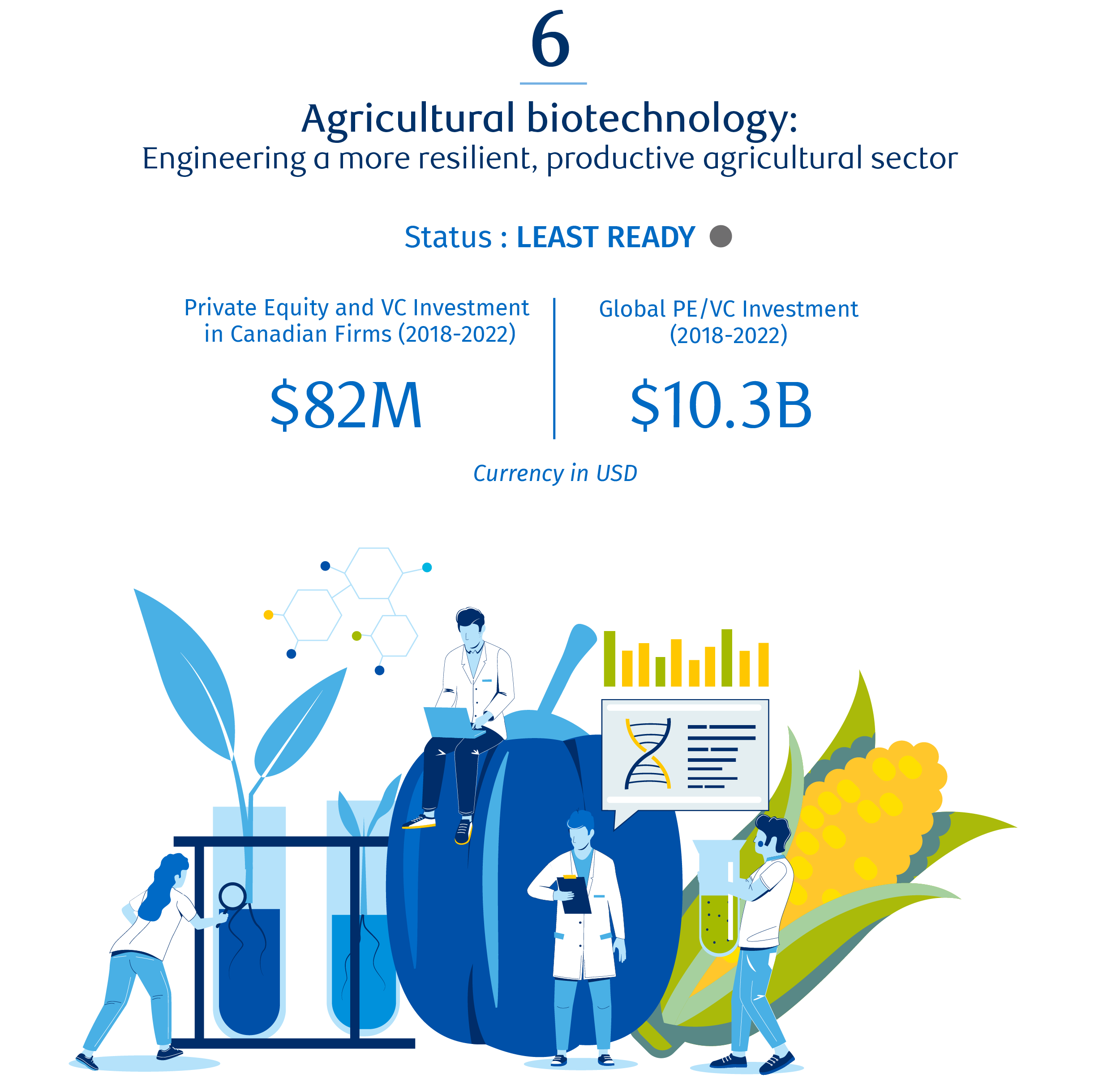
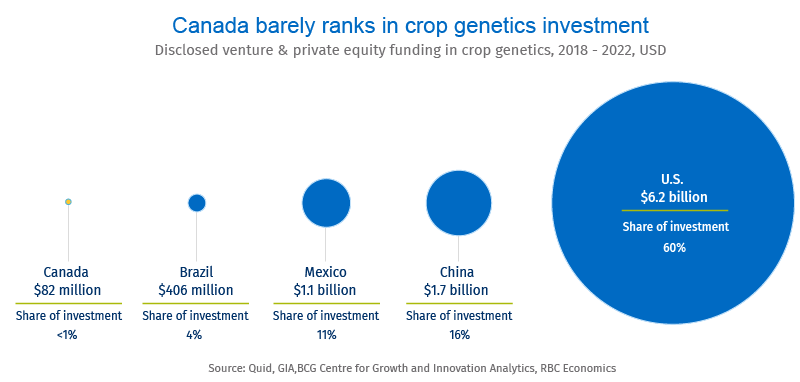
Critically, private equity and venture capital investment has lagged in some of the areas that have historically reaped the largest rewards for Canadian agriculture. As we look to lower emissions, crop genetics and soil science (including microbiome research) hold some of the greatest potential for boosting production on existing farmland, cutting carbon emissions and improving resilience to droughts and flooding. While much of our research has been focused “above the soil” in the past, scientists are increasingly turning their attention to the potential of root structures and soil microbiomes to cut emissions. But so far, private investment in these fields hasn’t rushed to Canada. Of total global private equity and venture capital investment of roughly US$10 billion since 2017, our ventures in crop genetics have drawn only US$82 million.
In addition, much of the investment Canada is attracting isn’t going to the kinds of technologies we need now to transition to a more sustainable agriculture and food sector. Globally, over half of private investment in ag-tech in 2021 was in sustainable practices. But in Canada, most investments are focused on digitization and automation, technology designed with productivity, not sustainability, in mind.

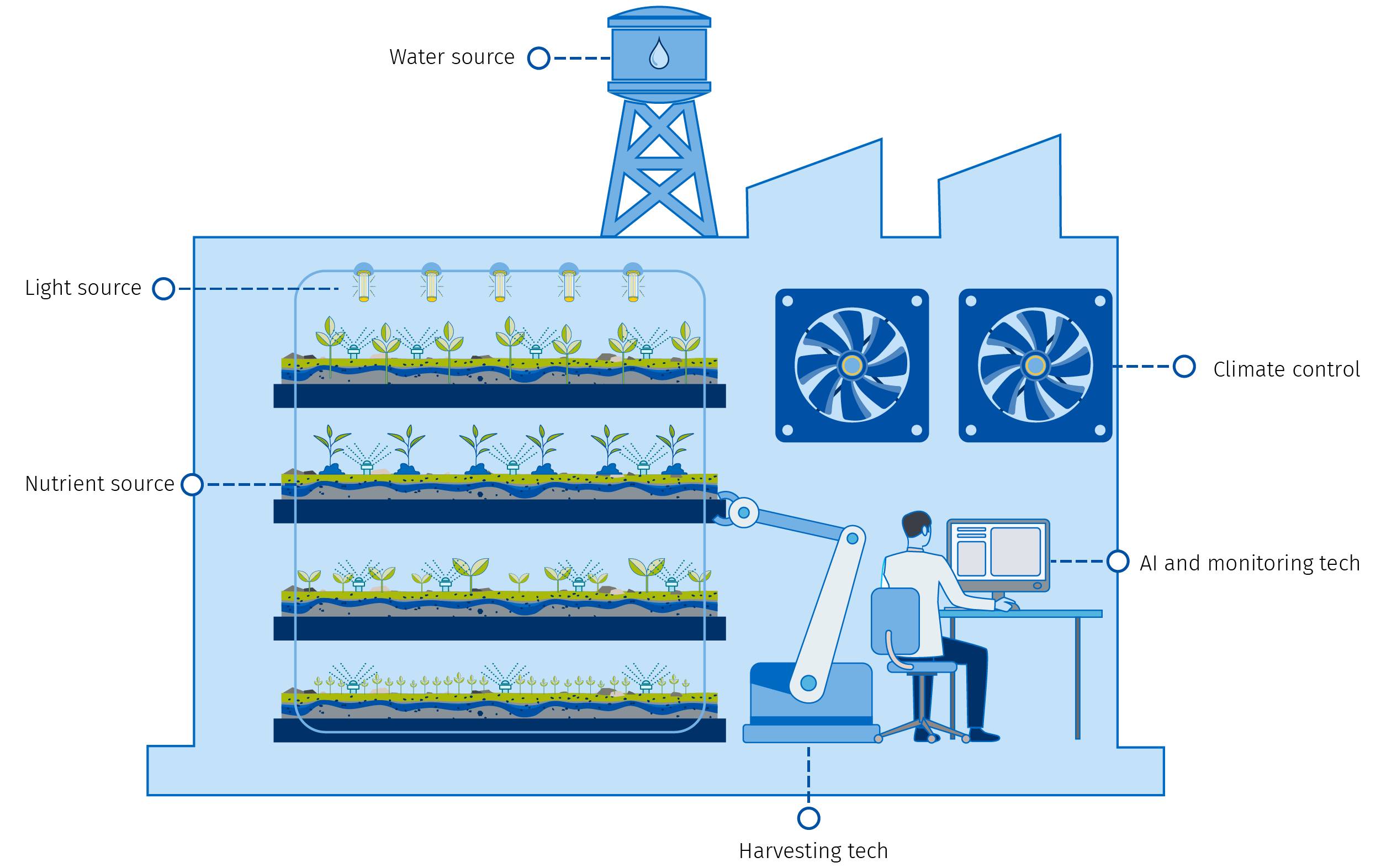
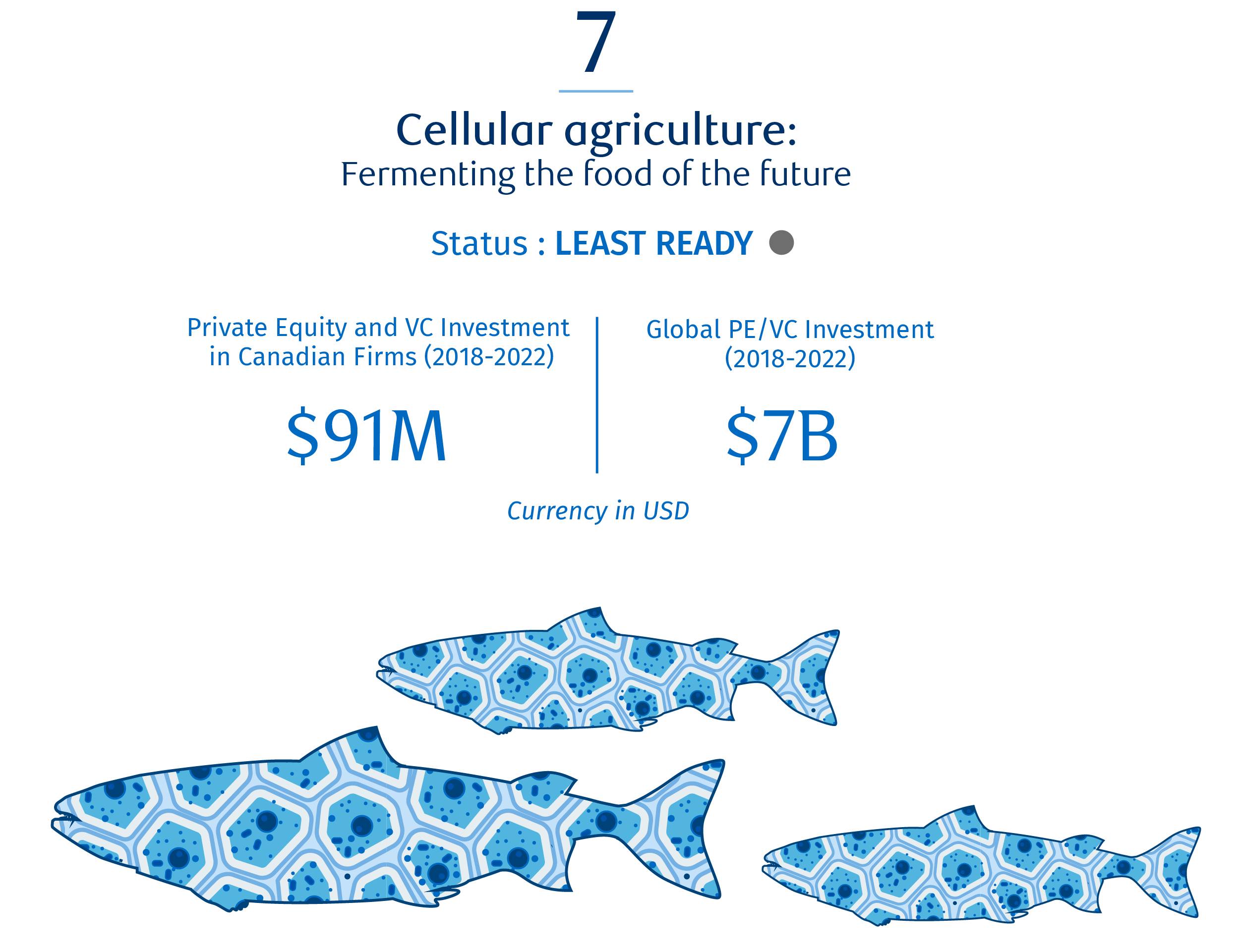
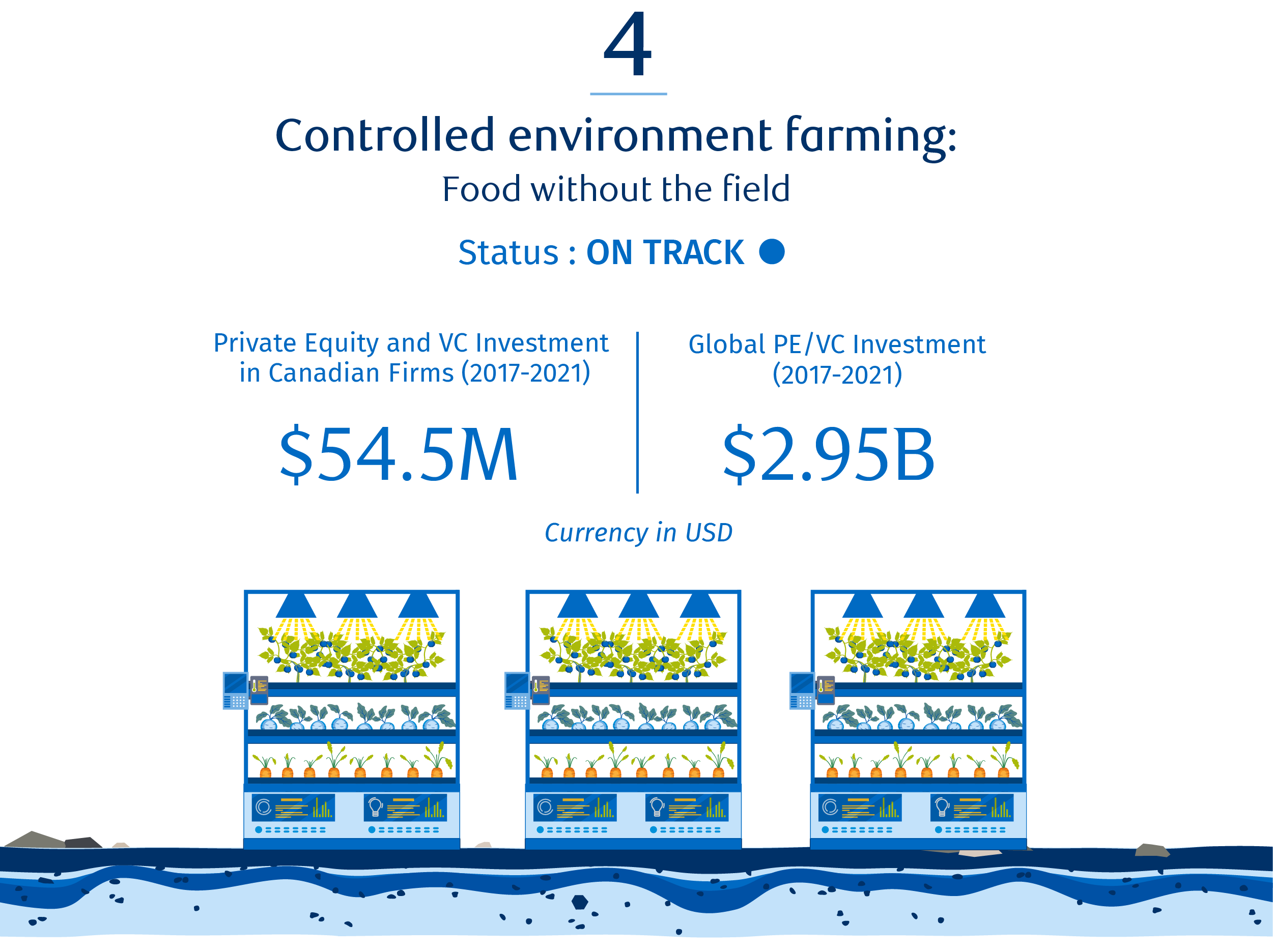
As we work to deploy these solutions today we’ll also need to keep an eye to the future, investing in earlier stage technologies that can help us adapt our food systems to climate change. “Controlled environment” agriculture, such as greenhouses and vertical farms that allow crops to be grown indoors and in stacked layers, is taking off around the world. Canada currently imports fresh produce at a low cost from regions that are far more vulnerable to climate change. Tech-based alternatives like these could help us maintain domestic food security in an increasingly volatile world of climate and political disruptions. Meantime, cellular agriculture and precision fermentation technologies, which are advancing rapidly, could increasingly provide consumers with alternatives to meat and dairy products.
“I think plant breeding could really do it for us. If you look at all the advances we’ve made in higher yields, disease, resistance, all these kinds of traits and that’s all been focused above ground. There’s an equal opportunity below ground to make all kinds of significant advancements.” Stuart Smyth, Associate Professor, College of Agriculture and Bioresources, University of SaskatchewanThe challenges: Artificial intelligence and data science, engineering, the “Internet of Things”, including sensors and drones, as well as biotechnology, are critical to the development of modern ag-tech. So are the skills that go with them. Yet efforts to draw this specialized talent and develop these skills among youth have fallen short of our needs.
Most support for Canadian research comes from public funding—which has been behind many of our successes. Marquis Wheat, which dramatically improved yields in the Prairies in the early 1900s, was developed through Dominion Experimental Farms—a system of stations, operated by the federal government, which investigated agricultural problems and created new techniques to assist farmers. Current funding programs can be onerous for researchers, particularly for emerging technologies that don’t fall easily into specific funding categories. And certain regulatory requirements—including those surrounding novel plant traits—can act as barriers to approval and investment in emerging areas of plant science like gene editing.
While Canadian researchers continue to rely on public investment, other countries including the U.S., are seeing most of their overall research dollars come from the private sector. Competing in the next era of agriculture will depend on our ability to mobilize more of this capital.
Fighting food waste
<class=”dark-blue”>Emissions arise not just from the food we grow but from the food we waste. In Canada, 58% of the food produced for human consumption is wasted or lost along the supply chain, of which 18% could be avoided.23 The economic cost of all that waste is $49 billion a year—a figure that climbs even higher when lost labour, transportation and other factors are accounted for.
Though a lot of waste happens during production and processing, just 14% of that is avoidable. Technological advancements have done much to eliminate food loss at the production stage, an effort driven in part by the cost savings it generates.
Among consumers, the problem of food waste is far more entrenched. Studies suggest 18% of all food produced is wasted in ways that could be avoided. Almost half of that avoidable waste comes from hotels, restaurants and households, with consumers in wealthier countries far more likely to waste food than those in poorer countries. As that food decomposes in landfills, it releases greenhouse gases, as much as 12 MT—when measured from end-to-end.
Solving the problem of consumer food waste means tackling a cluster of causes. These include time scarcity (consumers lack the time they need to plan meals and use food before it goes bad); a lack of education on how to prevent food waste through more thoughtful storage and use of cooking waste like vegetable stalks; and retail promotions that encourage consumers to buy more than they need.
In addition to cutting food loss, industry has done much to extend the shelf life of food through packaging and other controls. More novel packaging solutions are underway that use plant-based and microbial packaging and coating solutions to do the same. Sensors can tell us when food has actually spoiled rather than leaving consumers to rely on best before dates. And new business models are emerging, such as those that transform food that doesn’t meet retail standards into poultry feed and other uses.
But ultimately, solving the problem of food waste will depend on us.
Recommendations: Seeding change
Cutting our greenhouse gas emissions, while also meeting our responsibility to feed the world, is a challenge rife with uncertainty. With many agricultural technologies and farm practices still in nascent stages, and widespread adoption still elusive, questions will continue to hang over our actions.
This risks paralyzing our efforts at a time when there isn’t time to lose. The stakes of the current food crisis are staggering: shortages and high prices for staple goods, have put the lives and livelihoods of 345 million people in immediate danger of acute food insecurity.24 Low income countries, many of which depend on imports from Ukraine and Russia, including Somalia, South Sudan and Yemen, are among the most vulnerable. In North America and other higher income countries, soaring food prices due to shortages and post-pandemic inflation are also dominating public agendas.
The urgency of the situation means we’ll need to act boldly using the best tools we have today. And we’ll need to do it together. Policymakers, private businesses and producers will need to collaborate in new ways as we pursue a national strategy designed to support farmers. This begins by focusing on the building blocks we’ve identified above, and on the key pillars of technology, people, policy, and economics. Working with BCG Centre for Canada’s Future and the Arrell Food Institute, we’ll explore each of these pillars in depth in the coming months.
Building an agricultural sector fit for an age of climate disruption is a challenge unlike any we’ve faced. But few countries are better positioned than Canada to confront it.
The global threat of food insecurity growing. So, too, is our ability to lead a new age of innovation to both harvest our land and sustain it.
Planting a paradigm shift: Building the 4 key pillars of a low emissions food strategy
Policy
Establish a national plan for a low-emissions agriculture sector. Our plan for cutting emissions must take all stakeholders into account and rally not just farmers, but investors, private business and Canadians. Producing food more sustainably will mean making tough choices and supporting investment in key technologies, like carbon capture, utilization and storage (CCUS). It will also mean doing a better job of marketing Canada’s sustainable food to the world.
Lead efforts to create global alignment on a low-emissions food standard. Roughly 61% of our agricultural emissions are tied to goods that are ultimately exported. Advancing an emissions reduction strategy that’s misaligned with our key export markets could create friction in our trading relationships. We need to align trading partners around a common set of goals, indicators and GHG measurement, reporting and verification protocols. Canada, a longstanding supporter of free trade, and a global leader in multilateral processes, can lead these efforts.
Integrate agricultural strategies with energy strategies. Farmers are increasingly embracing opportunities to generate renewable natural gas from their operations. Integrating these efforts with a national energy strategy could help accelerate the deployment of clean energy both on and off the farm.
Technology
Create a central funding body for research and development, operating in close partnership with academia and the private sector. Many of the most promising and advanced areas of Canadian agricultural research don’t fit within current funding categories. A more centralized system such as in the United States Department of Agriculture, could develop a more holistic, nationwide view of where support and innovation is needed. The leadership shown by federal governments in creating the innovation super clusters provides a playbook for how Canada can super charge agri-food research and innovation.
Focus on technologies that hold the most promise to cut emissions. As we target funding to technology that accelerates productivity, we need to also attract more investment to technologies that cut emissions from key drivers in the supply chain—innovations like anaerobic digesters, feed additives and CCUS. Funding should also be focused on those technologies that enable sustainable practices to be adopted and rewarded, like soil sensors, and precision technologies.
Create innovative tax and financial incentives to spur more private investment. Accelerating private investment in Canadian agtech will mean thinking more creatively about the tax and financial incentives we have in place. We need to encourage the automation that will be key to our agricultural productivity and international competitiveness—and that will draw more capital to the technologies that will drive the future of low emissions farming. Expanding accelerated depreciation beyond tangible assets to include artificial intelligence and other agtechs is one possibility.
Economics
Make it pay. Forcing farmers to pay for emissions they already produce could add pressure to high food prices. A better approach is to compensate farmers for reducing them. Yet existing models like carbon credits are insufficient and place an unequal burden on the farmer. A national standard for measuring the impact of emissions-cutting activities, including a mechanism for measuring, reporting and verifying (MRV) carbon stored in soils, could be critical to compensating farmers and to empowering policymakers and financial institutions to mobilize support. This standard—also key to attracting investment—will need to be designed and regulated on a national basis and aligned internationally with our major trading partners.
Share the risk. For farmers, the adopting of emissions-cutting technology adds more uncertainty to a business already weighted with risk. Governments and other companies in the agricultural value chain have an important role to play in sharing the risk burden. That’ll mean insuring against yield losses for farmers who adopt sustainable practices. For example, right now there is no incentive for sustainable agriculture under crop insurance schemes though these practices are proven to reduce the impact of flooding and drought. Crop insurers should be willing to adjust premiums to reflect these shifting risks.
People
Build the skills. Leverage the Labour Market Information Council to pinpoint the skills farmers need to shift toward a more resilient food system. As we’ve noted in previous research, digital skills will be critical to the future of food production.25 So too will knowing how to apply tools in ways that cut emissions. Beyond data and technology, some farmers will need support to employ regenerative agriculture techniques and other tools on the farm. Experiential learning platforms including hands-on mentorship and co-op programs can accelerate this transition.
Broaden the talent pool. The lack of awareness about the potential for a fulfilling career in agriculture has hampered recruitment of individuals with the coding, artificial intelligence and data science skills critical to the future of food. Yet few sectors hold greater potential for innovation than agriculture. Educating students on the opportunities in the field—through co-ops, outreach and liaison programs—will be critical to bringing their talents to the challenge.
For more, go to rbc.com/climate.

Download the Report
Contributors:
RBC
Naomi Powell, Managing Editor, Economics and Thought Leadership
John Stackhouse, Senior Vice President
Colin Guldimann, Economist
Farah Huq, Senior Director, Content Strategy
Darren Chow, Senior Manager, Digital Media
Trinh Theresa Do, Senior Manager, Thought Leadership Strategy
Zeba Khan, Manager, Digital Publishing
Aidan Smith-Edgell, Research Associate
Kitty Wu, Intern
Gwen Paddock, Director, Sustainability & Climate – Agriculture
Ryan Riese, National Director, Agriculture
Boston Consulting Group
Keith Halliday, Director, Centre for Canada’s Future
Kilian Berz, Managing Director and Senior Partner
Shalini Unnikrishnan, Managing Director and Partner
Sonya Hoo, Managing Director and Partner
Chris Fletcher, Managing Director and Partner
Thomas Foucault, Managing Director and Partner
Wendi Backler, Partner and Director, BCG Centre for Growth and Innovation Analytics
Kate Banting, Head of Marketing and Social Impact
Simon Beck, Principal
Youssef Aroub, Project Leader
Ilana Hosios, Consultant
Anguel Dimov, Consultant
Pilar Pedrinelli, Consultant
Zahid Gani, Consultant
Rachel Ross, Consultant
Rachit Sharma, Lead Knowledge Analyst, BCG Centre for Growth and Innovation Analytics
Arrell Food Institute, University of Guelph
Evan Fraser, Director
Margarita Fontecha, Arrell Food Institute Scholar, Ph.D. Candidate, Environmental Design and Rural Development
Laura Hanley, M.Sc. Student, Food Science
Ibrahim Mohammed, Ph.D. Candidate, Environmental Sciences
Deus Mugabe, Ph.D. Candidate, Plant Agriculture
Brenda Zai, M.Sc. Student, Food Science
Dr. Krishna KC, Research Scientist
Dr. Jesus Pulido-Castanon, Post-doctoral Research Associate
Emily Duncan, PhD Candidate
1. This figure does not include downstream processing, transportation, retail or food service operations. See methodology.
2. See methodology.
3. World Population Growth – Our World in Data
5. World Economic Forum (weforum.org)
7. Why You Should Care About Farmland Loss – Canadians for a Sustainable Society
8. key-sectors-secteurs-cles-eng.pdf (budget.gc.ca)
9. UPDATE 1-Spain lobbying European Commission to buy emergency corn from Argentina | Reuters
10. China Set to Import Brazilian Corn in Challenge to US Supply – Bloomberg
11. The Daily — Farm income, 2021 (statcan.gc.ca)
12. Climate Change Is Hitting Farmers Hard – Scientific American
14. Fifth Assessment Report — IPCC
15. Global Warming Potentials (IPCC Fourth Assessment Report) | UNFCCC
16. SPARK-FERTILIZER-USE-IN-CANADA-REPORT-2022-VF_08_04_2022.pdf (fertilizercanada.ca)
18. In other words, over 20 years, one gram of methane produces 85 times the amount of warming as a gram of carbon dioxide.
19. Home Page – Simpson Centre
20. Home Page – Simpson Centre
22. Canada’s 2020 Biogas Market Report : Canadian Biogas Association
23. The Avoidable Crisis of Food Waste: Technical Report (secondharvest.ca)
24. Global Food Crisis Demands Support for People, Open Trade, Bigger Local Harvests (imf.org)
25. Farmer 4.0: How the Coming Skills Revolution Can Transform Agriculture – RBC Thought Leadership
Farmer 4.0: How the Coming Skills Revolution Can Transform Agriculture – RBC Thought Leadership
In addition to those cited in this report, we’d like to thank the following individuals for their insights:
Katie M. Wood, Associate professor, Ruminant Nutrition and Physiology, University of Guelph
Lisa Ashton, PhD Candidate, University of Guelph
Lenore Newman, Canada Research Chair in Food Security and the Environment and Professor of Geography, Simon Fraser University
Dennis Laycraft, Executive Director, Canadian Cattle Association
Brenna Grant, Executive Director, Canfax Research Services
Mark Thompson, Executive Vice President, Chief Corporate Development and Strategy Officer, Nutrien Ltd.
Michelle Nutting, Director, Agricultural and Environmental Sustainability, Nutrien Ltd.
Dan Heaney, Research Associate, Plant Nutrition Canada
Tom Steve, General Manager, Alberta Wheat Commission
Jason Lenz, Vice President, Alberta Wheat Commission
Dan McCann, CEO, Precision AI
Daniel Brisebois, Ferme Coopérative Tourne-Sol
Juanita Moore, Vice President of Corporate Development, GoodLeaf Farms
Janay Meisser, Director of Innovation, United Farmers of Alberta
Les Wall, CEO, KCL Cattle Company
Kate Parizeau, Associate Professor, Department of Geography, Environment, and Geomatics, University of Guelph
Tammara Soma, Assistant Professor, School of Resource and Environmental Management (Planning), Simon Fraser University
Mauricio Alanís, Director, Sustainability Strategy and Partnerships, Maple Leaf Foods
Ryan Phillippe, Director, Corporate Development, Genome Canada
Josh Bourassa, Research Associate, The Simpson Centre for Food and Agricultural Policy
Guillaume Lhermie, Director, The Simpson Centre for Food and Agricultural Policy
Lejjy Gafour, President, Cult Food Science Corp.
Jane Church, Corporate Engagement Manager, Nature United
Tony Ward, Professor Emeritus, Department of Economics, Brock University
Tyson Kamminga, Chief Financial Officer, Kroeker Farms Limited
Wayne Rempel, CEO, Kroeker Farms Limited
Brian Gilvesy, CEO, ALUS
Dave MacMillan, CEO, Deveron UAS
Derek Eaton, Director of Public Policy Research and Outreach, Smart Prosperity Institute
David Hughes, President and CEO, The Natural Step Canada
It’s now clear that the national priorities of Net Zero and reconciliation with Indigenous Peoples are inextricably linked. In the same spirit, we expect RBC’s reconciliation journey will increasingly intersect with our climate priorities.
92 to Zero highlights the incredible value that Indigenous capital, knowledge and decision-making can bring to a Net Zero transition. We’ve recently launched a national initiative of “listening circles” led by former Assembly of First Nations national chief Phil Fontaine that this report will help inform and inspire—and lead to more from us in the years ahead.
Now, each of us must act to break down the ongoing systematic barriers that prevent the full realization of Indigenous capital, supporting reconciliation and climate action. We hope this report will propel us further down that path.
We acknowledge that RBC resides on the traditional and contemporary treaty, and unceded territories of Turtle Island (North America) that are home to many First Nations, Inuit, and Métis peoples.
Key Findings
- Canada’s road to Net Zero will rely heavily on vital sources of capital held by Indigenous nations. RBC estimates Canada needs roughly $2 trillion in capital over the next 25 years, much of it from Indigenous sources—or unlocked by Indigenous partnerships, including ownership.
- An Indigenous-led approach to the climate transition, and economic opportunities toward Net Zero, will be essential to economic reconciliation.
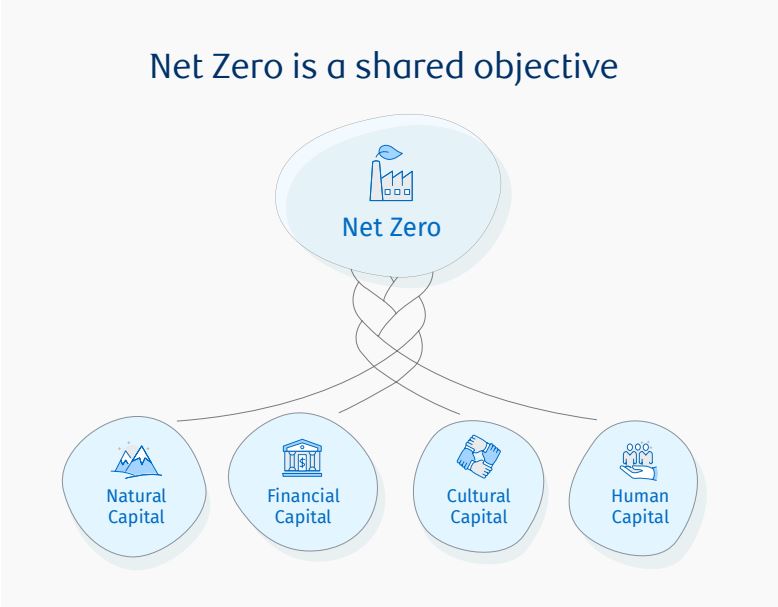
- Specifically, to achieve Net Zero and economic reconciliation, Canada needs to leverage four forms of Indigenous capital:
What is 92?
To redress the legacy of residential schools and advance the process of Canadian reconciliation, the 2015 Truth and Reconciliation Commission issued 94 calls to action. The 92nd dealt specifically with business and reconciliation.
We acknowledge that RBC resides on the traditional and contemporary treaty, and unceded territories of Turtle Island (North America) that are home to many First Nations, Inuit, and Métis peoples.
Indigenous communities can unlock green economic growth
For many Indigenous Peoples in Canada, braiding is a sacred act. It brings together seemingly disparate sinews, with the goal of building a stronger, more unified whole. Strands of hair, breakable on their own, become more resilient when braided together. Blades of sweet grass are woven and burned with sage, cedar, and tobacco, the ceremony strengthening the community, which in turn cares for the plant.
Similarly, to meet the generational challenge of climate change, Canada must weave together the critical strands of Indigenous capital to secure a durable Net Zero strategy.
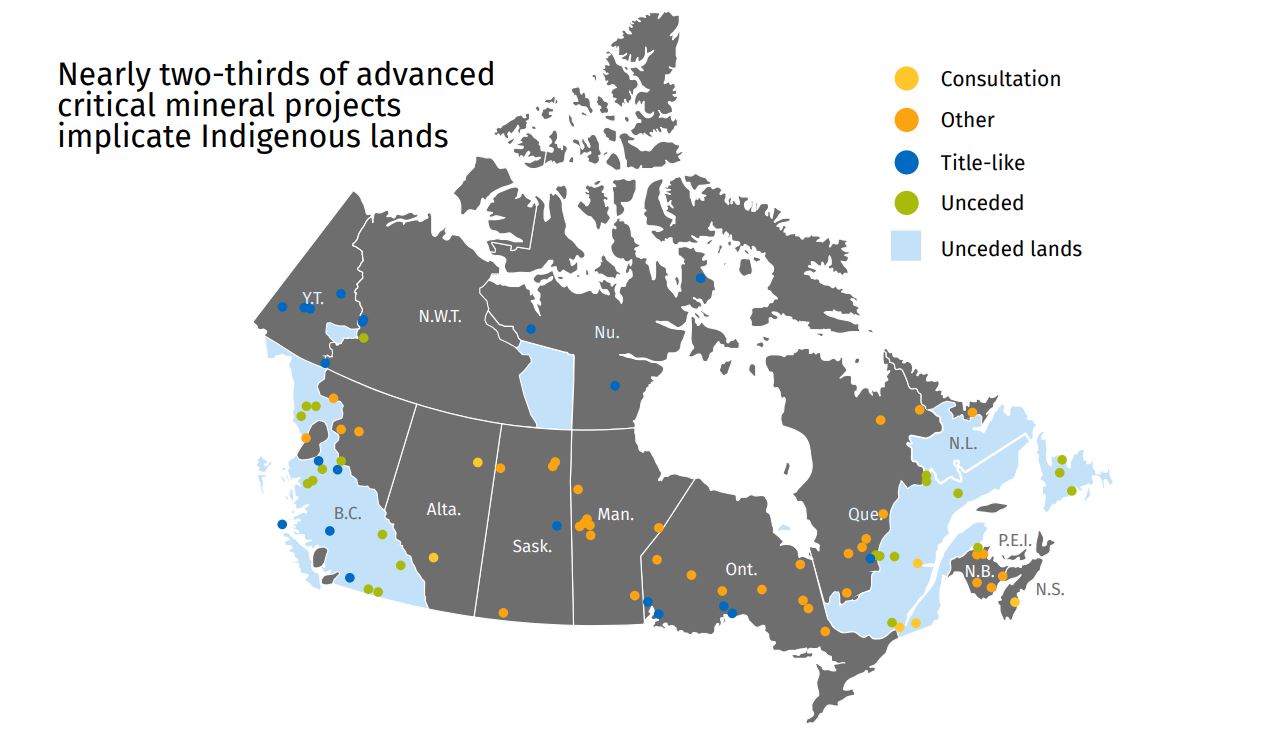
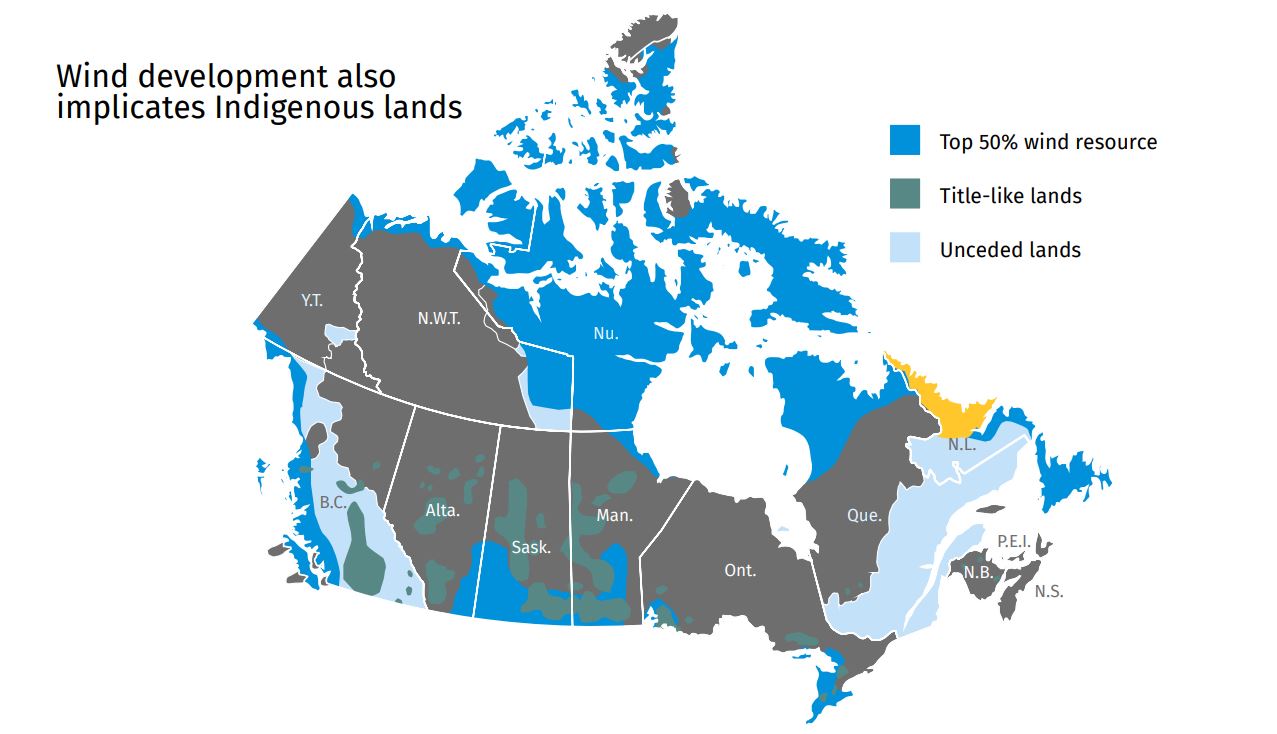
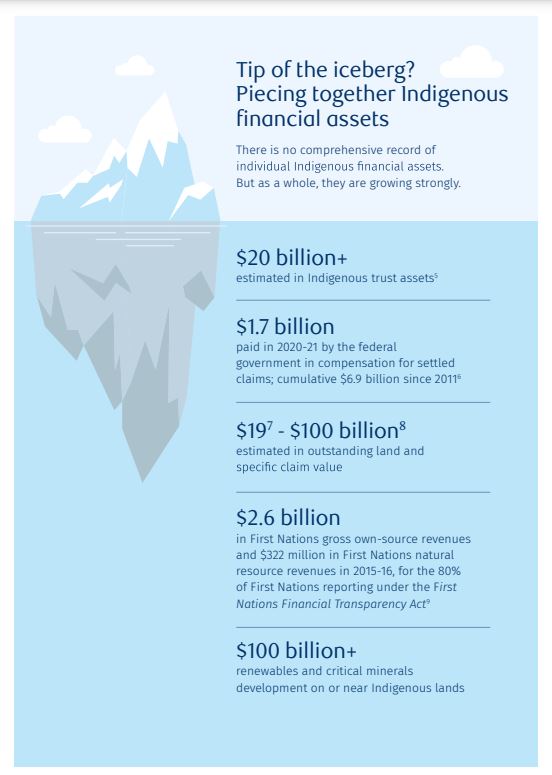
This new approach is about much more than money. It includes natural capital—vast portions of critical mineral, solar and wind developments depend on access to Indigenous lands—along with growing Indigenous wealth (financial capital), traditional Indigenous knowledge (intellectual capital) and powerful Indigenous entrepreneurship and talent (human capital). Each is required to strengthen the whole.
To unleash this capital, Canada will need new tools for clean energy development. That means establishing stronger corporate commitments and incentives for Indigenous partnership, greater sharing of project benefits, and financeable models of Indigenous equity participation. It means developing investment criteria that incorporates Indigenous perspectives and more intentional development of Indigenous entrepreneurs and youth leadership.
Above all else, it means establishing a new approach to partnership, one that reinforces the role of Indigenous rights, leadership, decision-making and consent.
These concrete actions will pull growing sources of Indigenous capital toward Net Zero. They’ll also mobilize critical private capital, by building a foundation of predictable development, better environmental outcomes, and expansive social impact.
Meaningful partnerships can’t be rushed. But the demands of the Net Zero transition are immediate—and there’s only one opportunity to get it right.
The onus now is on everyone to move forward together.

Natural Capital: The path to Net Zero winds through Indigenous land
Canada comes to the global climate challenge with a unique set of advantages. Its landscape includes vast quantities of both conventional and renewable energy resources—assets that, while enviable, bring challenges. Even as the country continues to rely on oil and gas, and works to more sustainably produce it, it’ll need to begin harnessing the resources to power the clean economy of the future.
And these resources are attached largely to Indigenous lands. RBC research shows at least 56% of advanced critical minerals projects involve Indigenous territory. Top opportunities for renewables development also overlap with Indigenous lands, including at least 35% of top solar sites and 44% of better wind sites. And Indigenous rights exist over many other territories that will require engagement.
To include these assets in its Net Zero strategy, Canada will need a new model for Indigenous partnerships—one that begins with meaningful engagement and consent.
Indigenous land contains key resources
- At least 56% of the $60 billion in new critical mineral advanced projects involve Indigenous lands, including 26% within 20 kilometres of Indigenous reserves, settlement lands, and other title-like areas, and another 30% on unceded territories where Indigenous rights are asserted.
- At least 35% of the top sites for the required $30 billion in solar development are near title-like lands.
- And at least 44% of the better sites for the needed $135 billion in wind development are near title-like lands.


Indigenous communities have ‘a say’, but not decision-making power
Greater legal and political recognition of land rights has empowered Indigenous voices at the negotiating table for development projects, particularly in unceded and modern treaty territories.
These advancements follow decades of government policy that removed Indigenous Peoples from decision-making and deprived them of long-held land and treaty rights. This created a cycle of underinvestment, poverty, and trauma that persists in many communities today.
How Indigenous Peoples were isolated from decision-making
Early cooperation between distinct and sovereign settler and Indigenous groups created mutually beneficial trade and strategic military alliances that aided European survival on the land. But over time, official government policies of land dispossession, paternalistic suppression, and cultural assimilation took hold. The government never fully honoured original agreements and it removed Indigenous Peoples from the decision-making table.
It’s now clear that the national priorities of Net Zero and reconciliation with Indigenous Peoples are inextricably linked. In the same spirit, we expect RBC’s reconciliation journey will increasingly intersect with our climate priorities.
92 to Zero highlights the incredible value that Indigenous capital, knowledge and decision-making can bring to a Net Zero transition. We’ve recently launched a national initiative of “listening circles” led by former Assembly of First Nations national chief Phil Fontaine that this report will help inform and inspire—and lead to more from us in the years ahead.
Now, each of us must act to break down the ongoing systematic barriers that prevent the full realization of Indigenous capital, supporting reconciliation and climate action. We hope this report will propel us further down that path.
We acknowledge that RBC resides on the traditional and contemporary treaty, and unceded territories of Turtle Island (North America) that are home to many First Nations, Inuit, and Métis peoples.
As Indigenous communities regain rights and sovereignty, business methods are inching closer to the true spirit of initial cooperative agreements between Indigenous and settler societies, or
Treaties, that guided the sharing of land and living together in parallel.
But conflicts continue to erupt, including public demonstrations against development companies. While the courts have signaled a growing willingness to set precedent for consultation, they’ve also established that Indigenous rights are not absolute.
Government often navigates difficult decisions in the overall national interest. But this maxim has led to problematic policy and flawed corporate approaches to Indigenous engagement. Too often, Indigenous Peoples have been given only checkbox approval on planned projects that don’t respect their community values, governance, timelines, or consensus-building processes.
Resulting clashes have led to cancelled projects, runaway costs and timelines, and rushed planning phases that fail to leverage extensive Indigenous knowledge of land stewardship.
An oppositional approach is one way to pursue energy development. But it’s not the optimal one. Resulting court challenges, broken social trust, delays, and investment uncertainty pose a sizeable threat to Canada’s climate ambitions.
Striking true partnership
Some Indigenous leaders have told Canada’s business community they’re thinking about this in the wrong way. Rather than represent a project risk, Indigenous Peoples could bring something unique to the table. They can potentially improve certainty and returns, offer deep location-specific knowledge and better environmental and social outcomes. And as the rights of Indigenous
Peoples continue to draw international attention, their reintegration into clean energy development could emerge as a competitive strength.
“I think a lot of proponents are going to have to shift their mindset from thinking of Indigenous people as a risk to a possible source of capital and an enhancement to their project.”
Mark Podlasly
Director Economic Policy
First Nations Major Projects Coalition
To realize it, Indigenous communities must be engaged as true partners. That means including their voices, values, knowledge and decision-making from the earliest stages of a project. Sufficient time needs to be allotted for this process, similar to the months or years afforded for Western development work.
Meaningful engagement and consent is an ongoing exercise of building trust, sharing information, and acting to realign the terms of the partnership based on evolving priorities. It also includes the possibility of saying no—some projects will not align with community values, and they may have to be rerouted or in some cases abandoned.
The power of Indigenous equity
Indigenous equity ownership of new energy projects is rising. Equity improves the risk profile of projects, both through ongoing information sharing and the ability of both parties to shape their direction.
Equity participation can build intergenerational wealth and guide land stewardship. This aligns with the long-term sustainable world view of many nations and in particular, the Haudenosaunee (Iroquois) Seventh Generation Principle, where decisions are partly determined by the impact they’ll have on the next seven generations.
By contrast, near-term commitments in many of today’s impact benefit agreements (around Indigenous procurement, employment, community investment or royalties) are increasingly out of sync with the priorities of Indigenous communities, especially in light of the valuable sources of capital they control.
Equity is not a universal solution. Some communities may not have the risk appetite or expertise to manage equity investment. Infrastructure development is complicated and risky, and project finance lenders may be wary of significant partners that lack major construction or operational experience. Certain projects that focus on transition fuels or non-dominant abatement technologies—like oil, natural gas, or carbon capture, utilization, and storage—could carry long-term risks.
And equity isn’t always an option for the Indigenous communities that want it. Even communities that have revenue-generating activities may find a portion of the equity contribution is unfinanceable by private lenders. For communities that lack any revenue-generating activities, the equity option is even further out of reach. Project proponents, financial institutions, and governments need to eliminate this equity financing gap. Greater capacity building and advisory services are then needed to support communities in making informed choices between different partnership arrangements, and negotiating the best terms.
“Our nation is not new to industrial development […] essentially we’ve sat on the sidelines and witnessed the destruction of our territory, our environment, and our cultural resources to being active partners within a process where we had a seat at the table.”
Chief Crystal Smith
Haisla First Nations Chair
First Nations LNG Alliance
Financial Capital: Indigenous leadership will help fuel the $2 trillion transition
Large Canadian firms with $8 trillion in global assets have committed to Net Zero, yet annual spending on green projects is still far short of the $80 billion per year required. Indigenous financial wealth isn’t at the scale needed to lead financing of the $2 trillion Net Zero transition. But with more than $20 billion in trust assets and up to $100 billion in outstanding land and other claims, it can nevertheless make a significant impact.
The bigger opportunity rests in the power of Indigenous financial capital and consent to crowd in the larger private funding needed for Net Zero—by derisking projects, boosting returns, improving environmental outcomes, and increasing social acceptance. Mobilizing investors to support Indigenous-aligned responsible investment will accelerate this process while also enhancing economic reconciliation.
Indigenous assets cycle back into communities
Greater recognition and application of Indigenous land rights have added to the financial wealth of Indigenous communities. These additions stem partly from land claim settlements or compensation for past violations of treaty or other rights. With over 250 specific claims awaiting negotiation and over 160 currently under review, as well as ongoing litigation and land claims, further increases in these assets can be anticipated.
Distinct from individual wealth, these assets are for the benefit of the community, supporting spending on physical, social or cultural infrastructure, economic development, or disbursements to members. They are increasingly being used to decarbonize local communities, including Net Zero projects in the built environment, renewable energy developments or transmission lines that bring cleaner electricity to diesel-reliant remote communities, or equity stakes in sustainable projects such as transition fuel facilities or wind and solar farms.
The Senákw project on Squamish Nation reserve land in Vancouver—a 12-tower, mixed-use development—is the largest First Nations economic development project in Canadian history and Canada’s first large-scale net zero housing development . To be developed in partnership with a private developer, the Nation is contributing the land. Costing $3 billion to construct, it could generate $8-12 billion in revenue for the Nation over the leasehold life
While growing, Indigenous financial assets remain undersized, a result of the historic non-recognition of Indigenous rights and suppression of the Indigenous economy. There’s also significant variation in the financial wealth held by communities based on treaty status (unceded, modern, or historic), location (urban or remote) and proximity to major resource projects. For example, the Squamish, Musqueam, and Tsleil-Waututh nations have major developments on their traditional unceded territories around and within modern day Vancouver. By contrast, a limited sample of 500 First Nations from 2015 to 2016 showed 50% had revenues below $3 million, whereas the top nation earned almost $100 million.

Formally recognizing the value of Indigenous partnership
Indigenous leaders can provide the greatest long-term certainty around infrastructure development. And Western developers and scientists are starting to recognize the value of Indigenous knowledge in project design.
Governments and leading project sponsors need to financially recognize the value Indigenous partners bring to the table. Fair compensation will lead to a growing Indigenous financial asset base that can be invested back into community wellbeing and position nations for Net Zero investment. That means finding new valuation models that go beyond lands leased or rights-of-way. Right now, communities that seek an equity share after the risky construction phase often purchase a stake in a more valuable project—but at a higher cost. This is despite their active participation in helping to de-risk it from the beginning. In terms of traditional knowledge, communities are often reimbursed for their time or monetary outlays, but not necessarily for their intellectual property as ‘consultants on the land’. Appropriately classifying these features as accretive to project returns may lead to their monetization, helping to close the Indigenous financial asset and equity financing gap.
Indigenous-aligned responsible investment
Successful Indigenous communities are investing in financial products consistent with their cultural values and using activist strategies to push companies to do better. They’re scaling their impact and building capacity through partnerships with like-minded investors. The National Aboriginal Trust Officers Association (NATOA), a resource and training organization, and Share, a responsible investment organization, have created the Reconciliation and Responsible Investment Initiative. It seeks to mobilize Canadian investors to “… use their voices and their capital to promote positive economic outcomes for Indigenous peoples including through employment, support for Indigenous entrepreneurs, increased partnerships with Indigenous communities and respect for Indigenous rights and title”10.
There’s a growing understanding that Indigenous entrepreneurs and communities could be a valuable focus for impact investing approaches. Also, that Indigenous factors, like Indigenous project co-development or Indigenous say in corporate governance, may be important to the overall performance of companies and projects. But while intentions are on the rise, the tools and regulatory framework to mobilize finance remain in the early stages.
- The ESG standards increasingly being deployed across capital markets have largely omitted Indigenous priorities and perspectives, and were developed without Indigenous input.
- Too often, Indigenous issues are considered an “S” factor in ESG modelling, which overlooks the singular legal foundations of Indigenous participation, as well as the unique environmental nature of Indigenous-led or -guided development.
- The $1.3 trillion dedicated sustainable equity fund market has no funds with an explicit focus on Indigenous issues.
- Investor demand has been insufficient to establish investment products aligned with Indigenous priorities.
- Concrete business commitments to Indigenous issues are not significant enough—or disclosed and verifiable—to build diversified products.
As the investment environment changes, corporate and investor inaction on climate and Indigenous priorities becomes increasingly salient to the bottom line.
“Investors are going to need to see this as not as some sort of forecasted or predicted risk. They’re actually going to need to see climate change as having material impact on assets that they own..”
Joseph Bastien
Share
Reconciliation and Responsible Investment Initiative
Intellectual Capital: The power of Indigenous land stewardship and knowledge
Indigenous capital is more than natural and financial capital. Recognition of the value of Indigenous voices and knowledge can be a powerful driver of both economic reconciliation—and growth.
Generations of traditional Indigenous knowledge have shaped an approach to land management that ensures the long-term sustainability of ecosystems. Each community specializes in preserving the delicate interrelationships between people, plants, and animals in its traditional territory. This approach is holistic, anchored in the interconnectedness of the environment, well-being and culture. It’s about the principle of reciprocity and sustainability. It is not rigid, but evolving.
As Canada seeks to build a prosperous economy while also minimizing environmental damage, preserving biodiversity, and developing nature-based carbon sinks for climate management, Indigenous knowledge and ways of knowing will become critical competitive advantages.
Leveraging these assets can also extend economic opportunities to Indigenous Peoples that haven’t traditionally benefitted from land rights.
But it’ll mean embracing a different world view.
Two-eyed seeing leads to better outcomes
Etuaptmumk, or two-eyed seeing, is a Mi’kmaq principle that calls for seeing from one eye with the strength of Indigenous stewardship, knowledge, and ways of knowing, and from the other with the strength of Western tools and systems. Bringing both perspectives together can create thoughtful, and more profitable Net Zero solutions.
Uniting place-based Indigenous knowledge with Western scientific methods improves the outcomes of environmental studies for development projects. By itself, the traditional scientific approach may only offer a narrow window into the local environment and require advanced extrapolation—for instance, on the baseline migratory patterns of fish or how to restore a reclaimed project site to its original ecosystem from decades ago. Indigenous knowledge, acquired over centuries of climatic variation, can augment or contextualize this information, producing more robust conclusions. Similarly, Western methods can complement traditional knowledge. For example, tracking devices on at-risk local species can expand information on and understanding of their movements.
“[Mi’kmaq Ecological Knowledge] is a cumulative body of knowledge that is passed on from generation to generation, Elder to child and is dynamic. MEK draws upon the ever changing natural world—as ecological knowledge changes over time, and new experiences bring forward new understandings regarding the Earth’s ecology, the Mi’kmaq will continue to learn, grow and share, just as they have done for over ten thousand years.”
Mi’kmaq Ecological Knowledge Study Protocol
Assembly of Nova Scotia Mi’kmaq Chiefse
Federal laws now require incorporation of Indigenous knowledge in the environmental assessment process, with interim guidance saying that traditional knowledge should be viewed as providing a framework “as complementary and influential information alongside Western science”.
But Indigenous knowledge does not yet have an equal place in environmental studies. Whereas Western science is afforded months, or even years, to do its work, assessment processes now often only have a short timeline for Indigenous input near the end. Indigenous communities often do not have this information readily available as it must be collected from knowledge-holders in the community, and they may be reluctant to share if trust is not strong. Others may want to produce their own traditional knowledge-based studies.
Human Capital: A new generation of leaders is driving innovation
Stronger say over local project development, growing wealth, and recognition of the value of Indigenous knowledge is empowering a new generation of Indigenous Peoples and entrepreneurs. The Indigenous economy, estimated at over $30 billion per year in 2016, is outpacing growth in the overall national economy and is poised to grow to $100 billion by 2024.
Driving change is a growing group of young, educated Indigenous leaders. These leaders are advancing new models of economic reconciliation and development. Supported by stronger land rights and growing capital, they’re pursuing an Indigenous-led approach to sustainable economic development that connects investment and community prosperity. They’re building networks with other Indigenous leaders past and present and often acting through increasingly influential Indigenous-led business and advocacy organizations, such as the Canadian Council for Aboriginal Business, First Nations Major Projects Coalition (FNMPC), Indigenous Resource Council, or National Aboriginal Capital Corporations Association (NACCA).
Many are heads of major economic ventures and are building a new model for the upcoming generation, which still sees limited Indigenous representation in corporate Canada. In 2020, only 0.3% of corporate board seats were held by Indigenous persons, despite their 4.9% share of the population.
Corporate Canada is increasingly seeking Indigenous perspectives and representation. As it does, it will be important that it doesn’t hoard Indigenous talent, especially from remote communities. Corporations that have a clear social purpose and use innovative models to share Indigenous talent with their communities are more likely to be successful.
Local talent can be a competitive advantage
The Net Zero projects brought by Indigenous leaders to their communities will have a powerful pool of human capital to draw from. And many communities are interested in economic partnerships that include long-term employment benefits. This means higher-value Indigenous employment and skills development that outlives the project, and includes opportunities at all levels including planning, design, construction, management, and operations.
This is also in the interest of project sponsors. For one, it’s a sign of the true partnership Indigenous leaders will be looking for when selecting collaborators. Additionally, in a world of acute labour shortages and fragile, cost-pushing global supply chains, a network of trusted local employees and suppliers delivers value. Building these networks takes time. But Canada’s energy system transition will be an intergenerational project.
The Net Zero transition can benefit from an Indigenous workforce that’s younger than for Canada as a whole. Indigenous youth are the fastest-growing population cohort, with their numbers expanding four times quicker than the non-Indigenous population. Indigenous people are increasingly pursuing postsecondary qualification, especially women, 52% of whom had a postsecondary qualification in 2016. Indigenous youth value their languages, identity and culture, and are confident in their foundational skills—including critical thinking, communication, or collaboration, which are all central to the future of work. The already strong employment of Indigenous people in Canada’s resource economy and skilled trades occupations, and greater proximity to remote areas, means an easier transition to the skills needed for green infrastructure and clean energy.
Meanwhile, Indigenous entrepreneurs are developing new businesses at nine times the Canadian average with 50,000 Indigenous-owned businesses across diverse Canadian sectors. Many of these businesses are promoting Indigenous values and knowledge, from Cheekbone Beauty—founded by Jenn Harper, an Anishinaabe woman whose line of high quality sustainable cosmetics is giving back to the community—to the SIKU mobile app, an Inuit-led social network to help hunters share real-time knowledge of ice conditions and animal behaviour.
Moving forward with reconciliation also means not hiding from the past or the impact that endures in so many Indigenous communities. All Canadians, including Canadian business, have a greater role to play in reconciliation, including supporting new approaches to education and pathways to employment, as we explored in our 2021 report, Building Bandwidth. Whether it’s apprenticeship and co-op opportunities for Indigenous students or capital for young entrepreneurs, a skills-centric approach to the climate transition will be critical.
“I think about the advancements [that Indigenous groups have] and it’s a small group thinking outside the box, thinking about innovation. What we need to figure out and address is how to bring everyone with us and continue to strengthen capacity in our communities.”
Chief David Jimmie
CEO at Squiala First Nation,
President Stó:lō Nation Chiefs Council
Capacity planning and supports are needed. Indigenous-led organizations are providing some of that—in addition to NATOA, First Nations Major Projects Coalition (FNMPC) and others, AFOA Canada provides capacity development in Indigenous management, finance, and governance. The Indigenous Leadership Development Institute Inc. (ILDII) builds leadership capacity in Indigenous people with specific training. But greater access and new partnerships will be critical.
More financial innovations are helping address the longstanding capital gaps between Indigenous communities and the rest of the country. It would take about $83 billion in capital to close the financing gap based on 2013 estimates. But Indigenous entrepreneurs still face barriers that other Canadian entrepreneurs don’t. Limits from the Indian Act and government underinvestment in assets continues to constrain the use of homes or other sources of collateral for conventional lending.
Innovative approaches can often work around this, but the complexity can scare off some lenders, or cause significant risk aversion in Indigenous lending. And with the need to access multiple government, Indigenous organizations, and private programs to obtain financing, application processes and timelines can be complex and time consuming.
A Way Forward
In her book, Braiding Sweetgrass, Robin Wall Kimmerer describes the propagation of sweet grass as growing not from the wind or animals but by underground root systems called rhizomes. Having long survived unseen, the Indigenous community is now emerging with strength and taking hold of prosperity grounded in recognition of the essential strands that nourished it: natural, human, financial, and intellectual capital.
To get to Net Zero, Canada will need to bring this Indigenous capital together with non-Indigenous capital through positive intent and deliberate action. If this is done right, it can promote reconciliation and a prosperous Net Zero future for everyone.
Here are some key questions Canadians need to address:
- What are the steps of engagement that project proponents must develop with Indigenous communities to achieve and maintain consent for development, given evolving definitions of consent and community-specific priorities?
- How can Indigenous communities proactively communicate their internal governance structures, preferred engagement processes, and general posture or conditions for clean energy and infrastructure development?
- How can better equity participation models be developed to encompass the wide range of assets, ambitions and priorities across Indigenous communities?
- How can non-Indigenous and Indigenous-led financial institutions and governments fill gaps in the project financing needed to ensure meaningful Indigenous ownership?
- How can international ESG standards and metrics be adapted to incorporate Indigenous perspectives and Canada-specific context, including legal rights framework?
- What are the best practices for meaningfully hearing and integrating Indigenous knowledge and perspectives in project decision-making processes as well as broader economic development strategies?
- How can Indigenous communities be supported in projecting the labour supply, skills, or supplier network needed to actively participate in economic development opportunities?
For more, go to rbc.com/climate.

Download the Report
Contributors:
- John Stackhouse, Senior Vice President
- Cynthia Leach, Assistant Chief Economist
- Alanna La Rose, Manager, Strategic Partnerships
- Colin Guldimann, Economist
- Darren Chow, Senior Manager, Digital Design
- Naomi Powell, Managing Editor, Economics and Thought Leadership
In our post-pandemic world, there is no issue more pressing than climate change. This fall on Disruptors, an RBC podcast, we launched a multi-part series called The Climate Conversations, which explored some of the potential solutions to a warming planet—as well as the challenges in implementing them.
Arguably no part of the Canadian economy has more work to do on climate action—but also more opportunities to innovate—than Canada’s oil and gas sector. Co-host Trinh Theresa Do spoke with a key player in the sector: JP Gladu, a Suncor Energy board member and executive director of the Indigenous Resource Network.
In this special extended cut of the conversation, we hear more from Gladu on how oil and gas companies (such as Suncor) can prosper in a Net Zero world; why reconciliation and sustainable development go hand-in-hand; and the importance of a “just transition” for Canada’s First Nations.
Build confidence, build supports, build infrastructure.
Those are some of the calls we heard from Indigenous leaders in the tech space, when we brought a roundtable together to discuss Building Bandwidth, RBC’s recent report on preparing Indigenous youth for a digital future. The report makes the case for harnessing the power of two growing forces in Canada: the rapidly advancing economy, and the emergence of Indigenous Canadians as the fastest growing youth demographic in the country.
Building Bandwidth was always intended as a conversation starter. Here are five ideas for moving forward, based on insights from Indigenous techies across Canada.
1. “Cohort in community”
Everyone agrees: technology needs to play a bigger role in K-12 education.
But there’s an important caveat. Developing new skills should be community-driven. Parents and teachers play a critical role in nurturing young people’s budding tech skills—they’re the “influencers” long before kids discover Instagram and TikTok.
Blaire Gould, who promotes technology in schools as the executive director of Mi’kmaw Kina’matnewey in Nova Scotia, talked about the value of youth learning alongside others in their community: making friends, building connections. This practice, “cohort in community,” produces better results than pursing school and training elsewhere. Too often, Indigenous youth feel compelled to leave their communities, and find themselves missing their support net and overwhelmed by culture shock.
Similarly, an outside organization coming into the community for a one-off event or weekly workshop doesn’t cut it either, according to Jace Meyer, the executive director of the Indigenous Innovation Institute. That tends to create an “us and them” divide, leaving the impression that the skills came into the community but then left again.
2. Roll out the role models
When Indigenous students don’t see themselves reflected in the tech programs or companies that interest them, it makes them far less likely to take a chance on applying.
Tara Rush, who collaborates with Indigenous communities in her work at Google in Waterloo, talked about actively going to schools and colleges to talk to Indigenous students—particularly in the U.S., where a lot of their hiring is focused—to make it clear you can be an Indigenous face in a Google t-shirt.
The work doesn’t stop once a young Indigenous person kicks off a career in tech. The employer needs to surround them with a good support system, and help them to reach their full potential.
The shift to remote work might make this more difficult. Any employer serious about hiring and retaining Indigenous talent also needs to be serious about advocating for Internet access—the lack of connectivity is arguably the biggest barrier to success. Furthermore, in the absence of face-to-face conversations, anti-racism training will become even more important, so managers and colleagues remain aware of the danger of micro-aggressions and emotional labour on employees who are BIPOC (Black, Indigenous and People of Colour).
3. Build confidence in the future
Mitch Gegwetch, who leads NPower’s Indigenous tech workforce development from Toronto, talked about how, for many Indigenous youth, completing high school or even getting a GED doesn’t seem worth the investment.
There was widespread agreement on this critical point: they need to know where education could lead.
Dallas Flett-Wapash, who grew up on Keeseekoose First Nation in Saskatchewan, recalled how he loved watching YouTube and playing videogames—but didn’t know there was a way into the space for him. It wasn’t until grade 12, when a teacher introduced him to software like Photoshop and video editing, that he saw a possible career in technology mapped out for him. Now he’s a videogame developer, and he leads online workshops as a youth mentor.
Getting the word out early is something Jordan Baptiste takes seriously in his work developing training and education opportunities for Indigenous youth in Saskatoon. They get big smiles on their faces when they learn about careers in tech, he said. Growing up, many assume that the jobs that await them are limited to the skilled trades.
4. Promote purpose
For Nova Scotia’s Gould, the demands of directing education across the province’s Mi’kmaq communities—including long hours and travel—are balanced out by the intrinsic value of working for her community. That’s what keeps her going.
Indigenous youth need to see tech as a means to better social and cultural outcomes, not just career advancement. The tech world tends to emphasis individualism, and capitalism more generally, and that doesn’t necessarily resonate.
“We don’t thrive in white capitalism,” said Shopify’s Tracy Ridler, who works with Indigenous entrepreneurs across Canada. “We thrive in collectivism.”
5. Harness Indigenous creativity
Children are natural innovators, and technology comes naturally to many of them. Nurturing these twin skills from an early age could pay off in a big way, instilling confidence in young people to try new ways of doing things.
Flett-Wapash, the videogame developer, is passionate about his work because not much of the content he consumed growing up was created from an Indigenous perspective. Now he can imagine a world where creative learners such as himself are able to stay within their communities, and create things the community wants—from educational videos to the software to advance policy needs.
Taking this a step further, the roundtable participants talked about the value of truly taking ownership of technology—such as building platforms and infrastructure—in order to see technology as an Indigenous space, where they too belong.

Read the Report
Sonya Bell joined RBC’s Thought Leadership and Economics team as a Senior Manager, Content Delivery in 2018, coming from Queen’s Park where she was a senior writer to the former Premier of Ontario. Previously, Sonya worked in journalism as a producer at CBC and as a federal political reporter for iPolitics. Between Parliament Hill and Queen’s Park, she spent two seasons as a comedy writer on This Hour Has 22 Minutes.
The Issue
The pandemic has created a historic crisis for Canadian colleges and universities. It could present a significant opportunity, too. The widespread use of online learning platforms and tools offers educators a chance to reach a global body of students that could far exceed Canada’s current market.
It won’t be easy – other countries are eyeing the same opportunity and our schools will need to invest to grow, at a time when they’re being asked to cut. But as Canada pursues a knowledge-driven economic recovery, the digital export of post-secondary education could attract talent, create high-value jobs and help colleges and universities reimagine themselves in a pandemic-disrupted world.
POV
The global spread of COVID-19 shocked international education; and it’s not clear how quickly it will recover. So far this year, just three-quarters of the 2019 level of international students have arrived, while the number of study permit applications has plummeted, risking some of the estimated $22 billion in annual contributions these students make to our economy, and straining a sector that supports an estimated 170,000 jobs.
The fiscal impact of lost international student tuition is already hitting colleges and universities. Colleges and Institutes Canada expects only about a third of 2019’s level of new international students this fall. And rising deficits are leaving provinces with fewer resources to fight economic fires.
A concerted effort – among our schools, provinces and federal departments – is needed to resume Canada’s leadership in attracting international students, whose ranks numbered 642,000 at the beginning of 2020. Expedited visa processing, ensuring safe housing and broadening recruitment efforts will be critical.
Yet, international education is also ripe for new models. At the peak of national lockdowns, some 1.6 billion students were pushed out of school, prompting a shift in preferences toward distance and online learning. Among the nearly 300 million new degree-holders we’ll see globally by 2030 – double today’s number – many more will earn their credentials online.
Reaching these potential international students through a hybrid post-secondary model – online at entry, and on-campus at completion – would allow Canada’s universities to be key players in this growing sector. Consider the potential of a collective push among our universities to create a global “Canada U” program. Students would earn credits remotely from their home country, gaining language skills, career guidance and virtual work-integrated learning opportunities – becoming strong candidates to secure admission to upper year studies at a university in Canada.
Key Numbers
The global pandemic slowed student arrivals
Through June 2020, student arrivals among our top-10 source countries fell 26% compared with 2019. More troublesome was the 60% drop in new study permits received by IRCC in April, May and June, and the slow rate of visas processed – only about 10% of last year’s volume was completed this spring.
Yet, internationally mobile learners are motivated to continue studying abroad
COVID lockdowns have discouraged only 5% of international students to fully abandon studies. The majority (54%) are inclined to delay their education by up to 12 months in hopes of starting studies on-campus. Only three in ten plan to begin studying online first.
Number of young graduates set to double by 2030
Asia will produce new graduates at break-neck speed, accounting for more than half of young degree holders over the next decade. The surge will be largely fuelled by China and India, where the number of graduates will grow to 81 million and 70 million respectively.
Global middle class to add 1.7 billion people by 2030
If the COVID recovery is broadly inclusive, the global middle class could swell to 5.7 billion within 10 years, leading to higher post-secondary enrolments, though faculty and funding constraints in the global south may slow institutional growth. India – Canada’s largest source of international students – could see some 600 million move to middle income levels. Meanwhile, Ethiopia, Angola and Cote D’Ivoire could together add over 20 million to the middle class.
Online cross-border education market reaches double global learners
An estimated 13 million students are earning credits online from a foreign institution. This is double the roughly 6 million on-campus international students in 2019. Canada (12%) has been the third most popular destination for on-campus international students, behind the US (21%) and Australia (13%). But it remains a minor player in cross-border online learning.
Key Questions
1. How could an online focus strengthen Canada’s international education strategy?
Online education was absent from Canada’ international education strategy, released in August 2019. Just six months later, the federal government moved quickly to allow foreign students to complete up to 50% of their program online from their home country. While this was intended to shore up existing students amid the pandemic, it opens the possibility of a new approach to our global education engagement.
Canada’s universities have already made significant investments in remote learning methods and technology, having moved 1.4 million students online this spring. Left fragmented, these resources can serve the immediate needs of schools; but combined into a unique international program, they could magnify their reach.
Canada U would engage more students in more places, combining the flexibility of a MOOC, the rigour of a Canadian credential and the appeal of experience in the Canadian workforce. Broadly, here’s what it could include:
- Open, rolling enrolment for early-year online studies in their home country.
- Lower per-credit tuition costs, driven by the scale of massive global enrolment.
- Opportunity to accumulate credits towards a Canadian credential, or transfer to a domestic university.
- Canadian based faculty, and remote counsellors for academic, career and language development.
- Networking opportunities via Canadian trade offices in their country or satellite campuses.
- Chance to undertake remote work-integrated learning (WIL) with a Canadian employer.
- Opportunity for admission to on-campus learning at a Canadian school, once student has achieved equivalent credits to 50% of desired program.
Such an approach could open Canadian education to millions of young, mobile learners.
This would be no small undertaking. It would require unprecedented collaboration among our universities to provide course instruction and materials, with supports from federal and provincial governments to build digital infrastructure and global marketing, and among provincial credit transfer bodies to ensure smooth academic transitions.
2. How big is the online education market?
The OECD estimates that over 13 million students participate in cross-border online education, through both formal institutions and online platforms. The majority of these learners – while benefiting from the convenience of online studies – are not putting those credits toward a degree.
The UK has the largest number of remote international students working towards a degree – at 120,000 or about 12% of their enrolled foreign students. The culture of open distant learning (ODL) has been a key part of the UK’s strategy, cultivated across the Commonwealth – with the Open University in the UK claiming more than 2 million global graduates. By contrast, in the US, only about 5% of international students are based outside the country, and at Canada’s largest online-only school, Athabasca University, just 3% are international students.
The most significant growth over the last decade has been among MOOCs, or massive open online courses, that offer short-term courses. Though characterized by low course completions and poor student retention, their use has spiked amid the current economic uncertainty as learners seek to upgrade skills.
One of the largest platforms, EdX, claims to have had 33 million learners – nearly 70% from US and Europe. New entrant Lectera is launching a multi-lingual, fast-training program focused on workplace skills to reach global students. Google is entering this space too, providing fast-track online learning for job-focused skills to compete with traditional college diplomas.
Developed by MIT and Harvard, Edx has successfully bridged MOOC and traditional education with its MicroBachelors and MicroMasters programs, where students from anywhere can earn credits online, fast-tracking their learning when admitted on-campus. The success of these efforts demonstrates the potential for a “Canada U” program.
3. Do international students want to study online?
International students prefer– by far – to study on-campus, when possible. Surveys have repeatedly shown a strong desire among these learners to transition to the Canadian job market, with 70% intending to work here after graduation. Only the reputation of our education system (82%) and perception of a safe, tolerant society (79%) rate higher.
Yet, when we look at those who study primarily online, students in emerging countries appear to have a higher motivation to earn foreign credits online. Among MOOC students in Colombia, Philippines and South Africa, 49% completed at least one course; among those employed, it jumped to 70%, a 2016 survey found. By comparison, only 5 to 10% of MOOC students in the US and Europe will complete their online studies.
A Canada U could achieve a balanced approach of online and on-campus; offering accessible remote learning to many, with a pathway to completing studies at a Canadian school.
4. Where is the demand for greater post-secondary education?
Among Canada’s top originating countries of international students, five have seen enormous growth in high school completion that hasn’t been matched by post-secondary achievement: Vietnam, Brazil, Iran, China and India. Among them, the proportion of adults (over 25) with only a high school diploma jumped between 1990 and 2010.
Upper Secondary education completion among adults (25+) without tertiary education, select countries

This growth shows two things. First, the value of high school completion is rising in developing nations. Second, there has been a slower capacity to convert these learners to post-secondary degrees. It’s no surprise either that the top originating countries of international students are also source countries of new Canadians; last year over 11,000 new permanent residents previously studied here. For Canada, education exports have led directly to talent imports.
Online education can attract more international students than traditional on-campus education by lowering the high financial barriers of tuition, travel and housing. Cost will be a key factor for families arriving into the middle class. This year alone, currency pressures have seen the Canadian dollar appreciate greatly against the Brazilian Real, Nigerian Naira, Ethiopian Birr, Russian Ruble, and slightly against the Indian Rupee and Chinese Yuan – boosting tuition costs.
What to Watch
- As colleges and universities reopen, and travel restrictions ease, will applications to study in Canada return to pre-COVID levels? Do we have enough capacity to promptly process applications?
- How will universities perceive their new online education resources, as strictly emergency spending or a potential growth opportunity? Can schools collaborate towards more shared online resources?
- To appeal to global students, will universities attempt a larger physical presence abroad, through satellite campuses or local partnerships?
- How can the intellectual property of online education be secured when entering markets with poor censorship or legal regimes?
Key Stakes
Education is a global social good. It is also a potent global market. The two concepts should not be separated. Canada has an excellent reputation abroad for high quality education; it’s one of the things we do best, with the highest rated tertiary education among the OECD and an already impressive share of international students choosing to learn here.
In the increasingly global knowledge economy, education is one of Canada’s greatest competitive advantages. Our deep alumni network of foreign graduates helps foster business networks abroad and strengthens trading relationships. Our robust student work permits lead to strong talent acquisition as a pathway to permanent residency. As Canada looks to rebuild for the 2020s, international education must be a key plank in our national strategy.
Canada U is one idea to help us get there. Embracing this bold venture will mean breaking down the artificial barriers between our higher education institutions and provinces to promote a collaborative, platform approach to international education. It will also require new funding to assemble the necessary technology, faculty and global marketing to make it a success, without clawing back existing transfers to our universities.
There is no shortage of competition in international education – from traditional universities to tech upstarts to growing domestic higher education – but Canada is uniquely placed to lead (if it wants to).

How the COVID-19 Crisis will Transform Higher Education
This report was authored by John Stackhouse, Senior Vice-President, and Andrew Schrumm, Senior Manager, Research, in the Office of the CEO
“I told them straight up, I’m not technically gifted,” Adatia said. “I bring something different.”
In the end, he landed the job. In the age of disruption, different can be good.
In a new RBC report, Bridging the Gap: What Canadians Told us about the Skills Revolution, we followed up on our landmark research into the future of work, Humans Wanted, by spending a year travelling across the country, engaging with students, educators, business owners and policymakers.

Read the Full Report
Over the course of those discussions, a number of insights emerged into how the skills revolution is playing out across our country — and the challenges we need to confront.
One of those challenges is that Liberal Arts programs are in decline — even though demand for their skills is up. We heard from employers that they are increasingly looking for candidates with the soft skills cultivated in the arts and sciences, such as critical thinking and communication — but post-secondary leaders told us enrollment in the Liberal Arts is down by double-digits.
In our tech-obsessed society, public discourse is so hostile to the humanities that young people are turning away from them, according to Patrick Deane, the president at McMaster University.
“Parents, governments and society at large underestimate the critical skills fostered in the humanities – this is a long-term systemic and cultural problem,” Deane said.
Between 2011 and 2017, enrollment in the humanities fell by 17.5%. Over the same period, enrollment increased by 45% in mathematics, computer and information sciences. These areas of study are seen as a more direct path to a steady job after graduation, the holy grail for young people who grew up in the shadow of the Great Recession.
Students studying arts and sciences find themselves worrying about where they fit into the future of work.
“Everyone’s scared of not getting a job,” Adatia said. “You can have a passion but you can’t have a job, that’s the perception.”
But it’s not the reality. While students are increasingly choosing specialized training, employers are looking for well-rounded graduates. According to LinkedIn, the top soft skills employers are having trouble hiring for are creativity, persuasion and collaboration.
“Soft skills are every bit as important as numeracy,” said Steven Murphy, Ontario Tech’s president and vice chancellor.
Adatia, whose philosophy major is complimented by a minor in commerce, found his future employer was willing to help get him up to speed on the technical aspects of the job. The team was excited by the skills he already brought to the table, like the ability to think critically, argue and reason.
Today’s demand for a Liberal Arts skillset isn’t happening despite automation. It’s happening because of it. As more tasks become automated in the workplace, there is a growing demand for people with the skills to both complement and collaborate with technology.
Employers are looking for technical capacity as a baseline. Those who get hired, like Adatia, are the ones that can demonstrate communication and complex problem solving skills.
Heading into the 2020s, we need more curiosity and creativity from all new grads in Canada. This is behind a growing push for interdisciplinary learning. While STEM grads need soft skills, humanities programs need to focus on providing digital fluency to their students. Gone are the days when students can be a ‘master of one’.
The future of work may be changing, but Canada’s youth have the potential, the ambition and power to impact the world around them.
Getting the word out to young graduates about the opportunities that await them is a communications challenge for employers and career counsellors.
Our Bridging the Gap research shows arts students exactly what to do with their B.A. after graduation: put it on their CV.