Where we are

2024 has been a significant year for momentum in Indigenous economic reconciliation. The mainstreaming of Indigenous equity ownership in major projects has been a long-sought goal. Significant strides include:

The final investment decision on the first Indigenous-owned LNG facility, Cedar LNG in B.C.

The sale and purchase agreement completed by the Nisga’a Nation on Ksi Lisims LNG in B.C.

The continued expansion of the largest Indigenous-led energy project in Ontario, Wataynikaneyap Power.

The announcement of a new, Indigenous-owned wind energy project—Seven Stars Energy—which is expected to be the largest in Saskatchewan.

Enabling meaningful Indigenous economic participation is now the status quo, and it’s incumbent on both governments and the private sector to advance proactive Indigenous participation. It is important to get this right for Canada—to grow the Indigenous economy, enable free, prior and informed consent for project development, and provide investor certainty.

Both provincial and federal governments are starting to catch up. BC Hydro announced the first competitive power bid in 15 years that mandated a minimum 25% Indigenous equity ownership requirement. Ontario recently announced its largest competitive energy procurement with the scoring expected to continue incentivizing (but not mandating) Indigenous participation1. All SaskPower renewable projects require a minimum of 10% Indigenous ownership.

And, after years of advocacy from both outside and within governments, three Indigenous loan guarantee programs were announced this year – one federal, and one in B.C. and Manitoba. These programs, if effectively implemented, will provide access to capital for Indigenous Nations seeking equity partnerships in major projects. Direct equity participation can enable greater economic self-determination by going beyond the traditional structures of impact-benefit agreements and employment, procurement, and contracting covenants. In some cases, it gives governance rights on projects that directly impact Nations. With existing access to capital support through provincial loan guarantee programs and federal Crown corporations, the next few years present a significant opportunity to advance meaningful progress on Indigenous economic reconciliation and equity ownership across the country.

Canada is amid an energy transition—which is both a climate and economic imperative. The road to Net Zero goes through Indigenous territory as our previous report 92 to Zero underscored. Indigenous ownership, participation and partnerships are now table stakes when advancing important resource and energy projects. Through financial and non-financial partnerships, early and deep Indigenous involvement in major project development can be a made-in-Canada model for inclusive economic growth as proactive relationship building is prioritized between Indigenous Nations, governments, and the private sector.

How we got here

The story of Canada is one of the Indigenous Nations that have occupied these lands and waters before all settlers. The Canadian government (personified through the Crown) recognized their independence, autonomy, and nationhood through treaties and agreements including the Tawagonshi Treaty (Two Row Wampum Treaty) of 1613, the Hudson’s Bay Charter of 1670, and the Royal Proclamation of 1763. Canada as a country and a concept has been and continues to be shaped by its relationship with its First Peoples. These agreements and documents recognize Indigenous rights and titles, but the Supreme Court of Canada has also recognized that they only express and affirm what already exists—that Indigenous Nations have stewarded Canada since time immemorial2.

The Canadian government pursued colonization through a range of administrative, legal and other means (including, but not exclusively, through violence). Following the conclusion of the process of Confederation in 1867, the Canadian government consolidated various pieces of legislation relating to Indigenous peoples in the form of the first Indian Act (1876), marking the shift in federal policy from mutuality to assimilation. Post-Confederation historic treaties signed with First Nations were sometimes done so under duress, or were implemented in a manner that breached the terms and spirit of the treaty relationship.

Following the Red River Resistance, the Canadian government often removed members of the Métis Nation from the lands they had been living on to give it to settlers and in some instances, offered scrip—titles to land that were either untenable for agriculture and hunting or bought out by unscrupulous speculators at a significant discount. The Inuit faced similar dispossession with resource extinguishment due to the whaling industry and forced relocation to the High Arctic. These are only some examples of the direct and indirect impacts of colonialism that First Nations, Inuit and Metis Nations have faced over history.

Indigenous Nations have found themselves increasingly dislocated from their legal orders, governance and economic systems through a process of dispossession of their lands, waters and resources.3 Despite this marginalization, Indigenous Nations have advocated for, and advanced legal, political and governance rights, including having Aboriginal rights and titles entrenched in the Constitution. Being able to participate fully in the mainstream Canadian economy while maintaining sui generis rights continues to be an important priority for Indigenous peoples and is an important aspect of the pathway toward economic self-determination and true reconciliation.

Indigenous Nations continue to face significant institutional and legal barriers to raising affordable capital to enable entrepreneurship and participation. This includes the inability to collateralize reserve land due to Section 89 of the Indian Act for First Nations, the inability to access federal funding programs for the Métis Nation, and the difficulty of securing project funding in remote, rural areas for the Inuit.

Major strides have already been made, including the passage of the First Nations Fiscal Management Act, the creation and devolution of powers to territorial governments and the creation of Indigenous-led financial institutions. Further strides must be made to unlock Indigenous economic potential and create the pathway for true economic reconciliation.

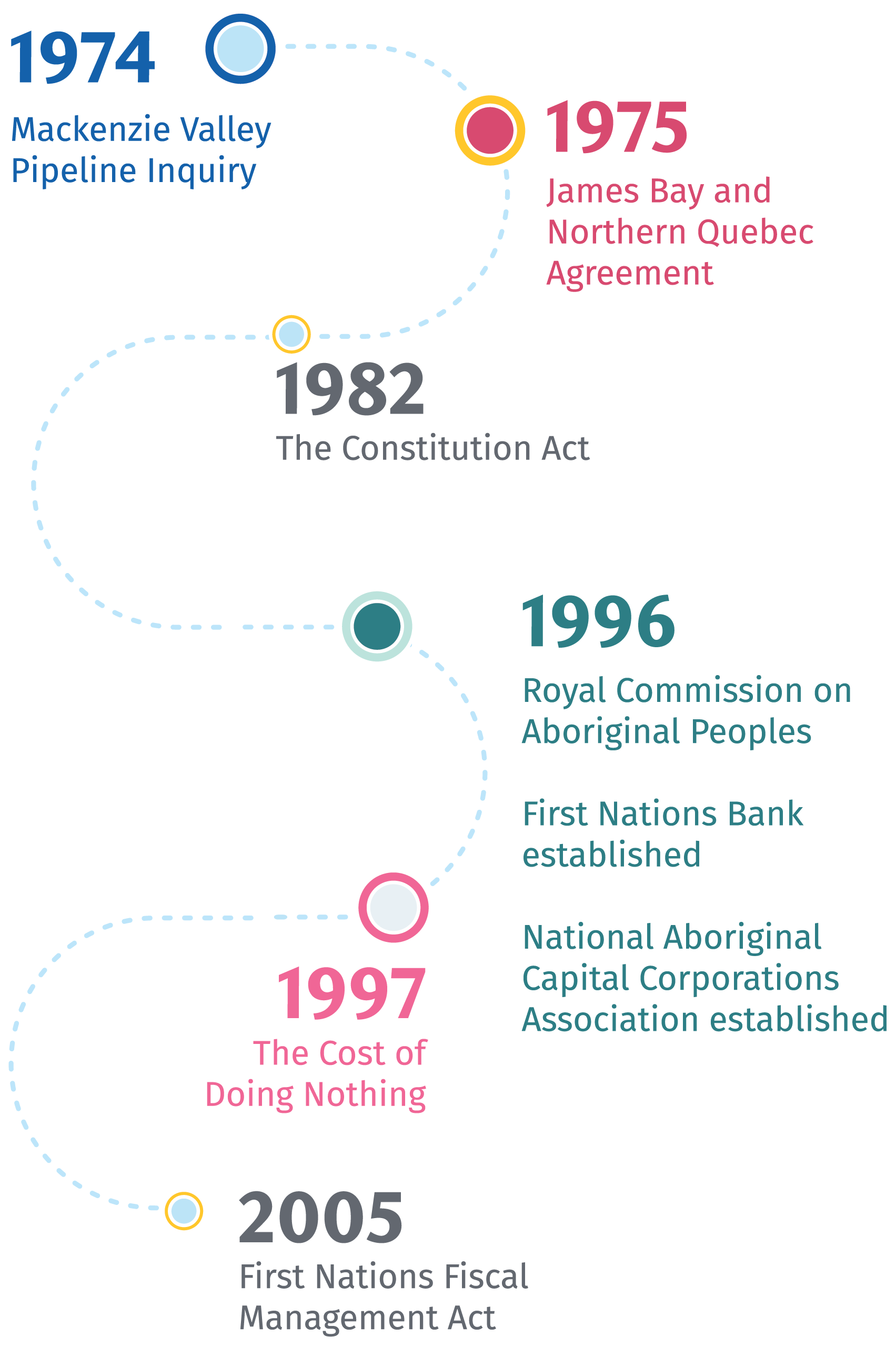
Timeline of key events

The story today

When Indigenous Nations consider major project participation, they often face a combination of institutional, legal and economic barriers that have led to many (but not all) Indigenous Nations to build a balance sheet, deal history, or internal capacity. Access to affordable capital that enables Nations that reduce the cost of capital and safeguard Indigenous assets remains a challenge. This is because of a combination of legal and institutional barriers outlined above, as well as network effects and a lack of awareness on the part of the private sector on the benefits of proactive Indigenous participation.

This gap is particularly evident in opportunities where Indigenous Nations may wish to have an ownership stake in energy and natural resource projects on their territories. Indigenous ownership is now a leading model to align interests and advance project development in a timely way by prioritizing Indigenous-corporate relationships, incorporating Indigenous values and priorities, and potentially streamlining regulatory processes4.

What is a loan guarantee and how are they structured?

A loan guarantee is a contractual agreement to repay a debt provided by a third-party lender such as a bank, when the borrower can no longer pay (i.e., “backstopping a loan”). For the lender, this can virtually eliminate the risk of economic loss. For Indigenous investors, equity loans without guarantees can be prohibitively expensive (i.e., the cost of the loan, if granted at all, is less than the cost of financing without a guarantee). Without guarantees, Indigenous investors are often faced with the scenario of an uneconomic cost of capital, accepting a much smaller equity position—or none at all—which are sub-optimal outcomes.

A loan guarantee facilitates the lending environment to fund the equity portion of a transaction, providing credit enhancement and liquidity support for Indigenous borrowers. Importantly, the use of limited partnerships and special purpose vehicles do not put Indigenous community assets at risk, as the project debt raised is non-recourse/limited recourse to equity partners. Use of a special purpose vehicle owned by Indigenous Nations, and generating distributions back to the community limit exposure of liabilities to the value of the initial equity investment made by a Nation.

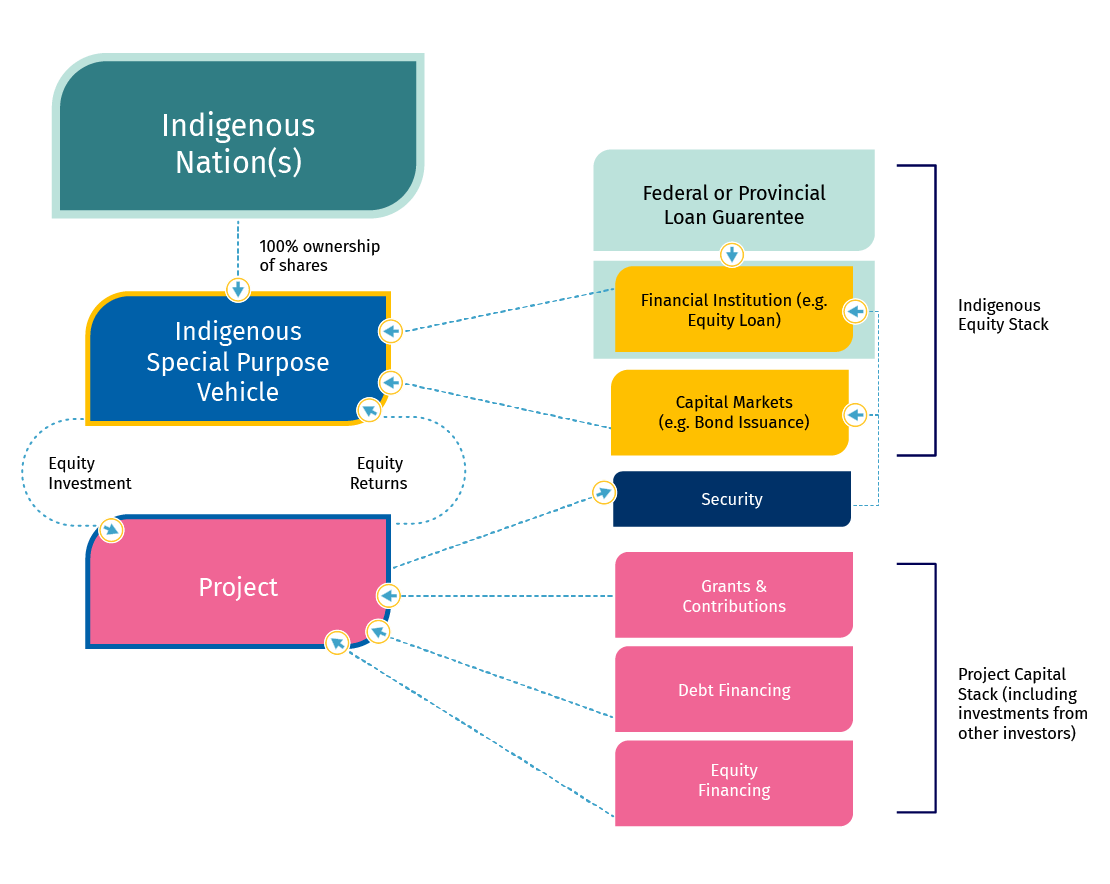
Loan guarantee programs have emerged as a “brick in the wall”—a part of the solution to address the access to capital gap among other complementary tools. The figure below outlines an example of the ownership structure and the relationship between an Indigenous Nation and equity ownership in a project, in particular, where a loan guarantee may play a role.

The federal government along with the B.C. and Manitoba governments announced loan guarantee programs in 2024 on the heels of advocacy by Indigenous Nations and the private sector amid growing maturity in the public policy development process. These programs, if effectively deployed, could help close the gap in the substantial demand for Indigenous equity participation, estimated by the First Nations Major Projects Coalition to be approximately $45 billion over the next 10 years. Both the development and deployment of newly announced loan guarantee programs will benefit from existing models in Ontario, Alberta and Saskatchewan.

Project finance tools for advancing Indigenous ownership in major projects

These announcements are an important contribution to the set of tools available for Indigenous Nations to economically participate in resource and energy projects. As these programs are implemented, important considerations will include the risk mandate of a loan guarantee program, adequate capacity support to enable partnerships, robust governance to ensure decision-making and issuance of guarantees are undertaken commercially, and stacking with other guarantee programs and support. Priorities to pay attention to as these programs are being implemented will include:

Indigenous people must be supported to make free, prior and informed decisions on project participation. Partnerships across all Indigenous Nations—First Nations, Inuit and Métis—must be supported. Indigenous perspectives, leadership and talent recruitment, development and retention should also be prioritized when implementing loan guarantee programs.

Programs should support the widest scope of projects to maximize Indigenous economic opportunity as a first-order priority in addition to wider productivity gains to Canada.

Government financial support should be backed by a robust due diligence process. A path toward market sustainability is necessary, so Indigenous Nations can access capital on an equal footing with other market participants over the long term.

Time is of the essence. Individual project negotiations must move at the speed of trust, but the bureaucratic functions of the loan guarantee programs must move at the speed of business. This priority will have to be balanced with the need to have a robust due diligence process.

Existing loan guarantee programs continue to learn and develop new approaches to better enable Indigenous ownership and participation. For instance, how best to support Indigenous ownership in greenfield or pre-construction projects. New loan guarantee programs need to retain flexibility in the structuring and deployment of guarantees to develop and adopt best practices across both public and private sectors.

Risk mandate and project application

Projects that provincial and federal governments select to guarantee will depend largely on the risk mandate of the loan guarantee program. Generally, loan guarantee programs mandated to be low or zero-risk will primarily provide support for relatively low-risk sectors (such as rate-regulated or operational projects). A loan guarantee program with a more accommodative risk mandate could take

on earlier-stage projects in riskier sectors (such as those with more merchant risk exposure) and larger/smaller ticket sizes—facilitating the completion of net-new projects that would not have occurred without Indigenous economic participation. Figure 2 presents the notional risk across a range of possible sectors and project stages, ranging from low to high risk.

It is likely that loan guarantee programs, similar to many government funding programs, will start out relatively risk-averse. However, given the ability of governments (particularly the federal government) to absorb more risk, these programs should adopt an evolving, dynamic risk mandate as they gain expertise through “learning by doing.” For instance, annual risk mandate reviews can incorporate the inputs of Indigenous clients and private sector participants in guarantee programs to re-evaluate whether new, innovative approaches and sectors can be covered. The risk would entail multiple dimensions, including:

Although partial loan guarantees that do not cover the entire Indigenous equity loan may be preferred initially, guaranteeing up to 100% of the equity loan can enable a greater degree of Indigenous economic participation and returns on projects where previously infeasible.

A sector-agnostic approach is important, enabling Indigenous Nations to retain full say and determination on the types of projects that happen on their territory and broadening the positive impacts of Indigenous participation. The loan guarantee program should prioritize a mix of projects across a range of sectors and geographies

Loan guarantee programs will seek to minimize undue risk and a call on guarantees due to both fiscal and reputational risk. Over time, as loan guarantee programs demonstrate success, a wider range of considerations can include guaranteeing projects with a smaller ticket size and greenfield or pre-regulatory projects versus brownfield projects, have a range of risk exposure. Ensuring this mix will capitalize on the program opportunity to maximize Indigenous opportunity and enable investment into net-new projects that contribute to energy and economic goals.

A larger number of Nations in a deal may add complexity, and dilute returns and the equity stake for individual Nations, but it can provide positive multiplier effects. Nations with a greater degree of capacity can support Nations that are developing and building their own internal capacity. Facilitating relationship building across Nations, and with the private sector will be an important impact measure for loan guarantee programs.

A loan guarantee does not create a cash profile on a government’s public accounts, but a loan loss provision can set aside part of the cash requirement for a call on a guarantee. However, when a guarantee is issued, part of this provision would be “locked in” until the loan is repaid. Accounting for a diversity of loan durations (e.g. a mix of five, 10 and 15-year terms) can enable the program to recycle capital and issue new guarantees that would unlock a greater value of equity partnerships.

Additional structuring protections governments may consider to mitigate risk would include:

Indigenous Nations that can invest their own capital can create an equity buffer, which can mitigate risk and further reduce the cost of equity capital.

Loan guarantee programs must lower the barrier to entry, including onerous fees, but these fees can also be tailored to the specific risk profile of the guarantee.

These are standard contractual terms that can stipulate timely repayment of debt by directing cash flows toward debt repayment before distributions, and create a buffer to ensure that future issues can be cured through funds capitalized upfront and over time.

Often used in minority ownership positions, share buyback provisions obligate the majority partner (and often the operator) to re-acquire the Indigenous equity shares in the case of full default.

A standard aspect of commercial debt monitoring, post close due diligence can help address potential issues proactively and enable a government, proponents or financiers to step in prior to an issue being raised. Both commercial monitoring and relationship management with individual Indigenous Nations will be important.

The federal minister of finance has indicated that the government would look forward to seeing the program oversubscribed and a request to increase the funding beyond $5 billion. Indeed, one major project can take over the entire loan guarantee envelope. A larger guarantee envelop is a positive signal of the government’s commitment to enable greater Indigenous partnerships and meet the $45 billion potential.

Capacity

A combination of institutional factors and network effects may mean Indigenous Nations have varying degrees of relationships, know-how and deal history to build the commercial capacity to assess and negotiate deals. The degree of capacity may be variable based on the Indigenous Nation and the nature of the deal. Capacity support can be crucial to the success of access to capital tool that enables Nations to access appropriate commercial, legal and financial expertise to make the right decisions.

As a comparator that highlights the importance of capacity amongst other factors, the U.S. Tribal Energy Loan Guarantee Program created in 2005 issued its first loan guarantee in March 2024. The program’s slow progress may be attributable to multiple factors, but an important omission appears to be that it did not fund for capacity for Native American tribes to make informed decisions on the commercial and technical aspects of a deal.

The federal government has provided $3.5 million over two years to support capacity funding under the program. This is a start, but capacity funding must be more highly prioritized to ensure Indigenous Nations have the appropriate commercial, technical and legal expertise to make project participation decisions. Capacity is often further enabled through the fees charged on loan guarantees, which can be recycled into a capacity fund, alongside support by project proponents. The B.C. loan guarantee program has indicated that it will capitalize a capacity fund with $10 million. The Manitoba loan guarantee program has not indicated whether it will fund capacity.

Organizations such as the First Nations Major Projects Coalition have played an important role in supporting Nations build and consolidate internal commercial, technical and environmental capacity. Continued support of existing and new organizations will be a crucial success factor over the long run.

A positive trend that is Indigenous Nations is growing the number of Nations supporting each other in building capacity. Anecdotally, in deals with multiple Indigenous Nations involved, Nations with more experience and a greater degree of internal commercial or technical expertise often allocate their internal or external resources or contribute their relationships or past experience to support those Nations that are building this capacity.

Governance

Independent, arms-length administration has been a priority with existing programs, including in Ontario (managed through a Crown agency) and Alberta and Saskatchewan (managed through an arms-length corp.). Independence and autonomy enable decision-making to happen with minimal political interference, and generally, have enhanced credibility. Indigenous perspectives and inclusion must be a critical component in all governance structures. Key priorities in developing a transparent, inclusive and nimble governance model will include:

Indigenous leadership and representation across governance and decision-making bodies must be a priority and imperative, given the focus of these programs on Indigenous economic reconciliation and inclusion.

The focus should remain on assessing guarantees on apolitical criteria, including ensuring commercial viability and inclusivity, limiting the scope for political interference in the issuance of individual guarantees.

A corollary for loan guarantee programs to remain apolitical is ensuring the approval and decision-making processes prioritize speed. Approvals by an independent, arms-length board with representation across Indigenous leaders, government officials, and the private sector can expedite implementation and communications.

  • Part of deploying at speed is enabling, particularly at the federal level, a “single window” approach or coordinating efforts across federal and provincial loan guarantee programs to ensure appropriate service delivery to Nations.

Robust, commercially comparable due diligence criteria and evaluation processes must be developed to ensure loan guarantee decisions are made on the commercial and economic merits of the underlying project and loan guarantee.

Buy-in and transparency go hand in hand to bulwark the credibility and reputation of loan guarantee programs. Both a clear governance process and robust monitoring and reporting requirements will be required for Indigenous Nations and the private sector to understand how and why guarantee decisions are made.

Stacking

There are a range of organizations that provide financial support for Indigenous major project participation, notably provincial loan guarantee programs. Considerations that would enable better stacking with the aim of maximizing the economic opportunity of Indigenous ownership using the full weight of government resources include:

Offering a “single window” for Nations considering both provincial and federal guarantees.

  • This includes coordination and communication between officials, which is especially important in complex projects that require support across multiple organizations. The federal loan guarantee program has an opportunity to show leadership in this regard.

Aligned financing and contractual terms including fees, guarantee structure and flexibility in rules that enable Nations to tap into multiple financing “pots.”

For capacity grants—not restricting the number of sources Nations can access.

Organizations that provide both financing and capacity support include the provincial guarantee programs, the First Nations Finance Authority, the Canada Infrastructure Bank, Export Development Canada, Business Development Bank of Canada, Farm Credit Canada, and multiple provincial agencies that provide support towards Indigenous economic opportunity.

Future tools

Loan guarantees can be an effective tool—but are only a brick in the wall and not a silver bullet. Crowding in private investment and creating a path to market sustainability will be important.

Future considerations for governments as they consider expanding the toolkit may include:

Indigenous economic interests intersect with almost every sector in the economy including fisheries, agriculture, telecommunications, infrastructure, manufacturing, tourism, and others. Federal and provincial loan guarantee programs can start expanding support across multiple sectors, particularly beyond the energy and natural resources sectors where most of the focus has remained.

Guaranteeing project debt, albeit riskier, may be the next stage after a critical mass of support and private capital is available to guarantee equity. This would functionally on-lend the federal government’s credit rating to Indigenous borrowers, and provide a greater range of flexibility for banks to lend toward.

Providing 100%-plus guarantees can support Indigenous participation for projects in the pre-construction, pre-revenue generation phase. Similar to guaranteeing debt, this may be riskier, but if strategically employed in otherwise commercially viable projects, it can unlock meaningful, early Indigenous participation in projects, particularly in strategic sectors such as critical minerals.

In higher-risk sectors such as mining, particularly in some frontier critical minerals projects, Indigenous Nations may prefer to participate through a royalty or income stream. By creating an institutional structure to transfer part of the royalty revenue to Indigenous Nations, governments can incentivize participation in sectors such as mining or forestry (where the royalty is referred to as stumpage fees). Federal government action is called for here. Provincial governments in B.C. and Alberta amongst others already have resource-revenue sharing agreements.

The growing wealth of Indigenous Nations includes an estimated $20 billion in trust assets and up to $100 billion in outstanding land and other claims. Pooling trust and investment assets through optional Indigenous-led institutions can help generate significant investment income as well as a vehicle to further advance participation and ownership.

An Indigenous Development Bond, akin to development bonds issued by emerging economies and multilateral institutions, can support financing of Indigenous-led projects. This would build on the existing success of the First Nations Finance Authority’s pooled lending and bond issuance program. This instrument would require consensus on bond issuance standards.

Building on the work of the Canadian Sustainability Standards Board and the federal sustainable investment guidelines, integrating Indigenous perspectives and considerations to investment standards can be an additional tool to drive investment to Indigenous-led projects and organizations.

An Indigenous-led development finance institution that consolidates debt, equity and grant instruments could offer a comprehensive set of tools to durably finance projects and businesses. The model for such an institution would be akin to community development banks, capitalized by both public and private sectors, rather than multilateral development banks with votes allocated by share capital.

The private sector is developing innovative structures to crowd in Indigenous participation and inclusion in major projects, including:

  • Breaking out lower-risk, revenue-generating elements of a larger project and facilitating Indigenous ownership—often elements that outlive the life of a single project (e.g. transmission lines or toll roads).

  • Post-construction options for Indigenous ownership, wherein the option can be exercised by Indigenous Nations to purchase an equity stake upon project completion.

  • Minimum annual payments to mitigate the potential downside and protect Nations from undue risk when a project goes through periods of no revenue.

  • Share buybacks upon project failure to commit to a set price to repurchase equity stakes by the project proponent if the project fails to be completed.

  • Negotiating Indigenous governance rights even in cases of minority equity positions through a separate share-class structure to recognize Indigenous owners sit in a unique position apart from other commercial participants.

  • Co-investing with institutional investors, particularly, with co-investors that can deploy large sums of capital over long durations, both in individual major projects and by bundling smaller opportunities through joint ventures.

  • Proponent guarantees or contractual supports: Proponents may seek to provide their loan guarantees or other forms of contractual support to enable Indigenous participation, particularly in riskier projects. This may be balanced by a higher equity sale price.

A proactive, relationship-focused and trust-based approach for Indigenous partnerships is now necessary in both public and private sectors. Advancing economic reconciliation through meaningful partnerships is both a moral and economic imperative – presenting an opportunity to grow out collective prosperity as a country.

For more, go to rbc.com/en/thought-leadership/

Download the Report

In this episode of Disruptors x CDL: The Innovation Era, hosts John Stackhouse and Sonia Sennik explore the dynamic role of generative AI in education and its far-reaching implications. As AI technology continues to evolve, it’s transforming classrooms and curriculum, influencing how students learn, and prompting schools to rethink traditional teaching methods. The hosts are joined by two distinguished guests: Janice Stein, founding director of the Munk School of Global Affairs, and John Baker, founder of D2L, a global ed-tech pioneer.

Janice shares her expertise on the ethical considerations and challenges of integrating AI into educational environments, highlighting how AI’s capabilities can impact both learning outcomes and the human connections vital to education. Meanwhile, John Baker provides insights into the evolving landscape of digital learning and discusses how AI-driven platforms like D2L Lumi are revolutionizing the educational experience, making learning more interactive and personalized.

This episode sheds light on the possibilities and challenges of AI in education, from enhancing productivity to rethinking team-based learning and fostering deep human connections. Whether you’re an educator, student, or tech enthusiast, tune in to discover how generative AI is not only shaping the classroom of today but paving the way for the classrooms of tomorrow.

Listen on Apple Podcasts, Spotify or Simplecast


John Stackhouse: [00:00:00] Hi, it’s John here. Welcome back to Disruptors and CDL: The Innovation Era. A big welcome back to my co host, Sonia Sennik, who’s CEO of Creative Destruction Lab.

Sonia Sennik: Great to see you, John. In this special series, we’re exploring the transformative ideas and technologies shaping Canada’s future and the people leading that change.

And if you’ve been listening to The Innovation Era, you know we’ve been especially focused on AI.

John Stackhouse: If you’re on a college or university campus, or just happen to know someone who is, you know it’s midterm season. That’s a good time to pause and assess what’s been learned. And you could say the same about the Gen AI revolution.

Most of us have probably tried ChatGPT, but if you’re like me, you probably feel you’re nowhere near ready for final exams.

Sonia Sennik: Nowhere is the Gen AI revolution having more impact and with it potentially more controversy than in our schools. And that’s what we’re focusing on today.

John Stackhouse: I came across a really interesting new research report, Sonia, from KPMG [00:01:00] Canada that shows a majority of students are now using Gen AI in their schoolwork.

Now, it’s largely for generating ideas, researching, and editing. Yet few are willing to tell their teachers that that’s what they’re doing.

Sonia Sennik: Two thirds of the students that were surveyed felt that using Gen AI was actually a form of cheating and they were reported feeling kind of ashamed that they were using it.

John Stackhouse: This is so fascinating. Well, there is that guilt factor. A majority of students say they want their teachers and their schools to incorporate Gen AI more and more in everything on campus.

Sonia Sennik: One of the things I found was very curious was that faculty reported being less inclined to use it, but a few are trying to catch up.

They’re seeing its value in not just tracking students. But reducing the often mindless administrative inefficiencies of the teaching process itself.

John Stackhouse: Now, before we get to our first guest, maybe a last point from the KPMG study, which I found fascinating [00:02:00] that almost three quarters of professors and instructors are adjusting their curriculum because of AI.

So to make sense of what’s happening out there, we’re now joined by one of Canada’s most respected and outspoken academics, Janice Stein. Janice is the founding director of the Munk School of Global Affairs at the University of Toronto, where she’s also Belzberg Professor of Conflict Management. She holds honorary doctorates from five universities around the world.

She’s written eight books and hundreds of articles rooted in her research. That sits at the intersection of cognitive science, psychology and international politics. Janice was also in some ways an inspiration for this series. She’s helping shape a new AI strategy for Canada with a lot more emphasis on adoption.

Janice, welcome to the podcast.

Janice Stein: Pleasure to be with you, John, and with Sonia.

John Stackhouse: You’re renowned in the field of conflict studies, so what got you interested in AI?

Janice Stein: AI [00:03:00] is the future of conflict studies. If you’re thinking about the future battlefield, every weapon of any significance is going to be powered by AI.

AI, space, satellite, target identification. It is impossible to think even five years out of a battlefield that is not transformed by AI. And I needed to understand the technology. It’s not good enough just to read about it. You actually have to understand.

John Stackhouse: That makes you a great teacher if you are always a student.

Sonia Sennik: And Janice, speaking of the classroom where you’ve been teaching for nearly six decades, what are some of the more enduring lessons that you’ve learned about the intersection of technology and education?

Janice Stein: People learn best by doing. They don’t learn best by listening. Despite 800 years, faculty standing at the front of the classroom, that is not the ideal learning environment.

So, if you can transfer the leadership to students, if [00:04:00] they can feel it, if they can touch it, if they can experience it, if they can imagine it, it doesn’t matter what we use, that is what I would call deep learning, as opposed to just listening.

John Stackhouse: I love that definition or redefinition of deep learning. Take us further, Janice, into the deep learning, the real learning experience.

Sonia and I were talking in the introduction about some new KPMG research, which shows, and maybe this is not a surprise, the majority of students are using ChatGPT. And maybe that’s not new. Students tend to innovate first with technology. You’ve probably seen this in a few go arounds in technology.

What can we learn from past experiences that we can and maybe should apply to AI in the classroom and around the classroom?

Janice Stein: I think the easiest analogy here, John, would be to a calculator. When calculators first came on the scene, you had a whole bunch of elementary school teachers [00:05:00] panic about what this was going to do.

to people’s capacity to multiply, right? Well, nobody would take that argument seriously right now. I think we’re in the same place with AI. There was, in the early days, right after ChatGPT was first released, all the university staff turned to issues that are very familiar to both of you. Privacy, safety, things that administrators love to talk about.

And there were seminars and workshops right from the beginning. We had several serious sessions with students, how to use it. And the first assignment in the course was, do an essay on this subject, ask GPT first, and then you rewrite it and tell us how much time it took. How did you verify whether anything in it was accurate?

Now that’s, relatively speaking, time consuming, but the easier question. The harder question for them was, how did GPT build the argument? Are you okay with that? Would you construct the argument differently? [00:06:00] Because that’s a skill. It doesn’t matter what age we’re in. If people can’t do that, they are not going to be leaders in their field.

John Stackhouse: Early days, Janice. But how is this changing the nature of students? Are they different coming out of your courses?

Janice Stein: To some extent, students are freed up, but some of the more routine things, ChatGPT is really helping them, and that’s great. But when we come to the kinds of challenges that we’re talking about, I get two quite different reactions from students.

Oh darn, I only read the summaries, I missed the point, I gotta go back, right? If they haven’t read the argument along the way, they feel at a disadvantage. And that’s what the early data on students are telling us. They want to use it. We need to take away, by the way, any discussion of penalties or ethics.

We have to take that off the table entirely. But at a [00:07:00] deeper level, they’re worried that they’re missing out on some of the higher level learning if they are overly reliant on AI.

John Stackhouse: So you’re saying take away the penalties. I think I get the logic of that, yeah. But are you okay with a student just asking ChatGPT to write a paper for them and they submit it?

Janice Stein: Yeah, as long as they tell me that they have and that’s where it gets really interesting for them. And, you know, this is harder than writing the paper, John, right? ChatGPT wrote this paper. I am confident in the validity of the data. I am confident that this is a well constructed argument, and you should have to tell me why you can answer those two questions, which is not unreasonable.

It’s what you would expect in your editorial role. You would want to know that the evidence is reliable and that the arguments are valid. That’s really hard work. You gotta go back. You gotta look. You gotta read something. And you can’t do that with ChatGPT itself. You can go some way, but [00:08:00] you can’t go all the way with it.

And so my view, there’s a contract between somebody in front of the classroom and somebody in the classroom. It’s not about cheating, and it’s not about catching cheating. So we reached an agreement right at the beginning. This is how we’re doing things. I’m going to use chat GPT. So bring it out in the open.

Sonia Sennik: From a teaching perspective, one of the most common questions I’m guessing a professor or a teacher asks themself is, okay, what do I teach next? What does this group one to many? What do I need to guide them to next? And large language models and generative AI is taking away that one to many. A student can have an engagement with a large language model and ask it questions.

As you said, get it to coach them through some things they may not understand yet. So with that utility on a personal level for students, we’re still seeing that faculty and admin at post secondary education institutions seem to be a bit behind the curve on adopting it or embracing it. What do you think they need to do to catch up?

Janice Stein: So I’m going to answer this question this way, Sonia. They’re behind the [00:09:00] curve, there’s no question, and they’re ahead of a curve. In other words, for coaching, for tutorials, for individual customized pathways to learning, AI is great. And I have no doubt that within five years, the classroom will look very, very different.

But here’s one way the classroom is probably not yet looking good enough, that as we move through higher and higher levels of responsibility, team based decision making is absolutely critical. And in the university, in the classroom, I’m getting more pushbacks from students about doing their work as part of a group, in a team, than I am about technology, frankly.

That’s the real hill to climb. Students cannot accept that their grade, their performance, is partly dependent on the performance of others. And they don’t understand that part of what they have to learn is not only the what, but how to get the [00:10:00] best of everybody and not to worry about that person is not doing as much as I am, but that person has skills that I don’t have.

They’re studying high level decision making. They see that happens to teams and groups all the time, but they can’t get themselves there.

John Stackhouse: I think you’ve just nailed a critical point that we’re living in a hybrid world. And the more technology we have, we also need a lot more humanity and those human skills of working with others, collaborating and communicating as people.

How are you finding that balance? And where in the education system do we have to really focus on creating that balance?

Janice Stein: You have to be very intentional in the way you design the learning environment. So you have to build in that teamwork and it’s got to be part of the requirements. What good is it if you do great research and you have great ideas but you can’t communicate?

These to me are the critical skills that we’re going to need going [00:11:00] forward. The capacity to de silo and to really work in a larger group and to get the best ideas from everybody, and then to communicate over those barriers. University has to prepare people to live in that world. It has to. So how did we do this?

First of all, it’s going to be slower than we like. We’re going to try some things that are going to fail, great. That’s another thing we need to model, that it’s okay. Because if you can’t fail in the classroom, you’re sure not going to fail when you take your first job in the private sector or anywhere else.

We have to build a culture of experimentation. Try it, see what works, adopt what works, and students are partners. And the best universities do that, they allow you to experiment. You know, I noticed in reading some of the research on this, that there’s a big focus on what university policies should be. I wouldn’t invest a [00:12:00] huge amount of effort there.

What you want them to do is have an enabling environment. Ultimately, let the faculty on the ground do the work, partner with students and see how much AI will change the learning environment. We will get the best results that way.

Sonia Sennik: So Janice, what do you see is that right balance between having these structures and institutions, places curious people can go, and the agility and flexibility for these institutions to keep up with the constant change?

Janice Stein: You know, I’m not big into binaries. It just doesn’t work. It’s and, right? I think universities can do everything they’re doing now and so I push our alumni all the time. We need you back for a weekend. And we have some in place and we have some all over the world and we can do hybrid and we could do all forms of learning, but they have to come back.

And that’s, I think, the biggest message. We need leaders like you, John, you know, to send that, you know, your [00:13:00] own teams that you lead, but more generically, as you look out at Canadian society, we need you back. And it’s a message that if you’re not learning in this world, where the pace of change is probably faster than it ever has been, how can you lead?

John Stackhouse: That’s a great message Janice. Gen AI is not about replacement, it’s about addition. I wonder as we move to close Janice, you mentioned how the classroom is going to be different five years out. Take us out to the 2030s. What in your imagination and maybe your vision does the learning experience as well as the classroom look like in that age?

Janice Stein: 2035 is an eternity away where we will have technologies, I think, that you and I can’t even think of right now. So how is the classroom going to be different in a fundamental aspect? I think it’s going to be the same, that it is the place where people come to argue and to think. And [00:14:00] to refine what they’re arguing, to walk out thinking differently than they walked in.

That, to me, is the essence of a classroom. Now, everything else I think we can design differently, depending on the technologies that are available to us. But that probably can’t go away, nor should it go away, actually. Because we’re social beings. We think better on some issues in a group, some issues we think better alone.

We want to be able to preserve that flexibility for people, but that social component of learning is so important and communication. That’s not going to change.

John Stackhouse: Wow. Listening to you speak, I’m just thinking Socrates had it right.

Janice Stein: It’s about dialogue. It’s about dialogue.

John Stackhouse: Exactly. It’s about dialogue. So we have the Socratic approach and dialogue.

But a heck of a lot more information thanks to the internet and then ways to synthesize, to understand, to curate, and maybe organize that [00:15:00] information in ways that were kind of overwhelming just a few years ago. And that’s one of the advantages of Gen AI. It’s an organizational tool, yes. Not necessarily a thinking tool.

Janice Stein: That’s right. It’s a huge organizational assist, and in an ideal world that I can imagine, it frees up time for more thinking.

John Stackhouse: Let’s free up time for more thinking. I can’t think of a better summation of this wonderful conversation, Janice. That should be a motto on all our walls. How can I free up more time for more thinking?

Janice, thank you so much for being on the podcast.

Sonia Sennik: Well, great to be with you and Sonia. That’s a great perspective on what AI is doing to our classrooms. But that’s just the classroom. Learning takes place in all sorts of ways, in all sorts of places, and few Canadians have done more to advance digitally enabled learning than John Baker.

John is founder of Desire2Learn, or D2L, one of Canada’s most successful and enduring edtech companies. He created the company in 1999 while studying at the University of [00:16:00] Waterloo. Today, D2L is a global software company and John is one of Canada’s most respected tech entrepreneurs. John Baker, welcome to the podcast.

John Baker: Thank you very much. I’m looking forward to the conversation.

Sonia Sennik: You founded D2L over 20 years ago with a vision to transform education through technology. Can you share a bit about what inspired you to start the company and how the landscape of digital learning has changed over the last 25 years?

John Baker: So I was in my third year of university, and I was wrestling with one key question.

What’s the most important problem that I could solve that would have the biggest impact in the world? And I couldn’t think of anything bigger than transforming the way the world learns. And we’re at a stage today where, because of the technologies in place, enables us to do that at scale, where in the past we wouldn’t have been able to do it.

Things like competency based learning, where instead of just simply passing or failing an exam, you get the ability to demonstrate mastery on the specific learning outcomes that you’re striving towards. So probably a good example to really understand that is if you’re going to go in for a heart surgery, you want the surgeon that’s demonstrated mastery of that procedure many [00:17:00] times, not the one that just passed their medical exam.

But what I’m probably most excited about is AI. AI is very much like the internet in the early days, a new way of doing things that’s going to really have a big impact on education globally.

John Stackhouse: And John, that’s a perfect segue into the theme of this episode. How is AI changing and challenging the way we learn?

So maybe give us a sense of how it’s changing D2L and where you see AI taking the company.

John Baker: The first thing is a lot of people get hung up on the risks attached to AI. That’s a natural tendency. If you’re a skier and you’re skiing down through the glades on a big mountain, what you want to avoid is looking at the trees for too long.

Otherwise, you wind up in one. So I break it down into sort of like five key paths that universities and schools and companies all over the world need to follow. One is, yes, working on the risks, understanding academic integrity issues, understanding if students are using these technologies to just have a shortcut or are they, Are they using it as a productivity tool?

Second is doing the research around this new [00:18:00] intersection point between AI and the scholarship of teaching and learning. AI is going to change how people learn. It’s going to change how people get assessed. It’s going to change how we do tutoring. And so there’s a lot of work that needs to be done in terms of, well, exactly how do we embrace this new technology?

Just like we did with the internet in the past. It was another disruptive technology that came in and changed how we taught, assessed, and tutored folks. Third is, now that we know that, how do we change our curriculum? How do we change how we teach students computer science or engineering or nursing now that this new technology is in place?

Fourth is how do we upskill the workforce that’s already there, not just prepare the current generation of students, but the workforce? And then the fifth, how do I personally start to use this technology to improve my own workflows and get better at the things that I do each and every day?

John Stackhouse: I wonder if you can also take us a bit deeper into how this is working at D2L.

You’ve got a new platform, D2L Lumi, maybe give us a sense of what that is seeking to do.

John Baker: So with Lumi, what we’re doing is really starting with the productivity enhancers for educators. So how do I take [00:19:00] your course content and now turn that into interactive content that would engage and inspire people?

How do I then take that interactive content and turn it into assessments that could really help address whether the students have actually learned what they’re being taught? Virtual tutors is another example of that. The application of AI to support the student experience so they can query just like they would a chatbot, if you will, to understand the material that they’re being taught.

Sonia Sennik: Folks that are listening may be thinking, okay, these AI tools seem great, but when I was in a classroom, my connection with my teacher mattered so much, or my connection with my tutor mattered so much. And you can think back to that person who made the difference in your learning journey. What would you say to folks who are thinking through whether or not AI erodes that human connection aspect of learning?

John Baker: I think that is at the heart of what we’re doing. AI is being used to support giving you more time to build that human connection. More time to build a connection with your classmates, with your faculty member, your teacher. It is going to free you up to be able to build better relationships, get [00:20:00] better feedback, and be more inspired.

That’s why we’re doing it. We’re not leveraging this technology for the sake of the technology. We’re using it to actually build a better educational experience, and at the heart of a better educational experience is more human connection.

Sonia Sennik: So how are your teachers and educators adjusting to this Gen AI revolution?

John Baker: So we’ve been using Lumi now just for a few months, but so far it’s been a home run. Faculty that are using it are loving the fact that it can help them to do things that would normally take them hours or days or weeks and do it within minutes. So the idea of taking a PowerPoint or a PDF or Word document and convert that into beautiful, engaging, interactive, inspiring content used to take a long time.

Now we’re doing it within, in some cases, seconds or minutes. And then being able to craft really good assessments of learning is also hard work. And many educators were never trained on how to do that. And so this starts to fix those issues. And what we’re seeing is More students getting A’s and B’s, more students completing, but more time for giving feedback.

It really is liberating in terms of looking at it as a [00:21:00] productivity tool versus as a replacement for the educator. I think it elevates the opportunity for the educator to do more group work, problem based learning, case studies, all kinds of other things that are going to be more engaging in that class experience.

John Stackhouse: D2L is a global company and you get to travel the world and meet educators in all sorts of countries. I think you’ve just come back from Asia. What’s most exciting out there in the world in terms of AI applications in education?

John Baker: I’ve been at this for 25 years. John, and I’ve never seen more willingness to embrace a new technology coming in than I am seeing it today.

I’m on a Strive AI task force with the State University of New York, where the whole university system’s rethinking how they teach and how they support workforce upskilling and changing almost everything. If I go to Singapore or Hong Kong, or I was also just in South Africa, or I was even just with one of the top universities here in Canada this morning.

Everybody is talking about it. What they don’t know is how to actually go through the transformation. And that’s where we’re trying to come in and be a partner on that journey. We’ve been working on machine learning and [00:22:00] AI for over a decade. So it’s bringing that expertise to the market now and bringing to life real technology that really has a big impact.

And then working with our clients almost as design partners. Let’s test this out. Is virtual tutoring going to work for you or not? Why not? How do we get it to be tuned such that you will want to deploy it for everybody? I think, unlike internet, I think we’ll see a transformation here much, much faster.

Internet really broke down time and place. You could take learning from anywhere, get it at any time of the day. So that was huge in terms of impact. But with AI, all of a sudden, we can maybe do a four year degree in six months. Because we can adapt learning to you. There’s another dimension. Maybe we can become better at the profession we’re pursuing so we can build better mastery.

Like I gave you that as an example with doctors being better because they’re able to to demonstrate mastery of every learning outcome because they have more time to actually perfect their profession. And then there’s a third dimension to this too, which is maybe we can teach things differently. So instead of just teaching how to remember or understand something, we can now do things like create something [00:23:00] or code something.

or analyze a whole bunch of data that we could have never imagined analyzing if we didn’t have AI superpowers, if you will. And so it allows us to not only do what we were always doing in the past with greater efficiency, but allows us to redefine what higher education, what learning could look like in the future.

And that to me is probably the most exciting part of this.

Sonia Sennik: So John, in the context of reimagining education and giving educators or students superpowers, what do we need to most protect in the next two decades of the development of education?

John Baker: Protect? Oh, that’s an interesting question. I think at the heart there, you’re getting at the risks.

The way I think about it is almost like a design challenge. And so we can design our AI to be used in education, to know everything. Even including the answers to the exam questions, or we can choose to limit its knowledge. We can design AI to just be responsive to your demands, or we can design AI to give you a grade for how you interact with it.

We can design AI to have more authority or, or to [00:24:00] care more about you as a student. And so I’m most concerned about making sure we get that design right. To me, that’s critical. I’m also really concerned about shortcuts. The risks are real. And I think the more that we could leverage this as a productivity tool, but without students just taking the simple shortcut.

So, for example, there are AIs that could give you the answer to every question on an exam almost instantly. Well, clearly we don’t want students using those. So, how do we redesign assessment, uh, is going to be a big question for the next few years to support authentic experiences for students, while at the same time not slowing down the educational journey.

John Stackhouse: So John, one of the design opportunities is to rethink the academic calendar and our schools are still, some people like to say they’re designed around the agriculture calendar still, even though very few students have to work on the farm. You mentioned that maybe we could take a four year program and do it in a few months.

AI would allow that. How much do we need to think about the business model and the operating model [00:25:00] of education, both secondary, but particularly post secondary?

John Baker: Well, I don’t think every university is going to support every type of experience, all with lower price points. I think what you’re going to see is more variety of types of education that we can receive. There’s no question these technologies can help make us more productive, which should help address the cost concerns, especially if you look at some of the universities where costs are really skyrocketing. This would be a way to save, in some cases, millions, maybe tens of millions for a university in their overall cost model, which would help them relieve some of that pressure.

But I think at the core, it’s like, well, what do you want that education experience to be? If you want to have the best nurses and best doctors and best engineers coming out of the program, you’re probably not going to get them through the program within six months. You’re probably going to want to spend that time to help them become better researchers, better scientists, better entrepreneurs, better nurses, better engineers.

And so, that will be a choice you make as a university and the cost for those types of programs will probably go higher because you’re spending more time building that better experience for those students. But for others, like let’s say for example you’re a working professional [00:26:00] and you’ve been in the industry for a long time and you just want to go back and get a degree.

Well, you have a lot of experience, so why can’t we just quickly assess what skills you already have and then provide you a personalized pathway that gets you through a four year program in six months. So the ability for us to support a wide variety. of circumstances and needs for the market, that’s going to be exciting versus everyone kind of doing it the one size fits all kind of approach, which is what we’ve been used to for the last few hundred years.

I think that will start to address some of the economic pressures that folks are under.

Sonia Sennik: Fantastic. John, thank you so much for joining us on the podcast.

John Baker: You’re very welcome Sonia.

John Stackhouse: What a fascinating and frankly inspiring conversation. I’ve known John Baker for years. He was an early guest on Disruptors. I don’t think I’ve ever heard him not excited about something.

Here we are in frankly, a post secondary education crisis in the country. It’s really challenging right now to run a university or a college. And along comes an innovator who sees [00:27:00] opportunity here with AI to transform the business model, to improve the education experience.

Sonia Sennik: These conversations were, dare I say it, educational and reinforced how the future of education is at such a pivotal moment.

And as you mentioned, John, post secondary crisis, but also massive opportunity for post secondary innovation and transformation with technology playing a critical role in equipping students and educators with the skills they need to thrive in our very rapidly changing world.

John Stackhouse: I also love how AI is changing the competitive playing field.

This is a chance for small schools, big schools to rethink what they’re doing and loss can go to first pretty quickly.

Sonia Sennik: And what I love is when Janice mentioned, learn by doing, and how important it is for students to get practical experience in the classroom. That practical learning and human connection truly is at the heart of innovating our education systems and processes and both Janice and John Baker reinforced that human connection.

John Stackhouse: What great words to [00:28:00] attach to AI. That’s all for today’s episode of Disruptors and CDL: The Innovation Era. A big thank you to our guests, Janice Stein and John Baker, for their incredible insights into the future of education. And how innovation is reshaping, not just our institutions, but also how we prepare for the challenges ahead.

Sonia Sennik: If you like this episode, leave us a review wherever you get your podcasts. And be sure to subscribe to Disruptors and CDL: The Innovation Era, for more conversations with industry disruptors, innovators, and thought leaders.

John Stackhouse: I’m John Stackhouse.

Sonia Sennik: And I’m Sonia Sennik.

John Stackhouse: This is Disruptors, an RBC podcast. Talk to you soon.


In this episode of Disruptors x CDL: The Innovation Era, hosts John Stackhouse and Sonia Sennik dive into the rapidly evolving world of life sciences, exploring how Canada can leverage its strengths to lead in global drug discovery and healthcare innovation.

The pandemic accelerated scientific breakthroughs, such as AI-assisted vaccine development, but what will it take for Canada to continue leading into the 2030s? With special guests Anne Woods (Managing Director, Life Sciences, RBCx), Sue Paish (CEO, Digital), and Dr. Christine Allen (CEO, Intrepid Labs), this episode delves into how AI, data, and interdisciplinary collaboration are driving new treatments and medical advancements.

From Canada’s storied history in medical innovation to today’s challenges in scaling life sciences companies, the conversation explores the need for a cohesive strategy, greater investment in early-stage ventures, and an openness to data-driven healthcare solutions.
Listen now to hear expert insights on the future of life sciences, Canada’s unique opportunities, and how AI can reshape the way we discover and deliver life-saving treatments.

Listen on Apple Podcasts, Spotify or Simplecast


John Stackhouse: [00:00:00] Hi, it’s John here and welcome to Disruptors x CDL: The Innovation Era. I’m joined by my co host Sonia Sennik, who’s CEO of Creative Destruction Lab. And in this special series, we’re exploring the future of Canada’s economy through the lens of cutting edge technologies and the visionaries who are at the forefront of so many breakthroughs.

Sonia Sennik: In today’s episode, we’re diving into the life sciences sector. The pandemic showcased the incredible speed and power of scientific Breakthroughs when paired with new technologies like artificial intelligence. When the pandemic hit in 2020, Moderna’s AI systems allowed them to prepare the vaccine for human trials in just 42 days compared to a typical vaccine that takes between five and 10 years.

But what’s next? What will it take for Canada to lead the world in new drug development and life saving treatments as we move into the 2030s?

John Stackhouse: That’s such a great way to frame this opportunity Sonia. The pandemic was brutal for so many people but [00:01:00] if something good came out of it, it was that innovation story around vaccines.

We all rely in different ways on pharmaceuticals and drugs and yet as Canadians probably don’t appreciate all that goes into their creation and so much of it right here in Canada. We actually have a storied history. Insulin was developed in Canada in the 1920s. In the 1980s, Montreal based scientists developed life saving treatments for HIV AIDS.

And just four years ago in 2020, Michael Houghton, a professor at the University of Alberta, was awarded a Nobel Prize for co-discovering a Hep C vaccine. Those discoveries don’t happen in some isolated lab. They’ve come out of Canada because of our remarkably strong network of universities, research labs, and the 2,000 companies in the life sciences space, some of whom we’re going to meet today.

But for all our creations, we seem to be lagging in terms of commercial development. Canada’s trade deficit in pharmaceuticals is big and it’s growing. And the amount we’re spending on everything to do with healthcare is getting pretty much unsustainable. So can [00:02:00] we innovate rather than spend our way out of this?

Canada has an opportunity to build on the momentum coming out of the pandemic. And establish ourselves as a global leader in drug discovery and life science innovation. Today, we’re joined by three leaders who are at the forefront of this revolution. Our first guest is Anne Woods. She’s the Managing Director of Life Sciences at RBCx, our innovation banking arm.

And she brings with her more than 25 years of experience in life sciences and capital markets. Anne’s a passionate advocate for innovation and innovation. And a trusted advisor for the next gen of life sciences founders.

Sonia Sennik: Anne, welcome to the podcast. Maybe you could share with our listeners a little bit about the focus of your work.

Anne Woods: Sure. I’m part of the RBCx division of RBC, so you can think of us as really being a team that focuses on the unique needs of the innovation economy, and that’s even more exaggerated when it comes to life sciences because there’s just even more unique needs with companies that are so heavily [00:03:00] research based.

So I joined last year to really launch a coordinated life sciences strategy across the country.

Sonia Sennik: What are some of the unique strengths and weaknesses of the Canadian life sciences ecosystem?

Anne Woods: Often I think some of the things that are our weaknesses are also our strengths. Someone said to me, and I wish I remembered who it was because it’s such a great quote, is that Canada has a reputation of being really good at digging natural resources out of the ground, sending them overseas to be refined, and then buying them back.

And we do that with our intellectual property too, whether it’s artificial intelligence or even the COVID vaccines, they wouldn’t have been possible without the lipid nanoparticle technology that came out of UBC, but all of that really, it took those partnerships with the United States to really bring them to market.

And so I think it’s a little bit of a mindset that Canadians have that potentially holds us back.

John Stackhouse: This is not a new problem. And I’m thinking back to the great John Evans and the creation of the MaRS Discovery District in Toronto [00:04:00] that was meant to address the very challenges you’re speaking of to make Toronto a bit more like Boston.

And there has been progress made. I’m not underestimating that, but what do you think we’re missing?

Anne Woods: I think we’re maybe where Boston was 10, 15 years ago. Right now we’ve got the talent and we’ve got the research, but we maybe don’t have that critical mass or critical concentration that exists in Boston today.

And so I think we need to really have a more coordinated strategy to take that research and make sure that we are finding what’s most compelling and that we translate it into commercial opportunity.

Sonia Sennik: I’m curious if you have some thoughts on what Canada can learn from the United States in terms of funding and supporting early stage life science ventures, because it’s a very different path than a traditional early stage startup when they’re in the life science sphere.

What can we learn and what are some of the gaps we may need to fill?

Anne Woods: It might even be worth defining what we mean when we say early [00:05:00] stage in life sciences. Because I think when people think about early stage tech companies, they’re the ones that have maybe got a bit of commercial traction and are just about to be widely adopted.

Whereas an early stage life science company is probably still in the lab. And really needs to de risk their technology before they’re able to attract institutional investment. And so I think if you compare Canada to the U. S., there’s really two things that kind of jump into my mind. The lack of capital for early stage funding is, of course, important.

But it’s also that even when there is capital available for companies, it’s often spread out amongst all the different organizations that really want to help and do good things. And then these researchers and entrepreneurs end up spending so much of their time writing grants to get 500,000 a year and 500,000 a year to really get to that 2 to10 million that they need to de [00:06:00] risk their technology.

Whereas in the U.S. The NIH and the SBIR grants are kind of a one stop shop, and so that concentration allows the entrepreneurs to go back to doing what they do best, which is developing the science into a business.

John Stackhouse: As we’ve discussed, Anne, in the past, in addition to that financing, procurement is also important, and there are many who argue we need more flagship companies.

That startups can feed off of. Is it that simple?

Anne Woods: It’s not that simple, but you can see how having that concentration and that, anchor company can create both talent and capital that’s. Can spin out new companies. So even if things go badly, what you have is the infrastructure and the talent that can then go on and start new companies.

And so we’ve seen that happening, particularly in BC That BC is much more mature and really has like almost a self sustaining kind of ecosystem now where they’ve got that critical [00:07:00] mass. People move from one company to the other. I mean, as an Ontario resident, I look at them with envy.

John Stackhouse: What did BC and Vancouver specifically do to get there?

Anne Woods: I think a little bit of it is Western entrepreneurial culture. That’s something that I’ve always said BC has. If we can’t attract the big med tech and the big biotech, big pharma, we’re going to have to build it ourselves. So there’s a real united voice in BC to build an ecosystem. If you think about Quebec and Ontario, it gets a bit more complicated because you’re talking to policymakers about decisions that are great for foreign investment, but maybe not so great for local companies.

And when you’re looking at early stage life science companies and you say the commercial success is 12 years from now. Because it’s going to take hundreds of millions of dollars to invest to get there. It’s hard for policy makers to take that long term view.

Sonia Sennik: Are there Canadian life science companies that [00:08:00] you see right now are making all the right moves to scale globally?

And what are some learnings you could share with us about their journey?

Anne Woods: So if you think about Fusion Pharmaceuticals, radio pharmaceutical company based in Hamilton, it was acquired by AstraZeneca. But we all feel pretty good about that because the infrastructure and the expertise is in Hamilton. And because they put down roots there, even though it’s no longer Canadian owned, It still is going to be a Canadian company.

It is now going to be a center of excellence for AstraZeneca and radio pharmaceuticals. And so I think that’s a great success story that putting down the infrastructure really can start to create an ecosystem or a cluster. And then I think if you look to the West, companies like Abcelera and Aspect Biosystem that have done the same thing.

And so the mindset and the ambition is really important because it is fairly easy to say, I’m going to build something and we’re all backed by venture capital firms who want that exit. So I think it does take [00:09:00] public private partnerships and ambition to say, we need a reason to put down roots here and stay.

Sonia Sennik: I do love that McMaster University example of fusion. Professor John Valiant. building the roots. So after that purchase was completed, the lab, the center of excellence will continue to be at McMaster growing in Hamilton with that Canadian talent engaged. And international talent too.

Anne Woods: I mean, it’s attracting international talent, which I think is also important.

John Stackhouse: And listening to you speak, I’m reminded of how important universities are, and we’ve got some of the world’s best in our country, but they are real anchors for this kind of innovation, whether it’s U of T McMaster, UBC, the list goes on and on. I wonder before we wrap up, if you can give us a sense of where you see the next big waves of innovation coming.

Anne Woods: In my world, it’s always going to come out of the universities because in life sciences, that’s where that basic research is done. So you’ve got the biologists and the chemists and the physicists and the computer scientists [00:10:00] all working together. And I feel like that is a uniquely Canadian opportunity because we are small still.

And so there’s a real desire to innovate and I’m really excited about that. The final piece that I’m really excited about is maybe not so much the innovation, but the innovators. I look at someone like Clarissa Desjardins, who’s a serial entrepreneur based in Montreal, who’s created her fourth company.

We just celebrated at the Bloom Burton Gala, three amazing entrepreneurs that are now reinvesting and moving on to their next projects. And so I think the innovators should be celebrated as much as the innovations.

John Stackhouse: What a great message to end on, celebrate the innovators as well as the innovations. And thanks for being on the podcast.

My pleasure. Thanks for having me. Our next guest is Sue Paish, the CEO of DIGITAL. That’s Canada’s global innovation cluster for digital technology. Sue is at the forefront of commercializing digital health solutions and leading projects that are setting new global standards [00:11:00] for healthcare.

Sonia Sennik: Sue, welcome to the podcast.

Sue Paish: Thank you, Sonia. Delighted to be here.

Sonia Sennik: Maybe we’ll kick it off with some conversation about digital. So digital is working on a range of projects, advancing the development and deployment of health technologies, including AI driven solutions. Can you share with us a bit more about some of the initiatives that have the potential to be game changers in the healthcare industry?

Sue Paish: I’ll give you a couple of examples. One is, we don’t think about wounds very much in health, but wounds actually comprise 30 to 50 percent of all health care spend. Usually, the care approach is a person comes to your bedside or comes to your home to care for your wound. You can imagine in 2020, with the onset of COVID, that created a problem.

Through our model, we brought together a number of organizations, researchers and academics, and they created a device that goes on your phone. It allows the patient or caregiver to take a 3D medical grade image of the wound, transmit that [00:12:00] to a specialist, and receive guidance in their home. either as the patient or as a caregiver, and care for that wound.

It’s proven to have 95 percent accuracy, 35 percent faster wound healing, and a 50 percent reduction on having patients with wounds admitted to hospital. Moving to another area of health data is something that we debate a lot in Canada. With our demographic diversity, and we have some of the richest health data in the world, and leveraging that health data in a secure, safe way could be a game changer in terms of reducing the costs and improving the effectiveness of our health system.

John Stackhouse: So, listening to your talk, I was thinking, I suspect Apple knows more about my health than my doctor does. They have more health data on me. Why can’t we move faster? Why can’t we move at the speed of technology when it comes to these health opportunities?

Sue Paish: That’s the 344 billion question because that’s what we spent on healthcare in [00:13:00] Canada in 2023.

8,470 per person. Do the math. We can’t sustain this. In Canada, we have a very high degree of respect for health information. It’s our most important personal information. And the curators of a lot of that health data have been resistant to sharing that data for fear that personal information would leak somehow into a public domain.

That fear is unfounded now. There’s absolutely nothing. Technologically or operationally preventing us from leveraging our health data for the betterment of individual and community health. It’s all mindset. The second thing that is blocking us is the structure of our health system that is delivered provincially and then each province divides that down into a multiplicity of health regions and those health regions or sometimes institutions believe that they own our health data.

And what we [00:14:00] need is a mindset change so that we as individuals are given the right to decide who can share our health data, how, and in what context. Nothing technologically is blocking that.

Sonia Sennik: Sue, what do you think is going to build confidence? There’s two innovations you’ve talked about. One is the mindset shift on how we approach data and privacy.

And two is a mindset shift or a systems wide shift on how we actually deliver care. What are the things that you think are going to build confidence in Canadians to cross that bridge?

Sue Paish: Well, I think there’s three things. One is the generation younger than me and the generations coming behind me are far more open to sharing data.

But I will say Canadians are quite comfortable sharing private data. The second thing is, If we don’t address this situation with our health system and leverage the data to improve the quality of care and reduce costs, we will bankrupt the country. It’s 23 [00:15:00] percent of tax revenue, and it’s increasing almost exponentially because our population is aging.

So we’re going to have a combination of mindset shift, forcing providers to change and systems to change. So we’ve got some early adopters, we’ve got the technology, we’re gonna get a mindset shift, we just have to move faster.

John Stackhouse: So you keep coming back to data, and data is the fuel of AI. How much of an opportunity or a challenge is AI in everything that you’re talking about?

Sue Paish: Well, AI is both the opportunity and the challenge. The opportunity is AI can actually transcribe the conversation that you’re having with your physician, interpret it and give guidance to the physician in real time on potential issues or care paths. The point that we need to make sure we’re comfortable with AI, and I think, we’ve still got a little ways to go, is the [00:16:00] accuracy of that guidance and to make sure that AI is seen as a supportive tool, not as a cure all.

We should never think of AI replacing the judgment or the expertise of a health care practitioner. AI supports the exercise of judgment and compassion by providing data driven decisions and guidance that the practitioner will then decide whether they’re going to deploy or change or not deploy.

Sonia Sennik: There’s really interesting underlying themes of trust in all the comments you’ve given us. Trust in how the data is going to be used, trust in how to make a systems wide change, trust that the AI will be supportive and augment as opposed to replace. So what advice would you give folks that are in that conversation right now trying to make those innovations, trying to adopt These new technologies on building trust with these systems.

Sue Paish: Well, the individuals and the organizations that are building these systems have built them on the basis of human interaction, [00:17:00] thousands and thousands of conversations or interactions or gathering data from real live doctors or nurses or wound care specialists. And so building trust comes from getting your data and building your models, not in a lab with your door closed, but by being.

in the community so that when the platform or the technology emerges, you actually have physicians or caregivers or nurses speaking up saying this works. This is helpful.

John Stackhouse: So we’ve talked about the challenges that Canada is up against. Where do you see the opportunities? And what do you think are great strengths that can give us a competitive edge in the world?

Sue Paish: The strengths that we have is Canada has one of the most demographically diverse populations in the world, which makes the data in the health system extremely valuable. No one has the kind of health data that we have. So that’s a real opportunity. In [00:18:00] terms of the next steps, I’ll be blunt here, we have to get out of our own way.

We have to look at the opportunities and the imperatives that our health data presents to us, that hasn’t been available in the past because we didn’t have these technologies, we didn’t have the protections that we now have around health data, and we didn’t have the ability to leverage the data the way we have now.

But we need the public policy makers to celebrate this. Not to make Canadians fearful and that’s what concerns me is that we drive a fear mindset that somehow leveraging your health data or population health data for the benefit of you personally and your family is not a good thing. It’s a very good thing.

John Stackhouse: So what a great note to end the conversation on fear. Fear can be the enemy of innovation, but mindset can be so liberating. So thank you for using that word in an inspiring way. Thanks for being on the podcast, Sue.

Sue Paish: [00:19:00] Thanks, John. Thanks, Sonia. And thank you for doing this series. It’s good for Canada.

Sonia Sennik: Our final guest is Dr. Christine Allen. She’s a world renowned researcher and leader in drug development. She’s a professor at the University of Toronto and CEO of Intrepid Labs, just one of the companies that Christine has co-founded that are pushing the boundaries of drug formulation and precision therapies. Christine, welcome to Disruptors.

Christine Allen: Thank you. I’m delighted to be here.

Sonia Sennik: So I was surprised to hear that 90 percent of drugs fail in clinical trials. What key factors do you believe are responsible for these high failure rates?

Christine Allen: Yeah, it’s actually a staggering number. I would say that it’s a multifactorial problem, but one of the key reasons is really that in many cases we’re using off the shelf formulations of drugs that are quick, they’re cheap, but they’re also in many cases ineffective.

These drugs are not entering clinical development in optimal formulations and so we’re not setting them up for success.

Sonia Sennik: Does this mean that there’s a window here [00:20:00] where new technology can enable innovations on formulation?

Christine Allen: Absolutely. I mean, there’s the real potential there to identify fit for purpose formulations for each drug.

How do we exploit the full therapeutic potential of the drug while managing toxicity?

Sonia Sennik: Christine, you’ve often compared drug formulation to a plane carrying the drug as its passenger. Can you walk us through a real world example of where the formulation played a critical role in a treatment success?

Christine Allen: The one that we’re probably all familiar with are the COVID 19 vaccines, right? Where lipid nanoparticles were used to deliver the mRNA. Without the lipid nanoparticles, the mRNA would not have been stable and it would not have been able to reach its site of action. Maybe another great example is Doxil.

Doxorubicin is a chemotherapeutic that was originally available in a conventional formulation administered to patients and would result in cardiotoxicity. You would treat the patient of the cancer and years later they [00:21:00] would have cardiovascular disease. And so it was reformulated then in lipid nanoparticles and liposomes, and this then addressed the cardiotoxicity so it could actually exert its chemotherapeutic effect without having any damaging effects on the heart.

Sonia Sennik: Fantastic. Speaking about emerging technology, I know that In your role as CEO, you’re leveraging artificial intelligence in your drug formulation process. And we know that AI has accelerated the timeline for drug development significantly. What are some of the most promising AI driven innovations that you see on the horizon for drug discovery?

Christine Allen: I think we’re still determining the highest and best uses of AI in drug development. We’ve certainly seen a lot of investment, also some in clinical development, much less so in formulation. There’s a great discussion paper that was put out by the FDA that looks at the extent to which AI and machine learning have been used in drug development, talks about discovery and clinical development and manufacturing, but actually nothing on formulation.

So a lot of running room [00:22:00] or white space there. But there’s actually some just really interesting, low hanging fruit type examples of the kind of impact that AI is making. I was at a talk with the head of machine learning of a large multinational pharmaceutical company, and they have this large language model that they’re now using to write the first draft of clinical trial reports.

And this is saving them two to three hundred million dollars a year and enabling them to run an additional phase three clinical trial. Great example, right? Low risk use of AI. It’s the first draft. It’s not the last draft. And enabling technology that’s making an impact. That’s just a simple example.

There are others, of course, but I think we’re still seeing where AI makes the most sense and the most sense right now. And of course, there’s always new advancements and that may then open kind of the extent of usage and or the applications that it’s appropriate for.

Sonia Sennik: So lots of room for innovation and creativity.

Christine Allen: Absolutely. But I do think that we need to be looking at AI critically, ensuring that the models [00:23:00] that we’re using are accurate, that we have evidence of the accuracy of those models, and that they’re able to be interpreted. So accuracy, evidence, interpretability, very key to ensuring effective use.

Sonia Sennik: At the core of the innovation engine are universities.

What role does the collaboration between universities, industry, and policymakers play in turning academic research into market ready treatments?

Christine Allen: That’s a great question. If you look at the University of Toronto, I mean, second to none in terms of the research outputs, publications, and so on. And I just think that it’s so important to take some of that creativity and those innovations and ensure that they are made available for translation and commercialization. And that’s where those partnerships make so much sense. I love to see academic researchers working closely or in discussions with policymakers to ensure that the technologies that we are developing are available for successful commercializations, that our policies are in line with that and enabling of that. Certainly [00:24:00] right now, this is an exciting time in Toronto because we are seeing multinationals, Unilever, Sanofi, Roche, and so on, investing in AI. And this is what we really need. We need small biotechs and companies. We need medium scale companies. We need multinationals as well as academics and government really working together to create this successful innovation ecosystem that will ensure these innovations that are based on AI are able to move forward for the benefit of humans, of people.

Sonia Sennik: And it sounds like the interdisciplinary approach. It’s going to take many people with many different skill sets, as you mentioned, all across the ecosystem, but what will it take for Canada to lead the world in new drug development and life saving treatments as we move to the 2030s?

Christine Allen: One of the things I think about is when we started developing the technology that Intrepid is based on, it was really built through a collaboration between my lab and Alan Aspuru-Guzik ‘s lab.

So you’ve got kind of best in class drug formulation, drug development expertise with best in class AI and robotics expertise, and that was [00:25:00] necessary to develop this technology. Then we have these young people from both labs working together, and I call some of them now unicorns, because they’re not just experts in drug formulation, or AI and robotics.

They’re experts in both and they’re working at that interface and they are needed to drive this next wave of developments, innovations, advancement. And we need to retain them in Canada. We need to retain that talent and provide them with opportunities here so they can drive that growth and they can be leaders in this space.

Sonia Sennik: But the heart of this, it would be obviously a very deep tech health related technology company. And you have those very specialized skills. The surrounding complimentary skills are also absolutely critical to help these scale. So for example, procurement or customer engagement, operations, managing teams, building processes to scale.

So what have you seen, Christine, in those types of skill sets and talent in Canada?

Christine Allen: I think we actually have a lot of talent in that space, and I would say that there are some great programs. [00:26:00] Biotalent Canada is a great program that provides support for young people that have just graduated. I know my company has tapped into their programs quite extensively to provide positions or support for young people that want to gain new skills through working with companies.

I just think we’ve got so many different experts in different areas, and it’s just about bringing them all together, sure. I’m not concerned with a lack of expertise in those areas and certainly we have excellence just with this Nobel Prize being won by Geoffrey Hinton last week. I don’t think we need to explain to anyone anymore why Toronto is the place to be for AI.

Sonia Sennik: One of the challenges in drug development also is personalization. How can new technologies make it possible to create more personalized and targeted treatments?

Christine Allen: One of the things I know that we’re doing at Intrepid is, we’re able to identify fit for purpose formulations for each drug, and you can imagine if that drug is to target a very specific patient population, then that’s absolutely critical to ensure we can fully [00:27:00] exploit the therapeutic potential of that drug while managing toxicity.

And so I see some of this AI and as well robotics and the combination of the two as enabling technologies to finally be able to implement. precision medicine or personalized medicine.

Sonia Sennik: Christine, thanks so much for being on the podcast.

Christine Allen: Thank you so much for having me. This has been awesome.

John Stackhouse: Sonia, that was a great conversation with Christine.

Both inspiring and in some ways challenging to think about all that we need to do to ensure that AI helps improve what we’re doing in life sciences and ultimately make all of our lives better. Much of that can be done right here in Canada. We’ve got all the ingredients for success in life sciences, world class research institutions, cutting edge technologies, and a strong foundation of collaboration.

But to truly lead, as we heard from our guests, we need to turn these strengths into a cohesive strategy.

Sonia Sennik: Absolutely, John. The innovation potential is enormous. But realizing that potential requires interdisciplinary collaboration across sectors and industries. It was [00:28:00] inspiring to learn from Christine about how emerging technology is creating better, fit for purpose outcomes for patients.

But what really stuck with me was Sue’s call to action. Canada needs growth, and growth is on the other side of discomfort. Thanks for joining us today, and a special thank you to Sue, Anne, and Christine for sharing their insights.

John Stackhouse: If you’re interested in how AI will continue to shape our world, From the opportunities to the challenges, stay tuned for more episodes.

Be sure to subscribe, leave a review, and tell us what topics you want us to explore next. This has been Disruptors, an RBC podcast. I’m John Stackhouse.

Sonia Sennik: And I’m Sonia Sennik.

John Stackhouse: Thanks for listening. Talk to you soon.


In this episode of Disruptors x CDL: The Innovation Era, hosts John Stackhouse, Senior VP of RBC, and Sonia Sennik, CEO of Creative Destruction Lab, dive into one of the most transformative technologies of our time: Artificial Intelligence. With the potential to revolutionize industries from healthcare to energy, AI is reshaping the global economy — and Canada is both a leader in research and a laggard in adoption.

This week, Geoffrey Hinton, Professor at the University of Toronto, was awarded the Nobel Prize in Physics for his research in artificial intelligence that began in 1987.

Join John and Sonia as they discuss Canada’s AI ecosystem and the country’s challenges in keeping pace with global AI adoption. They’re joined by three visionary guests: Sheldon Fernandez, CEO of Darwin AI, Kory Mathewson, Senior Research Scientist at Google DeepMind, and Gillian Hadfield, a Schmidt Sciences AI2050 Senior Fellow. Together, they explore the opportunities and barriers in AI adoption, the creative applications of AI, and the role Canada must play in the future of AI.

This episode is packed with insights for business leaders, policymakers, and anyone curious about how AI is changing our world. Whether you’re an AI enthusiast or a skeptic, this episode will challenge your thinking on the role of technology in shaping the future.

Tune in to learn how AI is both an opportunity and a responsibility, and how Canada can lead the charge in this new innovation era.

Listen on Apple Podcasts, Spotify or Simplecast


John Stackhouse: [00:00:00] Hi, it’s John here and welcome to Disruptors and CDL: The Innovation Era.

I’m joined by my co host, Sonia Sennik, who’s CEO of Creative Destruction Lab. And in this special series, we’ll be exploring the future of Canada’s economy through the lens of cutting edge technologies, and the visionaries who are at the forefront of these breakthroughs.

Sonia Sennik: Today’s episode is all about artificial intelligence, a technology that’s shaping everything from healthcare, to finance, to energy.

AI has the potential to transform our economy and redefine Canada’s role on the global stage. But there are also risks and challenges that come with these advancements.

John Stackhouse: If there’s one thing we’ve learned over the past year, it’s that AI is no longer just the stuff of Silicon Valley. It’s here, it’s now, and it’s transforming Canadian industries at a pace we haven’t seen before.

I was actually just in Silicon Valley. And the momentum has not let up. In fact, just a year ago when I was [00:01:00] last there, the innovations that many of the companies thought might take a few years are now already here. But another thing I heard in the Valley was that Canadians are not moving at the same pace as many other leading countries.

So how do we change this?

Sonia Sennik: Maybe we can first start with assessing how are we doing in Canada. We have world class research and academic excellence. Canada is home to several prominent AI research hubs, notably MILA, Montreal Institute for Learning Algorithms, Vector Institute in Toronto, and the Alberta Machine Intelligence Institute, or Amii, in Edmonton.

The University of Toronto is another key institution with Geoffrey Hinton’s contribution to AI significantly impacting the global development of deep learning technologies. At Creator Destruction Lab, we launched our AI focus stream in 2015. We have since seen a huge expansion of AI into every industry and technology area.

But John, as we’ve talked about before, Canada currently has a productivity challenge. We are a leader in AI research, but a laggard in AI adoption. It is really important for Canada to enable investment in new technologies to maintain [00:02:00] global competitiveness and improve things like the efficiency of our complicated project approval systems or reducing the complexity of the tax system, for example.

John Stackhouse: So Sonia, that’s a lot to figure out in this episode. And fortunately, we’re joined by three remarkable leaders. First up will be Sheldon Fernandez. He’s the CEO of DarwinAI, a company that’s pioneering AI driven solutions for a range of industries. Darwin actually came out of the Creative Destruction Lab in its AI stream in 2017.

And Sheldon is going to give us an inside look at how AI is already reshaping Canadian business and what the future might hold.

Sonia Sennik: We’ve also got Kory Mathewson, a senior research scientist at Google DeepMind, whose groundbreaking work is pushing the boundaries of what AI can do. Kory’s at the forefront of exploring how AI can augment human creativity and decision making.

And I can’t wait to hear his perspective on where this technology is taking us.

John Stackhouse: And rounding out our discussion is Gillian Hadfield, who’s a professor at the University of Toronto and at Johns Hopkins University in the United [00:03:00] States. She’s also been named a Schmidt Sciences AI 2050 Senior Fellow, which in AI circles is a really big deal.

Sonia Sennik: Let’s dive in.

Sheldon Fernandez: Sheldon, welcome to Disruptors. Thank you for having me.

Sonia Sennik: So Sheldon, can you tell us a bit about your background and your work at Darwin?

Sheldon Fernandez: So I am first a reluctant entrepreneur and then a serial entrepreneur, if that makes any sense. I went to the University of Waterloo and had the unique privilege as a co op student of doing a couple of my work terms in the United States in Silicon Valley in New York.

And that’s where I would say the entrepreneurial spirit of our neighbors down South really made an imprint on me. So I’ve actually started two companies right out of school. I started a company called Infusion with some classmates and some partners in the US. We grew that from the original six people to a company of 700.

And we were acquired in 2017 by a company called Avanade. They’re coined by Microsoft and Accenture. My plan was to take a break after [00:04:00] that 17 year journey and, watch hockey and eat Tim Hortons and do all the wonderful things that I think Canadians do when they have free time. But of course, the artificial intelligence revolution was happening around that time.

And through a series of chance events, I met a really gifted academic team at the university of Waterloo and just couldn’t walk away from this team and the potential of this IP. So in 2017, we started Darwin AI. And it really got going in 2018, about four months after starting Darwin, AI, my wife got pregnant with our first child.

So I often joke for the last five and a half years, I’ve really had two startups. I’ve had an artificial intelligence startup called Darwin AI and a biological intelligence startup called Max Fernandez, and they are magical and exhausting equal measure.

John Stackhouse: Sheldon, I’m sure there’s a Darwinian joke in there about survival of the fittest, but maybe we’ll leave that to later in the conversation.

One of the things I find fascinating about your background is just the interdisciplinary nature of it. You’ve studied neuroscience and metaethics. I’m not even sure what metaethics is, but it sounds impressive. [00:05:00] And you’ve pursued creative writing at Oxford, no less. I’m curious how the combination of those fields and all that it does to your brain helps you and therefore might signal how it can help all of us.

In this new age of AI.

Sheldon Fernandez: Yeah, I did engineering as an undergrad. Then I did a master’s degree in theology and philosophy where my thesis was on basically asking the question, what could the latest neuroscience tell us about our foundational morality? And I did it purely out of interest, not knowing that Almost 10 years later, neuroscience would directly connect to neural networks because of the conceptual overlap.

And of course, the question of morality would become very important as we think about the ethical implications of this pervasive and ubiquitous technology. So I think it just gave me a very holistic appreciation for How technology is not just in a box and it touches literally, so many different things.

And certainly we brought that holistic perspective to Darwin when we thought about the implications of our technology, societal and otherwise.

Sonia Sennik: And Sheldon, [00:06:00] just on the topic of deep tech and AI, Many companies see challenges and barriers on new technology adoption. What are the biggest barriers you’re seeing right now for AI adoption and how would you recommend companies overcome them?

Sheldon Fernandez: I think one of them is just being overwhelmed with the different applications of this really powerful technology and the many areas it can be used in your business. And what I often say is when we’re advising companies, start with low hanging fruit, start with obvious processes where, basic AI can help you, where you can measure the uptick in performance, where you have a lot of data and use that project as a means to familiarize yourself with this world a bit before tackling more ambitious undertakings.

So it’s a combination of fear, conceptual overload, and a little bit of, new technology syndrome that we see with any new transformative technology.

John Stackhouse: Sheldon, you deal with a lot of companies. When I talk to Canadian business people right across the economy, I [00:07:00] sense there’s still a bit of hesitation around AI.

Maybe that’s wrong, but curious what your perspective is and what you read into a bit of that Canadian mindset when it comes to this new opportunity.

Sheldon Fernandez: Yeah, I can tell you that of the dozen or so clients that we had at Darwin, all but one were outside Canada, which is a real shame to me as a proud Canadian, there’s so much innovation around the fundamental IP and technology and deep tech that’s happening here, Vector, University of Waterloo, the Creative Destruction Lab.

I mean, we were a child of that program, yet the corporate clients we engage are just very risk averse. It was much easier to engage in an experimental project with our companies and partners in the United States and Europe and even Asia than here in Canada. So that’s a culture that we’ve known about and I’ve dealt with it, in my previous business, but it is something that I think is limiting the aggressive adoption of AI transformation in this country.

John Stackhouse: When you think of those other clients, the non Canadians who are embracing this, what [00:08:00] kind of questions are they asking of you and of the technology that Canadians should be asking?

Sheldon Fernandez: I think they’re asking, first of all, what are the areas where this can transform our business? But one question we get a lot of is what are our competitors doing?

Or what are the small startups doing that could be threats to our business? To give you an example, financial institutions, the United States are looking very aggressively at fraud detection, and it was harder to get that conversation going with companies that we advised here. When you look across the Canadian economy, Sheldon, where do you think the biggest opportunities are?

One of the things I’ve noticed is that there’s some very seemingly mundane industries that really have been untouched by AI. I think of natural resources, I think of mining, I think of, things that we traditionally have strengths with, where there hasn’t been a lot of injection of this technology because it doesn’t seem exciting at the beginning, right?

So I think it’s those kind of underserved areas where we have traditional [00:09:00] industrial strengths, where there’s a real opportunity for Canada to show leadership.

Sonia Sennik: How is Canada doing? The hook for our conversation here on AI is, what does Canada need to do to stay ahead in the global AI race? What would be your grade or estimation of how Canada is performing right now?

Sheldon Fernandez: I don’t want to be too critical of my own country because I’m such a proud Canadian, so I would give us like a B minus. I think there’s so much wonderful innovation that happens here. I see it at the University of Waterloo where I’m a regular guest and speaker. I see it, of course, at CDL, I see it at Vector.

So on the innovation side, we’re not doing too badly where there’s a lot of room for improvement is with the larger scale corporate adoption of AI. The other advice I give a lot of entrepreneurs who are starting the journey and younger than myself is that the knock on Canadian entrepreneurs is that we don’t think ambitiously enough.

Many of the Canadian entrepreneurs that I speak to, they’d be comfortable with a 250 million market. In the United States, I [00:10:00] want a 10 billion market, I want to change the world. I would encourage everybody listening to this, including entrepreneurs, think bigger. This is going to be a transformative technology without question.

It reminds me a little bit of the internet in the early 90s when we didn’t know that this rudimentary technology that was sending signals over telephone lines would completely transform the world. We had no idea. The same thing is true of artificial intelligence. And so there’s an incredible opportunity here that I would really urge a lot of my fellow Canadians to take advantage of.

Sonia Sennik: I love that Sheldon. Think bigger, get creative. Thank you so much for your time and for joining us.

Sheldon Fernandez: My pleasure. Thank you for having me.

John Stackhouse: Kory, welcome to Disruptors. Happy to be here. Thanks for having me. Kory, I was just saying on the introduction that I was in Silicon Valley recently and got to go back to Googleplex, hadn’t been there in a few years, and saw for the first time the new gigantic building, it’s stunning, architecturally, [00:11:00] dedicated to DeepMind, and pardon the expression, it was mind blowing, it just was a big statement on the ambition.

when it comes to AI that we see from Google, but lots of other companies in the valley. And I wonder if we can start off with your perspective, because you get to see the world through DeepMind and the world as it is today, but also the world as it is becoming. Where does Canada fit into that picture?

And how do Canadians need to see ourselves in that bigger global picture?

Kory Mathewson: There’s a lot to unpack there. So first off, Canada occupies a pretty unique place on the world stage when it comes to the leadership in AI. We have an incredibly open and collaborative ecosystem with layers of academic, non profit, and private sector cooperations, and that’s really helped to position Canada as a leading player in this space.

We were, I think, the first nation to have a Pan Canadian AI strategy. There has been significant investment on a federal level for a long time. The National Research Council, a lot of the tech incubation, a lot of the universities, a lot of great [00:12:00] faculty and students that come out of Canada, and some fantastic representation in Canada.

in the private sector, including myself and the amazing colleagues I have at Google DeepMind in Montreal and in Toronto. I think that there’s a lot of exciting people that are working in it, a lot of great trainees and a great like system of development in Canada. And that has really driven a lot of knowledge sharing and a lot of innovation.

But as you say, there’s always more to do.

Sonia Sennik: Kory, your research focuses on the human machine interaction, most recently in domains of interactive conversational systems or creative applications of AI. As I like to call it, whose line of code is it anyway? So what potential do you see for AI to enhance human creativity further?

Kory Mathewson: I love that. So Colin Mockery loves that bit. I told it to him and he said he was very fond of it. He’s seen a lot of my technology brought to the stage and is pretty excited about the I love it. possibilities for these technologies to challenge creative people on the theater stage. So yeah, I like to work at the [00:13:00] intersection of AI and artistic creativity.

I think that there’s so much that can be done by listening and engaging with and empathizing with the creative professionals because they’re really the people that are going to push these models past the frontier. And their opinions are important because we have to do this together. It’s really critical that we do this together because.

Some of these people will be the ones that will be most impacted by the technologies that we’re building, right? To make the next era of art, like generative AI, is the storytelling technology of our generation. And that means that how we build it has to be done in collaboration and alongside creative people and technical people.

John Stackhouse: How do you apply that to businesses, and I’m thinking of healthcare as well as education, not just big corporations. How do you apply that idea of a technology that is enabling the storytelling of our times? That’s a poetic description.

Kory Mathewson: I aim for a bit of a poetic description every once in a while, but [00:14:00] humanity is built around storytelling.

knowledge transfer and a lot of what we would describe as culture is built around storytelling and the way that we share our principles and values comes down to the way that we can communicate and we’ll leverage the technology of our time to do that sort of communication. So I’m thinking about Educators, I think about students also, every single student in post secondary education, the TAs, the professors that are trying to communicate these classes and curriculums, they have the capacity to leverage these generative AI technologies so that they can communicate their messages more effectively, but also personalize that learning experience, that learning journey.

In the healthcare industry, there’s a lot that Google’s doing to understand the medical research domains and assist medical research. I think personalization has a real place here. Everyone is different. And with these powerful tools, we have the capacity to appreciate that context and appreciate the individual and to really build future alongside [00:15:00] them as they build the best version of themselves.

Sonia Sennik: Thinking about the creative community, Canada has some incredible musicians. Some of the work you’re focused on right now is transforming the future of music creation. And I’d love for you to share a bit about Dream Track or any of the other music AI tools that you’re starting to develop. How do they work and how do creators leverage them in their music or art creation process?

Kory Mathewson: Dream Track is powered by our most advanced music generation model. It’s called Lyria and Dream Track in YouTube shorts is a technology that’s going to allow creators to express themselves in new and interesting and different ways. It’s a model. It’s a generative AI model that’s been trained on a whole bunch of information to generate new original content.

And that content can either be used directly in Dream Track or in a lot of our different Music AI Sandbox tools. And that can be used directly in your own creative workflows if you want to come up with new idea generation, smash two ideas together, play something [00:16:00] on one instrument and hear it in a different voice.

We’ve seen artists like Wyclef Jean and Dan Deacon many more that have asked for certain things. that are doable, and we implement them, and then we see the sort of like fruit of the collision of the arts and the

John Stackhouse: technology. Kory, that’s so exciting to hear. When I talk to a lot of companies, though, they’re doing some pretty rudimentary things with AI.

How do organizations need to think about these big ambitions while also focusing on the plumbing? And using AI as kind of an enhancement tool for efficiency purposes.

Kory Mathewson: So this, I think, will happen slowly, and then progressively quicker, and quicker, and then rather quickly. Google Canada put out an economic report just recently, and it said that this sort of technology has an amazing potential to boost Canada’s economy.

230 billion, save the average Canadian worker 175 hours a year. That’s not [00:17:00] nothing. You think about a lot of the jobs that are being done and how those jobs can be done more efficiently, more effectively with these generative AI tools. Obviously, there’s going to be a lot of re skilling, on ramping that’s going to take time and energy and effort.

investment, but the payoff, the dividend that comes once you build out the workflow and how the workflow can be augmented by generative AI is starting to be measured and will pay off as the models get better, which is a bet I’m willing to make.

John Stackhouse: I’m glad you raised the point about skills and we all need to think pretty aggressively and ambitiously about the skills we need.

For that augmentation, as you described it, we also need to think about the talent that is critical to all of our organizations as well as our country. We’ve seen a lot of that talent leave. It goes to Silicon Valley. How do we do better? Kory, keeping our best talent. Especially when it comes to AI.

Kory Mathewson: So venture investment from previous founders is critical.

Now I do a lot of work with the Creative Destruction Lab [00:18:00] adjudicating the science behind early stage startups, not just in Canada, but companies that come to Canada to connect with our venture ecosystem and our science ecosystem. So I think it’s not just a matter of reducing the brain drain, but also attracting talent here and saying, hey, we have an incredible amount of scientific expertise and mentorship for.

These early stage startups and that can be fostered through the acceleration of the creative destruction lab through the incubation at the Mila or the Vector or Alberta’s Machine Intelligence Institute. These ecosystems are inviting and they want to support people. Canada is a great place to build a company.

Canada is a great place to do your early stage research to be a graduate student. There’s an incredible amount of funding that’s available provincially, federally, and at each of these institutions. So, would I like to see more? For sure. Am I happy to mentor early stage researchers, students, so that they do consider Canada as a place to build what they want to build?

For sure.

Sonia Sennik: Thank you so much, Kory. This was fantastic. Thanks for your time.

Kory Mathewson: Always a pleasure to talk with you, Sonia, and nice to meet you and to chat with you, John. [00:19:00] Thanks, Kory.

Sonia Sennik: Gillian, welcome to the podcast.

Gillian Hadfield: Hey, very glad to be here.

Sonia Sennik: So, Gillian, we met earlier this year, just before you started as a Schmidt Sciences AI 2050 Senior Fellow. Can you tell us a bit more about your work in this role so far?

Gillian Hadfield: Sure. The theme that’s informing that work is how can we build AI systems that what I call normatively competent and how can we build the normative infrastructure for AI alignment?

So this is a different take on how do you get computer machines, AI to do what you want them to do. One approach, which is the dominant approach today, is well just figure out what values and norms you want them to follow and stuff them in there. And I think it’s not going to work very well. It’s going to be very brittle, not very adaptive.

So I’m working with some fantastic computer scientists on how do you build AI systems that can go into a context or a setting and figure out what they [00:20:00] should be doing in this environment.

Sonia Sennik: The first way you were talking about is very policy driven or rules based, and what you’re researching is these AI models that need to do off policy learning to have the ability to innovate on policy.

How do those two things work?

Gillian Hadfield: So I think of normative competence as what describes humans. We don’t actually just come like pre programmed with a bunch of rules and norms that we should follow. You could drop any of us down in an unusual new environment, and we could kind of figure out, oh, I know there must be rules around here, and I know what to look at to go and figure out what the rules are, and I know what’s expected of me, both in terms of complying with rules, and also helping to enforce rules.

If you’re going to get AI systems that follow the rules, it’s much more complex than just say, well, give them the rules and they’ll follow the rules. Rules are actually really complex things and we use all kinds of institutions and ways of signaling and so on to figure out what is the right thing to do here.

Sonia Sennik: So given your experience on advising governments and tech companies on [00:21:00] AI policy, how do you think Canada can develop a regulatory framework that promotes both trust and innovation at the same time?

Gillian Hadfield: A really important place to start is to recognize that we don’t really even have the basic legal and regulatory infrastructure in place that would allow us to figure out when and how we want to regulate what AI does.

So everybody’s very focused on, we should come up with the rules and standards of behavior. But I think about things like, well, we need to figure out how we’re going to register. AI systems so that we can learn about them and keep track of them. We need to figure out how do we give them durable ID. Maybe we need to be figuring out how to make them directly accountable, just like we make corporations, which are also artificial entities, directly accountable through the legal system.

Sonia Sennik: So it sounds like Gillian, you’re thinking on very much a systems level for these types of innovations and that the recommendation for Canada is to think system wide. So how [00:22:00] can these regulatory or legal frameworks remain flexible? Because it sounds like they need to have some structure and standards, but also flexible at the same time, just like building a building or a bridge, it needs to stay standing tall, but it also needs to survive the weather and sway.

Yes. So what are some recommendations or what are you seeing that’s proving effective

Gillian Hadfield: I think the most important move we need to make to be able to get that balance between stability and adaptability between, having reasonable protections against harms, but also allowing innovation and evolution is an idea that I’ve put forward with Jack Clark called regulatory markets.

Rather than government coming up with very specific requirements, here’s the kind of data you should train on, here’s the particular tests you need to be able to pass. Government should be setting what the outcomes are. How safe does that autonomous vehicle have to be? How fair does your credit approval algorithm have to be?

Then you recruit the private sector to [00:23:00] invest and innovate in designing the systems that will implement those outcomes, and what.

Sonia Sennik: Are you seeing, Gillian, right now as a barrier for that to flow?

Gillian Hadfield: So I’ve actually been talking about this idea for close to eight or 10 years. So it’s been a long slog to get people to not think this is crazy or this is like turning it over to corporations to regulate.

But we are actually starting to see much more uptake because I think it’s becoming clear to people that it. Governments are not going to have the capacity to respond fast enough and the level of complexity and technological complexity here. So I will say I’m actually much more optimistic that this is going to happen than I was even like three or four years ago.

I think the release of ChatGPT and the sort of the language model explosion has gotten everybody to realize, Oh, my gosh, we may need to be doing things quite differently. But the kinds of obstacles that are there is it is a really different way of thinking about regulating, and you have [00:24:00] to get past this idea that it’s handing it over to the private sector.

Now, I do point out, we’ve already handed it over to the private sector because we actually don’t have very much AI regulation in place, and companies are regulating themselves. So we need to do things like, let’s pick some domains. And say, okay, how would we know that we’re achieving the outcomes we want?

Let’s identify some companies that are startups that are already in the space or could soon be in the space to license them to be a licensed regulator in this domain. Let’s think about how we create the incentive to adopt that regulatory system, like by giving like a safe harbor. It says, you can’t get sued in tort law.

If you’ve adopted this regulatory regime, like, oh your algorithm started discriminating against a group of people or it started behaving in ways that were unpredictable, like in the medical space or something like that. So I think I’d really be focused on [00:25:00] help those companies get a market foothold.

So they’ve got serious demand and I think governments could do that in a really straightforward way.

Sonia Sennik: There’s a lot of companies and enterprises that struggle with adopting new technologies like AI. And we’re seeing Canada right now, extremely low on our productivity and AI adoption comparative to the G7 or G20.

What are some of the barriers Gillian, that we’re experiencing and what are some recommendations on how companies can overcome them?

Gillian Hadfield: I think there are barriers that are coming from risk aversion in companies about, could we get sued? We don’t know. I’ve been reading scary stories about chatbots that go crazy or predictions about what might happen with AI.

So I actually think that the lack of sensible regulatory infrastructure that’s attuned to the current risks and, I mean, there are current risks, but it’s nothing we couldn’t handle. But I think it’s terra incognita for a lot of the people who are managing [00:26:00] risk and liability and compliance in organizations.

So I do think that building that regulatory infrastructure, trying to keep it simple, that’s why I keep coming back to the safe harbor idea. Right? Like the idea that, oh, we can actually put a straight line through our risk calculation because somebody said, take these steps or, enter into a contract, a regulatory contract with this organization, and you won’t face those kinds of downsides.

There are economic barriers, but this is certainly a factor.

Sonia Sennik: So de risking is critical. Thank you so much, Gillian, for your time. And thank you for joining the podcast.

Gillian Hadfield: Yeah, happy to, Sonia. Thank you.

John Stackhouse: That was a fascinating conversation, Sonia. And a really good reminder of the complexities of AI. We can all get excited about the technology and the opportunity for innovation.

As we should, but there’s so many more considerations that we’re hearing from right around the world.

Sonia Sennik: And what I love is talking to folks who are expanding AI into [00:27:00] areas that you wouldn’t typically think about, like Kory talking about the creation of music and the creative process, augmenting that with new innovative tools, and how essential it is to hear back from that community to shape those tools and build things that they’re excited to use.

John Stackhouse: That’s such an important word, tool. AI is a tool, and I fear that too much of the public debate around it is ascribing superpowers to AI that we may see one day, but right now it’s a tool that’s in the hands of humanity and we can all use these tools, whether we’re music creators or code writers to improve what we do. And how we do it.

Sonia Sennik: To quote Ani DiFranco, every tool is a weapon if you hold it right. And so now is the time to figure out how do we want to manage this tool? How do we want to shape the way we use it, the way we integrate it into our lives? And that’s why it was so inspiring to hear Gillian talk about the work she’s doing at the Schmidt Foundation to have a global conversation about how this evolves.

This is a moment in time as well, John, where I feel [00:28:00] companies and people can really have profound influence on how we use this technology. So now’s the time to get involved, test it out, try it in your company, in your industry, in your life, and make it work for you.

John Stackhouse: What a great message to end the show on.

Make it work for you. Sonia, it’s been great sharing the episode with you.

Sonia Sennik: Always a pleasure, John. And a special thank you to Sheldon, Kory, and Gillian for sharing their insights.

John Stackhouse: This has been Disruptors, an RBC podcast. And if you liked what you heard, be sure to subscribe, leave a review, and tell us what topics you want us to explore next.

I’m John Stackhouse.

Sonia Sennik: And I’m Sonia Sennik.

John Stackhouse: Thanks for listening.


Welcome to the first episode of Disruptors x CDL: The Innovation Era, where host John Stackhouse teams up with Sonia Sennik, CEO of Creative Destruction Lab (CDL), to explore how cutting-edge technologies are transforming Canadian industries. Over the next eight episodes, they’ll dive deep into the disruptive power of innovations like generative AI, quantum computing, and 5G, examining their potential to reshape sectors from entertainment to transportation.

In this premiere, John and Sonia discuss Canada’s economic challenges and how embracing technological advances is crucial for future growth. They also shine a spotlight on CDL, an objectives-based mentorship program that has helped generate $36 billion in equity value. Together, they explore the evolving role of AI in industries such as mining, manufacturing, and education, offering insights into how businesses can harness tech to stay competitive.

Tune in as they lay the groundwork for an exciting season, packed with discussions on the future of life sciences, energy, and even live entertainment.

Subscribe now to Disruptors x CDL: The Innovation Era as we explore critical insights into Canada’s economic challenges and offer actionable strategies for our bright future.

Listen on Apple Podcasts, Spotify or Simplecast


John Stackhouse: [00:00:00] Hi, it’s John here. Welcome to a new season of Disruptors.

On this, our eighth season, we’re trying something new. Disruptive, you might say. Over the next eight episodes, I’ll be collaborating with my friend and fellow Disruptor, Sonia Sennik, the CEO of Creative Destruction Lab. Together, we’ll explore how advanced technology is disrupting a range of Canadian industries from entertainment to transportation and manufacturing.

All those tech revolutions out there are critical to Canada’s economic success, which has become a national debate. If we’re going to get the economy growing again, we will need to do much more with the extraordinary technologies that are defining the 2020s. Generative AI, 5G, quantum computing, and so much more.

And at the forefront of this challenge is Canada’s Creative Destruction Lab. Now, if you don’t know CDL, as it’s known, it’s one of Canada’s great success stories. It’s a global startup program for seed [00:01:00] stage, science based companies, and a bit of a startup of its own. It’s now in six countries and 11 universities, and has graduated nearly 5, 000 startups.

I was at something that CDL calls its Super Session in June, which had more than 500 startups pretty much from all over the world. It was breathtaking, and so was the CDL story. Initially, it set a goal of generating $50 million in equity value created by the graduates of the program. Within five years.

Today, companies participating in CDL have generated more than $36 billion in equity value. Now that scale. Sonia,

Sonia Sennik: it’s great to share the mic with you. Thank you so much, John. It’s a pleasure to be here. At Creative Destruction Lab, we connect early stage companies with experienced entrepreneurs, investors, and scientists through our structured, objectives based mentorship program.

Our mission at CDL is to enhance the commercialization of science for the betterment of humankind. In other words, we don’t want science to go to waste. [00:02:00] And that’s why partnering with RBC on this series is such a great fit. We both believe that innovation is key to Canada’s future. And this series is going to allow us to explore these big questions.

How can we harness tech to stay competitive? How can we foster a culture of innovation across our country?

John Stackhouse: That’s a great setup for the conversations that we’re going to have. But let me pause there, Sonia, for a minute and ask you to tell us a bit about you. What got you first interested in tech?

Sonia Sennik: I’m an engineer by trade and so I spent a decade managing large capital projects in the mining and metallurgy industry with a Canadian engineering consulting company called Hatch Limited. And over that decade, I saw the emerging need for new technologies. And there was a lot of buzz about big data sort of in the mid 2010s. I started to get really interested.

And when I found out about Creative Destruction Labs AI program that they started in 2015, I got even more excited thinking this could be. really impactful I thought for the mining and minerals industry, that this is something that refineries smelters really could benefit from. And as I dug more into it, I realized that [00:03:00] there was a real opportunity to get involved on the thin edge of the wedge science.

And yeah, I went from one of the oldest industries in the world with mining and metallurgy and jumped to Creative Destruction Lab where I was working right away in AI. We started our quantum stream the year that I started as well as our health streams and really, really deep tech areas. I got excited about the prospect of what is possible when you bring these new emerging technologies to our resource industry was really my first curiosity.

John Stackhouse: And that speaks so perfectly to the Canadian challenge because too often we think about tech as uh, some inaccessible. aspect of society and of the economy, that there are these algorithms being written in labs somewhere that aren’t really going to touch me, but it’s about mining. It’s about agriculture.

It’s about the guts of the Canadian economy and positioning it smartly for the 2030s. I think we started talking about the idea for this podcast, Sonia, a number of months ago, when you and I and a group of people were in Silicon Valley with some of the biggest AI brains in the world, uh, [00:04:00] scientists, technologists, investors, uh, as well as executives talking about some of the great challenges of AI.

And this was a collaboration between CDL and the Stanford Digital Lab. My brain hurt after those, uh, those few days, but it opened my eyes to the potential of AI, as well as the risks, but the potential that Canada is not seizing enough. What did you come away with?

Sonia Sennik: So transformative AI is AI that enables machines to do virtually all of the tasks that humans currently do.

The purpose of our workshop, Organizing Collaboration with Stanford Digital Economy, the AI Center for the Governance of AI, and Creative Destruction Lab, was to address this question. If we knew with certainty that transformative AI would occur within 10 years, then what should economists and economic policy makers do today to prepare?

The first takeaway was on the issue of abundance versus distribution. So a lot of people believe that technology will create a world of more abundance and that technology can enable us to spend more time on [00:05:00] things we want to do and enjoy doing. However, we already have an issue of distribution in our world today.

So in a world of transformative AI, distribution is a problem that may only get worse. So how do we address the distribution issue? The second takeaway is that there were significantly differing opinions on the major breakthroughs needed to achieve artificial general intelligence, or AGI. So AGI is a form of technology that can understand, learn, and apply knowledge across a broad range of tasks.

This is a far more advanced technology compared to today’s AI systems that you may be familiar with, which are focused on more narrow tasks. So some believe we need major breakthroughs to achieve AGI. Others think we can scale our way to AGI. So they think, make our current models bigger and we’ll get there.

And there’s a lot of technologists that believe models need continuous retraining, and they should perform off policy learning. This means they need the space to experiment and grow without rigorous structures or rules or highly controlled policies around them. Of course, that brings up the issue of now we have this [00:06:00] really powerful tool.

How do we regulate it and manage it so that it can be safely integrated into our world?

John Stackhouse: Such a challenge for Canadians because we tend to gravitate to questions of safety. It’s almost how we’re wired as, uh, as a country. Maybe it’s all the winters that we, uh, grow up with. And I had my eyes open to the American ambition around AI.

And of course, Americans are mindful of safety, but they tend to index towards innovation. They’ll take a chance. Europeans will index towards safety. Canada’s usually somewhere in the middle. But with AI, things are moving so fast and America’s leading the way. I mean, China’s trying to keep up, but I think we know there’s one superpower with AI, and that’s the United States.

And Canada has a lot of opportunity there because of the interdependencies, but also the connectivity between our economies, between our education systems, our universities, cross border travel, cross border data. That’s a challenge for us as a country. [00:07:00] How do we keep safety in mind? Don’t do any harm, but also embrace risk a bit more.

And it’s not just the scientists, it’s companies, it’s small companies, it’s big companies, it’s governments, it’s hospitals. How do we open our minds a bit more to the opportunity and maybe take a bit more chance with this?

Sonia Sennik: So I think at this moment in time, John, you put your finger on it perfectly, the pace of technological improvement with AI is profound.

We’ve never seen this rate of change and improvement. So I think what Canadian companies and scientists are starting to understand is that never has the cost of not doing anything been higher. Because the longer you wait, the further behind you’re going to get in adopting these technologies and learning how to harness them.

So this isn’t a matter of offshoring, bringing in a few smart minds that are in that ecosystem, having a few conversations. This is learning. new skills, leveraging these tools and harnessing them for [00:08:00] the betterment of your company and your competitiveness. And it’s possible. So again, why I am so jazzed that we’re doing this podcast together is to build that bridge in conversation between what is really happening at the forefront and how can small, medium sized businesses and large enterprises start to really adopt and embrace the technology in a measured way.

John Stackhouse: I love that expression, the cost of not doing something. has never been higher. Every organization, business, nonprofit, government should be probably challenging themselves that way. Not what’s the cost of adopting AI. There’s the financial cost. I’ve got to hire a bunch of expensive techies and spend a lot on compute power.

We may get into some of those challenges, but the cost also of taking a bit more risk, but we should all be thinking about the cost of not doing something because right now, somewhere, someone is doing something. Yeah. Probably in. Our backyard, maybe our digital backyard, but whatever you’re doing, they’re innovating.[00:09:00]

One of the facts I came across recently that I found really alarming is that Canada is now firmly in last place in the G7 for AI computing. So, last place. We just saw the Olympics. No one likes to be in last place. No one likes to be in seventh place. We want to be on the podium. What are some of the things we need to think about as a country to get on the AI podium?

Sonia Sennik: No one likes being in fourth place either. I think that’s the most painful spot. We’re also. Bye for now. hosting the G7 meeting next year and been thinking about this a lot. We need to adopt AI. It’s as simple as that. We need to figure out ways in which we can embrace that in our workforce, in our companies, our small, medium sized businesses, in our enterprises, and do it in a way that feels like we demystify what it’s capable of doing.

With the introduction of ChatGPT, And these large language models, anyone can code. You know, we’ve taken the task of coding software. You don’t need to know [00:10:00] C or Rust or Python. You can just speak in your native language to a large language model to start coding and creating and building. There are these incredible opportunities for innovation and new types of innovation that could be embedded in everything from clinics, schools, hospitals.

Large enterprise, small, medium sized businesses, but really simplifying and creating a structured pathway to get there so it doesn’t feel overwhelming and it doesn’t feel impossible. So I think we need to adopt AI, but we first need to understand it before I think we’ll have the openness to adopt it.

And again, I hope that these conversations can really help and translate what is really going on with these technologies and what’s possible today.

John Stackhouse: So we need to adopt it, but. Most people already are adopting it and this is a challenge for organizations. I try to ask people whether it’s on the elevator or the street or waiting in line for a coffee.

Are you using cat GPT? And more often than not, the answer is yes. And I’m using it for my job in some way. And then I’ll ask, well, is your company, does it have [00:11:00] like a chat GPT policy for you or an AI policy? Yeah, well, I don’t know. Or it’s kind of like, I got to go to the tech department. And it reminds me a bit of going back more than a few years with the cell phone revolution and almost overnight, everyone had a cell phone.

And then lots of employers were sitting there still with their landlines and there were phones on every desk. And I used to ask employers like, why do you have phones on every desk? Because all your employees have a phone in their pocket and no one’s answering their desk phone anymore. And so we’ve gone through that change and we’re seeing it a bit with AI as well.

It’s employee led, it’s individual led, it’s consumer led. So your consumer is usually ahead of you. Whoever your consumer is, your user is usually ahead of you. Your student, if you’re in education, is usually ahead of you. And one of the things I’ve always admired about CDL is your ability to work with a range of organizations, big, small, in every sector, and excite them [00:12:00] about, uh, about these challenges.

But of course, the opportunities that go with them. What, Sonia, are you learning in, in, this revolution, if I can call it a revolution with AI of what the smart companies are thinking about or how is it, how are they thinking about things differently?

Sonia Sennik: So what we’re learning is that companies that have developed an AI strategy or have started working through these AI strategies, maybe they’re further down the line, they have a few structured implementations in their workforce versus companies who are at the starting blocks.

They’re just starting to wrap their heads around it. Those pathways, though they’re further along in the journey, There’s similar issues, right? So when I say things like AI for procurement, AI for customer service, AI for managing your HR, or AI for supporting your finance team, these are all core functions that whether you’re a clinic engaging with your clients, you’re a retail store engaging with customers, you’re an airline engaging with travelers, there’s more similarities than I think people would think. There [00:13:00] has been a Cambrian explosion of off the shelf AIs available. Up until prior to ChatGPT, it was a lot of internally developed tech. So you have to have a team of people in your organization dedicated to building in house AI models. Now I think even in the time that we’re having this podcast, there’s probably new AI models available off the shelf for people to apply to their personal finances, to managing their home, managing their energy usage at their office building.

So understanding how these prediction tools can be applied. used in your companies, used in your life in a meaningful way. What we’re learning is that that journey to adoption starts with a strategy. The buy in from the CEO and C suite level is so important that boards are starting to get very, very interested in AI governance.

I think last year we saw a big increase in the interest in privacy from boards. So cybersecurity and privacy, how can I understand what data is being used? In these large language models, is my company being exposed? Now that’s moving to, okay, how can we harness [00:14:00] this? How should we be governing our AI models that are in operation and leading the operations of our enterprise, both locally and potentially multinational or globally, depending on the size of the organization.

So we’re really seeing an interest and a curiosity to be on the front foot as opposed to on the back foot of how do we protect.

John Stackhouse: Sonia, maybe we can talk about a few of the other episodes. We’re going to touch on in this series because we want to explore not just how our listeners can think about AI and apply AI in their lives and their organizations, but also what the opportunities are in the real economy. So we’ll be talking about your former sector, about mining and manufacturing, but also services.

So maybe I can start first with education. You’re situated on a campus. Tell us a bit about how education, which sometimes feels. Still a bit centuries old, is transforming itself with AI.

Sonia Sennik: Each of our CDL sites is situated on a university campus, from Canada, the [00:15:00] US, France, Germany, Estonia, and Australia. In post secondary, it’s very much student led.

They know it’s available to them. They want to harness it to make their education experience more interesting, to make it more efficient. So students are adopting AI and leveraging things like ChatGPT to support them in creating content and through their educational experience. You’re seeing professors understanding that.

And actually starting to give them tasks that intentionally include chat GPT. So giving them strategic projects that say, Hey, use chat GPT to compare these two economic issues. So you’ll see some professors that are adopting it and engaging with the students, understanding that they’re using it. And of course you have some processes and some educational areas that aren’t yet adopting it.

I think seeing the students in the creative instruction lab program take the course, seeing their excitement in getting engaged with ventures, being in the room and seeing that type of entrepreneurial [00:16:00] energy. I think there’s a real appetite for change and innovation in post secondary. And we are one of the world’s only experiential entrepreneurial courses.

Meaning if you’re a student in the CDL course, you’re matched with a company and you get to effectively work for and with that company for the nine months that they’re in the program. Yeah. And they get to actually understand what it takes to build these technologies, what it takes to build a business and make tough decisions, thousands of decisions a week.

So being able to bring them behind the curtain of innovation, there’s, I think there’s two pieces. One is them adopting innovation. And the other is students really getting exposure to how are these innovative tools brought to life? How does something like this actually get built?

John Stackhouse: I love those examples.

Can’t wait to get into that episode on education, but you mentioned economics. We at RBC are setting out to help our economics team become one of the world’s leading AI empowered economic shops in the world for the 2030s and keen to see what kind of students, what kind of future economists are coming out of our excellent universities [00:17:00] to help us on that journey and in so many other fields as well.

So stay tuned for the education episode. We’re also going to talk about life sciences and drug discovery. We all saw and benefited during the pandemic from a speed of drug discovery that was unprecedented. And one of the reasons it was unprecedented was because it was AI powered. AI got us out of the pandemic, and if we seize on that spirit, and there’s lots of scientists and labs across the country, Intrepid Labs run by Christine Allen, who’s a friend of both of ours, doing amazing things.

We can, in Canada, lead the world with new drugs and medical treatments for, for the 2030s. What should we look forward to in that episode, Sonia?

Sonia Sennik: This life sciences space is so exciting. You mentioned Dr. Christine Allen. She is an expert in drug formulation. And so one item of drug development is what should the actual contents of the drug be.

[00:18:00] Another element is how should we formulate it so it can best reach the goals and achieve the goals that we’re trying to with these drugs. Leveraging AI with Intrepid Labs at U of T, they’re able to simulate that without. the long laborious process that previously was required. So what you can do is you can simulate both the formulation and the contents of drugs in, it’s theoretically an endless number of combinations and be able to assess through simulation what can potentially be the most effective and not just what’s the most effective drug period.

What would be the most effective drug in formulation for John versus what would be the most effective drug in formulation for Sonia? Those could be different answers. So that space, as you mentioned, AI being leveraged for solving are biggest health related problems. It’s a very expansive area. And also at Creative Instruction Lab, our largest portfolio of streams are health related.

So we have our biomedical engineering stream, our health and wellness stream, our cancer stream, our general health stream, as well as [00:19:00] our advanced therapy stream, all focused on different approaches to leveraging innovation for improving healthcare outcomes.

John Stackhouse: We can’t touch on any of these topics without getting to electricity because everything we’ve discussed requires electrons.

And we’re actually heading into a period where we may have an electrons shortage. Uh, we’ve all heard about the insatiable appetite that, uh, AI and all these algorithms have for electricity. I think the, uh, the common reference now is that a chat GPT query requires 10 times. The amount of electricity that a Google search does, and that’s only going to grow.

It’s insatiable. Now, Canada has an advantage. We’re really good at producing electricity. We have some of the world’s best and biggest hydro dams. We are really good at nuclear. We’re really good at renewables. And more of the world’s going to come to us wanting to put data centers here and wanting to harness that electricity.

We can also be a little more strategic in terms of using that electricity for [00:20:00] our own advantage and maybe gaining a step or two on our competitors in the AI race. But we’re going to need more energy. We’re going to need more electricity to do all these wonderful things. If we think about one question there, Sonia, what should it be?

Sonia Sennik: Maybe the question is, have we fully grasped that electricity provides us with compute and compute provides us with intelligence? So the natural outcome would be that the more electricity you have, the more intelligence you’re able to leverage, whether that’s in your enterprise or in your country. There is that central part, compute power, setting up data centers.

Of course, that infrastructure is being talked about widely, but John, I love that we’re doing an episode on electricity and the future of energy because it is at the core of absolutely everything. How widespread is that understanding would be my first question. And then I think we could dig into that to talk about how we can diversify the delivery methods of electricity in the future and how Canada, as you mentioned, is so well positioned to have a really broad range of opportunities to do that.

John Stackhouse: Well, I gotta wait for that [00:21:00] episode to remind you, Sonia, of that line and credit you with it. Electricity equals intelligence. That’s got to be Canada’s motto. So, lots more on that. And then lastly, we’re going to get to the live entertainment business. Something actually Canadians are very good at. And I can’t wait to talk about some of the Canadian expertise.

If you see a screen in a stadium, almost anywhere in the world. Odds are Canadians were behind both the hardware and the software. So we’ll talk a bit about that because AI is there as well and advancing the live entertainment experience. It can be baseball games, football games and concerts. And of course, here in Canada, the concert we’re all waiting for this fall is Taylor Swift.

Sonia, you’re a bit of a Swiftie. In fact, you’ve got, if I can break news here, a Swifty tribute concert in Toronto in November. Tell us a bit about your Swiftiness.

Sonia Sennik: Happy to. So it is called Tdot Swift 4 cats. It is Toronto’s only. Cat Fundraiser, where we are going to be playing Taylor Swift songs all night.

Our band is incredible. We typically do one fundraiser a year for Sick Kids in the spring. It’s a bunch of people from the tech ecosystem in Toronto. This time we’re harnessing all of our musical talents for all the stray Swifties. So, you know, 34 million Canadians tried to get tickets to the ERAs tour.

Only about 300, Got tickets? So where do those stray Swifties go, John? TDot Swift 4 cats. November 20th at the El Mocambo. Tickets are available and all proceeds go to cat shelters in the GTA.

John Stackhouse: We often hear the expression tech for good. I think that’s a beautiful illustration of tech for good. This is so exciting to share Disruptors with you and to think about all that we’ll get to discuss and explore and learn from during the coming season.

It’s going to be a lot of fun. Thank you for being part of it.

Sonia Sennik: John, thanks for inviting me to be on this journey.

John Stackhouse: Thanks to all our listeners for coming on this journey with us, for being on the journey for eight years and still going. If you’ve been with us from the start, you can subscribe to Disruptors and subscribe to the [00:23:00] Innovation Era on our websites, our special series with CDL.

Like and share the episodes you get to listen to and stay tuned for our next episode on AI and how it can make Canada more competitive. And make whatever organization or community you’re in more prosperous, more competitive, and more relevant for the coming years. I’m John Stackhouse. And I’m Sonia Sennik.

And this is Disruptors.

Sonia Sennik: And CDL

John Stackhouse: The Innovation Era. An RBC podcast. Talk to you soon.
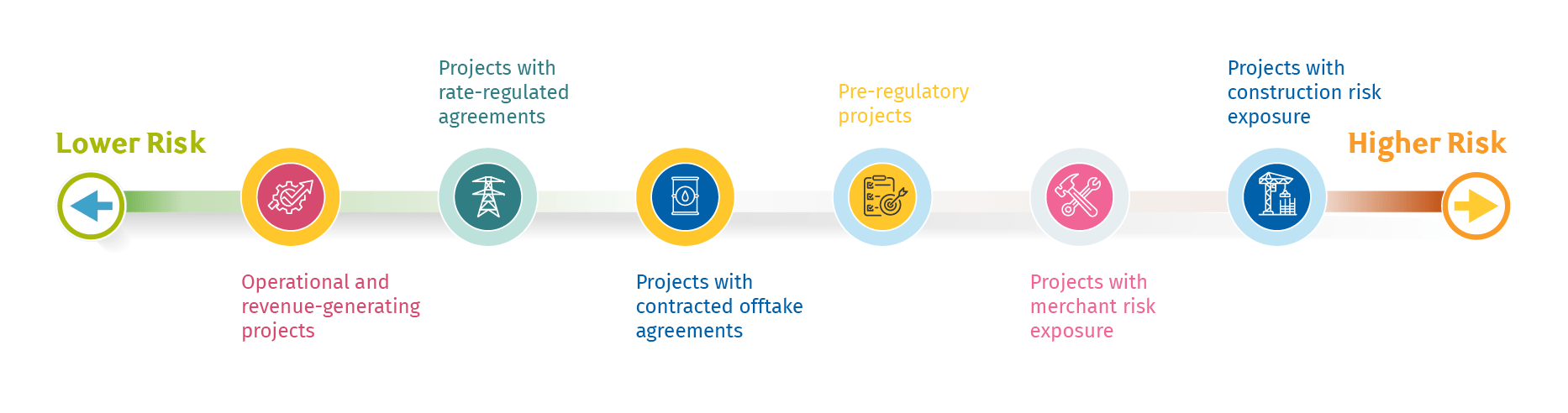

In an era of rapid technological change, how can we reshape Canada’s economy and position it for future success? Who are the innovators leading this transformation?

Disruptors x CDL: The Innovation Era is a limited podcast series where we dive into the cutting-edge technologies and visionaries reshaping the world. Hosted by John Stackhouse, Senior Vice-President at RBC, and Sonia Sennik, CEO of Creative Destruction Lab, this series uncovers the innovation that Canada needs to stay globally competitive.

From artificial intelligence to life sciences and clean energy, we explore the breakthroughs that hold the key to unlocking Canada’s economic potential. Join us as we sit down with industry disruptors and explore solutions for Canada’s most pressing economic challenges.

Subscribe now to Disruptors x CDL: The Innovation Era as we explore critical insights into Canada’s economic challenges and offer actionable strategies for our bright future.

Listen on Apple Podcasts, Spotify or Simplecast


Sonia Sennik: How do we reimagine an economy in a time of unprecedented change?

John Stackhouse: And who are the disruptors leading that change? Welcome to Disruptors and CDL, the Innovation Era, a limited series where we dive deep into the technologies and innovators reshaping our world. I’m John Stackhouse, Senior Vice President at RBC.

Sonia Sennik: And I’m Sonia Sennik, CEO of Creative Destruction Lab. Together, we’re creating change. We’ll explore how Canada can harness innovation to stay globally competitive in this time of disruption.

John Stackhouse: So, here’s the problem. We’re lagging. Canada’s adoption rates for transformative technology, like AI, are far behind where they should be.

Sonia Sennik: And this is not a tech issue. It’s an economic one. From artificial intelligence to biotech, to the future of energy, to post secondary innovation, this collaborative series between RBC and Creative Destruction Lab explores the breakthroughs and ideas that can unlock Canada’s economic potential.

John Stackhouse: We’ll speak to the innovators at the forefront, those changing the way we think about productivity, sustainability, and the future of work.

Sonia Sennik: Subscribe now to The Innovation Era and join us as we explore critical insights into Canada’s economic challenges

John Stackhouse: and what we can all do to build a brighter future.


What if we knew that the world — the human world — would be so radically different within our lifetimes that we might not recognize daily life? What if we knew that children born in 2025 would never know the meaning of work, or income inequality, or deprivation?

What if the ensuing shocks were so profound — to society, business, government, even to our sense of self — that our future selves wished more than anything else they had prepared better for the day when algorithms and machines could do everything we do, only better and faster? And what if our future selves were to look back at 2024, to see it as the one clear moment in time when we saw the future and blinked?

The potential for those shocks is there. Artificial General Intelligence — software with human-like intelligence and the ability to self-teach — may be nearing a state where it can, at least theoretically, start to displace, at scale, the functions (mental, physical, perhaps even emotional) that have, for millennia, made humans the species we are.

Will the resulting shocks come in a decade or a century, or somewhere in between?

In the long arc of time, the timing may not matter, as we know today the clock is running out on the age in which man reigned over machine. We are on the edge of a new era of commingling and interoperability, an era which could see intelligent machines play a role in every aspect of life.

That era will present plenty of unknowns, and for that, society needs to start preparing.

To discuss how, a group of technologists, academics and executives gathered this spring in Asilomar, California, to confront our newest existential challenge: What if we succeed? What if, within a decade, AGI is capable of replicating every human task? And how, on earth, should we prepare?

The Setting

Past is prologue, and so may be true for AI in the quiet solitudes of Asilomar.

Jutting into the Pacific Ocean, around the corner from Monterey Bay, Asilomar is a sleepy retreat that can easily be bypassed for the spectacle of Pebble Beach on one side and chill vibe of Pacific Grove on the other. Indeed, it seems to embody the paradox that Gertrude Stein applied to her hometown of Oakland, not far away. There is no ‘there’ there.

In one direction lies the sea and its infinite promise, and in the other, beyond the coastal mountains, Silicon Valley and its exponential promise. It was here, at the edge of America, and in the throws of the second Industrial Revolution, that the great San Francisco architect Julia Morgan designed a retreat for the Young Women’s Christian Association, the first in the American West.

Morgan had already helped San Francisco rebuild from the Great Fire of 1906, and was well into the defining commission of her career, Hearst Castle, down the coast in San Simeon. In 1913, when Asilomar opened, the world was on the cusp of a technological revolution, one that would make airplanes, cars, telephones and movies the tent pegs of 20th century life.

Morgan had tried to give the YWCA a retreat from what was to come, with her wood-beam and vaulted ceiling “Chapel” and its engraved words, “the lord on high is mighty.” But she later recognized that the Roaring Twenties, and the rise of American modernism, would challenge that view of the almighty, as it gave god-like powers to a new scientific class immersed in the atom and electron.

Nearly a century later, a new generation of scientists, technologists and their backers, are seeking to equally reshape society, with AGI.
Can they prepare for the unknowns of a far more powerful tech revolution? Can they find ways for autonomous machines and their human dependents to co-habitat?

If they succeed, can their society reform capitalism, in ways that the first Roaring Twenties failed to do, to fairly distribute resources even though the means of production are controlled by machines? And will the rest of us find new ways to accept our finiteness in an infinite economy?

Looking over the rugged dunes that connect Asilomar with the setting sun, and the promise of tomorrow, the challenges of technology disruption may feel the same today as they did for Julia Morgan, to both harness modernity and keep it in its place. And yet a century on, this new revolution feels entirely different, with its exponential promises looking to be as profound as its existential threats.

Here are some of the considerations:

1. The promise of infinite surplus

Moore’s Law remains the guiding force of our times, allowing for the doubling of computing power every two years. In fact, over the past decade, compute power has doubled every six months. To date, human ingenuity has been able to keep pace with that kind of growth. We’ve figured out how to use computers, smart phones, and wired machines to our benefit. But the compounding of compute beyond this decade, into a new AGI realm, may be more challenging to human adaptation, especially as machines increasingly make their own decisions and gain physical mobility. We could see more biorobots in 25 years than humans, and far more virtual agents informing, advising, and eventually directing our daily lives.

Some forecasters believe that 80 per cent of jobs will be done by some form of AI within a generation. One result could be a near-infinite rise in economic output, as the world’s productive capacity soars. Services such as health care, education and financial advice could become free, universally available and ever-improving. Profound challenges — climate, cancer, crime — could be solved rapidly. And even as wages collapse with the end of work, spiking productivity rates and surging output should easily compensate, if effective distribution models are established.

While the promise of such surpluses may be foreseeable, the timing is not. Like all technological impacts, AI is following the course of a slow, steady explosion. That makes it harder for society to prepare, to change income models, tax regimes, and social expectations. Moreover, the course of AI adoption and its impacts are unlikely to be linear, especially when they run up against rigid social and economic models. A meandering path to AGI, with technological bursts and social reactions, may mean we get to AGI before society is ready for it.

Perhaps Transformational AI can help distribute the surpluses it creates, but only if we guide it to do both at the same speed.

What’s needed:
Dynamic research to track the displacement of labour and distribution of benefits across the economy.

2. What AI needs to learn

Many aspects of AI may not be as smart as we think, given the stumbles of ChatGPT. But it’s also showing all signs of being slow and steady, then fast and furious. The avalanche effect.

The technology is currently evolving through a rapid series of small steps, with few eureka moments. One reason: most models still focus on computation, rather than achieving goals. The chat bot explosion of the early 2020s has yet to expose deep thinking from machines, other than an impressive ability to accept prompts and respond.

We need to shift Large Language Models (LLMs) to algorithms that can learn from ordinary experiences, not just from neat data sets. Indeed, LLMs may need to search for greater challenges, and pursue the sorts of messes that literally don’t compute. AI may also need more time, tools, and space to test and learn from multiple hypotheses rather than the hard coding of symbolic reasoning. Ultimately, systems will need to get better at working with the wonders of the human mind, and the depths of intuition that machines can’t replicate. One suggestion: “Think of it more as parenting than programming.”

That kind of parental guidance — helping AI not touch the hot stove or poke the dog’s eye — can come through continuous deep learning and “efficient off-policy learning”; that is, allowing the models to colour outside the boundaries of their algorithms, to understand aberrations, and to engage in discordant and shallow data sets. This will require humans to accept that our relationship with AI increasingly will become continuous and not transactional; again, parenting, not daycare. And we may need to accept that passive systems will wake up to learning.

Ultimately, AI will need to develop its ability to anticipate and adjust. Prediction machines will need to become planning machines. And like most of us, there will need to be plans for failure. Hospitals, for instance, may need to add on-call data scientists to help manage algorithms that go awry or stop during a procedure because they don’t know what to do.

The growth of AI may be iterative, a journey of baby steps. But such is the rapidly incremental nature of innovation.

A bit like childhood.

What’s needed:
Open sharing of discoveries and data, when public interest is at stake, to ensure collective progress.

3. A concentration risk

You don’t need to be in Silicon Valley to hear the giant sucking sound of capital by AI. And it’s getting louder, as the colossi of chip, cloud, and compute devour more and more capital to finance their energy- and data-hungry learning models. As the big get bigger, they’re also starting to drive returns, which in turn is leading to more capital generation.

LLM spending is already estimated to have hit about $1 billion last year, and could reach $10 billion this year or next. Some suggested $100 billion could be spent annually on language models within five years. Intel is already spending $25 billion on chips. AI is having the same power in fundraising; last year saw $50 billion in venture funding and 38 new unicorns. OpenAI, the market darling, saw its valuation edge reach $80 billion.

And then there’s this calculation: If AGI increases economic productivity, in an optimistic forecast, the cash value of its benefits could be $124 quadrillion. Suddenly, a $7 trillion investment seems reasonable.

The centripetal force of AI is about more than money. The cloud behemoths are accumulating data and talent at rapid clips, and also amassing the resources to spend on supercomputers. It’s estimated fewer than 10,000 people are working on what can be considered “transformative” AI — anything that might lead to AGI — and most are serving the interests of a handful of firms. It’s said that Tesla’s dominance in automobile data, especially for autonomous vehicles, was one reason Apple — hardly a constrained enterprise — backed away from the its AV project.

Will the concentration lead to an oligopoly or even monopoly in AI? And will that stifle competition? Or will there be an emergence of“bilateral oligopolies” — small groups of players at each link in the supply chain? That could lead to cartels or at least coalitions in, for instance, electricity supply, computing operations, and chip supplies. Governments could equally impose constraints — quotas, as an example — on dominant players, or at least require them to serve national needs first.

All of which comes with a caution: concentration of power is less dangerous than concentration of thought.

What’s needed:
Governments may need to consider an industrial policy mix for AI, to ensure a fair and strategic allocation of resources, including capital.

4. A risk to supply chains
There may be more than we can manage. Compute, chips, and labour are all in short supply, and traditional supply-demand models may no longer apply. For one, AI is creating exponential curves in demand through the unpredictability of its uses and needs. The steep cost of inferencing — the running of data in a live AI model — is only growing as those models get hungrier. The more they learn, the more they want to learn. A separate tech race is on, to develop more efficient chips, shrink the size of models, and compress the middleware that adds more weight to systems. In each of those areas, competition helps. And the explosion of capital for AI could help fuel that competition.

Structural (or infrastructural) inputs like electricity will be harder to fix. Much of the world is already in a hurry to produce more clean electricity to run factories and cities in a net-zero economy, and there’s a risk that capital-rich AI projects and their energy-hungry data centres will outbid the older parts of the economy trying to transition their energy models. In that scenario, the compute demands of AI could sideline the climate demands of society. In those cases, governments may need to assign scarce resources to a hierarchy of societal needs.

More positively, the enormous potential of the race for AGI, and the apparent economic potential, could prove to be an added incentive to the development and scaling of emerging energy sources like nuclear fusion.

A scarcity of inputs will also challenge the business and organizational adoption of AI, including transformational AI. Legacy industries, already operating with low margins, will continue to be challenged to compete, compute, and to buy the chips they may need. Such a scenario may lead many companies and public-sector organizations, as was the case in the Internet’s early years, to accept their place as slow adopters, using off-the-shelf enterprise software tools that can be useful for efficiency but less dynamic for innovation.

This will put further pressure on governments, to find ways to increase both supply and demand for AI in a broad range of sectors as well as public interest pursuits. As is often said of the Internet, we had an invention that was profound and powerful enough to cure cancer, and we used it instead to share photos. The same risk — individual preferences versus collective needs — could play out with AI and models; creating celebrity avatars rather than diagnosing health problems. In business, too, the next generation of AI needs to be focussed on discovery, not just automation. Collective research models, such as a DARPA or NASA for AI, could help coordinate university research and business application, and in turn develop ecosystems that ease supply chain constraints and open doors for emerging challengers.

Ultimately, AI should expand our vision, not shrink it.

What’s needed:
Incentives and initiatives to ensure the supply chains of AGI are focussed on societal needs, especially science, including the incomplete sciences of climate and behaviour.

5. A risk to robots
Mention AI on Main Street, and most conversations will quickly turn to robots and their rise. The early years of Transformational AI is painting a different picture. Many of the biggest private sector AI players have set aside their initial focus on blue-collar work — where robots are most needed — and turned instead to white-collar functions. For one, there’s quicker returns in the information economy. By its very nature, language models are also best at playing with words and numbers, the stuff of enterprise software. And it turns out, error rates are more acceptable in the information economy. We’re willing to accept fake news, or fake essays, a lot more than flawed buildings.

That’s not to suggest there’s no hope for robots outside warehouses. It’s just going to take longer. Big Tech is actively trying to develop software that can mimic human dexterity and senses. The prize is enormous. It just takes an ability to convert perception data into action data — what we might call reflex and instinct, as opposed to habit. In the coming years, we may see more “teleportation,” as people take possession of robots to help them learn. We could even see business models around Brain as a Service, in which enterprise software packages can be bought or licensed to command various aspects of the workplace, home, and community, or perhaps even ourselves.

The demand for robots, and other smart hardware, will only grow as populations age and eventually shrink. So, too, will our comfort interacting with machines, just as we’re comfortable conversing with our phones. (One retailer said their store tests show customers trust on-floor robots more than on-floor staff, for information.)

What will AI-powered robots, and other learning machines, be good for? If we get it wrong, we’ll end up developing self-teaching vacuum cleaners and toilet scrubbers first, rather than using Transformational AI to transform how the world’s economy operates. If we get it right, AGI can help remove transportation from the ground and sea, putting it in the air and freeing up our lands and waters for better uses. It can transform manufacturing, including through 3D printing. And most profoundly, it can change the way we live, with medical devices in our bodies learning as we age. Like the third Industrial Revolution — the computer age — which allowed us to shift en masse from a brawn economy to a brain economy, the advancement of Transformational AI can power the robots and smart machines in our lives to do more than make our lives more convenient and efficient.

They can help us leap into a new age of discovery.

What’s needed:
Robotics programs, including public supports, that drive innovation to the most important frontiers of human progress.

6. A transition risk

Utopia doesn’t have an on-ramp. If we’re to get to an AI-driven world, in which there’s infinite surpluses and machine-enabled peace and prosperity, we will have to endure a lot of bumpy detours and diversions.

In the world’s poorest countries, and indeed in the poorest regions of the world’s richest countries, labour is too abundant and cheap to replace with AI. Infrastructure and technology distribution will further impede the universal spread of AI. Paradoxically, where AI is needed most, it could be deployed least.

The dispersion of AI in advanced economies won’t come without disruptions, either, especially to workforces. Entire areas of expertise, and the trades and professions associated with them, could rapidly dwindle, along with the education programs that feed them. “Stranded expertise,” as it’s called.

During this transition, many of us will need to shift to “augmented work” in which we job-share with AI, exploring ways to make the most of each other as we co-habite roles. We will also need to prepare — psychologically as well as economically — for the day when we’re no longer needed in that role. Augmentation will give way to an advanced form of automation, in which the job and its constituent tasks continue to evolve in the hands of a machine.

Those with a growth mindset see far more opportunity. First of all, if AI is restricted to current human knowledge, it will have failed. Properly guided, Transformational AI should multiply our collective knowledge set, as well as our troves of creativity, which in turn will lead to more discoveries, more creations and more pursuits and jobs. As one small comparison, the microscope did not element any jobs; rather, it opened our collective eyes to frontiers and possibilities we had scarcely imagined.

Bumps, yes, but the transition is to a place of greater human engagement.

What’s needed:
Development programs for AI in low-income regions, as well as AI-powered learning programs across professions, trades, and jobs at risk.

7. A distribution risk

Even if we put AI in Utopia, it will be subject to human nature, which generally is not about sacrifice and sharing. Yes, once AGI becomes a universal reality, the potential surpluses of our economy could spell an end to hunger, poverty, and disease. But humans may not be content. We may still need and yearn for status hierarchies. Our happiness will remain relative. There will also be divisions between countries, as nations (xenophobic ones, especially) seek forms of differentiation to enhance national pride and self-worth. An AI-powered Olympics would be no fun if the optimal outcome was for every country to share the gold medal.

This kind of competition — or as Freud called it, “the narcissism of small differences” — may become more entrenched, and violent, if humans are unable to find other forms of meaning, beyond work. Regardless of the political economy of a country, basic instincts will be a challenge for AI to cope with — something communist states discovered about themselves and their Utopian dreams in George Orwell’s Animal Farm. (“All animals are equal, but some animals are more equal than others.”)

Even today, in the West at least, we have the best lives humanity has arguably ever lived, and yet we generally feel we don’t have enough. Social discontent has rarely been higher, and ironically, we know how to solve most of society’s shortcomings. In fact, we don’t need AI to figure out how to distribute wealth more equitably, as we did that some generations ago. Just open our borders more to trade and immigration, and find more systematic ways to distribute the surpluses of our economies. AI would tell us to do the same thing, presumably, and we would find reasons — relative prosperity — to reject it.

What’s needed:
More open trade policies, including for digital assets and IP, to allow for a freer flow of AI opportunities and benefits.

8. A risk to democratic capitalism

Capitalism exists by permission of democracy, and if the benefits of AI are not clearly and fairly distributed, the system that is financing its growth could be at risk. This could require capitalism to adjust as much as society needs to adjust to the powers of AI.

For centuries, the distribution of economic surpluses has been largely based on labour. More recently, economic rewards have gone disproportionally to the owners of capital, over labour. As AI, and the owners of the capital behind it, amass more economic benefits, and as labour rewards are diminished, social tensions and ensuing political pressures could grow. This could become even more acute in aging societies in which older, and less productive, generations hold the bulk of capital through their lifetime of savings, while labour-challenged younger generations are squeezed.

Could this lead governments to nationalize AI, in order to distribute the benefits more widely? Or will governments instead more aggressively tax the owners of capital, to redistribute their gains from AI? Perhaps modern capitalism won’t be needed anyway, since its AGI may replace the need for markets to determine equilibriums and drive the efficient allocation of resources. An algorithm can do that.

As AGI takes hold, governments could also be tempted by policies more associated with authoritarianism, to maintain control over the social and political consequences of emerging models. Fundamentally, democratic capitalism will be challenged to address this: Whoever controls the digital infrastructure behind AI — supercomputers, chips, energy sources — will control the future. In other words, the digital means of distribution will eclipse the means of production as the determinant of economic power.

Which leads to this question: in 2034, if Silicon Valley hasn’t taken over Washington, will Washington need to take over Silicon Valley?

What’s needed:
Businesses, investors, and governments need to rapidly develop new approaches to market economics, to ensure the rewards of capital and labour are properly assessed and allocated.

9. A risk to meaning

Technology has always challenged the meaning of life, and the purpose we each hold. Deus ex machina (“god from the machine”) goes back to Ancient Greece, and a seemingly instinctive association between the almighty and technology, both being stronger than us. In ancient theatre, the god from the machine usually brought resolution to the problems on centre stage and sent audiences home happy. AGI may be expected to do the same, even though the angst of human life may not compute.

Humans will need to prepare, perhaps rapidly, for a world in which work and deprivation are both remarkably scarce. That won’t put an end to human desires, even when everyone has sufficient food, housing, and clothing. We always need more. Especially in our minds and hearts. AGI may not anytime soon be able to speak to our emotional needs, for laughter, comfort, and love. Nor can it address the social isolation that can come from the end of workplaces, schools, and commercial centres.

Or can it?

AGI may actually not put an end to work, but rather enhance jobs and pursuits with more meaning. It will take the robotic out of every job, perhaps. This could lead to a new definition of work, in which jobs are as much social as economic functions. Call it a Seinfeldian world, as someone suggested, each of us busy with banter and errands. We’ll all be active, and rewarded accordingly, just not what exactly what we’re sure for.

Will that shift to leisurely work make us feel more inconsequential? And perhaps less essential? Will it lead to lethargy? Or anarchy?

Over the coming years and decades, as we pursue the final frontiers of technology, we will need to explore the inner frontiers of humanity, to determine what it means to be humans. We can love and preserve, as much as we today produce and provide. But that will require some new shared narratives of what the good life — and good work — can be.

Only humans can code that.

What’s needed:
Dismantle or at least refine labour market barriers and regulations, to allow for a more entrepreneurial, creative, and human approach to work.

10. A risk to regulation

The greatest risk in regulation may be our inclination to regulate the past against the future, and AGI is all about the future. That presents an important moment to challenge ourselves with what ifs:

  • What if there is only one AI model and it can be independently regulated?
  • What if we regulate the users and not the algorithms?
  • What if we declare and code all models with what good looks like? What if we declare and code all models with what bad looks like, including self-replication, break-ins and evil intent (e.g. bioweapon design)?
  • What if we ensure agents and models have “normative competence” to search for, and recognize, boundaries and laws?
  • What if we penalize, even threaten to shut down, models that go against good?
  • What if we use interoperability to monitor how models are doing, and ultimately allow models to measure and police themselves?
  • What if we allow models to share IP, to assist new entrants?
  • What if we require AI models that draw on data from public spaces — roads, social channels, education systems, for instance — to join data utilities?
  • What if we create regulatory safe harbours for areas of public importance, such as disease recognition?
  • What if we assign “personhood,” with rights and legal responsibilities, to agents and chatbots?
  • What if we apply principles rather than prescriptions to AI?
  • And ultimately, what if beneficial co-existence is not possible?

The emerging frontiers of AI regulation are no longer in the distance, and governments (democratic ones, at least) will be challenged to catch up. Fearing the worst, they may throw in the towel and shut down AGI efforts — or leave it in the hands of incumbent oligopolies that may be easier to negotiate with and police. It’s surely the case that AGI is too novel a concept to allow for regulatory capture. And yet, the incumbents, and their regulators, are party to the rise of algorithms that may soon be too complex and inscrutable for them to understand, and dangerously irreversible.

There is no easy way at it, other than, perhaps, to remind ourselves that science is inherently about experiment, guided by universal principles, including Do No Harm. Societies, in a range of political systems, have harnessed the benefits of science — space, medical, nuclear, biological — by following such principles. Ultimately, we may need to place the same confidence in the scientists working on AGI. If we don’t, other countries and regimes will not likely let up in their pursuit of this new frontier for intelligence. We may be better to work together, and over time, as was the case in the atomic age, place faith in science and a bit of skepticism in each other.

As the political code suggests, trust but verify.

What’s needed:
In the near term, a clear and replicable taxonomy and code for AI regulators to model and share. In the longer term, international conventions and systems for AI governance.

11. A risk to global security

Scientists hate to be politicized. Too late. AI is rapidly becoming a central political issue, and a growing geopolitical one. The G7 is making AI one of its top priorities, in part to ensure there’s a coherent and collective approach to keep China and Russia from achieving supremacy. The United States and Britain have made AI a central file for their heads of government, as nuclear security was in decades past. They’re not alone. The United Arab Emirates, among other emerging economic powers, has made AI a national ambition, while its close ally India is seeking to do the same with what may be the fastest growing tech stack anywhere. Those challengers to the West may find their own common ground, in a “Third Way” model that is neither Chinese, nor American-centric.

A space race in AI may be healthy for competition, and innovation, but it’s also a risk to global security, as self-learning models strive to compete with each other based on national standards and goals, not universal ones. This rivalrous approach to AI could deepen as countries put more resources behind national strategies designed to create a competitive advantage. Potentially worse may be national restrictions (and hoarding) of key AI inputs, including compute power and chips. Without greater global governance, the odds of mishaps — intentional or accidental — will grow.

Fortunately, the world has nearly a century of experience in successful multilateral governance, which while flawed, has helped prevent nuclear strikes, the proliferation of biological weapons, and ultimately another world war. Even conventions on child labour, land mines, and summary executions have had their effect. Similar approaches to AI governance may soon be needed.

Unfortunately, the post-war institutions that have successfully governed conduct in so many areas since the 1940s are themselves under attack. If the major powers are losing confidence in the World Trade Organization, why would they lean into a World AI Organization? As in previous generations, it may be up to scientists and business leaders to build bridges with all countries pursuing AI goals, including those that may have difficult political relationships with others. As the Churchillian credo of diplomacy says, jaw jaw is better than war war. In that spirit, we will need more alignment, between East, West, North, and South, on the goals — and dangers — of AI. We will also need more public confidence in AI, for people to see the value in its development as well as global governance, understanding its weaponization would be fatal.

Ultimately, AI for all will require all for AI.

What’s needed:
Track 2 diplomacy to bring together scientists, business leaders and academics from rival countries, paving the way for a Track 1.5 effort with government officials.

12. A risk to society

Not far from the barren dunes and windswept groves of Asilomar, the great midcentury American writer John Steinbeck worked on The Grapes of Wrath and Cannery Row. Those classics captured America at a crossroads, scarred by Depression, challenged by a changing world order, and yet inspired by the technological gusto from the Roaring Twenties. Writing of an emergent superpower, Steinbeck noted that the best qualities that Americans seek in people — kindness, honesty, openness — are not what they value in the market. And what we seek in markets — sharpness, acquisitiveness, self-interest — are what we consider failures in people. In other words, we seek in a system what we don’t want in each other, failing to appreciate a system is a function of its parts.

Can AI change that, taking the best of humanity and applying it to the worst of society? It won’t be easy given the dyspeptic mood of publics almost anywhere. It will be even harder in a political environment that seems to eschew kindness and celebrate sharpness.

The mind-boggling reach of Transformational AI can seem like too much for any society to comprehend and absorb. Democracy, most of all, may be challenged to mediate those existential challenges. The risks to our personal and collective security, the dangers of concentration, the unknowns of distribution, and the highly variable outcomes of regulation — each of these could tip the public’s mind away from AI. That is, if Transformational AI is not too fantastical for the public to consider seriously. That is, if it’s not too late to reverse what’s been started. That is, if we can untangle what’s smarter, faster, and more aware than its creators.

And if we can, do we know how to move collectively and at speed? As a society, we weren’t ready for the COVID-19 pandemic, which was predictable and precedented. Facing the unprecedented, we will need to find a different path. We can start by breaking down challenges into actionable and meaningful opportunities, and to frame the AGI discussion in the realities of today and tomorrow, rather than the extraordinary projections of a future time. Governments and their publics care most about the here and now, which is a good place to meet. Taking a page from nuclear science, we can also develop the muscles and rigours of safety precautions and monitoring. And we can build bridges with scores of countries to ensure this is a human-scale endeavour, not the purview of an elite band. Steinbeck wrote, in Cannery Row, “Man’s right to kill himself is inviolable, but sometimes a friend can make it unnecessary.” That may sound morbid, but it was framed in the spirit of a community that was overwhelmed by the changing world around it. Friendship, they discovered, was one of humanity’s great powers.

It may yet be what prepares us for the age of AGI.

Download the Report

Download

Canada has a growth problem. The economic momentum that propelled the country through the 20th century has faded in the 21st, and appears to have worsened since the pandemic. Higher interest rates have slowed per-capita output since 2019, but the problems run deeper than that. Our economy is now smaller than it was in 2019 when adjusted for inflation and immigration, and pretty much in the same place it was a decade ago. Globally, we’ve fallen behind most major economies since 2000. At the turn of the century, the economic output of the average Canadian was on par with Australia. Today, Australians are almost 10% more productive, while their economy has grown 50% per person faster than Canada’s over the quarter century. We’re further behind the United States. Canada is 30% less productive than the U.S. and closer to lower-income states like Alabama in terms of economic performance than tech-rich California or New York. The result: We’ve fallen from the 6th most productive economy in the Organisation for Economic Co-operation and Development in 1970 to the 18th as of 2022. Pretty much every Canadian has something at stake. The productivity gap with the U.S. stands at about $20,000 per person a year, putting Canadians’ wages roughly 8% below their U.S. counterparts. The gap has been even more taxing for capital. Anyone who invested $1,000 in Canada’s main stock index in 2000 would have $4,400 today; the same investment in the U.S. S&P 500 index would be worth $6000—a more than 35% difference. Our relatively low productivity —the amount of production and income generated per hour worked in the economy— has been held back by a shortfall in investment, especially outside real estate, construction and public services like hospitals. As a result, we’ve not been able to capitalize on the immigration boom that has added seven million people—most of them working-age and well-educated—since the turn of the century and offset the retirement wave of baby boomers. The deindustrialization of many parts of Canada has cut into the country’s overall prosperity. Manufacturing is half what it was to the economy in 2000, while mining has also shrunk. Oil and gas—once powerhouses of investment and growth—are showing signs of renewed strength, but investment levels remain far below what they were a decade ago. Agriculture has been a rare standout, as we’ll explore later in this report. A positive change in productivity could be the most significant factor in lifting economic growth, and the prosperity that goes with it. We have the natural and human resources that much of the world is looking for, and our access to major markets—Europe, Asia, and critically, the U.S.—is the envy of the world. With those strengths, Canada’s growth challenge can quickly become a growth opportunity, with significant benefits for Canadians. Simply closing the productivity gap with the U.S. would add roughly $20,000 of GDP per person per year.
Slowing Canadian GDP growth led by softening productivity gains
Average annual percent change, business sector (sum of bars equals per-year GDP growth)
Statistics Canada, RBC Economics
Boosting productivity is not simple, of course. Canada is a large, geographically diverse, resource-rich country with a dispersed population, and that creates unique infrastructure, regulatory and investment challenges. Administrative burdens across multiple levels of government have created inefficiencies and increased internal trade barriers. Infrastructure chokepoints and red tape make international trade more difficult than it should be. Even the mobility of skilled workers—hard enough given our geographic expanse—can be limited by the way provinces, industries and professional groups try to control labour supplies. Those issues all contribute to lower Canadian business investment and with that, lower growth. Moreover, in recent economic cycles, a growing share of savings and investment has flowed to real estate and construction, which, while needed and beneficial for many reasons, are both relatively inefficient and can hold back the overall productive growth of an economy. The same can be true for small businesses, which account for 98% of total businesses and historically have been less productive. Those businesses are foundational to the country and are part of many Canadian’ communities, but if they’re not growing and becoming more competitive, they can limit the overall economy’s potential. It wasn’t always this way. Canada’s productivity growth averaged 5% per year in the 1950s as wartime technologies were adapted for civilian use—powering virtually all GDP growth that decade. Productivity growth stayed strong (3.5% per year) in the 1960s as automation of the manufacturing sector continued, along with a boost from the 1965 Auto Pact between Canada and the U.S. that opened a new door to freer trade. That trajectory faded during the turbulent economic times of the 1970s and 1980s, although innovations like container shipping and expanding global trade led to further gains in growth and productivity in the 1990s. These challenges can seem daunting. But the solutions are also clear and attainable and don’t require many trade-offs. Growth-minded policies can benefit all parts of society including both investors and workers. Among the most compelling options for governments, businesses, unions and industry groups:
  • Cutting red tape and reducing internal trade barriers. This doesn’t have to mean lowering standards but rather improving consistency and rules across jurisdictions to make project approval times and costs more predictable.
  • Better utilization of immigrant skills. All population and workforce growth is going to come from immigration, and we need a better system to match education and skills with jobs.
  • Improving tax competitiveness. Canada’s tax competitiveness has been slipping. Our level of taxation overall is lower than other more productive economies, but broader reforms to reduce complexity and the cost of tax compliance could help to attract more investment.
  • Adopting new technologies. “Smarter” investments like artificial intelligence can help but adoption rates are low in Canada. Making it easier to invest in new technologies is critical to maintaining global competitiveness.
  • Capitalizing on a highly educated workforce. Canada’s highly educated workforce is uniquely positioned to benefit from a global shift to a more services-based economy. Canada needs to ensure investments in education are generating a return.
Every federal government over the last quarter-century, and many of the provinces have studied the challenges of competitiveness, growth and productivity. And they’ve each discovered, sometimes in hindsight, that there’s no simple policy playbook. This report examines some of the steps that can be taken to enhance growth, but one of the most powerful tools is not a tool at all; it’s a mindset. If Canadians developed a collective focus on the economy of the future—one that rewards innovation, celebrates competitiveness, invests in both people and technology, and efficiently delivers returns—the productivity puzzle may become easier to solve. And with it, growth will return.
  • Canada’s productivity vs. the U.S. has been sliding since 1980s
  • Natural resources lead Canada’s productivity gains vs. U.S.

How we got here: Canada’s journey to low productivity

Some of the causes of Canada’s long-term slowdown in economic growth are well-known and clear. Let‘s start with an inefficient regulatory and administrative approval system at all levels of government, which has unintentionally increased internal barriers to trade and growth. Infrastructure chokepoints and red tape further make international trade more difficult than it should be. Those have contributed to lower Canadian business investment, and with that, an overweight of capital going to buildings and construction, which, while valuable to the economy, don’t do as much for growth as machinery and intellectual property do. Moreover, many policies have favoured small businesses over growth companies and large enterprises, which, in turn, limits our overall productivity growth.
Canadian businesses invest less Canadian businesses invest substantially less than in the U.S.—about half as much per worker in aggregate. That underperformance intensified following the 2008-09 global financial crisis and through the oil price collapse of 2015, and worsened following the pandemic as higher interest rates hit the Canadian economy harder than the U.S. In sum, the contribution to productivity growth from capital investment in Canada since the 2008/09 financial crisis has been less than half the average over the decade before. Added to this, weak recent investment trends suggest further underperformance in the decade ahead. Of course, part of the slowing in investment has been from a pullback in investment in the Canadian oil and gas sector that is tied more to the ongoing energy transition globally away from fossil fuels. But, businesses have also invested a substantially smaller share of GDP in the manufacturing sector in Canada than in the U.S. over the last decade. The issue does not appear to be a lack of available funding. Central banks have pushed interest rates higher, but businesses are still sitting on a large cash stockpile worth almost a third of GDP. Businesses have long argued that an inefficient project approvals backdrop is making investing in Canada relatively expensive.  Lack of investment also keeps Canadian businesses smaller (98% of businesses in Canada have fewer than 100 employees) and smaller businesses are typically, on average, less productive.
  • Canada vs. U.S. investment per worker ratios
  • Utilities and mining draw most investment both sides of the border
Regulation is a tax on investment and growth A patchwork of regulatory and administrative rules across different municipalities and provinces is complicated and unintentionally restricts trade within Canada. The International Monetary Fund has estimated that internal trade barriers (for example, regulatory differences across regions, paperwork requirements for businesses in multiple jurisdictions, and certification differences that limit labour mobility) cost the equivalent of a 20% average tariff between provinces. By comparison, the effective tariff rate collected on international imports from abroad in Canada is less than 1%1. In 2020, Canada ranked 188th out of 208 economies tracked by the World Bank on the number of days businesses spent dealing with construction permits for new projects. That is three times longer than time spent in the U.S. Red tape also makes it more expensive for companies to trade across international borders. Actual tariff rates on international trade in Canada are low, but Canada ranks poorly (51st globally) in the ease of trading across borders in large part due to high administrative costs associated with importing and exporting. Our tax system is losing its competitive edge A decade ago, Canada had the second lowest corporate tax rate among G7 economies. That gap has narrowed, particularly, after a sharp drop in U.S. corporate tax rates in 2018. Canadian corporate tax rates are still comparable to other advanced economies. But taking into account the tax on company dividends at the personal income tax level, the total tax on distributed profits from Canadian companies is the highest in the G7, according to the OECD. Added to this, governments in Canada have been running larger budget deficits after decades of fiscal responsibility. That raises the risk of further tax increases in the future, which increases uncertainty for businesses thinking about coming to and expanding in Canada. At the same time, while foreign direct investment in Canada has remained firm, investment by Canadians abroad has grown substantially, leading to a large net outflow of investment abroad. The investments abroad are valuable. Canada’s stock of net assets held abroad has increased to about $1.7 trillion (57% of GDP)—but they are adding to productivity growth outside of Canada, rather than within.
  • Canada’s net investment outflow to U.S. intensified after 2014
  • Canada’s corporate profit taxes are highest among developed nations
Infrastructure challenges—some natural, some self-created Canada has a small population spread across a large land area with abundant natural resources that need to be exported. That generates some unique challenges compared to other countries. The good news is Canada has a strong infrastructure overall, ranking at the top of the G7 in World Bank rankings. Transportation and warehousing are the few industries where Canadian business investment is a larger share of industry GDP than in the U.S. It is one of the industries where Canada’s productivity underperformance relative to the U.S. is the smallest. However, there remain significant bottlenecks where Canadian infrastructure significantly underperforms. The country’s turnaround times at ports are among the longest in the world, ranking 103rd out of 113 countries tracked by the World Bank in 2023 with a median of two and a half days. Canada also ranks poorly on “ease of exporting” in global rankings by the World Bank largely due to high document and paperwork costs.
Overweight in construction, light on intellectual property Productivity in Canada lags in most industries versus the U.S., but the Canadian economy is also overweight in construction, where productivity growth has been slower. Investment in residential structures accounts for twice the share of GDP in Canada (6%) than in the U.S. (3%). Businesses in Canada invest more in nonresidential structures and less in intellectual property products. Canada invests about 40% less (as a share of GDP) in intellectual property products (IPP) overall—with a larger weighting towards mining exploration activity. The manufacturing sector invests about just a quarter of what the U.S. invests in IPP relative to the industry’s GDP footprint. As a result, construction accounts for about twice the share of total hours worked in Canada (8%) as it does in the U.S. (4%). Construction is one of the industries that has struggled the most to boost productivity over time. Indeed, looking back decades, productivity in the Canadian construction sector as of 2022 was 54% above levels in 1961—which is just a fourth of the broader increase in business sector output per hour worked over that period.
  • How Canada’s productivity grew by sector over the last six decades
  • U.S. outpaces Canada in intellectual property investment in key sectors
A growing services sector isn’t helping productivity The reasons for Canada’s decades-long productivity challenge on the goods-producing side of the economy are well known, if not easily solved. The service sector (home to 80% of Canadian workers) must also be part of any solution to productivity challenges. It’s concerning that high levels of investment in human capital aren’t paying higher dividends in terms of productivity growth. Canada has a highly educated and skilled workforce that should be well-positioned to take advantage of the ongoing shift in the global economy from goods to service-producing industries. However, there hasn’t been a corresponding acceleration in productivity growth from the quality of labour as education outcomes have improved. The share of the Canadian workforce with completed post-secondary education has increased from 41% in 1990 to 70% in 2023, but growth in measured productivity from labour composition (skill upgrading as measured by increases in the experience and education composition of the workforce) has been running at about half its pace in the 1990s.
  • A more educated workforce isn’t resulting in higher productivity
A large and growing public sector is less productive Canada’s large public sector education and healthcare industries are much less productive than in the U.S. by 70% and 50%, respectively. and accounting for a fifth of the total economy productivity gap despite only accounting for 14% of the economy. However, it is also notoriously difficult to measure productivity in the public sector, where there are often no market transactions. Much of Canada’s underperformance in measured productivity in healthcare and education (essentially the market value of services over the number of hours worked) versus the U.S. disappears when broader outcomes of those systems are considered. Life expectancies in Canada are longer, and preventable deaths are lower. A larger share of the population over the age of 65 is in good health. And the Canadian healthcare system costs just over half as much as the U.S. on a per-capita basis to achieve those outcomes. In education, Canadian students (15 year-olds) rank close to the top of the OECD (and above the U.S.) in math, science, and reading scores. But that doesn’t mean there is no room for improvement. The public sector will need to get more productive to meet the needs of a rapidly growing population. While Canadian health outcomes rank better than measured productivity, the speed and availability of services have long been an issue. Satisfaction with health coverage has been slipping. Canada has a shortage of doctors and nurses, and a poor record of utilizing the skills of new arrivals, particularly, in the healthcare sector at a time when demands are increasing due to rapid population growth. In Canada, public-sector employment has accounted for more than a third of total job growth over the last decade.
Canadian agricultural output:
Lessons for the future
Agriculture isn’t always top of mind in conversations about technological innovation. But no industry in Canada has seen more disruptive technological advancement over the last century (or two) than food production. Those advances have led to massive productivity gains—even in recent decades. New techniques and products have increased crop yields. Advanced machinery has dramatically reduced the number of people needed to work the land. Forget about the tractors and combines of a generation ago—the technology in modern farm equipment more closely resembles that found in a spaceship. By our count, agricultural production per farm acre in 2016 was three and a half times the level in 1941. Per-worker production gains have been even stronger. Output per agricultural worker is about 12 times what it was in 1941.
Fewer farmers but multiple times more productive All of those productivity gains have led to dramatic structural changes. Farms have gotten much bigger. The average Canadian farm size in 2021 was about 800 acres—twice as big as an average farm 50 years ago and four times the average size in 1921. Larger machinery means fewer workers are needed. In 1921, about a third of Canadian jobs, or one million workers were in the agriculture industry. Today, agriculture accounts for about 1.5% of jobs or less than 300,000 workers. About 700,000 fewer people currently farm land, which is about 12% larger than it was a century ago.Automation—this is not our first rodeo There’s a lesson in agriculture for those who fear that automation could make large swaths of the current workforce obsolete. Historical trends in agriculture show us technology can be massively disruptive but also welfare-improving on the same scale. The prospect of losing almost a third of jobs to technological innovation in agriculture would have sounded terrifying in 1921. There have been negative consequences for rural communities that depended on all of those agricultural jobs. The flip side of that equation, though, is that all of those agricultural productivity improvements freed up almost a third of the workforce to focus on something other than food production. New industries developed, and people found other jobs. Advancements in medical research, a widely expanded social safety net, new innovations that have boosted output in other industries, all owe part of their success to the fact that farmers got really good at producing food.

What needs to be done to improve productivity

Most of what should be done to address Canada’s productivity challenges is not controversial. The changes required are growth-positive policies that would benefit business owners and workers even if Canada were starting from the highest productivity levels in the world. That does not mean they are not easy to implement. But if they’re not addressed, Canada will enter the 2030s with an even greater economic challenge than we face today.
Lower interprovincial trade barriers and cut red tape
Lowering trade barriers within Canada doesn’t have to mean lower standards. It implies improving consistency and rules across jurisdictions to increase the speed and predictability of project approval times and lower potential holding costs for businesses planning new investments in Canada. In a lot of our conversations with businesses, an unpredictable project approval timeline is flagged as an issue that raises costs in Canada versus other regions like the U.S. Attempts have been made over decades to try and better harmonize the regulatory backdrop across the provinces. The latest was the 2017 Canadian Free Trade Agreement. But progress is slow and lists of exemptions to free trade across provinces are long. Not all of the challenges are interprovincial, either. Rules, regulations, and project approval times also vary across municipal governments. Other countries that have been able to reduce internal trade barriers have had success in boosting productivity levels. Australia also struggled with internal trade barriers but had more success eliminating them in the 1990s. Other factors at play in Australia included the emergence of China as a major global economic power. The result: Australia’s productivity levels swung from 8% below Canada’s in the early 1990s to 8% above Canada’s before the pandemic.
Better utilize immigrant skills
All population and workforce growth is going to come from immigration in the decade ahead, and Canada has a bad track record at utilizing the skills of new arrivals. Canada leads the G7 in attracting immigrants with newcomers now driving population growth. Those immigrants are, on average, better educated and younger than the domestic workforce and more likely to have majored in STEM-related fields (science, technology, engineering, and math) than their Canadian-born peers. But they are also more likely to work in jobs that don’t fully utilize those skills. Canada has had more success at utilizing the skills of new arrivals among international students who choose to stay in Canada. Labour market underutilization of immigrant skills versus the Canadian-born population largely disappears among immigrants that studied in Canada. But simply recognizing the credentials of foreign-trained professionals in fields like healthcare would also increase the productivity and earnings of those workers and help address the chronic undersupply of those workers in the labour market.
Focus again on tax competitiveness
Canada’s effective economy-wide tax rate doesn’t appear to be a problem. Of the 17 OECD economies that outrank Canada’s productivity, 13 have higher total tax burdens (all taxes, including corporate and personal, combined). But the way that tax revenues are collected also matters. Canada relies more heavily on income taxes and less on consumption taxes like the GST/HST compared to more productive economies. Tax rates on corporate profits (including taxes on dividend payments) are also high. The tax system is also overly complex with a long list of exceptions, deductions, credits, etc. They increase the costs of compliance, often without clear results in terms of increasing tax fairness across the income distribution. Policymakers should aim to make sure tax rules can be easily understood to encourage compliance, especially among those that are most in need of the benefits, i.e., new businesses and lower-income households. Proper assistance from the government with tax filing and document gathering should also be available and accessible to all with the help of digitization. The harmonization of the tax rules, tax bases and defined terms between the federal government and provinces can also be improved to increase efficiency. Canada could also consider the creation of an independent, impartial body or mechanism for regular tax policy and complexity reviews. Canada’s last thorough review of the tax system happened in 1967.
Invest in new technologies
“Smarter” investments like AI can help but adoption rates are low in Canada. New disruptive technologies also don’t always translate into productivity gains. Productivity gains have been slower in the decades following the widespread adoption of the Internet than in the 1990s, for example. However, the consequences of falling behind emerging trends can be significant, and Canadian businesses have been underinvesting in new technologies. Canada is already a leader in generating new ideas, but has been slower to adopt new technologies among businesses. Canada ranks fifth in the OECD in research and development at universities and only 22nd in those investments among businesses. The problem does not appear to be a lack of capital. The Canadian venture capital market is much smaller than in the U.S., but is easily the second largest in the G7. Improving the broader competitive backdrop and predictability of the policy environment can help. Canada ranks relatively high in R&D subsidies for small and medium-sized businesses, but much smaller for larger businesses, according to the OECD. Still, R&D tax incentives will only help in a predictable policy environment and projects often have long time horizons. Therefore, improving the efficiency and predictability of Canada’s complicated project approvals system and simplifying the tax system would benefit these investments. The OECD has also found that bankruptcy regimes that are less punishing to debtors can help spur investments and productivity growth. Canada ranks well on measures of ideas generation and perceived opportunities, but entrepreneurs have a high fear of failure.
Capitalize on Canadian strengths
Canada is uniquely positioned to capitalize on a global shift to a more services-based economy. Automation is shrinking the share of the workforce that is needed to produce goods globally, and that has meant that the services sector is growing. Canada’s highly educated workforce should benefit from that shift—with the largest share of university and college graduates in the G7. Some of the natural challenges to productivity growth in the goods-producing side of the economy, like the geographically dispersed population, are less of an issue in services, where high-value outputs can be exchanged electronically around the world almost instantly. Indeed, size and scale have long been a challenge for a dispersed population in Canada with a larger share of smaller and less productive businesses than in the U.S. But those challenges are smaller in the service sector where productivity levels are tied less to business size. The professional services sector has been among the fastest growing in recent years. It is a productive and high-wage industry, relies heavily on human capital versus machinery and equipment investments, and is less dependent on economies of scale. The average professional services business in Canada had six workers versus 29 in the manufacturing sector as of 2019. In Canada, the challenge has long been converting those positive education outcomes into increased income. We have long argued that a focus on skills over degrees, increasing emphasis on career planning in high school programs, and increasing the utilization of work-integrated learning placements (co-ops and internships) would help to better match the developments of skills in the economy with current and future labour market needs.
  • Trade barriers

Lower interprovincial trade barriers and cut red tape

Lowering trade barriers within Canada doesn’t have to mean lower standards. It implies improving consistency and rules across jurisdictions to increase the speed and predictability of project approval times and lower potential holding costs for businesses planning new investments in Canada. In a lot of our conversations with businesses, an unpredictable project approval timeline is flagged as an issue that raises costs in Canada versus other regions like the U.S.

Attempts have been made over decades to try and better harmonize the regulatory backdrop across the provinces. The latest was the 2017 Canadian Free Trade Agreement. But progress is slow and lists of exemptions to free trade across provinces are long. Not all of the challenges are interprovincial, either. Rules, regulations, and project approval times also vary across municipal governments.

Other countries that have been able to reduce internal trade barriers have had success in boosting productivity levels.

Australia also struggled with internal trade barriers but had more success eliminating them in the 1990s. Other factors at play in Australia included the emergence of China as a major global economic power. The result: Australia’s productivity levels swung from 8% below Canada’s in the early 1990s to 8% above Canada’s before the pandemic.

  • Immigrant skills

Better utilize immigrant skills

All population and workforce growth is going to come from immigration in the decade ahead, and Canada has a bad track record at utilizing the skills of new arrivals. Canada leads the G7 in attracting immigrants with newcomers now driving population growth.

Those immigrants are, on average, better educated and younger than the domestic workforce and more likely to have majored in STEM-related fields (science, technology, engineering, and math) than their Canadian-born peers. But they are also more likely to work in jobs that don’t fully utilize those skills.

Canada has had more success at utilizing the skills of new arrivals among international students who choose to stay in Canada. Labour market underutilization of immigrant skills versus the Canadian-born population largely disappears among immigrants that studied in Canada. But simply recognizing the credentials of foreign-trained professionals in fields like healthcare would also increase the productivity and earnings of those workers and help address the chronic undersupply of those workers in the labour market.

  • Tax competitiveness

Focus again on tax competitiveness

Canada’s effective economy-wide tax rate doesn’t appear to be a problem. Of the 17 OECD economies that outrank Canada’s productivity, 13 have higher total tax burdens (all taxes, including corporate and personal, combined).

But the way that tax revenues are collected also matters. Canada relies more heavily on income taxes and less on consumption taxes like the GST/HST compared to more productive economies. Tax rates on corporate profits (including taxes on dividend payments) are also high.

The tax system is also overly complex with a long list of exceptions, deductions, credits, etc. They increase the costs of compliance, often without clear results in terms of increasing tax fairness across the income distribution. Policymakers should aim to make sure tax rules can be easily understood to encourage compliance, especially among those that are most in need of the benefits, i.e., new businesses and lower-income households. Proper assistance from the government with tax filing and document gathering should also be available and accessible to all with the help of digitization.

The harmonization of the tax rules, tax bases and defined terms between the federal government and provinces can also be improved to increase efficiency. Canada could also consider the creation of an independent, impartial body or mechanism for regular tax policy and complexity reviews. Canada’s last thorough review of the tax system happened in 1967.

  • New technologies

Focus again on tax competitiveness

“Smarter” investments like AI can help but adoption rates are low in Canada. New disruptive technologies also don’t always translate into productivity gains. Productivity gains have been slower in the decades following the widespread adoption of the Internet than in the 1990s, for example. However, the consequences of falling behind emerging trends can be significant, and Canadian businesses have been underinvesting in new technologies.

Canada is already a leader in generating new ideas, but has been slower to adopt new technologies among businesses. Canada ranks fifth in the OECD in research and development at universities and only 22nd in those investments among businesses.

The problem does not appear to be a lack of capital. The Canadian venture capital market is much smaller than in the U.S., but is easily the second largest in the G7.

Improving the broader competitive backdrop and predictability of the policy environment can help. Canada ranks relatively high in R&D subsidies for small and medium-sized businesses, but much smaller for larger businesses, according to the OECD. Still, R&D tax incentives will only help in a predictable policy environment and projects often have long time horizons. Therefore, improving the efficiency and predictability of Canada’s complicated project approvals system and simplifying the tax system would benefit these investments.

  • Canadian strengths

Capitalize on Canadian strengths

Canada is uniquely positioned to capitalize on a global shift to a more services-based economy. Automation is shrinking the share of the workforce that is needed to produce goods globally, and that has meant that the services sector is growing.

Canada’s highly educated workforce should benefit from that shift—with the largest share of university and college graduates in the G7. Some of the natural challenges to productivity growth in the goods-producing side of the economy, like the geographically dispersed population, are less of an issue in services, where high-value outputs can be exchanged electronically around the world almost instantly.

Indeed, size and scale have long been a challenge for a dispersed population in Canada with a larger share of smaller and less productive businesses than in the U.S. But those challenges are smaller in the service sector where productivity levels are tied less to business size. The professional services sector has been among the fastest growing in recent years. It is a productive and high-wage industry, relies heavily on human capital versus machinery and equipment investments, and is less dependent on economies of scale. The average professional services business in Canada had six workers versus 29 in the manufacturing sector as of 2019.

In Canada, the challenge has long been converting those positive education outcomes into increased income. We have long argued that a focus on skills over degrees, increasing emphasis on career planning in high school programs, and increasing the utilization of work-integrated learning placements (co-ops and internships) would help to better match the developments of skills in the economy with current and future labour market needs.

Productivity will not fix itself

Canada’s productivity problems could take years, if not decades, to fix. But if action isn’t taken to address why people are working more and producing less—resulting in lower wages— then the growing discontent among workers and businesses could set the economy back even further than where we are today. The skyrocketing cost of living has put lagging productivity more in focus because lower wages play a big role in the affordability crisis. The challenge for Canada is how can the economy reverse decades of underinvestment by businesses, slow and low adoption of new technologies, and remove complex regulatory and tax hurdles. It also comes down to what are the tools and measures needed to get a highly educated workforce to fully utilize their skills. The massive gains in agricultural productivity over the last century show Canada has the capability to turn things around, as disruptive as it may be. There is a role for governments, businesses and industry groups to implement and support the transition to becoming more efficient. After all, if we don’t improve productivity in Canada, living standards will not improve.

Related Reading

Nova Scotia’s opportunity:

Capitalizing on the population boom

A Growing Problem:

How to align Canada’s immigration with the future economy

Humans Wanted:

How Canadian Youth Can Thrive in the Age of Disruption

For more, go to rbc.com/climate.

Download the Report

Download

Contributors:

Nathan Janzen, Senior Director Economic Research

Rajeshni Naidu-Ghelani, Managing Editor, Economics & Thought Leadership

Aidan Smith-Edgell, Research Associate, RBC Economics

Darren Chow, Director, Content Strategy and Creative Production

Caprice Biasoni, Graphic Design Specialist

  1. Federal custom duties collected as a share of total Canadian merchandise import values
  • Canada is at an economic crossroads. In one direction, reconciliation points to a new generation of corporate thinking and government policy, leading to more Indigenous ownership, project decisions based on consent and a more sustainable approach to resource development. In the other direction, Canada could risk a return to court fights over resource rights, lost foreign investment and a diminished ability to reach Net Zero. Leading businesses and Indigenous communities have a short window of time to pick a path and forge it together.

As Canada nears the halfway mark of the 2020s, with climate challenges growing and the economy struggling, a new path of prosperity through economic reconciliation and a transformed approach to resource development can be forged. A rapidly evolving legal framework around Indigenous rights has helped create this opportunity, as have scores of communities and nations looking to shape – even control – a more equitable future.

Enhancing this new spirit of economic reconciliation between Indigenous and non-indigenous businesses will be important if Canada is to solve the challenges of climate change and slow economic growth. The imperative for action now is growing, with the country in the early stages of an energy transition and on the verge of a critical-minerals boom. A new approach to reconciliation, as laid out in this report, can not only lead to more effective resource development for Canada and sustainable economic growth for communities; it can enhance exports, boost overall productivity and engage a larger part of the Indigenous workforce in the advanced jobs and trades of a greener economy. All sides will need to work together to increase investment in infrastructure for First Nations, Inuit and Métis peoples, including in the thousands of communities that both rely on and steward the natural resources on which much of Canada has been built. Canadians, whether in business, government or public life, will also need to see this as a critical chance to rebuild trust between Indigenous and non-Indigenous peoples, and hasten all of Canada on the path to reconciliation. At the heart of the matter is the concept of Free, Prior and Informed Consent (FPIC). FPIC sets out principles that can serve as a compass for this new path, and a means through which to enhance trust and decrease potential frictions wherever Indigenous peoples have interests and rights. FPIC is much more than a legal concept. The concept embodies a mindset of cooperation and long-term thinking that can position Canada in the eyes of global investors as a reliable and collaborative market that could offer fewer disputes and more rewards.
In 2021, the Canadian government enacted a law to commit the country to the United Nations Declaration on the Rights of Indigenous Peoples, which recognizes FPIC as an inherent right of Indigenous peoples. The law may seem vague and aspirational, and is only a first step to ensuring federal laws adhere to the Declaration. Indeed, FPIC is more concept than prescription, and will require much work to establish as a working standard in government and business. But the spirit of FPIC can also be a powerful navigational device for business now. FPIC is a call for direct, frank and respectful conversations that move beyond “yes or no” negotiations and check-box decisions. It is also a dynamic approach that requires early and regular engagement, as well as flexibility, open-mindedness and creativity from all participants. It calls for businesses to have a respect for traditional and contemporary Indigenous knowledge and culture. That’s what consent is. Indigenous and legal authorities agree it is not a veto. International law makes clear that FPIC is a mechanism that serves to balance all rights at stake. Shortly after Canada committed to adopt this new rights-based approach, RBC launched a national initiative to hear from Indigenous communities about their views of engagement and consent. The initiative, led by special advisor and former National Chief Phil Fontaine, embarked on a series of “listening circles” across the country that continue to inform our approach to economic reconciliation, including a view of how Canadian business should approach development with Indigenous peoples. These conversations will continue, and like the concept of Free, Prior and Informed Consent, will evolve as communities – and new generations – develop their own approaches to and comfort with economic reconciliation. It’s a flowing river, as one listening circle participant said, not a still pond. While FPIC is still in its early days of implementation, (only BC and the federal government have enacted laws related to it) we heard from communities that it is not, and will not be, a fast track or free pass for project development. Early adoption shows that this consensual approach to economic development requires plenty of time and extensive engagement between groups. This approach is also about much more than deal-making or project building. It’s about the past, and helping to heal and repair pervasive and often insidious harms. And it’s about the future, and building relationships and a mutual understanding that can transcend any particular transaction. In the long run, such investments – in relationship building, knowledge sharing, cultural recognition and ultimately, power sharing – can be effective mitigants to conflict and, more positively, enduring assets for future development. We heard from Indigenous and non-Indigenous leaders that this can be Canada’s moment, to choose the right path ahead from this crossroads. And if we apply the same concern, even urgency, as we do to other collective challenges, be it climate change or economic growth, we can go far and fast. No one expects the journey to be easy or straightforward. But the business of reconciliation promises a new economic chapter for the country, and for Indigenous peoples.

An anchor within UNDRIP, embodies the concept that Indigenous communities have the inherent right to make decisions about their lands, resources and futures.

It mandates states and businesses to engage in meaningful dialogue with Indigenous peoples, respecting their autonomy, cultural integrity and traditional knowledge, most notably in conjunction with the use of land.

The 2007 United Nations Declaration on the Rights of Indigenous Peoples, established in 2007, is a legally non-binding resolution that defines the inherent rights of Indigenous Peoples around the world.

Since its inception, UNDRIP has gained international recognition as a fundamental instrument of human-rights law, with a growing number of countries including Canada endorsing its principles.

While FPIC is an international guideline, “duty to consult” and accommodate has been a legally binding obligation in Canada since 2004 that applies to the federal, provincial and territorial governments.

Duty to consult must be fulfilled by the governments, collectively called the Crown, before they take any action that may affect the rights of Indigenous peoples.

Listening Circles: Key learnings

In our Listening Circles (roundtables with community leaders across Canada), we heard:
  • Business should embrace FPIC as a process to help find common ground with Indigenous communities on prospective projects.
  • First Nations, Inuit and Métis communities and nations can view enhanced collaboration with the private sector, as well as government agencies, as an additional model to development, moving beyond bilateral Crown-Indigenous relations.
  • Governments should consider Indigenous-led environmental impact assessments as sufficient for a single review process, replacing the requirement for additional reviews by outside agencies.
  • Ottawa should continue to clarify federal laws to ensure Indigenous consent is considered fundamental to any decision that impacts a community’s rights or way of life.
  • Business should develop and share leading practices for engagement with Indigenous communities, including a new emphasis on relationship-building and knowledge-sharing. And engagement should increasingly be in the language of a community’s choice.
  • Indigenous communities and outside industry should view equity participation as a pivotal component of successful partnerships, and an important element of consent.
  • Government and the private sector should prioritize investment in financial tools and skills in Indigenous communities to help develop local capacity to participle in, and shape, economic development.

Listening Circles

RBC has been on a journey of reconciliation, working with our Indigenous partners to listen, learn, and work towards tackling the complex challenges and emerging opportunities of our time. Together we have seen signs of progress, achieved many firsts, with recent work inspired by collaborations between Indigenous communities and the corporate sector dating back more than a quarter century. After the Royal Commission on Aboriginal Peoples published their final report, RBC released a seminal report called The Cost of Doing Nothing which highlighted the financial implications that inaction would create, including long-term social and economic costs for Indigenous communities and Canada as a whole.
In 2015 we pledged to honor the Truth and Reconciliation Commission’s Call to Action 92, which underscores the critical partnership between the corporate sector in Canada and our Indigenous partners. Over the past two years, RBC has joined with former Assembly of First Nations national chief Phil Fontaine to engage with Indigenous leaders and communities across Canada. Indigenous leaders spoke on the urgency and ambitions for their communities and the economic impact that it could have for all of Canada. We heard at length how interconnected issues about economic development are with community, geography and history – the need to tackle these issues together and not just in isolation – and their drive to collaborate with organizations and businesses to build a brighter future. The magnitude and complexity of the tasks in front of us – from reconciliation to the economy to the environment – can feel formidable. However, the work we have started and the partnerships we continue to build on are key to navigating the solutions to these interlinked challenges. RBC is committed to this pathway of collaboration with our Indigenous partners – acknowledging and breaking down institutional barriers, creating new innovative approaches, driving economic empowerment and creating meaningful impact now and for generations to come. Together we can shape a stronger more sustainable future from coast to coast to coast.

The TRC was established in 2008 to confront the impacts of residential schools on Indigenous children and offer a path towards healing, and understanding between Indigenous and non-Indigenous peoples.

The TRC’s 94 calls to action, released in 2015, provided a framework for addressing historical injustices, promoting Indigenous rights, and building bridges to reconciliation.

This Call to Action in the TRC report was directed to the Canadian corporate sector, calling on businesses to apply UNDRIP to their principles and standards involving Indigenous Peoples, their land and resources.

No. 92 includes the appeal for businesses to commit to meaningful consultation, building respectful relationships and obtaining FPIC before proceeding with economic development projects.

A new paradigm

Modern Aboriginal law has evolved slowly and unevenly throughout Canada’s history. Much of Canada’s land mass is covered by historical treaties that evolved over 300 years from early diplomatic and economic alliances that shifted by the influx of settlers who created a greater demand for land. After Confederation, the numbered treaties were signed with First Nations in much of the centre of the country for settlement and access to natural resources, while regions including Atlantic Canada, eastern Ontario, and large areas of Quebec and British Columbia remained unceded. Some Indigenous groups, particularly in the North, gained autonomy much faster than others. This left a patchwork of rules, policies and approaches that, from the point of view of some investors, created an unstable foundation for businesses to work on. Constitutional changes in the 1980s did not sufficiently clear up the matter. In the vacuum, courts have been asked to step in, and their decisions have helped delineate Indigenous rights. In response, federal and provincial governments have been intensifying efforts to bring balance to the situation. A critical moment came in 2014 when the Supreme Court of Canada recognized Aboriginal title beyond a reserve, ruling in the Tsilhqot’in decision that Crown sovereignty needs to be balanced with Indigenous rights and self-determination. Two years later, Canada officially endorsed the United Nations Declaration on the Rights of Indigenous Peoples (UNDRIP), paving the way for it to be adopted in law. Then, in June 2021, the federal government passed a law respecting the adoption in Canada of UNDRIP, which promotes Indigenous rights globally. Since then, Canada has released a UN Declaration Act Action Plan aimed at harmonizing federal laws with UNDRIP’s principles. That includes a commitment to meaningful consultation and building respectful relationships, including the desire of Indigenous communities to make business decisions based on the principle of FPIC. Provinces and territories are making changes as well. British Columbia’s new environmental assessment act formalizes the need for consent from First Nations communities for projects on their traditional territories. B.C. is also exploring innovative amendments to its Land Act, contemplating a shared decision-making model for authorizing permits on Crown land.

First Nations Major Projects Coalition

The Act was created in 1876 as a tool to administer rights promised by the Crown, but it was applied in a way that coerced First Nations to surrender their rights and culture and severed them from the mainstream economy.

The devastating marginalization and other impacts of the Act are still felt today. New legislation is dismantling it piece by piece through the return to self-determination and self-government initiatives.

Revenues generated by Indigenous governments through taxes or resource development, or by communities through economic endeavours and development like resource extraction and tourism.

Own Source Revenues symbolize a shift towards Indigenous economic self-determination because they allow communities to fund activities such as infrastructure projects, social programs and cultural initiatives.

Contracts between Indigenous communities and project developers that outline remedies, compensation and environmental safeguards related to natural resource development on traditional lands.

While IBAs are designed to honour Indigenous rights and mitigate socio-economic impacts, they may not meet communities’ expectations if they are not comprehensive and leave too much room for interpretation.

Overcoming unique challenges

Amidst this evolving legal landscape for Indigenous rights, one of the biggest challenges for business is the amorphous FPIC process. FPIC demands businesses approach Indigenous communities by building relationships and finding consensus rather than solely following the rules of Canadian corporate law. Difficulties in understanding the differences in governance systems and worldviews—not to mention inevitable discrepancies in size or financial power of business entities—have created frictions that have in places undermined collaboration. While the dynamics between Indigenous and non-Indigenous entities have improved in many ways, not all parts of the corporate sector have been quick to adapt their attitudes and policies to the new paradigm. On a deeper level, a legacy of injustice continues to impede progress. For decades, government policies deprived Indigenous peoples of their inherent rights and decision-making powers, leading to economic underinvestment and human deprivation that continues to impact Indigenous communities. The Indian Act of 1876 marginalized First Nations communities, while other restrictive and prejudicial policies such as the residential school system and forced relocation isolated
most Indigenous peoples from their traditional economy, as well as the mainstream economy. This multi-generational legacy has led to lingering mistrust, which grinds at the wheels of relationship-building, even in cases where there are mutually beneficial agreements around specific projects. Efforts to reverse this narrative are imperative if Canada is to advance economic reconciliation, boost economic development, strengthen productivity growth and increase climate action. Heading into the latter half of the 2020s, these objectives may well be intertwined. For instance, RBC research shows traditional Indigenous lands in Canada account for 56% of advanced critical mineral projects, 35% of the top solar sites, and 44% of the best wind sites for energy production. In each case, Canada will struggle to meet our potential without a new approach, which in turn promises significant economic opportunities, for Indigenous communities as well as the country. Over the next decade, Canada is poised to develop 470 natural resources projects, worth an estimated $525 billion, mostly in the energy sector. The First Nations Major Projects Coalition estimates these projects could create more than $50 billion in equity opportunities for Indigenous communities.
Amidst this evolving legal landscape for Indigenous rights, one of the biggest challenges for business is the amorphous FPIC process. FPIC demands businesses approach Indigenous communities by building relationships and finding consensus rather than solely following the rules of Canadian corporate law. Difficulties in understanding the differences in governance systems and worldviews—not to mention inevitable discrepancies in size or financial power of business entities—have created frictions that have in places undermined collaboration. While the dynamics between Indigenous and non-Indigenous entities hve improved in many ways, not all parts of the corporate sector have been quick to adapt their attitudes and policies to the new paradigm. On a deeper level, a legacy of injustice continues to impede progress. For decades, government policies deprived Indigenous peoples of their inherent rights and decision-making powers, leading to economic underinvestment and human deprivation that continues to impact Indigenous communities. The Indian Act of 1876 marginalized First Nations communities, while other restrictive and prejudicial policies such as the residential school system and forced relocation isolated most Indigenous peoples from their traditional economy, as well as the mainstream economy. This multi-generational legacy has led to lingering mistrust, which grinds at the wheels of relationship-building, even in cases where there are mutually beneficial agreements around specific projects. Efforts to reverse this narrative are imperative if Canada is to advance economic reconciliation, boost economic development, strengthen productivity growth and increase climate action. Heading into the latter half of the 2020s, these objectives may well be intertwined. For instance, RBC research shows traditional Indigenous lands in Canada account for 56% of advanced critical mineral projects, 35% of the top solar sites, and 44% of the best wind sites for energy production. In each case, Canada will struggle to meet our potential without a new approach, which in turn promises significant economic opportunities, for Indigenous communities as well as the country. Over the next decade, Canada is poised to develop 470 natural resources projects, worth an estimated $525 billion, mostly in the energy sector. The First Nations Major Projects Coalition estimates these projects could create more than $50 billion in equity opportunities for Indigenous communities.
To fulfil that promise, here are three important steps for business to consider:

Businesses seeking to engage a community about a project on Indigenous traditional territory would be wise to take a different approach than they would elsewhere. Increasingly, First Nations, Métis and Inuitleaders expect potential partners respect their community values, governance systems, timelines and consensus-building processes, which often vary from community to community and region to region. Seeking to establish a firm understanding of values and business goals is a far different approach than traditional Impact Benefit Agreements might seek through financial transfers, jobs and procurement deals. Indigenous leaders want to be approached as long-term partners who have unique value to add, including their traditional knowledge of their lands and natural ecosystems, which in turn could de-risk projects and lead to more sustainable and profitable outcomes.

Indigenous communities also want agreements that ensure they will retain influence over the life of the project, from initial planning to remediation and reclamation. This is why they have been advocating for equity participation to become a larger component of their business partnerships. While resource royalties are valuable because they can generate long-term wealth, equity participation generates both wealth and influence. Holding an ownership position in a project—and perhaps a seat on the board of directors—also aligns Indigenous interests, including environmental, impact and investment concerns, with project partners.

At a minimum, First Nations, Métis and Inuit leaders are demanding that project proponents approach them with a respect for traditional and contemporary Indigenous knowledge and worldviews. Participants in the Listening Circles consistently stressed the importance of listening, understanding and respect.

Businesses should seek participation in proactive partnerships with Indigenous communities and government agencies. Public Private Indigenous partnerships (P3I) are an increasingly attractive model for cooperation—and a departure from the framework of Crown-Indigenous relations that dominated the Indigenous economy for decades. P3Is leverage wide economic powers and build trust. The Oneida Energy Storage Project in Southwestern Ontario provides a recent example. The energy startup NRStor worked alongside Six Nations of the Grand River Development Corporation to advocate policies and procedures to promote a battery-storage project on the territory that could help serve Ontario’s Golden Horseshoe. The result was a true P3I, with Tesla providing the battery technology, Aecon building it, and Northland Power becoming a significant backer. In 2021, the Canada Infrastructure Bank committed to invest $170 million in the $500 million project.

Promoting P3Is can also be used as a potent force to eliminate the Indigenous infrastructure gap. Efforts to close that gap should be seen not only as an effort to redress legacy injustices and promote economic reconciliation, but an integral driver to help Canada reach its commitments of climate transition (through more efficient electrical grids and housing, for instance) and increased productivity.

The private sector should accelerate investment in financial tools and people. This will allow more First Nations, Métis and Inuit groups to participate in, or take charge of, community development and resource projects—while increasing collective opportunities for Canada as a whole. The need for greater support from the private sector, and coordination with Indigenous communities, was a major theme of the listening circles. Indeed, the “free” and “informed” parts of FPIC require that Indigenous groups be able to engage in business negotiations without substantive disadvantages.

Lack of financial capacity can pose a major barrier to that kind of engagement. The availability of tools like government loan guarantee programs has begun to allow Indigenous communities to access new forms of capital – but they also need the skills and technology to leverage the opportunities and overcome challenges such as the inability to use settlement lands for collateral. In Budget 2024, the federal government detailed a new national Indigenous loan guarantee program that could add to the transformative power of business-to-business cooperation. But it will need to be accompanied by formal and informal capacity building, for communities as well as small and medium-sized Indigenous businesses.

Private-sector support for increased educational opportunities, and sector-specific training in fields such as finance, governance and engineering can promote positive economic outcomes for Indigenous peoples. A new generation of jobs, trades and professions will not only add to the income levels in many communities. It will add to the collective strength of those communities to further advance their interests and protect their values.

A new business model

Economic reconciliation can be seen as an effort to achieve balance in equity and prosperity with First Nations, Métis and Inuit peoples. Free, Prior and Informed Consent can help build strong partnerships and can underpin that effort. As Canada grapples with the implications of FPIC, Indigenous communities are not standing idly by. Many of the leaders are pursuing business deals that conform to their individual nation’s priorities and worldviews—and in many cases are striking out on their own. As we noted in our 92 to Zero report, Indigenous entrepreneurs are developing new businesses at nine times the Canadian average—while Indigenous-led development agencies are proliferating. That is transforming Indigenous relations from a one-way to a two-way street. The private sector has a large role to play. Businesses in Canada can approach Indigenous negotiations by looking for shared goals, while offering equity rather than handouts. Those that don’t risk being outflanked by foreign firms, as well as emerging Indigenous competitors, with more collaborative approaches. To widen the field of collective opportunities, the private sector should be seeking to create new, innovative partnership models, and look for ways to accelerate investments in financial tools and people. Businesses that follow this balanced approach, including FPIC, may find it to be far less a business risk and much more a competitive advantage. Indeed, the greatest risk of reconciliation may soon be for those who don’t embrace it.

For more, go to rbc.com/thoughtleadership.

Download the Report

Download

Contributors:

John Stackhouse, Senior Vice President, Office of the CEO

Alanna La Rose, Senior Manager, Enterprise Strategy and Transformation

Steven Frank, Contributing editor

Caprice Biasoni, Graphic Design Specialist

Related Reading

  • The federal government’s latest Clean Electricity Regulations update shows it’s softening its position on sharply cutting emissions from natural gas-fired power plants by 2035.
  • Ottawa has demonstrated that it’s receptive to the provinces’ and utilities’ concerns about their ability to meet 2035 Net Zero targets.
  • We see this as a major win for Ontario, and it also gives Alberta and Saskatchewan more leeway in how they manage their transition to cleaner sources.
  • The proposed changes are not expected to compromise the 2035 Net Zero target set for the electricity sector if the regulations for offsets are included.
  • The devil will be in the detail, as the white paper does not provide any details on what the regulations could look like when finalized.
  • In terms of next steps, comments on potential changes to CER are due to be submitted by March 15, and final regulations are set to be released by the summer.

Ottawa’s draft Clean Electricity Regulations (CER) has sparked significant debate among provinces since its release in August 2023. Various stakeholders, including provinces, industry, and utilities, have raised concerns about the draft’s strict approach to phasing out natural gas from the grid. Most provinces worry that achieving the federal target of a Net Zero electricity grid by 2035 across the country will be challenging while ensuring system reliability and affordability. There were particularly large backlashes from Alberta and Saskatchewan, which are currently phasing out coal in favour of less emitting generation like natural gas.

The federal government responded last Friday with an update on the consultations and design options that are being considered for the final regulations. It comes several months after the consultation period for the draft regulations closed.

The feedback that the federal government received from the consultation raised concerns about the effectiveness of carbon capture and storage (CCS), potential operation of inefficient units, short end-of-prescribed life, challenges for existing cogeneration facilities, provisions for greenhouse gas offsets, and post-facto emergency exemptions review. These concerns could impact units under development and how existing units are operated.

In last week’s update, the federal government proposed major changes to its draft to reduce carbon emissions from Canada’s electricity sector by 2035. The new design options show more pragmatism in the federal government’s approach, indicating that it is softening its position on sharply cutting emissions from gas-fired power plants by 2035.

What’s in the update?

The updated design options for the regulations would provide electricity system operators more flexibility to continue operating their natural gas power plants past 2035. This includes setting annual emission limits rather than performance standards, allowing plants to operate longer without constraints, and permitting the purchase of offsets when emissions from natural gas generation exceed those limits.

The improvements to the regulations currently being considered are a significant win for provinces that will still need to rely on natural gas generation past 2035. This ensures that provincial electricity system operators can continue to provide reliable and affordable electricity while maintaining Canada’s ability to achieve its emissions reduction goal.

Flexibility for provinces

The federal government is considering several options to provide more flexibility to provinces, utilities, and other electricity regulators and providers, while still ensuring significant emissions reductions. One such consideration is changing the approach from a performance standard, which is a fixed emissions intensity standard, to a possible emissions limit. This limit would be tailored to each unit’s capacity, replacing the current “performance standard approach.”

This new approach could potentially incentivize efficiency improvements and provide flexibility. However, it could also eliminate the “peaker provision approach” that was included in the draft regulations, and was an area of concern for Ontario.

We see this as a major win for Ontario, and it also gives Alberta and Saskatchewan more leeway in how they manage their transition to cleaner sources.

Additionally, the regulations could permit a unit to exceed its emissions limit by a certain amount, provided it compensates for all excess emissions with greenhouse gas (GHG) offsets. In this scenario, the federal government will be faced with the task of ensuring a reliable supply of high-quality GHG offsets. Additionally, they need to establish effective market mechanisms to manage potential increased demand for offsets within Canada.

Other considerations include extending the “End of Prescribed Life” beyond the current proposed level of 20 years and allowing responsible parties, such as utilities and crown corporations, to pool the emissions limits of their multiple existing units in the same jurisdiction.

Regulatory treatment of cogeneration is also under review, potentially shifting to an emissions limit. The approach under consideration would also differentiate between “behind the fence” electricity emissions and the emissions associated with electricity provided to the grid.

The federal government plans to continue engaging with stakeholders, including provinces and utilities, before finalizing the CER later this year. Ottawa has stated that continued collaboration will be essential to ensuring the regulations can provide significant emissions reductions while supporting electricity system reliability and affordability. Comments on potential changes to CER are due to be submitted by stakeholders by March 15.