This is a part of RBC Thought Leadership and Eurasia Group’s joint report

An over-correction to the recent surge in irregular immigration is squeezing employers, hammering colleges and universities, and threatening to delay a new wave of resource projects and infrastructure builds—at the same time as Canada is nearing a demographic cliff.

Canadian public and political sentiment toward immigration is increasingly negative. But the sentiment is running contrary to the country’s needs: Canada’s aging population is facing declining fertility rates, leaving immigration central to the expansion of the skilled workforce. Cutting back on immigration drastically could lead to a rapid dip in population, hurting efforts to maintain living standards, drive economic and business activity and meet near-term economic ambitions.

The Mark Carney government’s plan to clamp down on immigration comes after years of expansionary policy. Temporary residents increased beyond capacity during Justin Trudeau’s decade-long tenure that began in 2015. Housing infrastructure and community services were overloaded, and productivity declined as temporary low-wage workers removed the incentive from some businesses to invest in technology, training or equipment. Targets for new temporary residents, including students, are down by over 550,000 in 2026 compared to 2024. And permanent resident targets are down by over 100,000 from 2024 admissions. Even with these reductions, Canadians feel immigration levels are too high.  

The government crackdown may face challenges advancing its broader agenda. The 2025 federal budget allocates billions for nation-building projects to jumpstart the economy and insulate Canada from geopolitical threats. It dedicates funding to scaling Canadian businesses, recognizing larger firms create more jobs and contribute disproportionately to economic growth and productivity.

Making good on these investments, and seizing opportunities before the country, will rely on a skilled workforce—without a smarter immigration strategy, Canada has little hope of attracting that skilled labour. Economic immigrants bring skills experience, innovation, and financial investments. They will be essential to addressing labour shortages in critical sectors like healthcare, technology, skilled trades, and agriculture, as they have done in the past. Global talent will also be key to scaling Canadian companies in key sectors and avoiding population declines in rural parts of the country.

Attracting the talent Canada needs will also be increasingly difficult given growing global competition for talent. By some estimates, the global population is set to peak by mid-2080 and is already shrinking in Europe and China. Other countries will be rolling out the red carpet to prospective citizens as their domestic populations shrink. Canada’s approach to immigration needs to be as much about recruiting as it is selecting.

Competing globally to recruit the best and brightest will require a strong international brand, which recent policy volatility is jeopardizing. Changes to Canada’s immigration point system in recent years have created back doors and side doors, making the system less predictable and transparent—deterring the people needed to build a strong economy from applying. The system has been described as a “lottery” depending less on merit and more on timing and has been criticized for long processing times—over two years for those entering through the entrepreneurial program.

Even if Canada addresses these recruitment challenges, there is little guarantee the newcomers will stay. New research shows one in five immigrants leave within 25 years of arriving in Canada, and the most highly skilled are the biggest flight risks.  Whether newcomer or Canadian-born, many of Canada’s graduates from degree programs in science, technology, engineering and math (STEM) disciplines, emigrate after graduation, primarily to the U.S. And Canada’s three largest startup cities—Toronto, Vancouver, Montreal—lag far behind global leaders, pulling in less than 5% of the venture capital investment that flows into places like San Francisco, New York and Boston.

Attracting and retaining the best and brightest will require more transparent, predictable pathways, faster processing times and investment in infrastructure and services—like housing and health care—to ensure a high standard of living. With a steady inflow of talent, Canada will be better placed to grow businesses and invest in the innovation needed to retain top talent.

In addition to attracting world-class talent, Canada can train for it. International students represent an important opportunity that Canada should be careful not to overlook. Foreign students who graduate from reputable programs in in-demand fields offer needed skills and recognized credentials, making them great candidates for permanent residency. They are also more likely to stay in the country and see higher earnings than immigrants who pursue permanent residency directly. That is, of course, if they come in the first place.

The latest federal budget cut international student numbers drastically for the next two years, by almost half of 2025’s target. Even at its new low, the target is unlikely to be met. International applications have declined significantly as frequent changes to post-graduate work permit eligibility have prospective students doubting whether their studies will provide a path to staying in Canada. The new system is also clunky and cumbersome for applicants. It features new hoops that students and institutions must jump through, namely Provincial Attestation Letters to enforce annual permit caps.

Canada can re-open student pathways and make them appealing again by rebuilding its brand as a country that welcomes foreign students and offers transparent immigration pathways after graduation. With guardrails to ensure colleges and universities maintain integrity, Canada could focus on welcoming students who pursue credentials (e.g., diplomas, degrees) in fields of study (e.g., STEM) that yield positive outcomes after graduation, including higher transition rates to permanent residency. (Rather than constantly revising a list of specific programs eligible for work permits after graduation—feeding into an image of instability.)

As the global population contracts and competition for immigration grows, reactive policies hurt Canada’s brand as a stable and desirable destination. Many Canadians acknowledge the need for immigration to fill labour market gaps, and most concerns about immigration are tied to capacity rather than culture or ideology. A revised immigration strategy with stable targets for both temporary and permanent residents, an international brand strategy, and investments in infrastructure and services can set Canada on a positive course.

Download the Report

This is a part of RBC Thought Leadership and Eurasia Group’s joint report

Canada’s economic prospects are threatened not just by external shocks and demanding neighbours; they’re up against a deepening asymmetry of federalism that makes a unified economic strategy harder to design, sell, and implement.

Different views among Ottawa, the provinces, and Indigenous governments over how to use natural resources, fund and deliver education, and stabilize a strained health-care system are pulling Canada further toward a patchwork of policy regimes just as it confronts tough trade talks with a more transactional United States and intensifying global competition. Constitutional tools that were once seen as last resorts—the notwithstanding clause, aggressive jurisdictional challenges, demands for exemptions from national regulations and standards, even provincial votes on autonomy—are becoming more commonplace, raising the odds that provinces and Indigenous groups will weaponize hard and soft vetoes on national priorities. One Canada, maybe, but many nations within.

The consequences for national unity are more serious than at any point since the 1990s because fragmentation now comes with cheerleaders and sponsors abroad. A divided global order gives foreign governments, activist networks, and corporate actors more opportunities to exploit jurisdictional tensions, whether by privileging particular provinces in supply-chain decisions, funding litigation and media campaigns around resource projects, or amplifying separatist narratives. For geopolitical rivals, anything that weakens Canada’s coherence as a U.S. ally and G7 partner could even become a feature, not a bug, as sub-national players and Indigenous rights-holders seek to express their voices more assertively over energy, climate, industrial policy, internal trade and, most critically, bilateral trade with the U.S.

Canada’s federation was designed to balance provincial autonomy with federal authority over certain shared concerns, including trade. But over time, the Charter of Rights and Freedoms has pulled the courts into the heart of that balance. The Charter gives individuals and groups—including Indigenous communities and provinces themselves—powerful tools to challenge federal or provincial legislation on rights grounds, forcing policy choices in areas like language, education, and social programs to survive constitutional scrutiny. In practice, this has extended the Supreme Court’s role as an arbiter of federal-provincial and Crown–Indigenous relations, as governments on all sides use the Charter not only to protect rights but also to constrain fiscal and regulatory initiatives they oppose.

Among those weapons, the most contentious is the notwithstanding clause. Once rarely invoked, the clause has been used or seriously threatened in recent years by Quebec, Ontario, Saskatchewan, and Alberta in disputes over language, religious symbols, election finance, labour rights, and education, signalling to voters that governments can bypass courts when rights protections collide with political objectives. 

The regional nature—and divergences—of Canada’s economy only serves to sharpen the competing interests of the provinces, each under a different threat from the Trump trade war and global divisions. Ontario’s economy remains anchored in autos and steel; British Columbia relies heavily on lumber and Asia-facing trade; Saskatchewan depends on canola and other agricultural exports; and Alberta’s prosperity hinges on oil and gas. Canada’s negotiating position struggled through much of 2025 as premiers tried to argue for their patch in Washington. They may reemerge as soon as CUSMA negotiations begin in earnest.

Bill C-5, the One Canadian Economy Act, and political backlash, has become a focal point for federal-provincial tensions over resource governance and Indigenous rights. The legislation allows the federal cabinet to declare projects—ports, pipelines, mines, dams—to be in the national interest and fast-track approvals. Provinces that resent federal intrusion into natural-resource jurisdiction view C-5 as Ottawa reaching over their heads, while many Indigenous groups see the act as a direct attack on their constitutionally protected right to be consulted and accommodated on decisions affecting their lands. The result is a wave of legal challenges and protests that further politicize big-ticket projects the Carney government counts on to diversify away from the United States.

In the wake of C-5, the Canada–Alberta Memorandum of Understanding on energy and climate is both a template for cooperation and a sign of how transactional federalism has become. The MOU commits Ottawa and Edmonton to work together on net-zero by 2050, build major transmission interties, streamline regulatory timelines to roughly two years, and negotiate equivalency agreements on carbon pricing and methane reductions by April 2026. It also sketches pathways for a new export pipeline and carbon capture infrastructure, with explicit references to Indigenous participation and economic benefit-sharing. But the fact that these national priorities are being handled on a project-by-project basis, with one province at a time, underlines how much of the Carney agenda now runs through bilateral deals rather than pan-Canadian frameworks, inviting other resource-rich provinces to demand similar side arrangements or carve-outs—and the growing urban parts of the country, where the ruling Liberals have their political base, to question if their own aspirations are being met, too.

The sleeping giant of Canada’s asymmetrical agitations is Crown–Indigenous relations that sit at the intersection of rights, resources, and legitimacy. Indigenous nations and communities have become sophisticated in their use of both the courts and direct action to halt or reshape major projects, winning injunctions, forcing governments back to the negotiating table, and mobilizing public opinion when they’ve deemed consultation to have been inadequate. B.C. First Nations pose a particular challenge, as they are central to both resource development and expanded exports to the Pacific—and they have different legal standing, given the province came into Confederation without treaties.

Under these pressures, several provinces and Ottawa have started to experiment with exemptions from environmental rules, electricity regulations, and interprovincial trade norms, and some are pushing to further decentralize immigration and demanding more respect for their jurisdiction over housing policies, which remains the country’s political hot potato. As a result, international investors are beginning to price Canadian federalism—once a quirky part of the Great White North—as an operational risk. “Can you get it done?” is still the global response to many Canadian proposals, whether it’s pipelines, mines or large export infrastructure. At the same time, some view this web of rights protections and multi-level consent requirements as a signal of rule-of-law robustness and social licence, especially compared with more arbitrary regimes. The balance between speed and certainty will be measured, in part, by how the Carney government navigates high-profile disputes over C-5 projects and the project commitments under the Canada-Alberta MOU.

The PMO’s highly centralized style is both an asset and a vulnerability. A strong prime ministerial centre can coordinate economic, climate, and foreign policy to respond quickly to U.S. shocks and mobilize federal spending behind a coherent industrial strategy. But governing through a tight PMO and bilateral deals with premiers risks sidelining intergovernmental forums and parliamentary scrutiny, feeding the narrative that Ottawa is imposing its will and prompting provinces to retaliate through the courts, the notwithstanding clause, or their own referendums on autonomy. That’s not to mention the risk of cabinet and caucus, especially in a fragile parliament. Any over-reliance on executive bargains could leave national policy dependent on a handful of political relationships rather than anchored in durable institutions.

The 2026 political calendar heightens the risk that constitutional and jurisdictional disputes move from background noise to full-blown flashpoints. A possible federal election, a scheduled Quebec election, and ongoing battles in Alberta and B.C. over resource policy, climate targets, and revenue-sharing all create incentives for leaders to campaign against Ottawa or against other provinces. This politics of permanent grievance erodes the goodwill necessary for joint economic projects. Without more signals of progress, the summertime meme of “elbows up” is at risk of melting into a wintertime mood of confidence down. 

Bridging these gaps will require a deliberate strategy of political choreography as much as policy design. Federal-provincial-territorial summits on health, housing, and climate can still set common baselines—but are always at risk of becoming provincial shakedowns of the federation. Advertising, public campaigns and town halls, led not only by the prime minister but also premiers, Indigenous leaders and CEOs, can further strengthen a shared narrative around a united and confident Canada. 

Regulatory reform will be a key test of whether the Carney government can use federal powers to unite the country. Efforts to reduce interprovincial trade barriers, harmonize or mutually recognize skills accreditation, and streamline immigration pathways for in-demand occupations all promise gains in productivity and labour mobility, but each step touches sensitive provincial prerogatives. The new cooperation mechanisms embedded in the Canada-Alberta MOU—single-window assessments, clear timelines, and equivalency agreements—offer a model that could, in theory, be extended to other provinces and sectors if trust can be built. Without such reforms, Canada risks leaving significant internal market efficiencies on the table just as it tries to compensate for a less reliable U.S. partner.

Businesses and investors should treat jurisdictional tensions as an enduring feature—and potential strength—of the Canadian landscape. The need to secure multi-level consent and navigate overlapping legal regimes raises transaction costs and lengthens project lead times, but it can also produce more resilient outcomes with stronger social licence and lessen the risk of abrupt reversals. For firms willing to invest in local relationships with provinces, Indigenous governments, and municipalities, Canada’s complex federalism can be a source of differentiated advantage, insulating long-term bets from the whims of any single political actor, including the U.S. The risk in 2026 is that escalating constitutional brinkmanship turns this complexity from a managed challenge into a systemic vulnerability—just when Canada needs a coherent, collective strategy to build a stronger economy, and country.

Download the Report

Artificial Intelligence is poised to reshape how value is created across Canada’s economy. To understand that shift, RBC Thought Leadership interviewed more than two dozen firms that are on the frontlines of building or deploying AI for Bridging the Imagination Gap: How Canadian Companies Can Become Global Leaders in AI Adoption. The report distilled the patterns that emerged from those conversations.

Building on that report, our series of case studies goes a level deeper. Here we follow how Manulife, a global insurer and asset manager, used generative AI as a catalyst to rethink how the organization learns, shares, and scales new ideas. The company’s experience shows that successful AI adoption is not a technology challenge alone—it’s a challenge of capability-building, governance, and empowering people to work differently.

Manulife, a global asset manager headquartered in Canada, saw AI as a chance to move beyond incremental efficiency gains and reimagine products and operations. Leadership judged the sector “too comfortable,” set a clear ambition to become a digital-customer leader, and treated OpenAI’s Large Language Model in 2022 as a tipping point. A hands-on executive session turned AI from a niche experiment into a CEO-level agenda item, signalling that real impact would require structure, governance, and integration—not one-off pilots.

Build absorptive capacity (infrastructure). Manulife created a multi-tier learning stack and embedded ~200 data science and machine learning experts, and used leadership rituals to grow the “stock of prior knowledge,” so new AI advances could be absorbed and embedded faster.

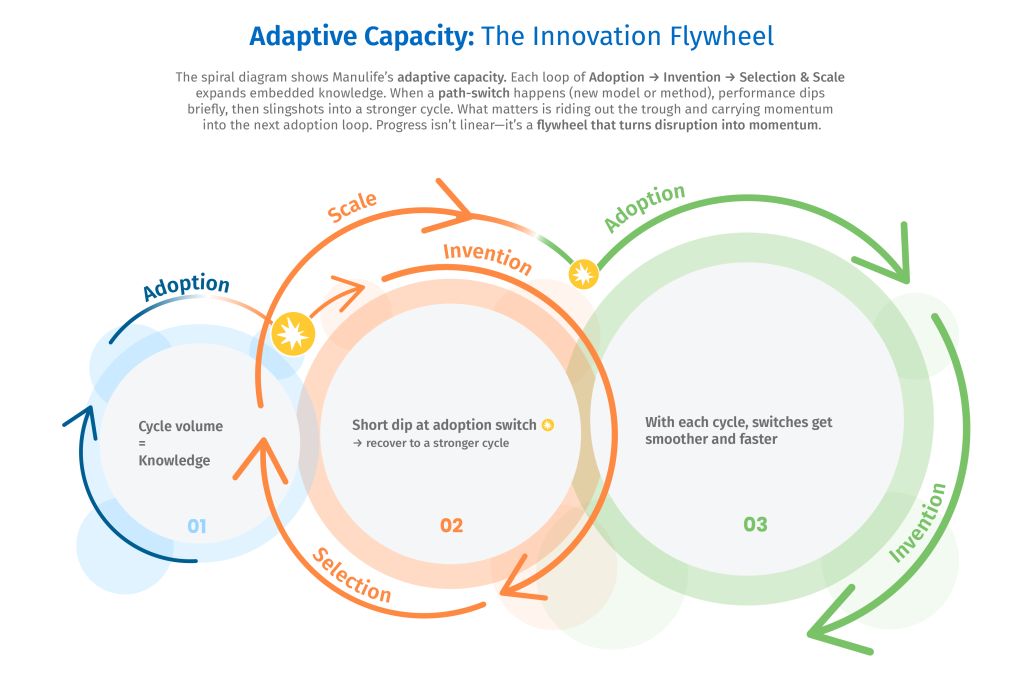
Institutionalize adaptive capacity (the engine). Leaders normalized copying—if one team built something useful, others reused it. This turned isolated wins into shared playbooks and spread improvements quickly. By embedding that habit, Manulife accelerated the cycle of adopt, invent, select, scale, building adaptive and innovative capacity together.

Balance speed and safety (governance by outcomes). Responsible AI principles, expanded model-risk frameworks, cross-functional review, and real-time telemetry treated fast iteration and strong oversight as complements, not one-off pilots

It was mid 2020. Jodie Wallis, then Manulife’s Global Chief Analytics Officer, had summoned the company’s top executives into a Toronto boardroom. She knew the meeting would mark a turning point: OpenAI’s breakthrough latest large language model (LLM), GPT1– 2 had just been released, and, at nearly 100 times stronger than its previous models, GPT-2’s implications stretched far beyond the technology itself. For Manulife, a 137-year-old insurer built on actuarial precision and risk discipline, the question was whether this new capability would be treated as a passing novelty, or as the spark for deeper change.

For years, AI at Manulife meant prediction and automation—underwriting models, fraud detection, lead scoring. Even as the frontier advanced with machine-learning models that could conjure hyper-realistic images, these applications still felt contained within the realm of “computer things.” They were useful and very impressive but safely bounded by expectation.

To Wallis, large language models like GPT shattered those boundaries. Designed for an iterative exchange, they created value not through a single output but through an unfolding dialogue—shifting the dynamic from command-and-response to something closer to collaboration. LLMs could now reason with a human-like cadence, inviting conversation rather than instruction. The breakthrough was not a more polished “answer,” but the model’s ability to so fluidly augment inquiry itself—generating new directions of thought and discovery.

That shift—from bounded tasks to open-ended discovery—was as unsettling as it was exhilarating. Wallis framed the moment with unusual candor: “Our industry has been too comfortable. This technology isn’t just another tool—it’s a fork in the road. We either harness it, or risk being reshaped by it.”

Around the table, reactions varied: curiosity, excitement, apprehension. The challenge was immediate. Should Manulife treat generative AI as an experiment at the margins, or as the new trajectory of the business itself? Wallis herself was convinced of the answer, but she also knew the technology was still raw—too raw, perhaps, for the boardroom to fully accept. The choice would force hard calls about strategy, governance, culture, and investment, all at the breakneck pace at which the frontier was advancing.

In such moments of technological upheaval, corporate boards look to figures like Wallis to distinguish passing trends from transformative forces. Unlike the technologist-soothsayers popular at the time, her task was consequential: to foresee how generative AI might reshape an institution built on actuarial discipline, and to ensure Manulife seized the opportunity rather than being undone by it. Frame the moment correctly, and new value could be unlocked; misjudge it, and the consequences could be existential.

But foresight alone would not suffice. Wallis knew no memo or slide deck could capture the implications of generative AI; words on a page risked being dismissed as abstractions. The only way forward was direct confrontation. To overcome that gap, one had to experience it themselves. Fortunately, the technology itself offered an answer—the opportunity to turn the crystal ball around and let skeptical peers glimpse inside for themselves.

So, she placed a tablet in front of each leader, preloaded with the latest OpenAI model, and invited them to test it—to ask it the questions they might otherwise have asked her. The room fell silent as screens lit up with blinking prompts. One by one, Manulife’s senior leaders began conversing with GPT-2, watching as it generated fluent answers in real time. The exercise was disarmingly simple, yet it shifted the atmosphere. Within minutes, the conversation had moved from “is this real?” to “what does this mean for us?”—the kind of pivot that months of memos and meetings could never have achieved.

It was Wallis’s decision—to make her colleagues experience the frontier for themselves—that created conviction at the top. But she knew conviction alone would not be enough. To matter, it had to be built into infrastructure, and then into the agility to adapt. With that boardroom experiment, Wallis set the flywheel in motion—conviction, infrastructure, adaptation—that would carry Manulife through one of the most profound technological shifts in its history. In doing so, Manulife joined a small group of financial giants positioning Canada at the forefront of AI transformation.

To understand how this journey unfolded, RBC Thought Leadership sat down with Jason MacDonald, Chief of Staff in the Office of the CEO, and Jodie Wallis—now the company’s Global Chief AI Officer—to explore how they and their colleagues steered a $72-billion insurer through one of the most profound technological shifts in its history.
Strong buy-in from senior executives is critical at the beginning of any transformative initiative. Wallis understood that leaders had to experience AI directly for themselves. In doing so, she was putting into practice what Everett Rogers’ diffusion theory had long shown: new ideas spread faster when they are trialable—safe to experiment with in low-risk conditions—and observable—when peers can see results firsthand. Together, these conditions turn abstract technology into something tangible enough to believe in.

That is exactly what unfolded in the boardroom. Once a few respected voices found the tool useful—asking follow-ups, reading fluent outputs aloud—trialability was satisfied: executives could experiment in a low-stakes, hands-on way. And because these experiments happened in public, observability took hold: colleagues could watch, compare reactions, and see the system working in real time. What could have been a solitary experiment quickly became a shared moment of discovery. Peer-to-peer reinforcement allowed skepticism to fall away and curiosity to spread, because the technology no longer seemed risky or abstract.

But conviction alone is not enough. To matter, it had to be translated into infrastructure that would let Manulife absorb and scale what leaders had seen. That is where absorptive capacity comes in.

A single demo, however persuasive at the individual level, fades unless an organization as a whole can metabolize what it saw into repeatable capability. That is the job of absorptive capacity—a firm’s ability to recognize the value of new information, assimilate it, and apply it to commercial ends—the infrastructure that makes later adaptation possible. Research on absorptive capacity, first developed by professors Wesley Cohen and Daniel Levinthal in the 1990s, highlights two foundations of that infrastructure:

Knowledge is cumulative and path-dependent—it builds fastest on what people already know, meaning prior knowledge is like scaffolding for future learning.

Breadth of knowledge expands absorptive reach—organizations with a wide base of prior knowledge can take in and apply new external ideas more effectively.

Absorptive capacity is about learning—building the knowledge base and routines to embed new tools. Adaptive capacity (discussed in Insight Three) is about changing—reconfiguring those routines when the frontier shifts and old paths no longer fit. Manulife needed both, but it started by deliberately building the absorptive infrastructure needed to allow the organization to learn. In doing so, Wallis’s team treated culture and skills as equal pillars to technology and designed a multi-tier learning stack:

AI 101 for anyone with an interest

advanced prompt-engineering and data-science for power users, and

tailored executive modules delivered with university partners.

They then wove AI into leadership rituals. At Manulife’s Global Leadership Conference, for example, executives showcased employee-built solutions to their peers, creating a common language of use cases and governance. The goal wasn’t just awareness; it was to give every layer of the company—front line to boardroom—enough context to recognize where AI was relevant and embed it in daily work.

In Cohen and Levinthal’s terms, Manulife was steadily increasing its stock of prior knowledge, so each new wave of technology could be absorbed and recombined faster. Wallis’s actions directly aligned with the two conditions they described: training and rituals made learning cumulative by building on what employees already knew, and broad participation across the workforce expanded the base of knowledge available to draw on. In an industry often criticized as “too comfortable,” this gave Manulife a distinctive edge: the ability to build on new tools and embed them into its routines in ways that accumulated advantage over time.

But infrastructure alone is not enough. Once that foundation was in place, the challenge became keeping momentum when the frontier shifted and old paths no longer fit. That required a different capability: adaptive capacity—the engine that keeps the flywheel turning.

When then-CEO Roy Gori warned that the industry had grown “too comfortable,” Wallis knew this complacency was dangerous in a domain where new AI models and applications were appearing at a breakneck pace, driven by massive new capital flows. Absorptive capacity had already given Manulife the infrastructure to learn and embed AI tools across the enterprise. The next challenge was agility: ensuring the company’s response to advancing technology was equally swift and dynamic. Adoption couldn’t be a one-off event; it had to become iterative. That insight set the stage for adaptive capacity—the engine that converts adoption into continuous reinvention.

Research underscores why this engine is critical. Prior adoption experience is the single strongest predictor of inventive capacity: organizations learn to invent by first copying. Yet when firms switch paths—moving to new models or methods —performance often dips before it recovers, as old mental models stop fitting the new approach. Adaptive capacity is therefore the discipline of riding out that trough and recovering faster, turning temporary disruption into cumulative learning. Manulife operationalized this discipline through a set of deliberate routines.

Adoption→ taking in new tools, practices, or patterns developed elsewhere, and embedding them into the organization’s routines.

Selection and Scale → filtering what works, embedding it into routines, and scaling proven solutions across the enterprise.

Invention→ creating original solutions internally, without relying on external patterns.

Manulife built this discipline deliberately. With a strong foundation of AI literacy embedded across the company, leadership worked to smooth adoption pathways by normalizing copying as a precursor to invention. Wallis instituted prompt-a-thons and leadership conferences where employee-built tools were showcased, creating a common language of value and risk. These rituals made it legitimate to borrow, refine, and scale what worked—ensuring adoption wasn’t confined to early enthusiasts but cascaded across the enterprise. In Cohen and Levinthal’s terms, this was about continuously increasing the firm’s stock of prior knowledge so that when a path switch came—whether a new model, platform, or application—the organization could absorb and apply it faster.

Secondly, Wallis deliberately designed for safe path-switching. A vendor-agnostic, cloud-ready stack allowed models to be swapped ‘even daily,’ making technology change a managed routine rather than a disruptive reset. Scaling decisions were tied to clear business outcomes—revenue lift, cost savings, risk reduction, or productivity—so that pivots created value rather than noise.

Finally, it embedded selection capacity—the discipline to prune weak ideas quickly and scale winners. Cross-functional forums and outcome-based funding kept the portfolio focused, so absorptive capacity compounded rather than leaked.

Together, these routines formed Manulife’s innovation flywheel: adoption experience generated invention; selection routines filtered the noise; flexible architecture enabled safe path-switching; and the loop restarted with each cycle stronger than the last.

From the outset, the company made responsible AI governance a design choice. In the absence of clear national rules, it created its own responsible AI principles and operating rules to ensure experimentation and deployment stayed aligned with ethical, privacy, and compliance obligations.

Manulife expanded its existing model risk frameworks to address GenAI’s unique challenges—vetting third-party vendors, monitoring outputs for bias or hallucinations, and requiring ongoing performance assessments for every model in production. A cross-functional governance committee reviewed use cases for ethical and privacy risks, aligning policies with evolving global guidelines. Governance was embedded as a living process, not a static policy.

Critically, Manulife treated fast iteration and strong oversight as complements, not trade-offs. Continuous model monitoring—tracking accuracy, drift, and usage—was used to tighten controls in real time. This outcome-based approach allowed models to stay in production as long as they met error and bias thresholds, and to be adjusted or pulled the moment they didn’t. Iteration was welcome, but never at the expense of trust.

This proactive stance enabled Manulife to scale GenAI quickly and responsibly, building confidence with compliance teams, customers, and policymakers, even in the absence of clear regulation. The broader lesson is that firms in sensitive sectors should not treat regulation as a brake. By self-imposing principles, operationalizing oversight, and demonstrating to regulators that innovation can be pursued responsibly, companies can get ahead of uncertainty. For policymakers, the takeaway is equally important: enabling real-time oversight and outcome-based guardrails may achieve safety faster than prescriptive, one-off compliance checks.

Within just a year of embracing generative AI, Manulife achieved broad-based adoption at a speed few incumbents match. Its proprietary assistant, ChatMFC, went from pilot to near ubiquity: within months, 40% of employees were using it monthly, and by early 2025, more than 75% of the global workforce was actively engaged with GenAI tools, training, or use cases. Adoption was not siloed to tech teams; it touched nearly every function, from sales and service to back-office operations.

The impact on productivity was equally striking. In call centers, AI tools shaved 30 – 40 seconds off average call times without lowering customer satisfaction. Across the enterprise, generative AI was no longer a side project—it had become embedded in the daily flow of work.

Customer-facing gains were even more visible. Newer advisors ramped up faster, using AI coaching to practice and refine interactions. Meanwhile, advisors reported that AI freed them to focus on client relationships, creating the unusual outcome of a technology initiative that delivered both efficiency and deeper human engagement.

At the strategic level, the flywheel was spinning. By mid-2025, Manulife had 35+ GenAI use cases in production and 70 more in queue. Early deployments alone contributed an estimated $4.7 million in benefits, while the broader digital transformation program (with AI at its core) yielded over $600 million in 2024 benefits—savings, new sales, and better risk outcomes. Looking ahead, the company projects a threefold return on AI investments over five years. These results affirm that Manulife’s design choices — hands-on executive engagement, outcome-gated scaling, perpetual-beta governance—transformed AI from novelty to institutional capability.

Numbers

$1.6T Assets under management
35MCustomers worldwide
$53BMarket Capitalization
$5.1BNet Income
38kNumber of employees
200Data scientists and engineers embedded across teams
$600mBenefits attributed to digital transformation (with AI as a core part) in 2024.
75+AI use cases deployed by the end of 2025
75%Share of Manulife’s global workforce engaged with GenAI

Download the Report

Artificial Intelligence is poised to reshape how value is created across Canada’s economy. To understand that shift, RBC Thought Leadership interviewed more than two dozen firms that are on the frontlines of building or deploying AI for Bridging the Imagination Gap: How Canadian Companies Can Become Global Leaders in AI Adoption. The report distilled the patterns that emerged from those conversations.

Building on that report, the series of case studies go a level deeper: following one company’s journey through specific problems, pivots and opportunities, helps illustrates the strategic choices and policy conditions that turn technical promise into economic and societal value.

Internal validation matters. Schneider Electric proved AI’s value both internally and in customer offers. Starting with supply chain projects that freed up millions to invest in predictive tools that reduced downtime. This internal credibility gave the company the confidence to embed AI directly into products and services.

Governance can be an advantage. By treating the EU AI Act as a design specification rather than red tape, Schneider built compliance into its MLOps machine-learning pipeline. This not only eased adoption internally but also created a “trust premium” with customers.

Centralization drives scale. A 350-person AI Hub concentrated scarce expertise, standardized tools, and linked directly to executive decision-making, turning AI into a repeatable capability rather than scattered experiments.

Future readiness requires sovereignty and edge leadership. Focusing on trust and compliance, Schneider is positioning itself to thrive in a world where data localization and sovereignty increasingly shape industrial competition.

When most people picture electronics manufacturing, they think of smart chips, GPUs, CPUs and capacitors. But it’s the hidden circuitry under the hoods that makes our world hum efficiently : a lattice of switches, sensors, drives, control panels, and interconnected IoT systems that silently, safely and reliably switch on lights, move elevators and keep servers cool.

Schneider Electric, the 189‑year‑old French manufacturing group, is the giant behind that invisible architecture. With €38.2 billion in annual revenue,1 177,000 employees, and operations in more than 100 countries, it manufactures the circuitry and control systems that power buildings, factories, grids and data‑centres.

2Schneider has maintained operations in Canada3for more than 100 years, with roughly 3,000 individuals across 10 provinces. Its products are featured in 40% of residences and 50% of commercial buildings in Canada.4

Schneider’s value to the global economy is twofold: it supplies5 the hardware and software that makes modern life possible and shepherds one of the world’s most distributed industrial supply chains6.

Yet even Schneider was not immune to the pandemic’s shock waves. By late 2020, COVID-19’s stop-start demand swings left warehouses bulging with unsold stock while plants struggled for parts. Across a network of 162 factories7, roughly 300,000 stock-keeping units (SKUs)8 and around revenues fell 6.4% organically9 in the first quarter of 2020, year-on-year, putting billions at risk.

Faced with this disruption, Schneider had to decide whether to keep tweaking legacy systems or take a chance on machine learning. They chose the latter.  Starting small, at one its North‑American switch‑gear plants, Scheider’s AI team trained a gradient‑boost model on three years of order history, macro indicators and pandemic mobility data. Six weeks later, there were double‑digit gains in forecast accuracy, safety‑stock days fell by a third, and the pilot resulted in considerable savings. The result became the catalyst for further exploring AI capabilities, that delivered great results in the energy management space. The strategic move to scaling AI initiatives globally resulted in creating Schneider’s centralized AI Hub.  

How did Schneider Electric transform multiple AI pilots into a global capability, and lead in enterprise AI deployment? To find out, RBC Thought Leadership sat down with Cédric Bureau, Senior Principal Product Manager for Artificial Intelligence at Schneider Electric, to unpack four key strategies the company implemented while scaling its AI capabilities, and the insights they offer today.
It clicked when we saw an internal AI pilot’s results. We weren’t just solving problems—we were building something that offered new opportunities for us and our customers — Cédric Bureau

Internally, under Schneider’s AI-at-scale program, the company rolled out machine-learning models across supply-chain planning and the factory floor; computer-vision and vibration analytics began feeding AI information and predicting failures, lifting throughput and uptime, and enhancing energy efficiency. In parallel, Schneider put AI into everyday enterprise support tools—HR and engineering chatbots and copilots, and enhanced energy-efficiency software—so teams had working tools, not just pilots.

The step-change came when those capabilities moved into customer offers. An anomaly-detection model first used to monitor building thermal performance and detect abnormal energy use now powers Schneider’s bespoke EcoStruxure Building Advisor10, which flags abnormal consumption and tunes HVAC automatically. By shifting from manual, Excel-based reporting to AI-powered building energy modelling, customers have achieved measurable benefits—including considerable operating cost savings across 50 sites and 2–5% reductions in energy consumption.

The two tracks now reinforce each other. Schneider’s AI-at-scale strategy sets the playbook—how pilots move to shop floor, enterprise tools and into products—and a centralized AI Hub runs it, rotating experts across projects, standardizing tooling and governance, and building enterprise-wide AI know-how. That pairing makes the hand-off between AI development and the factory floor routine: models that prove themselves are industrialized, documented and shipped into offers, while product telemetry feeds fresh data back for the next round. Internal efficiencies realized fuel further R&D, with every factory win becoming a candidate feature in a future product.

Takeaway: Use the enterprise as a live test bed and consistently build both technology and human capabilities to innovate with AI. When an AI solution delivers value inside the business, it provides credibility and de-risks similar use cases. Being able to claim “we run this at scale ourselves”improves sales prospects with cautious customers.


“AI is now past the hype cycle inside the company—it’s part of daily work habits”—Cédric Bureau

Scattered pilots could never keep pace with a network of 162 factories across five continents. So, in late 2021, Schneider launched a global AI Hub11—across three locations: Boston, Paris and Bangalore. Within 12 months the hub grew to around 350 data scientists, machine learning operations (ML Ops) engineers, product managers and an in‑house compliance squad. To ensure the hub can move at pace with technology development trends, it’s headed by a Chief AI Officer who reports to the executive committee, ensuring strategic bets on AI are scrutinized at the C‑suite level.

By elevating AI initiatives into a standalone enterprise function, Schneider pulled them out of isolated IT corners and gave them the strategic visibility needed to reach production. This centralized, AI-first organizational design enabled four key advantages:

1. Hub-and-spoke coordination: The centralized AI Hub supplies the technical backbone—algorithms, data infrastructure, compliance tools and features a team of AI product managers, each dedicated to a set of business units to work with marketing managers with clear understanding of local and/or industry specific challenges. This split of roles prevents duplication, ensures solutions are tailored to operational needs, and speeds up the rollout of AI projects across the enterprise.

2. Paved-road development: All AI projects share the same basic set of tools and processes—like standard methods to gather data, store and organize models, and perform quality checks. Think of it like using a standard recipe: following it takes some extra work at the start, but once you’ve done that, making adjustments or improvements becomes simpler and faster. Because as these processes are consistent across Schneider, teams don’t have to constantly reinvent the wheel. Netflix and Spotify use a similar concept, calling it a ‘paved road’, meaning a clear, straightforward path that makes developing technology quicker, safer, and easier.

3. Talent attraction and retention: The AI Hub offers a compelling career path and collaborative environment. Schneider can recruit top AI talent from Big Tech companies and retain skilled experts significantly longer than comparable industrial organizations.

4. Built-in compliance capability: Schneider’s compliance experts are integrated within the AI Hub. Every AI project undergoes a standardized risk assessment and bias testing before deployment, ensuring adherence to regulations such as the EU AI Act and laying the groundwork for the ‘compliance-by-design’ approach detailed further in the case.

Schneider is not alone in this architecture. Bosch’s Center for AI and the Siemens AI Lab follow a similar hub‑and‑platform pattern

Takeaway: Success comes from treating AI as a core enterprise function—appointing clear leadership, concentrating expertise, and serving business units as internal clients.


While talent solved capacity; trust solved adoption. When Brussels drafted the world’s first horizontal AI law, Schneider decided regulation would be a design spec, not a hand‑brake.” —Cédric Bureau

When the draft EU AI Act first circulated, many industrial peers froze projects, waiting to see how onerous the rules would become. In contrast, Schneider’s AI Hub embedded a ‘compliance squad’—lawyers, data‑privacy officers, risk engineers—directly into ideation and sprint teams. Every new use‑case begins with a 10‑question risk‑rating questionnaire that maps potential AI applications to the Act’s taxonomy (minimal, limited or high‑risk). Proposals assessed as high risk trigger up‑front data‑anonymization, mandatory human‑oversight12 plans and bias‑test requirements before development begins.

Schneider’s AI deployment pipeline itself enforces the law. Schneider’s AI policy requires that all use cases undergo a two-stage compliance review. First, use cases are scanned for risks across ethics, design, IP, data security, and governance. Then, those risks are mapped into a treatment plan—identifying owners, setting mitigation actions, and tracking accountability—so that compliance is not just a checklist but a living process. This AI Policy ensures alignment with EU AI Act Articles 1013 (data & bias), 11 (technical documentation) and 14 (human oversight). Once a model is live, the platform’s monitoring dashboard logs performance drift and automatically opens an incident ticket if thresholds are breached, satisfying Articles 72‑73 of the act on post‑market surveillance.

By having compliance experts on the team, Schneider’s engineers treat concerns like bias mitigation, data anonymization, and cybersecurity—as design inputs, not obstacles. This is an organizational cultural shift—developers are guided to think about ethical/legal constraints from the start rather than scramble to retrofit fixes later.

These extra steps yielded  three commercial dividends:

1. Faster sales cycles :Clients in heavily regulated industries often demand proof of AI governance; handing them an ‘AI‑Act‑ready’ dossier trims procurement reviews.

2. Trust premium: Positioning Schneider’s solutions as ‘regulation‑ready’ differentiates them against rivals who still treat compliance as paperwork to be done later. 

3. Build once, comply everywhere: Treating EU standards as the floor cuts duplication across markets and future‑proofs the portfolio against new laws—Canada’s Bill C‑27 included. As it stands, Schneider maintains compliance with standards across the world, including the Institute of Electrical and Electronics Engineers (IEEE14), International Electrotechnical Commission (IEC15) and the Organisation for Economic Co-operation and Development (OECD16).

Take‑away: By baking the rulebook into the codebase and deployment processes, Schneider converts the cost of compliance into a strategic advantage.


“We knew we’d succeeded when operators started asking us for AI models, not because management pushed them, but because workers saw firsthand how they improved their jobs.” — Cédric Bureau

With Schneider’s talent (AI Hub) and compliance guardrails (compliance by design) in place, it established the four-gate funnel to manage ideas. Every AI use case, from factory forecasting to customer-facing microgrid control, flows through the same four stages. At each gate, a go/no-go decision is made based on business case and feasibility. Pet projects without ROI, or projects deemed too high-risk are stopped early. Winners move quickly, because approval chains, tooling, and documentation are built in from the start.

Gate 1: Data owners co-develop a one-page problem brief with the AI Hub—qualifying return on investment (ROI), carbon impact, and passing a 10-question risk scan. Key technical challenges are identified, and sandbox phase on masked data with built-in bias and robustness testing is done to evaluate feasibility and to assess the best technology to overcome such challenges.

Gate 2: A Minimum Viable Product development and real-life deployment. Plant operators co-design dashboards and evaluate the solution in as-close to real-life-conditions as possible. Critically, the funnel separates trying from scaling—preventing the common trap of endless proof-of-concepts.

Gate 3: Solutions are hardened for production: user interfaces, documentation, and business integration. Models are migrated onto the Hub’s MLOps platform, and the compliance team completes the EU AI Act technical dossier.

Gate 4: Live dashboards track ROI, drift, and incident logs. Red flags auto-escalate to both the site lead and AI product team. Some models retrain automatically based on performance thresholds.

Takeaway: Human-centric design extends through the development, implementation, and operational phases of AI applications—Schneider doesn’t treat business stakeholders as merely AI end-users. They’re co-owners of AI solutions.

This cultural strategy scales, too. As small tools proved helpful, trust grew. Engineers adopted AI as naturally as any other tool. Plant managers began expecting data-driven insights in meetings. Executives used AI dashboards to spot margin opportunities. The result wasn’t just tech fluency—it wasa mindset shift. People no longer see AI as opaque or threatening—they understood where it fits, and how it can help them do better work.

Internally, Schneider backed this shift with a firm-wide initiative to elevate the AI knowledge of all employees through awareness/training programs, regular data & AI webinars, and the publicly available AI at Scale podcast.

Schneider Electric has thrived under Europe’s regulation-first approach, aligning early with the EU AI Act and embedding compliance into its operating model. This strategy has given it a competitive edge: customers see its solutions as “regulation-ready,” and regulators view the company as a trusted partner.

But the future of regulation may expose the company to competing paradigms, in which the EU resides in the middle. In the United States, a market-led approach prioritizes rapid innovation, with looser rules and fewer documentation burdens. China, meanwhile, pursues a state-steered model, demanding tight government oversight and strict localization of data. Each system pulls global players in different directions, and supply chains are increasingly split along regulatory lines.

Numbers

€38.2 b 2024 revenue
€4.3 bNet 2024 income
177 000 Number of employees
162Number of manufacturing sites, globally
1836Year of founding, in Le Creusot, France
100+Number of countries Schneider Electric maintains operations in     
5%Portion of revenue invested in R&D
20,000Number of active, global patents
1stRanking in Corporate Knights Global 100 most sustainable corporations

Download the Report

Canada is about to make historic investments to reorient the economy. The scale and focus of these investments should serve as a wakeup call to anyone working in Canadian postsecondary education or relevant provincial ministries—signaling both opportunity and necessity for change.

The upcoming federal budget is expected to allocate billions for nation-building initiatives like modernizing defence and space infrastructure, expanding computing capacity, and developing renewable energy. The potential rewards–sovereignty, growth and competitiveness–are great. As is the risk. We are hedging our bets on talent and innovation.

But as we laid out in our recent report, Testing Times, the postsecondary sector is facing a crisis. Just as Canada is ramping up, colleges and universities are scaling down–closing programs, departments and campuses. Postsecondary institutions across the country need to modernize and re-align their mandates for growth–as outlined in A Smarter Path—but they lack the financial footing, flexibility and connectivity with industry to do so. 

This was the context in which RBC Thought Leadership and our partners at the Business + Higher Education Roundtable convened a summit on Talent, Technology, and a New Economic Order. In September, about 60 industry and postsecondary leaders came together at RBC’s head offices with a shared interest: ensuring Canada’s historic investments yield historic rewards. We focused on three areas of national ambition that depend heavily on postsecondary for talent and innovation:

  • Defence and space capabilities

  • AI and digital technology

  • Major energy projects

The following summarizes the imperatives, opportunities and bold ideas that were discussed.

Today’s threats to sovereignty and security are not the ones that Hollywood war films call to mind. They are increasingly complex and defending against them requires economic and digital strength—and not just on earth. National security and prosperity are increasingly dependent on space infrastructure like satellites, which Canadians use for everything from surveillance and environmental monitoring (some key climate change variables are only measurable from space1) to daily communication and navigation.

But Canada’s capabilities in space, and in defence more broadly, are falling behind global competitors. Government procurement contracts—critical for maintaining and advancing capability and innovation—take significantly more time than comparable procurements in other jurisdictions. Our commercialization of space products and services trails other countries. And years of underspending has hurt Canadian defence capacity, with acute personnel shortages spanning the armed forces; trades and technician roles are particularly understaffed, as are engineers, including specialists in naval combat and aerospace.2

Spending commitments for defence and space provide a historic opportunity.

  • Canada is spending $9 billion on defence in 2025–2026, including $2.6 billion for recruitment and retention, and has pledged to raise defence spending to 5% of GDP annually by 2035.

    • In addition to building conventional defence capabilities, this is an opportunity for Canada to innovate and advance new technologies for purposes like surveillance and forecasting.

    • We can also lean into existing strengths. For example, Canada is already ahead in developing wildfire monitoring capability (microsatellites) that can be used to track fire activity and inform management efforts at home and internationally.3 In addition to threatening lives and livelihoods, wildfires can destroy critical infrastructure like communication systems and energy grids and cause political instability — our ability to respond quickly is an important part of a national defence strategy. 

  • The federal commitment to establish a Bureau of Research Engineering and Advanced Leadership in Innovation and Science (BOREALIS) is an opportunity to invite industry and postsecondary partners to quickly advance dual-use technology (defence and other civilian applications).

Three ideas from the summit that would give Canada an edge in defence and space:

  • Position Canada as NATO’s firefighting nation

    • Use a portion of new defence spending to grow earth observation capabilities, AI-enabled disaster response and drone technologies for wildfire management.

  • Build BOREALIS to match models like DARPA and ARIA

    • Both the Advance Research and Invention Agency (ARIA) in the U.K. and the Defence Advanced Research Projects Agency (DARPA) in the U.S. fund high-risk, high-reward projects, free from political constraints and academic processes.

  • Retrain automotive workers for shipbuilding and space sectors

    • Design new competency-based postsecondary programs that let experienced workers with relevant skills move through programs quickly–saving time and money–on their way to an industry-recognized credential.

Companies and organizations around the world are adopting AI to achieve productivity gains and become more efficient. Canadians are moving slowly by comparison. Despite being home to a concentration of the world’s top AI researchers and foundational AI models, when it comes to AI maturity, about 70% of Canadian companies are “crawling” or “walking,” and few (7%) are “running” —less than half the proportion of runners globally (17%) .4

Our top talent tends to move abroad, as do their ideas (most AI patents developed in Canada are owned by foreign entities5). And Canadians are less confident leveraging AI tools to boost productivity at work than our global peers.6

Government commitments and initiatives are opportunities to drive progress.

  • Defence funding could help drive postsecondary-industry collaboration on AI research and innovation (to commercialize dual-use AI, for example).

  • In the days following the summit, the Minister of Artificial Intelligence and Digital Innovation Evan Solomon announced a new AI Strategy Task Force of Canadian researchers, entrepreneurs and industry partners charged with developing a federal AI Strategy. The strategy will include “actionable insights and recommendations” to drive leadership in areas including education and skills, as well as commercialization.7

Now is the time to invest in home-grown innovation and quickly scale up and retain AI skills to capitalize on our advantage. Here are three ideas from the summit:

  • Buy Canadian technology first

    • Canadians–businesses, postsecondary, governments– should be the first customers for our own innovators, rather than wait for U.S. market validation.

  • Allocate more corporate resources for staff training

    • Employer-sponsored training in Canada lags international peers8 –our top 100 companies, based on market cap, should increase corporate training budgets and partner with postsecondary providers to deliver AI upskilling that develops internal capacity for productivity and growth.

  • Teach AI skills across postsecondary disciplines

    • Canadian colleges and universities should ensure students, no matter the program, develop AI literacy skills that they can leverage post-graduation.

Canada faces unprecedented energy demand as we expand computing and space infrastructure and pursue industrial growth. Net-zero policies driving a clean-energy transition place additional pressure on electrification and create demand for critical minerals—key to batteries, solar panels, magnets and wind-turbine motors. And oil and gas will continue to be a critical part of the energy supply mix to help reduce costs for consumers and ensure reliability.

A new Major Projects Office plans to fast-track energy projects to meet rising demands but is up against widespread skills shortages. Older skilled-trades people, for example, are retiring at faster rate than they are being replaced,9 and engineering students are not pursuing mining pathways (mining represents just 1% of engineering enrollments10).

Skills gaps are also an issue. Massive infrastructure projects will only be successful with people who can collaborate and solve problems in real time.

Canada’s nation building agenda creates momentum that postsecondary, industry and governments can use to address skills challenges and meet energy demands:

  • High-profile projects present an opportunity for postsecondary providers and industry to communicate career opportunities in energy sectors.

  • Indigenous populations are growing faster11 than the general population, and are often closer, geographically, to energy projects. Strong partnerships and education strategies that deliver community-based programming can empower community members to take on key roles and fill skills gaps.

  • Canada has delivered on major energy projects before—nuclear refurbishments at the Bruce A Nuclear Generating Station in the early 2010s is a great example.

Three ideas from the summit to capitalize on Canada’s energy momentum:

  • Backstop training for major projects

    • Provincial and federal governments should support human resource strategies and training initiatives, particularly for planned projects that are expected to stall due to a lack of talent.

  • Build an energy skills strategy

    • Major players in the energy industry need to dedicate time and resources to inventorying and projecting skills needs, factoring in evolving technology. They should work with postsecondary providers to design training programs that prepare graduates to hit the ground running.

  • Develop skills in partnership with Indigenous communities

    • Industry and postsecondary institutions should partner with Indigenous communities to design and offer training programs that prepare Indigenous talent for careers in the energy sector.

The path forward will take an urgent and coordinated effort from governments, postsecondary institutions and industry. The world is not standing still. Competitor nations are racing ahead in space exploration and AI adoption, while also investing in skills and infrastructure. Canada has the tools to compete—and lead—but only if we align our systems to meet this moment with urgency and ambition. Summit participants surfaced the following recommendations for governments, postsecondary and industry to take immediate action on.

Federal Government

Leverage the AI strategy for skills: Canada’s new AI strategy should have guidance for postsecondary that supports their modernization, e.g., explicit advice that helps institutions efficiently and effectively develop necessary AI skills (including an understanding of risks and when not to leverage AI) among staff and students, across disciplines.

Build Defence and Energy Workforce Alliances: Canada plans to launch up to five Workforce Alliances “to tackle urgent labour market challenges, drive growth and advance industrial strategies.”12 These should include alliances in defence and energy.

  • Each alliance should bring major employers, unions and postsecondary leaders together to talk supply and demand.

  • Alliances should inventory projects and programs already in place; detail current and projected skill gaps, regionally; consider how skills demands will evolve given new technology; identify and engage appropriate program providers to meet skill needs.

Capitalize on global strength in wildfire management: Use a portion of new defence spending to grow earth observation capabilities, AI-enabled disaster response and drone technologies for wildfire management.

Empower the Defence Investment Agency: This newly announced agency should have the mandate to streamline goals and operational requirements across the Department of National Defence, the Department of Public Works, Public Services and Procurement Canada and other departments, as applicable.

Modernize research and innovation funding: Funding criteria should focus more on outcomes and less on process.

  • Consider a new research and innovation agency, like the Defence Investment Agency, to review and coordinate “tri-agency” funding and other relevant programs–ensuring a balance of funding directed to strategic priorities, and between inquiry–and mission-driven research. Such an agency could lead or support additional changes like:

    • Embracing a model like DARPA with BOREALIS: fund high-risk, high-reward projects, free from political constraints and academic processes. 

    • Reforming the Scientific Research & Experimental Development (SR&ED) tax credit (building on reforms made in 2024) to incentivize commercialization.

    • Revamping and expanding national sandboxes,13 creating more opportunities for collaborations between industry, military, universities and colleges, focused on rapid prototyping and testing new defence and space capabilities.

    • Ensuring any new funding commitments are leveraged strategically. For example, at the summit, the federal government shared plans to fund additional research chairs to attract top American academics to Canada. Funding should be tied to strategic priorities and focus on attracting talent with experience driving mission-driven research projects. New chairs should be expected to help build capacity and act as champions for change in Canadian universities.

Backstop training for major projects: Coordinate with industry and relevant provincial governments to provide immediate financial support for training required to advance major energy projects.

Incentivize talent recruitment and retention: Offer tax credits for global talent needed to fill urgent skill shortages (i.e. energy project managers), and to retain exceptional Canadian graduates (i.e. in technology fields). 

Stabilize annual international student caps: Outline realistic, stable international student targets that enable appropriate population inflows and longer-term institutional planning.

Prioritize Canadian technology: Commit to using Canadian technology, including AI and space-based technologies, unless no domestic supplier offers an appropriate product or service. Prioritize Canadian technology in all future procurements and seek to be an anchor customer for promising Canadian start-ups.

Provincial Governments

Protect postsecondary systems: Increase domestic per-student funding (potentially tied to performance criteria or outcomes) in line with inflation. And/or offer more flexibility for institutions to set tuition, ensuring access is protected with robust government student assistance systems and institutional set-aside programs (that reserve a portion of tuition revenue for financial aid).

Offer strategic direction: Outline modernized expectations for transferable skill development.14 Institutions should develop AI literacy skills and collaboration skills, for example, across disciplines.

Backstop training for major projects: Coordinate with industry and the federal government to provide immediate financial support for training required to advance major energy projects.

Facilitate work-integrated learning partnerships: Consider replicating the U.K.’s Knowledge Transfer Partnerships, a granting program co-funded by industry partners that pairs recent grads with business or community organizations to solve innovation challenges.

Fund innovative pilot projects: Help institutions break the mold and develop competency-based education programs divorced from seat-time, for example, and ensure policy and qualifications frameworks are set up to scale successes.

Prioritize Canadian technology: Commit to using Canadian technology, including AI, unless no domestic supplier offers an appropriate product or service. And prioritize Canadian technology in all future procurements.

Postsecondary Institutions

Meaningfully engage employers: Explore new models for industry involvement. Build on successes engaging industry, for example, through university continuing education departments and colleges’ program advisory committees (which involve industry and community partners in curricula development).

Ensure all students graduate with transferable skills: Develop work-ready skills like AI literacy, adaptability, entrepreneurship, communication and collaboration in courses, assignments and work-integrated learning experiences.

Expand access to work-integrated learning: Including but not limited to internships and co-ops; practical programs with applied learning opportunities or immersive field trips, like visiting mining sites with industry partners are also great examples of work-integrated learning.

  • Create opportunities for students to work together across disciplines–like they will in the workforce–to solve problems.

  • Explore opportunities for technology to build experience (i.e. simulators).

Facilitate greater career mobility: Enable workers to navigate a dynamic economy. Consider:

  • Multi-disciplinary programs like the University of Calgary’s new energy science program, which covers a range of in-demand energy fields.

  • Incremental credentialling, for students in programs with low completion rates, like apprenticeships, so they receive recognition for skills gained.

  • Competency-based education programs that allow adults with relevant skills and experience to earn credentials quickly, learning at their own pace.

  • Skills-based transcripts that position graduates to articulate their competencies and succeed as employers shift toward skills-based hiring.

Develop community-based programming: Work closely with Indigenous communities and industry to develop tailored training programs. Consider using mobile training units, and remote or hybrid learning formats (where internet connectivity allows).

Offer upskilling and reskilling programs: This should include programs aligned with opportunities in defence and energy sectors, and to support an AI-literate workforce. Programs must meet the needs of learners with competing responsibilities, embracing formats like remote/hybrid, intensive learning, and competency-based education.

Prioritize Canadian technology: All colleges and universities should commit to using Canadian technology, including AI, unless no domestic supplier offers an appropriate product or service.

Industry

Send executives to participate in federal Workforce Alliances: They should come prepared with long-term project plans and skills projections.

Allocate staff resources to inform program development: Industry representatives with insight into day-to-day and forecasted long-term skill needs should be involved in designing postsecondary programs and work-integrated learning experiences. They should commit to hiring students who complete those programs.

Allocate more corporate resources for staff training: Canada’s top 100 companies, by market cap, should commit to a minimum annual training budget of $500 per employee – roughly double the current estimated industry average.

Innovate with postsecondary partners: Contract researchers at Canadian universities and colleges to overcome issues or improve productivity with new processes and tools. Consider a “relay race” partnership approach, e.g., university ideation, college or polytechnic application, industry deployment.

Reach students in high-schools, colleges and universities: Shareinformation about rewarding careers in sectors in need of talent, like energy. Host secondary and postsecondary student field trips that provide sightlines into specific industries.

Leverage AI for productivity gains: Integrate AI into core operations, not simply pilot projects and provide access to AI upskilling that develops internal capacity for productivity and growth.

Build mutually beneficial Indigenous partnerships: Engage communities surrounding major project sites to lay the foundation for meaningful employment and community benefits, including working with postsecondary to design and offer tailored training programs.

Hire for skills: move from hiring candidates who have held the same or similar job title previously, toward hiring candidates with skills and experience that align with expectations (or skill families), supporting a more mobile workforce and sending clear signals to training providers about which skills are needed.

Prioritize Canadian technology: Canada’s top 100 companies, by market cap, should commit to using Canadian technology including AI and space-based technologies, unless no domestic supplier offers an appropriate product or service.

Download the report

Artificial Intelligence is poised to reshape how value is created across Canada’s economy. To understand that shift, RBC Thought Leadership interviewed more than two dozen firms that are on the frontlines of building or deploying AI for Bridging the Imagination Gap: How Canadian Companies Can Become Global Leaders in AI Adoption. The report distilled the patterns that emerged from those conversations.
Building on that report, the series of case studies go a level deeper: following one company’s journey through specific problems, pivots and opportunities, helps illustrates the strategic choices and policy conditions that turn technical promise into economic and societal value.

In mining, the most important board-level decisions still hinge on results from distant lab tests—where core samples are cut and analyzed to measure mineral content. These tests are often slow, costly, and logistically risky, taking 6–10 weeks at precisely the stage when capital is most at risk.

GeologicAI moves the lab to the drill pad. Its AI-enabled sensors compress the sense–think–act loop to under 48 hours, turning scans into grade and NPV metrics that drive next-shift drilling decisions and reduce idle capital.

Adoption depends on trusted translators—domain experts fluent in both geology and AI—who can champion the shift and explain results in terms colleagues believe. Scaling that expertise along continued integration of new tools will be critical to scaling the technology within the industry.

For Canada, the lesson is clear: world-class AI research only becomes industrial leadership if policy incentives also target deployment and scale, not just R&D—funding field-ready teams, adoption support, and speed-to-scale in critical minerals.

Picture this. It’s nearly 40°C as a pair of geologists carefully extract two deep core samples from the 40,000-pound drill rig towering above them—the highest point for miles in Australia’s scorching Pilbara desert. Sent from Sydney, the team’s task was straightforward: retrieve the cores and escort them safely to geological assay lab 1,400 kilometres away in Perth. The tests would reveal whether the deposit has the potential to become a mine.

Battling oppressive heat and the clock, the window to act is short. The next phase requires loading the cores onto a Land Cruiser before navigating 200 kilometres of treacherous desert roads to a remote airfield and a waiting plane. These cores represented the final testing round for a proposed lithium mine, a pivotal step standing between their junior mining company and nearly AUD $500 million in funding should the core sample yield positive results.

The pair of geologists, along with a handful of others staking their careers on the two-year-old mining venture, understand the thinning patience of their financiers. Each day spent waiting on core results equates to well over AUD $110,000 in foregone returns—capital that an established mine could easily generate. The financiers know the stakes, but patience wanes with prolonged uncertainty. This was their eighth round-trip in five months, each journey a tense race against fading trust and tightening budgets. A dropped core, a missed flight, or another lengthy lab delay could shatter the fragile confidence holding this venture together.

GeologicAI flips the script by bringing its AI-powered core scanning technology to the deposit—eliminating many of the trips between assay lab and drill site and speeding up assessment processes.

Exploration is a relentless triangle of geology, capital, and time—often played out in the planet’s remotest corners. For Grant Sanden, Calgary-based founder and CEO of GeologicAI, it’s more than a logistical headache—it’s the central problem of mining: how to turn rock into reliable knowledge fast enough to guide investment. That’s the problem GeologicAI set out to solve.

A veteran of Canada’s resource sector, Sanden had watched scores of projects like the scene outlined above stall on the same bottleneck: the time it took to turn rock into knowledge. He knew the issue was not about pulling more samples—at 300 metres down you can drill forever and still miss the truth. The real cost lay in the slow, fragmented data loop that leaves geologists guessing, financiers fretting, and drill rigs burning cash in limbo. What if, he asked, the industry stopped treating assays as an after-the-fact report card and started treating them as a the key to a real-time decision engine?

Numbers

6 -10 daysTypical number of days delay for lab results to arrive from core samples, which determine how much metal is in the rock. Until then, multi-million-dollar drilling and investment decisions are on hold.
24 – 48 hoursHow long it takes GeologicAI to deliver the same results using its on-site, AI-enabled sensors.
$US 13bAnnual globalnon-ferrous exploration budgets (2023).
$US 60mGeologic AI’s July 2025 raise to scale globally amid the data‑centre/energy‑transition mineral crunch; headcount ~220, ~80% in Canada.
5Number of continents GeologicAI is active in.
16Median years from discovery to first production globally.        
6Per cent of firms in the mining sector that currently use AI.

Sanden’s hypothesis was straightforward: if core samples could be scanned where they’re drilled, mining exploration and development decisions would no longer hinge on assay lab results that could take several weeks. In practice, this involved a truck-towed trailer fitted with hyperspectral, X-Ray Fluorescence (XRF) and visual sensors, connected to machine-learning models that classify rock type, estimate grade and assign a preliminary dollar value. The trailer could also be lifted by helicopter to a mining project.

After building the prototype and conducting some initial field tests, Sanden and his team proved the AI-powered system could return a usable dataset in roughly 48 hours—compressing what had been an eight-to-twelve-week cycle and giving geologists enough confidence to refine drill plans before the next shift.

In mining exploration, GeologicAI shows that the real power of industrial AI is not only in accurate prediction, but also in compressing the sense–think–act cycle so it keeps pace with daily operations. By placing a multi-sensor lab at the drill pad, GeologicAI cuts the turnaround time for critical data from weeks to hours. Routing those scans through AI models that output economic metrics—grade, tonnage, NPV deltas—GeologicAI can turn enhanced data into better decisions before the next two-week shift even begins.

AI models that generate economic metrics—grade, tonnage, net present value (NPV) deltas—allow its mobile labs to deliver the analysis needed for better decisions before the next site shift begins.

  • Sense – Hyperspectral, XRF and visual sensors capture gigabytes of rock data on site.

  • Think Cloud models classify lithology, estimate grade and recalculate NPV in near real-time.

  • Act – Before the next shift, geologists see a refreshed analysis that answers the pivotal financial questions: Where do we drill next? How deep? When do we stop?

GeologicAI’s “High Resolution Decision Engineering” made decision-making faster and more dynamic. What had once been a linear sequence of costly bets became an agile sprint cycle—each hole informed by the last, each dollar tied to a fresh decision metric. In short, data stopped being a retrospective audit trail and became the steering wheel of the program.

Pitching GeologicAI’s solution also carried the challenge all first-movers face: no competitive heat. Early adopters could not point to rival mines already reaping the benefits. In a business where margins hinge on proven processes, being first could feel like volunteering for a metallurgical science experiment. Without “follow-or-fall-behind” pressure to fuel later-stage diffusion, GeologicAI had to sell both the vision and the urgency of change—one champion at a time.

Fortunately, within months of the first 24-hour data loop, GeologicAI secured its first set of pilot programs—including a high-profile engagement with Agnico Eagle Mines, one of Canada’s largest mining companies. According to Executive Vice President of Exploration Guy Gosselin, “this core scanning revolution places Agnico Eagle on the frontline of innovation and improves our critical decision-making capacity.”

For Agnico, the attraction was threefold:

  • GeologicAI’s system was faster and more accurate than traditional assays—compressing weeks of data-crunching into hours.

  • The richer datasets complemented, rather than replaced, existing geological information, giving decision-makers a complete and more reliable picture of deposits.

  • Adopting cutting-edge AI technology bolstered Agnico’s reputation as an employer of choice in a sector competing fiercely for talent.

That willingness to innovate created the opening for an internal champion. At Agnico Eagle, Gosselin, with purview over exploration, recognized the opportunity, translated the value for colleagues, and bridged skepticism with proof.

Sanden recognized the power of an internal champion early on. At Agnico Eagle, a forward-looking geoscience lead could see the opportunity and translate it for colleagues.

The business development lesson crystallized quickly: decision-makers who grasp both geology and data science are rare—but indispensable. Rather than cold-calling every mine CFO, Sanden focused on searching deliberately for strong leaders—cultivating their interest with pilot data and shared credit. Once an internal champion within a target client firm validated the technology, resistance melted away and adoption rippled across additional sites.

With persistence—and a few early wins—GeologicAI found its stride abroad. GeologicAI’s core value proposition is characteristically Canadian: a fusion of Calgary’s world-class natural resources expertise with national leadership in AI. Export Development Canada and the Bill Gates-backed Breakthrough Energy Ventures recognized that potential, backing an initial US$30 million Series A to turn the concept into field-ready hardware. Still, as Sanden would later reflect, building the technology was only half the battle; getting it deployed at home proved harder.

Today, there are more than two dozen trailer labs around the globe, from the Yukon to Pilbara and Chile’s Atacama Desert. The company’s Canadian pedigree quickly became a stamp of legitimacy in foreign jurisdictions.

GeologicAI’s workforce has grown to more than 200 across five continents, giving the company a front-row seat to how AI talent meets real industrial problems. One contrast is striking: Canada is a recognized AI research powerhouse—home to pioneers like Richard Sutton, Geoffrey Hinton, and Yoshua Bengio—yet the pool of production-grade, domain-savvy engineers is thin. The missing piece is not brainpower, but the applied expertise to turn world-class research into field-ready solutions. That gap—between invention and application—set the stage for GeologicAI’s third lesson: the need to cultivate “translators” who are articulate in both technology and geology.

GeologicAI’s answer has been twofold: hire translators—midcareer specialists who already know ML Ops, sensor fusion and drilling economics—wherever they live, and run an internal upskilling program that pairs Canadian researchers with field-seasoned geologists until both languages—rock and code—are fluent with each other.

In effect, the company’s journey has come full circle. What began as a Calgary startup solving a logistics headache now sits at the first link of North America’s electrification supply chain—mapping orebodies that will feed battery factories in Ontario and EV assembly lines across the continent. At the same time, its building out its CO₂-reduction analytics capabilities—helping miners blend ore and run smelters more efficiently, turning sustainability from a compliance cost into a competitive lever. GeologicAI is both innovator and enabler: a showcase of Canadian AI deployed at scale and a tool for unlocking the critical minerals Canada needs to cement its place in the next wave of advanced manufacturing.

Research and Experimental Development (SR&ED), a tax credit which reimburses firms after they invest in development and can take months in reviews and approval processes. While SR&ED is useful for prototypes, it’s not equipped to underwrite the riskier leap to first deployment. GeologicAI learned this firsthand: its Canadian pilot languished in grant limbo while the same scanner, shipped to a U.S. customer under a performance-linked voucher, reached fleet rollout in just six months.

If SR&ED looks backward, international programs look forward. Australia’s METS Ignited and the U.S. Department of Energy’s US$6.3 billion Industrial Demonstrations Program tie funding to milestones or proven outcomes—effectively paying for results, not receipts. That structure de-risks adoption for buyers and accelerates diffusion. GeologicAI’s own progress highlights both sides of the equation: despite slower support at home, the company has continued to expand, proving what Canadian innovation can achieve when paired with the right conditions.

For Canada, the lesson is clear. Redirecting even a portion of SR&ED spending toward outcome-based deployment incentives—field vouchers, first-deployment guarantees, and measurable performance targets—would shorten the path from lab to loader. Done right, Canada could position itself not just as the birthplace of AI breakthroughs, but as the place where heavy-industry AI actually runs. That’s how Canada can turn its AI breakthroughs into lasting industrial advantage.

From Rock to ROI: How GeologicAI Turns Cores into Capital - download report

Download the Report

  • Natural capital remains an underused economic engine. The GDP of Canada’s nature-based sectors, including forestry, agriculture, mining and fisheries, grew 0.3% slower, year-over-year, compared to the rest of the economy over the past quarter century. A similar trend is observed in the United States and the United Kingdom.

  • Ignoring nature threatens prosperity. More than half of the world’s economy, roughly $78 trillion, depends on nature, from food to tourism to construction. Canada, the U.S. and the U.K. are looking to build back their economies, but the nature base their economies rely on for long-term growth is depleting, and its true value is not accounted.

  • There is a generational opportunity to leverage natural capital wealth through nation-building agendas. Countries that track and grow natural capital alongside GDP can unlock growth and attract global investors hunting for investable natural capital projects. With finance mobilizing to close the nature finance gap, demand is rising—and an estimated $580 billion is required annually by 2030. That will increase to nearly $940 billion by 2050.

  • Private capital is critical to closing the gap – and scaling. Governments currently account for 82% ($222 billion) of nature finance. Private sector would need stronger policy signals and assurance that their investments will generate returns.

  • Nature’s place in finance and environmental markets is growing but remains underrepresented. Nature is a small segment of sustainability finance. In 2025, nature-based carbon offsets have represented 13% of voluntary carbon credits but hold more than half of the annual potential of carbon credit creation.

  • Policy integration, AI, and…yes, accounting can get nature on the balance sheet and growth agenda. For Canada, a timely test for all three is the implementation of the Critical Minerals Strategy and emerging major mining projects.It starts withincluding Indigenous values and knowledge systems in natural capital accounting frameworks.

RBC launched the Climate Action Institute in 2023 to support Canadians in our collective journey to net-zero, with a commitment to inform, engage and act on all aspects of the climate challenge. Protecting, conserving, and growing natural assets is a critical part of the journey to net-zero.

Nature is a foundational asset in growing our economy. This is a timely issue as advanced economies like Canada, the U.K., and the U.S., push forward nation-building policy agendas and projects. But there’s a problem: Nature and the people who steward it–including Indigenous communities, farmers, fisherpersons, and fosterers–are often left off the balance sheet. This is the issue that the RBC Climate Action Institute and Nature United, the Canadian affiliate of the global conservation organization, The Nature Conservancy, dig into in this report.

Building, consuming, and exporting more to boost GDP inevitably strains the forests, soils, and waters that make all growth possible. But pro-growth agendas also present a generational opportunity–to treat nature not as a cost to manage but as an asset to build, value, and leverage.

More than $78 trilliona of the global economy–roughly half of total GDP–is highly to moderately dependent on nature.1 Yet, national GDPs count nature only after it is extracted–fish, grain, timber–while mostly ignoring ecosystem services from nature. This includes carbon storage in agricultural soils, water filtration in healthy peatlands, and cultural and biodiversity benefits of intact forests. Valued at more than $200 trillion, ecosystem services remain largely invisible in economic accounts, leaving both a major source of growth and a growing source of risk unrecognized.2

Accounting nature’s true value has been an agenda item for global leaders at nature and climate change meetings for more than 30 years. When Brazil last hosted the world at the 1992 Earth Summit in Rio, leaders signed the first global agreements on climate and biodiversity. This Fall, at COP30, leaders are gathering again in Brazil and have the chance to finally put nature at the center of economic strategy.

Securing finance for nature continues to be a challenge. The vast majority is coming from governments, as industry has largely steered clear due, in part, to uncertainty around investment returns. Global public and private nature finance amounts to roughly $270 billion per year. To close the nature finance gap by 2030 more than $580 billion is required annually. That climbs to about $940 billion a year by 2050.3

A marriage between nature and pro-growth policy agendas provides an unprecedented opportunity to leverage nature as an investable asset. Building natural capital wealth provides a pathway to reboot nature-based sectors, including agriculture and forestry, and boost nature’s role in the built economy, including green infrastructure in housing developments. Investing in nature also mitigates economic losses, including the $3.3 trillion at risk, globally, if ecosystem services such as wild pollination or marine fisheries collapse due to over extraction.4

Canada, the U.S. and the U.K. have all set pro-growth agendas and offer three policy and economic models for nature integration. Roughly 7% of Canada’s GDP is from a nature-based sector–agriculture, mining, forestry and fisheries. Collectively, these sectors’ GDP growth has been 0.3% slower than the rest of the economy over the past quarter century.5 In the U.S., the Federal Reserve estimates that extreme weather events can negatively impact the country’s GDP by 0.5% annually.6 And natural protection, like coastal wetlands, are disappearing to developments, intensifying the impacts. If current trends persist, the U.K.’s management of its natural capital could cause GDP to shrink by roughly 5% by 2030.7

Nature is now both a reportable risk and an investable asset class. Yet, implementation is uneven. More than 90 countries, including Canada and Australia, have adopted natural capital accounting frameworks aligned with the United Nation’s System of Environmental-Economic Accounting (SEEA). But a gap remains in fully integrating natural capital into national GDP accounts and using natural capital accounting to guide large-scale investments. In the private sector, some regions–like the European Union–mandate sustainability reporting and encourage alignment with nature-related finance frameworks, such as the Taskforce on Nature-related Financial Disclosures (TNFD).

While the landscape of nature accounting and finance standards remains messy, these examples show that the policy and reporting scaffolding to treat nature as a cash-flow–relevant asset exists. Now, it’s time to streamline nature governance, improve accessibility for companies and governments by applying disruptive technologies like AI, and integrate it into pro-growth policy.

The Canadian model: Rich in resources, searching for new growth drivers

Canada is abundant in natural assets—home to 25% of the world’s wetland, 24% of boreal forests, and 30% of the world’s freshwater—and, as noted above, roughly 7% of the country’s GDP directly depends on their stability and productivity and this dependency trickles down the supply chain.8

Canada’s approach to integrating nature into economic growth is driven by funding and finance packages, target setting, including the 2030 Nature Strategy, and the expansion of national parks and ecological corridors. These investments and commitments are enabling progress on conservation and nature protection. Yet, existing policy measures fall short in capitalizing on nature accounting frameworks to return that value to the people on the ground at scale.

Canada’s challenge with integrating nature into its pro-growth policy is balancing its natural resource dependent growth with its commitment to United Nations Declaration on the Rights of Indigenous Peoples, while also upholding its legislated climate commitments. A complex landscape to navigate. But a necessary one to ensure Canada’s nation-building projects do not undermine Indigenous peoples’ rights and knowledge systems, nor hollow out one if its greatest assets in nature. 

The U.K. model: A natural resource-strapped country with outsized ambitions for use

The U.K. is one of the most nature depleted countries in the world with only half of its native wildlife intact.9 The country’s economy is primarily driven by service sectors like finance and real estate, while nature-based sectors account for roughly 2% of the economy.10 But, the country’s intense competition for natural assets and the rate of their depletion has ignited momentum for nature finance domestically. This momentum includes a call for recommendations on how the government can help expand the private sector’s role in nature recovery under the U.K. Government’s pro-growth strategy, Plan for Change.

A key component of the Plan for Change is the country’s ambitions to build 1.5 million homes and fast-track planning decisions on at least 150 major economic infrastructure projects, including the establishment of AI Growth Zones for data centres. Through the U.K.’s biodiversity net gain (BNG) and nutrient neutrality policies, a market-based opportunity for landowners and stewards to build up natural assets is integrated into these developments.11 This demonstrates that nature-focused U.K. policy is increasing and aligned with pro-growth policies.

But the country is still expected to fall short in both addressing GDP loses from natural capital depletion and achieving targets, such as conserving 30% of its biodiversity by 2030.12 The U.K. presents a challenge of nature restoration at scale, amidst intensifying and competing interests in natural assets. The water and land demands of housing, agriculture, and AI data centres expansion stresses the need for greater natural capital planning that informs nature positive economic growth options, beyond offsetting impacts.13

The U.S. model: An economic giant veering off course in valuing nature

Roughly 3% of the U.S.’s GDP is from nature-based sectors. And more than 10% of its GDP is highly exposed to nature, including industries that are down the supply chain of nature-based sectors, like food manufacturing.14 And yet, more than 40% of its natural ecosystems are said to be at risk of collapsing.15 In 2023, the Statistics for Environmental-Economic Decisions (SEED) program–informed by the SEEA framework–quantified the value of U.S. natural assets. This exercise valued private land at $43 trillion, about 30% of the U.S.’s net wealth. This positioned the federal government to make informed investments in conservation programs and green infrastructure developments, including the $1.3 billion delivered under the Inflation Reduction Act for urban greening.16

Under the Trump Administration, there has been a shift from accounting renewable natural assets on extracting non renewables. This is most notable under the Unleashing American Energy executive order, which revokes guidance to federal agencies to consider ecosystem services like a wetland’s contribution to flood management in project reviews. Newly proposed amendments to the One Big Beautiful Bill Act could also jeopardize a more than 100-year-old revenue-sharing agreement between the federal government and rural communities in forest management. This longstanding agreement returns 25% of the federal government’s profits from commercial logging to rural communities–where the logging takes place but doesn’t generate local property tax–to invest in local infrastructure. The amendments to the Act could redirect those funds back to the federal government and raise the minimum logging requirements.

Sidelining national efforts that account natural assets alongside GDP risks overlooking a source of economic growth and risk. The polarizing nature of U.S. federal politics calls for a rebranding of natural assets and their management that can withstand changes in administration. Most pressing is a communication strategy that stresses nature’s value within the federal administrations focus on a production-based economy.

Finance and funding: The tidal wave for stimulating growth

FundsDedicated investment funds that finance projects aimed at conserving, restoring, or sustainably managing natural capital.
GrantsNon-repayable funds given to support nature-related activities. 
SubsidiesFinancial incentives or support to encourage environmentally beneficial activities (e.g., tax breaks, or reduced fees)
BondsA fixed income debt instrument where proceeds from investors are specifically used for nature-based projects.
LoansBorrowed funds for nature projects that must be repaid with interest or improved lending conditions.
Debt-for-nature-swapsA deal where part of a country’s foreign debt is forgiven in exchange for commitments to fund conservation projects.                 

Funds and financing can open the floodgates in creating a role for nature-based solutions in the economy. However, governments are largely footing the bill–providing 82% of nature finance flows, globally17–making it difficult to raise the funds required for transformational projects.

Project Finance for Permanence (PFP) in Canada is a breakthrough conservation finance model for matching long-term government, private, and community funding. The first PFP in Canada, Great Bear Rainforest, born from a community well-being crisis in First Nations and conflict over logging, is now repositioning nature as a source of prosperity and enabling Indigenous-led conservation and economic development opportunities. Since the inception of the Great Bear Rainforest PFP in 2007, more than $444 million has been invested.18

CASE STUDY

Where: Great Bear Rainforest and Haida Gwaii, British Columbia, Canada

Long-term conservation finance steered by First Nations’ vision for economic development and conservation is multiplying the magnitude and durability of opportunities for communities, businesses, and nature conservation.

Driver:

A crisis in First Nations community well-being and an economy heavily reliant on extractive industries in B.C. in the 1980s and 1990s underpinned the growing conflict over natural resource management and limited economic and community development opportunities resulting in First Nations with unemployment rates as high as 80%.37 This unsustainable model came to a head in the 1990s. The First Nations-led movement, including War of the Woods, the historic Clayoquot Sound Protests in 1993, and with support from environmentalist groups, demanded protection of First Nation’s territories and access to economic opportunities. This movement led to the B.C. government initiating a strategic land-use planning process. This was a key step in making way for transformational change where prior piecemeal attempts had failed to improve community well-being, and economic and environmental conditions.

Resulting from the demand for change, was the creation of Coast Funds in 2007, a conservation finance institute with a mandate to implement portions of the Great Bear Rainforest Agreements. Coast Funds was created out of mutual recognition by First Nations, environmental groups, industry, and government that community well-being is critical to a sustainable economy and responsible management of natural resources.

Mechanism for change

First Nations and environmental organizations raised $60 million in private funds in 2006 to create the Coast Conservation Endowment Fund, with $4 million of those funds going towards conservation planning and operational start-up costs. One year later, the provincial and federal governments came to the table with match funding, and the Coast Economic Development Fund was born. These two funds, initially amounting to $120 million, are governed by the Coast Fund’s board of directors, which are appointed by First Nations, the B.C. Government and philanthropic foundations. The board oversees the funds’ finances and investments in Nations, who bring forward projects for the board to review.

The governance structure of the board has evolved as the foundations have consolidated their governance roles and relinquished their voting rights to elevate the influence of First Nations in steering the direction of Coast Funds, giving them equal control with Crown governments. This shift in governance advances the vision of Indigenous-led economic development and stewardship being led by Indigenous Nations. 

In the making

First Nations have invested more than $120 million from Coasts Funds and leveraged $324 million of their own funds and additional funding sources. The $444 million has been invested across economic sectors, including tourism, manufacturing, forestry, and aquaculture.

Complementary to funds from Coast Funds, Nations are generating carbon credit sales under the Atmospheric Benefit Sharing Agreement between two regional Indigenous organizations, their respective First Nations member Nations, and the provincial government. These agreements lay out the framework for sharing carbon benefits like offset credits associated with the Great Bear Rainforest agreements that avoid deforestation.  

Taan Forest, a Haida-owned forestry company, is one example of stacking funds and supporting carbon credit creation to advance sustainable forestry businesses. The company leveraged dollars from Coast Funds to develop an industrial park that enabled Haida entrepreneurs to participate in the value-add forestry sector.38 Taan Forest provides economic opportunities while protecting the Nation’s environmental and cultural assets by securing the forestry tenure for 60% of forestry operations on Haida Gwaii.39

Impact

Coast Funds has been a catalyst for Indigenous-led-and-owned economic development initiatives, which includes the growth or establishment of 144 businesses, the creation of more than 1,400 jobs, including 850 fulltime roles, with salaries totaling more than $70 million.40 Recognizing the Nations’ forestry stewardship and its role in climate action under the Atmospheric Benefit Sharing Agreement, the B.C. government has purchased more than $56.5 million in carbon credits from the Great Bear Carbon Credit Limited Partnership and $6.8 million from the Na̲nwak̲olas Offset Limited Partnership.41

On-the-ground, First Nations have led more than 444 habitat restoration and research initiatives benefiting species with cultural and economic significance, including salmon, kelp and trees. Taan Forest’s practices are aligned with Forest Steward Council Certification, Rainforest Alliance Certification, and the conservation standards of the Haida nations Land Use Order, enabling their sustainable forestry practices to be recognized by their supply chain. The latter ensures sensitive habitats are protected, including bear dens, bird nesting areas and reducing the allowable cut for logging, enhancing habitat protection and restoration.42

Lessons

Funding allocation criteria focused on scale can lead to inequity. The original Great Bear Rainforest funding allocation model incentivized higher levels of conservation by providing more benefits to First Nations that committed to large-scale biodiversity protection through the protection of intact forest ecosystems. As a result, First Nations with the largest conservation area and populations received the largest allocations, while First Nations’ whose lands had already been intensely logged, and those with smaller populations, received less. Recognizing this challenge, First Nations decided on the funding allocation formula for the Great Bear Sea PFP to ensure equity and account for nuances in scale and impact. Through the Great Bear Sea PFPs, all participating First Nations receive a baseline of support to advance their economic development and stewardship goals.

Great bear rainforest
Photo credit: Andrew S Wright

Building upon the momentum of the Great Bear Rainforest PFP, Coast Funds is now also overseeing the delivery of funds under the Great Bear Sea PFP. This PFP has an initial $335 million in funding, securing long-term Indigenous-led financing for Indigenous-led stewardship and development.19

Expanding conservation financing

Debt products for nature-based solutions can provide upfront capital, but projects must deliver competitive returns for investors and financers. Debt-for-nature swapping, for example, often engages development banks to help keep the cost of borrowing down and provide greater assurance to private investors. The debt-swapping market has more than doubled in the past year, totaling $3.6 billion.20 However, some nature finance experts say the structure for debt-for-nature swapping has expanded beyond its original purpose. They suggest that involving development banks and agencies in building natural capital helps build financing needed for projects as it reduces risks for other investors. However, the country receiving the funds should also consider how the debt swapping impacts their ability to control how their natural capital wealth is managed.

Green and sustainability-linked bonds and loans have also grown into significant debt products, with nearly $15 trillion in value to-date.21 Yet, nature focused debt remains a relatively small slice of total bond funds allocated. Over the past year, less than 10% of proceeds from green and sustainability-linked bonds explicitly went towards nature-based projects. While nature-based projects mature in their ability to guarantee returns for investors, the government and impact investor’s roles in scaling debt products for nature remain critical.

Beyond funding and finance, governments can also use their authority to recognize high-integrity nature-based projects to attract private dollars. Environment and Climate Change Canada, for instance, is piloting a Conservation Exchange. In the pilot, the federal government is testing an approach that recognizes the proven benefits of conservation projects funded by companies through government approved biodiversity certificates.22 Building from a long-term funding relationship, insurance firm Aviva and the Nature Conservancy of Canada are leveraging the Conservation Exchange pilot to deliver value through nature’s role in risk management and revitalizing working lands, like range pastures on restored native grasslands.

CASE STUDY

Where: Saskatchewan, Canada

Nature is an asset and a risk. Insurers and those managing working lands like grasslands for livestock grazing face this reality every day. Investing in long-term projects that restore depleted lands and their natural ecosystem functions provides a gateway for nature to contribute to economic resilience.

Driver:

Roughly 75% of Canada’s native grasslands are gone.43 Canadian grasslands stitch together the prairie provinces, store two- to three-billion tonnes of carbon, and are home to a dwindling number of ranchers, livestock herds, and native species that now make up one of the world’s most endangered ecosystems.44 Grassland loss is driven by land-use conversion for cropland production, resource extraction from mining and energy production, and urban sprawl. While these activities contribute to growing Canada’s economy, the loss of grasslands intensifies resource depletion and environmental risks, including droughts.45 Extreme weather, wildfires and the impact on natural and built assets is a material risk for the economy and a growing cost for insurance companies. The summer of 2024 was the most destructive and expensive season in Canada from extreme weather, with weather event losses totaling $7.7billon.46

Mechanism for change

Restoration does not happen overnight, which is a deterrent for investors who want immediate results. But with some foresight and common ground, The Nature Conservancy of Canada (NCC) and Aviva engaged in a 7-year partnership to restore grasslands across nearly 450 acres in Saskatchewan. Restoration investments are typically short term (1-3 yrs) and focused on immediate outcomes, not allowing for a multi-phase approach that restoration often requires to be durable. Aviva’s investment breaks that cycle.

To strengthen the partnership, government recognition of the grassland restoration projects is helping boost its appeal. Environment and Climate Change Canada is piloting a Conservation Exchange, providing companies with certificates that recognize their investment in high-integrity nature-based projects that have proven to deliver real biodiversity impacts. This exchange is a new approach to attract capital to build natural assets and provides companies with the opportunity to obtain government issued biodiversity certificates that acknowledge their investment, making associated sustainability claims more rigorous. NCC’s grassland restoration projects, supported by Aviva in Saskatchewan, are part of the Conservation Exchange pilot. 

In the making

Native seed production in Canada is limited by a lack of capital investment and long-term contracts, making it difficult for local growers to scale grassland restoration. To address this, the partnership with Aviva allowed NCC to establish a multi-year agreement with a native seed grower: Skinner Native Seeds. The upfront investment from Aviva reduced financial risk for Skinner Native Seeds and supported a scale up in production, improving restoration outcomes for grasslands and strengthening the resilience of Saskatchewan’s native seed industry.

Impact

The benefits are multi-dimensional but grounded in restoring productive working landscapes that combine opportunities to support conservation and agriculture production.

Through the Conservation Exchange pilot expert evaluation, the projects received positive scores, overall, for species and ecosystem restoration and improved probability of persistence for focal species, which serve as a proxy for broader biodiversity status. At the Old Man on His Back grassland restoration site in Saskatchewan, habitat for Species at Risk and grazing capacity is being expanded by increasing available native vegetation. To enable this restoration project and to increase seed production, Skinner Native Seeds estimates wildflower seed production at their facilities will increase by up to 200 lbs., – in 2027, leading to the expansion of roughly 40 species of native wildflower to support biodiversity and climate-resilience in the prairies.

Government recognition of these biodiversity benefits adds credibility and transparency, allowing companies and the public to understand the scale of the impact and the species and ecosystems expected to benefit.

Lesson

Nature restoration project developers looking to scale investment need to master communicating outcomes in a way that resonates with investors. They also need to play a role in educating investors on the importance of time in delivering meaningful and long-lasting impacts on the ground. This communication and education starts with knowing the audience. Understanding investors’ objectives in nature-based solutions–including mitigating risks, ESG claims, and meeting climate targets–is paramount in designing nature restoration projects that meet shared objectives among communities, conservationist, companies, and governments.

Nature Conservancy of Canada
Photo credit: Nature Conservancy of Canada

Streamlining policies to optimize public investment

While governments are driving investment in solutions, they may also be undercutting progress. The United Nations Environment Program finds that public finance flows to nature-based solutions are less than one-tenth of public spending on environmentally harmful subsidies. This issue is especially of concern in agriculture. Farmers in Canada, for instance, can receive funds for sustainable practices under the On-Farm Climate Action Fund, supporting the adoption of cover crops and improved fertilizer practices. And they can access government subsidized crop insurance, which some farmers are finding can incentivize growing crops on marginal land that would otherwise be uneconomical.23 24 Similar examples can be found in the U.S. under the Federal Crop Insurance Program. Some states are taking steps to address the mismatch between government safety nets and supports for sustainable agriculture by offering programs such as insurance premium discounts for farmers who adopt sustainable practices, like the Iowa Department of Agriculture & Land Stewardship’s Crop Insurance Discount Program for cover crop adoption.

Governments and the private sector have also struggled to expand market-based incentives for nature-based projects. Some farmers are taking note and using government grants to kickstart grassroot initiatives that give them control over how the value of ecosystem services is integrated into their business and recognized in the marketplace. The Prince Edward Island Federation of Agriculture, for example, learned early in their GHG mitigation journey the importance of robust data collection and monitoring of soil carbon to tap into carbon markets. Spurred by local leadership, the federation is helping position farmers to align practices with carbon offset protocols and build algorithms and data standards to unlock carbon value and improve efficiency.

CASE STUDY

Where: Prince Edward Island, Canada 

With sights on carbon credits, Prince Edward Island farmers learned that the efficiencies they gained from practices that reduce GHG emissions were indeed the real economic opportunity.

Driver:

A desire to incentivize farmers for their climate action was the impetus for P.E.I. Federation of Agriculture (PEIFA) in building soil carbon and GHG emissions measurement infrastructure required to connect farmers to carbon markets, while maintaining ownership of their data.

Farmers can be leaders in advancing climate solutions. Responsible management of inputs like nitrogen fertilizer that are essential tools in growing healthy crops and yields is a key part of farmers’ role in driving climate action. Potato production represents most of the agricultural land use on P.E.I., roughly 86,500 acres, and potatoes are a nutrient dense crop to grow, presenting an opportunity to explore how efficiencies in fertilizer use can be incentivized through carbon credits that reward reductions of net GHG emissions.

Mechanism for change

A mix of government funding and provincial leadership spearheaded by the P.E.I. Federation of Agriculture, and the launch of the offset protocol for improved agricultural land management on VERRA’s voluntary offset carbon registry, together, created the right conditions for the federation’s Agriculture Internet of Things (AgIoT) to come to life. AgIoT is a farmer-owned, scalable, data-agnostic, and real-time monitoring platform.

Money, project leadership, and a protocol that outlines the standard on how to enhance soil carbon and reduce GHG emissions are all necessary pieces to producing carbon credits. But, for nature-based projects, like this, arguably the hardest part is the data collection. This is why AgIoT, a technology solution for farmers by farmers, was created.

In the making

To access carbon markets, projects need baseline measurements, from which farmers adopt best management practices like precision nitrogen application or cover crops to show progress. The P.E.I. Federation of Agriculture developed the ‘P.E.I. Low Carbon Cropping Initiative’ with 4,800 acres now enrolled, forming an offset market-compliant project with the goal of registering the project on a carbon market. At the start of the project, the federation and its farmers had an ‘Aha moment’: farms did not have the existing capacity to collect data at a level required for accessing carbon markets. As a result, they set out to automate farmers’ engagement with AgIoT as much as possible.

AgIoT automates data collection and processing, with the goal of reducing the burden on farmers to manage and maintain their data. In-field sensors provide real-time data collection that automatically uploads to the cloud and is accessible to the user through the AgIoT dashboard. AgIoT’s soil carbon and GHG algorithms are estimating agriculture carbon in soils and GHG emissions with real farmer data to determine impacts on net GHG emissions AgIoT platform.

Impact

In 2024, a semi-automated software version of AgIoT algorithms was used to model pilot farms participating in the Low Carbon Cropping Initiative. It analyzed crop history submissions, recent soil cores, and a process-based model for GHG emissions and soil carbon estimation. The results from the pilot farms showed that the farms’ GHG emissions reduction are between 50 kilograms and 150 kilograms of carbon dioxide equivalent per hectare. The piloted practices including precision nitrogen fertilizer management also showed that farmers could save $50 to $120 per hectare on inputs. A direct result of optimizing a production system to drive positive economic and environmental outcomes.

If these modelled efficiencies were applied to the 86,500 acres of annual potato production, it could result in reducing the equivalent of 1,750 to 5,250 tonnes of carbon dioxide per year. That’s just from improving farmers’ data resolution to inform greater efficiencies.

Lesson

Carbon markets for nature-based projects is not for the faint at heart. It’s costly. It’s time consuming. And it’s complicated to measure, monitor, report and verify net GHG reductions from biological systems over time because there are many variables to consider that are out of a human’s control. But when you have the right mix of technical skills on the ground to build and apply data solutions like AgIoT, pursing carbon credits can be a pathway to unlock new innovations and efficiencies for farmers.

A farm operation that can collect the necessary data for accessing carbon markets will have a tremendous opportunity to improve decision making and profitability, which is more valuable than the actual carbon credit.

.

Harnessing markets to promote nature and raise revenue

Offset marketsTrading system where those wanting to offset their environmental impacts compensate others for creating environmental benefits elsewhere.
Inset schemesReducing or compensating environmental impacts within a company’s own value chain. A company invests in nature and climate-positive projects directly linked to its suppliers, operations, or distribution. 
PremiumsPaying extra for sustainable products or services to cover the higher cost of low-carbon or nature-friendly options.
Consumers or buyers along the supply chain pay a higher price or give preferential treatment for sustainable production or nature protection.
Market accessGaining entry to markets by meeting specific sustainability standards or certifications.

Marketplaces for ecosystem services cover a growing range of outcomes, including water quality trading schemes in the U.S., emerging biodiversity markets, like those in Australia, and compliance carbon markets in the EU. Yet, market activity is primarily focused on producing credits from greenhouse gas (GHG) emission reductions, removals and avoidances through compliance and voluntary carbon schemes. Cumulatively, $15.3 billion in credits have been traded on the voluntary offset carbon market. Peaking in 2021 at $2.6 billion, there has been a steady fall in market activity with 2024 being a 5-year low with traded credits valued at $727 million.25 This decline can be attributed to compounding factors including the market going through a maturity phase with the onboarding of additional integrity and assurance guardrails, and macroeconomic volatility since the coronavirus pandemic.

Despite the market downturn, nature is banking on a maturing carbon market to drive finance. The voluntary offset market is still going through a transition phase, focused on raising the quality of credits on the market and aligning with compliance market standards. An early sign from the voluntary offset market reset is a higher demand for quality, nature-based projects that produce GHG removal credits. It’s an opportunity for nature-based projects that actively pull carbon dioxide from the atmosphere through active management and restoration of carbon sinks, including wetlands, croplands, forests, grasslands, and sea bottoms. Recent developments in nature-based offset protocols provide the frameworks needed to produce GHG removal credits that are in demand.

Blue carbon, for example, has the potential to remove three gigatons of carbon from the atmosphere per year, equivalent to more than 3% of global emissions.26 With the development of blue carbon protocols like the Tidal Wetland and Seagrass Restoration on VERRA’s carbon offset registry, communities and landowners restoring seagrasses can see returns from their conservation efforts in the marketplace. A seagrass restoration project in the eastern coastal bays of Virginia that includes researchers, conservationists, the local community, and the Commonwealth of Virginia serves as a proof of concept for how to bring a blue carbon project to the marketplace, including the amendment of laws, as the state owns the coastal sea bottom.

While nature-based protocols have allowed for increased market access, nature-based carbon offsets account for only 13% of voluntary carbon credits issued in 2025 to-date but hold more than 50% of annual carbon credit potential.27

CASE STUDY

Where: Cairngorms National Park, Scotland

Presenting the risks and returns to investors positioned this restoration project to attract patient investments and in return benefit from long-term contracts that reduce project costs and uncertainty.

Driver:

Scotland’s peatlands cover a fifth of the country’s land mass and store roughly 1.6-billion tonnes of carbon. Peatlands also play a critical role in water filtration and flows, influencing the water supply for neighbouring cities like Dundee and Aberdeen.47 But more than 80% of the country’s peatlands are depleted.48This depletion is caused by a combination of factors, including drainage for peat extraction, livestock grazing, and planting of non-native species like some conifers tree plantations. Today, degraded peatlands account for more than 3.5% of the U.K.’s emissions, as well as increasing flood risk and habitat loss.

The Cairngorms Peatland Restoration Project, one of the largest of its kind in Scotland, is an award-winning collaboration between landowners, the Cairngorms National Park Authority, Palladium, an impact consultancy, and Revere, the coordinator of the collaboration. The project blends public funding and private finance to share risk in peatland restoration and enable durability in nature finance solutions. More than 1,700 acres of peatland restoration is under way in Cairngorms National Park, across nine sites.

Mechanism for change

The project combines government funding via Peatland ACTION, a government program, with private finance through the sale of carbon offset credits verified by the Peatland Code–a voluntary certification standard for peatland restoration projects in the U.K. The Peatland Code ensures that projects are credible, providing assurance to investors through independent validation and verification. 

Carbon benefits from nature-based projects can take years to verify. As a result, revenue from carbon credit sales can be slow to materialize. This presented a challenge: find long-term investors that understand nature-based carbon and are willing to wait on their returns. Santander U.K. and Respira, an impact investor, met the challenge and provided partial funding, which facilitated an agreement with a British law firm that purchased some of the project’s Pending Issuance Units (PIUs) verified under the Peatland Code. Such patient investors were key to funding the upfront project costs.

At the start of the project, the collaborators agreed to allocate 10% of the project’s profits to a local community trust. A commitment that reflects rural Scotland’s community values and the collaborators’ responsibility to the local economy.

In the making

Restoration begins with an assessment of the peatland’s health, including measuring the depth of peat and the extent of degradation. A key indicator of success in peatland restoration is raising the water table. When peatlands dry out, they are more likely to degrade and emit GHGs, damaging the rich ecosystems that they support.

Approaches to raising the water table include blocking man-made drains or ‘grips’ and restoring erosion features by creating ‘bunds’ like an embankment or dam, and reprofiling or revegetating areas of bare peat. The Peatland Code provides a methodology for calculating the GHG emissions impact of these approaches by assessing the pre- and post-restoration condition of the peatland.

Impact

The restoration projects across the nine sites are delivering carbon avoidance over a 30-year project term, amounting to the equivalent of more than 44,000 tonnes of carbon dioxide removed from the atmosphere. The project is also enhancing natural habitats conserving wildlife species such as golden plover, red grouse, meadow pipit, and curlew. Healthy peatlands also naturally filter water, reducing pollutant and nutrient levels.

The project collaborators have also worked with the Scottish Land Commission and the Scottish Government to develop economic benefits beyond financial returns from carbon credits, such as employment opportunities for contractors. This provides immediate, tangible benefits for local communities while the 10% financial commitment will be invested in the community over the long-term.

Lesson

Current carbon market prices and government funds are insufficient in covering project costs alone.  Attracting equity finance requires establishing offtake agreements that provide investors with the right assurances that make them feel confident in the project’s risk management and long-term viability.

In addition to greater value in dollars spent on restoration over long-term projects, longer-term subcontracts bring more certainty to the project’s budget and allow the team to more accurately forecast and price the carbon credits it sells to companies. Having a stable cost base means it is easier to calculate the revenues needed to make the project profitable.

Photo credit: Ed Smith

Patient investors are key to big nature returns

Bringing quality nature-based projects to market takes time. The long-term nature of ecological changes and the inherent difficulty in attributing specific, measurable biodiversity outcomes to a single intervention adds to the complexity and cost.

Carbon offset creation from nature-based projects, for instance, can take decades to verify. This presented those involved in a peatland restoration project in Scotland’s highlands with a challenge: find investors who are willing to wait patiently for their returns. One way is to seek advanced market commitments from buyers through pending credit returns for carbon removals or biodiversity benefits that have higher value in the marketplace but take longer to generate, compared to renewable energy projects that can often generate credits the day they are turned on. A recent precedent is the Symbiosis Coalition, made up of Microsoft, Google, Salesforce, Meta and McKinsey & Company. These large-scale organizations provide assurance to more risk-averse investors.

CASE STUDY

Where: Eastern shores of Virginia, United States

Community, research and conservation leadership led to the largest seagrass restoration project in the world. Changes to state legislation made it possible to connect the project to the carbon marketplace– creating an additional source of funds to invest back into conservation. 

Driver:

The Virginia Coast Reserve is the longest expanse of coastal wilderness along the East Coast: 75 miles long and covering 133,000 acres of conserved and protected land. Stakeholders of the coastline, like The Nature Conservancy who own and actively manage more than 40,000 of these acres, are contributing to the natural ecosystem and local economy in more ways than one–boosting biodiversity of finfish and shellfish and protecting and restoring natural barriers that protect communities from extreme weather events like hurricanes. But there was a missing piece in this growing, vibrant ecosystem.

For more than 70 years, eelgrass, an aquatic grass that grows in shallow bays, was thought to have been eliminated along the coastal bays of Virginia due to a pathogen outbreak and the Storm of 1933. But in 1999, a small patch was found, indicating that a source of seeds was drifting, likely from Chincoteague Bay, and generated optimism that eelgrass recovery was possible.49

Eelgrass restoration has multiple benefits, including supporting commercial and recreational fisheries by acting as a nursery for fish and shellfish, preventing erosion of shorelines, and carbon sequestration. Planting eelgrass and the associated carbon sequestered in the sea bottom through eelgrass roots is called “blue carbon,” and can remain in the sea bottom for thousands of years, making it one of nature’s longest-term solutions to climate change.

Mechanism for change

The approach to scaling eelgrass restoration in Virginia is a model for how to collaborate on a complex nature-based project. The Nature Conservancy, Virginia Institute of Marine Science, The University of Virginia, and the Commonwealth of Virginia all contribute in different ways—reseeding, community engagement, measurement and monitoring, and policy changes.

This project is also a proof of concept for how to bring blue carbon projects to carbon markets. While producing carbon credits was not the driving force for this collaboration to flourish, it did present an opportunity to help the team finance their restoration efforts into the future. But positioning the eelgrass restoration project to produce carbon credits for sale required protocols to be developed and policies to change.

It started with the creation of the offset protocol, Tidal Wetland and Seagrass Restoration, on Verra’s carbon offset registry in 2015. This enabled the project to follow a standardized approach to measure, report and verify the impacts of the reseeded eelgrass on carbon removals. The second missing piece was positioning the Commonwealth of Virginia to own and sell carbon credits from nature restoration projects, which was a practice that was not recognized in its legislation. The Commonwealth of Virginia owns all subaquatic bottomlands in the state, and with that comes the legal right to the carbon stored there. Amendments to laws, has enabled the state to participate in carbon projects and requires any revenue resulting from the sale of carbon credits to be invested back into the project—to be used to implement additional monitoring and research or to cover administrative costs.

In the making

Direct seeding of eelgrass is producing credits in the restoration project, further expanding seagrass coverage in the region. The Virginia Institute of Marine Science leads the restoration practices, and The Nature Conservancy engages the community who have played apivotal role in collecting more than 72 -million seeds. These seeds have been spread onto 700 acres to help accelerate the natural spread of eelgrass, which now covers 10,000 acres in South, Spider Crab, Hog Island and Cobb Island bays. The area enrolled in the carbon market project, meeting the offset protocol criteria, is roughly 3,000 acres – including restored eelgrass and available sea bottom for restoration to expand

Impact

The project is expected to deliver the equivalent of more than 42,000 tons of carbon dioxide (CO2e) captured from the atmosphere over 30 years, raising $1.4 million for continued research and management of the eelgrass restoration in coastal Virginia.

The project’s economic benefits go well beyond carbon credits. Bay scallops were abundant in the coastal area in the early 1930s, supporting commercial fishing. But the disappearance of eelgrass resulted in the loss of the bay scallop’s preferred habitat. Successful restoration of eelgrass could pave the way for the potential restoration of scallops–a nature-built pathway for reintroducing recreational and commercial fishing. While the shellfish aquaculture industry has raised concerns that eelgrass expansion may compete with shellfish for bottom areas, new research and inclusive land use planning approaches are ensuring both conservation and the clam industry can thrive.

Lesson

Developing carbon credits through an established marketplace can take years, underlining that they are a strong option to contribute to blended finance but are often not the driving force for a successful project. Ultimately, the project should provide benefits to communities, nature and businesses through means beyond carbon credits to foster durability in nature-based solution projects.

Photo credit: Nature Conservancy of Canada

Recognizing that farmers, foresters, and fisherpersons, cannot take on all the risk in investing in building natural capital, a growing movement has started to advance sustainable farming practices through supply-chain funding and incentives. Investments are coming from buyers including PepsiCo to input providers like fertilizer companies Nutrien and Yara through a variety of mechanisms including inset programs, payment for practices and green premiums, totaling more than $1.6 billion publicly committed by companies to-date.28

Raising the bar on sustainable supply chains

Green premiums—the higher prices paid for products that meet sustainability standards—and favorable market access conditions tied to sustainability criteria play a powerful role in encouraging sustainable practices. But a key question remains: Who will pay the premium? Often, it’s assumed it will be the end buyer, but in practice, end buyers need a market signal for paying the premium. As a result, premiums in the marketplace are sporadic. Most recently, farmers growing biofuel feedstocks like canola, soybeans and corn are seeing green premiums emerge in the marketplace to prove the sustainability of their production to access markets like the EU and U.S.

Green premiums are often underpinned by certifications that more broadly encourage responsible management of resources and community well-being and set standards for associated practices. Globally, these certifications are growing in market share with 19% of all wild marine catch engaged with Marine Stewardship Council (MSC) and roughly 200,000-million hectares of global forests certified under Forest Stewardship Council (FSC).29 30

While these certifications have been critiqued for their rigor, they are proving to advance and track practice implementation on-the-ground. For example, mammal monitoring in Gabon and the Republic of Congo shows there is greater diversity in species in FSC-certified forests compared to uncertified forests.31 Such certifications remain one of the few approaches available at scale that drive market standardization around sustainable use of natural assets and enable supply chain recognition and incentivization.

These industry-based certifications often operate outside of government, but governments are also stimulating markets for nature. In the U.K., under the Biodiversity Net Gain scheme, biodiversity credit payments totaled more than $360,000 in the first year of operation (2024 to 2025).32 A market-mechanism that creates value for those managing natural assets like farmers, outside of development zones, as well as incentivizing developers to integrate nature within their new builds. Wendling Beck, a collaboration led by four farmers in Norfolk County, U.K., is demonstrating how farmers can capitalize on revenue opportunities in environmental markets, while also producing food.

CASE STUDY

Where: Wendling Beck, Norfolk County, United Kingdom

Ambition to build 300,000 homes per year in the U.K. and a complementary biodiversity offset scheme presents a new way for farmers to generate income and build resilience on their land.

Driver:

Water stress in Norfolk County is mounting. By 2045, the county could run a deficit of 472-million liters of water per day.50 This is being driven by the county’s over-licensing and extraction of water from the region’s waterways, a growing population, and the effects of climate change, as well as water pollution. Water stress presents real challenges to economic growth from yield losses on farms to the availability of water required for built infrastructure, manufacturing, and human consumption.

Compounding the need to mitigate environmental stressors such as water availability, U.K. farmers increasingly are challenged by economic strain. The EU’s Common Agricultural Policy funding will be phased out in the U.K. by 2028, and onboarding of area-specific subsidies is underway. Furthermore, increasing volatility and frequency of disruptive events from droughts to tariffs can uproot farming businesses–driving demand for more diversified and durable revenue streams beyond agri-food commodity markets.

Mechanism for change

Farmers are known for helping their neighbours and community. But managing private land is often an individual endeavor.Four farmers from Wendling Beck are challenging this norm by working with conservation organizations and the local water utility company to lead landscape-scale adoption of nature-based solutions, delivering positive outcomes for water, biodiversity, climate and the farmers’ businesses.

Grants kickstarted the feasibility phase of the Wendling Beck farmers’ adoption of nature-based solutions. This helped mitigate the risks for the farmers if new practices such as rehabilitating marginal land did not net out positively. Now, the farmers’ efforts in rehabilitating landscapes and maintaining practices are enabled through private finance, ecotourism, and environmental marketplaces. Biodiversity net gain (BNG) units are a key source of revenue under the new scheme introduced in 2024, which requires developers to deliver at least a 10% net increase in biodiversity compared to pre-development conditions.

In the making

Over 2,000 acres are being rehabilitated with diverse activities on the land, including food production, wildlife habitat, flood management and water quality improvements. These activities are the result of farmers adopting nature-based solutions, including species-rich grassland restoration. Wendling Beck farmers continue to generate revenue through farming black currents and raising livestock on grasslands, stacked with revenue from environmental credits.

To ensure there is evidence backing the rigor of the credits sold by the farmers, counterfactual baseline measurements were set, and ongoing monitoring is conducted to ensure impacts are accounted. Species count, water quality and carbon sequestration are all being monitored through remote sensing, surveys, and eDNA barcoding.

Impact

Ultimately the Wendling Beck farmers have redesigned their business model, diversifying beyond revenue generation from food production to also profit from their contribution to building natural capital in the U.K. The project’s financial model conservatively uses CAD$47,000 per biodiversity unit, resulting in a financial projection of $131 million over 30+ years in revenue for the Wendling Beck farmers. They have nearly $10 million under contract already. These credits cover 1,500 acres of the habitat creation. The project is also reverting 400 acres of land back to its natural habitat for nutrient credits for housing developments under the Nutrient Neutrality scheme. The scheme requires housing developers to offset and mitigate the net impact of nutrient runoff from new housing developments in protected water habitats through the purchase of credits. The creation of nutrient neutrality credits by the Wendling Beck farmers enables the construction of roughly 2,000 homes in Norfolk.51

Lessons

Developing a vision map and fostering alignment among stakeholders has been essential to the project’s success as the number of stakeholders grows. Nature finance projects often involve stakeholders from different sectors with different objectives. Developing a shared vision can advance a common purpose, communicate how components of a project feed into the broader objectives, and foster continuity as new stakeholders come on-board at varying stages of the project. The Wendling Beck model is scalable and nature finance streams are stackable, but it requires bridging the gap between agricultural production and environmental conservation know-how to develop practical solutions for working farms. Farmers engaged in the Wendling Beck project are now enabling other regions to do the same through a farmer-led consulting firm.

Photos: The Wendling Beck Project
Photo credit: The Wendling Beck Project

Unlocking nature’s potential through business models

Triple-bottom lineA business framework that measures success across three dimensions: People (social), Planet (environmental), and Profit (economic).
 
Companies integrate social and environmental performance into their strategies alongside financial performance, often tracking metrics for each dimension.
Sustainable products and servicesBusiness models that design, produce, and deliver goods/services with minimal negative environmental and social impact, often with positive contributions.
 
Products/services are designed for reduced resource use, circularity, ethical sourcing, and/or social benefit, marketed as sustainable options.

Over the past year, nature has climbed the priority list for corporate ESG reporting. A Stanford University Business School survey of investors found that sustainability of supply chains and natural capital are 3rd and 4th on the priority list of environmental factors they consider when it comes to a company’ ESG reporting.33 Climate action remains the top consideration in environment and in the top three topics of investor ESG engagement across the three pillars of ESG. That’s an important consideration since nature and climate issues are interconnected, especially for nature-based sectors like forestry where investors’ key interests for ESG engagement with companies is risk mitigation.34

This growing focus on nature is a response from investor demand and recognition of the risks if natural capital is not managed responsibly by businesses. Over 27 pension funds at COP16 UN Biodiversity Summit in Colombia in 2024 called out government inaction, demanding greater regulations and standards to tackle the nature crisis. Black Rock publicly stated that sustaining nature–water, soil carbon, and biodiversity–is a foundational asset class. Goldman Sachs launched a Biodiversity Bond Fund with the goal of raising more than $700 million. Norway’s Government Pension Fund Global, which manages $2.1 trillion in assets, released an assessment of nature-related risks across approximately 90% of its portfolio.35

Community driven business models that work

A growing number of investors are on the hunt for companies that can demonstrate durability in their relationship with and use of natural assets. Companies that reduce their ecosystem impact intensity and land and carbon footprint also perform better. Annualized over 5-years, the S&P 500 Biodiversity Index slight outperforms the S&P 500 Index by 0.26%.b

Rethinking conventional business models for companies and industries reliant on natural assets is an opportunity to reposition nature’s strategic role in a growing economy. But buy-in and evidence at the ground-level is essential. A Canadian Prairies-based collective of farmers, conservation organizations, and corporates are working together to understand if water stewardship plans in the Lake Winnipeg Basin is good for business. Driven by curiosity, this group is creating a model for evaluating farmer returns on investments and profit margins with nature accounting integrated, which is replicable and scalable to any farming region.

CASE STUDY

Where: Southern Manitoba, Canada

Farmers are transforming their role in conservation through water stewardship action on their farms. Farmers in southern Manitoba are demonstrating how their practices produce positive environmental outcomes in their watershed and benefit their bottom line.

Driver:

Lake Winnipeg, the 10th largest freshwater lake in the world, has deteriorated over the past 50 years due to runoff of nutrients from agriculture, urban developments, and municipal and industrial waste. This has resulted in algae blooms, hinders industrial water use, and restricts recreational enjoyment of the lake.52 This is costly to the Canadian economy and businesses that rely on the stability in water quality and quantity, notably farmers in the Lake Winnipeg basin.

Mechanism for change

A collective of Prairie-based organizations, agri-businesses, and four farms covering more than 45,000 acres came together to design a project to demonstrate how water stewardship practices are good for business.53 An applied research project is helping this collective understand how water stewardship plans and implementation helps create value for farmers, empowering them to tell data-driven stories about their contribution to positive environmental outcomes.

While funding was not the reason farmers joined the collective–it was curiosity in what the impacts of water stewardship would have on their farms and communicating those impacts–companies in the collective are working with participating farmers to test incentive models, including a mix of carbon credits and practice incentive payments. Nutrien, a Canadian fertilizer company, is working with two of the participating farms through their Sustainable Nitrogen Outcomes program. The program generates an outcomes-based payment from GHG emission reductions produced through farmers’ improved management of nitrogen fertilizers.54

In the making

The farmers are implementing practices from their water stewardship plans and working with a research team to value the return on investment for profit, productivity and the environment. Water stewardship practices were categorized and assessed under two strategies. The first involves practices specifically deployed on croplands, which includes changes in tillage, adoption of precision agriculture technologies, and crop rotations. The second focuses on the enhancement of non-cultivated natural lands on the farm property, such as restoration of marginal farmland, or enhancements to wetlands, hedgerows, and green spaces. Assessed outcomes from practices adopted in 2023 and 2024 by the four farms, include improved air quality, better soil health, and enhanced biodiversity, which were organized based on public and private good.

Impact

Farmers generated, on average, $6,900 per acre of value for the public through ecosystem services such as pollination habitat, soil health, and water regulation. The value returned to farmers, based on carbon market values in the region, was $33 per acre.

There is also a social impact. Water stewardship awareness amongst the farming community has seen tremendous uptake and interest through knowledge sharing events and farm tours. This project is also inspiring similar landscape-based efforts, driven by water stewardship, in other regions. 

Lesson

Governments play a key role in a farmers’ ecosystem of support, providing funding, extension, and standardization. However, government timelines and priorities are not always aligned with those of farmers and companies. Nonetheless, not ensuring government was part of the collective in an active role became a barrier to scaling its impact. Their absence also resulted in missed opportunities in aligning farmers’ water stewardship plans with government programming. The collective is actively working to engage government and capitalize on opportunities from collaboration.

Photo credit: Mike Nemeth

In a triple bottom line business model, multiple revenue streams can help alleviate friction between environment, community resilience, and economic growth objectives. An enabling finance and policy environment helps, too. An ecosystem-based management plan that mapped the multiple environmental, community and economic objectives of forest management, positioned the Cheakamus Community Forest surrounding Whistler, B.C., to build a resilient business model that balances revenue from ecosystem services and logging.

CASE STUDY

Where: Whistler, British Columbia, Canada

From conflict to community driven economic development, B.C.’s Community Forest Agreements opened a pathway for community-led logging that is delivering on a triple bottom line business model that is generating profit from ecosystem services like carbon sequestration, tourism and logging.

Driver:

Conflict over forest management and ownership has been a longstanding issue in B.C. In response to greater calls for First Nations and local community control over forests, the province introduced area-based forest licenses called Community Forest Agreements (CFA) in 1998. This allowed for a new type of tenure in forestry management that aligns with local communities’ values and vision for development.

Mechanism for change

Community Forest Agreements take place on provincial Crown land in B.C., where Crown land covers roughly 94% of the land base. Licenses are issued by the province to communities that develop a management plan, including commitments to make a broader social, economic and resource use impact. These management plans are critical to the success of CFAs and empower communities to build a business model that generates social, economic, cultural, and environmental benefits, ensuring that local values and priorities shape how forests are stewarded. Community Forest Agreements are also long-term—25-to-99-year agreements—granting communities the exclusive right to harvest timber and manage botanical forest products within a fixed area. 

Today, there are 62 CFAs, covering about 5% of annual harvest volumes in B.C. on public lands.55 Roughly half of these CFAs are led by Indigenous Nations or Nations working in partnership with non-Indigenous communities to oversee activities under the CFA. One example, the Cheakamus Community Forest (CCF), is a three-way equal partnership including Lil’wat Nation, Squamish Nation and the Resort Municipality of Whistler. The Cheakamus Community Forest covers 81,589 acres and manages its tenure under an Ecosystem-based Management (EBM) Plan that focuses on delivering ecosystem function, cultural values, wildfire risk mitigation and recreation/tourism values, as it plans its harvesting operations.

In the making  

The Cheakamus Community Forest’s Ecosystem-based Management Plan led to developing a carbon offset program, as forest conservation and protection was a priority for the community under the plan. The Ecosystem-based Management Plan informed the community’s forestry management approach, which includes reduced harvest levels, extended rotation ages, expanded reserves, and enhanced old-growth and wildlife habitat protection compared to standard forestry practices. Because of these practices and the establishment of an atmospheric benefit sharing agreement, the Cheakamus Community Forest operates the only community forest carbon offset project in B.C., generating revenue to fund their stewardship and climate initiatives.

The Cheakamus Community Forest surrounds the Whistler resort, one of the top tourist destinations in the province, positioning the community to build tourism experiences throughout the managed forest. But it also adds a greater responsibility to undertake large-scale wildfire risk reduction to protect Whistler’s wildland–urban interface. Recently, the Cheakamus Community Forest completed a climate change risk assessment and identified areas subject to wildfire and drought risks, which they are using to inform strategic forestry operations plans to create a diverse, climate resilient forest.

Impact

The community forest tenure contributes $1-2 million annually through timber harvesting to the Sea-to-Sky economy, supports Indigenous employment and capacity-building, and ensures transparent, community-driven governance through significant community engagement and information sharing agreements.

Since its inception in 2009, the Cheakamus Community Forest has demonstrated its environmental impact through Improved Forest Management as defined by the B.C. Forest Carbon Offset Protocol, by avoiding an estimated 10,000–15,000 tonnes of carbon dioxide emissions, annually, generating over 150,000 carbon credits to-date, which equates to about $100,000 per year from carbon sales to reinvest in forest stewardship.56

Lessons  

In a triple bottom line business model, frictions between environment, community resilience and economic growth can lead to the development of multiple revenue streams that contribute to building natural capital. The Ecosystem-based Management Plan was foundational in identifying how to create win-win opportunities for the community and set the stage for the carbon project. For others to do the same, enabling policy that positions other community forests to generate profit from their work in producing ecosystem services like GHG mitigation is required. This is an opportunity to explore under the B.C. Minister of Forests recent mandate to expand the community forest tenure system.

Photo credit: Heather Beresford

Nature accounting: Getting it on the books

Used properly, nature accounting can result in smarter projects, resilient supply chains, reduced disaster losses, and pipelines of investable natural assets–turning ecosystems into wealth drivers. But frameworks like the UN’s SEEA that already exist need more use cases to demonstrate its value informing investments.

In Canada, the Critical Minerals Strategy and major projects that fall within could be a litmus test for implementing SEEA in project assessments and plans to mobilize capital. However, inclusion of Indigenous lands, values, and knowledge in SEEA framework is critical in closing the gap between Free, Prior, and Informed Consent (FPIC) and nature accounting metrics. Indigenous rights and knowledge must be at the core of nature accounting—so economic growth builds natural capital wealth and respects those who steward it.

Embedding natural capital values in impact assessments and broader pro-growth agendas like the U.K.’s Plan for Change could ensure that new developments unlock investment for green infrastructure and proceed where water use demands can be met. Nature accounting in the Thames Valley, one of the U.K.’s most water-stressed regions, could transform how housing and infrastructure projects are assessed. Leveraging nature as an asset in development and land-use decision making can reframe local authorities and developers’ approach in weighing the economic costs and trade-offs of water management and broaden the suite of options, including grey, green and hybrid options. Finally, consider the Chesapeake Bay watershed, covering six states along eastern shores of the U.S., which faces some of the highest nutrient pollution in the country from industry, agriculture and urban runoff, causing degraded water quality, habitat loss, and economic impacts on fisheries and recreation.36 Integrating natural capital values into infrastructure and land-use planning would enable targeted investments in green infrastructure and ecosystem services. It also presents an opportunity for farmers in the region to replicate the approach taken by the farmers in the Lake Winnipeg Basin Project case study to drive investment in agricultural-based water stewardship.

Policy integration: Net-new is not necessary to move money and rules toward nature-positive growth

Integrating government funding with plans to build supply of carbon offset projects in compliance offset markets is one key area for policy integration to grow, while ensuring projects adhere to additionality principles. In Canada, offset protocols for forestry and agriculture are emerging on the Federal GHG Offset System, yet farmers, as demonstrated by the Prince Edward Island Federation of Agriculture’s case study, are generally ill-equipped to meet data quality and record keeping requirements of carbon offset projects. Leveraging existing funding programs, like the nearly $500 million Agricultural Clean Technology program is an opportunity to address this challenge. Supporting farmers in navigating how their investments in hardware and software can help them collect the necessary data to access carbon incentives could help build the supply of nature-based offset projects on the Federal GHG Offset System and improve funding program outcomes.

The explicit inclusion and prioritization of nature-based sectors and green infrastructure projects in government-led growth funds is another launch pad for integrating nature into pro-growth agendas. The forthcoming United States Sovereign Wealth Fund, the nearly-$50 billion National Wealth Fund in the U.K., and the $15-billion Canada Growth Fund are places to start in prioritizing investable nature-based and natural capital wealth projects.

Finally, improving the community resilience and potentially reduce costs in the housing development boom is an imminent policy integration opportunity. The U.K. is driving action through the biodiversity net gain scheme–an opportunity to crowd in greater private capital. In Canada, there is an opportunity to use the National Adaptation Strategy to mainstream nature-based projects in municipal housing programs tied to federal funds including, the Canada Housing Infrastructure Fund (CHIF). The CHIF has committed to investing CAD$6 billion over 10 years in housing development water and wastewater management.

Embracing disruptive technology: Enable AI to streamline nature governance and build natural capital

Nature accounting and governance is deeply complex. There are numerous protocols, frameworks and standards for measuring, monitoring, accounting, reporting, and verifying natural assets and their ecosystem services. Since this governance network of standards and framework is critical to ensure rigor in nature accounting, there is a need to simplify it to ease adoption. Learning from countries like Estonia, a leader in implementing AI to transform public administration, is an opportunity for the nature and conservation sector to advance the implementation of nature standards and frameworks like SEEA.

Nature-based projects that assess outcomes and monitor progress can also leverage AI to automatically process satellite imagery, remote sensing, sensors, and public datasets to monitor ecosystems in near real time, reducing manual data collection costs and improving accuracy. Of course, the cost of powering AI can’t be ignored. AI data centres are a growing competitor in the demand for land, water and energy. It is a strategic imperative, especially among countries with depleting natural resources like the U.K., to leverage natural capital in determining where it is possible to build a clean fleet of AI data centres. In addition to location, design features are critical in mitigate natural resource use, like rainwater harvesting or net-positive watering, which can return clean water back to neighbouring landscapes. To ease pressure on land, the use of heat offtake can also position AI data centres to have a dual purpose in, for example, greenhouse food production.


Pro-growth agendas need to do more than extract for wealth, they need to build natural assets that sustain wealth today and for the future. Nations that do so can shift control and value of natural wealth to those who steward it. Global finance is already moving, and investors are on the hunt for impactful natural capital projects that generate returns. Countries that account and build their natural capital wealth can be home to this investment. This opportunity requires a shift in government and business approaches, treating natural capital, not as a regulatory box to tick or a nice to have, but as foundational for growth – the wealth beneath wealth.

Download the Report

Our project partner

Andrew Day, BC Parks Foundation

Audrey Popa, Coast Funds

Chance Cutrano, Resource Renewal Institute

Chuck Rumsey, Ecotrust Canada

Craig Harding, Nature Conservancy of Canada

Craig Losos, Nature Conservancy of Canada

Dave Secord, Salazar Center for North American Conservation

Deb Davidson, Center for Large Landscape Conservation

Donald Killorn  PEI Federation of Agriculture

Eddy Adra, Coast Funds

Glenn Anderson, Wendling Beck Environment Project

Heather Beresford, Cheakamus Community Forest

Holly Story, UK National Parks

Jane Church, Nature United

Jennifer Gunter, British Columbia Community Forests Association

Jill Bieri , The Nature Conservancy

Katie Davis, Wildlands Network

Leah Blechschmidt, Nature United

Leslie Harroun, Salazar Center for North American Conservation

Lisa Mclaughlin, Nature Conservancy of Canada

Maas, Tony, Nature United

María José González, MAR Fund

Matthew Mitchell, University of British Columbia

Maya Kocian, Earth Economics

Meg Lovett, Nature Conservancy of Canada

Mike Nemeth, Nutrien

Raine Playfair, Coast Funds

Risa Smith, IUCN/World Commission on Protected Areas

Ross Dixon, Coast Funds

Sara Aminzadeh, California Natural Resources Agency

Stephanie Walker, Revere

Stephenne Harding, Great Northern Strategies

Steven Nitah, Nature for Justice Canada

Susan Mulkey, British Columbia Community Forests Association

Canada is embarking on a major economic pivot and the country’s colleges and universities need to be a key driver in that transformation.

The postsecondary system has long been an important part of the Canadian identity. It has driven discoveries, delivered accessible, quality education and provided economic anchor institutions in communities across the country, underpinning progress and prosperity.

But the sector is not as strong as it once was, and its role in building Canada’s future is under threat. Many colleges and universities are financially unstable, and the sector is often perceived as unresponsive to economic needs; these issues are mutually reinforcing. Postsecondary institutions across Canada are closing programs and campuses and reducing staff to bring temporary budgetary relief. But broader policy and funding changes are needed to ensure the sector’s sustainability.

Like the country’s economy, postsecondary needs to pivot.

Earlier this year, we released a report as part of our Growth Project: A Smarter Path. We offered recommendations to improve the sector’s relevance, including integrating work and real-world experiences into programs and enabling private-sector investment in research and development. Over the summer, RBC Thought Leadership and partners dug deeper, engaging leaders to delve into higher education’s role in addressing Canada’s economic growth challenges.1 The message was clear: the sector is facing a crisis. 

Moved by this urgency, we identified five requirements that are critical to reforming the postsecondary sector and ensuring its relevance to Canada’s new economic strategy.

  • A strong postsecondary sector requires sufficient, stable financing.

  • Public spending on Canadian colleges and universities has been steadily decreasing.

    • Once a global leader in both funding and attainment rates2, public spending on postsecondary institutions in Canada has fallen from 1.47% of GDP at its height in 2011, to the current OECD average of 1.1%.3 Canada is not the only country to reduce spending but “few countries have seen declines as sustained and as wide-ranging as we have ,”4 according to a report.

    • As a percentage of GDP growth, public spending is $13 billion short of where it was 15 years ago.5

  • Domestic tuition has not helped make up for the growing shortfall.

    • Provincial governments essentially set tuition levels for most programs by placing caps on what providers can charge; under the current caps, most undergraduates are paying roughly what they would have paid 10 years ago for the same program.6

    • Partly as a result, Canadian students often encounter very large classes which help to subsidize more expensive programs–like medicine.

  • Unregulated international student tuition has been a lifeline for some institutions and subsidized domestic student programming

    • Between 2010 and 2023, international student tuition was responsible for 100% of new operating revenue in the sector.7

  • But in 2024, the federal government capped intake on permit applications and restricted post-graduate work permit eligibility—a major draw for many international students—to college programs linked to national labour shortages.8

    • Ontario has been hit particularly hard: six institutions are reporting more than $140 million in financial damage—losses, cuts and deficits—since 2024.9

    • By one count, there have been more than 850 program suspensions or closures at institutions since the caps were introduced, and 35 institutions reporting 100 or more job impacts.10

    • The federal list of programs eligible for post-graduate work permits has changed multiple times in the span of a year11 making it difficult for institutions to plan.

  • Without a new financial arrangement, institutions are forced to make decisions with their viability in mind, rather than the country’s prosperity. These decisions will have important implications for education quality and access, especially in rural communities where workforce shortages are already acute, as well as the country’s ability to retain top talent.

  • Increase public spending on postsecondary. That could include more provincial spending, more federal spending, or both.

    • Government funding could be tied to specific criteria or outcomes.

    • One idea raised in our cross-country conversations was to explore a new funding arrangement between the federal government and Canada’s U15–our leading research universities. Participants considered whether Canada could issue special funding to advance research in areas of national interest, potentially freeing up more provincial funding for redistribution.

    • But given Canada’s aging population and competing calls for funding in priority areas like health care, the level of investment needed is unlikely to come from government alone.

  • Another option is to create a larger role for student fees. Offering institutions more flexibility when it comes to tuition could bring a needed influx of funding that stabilizes budgets and encourages a new level of responsiveness to evolving student learning preferences and labour market needs.

    • Greater tuition flexibility would mean higher rates for those who can afford it. To maintain access for those who cannot, provinces together with the federal government should ensure robust financial assistance systems remain in place. Institutions could also be required to reserve a share of tuition revenue for means-tested student aid.

  • If international student fee revenue is to continue playing a significant role in funding institutions (as it has for colleges), Canada will need to offer more stable targets that balance a national interest in aligning immigration with forecasted skills needs with an institution’s need for longer-term institutional planning.

  • With greater financial footing, institutions can play a more strategic role in Canada’s economic pivot—advancing specific priorities. They will be better positioned to do that with mandates that respond to more distinct learner or industry needs. As we noted in A Smarter Path, “we neither need nor can we afford to have every institution offering the same menu.”

  • From afar, Canada’s postsecondary system looks highly differentiated. It includes universities, colleges, institutes, polytechnics, trade unions and employers involved in apprenticeships, as well as additional and sub-categorizations of providers in some provinces.

  • But the distinctions between some of these labels are murky. The system has long been accused of having an “academic drift” towards sameness, with the university model serving as the goal.12 These pursuits have been at least partially motivated by a need to generate revenue within the confines described above.

    • The recent growth in college bachelor’s degrees, and the push for master’s-level offerings are examples.13

    • The style of applied, industry-driven learning that Canadian colleges are known for is expensive to deliver–often requiring technical equipment and small class sizes. With a new funding arrangement, colleges could provide more of this training for Canadians of all ages, including adult learners in need of skills upgrading and youth pursuing careers in the skilled trades where there are persistent labour shortages.14

  • Within the broad categorizations of colleges and universities, institutions can lean into thematic strengths and develop unique reputations.

    • A couple of examples where this is happening to some degree: Lambton College’s collaboration with the local petrochemical industry, and Royal Roads University’s experimentation with flexible learning models.

  • Responding quickly to industry and community training needs will continue to be an essential part of Canada’s economic transition and presents opportunities for institutions with aligned mandates.

    • Plans to fast track major energy projects, for instance, will need to overcome large, technical skill gaps in rural and northern parts of the country.

    • Canada’s armed forces are suffering severe skills shortages in aviation, search and rescue and technicians, to name a few.

    • Of more than 1,000 Canadian adults surveyed recently, less than half felt they could use AI tools effectively, and less than a quarter indicated having received AI training,15 pointing to opportunities for adult upskilling programs.

  • Providing more control over tuition—and creating market competition—might naturally lead institutions toward greater differentiation and specialization.

  • Better data to inform planning would also help illuminate opportunities to specialize and do so strategically.

    • Compared to other jurisdictions, Canada tracks little information about how our education has been functioning, let alone information that would enable foresight about where it needs to go.

    • With better data, institutions could examine, for example, whether certain demographics of students have more success with some program formats than others. And when it comes to lifelong learning, institutions could gain insight into how credentials complement one another or stack together to impact career advancement in specific industries.

  • Updating institutional mandates in ways that play to and develop their unique strengths and meet specific labour force needs (for example, by concentrating on industries or learner demographics).

    • The federal government plans to launch new Workforce Alliances of employers, unions and industry groups, focused on skill development in “sectors under pressure” like energy and advanced manufacturing.

    • Postsecondary providers with relevant mandates should be at these tables, and quick to respond with relevant programming.16

  • For provincial governments: playing a coordination role, ensuring institutional mandates complement one another and align with social and economic needs, creating incentives for institutions to develop and lean into thematic strengths.

  • For the federal government: engaging the provinces in developing regulations to standardize data collection and offering consistent, up-to-date, granular data that allows for program-level analysis and student-level outcomes tracking.

  • College and university programs and services need to be more aligned with the world of work and the opportunities available to graduates.

  • Traditional education models make less sense in a context where AI and access to information is ubiquitous. We need to rethink what and how students learn and demonstrate learning; educators have traditionally focused on ensuring students can answer tough questions, we should be equally concerned with whether they can ask creative ones.

  • Analytical thinking, flexibility and agility, are the most sought-after skills among employers and have been for some time.17

    • Industry leaders emphasized entrepreneurial thinking, communication, and a basic awareness of how businesses operate.

    • All programs should be helping students develop and hone these skills, which are best gained in dynamic learning contexts that weave in real-world scenarios, for example, through applied projects, co-ops or internships.18

  • Demands for technological skills, including AI and big data, are fastest growing.19

    • Canada needs its postsecondary programs to produce graduates who are competent technology users; to know when and how to leverage AI to increase productivity, while being aware of its limitations and risks.

  • Institutions need to reckon with technology and AI themselves.

    • Canadian organizations of all kinds, including government,20 are using AI to find efficiencies and improve client experiences, motivated, in part, by the costs of inaction.21

    • Home to some the country’s top technology experts, postsecondary should be moving much faster, finding ways to integrate the latest technology in programs and supporting services to optimize student experiences, operational efficiency and program quality.

    • There are good examples in other jurisdictions: Arizona State University built proactive student support systems based on predictive analytics22 and is using AI to support student decision making with responsive career guidance.23

  • As economic volatility becomes our new normal, lifelong learning needs to as well.

    • This is a key priority for federal and provincial governments. For example, Canada is investing $450 million in reskilling,24 and Alberta’s new job strategy targets adults changing careers.25

  • More program offerings should reflect and appeal to mid-career adults in need of skills upgrading or retraining.

    • When faced with job disruptions, Canadians have tended to pursue short, career-focused programs, if any.26

    • Appealing to adults in these situations means being mindful that they will likely be keen to get back to work as quickly as possible, likely have prior learning and experience to bring to the table, as well as competing priorities (like bills to pay and children to care for). They may prefer to learn at their own pace and according to their own schedule.

    • Competency-based programs have taken off in the U.S. but are rare in Canada. These programs award credentials based on demonstrated mastery, not the amount of time enrolled in a program.27

  • Rethinking program content, delivery models, assessments, and instructor roles to optimize learning in a modern context.

  • Ensuring every program offers applied learning opportunities that develop transferable skills like problem-solving, communication, technology literacy and entrepreneurial thinking.

  • Leveraging technology and AI. For example:

    • Training faculty and staff to:

      • Effectively integrate AI as part of the student experience (pen and paper assessments to avoid “cheating” with AI are missing the point)

      • Identify places where AI can relieve their own workload.

    • Offering technology-enhanced learning opportunities (e.g., hybrid and distance learning, simulations) and support services.

  • Serving the needs of lifelong learners by presenting all credentials as steppingstones rather than discrete offerings.

    • Expecting that students will return for education multiple times throughout their lives and making that process straightforward and rewarding—this could include experimenting with new models like competency-based education.

  • Being more responsive and modern requires more institutional flexibility.

  • Externally, regulatory bodies and policy frameworks can be overly restrictive and work against the changes described above. As an example, Ontario’s funding model discourages colleges from developing part-time programs that would appeal to adults in need of upskilling28 and across Canada, qualifications and credentials frameworks centered on instructional hours discourage institutions from experimenting with individually-paced programs like competency-based education.

  • Internally, risk-averse institutional cultures, fragmented governance environments and restrictive collective agreements often layered with tenure, can impede leaders’ ability to take decisive action.

    • The processes involved with developing programs, revamping them or shutting them down to evolve in step with the world outside institutional walls are all very much informed (and paced) according to the structures inside those walls.

A roundtable participant captured the situation well:

[Institutional leaders] are being asked to run institutions like businesses, but are still operating in a legal and regulatory structure designed for a public service model. It’s completely mismatched.

80% of revenue and 85% of expenses are controlled by someone else, two governing boards and four sets of stakeholders think they’re the majority shareholder—but none of them are. The institution is accountable to 200+ pieces of legislation. Meanwhile, industry is moving in weekly cycles. It’s no wonder industry is losing faith in us. We’re bordering on obsolescence—not because we aren’t capable, but because we’re structurally constrained.

  • Provincial governments could engage postsecondary leaders to understand and dismantle regulatory roadblocks, including exploring the ways in which professional regulatory bodies facilitate or inhibit responsiveness.

  • Postsecondary leadership together with labour unions could review collective agreements and/or governance and human resource policies—striving for balance between job protection and institutional viability—drawing on union experience and expertise to outline new expectations like modernized job tasks and teaching methods.

  • Together, Canadian governments, postsecondary institutions and businesses need to do a better job of ensuring research advances national priorities, supporting Canadian communities and businesses with timely innovations.

  • Compared to other advanced countries, including the U.S. and Japan, or the OECD average, Canada’s spending on research and innovation is persistently low.29

    • A key reason for this is our business sector: largely made up of small- and medium-sized enterprises without research budgets30 and branches of multi-national companies whose head offices in other jurisdictions are driving innovation.

  • On the other hand, Canadian postsecondary spending on research is high compared to global peers.31 Essentially our postsecondary sector is carrying the weight here; and given the stakes, could be oriented more strategically.

  • Traditionally, success in postsecondary research is measured in terms of publication output and citations;32 often, government grants unintentionally encourage similar ideas and incremental change.

  • Research often ends at the ideation phase with little incentive to push toward patents or commercialization; promising innovations and innovators go elsewhere, like Silicon Valley.

  • For many institutions (and departments within them) advancing innovations, and ensuring they go beyond the ideation phase, will require a reorientation—from exploring topics to advancing goals—and an openness to taking on research contracts with industry partners who have defined milestones and clear deliverables in mind.

  • This is not to say there is no place for inquiry-driven research. Nobel Prize winning research by Geoffrey Hinton33 or Arthur McDonald34 might not have been possible without such freedom. But mission-driven research needs to take new precedence.

  • Updating federal granting to incentivize research that produces intellectual property (IP) or advances national priorities.

  • Focusing institutional research strategies (as part of updating mandates) to advance specific industries or public interests like health care, national defence, or food security.

  • Rewarding innovation and community impact in tenure and promotion processes.

  • Experimenting with new approaches and collaborations—Canada’s defence spending commitments, for instance, offer a prime opportunity. A new Bureau of Research, Engineering and Advanced Leadership in Innovation and Science (BOREALIS) could draw on academia and industry strengths to drive innovation, much like the Advance Research and Invention Agency (ARIA) in the U.K. or Defence Advanced Research Projects Agency (DARPA) in the U.S.–both of which fund high-risk, high-reward projects, free from the typical political constraints and academic processes.  

  • Industry coming to the table with more funding for research contracts.

Canada is relying on its postsecondary sector to supply the skills and innovation needed for an economic transformation. Ensuring, the sector is up to the task will hinge, crucially, on a new funding arrangement. And that, may hinge on public support. Modernizing as set out above will help the sector grow social license.

But this task should not fall entirely on postsecondary and policy makers.

Employers, expecting to benefit, need to be ready to engage and collaborate too: sharing information about job opportunities and skill expectations, shaping curricula and evaluating competencies, developing work-integrated learning opportunities, and funding research and innovation.

Educators in K-12 have a role to play as well. It is time guidance counsellors shed the outdated notion that skilled trades are less valuable than university degrees, and that degrees and diploma are the end point of education.

Upskilling is no longer optional. It must be seen and described—at levels of the education system and in the labour market—as the new baseline for success.

Download the report

As artificial intelligence comes of age, Canada finds itself at a crossroads. While we possess world-class research and a robust talent pool, the country is falling behind as global competitors race ahead in AI adoption. The core challenge is not a lack of technology or talent, but a pervasive “imagination gap”—a widespread inability among Canadian businesses, especially small and medium-sized enterprises (SMEs), to see AI as relevant or beneficial to their operations. Only 12% of Canadian firms have integrated AI into their production or services, placing Canada among the lowest in AI adoption in the OECD. Data from the OECD also shows that Canadian firms tend to explore a more limited set of use cases for AI than other nations.

And yet, the upside is clear. A recent Business Development Bank of Canada survey revealed that 97% of AI-adopting SMEs reported ‘tangible’ benefits. And Statistics Canada data showed that AI’s impact on task reduction is particularly pronounced in companies with fewer than 100 employees—underscoring significant potential for SMEs. The issue was also high on the agenda at the G7 in Kananaskis, Alberta, where leaders committed to “double down” on AI adoption efforts to improve prosperity.

To better understand why Canadian businesses have been so slow to adopt AI, RBC Thought Leadership partnered with the University of Toronto’s Munk School of Global Affairs & Public Policy and conducted more than two dozen in-depth interviews with senior business, public service and technology leaders in Canada. Here’s what we learned about the barriers that companies, both big and small, are facing. And some lessons from organizations that have taken the challenge of AI adoption head-on.  

Some companies that have been slow to adopt AI are locked in inertia. The costs associated with AI adoption are immediate and tangible, while the benefits seem distant and notional. For chief technology officers, AI initiatives carry fixed, up-front financial costs, as well as reputational costs if the project fails. But, as some of the leaders we spoke with recognized, late adoption carries the risk of lagging behind quick-moving competitors. It’s a double‑edged sword: move early and risk losing scarce capital and personnel resources; move late and risk competitive disadvantage.

Several technology leaders noted that these uncertainties frequently stall approvals by six to 12 months. Adding to that, they expressed frustration that Canadian industry leaders often failed to clearly perceive the benefits competitors were already achieving through AI. Technology developers even cited achieving greater success pitching their AI solutions to U.S. based divisions of Canadian companies than their domestic counterparts.

To navigate these obstacles successful AI transformation leaders recommended clearly quantifying AI investments by contrasting the costs of immediate action versus the cost of inaction. Tools such as ‘cost of delay’ dashboards help clarify the opportunity costs of not acting sooner.

Bell Canada: Overcoming Inertia Bias

When GPT‑4 burst onto the scene in early 2023, Bell’s directors wanted to know immediately what waiting to implement might cost them. Within weeks, the AI Group President convened two board‑level tutorials and unveiled ‘cost‑of‑delay’ analysis that contrasted lost productivity with the modest price of pilot projects. The numbers were decisive: capital to fund AI applications was released the same quarter. Real‑time speech analytics now mine 100% of the firm’s 50,000 daily customer calls, surfacing friction points that were previously buried in anecdotal samples. This has enabled AI voice and chat agents to handle inquiries with greater accuracy.

Cultivating a ‘culture of entrepreneurship and experimentation’ has also allowed Bell to grow innovative AI use cases from the bottom up, developing novel AI applications that vastly improve communication processes, workflows and customer satisfaction. 

2. AI Literacy: Moving from Apprehension to Opportunity

Whether it’s a fear that AI is coming to take their jobs or just a lack of understanding of its benefits, Canadians are skeptical of AI. One recent KPMG study found that 79% of Canadians are concerned about negative AI outcomes. And it’s estimated that less than one-in-four Canadian employees have received AI training. Simply put, most Canadians haven’t engaged sufficiently with AI to demystify it.

While having an AI champion in the corner office or a single business unit dedicated to experimentation and implementation helps, if AI expertise remains confined to a narrow ‘priesthood,’ widespread adoption stalls. Our research indicates that companies that invest in AI literacy for their staff see faster scale-up of AI projects, stronger employee engagement, and growing organizational confidence. Knowledge is a powerful catalyst for continuous innovation and competitive differentiation.

Hopper: Workforce Reskilling for Enhanced Efficiency

Rather than using AI to displace its customer support staff, Hopper, a Montreal-based travel platform, trained employees to take on roles focused on AI content, training, and testing. Up-skilling its staff to embed AI into its customer support function not only addressed employee hesitation, it allowed Hopper to handle customer inquiries 75% faster—reducing average resolution time from 15–20 minutes to 3–5 minutes. It did this without compromising customer satisfaction and led to cost savings of ~90% compared to human-driven interactions.

Canada’s most successful adopters match grassroots experimentation (“super‑agency” employees who already prompt, patch and prototype with GenAI) with an executive‑mandated transformation agenda. When only the bottom layer is active, shadow‑IT proliferates and pilots stall for lack of budget or risk authority. When only the top pushes, initiatives feel imposed, and staff revert to old workflows.

Lumberhub: Bottom‑Up “Super‑Agency” in Traditional Industry

When a chronic pricing lag between sawmills and home‑builders kept eating into margins, George McKeown, a PhD chemist turned lumber trader, asked a simple question: Why do we accept this inefficiency?

Lacking a deep coding background, he turned to GenAI pair‑programmers to develop over 40k lines of code and in less than three months built a conventional react/typescript web app running on Amazon Web Services that ingest real‑time futures data, spits out dynamic quotes for every stock keeping unit (SKU), and auto‑generates purchase orders for suppliers.

  • AI as an enabler, not the end‑product: The final platform runs on conventional SQL + Python; the code itself was written multiple times faster thanks to Copilot‑style tools.

  • Immediate pay‑off: The quote‑to‑order cycle time dropped from days to minutes, metigating inefficient and volatile price swings.

  • Leadership unlock: Once the CEO saw a live demo, the lumber mill fenced budget to refine the prototype and plugged it into the ERP stack inside.

3. Paralysis of Plenty: Too Many Use‑Cases

AI has opened the floodgates. To a technologist’s eye, every process, product, and customer touch‑point looks like it can be automated. But abundance can lead to inaction—‘choice paralysis.’ The bottleneck is often choosing the first use case. To accelerate the decision process, some firms tapped the expertise of their staff, including hosting a ‘use‑case tournament’ to evaluate options.

But even if a pilot program is selected and initiated, mid-size Canadian firms frequently encounter significant barriers to scaling projects. Our interviews highlighted three primary factors impeding AI initiatives:

  • Budget cliff: Public incentives frequently support only initial pilot phases, covering equipment or personnel but rarely address subsequent integration, training, and retrofitting costs. Many initiatives stall after pilot phases because ongoing costs typically fall into operating budgets instead of capital expenditure.

  • Champion churn: Key sponsors, such as plant managers or IT leads, often rotate or are promoted after pilots begin, leaving successors to inherit risks without corresponding enthusiasm or clarity around the initiative’s original vision.

  • ROI lost in translation: Tangible benefits essential for scaling rarely make it into capital allocation discussions. Technical improvements proposed by engineers must translate into clear cash-flow projections. Consequently, potential operational expenditures must be explicitly justified by cash-flow benefits rather than abstract metrics like ‘defects-per-million.

4. Data: Fragmented and Low-Quality

Many of the leaders interviewed cited the enormous lengths they had to go through to get to a place where AI usage was even possible, underscoring how foundational data architecture is to successful AI adoption. Some leaders flagged the shortage of high-quality, production-level data in manufacturing. That, in combination with the difficulties around unifying diverse datasets, creates a data integration burden that ends up thwarting or delaying AI implementation. Significant upfront investments are often required to improve data quality, reliability, and governance before AI can even be contemplated, which acts as a deterrent to adoption.

Strengthening Canada’s data foundations by building robust, AI-ready data ecosystems is essential. Many SMEs, nearly half of which are more than 20 years old, face significant hurdles adapting legacy systems and fragmented datasets. Legacy management information systems capture data in incompatible formats, riddled with gaps and duplicative records. The time spent cleaning and stitching these sources drains enthusiasm and budgets long before benefits materialize.

St. Michael’s Hospital: What Canada forfeits when data stays in silos

GEMINI, Canada’s largest hospital-data platform for research, was established to facilitate the creation of large health data sets to improve healthcare.

Despite successfully integrating more than 60% of Ontario’s hospital medical care within its platform and supporting more than 1,000 clinicians and researchers through $140 million in combined grant funding, challenges persist. A disparate web of hospital systems with incompatible data formats slow governance processes, and infrequent data refresh cycles block progress. These barriers highlight what Canada will miss out on if data integration efforts are not improved.

Platforms like GEMINI can automate patient matching into trials and efficiently capture health outcomes, reducing the cost of trials by up to 80% and enhancing Canada’s attractiveness as a clinical trial hub. Large-scale, richly detailed datasets are critical for health AI. GEMINI and its partners in Alberta and Quebec have started taking steps to overcome barriers, aspiring to build a 100-hospital near real-time data sharing network called ‘VITAL.’ Large and detailed datasets like GEMINI are critical for health AI and accelerating their development will be key to Canada‘s ability to be a leader in this field.

5.  Blind Spots: Overlooking the Unknown

It is common to invest in AI to automate the known knowns (repetitive tasks) or to analyse the known unknowns (questions we can articulate but cannot answer). Yet, some of the biggest wins came from the unknown unknowns—insights managers didn’t realize they were missing until they were unearthed by the model.

AI models can ingest years of sensor data, call logs, or shipment records, which can lead to the surfacing of correlations and anomalies that may have otherwise escaped human analysis. For example, excess energy use on a single production line, chronic micro‑stoppages in a distribution network, or an unexpected cross‑sell pathway in e‑commerce. Budgets, KPIs and risk reviews are designed for defined problems, the ability of an AI to augment ‘discovery value’ widens a firm’s operational possibilities.

Linamar: Turning ‘Unknown Unknowns’ into Competitive Advantage

Uncovering hidden inefficiencies and unexpected solutions in complex manufacturing environments is transforming Linamar’s approach to overlooked data, revealing tangible competitive advantages.

When Linamar piped 10 years of shop‑floor data into Acerta’s LinePulse Industrial AI and Analytics platform, the first surprise was a set of micro‑fluctuations in pump pressure that engineers had never tracked. By fixing it, the company was able to eliminate what had been a silent cost in its manufacturing process in parts for EV gearboxes. The software’s machine learning root-cause analysis tool then flagged the single upstream variable most responsible for ‘noise, vibration, and harshness’ from one of more than 100 parameters that no human could have correlated in real time. On another manufacturing line, the model showed that a non‑bottleneck station within the assembly line was slowing throughput.

By adopting an industrial AI platform that can solve problems in virtually any discrete manufacturing environment, Linamar has re‑positioned AI as a continuous diagnostic instrument rather than as a one‑off cost‑saver. Each unexpected insight frees capacity, trims launch challenges and even wins business.

6. Digital Infrastructure: Canada’s Compute‑Capacity Deficit

Much like how railways or electricity grids fuelled economic growth in the past, robust AI compute capacity—supercomputers and GPU clusters—underpin innovation. Currently, Canada’s compute capacity significantly lags the growing demand for training and deploying cutting-edge AI models. Canada trails every other G7 nation in AI computing infrastructure, possessing only one-eighth to one-tenth of the available compute performance per capita compared to countries like the U.S. Without sufficient domestic compute capacity, Canadian innovators may be held back in comparison to other countries that are providing subsidized and extensive compute capacity to their leading AI firms and researchers. And Canadian institutions may rely on foreign cloud providers which, in the context of sensitive data or government-facing AI applications, could heighten risks to sovereignty, security and economic resilience.


AI leaders shared that waiting in domestic compute queues can extend training cycles from hours to days—killing iteration speed. Procurement rules and cautious public‑sector buying also slow the build‑out of sovereign clusters that could attract anchor tenants. Without targeted ‘compute credits’ or pooled infrastructure, even world‑class research talent cannot fully commercialise models at home.

Provincially, initiatives like Alberta’s Artificial Intelligence Data Centres Strategy help to align more localized strengths, such as skills or energy, with the economic opportunities offered by AI compute infrastructure. Such initiatives are valuable complements to federal strategies which broadly incentivize compute infrastructure development.

And recent federal initiatives, notably the $2 billion Canadian Sovereign AI Compute Strategy, represent important steps toward addressing this gap. The program’s first project—a domestic supercomputing partnership between Cohere and CoreWeave—will provide Canadian AI firms access to essential computing resources on Canadian soil. Accelerating and expanding such strategic investments can significantly enhance Canada’s domestic AI infrastructure, enabling solutions to be securely and swiftly developed without reliance on external providers.

7.  Regulation and Policy: Duplicative and Uncertain

Regulatory responsibility is currently divided among several bodies—including Innovation, Science and Economic Development (ISED), Office of the Privacy Commissioner (OPC), Competition Bureau—as well as sector-specific regulators (e.g. Health Canada, and Transport Canada). Plus, provinces are increasingly drafting their own distinct guidance (e.g., Québec’s Bill 25 privacy amendments), creating what some describe as a ‘mini-EU’ landscape of 13 distinct regimes.

A major regulatory obstacle cited in most of the interviews was the absence of federal leadership. Recent attempts, notably the Artificial Intelligence and Data Act (AIDA), ultimately failed amid political challenges. AIDA drew criticism not only for its overly cautious, burdensome compliance demand, but also for procedural shortcomings and inadequate stakeholder engagement. Canada could benefit from a clear regulatory framework that facilitates innovation, involves meaningful public participation, and enables practical AI implementation.

This absence of clear federal guidance disproportionately affects SMEs—Canada’s economic backbone. Smaller businesses typically have limited resources to independently navigate regulatory ambiguities, leading to hesitation around investing in AI. Many technology leaders interviewed by RBC lamented how repeated announcements without substantive guidelines have created persistent uncertainty, pushing companies toward overly cautious approaches. As a result, organizations often limit their AI implementations to conservative use cases, wary of significant future compliance costs if regulations become stricter. Clarity would help.

Conclusion: Five Lessons for Leaders

Despite the obstacles, there are many examples of Canadian firms successfully embedding AI in their operations and reaping the competitive benefits. Successful firms:

  • Quantify the costs associated with both action and inaction to ensure decisions about capital allocation are informed by both the risks and the rewards of AI adoption.

  • Educate employees about the benefits of AI and teach them how to utilize the technology, both to advance their careers and to improve operational effectiveness.

  • Address the problem of ‘too many ideas, too little focus’ by pulling employees into the evaluation process, empowering them to drive solutions.

  • Invest in data governance, ensuring data is standardized, consolidated, and AI-compatible.

  • Formalize an ‘exploration budget’—a portion of annual AI spend reserved for open-ended data mining to ensure that hard-to-find opportunities are discovered. Embedding that mindset among employees turns every new dataset into a hunting ground for hidden efficiencies and growth opportunities.

Download the Report

  • Gas is critical in our best—and worst—case scenarios for global energy systems. Gas will be vital as a transition fuel in a ‘Decarbonizing World’ before declining by the late-2030s; and as an energy security cushion in our worst-case scenario, that we call ‘Dystopian World’.

  • Gas can anchor G7+’s energy security—but needs work. For G7+ consumers, it can reduce dependence on Russia in the near-term and avoid boom-bust cycles. In the longer term, it opens up promising new markets for G7+ producers. But the commodity is geopolitically problematic, too expensive in certain regions like Asia, and deemed too carbon-intensive. The G7+ can help overcome those hurdles.

  • Gas can help address, but also worsen, climate change. Achieving net-zero before the 2060s is challenged. But the G7+ can advance policies and technologies that catalyze carbon capture, accelerate methane intensity reductions, and encourage the development of low-carbon alternatives such as ammonia and hydrogen. That would help limit global temperature rise to around 1.7-1.8 Celsius compared to pre-industrial levels.

  • The G7+ could emerge as the most influential LNG player. By 2040, LNG exports from the U.S., Canada and Australia can power G7+ economies and also ship gas to emerging Asia, as we outline in our ‘Democratic World’ scenario. It’s an opportunity for G7+ to expand its geopolitical influence and forge stronger ties with emerging markets.

  • Global LNG export capacity may need to rise by nearly 50% by 2040. Current export capacity and supply under construction is insufficient to meet the needs and aspirations of a rising global population and a world economy that will expand 42%, according to our ‘Divided World’ scenario.

  • G7+ compact can help unlock financing for LNG projects. It could facilitate funding from a range of financial institutions, including multilateral development banks and national export credit agencies, that have excluded natural gas investment for fear of “locking in” emissions.

  • Exporting gas would require US$1.2-trillion in investments in North America alone. A build-out of the continent’s gas infrastructure would likely require around US$1.2 trillion over the next 15 years. But it would require supportive policies and clear frameworks for communities and corporations.

Welcome to the 2040s.

In the decade that will take us to the mid-century, our world will be very different, and so will our energy needs.

The planet will be home to at least a billion more people, with a population well over nine billion. The world’s economic output, if it follows recent decades, will add the equivalent of another U.S. economy, spread largely across Asia and the global south, with all the energy demands that go with it. Add to that something entirely new—the world of artificial intelligence at mass scale, with computing needs that, for now, seem incomputable. By one estimate, we will need 4,000 more terawatt hours of power to run this emerging data centre economy; that’s equivalent to 15% of the world’s electricity generation today.1

Another step change in energy demand may require more of every practical and affordable energy source, but the greatest expectations may be placed on natural gas. It’s expected to become the world’s dominant energy form, surpassing oil, having already grown in supply by 70% in the first quarter of the 21st century.2 The advent of liquefied natural gas, and supertankers to carry super-chilled LNG across oceans, has transformed the gas outlook even more. In a little over a decade, the United States has transformed itself from amongst the world’s largest gas importers, to the world’s largest LNG exporter.

As oil was to the 20th century, gas may be as critical to the 21st, but not without strategic choices that are already challenging the world. Russa’s invasion of Ukraine, and its weaponization of gas to weaken Europe, is just one indication of how the world’s rapidly growing reliance on gas has put energy security at risk. Rapidly growing and urbanizing countries across much of the world have found their dependence on imported gas to present further risks. The West’s growing ambition to reshore manufacturing, and remilitarize, may require more gas, too, as a reliable and affordable concentrated energy source.

Few bodies may be better suited to address these challenges than the G7, the group of leading liberal democracies (the United States, Canada, the U.K., France, Germany, Italy and Japan) that is meeting June 15-17 in Kananaskis, Alberta. Atop the group’s agenda: energy security.

The G7 was formed 50 years ago, in the mid-1970s, in response to similar disruptions to the global economy caused by an oil shock and ensuing conflicts. Today, the alliance faces new challenges, particularly from China and Russia, and may find opportunities in reasserting itself through an approach to democratic and decarbonized natural gas for a fast-changing world.

Properly managed, the G7 and key allies such as Australia and South Korea, known as G7+, can create stronger alliances with emerging markets, especially in Asia, stabilize energy prices and strengthen long-term global growth. It could even provide a bridge to lower energy emissions, by displacing coal. Led by the European Union’s 107 million tonnes per annum (mtpa) and Japan’s 64 million mtpa of LNG consumption, the G7+ consumes 227 mtpa, or 51% of global demand. That exceeds the 179 mtpa currently produced by the U.S. and Australia.

By 2040, however, the G7+ gas trade balance could reverse such that its supply far exceeds the demand of its members and allies—by almost 150 mtpa—requiring the Western-led alliance to secure new markets. China is expected to be, by far, the largest purchaser of LNG in 2040 (163 mtpa, from 79 mtpa in 2024, according to Rystad Energy’s base case). But trade frictions with North America could result in Chinese LNG imports diversifying away from American sources.

For the G7, other allies will be critical to ensure a greater balance between supply and demand. India is often seen as a vital long-term prospect for G7+ exports, with projected demand of 63 mtpa. But other emerging Asian markets such as Pakistan, Bangladesh, Thailand and Indonesia will be essential, too, as they’re projected to consume a combined 219 mtpa by 2040. In a potential world where the Chinese market is inaccessible to the U.S., and India follows its own path—prioritizing price above all else, perhaps from Russian supplies—Asian demand will be vital to any G7+ strategy.

With all these forces at play, the world almost certainly will need more gas in 2040—but just how much will be needed?

To map out potential pathways, RBC Thought Leadership and Oslo-based Rystad Energy developed a novel research methodology to outline plausible scenarios for the 2040s, knowing the trajectory of growth will be critical to the mid-century condition of our world. Each was shaped by geopolitical alignments, climate policy ambitions and market dynamics. We then worked with a range of policy experts to assess the risks in each scenario, and develop broader policy options.

The outcomes suggested by each scenario are profoundly different. The range of our pathways shows that total global gas exports could grow from 411 mtpa in 2024 to as high as 737 mtpa by 2050—or shrink to just 366 mtpa. The net swing of 371 mtpa is nearly equivalent to current LNG exports.

The difference depends on whether the world develops more structured markets for gas, finds ways to connect fast-growing markets with reliable (and democratic) suppliers, and invests in technologies to cut emissions. The environmental attributes of this future gas supply—including the scale of transition to capture carbon and low-carbon derivative fuels like hydrogen and ammonia—will have a major impact on the direction of climate change, as methane emissions from gas are widely considered to be more dangerous to global warming than carbon, even though they’re also easier to contain.

The G7+ nations have an interest in securing long-term supplies of reliable and affordable natural gas, having experienced price shocks from the Western U.S. power crisis of 2000-01, the post-Fukushima disaster LNG price spike in Japan, the recent twin shocks of the Covid pandemic and Russia’s weaponization of gas exports in its war on Ukraine. A coordinated G7+ approach can stabilize markets through more cohesive policy alignment and joint investments around infrastructure.

Leveraging democratic, rules-based gas markets can ensure environmental standards across the supply chain, and further add to economic growth through industrial decarbonization, including investments in carbon capture, utilization and storage (CCUS), low-carbon fuels for industrial heat and heavy transportation, and a coordinated action plan on zero flaring and mitigation of fugitive methane emissions.

In a potential world where the Chinese market is inaccessible to the U.S., and India follows its own path—prioritizing price above all else, perhaps from Russian supplies—Asian demand will be vital to any G7+ strategy.

As such, emerging Asian markets including Pakistan, Bangladesh, Thailand and Indonesia, will be essential for the G7+ as they’re projected to consume a combined 219 mtpa by 2040, especially as they accelerate the switch from coal to natural gas.

To do all this, a G7 gas compact may be needed to lay the foundation for a robust and secure natural gas infrastructure that aligns with the needs of producers and consumers, delivering price stability, affordability, reliability, and lower greenhouse gas emissions. Such a compact could address the needs of a rapidly growing global gas world to develop more sophisticated markets and financial tools; to resolve infrastructure bottlenecks and coordinate national investment plans; and work collectively to ensure rapidly growing countries across Asia, Africa and Latin America have access to G7+ supplies, not only for economic growth but for geopolitical stability.

But the G7 and its core allies need to recognize the risks of some very divergent paths if a coordinated approach is not taken. Our modelling lays out four such outcomes.

Behind the scenes—our research approach

The research and methodology behind this paper is unique for three main reasons:

The research paired quantitative modelling with qualitative interviews and roundtable forums, including with senior officials in Canada’s federal and provincial governments, the private sector, Indigenous groups, international research institutions and multilateral development banks. The team engaged these experts individually and as part of convenings in Washington D.C., Vancouver, Ottawa, London, Beijing, New York, Calgary and Toronto.

RBC Thought Leadership spoke to more than 100 experts in Canada, the U.S., Japan and Europe to explore practical energy security solutions. These included representatives from the Asian Development Bank (ADB), the Bloomberg New Energy Finance (BNEF), Mokwateh, the First Nations Climate Initiative, Dr. Robert J. Johnston, Senior Director of Research, at the Center on Global Energy Policy, Columbia University, and Dr. Ken Koyama, Senior Managing Director, Chief Economist at the Institute of Energy Economics, Japan (IEEJ). RBC Thought Leadership partnered with Rystad Energy to collaborate on the data and modelling for this research.


The four scenarios were modelled for the purposes of developing robust recommendations for the G7+ heading into the Kananaskis meeting in June. We know that traditional forecasting methodologies fall short of capturing the complex drivers of change in our geopolitical landscape and energy systems. We mapped these drivers of change and developed a range of four distinct yet plausible futures against which to stress-test what a coordinated G7+ natural gas strategy could look like.

The scenarios are built on different variations of key drivers in the G7+ environment, including geopolitical stability, population and economic growth in emerging markets, digitization and data centre deployment, climate and energy policies, the role of international institutions and multilateral forums, fossil fuel production, manufacturing and supply chain distribution, the role of civil society, social cohesion and global gas demand.

Among our assumptions that span all four scenarios:

  • The world’s population will be approximately 9.2 billion, with significant regional variation depending on GDP, education and healthcare trends;

  • coal consumption will continue to decline in OECD countries;

  • continued growth of coal in Asia will offer significant potential for coal-to-gas switching;

  • oil will remain a dominant fuel for the transportation sector, particularly in emerging Asia;

  • nuclear generation will continue to have a strategic but overall minor role to play into the 2030s, with new builds expected in Asian markets such as China and in the U.S., particularly to meet growing demand from data centres;

  • renewables will enjoy exponential growth, particularly in solar and wind, as costs continue to decline;

  • global temperatures are expected to be anywhere from 1.8-2.2 degrees Celsius above pre-industrial levels.

The following scenarios are by no means a prediction of what the future will look like in 2040, rather, they represent a range of plausible futures.

  • Headline of the year: “Japan and China resilient to global gas price shocks

  • Fragmented, protectionist world order, with a further erosion of international institutions and growing influence of Russia and China as global powers.

  • Australia, Russia, Qatar and the U.S. dominate global gas production; concentrated gas supply subjects the G7+ to significant market risks and volatility as a supply gap emerges.

  • Technology growth is regionalized with China and the Gulf nations leading in AI and digital infrastructure that matches North America, driving gas flows to non-G7 markets.

Context

Divided 2040 is characterized by protectionism and regionalism, as the superpowers continue to recede from global alliances, opening the door to a world dominated by Russia for energy and resources, and China for technology and manufacturing. Concerns about energy security in the mid-2020s and early 2030s are now exacerbated by supply and affordability challenges. Multilateral institutions and alliances such as the G7 have limited influence over state actors. The U.S., China and other major global players have receded from international institutions and alliances, further embedding realpolitik and an increasing focus on national policy and borders. Energy security is one of the world’s primary concerns and has had a deep impact on emerging markets’ ability to industrialize and develop economically. A current boom-bust cycle leaves consumers exposed to volatile prices, while major producers such as the U.S., Qatar, Russia and Australia are vulnerable as customers avoid signing long-term contracts. As countries focus on addressing immediate energy security challenges, climate activism has given way to more extreme and violent civic action.

The Global Energy Story

Total power demand is up 66% in 2040 compared to 2025, driven by the industrialization of emerging markets, electrification of transportation, heating and industrial processes. Countries prioritize the deployment of energy systems based on renewables and clean energy sources such as nuclear and hydro, and while natural gas remains an important transition fuel, reliance on fossil fuels declines globally.

Global climate action from the late 2010s and early 2020s has slowed considerably, with only a handful of European countries strongly dedicated to the cause. While this world remains divided, climate progressivism still endures. Global companies and capital remain directionally committed to a net-zero target. Emissions, on a gradual decline for the remainder of the century, are due to hit net-zero by 2096 as temperatures are limited to 2.0C, an outcome marginally out of bounds of the Paris Agreement.

South Korea and China continue to lead as technology innovators and providers, while other nations are falling behind in the AI revolution and remain mere buyers of those technologies. Global data centre energy demand is about six times what it was in 2025. Technological development is increasingly influenced by regional powers, leading to divergent standards and ecosystems. This fragmentation hampers global interoperability and exacerbates geopolitical tensions. Efforts by Gulf nations to fast-track AI infrastructure deployment as set out in the mid-2020s have come to fruition. The UAE continues to have the highest public cloud spend per employee in the region and is now firmly established as a global AI leader, with Saudi Arabia and Singapore also in the forefront. Given China’s diversification of gas supply and acceleration of domestic production efforts in the mid-2030s, the Gulf and China are strong rivals to the G7 nations when it comes to clean technology innovation and digital infrastructure.

The LNG Story

The world needs to find 207 million more tonnes of LNG by 2040, relative to current capacity and supply under construction. Industrialization of emerging markets like Indonesia and India has been constrained due to the lack of affordable energy supplies. The rise of technological infrastructure in South Korea, China and the Gulf, however, provides a strong demand signal for consistent, growing natural gas demand that peaks in 2038. A supply gap emerges, and gas consumers are subject to market volatility with pricing predominantly influenced by incumbent suppliers—the U.S., Russia, Qatar and Australia—that hold a concentration of supply. The U.S. remains the world leader, bringing on more LNG than Russia and Australia through the 2030s. Other members of the G7+ are subject to market volatility as prices fluctuate, controlled by leading producers and subject to regional market disruptions.

Technology leaders such as South Korea, India and China remain dependent on non-democratic sources such as Russia for the majority of their energy supply to power data centres and digital infrastructure. The global landscape of AI data centres and digital infrastructure, ownership and operation are led by technology leaders. And while developing nations still gain access to AI tool sets, they have little say in setting standards and experience increasing bias and unfair terms from technology providers.

  • Headline of the year: “Indonesia’s new robot factory stalled by global gas shortage

  • Rise of regional conflicts and a global economic downturn in the late 2030s has led to a highly fragmented world.

  • Fossil fuel dependence continues to rise alongside rising demand for LNG.

  • With a significant energy supply gap emerging, Gulf states experience major growth.

  • Energy security dominates policy agendas, distracting from climate action, while national agendas prioritize trade weaponization and geopolitical leverage in the interest of security.

Context

In Dystopian 2040, regional conflicts and a protracted global economic downturn experienced in the late 2030s have led to an erosion of international institutions and the post-WWII global order. International protocols around the rule of law and global security are unenforceable and stuck in a quagmire of indecision and veto power. A failure of any country or international institution to meaningfully act in the face of growing aggression out of occupied Ukraine and the Middle East has resulted in violent and authoritarian regimes redefining the world stage. In economies like the U.S., fearmongering, protectionism and hardline authoritarian rhetoric has led to a declining global presence. The EU is dominated by protectionist policies, focusing on local economies and a handful of key trading relationships to buffer the impacts of regional conflicts. Security dominates national policies and agendas, with nationalist policies creating a bifurcated trade and investment climate. China’s imposition of export restrictions on rare earth elements in the mid-2020s set the stage for a growing trend of supply chain control, particularly in technology and defence sectors. As a result of closed borders and bloc-style co-operation, international trade is limited to small clubs of countries, who limit market access, building on the techno-nationalist policies of the late 2020s to bolster independence from foreign supply chains and competitiveness on semiconductor production. Rising unemployment due to a global economic downturn and a growing technological divide means that there is a rift among those who have access to digital infrastructure and those who do not. In a world where civil society and institutions are characterized by high levels of mistrust and a lack of coordination, the G7 struggles to build energy resiliency and withstand periodic energy supply and demand shocks.

The Global Energy Story

Climate change, alongside regional and protracted conflicts, creates fresh waves of humanitarian crises. The phrase “energy transition” has almost been forgotten, while national security agendas dominate the narrative around energy systems. Global sentiment is heavily tied to energy security, driving demand for low-cost fossil fuels such as oil and coal, at the expense of managing emissions. Fossil-fuel rich Gulf nations experience significant growth as they support Asian economies, and unlock a wealth of state capital increasingly oriented towards a data economy. Globally, increased nationalism and national security concerns lead to a decline in multilateralism. Coalitions like the Paris Agreement fade in significance as the pursuit of cheap energy and economic recovery dominate priorities. The weaponization of trade becomes a common occurrence—even an expected phenomenon as the competition between nations spreads into new spheres. Expect increased militarism and protectionism.

The LNG Story

Natural gas demand is up 16% from 2025 levels. These numbers are tempered by demand for other cost-effective fossil fuels like coal, which remains a core part of energy systems (22% of total primary energy). Global fossil fuel demand continues to rise beyond the original 2030 projections with no sign of slowing into the 2040s. As climate goals take a back seat to national security, coal-to-gas switching in Asia does not play out as predicted in the late 2020s. Energy and national security challenges lie ahead, with projected supply shortages limiting global economic growth. By 2040, an incremental 225 million tonnes of LNG—equal to over half what the world produced in 2024—is required on top of current and in-construction supply.

  • Headline of the year: “G7 Methane Club Declares Victory at 15th Anniversary of Kananaskis

  • Climate security dominates global policymaking, with aggressive emissions reduction targets.

  • Global power demand more than doubles, driven by industrialization and digital infrastructure. Renewables and clean-tech solutions take the lead to meet demand.

  • LNG demand declines, presenting the risk of stranded assets.

  • Remaining gas supplies are governed by the emergence of a clean gas market, with methane performance tracking to meet demand for abated natural gas.

Context

In Decarbonized 2040, aggressive climate policies and targets dominate the international landscape, as the world’s leading economies race to cut emissions and secure a more cost-competitive energy supply. Climate security is the pre-eminent focus shaping energy policies as destructive climate events became increasingly difficult to ignore by the 2030s, shaping voter preferences and civic action, and leading governments to re-invigorate global cooperation and international institutions. There is a meaningful return to global climate targets and the creation of new market mechanisms to unlock value from decarbonization. This includes the emergence of a clean fuels and certified natural gas market, underpinned by the measurement and tracking of methane emissions. Carbon capture is on track to reach three billion tonnes sequestered by 2050, equivalent to four times Canada’s total emissions in 2025. Millennials and GenZ, now in critical leadership roles in organizations, are driving the decarbonization agenda across governments and institutions. Civil society, too, is characterized by strong, diverse voices who are active in holding institutions accountable to their climate commitments.

The Global Energy Story

Total power demand is up 66% in 2040 compared to 2025, driven by the industrialization of emerging markets, electrification of transportation, heating and industrial processes. Countries prioritize the deployment of energy systems based on renewables and clean energy sources such as nuclear and hydro, and while natural gas remains an important transition fuel, reliance on fossil fuels declines globally.

While China has maintained its position as a clean technology manufacturer and intellectual property leader, the West’s investments in clean technologies through the 2030s begins to pay off, with a more distributed global supply chain that leads to greater resiliency and lower costs.

Countries that developed small modular reactors (SMRs) in the 2030s—Canada, the U.S., Argentina, Poland, Romania and China—are exporting that expertise around the world to countries seeking clean and reliable energy. Electrification is a clear winner, too, allowing for the displacement of direct-use emissions and an increase in energy efficiency. Oil demand falls almost 60% from current levels to 43 million barrels per day by 2050—a level not seen since 1969. Natural gas demand, while falling, remains more resilient, down 33% from current levels.

The LNG Story

The maturity of carbon markets, border adjustment mechanisms and a “methane club” across G7+ buyers and sellers drives a robust certified natural gas market. Throughout the 2030s, governments and industry leaders worked to develop clear and transparent market regulations, as companies were incentivized to reduce methane emissions and sought to differentiate themselves based on performance. National regulations in G7+ countries are grounded in a multilateral G7+ natural gas strategy, which enables global trade and methane measurement. Significant innovation around satellite technologies has enabled more effective methane tracking and robust data sets, enabling greater consistency of methane tracking than the world saw in the 2020s. There is a risk that existing LNG infrastructure becomes stranded, as the world’s leading economies shift to alternative energy sources and LNG demand declines. Global LNG demand declines rapidly by 2040 such that the world does not require any net new LNG by 2050 relative to existing and in-construction supply. Existing natural gas supplies from G7+ sources have a competitive advantage among climate-minded buyers looking for hydrogen/ammonia and abated gas. Multilateral development banks like the Asian Development Bank have supported energy efficiency improvements in gas distribution and gas power plants as well as coal-to-gas switching projects in Asia.

Net-zero likely occurs in the mid 2070s, with a projected temperature rise of 1.8C. However, further efforts such as requiring a 30% decrease in carbon intensity of natural gas production post-2030 could result in a further 40-45 billion tonnes of incremental CO2e avoided in this scenario by 2100.

LNG: An opportunity for reconciliation

Canada’s LNG opportunity cannot be capitalized without Indigenous partnerships and participation. Most of the land connecting the country’s major gas fields to the Pacific Coast are unceded territory, claimed by, or ratified through, treaty to First Nations in British Columbia. This is a huge opportunity for reconciliation—one that’s already being slowly realized. Cedar LNG and Ksi Lisims, two West Coast projects that will add 15 mtpa to Canada’s export capacity, have significant Indigenous ownership through the Haisla and Nisga’a Nations, respectively. By cultivating meaningful Indigenous partnerships and developing models for Indigenous capital, capacity and consent, LNG can be an opportunity for shared prosperity, while allowing Canada to meet the moment and expedite major projects quickly.—Varun Srivatsan

  • Headline of the year: “G7+ agreement to connect Earth with low-orbit data centres

  • The world is dominated by coalitions of like-minded nations, and multilateral institutions are reinvigorated.

  • A dual-energy trajectory emerges as renewables scale rapidly with global climate funds while LNG demand continues, driven by Asian industrialization and coal-to-gas switching.

  • Global supply chains and trade are more evenly distributed and resilient, with the G7+ coalition solidifying its influence in LNG and manufacturing in an effort to counter China’s dominance over supply chains.

Context

In Democracy 2040, the world features strong coalitions among like-minded nations, with a growing effort to counter the fragmentation seen in the late 2020s and early 2030s. Multilateral institutions are experiencing a renaissance, undergoing a shift in their governance and structures to address frequent and critical global challenges. There are a few dissenting and regionally-focussed nations, as we saw during a decade-long retrenchment of international institutions that continued through the late 2020s and early 2030s. The international landscape is now dominated by coalitions of democratic countries in the G7+ to counter China and Russia, and ensure resilience in critical sectors of the economy such as advanced manufacturing, defence and energy. The most recent G7+ Agreement enables G7 gas importers and allies such as South Korea to secure gas supply for power data centres and digital infrastructure needed to power the next generation of AI technologies. As renewables continue to scale, gas has a critical role to play to serve demand peaks in big cities and support resiliency of electricity grids. The G7+ cooperation on natural gas has reduced gas market volatility, compared to the 2020s. Without a robust clean gas market, however, tensions remain between EU countries and the rest of the G7 members, who have compromised on meeting emissions targets in favour of affordability and resiliency. The global public square is robust in democratic countries, with civil society organizations advocating for greater collaboration and cooperation between countries with shared values and renewed commitments to bold climate goals. However, system-level oppression of civil society actors and voices in non-democratic states creates a global divide between liberal democracies and the rest of the world.

The Global Energy Story

Progress on climate is slow to start in the 2030s, but the Green Climate Fund is beginning to have real impact on climate mitigation and climate action. Contributions from both the global south and the G7+ mean that in 2040, the Fund has reached $800 billion worth of leveraged investments with a total of 25 billion tonnes of avoided emissions. The Green Climate Fund is only one example of a general sentiment that shifting away from fossil fuels is inevitable and renewables’ share of the global energy mix continues to increase exponentially. The rapid adoption of cost-competitive renewable energy sources and the G7+’s coordinated strategy on natural gas helped the West secure energy supplies for rapidly growing economies like Indonesia and India.

Global trade and supply chains are diversifying in 2040 through international and regional trade agreement. Mutually beneficial friendshoring and reshoring in a systematic, orderly fashion provides policy certainty and unlocks capital for critical infrastructure. For the G7+, diplomacy among its members helps develop common ground for climate-minded economic growth, which in turn secures its geopolitical presence in South and Southeast Asia, countering growing Chinese influence.

Technology leadership is spread across a range of competitive states, including continued leadership from China, the U.S. and the United Arab Emirates, as in the mid-2020s. But a renewed commitment to multilateral institutions has resulted in robust global pacts such as a Global Digital Compact that seeks to democratize access to AI and the energy sources needed to power a new data economy.

The LNG Story

Access to resilient natural gas supply through the G7+ coalition unlocks greater adoption of AI and energy needs for greater industrialization across Asia. Japan, Thailand, Korea, and India are major demand centres as an Asian renaissance dominates global LNG demand through 2050. LNG demand reaches 692 million tonnes by 2050—and is still rising as global economic growth drives demand. The climate impact of this reality is mitigated by the maturity of methane capture technologies and demand for abated gas by ethical buyers like Japan. However, a global clean gas market hasn’t emerged in the way experts predicted in the late 2020s. Clean gas market mechanisms are adopted by smaller coalitions of states and in bilateral or multilateral trading relationships. Growing carbon markets among the G7+ ultimately enables both energy transition and greater gas supply, which allows for growing natural gas demand rooted in significant coal-to-gas switching in Asia. While the G7+ coordination on a natural gas strategy enables access to resilient supply and demand within these countries, China continues to play a significant and growing leadership role in clean technologies and manufacturing, posing a major risk to the G7+ who actively seek these technologies to meet their climate commitments.

As the G7 host and the world’s fifth-largest natural gas producer, Canada is uniquely positioned to shape the future of natural gas by advancing its own economic and climate goals and supporting global energy security.

But there are several roadblocks that’s holding back natural gas. First, G7+ member nations — the core group plus allies like Australia and South Korea — are not aligned on gas’s role in the future of energy markets. Major producers like Canada and the U.S. need contract security to build up infrastructure and strategic supply. But consumers such as France, Japan and Britain want contract flexibility and diversified supply sources to hedge their risks and meet climate targets. Another layer of complexity comes with Canada, Germany, Italy, Japan and the U.S. favouring natural gas, while France and Britain support greater use of hydrogen, nuclear and abated gas to achieve climate goals. Moreover, climate-minded governments in Australia, Canada, France and the EU also don’t see eye-to-eye with the U.S., which sees fossil fuels driving its energy dominance.

A coordinated and cooperative policy framework adopted by G7 members can facilitate the creation of a more resilient natural gas and LNG market that reduces price volatility, unlocks capital, increases diversified supply and de-risks demand, and enables the eventual transition to a decarbonized gas market.

Here are some action-oriented approaches that could help the G7, through its energy ministers, move toward a democratic and decarbonized future for gas:

1. Declare a G7 compact to support decarbonized natural gas

A G7 policy compact that defines the role of natural gas and related fuels across a range of energy demand scenarios can help break the boom-and-bust cycle of prices and investment. It can also signal investment and financing of gas infrastructure sufficient to meet the expected supply gap identified in three of the four scenarios outlined in this paper.

G7 governments should also work to end the debate over whether natural gas is a solution or contributor to climate change. It’s both. In the short to medium term, coal-to-gas fuel switching, methane intensity reduction, and deployment of gas as an intermittency solution for renewables make a significant contribution to climate action. Over the longer term, governments need to work with industry to secure a commitment to new pathways to develop abated natural gas pathways, which may be required across all scenarios.

2. Develop a stable, well-functioning global gas market

The LNG market has evolved dramatically over the past decade, from a series of regional markets anchored mostly by long-term, oil-indexed contracts to something more dynamic and global.

In these ways, the LNG market is starting to resemble the global oil market which has become deep, resilient and highly liquid since the 1980s, offering a wide range of contracts, price benchmarks, and risk management tools for both physical and financial markets. These features mean that oil prices, while volatile, have a greater capacity to absorb shocks and rebalance.

Despite progress, the LNG market still has a ways to go to become sufficiently global and liquid to attract price-sensitive importers and risk-averse capital providers. Price spikes in 2022, in the midst of the Russia-Ukraine conflict, were dramatic and damaging for consumers, leading to a rebound in coal demand in Asia and shut-ins of gas-intensive industrial production in the EU.

A key feature of a G7 gas compact should be to further develop a tradeable market with both financial and physical participants, which in turn derisks capital, reduces capital costs and incentivizes further investment. More financial, or non-commercial participants, can help expand liquidity and bring in new pools of capital.

The global LNG market also needs effective and transparent reference prices. The emergence of such benchmarks with variance in duration and indexation can anchor a well-functioning market. This includes the ability to structure contracts to trade LNG cargoes using a range of markers across varying periods of time to avoid exposure to a single formula based on Henry Hub or Brent benchmarks. G7 countries should look to build on existing efforts such as the Japanese-led Producer-Consumer Dialogue.

Methane-tech: Reining in a potent gas

Natural gas is predominantly made up of methane, a powerful greenhouse gas. Lowering methane emissions in the LNG value chain—from wellheads to carriers to regasification terminals—is seen as a key driver of environmental performance for companies. This is especially critical as methane is 28 to 36 times more potent than CO2 over a 100-year timespan.

Several technologies can help plug leaks from LNG infrastructure: this includes tech that can detect (through satellites, airborne and on-ground sensors), contain (through vapour recovery units, low-bleed pneumatic devices), or combust (high-efficiency flare stacks) methane. Emissions can also be reduced by replacing gas-powered devices such as compressors with electricity driven equivalents, freeing up the gas for shipment.

Several technologies and policies are already making a difference. In the U.S., methane emission intensities dropped across natural gas processing (30%) and transmission and compression (33%) facilities between 2014-23, according to Environmental Protection Agency (EPA) data. Norway, meanwhile, has the world’s lowest emissions intensity driven by policies such as a ban on non-emergency flaring as far back as 1971, and a venting and flaring emission tax imposed in 2015.

However, precise measurement of methane emissions remains a challenge, with estimates subject to widespread uncertainty and underreporting. As methane measurement advances (for example, through satellite-based monitoring, of which more than a dozen satellites are in orbit today), operators and regulators can further constrain emissions, lower measurement uncertainty, and take appropriate mitigating action.

Some methane mitigation technologies can also allow oil and gas producers to capture methane and feed it back into the gas chain to lower emissions. In North America, for example, leak detection and repair (LDAR) technologies and improved equipment maintenance practices can conservatively avoid up to 55 million metric tons of carbon dioxide equivalent (MTCO2e) in methane emissions annually—the equivalent of taking 13 million gas-powered cars off the road.-Vivan Sorab

3. Invest in decarbonization to cut emissions with new technologies 

A G7+ gas compact should not be an endorsement of business-as-usual practices. Action on methane mitigation is critical alongside pathways to carbon-neutral fuels derived from natural gas.

The elimination of fugitive emissions and routine flaring/venting from the natural gas value chain is embedded in the Global Methane Pledge, which is central to the natural gas industry’s hopes to be aligned with a low-carbon future. It can be business-friendly, too, as mitigation costs are generally low and even net-positive in cases where fugitive gas can be captured, processed, and sold.

The G7 can play a critical role in supporting the deployment of measurement, monitoring, reporting, and verification (MMRV) protocols for methane emissions. The EU is leading such efforts through the rollout of its Methane Regulation, which requires the energy sector to document the methane intensity of fossil fuel imports, as a precursor to implementing a shift to lower methane-intensity fuels. This can be a differentiator for LNG sources, and involve major consumers such as Japan and South Korea to adopt regulations similar to the EU, while producers like Canada, the U.S., and Australia align on timelines and technology/policy pathways for rapid reductions in methane intensity.

The pathway to carbon neutral fuels should include the application of carbon capture and storage (CCS) technology to the production of ammonia, methanol, and hydrogen products. CCS technology will also be integral to preserving long-term demand security for natural gas in power generation as industrial production decarbonizes.

Energy security generally depends on the diversification of energy sources by fuel, technology, and geography. Clean electricity is essential to achieving a low-carbon economy, but maintaining a diverse, resilient system will require other sources including nuclear, bioenergy, offsets, and carbon capture. Low and zero carbon fuels can also support the decarbonization of industrial production processes such as steel and cement production that require higher temperatures. Canada and the U.S. can also partner with G7+ countries to decarbonize bunker fuel markets by switching to ammonia or methanol. Recent data from China shows a pathway to displace diesel in trucking with LNG, a pathway that could further evolve to clean hydrogen.

4. Promote new financing tools for developing economies to invest in clean growth

LNG’s status as a fossil fuel and its inherent price volatility as a commodity, along with its capital-intensive nature, presents project financing challenges. Developing countries tend to require large-scale infrastructure to import and store LNG and convert it from liquid to gas, to be shipped to internal markets. Most require concessional financing. A clear G7+ policy signal, providing greater acceptance of natural gas can unlock financing across a range of institutions, including multilateral development banks like the International Finance Corporation (IFC) and European Bank for Reconstruction and Development (EBRD), national export credit agencies such as Export Development Canada and private sector banks and asset managers that have excluded natural gas investment for fear of “locking in” emissions or being misaligned with Paris Agreement objectives. Supportive policies should stress the above-mentioned compact among G7 member states and commit to derisking and decarbonization the natural gas sector.

The continued evolution and progression of Article 6 of the Paris Agreement and the use of Internationally Transferred Mitigation Outcomes (ITMOs) such as Japan’s Joint Crediting Mechanism (JCM) also provide avenues for new financing methods based around the transfer of carbon credits generated from investments in methane reduction, coal-to-gas switching, or bunker fuel to clean ammonia.

However, the current Article 6/ITMO framework is not fit for purpose for natural gas or for trade between developed countries. Nonetheless, the spirit of “carbon clubs”—and creating shared incentives for natural gas-linked carbon reduction projects among G7 members—could be used to create financeable revenue streams for projects. These measures could be further complemented by programs such as Japan’s GX bonds, and South Korea’s climate funds could also co-finance LNG aligned with energy security and emissions transitions.

The use of certified natural gas can further demonstrate a clear pathway to decarbonization and alignment on values within G7+, in turn reducing project finance risks and improving project economics through enhanced pricing and offtake, and enabling access to transition finance.

Japan’s Emissions Trading Opportunity

Launched in 2023, the GX-ETS is a central component of Japan’s strategy to achieve carbon neutrality by 2050 and support industry decarbonization through a phased approach. Auctioned carbon credits support the repayment of Climate Transition Bonds (GX Bonds) which support transition-focused spending in areas such as hydrogen, ammonia, carbon capture, and EV infrastructure. These sovereign bonds aim to raise approximately ¥20 trillion (US$150 billion) by the early 2030s, catalyzing greater capital mobilization of approximately ¥150 trillion (US$1 trillion) in public and private investments.

While its focus is on domestic decarbonization, Japan has expressed interest in securing clean energy and low-carbon supply chains abroad and in funding the development costs of clean technologies.

Canada can benefit significantly by aligning its clean fuel exports—especially LNG and hydrogen—with Japan’s GX goals, provided projects meet Japan’s standards on carbon intensity, transparency, and reliability.

Here’s how:

  • Japan’s GX policy accepts low-carbon LNG—particularly if paired with methane abatement, CCS, or certified emissions standards—as transition-aligned. Canadian LNG could qualify for long-term GX-aligned supply contracts, if emissions reductions are verifiable.

  • Japanese investment via GX Transition Bonds, especially in infrastructure such as liquefaction and CCS-enabled transport. The country is already engaging Australia and other countries for clean ammonia. Canada’ low-carbon certified energy products can tap several opportunities including financing through GX Transition Bonds and Japan’s Joint Crediting Mechanism (JCM)—a bilateral initiative launched by the government to facilitate GHG emission reduction in collaboration with partner countries.

  • Canada can also participate in Japan’s plan to scale imports of green and blue hydrogen and ammonia for power and industrial use, given Canada’s potential to produce green hydrogen, and several hydrogen hubs under development in Alberta and Newfoundland and Labrador. Blue hydrogen, through natural gas with CCS potential, could emerge as another opportunity.

  • Japan’s economy also needs power to maintain its edge in computation and digital infrastructure. Data centres, AI and digital infrastructure are going to depend on natural gas. — Robert J. Johnston.

5. Create a Centre of Excellence to share market insights, technologies and best practices

The U.S. and Canada have strong incentives for cooperation on natural gas. The two countries have deeply integrated domestic markets, growing demand for gas-fired electricity to support reindustrialization and data centres, and a shared need to ensure growing exports do not lead to higher prices at home. Increasingly, as LNG exports from North America grow, the incentives for cooperation and coordination across the G7+ loom large.

The G7+ can advance these interests through a new organization to provide follow-on technical and policy action to support the implementation of a decarbonized and derisked natural gas market. Canada would be an excellent location for such a centre, given its role as the host of the 51st G7 leaders’ summit, longstanding commitments to climate action, technical expertise in horizontal drilling, methane capture and electrification, and growing role as a producer.

The Centre could sponsor technical, applied research in areas like methane mitigation, lower cost ammonia and hydrogen fuels. Equally important would be policy research and financial innovation supporting areas such as regulatory project assessment, community benefits sharing, methane MMRV, and sustainable/transition finance to support developing countries. The Centre could further embrace analysis of carbon market development, including markets for certified natural gas.

A G7 Centre of Excellence would be a clear signal from the world’s leading natural gas producers and consumers of their commitment to a derisked and decarbonized global gas market.

Certified gas: The gold standard

Several natural gas certification programs underwritten by independent third parties have emerged in recent years. North American operators Project Canary, Equitable Origin (EO), and MiQ (Methane Intelligence) play a meaningful role in certifying the carbon, environmental and human-rights credentials of natural gas.

In North America, about 30% of natural gas is currently certified to EO and MIQ. A third of production from Canada’s Montney basin is certified, as is two-thirds of contracted supply of the soon-to-launch LNG Canada. Over half the production from the Utica and Marcellus in the northeastern U.S. is certified as well.

For methane, where leaks often go unreported, producers certify natural gas volumes to MiQ as a way of highlighting the low carbon pedigree of their molecules. Additional environmental and social performance aspects that exceed regulatory minimums such as Indigenous equity participation and water use minimization are captured under the EO standard, largely consistent with disclosures that would be required under the EU’s emerging Corporate Sustainability Reporting Directive. The theory is that that these environmental and social attributes would lead to higher prices or, at a minimum, better market access.

The certified market is in the early stages of development, but the outlook for certified natural gas and potential regulatory catalysts could drive a bigger, more liquid market. If enough countries jointly developed and implemented a methane-intensity requirement (or broader certification standard) that exceeded the volume of certified natural gas, then the value of the certifications would increase and further incentivize emissions reduction.

Finally, field-based audit by industry experts following increasingly well-defined assurance processes consistent with ISO and IFRS norms adds rigour and a paper trail to claims of higher commitment and associated performance on the ground. Certifications can also assist in reducing project finance and insurance risk premiums, improving project economics through the potential for enhanced pricing and offtake, and enabling access to transition finance. Dr. Robert J. Johnston

The Big 5: The power sources that fuelled the global economy over the past 25 years

Coal

2000: 24% of global market share
2024: 26% of global market share

Global coal consumption has risen 67% since 2000, with growth in Asia more than offsetting declines in Europe and North America. China alone accounted for 74% of Asian growth. While Chinese consumption is expected to decline, rising consumption in India and Southeast Asia means coal will remain a critical energy source in Asian economies.

Oil

2000: 37% of global market share

2024: 31% of global market share

Global oil consumption is up almost 30% since 2000, with China accounting for over half of global growth. North American and European consumption is largely flat, with growth primarily coming from emerging markets. Transport across road, marine and shipping has represented almost 80% of global oil demand growth since 2000. Still, oil’s dominance within global energy systems continues to fall.

Nuclear

2000: 7% of global market share

2024: 5% of global market share

Energy generation from the technology has remained relatively consistent over the past quarter century, with declines in the developed world offset by new capacity in China. New nuclear power plants proposed and underway in Asia, revival of nuclear power plants in Canada and Europe, and new reactor designs in the U.S., largely driven by the electricity needs of data centres, could offset historical declines in nuclear.

Renewables

2000: 10% of global market share

2024: 13% of global market share

Wind and solar generation has grown exponentially from negligible levels in 2000, boosting total renewables (including hydro and biomass) global primary energy market share to 13%. Growth in other renewable generation sources such as geothermal are also growing moderately.

Natural Gas

2000: 22% of global market share

2024: 25% of global market share

Gas has boosted its market share over the past quarter century on rising demand from several economies. The power sector’s shift from coal to gas has also spurred demand and helped lower emissions for several countries, including Canada. Since 2000, 50% of gas growth has come from the power sector. Another 12% from the energy industry and another 8% from the residential sector. As a critical feedstock for petrochemicals, gas was also at the centre of a plastics boom. The globalization of LNG markets, with several new countries building LNG import terminals, has also driven demand.

All data sourced from BNEF World Energy Outlook

The Growth Project

The report is part of RBC’s Growth Project, an initiative to spark new ideas for the Canadian economy. For more on the Growth Project, click here.

Sign up here to receive RBC Thought Leadership’s newsletter, flagship reports and analysis on the forces shaping Canadian business and the economy.

Download the Report

Subscribe to RBC Thought Leadership

All data from Rystad Energy unless otherwise mentioned. Rystad gas and LNG data is sourced from Rystad’s Gas and LNG Macro Solution module. Rystad energy and emissions data is sourced from Rystad’s Energy Scenario Solution module.

Please refer to Behind the scenes-our research approach section for more details on the research collaboration.

1. McKinsey & Co.
2. International Energy Agency
3.The Institute of Energy Economics, Japan, 2025 Outlook