Overview

Economic theory and evidence tell us that the more educated a society is, the more productive its economy will be. Countries or regions with highly educated people will attract advanced industries, generate more savings and investment and create entirely new economic sectors.

That promise is not yet fulfilled in Canada. Despite having one of the world’s highest rates of postsecondary education and a steady rise in postsecondary attainment over the past quarter century, economic performance, including productivity, is lagging. Too many graduates have advanced degrees that don’t deliver an advanced economic return. Not enough employers can build teams with the right skill sets. Too often, students don’t know how their programs line up with the labour market. And our international students continue to struggle to gain productive work in a fast-changing economy.

The challenges are all the more pressing in a worsening trade environment in which many Canadian businesses are looking to quickly pivot to more global, and more competitive, opportunities. Trade wars mean talent wars.

Of course, this is not entirely new. Canada’s postsecondary sector, and employers and governments, have been working for years — decades, really — to build a more productive, knowledge-driven and skills-based economy.

But for all the innovations in workforce-readiness, there‘s still a substantial gap between education inputs and economic outcomes, which Canada’s struggling economy and productivity cannot afford.

In this report, we identify why Canada is not reaping the benefits of its globally respected postsecondary education systems and we make recommendations about how to address our current postsecondary education/productivity disconnect. Getting that relationship right is key to sharpening Canada’s competitive edge. At the end, we present examples of what more productive economies have done to leverage the knowledge capital and research capacity of their postsecondary systems. And we highlight innovative experiments in postsecondary delivery, giving food for thought.

RBC launched The Growth Project initiative this year to discover a new generation of ideas for the Canadian economy. Throughout this project, we’ve been exploring key drivers of economic growth including productivity. To build on our report on why the economy is stuck in neutral, we’ve partnered with the Business + Higher Education Roundtable (BHER) to address the role of postsecondary education in Canada’s productivity crisis.

Productivity is an important measure of an economy’s efficiency at generating additional income from each hour worked. Some economies generate more additional income per hour worked than others, leading to better economic performance and growth.

Where we are

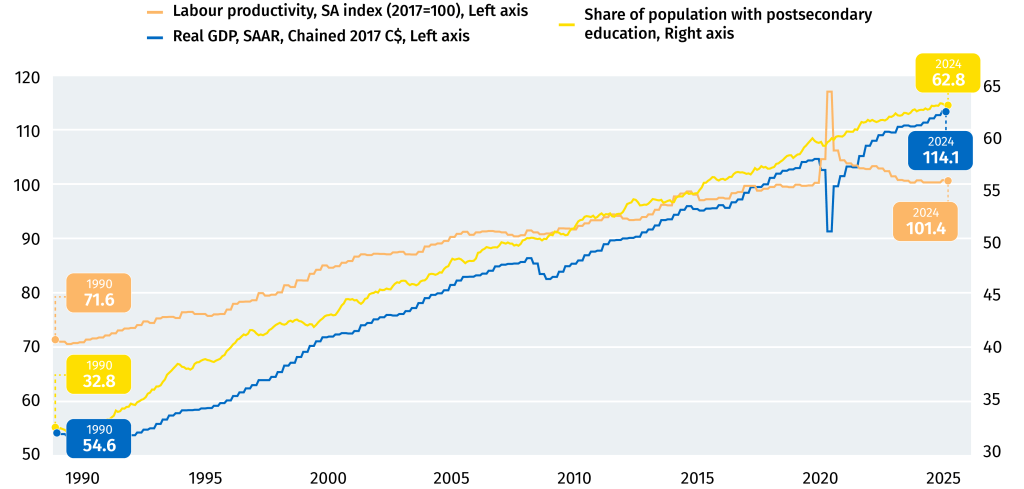
Canada’s labour productivity growth falters even as more Canadians obtain postsecondary education

Source: Statistics Canada, RBC Economics

Canada’s population is highly educated but our productivity doesn’t match — We are the most highly educated population in the G7 and above average across OECD countries. In 2024, some 63% of Canadians aged 25 to 64 had a postsecondary credential compared to an OECD average of 41%.1 Yet these two charts show that our productivity record has not kept up and is not only lagging our peers but has worsened over the past decade even as the rate of higher education, including for new Canadians, has improved.

And that productivity growth lags many OECD countries

Average annual labour productivity growth, 2014-2023, %

Source: OECD, RBC Economics

Our graduates get jobs, but their incomes  — College and university graduates experience lower levels of unemployment and earn more over time than Canadians with a high school diploma or less.2 But, regardless of education level, Canadians earn an average of 8% less than their American peers,3 a gap that is wider in many professions.4 This is one reason for a perennial migration — a brain drain — of people with advanced degrees to the United States and a loss to Canada, economically and otherwise. The differing costs and standards of living in the U.S. aside, Canada still only falls in the middle of the pack when we look at individual returns on investment from higher education compared to peer countries.5

Postsecondary Education in Canada

Canada does not have a singular postsecondary education system. Each province and territory holds responsibility (a constitutionally protected authority for provinces and federally delegated for territories) for establishing and regulating its universities, colleges and institutes, including giving power to grant degrees and diplomas and making choices about provincial funding and tuition. This has led to variation in policy and systems across the country. About 64% of postsecondary students are enrolled in universities and 36% in colleges6, the vast majority in publicly funded institutions split among about 100 universities and 200-plus colleges, including 13 polytechnic schools7. This is alongside more than 1,500 private vocational colleges, about half in Ontario8.

Universities have traditionally offered longer-term degree programs in subject disciplines and public colleges have offered shorter-term diplomas in career-focused programs. But provincial governments outside Quebec and the four Atlantic provinces have also allowed public colleges to grant degrees9, and diploma and certificate programs are frequently found at universities. The federal government contributes to the postsecondary systems indirectly as well, through research grants, student financial assistance and provincial transfer payments10.

The Challenges

At its best, higher education contributes to productivity by developing a skilled workforce, driving innovation through research and fostering industry collaboration. Postsecondary institutions equip graduates with critical skills, support businesses with cutting-edge research and fuel economic growth by creating new technologies, startups and talent. Research has shown a positive relationship between a region’s economic health and the presence of higher education institutions, with an additional 0.4% in future GDP for every 10% increase in the number of universities per capita11. This effect is driven by boosts to human capital and innovation, not just direct institutional and student spending.

Higher learning institutions also contribute to the social and intellectual vitality of a community, region, and society that are hard to quantify. Nevertheless, Canada’s record underscores that the presence of a higher education system with a high rate of participation and research activity does not always translate into high returns when we look at economic measures.

So, what’s missing? Pinpointing which factors contribute to the overall economic value of a postsecondary education is limited by a lack of data and research12 13. But we can look to other countries with higher productivity and strong postsecondary systems for clues about what works and is showing promise — some of those are highlighted later in this report. We can also identify clear gaps here at home, whether that’s in human capital development or in research.

Disconnects persist between the knowledge and skills outcomes of Canada’s higher education systems and labour market needs.

The OECD has noted that “higher educational attainment does not always directly correspond with higher skills14.” Employer surveys consistently indicate that companies still have a hard time finding new hires with the skills they need, especially interpersonal and communication skills15. We also know that there is a growing gap in graduates’ technical skills related to artificial intelligence, cybersecurity and working with big data, all areas rapidly growing in importance.

Postsecondary business models are inadequate to meet the outcomes expected of Canada’s higher education systems in the current global economy.

Postsecondary institutions have a balance sheet problem. Their finances are rapidly changing due to stagnating provincial government funding, restrictions or even freezes on student tuition increases, and a federal immigration policy shift that has led to steep drops in international students and the significant revenue their higher tuition contributed to the bottom line. The postsecondary revenue crunch is likely to worsen without a reformed business model — one that is capable of responding to the demands of a changing economy.

Trouble is, postsecondary leaders are constrained by insufficient control over their revenue sources, regulations that circumscribe how they run their budgets, and little to no ability to cut or reallocate some of their biggest fixed costs. Staff wages and benefits amount to more than 50% of total expenditures at both colleges and universities16 and a high presence of permanent faculty and teaching staff protected through collective agreements, tenure or both limit institutions’ ability to nimbly adjust or close programs as enrolments and demands change. The hiring of contract faculty to teach students has been one attempt to gain some flexibility but the practice is not a panacea and has led to a teaching underclass with insufficient access to resources or basic job stability.

Amid this shaky and constrained financial picture, academic programs that connect best with high productivity industries are the most expensive to run. Science, technology, engineering and mathematics programs – STEM — have been expanding over the last 30-plus years as labour market and student demands have shifted, from 18.3% of enrolments in 1992-1993 to nearly 26% in 2022-202317. But labs, computers and other equipment mean they cost at least twice as much as training for a humanities or business student. If traditional revenue sources are no longer reliable, colleges and universities need to be freed – and encouraged – to develop fresh revenue streams, funding models and educational redesigns that make sense for them and the broader societal and economic needs they serve. The case of Arizona State University (illustrated later in this report) is an example of an institution that has taken an entrepreneurial approach, reimagining its programs and research activities as well as its business model to gain back institutional control from reduced state funding while making student access a priority, including for marginalized students.

Canada lacks comparable data to assess outcomes of our postsecondary systems and support linkages with labour market information.

It’s hard to fix what isn’t well-measured and Canada falls down on data to assess outcomes of its postsecondary systems20. While completion and employment rates data are sometimes tracked, outcomes data are not uniform across provinces or even institutions; nor is it timely or robust enough to confirm alignment between graduates’ skills and the labour market. The provincial/territorial control of higher education systems may seem to make national standardization of this data a non-starter. But given the renewed exploration of how to better harmonize provincial/territorial economies and trade, there is a perfect opportunity to bring postsecondary institutions into the discussion.

Countries such as the U.S. and Australia do a better job with postsecondary data tracking, enabling well-informed public policy discussions and change. In the U.S., tracking has been federally mandated for institutions that participate in federal student aid programs, and data is available through its Integrated Postsecondary Education Data Systems. Australia has developed its Quality Indicators for Learning and Teaching, a suite of annual government-endorsed surveys that follow higher education students from enrolment to employment.

There is a mismatch of graduates with advanced degrees.

Nearly 15% of Canada’s working-age population hold a graduate degree today — just below the share that held a bachelor’s degree in 1997, at 16%21.But those degrees aren’t always leading to jobs that require them. (In fact, there are more job vacancies for positions requiring only a high school diploma than there are openings for positions requiring a bachelor’s degree or higher22.)

As a result, there’s a rising number of highly educated Canadians working in jobs that do not make effective use of their degree. The OECD has ranked Canada as having the second-highest overqualification rate of 37 countries23, with an overqualification rate of 10.6% for Canadian-born workers and 11.8% for Canadian-educated immigrants in 202324.

Degree-holders undoubtedly enjoy a wage bump compared to those without a postsecondary degree. But that wage premium is shrinking when comparing the benefit of a master’s degree to a bachelor’s. Between 1997 and 2019, that premium averaged 23%. Since the pandemic, that’s fallen to 18% as more graduate degree holders compete for the comparatively smaller pool of jobs that require their credentials.25 What people pursue in their advanced degrees matters too: business PhD holders were the highest earners in a 2021 analysis of doctoral graduates, although they represented only 4% of all PhDs, while humanities and science PhDs (9% humanities and 22% sciences) were among the lowest. Math and computer science doctorate holders meanwhile showed the highest earnings growth in the five years after PhD completion26.

As well, fewer Canadian PhDs are working for private industry, compared to the U.S., which may be partly tied to an economy that is still heavily resource-based and where we have lower levels of industry R&D investment that would demand their skills27. Nevertheless, graduate students have relatively low levels of participation in work-integrated learning experiences (discussed later in this report) and lack opportunities to demonstrate and apply their skills and expertise to Canadian firms that could benefit from them. Canada certainly needs people with advanced degrees, but more thought should be given to which programs are of greatest need and how to make the most out of the skills and knowledge they produce.

Canada has seen expansion of postsecondary campuses and programs over the last 25 years but it’s unclear whether we have the right number or distribution.

Participation in higher education has expanded over the last 35 years and along with it has come expansion of programs and campuses. We need a high-quality postsecondary sector to educate and inspire the next generation of talent and skilled workers while generating transformative discovery. But it’s worth asking whether the size and spread of Canada’s roughly 100 public universities and 200-plus colleges with associated campuses and 25,000-plus programs are aligned as well as they could be with the country’s most pressing needs and the challenge of creating a more productive economy.

This question becomes more urgent given the pullback on international students who until 2024 functioned as a significant counterweight against more recent shrinkage in domestic enrolment and revenue, which has been acute in some regions. Population demographics forecast modest growth among Canada’s   over the next decade before declining to something slightly above current numbers28.

Memories are also relatively fresh of the 2021 financial crisis at Laurentian University in Sudbury, Ont., when the institution declared insolvency due to what was later deemed primarily to be poorly planned capital projects combined with administrative bloat29.

Let’s think seriously about how to better align higher education resources with a broader student demographic and the evolving needs of the economy.

We are not setting up international graduates of Canadian postsecondary education for integration into high productivity labour sectors.

International students are part of the solution to Canada’s future economic needs and its productivity crisis. But over the last several years we’ve seen how the country’s efforts to recruit these students ballooned out of control, leading to students being underserved and/or ending up in programs without pathways to high value industries. As one example, international students are more likely to be enrolled in business or management programs versus STEM30,and many have struggled to find jobs after graduation when their visas allow them to stay.

As Canada works to reduce and recalibrate this student pool, we should focus on recruiting and educating high quality international students with targeted workforce development in mind. The federal government recently made this a requirement, with new rules about fields of study that international students need to be enrolled in to qualify for post-graduate work permits.

That’s a start, but the execution left something to be desired and threw many postsecondary institutions into crisis-mode trying to fill financial and programmatic gaps overnight. When the dust settles, fields of study should be chosen with consideration of regional labour demands too. International students will also need more help to translate their skills to the workplace, via focused career counselling and work-integrated learning opportunities, which some struggle to access due to immigration work restrictions.

Students need more complete skills toolbox.

We need data scientists who are storytellers, electricians who can communicate technical complexity to their clients, and culture creators who can make magic by leveraging cutting-edge digital technologies. Hard skills and knowledge learned in STEM programs are valuable, but so are the skills where humanities excel: persuasive and effective writing and speaking, critical thinking and creative approaches to problem-solving.

We also know that students may not end up working in the domain where they received their education, whether that was in STEM or business/humanities31. Not enough postsecondary programs encourage cross-pollination across disciplines. But programs such as McGill University’s Bachelor of Arts and Science (B.A. & Sc.) degree, which allows students to study disciplines in both faculties, BCIT’s Bachelor of Creative Industries program that combines training in the arts, technology, and business, or Langara College’s Environmental Studies program, blending biology, chemistry, English and geography, are promising examples32. Many programs leave room for electives, too, where students can acquire that breadth of skills independently.

But this is tinkering along the edges of what’s possible and needed. As enrolments continue to slide in humanities programs, postsecondary institutions must reimagine the core competencies the humanities provide to all students and how to extend that across subjects, disciplines and faculties in a world of growing STEM demand. Critical thinking and the ability to analyze complex problems are top skills for the most needed jobs in the face of advancing artificial intelligence and automation33 as is the ability to identify how to effectively use these technologies. Can we start to break down entrenched silos that prevent the STEAM concept from being embedded more directly into most students’ programs and curricula?

Canadian companies are not making the most of postsecondary research output and are weak adopters of postsecondary research innovations.

In 2022, Canada ranked 10th globally in terms of scientific publications34 and we are a global leader in specific fields, such as artificial intelligence. But Canadian companies aren’t picking up the ball when it comes to making the most of made-in-Canada discoveries. The U.S., with a much better track record, benefits from a more robust ecosystem to support research translation into market applications, including venture capital funding, supportive public policies and an intellectual property framework that incentivizes researchers and postsecondary institutions to pursue commercialization.

All told, Canadian business investment in research and development was just 1.7% of GDP in 2022, putting us below the OECD average and well below highly productive countries like Israel (6.0%), South Korea (5.2%) and the U.S. (3.6%)34. Even in AI research, where Canada is a global leader, we lag peer countries in its commercial use.

How we can do better

The discussion about aligning postsecondary education and training with labour market needs isn’t a new one. Colleges and universities recognize this, and there are growing pockets of innovation. But employers and economic data signal a different story: that Canada is still missing the mark in generating the skills and knowledge needed to meet its evolving productivity challenge in an increasingly competitive world. Here are a few things we can do differently:

Eliminate barriers to institutional innovation.

Postsecondary institutions in Canada require new business models that free them to be more entrepreneurial and in control of their financial destinies while remaining responsible and accountable to the people and communities they serve.

Too often institutions that attempt to innovate are frustrated by a host of mostly provincial but also federal regulations on everything from tuition to procurement to partnerships and mandatory programs without corresponding government financial support. Reasonable deregulation would help clear the way for institutions to become more creative, collaborative and in step with a changing world. Internally, colleges and universities need mechanisms to incentivize change where barriers and resistance exist within institutions to creating or altering programs at scale or incorporating industry into program design.

Enhance the awareness and articulation of skills developed in PSE programs.

Prospective students and new graduates need to know the skills they will emerge with, allowing them to fairly evaluate whether a program is for them and to communicate these skills to employers. Some programs are already clear about this, notably at colleges, but the practice should become widespread and should be tied into a larger drive towards national comparable postsecondary outcomes data that can be linked to labour market information.

The challenge can be more acute for advanced degree holders, most of whom won’t spend their careers in academia. They, and employers, also need to understand what skills they’re developing through their research and how these can be translated to a non-academic workplace.

Get work-integrated learning to where it’s needed most.

Work-integrated learning, or WIL, is the practice of integrating work and real-world experiences into a student’s higher education program. Internships, practicums, co-op programs, entrepreneurial mentorship and field work are common examples. These experiences help students connect and apply their learning to workplace realities, acquire new and relevant skills and assist businesses to recruit and develop students for their specific labour needs.

As such, WIL is part of the solution to Canada’s productivity and skills challenges – two-thirds of employers participating in WIL programs through BHER reported an increase in their productivity.36But while the country has made important strides in providing these opportunities, WIL is not yet the norm – just under half of all postsecondary graduates in 2020 had experienced a WIL opportunity.37 There are also variations in uptake, with PhD students (18%) and those in the humanities (16%) less likely to have a WIL experience38.

Most businesses in Canada are small and medium-sized enterprises (SMEs) and face more barriers than larger organizations to participating in conventional forms of WIL in terms of resources, time and risk. For them, shorter-term, more flexible and less resource-intensive forms of WIL aligned more closely with SME realities and needs make more sense. These should be considered as part of a robust suite of WIL experiences. They include consulting engagements, multiple short-term placements of up to 10 days, online projects and placements, and engagement in industry challenges through hackathons, competitions and course-based projects submitted by employers39.

Develop upskilling and reskilling opportunities.

Businesses have a responsibility to help workers stay current with the skills needed to keep doing their jobs as they evolve with technological and other changes. Postsecondary institutions are well-positioned to be providers for that learning and can take advantage of these opportunities as revenue streams in a reformed business model. Too often Canada’s companies struggle to partner with postsecondary institutions and end up developing their own in-house training solutions40.

To do that well, higher education must stay on top of and respond to upskilling opportunities in their communities, partner with employers (and vice versa) to understand and respond to specific skills gaps and create programs that fit the working and personal lives of learners. Continuing education departments are particularly well-positioned to do this. An opportunity also exists for governments to financially support and promote these programs, such as through tax and other incentives, as they look for policy responses to labour force disruption. Microcredentials – rapid, often virtual courses — are one form of upskilling that have proven effective in complementing workers’ existing skills41.

especially the programs and courses that are developed by postsecondary institutions (for example, Ontario provides access to these via its provincially funded eCampus portal).

Similar opportunities exist for postsecondary institutions in reskilling programs where workers exiting one industry acquire an entirely different set of more in-demand skills. Partnering with local companies’ outplacement programs is one example. Given that it’s a more substantial undertaking than upskilling, the reskilling shift can be trickier, especially if we want it to happen quickly. Competency-based education (CBE) courses may offer a way forward. CBE is singularly focused on mastery of a discrete set of competencies, often required for a particular job, such as nursing. CBE courses tend to be flexible, virtual, personalized, self-directed and recognize prior learning. The approach has been used in limited ways in Canada, is more widespread in the U.S. and may offer inspiration for reforming the structure and delivery of traditional programs42.

Intensify the drive towards institutional differentiation.

Canada has done an excellent job of providing access to public postsecondary education across a big country and into remote communities. But we neither need nor can we afford to have every institution offering the same menu. Not every institution needs its own artificial intelligence research hub or history department.

Differentiation is critical, where public colleges and universities are encouraged to lean into the teaching, learning and/or research they are best at, and discouraged from unnecessary program duplication. The government of Ontario has followed this policy, though without a strategic vision for the sector or what separate roles should be played by colleges and universities43.

Differentiation might mean institutions that are focused on and excellent at teaching mostly undergraduates, such as members of eastern Canada’s Maple League of Universities, or that are highly research-intensive, such as the University of Toronto, or whose teaching and research are strongly aligned with key local industries, such as the country’s polytechnic institutes.

Differentiation can also happen through the business model an institution uses to sustain itself and remain relevant. It can be promoted through strategic mandate agreements negotiated between institutions and government funders, as Ontario does. Government research funding models can also encourage differentiation and build capacity by favouring institutional specialization, such as through the federal government’s Canada First Research Excellence Fund.

The growing financial sustainability crisis faced by colleges and universities makes differentiation a strategic imperative for each institution.

Make it easier for Canadian businesses to adopt and invest in research.

Our world-class postsecondary researchers are part of an innovation pipeline that includes Canadian businesses who can adopt researchers’ discoveries, commercialize, refine and run with them, boosting their own competitive edge. But that pipeline is slowed by Canada’s fragmented regulatory and approval processes, at every level of government, which delay and complicate business investment decisions. Streamlining those processes by implementing, for example, a harmonized federal-provincial environmental assessment process for projects of national strategic importance would speed up approvals and drive private sector investment into new major projects.

Our outdated tax system is also in need of a comprehensive review with an eye to encouraging greater private sector investment in Canadian research and development. This review could include an assessment of the impact of recently announced changes to the, could further spur private sector R&D investment.

Conclusion

Postsecondary education is one of this country’s greatest strengths. But we’re not using it to its full potential and we’re not keeping pace with the rest of the world as a result. Our productivity crisis is clear and urgent with direct impacts on the standard of living all Canadians can expect, including the graduates of tomorrow, especially in a global economy that is more divided and disruptive. Governments, institutions and employers must each play a role in bridging the gap:

  • Take action on regulatory and tax reform to encourage greater private R&D investment and adoption of made-in-Canada research discoveries.

  • As federal departments work through a reformed strategy for international students, focus on ways to match their abilities and interests with programs aligned to Canada’s most pressing economic needs, regionally and nationally. Eliminate immigration restrictions that prevent international students from participating in work-integrated learning.

  • Address business barriers and raise awareness about the value of participating in work-integrated learning experiences, especially among SMEs, by investing in partnership and capacity building.

  • Use tax incentives and federal funding to encourage industry partnership with postsecondary institutions in support of cost-effective, high-quality upskilling and reskilling programs for employees.

  • Engage in pan-Canadian work and leverage relevant federal programs and departments to develop comparable, accessible, comprehensive and easy-to-understand data for timely identification and analysis of postsecondary education outcomes, including by institution and program.

  • Implement a clear vision and strategy for the province’s postsecondary systems that differentiates between the purpose of college vs. university programs and incentivizes differentiation within them.

  • Embark on a process of limited postsecondary deregulation that gives institutions more control over their finances, revenue streams and promotes innovation in programs and industry partnerships.

  • In parallel, promote accountability through mandatory institutional reporting of comparable and detailed data on postsecondary outcomes by institution and program, including graduates’ skills, which can be linked to labour market information.

  • Continuously and rigorously review changing labour needs and update labour market information to better support alignment with postsecondary programs.

  • Be explicit about the skills students will develop through the programs and courses offered to them and provide ways to communicate those to employers. Draw on the expertise of continuing education departments which are already well-positioned to help.

  • Encourage, support and incentivize departments and faculty to explore new models of teaching and learning, especially where these integrate skills students will need in the workplace.

  • Break down faculty, disciplinary and subject siloes that interfere with cross-curricular and interdisciplinary learning needed to promote STEAM skills and expose students to problems in high labour demand sectors.

  • Look for novel ways to spread student awareness of work-integrated learning opportunities, why they’re valuable and help them overcome barriers to access.

  • Engage with postsecondary institutions — or intermediaries like the Business + Higher Education Roundtable that can help navigate to and through them — to communicate skills needs and identify potential opportunities for collaboration.

  • Explore becoming a work-integrated learning participant to bridge the skills gap and potentially develop the next crop of employees.

  • Look to postsecondary institutions for short-duration programming to help upskill and/or reskill your employees before turning to untested third-party providers.

  • Engage in local outreach to high schools to raise awareness about their industry, why it’s an exciting place to work and the education pathways to a fulfilling career in that sector.

  • Continue to contribute to labour market information systems by sharing data with governments and collaborate to find new ways to enhance the accuracy and relevance of labour market analyses and policy development.

Global Stories in Higher Education Research and Development

Facilitating knowledge transfer to SMEs – Heilbronn University, Germany

The challenge: Bridge the knowledge gap for local small- and medium-sized enterprises.

The innovation: This applied research university created a virtual AI lab that is publicly accessible, frequently updated and helps businesses understand AI research developments and adopt pragmatic AI solutions in a city quickly becoming known as an AI hub.

Powering startups through global connections — Block 71, National University of Singapore

The challenge: Bridge the knowledge and connection gap for startups.

The innovation: Block 71 was set up in 2011 to create an innovation hub by connecting startups with academic research, mentorship and global markets. It has since spread to 10 other global locations including Silicon Valley, Saigon and Nagoya, leading to more than 100 startups connected with more than 50 venture capitalists.

Creating a research powerhouse through merger — University of Paris-Saclay, France

The challenge: Enhance research institutions’ global and research impact.

The innovation: Created in 2019, this technological research-intensive university brings together 20 prestigious colleges, public universities and research institutes under one campus while preserving their individual autonomy. Through their combined resources, the collaboration has positioned the university as a leading force in global science and technology research, education and innovation.

Fostering local economic engagement – Innovation and Economic Prosperity Program, Association of Public and Land-Grant Universities, United States

The challenge: Connect university teaching, learning and research to local economic development.

The innovation: The IEP program encourages universities to understand, communicate and develop their local economic engagement through a designation process. It also conducts annual awards recognizing outstanding examples of talent and workforce development; innovation, entrepreneurship and technology-based economic development; and other forms of community engagement.

Global Stories in Higher Education Teaching and Learning Innovation

Degree Apprenticeships — Manchester Metropolitan University

The challenge: Address graduates’ skills gaps and boost productivity

The innovation: Degree apprenticeships combine full-time work with part-time study, engaging industry in co-designing and delivering a large portion of the program. Manchester Met has achieved exceptional outcomes through this model, including a 44% median salary increase for apprentices, estimated to be equivalent to a 60% boost in productivity, and 70% of employers reporting productivity gains.

Disrupting the Model – Arizona State University, U.S.

The challenge: Redesign the university to provide broad access to education, advance research of public value and engage in community economic challenges.

The innovation: Under the transformative leadership of Michael M. Crow, the university is redefining the role of higher education under its “New American University” model. It’s been ahead of the curve in offering full degree programs online and improving access for non-traditional students, including a partnership with Starbucks to provide free online degree programs for its employees. On the research and intellectual property side, it has secured more than 1,600 patents since 2003, attracted more than $1.4 billion in investment capital and is considered a leader in technology transfer.

  • South Korea – This east Asian powerhouse has the highest rate of postsecondary education attainment in the OECD, at nearly 70% of its population and is an OECD leader in productivity growth. The country has leveraged its educational advantage towards its economic development, with a strong top-down system of close research collaboration between government, industry and the academic community. Although it is currently facing slippage in its record, its fundamentals remain strong and it stands as an example of what’s possible through robust policy, investment and collaboration.

  • Israel – With a 6.5% growth rate in 2022, Israel’s high-tech sector accounts for more than 15% of GDP and universities are tightly woven into its activities. Israel was ranked first globally for AI talent concentration and fifth for AI talent penetration by Stanford University’s 2024 AI Index Report. This has been attributed to “an exceptional ecosystem of startups, academia, and strategic support from both local and multinational players.”

  • Slovenia – Showing strong productivity gains over the last decade, this small eastern European nation has also seen significant gains in postsecondary education attainment since 2012, from 35.3% of the population to 47.3% in 2022. The country directs about 1% of GDP towards higher education, has seen rapid growth in STEM program graduates and manages higher education within the same government ministry as science and innovation.

Digital Technologies Program, York University
  • The challenge: Address skills gaps in the digital economy and foster a diverse, innovative workforce.

  • The innovation: Canada’s first fully work-integrated learning degree, where students spend 80% of their time in the workplace, including paid work opportunities, and 20% on coursework. The competency-based curriculum allows students to apply real-world skills while moving through advanced tech-related topics. Employers highlight gains in productivity resulting from longer-term placements and deeper student engagement with projects.

Electrical Technician Program, Nova Scotia Community College
  • The challenge: Meet the demand for new skills as Nova Scotia’s government works to grow its onshore wind generation.

  • The innovation: With an investment from RBC Foundation as part of a larger $2-million commitment, NSCC is updating its Electrical Technician Program to include large-scale wind energy training, in alignment with labour market demand and provincial clean growth initiatives. The funds will support new course development and hands-on training materials.

Global Innovation Clusters, Innovation, Science and Economic Development Canada
  • The challenge: Solve complex problems and improve Canada’s productivity in key emerging industries.

  • The innovation: Better known as the “superclusters,” this program brings together businesses, academic institutions and nonprofits under five industry categories to drive growth and innovation, backed by shared government and industry funding. The program generated more than $1.6 billion in project spending by the federal government and industry partners between 2018 and 2023 and created nearly 24,000 full-time jobs.

Mitacs Research and Internship Partnerships
  • The challenge: Connect postsecondary research expertise and innovation to problems faced by businesses and bridge the skills translation gap for undergraduate and graduate students.

  • The innovation: Through several programs, this not-for-profit organization brings students and post-doctoral researchers together with private sector partners through internships and collaborative research projects focused on real-world challenges faced by the business. Mitacs also provides dedicated professional skills development for graduate students and postdocs. The program has resulted in an 11% increase in productivity for its more than 12,000 partners and $1.2 billion in R&D spending between 2018 and 2023, according to a Statistics Canada/Mitacs analysis.

For more, go to rbc.com/thegrowthproject.

Download the Report

Contributors:

RBC Thought Leadership

John Stackhouse, Senior Vice-President, Office of the CEO, RBC

Caprice Biasoni, Graphic Design Specialist

Shiplu Talukder, Digital Publishing Specialist

Business + Higher Education Roundtable

Val Walker, CEO

Matthew McKean, Chief R&D Officer

Andrew Bieler, Director of Partnerships & Experiential Learning

Carmela Busi, R&D Associate

External Contributor

Moira MacDonald, Writer & Copy Editor

1. OECD. Adult Education Level. Retrieved from: https://www.oecd.org/en/data/indicators/adult-education-level.html?oecdcontrol-4e20b448f7-var6=TRY

2. Statistics Canada (2023), From high school, into postsecondary education and on to the labour market.

3. RBC Economics (2024). Canada’s Growth Challenge: Why the economy is stuck in neutral.

4. Statistics Canada and RBC Economics Research.

5. OECD and RBC Economics Research.

6. Statistics Canada (2024). Postsecondary enrolments, by International Standard Classification of Education, institution type, Classification of Instructional Programs, STEM and BHASE groupings.

7. Usher, A., & Balfour, J. (2024). The State of Postsecondary Education in Canada, 2024. Toronto: Higher Education Strategy Associates.

8. Higher Education Quality Council of Ontario (2024). Understanding the Regulatory Landscape of Private Career Colleges.

9. Usher, A., & Balfour, J. (2024). The State of Postsecondary Education in Canada, 2024. Toronto: Higher Education Strategy Associates.

10. Ibid.

11. Valero, Anna & Van Reenen, John. (2018) The economic impact of universities: evidence from across the globe. Economics of Education Review.

12. OECD (2019), Benchmarking Higher Education System Performance, Higher Education, OECD Publishing,

13. Paris.

14. Côté, A., Dobbs, G. (2023) Canada’s Black Box of Higher Education Outcomes. Canadian Standards Association, Toronto.

15. OECD (2019), Benchmarking Higher Education System Performance, Higher Education, OECD Publishing,

16. Paris.

17. Business + Higher Education Roundtable (2022), Empowering People for Recovery and Growth: 2022 Skills Survey Report.

18. Usher, A., & Balfour, J. (2024). The State of Postsecondary Education in Canada, 2024. Toronto: Higher Education Strategy Associates.

19. Statistics Canada (2024), Postsecondary enrolments by field of study, registration status, program type, credential type and gender.

20. Hemelt, Steven W. et al, “Why is math cheaper than English? Understanding cost difference in higher education,” Working Paper 25314, National Bureau of Economic Research, November 2018

21. Usher, Alex, “The Shifting Cost-base of Ontario’s Higher Education System,” February 2020.

22. Côté, A., Dobbs, G. (2023) Canada’s Black Box of Higher Education Outcomes. Canadian Standards Association, Toronto.

23. Statistics Canada. Retrieved from Labour Force Survey.

24. Statistics Canada (2023). Unemployment and job vacancies by education, 2016 to 2022.

25. OECD/European Commission (2023), Indicators of Immigrant Integration 2023: Settling In, OECD Publishing, Paris

26. Ibid.

27. Statistics Canada. Retrieved from Labour Force Survey microdata.

28. Council of Canadian Academies (2021). Degrees of Success, Ottawa (ON). The Expert Panel on the Labour Market Transition of PhD Graduates.

29. Ibid.

30. Statistics Canada. Population projections for Canada, provinces and territories: interactive dashboard.

31. Office of the Auditor General of Ontario (2022). Special Report on Laurentian University.

32. Canadian Bureau for International Education (2024). The Student Voice – National Results of the 2023 CBIE International Student Survey, Report, CBIE, 2024.

33. Council of Canadian Academies (2015). Some Assembly Required: STEM Skills and Canada’s Economic Productivity. Ottawa (ON): The Expert Panel on STEMSkills for the Future, Council of Canadian Academies.

34. RBC (2018). Humans Wanted: How Canadian youth can thrive in the age of disruption.

35. Nature Index. (2023). 2022 Research Leaders.

36. OECD. Gross domestic spending on R&D.

37. Innovative Work-Integrated Learning: Smarter Skills Solutions for Canada’s SMEs, Business + Higher Education Roundtable, 2025.

38. Statistics Canada. Table 37-10-0249-01 Work-integrated learning participation during postsecondary

39. Ibid.

40. Business + Higher Education Roundtable (2025). Innovative Work-Integrated Learning: Smarter Skills Agenda.

41. Business + Higher Education Roundtable (2023). Upskilling and Reskilling: how employers are retraining and retaining Canada’s workforce.

42. Pichette, J. & Courts, R. (2024) Postsecondary-offered Microcredentials in Ontario: What Does

43. The Evidence Tell Us? Higher Education Quality Council of Ontario

44. Pichette, J., Watkins, E. K. (2018). Competency-based Education: Driving the Skills-measurement Agenda. Toronto: Higher Education Quality Council of Ontario.

45. Office of the Auditor General of Ontario (2022). Value for Money Audit: Financial Management in Ontario Universities.

46. Statista (2025). Share of people with tertiary education in OECD countries in 2022, by country.

47. Lee, Soo & Jung, Hyejoo. (2021). Higher Education in the National Research System in South Korea.

48. World Bank. Retrieved from https://data.worldbank.org/country

49. OECD Economic Surveys 2023: Israel.

50. Press, Gil. “In 2024, Israel became a Global Leader in Applied AI Innovation,” Forbes, Dec. 22, 2024.

51. European Commission (2024). Country Reports: Slovenia.

52. Ibid.

53. Government of Canada (2022). Innovation Superclusters Initiative: Economic analysis final report.

54. Mitacs (2024). Measuring the Economic Impact of Mitacs.


Canada’s life sciences sector has been a paragon of strength and economic vibrancy. Supported by a world-class science and research ecosystem, it’s made the country a global leader in drug discovery and healthcare innovation, acted as an engine of economic growth, and helped develop, retain and attract top scientists in a growing, high-value field.

Despite the successes, Canada’s life sciences sector is showing signs of weakness. Scientists in the field are lagging in terms of their ability to translate ground-breaking research into commercial success. That may partly explain why Canadian life science companies are having an increasingly difficult time keeping up with domestic needs for drugs, pushing the country from a net exporter of pharmaceuticals to a net importer. Canada is also falling behind its peers in the Group of Seven Nations (G7) and Organisation for Economic Co-operation and Development (OECD) in terms of relative spending in the sector.

These warning signs are flashing at a difficult moment for the Canadian economy. A shortfall in investment is impacting the country’s overall productivity, a key measure of the amount of economic output we generate per hour of work. That has weakened the economic momentum that propelled the country through the 20th century and cut into our overall prosperity. If Canada is to reverse this long-term growth challenge, it will have to move to strengthen high-value sectors like life sciences, which have acted as strong economic catalysts over the past decades.

Recalibrating Canada’s approach to life sciences will better position the country to take advantage of the enormous opportunities in a global sector that has been valued at US$2.83 trillion. Strengthening the sector would also positively impact other advanced industries and have ripple effects throughout the country’s science and technology communities.

A rethink could have implications that go beyond economic interests as well. The COVID-19 pandemic, which shocked and strained national healthcare systems and global supply chains, put a spotlight on a key reason Canada needs to have robust production capacity: to be able to support itself in times of health emergencies. Since health crises such as pandemics are expected to occur with greater frequency across the globe, at least for the foreseeable future, due to factors such as climate change and increased globalization and urbanization, the need for domestic production capacity in vaccines and therapeutics will continue to increase. At the same time, demand for all health-related products will inevitably rise as the population grows and ages.

If Canada is to bolster its strengths and realize its full potential, we will have to address those critical challenges. Some solutions will require increased funding, but others would necessitate changes to the way we deliver support to the sector and coordinate public and private resources. If the country gets it right, the life sciences sector can continue to serve as a foundational pillar of economic resilience and better prepare Canada to meet future public health challenges.

Key Findings

  • The life sciences sector has long been a Canadian champion in research and development (R&D), but its stature risks eroding in the face of increasing global competition for investment and talent.
  • Urgent investment in AI computing infrastructure – and policy changes to encourage private investment – will be essential to relieve chronic and rising shortages of computational resources facing Canadian researchers and life sciences companies, in particular those doing time- and capital-intensive drug discovery.
  • Canada would benefit from improved coordination of policies and resources between the artificial intelligence (AI) and life sciences sectors if it wants to remain a global leader in life science innovation and drug discovery and development.
  • To make scaling innovation easier and keep more locally developed Intellectual Property (IP) in the country, Canada needs better commercialization support in the form of favourable policies and more accessible and coordinated resources and funding.
  • Canadian public- and private-sector policymakers should prioritize actions that help retain and attract world-class researchers and innovators as the country addresses its systemic issues in life sciences.

Where we are and how we got here

Life sciences is a rapidly evolving field spanning a broad array of activities that produce the tools needed to protect, maintain and improve health. These include biomanufacturing, which uses living organisms to develop products like vaccines; the pharmaceutical industry, which creates medicines from chemicals and synthetic processes; and manufacturers of health-related products such as diagnostic equipment and personal medical devices.

Canada is home to more than 2,000 life sciences firms, employing as many as 220,000 people across the country. Most of their activity focuses on research and development (R&D) at public and private labs, which creates various forms of IP used to advance health sciences. In turn, IP such as new drug formulas or medical device patents are then purchased – often by private firms outside the country – to be commercialized so it can be brought to market for healthcare organizations and consumers.

The impact of life sciences on Canadian gross domestic product is hard to isolate because the government does not provide data or reporting on the sector’s critical success indicators, such as GDP contribution, job figures, number of firms, and annual growth metrics. Sizing up Canada’s life sciences performance and growth opportunity is made more difficult because there is no generally agreed upon definition of exactly which specific sub-sectors are to be included when analyzing the sector. Plus, some life science endeavours like biotechnology focus not only on human health but also on factors affecting animal and plant health.

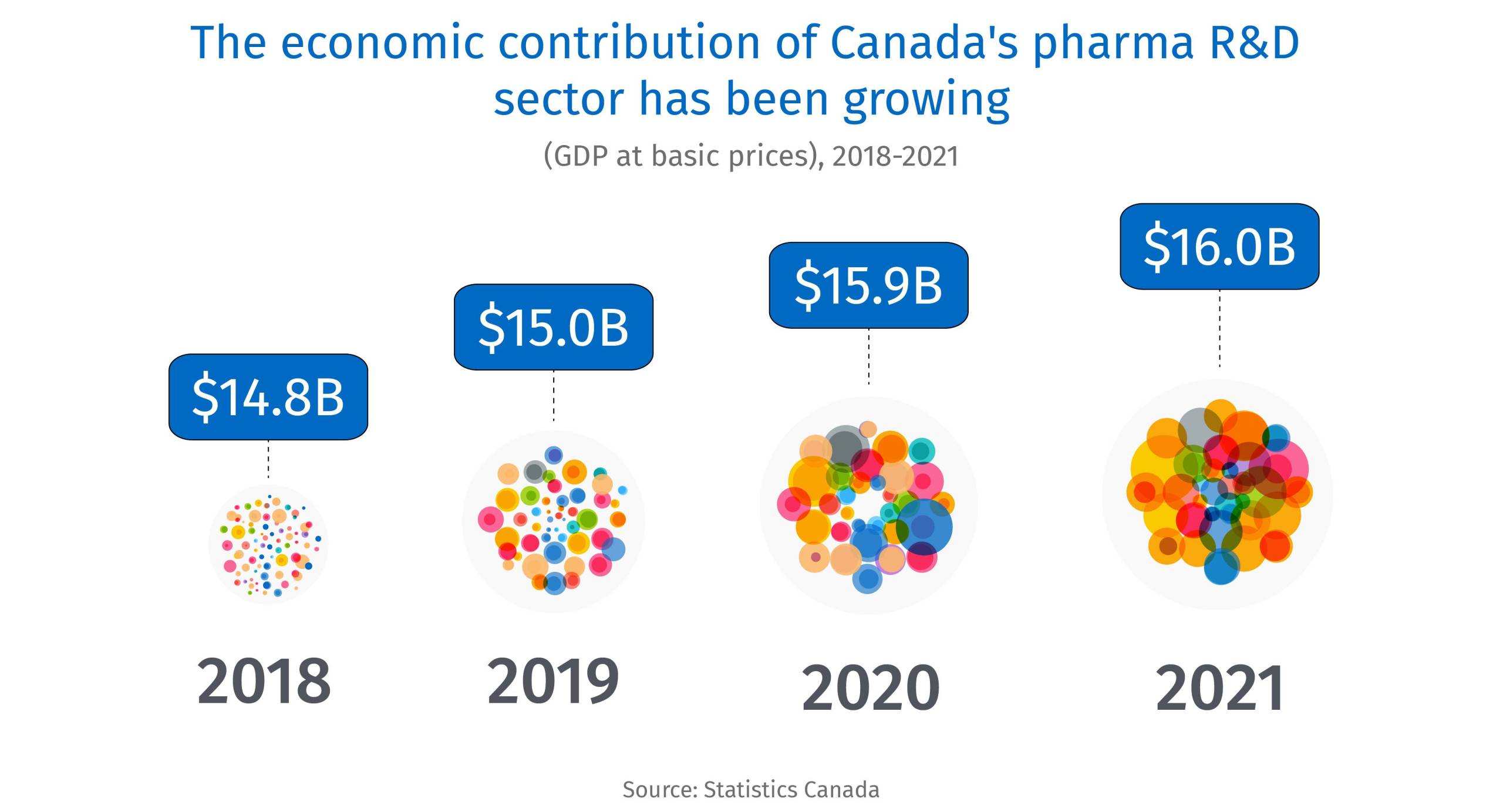
No one doubts, though, that the size and scope of Canada’s life sciences sector makes it an important and growing part of the economy. The pharmaceutical R&D subsector alone contributed $16 billion in value, or about 0.7%, of Canada’s GDP in 2021, with about half ($8.2 billion) generated in Ontario and $3.2 billion in Quebec.


The sector generates value for Canada in other ways. It develops and attracts highly skilled people whose specialized work is sought around the world. Demand for the research, products and services they develop has skyrocketed in line with the expanding needs of Canada’s overall healthcare sector, which is projected to grow at a rate of 10% annually over the next decade.

Why Canada has excelled in life sciences


For over a century, Canada has had an outsized impact within the life sciences world, making revolutionary contributions to personal and public health. Researchers at the University of Toronto gave the world insulin in the 1920s and the discovery of stem cells in the 1960s. Montreal-based scientists developed life-changing treatments for AIDS/HIV in the 1980s. And in 2020, University of Alberta professor Michael Houghton was one of three scientists awarded a Nobel Prize for co-discovering a Hepatitis C vaccine.

These innovations were nurtured by government support and Canada’s world-class R&D and innovation ecosystem. Clustered primarily in Toronto, Montreal and Vancouver, the life sciences sector is comprised of a remarkably strong nation-wide intersectoral network that spans academia, research labs, and the public and private sectors. These organizations include government-supported research centres, top universities (many of which also have their own research centres), small to midsized enterprises, and the presence of major multinational corporations in the country such as Johnson & Johnson, AstraZeneca, and Pfizer.

Canada has other key ingredients needed to boost its life sciences sector. Much like its contribution to life sciences research, Canada has been a global leader in the development of artificial intelligence (AI) technology. Canada’s three National AI Institutes are recognized as world leaders in the field, and some of the great minds in machine learning are based in Canada. Researchers working in one of the most multicultural countries have another national advantage: easier access to arguably the world’s most diverse health data.

Who, and what, Canada is up against


While Canada has grown its technical prowess in life sciences, the rest of the world hasn’t stood still. Viewed against its peers in the 38-member OECD, Canada’s sector has lost ground in relative investment levels and R&D spending in life sciences for the past two decades. The U.S. leads by a wide margin among the developed nations in virtually all metrics of participation and investment. There has been one bright spot for Canada, though: the ratio of researchers in Canada’s employment base has increased by 45% over the past 20 years, placing Canada above the OECD average.

Amid the underperformance in investment, Canada has become increasingly dependent on other countries to supply some of its critical domestic needs. Once a net exporter, Canada has become a net importer of the life sciences products it needs for its growing and aging population, resulting in the country’s pharmaceutical trade deficit tripling since 2016. Today, Canada imports 85% of the vaccines and therapeutics that it uses, while health spending, especially on drugs, continues to rise.


Sector dynamics tend to play out without much regard for borders. And staying competitive is not getting easier as the costs of asset and intellectual property development rise. It can take more than a decade and several billion dollars to bring one new drug to market, half of which is spent on clinical trials that fail 90% of the time, according to a 2022 study. And despite major advances in technology, generating investment returns has been challenging in some fields as the number of new drugs produced in relation to the money needed to fund their development has steadily declined since the mid-20th century.

Canada’s challenges are intensified because of its relatively small market, which hampers the viability of commercialization. This results in foreign firms buying up Canadian-made IP and commercializing it in more favourable/profitable environments, sometimes taking the talented creators with them.

The competitive market for resources in the field – and the broader demands of an increasingly strained healthcare system and ballooning Canadian health budgets – point to a pressing need for new thinking and improved support for productivity and innovation in Canada’s life sciences sector. Canada already has many of the key ingredients needed to boost its life sciences sector. How can those parts be better supported and coordinated to stoke the sector’s prospects?

Challenges and Solutions: What can be done to remain competitive

AI can energize drug discovery and development

The Challenge:
AI offers a potential key to reinvigorating Canada’s life sciences sector. Datasets in this space, especially those based on living organisms, are vast and highly complex – exactly the kind of environment where AI can be of great assistance. AI can be used to drive efficiency and productivity through its ability to process and learn from vast amounts of data quickly to generate and improve predictions, such as isolating an ideal molecule structure for a new drug therapy. Among sectors, life sciences could see some of the most significant positive impacts from AI in terms of efficiency and revenue.

AI is already showing great promise across the life sciences ecosystem and value chain. The southern Ontario-Quebec corridor is a hub for innovation in AI and health care, with companies like Deep Genomics in Toronto using AI for drug discovery and development, and the Vector Institute in Toronto applying AI to genomics and medical diagnostics.

Continued progress in the use of AI, however, will only be possible if the right infrastructure is in place. The combined computational capacity – referred to as AI compute – needed to develop and operate AI systems can require enough electricity to power big cities. What’s more, demand for these resources is increasing exponentially as AI systems become more prevalent and powerful across the whole economy. Yet, Canada sits last among its G7 peers in AI computing capacity. As Canada’s Minister of Innovation, Science, and Industry François-Philippe Champagne said this year: “We have the brain. Now we need the mainframe.”


The confluence of demand for more AI tools and more AI computing power is already causing a bottleneck in Canada as researchers and firms in virtually every industry and research field face chronic shortages of this high-cost, critical input.

Solutions:
A healthy life sciences sector depends on robust technological infrastructure. Public and private funding is needed quickly to secure more AI computing capacity. Otherwise, organizations may make plans that avoid Canada, creating long-term pain. Public-private cooperation would certainly go a long way in narrowing the AI computing gap, which will act as a key confidence indicator for further investment.

Reversing the trend of lagging investment in Canadian R&D

The Challenge:
The lagging investment in AI computing infrastructure is symptomatic of a larger challenge in the life sciences space. Canada has ranked below the OECD average in terms of domestic R&D expenditures as a share of GDP since at least 1991, a gap largely attributable to the Canadian government and business enterprise sectors spending less on R&D as a percentage of GDP than the OECD average, and substantially less than in the U.S.


This is despite one-off injections of Canadian public funding. The federal government committed over $2.4 billion in 2014 toward science, technology, and innovation, $2.2 billion to biomanufacturing and life sciences in 2021, and $2.4 billion for its national AI strategy in 2024. Despite the idiosyncratic spending, R&D investment as a percentage of GDP has been on a downward trend for the past two decades.

Relatively low R&D spending is a particularly acute problem for the life sciences sector, which relies on intensive and expensive testing and trials more than most other industries.

Solutions:
If the sector is to maintain its momentum as a global leader and attract future investments, Canadian public and private institutions will have to take the lead in addressing the funding gap. What’s more, the entire sector would benefit if the government committed to a permanent funding mechanism that didn’t depend on political expediency. A key target and priority should be reaching, at a minimum, the OECD average level of funding.

Heavy on R&D funding, light on commercialization supports

The Challenge:
Canada’s life sciences ecosystem is supported by robust mechanisms such as the Strategic Innovation Fund (SIF) and Canadian Foundation for Innovation (CFI). These federal programs provide billions of dollars to fund research projects, and to increase capabilities of research organizations at universities, hospitals and public and private companies.

Relatively little of that money, though, is being directed to help researchers commercialize their discoveries. About 80% of the funding for Canadian life sciences work is targeted toward R&D, as opposed to helping research teams bring their work to market. That could be a problem for researchers who need help with such tasks as finding a venture capital firm.

The relatively low level of go-to-market funding for these so-called early-stage life science companies is especially glaring when compared with the capital available in the U.S., hampering foreign investment in Canada. It also discourages Canadian firms from committing to longer-term projects.

That may be a key reason why Canada has fallen behind its peers in terms of scaling innovation. Government statistics show that the majority of products remain in pre-market/development stages. Canada’s competitiveness in the field is further hindered by its relatively small population among G7 nations, as smaller markets are less likely to offer the incentive needed to bring products to market.


These realities may also help explain Canada’s mounting deficit in the pharma trade – even as Canada leads G7 nations in clinical trial productivity, and sales of Canadian pharmaceuticals continue to grow.

Solutions:
After increasing financial support to build out Canada’s AI computing capacity, the government should prioritize a comprehensive, interdisciplinary review of available programs and policies with the aim of shifting more of the available and new support to commercialization efforts.

Enhancing the support infrastructure also could help ensure changes are relevant beyond financial considerations. Other supports, such as entrepreneurial training or skills development, can go a long way in helping researchers turn their discoveries into economic opportunities.

Better coordination of commercialization supports will boost the sector

The Challenge:
Aside from spending more to increase the likelihood that R&D will be commercialized in Canada, leaders in the sector can do a better job of working smarter. To encourage firms to keep Canadian-made IP – and the talent that builds it – in Canada, researchers would benefit from more favourable, less-complicated government policies and more coordination among financial supports and incentives.

Access to Canadian funding for life sciences work can be convoluted, spread across a patchwork of programs and does not optimally encourage monetization of discoveries. What’s more, about 80% of the funding programs are geared toward aiding research, with just 15% of those programs taking into account possible commercialization activities. Less than 10% of the funding is solely targeted at commercialization.

Canadian policy also favors spreading the limited wealth. That’s meant that researchers in Canada can spend more time applying for smaller sums across a broad array of different programs than their peers in other countries. In the U.S., for instance, programs administered by the National Institutes of Health (NIH) and Small Business Association (SBA) offer far larger grants, giving researchers the ability to gain funding in a one-stop approach.

Solutions:
Policy analysts have argued that Canada needs a federal champion for the life sciences sector. An office of this kind could act as an advocate for the sector, foster collaboration and ensure follow-through on policy objectives, creating a level of cohesion and sector leadership that does not exist today. It might also be used to provide a coordinated voice for scientists to advise the government on life-science matters.

At the least, this office would help scientists connect with all the resources they might need to bring their ideas to the market. These include AI and robotics specialists, venture capitalists, and experts in management and operations. It might also help researchers connect with like-minded colleagues around the world who have successfully commercialized their work.

Capitalizing on a skilled workforce: Talent flows toward opportunity

The Challenge:
As in other areas, people who experiment, innovate and build are the core generators of success in life sciences. If we are to create the ground for the sector to realize its growth potential, Canada will need to step up efforts to train, retain and attract highly skilled talent.

It will also need to have a competitive operating environment. As other leading jurisdictions outpace Canada in developing infrastructure and investment plans to drive innovation, there is an increasing risk of a brain drain and loss of intellectual property. In other words, it will be challenging to retain world-class, in-demand talent if Canada does not ensure they have continued access to world-class resources and economic support.

Solutions:
In addition to nurturing a vibrant innovation ecosystem, and investing in the infrastructure to support it, as recommended in previous sections, Canada should boost direct investments in people and educational institutions. For instance, increasing funding targeted at developing specific expertise – in pure science programs, but also in related technological and business areas – would help the sector.

The stopwatch is ticking

Public and private entities can decide to quickly pump more money into the life sciences sector. But when talent decides to leave the country, it doesn’t generally return in a heartbeat. And talent is at the core of what makes the sector strong. That’s why action is needed sooner rather than later, ideally with greater coordination between governments, businesses, academia and researchers across all sectors.

Canada has an economic growth challenge that has seen productivity gains dissipate for decades. To meet that challenge, Canadians need to develop a growth mindset – one that better rewards innovation and invests more heavily in two critical economic drivers: people and technology.

Focusing that thinking on life sciences, an area where Canada has excelled, would be one good place to start. Moving quickly to bolster the sector would improve its capacity to act as an important driver of economic growth, provide residual benefits to other advanced industries and promote a healthier future for Canadians.

Contributors:

Ajay Nandalall, Reserach associate

Steven Frank, Contributing editor

Caprice Biasoni, Graphic Design Specialist

Related Reading

GenAI:

Is Canada ready?

Canada’s Growth Challenge:

Why the economy is stuck in neutral

Nova Scotia’s opportunity:

Capitalizing on the population boom

For more, go to rbc.com/climate.

Download the Report

Download

Generative AI, suddenly, is everything, everywhere, all at once.

In the Okanagan Valley, the city of Kelowna is using AI to automate permit applications and answer questions about municipal bylaws, hoping to speed up building processes in the face of a housing crunch1. In Edmonton, global engineering giant Stantec has developed an AI-powered tool to analyze massive data sets on river flow, land use and water runoff patterns to help mitigate flood risk for infrastructure projects2. In Halifax, Dalhousie University researchers are training computers with thousands of photos and audio recordings of dairy cattle to see if their facial expressions, or something in the way they moo, offers a clue to how they are feeling—contented cows are known to produce more milk.

Artificial intelligence is the transformational technology of our time, with seemingly no end of applications as it accelerates a fourth industrial revolution fueled by data and electrons. Massively powerful, amazingly versatile, and only partly understood, AI uses technology to do things that usually require human intelligence. It scours massive datasets to look for patterns, solve problems and perform tasks.

Its latest iteration, Generative AI or Gen AI, uses machine learning to train computers to create things— write reports, code software, design molecules and produce art3. Gen AI has raised concerns about privacy, misinformation and ethical implications. It’s also posing a challenge to electricity supplies as each ChatGPT request to use one example consumes 10 times the amount of energy as a Google search.

By the same token, Gen AI holds the potential to get Canada’s economy growing again through accelerated innovation and productivity. The big question is whether Canadian businesses and public sector organizations will seize the moment.

Why we wrote this report:

To help explore Canada’s productivity challenge, RBC recently launched The Growth Project, exploring key economic drivers including productivity, trade, and investment; skills and immigration; and disruptive technologies like AI. For this report, we set out to explore the adoption of AI, and its impact on key economic sectors.

We surveyed innovators and AI specialists, convened roundtables of business leaders across key sectors, and developed an analytical framework to assess vulnerabilities across the Canadian economy. Finally, we offer recommendations to help with the adoption of Gen AI to ensure its impact is positive and productive for all Canadians.

Canada’s productivity rate—the amount we produce for each hour worked—has been declining in recent years, and is now 30% below U.S. levels. A key reason is a decline in capital spending and investments in intellectual property (which is now about 40% less than the U.S.). Our manufacturing sector invests just a quarter of what the U.S. does by the same measure4. Investing in Gen AI, along with other technologies, would not only help close the productivity gap; it could add to higher wages and help Canada compete in an increasingly digital and data-driven world.

In business, such investments can make workers—be they white collar, green or blue—more productive by saving time and streamlining routine tasks. A study by Microsoft found coders who used Gen AI tools could complete tasks in 56% less time than non-users, and the time taken for writing tasks was reduced by more than a third (37%)5. Estimates for how much time it could save range from 1006 to 125 hours per worker per year7, boosting labour productivity by 8% by 2030.

What business wants from Gen AI is to help save employees time to work on more important tasks and create more value. A survey of Canadian start-ups by the Conference Board of Canada found 63% said implementing AI would not reduce headcount and 30% said they weren’t sure8. (Two-thirds said it has already made them more competitive).

The productivity boost from Gen AI could add $180 billion per year to the Canadian economy by 20309, with another $ 5 billion coming from the creation of new Gen AI products and services10. The Conference Board sees it adding almost 2% to Canada’s gross domestic product with tech centres like Toronto, Waterloo and Vancouver gaining the most11.

Why then are Canadian businesses so far behind in adopting Gen AI? A recent report from the Canadian Chamber of Commerce revealed that one in seven Canadian businesses, or 14%, are using Gen AI or have plans to use it soon. Almost three out of four, or 73%, are not even considering it yet. The reasons are what one might expect for any revolutionary new technology—cost, concerns over data safety, doubts that workers have the skills to use it, and fear of making a mistake. Fear of AI is not limited to those who run businesses or public sector companies. Polling shows less than a third of Canadians (32%) trust AI systems, compared to 39% globally and 40% in the U.S. Only 28% of Canadians believe current regulations are sufficient to make AI use safe12.

The risks may be too big to ignore, but so too, are the benefits. To be part of the Gen AI generation, Canadian organizations will need to close the “readiness gap.” Because ready or not, the next technological transformation is coming. It may already be here.


How far behind is Canada when it comes to Gen AI? The latest and most comprehensive look came in Statistics Canada’s quarterly survey of business conditions, a survey of 13,327 companies in early 2024. It showed 73% of Canadian firms were not even considering using Gen AI. It put the percentage of companies using it at 9.3%, and those with plans to use it soon at 4.6%.

Internationally, we rank 20th out of 35 Organisation for Economic Co-operation Development countries in AI adoption, though that data is a few years old13. IBM’s Global AI Adoption Index from 2022 put Canada 10th out of 15 countries surveyed, 6 percentage points behind the average. We are not only trailing the U.S., we’re also not chasing Gen AI as hard.

To be trailing so many competitors is at odds with our leadership in research. We were the first country to create a national strategy for AI in 2017—a $125 million effort led by the Canadian Institute for Advanced Research intended to attract and retain talent and support research and innovation14. Canada’s three National AI Institutes are recognized as world-leading, and some of the great minds in machine learning call Canada home. We also have a dynamic AI ecosystem of research labs, business incubators, accelerators, Gen AI vendors and venture capital firms15.

Unfortunately, Canada has simply been better at generating ideas and developing models than putting them to work.


The basic structure of Canada’s economy presents some challenges when it comes to seizing the Gen AI moment. We have a small population and a large, diverse land mass making it a challenge to create the kind of large data sets that AI tends to require. Much of our economy is regulated as well, which can constrain innovation with technologies and business models. And then, there’s the large share of our economy connected to natural resources—forestry, mining, fishing, oil and gas—which have not been at the forefront of Gen AI anywhere.

A further impediment to the adoption of Gen AI is cost, be it through large computers and their electricity demand, or the increasing competition for tech talent. Those cost barriers are even greater for small businesses, which dominate our economy. About 98% of businesses in Canada have fewer than 100 employees, and small businesses are typically less eager to invest in new technology. They may believe they don’t have the money or the expertise needed, or it may be that the competitive pressures simply aren’t as great.

Analysis by the Business Data Lab (BDL) at the Canadian Chamber of Commerce puts the proportion of small businesses using or planning to use Gen AI at 15%, with roughly half being businesses with 100 employees or more16. Small companies ought to have an easier time retraining employees and re-orienting business strategy and technology use, the BDL argued. However, it conceded financing can be a bigger challenge for small businesses. Still, the benefits could be substantial. By one estimate, small and medium enterprises (SMEs) could add $100 billion a year to the Canadian economy by 2030 by using Gen AI with 70% of that coming from small businesses17.

Governments and the public sector should be moving faster as well. Innovation is not just a private sector concern, especially in Canada where the public sector accounts for roughly 40% of the economy and a fifth (21%) of all employment18. Canada’s large public sector education and healthcare industries are 70% and 50% less productive than in the U.S., respectively19.

StatCan puts Gen AI adoption by government agencies at a dismal 0.3%. It’s a good deal better in the healthcare and social assistance industry, which is mostly public sector, at 9%, but that’s still no better than the nation as a whole. The federal government said this spring it wants to have a plan in place by next spring for using AI in its operations, which may indicate it’s off to a late start. Among its problems is a massive technical debt, meaning systems are so old that introducing AI may not be possible or worth it. Microsoft’s study on AI opportunities in Canada broke out several sectors and estimated that AI could add $13 billion in value for healthcare by 2030, and $14 billion for government20.

Even old economy stalwarts like natural resources could see a $9 billion increase in GDP by adopting AI21. But each sector may require a different approach, as will competitors within those sectors. Many face different regulatory challenges in applying AI to customer data. Others continue to struggle to attract or retain talent for any kind of advanced technology. Still, some sectors have deep relationships with universities, where much of Canada’s AI research is housed.

The diversity of Canada’s economy suggests a diversity of approaches will be needed for the Gen AI landscape, which we lay out in the next section.


To better understand Canada’s readiness gap, we developed an analytical model that assesses major sectors of the economy, using key components that can drive Gen AI adoption:

  • Technology adoption rates. Based on the speed at which Canadian firms invest in intellectual property products (IPP) as a share of that sector’s GDP compared to the U.S. over the last 10 years.

  • Risks due to competitive pressure. Based on the risks of disruption or heightened global competition in major sectors, reflecting competitive forces that could influence the readiness gap.

  • Productivity potential. The promise of Gen AI for key economic sectors based on comparative studies, industry data and sector roundtables.

  • Skills readiness. Current and transferrable skills in major sectors based on labour market data and sector interviews.

  • Corporate willingness, based on StatCan‘s 2024 “Business Use of Generative AI” survey.

22%

of GDP

4.2

million jobs

Low risk
High reward

Strength: Large, centralized data sets including health, tax and school records
Priority: Data governance

  • Slow record of tech adoption

  • Higher than average skills readiness

  • Use cases: Enrolment processing, scheduling and record keeping, predicting curriculum demand

  • Key need: Data cooperatives

  • Payoff: Customized learning, more efficient research

  • Slow record of tech adoption

  • Average skills readiness

  • Use cases: Permit applications, crime patterns, public policy effectiveness

  • Key need: Stronger data infrastructure

  • Payoff: Leaner, more effective government

  • Slow record of tech adoption

  • 11% already use or plan to use Gen AI

  • High level of skills readiness

  • Use cases: Drug discovery, disease detection

  • Key need: Enhanced data governance

  • Payoff: Better health outcomes at lower costs

Case studies: AI Across The Board

Health

Mutuo Health wants to put an end to manual note scribbling by physicians.

The Toronto-based startup aims to leverage Gen AI technology with AutoScribe, a virtual medical scribe that transcribes doctor-patient dialogues and takes accurate notes in real time.

“This significantly reduces the after-visit notetaking time, which liberates the clinician to see more patients,” said Noah Crampton, CEO of Mutuo Health. “As a clinician myself, I also see my fair share of colleagues dissatisfied with their roles.” The tool has improved job satisfaction among doctors by 72%, boosting their productivity and well-being, Crampton said.
The tool is being used by more than 1,000 clinicians since it was launched in 2023, and is a tangible example of productivity improvements in Gen AI. The company says the tool shaves off an average of 80% of note-taking time for doctors. Considering that manually writing notes on average takes about five hours per week, a doctor can get back on average 16 to 20 hours per month – freeing them up for more patient care.


14%

of GDP

2.1

million jobs

High risk
High reward

Strength: Integrated with U.S. supply chains and markets
Priority: Supply chain management

  • Canadian firms invested 8% more in new technology than U.S. counterparts over the past decade

  • Nearly 20% of firms already use Gen AI

  • High skills readiness

  • Use cases: Contract generation, legal research, due diligence

  • Key need: Regulatory alignment

  • Payoff: More access to legal, tax and consulting services

  • Lower investments in intellectal property than U.S. counterparts

  • Three Canadian banks ranked among top 10 in the world on AI

  • 22% already use or plan to use Gen AI

  • High skills readiness

  • Use cases: Enhanced compliance and fraud detection, personalized financial advice

  • Key need: Enablement of frontline staff

  • Payoff: More effective fraud prevention and cyber-defence

Case studies: AI Across The Board

Professional services

Eirene, engaged in death care, has integrated Gemini, Google’s generative AI, to automate and optimize various aspects of its FuneralOS platform, allowing their staff to focus on delicate services such as cremation arrangements and funeral services.

Eirene uses GenAI to transcribe, analyze, and extract relevant information from phone calls, emails, and chat messages. The application can fill out a dozen government forms efficiently, reducing manual data entry and minimizing the risk of errors.

“We leverage AI to drive operational efficiencies behind the scenes, allowing us to invest more resources into delivering exceptional human-centered experiences for our customers, said CEO Mallory Greene. “The key is using AI as an enabling tool, not a replacement for human ingenuity.”


10%

of GDP

1.6

million jobs

High risk
High reward

Strength: Integrated with U.S. supply chains and markets
Priority: Supply chain management

  • Heavily underinvested in new technology, 72% less than U.S. over the past decade

  • 15% already use or plan to use Gen AI

  • Medium skills readiness

  • Use cases: Product development, production optimization, supply chain management

  • Key need: More re-training of existing technical staff

  • Payoff: Higher productivity

Case studies: AI Across The Board

Manufacturing

Gen AI could soon make its mark in the physical world. That’s the goal of Sanctuary AI, a Vancouver-based company, which aims to develop an AI system that mimics the human brain and body through a human-like robot.

Integrated large language models, such as ChatGPT, help robots ‘think’ and act like humans and translate language into actions and concepts. But while ChatGPT stops at “thinking,” Sanctuary AI robots go a step further with a range of human-like motions that can be used for manual or repetitive tasks. Sanctuary AI has attracted the attention of leading companies around the world. In April 2024, the company signed a strategic partnership with Magna International to deploy Gen AI applications across the auto parts giant’s automotive manufacturing processes.

Listen to our full interview on Disruptors:
Mechanical Minds: Exploring the World of AI Robots – RBC Thought Leadership


20%

of GDP

1.4

million jobs

Low risk
Low reward

Strength: Highly skilled trades
Priority: Virtual planning to reduce permit approval time

  • Underinvested in new technology, 50% less than U.S. over the past decade

  • 17% already use or plan to use Gen AI

  • Low skills readiness

  • Use cases: Market analysis, virtual staging, contract generation

  • Key need: Tech talent

  • Payoff: More affordable housing

  • Underinvested in new technology, 40% less than U.S. over the past decade

  • 6.5% already use or plan to use Gen AI

  • Low skills readiness

  • Use cases: Virtual modeling, resource optimization

  • Key need: Tech talent

  • Payoff: Fewer construction delays

5%

of GDP

2

million jobs

High risk
Medium reward

Strength: Strong brand loyalty and trust
Priority: Better understanding customer preferences

  • Technology laggard, investing 40% less than U.S. peers

  • 11% already use or plan to use Gen AI

  • Low skills readiness

  • Use cases: Inventory management, product development

  • Key need: High-quality data management

  • Payoff: Global competitiveness

Case studies: AI Across The Board

Retail

Retailers are often at the forefront of disruptive technology as they balance consumer expectations and shifting preferences with just-in-time inventory. To that end, Canadian Tire recently introduced CeeTee, a virtual shopping assistant powered by Gen AI, into its mobile app.

CeeTee streamlines the shopping journey by helping customers easily select the right tires for their vehicles.

“With CeeTee, we’re meeting our customers where they’re at on their shopping journey. Purchasing tires is not always an easy decision; it’s a technical decision and an expensive purchase. We started with tires and are using this as an opportunity to experiment with Gen AI and really understand how our customers might use this type of application,” said Cari Covent, Head of Artificial Intelligence and Emerging Technology at Canadian Tire Corporation.

The results are promising: the tool is guiding customers through their shopping journey, from browsing to asking questions, receiving recommendations, and ultimately selecting and purchasing the right tires for their vehicle. Furthermore, the customer interactions feed into a rich database enabling retailers to better tailor their products, and inform merchandising and inventory decisions, and Canadian Tire also has the opportunity to use these interactions to improve personalized offerings for its customers.


3.3%

of GDP

360K

jobs

High risk
High reward

Strength: Skills
Priority: Quality and accuracy

  • Investing 66% less than U.S. counterparts in new technology

  • 31% already use or plan to use Gen AI

  • High skills readiness

  • Use cases: Content creation, personalized recommendations, fact-checking

  • Key need: Combat misinformation

  • Payoff: A more informed society


5%

of GDP

200K

jobs

Low risk
Medium reward

Strength: Global expertise
Priority: Technology investment

  • Investing 63% more than U.S. counterparts in new technology

  • 8% already use or plan to use Gen AI

  • Low skills readiness

  • Use cases: Exploration and development, analyzing geological data

  • Key need: More tech talent

  • Payoff: More sustainable resource extraction


2%

of GDP

575K

jobs

Medium risk
Medium reward

Strength: Global expertise
Priority: Production optimization

  • Investing 80% more than US counterparts in new technology

  • 8.3% already use or plan to use Gen AI

  • Low skills readiness

  • Use cases: Carbon sequestration modelling, fertilizer and seed optimization

  • Key need: More on-farm tech talent

  • Payoff: More food production with fewer emissions

Recommendations

The Gen AI revolution will have an impact both broad and deep—across all sectors, affecting virtually everything businesses do. It will help companies make systems and processes more efficient, provide better customer service, and create new and better products—all at greater speed and lower cost. It will free employees from drudgery and let them create more value. It will make the Canadian economy more productive and innovative, better able to compete against the world and deliver prosperity for citizens.

Canadian businesses need to move now or risk getting left behind. What’s needed most of all is a change in mindset. Business needs to shed the reluctance to invest in new technologies and the belief that decisions can be delayed until there is less chance of making a mistake.

Barriers preventing AI adoption, or the rationalizations for waiting, need to be overcome. Here is what businesses can do:

1. Build public trust in AI.

It’s true Canadians don’t yet trust AI. The annual Edelman Trust Barometer showed just 31% of Canadians surveyed said they trust the technology, 19 points lower than the global average. Nearly half of Canadian respondents told an Ipsos study that products or services using AI make them nervous. Constant public discourse on the need for “guardrails” around the technology has only added to the suspicion.

Canadian companies have a role to play in changing this. They need to assure employees, customers, and the broader public that AI can be adopted responsibly. That will help earn the social license to adopt the technology in return. Companies should be transparent when using Gen AI, train their employees when relevant so that they in in turn can explain its use cases to clients and stakeholders.

2. Build an AI-capable labour force.

Workers need to overcome the fear that AI will take their jobs, and companies need to demonstrate that they intend to make them better and faster at their jobs and give them the tools that will allow them to innovate. (The Chamber of Commerce report showed the second biggest benefit seen by early Gen AI adopters was an increase in automation of tasks without reducing employment. Accelerating the development of creative content was at the top.) Gen AI is effectively a way to upskill the workforce.

That means investing in education and training, and working with post-secondary institutions to make sure the programs needed are available or being developed. Organizations that serve small businesses should help by setting up networks and how-to guides to get them started.

Employees can help themselves by taking advantage of online tools to experiment with Gen AI. Many are free of charge or almost free. “Prompt engineering” will be an increasingly important skillset for workers in the future, and for companies as well.

3. Invest now, pilot early and start small if necessary.

The cost of AI and Gen AI models is coming down, and small pilot projects to get started are affordable. It can be worth the investment. One study puts the average return on investment for AI at $3.50 for every $1 invested22.

Creating an environment safe for exploration and experimentation by employees is critical. By definition, Gen AI—and the business data it’s trained on—will improve over time. A business that starts too late might miss exponential improvements that competitors are taking advantage of, particularly, if they started using the technology months or years before.

Companies don’t need to begin with organization-wide transformational Gen AI projects. They can start by using it to tackle smaller practical challenges and then leverage the success to other projects.

4. Fix healthcare.

A sector so large and critical needs particular attention. It’s one that still uses fax machines to communicate and needs urgent modernization. Basic data infrastructure needs to be built. Digitized health records would be a start, but we should consider dynamic, digital networks of information that enable our healthcare system to spring from the middle to the front of the pack and leverage data for AI applications.

5. Build the right policy environment.

When attempting to regulate AI, governments should take technologically neutral and risk and principles-based approaches to legislation. This will help create sustainable regulations amid very rapid technology changes. They should also align as much as possible with international AI governance standards and promote interoperability (when a product/system can work with, exchange, or make use of information from another product/system) for Canadian companies abroad.

6. Review the appropriateness of data residency requirements.

Data residency requirements have slowed the adoption of modern cloud services in governments and some key industries. We should re-evaluate their pertinence in 2024. In place of the professional-grade software used by other governments and companies, Canadian government teams end up depending on legacy IT systems. Canada is too small a market for any but the largest cloud service providers to launch dedicated infrastructure. Currently, data residency requirements limit software options from major providers and give access to less-than-optimal AI models for companies to train on.

All of this is only possible with the right infrastructure in place. The electricity requirements of AI computing have surged dramatically—data centers running complex AI models need the power equivalent to the City of Vancouver or Calgary. As AI continues to evolve and expand, its electricity demands are expected to grow, highlighting the need for efficient and sustainable energy solutions to support this technological advancement without overwhelming existing power infrastructures. Recent announcements from the federal government in computing power further underscore the need for Canadian governments to keep an open dialogue with the industry on finding ways to let them seize the opportunity.

The Growth Project:

A new generation of ideas for the Canadian economy

Canada’s Growth Challenge:

Why the economy is stuck in neutral

Nova Scotia’s opportunity:

Capitalizing on the population boom

For more, go to rbc.com/en/thought-leadership/the-growth-project.

Download the Report

We recognize the support of Business + Higher Education Roundtable who helped us gather business and institutional leaders as part of this research initiative.

  1. Microsoft – AI in Canada: Meeting the opportunity and governing AI in Canada, 2023.
  2. Microsoft – AI in Canada: Meeting the opportunity and governing AI in Canada, 2023.
  3. Microsoft – Canada’s Generative AI opportunity, 2024.
  4. RBC – Canada’s Growth Challenge: Why the economy is stuck in neutral
  5. Microsoft – Canada’s Generative AI opportunity, 2024.
  6. Microsoft – Canada’s Generative AI opportunity, 2024.
  7. Conference Board of Canada – Real Talk: How Generative AI Could Close Canada’s Productivity Gap and Reshape the Workplace—Lessons From the Innovation Economy, 2024.
  8. Conference Board of Canada – Real Talk: How Generative AI Could Close Canada’s Productivity Gap and Reshape the Workplace—Lessons From the Innovation Economy, 2024.
  9. Microsoft – Canada’s Generative AI opportunity, 2024.
  10. Microsoft – Canada’s Generative AI opportunity, 2024.
  11. Conference Board of Canada – Real Talk: How Generative AI Could Close Canada’s Productivity Gap and Reshape the Workplace—Lessons From the Innovation Economy, 2024.
  12. Microsoft – Canada’s Generative AI opportunity, 2024.
  13. Automation Nation? AI Adoption in Canadian Businesses (dais.ca)
  14. Microsoft – AI in Canada: Meeting the opportunity and governing AI in Canada, 2023.
  15. Microsoft – AI in Canada: Meeting the opportunity and governing AI in Canada, 2023.
  16. Canadian Chamber of Commerce – Prompting Productivity: Generative AI Adoption by Canadian Businesses. 2024.
  17. Microsoft – Canada’s Generative AI opportunity, 2024.
  18. https://www.fraserinstitute.org/studies/size-of-government-in-canada-in-2022
  19. RBC – Canada’s Growth Challenge: Why the economy is stuck in neutral
  20. Microsoft – Canada’s Generative AI opportunity, 2024.
  21. Microsoft – Canada’s Generative AI opportunity, 2024.
  22. Canadian Chamber of Commerce = Canadian Chamber of Commerce – Prompting Productivity: Generative AI Adoption by Canadian Businesses. 2024.

Canada has a growth problem. The economic momentum that propelled the country through the 20th century has faded in the 21st, and appears to have worsened since the pandemic. Higher interest rates have slowed per-capita output since 2019, but the problems run deeper than that. Our economy is now smaller than it was in 2019 when adjusted for inflation and immigration, and pretty much in the same place it was a decade ago. Globally, we’ve fallen behind most major economies since 2000. At the turn of the century, the economic output of the average Canadian was on par with Australia. Today, Australians are almost 10% more productive, while their economy has grown 50% per person faster than Canada’s over the quarter century. We’re further behind the United States. Canada is 30% less productive than the U.S. and closer to lower-income states like Alabama in terms of economic performance than tech-rich California or New York. The result: We’ve fallen from the 6th most productive economy in the Organisation for Economic Co-operation and Development in 1970 to the 18th as of 2022. Pretty much every Canadian has something at stake. The productivity gap with the U.S. stands at about $20,000 per person a year, putting Canadians’ wages roughly 8% below their U.S. counterparts. The gap has been even more taxing for capital. Anyone who invested $1,000 in Canada’s main stock index in 2000 would have $4,400 today; the same investment in the U.S. S&P 500 index would be worth $6000—a more than 35% difference. Our relatively low productivity —the amount of production and income generated per hour worked in the economy— has been held back by a shortfall in investment, especially outside real estate, construction and public services like hospitals. As a result, we’ve not been able to capitalize on the immigration boom that has added seven million people—most of them working-age and well-educated—since the turn of the century and offset the retirement wave of baby boomers. The deindustrialization of many parts of Canada has cut into the country’s overall prosperity. Manufacturing is half what it was to the economy in 2000, while mining has also shrunk. Oil and gas—once powerhouses of investment and growth—are showing signs of renewed strength, but investment levels remain far below what they were a decade ago. Agriculture has been a rare standout, as we’ll explore later in this report. A positive change in productivity could be the most significant factor in lifting economic growth, and the prosperity that goes with it. We have the natural and human resources that much of the world is looking for, and our access to major markets—Europe, Asia, and critically, the U.S.—is the envy of the world. With those strengths, Canada’s growth challenge can quickly become a growth opportunity, with significant benefits for Canadians. Simply closing the productivity gap with the U.S. would add roughly $20,000 of GDP per person per year.
Slowing Canadian GDP growth led by softening productivity gains
Average annual percent change, business sector (sum of bars equals per-year GDP growth)
Statistics Canada, RBC Economics
Boosting productivity is not simple, of course. Canada is a large, geographically diverse, resource-rich country with a dispersed population, and that creates unique infrastructure, regulatory and investment challenges. Administrative burdens across multiple levels of government have created inefficiencies and increased internal trade barriers. Infrastructure chokepoints and red tape make international trade more difficult than it should be. Even the mobility of skilled workers—hard enough given our geographic expanse—can be limited by the way provinces, industries and professional groups try to control labour supplies. Those issues all contribute to lower Canadian business investment and with that, lower growth. Moreover, in recent economic cycles, a growing share of savings and investment has flowed to real estate and construction, which, while needed and beneficial for many reasons, are both relatively inefficient and can hold back the overall productive growth of an economy. The same can be true for small businesses, which account for 98% of total businesses and historically have been less productive. Those businesses are foundational to the country and are part of many Canadian’ communities, but if they’re not growing and becoming more competitive, they can limit the overall economy’s potential. It wasn’t always this way. Canada’s productivity growth averaged 5% per year in the 1950s as wartime technologies were adapted for civilian use—powering virtually all GDP growth that decade. Productivity growth stayed strong (3.5% per year) in the 1960s as automation of the manufacturing sector continued, along with a boost from the 1965 Auto Pact between Canada and the U.S. that opened a new door to freer trade. That trajectory faded during the turbulent economic times of the 1970s and 1980s, although innovations like container shipping and expanding global trade led to further gains in growth and productivity in the 1990s. These challenges can seem daunting. But the solutions are also clear and attainable and don’t require many trade-offs. Growth-minded policies can benefit all parts of society including both investors and workers. Among the most compelling options for governments, businesses, unions and industry groups:
  • Cutting red tape and reducing internal trade barriers. This doesn’t have to mean lowering standards but rather improving consistency and rules across jurisdictions to make project approval times and costs more predictable.
  • Better utilization of immigrant skills. All population and workforce growth is going to come from immigration, and we need a better system to match education and skills with jobs.
  • Improving tax competitiveness. Canada’s tax competitiveness has been slipping. Our level of taxation overall is lower than other more productive economies, but broader reforms to reduce complexity and the cost of tax compliance could help to attract more investment.
  • Adopting new technologies. “Smarter” investments like artificial intelligence can help but adoption rates are low in Canada. Making it easier to invest in new technologies is critical to maintaining global competitiveness.
  • Capitalizing on a highly educated workforce. Canada’s highly educated workforce is uniquely positioned to benefit from a global shift to a more services-based economy. Canada needs to ensure investments in education are generating a return.
Every federal government over the last quarter-century, and many of the provinces have studied the challenges of competitiveness, growth and productivity. And they’ve each discovered, sometimes in hindsight, that there’s no simple policy playbook. This report examines some of the steps that can be taken to enhance growth, but one of the most powerful tools is not a tool at all; it’s a mindset. If Canadians developed a collective focus on the economy of the future—one that rewards innovation, celebrates competitiveness, invests in both people and technology, and efficiently delivers returns—the productivity puzzle may become easier to solve. And with it, growth will return.
  • Canada’s productivity vs. the U.S. has been sliding since 1980s
  • Natural resources lead Canada’s productivity gains vs. U.S.

How we got here: Canada’s journey to low productivity

Some of the causes of Canada’s long-term slowdown in economic growth are well-known and clear. Let‘s start with an inefficient regulatory and administrative approval system at all levels of government, which has unintentionally increased internal barriers to trade and growth. Infrastructure chokepoints and red tape further make international trade more difficult than it should be. Those have contributed to lower Canadian business investment, and with that, an overweight of capital going to buildings and construction, which, while valuable to the economy, don’t do as much for growth as machinery and intellectual property do. Moreover, many policies have favoured small businesses over growth companies and large enterprises, which, in turn, limits our overall productivity growth.
Canadian businesses invest less Canadian businesses invest substantially less than in the U.S.—about half as much per worker in aggregate. That underperformance intensified following the 2008-09 global financial crisis and through the oil price collapse of 2015, and worsened following the pandemic as higher interest rates hit the Canadian economy harder than the U.S. In sum, the contribution to productivity growth from capital investment in Canada since the 2008/09 financial crisis has been less than half the average over the decade before. Added to this, weak recent investment trends suggest further underperformance in the decade ahead. Of course, part of the slowing in investment has been from a pullback in investment in the Canadian oil and gas sector that is tied more to the ongoing energy transition globally away from fossil fuels. But, businesses have also invested a substantially smaller share of GDP in the manufacturing sector in Canada than in the U.S. over the last decade. The issue does not appear to be a lack of available funding. Central banks have pushed interest rates higher, but businesses are still sitting on a large cash stockpile worth almost a third of GDP. Businesses have long argued that an inefficient project approvals backdrop is making investing in Canada relatively expensive.  Lack of investment also keeps Canadian businesses smaller (98% of businesses in Canada have fewer than 100 employees) and smaller businesses are typically, on average, less productive.
  • Canada vs. U.S. investment per worker ratios
  • Utilities and mining draw most investment both sides of the border
Regulation is a tax on investment and growth A patchwork of regulatory and administrative rules across different municipalities and provinces is complicated and unintentionally restricts trade within Canada. The International Monetary Fund has estimated that internal trade barriers (for example, regulatory differences across regions, paperwork requirements for businesses in multiple jurisdictions, and certification differences that limit labour mobility) cost the equivalent of a 20% average tariff between provinces. By comparison, the effective tariff rate collected on international imports from abroad in Canada is less than 1%1. In 2020, Canada ranked 188th out of 208 economies tracked by the World Bank on the number of days businesses spent dealing with construction permits for new projects. That is three times longer than time spent in the U.S. Red tape also makes it more expensive for companies to trade across international borders. Actual tariff rates on international trade in Canada are low, but Canada ranks poorly (51st globally) in the ease of trading across borders in large part due to high administrative costs associated with importing and exporting. Our tax system is losing its competitive edge A decade ago, Canada had the second lowest corporate tax rate among G7 economies. That gap has narrowed, particularly, after a sharp drop in U.S. corporate tax rates in 2018. Canadian corporate tax rates are still comparable to other advanced economies. But taking into account the tax on company dividends at the personal income tax level, the total tax on distributed profits from Canadian companies is the highest in the G7, according to the OECD. Added to this, governments in Canada have been running larger budget deficits after decades of fiscal responsibility. That raises the risk of further tax increases in the future, which increases uncertainty for businesses thinking about coming to and expanding in Canada. At the same time, while foreign direct investment in Canada has remained firm, investment by Canadians abroad has grown substantially, leading to a large net outflow of investment abroad. The investments abroad are valuable. Canada’s stock of net assets held abroad has increased to about $1.7 trillion (57% of GDP)—but they are adding to productivity growth outside of Canada, rather than within.
  • Canada’s net investment outflow to U.S. intensified after 2014
  • Canada’s corporate profit taxes are highest among developed nations
Infrastructure challenges—some natural, some self-created Canada has a small population spread across a large land area with abundant natural resources that need to be exported. That generates some unique challenges compared to other countries. The good news is Canada has a strong infrastructure overall, ranking at the top of the G7 in World Bank rankings. Transportation and warehousing are the few industries where Canadian business investment is a larger share of industry GDP than in the U.S. It is one of the industries where Canada’s productivity underperformance relative to the U.S. is the smallest. However, there remain significant bottlenecks where Canadian infrastructure significantly underperforms. The country’s turnaround times at ports are among the longest in the world, ranking 103rd out of 113 countries tracked by the World Bank in 2023 with a median of two and a half days. Canada also ranks poorly on “ease of exporting” in global rankings by the World Bank largely due to high document and paperwork costs.
Overweight in construction, light on intellectual property Productivity in Canada lags in most industries versus the U.S., but the Canadian economy is also overweight in construction, where productivity growth has been slower. Investment in residential structures accounts for twice the share of GDP in Canada (6%) than in the U.S. (3%). Businesses in Canada invest more in nonresidential structures and less in intellectual property products. Canada invests about 40% less (as a share of GDP) in intellectual property products (IPP) overall—with a larger weighting towards mining exploration activity. The manufacturing sector invests about just a quarter of what the U.S. invests in IPP relative to the industry’s GDP footprint. As a result, construction accounts for about twice the share of total hours worked in Canada (8%) as it does in the U.S. (4%). Construction is one of the industries that has struggled the most to boost productivity over time. Indeed, looking back decades, productivity in the Canadian construction sector as of 2022 was 54% above levels in 1961—which is just a fourth of the broader increase in business sector output per hour worked over that period.
  • How Canada’s productivity grew by sector over the last six decades
  • U.S. outpaces Canada in intellectual property investment in key sectors
A growing services sector isn’t helping productivity The reasons for Canada’s decades-long productivity challenge on the goods-producing side of the economy are well known, if not easily solved. The service sector (home to 80% of Canadian workers) must also be part of any solution to productivity challenges. It’s concerning that high levels of investment in human capital aren’t paying higher dividends in terms of productivity growth. Canada has a highly educated and skilled workforce that should be well-positioned to take advantage of the ongoing shift in the global economy from goods to service-producing industries. However, there hasn’t been a corresponding acceleration in productivity growth from the quality of labour as education outcomes have improved. The share of the Canadian workforce with completed post-secondary education has increased from 41% in 1990 to 70% in 2023, but growth in measured productivity from labour composition (skill upgrading as measured by increases in the experience and education composition of the workforce) has been running at about half its pace in the 1990s.
  • A more educated workforce isn’t resulting in higher productivity
A large and growing public sector is less productive Canada’s large public sector education and healthcare industries are much less productive than in the U.S. by 70% and 50%, respectively. and accounting for a fifth of the total economy productivity gap despite only accounting for 14% of the economy. However, it is also notoriously difficult to measure productivity in the public sector, where there are often no market transactions. Much of Canada’s underperformance in measured productivity in healthcare and education (essentially the market value of services over the number of hours worked) versus the U.S. disappears when broader outcomes of those systems are considered. Life expectancies in Canada are longer, and preventable deaths are lower. A larger share of the population over the age of 65 is in good health. And the Canadian healthcare system costs just over half as much as the U.S. on a per-capita basis to achieve those outcomes. In education, Canadian students (15 year-olds) rank close to the top of the OECD (and above the U.S.) in math, science, and reading scores. But that doesn’t mean there is no room for improvement. The public sector will need to get more productive to meet the needs of a rapidly growing population. While Canadian health outcomes rank better than measured productivity, the speed and availability of services have long been an issue. Satisfaction with health coverage has been slipping. Canada has a shortage of doctors and nurses, and a poor record of utilizing the skills of new arrivals, particularly, in the healthcare sector at a time when demands are increasing due to rapid population growth. In Canada, public-sector employment has accounted for more than a third of total job growth over the last decade.
Canadian agricultural output:
Lessons for the future
Agriculture isn’t always top of mind in conversations about technological innovation. But no industry in Canada has seen more disruptive technological advancement over the last century (or two) than food production. Those advances have led to massive productivity gains—even in recent decades. New techniques and products have increased crop yields. Advanced machinery has dramatically reduced the number of people needed to work the land. Forget about the tractors and combines of a generation ago—the technology in modern farm equipment more closely resembles that found in a spaceship. By our count, agricultural production per farm acre in 2016 was three and a half times the level in 1941. Per-worker production gains have been even stronger. Output per agricultural worker is about 12 times what it was in 1941.
Fewer farmers but multiple times more productive All of those productivity gains have led to dramatic structural changes. Farms have gotten much bigger. The average Canadian farm size in 2021 was about 800 acres—twice as big as an average farm 50 years ago and four times the average size in 1921. Larger machinery means fewer workers are needed. In 1921, about a third of Canadian jobs, or one million workers were in the agriculture industry. Today, agriculture accounts for about 1.5% of jobs or less than 300,000 workers. About 700,000 fewer people currently farm land, which is about 12% larger than it was a century ago.Automation—this is not our first rodeo There’s a lesson in agriculture for those who fear that automation could make large swaths of the current workforce obsolete. Historical trends in agriculture show us technology can be massively disruptive but also welfare-improving on the same scale. The prospect of losing almost a third of jobs to technological innovation in agriculture would have sounded terrifying in 1921. There have been negative consequences for rural communities that depended on all of those agricultural jobs. The flip side of that equation, though, is that all of those agricultural productivity improvements freed up almost a third of the workforce to focus on something other than food production. New industries developed, and people found other jobs. Advancements in medical research, a widely expanded social safety net, new innovations that have boosted output in other industries, all owe part of their success to the fact that farmers got really good at producing food.

What needs to be done to improve productivity

Most of what should be done to address Canada’s productivity challenges is not controversial. The changes required are growth-positive policies that would benefit business owners and workers even if Canada were starting from the highest productivity levels in the world. That does not mean they are not easy to implement. But if they’re not addressed, Canada will enter the 2030s with an even greater economic challenge than we face today.
Lower interprovincial trade barriers and cut red tape
Lowering trade barriers within Canada doesn’t have to mean lower standards. It implies improving consistency and rules across jurisdictions to increase the speed and predictability of project approval times and lower potential holding costs for businesses planning new investments in Canada. In a lot of our conversations with businesses, an unpredictable project approval timeline is flagged as an issue that raises costs in Canada versus other regions like the U.S. Attempts have been made over decades to try and better harmonize the regulatory backdrop across the provinces. The latest was the 2017 Canadian Free Trade Agreement. But progress is slow and lists of exemptions to free trade across provinces are long. Not all of the challenges are interprovincial, either. Rules, regulations, and project approval times also vary across municipal governments. Other countries that have been able to reduce internal trade barriers have had success in boosting productivity levels. Australia also struggled with internal trade barriers but had more success eliminating them in the 1990s. Other factors at play in Australia included the emergence of China as a major global economic power. The result: Australia’s productivity levels swung from 8% below Canada’s in the early 1990s to 8% above Canada’s before the pandemic.
Better utilize immigrant skills
All population and workforce growth is going to come from immigration in the decade ahead, and Canada has a bad track record at utilizing the skills of new arrivals. Canada leads the G7 in attracting immigrants with newcomers now driving population growth. Those immigrants are, on average, better educated and younger than the domestic workforce and more likely to have majored in STEM-related fields (science, technology, engineering, and math) than their Canadian-born peers. But they are also more likely to work in jobs that don’t fully utilize those skills. Canada has had more success at utilizing the skills of new arrivals among international students who choose to stay in Canada. Labour market underutilization of immigrant skills versus the Canadian-born population largely disappears among immigrants that studied in Canada. But simply recognizing the credentials of foreign-trained professionals in fields like healthcare would also increase the productivity and earnings of those workers and help address the chronic undersupply of those workers in the labour market.
Focus again on tax competitiveness
Canada’s effective economy-wide tax rate doesn’t appear to be a problem. Of the 17 OECD economies that outrank Canada’s productivity, 13 have higher total tax burdens (all taxes, including corporate and personal, combined). But the way that tax revenues are collected also matters. Canada relies more heavily on income taxes and less on consumption taxes like the GST/HST compared to more productive economies. Tax rates on corporate profits (including taxes on dividend payments) are also high. The tax system is also overly complex with a long list of exceptions, deductions, credits, etc. They increase the costs of compliance, often without clear results in terms of increasing tax fairness across the income distribution. Policymakers should aim to make sure tax rules can be easily understood to encourage compliance, especially among those that are most in need of the benefits, i.e., new businesses and lower-income households. Proper assistance from the government with tax filing and document gathering should also be available and accessible to all with the help of digitization. The harmonization of the tax rules, tax bases and defined terms between the federal government and provinces can also be improved to increase efficiency. Canada could also consider the creation of an independent, impartial body or mechanism for regular tax policy and complexity reviews. Canada’s last thorough review of the tax system happened in 1967.
Invest in new technologies
“Smarter” investments like AI can help but adoption rates are low in Canada. New disruptive technologies also don’t always translate into productivity gains. Productivity gains have been slower in the decades following the widespread adoption of the Internet than in the 1990s, for example. However, the consequences of falling behind emerging trends can be significant, and Canadian businesses have been underinvesting in new technologies. Canada is already a leader in generating new ideas, but has been slower to adopt new technologies among businesses. Canada ranks fifth in the OECD in research and development at universities and only 22nd in those investments among businesses. The problem does not appear to be a lack of capital. The Canadian venture capital market is much smaller than in the U.S., but is easily the second largest in the G7. Improving the broader competitive backdrop and predictability of the policy environment can help. Canada ranks relatively high in R&D subsidies for small and medium-sized businesses, but much smaller for larger businesses, according to the OECD. Still, R&D tax incentives will only help in a predictable policy environment and projects often have long time horizons. Therefore, improving the efficiency and predictability of Canada’s complicated project approvals system and simplifying the tax system would benefit these investments. The OECD has also found that bankruptcy regimes that are less punishing to debtors can help spur investments and productivity growth. Canada ranks well on measures of ideas generation and perceived opportunities, but entrepreneurs have a high fear of failure.
Capitalize on Canadian strengths
Canada is uniquely positioned to capitalize on a global shift to a more services-based economy. Automation is shrinking the share of the workforce that is needed to produce goods globally, and that has meant that the services sector is growing. Canada’s highly educated workforce should benefit from that shift—with the largest share of university and college graduates in the G7. Some of the natural challenges to productivity growth in the goods-producing side of the economy, like the geographically dispersed population, are less of an issue in services, where high-value outputs can be exchanged electronically around the world almost instantly. Indeed, size and scale have long been a challenge for a dispersed population in Canada with a larger share of smaller and less productive businesses than in the U.S. But those challenges are smaller in the service sector where productivity levels are tied less to business size. The professional services sector has been among the fastest growing in recent years. It is a productive and high-wage industry, relies heavily on human capital versus machinery and equipment investments, and is less dependent on economies of scale. The average professional services business in Canada had six workers versus 29 in the manufacturing sector as of 2019. In Canada, the challenge has long been converting those positive education outcomes into increased income. We have long argued that a focus on skills over degrees, increasing emphasis on career planning in high school programs, and increasing the utilization of work-integrated learning placements (co-ops and internships) would help to better match the developments of skills in the economy with current and future labour market needs.
  • Trade barriers

Lower interprovincial trade barriers and cut red tape

Lowering trade barriers within Canada doesn’t have to mean lower standards. It implies improving consistency and rules across jurisdictions to increase the speed and predictability of project approval times and lower potential holding costs for businesses planning new investments in Canada. In a lot of our conversations with businesses, an unpredictable project approval timeline is flagged as an issue that raises costs in Canada versus other regions like the U.S.

Attempts have been made over decades to try and better harmonize the regulatory backdrop across the provinces. The latest was the 2017 Canadian Free Trade Agreement. But progress is slow and lists of exemptions to free trade across provinces are long. Not all of the challenges are interprovincial, either. Rules, regulations, and project approval times also vary across municipal governments.

Other countries that have been able to reduce internal trade barriers have had success in boosting productivity levels.

Australia also struggled with internal trade barriers but had more success eliminating them in the 1990s. Other factors at play in Australia included the emergence of China as a major global economic power. The result: Australia’s productivity levels swung from 8% below Canada’s in the early 1990s to 8% above Canada’s before the pandemic.

  • Immigrant skills

Better utilize immigrant skills

All population and workforce growth is going to come from immigration in the decade ahead, and Canada has a bad track record at utilizing the skills of new arrivals. Canada leads the G7 in attracting immigrants with newcomers now driving population growth.

Those immigrants are, on average, better educated and younger than the domestic workforce and more likely to have majored in STEM-related fields (science, technology, engineering, and math) than their Canadian-born peers. But they are also more likely to work in jobs that don’t fully utilize those skills.

Canada has had more success at utilizing the skills of new arrivals among international students who choose to stay in Canada. Labour market underutilization of immigrant skills versus the Canadian-born population largely disappears among immigrants that studied in Canada. But simply recognizing the credentials of foreign-trained professionals in fields like healthcare would also increase the productivity and earnings of those workers and help address the chronic undersupply of those workers in the labour market.

  • Tax competitiveness

Focus again on tax competitiveness

Canada’s effective economy-wide tax rate doesn’t appear to be a problem. Of the 17 OECD economies that outrank Canada’s productivity, 13 have higher total tax burdens (all taxes, including corporate and personal, combined).

But the way that tax revenues are collected also matters. Canada relies more heavily on income taxes and less on consumption taxes like the GST/HST compared to more productive economies. Tax rates on corporate profits (including taxes on dividend payments) are also high.

The tax system is also overly complex with a long list of exceptions, deductions, credits, etc. They increase the costs of compliance, often without clear results in terms of increasing tax fairness across the income distribution. Policymakers should aim to make sure tax rules can be easily understood to encourage compliance, especially among those that are most in need of the benefits, i.e., new businesses and lower-income households. Proper assistance from the government with tax filing and document gathering should also be available and accessible to all with the help of digitization.

The harmonization of the tax rules, tax bases and defined terms between the federal government and provinces can also be improved to increase efficiency. Canada could also consider the creation of an independent, impartial body or mechanism for regular tax policy and complexity reviews. Canada’s last thorough review of the tax system happened in 1967.

  • New technologies

Focus again on tax competitiveness

“Smarter” investments like AI can help but adoption rates are low in Canada. New disruptive technologies also don’t always translate into productivity gains. Productivity gains have been slower in the decades following the widespread adoption of the Internet than in the 1990s, for example. However, the consequences of falling behind emerging trends can be significant, and Canadian businesses have been underinvesting in new technologies.

Canada is already a leader in generating new ideas, but has been slower to adopt new technologies among businesses. Canada ranks fifth in the OECD in research and development at universities and only 22nd in those investments among businesses.

The problem does not appear to be a lack of capital. The Canadian venture capital market is much smaller than in the U.S., but is easily the second largest in the G7.

Improving the broader competitive backdrop and predictability of the policy environment can help. Canada ranks relatively high in R&D subsidies for small and medium-sized businesses, but much smaller for larger businesses, according to the OECD. Still, R&D tax incentives will only help in a predictable policy environment and projects often have long time horizons. Therefore, improving the efficiency and predictability of Canada’s complicated project approvals system and simplifying the tax system would benefit these investments.

  • Canadian strengths

Capitalize on Canadian strengths

Canada is uniquely positioned to capitalize on a global shift to a more services-based economy. Automation is shrinking the share of the workforce that is needed to produce goods globally, and that has meant that the services sector is growing.

Canada’s highly educated workforce should benefit from that shift—with the largest share of university and college graduates in the G7. Some of the natural challenges to productivity growth in the goods-producing side of the economy, like the geographically dispersed population, are less of an issue in services, where high-value outputs can be exchanged electronically around the world almost instantly.

Indeed, size and scale have long been a challenge for a dispersed population in Canada with a larger share of smaller and less productive businesses than in the U.S. But those challenges are smaller in the service sector where productivity levels are tied less to business size. The professional services sector has been among the fastest growing in recent years. It is a productive and high-wage industry, relies heavily on human capital versus machinery and equipment investments, and is less dependent on economies of scale. The average professional services business in Canada had six workers versus 29 in the manufacturing sector as of 2019.

In Canada, the challenge has long been converting those positive education outcomes into increased income. We have long argued that a focus on skills over degrees, increasing emphasis on career planning in high school programs, and increasing the utilization of work-integrated learning placements (co-ops and internships) would help to better match the developments of skills in the economy with current and future labour market needs.

Productivity will not fix itself

Canada’s productivity problems could take years, if not decades, to fix. But if action isn’t taken to address why people are working more and producing less—resulting in lower wages— then the growing discontent among workers and businesses could set the economy back even further than where we are today. The skyrocketing cost of living has put lagging productivity more in focus because lower wages play a big role in the affordability crisis. The challenge for Canada is how can the economy reverse decades of underinvestment by businesses, slow and low adoption of new technologies, and remove complex regulatory and tax hurdles. It also comes down to what are the tools and measures needed to get a highly educated workforce to fully utilize their skills. The massive gains in agricultural productivity over the last century show Canada has the capability to turn things around, as disruptive as it may be. There is a role for governments, businesses and industry groups to implement and support the transition to becoming more efficient. After all, if we don’t improve productivity in Canada, living standards will not improve.

Related Reading

Nova Scotia’s opportunity:

Capitalizing on the population boom

A Growing Problem:

How to align Canada’s immigration with the future economy

Humans Wanted:

How Canadian Youth Can Thrive in the Age of Disruption

For more, go to rbc.com/climate.

Download the Report

Download

Contributors:

Nathan Janzen, Senior Director Economic Research

Rajeshni Naidu-Ghelani, Managing Editor, Economics & Thought Leadership

Aidan Smith-Edgell, Research Associate, RBC Economics

Darren Chow, Director, Content Strategy and Creative Production

Caprice Biasoni, Graphic Design Specialist

  1. Federal custom duties collected as a share of total Canadian merchandise import values