➔ Climate-tech funding perks up

➔ Nuclear ramps up

➔ Got eco-friendly milk?

Hot takes

Canadian climate technology companies raised $468 million in Q1. That’s upfrom a paltry $39 million during the same period last year. It’s a bright beginning to the year following a sluggish period of investment from Q2-Q4 2024. First quarter funding in 2025 was mostly driven by energy storage and clean power deals. While the overall rise in climate technology funding is encouraging, additional investments in industrial innovation—beyond the $36 million raised to date this year from a single deal—will be critical in decarbonizing hard-to-abate industrial sectors.

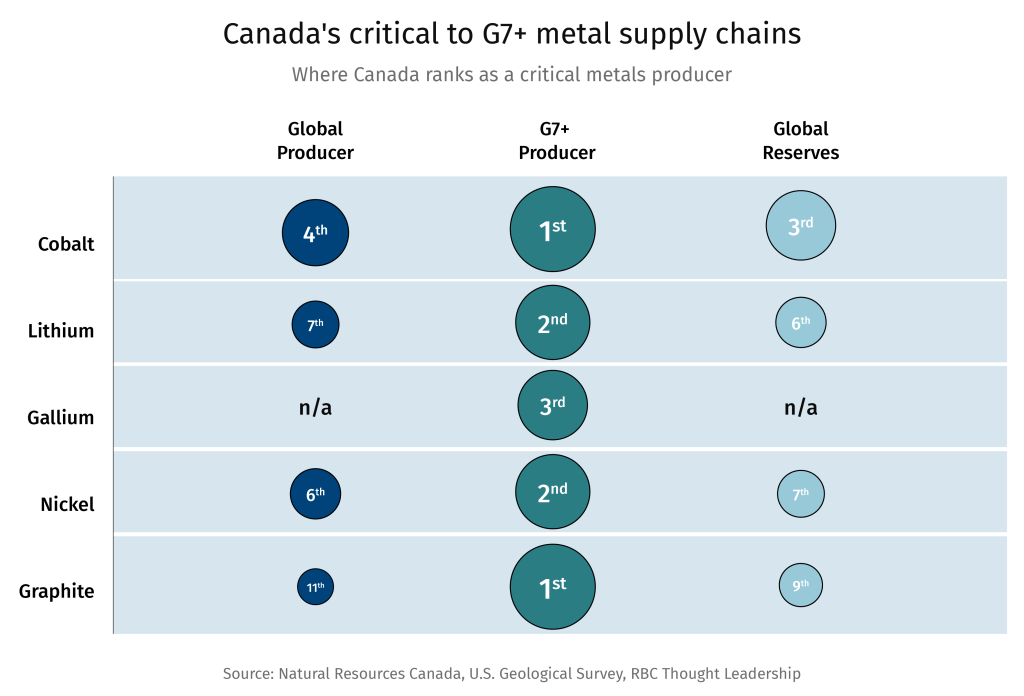
Speaking of funding, Canada will need more foreign capital to realize its commodity ambitions. More than 100 mineral projects worth $107 billion, are at various stages of development in Canada over the next ten years, according to research by RBC’s Cynthia Leach, Shaz Merwat and Vivan Sorab. With Chinese investment in minerals effectively blocked by Ottawa, Canadian miners would need to tap a variety of countries such as those in America and Europe and institutions such as Middle East sovereign wealth funds, to emerge as a commodity powerhouse. Read the full report here. Also watch RBC analysts talk minerals.

After all the talk, nuclear is finally ramping up. A new U.S. executive order aims to speed up new nuclear plant applications within 18 months—and quadruple nuclear power generation in 25 years. Belgium is scrapping its nuclear phase-out law, while EU members Germany, Denmark, and Italy are reconsidering their stances on nuclear. Ontario also kickstarted a nuclear modular reactor in May. But New Brunswick is delaying its small modular reactor (SMR) plans after its two partners failed to raise capital and hire workers. Ambition is fine, but the challenge is finding the money and the people to execute.

INFRASTRUCTURE

Build, Baby, Build—But Also Wait

Lofty ambitions, meet ground realities.Despite a reset, Canada’s plans to build new clean and conventional energy projects are running up against familiar obstacles, such as stringent environmental rules and lack of Indigenous consent. Both are critical considerations that should not supersede national interest.

Provinces that stitched together new laws in a hurry are being asked to wait:

  • Ontario’s Bill 5, which is set to become law, gives the provincial government wide powers to allocate projects to “trusted proponents” in special economic zones. The Canadian Civil Liberties Association calls it an “alarming move,” that they say gives the government the authority to unilaterally scrap legal safeguards that protect vulnerable communities and some Indigenous people.

  • Worried about the surge in mining activity, First Nations in Ontario’s Ring of Fire region are demanding the bill be struck down. Mining claims at the Ring of Fire have shot up 67% since 2022, with just under 43,000 claims covering an area 14 times the size of Toronto city, according to Wildlands League.

  • In British Columbia, which is hoping to be an LNG and commodity hub, the government narrowly passed the Infrastructure Projects Act (the Speaker had to break the tie) aimed at fast-tracking projects, amid opposition from B.C. Assembly of First Nations, municipalities and environmental organizations.

  • Anishinabek Nation Regional Chief Scott McLeod said a national plan to advance projects without input could trigger another “Idle No More” movement.

What are the chances of the federal government facing similar headwinds as it embarks on pushing through a new wave of major projects? The NDP and Bloc Quebecois are already gearing up for a fight. For now, the momentum is with the “Build” crowd.

RBC’s John Stackhouse who wasin Quebec and British Columbia recently, says attitudes towards resource development, and oil and gas exports, are shifting. (Read John’s full briefing from Quebec and B.C. here).

But as Prime Minister Mark Carney and the premiers thrash out a plan and prepare a “national interest” bill, here’s what’s on their to-do-list:

  • Indigenous consent will be needed and will take time, especially under B.C.’s commitment to the UN Declaration of the Rights of Indigenous Peoples. The First Ministers’ statement after their meeting acknowledges those challenges.

  • Premier Danielle Smith wants nine “terrible” federal policies, such as the proposed oil and gas emissions cap and tanker ban on B.C.’s northern coast, which she believes discouraged investment. How will policymakers balance their economic and environmental commitments?

  • Industrial carbon pricing remains another point of contention as it makes Canadian gas exports less competitive, but advance’s the country’s climate goals.

  • First Ministers’ focus on “decarbonized oil and gas pipelines” is another interesting proposition and would require leaning on carbon capture technology.

  • Building cleaner and more affordable electricity systems to ensure net-zero by 2050 could also spark activity in several industries such as steel, lumber and aluminum that have been deeply disrupted by U.S. tariffs.

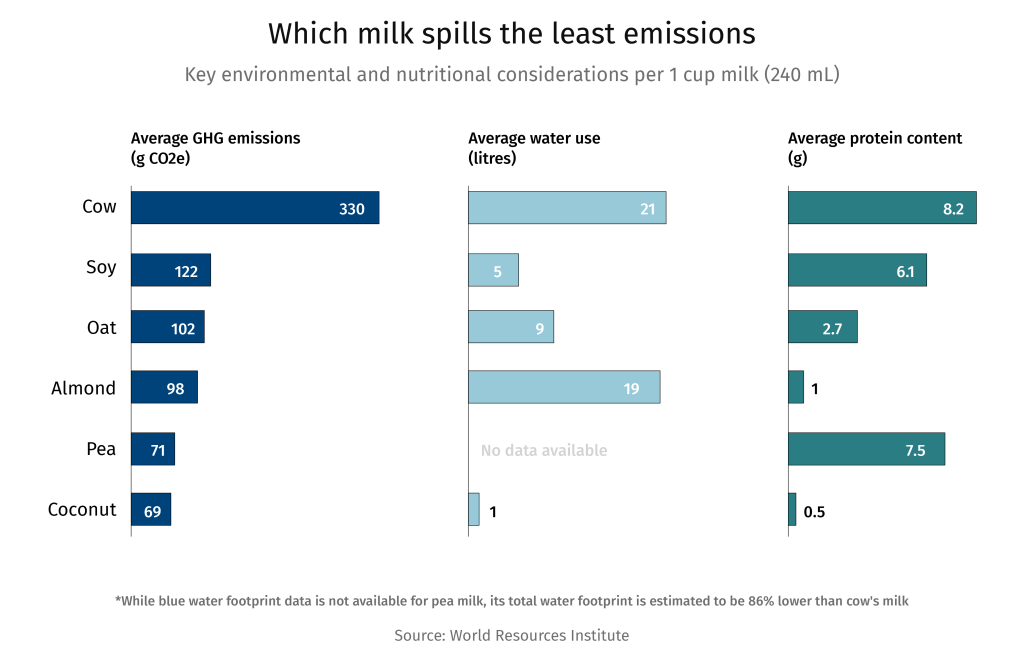
Got eco-friendly milk? It appears consumers can’t have all three—nutrition, low emissions and water conservation—when picking milk. Good old-fashioned dairy is the most emissions- and water-intensive but also the most nutritious, according to a World Resources Institute study. Almond appears to be the greatest disappointment: consuming almost as much water as dairy but is rather unwholesome. The winner appears to be the lesser-known pea milk.

Canadian cleantech remains a man’s world. Women were paid 17% less than men in 2023 in the environmental and cleantech (ECT) space—more pronounced than the 12.8% wage deficit women face in the overall Canadian economy, Statistics Canada data shows. Even though women in the industry (41.6%) were almost twice as likely as men (24.6%) to have a university diploma or degree. Overall, 7 in 10 jobs were held by men in a sector that represents 1.7% of all Canadian jobs in 2023.

A garbage truck’s worth of plastic enters the ocean every minute.That catastrophe is what makes Ocean with David Attenborough compellingviewing (now out in cinemas). “In front of us is a chance to protect our climate, our food, our home,” said Attenborough, the famed 99-year-old biologist. Oceans absorb 30% of CO2 emissions from human activities, yet only 2.4% of oceans are protected—compared to the global pledge to protect 30% of the ocean by 2030. The UN, which is hosting a conference on oceans next week in Nice, France, notes that of its 17 Sustainable Development Goals, protecting “Life Below Water,” remains the most underfunded.

The Institute In Action

  • In British Columbia, John Stackhouse joined a meeting between the Greater Vancouver Board of Trade and Calgary Chamber to discuss Canada’s role in global natural gas exports.

  • Myha Truong-Regan attended the Walrus Talks, Power Economy: Using Electricity to Change Cities, Homes, and Industry recently, to hear seven climate thought leaders and practitioners argue why the future is and must be electric.

  • Varun Srivatsan spoke to an audience at the Saskatchewan First Nations Energy Forum last week on equity financing and the importance of capacity, capital and consent to resource development.

On the team’s reading list

  • Fantasyland, a 500-year history of “How America Went Haywire” by Kurt Andersen. Read John’s review here.

  • Hotshot: A Life On Fire by River Selby, on wildfires and insights on U.S. federal fire policy, Indigenous land use and ecological history.

  • Is A River Alive? by Robert Macfarlane, tracks flowing water in Ecuador, India and Canada.

  • Who is government: The Untold Story of Public Service, by Michael Lewis, explores the vast complexity of American bureaucracy.

Curated by Yadullah Hussain, Managing Editor, RBC Climate Action Institute.

Climate Crunch would not be possible without John Stackhouse, Jordan Brennan, John Intini, Farhad PanahovLisa AshtonShaz MerwatVivan SorabCaprice Biasoni, Lavanya Kaleeswaran and Joelle Schonberg .

Have a comment, commendation, or umm, criticism? Write to me here (yadullahhussain@rbc.com)

Climate Crunch Newsletter
➔ A battery storage project going live and an approved SMR project suggests Canada can build

➔ Mark Carney’s cabinet: The fixer, the insider and the skeptic

➔ General Fusion needs financial infusion

Hot takes

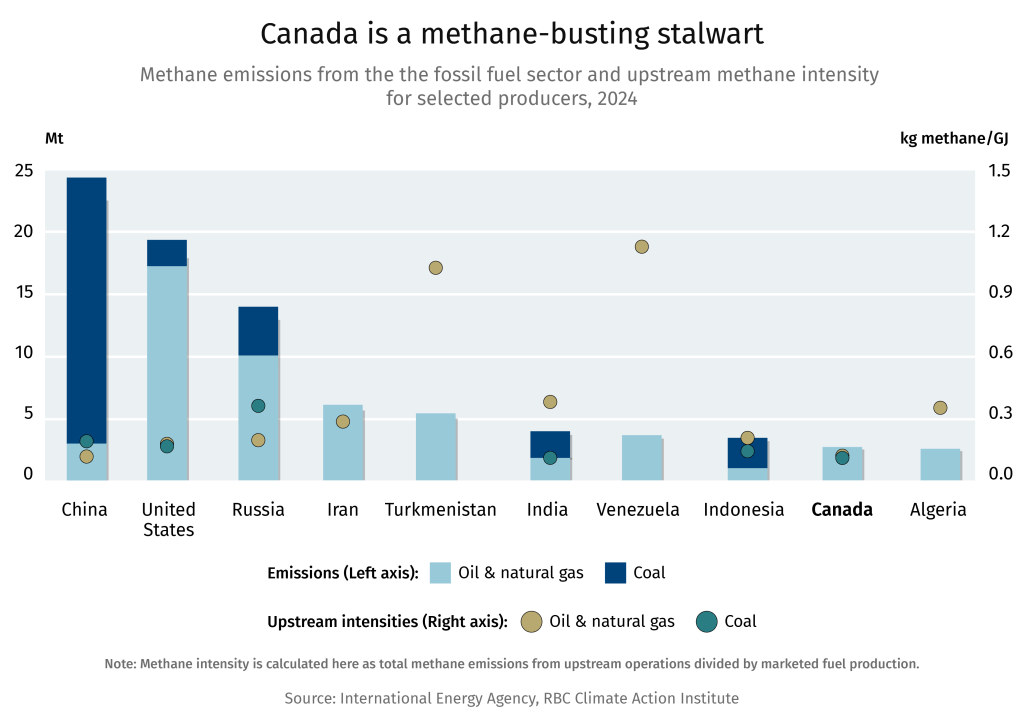
Canada is a methane-busting powerhouse. The International Energy Agency ranks Canada as among the lowest in methane intensity among major oil and gas producers including the United States, Russia and Iran. Emissions from methane, a far more potent greenhouse gas than carbon dioxide, remains at a high level globally despite pledges and available solutions that can lower fossil fuel emissions at “near zero” costs, the IEA estimates. Worse: methane emissions remains widely underreported globally, the agency said in its latest Methane Tracker report.

Canada is a methane-busting stalwart

The U.S. is going after solar power—and showers. A new U.S. Republican proposal aims to rollback popular tax credits for home solar and electric vehicles. The sweeping proposal to gut several incentives in the Inflation Reduction Act and other programs will save the government US$560-billion over a decade, but raise U.S. household costs by 7% by 2035, analysts say. The cuts could also impede U.S. efforts to cut emissions by 43% to 48% below 2005 over the next decade. Another U.S. proposal aims to scrap rules that conserve water in shower and toilets; also on the block: the Energy Star program that’s been credited for boosting energy efficiency and cutting utility bills.

The number of rare earth projects in Canada currently stand at 12. These constitute projects that are active in the exploration, resource estimation, or the preliminary economic assessment phase. Three separation and processing facilities and two rare earth elements (REE) recycling plants already exist, according to a report by Vivan Sorab, senior manager, clean technology. Fixing a couple of bottlenecks could help fast track the 12 projects. First, government investment, such as provincial funding in Saskatchewan, can help bring rare earth processing facilities closer to commercialization. Offtake agreements at competitive prices could also help Canada’s REE industry get a foothold.

Planting trees isn’t enough to tackle climate change. The world needs a global industry focused on removing carbon via nature-based and man-made solutions from the atmosphere at scale. Listen to a new episode of Disruptors X CDL: Innovation Era, where John Stackhouse and Sonia Sennik sit down with David Keith, a pioneer in carbon removal and founder of Carbon Engineering, to explore what it will take to build a low-carbon future.

POLICY

The fixer, the insider and the skeptic

Tim Hodgson, the new federal energy and resource minister, has been charged by his boss Mark Carney to make Canada a “leading energy superpower.” Hodgson will have to play the role of fixer in the resources sector, that includes mending relationships with Western provinces and Indigenous groups to make that dream come true. So far, he has been warmly received in the West, where grievances over Ottawa’s attitudes towards fossil fuels run deep—and remain live.

Julie Dabrusin, the Minister of Environment and Climate Change of Canada, has elicited a different reaction from oil and gas provinces. Her bio boasts a “strong stance against oil sands expansion,” raising concerns. But her insider knowledge as a parliamentary secretary to the Ministers of Natural Resources and Environment and Climate Change, and a member of the Natural Resources Committee, will be vital for Ottawa to streamline and fast-track project developments, including oil and gas pipelines. The Prime Minister seems open to the idea of new fossil fuel pipelines, as is Quebec. “Quebecers are saying, ‘There’s no way Trump is going to control the oil we produce in Alberta.’ So, can we export it to Europe through Quebec instead of being stuck with Trump? There’s openness. I feel things are shifting,” Premier Francois Legault said recently, adding that no concrete projects had been proposed.

While former environment minister Steve Guilbeault is now in charge of the heritage file, his skepticism about the economics of an east-to-west oil pipelines on his first day back in parliament, has also raised eyebrows. His portfolio appears to include Parks Canada, which gives him a platform to raise issues of biodiversity and nature erosion brought about by climate change. Committee to watch: Cabinet committees are where most of the business of government is transacted. One committee to watch will be the Build Canada committee, tasked with considering issues as diverse as housing, infrastructure, Indigenous economic prosperity, climate action and a host of others. The tag-team of Hodgson and Chrystia Freeland–chair and vice-chair of the committee–will provide a mix of private sector expertise and cabinet experience.

CLEANTECH

Financial infusion for General Fusion

General Fusion needs fresh capital. The B.C.-based nuclear fusion company announced a technological breakthrough that brings it one step closer to bringing zero-carbon fusion tech to the electricity grid. But the company also cut its headcount due to “unexpected and urgent financing constraints,” and is seeking new capital “to finish the job,” CEO Greg Twinney said.

Nuclear fusion mimics how stars create energy—an incredibly complex technology that’s perpetually “five years away,” but has gained investor interest in recent years on the back of several tech advances.

General Fusion also needs the stars to align. While the Canadian federal and provincial governments have injected funds in the company in the past, Twinney is looking for more financing including from the private sector, as the company’s competing with “nationally funded fusion programs around the world.” Since 2002, the company has raised US$440.53 million, according to PitchBook, and include counts Temasek, BDC Capital, and Chrysalix Venture Capital and Jeff Bezos as investors. The company recently hired the former CEO of the Amazon.com Inc. founder’s rocket company Blue Origin LLC as a strategic adviser.

The U.S. has been spending US$800 million annually in fusion technology in recent years, while China has injected between US$1-billion to US$1.5 billion annually. There are now around 98 demonstration plants or prototypes operating globally, another 13 under construction and 33 more planned.

Domestic rivals are also nipping at General Fusion’s heels. Montreal’s Fuse Energy raised US$32 million in new funding late last year, with the U.S. National Nuclear Security Administration (NNSA) as its largest collaborator and potential customer. The idea is to make Fuse to NNSA, what SpaceX is to NASA, said its 24-year-old CEO JC Btaiche. Last year, the Canadian Nuclear Laboratories called for a Canadian Fusion Strategy to help the country advance its net-zero emissions target by 2050. Canada provides the least government support for fusion development on a per capita basis among its G7 peers, CNL noted.

Ontario is set to build the G7’s first SMR. The province gave Ontario Power Generation the greenlight to start building the first of four small modular reactors at its Darlington New Nuclear Project—the first nuclear project in the province in three decades.

The Oneida energy storage operation is now live. The development in southern Ontario, near Hamilton, in Haldimand County is the fourth largest battery storage facility in the world. Its 278 lithium-ion battery units will store enough power to keep southern Ontario buzzing when demand peaks, or other sources get too expensive. Powered by renewable sources, the Indigenous-led project will reduce Ontario’s emissions by up to 4-million tonnes, equivalent to taking nearly 850,000 gas-powered cars off the road for a year. It may soon become a model for big demand users (such as datacentres) as they explore options. Read John Stackhouse’s blog on how battery storage gives us even more optionality to ensure costs remain low, relatability remains high and Canada’s climate commitments are fulfilled.

Recycling seems to be going out of fashion. A report by think-tank Circle Economy found only 6.9% of the 106-billion tonnes of materials used annually by the global economy came from recycled sources, a 2.2% point drop since 2015. While the use of recycled materials rose 200-million tonnes from 2018 to 2021, overall material consumption rose much faster, offsetting these improvements, Circle noted.

The Institute In Action

John Stackhouse attended the B7 Conference in Ottawa last week, where he presented preliminary findings from RBC’s joint project with Columbia University’s Center on Global Energy Policy, focused on exploring policy options for gas and LNG.

➔ On April 30th, John and Lisa Ashton presented our latest research on agriculture, food, and postsecondary education to the Deans Council-Agriculture, Food and Veterinary Medicine in Ottawa, highlighting key insights on talent development, innovation, and sector resilience.

➔ Read Head of Climate Research Myha Truong-Regan’s four key takeaways from a recent gas and electricity event organized by the Toronto Region Board of Trade.

➔ As part of the Salazar Center for North American Conservation’s symposium in Vancouver this month, the RBC Climate Action Institute co-hosted a roundtable with Nature United. Lisa hosted the discussion, which focused on how nature conservation and stewardship can be positioned as a strategic asset in pro-growth plans for nature-dependent sectors, including forestry, agriculture, and mining.

➔ On the team’s reading list: The Measure of Progress: Counting What Really Matters by Diane Coyle Bad Company: Private Equity and the Death of the American Dream, By Megan Greenwell; Transcend: Unlocking humanity in the age of AI, by Faisal Hoque.

Thriving natural ecosystems are critical to growing North America’s resource-based economy. “Build, baby, build” and “Drill, baby, drill” policies are driven by immediate concerns such as trade, economic sovereignty and security, and affordability. But plans for growth should consider building up our foundational asset–nature.

As part of the Salazar Center for North American Conservation’s symposium in Vancouver last week, the RBC Climate Action Institute co-hosted a roundtable with Nature United. The topic: How nature conservation and stewardship can be positioned as a strategic asset in pro-growth plans for nature-dependent sectors, including forestry, agriculture, and mining.

Here’s what we heard:

  • Focus on the economic benefits. There continues to be a movement away from models protecting landscapes with no public activity or access to those efforts that benefit local economies–creating jobs, spaces for recreation, and new streams of revenue (environmental credits) and businesses (ecotourism, responsible logging, forest management). This shift reflects that durability in conservation requires people. A good example of this is the Heiltsuk Tribal Council’s 2021 purchase of the Shearwater Marine Ltd., a 63-acre resort and marina in Bella Bella, B.C. The Heiltsuk regained an important part of their territory and unlocked new economic opportunities, including eco-cultural tourism.

  • Communicate with people where they’re at. The energy transition risks leaving behind rural communities dependent on fossil-fuel extraction for employment and economic activity. Revitalizing these communities via nature-based economies can be part of the solution, but generating buy-in depends on how the opportunities are communicated, requiring a focus on place-based values and priorities. In West Virginia, a hotspot for coal mining and a focus of the Trump administration’s efforts in building back the coal industry, there has been a new wave of growth via a nature-based economy focused on job creation and regenerate abandoned towns. Opportunities span responsible forestry and forest restoration, conservation rehabilitation within renewable energy projects on retired coal mine sites, and growing tourism along the Appalachian Mountain range.

  • A debate over assigning nature a monetary value. While opponents argue against commodifying nature, proponents say that valuing nature enables a broader scope of stakeholders to invest. This debate has shaped nature’s role in environmental offset markets and other mechanisms that drive investment in nature, from budgetary accounting to green bonds. For example, the town of Gibsons, B.C. developed an eco-asset strategy, integrating the value of nature in its planning processes. As a result, the town determined that green infrastructure was cost effective in managing stormwater, resulting in the reduction of associated development costs for residential and commercial projects.  

3 things to watch:

  • Proposed U.S. tax cut package could authorize the sale of nearly 300-million acres of public lands. There is growing concern that these lands will be sold for mining, logging and drilling with limited restraint on the scale. This is an issue for Canada, as well, since neighbouring public lands provide intact natural landscapes for wildlife crossing borders on migration routes. It also plays a critical role in the U.S.’s ability to meet global biodiversity and climate commitments. Public Lands in Public Hands Act is a piece of legislation that aims to prohibit the Secretary of the Interior and the Secretary of Agriculture from selling land of more than 300 acres to a non-federal entity. The bill was initially sponsored by Ryan K. Zinke, Republican congressperson from Montana. While seeking further support, the bill is with the Congress’ Subcommittee on Forestry and Horticulture.

  • The role of the UN Agreement on Biodiversity Beyond National Jurisdiction on Arctic development. While the agreement has 114 country signatories, only 21 have ratified it so far. That’s well short of the 60 required for it to take effect and ensure the conservation and sustainable use of marine biological diversity in international waters. The Arctic is home to some of the world’s largest intact marine ecosystems–the protection of which is a timely consideration with Russia, China, the U.S. and Canada eyeing Arctic-based tourism, commercial fishing, trans-Arctic shipping, and deep-sea mining.

  • Can the Carney government build up Canada’s natural resources in a pro-growth environment? The Liberal government platform outlines a plan for expediting and scaling energy and critical mineral projects, parallel to commitments to expand Canada’s nature conservation efforts. The challenge for a Liberal minority government will be integrating Indigenous reconciliation, nature-positive efforts, and resource extraction pathways while addressing tensions such as the pace of projects and the value of nature in extraction-based sectors.

Lisa Ashton, Agriculture Policy Lead, RBC Climate Action Institute

Martha Rogers, Senior Economist, The Nature Conservancy/Nature United

Issue #12

➔ On Carney’s to-do list: carbon capture project and transition bonds
➔ Warren Buffett’s successor built the company’s energy empire
➔ Struggling cleantech stars, and a Climate Fiction Prize

Hot takes

➔ Canada’s EV policies are hurting farmers. Ottawa’s tariffs on Chinese EVs has had the “unintended consequence” of Beijing slapping levies on Canadian canola, lobsters, and peas, etc., agriculture members of the Canadian Federation of Independent Businesses’ wrote in a letter to three federal ministers. Canada’s $62 billion in total subsidies to EV firms has also not triggered an investment boom as those firms have paused their plans in Canada, CFIB pointed out. The group wants some of those funds redirected to small businesses.

➔ Did green power trigger Iberian blackouts? Some suggest “non-controllable” resources—i.e. solar and wind that can’t be controlled or scheduled on demand—were to blame. But it’s not like fossil-fuels grids can’t break down (Italy in 2003, anyone?). But intermittent generation poses a different set of problems. While authorities remain in the dark for now, the Spanish grid operator REE had warned in February that reliance on renewables could lead to grid instability, especially if the government closes its nuclear power plants by 2027. Could the simple answer be: keep the energy mix diversified?

➔ Warren Buffett’s successor is an energy empire builder. The Oracle of Omaha handpicked Edmontonian Greg Abel to succeed him at Berkshire Hathaway. As chairman of the company’s energy and other non-insurance businesses, Abel runs a conglomerate that’s among the largest operators of wind and solar energy in the U.S., electric utilities, and natural gas pipelines. While Berkshire Hathaway runs some of the dirtiest coal plants in the U.S.—coal power now accounts for only 22% of Berkshire’s power generation, compared to 71% in 2005.

➔ Ontario is fast-tracking critical minerals development. The new proposed rules will boost investment in local supply chains and reducing reliance on foreign imports would drive job creation, stimulate economic growth, and position Ontario as a leader in the green economy. The new rules also give the province wide powers to shield its strategic assets against “hostile foreign actors and regimes.” The move comes as the U.S. is moving at a frenzied pace to lock in critical minerals, including a deal with Ukraine, fast-tracking of supply chains, and plans to accelerate deep-sea mining.

CLIMATE POLICY

Carney’s Climate Corridors

Economy and trade tops the new federal government’s priority list, but there’s room to push through climate policies—especially “energy corridors,” that are seen as the path to an investment-led growth spurt.

Here are some high-profile climate files on the new government’s to-do list:

➔ Building a major carbon capture project in Alberta. How can a CCS project backed by Pathways Alliance—a consortium of oilsands firms looking to build a carbon capture project—get off the ground? Prime Minister Mark Carney said last week in Edmonton he is keen to see it built.

➔ Strengthening industrial carbon policy. The Conservatives wanted to repeal the federal carbon pricing for industrial emissions, but it stays for now. Last year, Myha Truong-Regan, RBC Climate Action Institute’s Head of Climate Research, co-wrote on how industrial carbon markets can be central to Canada’s efforts to accelerate energy transition.

➔ A Carbon Border Adjustment Mechanism. It was in the Liberal platform and could be Canada’s version of a climate-tariff—if it proceeds—helping climate-compliant Canadian companies compete with high-emitting foreign rivals. The Europeans may nod approvingly, but a Canadian CBAM will likely face strong pushback—and retaliation—from the U.S. and other trade partners.

➔ Carbon Contracts for Difference (CCfD). Carney is supportive of expanding the initiative, but the federal government is already dealing with a laundry list of other financial priorities.

➔ Climate risk disclosure. The idea was floated on the platform just as Canada’s provincial securities commissions suspended their work on making climate-related disclosure mandatory for public companies.

➔ Transition bonds. The Liberal platform suggests financing clean industrial and agriculture projects with $10 billion in bonds issued annually.

➔ Oil and Gas Emissions Cap. There might be tweaks after Carney suggested he would work with industry and provinces “on specific ways to get those reductions, as opposed to … having preset caps or preset restrictions on preset timelines.”

➔ For more, read John Stackhouse’s blog on Carney’s energy options in the age of Trump.

Climate treads, tech & science

➔ Li-Cycle is running out of road. The Toronto-based company’s woes persist with its CEO departing after a takeover deal with Swiss miner Glencore collapsed.

➔ Quebec won’t save Lion Electric Co. No white knight yet for the electric bus and truck maker that has struggled amid delays in subsidy and incentive programs in Canada and the U.S., and supply-chain disruptions.

➔ Nova Scotia-based Planetary Technologies won US$1 million XPrize. The ocean-based CO2 removal tech firm beat 1,300 rivals to win a slice of the US$100-million competition backed by Elon Musk. Mati Carbon, an American-Indian-African company, won the $50-million grand prize for its carbon-removal tech.

➔ Listen to Mike Kelland of Planetary Technologies, Jim Mann of UNDO who won US$5 million from XPrize, Dr. David Keith, a pioneering climate scientist and co-founder of Carbon Engineering, speak to RBC Disruptors hosts John Stackhouse and Sonia Sennik, on the innovation race to scale carbon removal technologies.

➔ Nunavut welcome solar power. A tiny community on the Arctic Circle will be able to ditch diesel generators—in the summers at least—once 2,500 solar panels are switched on soon. 

➔ Climate Fiction Prize. Boy meets girl amid climate change, and love in the time of wildfires are among the themes explored in the five novels short-listed in the first-ever £10,000 Climate Fiction Prize . The winner will be picked at the Hay Festival later this month in Wales.

The Institute In Action

➔ Many of Canada’s top Indigenous leaders came together for the RBC-sponsored 8th annual First Nations Major Projects Coalition conference, to see how we can better mobilize capital for Indigenous-partnered projects. RBC also published a report, Building Together , and hosted a private roundtable with 30 Indigenous leaders and CEO’s around building Canada’s economic resilience, and the central role of Indigenous partnerships and inclusion.

➔ Grow Ontario Food Summit brought together agriculture and food leaders from across Ontario. RBC Thought Leadership’s John Stackhouse and Lisa Ashton delivered the keynote address on Canada-U.S. trade relations and its impacts on agriculture and food, and highlighted key insights from our latest research report, Food First. On the team’s reading list: Just Earth: How a Fairer World Will Save the Planet by Tony Juniper; What’s Left: Three Paths Through the Planetary Crisis, by Malcolm Harris; Values: Building a Better World for All, by Mark Carney; Abundance, by Ezra Klein and Derek Thompson.

Curated by Yadullah Hussain, Managing Editor, RBC Climate Action Institute.

Climate Crunch would not be possible without John StackhouseMyha Truong-ReganSarah PendrithFarhad PanahovLisa AshtonShaz MerwatVivan SorabCaprice Biasoni and Frances Dawson.

Have a comment, commendation, or umm, criticism? Write to me here (yadullahhussain@rbc.com)

Climate Crunch Newsletter
The super-charging revolution is here.

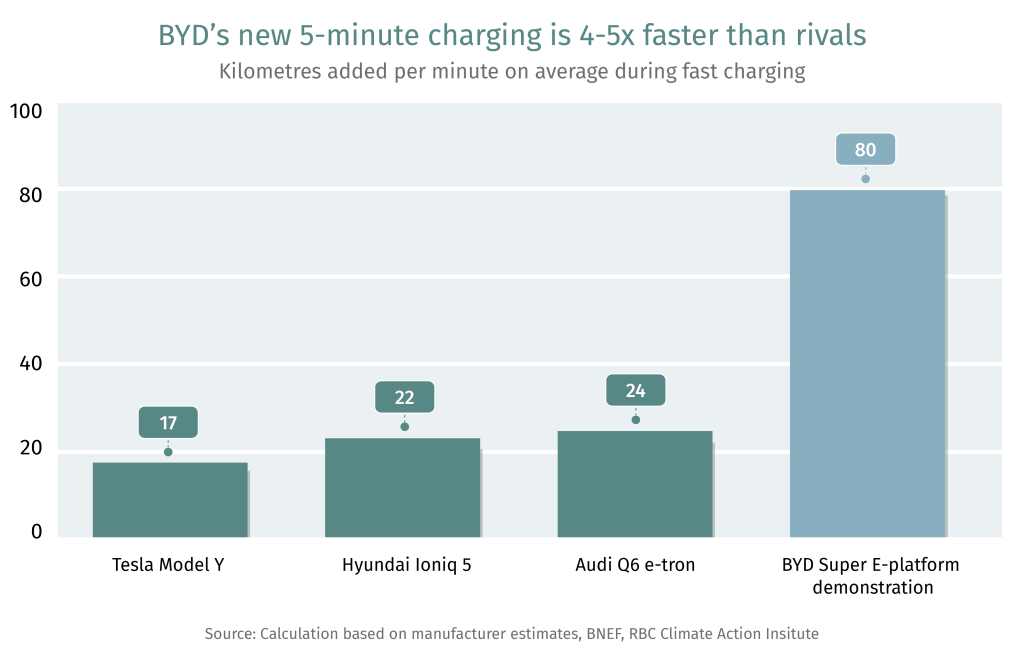
Recent demonstrations by Chinese electric vehicle (EV) giants BYD and CATL of batteries that can be charged in five minutes—up to five times faster than rivals—and with a range of 520 kilometres, has made many sit up and take notice.

Could this super-charging revolution be the game changer that will pave the way for greater EV adoption in Canada, and elsewhere? Equally crucial: can electricity grids handle the increased load demand if this technology were to reach Canadian shores in the next few years?

A game changer?

A five-minute charge has the potential to address two of the top three concerns that consumers often cite when considering EVs: range anxiety and access to public charging stations (the third being affordability). According to a JD Power survey in 2024, 68% of Canadians were anxious about running out of EV battery while on the road.The inconvenience of waiting in line at public charging stations and long charge times—on average 30 minutes—have been an issue for up to half of EV drivers, a survey shows. A five-minute charge battery with extended range tackles these issues head on and entice would-be owners to finally take the EV plunge.

BYD's new 5-minute charging is 4-5x faster than rivals

The 3 big grid challenges facing 5-minute charging

Here’s how the quick-charge revolution could impact Canada’s grids:It’s a massive draw on the grid: 

  • It’s a massive draw on the grid: Unlike traditional charging that’s spread over hours, fast charging delivers high-intensity power spike that grids might not be designed to handle. An average EV with a battery of 80 kWh would require around 1,000 kW power to fully charge in minutes. That’s enough electricity to power 800 homes for the same amount time, and adds significant load to the grid, especially if charging takes place during peak hours.

  • Grid expansion is already facing once-in-a-generation challenge. Expanding local distribution networks, modernizing local substations, and improving interconnections to accommodate localized demand surges are the biggest challenges posed by super-charging. Distribution lines will also need to grow by another 55,000-85,000 kilometres by 2030—requiring a build-out that’s 30%-100% faster than the current pace.

  • Future-proofing would require a decentralized grid: Fast, localized spikes in demand require more than just expansion of centralized grid assets. They also require the addition of decentralized distributed energy resources (DERs), such as micro-grids and residential solar, and greater grid digitization. Infrastructure modernization can also transform DERs into virtual power plants during periods of peak demand.

Farhad Panahov is an economist with the RBC Climate Action Institute.

Issue #11

➔ Earth Day edition focuses on Canada and B.C.’s power struggles
➔ Green steel is coming
➔ EVs: Open road or roadblocks?

Hot takes

➔ Our power, our planet. That’s the theme of this year’s Earth Day, celebrated today, just as the world feels a little less empowered to take care of the planet. But this edition is striving to celebrate small victories in a (very) long journey to heal the planet. Despite policymakers axing or toning down several ambitious global climate policies, there are rays of sunshine: led by solar and wind, renewable energy capacity additions hit a new record globally in 2024, while renewables accounted for more than 92% of total power expansion last year. Still, IRENA forecasts, the world’s falling short of the collective goal set in 2023 to triple installed renewable energy capacity by 2030.

➔ Sault Ste. Marie, Ont., is the setting for a Canadian green power revolution. The northern Ontario-based Algoma Steel is gearing up to launch its electric arc furnace (EAF) this month—it would cut back on coke, or coal power, and slash the company’s annual emissions by 70%. That’s a feat for any sector, but a monumental one for an industry considered among the hardest to abate.

➔ Canada’s first SMR got the green light this month. The small modular reactor (SMR) at the Darlington Nuclear Generating Station in Ontario—the first in a G7 nation— has the all-clear from the Canadian National Safety Commission. Ontario Power Generation, the developer, is now awaiting the provincial okay. There is a trade twist, though: the BWRX-300 reactor was built by North Carolina-based GE-Hitachi Nuclear Energy—making Canada dependent on the American supply chain at a time when ties between the two countries are strained.

➔ Climate drops off the radar as an election issue. About 24% of Canadians believed climate was an important issue in the 2021 federal election cycle. Just under 4% feel the same way as they start voting in the run-up to election day on April 28. Predictably, U.S.-Canada ties topped the list in the non-partisan Vote Compass’s poll of 161,000 Canadians, followed by economy, affordability, social justice and healthcare. The environment did not crack the top 5. Climate change also barely got a mention in the leaders’ TV debates (read John Stackhouse’s LinkedIn post here).

Earth Day: A Clean Super-Power

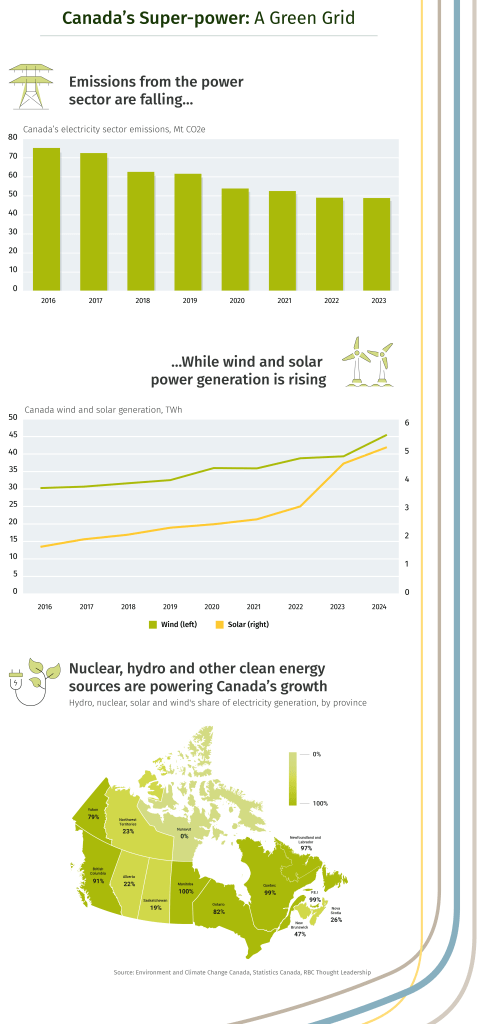
With this year’s Earth Day theme focused on tripling renewable energy by 2030, Canada can point to some victories in the electricity sector, the big one being that it’s Paris Agreement-compliant already. Alberta is coal-free, six years ahead of schedule, while Canada’s absolute electricity emissions declined by about 10% in 2024 compared to 2023.

Three charts that illustrate why electricity is Canada’s climate poster child:

There is no room for complacency, though. Here are 3 critical challenges Canadian policymakers—and a new federal government—will need to address soon.

➔ Balancing affordability with clean energy goals. New hydro dams and nuclear buildouts will be expensive, straining the ability of utilities to keep electricity bills affordable. 

➔ Expanding grids cleanly. Canada needs to more than double electricity capacity by 2050—and keep it clean—, if it wants to compete for investment dollars for data centres, automotive supply chains and other heavy manufacturing.

➔ Ensuring Indigenous rights. Power and energy projects—gaining renewed urgency—require a buy-in, consent and financial involvement from First Nations. Canada has had a spotty track-record on that file, which needs to change to fast-track projects.

Ready or not

Sticking to the power theme, B.C. LNG projects now only need to be net-zero ready. That’s the distinction the B.C. government made in a new letter to the environmental regulator, widely considered a weaking of the province’s environmental rules. Or is that climate realism ? Jurisdictions are walking a fine line as they fast-tack new projects in a tariff-stricken world without abandoning their environmental commitments.

The provincial utility BC Hydro has been bulking up, but not as fast as the surge in demand, which it estimates will rise 15% by 2030. Just over 90% of B.C. grid is no-emitting, but that could drop if natural gas power.

Here’s how the province is racing to meet its economic and climate goals:

➔ BC Hydro’s updated 10-Year Capital Plan (2024/25 to 2033/34) includes almost $36 billion in community and regional infrastructure investments—a 50% increase over its previous capital plan.

➔ The Site C hydro project’s fourth unit began this month, with two more set to be switched on by the fall. Once fully operational, the project in the province’s northeast can power nearly 500,000 homes, increasing BC Hydro’s electricity supply by 8%. Given expectations for Canada’s supply needing to 2x or 3x by 2050, we need similar additions every two to three years, Energy policy lead Shaz Merwat estimates. “Policy of needing to be ‘ready’ probably adds a level of ambiguity but good to see perspectives are changing about the need to build.”

➔ In February, B.C. signed deals for 9 wind and 1 solar energy projects with a combined 4,830 gigawatt hours (GWh) projects. All projects are majority-owned by First Nations.

➔ B.C. is working to electrify Northern B.C., vital for several big-ticket energy projects including the Ksi Lsims LNG project that’s currently under regulatory review. The Indigenous-backed gas export project now faces competition for Asian markets from an Alaskan LNG development that’s gaining traction. Canada needs to move fast.

➔ The North Coast Transmission Line is a critical piece of the northern B.C. clean grid. The government is fast-tracking permits to speed up construction of the NTCL and other major high-voltage transmission lines.

➔ The B.C. government is not ruling out more hydro dams in the province.

➔ Finally, we are watching how a greenhouse gas emissions cap for natural gas utilities, as envisioned in the CleanBC Roadmap to 2030, will play out.

Four roadblocks ahead for EVs

By John Stackhouse

EVs may be one of the causalities in the trade war — or one of the winners. It’s too early to tell.

The latest quarterly assessment from BloombergNEF shows a U-turn forming in some markets, and acceleration in others, notably China. Canada is one of the markets at a turning point.

EVs, including plug-in hybrids, accounted for one in five vehicle sales last year, reaching 17.2 million new vehicles on the road, up 24% in one year. Most of that growth was in China, where close to half of new vehicle sales are EVs—a number expected to increase this year thanks to a scrappage scheme for car-owners.

Elsewhere, EVs are facing new challenges, and not just the brand war that Tesla finds itself in. European sales started to flatline in 2024, while sales growth in the U.S. tempered. And that was before Liberation Day (April 2) and Donald Trump’s decision to slap 25% tariffs on imported vehicles and parts. Higher costs are the last thing EV producers need. Other policy changes—looser fuel standards in Europe and an end to the consumer carbon tax in Canada—may further impede EV sales, as the economics of traditional car engines gain ground again on batteries.

Canadian EV sales in the past year accounted for around 15% of passenger vehicle sales. BNEF expects Canadian EV sales to rise 20% this year, amid a decline in policy supports.
If EV sales stall, it will be due to four roadblocks in the months ahead:

➔ 1. Subsidies. Fiscally challenged governments will be looking to cut spending in some areas to pay for economic supports for businesses and workers hit by the trade war. The Trump administration has its eye on generous supports introduced in the Biden years. And many governments are pulling back EV mandates for their own fleets.

➔ 2. Tariffs. The U.S. is advancing a range of tariffs and trade restrictions on batteries and battery components, while China is also restricting exports of critical minerals. Battery-specific tariff rates are projected to hit 115% this year, and 132% next year. The Trump administration is also expected to continue to explore anti-dumping measures against Chinese battery components producers, even though a number of U.S. manufacturers, including Tesla, rely on them.

➔ 3. Economic growth. If the trade war continues to be a drag on economic growth, consumers will hold back on vehicle purchases of all kinds — and the more expensive range of EVs will be especially challenged.

➔ 4. Interest rates. If tariffs stoke inflation, and keep interest rates higher, car sales will be the first consumer item to take a dent, or worse. EVs may be at the front of that line, as car-owners hold on to their old vehicles for a year or two longer.

Climate Crunch would not be possible without John StackhouseMyha Truong-ReganSarah PendrithFarhad PanahovLisa AshtonShaz MerwatVivan SorabCaprice Biasoni and Frances Dawson.

Curated by Yadullah Hussain, Managing Editor, RBC Climate Action Institute.

Have a comment, commendation, or umm, criticism? Write to me here (yadullahhussain@rbc.com)

Climate Crunch Newsletter

Energy. Geopolitics. Trade.

All three topics were on full display at Columbia’s Global Energy Summit 2025. Tariffs and trade policy dominated the Summit, with significant implications to both the supply and demand of North American energy. Shaz Merwat, Energy Policy Lead of RBC’s Climate Action Institute, was in attendance and shares the five most pressing themes at this year’s event.

1. Energy risks becoming more complex

The push to re-orient trade flows to manifest specific economic outcomes (reduce a trade deficit, reshore production) likely increases price risk through a bifurcation of supply and demand in key commodities. At the most obvious, tariffs levied on steel, aluminum and possibly copper–all key inputs to energy infrastructure–result in regional pricing. As seen in the chart below, U.S. aluminum prices have largely decoupled from European pricing as a result of Trump’s tariffs. Similarly, price differences between U.S. Midwest hot rolled coil steel prices (US$1,075/tonne) and Northern Europe hot rolled coil steel (US$715) has increased to about $360/tonne, compared to $150/tonne at the start of the year.

Geopolitically, risks are also expanding beyond the simple ‘Middle East’ supply risk that we have known for the last half century. Spheres of influence can re-orient supply and demand relationships, especially in the case of LNG and critical minerals. These emerging geopolitical trade barriers ultimately weaken an otherwise more ‘global’ market to absorb supply and demand shocks–which likely are more deliberate at a time when weaponized trade is becoming increasingly more common (Russian gas, Chinese supply chains, the American market).

2. What is this energy dominance you speak of?

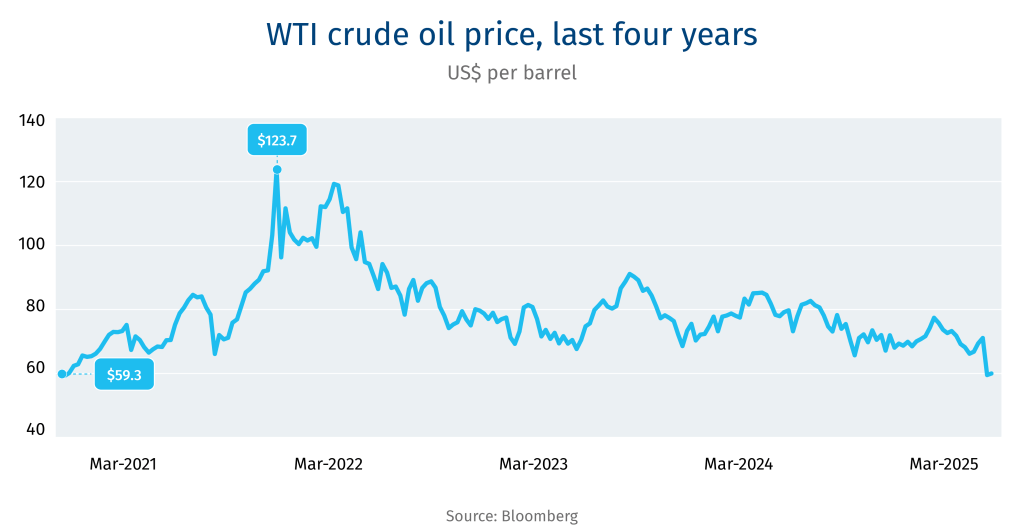
While the Administration has vowed to unleash U.S. energy dominance, to date, it appears to have done the exact opposite. On oil, Trump’s trade/tariff agenda has driven oil prices lower than those witnessed for most almost all of Biden’s presidency. WTI has twice dipped below US$60 per barrel in the past week–a level widely seen as U.S. shale’s breakeven–leading to increasing concerns of idled rigs and declining production; S&P Global estimates US$50/bbl oil could cause a U.S. production decline of 1 million bbl/d. All the while, OPEC is boosting production.

The continued desire to gut funding for the Inflation Reduction Act also stymies U.S. renewable energy, even for tax credits deemed friendly to the oil industry (such as the 45Q carbon capture tax credits). Lastly, concerns around supply inflation (steel/aluminum tariffs) and general market/economic uncertainly has created a very challenging environment to deploy capital.

3. Climate trade frictions remain alive and well

With the gutting of the WTO and Trump’s reciprocal tariffs, developing nations are increasingly seeing their preferential trade terms (higher ‘allowable’ tariff rates) erode. You can add climate to that list, as nations impose climate-related trade measures to enhance economic competitiveness.

In Europe, carbon border adjustments protect domestic carbon policy. In the U.S., a border pollution fee leverages America’s carbon advantage–especially in relation to China. The U.K. and Australia are also exploring carbon border adjustments of their own.

Domestic carbon policies without a climate trade measure (such as a CBAM), politically, is almost certainly bound to fail. Yet, expectations for developing nations to enact similar carbon prices as the E.U.’s emissions trading scheme–a system that has seen carbon pricing increase/expand over the last two decades–in a mere few years, seems unjust. This likely only accentuates climate trade tensions between North and South.

4. Reducing the trade deficit

In the eyes of U.S. President Donald Trump, reciprocal tariff rates yield a balanced trade relationship. For trade partners, a balanced trade relationship is as good as a ‘due north’ one can expect under Trump’s vision of America First. Trade partners will be served well if they can better house American (merchandise) exports.

In this world, U.S. LNG likely shines bright. The country is expected to surpass Qatar as the largest provider of U.S. LNG, globally, by 2030 according to RBC Capital Markets forecasts as seen below. For major LNG buyers that run large trade surpluses with the U.S. (the E.U., Japan, Korea, India), greater purchases of LNG supply can be the ‘easy’ win.

5. AI clusters and cross-border data flows

Nations with abundant, cheap electricity are best positioned in the race to build data centers. This likely results in supply ‘clusters’, especially torqued to renewable generation given the climate commitments of tech firms. Consensus is increasingly pointing to Canada, the U.S. and the Middle East as becoming cluster of American artificial intelligence deployment.

But what does that mean for data flows? Data protectionism towards data hosting (colocation) likely remains, but more alignment is needed on cross-border data transfers resulting from compute capacity (hyperscale). We expect more on this in the renegotiation of USMCA in 2026.

Shaz Merwat is the Energy Policy Lead of RBC’s Climate Action Institute

Issue #11

➔ Energy transition clashes with tariffs
➔ IRA: Scrap, slice, or save?
➔ Let’’s talk climate realism

Hot takes

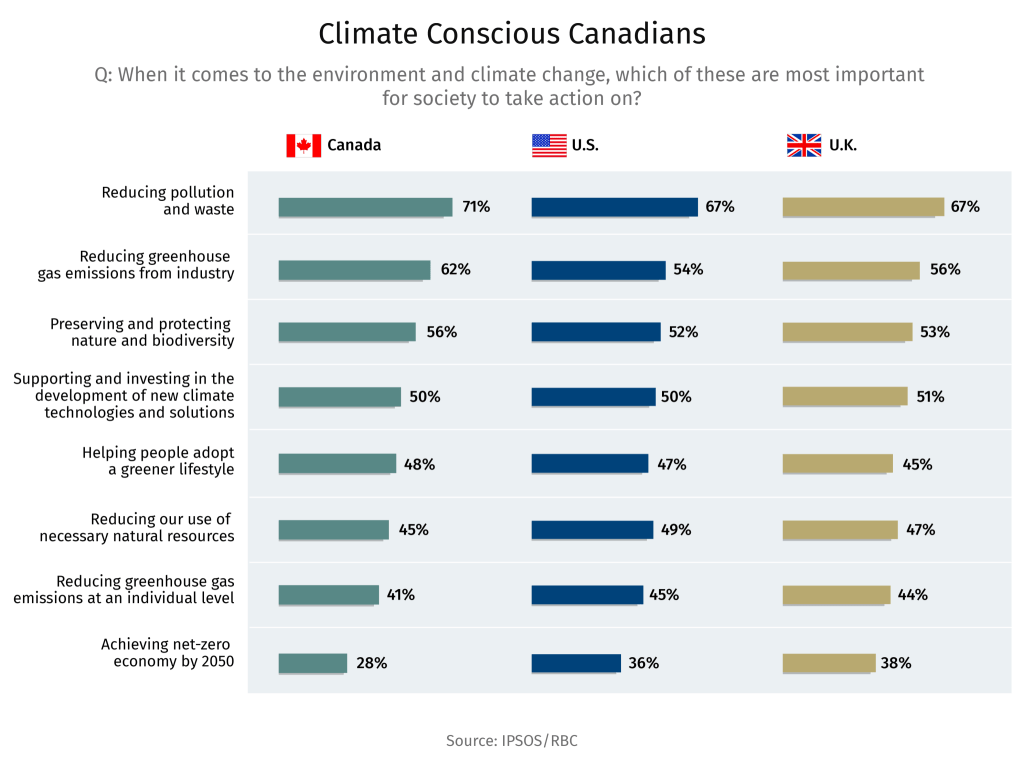
➔ Canadians remain keen on climate. Compared to their American and British counterparts, more Canadians believe reducing industry emissions is an important climate goal, according to an Ipsos survey for RBC (see chart below). However, Canadians are less likely to think that reducing the use of natural resources should be a societal goal.

➔ Let’s talk climate realism. The Council on Foreign Relations launched the Climate Realism Initiative this week, aimed at developing a new U.S. climate strategy. Myha Truong-Regan , Head of Climate Research, says five ideas from the launch event caught her attention: (1) economic and national security priorities will drive countries’ climate agenda; (2) climate can be a source of competitiveness in global trade; (3) global and national climate goals should be easy to understand, to garner widespread public support; (4) the world will need to pursue both fossil fuels and renewable energy as energy demand rises exponentially; (5) framing climate action as personal sacrificial acts rather than smart spending decisions will not resonate with the public. 

➔ Major investors are hoovering up renewable assets. Companies are circling over renewable assets that have seen their valuations shrink over the past five years. Brookfield Asset Management recently bought U.K.-based National Grid’s onshore U.S. renewables business for US$1.7 billion, and its units swooped in to buy French developer Neoen SA for US$6.6 billion, and UK offshore wind farms for $2.3 billion. KKR & Co. is looking to raise US$7 billion for its first Global Climate Fund, while Copenhagen Infrastructure Partners , closed its largest-ever renewables fund, at €12 billion, in March. Deep-pocketed investors are on the prowl. 

➔ A new U.S. biofuel policy may limit Canada’s market opportunities. Many Canadian farmers and biofuel producers worry they’ll be excluded from the proposed U.S. Clean Fuel Production Credit (Z45). This new credit replaces existing incentives that Canadian producers once benefited from and introduces a farmer tax credit with carbon-intensity and country-of-origin restrictions, says Lisa Ashton, Agriculture Policy Lead. U.S. farmers could be at a significant advantage if majority of Canadian farmers are ineligible for Z45 tax credits. 

The climate trade wars are here

Add the humble terbium to the list of commodities caught up in the tariff turmoil. The silvery, rare-earth mineral, used in wind turbines, was one of seven minerals on Beijing’s export controls as part of retaliatory measure to the U.S.’s reciprocal tariffs this month. China, which controls 95% of the global terbium’s supply, also restricted exports of substitutes gadolinium and scandium that could impact big American tech firms.

While autos and steel are grabbing the headlines, companies involved in sectors leading the energy transition are also hit by tariffs, and scrambling for materials that make the parts, cogs and pistons that drive clean technologies.

It’s early days, but here’s what we are watching as tariffs—especially if they remain in place beyond a few months—disrupt the energy transition:

  • EV batteries will be hit hard. U.S. baseline tariffs and higher levies on China and the EU will likely roil global supply chains. BloombergNEF expects batteries and solar prices to be hit hardest.

  • Certain metals and minerals were exempted—but China had other plans. The U.S.’s exemption list includes copper and zinc, rare earths, germanium, nuclear fuel, lithium and cobalt, etc. But China is weaponizing its metal dominance to hit back. Chinese control of several key minerals would hurt Western nations at least in the short to medium term. Canada, with its abundant resources, can help allies.

  • Uranium is about to get expensive. The U.S.’s dependence on mined uranium, especially from Canada, and foreign enrichment services, such as from Russia, make the price trajectory of nuclear fuel uncertain, notes Vivan Sorab, Senior Manager, Clean Tech. Tariffs on Canadian uranium were initially set at 25%, before falling to 10%. Rather than signing new purchase contracts in early 2025, U.S. reactor operators are staying on the sidelines on tariff uncertainty, according to Mining.com . With the U.S. reliant on foreign manufacturers for certain reactor components (e.g., reactor pressure vessels), tariffs could further hike costs.

  • Renewables are no strangers to tariffs. Tariffs on renewable energy systems and components averaged twice those applied to fossil fuels, the International Energy Agency said last year—long before the U.S.’s trade war started.

  • Cleantech was getting really cheap. Many technologies had seen costs drop over the past decade. However, a 100% tariff on solar PV modules today would cancel out the decline in technology costs seen over the past five years, according to the IEA.
    “A range of Chinese clean energy imports already faced high duties; these will become steeper yet,” BloombergNEF noted.

  • Climate remains an emergency, btw. While equity indices vacillate day to day, the global carbon emissions index is only headed one way: higher. CO2 levels are at the highest level in 800,000 years, the UN estimates. Every roadblock, material shortage and trade barrier is delaying efforts to rein in emissions.

IRA: Scrap, slice or save?

The Inflation Reduction Act is among the legislations in the U.S. currently under scrutiny, as Washington eyes spending cuts.

The U.S. Congress has to decide how to pay for the extension of the Tax Cuts and Jobs Act, which could impact IRA tax credits. Here’s how RBC Capital Markets is thinking about IRA’s prospects:

➔ With a potential price tag of US$4.5 trillion to extended tax breaks over 10 years, Republican lawmakers have indicated that every piece of the tax code is on the table, including energy-related IRA tax credits. 

➔ In a signal of some support, 21 Republican House members wrote a letter recently, arguing that developing clean energy was critical for the U.S. to meet President Donald Trump’s goal of becoming “energy dominant.” 

➔ Additionally, 83% of the US$126 billion in private sector manufacturing investments made since IRA’s passage was in Republican congressional districts. 

➔ While RBC Capital Markets does not foresee a full repeal of the IRA as a likely outcome, “we caution against broadly optimistic views that Republican lawmakers will hold the line to save green tax credits in the face of pressure from Republican leadership and ultimately, Trump himself.” 

Trump Tracker

A veritable selection of orders and actions from Washington that are impacting climate and energy transition:

➔ Reciprocal tariffs: The big one on April 2. It sent markets plunging, nerves fraying and brows knitting tighter. Originally, baseline tariffs started at 10% but many countries faced higher tariffs. Close trading partners Canada and Mexico were spared—for now. As markets plunged, Trump retained the universal 10% on most countries, except China which now faces 125% tariffs. 

➔ Upshot: “Major blow to the world economy,” is how European Commission President Ursula von der Leyen described it. China has retaliated with 84% tariffs now in total. 

➔ Tariffs on imported vehicles: The blanket 25% tariffs on all foreign-made vehicles. Parts that are compliant with the U.S.-Mexico-Canada Agreement would remain tariff-free—for now. 

➔ Upshot: Canada responded with matching tariffs on U.S. vehicles that are not compliant with the North American free trade deal. Stellantis shut down its Windsor assembly plant for two weeks. 

➔ Boosting American critical mineral production: The order aims to streamline ways to increase production of uranium, copper and potash. Also on the list: gold and coal that are often not viewed as critical. 

➔ Upshot: The U.S. is not abundant in several critical minerals vital for key technologies such as semiconductors. However, loans, and investment support for new projects through the International Development Finance Corporation (DFC), could “make it a clever candidate” to boost mining in the U.S., according to the Atlantic Council. A potential U.S. minerals deal with Congo highlights the administration’s wide push to source minerals. 

Curated by Yadullah Hussain, Managing Editor, RBC Climate Action Institute.

Climate Crunch would not be possible without John StackhouseMyha Truong-ReganSarah PendrithFarhad PanahovLisa AshtonShaz MerwatVivan SorabCaprice Biasoni and Frances Dawson.

Have a comment, commendation, or umm, criticism? Write to me here (yadullahhussain@rbc.com)

Climate Crunch Newsletter
Issue #10

  • Why (almost) everyone’s hating on the Impact Assessment Act

  • Natural gas is the sector’s emission-busting star

  • Tracking the Trump train. Plus, the big one set to come April 2!

Hot takes

➔ Natural gas is Canadian oil and gas sector’s emission-busting star. The subsector’s emissions have fallen 30% since 2005, the steepest drop within the wider oil and gas sector, according to the latest National Inventory Report. Canada’s total greenhouse gas emissions fell 8.5% in 2023 (from 2005 levels)—its lowest level in 27 years. Electricity led the declines among sectors with a 58% drop compared to 2005, while oil and gas was the laggard with emissions up 7%. That was mostly due to the oilsands, which saw emissions jump 143%, even as the rest of the sector (including pipelines, refining and conventional oil) saw a 25% drop.

➔ Ontario could be home to North America’s first cobalt sulphate refinery. Ottawa intends to provide $20 million in funding to Toronto-based Electra Battery Materials to transform its Temiskaming Shores facility into a cobalt sulfate refinery—the continent’s first. The funding adds to the $20 million grant Electra secured from the U.S. Department of Defense last September, as Washington looks to loosen China’s grip on the global cobalt market. South Korea’s LG Energy Solution will purchase 80% of the refinery’s output, aimed at facilitating the production of around one million EVs. The refinery is part of Electra’s wider ambition, which includes building a battery recycling refinery adjacent to its cobalt refinery. Electra is also eyeing a cobalt sulfate facility in Bécancour, Quebec, and a nickel sulfate plant.

Further reading: The New Great Game: How the race for critical minerals is shaping tech supremacy

➔ Greenpeace is facing an existential crisis. North Dakota jury ordered the environment group to pay US$660 million in damages for leading protests against Energy Transfer’s Dakota Access oil pipeline in 2016-17. The eco-group, which traces its roots to Vancouver back in 1971, could face bankruptcy, ending more than 50 years of activism. The ruling has had a chilling impact on environmental scrutiny by non-governmental groups, but Greenpeace has vowed to fight on.

➔ The great American billionaire climate retreat is underway. The Bill Gates-backed  Breakthrough Energy’s laid off dozens of staff involved in solving climate issues, highlighting the crumbling fight against climate change. It follows fellow billionaire Jeff Bezos’s Earth Fund halting funds for climate projects. Presumably, both are reactions to the U.S. government dismantling several key climate policies. Deep-pocketed philanthropic support and funding for climate initiatives was supposed to ride out political ebbs and flow—instead, it’s been like a weather vane—changing direction at the first sign of shifting winds.

How to fast-track $350B worth of energy projects

Sensing an opportunity, 14 oil and gas executives wrote to Canada’s major political parties—that are now in campaign mode—to “Build Canada Now,” notably oil and gas pipelines and liquefied natural gas export terminals. That playbook could well extend to all kinds of other infrastructure, including mining and clean energy projects.

What stood out from the industry’s five recommendations? A call to overhaul and simplify the Impact Assessment Act. Industries and provinces have railed against the IAA over its short existence and even the Supreme Court has problems with parts of it.

Critics say the IAA, in its current form, intrudes into areas of provincial jurisdiction and injects uncertainty as it covers many social factors beyond environmental effects, leading to project delays.

With Canadians in the mood to build big projects again, billions in capital can be unlocked quickly if the IAA and myriad other provincial and federal permitting rules can be streamlined. The Major Projects Inventory counts 231 energy projects valued at $351 billion energy that are either in review, planning or proposal stage, according to Natural Resources. Add several billion worth of projects that are twinkles in the eyes of corporate executives, and we could be looking at capital north of $400-billion ready to be pledged or deployed.

Also read John Stackhouse’s take on the industry’s 5 recommendations on accelerating project building in Canada.

Trump Tracker

Action # 1: Executive order. President Trump invoked the Defense Production Act to ramp up domestic production of critical minerals and curb China’s resource dominance.

Upshot: Facilitates financial support and streamlines permitting processes to boost domestic mining industry. The U.S. has been scrambling to secure critical minerals, including reportedly eyeing Canada’s resources, Greenland’s riches, and minerals deals with Ukraine.

Action # 2: The Environmental Protection Agency cancelled US$20 billion for clean energy projects being developed by non-profits and community organizations.

Upshot: Implemented. The Greenhouse Gas Reduction Fund created under the Inflation Reduction Act, was aimed to leverage green banks and community lenders to propel private capital investment into clean energy projects. EPA cancelled the grants amid concerns over lack of oversight.

Action # 3: Marine archaeological resources rules eased.

Upshot: Implemented. The move aims to cut red tape and accelerate America’s “Energy Dominance” ambition. The original rules required offshore oil and gas developers to conduct archaeological survey and report any new oil and gas activities that could disrupt the seafloor.

Action # 4: Reciprocal tariffs set for April 2.

Upshot: Announcement to come. They will be part of a slew of trade orders and actions that would hit Canada and the rest of the world, apparently on a sliding scale. Some Washington insiders think some key industries may be spared—for now.

RBC Briefings

Insights from RBC analysts that straddle climate, trade, economy—and everything in between.

ICYMI

Curated by Yadullah Hussain, Managing Editor, RBC Climate Action Institute.

Climate Crunch would not be possible without John StackhouseMyha Truong-ReganSarah PendrithFarhad PanahovLisa AshtonShaz MerwatVivan SorabCaprice Biasoni and Frances Dawson.

Have a comment, commendation, or umm, criticism? Write to me here (yadullahhussain@rbc.com)

Climate Crunch Newsletter
Mark Carney’s first act as Prime Minister was to axe the consumer carbon tax, as cost of living concerns continue to remain front and centre for Canadians.

Since the RBC Climate Action Institute launched our annual report Climate Action 2025: a year for rewiring in January, we’ve been asked repeatedly: “How will axing the carbon tax affect the building sector?”

A fair question, as half of homes in Canada are heated using natural gas or home heating oil. The burning of these fuels accounts for 75 to 80% of building emissions.  Ergo, the biggest opportunity to reduce these operating emissions is to electrify home heating.

The consumer carbon tax, until last Friday, applied to fossil fuels used to heat buildings. But even after factoring in the carbon tax, the cost of natural gas is about two times cheaper than electricity.  The economics are still heavily tilted in favour of using natural gas for home heating at this stage of the energy transition.

Provincial and federal governments, aware of the unfavourable economics, have intervened by providing consumers with incentives to move away from fossil fuel powered furnaces.  As we found in our analysis of the building sector, consumer adoption of heat pumps and their knock-on effects on capital mobilization and emissions are driving decarbonization efforts in the sector. All to say, axing the tax won’t slow down building decarbonization in the short-term, if other government policies, and spending by consumers and businesses stay the course.

Read our building sectoral analysis in Climate Action 2025: A year for rewiring for a deeper dive on the policies, people, and trends that helped move the dial on building decarbonization.