EN
EN 


After talks between Canada and the U.S. collapsed, U.S. President Donald Trump slapped 50% tariffs on more than 500 Canadian goods—amounting to 5% (~US$20 billion) of total exports to the U.S. Canada’s response: dollar-for-dollar retaliatory tariffs.
The big picture
Our colleagues in RBC Economics analyzed the impact of the new U.S. tariffs:
-
5.5% — The average tariff rate on U.S. imports from Canada, up from ~3%, but still below the average U.S. tariff rate on imports from all countries.
-
0.4% —Share of Canadian GDP directly exposed to new tariffs. While more than 80% of exports will remain tariff-free under the rules outlined in the Canada-U.S.-Mexico Agreement (CUSMA), the impact on the sectors that have been targeted will be significant.
Read the entire RBC Economics report here.
Mapping the impact
-
B.C., Quebec, and Ontario are facing the brunt of the impact of the latest tariffs, with ~10-15% of their U.S. exports affected by the new levies.
-
Electrical equipment, plastics and packaging, and furniture and lighting make up the bulk of the affected goods.
-
The Prairies and Atlantic provinces, which largely export key goods that the U.S. relies on such as energy, potash and grains, are largely spared.
Agriculture: That’s gonna sting a little
Many of Canada’s primary agri-food exports, such as grains, oilseeds, major protein and livestock, and processed goods were excluded from the Section 338 list.
However, several important sectors are impacted:
-
Dairy: The sector was targeted meaningfully, but unevenly. The schedule applies to dozens of products most aimed at whey, milk/cream concentrates, and several milk-protein ingredient products. The most significant product family affected is whey, of which more than $100 million worth of products were sold to the U.S. in 2025. Of note, yogurt, butter, and cheese are not included in the latest tariffs.
-
Honey, Sugars, Syrups: Natural honey was targeted, which could have severe impacts for beekeepers. Approximately $30 million worth of honey—more than 50% of its exports—went to the U.S. last year. Other syrup and sugar products such as glucose and glucose syrup ($100 million exported to U.S.) are included, but maple syrup ($540 million), was spared.
-
Horticulture, Botanicals, Essential Oils: Most bulbs, cut flowers, and other live plants are impacted, along with a comprehensive inclusion of essential oils. These are consequential, as $155 million worth of cut flower and flower buds were exported to the U.S. in 2025, and $52 million of bulbs and tubers. The value of essential oil exports to the U.S. was around $55 million, with 80% of exports going south of the border.
-
Alcoholic beverages: The tariff schedule contains 63 lines classified as alcoholic beverages and is a substantial, broad sectoral hit. It covers more than $1.2 billion of the major beer, wine, other fermented beverages and distilled spirits families.
With more than 60% ($60 billion) of Canadian agri-food sector exports reaching the U.S. annually, Americans have come to depend on Canada for food security and affordability. While these tariffs are severe for the sectors impacted, and will drive up prices for U.S. consumers, they do not change the macroeconomic picture for Canadian agriculture.
Autos: What the Canadian market means to the U.S.
On Monday, Trump announced that he will double the tariffs on the Canadian auto industry to 50%, levying the punishing rate on cars, trucks, and parts, in addition to steel. In his post, the president said that Americans don’t need Canada.
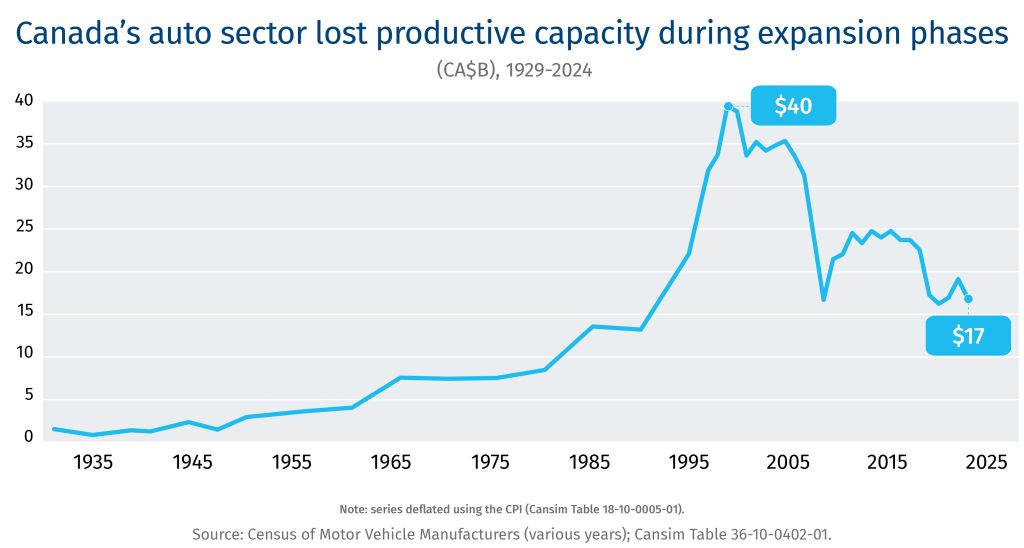
The North American auto industry is highly integrated; parts cross borders across North America up to eight times before a vehicle is assembled. Such tariffs would devastate Canada’s auto industry more than reciprocal tariffs would hurt the U.S. sector—but in absolute terms, the auto sectors on both sides of the border will be damaged by an escalating trade war.
-
The breakdown: Auto trade between Canada and the U.S. is $100 billion (across assembly, parts, and body & trailer). The U.S. runs a $3 billion surplus. Whatever trade is forfeited with Americans, they stand to lose as well.
-
Production hit in the U.S.: While most of the 10-11 million vehicles that are assembled in the U.S. are sold domestically, about 15% are exported, with Canada serving as the largest export market by far—more than the next 10 export markets combined. Closing the door on American imports would hit a channel equal to 7-10% of annual U.S. production.
-
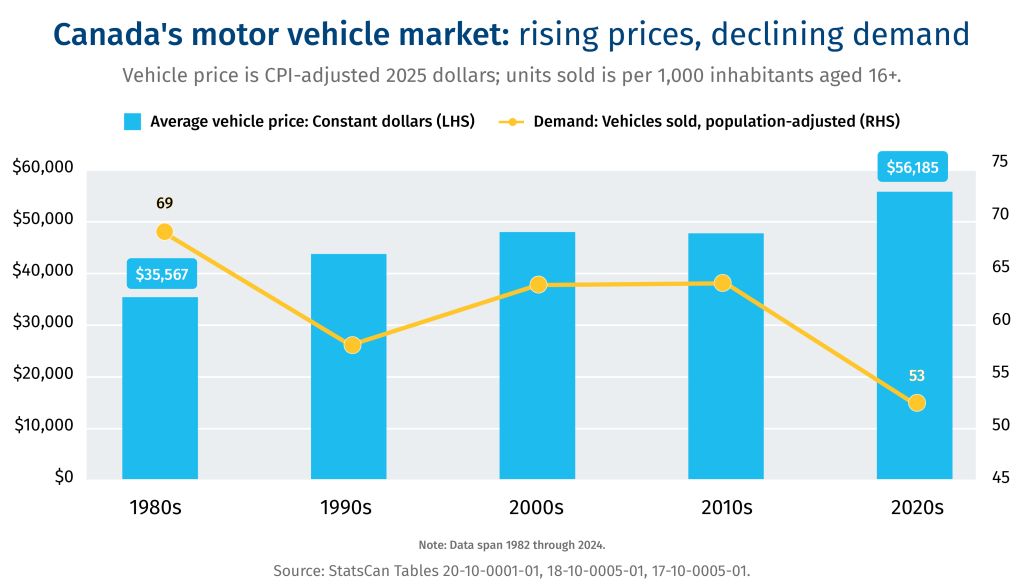
Canadians are big car buyers: Only Americans buy more cars than Canadians on a per-capita basis. Canadians spend nearly $110 billion annually on cars, with 90% of those vehicles built abroad. Canadians also have a penchant for heavier, higher-value vehicles. The Ford F-Series have been the best-selling vehicle in Canada for 15 consecutive years.
-
Tariffs make vehicles more expensive: Auto tariffs on Canada and Mexico alone totalled $1,600 for every vehicle assembled in the U.S.—and that doesn’t account for steel and aluminum tariffs. Tariffs against Canada and Mexico cost North American automakers and suppliers $12.5 billion in the past year.
-
The U.S. is losing market share: While the Canadian market is small relative to the U.S., it is still the largest global buyer of American-made cars and trucks. In the decade before Trump imposed tariffs on the Canadian auto industry, 49% of vehicles imported to Canada were manufactured in the U.S. In the first 10 months of 2025, that number dropped to 36%, with South Korean and Mexican-made vehicles gaining share. If even higher tariffs come into effect, that trend may continue.
Contributors: Alicja Siekierska, Farhad Panahov, Wilson Fink and Jordan Brennan