

 EN


Government climate policies appear to be relaxing, but businesses are still feeling the heat of climate change.
That’s because the climate change has impacted many companies’ operations: from Okanagan Valley winemakers dealing with smoke affected grapes after crushing wildfires, to public utilities forced to import energy after seeing water levels dwindle, and homeowners facing rising insurance home costs on flooding and other forms of extreme weather supercharged by climate change. The United Nations’ latest report notes that the world’s set to cross 1.5°C global warming, which are already proving that climate impacts “will strike faster, hit harder, and last longer, costing more lives and causing deeper disruption.”1 Environmental damage is pervasive on the ground, even if policy pressures, on paper, have receded.
This is borne by investment even as global policy has eased: Global investments in global energy transition hit a record US$2.3 trillion last year, an 8% jump from the previous year, as companies shrugged off the U.S.’s global tariff war and trade barriers are raised across the world.2
Climate-tech investments in Canada remain subdued, with $336 million across 18 deals in the first half of 2026, 4% more in dollar terms but eight fewer transactions than the same period last year, according to the Canadian Venture Capital and Private Equity Association.3 Tech dollars are most likely being diverted to AI or areas where policy is on surer footing and returns are quicker. Climate-tech,4 innovation and programs seem to be jostling for attention to show competitive return on investment compared to other sectors.
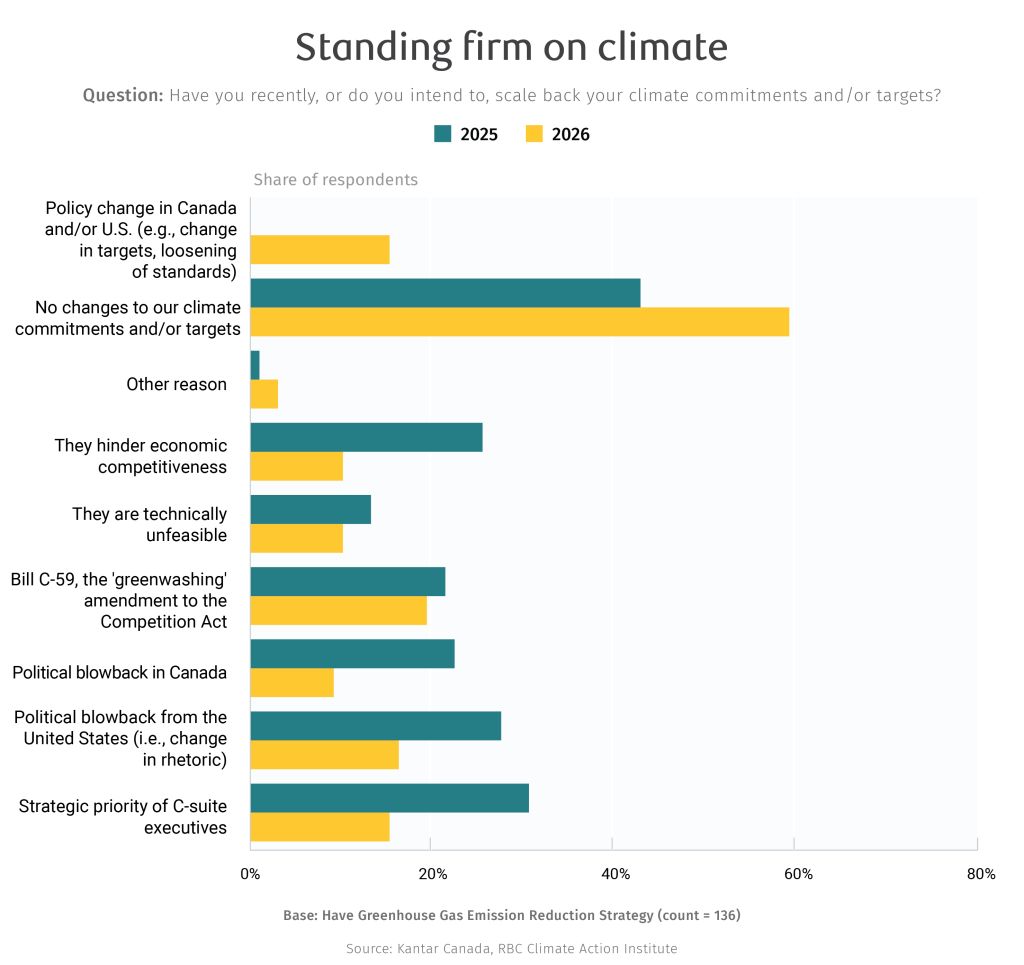
A key finding in this year’s Business Pulse survey of 150 executives was that very few executives offered excuses. Less than 20% cited political dynamics in North America as reasons to scale back their climate commitments, compared to the past two years. And only 1 in 10 cited concerns over eroding economic competitiveness for not pursuing climate policies.
Here are some other insights from the annual survey:
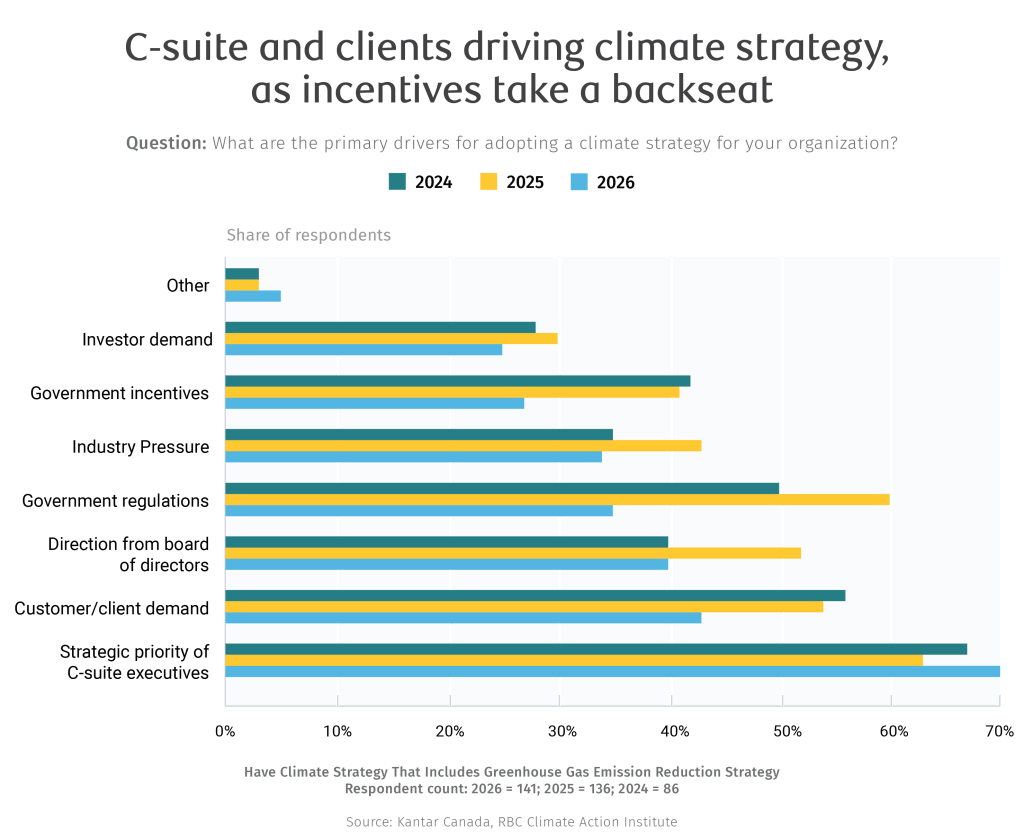
The findings are reinforced by the surveyed executives’ strong C-suite commitments, with these executives overwhelmingly seeing themselves as the biggest drivers of climate strategies in companies (70%), followed by demand from their consumers (43%). Government regulations and incentives now play a less significant role in corporate decision-making than before, the survey suggests. That could be because incentives are easier to get or they are not deemed a prerequisite to energy transition.
The survey of 150 senior business executives across Canada suggest the C-suite is championing climate policies, but access to capital remains a persistent bottleneck:
-
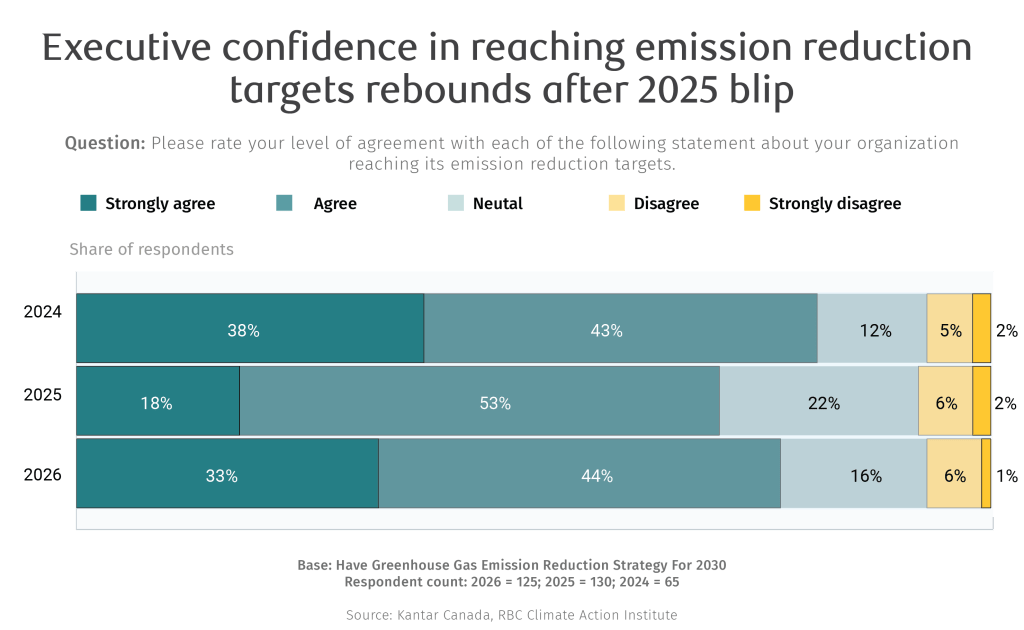
Executive confidence is rebounding: One in three executives (33%) “strongly agree” about hitting their emissions reduction targets—closer to 2024 levels (38%), after last year’s dip when only 18% were very confident of achieving their target.
-
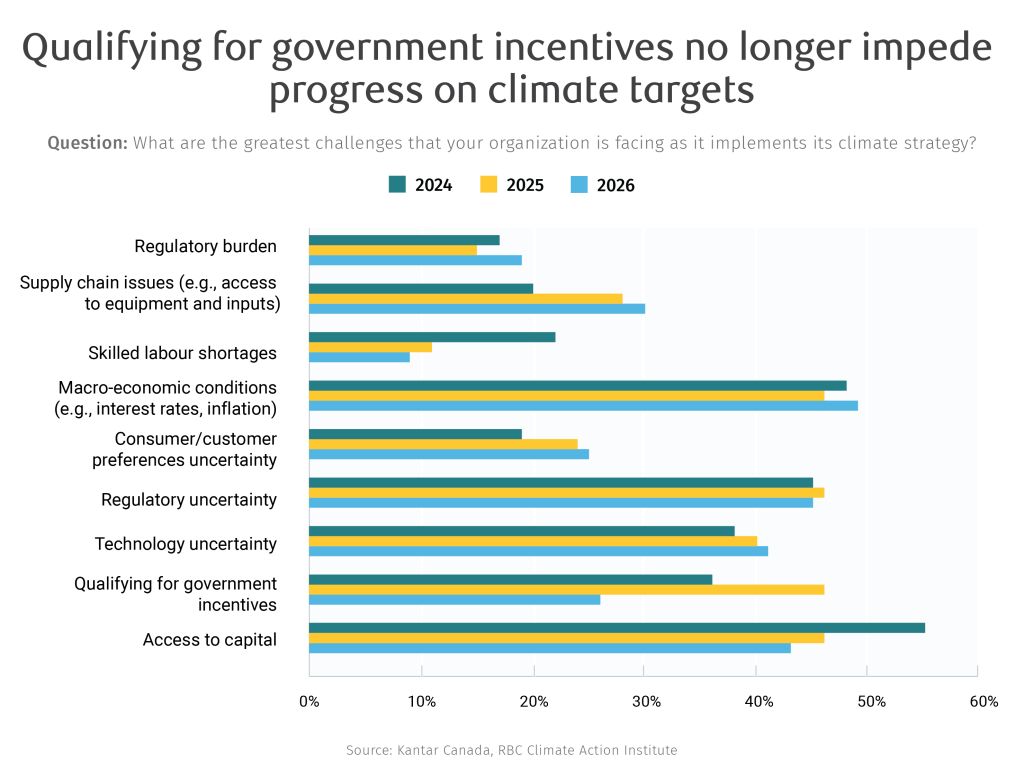
Barriers are easing, but not disappearing altogether: Access to capital (43%, down from 55%/46% in 2024/2025) and qualifying for incentives (26%, down from 36%/46%) both improved. Not surprisingly, macroeconomic conditions emerged as this year’s top challenge.
-
Industrial carbon pricing remains a key lever: 27% said improved carbon pricing is essential to hitting their company targets; 41% believe it’s necessary for Canada to reach Net Zero by 2050—outpacing calls for tighter emissions regulation (19%).
-
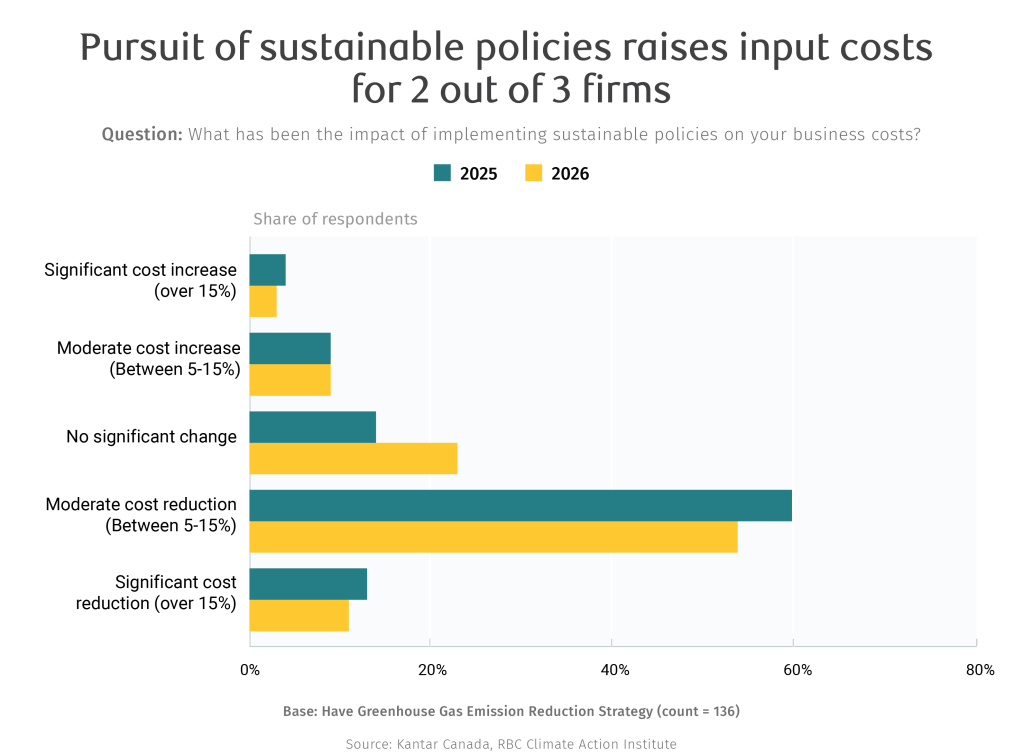
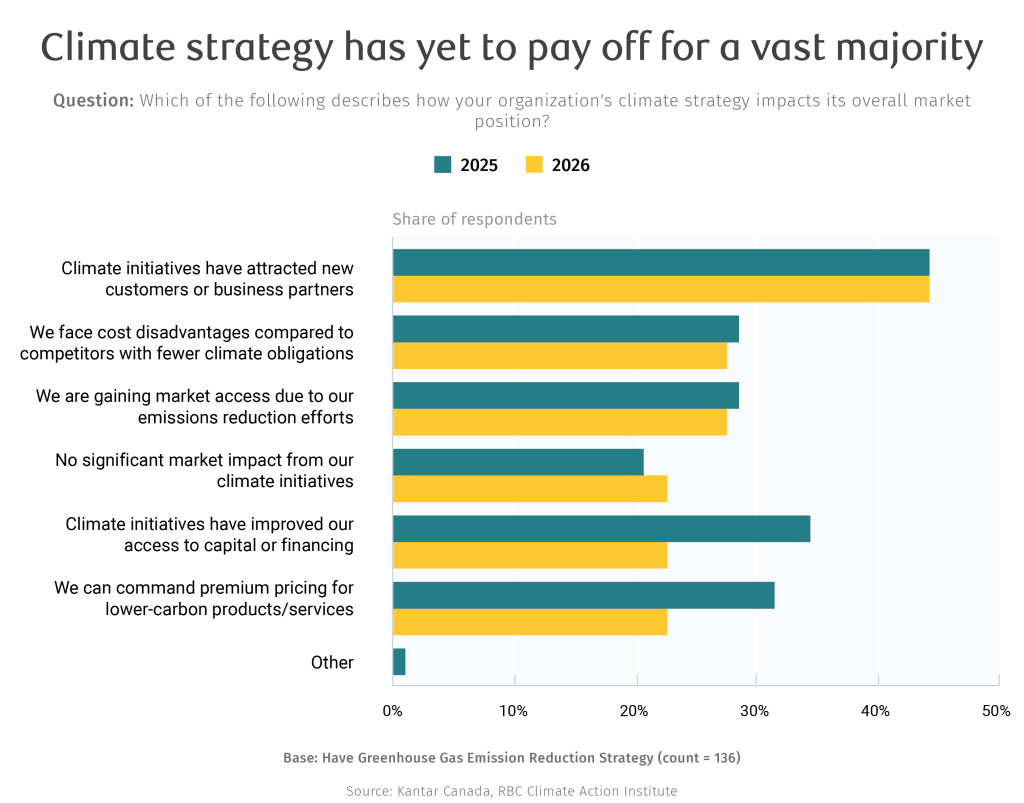
Cost pressure steady, upside shrinking: 54% report moderate cost impact (5–15%)—flat year-on-year—but fewer see a premium-pricing payoff (23%, down from 32%) or easier financing (23%, down from 35%).
-
Cost impacts remain modest for most firms. Only 11% of organizations report significant cost increases exceeding 15% from sustainable policies, while the majority experienced modest or manageable costs. The finding counters the narrative that climate action is inherently expensive, and suggests that many emissions reduction technologies have reached cost-parity or better with conventional alternatives, making climate action economically competitive.
-
No major change in market access. Around 45% of executives reported attracting new customers or business partners, similar to last year’s gains. However, fewer said they could command a premium (23%, compared to 32% in the previous year’s survey). This muted marketplace reward for climate leadership indicates that competitive advantage from climate action remains inconsistent, organizations may need to temper expectations that climate commitments may not automatically translate to market gains.
Government Pulse Check
The government pulse check is informed by quantitative and qualitative insights on government spending, government policy impact on GHG emissions trajectory, and climate policy experts’ perspectives on climate policy and its efficacy in Canada.
The RBC Climate Action Institute research team tracks annual government spending at the federal level and in the four largest provinces by gross domestic product to maintain tracking of government fiscal commitment to climate action.
To understand if government policies and spending are tracking towards 2035 and 2050 targets, the research team also considers the modelled projections of policy on GHG emissions scenarios to provide a directional, quantitative lens on policy efficacy in meeting GHG targets. These projections are produced each year by Environment and Climate Change Canada.
Finally, the research team surveyed an expert policy panel of more than 40 to glean additional detailed insights on the impact of current policies on Canada’s GHG emissions reduction targets. CAI solicited their views of policy efficacy (i.e., did it achieve its desired result), policy impact (i.e., broader consequences of policy–intended and unintended), policy durability (i.e., long-term stability of policy). This survey was conducted between June and August 2026.
The list of participants for the expert policy panel was curated by the Climate Action Institute and the Canadian Climate Institute and included academics, policy experts, former government officials and analysts. Key policy actions identified in the Government Pulse Check—such as carbon pricing, methane regulations and Clean Fuel Regulations, consumer incentives, industry incentives, funding programs and education and awareness—were deemed by our Climate Action team, in collaboration with external climate policy experts, to have a meaningful impact on the trajectory of Canada’s emissions.
Business Pulse Check
The business survey tracks year-over-year change in business leaders’ approach to climate action in their strategies, operations and products and services. The businesses are primarily focused on the six key sectors identified by the CAI Team as our focus areas, namely: Buildings, Agriculture, Oil & Gas, Transport, Heavy Industry, and Electricity.
The business survey is run by Kantar Canada Inc., a third-party vendor in June and July 2026 and attracts roughly 150 business responses.
Kantar Canada’s business survey is a self-administered online poll. It targeted vice-presidents and business leaders on a best-effort recruitment process. The survey was targeting complete responses from 100-150 companies.
Industry coverage included Buildings, Agriculture, Oil & Gas, Transport, Heavy Industry, and Electricity, with top up in ‘other’ industries.
Consumer Pulse Check
The consumer survey tracks year-over-year change in Canadian consumers’ perspectives, experiences and actions on climate change.
The consumer survey is run by a third-party vendor, Ipsos Canada, between June and July 2026 and collects roughly 2,000 individual responses from its Ipsos online omnibus in English and French across Canada.
This survey examines the views, experiences, and actions related to climate change among adults in Canada, the United States, and the United Kingdom.
All three countries were asked the same three questions, while respondents in Canada were asked an additional 11 questions.
The survey was conducted online between June 3–5, 2026 in Canada, June 8–9, 2026 in the United States; and June 12–16, 2026 in the United Kingdom.
Surveys were completed by adults aged 18 and older through the Ipsos I-Say Panel.
Results are considered accurate within a confidence interval (+/- percentage points), 19 times out of 20, compared to what would have been obtained if all adults aged 18+ had been surveyed. Sample sizes and confidence intervals are as follows:
CA n=2001 +/- 2.7
To allow for international comparisons, Ipsos ran select questions in the U.K. and U.S. to gleam insights from international consumers. These surveys run in June and July and collect roughly 1,000 responses each.
Sample sizes and confidence intervals are as follows:
U.S. n=1005 +/- 3.8
U.K. n=1122 +/- 3.6
This article is intended as general information only and is not to be relied upon as constituting legal, financial or other professional advice. The reader is solely liable for any use of the information contained in this document and Royal Bank of Canada (“RBC”) nor any of its affiliates nor any of their respective directors, officers, employees or agents shall be held responsible for any direct or indirect damages arising from the use of this document by the reader. A professional advisor should be consulted regarding your specific situation. Information presented is believed to be factual and up-to-date but we do not guarantee its accuracy and it should not be regarded as a complete analysis of the subjects discussed. All expressions of opinion reflect the judgment of the authors as of the date of publication and are subject to change. No endorsement of any third parties or their advice, opinions, information, products or services is expressly given or implied by Royal Bank of Canada or any of its affiliates. This document may contain forward-looking statements within the meaning of certain securities laws, which are subject to RBC’s caution regarding forward-looking statements. ESG (including climate) metrics, data and other information contained on this website are or may be based on assumptions, estimates and judgements. For cautionary statements relating to the information on this website, refer to the “Caution regarding forward-looking statements” and the “Important notice regarding this document” sections in our latest climate report or sustainability report, available at: https://www.rbc.com/our-impact/sustainability-reporting/index.html. Except as required by law, none of RBC nor any of its affiliates undertake to update any information in this document.